1.What did you see in
the video?
3.Have you ever been to
the airport before?
2.Where the video
took place?
arrive
(v.)
to get to the place you are
going toEx. you should arrive at the
airport with plenty of time to
spare.
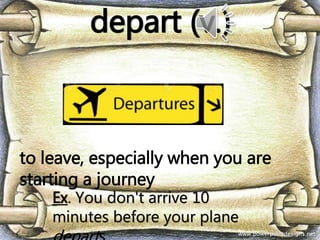
depart (v.)
to leave, especially when you are
starting a journey
Ex. You don't arrive 10
minutes before your plane
gate
(n.)
the place where you leave an airport
building to get
on a planeEx. You can walk to the
gate where you can wait to
terminal (n.)
a big building where people wait to
get onto planes
Ex. My mother wait me at
terminal 1.
check in
(n.)
a place where you report your arrival
at an airport
Ex. Please check in at least an
hour before departure.
How to use “Modal
helping verbs”
We use modal helping verbs to
"modify" the meaning of the main verb
in some way. A modal helping verb
expresses necessity or possibility, and
changes the main verb in that sense.
The list below shows all of the modal
helping verbs :
Prese
ent
can may will shall
Past coul migh woul shou
must
Ex. You can go home now if you like.
Could We use could as the past tense of can to show
that something is possible in the future, but not certain:
Can We use the can to give permission.
Ex. They could have arrived hours ago.
Will We use to express the future
/ prediction.
Ex. It will rain
tomorrow.
Would We use would as the past
tense of will to show the expression a
wish or desire. I
Ex. I would like to have one
more pencil.
Should We use Should as the past
tense of Shall to say something
expected or correct.
Ex. There should be an old city hall
building here.
Shall We Often used in formal
settings to deliver obligation or
requirement.
Ex. Students shall not enter
this room.
Airport
Information
While
-
Activit
y
Post
Activi
ty
Listen
and
Orde
Directio
ns
The airport is your first stop before leaving on your drea
Generally speaking, you should arrive at the airport
with plenty of time to spare. Don't arrive 10 minutes
before your plane departs.
You can park your car in long-term parking if you are pla
a few days, or you can ask someone to drop you off in th
in front of the airport terminal.
In some cases, you can check your bags there at curbsid
might have to go to the check-in counter inside the airp
Many airports now allow you to check in at a
computer kiosk, but you will still need to check
your bags if you have any.
Once you are checked in, you will have to pass
through security where they will check your ID and
your carry-on bags.
You will also need to walk through a metal
detector, which will check for
illegal items. After you pass through security, you
can walk to the gate
where you can wait to board your flight.
Just wait until they call your section to board. They
usually seat first-class
passengers and those who need assistance first.
Enjoy your flight.
“You have reached the gate, and your
plane is about to
depart. However, you just realized that
you are missing
your laptop. Describe where you went
งานนำเสนอ2

งานนำเสนอ2

  • 3.
    1.What did yousee in the video? 3.Have you ever been to the airport before? 2.Where the video took place?
  • 5.
    arrive (v.) to get tothe place you are going toEx. you should arrive at the airport with plenty of time to spare.
  • 6.
    depart (v.) to leave,especially when you are starting a journey Ex. You don't arrive 10 minutes before your plane
  • 7.
    gate (n.) the place whereyou leave an airport building to get on a planeEx. You can walk to the gate where you can wait to
  • 8.
    terminal (n.) a bigbuilding where people wait to get onto planes Ex. My mother wait me at terminal 1.
  • 9.
    check in (n.) a placewhere you report your arrival at an airport Ex. Please check in at least an hour before departure.
  • 11.
    How to use“Modal helping verbs” We use modal helping verbs to "modify" the meaning of the main verb in some way. A modal helping verb expresses necessity or possibility, and changes the main verb in that sense. The list below shows all of the modal helping verbs : Prese ent can may will shall Past coul migh woul shou must
  • 12.
    Ex. You cango home now if you like. Could We use could as the past tense of can to show that something is possible in the future, but not certain: Can We use the can to give permission. Ex. They could have arrived hours ago.
  • 13.
    Will We useto express the future / prediction. Ex. It will rain tomorrow. Would We use would as the past tense of will to show the expression a wish or desire. I Ex. I would like to have one more pencil.
  • 14.
    Should We useShould as the past tense of Shall to say something expected or correct. Ex. There should be an old city hall building here. Shall We Often used in formal settings to deliver obligation or requirement. Ex. Students shall not enter this room.
  • 15.
  • 16.
  • 17.
  • 18.
  • 19.
    The airport isyour first stop before leaving on your drea Generally speaking, you should arrive at the airport with plenty of time to spare. Don't arrive 10 minutes before your plane departs. You can park your car in long-term parking if you are pla a few days, or you can ask someone to drop you off in th in front of the airport terminal. In some cases, you can check your bags there at curbsid might have to go to the check-in counter inside the airp
  • 20.
    Many airports nowallow you to check in at a computer kiosk, but you will still need to check your bags if you have any. Once you are checked in, you will have to pass through security where they will check your ID and your carry-on bags. You will also need to walk through a metal detector, which will check for illegal items. After you pass through security, you can walk to the gate where you can wait to board your flight. Just wait until they call your section to board. They usually seat first-class passengers and those who need assistance first. Enjoy your flight.
  • 22.
    “You have reachedthe gate, and your plane is about to depart. However, you just realized that you are missing your laptop. Describe where you went