Top 10 HIS Vendors by 2016 Revenue
Part 2: High-end Vendors
© 2017 by H.I.S. Professionals, LLC, all rights reserved.
By Vince Ciotti & Elise Ames
HIS Professionals, LLC
High-End Vendors
• After the market overview last week, the next 3 episodes delve
into the details of the vendors by size & target market, first:
– High-end = vendors with over $1.5B that primarily target
large hospitals of 300+ beds, AMCs and multi-IDNs.
– Mid-Range = vendors with ≈$.5 to $1B in revenue, generally
targeting small to mid-size hospitals under 300 beds.
– Low-end = vendors with annual revenue under ≈$250M also
targeting small to mid-size hospitals of under 300 beds.
• Interesting how the size of vendors’ revenue
corresponds to bed size of their target market!
• For each vendor, we’ll give details on their:
- Annual revenue and growth/decline
- Product line and target markets
- Recent developments & future prospects.
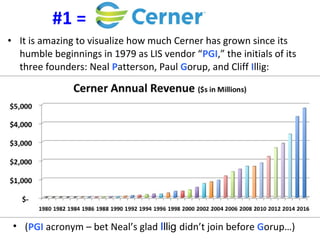
• It is amazing to visualize how much Cerner has grown since its
humble beginnings in 1979 as LIS vendor “PGI,” the initials of its
three founders: Neal Patterson, Paul Gorup, and Cliff Illig:
#1 =
• (PGI acronym – bet Neal’s glad Illig didn’t join before Gorup…)
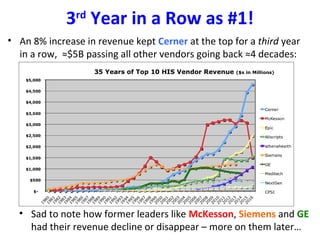
• An 8% increase in revenue kept Cerner at the top for a third year
in a row, ≈$5B passing all other vendors going back ≈4 decades:
3rd
Year in a Row as #1!
• Sad to note how former leaders like McKesson, Siemens and GE
had their revenue decline or disappear – more on them later…
Recent Developments
• Several developments in 2016 have helped Cerner grow:
– Return of founder Neal Patterson to full-time employment
this January, after successfully battling cancer last year.
– Strong sales to Siemens clients such as: Universal Health
System (UHS), Missouri Delta, McLeod Health, Baptist…
– In addition, Cerner sold a number of McKesson’s sunsetting
“Horizon” clients like Centra, Covenant and Boca Raton.
• How does Cerner earn so much $s? Like many vendors, they
have diversified their products and services far beyond pure HIS:
– Medical Devices, Patient Engagement, Physician Practices,
Pharmacy, Population Health, Workplace Health, etc.
– “RevWorks” division outsources RCM, and Cerner outsources
IT shops, transferring millions of $s from hospital payrolls.
– They also run most clients from 2 enormous data centers in
KC; remote hosting brings in about 17% of their revenue.
Next Year?
• We are bullish on Cerner maintaining the #1 position for years:
– Cerner has access to the C-suites of hundreds of Siemens’
clients on Soarian, Invision, Eagle & Medseries, which their
superb sales teams should do very well converting.
– The DoD contract worth ≈$9B was a major coup in 2015,
although most of that revenue will go to Leidos (SAIC).
• Downsides? Yes, like all vendors, Cerner faces challenges too:
– Epic always does well with large AMCs and IDNS, and has
won several large Siemens clients like Main Line Health.
– And also like Epic, Cerner has experienced a number of
troubled projects like Island Health and California Prisons…
• So Cerner is now the new “normal” – after a 15
year run by HBOC/McKesson, and 15 by SMS/
Siemens. Will Cerner lead for the next 15 years?
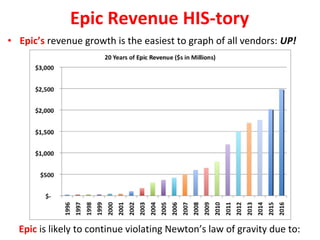
• Moving into 2nd place is Judy Faulkner’s epic journey that has
won the majority of large AMC & multi-IDNs for many years...
• Their revenue went up 23% from $2 to $2.5 billion last year,
amazing considering almost every hospital by now has an EMR so
the number of system selections has been relatively slim…
• They will probably win as much as Cerner from Siemens’ large
hospital clients on Invision & Soarian, at least those who look.
– They also offer “Community Connect,” which allows large
AMC/IDNs to host neighboring CAH & smaller hospitals.
– Their new “remote hosting” data center is fully operational, so
future revenue prospects are as solid as WI’s frozen lakes.
• As SMS & Cerner have proven, remote hosting
increases revenue enormously over inhouse
processing; like Meditech, Epic never sold
hardware, lowering past revenue substantially.
• Epic’s revenue growth is the easiest to graph of all vendors: UP!
Epic Revenue HIS-tory
Epic is likely to continue violating Newton’s law of gravity due to:
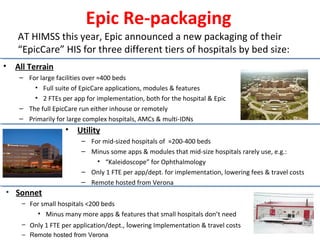
Epic Re-packaging
• All Terrain
– For large facilities over ≈400 beds
• Full suite of EpicCare applications, modules & features
• 2 FTEs per app for implementation, both for the hospital & Epic
– The full EpicCare run either inhouse or remotely
– Primarily for large complex hospitals, AMCs & multi-IDNs
• Sonnet
– For small hospitals <200 beds
• Minus many more apps & features that small hospitals don’t need
– Only 1 FTE per application/dept., lowering Implementation & travel costs
– Remote hosted from Verona
AT HIMSS this year, Epic announced a new packaging of their
“EpicCare” HIS for three different tiers of hospitals by bed size:
• Utility
– For mid-sized hospitals of ≈200-400 beds
– Minus some apps & modules that mid-size hospitals rarely use, e.g.:
• “Kaleidoscope” for Ophthalmology
– Only 1 FTE per app/dept. for implementation, lowering fees & travel costs
– Remote hosted from Verona
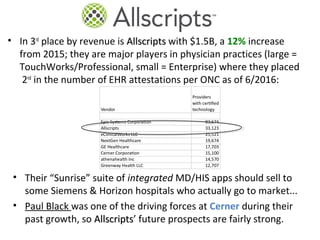
• In 3rd
place by revenue is AllscriptsAllscripts with $1.5B, a 12% increase
from 2015; they are major players in physician practices (large =
TouchWorks/Professional, small = Enterprise) where they placed
2nd
in the number of EHR attestations per ONC as of 6/2016:
• Their “Sunrise” suite of integrated MD/HIS apps should sell to
some Siemens & Horizon hospitals who actually go to market...
• Paul Black was one of the driving forces at Cerner during their
past growth, so AllscriptsAllscripts’ future prospects are fairly strong.
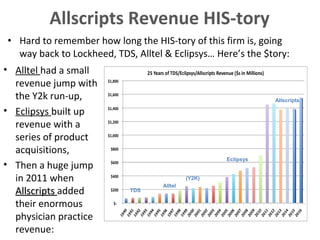
• Hard to remember how long the HIS-tory of this firm is, going
way back to Lockheed, TDS, Alltel & Eclipsys… Here’s the $tory:
• Alltel had a small
revenue jump with
the Y2k run-up,
• Eclipsys built up
revenue with a
series of product
acquisitions,
• Then a huge jump
in 2011 when
AllscriptsAllscripts added
their enormous
physician practice
revenue:
Allscripts Revenue HIS-tory
(Y2K)
Allscripts
Eclipsys
TDS
Alltel
• Slipping to 4th place place is pharma giant McKesson whose
total drug revenue in FY 2016 is in the gazillions, but our
estimate is their IT division “EIS” dropped 50% to ≈$1.5B:
– We had to estimate $s since their fiscal year end is March,
whereas most other vendors are calendar year-end…
– The reasons we estimated the IT decline by 50% are:
• Sale of MD practice systems (≈10% revenue) to eMDs:
– Practice Choice, Medisoft, Lytec, and Practice
Partners.
• Sale of 3 core systems (≈40% revenue) to Change Health:
– Relay Health, PACS and physician practice collections.• The remaining ½ of EIS is still up for sale:
- Paragon, Horizon, Star, HealthQuest, Series
- Rumors are a potential buyer is an Indian
consultancy; as the Brits say, Ta-ta for now…
McKesson Revenue History
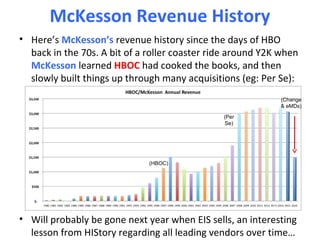
• Here’s McKesson’s revenue history since the days of HBO
back in the 70s. A bit of a roller coaster ride around Y2K when
McKesson learned HBOC had cooked the books, and then
slowly built things up through many acquisitions (eg: Per Se):
• Will probably be gone next year when EIS sells, an interesting
lesson from HIStory regarding all leading vendors over time…
(Per
Se)
(HBOC)
(Change
& eMDs)
• We dropped GE from our Top HIS Vendor list last year due to
their shrunken number of “Centricity” hospital clients - only 11
attestations per the ONC list. GE had acquired it from IDX as
“CareCast,” re-named from “LastWord” and “PHAMIS”...
• GE remains a very strong player in the MD
practice market (ranked #5 on ONC’s list of
attestations), but they have lost so many
hospitals to leaders like Epic & Cerner over the
past 5 years that they’re hardly an HIS player.
• Other vendors have also disappeared from previous Top 10 lists:
- NextGen – HIS products acquired by Harris Healthcare
- Healthland – CAH leader acquired by CPSI (Evident)
The fate of both will be covered in subsequent episodes, along
with several new vendor names that are “up & comers…”
Dropped:
Next 2 Weeks
• We’ll delve into the details of the remaining Top 10 HIS vendors
over the next episodes, who are more in the small and mid-size
market segment (both in terms of bed size and annual revenue):
– Mid-Size – vendors whose revenue falls between $.5B and
$1B, and who target mainly small to mid-size hospitals:
Meditech (all 3 products) and two physician practice vendors
new to the HIS market - eClinicalWorkseClinicalWorks and athenahealth
– Small – vendors whose annual revenue is below ≈$250M and
client base consists of small to mid-sized hospitals: CPSI, NTT
Data (Keane), Harris (QuadraMed), and Medhost, (HMS).
• With a subject area so wide and deep, it’s hard to cover it all in a
few slides so feel free to contact us with questions or comments:
vciotti@hispros.com eames@hispros.com
505.466.4958 413.329.6925

2. 2017 Macro Vendors

  • 1.
    Top 10 HISVendors by 2016 Revenue Part 2: High-end Vendors © 2017 by H.I.S. Professionals, LLC, all rights reserved. By Vince Ciotti & Elise Ames HIS Professionals, LLC
  • 2.
    High-End Vendors • Afterthe market overview last week, the next 3 episodes delve into the details of the vendors by size & target market, first: – High-end = vendors with over $1.5B that primarily target large hospitals of 300+ beds, AMCs and multi-IDNs. – Mid-Range = vendors with ≈$.5 to $1B in revenue, generally targeting small to mid-size hospitals under 300 beds. – Low-end = vendors with annual revenue under ≈$250M also targeting small to mid-size hospitals of under 300 beds. • Interesting how the size of vendors’ revenue corresponds to bed size of their target market! • For each vendor, we’ll give details on their: - Annual revenue and growth/decline - Product line and target markets - Recent developments & future prospects.
  • 3.
    • It isamazing to visualize how much Cerner has grown since its humble beginnings in 1979 as LIS vendor “PGI,” the initials of its three founders: Neal Patterson, Paul Gorup, and Cliff Illig: #1 = • (PGI acronym – bet Neal’s glad Illig didn’t join before Gorup…)
  • 4.
    • An 8%increase in revenue kept Cerner at the top for a third year in a row, ≈$5B passing all other vendors going back ≈4 decades: 3rd Year in a Row as #1! • Sad to note how former leaders like McKesson, Siemens and GE had their revenue decline or disappear – more on them later…
  • 5.
    Recent Developments • Severaldevelopments in 2016 have helped Cerner grow: – Return of founder Neal Patterson to full-time employment this January, after successfully battling cancer last year. – Strong sales to Siemens clients such as: Universal Health System (UHS), Missouri Delta, McLeod Health, Baptist… – In addition, Cerner sold a number of McKesson’s sunsetting “Horizon” clients like Centra, Covenant and Boca Raton. • How does Cerner earn so much $s? Like many vendors, they have diversified their products and services far beyond pure HIS: – Medical Devices, Patient Engagement, Physician Practices, Pharmacy, Population Health, Workplace Health, etc. – “RevWorks” division outsources RCM, and Cerner outsources IT shops, transferring millions of $s from hospital payrolls. – They also run most clients from 2 enormous data centers in KC; remote hosting brings in about 17% of their revenue.
  • 6.
    Next Year? • Weare bullish on Cerner maintaining the #1 position for years: – Cerner has access to the C-suites of hundreds of Siemens’ clients on Soarian, Invision, Eagle & Medseries, which their superb sales teams should do very well converting. – The DoD contract worth ≈$9B was a major coup in 2015, although most of that revenue will go to Leidos (SAIC). • Downsides? Yes, like all vendors, Cerner faces challenges too: – Epic always does well with large AMCs and IDNS, and has won several large Siemens clients like Main Line Health. – And also like Epic, Cerner has experienced a number of troubled projects like Island Health and California Prisons… • So Cerner is now the new “normal” – after a 15 year run by HBOC/McKesson, and 15 by SMS/ Siemens. Will Cerner lead for the next 15 years?
  • 7.
    • Moving into2nd place is Judy Faulkner’s epic journey that has won the majority of large AMC & multi-IDNs for many years... • Their revenue went up 23% from $2 to $2.5 billion last year, amazing considering almost every hospital by now has an EMR so the number of system selections has been relatively slim… • They will probably win as much as Cerner from Siemens’ large hospital clients on Invision & Soarian, at least those who look. – They also offer “Community Connect,” which allows large AMC/IDNs to host neighboring CAH & smaller hospitals. – Their new “remote hosting” data center is fully operational, so future revenue prospects are as solid as WI’s frozen lakes. • As SMS & Cerner have proven, remote hosting increases revenue enormously over inhouse processing; like Meditech, Epic never sold hardware, lowering past revenue substantially.
  • 8.
    • Epic’s revenuegrowth is the easiest to graph of all vendors: UP! Epic Revenue HIS-tory Epic is likely to continue violating Newton’s law of gravity due to:
  • 9.
    Epic Re-packaging • AllTerrain – For large facilities over ≈400 beds • Full suite of EpicCare applications, modules & features • 2 FTEs per app for implementation, both for the hospital & Epic – The full EpicCare run either inhouse or remotely – Primarily for large complex hospitals, AMCs & multi-IDNs • Sonnet – For small hospitals <200 beds • Minus many more apps & features that small hospitals don’t need – Only 1 FTE per application/dept., lowering Implementation & travel costs – Remote hosted from Verona AT HIMSS this year, Epic announced a new packaging of their “EpicCare” HIS for three different tiers of hospitals by bed size: • Utility – For mid-sized hospitals of ≈200-400 beds – Minus some apps & modules that mid-size hospitals rarely use, e.g.: • “Kaleidoscope” for Ophthalmology – Only 1 FTE per app/dept. for implementation, lowering fees & travel costs – Remote hosted from Verona
  • 10.
    • In 3rd placeby revenue is AllscriptsAllscripts with $1.5B, a 12% increase from 2015; they are major players in physician practices (large = TouchWorks/Professional, small = Enterprise) where they placed 2nd in the number of EHR attestations per ONC as of 6/2016: • Their “Sunrise” suite of integrated MD/HIS apps should sell to some Siemens & Horizon hospitals who actually go to market... • Paul Black was one of the driving forces at Cerner during their past growth, so AllscriptsAllscripts’ future prospects are fairly strong.
  • 11.
    • Hard toremember how long the HIS-tory of this firm is, going way back to Lockheed, TDS, Alltel & Eclipsys… Here’s the $tory: • Alltel had a small revenue jump with the Y2k run-up, • Eclipsys built up revenue with a series of product acquisitions, • Then a huge jump in 2011 when AllscriptsAllscripts added their enormous physician practice revenue: Allscripts Revenue HIS-tory (Y2K) Allscripts Eclipsys TDS Alltel
  • 12.
    • Slipping to4th place place is pharma giant McKesson whose total drug revenue in FY 2016 is in the gazillions, but our estimate is their IT division “EIS” dropped 50% to ≈$1.5B: – We had to estimate $s since their fiscal year end is March, whereas most other vendors are calendar year-end… – The reasons we estimated the IT decline by 50% are: • Sale of MD practice systems (≈10% revenue) to eMDs: – Practice Choice, Medisoft, Lytec, and Practice Partners. • Sale of 3 core systems (≈40% revenue) to Change Health: – Relay Health, PACS and physician practice collections.• The remaining ½ of EIS is still up for sale: - Paragon, Horizon, Star, HealthQuest, Series - Rumors are a potential buyer is an Indian consultancy; as the Brits say, Ta-ta for now…
  • 13.
    McKesson Revenue History •Here’s McKesson’s revenue history since the days of HBO back in the 70s. A bit of a roller coaster ride around Y2K when McKesson learned HBOC had cooked the books, and then slowly built things up through many acquisitions (eg: Per Se): • Will probably be gone next year when EIS sells, an interesting lesson from HIStory regarding all leading vendors over time… (Per Se) (HBOC) (Change & eMDs)
  • 14.
    • We droppedGE from our Top HIS Vendor list last year due to their shrunken number of “Centricity” hospital clients - only 11 attestations per the ONC list. GE had acquired it from IDX as “CareCast,” re-named from “LastWord” and “PHAMIS”... • GE remains a very strong player in the MD practice market (ranked #5 on ONC’s list of attestations), but they have lost so many hospitals to leaders like Epic & Cerner over the past 5 years that they’re hardly an HIS player. • Other vendors have also disappeared from previous Top 10 lists: - NextGen – HIS products acquired by Harris Healthcare - Healthland – CAH leader acquired by CPSI (Evident) The fate of both will be covered in subsequent episodes, along with several new vendor names that are “up & comers…” Dropped:
  • 15.
    Next 2 Weeks •We’ll delve into the details of the remaining Top 10 HIS vendors over the next episodes, who are more in the small and mid-size market segment (both in terms of bed size and annual revenue): – Mid-Size – vendors whose revenue falls between $.5B and $1B, and who target mainly small to mid-size hospitals: Meditech (all 3 products) and two physician practice vendors new to the HIS market - eClinicalWorkseClinicalWorks and athenahealth – Small – vendors whose annual revenue is below ≈$250M and client base consists of small to mid-sized hospitals: CPSI, NTT Data (Keane), Harris (QuadraMed), and Medhost, (HMS). • With a subject area so wide and deep, it’s hard to cover it all in a few slides so feel free to contact us with questions or comments: vciotti@hispros.com eames@hispros.com 505.466.4958 413.329.6925