Slides by Sebastian Martinez, Christel Vermeersch and Paul Gertler. We thank Patrick Premand and Martin Ruegenberg for
contributions. The content of this presentation reflects the views of the authors and not necessarily those of the World Bank .
Measuring Impact
Impact Evaluation Methods for
Policy Makers – A Refresher
Gil Shapira
Damien de Walque
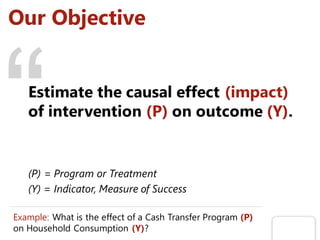
Our Objective
Estimate the causal effect (impact)
of intervention (P) on outcome (Y).
(P) = Program or Treatment
(Y) = Indicator, Measure of Success
Example: What is the effect of a Cash Transfer Program (P)
on Household Consumption (Y)?
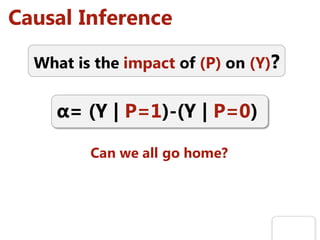
Causal Inference
What is the impact of (P) on (Y)?
α= (Y | P=1)-(Y | P=0)
Can we all go home?
Problem of Missing Data
For a program beneficiary:
α= (Y | P=1)-(Y | P=0)
we observe
(Y | P=1): Household Consumption (Y) with
a cash transfer program (P=1)
but we do not observe
(Y | P=0): Household Consumption (Y)
without a cash transfer program (P=0)
Solution
Estimate what would have happened to
Y in the absence of P.
We call this the Counterfactual.
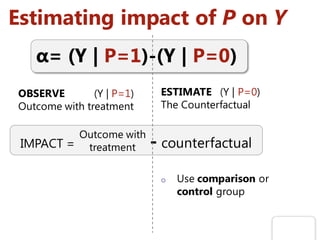
Estimating impact of P on Y
OBSERVE (Y | P=1)
Outcome with treatment
ESTIMATE (Y | P=0)
The Counterfactual
o Use comparison or
control group
α= (Y | P=1)-(Y | P=0)
IMPACT = - counterfactual
Outcome with
treatment
Example: What is the Impact of…
giving Fulanito
(P)
(Y)?
additional pocket money
on Fulanito’s consumption
of candies
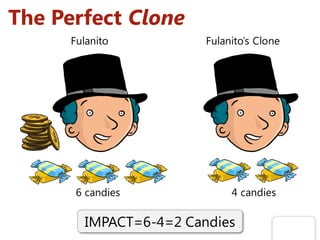
The Perfect Clone
Fulanito Fulanito’s Clone
IMPACT=6-4=2 Candies
6 candies 4 candies
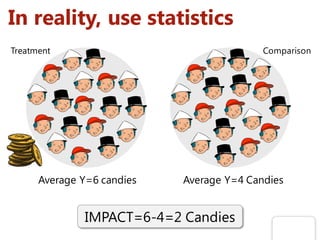
In reality, use statistics
Treatment Comparison
Average Y=6 candies Average Y=4 Candies
IMPACT=6-4=2 Candies
Finding good comparison groups
We want to find clones for the Fulanitos in our
programs.
The treatment and comparison groups should
o have identical characteristics
o except for benefiting from the intervention.
In practice, use program eligibility & assignment
rules to construct valid estimates of the
counterfactuals
Case Study: Progresa
National anti-poverty program in Mexico
o Started 1997
o 5 million beneficiaries by 2004
o Eligibility – based on poverty index
Cash Transfers
o Conditional on school and health care attendance.
Case Study: Progresa
Rigorous impact evaluation with rich data
o 506 communities, 24,000 households
o Baseline 1997, follow-up 2008
Many outcomes of interest
Here: Consumption per capita
What is the effect of Progresa (P) on
Consumption Per Capita (Y)?
If impact is a increase of $20 or more, then scale up
nationally
Eligibility and Enrollment
Ineligibles
(Non-Poor)
Eligibles
(Poor)
Enrolled
Not Enrolled
Causal
Inference
Counterfactuals
False Counterfactuals
Before & After (Pre & Post)
Enrolled & Not Enrolled
(Apples & Oranges)
Counterfeit Counterfactual #1
Y
TimeT=0
Baseline
T=1
Endline
A-B = 4
A-C = 2
IMPACT?
B
A
C (counterfactual)
Before & After
Case 1: Before & After
What is the effect of Progresa (P) on
consumption (Y)?
Y
TimeT=1997 T=1998
α = $35
IMPACT=A-B= $35
B
A
233
268(1) Observe only
beneficiaries (P=1)
(2) Two observations
in time:
Consumption at T=0
and consumption at
T=1.
Case 1: Before & After
Note: If the effect is statistically significant at the 1% significance level, we label the
estimated impact with 2 stars (**).
Consumption (Y)
Outcome with Treatment
(After) 268.7
Counterfactual
(Before) 233.4
Impact
(Y | P=1) - (Y | P=0) 35.3***
Case 1: What’s the problem?
Y
TimeT=0 T=1
α = $35
B
A
233
268
Economic Boom:
o Real Impact=A-C
o A-B is an
overestimate
C ?
D ?
Impact?
Impact?
Economic Recession:
o Real Impact=A-D
o A-B is an
underestimate
Causal
Inference
Counterfactuals
False Counterfactuals
Before & After (Pre & Post)
Enrolled & Not Enrolled
(Apples & Oranges)
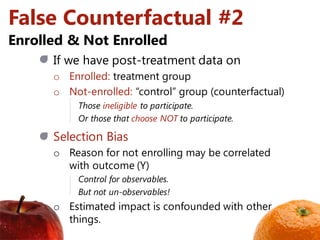
False Counterfactual #2
If we have post-treatment data on
o Enrolled: treatment group
o Not-enrolled: “control” group (counterfactual)
Those ineligible to participate.
Or those that choose NOT to participate.
Selection Bias
o Reason for not enrolling may be correlated
with outcome (Y)
Control for observables.
But not un-observables!
o Estimated impact is confounded with other
things.
Enrolled & Not Enrolled
Measure outcomes in post-treatment (T=1)
Case 2: Enrolled & Not Enrolled
Enrolled
Y=268
Not Enrolled
Y=290
Ineligibles
(Non-Poor)
Eligibles
(Poor)
In what ways might E&NE be different, other than their enrollment in the program?
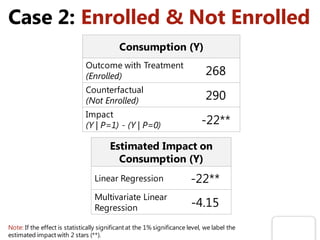
Case 2: Enrolled & Not Enrolled
Consumption (Y)
Outcome with Treatment
(Enrolled) 268
Counterfactual
(Not Enrolled) 290
Impact
(Y | P=1) - (Y | P=0) -22**
Estimated Impact on
Consumption (Y)
Linear Regression -22**
Multivariate Linear
Regression -4.15
Note: If the effect is statistically significant at the 1% significance level, we label the
estimated impact with 2 stars (**).
Progresa Policy Recommendation?
Will you recommend scaling up Progresa?
B&A: Are there other time-varying factors that also
influence consumption?
E&NE:
o Are reasons for enrolling correlated with consumption?
o Selection Bias.
Impact on Consumption (Y)
Case 1: Before & After 35.3***
Case 2: Enrolled& Not Enrolled -22**
Note: If the effect is statistically significant at the 1% significance level, we label the
estimated impact with 2 stars (**).
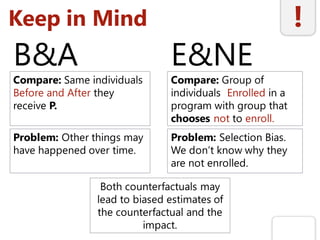
B&A
Compare: Same individuals
Before and After they
receive P.
Problem: Other things may
have happened over time.
E&NE
Compare: Group of
individuals Enrolled in a
program with group that
chooses not to enroll.
Problem: Selection Bias.
We don’t know why they
are not enrolled.
Keep in Mind
Both counterfactuals may
lead to biased estimates of
the counterfactual and the
impact.
!
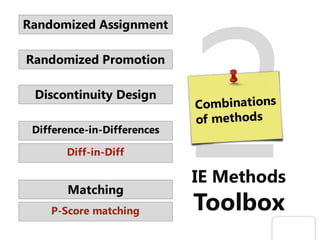
IE Methods
Toolbox
Randomized Assignment
Discontinuity Design
Diff-in-Diff
Randomized Promotion
Difference-in-Differences
P-Score matching
Matching
Randomized Treatments & Controls
o Randomize!
o Lottery for who is offered benefits
o Fair, transparent and ethical way to assign benefits to equally
deserving populations.
Eligibles > Number of Benefits
o Give each eligible unit the same chance of receiving treatment
o Compare those offered treatment with those not offered
treatment (controls).
Oversubscription
o Give each eligible unit the same chance of receiving treatment
first, second, third…
o Compare those offered treatment first, with those
offered later (controls).
Randomized Phase In
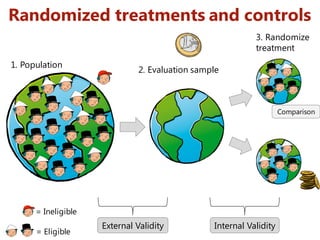
= Ineligible
Randomized treatments and controls
= Eligible
1. Population
External Validity
2. Evaluation sample
3. Randomize
treatment
Internal Validity
Comparison
Case 3: Randomized Assignment
Progresa CCT program
Unit of randomization: Community
o 320 treatment communities (14446 households):
First transfers in April 1998.
o 186 control communities (9630 households):
First transfers November 1999
506 communities in the evaluation sample
Randomized phase-in
Case 3: Randomized Assignment
Treatment
Communities
320
Control
Communities
186
Time
T=1T=0
Comparison Period
Case 3: Randomized Assignment
How do we know we have
good clones?
In the absence of Progresa, treatment
and comparisons should be identical
Let’s compare their characteristics at
baseline (T=0)
Case 3: Balance at Baseline
Case 3: Randomized Assignment
Control Treatment T-stat
Consumption
($ monthly per capita) 233.47 233.4 -0.39
Head’s age
(years) 42.3 41.6 1.2
Spouse’s age
(years) 36.8 36.8 -0.38
Head’s education
(years) 2.8 2.9 -2.16**
Spouse’s education
(years) 2.6 2.7 -0.006
Note: If the effect is statistically significant at the 1% significance level, we label the
estimated impact with 2 stars (**).
Case 3: Balance at Baseline
Case 3: Randomized Assignment
Control Treatment T-stat
Head is female=1 0.07 0.07 0.66
Indigenous=1 0.42 0.42 0.21
Number of household
members 5.7 5.7 -1.21
Bathroom=1 0.56 0.57 -1.04
Hectares of Land 1.71 1.67 1.35
Distance to Hospital
(km) 106 109 -1.02
Note: If the effect is statistically significant at the 1% significance level, we label the
estimated impact with 2 stars (**).
Case 3: Randomized Assignment
Treatment Group
(Randomized to
treatment)
Counterfactual
(Randomized to
Comparison)
Impact
(Y | P=1) - (Y | P=0)
Baseline (T=0)
Consumption (Y) 233.47 233.40 0.07
Follow-up (T=1)
Consumption (Y) 268.75 239.5 29.25**
Note: If the effect is statistically significant at the 1% significance level, we label the
estimated impact with 2 stars (**).
Progresa Policy Recommendation?
Note: If the effect is statistically significant at the 1% significance level, we label the
estimated impact with 2 stars (**).
Impact of Progresa on Consumption (Y)
Case 1: Before & After 35.27**
Case 2: Enrolled& Not Enrolled -22**
Case 3: Randomized Assignment 29.25**
Keep in Mind
Randomized Assignment
In Randomized Assignment,
large enough samples,
produces 2 statistically
equivalent groups.
We have identified the
perfect clone.
Randomized
beneficiary
Randomized
comparison
Feasible for prospective
evaluations with over-
subscription/excess demand.
Most pilots and new
programs fall into this
category.
!
Randomized assignment with
different benefit levels
Traditional impact evaluation question:
o What is the impact of a program on an outcome?
Other policy question of interest:
o What is the optimal level for program benefits?
o What is the impact of a “higher-intensity” treatment
compared to a “lower-intensity” treatment?
Randomized assignment with 2 levels of benefits:
Comparison Low Benefit High Benefit
X
= Ineligible
Randomized assignment with
different benefit levels
= Eligible
1. Eligible Population 2. Evaluation sample
3. Randomize
treatment
(2 benefit levels)
Comparison
IE Methods
Toolbox
Randomized Assignment
Discontinuity Design
Diff-in-Diff
Randomized Promotion
Difference-in-Differences
P-Score matching
Matching
Difference-in-differences
(Diff-in-diff)
Y=Girl’s school attendance
P=Tutoring program
Diff-in-Diff: Impact=(Yt1-Yt0)-(Yc1-Yc0)
Enrolled
Not
Enrolled
After 0.74 0.81
Before 0.60 0.78
Difference +0.14 +0.03 0.11
- -
- =
Difference-in-differences
(Diff-in-diff)
Diff-in-Diff: Impact=(Yt1-Yc1)-(Yt0-Yc0)
Y=Girl’s school attendance
P=Tutoring program
Enrolled
Not
Enrolled
After 0.74 0.81
Before 0.60 0.78
Difference
-0.07
-0.18
0.11
-
-
-
=
Impact =(A-B)-(C-D)=(A-C)-(B-D)
SchoolAttendance
B=0.60
C=0.81
D=0.78
T=0 T=1 Time
Enrolled
Not enrolled
Impact=0.11
A=0.74
Impact =(A-B)-(C-D)=(A-C)-(B-D)
SchoolAttendance
Impact<0.11
B=0.60
A=0.74
C=0.81
D=0.78
T=0 T=1 Time
Enrolled
Not enrolled
Case 6: Difference in differences
Enrolled Not Enrolled Difference
Baseline (T=0)
Consumption (Y) 233.47 281.74 -48.27
Follow-up (T=1)
Consumption (Y) 268.75 290 -21.25
Difference 35.28 8.26 27.02
Note: If the effect is statistically significant at the 1% significance level, we label the
estimated impact with 2 stars (**).
Progresa Policy Recommendation?
Note: If the effect is statistically significant at the 1% significance level, we label the
estimated impact with 2 stars (**).
Impact of Progresa on Consumption (Y)
Case 1: Before & After 35.27**
Case 2: Enrolled & Not Enrolled -22**
Case 3: Randomized Assignment 29.25**
Case 6: Difference-in-Differences 27.02**
Keep in Mind
Difference-in-Differences
Differences in Differences
combines Enrolled & Not
Enrolled with Before & After.
Slope: Generate
counterfactual for change in
outcome
Trends –slopes- are the same
in treatments and controls
(Fundamental assumption).
To test this, at least 3
observations in time are
needed:
o 2 observations before
o 1 observation after.
!
IE Methods
Toolbox
Randomized Assignment
Discontinuity Design
Diff-in-Diff
Randomized Promotion
Difference-in-Differences
P-Score matching
Matching
Remember
The objective of impact evaluation
is to estimate the causal effect or
impact of a program on outcomes
of interest.
Remember
To estimate impact, we need to
estimate the counterfactual.
o what would have happened in the absence of
the program and
o use comparison or control groups.
Remember
Choose the best evaluation
method that is feasible in the
program’s operational context.
Reference
This material constitutes supporting material for the "Impact Evaluation in
Practice book. This additional material is made freely but please
acknowledge its use as follows:
Gertler, P. J.; Martinez, S., Premand, P., Rawlings, L. B. and Christel M. J.
Vermeersch, 2010, Impact Evaluation in Practice: Ancillary
Material, The World Bank, Washington DC
(www.worldbank.org/ieinpractice).
The content of this presentation reflects the views of the authors and not
necessarily those of the World Bank."
Thank YouThank You

Annual Results and Impact Evaluation Workshop for RBF - Day Two - Measuring Impact - Impact Evaluation Methods for Policy Makers - A Refresher

  • 1.
    Slides by SebastianMartinez, Christel Vermeersch and Paul Gertler. We thank Patrick Premand and Martin Ruegenberg for contributions. The content of this presentation reflects the views of the authors and not necessarily those of the World Bank . Measuring Impact Impact Evaluation Methods for Policy Makers – A Refresher Gil Shapira Damien de Walque
  • 2.
    Our Objective Estimate thecausal effect (impact) of intervention (P) on outcome (Y). (P) = Program or Treatment (Y) = Indicator, Measure of Success Example: What is the effect of a Cash Transfer Program (P) on Household Consumption (Y)?
  • 3.
    Causal Inference What isthe impact of (P) on (Y)? α= (Y | P=1)-(Y | P=0) Can we all go home?
  • 4.
    Problem of MissingData For a program beneficiary: α= (Y | P=1)-(Y | P=0) we observe (Y | P=1): Household Consumption (Y) with a cash transfer program (P=1) but we do not observe (Y | P=0): Household Consumption (Y) without a cash transfer program (P=0)
  • 5.
    Solution Estimate what wouldhave happened to Y in the absence of P. We call this the Counterfactual.
  • 6.
    Estimating impact ofP on Y OBSERVE (Y | P=1) Outcome with treatment ESTIMATE (Y | P=0) The Counterfactual o Use comparison or control group α= (Y | P=1)-(Y | P=0) IMPACT = - counterfactual Outcome with treatment
  • 7.
    Example: What isthe Impact of… giving Fulanito (P) (Y)? additional pocket money on Fulanito’s consumption of candies
  • 8.
    The Perfect Clone FulanitoFulanito’s Clone IMPACT=6-4=2 Candies 6 candies 4 candies
  • 9.
    In reality, usestatistics Treatment Comparison Average Y=6 candies Average Y=4 Candies IMPACT=6-4=2 Candies
  • 10.
    Finding good comparisongroups We want to find clones for the Fulanitos in our programs. The treatment and comparison groups should o have identical characteristics o except for benefiting from the intervention. In practice, use program eligibility & assignment rules to construct valid estimates of the counterfactuals
  • 11.
    Case Study: Progresa Nationalanti-poverty program in Mexico o Started 1997 o 5 million beneficiaries by 2004 o Eligibility – based on poverty index Cash Transfers o Conditional on school and health care attendance.
  • 12.
    Case Study: Progresa Rigorousimpact evaluation with rich data o 506 communities, 24,000 households o Baseline 1997, follow-up 2008 Many outcomes of interest Here: Consumption per capita What is the effect of Progresa (P) on Consumption Per Capita (Y)? If impact is a increase of $20 or more, then scale up nationally
  • 13.
  • 14.
    Causal Inference Counterfactuals False Counterfactuals Before &After (Pre & Post) Enrolled & Not Enrolled (Apples & Oranges)
  • 15.
    Counterfeit Counterfactual #1 Y TimeT=0 Baseline T=1 Endline A-B= 4 A-C = 2 IMPACT? B A C (counterfactual) Before & After
  • 16.
    Case 1: Before& After What is the effect of Progresa (P) on consumption (Y)? Y TimeT=1997 T=1998 α = $35 IMPACT=A-B= $35 B A 233 268(1) Observe only beneficiaries (P=1) (2) Two observations in time: Consumption at T=0 and consumption at T=1.
  • 17.
    Case 1: Before& After Note: If the effect is statistically significant at the 1% significance level, we label the estimated impact with 2 stars (**). Consumption (Y) Outcome with Treatment (After) 268.7 Counterfactual (Before) 233.4 Impact (Y | P=1) - (Y | P=0) 35.3***
  • 18.
    Case 1: What’sthe problem? Y TimeT=0 T=1 α = $35 B A 233 268 Economic Boom: o Real Impact=A-C o A-B is an overestimate C ? D ? Impact? Impact? Economic Recession: o Real Impact=A-D o A-B is an underestimate
  • 19.
    Causal Inference Counterfactuals False Counterfactuals Before &After (Pre & Post) Enrolled & Not Enrolled (Apples & Oranges)
  • 20.
    False Counterfactual #2 Ifwe have post-treatment data on o Enrolled: treatment group o Not-enrolled: “control” group (counterfactual) Those ineligible to participate. Or those that choose NOT to participate. Selection Bias o Reason for not enrolling may be correlated with outcome (Y) Control for observables. But not un-observables! o Estimated impact is confounded with other things. Enrolled & Not Enrolled
  • 21.
    Measure outcomes inpost-treatment (T=1) Case 2: Enrolled & Not Enrolled Enrolled Y=268 Not Enrolled Y=290 Ineligibles (Non-Poor) Eligibles (Poor) In what ways might E&NE be different, other than their enrollment in the program?
  • 22.
    Case 2: Enrolled& Not Enrolled Consumption (Y) Outcome with Treatment (Enrolled) 268 Counterfactual (Not Enrolled) 290 Impact (Y | P=1) - (Y | P=0) -22** Estimated Impact on Consumption (Y) Linear Regression -22** Multivariate Linear Regression -4.15 Note: If the effect is statistically significant at the 1% significance level, we label the estimated impact with 2 stars (**).
  • 23.
    Progresa Policy Recommendation? Willyou recommend scaling up Progresa? B&A: Are there other time-varying factors that also influence consumption? E&NE: o Are reasons for enrolling correlated with consumption? o Selection Bias. Impact on Consumption (Y) Case 1: Before & After 35.3*** Case 2: Enrolled& Not Enrolled -22** Note: If the effect is statistically significant at the 1% significance level, we label the estimated impact with 2 stars (**).
  • 24.
    B&A Compare: Same individuals Beforeand After they receive P. Problem: Other things may have happened over time. E&NE Compare: Group of individuals Enrolled in a program with group that chooses not to enroll. Problem: Selection Bias. We don’t know why they are not enrolled. Keep in Mind Both counterfactuals may lead to biased estimates of the counterfactual and the impact. !
  • 25.
    IE Methods Toolbox Randomized Assignment DiscontinuityDesign Diff-in-Diff Randomized Promotion Difference-in-Differences P-Score matching Matching
  • 26.
    Randomized Treatments &Controls o Randomize! o Lottery for who is offered benefits o Fair, transparent and ethical way to assign benefits to equally deserving populations. Eligibles > Number of Benefits o Give each eligible unit the same chance of receiving treatment o Compare those offered treatment with those not offered treatment (controls). Oversubscription o Give each eligible unit the same chance of receiving treatment first, second, third… o Compare those offered treatment first, with those offered later (controls). Randomized Phase In
  • 27.
    = Ineligible Randomized treatmentsand controls = Eligible 1. Population External Validity 2. Evaluation sample 3. Randomize treatment Internal Validity Comparison
  • 28.
    Case 3: RandomizedAssignment Progresa CCT program Unit of randomization: Community o 320 treatment communities (14446 households): First transfers in April 1998. o 186 control communities (9630 households): First transfers November 1999 506 communities in the evaluation sample Randomized phase-in
  • 29.
    Case 3: RandomizedAssignment Treatment Communities 320 Control Communities 186 Time T=1T=0 Comparison Period
  • 30.
    Case 3: RandomizedAssignment How do we know we have good clones? In the absence of Progresa, treatment and comparisons should be identical Let’s compare their characteristics at baseline (T=0)
  • 31.
    Case 3: Balanceat Baseline Case 3: Randomized Assignment Control Treatment T-stat Consumption ($ monthly per capita) 233.47 233.4 -0.39 Head’s age (years) 42.3 41.6 1.2 Spouse’s age (years) 36.8 36.8 -0.38 Head’s education (years) 2.8 2.9 -2.16** Spouse’s education (years) 2.6 2.7 -0.006 Note: If the effect is statistically significant at the 1% significance level, we label the estimated impact with 2 stars (**).
  • 32.
    Case 3: Balanceat Baseline Case 3: Randomized Assignment Control Treatment T-stat Head is female=1 0.07 0.07 0.66 Indigenous=1 0.42 0.42 0.21 Number of household members 5.7 5.7 -1.21 Bathroom=1 0.56 0.57 -1.04 Hectares of Land 1.71 1.67 1.35 Distance to Hospital (km) 106 109 -1.02 Note: If the effect is statistically significant at the 1% significance level, we label the estimated impact with 2 stars (**).
  • 33.
    Case 3: RandomizedAssignment Treatment Group (Randomized to treatment) Counterfactual (Randomized to Comparison) Impact (Y | P=1) - (Y | P=0) Baseline (T=0) Consumption (Y) 233.47 233.40 0.07 Follow-up (T=1) Consumption (Y) 268.75 239.5 29.25** Note: If the effect is statistically significant at the 1% significance level, we label the estimated impact with 2 stars (**).
  • 34.
    Progresa Policy Recommendation? Note:If the effect is statistically significant at the 1% significance level, we label the estimated impact with 2 stars (**). Impact of Progresa on Consumption (Y) Case 1: Before & After 35.27** Case 2: Enrolled& Not Enrolled -22** Case 3: Randomized Assignment 29.25**
  • 35.
    Keep in Mind RandomizedAssignment In Randomized Assignment, large enough samples, produces 2 statistically equivalent groups. We have identified the perfect clone. Randomized beneficiary Randomized comparison Feasible for prospective evaluations with over- subscription/excess demand. Most pilots and new programs fall into this category. !
  • 36.
    Randomized assignment with differentbenefit levels Traditional impact evaluation question: o What is the impact of a program on an outcome? Other policy question of interest: o What is the optimal level for program benefits? o What is the impact of a “higher-intensity” treatment compared to a “lower-intensity” treatment? Randomized assignment with 2 levels of benefits: Comparison Low Benefit High Benefit X
  • 37.
    = Ineligible Randomized assignmentwith different benefit levels = Eligible 1. Eligible Population 2. Evaluation sample 3. Randomize treatment (2 benefit levels) Comparison
  • 38.
    IE Methods Toolbox Randomized Assignment DiscontinuityDesign Diff-in-Diff Randomized Promotion Difference-in-Differences P-Score matching Matching
  • 39.
    Difference-in-differences (Diff-in-diff) Y=Girl’s school attendance P=Tutoringprogram Diff-in-Diff: Impact=(Yt1-Yt0)-(Yc1-Yc0) Enrolled Not Enrolled After 0.74 0.81 Before 0.60 0.78 Difference +0.14 +0.03 0.11 - - - =
  • 40.
    Difference-in-differences (Diff-in-diff) Diff-in-Diff: Impact=(Yt1-Yc1)-(Yt0-Yc0) Y=Girl’s schoolattendance P=Tutoring program Enrolled Not Enrolled After 0.74 0.81 Before 0.60 0.78 Difference -0.07 -0.18 0.11 - - - =
  • 41.
  • 42.
  • 43.
    Case 6: Differencein differences Enrolled Not Enrolled Difference Baseline (T=0) Consumption (Y) 233.47 281.74 -48.27 Follow-up (T=1) Consumption (Y) 268.75 290 -21.25 Difference 35.28 8.26 27.02 Note: If the effect is statistically significant at the 1% significance level, we label the estimated impact with 2 stars (**).
  • 44.
    Progresa Policy Recommendation? Note:If the effect is statistically significant at the 1% significance level, we label the estimated impact with 2 stars (**). Impact of Progresa on Consumption (Y) Case 1: Before & After 35.27** Case 2: Enrolled & Not Enrolled -22** Case 3: Randomized Assignment 29.25** Case 6: Difference-in-Differences 27.02**
  • 45.
    Keep in Mind Difference-in-Differences Differencesin Differences combines Enrolled & Not Enrolled with Before & After. Slope: Generate counterfactual for change in outcome Trends –slopes- are the same in treatments and controls (Fundamental assumption). To test this, at least 3 observations in time are needed: o 2 observations before o 1 observation after. !
  • 46.
    IE Methods Toolbox Randomized Assignment DiscontinuityDesign Diff-in-Diff Randomized Promotion Difference-in-Differences P-Score matching Matching
  • 47.
    Remember The objective ofimpact evaluation is to estimate the causal effect or impact of a program on outcomes of interest.
  • 48.
    Remember To estimate impact,we need to estimate the counterfactual. o what would have happened in the absence of the program and o use comparison or control groups.
  • 49.
    Remember Choose the bestevaluation method that is feasible in the program’s operational context.
  • 50.
    Reference This material constitutessupporting material for the "Impact Evaluation in Practice book. This additional material is made freely but please acknowledge its use as follows: Gertler, P. J.; Martinez, S., Premand, P., Rawlings, L. B. and Christel M. J. Vermeersch, 2010, Impact Evaluation in Practice: Ancillary Material, The World Bank, Washington DC (www.worldbank.org/ieinpractice). The content of this presentation reflects the views of the authors and not necessarily those of the World Bank."
  • 51.