The Adamawa Primary Health Care System
Dr Abdullahi Dauda Belel
Chairman, Adamawa SPHCDA, Nigeria
Shun Mabuchi, Health Specialist, WB
24th April 2014
1
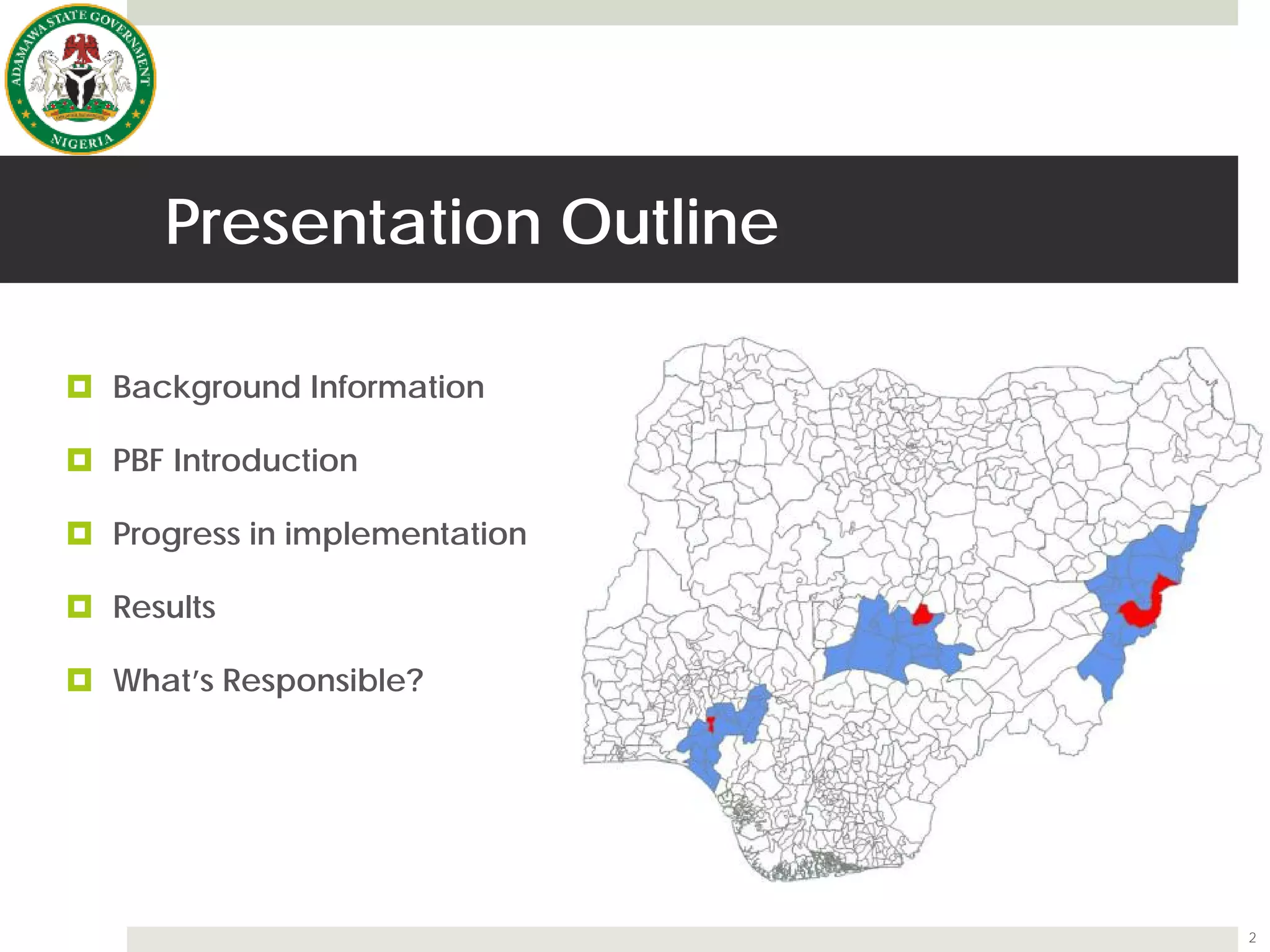
Presentation Outline
 Background Information
 PBF Introduction
 Progress in implementation
 Results
 What’s Responsible?
2
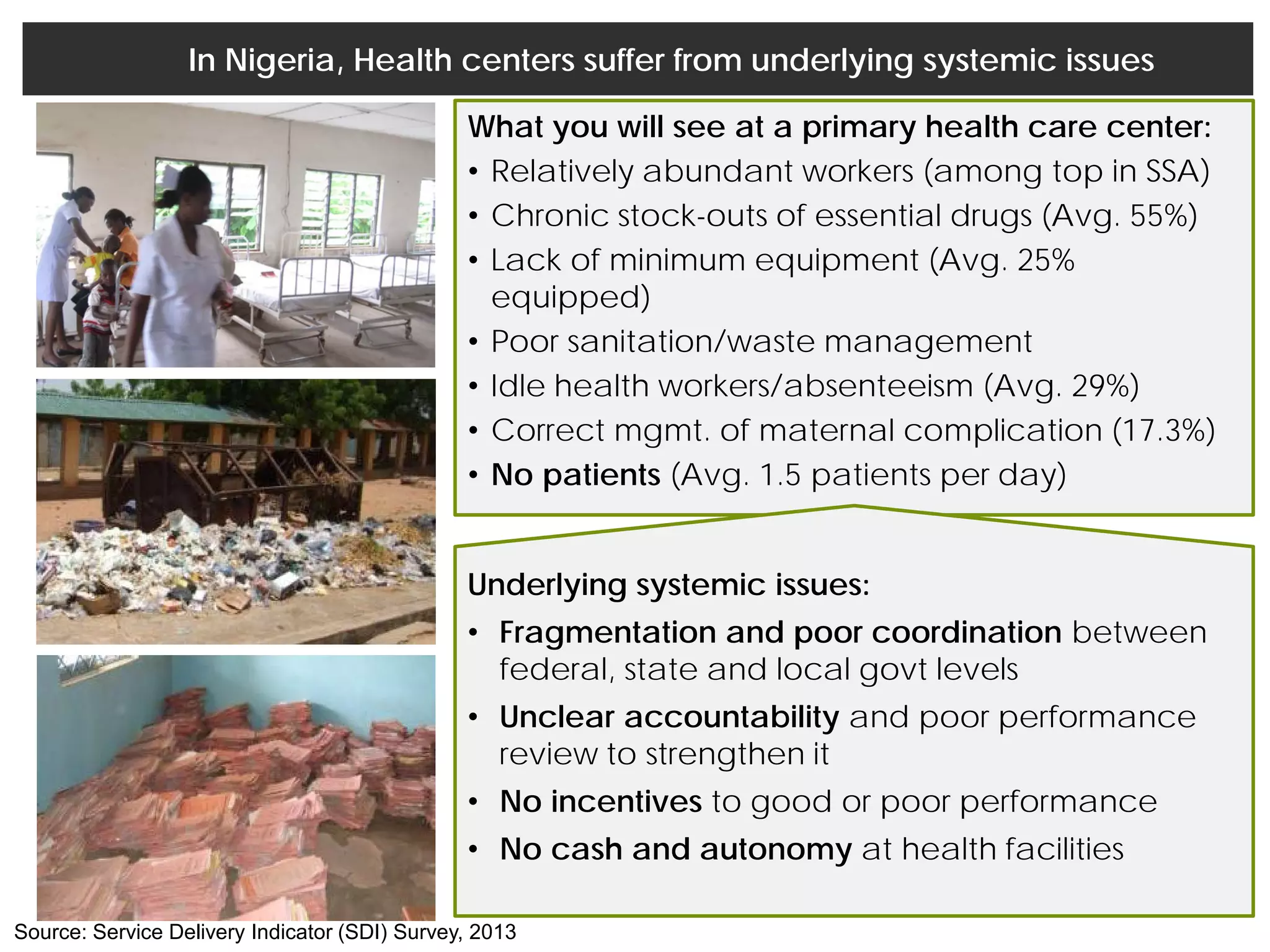
In Nigeria, Health centers suffer from underlying systemic issues
What you will see at a primary health care center:
• Relatively abundant workers (among top in SSA)
• Chronic stock-outs of essential drugs (Avg. 55%)
• Lack of minimum equipment (Avg. 25%
equipped)
• Poor sanitation/waste management
• Idle health workers/absenteeism (Avg. 29%)
• Correct mgmt. of maternal complication (17.3%)
• No patients (Avg. 1.5 patients per day)
Underlying systemic issues:
• Fragmentation and poor coordination between
federal, state and local govt levels
• Unclear accountability and poor performance
review to strengthen it
• No incentives to good or poor performance
• No cash and autonomy at health facilities
Source: Service Delivery Indicator (SDI) Survey, 2013
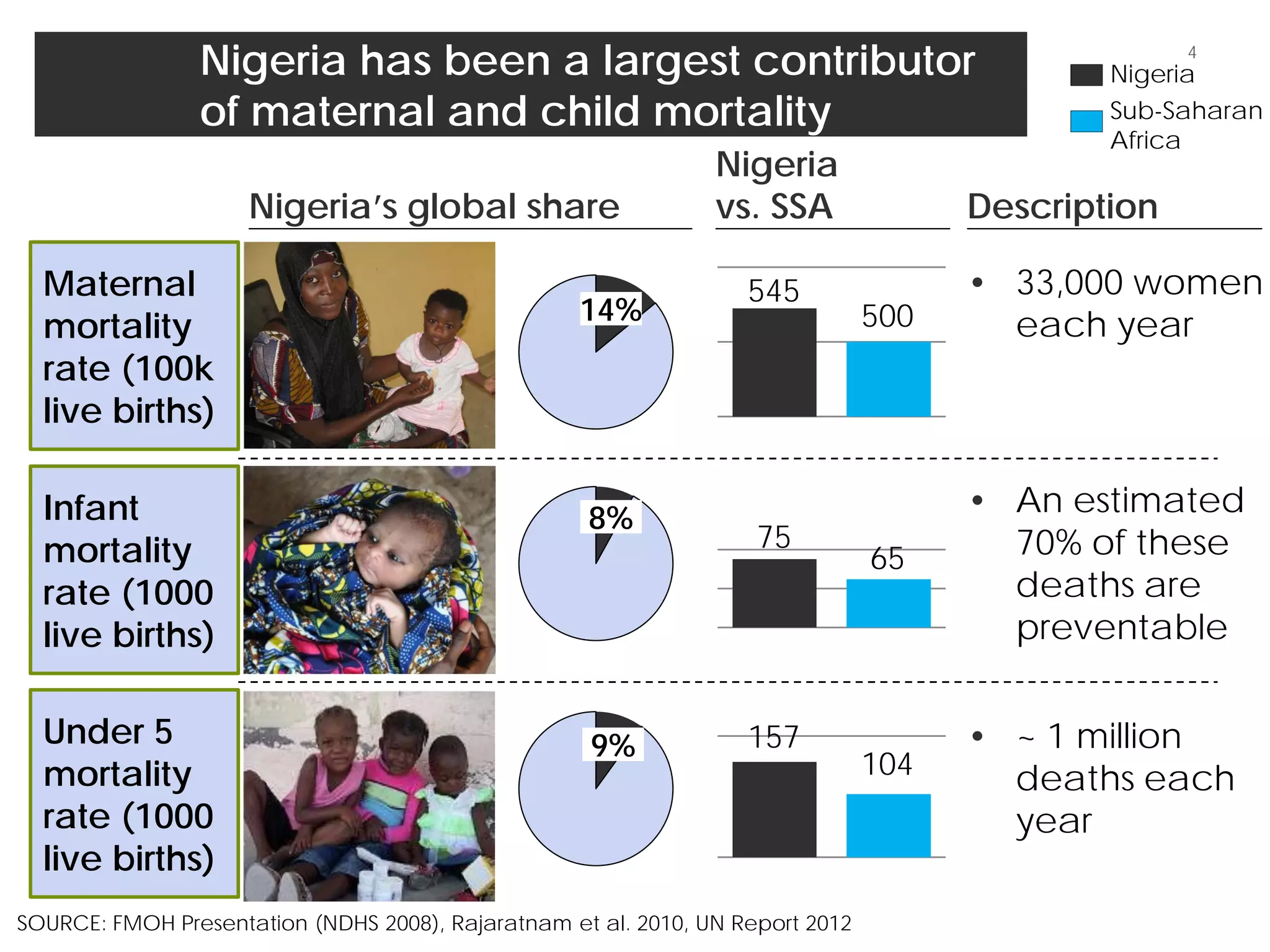
Nigeria has been a largest contributor
of maternal and child mortality
Description
• 33,000 women
each year
• An estimated
70% of these
deaths are
preventable
• ~ 1 million
deaths each
year
SOURCE: FMOH Presentation (NDHS 2008), Rajaratnam et al. 2010, UN Report 2012
Maternal
mortality
rate (100k
live births)
Infant
mortality
rate (1000
live births)
Under 5
mortality
rate (1000
live births)
14%
8%
9%
Nigeria’s global share
157
104
75
65
545
500
Nigeria
vs. SSA
Nigeria
Sub-Saharan
Africa
4
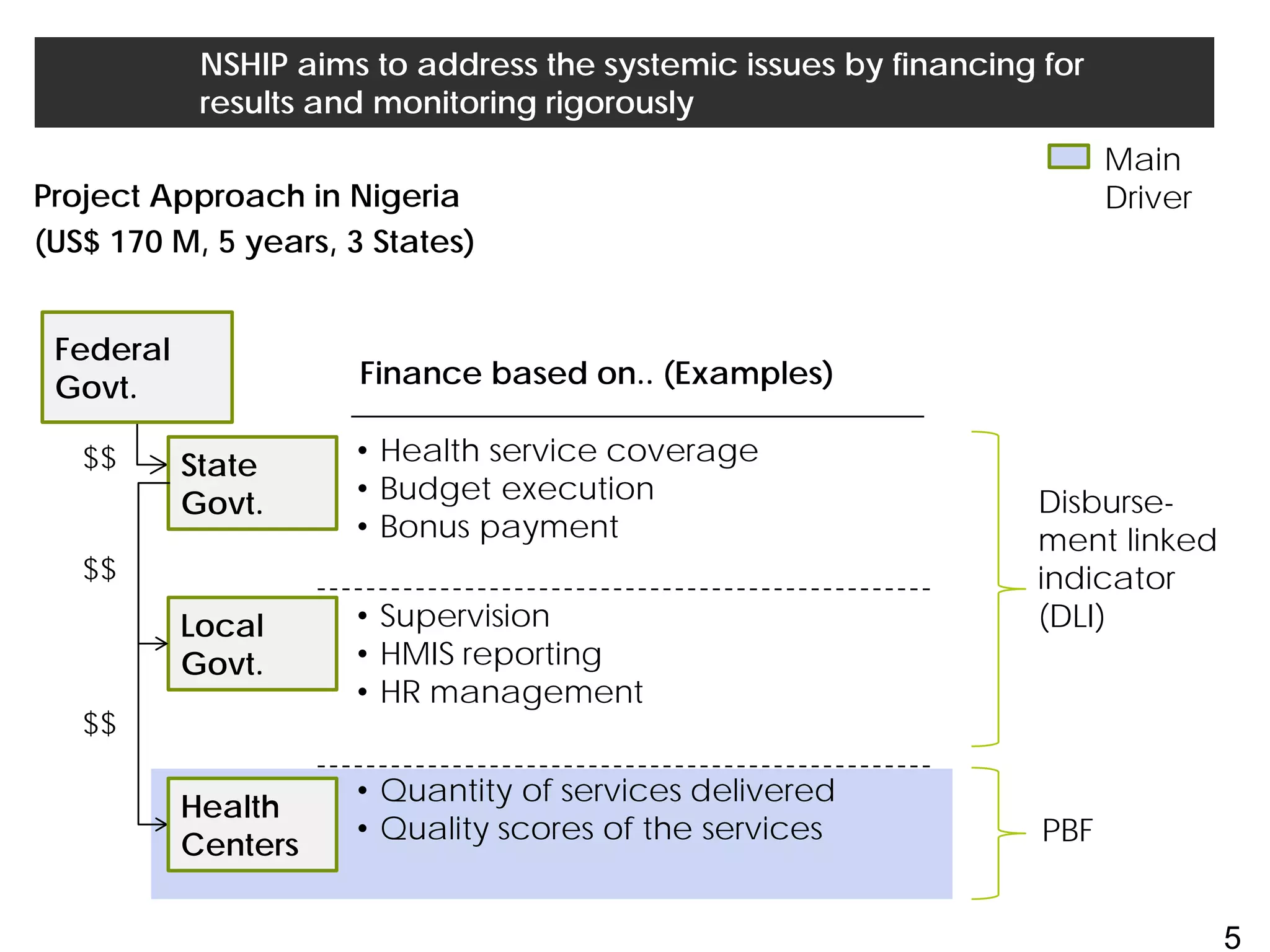
NSHIP aims to address the systemic issues by financing for
results and monitoring rigorously
Project Approach in Nigeria
(US$ 170 M, 5 years, 3 States)
• Health service coverage
• Budget execution
• Bonus payment
• Quantity of services delivered
• Quality scores of the services
• Supervision
• HMIS reporting
• HR management
Finance based on.. (Examples)
5
$$
$$
$$
State
Govt.
Local
Govt.
Health
Centers
Federal
Govt.
Disburse-
ment linked
indicator
(DLI)
PBF
Main
Driver
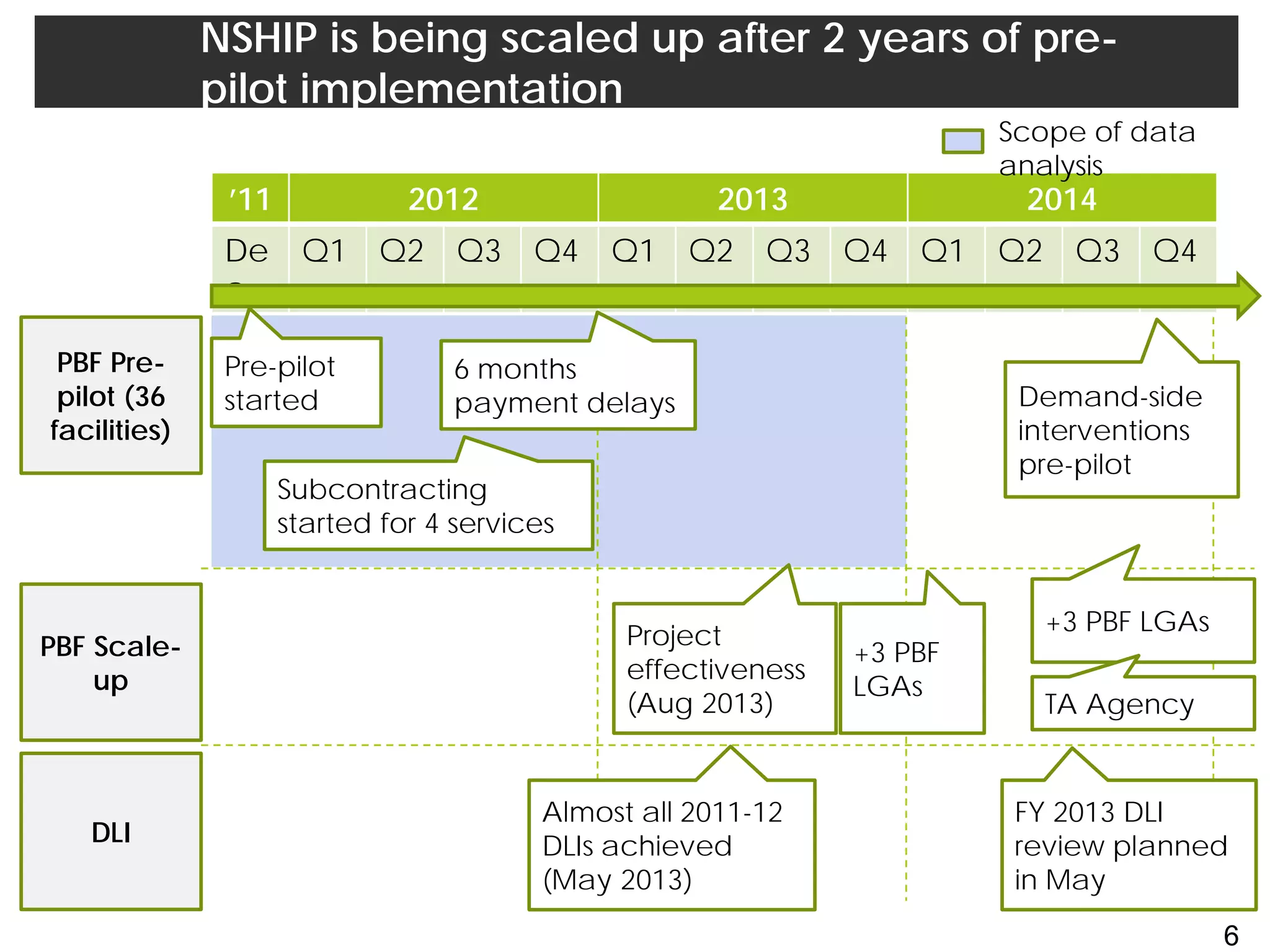
NSHIP is being scaled up after 2 years of pre-
pilot implementation
’11 2012 2013 2014
De
c
Q1 Q2 Q3 Q4 Q1 Q2 Q3 Q4 Q1 Q2 Q3 Q4
Pre-pilot
started
PBF Pre-
pilot (36
facilities)
PBF Scale-
up
DLI
6 months
payment delays
Subcontracting
started for 4 services
Demand-side
interventions
pre-pilot
Project
effectiveness
(Aug 2013)
+3 PBF
LGAs
+3 PBF LGAs
TA Agency
Almost all 2011-12
DLIs achieved
(May 2013)
FY 2013 DLI
review planned
in May
Scope of data
analysis
6
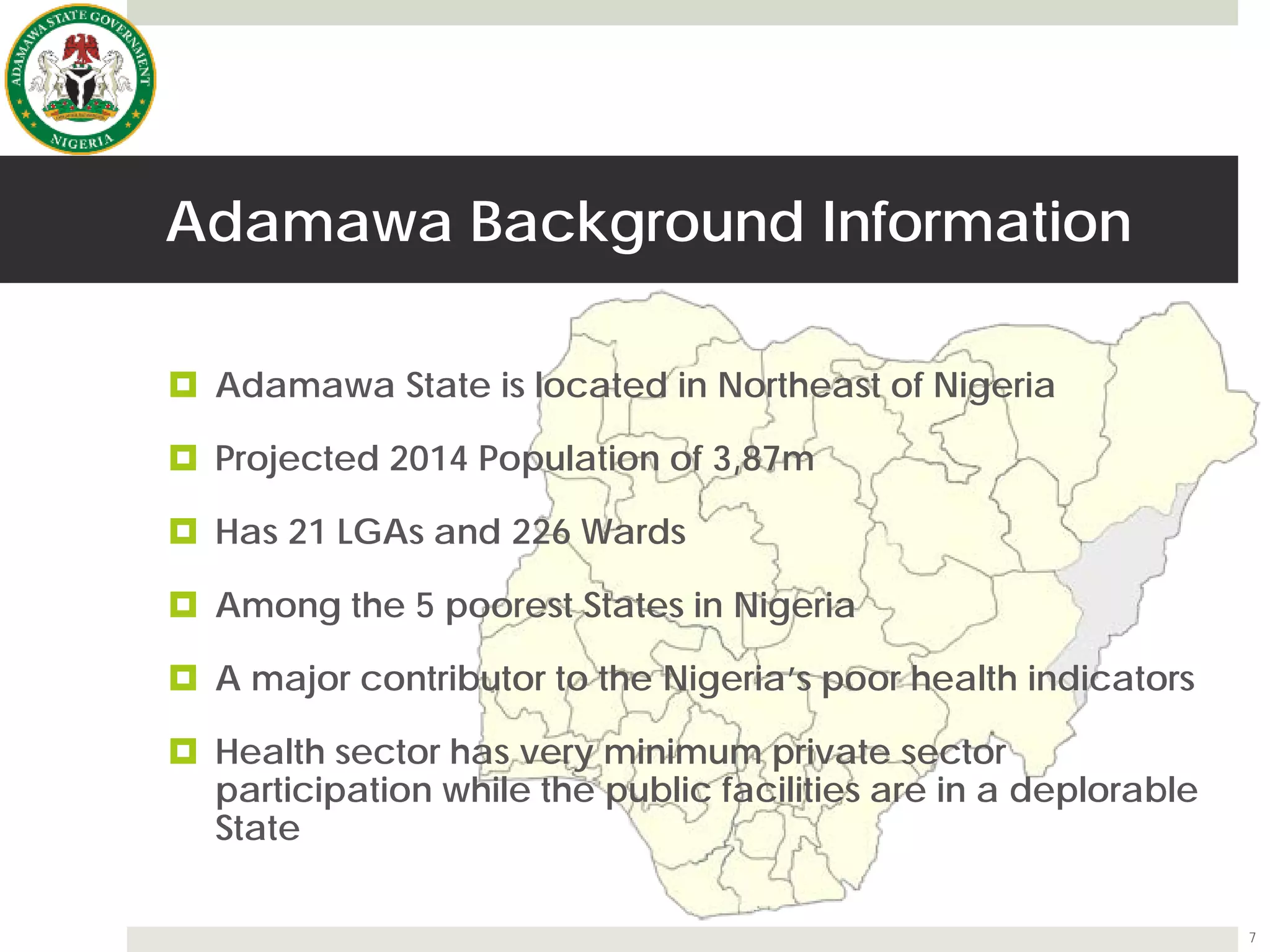
Adamawa Background Information
 Adamawa State is located in Northeast of Nigeria
 Projected 2014 Population of 3,87m
 Has 21 LGAs and 226 Wards
 Among the 5 poorest States in Nigeria
 A major contributor to the Nigeria’s poor health indicators
 Health sector has very minimum private sector
participation while the public facilities are in a deplorable
State
7
8
Background Information
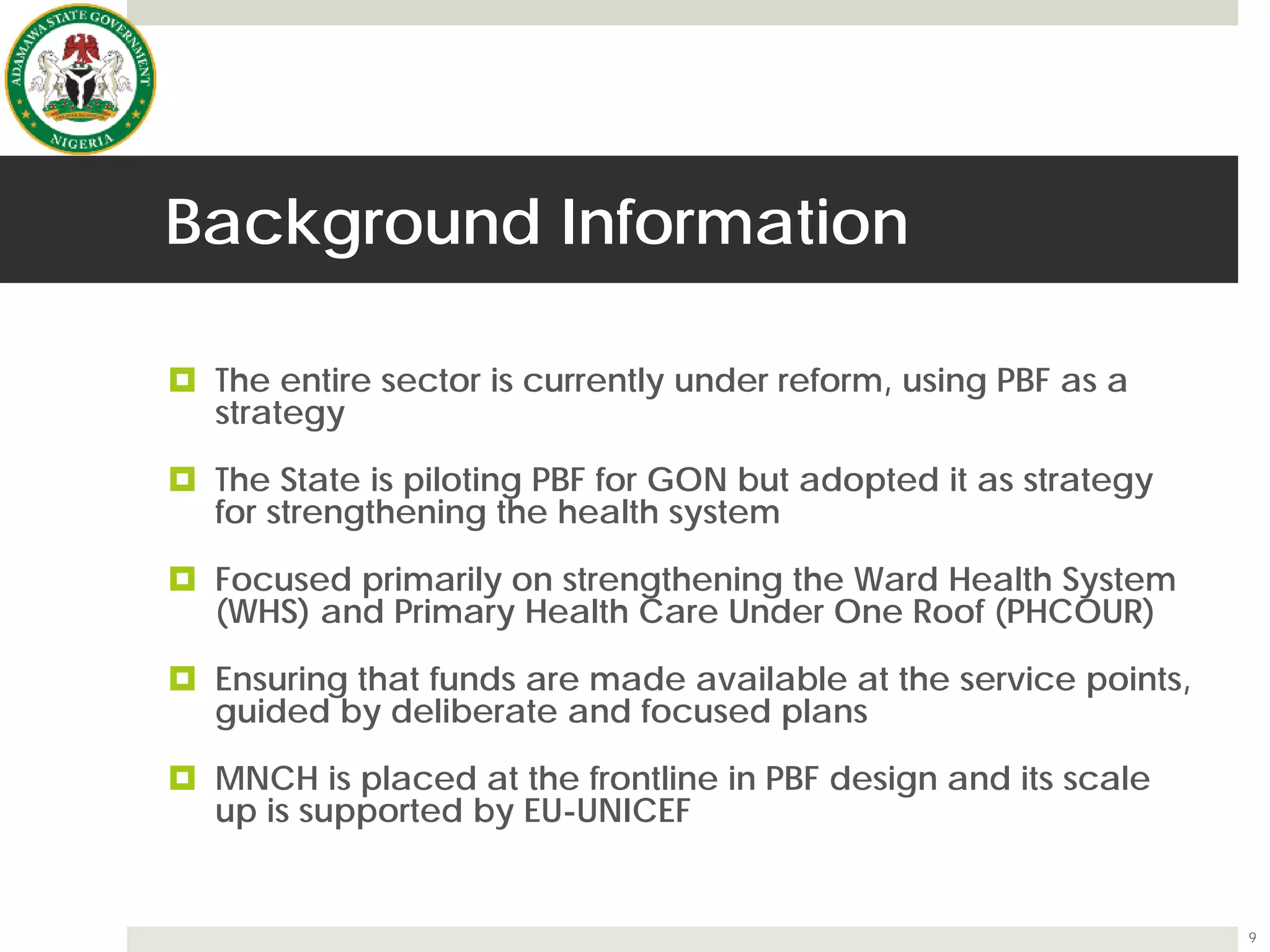
 The entire sector is currently under reform, using PBF as a
strategy
 The State is piloting PBF for GON but adopted it as strategy
for strengthening the health system
 Focused primarily on strengthening the Ward Health System
(WHS) and Primary Health Care Under One Roof (PHCOUR)
 Ensuring that funds are made available at the service points,
guided by deliberate and focused plans
 MNCH is placed at the frontline in PBF design and its scale
up is supported by EU-UNICEF
9
Background Information
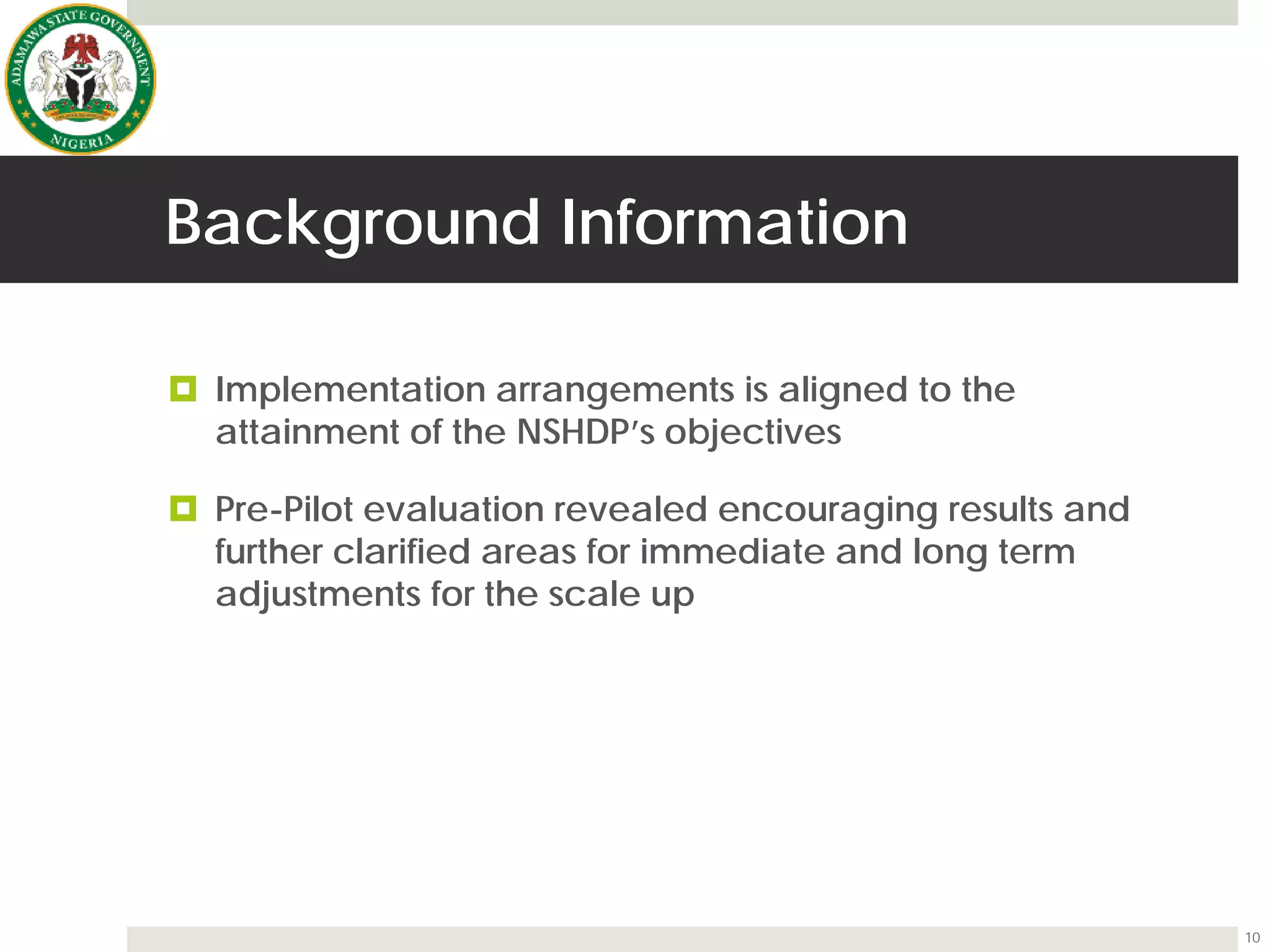
 Implementation arrangements is aligned to the
attainment of the NSHDP’s objectives
 Pre-Pilot evaluation revealed encouraging results and
further clarified areas for immediate and long term
adjustments for the scale up
10
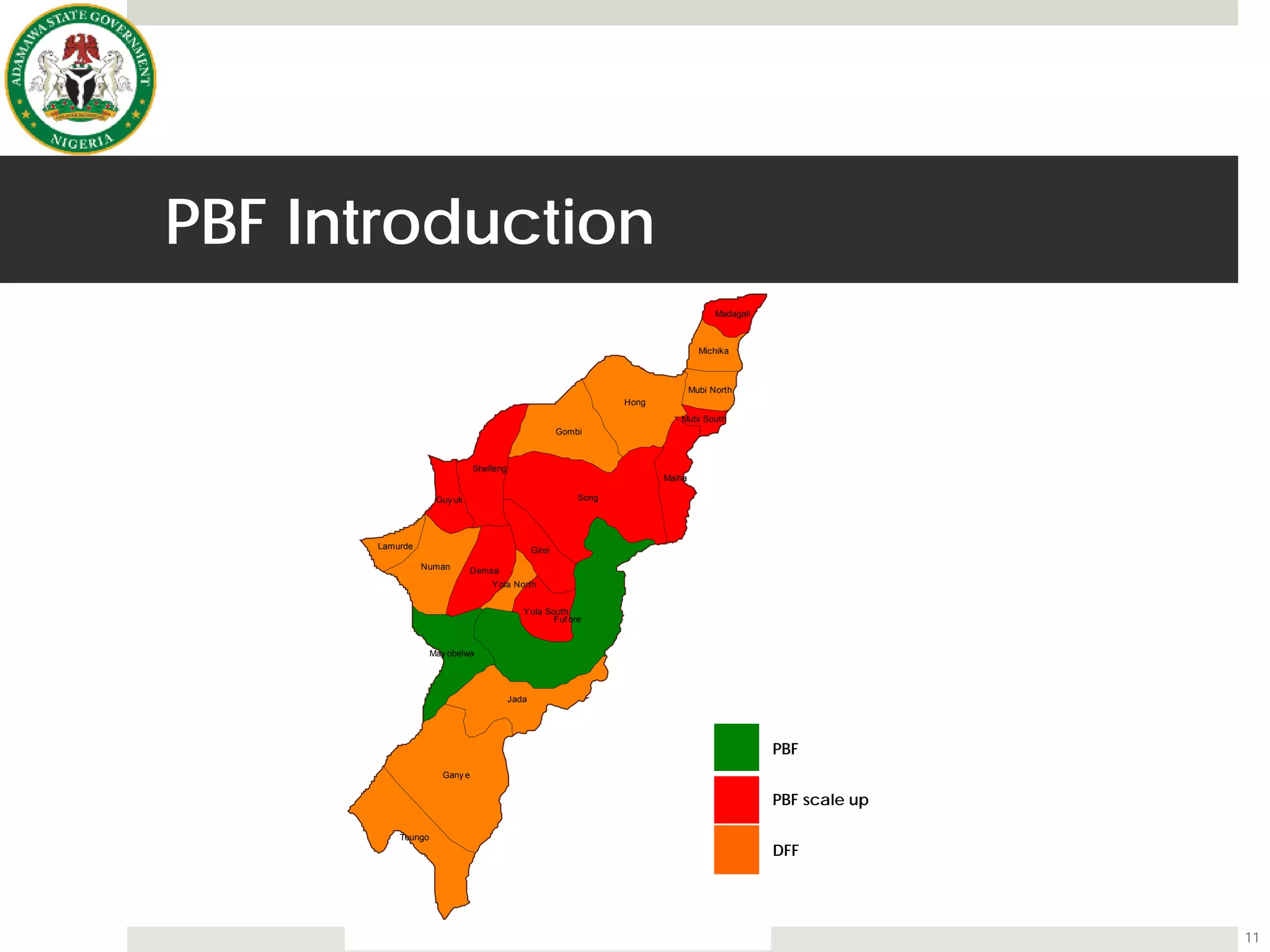
Demsa
Fuf ore
Gany e
Girei
Gombi
Guy uk
Hong
Jada
Lamurde
Madagali
Maiha
May obelwa
Michika
Mubi North
Mubi South
Numan
Shelleng
Song
Toungo
Yola North
Yola South
PBF Introduction
11
PBF
PBF scale up
DFF
Progress in Implementation
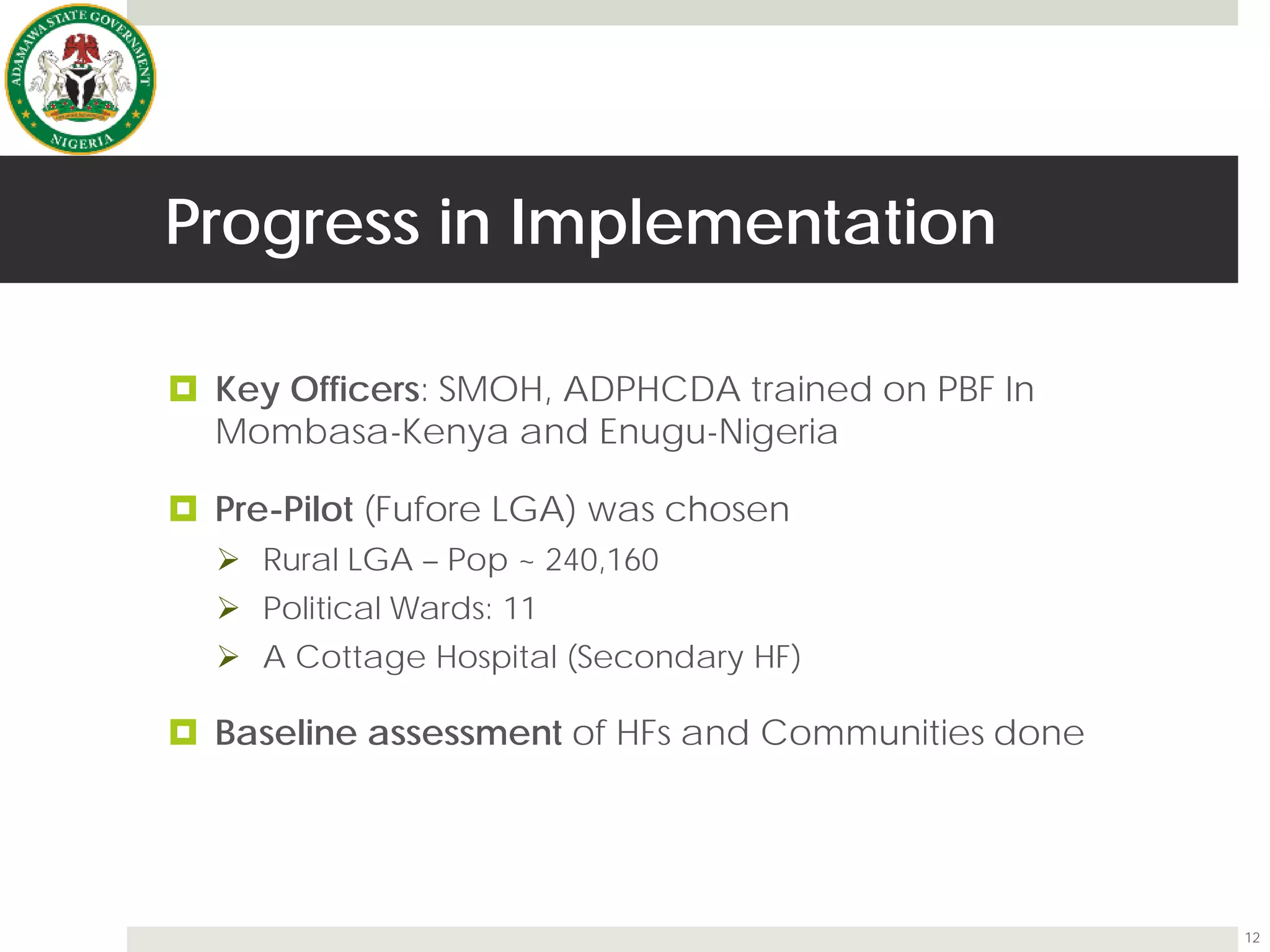
 Key Officers: SMOH, ADPHCDA trained on PBF In
Mombasa-Kenya and Enugu-Nigeria
 Pre-Pilot (Fufore LGA) was chosen
 Rural LGA – Pop ~ 240,160
 Political Wards: 11
 A Cottage Hospital (Secondary HF)
 Baseline assessment of HFs and Communities done
12
Progress in Implementation
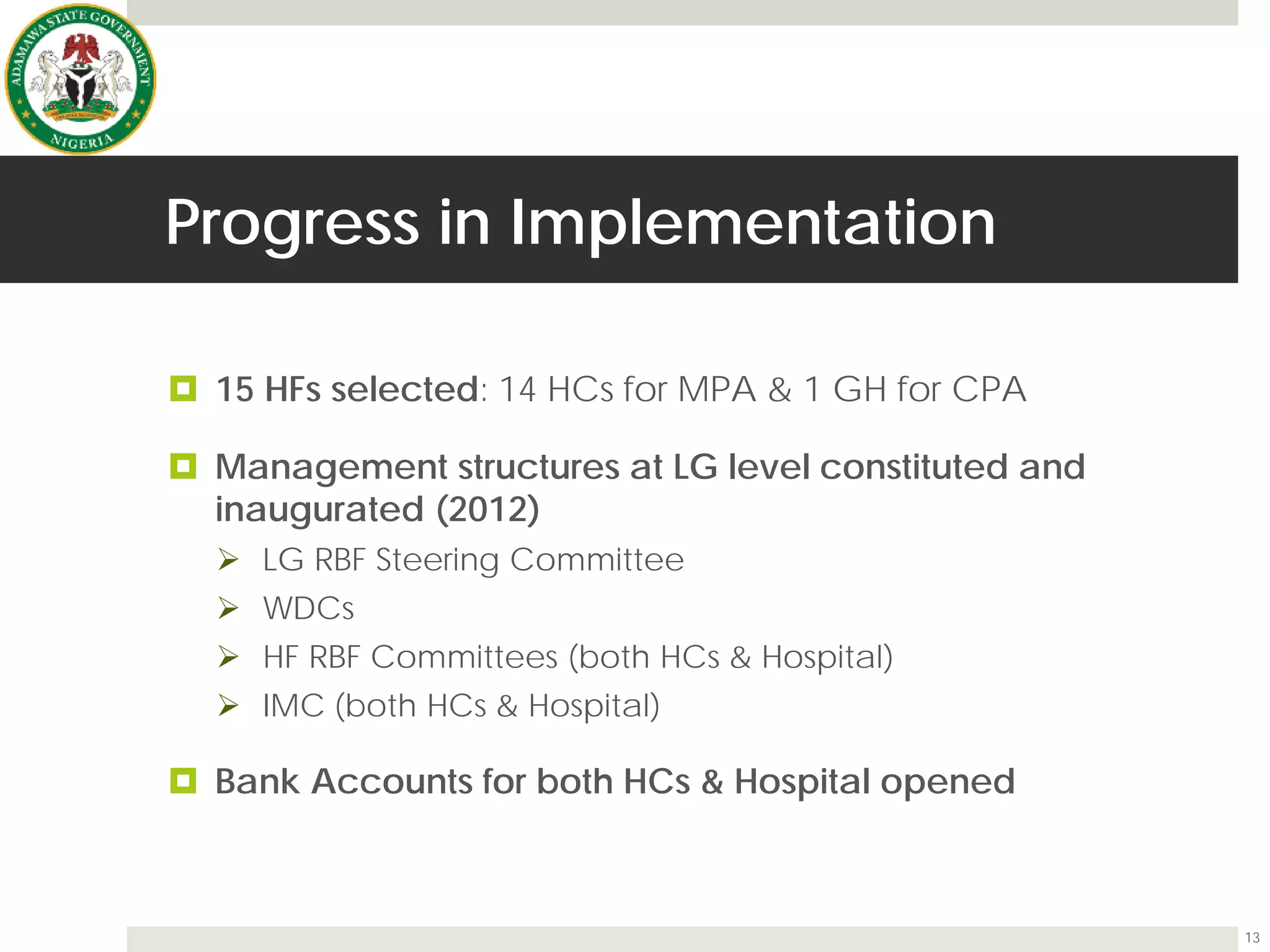
 15 HFs selected: 14 HCs for MPA & 1 GH for CPA
 Management structures at LG level constituted and
inaugurated (2012)
 LG RBF Steering Committee
 WDCs
 HF RBF Committees (both HCs & Hospital)
 IMC (both HCs & Hospital)
 Bank Accounts for both HCs & Hospital opened
13
Minimum Package of Activities
14
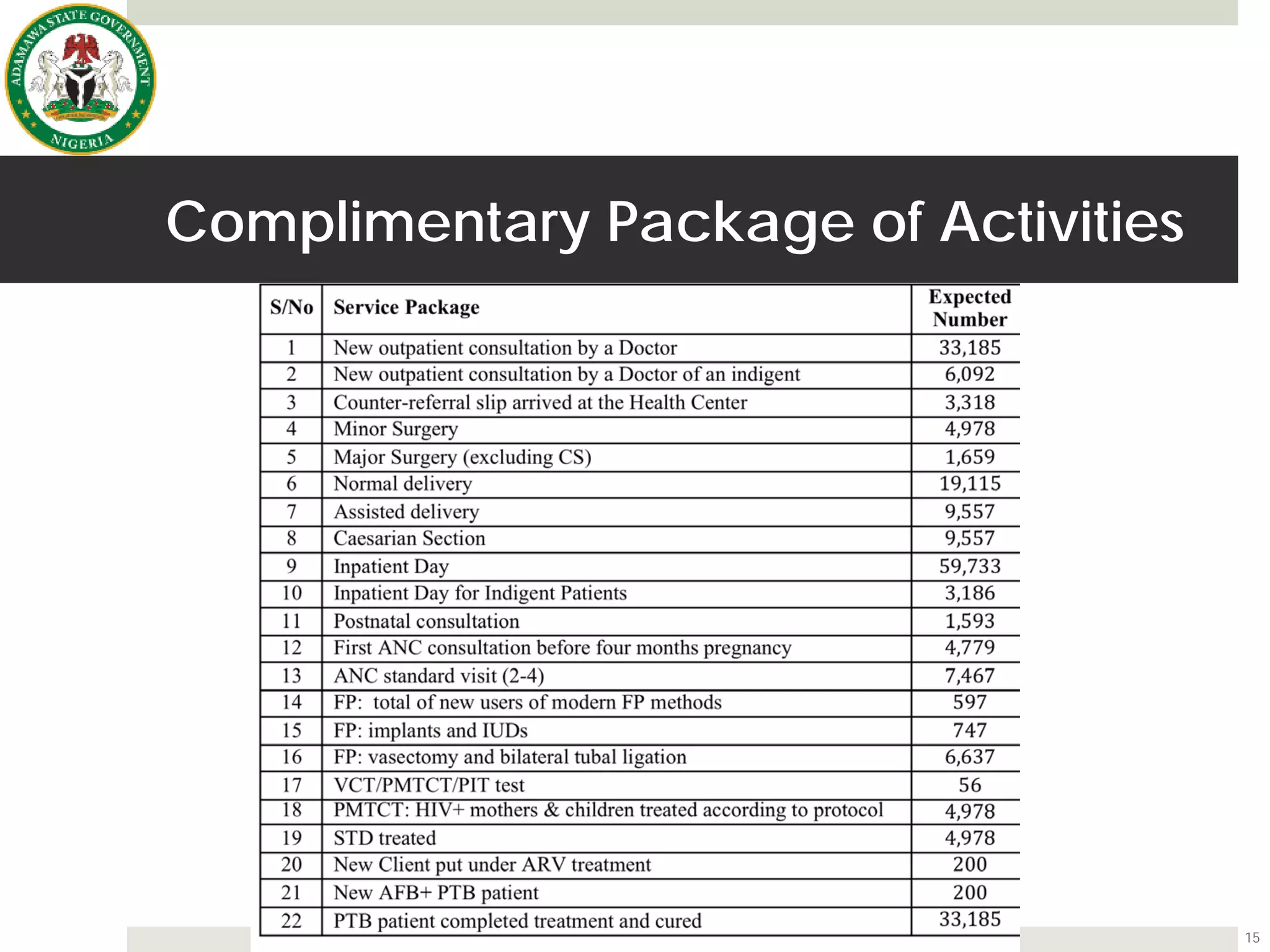
Complimentary Package of Activities
15
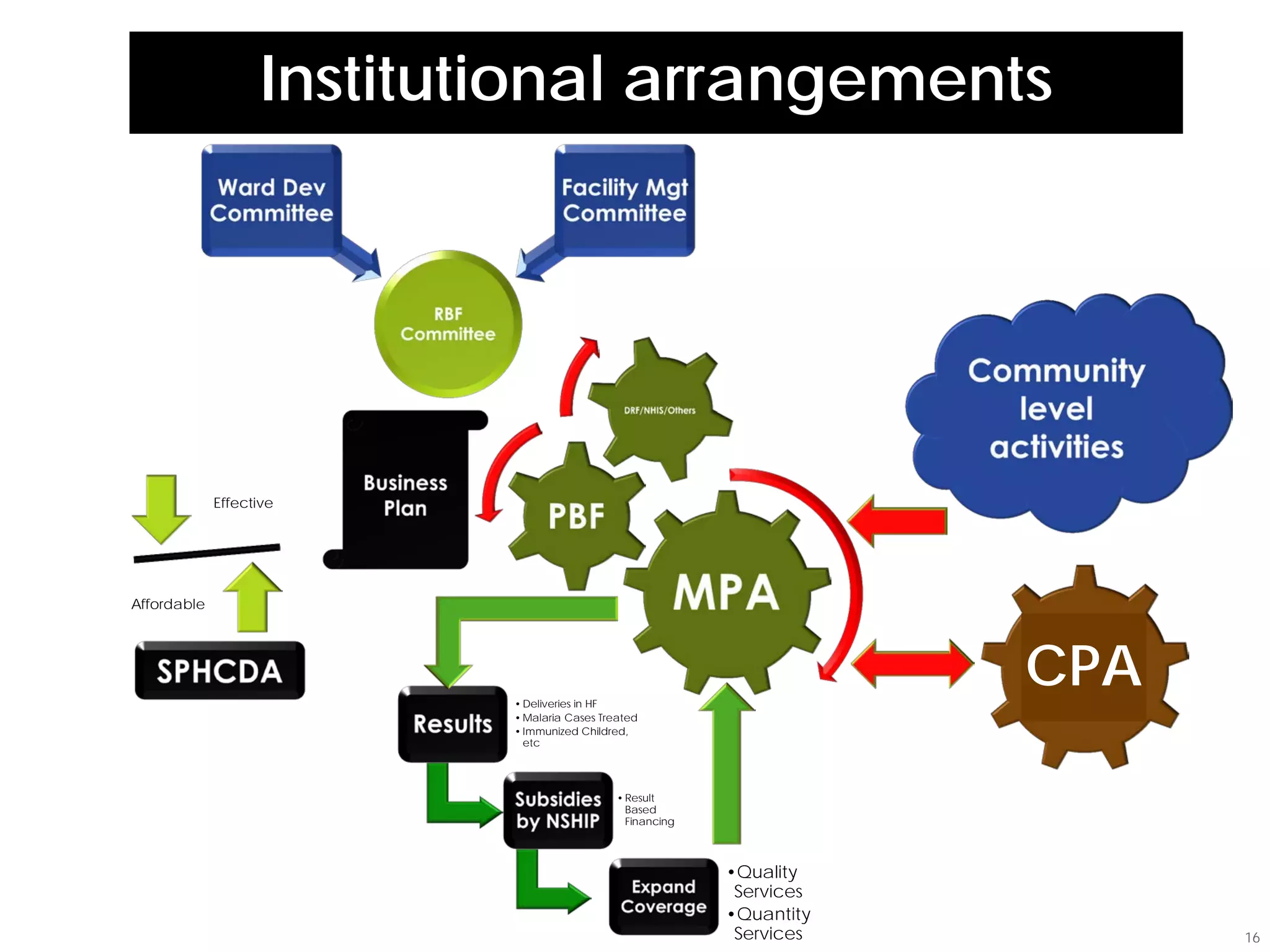
Effective
Affordable
• Deliveries in HF
• Malaria Cases Treated
• Immunized Childred,
etc
• Result
Based
Financing
•Quality
Services
•Quantity
Services
CPA
Institutional arrangements
16
Results
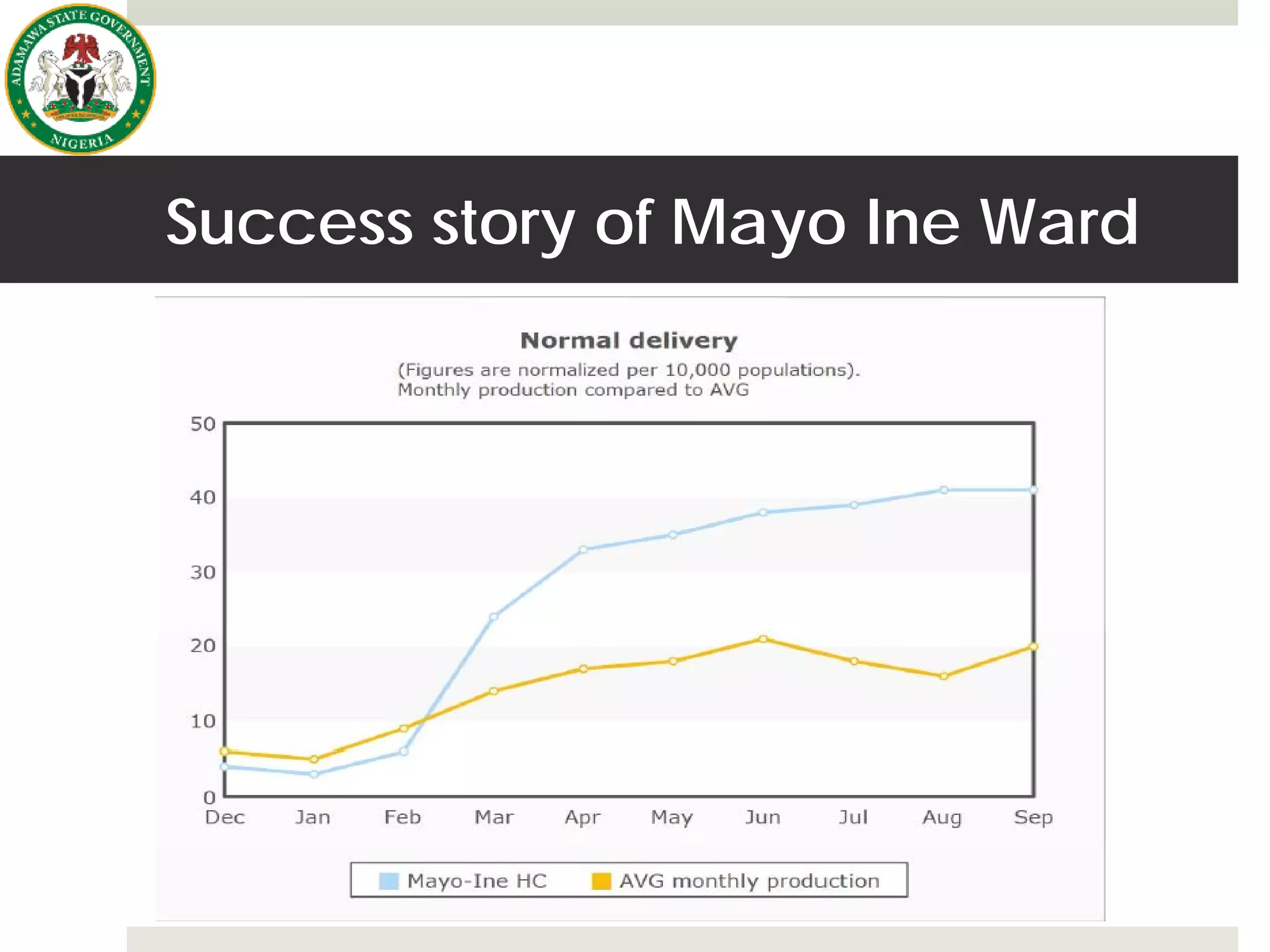
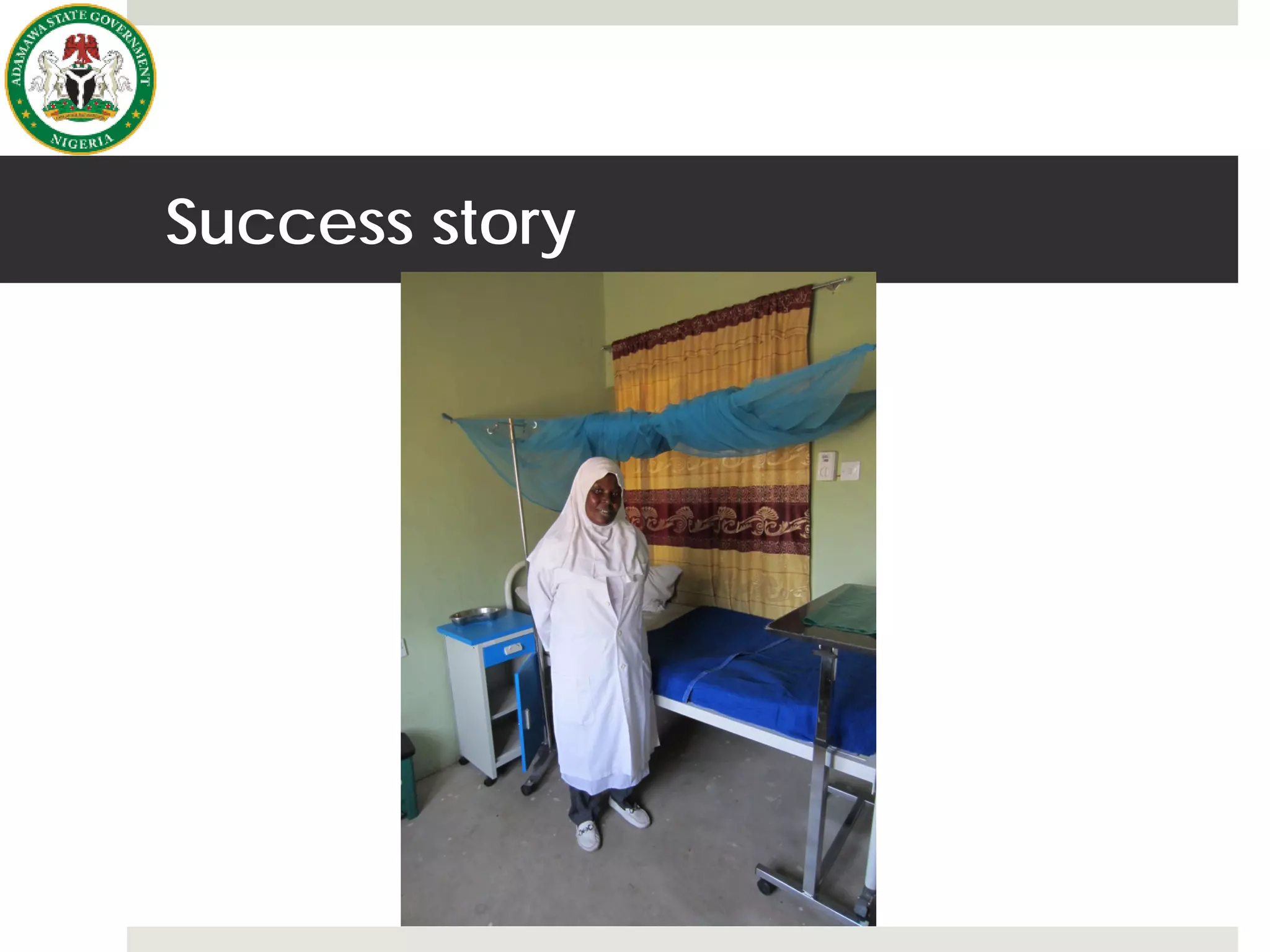
Success story of Mayo Ine Ward
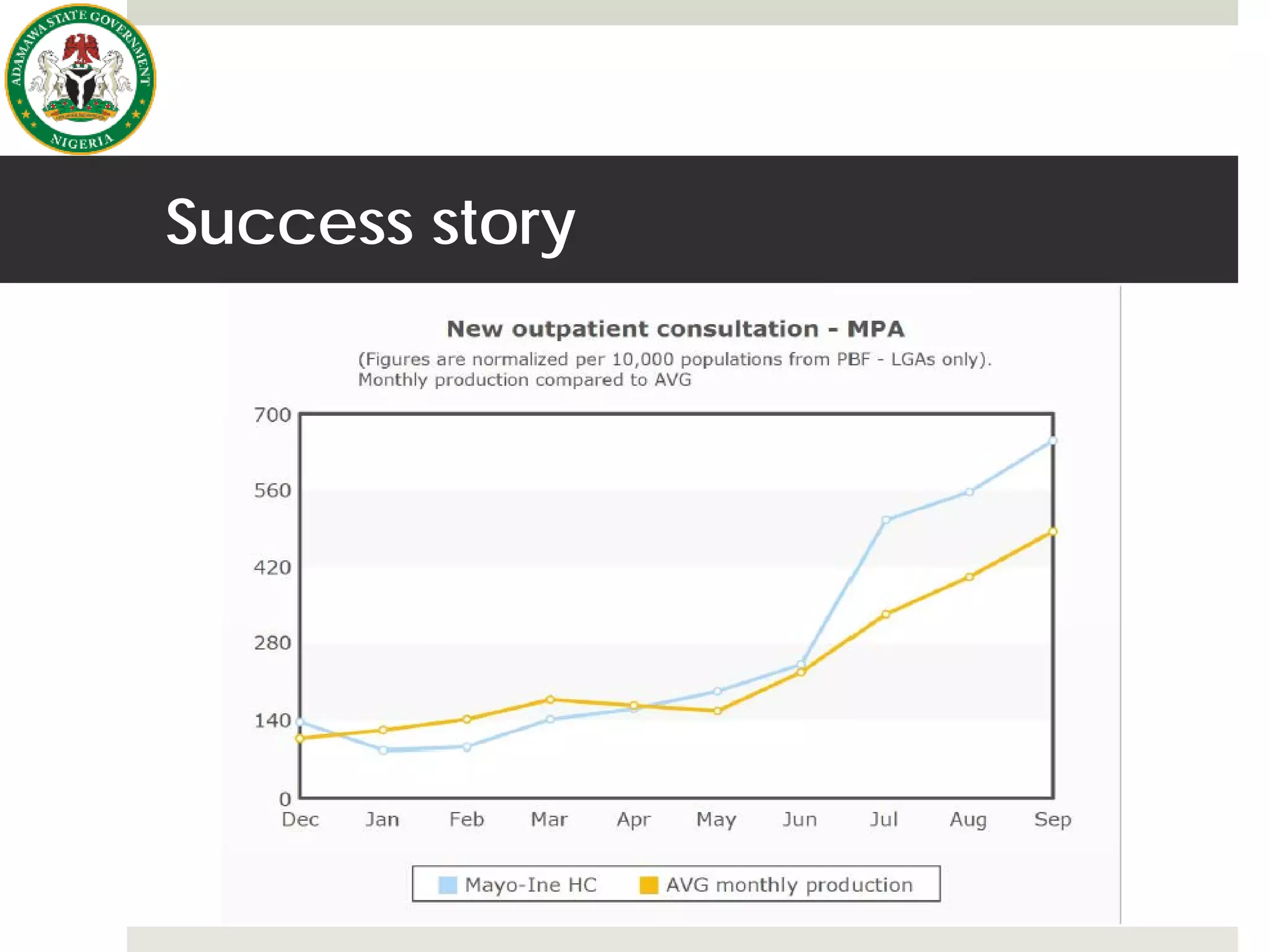
Success story
Success story
 Mayo-Ine health centre went from 4 deliveries per month
to 45 deliveries per month within a six-month period
 It has sustained that rate over the rest of the year, and this
means that, for its entire sub-district population, it had
gone from delivering10% of pregnant women to
delivering 100% of all expected deliveries in its health
facility.
 Mayo-Ine health center has effectively reached universal
coverage for institutional deliveries.
Success story
 So what happened in Mayo-Ine?
 As you can imagine, there must have been a tremendous change
from what was there before.
 The changes led to its staff working harder, going out to villages
and talking to the population.
 The staff involved the local community and traditional leaders in
convincing the population to use its services.
 The health facility received autonomy and a bank account and
learned to manage money.
 Working hours were changed from Monday to Friday 8 am to 4 pm
to 24/7. One additional staff, a lab assistant, was hired.
Success story
 The staff purchased drugs and medical materials from certified distributors; it
purchased new equipment, repaired the broken fence, the windows, repaired the
toilets, and fixed the waste disposal.
 The changes led to health workers linking to their health posts and using these
also to provide services, to provide growth monitoring, and vaccinations
 Patients who would come would be prescribed essential drugs according to
protocols which made it more affordable for them
 The district health team came frequently for supervision, and provided targeted
feed-back using a checklist.
 Technical assistance from the State Primary Health Care Development Agency
ensured that health staff was coached in using money, in managing their staff and
in using new strategies to improve their health services.
Success story
Success story
 And most difficult of all: health workers convinced all
pregnant women, all of them, to come and deliver in their
health facility.
 The health staff changed their attitudes to patients, ensured
that the equipment was there, that the environment in which
they had to deliver was nice, that it had water, sanitation, a
bed with clean sheets and a pleasant atmosphere.
 Women who delivered did not have to pay any more for
drugs or needles or to bring maternity pads.
 In fact, women who delivered were given small items such
as maternity pads, and clothes for their babies.
Success story
 The health workers did the hardest thing of all: to regain
the trust of the population by convincing them to use the
public health services again and to use it for all their
health needs.
 Today, Mayo-Ine health center is a beacon for Fufore
LGA, for Adamawa State, and also for Nigeria.
 If Mayo-Ine can do it, in this far outpost of Nigeria, then
anybody can do it.
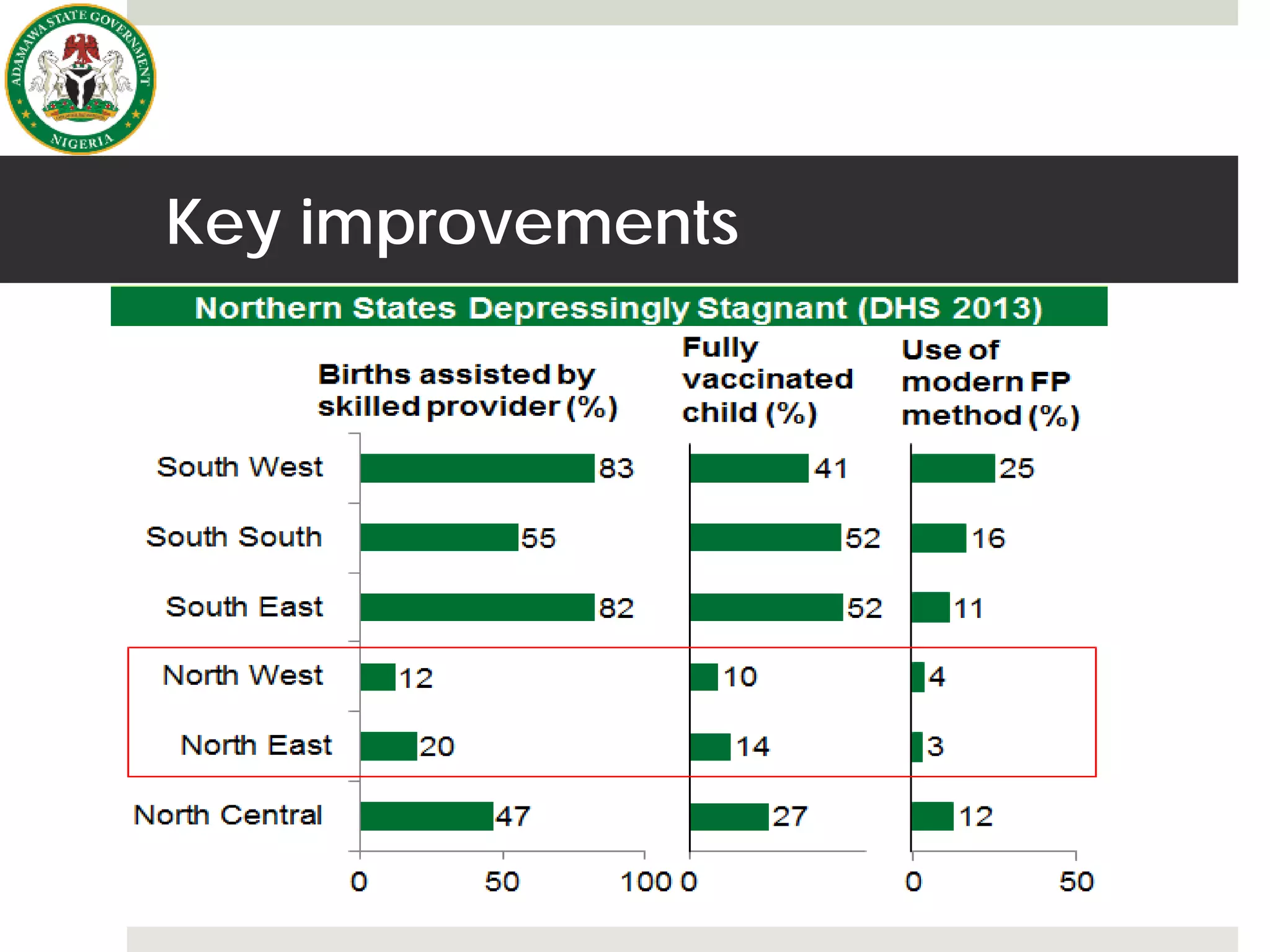
Key improvements
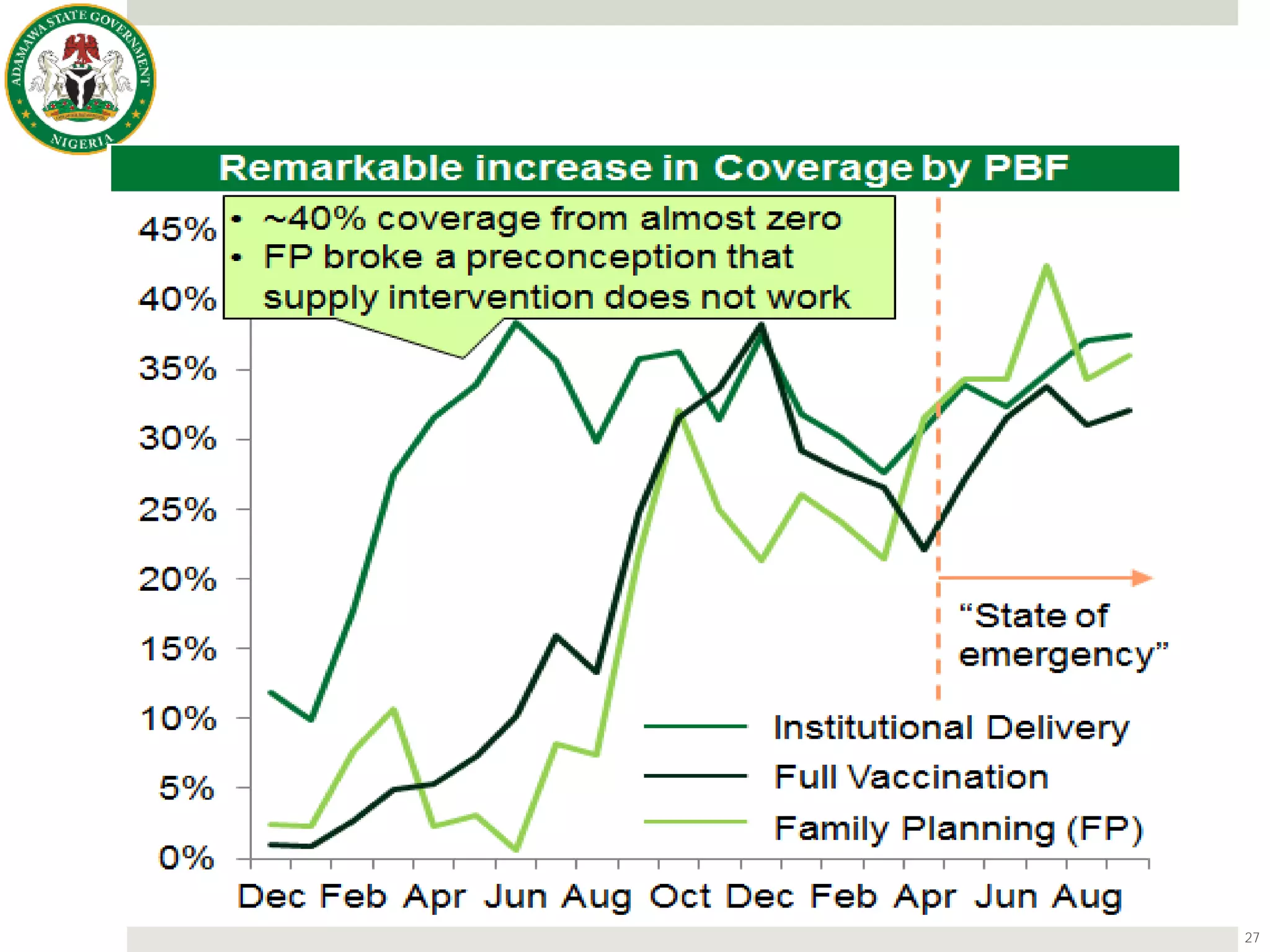
27
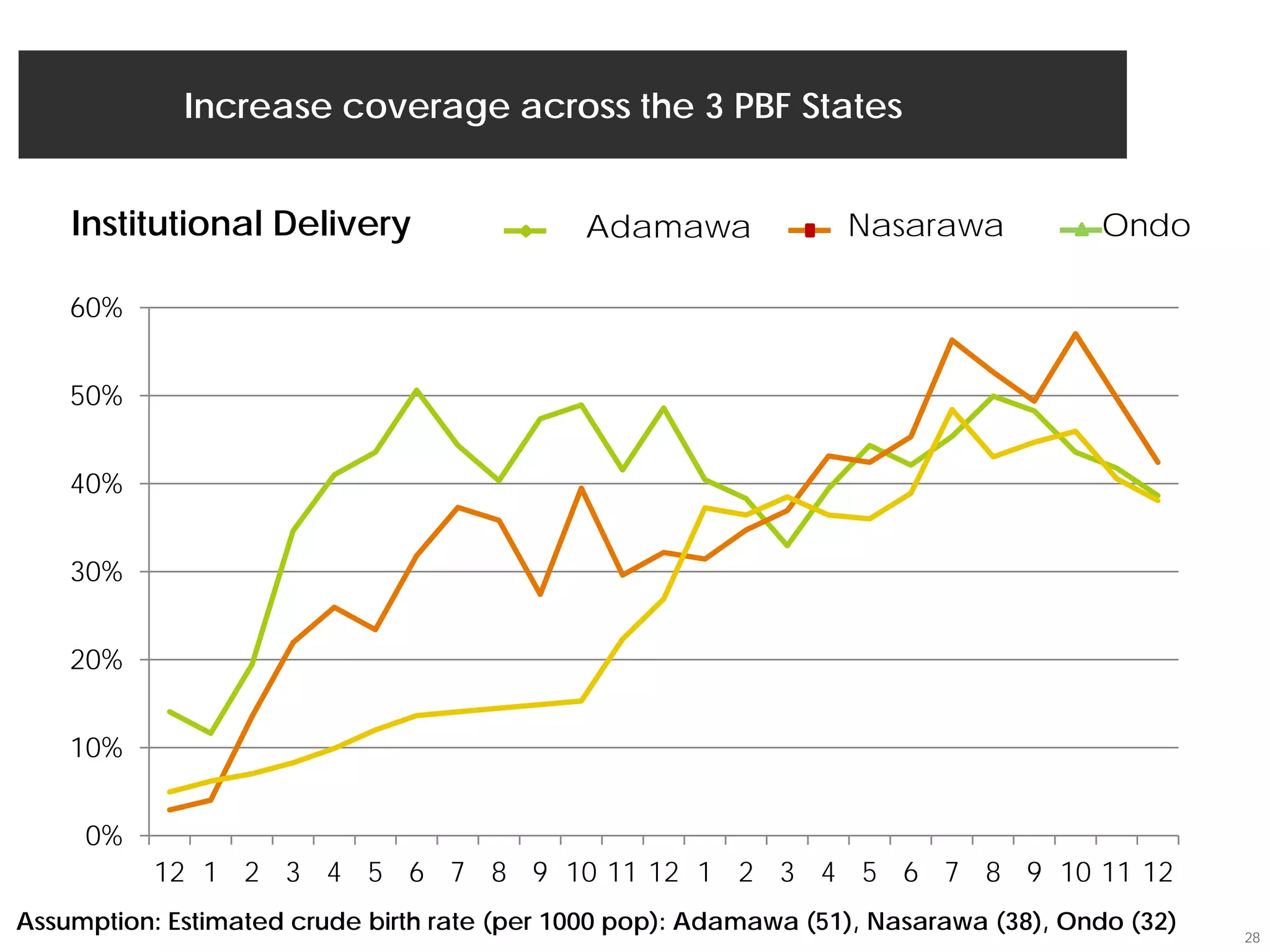
Increase coverage across the 3 PBF States
Adamawa Nasarawa Ondo
28
Institutional Delivery
0%
10%
20%
30%
40%
50%
60%
12 1 2 3 4 5 6 7 8 9 10 11 12 1 2 3 4 5 6 7 8 9 10 11 12
Assumption: Estimated crude birth rate (per 1000 pop): Adamawa (51), Nasarawa (38), Ondo (32)
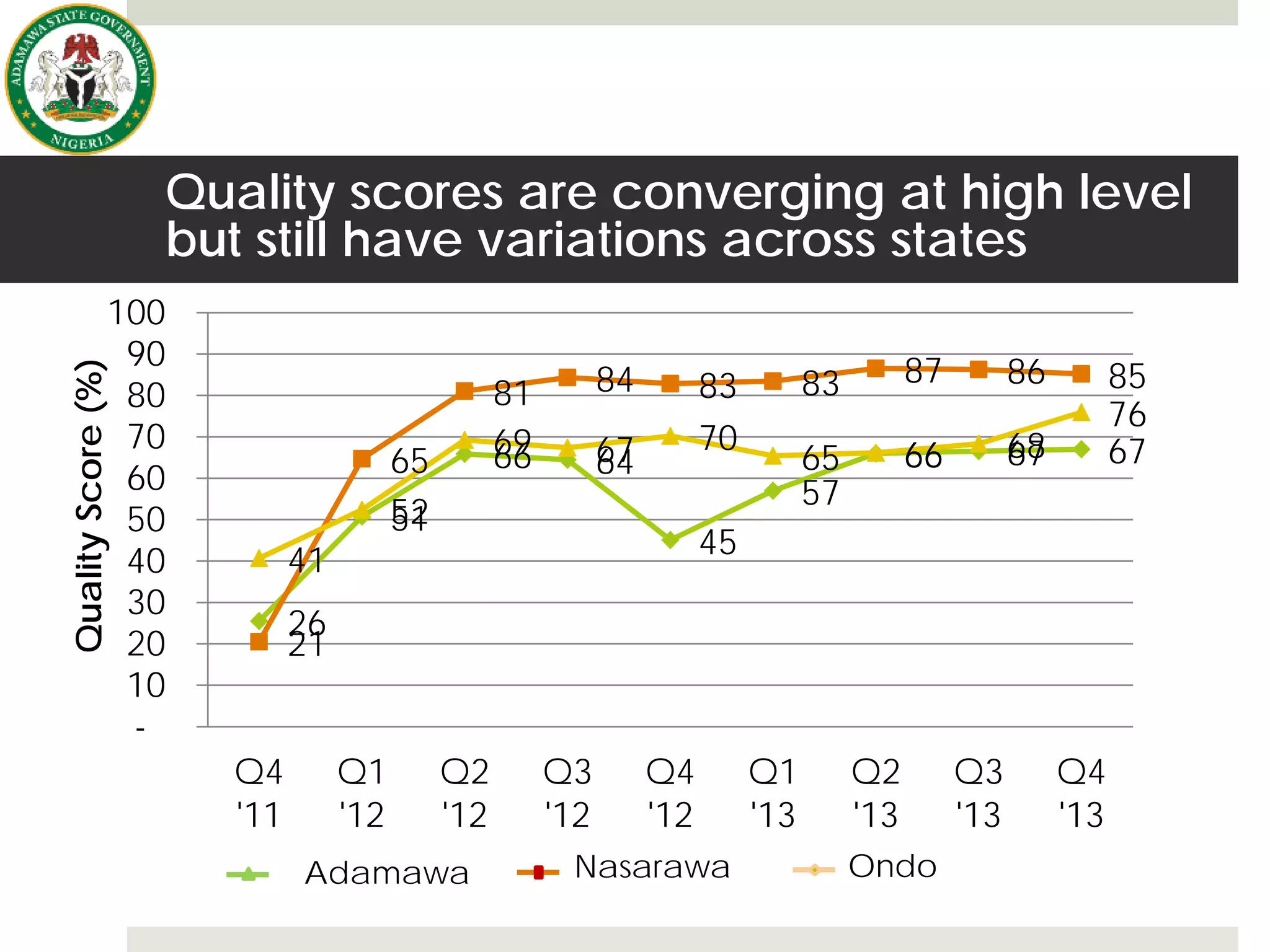
Adamawa Nasarawa Ondo
QualityScore(%)
26
51
66 64
45
57
66 67 67
21
65
81 84 83 83 87 86 85
41
52
69 67 70
65 66 68
76
-
10
20
30
40
50
60
70
80
90
100
Q4
'11
Q1
'12
Q2
'12
Q3
'12
Q4
'12
Q1
'13
Q2
'13
Q3
'13
Q4
'13
Quality scores are converging at high level
but still have variations across states
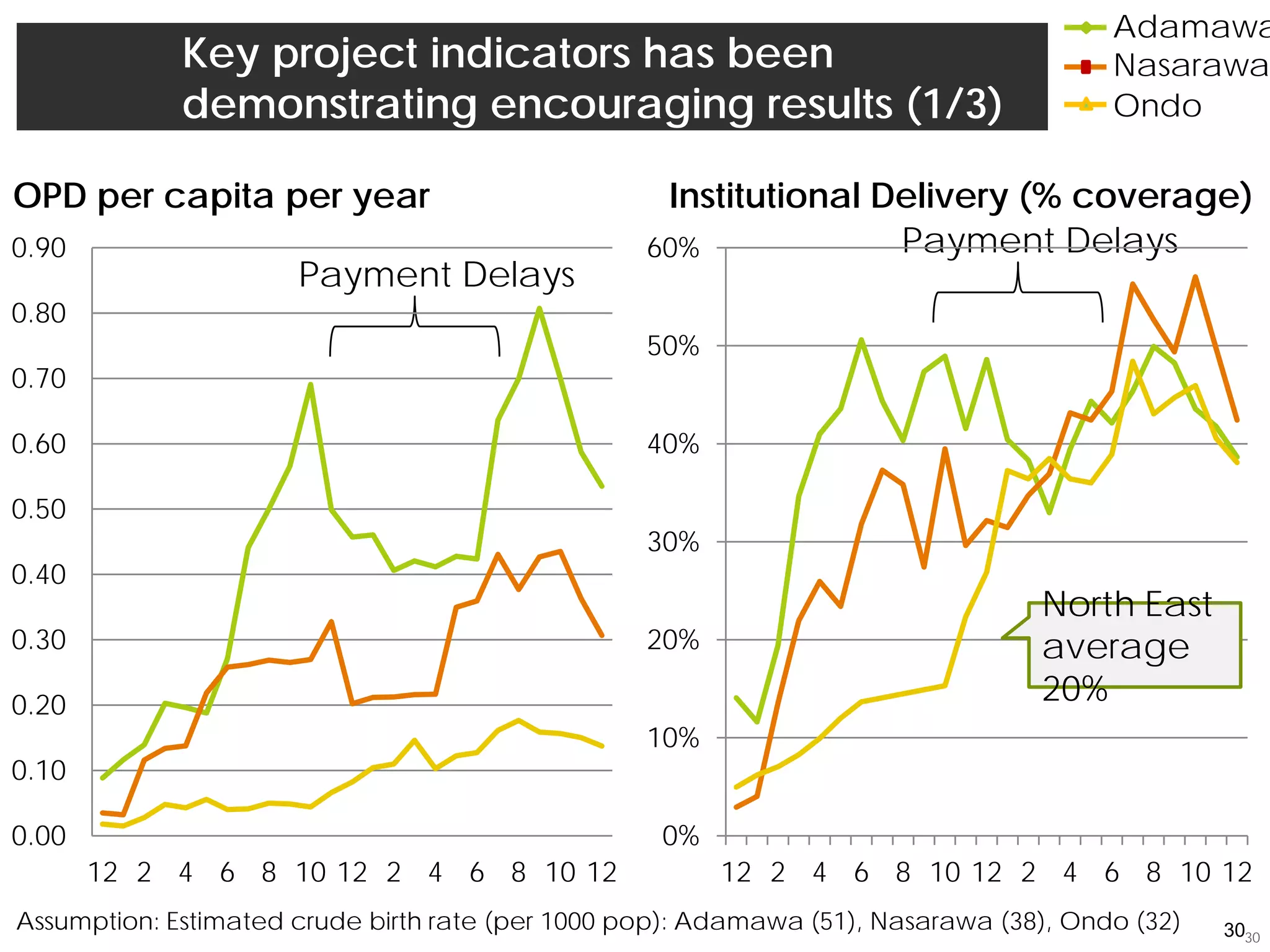
Key project indicators has been
demonstrating encouraging results (1/3)
Adamawa
Nasarawa
Ondo
30
OPD per capita per year Institutional Delivery (% coverage)
Payment Delays
Payment Delays
0.00
0.10
0.20
0.30
0.40
0.50
0.60
0.70
0.80
0.90
12 2 4 6 8 10 12 2 4 6 8 10 12
0%
10%
20%
30%
40%
50%
60%
12 2 4 6 8 10 12 2 4 6 8 10 12
Assumption: Estimated crude birth rate (per 1000 pop): Adamawa (51), Nasarawa (38), Ondo (32)
North East
average
20%
30
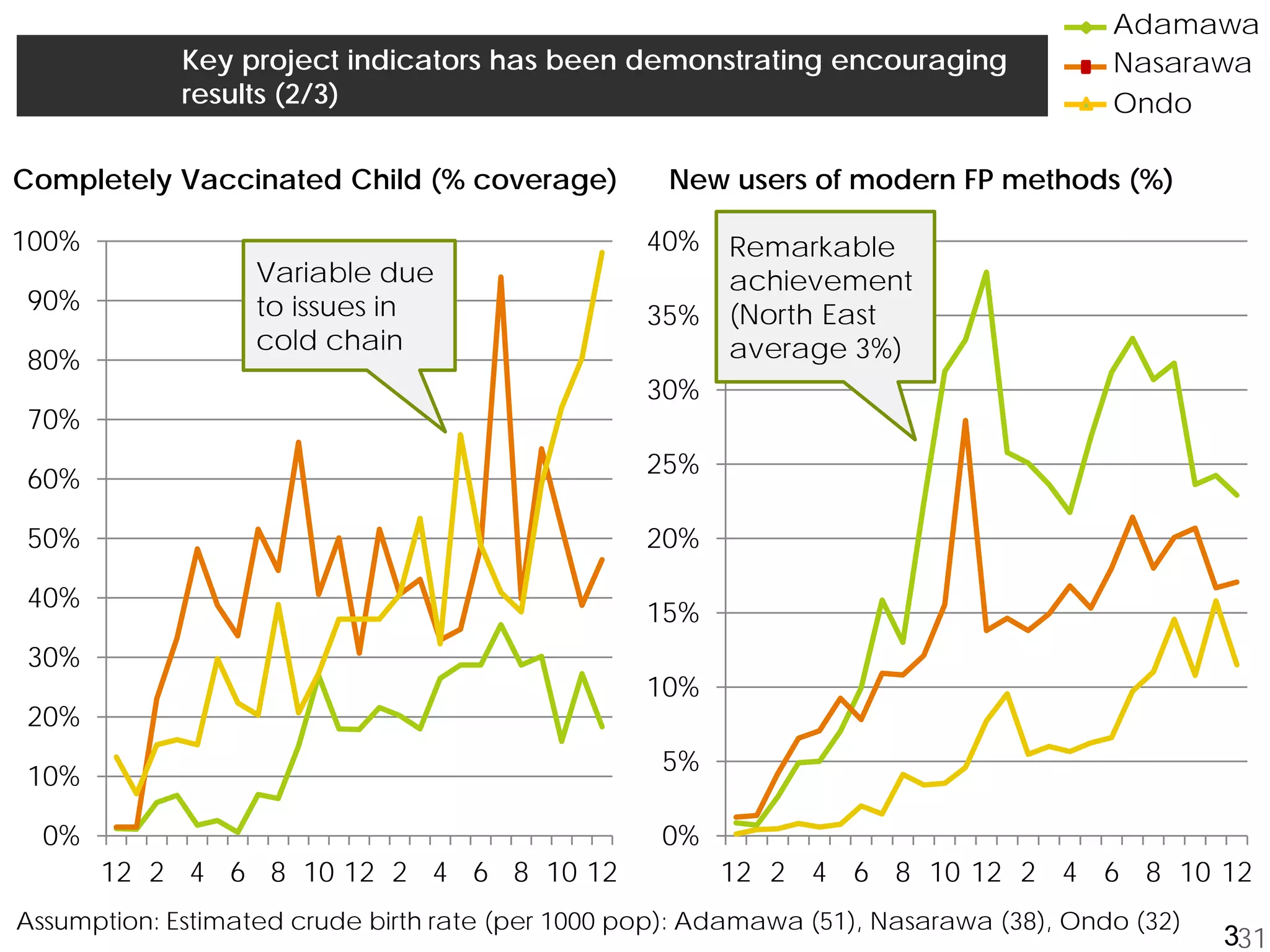
Key project indicators has been demonstrating encouraging
results (2/3)
Adamawa
Nasarawa
Ondo
31
Completely Vaccinated Child (% coverage) New users of modern FP methods (%)
0%
10%
20%
30%
40%
50%
60%
70%
80%
90%
100%
12 2 4 6 8 10 12 2 4 6 8 10 12
Variable due
to issues in
cold chain
0%
5%
10%
15%
20%
25%
30%
35%
40%
12 2 4 6 8 10 12 2 4 6 8 10 12
Remarkable
achievement
(North East
average 3%)
Assumption: Estimated crude birth rate (per 1000 pop): Adamawa (51), Nasarawa (38), Ondo (32)
3
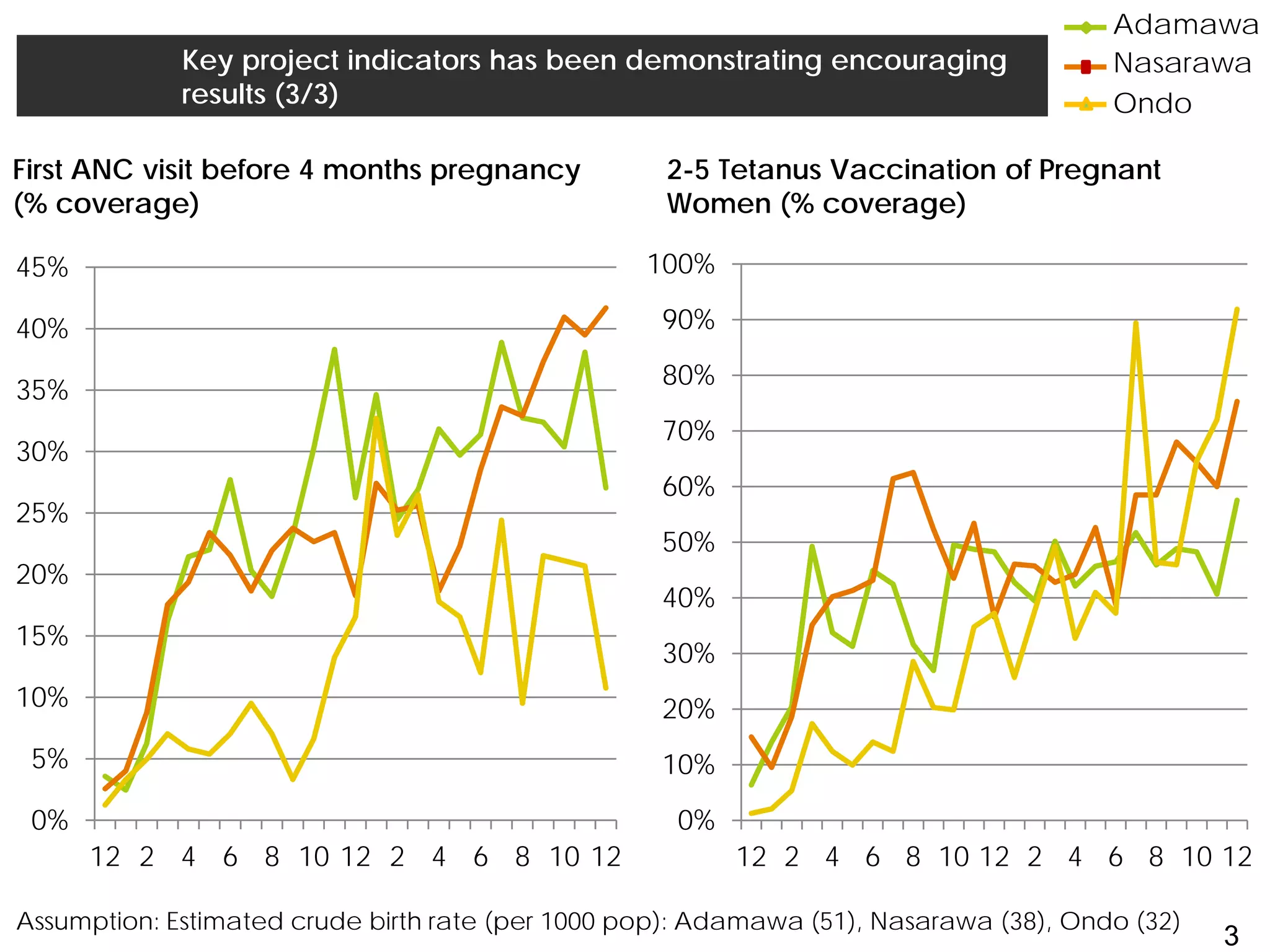
Key project indicators has been demonstrating encouraging
results (3/3)
Adamawa
Nasarawa
Ondo
First ANC visit before 4 months pregnancy
(% coverage)
0%
5%
10%
15%
20%
25%
30%
35%
40%
45%
12 2 4 6 8 10 12 2 4 6 8 10 12
Assumption: Estimated crude birth rate (per 1000 pop): Adamawa (51), Nasarawa (38), Ondo (32)
2-5 Tetanus Vaccination of Pregnant
Women (% coverage)
0%
10%
20%
30%
40%
50%
60%
70%
80%
90%
100%
12 2 4 6 8 10 12 2 4 6 8 10 12
3
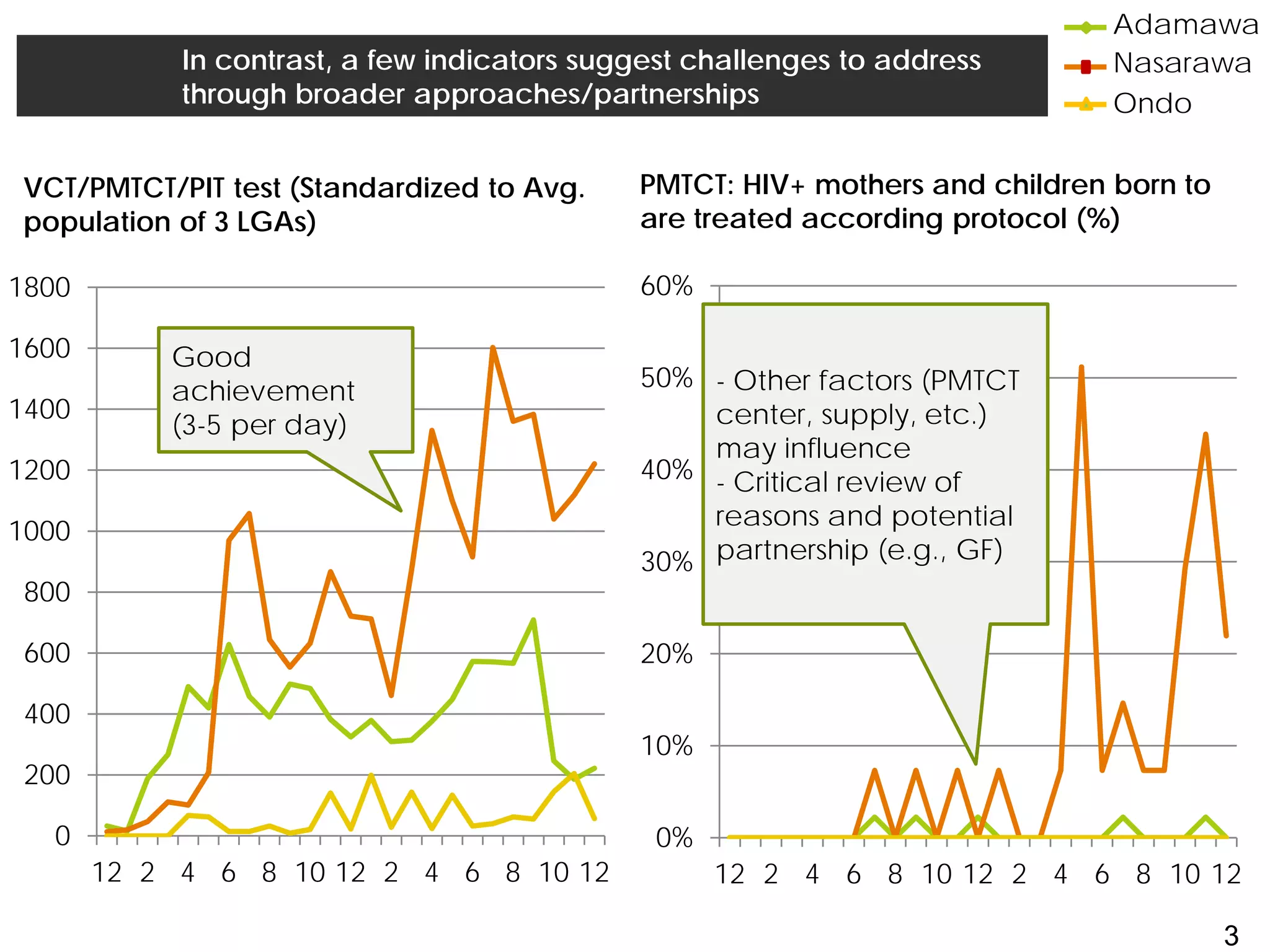
In contrast, a few indicators suggest challenges to address
through broader approaches/partnerships
Adamawa
Nasarawa
Ondo
PMTCT: HIV+ mothers and children born to
are treated according protocol (%)
0%
10%
20%
30%
40%
50%
60%
12 2 4 6 8 10 12 2 4 6 8 10 12
- Other factors (PMTCT
center, supply, etc.)
may influence
- Critical review of
reasons and potential
partnership (e.g., GF)
VCT/PMTCT/PIT test (Standardized to Avg.
population of 3 LGAs)
0
200
400
600
800
1000
1200
1400
1600
1800
12 2 4 6 8 10 12 2 4 6 8 10 12
Good
achievement
(3-5 per day)
3
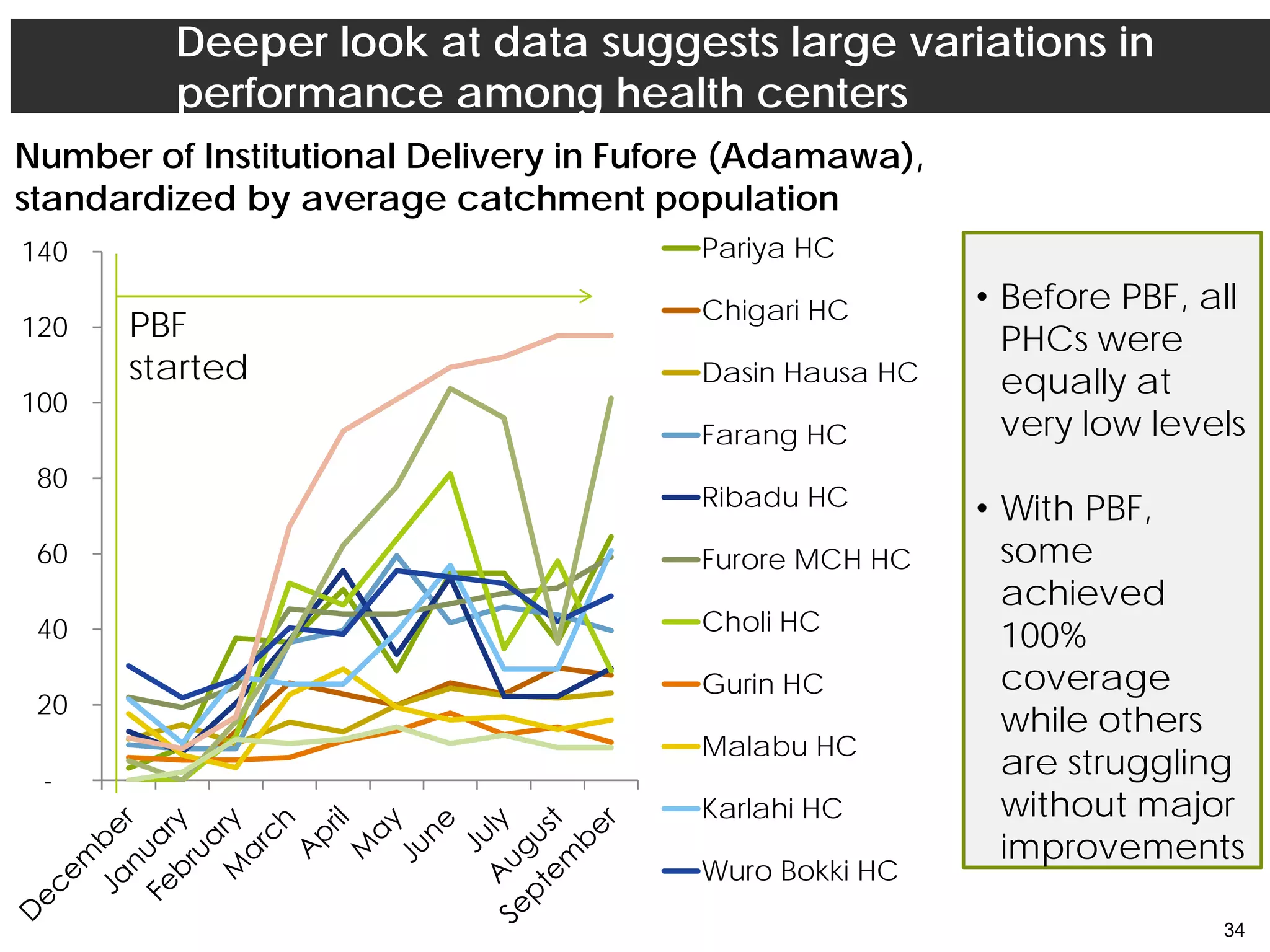
Deeper look at data suggests large variations in
performance among health centers
Number of Institutional Delivery in Fufore (Adamawa),
standardized by average catchment population
• Before PBF, all
PHCs were
equally at
very low levels
• With PBF,
some
achieved
100%
coverage
while others
are struggling
without major
improvements
-
20
40
60
80
100
120
140 Pariya HC
Chigari HC
Dasin Hausa HC
Farang HC
Ribadu HC
Furore MCH HC
Choli HC
Gurin HC
Malabu HC
Karlahi HC
Wuro Bokki HC
PBF
started
34
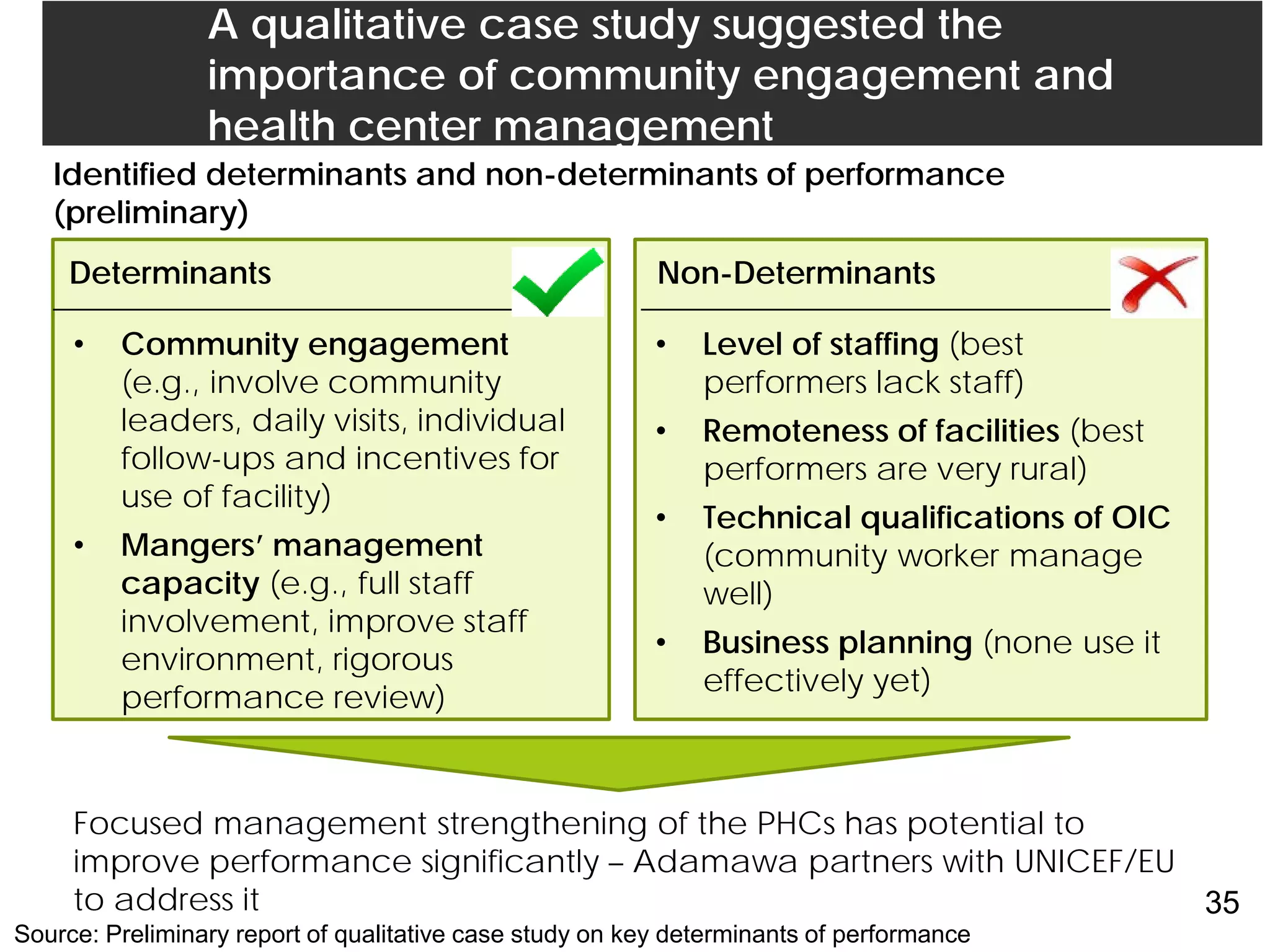
A qualitative case study suggested the
importance of community engagement and
health center management
Determinants Non-Determinants
• Community engagement
(e.g., involve community
leaders, daily visits, individual
follow-ups and incentives for
use of facility)
• Mangers’ management
capacity (e.g., full staff
involvement, improve staff
environment, rigorous
performance review)
Identified determinants and non-determinants of performance
(preliminary)
• Level of staffing (best
performers lack staff)
• Remoteness of facilities (best
performers are very rural)
• Technical qualifications of OIC
(community worker manage
well)
• Business planning (none use it
effectively yet)
35
Source: Preliminary report of qualitative case study on key determinants of performance
Focused management strengthening of the PHCs has potential to
improve performance significantly – Adamawa partners with UNICEF/EU
to address it
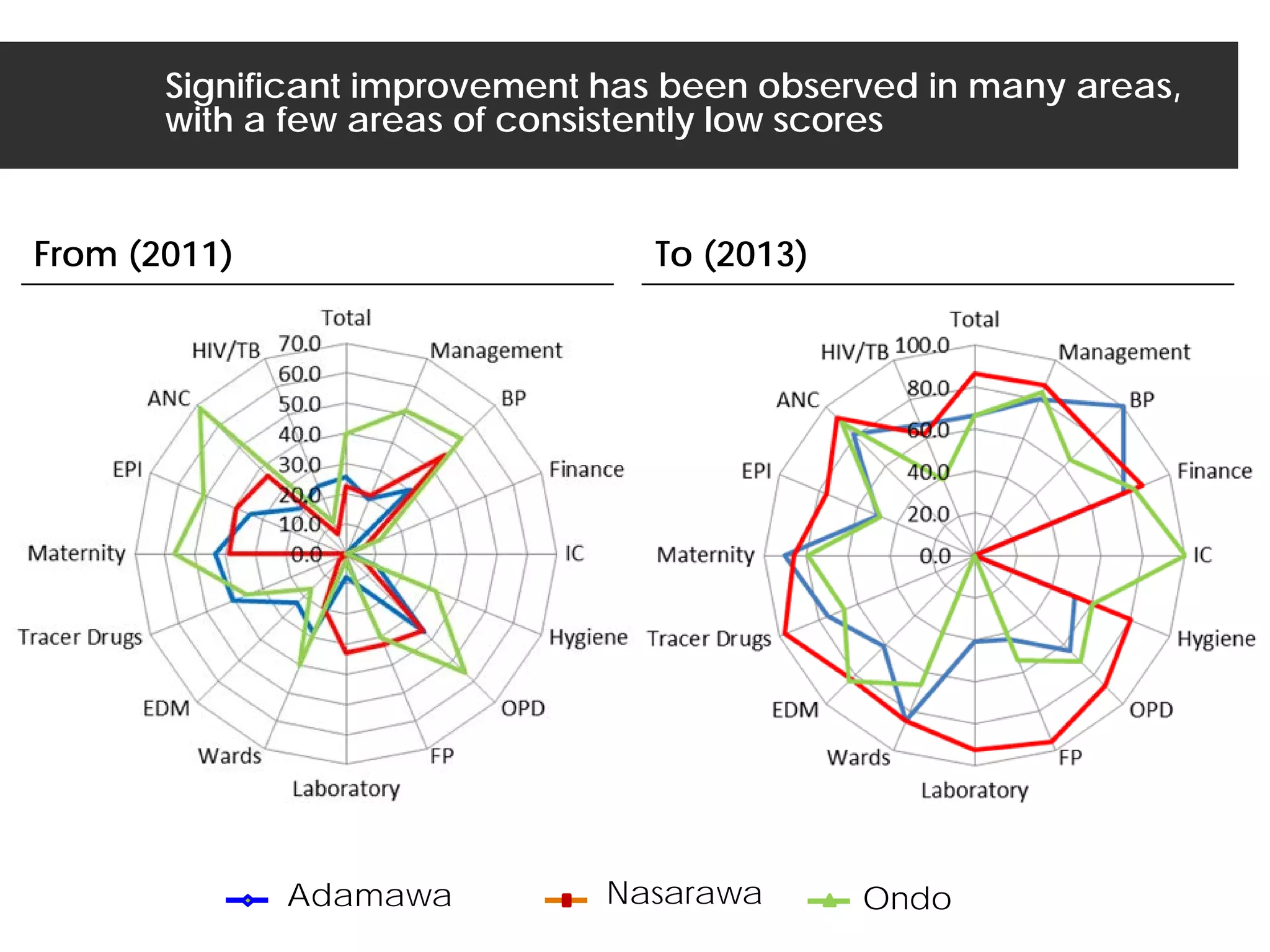
Adamawa Nasarawa Ondo
From (2011) To (2013)
Significant improvement has been observed in many areas,
with a few areas of consistently low scores
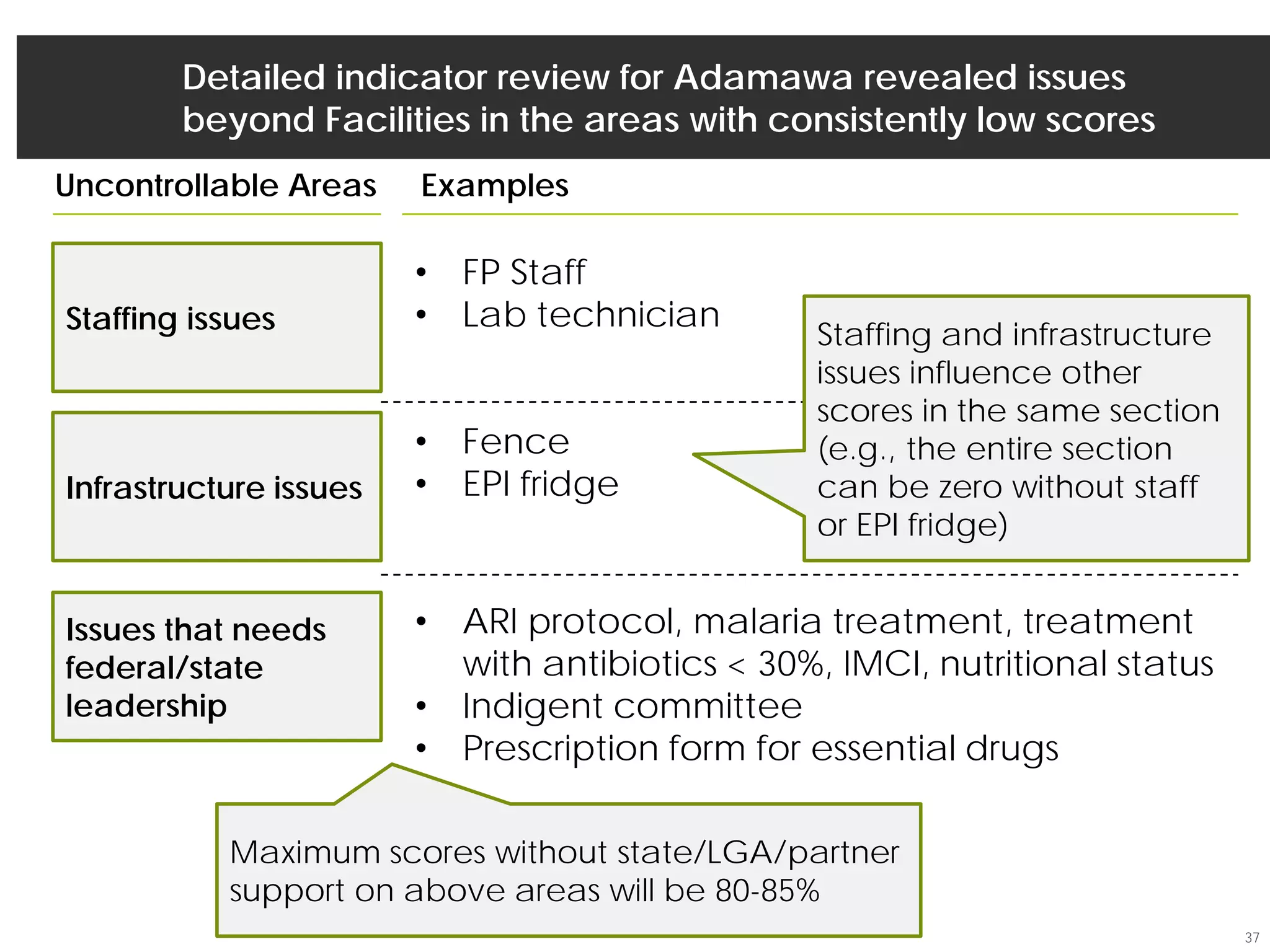
Detailed indicator review for Adamawa revealed issues
beyond Facilities in the areas with consistently low scores
37
Staffing issues
Infrastructure issues
Issues that needs
federal/state
leadership
• FP Staff
• Lab technician
• Fence
• EPI fridge
• ARI protocol, malaria treatment, treatment
with antibiotics < 30%, IMCI, nutritional status
• Indigent committee
• Prescription form for essential drugs
Staffing and infrastructure
issues influence other
scores in the same section
(e.g., the entire section
can be zero without staff
or EPI fridge)
ExamplesUncontrollable Areas
Maximum scores without state/LGA/partner
support on above areas will be 80-85%
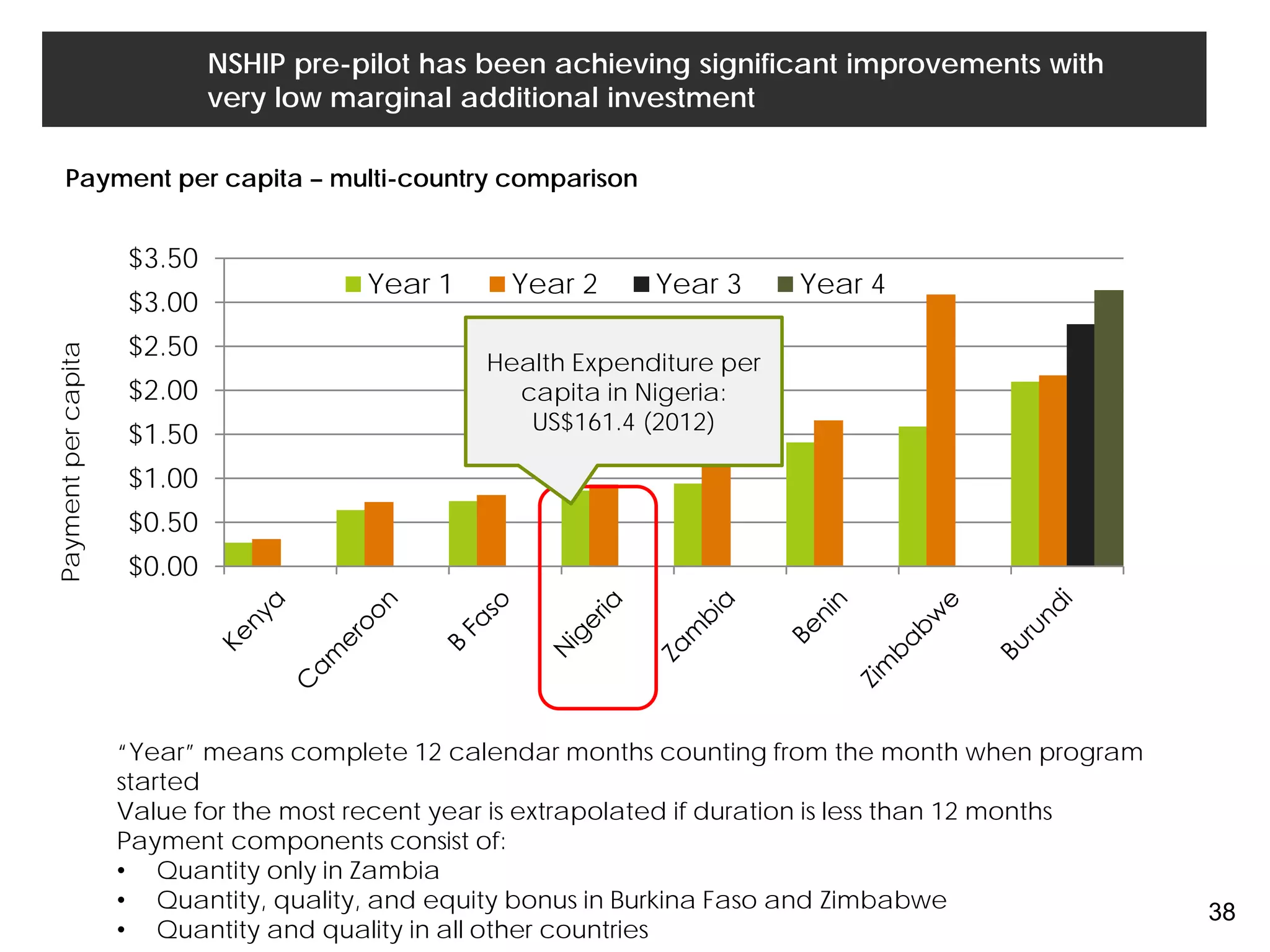
NSHIP pre-pilot has been achieving significant improvements with
very low marginal additional investment
$0.00
$0.50
$1.00
$1.50
$2.00
$2.50
$3.00
$3.50
Year 1 Year 2 Year 3 Year 4
Paymentpercapita
“Year” means complete 12 calendar months counting from the month when program
started
Value for the most recent year is extrapolated if duration is less than 12 months
Payment components consist of:
• Quantity only in Zambia
• Quantity, quality, and equity bonus in Burkina Faso and Zimbabwe
• Quantity and quality in all other countries
Payment per capita – multi-country comparison
Health Expenditure per
capita in Nigeria:
US$161.4 (2012)
38
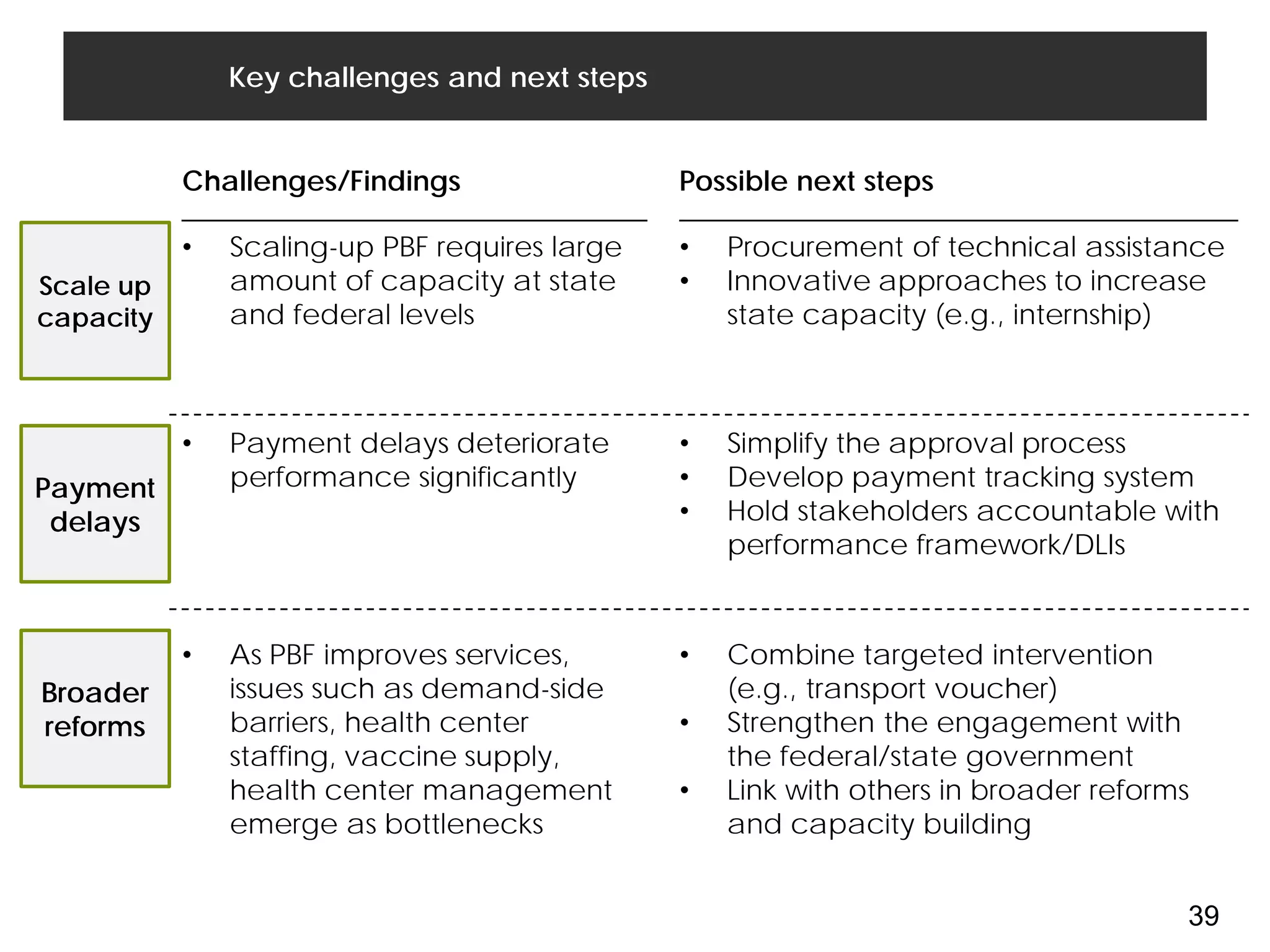
Key challenges and next steps
Challenges/Findings Possible next steps
• Scaling-up PBF requires large
amount of capacity at state
and federal levels
• Procurement of technical assistance
• Innovative approaches to increase
state capacity (e.g., internship)
Scale up
capacity
Payment
delays
• Payment delays deteriorate
performance significantly
• Simplify the approval process
• Develop payment tracking system
• Hold stakeholders accountable with
performance framework/DLIs
Broader
reforms
• As PBF improves services,
issues such as demand-side
barriers, health center
staffing, vaccine supply,
health center management
emerge as bottlenecks
• Combine targeted intervention
(e.g., transport voucher)
• Strengthen the engagement with
the federal/state government
• Link with others in broader reforms
and capacity building
39
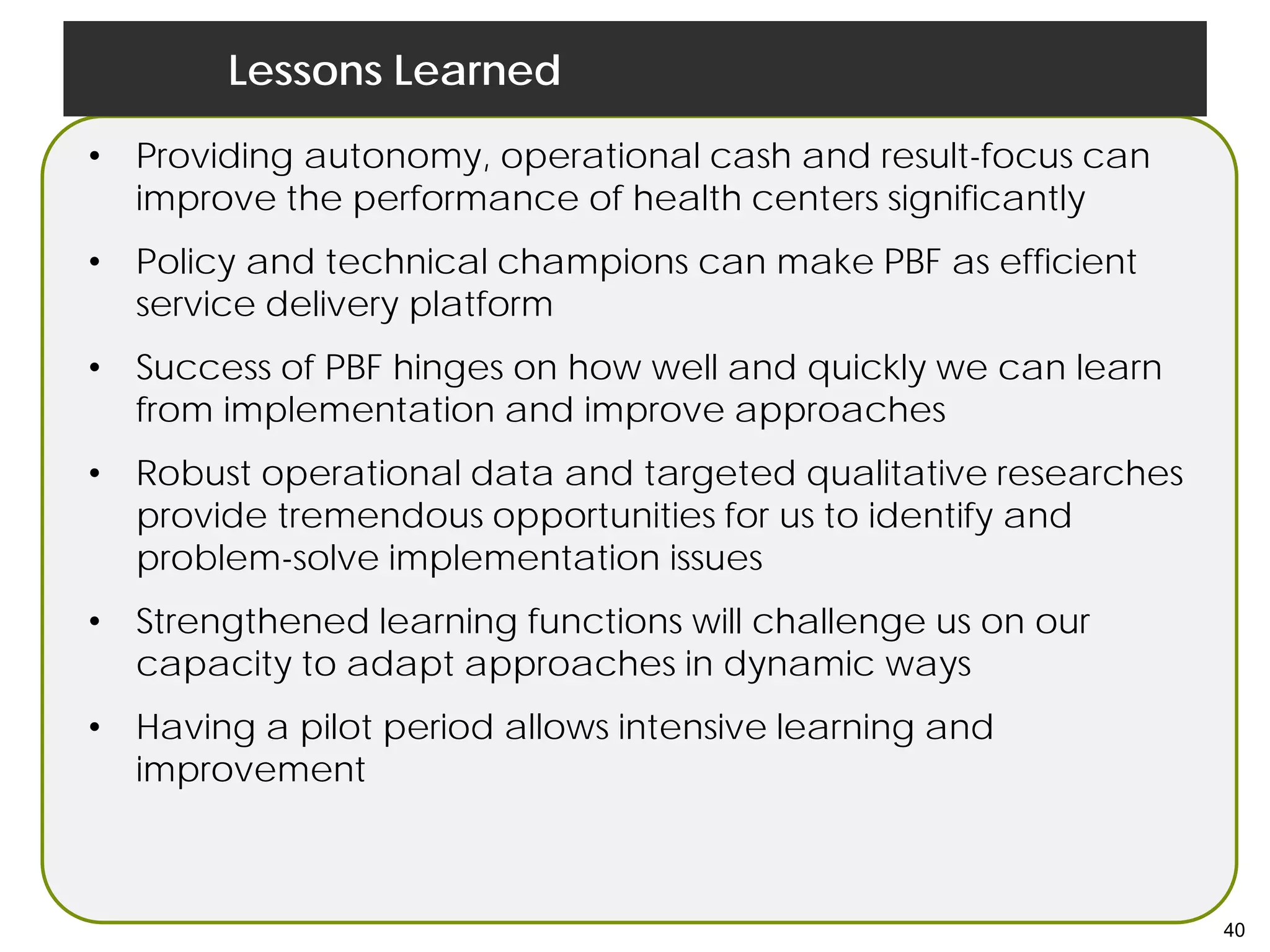
Lessons Learned
• Providing autonomy, operational cash and result-focus can
improve the performance of health centers significantly
• Policy and technical champions can make PBF as efficient
service delivery platform
• Success of PBF hinges on how well and quickly we can learn
from implementation and improve approaches
• Robust operational data and targeted qualitative researches
provide tremendous opportunities for us to identify and
problem-solve implementation issues
• Strengthened learning functions will challenge us on our
capacity to adapt approaches in dynamic ways
• Having a pilot period allows intensive learning and
improvement
40
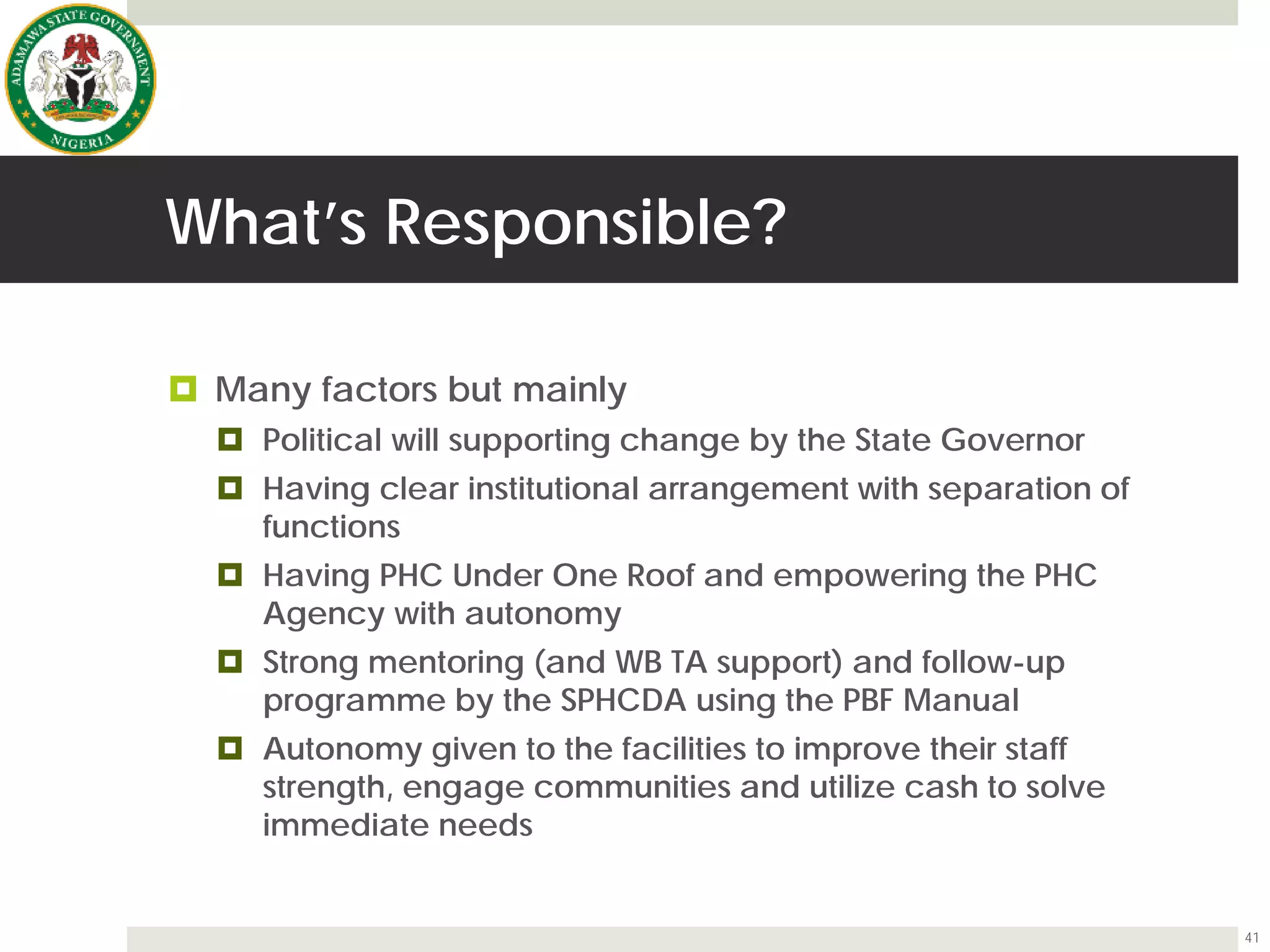
What’s Responsible?
 Many factors but mainly
 Political will supporting change by the State Governor
 Having clear institutional arrangement with separation of
functions
 Having PHC Under One Roof and empowering the PHC
Agency with autonomy
 Strong mentoring (and WB TA support) and follow-up
programme by the SPHCDA using the PBF Manual
 Autonomy given to the facilities to improve their staff
strength, engage communities and utilize cash to solve
immediate needs
41
Thank you
PLEASE VISIT US @:
http://nphcda.thenewtechs.com
&
http://adsphcda.org.ng
42

Providing Health in Difficult Contexts: Pre-Pilot Performance-Based Financing Experiences in Adamawa State in North-East Nigeria

  • 1.
    The Adamawa PrimaryHealth Care System Dr Abdullahi Dauda Belel Chairman, Adamawa SPHCDA, Nigeria Shun Mabuchi, Health Specialist, WB 24th April 2014 1
  • 2.
    Presentation Outline  BackgroundInformation  PBF Introduction  Progress in implementation  Results  What’s Responsible? 2
  • 3.
    In Nigeria, Healthcenters suffer from underlying systemic issues What you will see at a primary health care center: • Relatively abundant workers (among top in SSA) • Chronic stock-outs of essential drugs (Avg. 55%) • Lack of minimum equipment (Avg. 25% equipped) • Poor sanitation/waste management • Idle health workers/absenteeism (Avg. 29%) • Correct mgmt. of maternal complication (17.3%) • No patients (Avg. 1.5 patients per day) Underlying systemic issues: • Fragmentation and poor coordination between federal, state and local govt levels • Unclear accountability and poor performance review to strengthen it • No incentives to good or poor performance • No cash and autonomy at health facilities Source: Service Delivery Indicator (SDI) Survey, 2013
  • 4.
    Nigeria has beena largest contributor of maternal and child mortality Description • 33,000 women each year • An estimated 70% of these deaths are preventable • ~ 1 million deaths each year SOURCE: FMOH Presentation (NDHS 2008), Rajaratnam et al. 2010, UN Report 2012 Maternal mortality rate (100k live births) Infant mortality rate (1000 live births) Under 5 mortality rate (1000 live births) 14% 8% 9% Nigeria’s global share 157 104 75 65 545 500 Nigeria vs. SSA Nigeria Sub-Saharan Africa 4
  • 5.
    NSHIP aims toaddress the systemic issues by financing for results and monitoring rigorously Project Approach in Nigeria (US$ 170 M, 5 years, 3 States) • Health service coverage • Budget execution • Bonus payment • Quantity of services delivered • Quality scores of the services • Supervision • HMIS reporting • HR management Finance based on.. (Examples) 5 $$ $$ $$ State Govt. Local Govt. Health Centers Federal Govt. Disburse- ment linked indicator (DLI) PBF Main Driver
  • 6.
    NSHIP is beingscaled up after 2 years of pre- pilot implementation ’11 2012 2013 2014 De c Q1 Q2 Q3 Q4 Q1 Q2 Q3 Q4 Q1 Q2 Q3 Q4 Pre-pilot started PBF Pre- pilot (36 facilities) PBF Scale- up DLI 6 months payment delays Subcontracting started for 4 services Demand-side interventions pre-pilot Project effectiveness (Aug 2013) +3 PBF LGAs +3 PBF LGAs TA Agency Almost all 2011-12 DLIs achieved (May 2013) FY 2013 DLI review planned in May Scope of data analysis 6
  • 7.
    Adamawa Background Information Adamawa State is located in Northeast of Nigeria  Projected 2014 Population of 3,87m  Has 21 LGAs and 226 Wards  Among the 5 poorest States in Nigeria  A major contributor to the Nigeria’s poor health indicators  Health sector has very minimum private sector participation while the public facilities are in a deplorable State 7
  • 8.
  • 9.
    Background Information  Theentire sector is currently under reform, using PBF as a strategy  The State is piloting PBF for GON but adopted it as strategy for strengthening the health system  Focused primarily on strengthening the Ward Health System (WHS) and Primary Health Care Under One Roof (PHCOUR)  Ensuring that funds are made available at the service points, guided by deliberate and focused plans  MNCH is placed at the frontline in PBF design and its scale up is supported by EU-UNICEF 9
  • 10.
    Background Information  Implementationarrangements is aligned to the attainment of the NSHDP’s objectives  Pre-Pilot evaluation revealed encouraging results and further clarified areas for immediate and long term adjustments for the scale up 10
  • 11.
    Demsa Fuf ore Gany e Girei Gombi Guyuk Hong Jada Lamurde Madagali Maiha May obelwa Michika Mubi North Mubi South Numan Shelleng Song Toungo Yola North Yola South PBF Introduction 11 PBF PBF scale up DFF
  • 12.
    Progress in Implementation Key Officers: SMOH, ADPHCDA trained on PBF In Mombasa-Kenya and Enugu-Nigeria  Pre-Pilot (Fufore LGA) was chosen  Rural LGA – Pop ~ 240,160  Political Wards: 11  A Cottage Hospital (Secondary HF)  Baseline assessment of HFs and Communities done 12
  • 13.
    Progress in Implementation 15 HFs selected: 14 HCs for MPA & 1 GH for CPA  Management structures at LG level constituted and inaugurated (2012)  LG RBF Steering Committee  WDCs  HF RBF Committees (both HCs & Hospital)  IMC (both HCs & Hospital)  Bank Accounts for both HCs & Hospital opened 13
  • 14.
    Minimum Package ofActivities 14
  • 15.
  • 16.
    Effective Affordable • Deliveries inHF • Malaria Cases Treated • Immunized Childred, etc • Result Based Financing •Quality Services •Quantity Services CPA Institutional arrangements 16
  • 17.
  • 18.
    Success story ofMayo Ine Ward
  • 19.
  • 20.
    Success story  Mayo-Inehealth centre went from 4 deliveries per month to 45 deliveries per month within a six-month period  It has sustained that rate over the rest of the year, and this means that, for its entire sub-district population, it had gone from delivering10% of pregnant women to delivering 100% of all expected deliveries in its health facility.  Mayo-Ine health center has effectively reached universal coverage for institutional deliveries.
  • 21.
    Success story  Sowhat happened in Mayo-Ine?  As you can imagine, there must have been a tremendous change from what was there before.  The changes led to its staff working harder, going out to villages and talking to the population.  The staff involved the local community and traditional leaders in convincing the population to use its services.  The health facility received autonomy and a bank account and learned to manage money.  Working hours were changed from Monday to Friday 8 am to 4 pm to 24/7. One additional staff, a lab assistant, was hired.
  • 22.
    Success story  Thestaff purchased drugs and medical materials from certified distributors; it purchased new equipment, repaired the broken fence, the windows, repaired the toilets, and fixed the waste disposal.  The changes led to health workers linking to their health posts and using these also to provide services, to provide growth monitoring, and vaccinations  Patients who would come would be prescribed essential drugs according to protocols which made it more affordable for them  The district health team came frequently for supervision, and provided targeted feed-back using a checklist.  Technical assistance from the State Primary Health Care Development Agency ensured that health staff was coached in using money, in managing their staff and in using new strategies to improve their health services.
  • 23.
  • 24.
    Success story  Andmost difficult of all: health workers convinced all pregnant women, all of them, to come and deliver in their health facility.  The health staff changed their attitudes to patients, ensured that the equipment was there, that the environment in which they had to deliver was nice, that it had water, sanitation, a bed with clean sheets and a pleasant atmosphere.  Women who delivered did not have to pay any more for drugs or needles or to bring maternity pads.  In fact, women who delivered were given small items such as maternity pads, and clothes for their babies.
  • 25.
    Success story  Thehealth workers did the hardest thing of all: to regain the trust of the population by convincing them to use the public health services again and to use it for all their health needs.  Today, Mayo-Ine health center is a beacon for Fufore LGA, for Adamawa State, and also for Nigeria.  If Mayo-Ine can do it, in this far outpost of Nigeria, then anybody can do it.
  • 26.
  • 27.
  • 28.
    Increase coverage acrossthe 3 PBF States Adamawa Nasarawa Ondo 28 Institutional Delivery 0% 10% 20% 30% 40% 50% 60% 12 1 2 3 4 5 6 7 8 9 10 11 12 1 2 3 4 5 6 7 8 9 10 11 12 Assumption: Estimated crude birth rate (per 1000 pop): Adamawa (51), Nasarawa (38), Ondo (32)
  • 29.
    Adamawa Nasarawa Ondo QualityScore(%) 26 51 6664 45 57 66 67 67 21 65 81 84 83 83 87 86 85 41 52 69 67 70 65 66 68 76 - 10 20 30 40 50 60 70 80 90 100 Q4 '11 Q1 '12 Q2 '12 Q3 '12 Q4 '12 Q1 '13 Q2 '13 Q3 '13 Q4 '13 Quality scores are converging at high level but still have variations across states
  • 30.
    Key project indicatorshas been demonstrating encouraging results (1/3) Adamawa Nasarawa Ondo 30 OPD per capita per year Institutional Delivery (% coverage) Payment Delays Payment Delays 0.00 0.10 0.20 0.30 0.40 0.50 0.60 0.70 0.80 0.90 12 2 4 6 8 10 12 2 4 6 8 10 12 0% 10% 20% 30% 40% 50% 60% 12 2 4 6 8 10 12 2 4 6 8 10 12 Assumption: Estimated crude birth rate (per 1000 pop): Adamawa (51), Nasarawa (38), Ondo (32) North East average 20% 30
  • 31.
    Key project indicatorshas been demonstrating encouraging results (2/3) Adamawa Nasarawa Ondo 31 Completely Vaccinated Child (% coverage) New users of modern FP methods (%) 0% 10% 20% 30% 40% 50% 60% 70% 80% 90% 100% 12 2 4 6 8 10 12 2 4 6 8 10 12 Variable due to issues in cold chain 0% 5% 10% 15% 20% 25% 30% 35% 40% 12 2 4 6 8 10 12 2 4 6 8 10 12 Remarkable achievement (North East average 3%) Assumption: Estimated crude birth rate (per 1000 pop): Adamawa (51), Nasarawa (38), Ondo (32) 3
  • 32.
    Key project indicatorshas been demonstrating encouraging results (3/3) Adamawa Nasarawa Ondo First ANC visit before 4 months pregnancy (% coverage) 0% 5% 10% 15% 20% 25% 30% 35% 40% 45% 12 2 4 6 8 10 12 2 4 6 8 10 12 Assumption: Estimated crude birth rate (per 1000 pop): Adamawa (51), Nasarawa (38), Ondo (32) 2-5 Tetanus Vaccination of Pregnant Women (% coverage) 0% 10% 20% 30% 40% 50% 60% 70% 80% 90% 100% 12 2 4 6 8 10 12 2 4 6 8 10 12 3
  • 33.
    In contrast, afew indicators suggest challenges to address through broader approaches/partnerships Adamawa Nasarawa Ondo PMTCT: HIV+ mothers and children born to are treated according protocol (%) 0% 10% 20% 30% 40% 50% 60% 12 2 4 6 8 10 12 2 4 6 8 10 12 - Other factors (PMTCT center, supply, etc.) may influence - Critical review of reasons and potential partnership (e.g., GF) VCT/PMTCT/PIT test (Standardized to Avg. population of 3 LGAs) 0 200 400 600 800 1000 1200 1400 1600 1800 12 2 4 6 8 10 12 2 4 6 8 10 12 Good achievement (3-5 per day) 3
  • 34.
    Deeper look atdata suggests large variations in performance among health centers Number of Institutional Delivery in Fufore (Adamawa), standardized by average catchment population • Before PBF, all PHCs were equally at very low levels • With PBF, some achieved 100% coverage while others are struggling without major improvements - 20 40 60 80 100 120 140 Pariya HC Chigari HC Dasin Hausa HC Farang HC Ribadu HC Furore MCH HC Choli HC Gurin HC Malabu HC Karlahi HC Wuro Bokki HC PBF started 34
  • 35.
    A qualitative casestudy suggested the importance of community engagement and health center management Determinants Non-Determinants • Community engagement (e.g., involve community leaders, daily visits, individual follow-ups and incentives for use of facility) • Mangers’ management capacity (e.g., full staff involvement, improve staff environment, rigorous performance review) Identified determinants and non-determinants of performance (preliminary) • Level of staffing (best performers lack staff) • Remoteness of facilities (best performers are very rural) • Technical qualifications of OIC (community worker manage well) • Business planning (none use it effectively yet) 35 Source: Preliminary report of qualitative case study on key determinants of performance Focused management strengthening of the PHCs has potential to improve performance significantly – Adamawa partners with UNICEF/EU to address it
  • 36.
    Adamawa Nasarawa Ondo From(2011) To (2013) Significant improvement has been observed in many areas, with a few areas of consistently low scores
  • 37.
    Detailed indicator reviewfor Adamawa revealed issues beyond Facilities in the areas with consistently low scores 37 Staffing issues Infrastructure issues Issues that needs federal/state leadership • FP Staff • Lab technician • Fence • EPI fridge • ARI protocol, malaria treatment, treatment with antibiotics < 30%, IMCI, nutritional status • Indigent committee • Prescription form for essential drugs Staffing and infrastructure issues influence other scores in the same section (e.g., the entire section can be zero without staff or EPI fridge) ExamplesUncontrollable Areas Maximum scores without state/LGA/partner support on above areas will be 80-85%
  • 38.
    NSHIP pre-pilot hasbeen achieving significant improvements with very low marginal additional investment $0.00 $0.50 $1.00 $1.50 $2.00 $2.50 $3.00 $3.50 Year 1 Year 2 Year 3 Year 4 Paymentpercapita “Year” means complete 12 calendar months counting from the month when program started Value for the most recent year is extrapolated if duration is less than 12 months Payment components consist of: • Quantity only in Zambia • Quantity, quality, and equity bonus in Burkina Faso and Zimbabwe • Quantity and quality in all other countries Payment per capita – multi-country comparison Health Expenditure per capita in Nigeria: US$161.4 (2012) 38
  • 39.
    Key challenges andnext steps Challenges/Findings Possible next steps • Scaling-up PBF requires large amount of capacity at state and federal levels • Procurement of technical assistance • Innovative approaches to increase state capacity (e.g., internship) Scale up capacity Payment delays • Payment delays deteriorate performance significantly • Simplify the approval process • Develop payment tracking system • Hold stakeholders accountable with performance framework/DLIs Broader reforms • As PBF improves services, issues such as demand-side barriers, health center staffing, vaccine supply, health center management emerge as bottlenecks • Combine targeted intervention (e.g., transport voucher) • Strengthen the engagement with the federal/state government • Link with others in broader reforms and capacity building 39
  • 40.
    Lessons Learned • Providingautonomy, operational cash and result-focus can improve the performance of health centers significantly • Policy and technical champions can make PBF as efficient service delivery platform • Success of PBF hinges on how well and quickly we can learn from implementation and improve approaches • Robust operational data and targeted qualitative researches provide tremendous opportunities for us to identify and problem-solve implementation issues • Strengthened learning functions will challenge us on our capacity to adapt approaches in dynamic ways • Having a pilot period allows intensive learning and improvement 40
  • 41.
    What’s Responsible?  Manyfactors but mainly  Political will supporting change by the State Governor  Having clear institutional arrangement with separation of functions  Having PHC Under One Roof and empowering the PHC Agency with autonomy  Strong mentoring (and WB TA support) and follow-up programme by the SPHCDA using the PBF Manual  Autonomy given to the facilities to improve their staff strength, engage communities and utilize cash to solve immediate needs 41
  • 42.
    Thank you PLEASE VISITUS @: http://nphcda.thenewtechs.com & http://adsphcda.org.ng 42