INTERNATIONAL BUSINESS MANAGEMENT
UNIT-1
International business refers to the trade or exchange of goods,
services and resources between different countries and regions.
It involves companies and business operation in more than one
country and dealing with customers, suppliers, partners from
different culture and backgrounds. International business helps
countries and regions to grow economically by increasing
trade, investment and job opportunities.
In simple words, it is the flow of goods, services and
information between countries around the world.
Nature of International business in points:
1. Cross-border transactions: International business
involves transactions and activities across national
borders.
2. Cultural diversity: International business requires
companies to understand and adapt to cultural differences
between countries.
3. Political and legal differences: Companies must be
aware of the political and legal systems in different
countries and how they can affect business operations.
4. Currency fluctuations: Exchange rate fluctuations can
have a significant impact on international business
operations.
5. Transportation and logistics: The transportation and
logistics of goods and services play a crucial role in
international business.
6. Competition: Companies must be prepared to compete
with firms from all over the world in a global marketplace.
7. Globalization: International business is driven by
globalization, which is the increasing interconnectedness
of the world’s economies.
8. Economic integration: International business is
facilitated by economic integration, which refers to the
integration of economies through trade and investment.
9. Multilingualism: International business requires
companies to have a good understanding of different
languages and cultures.
10. Market opportunities: International business opens
up new market opportunities for companies, allowing
them to access new customers and expand their
operations.
Scope of international business in points:
1. Globalization: The increased interconnectedness of
countries and the growth of cross-border trade and
investment have made international business an integral
part of the global economy.
2. Market expansion: International business provides an
opportunity for companies to expand their markets and
increase their customer base by selling products and
services in different countries.
3. Cultural diversity: International business operates in
culturally diverse environments and requires an
understanding of different customs, beliefs, and business
practices.
4. Political and economic environment: Political stability
and economic conditions in a country can significantly
impact international business activities. Companies must
stay informed about changes in government policies and
economic trends in the countries in which they operate.
5. Technological advancements: Technological
advancements have made it easier for companies to
conduct business across borders and have increased the
efficiency of international trade.
6. Competition: International business is characterized by
intense competition as companies from different countries
compete for market share and customers.
7. Legal and regulatory environment: Companies must
comply with a variety of laws and regulations in different
countries, including labour laws, intellectual property
laws, and trade regulations.
8. Logistics and transportation: Effective logistics and
transportation are essential for the success of international
business, as companies must ensure the timely and cost-
effective delivery of products and services to customers in
different countries.
Importance of international business in points
1. Increased Revenue: International business helps
companies to increase their revenue by tapping into new
markets and selling their products and services to
customers in different countries.
2. Global Competition: International business also helps
companies to remain competitive in a global market by
expanding their reach and staying ahead of competitors in
other countries.
3. Diversification: By expanding into international markets,
companies can diversify their revenue streams, reducing
the risk of economic downturns in any one market.
4. Improved Technology: International business can lead to
improved technology through the exchange of knowledge
and experience between different countries and industries.
5. Cultural Exchange: International business helps to
facilitate cultural exchange between different countries
and promotes cross-cultural understanding.
6. Job Creation: International business can lead to the
creation of new jobs in different countries as companies
set up operations and expand into new markets.
7. Increased Economic Growth: International business
helps to stimulate economic growth in different countries
by increasing trade and investment, leading to higher
productivity and improved standards of living.
8. Better Access to Raw Materials: International business
provides companies with access to raw materials and
resources that may not be available in their home country,
leading to lower costs and increased efficiency.
9. Improved Brand Recognition: Companies that engage
in international business benefit from increased brand
recognition, as they expand their presence in new markets
and reach new customers.
10. Political and Economic Stability: International
business can contribute to political and economic stability
in different countries by creating new jobs and increasing
trade and investment.
Factors affecting international business
1. Political factors: Political stability, government
regulations, and laws, trade policies, tariffs and taxes, and
import and export regulations are the main political factors
that influence international business.
2. Economic factors: The economic stability of countries,
exchange rates, inflation, and the cost of goods and
services play a crucial role in the success of international
business.
3. Cultural factors: Cultural differences and language
barriers can have a significant impact on international
business, as they influence customer behaviour,
communication, and business practices.
4. Technological factors: Technological advancements,
innovation, and the digitalization of international trade
have a profound impact on international business
operations and competition.
5. Market factors: Competition, customer preferences,
market size, market saturation, and the level of market
development play a crucial role in determining the success
of international business ventures.
6. Natural factors: Climate, natural disasters, and
environmental regulations can affect the availability of
resources, production processes, and the delivery of goods
and services.
7. Infrastructure factors: The availability and quality of
transportation, communication, and energy networks, as
well as the level of developed infrastructure, play a crucial
role in the success of international business.
8. Legal factors: Intellectual property rights, patent laws,
labour laws, and international trade agreements impact the
viability of international business.
9. Demographic factors: Population growth, migration
patterns, and changes in demographics can have an impact
on the demand for goods and services in international
markets.
Current trends in international business:
1. Globalization: The trend of globalization has increased
the growth of international business. Companies are now
able to expand their operations globally, making them
more competitive.
2. E-commerce: The rise of e-commerce has revolutionized
international business, making it easier for companies to
sell their products and services online. This has opened
up new markets for businesses and made it possible for
companies to reach customers in remote areas.
3. Outsourcing: Outsourcing has become a common
practice in international business. Companies are
outsourcing various functions such as manufacturing,
customer service, and back-office operations to countries
with lower labour costs.
4. Mergers and Acquisitions: Mergers and acquisitions are
becoming more prevalent in international business.
Companies are seeking to grow through acquiring other
businesses or merging with other companies to expand
their operations.
5. Social Media: The use of social media in international
business has increased significantly. Companies are using
social media platforms to reach new customers and
promote their products and services.
6. Artificial Intelligence and Automation: Artificial
intelligence and automation are changing the way
international business is conducted. Companies are now
using AI and automation to improve their operations and
reduce costs.
7. Green Business Practices: Companies are becoming
more environmentally conscious and are implementing
green business practices in their operations. This is
becoming an important trend in international business as
consumers are becoming more aware of environmental
issues and are demanding sustainable products and
services.
8. Political and Economic Uncertainty: Political and
economic uncertainty is affecting international business,
with companies facing challenges in trade, taxes, and
other regulations. Companies are looking for ways to
mitigate these risks and remain competitive in the global
market.
9. Protectionism: The trend of protectionism, where
countries seek to protect their domestic industries, is
having an impact on international business. Companies
are having to navigate complex regulations and trade
barriers to enter new markets.
10. The Rise of the Gig Economy: The gig economy is
growing, with companies relying on freelance workers
and independent contractors to help meet their business
needs. This trend is having a profound impact on
international business as companies look to access a
global pool of talent.
Challenges faced by international business:
1. Cultural Differences: International business must
overcome cultural differences and language barriers to
establish successful operations in different countries. This
can lead to difficulties in communication, understanding
customer needs, and creating a sense of cultural
compatibility.
2. Political Instability: Political instability can create
challenges for international business, such as changes in
government policies, regulations, and taxes that can harm
business operations. This can also lead to uncertainty and
instability in the marketplace, making it difficult to plan
and make decisions.
3. Economic Instability: Economic instability in different
countries can create a challenging environment for
international business. For example, changes in currency
exchange rates, inflation, and market fluctuations can
make it difficult for businesses to plan for the future.
4. Logistical Challenges: Shipping goods and services
across borders can be a logistical challenge, especially if
there are different regulations, taxes, and tariffs involved.
This can lead to higher costs and longer delivery times,
making it more difficult for businesses to compete.
5. Competition: International business faces increased
competition from both domestic and international players,
which can make it difficult to establish a competitive
advantage and grow the business.
6. Different Legal Systems: Different legal systems can
create challenges for international business, especially
when it comes to contracts, employment laws, and
intellectual property protection. Businesses must be aware
of these differences and take the necessary steps to protect
their interests.
7. Technology and Infrastructure: Different countries
have varying levels of technology and infrastructure,
which can create challenges for international business. For
example, businesses may have to invest in new
technologies or find ways to adapt to local infrastructure
to meet customer needs.
Opportunities for International Business:
1. Diversification of Markets: International business
provides companies with the opportunity to diversify their
customer base by reaching new markets and customers in
other countries.
2. Expansion of Sales: By expanding into international
markets, companies can increase their sales and revenue,
thereby increasing profitability.
3. Access to New Resources: Companies that engage in
international business can access new raw materials,
technology, and skilled labour in other countries, which
can help to reduce costs and improve quality.
4. Reduction in Competition: International business can
help to reduce competition by allowing companies to
reach new customers in untapped markets.
5. Development of New Products: Companies that engage
in international business can develop new products and
services to meet the specific needs of customers in
different countries.
6. Improved Access to Capital: Companies that engage in
international business can access capital from
international investors, which can help to finance their
expansion and growth.
7. Enhanced Reputation: Companies that engage in
international business can enhance their reputation by
establishing a presence in new markets and demonstrating
their ability to compete globally.
8. Enhanced Research and Development: Companies that
engage in international business can benefit from the
sharing of knowledge and expertise with their
international partners, which can lead to improved
research and development.
9. Improved Economic Growth: International business can
help to promote economic growth by stimulating trade and
investment between countries, which can create jobs and
improve living standards.
Theories of International Business
Theories of international business have developed over time
and can be divided into three broad categories:
• Traditional/Classical Theories: These theories emerged in
the late 19th
and early 20th
centuries and focus on trade and
investment between countries. The most notable theories
include the theory of comparative advantage, the theory of
Heckscher-Ohlin, and the theory of product life cycle.
• Modern Theories: These theories emerged in the mid-20th
century and are concerned with multinational corporations
(MNCs) and the global economy. The most notable theories
include the internalization theory, the eclectic paradigm, and
the global value chain theory.
• Contemporary Theories: These theories have emerged in
recent decades and reflect the changing nature of international
business. The most notable theories include the resource-based
view, the network perspective, and the institutional perspective.
Traditional Theories
Classical/Traditional theories of international business are a set
of ideas that were developed in the early days of international
trade and investment. These theories provide a framework to
understand and analyze the behaviour of firms operating in an
international context. Here are some of the key traditional
theories of international business:
a) Mercantilism: This theory, developed in the 16th
and 17th
centuries, holds that a nation’s wealth is directly related to
its stock of gold and silver. Mercantilists believed that
exports were the key to a nation’s prosperity, and that
imports should be limited in order to maintain a favourable
balance of trade.
b)Absolute Advantage: This theory, developed by Adam
Smith, holds that a country should specialize in producing
goods for which it has a lower cost of production, and
trade those goods for goods produced more efficiently by
other countries.
c) Comparative Advantage: This theory, developed by
David Ricardo, holds that a country should specialize in
producing goods for which it has a lower relative cost of
production, regardless of whether it has an absolute
advantage in producing other goods.
d)Factor Proportions Theory: This theory, developed by
Eli Heckscher and Bertil Ohlin, suggests that a country
will have a comparative advantage in producing goods
that use its abundant factors of production intensively.
e) New Trade Theory: This theory, developed in the 1980s
and 1990s, focuses on the role of economies of scale and
product differentiation in determining trade patterns.
According to this theory, countries will trade goods that
are differentiated, rather than homogeneous.
These traditional theories of international business provide a
foundation for understanding the motivations and behaviours
of firms operating in an international context, and continue to
be relevant and influential today.
Modern Theories
a) Resource-Based View (1980s-90s): This theory suggests
that a firm’s resources, capabilities, and competencies are
key drivers of its competitive advantage in international
markets.
b)Institutional Theory (1980s-90s): This theory argues that
the political, legal, and cultural institutions of a country
shape its international business activities.
c) National Diamond Model (1990s): Proposed by Michael
Porter, this theory suggests that a country’s competitive
advantage in international business is determined by the
interplay of its factor conditions, related and supporting
industries, and firm strategy, structure, and rivalry.
d)Globalization Theory (2000s): This theory suggests that
international business is driven by the increased
interconnectedness of global economic, political, and
social systems, leading to the integration of markets and
the growth of cross-border trade and investment.
Contemporary Theories
a) Cultural Distance: This theory explains that cultural
differences and distances between countries impact
international business operations and outcomes.
b)Resource-Based View: This theory suggests that a firm’s
resources, including human, physical and intellectual
capital, are the key determinants of its competitiveness in
the global market.
c) Institutional Theory: This theory argues that a country’s
legal and political institutions influence international
business activities and outcomes.
d)Network Theory: This theory explains that international
business relationships are based on networks of
relationships between firms, governments, and other
actors.
e) Neo-Classical Trade Theory: This theory suggests that
countries trade with each other based on comparative
advantage, where countries specialize in the production of
goods in which they have a lower opportunity cost.
f) Global Strategic Rivalry Theory: This theory explains
that international business competition between firms is
shaped by the global distribution of power and influence
among nations.
g) Dependency Theory: This theory argues that less
developed countries are dependent on more developed
countries for economic growth, and that this relationship
negatively impacts the former’s ability to develop.
h)Political Risk Theory: This theory suggests that political
instability and uncertainty in a foreign market can impact
a firm’s ability to operate and succeed.
i) Hybrid Theory: This theory suggests that the nature of
international business is influenced by a combination of
factors, including cultural, institutional, and resource-
based variables.
j) Cultural Intelligence Theory: This theory argues that
cultural intelligence, or the ability to understand,
appreciate and navigate cultural differences, is an
important factor in the success of international business
operations.
International business Management
International Business Management is a field of study and
practice that focuses on the management of business operations
and transactions across national borders. It involves the
management of resources, products, services, and information
between countries. The goal is to ensure effective and efficient
global business operations that maximize profitability and
minimize risk.
International Business Management covers a wide range of
topics, including cross-cultural communication, international
trade and investment, currency management, global logistics,
market entry strategies, and risk management. It also includes
the study of various legal and regulatory frameworks that apply
to international business transactions.
International Business Managers must be well-versed in a
variety of business and cultural practices, as well as have a deep
understanding of global economic trends and geopolitical
factors. They must also have excellent communication,
leadership, and decision-making skills, as well as the ability to
manage complex relationships with partners, suppliers,
customers, and government agencies.
In conclusion, International Business Management is a critical
aspect of conducting business in today’s globalized economy.
It requires a comprehensive understanding of international
business practices, cultural differences, and the legal and
regulatory frameworks that apply to international business
transactions.
International Monetary System
The international monetary system refers to the framework of
international financial relations that determines exchange rates
and manages the flow of money between countries. It is a set
of rules, institutions, and procedures that govern international
payments and currency exchanges. The international monetary
system is designed to facilitate the flow of goods, services, and
capital between countries, promote economic growth and
stability, and reduce the risk of financial crises.
The current international monetary system is based on the use
of floating exchange rates, where the value of a currency is
determined by market forces rather than government
intervention. The International Monetary Fund (IMF) plays a
significant role in the international monetary system by
providing financial assistance to countries facing balance of
payment difficulties and promoting international economic
cooperation.
Overall, the international monetary system is a complex
and dynamic system that has evolved over time in
response to economic and political changes in the world.
It is an essential aspect of the global economy, and
changes to it can have significant impacts on international
trade, investment, and financial markets.
The main components of the international monetary system
are:
1. International Reserve Currency: A currency that is held
in large quantities by central banks around the world as a
reserve asset. The U.S. dollar is currently the international
reserve currency.
2. Exchange Rates: The value of one currency relative to
another. Exchange rates determine the value of a country’s
currency in the international market.
3. International Monetary Fund (IMF): An international
organization that promotes cooperation among nations in
monetary affairs and provides loans to countries facing
financial difficulties.
4. World Bank: An international financial institution that
provides loans and other financial assistance to
developing countries for the purpose of economic
development.
5. Central Banks: National institutions that oversee a
country’s monetary policy, including the setting of interest
rates and the management of foreign exchange reserves.
6. Bilateral Agreements: Agreements between two
countries that outline the terms of trade and investment
between the countries. These agreements often include
provisions related to the exchange rate.
The Merits of International Monetary System:
1. Facilitates trade: The international monetary system
enables countries to trade with each other by facilitating
the exchange of currencies.
2. Promotes economic growth: The international monetary
system helps countries to grow their economies by
allowing for the flow of capital, goods, and services across
borders.
3. Increases stability: The international monetary system
provides stability to currency exchange rates, reducing the
risk of currency fluctuations.
4. Encourages investment: The international monetary
system attracts foreign investment by providing a stable
environment for investment.
5. Enhances cooperation: The international monetary
system promotes international cooperation by
encouraging countries to work together to address
financial and economic challenges.
The Demerits of International Monetary System:
1. Lack of independence: Some countries may have limited
control over their monetary policies, making it difficult for
them to address domestic economic challenges.
2. Inequality: The international monetary system may
benefit developed countries at the expense of developing
countries, leading to increased inequality.
3. Currency fluctuations: Despite the stability provided by
the international monetary system, currency fluctuations
can still occur, causing economic instability.
4. Dependence on the US dollar: The international
monetary system is heavily dependent on the US dollar,
which can cause problems for countries that do not have a
strong currency.
5. Complexity: The international monetary system can be
complex and difficult to understand, making it challenging
for some countries to participate effectively.
Functions of the international monetary system:
1. Facilitation of international trade and investment: The
international monetary system enables international trade
and investment by providing a common currency and
exchange rate mechanism for transactions.
2. Promotion of monetary stability: The international
monetary system helps to maintain monetary stability by
providing a framework for the management of exchange
rates and the regulation of capital flows.
3. Reduction of transaction costs: The international
monetary system reduces transaction costs by allowing
countries to transact in a common currency, eliminating
the need for currency conversion and exchange rate
fluctuations.
4. Enhancement of economic cooperation: The
international monetary system enhances economic
cooperation among countries by promoting a stable and
predictable monetary environment, which facilitates the
flow of trade and investment.
5. Provision of financial services: The international
monetary system provides financial services such as credit
facilities, investment opportunities and risk management
services, which are essential for the growth of
international trade and investment.
6. Containment of financial crisis: The international
monetary system helps to contain financial crisis by
providing a mechanism for the coordination of monetary
and fiscal policies among countries and by promoting
stability in the international financial system.
7. Promoting economic growth: The international
monetary system promotes economic growth by providing
a stable and predictable monetary environment, which
encourages investment and trade.
In conclusion, the function of the international monetary
system is to facilitate international trade and investment,
promote monetary stability, reduce transaction costs, enhance
economic cooperation, provide financial services, contain
financial crisis and promote economic growth
Financial Market
Financial markets as a marketplace where financial securities,
commodities, and currencies are bought and sold. It refers to
the platforms where people and organizations trade financial
instruments, including stocks, bonds, derivatives, currencies,
commodities, and other financial instruments. Financial
markets play a crucial role in the allocation of capital and
determine the prices of financial instruments based on supply
and demand. They also help investors to make informed
decisions about the management of their money.
The following are the types of financial markets:
1. Stock Market: A stock market is a place where publicly
traded stocks are bought and sold.
2. Bond Market: A bond market is a place where debt
securities such as bonds and Treasuries are bought and
sold.
3. Foreign Exchange Market: A foreign exchange market
is a place where currencies are bought and sold.
4. Commodity Market: A commodity market is a place
where commodities such as gold, silver, oil and other raw
materials are bought and sold.
5. Derivatives Market: A derivatives market is a place
where derivative products such as options and futures
contracts are bought and sold.
6. Money Market: A money market is a place where short-
term debt securities such as Treasury bills and commercial
paper are bought and sold.
7. Real Estate Market: A real estate market is a place where
properties such as houses and commercial real estate are
bought and sold.
Following are the roles of financial markets in the economy:
The role of financial markets in the economy is to provide a
platform for buying and selling financial assets such as stocks,
bonds, currencies, commodities, and other financial
instruments. They act as intermediaries between investors and
issuers of financial assets, providing a mechanism for the
transfer of capital from those who have surplus funds to those
who have a need for financing.
Financial markets play a crucial role in the functioning of
the economy by:
1. Allocating capital: Financial markets help allocate
capital to the most productive uses, thereby promoting
economic growth.
2. Raising funds: They enable companies and governments
to raise capital for investment by issuing securities, such
as bonds and stocks, which can be bought and sold in the
market.
3. Providing liquidity: Financial markets provide liquidity
to investors, allowing them to buy and sell assets quickly
and easily.
4. Price discovery: They help determine the price of
financial assets based on supply and demand, providing
valuable information to market participants.
5. Risk management: Financial markets allow investors to
manage risk by providing a variety of investment options,
including derivatives, insurance products, and other
financial instruments.
Overall, the role of financial markets in the economy is to
facilitate the flow of capital, provide a platform for price
discovery, and support economic growth and stability.
International Monetary Fund
The International Monetary Fund (IMF) is a global
organization established in 1944 to promote international
monetary cooperation, facilitate the balanced growth of
international trade, and secure monetary stability. It aims to
ensure the stability of the international monetary system—the
system of exchange rates and international payments that
enables countries to transact with each other.
The IMF has several key functions, including:
1. Providing financial assistance: The IMF provides
financial assistance to member countries facing balance of
payments difficulties. This includes loans to help them
overcome short-term economic difficulties and structural
adjustment programs to support longer-term economic
reforms.
2. Surveillance: The IMF regularly monitors the economic
and financial policies of its member countries to ensure
that they are consistent with the stability of the
international monetary system. This includes the
evaluation of the economic policies and performance of
individual countries, as well as the assessment of global
economic developments and the implications for member
countries.
3. Technical assistance and capacity building: The IMF
provides technical assistance and training to its member
countries to help them implement sound economic
policies and strengthen their institutional capacity. This
includes assistance in areas such as fiscal and monetary
policy, tax administration, and financial sector reform.
4. Promoting global economic cooperation: The IMF
works with its member countries and other international
organizations to promote cooperation on issues of global
concern, such as financial stability, sustainable economic
growth, and poverty reduction.
5. Enhancing transparency and accountability: The IMF
encourages its member countries to publish accurate and
timely economic data, and to adopt transparent and
accountable fiscal and monetary policies. This helps to
build trust among countries and promotes stability in the
international monetary system.
In conclusion, the IMF is an important international institution
that plays a crucial role in promoting economic stability and
growth. Its functions help to ensure the stability of the
international monetary system and support member countries
in overcoming economic difficulties and implementing sound
economic policies.
World Bank
The World Bank is an international organization that provides
loans and grants to developing countries for various
development programs. It was established in 1944 and is
headquartered in Washington, D.C. The World Bank Group is
composed of five institutions that work together to achieve their
mission of ending extreme poverty and promoting shared
prosperity. These institutions are the International Bank for
Reconstruction and Development (IBRD), the International
Development Association (IDA), the International Finance
Corporation (IFC), the Multilateral Investment Guarantee
Agency (MIGA), and the International Centre for Settlement of
Investment Disputes (ICSID).
The International Bank for Reconstruction and Development
(IBRD) is the primary institution of the World Bank Group. It
provides loans to middle-income countries and creditworthy
low-income countries for a wide range of development
projects, including infrastructure, education, health, and social
services. The IBRD also provides technical assistance and
policy advice to its borrowing countries.
The International Development Association (IDA) is a
subsidiary of the World Bank that provides grants and low-
interest loans to the world’s poorest countries. IDA focuses on
supporting sustainable economic growth and reducing poverty
in its borrower countries by financing projects that improve
access to basic services like water, health care, and education,
as well as investments in infrastructure, agriculture, and
environmental sustainability.
The International Finance Corporation (IFC) is a member of the
World Bank Group that provides financing to private sector
businesses in developing countries. The IFC invests in a variety
of sectors, including agriculture, energy, finance, and
infrastructure, and it works to promote sustainable economic
growth and job creation in developing countries.
The Multilateral Investment Guarantee Agency (MIGA) is
another member of the World Bank Group that provides
political risk insurance and other forms of guarantees to
investors and lenders in developing countries. MIGA’s primary
goal is to encourage foreign direct investment in developing
countries by mitigating the risks associated with such
investments.
Finally, the International Centre for Settlement of Investment
Disputes (ICSID) is a forum for resolving disputes between
foreign investors and host governments. It provides a neutral
platform for resolving investment disputes through conciliation
or arbitration, thereby reducing the risk for investors and
encouraging investment in developing countries.
The World Bank’s activities have evolved over time to meet
the changing needs of its borrowers. In recent years, the World
Bank has placed greater emphasis on environmental
sustainability, gender equality, and social inclusion in its
development programs. It has also become more involved in
promoting private sector development and supporting small
and medium-sized enterprises in its borrowing countries.
Here are some key functions of the World Bank:
1. Providing financial assistance: The World Bank
provides loans, guarantees, and other forms of financial
assistance to developing countries for various
development projects and programs. These projects can
range from infrastructure development to social sector
programs and are aimed at promoting economic growth
and reducing poverty.
2. Policy advice: The World Bank provides policy advice to
governments and other stakeholders on a range of
development issues. This advice is based on its expertise
in development and its knowledge of best practices from
around the world.
3. Capacity building: The World Bank works to build the
capacities of governments, civil society organizations, and
the private sector to help them better plan and implement
development projects.
4. Knowledge sharing: The World Bank shares its
knowledge and expertise on development issues through
various channels, including reports, research papers, and
online resources. This helps to foster a global community
of practice in development and promotes best practices
and innovations in development.
5. Catalyzing private investment: The World Bank works
to attract private investment in developing countries by
providing risk mitigation instruments and other forms of
support. This helps to mobilize additional resources for
development and supports the growth of local businesses
and financial markets.
6. Monitoring and evaluation: The World Bank regularly
monitors and evaluates its projects to ensure that they are
delivering their intended results and making a positive
impact on people’s lives. This helps to identify challenges
and opportunities for improvement and ensure that the
bank’s resources are being used effectively.
Overall, the World Bank’s goal is to promote economic and
social development in developing countries and to eradicate
extreme poverty. Its functions play a critical role in achieving
this goal by providing financial assistance, policy advice,
capacity building, knowledge sharing, catalyzing private
investment, and monitoring and evaluation.
The International Bank for Reconstruction and
Development (IBRD)
The International Bank for Reconstruction and Development
(IBRD) is an international financial institution that was created
in 1944 as a part of the Bretton Woods system to support the
post-war reconstruction and development of countries that
were affected by World War II. The IBRD is also known as the
World Bank, and it provides loans, guarantees, and technical
assistance to low- and middle-income countries.
The IBRD is headquartered in Washington, D.C., and has 189
member countries. It operates under the guidance of a Board of
Governors and a Board of Executive Directors. The Board of
Governors is composed of one representative from each
member country and is responsible for setting the policies and
strategies of the bank. The Board of Executive Directors is
responsible for the day-to-day operations of the bank.
The primary goal of the IBRD is to reduce poverty and promote
sustainable development in low- and middle-income countries.
To achieve this goal, the bank provides loans, guarantees, and
technical assistance to support projects in various sectors,
including infrastructure, agriculture, education, health, and
governance.
The IBRD offers various types of loans, including investment
loans, development policy loans, and program-for-results
loans. Investment loans are designed to finance projects that
promote economic growth and reduce poverty. Development
policy loans are provided to support policy reforms that are
critical for economic development. Program-for-results loans
are designed to support specific development objectives, such
as improving maternal and child health or increasing access to
clean water.
In addition to loans, the IBRD also provides guarantees and
technical assistance to help countries access financing and
implement projects. Guarantees are designed to help countries
access financing by providing credit enhancements or risk-
sharing mechanisms. Technical assistance is provided to help
countries improve their institutional capacity and implement
projects effectively.
The IBRD has a strong commitment to sustainable
development and works closely with its member countries to
promote environmental and social sustainability. The bank has
developed environmental and social policies that guide its
lending operations and ensure that its projects are
environmentally and socially sustainable.
Overall, the IBRD plays a critical role in supporting
development in low- and middle-income countries. Its loans,
guarantees, and technical assistance help countries access
financing, implement projects, and promote sustainable
development. The bank has a strong commitment to reducing
poverty and promoting environmental and social sustainability,
and its work has helped millions of people around the world.
Detailed Functions of IBRD:
1. Financing infrastructure projects: The International
Bank for Reconstruction and Development (IBRD)
provides financing for infrastructure projects in
developing countries, such as roads, railways, and power
generation facilities.
2. Promoting economic development: IBRD helps to
promote economic development in member countries
through its financial support, technical assistance, and
policy advice.
3. Providing loans and credits: IBRD provides loans and
credits to member countries for specific development
projects, as well as for budget support and structural
reforms.
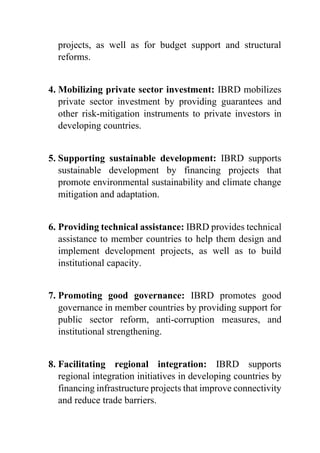
4. Mobilizing private sector investment: IBRD mobilizes
private sector investment by providing guarantees and
other risk-mitigation instruments to private investors in
developing countries.
5. Supporting sustainable development: IBRD supports
sustainable development by financing projects that
promote environmental sustainability and climate change
mitigation and adaptation.
6. Providing technical assistance: IBRD provides technical
assistance to member countries to help them design and
implement development projects, as well as to build
institutional capacity.
7. Promoting good governance: IBRD promotes good
governance in member countries by providing support for
public sector reform, anti-corruption measures, and
institutional strengthening.
8. Facilitating regional integration: IBRD supports
regional integration initiatives in developing countries by
financing infrastructure projects that improve connectivity
and reduce trade barriers.
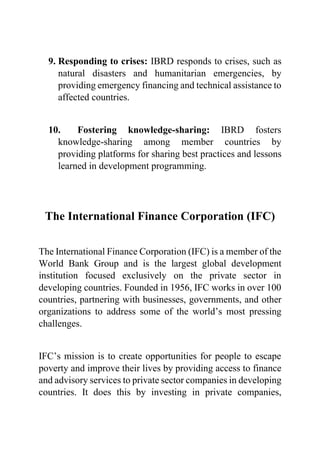
9. Responding to crises: IBRD responds to crises, such as
natural disasters and humanitarian emergencies, by
providing emergency financing and technical assistance to
affected countries.
10. Fostering knowledge-sharing: IBRD fosters
knowledge-sharing among member countries by
providing platforms for sharing best practices and lessons
learned in development programming.
The International Finance Corporation (IFC)
The International Finance Corporation (IFC) is a member of the
World Bank Group and is the largest global development
institution focused exclusively on the private sector in
developing countries. Founded in 1956, IFC works in over 100
countries, partnering with businesses, governments, and other
organizations to address some of the world’s most pressing
challenges.
IFC’s mission is to create opportunities for people to escape
poverty and improve their lives by providing access to finance
and advisory services to private sector companies in developing
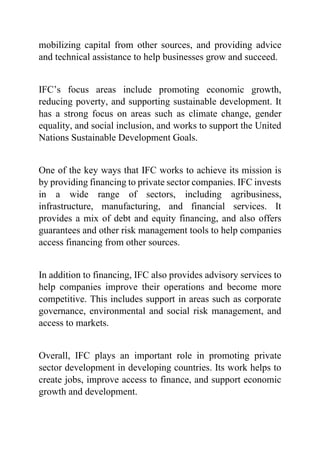
countries. It does this by investing in private companies,
mobilizing capital from other sources, and providing advice
and technical assistance to help businesses grow and succeed.
IFC’s focus areas include promoting economic growth,
reducing poverty, and supporting sustainable development. It
has a strong focus on areas such as climate change, gender
equality, and social inclusion, and works to support the United
Nations Sustainable Development Goals.
One of the key ways that IFC works to achieve its mission is
by providing financing to private sector companies. IFC invests
in a wide range of sectors, including agribusiness,
infrastructure, manufacturing, and financial services. It
provides a mix of debt and equity financing, and also offers
guarantees and other risk management tools to help companies
access financing from other sources.
In addition to financing, IFC also provides advisory services to
help companies improve their operations and become more
competitive. This includes support in areas such as corporate
governance, environmental and social risk management, and
access to markets.
Overall, IFC plays an important role in promoting private
sector development in developing countries. Its work helps to
create jobs, improve access to finance, and support economic
growth and development.
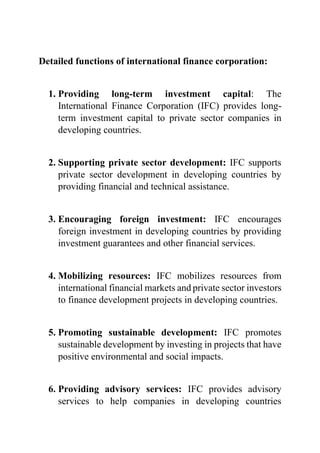
Detailed functions of international finance corporation:
1. Providing long-term investment capital: The
International Finance Corporation (IFC) provides long-
term investment capital to private sector companies in
developing countries.
2. Supporting private sector development: IFC supports
private sector development in developing countries by
providing financial and technical assistance.
3. Encouraging foreign investment: IFC encourages
foreign investment in developing countries by providing
investment guarantees and other financial services.
4. Mobilizing resources: IFC mobilizes resources from
international financial markets and private sector investors
to finance development projects in developing countries.
5. Promoting sustainable development: IFC promotes
sustainable development by investing in projects that have
positive environmental and social impacts.
6. Providing advisory services: IFC provides advisory
services to help companies in developing countries
improve their operations, management, and financial
performance.
7. Enhancing access to finance: IFC enhances access to
finance for small and medium-sized enterprises in
developing countries by investing in local financial
institutions.
8. Supporting infrastructure development: IFC supports
infrastructure development in developing countries by
investing in infrastructure projects such as power, water,
and transportation.
9. Promoting regional integration: IFC promotes regional
integration by investing in projects that connect
developing countries to regional and global markets.
10. Facilitating public-private partnerships: IFC
facilitates public-private partnerships in developing
countries by providing financial and technical assistance
to governments and private sector companies.
The International Development (IDA)
The International Development Association (IDA) is a
specialized agency of the World Bank Group that provides low-
interest loans and grants to the world’s poorest countries.
Established in 1960, IDA’s primary objective is to reduce
poverty and promote economic development in these countries
by providing them with financial resources and technical
assistance.
IDA provides support to countries that have low-income levels,
weak institutional capacities, and limited access to capital
markets. The agency supports a broad range of programs that
focus on social and economic development, including
agriculture, health, education, infrastructure, and private sector
development. IDA also provides funding for climate change
mitigation and adaptation projects.
IDA operates on a replenishment cycle, with donor countries
providing funds for a three-year period. The agency’s funding
is channelled to its borrowers through the World Bank, which
manages the implementation of IDA-supported projects. IDA’s
loans have very low-interest rates, and repayment periods are
often extended to allow borrowers to invest in long-term
development projects.
In conclusion, IDA is a vital organization that plays a crucial
role in promoting development and reducing poverty in the
world’s poorest countries. The agency’s work has helped to
improve the lives of millions of people, and it will continue to
be an essential partner in the global effort to achieve the SDGs
and create a more prosperous and equitable world.
Detailed functions of International development
association:
1. Poverty Reduction: The primary function of IDA is to
provide financial assistance to the world’s poorest
countries in order to reduce poverty levels. This assistance
can be in the form of grants or concessional loans, and it
is designed to support economic growth and social
development.
2. Infrastructure Development: IDA provides funding for
infrastructure projects such as roads, bridges, ports, and
airports. These projects are designed to improve
transportation and communication networks, which in
turn can boost economic growth.
3. Education and Health: IDA supports education and
health projects in developing countries. This includes
building schools and hospitals, providing access to clean
water and sanitation, and improving access to healthcare
services.
4. Agricultural Development: IDA provides funding for
agricultural projects in developing countries. This
includes improving irrigation systems, providing access to
seeds and fertilizers, and promoting sustainable farming
practices.
5. Private Sector Development: IDA supports private
sector development in developing countries. This includes
providing financing to small and medium-sized
enterprises, promoting business development, and
improving access to finance.
6. Climate Change Mitigation and Adaptation: IDA
provides funding for climate change mitigation and
adaptation projects in developing countries. This includes
promoting renewable energy, improving energy
efficiency, and supporting initiatives to reduce greenhouse
gas emissions.
Overall, the International Development Association plays a
critical role in supporting economic growth and social
development in some of the world’s poorest countries. Its
functions are aimed at reducing poverty, improving
infrastructure, promoting education and health, supporting
agriculture, encouraging private sector development, and
mitigating the impact of climate change.
Foreign Direct Investment (FDI)
Foreign Direct Investment (FDI) is the investment made by
foreign entities into the economy of another country. It is an
important source of financing for developing economies and
has been seen as a significant factor for economic growth,
employment creation, and technology transfer.
FDI is also seen as a way to boost a country’s export capacity,
as foreign investors may introduce new technology,
management skills, and access to global markets. By bringing
in capital, foreign investors can help to expand the economy
and create new job opportunities, as well as provide a source of
funding for infrastructure projects.
FDI has both positive and negative impacts on the host country.
On the positive side, it can bring in new technologies, improve
productivity, and stimulate economic growth. It can also help
to promote international trade and provide access to global
markets. Furthermore, FDI can increase the level of
competition in the local market, leading to more efficiency,
lower prices, and better quality products and services.
However, there are also negative impacts associated with FDI.
One of the major criticisms of FDI is that it can lead to a loss
of control over key industries by the host country. There is also
the risk of exploitation by foreign companies, who may pay
lower wages and provide poor working conditions. Moreover,
FDI can lead to an increase in environmental degradation, as
foreign investors may not be subject to the same regulations as
local businesses.
Therefore, it is crucial that FDI is regulated by the host country
to ensure that it brings benefits to the economy without any
adverse impact. Governments should have clear policies in
place to attract foreign investment that align with their national
development goals. It is also important to have adequate legal
frameworks to safeguard the interests of both foreign investors
and the host country.
In conclusion, FDI can bring significant benefits to a host
country if properly managed. However, it is also important to
recognize the potential negative impacts associated with FDI
and to take steps to mitigate these risks. By doing so, countries
can maximize the benefits of foreign investment while
minimizing any negative consequences.

1st unit International business.pdf

  • 1.
    INTERNATIONAL BUSINESS MANAGEMENT UNIT-1 Internationalbusiness refers to the trade or exchange of goods, services and resources between different countries and regions. It involves companies and business operation in more than one country and dealing with customers, suppliers, partners from different culture and backgrounds. International business helps countries and regions to grow economically by increasing trade, investment and job opportunities. In simple words, it is the flow of goods, services and information between countries around the world. Nature of International business in points: 1. Cross-border transactions: International business involves transactions and activities across national borders.
  • 2.
    2. Cultural diversity:International business requires companies to understand and adapt to cultural differences between countries. 3. Political and legal differences: Companies must be aware of the political and legal systems in different countries and how they can affect business operations. 4. Currency fluctuations: Exchange rate fluctuations can have a significant impact on international business operations. 5. Transportation and logistics: The transportation and logistics of goods and services play a crucial role in international business. 6. Competition: Companies must be prepared to compete with firms from all over the world in a global marketplace. 7. Globalization: International business is driven by globalization, which is the increasing interconnectedness of the world’s economies. 8. Economic integration: International business is facilitated by economic integration, which refers to the integration of economies through trade and investment.
  • 3.
    9. Multilingualism: Internationalbusiness requires companies to have a good understanding of different languages and cultures. 10. Market opportunities: International business opens up new market opportunities for companies, allowing them to access new customers and expand their operations. Scope of international business in points: 1. Globalization: The increased interconnectedness of countries and the growth of cross-border trade and investment have made international business an integral part of the global economy. 2. Market expansion: International business provides an opportunity for companies to expand their markets and increase their customer base by selling products and services in different countries. 3. Cultural diversity: International business operates in culturally diverse environments and requires an
  • 4.
    understanding of differentcustoms, beliefs, and business practices. 4. Political and economic environment: Political stability and economic conditions in a country can significantly impact international business activities. Companies must stay informed about changes in government policies and economic trends in the countries in which they operate. 5. Technological advancements: Technological advancements have made it easier for companies to conduct business across borders and have increased the efficiency of international trade. 6. Competition: International business is characterized by intense competition as companies from different countries compete for market share and customers. 7. Legal and regulatory environment: Companies must comply with a variety of laws and regulations in different countries, including labour laws, intellectual property laws, and trade regulations. 8. Logistics and transportation: Effective logistics and transportation are essential for the success of international business, as companies must ensure the timely and cost-
  • 5.
    effective delivery ofproducts and services to customers in different countries. Importance of international business in points 1. Increased Revenue: International business helps companies to increase their revenue by tapping into new markets and selling their products and services to customers in different countries. 2. Global Competition: International business also helps companies to remain competitive in a global market by expanding their reach and staying ahead of competitors in other countries. 3. Diversification: By expanding into international markets, companies can diversify their revenue streams, reducing the risk of economic downturns in any one market. 4. Improved Technology: International business can lead to improved technology through the exchange of knowledge and experience between different countries and industries.
  • 6.
    5. Cultural Exchange:International business helps to facilitate cultural exchange between different countries and promotes cross-cultural understanding. 6. Job Creation: International business can lead to the creation of new jobs in different countries as companies set up operations and expand into new markets. 7. Increased Economic Growth: International business helps to stimulate economic growth in different countries by increasing trade and investment, leading to higher productivity and improved standards of living. 8. Better Access to Raw Materials: International business provides companies with access to raw materials and resources that may not be available in their home country, leading to lower costs and increased efficiency. 9. Improved Brand Recognition: Companies that engage in international business benefit from increased brand recognition, as they expand their presence in new markets and reach new customers. 10. Political and Economic Stability: International business can contribute to political and economic stability in different countries by creating new jobs and increasing trade and investment.
  • 7.
    Factors affecting internationalbusiness 1. Political factors: Political stability, government regulations, and laws, trade policies, tariffs and taxes, and import and export regulations are the main political factors that influence international business. 2. Economic factors: The economic stability of countries, exchange rates, inflation, and the cost of goods and services play a crucial role in the success of international business. 3. Cultural factors: Cultural differences and language barriers can have a significant impact on international business, as they influence customer behaviour, communication, and business practices. 4. Technological factors: Technological advancements, innovation, and the digitalization of international trade have a profound impact on international business operations and competition.
  • 8.
    5. Market factors:Competition, customer preferences, market size, market saturation, and the level of market development play a crucial role in determining the success of international business ventures. 6. Natural factors: Climate, natural disasters, and environmental regulations can affect the availability of resources, production processes, and the delivery of goods and services. 7. Infrastructure factors: The availability and quality of transportation, communication, and energy networks, as well as the level of developed infrastructure, play a crucial role in the success of international business. 8. Legal factors: Intellectual property rights, patent laws, labour laws, and international trade agreements impact the viability of international business. 9. Demographic factors: Population growth, migration patterns, and changes in demographics can have an impact on the demand for goods and services in international markets.
  • 9.
    Current trends ininternational business: 1. Globalization: The trend of globalization has increased the growth of international business. Companies are now able to expand their operations globally, making them more competitive. 2. E-commerce: The rise of e-commerce has revolutionized international business, making it easier for companies to sell their products and services online. This has opened up new markets for businesses and made it possible for companies to reach customers in remote areas. 3. Outsourcing: Outsourcing has become a common practice in international business. Companies are outsourcing various functions such as manufacturing, customer service, and back-office operations to countries with lower labour costs. 4. Mergers and Acquisitions: Mergers and acquisitions are becoming more prevalent in international business. Companies are seeking to grow through acquiring other businesses or merging with other companies to expand their operations.

  • 10.
    5. Social Media:The use of social media in international business has increased significantly. Companies are using social media platforms to reach new customers and promote their products and services. 6. Artificial Intelligence and Automation: Artificial intelligence and automation are changing the way international business is conducted. Companies are now using AI and automation to improve their operations and reduce costs. 7. Green Business Practices: Companies are becoming more environmentally conscious and are implementing green business practices in their operations. This is becoming an important trend in international business as consumers are becoming more aware of environmental issues and are demanding sustainable products and services. 8. Political and Economic Uncertainty: Political and economic uncertainty is affecting international business, with companies facing challenges in trade, taxes, and other regulations. Companies are looking for ways to mitigate these risks and remain competitive in the global market. 9. Protectionism: The trend of protectionism, where countries seek to protect their domestic industries, is
  • 11.
    having an impacton international business. Companies are having to navigate complex regulations and trade barriers to enter new markets. 10. The Rise of the Gig Economy: The gig economy is growing, with companies relying on freelance workers and independent contractors to help meet their business needs. This trend is having a profound impact on international business as companies look to access a global pool of talent. Challenges faced by international business: 1. Cultural Differences: International business must overcome cultural differences and language barriers to establish successful operations in different countries. This can lead to difficulties in communication, understanding customer needs, and creating a sense of cultural compatibility. 2. Political Instability: Political instability can create challenges for international business, such as changes in government policies, regulations, and taxes that can harm business operations. This can also lead to uncertainty and instability in the marketplace, making it difficult to plan and make decisions.
  • 12.
    3. Economic Instability:Economic instability in different countries can create a challenging environment for international business. For example, changes in currency exchange rates, inflation, and market fluctuations can make it difficult for businesses to plan for the future. 4. Logistical Challenges: Shipping goods and services across borders can be a logistical challenge, especially if there are different regulations, taxes, and tariffs involved. This can lead to higher costs and longer delivery times, making it more difficult for businesses to compete. 5. Competition: International business faces increased competition from both domestic and international players, which can make it difficult to establish a competitive advantage and grow the business. 6. Different Legal Systems: Different legal systems can create challenges for international business, especially when it comes to contracts, employment laws, and intellectual property protection. Businesses must be aware of these differences and take the necessary steps to protect their interests. 7. Technology and Infrastructure: Different countries have varying levels of technology and infrastructure, which can create challenges for international business. For example, businesses may have to invest in new

  • 13.
    technologies or findways to adapt to local infrastructure to meet customer needs. Opportunities for International Business: 1. Diversification of Markets: International business provides companies with the opportunity to diversify their customer base by reaching new markets and customers in other countries. 2. Expansion of Sales: By expanding into international markets, companies can increase their sales and revenue, thereby increasing profitability. 3. Access to New Resources: Companies that engage in international business can access new raw materials, technology, and skilled labour in other countries, which can help to reduce costs and improve quality. 4. Reduction in Competition: International business can help to reduce competition by allowing companies to reach new customers in untapped markets. 5. Development of New Products: Companies that engage in international business can develop new products and services to meet the specific needs of customers in different countries.
  • 14.
    6. Improved Accessto Capital: Companies that engage in international business can access capital from international investors, which can help to finance their expansion and growth. 7. Enhanced Reputation: Companies that engage in international business can enhance their reputation by establishing a presence in new markets and demonstrating their ability to compete globally. 8. Enhanced Research and Development: Companies that engage in international business can benefit from the sharing of knowledge and expertise with their international partners, which can lead to improved research and development. 9. Improved Economic Growth: International business can help to promote economic growth by stimulating trade and investment between countries, which can create jobs and improve living standards.
  • 15.
    Theories of InternationalBusiness Theories of international business have developed over time and can be divided into three broad categories: • Traditional/Classical Theories: These theories emerged in the late 19th and early 20th centuries and focus on trade and investment between countries. The most notable theories include the theory of comparative advantage, the theory of Heckscher-Ohlin, and the theory of product life cycle. • Modern Theories: These theories emerged in the mid-20th century and are concerned with multinational corporations (MNCs) and the global economy. The most notable theories include the internalization theory, the eclectic paradigm, and the global value chain theory. • Contemporary Theories: These theories have emerged in recent decades and reflect the changing nature of international business. The most notable theories include the resource-based view, the network perspective, and the institutional perspective.
  • 16.
    Traditional Theories Classical/Traditional theoriesof international business are a set of ideas that were developed in the early days of international trade and investment. These theories provide a framework to understand and analyze the behaviour of firms operating in an international context. Here are some of the key traditional theories of international business: a) Mercantilism: This theory, developed in the 16th and 17th centuries, holds that a nation’s wealth is directly related to its stock of gold and silver. Mercantilists believed that exports were the key to a nation’s prosperity, and that imports should be limited in order to maintain a favourable balance of trade. b)Absolute Advantage: This theory, developed by Adam Smith, holds that a country should specialize in producing goods for which it has a lower cost of production, and trade those goods for goods produced more efficiently by other countries.
  • 17.
    c) Comparative Advantage:This theory, developed by David Ricardo, holds that a country should specialize in producing goods for which it has a lower relative cost of production, regardless of whether it has an absolute advantage in producing other goods. d)Factor Proportions Theory: This theory, developed by Eli Heckscher and Bertil Ohlin, suggests that a country will have a comparative advantage in producing goods that use its abundant factors of production intensively. e) New Trade Theory: This theory, developed in the 1980s and 1990s, focuses on the role of economies of scale and product differentiation in determining trade patterns. According to this theory, countries will trade goods that are differentiated, rather than homogeneous. These traditional theories of international business provide a foundation for understanding the motivations and behaviours of firms operating in an international context, and continue to be relevant and influential today. Modern Theories
  • 18.
    a) Resource-Based View(1980s-90s): This theory suggests that a firm’s resources, capabilities, and competencies are key drivers of its competitive advantage in international markets. b)Institutional Theory (1980s-90s): This theory argues that the political, legal, and cultural institutions of a country shape its international business activities. c) National Diamond Model (1990s): Proposed by Michael Porter, this theory suggests that a country’s competitive advantage in international business is determined by the interplay of its factor conditions, related and supporting industries, and firm strategy, structure, and rivalry. d)Globalization Theory (2000s): This theory suggests that international business is driven by the increased interconnectedness of global economic, political, and social systems, leading to the integration of markets and the growth of cross-border trade and investment. Contemporary Theories
  • 19.
    a) Cultural Distance:This theory explains that cultural differences and distances between countries impact international business operations and outcomes. b)Resource-Based View: This theory suggests that a firm’s resources, including human, physical and intellectual capital, are the key determinants of its competitiveness in the global market. c) Institutional Theory: This theory argues that a country’s legal and political institutions influence international business activities and outcomes. d)Network Theory: This theory explains that international business relationships are based on networks of relationships between firms, governments, and other actors. e) Neo-Classical Trade Theory: This theory suggests that countries trade with each other based on comparative advantage, where countries specialize in the production of goods in which they have a lower opportunity cost. f) Global Strategic Rivalry Theory: This theory explains that international business competition between firms is shaped by the global distribution of power and influence among nations.
  • 20.
    g) Dependency Theory:This theory argues that less developed countries are dependent on more developed countries for economic growth, and that this relationship negatively impacts the former’s ability to develop. h)Political Risk Theory: This theory suggests that political instability and uncertainty in a foreign market can impact a firm’s ability to operate and succeed. i) Hybrid Theory: This theory suggests that the nature of international business is influenced by a combination of factors, including cultural, institutional, and resource- based variables. j) Cultural Intelligence Theory: This theory argues that cultural intelligence, or the ability to understand, appreciate and navigate cultural differences, is an important factor in the success of international business operations.
  • 21.
    International business Management InternationalBusiness Management is a field of study and practice that focuses on the management of business operations and transactions across national borders. It involves the management of resources, products, services, and information between countries. The goal is to ensure effective and efficient global business operations that maximize profitability and minimize risk. International Business Management covers a wide range of topics, including cross-cultural communication, international trade and investment, currency management, global logistics, market entry strategies, and risk management. It also includes the study of various legal and regulatory frameworks that apply to international business transactions. International Business Managers must be well-versed in a variety of business and cultural practices, as well as have a deep understanding of global economic trends and geopolitical factors. They must also have excellent communication, leadership, and decision-making skills, as well as the ability to manage complex relationships with partners, suppliers, customers, and government agencies.
  • 22.
    In conclusion, InternationalBusiness Management is a critical aspect of conducting business in today’s globalized economy. It requires a comprehensive understanding of international business practices, cultural differences, and the legal and regulatory frameworks that apply to international business transactions. International Monetary System The international monetary system refers to the framework of international financial relations that determines exchange rates and manages the flow of money between countries. It is a set of rules, institutions, and procedures that govern international payments and currency exchanges. The international monetary system is designed to facilitate the flow of goods, services, and capital between countries, promote economic growth and stability, and reduce the risk of financial crises. The current international monetary system is based on the use of floating exchange rates, where the value of a currency is determined by market forces rather than government intervention. The International Monetary Fund (IMF) plays a significant role in the international monetary system by providing financial assistance to countries facing balance of payment difficulties and promoting international economic cooperation.
  • 23.
    Overall, the internationalmonetary system is a complex and dynamic system that has evolved over time in response to economic and political changes in the world. It is an essential aspect of the global economy, and changes to it can have significant impacts on international trade, investment, and financial markets. The main components of the international monetary system are: 1. International Reserve Currency: A currency that is held in large quantities by central banks around the world as a reserve asset. The U.S. dollar is currently the international reserve currency. 2. Exchange Rates: The value of one currency relative to another. Exchange rates determine the value of a country’s currency in the international market. 3. International Monetary Fund (IMF): An international organization that promotes cooperation among nations in monetary affairs and provides loans to countries facing financial difficulties. 4. World Bank: An international financial institution that provides loans and other financial assistance to
  • 24.
    developing countries forthe purpose of economic development. 5. Central Banks: National institutions that oversee a country’s monetary policy, including the setting of interest rates and the management of foreign exchange reserves. 6. Bilateral Agreements: Agreements between two countries that outline the terms of trade and investment between the countries. These agreements often include provisions related to the exchange rate. The Merits of International Monetary System: 1. Facilitates trade: The international monetary system enables countries to trade with each other by facilitating the exchange of currencies. 2. Promotes economic growth: The international monetary system helps countries to grow their economies by allowing for the flow of capital, goods, and services across borders. 3. Increases stability: The international monetary system provides stability to currency exchange rates, reducing the risk of currency fluctuations.
  • 25.
    4. Encourages investment:The international monetary system attracts foreign investment by providing a stable environment for investment. 5. Enhances cooperation: The international monetary system promotes international cooperation by encouraging countries to work together to address financial and economic challenges. The Demerits of International Monetary System: 1. Lack of independence: Some countries may have limited control over their monetary policies, making it difficult for them to address domestic economic challenges. 2. Inequality: The international monetary system may benefit developed countries at the expense of developing countries, leading to increased inequality. 3. Currency fluctuations: Despite the stability provided by the international monetary system, currency fluctuations can still occur, causing economic instability. 4. Dependence on the US dollar: The international monetary system is heavily dependent on the US dollar,
  • 26.
    which can causeproblems for countries that do not have a strong currency. 5. Complexity: The international monetary system can be complex and difficult to understand, making it challenging for some countries to participate effectively. Functions of the international monetary system: 1. Facilitation of international trade and investment: The international monetary system enables international trade and investment by providing a common currency and exchange rate mechanism for transactions. 2. Promotion of monetary stability: The international monetary system helps to maintain monetary stability by providing a framework for the management of exchange rates and the regulation of capital flows. 3. Reduction of transaction costs: The international monetary system reduces transaction costs by allowing countries to transact in a common currency, eliminating the need for currency conversion and exchange rate fluctuations. 4. Enhancement of economic cooperation: The international monetary system enhances economic
  • 27.
    cooperation among countriesby promoting a stable and predictable monetary environment, which facilitates the flow of trade and investment. 5. Provision of financial services: The international monetary system provides financial services such as credit facilities, investment opportunities and risk management services, which are essential for the growth of international trade and investment. 6. Containment of financial crisis: The international monetary system helps to contain financial crisis by providing a mechanism for the coordination of monetary and fiscal policies among countries and by promoting stability in the international financial system. 7. Promoting economic growth: The international monetary system promotes economic growth by providing a stable and predictable monetary environment, which encourages investment and trade. In conclusion, the function of the international monetary system is to facilitate international trade and investment, promote monetary stability, reduce transaction costs, enhance economic cooperation, provide financial services, contain financial crisis and promote economic growth
  • 28.
    Financial Market Financial marketsas a marketplace where financial securities, commodities, and currencies are bought and sold. It refers to the platforms where people and organizations trade financial instruments, including stocks, bonds, derivatives, currencies, commodities, and other financial instruments. Financial markets play a crucial role in the allocation of capital and determine the prices of financial instruments based on supply and demand. They also help investors to make informed decisions about the management of their money. The following are the types of financial markets: 1. Stock Market: A stock market is a place where publicly traded stocks are bought and sold. 2. Bond Market: A bond market is a place where debt securities such as bonds and Treasuries are bought and sold. 3. Foreign Exchange Market: A foreign exchange market is a place where currencies are bought and sold.
  • 29.
    4. Commodity Market:A commodity market is a place where commodities such as gold, silver, oil and other raw materials are bought and sold. 5. Derivatives Market: A derivatives market is a place where derivative products such as options and futures contracts are bought and sold. 6. Money Market: A money market is a place where short- term debt securities such as Treasury bills and commercial paper are bought and sold. 7. Real Estate Market: A real estate market is a place where properties such as houses and commercial real estate are bought and sold. Following are the roles of financial markets in the economy: The role of financial markets in the economy is to provide a platform for buying and selling financial assets such as stocks, bonds, currencies, commodities, and other financial instruments. They act as intermediaries between investors and issuers of financial assets, providing a mechanism for the transfer of capital from those who have surplus funds to those who have a need for financing.
  • 30.
    Financial markets playa crucial role in the functioning of the economy by: 1. Allocating capital: Financial markets help allocate capital to the most productive uses, thereby promoting economic growth. 2. Raising funds: They enable companies and governments to raise capital for investment by issuing securities, such as bonds and stocks, which can be bought and sold in the market. 3. Providing liquidity: Financial markets provide liquidity to investors, allowing them to buy and sell assets quickly and easily. 4. Price discovery: They help determine the price of financial assets based on supply and demand, providing valuable information to market participants. 5. Risk management: Financial markets allow investors to manage risk by providing a variety of investment options, including derivatives, insurance products, and other financial instruments.
  • 31.
    Overall, the roleof financial markets in the economy is to facilitate the flow of capital, provide a platform for price discovery, and support economic growth and stability. International Monetary Fund The International Monetary Fund (IMF) is a global organization established in 1944 to promote international monetary cooperation, facilitate the balanced growth of international trade, and secure monetary stability. It aims to ensure the stability of the international monetary system—the system of exchange rates and international payments that enables countries to transact with each other. The IMF has several key functions, including: 1. Providing financial assistance: The IMF provides financial assistance to member countries facing balance of payments difficulties. This includes loans to help them overcome short-term economic difficulties and structural adjustment programs to support longer-term economic reforms.
  • 32.
    2. Surveillance: TheIMF regularly monitors the economic and financial policies of its member countries to ensure that they are consistent with the stability of the international monetary system. This includes the evaluation of the economic policies and performance of individual countries, as well as the assessment of global economic developments and the implications for member countries. 3. Technical assistance and capacity building: The IMF provides technical assistance and training to its member countries to help them implement sound economic policies and strengthen their institutional capacity. This includes assistance in areas such as fiscal and monetary policy, tax administration, and financial sector reform. 4. Promoting global economic cooperation: The IMF works with its member countries and other international organizations to promote cooperation on issues of global concern, such as financial stability, sustainable economic growth, and poverty reduction. 5. Enhancing transparency and accountability: The IMF encourages its member countries to publish accurate and timely economic data, and to adopt transparent and accountable fiscal and monetary policies. This helps to build trust among countries and promotes stability in the international monetary system.
  • 33.
    In conclusion, theIMF is an important international institution that plays a crucial role in promoting economic stability and growth. Its functions help to ensure the stability of the international monetary system and support member countries in overcoming economic difficulties and implementing sound economic policies. World Bank The World Bank is an international organization that provides loans and grants to developing countries for various development programs. It was established in 1944 and is headquartered in Washington, D.C. The World Bank Group is composed of five institutions that work together to achieve their mission of ending extreme poverty and promoting shared prosperity. These institutions are the International Bank for Reconstruction and Development (IBRD), the International Development Association (IDA), the International Finance Corporation (IFC), the Multilateral Investment Guarantee Agency (MIGA), and the International Centre for Settlement of Investment Disputes (ICSID). The International Bank for Reconstruction and Development (IBRD) is the primary institution of the World Bank Group. It provides loans to middle-income countries and creditworthy low-income countries for a wide range of development projects, including infrastructure, education, health, and social
  • 34.
    services. The IBRDalso provides technical assistance and policy advice to its borrowing countries. The International Development Association (IDA) is a subsidiary of the World Bank that provides grants and low- interest loans to the world’s poorest countries. IDA focuses on supporting sustainable economic growth and reducing poverty in its borrower countries by financing projects that improve access to basic services like water, health care, and education, as well as investments in infrastructure, agriculture, and environmental sustainability. The International Finance Corporation (IFC) is a member of the World Bank Group that provides financing to private sector businesses in developing countries. The IFC invests in a variety of sectors, including agriculture, energy, finance, and infrastructure, and it works to promote sustainable economic growth and job creation in developing countries. The Multilateral Investment Guarantee Agency (MIGA) is another member of the World Bank Group that provides political risk insurance and other forms of guarantees to investors and lenders in developing countries. MIGA’s primary goal is to encourage foreign direct investment in developing countries by mitigating the risks associated with such investments. Finally, the International Centre for Settlement of Investment Disputes (ICSID) is a forum for resolving disputes between foreign investors and host governments. It provides a neutral
  • 35.
    platform for resolvinginvestment disputes through conciliation or arbitration, thereby reducing the risk for investors and encouraging investment in developing countries. The World Bank’s activities have evolved over time to meet the changing needs of its borrowers. In recent years, the World Bank has placed greater emphasis on environmental sustainability, gender equality, and social inclusion in its development programs. It has also become more involved in promoting private sector development and supporting small and medium-sized enterprises in its borrowing countries. Here are some key functions of the World Bank: 1. Providing financial assistance: The World Bank provides loans, guarantees, and other forms of financial assistance to developing countries for various development projects and programs. These projects can range from infrastructure development to social sector programs and are aimed at promoting economic growth and reducing poverty. 2. Policy advice: The World Bank provides policy advice to governments and other stakeholders on a range of development issues. This advice is based on its expertise in development and its knowledge of best practices from around the world.
  • 36.
    3. Capacity building:The World Bank works to build the capacities of governments, civil society organizations, and the private sector to help them better plan and implement development projects. 4. Knowledge sharing: The World Bank shares its knowledge and expertise on development issues through various channels, including reports, research papers, and online resources. This helps to foster a global community of practice in development and promotes best practices and innovations in development. 5. Catalyzing private investment: The World Bank works to attract private investment in developing countries by providing risk mitigation instruments and other forms of support. This helps to mobilize additional resources for development and supports the growth of local businesses and financial markets. 6. Monitoring and evaluation: The World Bank regularly monitors and evaluates its projects to ensure that they are delivering their intended results and making a positive impact on people’s lives. This helps to identify challenges and opportunities for improvement and ensure that the bank’s resources are being used effectively. Overall, the World Bank’s goal is to promote economic and social development in developing countries and to eradicate
  • 37.
    extreme poverty. Itsfunctions play a critical role in achieving this goal by providing financial assistance, policy advice, capacity building, knowledge sharing, catalyzing private investment, and monitoring and evaluation. The International Bank for Reconstruction and Development (IBRD) The International Bank for Reconstruction and Development (IBRD) is an international financial institution that was created in 1944 as a part of the Bretton Woods system to support the post-war reconstruction and development of countries that were affected by World War II. The IBRD is also known as the World Bank, and it provides loans, guarantees, and technical assistance to low- and middle-income countries. The IBRD is headquartered in Washington, D.C., and has 189 member countries. It operates under the guidance of a Board of Governors and a Board of Executive Directors. The Board of Governors is composed of one representative from each member country and is responsible for setting the policies and strategies of the bank. The Board of Executive Directors is responsible for the day-to-day operations of the bank.
  • 38.
    The primary goalof the IBRD is to reduce poverty and promote sustainable development in low- and middle-income countries. To achieve this goal, the bank provides loans, guarantees, and technical assistance to support projects in various sectors, including infrastructure, agriculture, education, health, and governance. The IBRD offers various types of loans, including investment loans, development policy loans, and program-for-results loans. Investment loans are designed to finance projects that promote economic growth and reduce poverty. Development policy loans are provided to support policy reforms that are critical for economic development. Program-for-results loans are designed to support specific development objectives, such as improving maternal and child health or increasing access to clean water. In addition to loans, the IBRD also provides guarantees and technical assistance to help countries access financing and implement projects. Guarantees are designed to help countries access financing by providing credit enhancements or risk- sharing mechanisms. Technical assistance is provided to help countries improve their institutional capacity and implement projects effectively. The IBRD has a strong commitment to sustainable development and works closely with its member countries to promote environmental and social sustainability. The bank has developed environmental and social policies that guide its
  • 39.
    lending operations andensure that its projects are environmentally and socially sustainable. Overall, the IBRD plays a critical role in supporting development in low- and middle-income countries. Its loans, guarantees, and technical assistance help countries access financing, implement projects, and promote sustainable development. The bank has a strong commitment to reducing poverty and promoting environmental and social sustainability, and its work has helped millions of people around the world. Detailed Functions of IBRD: 1. Financing infrastructure projects: The International Bank for Reconstruction and Development (IBRD) provides financing for infrastructure projects in developing countries, such as roads, railways, and power generation facilities. 2. Promoting economic development: IBRD helps to promote economic development in member countries through its financial support, technical assistance, and policy advice. 3. Providing loans and credits: IBRD provides loans and credits to member countries for specific development
  • 40.
    projects, as wellas for budget support and structural reforms. 4. Mobilizing private sector investment: IBRD mobilizes private sector investment by providing guarantees and other risk-mitigation instruments to private investors in developing countries. 5. Supporting sustainable development: IBRD supports sustainable development by financing projects that promote environmental sustainability and climate change mitigation and adaptation. 6. Providing technical assistance: IBRD provides technical assistance to member countries to help them design and implement development projects, as well as to build institutional capacity. 7. Promoting good governance: IBRD promotes good governance in member countries by providing support for public sector reform, anti-corruption measures, and institutional strengthening. 8. Facilitating regional integration: IBRD supports regional integration initiatives in developing countries by financing infrastructure projects that improve connectivity and reduce trade barriers.
  • 41.
    9. Responding tocrises: IBRD responds to crises, such as natural disasters and humanitarian emergencies, by providing emergency financing and technical assistance to affected countries. 10. Fostering knowledge-sharing: IBRD fosters knowledge-sharing among member countries by providing platforms for sharing best practices and lessons learned in development programming. The International Finance Corporation (IFC) The International Finance Corporation (IFC) is a member of the World Bank Group and is the largest global development institution focused exclusively on the private sector in developing countries. Founded in 1956, IFC works in over 100 countries, partnering with businesses, governments, and other organizations to address some of the world’s most pressing challenges. IFC’s mission is to create opportunities for people to escape poverty and improve their lives by providing access to finance and advisory services to private sector companies in developing countries. It does this by investing in private companies,
  • 42.
    mobilizing capital fromother sources, and providing advice and technical assistance to help businesses grow and succeed. IFC’s focus areas include promoting economic growth, reducing poverty, and supporting sustainable development. It has a strong focus on areas such as climate change, gender equality, and social inclusion, and works to support the United Nations Sustainable Development Goals. One of the key ways that IFC works to achieve its mission is by providing financing to private sector companies. IFC invests in a wide range of sectors, including agribusiness, infrastructure, manufacturing, and financial services. It provides a mix of debt and equity financing, and also offers guarantees and other risk management tools to help companies access financing from other sources. In addition to financing, IFC also provides advisory services to help companies improve their operations and become more competitive. This includes support in areas such as corporate governance, environmental and social risk management, and access to markets. Overall, IFC plays an important role in promoting private sector development in developing countries. Its work helps to create jobs, improve access to finance, and support economic growth and development.
  • 43.
    Detailed functions ofinternational finance corporation: 1. Providing long-term investment capital: The International Finance Corporation (IFC) provides long- term investment capital to private sector companies in developing countries. 2. Supporting private sector development: IFC supports private sector development in developing countries by providing financial and technical assistance. 3. Encouraging foreign investment: IFC encourages foreign investment in developing countries by providing investment guarantees and other financial services. 4. Mobilizing resources: IFC mobilizes resources from international financial markets and private sector investors to finance development projects in developing countries. 5. Promoting sustainable development: IFC promotes sustainable development by investing in projects that have positive environmental and social impacts. 6. Providing advisory services: IFC provides advisory services to help companies in developing countries
  • 44.
    improve their operations,management, and financial performance. 7. Enhancing access to finance: IFC enhances access to finance for small and medium-sized enterprises in developing countries by investing in local financial institutions. 8. Supporting infrastructure development: IFC supports infrastructure development in developing countries by investing in infrastructure projects such as power, water, and transportation. 9. Promoting regional integration: IFC promotes regional integration by investing in projects that connect developing countries to regional and global markets. 10. Facilitating public-private partnerships: IFC facilitates public-private partnerships in developing countries by providing financial and technical assistance to governments and private sector companies. The International Development (IDA)
  • 45.
    The International DevelopmentAssociation (IDA) is a specialized agency of the World Bank Group that provides low- interest loans and grants to the world’s poorest countries. Established in 1960, IDA’s primary objective is to reduce poverty and promote economic development in these countries by providing them with financial resources and technical assistance. IDA provides support to countries that have low-income levels, weak institutional capacities, and limited access to capital markets. The agency supports a broad range of programs that focus on social and economic development, including agriculture, health, education, infrastructure, and private sector development. IDA also provides funding for climate change mitigation and adaptation projects. IDA operates on a replenishment cycle, with donor countries providing funds for a three-year period. The agency’s funding is channelled to its borrowers through the World Bank, which manages the implementation of IDA-supported projects. IDA’s loans have very low-interest rates, and repayment periods are often extended to allow borrowers to invest in long-term development projects. In conclusion, IDA is a vital organization that plays a crucial role in promoting development and reducing poverty in the
  • 46.
    world’s poorest countries.The agency’s work has helped to improve the lives of millions of people, and it will continue to be an essential partner in the global effort to achieve the SDGs and create a more prosperous and equitable world. Detailed functions of International development association: 1. Poverty Reduction: The primary function of IDA is to provide financial assistance to the world’s poorest countries in order to reduce poverty levels. This assistance can be in the form of grants or concessional loans, and it is designed to support economic growth and social development. 2. Infrastructure Development: IDA provides funding for infrastructure projects such as roads, bridges, ports, and airports. These projects are designed to improve transportation and communication networks, which in turn can boost economic growth. 3. Education and Health: IDA supports education and health projects in developing countries. This includes building schools and hospitals, providing access to clean water and sanitation, and improving access to healthcare services.
  • 47.
    4. Agricultural Development:IDA provides funding for agricultural projects in developing countries. This includes improving irrigation systems, providing access to seeds and fertilizers, and promoting sustainable farming practices. 5. Private Sector Development: IDA supports private sector development in developing countries. This includes providing financing to small and medium-sized enterprises, promoting business development, and improving access to finance. 6. Climate Change Mitigation and Adaptation: IDA provides funding for climate change mitigation and adaptation projects in developing countries. This includes promoting renewable energy, improving energy efficiency, and supporting initiatives to reduce greenhouse gas emissions. Overall, the International Development Association plays a critical role in supporting economic growth and social development in some of the world’s poorest countries. Its functions are aimed at reducing poverty, improving infrastructure, promoting education and health, supporting agriculture, encouraging private sector development, and mitigating the impact of climate change. Foreign Direct Investment (FDI)
  • 48.
    Foreign Direct Investment(FDI) is the investment made by foreign entities into the economy of another country. It is an important source of financing for developing economies and has been seen as a significant factor for economic growth, employment creation, and technology transfer. FDI is also seen as a way to boost a country’s export capacity, as foreign investors may introduce new technology, management skills, and access to global markets. By bringing in capital, foreign investors can help to expand the economy and create new job opportunities, as well as provide a source of funding for infrastructure projects. FDI has both positive and negative impacts on the host country. On the positive side, it can bring in new technologies, improve productivity, and stimulate economic growth. It can also help to promote international trade and provide access to global markets. Furthermore, FDI can increase the level of competition in the local market, leading to more efficiency, lower prices, and better quality products and services. However, there are also negative impacts associated with FDI. One of the major criticisms of FDI is that it can lead to a loss of control over key industries by the host country. There is also the risk of exploitation by foreign companies, who may pay lower wages and provide poor working conditions. Moreover, FDI can lead to an increase in environmental degradation, as
  • 49.
    foreign investors maynot be subject to the same regulations as local businesses. Therefore, it is crucial that FDI is regulated by the host country to ensure that it brings benefits to the economy without any adverse impact. Governments should have clear policies in place to attract foreign investment that align with their national development goals. It is also important to have adequate legal frameworks to safeguard the interests of both foreign investors and the host country. In conclusion, FDI can bring significant benefits to a host country if properly managed. However, it is also important to recognize the potential negative impacts associated with FDI and to take steps to mitigate these risks. By doing so, countries can maximize the benefits of foreign investment while minimizing any negative consequences.