1st stage of labor
initial examination
Assessment
 History
 Examination
 General
 Abdominal
 P.V
 Investigation
. Taking a past history
 If the woman has booked in the hospital.
parity and age .
 Characteristic of previous labors , specially if
operative delivery was necessary .
 Weight of previous babies .
 Condition of previous babies .
 Evidence of CPD.
 Maternal disease, such as PET , anemia , DM
or HD .
 Rhesus iso- immunization .
 Checking for ante natal records
 Birth plan:-
 Most woman give birth at hospital .
 Welcome the woman and introduce your self
in order to establish trusting relation ship .
 Explore the following issue with mother.
A. chose birth companion.
B. chose of clothes.
c. Ambulation and pain relive .
d. position during delivery
e. procedure such as AROM ,exercise
Midwife's initial physical examination :-
on admission
 Welcoming
 Explanation should be given to the mother about any
procedure and purpose of examination.
 Verbal or written consent should be obtained and
recorded on the note .
 Ask the woman to empty her bladder and urine
specimen should be tested for protein and sugar .
 Take vital signs .
 Physical exam include hands and legs for edema,
general appearance.
 Detailed abdominal examination to assess position
and presentation and decent of presenting part .
 FHR monitor before P.V Exam
 Vaginal examination offered 4 hourly, or when
there is concern about progress
 You have to obtain verbal consent before doing
V.E
 she should empty her bladder before
examination .
P.V examination
Indication for vaginal examination
 To identify the presentation .
 Determine the head engagement
 To diagnose whether the fore water are ruptured
or not .
 To exclude cord prolapsed after SROM.
 Assess the progress of labour.
 To diagnose the entering of 2nd stage of labor
(urge to push).
 Prior to intrapartum administration of analgesia
 To do Artificial rupture of membranes
 In case of fetal distress
Cervical Examination: Component of
P.V
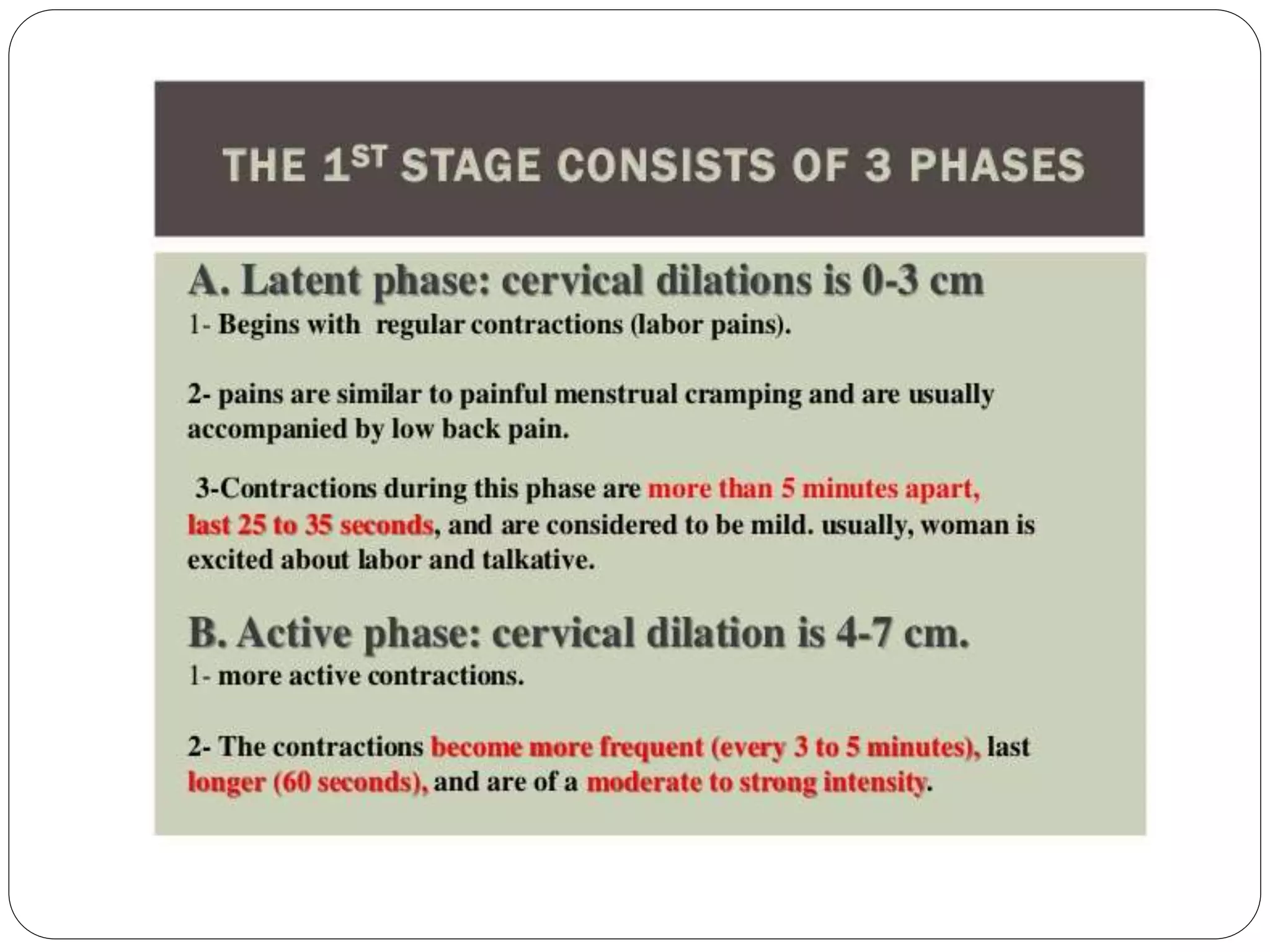
 Dilatation 0-10 cm
 1 cm: one finger fits tightly inside
 4 cm: two fingers fit loosely inside
 8 cm: only two cm remaining on each side around the
presenting part
 10 cm: no cervix is palpable around presenting part.
 Effacement: Thinning of the cervix caused by
pressure from the fetal head. It is expressed either as
a percent (0% = no effacement, 100% = complete
thinning) or by length (2cm, 1cm, 0cm).
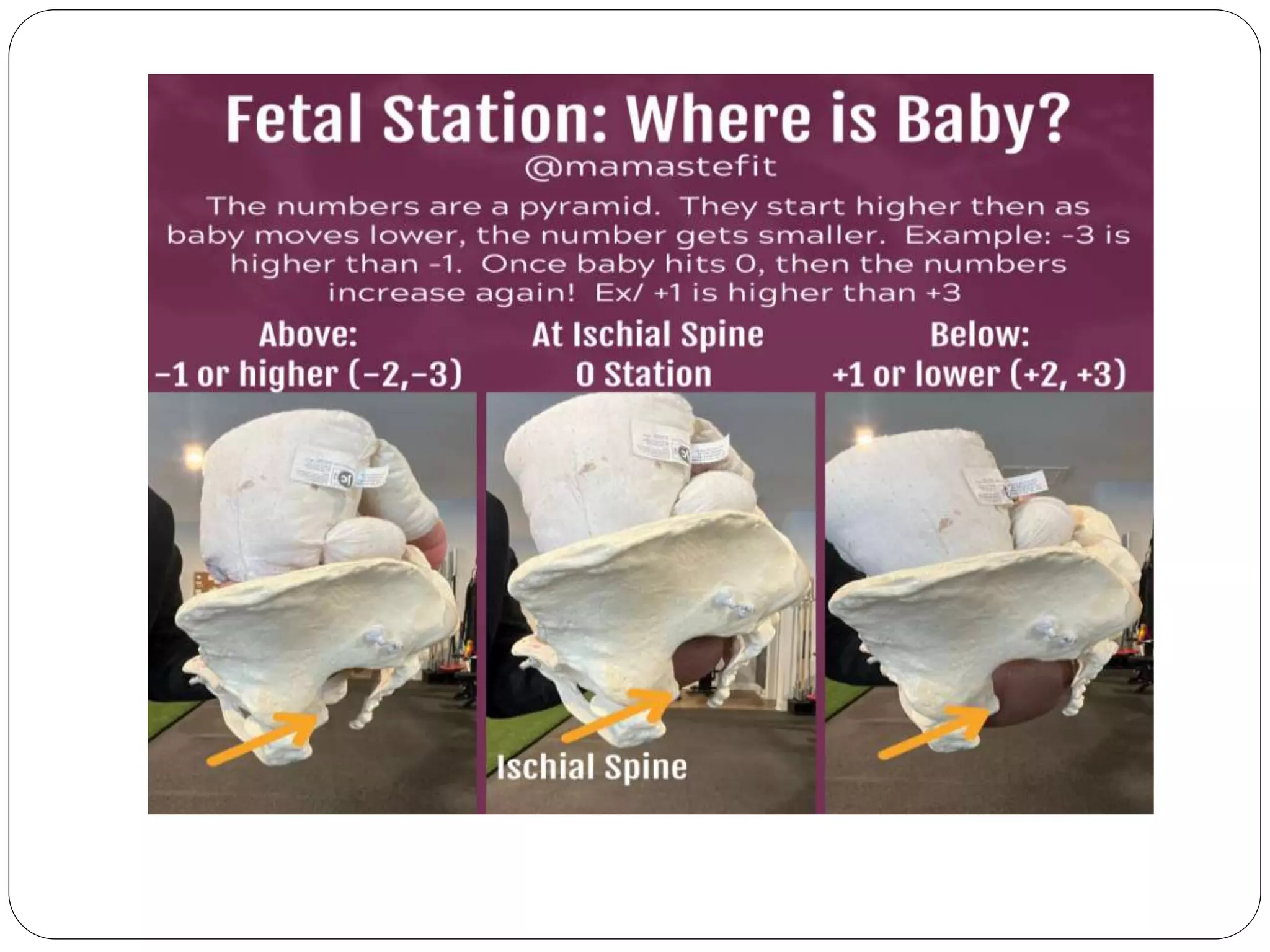
 Station, zero at ischial spine ,
 Position of cx : anterior , posterior, central
 Consistency: softening of the cx. firm, moderate firm
soft
 Presenting part : ceph. breech
 Status of membranes: intact or rupture
Cervical effacement
Figure 1.1 Effacement of the cervix.
(a) Before labour begins, the cervix is not
effaced. (b) Cervix is 60% effaced.
(b) (c) Cervix is fully effaced.
Adequacy of the pelvis
Fetal heart monitoring
 Intermittent auscultation of the fetal heart after a
contraction should occur for at least 1 minute, at
least every 15 minutes, and the rate should be
recorded as an average.
 Finding of PV Exam:-
 The condition of the vulva and the perineum .
 Any vaginal discharge .
 Cystocele or rectocele .
 Cervical dilatation , consistency , effacement ,
bag of water , the presenting part its position,
engagement , and molding .
 Records :- ( on the partograph )
 Pantograph it is the chart on which recording the
progress of labor in graphic method in order to
identified early any deviation from normal , by
which a visual means of recording all observation
and include the following.
 F/H, temp, P, Bp , PV , cont , intake, out put , UA ,
medication ,
Partogram:
 a graphical representation that clearly shows the
patient's labor compared to the expected lower limit
of "normal progress
 Some clinicians employ a partogram with alert and
action lines. The alert line represents the rate of
dilatation of the slowest 10 % of labors in
primigravidae. Crossing the alert line suggests that
the patient should be transferred to a hospital if she
is laboring in a rural setting.
 The action line is parallel and four hours to the right
of the alert line; crossing the action line suggests the
need for intervention (eg, artificial rupture of the
membranes, administration of oxytocics agent).
The 1st stage of labor
management
 Communication and environment :-
 Labor word staff should have good
communication skills
 God communication on labor word between
women and midwife , midwife and Dr , and Dr
and women can have enormous impact .
Communication
 None verbal communication such as written
birth planes, and involvement of the whole
team in decision making .
 Woman should have been given good
information about the physiological process of
labor .
 She should have to know what strategies may
use in cope during birth.
 It is important to welcome woman and
encouraged to feel at ease.
 The midwife should spends time actively
listing
Emotional support
 Emotional support is provided by the
following:-
 A) exercising skill in imparting confidence ,
expiring caring and dependability as well as
being an supporter for the child bearing
woman if needed .
 B) The midwife should be none judgmental
attitude .
 C) The woman should be accepted
whatever her reaction to labor .
 D) woman who control her body, behavior
,has active part in decision making , have
more satisfactory birth experience
Companion in labor:-
 One to one support during labor ,creates strong
feeling of security and satisfaction as well as
having a positive effect on the out come .
 Reduction use of pain relief , in operative vaginal
delivery ,and cesarean section , length of labor ,
and no harmful effect demonstrated .
 She chosen her companion , whether her
husband , friend , or family member , or even the
student midwife
 Companion can help reduce anxiety , walk with
her, support her decision about pain relive
,provide encouragement , and reassurance ,
helping with physical comfort .
Consent and information giving
 consent :- woman should signs on special
form wither she accept or refuse any medical
treatment or procedure , may be done during
labor such as , taking blood sample , after
giving adequate information and
comprehension of that information .
Cleanliness and comfort
 Bowel preparation .
 Perineal shave if needed .
 Bath or shower .
 Clothing .
Prevention of infection
 Effective cleaning will reduce the transfer of
air borne organisms .
 Restriction of visitor in labor room is
necessary .
 Complete scrubbing for beds and rooms after
use .
 The high standard of cleanliness should be
maintained to the environment .
 Personal hygiene for the mother and her
attendance is important.
 Woman should encouraged to bath and wash
as she wishes .
 The midwife must wash her hand before and
after any procedure .
 She must wear gloves when handling any
solid or contaminated object .
 Woman with infection such as hepatitis or
having H I V they need very specialized care
for prevention of cross infection such as
isolation, special midwife care for her.
 Minimize staying in hospital is important by
encouraging woman to stay at home during
latent phase of labor and also reduce the
duration of labor .
 Invasive procedure should be kept to maintain
skin integrity to provide an excellent barrier to
infection .
 The fetal membrane should remain intact
unless there is indication for ruptured .
 After rupture of membrane restriction of
vaginal examination with strict sterile
technique is important
Pre labor rupture of fetal membranes
at term
 If woman present with pre labor rupture of
membrane , restriction of vaginal examination is
important in order to reduce in ascending
infection .
 Sterile speculum examination is done to confirm
the driftnet rupture .
 High vaginal swab taken .
 After 24 – 48 hours if labor dose not started ,
spontaneously induction of labor is performed .
 Observe signs of infection e.g. temp , FHR .
 Anti biotic may be used to reduce neonatal
infection .
Position and mobilizing
 Up right position during labor is more significant
to woman because it provide less pain and less
perennial trauma .
 Her position should be influenced with fetal
position e.g. o p position or lateral .
 Any position woman found is comfortable for her
she should adapted unless other indication such
as fetal condition or position of fetal head .
Analgesia
 Advantage and disadvantage of all method of
analgesia available should be discussed with
woman during ANC .
 Epidural give most effective pain relief but
increase incidence of instrumental delivery .
Nutrition
 woman's need in labor for CHO . So tots , cereal,
yoghurt, fruit, juice, tea, biscuits, ice cream, jelly,
and fluid can be given .
 Some hospitals may allow woman with free
problem .
 Some hospital keep woman NPO because may
need for urgent operation , or fear of regurgitation
because emptying time of stomach is delayed .
 NPO may cause accumulation of acid in the
stomach and this can lead to chemical
pnemoniaitis if inhaled
NUTRITION
 Uterine muscle are in need for glucose during
contraction .
 Without glucose supply body start to metabolism
storage of protein and fat .
 Without glucose uterine inertia will occur .
 high concentration of IV glucose may cause fetal
blood glucose increase and production of insulin
will be high and result in hypoglycemia of the new
born ..
Bladder care
 Woman should be encouraged to empty her
bladder every 1-2 hours .
 Midwife should not wait for mother request to void
because sensation of needing mecturation is
reduced (epidural )
 Full bladder may interfere with the decent of the
presenting part.
 Reduce the contractility of the uterus which
increase risk of PPH .
 In and out catheterization may done if woman
unable to void and after dewing your nursing
measure to void .
observation
 Maternal condition;-
 Mother's reaction to labor e.g. happiness ,
excitement motivating , apprehension , fear ,
worry anxious .
 Advice and assistance , encouragement, can help
her ,
 Accurate and easy to understand information
about the progress of labor .
 Pulse rate may increase because of pain , anxiety
, ketosis and bleeding , so every 1-2 hours should
be taken and recorded .
 Temperature , hyper pyrexia may indicate
infection or ketosis .
 The BP measured every 2-4 hours unless
indicated
 In active phase hourly .
 BP must be monitored every closely following
epidural or spinal anesthesia .
 PET , essential hypertension , measuring BP may
needed more frequently .
 Urine analysis should be tested for glucose ,
ketenes , and protein .
 Fluid balance , a record of intake and out put is
important .
 Abdominal examination to asses the length ,
strength , and frequency of uterine contraction ,
the decent of the presenting part .
 Vaginal examination for the progress of labor to
diagnose the progress of labor
 The fetus;- assessment of the fetal condition
during labor by fetal heart patterns , fetal PH ,
and the amniotic fluid .

1st stage of labor.pptx

  • 1.
    1st stage oflabor initial examination
  • 7.
    Assessment  History  Examination General  Abdominal  P.V  Investigation
  • 8.
    . Taking apast history  If the woman has booked in the hospital. parity and age .  Characteristic of previous labors , specially if operative delivery was necessary .  Weight of previous babies .  Condition of previous babies .  Evidence of CPD.  Maternal disease, such as PET , anemia , DM or HD .  Rhesus iso- immunization .  Checking for ante natal records
  • 9.
     Birth plan:- Most woman give birth at hospital .  Welcome the woman and introduce your self in order to establish trusting relation ship .  Explore the following issue with mother. A. chose birth companion. B. chose of clothes. c. Ambulation and pain relive . d. position during delivery e. procedure such as AROM ,exercise
  • 10.
    Midwife's initial physicalexamination :- on admission  Welcoming  Explanation should be given to the mother about any procedure and purpose of examination.  Verbal or written consent should be obtained and recorded on the note .  Ask the woman to empty her bladder and urine specimen should be tested for protein and sugar .  Take vital signs .  Physical exam include hands and legs for edema, general appearance.  Detailed abdominal examination to assess position and presentation and decent of presenting part .
  • 16.
     FHR monitorbefore P.V Exam  Vaginal examination offered 4 hourly, or when there is concern about progress  You have to obtain verbal consent before doing V.E  she should empty her bladder before examination .
  • 23.
  • 24.
    Indication for vaginalexamination  To identify the presentation .  Determine the head engagement  To diagnose whether the fore water are ruptured or not .  To exclude cord prolapsed after SROM.  Assess the progress of labour.  To diagnose the entering of 2nd stage of labor (urge to push).  Prior to intrapartum administration of analgesia  To do Artificial rupture of membranes  In case of fetal distress
  • 26.
    Cervical Examination: Componentof P.V  Dilatation 0-10 cm  1 cm: one finger fits tightly inside  4 cm: two fingers fit loosely inside  8 cm: only two cm remaining on each side around the presenting part  10 cm: no cervix is palpable around presenting part.  Effacement: Thinning of the cervix caused by pressure from the fetal head. It is expressed either as a percent (0% = no effacement, 100% = complete thinning) or by length (2cm, 1cm, 0cm).  Station, zero at ischial spine ,  Position of cx : anterior , posterior, central  Consistency: softening of the cx. firm, moderate firm soft  Presenting part : ceph. breech  Status of membranes: intact or rupture
  • 30.
    Cervical effacement Figure 1.1Effacement of the cervix. (a) Before labour begins, the cervix is not effaced. (b) Cervix is 60% effaced. (b) (c) Cervix is fully effaced.
  • 33.
  • 34.
    Fetal heart monitoring Intermittent auscultation of the fetal heart after a contraction should occur for at least 1 minute, at least every 15 minutes, and the rate should be recorded as an average.  Finding of PV Exam:-  The condition of the vulva and the perineum .  Any vaginal discharge .  Cystocele or rectocele .  Cervical dilatation , consistency , effacement , bag of water , the presenting part its position, engagement , and molding .
  • 37.
     Records :-( on the partograph )  Pantograph it is the chart on which recording the progress of labor in graphic method in order to identified early any deviation from normal , by which a visual means of recording all observation and include the following.  F/H, temp, P, Bp , PV , cont , intake, out put , UA , medication ,
  • 38.
    Partogram:  a graphicalrepresentation that clearly shows the patient's labor compared to the expected lower limit of "normal progress  Some clinicians employ a partogram with alert and action lines. The alert line represents the rate of dilatation of the slowest 10 % of labors in primigravidae. Crossing the alert line suggests that the patient should be transferred to a hospital if she is laboring in a rural setting.  The action line is parallel and four hours to the right of the alert line; crossing the action line suggests the need for intervention (eg, artificial rupture of the membranes, administration of oxytocics agent).
  • 47.
    The 1st stageof labor management  Communication and environment :-  Labor word staff should have good communication skills  God communication on labor word between women and midwife , midwife and Dr , and Dr and women can have enormous impact .
  • 48.
    Communication  None verbalcommunication such as written birth planes, and involvement of the whole team in decision making .  Woman should have been given good information about the physiological process of labor .  She should have to know what strategies may use in cope during birth.  It is important to welcome woman and encouraged to feel at ease.  The midwife should spends time actively listing
  • 49.
    Emotional support  Emotionalsupport is provided by the following:-  A) exercising skill in imparting confidence , expiring caring and dependability as well as being an supporter for the child bearing woman if needed .  B) The midwife should be none judgmental attitude .  C) The woman should be accepted whatever her reaction to labor .  D) woman who control her body, behavior ,has active part in decision making , have more satisfactory birth experience
  • 50.
    Companion in labor:- One to one support during labor ,creates strong feeling of security and satisfaction as well as having a positive effect on the out come .  Reduction use of pain relief , in operative vaginal delivery ,and cesarean section , length of labor , and no harmful effect demonstrated .  She chosen her companion , whether her husband , friend , or family member , or even the student midwife  Companion can help reduce anxiety , walk with her, support her decision about pain relive ,provide encouragement , and reassurance , helping with physical comfort .
  • 51.
    Consent and informationgiving  consent :- woman should signs on special form wither she accept or refuse any medical treatment or procedure , may be done during labor such as , taking blood sample , after giving adequate information and comprehension of that information .
  • 52.
    Cleanliness and comfort Bowel preparation .  Perineal shave if needed .  Bath or shower .  Clothing .
  • 54.
    Prevention of infection Effective cleaning will reduce the transfer of air borne organisms .  Restriction of visitor in labor room is necessary .  Complete scrubbing for beds and rooms after use .  The high standard of cleanliness should be maintained to the environment .  Personal hygiene for the mother and her attendance is important.
  • 55.
     Woman shouldencouraged to bath and wash as she wishes .  The midwife must wash her hand before and after any procedure .  She must wear gloves when handling any solid or contaminated object .  Woman with infection such as hepatitis or having H I V they need very specialized care for prevention of cross infection such as isolation, special midwife care for her.
  • 56.
     Minimize stayingin hospital is important by encouraging woman to stay at home during latent phase of labor and also reduce the duration of labor .  Invasive procedure should be kept to maintain skin integrity to provide an excellent barrier to infection .  The fetal membrane should remain intact unless there is indication for ruptured .  After rupture of membrane restriction of vaginal examination with strict sterile technique is important
  • 57.
    Pre labor ruptureof fetal membranes at term  If woman present with pre labor rupture of membrane , restriction of vaginal examination is important in order to reduce in ascending infection .  Sterile speculum examination is done to confirm the driftnet rupture .  High vaginal swab taken .  After 24 – 48 hours if labor dose not started , spontaneously induction of labor is performed .  Observe signs of infection e.g. temp , FHR .  Anti biotic may be used to reduce neonatal infection .
  • 58.
    Position and mobilizing Up right position during labor is more significant to woman because it provide less pain and less perennial trauma .  Her position should be influenced with fetal position e.g. o p position or lateral .  Any position woman found is comfortable for her she should adapted unless other indication such as fetal condition or position of fetal head .
  • 59.
    Analgesia  Advantage anddisadvantage of all method of analgesia available should be discussed with woman during ANC .  Epidural give most effective pain relief but increase incidence of instrumental delivery .
  • 60.
    Nutrition  woman's needin labor for CHO . So tots , cereal, yoghurt, fruit, juice, tea, biscuits, ice cream, jelly, and fluid can be given .  Some hospitals may allow woman with free problem .  Some hospital keep woman NPO because may need for urgent operation , or fear of regurgitation because emptying time of stomach is delayed .  NPO may cause accumulation of acid in the stomach and this can lead to chemical pnemoniaitis if inhaled
  • 61.
    NUTRITION  Uterine muscleare in need for glucose during contraction .  Without glucose supply body start to metabolism storage of protein and fat .  Without glucose uterine inertia will occur .  high concentration of IV glucose may cause fetal blood glucose increase and production of insulin will be high and result in hypoglycemia of the new born ..
  • 62.
    Bladder care  Womanshould be encouraged to empty her bladder every 1-2 hours .  Midwife should not wait for mother request to void because sensation of needing mecturation is reduced (epidural )  Full bladder may interfere with the decent of the presenting part.  Reduce the contractility of the uterus which increase risk of PPH .  In and out catheterization may done if woman unable to void and after dewing your nursing measure to void .
  • 63.
    observation  Maternal condition;- Mother's reaction to labor e.g. happiness , excitement motivating , apprehension , fear , worry anxious .  Advice and assistance , encouragement, can help her ,  Accurate and easy to understand information about the progress of labor .  Pulse rate may increase because of pain , anxiety , ketosis and bleeding , so every 1-2 hours should be taken and recorded .  Temperature , hyper pyrexia may indicate infection or ketosis .
  • 64.
     The BPmeasured every 2-4 hours unless indicated  In active phase hourly .  BP must be monitored every closely following epidural or spinal anesthesia .  PET , essential hypertension , measuring BP may needed more frequently .  Urine analysis should be tested for glucose , ketenes , and protein .  Fluid balance , a record of intake and out put is important .  Abdominal examination to asses the length , strength , and frequency of uterine contraction , the decent of the presenting part .
  • 65.
     Vaginal examinationfor the progress of labor to diagnose the progress of labor  The fetus;- assessment of the fetal condition during labor by fetal heart patterns , fetal PH , and the amniotic fluid .