EARTH AND LIFE SCIENCE
Module
1
EARTH AND LIFE SCIENCE
Module
1
Origin and Structure
of the Earth
(Planet Earth)
EARTH AND LIFE SCIENCE
Module
1
Competencies
• Identify the characteristics of the
Earth that supports life; and
• Expound how the characteristics of
the Earth sustain the needs of living
organism.
EARTH AND LIFE SCIENCE
Module
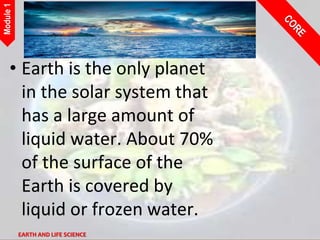
1
What can you say on the picture
below?
EARTH AND LIFE SCIENCE
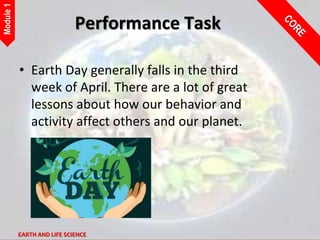
Module
1
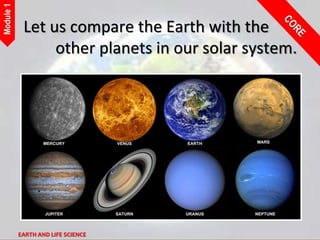
Let us compare the Earth with the
other planets in our solar system.
EARTH AND LIFE SCIENCE
Module
1
• Earth is the only planet in the solar
system known to harbor life. Our
planet’s has molten nickel-iron core
give rise to an extensive magnetic
field, which, along with the
atmosphere, shields us from harmful
radiation coming from the Sun. In
this module, you will understand why
this planet is called the “living
planet.”
EARTH AND LIFE SCIENCE
Module
1
Just a part of the vast universe is the solar system. From the
previous concepts learned, identify the planets in the solar
system in the given illustration.
Mercury
Venus
Earth
Mars
Jupiter
Saturn
Uranus
Neptune
EARTH AND LIFE SCIENCE
Module
1
What do you think are the
characteristics of the planet
Earth that make it different
from all the other planets?
EARTH AND LIFE SCIENCE
Module
1
EARTH AND LIFE SCIENCE
Module
1
How is the story of Goldilocks
related on the characteristics
of planet Earth that make it
different from other planets?
EARTH AND LIFE SCIENCE
Module
1
• Based on the story Goldilocks only take the
things that is just right for her.
• That is not too cold, not too hot. Just the right
temperature.
• Likewise also not too big, not too small. Just
the right size.
EARTH AND LIFE SCIENCE
Module
1
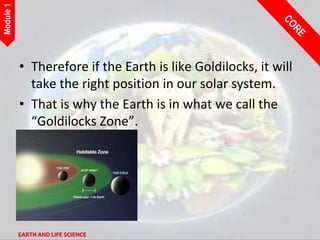
• Therefore if the Earth is like Goldilocks, it will
take the right position in our solar system.
• That is why the Earth is in what we call the
“Goldilocks Zone”.
EARTH AND LIFE SCIENCE
Module
1
What evidences show that the
Earth is in the right position in
the solar system?
There four categories that make the Earth a
habitable planet:
• Temperature
• Atmosphere
• Energy
• Nutrients
EARTH AND LIFE SCIENCE
Module
1
Temperature
Life seems to be limited to a
temperature range of -15oC to
115oC. In this range, liquid
water can still exist under
certain conditions.
The Earth is not too cold like
Neptune and not too hot like
Mercury.
EARTH AND LIFE SCIENCE
Module
1
Atmosphere
Earth have the right size to hold a
sufficient atmosphere. Earth’s
atmosphere is about 100 miles thick. It
keeps the surface warm and protects it
from radiation and small- to medium-
sized meteorites.
The Earth has no thick atmosphere like
Jupiter and has no thin atmosphere like
Mars.
EARTH AND LIFE SCIENCE
Module
1
Energy
With a steady input of either light or
chemical energy, cells can run the
chemical reactions necessary for life.
EARTH AND LIFE SCIENCE
Module
1
Nutrients used to build and
maintain an organism’s body
All solid planets and moons have the
same general chemical makeup, so
nutrients are present. Those with a
water cycle or volcanic activity can
transport and replenish the chemicals
required by living organisms.
EARTH AND LIFE SCIENCE
Module
1
Questions
1. What are the factors that make the
planet habitable?
2. What are the characteristics of
planet Earth that makes it habitable?
EARTH AND LIFE SCIENCE
Module
1
• Earth is the only place in the known
universe confirmed to host life and is
the only one known for sure to have
liquid water in the surface. These are
reasons why planet earth is a unique
one: (1) It has liquid water; (2) Plate
Tectonics; and (3) It has atmosphere
that shelters it from the worst of the
sun’s rays.
EARTH AND LIFE SCIENCE
Module
1
• Earth is the only planet
in the solar system that
has a large amount of
liquid water. About 70%
of the surface of the
Earth is covered by
liquid or frozen water.
EARTH AND LIFE SCIENCE
Module
1
• Because of this, Earth is sometimes
called “blue planet.” Planet Earth is
habitable because it has the right
distance from the sun. It is kept warm
by an insulating atmosphere, and it
has the right chemical ingredients for
life including water and carbon. It can
provide water, oxygen, useful
biological products for human, and has
suitable weather and climate.
EARTH AND LIFE SCIENCE
Module
1
• Earth, Venus, and Mars may have similarities:
(1) They all are terrestrial planets, made of
solid rocks and silicates;
(2) They all have an atmosphere;
(3) They all almost have the same time to
rotate on their axes;
(4) Earth and Mars both have water;
(5) They all have carbon dioxide; and
(6 All have landforms.
Altogether they are known as the
terrestrial planets.
EARTH AND LIFE SCIENCE
Module
1
• Earth, Venus, and Mars have
differences:
• (1) Venus has no water;
• (2) Venus and Mars don’t have
oxygen; and
• (3) Earth has life forms.
EARTH AND LIFE SCIENCE
Module
1
Performance Task
• Earth Day generally falls in the third
week of April. There are a lot of great
lessons about how our behavior and
activity affect others and our planet.
EARTH AND LIFE SCIENCE
Module
1
Performance Task
• List down ten (10) activities that you can do to save planet Earth
and identify those activities as a form of recycling, reducing, or
reusing.
EARTH AND LIFE SCIENCE
Module
1
Post Assessment
EARTH AND LIFE SCIENCE
Module
1
What makes planet earth different from the other
planets in the solar system?
A. It supports life.
B. It is mostly covered in water.
C. The atmosphere holds gases.
D. All of the above
D. All of the above
EARTH AND LIFE SCIENCE
Module
1
Why is Earth called the “living planet?”
A. It has life mechanism.
B. It has water and atmosphere.
C. It has carbon dioxide in the atmosphere.
D. It has atmosphere that supports oxygen.
B. It has water and atmosphere.
EARTH AND LIFE SCIENCE
Module
1
Planet Earth is considered as “blue planet.” Which
of the following best describes the surface of
planet Earth?
A. Earth has atmosphere.
• B. Earth has lots of volcano.
• C. Earth is covered with red dust.
• D. Earth has mostly water on the surface.
D. Earth has mostly water on the
surface
EARTH AND LIFE SCIENCE
Module
1
Which of the following best describes planet
Earth?
A. It has gases. C. It has rocky core.
B. It supports life. D. It supports other planet.
B. It supports life.
EARTH AND LIFE SCIENCE
Module
1
Planet Earth is considered uniquely different from any
other planets in the Solar system. Which among the
given choices correctly answers the statement?
A. Earth is the only planet that changes structure.
B. Earth is the only planet that turns around in space.
C. Earth is the only planet that is mostly covered with
water.
D. Earth is the only planet that is mostly made from rocks.
C. Earth is the only planet that is
mostly covered with water.
EARTH AND LIFE SCIENCE
Module
1
END OF MODULE 1

1_Earth_and_Life_Science.pptx

  • 1.
    EARTH AND LIFESCIENCE Module 1 EARTH AND LIFE SCIENCE
  • 2.
    EARTH AND LIFESCIENCE Module 1 Origin and Structure of the Earth (Planet Earth)
  • 3.
    EARTH AND LIFESCIENCE Module 1 Competencies • Identify the characteristics of the Earth that supports life; and • Expound how the characteristics of the Earth sustain the needs of living organism.
  • 4.
    EARTH AND LIFESCIENCE Module 1 What can you say on the picture below?
  • 5.
    EARTH AND LIFESCIENCE Module 1 Let us compare the Earth with the other planets in our solar system.
  • 6.
    EARTH AND LIFESCIENCE Module 1 • Earth is the only planet in the solar system known to harbor life. Our planet’s has molten nickel-iron core give rise to an extensive magnetic field, which, along with the atmosphere, shields us from harmful radiation coming from the Sun. In this module, you will understand why this planet is called the “living planet.”
  • 7.
    EARTH AND LIFESCIENCE Module 1 Just a part of the vast universe is the solar system. From the previous concepts learned, identify the planets in the solar system in the given illustration. Mercury Venus Earth Mars Jupiter Saturn Uranus Neptune
  • 8.
    EARTH AND LIFESCIENCE Module 1 What do you think are the characteristics of the planet Earth that make it different from all the other planets?
  • 9.
    EARTH AND LIFESCIENCE Module 1
  • 10.
    EARTH AND LIFESCIENCE Module 1 How is the story of Goldilocks related on the characteristics of planet Earth that make it different from other planets?
  • 11.
    EARTH AND LIFESCIENCE Module 1 • Based on the story Goldilocks only take the things that is just right for her. • That is not too cold, not too hot. Just the right temperature. • Likewise also not too big, not too small. Just the right size.
  • 12.
    EARTH AND LIFESCIENCE Module 1 • Therefore if the Earth is like Goldilocks, it will take the right position in our solar system. • That is why the Earth is in what we call the “Goldilocks Zone”.
  • 13.
    EARTH AND LIFESCIENCE Module 1 What evidences show that the Earth is in the right position in the solar system? There four categories that make the Earth a habitable planet: • Temperature • Atmosphere • Energy • Nutrients
  • 14.
    EARTH AND LIFESCIENCE Module 1 Temperature Life seems to be limited to a temperature range of -15oC to 115oC. In this range, liquid water can still exist under certain conditions. The Earth is not too cold like Neptune and not too hot like Mercury.
  • 15.
    EARTH AND LIFESCIENCE Module 1 Atmosphere Earth have the right size to hold a sufficient atmosphere. Earth’s atmosphere is about 100 miles thick. It keeps the surface warm and protects it from radiation and small- to medium- sized meteorites. The Earth has no thick atmosphere like Jupiter and has no thin atmosphere like Mars.
  • 16.
    EARTH AND LIFESCIENCE Module 1 Energy With a steady input of either light or chemical energy, cells can run the chemical reactions necessary for life.
  • 17.
    EARTH AND LIFESCIENCE Module 1 Nutrients used to build and maintain an organism’s body All solid planets and moons have the same general chemical makeup, so nutrients are present. Those with a water cycle or volcanic activity can transport and replenish the chemicals required by living organisms.
  • 18.
    EARTH AND LIFESCIENCE Module 1 Questions 1. What are the factors that make the planet habitable? 2. What are the characteristics of planet Earth that makes it habitable?
  • 19.
    EARTH AND LIFESCIENCE Module 1 • Earth is the only place in the known universe confirmed to host life and is the only one known for sure to have liquid water in the surface. These are reasons why planet earth is a unique one: (1) It has liquid water; (2) Plate Tectonics; and (3) It has atmosphere that shelters it from the worst of the sun’s rays.
  • 20.
    EARTH AND LIFESCIENCE Module 1 • Earth is the only planet in the solar system that has a large amount of liquid water. About 70% of the surface of the Earth is covered by liquid or frozen water.
  • 21.
    EARTH AND LIFESCIENCE Module 1 • Because of this, Earth is sometimes called “blue planet.” Planet Earth is habitable because it has the right distance from the sun. It is kept warm by an insulating atmosphere, and it has the right chemical ingredients for life including water and carbon. It can provide water, oxygen, useful biological products for human, and has suitable weather and climate.
  • 22.
    EARTH AND LIFESCIENCE Module 1 • Earth, Venus, and Mars may have similarities: (1) They all are terrestrial planets, made of solid rocks and silicates; (2) They all have an atmosphere; (3) They all almost have the same time to rotate on their axes; (4) Earth and Mars both have water; (5) They all have carbon dioxide; and (6 All have landforms. Altogether they are known as the terrestrial planets.
  • 23.
    EARTH AND LIFESCIENCE Module 1 • Earth, Venus, and Mars have differences: • (1) Venus has no water; • (2) Venus and Mars don’t have oxygen; and • (3) Earth has life forms.
  • 24.
    EARTH AND LIFESCIENCE Module 1 Performance Task • Earth Day generally falls in the third week of April. There are a lot of great lessons about how our behavior and activity affect others and our planet.
  • 25.
    EARTH AND LIFESCIENCE Module 1 Performance Task • List down ten (10) activities that you can do to save planet Earth and identify those activities as a form of recycling, reducing, or reusing.
  • 26.
    EARTH AND LIFESCIENCE Module 1 Post Assessment
  • 27.
    EARTH AND LIFESCIENCE Module 1 What makes planet earth different from the other planets in the solar system? A. It supports life. B. It is mostly covered in water. C. The atmosphere holds gases. D. All of the above D. All of the above
  • 28.
    EARTH AND LIFESCIENCE Module 1 Why is Earth called the “living planet?” A. It has life mechanism. B. It has water and atmosphere. C. It has carbon dioxide in the atmosphere. D. It has atmosphere that supports oxygen. B. It has water and atmosphere.
  • 29.
    EARTH AND LIFESCIENCE Module 1 Planet Earth is considered as “blue planet.” Which of the following best describes the surface of planet Earth? A. Earth has atmosphere. • B. Earth has lots of volcano. • C. Earth is covered with red dust. • D. Earth has mostly water on the surface. D. Earth has mostly water on the surface
  • 30.
    EARTH AND LIFESCIENCE Module 1 Which of the following best describes planet Earth? A. It has gases. C. It has rocky core. B. It supports life. D. It supports other planet. B. It supports life.
  • 31.
    EARTH AND LIFESCIENCE Module 1 Planet Earth is considered uniquely different from any other planets in the Solar system. Which among the given choices correctly answers the statement? A. Earth is the only planet that changes structure. B. Earth is the only planet that turns around in space. C. Earth is the only planet that is mostly covered with water. D. Earth is the only planet that is mostly made from rocks. C. Earth is the only planet that is mostly covered with water.
  • 32.
    EARTH AND LIFESCIENCE Module 1 END OF MODULE 1