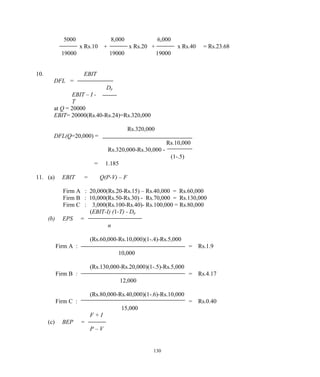
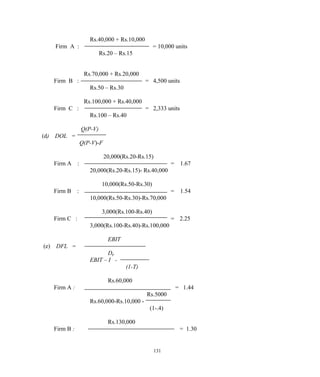
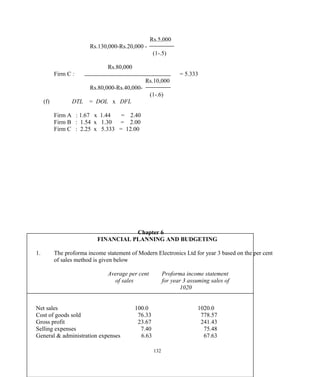
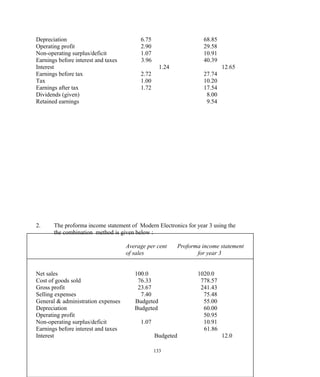
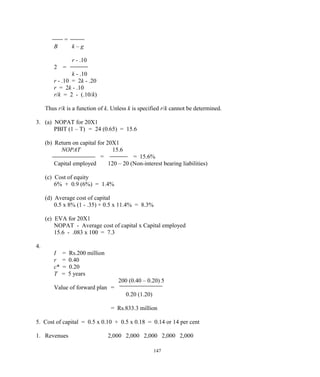
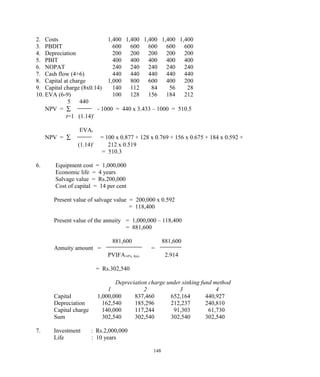
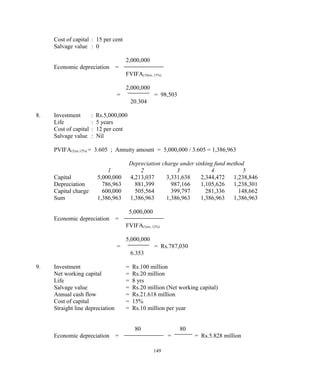
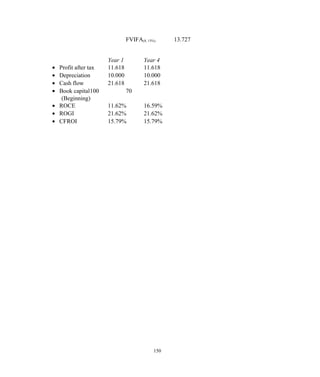
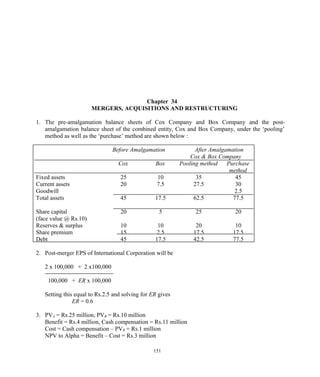
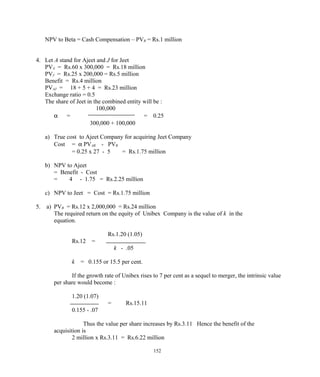
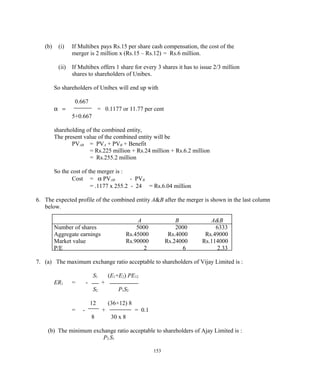
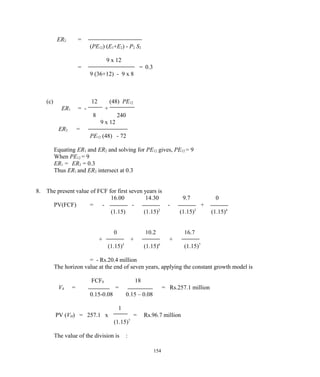
Chapter 7
TIME VALUE OF MONEY
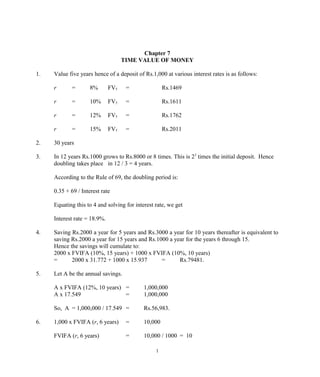
1. Value five years hence of a deposit of Rs.1,000 at various interest rates is as follows:
r = 8% FV5 = Rs.1469
r = 10% FV5 = Rs.1611
r = 12% FV5 = Rs.1762
r = 15% FV5 = Rs.2011
2. 30 years
3. In 12 years Rs.1000 grows to Rs.8000 or 8 times. This is 23
times the initial deposit. Hence
doubling takes place in 12 / 3 = 4 years.
According to the Rule of 69, the doubling period is:
0.35 + 69 / Interest rate
Equating this to 4 and solving for interest rate, we get
Interest rate = 18.9%.
4. Saving Rs.2000 a year for 5 years and Rs.3000 a year for 10 years thereafter is equivalent to
saving Rs.2000 a year for 15 years and Rs.1000 a year for the years 6 through 15.
Hence the savings will cumulate to:
2000 x FVIFA (10%, 15 years) + 1000 x FVIFA (10%, 10 years)
= 2000 x 31.772 + 1000 x 15.937 = Rs.79481.
5. Let A be the annual savings.
A x FVIFA (12%, 10 years) = 1,000,000
A x 17.549 = 1,000,000
So, A = 1,000,000 / 17.549 = Rs.56,983.
6. 1,000 x FVIFA (r, 6 years) = 10,000
FVIFA (r, 6 years) = 10,000 / 1000 = 10
1
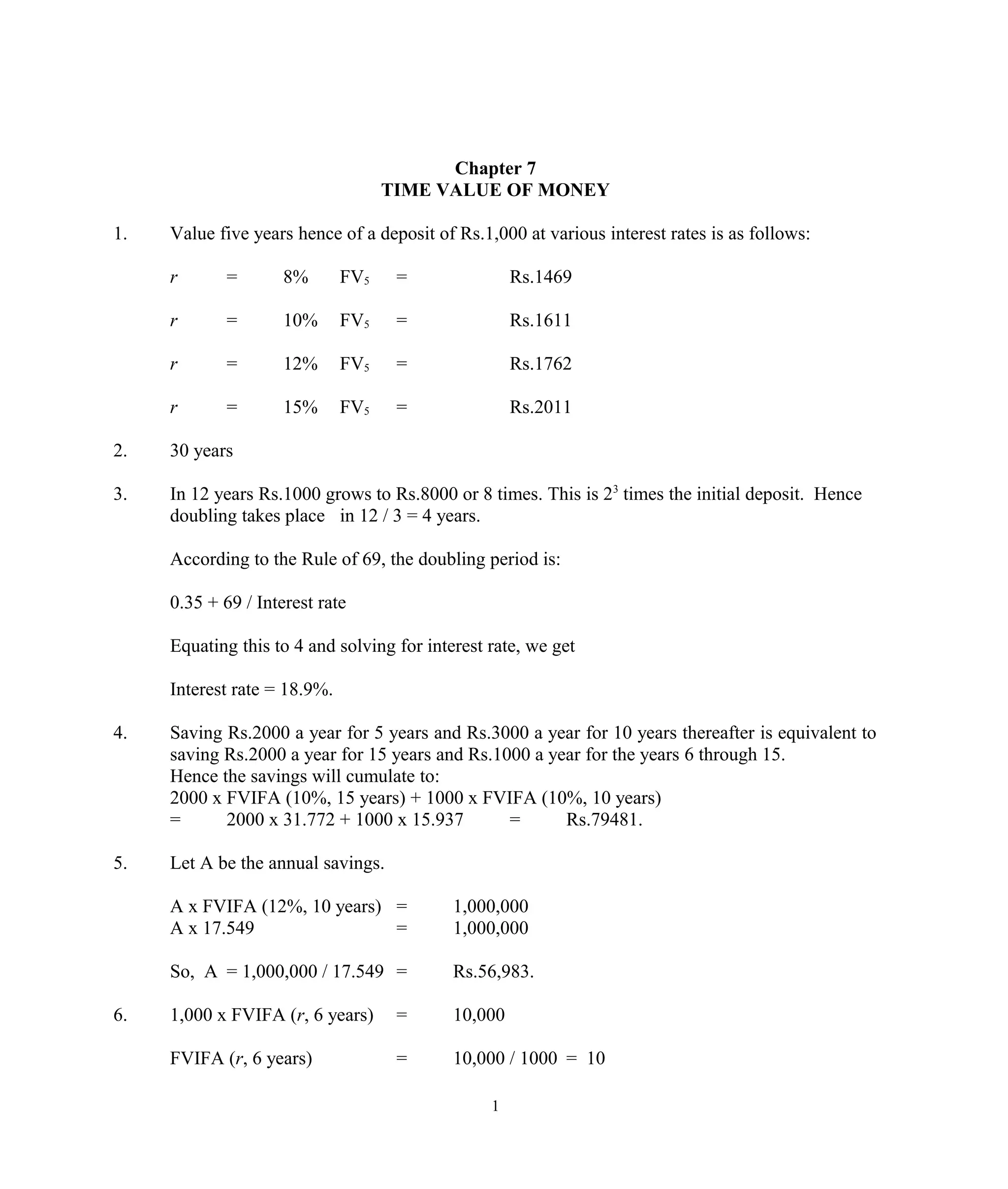
From the tables we find that
FVIFA (20%, 6 years) = 9.930
FVIFA (24%, 6 years) = 10.980
Using linear interpolation in the interval, we get:
20% + (10.000 – 9.930)
r = x 4% = 20.3%
(10.980 – 9.930)
7. 1,000 x FVIF (r, 10 years) = 5,000
FVIF (r,10 years) = 5,000 / 1000 = 5
From the tables we find that
FVIF (16%, 10 years) = 4.411
FVIF (18%, 10 years) = 5.234
Using linear interpolation in the interval, we get:
(5.000 – 4.411) x 2%
r = 16% + = 17.4%
(5.234 – 4.411)
8. The present value of Rs.10,000 receivable after 8 years for various discount rates (r ) are:
r = 10% PV = 10,000 x PVIF(r = 10%, 8 years)
= 10,000 x 0.467 = Rs.4,670
r = 12% PV = 10,000 x PVIF (r = 12%, 8 years)
= 10,000 x 0.404 = Rs.4,040
r = 15% PV = 10,000 x PVIF (r = 15%, 8 years)
= 10,000 x 0.327 = Rs.3,270
9. Assuming that it is an ordinary annuity, the present value is:
2,000 x PVIFA (10%, 5years)
= 2,000 x 3.791 = Rs.7,582
10. The present value of an annual pension of Rs.10,000 for 15 years when r = 15% is:
10,000 x PVIFA (15%, 15 years)
= 10,000 x 5.847 = Rs.58,470
2
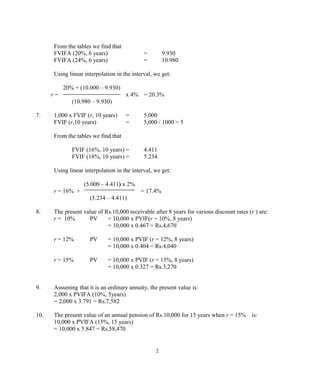
The alternative is to receive a lumpsum of Rs.50,000.
Obviously, Mr. Jingo will be better off with the annual pension amount of Rs.10,000.
11. The amount that can be withdrawn annually is:
100,000 100,000
A = ------------------ ------------ = ----------- = Rs.10,608
PVIFA (10%, 30 years) 9.427
12. The present value of the income stream is:
1,000 x PVIF (12%, 1 year) + 2,500 x PVIF (12%, 2 years)
+ 5,000 x PVIFA (12%, 8 years) x PVIF(12%, 2 years)
= 1,000 x 0.893 + 2,500 x 0.797 + 5,000 x 4.968 x 0.797 = Rs.22,683.
13. The present value of the income stream is:
2,000 x PVIFA (10%, 5 years) + 3000/0.10 x PVIF (10%, 5 years)
= 2,000 x 3.791 + 3000/0.10 x 0.621
= Rs.26,212
14. To earn an annual income of Rs.5,000 beginning from the end of 15 years from now, if the
deposit earns 10% per year a sum of
Rs.5,000 / 0.10 = Rs.50,000
is required at the end of 14 years. The amount that must be deposited to get this sum is:
Rs.50,000 / PVIF (10%, 14 years) = Rs.50,000 / 3.797 = Rs.13,165
15. Rs.20,000 =- Rs.4,000 x PVIFA (r, 10 years)
PVIFA (r,10 years) = Rs.20,000 / Rs.4,000 = 5.00
From the tables we find that:
PVIFA (15%, 10 years) = 5.019
PVIFA (18%, 10 years) = 4.494
Using linear interpolation we get:
5.019 – 5.00
r = 15% + ---------------- x 3%
5.019 – 4.494
= 15.1%
16. PV (Stream A) = Rs.100 x PVIF (12%, 1 year) + Rs.200 x
PVIF (12%, 2 years) + Rs.300 x PVIF(12%, 3 years) + Rs.400 x
3
PVIF (12%, 4 years) + Rs.500 x PVIF (12%, 5 years) +
Rs.600 x PVIF (12%, 6 years) + Rs.700 x PVIF (12%, 7 years) +
Rs.800 x PVIF (12%, 8 years) + Rs.900 x PVIF (12%, 9 years) +
Rs.1,000 x PVIF (12%, 10 years)
= Rs.100 x 0.893 + Rs.200 x 0.797 + Rs.300 x 0.712
+ Rs.400 x 0.636 + Rs.500 x 0.567 + Rs.600 x 0.507
+ Rs.700 x 0.452 + Rs.800 x 0.404 + Rs.900 x 0.361
+ Rs.1,000 x 0.322
= Rs.2590.9
Similarly,
PV (Stream B) = Rs.3,625.2
PV (Stream C) = Rs.2,851.1
17. FV5 = Rs.10,000 [1 + (0.16 / 4)]5x4
= Rs.10,000 (1.04)20
= Rs.10,000 x 2.191
= Rs.21,910
18. FV5 = Rs.5,000 [1+( 0.12/4)] 5x4
= Rs.5,000 (1.03)20
= Rs.5,000 x 1.806
= Rs.9,030
19 A B C
Stated rate (%) 12 24 24
Frequency of compounding 6 times 4 times 12 times
Effective rate (%) (1 + 0.12/6)6
- 1 (1+0.24/4)4
–1 (1 + 0.24/12)12
-1
= 12.6 = 26.2 = 26.8
Difference between the
effective rate and stated
rate (%) 0.6 2.2 2.8
20. Investment required at the end of 8th
year to yield an income of Rs.12,000 per year from the
end of 9th
year (beginning of 10th
year) for ever:
Rs.12,000 x PVIFA(12%, ∞ )
4
= Rs.12,000 / 0.12 = Rs.100,000
To have a sum of Rs.100,000 at the end of 8th
year , the amount to be deposited now is:
Rs.100,000 Rs.100,000
= = Rs.40,388
PVIF(12%, 8 years) 2.476
21. The interest rate implicit in the offer of Rs.20,000 after 10 years in lieu of Rs.5,000 now is:
Rs.5,000 x FVIF (r,10 years) = Rs.20,000
Rs.20,000
FVIF (r,10 years) = = 4.000
Rs.5,000
From the tables we find that
FVIF (15%, 10 years) = 4.046
This means that the implied interest rate is nearly 15%.
I would choose Rs.20,000 for 10 years from now because I find a return of 15% quite
acceptable.
22. FV10 = Rs.10,000 [1 + (0.10 / 2)]10x2
= Rs.10,000 (1.05)20
= Rs.10,000 x 2.653
= Rs.26,530
If the inflation rate is 8% per year, the value of Rs.26,530 10 years from now, in terms of
the current rupees is:
Rs.26,530 x PVIF (8%,10 years)
= Rs.26,530 x 0.463 = Rs.12,283
23. A constant deposit at the beginning of each year represents an annuity due.
PVIFA of an annuity due is equal to : PVIFA of an ordinary annuity x (1 + r)
To provide a sum of Rs.50,000 at the end of 10 years the annual deposit should
be
Rs.50,000
A = FVIFA(12%, 10 years) x (1.12)
Rs.50,000
= = Rs.2544
17.549 x 1.12
5
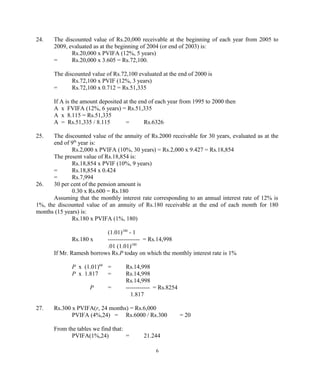
24. The discounted value of Rs.20,000 receivable at the beginning of each year from 2005 to
2009, evaluated as at the beginning of 2004 (or end of 2003) is:
Rs.20,000 x PVIFA (12%, 5 years)
= Rs.20,000 x 3.605 = Rs.72,100.
The discounted value of Rs.72,100 evaluated at the end of 2000 is
Rs.72,100 x PVIF (12%, 3 years)
= Rs.72,100 x 0.712 = Rs.51,335
If A is the amount deposited at the end of each year from 1995 to 2000 then
A x FVIFA (12%, 6 years) = Rs.51,335
A x 8.115 = Rs.51,335
A = Rs.51,335 / 8.115 = Rs.6326
25. The discounted value of the annuity of Rs.2000 receivable for 30 years, evaluated as at the
end of 9th
year is:
Rs.2,000 x PVIFA (10%, 30 years) = Rs.2,000 x 9.427 = Rs.18,854
The present value of Rs.18,854 is:
Rs.18,854 x PVIF (10%, 9 years)
= Rs.18,854 x 0.424
= Rs.7,994
26. 30 per cent of the pension amount is
0.30 x Rs.600 = Rs.180
Assuming that the monthly interest rate corresponding to an annual interest rate of 12% is
1%, the discounted value of an annuity of Rs.180 receivable at the end of each month for 180
months (15 years) is:
Rs.180 x PVIFA (1%, 180)
(1.01)180
- 1
Rs.180 x ---------------- = Rs.14,998
.01 (1.01)180
If Mr. Ramesh borrows Rs.P today on which the monthly interest rate is 1%
P x (1.01)60
= Rs.14,998
P x 1.817 = Rs.14,998
Rs.14,998
P = ------------ = Rs.8254
1.817
27. Rs.300 x PVIFA(r, 24 months) = Rs.6,000
PVIFA (4%,24) = Rs.6000 / Rs.300 = 20
From the tables we find that:
PVIFA(1%,24) = 21.244
6
PVIFA (2%, 24) = 18.914
Using a linear interpolation
21.244 – 20.000
r = 1% + ---------------------- x 1%
21.244 – 18,914
= 1.53%
Thus, the bank charges an interest rate of 1.53% per month.
The corresponding effective rate of interest per annum is
[ (1.0153)12
– 1 ] x 100 = 20%
28. The discounted value of the debentures to be redeemed between 8 to 10 years evaluated at
the end of the 5th
year is:
Rs.10 million x PVIF (8%, 3 years)
+ Rs.10 million x PVIF (8%, 4 years)
+ Rs.10 million x PVIF (8%, 5 years)
= Rs.10 million (0.794 + 0.735 + 0.681)
= Rs.2.21 million
If A is the annual deposit to be made in the sinking fund for the years 1 to 5,
then
A x FVIFA (8%, 5 years) = Rs.2.21 million
A x 5.867 = Rs.2.21 million
A = 5.867 = Rs.2.21 million
A = Rs.2.21 million / 5.867 = Rs.0.377 million
29. Let `n’ be the number of years for which a sum of Rs.20,000 can be withdrawn annually.
Rs.20,000 x PVIFA (10%, n) = Rs.100,000
PVIFA (15%, n) = Rs.100,000 / Rs.20,000 = 5.000
From the tables we find that
PVIFA (10%, 7 years) = 4.868
PVIFA (10%, 8 years) = 5.335
Thus n is between 7 and 8. Using a linear interpolation we get
5.000 – 4.868
n = 7 + ----------------- x 1 = 7.3 years
5.335 – 4.868
7
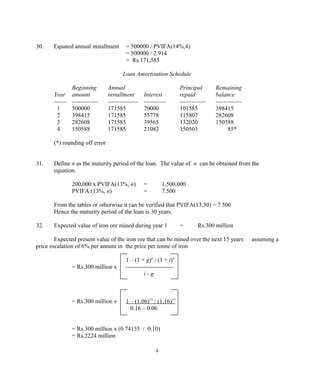
30. Equated annual installment = 500000 / PVIFA(14%,4)
= 500000 / 2.914
= Rs.171,585
Loan Amortisation Schedule
Beginning Annual Principal Remaining
Year amount installment Interest repaid balance
------ ------------- --------------- ----------- ------------- -------------
1 500000 171585 70000 101585 398415
2 398415 171585 55778 115807 282608
3 282608 171585 39565 132020 150588
4 150588 171585 21082 150503 85*
(*) rounding off error
31. Define n as the maturity period of the loan. The value of n can be obtained from the
equation.
200,000 x PVIFA(13%, n) = 1,500,000
PVIFA (13%, n) = 7.500
From the tables or otherwise it can be verified that PVIFA(13,30) = 7.500
Hence the maturity period of the loan is 30 years.
32. Expected value of iron ore mined during year 1 = Rs.300 million
Expected present value of the iron ore that can be mined over the next 15 years assuming a
price escalation of 6% per annum in the price per tonne of iron
1 – (1 + g)n
/ (1 + i)n
= Rs.300 million x ------------------------
i - g
= Rs.300 million x 1 – (1.06)15
/ (1.16)15
0.16 – 0.06
= Rs.300 million x (0.74135 / 0.10)
= Rs.2224 million
8
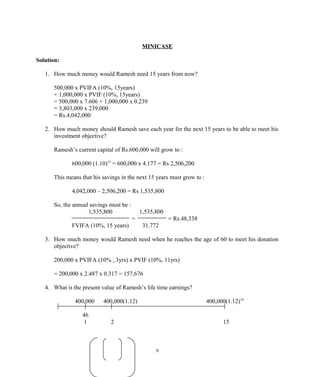
MINICASE
Solution:
1. How much money would Ramesh need 15 years from now?
500,000 x PVIFA (10%, 15years)
+ 1,000,000 x PVIF (10%, 15years)
= 500,000 x 7.606 + 1,000,000 x 0.239
= 3,803,000 x 239,000
= Rs.4,042,000
2. How much money should Ramesh save each year for the next 15 years to be able to meet his
investment objective?
Ramesh’s current capital of Rs.600,000 will grow to :
600,000 (1.10)15
= 600,000 x 4.177 = Rs 2,506,200
This means that his savings in the next 15 years must grow to :
4,042,000 – 2,506,200 = Rs 1,535,800
So, the annual savings must be :
1,535,800 1,535,800
= = Rs.48,338
FVIFA (10%, 15 years) 31.772
3. How much money would Ramesh need when he reaches the age of 60 to meet his donation
objective?
200,000 x PVIFA (10% , 3yrs) x PVIF (10%, 11yrs)
= 200,000 x 2.487 x 0.317 = 157,676
4. What is the present value of Ramesh’s life time earnings?
400,000 400,000(1.12) 400,000(1.12)14
46
1 2 15
9
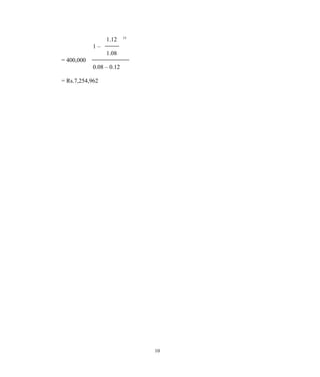
1.12 15
1 –
1.08
= 400,000
0.08 – 0.12
= Rs.7,254,962
10
Chapter 8
VALUATION OF BONDS AND STOCKS
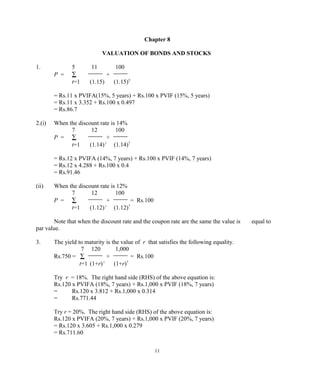
1. 5 11 100
P = ∑ +
t=1 (1.15) (1.15)5
= Rs.11 x PVIFA(15%, 5 years) + Rs.100 x PVIF (15%, 5 years)
= Rs.11 x 3.352 + Rs.100 x 0.497
= Rs.86.7
2.(i) When the discount rate is 14%
7 12 100
P = ∑ +
t=1 (1.14) t
(1.14)7
= Rs.12 x PVIFA (14%, 7 years) + Rs.100 x PVIF (14%, 7 years)
= Rs.12 x 4.288 + Rs.100 x 0.4
= Rs.91.46
(ii) When the discount rate is 12%
7 12 100
P = ∑ + = Rs.100
t=1 (1.12) t
(1.12)7
Note that when the discount rate and the coupon rate are the same the value is equal to
par value.
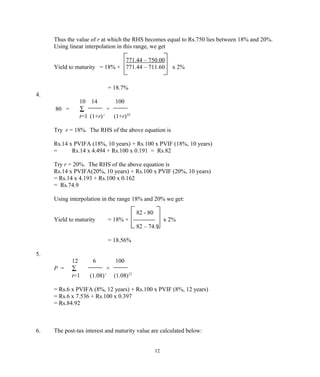
3. The yield to maturity is the value of r that satisfies the following equality.
7 120 1,000
Rs.750 = ∑ + = Rs.100
t=1 (1+r) t
(1+r)7
Try r = 18%. The right hand side (RHS) of the above equation is:
Rs.120 x PVIFA (18%, 7 years) + Rs.1,000 x PVIF (18%, 7 years)
= Rs.120 x 3.812 + Rs.1,000 x 0.314
= Rs.771.44
Try r = 20%. The right hand side (RHS) of the above equation is:
Rs.120 x PVIFA (20%, 7 years) + Rs.1,000 x PVIF (20%, 7 years)
= Rs.120 x 3.605 + Rs.1,000 x 0.279
= Rs.711.60
11
Thus the value of r at which the RHS becomes equal to Rs.750 lies between 18% and 20%.
Using linear interpolation in this range, we get
771.44 – 750.00
Yield to maturity = 18% + 771.44 – 711.60 x 2%
= 18.7%
4.
10 14 100
80 = ∑ +
t=1 (1+r) t
(1+r)10
Try r = 18%. The RHS of the above equation is
Rs.14 x PVIFA (18%, 10 years) + Rs.100 x PVIF (18%, 10 years)
= Rs.14 x 4.494 + Rs.100 x 0.191 = Rs.82
Try r = 20%. The RHS of the above equation is
Rs.14 x PVIFA(20%, 10 years) + Rs.100 x PVIF (20%, 10 years)
= Rs.14 x 4.193 + Rs.100 x 0.162
= Rs.74.9
Using interpolation in the range 18% and 20% we get:
82 - 80
Yield to maturity = 18% + ----------- x 2%
82 – 74.9
= 18.56%
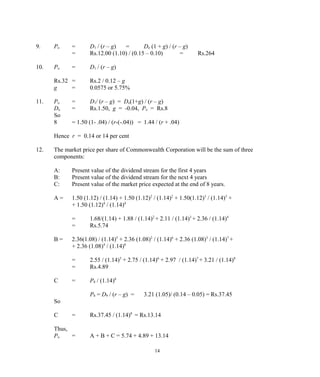
5.
12 6 100
P = ∑ +
t=1 (1.08) t
(1.08)12
= Rs.6 x PVIFA (8%, 12 years) + Rs.100 x PVIF (8%, 12 years)
= Rs.6 x 7.536 + Rs.100 x 0.397
= Rs.84.92
6. The post-tax interest and maturity value are calculated below:
12
Bond A Bond B
* Post-tax interest (C ) 12(1 – 0.3) 10 (1 – 0.3)
=Rs.8.4 =Rs.7
* Post-tax maturity value (M) 100 - 100 -
[ (100-70)x 0.1] [ (100 – 60)x 0.1]
=Rs.97 =Rs.96
The post-tax YTM, using the approximate YTM formula is calculated below
8.4 + (97-70)/10
Bond A : Post-tax YTM = --------------------
0.6 x 70 + 0.4 x 97
= 13.73%
7 + (96 – 60)/6
Bond B : Post-tax YTM = ----------------------
0.6x 60 + 0.4 x 96
= 17. 47%
7.
14 6 100
P = ∑ +
t=1 (1.08) t
(1.08)14
= Rs.6 x PVIFA(8%, 14) + Rs.100 x PVIF (8%, 14)
= Rs.6 x 8.244 + Rs.100 x 0.341
= Rs.83.56
8. Do = Rs.2.00, g = 0.06, r = 0.12
Po = D1 / (r – g) = Do (1 + g) / (r – g)
= Rs.2.00 (1.06) / (0.12 - 0.06)
= Rs.35.33
Since the growth rate of 6% applies to dividends as well as market price, the market
price at the end of the 2nd
year will be:
P2 = Po x (1 + g)2
= Rs.35.33 (1.06)2
= Rs.39.70
13
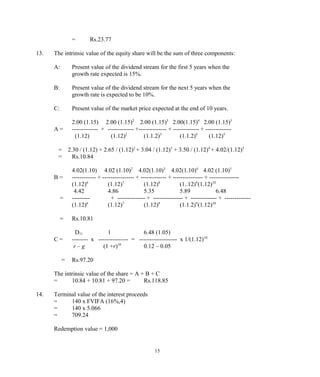
9. Po = D1 / (r – g) = Do (1 + g) / (r – g)
= Rs.12.00 (1.10) / (0.15 – 0.10) = Rs.264
10. Po = D1 / (r – g)
Rs.32 = Rs.2 / 0.12 – g
g = 0.0575 or 5.75%
11. Po = D1/ (r – g) = Do(1+g) / (r – g)
Do = Rs.1.50, g = -0.04, Po = Rs.8
So
8 = 1.50 (1- .04) / (r-(-.04)) = 1.44 / (r + .04)
Hence r = 0.14 or 14 per cent
12. The market price per share of Commonwealth Corporation will be the sum of three
components:
A: Present value of the dividend stream for the first 4 years
B: Present value of the dividend stream for the next 4 years
C: Present value of the market price expected at the end of 8 years.
A = 1.50 (1.12) / (1.14) + 1.50 (1.12)2
/ (1.14)2
+ 1.50(1.12)3
/ (1.14)3
+
+ 1.50 (1.12)4
/ (1.14)4
= 1.68/(1.14) + 1.88 / (1.14)2
+ 2.11 / (1.14)3
+ 2.36 / (1.14)4
= Rs.5.74
B = 2.36(1.08) / (1.14)5
+ 2.36 (1.08)2
/ (1.14)6
+ 2.36 (1.08)3
/ (1.14)7
+
+ 2.36 (1.08)4
/ (1.14)8
= 2.55 / (1.14)5
+ 2.75 / (1.14)6
+ 2.97 / (1.14)7
+ 3.21 / (1.14)8
= Rs.4.89
C = P8 / (1.14)8
P8 = D9 / (r – g) = 3.21 (1.05)/ (0.14 – 0.05) = Rs.37.45
So
C = Rs.37.45 / (1.14)8
= Rs.13.14
Thus,
Po = A + B + C = 5.74 + 4.89 + 13.14
14
= Rs.23.77
13. The intrinsic value of the equity share will be the sum of three components:
A: Present value of the dividend stream for the first 5 years when the
growth rate expected is 15%.
B: Present value of the dividend stream for the next 5 years when the
growth rate is expected to be 10%.
C: Present value of the market price expected at the end of 10 years.
2.00 (1.15) 2.00 (1.15)2
2.00 (1.15)3
2.00(1.15)4
2.00 (1.15)5
A = ------------- + ------------- +-------------- + ------------- + -------------
(1.12) (1.12)2
(1.1.2)3
(1.1.2)4
(1.12)5
= 2.30 / (1.12) + 2.65 / (1.12)2
+ 3.04 / (1.12)3
+ 3.50 / (1.12)4
+ 4.02/(1.12)5
= Rs.10.84
4.02(1.10) 4.02 (1.10)2
4.02(1.10)3
4.02(1.10)4
4.02 (1.10)5
B = ------------ + ---------------- + ------------- + --------------- + ---------------
(1.12)6
(1.12)7
(1.12)8
(1..12)9
(1.12)10
4.42 4.86 5.35 5.89 6.48
= --------- + -------------- + --------------- + ------------- + -------------
(1.12)6
(1.12)7
(1.12)8
(1.1.2)9
(1.12)10
= Rs.10.81
D11 1 6.48 (1.05)
C = -------- x --------------- = ------------------- x 1/(1.12)10
r – g (1 +r)10
0.12 – 0.05
= Rs.97.20
The intrinsic value of the share = A + B + C
= 10.84 + 10.81 + 97.20 = Rs.118.85
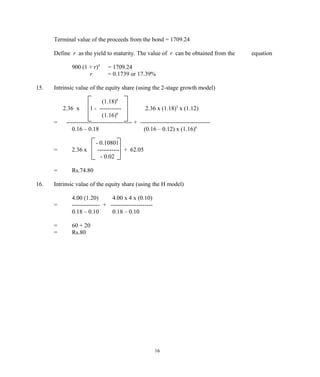
14. Terminal value of the interest proceeds
= 140 x FVIFA (16%,4)
= 140 x 5.066
= 709.24
Redemption value = 1,000
15
Terminal value of the proceeds from the bond = 1709.24
Define r as the yield to maturity. The value of r can be obtained from the equation
900 (1 + r)4
= 1709.24
r = 0.1739 or 17.39%
15. Intrinsic value of the equity share (using the 2-stage growth model)
(1.18)6
2.36 x 1 - ----------- 2.36 x (1.18)5
x (1.12)
(1.16)6
= --------------------------------- + -----------------------------------
0.16 – 0.18 (0.16 – 0.12) x (1.16)6
- 0.10801
= 2.36 x ----------- + 62.05
- 0.02
= Rs.74.80
16. Intrinsic value of the equity share (using the H model)
4.00 (1.20) 4.00 x 4 x (0.10)
= -------------- + ---------------------
0.18 – 0.10 0.18 – 0.10
= 60 + 20
= Rs.80
16
Chapter 9
RISK AND RETURN
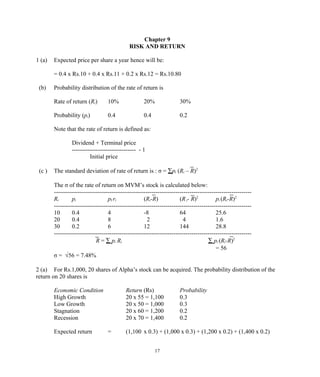
1 (a) Expected price per share a year hence will be:
= 0.4 x Rs.10 + 0.4 x Rs.11 + 0.2 x Rs.12 = Rs.10.80
(b) Probability distribution of the rate of return is
Rate of return (Ri) 10% 20% 30%
Probability (pi) 0.4 0.4 0.2
Note that the rate of return is defined as:
Dividend + Terminal price
-------------------------------- - 1
Initial price
(c ) The standard deviation of rate of return is : σ = ∑pi (Ri – R)2
The σ of the rate of return on MVM’s stock is calculated below:
---------------------------------------------------------------------------------------------------
Ri pi pI ri (Ri-R) (Ri- R)2
pi (Ri-R)2
---------------------------------------------------------------------------------------------------
10 0.4 4 -8 64 25.6
20 0.4 8 2 4 1.6
30 0.2 6 12 144 28.8
---------------------------------------------------------------------------------------------------
R = ∑ pi Ri ∑ pi (Ri-R)2
= 56
σ = √56 = 7.48%
2 (a) For Rs.1,000, 20 shares of Alpha’s stock can be acquired. The probability distribution of the
return on 20 shares is
Economic Condition Return (Rs) Probability
High Growth 20 x 55 = 1,100 0.3
Low Growth 20 x 50 = 1,000 0.3
Stagnation 20 x 60 = 1,200 0.2
Recession 20 x 70 = 1,400 0.2
Expected return = (1,100 x 0.3) + (1,000 x 0.3) + (1,200 x 0.2) + (1,400 x 0.2)
17
= 330 + 300 + 240 + 280
= Rs.1,150
Standard deviation of the return = [(1,100 – 1,150)2
x 0.3 + (1,000 – 1,150)2
x
0.3 + (1,200 – 1,150)2
x 0.2 + (1,400 – 1,150)2
x 0.2]1/2
= Rs.143.18
(b) For Rs.1,000, 20 shares of Beta’s stock can be acquired. The probability distribution of the
return on 20 shares is:
Economic condition Return (Rs) Probability
High growth 20 x 75 = 1,500 0.3
Low growth 20 x 65 = 1,300 0.3
Stagnation 20 x 50 = 1,000 0.2
Recession 20 x 40 = 800 0.2
Expected return = (1,500 x 0.3) + (1,300 x 0.3) + (1,000 x 0.2) + (800 x 0.2)
= Rs.1,200
Standard deviation of the return = [(1,500 – 1,200)2
x .3 + (1,300 – 1,200)2
x .3
+ (1,000 – 1,200)2
x .2 + (800 – 1,200)2
x .2]1/2
= Rs.264.58
(c ) For Rs.500, 10 shares of Alpha’s stock can be acquired; likewise for Rs.500, 10
shares of Beta’s stock can be acquired. The probability distribution of this option is:
Return (Rs) Probability
(10 x 55) + (10 x 75) = 1,300 0.3
(10 x 50) + (10 x 65) = 1,150 0.3
(10 x 60) + (10 x 50) = 1,100 0.2
(10 x 70) + (10 x 40) = 1,100 0.2
Expected return = (1,300 x 0.3) + (1,150 x 0.3) + (1,100 x 0.2) +
(1,100 x 0.2)
= Rs.1,175
Standard deviation = [(1,300 –1,175)2
x 0.3 + (1,150 – 1,175)2
x 0.3 +
(1,100 – 1,175)2
x 0.2 + (1,100 – 1,175)2
x 0.2 ]1/2
= Rs.84.41
d. For Rs.700, 14 shares of Alpha’s stock can be acquired; likewise for Rs.300, 6
shares of Beta’s stock can be acquired. The probability distribution of this
option is:
18
Return (Rs) Probability
(14 x 55) + (6 x 75) = 1,220 0.3
(14 x 50) + (6 x 65) = 1,090 0.3
(14 x 60) + (6 x 50) = 1,140 0.2
(14 x 70) + (6 x 40) = 1,220 0.2
Expected return = (1,220 x 0.3) + (1,090 x 0.3) + (1,140 x 0.2) + (1,220 x 0.2)
= Rs.1,165
Standard deviation = [(1,220 – 1,165)2
x 0.3 + (1,090 – 1,165)2
x 0.3 +
(1,140 – 1,165)2
x 0.2 + (1,220 – 1,165)2
x 0.2]1/2
= Rs.57.66
The expected return to standard deviation of various options are as follows :
Option
Expected return
(Rs)
Standard deviation
(Rs)
Expected / Standard
return deviation
a 1,150 143 8.04
b 1,200 265 4.53
c 1,175 84 13.99
d 1,165 58 20.09
Option `d’ is the most preferred option because it has the highest return to risk ratio.
3. Expected rates of returns on equity stock A, B, C and D can be computed as follows:
A: 0.10 + 0.12 + (-0.08) + 0.15 + (-0.02) + 0.20 = 0.0783 = 7.83%
6
B: 0.08 + 0.04 + 0.15 +.12 + 0.10 + 0.06 = 0.0917 = 9.17%
6
C: 0.07 + 0.08 + 0.12 + 0.09 + 0.06 + 0.12 = 0.0900 = 9.00%
6
D: 0.09 + 0.09 + 0.11 + 0.04 + 0.08 + 0.16 = 0.095 = 9.50%
6
(a) Return on portfolio consisting of stock A = 7.83%
(b) Return on portfolio consisting of stock A and B in equal
proportions = 0.5 (0.0783) + 0.5 (0.0917)
= 0.085 = 8.5%
19
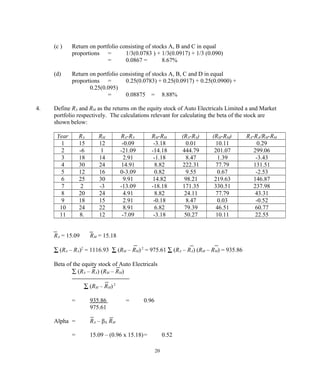
(c ) Return on portfolio consisting of stocks A, B and C in equal
proportions = 1/3(0.0783 ) + 1/3(0.0917) + 1/3 (0.090)
= 0.0867 = 8.67%
(d) Return on portfolio consisting of stocks A, B, C and D in equal
proportions = 0.25(0.0783) + 0.25(0.0917) + 0.25(0.0900) +
0.25(0.095)
= 0.08875 = 8.88%
4. Define RA and RM as the returns on the equity stock of Auto Electricals Limited a and Market
portfolio respectively. The calculations relevant for calculating the beta of the stock are
shown below:
Year RA RM RA-RA RM-RM (RA-RA) (RM-RM) RA-RA/RM-RM
1 15 12 -0.09 -3.18 0.01 10.11 0.29
2 -6 1 -21.09 -14.18 444.79 201.07 299.06
3 18 14 2.91 -1.18 8.47 1.39 -3.43
4 30 24 14.91 8.82 222.31 77.79 131.51
5 12 16 0-3.09 0.82 9.55 0.67 -2.53
6 25 30 9.91 14.82 98.21 219.63 146.87
7 2 -3 -13.09 -18.18 171.35 330.51 237.98
8 20 24 4.91 8.82 24.11 77.79 43.31
9 18 15 2.91 -0.18 8.47 0.03 -0.52
10 24 22 8.91 6.82 79.39 46.51 60.77
11 8. 12 -7.09 -3.18 50.27 10.11 22.55
RA = 15.09 RM = 15.18
∑ (RA – RA)2
= 1116.93 ∑ (RM – RM)2
= 975.61 ∑ (RA – RA) (RM – RM) = 935.86
Beta of the equity stock of Auto Electricals
∑ (RA – RA) (RM – RM)
∑ (RM – RM)2
= 935.86 = 0.96
975.61
Alpha = RA – βA RM
= 15.09 – (0.96 x 15.18)= 0.52
20
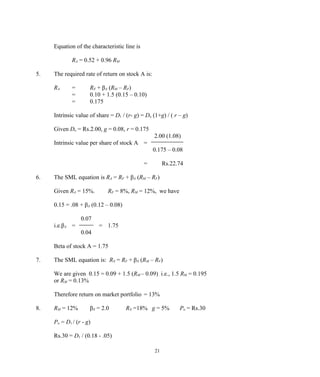
Equation of the characteristic line is
RA = 0.52 + 0.96 RM
5. The required rate of return on stock A is:
RA = RF + βA (RM – RF)
= 0.10 + 1.5 (0.15 – 0.10)
= 0.175
Intrinsic value of share = D1 / (r- g) = Do (1+g) / ( r – g)
Given Do = Rs.2.00, g = 0.08, r = 0.175
2.00 (1.08)
Intrinsic value per share of stock A =
0.175 – 0.08
= Rs.22.74
6. The SML equation is RA = RF + βA (RM – RF)
Given RA = 15%. RF = 8%, RM = 12%, we have
0.15 = .08 + βA (0.12 – 0.08)
0.07
i.e.βA = = 1.75
0.04
Beta of stock A = 1.75
7. The SML equation is: RX = RF + βX (RM – RF)
We are given 0.15 = 0.09 + 1.5 (RM – 0.09) i.e., 1.5 RM = 0.195
or RM = 0.13%
Therefore return on market portfolio = 13%
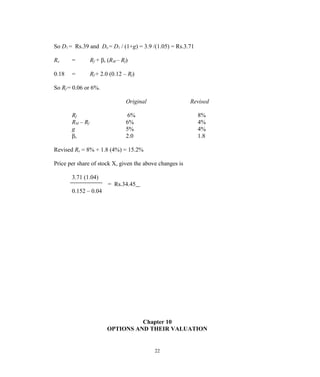
8. RM = 12% βX = 2.0 RX =18% g = 5% Po = Rs.30
Po = D1 / (r - g)
Rs.30 = D1 / (0.18 - .05)
21
So D1 = Rs.39 and Do = D1 / (1+g) = 3.9 /(1.05) = Rs.3.71
Rx = Rf + βx (RM – Rf)
0.18 = Rf + 2.0 (0.12 – Rf)
So Rf = 0.06 or 6%.
Original Revised
Rf 6% 8%
RM – Rf 6% 4%
g 5% 4%
βx 2.0 1.8
Revised Rx = 8% + 1.8 (4%) = 15.2%
Price per share of stock X, given the above changes is
3.71 (1.04)
= Rs.34.45
0.152 – 0.04
Chapter 10
OPTIONS AND THEIR VALUATION
22
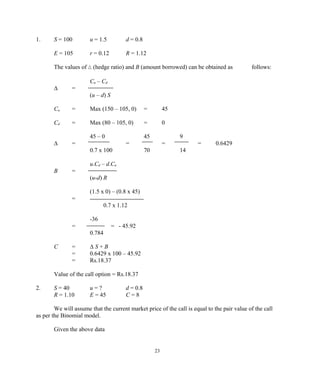
1. S = 100 u = 1.5 d = 0.8
E = 105 r = 0.12 R = 1.12
The values of ∆ (hedge ratio) and B (amount borrowed) can be obtained as follows:
Cu – Cd
∆ =
(u – d) S
Cu = Max (150 – 105, 0) = 45
Cd = Max (80 – 105, 0) = 0
45 – 0 45 9
∆ = = = = 0.6429
0.7 x 100 70 14
u.Cd – d.Cu
B =
(u-d) R
(1.5 x 0) – (0.8 x 45)
=
0.7 x 1.12
-36
= = - 45.92
0.784
C = ∆ S + B
= 0.6429 x 100 – 45.92
= Rs.18.37
Value of the call option = Rs.18.37
2. S = 40 u = ? d = 0.8
R = 1.10 E = 45 C = 8
We will assume that the current market price of the call is equal to the pair value of the call
as per the Binomial model.
Given the above data
23
Cd = Max (32 – 45, 0) = 0
∆ Cu – Cd R
= x
B u Cd – d Cu S
∆ Cu – 0 1.10
= x
B -0.8Cu 40
= (-) 0.034375
∆ = - 0.34375 B (1)
C = ∆ S + B
8 = ∆ x 40 + B (2)
Substituting (1) in (2) we get
8 = (-0.034365 x 40) B + B
8 = -0.375 B
or B = - 21.33
∆ = - 0.034375 (-21.33) = 0.7332
The portfolio consists of 0.7332 of a share plus a borrowing of Rs.21.33 (entailing a
repayment of Rs.21.33 (1.10) = Rs.23.46 after one year). It follows that when u occurs either u x 40
x 0.7332 – 23.46 = u x 40 – 45
-10.672 u = -21.54
u = 2.02
or
u x 40 x 0.7332 – 23.46 = 0
u = 0.8
Since u > d, it follows that u = 2.02.
Put differently the stock price is expected to rise by 1.02 x 100 = 102%.
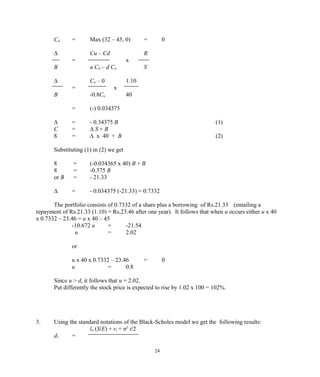
3. Using the standard notations of the Black-Scholes model we get the following results:
ln (S/E) + rt + σ2
t/2
d1 =
24
σ √ t
= ln (120 / 110) + 0.14 + 0.42
/2
0.4
= 0.08701 + 0.14 + 0.08
0.4
= 0.7675
d2 = d1 - σ √ t
= 0.7675 – 0.4
= 0.3675
N(d1) = N (0.7675) ~ N (0.77) = 0.80785
N (d2) = N (0.3675) ~ N (0.37) = 0.64431
C = So N(d1) – E. e-rt
. N(d2)
= 120 x 0.80785 – 110 x e-0.14
x 0.64431
= (120 x 0.80785) – (110 x 0.86936 x 0.64431)
= 35.33
Value of the call as per the Black and Scholes model is Rs.35.33.
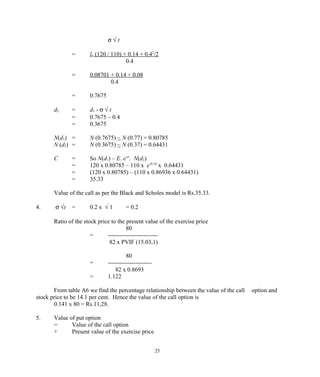
4. σ √t = 0.2 x √ 1 = 0.2
Ratio of the stock price to the present value of the exercise price
80
= -------------------------
82 x PVIF (15.03,1)
80
= ----------------------
82 x 0.8693
= 1.122
From table A6 we find the percentage relationship between the value of the call option and
stock price to be 14.1 per cent. Hence the value of the call option is
0.141 x 80 = Rs.11,28.
5. Value of put option
= Value of the call option
+ Present value of the exercise price
25
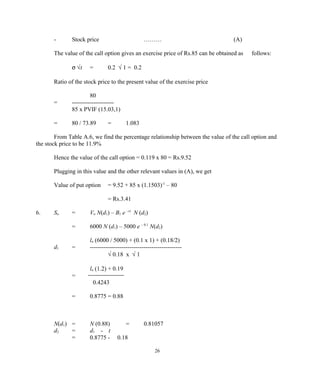
- Stock price ……… (A)
The value of the call option gives an exercise price of Rs.85 can be obtained as follows:
σ √t = 0.2 √ 1 = 0.2
Ratio of the stock price to the present value of the exercise price
80
= ---------------------
85 x PVIF (15.03,1)
= 80 / 73.89 = 1.083
From Table A.6, we find the percentage relationship between the value of the call option and
the stock price to be 11.9%
Hence the value of the call option = 0.119 x 80 = Rs.9.52
Plugging in this value and the other relevant values in (A), we get
Value of put option = 9.52 + 85 x (1.1503)-1
– 80
= Rs.3.41
6. So = Vo N(d1) – B1 e –rt
N (d2)
= 6000 N (d1) – 5000 e – 0.1
N(d2)
ln (6000 / 5000) + (0.1 x 1) + (0.18/2)
d1 = ----------------------------------------------
√ 0.18 x √ 1
ln (1.2) + 0.19
=
0.4243
= 0.8775 = 0.88
N(d1) = N (0.88) = 0.81057
d2 = d1 - t
= 0.8775 - 0.18
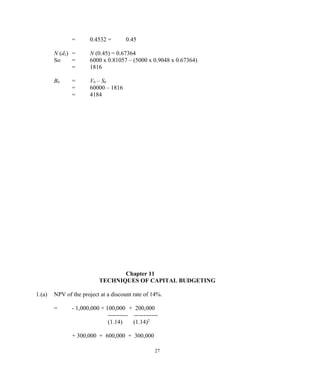
26
= 0.4532 = 0.45
N (d2) = N (0.45) = 0.67364
So = 6000 x 0.81057 – (5000 x 0.9048 x 0.67364)
= 1816
B0 = V0 – S0
= 60000 – 1816
= 4184
Chapter 11
TECHNIQUES OF CAPITAL BUDGETING
1.(a) NPV of the project at a discount rate of 14%.
= - 1,000,000 + 100,000 + 200,000
---------- ------------
(1.14) (1.14)2
+ 300,000 + 600,000 + 300,000
27
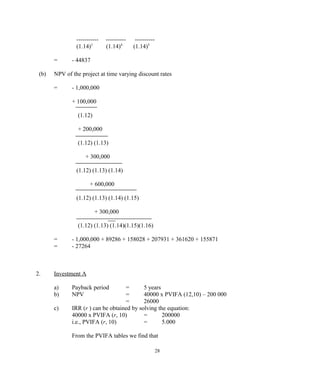
----------- ---------- ----------
(1.14)3
(1.14)4
(1.14)5
= - 44837
(b) NPV of the project at time varying discount rates
= - 1,000,000
+ 100,000
(1.12)
+ 200,000
(1.12) (1.13)
+ 300,000
(1.12) (1.13) (1.14)
+ 600,000
(1.12) (1.13) (1.14) (1.15)
+ 300,000
(1.12) (1.13) (1.14)(1.15)(1.16)
= - 1,000,000 + 89286 + 158028 + 207931 + 361620 + 155871
= - 27264
2. Investment A
a) Payback period = 5 years
b) NPV = 40000 x PVIFA (12,10) – 200 000
= 26000
c) IRR (r ) can be obtained by solving the equation:
40000 x PVIFA (r, 10) = 200000
i.e., PVIFA (r, 10) = 5.000
From the PVIFA tables we find that
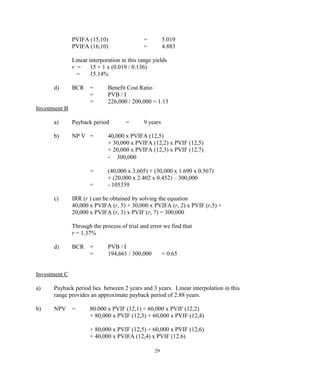
28
PVIFA (15,10) = 5.019
PVIFA (16,10) = 4.883
Linear interporation in this range yields
r = 15 + 1 x (0.019 / 0.136)
= 15.14%
d) BCR = Benefit Cost Ratio
= PVB / I
= 226,000 / 200,000 = 1.13
Investment B
a) Payback period = 9 years
b) NP V = 40,000 x PVIFA (12,5)
+ 30,000 x PVIFA (12,2) x PVIF (12,5)
+ 20,000 x PVIFA (12,3) x PVIF (12,7)
- 300,000
= (40,000 x 3.605) + (30,000 x 1.690 x 0.567)
+ (20,000 x 2.402 x 0.452) – 300,000
= - 105339
c) IRR (r ) can be obtained by solving the equation
40,000 x PVIFA (r, 5) + 30,000 x PVIFA (r, 2) x PVIF (r,5) +
20,000 x PVIFA (r, 3) x PVIF (r, 7) = 300,000
Through the process of trial and error we find that
r = 1.37%
d) BCR = PVB / I
= 194,661 / 300,000 = 0.65
Investment C
a) Payback period lies between 2 years and 3 years. Linear interpolation in this
range provides an approximate payback period of 2.88 years.
b) NPV = 80.000 x PVIF (12,1) + 60,000 x PVIF (12,2)
+ 80,000 x PVIF (12,3) + 60,000 x PVIF (12,4)
+ 80,000 x PVIF (12,5) + 60,000 x PVIF (12,6)
+ 40,000 x PVIFA (12,4) x PVIF (12.6)
29
- 210,000
= 111,371
c) IRR (r) is obtained by solving the equation
80,000 x PVIF (r,1) + 60,000 x PVIF (r,2) + 80,000 x PVIF (r,3)
+ 60,000 x PVIF (r,4) + 80,000 x PVIF (r,5) + 60,000 x PVIF (r,6)
+ 40000 x PVIFA (r,4) x PVIF (r,6) = 210000
Through the process of trial and error we get
r = 29.29%
d) BCR = PVB / I = 321,371 / 210,000 = 1.53
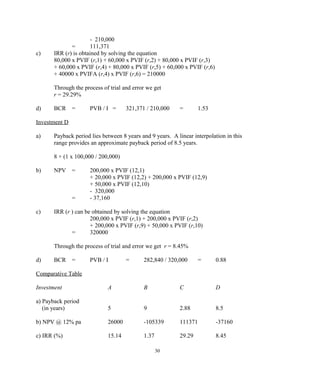
Investment D
a) Payback period lies between 8 years and 9 years. A linear interpolation in this
range provides an approximate payback period of 8.5 years.
8 + (1 x 100,000 / 200,000)
b) NPV = 200,000 x PVIF (12,1)
+ 20,000 x PVIF (12,2) + 200,000 x PVIF (12,9)
+ 50,000 x PVIF (12,10)
- 320,000
= - 37,160
c) IRR (r ) can be obtained by solving the equation
200,000 x PVIF (r,1) + 200,000 x PVIF (r,2)
+ 200,000 x PVIF (r,9) + 50,000 x PVIF (r,10)
= 320000
Through the process of trial and error we get r = 8.45%
d) BCR = PVB / I = 282,840 / 320,000 = 0.88
Comparative Table
Investment A B C D
a) Payback period
(in years) 5 9 2.88 8.5
b) NPV @ 12% pa 26000 -105339 111371 -37160
c) IRR (%) 15.14 1.37 29.29 8.45
30
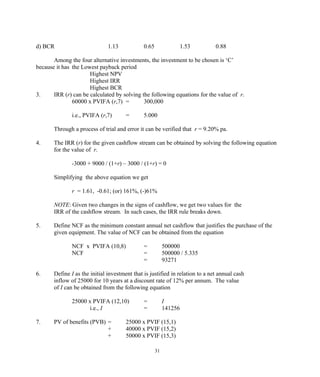
d) BCR 1.13 0.65 1.53 0.88
Among the four alternative investments, the investment to be chosen is ‘C’
because it has the Lowest payback period
Highest NPV
Highest IRR
Highest BCR
3. IRR (r) can be calculated by solving the following equations for the value of r.
60000 x PVIFA (r,7) = 300,000
i.e., PVIFA (r,7) = 5.000
Through a process of trial and error it can be verified that r = 9.20% pa.
4. The IRR (r) for the given cashflow stream can be obtained by solving the following equation
for the value of r.
-3000 + 9000 / (1+r) – 3000 / (1+r) = 0
Simplifying the above equation we get
r = 1.61, -0.61; (or) 161%, (-)61%
NOTE: Given two changes in the signs of cashflow, we get two values for the
IRR of the cashflow stream. In such cases, the IRR rule breaks down.
5. Define NCF as the minimum constant annual net cashflow that justifies the purchase of the
given equipment. The value of NCF can be obtained from the equation
NCF x PVIFA (10,8) = 500000
NCF = 500000 / 5.335
= 93271
6. Define I as the initial investment that is justified in relation to a net annual cash
inflow of 25000 for 10 years at a discount rate of 12% per annum. The value
of I can be obtained from the following equation
25000 x PVIFA (12,10) = I
i.e., I = 141256
7. PV of benefits (PVB) = 25000 x PVIF (15,1)
+ 40000 x PVIF (15,2)
+ 50000 x PVIF (15,3)
31
+ 40000 x PVIF (15,4)
+ 30000 x PVIF (15,5)
= 122646 (A)
Investment = 100,000 (B)
Benefit cost ratio = 1.23 [= (A) / (B)]
8. The NPV’s of the three projects are as follows:
Project
P Q R
Discount rate
0% 400 500 600
5% 223 251 312
10% 69 40 70
15% - 66 - 142 - 135
25% - 291 - 435 - 461
30% - 386 - 555 - 591
9. NPV profiles for Projects P and Q for selected discount rates are as follows:
(a)
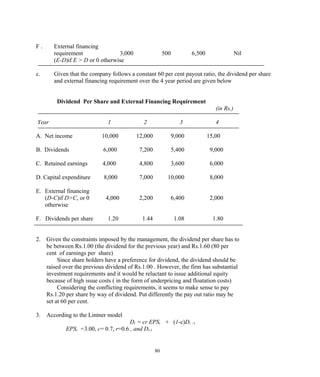
Project
P Q
Discount rate (%)
0 2950 500
5 1876 208
10 1075 - 28
15 471 - 222
20 11 - 382
b) (i) The IRR (r ) of project P can be obtained by solving the following
equation for `r’.
-1000 -1200 x PVIF (r,1) – 600 x PVIF (r,2) – 250 x PVIF (r,3)
+ 2000 x PVIF (r,4) + 4000 x PVIF (r,5) = 0
Through a process of trial and error we find that r = 20.13%
(ii) The IRR (r') of project Q can be obtained by solving the following equation for r'
32
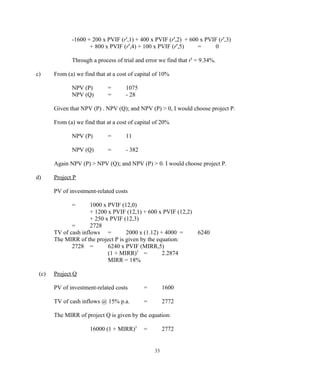
-1600 + 200 x PVIF (r',1) + 400 x PVIF (r',2) + 600 x PVIF (r',3)
+ 800 x PVIF (r',4) + 100 x PVIF (r',5) = 0
Through a process of trial and error we find that r' = 9.34%.
c) From (a) we find that at a cost of capital of 10%
NPV (P) = 1075
NPV (Q) = - 28
Given that NPV (P) . NPV (Q); and NPV (P) > 0, I would choose project P.
From (a) we find that at a cost of capital of 20%
NPV (P) = 11
NPV (Q) = - 382
Again NPV (P) > NPV (Q); and NPV (P) > 0. I would choose project P.
d) Project P
PV of investment-related costs
= 1000 x PVIF (12,0)
+ 1200 x PVIF (12,1) + 600 x PVIF (12,2)
+ 250 x PVIF (12,3)
= 2728
TV of cash inflows = 2000 x (1.12) + 4000 = 6240
The MIRR of the project P is given by the equation:
2728 = 6240 x PVIF (MIRR,5)
(1 + MIRR)5
= 2.2874
MIRR = 18%
(c) Project Q
PV of investment-related costs = 1600
TV of cash inflows @ 15% p.a. = 2772
The MIRR of project Q is given by the equation:
16000 (1 + MIRR)5
= 2772
33
MIRR = 11.62%
10
(a) Project A
NPV at a cost of capital of 12%
= - 100 + 25 x PVIFA (12,6)
= Rs.2.79 million
IRR (r ) can be obtained by solving the following equation for r.
25 x PVIFA (r,6) = 100
i.e., r = 12,98%
Project B
NPV at a cost of capital of 12%
= - 50 + 13 x PVIFA (12,6)
= Rs.3.45 million
IRR (r') can be obtained by solving the equation
13 x PVIFA (r',6) = 50
i.e., r' = 14.40% [determined through a process of trial and error]
(b) Difference in capital outlays between projects A and B is Rs.50 million
Difference in net annual cash flow between projects A and B is Rs.12 million.
NPV of the differential project at 12%
= -50 + 12 x PVIFA (12,6)
= Rs.3.15 million
IRR (r'') of the differential project can be obtained from the equation
12 x PVIFA (r'', 6) = 50
i.e., r'' = 11.53%
11
(a) Project M
The pay back period of the project lies between 2 and 3 years. Interpolating in
this range we get an approximate pay back period of 2.63 years/
Project N
The pay back period lies between 1 and 2 years. Interpolating in this range we
get an approximate pay back period of 1.55 years.
34
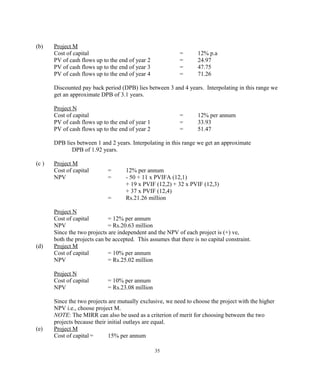
(b) Project M
Cost of capital = 12% p.a
PV of cash flows up to the end of year 2 = 24.97
PV of cash flows up to the end of year 3 = 47.75
PV of cash flows up to the end of year 4 = 71.26
Discounted pay back period (DPB) lies between 3 and 4 years. Interpolating in this range we
get an approximate DPB of 3.1 years.
Project N
Cost of capital = 12% per annum
PV of cash flows up to the end of year 1 = 33.93
PV of cash flows up to the end of year 2 = 51.47
DPB lies between 1 and 2 years. Interpolating in this range we get an approximate
DPB of 1.92 years.
(c ) Project M
Cost of capital = 12% per annum
NPV = - 50 + 11 x PVIFA (12,1)
+ 19 x PVIF (12,2) + 32 x PVIF (12,3)
+ 37 x PVIF (12,4)
= Rs.21.26 million
Project N
Cost of capital = 12% per annum
NPV = Rs.20.63 million
Since the two projects are independent and the NPV of each project is (+) ve,
both the projects can be accepted. This assumes that there is no capital constraint.
(d) Project M
Cost of capital = 10% per annum
NPV = Rs.25.02 million
Project N
Cost of capital = 10% per annum
NPV = Rs.23.08 million
Since the two projects are mutually exclusive, we need to choose the project with the higher
NPV i.e., choose project M.
NOTE: The MIRR can also be used as a criterion of merit for choosing between the two
projects because their initial outlays are equal.
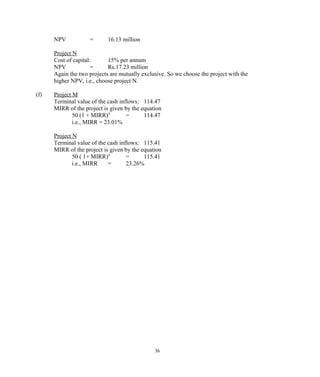
(e) Project M
Cost of capital = 15% per annum
35
NPV = 16.13 million
Project N
Cost of capital: 15% per annum
NPV = Rs.17.23 million
Again the two projects are mutually exclusive. So we choose the project with the
higher NPV, i.e., choose project N.
(f) Project M
Terminal value of the cash inflows: 114.47
MIRR of the project is given by the equation
50 (1 + MIRR)4
= 114.47
i.e., MIRR = 23.01%
Project N
Terminal value of the cash inflows: 115.41
MIRR of the project is given by the equation
50 ( 1+ MIRR)4
= 115.41
i.e., MIRR = 23.26%
36
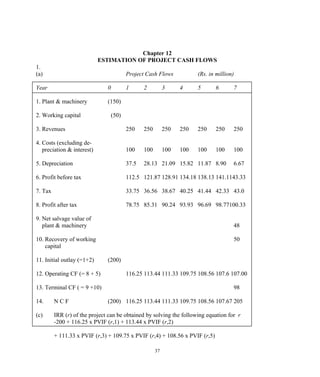
Chapter 12
ESTIMATION OF PROJECT CASH FLOWS
1.
(a) Project Cash Flows (Rs. in million)
Year 0 1 2 3 4 5 6 7
1. Plant & machinery (150)
2. Working capital (50)
3. Revenues 250 250 250 250 250 250 250
4. Costs (excluding de-
preciation & interest) 100 100 100 100 100 100 100
5. Depreciation 37.5 28.13 21.09 15.82 11.87 8.90 6.67
6. Profit before tax 112.5 121.87 128.91 134.18 138.13 141.1143.33
7. Tax 33.75 36.56 38.67 40.25 41.44 42.33 43.0
8. Profit after tax 78.75 85.31 90.24 93.93 96.69 98.77100.33
9. Net salvage value of
plant & machinery 48
10. Recovery of working 50
capital
11. Initial outlay (=1+2) (200)
12. Operating CF (= 8 + 5) 116.25 113.44 111.33 109.75 108.56 107.6 107.00
13. Terminal CF ( = 9 +10) 98
14. N C F (200) 116.25 113.44 111.33 109.75 108.56 107.67 205
(c) IRR (r) of the project can be obtained by solving the following equation for r
-200 + 116.25 x PVIF (r,1) + 113.44 x PVIF (r,2)
+ 111.33 x PVIF (r,3) + 109.75 x PVIF (r,4) + 108.56 x PVIF (r,5)
37
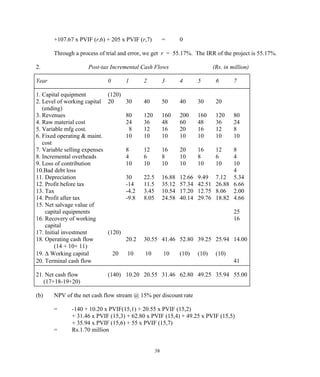
+107.67 x PVIF (r,6) + 205 x PVIF (r,7) = 0
Through a process of trial and error, we get r = 55.17%. The IRR of the project is 55.17%.
2. Post-tax Incremental Cash Flows (Rs. in million)
Year 0 1 2 3 4 5 6 7
1. Capital equipment (120)
2. Level of working capital 20 30 40 50 40 30 20
(ending)
3. Revenues 80 120 160 200 160 120 80
4. Raw material cost 24 36 48 60 48 36 24
5. Variable mfg cost. 8 12 16 20 16 12 8
6. Fixed operating & maint. 10 10 10 10 10 10 10
cost
7. Variable selling expenses 8 12 16 20 16 12 8
8. Incremental overheads 4 6 8 10 8 6 4
9. Loss of contribution 10 10 10 10 10 10 10
10.Bad debt loss 4
11. Depreciation 30 22.5 16.88 12.66 9.49 7.12 5.34
12. Profit before tax -14 11.5 35.12 57.34 42.51 26.88 6.66
13. Tax -4.2 3.45 10.54 17.20 12.75 8.06 2.00
14. Profit after tax -9.8 8.05 24.58 40.14 29.76 18.82 4.66
15. Net salvage value of
capital equipments 25
16. Recovery of working 16
capital
17. Initial investment (120)
18. Operating cash flow 20.2 30.55 41.46 52.80 39.25 25.94 14.00
(14 + 10+ 11)
19. ∆ Working capital 20 10 10 10 (10) (10) (10)
20. Terminal cash flow 41
21. Net cash flow (140) 10.20 20.55 31.46 62.80 49.25 35.94 55.00
(17+18-19+20)
(b) NPV of the net cash flow stream @ 15% per discount rate
= -140 + 10.20 x PVIF(15,1) + 20.55 x PVIF (15,2)
+ 31.46 x PVIF (15,3) + 62.80 x PVIF (15,4) + 49.25 x PVIF (15,5)
+ 35.94 x PVIF (15,6) + 55 x PVIF (15,7)
= Rs.1.70 million
38
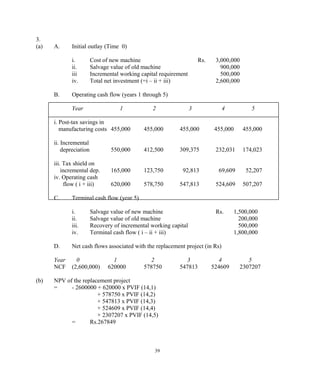
3.
(a) A. Initial outlay (Time 0)
i. Cost of new machine Rs. 3,000,000
ii. Salvage value of old machine 900,000
iii Incremental working capital requirement 500,000
iv. Total net investment (=i – ii + iii) 2,600,000
B. Operating cash flow (years 1 through 5)
Year 1 2 3 4 5
i. Post-tax savings in
manufacturing costs 455,000 455,000 455,000 455,000 455,000
ii. Incremental
depreciation 550,000 412,500 309,375 232,031 174,023
iii. Tax shield on
incremental dep. 165,000 123,750 92,813 69,609 52,207
iv. Operating cash
flow ( i + iii) 620,000 578,750 547,813 524,609 507,207
C. Terminal cash flow (year 5)
i. Salvage value of new machine Rs. 1,500,000
ii. Salvage value of old machine 200,000
iii. Recovery of incremental working capital 500,000
iv. Terminal cash flow ( i – ii + iii) 1,800,000
D. Net cash flows associated with the replacement project (in Rs)
Year 0 1 2 3 4 5
NCF (2,600,000) 620000 578750 547813 524609 2307207
(b) NPV of the replacement project
= - 2600000 + 620000 x PVIF (14,1)
+ 578750 x PVIF (14,2)
+ 547813 x PVIF (14,3)
+ 524609 x PVIF (14,4)
+ 2307207 x PVIF (14,5)
= Rs.267849
39
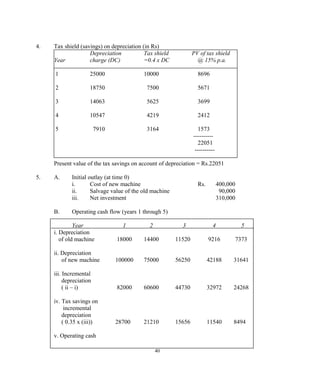
4. Tax shield (savings) on depreciation (in Rs)
Depreciation Tax shield PV of tax shield
Year charge (DC) =0.4 x DC @ 15% p.a.
1 25000 10000 8696
2 18750 7500 5671
3 14063 5625 3699
4 10547 4219 2412
5 7910 3164 1573
----------
22051
----------
Present value of the tax savings on account of depreciation = Rs.22051
5. A. Initial outlay (at time 0)
i. Cost of new machine Rs. 400,000
ii. Salvage value of the old machine 90,000
iii. Net investment 310,000
B. Operating cash flow (years 1 through 5)
Year 1 2 3 4 5
i. Depreciation
of old machine 18000 14400 11520 9216 7373
ii. Depreciation
of new machine 100000 75000 56250 42188 31641
iii. Incremental
depreciation
( ii – i) 82000 60600 44730 32972 24268
iv. Tax savings on
incremental
depreciation
( 0.35 x (iii)) 28700 21210 15656 11540 8494
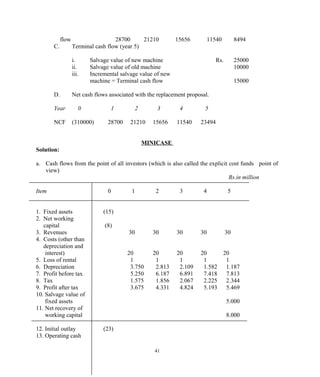
v. Operating cash
40
flow 28700 21210 15656 11540 8494
C. Terminal cash flow (year 5)
i. Salvage value of new machine Rs. 25000
ii. Salvage value of old machine 10000
iii. Incremental salvage value of new
machine = Terminal cash flow 15000
D. Net cash flows associated with the replacement proposal.
Year 0 1 2 3 4 5
NCF (310000) 28700 21210 15656 11540 23494
MINICASE
Solution:
a. Cash flows from the point of all investors (which is also called the explicit cost funds point of
view)
Rs.in million
Item 0 1 2 3 4 5
1. Fixed assets (15)
2. Net working
capital (8)
3. Revenues 30 30 30 30 30
4. Costs (other than
depreciation and
interest) 20 20 20 20 20
5. Loss of rental 1 1 1 1 1
6. Depreciation 3.750 2.813 2.109 1.582 1.187
7. Profit before tax 5.250 6.187 6.891 7.418 7.813
8. Tax 1.575 1.856 2.067 2.225 2.344
9. Profit after tax 3.675 4.331 4.824 5.193 5.469
10. Salvage value of
fixed assets 5.000
11. Net recovery of
working capital 8.000
12. Initial outlay (23)
13. Operating cash
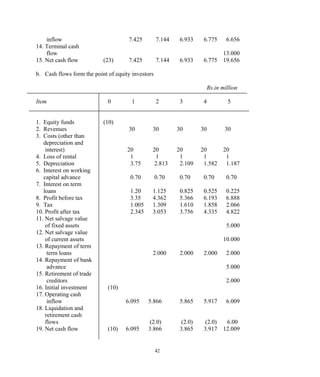
41
inflow 7.425 7.144 6.933 6.775 6.656
14. Terminal cash
flow 13.000
15. Net cash flow (23) 7.425 7.144 6.933 6.775 19.656
b. Cash flows form the point of equity investors
Rs.in million
Item 0 1 2 3 4 5
1. Equity funds (10)
2. Revenues 30 30 30 30 30
3. Costs (other than
depreciation and
interest) 20 20 20 20 20
4. Loss of rental 1 1 1 1 1
5. Depreciation 3.75 2.813 2.109 1.582 1.187
6. Interest on working
capital advance 0.70 0.70 0.70 0.70 0.70
7. Interest on term
loans 1.20 1.125 0.825 0.525 0.225
8. Profit before tax 3.35 4.362 5.366 6.193 6.888
9. Tax 1.005 1.309 1.610 1.858 2.066
10. Profit after tax 2.345 3.053 3.756 4.335 4.822
11. Net salvage value
of fixed assets 5.000
12. Net salvage value
of current assets 10.000
13. Repayment of term
term loans 2.000 2.000 2.000 2.000
14. Repayment of bank
advance 5.000
15. Retirement of trade
creditors 2.000
16. Initial investment (10)
17. Operating cash
inflow 6.095 5.866 5.865 5.917 6.009
18. Liquidation and
retirement cash
flows (2.0) (2.0) (2.0) 6.00
19. Net cash flow (10) 6.095 3.866 3.865 3.917 12.009
42
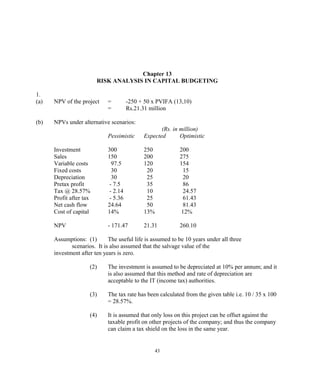
Chapter 13
RISK ANALYSIS IN CAPITAL BUDGETING
1.
(a) NPV of the project = -250 + 50 x PVIFA (13,10)
= Rs.21.31 million
(b) NPVs under alternative scenarios:
(Rs. in million)
Pessimistic Expected Optimistic
Investment 300 250 200
Sales 150 200 275
Variable costs 97.5 120 154
Fixed costs 30 20 15
Depreciation 30 25 20
Pretax profit - 7.5 35 86
Tax @ 28.57% - 2.14 10 24.57
Profit after tax - 5.36 25 61.43
Net cash flow 24.64 50 81.43
Cost of capital 14% 13% 12%
NPV - 171.47 21.31 260.10
Assumptions: (1) The useful life is assumed to be 10 years under all three
scenarios. It is also assumed that the salvage value of the
investment after ten years is zero.
(2) The investment is assumed to be depreciated at 10% per annum; and it
is also assumed that this method and rate of depreciation are
acceptable to the IT (income tax) authorities.
(3) The tax rate has been calculated from the given table i.e. 10 / 35 x 100
= 28.57%.
(4) It is assumed that only loss on this project can be offset against the
taxable profit on other projects of the company; and thus the company
can claim a tax shield on the loss in the same year.
43
(c) Accounting break even point (under ‘expected’ scenario)
Fixed costs + depreciation = Rs. 45 million
Contribution margin ratio = 60 / 200 = 0.3
Break even level of sales = 45 / 0.3 = Rs.150 million
Financial break even point (under ‘xpected’ scenario)
i. Annual net cash flow = 0.7143 [ 0.3 x sales – 45 ] + 25
= 0.2143 sales – 7.14
ii. PV (net cash flows) = [0.2143 sales – 7.14 ] x PVIFA (13,10)
= 1.1628 sales – 38.74
iii. Initial investment = 200
iv. Financial break even level
of sales = 238.74 / 1.1628 = Rs.205.31 million
2.
(a) Sensitivity of NPV with respect to quantity manufactured and sold:
(in Rs)
Pessimistic Expected Optimistic
Initial investment 30000 30000 30000
Sale revenue 24000 42000 54000
Variable costs 16000 28000 36000
Fixed costs 3000 3000 3000
Depreciation 2000 2000 2000
Profit before tax 3000 9000 13000
Tax 1500 4500 6500
Profit after tax 1500 4500 6500
Net cash flow 3500 6500 8500
NPV at a cost of
capital of 10% p.a
and useful life of
5 years -16732 - 5360 2222
(b) Sensitivity of NPV with respect to variations in unit price.
Pessimistic Expected Optimistic
Initial investment 30000 30000 30000
Sale revenue 28000 42000 70000
44
Variable costs 28000 28000 28000
Fixed costs 3000 3000 3000
Depreciation 2000 2000 2000
Profit before tax -5000 9000 37000
Tax -2500 4500 18500
Profit after tax -2500 4500 18500
Net cash flow - 500 6500 20500
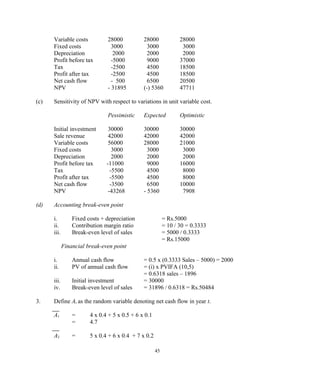
NPV - 31895 (-) 5360 47711
(c) Sensitivity of NPV with respect to variations in unit variable cost.
Pessimistic Expected Optimistic
Initial investment 30000 30000 30000
Sale revenue 42000 42000 42000
Variable costs 56000 28000 21000
Fixed costs 3000 3000 3000
Depreciation 2000 2000 2000
Profit before tax -11000 9000 16000
Tax -5500 4500 8000
Profit after tax -5500 4500 8000
Net cash flow -3500 6500 10000
NPV -43268 - 5360 7908
(d) Accounting break-even point
i. Fixed costs + depreciation = Rs.5000
ii. Contribution margin ratio = 10 / 30 = 0.3333
iii. Break-even level of sales = 5000 / 0.3333
= Rs.15000
Financial break-even point
i. Annual cash flow = 0.5 x (0.3333 Sales – 5000) = 2000
ii. PV of annual cash flow = (i) x PVIFA (10,5)
= 0.6318 sales – 1896
iii. Initial investment = 30000
iv. Break-even level of sales = 31896 / 0.6318 = Rs.50484
3. Define At as the random variable denoting net cash flow in year t.
A1 = 4 x 0.4 + 5 x 0.5 + 6 x 0.1
= 4.7
A2 = 5 x 0.4 + 6 x 0.4 + 7 x 0.2
45
= 5.8
A3 = 3 x 0.3 + 4 x 0.5 + 5 x 0.2
= 3.9
NPV = 4.7 / 1.1 +5.8 / (1.1)2
+ 3.9 / (1.1)3
– 10
= Rs.2.00 million
σ1
2
= 0.41
σ2
2
= 0.56
σ3
2
= 0.49
σ1
2
σ2
2
σ3
2
σ2
NPV = + +
(1.1)2
(1.1)4
(1.1)6
= 1.00
σ (NPV) = Rs.1.00 million
4. Expected NPV
4 At
= ∑ - 25,000
t=1 (1.08)t
= 12,000/(1.08) + 10,000 / (1.08)2
+ 9,000 / (1.08)3
+ 8,000 / (1.08)4
– 25,000
= [ 12,000 x .926 + 10,000 x .857 + 9,000 x .794 + 8,000 x .735]
- 25,000
= 7,708
Standard deviation of NPV
4 σt
∑
t=1 (1.08)t
= 5,000 / (1.08) + 6,000 / (1.08)2
+ 5,000 / (1,08)3
+ 6,000 / (1.08)4
= 5,000 x .926 + 6,000 x .857 + 5000 x .794 + 6,000 x .735
= 18,152
5. Expected NPV
46
4 At
= ∑ - 10,000 …. (1)
t=1 (1.06)t
A1 = 2,000 x 0.2 + 3,000 x 0.5 + 4,000 x 0.3
= 3,100
A2 = 3,000 x 0.4 + 4,000 x 0.3 + 5,000 x 0.3
= 3,900
A3 = 4,000 x 0.3 + 5,000 x 0.5 + 6,000 x 0.2
= 4,900
A4 = 2,000 x 0.2 + 3,000 x 0.4 + 4,000 x 0.4
= 3,200
Substituting these values in (1) we get
Expected NPV = NPV
= 3,100 / (1.06)+ 3,900 / 1.06)2
+ 4,900 / (1.06)3
+ 3,200 / (1,06)4
- 10,000 = Rs.3,044
The variance of NPV is given by the expression
4 σ2
t
σ2
(NPV) = ∑ …….. (2)
t=1 (1.06)2t
σ1
2
= [(2,000 – 3,100)2
x 0.2 + (3,000 – 3,100)2
x 0.5
+ (4,000 – 3,100)2
x 0.3]
= 490,000
σ2
2
= [(3,000 – 3,900)2
x 0.4 + (4,000 – 3,900)2
x 0.3
+ (5,000 – 3900)2
x 0.3]
= 690,000
σ3
2
= [(4,000 – 4,900)2
x 0.3 + (5,000 – 4,900)2
x 0.5
+ (6,000 – 4,900)2
x 0.2]
= 490,000
σ4
2
= [(2,000 – 3,200)2
x 0.2 + (3,000 – 3,200)2
x 0.4
+ (4,000 – 3200)2
x 0.4]
= 560,000
47
Substituting these values in (2) we get
490,000 / (1.06)2
+ 690,000 / (1.06)4
+ 490,000 / (1.06)6
+ 560,000 / (1.08)8
[ 490,000 x 0.890 + 690,000 x 0.792
+ 490,000 x 0.705 + 560,000 x 0.627 ]
= 1,679,150
σ NPV= 1,679,150 = Rs.1,296
NPV – NPV 0 - NPV
Prob (NPV < 0) = Prob. <
σ NPV σ NPV
0 – 3044
= Prob Z <
1296
= Prob (Z < -2.35)
The required probability is given by the shaded area in the following normal curve.
P (Z < - 2.35) = 0.5 – P (-2.35 < Z < 0)
= 0.5 – P (0 < Z < 2.35)
= 0.5 – 0.4906
= 0.0094
So the probability of NPV being negative is 0.0094
Prob (P1 > 1.2) Prob (PV / I > 1.2)
Prob (NPV / I > 0.2)
Prob. (NPV > 0.2 x 10,000)
Prob (NPV > 2,000)
Prob (NPV >2,000)= Prob (Z > 2,000- 3,044 / 1,296)
Prob (Z > - 0.81)
The required probability is given by the shaded area of the following normal
curve:
P(Z > - 0.81) = 0.5 + P(-0.81 < Z < 0)
= 0.5 + P(0 < Z < 0.81)
= 0.5 + 0.2910
= 0.7910
So the probability of P1 > 1.2 as 0.7910
48
6. Given values of variables other than Q, P and V, the net present value model of Bidhan
Corporation can be expressed as:
[Q(P – V) – 3,000 – 2,000] (0.5)+ 2,000 0
5
NPV ∑ + - 30,000
t =1 (1.1)t
(1.1)5
0.5 Q (P – V) – 500
5
∑ = ------------------------------------ - 30,000
t=1 (1.1)t
= [ 0.5Q (P – V) – 500] x PVIFA (10,5) – 30,000
= [0.5Q (P – V) – 500] x 3.791 – 30,000
= 1.8955Q (P – V) – 31,895.5
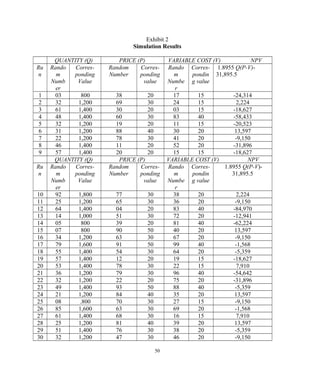
Exhibit 1 presents the correspondence between the values of exogenous variables and the two
digit random number. Exhibit 2 shows the results of the simulation.
Exhibit 1
Correspondence between values of exogenous variables and
two digit random numbers
QUANTITY PRICE VARIABLE COST
Valu
e
Pro
b
Cumulati
ve Prob.
Two digit
random
numbers Valu
e
Pro
b
Cumulati
ve Prob.
Two digit
random
numbers Value Pro
b
Cum
u-
lative
Prob.
Two digit
random
numbers
800 0.1
0
0.10 00 to 09 20 0.4
0
0.40 00 to 39 15 0.3
0
0.30 00 to 29
1,00
0
0.1
0
0.20 10 to 19 30 0.4
0
0.80 40 to 79 20 0.5
0
0.80 30 to 79
1,20
0
0.2
0
0.40 20 to 39 40 0.1
0
0.90 80 to 89 40 0.2
0
1.00 80 to 99
1,40
0
0.3
0
0.70 40 to 69 50 0.1
0
1.00 90 to 99
1,60
0
0.2
0
0.90 70 to 89
1,80
0
0.1
0
1.00 90 to 99
49
Exhibit 2
Simulation Results
QUANTITY (Q) PRICE (P) VARIABLE COST (V) NPV
Ru
n
Rando
m
Numb
er
Corres-
ponding
Value
Random
Number
Corres-
ponding
value
Rando
m
Numbe
r
Corres-
pondin
g value
1.8955 Q(P-V)-
31,895.5
1 03 800 38 20 17 15 -24,314
2 32 1,200 69 30 24 15 2,224
3 61 1,400 30 20 03 15 -18,627
4 48 1,400 60 30 83 40 -58,433
5 32 1,200 19 20 11 15 -20,523
6 31 1,200 88 40 30 20 13,597
7 22 1,200 78 30 41 20 -9,150
8 46 1,400 11 20 52 20 -31,896
9 57 1,400 20 20 15 15 -18,627
QUANTITY (Q) PRICE (P) VARIABLE COST (V) NPV
Ru
n
Rando
m
Numb
er
Corres-
ponding
Value
Random
Number
Corres-
ponding
value
Rando
m
Numbe
r
Corres-
pondin
g value
1.8955 Q(P-V)-
31,895.5
10 92 1,800 77 30 38 20 2,224
11 25 1,200 65 30 36 20 -9,150
12 64 1,400 04 20 83 40 -84,970
13 14 1,000 51 30 72 20 -12,941
14 05 800 39 20 81 40 -62,224
15 07 800 90 50 40 20 13,597
16 34 1,200 63 30 67 20 -9,150
17 79 1,600 91 50 99 40 -1,568
18 55 1,400 54 30 64 20 -5,359
19 57 1,400 12 20 19 15 -18,627
20 53 1,400 78 30 22 15 7,910
21 36 1,200 79 30 96 40 -54,642
22 32 1,200 22 20 75 20 -31,896
23 49 1,400 93 50 88 40 -5,359
24 21 1,200 84 40 35 20 13,597
25 08 .800 70 30 27 15 -9,150
26 85 1,600 63 30 69 20 -1,568
27 61 1,400 68 30 16 15 7,910
28 25 1,200 81 40 39 20 13,597
29 51 1,400 76 30 38 20 -5,359
30 32 1,200 47 30 46 20 -9,150
50
31 52 1,400 61 30 58 20 -5,359
32 76 1,600 18 20 41 20 -31,896
33 43 1,400 04 20 49 20 -31,896
34 70 1,600 11 20 59 20 -31,896
35 67 1,400 35 20 26 15 -18,627
36 26 1,200 63 30 22 15 2,224
QUANTITY (Q) PRICE (P) VARIABLE COST (V) NPV
Ru
n
Random
Number
Corre
s-
pondi
ng
Value
Random
Number
Corres-
ponding
value
Rando
m
Numbe
r
Corres-
pondin
g value
1.8955 Q(P-V)-
31,895.5
37 89 1,600 86 40 59 20 28,761
38 94 1,800 00 20 25 15 -14,836
39 09 .800 15 20 29 15 -24,314
40 44 1,400 84 40 21 15 34,447
41 98 1,800 23 20 79 20 -31,896
42 10 1,000 53 30 77 20 -12,941
43 38 1,200 44 30 31 20 -9,150
44 83 1,600 30 20 10 15 -16,732
45 54 1,400 71 30 52 20 -5,359
46 16 1,000 70 30 19 15 -3,463
47 20 1,200 65 30 87 40 -54,642
48 61 1,400 61 30 70 20 -5,359
49 82 1,600 48 30 97 40 -62,224
50 90 1,800 50 30 43 20 2,224
Expected NPV = NPV
50
= 1/ 50 ∑ NPVi
i=1
= 1/50 (-7,20,961)
= 14,419
50
Variance of NPV = 1/50 ∑ (NPVi – NPV)2
i=1
= 1/50 [27,474.047 x 106
]
= 549.481 x 10⁶
51
Standard deviation of NPV = 549.481 x 106
= 23,441
7. To carry out a sensitivity analysis, we have to define the range and the most likely values of
the variables in the NPV Model. These values are defined below
Variable Range Most likely value
I Rs.30,000 – Rs.30,000 Rs.30,000
k 10% - 10% 10%
F Rs.3,000 – Rs.3,000 Rs.3,000
D Rs.2,000 – Rs.2,000 Rs.2,000
T 0.5 – 0.5 0.5
N 5 – 5 5
S 0 – 0 0
Q Can assume any one of the values - 1,400*
800, 1,000, 1,200, 1,400, 1,600 and 1,800
P Can assume any of the values 20, 30, 30**
40 and 50
V Can assume any one of the values 20*
15,20 and 40
----------------------------------------------------------------------------------------
* The most likely values in the case of Q, P and V are the values that have the
highest probability associated with them
** In the case of price, 20 and 30 have the same probability of occurrence viz 0.4. We
have chosen 30 as the most likely value because the expected value of the
distribution is closer to 30
Sensitivity Analysis with Reference to Q
The relationship between Q and NPV given the most likely values of other
variables is given by
5 [Q (30-20) – 3,000 – 2,000] x 0.5 + 2,000 0
NPV = ∑ + - 30,000
t=1 (1.1)t
(1.1)5
5 5Q - 500
= ∑ - 30,000
t=1 (1.1)t
The net present values for various values of Q are given in the following table:
52
Q 800 1,000 1,200 1,400 1,600 1,800
NPV -16,732 -12,941 -9,150 -5,359 -1,568 2,224
Sensitivity analysis with reference to P
The relationship between P and NPV, given the most likely values of other variables is defined as
follows:
5 [1,400 (P-20) – 3,000 – 2,000] x 0.5 + 2,000 0
NPV = ∑ + - 30,0
t=1 (1.1)t
(1.1)5
5 700 P – 14,500
= ∑ - 30,000
t=1 (1.1)t
The net present values for various values of P are given below :
P (Rs) 20 30 - 40 50
NPV(Rs) -31,896 -5,359 21,179 47,716
8. NPV - 5 0 5 10 15 20
(Rs.in lakhs)
PI 0.9 1.00 1.10 1.20 1.30 1.40
Prob. 0.02 0.03 0.10 0.40 0.30 0.15
6
Expected PI = PI = ∑ (PI)j Pj
j=1
= 1.24
6
Standard deviation of P1 = ∑ (PIj - PI) 2
Pj
j=1
= √ .01156
= .1075
The standard deviation of P1 is .1075 for the given investment with an expected PI of 1.24.
The maximum standard deviation of PI acceptable to the company for an investment with an
expected PI of 1.25 is 0.30.
53
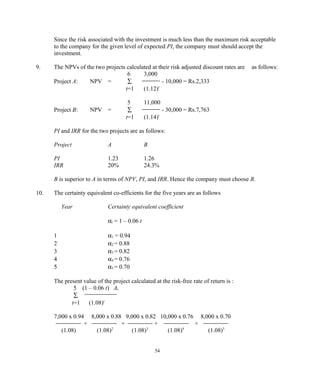
Since the risk associated with the investment is much less than the maximum risk acceptable
to the company for the given level of expected PI, the company must should accept the
investment.
9. The NPVs of the two projects calculated at their risk adjusted discount rates are as follows:
6 3,000
Project A: NPV = ∑ - 10,000 = Rs.2,333
t=1 (1.12)t
5 11,000
Project B: NPV = ∑ - 30,000 = Rs.7,763
t=1 (1.14)t
PI and IRR for the two projects are as follows:
Project A B
PI 1.23 1.26
IRR 20% 24.3%
B is superior to A in terms of NPV, PI, and IRR. Hence the company must choose B.
10. The certainty equivalent co-efficients for the five years are as follows
Year Certainty equivalent coefficient
αt = 1 – 0.06 t
1 α1 = 0.94
2 α2 = 0.88
3 α3 = 0.82
4 α4 = 0.76
5 α5 = 0.70
The present value of the project calculated at the risk-free rate of return is :
5 (1 – 0.06 t) At
∑
t=1 (1.08)t
7,000 x 0.94 8,000 x 0.88 9,000 x 0.82 10,000 x 0.76 8,000 x 0.70
+ + + +
(1.08) (1.08)2
(1.08)3
(1.08)4
(1.08)5
54
6,580 7,040 7,380 7,600 5,600
+ + + +
(1.08) (1.08)2
(1.08)3
(1.08)4
(1.08)5
= 27,386
Net present value of the Project = (27,386 – 30,000
= Rs. –2,614
MINICASE
Solution:
1. The expected NPV of the turboprop aircraft
0.65 (5500) + 0.35 (500)
NPV = - 11000 +
(1.12)
0.65 [0.8 (17500) + 0.2 (3000)] + 0.35 [0.4 (17500) + 0.6 (3000)]
+
(1.12)2
= 2369
2. If Southern Airways buys the piston engine aircraft and the demand in year 1 turns out to be
high, a further decision has to be made with respect to capacity expansion. To evaluate the
piston engine aircraft, proceed as follows:
First, calculate the NPV of the two options viz., ‘expand’ and ‘do not expand’ at decision
point D2:
0.8 (15000) + 0.2 (1600)
Expand : NPV = - 4400 +
1.12
= 6600
0.8 (6500) + 0.2 (2400)
Do not expand : NPV =
1.12
= 5071
55
Second, truncate the ‘do not expand’ option as it is inferior to the ‘expand’ option. This
means that the NPV at decision point D2 will be 6600
Third, calculate the NPV of the piston engine aircraft option.
0.65 (2500+6600) + 0.35 (800)
NPV = – 5500 +
1.12
0.35 [0.2 (6500) + 0.8 (2400)]
+
(1.12)2
= – 5500 + 5531 + 898 = 929
3. The value of the option to expand in the case of piston engine aircraft
If Southern Airways does not have the option of expanding capacity at the end of year 1, the
NPV of the piston engine aircraft would be:
0.65 (2500) + 0.35 (800)
NPV = – 5500 +
1.12
0.65 [0.8 (6500) + 0.2 (2400)] + 0.35 [0.2 (6500) + 0.8 (2400)]
+
(1.12)2
= - 5500 + 1701 + 3842 = 43
Thus the option to expand has a value of 929 – 43 = 886
4. Value of the option to abandon if the turboprop aircraft can be sold for 8000 at the end of year
1
If the demand in year 1 turns out to be low, the payoffs for the ‘continuation’ and
‘abandonment’ options as of year 1 are as follows.
0.4 (17500) + 0.6 (3000)
Continuation: = 7857
1.12
56
Abandonment : 8000
Thus it makes sense to sell off the aircraft after year 1, if the demand in year 1 turns out to be
low.
The NPV of the turboprop aircraft with abandonment possibility is
0.65 [5500 +{0.8 (17500) + 0.2 (3000)}/ (1.12)] + 0.35 (500 +8000)
NPV = - 11,000 +
(1.12)
12048 + 2975
= - 11,000 + = 2413
1.12
Since the turboprop aircraft without the abandonment option has a value of 2369, the
value of the abandonment option is : 2413 – 2369 = 44
5. The value of the option to abandon if the piston engine aircraft can be sold for 4400 at the
end of year 1:
If the demand in year 1 turns out to be low, the payoffs for the ‘continuation’ and
‘abandonment’ options as of year 1 are as follows:
0.2 (6500) + 0.8 (2400)
Continuation : = 2875
1.12
Abandonment : 4400
Thus, it makes sense to sell off the aircraft after year 1, if the demand in year 1 turns out to
be low.
The NPV of the piston engine aircraft with abandonment possibility is:
0.65 [2500 + 6600] + 0.35 [800 + 4400]
NPV = - 5500 +
1.12
5915 + 1820
= - 5500 + = 1406
1.12
For the piston engine aircraft the possibility of abandonment increases the NPV
57
from 929 to 1406. Hence the value of the abandonment option is 477.
58
Chapter 14
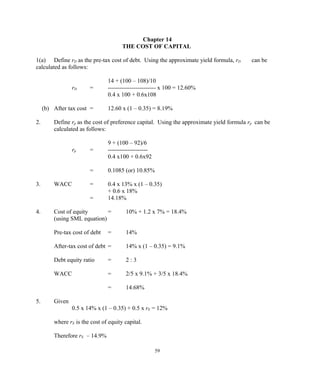
THE COST OF CAPITAL
1(a) Define rD as the pre-tax cost of debt. Using the approximate yield formula, rD can be
calculated as follows:
14 + (100 – 108)/10
rD = ------------------------ x 100 = 12.60%
0.4 x 100 + 0.6x10⁸
(b) After tax cost = 12.60 x (1 – 0.35) = 8.19%
2. Define rp as the cost of preference capital. Using the approximate yield formula rp can be
calculated as follows:
9 + (100 – 92)/6
rp = --------------------
0.4 x100 + 0.6x92
= 0.1085 (or) 10.85%
3. WACC = 0.4 x 13% x (1 – 0.35)
+ 0.6 x 18%
= 14.18%
4. Cost of equity = 10% + 1.2 x 7% = 18.4%
(using SML equation)
Pre-tax cost of debt = 14%
After-tax cost of debt = 14% x (1 – 0.35) = 9.1%
Debt equity ratio = 2 : 3
WACC = 2/5 x 9.1% + 3/5 x 18.4%
= 14.68%
5. Given
0.5 x 14% x (1 – 0.35) + 0.5 x rE = 12%
where rE is the cost of equity capital.
Therefore rE – 14.9%
59
Using the SML equation we get
11% + 8% x β = 14.9%
where β denotes the beta of Azeez’s equity.
Solving this equation we get β = 0.4875.
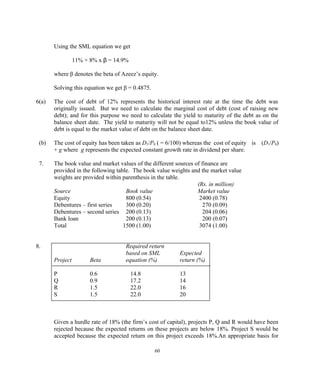
6(a) The cost of debt of 12% represents the historical interest rate at the time the debt was
originally issued. But we need to calculate the marginal cost of debt (cost of raising new
debt); and for this purpose we need to calculate the yield to maturity of the debt as on the
balance sheet date. The yield to maturity will not be equal to12% unless the book value of
debt is equal to the market value of debt on the balance sheet date.
(b) The cost of equity has been taken as D1/P0 ( = 6/100) whereas the cost of equity is (D1/P0)
+ g where g represents the expected constant growth rate in dividend per share.
7. The book value and market values of the different sources of finance are
provided in the following table. The book value weights and the market value
weights are provided within parenthesis in the table.
(Rs. in million)
Source Book value Market value
Equity 800 (0.54) 2400 (0.78)
Debentures – first series 300 (0.20) 270 (0.09)
Debentures – second series 200 (0.13) 204 (0.06)
Bank loan 200 (0.13) 200 (0.07)
Total 1500 (1.00) 3074 (1.00)
8. Required return
based on SML Expected
Project Beta equation (%) return (%)
P 0.6 14.8 13
Q 0.9 17.2 14
R 1.5 22.0 16
S 1.5 22.0 20
Given a hurdle rate of 18% (the firm’s cost of capital), projects P, Q and R would have been
rejected because the expected returns on these projects are below 18%. Project S would be
accepted because the expected return on this project exceeds 18%.An appropriate basis for
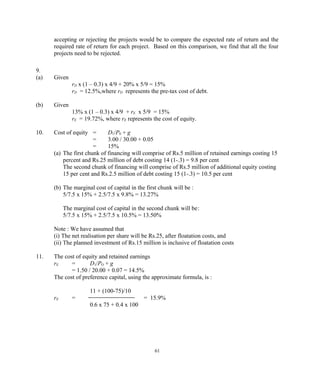
60
accepting or rejecting the projects would be to compare the expected rate of return and the
required rate of return for each project. Based on this comparison, we find that all the four
projects need to be rejected.
9.
(a) Given
rD x (1 – 0.3) x 4/9 + 20% x 5/9 = 15%
rD = 12.5%,where rD represents the pre-tax cost of debt.
(b) Given
13% x (1 – 0.3) x 4/9 + rE x 5/9 = 15%
rE = 19.72%, where rE represents the cost of equity.
10. Cost of equity = D1/P0 + g
= 3.00 / 30.00 + 0.05
= 15%
(a) The first chunk of financing will comprise of Rs.5 million of retained earnings costing 15
percent and Rs.25 million of debt costing 14 (1-.3) = 9.8 per cent
The second chunk of financing will comprise of Rs.5 million of additional equity costing
15 per cent and Rs.2.5 million of debt costing 15 (1-.3) = 10.5 per cent
(b) The marginal cost of capital in the first chunk will be :
5/7.5 x 15% + 2.5/7.5 x 9.8% = 13.27%
The marginal cost of capital in the second chunk will be:
5/7.5 x 15% + 2.5/7.5 x 10.5% = 13.50%
Note : We have assumed that
(i) The net realisation per share will be Rs.25, after floatation costs, and
(ii) The planned investment of Rs.15 million is inclusive of floatation costs
11. The cost of equity and retained earnings
rE = D1/PO + g
= 1.50 / 20.00 + 0.07 = 14.5%
The cost of preference capital, using the approximate formula, is :
11 + (100-75)/10
rE = = 15.9%
0.6 x 75 + 0.4 x 100
61
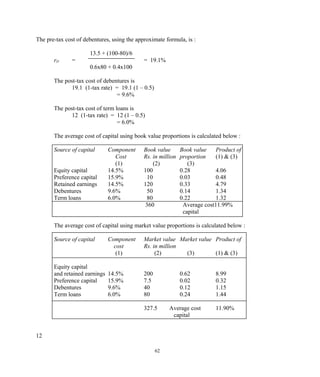
The pre-tax cost of debentures, using the approximate formula, is :
13.5 + (100-80)/6
rD = = 19.1%
0.6x80 + 0.4x100
The post-tax cost of debentures is
19.1 (1-tax rate) = 19.1 (1 – 0.5)
= 9.6%
The post-tax cost of term loans is
12 (1-tax rate) = 12 (1 – 0.5)
= 6.0%
The average cost of capital using book value proportions is calculated below :
Source of capital Component Book value Book value Product of
Cost Rs. in million proportion (1) & (3)
(1) (2) (3)
Equity capital 14.5% 100 0.28 4.06
Preference capital 15.9% 10 0.03 0.48
Retained earnings 14.5% 120 0.33 4.79
Debentures 9.6% 50 0.14 1.34
Term loans 6.0% 80 0.22 1.32
360 Average cost11.99%
capital
The average cost of capital using market value proportions is calculated below :
Source of capital Component Market value Market value Product of
cost Rs. in million
(1) (2) (3) (1) & (3)
Equity capital
and retained earnings 14.5% 200 0.62 8.99
Preference capital 15.9% 7.5 0.02 0.32
Debentures 9.6% 40 0.12 1.15
Term loans 6.0% 80 0.24 1.44
327.5 Average cost 11.90%
capital
12
62
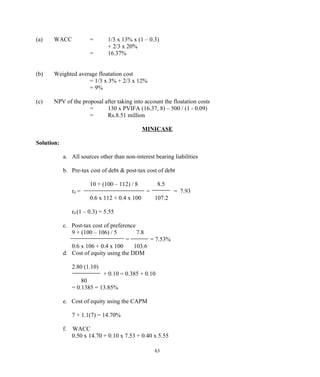
(a) WACC = 1/3 x 13% x (1 – 0.3)
+ 2/3 x 20%
= 16.37%
(b) Weighted average floatation cost
= 1/3 x 3% + 2/3 x 12%
= 9%
(c) NPV of the proposal after taking into account the floatation costs
= 130 x PVIFA (16.37, 8) – 500 / (1 - 0.09)
= Rs.8.51 million
MINICASE
Solution:
a. All sources other than non-interest bearing liabilities
b. Pre-tax cost of debt & post-tax cost of debt
10 + (100 – 112) / 8 8.5
rd = = = 7.93
0.6 x 112 + 0.4 x 100 107.2
rd (1 – 0.3) = 5.55
c. Post-tax cost of preference
9 + (100 – 106) / 5 7.8
= = 7.53%
0.6 x 10⁶ + 0.4 x 100 103.6
d. Cost of equity using the DDM
2.80 (1.10)
+ 0.10 = 0.385 + 0.10
80
= 0.1385 = 13.85%
e. Cost of equity using the CAPM
7 + 1.1(7) = 14.70%
f. WACC
0.50 x 14.70 + 0.10 x 7.53 + 0.40 x 5.55
63
= 7.35 + 0.75 + 2.22
= 10.32%
g. Cost of capital for the new business
0.5 [7 + 1.5 (7)] + 0.5 [ 11 (1 – 0.3)]
8.75 + 3.85
= 12.60%
64
Chapter 15
CAPITAL BUDGETING : EXTENSIONS
1. EAC
(Plastic Emulsion) = 300000 / PVIFA (12,7)
= 300000 / 4.564
= Rs.65732
EAC
(Distemper Painting) = 180000 / PVIFA (12,3)
= 180000 / 2.402
= Rs.74938
Since EAC of plastic emulsion is less than that of distemper painting, it is the preferred
alternative.
2. PV of the net costs associated with the internal transportation system
= 1 500 000 + 300 000 x PVIF (13,1) + 360 000 x PVIF (13,2)
+ 400 000 x PVIF (13,3) + 450 000 x PVIF (13,4)
+ 500 000 x PVIF (13,5) - 300 000 x PVIF (13,5)
= 2709185
EAC of the internal transportation system
= 2709185 / PVIFA (13,5)
= 2709185 / 3.517
= Rs.770 311
3. EAC [ Standard overhaul]
= 500 000 / PVIFA (14,6)
= 500 000 / 3.889
= Rs.128568 ……… (A)
EAC [Less costly overhaul]
= 200 000 / PVIFA (14,2)
= 200 000 / 1.647
= Rs.121433 ……… (B)
Since (B) < (A), the less costly overhaul is preferred alternative.
65
4.
(a) Base case NPV
= -12,000,000 + 3,000,000 x PVIFA (20,6)
= -12,000,000 + 997,8000
= (-) Rs.2,022,000
(b) Issue costs = 6,000,000 / 0.88 - 6,000,000
= Rs.818 182
Adjusted NPV after adjusting for issue costs
= - 2,022,000 – 818,182
= - Rs.2,840,182
(c) The present value of interest tax shield is calculated below :
Year Debt outstanding at Interest Tax shield Present value of
the beginning tax shield
1 6,000,000 1,080,000 324,000 274,590
2 6,000,000 1,080,000 324,000 232,697
3 5,250,000 945,000 283,000 172,538
4 4,500,000 810,000 243,000 125,339
5 3,750,000 675,000 202,000 88,513
6 3,000,000 540,000 162,000 60,005
7 2,225,000 400,500 120,000 37,715
8 1,500,000 270,000 81,000 21,546
9 750,000 135,000 40,500 9,133
Present value of tax shield = Rs.1,022,076
5.
(a) Base case BPV
= - 8,000,000 + 2,000,000 x PVIFA (18,6)
= - Rs.1,004,000
(b) Adjusted NPV after adjustment for issue cost of external equity
= Base case NPV – Issue cost
= - 1,004,000 – [ 3,000,000 / 0.9 – 3,000,000]
= - Rs.1,337,333
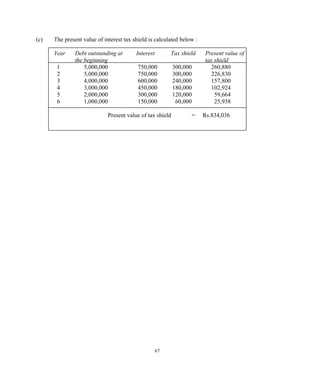
66
(c) The present value of interest tax shield is calculated below :
Year Debt outstanding at Interest Tax shield Present value of
the beginning tax shield
1 5,000,000 750,000 300,000 260,880
2 5,000,000 750,000 300,000 226,830
3 4,000,000 600,000 240,000 157,800
4 3,000,000 450,000 180,000 102,924
5 2,000,000 300,000 120,000 59,664
6 1,000,000 150,000 60,000 25,938
Present value of tax shield = Rs.834,036
67
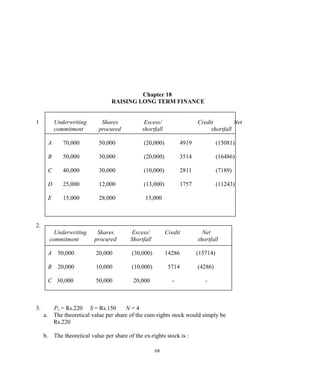
Chapter 18
RAISING LONG TERM FINANCE
1 Underwriting Shares Excess/ Credit Net
commitment procured shortfall shortfall
A 70,000 50,000 (20,000) 4919 (15081)
B 50,000 30,000 (20,000) 3514 (16486)
C 40,000 30,000 (10,000) 2811 (7189)
D 25,000 12,000 (13,000) 1757 (11243)
E 15,000 28,000 13,000
2.
Underwriting Shares Excess/ Credit Net
commitment procured Shortfall shortfall
A 50,000 20,000 (30,000) 14286 (15714)
B 20,000 10,000 (10,000) 5714 (4286)
C 30,000 50,000 20,000 - -
3. Po = Rs.220 S = Rs.150 N = 4
a. The theoretical value per share of the cum-rights stock would simply be
Rs.220
b. The theoretical value per share of the ex-rights stock is :
68
NPo+S 4 x 220 +150
= = Rs.206
N+1 4+1
c. The theoretical value of each right is :
Po – S 220 – 150
= = Rs.14
N+1 4+1
The theoretical value of 4 rights which are required to buy 1 share is Rs.14x14=Rs.56.
4. Po = Rs.180 N = 5
a. The theoretical value of a right if the subscription price is Rs.150
Po – S 180 – 150
= = Rs.5
N+1 5+1
b. The ex-rights value per share if the subscription price is Rs.160
NPo + S 5 x 180 + 160
= = Rs.176.7
N+1 5+1
c. The theoretical value per share, ex-rights, if the subscription price is
Rs.180? 100?
5 x 180 + 180
= Rs.180
5+1
5 x 180 + 100
= Rs.166.7
5+1
69
Chapter 19
CAPITAL STRUCTURE AND FIRM VALUE
1. Net operating income (O) : Rs.30 million
Interest on debt (I) : Rs.10 million
Equity earnings (P) : Rs.20 million
Cost of equity (rE) : 15%
Cost of debt (rD) : 10%
Market value of equity (E) : Rs.20 million/0.15 =Rs.133 million
Market value of debt (D) : Rs.10 million/0.10 =Rs.100 million
Market value of the firm (V) : Rs.233 million
2. Box Cox
Market value of equity 2,000,000/0.15 2,000,000/0.15
= Rs.13.33 million = Rs.13.33 million
Market value of debt 0 1,000,000/0.10
=Rs.10 million
Market value of the firm Rs.13.33million =23.33 million
(a) Average cost of capital for Box Corporation
13.33. 0
x 15% + x 10% = 15%
13.33 13.33
Average cost of capital for Cox Corporation
13.33 10.00
x 15% + x 10% = 12.86%
23.33 23.33
(b) If Box Corporation employs Rs.30 million of debt to finance a project that yields
Rs.4 million net operating income, its financials will be as follows.
Net operating income Rs.6,000,000
Interest on debt Rs.3,000,000
Equity earnings Rs.3,000,000
Cost of equity 15%
70
Cost of debt 10%
Market value of equity Rs.20 million
Market value of debt Rs.30 million
Market value of the firm Rs.50 million
Average cost of capital
20 30
15% x + 10% = 12%
50 50
(c) If Cox Corporation sells Rs.10 million of additional equity to retire
Rs.10 million of debt , it will become an all-equity company. So its
average cost of capital will simply be equal to its cost of equity,
which is 15%.
3. rE = rA + (rA-rD)D/E
20 = 12 + (12-8) D/E
So D/E = 2
4. E D E D
rE rD rA = rE + rD
D+E D+E (%) (%) D+E D+E
1.00 0.00 11.0 6.0 11.00
0.90 0.10 11.0 6.5 10.55
0.80 0.20 11.5 7.0 10.60
0.70 0.30 12.5 7.5 11.00
0.60 0.40 13.0 8.5 11.20
0.50 0.50 14.0 9.5 11.75
0.40 0.60 15.0 11.0 12.60
0.30 0.70 16.0 12.0 13.20
0.20 0.80 18.0 13.0 14.00
0.10 0.90 20.0 14.0 14.20
The optimal debt ratio is 0.10 as it minimises the weighted average
cost of capital.
5. (a) If you own Rs.10,000 worth of Bharat Company, the levered company
which is valued more, you would sell shares of Bharat Company, resort
to personal leverage, and buy the shares of Charat Company.
(b) The arbitrage will cease when Charat Company and Bharat Company
are valued alike
71
6. The value of Ashwini Limited according to Modigliani and Miller
hypothesis is
Expected operating income 15
= = Rs.125 million
Discount rate applicable to the 0.12
risk class to which Aswini belongs
7. The average cost of capital(without considering agency and bankruptcy cost)
at various leverage ratios is given below.
D E E D
rD rE rA = rE + rD
D + E D+ E % % D+E D+E
(%)
0 1.00 4.0 12.0 12.0
0.10 0.90 4.0 12.0 11.2
0.20 0.80 4.0 12.5 10.8
0.30 0.70 4.0 13.5 10.36
0.40 0.60 4.0 13.5 9.86
0.50 0.50 4.0 14.0 9.30
0.60 0.40 4.0 14.5 8.68
0.70 0.30 4.0 15.0 8.14
0.80 0.20 4.0 15.5 7.90
0.90 0.10 4.0 16.0 7.72 Optimal
b. The average cost of capital considering agency and bankruptcy costs is
given below
.
D E E D
rD rE rA = rE + rD
D + E D+ E % % D+E D+E
(%)
0 1.00 4.0 12.0 12.0
0.10 0.90 4.0 12.0 11.2
0.20 0.80 4.0 13.0 11.2
0.30 0.70 4.2 14.0 11.06
0.40 0.60 4.4 15.0 10.76
0.50 0.50 4.6 16.0 10.30
0.60 0.40 4.8 17.0 9.68
0.70 0.30 5.2 18.0 9.04
0.80 0.20 6.0 19.0 8.60
0.90 0.10 6.8 20.0 8.12 Optimal
8. The tax advantage of one rupee of debt is :
72
1-(1-tc) (1-tpe) (1-0.55) (1-0.05)
= 1 -
(1-tpd) (1-0.25)
= 0.43 rupee
Chapter 20
CAPITAL STRUCTURE DECISION
1.(a) Currently
No. of shares = 1,500,000
EBIT = Rs 7.2 million
Interest = 0
Preference dividend = Rs.12 x 50,000 = Rs.0.6 million
EPS = Rs.2
(EBIT – Interest) (1-t) – Preference dividend
EPS =
No. of shares
(7,200,000 – 0 ) (1-t) – 600,000
Rs.2 =
1,500,000
Hence t = 0.5 or 50 per cent
The EPS under the two financing plans is :
Financing Plan A : Issue of 1,000,000 shares
(EBIT - 0 ) ( 1 – 0.5) - 600,000
EPSA =
2,500,000
Financing Plan B : Issue of Rs.10 million debentures carrying 15 per cent
interest
(EBIT – 1,500,000) (1-0.5) – 600,000
EPSB =
1,500,000
The EPS – EBIT indifference point can be obtained by equating EPSA and EPSB
(EBIT – 0 ) (1 – 0.5) – 600,000 (EBIT – 1,500,000) (1 – 0.5) – 600,000
73
=
2,500,000 1,500,000
Solving the above we get EBIT = Rs.4,950,000 and at that EBIT, EPS is Rs.0.75
under both the plans
(b) As long as EBIT is less than Rs.4,950,000 equity financing maximixes EPS.
When EBIT exceeds Rs.4,950,000 debt financing maximises EPS.
2.
(a) EPS – EBIT equation for alternative A
EBIT ( 1 – 0.5)
EPSA =
2,000,000
(b) EPS – EBIT equation for alternative B
EBIT ( 1 – 0.5 ) – 440,000
EPSB =
1,600,000
(c) EPS – EBIT equation for alternative C
(EBIT – 1,200,000) (1- 0.5)
EPSC =
1,200,000
(d) The three alternative plans of financing ranked in terms of EPS over varying
Levels of EBIT are given the following table
Ranking of Alternatives
EBIT EPSA EPSB EPSC
(Rs.) (Rs.) (Rs.) (Rs.)
2,000,000 0.50(I) 0.35(II) 0.33(III)
2,160,000 0.54(I) 0.40(II) 0.40(II)
3,000,000 0.75(I) 0.66(II) 0.75(I)
4,000,000 1.00(II) 0.98(III) 1.17(I)
4,400,000 1.10(II) 1.10(II) 1.33(I)
More than 4,400,000 (III) (II) (I)
3. Plan A : Issue 0.8 million equity shares at Rs. 12.5 per share.
Plan B : Issue Rs.10 million of debt carrying interest rate of 15 per cent.
(EBIT – 0 ) (1 – 0.6)
EPSA =
74
1,800,000
(EBIT – 1,500,000) (1 – 0.6)
EPSB =
1,000,000
Equating EPSA and EPSB , we get
(EBIT – 0 ) (1 – 0.6) (EBIT – 1,500,000) (1 – 0.6)
=
1,800,000 1,000,000
Solving this we get EBIT = 3,375,000 or 3.375 million
Thus the debt alternative is better than the equity alternative when
EBIT > 3.375 million
EBIT – EBIT 3.375 – 7.000
Prob(EBIT>3,375,000) = Prob >
σ EBIT 3.000
= Prob [z > - 1.21]
= 0.8869
4. ROE = [ ROI + ( ROI – r ) D/E ] (1 – t )
15 = [ 14 + ( 14 – 8 ) D/E ] ( 1- 0.5 )
D/E = 2.67
5. ROE = [12 + (12 – 9 ) 0.6 ] (1 – 0.6)
= 5.52 per cent
6. 18 = [ ROI + ( ROI – 8 ) 0.7 ] ( 1 – 0.5)
ROI = 24.47 per cent
EBIT
7. a. Interest coverage ratio =
Interest on debt
150
=
40
= 3.75
EBIT + Depreciation
b. Cash flow coverage ratio =
Loan repayment instalment
75
Int.on debt +
(1 – Tax rate)
= 150 + 30
40 + 50
= 2
8. The debt service coverage ratio for Pioneer Automobiles Limited is given by :
5
∑ ( PAT i + Depi + Inti)
i=1
DSCR = 5
∑ (Inti + LRIi)
i=1
= 133.00 + 49.14 +95.80
95.80 + 72.00
= 277.94
167.80
= 1.66
9. (a) If the entire outlay of Rs. 300 million is raised by way of debt carrying 15 per cent
interest, the interest burden will be Rs. 45 million.
Considering the interest burden the net cash flows of the firm during
a recessionary year will have an expected value of Rs. 35 million (Rs.80 million - Rs. 45
million ) and a standard deviation of Rs. 40 million .
Since the net cash flow (X) is distributed normally
X – 35
40
has a standard normal deviation
Cash flow inadequacy means that X is less than 0.
0.35
Prob(X<0) = Prob (z< ) = Prob (z<- 0.875)
40
= 0.1909
(b) Since µ = Rs.80 million, σ= Rs.40 million , and the Z value corresponding to the risk
tolerance limit of 5 per cent is – 1.645, the cash available from the operations to service the
debt is equal to X which is defined as :
X – 80
76
= - 1.645
40
X = Rs.14.2 million
Given 15 per cent interest rate, the debt than be serviced is
14.2
= Rs. 94.67 million
0.15
Chapter 21
DIVIDEND POLICY AND FIRM VALUE
1. Payout ratio Price per share
3(0.5)+3(0.5) 0.15
0.5
0.12
= Rs. 28.13
0.12
3(0.7 5)+3(0.25) 0.15
0.12
0.75 = Rs. 26.56
0.12
3(1.00)
1.00 = Rs. 25.00
0.12
2. Payout ratio Price per share
8(0.25)
0.25 = undefined
0.12 – 0.16(0.75)
8(0.50)
0.50 = Rs.100
0.12 – 0.16(0.50)
8(1.00)
1.0 =Rs.66.7
0.12 – 0.16 (0)
77
3.
P Q
• Next year’s price 80 74
• Dividend 0 6
• Current price P Q
• Capital appreciation (80-P) (74-Q)
• Post-tax capital appreciation 0.9(80-P) 0.9 (74-Q)
• Post-tax dividend income 0 0.8 x 6
• Total return 0.9 (80-P)
P
= 14%
0.9 (74-Q) + 4.8
Q
=14%
• Current price (obtained by solving
the preceding equation)
P = Rs.69.23 Q = Rs.68.65
78
Chapter 22
DIVIDEND DECISION
1. a. Under a pure residual dividend policy, the dividend per share over the 4 year
period will be as follows:
DPS Under Pure Residual Dividend Policy
( in Rs.)
Year 1 2 3 4
Earnings 10,000 12,000 9,000 15,000
Capital expenditure 8,000 7,000 10,000 8,000
Equity investment 4,000 3,500 5,000 4,000
Pure residual
dividends 6,000 8,500 4,000 11,000
Dividends per share 1.20 1.70 0.80 2.20
b. The external financing required over the 4 year period (under the assumption that the
company plans to raise dividends by 10 percents every two years) is given below :
Required Level of External Financing
(in Rs.)
Year 1 2 3 4
A . Net income 10,000 12,000 9,000 15,000
B . Targeted DPS 1.00 1.10 1.10 1.21
C . Total dividends 5,000 5,500 5,500 6,050
D . Retained earnings(A-C) 5,000 6,500 3,500 8,950
E . Capital expenditure 8,000 7,000 10,000 8,000
79
F . External financing
requirement 3,000 500 6,500 Nil
(E-D)if E > D or 0 otherwise
c. Given that the company follows a constant 60 per cent payout ratio, the dividend per share
and external financing requirement over the 4 year period are given below
Dividend Per Share and External Financing Requirement
(in Rs.)
Year 1 2 3 4
A. Net income 10,000 12,000 9,000 15,00
B. Dividends 6,000 7,200 5,400 9,000
C. Retained earnings 4,000 4,800 3,600 6,000
D. Capital expenditure 8,000 7,000 10,000 8,000
E. External financing
(D-C)if D>C, or 0 4,000 2,200 6,400 2,000
otherwise
F. Dividends per share 1.20 1.44 1.08 1.80
2. Given the constraints imposed by the management, the dividend per share has to
be between Rs.1.00 (the dividend for the previous year) and Rs.1.60 (80 per
cent of earnings per share)
Since share holders have a preference for dividend, the dividend should be
raised over the previous dividend of Rs.1.00 . However, the firm has substantial
investment requirements and it would be reluctant to issue additional equity
because of high issue costs ( in the form of underpricing and floatation costs)
Considering the conflicting requirements, it seems to make sense to pay
Rs.1.20 per share by way of dividend. Put differently the pay out ratio may be
set at 60 per cent.
3. According to the Lintner model
Dt = cr EPSt + (1-c)Dt –1
EPSt =3.00, c= 0.7, r=0.6 , and Dt-1
80
Hence
Dt = 0.7 x 0.6 x 3.00 + (1-0.7)1.20
= Rs.1.62
4. The bonus ratio (b) must satisfy the following constraints :
(R-Sb)≥0.4S (1+b) (1)
0.3 PBT ≥0.1 S(1+b) (2)
R = Rs.100 million, S= Rs.60 million, PBT = Rs.60 million
Hence the constraints are
(100-60 b) ≥ 0.4 x 60 (1+b) (1a)
0.3 x 60≥0.1 x 60 (1+b) (2a)
These simplify to
b ≥ 76/84
b ≥ 2
The condition b ≥ 76/84 is more restructive than b≥ 2
So the maximum bonus ratio is 76/84 or 19/21
81
Chapter 23
Debt Analysis and Management
1. (i) Initial Outlay
(a) Cost of calling the old bonds
Face value of the old bonds 250,000,000
Call premium 15,000,000
265,000,000
(b) Net proceeds of the new bonds
Gross proceeds 250,000,000
Issue costs 10,000,000
240,000,000
(c) Tax savings on tax-deductible expenses
Tax rate[Call premium+Unamortised issue cost on
the old bonds] 9,200,000
0.4 [ 15,000,000 + 8,000,000]
Initial outlay i(a) – i(b) – i(c) 15,800,000
(ii) Annual Net Cash Savings
(a) Annual net cash outflow on old bonds
Interest expense 42,500,000
- Tax savings on interest expense and amortisation of
issue expenses 17,400,000
0.4 [42,500,000 + 8,000,000/10]
25,100,000
(b) Annual net cash outflow on new bonds
Interest expense 37,500,000
- Tax savings on interest expense and amortisation of
issue cost 15,500,000
0.4 [ 37,500,000 – 10,000,000/8]
22,000,000
Annual net cash savings : ii(a) – ii(b) 3,100,000
82
(iii) Present Value of the Annual Cash Savings
Present value of an 8-year annuity of 3,100,000 at a
discount rate of 9 per cent which is the post –tax cost
of new bonds 3,100,000 x 5.535 17,158,500
(iv) Net Present Value of Refunding the Bonds
(a) Present value of annual cash savings 17,158,500
(b) Net initial outlay 15,800,000
(c) Net present value of refunding the bonds :
iv(a) – iv(b). 1,358,500
2. (i) Initial Outlay
(a) Cost of calling the old bonds
Face value of the old bonds 120,000,000
Call premium 4,800,000
124,800,000
(b) Net proceeds of the new issue
Gross proceeds 120,000,000
Issue costs 2,400,000
117,600,000
(c) Tax savings on tax-deductible expenses 3,120,000
Tax rate[Call premium+Unamortised issue costs on
the old bond issue]
0.4 [ 4,800,000 + 3,000,000]
Initial outlay i(a) – i(b) – i(c) 4,080,000
(ii) Annual Net Cash Savings
(a) Annual net cash out flow on old bonds
Interest expense 19,200,000
- Tax savings on interest expense and amortisation of
issue costs 7,920,000
0.4[19,200,000 + 3,000,000/5]
11,280,000
(b) Annual net cash outflow on new bonds
Interest expense 18,000,000
- Tax savings on interest expense and amortistion of issue
costs 7,392,000
0.4[18,000,000 + 2,400,000/5]
10,608,000
Annual net cash savings : ii(a) – ii(b) 672,000
(iii) Present Value of the Annual Net Cash Savings
83
Present value of a 5 year annuity of 672,000 at
as discount rate of 9 per cent, which is the post-tax 2,614,080 cost of
new bonds
(iv) Net Present Value of Refunding the Bonds
(a) Present value of annual net cash savings 2,614,080
(b) Initial outlay 4,080,000
(c) Net present value of refunding the bonds : - 1,466,000
iv(a) – iv(b)
3. Yield to maturity of bond P
8 160 1000
918.50 =∑ +
t=1 (1+r)t
(1+r)8
r or yield to maturity is 18 percent
Yield to maturity of bond Q
5 120 1000
761 = ∑ +
t=1 (1+r)t
(1+r)5
r or yield to maturity is 20 per cent
Duration of bond P is calculated below
Year Cash flow Present Value Proportion of Proportion of bond’s
at 18% bond’s value Value x Time
1 160 135.5 0.148 0.148
2 160 114.9 0.125 0.250
3 160 97.4 0.106 0.318
4 160 82.6 0.090 0.360
5 160 69.9 0.076 0.380
6 160 59.2 0.064 0.384
7 160 50.2 0.055 0.385
8 160 308.6 0.336 2.688
4.913
Duration of bond Q is calculated below
Year Cash flow Present Value Proportion of Proportion of bond’s
at 20% bond’s value Value x Time
84
1 120 100.0 0.131 0.131
2 120 83.2 0.109 0.218
3 120 69.5 0.091 0.273
4 120 57.8 0.076 0.304
5 1120 450.2 0.592 2.960
3.886
Volatility of bond P Volatility of bond Q
4.913 3.886
= 4.16 = 3.24
1.18 1.20
4. The YTM for bonds of various maturities is
Maturity YTM(%)
1 12.36
2 13.10
3 13.21
4 13.48
5 13.72
Graphing these YTMs against the maturities will give the yield curve
The one year treasury bill rate , r1, is
1,00,000
- 1 = 12.36 %
89,000
To get the forward rate for year 2, r2, the following equation may be set up :
12500 112500
99000 = +
(1.1236) (1.1236)(1+r2)
85
Solving this for r2 we get r2 = 13.94%
To get the forward rate for year 3, r3, the following equation may be set up :
13,000 13,000 113,000
99,500 = + +
(1.1236) (1.1236)(1.1394) (1.1236)(1.1394)(1+r3)
Solving this for r3 we get r3 = 13.49%
To get the forward rate for year 4, r4 , the following equation may be set up :
13,500 13,500 13,500
100,050 = + +
(1.1236) (1.1236)(1.1394) (1.1236)(1.1394)(1.1349)
113,500
+
(1.1236)(1.1394)(1.1349)(1+r4)
Solving this for r4 we get r4 = 14.54%
To get the forward rate for year 5, r5 , the following equation may be set up :
13,750 13,750 13,750
100,100 = + +
(1.1236) (1.1236)(1.1394) (1.1236)(1.1394)(1.1349)
13,750
+
(1.1236)(1.1394)(1.1349)(1.1454)
113,750
+
(1.1236)(1.1394)(1.1349)(1.1454)(1+r5)
Solving this for r5 we get r5 = 15.08%
86
Chapter 25
HYBRID FINANCING
1. The product of the standard deviation and square root of time is :
σ t = 0.35 2 = 0.495
The ratio of the stock price to the present value of the exercise price is :
Stock price 40
= = 1.856
PV (Exercise price) 25/(1.16)
The ratio of the value of call option to stock price corresponding to numbers
0.495 and 1.856 can be found out from Table A.6 by interpolation. Note the
table gives values for the following combinations
1.75 2.00
0.45 44.6 50.8
0.50 45.3 51.3
Since we are interested in the combination 0.495 and 1.856 we first interpolate
between 0.450 and 0.500 and then interpolate between 1.75 and 2.00
Interpolation between 0.450 and 0.500 gives
1.75 2.00
0.450 44.6 50.8
0.495 45.23 51.25
0.500 45.3 51.3
87
Then, interpolation between 1.75 and 2.00 gives
1.75 1.856 2.00
0.495 45.23 47.78 51.25
Chapter 24
LEASING, HIRE PURCHASE, AND PROJECT FINANCE
1. NPV of the Purchase Option
(Rs.in ‘000)
Year 0 1 2 3 4 5
1.Investment(I) (1,500)
2.Revenues(Rt) 1,700 1,700 1,700 1,700 1,700
3.Costs(other than
(Depreciation)(Ct) 900 900 900 900 900
4.Depreciation(Dt) 500 333.3 222.2 148.1 98.8
5.Profit before tax
(Rt-Ct-Dt) 300 466.7 577.8 651.9 701.2
6.Profit after tax: 5(1-t) 210 326.7 404.5 456.3 490.8
7.Net salvage value 300
8.Net cash flow
(1+6+4+7) (1,500) 710 610 626.7 604.4 889.6
9.Discount factor
at 11 percent 1.000 0.901 0.812 0.731 0.659 0.593
10.Present value (8x9) (1,500) 639.7 495.3 458.1 398.3 527.5
NPV(Purchases)= - 1500+639.7+495.3+458.1+398.3+527.5 = 1018.9
NPV of the Leasing Option
(Rs. in ‘000)
Year 0 1 2 3 4 5
1.Revenues(Rt) - 1,700 1,700 1,700 1,700 1,700
2.Costs(other than
lease rentals)(Ct) 900 900 900 900 900
3.Lease rentals(Lt) 420 420 420 420 420 0
4.Profit before tax
(Rt-Ct-Lt) -420 380 380 380 380 800
5.Profit after tax (which
88
also reflects the net
cash flow)(1-t) -294 266 266 266 266 560
6.Discount factor at
13 per cent 1.000 0.885 0.783 0.693 0.613 0.543
7.Present value(5x6) -294 -235.4 208.3 184.3 163.1 304.1
NPV(Leasing) = -294+235.4+208.3+184.3+163.1+304.1 = 801.2
2. Under the hire purchase proposal the total interest payment is
2,000,000 x 0.12 x 3 = Rs. 720,000
The interest payment of Rs. 720,000 is allocated over the 3 years period using
the sum of the years digits method as follows:
Year Interest allocation
366
1 x Rs.720,000 = Rs.395,676
666
222
2 x Rs.720,000 = Rs.240,000
666
78
3 x Rs.720,000 = Rs.84,324
666
The annual hire purchase instalments will be :
Rs.2,000,000 + Rs.720,000
= Rs.906,667
3
The annual hire purchase instalments would be split as follows
Year Hire purchase instalment Interest Principal repayment
1 Rs.906,667 Rs.395,676 Rs. 510,991
2 Rs.906,667 Rs.240,000 Rs. 666,667
3 Rs.906,667 Rs. 84,324 Rs. 822,343
89
The lease rental will be as follows :
Rs. 560,000 per year for the first 5 years
Rs. 20,000 per year for the next 5 years
The cash flows of the leasing and hire purchse options are shown below
Year Leasing High Purchase -It(1-tc)-PRt+
- LRt (1-tc) -It(1-tc) -PRt Dt(tc) NSVt Dt(tc)+NSVt
1 -560,000(1-.4)=-336,000 -395,676(1-.4) -510,991 500,000(0.4) -548,397
2 -560,000(1-.4)=-336,000 -240,000(1-.4) -666,667 375,000(0.4) -660,667
3 -560,000(1-.4)=-336,000 - 84,324(1-.4) -822,343 281,250(0.4) -760,437
4 -560,000(1-.4)=-336,000 210,938(0.4) 84,375
5 -560,000(1-.4)=-336,000 158,203(0.4) 63,281
6 - 20,000(1-.4)= - 12,000 118,652(0.4) 47,461
7 - 20,000(1-.4)= - 12,000 88,989(0.4) 35,596
8 - 20,000(1-.4)= - 12,000 66,742(0.4) 26,697
9 - 20,000(1-.4)= - 12,000 50,056(0.4) 20,023
10 - 20,000(1-.4)= - 12,000 37,542(0.4) 200,000 215,017
Present value of the leasing option
5 336,000 10 12,000
= - ∑ − ∑ = - 1,302,207
t=1 (1.10)t
t=6 (1.10)t
Present value of the hire purchase option
548,397 660,667 760,437 84,375
= - - - -
(1.10) (1.10)2
(1.10)3
(1.10)4
63,281 47,461 35,596 26,697
+ + +
(1.10)5
(1.10)6
(1.10)7
(1.10)8
90
20,023 215,017
+
(1.10.9 (1.10)10
= - 1,369,383
Since the leasing option costs less than the hire purchase option , Apex should choose the
leasing option.
Chapter 26
WORKING CAPITAL POLICY
Average inventory
1 Inventory period =
Annual cost of goods sold/365
(60+64)/2
= = 62.9 days
360/365
Average accounts receivable
Accounts receivable =
period Annual sales/365
(80+88)/2
= = 61.3 days
500/365
Average accounts payable
Accounts payable =
period Annual cost of goods sold/365
(40+46)/2
= = 43.43 days
360/365
Operating cycle = 62.9 + 61.3 = 124.2 days
Cash cycle = 124.2 – 43.43 = 80.77 days
(110+120)/2
2. Inventory period = = 56.0 days
750/365
91
(140+150)/2
Accounts receivable = = 52.9 days
period 1000/365
(60+66)/2
Accounts payable = = 30.7 days
period 750/365
Operating cycle = 56.0 + 52.9 = 108.9 days
Cash cycle = 108.9 – 30.7 = 78.2 days
Rs.
3. 1. Sales 3,600,000
Less : Gross profit (25 per cent) 900,000
Total manufacturing cost 2,700,000
Less : Materials 900,000
Wages 720,000 1,620,000
Manufacturing expenses 1,080,000
2. Cash manufacturing expenses 960,000
(80,000 x 12)
3. Depreciation : (1) – (2) 120,000
4. Total cash cost
Total manufacturing cost 2,700,000
Less: Depreciation 120,000
Cash manufacturing cost 2,580,000
Add: Administration and sales
promotion expenses 360,000
2,940,000
A : Current Assets Rs.
Total cash cost 2,940,000
Debtors x 2 = x 2 = 490,000
12 12
Material cost 900,000
Raw material x 1 = x 1 = 75,000
stock 12 12
Cash manufacturing cost 2,580,000
Finished goods x 1 = x 1 = 215,000
stock 12 12
92
Cash balance A predetermined amount = 100,000
Sales promotion expenses 120,000
Prepaid sales x 1.5 = x 1.5 = 15,000
promotion 12 12
expenses
Cash balance A predetermined amount = 100,000
A : Current Assets = 995,000
B : Current Liabilites Rs.
Material cost 900,000
Sundry creditors x 2 = x 2 = 150,000
12 12
Manufacturing One month’s cash
expenses outstanding manufacturing expenses = 80,000
Wages outstanding One month’s wages = 60,000
B : Current liabilities 290,000
Working capital (A – B) 705,000
Add 20 % safety margin 141,000
Working capital required 846,000
93
Chapter 27
CASH AND LIQUIDITY MANAGEMENT
1. The forecast of cash receipts, cash payments, and cash position is prepared in the
statements given below
Forecast of Cash Receipts (Rs. in 000’s)
November December January February March April May June
1. Sales 120 120 150 150 150 200 200 200
2. Credit sales 84 84 105 105 105 140 140 140
3. Cash sales 36 36 45 45 45 60 60 60
4. Collection of receivables
(a) Previous month 33.6 33.6 42.0 42.0 42.0 56.0 56.0
(b) Two months earlier 50.4 50.4 63.0 63.0 63.0 84.0
5. Sale of machine 70.0
6. Interest on securities 3.0
7. Total receipts 129.0 137.4 150.0 235.0 179.0 203.0
(3+4+5+6)
Forecast of Cash Payments (Rs. in 000’s)
December January February March April May June
1. Purchases 60 60 60 60 80 80 80
2. Payment of accounts 60 60 60 60 80 80
payable
3. Cash purchases 3 3 3 3 3 3
4. Wage payments 25 25 25 25 25 25
5. Manufacturing
expenses 32 32 32 32 32 32
6. General, administrative
94
& selling expenses 15 15 15 15 15 15
7. Dividends 30
8. Taxes 35
9. Acquisition of
machinery 80
Total payments(2to9) 135 135 215 135 155 220
Summary of Cash Forecast (Rs.in 000’s)
January February March April May June
1. Opening balance 28
2. Receipts 129.0 137.4 150.0 235.0 179.0 203.0
3. Payments 135.0 135.0 215.0 135.0 155.0 220.0
4. Net cash flow(2-3) (6.0) 2.4 (65.0) 100.0 24.0 (17.0)
5. Cumulative net cash flow (6.0) (3.6) (68.6) 31.4 55.4 (38.4)
6. Opening balance +
Cumulative net cash flow 22.0 24.4 (40.6) 59.4 83.4 66.4
7. Minimum cash balance
required 30.0 30.0 30.0 30.0 30.0 30.0
8. Surplus/(Deficit) (8.0) (5.6) (70.6) 29.4 53.0 36.4
2. The projected cash inflows and outflows for the quarter, January through March, is shown below
.
Month December January February March
(Rs.) (Rs.) (Rs.) (Rs.)
Inflows :
Sales collection 50,000 55,000 60,000
Outflows :
Purchases 22,000 20,000 22,000 25,000
Payment to sundry creditors 22,000 20,000 22,000
Rent 5,000 5,000 5,000
Drawings 5,000 5,000 5,000
Salaries & other expenses 15,000 18,000 20,000
Purchase of furniture - 25,000 -
95
Total outflows(2to6) 47,000 73,000 52,000
Given an opening cash balance of Rs.5000 and a target cash balance of Rs.8000, the
surplus/deficit in relation to the target cash balance is worked out below :
January February March
(Rs.) (Rs.) (Rs.)
1. Opening balance 5,000
2. Inflows 50,000 55,000 60,000
3. Outflows 47,000 73,000 52,000
4. Net cash flow (2 - 3) 3,000 (18,000) 8,000
5. Cumulative net cash flow 3,000 (15,000) (7,000)
6. Opening balance + Cumulative
net cash flow 8,000 (10,000) (2,000)
7. Minimum cash balance required 8,000 8,000 8,000
8. Surplus/(Deficit) - (18,000) (10,000)
3. The balances in the books of Datta co and the books of the bank are shown below:
(Rs.)
1 2 3 4 5 6 7 8 9 10
Books of Datta
Co:
Opening
Balance
30,00
0
46,00
0
62,00
0
78,000
94,000
1,10,00
0
1,26,0
00
1,42,0
00
1,58,0
00
1,74,0
00
Add: Cheque
received
20,00
0
20,00
0
20,00
0
20,000
20,000 20,000 20,000 20,000 20,000 20,000
Less: Cheque
issued 4,000 4,000 4,000
4,000
4,000 4,000 4,000 4,000 4,000 4,000
Closing
Balance
46,00
0
62,00
0
78,00
0
94,000 1,10,0
00
1,26,00
0
1,42,0
00
1,58,0
00
1,74,0
00
1,90,0
00
Books of the
Bank:
96
Opening
Balance
30,00
0
30,00
0
30,00
0
30,000 30,000 30,000 50,000 70,000
90,000
1,06,0
00
Add: Cheques
realised
- - - - - 20,000 20,000 20,000
20,000 20,000
Less: Cheques
debited
- - - - - - - -
4,000 4,000
Closing
Balance
30,00
0
30,00
0
30,00
0
30,000 30,000 50,000 70,000 90,000 1,06,0
00
1,22,0
00
From day 9 we find that the balance as per the bank’s books is less than the balance as per Datta
Company’s books by a constant sum of Rs.68,000. Hence in the steady situation Datta Company has
a negative net float of Rs.68,000.
4. Optimal conversion size is
2bT
C =
I
b = Rs.1200, T= Rs.2,500,000, I = 5% (10% dividend by two)
So,
2 x 1200 x 2,500,000
C = = Rs.346,410
0.05
5.
3 3 bσ2
RP = + LL
4I
UL = 3 RP – 2 LL
I = 0.12/360 = .00033, b = Rs.1,500, σ = Rs.6,000, LL = Rs.100,000
3 3 x 1500 x 6,000 x 6,000
RP = + 100,000
4 x .00033
= 49,695 + 100,000 = Rs.149,695
97
UL = 3RP – 2LL = 3 x 149,695 – 2 x 100,000
= Rs.249,085
Chapter 28
CREDIT MANAGEMENT
1. Δ RI = [ΔS(1-V)- ΔSbn](1-t)- k ΔI
Δ S
Δ I = x ACP x V
360
Δ S = Rs.10 million, V=0.85, bn =0.08, ACP= 60 days, k=0.15, t = 0.40
Hence, ΔRI = [ 10,000,000(1-0.85)- 10,000,000 x 0.08 ] (1-0.4)
-0.15 x 10,000,000 x 60 x 0.85
360
= Rs. 207,500
2. Δ RI = [ΔS(1-V)- ΔSbn] (1-t) – k Δ I
So ΔS
Δ I = (ACPN – ACPo) +V(ACPN)
360 360
98
ΔS=Rs.1.5 million, V=0.80, bn=0.05, t=0.45, k=0.15, ACPN=60, ACPo=45, So=Rs.15 million
Hence ΔRI = [1,500,000(1-0.8) – 1,500,000 x 0.05] (1-.45)
-0.15 (60-45) 15,000,000 + 0.8 x 60 x 1,500,000
360 360
= 123750 – 123750 = Rs. 0
3. Δ RI = [ΔS(1-V) –Δ DIS ] (1-t) + k Δ I
Δ DIS = pn(So+ΔS)dn – poSodo
So ΔS
Δ I = (ACPo-ACPN) - x ACPN x V
360 360
So =Rs.12 million, ACPo=24, V=0.80, t= 0.50, r=0.15, po=0.3, pn=0.7,
ACPN=16, ΔS=Rs.1.2 million, do=.01, dn= .02
Hence
ΔRI = [ 1,200,000(1-0.80)-{0.7(12,000,000+1,200,000).02-
0.3(12,000,000).01}](1-0.5)
12,000,000 1,200,000
+ 0.15 (24-16) - x 16 x 0.80
360 360
= Rs.79,200
4. Δ RI = [ΔS(1-V)- ΔBD](1-t) –kΔ I
ΔBD=bn(So+ΔS) –boSo
So ΔS
ΔI = (ACPN –ACPo) + x ACPN x V
360 360
So=Rs.50 million, ACPo=25, V=0.75, k=0.15, bo=0.04, ΔS=Rs.6 million,
ACPN=40 , bn= 0.06 , t = 0.3
ΔRI = [ Rs.6,000,000(1-.75) –{.06(Rs.56,000,000)-.04(Rs.50,000,000)](1-0.3)
99
Rs.50,000,000 Rs.6,000,000
- 0.15 (40-25) + x 40 x 0.75
360 360
= - Rs.289.495
5. 30% of sales will be collected on the 10th
day
70% of sales will be collected on the 50th
day
ACP = 0.3 x 10 + 0.7 x 50 = 38 days
Rs.40,000,000
Value of receivables = x 38
360
= Rs.4,222,222
Assuming that V is the proportion of variable costs to sales, the investment in
receivables is :
Rs.4,222,222 x V
6. 30% of sales are collected on the 5th
day and 70% of sales are collected on the
25th
day. So,
ACP = 0.3 x 5 + 0.7 x 25 = 19 days
Rs.10,000,000
Value of receivables = x 19
360
= Rs.527,778
Investment in receivables = 0.7 x 527,778
= Rs.395,833
7. Since the change in credit terms increases the investment in receivables,
ΔRI = [ΔS(1-V)- ΔDIS](1-t) – kΔI
So=Rs.50 million, ΔS=Rs.10 million, do=0.02, po=0.70, dn=0.03,pn=0.60,
ACPo=20 days, ACPN=24 days, V=0.85, k=0.12 , and t = 0.40
ΔDIS = 0.60 x 60 x 0.03 – 0.70 x 50 x 0.2
= Rs.0.38 million
50 10
Δ I = (24-20) + x 24 x 0.85
360 360
= Rs.1.2222 million
Δ RI = [ 10,000,000 (1-.85) – 380,000 ] (1-.4) – 0.12 x 1,222,222
100
= Rs.525,333
8. The decision tree for granting credit is as follows :
Customer pays(0.95)
Grant credit Profit 1500
Customer pays(0.85)
Grant credit Customer defaults(0.05)
Profit 1500 Refuse credit
Loss 8500
Customer defaults(0.15)
Loss 8500
Refuse credit
The expected profit from granting credit, ignoring the time value of money, is :
Expected profit on + Probability of payment x Expected profit on
Initial order and repeat order repeat order
{ 0.85(1500)-0.15(8500)} + 0.85 {0.95(1500)-.05(8500)}
= 0 + 850 = Rs.850
9. Profit when the customer pays = Rs.10,000 - Rs.8,000 = Rs.2000
Loss when the customer does not pay = Rs.8000
Expected profit = p1 x 2000 –(1-p1)8000
Setting expected profit equal to zero and solving for p1 gives :
p1 x 2000 – (1- p1)8000 = 0 p1 = 0.80
Hence the minimum probability that the customer must pay is 0.80
MINICASE
Solution:
Present Data
• Sales : Rs.800 million
• Credit period : 30 days to those deemed eligible
• Cash discount : 1/10, net 30
• Proportion of credit sales and cash sales are 0.7 and 0.3. 50 percent of the credit customers
avail of cash discount
• Contribution margin ratio : 0.20
• Tax rate : 30 percent
101
• Post-tax cost of capital : 12 percent
• ACP on credit sales : 20 days
Effect of Relaxing the Credit Standards on Residual Income
Incremental sales : Rs.50 million
Bad debt losses on incremental sales: 12 percent
ACP remains unchanged at 20 days
∆RI = [∆S(1 – V) - ∆Sbn] (1 – t) – R ∆ I
∆S
where ∆ I = x ACP x V
360
∆ RI = [50,000,000 (1-0.8) – 50,000,000 x 0.12] (1 – 0.3)
50,000,000
- 0.12 x x 20 x 0.8
360
= 2,800,000 – 266,667 = 2,533,333
Effect of Extending the Credit Period on Residual Income
∆ RI = [∆S(1 – V) - ∆Sbn] (1 – t) – R ∆ I
So ∆S
where ∆I = (ACPn – ACPo) + V (ACPn)
360 360
∆RI = [50,000,000 (1 – 0.8) – 50,000,000 x 0] (1 – 0.3)
800,000,000 50,000,000
- 0.12 (50 – 20) x + 0.8 x 50 x
360 360
= 7,000,000 – 8,666,667
= - Rs.1,666,667
Effect of Relaxing the Cash Discount Policy on Residual Income
∆RI = [∆S (1 – V) - ∆ DIS] (1 – t) + R ∆ I
102
where ∆ I = savings in receivables investment
So ∆S
= (ACPo – ACPn) – V x ACPn
360 360
800,000,000 20,000,000
= (20 – 16) – 0.8 x x 16
360 360
= 8,888,889 – 711,111 = 8,177,778
∆ DIS = increase in discount cost
= pn (So + ∆S) dn – po So do
= 0.7 (800,000,000 + 20,000,000) x 0.02 – 0.5 x 800,000,000 x 0.01
= 11,480,000 – 4,000,000 = 7,480,000
So, ∆RI = [20,000,000 (1 – 0.8) – 7,480,000] (1 – 0.3) + 0.12 x 8,177,778
= - 2,436,000 + 981,333
= - 1,454,667
Chapter 29
INVENTORY MANAGEMENT
1.
a. No. of Order Ordering Cost Carrying Cost Total Cost
Orders Per Quantity (U/Q x F) Q/2xPxC of Ordering
Year (Q) (where and Carrying
(U/Q) PxC=Rs.30)
Units Rs. Rs. Rs.
1 250 200 3,750 3,950
2 125 400 1,875 2,275
5 50 1,000 750 1,750
10 25 2,000 375 2,375
2 UF 2x250x200
103
b. Economic Order Quantity (EOQ) = =
PC 30
2UF = 58 units (approx)
2. a EOQ =
PC
U=10,000 , F=Rs.300, PC= Rs.25 x 0.25 =Rs.6.25
2 x 10,000 x 300
EOQ = = 980
6.25
10000
b. Number of orders that will be placed is = 10.20
980
Note that though fractional orders cannot be placed, the number of orders
relevant for the year will be 10.2 . In practice 11 orders will be placed during the year. However,
the 11th
order will serve partly(to the extent of 20 percent) the present year and partly(to the
extent of 80 per cent) the following year. So only 20 per cent of the ordering cost of the 11th
order relates to the present year. Hence the ordering cost for the present year will be 10.2 x
Rs.300
c. Total cost of carrying and ordering inventories
980
= [ 10.2 x 300 + x 6.25 ] = Rs.6122.5
2
3. U=6,000, F=Rs.400 , PC =Rs.100 x 0.2 =Rs.20
2 x 6,000 x 400
EOQ = = 490 units
20
U U Q’(P-D)C Q* PC
Δπ = UD + - F- -
Q* Q’ 2 2
6,000 6,000
= 6000 x .5 + - x 400
490 1,000
1,000 (95)0.2 490 x 100 x 0.2
- -
2 2
104
= 30,000 + 2498 – 4600 = Rs.27898
4. U=5000 , F= Rs.300 , PC= Rs.30 x 0.2 = Rs.6
2 x 5000 x 300
EOQ = = 707 units
6
If 1000 units are ordered the discount is : .05 x Rs.30 = Rs.1.5 Change in
profit when 1,000 units are ordered is :
5,000 5,000
Δπ = 5000 x 1.5 + - x 300
707 1,000
1000 x 28.5 x 0.2 707 x 30 x 0.2
- - = 7500 + 622-729 =Rs.7393
2 2
If 2000 units are ordered the discount is : .10 x Rs.30 = Rs.3 Change in profit
when 2,000 units are ordered is :
5000 5000 2000x27x0.2 707x30x0.2
Δπ = 5000 x 3.0 + - x 300- -
707 2000 2 2
= 15,000 +1372 – 3279 = Rs.13,093
5. The quantities required for different combinations of daily usage rate(DUR)
and lead times(LT) along with their probabilities are given in the following
table
LT
(Days)
DUR 5(0.6) 10(0.2) 15(0.2)
(Units)
4(0.3) 20*(0.18) 40(0.06) 60(0.06)
6(0.5) 30 (0.30) 60(0.10) 90(0.10)
8(0.2) 40 (0.12) 80(0.04) 120(0.04)
105
*
Note that if the DUR is 4 units with a probability of 0.3 and the LT is 5 days with
a probability of 0.6, the requirement for the combination DUR = 4 units and LT =
5 days is 20 units with a probability of 0.3x0.6 = 0.18. We have assumed that the
probability distributions of DUR and LT are independent. All other entries in the
table are derived similarly.
The normal (expected) consumption during the lead time is :
20x0.18 + 30x0.30 + 40x0.12 + 40x0.06 + 60x0.10 + 80x0.04 + 60x0.06 + 90x0.10 +
120x0.04 = 46.4 tonnes
a. Costs associated with various levels of safety stock are given below :
Safety Stock Stock out Probability Expected Carrying Total Cost
Stock* outs(in Cost Stock out Cost
tonnes)
1 2 3 4 5 6 7
[3x4] [(1)x1,000] [5+6]
Tonnes Rs. Rs. Rs.
73.6 0 0 0 0 73,600 73,600
43.6 30 120,000 0.04 4,800 43,600 48,400
33.6 10 40,000 0.10
40 160,000 0.04 10,400 33,600 44,000
13.6 20 80,000 0.04
30 120,000 0.10 24,800 13,600 38,400
60 240,000 0.04
106
0 13.6 54,400 0.16
33.6 134,400 0.04 43,296 0 43,296
43.6 174,400 0.10
73.6 294,400
*
Safety stock = Maximum consumption during lead time – Normal
consumption during lead time
So the optimal safety stock= 13.6 tonnes
Reorder level = Normal consumption during lead time + safety stock
K= 46.4 + 13.6 = 60 tonnes
b. Probability of stock out at the optimal level of safety stock = Probability
(consumption being 80 or 90 or 120 tonnes)
Probability (consumption = 80 tonnes) + Probability (consumption = 90 tonnes) +
Probability (consumption = 120 tonnes)
= 0.04 +0.10+0.04 = 0.18
6. Reorder point is given by the formula : S(L) + F SR (L)
= 30 x 40 + 2.00 30 x 1,000 x 40 = 3,391 units
7.
Item Annual Usage Price per Annual Ranking
(in Units) Unit Usage Value
Rs. Rs.
1 400 20.00 8,000 6
2 15 150.00 2,250 10
3 6,000 2.00 12,000 5
4 750 18.00 13,500 4
5 1,200 25.00 30,000 1
6 25 160.00 4,000 9
7 300 2.00 600 14
8 450 1.00 450 15
9 1,500 4.00 6,000 7
10 1,300 20.00 26,000 2
11 900 2.00 1,800 11
12 1,600 15.00 24,000 3
13 600 7.50 4,500 8
14 30 40.00 1,200 12
15 45 20.00 900 13
107
1,35,200
Cumulative Value of Items & Usage
Item Rank Annual Cumulative Cumulative Cumulative
No. UsageValue Annual Usage % of Usage % of Items
(Rs.) Value (Rs.) Value
5 1 30,000 30,000 22.2 6.7
10 2 26,000 56,000 41.4 13.3
12 3 24,000 80,000 59.2 20.0
4 4 13,500 93,500 69.2 26.7
3 5 12,000 105,500 78.0 33.3
1 6 8,000 113,500 83.9 40.0
9 7 6,000 119,500 88.4 46.7
13 8 4,500 124,000 91.7 53.3
6 9 4,000 128,000 94.7 60.0
2 10 2,250 130,250 96.3 66.7
11 11 1,800 132,050 97.7 73.3
108
14 12 1,200 133,250 98.6 80.0
15 13 900 134,150 99.2 86.7
7 14 600 134,750 99.7 93.3
8 15 450 135,200 100.0 100.0
Class No. of Items % to the Total Annual Usage % to Total Value
Value Rs.
A 4 26.7 93,500 69.2
B 3 20.0 26,000 19.2
C 18 53.3 15,700 11.6
15 135,200
Chapter 30
WORKING CAPITAL FINANCING
1. Annual interest cost is given by ,
Discount % 360
x
1- Discount % Credit period – Discount period
Therefore, the annual per cent interest cost for the given credit terms will be as
follows:
a. 0.01 360
x = 0.182 = 18.2%
0.99 20
b. 0.02 360
x = 0.367 = 36.7%
0.98 20
c. 0.03 360
x = 0.318 = 31.8%
109
0.97 35
d. 0.01 360
x = 0.364 = 36.4%
0.99 10
2.
a.
0.01 360
x = 0.104 = 10.4%
0.99 35
b. 0.02 360
x = 0.21 = 21%
0.98 35
c. 0.03 360
x = 0.223 = 22.3%
0.97 50
d. 0.01 360
x = 0.145 = 14.5%
0.99 25
3. The maximum permissible bank finance under the three methods suggested by
The Tandon Committee are :
Method 1 : 0.75(CA-CL) = 0.75(36-12) = Rs.18 million
Method 2 : 0.75(CA)-CL = 0.75(36-12 = Rs.15 million
Method 3 : 0.75(CA-CCA)-CL = 0.75(36-18)-12 = Rs.1.5 million
110
Chapter 31
WORKING CAPITAL MANAGEMENT :EXTENSIONS
1.(a) The discriminant function is :
Zi = aXi + bYi
where Zi = discriminant score for the ith account
Xi = quick ratio for the ith account
Yi = EBDIT/Sales ratio for the ith account
The estimates of a and b are :
σy
2
. dx - σxy . dy
a =
σx
2
. σy
2
- σxy .σxy
σx
2
. dy − σxy . dx
b =
σx
2
. σy
2
− σxy . σxy
111
The basic calculations for deriving the estimates of a and b are given
the accompanying table.
Drawing on the information in the accompanying table we find that
∑Xi = 19.81 ∑Yi= 391 ∑(Xi-X)2
∑(Yi-Y)2
∑(Xi-X)(Yi-Y)
X = 0.7924 Y = 15.64 = 0.8311 =1661.76 = 10.007
Account Xi Yi (Xi-X) (Yi-Y) (Xi-X)2
(Yi-Y)2
(Xi-X)(Yi-Y)
Number
1 0.90 15 0.1076 -0.64 0.0116 0.4096 -0.0689
2 0.75 20 -0.0424 4.36 0.0018 19.0096 -0.1849
3 1.05 10 -0.2576 -5.64 0.0664 31.8096 -1.4529
4 0.85 14 0.0576 -1.64 0.0033 2.6896 -0.0945
G 5 0.65 16 -0.1424 0.36 0.0203 0.1296 -0.513
R 6 1.20 20 0.4076 4.36 0.1661 19.0096 1.7771
O 7 0.90 24 0.1076 8.36 0.0116 69.8896 0.8995
U 8 0.84 26 0.0476 10.36 0.0023 107.3296 0.4931
P 9 0.93 11 0.1376 -4.64 0.0189 21.5296 -0.6385
10 0.78 18 -0.0124 2.36 0.0002 5.5696 -0.0293
I 11 0.96 12 0.1676 -3.64 0.0281 13.2496 -0.6101
12 1.02 25 0.2276 9.36 0.0518 87.6096 2.1303
13 0.81 26 0.0176 10.36 0.0003 107.3296 0.1823
14 0.76 30 -0.0324 14.36 0.0010 206.2096 -0.4653
15 1.02 28 0.2276 12.36 0.0518 152.7696 2.8131
16 0.76 10 -0.0324 -5.64 0.0010 31.8069 0.1827
17 0.68 12 -0.1124 -3.64 0.0126 13.2496 0.4091
G 18 0.56 4 -0.2324 -11.64 0.0540 135.4896 2.7051
R 19 0.62 18 -0.1724 2.36 0.0297 5.5696 -0.4069
O 20 0.92 -4 0.1276 -19.64 0.0163 385.7296 -2.5061
U 21 0.58 20 -0.2124 4.36 0.0451 19.0096 -0.9261
P 22 0.70 8 -0.0924 - 7.64 0.0085 58.3696 0.7059
23 0.52 15 –0.2724 -0.64 0.0742 0.4096 0.1743
II 24 0.45 6 –0.3424 -9.64 0.1172 92.9296 3.3007
25 0.60 7 –0.1924 -8.64 0.0370 74.6496 1.6623
19.81 391 0.8311 1661.76 9.539
Sum of Xi for group 1 13.42
112
X1 = = = 0.8947
15 15
Sum of Xi for group 2 6.39
X2 = = = 0.6390
10 10
Sum of Yi for group 1 295
Y1 = = = 19.67
15 15
Sum of Yi for group 2 96
Y2 = = = 9.60
10 10
1 0.8311
σx
2
= ∑(Xi –X)2
= = 0.0346
n-1 25-1
1 1661.76
σy
2
= ∑(Yi – Y)2
= = 69.24
n-1 25-1
1 10.0007
σxy = ∑(Xi-X)(Yi-Y) = = 0.4167
n-1 25-1
dx = X1 - X2 = 0.8947 – 0.6390 = 0.2557
dy = Y1 – Y2 = 19.67 – 9.60 = 10.07
Substituting these values in the equations for a and b we get :
69.24 x 0.2557 – 0.4167 x 10.07
a = = 6.079
0.0346 x 69.24 – 0.4167 x 0.4167
0.0346 x 10.07 – 0.4167 x 0.2557
b = = 0.1089
0.0346 x 69.24 – 0.4167 x 0.4167
Hence , the discriminant function is :
113
Zi = 6.079 Xi + 0.1089 Yi
(b) Choice of the cutoff point
The Zi score for various accounts are shown below
Zi scores for various accounts
Account No. Zi Score
1 7.1046
2 6.7373
3 7.4720
4 6.6918
5 5.6938
6 9.4728
7 8.0847
8 7.9378
9 6.8514
10 6.7018
11 7.1426
12 8.9231
13 7.7554
14 7.8870
15 9.2498
16 5.7090
17 5.4405
18 3.8398
19 5.7292
20 5.1571
21 5.7038
22 5.1265
23 4.7946
24 3.3890
25 4.4097
The Zi scores arranged in an ascending order are shown below
Good(G)
Account Number Zi Score or
Bad (B)
24 3.3890 B
18 3.8398 B
25 4.4097 B
114
23 4.7946 B
22 5.1265 B
20 5.1571 B
17 5.4405 B
5 5.6938 G
21 5.7038 B
16 5.7090 B
19 5.7292 B
4 6.6918 G
10 6.7018 G
2 6.7373 G
9 6.8514 G
1 7.1046 G
11 7.1426 G
3 7.4720 G
13 7.7554 G
14 7.8870 G
8 7.9378 G
7 8.0847 G
12 8.9231 G
15 9.2498 G
6 9.4728 G
From the above table, it is evident that a Zi score which represents the mid-point between the
Zi scores of account numbers 19 and 4 results in the minimum number of misclassifications . This Zi
score is :
5.7292 + 6.6918
= 6.2105
2
Given this cut-off Zi score, there is just one misclassification (Account number 5)
115
Chapter 4
ANALYSING FINANCIAL PERFORMANCE
Net profit
1. Return on equity =
Equity
= Net profit Net sales Total assets
x x
Net sales Total assets Equity
1
= 0.05 x 1.5 x = 0.25 or 25 per cent
0.3
Debt Equity
Note : = 0.7 So = 1-0.7 = 0.3
Total assets Total assets
Hence Total assets/Equity = 1/0.3
116
2. PBT = Rs.40 million
PBIT
Times interest covered = = 6
Interest
So PBIT = 6 x Interest
PBIT – Interest = PBT = Rs.40 million
6 x Interest = Rs.40 million
Hence Interest = Rs.8 million
3. Sales = Rs.7,000,000
Net profit margin = 6 per cent
Net profit = Rs.7000000 x 0.06 = 420,000
Tax rate = 60 per cent
420,000
So, Profit before tax = = Rs.1,050,000
(1-.6)
Interest charge = Rs.150,000
So Profit before interest and taxes = Rs.1,200,000
Hence
1,200,000
Times interest covered ratio = = 8
150,000
4. CA = 1500 CL = 600
Let BB stand for bank borrowing
CA+BB
= 1.5
CL+BB
1500+BB
= 1.5
600+BB
BB = 120
1,000,000
5. Average daily credit sales = = 2740
365
160000
ACP = = 58.4
117
2740
If the accounts receivable has to be reduced to 120,000 the ACP must be:
120,000
x 58.4 = 43.8days
160,000
Current assets
6. Current ratio = = 1.5
Current liabilities
Current assets - Inventories
Acid-test ratio = = 1.2
Current liabilities
Current liabilities = 800,000
Sales
Inventory turnover ratio = = 5
Inventories
Current assets - Inventories
Acid-test ratio = = 1.2
Current liabilities
Current assets Inventories
This means - = 1.2
Current liabilities Current liabilities
Inventories
1.5 - = 1.2
800,000
Inventories
= 0.3
800,000
Inventories = 240,000
Sales
= 5 So Sales = 1,200,000
2,40,000
7. Debt/equity = 0.60
118
Equity = 50,000 + 60,000 = 110,000
So Debt = 0.6 x 110,000 = 66,000
Hence Total assets = 110,000+66,000 = 176,000
Total assets turnover ratio = 1.5
So Sales = 1.5 x 176,000 = 264,000
Gross profit margin = 20 per cent
So Cost of goods sold = 0.8 x 264,000 = 211,200
Day’s sales outstanding in accounts receivable = 40 days
Sales
So Accounts receivable = x 40
360
264,000
= x 40 = 29,333
360
Cost of goods sold 211,200
Inventory turnover ratio = = = 5
Inventory Inventory
So Inventory = 42,240
Assuming that the debt of 66,000 represent current liabilities
Cash + Accounts receivable
Acid-test ratio =
Current liabilities
Cash + 29,333
= = 1.2
66,000
So Cash = 49867
Plant and equipment = Total assets - Inventories – Accounts receivable – Cash
= 176,000 - 42240 - 29333 – 49867
= 54560
Pricing together everything we get
Balance Sheet
Equity capital 50,000 Plant & equipment 54,560
Retained earnings 60,000 Inventories 42,240
Debt(Current liabilities) 66,000 Accounts receivable 29,333
Cash 49,867
119
176,000 176,000
Sales 264,000
Cost of goods sold 211,200
Cash & bank balances + Receivables + Inventories + Pre-paid expenses
8. (i) Current ratio =
Short-term bank borrowings + Trade creditors + Provisions
5,000,000+15,000,000+20,000,000+2,500,000
=
15,000,000+10,000,000+5,000,000
42,500,000
= = 1.42
30,000,000
Current assets – Inventories 22,500,000
(ii) Acid-test ratio = = = 0.75
Current liabilities 30,000,000
Long-term debt + Current liabilities
(iii) Debt-equity ratio =
Equity capital + Reserves & surplus
12,500,000 + 30,000,000
= = 1.31
10,000,000 + 22,500,000
Profit before interest and tax
(iv) Times interest coverage ratio =
Interest
15,100,000
= = 3.02
5,000,000
Cost of goods sold 72,000,000
(v) Inventory turnover period = = = 3.6
Inventory 20,000,000
365
120
(vi) Average collection period =
Net sales/Accounts receivable
365
= = 57.6 days
95,000,000/15,000,000
Net sales 95,000,000
(vii) Total assets turnover ratio = = = 1.27
Total assets 75,000,000
Profit after tax 5,100,000
(ix) Net profit margin = = = 5.4%
Net sales 95,000,000
PBIT 15,100,000
(x) Earning power = = = 20.1%
Total assets 75,000,000
Equity earning 5,100,000
(xi) Return on equity = = = 15.7%
Net worth 32,500,000
The comparison of the Omex’s ratios with the standard is given below
Omex Standard
Current ratio 1.42 1.5
Acid-test ratio 0.75 0.80
Debt-equity ratio 1.31 1.5
Times interest covered ratio 3.02 3.5
Inventory turnover ratio 3.6 4.0
Average collection period 57.6 days 60 days
Total assets turnover ratio 1.27 1.0
Net profit margin ratio 5.4% 6%
Earning power 20.1% 18%
Return on equity 15.7% 15%
Note that solutions to problems 10 & 11 are not given
MINICASE
Solution:
121
(a) Key ratios for 20 X 5
12.4
Current ratio = = 0.93
13.4
8.8 + 6.7
Debt-equity ratio = = 0.98
6.5 + 9.3
57.4
Total assets turnover ratio = = 1.96
[(34 – 6.6) + (38 – 6.7)] / 2
3.0
Net profit margin = = 5.2 percent
57.4
5
Earning power = = 17.0 percent
[(34 – 6.6) + (38 – 6.7)] / 2
3.0
Return on equity = = 20.2 percent
(13.9 + 15.8) / 2
(b) Dupont Chart for 20 x 5
–
÷
122
Return on
total assets
10.2%
Net profit
margin
5.2%
Net profit
3.0
Net sales
57.4
Net sales +/-
Non-op. surplus
deficit 57.8
Total costs
54.8
÷
+
+
(c) Common size and common base financial statements
Common Size Financial Statements
Profit and Loss Account
Regular (in million) Common Size (%)
20 X 4 20 X 5 20 X 4 20 X 5
• Net sales 39.0 57.4 100 100
• Cost of goods sold 30.5 45.8 78 80
• Gross profit 8.5 11.6 22 20
• Operating expenses 4.9 7.0 13 12
• Operating profit 3.6 4.6 9 8
• Non-operating surplus /
deficit
0.5 0.4 1 1
• PBIT 4.1 5.0 11 9
• Interest 1.5 2.0 4 3
• PBT 2.6 3.0 7 5
123
Total asset
turnover
1.96
Net sales
57.4
Average total
assets
29.35
Average
fixed assets
21.4
Average
net current
assets 54.0
Average
other assets
2.55
• Tax - - - -
• Profit after tax 2.6 3.0 7 5
Balance Sheet
Regular (in million) Common Size (%)
20 X 4 20 X 5 20 X 4 20 X 5
• Shareholders’ funds 13.9 15.8 51 50
• Loan funds 13.5 15.5 49 50
Total 27.4 31.3 100 100
• Net fixed assets 19.6 23.2 72 74
• Net current assets 5.1 5.7 19 18
• Other assets 2.7 2.4 10 8
Total 27.4 31.3 100 100
Common Base Year Financial Statements
Profit and Loss Account
Regular (in million) Common Base Year(%)
20 X 4 20 X 5 20 X 4 20 X 5
• Net sales 39.0 57.4 100 147
• Cost of goods sold 30.5 45.8 100 150
• Gross profit 8.5 11.6 100 136
• Operating expenses 4.9 7.0 100 43
• Operating profit 3.6 4.6 100 128
• Non-operating surplus /
deficit
0.5 0.4 100 80
• PBIT 4.1 5.0 100 122
• Interest 1.5 2.0 100 133
• PBT 2.6 3.0 100 115
• Tax - - 100 100
124
• Profit after tax 2.6 3.0 100 115
Balance Sheet
Regular (in million) Common Base Year(%)
20 X 4 20 X 5 20 X 4 20 X 5
• Shareholders’ funds 13.9 15.8 100 114
• Loan funds 13.5 15.5 100 115
Total 27.4 31.3 100 114
• Net fixed assets 19.6 23.2 100 118
• Net current assets 5.1 5.7 100 112
• Other assets 2.7 2.4 100 89
Total 27.4 31.3 100 114
(d) The financial strengths of the company are:
• Asset productivity appears to be good.
• Earning power and return on equity are quite satisfactory
• Revenues have grown impressively over 20 x 4 – 20 x 5
The financial weaknesses of the company are:
• Current ratio is unusually low
• While revenues grew impressively, costs rose even faster: As a result profit margins
declined
• The company did not have any tax liability in the last two years. If the company has to
bear the burden of regular taxes, its return on equity will be adversely impacted
(e) The following are the problems in financial statement analysis
• There is no underlying theory
• It is difficult to find suitable benchmarks for conglomerate firms
• Firms may resort to window dressing
• Financial statements do not reflect price level changes
• Diversity of accounting policies may vitiate financial statement analysis
• It is somewhat difficult to judge whether a certain ratio is ‘good’ or ‘bad’
(f) The qualitative factors relevant for evaluating the performance and prospects of a
company are as follows:
• Are the company’s revenues tied to one key customer?
125
• To what extent are the company’s revenues tied to one key product?
• To what extent does the company rely on a single supplier?
• What percentage of the company’s business is generated overseas?
• How will competition impact the company?
• What are the future prospects of the firm?
• What could be the effect of the changes in the legal and regulatory environment?
Chapter 5
BREAK-EVEN ANALYSIS AND LEVERAGES
1. a. EBIT = Q(P-V)-F
= 20,000(10-6)-50,000 = Rs.30,000
b. EBIT = 12,000(50-30)-200,000 = Rs.40,000
2. EBIT = Q(P-V)-F
EBIT=Rs.30,000 , Q=5,000 , P=Rs.30 , V=Rs.20
So, 30,000 = 5,000(30-20)-F
So, F = Rs.20,000.
Q(P-V)
3. DOL =
126
Q(P-V)-F
P=Rs.1,000 ,V=Rs.600, F=Rs.100,000
400(1,000-600)
DOL(Q=400) = = 2.67
400(1,000-600)-100,000
600(1,000-600)
DOL(Q=600) = = 1.71
600(1,000-600)-1,00,000
4. DOL(Q=15000) = 2.5
EBIT(Q=15000) = Rs.3,00,000
Percentage change in EBIT = DOL x Percentage change in Q
If the percentage change in Q is –10%
Percentage change in EBIT = 2.5 x –10% = - 25%
If the percentage change in Q is + 5%
Percentage change in EBIT = 2.5 x 5% = 12.5%
Hence the possible forecast errors of EBIT in percentage terms is –25% to
12.5%
The corresponding value range of EBIT is Rs.225,000 to Rs.337,500
5. Break even point in units
F 50,000
Q = = =10,000 units
P-V 12-7
Break even point in rupees:
Q x P = 10,000 x Rs.12 = Rs,120,000
To earn a pre-tax income of Rs.60,000 the number of units to be sold is
F + Target pre-tax income
Q =
P-V
= 50,000 + 60,000
= 22,000 units
12-7
To earn an after-tax income of Rs.60,000 if the tax rate is 40 per cent, the
127
Pre-tax income must be Rs.60,000
= Rs.100,000
1-.4
Hence the number of units to be sold to earn an after-tax income of Rs.60,000
is :
50,000 + 100,000
Q = = 30,000 units
12-7
6. P-V
= 0.30 P-V = Rs.6 F=20,000
P
20000 6
Q = = 3,333 P = = Rs.20
6 0.30
Break even point in rupees = Rs.66,666
When net income is Rs.60,000
20,000 +60,000
Q = = 13,333
6
Sales in rupees = 13,333 x Rs.20 = Rs.266,666
10,000
7. (a) P = Rs.30 ,V=Rs.16, F=Rs.10,000 Q = = 714.3 bags
30-16
(b) Profit when the quantity is 3000 bags
Profit =3,000(30-16)-10000 = Rs.32000
10 per cent increase in production means that the quantity is 3300 bags
At that production
Profit = 3,300(30-16)-10,000 = Rs.36200
So, the percentage change in profit is :
36200-32000
= 13.1%
32000
(c) A 10 per cent increase in selling price means that P= Rs.33
Break-even point when P= Rs.33
128
10,000
Q = = 588.2 bags
33-16
(d) A 50 per cent increase in fixed costs means that F=Rs.15,000
Break-even point when F= Rs.15,000
15,000
Q = = 882.4 bags
33-16
(e) If V= Rs.20, the break-even point is :
10,000
Q = = 1000 bags
30-20
8. A B C D
Selling price per unit Rs.10 Rs.16.66 Rs.20 Rs.10
Variable cost per unit Rs.6 Rs.8.33 Rs.12 Rs.5
Contribution margin per unit Rs.4 Rs.8.33 Rs.8 Rs.5
Contribution margin ratio 0.4 0.5 0.4 0.5
Total fixed costs Rs.16000 Rs.100000 Rs.160000 Rs.60000
Break-even point in units 4000 12000 20000 12000
Break-even sales(Rs.) Rs.40000 Rs.200000 Rs.400000 Rs.120000
Net income(loss)before tax Rs.30000 Rs.80000 Rs.(40000) Rs.40000
No.of units sold 11500 21600 15000 20000
9. (a) Break-even point for product P
30,000
= 3,000 units
30-20
Break-even point for product Q
100,000
= 5,000 units
50-30
Break-even point for product R
200,000
= 5,000 units
80-40
(b) The weighted contribution margin is :
129
5000 8,000 6,000
x Rs.10 + x Rs.20 + x Rs.40 = Rs.23.68
19000 19000 19000
10. EBIT
DFL =
Dp
EBIT – I -
T
at Q = 20000
EBIT= 20000(Rs.40-Rs.24)=Rs.320,000
Rs.320,000
DFL(Q=20,000) =
Rs.10,000
Rs.320,000-Rs.30,000 -
(1-.5)
= 1.185
11. (a) EBIT = Q(P-V) – F
Firm A : 20,000(Rs.20-Rs.15) – Rs.40,000 = Rs.60,000
Firm B : 10,000(Rs.50-Rs.30) - Rs.70,000 = Rs.130,000
Firm C : 3,000(Rs.100-Rs.40)- Rs.100,000 = Rs.80,000
(EBIT-I) (1-T) - Dp
(b) EPS =
n
(Rs.60,000-Rs.10,000)(1-.4)-Rs.5,000
Firm A : = Rs.1.9
10,000
(Rs.130,000-Rs.20,000)(1-.5)-Rs.5,000
Firm B : = Rs.4.17
12,000
(Rs.80,000-Rs.40,000)(1-.6)-Rs.10,000
Firm C : = Rs.0.40
15,000
F + I
(c) BEP =
P – V
130
Rs.40,000 + Rs.10,000
Firm A : = 10,000 units
Rs.20 – Rs.15
Rs.70,000 + Rs.20,000
Firm B : = 4,500 units
Rs.50 – Rs.30
Rs.100,000 + Rs.40,000
Firm C : = 2,333 units
Rs.100 – Rs.40
Q(P-V)
(d) DOL =
Q(P-V)-F
20,000(Rs.20-Rs.15)
Firm A : = 1.67
20,000(Rs.20-Rs.15)- Rs.40,000
10,000(Rs.50-Rs.30)
Firm B : = 1.54
10,000(Rs.50-Rs.30)-Rs.70,000
3,000(Rs.100-Rs.40)
Firm C : = 2.25
3,000(Rs.100-Rs.40)-Rs.100,000
EBIT
(e) DFL =
Dp
EBIT – I -
(1-T)
Rs.60,000
Firm A : = 1.44
Rs.5000
Rs.60,000-Rs.10,000 -
(1-.4)
Rs.130,000
Firm B : = 1.30
131
Rs.5,000
Rs.130,000-Rs.20,000 -
(1-.5)
Rs.80,000
Firm C : = 5.333
Rs.10,000
Rs.80,000-Rs.40,000-
(1-.6)
(f) DTL = DOL x DFL
Firm A : 1.67 x 1.44 = 2.40
Firm B : 1.54 x 1.30 = 2.00
Firm C : 2.25 x 5.333 = 12.00
Chapter 6
FINANCIAL PLANNING AND BUDGETING
1. The proforma income statement of Modern Electronics Ltd for year 3 based on the per cent
of sales method is given below
Average per cent Proforma income statement
of sales for year 3 assuming sales of
1020
Net sales 100.0 1020.0
Cost of goods sold 76.33 778.57
Gross profit 23.67 241.43
Selling expenses 7.40 75.48
General & administration expenses 6.63 67.63
132
Depreciation 6.75 68.85
Operating profit 2.90 29.58
Non-operating surplus/deficit 1.07 10.91
Earnings before interest and taxes 3.96 40.39
Interest 1.24 12.65
Earnings before tax 2.72 27.74
Tax 1.00 10.20
Earnings after tax 1.72 17.54
Dividends (given) 8.00
Retained earnings 9.54
2. The proforma income statement of Modern Electronics for year 3 using the
the combination method is given below :
Average per cent Proforma income statement
of sales for year 3
Net sales 100.0 1020.0
Cost of goods sold 76.33 778.57
Gross profit 23.67 241.43
Selling expenses 7.40 75.48
General & administration expenses Budgeted 55.00
Depreciation Budgeted 60.00
Operating profit 50.95
Non-operating surplus/deficit 1.07 10.91
Earnings before interest and taxes 61.86
Interest Budgeted 12.0
133
Earnings before tax 49.86
Tax 1.00 10.20
Earnings after tax 39.66
Dividends (given) Budgeted 8.00
Retained earnings 31.66
3. The proforma balance sheet of Modern Electronics Ltd for year 3 is given below
Average of percent Projections for year 3
of sales or some based on a forecast
other basis sales of 1400
Net sales 100.0 1020.0
ASSETS
Fixed assets (net) 40.23 410.35
Investments No change 20.00
Current assets, loans & advances :
Cash and bank 1.54 15.71
Receivables 22.49 229.40
Inventories 21.60 220.32
Prepaid expenses 5.09 51.92
134
Miscellaneous expenditure & losses No change 14.00
961.70
LIABILITIES :
Share capital :
Equity No change 150.00
Reserves & surplus Proforma income 160.66
statement
Secured loans:
Term loans No change 175.00
Bank borrowings No change 199.00
Current liabilities :
Trade creditors 17.33 176.77
Provisions 5.03 51.31
External funds requirement Balancing figure 48.96
961.7
A L
4. EFR = - ∆S – m S1 (1-d)
S S
800 190
= - 300 – 0.06 x 1,300 (1-0.5)
1000 1000
= (0.61 x 300) – (0.06) x 1,300 x (0.5)
= 183 – 39 = Rs.144.
Projected Income Statement for Year Ending 31st
December , 2001
Sales 1,300
Profits before tax 195
Taxes 117
135
Profit after tax (6% on sales) 78
Dividends 39
Retained earnings 39
Projected Balance Sheet as at 31.12 2001
Liabilities Assets
Share capital 150 Fixed assets 520
Retained earnings 219 Inventories 260
Term loans (80+72) 152 Receivables 195
Short-term bank borrowings 272 Cash 65
(200 + 72)
Accounts payable 182
Provisions 65
1,040 1,040
A L
5. (a) EFR = - ∆S – m S1 (1 –d)
S S
150 30
= - x 80 – (0.625) x 240 x (0.5)
160 160
= (60 – 7.5) = 52.5
(b) Projected Balance Sheet as on 31.12.20X1
Liabilities Assets
Share capital 56.25 Net fixed assets 90
Retained earnings 47.50 Inventories 75
(40 + 7.5)
Term loans 46.25 Debtors 45
Short-term bank 30.00 Cash 15
borrowings
Trade creditors 37.50
Provisions 7.50
136
225.00 225.00
(c) 20X0 20X1
i) Current ratio 1.50 1.80
ii) Debt to total assets ratio 0.53 0.54
iii) Return on equity 14.3% 14.5%
(d)
A L
EFR 20X1= - ∆S – mS1 (1 – d)
S S
150 30
= - 20 – 0.0625 x 180 x 0.5
160 160
= 9.38
150 x (1.125) 30 x 1.125
EFR 20X2 = - x 20 – 0.0625 x 200 x 0.5
180 180
168.75 33.75
= - x 20 –0.0625 x 220 x 0.5
180 180
= 8.75
168.75 x (1.11) 33.75 x (1.11)
EFR 20X3 = - 20 – 0.0625 x 220 x 0.5
200 200
187.31 37.46
= - x 20 – 6.88
200 200
= 8.11
187.31 x (1.1) 37.46 x (1.1)
137
EFR 20X4 = - x 20 – 0.0625 x 240 x 0.5
220 220
= 7.49
Balance Sheet as on 31st
December, 20X4
Liabilities Rs. Assets Rs.
Share capital 46.87 Net fixed assets 90.00
(30+16.87) (60 x 240/160)
Retained earnings Inventories
(40.00+5.63+6.25+6.88+7.50) 66.26 (50x240/160) 75.00
Term loans(20+16.87) 36.87 Debtors (30x240/160) 45.00
Short-term bank borrowings 30.00 Cash (10x240/160) 15.00
Trade creditors 37.50
Provisions 7.50
225.00 225.00
6. EFR A L m (1+g) (1-d)
= - -
∆S S S g
Given A/S= 0.8 , L/S= 0.5 , m= 0.05 , d= 0.6 and EFR = 0 we have,
(0.05)(1+g)(0.4)
(0.8-0.5) - = 0
g
(0.05)(1+g)(0.4)
i.e. 0.3 - = 0
g
Solving the above equation we get g = 7.14%
A L
7. (a) EFR = - ∆S – mS1 (1-d)
S S
320 70
= - x 100 – (0.05) (500) (0.5)
400 400
138
= Rs.50
(b) Let CA = denote Current assets
CL = Current liabilities
SCL = Spontaneous current liabilities
STL = Short-term bank borrowings
FA = Fixed assets
and LTL = Long-term loans
i. Current ratio ≥ 1.25
CA
i.e greater than or equal to 1.25 or
CL
CA
≥ 1.25
STL +SCL
As at the end of 20X1, CA = 20x0 x 1.25 = 237.50
SCL = 70 x 1.25 = 87.50
Substituting these values, we get
1.25 (STL + 87.5) ≤ 237.50
or 1.25 STL ≤ 237.50 − (8.50 x 1.25)
1285.125
or STL =
1.25
i.e STL ≤ Rs.102.50
ii. Ratio of fixed assets to long term loans ≥ 1.25
FA
≥ 1.25
LTL
At the end of 20X1 FA = 130 x 1.25 = 162.5
162.5
∴LTL ≤ or LTL = Rs.130
1.25
If ∆ STL and ∆ LTL denote the maximum increase in ST borrowings & LT
borrowings , we have :
∆ STL = STL (20X1) – STL (20X1) = 102.50 – 60.00 = 42.50
139
∆ LTL = LTL (20X1)- LTL (20X1) = 130.00 – 80.00 = 50.00
Hence, the suggested mix for raising external funds will be :
Short-term borrowings 42.50
Long-term loans 7.50
Additional equity issue --
50.00
A L
8. EFR = - ∆S – m S1 (1-d)
S S
A S
Therefore, mS1(1-d) – - ∆S represents surplus funds
S S
Given m= 0.06, S1 =11,000, d= 0.6 , L= 3,000 S= 10,000 and
surplus funds = 150 we have
A 3,000
(0.06) 11,000 (1-0.6) - - 1,000 = 150
10,000 10,000
A – 3,000
= (0.06) (0.4) (11,000) – 150 = 114
10
or A = (1,140 + 3,000) = 4,140
∴ The total assets of Videosonics must be 4,140
9. m= .05 , d = 0.6 , A/E = 2.5 , A/S = 1.4
m (1-d)A/E .05 (1-0.6) 2.5
(a) g = = = 3.70 per cent
A/S –m(1-d)A/E 1.4 -.05 (1-0.6) 2.5
.05 (1-0.6) x A/E
(b) 0.5 = A/E = 3.33
2.4 - .05 (1-0.6) A/E
d = 0.466
The dividend payout ratio must be reduced from 60 per cent to 46.6 per cent
.05 (1-0.6) x A/E
140
(c) .05 = A/E = 3.33
1.4 -.05 (1-0.6) A/E
The A/E ratio must increase from 2.5 to 3.33
m (1-0.6) 2.5
(d) .06 = m = 7.92 per cent
1.4 – m (1-0.6) x 2.5
The net profit margin must increase from 5 per cent to 7.92 per cent
.05 (1-0.6) 2.5
(e) .06 = A/S = .883
A/S - .05 (1-0.6) 2.5
The asset to sales ratio must decrease from 1.4 to 0.883
Chapter 32
CORPORATE VALUATION
1. (a) The calculations for Hitech Limited are shown below :
Year 2 Year3
EBIT
PBT 86 102
+ Interest expense 24 28
- Interest income (10) (15)
- Non-operating income (5) (10)
EBIT 95 105
Tax on EBIT
Tax provision on income statement 26 32
+ Tax shield on interest expense 9.6 11.2
- Tax on interest income (4) (6)
141
- Tax on non-operating income (2) (4)
Tax on EBIT 29.6 33.2
NOPLAT 65.4 71.8
Net investment (50) (50)
Non-operating cash flow (post-tax) 3 6
FCFF 18.4 27.8
(b) The financing flow for years 2 and 3 is as follows :
Year 2 Year 3
After-tax interest expense 14.4 16.8
Cash dividend 30 40
- Net borrowings (30) (30)
+ ∆ Excess marketable securities 30 10
- After-tax income on excess (6) (9)
marketable securities
- Share issue (20) -
18.4 27.8
(c) Year 2 Year 3
Invested capital (Beginning) 310 360
Invested capital (Ending) 360 410
NOPLAT 65.4 71.8
Turnover 400 460
Net investment 50 50
Post-tax operating margin 16.35% 15.61%
Capital turnover 1.29 1.28
ROIC 21.1% 19.9%
Growth rate 16.1% 13.9%
FCF 15.4 21.8
2. Televista Corporation
0 1 2 3 4 5
Base year
1. Revenues 1600 1920 2304 2765 3318 3650
2. EBIT 240 288 346 415 498 547
3. EBIT (1-t) 156 187 225 270 323 356
4. Cap. exp. 200 240 288 346 415 -
- Depreciation 120 144 173 207 249
142
5. Working capital 400 480 576 691 829 912
6. ∆Working capital 80 96 115 138 83
7. FCFF 11 13 16 19 273
(3-4-6)
Discount factor 0.876 0.767 0.672 .589
Present value 9.64 9.97 10.76 11.19
Cost of capital for the high growth period
0.4 [12% + 1.25 x 7%] + 0.6 [15% (1 - .35)]
8.3% + 5.85%
= 14.15%
Cost of capital for the stable growth period
0.5 [12% + 1.00 x 6%] + 0.5 [14% (1 - .35)]
9% + 4.55%
= 13.55%
Present value of FCFF during the explicit forecast period
= 9.64 + 9.97 + 10.76 + 11.19 = 41.56
273 273
Horizon value = = = 7690
0.1355 – 0.10 0.0355
Present value of horizon value = 4529.5
Value of the firm = 41.56 + 4529.50 = Rs.4571.06 million
3. The WACC for different periods may be calculated :
WACC in the high growth period
Year kd(1-t) = 15% (1-t) ke = Rf + β x Market risk premium ka = wd kd (1-t)+ we ke
1 15 (0.94) = 14.1% 12 + 1.3 x 7 = 21.1% 0.5 x 14.1 + 0.5 x 21.1 = 17.6%
2 15 (0.88) = 13.2% 21.1% 0.5 x 13.2 + 0.5 x 21.1 = 17.2%
3 15 (0.82) = 12.3% 21.1% 0.5 x 12.3 + 0.5 x 21.1 = 16.7%
4 15 (0.76) = 11.4% 21.1% 0.5 x 11.4 + 0.5 x 21.1 = 16.3%
5 15 (0.70) = 10.5% 21.1% 0.5 x 10.5 + 0.5 x 21.1 = 15.8%
WACC in the transition period
kd(1-t) = 14 (1 – 0.3) = 9.8%
143
ke = 11 + 1.1 x 6 = 17.6%
ka = 0.44 x 9.8 + 0.56 x 17.6 = 14.2%
WACC for the stable growth period
kd(1-t) = 13 (1 – 0.3) = 9.1%
ke = 11 + 1.0 x 5 = 16%
ka = 1/3 x 9.1 + 2/3 x 16 = 13.7%
The FCFF for years 1 to 11 is calculated below. The present value of the
FCFF for the years 1 to 10 is also calculated below.
Multisoft Limited
Period Growth
rate (%)
EBIT Tax
rate
(%)
EBIT
(1-t)
Cap.
exp.
Dep. ∆WC FCFF D/E Beta WACC
%
PV
Factor
Present
value
0 90 100 60
1 40 126 6 118 140 84 26 36 1:1 1.3 17.6 .850 30.6
2 40 176 12 155 196 118 39 38 1:1 1.3 17.2 .726 27.6
3 40 247 18 203 274 165 50 44 1:1 1.3 16.7 .622 27.4
4 40 346 24 263 384 230 70 39 1:1 1.3 16.3 .535 20.8
5 40 484 30 339 538 323 98 26 1:1 1.3 15.8 .462 12.0
6 34 649 30 454 721 432 132 33 0.8:1 1.1 14.2 .405 13.4
7 28 830 30 581 922 553 169 43 0.8:1 1.1 14.2 .354 15.4
8 22 1013 30 709 1125 675 206 53 0.8:1 1.1 14.2 .310 16.7
9 16 1175 30 822 1305 783 239 61 0.8:1 1.1 14.2 .272 16.9
10 10 1292 30 905 1436 862 263 68 0.8:1 1.1 14.2 .238 16.6
11 10 1421 30 995 1580 948 289 74 0.5:
1.0
1.1 13.7 476
673.4
The present value of continuing value is :
FCF11 74
x PV factor 10 years = x 0.238 = 476
k – g 0.137 – 0.100
This is shown in the present value cell against year 11.
The value of the firm is equal to :
Present value of FCFF during + Present value of continuing
The explicit forecast period of 10 years value
This adds up to Rs.685.4 million as shown below
144
MINI CASE
Solution:
Solution:
145
1 2 3 4 5 6
1. Revenues 950 1,000 1,200 1,450 1,660 1,770
2. PBIT 140 115 130 222 245 287
3. NOPAT = PBIT
(1 – .35)
91 74.8 84.5 144.3 159.3 186.6
4. Depreciation 55 85 80 83 85 87
5. Gross cash flow 146 159.8 164.5 227.3 244.3 273.7
6. Gross investment
in fixed assets
100 250 85 100 105 120
7. Investment in net
current assets
10 15 70 70 70 54
8. Total investment 110 265 155 170 175 174
9. FCFF (5) – (8) 36 (105.2) 9.5 57.3 69.3 99.6
0.4 1.0
WACC = x 12 x (1 – 0.35) + {8 + 1.06 (8)}
1.4 1.4
= 14%
99.6 (1.10)
Continuing Value = = 2739.00
0.14 – 0.10
2739
Present value of continuing value = = 1249
(1.14)6
PV of the FCFF during the explicit forecast period
3.6 105.2 9.5 57.3 69.3 99.6
= – + + + +
(1.14) (1.14)2
(1.14)3
(1.14)4
(1.14)5
(1.14)6
= 72.4
Firm value = 72.4 + 1249 = 1321.4
Value of equity = 1321.4 – 200 = 1121.4 million
Chapter 33
VALUE BASED MANAGEMENT
1. The value created by the new strategy is calculated below :
Current Income Statement Projection
Values
(Year 0) 1 2 3 4 5
• Sales 2000 2240 2509 2810 3147 3147
• Gross margin (20%) 400 448 502 562 629 629
• Selling and general 160 179 201 225 252 252
administration (8%)
• Profit before tax 240 269 301 337 378 378
• Tax 72 81 90 101 113 113
• Profit after tax 168 188 211 236 264 264
Balance Sheet Projections
• Fixed assets 600 672 753 843 944 944
• Current assets 600 672 753 843 944 944
• Total assets 1200 1344 1505 1696 1888 1888
• Equity 1200 1344 1505 1686 1888 1888
Cash Flow Projections
• Profit after tax 188 211 236 264 264
• Depreciation 60 67 75 84 94
• Capital expenditure 132 148 166 185 94
• Increase in current assets 72 81 90 101 -
• Operating cash flow 44 49 55 62 264
• Present value of the operating cash flow = 147
• Residual value = 264 / 0.15 = 1760
• Present value of residual value = 1760 / (1.15)4
= 1007
• Total shareholder value = 147 + 1007 = 1154
• Pre-strategy value = 168/0.15 = 1120
• Value of the strategy = 1154 – 1120 = 34
2. According to the Marakon approach
M r – g
146
=
B k – g
r - .10
2 =
k - .10
r - .10 = 2k - .20
r = 2k - .10
r/k = 2 - (.10/k)
Thus r/k is a function of k. Unless k is specified r/k cannot be determined.
3. (a) NOPAT for 20X1
PBIT (1 – T) = 24 (0.65) = 15.6
(b) Return on capital for 20X1
NOPAT 15.6
= = 15.6%
Capital employed 120 – 20 (Non-interest bearing liabilities)
(c) Cost of equity
6% + 0.9 (6%) = 1.4%
(d) Average cost of capital
0.5 x 8% (1 - .35) + 0.5 x 11.4% = 8.3%
(e) EVA for 20X1
NOPAT - Average cost of capital x Capital employed
15.6 - .083 x 100 = 7.3
4.
I = Rs.200 million
r = 0.40
c* = 0.20
T = 5 years
200 (0.40 – 0.20) 5
Value of forward plan =
0.20 (1.20)
= Rs.833.3 million
5. Cost of capital = 0.5 x 0.10 + 0.5 x 0.18 = 0.14 or 14 per cent
1. Revenues 2,000 2,000 2,000 2,000 2,000
147
2. Costs 1,400 1,400 1,400 1,400 1,400
3. PBDIT 600 600 600 600 600
4. Depreciation 200 200 200 200 200
5. PBIT 400 400 400 400 400
6. NOPAT 240 240 240 240 240
7. Cash flow (4+6) 440 440 440 440 440
8. Capital at charge 1,000 800 600 400 200
9. Capital charge (8x0.14) 140 112 84 56 28
10. EVA (6-9) 100 128 156 184 212
5 440
NPV = ∑ - 1000 = 440 x 3.433 – 1000 = 510.5
t=1 (1.14)t
EVAt
NPV = ∑ = 100 x 0.877 + 128 x 0.769 + 156 x 0.675 + 184 x 0.592 +
(1.14)t
212 x 0.519
= 510.3
6. Equipment cost = 1,000,000
Economic life = 4 years
Salvage value = Rs.200,000
Cost of capital = 14 per cent
Present value of salvage value = 200,000 x 0.592
= 118,400
Present value of the annuity = 1,000,000 – 118,400
= 881,600
881,600 881,600
Annuity amount = =
PVIFA14%, 4yrs 2.914
= Rs.302,540
Depreciation charge under sinking fund method
1 2 3 4
Capital 1,000,000 837,460 652,164 440,927
Depreciation 162,540 185,296 212,237 240,810
Capital charge 140,000 117,244 91,303 61,730
Sum 302,540 302,540 302,540 302,540
7. Investment : Rs.2,000,000
Life : 10 years
148
Cost of capital : 15 per cent
Salvage value : 0
2,000,000
Economic depreciation =
FVIFA(10yrs, 15%)
2,000,000
= = 98,503
20.304
8. Investment : Rs.5,000,000
Life : 5 years
Cost of capital : 12 per cent
Salvage value : Nil
PVIFA(5yrs,12%) = 3.605 ; Annuity amount = 5,000,000 / 3.605 = 1,386,963
Depreciation charge under sinking fund method
1 2 3 4 5
Capital 5,000,000 4,213,037 3,331,638 2,344,472 1,238,846
Depreciation 786,963 881,399 987,166 1,105,626 1,238,301
Capital charge 600,000 505,564 399,797 281,336 148,662
Sum 1,386,963 1,386,963 1,386,963 1,386,963 1,386,963
5,000,000
Economic depreciation =
FVIFA(5yrs, 12%)
5,000,000
= = Rs.787,030
6.353
9. Investment = Rs.100 million
Net working capital = Rs.20 million
Life = 8 yrs
Salvage value = Rs.20 million (Net working capital)
Annual cash flow = Rs.21.618 million
Cost of capital = 15%
Straight line depreciation = Rs.10 million per year
80 80
Economic depreciation = = = Rs.5.828 million
149
FVIFA(8, 15%) 13.727
Year 1 Year 4
• Profit after tax 11.618 11.618
• Depreciation 10.000 10.000
• Cash flow 21.618 21.618
• Book capital100 70
(Beginning)
• ROCE 11.62% 16.59%
• ROGI 21.62% 21.62%
• CFROI 15.79% 15.79%
150
Chapter 34
MERGERS, ACQUISITIONS AND RESTRUCTURING
1. The pre-amalgamation balance sheets of Cox Company and Box Company and the post-
amalgamation balance sheet of the combined entity, Cox and Box Company, under the ‘pooling’
method as well as the ‘purchase’ method are shown below :
Before Amalgamation After Amalgamation
Cox & Box Company
Cox Box Pooling method Purchase
method
Fixed assets 25 10 35 45
Current assets
Goodwill
20 7.5 27.5 30
2.5
Total assets 45 17.5 62.5 77.5
Share capital
(face value @ Rs.10)
20 5 25 20
Reserves & surplus 10 10 20 10
Share premium 15 2.5 17.5 17.5
Debt 45 17.5 42.5 77.5
2. Post-merger EPS of International Corporation will be
2 x 100,000 + 2 x100,000
100,000 + ER x 100,000
Setting this equal to Rs.2.5 and solving for ER gives
ER = 0.6
3. PVA = Rs.25 million, PVB = Rs.10 million
Benefit = Rs.4 million, Cash compensation = Rs.11 million
Cost = Cash compensation – PVB = Rs.1 million
NPV to Alpha = Benefit – Cost = Rs.3 million
151
NPV to Beta = Cash Compensation – PVB = Rs.1 million
4. Let A stand for Ajeet and J for Jeet
PVA = Rs.60 x 300,000 = Rs.18 million
PVJ = Rs.25 x 200,000 = Rs.5 million
Benefit = Rs.4 million
PVAJ = 18 + 5 + 4 = Rs.23 million
Exchange ratio = 0.5
The share of Jeet in the combined entity will be :
100,000
α = = 0.25
300,000 + 100,000
a) True cost to Ajeet Company for acquiring Jeet Company
Cost = α PVAB - PVB
= 0.25 x 27 - 5 = Rs.1.75 million
b) NPV to Ajeet
= Benefit - Cost
= 4 - 1.75 = Rs.2.25 million
c) NPV to Jeet = Cost = Rs.1.75 million
5. a) PVB = Rs.12 x 2,000,000 = Rs.24 million
The required return on the equity of Unibex Company is the value of k in the
equation.
Rs.1.20 (1.05)
Rs.12 =
k - .05
k = 0.155 or 15.5 per cent.
If the growth rate of Unibex rises to 7 per cent as a sequel to merger, the intrinsic value
per share would become :
1.20 (1.07)
= Rs.15.11
0.155 - .07
Thus the value per share increases by Rs.3.11 Hence the benefit of the
acquisition is
2 million x Rs.3.11 = Rs.6.22 million
152
(b) (i) If Multibex pays Rs.15 per share cash compensation, the cost of the
merger is 2 million x (Rs.15 – Rs.12) = Rs.6 million.
(ii) If Multibex offers 1 share for every 3 shares it has to issue 2/3 million
shares to shareholders of Unibex.
So shareholders of Unibex will end up with
0.667
α = = 0.1177 or 11.77 per cent
5+0.667
shareholding of the combined entity,
The present value of the combined entity will be
PVAB = PVA + PVB + Benefit
= Rs.225 million + Rs.24 million + Rs.6.2 million
= Rs.255.2 million
So the cost of the merger is :
Cost = α PVAB - PVB
= .1177 x 255.2 - 24 = Rs.6.04 million
6. The expected profile of the combined entity A&B after the merger is shown in the last column
below.
A B A&B
Number of shares 5000 2000 6333
Aggregate earnings Rs.45000 Rs.4000 Rs.49000
Market value Rs.90000 Rs.24000 Rs.114000
P/E 2 6 2.33
7. (a) The maximum exchange ratio acceptable to shareholders of Vijay Limited is :
S1 (E1+E2) PE12
ER1 = - +
S2 P1S2
12 (36+12) 8
= - + = 0.1
8 30 x 8
(b) The minimum exchange ratio acceptable to shareholders of Ajay Limited is :
P2 S1
153
ER2 =
(PE12) (E1+E2) - P2 S2
9 x 12
= = 0.3
9 (36+12) - 9 x 8
(c) 12 (48) PE12
ER1 = - +
8 240
9 x 12
ER2 =
PE12 (48) - 72
Equating ER1 and ER2 and solving for PE12 gives, PE12 = 9
When PE12 = 9
ER1 = ER2 = 0.3
Thus ER1 and ER2 intersect at 0.3
8. The present value of FCF for first seven years is
16.00 14.30 9.7 0
PV(FCF) = - - - +
(1.15) (1.15)2
(1.15)3
(1.15)4
0 10.2 16.7
+ + +
(1.15)5
(1.15)6
(1.15)7
= - Rs.20.4 million
The horizon value at the end of seven years, applying the constant growth model is
FCF8 18
V4 = = = Rs.257.1 million
0.15-0.08 0.15 – 0.08
1
PV (VH) = 257.1 x = Rs.96.7 million
(1.15)7
The value of the division is :
154
- 20.4 + 96.7 = Rs.76.3 million
MINICASE
Solution:
(a)
Modern Pharma Magnum Drugs Exchange
Ratio
Book value per share 2300 650
= Rs.115 = Rs.65
20 10
65
115
Earnings per share 450 95
= Rs.22.5 = Rs.9.5
20 10
9.5
22.5
Market price per share Rs.320 Rs.102 102
320
Exchange ratio that gives equal weightage to book value per share, earnings per share, and market
price per share
65 9.5 102
+ +
115 22.5 320 0.57 + 0.42 + 0.32
= = 0.44
3 3
(b) An exchange ratio based on earnings per share fails to take into account the
following:
(i) The difference in the growth rate of earnings of the two companies.
(ii) The gains in earnings arising out of merger.
(iii) The differential risk associated with the earnings of the two companies.
(c) Current EPS of Modern Pharma
450
155
= = Rs.22.5
20
If there is a synergy gain of 5 percent, the post-merger EPS of Modern Pharma is
(450 + 95) (1.05)
20 + ER X 10
Equating this with Rs.22.5, we get
(450 + 95) (1.05)
= 22.5
20 + 10ER
This gives ER = 0.54
Thus the maximum exchange ratio Modern Pharma should accept to avoid initial dilution of EPS is
0.54
(d) Post-merger EPS of Modern Pharma if the exchange ratio is 1:4, assuming no
synergy gain:
450 + 95
= Rs.24.2
20 + 0.25 x 10
(e) The maximum exchange ratio acceptable to the shareholders of Modern Pharma if
the P/E ratio of the combined entity is 13 and there is no synergy gain
-S1 (E1 + E2) P/E12
ER1 = +
S2 P1 S2
- 20 (450 + 95) 13
= + = 0.21
10 320 x 10
(f) The minimum exchange ratio acceptable to the shareholders of Magnum Drugs if
the P/E ratio of the combined entity is 12 and the synergy benefit is 2 percent
P2S1
ER2 =
(P/E12) (E1 + E2) (1 + S) – P2S2
156
102 x 20
=
12 (450 + 95) (1.02) – 102 X 10
= 0.36
(g) The level of P/E ratio where the lines ER1 and ER2 intersect.
To get this, solve the following for P/E12
- S1 (E1 + E2) P/E12 P2S1
+ =
S2 P1S2 P/E12 (E1 + E2) – P2S2
- 20 (450 +95) P/E12 102 x 20
+ =
10 320 x 10 P/E12 (450 +95) – 1020
- 6400 + 545 P/E12 2040
=
3200 545 P/E12 – 1020
(545 P/E12 – 1020) (545 P/E12 – 6400) = 2040 x 3200
297025 P/E2
12 – 3488000 P/E12 – 555900 P/E12
+6528000 = 6528000
297025 P/E2
12 = 4043900 P/E
297025 P/E12 = 4043900
P/E12 = 13.61
157
Chapter 37
INTERNATIONAL FINANCIAL MANAGEMENT
1. The annualised premium is :
Forward rate – Spot rate 12
x
Spot rate Forward contract length in months
46.50 – 46.00 12
= x = 4.3%
46.00 3
2. 100
100 (1.06) = x 1.07 x F
1.553
106 x 1.553
F = = 1.538
107
A forward exchange rate of 1.538 dollars per sterling pound will mean indifference between
investing in the U.S and in the U.K.
3. (a) The annual percentage premium of the dollar on the yen may be calculated with
reference to 30-days futures
105.5 – 105 12
x = 5.7%
105 1
158
(b) The most likely spot rate 6 months hence will be : 107 yen / dollar
(c) Futures rate 1 + domestic interest rate
=
Spot rate 1 + foreign interest rate
107 1 + domestic interest rate in Japan
=
106 1.03
Domestic interest rate in Japan = .0397 = 3.97 per cent
4. S0 = Rs.46 , rh = 11 per cent , rf = 6 per cent
Hence the forecasted spot rates are :
Year Forecasted spot exchange rate
1 Rs.46 (1.11 / 1.06)1
= Rs.48.17
2 Rs.46 (1.11 / 1.06)2
= Rs.50.44
3 Rs.46 (1.11 / 1.06)3
= Rs.52.82
4 Rs.46 (1.11 / 1.06)4
= Rs.55.31
5 Rs.46 (1.11 / 1.06)5
= Rs.57.92
The expected rupee cash flows for the project
Year Cash flow in dollars Expected exchange Cash flow in rupees
(million) rate (million)
0 -200 46 -9200
1 50 48.17 2408.5
2 70 50.44 3530.8
3 90 52.82 4753.8
4 105 55.31 5807.6
5 80 57.92 4633.6
Given a rupee discount rate of 20 per cent, the NPV in rupees is :
2408.5 3530.8 4753.8
NPV = -9200 + + +
(1.18)2
(1.18)3
(1.18)4
5807.6 4633.6
+ +
(1.18)5
(1.18)6
= Rs.3406.2 million
159
The dollar NPV is :
3406.2 / 46 = 74.05 million dollars
5. Forward rate 1 + domestic interest rate
=
Spot rate 1 + foreign interest rate
F 1 + .015
=
1.60 1 + .020
F = $ 1.592 / £
6. Expected spot rate a year from now 1 + expected inflation in home country
=
Current spot rate 1 + expected inflation in foreign country
Expected spot rate a year from now 1.06
=
Rs.70 1.03
So, the expected spot rate a year from now is : 72 x (1.06 / 1.03) = Rs.72.04
7. (a) The spot exchange rate of one US dollar should be :
12000
= Rs.48
250
(b) One year forward rate of one US dollar should be :
13000
= Rs.50
260
8. (1 + expected inflation in Japan)2
Expected spot rate = Current spot rate x
2 years from now (1 + expected inflation in UK)2
(1.01)2
= 170 x = 163.46 yen / £
(1.03)2
9. (i) Determine the present value of the foreign currency liability (£100,000) by using
90-day money market lending rate applicable to the foreign country. This works
out to :
160
£100,000
= £ 98522
(1.015)
(ii) Obtain £98522 on today’s spot market
(iii) Invest £98522 in the UK money market. This investment will grow to
£100,000 after 90 days
10. (i) Determine the present value of the foreign currency asset (£100,000) by using
the 90-day money market borrowing rate of 2 per cent.
100,000
= £98039
(1.02)
(ii) Borrow £98039 in the UK money market and convert them to dollars in the spot
market.
(iii) Repay the borrowing of £98039 which will compound to £100000 after 90 days
with the collection of the receivable
11. A lower interest rate in the Swiss market will be offset by the depreciation of the US
dollar vis-à-vis the Swiss franc. So Mr.Sehgal’s argument is not tenable.
161
Chapter 40
CORPORATE RISK MANAGEMENT
1. (a) The investor must short sell Rs.1.43 million (Rs.1 million / 0.70) of B
(b) His hedge ratio is 0.70
(c) To create a zero value hedge he must deposit Rs.0.43 million
2. Futures price Spot price x Dividend yield
= Spot price -
(1+Risk-free rate)0.5
4200 4000 x Dividend yield
= 4000 -
(1.145)0.5
(1.145)0.5
The dividend yield on a six months basis is 2 per cent. On an annual basis it is
approximately 4 per cent.
3. Futures price
= Spot price + Present value of – Present value
(1+Risk-free rate)1
storagecosts of convenience yield
5400
= 5000 + 250 – Present value of convenience yield
(1.15)1
Hence the present value of convenience yield is Rs.554.3 per ton.
162
163
164

199776069-prasanna-chandra-financial-management.pdf

  • 1.
    Chapter 7 TIME VALUEOF MONEY 1. Value five years hence of a deposit of Rs.1,000 at various interest rates is as follows: r = 8% FV5 = Rs.1469 r = 10% FV5 = Rs.1611 r = 12% FV5 = Rs.1762 r = 15% FV5 = Rs.2011 2. 30 years 3. In 12 years Rs.1000 grows to Rs.8000 or 8 times. This is 23 times the initial deposit. Hence doubling takes place in 12 / 3 = 4 years. According to the Rule of 69, the doubling period is: 0.35 + 69 / Interest rate Equating this to 4 and solving for interest rate, we get Interest rate = 18.9%. 4. Saving Rs.2000 a year for 5 years and Rs.3000 a year for 10 years thereafter is equivalent to saving Rs.2000 a year for 15 years and Rs.1000 a year for the years 6 through 15. Hence the savings will cumulate to: 2000 x FVIFA (10%, 15 years) + 1000 x FVIFA (10%, 10 years) = 2000 x 31.772 + 1000 x 15.937 = Rs.79481. 5. Let A be the annual savings. A x FVIFA (12%, 10 years) = 1,000,000 A x 17.549 = 1,000,000 So, A = 1,000,000 / 17.549 = Rs.56,983. 6. 1,000 x FVIFA (r, 6 years) = 10,000 FVIFA (r, 6 years) = 10,000 / 1000 = 10 1
  • 2.
    From the tableswe find that FVIFA (20%, 6 years) = 9.930 FVIFA (24%, 6 years) = 10.980 Using linear interpolation in the interval, we get: 20% + (10.000 – 9.930) r = x 4% = 20.3% (10.980 – 9.930) 7. 1,000 x FVIF (r, 10 years) = 5,000 FVIF (r,10 years) = 5,000 / 1000 = 5 From the tables we find that FVIF (16%, 10 years) = 4.411 FVIF (18%, 10 years) = 5.234 Using linear interpolation in the interval, we get: (5.000 – 4.411) x 2% r = 16% + = 17.4% (5.234 – 4.411) 8. The present value of Rs.10,000 receivable after 8 years for various discount rates (r ) are: r = 10% PV = 10,000 x PVIF(r = 10%, 8 years) = 10,000 x 0.467 = Rs.4,670 r = 12% PV = 10,000 x PVIF (r = 12%, 8 years) = 10,000 x 0.404 = Rs.4,040 r = 15% PV = 10,000 x PVIF (r = 15%, 8 years) = 10,000 x 0.327 = Rs.3,270 9. Assuming that it is an ordinary annuity, the present value is: 2,000 x PVIFA (10%, 5years) = 2,000 x 3.791 = Rs.7,582 10. The present value of an annual pension of Rs.10,000 for 15 years when r = 15% is: 10,000 x PVIFA (15%, 15 years) = 10,000 x 5.847 = Rs.58,470 2
  • 3.
    The alternative isto receive a lumpsum of Rs.50,000. Obviously, Mr. Jingo will be better off with the annual pension amount of Rs.10,000. 11. The amount that can be withdrawn annually is: 100,000 100,000 A = ------------------ ------------ = ----------- = Rs.10,608 PVIFA (10%, 30 years) 9.427 12. The present value of the income stream is: 1,000 x PVIF (12%, 1 year) + 2,500 x PVIF (12%, 2 years) + 5,000 x PVIFA (12%, 8 years) x PVIF(12%, 2 years) = 1,000 x 0.893 + 2,500 x 0.797 + 5,000 x 4.968 x 0.797 = Rs.22,683. 13. The present value of the income stream is: 2,000 x PVIFA (10%, 5 years) + 3000/0.10 x PVIF (10%, 5 years) = 2,000 x 3.791 + 3000/0.10 x 0.621 = Rs.26,212 14. To earn an annual income of Rs.5,000 beginning from the end of 15 years from now, if the deposit earns 10% per year a sum of Rs.5,000 / 0.10 = Rs.50,000 is required at the end of 14 years. The amount that must be deposited to get this sum is: Rs.50,000 / PVIF (10%, 14 years) = Rs.50,000 / 3.797 = Rs.13,165 15. Rs.20,000 =- Rs.4,000 x PVIFA (r, 10 years) PVIFA (r,10 years) = Rs.20,000 / Rs.4,000 = 5.00 From the tables we find that: PVIFA (15%, 10 years) = 5.019 PVIFA (18%, 10 years) = 4.494 Using linear interpolation we get: 5.019 – 5.00 r = 15% + ---------------- x 3% 5.019 – 4.494 = 15.1% 16. PV (Stream A) = Rs.100 x PVIF (12%, 1 year) + Rs.200 x PVIF (12%, 2 years) + Rs.300 x PVIF(12%, 3 years) + Rs.400 x 3
  • 4.
    PVIF (12%, 4years) + Rs.500 x PVIF (12%, 5 years) + Rs.600 x PVIF (12%, 6 years) + Rs.700 x PVIF (12%, 7 years) + Rs.800 x PVIF (12%, 8 years) + Rs.900 x PVIF (12%, 9 years) + Rs.1,000 x PVIF (12%, 10 years) = Rs.100 x 0.893 + Rs.200 x 0.797 + Rs.300 x 0.712 + Rs.400 x 0.636 + Rs.500 x 0.567 + Rs.600 x 0.507 + Rs.700 x 0.452 + Rs.800 x 0.404 + Rs.900 x 0.361 + Rs.1,000 x 0.322 = Rs.2590.9 Similarly, PV (Stream B) = Rs.3,625.2 PV (Stream C) = Rs.2,851.1 17. FV5 = Rs.10,000 [1 + (0.16 / 4)]5x4 = Rs.10,000 (1.04)20 = Rs.10,000 x 2.191 = Rs.21,910 18. FV5 = Rs.5,000 [1+( 0.12/4)] 5x4 = Rs.5,000 (1.03)20 = Rs.5,000 x 1.806 = Rs.9,030 19 A B C Stated rate (%) 12 24 24 Frequency of compounding 6 times 4 times 12 times Effective rate (%) (1 + 0.12/6)6 - 1 (1+0.24/4)4 –1 (1 + 0.24/12)12 -1 = 12.6 = 26.2 = 26.8 Difference between the effective rate and stated rate (%) 0.6 2.2 2.8 20. Investment required at the end of 8th year to yield an income of Rs.12,000 per year from the end of 9th year (beginning of 10th year) for ever: Rs.12,000 x PVIFA(12%, ∞ ) 4
  • 5.
    = Rs.12,000 /0.12 = Rs.100,000 To have a sum of Rs.100,000 at the end of 8th year , the amount to be deposited now is: Rs.100,000 Rs.100,000 = = Rs.40,388 PVIF(12%, 8 years) 2.476 21. The interest rate implicit in the offer of Rs.20,000 after 10 years in lieu of Rs.5,000 now is: Rs.5,000 x FVIF (r,10 years) = Rs.20,000 Rs.20,000 FVIF (r,10 years) = = 4.000 Rs.5,000 From the tables we find that FVIF (15%, 10 years) = 4.046 This means that the implied interest rate is nearly 15%. I would choose Rs.20,000 for 10 years from now because I find a return of 15% quite acceptable. 22. FV10 = Rs.10,000 [1 + (0.10 / 2)]10x2 = Rs.10,000 (1.05)20 = Rs.10,000 x 2.653 = Rs.26,530 If the inflation rate is 8% per year, the value of Rs.26,530 10 years from now, in terms of the current rupees is: Rs.26,530 x PVIF (8%,10 years) = Rs.26,530 x 0.463 = Rs.12,283 23. A constant deposit at the beginning of each year represents an annuity due. PVIFA of an annuity due is equal to : PVIFA of an ordinary annuity x (1 + r) To provide a sum of Rs.50,000 at the end of 10 years the annual deposit should be Rs.50,000 A = FVIFA(12%, 10 years) x (1.12) Rs.50,000 = = Rs.2544 17.549 x 1.12 5
  • 6.
    24. The discountedvalue of Rs.20,000 receivable at the beginning of each year from 2005 to 2009, evaluated as at the beginning of 2004 (or end of 2003) is: Rs.20,000 x PVIFA (12%, 5 years) = Rs.20,000 x 3.605 = Rs.72,100. The discounted value of Rs.72,100 evaluated at the end of 2000 is Rs.72,100 x PVIF (12%, 3 years) = Rs.72,100 x 0.712 = Rs.51,335 If A is the amount deposited at the end of each year from 1995 to 2000 then A x FVIFA (12%, 6 years) = Rs.51,335 A x 8.115 = Rs.51,335 A = Rs.51,335 / 8.115 = Rs.6326 25. The discounted value of the annuity of Rs.2000 receivable for 30 years, evaluated as at the end of 9th year is: Rs.2,000 x PVIFA (10%, 30 years) = Rs.2,000 x 9.427 = Rs.18,854 The present value of Rs.18,854 is: Rs.18,854 x PVIF (10%, 9 years) = Rs.18,854 x 0.424 = Rs.7,994 26. 30 per cent of the pension amount is 0.30 x Rs.600 = Rs.180 Assuming that the monthly interest rate corresponding to an annual interest rate of 12% is 1%, the discounted value of an annuity of Rs.180 receivable at the end of each month for 180 months (15 years) is: Rs.180 x PVIFA (1%, 180) (1.01)180 - 1 Rs.180 x ---------------- = Rs.14,998 .01 (1.01)180 If Mr. Ramesh borrows Rs.P today on which the monthly interest rate is 1% P x (1.01)60 = Rs.14,998 P x 1.817 = Rs.14,998 Rs.14,998 P = ------------ = Rs.8254 1.817 27. Rs.300 x PVIFA(r, 24 months) = Rs.6,000 PVIFA (4%,24) = Rs.6000 / Rs.300 = 20 From the tables we find that: PVIFA(1%,24) = 21.244 6
  • 7.
    PVIFA (2%, 24)= 18.914 Using a linear interpolation 21.244 – 20.000 r = 1% + ---------------------- x 1% 21.244 – 18,914 = 1.53% Thus, the bank charges an interest rate of 1.53% per month. The corresponding effective rate of interest per annum is [ (1.0153)12 – 1 ] x 100 = 20% 28. The discounted value of the debentures to be redeemed between 8 to 10 years evaluated at the end of the 5th year is: Rs.10 million x PVIF (8%, 3 years) + Rs.10 million x PVIF (8%, 4 years) + Rs.10 million x PVIF (8%, 5 years) = Rs.10 million (0.794 + 0.735 + 0.681) = Rs.2.21 million If A is the annual deposit to be made in the sinking fund for the years 1 to 5, then A x FVIFA (8%, 5 years) = Rs.2.21 million A x 5.867 = Rs.2.21 million A = 5.867 = Rs.2.21 million A = Rs.2.21 million / 5.867 = Rs.0.377 million 29. Let `n’ be the number of years for which a sum of Rs.20,000 can be withdrawn annually. Rs.20,000 x PVIFA (10%, n) = Rs.100,000 PVIFA (15%, n) = Rs.100,000 / Rs.20,000 = 5.000 From the tables we find that PVIFA (10%, 7 years) = 4.868 PVIFA (10%, 8 years) = 5.335 Thus n is between 7 and 8. Using a linear interpolation we get 5.000 – 4.868 n = 7 + ----------------- x 1 = 7.3 years 5.335 – 4.868 7
  • 8.
    30. Equated annualinstallment = 500000 / PVIFA(14%,4) = 500000 / 2.914 = Rs.171,585 Loan Amortisation Schedule Beginning Annual Principal Remaining Year amount installment Interest repaid balance ------ ------------- --------------- ----------- ------------- ------------- 1 500000 171585 70000 101585 398415 2 398415 171585 55778 115807 282608 3 282608 171585 39565 132020 150588 4 150588 171585 21082 150503 85* (*) rounding off error 31. Define n as the maturity period of the loan. The value of n can be obtained from the equation. 200,000 x PVIFA(13%, n) = 1,500,000 PVIFA (13%, n) = 7.500 From the tables or otherwise it can be verified that PVIFA(13,30) = 7.500 Hence the maturity period of the loan is 30 years. 32. Expected value of iron ore mined during year 1 = Rs.300 million Expected present value of the iron ore that can be mined over the next 15 years assuming a price escalation of 6% per annum in the price per tonne of iron 1 – (1 + g)n / (1 + i)n = Rs.300 million x ------------------------ i - g = Rs.300 million x 1 – (1.06)15 / (1.16)15 0.16 – 0.06 = Rs.300 million x (0.74135 / 0.10) = Rs.2224 million 8
  • 9.
    MINICASE Solution: 1. How muchmoney would Ramesh need 15 years from now? 500,000 x PVIFA (10%, 15years) + 1,000,000 x PVIF (10%, 15years) = 500,000 x 7.606 + 1,000,000 x 0.239 = 3,803,000 x 239,000 = Rs.4,042,000 2. How much money should Ramesh save each year for the next 15 years to be able to meet his investment objective? Ramesh’s current capital of Rs.600,000 will grow to : 600,000 (1.10)15 = 600,000 x 4.177 = Rs 2,506,200 This means that his savings in the next 15 years must grow to : 4,042,000 – 2,506,200 = Rs 1,535,800 So, the annual savings must be : 1,535,800 1,535,800 = = Rs.48,338 FVIFA (10%, 15 years) 31.772 3. How much money would Ramesh need when he reaches the age of 60 to meet his donation objective? 200,000 x PVIFA (10% , 3yrs) x PVIF (10%, 11yrs) = 200,000 x 2.487 x 0.317 = 157,676 4. What is the present value of Ramesh’s life time earnings? 400,000 400,000(1.12) 400,000(1.12)14 46 1 2 15 9
  • 10.
    1.12 15 1 – 1.08 =400,000 0.08 – 0.12 = Rs.7,254,962 10
  • 11.
    Chapter 8 VALUATION OFBONDS AND STOCKS 1. 5 11 100 P = ∑ + t=1 (1.15) (1.15)5 = Rs.11 x PVIFA(15%, 5 years) + Rs.100 x PVIF (15%, 5 years) = Rs.11 x 3.352 + Rs.100 x 0.497 = Rs.86.7 2.(i) When the discount rate is 14% 7 12 100 P = ∑ + t=1 (1.14) t (1.14)7 = Rs.12 x PVIFA (14%, 7 years) + Rs.100 x PVIF (14%, 7 years) = Rs.12 x 4.288 + Rs.100 x 0.4 = Rs.91.46 (ii) When the discount rate is 12% 7 12 100 P = ∑ + = Rs.100 t=1 (1.12) t (1.12)7 Note that when the discount rate and the coupon rate are the same the value is equal to par value. 3. The yield to maturity is the value of r that satisfies the following equality. 7 120 1,000 Rs.750 = ∑ + = Rs.100 t=1 (1+r) t (1+r)7 Try r = 18%. The right hand side (RHS) of the above equation is: Rs.120 x PVIFA (18%, 7 years) + Rs.1,000 x PVIF (18%, 7 years) = Rs.120 x 3.812 + Rs.1,000 x 0.314 = Rs.771.44 Try r = 20%. The right hand side (RHS) of the above equation is: Rs.120 x PVIFA (20%, 7 years) + Rs.1,000 x PVIF (20%, 7 years) = Rs.120 x 3.605 + Rs.1,000 x 0.279 = Rs.711.60 11
  • 12.
    Thus the valueof r at which the RHS becomes equal to Rs.750 lies between 18% and 20%. Using linear interpolation in this range, we get 771.44 – 750.00 Yield to maturity = 18% + 771.44 – 711.60 x 2% = 18.7% 4. 10 14 100 80 = ∑ + t=1 (1+r) t (1+r)10 Try r = 18%. The RHS of the above equation is Rs.14 x PVIFA (18%, 10 years) + Rs.100 x PVIF (18%, 10 years) = Rs.14 x 4.494 + Rs.100 x 0.191 = Rs.82 Try r = 20%. The RHS of the above equation is Rs.14 x PVIFA(20%, 10 years) + Rs.100 x PVIF (20%, 10 years) = Rs.14 x 4.193 + Rs.100 x 0.162 = Rs.74.9 Using interpolation in the range 18% and 20% we get: 82 - 80 Yield to maturity = 18% + ----------- x 2% 82 – 74.9 = 18.56% 5. 12 6 100 P = ∑ + t=1 (1.08) t (1.08)12 = Rs.6 x PVIFA (8%, 12 years) + Rs.100 x PVIF (8%, 12 years) = Rs.6 x 7.536 + Rs.100 x 0.397 = Rs.84.92 6. The post-tax interest and maturity value are calculated below: 12
  • 13.
    Bond A BondB * Post-tax interest (C ) 12(1 – 0.3) 10 (1 – 0.3) =Rs.8.4 =Rs.7 * Post-tax maturity value (M) 100 - 100 - [ (100-70)x 0.1] [ (100 – 60)x 0.1] =Rs.97 =Rs.96 The post-tax YTM, using the approximate YTM formula is calculated below 8.4 + (97-70)/10 Bond A : Post-tax YTM = -------------------- 0.6 x 70 + 0.4 x 97 = 13.73% 7 + (96 – 60)/6 Bond B : Post-tax YTM = ---------------------- 0.6x 60 + 0.4 x 96 = 17. 47% 7. 14 6 100 P = ∑ + t=1 (1.08) t (1.08)14 = Rs.6 x PVIFA(8%, 14) + Rs.100 x PVIF (8%, 14) = Rs.6 x 8.244 + Rs.100 x 0.341 = Rs.83.56 8. Do = Rs.2.00, g = 0.06, r = 0.12 Po = D1 / (r – g) = Do (1 + g) / (r – g) = Rs.2.00 (1.06) / (0.12 - 0.06) = Rs.35.33 Since the growth rate of 6% applies to dividends as well as market price, the market price at the end of the 2nd year will be: P2 = Po x (1 + g)2 = Rs.35.33 (1.06)2 = Rs.39.70 13
  • 14.
    9. Po =D1 / (r – g) = Do (1 + g) / (r – g) = Rs.12.00 (1.10) / (0.15 – 0.10) = Rs.264 10. Po = D1 / (r – g) Rs.32 = Rs.2 / 0.12 – g g = 0.0575 or 5.75% 11. Po = D1/ (r – g) = Do(1+g) / (r – g) Do = Rs.1.50, g = -0.04, Po = Rs.8 So 8 = 1.50 (1- .04) / (r-(-.04)) = 1.44 / (r + .04) Hence r = 0.14 or 14 per cent 12. The market price per share of Commonwealth Corporation will be the sum of three components: A: Present value of the dividend stream for the first 4 years B: Present value of the dividend stream for the next 4 years C: Present value of the market price expected at the end of 8 years. A = 1.50 (1.12) / (1.14) + 1.50 (1.12)2 / (1.14)2 + 1.50(1.12)3 / (1.14)3 + + 1.50 (1.12)4 / (1.14)4 = 1.68/(1.14) + 1.88 / (1.14)2 + 2.11 / (1.14)3 + 2.36 / (1.14)4 = Rs.5.74 B = 2.36(1.08) / (1.14)5 + 2.36 (1.08)2 / (1.14)6 + 2.36 (1.08)3 / (1.14)7 + + 2.36 (1.08)4 / (1.14)8 = 2.55 / (1.14)5 + 2.75 / (1.14)6 + 2.97 / (1.14)7 + 3.21 / (1.14)8 = Rs.4.89 C = P8 / (1.14)8 P8 = D9 / (r – g) = 3.21 (1.05)/ (0.14 – 0.05) = Rs.37.45 So C = Rs.37.45 / (1.14)8 = Rs.13.14 Thus, Po = A + B + C = 5.74 + 4.89 + 13.14 14
  • 15.
    = Rs.23.77 13. Theintrinsic value of the equity share will be the sum of three components: A: Present value of the dividend stream for the first 5 years when the growth rate expected is 15%. B: Present value of the dividend stream for the next 5 years when the growth rate is expected to be 10%. C: Present value of the market price expected at the end of 10 years. 2.00 (1.15) 2.00 (1.15)2 2.00 (1.15)3 2.00(1.15)4 2.00 (1.15)5 A = ------------- + ------------- +-------------- + ------------- + ------------- (1.12) (1.12)2 (1.1.2)3 (1.1.2)4 (1.12)5 = 2.30 / (1.12) + 2.65 / (1.12)2 + 3.04 / (1.12)3 + 3.50 / (1.12)4 + 4.02/(1.12)5 = Rs.10.84 4.02(1.10) 4.02 (1.10)2 4.02(1.10)3 4.02(1.10)4 4.02 (1.10)5 B = ------------ + ---------------- + ------------- + --------------- + --------------- (1.12)6 (1.12)7 (1.12)8 (1..12)9 (1.12)10 4.42 4.86 5.35 5.89 6.48 = --------- + -------------- + --------------- + ------------- + ------------- (1.12)6 (1.12)7 (1.12)8 (1.1.2)9 (1.12)10 = Rs.10.81 D11 1 6.48 (1.05) C = -------- x --------------- = ------------------- x 1/(1.12)10 r – g (1 +r)10 0.12 – 0.05 = Rs.97.20 The intrinsic value of the share = A + B + C = 10.84 + 10.81 + 97.20 = Rs.118.85 14. Terminal value of the interest proceeds = 140 x FVIFA (16%,4) = 140 x 5.066 = 709.24 Redemption value = 1,000 15
  • 16.
    Terminal value ofthe proceeds from the bond = 1709.24 Define r as the yield to maturity. The value of r can be obtained from the equation 900 (1 + r)4 = 1709.24 r = 0.1739 or 17.39% 15. Intrinsic value of the equity share (using the 2-stage growth model) (1.18)6 2.36 x 1 - ----------- 2.36 x (1.18)5 x (1.12) (1.16)6 = --------------------------------- + ----------------------------------- 0.16 – 0.18 (0.16 – 0.12) x (1.16)6 - 0.10801 = 2.36 x ----------- + 62.05 - 0.02 = Rs.74.80 16. Intrinsic value of the equity share (using the H model) 4.00 (1.20) 4.00 x 4 x (0.10) = -------------- + --------------------- 0.18 – 0.10 0.18 – 0.10 = 60 + 20 = Rs.80 16
  • 17.
    Chapter 9 RISK ANDRETURN 1 (a) Expected price per share a year hence will be: = 0.4 x Rs.10 + 0.4 x Rs.11 + 0.2 x Rs.12 = Rs.10.80 (b) Probability distribution of the rate of return is Rate of return (Ri) 10% 20% 30% Probability (pi) 0.4 0.4 0.2 Note that the rate of return is defined as: Dividend + Terminal price -------------------------------- - 1 Initial price (c ) The standard deviation of rate of return is : σ = ∑pi (Ri – R)2 The σ of the rate of return on MVM’s stock is calculated below: --------------------------------------------------------------------------------------------------- Ri pi pI ri (Ri-R) (Ri- R)2 pi (Ri-R)2 --------------------------------------------------------------------------------------------------- 10 0.4 4 -8 64 25.6 20 0.4 8 2 4 1.6 30 0.2 6 12 144 28.8 --------------------------------------------------------------------------------------------------- R = ∑ pi Ri ∑ pi (Ri-R)2 = 56 σ = √56 = 7.48% 2 (a) For Rs.1,000, 20 shares of Alpha’s stock can be acquired. The probability distribution of the return on 20 shares is Economic Condition Return (Rs) Probability High Growth 20 x 55 = 1,100 0.3 Low Growth 20 x 50 = 1,000 0.3 Stagnation 20 x 60 = 1,200 0.2 Recession 20 x 70 = 1,400 0.2 Expected return = (1,100 x 0.3) + (1,000 x 0.3) + (1,200 x 0.2) + (1,400 x 0.2) 17
  • 18.
    = 330 +300 + 240 + 280 = Rs.1,150 Standard deviation of the return = [(1,100 – 1,150)2 x 0.3 + (1,000 – 1,150)2 x 0.3 + (1,200 – 1,150)2 x 0.2 + (1,400 – 1,150)2 x 0.2]1/2 = Rs.143.18 (b) For Rs.1,000, 20 shares of Beta’s stock can be acquired. The probability distribution of the return on 20 shares is: Economic condition Return (Rs) Probability High growth 20 x 75 = 1,500 0.3 Low growth 20 x 65 = 1,300 0.3 Stagnation 20 x 50 = 1,000 0.2 Recession 20 x 40 = 800 0.2 Expected return = (1,500 x 0.3) + (1,300 x 0.3) + (1,000 x 0.2) + (800 x 0.2) = Rs.1,200 Standard deviation of the return = [(1,500 – 1,200)2 x .3 + (1,300 – 1,200)2 x .3 + (1,000 – 1,200)2 x .2 + (800 – 1,200)2 x .2]1/2 = Rs.264.58 (c ) For Rs.500, 10 shares of Alpha’s stock can be acquired; likewise for Rs.500, 10 shares of Beta’s stock can be acquired. The probability distribution of this option is: Return (Rs) Probability (10 x 55) + (10 x 75) = 1,300 0.3 (10 x 50) + (10 x 65) = 1,150 0.3 (10 x 60) + (10 x 50) = 1,100 0.2 (10 x 70) + (10 x 40) = 1,100 0.2 Expected return = (1,300 x 0.3) + (1,150 x 0.3) + (1,100 x 0.2) + (1,100 x 0.2) = Rs.1,175 Standard deviation = [(1,300 –1,175)2 x 0.3 + (1,150 – 1,175)2 x 0.3 + (1,100 – 1,175)2 x 0.2 + (1,100 – 1,175)2 x 0.2 ]1/2 = Rs.84.41 d. For Rs.700, 14 shares of Alpha’s stock can be acquired; likewise for Rs.300, 6 shares of Beta’s stock can be acquired. The probability distribution of this option is: 18
  • 19.
    Return (Rs) Probability (14x 55) + (6 x 75) = 1,220 0.3 (14 x 50) + (6 x 65) = 1,090 0.3 (14 x 60) + (6 x 50) = 1,140 0.2 (14 x 70) + (6 x 40) = 1,220 0.2 Expected return = (1,220 x 0.3) + (1,090 x 0.3) + (1,140 x 0.2) + (1,220 x 0.2) = Rs.1,165 Standard deviation = [(1,220 – 1,165)2 x 0.3 + (1,090 – 1,165)2 x 0.3 + (1,140 – 1,165)2 x 0.2 + (1,220 – 1,165)2 x 0.2]1/2 = Rs.57.66 The expected return to standard deviation of various options are as follows : Option Expected return (Rs) Standard deviation (Rs) Expected / Standard return deviation a 1,150 143 8.04 b 1,200 265 4.53 c 1,175 84 13.99 d 1,165 58 20.09 Option `d’ is the most preferred option because it has the highest return to risk ratio. 3. Expected rates of returns on equity stock A, B, C and D can be computed as follows: A: 0.10 + 0.12 + (-0.08) + 0.15 + (-0.02) + 0.20 = 0.0783 = 7.83% 6 B: 0.08 + 0.04 + 0.15 +.12 + 0.10 + 0.06 = 0.0917 = 9.17% 6 C: 0.07 + 0.08 + 0.12 + 0.09 + 0.06 + 0.12 = 0.0900 = 9.00% 6 D: 0.09 + 0.09 + 0.11 + 0.04 + 0.08 + 0.16 = 0.095 = 9.50% 6 (a) Return on portfolio consisting of stock A = 7.83% (b) Return on portfolio consisting of stock A and B in equal proportions = 0.5 (0.0783) + 0.5 (0.0917) = 0.085 = 8.5% 19
  • 20.
    (c ) Returnon portfolio consisting of stocks A, B and C in equal proportions = 1/3(0.0783 ) + 1/3(0.0917) + 1/3 (0.090) = 0.0867 = 8.67% (d) Return on portfolio consisting of stocks A, B, C and D in equal proportions = 0.25(0.0783) + 0.25(0.0917) + 0.25(0.0900) + 0.25(0.095) = 0.08875 = 8.88% 4. Define RA and RM as the returns on the equity stock of Auto Electricals Limited a and Market portfolio respectively. The calculations relevant for calculating the beta of the stock are shown below: Year RA RM RA-RA RM-RM (RA-RA) (RM-RM) RA-RA/RM-RM 1 15 12 -0.09 -3.18 0.01 10.11 0.29 2 -6 1 -21.09 -14.18 444.79 201.07 299.06 3 18 14 2.91 -1.18 8.47 1.39 -3.43 4 30 24 14.91 8.82 222.31 77.79 131.51 5 12 16 0-3.09 0.82 9.55 0.67 -2.53 6 25 30 9.91 14.82 98.21 219.63 146.87 7 2 -3 -13.09 -18.18 171.35 330.51 237.98 8 20 24 4.91 8.82 24.11 77.79 43.31 9 18 15 2.91 -0.18 8.47 0.03 -0.52 10 24 22 8.91 6.82 79.39 46.51 60.77 11 8. 12 -7.09 -3.18 50.27 10.11 22.55 RA = 15.09 RM = 15.18 ∑ (RA – RA)2 = 1116.93 ∑ (RM – RM)2 = 975.61 ∑ (RA – RA) (RM – RM) = 935.86 Beta of the equity stock of Auto Electricals ∑ (RA – RA) (RM – RM) ∑ (RM – RM)2 = 935.86 = 0.96 975.61 Alpha = RA – βA RM = 15.09 – (0.96 x 15.18)= 0.52 20
  • 21.
    Equation of thecharacteristic line is RA = 0.52 + 0.96 RM 5. The required rate of return on stock A is: RA = RF + βA (RM – RF) = 0.10 + 1.5 (0.15 – 0.10) = 0.175 Intrinsic value of share = D1 / (r- g) = Do (1+g) / ( r – g) Given Do = Rs.2.00, g = 0.08, r = 0.175 2.00 (1.08) Intrinsic value per share of stock A = 0.175 – 0.08 = Rs.22.74 6. The SML equation is RA = RF + βA (RM – RF) Given RA = 15%. RF = 8%, RM = 12%, we have 0.15 = .08 + βA (0.12 – 0.08) 0.07 i.e.βA = = 1.75 0.04 Beta of stock A = 1.75 7. The SML equation is: RX = RF + βX (RM – RF) We are given 0.15 = 0.09 + 1.5 (RM – 0.09) i.e., 1.5 RM = 0.195 or RM = 0.13% Therefore return on market portfolio = 13% 8. RM = 12% βX = 2.0 RX =18% g = 5% Po = Rs.30 Po = D1 / (r - g) Rs.30 = D1 / (0.18 - .05) 21
  • 22.
    So D1 =Rs.39 and Do = D1 / (1+g) = 3.9 /(1.05) = Rs.3.71 Rx = Rf + βx (RM – Rf) 0.18 = Rf + 2.0 (0.12 – Rf) So Rf = 0.06 or 6%. Original Revised Rf 6% 8% RM – Rf 6% 4% g 5% 4% βx 2.0 1.8 Revised Rx = 8% + 1.8 (4%) = 15.2% Price per share of stock X, given the above changes is 3.71 (1.04) = Rs.34.45 0.152 – 0.04 Chapter 10 OPTIONS AND THEIR VALUATION 22
  • 23.
    1. S =100 u = 1.5 d = 0.8 E = 105 r = 0.12 R = 1.12 The values of ∆ (hedge ratio) and B (amount borrowed) can be obtained as follows: Cu – Cd ∆ = (u – d) S Cu = Max (150 – 105, 0) = 45 Cd = Max (80 – 105, 0) = 0 45 – 0 45 9 ∆ = = = = 0.6429 0.7 x 100 70 14 u.Cd – d.Cu B = (u-d) R (1.5 x 0) – (0.8 x 45) = 0.7 x 1.12 -36 = = - 45.92 0.784 C = ∆ S + B = 0.6429 x 100 – 45.92 = Rs.18.37 Value of the call option = Rs.18.37 2. S = 40 u = ? d = 0.8 R = 1.10 E = 45 C = 8 We will assume that the current market price of the call is equal to the pair value of the call as per the Binomial model. Given the above data 23
  • 24.
    Cd = Max(32 – 45, 0) = 0 ∆ Cu – Cd R = x B u Cd – d Cu S ∆ Cu – 0 1.10 = x B -0.8Cu 40 = (-) 0.034375 ∆ = - 0.34375 B (1) C = ∆ S + B 8 = ∆ x 40 + B (2) Substituting (1) in (2) we get 8 = (-0.034365 x 40) B + B 8 = -0.375 B or B = - 21.33 ∆ = - 0.034375 (-21.33) = 0.7332 The portfolio consists of 0.7332 of a share plus a borrowing of Rs.21.33 (entailing a repayment of Rs.21.33 (1.10) = Rs.23.46 after one year). It follows that when u occurs either u x 40 x 0.7332 – 23.46 = u x 40 – 45 -10.672 u = -21.54 u = 2.02 or u x 40 x 0.7332 – 23.46 = 0 u = 0.8 Since u > d, it follows that u = 2.02. Put differently the stock price is expected to rise by 1.02 x 100 = 102%. 3. Using the standard notations of the Black-Scholes model we get the following results: ln (S/E) + rt + σ2 t/2 d1 = 24
  • 25.
    σ √ t =ln (120 / 110) + 0.14 + 0.42 /2 0.4 = 0.08701 + 0.14 + 0.08 0.4 = 0.7675 d2 = d1 - σ √ t = 0.7675 – 0.4 = 0.3675 N(d1) = N (0.7675) ~ N (0.77) = 0.80785 N (d2) = N (0.3675) ~ N (0.37) = 0.64431 C = So N(d1) – E. e-rt . N(d2) = 120 x 0.80785 – 110 x e-0.14 x 0.64431 = (120 x 0.80785) – (110 x 0.86936 x 0.64431) = 35.33 Value of the call as per the Black and Scholes model is Rs.35.33. 4. σ √t = 0.2 x √ 1 = 0.2 Ratio of the stock price to the present value of the exercise price 80 = ------------------------- 82 x PVIF (15.03,1) 80 = ---------------------- 82 x 0.8693 = 1.122 From table A6 we find the percentage relationship between the value of the call option and stock price to be 14.1 per cent. Hence the value of the call option is 0.141 x 80 = Rs.11,28. 5. Value of put option = Value of the call option + Present value of the exercise price 25
  • 26.
    - Stock price……… (A) The value of the call option gives an exercise price of Rs.85 can be obtained as follows: σ √t = 0.2 √ 1 = 0.2 Ratio of the stock price to the present value of the exercise price 80 = --------------------- 85 x PVIF (15.03,1) = 80 / 73.89 = 1.083 From Table A.6, we find the percentage relationship between the value of the call option and the stock price to be 11.9% Hence the value of the call option = 0.119 x 80 = Rs.9.52 Plugging in this value and the other relevant values in (A), we get Value of put option = 9.52 + 85 x (1.1503)-1 – 80 = Rs.3.41 6. So = Vo N(d1) – B1 e –rt N (d2) = 6000 N (d1) – 5000 e – 0.1 N(d2) ln (6000 / 5000) + (0.1 x 1) + (0.18/2) d1 = ---------------------------------------------- √ 0.18 x √ 1 ln (1.2) + 0.19 = 0.4243 = 0.8775 = 0.88 N(d1) = N (0.88) = 0.81057 d2 = d1 - t = 0.8775 - 0.18 26
  • 27.
    = 0.4532 =0.45 N (d2) = N (0.45) = 0.67364 So = 6000 x 0.81057 – (5000 x 0.9048 x 0.67364) = 1816 B0 = V0 – S0 = 60000 – 1816 = 4184 Chapter 11 TECHNIQUES OF CAPITAL BUDGETING 1.(a) NPV of the project at a discount rate of 14%. = - 1,000,000 + 100,000 + 200,000 ---------- ------------ (1.14) (1.14)2 + 300,000 + 600,000 + 300,000 27
  • 28.
    ----------- ---------- ---------- (1.14)3 (1.14)4 (1.14)5 =- 44837 (b) NPV of the project at time varying discount rates = - 1,000,000 + 100,000 (1.12) + 200,000 (1.12) (1.13) + 300,000 (1.12) (1.13) (1.14) + 600,000 (1.12) (1.13) (1.14) (1.15) + 300,000 (1.12) (1.13) (1.14)(1.15)(1.16) = - 1,000,000 + 89286 + 158028 + 207931 + 361620 + 155871 = - 27264 2. Investment A a) Payback period = 5 years b) NPV = 40000 x PVIFA (12,10) – 200 000 = 26000 c) IRR (r ) can be obtained by solving the equation: 40000 x PVIFA (r, 10) = 200000 i.e., PVIFA (r, 10) = 5.000 From the PVIFA tables we find that 28
  • 29.
    PVIFA (15,10) =5.019 PVIFA (16,10) = 4.883 Linear interporation in this range yields r = 15 + 1 x (0.019 / 0.136) = 15.14% d) BCR = Benefit Cost Ratio = PVB / I = 226,000 / 200,000 = 1.13 Investment B a) Payback period = 9 years b) NP V = 40,000 x PVIFA (12,5) + 30,000 x PVIFA (12,2) x PVIF (12,5) + 20,000 x PVIFA (12,3) x PVIF (12,7) - 300,000 = (40,000 x 3.605) + (30,000 x 1.690 x 0.567) + (20,000 x 2.402 x 0.452) – 300,000 = - 105339 c) IRR (r ) can be obtained by solving the equation 40,000 x PVIFA (r, 5) + 30,000 x PVIFA (r, 2) x PVIF (r,5) + 20,000 x PVIFA (r, 3) x PVIF (r, 7) = 300,000 Through the process of trial and error we find that r = 1.37% d) BCR = PVB / I = 194,661 / 300,000 = 0.65 Investment C a) Payback period lies between 2 years and 3 years. Linear interpolation in this range provides an approximate payback period of 2.88 years. b) NPV = 80.000 x PVIF (12,1) + 60,000 x PVIF (12,2) + 80,000 x PVIF (12,3) + 60,000 x PVIF (12,4) + 80,000 x PVIF (12,5) + 60,000 x PVIF (12,6) + 40,000 x PVIFA (12,4) x PVIF (12.6) 29
  • 30.
    - 210,000 = 111,371 c)IRR (r) is obtained by solving the equation 80,000 x PVIF (r,1) + 60,000 x PVIF (r,2) + 80,000 x PVIF (r,3) + 60,000 x PVIF (r,4) + 80,000 x PVIF (r,5) + 60,000 x PVIF (r,6) + 40000 x PVIFA (r,4) x PVIF (r,6) = 210000 Through the process of trial and error we get r = 29.29% d) BCR = PVB / I = 321,371 / 210,000 = 1.53 Investment D a) Payback period lies between 8 years and 9 years. A linear interpolation in this range provides an approximate payback period of 8.5 years. 8 + (1 x 100,000 / 200,000) b) NPV = 200,000 x PVIF (12,1) + 20,000 x PVIF (12,2) + 200,000 x PVIF (12,9) + 50,000 x PVIF (12,10) - 320,000 = - 37,160 c) IRR (r ) can be obtained by solving the equation 200,000 x PVIF (r,1) + 200,000 x PVIF (r,2) + 200,000 x PVIF (r,9) + 50,000 x PVIF (r,10) = 320000 Through the process of trial and error we get r = 8.45% d) BCR = PVB / I = 282,840 / 320,000 = 0.88 Comparative Table Investment A B C D a) Payback period (in years) 5 9 2.88 8.5 b) NPV @ 12% pa 26000 -105339 111371 -37160 c) IRR (%) 15.14 1.37 29.29 8.45 30
  • 31.
    d) BCR 1.130.65 1.53 0.88 Among the four alternative investments, the investment to be chosen is ‘C’ because it has the Lowest payback period Highest NPV Highest IRR Highest BCR 3. IRR (r) can be calculated by solving the following equations for the value of r. 60000 x PVIFA (r,7) = 300,000 i.e., PVIFA (r,7) = 5.000 Through a process of trial and error it can be verified that r = 9.20% pa. 4. The IRR (r) for the given cashflow stream can be obtained by solving the following equation for the value of r. -3000 + 9000 / (1+r) – 3000 / (1+r) = 0 Simplifying the above equation we get r = 1.61, -0.61; (or) 161%, (-)61% NOTE: Given two changes in the signs of cashflow, we get two values for the IRR of the cashflow stream. In such cases, the IRR rule breaks down. 5. Define NCF as the minimum constant annual net cashflow that justifies the purchase of the given equipment. The value of NCF can be obtained from the equation NCF x PVIFA (10,8) = 500000 NCF = 500000 / 5.335 = 93271 6. Define I as the initial investment that is justified in relation to a net annual cash inflow of 25000 for 10 years at a discount rate of 12% per annum. The value of I can be obtained from the following equation 25000 x PVIFA (12,10) = I i.e., I = 141256 7. PV of benefits (PVB) = 25000 x PVIF (15,1) + 40000 x PVIF (15,2) + 50000 x PVIF (15,3) 31
  • 32.
    + 40000 xPVIF (15,4) + 30000 x PVIF (15,5) = 122646 (A) Investment = 100,000 (B) Benefit cost ratio = 1.23 [= (A) / (B)] 8. The NPV’s of the three projects are as follows: Project P Q R Discount rate 0% 400 500 600 5% 223 251 312 10% 69 40 70 15% - 66 - 142 - 135 25% - 291 - 435 - 461 30% - 386 - 555 - 591 9. NPV profiles for Projects P and Q for selected discount rates are as follows: (a) Project P Q Discount rate (%) 0 2950 500 5 1876 208 10 1075 - 28 15 471 - 222 20 11 - 382 b) (i) The IRR (r ) of project P can be obtained by solving the following equation for `r’. -1000 -1200 x PVIF (r,1) – 600 x PVIF (r,2) – 250 x PVIF (r,3) + 2000 x PVIF (r,4) + 4000 x PVIF (r,5) = 0 Through a process of trial and error we find that r = 20.13% (ii) The IRR (r') of project Q can be obtained by solving the following equation for r' 32
  • 33.
    -1600 + 200x PVIF (r',1) + 400 x PVIF (r',2) + 600 x PVIF (r',3) + 800 x PVIF (r',4) + 100 x PVIF (r',5) = 0 Through a process of trial and error we find that r' = 9.34%. c) From (a) we find that at a cost of capital of 10% NPV (P) = 1075 NPV (Q) = - 28 Given that NPV (P) . NPV (Q); and NPV (P) > 0, I would choose project P. From (a) we find that at a cost of capital of 20% NPV (P) = 11 NPV (Q) = - 382 Again NPV (P) > NPV (Q); and NPV (P) > 0. I would choose project P. d) Project P PV of investment-related costs = 1000 x PVIF (12,0) + 1200 x PVIF (12,1) + 600 x PVIF (12,2) + 250 x PVIF (12,3) = 2728 TV of cash inflows = 2000 x (1.12) + 4000 = 6240 The MIRR of the project P is given by the equation: 2728 = 6240 x PVIF (MIRR,5) (1 + MIRR)5 = 2.2874 MIRR = 18% (c) Project Q PV of investment-related costs = 1600 TV of cash inflows @ 15% p.a. = 2772 The MIRR of project Q is given by the equation: 16000 (1 + MIRR)5 = 2772 33
  • 34.
    MIRR = 11.62% 10 (a)Project A NPV at a cost of capital of 12% = - 100 + 25 x PVIFA (12,6) = Rs.2.79 million IRR (r ) can be obtained by solving the following equation for r. 25 x PVIFA (r,6) = 100 i.e., r = 12,98% Project B NPV at a cost of capital of 12% = - 50 + 13 x PVIFA (12,6) = Rs.3.45 million IRR (r') can be obtained by solving the equation 13 x PVIFA (r',6) = 50 i.e., r' = 14.40% [determined through a process of trial and error] (b) Difference in capital outlays between projects A and B is Rs.50 million Difference in net annual cash flow between projects A and B is Rs.12 million. NPV of the differential project at 12% = -50 + 12 x PVIFA (12,6) = Rs.3.15 million IRR (r'') of the differential project can be obtained from the equation 12 x PVIFA (r'', 6) = 50 i.e., r'' = 11.53% 11 (a) Project M The pay back period of the project lies between 2 and 3 years. Interpolating in this range we get an approximate pay back period of 2.63 years/ Project N The pay back period lies between 1 and 2 years. Interpolating in this range we get an approximate pay back period of 1.55 years. 34
  • 35.
    (b) Project M Costof capital = 12% p.a PV of cash flows up to the end of year 2 = 24.97 PV of cash flows up to the end of year 3 = 47.75 PV of cash flows up to the end of year 4 = 71.26 Discounted pay back period (DPB) lies between 3 and 4 years. Interpolating in this range we get an approximate DPB of 3.1 years. Project N Cost of capital = 12% per annum PV of cash flows up to the end of year 1 = 33.93 PV of cash flows up to the end of year 2 = 51.47 DPB lies between 1 and 2 years. Interpolating in this range we get an approximate DPB of 1.92 years. (c ) Project M Cost of capital = 12% per annum NPV = - 50 + 11 x PVIFA (12,1) + 19 x PVIF (12,2) + 32 x PVIF (12,3) + 37 x PVIF (12,4) = Rs.21.26 million Project N Cost of capital = 12% per annum NPV = Rs.20.63 million Since the two projects are independent and the NPV of each project is (+) ve, both the projects can be accepted. This assumes that there is no capital constraint. (d) Project M Cost of capital = 10% per annum NPV = Rs.25.02 million Project N Cost of capital = 10% per annum NPV = Rs.23.08 million Since the two projects are mutually exclusive, we need to choose the project with the higher NPV i.e., choose project M. NOTE: The MIRR can also be used as a criterion of merit for choosing between the two projects because their initial outlays are equal. (e) Project M Cost of capital = 15% per annum 35
  • 36.
    NPV = 16.13million Project N Cost of capital: 15% per annum NPV = Rs.17.23 million Again the two projects are mutually exclusive. So we choose the project with the higher NPV, i.e., choose project N. (f) Project M Terminal value of the cash inflows: 114.47 MIRR of the project is given by the equation 50 (1 + MIRR)4 = 114.47 i.e., MIRR = 23.01% Project N Terminal value of the cash inflows: 115.41 MIRR of the project is given by the equation 50 ( 1+ MIRR)4 = 115.41 i.e., MIRR = 23.26% 36
  • 37.
    Chapter 12 ESTIMATION OFPROJECT CASH FLOWS 1. (a) Project Cash Flows (Rs. in million) Year 0 1 2 3 4 5 6 7 1. Plant & machinery (150) 2. Working capital (50) 3. Revenues 250 250 250 250 250 250 250 4. Costs (excluding de- preciation & interest) 100 100 100 100 100 100 100 5. Depreciation 37.5 28.13 21.09 15.82 11.87 8.90 6.67 6. Profit before tax 112.5 121.87 128.91 134.18 138.13 141.1143.33 7. Tax 33.75 36.56 38.67 40.25 41.44 42.33 43.0 8. Profit after tax 78.75 85.31 90.24 93.93 96.69 98.77100.33 9. Net salvage value of plant & machinery 48 10. Recovery of working 50 capital 11. Initial outlay (=1+2) (200) 12. Operating CF (= 8 + 5) 116.25 113.44 111.33 109.75 108.56 107.6 107.00 13. Terminal CF ( = 9 +10) 98 14. N C F (200) 116.25 113.44 111.33 109.75 108.56 107.67 205 (c) IRR (r) of the project can be obtained by solving the following equation for r -200 + 116.25 x PVIF (r,1) + 113.44 x PVIF (r,2) + 111.33 x PVIF (r,3) + 109.75 x PVIF (r,4) + 108.56 x PVIF (r,5) 37
  • 38.
    +107.67 x PVIF(r,6) + 205 x PVIF (r,7) = 0 Through a process of trial and error, we get r = 55.17%. The IRR of the project is 55.17%. 2. Post-tax Incremental Cash Flows (Rs. in million) Year 0 1 2 3 4 5 6 7 1. Capital equipment (120) 2. Level of working capital 20 30 40 50 40 30 20 (ending) 3. Revenues 80 120 160 200 160 120 80 4. Raw material cost 24 36 48 60 48 36 24 5. Variable mfg cost. 8 12 16 20 16 12 8 6. Fixed operating & maint. 10 10 10 10 10 10 10 cost 7. Variable selling expenses 8 12 16 20 16 12 8 8. Incremental overheads 4 6 8 10 8 6 4 9. Loss of contribution 10 10 10 10 10 10 10 10.Bad debt loss 4 11. Depreciation 30 22.5 16.88 12.66 9.49 7.12 5.34 12. Profit before tax -14 11.5 35.12 57.34 42.51 26.88 6.66 13. Tax -4.2 3.45 10.54 17.20 12.75 8.06 2.00 14. Profit after tax -9.8 8.05 24.58 40.14 29.76 18.82 4.66 15. Net salvage value of capital equipments 25 16. Recovery of working 16 capital 17. Initial investment (120) 18. Operating cash flow 20.2 30.55 41.46 52.80 39.25 25.94 14.00 (14 + 10+ 11) 19. ∆ Working capital 20 10 10 10 (10) (10) (10) 20. Terminal cash flow 41 21. Net cash flow (140) 10.20 20.55 31.46 62.80 49.25 35.94 55.00 (17+18-19+20) (b) NPV of the net cash flow stream @ 15% per discount rate = -140 + 10.20 x PVIF(15,1) + 20.55 x PVIF (15,2) + 31.46 x PVIF (15,3) + 62.80 x PVIF (15,4) + 49.25 x PVIF (15,5) + 35.94 x PVIF (15,6) + 55 x PVIF (15,7) = Rs.1.70 million 38
  • 39.
    3. (a) A. Initialoutlay (Time 0) i. Cost of new machine Rs. 3,000,000 ii. Salvage value of old machine 900,000 iii Incremental working capital requirement 500,000 iv. Total net investment (=i – ii + iii) 2,600,000 B. Operating cash flow (years 1 through 5) Year 1 2 3 4 5 i. Post-tax savings in manufacturing costs 455,000 455,000 455,000 455,000 455,000 ii. Incremental depreciation 550,000 412,500 309,375 232,031 174,023 iii. Tax shield on incremental dep. 165,000 123,750 92,813 69,609 52,207 iv. Operating cash flow ( i + iii) 620,000 578,750 547,813 524,609 507,207 C. Terminal cash flow (year 5) i. Salvage value of new machine Rs. 1,500,000 ii. Salvage value of old machine 200,000 iii. Recovery of incremental working capital 500,000 iv. Terminal cash flow ( i – ii + iii) 1,800,000 D. Net cash flows associated with the replacement project (in Rs) Year 0 1 2 3 4 5 NCF (2,600,000) 620000 578750 547813 524609 2307207 (b) NPV of the replacement project = - 2600000 + 620000 x PVIF (14,1) + 578750 x PVIF (14,2) + 547813 x PVIF (14,3) + 524609 x PVIF (14,4) + 2307207 x PVIF (14,5) = Rs.267849 39
  • 40.
    4. Tax shield(savings) on depreciation (in Rs) Depreciation Tax shield PV of tax shield Year charge (DC) =0.4 x DC @ 15% p.a. 1 25000 10000 8696 2 18750 7500 5671 3 14063 5625 3699 4 10547 4219 2412 5 7910 3164 1573 ---------- 22051 ---------- Present value of the tax savings on account of depreciation = Rs.22051 5. A. Initial outlay (at time 0) i. Cost of new machine Rs. 400,000 ii. Salvage value of the old machine 90,000 iii. Net investment 310,000 B. Operating cash flow (years 1 through 5) Year 1 2 3 4 5 i. Depreciation of old machine 18000 14400 11520 9216 7373 ii. Depreciation of new machine 100000 75000 56250 42188 31641 iii. Incremental depreciation ( ii – i) 82000 60600 44730 32972 24268 iv. Tax savings on incremental depreciation ( 0.35 x (iii)) 28700 21210 15656 11540 8494 v. Operating cash 40
  • 41.
    flow 28700 2121015656 11540 8494 C. Terminal cash flow (year 5) i. Salvage value of new machine Rs. 25000 ii. Salvage value of old machine 10000 iii. Incremental salvage value of new machine = Terminal cash flow 15000 D. Net cash flows associated with the replacement proposal. Year 0 1 2 3 4 5 NCF (310000) 28700 21210 15656 11540 23494 MINICASE Solution: a. Cash flows from the point of all investors (which is also called the explicit cost funds point of view) Rs.in million Item 0 1 2 3 4 5 1. Fixed assets (15) 2. Net working capital (8) 3. Revenues 30 30 30 30 30 4. Costs (other than depreciation and interest) 20 20 20 20 20 5. Loss of rental 1 1 1 1 1 6. Depreciation 3.750 2.813 2.109 1.582 1.187 7. Profit before tax 5.250 6.187 6.891 7.418 7.813 8. Tax 1.575 1.856 2.067 2.225 2.344 9. Profit after tax 3.675 4.331 4.824 5.193 5.469 10. Salvage value of fixed assets 5.000 11. Net recovery of working capital 8.000 12. Initial outlay (23) 13. Operating cash 41
  • 42.
    inflow 7.425 7.1446.933 6.775 6.656 14. Terminal cash flow 13.000 15. Net cash flow (23) 7.425 7.144 6.933 6.775 19.656 b. Cash flows form the point of equity investors Rs.in million Item 0 1 2 3 4 5 1. Equity funds (10) 2. Revenues 30 30 30 30 30 3. Costs (other than depreciation and interest) 20 20 20 20 20 4. Loss of rental 1 1 1 1 1 5. Depreciation 3.75 2.813 2.109 1.582 1.187 6. Interest on working capital advance 0.70 0.70 0.70 0.70 0.70 7. Interest on term loans 1.20 1.125 0.825 0.525 0.225 8. Profit before tax 3.35 4.362 5.366 6.193 6.888 9. Tax 1.005 1.309 1.610 1.858 2.066 10. Profit after tax 2.345 3.053 3.756 4.335 4.822 11. Net salvage value of fixed assets 5.000 12. Net salvage value of current assets 10.000 13. Repayment of term term loans 2.000 2.000 2.000 2.000 14. Repayment of bank advance 5.000 15. Retirement of trade creditors 2.000 16. Initial investment (10) 17. Operating cash inflow 6.095 5.866 5.865 5.917 6.009 18. Liquidation and retirement cash flows (2.0) (2.0) (2.0) 6.00 19. Net cash flow (10) 6.095 3.866 3.865 3.917 12.009 42
  • 43.
    Chapter 13 RISK ANALYSISIN CAPITAL BUDGETING 1. (a) NPV of the project = -250 + 50 x PVIFA (13,10) = Rs.21.31 million (b) NPVs under alternative scenarios: (Rs. in million) Pessimistic Expected Optimistic Investment 300 250 200 Sales 150 200 275 Variable costs 97.5 120 154 Fixed costs 30 20 15 Depreciation 30 25 20 Pretax profit - 7.5 35 86 Tax @ 28.57% - 2.14 10 24.57 Profit after tax - 5.36 25 61.43 Net cash flow 24.64 50 81.43 Cost of capital 14% 13% 12% NPV - 171.47 21.31 260.10 Assumptions: (1) The useful life is assumed to be 10 years under all three scenarios. It is also assumed that the salvage value of the investment after ten years is zero. (2) The investment is assumed to be depreciated at 10% per annum; and it is also assumed that this method and rate of depreciation are acceptable to the IT (income tax) authorities. (3) The tax rate has been calculated from the given table i.e. 10 / 35 x 100 = 28.57%. (4) It is assumed that only loss on this project can be offset against the taxable profit on other projects of the company; and thus the company can claim a tax shield on the loss in the same year. 43
  • 44.
    (c) Accounting breakeven point (under ‘expected’ scenario) Fixed costs + depreciation = Rs. 45 million Contribution margin ratio = 60 / 200 = 0.3 Break even level of sales = 45 / 0.3 = Rs.150 million Financial break even point (under ‘xpected’ scenario) i. Annual net cash flow = 0.7143 [ 0.3 x sales – 45 ] + 25 = 0.2143 sales – 7.14 ii. PV (net cash flows) = [0.2143 sales – 7.14 ] x PVIFA (13,10) = 1.1628 sales – 38.74 iii. Initial investment = 200 iv. Financial break even level of sales = 238.74 / 1.1628 = Rs.205.31 million 2. (a) Sensitivity of NPV with respect to quantity manufactured and sold: (in Rs) Pessimistic Expected Optimistic Initial investment 30000 30000 30000 Sale revenue 24000 42000 54000 Variable costs 16000 28000 36000 Fixed costs 3000 3000 3000 Depreciation 2000 2000 2000 Profit before tax 3000 9000 13000 Tax 1500 4500 6500 Profit after tax 1500 4500 6500 Net cash flow 3500 6500 8500 NPV at a cost of capital of 10% p.a and useful life of 5 years -16732 - 5360 2222 (b) Sensitivity of NPV with respect to variations in unit price. Pessimistic Expected Optimistic Initial investment 30000 30000 30000 Sale revenue 28000 42000 70000 44
  • 45.
    Variable costs 2800028000 28000 Fixed costs 3000 3000 3000 Depreciation 2000 2000 2000 Profit before tax -5000 9000 37000 Tax -2500 4500 18500 Profit after tax -2500 4500 18500 Net cash flow - 500 6500 20500 NPV - 31895 (-) 5360 47711 (c) Sensitivity of NPV with respect to variations in unit variable cost. Pessimistic Expected Optimistic Initial investment 30000 30000 30000 Sale revenue 42000 42000 42000 Variable costs 56000 28000 21000 Fixed costs 3000 3000 3000 Depreciation 2000 2000 2000 Profit before tax -11000 9000 16000 Tax -5500 4500 8000 Profit after tax -5500 4500 8000 Net cash flow -3500 6500 10000 NPV -43268 - 5360 7908 (d) Accounting break-even point i. Fixed costs + depreciation = Rs.5000 ii. Contribution margin ratio = 10 / 30 = 0.3333 iii. Break-even level of sales = 5000 / 0.3333 = Rs.15000 Financial break-even point i. Annual cash flow = 0.5 x (0.3333 Sales – 5000) = 2000 ii. PV of annual cash flow = (i) x PVIFA (10,5) = 0.6318 sales – 1896 iii. Initial investment = 30000 iv. Break-even level of sales = 31896 / 0.6318 = Rs.50484 3. Define At as the random variable denoting net cash flow in year t. A1 = 4 x 0.4 + 5 x 0.5 + 6 x 0.1 = 4.7 A2 = 5 x 0.4 + 6 x 0.4 + 7 x 0.2 45
  • 46.
    = 5.8 A3 =3 x 0.3 + 4 x 0.5 + 5 x 0.2 = 3.9 NPV = 4.7 / 1.1 +5.8 / (1.1)2 + 3.9 / (1.1)3 – 10 = Rs.2.00 million σ1 2 = 0.41 σ2 2 = 0.56 σ3 2 = 0.49 σ1 2 σ2 2 σ3 2 σ2 NPV = + + (1.1)2 (1.1)4 (1.1)6 = 1.00 σ (NPV) = Rs.1.00 million 4. Expected NPV 4 At = ∑ - 25,000 t=1 (1.08)t = 12,000/(1.08) + 10,000 / (1.08)2 + 9,000 / (1.08)3 + 8,000 / (1.08)4 – 25,000 = [ 12,000 x .926 + 10,000 x .857 + 9,000 x .794 + 8,000 x .735] - 25,000 = 7,708 Standard deviation of NPV 4 σt ∑ t=1 (1.08)t = 5,000 / (1.08) + 6,000 / (1.08)2 + 5,000 / (1,08)3 + 6,000 / (1.08)4 = 5,000 x .926 + 6,000 x .857 + 5000 x .794 + 6,000 x .735 = 18,152 5. Expected NPV 46
  • 47.
    4 At = ∑- 10,000 …. (1) t=1 (1.06)t A1 = 2,000 x 0.2 + 3,000 x 0.5 + 4,000 x 0.3 = 3,100 A2 = 3,000 x 0.4 + 4,000 x 0.3 + 5,000 x 0.3 = 3,900 A3 = 4,000 x 0.3 + 5,000 x 0.5 + 6,000 x 0.2 = 4,900 A4 = 2,000 x 0.2 + 3,000 x 0.4 + 4,000 x 0.4 = 3,200 Substituting these values in (1) we get Expected NPV = NPV = 3,100 / (1.06)+ 3,900 / 1.06)2 + 4,900 / (1.06)3 + 3,200 / (1,06)4 - 10,000 = Rs.3,044 The variance of NPV is given by the expression 4 σ2 t σ2 (NPV) = ∑ …….. (2) t=1 (1.06)2t σ1 2 = [(2,000 – 3,100)2 x 0.2 + (3,000 – 3,100)2 x 0.5 + (4,000 – 3,100)2 x 0.3] = 490,000 σ2 2 = [(3,000 – 3,900)2 x 0.4 + (4,000 – 3,900)2 x 0.3 + (5,000 – 3900)2 x 0.3] = 690,000 σ3 2 = [(4,000 – 4,900)2 x 0.3 + (5,000 – 4,900)2 x 0.5 + (6,000 – 4,900)2 x 0.2] = 490,000 σ4 2 = [(2,000 – 3,200)2 x 0.2 + (3,000 – 3,200)2 x 0.4 + (4,000 – 3200)2 x 0.4] = 560,000 47
  • 48.
    Substituting these valuesin (2) we get 490,000 / (1.06)2 + 690,000 / (1.06)4 + 490,000 / (1.06)6 + 560,000 / (1.08)8 [ 490,000 x 0.890 + 690,000 x 0.792 + 490,000 x 0.705 + 560,000 x 0.627 ] = 1,679,150 σ NPV= 1,679,150 = Rs.1,296 NPV – NPV 0 - NPV Prob (NPV < 0) = Prob. < σ NPV σ NPV 0 – 3044 = Prob Z < 1296 = Prob (Z < -2.35) The required probability is given by the shaded area in the following normal curve. P (Z < - 2.35) = 0.5 – P (-2.35 < Z < 0) = 0.5 – P (0 < Z < 2.35) = 0.5 – 0.4906 = 0.0094 So the probability of NPV being negative is 0.0094 Prob (P1 > 1.2) Prob (PV / I > 1.2) Prob (NPV / I > 0.2) Prob. (NPV > 0.2 x 10,000) Prob (NPV > 2,000) Prob (NPV >2,000)= Prob (Z > 2,000- 3,044 / 1,296) Prob (Z > - 0.81) The required probability is given by the shaded area of the following normal curve: P(Z > - 0.81) = 0.5 + P(-0.81 < Z < 0) = 0.5 + P(0 < Z < 0.81) = 0.5 + 0.2910 = 0.7910 So the probability of P1 > 1.2 as 0.7910 48
  • 49.
    6. Given valuesof variables other than Q, P and V, the net present value model of Bidhan Corporation can be expressed as: [Q(P – V) – 3,000 – 2,000] (0.5)+ 2,000 0 5 NPV ∑ + - 30,000 t =1 (1.1)t (1.1)5 0.5 Q (P – V) – 500 5 ∑ = ------------------------------------ - 30,000 t=1 (1.1)t = [ 0.5Q (P – V) – 500] x PVIFA (10,5) – 30,000 = [0.5Q (P – V) – 500] x 3.791 – 30,000 = 1.8955Q (P – V) – 31,895.5 Exhibit 1 presents the correspondence between the values of exogenous variables and the two digit random number. Exhibit 2 shows the results of the simulation. Exhibit 1 Correspondence between values of exogenous variables and two digit random numbers QUANTITY PRICE VARIABLE COST Valu e Pro b Cumulati ve Prob. Two digit random numbers Valu e Pro b Cumulati ve Prob. Two digit random numbers Value Pro b Cum u- lative Prob. Two digit random numbers 800 0.1 0 0.10 00 to 09 20 0.4 0 0.40 00 to 39 15 0.3 0 0.30 00 to 29 1,00 0 0.1 0 0.20 10 to 19 30 0.4 0 0.80 40 to 79 20 0.5 0 0.80 30 to 79 1,20 0 0.2 0 0.40 20 to 39 40 0.1 0 0.90 80 to 89 40 0.2 0 1.00 80 to 99 1,40 0 0.3 0 0.70 40 to 69 50 0.1 0 1.00 90 to 99 1,60 0 0.2 0 0.90 70 to 89 1,80 0 0.1 0 1.00 90 to 99 49
  • 50.
    Exhibit 2 Simulation Results QUANTITY(Q) PRICE (P) VARIABLE COST (V) NPV Ru n Rando m Numb er Corres- ponding Value Random Number Corres- ponding value Rando m Numbe r Corres- pondin g value 1.8955 Q(P-V)- 31,895.5 1 03 800 38 20 17 15 -24,314 2 32 1,200 69 30 24 15 2,224 3 61 1,400 30 20 03 15 -18,627 4 48 1,400 60 30 83 40 -58,433 5 32 1,200 19 20 11 15 -20,523 6 31 1,200 88 40 30 20 13,597 7 22 1,200 78 30 41 20 -9,150 8 46 1,400 11 20 52 20 -31,896 9 57 1,400 20 20 15 15 -18,627 QUANTITY (Q) PRICE (P) VARIABLE COST (V) NPV Ru n Rando m Numb er Corres- ponding Value Random Number Corres- ponding value Rando m Numbe r Corres- pondin g value 1.8955 Q(P-V)- 31,895.5 10 92 1,800 77 30 38 20 2,224 11 25 1,200 65 30 36 20 -9,150 12 64 1,400 04 20 83 40 -84,970 13 14 1,000 51 30 72 20 -12,941 14 05 800 39 20 81 40 -62,224 15 07 800 90 50 40 20 13,597 16 34 1,200 63 30 67 20 -9,150 17 79 1,600 91 50 99 40 -1,568 18 55 1,400 54 30 64 20 -5,359 19 57 1,400 12 20 19 15 -18,627 20 53 1,400 78 30 22 15 7,910 21 36 1,200 79 30 96 40 -54,642 22 32 1,200 22 20 75 20 -31,896 23 49 1,400 93 50 88 40 -5,359 24 21 1,200 84 40 35 20 13,597 25 08 .800 70 30 27 15 -9,150 26 85 1,600 63 30 69 20 -1,568 27 61 1,400 68 30 16 15 7,910 28 25 1,200 81 40 39 20 13,597 29 51 1,400 76 30 38 20 -5,359 30 32 1,200 47 30 46 20 -9,150 50
  • 51.
    31 52 1,40061 30 58 20 -5,359 32 76 1,600 18 20 41 20 -31,896 33 43 1,400 04 20 49 20 -31,896 34 70 1,600 11 20 59 20 -31,896 35 67 1,400 35 20 26 15 -18,627 36 26 1,200 63 30 22 15 2,224 QUANTITY (Q) PRICE (P) VARIABLE COST (V) NPV Ru n Random Number Corre s- pondi ng Value Random Number Corres- ponding value Rando m Numbe r Corres- pondin g value 1.8955 Q(P-V)- 31,895.5 37 89 1,600 86 40 59 20 28,761 38 94 1,800 00 20 25 15 -14,836 39 09 .800 15 20 29 15 -24,314 40 44 1,400 84 40 21 15 34,447 41 98 1,800 23 20 79 20 -31,896 42 10 1,000 53 30 77 20 -12,941 43 38 1,200 44 30 31 20 -9,150 44 83 1,600 30 20 10 15 -16,732 45 54 1,400 71 30 52 20 -5,359 46 16 1,000 70 30 19 15 -3,463 47 20 1,200 65 30 87 40 -54,642 48 61 1,400 61 30 70 20 -5,359 49 82 1,600 48 30 97 40 -62,224 50 90 1,800 50 30 43 20 2,224 Expected NPV = NPV 50 = 1/ 50 ∑ NPVi i=1 = 1/50 (-7,20,961) = 14,419 50 Variance of NPV = 1/50 ∑ (NPVi – NPV)2 i=1 = 1/50 [27,474.047 x 106 ] = 549.481 x 10⁶ 51
  • 52.
    Standard deviation ofNPV = 549.481 x 106 = 23,441 7. To carry out a sensitivity analysis, we have to define the range and the most likely values of the variables in the NPV Model. These values are defined below Variable Range Most likely value I Rs.30,000 – Rs.30,000 Rs.30,000 k 10% - 10% 10% F Rs.3,000 – Rs.3,000 Rs.3,000 D Rs.2,000 – Rs.2,000 Rs.2,000 T 0.5 – 0.5 0.5 N 5 – 5 5 S 0 – 0 0 Q Can assume any one of the values - 1,400* 800, 1,000, 1,200, 1,400, 1,600 and 1,800 P Can assume any of the values 20, 30, 30** 40 and 50 V Can assume any one of the values 20* 15,20 and 40 ---------------------------------------------------------------------------------------- * The most likely values in the case of Q, P and V are the values that have the highest probability associated with them ** In the case of price, 20 and 30 have the same probability of occurrence viz 0.4. We have chosen 30 as the most likely value because the expected value of the distribution is closer to 30 Sensitivity Analysis with Reference to Q The relationship between Q and NPV given the most likely values of other variables is given by 5 [Q (30-20) – 3,000 – 2,000] x 0.5 + 2,000 0 NPV = ∑ + - 30,000 t=1 (1.1)t (1.1)5 5 5Q - 500 = ∑ - 30,000 t=1 (1.1)t The net present values for various values of Q are given in the following table: 52
  • 53.
    Q 800 1,0001,200 1,400 1,600 1,800 NPV -16,732 -12,941 -9,150 -5,359 -1,568 2,224 Sensitivity analysis with reference to P The relationship between P and NPV, given the most likely values of other variables is defined as follows: 5 [1,400 (P-20) – 3,000 – 2,000] x 0.5 + 2,000 0 NPV = ∑ + - 30,0 t=1 (1.1)t (1.1)5 5 700 P – 14,500 = ∑ - 30,000 t=1 (1.1)t The net present values for various values of P are given below : P (Rs) 20 30 - 40 50 NPV(Rs) -31,896 -5,359 21,179 47,716 8. NPV - 5 0 5 10 15 20 (Rs.in lakhs) PI 0.9 1.00 1.10 1.20 1.30 1.40 Prob. 0.02 0.03 0.10 0.40 0.30 0.15 6 Expected PI = PI = ∑ (PI)j Pj j=1 = 1.24 6 Standard deviation of P1 = ∑ (PIj - PI) 2 Pj j=1 = √ .01156 = .1075 The standard deviation of P1 is .1075 for the given investment with an expected PI of 1.24. The maximum standard deviation of PI acceptable to the company for an investment with an expected PI of 1.25 is 0.30. 53
  • 54.
    Since the riskassociated with the investment is much less than the maximum risk acceptable to the company for the given level of expected PI, the company must should accept the investment. 9. The NPVs of the two projects calculated at their risk adjusted discount rates are as follows: 6 3,000 Project A: NPV = ∑ - 10,000 = Rs.2,333 t=1 (1.12)t 5 11,000 Project B: NPV = ∑ - 30,000 = Rs.7,763 t=1 (1.14)t PI and IRR for the two projects are as follows: Project A B PI 1.23 1.26 IRR 20% 24.3% B is superior to A in terms of NPV, PI, and IRR. Hence the company must choose B. 10. The certainty equivalent co-efficients for the five years are as follows Year Certainty equivalent coefficient αt = 1 – 0.06 t 1 α1 = 0.94 2 α2 = 0.88 3 α3 = 0.82 4 α4 = 0.76 5 α5 = 0.70 The present value of the project calculated at the risk-free rate of return is : 5 (1 – 0.06 t) At ∑ t=1 (1.08)t 7,000 x 0.94 8,000 x 0.88 9,000 x 0.82 10,000 x 0.76 8,000 x 0.70 + + + + (1.08) (1.08)2 (1.08)3 (1.08)4 (1.08)5 54
  • 55.
    6,580 7,040 7,3807,600 5,600 + + + + (1.08) (1.08)2 (1.08)3 (1.08)4 (1.08)5 = 27,386 Net present value of the Project = (27,386 – 30,000 = Rs. –2,614 MINICASE Solution: 1. The expected NPV of the turboprop aircraft 0.65 (5500) + 0.35 (500) NPV = - 11000 + (1.12) 0.65 [0.8 (17500) + 0.2 (3000)] + 0.35 [0.4 (17500) + 0.6 (3000)] + (1.12)2 = 2369 2. If Southern Airways buys the piston engine aircraft and the demand in year 1 turns out to be high, a further decision has to be made with respect to capacity expansion. To evaluate the piston engine aircraft, proceed as follows: First, calculate the NPV of the two options viz., ‘expand’ and ‘do not expand’ at decision point D2: 0.8 (15000) + 0.2 (1600) Expand : NPV = - 4400 + 1.12 = 6600 0.8 (6500) + 0.2 (2400) Do not expand : NPV = 1.12 = 5071 55
  • 56.
    Second, truncate the‘do not expand’ option as it is inferior to the ‘expand’ option. This means that the NPV at decision point D2 will be 6600 Third, calculate the NPV of the piston engine aircraft option. 0.65 (2500+6600) + 0.35 (800) NPV = – 5500 + 1.12 0.35 [0.2 (6500) + 0.8 (2400)] + (1.12)2 = – 5500 + 5531 + 898 = 929 3. The value of the option to expand in the case of piston engine aircraft If Southern Airways does not have the option of expanding capacity at the end of year 1, the NPV of the piston engine aircraft would be: 0.65 (2500) + 0.35 (800) NPV = – 5500 + 1.12 0.65 [0.8 (6500) + 0.2 (2400)] + 0.35 [0.2 (6500) + 0.8 (2400)] + (1.12)2 = - 5500 + 1701 + 3842 = 43 Thus the option to expand has a value of 929 – 43 = 886 4. Value of the option to abandon if the turboprop aircraft can be sold for 8000 at the end of year 1 If the demand in year 1 turns out to be low, the payoffs for the ‘continuation’ and ‘abandonment’ options as of year 1 are as follows. 0.4 (17500) + 0.6 (3000) Continuation: = 7857 1.12 56
  • 57.
    Abandonment : 8000 Thusit makes sense to sell off the aircraft after year 1, if the demand in year 1 turns out to be low. The NPV of the turboprop aircraft with abandonment possibility is 0.65 [5500 +{0.8 (17500) + 0.2 (3000)}/ (1.12)] + 0.35 (500 +8000) NPV = - 11,000 + (1.12) 12048 + 2975 = - 11,000 + = 2413 1.12 Since the turboprop aircraft without the abandonment option has a value of 2369, the value of the abandonment option is : 2413 – 2369 = 44 5. The value of the option to abandon if the piston engine aircraft can be sold for 4400 at the end of year 1: If the demand in year 1 turns out to be low, the payoffs for the ‘continuation’ and ‘abandonment’ options as of year 1 are as follows: 0.2 (6500) + 0.8 (2400) Continuation : = 2875 1.12 Abandonment : 4400 Thus, it makes sense to sell off the aircraft after year 1, if the demand in year 1 turns out to be low. The NPV of the piston engine aircraft with abandonment possibility is: 0.65 [2500 + 6600] + 0.35 [800 + 4400] NPV = - 5500 + 1.12 5915 + 1820 = - 5500 + = 1406 1.12 For the piston engine aircraft the possibility of abandonment increases the NPV 57
  • 58.
    from 929 to1406. Hence the value of the abandonment option is 477. 58
  • 59.
    Chapter 14 THE COSTOF CAPITAL 1(a) Define rD as the pre-tax cost of debt. Using the approximate yield formula, rD can be calculated as follows: 14 + (100 – 108)/10 rD = ------------------------ x 100 = 12.60% 0.4 x 100 + 0.6x10⁸ (b) After tax cost = 12.60 x (1 – 0.35) = 8.19% 2. Define rp as the cost of preference capital. Using the approximate yield formula rp can be calculated as follows: 9 + (100 – 92)/6 rp = -------------------- 0.4 x100 + 0.6x92 = 0.1085 (or) 10.85% 3. WACC = 0.4 x 13% x (1 – 0.35) + 0.6 x 18% = 14.18% 4. Cost of equity = 10% + 1.2 x 7% = 18.4% (using SML equation) Pre-tax cost of debt = 14% After-tax cost of debt = 14% x (1 – 0.35) = 9.1% Debt equity ratio = 2 : 3 WACC = 2/5 x 9.1% + 3/5 x 18.4% = 14.68% 5. Given 0.5 x 14% x (1 – 0.35) + 0.5 x rE = 12% where rE is the cost of equity capital. Therefore rE – 14.9% 59
  • 60.
    Using the SMLequation we get 11% + 8% x β = 14.9% where β denotes the beta of Azeez’s equity. Solving this equation we get β = 0.4875. 6(a) The cost of debt of 12% represents the historical interest rate at the time the debt was originally issued. But we need to calculate the marginal cost of debt (cost of raising new debt); and for this purpose we need to calculate the yield to maturity of the debt as on the balance sheet date. The yield to maturity will not be equal to12% unless the book value of debt is equal to the market value of debt on the balance sheet date. (b) The cost of equity has been taken as D1/P0 ( = 6/100) whereas the cost of equity is (D1/P0) + g where g represents the expected constant growth rate in dividend per share. 7. The book value and market values of the different sources of finance are provided in the following table. The book value weights and the market value weights are provided within parenthesis in the table. (Rs. in million) Source Book value Market value Equity 800 (0.54) 2400 (0.78) Debentures – first series 300 (0.20) 270 (0.09) Debentures – second series 200 (0.13) 204 (0.06) Bank loan 200 (0.13) 200 (0.07) Total 1500 (1.00) 3074 (1.00) 8. Required return based on SML Expected Project Beta equation (%) return (%) P 0.6 14.8 13 Q 0.9 17.2 14 R 1.5 22.0 16 S 1.5 22.0 20 Given a hurdle rate of 18% (the firm’s cost of capital), projects P, Q and R would have been rejected because the expected returns on these projects are below 18%. Project S would be accepted because the expected return on this project exceeds 18%.An appropriate basis for 60
  • 61.
    accepting or rejectingthe projects would be to compare the expected rate of return and the required rate of return for each project. Based on this comparison, we find that all the four projects need to be rejected. 9. (a) Given rD x (1 – 0.3) x 4/9 + 20% x 5/9 = 15% rD = 12.5%,where rD represents the pre-tax cost of debt. (b) Given 13% x (1 – 0.3) x 4/9 + rE x 5/9 = 15% rE = 19.72%, where rE represents the cost of equity. 10. Cost of equity = D1/P0 + g = 3.00 / 30.00 + 0.05 = 15% (a) The first chunk of financing will comprise of Rs.5 million of retained earnings costing 15 percent and Rs.25 million of debt costing 14 (1-.3) = 9.8 per cent The second chunk of financing will comprise of Rs.5 million of additional equity costing 15 per cent and Rs.2.5 million of debt costing 15 (1-.3) = 10.5 per cent (b) The marginal cost of capital in the first chunk will be : 5/7.5 x 15% + 2.5/7.5 x 9.8% = 13.27% The marginal cost of capital in the second chunk will be: 5/7.5 x 15% + 2.5/7.5 x 10.5% = 13.50% Note : We have assumed that (i) The net realisation per share will be Rs.25, after floatation costs, and (ii) The planned investment of Rs.15 million is inclusive of floatation costs 11. The cost of equity and retained earnings rE = D1/PO + g = 1.50 / 20.00 + 0.07 = 14.5% The cost of preference capital, using the approximate formula, is : 11 + (100-75)/10 rE = = 15.9% 0.6 x 75 + 0.4 x 100 61
  • 62.
    The pre-tax costof debentures, using the approximate formula, is : 13.5 + (100-80)/6 rD = = 19.1% 0.6x80 + 0.4x100 The post-tax cost of debentures is 19.1 (1-tax rate) = 19.1 (1 – 0.5) = 9.6% The post-tax cost of term loans is 12 (1-tax rate) = 12 (1 – 0.5) = 6.0% The average cost of capital using book value proportions is calculated below : Source of capital Component Book value Book value Product of Cost Rs. in million proportion (1) & (3) (1) (2) (3) Equity capital 14.5% 100 0.28 4.06 Preference capital 15.9% 10 0.03 0.48 Retained earnings 14.5% 120 0.33 4.79 Debentures 9.6% 50 0.14 1.34 Term loans 6.0% 80 0.22 1.32 360 Average cost11.99% capital The average cost of capital using market value proportions is calculated below : Source of capital Component Market value Market value Product of cost Rs. in million (1) (2) (3) (1) & (3) Equity capital and retained earnings 14.5% 200 0.62 8.99 Preference capital 15.9% 7.5 0.02 0.32 Debentures 9.6% 40 0.12 1.15 Term loans 6.0% 80 0.24 1.44 327.5 Average cost 11.90% capital 12 62
  • 63.
    (a) WACC =1/3 x 13% x (1 – 0.3) + 2/3 x 20% = 16.37% (b) Weighted average floatation cost = 1/3 x 3% + 2/3 x 12% = 9% (c) NPV of the proposal after taking into account the floatation costs = 130 x PVIFA (16.37, 8) – 500 / (1 - 0.09) = Rs.8.51 million MINICASE Solution: a. All sources other than non-interest bearing liabilities b. Pre-tax cost of debt & post-tax cost of debt 10 + (100 – 112) / 8 8.5 rd = = = 7.93 0.6 x 112 + 0.4 x 100 107.2 rd (1 – 0.3) = 5.55 c. Post-tax cost of preference 9 + (100 – 106) / 5 7.8 = = 7.53% 0.6 x 10⁶ + 0.4 x 100 103.6 d. Cost of equity using the DDM 2.80 (1.10) + 0.10 = 0.385 + 0.10 80 = 0.1385 = 13.85% e. Cost of equity using the CAPM 7 + 1.1(7) = 14.70% f. WACC 0.50 x 14.70 + 0.10 x 7.53 + 0.40 x 5.55 63
  • 64.
    = 7.35 +0.75 + 2.22 = 10.32% g. Cost of capital for the new business 0.5 [7 + 1.5 (7)] + 0.5 [ 11 (1 – 0.3)] 8.75 + 3.85 = 12.60% 64
  • 65.
    Chapter 15 CAPITAL BUDGETING: EXTENSIONS 1. EAC (Plastic Emulsion) = 300000 / PVIFA (12,7) = 300000 / 4.564 = Rs.65732 EAC (Distemper Painting) = 180000 / PVIFA (12,3) = 180000 / 2.402 = Rs.74938 Since EAC of plastic emulsion is less than that of distemper painting, it is the preferred alternative. 2. PV of the net costs associated with the internal transportation system = 1 500 000 + 300 000 x PVIF (13,1) + 360 000 x PVIF (13,2) + 400 000 x PVIF (13,3) + 450 000 x PVIF (13,4) + 500 000 x PVIF (13,5) - 300 000 x PVIF (13,5) = 2709185 EAC of the internal transportation system = 2709185 / PVIFA (13,5) = 2709185 / 3.517 = Rs.770 311 3. EAC [ Standard overhaul] = 500 000 / PVIFA (14,6) = 500 000 / 3.889 = Rs.128568 ……… (A) EAC [Less costly overhaul] = 200 000 / PVIFA (14,2) = 200 000 / 1.647 = Rs.121433 ……… (B) Since (B) < (A), the less costly overhaul is preferred alternative. 65
  • 66.
    4. (a) Base caseNPV = -12,000,000 + 3,000,000 x PVIFA (20,6) = -12,000,000 + 997,8000 = (-) Rs.2,022,000 (b) Issue costs = 6,000,000 / 0.88 - 6,000,000 = Rs.818 182 Adjusted NPV after adjusting for issue costs = - 2,022,000 – 818,182 = - Rs.2,840,182 (c) The present value of interest tax shield is calculated below : Year Debt outstanding at Interest Tax shield Present value of the beginning tax shield 1 6,000,000 1,080,000 324,000 274,590 2 6,000,000 1,080,000 324,000 232,697 3 5,250,000 945,000 283,000 172,538 4 4,500,000 810,000 243,000 125,339 5 3,750,000 675,000 202,000 88,513 6 3,000,000 540,000 162,000 60,005 7 2,225,000 400,500 120,000 37,715 8 1,500,000 270,000 81,000 21,546 9 750,000 135,000 40,500 9,133 Present value of tax shield = Rs.1,022,076 5. (a) Base case BPV = - 8,000,000 + 2,000,000 x PVIFA (18,6) = - Rs.1,004,000 (b) Adjusted NPV after adjustment for issue cost of external equity = Base case NPV – Issue cost = - 1,004,000 – [ 3,000,000 / 0.9 – 3,000,000] = - Rs.1,337,333 66
  • 67.
    (c) The presentvalue of interest tax shield is calculated below : Year Debt outstanding at Interest Tax shield Present value of the beginning tax shield 1 5,000,000 750,000 300,000 260,880 2 5,000,000 750,000 300,000 226,830 3 4,000,000 600,000 240,000 157,800 4 3,000,000 450,000 180,000 102,924 5 2,000,000 300,000 120,000 59,664 6 1,000,000 150,000 60,000 25,938 Present value of tax shield = Rs.834,036 67
  • 68.
    Chapter 18 RAISING LONGTERM FINANCE 1 Underwriting Shares Excess/ Credit Net commitment procured shortfall shortfall A 70,000 50,000 (20,000) 4919 (15081) B 50,000 30,000 (20,000) 3514 (16486) C 40,000 30,000 (10,000) 2811 (7189) D 25,000 12,000 (13,000) 1757 (11243) E 15,000 28,000 13,000 2. Underwriting Shares Excess/ Credit Net commitment procured Shortfall shortfall A 50,000 20,000 (30,000) 14286 (15714) B 20,000 10,000 (10,000) 5714 (4286) C 30,000 50,000 20,000 - - 3. Po = Rs.220 S = Rs.150 N = 4 a. The theoretical value per share of the cum-rights stock would simply be Rs.220 b. The theoretical value per share of the ex-rights stock is : 68
  • 69.
    NPo+S 4 x220 +150 = = Rs.206 N+1 4+1 c. The theoretical value of each right is : Po – S 220 – 150 = = Rs.14 N+1 4+1 The theoretical value of 4 rights which are required to buy 1 share is Rs.14x14=Rs.56. 4. Po = Rs.180 N = 5 a. The theoretical value of a right if the subscription price is Rs.150 Po – S 180 – 150 = = Rs.5 N+1 5+1 b. The ex-rights value per share if the subscription price is Rs.160 NPo + S 5 x 180 + 160 = = Rs.176.7 N+1 5+1 c. The theoretical value per share, ex-rights, if the subscription price is Rs.180? 100? 5 x 180 + 180 = Rs.180 5+1 5 x 180 + 100 = Rs.166.7 5+1 69
  • 70.
    Chapter 19 CAPITAL STRUCTUREAND FIRM VALUE 1. Net operating income (O) : Rs.30 million Interest on debt (I) : Rs.10 million Equity earnings (P) : Rs.20 million Cost of equity (rE) : 15% Cost of debt (rD) : 10% Market value of equity (E) : Rs.20 million/0.15 =Rs.133 million Market value of debt (D) : Rs.10 million/0.10 =Rs.100 million Market value of the firm (V) : Rs.233 million 2. Box Cox Market value of equity 2,000,000/0.15 2,000,000/0.15 = Rs.13.33 million = Rs.13.33 million Market value of debt 0 1,000,000/0.10 =Rs.10 million Market value of the firm Rs.13.33million =23.33 million (a) Average cost of capital for Box Corporation 13.33. 0 x 15% + x 10% = 15% 13.33 13.33 Average cost of capital for Cox Corporation 13.33 10.00 x 15% + x 10% = 12.86% 23.33 23.33 (b) If Box Corporation employs Rs.30 million of debt to finance a project that yields Rs.4 million net operating income, its financials will be as follows. Net operating income Rs.6,000,000 Interest on debt Rs.3,000,000 Equity earnings Rs.3,000,000 Cost of equity 15% 70
  • 71.
    Cost of debt10% Market value of equity Rs.20 million Market value of debt Rs.30 million Market value of the firm Rs.50 million Average cost of capital 20 30 15% x + 10% = 12% 50 50 (c) If Cox Corporation sells Rs.10 million of additional equity to retire Rs.10 million of debt , it will become an all-equity company. So its average cost of capital will simply be equal to its cost of equity, which is 15%. 3. rE = rA + (rA-rD)D/E 20 = 12 + (12-8) D/E So D/E = 2 4. E D E D rE rD rA = rE + rD D+E D+E (%) (%) D+E D+E 1.00 0.00 11.0 6.0 11.00 0.90 0.10 11.0 6.5 10.55 0.80 0.20 11.5 7.0 10.60 0.70 0.30 12.5 7.5 11.00 0.60 0.40 13.0 8.5 11.20 0.50 0.50 14.0 9.5 11.75 0.40 0.60 15.0 11.0 12.60 0.30 0.70 16.0 12.0 13.20 0.20 0.80 18.0 13.0 14.00 0.10 0.90 20.0 14.0 14.20 The optimal debt ratio is 0.10 as it minimises the weighted average cost of capital. 5. (a) If you own Rs.10,000 worth of Bharat Company, the levered company which is valued more, you would sell shares of Bharat Company, resort to personal leverage, and buy the shares of Charat Company. (b) The arbitrage will cease when Charat Company and Bharat Company are valued alike 71
  • 72.
    6. The valueof Ashwini Limited according to Modigliani and Miller hypothesis is Expected operating income 15 = = Rs.125 million Discount rate applicable to the 0.12 risk class to which Aswini belongs 7. The average cost of capital(without considering agency and bankruptcy cost) at various leverage ratios is given below. D E E D rD rE rA = rE + rD D + E D+ E % % D+E D+E (%) 0 1.00 4.0 12.0 12.0 0.10 0.90 4.0 12.0 11.2 0.20 0.80 4.0 12.5 10.8 0.30 0.70 4.0 13.5 10.36 0.40 0.60 4.0 13.5 9.86 0.50 0.50 4.0 14.0 9.30 0.60 0.40 4.0 14.5 8.68 0.70 0.30 4.0 15.0 8.14 0.80 0.20 4.0 15.5 7.90 0.90 0.10 4.0 16.0 7.72 Optimal b. The average cost of capital considering agency and bankruptcy costs is given below . D E E D rD rE rA = rE + rD D + E D+ E % % D+E D+E (%) 0 1.00 4.0 12.0 12.0 0.10 0.90 4.0 12.0 11.2 0.20 0.80 4.0 13.0 11.2 0.30 0.70 4.2 14.0 11.06 0.40 0.60 4.4 15.0 10.76 0.50 0.50 4.6 16.0 10.30 0.60 0.40 4.8 17.0 9.68 0.70 0.30 5.2 18.0 9.04 0.80 0.20 6.0 19.0 8.60 0.90 0.10 6.8 20.0 8.12 Optimal 8. The tax advantage of one rupee of debt is : 72
  • 73.
    1-(1-tc) (1-tpe) (1-0.55)(1-0.05) = 1 - (1-tpd) (1-0.25) = 0.43 rupee Chapter 20 CAPITAL STRUCTURE DECISION 1.(a) Currently No. of shares = 1,500,000 EBIT = Rs 7.2 million Interest = 0 Preference dividend = Rs.12 x 50,000 = Rs.0.6 million EPS = Rs.2 (EBIT – Interest) (1-t) – Preference dividend EPS = No. of shares (7,200,000 – 0 ) (1-t) – 600,000 Rs.2 = 1,500,000 Hence t = 0.5 or 50 per cent The EPS under the two financing plans is : Financing Plan A : Issue of 1,000,000 shares (EBIT - 0 ) ( 1 – 0.5) - 600,000 EPSA = 2,500,000 Financing Plan B : Issue of Rs.10 million debentures carrying 15 per cent interest (EBIT – 1,500,000) (1-0.5) – 600,000 EPSB = 1,500,000 The EPS – EBIT indifference point can be obtained by equating EPSA and EPSB (EBIT – 0 ) (1 – 0.5) – 600,000 (EBIT – 1,500,000) (1 – 0.5) – 600,000 73
  • 74.
    = 2,500,000 1,500,000 Solving theabove we get EBIT = Rs.4,950,000 and at that EBIT, EPS is Rs.0.75 under both the plans (b) As long as EBIT is less than Rs.4,950,000 equity financing maximixes EPS. When EBIT exceeds Rs.4,950,000 debt financing maximises EPS. 2. (a) EPS – EBIT equation for alternative A EBIT ( 1 – 0.5) EPSA = 2,000,000 (b) EPS – EBIT equation for alternative B EBIT ( 1 – 0.5 ) – 440,000 EPSB = 1,600,000 (c) EPS – EBIT equation for alternative C (EBIT – 1,200,000) (1- 0.5) EPSC = 1,200,000 (d) The three alternative plans of financing ranked in terms of EPS over varying Levels of EBIT are given the following table Ranking of Alternatives EBIT EPSA EPSB EPSC (Rs.) (Rs.) (Rs.) (Rs.) 2,000,000 0.50(I) 0.35(II) 0.33(III) 2,160,000 0.54(I) 0.40(II) 0.40(II) 3,000,000 0.75(I) 0.66(II) 0.75(I) 4,000,000 1.00(II) 0.98(III) 1.17(I) 4,400,000 1.10(II) 1.10(II) 1.33(I) More than 4,400,000 (III) (II) (I) 3. Plan A : Issue 0.8 million equity shares at Rs. 12.5 per share. Plan B : Issue Rs.10 million of debt carrying interest rate of 15 per cent. (EBIT – 0 ) (1 – 0.6) EPSA = 74
  • 75.
    1,800,000 (EBIT – 1,500,000)(1 – 0.6) EPSB = 1,000,000 Equating EPSA and EPSB , we get (EBIT – 0 ) (1 – 0.6) (EBIT – 1,500,000) (1 – 0.6) = 1,800,000 1,000,000 Solving this we get EBIT = 3,375,000 or 3.375 million Thus the debt alternative is better than the equity alternative when EBIT > 3.375 million EBIT – EBIT 3.375 – 7.000 Prob(EBIT>3,375,000) = Prob > σ EBIT 3.000 = Prob [z > - 1.21] = 0.8869 4. ROE = [ ROI + ( ROI – r ) D/E ] (1 – t ) 15 = [ 14 + ( 14 – 8 ) D/E ] ( 1- 0.5 ) D/E = 2.67 5. ROE = [12 + (12 – 9 ) 0.6 ] (1 – 0.6) = 5.52 per cent 6. 18 = [ ROI + ( ROI – 8 ) 0.7 ] ( 1 – 0.5) ROI = 24.47 per cent EBIT 7. a. Interest coverage ratio = Interest on debt 150 = 40 = 3.75 EBIT + Depreciation b. Cash flow coverage ratio = Loan repayment instalment 75
  • 76.
    Int.on debt + (1– Tax rate) = 150 + 30 40 + 50 = 2 8. The debt service coverage ratio for Pioneer Automobiles Limited is given by : 5 ∑ ( PAT i + Depi + Inti) i=1 DSCR = 5 ∑ (Inti + LRIi) i=1 = 133.00 + 49.14 +95.80 95.80 + 72.00 = 277.94 167.80 = 1.66 9. (a) If the entire outlay of Rs. 300 million is raised by way of debt carrying 15 per cent interest, the interest burden will be Rs. 45 million. Considering the interest burden the net cash flows of the firm during a recessionary year will have an expected value of Rs. 35 million (Rs.80 million - Rs. 45 million ) and a standard deviation of Rs. 40 million . Since the net cash flow (X) is distributed normally X – 35 40 has a standard normal deviation Cash flow inadequacy means that X is less than 0. 0.35 Prob(X<0) = Prob (z< ) = Prob (z<- 0.875) 40 = 0.1909 (b) Since µ = Rs.80 million, σ= Rs.40 million , and the Z value corresponding to the risk tolerance limit of 5 per cent is – 1.645, the cash available from the operations to service the debt is equal to X which is defined as : X – 80 76
  • 77.
    = - 1.645 40 X= Rs.14.2 million Given 15 per cent interest rate, the debt than be serviced is 14.2 = Rs. 94.67 million 0.15 Chapter 21 DIVIDEND POLICY AND FIRM VALUE 1. Payout ratio Price per share 3(0.5)+3(0.5) 0.15 0.5 0.12 = Rs. 28.13 0.12 3(0.7 5)+3(0.25) 0.15 0.12 0.75 = Rs. 26.56 0.12 3(1.00) 1.00 = Rs. 25.00 0.12 2. Payout ratio Price per share 8(0.25) 0.25 = undefined 0.12 – 0.16(0.75) 8(0.50) 0.50 = Rs.100 0.12 – 0.16(0.50) 8(1.00) 1.0 =Rs.66.7 0.12 – 0.16 (0) 77
  • 78.
    3. P Q • Nextyear’s price 80 74 • Dividend 0 6 • Current price P Q • Capital appreciation (80-P) (74-Q) • Post-tax capital appreciation 0.9(80-P) 0.9 (74-Q) • Post-tax dividend income 0 0.8 x 6 • Total return 0.9 (80-P) P = 14% 0.9 (74-Q) + 4.8 Q =14% • Current price (obtained by solving the preceding equation) P = Rs.69.23 Q = Rs.68.65 78
  • 79.
    Chapter 22 DIVIDEND DECISION 1.a. Under a pure residual dividend policy, the dividend per share over the 4 year period will be as follows: DPS Under Pure Residual Dividend Policy ( in Rs.) Year 1 2 3 4 Earnings 10,000 12,000 9,000 15,000 Capital expenditure 8,000 7,000 10,000 8,000 Equity investment 4,000 3,500 5,000 4,000 Pure residual dividends 6,000 8,500 4,000 11,000 Dividends per share 1.20 1.70 0.80 2.20 b. The external financing required over the 4 year period (under the assumption that the company plans to raise dividends by 10 percents every two years) is given below : Required Level of External Financing (in Rs.) Year 1 2 3 4 A . Net income 10,000 12,000 9,000 15,000 B . Targeted DPS 1.00 1.10 1.10 1.21 C . Total dividends 5,000 5,500 5,500 6,050 D . Retained earnings(A-C) 5,000 6,500 3,500 8,950 E . Capital expenditure 8,000 7,000 10,000 8,000 79
  • 80.
    F . Externalfinancing requirement 3,000 500 6,500 Nil (E-D)if E > D or 0 otherwise c. Given that the company follows a constant 60 per cent payout ratio, the dividend per share and external financing requirement over the 4 year period are given below Dividend Per Share and External Financing Requirement (in Rs.) Year 1 2 3 4 A. Net income 10,000 12,000 9,000 15,00 B. Dividends 6,000 7,200 5,400 9,000 C. Retained earnings 4,000 4,800 3,600 6,000 D. Capital expenditure 8,000 7,000 10,000 8,000 E. External financing (D-C)if D>C, or 0 4,000 2,200 6,400 2,000 otherwise F. Dividends per share 1.20 1.44 1.08 1.80 2. Given the constraints imposed by the management, the dividend per share has to be between Rs.1.00 (the dividend for the previous year) and Rs.1.60 (80 per cent of earnings per share) Since share holders have a preference for dividend, the dividend should be raised over the previous dividend of Rs.1.00 . However, the firm has substantial investment requirements and it would be reluctant to issue additional equity because of high issue costs ( in the form of underpricing and floatation costs) Considering the conflicting requirements, it seems to make sense to pay Rs.1.20 per share by way of dividend. Put differently the pay out ratio may be set at 60 per cent. 3. According to the Lintner model Dt = cr EPSt + (1-c)Dt –1 EPSt =3.00, c= 0.7, r=0.6 , and Dt-1 80
  • 81.
    Hence Dt = 0.7x 0.6 x 3.00 + (1-0.7)1.20 = Rs.1.62 4. The bonus ratio (b) must satisfy the following constraints : (R-Sb)≥0.4S (1+b) (1) 0.3 PBT ≥0.1 S(1+b) (2) R = Rs.100 million, S= Rs.60 million, PBT = Rs.60 million Hence the constraints are (100-60 b) ≥ 0.4 x 60 (1+b) (1a) 0.3 x 60≥0.1 x 60 (1+b) (2a) These simplify to b ≥ 76/84 b ≥ 2 The condition b ≥ 76/84 is more restructive than b≥ 2 So the maximum bonus ratio is 76/84 or 19/21 81
  • 82.
    Chapter 23 Debt Analysisand Management 1. (i) Initial Outlay (a) Cost of calling the old bonds Face value of the old bonds 250,000,000 Call premium 15,000,000 265,000,000 (b) Net proceeds of the new bonds Gross proceeds 250,000,000 Issue costs 10,000,000 240,000,000 (c) Tax savings on tax-deductible expenses Tax rate[Call premium+Unamortised issue cost on the old bonds] 9,200,000 0.4 [ 15,000,000 + 8,000,000] Initial outlay i(a) – i(b) – i(c) 15,800,000 (ii) Annual Net Cash Savings (a) Annual net cash outflow on old bonds Interest expense 42,500,000 - Tax savings on interest expense and amortisation of issue expenses 17,400,000 0.4 [42,500,000 + 8,000,000/10] 25,100,000 (b) Annual net cash outflow on new bonds Interest expense 37,500,000 - Tax savings on interest expense and amortisation of issue cost 15,500,000 0.4 [ 37,500,000 – 10,000,000/8] 22,000,000 Annual net cash savings : ii(a) – ii(b) 3,100,000 82
  • 83.
    (iii) Present Valueof the Annual Cash Savings Present value of an 8-year annuity of 3,100,000 at a discount rate of 9 per cent which is the post –tax cost of new bonds 3,100,000 x 5.535 17,158,500 (iv) Net Present Value of Refunding the Bonds (a) Present value of annual cash savings 17,158,500 (b) Net initial outlay 15,800,000 (c) Net present value of refunding the bonds : iv(a) – iv(b). 1,358,500 2. (i) Initial Outlay (a) Cost of calling the old bonds Face value of the old bonds 120,000,000 Call premium 4,800,000 124,800,000 (b) Net proceeds of the new issue Gross proceeds 120,000,000 Issue costs 2,400,000 117,600,000 (c) Tax savings on tax-deductible expenses 3,120,000 Tax rate[Call premium+Unamortised issue costs on the old bond issue] 0.4 [ 4,800,000 + 3,000,000] Initial outlay i(a) – i(b) – i(c) 4,080,000 (ii) Annual Net Cash Savings (a) Annual net cash out flow on old bonds Interest expense 19,200,000 - Tax savings on interest expense and amortisation of issue costs 7,920,000 0.4[19,200,000 + 3,000,000/5] 11,280,000 (b) Annual net cash outflow on new bonds Interest expense 18,000,000 - Tax savings on interest expense and amortistion of issue costs 7,392,000 0.4[18,000,000 + 2,400,000/5] 10,608,000 Annual net cash savings : ii(a) – ii(b) 672,000 (iii) Present Value of the Annual Net Cash Savings 83
  • 84.
    Present value ofa 5 year annuity of 672,000 at as discount rate of 9 per cent, which is the post-tax 2,614,080 cost of new bonds (iv) Net Present Value of Refunding the Bonds (a) Present value of annual net cash savings 2,614,080 (b) Initial outlay 4,080,000 (c) Net present value of refunding the bonds : - 1,466,000 iv(a) – iv(b) 3. Yield to maturity of bond P 8 160 1000 918.50 =∑ + t=1 (1+r)t (1+r)8 r or yield to maturity is 18 percent Yield to maturity of bond Q 5 120 1000 761 = ∑ + t=1 (1+r)t (1+r)5 r or yield to maturity is 20 per cent Duration of bond P is calculated below Year Cash flow Present Value Proportion of Proportion of bond’s at 18% bond’s value Value x Time 1 160 135.5 0.148 0.148 2 160 114.9 0.125 0.250 3 160 97.4 0.106 0.318 4 160 82.6 0.090 0.360 5 160 69.9 0.076 0.380 6 160 59.2 0.064 0.384 7 160 50.2 0.055 0.385 8 160 308.6 0.336 2.688 4.913 Duration of bond Q is calculated below Year Cash flow Present Value Proportion of Proportion of bond’s at 20% bond’s value Value x Time 84
  • 85.
    1 120 100.00.131 0.131 2 120 83.2 0.109 0.218 3 120 69.5 0.091 0.273 4 120 57.8 0.076 0.304 5 1120 450.2 0.592 2.960 3.886 Volatility of bond P Volatility of bond Q 4.913 3.886 = 4.16 = 3.24 1.18 1.20 4. The YTM for bonds of various maturities is Maturity YTM(%) 1 12.36 2 13.10 3 13.21 4 13.48 5 13.72 Graphing these YTMs against the maturities will give the yield curve The one year treasury bill rate , r1, is 1,00,000 - 1 = 12.36 % 89,000 To get the forward rate for year 2, r2, the following equation may be set up : 12500 112500 99000 = + (1.1236) (1.1236)(1+r2) 85
  • 86.
    Solving this forr2 we get r2 = 13.94% To get the forward rate for year 3, r3, the following equation may be set up : 13,000 13,000 113,000 99,500 = + + (1.1236) (1.1236)(1.1394) (1.1236)(1.1394)(1+r3) Solving this for r3 we get r3 = 13.49% To get the forward rate for year 4, r4 , the following equation may be set up : 13,500 13,500 13,500 100,050 = + + (1.1236) (1.1236)(1.1394) (1.1236)(1.1394)(1.1349) 113,500 + (1.1236)(1.1394)(1.1349)(1+r4) Solving this for r4 we get r4 = 14.54% To get the forward rate for year 5, r5 , the following equation may be set up : 13,750 13,750 13,750 100,100 = + + (1.1236) (1.1236)(1.1394) (1.1236)(1.1394)(1.1349) 13,750 + (1.1236)(1.1394)(1.1349)(1.1454) 113,750 + (1.1236)(1.1394)(1.1349)(1.1454)(1+r5) Solving this for r5 we get r5 = 15.08% 86
  • 87.
    Chapter 25 HYBRID FINANCING 1.The product of the standard deviation and square root of time is : σ t = 0.35 2 = 0.495 The ratio of the stock price to the present value of the exercise price is : Stock price 40 = = 1.856 PV (Exercise price) 25/(1.16) The ratio of the value of call option to stock price corresponding to numbers 0.495 and 1.856 can be found out from Table A.6 by interpolation. Note the table gives values for the following combinations 1.75 2.00 0.45 44.6 50.8 0.50 45.3 51.3 Since we are interested in the combination 0.495 and 1.856 we first interpolate between 0.450 and 0.500 and then interpolate between 1.75 and 2.00 Interpolation between 0.450 and 0.500 gives 1.75 2.00 0.450 44.6 50.8 0.495 45.23 51.25 0.500 45.3 51.3 87
  • 88.
    Then, interpolation between1.75 and 2.00 gives 1.75 1.856 2.00 0.495 45.23 47.78 51.25 Chapter 24 LEASING, HIRE PURCHASE, AND PROJECT FINANCE 1. NPV of the Purchase Option (Rs.in ‘000) Year 0 1 2 3 4 5 1.Investment(I) (1,500) 2.Revenues(Rt) 1,700 1,700 1,700 1,700 1,700 3.Costs(other than (Depreciation)(Ct) 900 900 900 900 900 4.Depreciation(Dt) 500 333.3 222.2 148.1 98.8 5.Profit before tax (Rt-Ct-Dt) 300 466.7 577.8 651.9 701.2 6.Profit after tax: 5(1-t) 210 326.7 404.5 456.3 490.8 7.Net salvage value 300 8.Net cash flow (1+6+4+7) (1,500) 710 610 626.7 604.4 889.6 9.Discount factor at 11 percent 1.000 0.901 0.812 0.731 0.659 0.593 10.Present value (8x9) (1,500) 639.7 495.3 458.1 398.3 527.5 NPV(Purchases)= - 1500+639.7+495.3+458.1+398.3+527.5 = 1018.9 NPV of the Leasing Option (Rs. in ‘000) Year 0 1 2 3 4 5 1.Revenues(Rt) - 1,700 1,700 1,700 1,700 1,700 2.Costs(other than lease rentals)(Ct) 900 900 900 900 900 3.Lease rentals(Lt) 420 420 420 420 420 0 4.Profit before tax (Rt-Ct-Lt) -420 380 380 380 380 800 5.Profit after tax (which 88
  • 89.
    also reflects thenet cash flow)(1-t) -294 266 266 266 266 560 6.Discount factor at 13 per cent 1.000 0.885 0.783 0.693 0.613 0.543 7.Present value(5x6) -294 -235.4 208.3 184.3 163.1 304.1 NPV(Leasing) = -294+235.4+208.3+184.3+163.1+304.1 = 801.2 2. Under the hire purchase proposal the total interest payment is 2,000,000 x 0.12 x 3 = Rs. 720,000 The interest payment of Rs. 720,000 is allocated over the 3 years period using the sum of the years digits method as follows: Year Interest allocation 366 1 x Rs.720,000 = Rs.395,676 666 222 2 x Rs.720,000 = Rs.240,000 666 78 3 x Rs.720,000 = Rs.84,324 666 The annual hire purchase instalments will be : Rs.2,000,000 + Rs.720,000 = Rs.906,667 3 The annual hire purchase instalments would be split as follows Year Hire purchase instalment Interest Principal repayment 1 Rs.906,667 Rs.395,676 Rs. 510,991 2 Rs.906,667 Rs.240,000 Rs. 666,667 3 Rs.906,667 Rs. 84,324 Rs. 822,343 89
  • 90.
    The lease rentalwill be as follows : Rs. 560,000 per year for the first 5 years Rs. 20,000 per year for the next 5 years The cash flows of the leasing and hire purchse options are shown below Year Leasing High Purchase -It(1-tc)-PRt+ - LRt (1-tc) -It(1-tc) -PRt Dt(tc) NSVt Dt(tc)+NSVt 1 -560,000(1-.4)=-336,000 -395,676(1-.4) -510,991 500,000(0.4) -548,397 2 -560,000(1-.4)=-336,000 -240,000(1-.4) -666,667 375,000(0.4) -660,667 3 -560,000(1-.4)=-336,000 - 84,324(1-.4) -822,343 281,250(0.4) -760,437 4 -560,000(1-.4)=-336,000 210,938(0.4) 84,375 5 -560,000(1-.4)=-336,000 158,203(0.4) 63,281 6 - 20,000(1-.4)= - 12,000 118,652(0.4) 47,461 7 - 20,000(1-.4)= - 12,000 88,989(0.4) 35,596 8 - 20,000(1-.4)= - 12,000 66,742(0.4) 26,697 9 - 20,000(1-.4)= - 12,000 50,056(0.4) 20,023 10 - 20,000(1-.4)= - 12,000 37,542(0.4) 200,000 215,017 Present value of the leasing option 5 336,000 10 12,000 = - ∑ − ∑ = - 1,302,207 t=1 (1.10)t t=6 (1.10)t Present value of the hire purchase option 548,397 660,667 760,437 84,375 = - - - - (1.10) (1.10)2 (1.10)3 (1.10)4 63,281 47,461 35,596 26,697 + + + (1.10)5 (1.10)6 (1.10)7 (1.10)8 90
  • 91.
    20,023 215,017 + (1.10.9 (1.10)10 =- 1,369,383 Since the leasing option costs less than the hire purchase option , Apex should choose the leasing option. Chapter 26 WORKING CAPITAL POLICY Average inventory 1 Inventory period = Annual cost of goods sold/365 (60+64)/2 = = 62.9 days 360/365 Average accounts receivable Accounts receivable = period Annual sales/365 (80+88)/2 = = 61.3 days 500/365 Average accounts payable Accounts payable = period Annual cost of goods sold/365 (40+46)/2 = = 43.43 days 360/365 Operating cycle = 62.9 + 61.3 = 124.2 days Cash cycle = 124.2 – 43.43 = 80.77 days (110+120)/2 2. Inventory period = = 56.0 days 750/365 91
  • 92.
    (140+150)/2 Accounts receivable == 52.9 days period 1000/365 (60+66)/2 Accounts payable = = 30.7 days period 750/365 Operating cycle = 56.0 + 52.9 = 108.9 days Cash cycle = 108.9 – 30.7 = 78.2 days Rs. 3. 1. Sales 3,600,000 Less : Gross profit (25 per cent) 900,000 Total manufacturing cost 2,700,000 Less : Materials 900,000 Wages 720,000 1,620,000 Manufacturing expenses 1,080,000 2. Cash manufacturing expenses 960,000 (80,000 x 12) 3. Depreciation : (1) – (2) 120,000 4. Total cash cost Total manufacturing cost 2,700,000 Less: Depreciation 120,000 Cash manufacturing cost 2,580,000 Add: Administration and sales promotion expenses 360,000 2,940,000 A : Current Assets Rs. Total cash cost 2,940,000 Debtors x 2 = x 2 = 490,000 12 12 Material cost 900,000 Raw material x 1 = x 1 = 75,000 stock 12 12 Cash manufacturing cost 2,580,000 Finished goods x 1 = x 1 = 215,000 stock 12 12 92
  • 93.
    Cash balance Apredetermined amount = 100,000 Sales promotion expenses 120,000 Prepaid sales x 1.5 = x 1.5 = 15,000 promotion 12 12 expenses Cash balance A predetermined amount = 100,000 A : Current Assets = 995,000 B : Current Liabilites Rs. Material cost 900,000 Sundry creditors x 2 = x 2 = 150,000 12 12 Manufacturing One month’s cash expenses outstanding manufacturing expenses = 80,000 Wages outstanding One month’s wages = 60,000 B : Current liabilities 290,000 Working capital (A – B) 705,000 Add 20 % safety margin 141,000 Working capital required 846,000 93
  • 94.
    Chapter 27 CASH ANDLIQUIDITY MANAGEMENT 1. The forecast of cash receipts, cash payments, and cash position is prepared in the statements given below Forecast of Cash Receipts (Rs. in 000’s) November December January February March April May June 1. Sales 120 120 150 150 150 200 200 200 2. Credit sales 84 84 105 105 105 140 140 140 3. Cash sales 36 36 45 45 45 60 60 60 4. Collection of receivables (a) Previous month 33.6 33.6 42.0 42.0 42.0 56.0 56.0 (b) Two months earlier 50.4 50.4 63.0 63.0 63.0 84.0 5. Sale of machine 70.0 6. Interest on securities 3.0 7. Total receipts 129.0 137.4 150.0 235.0 179.0 203.0 (3+4+5+6) Forecast of Cash Payments (Rs. in 000’s) December January February March April May June 1. Purchases 60 60 60 60 80 80 80 2. Payment of accounts 60 60 60 60 80 80 payable 3. Cash purchases 3 3 3 3 3 3 4. Wage payments 25 25 25 25 25 25 5. Manufacturing expenses 32 32 32 32 32 32 6. General, administrative 94
  • 95.
    & selling expenses15 15 15 15 15 15 7. Dividends 30 8. Taxes 35 9. Acquisition of machinery 80 Total payments(2to9) 135 135 215 135 155 220 Summary of Cash Forecast (Rs.in 000’s) January February March April May June 1. Opening balance 28 2. Receipts 129.0 137.4 150.0 235.0 179.0 203.0 3. Payments 135.0 135.0 215.0 135.0 155.0 220.0 4. Net cash flow(2-3) (6.0) 2.4 (65.0) 100.0 24.0 (17.0) 5. Cumulative net cash flow (6.0) (3.6) (68.6) 31.4 55.4 (38.4) 6. Opening balance + Cumulative net cash flow 22.0 24.4 (40.6) 59.4 83.4 66.4 7. Minimum cash balance required 30.0 30.0 30.0 30.0 30.0 30.0 8. Surplus/(Deficit) (8.0) (5.6) (70.6) 29.4 53.0 36.4 2. The projected cash inflows and outflows for the quarter, January through March, is shown below . Month December January February March (Rs.) (Rs.) (Rs.) (Rs.) Inflows : Sales collection 50,000 55,000 60,000 Outflows : Purchases 22,000 20,000 22,000 25,000 Payment to sundry creditors 22,000 20,000 22,000 Rent 5,000 5,000 5,000 Drawings 5,000 5,000 5,000 Salaries & other expenses 15,000 18,000 20,000 Purchase of furniture - 25,000 - 95
  • 96.
    Total outflows(2to6) 47,00073,000 52,000 Given an opening cash balance of Rs.5000 and a target cash balance of Rs.8000, the surplus/deficit in relation to the target cash balance is worked out below : January February March (Rs.) (Rs.) (Rs.) 1. Opening balance 5,000 2. Inflows 50,000 55,000 60,000 3. Outflows 47,000 73,000 52,000 4. Net cash flow (2 - 3) 3,000 (18,000) 8,000 5. Cumulative net cash flow 3,000 (15,000) (7,000) 6. Opening balance + Cumulative net cash flow 8,000 (10,000) (2,000) 7. Minimum cash balance required 8,000 8,000 8,000 8. Surplus/(Deficit) - (18,000) (10,000) 3. The balances in the books of Datta co and the books of the bank are shown below: (Rs.) 1 2 3 4 5 6 7 8 9 10 Books of Datta Co: Opening Balance 30,00 0 46,00 0 62,00 0 78,000 94,000 1,10,00 0 1,26,0 00 1,42,0 00 1,58,0 00 1,74,0 00 Add: Cheque received 20,00 0 20,00 0 20,00 0 20,000 20,000 20,000 20,000 20,000 20,000 20,000 Less: Cheque issued 4,000 4,000 4,000 4,000 4,000 4,000 4,000 4,000 4,000 4,000 Closing Balance 46,00 0 62,00 0 78,00 0 94,000 1,10,0 00 1,26,00 0 1,42,0 00 1,58,0 00 1,74,0 00 1,90,0 00 Books of the Bank: 96
  • 97.
    Opening Balance 30,00 0 30,00 0 30,00 0 30,000 30,000 30,00050,000 70,000 90,000 1,06,0 00 Add: Cheques realised - - - - - 20,000 20,000 20,000 20,000 20,000 Less: Cheques debited - - - - - - - - 4,000 4,000 Closing Balance 30,00 0 30,00 0 30,00 0 30,000 30,000 50,000 70,000 90,000 1,06,0 00 1,22,0 00 From day 9 we find that the balance as per the bank’s books is less than the balance as per Datta Company’s books by a constant sum of Rs.68,000. Hence in the steady situation Datta Company has a negative net float of Rs.68,000. 4. Optimal conversion size is 2bT C = I b = Rs.1200, T= Rs.2,500,000, I = 5% (10% dividend by two) So, 2 x 1200 x 2,500,000 C = = Rs.346,410 0.05 5. 3 3 bσ2 RP = + LL 4I UL = 3 RP – 2 LL I = 0.12/360 = .00033, b = Rs.1,500, σ = Rs.6,000, LL = Rs.100,000 3 3 x 1500 x 6,000 x 6,000 RP = + 100,000 4 x .00033 = 49,695 + 100,000 = Rs.149,695 97
  • 98.
    UL = 3RP– 2LL = 3 x 149,695 – 2 x 100,000 = Rs.249,085 Chapter 28 CREDIT MANAGEMENT 1. Δ RI = [ΔS(1-V)- ΔSbn](1-t)- k ΔI Δ S Δ I = x ACP x V 360 Δ S = Rs.10 million, V=0.85, bn =0.08, ACP= 60 days, k=0.15, t = 0.40 Hence, ΔRI = [ 10,000,000(1-0.85)- 10,000,000 x 0.08 ] (1-0.4) -0.15 x 10,000,000 x 60 x 0.85 360 = Rs. 207,500 2. Δ RI = [ΔS(1-V)- ΔSbn] (1-t) – k Δ I So ΔS Δ I = (ACPN – ACPo) +V(ACPN) 360 360 98
  • 99.
    ΔS=Rs.1.5 million, V=0.80,bn=0.05, t=0.45, k=0.15, ACPN=60, ACPo=45, So=Rs.15 million Hence ΔRI = [1,500,000(1-0.8) – 1,500,000 x 0.05] (1-.45) -0.15 (60-45) 15,000,000 + 0.8 x 60 x 1,500,000 360 360 = 123750 – 123750 = Rs. 0 3. Δ RI = [ΔS(1-V) –Δ DIS ] (1-t) + k Δ I Δ DIS = pn(So+ΔS)dn – poSodo So ΔS Δ I = (ACPo-ACPN) - x ACPN x V 360 360 So =Rs.12 million, ACPo=24, V=0.80, t= 0.50, r=0.15, po=0.3, pn=0.7, ACPN=16, ΔS=Rs.1.2 million, do=.01, dn= .02 Hence ΔRI = [ 1,200,000(1-0.80)-{0.7(12,000,000+1,200,000).02- 0.3(12,000,000).01}](1-0.5) 12,000,000 1,200,000 + 0.15 (24-16) - x 16 x 0.80 360 360 = Rs.79,200 4. Δ RI = [ΔS(1-V)- ΔBD](1-t) –kΔ I ΔBD=bn(So+ΔS) –boSo So ΔS ΔI = (ACPN –ACPo) + x ACPN x V 360 360 So=Rs.50 million, ACPo=25, V=0.75, k=0.15, bo=0.04, ΔS=Rs.6 million, ACPN=40 , bn= 0.06 , t = 0.3 ΔRI = [ Rs.6,000,000(1-.75) –{.06(Rs.56,000,000)-.04(Rs.50,000,000)](1-0.3) 99
  • 100.
    Rs.50,000,000 Rs.6,000,000 - 0.15(40-25) + x 40 x 0.75 360 360 = - Rs.289.495 5. 30% of sales will be collected on the 10th day 70% of sales will be collected on the 50th day ACP = 0.3 x 10 + 0.7 x 50 = 38 days Rs.40,000,000 Value of receivables = x 38 360 = Rs.4,222,222 Assuming that V is the proportion of variable costs to sales, the investment in receivables is : Rs.4,222,222 x V 6. 30% of sales are collected on the 5th day and 70% of sales are collected on the 25th day. So, ACP = 0.3 x 5 + 0.7 x 25 = 19 days Rs.10,000,000 Value of receivables = x 19 360 = Rs.527,778 Investment in receivables = 0.7 x 527,778 = Rs.395,833 7. Since the change in credit terms increases the investment in receivables, ΔRI = [ΔS(1-V)- ΔDIS](1-t) – kΔI So=Rs.50 million, ΔS=Rs.10 million, do=0.02, po=0.70, dn=0.03,pn=0.60, ACPo=20 days, ACPN=24 days, V=0.85, k=0.12 , and t = 0.40 ΔDIS = 0.60 x 60 x 0.03 – 0.70 x 50 x 0.2 = Rs.0.38 million 50 10 Δ I = (24-20) + x 24 x 0.85 360 360 = Rs.1.2222 million Δ RI = [ 10,000,000 (1-.85) – 380,000 ] (1-.4) – 0.12 x 1,222,222 100
  • 101.
    = Rs.525,333 8. Thedecision tree for granting credit is as follows : Customer pays(0.95) Grant credit Profit 1500 Customer pays(0.85) Grant credit Customer defaults(0.05) Profit 1500 Refuse credit Loss 8500 Customer defaults(0.15) Loss 8500 Refuse credit The expected profit from granting credit, ignoring the time value of money, is : Expected profit on + Probability of payment x Expected profit on Initial order and repeat order repeat order { 0.85(1500)-0.15(8500)} + 0.85 {0.95(1500)-.05(8500)} = 0 + 850 = Rs.850 9. Profit when the customer pays = Rs.10,000 - Rs.8,000 = Rs.2000 Loss when the customer does not pay = Rs.8000 Expected profit = p1 x 2000 –(1-p1)8000 Setting expected profit equal to zero and solving for p1 gives : p1 x 2000 – (1- p1)8000 = 0 p1 = 0.80 Hence the minimum probability that the customer must pay is 0.80 MINICASE Solution: Present Data • Sales : Rs.800 million • Credit period : 30 days to those deemed eligible • Cash discount : 1/10, net 30 • Proportion of credit sales and cash sales are 0.7 and 0.3. 50 percent of the credit customers avail of cash discount • Contribution margin ratio : 0.20 • Tax rate : 30 percent 101
  • 102.
    • Post-tax costof capital : 12 percent • ACP on credit sales : 20 days Effect of Relaxing the Credit Standards on Residual Income Incremental sales : Rs.50 million Bad debt losses on incremental sales: 12 percent ACP remains unchanged at 20 days ∆RI = [∆S(1 – V) - ∆Sbn] (1 – t) – R ∆ I ∆S where ∆ I = x ACP x V 360 ∆ RI = [50,000,000 (1-0.8) – 50,000,000 x 0.12] (1 – 0.3) 50,000,000 - 0.12 x x 20 x 0.8 360 = 2,800,000 – 266,667 = 2,533,333 Effect of Extending the Credit Period on Residual Income ∆ RI = [∆S(1 – V) - ∆Sbn] (1 – t) – R ∆ I So ∆S where ∆I = (ACPn – ACPo) + V (ACPn) 360 360 ∆RI = [50,000,000 (1 – 0.8) – 50,000,000 x 0] (1 – 0.3) 800,000,000 50,000,000 - 0.12 (50 – 20) x + 0.8 x 50 x 360 360 = 7,000,000 – 8,666,667 = - Rs.1,666,667 Effect of Relaxing the Cash Discount Policy on Residual Income ∆RI = [∆S (1 – V) - ∆ DIS] (1 – t) + R ∆ I 102
  • 103.
    where ∆ I= savings in receivables investment So ∆S = (ACPo – ACPn) – V x ACPn 360 360 800,000,000 20,000,000 = (20 – 16) – 0.8 x x 16 360 360 = 8,888,889 – 711,111 = 8,177,778 ∆ DIS = increase in discount cost = pn (So + ∆S) dn – po So do = 0.7 (800,000,000 + 20,000,000) x 0.02 – 0.5 x 800,000,000 x 0.01 = 11,480,000 – 4,000,000 = 7,480,000 So, ∆RI = [20,000,000 (1 – 0.8) – 7,480,000] (1 – 0.3) + 0.12 x 8,177,778 = - 2,436,000 + 981,333 = - 1,454,667 Chapter 29 INVENTORY MANAGEMENT 1. a. No. of Order Ordering Cost Carrying Cost Total Cost Orders Per Quantity (U/Q x F) Q/2xPxC of Ordering Year (Q) (where and Carrying (U/Q) PxC=Rs.30) Units Rs. Rs. Rs. 1 250 200 3,750 3,950 2 125 400 1,875 2,275 5 50 1,000 750 1,750 10 25 2,000 375 2,375 2 UF 2x250x200 103
  • 104.
    b. Economic OrderQuantity (EOQ) = = PC 30 2UF = 58 units (approx) 2. a EOQ = PC U=10,000 , F=Rs.300, PC= Rs.25 x 0.25 =Rs.6.25 2 x 10,000 x 300 EOQ = = 980 6.25 10000 b. Number of orders that will be placed is = 10.20 980 Note that though fractional orders cannot be placed, the number of orders relevant for the year will be 10.2 . In practice 11 orders will be placed during the year. However, the 11th order will serve partly(to the extent of 20 percent) the present year and partly(to the extent of 80 per cent) the following year. So only 20 per cent of the ordering cost of the 11th order relates to the present year. Hence the ordering cost for the present year will be 10.2 x Rs.300 c. Total cost of carrying and ordering inventories 980 = [ 10.2 x 300 + x 6.25 ] = Rs.6122.5 2 3. U=6,000, F=Rs.400 , PC =Rs.100 x 0.2 =Rs.20 2 x 6,000 x 400 EOQ = = 490 units 20 U U Q’(P-D)C Q* PC Δπ = UD + - F- - Q* Q’ 2 2 6,000 6,000 = 6000 x .5 + - x 400 490 1,000 1,000 (95)0.2 490 x 100 x 0.2 - - 2 2 104
  • 105.
    = 30,000 +2498 – 4600 = Rs.27898 4. U=5000 , F= Rs.300 , PC= Rs.30 x 0.2 = Rs.6 2 x 5000 x 300 EOQ = = 707 units 6 If 1000 units are ordered the discount is : .05 x Rs.30 = Rs.1.5 Change in profit when 1,000 units are ordered is : 5,000 5,000 Δπ = 5000 x 1.5 + - x 300 707 1,000 1000 x 28.5 x 0.2 707 x 30 x 0.2 - - = 7500 + 622-729 =Rs.7393 2 2 If 2000 units are ordered the discount is : .10 x Rs.30 = Rs.3 Change in profit when 2,000 units are ordered is : 5000 5000 2000x27x0.2 707x30x0.2 Δπ = 5000 x 3.0 + - x 300- - 707 2000 2 2 = 15,000 +1372 – 3279 = Rs.13,093 5. The quantities required for different combinations of daily usage rate(DUR) and lead times(LT) along with their probabilities are given in the following table LT (Days) DUR 5(0.6) 10(0.2) 15(0.2) (Units) 4(0.3) 20*(0.18) 40(0.06) 60(0.06) 6(0.5) 30 (0.30) 60(0.10) 90(0.10) 8(0.2) 40 (0.12) 80(0.04) 120(0.04) 105
  • 106.
    * Note that ifthe DUR is 4 units with a probability of 0.3 and the LT is 5 days with a probability of 0.6, the requirement for the combination DUR = 4 units and LT = 5 days is 20 units with a probability of 0.3x0.6 = 0.18. We have assumed that the probability distributions of DUR and LT are independent. All other entries in the table are derived similarly. The normal (expected) consumption during the lead time is : 20x0.18 + 30x0.30 + 40x0.12 + 40x0.06 + 60x0.10 + 80x0.04 + 60x0.06 + 90x0.10 + 120x0.04 = 46.4 tonnes a. Costs associated with various levels of safety stock are given below : Safety Stock Stock out Probability Expected Carrying Total Cost Stock* outs(in Cost Stock out Cost tonnes) 1 2 3 4 5 6 7 [3x4] [(1)x1,000] [5+6] Tonnes Rs. Rs. Rs. 73.6 0 0 0 0 73,600 73,600 43.6 30 120,000 0.04 4,800 43,600 48,400 33.6 10 40,000 0.10 40 160,000 0.04 10,400 33,600 44,000 13.6 20 80,000 0.04 30 120,000 0.10 24,800 13,600 38,400 60 240,000 0.04 106
  • 107.
    0 13.6 54,4000.16 33.6 134,400 0.04 43,296 0 43,296 43.6 174,400 0.10 73.6 294,400 * Safety stock = Maximum consumption during lead time – Normal consumption during lead time So the optimal safety stock= 13.6 tonnes Reorder level = Normal consumption during lead time + safety stock K= 46.4 + 13.6 = 60 tonnes b. Probability of stock out at the optimal level of safety stock = Probability (consumption being 80 or 90 or 120 tonnes) Probability (consumption = 80 tonnes) + Probability (consumption = 90 tonnes) + Probability (consumption = 120 tonnes) = 0.04 +0.10+0.04 = 0.18 6. Reorder point is given by the formula : S(L) + F SR (L) = 30 x 40 + 2.00 30 x 1,000 x 40 = 3,391 units 7. Item Annual Usage Price per Annual Ranking (in Units) Unit Usage Value Rs. Rs. 1 400 20.00 8,000 6 2 15 150.00 2,250 10 3 6,000 2.00 12,000 5 4 750 18.00 13,500 4 5 1,200 25.00 30,000 1 6 25 160.00 4,000 9 7 300 2.00 600 14 8 450 1.00 450 15 9 1,500 4.00 6,000 7 10 1,300 20.00 26,000 2 11 900 2.00 1,800 11 12 1,600 15.00 24,000 3 13 600 7.50 4,500 8 14 30 40.00 1,200 12 15 45 20.00 900 13 107
  • 108.
    1,35,200 Cumulative Value ofItems & Usage Item Rank Annual Cumulative Cumulative Cumulative No. UsageValue Annual Usage % of Usage % of Items (Rs.) Value (Rs.) Value 5 1 30,000 30,000 22.2 6.7 10 2 26,000 56,000 41.4 13.3 12 3 24,000 80,000 59.2 20.0 4 4 13,500 93,500 69.2 26.7 3 5 12,000 105,500 78.0 33.3 1 6 8,000 113,500 83.9 40.0 9 7 6,000 119,500 88.4 46.7 13 8 4,500 124,000 91.7 53.3 6 9 4,000 128,000 94.7 60.0 2 10 2,250 130,250 96.3 66.7 11 11 1,800 132,050 97.7 73.3 108
  • 109.
    14 12 1,200133,250 98.6 80.0 15 13 900 134,150 99.2 86.7 7 14 600 134,750 99.7 93.3 8 15 450 135,200 100.0 100.0 Class No. of Items % to the Total Annual Usage % to Total Value Value Rs. A 4 26.7 93,500 69.2 B 3 20.0 26,000 19.2 C 18 53.3 15,700 11.6 15 135,200 Chapter 30 WORKING CAPITAL FINANCING 1. Annual interest cost is given by , Discount % 360 x 1- Discount % Credit period – Discount period Therefore, the annual per cent interest cost for the given credit terms will be as follows: a. 0.01 360 x = 0.182 = 18.2% 0.99 20 b. 0.02 360 x = 0.367 = 36.7% 0.98 20 c. 0.03 360 x = 0.318 = 31.8% 109
  • 110.
    0.97 35 d. 0.01360 x = 0.364 = 36.4% 0.99 10 2. a. 0.01 360 x = 0.104 = 10.4% 0.99 35 b. 0.02 360 x = 0.21 = 21% 0.98 35 c. 0.03 360 x = 0.223 = 22.3% 0.97 50 d. 0.01 360 x = 0.145 = 14.5% 0.99 25 3. The maximum permissible bank finance under the three methods suggested by The Tandon Committee are : Method 1 : 0.75(CA-CL) = 0.75(36-12) = Rs.18 million Method 2 : 0.75(CA)-CL = 0.75(36-12 = Rs.15 million Method 3 : 0.75(CA-CCA)-CL = 0.75(36-18)-12 = Rs.1.5 million 110
  • 111.
    Chapter 31 WORKING CAPITALMANAGEMENT :EXTENSIONS 1.(a) The discriminant function is : Zi = aXi + bYi where Zi = discriminant score for the ith account Xi = quick ratio for the ith account Yi = EBDIT/Sales ratio for the ith account The estimates of a and b are : σy 2 . dx - σxy . dy a = σx 2 . σy 2 - σxy .σxy σx 2 . dy − σxy . dx b = σx 2 . σy 2 − σxy . σxy 111
  • 112.
    The basic calculationsfor deriving the estimates of a and b are given the accompanying table. Drawing on the information in the accompanying table we find that ∑Xi = 19.81 ∑Yi= 391 ∑(Xi-X)2 ∑(Yi-Y)2 ∑(Xi-X)(Yi-Y) X = 0.7924 Y = 15.64 = 0.8311 =1661.76 = 10.007 Account Xi Yi (Xi-X) (Yi-Y) (Xi-X)2 (Yi-Y)2 (Xi-X)(Yi-Y) Number 1 0.90 15 0.1076 -0.64 0.0116 0.4096 -0.0689 2 0.75 20 -0.0424 4.36 0.0018 19.0096 -0.1849 3 1.05 10 -0.2576 -5.64 0.0664 31.8096 -1.4529 4 0.85 14 0.0576 -1.64 0.0033 2.6896 -0.0945 G 5 0.65 16 -0.1424 0.36 0.0203 0.1296 -0.513 R 6 1.20 20 0.4076 4.36 0.1661 19.0096 1.7771 O 7 0.90 24 0.1076 8.36 0.0116 69.8896 0.8995 U 8 0.84 26 0.0476 10.36 0.0023 107.3296 0.4931 P 9 0.93 11 0.1376 -4.64 0.0189 21.5296 -0.6385 10 0.78 18 -0.0124 2.36 0.0002 5.5696 -0.0293 I 11 0.96 12 0.1676 -3.64 0.0281 13.2496 -0.6101 12 1.02 25 0.2276 9.36 0.0518 87.6096 2.1303 13 0.81 26 0.0176 10.36 0.0003 107.3296 0.1823 14 0.76 30 -0.0324 14.36 0.0010 206.2096 -0.4653 15 1.02 28 0.2276 12.36 0.0518 152.7696 2.8131 16 0.76 10 -0.0324 -5.64 0.0010 31.8069 0.1827 17 0.68 12 -0.1124 -3.64 0.0126 13.2496 0.4091 G 18 0.56 4 -0.2324 -11.64 0.0540 135.4896 2.7051 R 19 0.62 18 -0.1724 2.36 0.0297 5.5696 -0.4069 O 20 0.92 -4 0.1276 -19.64 0.0163 385.7296 -2.5061 U 21 0.58 20 -0.2124 4.36 0.0451 19.0096 -0.9261 P 22 0.70 8 -0.0924 - 7.64 0.0085 58.3696 0.7059 23 0.52 15 –0.2724 -0.64 0.0742 0.4096 0.1743 II 24 0.45 6 –0.3424 -9.64 0.1172 92.9296 3.3007 25 0.60 7 –0.1924 -8.64 0.0370 74.6496 1.6623 19.81 391 0.8311 1661.76 9.539 Sum of Xi for group 1 13.42 112
  • 113.
    X1 = == 0.8947 15 15 Sum of Xi for group 2 6.39 X2 = = = 0.6390 10 10 Sum of Yi for group 1 295 Y1 = = = 19.67 15 15 Sum of Yi for group 2 96 Y2 = = = 9.60 10 10 1 0.8311 σx 2 = ∑(Xi –X)2 = = 0.0346 n-1 25-1 1 1661.76 σy 2 = ∑(Yi – Y)2 = = 69.24 n-1 25-1 1 10.0007 σxy = ∑(Xi-X)(Yi-Y) = = 0.4167 n-1 25-1 dx = X1 - X2 = 0.8947 – 0.6390 = 0.2557 dy = Y1 – Y2 = 19.67 – 9.60 = 10.07 Substituting these values in the equations for a and b we get : 69.24 x 0.2557 – 0.4167 x 10.07 a = = 6.079 0.0346 x 69.24 – 0.4167 x 0.4167 0.0346 x 10.07 – 0.4167 x 0.2557 b = = 0.1089 0.0346 x 69.24 – 0.4167 x 0.4167 Hence , the discriminant function is : 113
  • 114.
    Zi = 6.079Xi + 0.1089 Yi (b) Choice of the cutoff point The Zi score for various accounts are shown below Zi scores for various accounts Account No. Zi Score 1 7.1046 2 6.7373 3 7.4720 4 6.6918 5 5.6938 6 9.4728 7 8.0847 8 7.9378 9 6.8514 10 6.7018 11 7.1426 12 8.9231 13 7.7554 14 7.8870 15 9.2498 16 5.7090 17 5.4405 18 3.8398 19 5.7292 20 5.1571 21 5.7038 22 5.1265 23 4.7946 24 3.3890 25 4.4097 The Zi scores arranged in an ascending order are shown below Good(G) Account Number Zi Score or Bad (B) 24 3.3890 B 18 3.8398 B 25 4.4097 B 114
  • 115.
    23 4.7946 B 225.1265 B 20 5.1571 B 17 5.4405 B 5 5.6938 G 21 5.7038 B 16 5.7090 B 19 5.7292 B 4 6.6918 G 10 6.7018 G 2 6.7373 G 9 6.8514 G 1 7.1046 G 11 7.1426 G 3 7.4720 G 13 7.7554 G 14 7.8870 G 8 7.9378 G 7 8.0847 G 12 8.9231 G 15 9.2498 G 6 9.4728 G From the above table, it is evident that a Zi score which represents the mid-point between the Zi scores of account numbers 19 and 4 results in the minimum number of misclassifications . This Zi score is : 5.7292 + 6.6918 = 6.2105 2 Given this cut-off Zi score, there is just one misclassification (Account number 5) 115
  • 116.
    Chapter 4 ANALYSING FINANCIALPERFORMANCE Net profit 1. Return on equity = Equity = Net profit Net sales Total assets x x Net sales Total assets Equity 1 = 0.05 x 1.5 x = 0.25 or 25 per cent 0.3 Debt Equity Note : = 0.7 So = 1-0.7 = 0.3 Total assets Total assets Hence Total assets/Equity = 1/0.3 116
  • 117.
    2. PBT =Rs.40 million PBIT Times interest covered = = 6 Interest So PBIT = 6 x Interest PBIT – Interest = PBT = Rs.40 million 6 x Interest = Rs.40 million Hence Interest = Rs.8 million 3. Sales = Rs.7,000,000 Net profit margin = 6 per cent Net profit = Rs.7000000 x 0.06 = 420,000 Tax rate = 60 per cent 420,000 So, Profit before tax = = Rs.1,050,000 (1-.6) Interest charge = Rs.150,000 So Profit before interest and taxes = Rs.1,200,000 Hence 1,200,000 Times interest covered ratio = = 8 150,000 4. CA = 1500 CL = 600 Let BB stand for bank borrowing CA+BB = 1.5 CL+BB 1500+BB = 1.5 600+BB BB = 120 1,000,000 5. Average daily credit sales = = 2740 365 160000 ACP = = 58.4 117
  • 118.
    2740 If the accountsreceivable has to be reduced to 120,000 the ACP must be: 120,000 x 58.4 = 43.8days 160,000 Current assets 6. Current ratio = = 1.5 Current liabilities Current assets - Inventories Acid-test ratio = = 1.2 Current liabilities Current liabilities = 800,000 Sales Inventory turnover ratio = = 5 Inventories Current assets - Inventories Acid-test ratio = = 1.2 Current liabilities Current assets Inventories This means - = 1.2 Current liabilities Current liabilities Inventories 1.5 - = 1.2 800,000 Inventories = 0.3 800,000 Inventories = 240,000 Sales = 5 So Sales = 1,200,000 2,40,000 7. Debt/equity = 0.60 118
  • 119.
    Equity = 50,000+ 60,000 = 110,000 So Debt = 0.6 x 110,000 = 66,000 Hence Total assets = 110,000+66,000 = 176,000 Total assets turnover ratio = 1.5 So Sales = 1.5 x 176,000 = 264,000 Gross profit margin = 20 per cent So Cost of goods sold = 0.8 x 264,000 = 211,200 Day’s sales outstanding in accounts receivable = 40 days Sales So Accounts receivable = x 40 360 264,000 = x 40 = 29,333 360 Cost of goods sold 211,200 Inventory turnover ratio = = = 5 Inventory Inventory So Inventory = 42,240 Assuming that the debt of 66,000 represent current liabilities Cash + Accounts receivable Acid-test ratio = Current liabilities Cash + 29,333 = = 1.2 66,000 So Cash = 49867 Plant and equipment = Total assets - Inventories – Accounts receivable – Cash = 176,000 - 42240 - 29333 – 49867 = 54560 Pricing together everything we get Balance Sheet Equity capital 50,000 Plant & equipment 54,560 Retained earnings 60,000 Inventories 42,240 Debt(Current liabilities) 66,000 Accounts receivable 29,333 Cash 49,867 119
  • 120.
    176,000 176,000 Sales 264,000 Costof goods sold 211,200 Cash & bank balances + Receivables + Inventories + Pre-paid expenses 8. (i) Current ratio = Short-term bank borrowings + Trade creditors + Provisions 5,000,000+15,000,000+20,000,000+2,500,000 = 15,000,000+10,000,000+5,000,000 42,500,000 = = 1.42 30,000,000 Current assets – Inventories 22,500,000 (ii) Acid-test ratio = = = 0.75 Current liabilities 30,000,000 Long-term debt + Current liabilities (iii) Debt-equity ratio = Equity capital + Reserves & surplus 12,500,000 + 30,000,000 = = 1.31 10,000,000 + 22,500,000 Profit before interest and tax (iv) Times interest coverage ratio = Interest 15,100,000 = = 3.02 5,000,000 Cost of goods sold 72,000,000 (v) Inventory turnover period = = = 3.6 Inventory 20,000,000 365 120
  • 121.
    (vi) Average collectionperiod = Net sales/Accounts receivable 365 = = 57.6 days 95,000,000/15,000,000 Net sales 95,000,000 (vii) Total assets turnover ratio = = = 1.27 Total assets 75,000,000 Profit after tax 5,100,000 (ix) Net profit margin = = = 5.4% Net sales 95,000,000 PBIT 15,100,000 (x) Earning power = = = 20.1% Total assets 75,000,000 Equity earning 5,100,000 (xi) Return on equity = = = 15.7% Net worth 32,500,000 The comparison of the Omex’s ratios with the standard is given below Omex Standard Current ratio 1.42 1.5 Acid-test ratio 0.75 0.80 Debt-equity ratio 1.31 1.5 Times interest covered ratio 3.02 3.5 Inventory turnover ratio 3.6 4.0 Average collection period 57.6 days 60 days Total assets turnover ratio 1.27 1.0 Net profit margin ratio 5.4% 6% Earning power 20.1% 18% Return on equity 15.7% 15% Note that solutions to problems 10 & 11 are not given MINICASE Solution: 121
  • 122.
    (a) Key ratiosfor 20 X 5 12.4 Current ratio = = 0.93 13.4 8.8 + 6.7 Debt-equity ratio = = 0.98 6.5 + 9.3 57.4 Total assets turnover ratio = = 1.96 [(34 – 6.6) + (38 – 6.7)] / 2 3.0 Net profit margin = = 5.2 percent 57.4 5 Earning power = = 17.0 percent [(34 – 6.6) + (38 – 6.7)] / 2 3.0 Return on equity = = 20.2 percent (13.9 + 15.8) / 2 (b) Dupont Chart for 20 x 5 – ÷ 122 Return on total assets 10.2% Net profit margin 5.2% Net profit 3.0 Net sales 57.4 Net sales +/- Non-op. surplus deficit 57.8 Total costs 54.8
  • 123.
    ÷ + + (c) Common sizeand common base financial statements Common Size Financial Statements Profit and Loss Account Regular (in million) Common Size (%) 20 X 4 20 X 5 20 X 4 20 X 5 • Net sales 39.0 57.4 100 100 • Cost of goods sold 30.5 45.8 78 80 • Gross profit 8.5 11.6 22 20 • Operating expenses 4.9 7.0 13 12 • Operating profit 3.6 4.6 9 8 • Non-operating surplus / deficit 0.5 0.4 1 1 • PBIT 4.1 5.0 11 9 • Interest 1.5 2.0 4 3 • PBT 2.6 3.0 7 5 123 Total asset turnover 1.96 Net sales 57.4 Average total assets 29.35 Average fixed assets 21.4 Average net current assets 54.0 Average other assets 2.55
  • 124.
    • Tax -- - - • Profit after tax 2.6 3.0 7 5 Balance Sheet Regular (in million) Common Size (%) 20 X 4 20 X 5 20 X 4 20 X 5 • Shareholders’ funds 13.9 15.8 51 50 • Loan funds 13.5 15.5 49 50 Total 27.4 31.3 100 100 • Net fixed assets 19.6 23.2 72 74 • Net current assets 5.1 5.7 19 18 • Other assets 2.7 2.4 10 8 Total 27.4 31.3 100 100 Common Base Year Financial Statements Profit and Loss Account Regular (in million) Common Base Year(%) 20 X 4 20 X 5 20 X 4 20 X 5 • Net sales 39.0 57.4 100 147 • Cost of goods sold 30.5 45.8 100 150 • Gross profit 8.5 11.6 100 136 • Operating expenses 4.9 7.0 100 43 • Operating profit 3.6 4.6 100 128 • Non-operating surplus / deficit 0.5 0.4 100 80 • PBIT 4.1 5.0 100 122 • Interest 1.5 2.0 100 133 • PBT 2.6 3.0 100 115 • Tax - - 100 100 124
  • 125.
    • Profit aftertax 2.6 3.0 100 115 Balance Sheet Regular (in million) Common Base Year(%) 20 X 4 20 X 5 20 X 4 20 X 5 • Shareholders’ funds 13.9 15.8 100 114 • Loan funds 13.5 15.5 100 115 Total 27.4 31.3 100 114 • Net fixed assets 19.6 23.2 100 118 • Net current assets 5.1 5.7 100 112 • Other assets 2.7 2.4 100 89 Total 27.4 31.3 100 114 (d) The financial strengths of the company are: • Asset productivity appears to be good. • Earning power and return on equity are quite satisfactory • Revenues have grown impressively over 20 x 4 – 20 x 5 The financial weaknesses of the company are: • Current ratio is unusually low • While revenues grew impressively, costs rose even faster: As a result profit margins declined • The company did not have any tax liability in the last two years. If the company has to bear the burden of regular taxes, its return on equity will be adversely impacted (e) The following are the problems in financial statement analysis • There is no underlying theory • It is difficult to find suitable benchmarks for conglomerate firms • Firms may resort to window dressing • Financial statements do not reflect price level changes • Diversity of accounting policies may vitiate financial statement analysis • It is somewhat difficult to judge whether a certain ratio is ‘good’ or ‘bad’ (f) The qualitative factors relevant for evaluating the performance and prospects of a company are as follows: • Are the company’s revenues tied to one key customer? 125
  • 126.
    • To whatextent are the company’s revenues tied to one key product? • To what extent does the company rely on a single supplier? • What percentage of the company’s business is generated overseas? • How will competition impact the company? • What are the future prospects of the firm? • What could be the effect of the changes in the legal and regulatory environment? Chapter 5 BREAK-EVEN ANALYSIS AND LEVERAGES 1. a. EBIT = Q(P-V)-F = 20,000(10-6)-50,000 = Rs.30,000 b. EBIT = 12,000(50-30)-200,000 = Rs.40,000 2. EBIT = Q(P-V)-F EBIT=Rs.30,000 , Q=5,000 , P=Rs.30 , V=Rs.20 So, 30,000 = 5,000(30-20)-F So, F = Rs.20,000. Q(P-V) 3. DOL = 126
  • 127.
    Q(P-V)-F P=Rs.1,000 ,V=Rs.600, F=Rs.100,000 400(1,000-600) DOL(Q=400)= = 2.67 400(1,000-600)-100,000 600(1,000-600) DOL(Q=600) = = 1.71 600(1,000-600)-1,00,000 4. DOL(Q=15000) = 2.5 EBIT(Q=15000) = Rs.3,00,000 Percentage change in EBIT = DOL x Percentage change in Q If the percentage change in Q is –10% Percentage change in EBIT = 2.5 x –10% = - 25% If the percentage change in Q is + 5% Percentage change in EBIT = 2.5 x 5% = 12.5% Hence the possible forecast errors of EBIT in percentage terms is –25% to 12.5% The corresponding value range of EBIT is Rs.225,000 to Rs.337,500 5. Break even point in units F 50,000 Q = = =10,000 units P-V 12-7 Break even point in rupees: Q x P = 10,000 x Rs.12 = Rs,120,000 To earn a pre-tax income of Rs.60,000 the number of units to be sold is F + Target pre-tax income Q = P-V = 50,000 + 60,000 = 22,000 units 12-7 To earn an after-tax income of Rs.60,000 if the tax rate is 40 per cent, the 127
  • 128.
    Pre-tax income mustbe Rs.60,000 = Rs.100,000 1-.4 Hence the number of units to be sold to earn an after-tax income of Rs.60,000 is : 50,000 + 100,000 Q = = 30,000 units 12-7 6. P-V = 0.30 P-V = Rs.6 F=20,000 P 20000 6 Q = = 3,333 P = = Rs.20 6 0.30 Break even point in rupees = Rs.66,666 When net income is Rs.60,000 20,000 +60,000 Q = = 13,333 6 Sales in rupees = 13,333 x Rs.20 = Rs.266,666 10,000 7. (a) P = Rs.30 ,V=Rs.16, F=Rs.10,000 Q = = 714.3 bags 30-16 (b) Profit when the quantity is 3000 bags Profit =3,000(30-16)-10000 = Rs.32000 10 per cent increase in production means that the quantity is 3300 bags At that production Profit = 3,300(30-16)-10,000 = Rs.36200 So, the percentage change in profit is : 36200-32000 = 13.1% 32000 (c) A 10 per cent increase in selling price means that P= Rs.33 Break-even point when P= Rs.33 128
  • 129.
    10,000 Q = =588.2 bags 33-16 (d) A 50 per cent increase in fixed costs means that F=Rs.15,000 Break-even point when F= Rs.15,000 15,000 Q = = 882.4 bags 33-16 (e) If V= Rs.20, the break-even point is : 10,000 Q = = 1000 bags 30-20 8. A B C D Selling price per unit Rs.10 Rs.16.66 Rs.20 Rs.10 Variable cost per unit Rs.6 Rs.8.33 Rs.12 Rs.5 Contribution margin per unit Rs.4 Rs.8.33 Rs.8 Rs.5 Contribution margin ratio 0.4 0.5 0.4 0.5 Total fixed costs Rs.16000 Rs.100000 Rs.160000 Rs.60000 Break-even point in units 4000 12000 20000 12000 Break-even sales(Rs.) Rs.40000 Rs.200000 Rs.400000 Rs.120000 Net income(loss)before tax Rs.30000 Rs.80000 Rs.(40000) Rs.40000 No.of units sold 11500 21600 15000 20000 9. (a) Break-even point for product P 30,000 = 3,000 units 30-20 Break-even point for product Q 100,000 = 5,000 units 50-30 Break-even point for product R 200,000 = 5,000 units 80-40 (b) The weighted contribution margin is : 129
  • 130.
    5000 8,000 6,000 xRs.10 + x Rs.20 + x Rs.40 = Rs.23.68 19000 19000 19000 10. EBIT DFL = Dp EBIT – I - T at Q = 20000 EBIT= 20000(Rs.40-Rs.24)=Rs.320,000 Rs.320,000 DFL(Q=20,000) = Rs.10,000 Rs.320,000-Rs.30,000 - (1-.5) = 1.185 11. (a) EBIT = Q(P-V) – F Firm A : 20,000(Rs.20-Rs.15) – Rs.40,000 = Rs.60,000 Firm B : 10,000(Rs.50-Rs.30) - Rs.70,000 = Rs.130,000 Firm C : 3,000(Rs.100-Rs.40)- Rs.100,000 = Rs.80,000 (EBIT-I) (1-T) - Dp (b) EPS = n (Rs.60,000-Rs.10,000)(1-.4)-Rs.5,000 Firm A : = Rs.1.9 10,000 (Rs.130,000-Rs.20,000)(1-.5)-Rs.5,000 Firm B : = Rs.4.17 12,000 (Rs.80,000-Rs.40,000)(1-.6)-Rs.10,000 Firm C : = Rs.0.40 15,000 F + I (c) BEP = P – V 130
  • 131.
    Rs.40,000 + Rs.10,000 FirmA : = 10,000 units Rs.20 – Rs.15 Rs.70,000 + Rs.20,000 Firm B : = 4,500 units Rs.50 – Rs.30 Rs.100,000 + Rs.40,000 Firm C : = 2,333 units Rs.100 – Rs.40 Q(P-V) (d) DOL = Q(P-V)-F 20,000(Rs.20-Rs.15) Firm A : = 1.67 20,000(Rs.20-Rs.15)- Rs.40,000 10,000(Rs.50-Rs.30) Firm B : = 1.54 10,000(Rs.50-Rs.30)-Rs.70,000 3,000(Rs.100-Rs.40) Firm C : = 2.25 3,000(Rs.100-Rs.40)-Rs.100,000 EBIT (e) DFL = Dp EBIT – I - (1-T) Rs.60,000 Firm A : = 1.44 Rs.5000 Rs.60,000-Rs.10,000 - (1-.4) Rs.130,000 Firm B : = 1.30 131
  • 132.
    Rs.5,000 Rs.130,000-Rs.20,000 - (1-.5) Rs.80,000 Firm C: = 5.333 Rs.10,000 Rs.80,000-Rs.40,000- (1-.6) (f) DTL = DOL x DFL Firm A : 1.67 x 1.44 = 2.40 Firm B : 1.54 x 1.30 = 2.00 Firm C : 2.25 x 5.333 = 12.00 Chapter 6 FINANCIAL PLANNING AND BUDGETING 1. The proforma income statement of Modern Electronics Ltd for year 3 based on the per cent of sales method is given below Average per cent Proforma income statement of sales for year 3 assuming sales of 1020 Net sales 100.0 1020.0 Cost of goods sold 76.33 778.57 Gross profit 23.67 241.43 Selling expenses 7.40 75.48 General & administration expenses 6.63 67.63 132
  • 133.
    Depreciation 6.75 68.85 Operatingprofit 2.90 29.58 Non-operating surplus/deficit 1.07 10.91 Earnings before interest and taxes 3.96 40.39 Interest 1.24 12.65 Earnings before tax 2.72 27.74 Tax 1.00 10.20 Earnings after tax 1.72 17.54 Dividends (given) 8.00 Retained earnings 9.54 2. The proforma income statement of Modern Electronics for year 3 using the the combination method is given below : Average per cent Proforma income statement of sales for year 3 Net sales 100.0 1020.0 Cost of goods sold 76.33 778.57 Gross profit 23.67 241.43 Selling expenses 7.40 75.48 General & administration expenses Budgeted 55.00 Depreciation Budgeted 60.00 Operating profit 50.95 Non-operating surplus/deficit 1.07 10.91 Earnings before interest and taxes 61.86 Interest Budgeted 12.0 133
  • 134.
    Earnings before tax49.86 Tax 1.00 10.20 Earnings after tax 39.66 Dividends (given) Budgeted 8.00 Retained earnings 31.66 3. The proforma balance sheet of Modern Electronics Ltd for year 3 is given below Average of percent Projections for year 3 of sales or some based on a forecast other basis sales of 1400 Net sales 100.0 1020.0 ASSETS Fixed assets (net) 40.23 410.35 Investments No change 20.00 Current assets, loans & advances : Cash and bank 1.54 15.71 Receivables 22.49 229.40 Inventories 21.60 220.32 Prepaid expenses 5.09 51.92 134
  • 135.
    Miscellaneous expenditure &losses No change 14.00 961.70 LIABILITIES : Share capital : Equity No change 150.00 Reserves & surplus Proforma income 160.66 statement Secured loans: Term loans No change 175.00 Bank borrowings No change 199.00 Current liabilities : Trade creditors 17.33 176.77 Provisions 5.03 51.31 External funds requirement Balancing figure 48.96 961.7 A L 4. EFR = - ∆S – m S1 (1-d) S S 800 190 = - 300 – 0.06 x 1,300 (1-0.5) 1000 1000 = (0.61 x 300) – (0.06) x 1,300 x (0.5) = 183 – 39 = Rs.144. Projected Income Statement for Year Ending 31st December , 2001 Sales 1,300 Profits before tax 195 Taxes 117 135
  • 136.
    Profit after tax(6% on sales) 78 Dividends 39 Retained earnings 39 Projected Balance Sheet as at 31.12 2001 Liabilities Assets Share capital 150 Fixed assets 520 Retained earnings 219 Inventories 260 Term loans (80+72) 152 Receivables 195 Short-term bank borrowings 272 Cash 65 (200 + 72) Accounts payable 182 Provisions 65 1,040 1,040 A L 5. (a) EFR = - ∆S – m S1 (1 –d) S S 150 30 = - x 80 – (0.625) x 240 x (0.5) 160 160 = (60 – 7.5) = 52.5 (b) Projected Balance Sheet as on 31.12.20X1 Liabilities Assets Share capital 56.25 Net fixed assets 90 Retained earnings 47.50 Inventories 75 (40 + 7.5) Term loans 46.25 Debtors 45 Short-term bank 30.00 Cash 15 borrowings Trade creditors 37.50 Provisions 7.50 136
  • 137.
    225.00 225.00 (c) 20X020X1 i) Current ratio 1.50 1.80 ii) Debt to total assets ratio 0.53 0.54 iii) Return on equity 14.3% 14.5% (d) A L EFR 20X1= - ∆S – mS1 (1 – d) S S 150 30 = - 20 – 0.0625 x 180 x 0.5 160 160 = 9.38 150 x (1.125) 30 x 1.125 EFR 20X2 = - x 20 – 0.0625 x 200 x 0.5 180 180 168.75 33.75 = - x 20 –0.0625 x 220 x 0.5 180 180 = 8.75 168.75 x (1.11) 33.75 x (1.11) EFR 20X3 = - 20 – 0.0625 x 220 x 0.5 200 200 187.31 37.46 = - x 20 – 6.88 200 200 = 8.11 187.31 x (1.1) 37.46 x (1.1) 137
  • 138.
    EFR 20X4 =- x 20 – 0.0625 x 240 x 0.5 220 220 = 7.49 Balance Sheet as on 31st December, 20X4 Liabilities Rs. Assets Rs. Share capital 46.87 Net fixed assets 90.00 (30+16.87) (60 x 240/160) Retained earnings Inventories (40.00+5.63+6.25+6.88+7.50) 66.26 (50x240/160) 75.00 Term loans(20+16.87) 36.87 Debtors (30x240/160) 45.00 Short-term bank borrowings 30.00 Cash (10x240/160) 15.00 Trade creditors 37.50 Provisions 7.50 225.00 225.00 6. EFR A L m (1+g) (1-d) = - - ∆S S S g Given A/S= 0.8 , L/S= 0.5 , m= 0.05 , d= 0.6 and EFR = 0 we have, (0.05)(1+g)(0.4) (0.8-0.5) - = 0 g (0.05)(1+g)(0.4) i.e. 0.3 - = 0 g Solving the above equation we get g = 7.14% A L 7. (a) EFR = - ∆S – mS1 (1-d) S S 320 70 = - x 100 – (0.05) (500) (0.5) 400 400 138
  • 139.
    = Rs.50 (b) LetCA = denote Current assets CL = Current liabilities SCL = Spontaneous current liabilities STL = Short-term bank borrowings FA = Fixed assets and LTL = Long-term loans i. Current ratio ≥ 1.25 CA i.e greater than or equal to 1.25 or CL CA ≥ 1.25 STL +SCL As at the end of 20X1, CA = 20x0 x 1.25 = 237.50 SCL = 70 x 1.25 = 87.50 Substituting these values, we get 1.25 (STL + 87.5) ≤ 237.50 or 1.25 STL ≤ 237.50 − (8.50 x 1.25) 1285.125 or STL = 1.25 i.e STL ≤ Rs.102.50 ii. Ratio of fixed assets to long term loans ≥ 1.25 FA ≥ 1.25 LTL At the end of 20X1 FA = 130 x 1.25 = 162.5 162.5 ∴LTL ≤ or LTL = Rs.130 1.25 If ∆ STL and ∆ LTL denote the maximum increase in ST borrowings & LT borrowings , we have : ∆ STL = STL (20X1) – STL (20X1) = 102.50 – 60.00 = 42.50 139
  • 140.
    ∆ LTL =LTL (20X1)- LTL (20X1) = 130.00 – 80.00 = 50.00 Hence, the suggested mix for raising external funds will be : Short-term borrowings 42.50 Long-term loans 7.50 Additional equity issue -- 50.00 A L 8. EFR = - ∆S – m S1 (1-d) S S A S Therefore, mS1(1-d) – - ∆S represents surplus funds S S Given m= 0.06, S1 =11,000, d= 0.6 , L= 3,000 S= 10,000 and surplus funds = 150 we have A 3,000 (0.06) 11,000 (1-0.6) - - 1,000 = 150 10,000 10,000 A – 3,000 = (0.06) (0.4) (11,000) – 150 = 114 10 or A = (1,140 + 3,000) = 4,140 ∴ The total assets of Videosonics must be 4,140 9. m= .05 , d = 0.6 , A/E = 2.5 , A/S = 1.4 m (1-d)A/E .05 (1-0.6) 2.5 (a) g = = = 3.70 per cent A/S –m(1-d)A/E 1.4 -.05 (1-0.6) 2.5 .05 (1-0.6) x A/E (b) 0.5 = A/E = 3.33 2.4 - .05 (1-0.6) A/E d = 0.466 The dividend payout ratio must be reduced from 60 per cent to 46.6 per cent .05 (1-0.6) x A/E 140
  • 141.
    (c) .05 =A/E = 3.33 1.4 -.05 (1-0.6) A/E The A/E ratio must increase from 2.5 to 3.33 m (1-0.6) 2.5 (d) .06 = m = 7.92 per cent 1.4 – m (1-0.6) x 2.5 The net profit margin must increase from 5 per cent to 7.92 per cent .05 (1-0.6) 2.5 (e) .06 = A/S = .883 A/S - .05 (1-0.6) 2.5 The asset to sales ratio must decrease from 1.4 to 0.883 Chapter 32 CORPORATE VALUATION 1. (a) The calculations for Hitech Limited are shown below : Year 2 Year3 EBIT PBT 86 102 + Interest expense 24 28 - Interest income (10) (15) - Non-operating income (5) (10) EBIT 95 105 Tax on EBIT Tax provision on income statement 26 32 + Tax shield on interest expense 9.6 11.2 - Tax on interest income (4) (6) 141
  • 142.
    - Tax onnon-operating income (2) (4) Tax on EBIT 29.6 33.2 NOPLAT 65.4 71.8 Net investment (50) (50) Non-operating cash flow (post-tax) 3 6 FCFF 18.4 27.8 (b) The financing flow for years 2 and 3 is as follows : Year 2 Year 3 After-tax interest expense 14.4 16.8 Cash dividend 30 40 - Net borrowings (30) (30) + ∆ Excess marketable securities 30 10 - After-tax income on excess (6) (9) marketable securities - Share issue (20) - 18.4 27.8 (c) Year 2 Year 3 Invested capital (Beginning) 310 360 Invested capital (Ending) 360 410 NOPLAT 65.4 71.8 Turnover 400 460 Net investment 50 50 Post-tax operating margin 16.35% 15.61% Capital turnover 1.29 1.28 ROIC 21.1% 19.9% Growth rate 16.1% 13.9% FCF 15.4 21.8 2. Televista Corporation 0 1 2 3 4 5 Base year 1. Revenues 1600 1920 2304 2765 3318 3650 2. EBIT 240 288 346 415 498 547 3. EBIT (1-t) 156 187 225 270 323 356 4. Cap. exp. 200 240 288 346 415 - - Depreciation 120 144 173 207 249 142
  • 143.
    5. Working capital400 480 576 691 829 912 6. ∆Working capital 80 96 115 138 83 7. FCFF 11 13 16 19 273 (3-4-6) Discount factor 0.876 0.767 0.672 .589 Present value 9.64 9.97 10.76 11.19 Cost of capital for the high growth period 0.4 [12% + 1.25 x 7%] + 0.6 [15% (1 - .35)] 8.3% + 5.85% = 14.15% Cost of capital for the stable growth period 0.5 [12% + 1.00 x 6%] + 0.5 [14% (1 - .35)] 9% + 4.55% = 13.55% Present value of FCFF during the explicit forecast period = 9.64 + 9.97 + 10.76 + 11.19 = 41.56 273 273 Horizon value = = = 7690 0.1355 – 0.10 0.0355 Present value of horizon value = 4529.5 Value of the firm = 41.56 + 4529.50 = Rs.4571.06 million 3. The WACC for different periods may be calculated : WACC in the high growth period Year kd(1-t) = 15% (1-t) ke = Rf + β x Market risk premium ka = wd kd (1-t)+ we ke 1 15 (0.94) = 14.1% 12 + 1.3 x 7 = 21.1% 0.5 x 14.1 + 0.5 x 21.1 = 17.6% 2 15 (0.88) = 13.2% 21.1% 0.5 x 13.2 + 0.5 x 21.1 = 17.2% 3 15 (0.82) = 12.3% 21.1% 0.5 x 12.3 + 0.5 x 21.1 = 16.7% 4 15 (0.76) = 11.4% 21.1% 0.5 x 11.4 + 0.5 x 21.1 = 16.3% 5 15 (0.70) = 10.5% 21.1% 0.5 x 10.5 + 0.5 x 21.1 = 15.8% WACC in the transition period kd(1-t) = 14 (1 – 0.3) = 9.8% 143
  • 144.
    ke = 11+ 1.1 x 6 = 17.6% ka = 0.44 x 9.8 + 0.56 x 17.6 = 14.2% WACC for the stable growth period kd(1-t) = 13 (1 – 0.3) = 9.1% ke = 11 + 1.0 x 5 = 16% ka = 1/3 x 9.1 + 2/3 x 16 = 13.7% The FCFF for years 1 to 11 is calculated below. The present value of the FCFF for the years 1 to 10 is also calculated below. Multisoft Limited Period Growth rate (%) EBIT Tax rate (%) EBIT (1-t) Cap. exp. Dep. ∆WC FCFF D/E Beta WACC % PV Factor Present value 0 90 100 60 1 40 126 6 118 140 84 26 36 1:1 1.3 17.6 .850 30.6 2 40 176 12 155 196 118 39 38 1:1 1.3 17.2 .726 27.6 3 40 247 18 203 274 165 50 44 1:1 1.3 16.7 .622 27.4 4 40 346 24 263 384 230 70 39 1:1 1.3 16.3 .535 20.8 5 40 484 30 339 538 323 98 26 1:1 1.3 15.8 .462 12.0 6 34 649 30 454 721 432 132 33 0.8:1 1.1 14.2 .405 13.4 7 28 830 30 581 922 553 169 43 0.8:1 1.1 14.2 .354 15.4 8 22 1013 30 709 1125 675 206 53 0.8:1 1.1 14.2 .310 16.7 9 16 1175 30 822 1305 783 239 61 0.8:1 1.1 14.2 .272 16.9 10 10 1292 30 905 1436 862 263 68 0.8:1 1.1 14.2 .238 16.6 11 10 1421 30 995 1580 948 289 74 0.5: 1.0 1.1 13.7 476 673.4 The present value of continuing value is : FCF11 74 x PV factor 10 years = x 0.238 = 476 k – g 0.137 – 0.100 This is shown in the present value cell against year 11. The value of the firm is equal to : Present value of FCFF during + Present value of continuing The explicit forecast period of 10 years value This adds up to Rs.685.4 million as shown below 144
  • 145.
    MINI CASE Solution: Solution: 145 1 23 4 5 6 1. Revenues 950 1,000 1,200 1,450 1,660 1,770 2. PBIT 140 115 130 222 245 287 3. NOPAT = PBIT (1 – .35) 91 74.8 84.5 144.3 159.3 186.6 4. Depreciation 55 85 80 83 85 87 5. Gross cash flow 146 159.8 164.5 227.3 244.3 273.7 6. Gross investment in fixed assets 100 250 85 100 105 120 7. Investment in net current assets 10 15 70 70 70 54 8. Total investment 110 265 155 170 175 174 9. FCFF (5) – (8) 36 (105.2) 9.5 57.3 69.3 99.6 0.4 1.0 WACC = x 12 x (1 – 0.35) + {8 + 1.06 (8)} 1.4 1.4 = 14% 99.6 (1.10) Continuing Value = = 2739.00 0.14 – 0.10 2739 Present value of continuing value = = 1249 (1.14)6 PV of the FCFF during the explicit forecast period 3.6 105.2 9.5 57.3 69.3 99.6 = – + + + + (1.14) (1.14)2 (1.14)3 (1.14)4 (1.14)5 (1.14)6 = 72.4 Firm value = 72.4 + 1249 = 1321.4 Value of equity = 1321.4 – 200 = 1121.4 million
  • 146.
    Chapter 33 VALUE BASEDMANAGEMENT 1. The value created by the new strategy is calculated below : Current Income Statement Projection Values (Year 0) 1 2 3 4 5 • Sales 2000 2240 2509 2810 3147 3147 • Gross margin (20%) 400 448 502 562 629 629 • Selling and general 160 179 201 225 252 252 administration (8%) • Profit before tax 240 269 301 337 378 378 • Tax 72 81 90 101 113 113 • Profit after tax 168 188 211 236 264 264 Balance Sheet Projections • Fixed assets 600 672 753 843 944 944 • Current assets 600 672 753 843 944 944 • Total assets 1200 1344 1505 1696 1888 1888 • Equity 1200 1344 1505 1686 1888 1888 Cash Flow Projections • Profit after tax 188 211 236 264 264 • Depreciation 60 67 75 84 94 • Capital expenditure 132 148 166 185 94 • Increase in current assets 72 81 90 101 - • Operating cash flow 44 49 55 62 264 • Present value of the operating cash flow = 147 • Residual value = 264 / 0.15 = 1760 • Present value of residual value = 1760 / (1.15)4 = 1007 • Total shareholder value = 147 + 1007 = 1154 • Pre-strategy value = 168/0.15 = 1120 • Value of the strategy = 1154 – 1120 = 34 2. According to the Marakon approach M r – g 146
  • 147.
    = B k –g r - .10 2 = k - .10 r - .10 = 2k - .20 r = 2k - .10 r/k = 2 - (.10/k) Thus r/k is a function of k. Unless k is specified r/k cannot be determined. 3. (a) NOPAT for 20X1 PBIT (1 – T) = 24 (0.65) = 15.6 (b) Return on capital for 20X1 NOPAT 15.6 = = 15.6% Capital employed 120 – 20 (Non-interest bearing liabilities) (c) Cost of equity 6% + 0.9 (6%) = 1.4% (d) Average cost of capital 0.5 x 8% (1 - .35) + 0.5 x 11.4% = 8.3% (e) EVA for 20X1 NOPAT - Average cost of capital x Capital employed 15.6 - .083 x 100 = 7.3 4. I = Rs.200 million r = 0.40 c* = 0.20 T = 5 years 200 (0.40 – 0.20) 5 Value of forward plan = 0.20 (1.20) = Rs.833.3 million 5. Cost of capital = 0.5 x 0.10 + 0.5 x 0.18 = 0.14 or 14 per cent 1. Revenues 2,000 2,000 2,000 2,000 2,000 147
  • 148.
    2. Costs 1,4001,400 1,400 1,400 1,400 3. PBDIT 600 600 600 600 600 4. Depreciation 200 200 200 200 200 5. PBIT 400 400 400 400 400 6. NOPAT 240 240 240 240 240 7. Cash flow (4+6) 440 440 440 440 440 8. Capital at charge 1,000 800 600 400 200 9. Capital charge (8x0.14) 140 112 84 56 28 10. EVA (6-9) 100 128 156 184 212 5 440 NPV = ∑ - 1000 = 440 x 3.433 – 1000 = 510.5 t=1 (1.14)t EVAt NPV = ∑ = 100 x 0.877 + 128 x 0.769 + 156 x 0.675 + 184 x 0.592 + (1.14)t 212 x 0.519 = 510.3 6. Equipment cost = 1,000,000 Economic life = 4 years Salvage value = Rs.200,000 Cost of capital = 14 per cent Present value of salvage value = 200,000 x 0.592 = 118,400 Present value of the annuity = 1,000,000 – 118,400 = 881,600 881,600 881,600 Annuity amount = = PVIFA14%, 4yrs 2.914 = Rs.302,540 Depreciation charge under sinking fund method 1 2 3 4 Capital 1,000,000 837,460 652,164 440,927 Depreciation 162,540 185,296 212,237 240,810 Capital charge 140,000 117,244 91,303 61,730 Sum 302,540 302,540 302,540 302,540 7. Investment : Rs.2,000,000 Life : 10 years 148
  • 149.
    Cost of capital: 15 per cent Salvage value : 0 2,000,000 Economic depreciation = FVIFA(10yrs, 15%) 2,000,000 = = 98,503 20.304 8. Investment : Rs.5,000,000 Life : 5 years Cost of capital : 12 per cent Salvage value : Nil PVIFA(5yrs,12%) = 3.605 ; Annuity amount = 5,000,000 / 3.605 = 1,386,963 Depreciation charge under sinking fund method 1 2 3 4 5 Capital 5,000,000 4,213,037 3,331,638 2,344,472 1,238,846 Depreciation 786,963 881,399 987,166 1,105,626 1,238,301 Capital charge 600,000 505,564 399,797 281,336 148,662 Sum 1,386,963 1,386,963 1,386,963 1,386,963 1,386,963 5,000,000 Economic depreciation = FVIFA(5yrs, 12%) 5,000,000 = = Rs.787,030 6.353 9. Investment = Rs.100 million Net working capital = Rs.20 million Life = 8 yrs Salvage value = Rs.20 million (Net working capital) Annual cash flow = Rs.21.618 million Cost of capital = 15% Straight line depreciation = Rs.10 million per year 80 80 Economic depreciation = = = Rs.5.828 million 149
  • 150.
    FVIFA(8, 15%) 13.727 Year1 Year 4 • Profit after tax 11.618 11.618 • Depreciation 10.000 10.000 • Cash flow 21.618 21.618 • Book capital100 70 (Beginning) • ROCE 11.62% 16.59% • ROGI 21.62% 21.62% • CFROI 15.79% 15.79% 150
  • 151.
    Chapter 34 MERGERS, ACQUISITIONSAND RESTRUCTURING 1. The pre-amalgamation balance sheets of Cox Company and Box Company and the post- amalgamation balance sheet of the combined entity, Cox and Box Company, under the ‘pooling’ method as well as the ‘purchase’ method are shown below : Before Amalgamation After Amalgamation Cox & Box Company Cox Box Pooling method Purchase method Fixed assets 25 10 35 45 Current assets Goodwill 20 7.5 27.5 30 2.5 Total assets 45 17.5 62.5 77.5 Share capital (face value @ Rs.10) 20 5 25 20 Reserves & surplus 10 10 20 10 Share premium 15 2.5 17.5 17.5 Debt 45 17.5 42.5 77.5 2. Post-merger EPS of International Corporation will be 2 x 100,000 + 2 x100,000 100,000 + ER x 100,000 Setting this equal to Rs.2.5 and solving for ER gives ER = 0.6 3. PVA = Rs.25 million, PVB = Rs.10 million Benefit = Rs.4 million, Cash compensation = Rs.11 million Cost = Cash compensation – PVB = Rs.1 million NPV to Alpha = Benefit – Cost = Rs.3 million 151
  • 152.
    NPV to Beta= Cash Compensation – PVB = Rs.1 million 4. Let A stand for Ajeet and J for Jeet PVA = Rs.60 x 300,000 = Rs.18 million PVJ = Rs.25 x 200,000 = Rs.5 million Benefit = Rs.4 million PVAJ = 18 + 5 + 4 = Rs.23 million Exchange ratio = 0.5 The share of Jeet in the combined entity will be : 100,000 α = = 0.25 300,000 + 100,000 a) True cost to Ajeet Company for acquiring Jeet Company Cost = α PVAB - PVB = 0.25 x 27 - 5 = Rs.1.75 million b) NPV to Ajeet = Benefit - Cost = 4 - 1.75 = Rs.2.25 million c) NPV to Jeet = Cost = Rs.1.75 million 5. a) PVB = Rs.12 x 2,000,000 = Rs.24 million The required return on the equity of Unibex Company is the value of k in the equation. Rs.1.20 (1.05) Rs.12 = k - .05 k = 0.155 or 15.5 per cent. If the growth rate of Unibex rises to 7 per cent as a sequel to merger, the intrinsic value per share would become : 1.20 (1.07) = Rs.15.11 0.155 - .07 Thus the value per share increases by Rs.3.11 Hence the benefit of the acquisition is 2 million x Rs.3.11 = Rs.6.22 million 152
  • 153.
    (b) (i) IfMultibex pays Rs.15 per share cash compensation, the cost of the merger is 2 million x (Rs.15 – Rs.12) = Rs.6 million. (ii) If Multibex offers 1 share for every 3 shares it has to issue 2/3 million shares to shareholders of Unibex. So shareholders of Unibex will end up with 0.667 α = = 0.1177 or 11.77 per cent 5+0.667 shareholding of the combined entity, The present value of the combined entity will be PVAB = PVA + PVB + Benefit = Rs.225 million + Rs.24 million + Rs.6.2 million = Rs.255.2 million So the cost of the merger is : Cost = α PVAB - PVB = .1177 x 255.2 - 24 = Rs.6.04 million 6. The expected profile of the combined entity A&B after the merger is shown in the last column below. A B A&B Number of shares 5000 2000 6333 Aggregate earnings Rs.45000 Rs.4000 Rs.49000 Market value Rs.90000 Rs.24000 Rs.114000 P/E 2 6 2.33 7. (a) The maximum exchange ratio acceptable to shareholders of Vijay Limited is : S1 (E1+E2) PE12 ER1 = - + S2 P1S2 12 (36+12) 8 = - + = 0.1 8 30 x 8 (b) The minimum exchange ratio acceptable to shareholders of Ajay Limited is : P2 S1 153
  • 154.
    ER2 = (PE12) (E1+E2)- P2 S2 9 x 12 = = 0.3 9 (36+12) - 9 x 8 (c) 12 (48) PE12 ER1 = - + 8 240 9 x 12 ER2 = PE12 (48) - 72 Equating ER1 and ER2 and solving for PE12 gives, PE12 = 9 When PE12 = 9 ER1 = ER2 = 0.3 Thus ER1 and ER2 intersect at 0.3 8. The present value of FCF for first seven years is 16.00 14.30 9.7 0 PV(FCF) = - - - + (1.15) (1.15)2 (1.15)3 (1.15)4 0 10.2 16.7 + + + (1.15)5 (1.15)6 (1.15)7 = - Rs.20.4 million The horizon value at the end of seven years, applying the constant growth model is FCF8 18 V4 = = = Rs.257.1 million 0.15-0.08 0.15 – 0.08 1 PV (VH) = 257.1 x = Rs.96.7 million (1.15)7 The value of the division is : 154
  • 155.
    - 20.4 +96.7 = Rs.76.3 million MINICASE Solution: (a) Modern Pharma Magnum Drugs Exchange Ratio Book value per share 2300 650 = Rs.115 = Rs.65 20 10 65 115 Earnings per share 450 95 = Rs.22.5 = Rs.9.5 20 10 9.5 22.5 Market price per share Rs.320 Rs.102 102 320 Exchange ratio that gives equal weightage to book value per share, earnings per share, and market price per share 65 9.5 102 + + 115 22.5 320 0.57 + 0.42 + 0.32 = = 0.44 3 3 (b) An exchange ratio based on earnings per share fails to take into account the following: (i) The difference in the growth rate of earnings of the two companies. (ii) The gains in earnings arising out of merger. (iii) The differential risk associated with the earnings of the two companies. (c) Current EPS of Modern Pharma 450 155
  • 156.
    = = Rs.22.5 20 Ifthere is a synergy gain of 5 percent, the post-merger EPS of Modern Pharma is (450 + 95) (1.05) 20 + ER X 10 Equating this with Rs.22.5, we get (450 + 95) (1.05) = 22.5 20 + 10ER This gives ER = 0.54 Thus the maximum exchange ratio Modern Pharma should accept to avoid initial dilution of EPS is 0.54 (d) Post-merger EPS of Modern Pharma if the exchange ratio is 1:4, assuming no synergy gain: 450 + 95 = Rs.24.2 20 + 0.25 x 10 (e) The maximum exchange ratio acceptable to the shareholders of Modern Pharma if the P/E ratio of the combined entity is 13 and there is no synergy gain -S1 (E1 + E2) P/E12 ER1 = + S2 P1 S2 - 20 (450 + 95) 13 = + = 0.21 10 320 x 10 (f) The minimum exchange ratio acceptable to the shareholders of Magnum Drugs if the P/E ratio of the combined entity is 12 and the synergy benefit is 2 percent P2S1 ER2 = (P/E12) (E1 + E2) (1 + S) – P2S2 156
  • 157.
    102 x 20 = 12(450 + 95) (1.02) – 102 X 10 = 0.36 (g) The level of P/E ratio where the lines ER1 and ER2 intersect. To get this, solve the following for P/E12 - S1 (E1 + E2) P/E12 P2S1 + = S2 P1S2 P/E12 (E1 + E2) – P2S2 - 20 (450 +95) P/E12 102 x 20 + = 10 320 x 10 P/E12 (450 +95) – 1020 - 6400 + 545 P/E12 2040 = 3200 545 P/E12 – 1020 (545 P/E12 – 1020) (545 P/E12 – 6400) = 2040 x 3200 297025 P/E2 12 – 3488000 P/E12 – 555900 P/E12 +6528000 = 6528000 297025 P/E2 12 = 4043900 P/E 297025 P/E12 = 4043900 P/E12 = 13.61 157
  • 158.
    Chapter 37 INTERNATIONAL FINANCIALMANAGEMENT 1. The annualised premium is : Forward rate – Spot rate 12 x Spot rate Forward contract length in months 46.50 – 46.00 12 = x = 4.3% 46.00 3 2. 100 100 (1.06) = x 1.07 x F 1.553 106 x 1.553 F = = 1.538 107 A forward exchange rate of 1.538 dollars per sterling pound will mean indifference between investing in the U.S and in the U.K. 3. (a) The annual percentage premium of the dollar on the yen may be calculated with reference to 30-days futures 105.5 – 105 12 x = 5.7% 105 1 158
  • 159.
    (b) The mostlikely spot rate 6 months hence will be : 107 yen / dollar (c) Futures rate 1 + domestic interest rate = Spot rate 1 + foreign interest rate 107 1 + domestic interest rate in Japan = 106 1.03 Domestic interest rate in Japan = .0397 = 3.97 per cent 4. S0 = Rs.46 , rh = 11 per cent , rf = 6 per cent Hence the forecasted spot rates are : Year Forecasted spot exchange rate 1 Rs.46 (1.11 / 1.06)1 = Rs.48.17 2 Rs.46 (1.11 / 1.06)2 = Rs.50.44 3 Rs.46 (1.11 / 1.06)3 = Rs.52.82 4 Rs.46 (1.11 / 1.06)4 = Rs.55.31 5 Rs.46 (1.11 / 1.06)5 = Rs.57.92 The expected rupee cash flows for the project Year Cash flow in dollars Expected exchange Cash flow in rupees (million) rate (million) 0 -200 46 -9200 1 50 48.17 2408.5 2 70 50.44 3530.8 3 90 52.82 4753.8 4 105 55.31 5807.6 5 80 57.92 4633.6 Given a rupee discount rate of 20 per cent, the NPV in rupees is : 2408.5 3530.8 4753.8 NPV = -9200 + + + (1.18)2 (1.18)3 (1.18)4 5807.6 4633.6 + + (1.18)5 (1.18)6 = Rs.3406.2 million 159
  • 160.
    The dollar NPVis : 3406.2 / 46 = 74.05 million dollars 5. Forward rate 1 + domestic interest rate = Spot rate 1 + foreign interest rate F 1 + .015 = 1.60 1 + .020 F = $ 1.592 / £ 6. Expected spot rate a year from now 1 + expected inflation in home country = Current spot rate 1 + expected inflation in foreign country Expected spot rate a year from now 1.06 = Rs.70 1.03 So, the expected spot rate a year from now is : 72 x (1.06 / 1.03) = Rs.72.04 7. (a) The spot exchange rate of one US dollar should be : 12000 = Rs.48 250 (b) One year forward rate of one US dollar should be : 13000 = Rs.50 260 8. (1 + expected inflation in Japan)2 Expected spot rate = Current spot rate x 2 years from now (1 + expected inflation in UK)2 (1.01)2 = 170 x = 163.46 yen / £ (1.03)2 9. (i) Determine the present value of the foreign currency liability (£100,000) by using 90-day money market lending rate applicable to the foreign country. This works out to : 160
  • 161.
    £100,000 = £ 98522 (1.015) (ii)Obtain £98522 on today’s spot market (iii) Invest £98522 in the UK money market. This investment will grow to £100,000 after 90 days 10. (i) Determine the present value of the foreign currency asset (£100,000) by using the 90-day money market borrowing rate of 2 per cent. 100,000 = £98039 (1.02) (ii) Borrow £98039 in the UK money market and convert them to dollars in the spot market. (iii) Repay the borrowing of £98039 which will compound to £100000 after 90 days with the collection of the receivable 11. A lower interest rate in the Swiss market will be offset by the depreciation of the US dollar vis-à-vis the Swiss franc. So Mr.Sehgal’s argument is not tenable. 161
  • 162.
    Chapter 40 CORPORATE RISKMANAGEMENT 1. (a) The investor must short sell Rs.1.43 million (Rs.1 million / 0.70) of B (b) His hedge ratio is 0.70 (c) To create a zero value hedge he must deposit Rs.0.43 million 2. Futures price Spot price x Dividend yield = Spot price - (1+Risk-free rate)0.5 (1+Risk-free rate)0.5 4200 4000 x Dividend yield = 4000 - (1.145)0.5 (1.145)0.5 The dividend yield on a six months basis is 2 per cent. On an annual basis it is approximately 4 per cent. 3. Futures price = Spot price + Present value of – Present value (1+Risk-free rate)1 storagecosts of convenience yield 5400 = 5000 + 250 – Present value of convenience yield (1.15)1 Hence the present value of convenience yield is Rs.554.3 per ton. 162
  • 163.
  • 164.