CRITICAL ANALYSIS OF
CLAUSE 34 OF FORM3CD
PROCEDURE TO TACKLE NON-DEDUCTION/COLLECTION OF
TAX AT SOURCE BEFORE FILING TAX AUDIT REPORT
PresentedBy : CA Adhir Samal
AssisstedBy : Neha Agarwal
Email ID : voiceofca@gmail.com
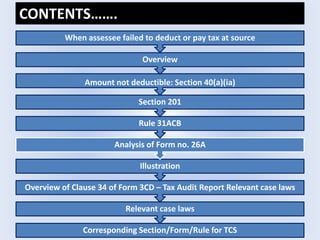
Corresponding Section/Form/Rule for TCS
Relevant case laws
Overview of Clause 34 of Form 3CD – Tax Audit Report Relevant case laws
Illustration
Analysis of Form no. 26A
Rule 31ACB
Section 201
Amount not deductible: Section 40(a)(ia)
Overview
When assessee failed to deduct or pay tax at source
CONTENTS…….
When assessee failed to deduct or
pay tax at source
If it is noticed at the time of tax audit that the assessee has failed
to deduct tax at source on payments on which tax is deductible,
then Section 40(a)(ia) comes into the picture and such
payments/expenses are not deductible [100% till A.Y. 2014-15 &
30% thereafter] from the income of the assessee.
However, the payer/assessee can claim the said expenses under
second proviso to Section 40(a)(ia) by complying first Proviso to
Section 201(1) & Section 201(1A).
Overview
Amount not deductible: Section 40(a)(ia)
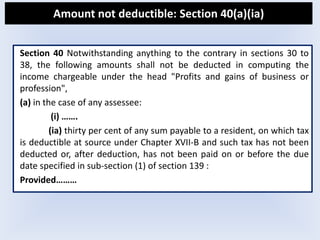
Section 40 Notwithstanding anything to the contrary in sections 30 to
38, the following amounts shall not be deducted in computing the
income chargeable under the head "Profits and gains of business or
profession",
(a) in the case of any assessee:
(i) …….
(ia) thirty per cent of any sum payable to a resident, on which tax
is deductible at source under Chapter XVII-B and such tax has not been
deducted or, after deduction, has not been paid on or before the due
date specified in sub-section (1) of section 139 :
Provided………
Second Proviso to Section 40(a)(ia)
BRIEF ANALYSIS:
If any assessee has failed to deduct tax at source, the expenses shall be disallowed.
However, if the assessee comply with the Section 201(1) then, he will not be
treated as an assessee in default & it shall be deemed that the assessee has
deducted and paid the tax on such sum on the date of furnishing of return of
income by the resident payee. Hence, such expenses are allowed as a deduction in
computing the income of the assessee/payer for the previous year in which such
tax has been deemed to be paid.
Provided further that where an assessee fails to deduct the whole or any
part of the tax in accordance with the provisions of Chapter XVII-B on any
such sum but is not deemed to be an assessee in default under the first
proviso to sub-section (1) of section 201, then, for the purpose of this sub-
clause, it shall be deemed that the assessee has deducted and paid the
tax on such sum on the date of furnishing of return of income by the
resident payee referred to in the said proviso. [inserted by Finance Act,
2012, w.e.f. 1-4-2013]
Assessee in default
Section - 201, Income-tax Act, 1961
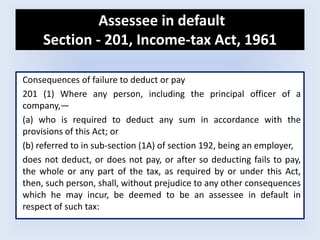
Consequences of failure to deduct or pay
201 (1) Where any person, including the principal officer of a
company,—
(a) who is required to deduct any sum in accordance with the
provisions of this Act; or
(b) referred to in sub-section (1A) of section 192, being an employer,
does not deduct, or does not pay, or after so deducting fails to pay,
the whole or any part of the tax, as required by or under this Act,
then, such person, shall, without prejudice to any other consequences
which he may incur, be deemed to be an assessee in default in
respect of such tax:
Proviso to Sub-section (1) of Section 201
inserted by Finance Act , 2012 w.e.f. 1-7-2012
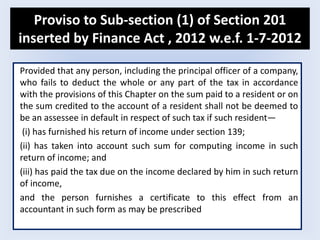
Provided that any person, including the principal officer of a company,
who fails to deduct the whole or any part of the tax in accordance
with the provisions of this Chapter on the sum paid to a resident or on
the sum credited to the account of a resident shall not be deemed to
be an assessee in default in respect of such tax if such resident—
(i) has furnished his return of income under section 139;
(ii) has taken into account such sum for computing income in such
return of income; and
(iii) has paid the tax due on the income declared by him in such return
of income,
and the person furnishes a certificate to this effect from an
accountant in such form as may be prescribed
Brief analysis of proviso to Section 201(1)
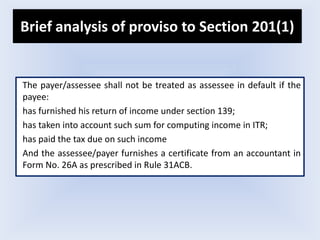
The payer/assessee shall not be treated as assessee in default if the
payee:
has furnished his return of income under section 139;
has taken into account such sum for computing income in ITR;
has paid the tax due on such income
And the assessee/payer furnishes a certificate from an accountant in
Form No. 26A as prescribed in Rule 31ACB.
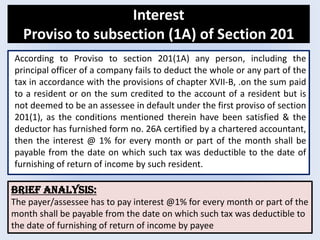
Interest
Proviso to subsection (1A) of Section 201
According to Proviso to section 201(1A) any person, including the
principal officer of a company fails to deduct the whole or any part of the
tax in accordance with the provisions of chapter XVII-B, .on the sum paid
to a resident or on the sum credited to the account of a resident but is
not deemed to be an assessee in default under the first proviso of section
201(1), as the conditions mentioned therein have been satisfied & the
deductor has furnished form no. 26A certified by a chartered accountant,
then the interest @ 1% for every month or part of the month shall be
payable from the date on which such tax was deductible to the date of
furnishing of return of income by such resident.
Brief analysis:
The payer/assessee has to pay interest @1% for every month or part of the
month shall be payable from the date on which such tax was deductible to
the date of furnishing of return of income by payee
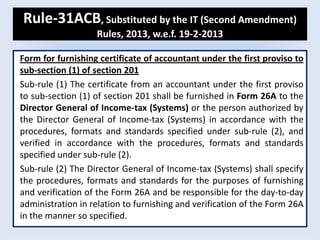
Rule-31ACB, Substituted by the IT (Second Amendment)
Rules, 2013, w.e.f. 19-2-2013
Form for furnishing certificate of accountant under the first proviso to
sub-section (1) of section 201
Sub-rule (1) The certificate from an accountant under the first proviso
to sub-section (1) of section 201 shall be furnished in Form 26A to the
Director General of Income-tax (Systems) or the person authorized by
the Director General of Income-tax (Systems) in accordance with the
procedures, formats and standards specified under sub-rule (2), and
verified in accordance with the procedures, formats and standards
specified under sub-rule (2).
Sub-rule (2) The Director General of Income-tax (Systems) shall specify
the procedures, formats and standards for the purposes of furnishing
and verification of the Form 26A and be responsible for the day-to-day
administration in relation to furnishing and verification of the Form 26A
in the manner so specified.
Form No. 26A
(Rule 31ACB )
Form for furnishing accountant certificate under the first proviso to
Section 201(1) of the income tax act, 1961
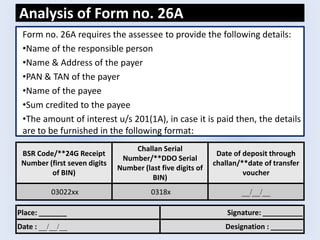
Analysis of Form no. 26A
Form no. 26A requires the assessee to provide the following details:
•Name of the responsible person
•Name & Address of the payer
•PAN & TAN of the payer
•Name of the payee
•Sum credited to the payee
•The amount of interest u/s 201(1A), in case it is paid then, the details
are to be furnished in the following format:
BSR Code/**24G Receipt
Number (first seven digits
of BIN)
Challan Serial
Number/**DDO Serial
Number (last five digits of
BIN)
Date of deposit through
challan/**date of transfer
voucher
03022xx 0318x __/__/__
Place: _______ Signature: __________
Date : __/__/__ Designation : ________
Analysis of Form no. 26A: Annexure ‘A’
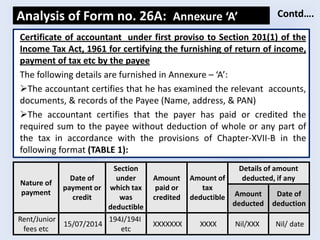
Certificate of accountant under first proviso to Section 201(1) of the
Income Tax Act, 1961 for certifying the furnishing of return of income,
payment of tax etc by the payee
The following details are furnished in Annexure – ‘A’:
The accountant certifies that he has examined the relevant accounts,
documents, & records of the Payee (Name, address, & PAN)
The accountant certifies that the payer has paid or credited the
required sum to the payee without deduction of whole or any part of
the tax in accordance with the provisions of Chapter-XVII-B in the
following format (TABLE 1):
Contd….
Nature of
payment
Date of
payment or
credit
Section
under
which tax
was
deductible
Amount
paid or
credited
Amount of
tax
deductible
Details of amount
deducted, if any
Amount
deducted
Date of
deduction
Rent/Junior
fees etc
15/07/2014
194J/194I
etc
XXXXXXX XXXX Nil/XXX Nil/ date
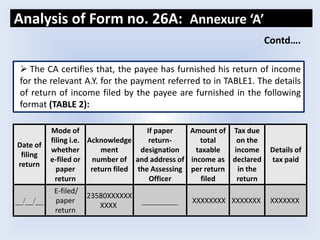
 The CA certifies that, the payee has furnished his return of income
for the relevant A.Y. for the payment referred to in TABLE1. The details
of return of income filed by the payee are furnished in the following
format (TABLE 2):
Analysis of Form no. 26A: Annexure ‘A’
Contd….
Date of
filing
return
Mode of
filing i.e.
whether
e-filed or
paper
return
Acknowledge
ment
number of
return filed
If paper
return-
designation
and address of
the Assessing
Officer
Amount of
total
taxable
income as
per return
filed
Tax due
on the
income
declared
in the
return
Details of
tax paid
__/__/__
E-filed/
paper
return
23580XXXXXX
XXXX
_________ XXXXXXXX XXXXXXX XXXXXXX
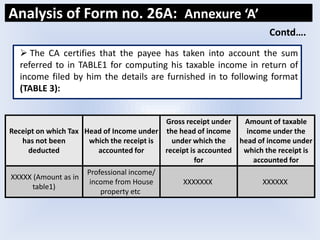
 The CA certifies that the payee has taken into account the sum
referred to in TABLE1 for computing his taxable income in return of
income filed by him the details are furnished in to following format
(TABLE 3):
Receipt on which Tax
has not been
deducted
Head of Income under
which the receipt is
accounted for
Gross receipt under
the head of income
under which the
receipt is accounted
for
Amount of taxable
income under the
head of income under
which the receipt is
accounted for
XXXXX (Amount as in
table1)
Professional income/
income from House
property etc
XXXXXXX XXXXXX
Analysis of Form no. 26A: Annexure ‘A’
Contd….
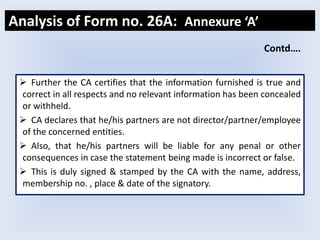
 Further the CA certifies that the information furnished is true and
correct in all respects and no relevant information has been concealed
or withheld.
 CA declares that he/his partners are not director/partner/employee
of the concerned entities.
 Also, that he/his partners will be liable for any penal or other
consequences in case the statement being made is incorrect or false.
 This is duly signed & stamped by the CA with the name, address,
membership no. , place & date of the signatory.
Analysis of Form no. 26A: Annexure ‘A’
Contd….
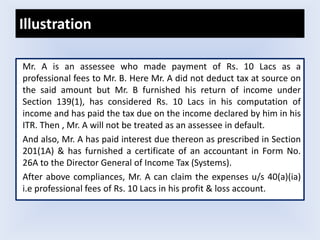
Illustration
Mr. A is an assessee who made payment of Rs. 10 Lacs as a
professional fees to Mr. B. Here Mr. A did not deduct tax at source on
the said amount but Mr. B furnished his return of income under
Section 139(1), has considered Rs. 10 Lacs in his computation of
income and has paid the tax due on the income declared by him in his
ITR. Then , Mr. A will not be treated as an assessee in default.
And also, Mr. A has paid interest due thereon as prescribed in Section
201(1A) & has furnished a certificate of an accountant in Form No.
26A to the Director General of Income Tax (Systems).
After above compliances, Mr. A can claim the expenses u/s 40(a)(ia)
i.e professional fees of Rs. 10 Lacs in his profit & loss account.
Overview of Clause 34 of Form
3CD – Tax audit report
In relation to deduction or collection of tax as per the
provisions of Chapter XVII-B or Chapter XVII-BB
20
(a) Whether the assessee is required to deduct or collect tax as per the
provisions of Chapter XVII-B or Chapter XVII-BB, if yes please furnish:
Clause no. 34(a) Contd….
Tax deduction and collection Account Number (TAN) (1)
Section (2)
Nature of payment (3)
Total amount of payment or receipt of the nature specified in column (3) (4)
Total amount on which tax was required to be deducted or collected out of (4) (5)
Total amount on which tax was deducted or collected at specified rate out of (5) (6)
Amount of tax deducted or collected out of (6) (7)
Total amount on which tax was deducted or collected at less than specified rate out of (8)
Amount of tax deducted or collected on (8) (9)
Amount of tax deducted or collected not deposited to the credit of the Central
Government out of (6) and (8) [logically it should be (7) and (9)]
(10)
( 7) [logically it should be (5)]
Yet not updated in E-utility
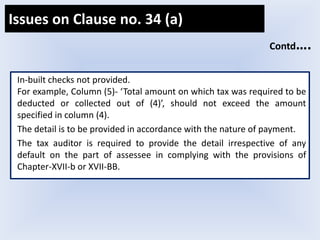
In-built checks not provided.
For example, Column (5)- ‘Total amount on which tax was required to be
deducted or collected out of (4)’, should not exceed the amount
specified in column (4).
The detail is to be provided in accordance with the nature of payment.
The tax auditor is required to provide the detail irrespective of any
default on the part of assessee in complying with the provisions of
Chapter-XVII-b or XVII-BB.
Contd….
Issues on Clause no. 34 (a)
Issues on Clause no. 34(a)…… Contd….
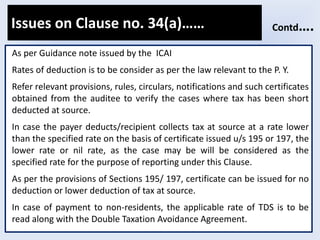
As per Guidance note issued by the ICAI
Rates of deduction is to be consider as per the law relevant to the P. Y.
Refer relevant provisions, rules, circulars, notifications and such certificates
obtained from the auditee to verify the cases where tax has been short
deducted at source.
In case the payer deducts/recipient collects tax at source at a rate lower
than the specified rate on the basis of certificate issued u/s 195 or 197, the
lower rate or nil rate, as the case may be will be considered as the
specified rate for the purpose of reporting under this Clause.
As per the provisions of Sections 195/ 197, certificate can be issued for no
deduction or lower deduction of tax at source.
In case of payment to non-residents, the applicable rate of TDS is to be
read along with the Double Taxation Avoidance Agreement.
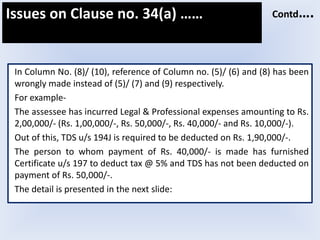
In Column No. (8)/ (10), reference of Column no. (5)/ (6) and (8) has been
wrongly made instead of (5)/ (7) and (9) respectively.
For example-
The assessee has incurred Legal & Professional expenses amounting to Rs.
2,00,000/- (Rs. 1,00,000/-, Rs. 50,000/-, Rs. 40,000/- and Rs. 10,000/-).
Out of this, TDS u/s 194J is required to be deducted on Rs. 1,90,000/-.
The person to whom payment of Rs. 40,000/- is made has furnished
Certificate u/s 197 to deduct tax @ 5% and TDS has not been deducted on
payment of Rs. 50,000/-.
The detail is presented in the next slide:
Issues on Clause no. 34(a) …… Contd….
24
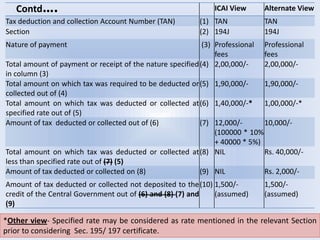
Contd…. ICAI View Alternate View
Tax deduction and collection Account Number (TAN) (1) TAN TAN
Section (2) 194J 194J
Nature of payment (3) Professional
fees
Professional
fees
Total amount of payment or receipt of the nature specified
in column (3)
(4) 2,00,000/- 2,00,000/-
Total amount on which tax was required to be deducted or
collected out of (4)
(5) 1,90,000/- 1,90,000/-
Total amount on which tax was deducted or collected at
specified rate out of (5)
(6) 1,40,000/-* 1,00,000/-*
Amount of tax deducted or collected out of (6) (7) 12,000/-
(100000 * 10%
+ 40000 * 5%)
10,000/-
Total amount on which tax was deducted or collected at
less than specified rate out of (7) (5)
(8) NIL Rs. 40,000/-
Amount of tax deducted or collected on (8) (9) NIL Rs. 2,000/-
Amount of tax deducted or collected not deposited to the
credit of the Central Government out of (6) and (8) (7) and
(9)
(10) 1,500/-
(assumed)
1,500/-
(assumed)
*Other view- Specified rate may be considered as rate mentioned in the relevant Section
prior to considering Sec. 195/ 197 certificate.
25
There is no specific column to mention non- deduction of tax at source in
the specified format. However, the amount may be calculated as follows
Non- deduction = Column (5) less [(6) plus (8)]
Since the reference to Chapter XVII-B is made, it is clear that TDS under
Income-tax Act is only covered. TDS under other laws (e.g. TDS on works
contracts under State VAT laws) are not covered. The tax auditor is also not
responsible for reporting timely deposit with the State Government of
Profession Tax deducted from salaries of employees - ICAI’s Issues on Tax
Audit.
If tax auditor does not agree with the auditee’s views on deductibility/non-
deductibility of tax in particular cases, it would be advisable to state both
views (his views as well as the auditee’s views)
Issues on Clause no. 34(a)…… Contd….
26
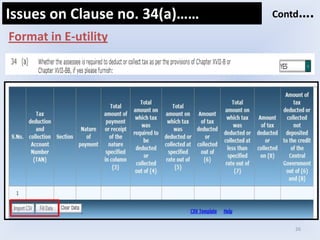
Format in E-utility
Issues on Clause no. 34(a)…… Contd….
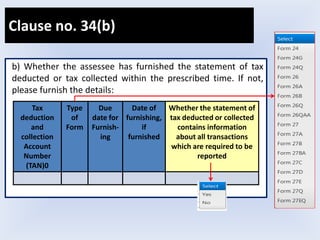
b) Whether the assessee has furnished the statement of tax
deducted or tax collected within the prescribed time. If not,
please furnish the details:
Tax
deduction
and
collection
Account
Number
(TAN)0
Type
of
Form
Due
date for
Furnish-
ing
Date of
furnishing,
if
furnished
Whether the statement of
tax deducted or collected
contains information
about all transactions
which are required to be
reported
Clause no. 34(b)
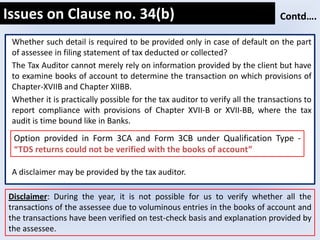
Whether such detail is required to be provided only in case of default on the part
of assessee in filing statement of tax deducted or collected?
The Tax Auditor cannot merely rely on information provided by the client but have
to examine books of account to determine the transaction on which provisions of
Chapter-XVIIB and Chapter XIIBB.
Whether it is practically possible for the tax auditor to verify all the transactions to
report compliance with provisions of Chapter XVII-B or XVII-BB, where the tax
audit is time bound like in Banks.
A disclaimer may be provided by the tax auditor.
Issues on Clause no. 34(b) Contd….
Option provided in Form 3CA and Form 3CB under Qualification Type -
“TDS returns could not be verified with the books of account”
Disclaimer: During the year, it is not possible for us to verify whether all the
transactions of the assessee due to voluminous entries in the books of account and
the transactions have been verified on test-check basis and explanation provided by
the assessee.
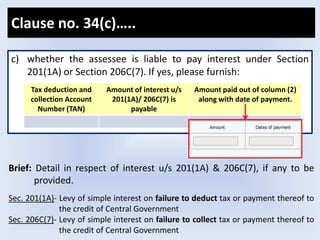
c) whether the assessee is liable to pay interest under Section
201(1A) or Section 206C(7). If yes, please furnish:
Tax deduction and
collection Account
Number (TAN)
Amount of interest u/s
201(1A)/ 206C(7) is
payable
Amount paid out of column (2)
along with date of payment.
Brief: Detail in respect of interest u/s 201(1A) & 206C(7), if any to be
provided.
Sec. 201(1A)- Levy of simple interest on failure to deduct tax or payment thereof to
the credit of Central Government
Sec. 206C(7)- Levy of simple interest on failure to collect tax or payment thereof to
the credit of Central Government
Clause no. 34(c)…..
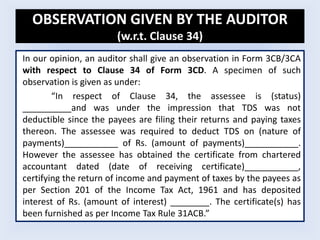
OBSERVATION GIVEN BY THE AUDITOR
(w.r.t. Clause 34)
In our opinion, an auditor shall give an observation in Form 3CB/3CA
with respect to Clause 34 of Form 3CD. A specimen of such
observation is given as under:
“In respect of Clause 34, the assessee is (status)
__________and was under the impression that TDS was not
deductible since the payees are filing their returns and paying taxes
thereon. The assessee was required to deduct TDS on (nature of
payments)___________ of Rs. (amount of payments)___________.
However the assessee has obtained the certificate from chartered
accountant dated (date of receiving certificate)___________,
certifying the return of income and payment of taxes by the payees as
per Section 201 of the Income Tax Act, 1961 and has deposited
interest of Rs. (amount of interest) ________. The certificate(s) has
been furnished as per Income Tax Rule 31ACB.”
Relevant
case
laws
Issue: Whether 2nd proviso to section
40(a)(ia) has retrospective effect
CIT v. Ansal Land Mark Township (P.) Ltd. 2015] 61 taxmann.com 45
(HC- Delhi)
The High Court affirmed the order of The Agra Tribunal the case of
Rajiv Kumar Agarwal v. ACIT [2014] 45 taxmann.com 555 (Agra - Trib.)
that Second proviso to section 40(a)(ia) which states that TDS shall be
deemed to be deducted and paid by a deductor if resident recipient
has disclosed the amount in his return of income and paid tax thereon
is declaratory and curative in nature and has retrospective effect from
1st April 2005.
Issue: No income of recipient
Samsung India Electronics Pvt. Ltd. Vs DDIT [2014] 47 taxmann.com 379
(HC - Delhi)
In this case, it was held that if no income arose to the recipient then any
notice to payer for TDS default u/s 201 & disallowance u/s 40(a)(ia) are
bad.
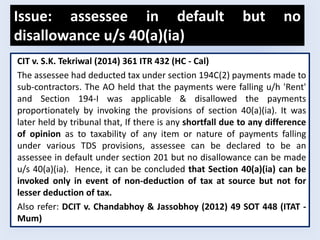
Issue: assessee in default but no
disallowance u/s 40(a)(ia)
CIT v. S.K. Tekriwal (2014) 361 ITR 432 (HC - Cal)
The assessee had deducted tax under section 194C(2) payments made to
sub-contractors. The AO held that the payments were falling u/h 'Rent'
and Section 194-I was applicable & disallowed the payments
proportionately by invoking the provisions of section 40(a)(ia). It was
later held by tribunal that, If there is any shortfall due to any difference
of opinion as to taxability of any item or nature of payments falling
under various TDS provisions, assessee can be declared to be an
assessee in default under section 201 but no disallowance can be made
u/s 40(a)(ia). Hence, it can be concluded that Section 40(a)(ia) can be
invoked only in event of non-deduction of tax at source but not for
lesser deduction of tax.
Also refer: DCIT v. Chandabhoy & Jassobhoy (2012) 49 SOT 448 (ITAT -
Mum)
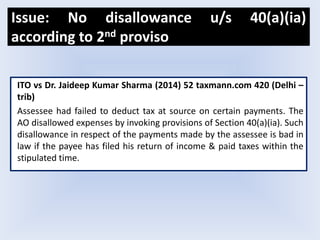
Issue: No disallowance u/s 40(a)(ia)
according to 2nd proviso
ITO vs Dr. Jaideep Kumar Sharma (2014) 52 taxmann.com 420 (Delhi –
trib)
Assessee had failed to deduct tax at source on certain payments. The
AO disallowed expenses by invoking provisions of Section 40(a)(ia). Such
disallowance in respect of the payments made by the assessee is bad in
law if the payee has filed his return of income & paid taxes within the
stipulated time.
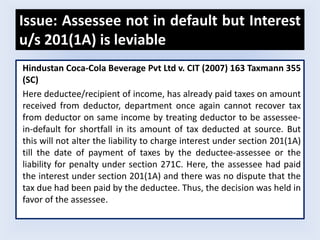
Issue: Assessee not in default but Interest
u/s 201(1A) is leviable
Hindustan Coca-Cola Beverage Pvt Ltd v. CIT (2007) 163 Taxmann 355
(SC)
Here deductee/recipient of income, has already paid taxes on amount
received from deductor, department once again cannot recover tax
from deductor on same income by treating deductor to be assessee-
in-default for shortfall in its amount of tax deducted at source. But
this will not alter the liability to charge interest under section 201(1A)
till the date of payment of taxes by the deductee-assessee or the
liability for penalty under section 271C. Here, the assessee had paid
the interest under section 201(1A) and there was no dispute that the
tax due had been paid by the deductee. Thus, the decision was held in
favor of the assessee.
Issue: assessee not in default & short
deduction of tax at source
Jagran Prakashan Ltd. v. DCIT (TDS) [2012] 21 taxmann.com 489 (HC
- All.)
• A deductor who has failed to deduct tax at source is not an assessee
in default until the deductee has also failed to pay tax directly.
• In this case, tax has not been deducted at source. It was held that
the short deducted tax cannot be realized from the deductor and
liability to pay such tax shall continue to be with the deductee direct,
whose income is to be charged and a person who fails to deduct tax at
source, at best is liable for interest and penalty only.
Issue: Tax can be paid by deductor/
deductee
CIT v Adidas India Marketing Pvt. Ltd (2007) 288 ITR 379 (HC - Delhi)
• Section 201 does not state that the tax should have been paid by the
deductor only it can be paid by the deductor or the deductee.
• Moreover, interest can be claimed under section 201(1A) is only for
the period ‘from date on which such tax was deductible to date on
which such tax is actually paid’. Levy of interest for any period after
the date on which the tax is actually paid is not justified. [Also see:
ITO vs Labh Construction & Ind. Ltd. (2006) 8 SOT 475 (ITAT- Ahd.)]
Issue: Assessee not in default u/s 201
• Ramakrishna vedanta math v ITO [ITA no. 477/478 & 479] (ITAT -
Kolkata)
Where the recipient of the income has paid taxes, no action can be
taken u/s 201(1) & 201(1A) treating the assessee as assessee in default.
[Also refer: Grindlays Bank v CIT, (1992) 193 ITR 457 (Cal)]
• ITO v Alfred Allan Advertising (2006) 8 SOT 312 (ITAT - Delhi)
Here, recipient of payment has filed a return and paid tax on
amount received, person responsible for deducting tax at source
cannot be treated as an assessee-in-default under section 201(1).
It is impermissible to charge interest only up to date of payment of
tax by payee as revenue could not claim payment of interest for
period when payee had already paid taxes to exchequer.
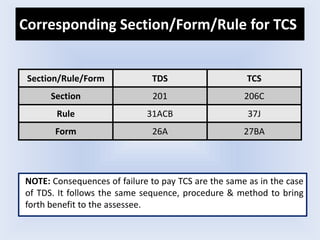
NOTE: Consequences of failure to pay TCS are the same as in the case
of TDS. It follows the same sequence, procedure & method to bring
forth benefit to the assessee.
Section/Rule/Form TDS TCS
Section 201 206C
Rule 31ACB 37J
Form 26A 27BA
Corresponding Section/Form/Rule for TCS
PresentedBy : CA Adhir Samal
AssisstedBy : Neha Agarwal
Email ID : voiceofca@gmail.com

19 09 15_form26_a (1)

  • 1.
    CRITICAL ANALYSIS OF CLAUSE34 OF FORM3CD PROCEDURE TO TACKLE NON-DEDUCTION/COLLECTION OF TAX AT SOURCE BEFORE FILING TAX AUDIT REPORT PresentedBy : CA Adhir Samal AssisstedBy : Neha Agarwal Email ID : voiceofca@gmail.com
  • 2.
    Corresponding Section/Form/Rule forTCS Relevant case laws Overview of Clause 34 of Form 3CD – Tax Audit Report Relevant case laws Illustration Analysis of Form no. 26A Rule 31ACB Section 201 Amount not deductible: Section 40(a)(ia) Overview When assessee failed to deduct or pay tax at source CONTENTS…….
  • 3.
    When assessee failedto deduct or pay tax at source
  • 4.
    If it isnoticed at the time of tax audit that the assessee has failed to deduct tax at source on payments on which tax is deductible, then Section 40(a)(ia) comes into the picture and such payments/expenses are not deductible [100% till A.Y. 2014-15 & 30% thereafter] from the income of the assessee. However, the payer/assessee can claim the said expenses under second proviso to Section 40(a)(ia) by complying first Proviso to Section 201(1) & Section 201(1A). Overview
  • 5.
    Amount not deductible:Section 40(a)(ia) Section 40 Notwithstanding anything to the contrary in sections 30 to 38, the following amounts shall not be deducted in computing the income chargeable under the head "Profits and gains of business or profession", (a) in the case of any assessee: (i) ……. (ia) thirty per cent of any sum payable to a resident, on which tax is deductible at source under Chapter XVII-B and such tax has not been deducted or, after deduction, has not been paid on or before the due date specified in sub-section (1) of section 139 : Provided………
  • 6.
    Second Proviso toSection 40(a)(ia) BRIEF ANALYSIS: If any assessee has failed to deduct tax at source, the expenses shall be disallowed. However, if the assessee comply with the Section 201(1) then, he will not be treated as an assessee in default & it shall be deemed that the assessee has deducted and paid the tax on such sum on the date of furnishing of return of income by the resident payee. Hence, such expenses are allowed as a deduction in computing the income of the assessee/payer for the previous year in which such tax has been deemed to be paid. Provided further that where an assessee fails to deduct the whole or any part of the tax in accordance with the provisions of Chapter XVII-B on any such sum but is not deemed to be an assessee in default under the first proviso to sub-section (1) of section 201, then, for the purpose of this sub- clause, it shall be deemed that the assessee has deducted and paid the tax on such sum on the date of furnishing of return of income by the resident payee referred to in the said proviso. [inserted by Finance Act, 2012, w.e.f. 1-4-2013]
  • 7.
    Assessee in default Section- 201, Income-tax Act, 1961 Consequences of failure to deduct or pay 201 (1) Where any person, including the principal officer of a company,— (a) who is required to deduct any sum in accordance with the provisions of this Act; or (b) referred to in sub-section (1A) of section 192, being an employer, does not deduct, or does not pay, or after so deducting fails to pay, the whole or any part of the tax, as required by or under this Act, then, such person, shall, without prejudice to any other consequences which he may incur, be deemed to be an assessee in default in respect of such tax:
  • 8.
    Proviso to Sub-section(1) of Section 201 inserted by Finance Act , 2012 w.e.f. 1-7-2012 Provided that any person, including the principal officer of a company, who fails to deduct the whole or any part of the tax in accordance with the provisions of this Chapter on the sum paid to a resident or on the sum credited to the account of a resident shall not be deemed to be an assessee in default in respect of such tax if such resident— (i) has furnished his return of income under section 139; (ii) has taken into account such sum for computing income in such return of income; and (iii) has paid the tax due on the income declared by him in such return of income, and the person furnishes a certificate to this effect from an accountant in such form as may be prescribed
  • 9.
    Brief analysis ofproviso to Section 201(1) The payer/assessee shall not be treated as assessee in default if the payee: has furnished his return of income under section 139; has taken into account such sum for computing income in ITR; has paid the tax due on such income And the assessee/payer furnishes a certificate from an accountant in Form No. 26A as prescribed in Rule 31ACB.
  • 10.
    Interest Proviso to subsection(1A) of Section 201 According to Proviso to section 201(1A) any person, including the principal officer of a company fails to deduct the whole or any part of the tax in accordance with the provisions of chapter XVII-B, .on the sum paid to a resident or on the sum credited to the account of a resident but is not deemed to be an assessee in default under the first proviso of section 201(1), as the conditions mentioned therein have been satisfied & the deductor has furnished form no. 26A certified by a chartered accountant, then the interest @ 1% for every month or part of the month shall be payable from the date on which such tax was deductible to the date of furnishing of return of income by such resident. Brief analysis: The payer/assessee has to pay interest @1% for every month or part of the month shall be payable from the date on which such tax was deductible to the date of furnishing of return of income by payee
  • 11.
    Rule-31ACB, Substituted bythe IT (Second Amendment) Rules, 2013, w.e.f. 19-2-2013 Form for furnishing certificate of accountant under the first proviso to sub-section (1) of section 201 Sub-rule (1) The certificate from an accountant under the first proviso to sub-section (1) of section 201 shall be furnished in Form 26A to the Director General of Income-tax (Systems) or the person authorized by the Director General of Income-tax (Systems) in accordance with the procedures, formats and standards specified under sub-rule (2), and verified in accordance with the procedures, formats and standards specified under sub-rule (2). Sub-rule (2) The Director General of Income-tax (Systems) shall specify the procedures, formats and standards for the purposes of furnishing and verification of the Form 26A and be responsible for the day-to-day administration in relation to furnishing and verification of the Form 26A in the manner so specified.
  • 12.
    Form No. 26A (Rule31ACB ) Form for furnishing accountant certificate under the first proviso to Section 201(1) of the income tax act, 1961
  • 13.
    Analysis of Formno. 26A Form no. 26A requires the assessee to provide the following details: •Name of the responsible person •Name & Address of the payer •PAN & TAN of the payer •Name of the payee •Sum credited to the payee •The amount of interest u/s 201(1A), in case it is paid then, the details are to be furnished in the following format: BSR Code/**24G Receipt Number (first seven digits of BIN) Challan Serial Number/**DDO Serial Number (last five digits of BIN) Date of deposit through challan/**date of transfer voucher 03022xx 0318x __/__/__ Place: _______ Signature: __________ Date : __/__/__ Designation : ________
  • 14.
    Analysis of Formno. 26A: Annexure ‘A’ Certificate of accountant under first proviso to Section 201(1) of the Income Tax Act, 1961 for certifying the furnishing of return of income, payment of tax etc by the payee The following details are furnished in Annexure – ‘A’: The accountant certifies that he has examined the relevant accounts, documents, & records of the Payee (Name, address, & PAN) The accountant certifies that the payer has paid or credited the required sum to the payee without deduction of whole or any part of the tax in accordance with the provisions of Chapter-XVII-B in the following format (TABLE 1): Contd…. Nature of payment Date of payment or credit Section under which tax was deductible Amount paid or credited Amount of tax deductible Details of amount deducted, if any Amount deducted Date of deduction Rent/Junior fees etc 15/07/2014 194J/194I etc XXXXXXX XXXX Nil/XXX Nil/ date
  • 15.
     The CAcertifies that, the payee has furnished his return of income for the relevant A.Y. for the payment referred to in TABLE1. The details of return of income filed by the payee are furnished in the following format (TABLE 2): Analysis of Form no. 26A: Annexure ‘A’ Contd…. Date of filing return Mode of filing i.e. whether e-filed or paper return Acknowledge ment number of return filed If paper return- designation and address of the Assessing Officer Amount of total taxable income as per return filed Tax due on the income declared in the return Details of tax paid __/__/__ E-filed/ paper return 23580XXXXXX XXXX _________ XXXXXXXX XXXXXXX XXXXXXX
  • 16.
     The CAcertifies that the payee has taken into account the sum referred to in TABLE1 for computing his taxable income in return of income filed by him the details are furnished in to following format (TABLE 3): Receipt on which Tax has not been deducted Head of Income under which the receipt is accounted for Gross receipt under the head of income under which the receipt is accounted for Amount of taxable income under the head of income under which the receipt is accounted for XXXXX (Amount as in table1) Professional income/ income from House property etc XXXXXXX XXXXXX Analysis of Form no. 26A: Annexure ‘A’ Contd….
  • 17.
     Further theCA certifies that the information furnished is true and correct in all respects and no relevant information has been concealed or withheld.  CA declares that he/his partners are not director/partner/employee of the concerned entities.  Also, that he/his partners will be liable for any penal or other consequences in case the statement being made is incorrect or false.  This is duly signed & stamped by the CA with the name, address, membership no. , place & date of the signatory. Analysis of Form no. 26A: Annexure ‘A’ Contd….
  • 18.
    Illustration Mr. A isan assessee who made payment of Rs. 10 Lacs as a professional fees to Mr. B. Here Mr. A did not deduct tax at source on the said amount but Mr. B furnished his return of income under Section 139(1), has considered Rs. 10 Lacs in his computation of income and has paid the tax due on the income declared by him in his ITR. Then , Mr. A will not be treated as an assessee in default. And also, Mr. A has paid interest due thereon as prescribed in Section 201(1A) & has furnished a certificate of an accountant in Form No. 26A to the Director General of Income Tax (Systems). After above compliances, Mr. A can claim the expenses u/s 40(a)(ia) i.e professional fees of Rs. 10 Lacs in his profit & loss account.
  • 19.
    Overview of Clause34 of Form 3CD – Tax audit report In relation to deduction or collection of tax as per the provisions of Chapter XVII-B or Chapter XVII-BB
  • 20.
    20 (a) Whether theassessee is required to deduct or collect tax as per the provisions of Chapter XVII-B or Chapter XVII-BB, if yes please furnish: Clause no. 34(a) Contd…. Tax deduction and collection Account Number (TAN) (1) Section (2) Nature of payment (3) Total amount of payment or receipt of the nature specified in column (3) (4) Total amount on which tax was required to be deducted or collected out of (4) (5) Total amount on which tax was deducted or collected at specified rate out of (5) (6) Amount of tax deducted or collected out of (6) (7) Total amount on which tax was deducted or collected at less than specified rate out of (8) Amount of tax deducted or collected on (8) (9) Amount of tax deducted or collected not deposited to the credit of the Central Government out of (6) and (8) [logically it should be (7) and (9)] (10) ( 7) [logically it should be (5)] Yet not updated in E-utility
  • 21.
    In-built checks notprovided. For example, Column (5)- ‘Total amount on which tax was required to be deducted or collected out of (4)’, should not exceed the amount specified in column (4). The detail is to be provided in accordance with the nature of payment. The tax auditor is required to provide the detail irrespective of any default on the part of assessee in complying with the provisions of Chapter-XVII-b or XVII-BB. Contd…. Issues on Clause no. 34 (a)
  • 22.
    Issues on Clauseno. 34(a)…… Contd…. As per Guidance note issued by the ICAI Rates of deduction is to be consider as per the law relevant to the P. Y. Refer relevant provisions, rules, circulars, notifications and such certificates obtained from the auditee to verify the cases where tax has been short deducted at source. In case the payer deducts/recipient collects tax at source at a rate lower than the specified rate on the basis of certificate issued u/s 195 or 197, the lower rate or nil rate, as the case may be will be considered as the specified rate for the purpose of reporting under this Clause. As per the provisions of Sections 195/ 197, certificate can be issued for no deduction or lower deduction of tax at source. In case of payment to non-residents, the applicable rate of TDS is to be read along with the Double Taxation Avoidance Agreement.
  • 23.
    In Column No.(8)/ (10), reference of Column no. (5)/ (6) and (8) has been wrongly made instead of (5)/ (7) and (9) respectively. For example- The assessee has incurred Legal & Professional expenses amounting to Rs. 2,00,000/- (Rs. 1,00,000/-, Rs. 50,000/-, Rs. 40,000/- and Rs. 10,000/-). Out of this, TDS u/s 194J is required to be deducted on Rs. 1,90,000/-. The person to whom payment of Rs. 40,000/- is made has furnished Certificate u/s 197 to deduct tax @ 5% and TDS has not been deducted on payment of Rs. 50,000/-. The detail is presented in the next slide: Issues on Clause no. 34(a) …… Contd….
  • 24.
    24 Contd…. ICAI ViewAlternate View Tax deduction and collection Account Number (TAN) (1) TAN TAN Section (2) 194J 194J Nature of payment (3) Professional fees Professional fees Total amount of payment or receipt of the nature specified in column (3) (4) 2,00,000/- 2,00,000/- Total amount on which tax was required to be deducted or collected out of (4) (5) 1,90,000/- 1,90,000/- Total amount on which tax was deducted or collected at specified rate out of (5) (6) 1,40,000/-* 1,00,000/-* Amount of tax deducted or collected out of (6) (7) 12,000/- (100000 * 10% + 40000 * 5%) 10,000/- Total amount on which tax was deducted or collected at less than specified rate out of (7) (5) (8) NIL Rs. 40,000/- Amount of tax deducted or collected on (8) (9) NIL Rs. 2,000/- Amount of tax deducted or collected not deposited to the credit of the Central Government out of (6) and (8) (7) and (9) (10) 1,500/- (assumed) 1,500/- (assumed) *Other view- Specified rate may be considered as rate mentioned in the relevant Section prior to considering Sec. 195/ 197 certificate.
  • 25.
    25 There is nospecific column to mention non- deduction of tax at source in the specified format. However, the amount may be calculated as follows Non- deduction = Column (5) less [(6) plus (8)] Since the reference to Chapter XVII-B is made, it is clear that TDS under Income-tax Act is only covered. TDS under other laws (e.g. TDS on works contracts under State VAT laws) are not covered. The tax auditor is also not responsible for reporting timely deposit with the State Government of Profession Tax deducted from salaries of employees - ICAI’s Issues on Tax Audit. If tax auditor does not agree with the auditee’s views on deductibility/non- deductibility of tax in particular cases, it would be advisable to state both views (his views as well as the auditee’s views) Issues on Clause no. 34(a)…… Contd….
  • 26.
    26 Format in E-utility Issueson Clause no. 34(a)…… Contd….
  • 27.
    b) Whether theassessee has furnished the statement of tax deducted or tax collected within the prescribed time. If not, please furnish the details: Tax deduction and collection Account Number (TAN)0 Type of Form Due date for Furnish- ing Date of furnishing, if furnished Whether the statement of tax deducted or collected contains information about all transactions which are required to be reported Clause no. 34(b)
  • 28.
    Whether such detailis required to be provided only in case of default on the part of assessee in filing statement of tax deducted or collected? The Tax Auditor cannot merely rely on information provided by the client but have to examine books of account to determine the transaction on which provisions of Chapter-XVIIB and Chapter XIIBB. Whether it is practically possible for the tax auditor to verify all the transactions to report compliance with provisions of Chapter XVII-B or XVII-BB, where the tax audit is time bound like in Banks. A disclaimer may be provided by the tax auditor. Issues on Clause no. 34(b) Contd…. Option provided in Form 3CA and Form 3CB under Qualification Type - “TDS returns could not be verified with the books of account” Disclaimer: During the year, it is not possible for us to verify whether all the transactions of the assessee due to voluminous entries in the books of account and the transactions have been verified on test-check basis and explanation provided by the assessee.
  • 29.
    c) whether theassessee is liable to pay interest under Section 201(1A) or Section 206C(7). If yes, please furnish: Tax deduction and collection Account Number (TAN) Amount of interest u/s 201(1A)/ 206C(7) is payable Amount paid out of column (2) along with date of payment. Brief: Detail in respect of interest u/s 201(1A) & 206C(7), if any to be provided. Sec. 201(1A)- Levy of simple interest on failure to deduct tax or payment thereof to the credit of Central Government Sec. 206C(7)- Levy of simple interest on failure to collect tax or payment thereof to the credit of Central Government Clause no. 34(c)…..
  • 30.
    OBSERVATION GIVEN BYTHE AUDITOR (w.r.t. Clause 34) In our opinion, an auditor shall give an observation in Form 3CB/3CA with respect to Clause 34 of Form 3CD. A specimen of such observation is given as under: “In respect of Clause 34, the assessee is (status) __________and was under the impression that TDS was not deductible since the payees are filing their returns and paying taxes thereon. The assessee was required to deduct TDS on (nature of payments)___________ of Rs. (amount of payments)___________. However the assessee has obtained the certificate from chartered accountant dated (date of receiving certificate)___________, certifying the return of income and payment of taxes by the payees as per Section 201 of the Income Tax Act, 1961 and has deposited interest of Rs. (amount of interest) ________. The certificate(s) has been furnished as per Income Tax Rule 31ACB.”
  • 31.
  • 32.
    Issue: Whether 2ndproviso to section 40(a)(ia) has retrospective effect CIT v. Ansal Land Mark Township (P.) Ltd. 2015] 61 taxmann.com 45 (HC- Delhi) The High Court affirmed the order of The Agra Tribunal the case of Rajiv Kumar Agarwal v. ACIT [2014] 45 taxmann.com 555 (Agra - Trib.) that Second proviso to section 40(a)(ia) which states that TDS shall be deemed to be deducted and paid by a deductor if resident recipient has disclosed the amount in his return of income and paid tax thereon is declaratory and curative in nature and has retrospective effect from 1st April 2005.
  • 33.
    Issue: No incomeof recipient Samsung India Electronics Pvt. Ltd. Vs DDIT [2014] 47 taxmann.com 379 (HC - Delhi) In this case, it was held that if no income arose to the recipient then any notice to payer for TDS default u/s 201 & disallowance u/s 40(a)(ia) are bad.
  • 34.
    Issue: assessee indefault but no disallowance u/s 40(a)(ia) CIT v. S.K. Tekriwal (2014) 361 ITR 432 (HC - Cal) The assessee had deducted tax under section 194C(2) payments made to sub-contractors. The AO held that the payments were falling u/h 'Rent' and Section 194-I was applicable & disallowed the payments proportionately by invoking the provisions of section 40(a)(ia). It was later held by tribunal that, If there is any shortfall due to any difference of opinion as to taxability of any item or nature of payments falling under various TDS provisions, assessee can be declared to be an assessee in default under section 201 but no disallowance can be made u/s 40(a)(ia). Hence, it can be concluded that Section 40(a)(ia) can be invoked only in event of non-deduction of tax at source but not for lesser deduction of tax. Also refer: DCIT v. Chandabhoy & Jassobhoy (2012) 49 SOT 448 (ITAT - Mum)
  • 35.
    Issue: No disallowanceu/s 40(a)(ia) according to 2nd proviso ITO vs Dr. Jaideep Kumar Sharma (2014) 52 taxmann.com 420 (Delhi – trib) Assessee had failed to deduct tax at source on certain payments. The AO disallowed expenses by invoking provisions of Section 40(a)(ia). Such disallowance in respect of the payments made by the assessee is bad in law if the payee has filed his return of income & paid taxes within the stipulated time.
  • 36.
    Issue: Assessee notin default but Interest u/s 201(1A) is leviable Hindustan Coca-Cola Beverage Pvt Ltd v. CIT (2007) 163 Taxmann 355 (SC) Here deductee/recipient of income, has already paid taxes on amount received from deductor, department once again cannot recover tax from deductor on same income by treating deductor to be assessee- in-default for shortfall in its amount of tax deducted at source. But this will not alter the liability to charge interest under section 201(1A) till the date of payment of taxes by the deductee-assessee or the liability for penalty under section 271C. Here, the assessee had paid the interest under section 201(1A) and there was no dispute that the tax due had been paid by the deductee. Thus, the decision was held in favor of the assessee.
  • 37.
    Issue: assessee notin default & short deduction of tax at source Jagran Prakashan Ltd. v. DCIT (TDS) [2012] 21 taxmann.com 489 (HC - All.) • A deductor who has failed to deduct tax at source is not an assessee in default until the deductee has also failed to pay tax directly. • In this case, tax has not been deducted at source. It was held that the short deducted tax cannot be realized from the deductor and liability to pay such tax shall continue to be with the deductee direct, whose income is to be charged and a person who fails to deduct tax at source, at best is liable for interest and penalty only.
  • 38.
    Issue: Tax canbe paid by deductor/ deductee CIT v Adidas India Marketing Pvt. Ltd (2007) 288 ITR 379 (HC - Delhi) • Section 201 does not state that the tax should have been paid by the deductor only it can be paid by the deductor or the deductee. • Moreover, interest can be claimed under section 201(1A) is only for the period ‘from date on which such tax was deductible to date on which such tax is actually paid’. Levy of interest for any period after the date on which the tax is actually paid is not justified. [Also see: ITO vs Labh Construction & Ind. Ltd. (2006) 8 SOT 475 (ITAT- Ahd.)]
  • 39.
    Issue: Assessee notin default u/s 201 • Ramakrishna vedanta math v ITO [ITA no. 477/478 & 479] (ITAT - Kolkata) Where the recipient of the income has paid taxes, no action can be taken u/s 201(1) & 201(1A) treating the assessee as assessee in default. [Also refer: Grindlays Bank v CIT, (1992) 193 ITR 457 (Cal)] • ITO v Alfred Allan Advertising (2006) 8 SOT 312 (ITAT - Delhi) Here, recipient of payment has filed a return and paid tax on amount received, person responsible for deducting tax at source cannot be treated as an assessee-in-default under section 201(1). It is impermissible to charge interest only up to date of payment of tax by payee as revenue could not claim payment of interest for period when payee had already paid taxes to exchequer.
  • 40.
    NOTE: Consequences offailure to pay TCS are the same as in the case of TDS. It follows the same sequence, procedure & method to bring forth benefit to the assessee. Section/Rule/Form TDS TCS Section 201 206C Rule 31ACB 37J Form 26A 27BA Corresponding Section/Form/Rule for TCS
  • 41.
    PresentedBy : CAAdhir Samal AssisstedBy : Neha Agarwal Email ID : voiceofca@gmail.com