A capsule network with dynamic routing achieves state-of-the-art performance on MNIST. The network uses capsules that output vectors, with vector length representing probability of existence and orientation representing instantiation parameters. Lower level capsules make predictions that are routed to higher level capsules using an iterative routing-by-agreement mechanism. Reconstruction is used as a regularizer, encouraging encoding of instantiation parameters in capsule vectors. The CapsNet achieves 0.25% error on MNIST with 3 routing iterations and reconstruction, outperforming CNN baselines.
![Dynamic Routing Between Capsules
Sara Sabour Nicholas Frosst
Geoffrey E. Hinton
Google Brain
Toronto
{sasabour, frosst, geoffhinton}@google.com
Abstract
A capsule is a group of neurons whose activity vector represents the instantiation
parameters of a specific type of entity such as an object or an object part. We use
the length of the activity vector to represent the probability that the entity exists and
its orientation to represent the instantiation parameters. Active capsules at one level
make predictions, via transformation matrices, for the instantiation parameters of
higher-level capsules. When multiple predictions agree, a higher level capsule
becomes active. We show that a discrimininatively trained, multi-layer capsule
system achieves state-of-the-art performance on MNIST and is considerably better
than a convolutional net at recognizing highly overlapping digits. To achieve these
results we use an iterative routing-by-agreement mechanism: A lower-level capsule
prefers to send its output to higher level capsules whose activity vectors have a big
scalar product with the prediction coming from the lower-level capsule.
1 Introduction
Human vision ignores irrelevant details by using a carefully determined sequence of fixation points
to ensure that only a tiny fraction of the optic array is ever processed at the highest resolution.
Introspection is a poor guide to understanding how much of our knowledge of a scene comes from
the sequence of fixations and how much we glean from a single fixation, but in this paper we will
assume that a single fixation gives us much more than just a single identified object and its properties.
We assume that our multi-layer visual system creates a parse tree-like structure on each fixation, and
we ignore the issue of how these single-fixation parse trees are coordinated over multiple fixations.
Parse trees are generally constructed on the fly by dynamically allocating memory. Following Hinton
et al. [2000], however, we shall assume that, for a single fixation, a parse tree is carved out of a fixed
multilayer neural network like a sculpture is carved from a rock. Each layer will be divided into many
small groups of neurons called “capsules” (Hinton et al. [2011]) and each node in the parse tree will
correspond to an active capsule. Using an iterative routing process, each active capsule will choose a
capsule in the layer above to be its parent in the tree. For the higher levels of a visual system, this
iterative process will be solving the problem of assigning parts to wholes.
The activities of the neurons within an active capsule represent the various properties of a particular
entity that is present in the image. These properties can include many different types of instantiation
parameter such as pose (position, size, orientation), deformation, velocity, albedo, hue, texture, etc.
One very special property is the existence of the instantiated entity in the image. An obvious way to
represent existence is by using a separate logistic unit whose output is the probability that the entity
exists. In this paper we explore an interesting alternative which is to use the overall length of the
vector of instantiation parameters to represent the existence of the entity and to force the orientation
31st Conference on Neural Information Processing Systems (NIPS 2017), Long Beach, CA, USA.
arXiv:1710.09829v2
[cs.CV]
7
Nov
2017](https://image.slidesharecdn.com/1710-230823065704-47ae6960/75/1710-09829v2-pdf-1-2048.jpg)

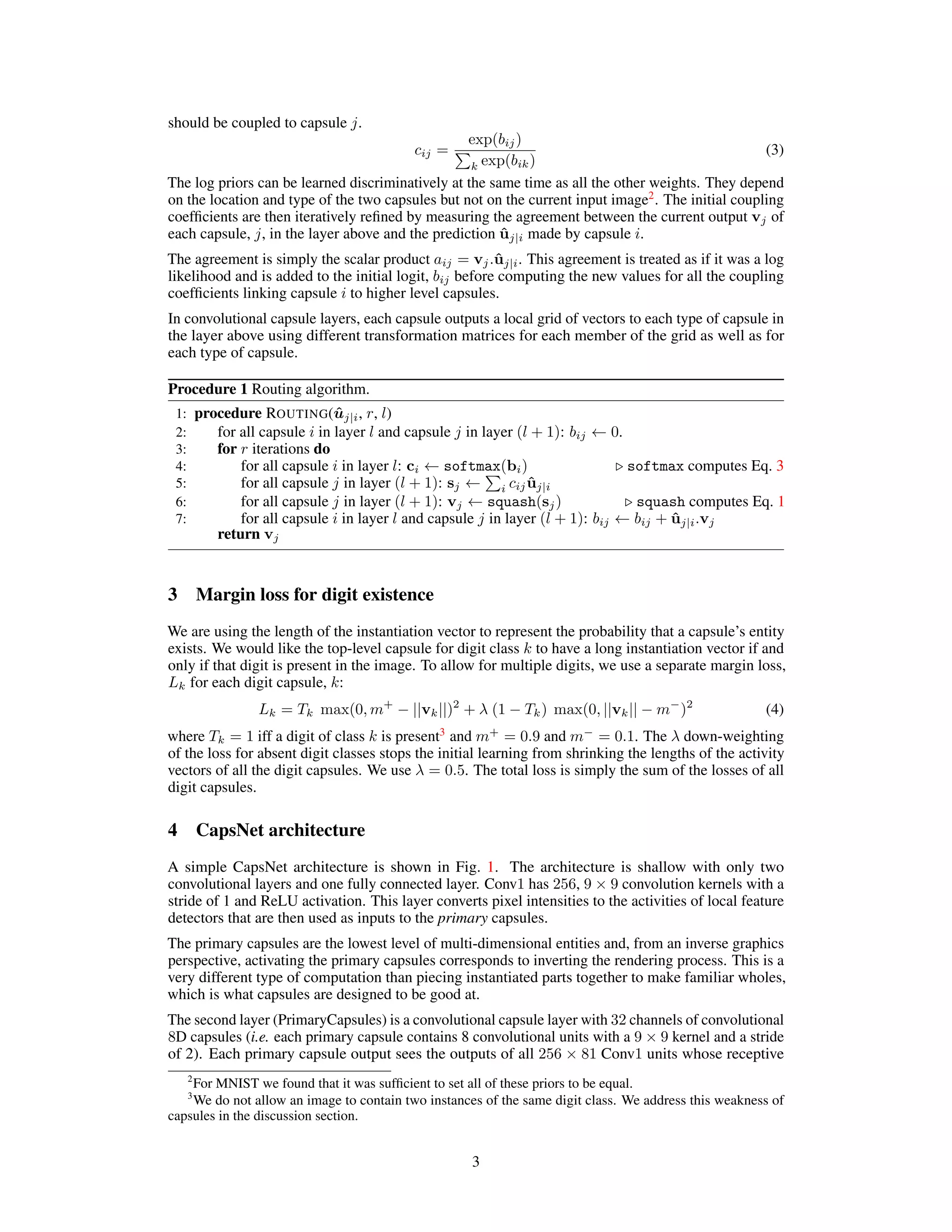
![Figure 1: A simple CapsNet with 3 layers. This model gives comparable results to deep convolutional
networks (such as Chang and Chen [2015]). The length of the activity vector of each capsule
in DigitCaps layer indicates presence of an instance of each class and is used to calculate the
classification loss. Wij is a weight matrix between each ui, i ∈ (1, 32 × 6 × 6) in PrimaryCapsules
and vj, j ∈ (1, 10).
Figure 2: Decoder structure to reconstruct a digit from the DigitCaps layer representation. The
euclidean distance between the image and the output of the Sigmoid layer is minimized during
training. We use the true label as reconstruction target during training.
fields overlap with the location of the center of the capsule. In total PrimaryCapsules has [32 × 6 × 6]
capsule outputs (each output is an 8D vector) and each capsule in the [6 × 6] grid is sharing their
weights with each other. One can see PrimaryCapsules as a Convolution layer with Eq. 1 as its block
non-linearity. The final Layer (DigitCaps) has one 16D capsule per digit class and each of these
capsules receives input from all the capsules in the layer below.
We have routing only between two consecutive capsule layers (e.g. PrimaryCapsules and DigitCaps).
Since Conv1 output is 1D, there is no orientation in its space to agree on. Therefore, no routing is used
between Conv1 and PrimaryCapsules. All the routing logits (bij) are initialized to zero. Therefore,
initially a capsule output (ui) is sent to all parent capsules (v0...v9) with equal probability (cij).
Our implementation is in TensorFlow (Abadi et al. [2016]) and we use the Adam optimizer (Kingma
and Ba [2014]) with its TensorFlow default parameters, including the exponentially decaying learning
rate, to minimize the sum of the margin losses in Eq. 4.
4.1 Reconstruction as a regularization method
We use an additional reconstruction loss to encourage the digit capsules to encode the instantiation
parameters of the input digit. During training, we mask out all but the activity vector of the correct
digit capsule. Then we use this activity vector to reconstruct the input image. The output of the digit
capsule is fed into a decoder consisting of 3 fully connected layers that model the pixel intensities as
described in Fig. 2. We minimize the sum of squared differences between the outputs of the logistic
units and the pixel intensities. We scale down this reconstruction loss by 0.0005 so that it does not
dominate the margin loss during training. As illustrated in Fig. 3 the reconstructions from the 16D
output of the CapsNet are robust while keeping only important details.
4](https://image.slidesharecdn.com/1710-230823065704-47ae6960/75/1710-09829v2-pdf-4-2048.jpg)
![Figure 3: Sample MNIST test reconstructions of a CapsNet with 3 routing iterations. (l, p, r)
represents the label, the prediction and the reconstruction target respectively. The two rightmost
columns show two reconstructions of a failure example and it explains how the model confuses a
5 and a 3 in this image. The other columns are from correct classifications and shows that model
preserves many of the details while smoothing the noise.
(l, p, r) (2, 2, 2) (5, 5, 5) (8, 8, 8) (9, 9, 9) (5, 3, 5) (5, 3, 3)
Input
Output
Table 1: CapsNet classification test accuracy. The MNIST average and standard deviation results are
reported from 3 trials.
Method Routing Reconstruction MNIST (%) MultiMNIST (%)
Baseline - - 0.39 8.1
CapsNet 1 no 0.34±0.032 -
CapsNet 1 yes 0.29±0.011 7.5
CapsNet 3 no 0.35±0.036 -
CapsNet 3 yes 0.25±0.005 5.2
5 Capsules on MNIST
Training is performed on 28 × 28 MNIST (LeCun et al. [1998]) images that have been shifted by up
to 2 pixels in each direction with zero padding. No other data augmentation/deformation is used. The
dataset has 60K and 10K images for training and testing respectively.
We test using a single model without any model averaging. Wan et al. [2013] achieves 0.21% test
error with ensembling and augmenting the data with rotation and scaling. They achieve 0.39%
without them. We get a low test error (0.25%) on a 3 layer network previously only achieved by
deeper networks. Tab. 1 reports the test error rate on MNIST for different CapsNet setups and shows
the importance of routing and reconstruction regularizer. Adding the reconstruction regularizer boosts
the routing performance by enforcing the pose encoding in the capsule vector.
The baseline is a standard CNN with three convolutional layers of 256, 256, 128 channels. Each has
5x5 kernels and stride of 1. The last convolutional layers are followed by two fully connected layers
of size 328, 192. The last fully connected layer is connected with dropout to a 10 class softmax layer
with cross entropy loss. The baseline is also trained on 2-pixel shifted MNIST with Adam optimizer.
The baseline is designed to achieve the best performance on MNIST while keeping the computation
cost as close as to CapsNet. In terms of number of parameters the baseline has 35.4M while CapsNet
has 8.2M parameters and 6.8M parameters without the reconstruction subnetwork.
5.1 What the individual dimensions of a capsule represent
Since we are passing the encoding of only one digit and zeroing out other digits, the dimensions of a
digit capsule should learn to span the space of variations in the way digits of that class are instantiated.
These variations include stroke thickness, skew and width. They also include digit-specific variations
such as the length of the tail of a 2. We can see what the individual dimensions represent by making
use of the decoder network. After computing the activity vector for the correct digit capsule, we can
feed a perturbed version of this activity vector to the decoder network and see how the perturbation
affects the reconstruction. Examples of these perturbations are shown in Fig. 4. We found that one
dimension (out of 16) of the capsule almost always represents the width of the digit. While some
dimensions represent combinations of global variations, there are other dimensions that represent
5](https://image.slidesharecdn.com/1710-230823065704-47ae6960/75/1710-09829v2-pdf-5-2048.jpg)
![Figure 4: Dimension perturbations. Each row shows the reconstruction when one of the 16 dimensions
in the DigitCaps representation is tweaked by intervals of 0.05 in the range [−0.25, 0.25].
Scale and thickness
Localized part
Stroke thickness
Localized skew
Width and translation
Localized part
variation in a localized part of the digit. For example, different dimensions are used for the length of
the ascender of a 6 and the size of the loop.
5.2 Robustness to Affine Transformations
Experiments show that each DigitCaps capsule learns a more robust representation for each class
than a traditional convolutional network. Because there is natural variance in skew, rotation, style, etc
in hand written digits, the trained CapsNet is moderately robust to small affine transformations of the
training data.
To test the robustness of CapsNet to affine transformations, we trained a CapsNet and a traditional
convolutional network (with MaxPooling and DropOut) on a padded and translated MNIST training
set, in which each example is an MNIST digit placed randomly on a black background of 40 × 40
pixels. We then tested this network on the affNIST4
data set, in which each example is an MNIST digit
with a random small affine transformation. Our models were never trained with affine transformations
other than translation and any natural transformation seen in the standard MNIST. An under-trained
CapsNet with early stopping which achieved 99.23% accuracy on the expanded MNIST test set
achieved 79% accuracy on the affnist test set. A traditional convolutional model with a similar
number of parameters which achieved similar accuracy (99.22%) on the expanded mnist test set only
achieved 66% on the affnist test set.
6 Segmenting highly overlapping digits
Dynamic routing can be viewed as a parallel attention mechanism that allows each capsule at one
level to attend to some active capsules at the level below and to ignore others. This should allow
the model to recognize multiple objects in the image even if objects overlap. Hinton et al. propose
the task of segmenting and recognizing highly overlapping digits (Hinton et al. [2000] and others
have tested their networks in a similar domain (Goodfellow et al. [2013], Ba et al. [2014], Greff et al.
[2016]). The routing-by-agreement should make it possible to use a prior about the shape of objects
to help segmentation and it should obviate the need to make higher-level segmentation decisions in
the domain of pixels.
6.1 MultiMNIST dataset
We generate the MultiMNIST training and test dataset by overlaying a digit on top of another digit
from the same set (training or test) but different class. Each digit is shifted up to 4 pixels in each
direction resulting in a 36×36 image. Considering a digit in a 28×28 image is bounded in a 20×20
box, two digits bounding boxes on average have 80% overlap. For each digit in the MNIST dataset
we generate 1K MultiMNIST examples. So the training set size is 60M and the test set size is 10M.
4
Available at http://www.cs.toronto.edu/~tijmen/affNIST/.
6](https://image.slidesharecdn.com/1710-230823065704-47ae6960/75/1710-09829v2-pdf-6-2048.jpg)
![Figure 5: Sample reconstructions of a CapsNet with 3 routing iterations on MultiMNIST test dataset.
The two reconstructed digits are overlayed in green and red as the lower image. The upper image
shows the input image. L:(l1, l2) represents the label for the two digits in the image and R:(r1, r2)
represents the two digits used for reconstruction. The two right most columns show two examples
with wrong classification reconstructed from the label and from the prediction (P). In the (2, 8)
example the model confuses 8 with a 7 and in (4, 9) it confuses 9 with 0. The other columns have
correct classifications and show that the model accounts for all the pixels while being able to assign
one pixel to two digits in extremely difficult scenarios (column 1 − 4). Note that in dataset generation
the pixel values are clipped at 1. The two columns with the (*) mark show reconstructions from a
digit that is neither the label nor the prediction. These columns suggests that the model is not just
finding the best fit for all the digits in the image including the ones that do not exist. Therefore in case
of (5, 0) it cannot reconstruct a 7 because it knows that there is a 5 and 0 that fit best and account for
all the pixels. Also, in case of (8, 1) the loop of 8 has not triggered 0 because it is already accounted
for by 8. Therefore it will not assign one pixel to two digits if one of them does not have any other
support.
R:(2, 7) R:(6, 0) R:(6, 8) R:(7, 1) *R:(5, 7) *R:(2, 3) R:(2, 8) R:P:(2, 7)
L:(2, 7) L:(6, 0) L:(6, 8) L:(7, 1) L:(5, 0) L:(4, 3) L:(2, 8) L:(2, 8)
R:(8, 7) R:(9, 4) R:(9, 5) R:(8, 4) *R:(0, 8) *R:(1, 6) R:(4, 9) R:P:(4, 0)
L:(8, 7) L:(9, 4) L:(9, 5) L:(8, 4) L:(1, 8) L:(7, 6) L:(4, 9) L:(4, 9)
6.2 MultiMNIST results
Our 3 layer CapsNet model trained from scratch on MultiMNIST training data achieves higher
test classification accuracy than our baseline convolutional model. We are achieving the same
classification error rate of 5.0% on highly overlapping digit pairs as the sequential attention model of
Ba et al. [2014] achieves on a much easier task that has far less overlap (80% overlap of the boxes
around the two digits in our case vs < 4% for Ba et al. [2014]). On test images, which are composed
of pairs of images from the test set, we treat the two most active digit capsules as the classification
produced by the capsules network. During reconstruction we pick one digit at a time and use the
activity vector of the chosen digit capsule to reconstruct the image of the chosen digit (we know this
image because we used it to generate the composite image). The only difference with our MNIST
model is that we increased the period of the decay step for the learning rate to be 10× larger because
the training dataset is larger.
The reconstructions illustrated in Fig. 5 show that CapsNet is able to segment the image into the
two original digits. Since this segmentation is not at pixel level we observe that the model is able to
deal correctly with the overlaps (a pixel is on in both digits) while accounting for all the pixels. The
position and the style of each digit is encoded in DigitCaps. The decoder has learned to reconstruct
a digit given the encoding. The fact that it is able to reconstruct digits regardless of the overlap
shows that each digit capsule can pick up the style and position from the votes it is receiving from
PrimaryCapsules layer.
7](https://image.slidesharecdn.com/1710-230823065704-47ae6960/75/1710-09829v2-pdf-7-2048.jpg)
![Tab. 1 emphasizes the importance of capsules with routing on this task. As a baseline for the
classification of CapsNet accuracy we trained a convolution network with two convolution layers and
two fully connected layers on top of them. The first layer has 512 convolution kernels of size 9 × 9
and stride 1. The second layer has 256 kernels of size 5 × 5 and stride 1. After each convolution layer
the model has a pooling layer of size 2 × 2 and stride 2. The third layer is a 1024D fully connected
layer. All three layers have ReLU non-linearities. The final layer of 10 units is fully connected. We
use the TensorFlow default Adam optimizer (Kingma and Ba [2014]) to train a sigmoid cross entropy
loss on the output of final layer. This model has 24.56M parameters which is 2 times more parameters
than CapsNet with 11.36M parameters. We started with a smaller CNN (32 and 64 convolutional
kernels of 5 × 5 and stride of 1 and a 512D fully connected layer) and incrementally increased the
width of the network until we reached the best test accuracy on a 10K subset of the MultiMNIST
data. We also searched for the right decay step on the 10K validation set.
We decode the two most active DigitCaps capsules one at a time and get two images. Then by
assigning any pixel with non-zero intensity to each digit we get the segmentation results for each
digit.
7 Other datasets
We tested our capsule model on CIFAR10 and achieved 10.6% error with an ensemble of 7 models
each of which is trained with 3 routing iterations on 24 × 24 patches of the image. Each model
has the same architecture as the simple model we used for MNIST except that there are three color
channels and we used 64 different types of primary capsule. We also found that it helped to introduce
a "none-of-the-above" category for the routing softmaxes, since we do not expect the final layer of
ten capsules to explain everything in the image. 10.6% test error is about what standard convolutional
nets achieved when they were first applied to CIFAR10 (Zeiler and Fergus [2013]).
One drawback of Capsules which it shares with generative models is that it likes to account for
everything in the image so it does better when it can model the clutter than when it just uses an
additional “orphan” category in the dynamic routing. In CIFAR-10, the backgrounds are much too
varied to model in a reasonable sized net which helps to account for the poorer performance.
We also tested the exact same architecture as we used for MNIST on smallNORB (LeCun et al.
[2004]) and achieved 2.7% test error rate, which is on-par with the state-of-the-art (Cireşan et al.
[2011]). The smallNORB dataset consists of 96x96 stereo grey-scale images. We resized the images
to 48x48 and during training processed random 32x32 crops of them. We passed the central 32x32
patch during test.
We also trained a smaller network on the small training set of SVHN (Netzer et al. [2011]) with
only 73257 images. We reduced the number of first convolutional layer channels to 64, the primary
capsule layer to 16 6D-capsules with 8D final capsule layer at the end and achieved 4.3% on the test
set.
8 Discussion and previous work
For thirty years, the state-of-the-art in speech recognition used hidden Markov models with Gaussian
mixtures as output distributions. These models were easy to learn on small computers, but they
had a representational limitation that was ultimately fatal: The one-of-n representations they use
are exponentially inefficient compared with, say, a recurrent neural network that uses distributed
representations. To double the amount of information that an HMM can remember about the string it
has generated so far, we need to square the number of hidden nodes. For a recurrent net we only need
to double the number of hidden neurons.
Now that convolutional neural networks have become the dominant approach to object recognition, it
makes sense to ask whether there are any exponential inefficiencies that may lead to their demise. A
good candidate is the difficulty that convolutional nets have in generalizing to novel viewpoints. The
ability to deal with translation is built in, but for the other dimensions of an affine transformation
we have to chose between replicating feature detectors on a grid that grows exponentially with the
number of dimensions, or increasing the size of the labelled training set in a similarly exponential way.
Capsules (Hinton et al. [2011]) avoid these exponential inefficiencies by converting pixel intensities
8](https://image.slidesharecdn.com/1710-230823065704-47ae6960/75/1710-09829v2-pdf-8-2048.jpg)
![into vectors of instantiation parameters of recognized fragments and then applying transformation
matrices to the fragments to predict the instantiation parameters of larger fragments. Transformation
matrices that learn to encode the intrinsic spatial relationship between a part and a whole constitute
viewpoint invariant knowledge that automatically generalizes to novel viewpoints. Hinton et al. [2011]
proposed transforming autoencoders to generate the instantiation parameters of the PrimaryCapsule
layer and their system required transformation matrices to be supplied externally. We propose a
complete system that also answers "how larger and more complex visual entities can be recognized
by using agreements of the poses predicted by active, lower-level capsules".
Capsules make a very strong representational assumption: At each location in the image, there is
at most one instance of the type of entity that a capsule represents. This assumption, which was
motivated by the perceptual phenomenon called "crowding" (Pelli et al. [2004]), eliminates the
binding problem (Hinton [1981a]) and allows a capsule to use a distributed representation (its activity
vector) to encode the instantiation parameters of the entity of that type at a given location. This
distributed representation is exponentially more efficient than encoding the instantiation parameters
by activating a point on a high-dimensional grid and with the right distributed representation, capsules
can then take full advantage of the fact that spatial relationships can be modelled by matrix multiplies.
Capsules use neural activities that vary as viewpoint varies rather than trying to eliminate viewpoint
variation from the activities. This gives them an advantage over "normalization" methods like
spatial transformer networks (Jaderberg et al. [2015]): They can deal with multiple different affine
transformations of different objects or object parts at the same time.
Capsules are also very good for dealing with segmentation, which is another of the toughest problems
in vision, because the vector of instantiation parameters allows them to use routing-by-agreement, as
we have demonstrated in this paper. The importance of dynamic routing procedure is also backed by
biologically plausible models of invarient pattern recognition in the visual cortex. Hinton [1981b]
proposes dynamic connections and canonical object based frames of reference to generate shape
descriptions that can be used for object recognition. Olshausen et al. [1993] improves upon Hinton
[1981b] dynamic connections and presents a biologically plausible, position and scale invariant model
of object representations.
Research on capsules is now at a similar stage to research on recurrent neural networks for speech
recognition at the beginning of this century. There are fundamental representational reasons for
believing that it is a better approach but it probably requires a lot more small insights before it can
out-perform a highly developed technology. The fact that a simple capsules system already gives
unparalleled performance at segmenting overlapping digits is an early indication that capsules are a
direction worth exploring.
Acknowledgement. Of the many who provided us with constructive comments, we are specially
grateful to Robert Gens, Eric Langlois, Vincent Vanhoucke, Chris Williams, and the reviewers for
their fruitful comments and corrections.
9](https://image.slidesharecdn.com/1710-230823065704-47ae6960/75/1710-09829v2-pdf-9-2048.jpg)



![[PR12] Capsule Networks - Jaejun Yoo](https://cdn.slidesharecdn.com/ss_thumbnails/pr12capsulenetworks-jaejunyoo-171217144319-thumbnail.jpg?width=640&height=640&fit=bounds)


