UNIT- V
COMMENCEMENT AND
OPERATION OF
STATUTES
- A Brief Synopsis of Discussion -
1.) Commencement of Statutes
2.) Operation of Statutes
(i) Prospective Operation
(ii) Retrospective Operation
Why is there a presumption against retrospectivity
Nature of the Statute in consideration
Statutes dealing with Substantive Rights
Statutes dealing with Procedure
3.) Other Important Considerations
1.
COMMENCEMEN
T OF A STATUTE
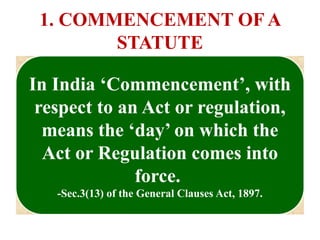
In India ‘Commencement’, with
respect to an Act or regulation,
means the ‘day’ on which the
Act or Regulation comes into
force.
-Sec.3(13) of the General Clauses Act, 1897.
1. COMMENCEMENT OF A
STATUTE
AT THE STROKE OF THE
MIDNIGHT HOUR!!
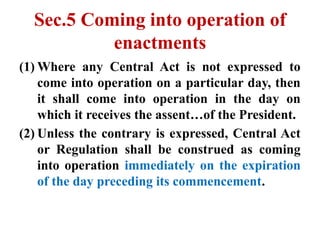
Sec.5 Coming into operation of
enactments
(1) Where any Central Act is not expressed to
come into operation on a particular day, then
it shall come into operation in the day on
which it receives the assent…of the President.
(2) Unless the contrary is expressed, Central Act
or Regulation shall be construed as coming
into operation immediately on the expiration
of the day preceding its commencement.
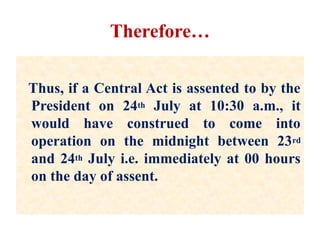
Therefore…
Thus, if a Central Act is assented to by the
President on 24th July at 10:30 a.m., it
would have construed to come into
operation on the midnight between 23rd
and 24th July i.e. immediately at 00 hours
on the day of assent.
COMMENCEMENT OF A
STATUTE IN A STATE
Many states in
India have their
own GCA
When no date is
prescribed for
commencement
Comes into force when
assent of the Governor
is published
Rules applicable for the State Acts
Publication in the Official Gazette required for
the State Acts
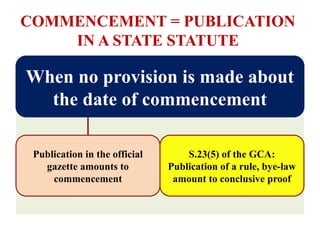
COMMENCEMENT = PUBLICATION
IN A STATE STATUTE
When no provision is made about
the date of commencement
Publication in the official
gazette amounts to
commencement
S.23(5) of the GCA:
Publication of a rule, bye-law
amount to conclusive proof
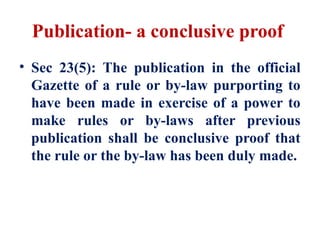
Publication- a conclusive proof
• Sec 23(5): The publication in the official
Gazette of a rule or by-law purporting to
have been made in exercise of a power to
make rules or by-laws after previous
publication shall be conclusive proof that
the rule or the by-law has been duly made.
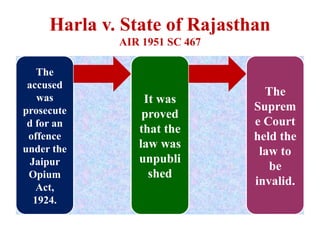
Harla v. State of Rajasthan
AIR 1951 SC 467
The
accused
was
prosecute
d for an
offence
under the
Jaipur
Opium
Act,
1924.
It was
proved
that the
law was
unpubli
shed
The
Suprem
e Court
held the
law to
be
invalid.
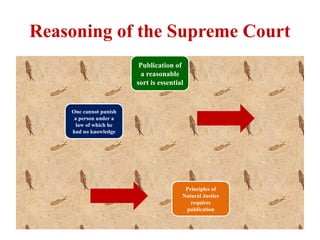
Reasoning of the Supreme Court
Publication of
a reasonable
sort is essential
Principles of
Natural Justice
requires
publication
One cannot punish
a person under a
law of which he
had no knowledge
Observations of the Supreme Court
• the rule that in the absence of a specified date mentioned
by the Statute of its commencement, it will come into force
from the day of assent of the President of India or the
Governor of a State is received, may cause avoidable
hardship to people even though normally the government
does not take much time to publish a statute once it has
received the assent. The hardship can be mitigated if the
commencement of a statute is presumed from the date of
its publication in the Official Gazette.
***
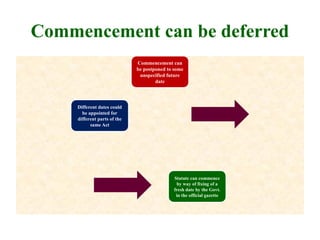
Commencement can
be postponed to some
unspecified future
date
Statute can commence
by way of fixing of a
fresh date by the Govt.
in the official gazette
Different dates could
be appointed for
different parts of the
same Act
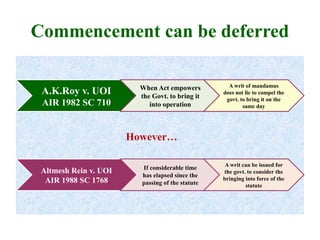
Commencement can be deferred
Power to bring into force
A.K.Roy v. UOI
AIR 1982 SC 710
When Act empowers
the Govt. to bring it
into operation
A writ of mandamus
does not lie to compel the
govt. to bring it on the
same day
Altmesh Rein v. UOI
AIR 1988 SC 1768
If considerable time
has elapsed since the
passing of the statute
A writ can be issued for
the govt. to consider the
bringing into force of the
statute
Commencement can be deferred
However…
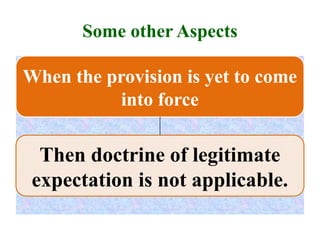
Some other Aspects
When the provision is yet to come
into force
Then doctrine of legitimate
expectation is not applicable.
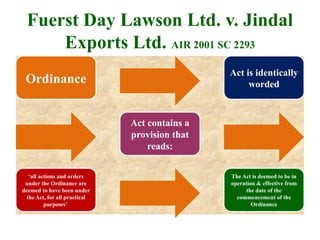
Fuerst Day Lawson Ltd. v. Jindal
Exports Ltd. AIR 2001 SC 2293
Ordinance
Act is identically
worded
Act contains a
provision that
reads:
‘all actions and orders
under the Ordinance are
deemed to have been under
the Act, for all practical
purposes’
The Act is deemed to be in
operation & effective from
the date of the
commencement of the
Ordinance
2.) THE RULE OF
PROSPECTIVE
APPLICATION
The Statute Commenced to be
applied Prospectively
nova constitutio futuris formam
imponere debet non praeteritis
every new enactment should affect
future and not past times.
How strong is the
presumption..???
• Unless there are words in the statute
sufficient to show the intention of the
Legislature to affect existing rights, it is
“deemed to be prospective only”.
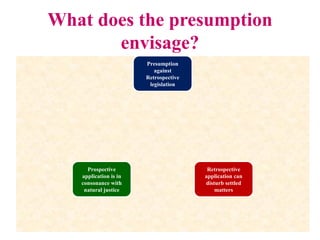
What does the presumption
envisage?
Presumption
against
Retrospective
legislation
Retrospective
application can
disturb settled
matters
Prospective
application is in
consonance with
natural justice
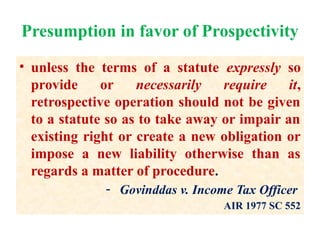
Presumption in favor of Prospectivity
• unless the terms of a statute expressly so
provide or necessarily require it,
retrospective operation should not be given
to a statute so as to take away or impair an
existing right or create a new obligation or
impose a new liability otherwise than as
regards a matter of procedure.
- Govinddas v. Income Tax Officer
AIR 1977 SC 552
3. Retrospective
Operation of
Statutes
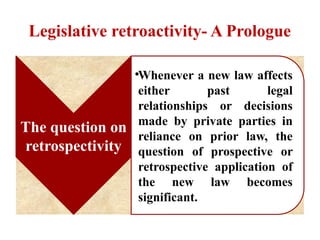
Legislative retroactivity- A Prologue
The question on
retrospectivity
●
Whenever a new law affects
either past legal
relationships or decisions
made by private parties in
reliance on prior law, the
question of prospective or
retrospective application of
the new law becomes
significant.
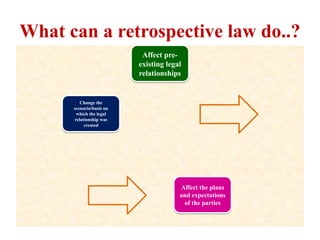
What can a retrospective law do..?
Affect pre-
existing legal
relationships
Affect pre-
existing legal
relationships
Affect the plans
and expectations
of the parties
Affect the plans
and expectations
of the parties
Change the
scenario/basis on
which the legal
relationship was
created
Change the
scenario/basis on
which the legal
relationship was
created
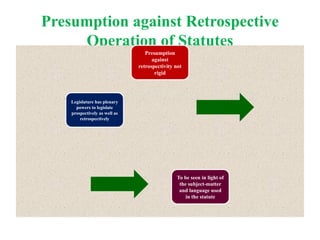
Presumption against Retrospective
Operation of Statutes
Presumption
against
retrospectivity not
rigid
To be seen in light of
the subject-matter
and language used
in the statute
Legislature has plenary
powers to legislate
prospectively as well as
retrospectively
• The inhibition against retrospective
construction must vary secundum subjectam
materiam.
• “the basis of the rule is no more than simple
fairness which ought to be the basis of every
legal rule.”
Retrospectivity can be found in
two circumstances
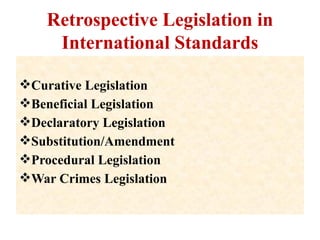
Retrospective Legislation in
International Standards
Curative Legislation
Beneficial Legislation
Declaratory Legislation
Substitution/Amendment
Procedural Legislation
War Crimes Legislation
Statutes dealing with substantive
rights
• “Provisions which touch a right in existence at
the passing of the statute are not to be applied
retrospectively in the absence of express
enactment or necessary intendment.”
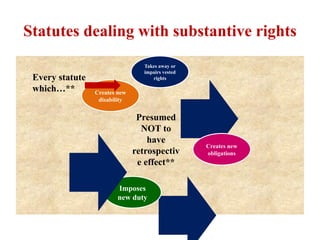
Statutes dealing with substantive rights
Takes away or
impairs vested
rights
Creates new
obligations
Imposes
new duty
Creates new
disability
Every statute
which…**
Presumed
NOT to
have
retrospectiv
e effect**
Provisions of theWorkmen’s
Compensation Act, 1923 with
its amended Sec 4 and
Schedule IV were construed.
The amended
provisions provided
for enhanced rate of
compensation.
The
Supr
eme
Cour
t
stron
gly
emp
hasiz
ed
that
unles
s the
amen
ding
Act
expr
essly
or by
impli
catio
n
make
s the
amen
dme
nt
retro
spect
ive in
oper
ation
,
provi
sion
will
be
pros
pecti
ve.
New India Insurance Co. Ltd. v.
Laxmi (2003) 8 SCC 718
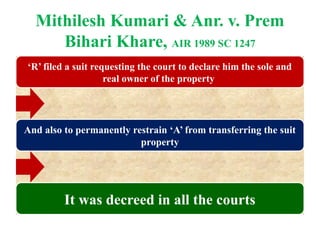
Mithilesh Kumari & Anr. v. Prem
Bihari Khare, AIR 1989 SC 1247
‘R’ filed a suit requesting the court to declare him the sole and
real owner of the property
And also to permanently restrain ‘A’ from transferring the suit
property
It was decreed in all the courts
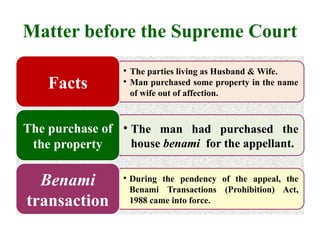
Matter before the Supreme Court
●
The parties living as Husband & Wife.
●
Man purchased some property in the name
of wife out of affection.
Facts
●
The man had purchased the
house benami for the appellant.
The purchase of
the property
●
During the pendency of the appeal, the
Benami Transactions (Prohibition) Act,
1988 came into force.
Benami
transaction
Sec. 4 Benami Transactions (Prohibition) Act, 1988
• No suit to enforce ‘any right in respect of
any property held benami’ shall lie by or
on behalf of a person claiming to be the
real owner; and ‘no defence based on any
right in respect of any property held
benami shall be allowed in any suit by or
on behalf of a person claiming to be the
real owner’.
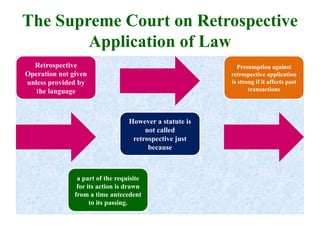
The Supreme Court on Retrospective
Application of Law
Retrospective
Operation not given
unless provided by
the language
Presumption against
retrospective application
is strong if it affects past
transactions
However a statute is
not called
retrospective just
because
a part of the requisite
for its action is drawn
from a time antecedent
to its passing.
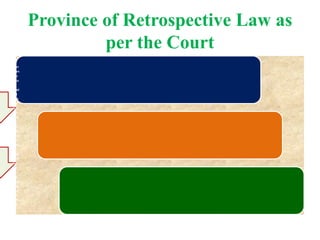
Province of Retrospective Law as
per the Court
Although every law that
takes away or impairs
rights vested is generally
unjust and may be
oppressive.
But laws made for the
benefit of the community
may relate to time
antecedent to their
commitment.
The
pres
um
ptio
n
agai
nst
retr
osp
ecti
vity
may
be
reb
utte
d by
nec
essa
ry
imp
licat
ion
fro
m
the
lang
uag
e of
the
stat
ute
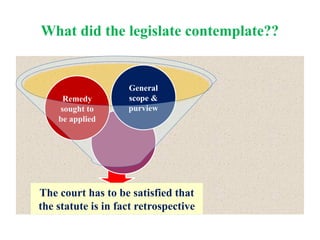
What did the legislate contemplate??
The court has to be satisfied that
the statute is in fact retrospective
Remedy
sought to
be applied
General
scope &
purview
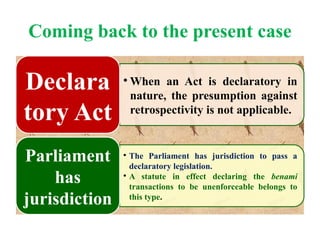
Coming back to the present case
●
When an Act is declaratory in
nature, the presumption against
retrospectivity is not applicable.
Declara
tory Act
●
The Parliament has jurisdiction to pass a
declaratory legislation.
●
A statute in effect declaring the benami
transactions to be unenforceable belongs to
this type.
Parliament
has
jurisdiction
Law Commission Report: External Aid
• The Law Commission wanted the
legislation replacing the Benami
transaction to be retroactive in
operation.
The interpretation of the plain
meaning of the definition
‘any property held benami’ ‘at the moment
of the Act coming into force’
All such properties may be affected
irrespective of their beginning,
duration and origin.
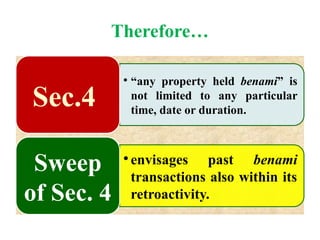
Therefore…
●
“any property held benami” is
not limited to any particular
time, date or duration.
Sec.4
●
envisages past benami
transactions also within its
retroactivity.
Sweep
of Sec. 4
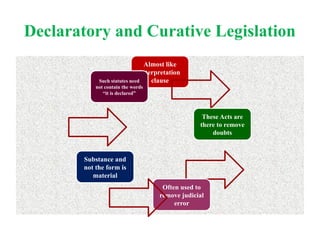
Almost like
interpretation
clause
These Acts are
there to remove
doubts
Often used to
remove judicial
error
Substance and
not the form is
material
Such statutes need
not contain the words
“it is declared”
Declaratory and Curative Legislation
• When the law is amended during the
pendency of an action, the rights of parties
are decided according to law, as it existed,
when the case had ‘begun’, unless a new
statute shows a clear intention to the
contrary.
• If the rights are ‘accrued’, then the new
law will not affect those rights.
Applicability of Amending Act to Pending
Cases
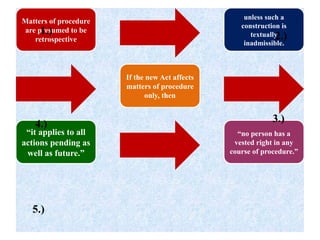
-Retrospectivity-
Statutes dealing
with Procedure
Matters of procedure
are presumed to be
retrospective
unless such a
construction is
textually
inadmissible.
If the new Act affects
matters of procedure
only, then
“it applies to all
actions pending as
well as future.”
“no person has a
vested right in any
course of procedure.”
1.) 2.)
3.)
4.)
5.)
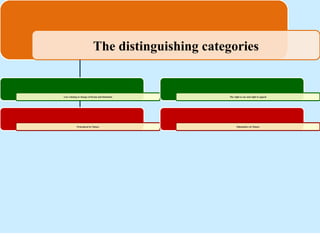
The distinguishing categories
Law relating to change of forum and limitation
Procedural in Nature
The right to sue and right to appeal
Substantive in Nature
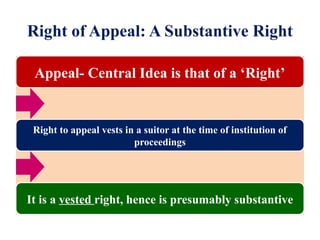
Right of Appeal: A Substantive Right
Appeal- Central Idea is that of a ‘Right’
Right to appeal vests in a suitor at the time of institution of
proceedings
It is a vested right, hence is presumably substantive
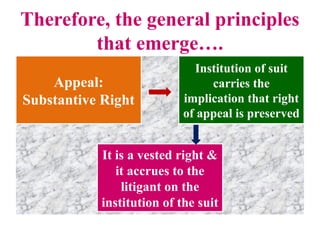
Therefore, the general principles
that emerge….
Appeal:
Substantive Right
Institution of suit
carries the
implication that right
of appeal is preserved
It is a vested right &
it accrues to the
litigant on the
institution of the suit
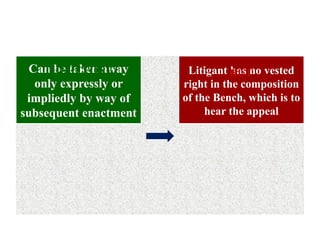
Can be taken away
only expressly or
impliedly by way of
subsequent enactment
Litigant has no vested
right in the composition
of the Bench, which is to
hear the appeal
THEREFORE BUT
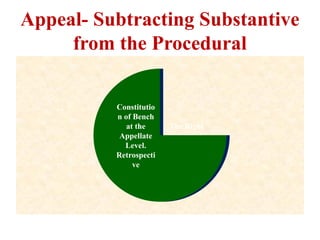
Appeal- Subtracting Substantive
from the Procedural
The Right
to Appeal.
Prospective
Constitutio
n of Bench
at the
Appellate
Level.
Retrospecti
ve
• Classification of a statute as
substantive or procedural does
not necessarily determine
whether it may have a
retrospective operation.
Some Recent Statements on
Retrospectivity
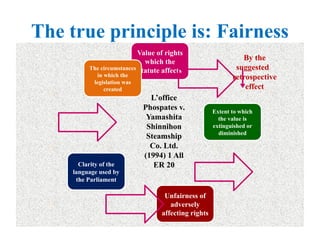
The true principle is: Fairness
Value of rights
which the
statute affects
Extent to which
the value is
extinguished or
diminished
Unfairness of
adversely
affecting rights
Clarity of the
language used by
the Parliament
The circumstances
in which the
legislation was
created
By the
suggested
retrospective
effect
L’office
Phospates v.
Yamashita
Shinnihon
Steamship
Co. Ltd.
(1994) 1 All
ER 20
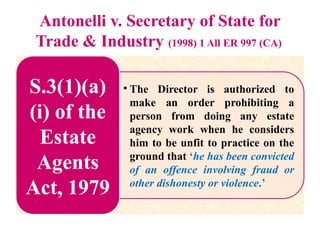
Antonelli v. Secretary of State for
Trade & Industry (1998) 1 All ER 997 (CA)
●
The Director is authorized to
make an order prohibiting a
person from doing any estate
agency work when he considers
him to be unfit to practice on the
ground that ‘he has been convicted
of an offence involving fraud or
other dishonesty or violence.’
S.3(1)(a)
(i) of the
Estate
Agents
Act, 1979
The question in this case
• Whether a conviction which
occurred prior to the Act could
enable the Director to make a
disqualification order?
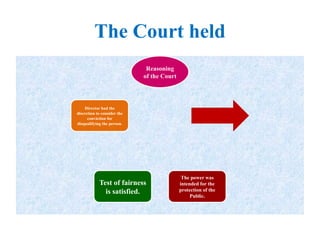
The Court held
Reasoning
of the Court
The power was
intended for the
protection of the
Public.
Test of fairness
is satisfied.
Director had the
discretion to consider the
conviction for
disqualifying the person.
The doctrine of fairness
was referred to by the
Supreme Court in
Vijay v. State of
Maharashtra
(2006) 6 SCC 289
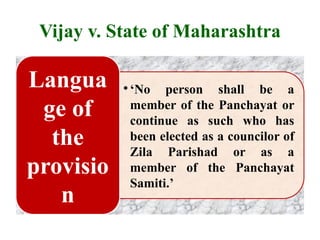
Vijay v. State of Maharashtra
●
‘No person shall be a
member of the Panchayat or
continue as such who has
been elected as a councilor of
Zila Parishad or as a
member of the Panchayat
Samiti.’
Langua
ge of
the
provisio
n
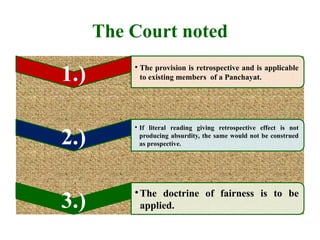
1.)
●
The provision is retrospective and is applicable
to existing members of a Panchayat.
2.)
●
If literal reading giving retrospective effect is not
producing absurdity, the same would not be construed
as prospective.
3.)
●
The doctrine of fairness is to be
applied.
The Court noted
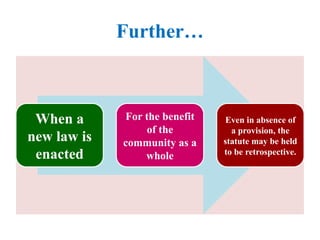
Further…
When a
new law is
enacted
For the benefit
of the
community as a
whole
Even in absence of
a provision, the
statute may be held
to be retrospective.
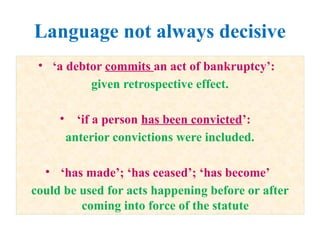
Language not always decisive
• ‘a debtor commits an act of bankruptcy’:
given retrospective effect.
• ‘if a person has been convicted’:
anterior convictions were included.
• ‘has made’; ‘has ceased’; ‘has become’
could be used for acts happening before or after
coming into force of the statute
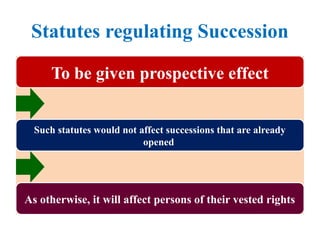
Statutes regulating Succession
To be given prospective effect
Such statutes would not affect successions that are already
opened
As otherwise, it will affect persons of their vested rights
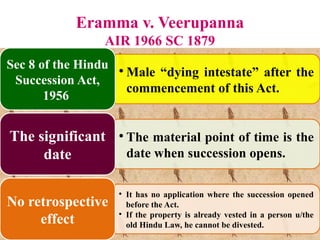
Eramma v. Veerupanna
AIR 1966 SC 1879
●
Male “dying intestate” after the
commencement of this Act.
Sec 8 of the Hindu
Succession Act,
1956
●
The material point of time is the
date when succession opens.
The significant
date
●
It has no application where the succession opened
before the Act.
●
If the property is already vested in a person u/the
old Hindu Law, he cannot be divested.
No retrospective
effect
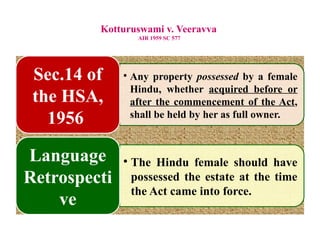
Kotturuswami v. Veeravva
AIR 1959 SC 577
●
Any property possessed by a female
Hindu, whether acquired before or
after the commencement of the Act,
shall be held by her as full owner.
Sec.14 of
the HSA,
1956
●
The Hindu female should have
possessed the estate at the time
the Act came into force.
Language
Retrospecti
ve
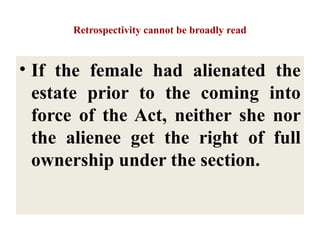
Retrospectivity cannot be broadly read
• If the female had alienated the
estate prior to the coming into
force of the Act, neither she nor
the alienee get the right of full
ownership under the section.
Penal Statutes
Some essential ingredients to be seen
Mollificati
on
Strict
Construction of
Penal Statutes
Art.15.1
of
the
ICCPR,
1966
Liberty
cannot
be
wrongfully
compromised
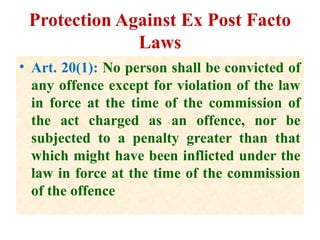
Art.20 (1) of the
Constitution
Protection Against Ex Post Facto
Laws
• Art. 20(1): No person shall be convicted of
any offence except for violation of the law
in force at the time of the commission of
the act charged as an offence, nor be
subjected to a penalty greater than that
which might have been inflicted under the
law in force at the time of the commission
of the offence
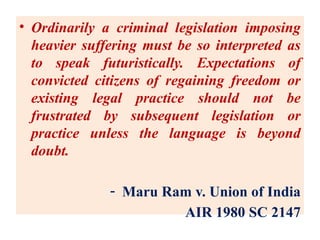
• Ordinarily a criminal legislation imposing
heavier suffering must be so interpreted as
to speak futuristically. Expectations of
convicted citizens of regaining freedom or
existing legal practice should not be
frustrated by subsequent legislation or
practice unless the language is beyond
doubt.
- Maru Ram v. Union of India
AIR 1980 SC 2147
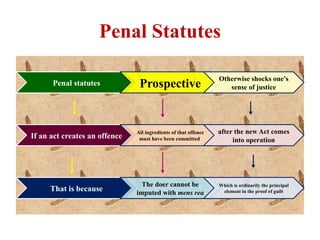
Penal Statutes
Penal statutes Prospective
Otherwise shocks one’s
sense of justice
If an act creates an offence
All ingredients of that offence
must have been committed
after the new Act comes
into operation
That is because
The doer cannot be
imputed with mens rea
Which is ordinarily the principal
element in the proof of guilt
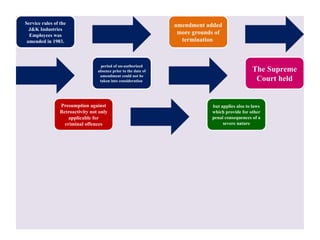
Pyare Lal Sharma v.
Managing Director, Jammu
& Kashmir Industries Ltd.
AIR 1989 SC 1854
Service rules of the
J&K Industries
Employees was
amended in 1983.
amendment added
more grounds of
termination
The Supreme
Court held
period of un-authorized
absence prior to the date of
amendment could not be
taken into consideration
Presumption against
Retroactivity not only
applicable for
criminal offences
but applies also to laws
which provide for other
penal consequences of a
severe nature
“It is a basic principle of natural
justice that no one can be
penalised on the ground of a
conduct which was not penal on
the day it was committed.”
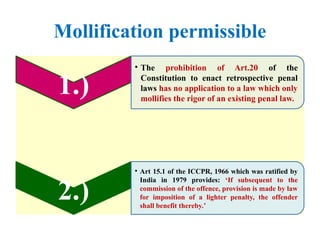
Mollification permissible
1.)
●
The prohibition of Art.20 of the
Constitution to enact retrospective penal
laws has no application to a law which only
mollifies the rigor of an existing penal law.
2.)
●
Art 15.1 of the ICCPR, 1966 which was ratified by
India in 1979 provides: ‘If subsequent to the
commission of the offence, provision is made by law
for imposition of a lighter penalty, the offender
shall benefit thereby.’
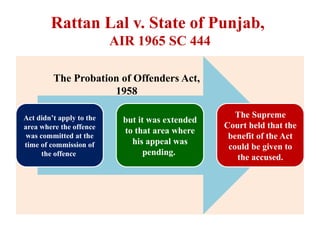
Rattan Lal v. State of Punjab,
AIR 1965 SC 444
Act didn’t apply to the
area where the offence
was committed at the
time of commission of
the offence
but it was extended
to that area where
his appeal was
pending.
The Supreme
Court held that the
benefit of the Act
could be given to
the accused.
The Probation of Offenders Act,
1958
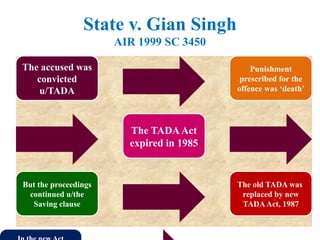
State v. Gian Singh
AIR 1999 SC 3450
The accused was
convicted
u/TADA
Punishment
prescribed for the
offence was ‘death’
The TADAAct
expired in 1985
But the proceedings
continued u/the
Saving clause
The old TADA was
replaced by new
TADAAct, 1987
Question before the Court
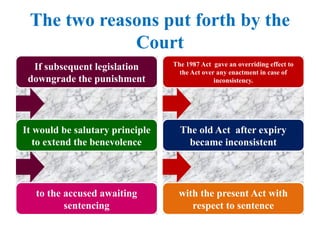
If subsequent legislation
downgrade the punishment
It would be salutary principle
to extend the benevolence
to the accused awaiting
sentencing
The 1987 Act gave an overriding effect to
the Act over any enactment in case of
inconsistency.
The old Act after expiry
became inconsistent
with the present Act with
respect to sentence
The two reasons put forth by the
Court
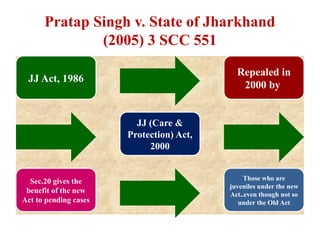
Pratap Singh v. State of Jharkhand
(2005) 3 SCC 551
JJ Act, 1986
Repealed in
2000 by
JJ (Care &
Protection) Act,
2000
Sec.20 gives the
benefit of the new
Act to pending cases
Those who are
juveniles under the new
Act..even though not so
under the Old Act
Section 20 Special provision in respect of
pending cases.
• Notwithstanding anything contained in this Act, all
proceedings in respect of a juvenile pending in any court in
any area on the date on which this Act comes into force in
that area, shall be continued in that court as if this Act had
not been passed and if the court finds that the juvenile has
committed an offence…
Explanation.—In all pending cases including trial, revision,
appeal or any other criminal proceedings in respect of a
juvenile in conflict with law, in any court, the determination
of juvenility of such a juvenile shall be in terms of clause (l) of
section 2, even if the juvenile ceases to be so on or before the
date of commencement of this Act and the provisions of this
Act shall apply as if the said provisions had been in force, for
all purposes and at all material times when the alleged
The Court held
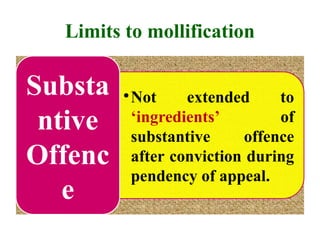
Limits to mollification
●
Not extended to
‘ingredients’ of
substantive offence
after conviction during
pendency of appeal.
Substa
ntive
Offenc
e
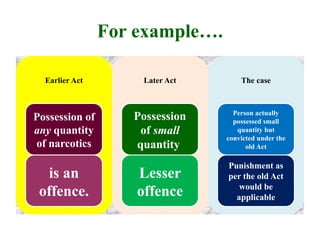
For example….
Earlier Act
Possession of
any quantity
of narcotics
is an
offence.
Later Act
Possession
of small
quantity
Lesser
offence
The case
Person actually
possessed small
quantity but
convicted under the
old Act
Punishment as
per the old Act
would be
applicable
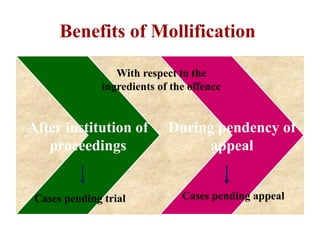
Benefits of Mollification
After institution of
proceedings
During pendency of
appeal
With respect to the
ingredients of the offence
Cases pending trial Cases pending appeal
Dayal Singh v. State of Rajasthan
(2004) 5 SCC 721
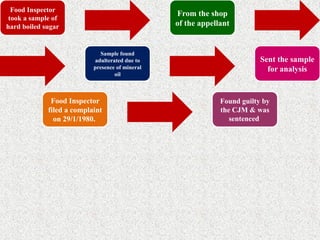
Food Inspector
took a sample of
hard boiled sugar
From the shop
of the appellant
Sent the sample
for analysis
Sample found
adulterated due to
presence of mineral
oil
Food Inspector
filed a complaint
on 29/1/1980.
Found guilty by
the CJM & was
sentenced
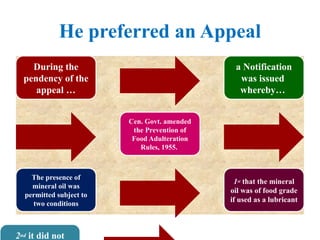
He preferred an Appeal
During the
pendency of the
appeal …
a Notification
was issued
whereby…
Cen. Govt. amended
the Prevention of
Food Adulteration
Rules, 1955.
The presence of
mineral oil was
permitted subject to
two conditions
1st that the mineral
oil was of food grade
if used as a lubricant
2nd it did not
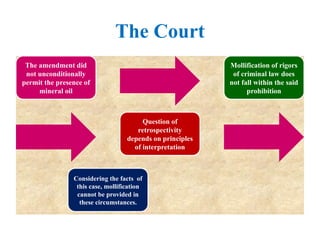
The Court
The amendment did
not unconditionally
permit the presence of
mineral oil
Mollification of rigors
of criminal law does
not fall within the said
prohibition
Question of
retrospectivity
depends on principles
of interpretation
Considering the facts of
this case, mollification
cannot be provided in
these circumstances.
N.P. Basheer v. State of Kerala
(2004) 3 SCC 609
The Constitutional
validity of the proviso to
Sub-section 1 of Section
41 of the NDPS
(Amendment) Act, 2001
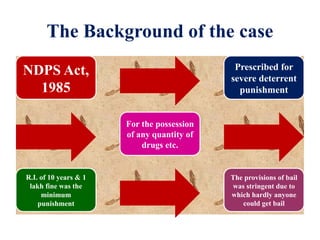
The Background of the case
NDPS Act,
1985
Prescribed for
severe deterrent
punishment
For the possession
of any quantity of
drugs etc.
R.I. of 10 years & 1
lakh fine was the
minimum
punishment
The provisions of bail
was stringent due to
which hardly anyone
could get bail
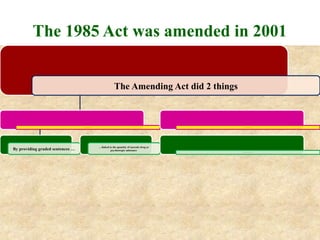
The 1985 Act was amended in 2001
The Amending Act did 2 things
Rationalized the structure of punishment
By providing graded sentences …
…linked to the quantity of narcotic drug or
psychotropic substance
The application of strict bail provisions
Restricted only to those offenders who i ndul ged i n serious offences.
The Statement of Objects &
Reasons
• The Narcotic Drugs and Psychotropic Substances Act, 1985 provides
deterrent punishment for various offences relating to illicit trafficking
in narcotic drugs and psychotropic substances. Most of the offences
invite uniform punishment of minimum ten years rigorous
imprisonment which may extend up to twenty years. While the Act
envisages severe punishments for drug traffickers, it envisages
reformative approach towards addicts. In view of the general delay in
trial it has been found that the addicts prefer not to invoke the
provisions of the Act. The strict bail provisions under the Act add to
their misery. Therefore, it is proposed to rationalise the sentence
structure so as to ensure that while drug traffickers who traffic in
significant quantities of drugs are punished with deterrent sentences,
the addicts and those who commit less serious offences are sentenced
to less severe punishment. This requires rationalisation of the
sentence structure provided under the Act. It is also proposed to
restrict the application of strict bail provisions to those offenders who
indulge in serious offences.
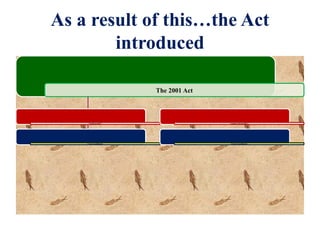
As a result of this…the Act
introduced
The 2001 Act
“small quantity”
Lesser punishment
“commercial quantity”
Greater punishment
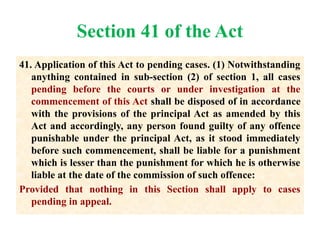
Section 41 of the Act
41. Application of this Act to pending cases. (1) Notwithstanding
anything contained in sub-section (2) of section 1, all cases
pending before the courts or under investigation at the
commencement of this Act shall be disposed of in accordance
with the provisions of the principal Act as amended by this
Act and accordingly, any person found guilty of any offence
punishable under the principal Act, as it stood immediately
before such commencement, shall be liable for a punishment
which is lesser than the punishment for which he is otherwise
liable at the date of the commission of such offence:
Provided that nothing in this Section shall apply to cases
pending in appeal.
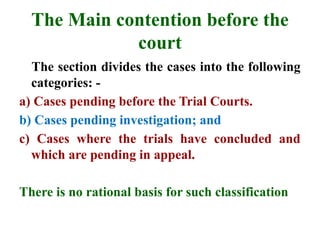
The Main contention before the
court
The section divides the cases into the following
categories: -
a) Cases pending before the Trial Courts.
b) Cases pending investigation; and
c) Cases where the trials have concluded and
which are pending in appeal.
There is no rational basis for such classification
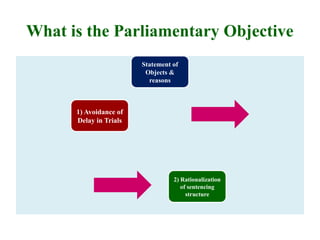
What is the Parliamentary Objective
Statement of
Objects &
reasons
2) Rationalization
of sentencing
structure
1) Avoidance of
Delay in Trials
The Supreme Court thus stated:
Statutes prescribing
posterior
disqualification on past
conduct