Vol 3 | Issue 2 | 2013 | 93-96.
93 | P a g e
e-ISSN 2248 – 9142
print-ISSN 2248 – 9134
International Journal of
Current Pharmaceutical & Clinical
Research
www.ijcpcr.com
EVALUATION OF VARIOUS CAUSES OF LEUCORRHOEA IN
SEXUALLY ACTIVE FEMALES
K. Padma Leela1
, K. Venkata Ramana2
, V. Leela Madhuri3
1
Associate. Professor, 2
Asst. Professor, 3
Post Graduate, Department of Obst. & Gyneac, Andhra Medical College,
Visakhapatnam, Andhra Pradesh, India.
INTRODUCTION
Leucorrhoea is one of the most common causes of
referral to the gynaecology clinics [1]. The amount of
vaginal discharge ordinarily present in the adults is such
that the introitus feels comfortably moist, however this is
not enough to stain the under clothing. Physiological
increase in the vaginal secretion occurs in puberty, at the
time of ovulation, during pregnancy and during pre-
menstrual phase [2].
Pathological discharge is defined as the excess of
normal which may be leucorrhoea or due to infections like
vulvo-vaginitis caused by trichomoniasis, moniliasis,
bacterial vaginosis, or gonococcal cervicitis. Non –
Pathological Leucorrhoea occurs due to local causes like
mucous polypi, cervical erosions, ectropion, local
congestive states of pelvic organs like pregnancy, acquired
retroversion, prolapsed congested ovaries, chronic pelvic
inflammatory disease ( PID ) and even chronic constipation
[3]. Vaginal normal flora includes lactobacilli, some gram
positive, gram negative, aerobic and anaerobic bacteria.
Normal pH in healthy women during child bearing period
is about 4.5 which is due to lactic acid. Doderlein bacilli is
almost the only organism which will grow at a pH of 4 –
4.5 in vagina. As the acidity of the vagina falls and pH
rises, then non-resident pathogens are able to thrive. The
vagina, ectocervix and endocervix are all susceptible to
various pathogens depending upon the type of epithelium
present. The squamous epithelium of the vagina and
ectocervix is susceptible to infection with candida species
and trichomonas vaginalis and columnar epithelium of the
endocervix is susceptible to infection with neisseria
gonorrhea and chlamydia trachomatis [4].
Aims and Objectives
To study the various causes of specific vaginitis
after ruling out non-pathogenic causes of leucorrhoea in
sexually active women.
Corresponding Author :- Dr.K Padma Leela Email:- drkpadmaleela@gmail.com
ABSTRACT
Leucorrhoea is one of the most common symptoms of sexually transmitted infections which remain untreated in majority of
women. When left untreated, they may lead to complications such as infertility, ectopic pregnancy and cervical cancer. If
associated with pregnancy, they increase the risk of premature rupture of membranes, this further leading to increased
neonatal mortality and morbidity. The present study was undertaken to evaluate the various causes of Leucorrhoea in
sexually active females of age group 15 to 45 years. One hundred sexually active women in the age group of 15 to 45 years
who attended gynaec OPD with complaint of vaginal discharge were selected randomly for the study. A detailed clinical
history was taken and discharge was collected and appropriate tests for diagnosing candidiasis, trichomoniasis, gonorrhea
and bacterial vaginosis were done. The present study showed an incidence of 24% of candidiasis, 20% of Bacterial
vaginosis, Trichomoniasis 8% and no etiological agent was found in 48% of cases which could probably be physiological.
Key words: Leucorrhoea, Candidiasis, Trichomoniasis, Gonorrhea and Bacterial vaginosis.
Vol 3 | Issue 2 | 2013 | 93-96.
94 | P a g e
MATERIAL AND METHODS
A hospital based Prospective study was carried
out among 100 sexually active females who were attending
the gynaecology OPD at Government Victoria Hospital,
Andhra Medical College, Visakhapatnam during the period
from June 2012– September 2012. Study subjects were
selected from the age group of 15 – 45 yrs with signs of
vaginal discharge. Informed consent was taken from the
participants.
A detailed clinical history and a thorough physical
examination of all the cases was done and then using
sterile vaginal speculum and swab, inspection and sample
collection have been done.
Process:
Three smears have been spread for each patient:
1) With normal saline; to visualize Trichomonas vaginalis
2) With 10 % KOH; for whiff test and microscopic
examination of Candida albicans mycelium.
3) For Gram’s staining.
Inclusion Criteria
All women of reproductive age group and
sexually active with vaginal discharge attending
Gynaecology OPD and who have given informed consent
for participation.
Exclusion Criteria
Pregnant women, women with abnormal vaginal
bleeding, post hysterectomised women, women on
hormonal therapy, oral contraceptive pills, Intra uterine
device, women with cervical lesions and post-menopausal
women.
RESULTS
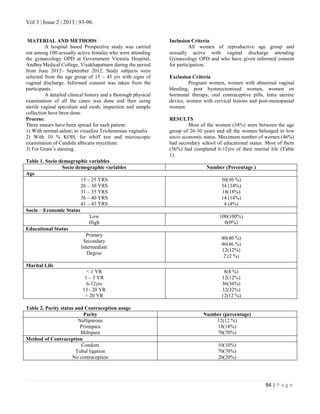
Most of the women (34%) were between the age
group of 26-30 years and all the women belonged to low
socio economic status. Maximum number of women (46%)
had secondary school of educational status. Most of them
(36%) had completed 6-12yrs of their marital life (Table
1).
Table 1. Socio demographic variables
Socio demographic variables Number (Percentage )
Age
15 – 25 YRS
26 – 30 YRS
31 – 35 YRS
36 – 40 YRS
41 – 45 YRS
30(30 %)
34 (34%)
18(18%)
14 (14%)
4 (4%)
Socio – Economic Status
Low
High
100(100%)
0(0%)
Educational Status
Primary
Secondary
Intermediate
Degree
40(40 %)
46(46 %)
12(12%)
2 (2 %)
Marital Life
< 1 YR
1 – 5 YR
6-12yrs
13– 20 YR
> 20 YR
8(8 %)
12(12%)
36(36%)
32(32%)
12(12 %)
Table 2. Parity status and Contraception usage
Parity Number (percentage)
Nulliparous
Primipara
Miltipara
12(12 %)
18(18%)
70(70%)
Method of Contraception
Condom
Tubal ligation
No contraception
10(10%)
70(70%)
20(20%)
Vol 3 | Issue 2 | 2013 | 93-96.
95 | P a g e
Figure 1. Self-reported symptoms Figure 2. Etiological Agents Identified
DISCUSSION
Reproductive tract infections including sexually
transmitted infections adversely affect the reproductive
health of women. Despite the ability to cure reproductive
tract infections it remains a major worldwide public health
problem. India has a high burden of morbidity due to
reproductive tract infections. Diagnosis using clinical
criteria often leads to misdiagnosis as the components are
subjective and depend on the acuity of the clinician and the
availability of the equipment [6].
Therefore a etiological diagnosis by isolation and
identification of the causative agent provides reliable
information for delivering proper treatment and to avoid
complications associated with bacterial vaginosis and
pregnancy like prematurity, chorioamnionitis, neonatal
infections and infections following cesarean section and
hysterectomy.
In our study most of the women with vaginal
discharge were between the age group of 26-30 yrs (34%),
belonging to low socio-economic status (100%), having
secondary school education levels (46%), 70 % of the
women were multiparous and many of them were having
marital life between 6-12 yrs (36 %) and most of them
were tubectomized (70%). No one had multiple sexual
partners. The most common symptom associated with
vaginal discharge was pruritus (45%) followed by back
pain and dyspareunia (20%), foul smelling discharge
(16%).Watery type of discharge was noticed in maximum
number of women i.e., 66% and curdy white discharge in
20%, frothy discharge in 8 % and muciod discharge in 16
%.The most common etiological agent identified was
Candida (24%) followed by Bacterial vaginosis (20%).
Trichomonas was found in 8 % and physiological
leucorrhoea was found in 48%. There was no Gonococcal
infection identified.
These results can be compared to another study
done by Puri KJ and Bajaj K of Punjab where the
incidence of bacterial vaginosis was 45%, candidiasis -
31%, trichomoniasis-2%, gonorrhoea -3% and other causes
14% [7].
CONCLUSIONS AND RECOMMENDATIONS
In our study Vaginal Candidiasis was the most
common cause of leucorrhoea in sexually active women
followed by Bacterial Vaginosis and Trichomoniasis.
- INDIA has high burden of reproductive tract
infections morbidity. Identifying the proper etiological
agent can reduce the prevalence of reproductive tract
infections and thus the relevant morbidity is reduced.
- Using condom as the contraceptive method is an
effective way of decreasing the prevalence of infectious
leucorrhoea. By preventing vaginal pH changes and
decreasing non-specific vaginal bacterial overgrowth
vaginitis can be reduced.
- Maintenance of personal and perineal hygiene was
found to be most important factor for reducing the
vulvovaginits.
- Health Education must emphasise on perineal hygiene
and its importance to reduce the incidence of RTI’s.
REFERENCES
1. Berek and Novak’s text book of Gynaecology, 15th
Edition, Chapter 18, 557-570.
2. D.C. Dutta’s text book of Gynaecology, 5th
edition, chapter 33, 142-154 and 524-526.
3. Howkins & Bourne shaw’s text book of Gynaecology, 15th
edition, chapter 10, 11, 127-150.
4. Fox KK, Behets FM. Vaginal discharge. How to pinpoint the cause postgraduate Medicine, 98, 87-90, 1995, 93-96,101.
5. Faudes A. Reproductive tract infection. Report of a RCOG meeting. Br J Obnaecol, 102, 1995, 424-6.
Vol 3 | Issue 2 | 2013 | 93-96.
96 | P a g e
6. Roochika ranjan, A.k. sharma, Geeta mehta. Evaluation of who diagnostic algorithm for reproductive tract
infections.among married women. Indian Journal of Community Medicine, XXVIII, 2003, 2.
7. Puri K J, Madan A, Bajaj K. Incidence of various causes of vaginal discharge among sexually active females in age group
20-40 years. Indian J Dermatol Venereol Leprol, 69, 2003, 122-5.

EVALUATION OF VARIOUS CAUSES OF LEUCORRHOEA IN SEXUALLY ACTIVE FEMALES

  • 1.
    Vol 3 |Issue 2 | 2013 | 93-96. 93 | P a g e e-ISSN 2248 – 9142 print-ISSN 2248 – 9134 International Journal of Current Pharmaceutical & Clinical Research www.ijcpcr.com EVALUATION OF VARIOUS CAUSES OF LEUCORRHOEA IN SEXUALLY ACTIVE FEMALES K. Padma Leela1 , K. Venkata Ramana2 , V. Leela Madhuri3 1 Associate. Professor, 2 Asst. Professor, 3 Post Graduate, Department of Obst. & Gyneac, Andhra Medical College, Visakhapatnam, Andhra Pradesh, India. INTRODUCTION Leucorrhoea is one of the most common causes of referral to the gynaecology clinics [1]. The amount of vaginal discharge ordinarily present in the adults is such that the introitus feels comfortably moist, however this is not enough to stain the under clothing. Physiological increase in the vaginal secretion occurs in puberty, at the time of ovulation, during pregnancy and during pre- menstrual phase [2]. Pathological discharge is defined as the excess of normal which may be leucorrhoea or due to infections like vulvo-vaginitis caused by trichomoniasis, moniliasis, bacterial vaginosis, or gonococcal cervicitis. Non – Pathological Leucorrhoea occurs due to local causes like mucous polypi, cervical erosions, ectropion, local congestive states of pelvic organs like pregnancy, acquired retroversion, prolapsed congested ovaries, chronic pelvic inflammatory disease ( PID ) and even chronic constipation [3]. Vaginal normal flora includes lactobacilli, some gram positive, gram negative, aerobic and anaerobic bacteria. Normal pH in healthy women during child bearing period is about 4.5 which is due to lactic acid. Doderlein bacilli is almost the only organism which will grow at a pH of 4 – 4.5 in vagina. As the acidity of the vagina falls and pH rises, then non-resident pathogens are able to thrive. The vagina, ectocervix and endocervix are all susceptible to various pathogens depending upon the type of epithelium present. The squamous epithelium of the vagina and ectocervix is susceptible to infection with candida species and trichomonas vaginalis and columnar epithelium of the endocervix is susceptible to infection with neisseria gonorrhea and chlamydia trachomatis [4]. Aims and Objectives To study the various causes of specific vaginitis after ruling out non-pathogenic causes of leucorrhoea in sexually active women. Corresponding Author :- Dr.K Padma Leela Email:- drkpadmaleela@gmail.com ABSTRACT Leucorrhoea is one of the most common symptoms of sexually transmitted infections which remain untreated in majority of women. When left untreated, they may lead to complications such as infertility, ectopic pregnancy and cervical cancer. If associated with pregnancy, they increase the risk of premature rupture of membranes, this further leading to increased neonatal mortality and morbidity. The present study was undertaken to evaluate the various causes of Leucorrhoea in sexually active females of age group 15 to 45 years. One hundred sexually active women in the age group of 15 to 45 years who attended gynaec OPD with complaint of vaginal discharge were selected randomly for the study. A detailed clinical history was taken and discharge was collected and appropriate tests for diagnosing candidiasis, trichomoniasis, gonorrhea and bacterial vaginosis were done. The present study showed an incidence of 24% of candidiasis, 20% of Bacterial vaginosis, Trichomoniasis 8% and no etiological agent was found in 48% of cases which could probably be physiological. Key words: Leucorrhoea, Candidiasis, Trichomoniasis, Gonorrhea and Bacterial vaginosis.
  • 2.
    Vol 3 |Issue 2 | 2013 | 93-96. 94 | P a g e MATERIAL AND METHODS A hospital based Prospective study was carried out among 100 sexually active females who were attending the gynaecology OPD at Government Victoria Hospital, Andhra Medical College, Visakhapatnam during the period from June 2012– September 2012. Study subjects were selected from the age group of 15 – 45 yrs with signs of vaginal discharge. Informed consent was taken from the participants. A detailed clinical history and a thorough physical examination of all the cases was done and then using sterile vaginal speculum and swab, inspection and sample collection have been done. Process: Three smears have been spread for each patient: 1) With normal saline; to visualize Trichomonas vaginalis 2) With 10 % KOH; for whiff test and microscopic examination of Candida albicans mycelium. 3) For Gram’s staining. Inclusion Criteria All women of reproductive age group and sexually active with vaginal discharge attending Gynaecology OPD and who have given informed consent for participation. Exclusion Criteria Pregnant women, women with abnormal vaginal bleeding, post hysterectomised women, women on hormonal therapy, oral contraceptive pills, Intra uterine device, women with cervical lesions and post-menopausal women. RESULTS Most of the women (34%) were between the age group of 26-30 years and all the women belonged to low socio economic status. Maximum number of women (46%) had secondary school of educational status. Most of them (36%) had completed 6-12yrs of their marital life (Table 1). Table 1. Socio demographic variables Socio demographic variables Number (Percentage ) Age 15 – 25 YRS 26 – 30 YRS 31 – 35 YRS 36 – 40 YRS 41 – 45 YRS 30(30 %) 34 (34%) 18(18%) 14 (14%) 4 (4%) Socio – Economic Status Low High 100(100%) 0(0%) Educational Status Primary Secondary Intermediate Degree 40(40 %) 46(46 %) 12(12%) 2 (2 %) Marital Life < 1 YR 1 – 5 YR 6-12yrs 13– 20 YR > 20 YR 8(8 %) 12(12%) 36(36%) 32(32%) 12(12 %) Table 2. Parity status and Contraception usage Parity Number (percentage) Nulliparous Primipara Miltipara 12(12 %) 18(18%) 70(70%) Method of Contraception Condom Tubal ligation No contraception 10(10%) 70(70%) 20(20%)
  • 3.
    Vol 3 |Issue 2 | 2013 | 93-96. 95 | P a g e Figure 1. Self-reported symptoms Figure 2. Etiological Agents Identified DISCUSSION Reproductive tract infections including sexually transmitted infections adversely affect the reproductive health of women. Despite the ability to cure reproductive tract infections it remains a major worldwide public health problem. India has a high burden of morbidity due to reproductive tract infections. Diagnosis using clinical criteria often leads to misdiagnosis as the components are subjective and depend on the acuity of the clinician and the availability of the equipment [6]. Therefore a etiological diagnosis by isolation and identification of the causative agent provides reliable information for delivering proper treatment and to avoid complications associated with bacterial vaginosis and pregnancy like prematurity, chorioamnionitis, neonatal infections and infections following cesarean section and hysterectomy. In our study most of the women with vaginal discharge were between the age group of 26-30 yrs (34%), belonging to low socio-economic status (100%), having secondary school education levels (46%), 70 % of the women were multiparous and many of them were having marital life between 6-12 yrs (36 %) and most of them were tubectomized (70%). No one had multiple sexual partners. The most common symptom associated with vaginal discharge was pruritus (45%) followed by back pain and dyspareunia (20%), foul smelling discharge (16%).Watery type of discharge was noticed in maximum number of women i.e., 66% and curdy white discharge in 20%, frothy discharge in 8 % and muciod discharge in 16 %.The most common etiological agent identified was Candida (24%) followed by Bacterial vaginosis (20%). Trichomonas was found in 8 % and physiological leucorrhoea was found in 48%. There was no Gonococcal infection identified. These results can be compared to another study done by Puri KJ and Bajaj K of Punjab where the incidence of bacterial vaginosis was 45%, candidiasis - 31%, trichomoniasis-2%, gonorrhoea -3% and other causes 14% [7]. CONCLUSIONS AND RECOMMENDATIONS In our study Vaginal Candidiasis was the most common cause of leucorrhoea in sexually active women followed by Bacterial Vaginosis and Trichomoniasis. - INDIA has high burden of reproductive tract infections morbidity. Identifying the proper etiological agent can reduce the prevalence of reproductive tract infections and thus the relevant morbidity is reduced. - Using condom as the contraceptive method is an effective way of decreasing the prevalence of infectious leucorrhoea. By preventing vaginal pH changes and decreasing non-specific vaginal bacterial overgrowth vaginitis can be reduced. - Maintenance of personal and perineal hygiene was found to be most important factor for reducing the vulvovaginits. - Health Education must emphasise on perineal hygiene and its importance to reduce the incidence of RTI’s. REFERENCES 1. Berek and Novak’s text book of Gynaecology, 15th Edition, Chapter 18, 557-570. 2. D.C. Dutta’s text book of Gynaecology, 5th edition, chapter 33, 142-154 and 524-526. 3. Howkins & Bourne shaw’s text book of Gynaecology, 15th edition, chapter 10, 11, 127-150. 4. Fox KK, Behets FM. Vaginal discharge. How to pinpoint the cause postgraduate Medicine, 98, 87-90, 1995, 93-96,101. 5. Faudes A. Reproductive tract infection. Report of a RCOG meeting. Br J Obnaecol, 102, 1995, 424-6.
  • 4.
    Vol 3 |Issue 2 | 2013 | 93-96. 96 | P a g e 6. Roochika ranjan, A.k. sharma, Geeta mehta. Evaluation of who diagnostic algorithm for reproductive tract infections.among married women. Indian Journal of Community Medicine, XXVIII, 2003, 2. 7. Puri K J, Madan A, Bajaj K. Incidence of various causes of vaginal discharge among sexually active females in age group 20-40 years. Indian J Dermatol Venereol Leprol, 69, 2003, 122-5.