Genetic Algorithms
           NEURAL NETWORKS                                                            The genetic algorithms follow the evolution process in the nature
                                                                                      to find the better solutions of some complicated problems.
            (ELEC 5240 and ELEC 6240)                                                 Foundations of genetic algorithms are given in Holland (1975) and
                                                                                      Goldberg (1989) books.
          Generic Algorithms
     (Evolutionary Computations)                                                      Genetic algorithms consist the following steps:

                                                                                           Initialization
                                                                                           Selection
                                                                                           Reproduction with crossover and mutation
        Bodgan M. Wilamowski - Fall 2006                                              Selection and reproduction are repeated for each generation until a
                                                                                      solution is reached

                                                                                      During this procedure a certain strings of symbols, known as
                                                                                  1   chromosomes, evaluate toward better solution.                                            2


                                                                                                                            0.08

Genetic Algorithms 2                                                                  Genetic Algorithms 2                  0.07


                                                                                                                            0.06


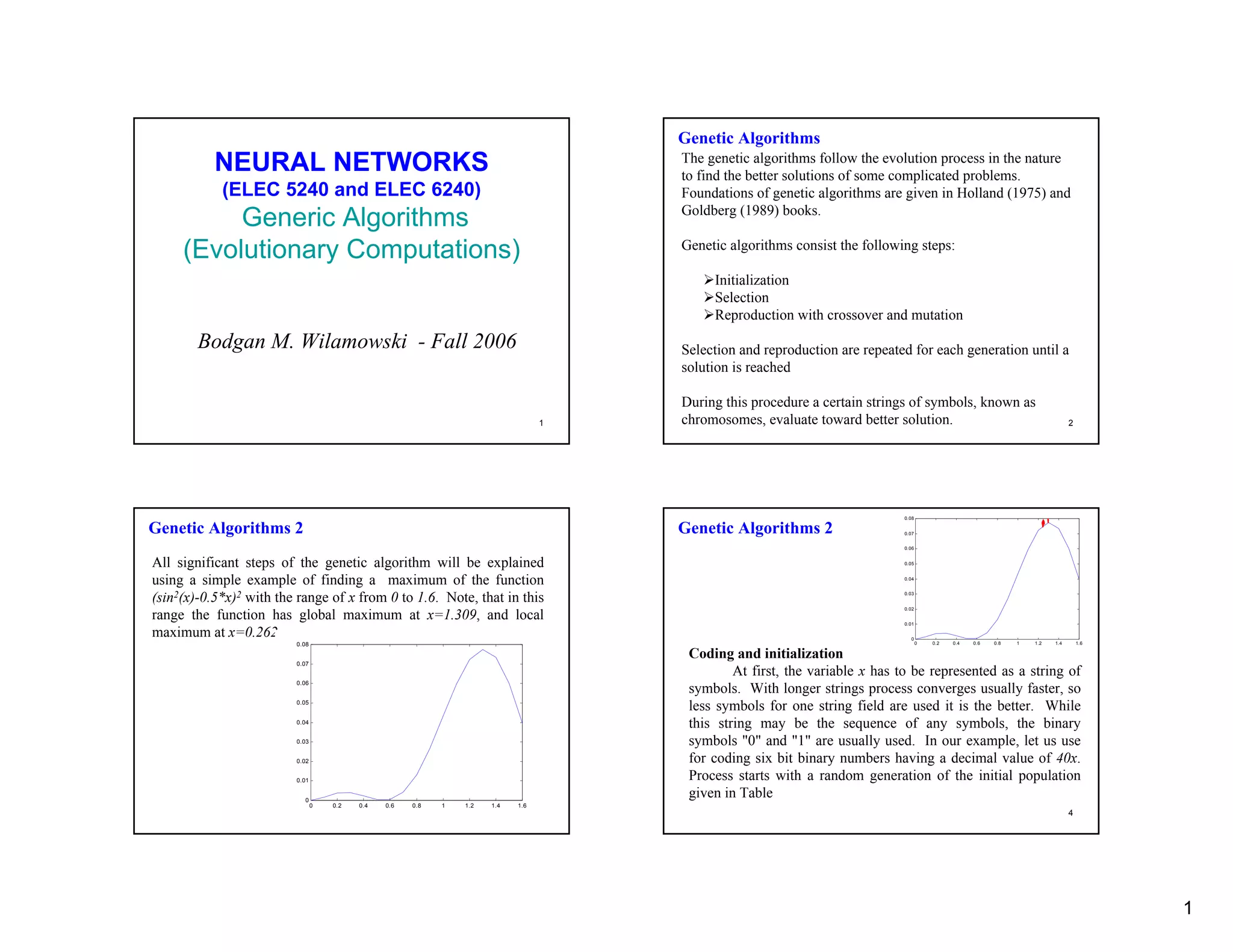
All significant steps of the genetic algorithm will be explained                                                            0.05


using a simple example of finding a maximum of the function                                                                 0.04


(sin2(x)-0.5*x)2 with the range of x from 0 to 1.6. Note, that in this                                                      0.03


                                                                                                                            0.02
range the function has global maximum at x=1.309, and local                                                                 0.01

maximum at x=0.262.                                                                                                           0
                         0.08                                                                                                      0   0.2   0.4   0.6   0.8   1   1.2   1.4       1.6

                                                                                       Coding and initialization
                         0.07
                                                                                               At first, the variable x has to be represented as a string of
                         0.06
                                                                                       symbols. With longer strings process converges usually faster, so
                         0.05
                                                                                       less symbols for one string field are used it is the better. While
                         0.04
                                                                                       this string may be the sequence of any symbols, the binary
                         0.03                                                          symbols "0" and "1" are usually used. In our example, let us use
                         0.02                                                          for coding six bit binary numbers having a decimal value of 40x.
                         0.01                                                          Process starts with a random generation of the initial population
                           0
                                                                                       given in Table
                                0   0.2   0.4   0.6   0.8   1   1.2   1.4   1.6
                                                                                  3                                                                                            4


                                                                                                                                                                                         1
Genetic Algorithms 3                                                         Genetic Algorithms 4
                          Initial Population                                Selection and reproduction
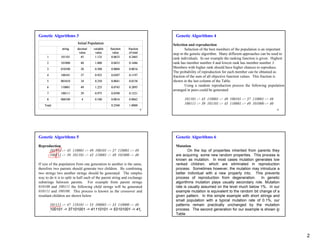
                string    decimal    variable    function    fraction               Selection of the best members of the population is an important
                           value      value        value     of total       step in the genetic algorithm. Many different approaches can be used to
     1         101101       45        1.125       0.0633      0.2465
                                                                            rank individuals. In our example the ranking function is given. Highest
     2         101000       40        1.000      0.0433       0.1686        rank has member number 6 and lowest rank has member number 3.
     3         010100       20        0.500      0.0004       0.0016        Members with higher rank should have higher chances to reproduce.
                                                                            The probability of reproduction for each member can be obtained as
     4         100101       37        0.925      0.0307       0.1197        fraction of the sum of all objective function values. This fraction is
     5         001010       10        0.250      0.0041       0.0158        shown in the last column of the Table.
     6         110001       49        1.225      0.0743       0.2895
                                                                                    Using a random reproduction process the following population
                                                                            arranged in pairs could be generated:
     7         100111       39        0.975      0.0390       0.1521
     8         000100        4        0.100      0.0016       0.0062               101101 -> 45 110001 -> 49 100101 -> 37 110001 -> 49
    Total                                        0.2568       1.0000
                                                                                   100111 -> 39 101101 -> 45 110001 -> 49 101000 -> 40
                                                                        5                                                                     6


Genetic Algorithms 5                                                         Genetic Algorithms 6
Reproduction                                                                 Mutation
      101101 -> 45 110001 -> 49 100101 -> 37 110001 -> 49                            On the top of properties inherited from parents they
      100111 -> 39 101101 -> 45 110001 -> 49 101000 -> 40                    are acquiring some new random properties. This process is
                                                                             known as mutation. In most cases mutation generates low
If size of the population from one generation to another is the same,        ranked children, which are eliminated in reproduction
therefore two parents should generate two children. By combining             process. Sometimes however, the mutation may introduce a
two strings two another strings should be generated. The simples             better individual with a new property into. This prevents
way to do it is to split in half each of the parent string and exchange      process of reproduction from degeneration.        In genetic
substrings between parents. For example from parent strings                  algorithms mutation plays usually secondary role. Mutation
010100 and 100111 the following child strings will be generated              rate is usually assumed on the level much below 1%. In our
010111 and 100100. This process is known as the crossover and                example mutation is equivalent to the random bit change of a
resultant children are shown below                                           given pattern. In this simple example with short strings and
                                                                             small population with a typical mutation rate of 0.1%, our
         101111 -> 47 110101 -> 53 100001 -> 33 110000 -> 48                 patterns remain practically unchanged by the mutation
         100101 -> 37101001 -> 41110101 -> 53101001 -> 417                   process. The second generation for our example is shown in 8
                                                                             Table


                                                                                                                                                      2
Genetic Algorithms 7                                                     Genetic Algorithms 8
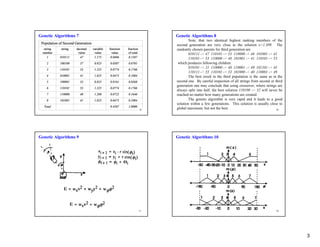
                                                                                 Note, that two identical highest ranking members of the
 Population of Second Generation                                         second generation are very close to the solution x=1.309. The
   string    string   decimal      variable   function   fraction        randomly chosen parents for third generation are
  number               value        value       value    of total                010111 -> 47 110101 -> 53 110000 -> 48 101001 -> 41
      1     010111      47          1.175      0.0696     0.1587                 110101 -> 53 110000 -> 48 101001 -> 41 110101 -> 53
    2       100100      37          0.925     0.0307     0.0701           which produces following children:
                                                                                 010101 -> 21 110000 -> 48 110001 -> 49 101101 -> 45
    3       110101      53          1.325     0.0774     0.1766
                                                                                 110111 -> 55 110101 -> 53 101000 -> 40 110001 -> 49
    4       010001      41          1.025     0.0475     0.1084                  The best result in the third population is the same as in the
    5       100001      33          0.825     0.0161     0.0368          second one. By careful inspection of all strings from second or third
                                                                         generation one may conclude that using crossover, where strings are
    6       110101      53          1.325     0.0774     0.1766
                                                                         always split into half, the best solution 110100 -> 52 will never be
    7       110000      48          1.200     0.0722     0.1646          reached no matter how many generations are created.
    8       101001      41          1.025     0.0475     0.1084                  The genetic algorithm is very rapid and it leads to a good
                                                                         solution within a few generations. This solution is usually close to
   Total                                      0.4387     1.0000
                                                                     9   global maximum, but not the best.                                10


Genetic Algorithms 9                                                     Genetic Algorithms 10


                                                                    11                                                                   12


                                                                                                                                                 3
Genetic Algorithms 11        Genetic Algorithms 12


                        13                                        14


Genetic Algorithms 13        Genetic Algorithms 14
                                 format compact, clear all,
                                 n=100; m=40; st=1; xo=1;
                                 for ite=1:10,
                                    x=xo+(2*rand(1,n)-1)*st;
                                    f=x-0.025*log((5-x)/1e-12);
                                    mat=f.*f;
                                    [mat,ii]=sort(mat);
                                    win=x(ii(1:m));
                                    st=std(win);
                                    xo=mean(win)
                                 end;


                        15                                        16


                                                                       4
Genetic Algorithms 15

format compact, clear all,
n=10; m=4; st=1; xo=1;
for ite=1:15,
   x=xo+(2*rand(1,n)-1)*st;
   f=x-0.025*log((5-x)/1e-12);
   mat=f.*f;
   [mat,ii]=sort(mat);
   win=x(ii(1:m));
   mat(m);
   mat(1:m);
   xn=x(ii(1:m));
   weig=mat(m)-mat(1:m);
   xo=sum(weig.*xn)/sum(weig);
   st=std(xn);
 % res=[xo,st,xo-0.025*log((5-xo)/1e-12)]
   disp(sprintf('x=%12.8g std=%12.5g f=%12.5g',xo,st,xo-
0.025*log((5-xo)/1e-12)));
end;

                                                           17


                                                                5

13 genetic algorithms

  • 1.
    Genetic Algorithms NEURAL NETWORKS The genetic algorithms follow the evolution process in the nature to find the better solutions of some complicated problems. (ELEC 5240 and ELEC 6240) Foundations of genetic algorithms are given in Holland (1975) and Goldberg (1989) books. Generic Algorithms (Evolutionary Computations) Genetic algorithms consist the following steps: Initialization Selection Reproduction with crossover and mutation Bodgan M. Wilamowski - Fall 2006 Selection and reproduction are repeated for each generation until a solution is reached During this procedure a certain strings of symbols, known as 1 chromosomes, evaluate toward better solution. 2 0.08 Genetic Algorithms 2 Genetic Algorithms 2 0.07 0.06 All significant steps of the genetic algorithm will be explained 0.05 using a simple example of finding a maximum of the function 0.04 (sin2(x)-0.5*x)2 with the range of x from 0 to 1.6. Note, that in this 0.03 0.02 range the function has global maximum at x=1.309, and local 0.01 maximum at x=0.262. 0 0.08 0 0.2 0.4 0.6 0.8 1 1.2 1.4 1.6 Coding and initialization 0.07 At first, the variable x has to be represented as a string of 0.06 symbols. With longer strings process converges usually faster, so 0.05 less symbols for one string field are used it is the better. While 0.04 this string may be the sequence of any symbols, the binary 0.03 symbols "0" and "1" are usually used. In our example, let us use 0.02 for coding six bit binary numbers having a decimal value of 40x. 0.01 Process starts with a random generation of the initial population 0 given in Table 0 0.2 0.4 0.6 0.8 1 1.2 1.4 1.6 3 4 1
  • 2.
    Genetic Algorithms 3 Genetic Algorithms 4 Initial Population Selection and reproduction string decimal variable function fraction Selection of the best members of the population is an important value value value of total step in the genetic algorithm. Many different approaches can be used to 1 101101 45 1.125 0.0633 0.2465 rank individuals. In our example the ranking function is given. Highest 2 101000 40 1.000 0.0433 0.1686 rank has member number 6 and lowest rank has member number 3. 3 010100 20 0.500 0.0004 0.0016 Members with higher rank should have higher chances to reproduce. The probability of reproduction for each member can be obtained as 4 100101 37 0.925 0.0307 0.1197 fraction of the sum of all objective function values. This fraction is 5 001010 10 0.250 0.0041 0.0158 shown in the last column of the Table. 6 110001 49 1.225 0.0743 0.2895 Using a random reproduction process the following population arranged in pairs could be generated: 7 100111 39 0.975 0.0390 0.1521 8 000100 4 0.100 0.0016 0.0062 101101 -> 45 110001 -> 49 100101 -> 37 110001 -> 49 Total 0.2568 1.0000 100111 -> 39 101101 -> 45 110001 -> 49 101000 -> 40 5 6 Genetic Algorithms 5 Genetic Algorithms 6 Reproduction Mutation 101101 -> 45 110001 -> 49 100101 -> 37 110001 -> 49 On the top of properties inherited from parents they 100111 -> 39 101101 -> 45 110001 -> 49 101000 -> 40 are acquiring some new random properties. This process is known as mutation. In most cases mutation generates low If size of the population from one generation to another is the same, ranked children, which are eliminated in reproduction therefore two parents should generate two children. By combining process. Sometimes however, the mutation may introduce a two strings two another strings should be generated. The simples better individual with a new property into. This prevents way to do it is to split in half each of the parent string and exchange process of reproduction from degeneration. In genetic substrings between parents. For example from parent strings algorithms mutation plays usually secondary role. Mutation 010100 and 100111 the following child strings will be generated rate is usually assumed on the level much below 1%. In our 010111 and 100100. This process is known as the crossover and example mutation is equivalent to the random bit change of a resultant children are shown below given pattern. In this simple example with short strings and small population with a typical mutation rate of 0.1%, our 101111 -> 47 110101 -> 53 100001 -> 33 110000 -> 48 patterns remain practically unchanged by the mutation 100101 -> 37101001 -> 41110101 -> 53101001 -> 417 process. The second generation for our example is shown in 8 Table 2
  • 3.
    Genetic Algorithms 7 Genetic Algorithms 8 Note, that two identical highest ranking members of the Population of Second Generation second generation are very close to the solution x=1.309. The string string decimal variable function fraction randomly chosen parents for third generation are number value value value of total 010111 -> 47 110101 -> 53 110000 -> 48 101001 -> 41 1 010111 47 1.175 0.0696 0.1587 110101 -> 53 110000 -> 48 101001 -> 41 110101 -> 53 2 100100 37 0.925 0.0307 0.0701 which produces following children: 010101 -> 21 110000 -> 48 110001 -> 49 101101 -> 45 3 110101 53 1.325 0.0774 0.1766 110111 -> 55 110101 -> 53 101000 -> 40 110001 -> 49 4 010001 41 1.025 0.0475 0.1084 The best result in the third population is the same as in the 5 100001 33 0.825 0.0161 0.0368 second one. By careful inspection of all strings from second or third generation one may conclude that using crossover, where strings are 6 110101 53 1.325 0.0774 0.1766 always split into half, the best solution 110100 -> 52 will never be 7 110000 48 1.200 0.0722 0.1646 reached no matter how many generations are created. 8 101001 41 1.025 0.0475 0.1084 The genetic algorithm is very rapid and it leads to a good solution within a few generations. This solution is usually close to Total 0.4387 1.0000 9 global maximum, but not the best. 10 Genetic Algorithms 9 Genetic Algorithms 10 11 12 3
  • 4.
    Genetic Algorithms 11 Genetic Algorithms 12 13 14 Genetic Algorithms 13 Genetic Algorithms 14 format compact, clear all, n=100; m=40; st=1; xo=1; for ite=1:10, x=xo+(2*rand(1,n)-1)*st; f=x-0.025*log((5-x)/1e-12); mat=f.*f; [mat,ii]=sort(mat); win=x(ii(1:m)); st=std(win); xo=mean(win) end; 15 16 4
  • 5.
    Genetic Algorithms 15 formatcompact, clear all, n=10; m=4; st=1; xo=1; for ite=1:15, x=xo+(2*rand(1,n)-1)*st; f=x-0.025*log((5-x)/1e-12); mat=f.*f; [mat,ii]=sort(mat); win=x(ii(1:m)); mat(m); mat(1:m); xn=x(ii(1:m)); weig=mat(m)-mat(1:m); xo=sum(weig.*xn)/sum(weig); st=std(xn); % res=[xo,st,xo-0.025*log((5-xo)/1e-12)] disp(sprintf('x=%12.8g std=%12.5g f=%12.5g',xo,st,xo- 0.025*log((5-xo)/1e-12))); end; 17 5