Machine Learning
michel.bruley@teradata.com

Extract from various presentations: University of Nebraska, Scott,
Freund, Domingo, Hong, …

www.decideo.fr/bruley
What is learning?


“Learning is making useful changes in our minds”
Marvin Minsky



“Learning is constructing or modifying
representations of what is being experienced”
Ryszard Michalski



“Learning denotes changes in a system that ...
enable a system to do the same task more efficiently
the next time”
Herbert Simon

www.decideo.fr/bruley

2
What is Machine Learning?






Definition
– A program learns from experience E with respect to some class of tasks
T and performance measure P, if its performance at task T, as
measured by P, improves with experience E
Learning systems are not directly programmed to solve a problem, instead
develop own program based on
– examples of how they should behave
– from trial-and-error experience trying to solve the problem
Another definition
– For the purposes of computer, machine learning should really be
viewed as a set of techniques for leveraging data
– Machine Learning algorithms discover the relationships between the
variables of a system (input, output and hidden) from direct samples of
the system
– These algorithms originate from many fields (Statistics, mathematics,
theoretical computer science, physics, neuroscience, etc.)

www.decideo.fr/bruley
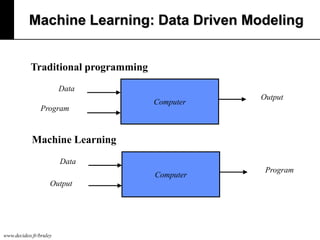
Machine Learning: Data Driven Modeling
Traditional programming
Data
Program

Computer

Output

Machine Learning
Data
Computer
Output

www.decideo.fr/bruley

Program
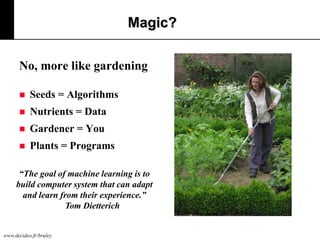
Magic?
No, more like gardening


Seeds = Algorithms



Nutrients = Data



Gardener = You



Plants = Programs

“The goal of machine learning is to
build computer system that can adapt
and learn from their experience.”
Tom Dietterich

www.decideo.fr/bruley
The black-box approach

 Statistical

A

models are not generators, they are predictors

predictor is a function from observation X to action Z

 After

action is taken, outcome Y is observed which implies
loss L (a real valued number)

 Goal:

find a predictor with small loss (in expectation, with
high probability, cumulative, …)

www.decideo.fr/bruley
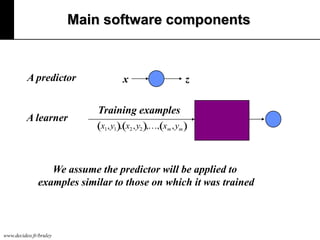
Main software components

A predictor

A learner

x

z

Training examples
x1,y1 , x2 ,y2 ,, xm ,ym

We assume the predictor will be applied to
examples similar to those on which it was trained

www.decideo.fr/bruley
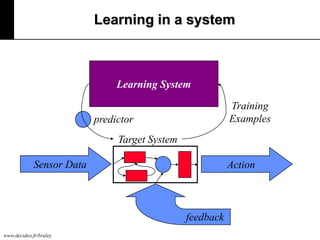
Learning in a system

Learning System
Training
Examples

predictor

Target System
Sensor Data

Action

feedback
www.decideo.fr/bruley
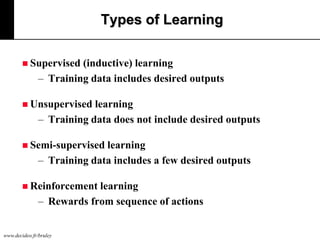
Types of Learning
 Supervised

(inductive) learning
– Training data includes desired outputs

 Unsupervised

learning
– Training data does not include desired outputs

 Semi-supervised

learning
– Training data includes a few desired outputs

 Reinforcement

learning
– Rewards from sequence of actions

www.decideo.fr/bruley
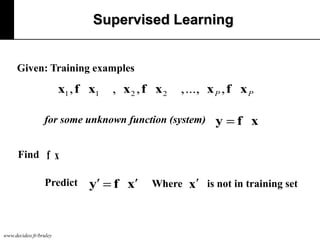
Supervised Learning

Given: Training examples

x1 , f x1

, x2 , f x2

,..., x P , f x P

for some unknown function (system) y

f x

Find f x
Predict

www.decideo.fr/bruley

y

f x

Where x

is not in training set
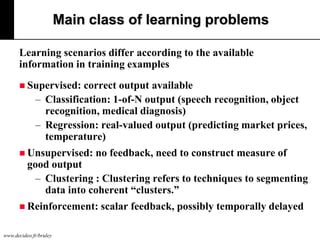
Main class of learning problems
Learning scenarios differ according to the available
information in training examples
 Supervised:

correct output available
– Classification: 1-of-N output (speech recognition, object
recognition, medical diagnosis)
– Regression: real-valued output (predicting market prices,
temperature)

 Unsupervised:

no feedback, need to construct measure of

good output
– Clustering : Clustering refers to techniques to segmenting
data into coherent “clusters.”
 Reinforcement:

www.decideo.fr/bruley

scalar feedback, possibly temporally delayed
And more …


Time series analysis



Dimension reduction



Model selection



Generic methods



Graphical models

www.decideo.fr/bruley
Why do we need learning?

 Computers

–
–
–
–
 For

need functions that map highly variable data:
Speech recognition: Audio signal -> words
Image analysis: Video signal -> objects
Bio-Informatics: Micro-array Images -> gene function
Data Mining: Transaction logs -> customer classification
accuracy, functions must be tuned to fit the data source

 For

real-time processing, function computation has to be
very fast

www.decideo.fr/bruley
A very small set of uses of ML


Vision
– Object recognition, Hand writing recognition, Emotion
labeling, Surveillance, …



Sound
– Speech recognition, music genre classification, …

 Text

– Document labeling, Part of speech tagging,
Summarization, …


Finance
– Algorithmic trading, …



Medical, Biological, Chemical, and on, and on, …

www.decideo.fr/bruley
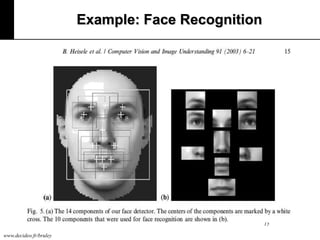
Example: Face Recognition

15
www.decideo.fr/bruley
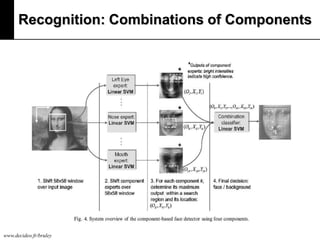
Recognition: Combinations of Components

www.decideo.fr/bruley
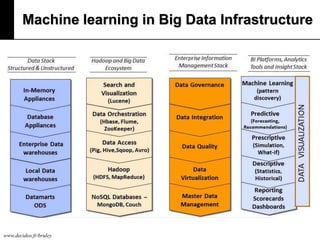
Machine learning in Big Data Infrastructure

www.decideo.fr/bruley
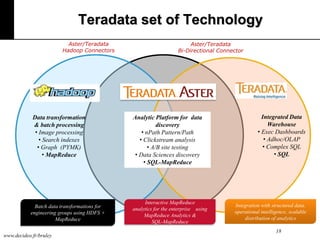
Teradata set of Technology
Aster/Teradata
Hadoop Connectors

Data transformation
& batch processing
• Image processing
• Search indexes
• Graph (PYMK)
• MapReduce

Batch data transformations for
engineering groups using HDFS +
MapReduce
www.decideo.fr/bruley

Aster/Teradata
Bi-Directional Connector

Analytic Platform for data
discovery
• nPath Pattern/Path
• Clickstream analysis
• A/B site testing
• Data Sciences discovery
• SQL-MapReduce

Interactive MapReduce
analytics for the enterprise using
MapReduce Analytics &
SQL-MapReduce

Integrated Data
Warehouse
• Exec Dashboards
• Adhoc/OLAP
• Complex SQL
• SQL

Integration with structured data,
operational intelligence, scalable
distribution of analytics
18

Big Data and Machine Learning

  • 1.
    Machine Learning michel.bruley@teradata.com Extract fromvarious presentations: University of Nebraska, Scott, Freund, Domingo, Hong, … www.decideo.fr/bruley
  • 2.
    What is learning?  “Learningis making useful changes in our minds” Marvin Minsky  “Learning is constructing or modifying representations of what is being experienced” Ryszard Michalski  “Learning denotes changes in a system that ... enable a system to do the same task more efficiently the next time” Herbert Simon www.decideo.fr/bruley 2
  • 3.
    What is MachineLearning?    Definition – A program learns from experience E with respect to some class of tasks T and performance measure P, if its performance at task T, as measured by P, improves with experience E Learning systems are not directly programmed to solve a problem, instead develop own program based on – examples of how they should behave – from trial-and-error experience trying to solve the problem Another definition – For the purposes of computer, machine learning should really be viewed as a set of techniques for leveraging data – Machine Learning algorithms discover the relationships between the variables of a system (input, output and hidden) from direct samples of the system – These algorithms originate from many fields (Statistics, mathematics, theoretical computer science, physics, neuroscience, etc.) www.decideo.fr/bruley
  • 4.
    Machine Learning: DataDriven Modeling Traditional programming Data Program Computer Output Machine Learning Data Computer Output www.decideo.fr/bruley Program
  • 5.
    Magic? No, more likegardening  Seeds = Algorithms  Nutrients = Data  Gardener = You  Plants = Programs “The goal of machine learning is to build computer system that can adapt and learn from their experience.” Tom Dietterich www.decideo.fr/bruley
  • 6.
    The black-box approach Statistical A models are not generators, they are predictors predictor is a function from observation X to action Z  After action is taken, outcome Y is observed which implies loss L (a real valued number)  Goal: find a predictor with small loss (in expectation, with high probability, cumulative, …) www.decideo.fr/bruley
  • 7.
    Main software components Apredictor A learner x z Training examples x1,y1 , x2 ,y2 ,, xm ,ym We assume the predictor will be applied to examples similar to those on which it was trained www.decideo.fr/bruley
  • 8.
    Learning in asystem Learning System Training Examples predictor Target System Sensor Data Action feedback www.decideo.fr/bruley
  • 9.
    Types of Learning Supervised (inductive) learning – Training data includes desired outputs  Unsupervised learning – Training data does not include desired outputs  Semi-supervised learning – Training data includes a few desired outputs  Reinforcement learning – Rewards from sequence of actions www.decideo.fr/bruley
  • 10.
    Supervised Learning Given: Trainingexamples x1 , f x1 , x2 , f x2 ,..., x P , f x P for some unknown function (system) y f x Find f x Predict www.decideo.fr/bruley y f x Where x is not in training set
  • 11.
    Main class oflearning problems Learning scenarios differ according to the available information in training examples  Supervised: correct output available – Classification: 1-of-N output (speech recognition, object recognition, medical diagnosis) – Regression: real-valued output (predicting market prices, temperature)  Unsupervised: no feedback, need to construct measure of good output – Clustering : Clustering refers to techniques to segmenting data into coherent “clusters.”  Reinforcement: www.decideo.fr/bruley scalar feedback, possibly temporally delayed
  • 12.
    And more …  Timeseries analysis  Dimension reduction  Model selection  Generic methods  Graphical models www.decideo.fr/bruley
  • 13.
    Why do weneed learning?  Computers – – – –  For need functions that map highly variable data: Speech recognition: Audio signal -> words Image analysis: Video signal -> objects Bio-Informatics: Micro-array Images -> gene function Data Mining: Transaction logs -> customer classification accuracy, functions must be tuned to fit the data source  For real-time processing, function computation has to be very fast www.decideo.fr/bruley
  • 14.
    A very smallset of uses of ML  Vision – Object recognition, Hand writing recognition, Emotion labeling, Surveillance, …  Sound – Speech recognition, music genre classification, …  Text – Document labeling, Part of speech tagging, Summarization, …  Finance – Algorithmic trading, …  Medical, Biological, Chemical, and on, and on, … www.decideo.fr/bruley
  • 15.
  • 16.
    Recognition: Combinations ofComponents www.decideo.fr/bruley
  • 17.
    Machine learning inBig Data Infrastructure www.decideo.fr/bruley
  • 18.
    Teradata set ofTechnology Aster/Teradata Hadoop Connectors Data transformation & batch processing • Image processing • Search indexes • Graph (PYMK) • MapReduce Batch data transformations for engineering groups using HDFS + MapReduce www.decideo.fr/bruley Aster/Teradata Bi-Directional Connector Analytic Platform for data discovery • nPath Pattern/Path • Clickstream analysis • A/B site testing • Data Sciences discovery • SQL-MapReduce Interactive MapReduce analytics for the enterprise using MapReduce Analytics & SQL-MapReduce Integrated Data Warehouse • Exec Dashboards • Adhoc/OLAP • Complex SQL • SQL Integration with structured data, operational intelligence, scalable distribution of analytics 18