UNIVERSITY OF CAMBRIDGE INTERNATIONAL EXAMINATIONS
Cambridge International Level 3 Pre-U Certificate
Short Course

1347/01

MATHEMATICS (STATISTICS WITH PURE MATHEMATICS)
Paper 1 Pure Mathematics

For Examination from 2012

SPECIMEN PAPER
1 hour 45 minutes
Additional Materials:

Answer Booklet/Paper
Graph Paper
List of Formulae (MF21)

READ THESE INSTRUCTIONS FIRST
If you have been given an Answer Booklet, follow the instructions on the front cover of the Booklet.
Write your Centre number, candidate number and name on all the work you hand in.
Write in dark blue or black pen.
You may use a soft pencil for any diagrams or graphs.
Do not use staples, paper clips, highlighters, glue or correction fluid.
Answer all the questions.
Give non-exact numerical answers correct to 3 significant figures, or 1 decimal place in the case of angles in
degrees, unless a different level of accuracy is specified in the question.
The use of an electronic calculator is expected, where appropriate.
You are reminded of the need for clear presentation in your answers.
At the end of the examination, fasten all your work securely together.
The number of marks is given in brackets [ ] at the end of each question or part question.
The total number of marks for this paper is 65.

This document consists of 3 printed pages and 1 blank page.

© UCLES 2011

[Turn over
2
1

A farmer has a rectangular field. The length of the field is 10 metres more than its width and the area
of the field is 39 square metres. The farmer writes this as x(x + 10) = 39.
(i) By completing the square, express x(x + 10) = 39 in the form (x + a)2 = b, where a and b are
constants to be found.
[2]
(ii) Hence write down the width and length of the field.

2

[1]

The sensitivity, S (dB), of a loudspeaker at different acoustic efficiency percentages, E (%), is given
in the table.

E

1

2

5

10

20

S

92

95

99

102

105

It is claimed that there is a relationship between E and S of the form S = kEn .
When the values of ln S are plotted against the values of ln E the points approximately fit a straight
line with gradient 0.0445.
(i) Deduce values for k and n.
(ii) What sensitivity would you expect from a loudspeaker with 15% efficiency?

3

[3]
[2]

Jack needs to know the value of (2.03)5 but he cannot be bothered to find his calculator.
(i) Write down and simplify the expansion of (2 + 3x)5 in ascending powers of x as far as the term
[4]
in x2 .
(ii) Use your answer to part (i) to calculate an approximate value for (2.03)5 and show that it agrees
with the value from your calculator to 2 decimal places.
[2]

4

(i) Show that at the points of intersection of y = 3x2 − 2x + 2 and y = 4x + k the x-values must satisfy
the quadratic equation 3x2 − 6x + (2 − k) = 0.
[1]
(ii) Calculate the discriminant of 3x2 − 6x + (2 − k) and hence find the point on the curve
y = 3x2 − 2x + 2 where the tangent is parallel to the line joining (−1, 7) and (3, 23).
[5]

5

A triangle is formed by joining the points A (1, 2), B (5, 5) and C (2, 9).
(i) Calculate the length of the line segment AC, giving your answer in surd form.

[1]

(ii) Calculate the gradient of AB and the gradient of BC. What can you deduce about the line
segments AB and BC?
[3]
(iii) Give the centre of the circle that passes through A, B and C . Also give the radius of the circle,
√
expressing your answer in terms of 2.
[3]

© UCLES 2011

1347/01/SP/12
3
6

In his Anthropology coursework, Tom is trying to construct a function to model the cross-sectional
area, y, of a small ceramic pot in terms of its depth, x. He needs the graph of the function to have a
minimum turning point at (0, 8). He has decided to try a function of the form y = −2x4 + ax2 + bx + 8.
d2 y
and
dx2
show that setting a > 0 will guarantee that the turning point is a minimum turning point.
[4]

(i) Show that for the function to have a turning point at (0, 8), b must equal 0. Calculate

(ii) Find, in terms of a, the x-values of the other stationary points on the graph of Tom’s function.
[3]

Tom decides to use the function y = −2x4 + 6x2 + 8. He then realises that he has recorded the x-values
in his coursework in centimetres instead of metres and the y-values in cm2 instead of m2 .
(iii) Explain why Tom should change his function to y = −20 000x4 + 6x2 + 0.0008.

[2]

The function y = −20 000x4 + 6x2 + 0.0008 gives the cross-sectional area, y m2 , as a function of the
depth, x m, where 0 ≤ x ≤ 0.02.
(iv) Use integration to calculate the volume of the ceramic pot in m3 .

7

[4]

(i) The graph of the quadratic polynomial y = (x − A)2 + B has its minimum turning point at (−1, 7).
[3]
Show that the point (3, 23) also lies on the curve.
(ii) The graph of a second quadratic polynomial, y = ax2 + bx + c, intersects the first graph at (−1, 7)
and (3, 23). Find, in terms of a, the equation of the tangent to the second graph that is parallel
to the chord joining the two points of intersection.
[11]
(iii) The area enclosed between the two quadratic graphs is 472 square units. Find the coordinates
of the point where the perpendicular bisector of the two points of intersection meets the tangent
from part (ii).
[11]

© UCLES 2011

1347/01/SP/12
4
BLANK PAGE

Permission to reproduce items where third-party owned material protected by copyright is included has been sought and cleared where possible. Every reasonable
effort has been made by the publisher (UCLES) to trace copyright holders, but if any items requiring clearance have unwittingly been included, the publisher will
be pleased to make amends at the earliest possible opportunity.
University of Cambridge International Examinations is part of the Cambridge Assessment Group. Cambridge Assessment is the brand name of University of
Cambridge Local Examinations Syndicate (UCLES), which is itself a department of the University of Cambridge.
1347/01/SP/12
UNIVERSITY OF CAMBRIDGE INTERNATIONAL EXAMINATIONS
Cambridge International Level 3 Pre-U Certificate
Short Course

MATHEMATICS (STATISTICS WITH PURE MATHEMATICS)

1347/01
For Examination from 2012

Paper 1 Pure Mathematics
SPECIMEN MARK SCHEME

MAXIMUM MARK: 65

This document consists of 4 printed pages.

© UCLES 2011

[Turn over
2
1

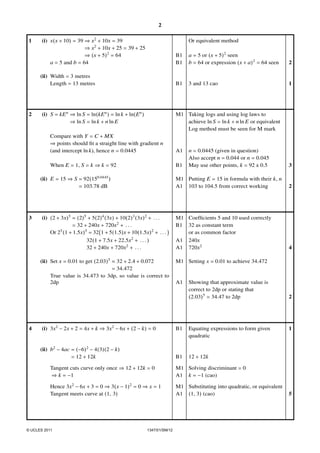
(i) x(x + 10) = 39 ⇒ x2 + 10x = 39
⇒ x2 + 10x + 25 = 39 + 25
⇒ (x + 5)2 = 64
a = 5 and b = 64

Or equivalent method

a = 5 or (x + 5)2 seen
b = 64 or expression (x + a)2 = 64 seen

2

(ii) Width = 3 metres
Length = 13 metres

2

B1
B1

B1

3 and 13 cao

1

(i) S = kE n ⇒ ln S = ln(kE n ) = ln k + ln(En )
⇒ ln S = ln k + n ln E

M1 Taking logs and using log laws to
achieve ln S = ln k + n ln E or equivalent
Log method must be seen for M mark

Compare with Y = C + MX
⇒ points should fit a straight line with gradient n
(and intercept ln k), hence n = 0.0445
When E = 1, S = k ⇒ k = 92

A1
B1

n = 0.0445 (given in question)
Also accept n = 0.044 or n = 0.045
May use other points, k = 92 ± 0.5

3

(ii) E = 15 ⇒ S = 92(150.0445 )
= 103.78 dB

2

(i) (2 + 3x)5 = (2)5 + 5(2)4 (3x) + 10(2)3 (3x)2 + . . .
= 32 + 240x + 720x2 + . . .
5
Or 2 (1 + 1.5x)5 = 32 1 + 5(1.5)x + 10(1.5x)2 + . . .
32(1 + 7.5x + 22.5x2 + . . . )
32 + 240x + 720x2 + . . .

M1 Coefficients 5 and 10 used correctly
B1 32 as constant term
or as common factor
A1 240x
A1 720x2

4

(ii) Set x = 0.01 to get (2.03)5 ≈ 32 + 2.4 + 0.072
= 34.472
True value is 34.473 to 3dp, so value is correct to
2dp

3

M1 Putting E = 15 in formula with their k, n
A1 103 to 104.5 from correct working

M1 Setting x = 0.01 to achieve 34.472
A1

Showing that approximate value is
correct to 2dp or stating that
(2.03)5 = 34.47 to 2dp

(i) 3x2 − 2x + 2 = 4x + k ⇒ 3x2 − 6x + (2 − k) = 0

B1

Equating expressions to form given
quadratic

(ii) b2 − 4ac = (−6)2 − 4(3)(2 − k)
= 12 + 12k

4

B1

2

12 + 12k

Tangent cuts curve only once ⇒ 12 + 12k = 0
⇒ k = −1

M1 Solving discriminant = 0
A1 k = −1 (cao)

Hence 3x2 − 6x + 3 = 0 ⇒ 3(x − 1)2 = 0 ⇒ x = 1
Tangent meets curve at (1, 3)

M1 Substituting into quadratic, or equivalent
A1 (1, 3) (cao)

1

© UCLES 2011

1347/01/SM/12

5
3
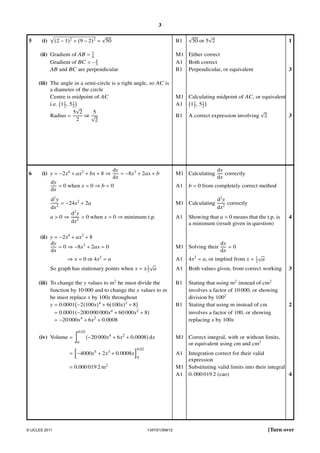
5

√
(2 − 1)2 + (9 − 2)2 = 50

(i)

B1

(ii) Gradient of AB = 3
4
Gradient of BC = − 4
3
AB and BC are perpendicular

(i) y = −2x4 + ax2 + bx + 8 ⇒

√
50 or 5 2

1

M1 Either correct
A1 Both correct
B1 Perpendicular, or equivalent

(iii) The angle in a semi-circle is a right angle, so AC is
a diameter of the circle
Centre is midpoint of AC
i.e. 1 1 , 5 1
2
2√
5 2
5
Radius =
or √
2
2

6

√

dy
= −8x3 + 2ax + b
dx

dy
= 0 when x = 0 ⇒ b = 0
dx

M1 Calculating midpoint of AC, or equivalent
A1 1 1 , 5 1
2
2
√
3
B1 A correct expression involving 2

M1 Calculating
A1

d2 y
= −24x2 + 2a
dx2
d2 y
a > 0 ⇒ 2 > 0 when x = 0 ⇒ minimum t.p.
dx
(ii) y = −2x4 + ax2 + 8
dy
= 0 ⇒ −8x3 + 2ax = 0
dx

b = 0 from completely correct method

M1 Calculating
A1

dy
correctly
dx

d2 y
correctly
d x2

Showing that a > 0 means that the t.p. is
a minimum (result given in question)

M1 Solving their

⇒ x = 0 or 4x2 = a

3

dy
=0
dx

√

A1

So graph has stationary points when x =

±1
2

√

a

(iii) To change the y values to m2 he must divide the
function by 10 000 and to change the x values to m
he must replace x by 100x throughout
y = 0.0001 −2(100x)4 + 6(100x)2 + 8
= 0.0001(−200 000 000x4 + 60 000x2 + 8)
= −20 000x4 + 6x2 + 0.0008

4x2 = a, or implied from x =

A1

Both values given, from correct working

B1

Stating that using m2 instead of cm2
involves a factor of 10 000, or showing
division by 1002
Stating that using m instead of cm
involves a factor of 100, or showing
replacing x by 100x

B1

1
2

4

a
3

2

0.02

(iv) Volume =

0

(−20 000x4 + 6x2 + 0.0008) dx

= −4000x5 + 2x3 + 0.0008x

0.02

A1

Integration correct for their valid
expression
M1 Substituting valid limits into their integral
A1 0. 000 019 2 (cao)
4

0

= 0.000 019 2 m2

© UCLES 2011

M1 Correct integral, with or without limits,
or equivalent using cm and cm2

1347/01/SM/12

[Turn over
4
7

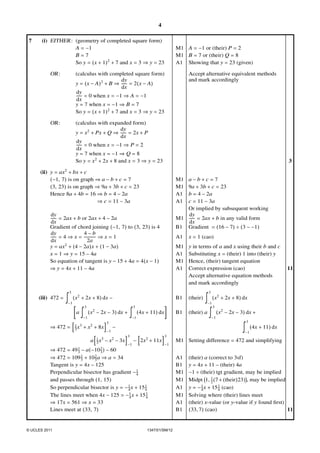
(i) EITHER : (geometry of completed square form)
A = −1
B=7
So y = (x + 1)2 + 7 and x = 3 ⇒ y = 23

OR :

(calculus with completed square form)
dy
y = (x − A )2 + B ⇒
= 2(x − A)
dx
dy
= 0 when x = −1 ⇒ A = −1
dx
y = 7 when x = −1 ⇒ B = 7
So y = (x + 1)2 + 7 and x = 3 ⇒ y = 23

OR :

M1 A = −1 or (their) P = 2
M1 B = 7 or (their) Q = 8
A1 Showing that y = 23 (given)

(calculus with expanded form)
dy
y = x2 + Px + Q ⇒
= 2x + P
dx
dy
= 0 when x = −1 ⇒ P = 2
dx
y = 7 when x = −1 ⇒ Q = 8
So y = x2 + 2x + 8 and x = 3 ⇒ y = 23

Accept alternative equivalent methods
and mark accordingly

3

(ii) y = ax2 + bx + c
(−1, 7) is on graph ⇒ a − b + c = 7
(3, 23) is on graph ⇒ 9a + 3b + c = 23
Hence 8a + 4b = 16 ⇒ b = 4 − 2a
⇒ c = 11 − 3a

a−b+c=7
9a + 3b + c = 23
b = 4 − 2a
c = 11 − 3a
Or implied by subsequent working
dy
M1
= 2ax + b in any valid form
dx
B1 Gradient = (16 − 7) ÷ (3 − −1)
M1
M1
A1
A1

dy
= 2ax + b or 2ax + 4 − 2a
dx
Gradient of chord joining (−1, 7) to (3, 23) is 4
dy
4−b
=4⇒x=
⇒x=1
dx
2a
y = ax2 + (4 − 2a)x + (1 − 3a)
x = 1 ⇒ y = 15 − 4a
So equation of tangent is y − 15 + 4a = 4(x − 1)
⇒ y = 4x + 11 − 4a

A1

x = 1 (cao)

M1
A1
M1
A1

y in terms of a and x using their b and c
Substituting x = (their) 1 into (their) y
Hence, (their) tangent equation
Correct expression (cao)
Accept alternative equation methods
and mark accordingly

B1

(their)

3

(iii) 472 =

−1

3

( x2 + 2 x + 8 ) d x −
3

a
−1

⇒ 472 =

1 3
3x

−1

3

(x2 − 2x − 3) dx +
2

+ x + 8x

3
−1

−1

(4x + 11) dx

B1

3
−1

− 2x2 + 11x

⇒ 472 = 49 1 − a(−10 2 ) − 60
3
3
⇒ 472 = 109 1 + 10 2 a ⇒ a = 34
3
3
Tangent is y = 4x − 125
Perpendicular bisector has gradient − 1
4
and passes through (1, 15)
So perpendicular bisector is y = − 1 x + 15 1
4
4
The lines meet when 4x − 125 = − 1 x + 15 1
4
4
⇒ 17x = 561 ⇒ x = 33
Lines meet at (33, 7)

(x2 + 2x + 8) dx
3

(their) a
−1

−

a 1 x3 − x2 − 3x
3

© UCLES 2011

11

1347/01/SM/12

3
−1

3
−1

(x2 − 2x − 3) dx +
(4x + 11) dx

M1 Setting difference = 472 and simplifying
A1
B1
M1
M1
A1
M1
A1
B1

(their) a (correct to 3sf)
y = 4x + 11 − (their) 4a
−1 ÷ (their) tgt gradient, may be implied
Midpt 1, 1 (7 + (their)23) , may be implied
2
y = − 1 x + 15 1 (cao)
4
4
Solving where (their) lines meet
(their) x-value (or y-value if y found first)
(33, 7) (cao)
11
UNIVERSITY OF CAMBRIDGE INTERNATIONAL EXAMINATIONS
Cambridge International Level 3 Pre-U Certificate
Short Course

1347/02

MATHEMATICS (STATISTICS WITH PURE MATHEMATICS)

For Examination from 2012

Paper 2 Statistics
SPECIMEN PAPER

2 hours
Additional Materials:

Answer Booklet/Paper
Graph Paper
List of Formulae (MF21)

READ THESE INSTRUCTIONS FIRST
If you have been given an Answer Booklet, follow the instructions on the front cover of the Booklet.
Write your Centre number, candidate number and name on all the work you hand in.
Write in dark blue or black pen.
You may use a soft pencil for any diagrams or graphs.
Do not use staples, paper clips, highlighters, glue or correction fluid.
Answer all the questions.
Give non-exact numerical answers correct to 3 significant figures, or 1 decimal place in the case of angles in
degrees, unless a different level of accuracy is specified in the question.
The use of an electronic calculator is expected, where appropriate.
You are reminded of the need for clear presentation in your answers.
At the end of the examination, fasten all your work securely together.
The number of marks is given in brackets [ ] at the end of each question or part question.
The total number of marks for this paper is 80.

This document consists of 6 printed pages.

© UCLES 2011

[Turn over
2
1

The table shows information about the twenty most densely populated countries in the world.
Country

Population

Rank

Land Area (km2 )

Rank

Population density

Monaco
Singapore
Malta
Maldives
Bahrain
Bangladesh
Vatican City
Barbados
Nauru
Mauritius
South Korea
San Marino
Tuvalu
Netherlands
Lebanon
Belgium
Japan
India
Marshall Islands
Rwanda

32 410
4 425 700
398 500
349 100
688 300
144 319 600
920
279 300
13 050
1 230 600
48 422 600
28 800
11 640
16 407 500
3 826 000
10 364 400
127 417 200
1 080 264 400
59 070
8 440 800

16
8
12
13
11
2
20
14
18
10
4
17
19
5
9
6
3
1
15
7

2
693
316
300
665
144 000
1
431
21
2 040
98 480
61
26
41 526
10 400
30 510
377 835
3 287 590
181
26 338

19
10
13
14
11
3
20
12
18
9
4
16
17
5
8
6
2
1
15
7

16 205
6 386
1 261
1 164
1 035
1 002
920
648
621
603
492
472
448
395
368
340
337
329
326
320

source: http://www.worldatlas.com

(i) Write down the median and quartiles for the populations of these twenty countries. What do
these values tell you about the shape of the distribution of the populations? Identify the countries
for which the population is an outlier for this sample.
[6]
(ii) Explain why it is not appropriate to use the product-moment correlation coefficient as a measure
of correlation between the populations and the areas for these twenty countries. Show that the
value of Spearman’s rank correlation coefficient between the populations and the areas is 0.9789.
[4]

© UCLES 2011

1347/02/SP/12
3
2

Louise has made up two sets of words for a Psychology project. Each set consists of twenty words
written in five groups of four. On card A the words in each group are random; on card B the words in
each group have a common theme.
Card A

Card B

Rabbit

Turnip

Daisy

Lamp

Rabbit

Dog

Cat

Mouse

Scarf

Pebble

Cheese

Pencil

Scarf

Hat

Coat

Gloves

Snow

Triangle

Yacht

Bag

Snow

Rain

Wind

Sun

Green

Pram

Chair

Film

Green

Blue

Red

Yellow

Tennis

Bottle

String

Needle

Tennis

Golf

Hockey

Squash

Louise asks six volunteers to try to memorise the words on card A and another six to try to memorise
the words on card B. Each group is given 30 seconds and is then asked to write down as many of the
words as they can remember.
The number of words that each volunteer remembered correctly is given below.
Card A:
Card B:

4
12

9
18

3
13

14
15

7
5

11
8

(i) Carry out a Wilcoxon rank-sum test, at the 5% level, to test whether card B was easier to
remember than card A.
[4]

Suppose that, instead, Louise had asked six volunteers to try to memorise the words on card A and
had then asked the same six to try to memorise the words on card B. Assume that the results above
represent the paired data showing the number of words remembered correctly from each list by each
of these six volunteers.
(ii) Carry out a Wilcoxon matched-pairs signed-rank test, at the 5% level, to test whether card B was
easier to remember than card A.
[4]
(iii) Apart from changing the words on the lists, give one way in which Louise could have improved
the design of her experiment in part (i), and a different way in which she could have improved
the design of the experiment in part (ii).
[2]

© UCLES 2011

1347/02/SP/12

[Turn over
4
3

An article from the organic coffee producers association claimed that 5% of the coffee bought in the
UK is made with beans from fair-trade sources.
A high-street coffee vendor sells different types of coffee, some of which are made with beans from
fair-trade sources. One day he sells 10 cups of coffee in the first half hour of trading. He uses
a binomial B(n, p) distribution to model the number of these cups that are made with beans from
fair-trade sources.
(i) Calculate the probability that at least 2 of the 10 cups are made with beans from fair-trade sources.
State the assumptions you have made.
[4]

The vendor finds that exactly 1 of the 10 cups was made with beans from fair-trade sources. He claims
that this shows that more than 5% of the coffee bought in his shop is made with beans from fair-trade
sources.
(ii) Test whether this result supports the vendor’s claim, assuming that a binomial model is valid.
Use a 20% level of significance for your test.
[4]

Each day for a month the vendor records how many of the first ten cups of coffee sold were made
with beans from fair-trade sources. His results are given below.
Number of cups made with
beans from fair-trade sources

Number of days

0

4

1

7

2

9

3

6

4

3

5

1

6 or more

0

(iii) Calculate the mean for this sample and hence estimate an appropriate value for the percentage
of the vendor’s coffee sales that are made with beans from fair-trade sources.
[3]
(iv) Use the vendor’s records to calculate an estimate for the population variance. Compare this with
[4]
the theoretical value from B(n, p) using your estimate for p.
(v) Suggest two improvements to the vendor’s sampling method.

© UCLES 2011

1347/02/SP/12

[2]
5
4

An economist records the daily rises and falls of the £ sterling against the US dollar. At the start
of each business day she records the value of £1 in US dollars and then calculates the increase or
decrease from the previous day in $0.001.
She claims that the changes can be modelled using a normal distribution N(0, 100).
(i) Assuming the claim to be true, calculate the probability of a change that is
(a) greater than 16,

[3]

(b) more negative than −0.7.

[3]

Each working week there are five daily changes.
(ii) Assuming the economist’s claim to be true, write down the distribution for the mean of the
weekly changes and calculate the probability of a mean change of between ±7.8.
[4]

One week the economist finds that the five changes are 6, 16, −12, 2, −7.
She puts these values into a spreadsheet and calculates various totals.
A

B

C

D

6

36

5

25

2

16

256

15

225

3

−12

144

169

2

4

−13
1

1

−7

49

−8

64

5

489

0

484

1

4
5
6
7

E

(iii) Use this result to determine a 95% confidence interval for the mean change, assuming that the
changes can be regarded as being a random sample from a normal population.
[6]

The economist then collects data for 100 daily changes. She finds that 25 of the 100 changes were
greater than 9.2 and just one was greater than 29.
(iv) Assuming that a normal model is appropriate and that the data are typical, calculate appropriate
values (to 2 significant figures) for the mean and standard deviation of the daily changes.
[5]

© UCLES 2011

1347/02/SP/12

[Turn over
6
5

A biologist carries out a study into the effect of different chemicals on plant growth. He grows 50
common vetch plants in ordinary conditions, 25 in an environment where the air is polluted with
motor exhaust fumes and 25 in soil polluted with oil. He records what happens to the leaves of the
plants. The frequencies are given in the table.
Grew normally

Spotted leaves

Plant died

TOTAL

Control

31

12

7

50

Polluted air

12

10

3

25

Polluted soil

7

8

10

25

50

30

20

100

TOTAL

The biologist suspects that there is an association between the type of pollution and what happens to
the leaves of the plants. A χ 2 test is to be applied to the data in the contingency table.
(i) State the null and alternative hypotheses for the test.

[1]

(ii) Assuming the null hypothesis to be true, how many of the plants grown in polluted soil would
you expect to have grown normally? Show that the contribution to the χ 2 test statistic from the
cell for plants grown in polluted soil that grew normally is 2.42 to 2 decimal places.
[2]
(iii) Carry out the test at the 5% level of significance. State the conclusion that the biologist should
make.
[8]

The biologist then measures the heights, in cm, of the 50 plants that grew normally. The heights
of the 31 plants in the control group can be modelled using a normal distribution with mean 35 and
variance 9. The heights of the 12 plants grown in polluted air can also be modelled using a normal
distribution with variance 9. The heights of the 7 plants grown in polluted soil cannot be modelled
using a normal distribution.
(iv) The sample mean height for the 12 plants grown in polluted air was 32 cm. Test, at the 5% level,
whether the average height of plants grown in polluted air is significantly less than 35 cm. [6]

It is later found that the heights of common vetch plants grown in polluted air can be modelled using
a normal distribution with mean 31.5 and variance 9.
(v) Calculate the probability of having made a Type I error and of having made a Type II error in
your test from part (iv).
[3]
(vi) Using the data for the 7 plants grown in polluted soil, what test could the biologist use to test
whether the average height of all common vetch plants grown in polluted soil is less than 35 cm?
[2]

Permission to reproduce items where third-party owned material protected by copyright is included has been sought and cleared where possible. Every reasonable
effort has been made by the publisher (UCLES) to trace copyright holders, but if any items requiring clearance have unwittingly been included, the publisher will
be pleased to make amends at the earliest possible opportunity.
University of Cambridge International Examinations is part of the Cambridge Assessment Group. Cambridge Assessment is the brand name of University of
Cambridge Local Examinations Syndicate (UCLES), which is itself a department of the University of Cambridge.
© UCLES 2011

1347/02/SP/12
UNIVERSITY OF CAMBRIDGE INTERNATIONAL EXAMINATIONS
Cambridge International Level 3 Pre-U Certificate
Short Course

MATHEMATICS (STATISTICS WITH PURE MATHEMATICS)

1347/02
For Examination from 2012

Paper 2 Statistics
SPECIMEN MARK SCHEME

MAXIMUM MARK: 80

This document consists of 6 printed pages.

© UCLES 2011

[Turn over
2
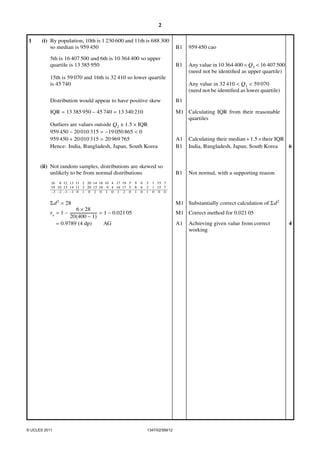
(i) By population, 10th is 1 230 600 and 11th is 688 300
so median is 959 450

B1

959 450 cao

5th is 16 407 500 and 6th is 10 364 400 so upper
quartile is 13 385 950

1

B1

Any value in 10 364 400 < Q3 < 16 407 500
(need not be identified as upper quartile)

15th is 59 070 and 16th is 32 410 so lower quartile
is 45 740

Any value in 32 410 < Q1 < 59 070
(need not be identified as lower quartile)

Distribution would appear to have positive skew

B1

IQR = 13 385 950 − 45 740 = 13 340 210

M1 Calculating IQR from their reasonable
quartiles

Outliers are values outside Q2 ± 1.5 × IQR
959 450 − 20 010 315 = −19 050 865 < 0
959 450 + 20 010 315 = 20 969 765
Hence: India, Bangladesh, Japan, South Korea

(ii) Not random samples, distributions are skewed so
unlikely to be from normal distributions
16 8 12 13 11 2 20 14 18 10 4 17 19 5
19 10 13 14 11 3 20 12 18 9 4 16 17 5
−3 −2 −1 −1 0 1 0 2 0 1 0 1 2 0

9
8
1

6
6
0

3
2
1

A1
B1

Calculating their median + 1.5 × their IQR
6
India, Bangladesh, Japan, South Korea

B1

Not normal, with a supporting reason

1 15 7
1 15 7
0 0 0

Σ d 2 = 28

M1 Substantially correct calculation of Σ d 2

rs = 1 −

M1 Correct method for 0.021 05

6 × 28
= 1 − 0.021 05
20(400 − 1)
= 0.9789 (4 dp)
AG

© UCLES 2011

A1

1347/02/SM/12

Achieving given value from correct
working

4
3
2

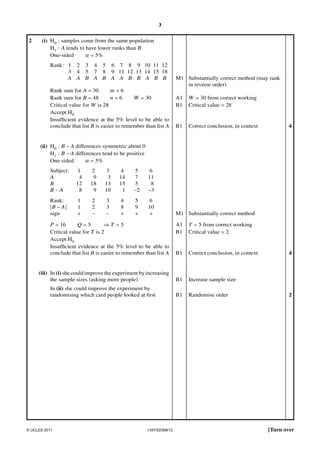
(i) H0 : samples come from the same population
H1 : A tends to have lower ranks than B
One-sided
α = 5%

Rank: 1 2 3 4 5 6 7 8 9 10 11 12
3 4 5 7 8 9 11 12 13 14 15 18
A A B A B A A B B A B B
Rank sum for A = 30
m=6
n=6
W = 30
Rank sum for B = 48
Critical value for W is 28
Accept H0
Insufficient evidence at the 5% level to be able to
conclude that list B is easier to remember than list A

M1 Substantially correct method (may rank
in reverse order)
A1
B1

W = 30 from correct working
Critical value = 28

B1

Correct conclusion, in context

4

(ii) H0 : B − A differences symmetric about 0
H1 : B − A differences tend to be positive
α = 5%
One-sided

Subject:
A
B
B−A

1
4
12
8

2
9
18
9

3
3
13
10

4
14
15
1

5
7
5
−2

6
11
8
−3

Rank:
|B − A|
sign

1
1
+

2
2
−

3
3
−

4
8
+

5
9
+

6
10
+

P = 16
Q=5
⇒T=5
Critical value for T is 2
Accept H0
Insufficient evidence at the 5% level to be able to
conclude that list B is easier to remember than list A

M1 Substantially correct method
A1
B1

T = 5 from correct working
Critical value = 2

B1

Correct conclusion, in context

(iii) In (i) she could improve the experiment by increasing
the sample sizes (asking more people)

B1

Increase sample size

In (ii) she could improve the experiment by
randomising which card people looked at first

B1

Randomise order

© UCLES 2011

1347/02/SM/12

4

2

[Turn over
4
3

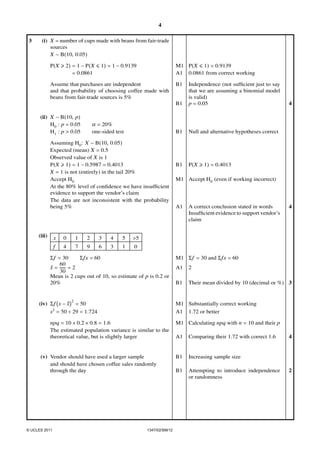
(i) X = number of cups made with beans from fair-trade
sources
X ∼ B(10, 0.05)

P(X ≥ 2) = 1 − P(X ≤ 1) = 1 − 0.9139
= 0.0861

M1 P(X ≤ 1) = 0.9139
A1 0.0861 from correct working

Assume that purchases are independent
and that probability of choosing coffee made with
beans from fair-trade sources is 5%

B1

B1
(ii) X ∼ B(10, p)
H0 : p = 0.05
H1 : p > 0.05

α = 20%
one-sided test

B1

Assuming H0 : X ∼ B(10, 0.05)
Expected (mean) X = 0.5
Observed value of X is 1
P(X ≥ 1) = 1 − 0.5987 = 0.4013
X = 1 is not (entirely) in the tail 20%
Accept H0
At the 80% level of confidence we have insufficient
evidence to support the vendor’s claim
The data are not inconsistent with the probability
being 5%

(iii)

x

0

1

2

3

4

5

4

7

9

6

3

1

Null and alternative hypotheses correct

B1

4

P(X ≥ 1) = 0.4013

M1 Accept H0 (even if working incorrect)

A1

A correct conclusion stated in words
Insufficient evidence to support vendor’s
claim

4

>5

f

0

Σ f = 30
Σ fx = 60
60
x=
=2
30
Mean is 2 cups out of 10, so estimate of p is 0.2 or
20%

2

(iv) Σ f x − x = 50
s2 = 50 ÷ 29 = 1.724

M1 Σ f = 30 and Σ fx = 60
A1

2

B1

Their mean divided by 10 (decimal or %) 3

M1 Substantially correct working
A1 1.72 or better

npq = 10 × 0.2 × 0.8 = 1.6
The estimated population variance is similar to the
theoretical value, but is slightly larger

(v) Vendor should have used a larger sample
and should have chosen coffee sales randomly
through the day

© UCLES 2011

Independence (not sufficient just to say
that we are assuming a binomial model
is valid)
p = 0.05

1347/02/SM/12

M1 Calculating npq with n = 10 and their p
A1

Comparing their 1.72 with correct 1.6

B1

Increasing sample size

B1

Attempting to introduce independence
or randomness

4

2
5
4

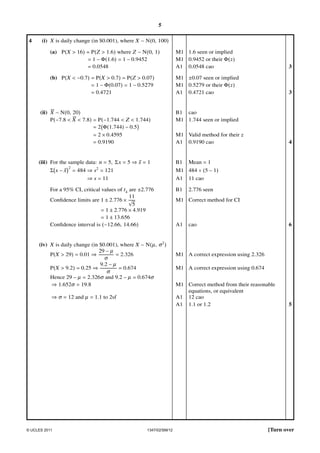
(i) X is daily change (in $0.001), where X ∼ N(0, 100)
(a) P(X > 16) = P(Z > 1.6) where Z ∼ N(0, 1)
= 1 − Φ(1.6) = 1 − 0.9452
= 0.0548

M1 1.6 seen or implied
M1 0.9452 or their Φ( )
A1 0.0548 cao

3

(b) P(X < −0.7) = P(X > 0.7) = P(Z > 0.07)
= 1 − Φ(0.07) = 1 − 0.5279
= 0.4721

M1 ±0.07 seen or implied
M1 0.5279 or their Φ( )
A1 0.4721 cao

3

(ii) X ∼ N(0, 20)
P(−7.8 < X < 7.8) = P(−1.744 < Z < 1.744)
= 2 Φ(1.744) − 0.5
= 2 × 0.4595
= 0.9190
(iii) For the sample data: n = 5, Σ x = 5 ⇒ x = 1
Σ x−x

2

= 484 ⇒ s2 = 121
⇒ s = 11

For a 95% CI, critical values of t4 are ±2.776
11
Confidence limits are 1 ± 2.776 × √
5
= 1 ± 2.776 × 4.919
= 1 ± 13.656
Confidence interval is (−12.66, 14.66)
(iv) X is daily change (in $0.001), where X ∼ N(µ , σ 2 )
29 − µ
P(X > 29) = 0.01 ⇒
= 2.326
σ
9.2 − µ
= 0.674
P(X > 9.2) = 0.25 ⇒
σ
Hence 29 − µ = 2.326σ and 9.2 − µ = 0.674σ
⇒ 1.652σ = 19.8
⇒ σ = 12 and µ = 1.1 to 2sf

© UCLES 2011

1347/02/SM/12

B1 cao
M1 1.744 seen or implied
M1 Valid method for their
A1 0.9190 cao

B1

4

Mean = 1

M1 484 ÷ (5 − 1)
A1 11 cao
B1

2.776 seen

M1 Correct method for CI

A1

cao

6

M1 A correct expression using 2.326
M1 A correct expression using 0.674
M1 Correct method from their reasonable
equations, or equivalent
A1 12 cao
A1 1.1 or 1.2

5

[Turn over
6
5

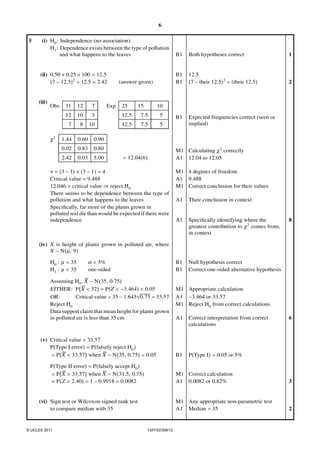
(i) H0 : Independence (no association)
H1 : Dependence exists between the type of pollution
and what happens to the leaves

(ii) 0.50 × 0.25 × 100 = 12.5
(7 − 12.5)2 ÷ 12.5 = 2.42
(iii)

Obs

12

7

12

10

3

12.5

7.5

5

7
χ2

31

8

10

12.5

7.5

0.60
0.83

2

B1

Expected frequencies correct (seen or
implied)

0.03

5.00

10

0.80

2.42

15

12.5
(7 − their 12.5)2 ÷ (their 12.5)

0.90

0.02

25

1

5

1.44

Exp

Both hypotheses correct

B1
B1

(answer given)

B1

= 12.04(6)

ν = (3 − 1) × (3 − 1) = 4
Critical value = 9.488
12.046 > critical value ⇒ reject H0
There seems to be dependence between the type of
pollution and what happens to the leaves
Specifically, far more of the plants grown in
polluted soil die than would be expected if there were
independence

M1 Calculating χ 2 correctly
A1 12.04 to 12.05
M1 4 degrees of freedom
A1 9.488
M1 Correct conclusion for their values
A1

Their conclusion in context

A1

Specifically identifying where the
greatest contribution to χ 2 comes from,
in context

B1
B1

Null hypothesis correct
Correct one-sided alternative hypothesis

8

(iv) X is height of plants grown in polluted air, where
X ∼ N(µ , 9)

H0 : µ = 35
H1 : µ < 35

α = 5%
one-sided

Assuming H0 , X ∼ N(35, 0.75)
EITHER : P X < 32 = P(Z < −3.464) < 0.05
√
OR :
Critical value = 35 − 1.645 0.75 = 33.57
Reject H0
Data support claim that mean height for plants grown
in polluted air is less than 35 cm

(v) Critical value = 33.57
P(Type I error) = P(falsely reject H0 )
= P X < 33.57 when X ∼ N(35, 0.75) = 0.05

P(Type II error) = P(falsely accept H0 )
= P X > 33.57 when X ∼ N(31.5, 0.75)
= P(Z > 2.40) = 1 − 0.9918 = 0.0082

A1

Correct interpretation from correct
calculations

B1

P(Type I) = 0.05 or 5%

M1 Correct calculation
A1 0.0082 or 0.82%

(vi) Sign test or Wilcoxon signed rank test
to compare median with 35

© UCLES 2011

M1 Appropriate calculation
A1 −3.464 or 33.57
M1 Reject H0 from correct calculations

M1 Any appropriate non-parametric test
A1 Median = 35

1347/02/SM/12

6

3

2

129215 specimen-paper-and-mark-schemes

  • 1.
    UNIVERSITY OF CAMBRIDGEINTERNATIONAL EXAMINATIONS Cambridge International Level 3 Pre-U Certificate Short Course 1347/01 MATHEMATICS (STATISTICS WITH PURE MATHEMATICS) Paper 1 Pure Mathematics For Examination from 2012 SPECIMEN PAPER 1 hour 45 minutes Additional Materials: Answer Booklet/Paper Graph Paper List of Formulae (MF21) READ THESE INSTRUCTIONS FIRST If you have been given an Answer Booklet, follow the instructions on the front cover of the Booklet. Write your Centre number, candidate number and name on all the work you hand in. Write in dark blue or black pen. You may use a soft pencil for any diagrams or graphs. Do not use staples, paper clips, highlighters, glue or correction fluid. Answer all the questions. Give non-exact numerical answers correct to 3 significant figures, or 1 decimal place in the case of angles in degrees, unless a different level of accuracy is specified in the question. The use of an electronic calculator is expected, where appropriate. You are reminded of the need for clear presentation in your answers. At the end of the examination, fasten all your work securely together. The number of marks is given in brackets [ ] at the end of each question or part question. The total number of marks for this paper is 65. This document consists of 3 printed pages and 1 blank page. © UCLES 2011 [Turn over
  • 2.
    2 1 A farmer hasa rectangular field. The length of the field is 10 metres more than its width and the area of the field is 39 square metres. The farmer writes this as x(x + 10) = 39. (i) By completing the square, express x(x + 10) = 39 in the form (x + a)2 = b, where a and b are constants to be found. [2] (ii) Hence write down the width and length of the field. 2 [1] The sensitivity, S (dB), of a loudspeaker at different acoustic efficiency percentages, E (%), is given in the table. E 1 2 5 10 20 S 92 95 99 102 105 It is claimed that there is a relationship between E and S of the form S = kEn . When the values of ln S are plotted against the values of ln E the points approximately fit a straight line with gradient 0.0445. (i) Deduce values for k and n. (ii) What sensitivity would you expect from a loudspeaker with 15% efficiency? 3 [3] [2] Jack needs to know the value of (2.03)5 but he cannot be bothered to find his calculator. (i) Write down and simplify the expansion of (2 + 3x)5 in ascending powers of x as far as the term [4] in x2 . (ii) Use your answer to part (i) to calculate an approximate value for (2.03)5 and show that it agrees with the value from your calculator to 2 decimal places. [2] 4 (i) Show that at the points of intersection of y = 3x2 − 2x + 2 and y = 4x + k the x-values must satisfy the quadratic equation 3x2 − 6x + (2 − k) = 0. [1] (ii) Calculate the discriminant of 3x2 − 6x + (2 − k) and hence find the point on the curve y = 3x2 − 2x + 2 where the tangent is parallel to the line joining (−1, 7) and (3, 23). [5] 5 A triangle is formed by joining the points A (1, 2), B (5, 5) and C (2, 9). (i) Calculate the length of the line segment AC, giving your answer in surd form. [1] (ii) Calculate the gradient of AB and the gradient of BC. What can you deduce about the line segments AB and BC? [3] (iii) Give the centre of the circle that passes through A, B and C . Also give the radius of the circle, √ expressing your answer in terms of 2. [3] © UCLES 2011 1347/01/SP/12
  • 3.
    3 6 In his Anthropologycoursework, Tom is trying to construct a function to model the cross-sectional area, y, of a small ceramic pot in terms of its depth, x. He needs the graph of the function to have a minimum turning point at (0, 8). He has decided to try a function of the form y = −2x4 + ax2 + bx + 8. d2 y and dx2 show that setting a > 0 will guarantee that the turning point is a minimum turning point. [4] (i) Show that for the function to have a turning point at (0, 8), b must equal 0. Calculate (ii) Find, in terms of a, the x-values of the other stationary points on the graph of Tom’s function. [3] Tom decides to use the function y = −2x4 + 6x2 + 8. He then realises that he has recorded the x-values in his coursework in centimetres instead of metres and the y-values in cm2 instead of m2 . (iii) Explain why Tom should change his function to y = −20 000x4 + 6x2 + 0.0008. [2] The function y = −20 000x4 + 6x2 + 0.0008 gives the cross-sectional area, y m2 , as a function of the depth, x m, where 0 ≤ x ≤ 0.02. (iv) Use integration to calculate the volume of the ceramic pot in m3 . 7 [4] (i) The graph of the quadratic polynomial y = (x − A)2 + B has its minimum turning point at (−1, 7). [3] Show that the point (3, 23) also lies on the curve. (ii) The graph of a second quadratic polynomial, y = ax2 + bx + c, intersects the first graph at (−1, 7) and (3, 23). Find, in terms of a, the equation of the tangent to the second graph that is parallel to the chord joining the two points of intersection. [11] (iii) The area enclosed between the two quadratic graphs is 472 square units. Find the coordinates of the point where the perpendicular bisector of the two points of intersection meets the tangent from part (ii). [11] © UCLES 2011 1347/01/SP/12
  • 4.
    4 BLANK PAGE Permission toreproduce items where third-party owned material protected by copyright is included has been sought and cleared where possible. Every reasonable effort has been made by the publisher (UCLES) to trace copyright holders, but if any items requiring clearance have unwittingly been included, the publisher will be pleased to make amends at the earliest possible opportunity. University of Cambridge International Examinations is part of the Cambridge Assessment Group. Cambridge Assessment is the brand name of University of Cambridge Local Examinations Syndicate (UCLES), which is itself a department of the University of Cambridge. 1347/01/SP/12
  • 5.
    UNIVERSITY OF CAMBRIDGEINTERNATIONAL EXAMINATIONS Cambridge International Level 3 Pre-U Certificate Short Course MATHEMATICS (STATISTICS WITH PURE MATHEMATICS) 1347/01 For Examination from 2012 Paper 1 Pure Mathematics SPECIMEN MARK SCHEME MAXIMUM MARK: 65 This document consists of 4 printed pages. © UCLES 2011 [Turn over
  • 6.
    2 1 (i) x(x +10) = 39 ⇒ x2 + 10x = 39 ⇒ x2 + 10x + 25 = 39 + 25 ⇒ (x + 5)2 = 64 a = 5 and b = 64 Or equivalent method a = 5 or (x + 5)2 seen b = 64 or expression (x + a)2 = 64 seen 2 (ii) Width = 3 metres Length = 13 metres 2 B1 B1 B1 3 and 13 cao 1 (i) S = kE n ⇒ ln S = ln(kE n ) = ln k + ln(En ) ⇒ ln S = ln k + n ln E M1 Taking logs and using log laws to achieve ln S = ln k + n ln E or equivalent Log method must be seen for M mark Compare with Y = C + MX ⇒ points should fit a straight line with gradient n (and intercept ln k), hence n = 0.0445 When E = 1, S = k ⇒ k = 92 A1 B1 n = 0.0445 (given in question) Also accept n = 0.044 or n = 0.045 May use other points, k = 92 ± 0.5 3 (ii) E = 15 ⇒ S = 92(150.0445 ) = 103.78 dB 2 (i) (2 + 3x)5 = (2)5 + 5(2)4 (3x) + 10(2)3 (3x)2 + . . . = 32 + 240x + 720x2 + . . . 5 Or 2 (1 + 1.5x)5 = 32 1 + 5(1.5)x + 10(1.5x)2 + . . . 32(1 + 7.5x + 22.5x2 + . . . ) 32 + 240x + 720x2 + . . . M1 Coefficients 5 and 10 used correctly B1 32 as constant term or as common factor A1 240x A1 720x2 4 (ii) Set x = 0.01 to get (2.03)5 ≈ 32 + 2.4 + 0.072 = 34.472 True value is 34.473 to 3dp, so value is correct to 2dp 3 M1 Putting E = 15 in formula with their k, n A1 103 to 104.5 from correct working M1 Setting x = 0.01 to achieve 34.472 A1 Showing that approximate value is correct to 2dp or stating that (2.03)5 = 34.47 to 2dp (i) 3x2 − 2x + 2 = 4x + k ⇒ 3x2 − 6x + (2 − k) = 0 B1 Equating expressions to form given quadratic (ii) b2 − 4ac = (−6)2 − 4(3)(2 − k) = 12 + 12k 4 B1 2 12 + 12k Tangent cuts curve only once ⇒ 12 + 12k = 0 ⇒ k = −1 M1 Solving discriminant = 0 A1 k = −1 (cao) Hence 3x2 − 6x + 3 = 0 ⇒ 3(x − 1)2 = 0 ⇒ x = 1 Tangent meets curve at (1, 3) M1 Substituting into quadratic, or equivalent A1 (1, 3) (cao) 1 © UCLES 2011 1347/01/SM/12 5
  • 7.
    3 5 √ (2 − 1)2+ (9 − 2)2 = 50 (i) B1 (ii) Gradient of AB = 3 4 Gradient of BC = − 4 3 AB and BC are perpendicular (i) y = −2x4 + ax2 + bx + 8 ⇒ √ 50 or 5 2 1 M1 Either correct A1 Both correct B1 Perpendicular, or equivalent (iii) The angle in a semi-circle is a right angle, so AC is a diameter of the circle Centre is midpoint of AC i.e. 1 1 , 5 1 2 2√ 5 2 5 Radius = or √ 2 2 6 √ dy = −8x3 + 2ax + b dx dy = 0 when x = 0 ⇒ b = 0 dx M1 Calculating midpoint of AC, or equivalent A1 1 1 , 5 1 2 2 √ 3 B1 A correct expression involving 2 M1 Calculating A1 d2 y = −24x2 + 2a dx2 d2 y a > 0 ⇒ 2 > 0 when x = 0 ⇒ minimum t.p. dx (ii) y = −2x4 + ax2 + 8 dy = 0 ⇒ −8x3 + 2ax = 0 dx b = 0 from completely correct method M1 Calculating A1 dy correctly dx d2 y correctly d x2 Showing that a > 0 means that the t.p. is a minimum (result given in question) M1 Solving their ⇒ x = 0 or 4x2 = a 3 dy =0 dx √ A1 So graph has stationary points when x = ±1 2 √ a (iii) To change the y values to m2 he must divide the function by 10 000 and to change the x values to m he must replace x by 100x throughout y = 0.0001 −2(100x)4 + 6(100x)2 + 8 = 0.0001(−200 000 000x4 + 60 000x2 + 8) = −20 000x4 + 6x2 + 0.0008 4x2 = a, or implied from x = A1 Both values given, from correct working B1 Stating that using m2 instead of cm2 involves a factor of 10 000, or showing division by 1002 Stating that using m instead of cm involves a factor of 100, or showing replacing x by 100x B1 1 2 4 a 3 2 0.02 (iv) Volume = 0 (−20 000x4 + 6x2 + 0.0008) dx = −4000x5 + 2x3 + 0.0008x 0.02 A1 Integration correct for their valid expression M1 Substituting valid limits into their integral A1 0. 000 019 2 (cao) 4 0 = 0.000 019 2 m2 © UCLES 2011 M1 Correct integral, with or without limits, or equivalent using cm and cm2 1347/01/SM/12 [Turn over
  • 8.
    4 7 (i) EITHER :(geometry of completed square form) A = −1 B=7 So y = (x + 1)2 + 7 and x = 3 ⇒ y = 23 OR : (calculus with completed square form) dy y = (x − A )2 + B ⇒ = 2(x − A) dx dy = 0 when x = −1 ⇒ A = −1 dx y = 7 when x = −1 ⇒ B = 7 So y = (x + 1)2 + 7 and x = 3 ⇒ y = 23 OR : M1 A = −1 or (their) P = 2 M1 B = 7 or (their) Q = 8 A1 Showing that y = 23 (given) (calculus with expanded form) dy y = x2 + Px + Q ⇒ = 2x + P dx dy = 0 when x = −1 ⇒ P = 2 dx y = 7 when x = −1 ⇒ Q = 8 So y = x2 + 2x + 8 and x = 3 ⇒ y = 23 Accept alternative equivalent methods and mark accordingly 3 (ii) y = ax2 + bx + c (−1, 7) is on graph ⇒ a − b + c = 7 (3, 23) is on graph ⇒ 9a + 3b + c = 23 Hence 8a + 4b = 16 ⇒ b = 4 − 2a ⇒ c = 11 − 3a a−b+c=7 9a + 3b + c = 23 b = 4 − 2a c = 11 − 3a Or implied by subsequent working dy M1 = 2ax + b in any valid form dx B1 Gradient = (16 − 7) ÷ (3 − −1) M1 M1 A1 A1 dy = 2ax + b or 2ax + 4 − 2a dx Gradient of chord joining (−1, 7) to (3, 23) is 4 dy 4−b =4⇒x= ⇒x=1 dx 2a y = ax2 + (4 − 2a)x + (1 − 3a) x = 1 ⇒ y = 15 − 4a So equation of tangent is y − 15 + 4a = 4(x − 1) ⇒ y = 4x + 11 − 4a A1 x = 1 (cao) M1 A1 M1 A1 y in terms of a and x using their b and c Substituting x = (their) 1 into (their) y Hence, (their) tangent equation Correct expression (cao) Accept alternative equation methods and mark accordingly B1 (their) 3 (iii) 472 = −1 3 ( x2 + 2 x + 8 ) d x − 3 a −1 ⇒ 472 = 1 3 3x −1 3 (x2 − 2x − 3) dx + 2 + x + 8x 3 −1 −1 (4x + 11) dx B1 3 −1 − 2x2 + 11x ⇒ 472 = 49 1 − a(−10 2 ) − 60 3 3 ⇒ 472 = 109 1 + 10 2 a ⇒ a = 34 3 3 Tangent is y = 4x − 125 Perpendicular bisector has gradient − 1 4 and passes through (1, 15) So perpendicular bisector is y = − 1 x + 15 1 4 4 The lines meet when 4x − 125 = − 1 x + 15 1 4 4 ⇒ 17x = 561 ⇒ x = 33 Lines meet at (33, 7) (x2 + 2x + 8) dx 3 (their) a −1 − a 1 x3 − x2 − 3x 3 © UCLES 2011 11 1347/01/SM/12 3 −1 3 −1 (x2 − 2x − 3) dx + (4x + 11) dx M1 Setting difference = 472 and simplifying A1 B1 M1 M1 A1 M1 A1 B1 (their) a (correct to 3sf) y = 4x + 11 − (their) 4a −1 ÷ (their) tgt gradient, may be implied Midpt 1, 1 (7 + (their)23) , may be implied 2 y = − 1 x + 15 1 (cao) 4 4 Solving where (their) lines meet (their) x-value (or y-value if y found first) (33, 7) (cao) 11
  • 9.
    UNIVERSITY OF CAMBRIDGEINTERNATIONAL EXAMINATIONS Cambridge International Level 3 Pre-U Certificate Short Course 1347/02 MATHEMATICS (STATISTICS WITH PURE MATHEMATICS) For Examination from 2012 Paper 2 Statistics SPECIMEN PAPER 2 hours Additional Materials: Answer Booklet/Paper Graph Paper List of Formulae (MF21) READ THESE INSTRUCTIONS FIRST If you have been given an Answer Booklet, follow the instructions on the front cover of the Booklet. Write your Centre number, candidate number and name on all the work you hand in. Write in dark blue or black pen. You may use a soft pencil for any diagrams or graphs. Do not use staples, paper clips, highlighters, glue or correction fluid. Answer all the questions. Give non-exact numerical answers correct to 3 significant figures, or 1 decimal place in the case of angles in degrees, unless a different level of accuracy is specified in the question. The use of an electronic calculator is expected, where appropriate. You are reminded of the need for clear presentation in your answers. At the end of the examination, fasten all your work securely together. The number of marks is given in brackets [ ] at the end of each question or part question. The total number of marks for this paper is 80. This document consists of 6 printed pages. © UCLES 2011 [Turn over
  • 10.
    2 1 The table showsinformation about the twenty most densely populated countries in the world. Country Population Rank Land Area (km2 ) Rank Population density Monaco Singapore Malta Maldives Bahrain Bangladesh Vatican City Barbados Nauru Mauritius South Korea San Marino Tuvalu Netherlands Lebanon Belgium Japan India Marshall Islands Rwanda 32 410 4 425 700 398 500 349 100 688 300 144 319 600 920 279 300 13 050 1 230 600 48 422 600 28 800 11 640 16 407 500 3 826 000 10 364 400 127 417 200 1 080 264 400 59 070 8 440 800 16 8 12 13 11 2 20 14 18 10 4 17 19 5 9 6 3 1 15 7 2 693 316 300 665 144 000 1 431 21 2 040 98 480 61 26 41 526 10 400 30 510 377 835 3 287 590 181 26 338 19 10 13 14 11 3 20 12 18 9 4 16 17 5 8 6 2 1 15 7 16 205 6 386 1 261 1 164 1 035 1 002 920 648 621 603 492 472 448 395 368 340 337 329 326 320 source: http://www.worldatlas.com (i) Write down the median and quartiles for the populations of these twenty countries. What do these values tell you about the shape of the distribution of the populations? Identify the countries for which the population is an outlier for this sample. [6] (ii) Explain why it is not appropriate to use the product-moment correlation coefficient as a measure of correlation between the populations and the areas for these twenty countries. Show that the value of Spearman’s rank correlation coefficient between the populations and the areas is 0.9789. [4] © UCLES 2011 1347/02/SP/12
  • 11.
    3 2 Louise has madeup two sets of words for a Psychology project. Each set consists of twenty words written in five groups of four. On card A the words in each group are random; on card B the words in each group have a common theme. Card A Card B Rabbit Turnip Daisy Lamp Rabbit Dog Cat Mouse Scarf Pebble Cheese Pencil Scarf Hat Coat Gloves Snow Triangle Yacht Bag Snow Rain Wind Sun Green Pram Chair Film Green Blue Red Yellow Tennis Bottle String Needle Tennis Golf Hockey Squash Louise asks six volunteers to try to memorise the words on card A and another six to try to memorise the words on card B. Each group is given 30 seconds and is then asked to write down as many of the words as they can remember. The number of words that each volunteer remembered correctly is given below. Card A: Card B: 4 12 9 18 3 13 14 15 7 5 11 8 (i) Carry out a Wilcoxon rank-sum test, at the 5% level, to test whether card B was easier to remember than card A. [4] Suppose that, instead, Louise had asked six volunteers to try to memorise the words on card A and had then asked the same six to try to memorise the words on card B. Assume that the results above represent the paired data showing the number of words remembered correctly from each list by each of these six volunteers. (ii) Carry out a Wilcoxon matched-pairs signed-rank test, at the 5% level, to test whether card B was easier to remember than card A. [4] (iii) Apart from changing the words on the lists, give one way in which Louise could have improved the design of her experiment in part (i), and a different way in which she could have improved the design of the experiment in part (ii). [2] © UCLES 2011 1347/02/SP/12 [Turn over
  • 12.
    4 3 An article fromthe organic coffee producers association claimed that 5% of the coffee bought in the UK is made with beans from fair-trade sources. A high-street coffee vendor sells different types of coffee, some of which are made with beans from fair-trade sources. One day he sells 10 cups of coffee in the first half hour of trading. He uses a binomial B(n, p) distribution to model the number of these cups that are made with beans from fair-trade sources. (i) Calculate the probability that at least 2 of the 10 cups are made with beans from fair-trade sources. State the assumptions you have made. [4] The vendor finds that exactly 1 of the 10 cups was made with beans from fair-trade sources. He claims that this shows that more than 5% of the coffee bought in his shop is made with beans from fair-trade sources. (ii) Test whether this result supports the vendor’s claim, assuming that a binomial model is valid. Use a 20% level of significance for your test. [4] Each day for a month the vendor records how many of the first ten cups of coffee sold were made with beans from fair-trade sources. His results are given below. Number of cups made with beans from fair-trade sources Number of days 0 4 1 7 2 9 3 6 4 3 5 1 6 or more 0 (iii) Calculate the mean for this sample and hence estimate an appropriate value for the percentage of the vendor’s coffee sales that are made with beans from fair-trade sources. [3] (iv) Use the vendor’s records to calculate an estimate for the population variance. Compare this with [4] the theoretical value from B(n, p) using your estimate for p. (v) Suggest two improvements to the vendor’s sampling method. © UCLES 2011 1347/02/SP/12 [2]
  • 13.
    5 4 An economist recordsthe daily rises and falls of the £ sterling against the US dollar. At the start of each business day she records the value of £1 in US dollars and then calculates the increase or decrease from the previous day in $0.001. She claims that the changes can be modelled using a normal distribution N(0, 100). (i) Assuming the claim to be true, calculate the probability of a change that is (a) greater than 16, [3] (b) more negative than −0.7. [3] Each working week there are five daily changes. (ii) Assuming the economist’s claim to be true, write down the distribution for the mean of the weekly changes and calculate the probability of a mean change of between ±7.8. [4] One week the economist finds that the five changes are 6, 16, −12, 2, −7. She puts these values into a spreadsheet and calculates various totals. A B C D 6 36 5 25 2 16 256 15 225 3 −12 144 169 2 4 −13 1 1 −7 49 −8 64 5 489 0 484 1 4 5 6 7 E (iii) Use this result to determine a 95% confidence interval for the mean change, assuming that the changes can be regarded as being a random sample from a normal population. [6] The economist then collects data for 100 daily changes. She finds that 25 of the 100 changes were greater than 9.2 and just one was greater than 29. (iv) Assuming that a normal model is appropriate and that the data are typical, calculate appropriate values (to 2 significant figures) for the mean and standard deviation of the daily changes. [5] © UCLES 2011 1347/02/SP/12 [Turn over
  • 14.
    6 5 A biologist carriesout a study into the effect of different chemicals on plant growth. He grows 50 common vetch plants in ordinary conditions, 25 in an environment where the air is polluted with motor exhaust fumes and 25 in soil polluted with oil. He records what happens to the leaves of the plants. The frequencies are given in the table. Grew normally Spotted leaves Plant died TOTAL Control 31 12 7 50 Polluted air 12 10 3 25 Polluted soil 7 8 10 25 50 30 20 100 TOTAL The biologist suspects that there is an association between the type of pollution and what happens to the leaves of the plants. A χ 2 test is to be applied to the data in the contingency table. (i) State the null and alternative hypotheses for the test. [1] (ii) Assuming the null hypothesis to be true, how many of the plants grown in polluted soil would you expect to have grown normally? Show that the contribution to the χ 2 test statistic from the cell for plants grown in polluted soil that grew normally is 2.42 to 2 decimal places. [2] (iii) Carry out the test at the 5% level of significance. State the conclusion that the biologist should make. [8] The biologist then measures the heights, in cm, of the 50 plants that grew normally. The heights of the 31 plants in the control group can be modelled using a normal distribution with mean 35 and variance 9. The heights of the 12 plants grown in polluted air can also be modelled using a normal distribution with variance 9. The heights of the 7 plants grown in polluted soil cannot be modelled using a normal distribution. (iv) The sample mean height for the 12 plants grown in polluted air was 32 cm. Test, at the 5% level, whether the average height of plants grown in polluted air is significantly less than 35 cm. [6] It is later found that the heights of common vetch plants grown in polluted air can be modelled using a normal distribution with mean 31.5 and variance 9. (v) Calculate the probability of having made a Type I error and of having made a Type II error in your test from part (iv). [3] (vi) Using the data for the 7 plants grown in polluted soil, what test could the biologist use to test whether the average height of all common vetch plants grown in polluted soil is less than 35 cm? [2] Permission to reproduce items where third-party owned material protected by copyright is included has been sought and cleared where possible. Every reasonable effort has been made by the publisher (UCLES) to trace copyright holders, but if any items requiring clearance have unwittingly been included, the publisher will be pleased to make amends at the earliest possible opportunity. University of Cambridge International Examinations is part of the Cambridge Assessment Group. Cambridge Assessment is the brand name of University of Cambridge Local Examinations Syndicate (UCLES), which is itself a department of the University of Cambridge. © UCLES 2011 1347/02/SP/12
  • 15.
    UNIVERSITY OF CAMBRIDGEINTERNATIONAL EXAMINATIONS Cambridge International Level 3 Pre-U Certificate Short Course MATHEMATICS (STATISTICS WITH PURE MATHEMATICS) 1347/02 For Examination from 2012 Paper 2 Statistics SPECIMEN MARK SCHEME MAXIMUM MARK: 80 This document consists of 6 printed pages. © UCLES 2011 [Turn over
  • 16.
    2 (i) By population,10th is 1 230 600 and 11th is 688 300 so median is 959 450 B1 959 450 cao 5th is 16 407 500 and 6th is 10 364 400 so upper quartile is 13 385 950 1 B1 Any value in 10 364 400 < Q3 < 16 407 500 (need not be identified as upper quartile) 15th is 59 070 and 16th is 32 410 so lower quartile is 45 740 Any value in 32 410 < Q1 < 59 070 (need not be identified as lower quartile) Distribution would appear to have positive skew B1 IQR = 13 385 950 − 45 740 = 13 340 210 M1 Calculating IQR from their reasonable quartiles Outliers are values outside Q2 ± 1.5 × IQR 959 450 − 20 010 315 = −19 050 865 < 0 959 450 + 20 010 315 = 20 969 765 Hence: India, Bangladesh, Japan, South Korea (ii) Not random samples, distributions are skewed so unlikely to be from normal distributions 16 8 12 13 11 2 20 14 18 10 4 17 19 5 19 10 13 14 11 3 20 12 18 9 4 16 17 5 −3 −2 −1 −1 0 1 0 2 0 1 0 1 2 0 9 8 1 6 6 0 3 2 1 A1 B1 Calculating their median + 1.5 × their IQR 6 India, Bangladesh, Japan, South Korea B1 Not normal, with a supporting reason 1 15 7 1 15 7 0 0 0 Σ d 2 = 28 M1 Substantially correct calculation of Σ d 2 rs = 1 − M1 Correct method for 0.021 05 6 × 28 = 1 − 0.021 05 20(400 − 1) = 0.9789 (4 dp) AG © UCLES 2011 A1 1347/02/SM/12 Achieving given value from correct working 4
  • 17.
    3 2 (i) H0 :samples come from the same population H1 : A tends to have lower ranks than B One-sided α = 5% Rank: 1 2 3 4 5 6 7 8 9 10 11 12 3 4 5 7 8 9 11 12 13 14 15 18 A A B A B A A B B A B B Rank sum for A = 30 m=6 n=6 W = 30 Rank sum for B = 48 Critical value for W is 28 Accept H0 Insufficient evidence at the 5% level to be able to conclude that list B is easier to remember than list A M1 Substantially correct method (may rank in reverse order) A1 B1 W = 30 from correct working Critical value = 28 B1 Correct conclusion, in context 4 (ii) H0 : B − A differences symmetric about 0 H1 : B − A differences tend to be positive α = 5% One-sided Subject: A B B−A 1 4 12 8 2 9 18 9 3 3 13 10 4 14 15 1 5 7 5 −2 6 11 8 −3 Rank: |B − A| sign 1 1 + 2 2 − 3 3 − 4 8 + 5 9 + 6 10 + P = 16 Q=5 ⇒T=5 Critical value for T is 2 Accept H0 Insufficient evidence at the 5% level to be able to conclude that list B is easier to remember than list A M1 Substantially correct method A1 B1 T = 5 from correct working Critical value = 2 B1 Correct conclusion, in context (iii) In (i) she could improve the experiment by increasing the sample sizes (asking more people) B1 Increase sample size In (ii) she could improve the experiment by randomising which card people looked at first B1 Randomise order © UCLES 2011 1347/02/SM/12 4 2 [Turn over
  • 18.
    4 3 (i) X =number of cups made with beans from fair-trade sources X ∼ B(10, 0.05) P(X ≥ 2) = 1 − P(X ≤ 1) = 1 − 0.9139 = 0.0861 M1 P(X ≤ 1) = 0.9139 A1 0.0861 from correct working Assume that purchases are independent and that probability of choosing coffee made with beans from fair-trade sources is 5% B1 B1 (ii) X ∼ B(10, p) H0 : p = 0.05 H1 : p > 0.05 α = 20% one-sided test B1 Assuming H0 : X ∼ B(10, 0.05) Expected (mean) X = 0.5 Observed value of X is 1 P(X ≥ 1) = 1 − 0.5987 = 0.4013 X = 1 is not (entirely) in the tail 20% Accept H0 At the 80% level of confidence we have insufficient evidence to support the vendor’s claim The data are not inconsistent with the probability being 5% (iii) x 0 1 2 3 4 5 4 7 9 6 3 1 Null and alternative hypotheses correct B1 4 P(X ≥ 1) = 0.4013 M1 Accept H0 (even if working incorrect) A1 A correct conclusion stated in words Insufficient evidence to support vendor’s claim 4 >5 f 0 Σ f = 30 Σ fx = 60 60 x= =2 30 Mean is 2 cups out of 10, so estimate of p is 0.2 or 20% 2 (iv) Σ f x − x = 50 s2 = 50 ÷ 29 = 1.724 M1 Σ f = 30 and Σ fx = 60 A1 2 B1 Their mean divided by 10 (decimal or %) 3 M1 Substantially correct working A1 1.72 or better npq = 10 × 0.2 × 0.8 = 1.6 The estimated population variance is similar to the theoretical value, but is slightly larger (v) Vendor should have used a larger sample and should have chosen coffee sales randomly through the day © UCLES 2011 Independence (not sufficient just to say that we are assuming a binomial model is valid) p = 0.05 1347/02/SM/12 M1 Calculating npq with n = 10 and their p A1 Comparing their 1.72 with correct 1.6 B1 Increasing sample size B1 Attempting to introduce independence or randomness 4 2
  • 19.
    5 4 (i) X isdaily change (in $0.001), where X ∼ N(0, 100) (a) P(X > 16) = P(Z > 1.6) where Z ∼ N(0, 1) = 1 − Φ(1.6) = 1 − 0.9452 = 0.0548 M1 1.6 seen or implied M1 0.9452 or their Φ( ) A1 0.0548 cao 3 (b) P(X < −0.7) = P(X > 0.7) = P(Z > 0.07) = 1 − Φ(0.07) = 1 − 0.5279 = 0.4721 M1 ±0.07 seen or implied M1 0.5279 or their Φ( ) A1 0.4721 cao 3 (ii) X ∼ N(0, 20) P(−7.8 < X < 7.8) = P(−1.744 < Z < 1.744) = 2 Φ(1.744) − 0.5 = 2 × 0.4595 = 0.9190 (iii) For the sample data: n = 5, Σ x = 5 ⇒ x = 1 Σ x−x 2 = 484 ⇒ s2 = 121 ⇒ s = 11 For a 95% CI, critical values of t4 are ±2.776 11 Confidence limits are 1 ± 2.776 × √ 5 = 1 ± 2.776 × 4.919 = 1 ± 13.656 Confidence interval is (−12.66, 14.66) (iv) X is daily change (in $0.001), where X ∼ N(µ , σ 2 ) 29 − µ P(X > 29) = 0.01 ⇒ = 2.326 σ 9.2 − µ = 0.674 P(X > 9.2) = 0.25 ⇒ σ Hence 29 − µ = 2.326σ and 9.2 − µ = 0.674σ ⇒ 1.652σ = 19.8 ⇒ σ = 12 and µ = 1.1 to 2sf © UCLES 2011 1347/02/SM/12 B1 cao M1 1.744 seen or implied M1 Valid method for their A1 0.9190 cao B1 4 Mean = 1 M1 484 ÷ (5 − 1) A1 11 cao B1 2.776 seen M1 Correct method for CI A1 cao 6 M1 A correct expression using 2.326 M1 A correct expression using 0.674 M1 Correct method from their reasonable equations, or equivalent A1 12 cao A1 1.1 or 1.2 5 [Turn over
  • 20.
    6 5 (i) H0 :Independence (no association) H1 : Dependence exists between the type of pollution and what happens to the leaves (ii) 0.50 × 0.25 × 100 = 12.5 (7 − 12.5)2 ÷ 12.5 = 2.42 (iii) Obs 12 7 12 10 3 12.5 7.5 5 7 χ2 31 8 10 12.5 7.5 0.60 0.83 2 B1 Expected frequencies correct (seen or implied) 0.03 5.00 10 0.80 2.42 15 12.5 (7 − their 12.5)2 ÷ (their 12.5) 0.90 0.02 25 1 5 1.44 Exp Both hypotheses correct B1 B1 (answer given) B1 = 12.04(6) ν = (3 − 1) × (3 − 1) = 4 Critical value = 9.488 12.046 > critical value ⇒ reject H0 There seems to be dependence between the type of pollution and what happens to the leaves Specifically, far more of the plants grown in polluted soil die than would be expected if there were independence M1 Calculating χ 2 correctly A1 12.04 to 12.05 M1 4 degrees of freedom A1 9.488 M1 Correct conclusion for their values A1 Their conclusion in context A1 Specifically identifying where the greatest contribution to χ 2 comes from, in context B1 B1 Null hypothesis correct Correct one-sided alternative hypothesis 8 (iv) X is height of plants grown in polluted air, where X ∼ N(µ , 9) H0 : µ = 35 H1 : µ < 35 α = 5% one-sided Assuming H0 , X ∼ N(35, 0.75) EITHER : P X < 32 = P(Z < −3.464) < 0.05 √ OR : Critical value = 35 − 1.645 0.75 = 33.57 Reject H0 Data support claim that mean height for plants grown in polluted air is less than 35 cm (v) Critical value = 33.57 P(Type I error) = P(falsely reject H0 ) = P X < 33.57 when X ∼ N(35, 0.75) = 0.05 P(Type II error) = P(falsely accept H0 ) = P X > 33.57 when X ∼ N(31.5, 0.75) = P(Z > 2.40) = 1 − 0.9918 = 0.0082 A1 Correct interpretation from correct calculations B1 P(Type I) = 0.05 or 5% M1 Correct calculation A1 0.0082 or 0.82% (vi) Sign test or Wilcoxon signed rank test to compare median with 35 © UCLES 2011 M1 Appropriate calculation A1 −3.464 or 33.57 M1 Reject H0 from correct calculations M1 Any appropriate non-parametric test A1 Median = 35 1347/02/SM/12 6 3 2