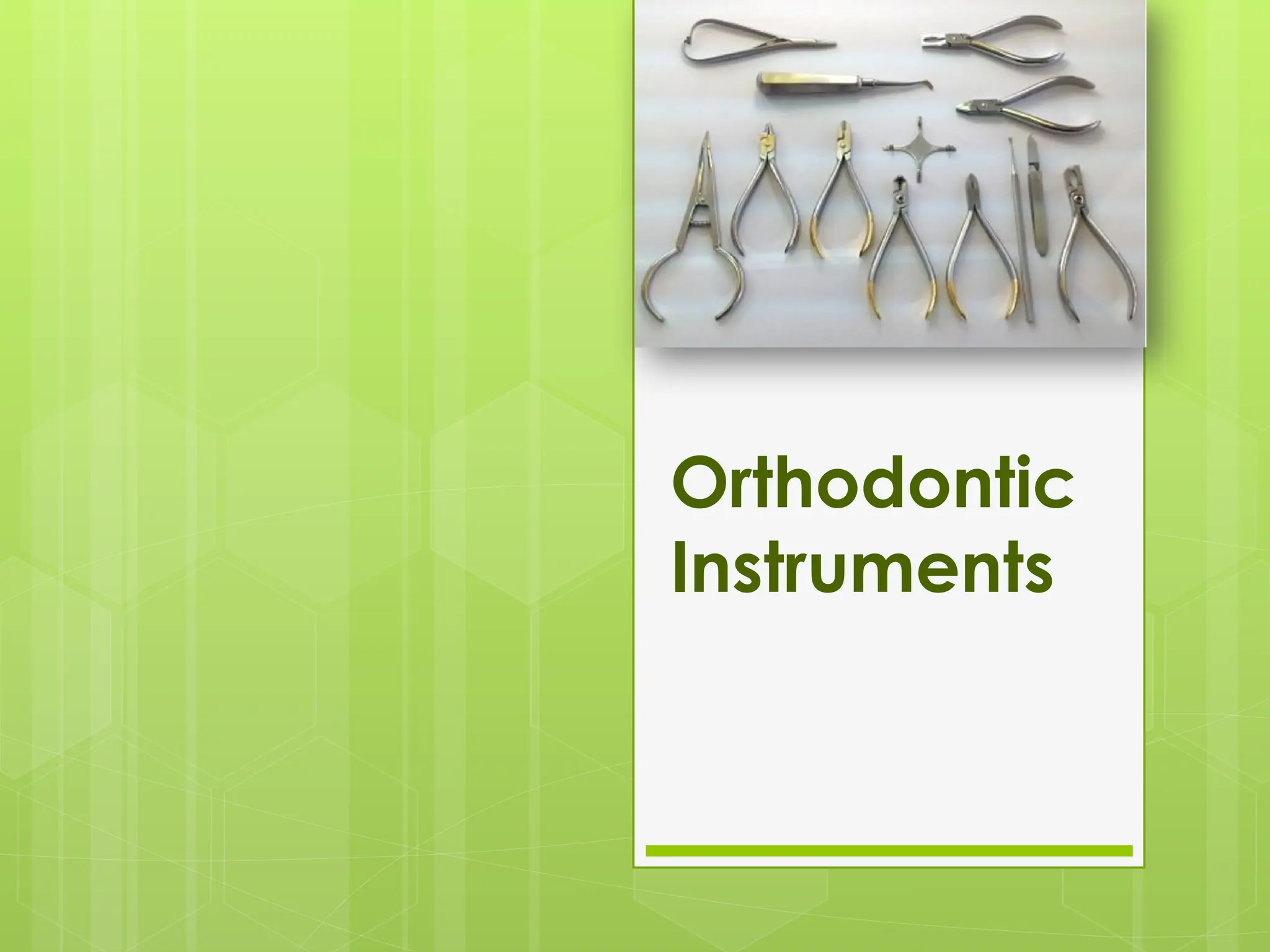
Orthodontic
Instruments
Contents
 Introduction
 Orthodontic Instruments Materials
 Parts Of Pliers
 Grasp
 Classification Of Orthodontic Instruments
 Diagnostic Instruments
 Separator Placement
 Band Forming Instruments
 Bracket Positioning Instruments
 Ligature Instruments
 Cutters
 Debonding Instruments
 Wire Bending Instruments
 Wire Forming instruments
 Measuring Instruments
 Other Instruments
 Maintenance
 Sterilization
 References
Introduction
Tool
“A device or implement, especially one held in
the hand, used to carry out a particular function”
Pliers
“A tool with scissor-action, pointed-
jawed tool for bending or cutting metal wires or grasp
ing small objects.”
Parts Of Plier
Beak
Joint
Handle
Grasp
Thumb and Palm Grip -
Pen Grip -
Joints
Box Joint
Screw
Joint
Diagnostic Instruments
 Mouth Mirror
 Probe
 Explorer
 Tweezer
 Impression trays
 Lip Retactor
 Intraoral Mirror
Instruments
for
placement
of Separator
Separator Placing Pliers
 Stainless steel
 Spring back action
 Use - Expanding elastic separators before positioning
them interdentally.
 Barrel-shaped tip prevents slippage of the module,
reduces the risk of tissue damage.
 Angled beaks facilitate easier placement of elastic
separators in anterior and posterior areas
Band
Forming
Instruments
Band Cutting Scissors
 Hardened stainless steel with tungsten carbide inert
cutting tip
 Cutting Edge Pattern
 straight or curved pattern
 long and short
 Use - cutting thin metal bands or band material
Mershon Band Pusher
 Handle is cylindrical and working end is
serrated
 Use –
 push bands so as to seat
 adapt to contour of the teeth
Nylon Band Seater
 High impact plastics or wood
 The biting surface - Tin inlay with serrated surface
 Shape –
 Round
 Square
 Triangular
 Use – Patient is asked to bite on the surface with the tin
inlay tip resting on the lug or the band edge.
Band Crimping Plier
 Use - contour the gingival surface of preformed bands
to provide better tooth anatomy
Photo – Hu-friedy Catalog
Johnson Band Contouring Plier
 Beaks - Tapered with a slight
bow.
 One beak is concave and other
is convex allowing re-contouring
of bands.
 Use - re-contour band edges that
sometimes get bent during band
placement.
Anterior Band Removing Pliers
 Beak - narrow groove and sharp end
 One beak is shorter
Oliver Jones Posterior Band
Removing Plier
 Beaks - Plastic padded tip and sharp removing beak
 Plastic head rest on the occlusal surface of tooth and
the sharp tip below the gingival contour of the band.
 Use - Remove posterior metal bands with maximum
patient comfort.
Bracket
Instruments
Boons Gauge
 It is the most frequently used bracket positioning aid.
 Stainless steel.
 It accurately measures height of bracket placement from the
incisal edge at 3.5, 4, 4.5 and 5mm.
 Flat surface rests on incisal/occlusal surface of tooth.
 Simplifies seating the bracket on the teeth with exactly the right
distance between bracket slot and incisal edge with pencil lid
or metal tips.
Bracket Positioning & Height
Gauge
 Aluminum or stainless steel
 Use - This device simplifies the seating of brackets on the teeth
with exactly the right distance between the bracket slot and
incisal edge.
 Adjustable for use on both anterior and posterior teeth.
 Measures height of bracket placement from the incisal edge at
2, 2.5, 3, 3.5, 4, 4.5, 5 and 5.5mm.
 Works with .022 & .018 bracket system.
Bracket Holder
 It holds any type of bracket from a wide twin to a single
one.
 Reverse action type handle which on pressing the
handle open-up the beaks.
 Beaks are diamond shaped with serrations to grip the
bracket.
 Flat end of the handle used to press the bracket into
position for bonding.
Curved Bracket Holder
 Serrated Tips
 Use – Lingual Bracket placement
Photo – iXion Catalog
Modified Bracket Positioning
Holder
 Combined Gauge with Bracket Holding
Forcep
Photo – Contm. Clini. Dentistry
Lingual Bracket & Tube Holder
 Reverse Action
 Curved Beaks help in unobstructed
placement
 Use – For placement of Lingual Brackets,
Tubes and Attachments
Photo – iXion Catalog
Orthodontic Bracket Card
 It is used to organize and hold orthodontic brackets to facilitate
quick bracket placement.
 Each circle on the card corresponds to a particular tooth in the
mouth.
 Brackets are placed corresponding to the tooth to be bonded.
Ligature
Instruments
Mosquito Forceps
 Types
 Straight
 Curved
 Use
 Placing Elastic Ligature
 Tightening Wire Ligature
Photo – iXion Catalog
Mathieu Plier
 Locking And Spring Back
Mechanism
 Serrated tips
 Types
 TC tip
 Straight
 Curve
 RMOrtho
 Wide
 Hole
 Shape
 Mini
 Standard
 Narrow
Photo – iXion Catalog
Speedo Ligature Director
 Double Ended
 Removing and Placing Ligature
Twister
 Twisting Ligature wire
Photo – Dental USA Catalog
Ligature Tucker
 Types
 Single end
 Double
 Use – To Tuck cut end of Ligature
Straight Shooter Ligature Gun
 Thermoplastic Material
 Types
 Mini Bracket Shooter
 Twin Bracket Shooter
 Use – Elastomeric to
Edgewise Bracket
Cutter
Hard Wire Cutter
 Hard wire cutters have hard metal tips or tungsten
carbide tips.
 These are heavier and larger than the pin and ligature
cutters.
 These are used to cut all wires up to 0.020" round
Manu’s Heavy Wire Cutter’s
 Heavy gauge side cutters.
 They are capable of cutting wires of up
to 1.3 mm diameter.
 Laboratory purpose
Distal End Cutter
 The distal end cutter is capable of cutting arch wires up
to 0.56 x 0.70 mm/ .022" x .028 " both intraoral and extra
oral
 Use - Exclusively for cutting the distal end of wire
protruding out of the molar tubes
 It had a ‘safety’ mechanism to hold the cut arch wire so
it does not fall into the patients mouth.
Photo – Hu-Friedy Catalog
Distal End Cutter Angulated
 45 ° and 90˚ angled cutting tips
 For Posterior Areas
Kruz Distal End Cutter
 Similar to distal end cutter
 Difference - Designed with long body so it can reach
back into depth of mouth
Pin & Ligature Cutter - PLC
 Stainless steel or Tungsten carbide
 Right to the tip, for smooth cutting
of soft ligature wires and lock pins
and elastomerics
 Ligatures up to 0.015mm in
diameter
 Types
 Mini
 Micro Mini
 Micro Mini 15 degree
Debonding
Instruments
Bracket & Adhesive Removing
Pliers
 Use - for removing bonded brackets.
 The wide tips wedge between both the edges of the base
of the bracket and the tooth surface(incisal-gingival
direction), easily lifting off the bracket.
 Types
 Straight
 60° angled tip
 Anterior debonding plier is also used for removal of
adhesive remanant on enamel surface after bracket
debonding
Clasp
Forming
Instruments
Clasp Forming Instruments
Adam’s Plier
 Hard stainless steel with or without TC tip
 Beaks - two smooth rectangular beaks
 The distance between hinge pin and the tips of the
beaks is short
 The sides of the beaks are flat
 Edges of the grasping surface of the beaks are sharp
and textured
 Inner surfaces - Not polished for better grip
 Use – For fabrication of the Adam's clasp
Adam’s Clasp Bending Plier
 Special pliers for easy forming of Adams' clasps in one
step.
 Used for wires up to the diameter of 1 mm.
Arrow Clasp Bending Plier
 Arrow clasp bending pliers are used to bend the arrow
clasp
 Used for wires up to the diameter of 0.7 mm.
Arrow Clasp Former
 Arrow clasp former is used for hard wires up to
0.7mm/0.028".
 Use - forms the clasp of the shape and small stops in the
arch wire
Adam’s Spring Forming Plier
 Beaks - One beak is rounded and other is square/flat
ended.
 Use - to adjust springs on orthodontic removable
appliances and to smooth and contour arch wires
 Up to 0.7mm
Arch
Forming
Instruments
Bird Beak Plier
 Stainless Steel
 Beaks – Pyramid Shape
 Use – Utility Plier,Up to 0.030”/0.76mm,
Round Wire
Photo – iXion Catalog
Jarabak Plier
 Modification of Light Wire Plier
 Precision Groove
Photo – Hu-Friedy Catalog
Howe Plier
 Lip Shape
 Types
 Straight
 Curved
Photo – iXion Catalog
Weingart Plier
 Serrated tips
 Use – Placement of Archwire
 Up to 0.020”/0.5mm
Photo – iXion Catalog
Tweed Plier
Photo – iXion Catalog
 Serrated tips
 Use – Edgewise Technique
 Stoppage
 Bends
Three Jaw Plier
 3 tips
 Up to 0.030”
 Use
 Activation of quad Helix
 Bends in Lingual bar and Wire
Photo – iXion Catalog
Turret
 The wire slotted body is made of stainless steel
 It is used for preparation of arch wires with or without torque
adjustment.
 It is available in six different versions and colors – Blue, Black,
Gold, Silver, Purple, Green.
Turret – Blue
Turret – Black
It is used for forming rectangular arch
wires.
.016’’ to .0215’’
It is used for forming rectangular arch
wires with torque adjustments :
00
– 100
– 160
– 230
For use only with wire : .016’’ x .022’’
Turret – Gold
Turret – Silver
It is used for forming rectangular arch
wires with torque adjustments :
00
– 70
– 100
- 130
– 160
For use only with wire : .018’’
It is used for forming rectangular arch
wires with torque adjustments :
00
– 100
– 160
– 230
For use only with wire : .022’’
Turret – Purple
Turret – Green
It is used for forming rectangular arch
wires with torque adjustments :
00
– 100
– 160
- 230
For use only with wire : .016” x .016”
It is used for forming round arch wires
For use only with wire : .014” - .016”
- .018” - .020”
De La Rosa Contouring Pliers
 Guiding grooves for forming round and square arches
0.016", 0.018", 0.020" and 0.022".
 Use - helps to accentuate the curvature in the arch wire.
Hook Crimping Plier
 Designed to crimp stops, hooks and posts to archwire
Photo – Dentsply Catalog
V Bending Plier
 1mm V bend
Photo – iXion Catalog
Rose Torquing Plier
 Used In Pair
 To give Labial or Lingual Torque
Photo – Dentsply Catalog
Loop
Forming
Instruments
Young’s Loop Forming Plier
 Stainless Steel with Tungsten Carbide Tips
 It can be used for wires up to the diameter of 1 mm
 Use – To form loops
Nance Loop Forming Plier
 Steps
 3mm
 4mm
 5mm
 6mm
 Use – Round and
Rectangular Wire
 Up to 0.7mm/ 0.028”
Photo – iXion Catalog
Tweed Plier
 Beak – One Cylindrical & Concave Beak
 Use
 Multiple Loops
 Omega Loops
Photo – iXion Catalog
Omega Loop Forming Plier
 Electro-etched Beak
 Steps
 0.045”
 0.060”
 0.075”
 Use – Up to 0.021” x 0.028”
 Round
 Omega Loop
Photo – Dentsply Catalog
Loop Tie Back Plier
 Steps
 2mm
 3mm
 4mm
 5mm
 Use – Closing loops are
made to desired heights
Optical Plier
 Beak – One Round & Concave Beak
 Use
 Stop in Wire
 Loop Tie Back
 Gable Bend
Photo – iXion Catalog
Measuring
Instruments
Dontrix Gauge
 Stainless Steel
 Measures Orthodontic
Forces
Correx Gauge
 Measures Orthodontic
Forces
 Measure and calibrate
the pressure or force
required
Vernier Scale
 Originated in Ancient
China
Maintenance
of
Instruments
Maintenance
 Handle Gently
 Avoid Mishandling
 Discard corroded instruments
 Check beaks regularly
 Use for the prescribed purpose
 Lubricate Joints before sterilization
 Dry instruments before sterilization
Sterilization
Sterilization
 Pre Cleaning
 Instrument Washer
 Ultrasonic cleaner
 Chemiclave
 Autoclave
References
 The Design, Construction and Use of Removable
Orthodontic Appliances (5th
ed) – C. Philip Adams
 Modified Bracket Positioning Holder – Contemporary
Clinical Dentistry, April 2011 Vol-2 Issue-2 – Dr Nandish
Shetty
 Textbook Of Orthodontics (2nd
Ed) – Gurkeerat Singh
 Catalog
 TP orthodontics
 iXion
 Leone
 Dentarum
 3M Unitek
 American Orthodontics
 Dentsply
Thank You

12345678900987654321Ortho-instrument.pptx

  • 1.
  • 2.
    Contents  Introduction  OrthodonticInstruments Materials  Parts Of Pliers  Grasp
  • 3.
     Classification OfOrthodontic Instruments  Diagnostic Instruments  Separator Placement  Band Forming Instruments  Bracket Positioning Instruments  Ligature Instruments  Cutters  Debonding Instruments  Wire Bending Instruments  Wire Forming instruments  Measuring Instruments  Other Instruments
  • 4.
  • 5.
    Introduction Tool “A device orimplement, especially one held in the hand, used to carry out a particular function” Pliers “A tool with scissor-action, pointed- jawed tool for bending or cutting metal wires or grasp ing small objects.”
  • 6.
  • 7.
    Grasp Thumb and PalmGrip - Pen Grip -
  • 8.
  • 9.
    Diagnostic Instruments  MouthMirror  Probe  Explorer  Tweezer  Impression trays  Lip Retactor  Intraoral Mirror
  • 11.
  • 12.
    Separator Placing Pliers Stainless steel  Spring back action  Use - Expanding elastic separators before positioning them interdentally.  Barrel-shaped tip prevents slippage of the module, reduces the risk of tissue damage.  Angled beaks facilitate easier placement of elastic separators in anterior and posterior areas
  • 13.
  • 14.
    Band Cutting Scissors Hardened stainless steel with tungsten carbide inert cutting tip  Cutting Edge Pattern  straight or curved pattern  long and short  Use - cutting thin metal bands or band material
  • 15.
    Mershon Band Pusher Handle is cylindrical and working end is serrated  Use –  push bands so as to seat  adapt to contour of the teeth
  • 16.
    Nylon Band Seater High impact plastics or wood  The biting surface - Tin inlay with serrated surface  Shape –  Round  Square  Triangular  Use – Patient is asked to bite on the surface with the tin inlay tip resting on the lug or the band edge.
  • 17.
    Band Crimping Plier Use - contour the gingival surface of preformed bands to provide better tooth anatomy Photo – Hu-friedy Catalog
  • 18.
    Johnson Band ContouringPlier  Beaks - Tapered with a slight bow.  One beak is concave and other is convex allowing re-contouring of bands.  Use - re-contour band edges that sometimes get bent during band placement.
  • 19.
    Anterior Band RemovingPliers  Beak - narrow groove and sharp end  One beak is shorter
  • 20.
    Oliver Jones PosteriorBand Removing Plier  Beaks - Plastic padded tip and sharp removing beak  Plastic head rest on the occlusal surface of tooth and the sharp tip below the gingival contour of the band.  Use - Remove posterior metal bands with maximum patient comfort.
  • 21.
  • 22.
    Boons Gauge  Itis the most frequently used bracket positioning aid.  Stainless steel.  It accurately measures height of bracket placement from the incisal edge at 3.5, 4, 4.5 and 5mm.  Flat surface rests on incisal/occlusal surface of tooth.  Simplifies seating the bracket on the teeth with exactly the right distance between bracket slot and incisal edge with pencil lid or metal tips.
  • 23.
    Bracket Positioning &Height Gauge  Aluminum or stainless steel  Use - This device simplifies the seating of brackets on the teeth with exactly the right distance between the bracket slot and incisal edge.  Adjustable for use on both anterior and posterior teeth.  Measures height of bracket placement from the incisal edge at 2, 2.5, 3, 3.5, 4, 4.5, 5 and 5.5mm.  Works with .022 & .018 bracket system.
  • 24.
    Bracket Holder  Itholds any type of bracket from a wide twin to a single one.  Reverse action type handle which on pressing the handle open-up the beaks.  Beaks are diamond shaped with serrations to grip the bracket.  Flat end of the handle used to press the bracket into position for bonding.
  • 25.
    Curved Bracket Holder Serrated Tips  Use – Lingual Bracket placement Photo – iXion Catalog
  • 26.
    Modified Bracket Positioning Holder Combined Gauge with Bracket Holding Forcep Photo – Contm. Clini. Dentistry
  • 27.
    Lingual Bracket &Tube Holder  Reverse Action  Curved Beaks help in unobstructed placement  Use – For placement of Lingual Brackets, Tubes and Attachments Photo – iXion Catalog
  • 28.
    Orthodontic Bracket Card It is used to organize and hold orthodontic brackets to facilitate quick bracket placement.  Each circle on the card corresponds to a particular tooth in the mouth.  Brackets are placed corresponding to the tooth to be bonded.
  • 29.
  • 30.
    Mosquito Forceps  Types Straight  Curved  Use  Placing Elastic Ligature  Tightening Wire Ligature Photo – iXion Catalog
  • 31.
    Mathieu Plier  LockingAnd Spring Back Mechanism  Serrated tips  Types  TC tip  Straight  Curve  RMOrtho  Wide  Hole  Shape  Mini  Standard  Narrow Photo – iXion Catalog
  • 32.
    Speedo Ligature Director Double Ended  Removing and Placing Ligature
  • 33.
    Twister  Twisting Ligaturewire Photo – Dental USA Catalog
  • 34.
    Ligature Tucker  Types Single end  Double  Use – To Tuck cut end of Ligature
  • 35.
    Straight Shooter LigatureGun  Thermoplastic Material  Types  Mini Bracket Shooter  Twin Bracket Shooter  Use – Elastomeric to Edgewise Bracket
  • 36.
  • 37.
    Hard Wire Cutter Hard wire cutters have hard metal tips or tungsten carbide tips.  These are heavier and larger than the pin and ligature cutters.  These are used to cut all wires up to 0.020" round
  • 38.
    Manu’s Heavy WireCutter’s  Heavy gauge side cutters.  They are capable of cutting wires of up to 1.3 mm diameter.  Laboratory purpose
  • 39.
    Distal End Cutter The distal end cutter is capable of cutting arch wires up to 0.56 x 0.70 mm/ .022" x .028 " both intraoral and extra oral  Use - Exclusively for cutting the distal end of wire protruding out of the molar tubes  It had a ‘safety’ mechanism to hold the cut arch wire so it does not fall into the patients mouth. Photo – Hu-Friedy Catalog
  • 40.
    Distal End CutterAngulated  45 ° and 90˚ angled cutting tips  For Posterior Areas
  • 41.
    Kruz Distal EndCutter  Similar to distal end cutter  Difference - Designed with long body so it can reach back into depth of mouth
  • 42.
    Pin & LigatureCutter - PLC  Stainless steel or Tungsten carbide  Right to the tip, for smooth cutting of soft ligature wires and lock pins and elastomerics  Ligatures up to 0.015mm in diameter  Types  Mini  Micro Mini  Micro Mini 15 degree
  • 43.
  • 44.
    Bracket & AdhesiveRemoving Pliers  Use - for removing bonded brackets.  The wide tips wedge between both the edges of the base of the bracket and the tooth surface(incisal-gingival direction), easily lifting off the bracket.  Types  Straight  60° angled tip  Anterior debonding plier is also used for removal of adhesive remanant on enamel surface after bracket debonding
  • 47.
  • 48.
    Clasp Forming Instruments Adam’sPlier  Hard stainless steel with or without TC tip  Beaks - two smooth rectangular beaks  The distance between hinge pin and the tips of the beaks is short  The sides of the beaks are flat  Edges of the grasping surface of the beaks are sharp and textured  Inner surfaces - Not polished for better grip  Use – For fabrication of the Adam's clasp
  • 49.
    Adam’s Clasp BendingPlier  Special pliers for easy forming of Adams' clasps in one step.  Used for wires up to the diameter of 1 mm.
  • 50.
    Arrow Clasp BendingPlier  Arrow clasp bending pliers are used to bend the arrow clasp  Used for wires up to the diameter of 0.7 mm.
  • 51.
    Arrow Clasp Former Arrow clasp former is used for hard wires up to 0.7mm/0.028".  Use - forms the clasp of the shape and small stops in the arch wire
  • 52.
    Adam’s Spring FormingPlier  Beaks - One beak is rounded and other is square/flat ended.  Use - to adjust springs on orthodontic removable appliances and to smooth and contour arch wires  Up to 0.7mm
  • 53.
  • 54.
    Bird Beak Plier Stainless Steel  Beaks – Pyramid Shape  Use – Utility Plier,Up to 0.030”/0.76mm, Round Wire Photo – iXion Catalog
  • 55.
    Jarabak Plier  Modificationof Light Wire Plier  Precision Groove Photo – Hu-Friedy Catalog
  • 56.
    Howe Plier  LipShape  Types  Straight  Curved Photo – iXion Catalog
  • 57.
    Weingart Plier  Serratedtips  Use – Placement of Archwire  Up to 0.020”/0.5mm Photo – iXion Catalog
  • 58.
    Tweed Plier Photo –iXion Catalog  Serrated tips  Use – Edgewise Technique  Stoppage  Bends
  • 59.
    Three Jaw Plier 3 tips  Up to 0.030”  Use  Activation of quad Helix  Bends in Lingual bar and Wire Photo – iXion Catalog
  • 60.
    Turret  The wireslotted body is made of stainless steel  It is used for preparation of arch wires with or without torque adjustment.  It is available in six different versions and colors – Blue, Black, Gold, Silver, Purple, Green.
  • 61.
    Turret – Blue Turret– Black It is used for forming rectangular arch wires. .016’’ to .0215’’ It is used for forming rectangular arch wires with torque adjustments : 00 – 100 – 160 – 230 For use only with wire : .016’’ x .022’’
  • 62.
    Turret – Gold Turret– Silver It is used for forming rectangular arch wires with torque adjustments : 00 – 70 – 100 - 130 – 160 For use only with wire : .018’’ It is used for forming rectangular arch wires with torque adjustments : 00 – 100 – 160 – 230 For use only with wire : .022’’
  • 63.
    Turret – Purple Turret– Green It is used for forming rectangular arch wires with torque adjustments : 00 – 100 – 160 - 230 For use only with wire : .016” x .016” It is used for forming round arch wires For use only with wire : .014” - .016” - .018” - .020”
  • 64.
    De La RosaContouring Pliers  Guiding grooves for forming round and square arches 0.016", 0.018", 0.020" and 0.022".  Use - helps to accentuate the curvature in the arch wire.
  • 65.
    Hook Crimping Plier Designed to crimp stops, hooks and posts to archwire Photo – Dentsply Catalog
  • 66.
    V Bending Plier 1mm V bend Photo – iXion Catalog
  • 67.
    Rose Torquing Plier Used In Pair  To give Labial or Lingual Torque Photo – Dentsply Catalog
  • 68.
  • 69.
    Young’s Loop FormingPlier  Stainless Steel with Tungsten Carbide Tips  It can be used for wires up to the diameter of 1 mm  Use – To form loops
  • 70.
    Nance Loop FormingPlier  Steps  3mm  4mm  5mm  6mm  Use – Round and Rectangular Wire  Up to 0.7mm/ 0.028” Photo – iXion Catalog
  • 71.
    Tweed Plier  Beak– One Cylindrical & Concave Beak  Use  Multiple Loops  Omega Loops Photo – iXion Catalog
  • 72.
    Omega Loop FormingPlier  Electro-etched Beak  Steps  0.045”  0.060”  0.075”  Use – Up to 0.021” x 0.028”  Round  Omega Loop Photo – Dentsply Catalog
  • 73.
    Loop Tie BackPlier  Steps  2mm  3mm  4mm  5mm  Use – Closing loops are made to desired heights
  • 74.
    Optical Plier  Beak– One Round & Concave Beak  Use  Stop in Wire  Loop Tie Back  Gable Bend Photo – iXion Catalog
  • 75.
  • 76.
    Dontrix Gauge  StainlessSteel  Measures Orthodontic Forces
  • 77.
    Correx Gauge  MeasuresOrthodontic Forces  Measure and calibrate the pressure or force required
  • 78.
  • 79.
  • 80.
    Maintenance  Handle Gently Avoid Mishandling  Discard corroded instruments  Check beaks regularly  Use for the prescribed purpose  Lubricate Joints before sterilization  Dry instruments before sterilization
  • 81.
  • 82.
    Sterilization  Pre Cleaning Instrument Washer  Ultrasonic cleaner  Chemiclave  Autoclave
  • 83.
    References  The Design,Construction and Use of Removable Orthodontic Appliances (5th ed) – C. Philip Adams  Modified Bracket Positioning Holder – Contemporary Clinical Dentistry, April 2011 Vol-2 Issue-2 – Dr Nandish Shetty  Textbook Of Orthodontics (2nd Ed) – Gurkeerat Singh  Catalog  TP orthodontics  iXion  Leone  Dentarum  3M Unitek  American Orthodontics  Dentsply
  • 84.

Editor's Notes

  • #8 Hinge Joint – Permits Motion in one plain eg. tweezer Pivot Joint – Rotary Movement eg plier
  • #17 Modified thin plier
  • #30 Also k\as Hemostat or Artery Forcep . Curve at 45 degree . Serrated Beaks
  • #31 Hole 0.020” Groove . Wide – Positive locking
  • #34 Prevent Soft tissue Damage
  • #44 for anterior debonding which allows better access to posterior areas).
  • #55 3 grooves
  • #56 Straight Anterior Banding , Curve at 40 degree - Posterior
  • #58 Modified with tc
  • #59 Modification – NiTi , Extra Fine
  • #66 Has TC tip
  • #70 4 steps
  • #73 4 steps … 2 squeezes
  • #77  4 to 9 oz.   gram/pond and centi-Newton