Definition
Removable appliances arenot orthodontic appliances consisting mainly of wires and acrylic component that
can be inserted and removed by patient.
11.1 Indications:
1. Simple tipping movements
2. Overbite reduction
3. Elimination of occlusal interference
4. As space maintainers
5. To help transmit forces to groups of teeth
6. Minor de-rotation of incisor teeth
7. Simple extrusion and rotation in conjunction with a fixed attachment
8. retainer
3.
11.1.1 Simple tippingmovement
Teeth tip at a point approximately at 40% of the root from its apex, which means the that the will move in the
opposite direction to the crown.
Removable appliances are particulary good at correcting incisor crossbites, provided that the tooth or teeth in
crossbite are not already proclined, and there is adequate overbite.
Note:
• Proclination of an incisor will reduce the overbite, and
• A positive overbite at the end of treatment is essential for stability.
Indication for tipping movement (when moving tooth distally)
• Tooth that is mesially-tipped before treatment
• Tooth that is in upright position, provided that some distal tipping is acceptable at the end of treatment.
Contraindication for tipping movement (when moving tooth distally)
• Tooth that is distally-tipped (need to be treated by fixed appliance for bodily movement).
Remember that if distar movement of mandibular canine is intended, then the maxillary canine will have to be
moved further distally to achieve or maintain a class I relationship.
4.
11.1.2 Overbite reduction
•In a growth child, the incorporation of an anterior bite plane helps to reduce the overbite through the
eruption of the lower buccal segment teeth.
• Anterior bite plane should not be used to reduce the overbite in bimaxillary procliation cases, as the
effect will be to procline the mandibular incisors further.
5.
11.1.3 Elimination ofocclusal interference
• Anterior or posterior bite planes will efficiently eliminate occlusal interferences during crossbite
correction.
• Lower removable appliances with bite planes may also be used to assist a maxillary fixed appliance
which is attempting anterior crossbite correction.
6.
11.1.4 Space maintainer
Keepingspace in the dental arch for unerupted teeth can be achieved with a removable appliance.
The advantages of a removable appliance as space-maintainer are:
• It can incorporate an anterior bite plane to reduce overbite.
• It is easy to attach a prosthetic tooth to the baseplate to act as a space maintenance and also helps to
enhance aesthetics in cases such as congenital absence of a maxillary incisor.
7.
11.1.5 To helptransmit forces to groups of teeth
Examples:
• For arch expansion, or
• Distal movement of buccal segment
8.
11.1.6 Minor de-rotationsof incisor teeth
• A force couple, i.e. two wires acting in opposite directions on the opposed corners of the incisor tooth,
will cause de-rotation. This is only possible if the rotated tooth is upright.
• A rotated incisor occupies less space in the arch, so more space will be required for de-rotation.
9.
11.1.7 Simple extrusionand de-rotation of teeth in conjunction with a fixed attachment
(Fixed removable appliance)
a) The wide palatal coverage of a removable appliance provides excellent resistance to the reactive forces
generated by extrusive mechanics.
This is particularly helpful when straightforward vertical movement of a tooth is mecessary.
i.e. A free-ended spring, with a coil for additional flexibility constructed in 0.5 mm wire, hooks over a suitable
attachment on the tooth.
b) Where one or two incisors are rotated, a whip spring and bonded attachment may be effective when used
in comjunction with a labial bow from a removable appliance.
10.
11.1.8 As aretainer
• A passive removable appliance is frequently used as a retainer following removable or fixed appliance
treatment.
11.
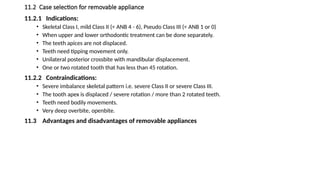
11.2 Case selectionfor removable appliance
11.2.1 Indications:
• Skeletal Class I, mild Class II (< ANB 4 - 6), Pseudo Class III (< ANB 1 or 0)
• When upper and lower orthodontic treatment can be done separately.
• The teeth apices are not displaced.
• Teeth need tipping movement only.
• Unilateral posterior crossbite with mandibular displacement.
• One or two rotated tooth that has less than 45 rotation.
11.2.2 Contraindications:
• Severe imbalance skeletal pattern i.e. severe Class II or severe Class III.
• The tooth apex is displaced / severe rotation / more than 2 rotated teeth.
• Teeth need bodily movements.
• Very deep overbite, openbite.
11.3 Advantages and disadvantages of removable appliances
12.
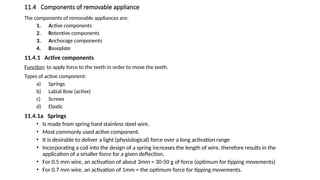
11.4 Components ofremovable appliance
The components of removable appliances are:
1. Active components
2. Retentive components
3. Anchorage components
4. Baseplate
11.4.1 Active components
Function: to apply force to the teeth in order to move the teeth.
Types of active component:
a) Springs
b) Labial Bow (active)
c) Screws
d) Elastic
11.4.1a Springs
• Is made from spring hard stainless steel wire.
• Most commonly used active component.
• It is desirable to deliver a light (physiological) force over a long activation range
• Incorporating a coil into the design of a spring increases the length of wire, therefore results in the
application of a smaller force for a given deflection.
• For 0.5 mm wire, an activation of about 3mm = 30-50 g of force (optimum for tipping movements)
• For 0.7 mm wire, an activation of 1mm = the optimum force for tipping movements.
11.4.1c Screws
Function:
• Tomove one or a group of anterior teeth labially
• To expand the upper arch transversely
• To move one or a group of teeth distally.
Disadvantage: bulky and more expensive compared to springs
15.
11.4.2 Retentive Components
•Is made from spring hard stainless steel wires.
Function: to keep the appliance in position.
The various types of retentive component are:
a) Adams Clasp (for anterior or posterior teeth)
b) South-end Clasp (for anterior)
c) Labial Bow (passive stage)
16.
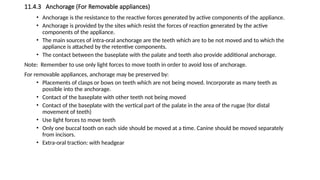
11.4.3 Anchorage (ForRemovable appliances)
• Anchorage is the resistance to the reactive forces generated by active components of the appliance.
• Anchorage is provided by the sites which resist the forces of reaction generated by the active
components of the appliance.
• The main sources of intra-oral anchorage are the teeth which are to be not moved and to which the
appliance is attached by the retentive components.
• The contact between the baseplate with the palate and teeth also provide additional anchorage.
Note: Remember to use only light forces to move tooth in order to avoid loss of anchorage.
For removable appliances, anchorage may be preserved by:
• Placements of clasps or bows on teeth which are not being moved. Incorporate as many teeth as
possible into the anchorage.
• Contact of the baseplate with other teeth not being moved
• Contact of the baseplate with the vertical part of the palate in the area of the rugae (for distal
movement of teeth)
• Use light forces to move teeth
• Only one buccal tooth on each side should be moved at a time. Canine should be moved separately
from incisors.
• Extra-oral traction: with headgear
17.
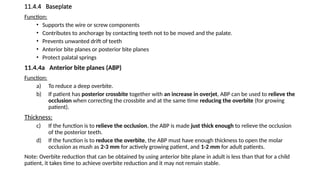
11.4.4 Baseplate
Function:
• Supportsthe wire or screw components
• Contributes to anchorage by contacting teeth not to be moved and the palate.
• Prevents unwanted drift of teeth
• Anterior bite planes or posterior bite planes
• Protect palatal springs
11.4.4a Anterior bite planes (ABP)
Function:
a) To reduce a deep overbite.
b) If patient has posterior crossbite together with an increase in overjet, ABP can be used to relieve the
occlusion when correcting the crossbite and at the same time reducing the overbite (for growing
patient).
Thickness:
c) If the function is to relieve the occlusion, the ABP is made just thick enough to relieve the occlusion
of the posterior teeth.
d) If the function is to reduce the overbite, the ABP must have enough thickness to open the molar
occlusion as mush as 2-3 mm for actively growing patient, and 1-2 mm for adult patients.
Note: Overbite reduction that can be obtained by using anterior bite plane in adult is less than that for a child
patient, it takes time to achieve overbite reduction and it may not remain stable.
18.
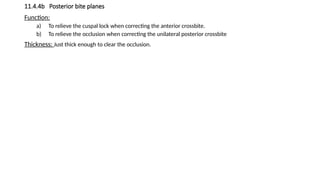
11.4.4b Posterior biteplanes
Function:
a) To relieve the cuspal lock when correcting the anterior crossbite.
b) To relieve the occlusion when correcting the unilateral posterior crossbite
Thickness: Just thick enough to clear the occlusion.
19.
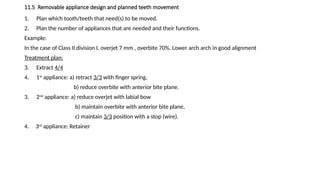
11.5 Removable appliancedesign and planned teeth movement
1. Plan which tooth/teeth that need(s) to be moved.
2. Plan the number of appliances that are needed and their functions.
Example:
In the case of Class II division I, overjet 7 mm , overbite 70%. Lower arch arch in good alignment
Treatment plan:
3. Extract 4/4
4. 1st
appliance: a) retract 3/3 with finger spring,
b) reduce overbite with anterior bite plane.
3. 2nd
appliance: a) reduce overjet with labial bow
b) maintain overbite with anterior bite plane,
c) maintain 3/3 position with a stop (wire).
4. 3rd
appliance: Retainer






![Removable Appliances ortho[Autosaved].ppt](https://cdn.slidesharecdn.com/ss_thumbnails/removableappliancesautosaved-250321193254-b5973907-thumbnail.jpg?width=640&height=640&fit=bounds)


