Humans Try to Control Nature
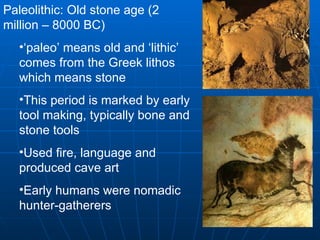
Paleolithic: Old stone age (2 million – 8000 BC) ‘ paleo’ means old and ‘lithic’ comes from the Greek lithos which means stone This period is marked by early tool making, typically bone and stone tools Used fire, language and produced cave art Early humans were nomadic hunter-gatherers
The Neolithic Age The new stone age (neo=new) So what was so new about the New Stone Age? The Agricultural Revolution, that’s what. People started cultivating crops and domesticating and raising animals.  This completely changed things.
What led to neolithic revolution? Global warming (see, sometimes it’s good!) This allowed for longer growing seasons and better growing conditions Because of rising populations, wild food became harder to find.  In order to survive, more efficient methods of obtaining food had to be developed. The Revolution occurred in disparate locations within a relatively short time – a few thousand years.

1.2 - Humans Try To Control Nature

  • 1.
    Humans Try toControl Nature
  • 2.
    Paleolithic: Old stoneage (2 million – 8000 BC) ‘ paleo’ means old and ‘lithic’ comes from the Greek lithos which means stone This period is marked by early tool making, typically bone and stone tools Used fire, language and produced cave art Early humans were nomadic hunter-gatherers
  • 3.
    The Neolithic AgeThe new stone age (neo=new) So what was so new about the New Stone Age? The Agricultural Revolution, that’s what. People started cultivating crops and domesticating and raising animals. This completely changed things.
  • 4.
    What led toneolithic revolution? Global warming (see, sometimes it’s good!) This allowed for longer growing seasons and better growing conditions Because of rising populations, wild food became harder to find. In order to survive, more efficient methods of obtaining food had to be developed. The Revolution occurred in disparate locations within a relatively short time – a few thousand years.