ANCIENT AND
MEDIEVAL SCIENCE
AND TECHNOLOGY
LESSON 1.1: PALEOLITHIC AND
NEOLITHIC ERAS
• The term "Paleolithic" comes from two Greek words:
"palaios" (παλαιός), meaning "old" or "ancient," and
"lithos" (λίθος), meaning "stone." Hence,
"Paleolithic" essentially means "Old Stone Age,"
reflecting the era's characteristic use of stone tools.
LESSON 1.1: PALEOLITHIC AND
NEOLITHIC ERAS
•The Paleolithic era, also known as the Old Stone
Age, is the earliest period of human existence. It
started when stone tools were first used around
2.6 million years ago and ended with the
beginning of the New Stone Age, or Neolithic
era, around 10,000 to 12,000 BCE.
LESSON 1.1: PALEOLITHIC AND
NEOLITHIC ERAS
• During the Paleolithic era, human behavior and technology was shaped
by the challenges of migration. Meanwhile, the Neolithic era, also
known as the New Stone Age, is characterized by the development of
agriculture, 'the domestication of animals, and the emergence of
permanent settlements. This era was a big change because people
stopped moving around and started to live in one place; focusing on
farming. The emergence of civilizations, characterized by specialized
trades and management of resources set the stage for interactions,
exchanges, and the creation of political and administrative systems.
PALEOLITHIC
ERA
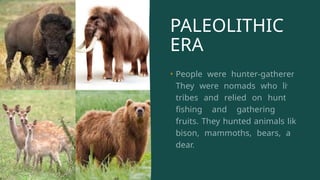
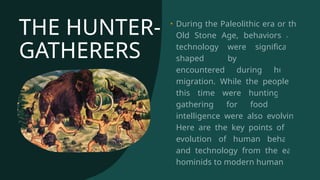
• People were hunter-gatherers.
They were nomads who lived
tribes and relied on hunting,
fishing and gathering wild
fruits. They hunted animals like
bison, mammoths, bears, and
dear.
PALEOLITHIC
ERA
• Meat was a source of food and
animal hide was used to make
clothes. They lived in clans of
20-30 people in caves,
outdoors or in cabins made of
tree branches and animal skin.
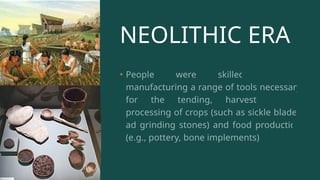
NEOLITHIC ERA
• People were skilled farmers,
manufacturing a range of tools necessary
for the tending, harvesting, and
processing of crops (such as sickle blades
ad grinding stones) and food production
(e.g., pottery, bone implements).
THE HUNTER-
GATHERERS
• During the Paleolithic era or the
Old Stone Age, behaviors and
technology were significantly
shaped by challenges
encountered during human
migration. While the people of
this time were hunting and
gathering for food, their
intelligence were also evolving.
Here are the key points of the
evolution of human behavior
and technology from the early
hominids to modern human.
FORAGING VS
GATHERING
• Great apes forage, while
gatherers collect food from
various locations for
consumption or storage.
• Forage refers to the act of
searching for and gathering wild
food resources, especially
plants, fruits, nuts, and edible
roots.
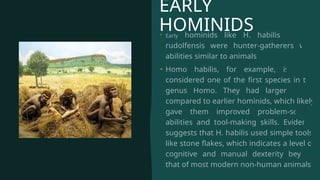
EARLY
HOMINIDS
• Early hominids like H. habilis and H.
rudolfensis were hunter-gatherers with
abilities similar to animals.
• Homo habilis, for example, is often
considered one of the first species in the
genus Homo. They had larger brains
compared to earlier hominids, which likely
gave them improved problem-solving
abilities and tool-making skills. Evidence
suggests that H. habilis used simple tools,
like stone flakes, which indicates a level of
cognitive and manual dexterity beyond
that of most modern non-human animals.
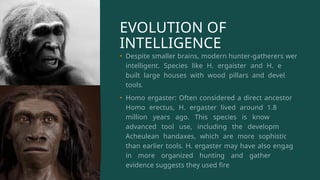
EVOLUTION OF
INTELLIGENCE
• Despite smaller brains, modern hunter-gatherers were
intelligent. Species like H. ergaister and H. erectus
built large houses with wood pillars and developed
tools.
• Homo ergaster: Often considered a direct ancestor to
Homo erectus, H. ergaster lived around 1.8 to 1.3
million years ago. This species is known for its
advanced tool use, including the development of
Acheulean handaxes, which are more sophisticated
than earlier tools. H. ergaster may have also engaged
in more organized hunting and gathering, and
evidence suggests they used fire.
NEOLITHIC ERA
ADVANCEMENT
Technological progress was
demonstrated through the use of
stone tools and other materials.
KNOWLEDGE
AND SKILLS
Early hunter-gatherers observed
celestial motions and had knowledge
about wild animals and vegetation.
Celestial Motions: Seasonal Changes:
They observed celestial patterns to
predict seasonal changes, which
helped in tracking the best times for
hunting and gathering. The position of
the sun, moon, and stars played a role
in their agricultural and migratory
activities.
Navigation: They might have used
celestial bodies for navigation,
especially in the absence of clear
landmarks.
HUMAN
MIGRATION
Humans migrated across Asia and
Europe, reaching Australia about
50,000 to 46,000 years ago and the
Americas later.
CHALLENGES AND
UNDERSTANDING
Populations faced challenges in new
territories, leading to an improved
understanding of biology.
ADVANCEMENT IN
AGRICULTURE
The Neolithic era, also called the
New Stone Age, started about 10,
000 BCE. It was during this time .that
people stopped moving from place
to place to find food, and instead
started to grow their own food and
live in a particular area that they
found suitable. This change saw the
creation of civilizations and new
technologies: The new farming
methods of the Neolithic era
included:
DOMESTICATION
OF PLANTS
This involved selectively breeding.
plants like wheat, barley, and rice for
their desirable. traits such as higher
yield and disease resistance.
DOMESTICATION
OF ANIMALS
Sheep, goats, cattle, and pigs were
sources of meat, milk, and wool.
DEVELOPMENT OF
NEW TOOLS
Hoes, sickles, and grinding stone
helped make land clearing, planting
seeds, and harvesting easier.
• Hoes: Agricultural tools used to break up
soil, remove weeds, and prepare land for
planting. They make it easier to work the
soil and get it ready for crops.
• Sickles: Curved blades used for harvesting
crops like grain or grass. Sickles help in
cutting through the crops efficiently and
gathering them for further processing.
• Grinding Stones: Tools used to grind
grains into flour or meal. They make it
possible to process harvested crops into
food products.
USE OF
IRRIGATION
In some areas, people began to use
irrigation to water their crops and
help it grow during drier seasons or
climates.
Irrigation involves directing water from
sources like rivers, lakes, or reservoirs to
the fields where crops are grown. This helps
ensure that crops receive the necessary
moisture to grow and thrive, even when
there isn't enough rainfall. This practice
allows for more reliable and consistent
agricultural production, particularly in areas
with variable or limited water resources.

Science, Technology and Society Presentation

  • 1.
  • 2.
    LESSON 1.1: PALEOLITHICAND NEOLITHIC ERAS • The term "Paleolithic" comes from two Greek words: "palaios" (παλαιός), meaning "old" or "ancient," and "lithos" (λίθος), meaning "stone." Hence, "Paleolithic" essentially means "Old Stone Age," reflecting the era's characteristic use of stone tools.
  • 3.
    LESSON 1.1: PALEOLITHICAND NEOLITHIC ERAS •The Paleolithic era, also known as the Old Stone Age, is the earliest period of human existence. It started when stone tools were first used around 2.6 million years ago and ended with the beginning of the New Stone Age, or Neolithic era, around 10,000 to 12,000 BCE.
  • 4.
    LESSON 1.1: PALEOLITHICAND NEOLITHIC ERAS • During the Paleolithic era, human behavior and technology was shaped by the challenges of migration. Meanwhile, the Neolithic era, also known as the New Stone Age, is characterized by the development of agriculture, 'the domestication of animals, and the emergence of permanent settlements. This era was a big change because people stopped moving around and started to live in one place; focusing on farming. The emergence of civilizations, characterized by specialized trades and management of resources set the stage for interactions, exchanges, and the creation of political and administrative systems.
  • 5.
    PALEOLITHIC ERA • People werehunter-gatherers. They were nomads who lived tribes and relied on hunting, fishing and gathering wild fruits. They hunted animals like bison, mammoths, bears, and dear.
  • 6.
    PALEOLITHIC ERA • Meat wasa source of food and animal hide was used to make clothes. They lived in clans of 20-30 people in caves, outdoors or in cabins made of tree branches and animal skin.
  • 7.
    NEOLITHIC ERA • Peoplewere skilled farmers, manufacturing a range of tools necessary for the tending, harvesting, and processing of crops (such as sickle blades ad grinding stones) and food production (e.g., pottery, bone implements).
  • 8.
    THE HUNTER- GATHERERS • Duringthe Paleolithic era or the Old Stone Age, behaviors and technology were significantly shaped by challenges encountered during human migration. While the people of this time were hunting and gathering for food, their intelligence were also evolving. Here are the key points of the evolution of human behavior and technology from the early hominids to modern human.
  • 9.
    FORAGING VS GATHERING • Greatapes forage, while gatherers collect food from various locations for consumption or storage. • Forage refers to the act of searching for and gathering wild food resources, especially plants, fruits, nuts, and edible roots.
  • 10.
    EARLY HOMINIDS • Early hominidslike H. habilis and H. rudolfensis were hunter-gatherers with abilities similar to animals. • Homo habilis, for example, is often considered one of the first species in the genus Homo. They had larger brains compared to earlier hominids, which likely gave them improved problem-solving abilities and tool-making skills. Evidence suggests that H. habilis used simple tools, like stone flakes, which indicates a level of cognitive and manual dexterity beyond that of most modern non-human animals.
  • 11.
    EVOLUTION OF INTELLIGENCE • Despitesmaller brains, modern hunter-gatherers were intelligent. Species like H. ergaister and H. erectus built large houses with wood pillars and developed tools. • Homo ergaster: Often considered a direct ancestor to Homo erectus, H. ergaster lived around 1.8 to 1.3 million years ago. This species is known for its advanced tool use, including the development of Acheulean handaxes, which are more sophisticated than earlier tools. H. ergaster may have also engaged in more organized hunting and gathering, and evidence suggests they used fire.
  • 12.
    NEOLITHIC ERA ADVANCEMENT Technological progresswas demonstrated through the use of stone tools and other materials.
  • 13.
    KNOWLEDGE AND SKILLS Early hunter-gatherersobserved celestial motions and had knowledge about wild animals and vegetation. Celestial Motions: Seasonal Changes: They observed celestial patterns to predict seasonal changes, which helped in tracking the best times for hunting and gathering. The position of the sun, moon, and stars played a role in their agricultural and migratory activities. Navigation: They might have used celestial bodies for navigation, especially in the absence of clear landmarks.
  • 14.
    HUMAN MIGRATION Humans migrated acrossAsia and Europe, reaching Australia about 50,000 to 46,000 years ago and the Americas later.
  • 15.
    CHALLENGES AND UNDERSTANDING Populations facedchallenges in new territories, leading to an improved understanding of biology.
  • 16.
    ADVANCEMENT IN AGRICULTURE The Neolithicera, also called the New Stone Age, started about 10, 000 BCE. It was during this time .that people stopped moving from place to place to find food, and instead started to grow their own food and live in a particular area that they found suitable. This change saw the creation of civilizations and new technologies: The new farming methods of the Neolithic era included:
  • 17.
    DOMESTICATION OF PLANTS This involvedselectively breeding. plants like wheat, barley, and rice for their desirable. traits such as higher yield and disease resistance.
  • 18.
    DOMESTICATION OF ANIMALS Sheep, goats,cattle, and pigs were sources of meat, milk, and wool.
  • 19.
    DEVELOPMENT OF NEW TOOLS Hoes,sickles, and grinding stone helped make land clearing, planting seeds, and harvesting easier. • Hoes: Agricultural tools used to break up soil, remove weeds, and prepare land for planting. They make it easier to work the soil and get it ready for crops. • Sickles: Curved blades used for harvesting crops like grain or grass. Sickles help in cutting through the crops efficiently and gathering them for further processing. • Grinding Stones: Tools used to grind grains into flour or meal. They make it possible to process harvested crops into food products.
  • 20.
    USE OF IRRIGATION In someareas, people began to use irrigation to water their crops and help it grow during drier seasons or climates. Irrigation involves directing water from sources like rivers, lakes, or reservoirs to the fields where crops are grown. This helps ensure that crops receive the necessary moisture to grow and thrive, even when there isn't enough rainfall. This practice allows for more reliable and consistent agricultural production, particularly in areas with variable or limited water resources.

Editor's Notes

  • #7 Tending means taking care
  • #8 Tending means taking care
  • #9 Forage refers to the act of searching for and gathering wild food resources, especially plants, fruits, nuts, and edible roots. It can also refer to the collection of food by animals.
  • #10 Forage refers to the act of searching for and gathering wild food resources, especially plants, fruits, nuts, and edible roots. It can also refer to the collection of food by animals.
  • #11 Forage refers to the act of searching for and gathering wild food resources, especially plants, fruits, nuts, and edible roots. It can also refer to the collection of food by animals.
  • #12 Forage refers to the act of searching for and gathering wild food resources, especially plants, fruits, nuts, and edible roots. It can also refer to the collection of food by animals.
  • #13 Forage refers to the act of searching for and gathering wild food resources, especially plants, fruits, nuts, and edible roots. It can also refer to the collection of food by animals.
  • #14 Forage refers to the act of searching for and gathering wild food resources, especially plants, fruits, nuts, and edible roots. It can also refer to the collection of food by animals.
  • #15 Forage refers to the act of searching for and gathering wild food resources, especially plants, fruits, nuts, and edible roots. It can also refer to the collection of food by animals.
  • #16 Forage refers to the act of searching for and gathering wild food resources, especially plants, fruits, nuts, and edible roots. It can also refer to the collection of food by animals.
  • #17 The domestication of plants refers to the process through which humans cultivate and selectively breed wild plant species to produce desirable traits for agriculture and consumption.
  • #18 The domestication of plants refers to the process through which humans cultivate and selectively breed wild plant species to produce desirable traits for agriculture and consumption.
  • #19 The domestication of plants refers to the process through which humans cultivate and selectively breed wild plant species to produce desirable traits for agriculture and consumption.
  • #20 The domestication of plants refers to the process through which humans cultivate and selectively breed wild plant species to produce desirable traits for agriculture and consumption.