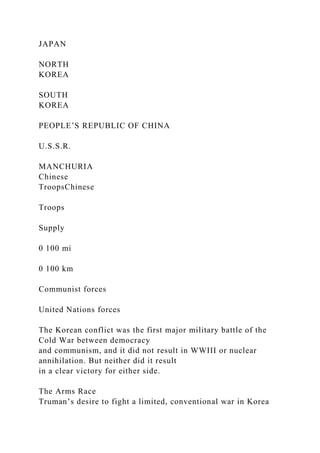
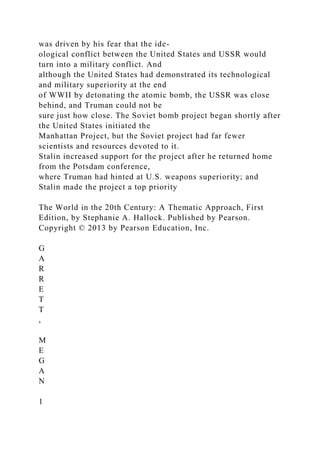
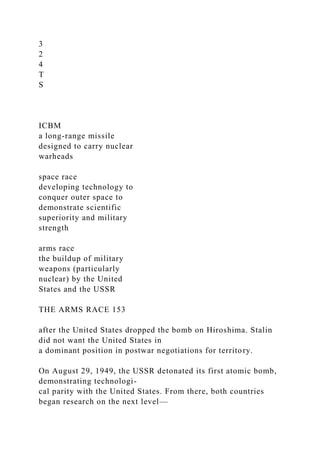
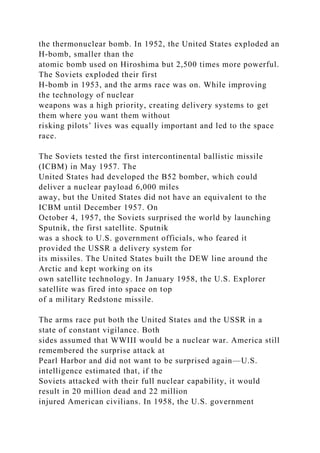
118
CHAPTER
OUTLINE
• Worldwide
Conflict
• Western Europe
on the Front Line
• Regional Conflicts
• International
and Regional
Convergence
Conflict and Convergence: 1945–19506
1943
Sartre’s Being and
Nothingness is
published
The “big three”
meet at Tehran
conference
1945
Yalta conference
is held
VE Day ends the
war in Europe
Potsdam
conference is held
VJ Day ends the
war in the Pacific
Ho Chi Minh
“decolonizes”
Vietnam
Korea is divided
into occupation
zones
The United
Nations is
founded
1946
The first
Indochina war
begins
Bretton Woods
system goes into
effect
Kennan writes the
“Long Telegram”
Churchill makes
“Iron Curtain”
speech
1947
India is
decolonized
India and
Pakistan are
created
UN Partition Plan
for Palestine is
approved
Truman Doctrine,
Marshall Plan,
and National
Security Act go
into effect in
United States
The “Red Scare”
takes hold in the
United States
1941
United States and
USSR join the
Allies
C H A P T E R T I M E L I N EC H A P T E R T I M E L I N E
The World in the 20th Century: A Thematic Approach, First
Edition, by Stephanie A. Hallock. Published by Pearson.
Copyright © 2013 by Pearson Education, Inc.
G
A
R
R
E
T
T
,
M
E
G
A
N
1
3
2
4
T
S
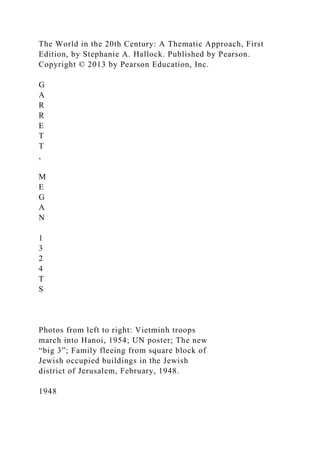
Photos from left to right: Vietminh troops
march into Hanoi, 1954; UN poster; The new
“big 3”; Family fleeing from square block of
Jewish occupied buildings in the Jewish
district of Jerusalem, February, 1948.
1948
Congress of
Europe meets
Gandhi is
assassinated
USSR blockades
Berlin, and United
States flies airlift
around it
The OAS is
established
State of Israel
is created and
recognized
The first Arab-
Israeli War begins
1949
Mao wins civil
war in China and
establishes PRC
Chinese
nationalists flee
to Taiwan
The German
Federal Republic
is created
NATO is
established
1950
Sino-Soviet Treaty
is signed
U.S. government
issues NSC-68
1955
Moscow creates
the Warsaw Pact
119
The World in the 20th Century: A Thematic Approach, First
Edition, by Stephanie A. Hallock. Published by Pearson.
Copyright © 2013 by Pearson Education, Inc.
G
A
R
R
E
T
T
,
M
E
G
A
N
1
3
2
4
T
S
Worldwide Conflict
The defining structural characteristic of the
latter half of the twentieth century was the
conflict between the two “superpowers” that
emerged at the end of World War II. After
thirty years of war and its consequences in
Europe, Germany’s and Italy’s military ca-
pacities were almost completely destroyed
and Great Britain’s and France’s had been
greatly diminished. What was left of Japan’s
military was being dismantled by the United
States during the Occupation, and China
was engaged in an intermittent civil war
from April 1927 through May 1950. By
1945, only the United States and USSR were
capable of fielding effective military ma-
chines, and the United States was clearly
leading in terms of military technology, proven by its use of the
atomic bombs in Japan. The mil-
itary alliance these two countries forged to defeat fascism in
World War II was not strong
enough to overcome the ideological differences between them.
The Roots of the Cold War
Patterns of war in the twentieth century (really throughout the
history of humankind) were
based on technological growth: close-range combat of the late
1800s led to long-range
weapons (grenades, mortar, nerve gas) for total war in World
War I, which led to airplanes
and bombing in World War II. With the advent of the atomic
bomb and rapidly expanding nu-
clear technology, it became obvious that waging a total war
would have destructive conse-
quences worldwide. This led to the Cold War, which does not
mean “no war”; it simply
means that the primary combatants never engaged in direct
military conflict against one an-
other. As long as the two superpowers with the nuclear weapons
did not go to war, the world
could survive. Somewhat ironically, it was because of the
advancements in military technol-
ogy that the United States and USSR could not engage one
another in traditional military
warfare without potentially destroying the world.
In many ways, the goals of the two main contenders in the Cold
War followed the very tradi-
tional goals of combatants throughout history—each side was
fighting for control of territory. The
Cold War is often referred to as an ideological war, implying
that the two sides were fighting
over beliefs. On some level, that is certainly true—the stated
goal of the USSR was to spread
communism, and the stated goal of the United States was to
contain the spread of communism
The victors of the second world war were anxious to avoid the
mistakes made at the end of theGreat War, particularly those
that contributed to the worldwide economic depression. This re-
quired cooperation, which led to convergence in several key
economic and political areas in the
latter half of the twentieth century. But differ-
ent views on who should dominate the post-
war political, economic and social cultures led
to regional and international conflicts. It was
in these immediate postwar years, 1945–1950,
that the patterns of conflict and convergence
that would structure the rest of the century, as
well as shape the twenty-first century, were
established.
Cold War
describes the conflict
between the United
States and USSR between
1945–1991, when the
two primary combatants
never engaged in direct
military conflict against
one another
Occupation
after the Japanese
surrendered at the end of
the WWII, the Allied
military, led by General
MacArthur, supervised the
political, economic and
social reconstruction of
Japan from 1945–1952
120 CHAPTER 6 • CONFLICT AND CONVERGENCE: 1945–
1950
W O R K I N G W I T H T H E T H E M E S
THE EFFECTS OF TECHNOLOGY The “total war” era of the
first
half of the twentieth century gives way to a “Cold War,” driven
by
the ongoing development of weapons technology.
CHANGING IDENTITIES Thirty years of war in Europe greatly
impacted its citizens. Two new issues evolve that will remain
dominant features for the remainder of the twentieth century:
the
implications of the Cold War on people throughout the world
and
the short- and long-term consequences of decolonization.
SHIFTING BORDERS Because the Allies cannot agree on
political
ideology, their division of the postwar world into occupation
zones
has serious worldwide ramifications. The creation of new
indepen-
dent countries in the late 1940s through decolonization leads to
regional violence.
GLOBALIZATION Two seemingly contradictory paths emerge:
international political and economic division created by the
Cold
War and unprecedented convergence in the creation of the
United
Nations and Bretton Woods system, as well as the development
of
regional organizations.
The World in the 20th Century: A Thematic Approach, First
Edition, by Stephanie A. Hallock. Published by Pearson.
Copyright © 2013 by Pearson Education, Inc.
G
A
R
R
E
T
T
,
M
E
G
A
N
1
3
2
4
T
S
(which is a less aggressive way of saying, “to spread
democracy”). In order to accomplish its
goal, however, each side would have to control a territory, or
control the government of that terri-
tory at the very least.
How did the world get to this somewhat artificial divide
between democracy and commu-
nism, with each ideology outright vilifying the other to prove to
the rest of the world that its
political and economic system was the better one? Thanks to the
actions of Mussolini and Hitler,
fascism had essentially been discredited as an ideological form
of political governance (not that
it ended it in reality, of course). During World War II, the
democracies and communist USSR
joined together to defeat those fascist regimes. Interestingly, it
is in this military alliance to de-
feat fascism that the Cold War took shape.
The “Big Three”
When Hitler broke his nonaggression pact
with Stalin and invaded the USSR, he forced
the Soviet Union into a military alliance with
the Allies. The Soviets proved to be absolutely
vital in the final defeat of Berlin and Germany,
which created a bit of a problem after the war
because the Red Army physically occupied all
of Eastern Europe and one-half of Germany.
Driving out the Soviets would require military
action, which the United States and Britain
could not even contemplate at that point. But
the alliance between the USSR and the Allies
was a military one only and had nothing to do
with achieving political harmony. Predictably,
when it came time for all the winners to sit
down at the table and bring the war in Europe
to its conclusion, the USSR wanted to install
communist governments in Eastern Europe
that would be subordinate to Moscow. And
predictably, Great Britain and the United
States opposed such expansion.
The first meeting of the “big three” was in
Tehran, Iran, in November 1943, before the war
even ended. They agreed to keep fighting to-
gether and pursue unconditional surrender from Germany and
Japan in an effort to avoid the diplo-
matic messes created by the negotiations at the end of World
War I. Churchill and Roosevelt agreed
to open a second front in France (leading to D-Day), and in
return, Stalin promised
to join the war in the Pacific after Germany was defeated. But
as the Soviets moved
through Eastern Europe on their way to Germany, they held
onto the territory for
themselves. Churchill opposed Stalin’s actions, and in October
1944 they talked and
tentatively agreed on how they would divide up control of the
Balkans after the war.
There was a lot of tension over the countries of Eastern Europe
occupied by the
Soviet military—Stalin wanted them all to be communist under
his control, while
the United States and Great Britain still had hopes of freely
elected democratic governments every-
where in the world. Stalin agreed to let the citizens decide (self-
determination), knowing that he
would violate the agreements anyway and establish communist
regimes. When it came to Germany,
all three men agreed that it would be stripped of its government
and military and would be divided
into four occupation zones (one for each of the Allied powers,
including France).
The next time the “big three” met was in February 1945, in
Yalta, just before Germany fell.
Roosevelt’s goal was to encourage the USSR to get involved in
the war against Japan after
ANALYSIS
Look carefully at the body language in
this photograph. What does it tell you
about each man? What does it tell you
about the relationship between them?
ideological war
conflict rooted in differing
world views; to win, one
ideology would become
dominant over all others
WORLDWIDE CONFLICT 121
The “big three”: U.S. President Franklin D. Roosevelt, British
Prime Minister Winston Churchill
and Soviet Premier Josef Stalin.
The World in the 20th Century: A Thematic Approach, First
Edition, by Stephanie A. Hallock. Published by Pearson.
Copyright © 2013 by Pearson Education, Inc.
G
A
R
R
E
T
T
,
M
E
G
A
N
1
3
2
4
T
S
Read the
Document Long
Telegram on
mysearchlab.com
122 CHAPTER 6 • CONFLICT AND CONVERGENCE: 1945–
1950
Germany was defeated, so he and Churchill promised Stalin he
could control significant regions
in the Pacific after Japan was defeated. Roosevelt expressed his
idea of a United Nations (UN)
organization to ensure peace after the war—sort of a League of
Nations, but with more muscle.
Because Stalin agreed to participate, the United States made
some more concessions to him,
allowing the USSR to essentially control all of Eastern Europe,
assuming the people were
allowed to choose their own governments. Stalin was relentless
in “convincing” them to “choose”
communism.
The last time the Allied leaders met was in the Berlin
neighborhood of Potsdam in July
1945. Germany was defeated, Roosevelt had passed away and
had been replaced by Truman,
and the British people had replaced the very conservative
Churchill with Clement Attlee and his
Labour Party. The leaders confirmed past agreements, expanded
Soviet control in Eastern
Europe, and carved Germany into four separate occupation
zones until they could figure out a
better arrangement (which did not come until 1990). Rather than
creating an unsatisfactory,
overarching peace treaty like the Treaty of Versailles that ended
World War I, they left Potsdam
with no treaties at all. Such agreements would come slowly in
following years. When the Allied
leaders left Potsdam, the world had been divided into two
unfriendly camps: the West (led by the
United States) and the East (led by the USSR).
Behind the Iron Curtain
In a speech to the Soviet people in early 1946, Stalin made a
statement implying that capitalism
made future wars inevitable:
It would be wrong to think that the Second World War broke out
accidentally,
or as a result of blunders committed by certain statesmen,
although blunders
were certainly committed. As a matter of fact, the war broke out
as the
inevitable result of the development of world economic and
political forces on
the basis of present-day monopolistic capitalism. Marxists have
more than
once stated that the capitalist system of world economy contains
the elements
of a general crisis and military conflicts, that, in view of that,
the develop-
ment of world capitalism in our times does not proceed
smoothly and evenly, but through
crises and catastrophic wars.
The U.S. Department of State asked George Kennan, a U.S.
diplomat in Moscow since 1933, for
his view on Stalin’s intentions. His now-famous response, The
Long Telegram of February 22,
1946, warned that “in the long run, there [could] be no
permanent, peaceful coexistence” with
the Soviet Union. In Kennan’s mind, the conflict stemmed from
Stalin’s belief in Marxism and
his fear that Western capitalism would affect his people;
therefore, the American way of life had
to be destroyed. Probably the most important feature of this
Long Telegram is Kennan’s conclu-
sion regarding how best to handle the situation. Although Stalin
would never negotiate or com-
promise, the problem could be solved “without recourse to any
general military conflict.”
Ultimately, Kennan said, the Soviet system of government is
weaker than the American system
of government and American success “. . . depends on health
and vigor of our own society. . .
Every courageous and incisive measure to solve internal
problems of our own society, to
improve self-confidence, discipline, morale and community
spirit of our own people, is a diplo-
matic victory over Moscow. . .” The United States should firmly
guide other countries in devel-
oping political, economic, and social well-being “and unless we
do,” Kennan warned, “Russians
certainly will.” Kennan’s words became the cornerstone of
American foreign policy for most of
the remainder of the twentieth century.
A few weeks after Kennan’s telegram, Winston Churchill, the
former British prime minister,
spoke at a college in Fulton, Missouri. His speech was not well
received at the time—many
people viewed Churchill as a warmonger trying to drag the
United States into another military
ANALYSIS
These words were taken from Stalin’s
“Two Worlds” speech of 1946. Why
did the U.S. government react to these
words with concern?
The World in the 20th Century: A Thematic Approach, First
Edition, by Stephanie A. Hallock. Published by Pearson.
Copyright © 2013 by Pearson Education, Inc.
G
A
R
R
E
T
T
,
M
E
G
A
N
1
3
2
4
T
S
sphere of influence
a geographic region over
which one country
directly or indirectly
controls political,
economic, social, and/or
military decision making
WORLDWIDE CONFLICT 123
conflict—but the speech coined the phrase that best described
the political and ideological divide between the Soviets and
the West as the Cold War began:
. . . From Stettin in the Baltic to Trieste in the Adriatic an
iron curtain has descended across the Continent. Behind
that line lie all the capitals of the ancient states of
Central and Eastern Europe. Warsaw, Berlin, Prague,
Vienna, Budapest, Belgrade, Bucharest and Sofia; all
these famous cities and the populations around them lie
in what I must call the Soviet sphere, and all are subject,
in one form or another, not only to Soviet influence but to
a very high and in some cases increasing measure of con-
trol from Moscow.
Churchill was referring to the divide across Eastern
Europe between free countries with Western-style democratic
governments and the Eastern bloc countries with communist
governments that answered directly to the USSR. Stalin, of
course, perceived Churchill’s speech as a threat, particularly
the opening phrases in which Churchill seemed to challenge
America to act against communism: “. . . The United States
stands at this time at the pinnacle of world power . . . with this
primacy in power is also joined an awe-inspiring accountabil-
ity to the future.” Churchill may well have been trying to pro-
voke the United States to stay involved in European affairs
rather than return to isolationism as it did after World War I,
but there was good reason for him to be concerned about the
future of democracy in Europe.
As agreed upon during the Tehran, Yalta and Potsdam
conferences, the Soviet military
occupied the territory it conquered on the way to Berlin to
defeat Hitler, including Poland,
Romania, Bulgaria, Hungary and parts of Czechoslovakia,
Austria and Germany. In violation of
those same agreements, however, Stalin refused to allow
democratic elections in those countries,
and each was ruled by a communist government supported by
the Red Army. With the exception
of Yugoslavia, where the communist yet fiercely nationalist
leader Josip Broz Tito refused to
comply with Stalin’s domination, each of these communist
countries fell under the Soviet
sphere of influence. They became known as the satellite states
because they resolutely dupli-
cated Stalin’s political and economic models, although they
were technically independent coun-
tries. Additionally, a civil war between democratic and
communist forces in Greece threatened
to replace the democratic government there, and the USSR
clearly hoped to add Turkey to the
satellite bloc to secure the Soviet border.
The U.S. Response
After thirty years of war and economic hardship, Europe was in
shambles politically, economi-
cally, industrially, commercially and socially. Much had been
destroyed, leading many Western
Europeans to wonder if communism was a way out of the hard
life and injustices they suffered.
President Truman believed that if the United States did not step
in to help, communist move-
ments underfoot in Western Europe would be successful. After
studying Kennan’s Long
Telegram, Truman made three key announcements:
1. The official U.S. policy of containment, eventually
formalized in NSC-68 to prevent the
spread of communism to noncommunist countries
EAST
GERMANY
CZECHOSLOVAKIA
BULGARIA
ROMANIA
YUGOSLAVIA
HUNGARY
POLAND
UNION OF
SOVIET SOCIALIST
REPUBLICS
Bla
ck S
ea
0 200 mi
0 200 km
MAP 6.1 Soviet Sphere of Influence by 1948
Read the
Document Iron
Curtain Speech on
mysearchlab.com
Read the
Document National
Security Council
Memorandum Number 68
on mysearchlab.com
The World in the 20th Century: A Thematic Approach, First
Edition, by Stephanie A. Hallock. Published by Pearson.
Copyright © 2013 by Pearson Education, Inc.
G
A
R
R
E
T
T
,
M
E
G
A
N
1
3
2
4
T
S
Read the
Document The Truman
Doctrine on
mysearchlab.com
2. The Truman Doctrine to support “free people who are
resisting attempted subjugation by
armed minorities or by outside pressures” (primarily targeted
toward Greece and Turkey)
3. The Marshall Plan to provide money for the rebuilding of
Europe
Under the Marshall Plan, any European state was invited to
submit a request to the United
States to receive funding for reconstruction programs. At first,
Poland and Czechoslovakia tried
to sign up, but Stalin quickly realized the political aspect of this
economic program and blocked
participation from countries within the Soviet sphere of
influence. Taking money from the U.S.
Congress would certainly place a country squarely within the
U.S. sphere of influence.
In four years, the Marshall Plan provided aid to sixteen
countries in the total amount of
$13.2 billion. The Allies received the largest shares: Great
Britain got $3.2 billion to rebuild its
oil industry; France got $2.7 billion to modernize industry and
transportation; and West
Germany used its $1.5 billion to create a free-enterprise
industrial system that worked so well it
boosted German production 50 percent within four years.
Overall, the Marshall Plan achieved its
economic goals—the nations of Western Europe rebounded
economically, enabling them to
trade with the United States. And economic well-being in the
Western world provided the
124 CHAPTER 6 • CONFLICT AND CONVERGENCE: 1945–
1950
MAKE THE CONNECTION
Using the map on the right as a
guide and documents 6.3, 6.4,
and 6.5, what connections can
you make between the policy of
containment, the Truman
Doctrine and the Marshall Plan?
StockholmStockholm
CopenhagenCopenhagen
WarsawWarsawBerlinerlin
ViennaVienna
BudapestBudapest
BucharBuchar
IstanbulIstanbul
AthensAthens
SofiaSofia
BelgradeBelgrade
TriesteTrieste
ParisParis
FINLANDFINLAND
IRELANDELAND
FRANCEFRANCE
ITALYITALY
SWITZ.SWITZ.
BELG.BELG.
LUX.LUX.
NETH.NETH.
DEN.DEN.
WESTWEST
GERMANYGERMANY
EASEAST
GERMERMANYANY
HUN.HUN.
ROMANIAROMANIA
POLANDPOLAND
CZECH.CZECH.
AUS.AUS.
BULGARIABULGARIAYUGO.YUGO.
UNITEDUNITED
KINGDOMKINGDOM
Moscow
Stockholm
Oslo
Copenhagen
WarsawBerlin
Vienna
Budapest
Bucharest
Istanbul
Athens
Sofia
Belgrade
Trieste
Rome
Paris
London
Dublin
Madrid
Lisbon
NORWAY
SWEDEN
SOVIET UNION
FINLAND
ICELAND
IRELAND
FRANCE
PORTUGAL
SPAIN ITALY
SWITZ.
BELG.
LUX.
NETH.
DEN.
WEST
GERMANY
EAST
GERMANY
HUN.
ROMANIA
POLAND
CZECH.
AUS.
BULGARIAYUGO.
ALB.
GREECE TURKEY
MOROCCO ALGERIA TUNISIA
UNITED
KINGDOM
North
Sea
Mediterranean Sea
Black
Sea
B
al
ti
c
S
ea
ATLANTIC
OCEAN
Less than $400 million
$400 million to $1.2 billion
More than $1.2 billion
MAP 6.2 Marshall Plan Aid to Europe, 1948–1952
Read the
Document The
Marshall Plan on
mysearchlab.com
The World in the 20th Century: A Thematic Approach, First
Edition, by Stephanie A. Hallock. Published by Pearson.
Copyright © 2013 by Pearson Education, Inc.
G
A
R
R
E
T
T
,
M
E
G
A
N
1
3
2
4
T
S
“proof” that democracy generated wealth for all, leading to a
high degree of political stability in
the United States and Western Europe.
The mental image of the iron curtain across Europe, the
language of the containment policy
and the bold political and economic promises of the Truman
Doctrine and Marshall Plan solidi-
fied the divisions, differences and distance between the East
and the West—the Cold War had
begun and both sides had made their positions clear. But was
the United States prepared to fol-
low through? Not quite yet.
The National Security Act of 1947 created the Department of
Defense and included the
army, navy and air force as equals within it. The act also
created the National Security Council
to advise the president of foreign policy matters and the Central
Intelligence Agency (CIA) to
collect and analyze intelligence information and conduct covert
operations outside of the
United States. The Federal Bureau of Investigation (FBI) would
continue to handle internal af-
fairs. One of the first actions of the National Security Council
was to recommend increasing
military spending by 400 percent. The military budget jumped
from $13 billion in 1949 to more
than $40 billion in one year. To prevent communist influences
from surfacing within the United
States, Executive Order 9835 in March 1947 revoked
governmental security clearances for peo-
ple who were considered politically “leftist.” The Taft-Hartley
Act, which passed in June 1947
despite a presidential veto, restricted the power of labor unions.
In 1949, Congress instituted a
peacetime draft to make sure the military was trained and ready
to go at moment’s notice.
Congress also revived the House Committee on Un-American
Activities and went after
America’s film industry, academicians, and eventually even
members of the U.S. military and
top State Department officials. Republican Senator Joseph
McCarthy led this Red Scare and
held Senate hearings that accused people of sympathizing with
communists. At the least, many
people lost their jobs and friends; at the worst, they faced
contempt citations, criminal trials,
and even prison sentences.
The First Conflict of the Cold War: the Berlin Airlift
For the U.S. government, 1947 was a busy year; and Stalin
decided to test the new policies—he
wanted to gauge how committed the United States was to
containment. In June 1948, Stalin tried
to push the line between the communists (supported by the
USSR) and the Western democracies
(supported by the United States), which ran right down the
middle of Germany. Even though the
city of Berlin was located 110 miles inside of East Germany
(controlled by the USSR), it too
was divided into four sectors—one part to each of the victorious
Allies. The French, British and
American sectors combined to form West Berlin, and the USSR
agreed to allow access through
East German territory to and from West Berlin.
But in June 1948, the Soviets cut off all power to West Berlin
and closed all transportation
access, completely forming a blockade around it. Although U.S.
troops were stationed nearby,
using them against the Soviet troops who were upholding the
blockade would most certainly re-
sult in armed conflict, escalating the Cold War just as it got
underway. Truman decided the better
way to handle this was to bypass the blockade and show the
Soviets that they could not “beat”
the United States. For almost one year, basic necessities were
consistently flown into West
Berlin via the Berlin Airlift. At the peak of the Berlin Airlift,
Western cargo planes were landing
at one of Berlin’s three airports at a rate of one plane every
sixty-two seconds. In May 1949, the
Soviets realized that the United States was not going to simply
surrender West Berlin and dis-
continued the blockade, but not before 275,000 flights had
carried a staggering 2.3 million tons
of supplies into West Berlin. The point was made—the United
States would take action to con-
tain the spread of communism.
Stalin’s aggression in Berlin led to the birth of the German
Federal Republic in 1949, cre-
ated by a constitution written by Germans under Allied
supervision. Germany was no longer one
country divided into occupation zones; it became two
independent states—familiarly known as
West and East Germany—that formed the front line of the Cold
War.
House Committee
on Un-American
Activities
a standing committee of
nine representatives who
investigated suspected
communists in influential
positions in U.S. society
WORLDWIDE CONFLICT 125
Watch the
Video President Truman
and the Threat
of Communism on
mysearchlab.com
Watch the
Video The Berlin Airlift on
mysearchlab.com
The World in the 20th Century: A Thematic Approach, First
Edition, by Stephanie A. Hallock. Published by Pearson.
Copyright © 2013 by Pearson Education, Inc.
G
A
R
R
E
T
T
,
M
E
G
A
N
1
3
2
4
T
S
126 CHAPTER 6 • CONFLICT AND CONVERGENCE: 1945–
1950
Western Europe on the Front Line
For almost the entire first half of the twentieth century, Western
Europe had been torn apart by
war, and the results were absolutely devastating. The physical
destruction was almost unimag-
inable; an estimated 70 percent of Europe’s industrial
infrastructure was destroyed. From the
largest cities on the continent to the smallest rural villages,
farmland, factories and all meth-
ods of transportation were unusable and, in many cases, simply
gone. People suffered through
bombings, military occupations, war crimes, forced labor camps
and the Holocaust.
Approximately 37 million Europeans were dead, which included
almost twice as many civil-
ians as military. For those left to survive in what American
journalist William Shirer described
KielKiel
HamburgHamburg
BremerhavenBremerhaven
BremenBremen
HannoverHannover
SchwerinSchwerin
PotsdamPotsdam
HalleHalle
ErfurtErfurt DresdenDresden
DüsseldorfDüsseldorf
BerlinBerlin
WiesbadenWiesbaden
MainzMainz
StuttgartStuttgart
MunichMunich
TübingenTübingen
KehlKehl
(Fr. military area)(Fr. military area)
FreiburgFreiburg
RHINELAND-RHINELAND-
PALATINATEPALATINATE
SAARSAAR
BADENBADEN
WÜRTTEMBERG-WÜRTTEMBERG-
HOHENZOLLERNHOHENZOLLERN
BAVARIABAVARIA
WÜRTTENBERG-BADENWÜRTTENBERG-BADEN
HESSEHESSE
THURINGIATHURINGIA SAXONYSAXONY
SAXONY-ANHALTSAXONY-ANHALT
BRANDENBURGBRANDENBURG
NORTH RHINE-WESTPHALIANORTH RHINE-WESTPHALIA
LOWER SAXONYLOWER SAXONY
SCHLESWIG-HOLSTEINSCHLESWIG-HOLSTEIN
MECKLENBURGMECKLENBURG
Kiel
Hamburg
Bremerhaven
Heligoland
(Br. military area)
Bremen
Hannover
Schwerin
Potsdam
Halle
Erfurt Dresden
Düsseldorf
Berlin
Wiesbaden
Mainz
Stuttgart
Munich
Tübingen
Kehl
(Fr. military area)
Freiburg
RHINELAND-
PALATINATE
SAAR
BADEN
WÜRTTEMBERG-
HOHENZOLLERN
BAVARIA
WÜRTTEMBERG-BADEN
HESSE
THURINGIA SAXONY
SAXONY-ANHALT
BRANDENBURG
NORTH RHINE-WESTPHALIA
LOWER SAXONY
SCHLESWIG-HOLSTEIN
MECKLENBURG
0 50 mi
0 50 kmAmerican Zone
British Zone
French Zone
Soviet Zone
French protectorate
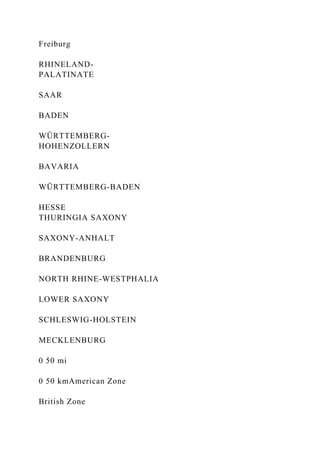
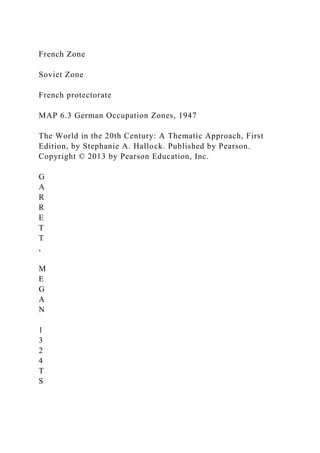
MAP 6.3 German Occupation Zones, 1947
The World in the 20th Century: A Thematic Approach, First
Edition, by Stephanie A. Hallock. Published by Pearson.
Copyright © 2013 by Pearson Education, Inc.
G
A
R
R
E
T
T
,
M
E
G
A
N
1
3
2
4
T
S
as an “utter wasteland,” famine and poor living
conditions were rampant. Unemployment, food ra-
tioning and a coal shortage led to civil unrest and
violence. In an effort to find homes, jobs and their
families, people migrated and relocated across the
continent. An estimated 50 million refugees were
homeless.
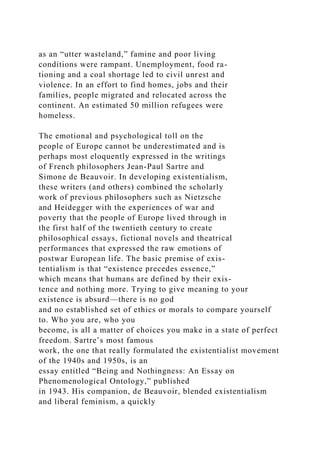
The emotional and psychological toll on the
people of Europe cannot be underestimated and is
perhaps most eloquently expressed in the writings
of French philosophers Jean-Paul Sartre and
Simone de Beauvoir. In developing existentialism,
these writers (and others) combined the scholarly
work of previous philosophers such as Nietzsche
and Heidegger with the experiences of war and
poverty that the people of Europe lived through in
the first half of the twentieth century to create
philosophical essays, fictional novels and theatrical
performances that expressed the raw emotions of
postwar European life. The basic premise of exis-
tentialism is that “existence precedes essence,”
which means that humans are defined by their exis-
tence and nothing more. Trying to give meaning to your
existence is absurd—there is no god
and no established set of ethics or morals to compare yourself
to. Who you are, who you
become, is all a matter of choices you make in a state of perfect
freedom. Sartre’s most famous
work, the one that really formulated the existentialist movement
of the 1940s and 1950s, is an
essay entitled “Being and Nothingness: An Essay on
Phenomenological Ontology,” published
in 1943. His companion, de Beauvoir, blended existentialism
and liberal feminism, a quickly
growing movement in the late 1940s, when women were not
anxious to give up the jobs and in-
dependence they had gained while their husbands were gone.
Her 1949 best seller, The Second
Sex, argues that, throughout history, women have been defined
as the “other” sex, implying
they are not the “normal” sex.
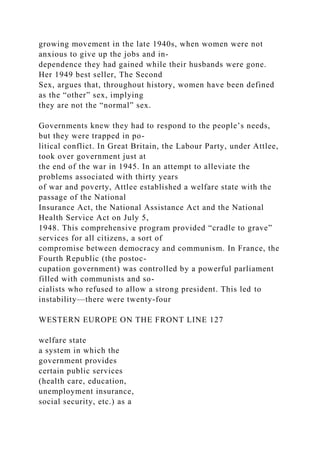
Governments knew they had to respond to the people’s needs,
but they were trapped in po-
litical conflict. In Great Britain, the Labour Party, under Attlee,
took over government just at
the end of the war in 1945. In an attempt to alleviate the
problems associated with thirty years
of war and poverty, Attlee established a welfare state with the
passage of the National
Insurance Act, the National Assistance Act and the National
Health Service Act on July 5,
1948. This comprehensive program provided “cradle to grave”
services for all citizens, a sort of
compromise between democracy and communism. In France, the
Fourth Republic (the postoc-
cupation government) was controlled by a powerful parliament
filled with communists and so-
cialists who refused to allow a strong president. This led to
instability—there were twenty-four
WESTERN EUROPE ON THE FRONT LINE 127
welfare state
a system in which the
government provides
certain public services
(health care, education,
unemployment insurance,
social security, etc.) as a
right of citizenship,
regardless of personal
wealth
liberal feminism
a philosophy and activist
movement that seeks
political, legal and social
reform on the premise that
men and women are equal
existentialism
a philosophical movement
of postwar Europe that
emphasizes individual
decision making as the
sole source of one’s
identity
Rebuilding England.
MAKE THE CONNECTION
Sartre was drafted into the French army in 1939, captured by
Germans in 1940 and spent nine
months in a prisoner of war camp. After negotiating his release,
he returned to Paris and began work-
ing for the French Resistance. Sartre’s experiences during
World War II reflect the conundrum most
Europeans faced during those years—do I collaborate with the
Nazis, join the Resistance or focus
solely on self-preservation? Solving this question for himself
led Sartre to one of the fundamental
tenets of existential philosophy—freedom is what you do with
what’s been done to you. Why did this
philosophy gain popular appeal in Europe following World War
II?
The World in the 20th Century: A Thematic Approach, First
Edition, by Stephanie A. Hallock. Published by Pearson.
Copyright © 2013 by Pearson Education, Inc.
G
A
R
R
E
T
T
,
M
E
G
A
N
1
3
2
4
T
S
128 CHAPTER 6 • CONFLICT AND CONVERGENCE: 1945–
1950
governments in just twelve years. In West
Germany, the government was initially ruled
by the Allied High Commission, comprised
of four commissioners from the United
States, three from the United Kingdom and
one from France. Germans regained control
of their government in September 1949. In
Italy, a threat of impending civil war led to a
referendum in June 1946 to decide whether
to maintain the monarchy or move to a re-
public form of government. With only 54
percent of the vote in favor of republicanism,
in a hotly contested election with charges of
corruption, Italy officially became a republic
on January 1, 1948.
The Denazification of West Germany
Although the war was officially over, through-
out Europe Germans were still popularly re-
garded as the enemy. The hatred and distrust
extended to all German people, although the
official Allied policy toward Germany was
focused on the denazification and demilitariza-
tion of the state. Across Europe and the United
States, there was a sense of the need for retri-
bution for the death and destruction that
Germany had initiated, particularly because
Hitler was unavailable to publicly suffer for the
misery he created. On August 8, 1945, The
London Charter of the International Military
Tribunal was published, providing the legal basis for conducting
trials for individuals accused of
committing war crimes, crimes against peace, and/or crimes
against humanity during the war,
and it spelled out the procedures that would be followed in
doing so. From November 20, 1945, to
October 1, 1946, the International Military Tribunal (IMT),
comprised of judges from the four
Allied countries, tried twenty-four of the highest-ranking Nazi
officials who were captured at the
end of the war. The United States also held its own tribunal for
war criminals, including specific
ones for doctors and judges. Collectively, these tribunals were
known as the Nuremberg Trials
because they were held in the city of Nuremberg, Germany, the
site of some of the largest Nazi ral-
lies before and during World War II. Of the twenty-four high-
ranking Nazi officials tried by the
IMT, twelve received the death sentence (by hanging), seven
received prison time ranging from ten
years to life, three were acquitted, one had his charges dropped
to lesser crimes and was sent to a
U.S. tribunal, and one committed suicide before his trial began.
The Nuremberg Trials became the
foundation for the ongoing development of international
criminal law through UN conventions and
the creation of international courts.
Between the U.S. military presence throughout Europe and the
money coming in through
the Marshall Plan, American citizens, corporations and culture
spread throughout Europe.
Unlike the end of World War I, when the American troops went
home and the country became
isolationist, the United States established military bases in West
Germany to keep a close eye on
the encroaching communist regimes in Eastern Europe. The
European countries were simply too
weak militarily to handle the occupation of Germany and
protect themselves from the Soviet
Red Army without the help of the United States. Similarly, they
were too financially drained to
rebuild their own economies and had to rely on aid from the
United States to do so. This was a
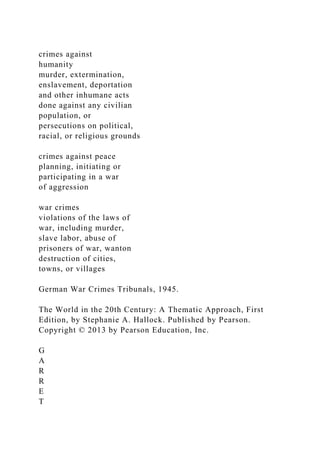
crimes against
humanity
murder, extermination,
enslavement, deportation
and other inhumane acts
done against any civilian
population, or
persecutions on political,
racial, or religious grounds
crimes against peace
planning, initiating or
participating in a war
of aggression
war crimes
violations of the laws of
war, including murder,
slave labor, abuse of
prisoners of war, wanton
destruction of cities,
towns, or villages
German War Crimes Tribunals, 1945.
The World in the 20th Century: A Thematic Approach, First
Edition, by Stephanie A. Hallock. Published by Pearson.
Copyright © 2013 by Pearson Education, Inc.
G
A
R
R
E
T
T
,
M
E
G
A
N
1
3
2
4
T
S
REGIONAL CONFLICTS 129
tough spot for the European governments, who were on the one
hand thankful the United States
was willing to stay involved and participate in establishing
economic, political and military sta-
bility; but at the same time painfully aware of the
Americanization of Europe.
Regional Conflicts
While the beginning of the Cold War was certainly the most
divisive conflict of this era, it was
by no means the only one. Some of the most dramatic conflicts
in the latter half of the twentieth
century also began in these postwar years as a result of issues
associated with migration and de-
colonization. Because of the bipolar structure of the world
during this time, many of these re-
gional conflicts became key battles in the Cold War (and are
discussed in future chapters).
Indeed, many of them remain heated regional conflicts in the
twenty-first century.
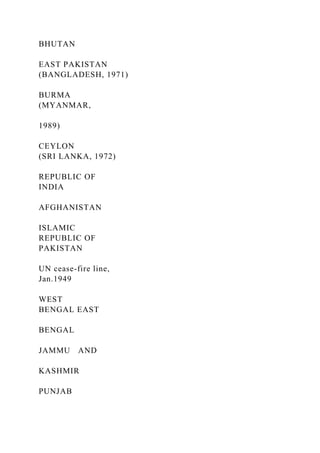
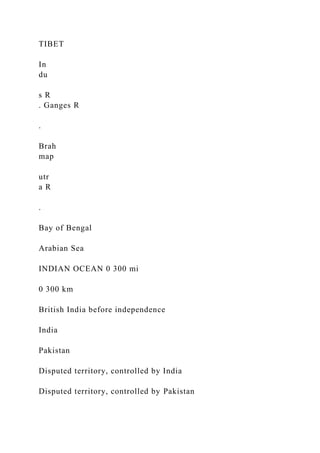
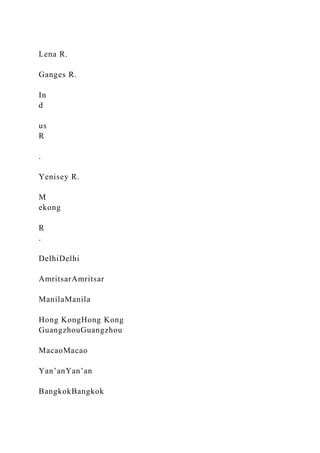
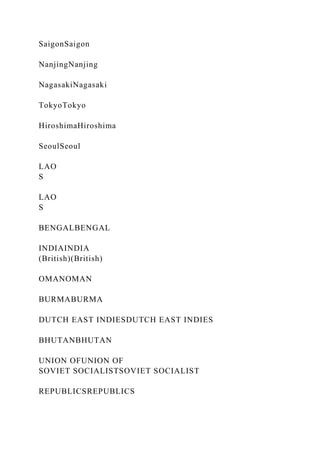
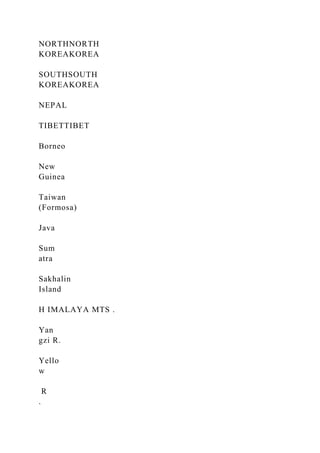
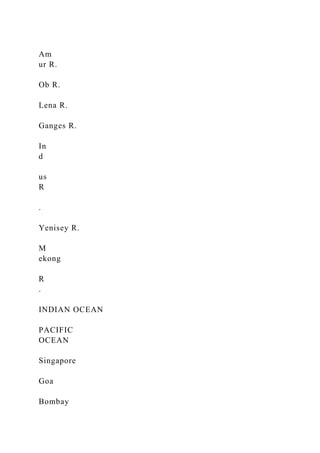
India and Pakistan
After years of working toward self-rule, India gained its
independence from Great Britain in
August 1947. Unfortunately, the people of India disagreed
(often violently) on religion and
government. Muslims believed that religion should be an
integral part of the governance sys-
tem, while Hindus wanted to establish a democratic republic
with a separation of church and
state. Because they could not agree, they could not create a
single government for the newly
New Delhi
Delhi
Bombay
(Mumbai)
Calcutta
Dacca
AmritsarLahore
Islamabad
Karachi
CHINA
NEPAL
BHUTAN
EAST PAKISTAN
(BANGLADESH, 1971)
BURMA
(MYANMAR,
1989)
CEYLON
(SRI LANKA, 1972)
REPUBLIC OF
INDIA
AFGHANISTAN
ISLAMIC
REPUBLIC OF
PAKISTAN
UN cease-fire line,
Jan.1949
WEST
BENGAL EAST
BENGAL
JAMMU AND
KASHMIR
PUNJAB
TIBET
In
du
s R
. Ganges R
.
Brah
map
utr
a R
.
Bay of Bengal
Arabian Sea
INDIAN OCEAN 0 300 mi
0 300 km
British India before independence
India
Pakistan
Disputed territory, controlled by India
Disputed territory, controlled by Pakistan
MAP 6.4 India and Pakistan, 1947
Americanization
U.S. influence on the
culture of another
country, generally spread
through consumerism
and/or militarization
The World in the 20th Century: A Thematic Approach, First
Edition, by Stephanie A. Hallock. Published by Pearson.
Copyright © 2013 by Pearson Education, Inc.
G
A
R
R
E
T
T
,
M
E
G
A
N
1
3
2
4
T
S
130 CHAPTER 6 • CONFLICT AND CONVERGENCE: 1945–
1950
decolonized state, and India was partitioned into two separate
nations: India for the Hindus
and Pakistan for the Muslims. This partition led to violence as
approximately 14.5 million
people rushed the border—the Muslims in India heading for
Pakistan and the Hindus in
Pakistan heading for India. They met in the Punjab region,
where an estimated 500,000 were
killed in rioting.
Mohandas Gandhi, by then the most powerful figure in the
Indian National Congress, opposed
the partition, but his closest advisors convinced him that it was
the only way to avoid civil war, so
he reluctantly agreed. After the partition, he became focused on
Hindu–Muslim unity, engaging in
a fast-unto-death unless financial aid from India that had been
promised to Pakistan was delivered.
The money transfer was made; but despite Gandhi’s efforts, in
October 1947 the first of what
would be four wars broke out between the newly created India
and Pakistan over the territory of
Kashmir. In 1948, Gandhi was assassinated by a radical Hindu
who was angered by Gandhi’s ef-
forts at Hindu–Muslim unity.
Israel versus Arab Nationalism
Jewish immigration to Palestine from Germany and the rest of
Europe increased dramatically
throughout the 1930s as a result of Hitler’s actions, further
angering the Arabs living in Palestine
and igniting violence. The Arabs demanded an end to
immigration, warning Great Britain that
“no room can be made in Palestine for a second nation except
by dislodging or exterminating the
first.” In other words, give us our independence, but the Arabs
must rule it. The Jews, however,
also claimed the right to rule an independent Palestine.
In March 1945, six Arab countries formed a regional
intergovernmental organization (IGO)
called the Arab League in order to “draw closer the relations
between member States and co-
ordinate their political activities with the aim of realizing a
close collaboration between them, to
safeguard their independence and sovereignty, and to consider
in a general way the affairs and
interests of the Arab countries.” The goal was to create an Arab
homeland that would respect the
sovereign authority of its member states but support one another
politically and economically in
world affairs. The primary focus was to remove the Jews from
Palestine and restore it as an Arab
territory.
After Roosevelt’s death in April 1945, President Truman openly
supported Jewish immigra-
tion to Palestine, which made the Arab League angry at the
United States. As the Holocaust
camps were liberated, Great Britain made the very controversial
decision to refuse the survivors
admittance to Palestine, instead setting up refugee camps for
them in Cyprus. This decision an-
gered President Truman, strengthening his resolve to support
Zionist efforts at establishing a
homeland in Palestine. Both the Jews and Arabs in Palestine
resorted to terrorism to get rid of
the British and each other, and the British soon came to realize
that the 1 million Arabs and the
400,000 Jews sharing the British-controlled territory of
Palestine were never going to get along
peacefully. Great Britain decided to let the newly created
United Nations step in and take over.
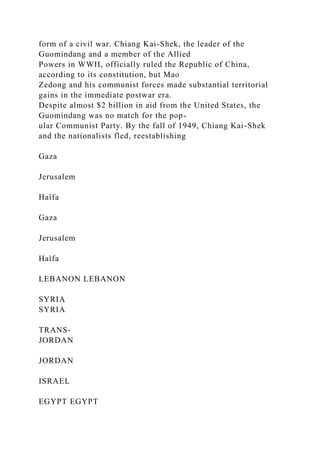
In November 1947, the UN General Assembly voted to approve
the UN Partition Plan for
Palestine, which would create a separate Jewish state and a
separate Arab state, leaving a small
territory containing Jerusalem and Bethlehem under UN
administration. According to the plan,
the Arab state would receive about 43 percent of its original
territory and the Jewish state would
receive approximately 56 percent (although much of it was
desert) to accommodate the expected
rise in immigration once a Jewish state was created. The
problem was not the land itself, how-
ever; it was the population living within those borders. In the
process of trying to include most of
the Jews in the Jewish state, a lot of Arabs were included as
well. As a result, the Jewish state
ended up with only a 61 percent majority of Jews, meaning that
39 percent of the people living
in the Jewish state were Arab, most of them Muslims.
The response of the Jewish leadership was mixed, but they
accepted the partition plan. The
Palestinian leadership disagreed with it for a variety of reasons,
arguing first and foremost that
partition only represented the will of one-third of the overall
Palestinian population (the Jewish
people). Leaders in the surrounding Arab countries, concerned
about the large numbers of Arabs
recognized
to be a legitimate state in
the international system,
you must have a well-
defined territory with a
permanent population
and a single government
to engage in relations
with other states
Arab Nationalism
a self-rule movement
based on the assertion
that all Arabs are united
by a common cultural,
historical, linguistic
heritage
The World in the 20th Century: A Thematic Approach, First
Edition, by Stephanie A. Hallock. Published by Pearson.
Copyright © 2013 by Pearson Education, Inc.
G
A
R
R
E
T
T
,
M
E
G
A
N
1
3
2
4
T
S
who would be living as a minority group
inside what was historically their own land,
got involved as well. Arab nationalism,
which first appeared in force after the fall of
the Ottoman Empire, grew into an organized
anticolonial movement after the Treaty of
Versailles turned the territory of the Middle
East into British and French mandates. Now
that the Western powers were once again de-
termining state boundaries and who could
dominate them, Arab nationalists were eager
to help Palestinian Arabs maintain control of
their territory. In December 1947, Syria es-
tablished the Arab Liberation Army with
6,000 volunteers, Arabs primarily from Syria,
Iraq, Lebanon, Transjordan and Egypt. But
the Jews also had their own army and para-
military organizations, with many World War
II veterans, and violent conflicts and terrorist
attacks occurred daily.
The British wanted nothing to do with
Palestine once the violence began and an-
nounced that they would leave Palestine on
May 15, 1948, refusing to participate in the
implementation of the plan. On May 14,
1948, the leader of the provisional govern-
ment of Israel, David Ben-Gurion, announced
the establishment of the state of Israel, basi-
cally enacting the UN Partition Plan. Arabs
throughout the Middle East denied his ability
to do so, arguing that Israel was stealing land
that belonged to Palestine. President Truman
immediately recognized Ben-Gurion’s gov-
ernment as the leadership of the new state of
Israel. As the now-declassified documents
show, Truman knew in advance of Ben-
Gurion’s plan, and Ben-Gurion knew that he
had U.S. support. The UN was angry that
Truman did not discuss his plans with the
Security Council before publicly announcing
his support for Israel, but it too followed suit
in recognizing Israel as a legitimate state.
The very next day, May 15, 1948, state
militaries from Egypt, Transjordan, Syria,
Lebanon and Iraq joined with the Arab Liberation Army and
invaded Palestine. This was the
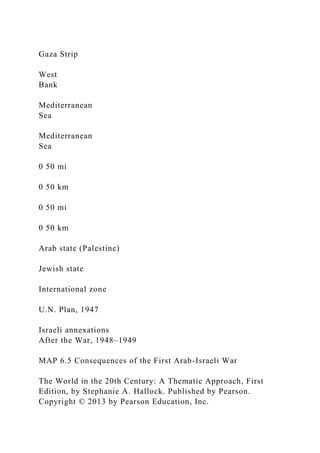
first Arab–Israeli War, and it lasted until January 1949. The
Jewish people successfully held
onto the territory they were originally allotted under the
Partition Plan, gained almost half of
the land designated for Palestine, and also captured part of
Jerusalem. At the end of this war,
Israel controlled approximately 78 percent of the original state
of Palestine. Egypt gained the
territory known as the Gaza Strip, and the West Bank went to
Transjordan. One of the most se-
vere effects of the war was the incredible refugee crisis
throughout the Middle East. Palestinian
refugees fleeing Israeli control were estimated at anywhere
from 360,000 to 711,000, and most
REGIONAL CONFLICTS 131
UN Partition Plan for Palestine, 1947.
Read the
Document Israel’s
Proclamation of
Independence, 1948 on
mysearchlab.com
The World in the 20th Century: A Thematic Approach, First
Edition, by Stephanie A. Hallock. Published by Pearson.
Copyright © 2013 by Pearson Education, Inc.
G
A
R
R
E
T
T
,
M
E
G
A
N
1
3
2
4
T
S
132 CHAPTER 6 • CONFLICT AND CONVERGENCE: 1945–
1950
surrounding Arab countries were not financially, politically or
geographically equipped to ac-
commodate them. Another 758,000 to 900,000 Jewish refugees
fled from Arab nations, most of
them to Israel. The war also made the Arabs determined to seek
revenge, not just against the
Jews, but also against the West, which had clearly provided
Israel with political support, financ-
ing and military technology.
Once Israel was established, the population grew rapidly due to
immigration, doubling in just
three years. Unfortunately, the economic situation was bleak
due to the boycott by all surrounding
Arab states and high taxes to keep the military running for
much-needed defense. Some help ar-
rived when Israel became a member of the UN in May 1949; but
to survive, Israel relied heavily
on direct financial and military aid from the West, particularly
from the United States.
Two Communisms
In China, the Guomindang (Nationalist Party) government and
Communist Party had temporarily
united to help defend the country from Japan’s attacks. But
Japan’s defeat in World War II meant its
conquered territory was returned to its rightful owners, and
China was geographically restored, so
the struggle for political power between the Guomindang and
Communist Party resurfaced in the
form of a civil war. Chiang Kai-Shek, the leader of the
Guomindang and a member of the Allied
Powers in WWII, officially ruled the Republic of China,
according to its constitution, but Mao
Zedong and his communist forces made substantial territorial
gains in the immediate postwar era.
Despite almost $2 billion in aid from the United States, the
Guomindang was no match for the pop-
ular Communist Party. By the fall of 1949, Chiang Kai-Shek
and the nationalists fled, reestablishing
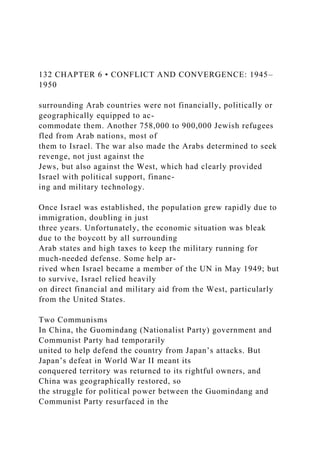
Gaza
Jerusalem
Haïfa
Gaza
Jerusalem
Haïfa
LEBANON LEBANON
SYRIA
SYRIA
TRANS-
JORDAN
JORDAN
ISRAEL
EGYPT EGYPT
Gaza Strip
West
Bank
Mediterranean
Sea
Mediterranean
Sea
0 50 mi
0 50 km
0 50 mi
0 50 km
Arab state (Palestine)
Jewish state
International zone
U.N. Plan, 1947
Israeli annexations
After the War, 1948–1949
MAP 6.5 Consequences of the First Arab-Israeli War
The World in the 20th Century: A Thematic Approach, First
Edition, by Stephanie A. Hallock. Published by Pearson.
Copyright © 2013 by Pearson Education, Inc.
G
A
R
R
E
T
T
,
M
E
G
A
N
1
3
2
4
T
S
REGIONAL CONFLICTS 133
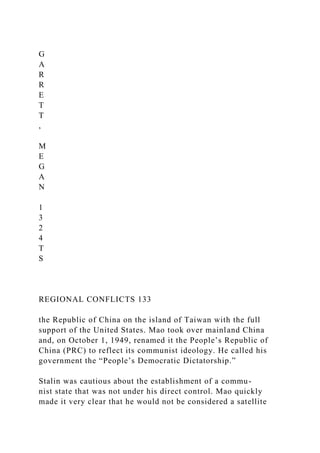
the Republic of China on the island of Taiwan with the full
support of the United States. Mao took over mainland China
and, on October 1, 1949, renamed it the People’s Republic of
China (PRC) to reflect its communist ideology. He called his
government the “People’s Democratic Dictatorship.”
Stalin was cautious about the establishment of a commu-
nist state that was not under his direct control. Mao quickly
made it very clear that he would not be considered a satellite
state of the USSR—Mao had his own brand of communism,
rooted deeply in the unique cultural and historical experi-
ences of China. After a few months of difficult negotiations,
the Sino-Soviet Treaty of Friendship, Alliance and Mutual
Assistance was signed in February 1950. The treaty included
a mutual defense pact, an agreement to consult on interna-
tional affairs that involved both countries, moderate eco-
nomic assistance (roughly $300 million) from the USSR to
the PRC and a promise of nonintervention in the domestic af-
fairs of the other. Nationalism, it seemed, was stronger than
communism.
Vietnam
When Germany controlled France during World War II,
Japan began supervising France’s Asian colonies, including
Vietnam. Though guerilla resistance failed against the power-
ful Japanese military, the independence movement in Vietnam
grew even stronger. After Japan’s
defeat in 1945, the Vietnamese people tried to negotiate for
their independence, but the French
refused. Led by Ho Chi Minh, the people decided to fight.
Born in Vietnam under French colonialism, Ho Chi Minh spent
his early adult years in
London and Paris (he even attended the 1919 Paris Peace
Conference), where he helped establish
the French Communist Party. He attended East Moscow
University in the USSR and, as a mem-
ber of the Comintern, traveled through China and
Indochina establishing regional communist polit-
ical parties. In 1941, he brought nationalists and
communists together as the Vietminh, an organi-
zation devoted to Vietnamese independence. Ho
was certainly a communist, but he was first and
foremost a nationalist.
On September 2, 1945, Ho Chi Minh an-
nounced the establishment of the Democratic
Republic of Vietnam, ironically using lan-
guage from both the U.S. Declaration of
Independence and the French revolutionaries
of the late 1700s to proclaim the Vietnamese
people free from outside domination. The
French responded, and the First Indochina War
began in December 1946. For eight years,
Vietnam was a battleground as France strug-
gled to fight off a nationalist movement led by
the Vietminh.
But as much as the Allies believed in decolo-
nization, the Cold War mentality had taken hold, Ho Chi Minh
at the Versailles Peace Conference, 1919.
PEOPLE’S REPUBLIC
OF CHINA (MAO)
REPUBLIC
OF CHINA
(CHIANG)
0 1,000 mi
0 1,000 km
MAP 6.6 The People’s Republic of China
and the Republic of China
The World in the 20th Century: A Thematic Approach, First
Edition, by Stephanie A. Hallock. Published by Pearson.
Copyright © 2013 by Pearson Education, Inc.
G
A
R
R
E
T
T
,
M
E
G
A
N
1
3
2
4
T
S
134 CHAPTER 6 • CONFLICT AND CONVERGENCE: 1945–
1950
and Ho Chi Minh was a known communist. With good reason,
the Allies did not trust that he
would establish a democratic state in Vietnam. By 1950, the
U.S. policy of containment had
kicked in full force, and the United States began providing
military and financial aid to the French
with the expectation that they would stop the communist
takeover. At about the same time, Mao
took over China and began providing military support to Ho Chi
Minh. The French suffered a ma-
jor military defeat and lost control of Vietnam in 1954. They
were forced to negotiate with the
Vietnamese communists, and the resulting “independence”
agreement created far more problems
than it solved.
International and Regional Convergence
Although this immediate postwar period served as a sort of
incubator for the major conflicts of
the latter half of the twentieth century, it was also a period of
cooperation in many respects.
After thirty years of total war, it was apparent that the nation-
states of the world were not
isolated. The linkages between them—economic, ideological
and political—were great and
growing. The powerful countries in 1945 recognized that, if
they could harness those linkages to
create convergence in several key areas, most notably trade,
they could control the international
system without the expense of colonization.
International Agreements
It was no mystery why the League of Nations failed to prevent
World War II. Without the par-
ticipation of the United States, the League was virtually
ineffective outside of Western Europe
(and barely credible there). Before the United States was even
officially involved in World
War II, President Roosevelt was determined that the United
States should take its rightful
Flag Day Ceremonies at the White House.
The World in the 20th Century: A Thematic Approach, First
Edition, by Stephanie A. Hallock. Published by Pearson.
Copyright © 2013 by Pearson Education, Inc.
G
A
R
R
E
T
T
,
M
E
G
A
N
1
3
2
4
T
S
INTERNATIONAL AND REGIONAL CONVERGENCE 135
THE PURPOSES OF THE UNITED NATIONS ARE
1. To maintain international peace and security, and to that end:
to take effective collective measures for the prevention and
removal of threats to the peace, and for the suppression of acts
of aggression or other breaches of the peace, and to bring
about by peaceful means, and in conformity with the principles
of justice and international law, adjustment or settlement of
international disputes or situations which might lead to a breach
of the peace;
2. To develop friendly relations among nations based on respect
for the principle of equal rights and self-determination of
peoples, and to take other appropriate measures to strengthen
universal peace;
3. To achieve international co-operation in solving international
problems of an economic, social, cultural, or humanitarian
character, and in promoting and encouraging respect for human
rights and for fundamental freedoms for all without
distinction as to race, sex, language, or religion; and
4. To be a centre for harmonizing the actions of nations in the
attainment of these common ends.
place in a new international organization dedicated to many of
Wilson’s original goals for the
League of Nations. When creating the Atlantic Charter in 1941,
Roosevelt and Churchill used
the phrase “united nations” to describe their alliance. Roosevelt
liked the term and suggested
to Churchill that it should be the name of the postwar
organization they would create to estab-
lish stability and peace. At the first meeting of the “big three”
in Tehran in 1943, Roosevelt
proposed the creation of the United Nations with five core
members: the United States, the
United Kingdom, the USSR, France, and China (at the time still
under one-party rule by the
Guomindang). Representatives from those countries spent the
fall of 1944 working out the
general parameters for the international organization, and in the
spring of 1945 the UN
Conference on International Organizations brought together the
governments of fifty nations
and several nongovernmental organizations to create the UN
Charter. Once this charter was
ratified by the five original members, who retained permanent
positions on the Security
Council, and by a majority of the other forty-six nations
involved, the United Nations was of-
ficially established on June 26, 1945.
There was no doubt why the UN was created—the first line of
the preamble reads: “We
the Peoples of the United Nations Determined . . . to save
succeeding generations from the
scourge of war, which twice in our lifetime has brought untold
sorrow to mankind . . .” The
stated goal was to prevent World War III. The United Nations
was established to do what
the League of Nations was supposed to do but could never
accomplish; much of Wilson’s
language even appears throughout the text. The primary
differences lie in the structure and
membership, giving the UN far more power to carry out its
goals than the League of Nations
ever possessed.
One of the major reasons World War II started was economic
depression and the fear that
poor people would turn to communism as an answer. To provide
an alternative other than fas-
cism or Nazism to prevent this, representatives from all forty-
four Allied nations met in Bretton
Woods, New Hampshire, at the United Nations Monetary and
Financial Conference (more com-
monly referred to as the Bretton Woods Conference) in July
1944 to figure out how to stabilize
the world financial system and prevent a repeat of the economic
disaster that occurred post-
World War I. The goals of the representatives were to create
rules and institutions that would
regulate the international monetary system to prevent another
worldwide depression and to help
the poorest countries of the world get stronger to prevent a
communist takeover. They estab-
lished a liberal economic system to provide “economic
security,” which would be maintained
through two newly created institutions. The International
Monetary Fund (IMF) was established
to oversee currency exchange rates, promote economic growth
and employment and provide
emergency loans to countries in severe debt. Working as an
agency under the UN, the
International Bank for Reconstruction and Development
(IRBD), more commonly referred to as
the World Bank, began with $10 billion to loan to governments
of countries most in need of
postwar reconstruction.
liberal economic
system
a set of international
agreements and rules
designed to promote free
trade, open markets and
monetary stability
The World in the 20th Century: A Thematic Approach, First
Edition, by Stephanie A. Hallock. Published by Pearson.
Copyright © 2013 by Pearson Education, Inc.
G
A
R
R
E
T
T
,
M
E
G
A
N
1
3
2
4
T
S
The Bretton Woods system was officially established in 1946
after ratification by a major-
ity of the Allied nations at the conference. An international
trade organization was originally
proposed, but the idea never made it past the U.S. Senate, so it
never went on for consideration
by the other Bretton Woods members. Instead, the General
Agreement on Trade and Tariffs
(GATT) was put in place to regulate trade issues. Although a
Soviet representative attended the
initial conference, the USSR refused to join the IMF or sign the
GATT because the goals of a
liberal economic system ran exactly counter to the goals of a
communist economy.
Regional Agreements
Western European governments were reliant on Marshall Plan
aid to rebuild their shattered
economies. And as the UN demand for decolonization grew,
they were also faced with the
prospect of completely revamping their economies, which had
been built on mercantilism.
Without colonies, they would have to pay for natural resources
and labor and sell their goods
at a fair price. In 1948, a Congress of Europe was held to look
at the options for opening up
cooperative trade opportunities between the six participants:
France, Italy, West Germany,
Belgium, Netherlands and Luxembourg. Over the next few
years, they established the
Organization of European Economic Cooperation, the European
Coal and Steel Community
and the European Economic Community, all of which eventually
merged into the European
Community in 1967. Instead of competing over limited
resources and colonies, Europe would
work together to support one another’s economies. In part, this
was an economic necessity, but
many realized that it was a political necessity as well in the face
of clearly increasing U.S.
dominance over Europe. Tying the success and failures of these
six major European
economies together also linked them politically, and the
European Parliament was established
in 1957 as part of the European Economic Community.
Eventually, other Western European
powers joined, creating the basic structure for European unity
that continued to converge
throughout the century.
As the Cold War began, the countries of Latin America realized
that the United States
would once again seek them out for political and economic
support. In part because of the
heavy U.S. financial investment and in part because of
geostrategic positioning, the United
States would never allow a communist foothold to develop in
Latin America. Given the high
poverty rates and U.S. intervention in their leading industries
over the years, left-wing political
regimes were relatively popular with the people of South
America. The U.S. government real-
ized that these regimes were vulnerable to accepting financial
and military support from the
USSR in exchange for a jump just a little further left on the
political spectrum. Eager to prevent
this, the United States once again approached the countries of
Latin America, offering support.
The 1947 Rio Pact placed the twenty-one countries of Latin
America in a security alliance sup-
ported by the United States. In April 1948, this alliance was
formalized as the Organization of
American States (OAS), a collective security arrangement “to
achieve an order of peace and
justice, to promote their solidarity, to strengthen their
collaboration, and to defend their sover-
eignty, their territorial integrity, and their independence.” One
of the stated goals was to “pro-
mote and consolidate representative democracy,” so the United
States channeled money, direct
military assistance and covert CIA aid to help prevent left-wing
regimes from gaining power in
Latin America.
After the experience of the Berlin blockade, it was apparent to
the United States and
Western Europe that the USSR was serious about spreading
communism and would perhaps
even resort to violence to do so. To prepare for this possibility,
they established a collective self-
defense organization in April 1949 under Article 51 of the
United Nations Charter. They called
it the North Atlantic Treaty Organization (NATO), and it
essentially told the world that an attack
on one member was equivalent to an attack on all members. In
response, the Eastern European
states, controlled by Moscow, created COMECON (Council of
Mutual Assistance), supposedly
to integrate their economies (sort of a Marshall Plan for the
eastern bloc), but also very much as
136 CHAPTER 6 • CONFLICT AND CONVERGENCE: 1945–
1950
Bretton Woods
system
the institutions created
and controlled by the
wealthy democratic
countries to encourage
worldwide prosperity
and counter political
extremism
The World in the 20th Century: A Thematic Approach, First
Edition, by Stephanie A. Hallock. Published by Pearson.
Copyright © 2013 by Pearson Education, Inc.
G
A
R
R
E
T
T
,
M
E
G
A
N
1
3
2
4
T
S
an informal military alliance. The Soviets formalized this when
they established the Warsaw
Pact, an Eastern European defense organization, on May 14,
1955.
In an effort to prevent the further spread of communism in
Southeast Asia, the United
States, France, Great Britain, New Zealand, Australia, the
Philippines, Thailand (where the
headquarters were located) and Pakistan created the Southeast
Asia Treaty Organization
(SEATO) in September 1954. Its membership included only two
Southeast Asian countries—
the rest were not terribly concerned that communism presented
a threat to their internal sta-
bility. The United States viewed SEATO as an essential tool in
containment; France and
Great Britain were financially invested in the region; New
Zealand and Australia joined be-
cause of their close proximity; and Pakistan was trying to build
international support and
marginalize India. Given its membership and lack of military
forces, SEATO’s ability to take
action was restricted only to meet U.S. interests (particularly
during U.S. involvement in
Vietnam).
Conclusions
In the first fifty years of the twentieth century, the combination
of technology and economic
growth built advanced militaries, while nationalism, Social
Darwinism and consumerism tore
apart existing empires, leading to roughly thirty years of total
war and global economic depres-
sion. In the aftermath, during the years 1945–1950, the leaders
of the world’s most powerful
countries were determined to prevent what seemed to be a
downward spiral for humanity. They
sought new ways to cope with the results of their actions,
seeking a convergence of political
ideals and military control wherever possible to prevent large-
scale warfare and extensive coop-
eration in economic matters to prevent another worldwide
depression. The people of the world
also chose new responses to what they perceived as the same
problems they had been facing
since the century began. They had been promised self-
determination before and were frustrated
when the political leaders they trusted to deliver it had failed to
do so. This time they would fight
for independence and create their own identities through civil
war, political revolutions, and mi-
gration. With ongoing nationalistic-driven, postcolonial, and
identity-related violence marking
almost every region of the world and a “cold war” prevailing on
a global level, the structure for
the latter half of the twentieth century was established.
CONCLUSIONS 137
W O R K I N G W I T H T H E T H E M E S
THE EFFECTS OF TECHNOLOGY What were the
ramifications of the United States utiliz-
ing its atomic bombs against Japan? How did the use of the
bombs lead to a “cold war”?
CHANGING IDENTITIES How did WWII affect European
civilians? What were the
implications of the East/West divide into “spheres of
influence”? What were the immedi-
ate effects of decolonization for people in the Middle East,
India, and Southeast Asia?
SHIFTING BORDERS How did the victorious Allies settle land
disputes at the end of
WWII? What were the short-term effects of occupation zones?
What were the geographic
consequences of decolonization from 1945–1950?
GLOBALIZATION Why was the United Nations created after
the failure of the League of
Nations? How did the Great Depression of the 1930s lead to the
Bretton Woods system?
Why was there an increase in regional organizations in the
postwar era? What were the
ramifications of the linkage between cold-war politics and
economics?
The World in the 20th Century: A Thematic Approach, First
Edition, by Stephanie A. Hallock. Published by Pearson.
Copyright © 2013 by Pearson Education, Inc.
G
A
R
R
E
T
T
,
M
E
G
A
N
1
3
2
4
T
S
138 CHAPTER 6 • CONFLICT AND CONVERGENCE: 1945–
1950
Further Reading
TO FIND OUT MORE
Library of Congress: For European Recovery: The Fiftieth
Anniversary of the Marshall Plan.
Available online at http://www.loc.gov/exhibits/marshall/
PBS American Experience: The Berlin Airlift. Available online
at
http://www.pbs.org/wgbh/amex/airlift
MATRIX, the Center for Humane Arts, Letters and Social
Sciences Online: Seventeen
Moments in Soviet History—1947. Available online at
http://www.soviethistory.org
Imperial War Museum: Through My Eyes—Stories of Conflict,
Belonging and Identity (Indian
Partition). Available online at
http://www.throughmyeyes.org.uk/
James L. Gelvin: The Israel–Palestine Conflict: One Hundred
Years of War (2007)
NATO: NATO Declassified 1949–1959. Available online at
http://www.nato.int/ebookshop/video/declassified/#/en/home/
GO TO THE SOURCE
Yale Law School/The Avalon Project: The Nuremberg Trials
Collection. Available online at
http://avalon.law.yale.edu/subject_menus/imt.asp
Yale Law School/The Avalon Project: The Bretton Woods
Agreements. Available online at
http://avalon.law.yale.edu/20th_century/decad047.asp
Library of Congress: Revelations from the Russian Archives.
Available online at
http://www.loc.gov/exhibits/archives/intro.html
Harry S. Truman Library & Museum: Ideological Foundations
of the Cold War. Available
online at
http://www.trumanlibrary.org/whistlestop/study_collections/col
dwar/index.php?
action=docs
Connections
6.1 George F. Kennan, Long Telegram. In 1946, the wartime
alliance between the United
States and the Soviet Union was falling apart. U.S. Foreign
Service officer George F.
Kennan argued that the systems of the United States and the
Soviet Union were incom-
patible and that Soviet security depended on destroying the
American way of life.
6.2 Winston Churchill, Iron Curtain Speech. After World War
II, Churchill toured the
United States alongside President Harry S. Truman. In a speech
at Westminster College
in Missouri, he coined the phrase “Iron Curtain” to describe the
lack of clarity in the
west for what was going on in Soviet-dominated Eastern
Europe.
6.3 National Security Council Memorandum Number 68. The
emerging Cold War led some
U.S. officials to view the world as dividing into two hostile
spheres. A major issue con-
cerned nuclear weapons in the Soviet-dominated sphere and the
need to maintain the
American lead in the arms race.
6.4 Harry S. Truman, The Truman Doctrine. World War II left
Europe economically devas-
tated and politically unstable. Early in 1947, it appeared that
Turkey and Greece would
fall under Soviet influence. In this speech, Truman outlines his
support for a policy of
aggressive containment of the Soviet Union not only in Turkey
and Greece, but all over
the world.
Read the Document on mysearchlab.com
The World in the 20th Century: A Thematic Approach, First
Edition, by Stephanie A. Hallock. Published by Pearson.
Copyright © 2013 by Pearson Education, Inc.
G
A
R
R
E
T
T
,
M
E
G
A
N
1
3
2
4
T
S
6.5 George Marshall, The Marshall Plan. In 1947, U.S.
Secretary of State Marshall articu-
lated a plan for American aid to Europe. The plan was designed
to fill the power vac-
uum in Europe and to help Europe reconstruct itself after the
devastation of war.
6.6 Israel’s Proclamation of Independence, 1948. One day
before the termination of the
British mandate for Palestine, the Provisional State Council (a
forerunner of the Israeli
Parliament) declared the independence of Israel on May 14,
1948.
6.1 President Truman and the Threat of Communism
6.2 The Berlin Airlift
Watch the Video on mysearchlab.com
CONCLUSIONS 139
The World in the 20th Century: A Thematic Approach, First
Edition, by Stephanie A. Hallock. Published by Pearson.
Copyright © 2013 by Pearson Education, Inc.
G
A
R
R
E
T
T
,
M
E
G
A
N
1
3
2
4
T
S
C H A P T E R T I M E L I N E
140
C H A P T E R T I M E L I N E
CHAPTER
OUTLINE
• U.S. Occupation
of Japan
• The “Other”
Communism:
Mao’s People’s
Republic of China
• Conflict in Korea
• The Arms Race
• Battle by Proxy
The Cold War Begins7
C H A P T E R T I M E L I N E
1945
United States uses
atomic bombs
VJ Day–U.S.
occupation of Japan
begins
Korea is divided
into communist
north and
democratic south
1947
Japan approves
democratic
Constitution
1949
Mao wins Chinese
Civil War and
establishes PRC
United States
recognizes Taiwan
Sino-Soviet Treaty
is signed
USSR detonates
atomic bombs
1950
Korean War
begins
1953
Stalin dies
The transistor
radio is invented
USSR and United
States invent
hydrogen bombs
1964
Quotations from
Chairman Mao
Zedong is published
The PRC becomes a
nuclear power
1965
Mao’s Great
Proletarian
Cultural
Revolution begins
The World in the 20th Century: A Thematic Approach, First
Edition, by Stephanie A. Hallock. Published by Pearson.
Copyright © 2013 by Pearson Education, Inc.
G
A
R
R
E
T
T
,
M
E
G
A
N
1
3
2
4
T
S
1954
Vietnam wins
independence
from France
Geneva Accords
divide Vietnam
1957
USSR and United
States invent
ICBMs
USSR launches
Sputnik
1958
Khrushchev
becomes premier
of the USSR
Mao launches the
Great Leap
Forward
1960
The Sino-Soviet
Split changes the
Cold War
1961
USSR and United
States develop
ABMs
Photos from left to right: Political cartoon
depicting the arms race; Korean War; Diagram
of a fallout shelter; Mao and Khruschev, 1958.
141
The World in the 20th Century: A Thematic Approach, First
Edition, by Stephanie A. Hallock. Published by Pearson.
Copyright © 2013 by Pearson Education, Inc.
G
A
R
R
E
T
T
,
M
E
G
A
N
1
3
2
4
T
S
142 CHAPTER 7 • THE COLD WAR BEGINS
U.S. Occupation of Japan
Japan was an active, aggressive player in world affairs from the
late nineteenth century until it
was defeated in August 1945. Because of the terms of surrender,
Japan was unable to play a
dominant role during the Cold War, but it certainly served
several important functions in helping
the United States maintain its interests in the East.
The Occupation
For seven years immediately following WWII, Japan was
occupied by Allied forces (primarily
U.S. troops) led by U.S. General Douglas MacArthur, Supreme
Commander of the Allied
Powers (SCAP). To MacArthur and the U.S. government, a
thorough military occupation was
required for three reasons: (1) to prevent future aggression,
which was so deeply ingrained in
Japanese Meiji culture, (2) to make sure that the desired
changes actually occurred (unlike what
happened in Germany after WWI), and (3) to provide a
democratic safe haven in a region of
growing communist dominance. During the occupation, Japan
was thoroughly demilitarized and
politically, socially and economically restructured through
SCAP directives that the Japanese
leaders and people had no choice but to accept.
MacArthur had spent a lot of time in the Pacific and studied
Japanese culture, which was
very focused on obedience to a hierarchical chain of authority.
He knew that the occupation
would meet significantly less internal resistance if the emperor
(at the top of the chain) sup-
ported U.S. policies, so he made sure during the surrender
negotiations that Emperor Hirohito
kept his position as a figurehead, though not as a divine leader.
To pave the way for democ-
racy, MacArthur had to remove the authoritarian military
government, which he did through
war crimes tribunals. Almost 6,000 Japanese military and
government officials were put on
trial in Tokyo for war crimes associated with Japan’s treatment
of civilians and POWs, includ-
ing mass killings, the use of biological and chemical weapons,
torture, cannibalism and sexual
slavery. The Tokyo Tribunal began in May 1946, and the
verdicts were announced in
November 1948: 984 were sentenced to death (920 of whom
were actually executed), 3,419
While the roots of the Cold War were certainly planted in the
agreements made between theAllies toward the end of World
War II and the immediate decisions made by both Stalin
andTruman, the Cold War itself really took shape in the late
1940s and throughout the 1950s as
the United States and the USSR scrambled to
secure ideological supporters without risking
World War III. Rather than building traditional
militaries, the two superpowers financed espi-
onage (the CIA and KGB), funded civil wars
and political coups around the world, and
hoped that the existence of ever-increasing
stockpiles of technologically advanced nuclear
weapons would be enough to demonstrate
power without having to actually detonate
them. To a great extent, the Cold War was dri-
ven by the personalities and goals of the many
political leaders who participated over the
years. In the first phase of the conflict, Stalin
was still firmly in control of the USSR, and the
United States was led by Truman, who knew
all too well the difficult decision-making
processes of the nuclear era. Truman was fol-
lowed by WWII General Dwight D. Eisenhower.
Their decisions established the foundation of
the Cold War.
W O R K I N G W I T H T H E T H E M E S
THE EFFECTS OF TECHNOLOGY The escalating arms race
and
related space race make WWIII potentially devastating for all
participants, so the superpowers use battle by proxy in an
attempt
to keep warfare conventional.
CHANGING IDENTITIES The Sino-Soviet split creates a
schism in
the communist world. The Japanese Meiji constitution is
replaced
with democracy under U.S. occupation.
SHIFTING BORDERS Korea is divided into occupation zones,
and
the superpowers fight a battle by proxy to establish control.
Korea
becomes two separate countries.
GLOBALIZATION The arms and space races expand the
potential
theater of WWIII to the entire globe. Through proxy battles, the
world becomes increasingly divided into spheres of influence.
The World in the 20th Century: A Thematic Approach, First
Edition, by Stephanie A. Hallock. Published by Pearson.
Copyright © 2013 by Pearson Education, Inc.
G
A
R
R
E
T
T
,
M
E
G
A
N
1
3
2
4
T
S
popular sovereignty
the concept that
government is created by
and subject to the will of
the people
U.S. OCCUPATION OF JAPAN 143
were sentenced to prison (475 for life), and 1,018 were
acquitted. Another 5,500 Japanese of-
ficials and soldiers were tried in other countries: 4,400 were
convicted, 1,000 of whom were
executed. And although the structure of the new government
under SCAP was democratic, the
focus on authority and hierarchy remained to remind the
Japanese people that they were in-
deed living under a military occupation. For example, SCAP
practiced strict censorship to pre-
vent antidemocratic rhetoric that opposed the U.S. occupation
and tried to keep communist
ideas from infiltrating Japan.
The 1947 Constitution
To democratize Japan, the Meiji Constitution from 1889
obviously had to be changed. After
Japanese officials submitted a draft that was essentially a
rewording of the existing Meiji
Constitution, MacArthur realized that the Japanese would not
understand or agree with demo-
cratic principles that did not exist in the Meiji culture. As a
result, he and a committee of U.S.
military officials wrote a new constitution for Japan in just six
days in February 1946. The
constitution was presented to Japanese government officials in
March, and although the offi-
cials tried to negotiate, they achieved only minor revisions. It
helped MacArthur that Emperor
Hirohito endorsed the constitution and even personally took it
to the Diet (Japanese
Parliament). The constitution was voted into law by the new
Diet in fall 1946 and went into
effect in May 1947.
The 1947 Constitution was grounded in the principles of British
and American democracy, de-
voted to popular sovereignty and a parliamentary system of
government. The emperor, stripped of
his former powers, became a constitutional monarch, and
MacArthur himself handpicked the first
prime minister with the emperor’s “consent.” The Diet was
turned into a bicameral legislature, with
a weak upper chamber to represent the entire country and a
powerful lower chamber to represent
the people. Most importantly, members of the Diet were elected
by popular vote. Almost one-third
MacArthur signs Japanese Surrender.
The World in the 20th Century: A Thematic Approach, First
Edition, by Stephanie A. Hallock. Published by Pearson.
Copyright © 2013 by Pearson Education, Inc.
G
A
R
R
E
T
T
,
M
E
G
A
N
1
3
2
4
T
S
144 CHAPTER 7 • THE COLD WAR BEGINS
of the articles of the Constitution were devoted to ensuring civil
liberties and individual rights for
Japanese citizens. These “basic human liberties,” as MacArthur
called them, included the funda-
mental freedoms expressed in the U.S. Bill of Rights, but go
even further, adding universal adult
suffrage, workers’ rights, a right to property and education, and
specific marriage and property
rights for women. The requirements of the 1947 Constitution
forced a complete restructuring of
Japanese education and business systems, as well as altered
social norms.
The most unique element of the constitution, and the one that
earned it the nickname
“MacArthur Peace Constitution,” was Article 9, which stated:
“aspiring sincerely to an interna-
tional peace based on justice and order, the Japanese people
forever renounce war as a sovereign
right of the nation and the threat or use of force as means of
settling international disputes.” This
article was essentially the prohibition of war, which no other
nation before or since has agreed to
as a component of its constitutional structure. Article 9 also
forbade Japan from maintaining
land, sea or air forces, but federal laws passed a few years later
allowed them to create the
National Police Reserve, a small paramilitary force to defend
the Japanese islands. The amend-
ment process defined in the constitution was rigorous. As a
result, although there is often debate,
no amendments have ever been made. The constitution of Japan
stands today as it was written by
SCAP during the occupation in 1946.
Consequences of Article 9
Article 9, also called “the peace clause,” met a few important
needs of the United States. First
and foremost, it prevented Japan from rearming itself and
becoming a threat to world peace
again. The article also created a situation that essentially
required Japan to allow U.S. military
bases to remain intact even after the occupation ended—a strong
U.S. presence might be the
only thing that prevented surrounding aggressive nations from
invading Japan. And although
this was marginally important to the United States when the
constitution was written in 1946, it
very quickly became vital for several reasons: Stalin grew
openly hostile toward the United
States, Mao seized control of China and established the PRC
(1949), communist North Korea
invaded South Korea (1950), and Ho Chi Minh earned
Vietnam’s independence from France
(1954). For the United States, it was imperative that its military
remain stationed in Japan to
protect against communist threats, as well as to maintain a U.S.
military presence in the region.
With the new constitution in place, Japan and the United States
began negotiating the end of the
occupation in 1951. The United States agreed to a peace treaty
that would fully restore Japan’s sov-
ereignty, and Japan agreed to a Mutual Security Treaty that
allowed U.S. forces to be stationed in
Japan for the defense of the region and also to intervene in
Japanese domestic affairs if the govern-
ment requested assistance. Both agreements went into effect
simultaneously in April 1952, with the
support of both governments and most of the Japanese citizens;
although a vocal minority in Japan
as well as the Soviet government protested the Mutual Security
Treaty. The occupation officially
ended in April 1952, but the United States maintains military
bases in Japan to this day.
The democratic structure that MacArthur created in Japan
allowed the nation to excel polit-
ically and financially. When the occupation ended, there were
some political clashes between
the left- and right-wing political parties, but the economy
superseded everything. Because the
infrastructure of the country was destroyed during the war, the
government and private enter-
prise formed a mutually beneficial partnership to rebuild the
country’s industrial capacity and
put people to work. During the occupation, the Japanese
government was aided fi-
nancially by the United States, and when the Korean War
started, Japan was able to
produce just about everything needed by the UN troops.
Because Japan fell under
U.S. military protection and the constitution prevented Japan
from building an offen-
sive military machine, Japan invested all of its income in
technological research and
development and established trade relationships around the
world. The connection
between government and industry made for a very lucrative and
well-coordinated
economic plan for the country, and the economy took off. By
the end of the 1960s,
Japan had the second largest economy in the world (behind the
United States).
Read the
Document The
Constitution of Japan on
mysearchlab.com
MAKE THE CONNECTION
Why did the United States want
military bases in Japan? What are
the long-term costs or conse-
quences for both Japan and the
United States of having military
bases there?
The World in the 20th Century: A Thematic Approach, First
Edition, by Stephanie A. Hallock. Published by Pearson.
Copyright © 2013 by Pearson Education, Inc.
G
A
R
R
E
T
T
,
M
E
G
A
N
1
3
2
4
T
S
U.S. OCCUPATION OF JAPAN 145
H IMALAYA MTS .
Yan
gzi R.
Yello
w
R
.
Yello
w
R
.
Am
ur R.
Am
ur R.
Ob R.
Ob
R.
Lena R.
Lena R.
Ganges R.
In
d
us
R
.
Yenisey R.
M
ekong
R
.
DelhiDelhi
AmritsarAmritsar
ManilaManila
Hong KongHong Kong
GuangzhouGuangzhou
MacaoMacao
Yan’anYan’an
BangkokBangkok
SaigonSaigon
NanjingNanjing
NagasakiNagasaki
TokyoTokyo
HiroshimaHiroshima
SeoulSeoul
LAO
S
LAO
S
BENGALBENGAL
INDIAINDIA
(British)(British)
OMANOMAN
BURMABURMA
DUTCH EAST INDIESDUTCH EAST INDIES
BHUTANBHUTAN
UNION OFUNION OF
SOVIET SOCIALISTSOVIET SOCIALIST
REPUBLICSREPUBLICS
NORTHNORTH
KOREAKOREA
SOUTHSOUTH
KOREAKOREA
NEPAL
TIBETTIBET
Borneo
New
Guinea
Taiwan
(Formosa)
Java
Sum
atra
Sakhalin
Island
H IMALAYA MTS .
Yan
gzi R.
Yello
w
R
.
Am
ur R.
Ob R.
Lena R.
Ganges R.
In
d
us
R
.
Yenisey R.
M
ekong
R
.
INDIAN OCEAN
PACIFIC
OCEAN
Singapore
Goa
Bombay
(Mumbai)
Delhi
Amritsar
Manila
Hong Kong
Guangzhou
Macao
Beijing
Yan’an
Bangkok
Saigon
Nanjing Shanghai
Nagasaki
Tokyo
Hiroshima
Seoul
38°
LAO
S
BENGAL
VIETNAM
M
AN
C
HURIA
C
A
M
B
O
D
IA
INDIA
(British)
IRAN
AFGHANISTAN
OMAN
BURMA
DUTCH EAST INDIES
MALAYA
BRUNEI
SARAWAK
CEYLON
(Sri Lanka)
SIAM
(Thailand)
FRENCH
INDOCHINA
BRITISH
NORTH
BORNEO
BHUTAN
CHINA
UNION OF
SOVIET SOCIALIST
REPUBLICS
MONGOLIA
PHILIPPINE
ISLANDS
(USA)
NORTH
KOREA
SOUTH
KOREA
JAPAN
NEPAL
TIBET
GUAM
(USA)
0 500 mi
0 500 km
MAP 7.1 East and South Asia in 1945
The decisions MacArthur made during the occupation were vital
in establishing Japan as
a solid democratic and capitalist nation in an increasingly
communist-dominated region of the
world. Because of its economic dominance, its democratic
political regime, and the presence
The World in the 20th Century: A Thematic Approach, First
Edition, by Stephanie A. Hallock. Published by Pearson.
Copyright © 2013 by Pearson Education, Inc.
G
A
R
R
E
T
T
,
M
E
G
A
N
1
3
2
4
T
S
146 CHAPTER 7 • THE COLD WAR BEGINS
of U.S. military bases, Japan held a very important geostrategic
position for the United States
throughout the Cold War.
The “Other” Communism: Mao’s People’s
Republic of China
When Mao seized control of China in October 1949, Chinese
citizens were exhausted and poor
after decades of warfare with European imperialists, competing
warlords, the Japanese invasions
during WWII and the internal civil war for control of the
government. China had been under at-
tack for one hundred years, and the Chinese citizens were
looking to Mao and the Communist
Party to provide political stability, economic well-being and
peace.
“Democracy” in China
To provide stability for the citizens, Mao established what he
called a “democratic dictatorship,”
in which all four social classes were represented in decision
making by elected officials in local
assemblies (the democracy part), but the central government
maintained strict control over those
local assemblies and all citizens to prevent a counterrevolution
(the dictatorship part). To solid-
ify the power of his government, which Mao claimed ruled by
the “Mandate of Heaven,” he es-
tablished prisons to reeducate political opponents and forced
labor camps to punish those who
were deemed beyond help. He also executed an estimated 5.5
million “enemies of the people” in
the first five years of his regime.
The central government consisted of one body that held all
political power in the PRC: the
Central People’s Government Council, led by Chairman Mao.
Though there were several com-
mittees and councils under this central council, there was no
question about who was in charge of
decision making at the national level. The first local assemblies
were established in 1954, and
everyone over the age of eighteen (except
counterrevolutionaries and landlords) could vote for
their representatives. The primary job of the local assemblies
was to elect members to serve in
provincial assemblies, and the provincial assemblies
elected representatives to the National People’s
Congress (which pretty much did whatever Mao said).
The PRC’s constitution included rights of all citizens,
except those who were deemed to be counterrevolu-
tionaries. In other words, you could vote, say and do
anything you wanted in Communist China, as long as
you did not disagree with the government. National
social organizations were created specifically to edu-
cate everyone—youth, laborers, women—about their
specific roles in Chinese society. Ultimately, each cit-
izen was reponsible for the well-being of the PRC
overall and carried a duty to put the interests of the
state above the individual. Mao firmly believed that
the strength of the PRC lay in the masses—peasants
and workers who were committed to faithfully
following his ideology.
Following Stalin’s Economic Model
The biggest problem Mao faced was the largely
agrarian economy, which was all but destroyed after years of
war.
Communist economic policy assumed tight control of currency,
inflation and wages in an effort
to stabilize prices. To deal with the daunting economic
problems, Mao largely followed the
economic policies that Stalin implemented in the USSR,
including the 1950 Agrarian Reform
Mao Propaganda Poster.
The World in the 20th Century: A Thematic Approach, First
Edition, by Stephanie A. Hallock. Published by Pearson.
Copyright © 2013 by Pearson Education, Inc.
G
A
R
R
E
T
T
,
M
E
G
A
N
1
3
2
4
T
S
commune
structure for pooling labor
and income to coordinate
all activities of a village
with joint responsibility
for all projects
collective farm
a group of farms
organized and managed
as one, worked
cooperatively by a group
of laborers under state
supervision
THE “OTHER” COMMUNISM: MAO’S PEOPLE’S REPUBLIC
OF CHINA 147
Law that ended all private land ownership in the PRC. The
peasants suffered by the unequal
distribution of land that resulted from the law, and when they
complained about it, they were
executed. In 1953, the government established collective farms,
which were turned into
communes with almost 1,000 people living on each by the end
of the 1950s. Mao also used
Five Year Plans to rebuild the industrial capacity of the PRC,
focusing on factories and infra-
structure. The first one doubled industrial output in just two
years, although at the expense of
the rural peasantry.
In 1958, the government launched the Great Leap Forward in an
effort to catch up with the
rest of the world. The educational system was reformed to focus
on science and engineering, and
everyone in the country was required to participate in expanding
the production of steel, electric-
ity and coal. People were literally building steel furnaces in
their backyards, so the quantity of
steel produced increased, but the quality of what they produced
rendered it basically unusable.
The focus on industrial output meant less time and fewer
resources for agriculture, which made
it nearly impossible to feed the 660 million people living in the
PRC in 1960. The Great Leap
Forward helped precipiate the Great Famine, and between the
two, an estimated 20 to 43 million
Chinese citizens died. Economically, the Great Leap Forward
was a disaster that threatened to
turn back all the progress the PRC had made in the previous
decade.
The Great Proletarian Cultural Revolution
The failure of the Great Leap Forward led to divisions within
the ruling elite of the Communist
Party. A splinter group led by Deng Xiaoping actually
questioned Mao’s decision making, ar-
guing that collectivization and industrialization had been
pursued too quickly. They also ques-
tioned his ability to lead—Mao was 71 years old and suffering
from Parkinson’s disease. In
1965, to regain his authority, Mao initiated the Great
Proletarian Cultural Revolution to rid the
government and the PRC of counterrevolutionaries. To do so, he
relied on the faithful masses,
requiring every citizen to report to local committees anyone,
even family members, who they
believed might hold counterrevolutionary ideas. The entire
process was carried out in the
provinces by the newly created Red Guards, a paramilitary force
of students responsible for
purging counterrevolutionaries. These students took their jobs
very seriously, and anyone who
challenged their authority was immediately arrested, so they
enjoyed absolute power. What
started as a student-led revolution grew into a proletarian
movement as the Red Guards spread
out across the countryside and pulled peasants, laborers and
military into the revolution, target-
ing educated citizens, teachers and high-ranking Communist
Party officials. They were guided
in an almost cult-like fashion by Quotations from Chairman
Mao Zedong, a collection of Mao’s
quotations published in 1964 that was required reading for
every citizen of the PRC. The only
group capable of stopping the Red Guards was the military
(People’s Liberation Army), so the
ANALYSIS
The Little Red Book, as it is known in the West, contains 427
quotations on thirty-three different topics that define Mao’s
ideology.
What do these quotes tell you about Mao’s leadership style?
� If there is to be revolution, there must be a revolutionary
party. Without a revolutionary party, without a party built on
the
Marxist-Leninist revolutionary theory and in the Marxist-
Leninist revolutionary style, it is impossible to lead the working
class
and the broad masses of the people in defeating imperialism and
its running dogs.
� People of the world, be courageous, and dare to fight, defy
difficulties and advance wave upon wave. Then the whole world
will belong to the people. Monsters of all kinds shall be
destroyed.
� Ideological education is the key link to be grasped in uniting
the whole Party for great political struggles.
� The principle of diligence and frugality should be observed in
everything.
� One requirement of Party discipline is that the minority
should submit to the majority. If the view of the minority has
been
rejected, it must support the decision passed by the majority.
� Liberalism is extremely harmful in a revolutionary collective.
It is a corrosive which eats away unity, undermines cohesion,
causes apathy and creates dissension.
The World in the 20th Century: A Thematic Approach, First
Edition, by Stephanie A. Hallock. Published by Pearson.
Copyright © 2013 by Pearson Education, Inc.
G
A
R
R
E
T
T
,
M
E
G
A
N
1
3
2
4
T
S
148 CHAPTER 7 • THE COLD WAR BEGINS
only way Mao could end the revolution he started was
to call in the troops against it, initiating violent
clashes across the country. The Great Proletarian
Cultural Revolution certainly reaffirmed Mao’s au-
thority in the PRC, but it also weakened the unity of
the Chinese Communist Party and slowed industrial
progress. And on the international front, the revolu-
tion escalated the growing tension between the
PRC and the USSR.
The Sino-Soviet Split
As far back as the 1930s, Stalin had served more
as an advisor to Mao than a provider. Mao lis-
tened, but he mostly ignored the advice, particu-
larly when Stalin suggested that Mao and Chiang
Kai-Shek acquiesce to U.S. attempts to force a
compromise between them to govern China after
WWII. But once Mao seized control and estab-
lished the PRC in 1949, he needed financial and
military support. Although he feared a loss of
independence, he sought the Sino-Soviet Treaty and followed
most
of Stalin’s economic advice. Stalin was driven into the alliance
with Mao by his need to keep the
United States away from the growing power. Particularly once
the North Atlantic Treaty
Organization (NATO) was created in 1949, Stalin wanted to
secure his alliances in the Pacific to
control the region. So the relationship between the USSR and
the PRC was not really about
communist ideology, nor was it grounded in mutual trust;
rather, it was very clearly about what
Mao and Stalin each perceived to be best for his national
security interests. Still, Mao respected
Stalin’s authority as the leader of one of the world’s
superpowers, and Stalin did stand up for
Mao at the UN, boycotting the Security Council when the seat
for China went to
Chiang Kai-Shek instead of Mao.
By 1960, a lot had changed. Stalin died in 1953, and Mao did
not respect
Stalin’s successor, Nikita Khrushchev. Khrushchev harshly
criticized Stalin’s
leadership and Mao’s Great Leap Forward, and in 1959 he
traveled to the United
States to meet with Eisenhower about improving communication
between the
two countries. In Mao’s mind, the only thing that would bring
these two enemies
together was their mutual desire to reduce his power in Asia.
Mao’s fears were confirmed when
Khrushchev returned from the United States and publicly
warned Mao to stop provoking U.S.
military action with his ongoing attacks against the nationalist
regime in Taiwan.
Khrushchev and Mao verbally attacked one another repeatedly,
and the struggle for pre-
eminence in the communist world was clearly out in the open.
In 1960, the USSR stopped
providing financial aid to the PRC, and in 1962 the USSR did
not hold up its promise of mili-
tary support in the PRC’s border dispute with India. In 1964,
the PRC became a nuclear
power, and Mao decided he did not really need the USSR
anymore anyway. Both countries
began heavily building up their military presence on either side
of the Sino-Soviet border in
the PRC’s northwestern Xinjiang province, territory that Russia
had seized from China in the
nineteenth century. In 1969, military clashes broke out,
although both countries agreed not to
resort to their nuclear arsenals.
The border disputes continued intermittently throughout the
Cold War, forcing the Western
democracies to reevaluate their perceived sharp ideological
divide between democracy and com-
munism. Communism itself was clearly divided in two, and both
the USSR and the PRC cer-
tainly presented credible military threats to the United States.
The PRC was a populous country
with a big military, and in 1964, when it became the third
country in the world to acquire nuclear
ANALYSIS
From a “containment” perspective,
why is a communist China dangerous
to the United States? Is it dangerous
to the USSR?
A propaganda poster for
the Red Guard.
The World in the 20th Century: A Thematic Approach, First
Edition, by Stephanie A. Hallock. Published by Pearson.
Copyright © 2013 by Pearson Education, Inc.
G
A
R
R
E
T
T
,
M
E
G
A
N
1
3
2
4
T
S
CONFLICT IN KOREA 149
MAP 7.2 The Cold War in the Pacific
0 5,000 mi
0 5,000 km
States with Communists in power
weapons, it also became a superpower. Even so, the Americans’
fear of communism was largely
driven by the brutality of the communist governments. Although
it is hard to know exactly, ex-
perts estimate that Stalin’s purges and famines killed 30 to 40
million Russians and that Mao’s
regime can be held accountable for 40 to 80 million Chinese
deaths. What was most staggering
to citizens in the West was that these governments killed so
many of their own citizens.
Conflict in Korea
Japan’s defeat in World War II “freed” its colonies, which did
not necessarily bring them inde-
pendence, as evidenced by what happened to Korea. In August
1945, the USSR declared war on
Japan and invaded Manchuria, liberating the northern half of
Korea from Japanese control to the
38th parallel, where Soviet troops met up with U.S. troops
moving in from the Pacific islands.
But just as it had in Eastern Europe, the Soviet military held
onto the territory it conquered as
part of the Soviet sphere of influence. Because the United States
was still focused on defeating
Japan and thought it may still need Stalin’s help to do so, the
two Allied powers divided the
Korean peninsula into occupation zones and sent the matter to
the newly created United Nations
to handle. In early 1948, the UN established a temporary
commission to oversee elections to re-
unite the country in May. But the Soviet military refused to
allow UN workers into the north,
making it clear that Korea would not be reunited under a
democratic regime. The Korean people
were not consulted, and they absolutely hated the idea of
dividing their country, particularly
The World in the 20th Century: A Thematic Approach, First
Edition, by Stephanie A. Hallock. Published by Pearson.
Copyright © 2013 by Pearson Education, Inc.
G
A
R
R
E
T
T
,
M
E
G
A
N
1
3
2
4
T
S
150 CHAPTER 7 • THE COLD WAR BEGINS
MAP 7.3 Korea Divided along the 38th Parallel
Beijing
Yan’an
Shanghai
Pusan
Seoul
P’yongyang
Nanjing
SOUTH
KOREA
38°
NORTH
KOREA
JAPAN
MONGOLIA
CHINA
U.S.S.R.
M
AN
CH
UR
IA
Y
e l
lo
w
R
.
East China
Sea
Yellow
Sea
Sea of
Japan
PACIFIC
OCEAN
0 500 mi
0 500 km
because this was their first taste of independence since the
Japanese colonized them in
1910, but there was little they could do to prevent the division.
In keeping with the Cold War, a communist government was
established in North
Korea under Kim Il-Sung, who enjoyed full political, military
and financial support
from the USSR and used the support to build a powerful
military state. Satisfied that
Kim Il-Sung was in full control, Soviet troops withdrew from
North Korea in
December 1948. In South Korea, elections were held to
establish a democratic govern-
ment. But because this was the Cold War, the United States
supported the most avid anticommu-
nists they could find to take over the government rather than the
left-wing candidates who were
more popular with the Korean people. When the U.S.-educated,
anticommunist Syngman Rhee
won the election, most South Koreans viewed the election as
fraudulent and protested violently
against both the “puppet” government they were saddled with
and the U.S. military supporting
it. In June 1949, just as Mao’s Communist Party was gaining the
upper hand in the Chinese civil
war, the U.S. troops left. Korea was now in the hands of Kim Il-
Sung and Syngman Rhee, each
of whom was determined to reunite Korea under his leadership.
Kim Il-Sung acted first, requesting military help from the
USSR. Initially, Stalin rejected
the idea of invading South Korea for fear that it would
undermine his bargaining position with
the United States, but the potential gains in terms of Korea’s
natural resources and geostrategic
positioning in the region, particularly once the communists
seized China in October 1949, were
too great to pass up. Stalin agreed to secretly help Kim Il-Sung
reunite the country, and on June
25, 1950, the North Korean army rolled south in a surprise
assault.
For President Truman, North Korea’s military action against
South Korea was a clear threat
to the U.S. containment policy. Although South Korea itself was
not particularly important to
U.S. security interests, a failure to enforce containment policy
in this case could set a dangerous
precedent that would lead to conflicts around the globe and the
expansion of communism. The
United States immediately went to the UN and called a meeting
of the Security Council to
decide an appropriate response to North Korea’s aggression.
Because the Soviet Union was
boycotting the UN in a show of solidarity with Mao, Stalin was
unable to exercise his veto
MAKE THE CONNECTION
What is the relationship
between the U.S. foreign
policies of containment and
decolonization?
The World in the 20th Century: A Thematic Approach, First
Edition, by Stephanie A. Hallock. Published by Pearson.
Copyright © 2013 by Pearson Education, Inc.
G
A
R
R
E
T
T
,
M
E
G
A
N
1
3
2
4
T
S
conventional war
warfare conducted by
states without the use of
nuclear, chemical or
biological weapons
CONFLICT IN KOREA 151
power to prevent a UN military response,
which is exactly what Truman wanted.
There were reasons to be concerned about
military conflict just five years after WWII
ended with the detonation of atomic weapons.
Now that these weapons existed, was it possible
to have a conventional war, or would Truman
have to again resort to nuclear weapons? Could
this war be geographically limited to Korea, or
would the USSR and/or the PRC get involved,
leading to WWIII? With these questions loom-
ing, the Security Council authorized a UN force
that included soldiers from sixteen nations, with
the largest contingent coming from the United
States, all under the command of General
MacArthur. Chiang Kai-Shek’s offer to commit
Chinese troops (from Taiwan) was rejected for
fear that they would invade North Korea just to
get to the PRC, instigating WWIII.
Initially, UN troops were able to provide
limited help to the South Korean military from
its tiny toehold position in Pusan in summer
1950. MacArthur engineered a daring attack behind North
Korean lines at the port of Inchon in
September that cut off the North Korean supply lines and forced
their troops to retreat. UN forces
drove the North Koreans out of the South and reached the 38th
parallel in just two weeks. Truman
thought MacArthur should stop at the 38th parallel to begin
peace negotiations rather than risk in-
citing the PRC or the USSR, but he agreed to give the very
successful general leeway to do what
he thought was best so long as it did not lead to WWIII.
MacArthur did not believe that the PRC
or the USSR would send in troops, and he viewed stopping at
the 38th parallel as a failed military
opportunity to do some harm to the PRC’s industrial base in
Manchuria, so he sent two American
armies into North Korea. He miscalculated—Mao was
concerned about the presence of UN
troops on his border, and he was also angry because neither Kim
Il-Sung nor Stalin had bothered
to tell him that North Korea was going to initiate the war. Mao
did not trust any of them, and
rather than risk the end of communism in Korea and having UN
forces within attack range, Mao
prepared the People’s Volunteer Army, ill equipped but battle
ready from years of civil war, to
enter North Korea.
In November 1950, after repeated warnings through diplomatic
channels, the PRC attacked,
sending the surprised UN forces reeling southward. By January
1951, the UN troops were able
to reestablish a front line just south of the 38th parallel that
stopped the advance by North
Korean and Chinese forces, and the war developed into a long
and difficult stalemate.
MacArthur was frustrated that Truman would not bring in
Taiwanese troops for support and go
after the PRC, and he made several statements to that effect to
the media. In March 1951,
General MacArthur wrote a letter to the U.S. House of
Representatives, hoping to receive sup-
port for his plans. In the letter, MacArthur warned, “if we lose
the war to communism in Asia the
fall of Europe is inevitable, win it and Europe most probably
would avoid war and yet preserve
freedom.” Truman considered MacArthur’s actions
insubordination, and the Pentagon was an-
gered by the media war MacArthur was waging against his own
government. Truman fired
MacArthur, ending his military career and his leadership of the
Japanese occupation. Stalin
agreed to support Mao but would not commit Soviet troops. In
summer 1951 armistice talks be-
gan, but it was not until July 1953, after years of fighting and
the death of Stalin, that a cease-fire
was finally negotiated. The armistice permanently divided the
Korean peninsula into two coun-
tries separated by a UN-controlled demilitarized zone that
remains in place today.
UN forces crossing the 38th parallel.
The World in the 20th Century: A Thematic Approach, First
Edition, by Stephanie A. Hallock. Published by Pearson.
Copyright © 2013 by Pearson Education, Inc.
G
A
R
R
E
T
T
,
M
E
G
A
N
1
3
2
4
T
S
152 CHAPTER 7 • THE COLD WAR BEGINS
MAP 7.4 The Korean War
Pyongyang
Seoul
Pusan
Hungnam
Vladivostok
Panmunjom
Inchon
5
1
7
6
3
24
Armistice Line
July 27, 1953
Communist Chinese
troops invade,
November, 1950
Farthest U.N.
advance,
November, 1950
Farthest advance
of North Koreans
July–September, 1950
Communist North
Koreans invade
June 25, 1950
United Nations
counter attack by
landing at Inchon
September 15, 1950
38th Parallel
boundary set by
military decision
August, 1945
Ya
lu
R.
JAPAN
NORTH
KOREA
SOUTH
KOREA
PEOPLE’S REPUBLIC OF CHINA
U.S.S.R.
MANCHURIA
Chinese
TroopsChinese
Troops
Supply
0 100 mi
0 100 km
Communist forces
United Nations forces
The Korean conflict was the first major military battle of the
Cold War between democracy
and communism, and it did not result in WWIII or nuclear
annihilation. But neither did it result
in a clear victory for either side.
The Arms Race
Truman’s desire to fight a limited, conventional war in Korea
was driven by his fear that the ide-
ological conflict between the United States and USSR would
turn into a military conflict. And
although the United States had demonstrated its technological
and military superiority at the end
of WWII by detonating the atomic bomb, the USSR was close
behind, and Truman could not be
sure just how close. The Soviet bomb project began shortly after
the United States initiated the
Manhattan Project, but the Soviet project had far fewer
scientists and resources devoted to it.
Stalin increased support for the project after he returned home
from the Potsdam conference,
where Truman had hinted at U.S. weapons superiority; and
Stalin made the project a top priority
The World in the 20th Century: A Thematic Approach, First
Edition, by Stephanie A. Hallock. Published by Pearson.
Copyright © 2013 by Pearson Education, Inc.
G
A
R
R
E
T
T
,
M
E
G
A
N
1
3
2
4
T
S
ICBM
a long-range missile
designed to carry nuclear
warheads
space race
developing technology to
conquer outer space to
demonstrate scientific
superiority and military
strength
arms race
the buildup of military
weapons (particularly
nuclear) by the United
States and the USSR
THE ARMS RACE 153
after the United States dropped the bomb on Hiroshima. Stalin
did not want the United States in
a dominant position in postwar negotiations for territory.
On August 29, 1949, the USSR detonated its first atomic bomb,
demonstrating technologi-
cal parity with the United States. From there, both countries
began research on the next level—
the thermonuclear bomb. In 1952, the United States exploded an
H-bomb, smaller than the
atomic bomb used on Hiroshima but 2,500 times more powerful.
The Soviets exploded their first
H-bomb in 1953, and the arms race was on. While improving
the technology of nuclear
weapons was a high priority, creating delivery systems to get
them where you want them without
risking pilots’ lives was equally important and led to the space
race.
The Soviets tested the first intercontinental ballistic missile
(ICBM) in May 1957. The
United States had developed the B52 bomber, which could
deliver a nuclear payload 6,000 miles
away, but the United States did not have an equivalent to the
ICBM until December 1957. On
October 4, 1957, the Soviets surprised the world by launching
Sputnik, the first satellite. Sputnik
was a shock to U.S. government officials, who feared it
provided the USSR a delivery system for
its missiles. The United States built the DEW line around the
Arctic and kept working on its
own satellite technology. In January 1958, the U.S. Explorer
satellite was fired into space on top
of a military Redstone missile.
The arms race put both the United States and the USSR in a
state of constant vigilance. Both
sides assumed that WWIII would be a nuclear war. America still
remembered the surprise attack at
Pearl Harbor and did not want to be surprised again—U.S.
intelligence estimated that, if the
Soviets attacked with their full nuclear capability, it would
result in 20 million dead and 22 million
injured American civilians. In 1958, the U.S. government
created the National Aeronautics and
Space Administration (NASA) to provide federal funding to
compete in the ongoing arms and
space races. The United States focused on producing high-
quality missiles with rapidly expanding
technology, while the USSR produced a higher quantity of low-
tech missiles overall. By 1960, the
United States and the USSR combined had enough nuclear
missiles to destroy the world.
MAD versus NUTS
The arms race itself was not so different from the military
buildup that happened in the early
1900s when Great Britain and Germany engaged in the
escalating naval race that led to the Great
War. And expanding weapons technology in the 1930s created
Blitzkrieg and gave Hitler the mil-
itary confidence to begin WWII. The lesson from the first half
of the twentieth century is that,
when powerful countries build militaries with a technological
edge over others and form alliances
to extend their power base, the result is worldwide war. So in
the 1950s, the United States and the
USSR were clearly headed for WWIII and, due to the
advancements in weapons technology, it
would be nuclear and everyone would die.
When President Eisenhower, a WWII general, became president
of the United States in
1953, the nuclear arms race was just getting underway. He and a
team of advisors shaped what
would stand as U.S. foreign policy for the remainder of the Cold
War: contain Soviet expansion
without military engagement, apply political pressure to
encourage countries to choose democ-
racy, and rely on nuclear deterrence to win the Cold War.
Eisenhower knew this would require
a lot of time and money, but it was better than the alternative.
His assessment: “The only way to
win WWIII is to prevent it.”
In the United States, nuclear deterrence took the form of Mutual
Assured Destruction (MAD)
theory. Essentially, so long as both the United States and the
USSR maintained equilibrium in the
nuclear arms race, neither side could actually use the weapons it
created without destroying itself
as well. Each side had the capacity to destroy the other, and
each side had a radar system in place
to detect incoming missiles; so when one side fired, the other
would know it and launch a nuclear
response, thus ensuring that everyone was destroyed. Of course,
the nuclear fallout from a large-
scale war would destroy the rest of the world as well. For the
United States, there was a strange
comfort to MAD. All it had to do was keep building more and
better nuclear weapons, and the
U.S. government was pretty confident that it had the money and
scientific ability to at least keep
DEW line
(Defense and Early
Warning system) a system
of radar stations around
the arctic to detect
incoming Soviet bombers
and missiles
Watch the Video
Duck and Cover: School
Bomb Drill on
mysearchlab.com
nuclear deterrence
the theory that an enemy
will choose not to use
nuclear weapons if it
believes that doing so will
result in its own
destruction as well;
requires a credible threat
of second-strike capability
The World in the 20th Century: A Thematic Approach, First
Edition, by Stephanie A. Hallock. Published by Pearson.
Copyright © 2013 by Pearson Education, Inc.
G
A
R
R
E
T
T
,
M
E
G
A
N
1
3
2
4
T
S
154 CHAPTER 7 • THE COLD WAR BEGINS
Washington
Moscow
NORAD
Berlin
CANADA
DEW
Line
U.S.
CUBA
RUSSIA
(U.S.S.R.)
CHINA
INDIA
JAPAN
SOUTH
KOREA
SOUTH
VIETNAM
A F R I C A
WESTERN
EUROPE
PACIFIC
OCEAN
ATLANTIC
OCEAN
ARCTIC
OCEAN
0 1,000 mi
0 1,000 km
The U.S. and its Allies
Communist Nations
Non-aligned Nations
MAP 7.5 The DEW Line
up with the USSR, if not surpass it. Indeed, in the last half of
the twentieth century (1945–1996),
the United States spent an estimated $5.8 trillion on nuclear
weapons (research, developing war-
heads, delivery systems technology, defense and intelligence).
The United States built more than
70,000 nuclear bombs and warheads in sixty-five different
configurations and developed 116 dif-
ferent kinds of delivery systems. Much of this was driven by a
lack of precise knowledge about
Soviet capabilities, as well as a belief that the promise of MAD
would prevent WWIII.
The Soviets did not fully buy the MAD theory—they were
preparing to fight and win a nu-
clear war. In the United States, that approach was called NUTS
(Nuclear Utilization Targeting
Strategy), which contends that it is possible to engage in a
limited nuclear war that does not result
in worldwide destruction. The Soviets focused their weapons
research on the tools they would
The World in the 20th Century: A Thematic Approach, First
Edition, by Stephanie A. Hallock. Published by Pearson.
Copyright © 2013 by Pearson Education, Inc.
G
A
R
R
E
T
T
,
M
E
G
A
N
1
3
2
4
T
S
nuclear proliferation
the spread of nuclear
weapons capabilities to
more countries
BATTLE BY PROXY 155
need to win a limited nuclear war, creating defensive weapons
called antiballistic missiles (ABMs)
that could intercept and destroy U.S. missiles in flight. The
introduction of ABMs destabilized the
concept of MAD because it took away second-strike capability.
The USSR could launch a nuclear
attack against the United States but prevent a successful U.S.
retaliatory attack with ABMs. U.S.
scientists came up with a countermeasure: Multiple
Independently Targeted Reentry Vehicles
(MIRVs). One single missile carried ten warheads, each capable
of destroying a separate city.
NUTS led to the creation of entirely new kinds of offensive and
defensive nuclear weapons.
Both the technology and sheer number of nuclear weapons
expanded quickly in the early
years of the Cold War. Great Britain, which collaborated with
the United States on the Manhattan
Project, successfully tested its first nuclear weapon in 1952 in
an effort to demonstrate that it was
an independent power player in the Cold War. France quickly
began a nuclear weapons program
to maintain relevancy, joining the “nuclear club” in 1960. When
the PRC developed a nuclear
weapons program in 1964, the fear of nuclear proliferation
became a reality. The ability to
destroy the world lay in the hands of a few men, and none of
them trusted the others. Each was
operating under a different worldview, and each was relying on
theories and espionage to prevent
WWIII. The world would become an increasingly unstable place
as this power spread.
Battle By Proxy
In retrospect, we know that both the United States and the
USSR wanted to avoid initiating WWIII.
In the years immediately following WWII, neither superpower
had the financial or human
resources to commit to winning a war of that magnitude. The
most viable option to win WWIII
would be using nuclear weapons, but the arms race had
progressed so quickly that resorting to
nuclear war would certainly mean the destruction of the entire
world, and no one would win in that
scenario. The biggest problem was a lack of communication—
neither side was sure who was win-
ning the arms race, nor could they be sure of the true intentions
of the other. In an atmosphere of
distrust, a willingness to negotiate would surely be seen as
weakness—the other side might assume
it had the upper hand, ideologically or militarily. And that
rhetoric, combined with a lack of infor-
mation, is what made the Cold War so potentially dangerous.
Because the Cold War could not be fought in a traditional way
between the primary com-
batants, it was impossible to measure progress toward their
goals (spreading ideology) in a
traditional way. Instead, successes and failures in the Cold War
were measured by the extent
of ideological, political and financial influence each side
exerted over the other countries of
the world. To “win” a territory, both sides engaged in similar
tactics: they provided financial
incentives to political leaders who agreed to adopt their
ideology; they maintained military
bases in geostrategic locations; and they created formal alliance
blocs that divided the world
into East versus West. But they absolutely could not go to war
directly against one another for
fear of WWIII.
This competition between the United States and the
USSR for control of governments was not at all “cold.” Some
of the nastiest little wars of the twentieth century were
the proxy battles of the Cold War (as opposed to the total wars
of the first half of the century). Korea was the first example of
a battle by proxy, and although the Korean War ended in a
draw, both superpowers realized that they could fight for con-
trol of a territory as long as they did so carefully. A battle by
proxy looked like a civil war, where competing interests
within a country or sometimes between neighboring countries
were fighting one another for control of the government. One
group wanted to establish a communist regime, and the other
a democratic one. But because each side was financially and
militarily supported by one of the two superpowers, they were
Cold War Tally Sheet
Each country that fell within the U.S.
or Soviet sphere of influence represented
another “win” for one side or the other.
U.S. U.S.S.R.
The Cold War “Tally Sheet.”
proxy
a substitute with the
authority to act on behalf
of another person; in the
Cold War, a battle by
proxy refers to a war in
which the country that
instigated the war is not a
direct participant
The World in the 20th Century: A Thematic Approach, First
Edition, by Stephanie A. Hallock. Published by Pearson.
Copyright © 2013 by Pearson Education, Inc.
G
A
R
R
E
T
T
,
M
E
G
A
N
1
3
2
4
T
S
156 CHAPTER 7 • THE COLD WAR BEGINS
essentially proxies for the larger battle between the United
States and the USSR. Throughout the
Cold War, money and weapons flowed freely from the two
superpowers all around the globe in
support of these proxy battles. As we will see, in Asia, Africa
and Latin America, this practice in-
cited civil wars where existing political discontent could be
exacerbated by large sums of money
and free weapons. Local entities gained political power, and the
superpowers gained hash marks
on the tally sheet, spreading democracy and communism to
other countries. Where the stakes
were high (usually because of geostrategic position and/or
access to natural resources), the United
States or the USSR might also send in troops. This is where
proxy battles became potentially dan-
gerous—only one side could have troops on the ground or the
world risked having Soviet soldiers
and U.S. soldiers firing on one another, which would most
certainly have led to WWIII.
Conclusions
Stalin, Truman, and Eisenhower established the parameters for
the Cold War in the 1950s—the
Cold War was an ideological conflict in which each side used
its growing military technology and
alliance systems to stop the spread of the opposing ideology,
thereby spreading its own ideology
around the globe. Because no one wanted a nuclear holocaust,
the superpowers relied on others
(proxies) to engage in battles for them. The first battle by
proxy, the Korean War, ended in a draw,
demonstrating that the Cold War would be long and expensive
for both the United States and the
USSR. The Korean War also sent a clear message to the citizens
in countries where proxy battles
would be fought that the ultimate goal was not to help them
achieve their political desires but rather
to meet the strategic interests of the superpowers. Most notably,
the Korean War demonstrated to
both the United States and the USSR that Mao Zedong and his
version of communism had to be
taken seriously.
The Sino-Soviet split in the 1960s changed the Cold War. For
the USSR, the PRC became a
practical problem with a large military and nuclear weapons on
its border. For the United States,
the split was a serious blow to the idea that the Cold War was
an ideological war. If alliances
weren’t based on ideology and decisions were instead being
made out of pure national interests,
then this was actually a traditional war with a traditional enemy
(the USSR) that could be fought
in a traditional way. But that might lead to WWIII.
W O R K I N G W I T H T H E T H E M E S
THE EFFECTS OF TECHNOLOGY Should the United States
and the USSR have invested
so much money in expanding nuclear technology that they could
not use without world-
wide devastation? Which theory is more viable to you—MAD or
NUTS? Why are the arms
and space races interconnected?
CHANGING IDENTITIES Did the United States have the right
to create Japan’s 1947
constitution? What are the domestic and international long-term
effects of the 1947
constitution? What were the differences between Stalin’s
version of communism and
Mao’s? How did the Sino-Soviet split affect U.S. decision
making?
SHIFTING BORDERS Why wasn’t Korea granted full
independence immediately
following WWII? Should UN troops have stopped at the 38th
parallel or tried to reunite
Korea? Should Korea be allowed to reunite now?
GLOBALIZATION Was battle by proxy a reasonable way to
prevent WWIII? How did the
arms race affect national security concerns in Europe and Asia?
The World in the 20th Century: A Thematic Approach, First
Edition, by Stephanie A. Hallock. Published by Pearson.
Copyright © 2013 by Pearson Education, Inc.
G
A
R
R
E
T
T
,
M
E
G
A
N
1
3
2
4
T
S
CONCLUSIONS 157
Further Reading
TO FIND OUT MORE
University of Maryland Libraries—Gordon W. Prange
Collection: Rebuilding
a Nation: Japan in the Immediate Postwar Years 1945–1949.
Available online at
http://www.lib.umd.edu/prange/html/exhibit/index.jsp
Society for Anglo-Chinese Understanding: About China.
Available online at
http://www.sacu.org/communisthistory.html
Korean War National Museum. Available online at
http://www.theforgottenvictory.org/
Stefan R. Landsberger/Chinese Posters Foundation: Chinese
Posters. Available online at
http://chineseposters.net
National Science Digital Library: The Atomic Archive.
Available online at
http://www.atomicarchive.com/
GO TO THE SOURCE
Marxists Internet Archive: The “Great Debate” Documents of
the Sino-Soviet Split. Available
online at
http://www.marxists.org/history/international/comintern/sino-
soviet-split/index.htm
Harry S. Truman Library: The Korean War and its Origins.
Available online at http://www.
trumanlibrary.org/whistlestop/study_collections/koreanwar/inde
x.php
Douglas MacArthur: Reminiscences (1964)
Kim Il Sung: Reminiscences With the Century, Volumes 1–8
(1994)
Mao Zedong: Quotations from Chairman Mao (1964)
Taiwan Documents Project. Available online at
http://www.taiwandocuments.org
Central Intelligence Agency: The China Collection. Available
online at http://www.foia.cia.gov/
nic_china_collection.asp
Connections
7.1 The Constitution of Japan. Following Japan’s surrender at
the end of World War II,
Allied occupation forces, know as the SCAP (Supreme
Commander of Allied Powers),
began its task of remaking a new Japan that would be an
American ally in the Pacific
The constitution drafted by SCAP would reshape Japan in all
aspects.
7.1 Duck and Cover: School Bomb Drill
Watch the Video on mysearchlab.com
Read the Document on mysearchlab.com
The World in the 20th Century: A Thematic Approach, First
Edition, by Stephanie A. Hallock. Published by Pearson.
Copyright © 2013 by Pearson Education, Inc.
G
A
R
R
E
T
T
,
M
E
G
A
N
1
3
2
4
T
S
118CHAPTEROUTLINE• WorldwideConflict• Western .docx

118CHAPTEROUTLINE• WorldwideConflict• Western .docx

  • 1.
    118 CHAPTER OUTLINE • Worldwide Conflict • WesternEurope on the Front Line • Regional Conflicts • International and Regional Convergence Conflict and Convergence: 1945–19506 1943 Sartre’s Being and Nothingness is published The “big three” meet at Tehran conference 1945 Yalta conference
  • 2.
    is held VE Dayends the war in Europe Potsdam conference is held VJ Day ends the war in the Pacific Ho Chi Minh “decolonizes” Vietnam Korea is divided into occupation zones The United Nations is founded 1946 The first Indochina war begins Bretton Woods system goes into effect Kennan writes the “Long Telegram”
  • 3.
    Churchill makes “Iron Curtain” speech 1947 Indiais decolonized India and Pakistan are created UN Partition Plan for Palestine is approved Truman Doctrine, Marshall Plan, and National Security Act go into effect in United States The “Red Scare” takes hold in the United States 1941 United States and USSR join the Allies C H A P T E R T I M E L I N EC H A P T E R T I M E L I N E
  • 4.
    The World inthe 20th Century: A Thematic Approach, First Edition, by Stephanie A. Hallock. Published by Pearson. Copyright © 2013 by Pearson Education, Inc. G A R R E T T , M E G A N 1 3 2 4 T S Photos from left to right: Vietminh troops march into Hanoi, 1954; UN poster; The new “big 3”; Family fleeing from square block of Jewish occupied buildings in the Jewish district of Jerusalem, February, 1948. 1948
  • 5.
    Congress of Europe meets Gandhiis assassinated USSR blockades Berlin, and United States flies airlift around it The OAS is established State of Israel is created and recognized The first Arab- Israeli War begins 1949 Mao wins civil war in China and establishes PRC Chinese nationalists flee to Taiwan The German Federal Republic is created NATO is
  • 6.
    established 1950 Sino-Soviet Treaty is signed U.S.government issues NSC-68 1955 Moscow creates the Warsaw Pact 119 The World in the 20th Century: A Thematic Approach, First Edition, by Stephanie A. Hallock. Published by Pearson. Copyright © 2013 by Pearson Education, Inc. G A R R E T T , M E G A N
  • 7.
    1 3 2 4 T S Worldwide Conflict The definingstructural characteristic of the latter half of the twentieth century was the conflict between the two “superpowers” that emerged at the end of World War II. After thirty years of war and its consequences in Europe, Germany’s and Italy’s military ca- pacities were almost completely destroyed and Great Britain’s and France’s had been greatly diminished. What was left of Japan’s military was being dismantled by the United States during the Occupation, and China was engaged in an intermittent civil war from April 1927 through May 1950. By 1945, only the United States and USSR were capable of fielding effective military ma- chines, and the United States was clearly leading in terms of military technology, proven by its use of the atomic bombs in Japan. The mil- itary alliance these two countries forged to defeat fascism in World War II was not strong enough to overcome the ideological differences between them. The Roots of the Cold War Patterns of war in the twentieth century (really throughout the history of humankind) were
  • 8.
    based on technologicalgrowth: close-range combat of the late 1800s led to long-range weapons (grenades, mortar, nerve gas) for total war in World War I, which led to airplanes and bombing in World War II. With the advent of the atomic bomb and rapidly expanding nu- clear technology, it became obvious that waging a total war would have destructive conse- quences worldwide. This led to the Cold War, which does not mean “no war”; it simply means that the primary combatants never engaged in direct military conflict against one an- other. As long as the two superpowers with the nuclear weapons did not go to war, the world could survive. Somewhat ironically, it was because of the advancements in military technol- ogy that the United States and USSR could not engage one another in traditional military warfare without potentially destroying the world. In many ways, the goals of the two main contenders in the Cold War followed the very tradi- tional goals of combatants throughout history—each side was fighting for control of territory. The Cold War is often referred to as an ideological war, implying that the two sides were fighting over beliefs. On some level, that is certainly true—the stated goal of the USSR was to spread communism, and the stated goal of the United States was to contain the spread of communism The victors of the second world war were anxious to avoid the mistakes made at the end of theGreat War, particularly those that contributed to the worldwide economic depression. This re- quired cooperation, which led to convergence in several key economic and political areas in the
  • 9.
    latter half ofthe twentieth century. But differ- ent views on who should dominate the post- war political, economic and social cultures led to regional and international conflicts. It was in these immediate postwar years, 1945–1950, that the patterns of conflict and convergence that would structure the rest of the century, as well as shape the twenty-first century, were established. Cold War describes the conflict between the United States and USSR between 1945–1991, when the two primary combatants never engaged in direct military conflict against one another Occupation after the Japanese surrendered at the end of the WWII, the Allied military, led by General MacArthur, supervised the political, economic and social reconstruction of Japan from 1945–1952 120 CHAPTER 6 • CONFLICT AND CONVERGENCE: 1945– 1950 W O R K I N G W I T H T H E T H E M E S THE EFFECTS OF TECHNOLOGY The “total war” era of the
  • 10.
    first half of thetwentieth century gives way to a “Cold War,” driven by the ongoing development of weapons technology. CHANGING IDENTITIES Thirty years of war in Europe greatly impacted its citizens. Two new issues evolve that will remain dominant features for the remainder of the twentieth century: the implications of the Cold War on people throughout the world and the short- and long-term consequences of decolonization. SHIFTING BORDERS Because the Allies cannot agree on political ideology, their division of the postwar world into occupation zones has serious worldwide ramifications. The creation of new indepen- dent countries in the late 1940s through decolonization leads to regional violence. GLOBALIZATION Two seemingly contradictory paths emerge: international political and economic division created by the Cold War and unprecedented convergence in the creation of the United Nations and Bretton Woods system, as well as the development of regional organizations. The World in the 20th Century: A Thematic Approach, First Edition, by Stephanie A. Hallock. Published by Pearson. Copyright © 2013 by Pearson Education, Inc. G
  • 11.
    A R R E T T , M E G A N 1 3 2 4 T S (which is aless aggressive way of saying, “to spread democracy”). In order to accomplish its goal, however, each side would have to control a territory, or control the government of that terri- tory at the very least. How did the world get to this somewhat artificial divide between democracy and commu- nism, with each ideology outright vilifying the other to prove to the rest of the world that its political and economic system was the better one? Thanks to the actions of Mussolini and Hitler, fascism had essentially been discredited as an ideological form
  • 12.
    of political governance(not that it ended it in reality, of course). During World War II, the democracies and communist USSR joined together to defeat those fascist regimes. Interestingly, it is in this military alliance to de- feat fascism that the Cold War took shape. The “Big Three” When Hitler broke his nonaggression pact with Stalin and invaded the USSR, he forced the Soviet Union into a military alliance with the Allies. The Soviets proved to be absolutely vital in the final defeat of Berlin and Germany, which created a bit of a problem after the war because the Red Army physically occupied all of Eastern Europe and one-half of Germany. Driving out the Soviets would require military action, which the United States and Britain could not even contemplate at that point. But the alliance between the USSR and the Allies was a military one only and had nothing to do with achieving political harmony. Predictably, when it came time for all the winners to sit down at the table and bring the war in Europe to its conclusion, the USSR wanted to install communist governments in Eastern Europe that would be subordinate to Moscow. And predictably, Great Britain and the United States opposed such expansion. The first meeting of the “big three” was in Tehran, Iran, in November 1943, before the war even ended. They agreed to keep fighting to- gether and pursue unconditional surrender from Germany and Japan in an effort to avoid the diplo- matic messes created by the negotiations at the end of World
  • 13.
    War I. Churchilland Roosevelt agreed to open a second front in France (leading to D-Day), and in return, Stalin promised to join the war in the Pacific after Germany was defeated. But as the Soviets moved through Eastern Europe on their way to Germany, they held onto the territory for themselves. Churchill opposed Stalin’s actions, and in October 1944 they talked and tentatively agreed on how they would divide up control of the Balkans after the war. There was a lot of tension over the countries of Eastern Europe occupied by the Soviet military—Stalin wanted them all to be communist under his control, while the United States and Great Britain still had hopes of freely elected democratic governments every- where in the world. Stalin agreed to let the citizens decide (self- determination), knowing that he would violate the agreements anyway and establish communist regimes. When it came to Germany, all three men agreed that it would be stripped of its government and military and would be divided into four occupation zones (one for each of the Allied powers, including France). The next time the “big three” met was in February 1945, in Yalta, just before Germany fell. Roosevelt’s goal was to encourage the USSR to get involved in the war against Japan after ANALYSIS Look carefully at the body language in this photograph. What does it tell you about each man? What does it tell you about the relationship between them?
  • 14.
    ideological war conflict rootedin differing world views; to win, one ideology would become dominant over all others WORLDWIDE CONFLICT 121 The “big three”: U.S. President Franklin D. Roosevelt, British Prime Minister Winston Churchill and Soviet Premier Josef Stalin. The World in the 20th Century: A Thematic Approach, First Edition, by Stephanie A. Hallock. Published by Pearson. Copyright © 2013 by Pearson Education, Inc. G A R R E T T , M E G A N 1 3 2 4
  • 15.
    T S Read the Document Long Telegramon mysearchlab.com 122 CHAPTER 6 • CONFLICT AND CONVERGENCE: 1945– 1950 Germany was defeated, so he and Churchill promised Stalin he could control significant regions in the Pacific after Japan was defeated. Roosevelt expressed his idea of a United Nations (UN) organization to ensure peace after the war—sort of a League of Nations, but with more muscle. Because Stalin agreed to participate, the United States made some more concessions to him, allowing the USSR to essentially control all of Eastern Europe, assuming the people were allowed to choose their own governments. Stalin was relentless in “convincing” them to “choose” communism. The last time the Allied leaders met was in the Berlin neighborhood of Potsdam in July 1945. Germany was defeated, Roosevelt had passed away and had been replaced by Truman, and the British people had replaced the very conservative Churchill with Clement Attlee and his Labour Party. The leaders confirmed past agreements, expanded Soviet control in Eastern Europe, and carved Germany into four separate occupation
  • 16.
    zones until theycould figure out a better arrangement (which did not come until 1990). Rather than creating an unsatisfactory, overarching peace treaty like the Treaty of Versailles that ended World War I, they left Potsdam with no treaties at all. Such agreements would come slowly in following years. When the Allied leaders left Potsdam, the world had been divided into two unfriendly camps: the West (led by the United States) and the East (led by the USSR). Behind the Iron Curtain In a speech to the Soviet people in early 1946, Stalin made a statement implying that capitalism made future wars inevitable: It would be wrong to think that the Second World War broke out accidentally, or as a result of blunders committed by certain statesmen, although blunders were certainly committed. As a matter of fact, the war broke out as the inevitable result of the development of world economic and political forces on the basis of present-day monopolistic capitalism. Marxists have more than once stated that the capitalist system of world economy contains the elements of a general crisis and military conflicts, that, in view of that, the develop- ment of world capitalism in our times does not proceed smoothly and evenly, but through crises and catastrophic wars. The U.S. Department of State asked George Kennan, a U.S.
  • 17.
    diplomat in Moscowsince 1933, for his view on Stalin’s intentions. His now-famous response, The Long Telegram of February 22, 1946, warned that “in the long run, there [could] be no permanent, peaceful coexistence” with the Soviet Union. In Kennan’s mind, the conflict stemmed from Stalin’s belief in Marxism and his fear that Western capitalism would affect his people; therefore, the American way of life had to be destroyed. Probably the most important feature of this Long Telegram is Kennan’s conclu- sion regarding how best to handle the situation. Although Stalin would never negotiate or com- promise, the problem could be solved “without recourse to any general military conflict.” Ultimately, Kennan said, the Soviet system of government is weaker than the American system of government and American success “. . . depends on health and vigor of our own society. . . Every courageous and incisive measure to solve internal problems of our own society, to improve self-confidence, discipline, morale and community spirit of our own people, is a diplo- matic victory over Moscow. . .” The United States should firmly guide other countries in devel- oping political, economic, and social well-being “and unless we do,” Kennan warned, “Russians certainly will.” Kennan’s words became the cornerstone of American foreign policy for most of the remainder of the twentieth century. A few weeks after Kennan’s telegram, Winston Churchill, the former British prime minister, spoke at a college in Fulton, Missouri. His speech was not well received at the time—many people viewed Churchill as a warmonger trying to drag the
  • 18.
    United States intoanother military ANALYSIS These words were taken from Stalin’s “Two Worlds” speech of 1946. Why did the U.S. government react to these words with concern? The World in the 20th Century: A Thematic Approach, First Edition, by Stephanie A. Hallock. Published by Pearson. Copyright © 2013 by Pearson Education, Inc. G A R R E T T , M E G A N 1 3 2 4 T S
  • 19.
    sphere of influence ageographic region over which one country directly or indirectly controls political, economic, social, and/or military decision making WORLDWIDE CONFLICT 123 conflict—but the speech coined the phrase that best described the political and ideological divide between the Soviets and the West as the Cold War began: . . . From Stettin in the Baltic to Trieste in the Adriatic an iron curtain has descended across the Continent. Behind that line lie all the capitals of the ancient states of Central and Eastern Europe. Warsaw, Berlin, Prague, Vienna, Budapest, Belgrade, Bucharest and Sofia; all these famous cities and the populations around them lie in what I must call the Soviet sphere, and all are subject, in one form or another, not only to Soviet influence but to a very high and in some cases increasing measure of con- trol from Moscow. Churchill was referring to the divide across Eastern Europe between free countries with Western-style democratic governments and the Eastern bloc countries with communist governments that answered directly to the USSR. Stalin, of course, perceived Churchill’s speech as a threat, particularly the opening phrases in which Churchill seemed to challenge America to act against communism: “. . . The United States stands at this time at the pinnacle of world power . . . with this primacy in power is also joined an awe-inspiring accountabil- ity to the future.” Churchill may well have been trying to pro- voke the United States to stay involved in European affairs
  • 20.
    rather than returnto isolationism as it did after World War I, but there was good reason for him to be concerned about the future of democracy in Europe. As agreed upon during the Tehran, Yalta and Potsdam conferences, the Soviet military occupied the territory it conquered on the way to Berlin to defeat Hitler, including Poland, Romania, Bulgaria, Hungary and parts of Czechoslovakia, Austria and Germany. In violation of those same agreements, however, Stalin refused to allow democratic elections in those countries, and each was ruled by a communist government supported by the Red Army. With the exception of Yugoslavia, where the communist yet fiercely nationalist leader Josip Broz Tito refused to comply with Stalin’s domination, each of these communist countries fell under the Soviet sphere of influence. They became known as the satellite states because they resolutely dupli- cated Stalin’s political and economic models, although they were technically independent coun- tries. Additionally, a civil war between democratic and communist forces in Greece threatened to replace the democratic government there, and the USSR clearly hoped to add Turkey to the satellite bloc to secure the Soviet border. The U.S. Response After thirty years of war and economic hardship, Europe was in shambles politically, economi- cally, industrially, commercially and socially. Much had been destroyed, leading many Western Europeans to wonder if communism was a way out of the hard life and injustices they suffered. President Truman believed that if the United States did not step
  • 21.
    in to help,communist move- ments underfoot in Western Europe would be successful. After studying Kennan’s Long Telegram, Truman made three key announcements: 1. The official U.S. policy of containment, eventually formalized in NSC-68 to prevent the spread of communism to noncommunist countries EAST GERMANY CZECHOSLOVAKIA BULGARIA ROMANIA YUGOSLAVIA HUNGARY POLAND UNION OF SOVIET SOCIALIST REPUBLICS Bla ck S ea 0 200 mi
  • 22.
    0 200 km MAP6.1 Soviet Sphere of Influence by 1948 Read the Document Iron Curtain Speech on mysearchlab.com Read the Document National Security Council Memorandum Number 68 on mysearchlab.com The World in the 20th Century: A Thematic Approach, First Edition, by Stephanie A. Hallock. Published by Pearson. Copyright © 2013 by Pearson Education, Inc. G A R R E T T , M E G A N 1 3
  • 23.
    2 4 T S Read the Document TheTruman Doctrine on mysearchlab.com 2. The Truman Doctrine to support “free people who are resisting attempted subjugation by armed minorities or by outside pressures” (primarily targeted toward Greece and Turkey) 3. The Marshall Plan to provide money for the rebuilding of Europe Under the Marshall Plan, any European state was invited to submit a request to the United States to receive funding for reconstruction programs. At first, Poland and Czechoslovakia tried to sign up, but Stalin quickly realized the political aspect of this economic program and blocked participation from countries within the Soviet sphere of influence. Taking money from the U.S. Congress would certainly place a country squarely within the U.S. sphere of influence. In four years, the Marshall Plan provided aid to sixteen countries in the total amount of $13.2 billion. The Allies received the largest shares: Great Britain got $3.2 billion to rebuild its oil industry; France got $2.7 billion to modernize industry and
  • 24.
    transportation; and West Germanyused its $1.5 billion to create a free-enterprise industrial system that worked so well it boosted German production 50 percent within four years. Overall, the Marshall Plan achieved its economic goals—the nations of Western Europe rebounded economically, enabling them to trade with the United States. And economic well-being in the Western world provided the 124 CHAPTER 6 • CONFLICT AND CONVERGENCE: 1945– 1950 MAKE THE CONNECTION Using the map on the right as a guide and documents 6.3, 6.4, and 6.5, what connections can you make between the policy of containment, the Truman Doctrine and the Marshall Plan? StockholmStockholm CopenhagenCopenhagen WarsawWarsawBerlinerlin ViennaVienna BudapestBudapest BucharBuchar IstanbulIstanbul AthensAthens
  • 25.
  • 26.
  • 27.
  • 28.
  • 29.
    ti c S ea ATLANTIC OCEAN Less than $400million $400 million to $1.2 billion More than $1.2 billion MAP 6.2 Marshall Plan Aid to Europe, 1948–1952 Read the Document The Marshall Plan on mysearchlab.com The World in the 20th Century: A Thematic Approach, First Edition, by Stephanie A. Hallock. Published by Pearson. Copyright © 2013 by Pearson Education, Inc. G A R R E T T ,
  • 30.
    M E G A N 1 3 2 4 T S “proof” that democracygenerated wealth for all, leading to a high degree of political stability in the United States and Western Europe. The mental image of the iron curtain across Europe, the language of the containment policy and the bold political and economic promises of the Truman Doctrine and Marshall Plan solidi- fied the divisions, differences and distance between the East and the West—the Cold War had begun and both sides had made their positions clear. But was the United States prepared to fol- low through? Not quite yet. The National Security Act of 1947 created the Department of Defense and included the army, navy and air force as equals within it. The act also created the National Security Council to advise the president of foreign policy matters and the Central Intelligence Agency (CIA) to
  • 31.
    collect and analyzeintelligence information and conduct covert operations outside of the United States. The Federal Bureau of Investigation (FBI) would continue to handle internal af- fairs. One of the first actions of the National Security Council was to recommend increasing military spending by 400 percent. The military budget jumped from $13 billion in 1949 to more than $40 billion in one year. To prevent communist influences from surfacing within the United States, Executive Order 9835 in March 1947 revoked governmental security clearances for peo- ple who were considered politically “leftist.” The Taft-Hartley Act, which passed in June 1947 despite a presidential veto, restricted the power of labor unions. In 1949, Congress instituted a peacetime draft to make sure the military was trained and ready to go at moment’s notice. Congress also revived the House Committee on Un-American Activities and went after America’s film industry, academicians, and eventually even members of the U.S. military and top State Department officials. Republican Senator Joseph McCarthy led this Red Scare and held Senate hearings that accused people of sympathizing with communists. At the least, many people lost their jobs and friends; at the worst, they faced contempt citations, criminal trials, and even prison sentences. The First Conflict of the Cold War: the Berlin Airlift For the U.S. government, 1947 was a busy year; and Stalin decided to test the new policies—he wanted to gauge how committed the United States was to containment. In June 1948, Stalin tried to push the line between the communists (supported by the
  • 32.
    USSR) and theWestern democracies (supported by the United States), which ran right down the middle of Germany. Even though the city of Berlin was located 110 miles inside of East Germany (controlled by the USSR), it too was divided into four sectors—one part to each of the victorious Allies. The French, British and American sectors combined to form West Berlin, and the USSR agreed to allow access through East German territory to and from West Berlin. But in June 1948, the Soviets cut off all power to West Berlin and closed all transportation access, completely forming a blockade around it. Although U.S. troops were stationed nearby, using them against the Soviet troops who were upholding the blockade would most certainly re- sult in armed conflict, escalating the Cold War just as it got underway. Truman decided the better way to handle this was to bypass the blockade and show the Soviets that they could not “beat” the United States. For almost one year, basic necessities were consistently flown into West Berlin via the Berlin Airlift. At the peak of the Berlin Airlift, Western cargo planes were landing at one of Berlin’s three airports at a rate of one plane every sixty-two seconds. In May 1949, the Soviets realized that the United States was not going to simply surrender West Berlin and dis- continued the blockade, but not before 275,000 flights had carried a staggering 2.3 million tons of supplies into West Berlin. The point was made—the United States would take action to con- tain the spread of communism. Stalin’s aggression in Berlin led to the birth of the German
  • 33.
    Federal Republic in1949, cre- ated by a constitution written by Germans under Allied supervision. Germany was no longer one country divided into occupation zones; it became two independent states—familiarly known as West and East Germany—that formed the front line of the Cold War. House Committee on Un-American Activities a standing committee of nine representatives who investigated suspected communists in influential positions in U.S. society WORLDWIDE CONFLICT 125 Watch the Video President Truman and the Threat of Communism on mysearchlab.com Watch the Video The Berlin Airlift on mysearchlab.com The World in the 20th Century: A Thematic Approach, First Edition, by Stephanie A. Hallock. Published by Pearson. Copyright © 2013 by Pearson Education, Inc. G A R
  • 34.
    R E T T , M E G A N 1 3 2 4 T S 126 CHAPTER 6• CONFLICT AND CONVERGENCE: 1945– 1950 Western Europe on the Front Line For almost the entire first half of the twentieth century, Western Europe had been torn apart by war, and the results were absolutely devastating. The physical destruction was almost unimag- inable; an estimated 70 percent of Europe’s industrial infrastructure was destroyed. From the largest cities on the continent to the smallest rural villages, farmland, factories and all meth- ods of transportation were unusable and, in many cases, simply gone. People suffered through bombings, military occupations, war crimes, forced labor camps
  • 35.
    and the Holocaust. Approximately37 million Europeans were dead, which included almost twice as many civil- ians as military. For those left to survive in what American journalist William Shirer described KielKiel HamburgHamburg BremerhavenBremerhaven BremenBremen HannoverHannover SchwerinSchwerin PotsdamPotsdam HalleHalle ErfurtErfurt DresdenDresden DüsseldorfDüsseldorf BerlinBerlin WiesbadenWiesbaden MainzMainz StuttgartStuttgart MunichMunich TübingenTübingen
  • 36.
    KehlKehl (Fr. military area)(Fr.military area) FreiburgFreiburg RHINELAND-RHINELAND- PALATINATEPALATINATE SAARSAAR BADENBADEN WÜRTTEMBERG-WÜRTTEMBERG- HOHENZOLLERNHOHENZOLLERN BAVARIABAVARIA WÜRTTENBERG-BADENWÜRTTENBERG-BADEN HESSEHESSE THURINGIATHURINGIA SAXONYSAXONY SAXONY-ANHALTSAXONY-ANHALT BRANDENBURGBRANDENBURG NORTH RHINE-WESTPHALIANORTH RHINE-WESTPHALIA LOWER SAXONYLOWER SAXONY SCHLESWIG-HOLSTEINSCHLESWIG-HOLSTEIN MECKLENBURGMECKLENBURG Kiel
  • 37.
    Hamburg Bremerhaven Heligoland (Br. military area) Bremen Hannover Schwerin Potsdam Halle ErfurtDresden Düsseldorf Berlin Wiesbaden Mainz Stuttgart Munich Tübingen Kehl (Fr. military area)
  • 38.
  • 39.
    French Zone Soviet Zone Frenchprotectorate MAP 6.3 German Occupation Zones, 1947 The World in the 20th Century: A Thematic Approach, First Edition, by Stephanie A. Hallock. Published by Pearson. Copyright © 2013 by Pearson Education, Inc. G A R R E T T , M E G A N 1 3 2 4 T S
  • 40.
    as an “utterwasteland,” famine and poor living conditions were rampant. Unemployment, food ra- tioning and a coal shortage led to civil unrest and violence. In an effort to find homes, jobs and their families, people migrated and relocated across the continent. An estimated 50 million refugees were homeless. The emotional and psychological toll on the people of Europe cannot be underestimated and is perhaps most eloquently expressed in the writings of French philosophers Jean-Paul Sartre and Simone de Beauvoir. In developing existentialism, these writers (and others) combined the scholarly work of previous philosophers such as Nietzsche and Heidegger with the experiences of war and poverty that the people of Europe lived through in the first half of the twentieth century to create philosophical essays, fictional novels and theatrical performances that expressed the raw emotions of postwar European life. The basic premise of exis- tentialism is that “existence precedes essence,” which means that humans are defined by their exis- tence and nothing more. Trying to give meaning to your existence is absurd—there is no god and no established set of ethics or morals to compare yourself to. Who you are, who you become, is all a matter of choices you make in a state of perfect freedom. Sartre’s most famous work, the one that really formulated the existentialist movement of the 1940s and 1950s, is an essay entitled “Being and Nothingness: An Essay on Phenomenological Ontology,” published in 1943. His companion, de Beauvoir, blended existentialism and liberal feminism, a quickly
  • 41.
    growing movement inthe late 1940s, when women were not anxious to give up the jobs and in- dependence they had gained while their husbands were gone. Her 1949 best seller, The Second Sex, argues that, throughout history, women have been defined as the “other” sex, implying they are not the “normal” sex. Governments knew they had to respond to the people’s needs, but they were trapped in po- litical conflict. In Great Britain, the Labour Party, under Attlee, took over government just at the end of the war in 1945. In an attempt to alleviate the problems associated with thirty years of war and poverty, Attlee established a welfare state with the passage of the National Insurance Act, the National Assistance Act and the National Health Service Act on July 5, 1948. This comprehensive program provided “cradle to grave” services for all citizens, a sort of compromise between democracy and communism. In France, the Fourth Republic (the postoc- cupation government) was controlled by a powerful parliament filled with communists and so- cialists who refused to allow a strong president. This led to instability—there were twenty-four WESTERN EUROPE ON THE FRONT LINE 127 welfare state a system in which the government provides certain public services (health care, education, unemployment insurance, social security, etc.) as a
  • 42.
    right of citizenship, regardlessof personal wealth liberal feminism a philosophy and activist movement that seeks political, legal and social reform on the premise that men and women are equal existentialism a philosophical movement of postwar Europe that emphasizes individual decision making as the sole source of one’s identity Rebuilding England. MAKE THE CONNECTION Sartre was drafted into the French army in 1939, captured by Germans in 1940 and spent nine months in a prisoner of war camp. After negotiating his release, he returned to Paris and began work- ing for the French Resistance. Sartre’s experiences during World War II reflect the conundrum most Europeans faced during those years—do I collaborate with the Nazis, join the Resistance or focus solely on self-preservation? Solving this question for himself led Sartre to one of the fundamental tenets of existential philosophy—freedom is what you do with what’s been done to you. Why did this philosophy gain popular appeal in Europe following World War
  • 43.
    II? The World inthe 20th Century: A Thematic Approach, First Edition, by Stephanie A. Hallock. Published by Pearson. Copyright © 2013 by Pearson Education, Inc. G A R R E T T , M E G A N 1 3 2 4 T S 128 CHAPTER 6 • CONFLICT AND CONVERGENCE: 1945– 1950 governments in just twelve years. In West Germany, the government was initially ruled by the Allied High Commission, comprised
  • 44.
    of four commissionersfrom the United States, three from the United Kingdom and one from France. Germans regained control of their government in September 1949. In Italy, a threat of impending civil war led to a referendum in June 1946 to decide whether to maintain the monarchy or move to a re- public form of government. With only 54 percent of the vote in favor of republicanism, in a hotly contested election with charges of corruption, Italy officially became a republic on January 1, 1948. The Denazification of West Germany Although the war was officially over, through- out Europe Germans were still popularly re- garded as the enemy. The hatred and distrust extended to all German people, although the official Allied policy toward Germany was focused on the denazification and demilitariza- tion of the state. Across Europe and the United States, there was a sense of the need for retri- bution for the death and destruction that Germany had initiated, particularly because Hitler was unavailable to publicly suffer for the misery he created. On August 8, 1945, The London Charter of the International Military Tribunal was published, providing the legal basis for conducting trials for individuals accused of committing war crimes, crimes against peace, and/or crimes against humanity during the war, and it spelled out the procedures that would be followed in doing so. From November 20, 1945, to October 1, 1946, the International Military Tribunal (IMT), comprised of judges from the four
  • 45.
    Allied countries, triedtwenty-four of the highest-ranking Nazi officials who were captured at the end of the war. The United States also held its own tribunal for war criminals, including specific ones for doctors and judges. Collectively, these tribunals were known as the Nuremberg Trials because they were held in the city of Nuremberg, Germany, the site of some of the largest Nazi ral- lies before and during World War II. Of the twenty-four high- ranking Nazi officials tried by the IMT, twelve received the death sentence (by hanging), seven received prison time ranging from ten years to life, three were acquitted, one had his charges dropped to lesser crimes and was sent to a U.S. tribunal, and one committed suicide before his trial began. The Nuremberg Trials became the foundation for the ongoing development of international criminal law through UN conventions and the creation of international courts. Between the U.S. military presence throughout Europe and the money coming in through the Marshall Plan, American citizens, corporations and culture spread throughout Europe. Unlike the end of World War I, when the American troops went home and the country became isolationist, the United States established military bases in West Germany to keep a close eye on the encroaching communist regimes in Eastern Europe. The European countries were simply too weak militarily to handle the occupation of Germany and protect themselves from the Soviet Red Army without the help of the United States. Similarly, they were too financially drained to rebuild their own economies and had to rely on aid from the United States to do so. This was a
  • 46.
    crimes against humanity murder, extermination, enslavement,deportation and other inhumane acts done against any civilian population, or persecutions on political, racial, or religious grounds crimes against peace planning, initiating or participating in a war of aggression war crimes violations of the laws of war, including murder, slave labor, abuse of prisoners of war, wanton destruction of cities, towns, or villages German War Crimes Tribunals, 1945. The World in the 20th Century: A Thematic Approach, First Edition, by Stephanie A. Hallock. Published by Pearson. Copyright © 2013 by Pearson Education, Inc. G A R R E T
  • 47.
    T , M E G A N 1 3 2 4 T S REGIONAL CONFLICTS 129 toughspot for the European governments, who were on the one hand thankful the United States was willing to stay involved and participate in establishing economic, political and military sta- bility; but at the same time painfully aware of the Americanization of Europe. Regional Conflicts While the beginning of the Cold War was certainly the most divisive conflict of this era, it was by no means the only one. Some of the most dramatic conflicts in the latter half of the twentieth century also began in these postwar years as a result of issues associated with migration and de- colonization. Because of the bipolar structure of the world during this time, many of these re-
  • 48.
    gional conflicts becamekey battles in the Cold War (and are discussed in future chapters). Indeed, many of them remain heated regional conflicts in the twenty-first century. India and Pakistan After years of working toward self-rule, India gained its independence from Great Britain in August 1947. Unfortunately, the people of India disagreed (often violently) on religion and government. Muslims believed that religion should be an integral part of the governance sys- tem, while Hindus wanted to establish a democratic republic with a separation of church and state. Because they could not agree, they could not create a single government for the newly New Delhi Delhi Bombay (Mumbai) Calcutta Dacca AmritsarLahore Islamabad Karachi CHINA NEPAL
  • 49.
    BHUTAN EAST PAKISTAN (BANGLADESH, 1971) BURMA (MYANMAR, 1989) CEYLON (SRILANKA, 1972) REPUBLIC OF INDIA AFGHANISTAN ISLAMIC REPUBLIC OF PAKISTAN UN cease-fire line, Jan.1949 WEST BENGAL EAST BENGAL JAMMU AND KASHMIR PUNJAB
  • 50.
    TIBET In du s R . GangesR . Brah map utr a R . Bay of Bengal Arabian Sea INDIAN OCEAN 0 300 mi 0 300 km British India before independence India Pakistan Disputed territory, controlled by India Disputed territory, controlled by Pakistan
  • 51.
    MAP 6.4 Indiaand Pakistan, 1947 Americanization U.S. influence on the culture of another country, generally spread through consumerism and/or militarization The World in the 20th Century: A Thematic Approach, First Edition, by Stephanie A. Hallock. Published by Pearson. Copyright © 2013 by Pearson Education, Inc. G A R R E T T , M E G A N 1 3 2 4 T S
  • 52.
    130 CHAPTER 6• CONFLICT AND CONVERGENCE: 1945– 1950 decolonized state, and India was partitioned into two separate nations: India for the Hindus and Pakistan for the Muslims. This partition led to violence as approximately 14.5 million people rushed the border—the Muslims in India heading for Pakistan and the Hindus in Pakistan heading for India. They met in the Punjab region, where an estimated 500,000 were killed in rioting. Mohandas Gandhi, by then the most powerful figure in the Indian National Congress, opposed the partition, but his closest advisors convinced him that it was the only way to avoid civil war, so he reluctantly agreed. After the partition, he became focused on Hindu–Muslim unity, engaging in a fast-unto-death unless financial aid from India that had been promised to Pakistan was delivered. The money transfer was made; but despite Gandhi’s efforts, in October 1947 the first of what would be four wars broke out between the newly created India and Pakistan over the territory of Kashmir. In 1948, Gandhi was assassinated by a radical Hindu who was angered by Gandhi’s ef- forts at Hindu–Muslim unity. Israel versus Arab Nationalism Jewish immigration to Palestine from Germany and the rest of Europe increased dramatically throughout the 1930s as a result of Hitler’s actions, further angering the Arabs living in Palestine and igniting violence. The Arabs demanded an end to
  • 53.
    immigration, warning GreatBritain that “no room can be made in Palestine for a second nation except by dislodging or exterminating the first.” In other words, give us our independence, but the Arabs must rule it. The Jews, however, also claimed the right to rule an independent Palestine. In March 1945, six Arab countries formed a regional intergovernmental organization (IGO) called the Arab League in order to “draw closer the relations between member States and co- ordinate their political activities with the aim of realizing a close collaboration between them, to safeguard their independence and sovereignty, and to consider in a general way the affairs and interests of the Arab countries.” The goal was to create an Arab homeland that would respect the sovereign authority of its member states but support one another politically and economically in world affairs. The primary focus was to remove the Jews from Palestine and restore it as an Arab territory. After Roosevelt’s death in April 1945, President Truman openly supported Jewish immigra- tion to Palestine, which made the Arab League angry at the United States. As the Holocaust camps were liberated, Great Britain made the very controversial decision to refuse the survivors admittance to Palestine, instead setting up refugee camps for them in Cyprus. This decision an- gered President Truman, strengthening his resolve to support Zionist efforts at establishing a homeland in Palestine. Both the Jews and Arabs in Palestine resorted to terrorism to get rid of the British and each other, and the British soon came to realize
  • 54.
    that the 1million Arabs and the 400,000 Jews sharing the British-controlled territory of Palestine were never going to get along peacefully. Great Britain decided to let the newly created United Nations step in and take over. In November 1947, the UN General Assembly voted to approve the UN Partition Plan for Palestine, which would create a separate Jewish state and a separate Arab state, leaving a small territory containing Jerusalem and Bethlehem under UN administration. According to the plan, the Arab state would receive about 43 percent of its original territory and the Jewish state would receive approximately 56 percent (although much of it was desert) to accommodate the expected rise in immigration once a Jewish state was created. The problem was not the land itself, how- ever; it was the population living within those borders. In the process of trying to include most of the Jews in the Jewish state, a lot of Arabs were included as well. As a result, the Jewish state ended up with only a 61 percent majority of Jews, meaning that 39 percent of the people living in the Jewish state were Arab, most of them Muslims. The response of the Jewish leadership was mixed, but they accepted the partition plan. The Palestinian leadership disagreed with it for a variety of reasons, arguing first and foremost that partition only represented the will of one-third of the overall Palestinian population (the Jewish people). Leaders in the surrounding Arab countries, concerned about the large numbers of Arabs recognized
  • 55.
    to be alegitimate state in the international system, you must have a well- defined territory with a permanent population and a single government to engage in relations with other states Arab Nationalism a self-rule movement based on the assertion that all Arabs are united by a common cultural, historical, linguistic heritage The World in the 20th Century: A Thematic Approach, First Edition, by Stephanie A. Hallock. Published by Pearson. Copyright © 2013 by Pearson Education, Inc. G A R R E T T , M E G A N
  • 56.
    1 3 2 4 T S who would beliving as a minority group inside what was historically their own land, got involved as well. Arab nationalism, which first appeared in force after the fall of the Ottoman Empire, grew into an organized anticolonial movement after the Treaty of Versailles turned the territory of the Middle East into British and French mandates. Now that the Western powers were once again de- termining state boundaries and who could dominate them, Arab nationalists were eager to help Palestinian Arabs maintain control of their territory. In December 1947, Syria es- tablished the Arab Liberation Army with 6,000 volunteers, Arabs primarily from Syria, Iraq, Lebanon, Transjordan and Egypt. But the Jews also had their own army and para- military organizations, with many World War II veterans, and violent conflicts and terrorist attacks occurred daily. The British wanted nothing to do with Palestine once the violence began and an- nounced that they would leave Palestine on May 15, 1948, refusing to participate in the implementation of the plan. On May 14, 1948, the leader of the provisional govern-
  • 57.
    ment of Israel,David Ben-Gurion, announced the establishment of the state of Israel, basi- cally enacting the UN Partition Plan. Arabs throughout the Middle East denied his ability to do so, arguing that Israel was stealing land that belonged to Palestine. President Truman immediately recognized Ben-Gurion’s gov- ernment as the leadership of the new state of Israel. As the now-declassified documents show, Truman knew in advance of Ben- Gurion’s plan, and Ben-Gurion knew that he had U.S. support. The UN was angry that Truman did not discuss his plans with the Security Council before publicly announcing his support for Israel, but it too followed suit in recognizing Israel as a legitimate state. The very next day, May 15, 1948, state militaries from Egypt, Transjordan, Syria, Lebanon and Iraq joined with the Arab Liberation Army and invaded Palestine. This was the first Arab–Israeli War, and it lasted until January 1949. The Jewish people successfully held onto the territory they were originally allotted under the Partition Plan, gained almost half of the land designated for Palestine, and also captured part of Jerusalem. At the end of this war, Israel controlled approximately 78 percent of the original state of Palestine. Egypt gained the territory known as the Gaza Strip, and the West Bank went to Transjordan. One of the most se- vere effects of the war was the incredible refugee crisis throughout the Middle East. Palestinian refugees fleeing Israeli control were estimated at anywhere from 360,000 to 711,000, and most
  • 58.
    REGIONAL CONFLICTS 131 UNPartition Plan for Palestine, 1947. Read the Document Israel’s Proclamation of Independence, 1948 on mysearchlab.com The World in the 20th Century: A Thematic Approach, First Edition, by Stephanie A. Hallock. Published by Pearson. Copyright © 2013 by Pearson Education, Inc. G A R R E T T , M E G A N 1 3 2 4 T S
  • 59.
    132 CHAPTER 6• CONFLICT AND CONVERGENCE: 1945– 1950 surrounding Arab countries were not financially, politically or geographically equipped to ac- commodate them. Another 758,000 to 900,000 Jewish refugees fled from Arab nations, most of them to Israel. The war also made the Arabs determined to seek revenge, not just against the Jews, but also against the West, which had clearly provided Israel with political support, financ- ing and military technology. Once Israel was established, the population grew rapidly due to immigration, doubling in just three years. Unfortunately, the economic situation was bleak due to the boycott by all surrounding Arab states and high taxes to keep the military running for much-needed defense. Some help ar- rived when Israel became a member of the UN in May 1949; but to survive, Israel relied heavily on direct financial and military aid from the West, particularly from the United States. Two Communisms In China, the Guomindang (Nationalist Party) government and Communist Party had temporarily united to help defend the country from Japan’s attacks. But Japan’s defeat in World War II meant its conquered territory was returned to its rightful owners, and China was geographically restored, so the struggle for political power between the Guomindang and Communist Party resurfaced in the
  • 60.
    form of acivil war. Chiang Kai-Shek, the leader of the Guomindang and a member of the Allied Powers in WWII, officially ruled the Republic of China, according to its constitution, but Mao Zedong and his communist forces made substantial territorial gains in the immediate postwar era. Despite almost $2 billion in aid from the United States, the Guomindang was no match for the pop- ular Communist Party. By the fall of 1949, Chiang Kai-Shek and the nationalists fled, reestablishing Gaza Jerusalem Haïfa Gaza Jerusalem Haïfa LEBANON LEBANON SYRIA SYRIA TRANS- JORDAN JORDAN ISRAEL EGYPT EGYPT
  • 61.
    Gaza Strip West Bank Mediterranean Sea Mediterranean Sea 0 50mi 0 50 km 0 50 mi 0 50 km Arab state (Palestine) Jewish state International zone U.N. Plan, 1947 Israeli annexations After the War, 1948–1949 MAP 6.5 Consequences of the First Arab-Israeli War The World in the 20th Century: A Thematic Approach, First Edition, by Stephanie A. Hallock. Published by Pearson. Copyright © 2013 by Pearson Education, Inc.
  • 62.
    G A R R E T T , M E G A N 1 3 2 4 T S REGIONAL CONFLICTS 133 theRepublic of China on the island of Taiwan with the full support of the United States. Mao took over mainland China and, on October 1, 1949, renamed it the People’s Republic of China (PRC) to reflect its communist ideology. He called his government the “People’s Democratic Dictatorship.” Stalin was cautious about the establishment of a commu- nist state that was not under his direct control. Mao quickly made it very clear that he would not be considered a satellite
  • 63.
    state of theUSSR—Mao had his own brand of communism, rooted deeply in the unique cultural and historical experi- ences of China. After a few months of difficult negotiations, the Sino-Soviet Treaty of Friendship, Alliance and Mutual Assistance was signed in February 1950. The treaty included a mutual defense pact, an agreement to consult on interna- tional affairs that involved both countries, moderate eco- nomic assistance (roughly $300 million) from the USSR to the PRC and a promise of nonintervention in the domestic af- fairs of the other. Nationalism, it seemed, was stronger than communism. Vietnam When Germany controlled France during World War II, Japan began supervising France’s Asian colonies, including Vietnam. Though guerilla resistance failed against the power- ful Japanese military, the independence movement in Vietnam grew even stronger. After Japan’s defeat in 1945, the Vietnamese people tried to negotiate for their independence, but the French refused. Led by Ho Chi Minh, the people decided to fight. Born in Vietnam under French colonialism, Ho Chi Minh spent his early adult years in London and Paris (he even attended the 1919 Paris Peace Conference), where he helped establish the French Communist Party. He attended East Moscow University in the USSR and, as a mem- ber of the Comintern, traveled through China and Indochina establishing regional communist polit- ical parties. In 1941, he brought nationalists and communists together as the Vietminh, an organi- zation devoted to Vietnamese independence. Ho was certainly a communist, but he was first and foremost a nationalist.
  • 64.
    On September 2,1945, Ho Chi Minh an- nounced the establishment of the Democratic Republic of Vietnam, ironically using lan- guage from both the U.S. Declaration of Independence and the French revolutionaries of the late 1700s to proclaim the Vietnamese people free from outside domination. The French responded, and the First Indochina War began in December 1946. For eight years, Vietnam was a battleground as France strug- gled to fight off a nationalist movement led by the Vietminh. But as much as the Allies believed in decolo- nization, the Cold War mentality had taken hold, Ho Chi Minh at the Versailles Peace Conference, 1919. PEOPLE’S REPUBLIC OF CHINA (MAO) REPUBLIC OF CHINA (CHIANG) 0 1,000 mi 0 1,000 km MAP 6.6 The People’s Republic of China and the Republic of China The World in the 20th Century: A Thematic Approach, First Edition, by Stephanie A. Hallock. Published by Pearson. Copyright © 2013 by Pearson Education, Inc. G
  • 65.
    A R R E T T , M E G A N 1 3 2 4 T S 134 CHAPTER 6• CONFLICT AND CONVERGENCE: 1945– 1950 and Ho Chi Minh was a known communist. With good reason, the Allies did not trust that he would establish a democratic state in Vietnam. By 1950, the U.S. policy of containment had kicked in full force, and the United States began providing military and financial aid to the French with the expectation that they would stop the communist takeover. At about the same time, Mao took over China and began providing military support to Ho Chi Minh. The French suffered a ma-
  • 66.
    jor military defeatand lost control of Vietnam in 1954. They were forced to negotiate with the Vietnamese communists, and the resulting “independence” agreement created far more problems than it solved. International and Regional Convergence Although this immediate postwar period served as a sort of incubator for the major conflicts of the latter half of the twentieth century, it was also a period of cooperation in many respects. After thirty years of total war, it was apparent that the nation- states of the world were not isolated. The linkages between them—economic, ideological and political—were great and growing. The powerful countries in 1945 recognized that, if they could harness those linkages to create convergence in several key areas, most notably trade, they could control the international system without the expense of colonization. International Agreements It was no mystery why the League of Nations failed to prevent World War II. Without the par- ticipation of the United States, the League was virtually ineffective outside of Western Europe (and barely credible there). Before the United States was even officially involved in World War II, President Roosevelt was determined that the United States should take its rightful Flag Day Ceremonies at the White House. The World in the 20th Century: A Thematic Approach, First Edition, by Stephanie A. Hallock. Published by Pearson. Copyright © 2013 by Pearson Education, Inc.
  • 67.
    G A R R E T T , M E G A N 1 3 2 4 T S INTERNATIONAL AND REGIONALCONVERGENCE 135 THE PURPOSES OF THE UNITED NATIONS ARE 1. To maintain international peace and security, and to that end: to take effective collective measures for the prevention and removal of threats to the peace, and for the suppression of acts of aggression or other breaches of the peace, and to bring about by peaceful means, and in conformity with the principles of justice and international law, adjustment or settlement of international disputes or situations which might lead to a breach
  • 68.
    of the peace; 2.To develop friendly relations among nations based on respect for the principle of equal rights and self-determination of peoples, and to take other appropriate measures to strengthen universal peace; 3. To achieve international co-operation in solving international problems of an economic, social, cultural, or humanitarian character, and in promoting and encouraging respect for human rights and for fundamental freedoms for all without distinction as to race, sex, language, or religion; and 4. To be a centre for harmonizing the actions of nations in the attainment of these common ends. place in a new international organization dedicated to many of Wilson’s original goals for the League of Nations. When creating the Atlantic Charter in 1941, Roosevelt and Churchill used the phrase “united nations” to describe their alliance. Roosevelt liked the term and suggested to Churchill that it should be the name of the postwar organization they would create to estab- lish stability and peace. At the first meeting of the “big three” in Tehran in 1943, Roosevelt proposed the creation of the United Nations with five core members: the United States, the United Kingdom, the USSR, France, and China (at the time still under one-party rule by the Guomindang). Representatives from those countries spent the fall of 1944 working out the general parameters for the international organization, and in the spring of 1945 the UN Conference on International Organizations brought together the governments of fifty nations
  • 69.
    and several nongovernmentalorganizations to create the UN Charter. Once this charter was ratified by the five original members, who retained permanent positions on the Security Council, and by a majority of the other forty-six nations involved, the United Nations was of- ficially established on June 26, 1945. There was no doubt why the UN was created—the first line of the preamble reads: “We the Peoples of the United Nations Determined . . . to save succeeding generations from the scourge of war, which twice in our lifetime has brought untold sorrow to mankind . . .” The stated goal was to prevent World War III. The United Nations was established to do what the League of Nations was supposed to do but could never accomplish; much of Wilson’s language even appears throughout the text. The primary differences lie in the structure and membership, giving the UN far more power to carry out its goals than the League of Nations ever possessed. One of the major reasons World War II started was economic depression and the fear that poor people would turn to communism as an answer. To provide an alternative other than fas- cism or Nazism to prevent this, representatives from all forty- four Allied nations met in Bretton Woods, New Hampshire, at the United Nations Monetary and Financial Conference (more com- monly referred to as the Bretton Woods Conference) in July 1944 to figure out how to stabilize the world financial system and prevent a repeat of the economic disaster that occurred post-
  • 70.
    World War I.The goals of the representatives were to create rules and institutions that would regulate the international monetary system to prevent another worldwide depression and to help the poorest countries of the world get stronger to prevent a communist takeover. They estab- lished a liberal economic system to provide “economic security,” which would be maintained through two newly created institutions. The International Monetary Fund (IMF) was established to oversee currency exchange rates, promote economic growth and employment and provide emergency loans to countries in severe debt. Working as an agency under the UN, the International Bank for Reconstruction and Development (IRBD), more commonly referred to as the World Bank, began with $10 billion to loan to governments of countries most in need of postwar reconstruction. liberal economic system a set of international agreements and rules designed to promote free trade, open markets and monetary stability The World in the 20th Century: A Thematic Approach, First Edition, by Stephanie A. Hallock. Published by Pearson. Copyright © 2013 by Pearson Education, Inc. G A R R
  • 71.
    E T T , M E G A N 1 3 2 4 T S The Bretton Woodssystem was officially established in 1946 after ratification by a major- ity of the Allied nations at the conference. An international trade organization was originally proposed, but the idea never made it past the U.S. Senate, so it never went on for consideration by the other Bretton Woods members. Instead, the General Agreement on Trade and Tariffs (GATT) was put in place to regulate trade issues. Although a Soviet representative attended the initial conference, the USSR refused to join the IMF or sign the GATT because the goals of a liberal economic system ran exactly counter to the goals of a communist economy. Regional Agreements
  • 72.
    Western European governmentswere reliant on Marshall Plan aid to rebuild their shattered economies. And as the UN demand for decolonization grew, they were also faced with the prospect of completely revamping their economies, which had been built on mercantilism. Without colonies, they would have to pay for natural resources and labor and sell their goods at a fair price. In 1948, a Congress of Europe was held to look at the options for opening up cooperative trade opportunities between the six participants: France, Italy, West Germany, Belgium, Netherlands and Luxembourg. Over the next few years, they established the Organization of European Economic Cooperation, the European Coal and Steel Community and the European Economic Community, all of which eventually merged into the European Community in 1967. Instead of competing over limited resources and colonies, Europe would work together to support one another’s economies. In part, this was an economic necessity, but many realized that it was a political necessity as well in the face of clearly increasing U.S. dominance over Europe. Tying the success and failures of these six major European economies together also linked them politically, and the European Parliament was established in 1957 as part of the European Economic Community. Eventually, other Western European powers joined, creating the basic structure for European unity that continued to converge throughout the century. As the Cold War began, the countries of Latin America realized that the United States
  • 73.
    would once againseek them out for political and economic support. In part because of the heavy U.S. financial investment and in part because of geostrategic positioning, the United States would never allow a communist foothold to develop in Latin America. Given the high poverty rates and U.S. intervention in their leading industries over the years, left-wing political regimes were relatively popular with the people of South America. The U.S. government real- ized that these regimes were vulnerable to accepting financial and military support from the USSR in exchange for a jump just a little further left on the political spectrum. Eager to prevent this, the United States once again approached the countries of Latin America, offering support. The 1947 Rio Pact placed the twenty-one countries of Latin America in a security alliance sup- ported by the United States. In April 1948, this alliance was formalized as the Organization of American States (OAS), a collective security arrangement “to achieve an order of peace and justice, to promote their solidarity, to strengthen their collaboration, and to defend their sover- eignty, their territorial integrity, and their independence.” One of the stated goals was to “pro- mote and consolidate representative democracy,” so the United States channeled money, direct military assistance and covert CIA aid to help prevent left-wing regimes from gaining power in Latin America. After the experience of the Berlin blockade, it was apparent to the United States and Western Europe that the USSR was serious about spreading communism and would perhaps
  • 74.
    even resort toviolence to do so. To prepare for this possibility, they established a collective self- defense organization in April 1949 under Article 51 of the United Nations Charter. They called it the North Atlantic Treaty Organization (NATO), and it essentially told the world that an attack on one member was equivalent to an attack on all members. In response, the Eastern European states, controlled by Moscow, created COMECON (Council of Mutual Assistance), supposedly to integrate their economies (sort of a Marshall Plan for the eastern bloc), but also very much as 136 CHAPTER 6 • CONFLICT AND CONVERGENCE: 1945– 1950 Bretton Woods system the institutions created and controlled by the wealthy democratic countries to encourage worldwide prosperity and counter political extremism The World in the 20th Century: A Thematic Approach, First Edition, by Stephanie A. Hallock. Published by Pearson. Copyright © 2013 by Pearson Education, Inc. G A R R E T
  • 75.
    T , M E G A N 1 3 2 4 T S an informal militaryalliance. The Soviets formalized this when they established the Warsaw Pact, an Eastern European defense organization, on May 14, 1955. In an effort to prevent the further spread of communism in Southeast Asia, the United States, France, Great Britain, New Zealand, Australia, the Philippines, Thailand (where the headquarters were located) and Pakistan created the Southeast Asia Treaty Organization (SEATO) in September 1954. Its membership included only two Southeast Asian countries— the rest were not terribly concerned that communism presented a threat to their internal sta- bility. The United States viewed SEATO as an essential tool in containment; France and Great Britain were financially invested in the region; New
  • 76.
    Zealand and Australiajoined be- cause of their close proximity; and Pakistan was trying to build international support and marginalize India. Given its membership and lack of military forces, SEATO’s ability to take action was restricted only to meet U.S. interests (particularly during U.S. involvement in Vietnam). Conclusions In the first fifty years of the twentieth century, the combination of technology and economic growth built advanced militaries, while nationalism, Social Darwinism and consumerism tore apart existing empires, leading to roughly thirty years of total war and global economic depres- sion. In the aftermath, during the years 1945–1950, the leaders of the world’s most powerful countries were determined to prevent what seemed to be a downward spiral for humanity. They sought new ways to cope with the results of their actions, seeking a convergence of political ideals and military control wherever possible to prevent large- scale warfare and extensive coop- eration in economic matters to prevent another worldwide depression. The people of the world also chose new responses to what they perceived as the same problems they had been facing since the century began. They had been promised self- determination before and were frustrated when the political leaders they trusted to deliver it had failed to do so. This time they would fight for independence and create their own identities through civil war, political revolutions, and mi- gration. With ongoing nationalistic-driven, postcolonial, and identity-related violence marking
  • 77.
    almost every regionof the world and a “cold war” prevailing on a global level, the structure for the latter half of the twentieth century was established. CONCLUSIONS 137 W O R K I N G W I T H T H E T H E M E S THE EFFECTS OF TECHNOLOGY What were the ramifications of the United States utiliz- ing its atomic bombs against Japan? How did the use of the bombs lead to a “cold war”? CHANGING IDENTITIES How did WWII affect European civilians? What were the implications of the East/West divide into “spheres of influence”? What were the immedi- ate effects of decolonization for people in the Middle East, India, and Southeast Asia? SHIFTING BORDERS How did the victorious Allies settle land disputes at the end of WWII? What were the short-term effects of occupation zones? What were the geographic consequences of decolonization from 1945–1950? GLOBALIZATION Why was the United Nations created after the failure of the League of Nations? How did the Great Depression of the 1930s lead to the Bretton Woods system? Why was there an increase in regional organizations in the postwar era? What were the ramifications of the linkage between cold-war politics and economics? The World in the 20th Century: A Thematic Approach, First
  • 78.
    Edition, by StephanieA. Hallock. Published by Pearson. Copyright © 2013 by Pearson Education, Inc. G A R R E T T , M E G A N 1 3 2 4 T S 138 CHAPTER 6 • CONFLICT AND CONVERGENCE: 1945– 1950 Further Reading TO FIND OUT MORE Library of Congress: For European Recovery: The Fiftieth Anniversary of the Marshall Plan.
  • 79.
    Available online athttp://www.loc.gov/exhibits/marshall/ PBS American Experience: The Berlin Airlift. Available online at http://www.pbs.org/wgbh/amex/airlift MATRIX, the Center for Humane Arts, Letters and Social Sciences Online: Seventeen Moments in Soviet History—1947. Available online at http://www.soviethistory.org Imperial War Museum: Through My Eyes—Stories of Conflict, Belonging and Identity (Indian Partition). Available online at http://www.throughmyeyes.org.uk/ James L. Gelvin: The Israel–Palestine Conflict: One Hundred Years of War (2007) NATO: NATO Declassified 1949–1959. Available online at http://www.nato.int/ebookshop/video/declassified/#/en/home/ GO TO THE SOURCE Yale Law School/The Avalon Project: The Nuremberg Trials Collection. Available online at http://avalon.law.yale.edu/subject_menus/imt.asp Yale Law School/The Avalon Project: The Bretton Woods Agreements. Available online at http://avalon.law.yale.edu/20th_century/decad047.asp Library of Congress: Revelations from the Russian Archives. Available online at http://www.loc.gov/exhibits/archives/intro.html
  • 80.
    Harry S. TrumanLibrary & Museum: Ideological Foundations of the Cold War. Available online at http://www.trumanlibrary.org/whistlestop/study_collections/col dwar/index.php? action=docs Connections 6.1 George F. Kennan, Long Telegram. In 1946, the wartime alliance between the United States and the Soviet Union was falling apart. U.S. Foreign Service officer George F. Kennan argued that the systems of the United States and the Soviet Union were incom- patible and that Soviet security depended on destroying the American way of life. 6.2 Winston Churchill, Iron Curtain Speech. After World War II, Churchill toured the United States alongside President Harry S. Truman. In a speech at Westminster College in Missouri, he coined the phrase “Iron Curtain” to describe the lack of clarity in the west for what was going on in Soviet-dominated Eastern Europe. 6.3 National Security Council Memorandum Number 68. The emerging Cold War led some U.S. officials to view the world as dividing into two hostile spheres. A major issue con- cerned nuclear weapons in the Soviet-dominated sphere and the need to maintain the American lead in the arms race. 6.4 Harry S. Truman, The Truman Doctrine. World War II left
  • 81.
    Europe economically devas- tatedand politically unstable. Early in 1947, it appeared that Turkey and Greece would fall under Soviet influence. In this speech, Truman outlines his support for a policy of aggressive containment of the Soviet Union not only in Turkey and Greece, but all over the world. Read the Document on mysearchlab.com The World in the 20th Century: A Thematic Approach, First Edition, by Stephanie A. Hallock. Published by Pearson. Copyright © 2013 by Pearson Education, Inc. G A R R E T T , M E G A N 1 3 2 4 T S
  • 82.
    6.5 George Marshall,The Marshall Plan. In 1947, U.S. Secretary of State Marshall articu- lated a plan for American aid to Europe. The plan was designed to fill the power vac- uum in Europe and to help Europe reconstruct itself after the devastation of war. 6.6 Israel’s Proclamation of Independence, 1948. One day before the termination of the British mandate for Palestine, the Provisional State Council (a forerunner of the Israeli Parliament) declared the independence of Israel on May 14, 1948. 6.1 President Truman and the Threat of Communism 6.2 The Berlin Airlift Watch the Video on mysearchlab.com CONCLUSIONS 139 The World in the 20th Century: A Thematic Approach, First Edition, by Stephanie A. Hallock. Published by Pearson. Copyright © 2013 by Pearson Education, Inc. G A R R E T T ,
  • 83.
    M E G A N 1 3 2 4 T S C H AP T E R T I M E L I N E 140 C H A P T E R T I M E L I N E CHAPTER OUTLINE • U.S. Occupation of Japan • The “Other” Communism: Mao’s People’s Republic of China • Conflict in Korea • The Arms Race
  • 84.
    • Battle byProxy The Cold War Begins7 C H A P T E R T I M E L I N E 1945 United States uses atomic bombs VJ Day–U.S. occupation of Japan begins Korea is divided into communist north and democratic south 1947 Japan approves democratic Constitution 1949 Mao wins Chinese Civil War and establishes PRC United States recognizes Taiwan
  • 85.
    Sino-Soviet Treaty is signed USSRdetonates atomic bombs 1950 Korean War begins 1953 Stalin dies The transistor radio is invented USSR and United States invent hydrogen bombs 1964 Quotations from Chairman Mao Zedong is published The PRC becomes a nuclear power 1965 Mao’s Great Proletarian Cultural
  • 86.
    Revolution begins The Worldin the 20th Century: A Thematic Approach, First Edition, by Stephanie A. Hallock. Published by Pearson. Copyright © 2013 by Pearson Education, Inc. G A R R E T T , M E G A N 1 3 2 4 T S 1954 Vietnam wins independence from France
  • 87.
    Geneva Accords divide Vietnam 1957 USSRand United States invent ICBMs USSR launches Sputnik 1958 Khrushchev becomes premier of the USSR Mao launches the Great Leap Forward 1960 The Sino-Soviet Split changes the Cold War 1961 USSR and United States develop ABMs Photos from left to right: Political cartoon depicting the arms race; Korean War; Diagram
  • 88.
    of a falloutshelter; Mao and Khruschev, 1958. 141 The World in the 20th Century: A Thematic Approach, First Edition, by Stephanie A. Hallock. Published by Pearson. Copyright © 2013 by Pearson Education, Inc. G A R R E T T , M E G A N 1 3 2 4 T S 142 CHAPTER 7 • THE COLD WAR BEGINS U.S. Occupation of Japan Japan was an active, aggressive player in world affairs from the
  • 89.
    late nineteenth centuryuntil it was defeated in August 1945. Because of the terms of surrender, Japan was unable to play a dominant role during the Cold War, but it certainly served several important functions in helping the United States maintain its interests in the East. The Occupation For seven years immediately following WWII, Japan was occupied by Allied forces (primarily U.S. troops) led by U.S. General Douglas MacArthur, Supreme Commander of the Allied Powers (SCAP). To MacArthur and the U.S. government, a thorough military occupation was required for three reasons: (1) to prevent future aggression, which was so deeply ingrained in Japanese Meiji culture, (2) to make sure that the desired changes actually occurred (unlike what happened in Germany after WWI), and (3) to provide a democratic safe haven in a region of growing communist dominance. During the occupation, Japan was thoroughly demilitarized and politically, socially and economically restructured through SCAP directives that the Japanese leaders and people had no choice but to accept. MacArthur had spent a lot of time in the Pacific and studied Japanese culture, which was very focused on obedience to a hierarchical chain of authority. He knew that the occupation would meet significantly less internal resistance if the emperor (at the top of the chain) sup- ported U.S. policies, so he made sure during the surrender negotiations that Emperor Hirohito kept his position as a figurehead, though not as a divine leader. To pave the way for democ-
  • 90.
    racy, MacArthur hadto remove the authoritarian military government, which he did through war crimes tribunals. Almost 6,000 Japanese military and government officials were put on trial in Tokyo for war crimes associated with Japan’s treatment of civilians and POWs, includ- ing mass killings, the use of biological and chemical weapons, torture, cannibalism and sexual slavery. The Tokyo Tribunal began in May 1946, and the verdicts were announced in November 1948: 984 were sentenced to death (920 of whom were actually executed), 3,419 While the roots of the Cold War were certainly planted in the agreements made between theAllies toward the end of World War II and the immediate decisions made by both Stalin andTruman, the Cold War itself really took shape in the late 1940s and throughout the 1950s as the United States and the USSR scrambled to secure ideological supporters without risking World War III. Rather than building traditional militaries, the two superpowers financed espi- onage (the CIA and KGB), funded civil wars and political coups around the world, and hoped that the existence of ever-increasing stockpiles of technologically advanced nuclear weapons would be enough to demonstrate power without having to actually detonate them. To a great extent, the Cold War was dri- ven by the personalities and goals of the many political leaders who participated over the years. In the first phase of the conflict, Stalin was still firmly in control of the USSR, and the United States was led by Truman, who knew all too well the difficult decision-making processes of the nuclear era. Truman was fol-
  • 91.
    lowed by WWIIGeneral Dwight D. Eisenhower. Their decisions established the foundation of the Cold War. W O R K I N G W I T H T H E T H E M E S THE EFFECTS OF TECHNOLOGY The escalating arms race and related space race make WWIII potentially devastating for all participants, so the superpowers use battle by proxy in an attempt to keep warfare conventional. CHANGING IDENTITIES The Sino-Soviet split creates a schism in the communist world. The Japanese Meiji constitution is replaced with democracy under U.S. occupation. SHIFTING BORDERS Korea is divided into occupation zones, and the superpowers fight a battle by proxy to establish control. Korea becomes two separate countries. GLOBALIZATION The arms and space races expand the potential theater of WWIII to the entire globe. Through proxy battles, the world becomes increasingly divided into spheres of influence. The World in the 20th Century: A Thematic Approach, First Edition, by Stephanie A. Hallock. Published by Pearson. Copyright © 2013 by Pearson Education, Inc. G A
  • 92.
    R R E T T , M E G A N 1 3 2 4 T S popular sovereignty the conceptthat government is created by and subject to the will of the people U.S. OCCUPATION OF JAPAN 143 were sentenced to prison (475 for life), and 1,018 were acquitted. Another 5,500 Japanese of- ficials and soldiers were tried in other countries: 4,400 were convicted, 1,000 of whom were executed. And although the structure of the new government under SCAP was democratic, the
  • 93.
    focus on authorityand hierarchy remained to remind the Japanese people that they were in- deed living under a military occupation. For example, SCAP practiced strict censorship to pre- vent antidemocratic rhetoric that opposed the U.S. occupation and tried to keep communist ideas from infiltrating Japan. The 1947 Constitution To democratize Japan, the Meiji Constitution from 1889 obviously had to be changed. After Japanese officials submitted a draft that was essentially a rewording of the existing Meiji Constitution, MacArthur realized that the Japanese would not understand or agree with demo- cratic principles that did not exist in the Meiji culture. As a result, he and a committee of U.S. military officials wrote a new constitution for Japan in just six days in February 1946. The constitution was presented to Japanese government officials in March, and although the offi- cials tried to negotiate, they achieved only minor revisions. It helped MacArthur that Emperor Hirohito endorsed the constitution and even personally took it to the Diet (Japanese Parliament). The constitution was voted into law by the new Diet in fall 1946 and went into effect in May 1947. The 1947 Constitution was grounded in the principles of British and American democracy, de- voted to popular sovereignty and a parliamentary system of government. The emperor, stripped of his former powers, became a constitutional monarch, and MacArthur himself handpicked the first prime minister with the emperor’s “consent.” The Diet was
  • 94.
    turned into abicameral legislature, with a weak upper chamber to represent the entire country and a powerful lower chamber to represent the people. Most importantly, members of the Diet were elected by popular vote. Almost one-third MacArthur signs Japanese Surrender. The World in the 20th Century: A Thematic Approach, First Edition, by Stephanie A. Hallock. Published by Pearson. Copyright © 2013 by Pearson Education, Inc. G A R R E T T , M E G A N 1 3 2 4 T S
  • 95.
    144 CHAPTER 7• THE COLD WAR BEGINS of the articles of the Constitution were devoted to ensuring civil liberties and individual rights for Japanese citizens. These “basic human liberties,” as MacArthur called them, included the funda- mental freedoms expressed in the U.S. Bill of Rights, but go even further, adding universal adult suffrage, workers’ rights, a right to property and education, and specific marriage and property rights for women. The requirements of the 1947 Constitution forced a complete restructuring of Japanese education and business systems, as well as altered social norms. The most unique element of the constitution, and the one that earned it the nickname “MacArthur Peace Constitution,” was Article 9, which stated: “aspiring sincerely to an interna- tional peace based on justice and order, the Japanese people forever renounce war as a sovereign right of the nation and the threat or use of force as means of settling international disputes.” This article was essentially the prohibition of war, which no other nation before or since has agreed to as a component of its constitutional structure. Article 9 also forbade Japan from maintaining land, sea or air forces, but federal laws passed a few years later allowed them to create the National Police Reserve, a small paramilitary force to defend the Japanese islands. The amend- ment process defined in the constitution was rigorous. As a result, although there is often debate, no amendments have ever been made. The constitution of Japan stands today as it was written by SCAP during the occupation in 1946.
  • 96.
    Consequences of Article9 Article 9, also called “the peace clause,” met a few important needs of the United States. First and foremost, it prevented Japan from rearming itself and becoming a threat to world peace again. The article also created a situation that essentially required Japan to allow U.S. military bases to remain intact even after the occupation ended—a strong U.S. presence might be the only thing that prevented surrounding aggressive nations from invading Japan. And although this was marginally important to the United States when the constitution was written in 1946, it very quickly became vital for several reasons: Stalin grew openly hostile toward the United States, Mao seized control of China and established the PRC (1949), communist North Korea invaded South Korea (1950), and Ho Chi Minh earned Vietnam’s independence from France (1954). For the United States, it was imperative that its military remain stationed in Japan to protect against communist threats, as well as to maintain a U.S. military presence in the region. With the new constitution in place, Japan and the United States began negotiating the end of the occupation in 1951. The United States agreed to a peace treaty that would fully restore Japan’s sov- ereignty, and Japan agreed to a Mutual Security Treaty that allowed U.S. forces to be stationed in Japan for the defense of the region and also to intervene in Japanese domestic affairs if the govern- ment requested assistance. Both agreements went into effect simultaneously in April 1952, with the support of both governments and most of the Japanese citizens;
  • 97.
    although a vocalminority in Japan as well as the Soviet government protested the Mutual Security Treaty. The occupation officially ended in April 1952, but the United States maintains military bases in Japan to this day. The democratic structure that MacArthur created in Japan allowed the nation to excel polit- ically and financially. When the occupation ended, there were some political clashes between the left- and right-wing political parties, but the economy superseded everything. Because the infrastructure of the country was destroyed during the war, the government and private enter- prise formed a mutually beneficial partnership to rebuild the country’s industrial capacity and put people to work. During the occupation, the Japanese government was aided fi- nancially by the United States, and when the Korean War started, Japan was able to produce just about everything needed by the UN troops. Because Japan fell under U.S. military protection and the constitution prevented Japan from building an offen- sive military machine, Japan invested all of its income in technological research and development and established trade relationships around the world. The connection between government and industry made for a very lucrative and well-coordinated economic plan for the country, and the economy took off. By the end of the 1960s, Japan had the second largest economy in the world (behind the United States).
  • 98.
    Read the Document The Constitutionof Japan on mysearchlab.com MAKE THE CONNECTION Why did the United States want military bases in Japan? What are the long-term costs or conse- quences for both Japan and the United States of having military bases there? The World in the 20th Century: A Thematic Approach, First Edition, by Stephanie A. Hallock. Published by Pearson. Copyright © 2013 by Pearson Education, Inc. G A R R E T T , M E G A N 1 3 2 4
  • 99.
    T S U.S. OCCUPATION OFJAPAN 145 H IMALAYA MTS . Yan gzi R. Yello w R . Yello w R . Am ur R. Am ur R. Ob R. Ob R. Lena R.
  • 100.
    Lena R. Ganges R. In d us R . YeniseyR. M ekong R . DelhiDelhi AmritsarAmritsar ManilaManila Hong KongHong Kong GuangzhouGuangzhou MacaoMacao Yan’anYan’an BangkokBangkok
  • 101.
  • 102.
  • 103.
    Am ur R. Ob R. LenaR. Ganges R. In d us R . Yenisey R. M ekong R . INDIAN OCEAN PACIFIC OCEAN Singapore Goa Bombay
  • 104.
  • 105.
  • 106.
    CEYLON (Sri Lanka) SIAM (Thailand) FRENCH INDOCHINA BRITISH NORTH BORNEO BHUTAN CHINA UNION OF SOVIETSOCIALIST REPUBLICS MONGOLIA PHILIPPINE ISLANDS (USA) NORTH KOREA SOUTH KOREA
  • 107.
    JAPAN NEPAL TIBET GUAM (USA) 0 500 mi 0500 km MAP 7.1 East and South Asia in 1945 The decisions MacArthur made during the occupation were vital in establishing Japan as a solid democratic and capitalist nation in an increasingly communist-dominated region of the world. Because of its economic dominance, its democratic political regime, and the presence The World in the 20th Century: A Thematic Approach, First Edition, by Stephanie A. Hallock. Published by Pearson. Copyright © 2013 by Pearson Education, Inc. G A R R E T T ,
  • 108.
    M E G A N 1 3 2 4 T S 146 CHAPTER 7• THE COLD WAR BEGINS of U.S. military bases, Japan held a very important geostrategic position for the United States throughout the Cold War. The “Other” Communism: Mao’s People’s Republic of China When Mao seized control of China in October 1949, Chinese citizens were exhausted and poor after decades of warfare with European imperialists, competing warlords, the Japanese invasions during WWII and the internal civil war for control of the government. China had been under at- tack for one hundred years, and the Chinese citizens were looking to Mao and the Communist Party to provide political stability, economic well-being and peace. “Democracy” in China To provide stability for the citizens, Mao established what he
  • 109.
    called a “democraticdictatorship,” in which all four social classes were represented in decision making by elected officials in local assemblies (the democracy part), but the central government maintained strict control over those local assemblies and all citizens to prevent a counterrevolution (the dictatorship part). To solid- ify the power of his government, which Mao claimed ruled by the “Mandate of Heaven,” he es- tablished prisons to reeducate political opponents and forced labor camps to punish those who were deemed beyond help. He also executed an estimated 5.5 million “enemies of the people” in the first five years of his regime. The central government consisted of one body that held all political power in the PRC: the Central People’s Government Council, led by Chairman Mao. Though there were several com- mittees and councils under this central council, there was no question about who was in charge of decision making at the national level. The first local assemblies were established in 1954, and everyone over the age of eighteen (except counterrevolutionaries and landlords) could vote for their representatives. The primary job of the local assemblies was to elect members to serve in provincial assemblies, and the provincial assemblies elected representatives to the National People’s Congress (which pretty much did whatever Mao said). The PRC’s constitution included rights of all citizens, except those who were deemed to be counterrevolu- tionaries. In other words, you could vote, say and do anything you wanted in Communist China, as long as you did not disagree with the government. National
  • 110.
    social organizations werecreated specifically to edu- cate everyone—youth, laborers, women—about their specific roles in Chinese society. Ultimately, each cit- izen was reponsible for the well-being of the PRC overall and carried a duty to put the interests of the state above the individual. Mao firmly believed that the strength of the PRC lay in the masses—peasants and workers who were committed to faithfully following his ideology. Following Stalin’s Economic Model The biggest problem Mao faced was the largely agrarian economy, which was all but destroyed after years of war. Communist economic policy assumed tight control of currency, inflation and wages in an effort to stabilize prices. To deal with the daunting economic problems, Mao largely followed the economic policies that Stalin implemented in the USSR, including the 1950 Agrarian Reform Mao Propaganda Poster. The World in the 20th Century: A Thematic Approach, First Edition, by Stephanie A. Hallock. Published by Pearson. Copyright © 2013 by Pearson Education, Inc. G A R R E T T ,
  • 111.
    M E G A N 1 3 2 4 T S commune structure for poolinglabor and income to coordinate all activities of a village with joint responsibility for all projects collective farm a group of farms organized and managed as one, worked cooperatively by a group of laborers under state supervision THE “OTHER” COMMUNISM: MAO’S PEOPLE’S REPUBLIC OF CHINA 147 Law that ended all private land ownership in the PRC. The peasants suffered by the unequal
  • 112.
    distribution of landthat resulted from the law, and when they complained about it, they were executed. In 1953, the government established collective farms, which were turned into communes with almost 1,000 people living on each by the end of the 1950s. Mao also used Five Year Plans to rebuild the industrial capacity of the PRC, focusing on factories and infra- structure. The first one doubled industrial output in just two years, although at the expense of the rural peasantry. In 1958, the government launched the Great Leap Forward in an effort to catch up with the rest of the world. The educational system was reformed to focus on science and engineering, and everyone in the country was required to participate in expanding the production of steel, electric- ity and coal. People were literally building steel furnaces in their backyards, so the quantity of steel produced increased, but the quality of what they produced rendered it basically unusable. The focus on industrial output meant less time and fewer resources for agriculture, which made it nearly impossible to feed the 660 million people living in the PRC in 1960. The Great Leap Forward helped precipiate the Great Famine, and between the two, an estimated 20 to 43 million Chinese citizens died. Economically, the Great Leap Forward was a disaster that threatened to turn back all the progress the PRC had made in the previous decade. The Great Proletarian Cultural Revolution The failure of the Great Leap Forward led to divisions within the ruling elite of the Communist
  • 113.
    Party. A splintergroup led by Deng Xiaoping actually questioned Mao’s decision making, ar- guing that collectivization and industrialization had been pursued too quickly. They also ques- tioned his ability to lead—Mao was 71 years old and suffering from Parkinson’s disease. In 1965, to regain his authority, Mao initiated the Great Proletarian Cultural Revolution to rid the government and the PRC of counterrevolutionaries. To do so, he relied on the faithful masses, requiring every citizen to report to local committees anyone, even family members, who they believed might hold counterrevolutionary ideas. The entire process was carried out in the provinces by the newly created Red Guards, a paramilitary force of students responsible for purging counterrevolutionaries. These students took their jobs very seriously, and anyone who challenged their authority was immediately arrested, so they enjoyed absolute power. What started as a student-led revolution grew into a proletarian movement as the Red Guards spread out across the countryside and pulled peasants, laborers and military into the revolution, target- ing educated citizens, teachers and high-ranking Communist Party officials. They were guided in an almost cult-like fashion by Quotations from Chairman Mao Zedong, a collection of Mao’s quotations published in 1964 that was required reading for every citizen of the PRC. The only group capable of stopping the Red Guards was the military (People’s Liberation Army), so the ANALYSIS The Little Red Book, as it is known in the West, contains 427 quotations on thirty-three different topics that define Mao’s
  • 114.
    ideology. What do thesequotes tell you about Mao’s leadership style? � If there is to be revolution, there must be a revolutionary party. Without a revolutionary party, without a party built on the Marxist-Leninist revolutionary theory and in the Marxist- Leninist revolutionary style, it is impossible to lead the working class and the broad masses of the people in defeating imperialism and its running dogs. � People of the world, be courageous, and dare to fight, defy difficulties and advance wave upon wave. Then the whole world will belong to the people. Monsters of all kinds shall be destroyed. � Ideological education is the key link to be grasped in uniting the whole Party for great political struggles. � The principle of diligence and frugality should be observed in everything. � One requirement of Party discipline is that the minority should submit to the majority. If the view of the minority has been rejected, it must support the decision passed by the majority. � Liberalism is extremely harmful in a revolutionary collective. It is a corrosive which eats away unity, undermines cohesion, causes apathy and creates dissension. The World in the 20th Century: A Thematic Approach, First Edition, by Stephanie A. Hallock. Published by Pearson. Copyright © 2013 by Pearson Education, Inc. G
  • 115.
    A R R E T T , M E G A N 1 3 2 4 T S 148 CHAPTER 7• THE COLD WAR BEGINS only way Mao could end the revolution he started was to call in the troops against it, initiating violent clashes across the country. The Great Proletarian Cultural Revolution certainly reaffirmed Mao’s au- thority in the PRC, but it also weakened the unity of the Chinese Communist Party and slowed industrial progress. And on the international front, the revolu- tion escalated the growing tension between the PRC and the USSR. The Sino-Soviet Split
  • 116.
    As far backas the 1930s, Stalin had served more as an advisor to Mao than a provider. Mao lis- tened, but he mostly ignored the advice, particu- larly when Stalin suggested that Mao and Chiang Kai-Shek acquiesce to U.S. attempts to force a compromise between them to govern China after WWII. But once Mao seized control and estab- lished the PRC in 1949, he needed financial and military support. Although he feared a loss of independence, he sought the Sino-Soviet Treaty and followed most of Stalin’s economic advice. Stalin was driven into the alliance with Mao by his need to keep the United States away from the growing power. Particularly once the North Atlantic Treaty Organization (NATO) was created in 1949, Stalin wanted to secure his alliances in the Pacific to control the region. So the relationship between the USSR and the PRC was not really about communist ideology, nor was it grounded in mutual trust; rather, it was very clearly about what Mao and Stalin each perceived to be best for his national security interests. Still, Mao respected Stalin’s authority as the leader of one of the world’s superpowers, and Stalin did stand up for Mao at the UN, boycotting the Security Council when the seat for China went to Chiang Kai-Shek instead of Mao. By 1960, a lot had changed. Stalin died in 1953, and Mao did not respect Stalin’s successor, Nikita Khrushchev. Khrushchev harshly criticized Stalin’s leadership and Mao’s Great Leap Forward, and in 1959 he
  • 117.
    traveled to theUnited States to meet with Eisenhower about improving communication between the two countries. In Mao’s mind, the only thing that would bring these two enemies together was their mutual desire to reduce his power in Asia. Mao’s fears were confirmed when Khrushchev returned from the United States and publicly warned Mao to stop provoking U.S. military action with his ongoing attacks against the nationalist regime in Taiwan. Khrushchev and Mao verbally attacked one another repeatedly, and the struggle for pre- eminence in the communist world was clearly out in the open. In 1960, the USSR stopped providing financial aid to the PRC, and in 1962 the USSR did not hold up its promise of mili- tary support in the PRC’s border dispute with India. In 1964, the PRC became a nuclear power, and Mao decided he did not really need the USSR anymore anyway. Both countries began heavily building up their military presence on either side of the Sino-Soviet border in the PRC’s northwestern Xinjiang province, territory that Russia had seized from China in the nineteenth century. In 1969, military clashes broke out, although both countries agreed not to resort to their nuclear arsenals. The border disputes continued intermittently throughout the Cold War, forcing the Western democracies to reevaluate their perceived sharp ideological divide between democracy and com- munism. Communism itself was clearly divided in two, and both
  • 118.
    the USSR andthe PRC cer- tainly presented credible military threats to the United States. The PRC was a populous country with a big military, and in 1964, when it became the third country in the world to acquire nuclear ANALYSIS From a “containment” perspective, why is a communist China dangerous to the United States? Is it dangerous to the USSR? A propaganda poster for the Red Guard. The World in the 20th Century: A Thematic Approach, First Edition, by Stephanie A. Hallock. Published by Pearson. Copyright © 2013 by Pearson Education, Inc. G A R R E T T , M E G A N 1 3
  • 119.
    2 4 T S CONFLICT IN KOREA149 MAP 7.2 The Cold War in the Pacific 0 5,000 mi 0 5,000 km States with Communists in power weapons, it also became a superpower. Even so, the Americans’ fear of communism was largely driven by the brutality of the communist governments. Although it is hard to know exactly, ex- perts estimate that Stalin’s purges and famines killed 30 to 40 million Russians and that Mao’s regime can be held accountable for 40 to 80 million Chinese deaths. What was most staggering to citizens in the West was that these governments killed so many of their own citizens. Conflict in Korea Japan’s defeat in World War II “freed” its colonies, which did not necessarily bring them inde- pendence, as evidenced by what happened to Korea. In August 1945, the USSR declared war on Japan and invaded Manchuria, liberating the northern half of Korea from Japanese control to the 38th parallel, where Soviet troops met up with U.S. troops moving in from the Pacific islands.
  • 120.
    But just asit had in Eastern Europe, the Soviet military held onto the territory it conquered as part of the Soviet sphere of influence. Because the United States was still focused on defeating Japan and thought it may still need Stalin’s help to do so, the two Allied powers divided the Korean peninsula into occupation zones and sent the matter to the newly created United Nations to handle. In early 1948, the UN established a temporary commission to oversee elections to re- unite the country in May. But the Soviet military refused to allow UN workers into the north, making it clear that Korea would not be reunited under a democratic regime. The Korean people were not consulted, and they absolutely hated the idea of dividing their country, particularly The World in the 20th Century: A Thematic Approach, First Edition, by Stephanie A. Hallock. Published by Pearson. Copyright © 2013 by Pearson Education, Inc. G A R R E T T , M E G A N
  • 121.
    1 3 2 4 T S 150 CHAPTER 7• THE COLD WAR BEGINS MAP 7.3 Korea Divided along the 38th Parallel Beijing Yan’an Shanghai Pusan Seoul P’yongyang Nanjing SOUTH KOREA 38° NORTH KOREA JAPAN
  • 122.
  • 123.
    0 500 mi 0500 km because this was their first taste of independence since the Japanese colonized them in 1910, but there was little they could do to prevent the division. In keeping with the Cold War, a communist government was established in North Korea under Kim Il-Sung, who enjoyed full political, military and financial support from the USSR and used the support to build a powerful military state. Satisfied that Kim Il-Sung was in full control, Soviet troops withdrew from North Korea in December 1948. In South Korea, elections were held to establish a democratic govern- ment. But because this was the Cold War, the United States supported the most avid anticommu- nists they could find to take over the government rather than the left-wing candidates who were more popular with the Korean people. When the U.S.-educated, anticommunist Syngman Rhee won the election, most South Koreans viewed the election as fraudulent and protested violently against both the “puppet” government they were saddled with and the U.S. military supporting it. In June 1949, just as Mao’s Communist Party was gaining the upper hand in the Chinese civil war, the U.S. troops left. Korea was now in the hands of Kim Il- Sung and Syngman Rhee, each of whom was determined to reunite Korea under his leadership. Kim Il-Sung acted first, requesting military help from the
  • 124.
    USSR. Initially, Stalinrejected the idea of invading South Korea for fear that it would undermine his bargaining position with the United States, but the potential gains in terms of Korea’s natural resources and geostrategic positioning in the region, particularly once the communists seized China in October 1949, were too great to pass up. Stalin agreed to secretly help Kim Il-Sung reunite the country, and on June 25, 1950, the North Korean army rolled south in a surprise assault. For President Truman, North Korea’s military action against South Korea was a clear threat to the U.S. containment policy. Although South Korea itself was not particularly important to U.S. security interests, a failure to enforce containment policy in this case could set a dangerous precedent that would lead to conflicts around the globe and the expansion of communism. The United States immediately went to the UN and called a meeting of the Security Council to decide an appropriate response to North Korea’s aggression. Because the Soviet Union was boycotting the UN in a show of solidarity with Mao, Stalin was unable to exercise his veto MAKE THE CONNECTION What is the relationship between the U.S. foreign policies of containment and decolonization? The World in the 20th Century: A Thematic Approach, First Edition, by Stephanie A. Hallock. Published by Pearson. Copyright © 2013 by Pearson Education, Inc.
  • 125.
    G A R R E T T , M E G A N 1 3 2 4 T S conventional war warfare conductedby states without the use of nuclear, chemical or biological weapons CONFLICT IN KOREA 151 power to prevent a UN military response, which is exactly what Truman wanted.
  • 126.
    There were reasonsto be concerned about military conflict just five years after WWII ended with the detonation of atomic weapons. Now that these weapons existed, was it possible to have a conventional war, or would Truman have to again resort to nuclear weapons? Could this war be geographically limited to Korea, or would the USSR and/or the PRC get involved, leading to WWIII? With these questions loom- ing, the Security Council authorized a UN force that included soldiers from sixteen nations, with the largest contingent coming from the United States, all under the command of General MacArthur. Chiang Kai-Shek’s offer to commit Chinese troops (from Taiwan) was rejected for fear that they would invade North Korea just to get to the PRC, instigating WWIII. Initially, UN troops were able to provide limited help to the South Korean military from its tiny toehold position in Pusan in summer 1950. MacArthur engineered a daring attack behind North Korean lines at the port of Inchon in September that cut off the North Korean supply lines and forced their troops to retreat. UN forces drove the North Koreans out of the South and reached the 38th parallel in just two weeks. Truman thought MacArthur should stop at the 38th parallel to begin peace negotiations rather than risk in- citing the PRC or the USSR, but he agreed to give the very successful general leeway to do what he thought was best so long as it did not lead to WWIII. MacArthur did not believe that the PRC or the USSR would send in troops, and he viewed stopping at the 38th parallel as a failed military opportunity to do some harm to the PRC’s industrial base in
  • 127.
    Manchuria, so hesent two American armies into North Korea. He miscalculated—Mao was concerned about the presence of UN troops on his border, and he was also angry because neither Kim Il-Sung nor Stalin had bothered to tell him that North Korea was going to initiate the war. Mao did not trust any of them, and rather than risk the end of communism in Korea and having UN forces within attack range, Mao prepared the People’s Volunteer Army, ill equipped but battle ready from years of civil war, to enter North Korea. In November 1950, after repeated warnings through diplomatic channels, the PRC attacked, sending the surprised UN forces reeling southward. By January 1951, the UN troops were able to reestablish a front line just south of the 38th parallel that stopped the advance by North Korean and Chinese forces, and the war developed into a long and difficult stalemate. MacArthur was frustrated that Truman would not bring in Taiwanese troops for support and go after the PRC, and he made several statements to that effect to the media. In March 1951, General MacArthur wrote a letter to the U.S. House of Representatives, hoping to receive sup- port for his plans. In the letter, MacArthur warned, “if we lose the war to communism in Asia the fall of Europe is inevitable, win it and Europe most probably would avoid war and yet preserve freedom.” Truman considered MacArthur’s actions insubordination, and the Pentagon was an- gered by the media war MacArthur was waging against his own government. Truman fired MacArthur, ending his military career and his leadership of the
  • 128.
    Japanese occupation. Stalin agreedto support Mao but would not commit Soviet troops. In summer 1951 armistice talks be- gan, but it was not until July 1953, after years of fighting and the death of Stalin, that a cease-fire was finally negotiated. The armistice permanently divided the Korean peninsula into two coun- tries separated by a UN-controlled demilitarized zone that remains in place today. UN forces crossing the 38th parallel. The World in the 20th Century: A Thematic Approach, First Edition, by Stephanie A. Hallock. Published by Pearson. Copyright © 2013 by Pearson Education, Inc. G A R R E T T , M E G A N 1 3 2 4 T
  • 129.
    S 152 CHAPTER 7• THE COLD WAR BEGINS MAP 7.4 The Korean War Pyongyang Seoul Pusan Hungnam Vladivostok Panmunjom Inchon 5 1 7 6 3 24 Armistice Line July 27, 1953
  • 130.
    Communist Chinese troops invade, November,1950 Farthest U.N. advance, November, 1950 Farthest advance of North Koreans July–September, 1950 Communist North Koreans invade June 25, 1950 United Nations counter attack by landing at Inchon September 15, 1950 38th Parallel boundary set by military decision August, 1945 Ya lu R.
  • 131.
    JAPAN NORTH KOREA SOUTH KOREA PEOPLE’S REPUBLIC OFCHINA U.S.S.R. MANCHURIA Chinese TroopsChinese Troops Supply 0 100 mi 0 100 km Communist forces United Nations forces The Korean conflict was the first major military battle of the Cold War between democracy and communism, and it did not result in WWIII or nuclear annihilation. But neither did it result in a clear victory for either side. The Arms Race Truman’s desire to fight a limited, conventional war in Korea
  • 132.
    was driven byhis fear that the ide- ological conflict between the United States and USSR would turn into a military conflict. And although the United States had demonstrated its technological and military superiority at the end of WWII by detonating the atomic bomb, the USSR was close behind, and Truman could not be sure just how close. The Soviet bomb project began shortly after the United States initiated the Manhattan Project, but the Soviet project had far fewer scientists and resources devoted to it. Stalin increased support for the project after he returned home from the Potsdam conference, where Truman had hinted at U.S. weapons superiority; and Stalin made the project a top priority The World in the 20th Century: A Thematic Approach, First Edition, by Stephanie A. Hallock. Published by Pearson. Copyright © 2013 by Pearson Education, Inc. G A R R E T T , M E G A N 1
  • 133.
    3 2 4 T S ICBM a long-range missile designedto carry nuclear warheads space race developing technology to conquer outer space to demonstrate scientific superiority and military strength arms race the buildup of military weapons (particularly nuclear) by the United States and the USSR THE ARMS RACE 153 after the United States dropped the bomb on Hiroshima. Stalin did not want the United States in a dominant position in postwar negotiations for territory. On August 29, 1949, the USSR detonated its first atomic bomb, demonstrating technologi- cal parity with the United States. From there, both countries began research on the next level—
  • 134.
    the thermonuclear bomb.In 1952, the United States exploded an H-bomb, smaller than the atomic bomb used on Hiroshima but 2,500 times more powerful. The Soviets exploded their first H-bomb in 1953, and the arms race was on. While improving the technology of nuclear weapons was a high priority, creating delivery systems to get them where you want them without risking pilots’ lives was equally important and led to the space race. The Soviets tested the first intercontinental ballistic missile (ICBM) in May 1957. The United States had developed the B52 bomber, which could deliver a nuclear payload 6,000 miles away, but the United States did not have an equivalent to the ICBM until December 1957. On October 4, 1957, the Soviets surprised the world by launching Sputnik, the first satellite. Sputnik was a shock to U.S. government officials, who feared it provided the USSR a delivery system for its missiles. The United States built the DEW line around the Arctic and kept working on its own satellite technology. In January 1958, the U.S. Explorer satellite was fired into space on top of a military Redstone missile. The arms race put both the United States and the USSR in a state of constant vigilance. Both sides assumed that WWIII would be a nuclear war. America still remembered the surprise attack at Pearl Harbor and did not want to be surprised again—U.S. intelligence estimated that, if the Soviets attacked with their full nuclear capability, it would result in 20 million dead and 22 million injured American civilians. In 1958, the U.S. government
  • 135.
    created the NationalAeronautics and Space Administration (NASA) to provide federal funding to compete in the ongoing arms and space races. The United States focused on producing high- quality missiles with rapidly expanding technology, while the USSR produced a higher quantity of low- tech missiles overall. By 1960, the United States and the USSR combined had enough nuclear missiles to destroy the world. MAD versus NUTS The arms race itself was not so different from the military buildup that happened in the early 1900s when Great Britain and Germany engaged in the escalating naval race that led to the Great War. And expanding weapons technology in the 1930s created Blitzkrieg and gave Hitler the mil- itary confidence to begin WWII. The lesson from the first half of the twentieth century is that, when powerful countries build militaries with a technological edge over others and form alliances to extend their power base, the result is worldwide war. So in the 1950s, the United States and the USSR were clearly headed for WWIII and, due to the advancements in weapons technology, it would be nuclear and everyone would die. When President Eisenhower, a WWII general, became president of the United States in 1953, the nuclear arms race was just getting underway. He and a team of advisors shaped what would stand as U.S. foreign policy for the remainder of the Cold War: contain Soviet expansion without military engagement, apply political pressure to encourage countries to choose democ- racy, and rely on nuclear deterrence to win the Cold War.
  • 136.
    Eisenhower knew thiswould require a lot of time and money, but it was better than the alternative. His assessment: “The only way to win WWIII is to prevent it.” In the United States, nuclear deterrence took the form of Mutual Assured Destruction (MAD) theory. Essentially, so long as both the United States and the USSR maintained equilibrium in the nuclear arms race, neither side could actually use the weapons it created without destroying itself as well. Each side had the capacity to destroy the other, and each side had a radar system in place to detect incoming missiles; so when one side fired, the other would know it and launch a nuclear response, thus ensuring that everyone was destroyed. Of course, the nuclear fallout from a large- scale war would destroy the rest of the world as well. For the United States, there was a strange comfort to MAD. All it had to do was keep building more and better nuclear weapons, and the U.S. government was pretty confident that it had the money and scientific ability to at least keep DEW line (Defense and Early Warning system) a system of radar stations around the arctic to detect incoming Soviet bombers and missiles Watch the Video Duck and Cover: School Bomb Drill on mysearchlab.com
  • 137.
    nuclear deterrence the theorythat an enemy will choose not to use nuclear weapons if it believes that doing so will result in its own destruction as well; requires a credible threat of second-strike capability The World in the 20th Century: A Thematic Approach, First Edition, by Stephanie A. Hallock. Published by Pearson. Copyright © 2013 by Pearson Education, Inc. G A R R E T T , M E G A N 1 3 2 4 T S
  • 138.
    154 CHAPTER 7• THE COLD WAR BEGINS Washington Moscow NORAD Berlin CANADA DEW Line U.S. CUBA RUSSIA (U.S.S.R.) CHINA INDIA JAPAN SOUTH KOREA SOUTH VIETNAM
  • 139.
    A F RI C A WESTERN EUROPE PACIFIC OCEAN ATLANTIC OCEAN ARCTIC OCEAN 0 1,000 mi 0 1,000 km The U.S. and its Allies Communist Nations Non-aligned Nations MAP 7.5 The DEW Line up with the USSR, if not surpass it. Indeed, in the last half of the twentieth century (1945–1996), the United States spent an estimated $5.8 trillion on nuclear weapons (research, developing war- heads, delivery systems technology, defense and intelligence). The United States built more than 70,000 nuclear bombs and warheads in sixty-five different configurations and developed 116 dif- ferent kinds of delivery systems. Much of this was driven by a lack of precise knowledge about
  • 140.
    Soviet capabilities, aswell as a belief that the promise of MAD would prevent WWIII. The Soviets did not fully buy the MAD theory—they were preparing to fight and win a nu- clear war. In the United States, that approach was called NUTS (Nuclear Utilization Targeting Strategy), which contends that it is possible to engage in a limited nuclear war that does not result in worldwide destruction. The Soviets focused their weapons research on the tools they would The World in the 20th Century: A Thematic Approach, First Edition, by Stephanie A. Hallock. Published by Pearson. Copyright © 2013 by Pearson Education, Inc. G A R R E T T , M E G A N 1 3 2 4 T
  • 141.
    S nuclear proliferation the spreadof nuclear weapons capabilities to more countries BATTLE BY PROXY 155 need to win a limited nuclear war, creating defensive weapons called antiballistic missiles (ABMs) that could intercept and destroy U.S. missiles in flight. The introduction of ABMs destabilized the concept of MAD because it took away second-strike capability. The USSR could launch a nuclear attack against the United States but prevent a successful U.S. retaliatory attack with ABMs. U.S. scientists came up with a countermeasure: Multiple Independently Targeted Reentry Vehicles (MIRVs). One single missile carried ten warheads, each capable of destroying a separate city. NUTS led to the creation of entirely new kinds of offensive and defensive nuclear weapons. Both the technology and sheer number of nuclear weapons expanded quickly in the early years of the Cold War. Great Britain, which collaborated with the United States on the Manhattan Project, successfully tested its first nuclear weapon in 1952 in an effort to demonstrate that it was an independent power player in the Cold War. France quickly began a nuclear weapons program to maintain relevancy, joining the “nuclear club” in 1960. When the PRC developed a nuclear
  • 142.
    weapons program in1964, the fear of nuclear proliferation became a reality. The ability to destroy the world lay in the hands of a few men, and none of them trusted the others. Each was operating under a different worldview, and each was relying on theories and espionage to prevent WWIII. The world would become an increasingly unstable place as this power spread. Battle By Proxy In retrospect, we know that both the United States and the USSR wanted to avoid initiating WWIII. In the years immediately following WWII, neither superpower had the financial or human resources to commit to winning a war of that magnitude. The most viable option to win WWIII would be using nuclear weapons, but the arms race had progressed so quickly that resorting to nuclear war would certainly mean the destruction of the entire world, and no one would win in that scenario. The biggest problem was a lack of communication— neither side was sure who was win- ning the arms race, nor could they be sure of the true intentions of the other. In an atmosphere of distrust, a willingness to negotiate would surely be seen as weakness—the other side might assume it had the upper hand, ideologically or militarily. And that rhetoric, combined with a lack of infor- mation, is what made the Cold War so potentially dangerous. Because the Cold War could not be fought in a traditional way between the primary com- batants, it was impossible to measure progress toward their goals (spreading ideology) in a traditional way. Instead, successes and failures in the Cold War were measured by the extent
  • 143.
    of ideological, politicaland financial influence each side exerted over the other countries of the world. To “win” a territory, both sides engaged in similar tactics: they provided financial incentives to political leaders who agreed to adopt their ideology; they maintained military bases in geostrategic locations; and they created formal alliance blocs that divided the world into East versus West. But they absolutely could not go to war directly against one another for fear of WWIII. This competition between the United States and the USSR for control of governments was not at all “cold.” Some of the nastiest little wars of the twentieth century were the proxy battles of the Cold War (as opposed to the total wars of the first half of the century). Korea was the first example of a battle by proxy, and although the Korean War ended in a draw, both superpowers realized that they could fight for con- trol of a territory as long as they did so carefully. A battle by proxy looked like a civil war, where competing interests within a country or sometimes between neighboring countries were fighting one another for control of the government. One group wanted to establish a communist regime, and the other a democratic one. But because each side was financially and militarily supported by one of the two superpowers, they were Cold War Tally Sheet Each country that fell within the U.S. or Soviet sphere of influence represented another “win” for one side or the other. U.S. U.S.S.R. The Cold War “Tally Sheet.”
  • 144.
    proxy a substitute withthe authority to act on behalf of another person; in the Cold War, a battle by proxy refers to a war in which the country that instigated the war is not a direct participant The World in the 20th Century: A Thematic Approach, First Edition, by Stephanie A. Hallock. Published by Pearson. Copyright © 2013 by Pearson Education, Inc. G A R R E T T , M E G A N 1 3 2 4 T S
  • 145.
    156 CHAPTER 7• THE COLD WAR BEGINS essentially proxies for the larger battle between the United States and the USSR. Throughout the Cold War, money and weapons flowed freely from the two superpowers all around the globe in support of these proxy battles. As we will see, in Asia, Africa and Latin America, this practice in- cited civil wars where existing political discontent could be exacerbated by large sums of money and free weapons. Local entities gained political power, and the superpowers gained hash marks on the tally sheet, spreading democracy and communism to other countries. Where the stakes were high (usually because of geostrategic position and/or access to natural resources), the United States or the USSR might also send in troops. This is where proxy battles became potentially dan- gerous—only one side could have troops on the ground or the world risked having Soviet soldiers and U.S. soldiers firing on one another, which would most certainly have led to WWIII. Conclusions Stalin, Truman, and Eisenhower established the parameters for the Cold War in the 1950s—the Cold War was an ideological conflict in which each side used its growing military technology and alliance systems to stop the spread of the opposing ideology, thereby spreading its own ideology around the globe. Because no one wanted a nuclear holocaust, the superpowers relied on others (proxies) to engage in battles for them. The first battle by
  • 146.
    proxy, the KoreanWar, ended in a draw, demonstrating that the Cold War would be long and expensive for both the United States and the USSR. The Korean War also sent a clear message to the citizens in countries where proxy battles would be fought that the ultimate goal was not to help them achieve their political desires but rather to meet the strategic interests of the superpowers. Most notably, the Korean War demonstrated to both the United States and the USSR that Mao Zedong and his version of communism had to be taken seriously. The Sino-Soviet split in the 1960s changed the Cold War. For the USSR, the PRC became a practical problem with a large military and nuclear weapons on its border. For the United States, the split was a serious blow to the idea that the Cold War was an ideological war. If alliances weren’t based on ideology and decisions were instead being made out of pure national interests, then this was actually a traditional war with a traditional enemy (the USSR) that could be fought in a traditional way. But that might lead to WWIII. W O R K I N G W I T H T H E T H E M E S THE EFFECTS OF TECHNOLOGY Should the United States and the USSR have invested so much money in expanding nuclear technology that they could not use without world- wide devastation? Which theory is more viable to you—MAD or NUTS? Why are the arms and space races interconnected? CHANGING IDENTITIES Did the United States have the right
  • 147.
    to create Japan’s1947 constitution? What are the domestic and international long-term effects of the 1947 constitution? What were the differences between Stalin’s version of communism and Mao’s? How did the Sino-Soviet split affect U.S. decision making? SHIFTING BORDERS Why wasn’t Korea granted full independence immediately following WWII? Should UN troops have stopped at the 38th parallel or tried to reunite Korea? Should Korea be allowed to reunite now? GLOBALIZATION Was battle by proxy a reasonable way to prevent WWIII? How did the arms race affect national security concerns in Europe and Asia? The World in the 20th Century: A Thematic Approach, First Edition, by Stephanie A. Hallock. Published by Pearson. Copyright © 2013 by Pearson Education, Inc. G A R R E T T , M E G A N
  • 148.
    1 3 2 4 T S CONCLUSIONS 157 Further Reading TOFIND OUT MORE University of Maryland Libraries—Gordon W. Prange Collection: Rebuilding a Nation: Japan in the Immediate Postwar Years 1945–1949. Available online at http://www.lib.umd.edu/prange/html/exhibit/index.jsp Society for Anglo-Chinese Understanding: About China. Available online at http://www.sacu.org/communisthistory.html Korean War National Museum. Available online at http://www.theforgottenvictory.org/ Stefan R. Landsberger/Chinese Posters Foundation: Chinese Posters. Available online at http://chineseposters.net National Science Digital Library: The Atomic Archive. Available online at http://www.atomicarchive.com/
  • 149.
    GO TO THESOURCE Marxists Internet Archive: The “Great Debate” Documents of the Sino-Soviet Split. Available online at http://www.marxists.org/history/international/comintern/sino- soviet-split/index.htm Harry S. Truman Library: The Korean War and its Origins. Available online at http://www. trumanlibrary.org/whistlestop/study_collections/koreanwar/inde x.php Douglas MacArthur: Reminiscences (1964) Kim Il Sung: Reminiscences With the Century, Volumes 1–8 (1994) Mao Zedong: Quotations from Chairman Mao (1964) Taiwan Documents Project. Available online at http://www.taiwandocuments.org Central Intelligence Agency: The China Collection. Available online at http://www.foia.cia.gov/ nic_china_collection.asp Connections 7.1 The Constitution of Japan. Following Japan’s surrender at the end of World War II, Allied occupation forces, know as the SCAP (Supreme Commander of Allied Powers), began its task of remaking a new Japan that would be an American ally in the Pacific The constitution drafted by SCAP would reshape Japan in all aspects.
  • 150.
    7.1 Duck andCover: School Bomb Drill Watch the Video on mysearchlab.com Read the Document on mysearchlab.com The World in the 20th Century: A Thematic Approach, First Edition, by Stephanie A. Hallock. Published by Pearson. Copyright © 2013 by Pearson Education, Inc. G A R R E T T , M E G A N 1 3 2 4 T S