NORMALIZATION & TYPES OF
NORMALIZATION
1) DEFINE NORMALIZATION
Normalization can be defined as :-
 A process of organizing the data in database to avoid data redundancy,
insertion anomaly, update anomaly & deletion anomaly.
• A process of organizing data into tables in such a way that the results
of using the database are always unambiguous and as intended. Such
normalization is intrinsic to relational database theory. It may have
the effect of duplicating data within the database and often results in
the creation of additional tables.
Types of normalization
 First Normal Form (1NF)
 Second Normal Form (2NF)
 Third Normal Form (3NF)
 Boyce-Codd Normal Form (BCNF)
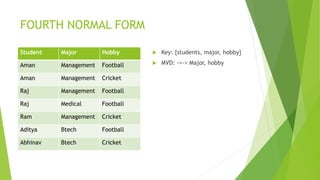
 Fourth Normal Form (4NF)
 Fifth Normal Form (5NF)
First Normal Form (1NF)
First normal form enforces these criteria:
 Eliminate repeating groups in individual tables.
 Create a separate table for each set of related data.
 Identify each set of related data with a primary key
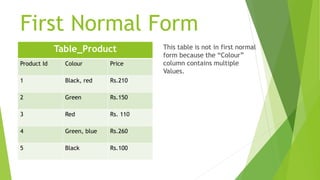
First Normal Form
Table_Product
Product Id Colour Price
1 Black, red Rs.210
2 Green Rs.150
3 Red Rs. 110
4 Green, blue Rs.260
5 Black Rs.100
This table is not in first normal
form because the “Colour”
column contains multiple
Values.
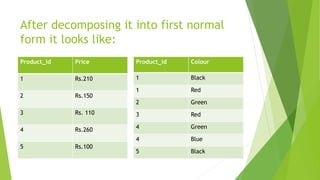
After decomposing it into first normal
form it looks like:
Product_id Price
1 Rs.210
2 Rs.150
3 Rs. 110
4 Rs.260
5 Rs.100
Product_id Colour
1 Black
1 Red
2 Green
3 Red
4 Green
4 Blue
5 Black
Second Normal Form (2NF)
A table is said to be in 2NF if both the following conditions hold:
 Table is in 1NF (First normal form)
 No non-prime attribute is dependent on the proper subset of any candidate
key of table.
An attribute that is not part of any candidate key is known as non-prime
attribute.
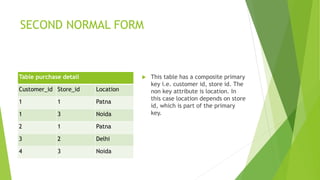
SECOND NORMAL FORM
Table purchase detail
Customer_id Store_id Location
1 1 Patna
1 3 Noida
2 1 Patna
3 2 Delhi
4 3 Noida
 This table has a composite primary
key i.e. customer id, store id. The
non key attribute is location. In
this case location depends on store
id, which is part of the primary
key.
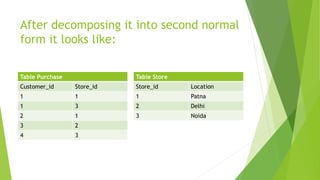
After decomposing it into second normal
form it looks like:
Table Purchase
Customer_id Store_id
1 1
1 3
2 1
3 2
4 3
Table Store
Store_id Location
1 Patna
2 Delhi
3 Noida
Third Normal Form (3NF)
A table design is said to be in 3NF if both the following conditions hold:
 Table must be in 2NF
 Transitive functional dependency of non-prime attribute on any super key should
be removed.
An attribute that is not part of any candidate key is known as non-prime attribute.
In other words 3NF can be explained like this: A table is in 3NF if it is in 2NF and for
each functional dependency X-> Y at least one of the following conditions hold:
 X is a super key of table
 Y is a prime attribute of table
An attribute that is a part of one of the candidate keys is known as prime attribute.
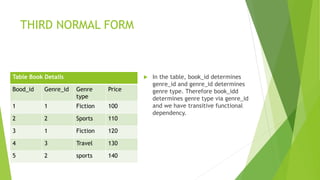
THIRD NORMAL FORM
Table Book Details
Bood_id Genre_id Genre
type
Price
1 1 Fiction 100
2 2 Sports 110
3 1 Fiction 120
4 3 Travel 130
5 2 sports 140
 In the table, book_id determines
genre_id and genre_id determines
genre type. Therefore book_idd
determines genre type via genre_id
and we have transitive functional
dependency.
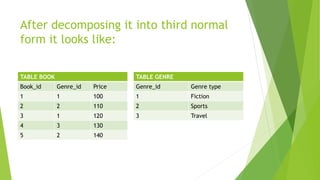
After decomposing it into third normal
form it looks like:
TABLE BOOK
Book_id Genre_id Price
1 1 100
2 2 110
3 1 120
4 3 130
5 2 140
TABLE GENRE
Genre_id Genre type
1 Fiction
2 Sports
3 Travel
Boyce-Codd Normal Form (BCNF)
 It is an advance version of 3NF that’s why it is also referred as 3.5NF. BCNF is
stricter than 3NF. A table complies with BCNF if it is in 3NF and for every
functional dependency X->Y, X should be the super key of the table.
Boyce-Codd Normal Form
Student Course Teacher
Aman DBMS AYUSH
Aditya DBMS RAJ
Abhinav E-COMM RAHUL
Aman E-COMM RAHUL
abhinav DBMS RAJ
 KEY: {Student, Course}
 Functional dependency
{student, course} -> Teacher
Teacher-> Course
 Problem: teacher is not superkey
but determines course.
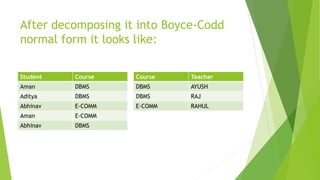
After decomposing it into Boyce-Codd
normal form it looks like:
Student Course
Aman DBMS
Aditya DBMS
Abhinav E-COMM
Aman E-COMM
Abhinav DBMS
Course Teacher
DBMS AYUSH
DBMS RAJ
E-COMM RAHUL
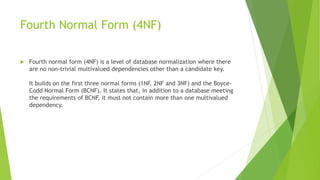
Fourth Normal Form (4NF)
 Fourth normal form (4NF) is a level of database normalization where there
are no non-trivial multivalued dependencies other than a candidate key.
It builds on the first three normal forms (1NF, 2NF and 3NF) and the Boyce-
Codd Normal Form (BCNF). It states that, in addition to a database meeting
the requirements of BCNF, it must not contain more than one multivalued
dependency.
FOURTH NORMAL FORM
Student Major Hobby
Aman Management Football
Aman Management Cricket
Raj Management Football
Raj Medical Football
Ram Management Cricket
Aditya Btech Football
Abhinav Btech Cricket
 Key: {students, major, hobby}
 MVD: ->-> Major, hobby
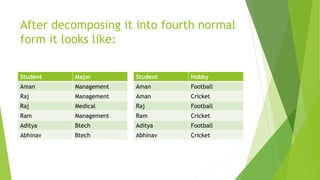
After decomposing it into fourth normal
form it looks like:
Student Major
Aman Management
Raj Management
Raj Medical
Ram Management
Aditya Btech
Abhinav Btech
Student Hobby
Aman Football
Aman Cricket
Raj Football
Ram Cricket
Aditya Football
Abhinav Cricket
Fifth Normal Form (5NF)
A database is said to be in 5NF, if and only if,
 It's in 4NF.
 If we can decompose table further to eliminate redundancy and anomaly, and
when we re-join the decomposed tables by means of candidate keys, we
should not be losing the original data or any new record set should not arise.
In simple words, joining two or more decomposed table should not lose
records nor create new records.
FIFTH NORMAL FORM
Seller Company Product
Aman Coca cola
company
Thumps Up
Aditya Unilever Ponds
Aditya Unilever Axe
Aditya Uniliver Lakme
Abhinav P&G Vicks
Abhinav Pepsico Pepsi
 Key: {seller, company, product}
 MVD: Seller ->-> Company, product
Product is related to company.
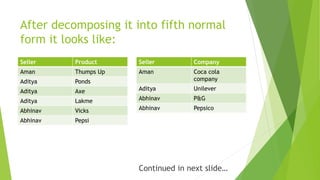
After decomposing it into fifth normal
form it looks like:
Continued in next slide…
Seller Product
Aman Thumps Up
Aditya Ponds
Aditya Axe
Aditya Lakme
Abhinav Vicks
Abhinav Pepsi
Seller Company
Aman Coca cola
company
Aditya Unilever
Abhinav P&G
Abhinav Pepsico
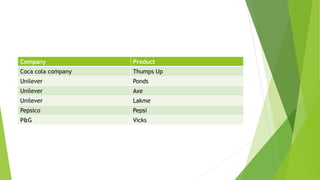
Company Product
Coca cola company Thumps Up
Unilever Ponds
Unilever Axe
Unilever Lakme
Pepsico Pepsi
P&G Vicks
1-161103092724 (1).pdf

1-161103092724 (1).pdf

  • 1.
    NORMALIZATION & TYPESOF NORMALIZATION
  • 2.
    1) DEFINE NORMALIZATION Normalizationcan be defined as :-  A process of organizing the data in database to avoid data redundancy, insertion anomaly, update anomaly & deletion anomaly. • A process of organizing data into tables in such a way that the results of using the database are always unambiguous and as intended. Such normalization is intrinsic to relational database theory. It may have the effect of duplicating data within the database and often results in the creation of additional tables.
  • 3.
    Types of normalization First Normal Form (1NF)  Second Normal Form (2NF)  Third Normal Form (3NF)  Boyce-Codd Normal Form (BCNF)  Fourth Normal Form (4NF)  Fifth Normal Form (5NF)
  • 4.
    First Normal Form(1NF) First normal form enforces these criteria:  Eliminate repeating groups in individual tables.  Create a separate table for each set of related data.  Identify each set of related data with a primary key
  • 5.
    First Normal Form Table_Product ProductId Colour Price 1 Black, red Rs.210 2 Green Rs.150 3 Red Rs. 110 4 Green, blue Rs.260 5 Black Rs.100 This table is not in first normal form because the “Colour” column contains multiple Values.
  • 6.
    After decomposing itinto first normal form it looks like: Product_id Price 1 Rs.210 2 Rs.150 3 Rs. 110 4 Rs.260 5 Rs.100 Product_id Colour 1 Black 1 Red 2 Green 3 Red 4 Green 4 Blue 5 Black
  • 7.
    Second Normal Form(2NF) A table is said to be in 2NF if both the following conditions hold:  Table is in 1NF (First normal form)  No non-prime attribute is dependent on the proper subset of any candidate key of table. An attribute that is not part of any candidate key is known as non-prime attribute.
  • 8.
    SECOND NORMAL FORM Tablepurchase detail Customer_id Store_id Location 1 1 Patna 1 3 Noida 2 1 Patna 3 2 Delhi 4 3 Noida  This table has a composite primary key i.e. customer id, store id. The non key attribute is location. In this case location depends on store id, which is part of the primary key.
  • 9.
    After decomposing itinto second normal form it looks like: Table Purchase Customer_id Store_id 1 1 1 3 2 1 3 2 4 3 Table Store Store_id Location 1 Patna 2 Delhi 3 Noida
  • 10.
    Third Normal Form(3NF) A table design is said to be in 3NF if both the following conditions hold:  Table must be in 2NF  Transitive functional dependency of non-prime attribute on any super key should be removed. An attribute that is not part of any candidate key is known as non-prime attribute. In other words 3NF can be explained like this: A table is in 3NF if it is in 2NF and for each functional dependency X-> Y at least one of the following conditions hold:  X is a super key of table  Y is a prime attribute of table An attribute that is a part of one of the candidate keys is known as prime attribute.
  • 11.
    THIRD NORMAL FORM TableBook Details Bood_id Genre_id Genre type Price 1 1 Fiction 100 2 2 Sports 110 3 1 Fiction 120 4 3 Travel 130 5 2 sports 140  In the table, book_id determines genre_id and genre_id determines genre type. Therefore book_idd determines genre type via genre_id and we have transitive functional dependency.
  • 12.
    After decomposing itinto third normal form it looks like: TABLE BOOK Book_id Genre_id Price 1 1 100 2 2 110 3 1 120 4 3 130 5 2 140 TABLE GENRE Genre_id Genre type 1 Fiction 2 Sports 3 Travel
  • 13.
    Boyce-Codd Normal Form(BCNF)  It is an advance version of 3NF that’s why it is also referred as 3.5NF. BCNF is stricter than 3NF. A table complies with BCNF if it is in 3NF and for every functional dependency X->Y, X should be the super key of the table.
  • 14.
    Boyce-Codd Normal Form StudentCourse Teacher Aman DBMS AYUSH Aditya DBMS RAJ Abhinav E-COMM RAHUL Aman E-COMM RAHUL abhinav DBMS RAJ  KEY: {Student, Course}  Functional dependency {student, course} -> Teacher Teacher-> Course  Problem: teacher is not superkey but determines course.
  • 15.
    After decomposing itinto Boyce-Codd normal form it looks like: Student Course Aman DBMS Aditya DBMS Abhinav E-COMM Aman E-COMM Abhinav DBMS Course Teacher DBMS AYUSH DBMS RAJ E-COMM RAHUL
  • 16.
    Fourth Normal Form(4NF)  Fourth normal form (4NF) is a level of database normalization where there are no non-trivial multivalued dependencies other than a candidate key. It builds on the first three normal forms (1NF, 2NF and 3NF) and the Boyce- Codd Normal Form (BCNF). It states that, in addition to a database meeting the requirements of BCNF, it must not contain more than one multivalued dependency.
  • 17.
    FOURTH NORMAL FORM StudentMajor Hobby Aman Management Football Aman Management Cricket Raj Management Football Raj Medical Football Ram Management Cricket Aditya Btech Football Abhinav Btech Cricket  Key: {students, major, hobby}  MVD: ->-> Major, hobby
  • 18.
    After decomposing itinto fourth normal form it looks like: Student Major Aman Management Raj Management Raj Medical Ram Management Aditya Btech Abhinav Btech Student Hobby Aman Football Aman Cricket Raj Football Ram Cricket Aditya Football Abhinav Cricket
  • 19.
    Fifth Normal Form(5NF) A database is said to be in 5NF, if and only if,  It's in 4NF.  If we can decompose table further to eliminate redundancy and anomaly, and when we re-join the decomposed tables by means of candidate keys, we should not be losing the original data or any new record set should not arise. In simple words, joining two or more decomposed table should not lose records nor create new records.
  • 20.
    FIFTH NORMAL FORM SellerCompany Product Aman Coca cola company Thumps Up Aditya Unilever Ponds Aditya Unilever Axe Aditya Uniliver Lakme Abhinav P&G Vicks Abhinav Pepsico Pepsi  Key: {seller, company, product}  MVD: Seller ->-> Company, product Product is related to company.
  • 21.
    After decomposing itinto fifth normal form it looks like: Continued in next slide… Seller Product Aman Thumps Up Aditya Ponds Aditya Axe Aditya Lakme Abhinav Vicks Abhinav Pepsi Seller Company Aman Coca cola company Aditya Unilever Abhinav P&G Abhinav Pepsico
  • 22.
    Company Product Coca colacompany Thumps Up Unilever Ponds Unilever Axe Unilever Lakme Pepsico Pepsi P&G Vicks