 An analytical technique used during logical database
design
 This is the process which allows you to winnow out
redundant data within your database.
 This involves restructuring the tables to avoid data
inconsistencies (insert/update/delete anomalies)
 A properly normalized database should have the
following characteristics
 Scalar/Atomic values in each fields
 No data redundancy.
 Minimal/No loss of information
 Minimal Uses of NULL values
Normalization
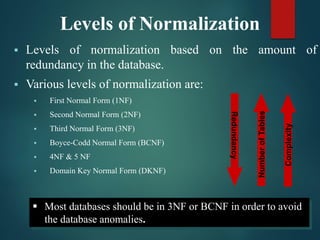
 Levels of normalization based on the amount of
redundancy in the database.
 Various levels of normalization are:
 First Normal Form (1NF)
 Second Normal Form (2NF)
 Third Normal Form (3NF)
 Boyce-Codd Normal Form (BCNF)
 4NF & 5 NF
 Domain Key Normal Form (DKNF)
Levels of Normalization
Redundancy
NumberofTables
 Most databases should be in 3NF or BCNF in order to avoid
the database anomalies.
Complexity
Levels of Normalization
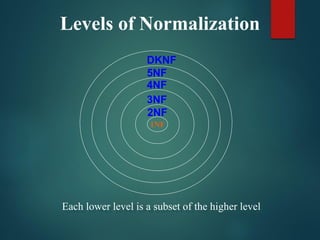
Each lower level is a subset of the higher level
1NF
DKNF
5NF
4NF
3NF
2NF
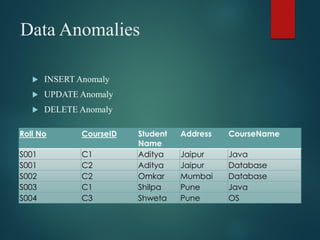
Data Anomalies
 INSERT Anomaly
 UPDATE Anomaly
 DELETE Anomaly
Roll No CourseID Student
Name
Address CourseName
S001 C1 Aditya Jaipur Java
S001 C2 Aditya Jaipur Database
S002 C2 Omkar Mumbai Database
S003 C1 Shilpa Pune Java
S004 C3 Shweta Pune OS
A table is considered to be in 1NF if all the fields contain
only scalar values (as opposed to list of values).
Example (Not 1NF)
First Normal Form (1NF)
Author and AuPhone columns are not scalar
0-321-32132-1 Core Java Sleepy,
Snoopy,
Grumpy
321-321-1111,
232-234-1234,
665-235-6532
Small House 714-000-0000 $34.00
0-55-123456-9 Postgres Jones, Smith 123-333-3333,
654-223-3455
Small House 714-000-0000 $22.95
0-123-45678-0 Oracle Joyce 666-666-6666 Alpha Press 999-999-9999 $34.00
1-22-233700-0 MongoDB Roman 444-444-4444 Big House 123-456-7890 $25.00
ISBN Title AuName AuPhone PubName PubPhone Price
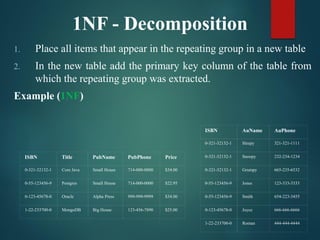
1. Place all items that appear in the repeating group in a new table
2. In the new table add the primary key column of the table from
which the repeating group was extracted.
Example (1NF)
1NF - Decomposition
0-321-32132-1 Core Java Small House 714-000-0000 $34.00
0-55-123456-9 Postgres Small House 714-000-0000 $22.95
0-123-45678-0 Oracle Alpha Press 999-999-9999 $34.00
1-22-233700-0 MongoDB Big House 123-456-7890 $25.00
ISBN Title PubName PubPhone Price
ISBN AuName AuPhone
0-123-45678-0 Joyce 666-666-6666
1-22-233700-0 Roman 444-444-4444
0-55-123456-9 Smith 654-223-3455
0-55-123456-9 Jones 123-333-3333
0-321-32132-1 Grumpy 665-235-6532
0-321-32132-1 Snoopy 232-234-1234
0-321-32132-1 Sleepy 321-321-1111
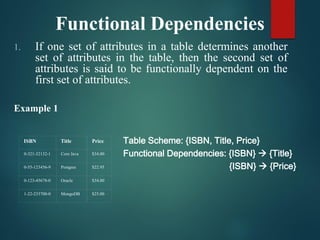
1. If one set of attributes in a table determines another
set of attributes in the table, then the second set of
attributes is said to be functionally dependent on the
first set of attributes.
Example 1
Functional Dependencies
0-321-32132-1 Core Java $34.00
0-55-123456-9 Postgres $22.95
0-123-45678-0 Oracle $34.00
1-22-233700-0 MongoDB $25.00
ISBN Title Price Table Scheme: {ISBN, Title, Price}
Functional Dependencies: {ISBN}  {Title}
{ISBN}  {Price}
Example 2
Functional Dependencies
1 Big House 999-999-9999
2 Small House 123-456-7890
3 Alpha Press 111-111-1111
PubID PubName PubPhone Table Scheme: {PubID, PubName, PubPhone}
Functional Dependencies: {PubId}  {PubPhone}
{PubId}  {PubName}
{PubName, PubPhone}  {PubID}
AuID AuName AuPhone
6 Joyce 666-666-6666
7 Roman 444-444-4444
5 Smith 654-223-3455
4 Jones 123-333-3333
3 Grumpy 665-235-6532
2 Snoopy 232-234-1234
1 Sleepy 321-321-1111
Example 3
Table Scheme: {AuID, AuName, AuPhone}
Functional Dependencies: {AuId}  {AuPhone}
{AuId}  {AuName}
{AuName, AuPhone}  {AuID}
 For a table to be in 2NF, there are two requirements
 The database is in first normal form
 All nonkey attributes in the table must be fully functionally
dependent on the entire primary key
 Example 1 (Not 2NF)
 Scheme  {Title, PubId, AuId, Price, AuAddress}
 Key  {Title, PubId, AuId}
 {Title, PubId, AuID}  {Price}
 {AuID}  {AuAddress}
 AuAddress does not belong to a key
 AuAddress functionally depends on AuId which is a
subset of a key
Second Normal Form (2NF)
Example 2 (Not 2NF)
Scheme  {City, Street, HouseNumber, HouseColor,
CityPopulation}
 Key  {City, Street, HouseNumber}
 {City, Street, HouseNumber}  {HouseColor}
 {City}  {CityPopulation}
 CityPopulation does not belong to any key.
 CityPopulation is functionally dependent on the City
which is a subset of the key.
Second Normal Form (2NF)
 If a data item is fully functionally dependent on only a part
of the primary key, move that data item and that part of the
primary key to a new table.
 If other data items are functionally dependent on the same
part of the key, place them in the new table also
 Make the partial primary key copied from the original table
the primary key for the new table. Place all items that appear
in the repeating group in a new table
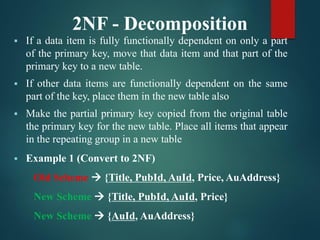
 Example 1 (Convert to 2NF)
Old Scheme  {Title, PubId, AuId, Price, AuAddress}
New Scheme  {Title, PubId, AuId, Price}
New Scheme  {AuId, AuAddress}
2NF - Decomposition
Example 2 (Convert to 2NF)
Old Scheme  {City, Street, HouseNumber, HouseColor,
CityPopulation}
New Scheme  {City, Street, HouseNumber, HouseColor}
New Scheme  {City, CityPopulation}
2NF - Decomposition
 This form dictates that all non-key attributes must directly
depend on key attribute ie. no interdependencies among non-
key attributes.
 For a table to be in 3NF, there are two requirements
 The table should be second normal form
 No attribute is transitively dependent on the primary key
Third Normal Form (3NF)
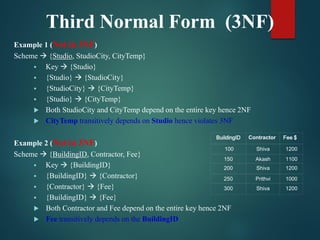
Example 1 (Not in 3NF)
Scheme  {Studio, StudioCity, CityTemp}
 Key  {Studio}
 {Studio}  {StudioCity}
 {StudioCity}  {CityTemp}
 {Studio}  {CityTemp}
 Both StudioCity and CityTemp depend on the entire key hence 2NF
 CityTemp transitively depends on Studio hence violates 3NF
Example 2 (Not in 3NF)
Scheme  {BuildingID, Contractor, Fee}
 Key  {BuildingID}
 {BuildingID}  {Contractor}
 {Contractor}  {Fee}
 {BuildingID}  {Fee}
 Both Contractor and Fee depend on the entire key hence 2NF
 Fee transitively depends on the BuildingID
Third Normal Form (3NF)
BuildingID Contractor Fee $
100 Shiva 1200
150 Akash 1100
200 Shiva 1200
250 Prithvi 1000
300 Shiva 1200
 Move all items involved in transitive dependencies to a new
entity.
 Identify a primary key for the new entity.
 Place the primary key for the new entity as a foreign key on
the original entity.
3NF - Decomposition
Example 1 (Convert to 3NF)
Old Scheme  {Studio, StudioCity, CityTemp}
New Scheme  {Studio, StudioCity}
New Scheme  {StudioCity, CityTemp}
Example 2 (Convert to 3NF)
Old Scheme  {BuildingID, Contractor, Fee}
New Scheme  {BuildingID, Contractor}
New Scheme  {Contractor, Fee}
3NF - Decomposition
BuildingID Contractor
100 Shiva
150 Akash
200 Shiva
250 Prithvi
300 Shiva
Contractor Fee
Shiva 1200
Akash 1100
Prithvi 1000
 BCNF does not allow dependencies between attributes that
belong to candidate key.
 BCNF is a refinement of the third normal form in which it drops
the restriction of a non-key attribute from the 3rd normal form.
Boyce-Codd Normal Form
(BCNF)
Example - Movie (Not in BCNF)
Scheme  {MovieTitle, MovieID, ActorName, Payment }
 Key1  {MovieTitle, ActorName}
 Key2  {MovieID, ActorName}
 {MovieID}  {MovieTitle}
 Payment functionally depend on both Candidate Keys, thus
3NF
 Dependency between MovieID & MovieTitle Violates BCNF
Boyce-Codd Normal Form
(BCNF)
 Place the two candidate keys in separate entities
 Place each of the remaining data items in one of the resulting
entities according to its dependency on the primary key.
BCNF - Decomposition
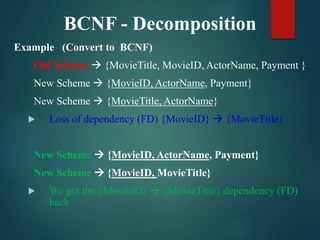
Example (Convert to BCNF)
Old Scheme  {MovieTitle, MovieID, ActorName, Payment }
New Scheme  {MovieID, ActorName, Payment}
New Scheme  {MovieTitle, ActorName}
 Loss of dependency (FD) {MovieID}  {MovieTitle}
New Scheme  {MovieID, ActorName, Payment}
New Scheme  {MovieID, MovieTitle}
 We got the {MovieID}  {MovieTitle} dependency (FD)
back
BCNF - Decomposition
 If decomposition does not cause any loss of information it is
called a lossless decomposition.
 If a decomposition does not cause any dependencies to be
lost it is called a dependency-preserving decomposition.
 Any table scheme can be decomposed in a lossless way into
a collection of smaller schemas that are in BCNF form.
However the dependency preservation is not guaranteed.
 Any table can be decomposed in a lossless way into 3rd
normal form that also preserves the dependencies.
 3NF may be better than BCNF in some cases
Decomposition – Loss of
Information
 4NF is concerned with Multivalued Dependency. 4NF
eliminates independent many-to-one relationships between
columns.
 A multivalued dependency exists when there are at least
three attributes (like X,Y and Z) in a relation and for a value
of X there is a well defined set of values of Y and a well
defined set of values of Z. However, the set of values of Y is
independent of set Z and vice versa.
 To be in Fourth Normal Form,
 A relation must first be in Boyce-Codd Normal Form (BCNF).
 A given relation should not have multi-valued dependency
(MVD).
Fourth Normal Form (4NF)
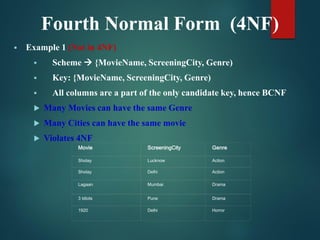
 Example 1 (Not in 4NF)
 Scheme  {MovieName, ScreeningCity, Genre)
 Key: {MovieName, ScreeningCity, Genre)
 All columns are a part of the only candidate key, hence BCNF
 Many Movies can have the same Genre
 Many Cities can have the same movie
 Violates 4NF
Fourth Normal Form (4NF)
Movie ScreeningCity Genre
Sholay Lucknow Action
Sholay Delhi Action
Lagaan Mumbai Drama
3 Idiots Pune Drama
1920 Delhi Horror
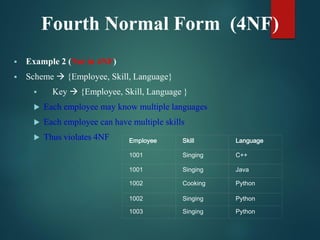
 Example 2 (Not in 4NF)
 Scheme  {Employee, Skill, Language}
 Key  {Employee, Skill, Language }
 Each employee may know multiple languages
 Each employee can have multiple skills
 Thus violates 4NF
Fourth Normal Form (4NF)
Employee Skill Language
1001 Singing C++
1001 Singing Java
1002 Cooking Python
1002 Singing Python
1003 Singing Python
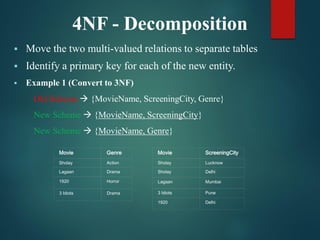
 Move the two multi-valued relations to separate tables
 Identify a primary key for each of the new entity.
 Example 1 (Convert to 3NF)
Old Scheme  {MovieName, ScreeningCity, Genre}
New Scheme  {MovieName, ScreeningCity}
New Scheme  {MovieName, Genre}
4NF - Decomposition
Movie Genre
Sholay Action
Lagaan Drama
1920 Horror
Movie ScreeningCity
Sholay Lucknow
Sholay Delhi
Lagaan Mumbai
3 Idiots Pune
1920 Delhi
3 Idiots Drama
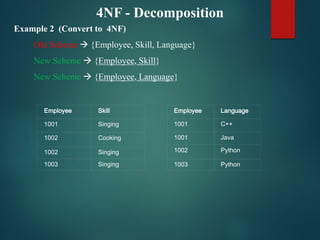
Example 2 (Convert to 4NF)
Old Scheme  {Employee, Skill, Language}
New Scheme  {Employee, Skill}
New Scheme  {Employee, Language}
4NF - Decomposition
Employee Language
1001 C++
1001 Java
1002 Python
1003 Python
Employee Skill
1001 Singing
1002 Cooking
1002 Singing
1003 Singing
 Fifth normal form is satisfied when all tables are broken
into as many tables as possible in order to avoid
redundancy. Once it is in fifth normal form it cannot be
broken into smaller relations without changing the facts
or the meaning.
Fifth Normal Form (5NF)
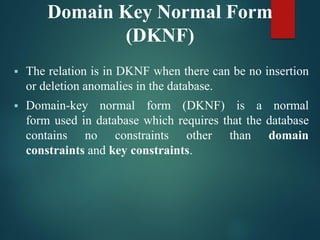
 The relation is in DKNF when there can be no insertion
or deletion anomalies in the database.
 Domain-key normal form (DKNF) is a normal
form used in database which requires that the database
contains no constraints other than domain
constraints and key constraints.
Domain Key Normal Form
(DKNF)
De-Normalization

Normalization

  • 1.
     An analyticaltechnique used during logical database design  This is the process which allows you to winnow out redundant data within your database.  This involves restructuring the tables to avoid data inconsistencies (insert/update/delete anomalies)  A properly normalized database should have the following characteristics  Scalar/Atomic values in each fields  No data redundancy.  Minimal/No loss of information  Minimal Uses of NULL values Normalization
  • 2.
     Levels ofnormalization based on the amount of redundancy in the database.  Various levels of normalization are:  First Normal Form (1NF)  Second Normal Form (2NF)  Third Normal Form (3NF)  Boyce-Codd Normal Form (BCNF)  4NF & 5 NF  Domain Key Normal Form (DKNF) Levels of Normalization Redundancy NumberofTables  Most databases should be in 3NF or BCNF in order to avoid the database anomalies. Complexity
  • 3.
    Levels of Normalization Eachlower level is a subset of the higher level 1NF DKNF 5NF 4NF 3NF 2NF
  • 4.
    Data Anomalies  INSERTAnomaly  UPDATE Anomaly  DELETE Anomaly Roll No CourseID Student Name Address CourseName S001 C1 Aditya Jaipur Java S001 C2 Aditya Jaipur Database S002 C2 Omkar Mumbai Database S003 C1 Shilpa Pune Java S004 C3 Shweta Pune OS
  • 5.
    A table isconsidered to be in 1NF if all the fields contain only scalar values (as opposed to list of values). Example (Not 1NF) First Normal Form (1NF) Author and AuPhone columns are not scalar 0-321-32132-1 Core Java Sleepy, Snoopy, Grumpy 321-321-1111, 232-234-1234, 665-235-6532 Small House 714-000-0000 $34.00 0-55-123456-9 Postgres Jones, Smith 123-333-3333, 654-223-3455 Small House 714-000-0000 $22.95 0-123-45678-0 Oracle Joyce 666-666-6666 Alpha Press 999-999-9999 $34.00 1-22-233700-0 MongoDB Roman 444-444-4444 Big House 123-456-7890 $25.00 ISBN Title AuName AuPhone PubName PubPhone Price
  • 6.
    1. Place allitems that appear in the repeating group in a new table 2. In the new table add the primary key column of the table from which the repeating group was extracted. Example (1NF) 1NF - Decomposition 0-321-32132-1 Core Java Small House 714-000-0000 $34.00 0-55-123456-9 Postgres Small House 714-000-0000 $22.95 0-123-45678-0 Oracle Alpha Press 999-999-9999 $34.00 1-22-233700-0 MongoDB Big House 123-456-7890 $25.00 ISBN Title PubName PubPhone Price ISBN AuName AuPhone 0-123-45678-0 Joyce 666-666-6666 1-22-233700-0 Roman 444-444-4444 0-55-123456-9 Smith 654-223-3455 0-55-123456-9 Jones 123-333-3333 0-321-32132-1 Grumpy 665-235-6532 0-321-32132-1 Snoopy 232-234-1234 0-321-32132-1 Sleepy 321-321-1111
  • 7.
    1. If oneset of attributes in a table determines another set of attributes in the table, then the second set of attributes is said to be functionally dependent on the first set of attributes. Example 1 Functional Dependencies 0-321-32132-1 Core Java $34.00 0-55-123456-9 Postgres $22.95 0-123-45678-0 Oracle $34.00 1-22-233700-0 MongoDB $25.00 ISBN Title Price Table Scheme: {ISBN, Title, Price} Functional Dependencies: {ISBN}  {Title} {ISBN}  {Price}
  • 8.
    Example 2 Functional Dependencies 1Big House 999-999-9999 2 Small House 123-456-7890 3 Alpha Press 111-111-1111 PubID PubName PubPhone Table Scheme: {PubID, PubName, PubPhone} Functional Dependencies: {PubId}  {PubPhone} {PubId}  {PubName} {PubName, PubPhone}  {PubID} AuID AuName AuPhone 6 Joyce 666-666-6666 7 Roman 444-444-4444 5 Smith 654-223-3455 4 Jones 123-333-3333 3 Grumpy 665-235-6532 2 Snoopy 232-234-1234 1 Sleepy 321-321-1111 Example 3 Table Scheme: {AuID, AuName, AuPhone} Functional Dependencies: {AuId}  {AuPhone} {AuId}  {AuName} {AuName, AuPhone}  {AuID}
  • 9.
     For atable to be in 2NF, there are two requirements  The database is in first normal form  All nonkey attributes in the table must be fully functionally dependent on the entire primary key  Example 1 (Not 2NF)  Scheme  {Title, PubId, AuId, Price, AuAddress}  Key  {Title, PubId, AuId}  {Title, PubId, AuID}  {Price}  {AuID}  {AuAddress}  AuAddress does not belong to a key  AuAddress functionally depends on AuId which is a subset of a key Second Normal Form (2NF)
  • 10.
    Example 2 (Not2NF) Scheme  {City, Street, HouseNumber, HouseColor, CityPopulation}  Key  {City, Street, HouseNumber}  {City, Street, HouseNumber}  {HouseColor}  {City}  {CityPopulation}  CityPopulation does not belong to any key.  CityPopulation is functionally dependent on the City which is a subset of the key. Second Normal Form (2NF)
  • 11.
     If adata item is fully functionally dependent on only a part of the primary key, move that data item and that part of the primary key to a new table.  If other data items are functionally dependent on the same part of the key, place them in the new table also  Make the partial primary key copied from the original table the primary key for the new table. Place all items that appear in the repeating group in a new table  Example 1 (Convert to 2NF) Old Scheme  {Title, PubId, AuId, Price, AuAddress} New Scheme  {Title, PubId, AuId, Price} New Scheme  {AuId, AuAddress} 2NF - Decomposition
  • 12.
    Example 2 (Convertto 2NF) Old Scheme  {City, Street, HouseNumber, HouseColor, CityPopulation} New Scheme  {City, Street, HouseNumber, HouseColor} New Scheme  {City, CityPopulation} 2NF - Decomposition
  • 13.
     This formdictates that all non-key attributes must directly depend on key attribute ie. no interdependencies among non- key attributes.  For a table to be in 3NF, there are two requirements  The table should be second normal form  No attribute is transitively dependent on the primary key Third Normal Form (3NF)
  • 14.
    Example 1 (Notin 3NF) Scheme  {Studio, StudioCity, CityTemp}  Key  {Studio}  {Studio}  {StudioCity}  {StudioCity}  {CityTemp}  {Studio}  {CityTemp}  Both StudioCity and CityTemp depend on the entire key hence 2NF  CityTemp transitively depends on Studio hence violates 3NF Example 2 (Not in 3NF) Scheme  {BuildingID, Contractor, Fee}  Key  {BuildingID}  {BuildingID}  {Contractor}  {Contractor}  {Fee}  {BuildingID}  {Fee}  Both Contractor and Fee depend on the entire key hence 2NF  Fee transitively depends on the BuildingID Third Normal Form (3NF) BuildingID Contractor Fee $ 100 Shiva 1200 150 Akash 1100 200 Shiva 1200 250 Prithvi 1000 300 Shiva 1200
  • 15.
     Move allitems involved in transitive dependencies to a new entity.  Identify a primary key for the new entity.  Place the primary key for the new entity as a foreign key on the original entity. 3NF - Decomposition
  • 16.
    Example 1 (Convertto 3NF) Old Scheme  {Studio, StudioCity, CityTemp} New Scheme  {Studio, StudioCity} New Scheme  {StudioCity, CityTemp} Example 2 (Convert to 3NF) Old Scheme  {BuildingID, Contractor, Fee} New Scheme  {BuildingID, Contractor} New Scheme  {Contractor, Fee} 3NF - Decomposition BuildingID Contractor 100 Shiva 150 Akash 200 Shiva 250 Prithvi 300 Shiva Contractor Fee Shiva 1200 Akash 1100 Prithvi 1000
  • 17.
     BCNF doesnot allow dependencies between attributes that belong to candidate key.  BCNF is a refinement of the third normal form in which it drops the restriction of a non-key attribute from the 3rd normal form. Boyce-Codd Normal Form (BCNF)
  • 18.
    Example - Movie(Not in BCNF) Scheme  {MovieTitle, MovieID, ActorName, Payment }  Key1  {MovieTitle, ActorName}  Key2  {MovieID, ActorName}  {MovieID}  {MovieTitle}  Payment functionally depend on both Candidate Keys, thus 3NF  Dependency between MovieID & MovieTitle Violates BCNF Boyce-Codd Normal Form (BCNF)
  • 19.
     Place thetwo candidate keys in separate entities  Place each of the remaining data items in one of the resulting entities according to its dependency on the primary key. BCNF - Decomposition
  • 20.
    Example (Convert toBCNF) Old Scheme  {MovieTitle, MovieID, ActorName, Payment } New Scheme  {MovieID, ActorName, Payment} New Scheme  {MovieTitle, ActorName}  Loss of dependency (FD) {MovieID}  {MovieTitle} New Scheme  {MovieID, ActorName, Payment} New Scheme  {MovieID, MovieTitle}  We got the {MovieID}  {MovieTitle} dependency (FD) back BCNF - Decomposition
  • 21.
     If decompositiondoes not cause any loss of information it is called a lossless decomposition.  If a decomposition does not cause any dependencies to be lost it is called a dependency-preserving decomposition.  Any table scheme can be decomposed in a lossless way into a collection of smaller schemas that are in BCNF form. However the dependency preservation is not guaranteed.  Any table can be decomposed in a lossless way into 3rd normal form that also preserves the dependencies.  3NF may be better than BCNF in some cases Decomposition – Loss of Information
  • 22.
     4NF isconcerned with Multivalued Dependency. 4NF eliminates independent many-to-one relationships between columns.  A multivalued dependency exists when there are at least three attributes (like X,Y and Z) in a relation and for a value of X there is a well defined set of values of Y and a well defined set of values of Z. However, the set of values of Y is independent of set Z and vice versa.  To be in Fourth Normal Form,  A relation must first be in Boyce-Codd Normal Form (BCNF).  A given relation should not have multi-valued dependency (MVD). Fourth Normal Form (4NF)
  • 23.
     Example 1(Not in 4NF)  Scheme  {MovieName, ScreeningCity, Genre)  Key: {MovieName, ScreeningCity, Genre)  All columns are a part of the only candidate key, hence BCNF  Many Movies can have the same Genre  Many Cities can have the same movie  Violates 4NF Fourth Normal Form (4NF) Movie ScreeningCity Genre Sholay Lucknow Action Sholay Delhi Action Lagaan Mumbai Drama 3 Idiots Pune Drama 1920 Delhi Horror
  • 24.
     Example 2(Not in 4NF)  Scheme  {Employee, Skill, Language}  Key  {Employee, Skill, Language }  Each employee may know multiple languages  Each employee can have multiple skills  Thus violates 4NF Fourth Normal Form (4NF) Employee Skill Language 1001 Singing C++ 1001 Singing Java 1002 Cooking Python 1002 Singing Python 1003 Singing Python
  • 25.
     Move thetwo multi-valued relations to separate tables  Identify a primary key for each of the new entity.  Example 1 (Convert to 3NF) Old Scheme  {MovieName, ScreeningCity, Genre} New Scheme  {MovieName, ScreeningCity} New Scheme  {MovieName, Genre} 4NF - Decomposition Movie Genre Sholay Action Lagaan Drama 1920 Horror Movie ScreeningCity Sholay Lucknow Sholay Delhi Lagaan Mumbai 3 Idiots Pune 1920 Delhi 3 Idiots Drama
  • 26.
    Example 2 (Convertto 4NF) Old Scheme  {Employee, Skill, Language} New Scheme  {Employee, Skill} New Scheme  {Employee, Language} 4NF - Decomposition Employee Language 1001 C++ 1001 Java 1002 Python 1003 Python Employee Skill 1001 Singing 1002 Cooking 1002 Singing 1003 Singing
  • 27.
     Fifth normalform is satisfied when all tables are broken into as many tables as possible in order to avoid redundancy. Once it is in fifth normal form it cannot be broken into smaller relations without changing the facts or the meaning. Fifth Normal Form (5NF)
  • 28.
     The relationis in DKNF when there can be no insertion or deletion anomalies in the database.  Domain-key normal form (DKNF) is a normal form used in database which requires that the database contains no constraints other than domain constraints and key constraints. Domain Key Normal Form (DKNF)
  • 29.