Normalization in DBMS
1
PreparedBy
Dr. S. Chitra & Mrs. P. Renuka
Assistant Professors,
Department of Computer Science with Specialization in Cyber Security,
SRM Institute of Science & Technology, Ramapuram Campus,
Chennai – 600089.
2.
Normalization isa process of organizing data in a database.
Goal: Reduce redundancy and improve data integrity.
Ensures data is stored efficiently and consistently.
This involves restructuring the tables to successively meeting
higher forms of Normalization.
2
Introduction
3.
Characteristics
A properly normalizeddatabase should
have the following characteristics
Scalar values in each fields.
Absence of redundancy.
Minimal use of null values.
Minimal loss of information.
3
Anomalies Without Normalization
Insertion Anomaly – Cannot insert data
without other details
Update Anomaly – Updating data in
multiple places causes inconsistency
Deletion Anomaly – Deleting data may
lead to unintended loss of other
information
5
6.
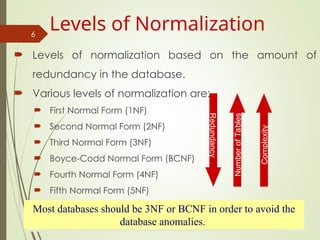
Levels ofnormalization based on the amount of
redundancy in the database.
Various levels of normalization are:
First Normal Form (1NF)
Second Normal Form (2NF)
Third Normal Form (3NF)
Boyce-Codd Normal Form (BCNF)
Fourth Normal Form (4NF)
Fifth Normal Form (5NF)
6
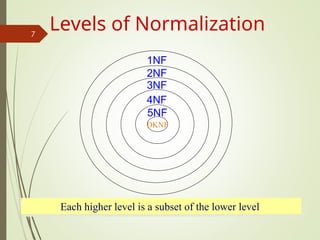
Levels of Normalization
Redundancy
Number
of
Tables
Most databases should be 3NF or BCNF in order to avoid the
database anomalies.
Complexity
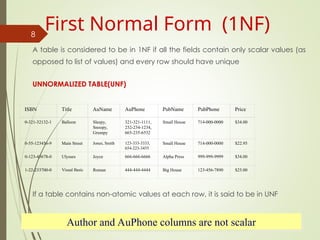
A table isconsidered to be in 1NF if all the fields contain only scalar values (as
opposed to list of values) and every row should have unique
UNNORMALIZED TABLE(UNF)
If a table contains non-atomic values at each row, it is said to be in UNF
8
First Normal Form (1NF)
Author and AuPhone columns are not scalar
0-321-32132-1 Balloon Sleepy,
Snoopy,
Grumpy
321-321-1111,
232-234-1234,
665-235-6532
Small House 714-000-0000 $34.00
0-55-123456-9 Main Street Jones, Smith 123-333-3333,
654-223-3455
Small House 714-000-0000 $22.95
0-123-45678-0 Ulysses Joyce 666-666-6666 Alpha Press 999-999-9999 $34.00
1-22-233700-0 Visual Basic Roman 444-444-4444 Big House 123-456-7890 $25.00
ISBN Title AuName AuPhone PubName PubPhone Price
9.
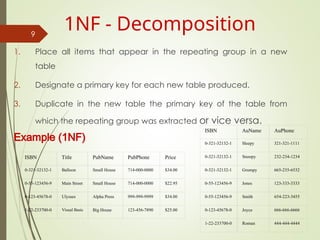
1. Place allitems that appear in the repeating group in a new
table
2. Designate a primary key for each new table produced.
3. Duplicate in the new table the primary key of the table from
which the repeating group was extracted or vice versa.
Example (1NF)
9
1NF - Decomposition
0-321-32132-1 Balloon Small House 714-000-0000 $34.00
0-55-123456-9 Main Street Small House 714-000-0000 $22.95
0-123-45678-0 Ulysses Alpha Press 999-999-9999 $34.00
1-22-233700-0 Visual Basic Big House 123-456-7890 $25.00
ISBN Title PubName PubPhone Price
ISBN AuName AuPhone
0-123-45678-0 Joyce 666-666-6666
1-22-233700-0 Roman 444-444-4444
0-55-123456-9 Smith 654-223-3455
0-55-123456-9 Jones 123-333-3333
0-321-32132-1 Grumpy 665-235-6532
0-321-32132-1 Snoopy 232-234-1234
0-321-32132-1 Sleepy 321-321-1111
10.
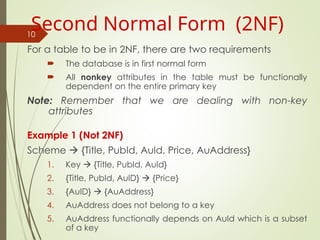
For a tableto be in 2NF, there are two requirements
The database is in first normal form
All nonkey attributes in the table must be functionally
dependent on the entire primary key
Note: Remember that we are dealing with non-key
attributes
Example 1 (Not 2NF)
Scheme {Title, PubId, AuId, Price, AuAddress}
1. Key {Title, PubId, AuId}
2. {Title, PubId, AuID} {Price}
3. {AuID} {AuAddress}
4. AuAddress does not belong to a key
5. AuAddress functionally depends on AuId which is a subset
of a key
10
Second Normal Form (2NF)
11.
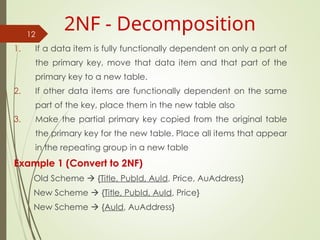
1. If adata item is fully functionally dependent on only a part of
the primary key, move that data item and that part of the
primary key to a new table.
2. If other data items are functionally dependent on the same
part of the key, place them in the new table also
3. Make the partial primary key copied from the original table
the primary key for the new table. Place all items that appear
in the repeating group in a new table
Example 1 (Convert to 2NF)
Old Scheme {Title, PubId, AuId, Price, AuAddress}
New Scheme {Title, PubId, AuId, Price}
New Scheme {AuId, AuAddress}
12
2NF - Decomposition
12.
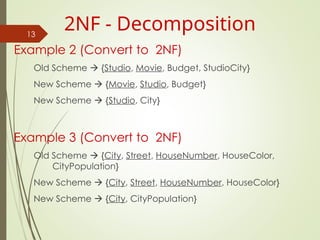
Example 2 (Convertto 2NF)
Old Scheme {Studio, Movie, Budget, StudioCity}
New Scheme {Movie, Studio, Budget}
New Scheme {Studio, City}
Example 3 (Convert to 2NF)
Old Scheme {City, Street, HouseNumber, HouseColor,
CityPopulation}
New Scheme {City, Street, HouseNumber, HouseColor}
New Scheme {City, CityPopulation}
13
2NF - Decomposition
13.
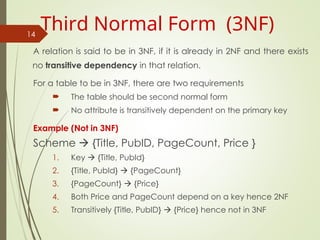
A relation issaid to be in 3NF, if it is already in 2NF and there exists
no transitive dependency in that relation.
For a table to be in 3NF, there are two requirements
The table should be second normal form
No attribute is transitively dependent on the primary key
Example (Not in 3NF)
Scheme {Title, PubID, PageCount, Price }
1. Key {Title, PubId}
2. {Title, PubId} {PageCount}
3. {PageCount} {Price}
4. Both Price and PageCount depend on a key hence 2NF
5. Transitively {Title, PubID} {Price} hence not in 3NF
14
Third Normal Form (3NF)
14.
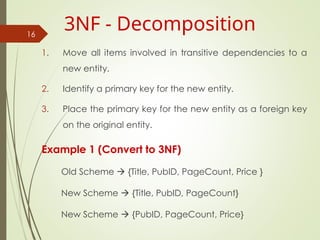
1. Move allitems involved in transitive dependencies to a
new entity.
2. Identify a primary key for the new entity.
3. Place the primary key for the new entity as a foreign key
on the original entity.
Example 1 (Convert to 3NF)
Old Scheme {Title, PubID, PageCount, Price }
New Scheme {Title, PubID, PageCount}
New Scheme {PubID, PageCount, Price}
16
3NF - Decomposition
15.
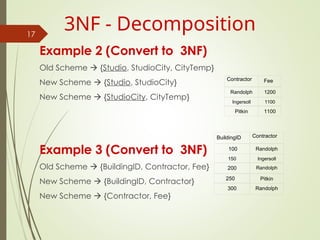
Example 2 (Convertto 3NF)
Old Scheme {Studio, StudioCity, CityTemp}
New Scheme {Studio, StudioCity}
New Scheme {StudioCity, CityTemp}
Example 3 (Convert to 3NF)
Old Scheme {BuildingID, Contractor, Fee}
New Scheme {BuildingID, Contractor}
New Scheme {Contractor, Fee}
17
3NF - Decomposition
BuildingID Contractor
100 Randolph
150 Ingersoll
200 Randolph
250 Pitkin
300 Randolph
Contractor Fee
Randolph 1200
Ingersoll 1100
Pitkin 1100
16.
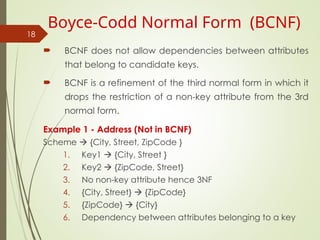
BCNF doesnot allow dependencies between attributes
that belong to candidate keys.
BCNF is a refinement of the third normal form in which it
drops the restriction of a non-key attribute from the 3rd
normal form.
Example 1 - Address (Not in BCNF)
Scheme {City, Street, ZipCode }
1. Key1 {City, Street }
2. Key2 {ZipCode, Street}
3. No non-key attribute hence 3NF
4. {City, Street} {ZipCode}
5. {ZipCode} {City}
6. Dependency between attributes belonging to a key
18
Boyce-Codd Normal Form (BCNF)
17.
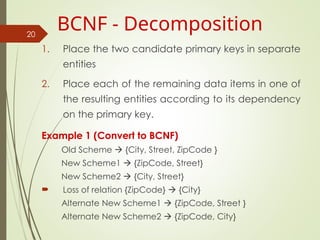
1. Place thetwo candidate primary keys in separate
entities
2. Place each of the remaining data items in one of
the resulting entities according to its dependency
on the primary key.
Example 1 (Convert to BCNF)
Old Scheme {City, Street, ZipCode }
New Scheme1 {ZipCode, Street}
New Scheme2 {City, Street}
Loss of relation {ZipCode} {City}
Alternate New Scheme1 {ZipCode, Street }
Alternate New Scheme2 {ZipCode, City}
20
BCNF - Decomposition
18.
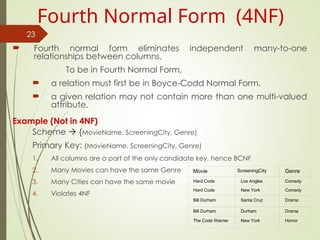
Fourth normalform eliminates independent many-to-one
relationships between columns.
To be in Fourth Normal Form,
a relation must first be in Boyce-Codd Normal Form.
a given relation may not contain more than one multi-valued
attribute.
Example (Not in 4NF)
Scheme {MovieName, ScreeningCity, Genre)
Primary Key: {MovieName, ScreeningCity, Genre)
1. All columns are a part of the only candidate key, hence BCNF
2. Many Movies can have the same Genre
3. Many Cities can have the same movie
4. Violates 4NF
23
Fourth Normal Form (4NF)
Movie ScreeningCity Genre
Hard Code Los Angles Comedy
Hard Code New York Comedy
Bill Durham Santa Cruz Drama
Bill Durham Durham Drama
The Code Warrier New York Horror
19.
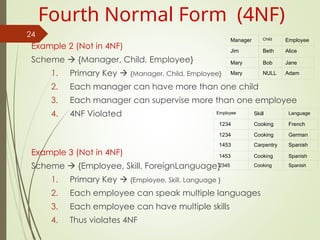
Example 2 (Notin 4NF)
Scheme {Manager, Child, Employee}
1. Primary Key {Manager, Child, Employee}
2. Each manager can have more than one child
3. Each manager can supervise more than one employee
4. 4NF Violated
Example 3 (Not in 4NF)
Scheme {Employee, Skill, ForeignLanguage}
1. Primary Key {Employee, Skill, Language }
2. Each employee can speak multiple languages
3. Each employee can have multiple skills
4. Thus violates 4NF
24
Fourth Normal Form (4NF)
Manager Child Employee
Jim Beth Alice
Mary Bob Jane
Mary NULL Adam
Employee Skill Language
1234 Cooking French
1234 Cooking German
1453 Carpentry Spanish
1453 Cooking Spanish
2345 Cooking Spanish
20.
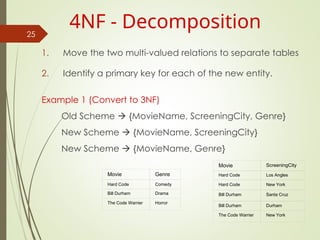
1. Move thetwo multi-valued relations to separate tables
2. Identify a primary key for each of the new entity.
Example 1 (Convert to 3NF)
Old Scheme {MovieName, ScreeningCity, Genre}
New Scheme {MovieName, ScreeningCity}
New Scheme {MovieName, Genre}
25
4NF - Decomposition
Movie Genre
Hard Code Comedy
Bill Durham Drama
The Code Warrier Horror
Movie ScreeningCity
Hard Code Los Angles
Hard Code New York
Bill Durham Santa Cruz
Bill Durham Durham
The Code Warrier New York
21.
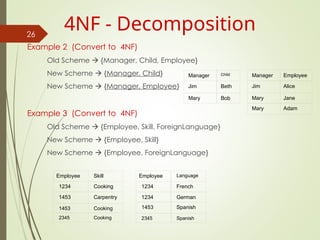
Example 2 (Convertto 4NF)
Old Scheme {Manager, Child, Employee}
New Scheme {Manager, Child}
New Scheme {Manager, Employee}
Example 3 (Convert to 4NF)
Old Scheme {Employee, Skill, ForeignLanguage}
New Scheme {Employee, Skill}
New Scheme {Employee, ForeignLanguage}
26
4NF - Decomposition
Manager Child
Jim Beth
Mary Bob
Manager Employee
Jim Alice
Mary Jane
Mary Adam
Employee Language
1234 French
1234 German
1453 Spanish
2345 Spanish
Employee Skill
1234 Cooking
1453 Carpentry
1453 Cooking
2345 Cooking
22.
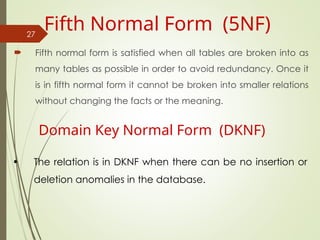
Fifth normalform is satisfied when all tables are broken into as
many tables as possible in order to avoid redundancy. Once it
is in fifth normal form it cannot be broken into smaller relations
without changing the facts or the meaning.
27
Fifth Normal Form (5NF)
• The relation is in DKNF when there can be no insertion or
deletion anomalies in the database.
Domain Key Normal Form (DKNF)
Disadvantages of Over-
Normalization
Too many tables may lead to complex queries
Requires more joins → can reduce performance
Sometimes denormalization is used for optimization
29
25.
Conclusion
Normalization ensuresa well-structured database
Prevents anomalies and redundancy
Used up to 3NF or BCNF in most practical applications
30
#8 Having scalar values also means that all instances of a record type must contain the same number of fields.
A table not in first normal form is called un normalized
#9 1. The designated key will be the primary key of the original table concatenated with one or more data items from the new table.
For the first table the primary key is ISBN
For the second table the primary key is ISBN + Author Name
#11 Let us consider the problems with the movie studio database:
Redundancy – City Population is repeated many times
Insertion anomaly – Whenever we add a new record we have to add unnecessary information. We can not add record until we know information about the city population
Deletion anomaly – Whenever we delete a record, useful information is deleted.
Update anomaly – The City Population needs to be updated in more than one location if it changes.
#12 If there is a table with columns A,B,C,D with Primary Key (A,B) & D is dependant on A (alone) then to be 2NF, you should reduce (split) tables as:
Table with columns A,D with Primary Key (A)
Table with columns A,B,C with Primary Key (A,B)
#14 In the Book Schema Third Normal Form is violated since a non-key field is dependent on another non-key field and is transitively dependent on the primary key.
#15 Let us consider the problems with the movie studio database:
Redundancy – City Population is repeated many times
Insertion anomaly – Whenever we add a new record we have to add unnecessary information. We can not add record until we know information about the city population
Deletion anomaly – Whenever we delete a record, useful information is deleted.
Update anomaly – The City Population needs to be updated in more than one location if it changes.
#16 If there is a table with columns A,B,C with Primary Key (A) and C is dependant on B (B C) then to be 3NF, the tables become
Table with columns B,C with Primary Key (B)
Table with fields A,B with Primary Key ( A), and Foreign Key (B)
#18 The second and third normal forms assume that all attributes not part of the candidate keys depend on the candidate keys but does not deal with dependencies within the keys. BCNF deals with such dependencies.
Under third normal form all non-key columns must be functionally dependent on a candidate key. Under BCNF, even columns that are part of a candidate key must be dependent on another candidate key, if they have a dependency at all.
For most tables third normal form and BCNF are the same. Third normal form does not cover some specific cases for which BCNF was created. Third normal form and BCNF are not same if the following conditions are true:
The table has two or more candidate keys
At least two of the candidate keys are composed of more than one attribute
The keys are not disjoint i.e. The composite candidate keys share some attributes
#19 A management consulting firm has several clients and consultants. A client can have several problems and the same problem can be an issue for several clients. Each consultant specializes in only one problem type (e. g marketing, production) but several consultants could advise on one problem. For each problem, the client is advised by only one consultant.
#20 If there is a table with columns A,B,C with Primary Key (A) and C is dependant on B (B C) then to be 3NF, the tables become
Table with columns B,C with Primary Key (B)
Table with fields A,B with Primary Key ( A), and Foreign Key (B)
#24 These cause update, addition and deletion anomalies.
Insertion anomaly is that entity integrity would be violated if you tried to add a new employee who did not speak a foreign language.
Update anomalies would occur if you tried to change Cooking to Chef.