Coverage and Capacity
Patrik Persson
Senior Specialist
WCDMA RAN System Management
Commercial in confidence Coverage and Capacity 2005-09-27
2
Outline
 Properties of WCDMA
– Processing gain
– Cell breathing
– Pole Capacity
– Orthogonal Channels
– Pooled DL power resources
– Soft Capacity
 Coverage: Link budget analysis
– UL and DL reference to GSM
 Capacity: Maximising air interface resources
– Common and dedicated power
– Effect of different user distribution
– Capacity and coverage
 HSDPA Considerations
Commercial in confidence Coverage and Capacity 2005-09-27
4
Properties of WCDMA
Processing gain (1/2)
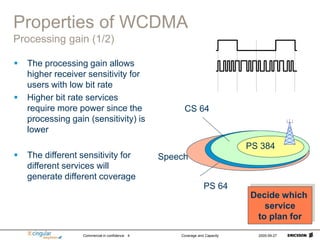
 The processing gain allows
higher receiver sensitivity for
users with low bit rate
 Higher bit rate services
require more power since the
processing gain (sensitivity) is
lower
 The different sensitivity for
different services will
generate different coverage
Speech
PS 64
CS 64
PS 384
Decide which
service
to plan for
Commercial in confidence Coverage and Capacity 2005-09-27
5
Properties of WCDMA
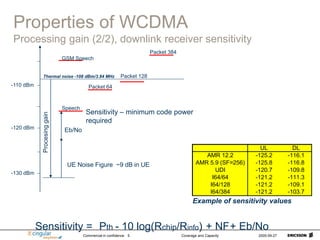
Processing gain (2/2), downlink receiver sensitivity
Thermal noise -108 dBm/3.84 MHz
Sensitivity = Pth
Procesing
gain
- 10 log(Rchip/Rinfo)
UE Noise Figure ~9 dB in UE
+ NF
Eb/No
+ Eb/No
Sensitivity – minimum code power
required
-110 dBm
-120 dBm
-130 dBm
Speech
Packet 64
Packet 128
Packet 384
GSM Speech
UL DL
AMR 12.2 -125.2 -116.1
AMR 5.9 (SF=256) -125.8 -116.8
UDI -120.7 -109.8
I64/64 -121.2 -111.3
I64/128 -121.2 -109.1
I64/384 -121.2 -103.7
Example of sensitivity values
Commercial in confidence Coverage and Capacity 2005-09-27
6
PRx
UL sensitivity
Properties of WCDMA
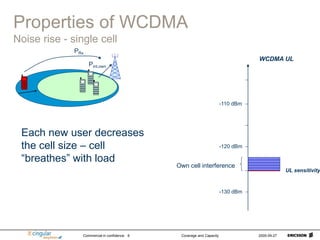
Noise rise - single cell
-110 dBm
-120 dBm
-130 dBm
WCDMA UL
Pint,own
Own cell interference
Each new user decreases
the cell size – cell
“breathes” with load
Commercial in confidence Coverage and Capacity 2005-09-27
7
PRx
UL sensitivity
Properties of WCDMA
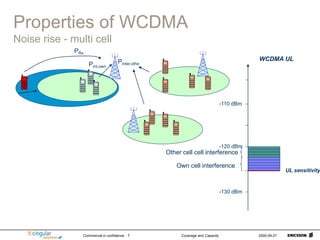
Noise rise - multi cell
-110 dBm
-120 dBm
-130 dBm
WCDMA UL
Pint,own
Own cell interference
Pinter,othe
r
Other cell cell interference
Commercial in confidence Coverage and Capacity 2005-09-27
8
Properties of WCDMA
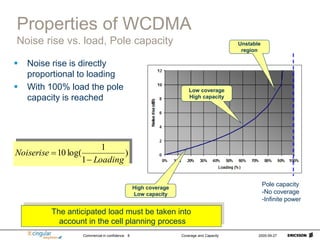
Noise rise vs. load, Pole capacity
 Noise rise is directly
proportional to loading
 With 100% load the pole
capacity is reached
)
1
1
log(
10
Loading
Noiserise


High coverage
Low capacity
Low coverage
High capacity
Unstable
region
The anticipated load must be taken into
account in the cell planning process
Pole capacity
-No coverage
-Infinite power
Commercial in confidence Coverage and Capacity 2005-09-27
9
Properties of WCDMA
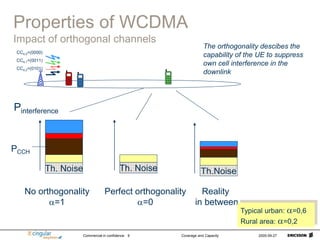
Impact of orthogonal channels
Pinterference
Th. Noise Th. Noise Th.Noise
No orthogonality
=1
Perfect orthogonality
=0
Reality
in between
Typical urban: =0,6
Rural area: =0,2
CC4,0=(0000)
CC4,1=(0011)
CC4,2=(0101)
PCCH
The orthogonality descibes the
capability of the UE to suppress
own cell interference in the
downlink
Commercial in confidence Coverage and Capacity 2005-09-27
10
Properties of WCDMA
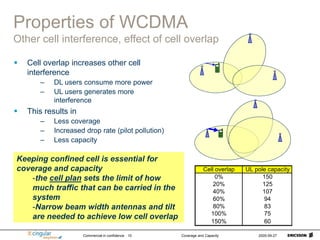
Other cell interference, effect of cell overlap
 Cell overlap increases other cell
interference
– DL users consume more power
– UL users generates more
interference
 This results in
– Less coverage
– Increased drop rate (pilot pollution)
– Less capacity
Keeping confined cell is essential for
coverage and capacity
-the cell plan sets the limit of how
much traffic that can be carried in the
system
-Narrow beam width antennas and tilt
are needed to achieve low cell overlap
Cell overlap UL pole capacity
0% 150
20% 125
40% 107
60% 94
80% 83
100% 75
150% 60
Commercial in confidence Coverage and Capacity 2005-09-27
11
Properties of WCDMA
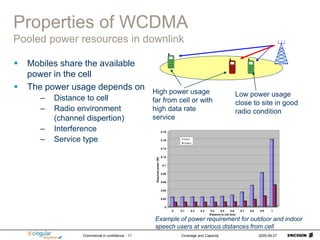
Pooled power resources in downlink
 Mobiles share the available
power in the cell
 The power usage depends on
– Distance to cell
– Radio environment
(channel dispertion)
– Interference
– Service type
High power usage
far from cell or with
high data rate
service
Low power usage
close to site in good
radio condition
0
0.02
0.04
0.06
0.08
0.1
0.12
0.14
0.16
0.18
Required
power
(W)
0 0.1 0.2 0.3 0.4 0.5 0.6 0.7 0.8 0.9 1
Distance to cell (km)
Indoor
Outdoor
Example of power requirement for outdoor and indoor
speech users at various distances from cell
Commercial in confidence Coverage and Capacity 2005-09-27
12
Effects of soft capacity
Equally loaded cells
Less loading in surrounding cells
 Higher capacity in middle cell
Equally loaded cells
Less loading in surrounding cells
 Higher capacity in middle cell
0
200
400
600
800
1000
1200
130 135 140 145 150
Lsa [dB]
Cell
border
throughput
[kbps]
0% 25% 50% 75% 100%
Example of cell border throughput
Equally loaded
No load in neighbouring cells
Maximum cell capacity and user
throughput can be significantly
higher in an unevenly loaded
network
 All networks are
unevenly loaded
Cell pole capacity
Equal load Unloaded neighbour
85
125
Upto 50% more capacity
Coverage
Linkbudget analysis
Commercial in confidence Coverage and Capacity 2005-09-27
14
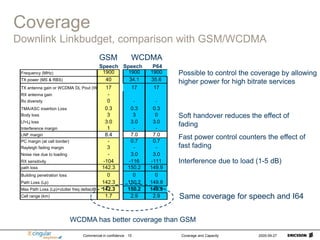
Coverage
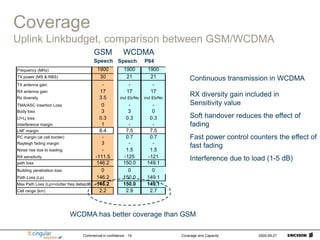
Uplink Linkbudget, comparison between GSM/WCDMA
GSM WCDMA
Continuous transmission in WCDMA
1900 1900
21 21
- -
17 17
incl Eb/No incl Eb/No
- -
3 0
0.3 0.3
- -
7.5 7.5
0.7 0.7
- -
1.5 1.5
-125 -121
150.0 149.1
0 0
150.0 149.1
150.0 149.1
2.9 2.7
Frequency (MHz) 1900
TX power (MS & RBS) 30
TX antenna gain -
RX antenna gain 17
Rx diversity 3.5
TMA/ASC insertion Loss 0
Body loss 3
Lf+Lj loss 0.3
Interference margin 1
LNF margin 8.4
PC margin (at cell border) -
Rayleigh fading margin 3
Noise rise due to loading -
RX sensitivity -111.5
path loss 146.2
Building penetration loss 0
Path Loss (Lp) 146.2
Max Path Loss (Lp)+clutter freq delta(dB) 146.2
Cell range (km) 2.2
RX diversity gain included in
Sensitivity value
Soft handover reduces the effect of
fading
Fast power control counters the effect of
fast fading
Interference due to load (1-5 dB)
WCDMA has better coverage than GSM
Speech Speech P64
Commercial in confidence Coverage and Capacity 2005-09-27
15
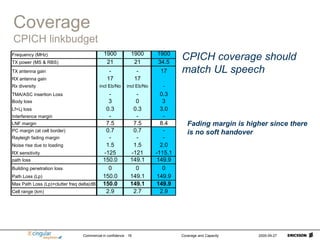
Coverage
Downlink Linkbudget, comparison with GSM/WCDMA
GSM WCDMA
Frequency (MHz) 1900
TX power (MS & RBS) 40
TX antenna gain or WCDMA DL Pout (W) 17
RX antenna gain -
Rx diversity 0
TMA/ASC insertion Loss 0.3
Body loss 3
Lf+Lj loss 3.0
Interference margin 1
LNF margin 8.4
PC margin (at cell border) -
Rayleigh fading margin 3
Noise rise due to loading -
RX sensitivity -104
path loss 142.3
Building penetration loss 0
Path Loss (Lp) 142.3
Max Path Loss (Lp)+clutter freq delta(dB) 142.3
Cell range (km) 1.7
Possible to control the coverage by allowing
higher power for high bitrate services
Soft handover reduces the effect of
fading
Fast power control counters the effect of
fast fading
Interference due to load (1-5 dB)
1900 1900
34.1 35.6
17 17
- -
0.3 0.3
3 0
3.0 3.0
- -
7.0 7.0
0.7 0.7
- -
3.0 3.0
-116 -111
150.2 149.9
0 0
150.2 149.9
150.2 149.9
2.9 2.9
WCDMA has better coverage than GSM
Same coverage for speech and I64
Speech Speech P64
Commercial in confidence Coverage and Capacity 2005-09-27
16
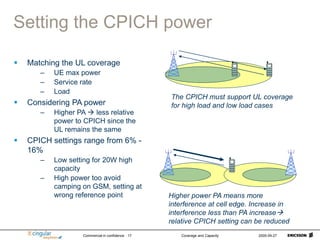
Coverage
CPICH linkbudget
Fading margin is higher since there
is no soft handover
CPICH coverage should
match UL speech
Frequency (MHz) 1900 1900 1900
TX power (MS & RBS) 21 21 34.5
TX antenna gain - - 17
RX antenna gain 17 17
Rx diversity incl Eb/No incl Eb/No -
TMA/ASC insertion Loss - - 0.3
Body loss 3 0 3
Lf+Lj loss 0.3 0.3 3.0
Interference margin - - -
LNF margin 7.5 7.5 8.4
PC margin (at cell border) 0.7 0.7 -
Rayleigh fading margin - - -
Noise rise due to loading 1.5 1.5 2.0
RX sensitivity -125 -121 -115.1
path loss 150.0 149.1 149.9
Building penetration loss 0 0 0
Path Loss (Lp) 150.0 149.1 149.9
Max Path Loss (Lp)+clutter freq delta(dB) 150.0 149.1 149.9
Cell range (km) 2.9 2.7 2.9
Commercial in confidence Coverage and Capacity 2005-09-27
17
Setting the CPICH power
 Matching the UL coverage
– UE max power
– Service rate
– Load
 Considering PA power
– Higher PA  less relative
power to CPICH since the
UL remains the same
 CPICH settings range from 6% -
16%
– Low setting for 20W high
capacity
– High power too avoid
camping on GSM, setting at
wrong reference point
The CPICH must support UL coverage
for high load and low load cases
Higher power PA means more
interference at cell edge. Increase in
interference less than PA increase
relative CPICH setting can be reduced
Capacity
Maximising air interface resources
Commercial in confidence Coverage and Capacity 2005-09-27
19
Power distribution
FACH-2
3%
FACH-1
1%
P-CPICH
8%
P-SCH
0%
PCH
1%
BCH
3%
AICH
0%
PICH
1%
S-SCH
0%
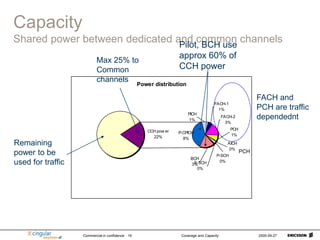
CCH pow er
22%
PCH
Capacity
Shared power between dedicated and common channels
Pilot, BCH use
approx 60% of
CCH power
FACH and
PCH are traffic
dependednt
Max 25% to
Common
channels
Remaining
power to be
used for traffic
Commercial in confidence Coverage and Capacity 2005-09-27
20
Capacity
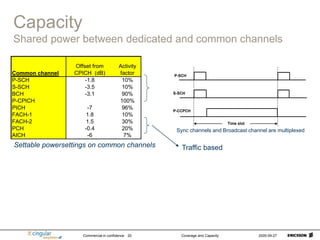
Shared power between dedicated and common channels
Settable powersettings on common channels
Sync channels and Broadcast channel are multiplexed
Traffic based
P-SCH
S-SCH
P-CCPCH
Time slot
Common channel
Offset from
CPICH (dB)
Activity
factor
P-SCH -1.8 10%
S-SCH -3.5 10%
BCH -3.1 90%
P-CPICH 100%
PICH -7 96%
FACH-1 1.8 10%
FACH-2 1.5 30%
PCH -0.4 20%
AICH -6 7%
Commercial in confidence Coverage and Capacity 2005-09-27
21
Capacity
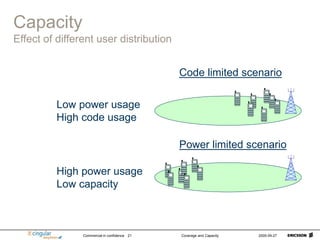
Effect of different user distribution
High power usage
Low capacity
Low power usage
High code usage
Code limited scenario
Power limited scenario
Commercial in confidence Coverage and Capacity 2005-09-27
22
Capacity
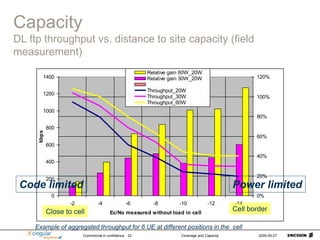
DL ftp throughput vs. distance to site capacity (field
measurement)
0%
20%
40%
60%
80%
100%
120%
-14
-12
-10
-8
-6
-4
-2
Ec/No measured without load in cell
kbps
0
200
400
600
800
1000
1200
1400
Relative gain 60W_20W
Relative gain 30W_20W
Throughput_20W
Throughput_30W
Throughput_60W
Example of aggregated throughput for 6 UE at different positions in the cell
Close to cell Cell border
Power limited
Code limited
Commercial in confidence Coverage and Capacity 2005-09-27
23
Capacity
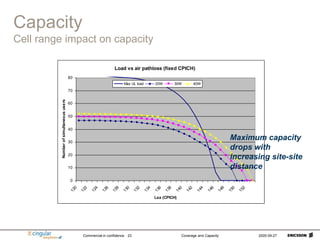
Cell range impact on capacity
Load vs air pathloss (fixed CPICH)
0
10
20
30
40
50
60
70
80
120
122
124
126
128
130
132
134
136
138
140
142
144
146
148
150
152
Lsa (CPICH)
Number
of
simultaneous
use
rs
Max UL load 20W 30W 40W
Maximum capacity
drops with
increasing site-site
distance
Commercial in confidence Coverage and Capacity 2005-09-27
24
Capacity
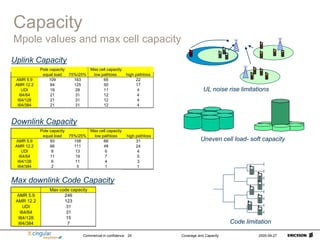
Mpole values and max cell capacity
UL noise rise limitations
Uneven cell load- soft capacity
Pole capacity
equal load
AMR 5.9 109
AMR 12.2 84
UDI 19
I64/64 21
I64/128 21
I64/384 21
75%/25%
163
125
28
31
31
31
Max cell capacity
low pathloss
65
50
11
12
12
12
high pathloss
22
17
4
4
4
4
Pole capacity
equal load
AMR 5.9 93
AMR 12.2 66
UDI 8
I64/64 11
I64/128 6
I64/384 2
75%/25%
158
111
13
19
11
3
Max cell capacity
low pathloss
66
48
6
7
4
1
high pathloss
31
24
4
5
3
1
Code limitation
Uplink Capacity
Downlink Capacity
Max downlink Code Capacity
AMR 5.9
AMR 12.2
UDI
I64/64
I64/128
I64/384
31
15
7
Max code capacity
246
123
31
HSDPA Considerations
Coverage and Capacity Impacts with HSDPA
Commercial in confidence Coverage and Capacity 2005-09-27
26
HSDPA Considerations
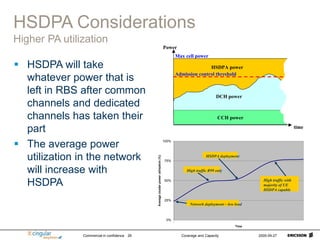
Higher PA utilization
 HSDPA will take
whatever power that is
left in RBS after common
channels and dedicated
channels has taken their
part
 The average power
utilization in the network
will increase with
HSDPA
Power
time
CCH power
HSDPA power
DCH power
Admission control threshold
Max cell power
Power
time
CCH power
HSDPA power
DCH power
Admission control threshold
Max cell power
0%
25%
50%
75%
100%
1
Time
Average
cluster
power
utilisation
(%)
Network deployment – low load
High traffic R99 only
HSDPA deployment
High traffic with
majority of UE
HSDPA capable
Commercial in confidence Coverage and Capacity 2005-09-27
27
HSDPA Considerations
High bitrate possible in good radio conditions
0,00
0,50
1,00
1,50
2,00
2,50
3,00
3,50
4,00
4,50
-12 -10 -8 -6 -4 -2 0 2 4 6 8
C/I [dB]
Throughput
[Mbps]
16QAM QPSK
Max. rate 3.36 Mbps, class 5 & 6 UE
Max. rate 1.6 Mbps, class 12 UE
0,00
0,50
1,00
1,50
2,00
2,50
3,00
3,50
4,00
4,50
-12 -10 -8 -6 -4 -2 0 2 4 6 8
C/I [dB]
Throughput
[Mbps]
16QAM QPSK
Max. rate 3.36 Mbps, class 5 & 6 UE
Max user throughput for R99
thermal
own
other
HSDPA
P
P
P
P
I
C





Simulated throughput vs received C/I
Commercial in confidence Coverage and Capacity 2005-09-27
28
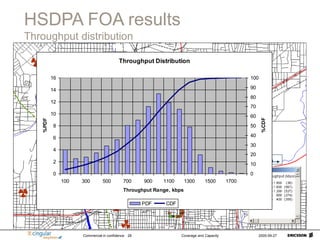
HSDPA FOA results
Throughput distribution
1km
Throughput Distribution
0
2
4
6
8
10
12
14
16
100 300 500 700 900 1100 1300 1500 1700
Throughput Range, kbps
%PDF
0
10
20
30
40
50
60
70
80
90
100
%CDF
PDF CDF
Commercial in confidence Coverage and Capacity 2005-09-27
30
0
200
400
600
800
1000
1200
130 135 140 145 150
Lsa [dB]
Cell
average
throughput
[kbps]
8.7 W 12.5 W 22.3 W
DCH 8.7W DCH 12.5W DCH 22.3W
HSDPA Considerations
Higher Packet Capacity with HSDPA
HSDPA cell average throughput
DCH cell average throughput
Lsa = 141.8dB, corresponding to PS 64 kbps in UL
About 2.5 times more capacity for HSDPA
Example of average cell throughput on TU-3 channel comparing R99 and HSDPA
Commercial in confidence Coverage and Capacity 2005-09-27
31
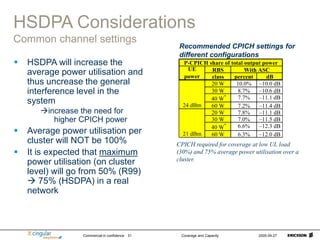
HSDPA Considerations
Common channel settings
 HSDPA will increase the
average power utilisation and
thus uncrease the general
interference level in the
system
increase the need for
higher CPICH power
 Average power utilisation per
cluster will NOT be 100%
 It is expected that maximum
power utilisation (on cluster
level) will go from 50% (R99)
 75% (HSDPA) in a real
network
CPICH required for coverage at low UL load
(30%) and 75% average power utilisation over a
cluster.
RBS
class percent dB
20 W 10.0% –10.0 dB
30 W 8.7% –10.6 dB
40 W* 7.7% –11.1 dB
60 W 7.2% –11.4 dB
20 W 7.8% –11.1 dB
30 W 7.0% –11.5 dB
40 W* 6.6% –12.3 dB
60 W 6.3% –12.0 dB
P-CPICH share of total output power
UE
power
With ASC
24 dBm
21 dBm
Recommended CPICH settings for
different configurations
Commercial in confidence Coverage and Capacity 2005-09-27
32
Summary
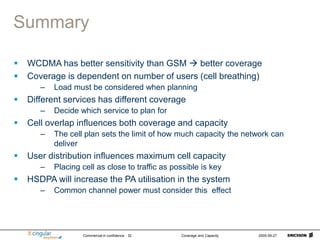
 WCDMA has better sensitivity than GSM  better coverage
 Coverage is dependent on number of users (cell breathing)
– Load must be considered when planning
 Different services has different coverage
– Decide which service to plan for
 Cell overlap influences both coverage and capacity
– The cell plan sets the limit of how much capacity the network can
deliver
 User distribution influences maximum cell capacity
– Placing cell as close to traffic as possible is key
 HSDPA will increase the PA utilisation in the system
– Common channel power must consider this effect
Commercial in confidence Coverage and Capacity 2005-09-27
33

11 - WCDMA Coverage and Capacity Rev A.ppt

  • 1.
    Coverage and Capacity PatrikPersson Senior Specialist WCDMA RAN System Management
  • 2.
    Commercial in confidenceCoverage and Capacity 2005-09-27 2 Outline  Properties of WCDMA – Processing gain – Cell breathing – Pole Capacity – Orthogonal Channels – Pooled DL power resources – Soft Capacity  Coverage: Link budget analysis – UL and DL reference to GSM  Capacity: Maximising air interface resources – Common and dedicated power – Effect of different user distribution – Capacity and coverage  HSDPA Considerations
  • 3.
    Commercial in confidenceCoverage and Capacity 2005-09-27 4 Properties of WCDMA Processing gain (1/2)  The processing gain allows higher receiver sensitivity for users with low bit rate  Higher bit rate services require more power since the processing gain (sensitivity) is lower  The different sensitivity for different services will generate different coverage Speech PS 64 CS 64 PS 384 Decide which service to plan for
  • 4.
    Commercial in confidenceCoverage and Capacity 2005-09-27 5 Properties of WCDMA Processing gain (2/2), downlink receiver sensitivity Thermal noise -108 dBm/3.84 MHz Sensitivity = Pth Procesing gain - 10 log(Rchip/Rinfo) UE Noise Figure ~9 dB in UE + NF Eb/No + Eb/No Sensitivity – minimum code power required -110 dBm -120 dBm -130 dBm Speech Packet 64 Packet 128 Packet 384 GSM Speech UL DL AMR 12.2 -125.2 -116.1 AMR 5.9 (SF=256) -125.8 -116.8 UDI -120.7 -109.8 I64/64 -121.2 -111.3 I64/128 -121.2 -109.1 I64/384 -121.2 -103.7 Example of sensitivity values
  • 5.
    Commercial in confidenceCoverage and Capacity 2005-09-27 6 PRx UL sensitivity Properties of WCDMA Noise rise - single cell -110 dBm -120 dBm -130 dBm WCDMA UL Pint,own Own cell interference Each new user decreases the cell size – cell “breathes” with load
  • 6.
    Commercial in confidenceCoverage and Capacity 2005-09-27 7 PRx UL sensitivity Properties of WCDMA Noise rise - multi cell -110 dBm -120 dBm -130 dBm WCDMA UL Pint,own Own cell interference Pinter,othe r Other cell cell interference
  • 7.
    Commercial in confidenceCoverage and Capacity 2005-09-27 8 Properties of WCDMA Noise rise vs. load, Pole capacity  Noise rise is directly proportional to loading  With 100% load the pole capacity is reached ) 1 1 log( 10 Loading Noiserise   High coverage Low capacity Low coverage High capacity Unstable region The anticipated load must be taken into account in the cell planning process Pole capacity -No coverage -Infinite power
  • 8.
    Commercial in confidenceCoverage and Capacity 2005-09-27 9 Properties of WCDMA Impact of orthogonal channels Pinterference Th. Noise Th. Noise Th.Noise No orthogonality =1 Perfect orthogonality =0 Reality in between Typical urban: =0,6 Rural area: =0,2 CC4,0=(0000) CC4,1=(0011) CC4,2=(0101) PCCH The orthogonality descibes the capability of the UE to suppress own cell interference in the downlink
  • 9.
    Commercial in confidenceCoverage and Capacity 2005-09-27 10 Properties of WCDMA Other cell interference, effect of cell overlap  Cell overlap increases other cell interference – DL users consume more power – UL users generates more interference  This results in – Less coverage – Increased drop rate (pilot pollution) – Less capacity Keeping confined cell is essential for coverage and capacity -the cell plan sets the limit of how much traffic that can be carried in the system -Narrow beam width antennas and tilt are needed to achieve low cell overlap Cell overlap UL pole capacity 0% 150 20% 125 40% 107 60% 94 80% 83 100% 75 150% 60
  • 10.
    Commercial in confidenceCoverage and Capacity 2005-09-27 11 Properties of WCDMA Pooled power resources in downlink  Mobiles share the available power in the cell  The power usage depends on – Distance to cell – Radio environment (channel dispertion) – Interference – Service type High power usage far from cell or with high data rate service Low power usage close to site in good radio condition 0 0.02 0.04 0.06 0.08 0.1 0.12 0.14 0.16 0.18 Required power (W) 0 0.1 0.2 0.3 0.4 0.5 0.6 0.7 0.8 0.9 1 Distance to cell (km) Indoor Outdoor Example of power requirement for outdoor and indoor speech users at various distances from cell
  • 11.
    Commercial in confidenceCoverage and Capacity 2005-09-27 12 Effects of soft capacity Equally loaded cells Less loading in surrounding cells  Higher capacity in middle cell Equally loaded cells Less loading in surrounding cells  Higher capacity in middle cell 0 200 400 600 800 1000 1200 130 135 140 145 150 Lsa [dB] Cell border throughput [kbps] 0% 25% 50% 75% 100% Example of cell border throughput Equally loaded No load in neighbouring cells Maximum cell capacity and user throughput can be significantly higher in an unevenly loaded network  All networks are unevenly loaded Cell pole capacity Equal load Unloaded neighbour 85 125 Upto 50% more capacity
  • 12.
  • 13.
    Commercial in confidenceCoverage and Capacity 2005-09-27 14 Coverage Uplink Linkbudget, comparison between GSM/WCDMA GSM WCDMA Continuous transmission in WCDMA 1900 1900 21 21 - - 17 17 incl Eb/No incl Eb/No - - 3 0 0.3 0.3 - - 7.5 7.5 0.7 0.7 - - 1.5 1.5 -125 -121 150.0 149.1 0 0 150.0 149.1 150.0 149.1 2.9 2.7 Frequency (MHz) 1900 TX power (MS & RBS) 30 TX antenna gain - RX antenna gain 17 Rx diversity 3.5 TMA/ASC insertion Loss 0 Body loss 3 Lf+Lj loss 0.3 Interference margin 1 LNF margin 8.4 PC margin (at cell border) - Rayleigh fading margin 3 Noise rise due to loading - RX sensitivity -111.5 path loss 146.2 Building penetration loss 0 Path Loss (Lp) 146.2 Max Path Loss (Lp)+clutter freq delta(dB) 146.2 Cell range (km) 2.2 RX diversity gain included in Sensitivity value Soft handover reduces the effect of fading Fast power control counters the effect of fast fading Interference due to load (1-5 dB) WCDMA has better coverage than GSM Speech Speech P64
  • 14.
    Commercial in confidenceCoverage and Capacity 2005-09-27 15 Coverage Downlink Linkbudget, comparison with GSM/WCDMA GSM WCDMA Frequency (MHz) 1900 TX power (MS & RBS) 40 TX antenna gain or WCDMA DL Pout (W) 17 RX antenna gain - Rx diversity 0 TMA/ASC insertion Loss 0.3 Body loss 3 Lf+Lj loss 3.0 Interference margin 1 LNF margin 8.4 PC margin (at cell border) - Rayleigh fading margin 3 Noise rise due to loading - RX sensitivity -104 path loss 142.3 Building penetration loss 0 Path Loss (Lp) 142.3 Max Path Loss (Lp)+clutter freq delta(dB) 142.3 Cell range (km) 1.7 Possible to control the coverage by allowing higher power for high bitrate services Soft handover reduces the effect of fading Fast power control counters the effect of fast fading Interference due to load (1-5 dB) 1900 1900 34.1 35.6 17 17 - - 0.3 0.3 3 0 3.0 3.0 - - 7.0 7.0 0.7 0.7 - - 3.0 3.0 -116 -111 150.2 149.9 0 0 150.2 149.9 150.2 149.9 2.9 2.9 WCDMA has better coverage than GSM Same coverage for speech and I64 Speech Speech P64
  • 15.
    Commercial in confidenceCoverage and Capacity 2005-09-27 16 Coverage CPICH linkbudget Fading margin is higher since there is no soft handover CPICH coverage should match UL speech Frequency (MHz) 1900 1900 1900 TX power (MS & RBS) 21 21 34.5 TX antenna gain - - 17 RX antenna gain 17 17 Rx diversity incl Eb/No incl Eb/No - TMA/ASC insertion Loss - - 0.3 Body loss 3 0 3 Lf+Lj loss 0.3 0.3 3.0 Interference margin - - - LNF margin 7.5 7.5 8.4 PC margin (at cell border) 0.7 0.7 - Rayleigh fading margin - - - Noise rise due to loading 1.5 1.5 2.0 RX sensitivity -125 -121 -115.1 path loss 150.0 149.1 149.9 Building penetration loss 0 0 0 Path Loss (Lp) 150.0 149.1 149.9 Max Path Loss (Lp)+clutter freq delta(dB) 150.0 149.1 149.9 Cell range (km) 2.9 2.7 2.9
  • 16.
    Commercial in confidenceCoverage and Capacity 2005-09-27 17 Setting the CPICH power  Matching the UL coverage – UE max power – Service rate – Load  Considering PA power – Higher PA  less relative power to CPICH since the UL remains the same  CPICH settings range from 6% - 16% – Low setting for 20W high capacity – High power too avoid camping on GSM, setting at wrong reference point The CPICH must support UL coverage for high load and low load cases Higher power PA means more interference at cell edge. Increase in interference less than PA increase relative CPICH setting can be reduced
  • 17.
  • 18.
    Commercial in confidenceCoverage and Capacity 2005-09-27 19 Power distribution FACH-2 3% FACH-1 1% P-CPICH 8% P-SCH 0% PCH 1% BCH 3% AICH 0% PICH 1% S-SCH 0% CCH pow er 22% PCH Capacity Shared power between dedicated and common channels Pilot, BCH use approx 60% of CCH power FACH and PCH are traffic dependednt Max 25% to Common channels Remaining power to be used for traffic
  • 19.
    Commercial in confidenceCoverage and Capacity 2005-09-27 20 Capacity Shared power between dedicated and common channels Settable powersettings on common channels Sync channels and Broadcast channel are multiplexed Traffic based P-SCH S-SCH P-CCPCH Time slot Common channel Offset from CPICH (dB) Activity factor P-SCH -1.8 10% S-SCH -3.5 10% BCH -3.1 90% P-CPICH 100% PICH -7 96% FACH-1 1.8 10% FACH-2 1.5 30% PCH -0.4 20% AICH -6 7%
  • 20.
    Commercial in confidenceCoverage and Capacity 2005-09-27 21 Capacity Effect of different user distribution High power usage Low capacity Low power usage High code usage Code limited scenario Power limited scenario
  • 21.
    Commercial in confidenceCoverage and Capacity 2005-09-27 22 Capacity DL ftp throughput vs. distance to site capacity (field measurement) 0% 20% 40% 60% 80% 100% 120% -14 -12 -10 -8 -6 -4 -2 Ec/No measured without load in cell kbps 0 200 400 600 800 1000 1200 1400 Relative gain 60W_20W Relative gain 30W_20W Throughput_20W Throughput_30W Throughput_60W Example of aggregated throughput for 6 UE at different positions in the cell Close to cell Cell border Power limited Code limited
  • 22.
    Commercial in confidenceCoverage and Capacity 2005-09-27 23 Capacity Cell range impact on capacity Load vs air pathloss (fixed CPICH) 0 10 20 30 40 50 60 70 80 120 122 124 126 128 130 132 134 136 138 140 142 144 146 148 150 152 Lsa (CPICH) Number of simultaneous use rs Max UL load 20W 30W 40W Maximum capacity drops with increasing site-site distance
  • 23.
    Commercial in confidenceCoverage and Capacity 2005-09-27 24 Capacity Mpole values and max cell capacity UL noise rise limitations Uneven cell load- soft capacity Pole capacity equal load AMR 5.9 109 AMR 12.2 84 UDI 19 I64/64 21 I64/128 21 I64/384 21 75%/25% 163 125 28 31 31 31 Max cell capacity low pathloss 65 50 11 12 12 12 high pathloss 22 17 4 4 4 4 Pole capacity equal load AMR 5.9 93 AMR 12.2 66 UDI 8 I64/64 11 I64/128 6 I64/384 2 75%/25% 158 111 13 19 11 3 Max cell capacity low pathloss 66 48 6 7 4 1 high pathloss 31 24 4 5 3 1 Code limitation Uplink Capacity Downlink Capacity Max downlink Code Capacity AMR 5.9 AMR 12.2 UDI I64/64 I64/128 I64/384 31 15 7 Max code capacity 246 123 31
  • 24.
    HSDPA Considerations Coverage andCapacity Impacts with HSDPA
  • 25.
    Commercial in confidenceCoverage and Capacity 2005-09-27 26 HSDPA Considerations Higher PA utilization  HSDPA will take whatever power that is left in RBS after common channels and dedicated channels has taken their part  The average power utilization in the network will increase with HSDPA Power time CCH power HSDPA power DCH power Admission control threshold Max cell power Power time CCH power HSDPA power DCH power Admission control threshold Max cell power 0% 25% 50% 75% 100% 1 Time Average cluster power utilisation (%) Network deployment – low load High traffic R99 only HSDPA deployment High traffic with majority of UE HSDPA capable
  • 26.
    Commercial in confidenceCoverage and Capacity 2005-09-27 27 HSDPA Considerations High bitrate possible in good radio conditions 0,00 0,50 1,00 1,50 2,00 2,50 3,00 3,50 4,00 4,50 -12 -10 -8 -6 -4 -2 0 2 4 6 8 C/I [dB] Throughput [Mbps] 16QAM QPSK Max. rate 3.36 Mbps, class 5 & 6 UE Max. rate 1.6 Mbps, class 12 UE 0,00 0,50 1,00 1,50 2,00 2,50 3,00 3,50 4,00 4,50 -12 -10 -8 -6 -4 -2 0 2 4 6 8 C/I [dB] Throughput [Mbps] 16QAM QPSK Max. rate 3.36 Mbps, class 5 & 6 UE Max user throughput for R99 thermal own other HSDPA P P P P I C      Simulated throughput vs received C/I
  • 27.
    Commercial in confidenceCoverage and Capacity 2005-09-27 28 HSDPA FOA results Throughput distribution 1km Throughput Distribution 0 2 4 6 8 10 12 14 16 100 300 500 700 900 1100 1300 1500 1700 Throughput Range, kbps %PDF 0 10 20 30 40 50 60 70 80 90 100 %CDF PDF CDF
  • 28.
    Commercial in confidenceCoverage and Capacity 2005-09-27 30 0 200 400 600 800 1000 1200 130 135 140 145 150 Lsa [dB] Cell average throughput [kbps] 8.7 W 12.5 W 22.3 W DCH 8.7W DCH 12.5W DCH 22.3W HSDPA Considerations Higher Packet Capacity with HSDPA HSDPA cell average throughput DCH cell average throughput Lsa = 141.8dB, corresponding to PS 64 kbps in UL About 2.5 times more capacity for HSDPA Example of average cell throughput on TU-3 channel comparing R99 and HSDPA
  • 29.
    Commercial in confidenceCoverage and Capacity 2005-09-27 31 HSDPA Considerations Common channel settings  HSDPA will increase the average power utilisation and thus uncrease the general interference level in the system increase the need for higher CPICH power  Average power utilisation per cluster will NOT be 100%  It is expected that maximum power utilisation (on cluster level) will go from 50% (R99)  75% (HSDPA) in a real network CPICH required for coverage at low UL load (30%) and 75% average power utilisation over a cluster. RBS class percent dB 20 W 10.0% –10.0 dB 30 W 8.7% –10.6 dB 40 W* 7.7% –11.1 dB 60 W 7.2% –11.4 dB 20 W 7.8% –11.1 dB 30 W 7.0% –11.5 dB 40 W* 6.6% –12.3 dB 60 W 6.3% –12.0 dB P-CPICH share of total output power UE power With ASC 24 dBm 21 dBm Recommended CPICH settings for different configurations
  • 30.
    Commercial in confidenceCoverage and Capacity 2005-09-27 32 Summary  WCDMA has better sensitivity than GSM  better coverage  Coverage is dependent on number of users (cell breathing) – Load must be considered when planning  Different services has different coverage – Decide which service to plan for  Cell overlap influences both coverage and capacity – The cell plan sets the limit of how much capacity the network can deliver  User distribution influences maximum cell capacity – Placing cell as close to traffic as possible is key  HSDPA will increase the PA utilisation in the system – Common channel power must consider this effect
  • 31.
    Commercial in confidenceCoverage and Capacity 2005-09-27 33

Editor's Notes