(2024-2025) – 2nd semester
Ch18
Replication
Distributed Systems
Introduction
Replication can provide the following:
1. Performance enhancement
◦ Replication of read-only data is simple, but replication of changing data has
overheads
2. Fault-tolerant service
◦ Guarantees correct behaviour in spite of certain faults (can include timeliness)
3. Availability is hindered by
◦ Server failures
◦ Replicate data at failure- independent servers and when one fails, client may use another.
Note that caches do not help with availability(they are incomplete).
◦ Network partitions and disconnected operation
◦ Users of mobile computers deliberately disconnect, and then on re-connection, resolve
conflicts
Replication of data :- Multiple copies at multiple
computers of the same object/data
Requirements for replicated
data
Replication transparency
◦ clients see logical objects (not several physical
copies)
◦ they access one logical item and receive a single result
Replication Consistency
◦ Data is consistent on all of the replicas of an
object (or is converging towards becoming
consistent).
System model
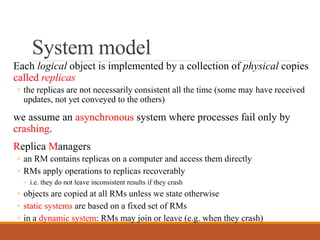
Each logical object is implemented by a collection of physical copies
called replicas
◦ the replicas are not necessarily consistent all the time (some may have received
updates, not yet conveyed to the others)
we assume an asynchronous system where processes fail only by
crashing.
Replica Managers
◦ an RM contains replicas on a computer and access them directly
◦ RMs apply operations to replicas recoverably
◦ i.e. they do not leave inconsistent results if they crash
◦ objects are copied at all RMs unless we state otherwise
◦ static systems are based on a fixed set of RMs
◦ in a dynamic system: RMs may join or leave (e.g. when they crash)
Architectural model for the
management of replicated data
FE
Requests and
replies
C
Replica
C
Service
Clients
Front ends
managers
RM
RM
FE
RM
A collection of RMs provides a service to clients
Clients see a service that gives them access to logical
objects, which are in fact replicated at the RMs
Clients request operations: those without updates are called read-only requests the
others are called update requests (they may include reads)
Clients request are handled by front ends. A front end makes replication transparent.
server server
server
Replication Management
Request
◦ the FE either
◦ sends the request to a single RM that passes it on to the others
◦ or multicasts the request to all of the RMs.
Coordination + Agreement
◦ the RMs decide whether to apply the request; and decide on its ordering relative to other
requests (according to FIFO, causal or total ordering)
Execution
◦ the RMs execute the request.
Response
◦ one or more RMs reply to FE. e.g.
◦ for high availability give first response to client.
Replication guarantees
Any client will see (at any point of time) a copy
of the object that is correct and consistent.
Want:
•All replicas start in the same state
•All replicas receive the same set of requests
•All replicas process the same sequence of requests
◦ Uniquely identify the requests.
◦ Order the requests. Do not forget the guarantees that we
expect.
RMs have to know when to service a request.
When to process a request -
Stability
3 methods:
◦Logical clocks
◦Real-time clocks
◦Replica-generated ids
Transactions on Replicated
Data
B
A
Client + front end
B
B B
A A
getBalance(A)
Client + front end
Replica managers
Replica managers
deposit(B,3);
U
T

11 Distributrd Systems and parallel systems_Chapter 18

  • 1.
    (2024-2025) – 2ndsemester Ch18 Replication Distributed Systems
  • 2.
    Introduction Replication can providethe following: 1. Performance enhancement ◦ Replication of read-only data is simple, but replication of changing data has overheads 2. Fault-tolerant service ◦ Guarantees correct behaviour in spite of certain faults (can include timeliness) 3. Availability is hindered by ◦ Server failures ◦ Replicate data at failure- independent servers and when one fails, client may use another. Note that caches do not help with availability(they are incomplete). ◦ Network partitions and disconnected operation ◦ Users of mobile computers deliberately disconnect, and then on re-connection, resolve conflicts Replication of data :- Multiple copies at multiple computers of the same object/data
  • 3.
    Requirements for replicated data Replicationtransparency ◦ clients see logical objects (not several physical copies) ◦ they access one logical item and receive a single result Replication Consistency ◦ Data is consistent on all of the replicas of an object (or is converging towards becoming consistent).
  • 4.
    System model Each logicalobject is implemented by a collection of physical copies called replicas ◦ the replicas are not necessarily consistent all the time (some may have received updates, not yet conveyed to the others) we assume an asynchronous system where processes fail only by crashing. Replica Managers ◦ an RM contains replicas on a computer and access them directly ◦ RMs apply operations to replicas recoverably ◦ i.e. they do not leave inconsistent results if they crash ◦ objects are copied at all RMs unless we state otherwise ◦ static systems are based on a fixed set of RMs ◦ in a dynamic system: RMs may join or leave (e.g. when they crash)
  • 5.
    Architectural model forthe management of replicated data FE Requests and replies C Replica C Service Clients Front ends managers RM RM FE RM A collection of RMs provides a service to clients Clients see a service that gives them access to logical objects, which are in fact replicated at the RMs Clients request operations: those without updates are called read-only requests the others are called update requests (they may include reads) Clients request are handled by front ends. A front end makes replication transparent. server server server
  • 6.
    Replication Management Request ◦ theFE either ◦ sends the request to a single RM that passes it on to the others ◦ or multicasts the request to all of the RMs. Coordination + Agreement ◦ the RMs decide whether to apply the request; and decide on its ordering relative to other requests (according to FIFO, causal or total ordering) Execution ◦ the RMs execute the request. Response ◦ one or more RMs reply to FE. e.g. ◦ for high availability give first response to client.
  • 7.
    Replication guarantees Any clientwill see (at any point of time) a copy of the object that is correct and consistent. Want: •All replicas start in the same state •All replicas receive the same set of requests •All replicas process the same sequence of requests ◦ Uniquely identify the requests. ◦ Order the requests. Do not forget the guarantees that we expect. RMs have to know when to service a request.
  • 8.
    When to processa request - Stability 3 methods: ◦Logical clocks ◦Real-time clocks ◦Replica-generated ids
  • 9.
    Transactions on Replicated Data B A Client+ front end B B B A A getBalance(A) Client + front end Replica managers Replica managers deposit(B,3); U T