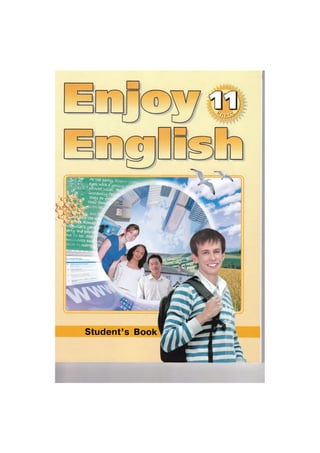
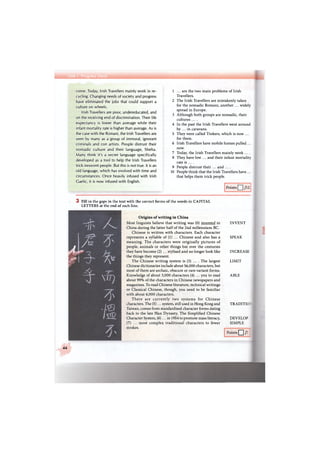
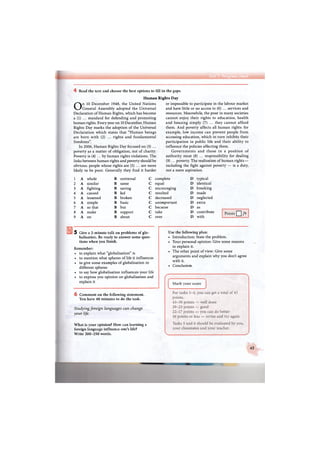
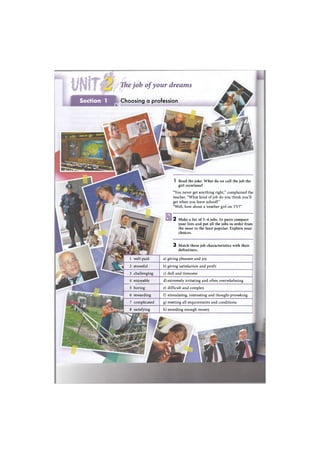
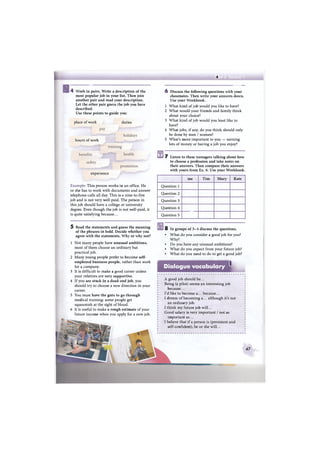
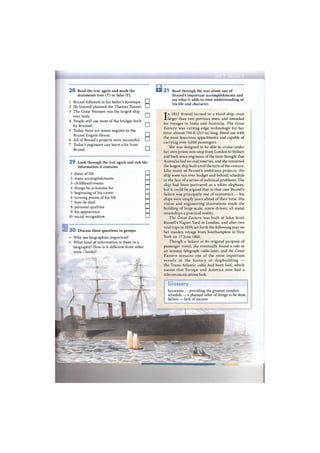
Student's Book
М. 3. Биболетова, Е. Е. Бабушис, Н. Д. Снежко
Английский язык
Ёэ
rasiQSglro
J
I
Учебник для 1 1 класса
общеобразовательных учреждений
Рекомендовано Министерством образования и науки
Российской Федерации к использованию в образовательном
процессе в образовательных учреждениях, реализующих
образовательные программы общего образования
и имеющих государственную аккредитацию
2-е издание, исправленное
И З Д А Т Е Л Ь С Т В О
т и т У
|<|
т 1 т и L
P U B L I S H E R S
201 1
ББК 81.2Англ-922
Б59
УДК 802.0(075.3)
The authors would like to thank the designers
Natalia Valayeva and Ekaterina Valayeva for their creative artwork
and design which really bring the book to life.
Our deepest gratitude to Anna Kutz whose editing work helped make the English
language in the textbook sound natural and transparent.
Special thanks to Duncan Prowse for consultancy advice and coordinating the
recording of the audio materials, and for assistance
in publishing arrangements.
УМК "Английский с удовольствием" /
"Enjoy English" (11 класс)
состоит из следующих компонентов:
• учебника
• книги для учителя
• рабочей тетради № 1
• рабочей тетради № 2 "Контрольные работы"
• аудиоприложения (CD МРЗ)
• электронного приложения
По вопросам приобретения УМК "Enjoy English" (11 класс)
следует обращаться в издательство "Титул":
тел.: (48439) 9-10-09, факс: (48439) 9-10-00,
e-mail: pochta@titul.ru (книга почтой),
umk@titul.ru (оптовые покупатели).
Биболетова М. 3., Бабушис Е. Е., Снежко Н. Д.
Б59 Английский язык: Английский с удовольствием / Enjoy English: Учебник для
11 кл. общеобраз. учрежд.— 2-е изд, испр.— Обнинск: Титул, 2011.— 200 е.: ил.
ISBN 978-5-86866-530-1
Учебник "Английский с удовольствием" (11 класс) предназначен для старших
классов (базовый уровень) общеобразовательных учреждений РФ, в которых обу-
чение английскому языку начинается со второго класса. Все учебники данной серии
рекомендованы Министерством образования и науки Российской Федерации.
Содержание учебника полностью соответствует действующему образовательному
стандарту и примерной программе по английскому языку.
Тематика учебника отобрана с учетом интересов учащихся 11-го класса, их рече-
вых потребностей и ориентирована на самоопределение учащихся, выбор будущей
профессии и продолжение образования.
Учебник готовит к итоговой проверке уровня подготовки по английскому языку,
предусмотренной для выпускников полной средней школы, формирует умения по-
знавательной деятельности, обучает школьников стратегиям самообразования.
Учебник основывается на современных методических принципах и отвечает тре-
бованиям, предъявляемым к учебникам начала третьего тысячелетия.
Л
J
ББК 81.2Англ-922
ISBN 978-5-86866-530-1
© М. 3. Биболетова, Е.Е. Бабушис, Н. Д. Снежко, 2009
© Издательство "Титул", дизайн, воспроизведение, распространение, 2009
Learning
strategies content
• How to deal with reading test questions
• How to deal with listening test questions
• How to deal with matching test questions
• How to deal with fill-in-the-gap test questions
• How to deal with true / false test questions
• How to deal with multiple choice test questions
> How to write an informal letter
How to take notes effectively
How to write opinion essay / a for and against essay
Tips for doing internet research
Tips for participating in a discussion (in an exam situation)
> What questions to answer while writing a biography
• How to deal with structural clozes
• Tips for giving a talk (individual long-turn exam task)
• General exam taking advice (final assessment)
• Effective time management
• An effective study plan
• Effective exam-taking strategies
• How to conquer exam anxiety
• Exam-taking tips
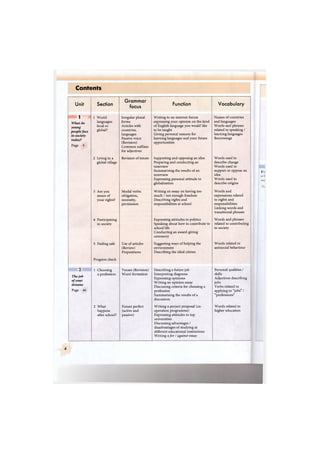
Contents
Unit
«Л 1 ШШ
What do
young
people face
in society
today?
Page 8
Thejob
ofyour
dreams
Page 46
Section
1 World
languages:
local or
global?
2 Living in a
global village
3 Are you
aware of
your rights?
4 Participating
in society
5 Feeling safe
Progress check
1 Choosing
a profession
2 What
happens
after school?
Grammar
focus
Irregular plural
forms
Articles with
countries,
languages
Passive voice
(Revision)
Common suffixes
for adjectives
Revision of tenses
Modal verbs:
obligation,
necessity,
permission
Use of articles
(Review)
Prepositions
Tenses (Revision)
Word-formation
Future perfect
(active and
passive)
Function
Writing to an internet forum
expressing your opinion on the kind
of English language you would like
to be taught
Giving personal reasons for
learning languages and your future
opportunities
Supporting and opposing an idea
Preparing and conducting an
interview
Summarising the results of an
interview
Expressing personal attitude to
globalisation
Writing an essay on having too
much / not enough freedom
Describing rights and
responsibilities at school
Expressing attitudes to politics
Speaking about how to contribute to
school life
Conducting an award-giving
ceremony
Suggesting ways of helping the
environment
Describing the ideal citizen
Describing a future job
Interpreting diagrams
Expressing opinions
Writing an opinion essay
Discussing criteria for choosing a
profession
Summarising the results of a
discussion
Writing a project proposal (co-
operation programme)
Expressing attitudes to top
universities
Discussing advantages /
disadvantages of studying at
different educational institutions
Writing afor / against essay
Vocabulary
Names of countries
and languages
Words and phrases
related to speaking /
learning languages
Borrowings
Words used to
describe change
Words used to
support or oppose an
idea
Words used to
describe origins
Words and
expressions related
to rights and
responsibilities
Linking words and
transitional phrases
Words and phrases
related to contributing
to society
Words related to
antisocial behaviour
£
Personal qualities /
skills
Adjectives describing
jobs
Verbs related to
applying to "jobs" /
"professions"
Words related to
higher education
4
Contents
Unit Section
Grammar
focus
Function Vocabulary
3 Final
assessment
Reported speech
(Revision)
Clauses of
consequence
so /such (that)
Taking notes
Describing an exam system
Developing presentation skills
4 Are there any
alternatives
to modern
technology?
Present perfect
simple / Present
perfect continous /
Past simple
(Revision)
Expressing opinion
Discussing different modes of
learning
Discussing controversial statements
in groups
Reporting the results of a discussion
Verbs related to
education
Words related to
e-learning and
distance learning
Progress check
зтш
Headingfor
л retter new
worid?
Page 78
1 How
dependent
are you on
modern
technology?
Describing
changes and
comparing past
and present
(Revision)
Future simple
for making
predictions
Adjectives
(suffixes)
Describing technological changes
and the way they influence people's
lives
Describing one's favourite mode of
communication
Making predictions about the future
of technology
Abbreviations of
electronic / digital
devices
Multi-word verbs
2 Extraordi-
nary minds
Past perfect
passive
Speaking about a famous person's
life (doing research and writing a
famous person's biography)
Talking about engineering as a
future profession
Doing a problem-solving activity
(in groups)
Giving biographical
information
Phrases with the word
"problem"
3 Science or
fraud?
Word categories
(Revision)
Discussing the importance of
science
Doing research and presenting a
new scientific discovery or fraud
Words and
expressions related to
science
4 To clone or
not to clone?
Expressing opinion on ethical issues
(in groups)
Debating on cloning humans
Writing an opinion essay
Words and phrases
used to express
attitude to ethical
issues
5 Old or
modern:
Medicine
as a new
technology
Doing a class survey (designing and
writing questions, summarising
information)
Writing a report on survey results
Writing a home remedy recipe
Describing symptoms and giving
advice
Discussing the advantages and
disadvantages of using modern
technologies in medicine
Giving and supporting arguments
Phrases with the word
"health"
Words referring to
food and healthy
eating
Words and
expressions related to
health and medicine
Words often confused
Contents
Unit Section
Grammar
focus
Function Vocabulary
6 Modern
technologies
and the
environment
Word building Discussing the dangers of rubbish /
litter
Discussing noise pollution
Doing research on existing
environmentally-friendly
technologies
Discussing and writing a Green
Party Manifesto
Words and
expressions related to
the environment
7 Let's get
digital
Discourse
Numerals
Discussing the importance of the
internet in modern life
Simulation of the TV Show
"Bol'shie"
Words and expressions
related to digital
technologies and the
internet
Progress check
mm 4и
Where are
you from?
Page 124
1 City versus
country
Word building Expressing and justifying opinions
about city life and country life
Describing where you live
Giving a talk about the nature in
and around your city or village
Words and phrases
related to city life and
country
-
2 What
hobbies do
you prefer?
Expressions with
the word "time"
Discussing hobbies and pastimes
and summarising the results
Comparing popular pastimes in
different countries
Writing a letter describing the most
popular pastimes in Russia
Talking about hobbies
Discussing what to do in the
evening
Words and phrases
related to hobbies and
pastimes
3 My circle of
friends
Personal
adjectives
Discussing an ideal friend's profile
Writing a "Friendship Recipe" about
how to be a good friend
Expressing personal opinions
Discussing the ways of maintaining
friendship
Giving a talk about friends and
friendship
Making notes about a discussion
Creating a collage
Words and phrases
related to friendship
4 East or West? Combining words
Word building
Discussing the lifestyles of people in
different countries
Expressing and justifying opinions
Describing the lifestyle in your
region / city / village
Commenting on a common
statement
Writing a personal opinion essays
Words and phrases
related to lifestyles
Definitions
5 Keeping
traditions
Progress check
Multi-meaning
words
Describing festivals
Discussing school traditions
Writing a letter to the future
Contents
i
Appendixes
Appendix 1 School English 157
Appendix 2 Learning strategies 169
Appendix 3 Cultural guide 178
Appendix 4 Grammar reference 181
Appendix 5 List of irregular verbs 189
Appendix 6 Dialogue vocabulary 191
Appendix 7 Key vocabulary 193
Условные обозначения
CG — Cultural guide
— текст для аудирования
— работа в парах
— работа в группе
| — задание повышенной сложности
— работа с интернетом
А
1 м
п
с f
i
What do young people face in society today?
Section 1 World languages: local or global?
• М Ш » . - . . . . л
I Answer the questions. Use your Workbook
to write the answers.
Personal quiz
in English:
How long have you been
learning English for?
Why did you start
learning it?
3 1 What was your first
English lesson like?
What was your first
English teacher's name?
What do you enjoy most
in your English lessons?
Why are you learning
English now?
Would you like to learn any
other foreign languages?
Are you learning any other
foreign language?
What do you find most difficult
about learning English?
How do you think you are going
to use English in the future?
2 Work in pairs. Ask and answer the quiz
questions. Do you have much in common?
summarises its meaning.
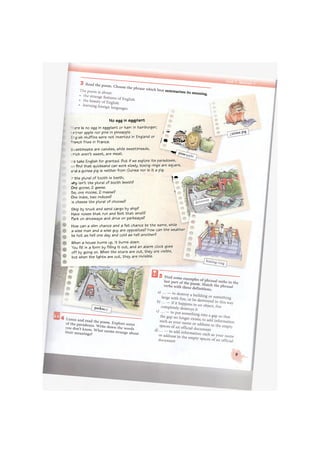
No egg in eggplant
f~e is no egg in eggplant or ham in hamburger;
frther apple nor pine in pineapple. P&J&t
E-.j :sh muffins were not invented in England or
r-snch fries in Vrance. 1Й1§»И
r.'.eetmeats are candies, while sweetbreads,
-.^Ich aren't sweet, are meat. / руЛе
'•5 take English for granted. But if we explore its paradoxes,
find that quicksand can work slowly, boxing rings are square,
S'-A a guinea pig is neither from Guinea nor is it a pig.
* the plural of tooth is teeth, m ,
•vhy isn't the plural of booth beeth? £
One goose, 2 geese. -г
$о, one moose, 2 meese? I
One index, two indices?
s cheese the plural of choose?
Ship by truck and send cargo by ship?
Have noses that run and feet that smell?
Park on driveways and drive on parkways?
How can a slim chance and a fat chance be the same, while
a wise man and a wise guy are opposites? How can the weather
be hot as hell one day and cold as hell another?
When a house burns up, it burns down.
You fill in a form by filling it out, and an alarm clock goes
off by going on. When the stars are out, they are visible,
but when the lights are out, they are invisible.
,uinea pig
Parkwi
9
GRAMMAR FOCUS: IRREGULAR PLURAL FORMS
6 a) Find irregular plural forms of some nouns in the poem.
b) Read the dictionary entries and check the irregular plural nouns in the poem.
booth (countable) — an enclosed space,
usually just for one person, where you can do
something, such as voting or making a phone
call, without other people seeing or hearing you
cheese (countable or uncountable) — a solid
food made from milk
goose (pi. geese) — a large white or grey bird
with a long beak
index (pi. indexes, indices) — an alphabetical
list of something, such as subjects or names at
the back of a book that indicates the pages that
are mentioned
moose (pi. moose) — a large mammal that lives
in North America, northern Europe, and Asia
tooth (pi. teeth) — the hard white object inside
your mouth that you use for biting and for
chewing food
c) Give other examples of irregular plural nouns. If necessary, check their
plural forms in the dictionary.
7 Work in groups. What can you do to make
learning English easier? Write a list of
ideas.
8 Look at the picture and guess what the
people are doing.
9 Listen to a radio programme about the
different ways of learning English and
then complete the sentences. Use your
Workbook.
1 "Crazy English" is a method of ... .
2 Students practise it by ... .
3 This method helps them to ... .
4 The school administration is against this
method because ....
5 "Crazy English" was developed when ....
6 Li Yang realised that reading his work out
loud ....
7 According to the exam results, Li Yang was
8 In 1994 he started ....
9 Today about ... people practise this method.
1 0 Work in pairs. Answer the questions.
Use the words below and also ideas from
Ex. 7.
1 What skills do you think can be practised
by the method described in the radio
programme?
2 What other skills should be practised in
order to speak English fluently?
3 Would you like to try learning English in
this way? Why? / Why not?
4 What would you like to improve in your
own learning?
Use:
effective / ineffective, shyness, confidence,
accuracy, fluency, fear of public speaking,
knowledge of vocabulary / grammar, reading /
listening / speaking / writing skills
i ШШМШИЯшВИШВШШШШШшШШШШВШШ
11 Read the dictionary entry for the word
"borrowing" and match the words with
the countries they come from.
borrowing — a word directly taken from one
-irtguage and added to another.
Vote: Although there are typically far fewer bor-
-: wings than the native words of most languages,
" are often widely known and used, since their
r —owing served a certain purpose, for example to
: -: ide a name for a new invention.
1 2 Work in groups. Give examples of
borrowings in your language. Do you
know where these words come from?
How often do you use them? How do you
feel about them?
13 Read the joke and say what language the
people are speaking. Do they understand
each other? Translate the joke into
Russian and then back into English so
that it makes sense.
14 Look at the map of the world and show
where these languages are spoken. How
did you guess?
Spanglish Chingli&h Franglish
Danglish Hunglish Finglish
Poglish Runglish italish
11
bistro Australian Aboriginal
feng shui African
s= graffiti Arabic
- Word
 kangaroo
karaoke
pnamas
sauna
French
German
scholarship Indian
Russian
zebra Japanese
troika Italian
Chinese
Finnish
Excuse me, which watch?
I
12
15 Read the text about these kinds of languages and find two names that are
a combination of Russian and English. Explain how they came about.
All these languages come from word combinations that describe certain
local variants of English. They developed as a means of communication
between two or more language groups that do not share a common language.
Although the names of these languages look similar, they are actually quite
different. Some genuinely mix the languages, some alter between English
and the other language, some are local dialects of English used by English
speakers themselves, and some are just non-native pronunciations of English.
As a term for describing the Russian-English pidgin language, "Runglish"
was popularised in the year 2000 when it was used as the language aboard
the International Space Station. Although less widespread than other
variants, Runglish is spoken in a number of English-Russian communities,
most notably the Russian-speaking Jewish community of Brighton Beach in
Brooklyn, New York.
Arthur C. Clarke's novel 2010: Odyssey Two mentions a similarly named
language, Russlish. The small subplot in Arthur C. Clarke's novel 2010
involved the crew of a Russo-American spaceship, who attempted to battle
their boredom with a so-called "Stamp Out Russlish!" campaign. As the story
went, both crews were fully fluent in each other's languages, to the point that
they found themselves crossing over languages
in mid-conversation, or even simply speaking
the other language even when there was no one
present who had it as their native tongue.
Use of "Russlish" in space has been realised
to some extent on the International Space Station.
Cosmonaut Sergei Krikalyov said in October of
2000: "We say jokingly that we communicate in
"Runglish", a mixture of Russian and English
languages, so that when we are short of words in
one language we can use the other, because all
the crew members speak both languages well."
WORD FOCUS:
COMMON SUFFIXES FOR ADJECTIVES
1 6 Read the text once again and say whether
the following statements are true (T) or
false (F). Correct the false statements.
See "How to deal with true / false test
questions" in "Learning strategies".
1 The languages described in the text were
invented to make English easier for people
from different countries to understand.
2 The languages have different names but
they are very similar.
3 Runglish was invented in space.
4 Runglish is spoken only aboard the Inter-
national Space Station.
5 A variant of Runglish was first mentioned
in a science fiction book.
6 A pidgin language is a mixture of two or
more languages. Pidgin is usually used
between people who do not speak each
other's languages.
•
•
•
•
•
17 Read through the text again. Put the
adjectives you find in the table in your
Workbook. Use the words from the list
and add more examples of your own.
suffix examples
-al
-ant, -ent, -ient
-ed
-ing
-ful
-ic
-ive
-less
-ious, -ous
-ible, -able
-y
tradition, communicate, responsibility, effect,
culture, history, excellence, limit, music, remark,
interest, conversation, understand, ambition,
care, create, wonder
Unit 1 Section 1
1 8 Complete the sentences with the correct form of the word.
1 In this school we study languages that are less ... in Russia.
2 If I want to enter the university I must get an ... mark on the exam.
3 The new method of learning English is very ..., but I don't think
it is ... for everyone.
4 I think that the usage of this language is very ....
5 She is a very ... person. She will do the task in time.
6 He is extremely ... .He wants to learn several languages and become
a diplomat.
7 His English is perfect. Some people think he is a ... English speaker.
TRADITION
EXCELLENCE
INTEREST
EFFECT
LIMIT
RESPONSE
AMBITION
NATURE
19 Work in groups of 3-4. Draw a scheme / picture to show how
languages influence each other. Explain it. Share your ideas
with other students.
Use:
local variant / dialect, means of communication, native tongue,
mixture, non-native pronunciation, pidgin language
describe, develop, share a common language
be different in nature, be spoken in..., mix, similar, different,
mixed, widespread, fluent, international, so-called
2 0 Compare the two texts and say which of them you like more.
Explain your opinion.
Say it in English
I went to my niece and nephew's party the other
weekend. I played the piano and we were all singing
along when a mouse ran out from behind the sofa
with a piece of apple in its mouth.
Say it in Globish
At the party of my brother's children the
other day, I played an instrument with black
and white keys and we all sang along. Then
an animal that cats like to eat ran out from
behind the seat with a piece of fruit in its
mouth.
2 1 Answer the questions.
What do you think Globish is?
Who speaks it?
Is it useful? Does it have any future?
2 2 Read the text and check your guesses.
T h e ^
M
ankind has always dreamt of the end of Babel appeared called Glo<
and Globish is its most recent expression. specifically with the
As early as the 1920s, Charles Kay Ogden created ' " ^ ^ncY
Basic English, a constructed language with 850
words. Ogden said that it would take seven years
to learn English, seven months for Esperanto, and
seven weeks for Basic English. The concept gained
its greatest publicity just after the Second Nord
War as a tool for Nord peace. Winston Churchill and
Franklin Roosevelt supported the idea of using Basic
English as an international language, and Churchill
recommended it in a speech at Harvard University
in 1943. Amused critics said that "blood, toil, tears
and sweat" translates into Basic English as "blood,hard work, eyewash and body water".
Though the idea got lots of criticism, it did not die.
Another simplified version of the English language
l e i u i u i o
appeared called Globish. It was created in the 1990s
specifically with the business world in mind due to
a project its French creator, Jean-Paul Nerriere, had
with IBM. It uses only the most common 1500 English
words and phrases and continues to expand as a
tool of common understanding in simple international
communication. This expansion of Globish has made
some consider it a menace to cultural diversity and
the purity of non-English languages. Some also find
Globish limited in what it can express, but the idea
is that people would be able to share a vocabulary
set up by the creation of the language.
Nerriere himself is sometimes described as a
remarkable man whose ambition is to promote global
understanding between nationalities. He hopes that
"some day it will be accepted as a viable alternative
by the European Union or the United Nations".
123 Work in groups of 3-4. Make two lists of
strengths and weaknesses of simplified
languages.
GRAMMAR FOCUS: USE OF ARTICLES
WITH COUNTRIES AND LANGUAGES
2 4 Read the rules and match them with
an example. There is more than one
example for each rule.
1 We use "the" with the names of countries
when they include words, such as state,
republic, kingdom, etc.
2 We do not use "the" with the names of
countries. There are some exceptions: the
Netherlands, the Sudan, the Vatican City.
3 We do not use "the" with the names of
languages when they are NOT followed by
the word language.
Examples:
a) My brother speaks French fluently.
b) The USA consists of 50 states.
c) The Netherlands is a country in northwest
Europe.
d) The French language is difficult to learn.
e) Australia is both a country and a continent.
2 5 Fill in "the" where necessary. Find the
countries mentioned in the exercise on the
world map. What languages are spoken in
these countries?
1 ... United States of America is located in ...
North America between ... Canada and ...
Mexico. The official language of the USA is
... English.
2 ... China is the world's largest country. ...
Chinese language is one of the most difficult
for Europeans to learn.
3 ... Croatia lies on the northeast of Adriatic, it
borders with ... Slovenia, Bosnia and Serbia.
4 ... Cyprus lies in the Mediterranean, 71 km
south of ... Turkey. Most people in Cyprus
speak ... Greek and ... English.
5 ... United Kingdom of Great Britain and
Northern Ireland is made up of ... England,
... Wales, ... Scotland and ... Northern
Ireland. Its population is about 60,000,000
people.
6 ... New Zealand is a country in the Pacific
Ocean southeast of ... Australia. About 10%
of the population are Maori people who lived
there before Europeans came. The language
they speak is ... Maori.
14
2 6 Work in pairs. Answer the question: Do
you think English should be simplified and
made easier to learn?
2 7 Read the teachers' comments on this
topic which they made on an internet
forum. Mark the ideas + or - depending
on how they answer the question above.
ШВШШЖо Форум учителей английского языка (Работает на Invision Power Board) - Windows Internet Explorer
j^jp ),T http://vwvw.englishteachers.ru
Antonio Benedict from Italy
In my view English should be taught at different levels, but
not simplified. And besides, by changing the language, we are
depriving the student of the real words. If the student is taught
a simplified version of a language, how will he or she be able
to understand authentic texts like poems, slang expressions, or
lyrics? That is really no good for students!
Magda Szabo from Hungary
We call our planet "a global village" now which means that
everything is gradually becoming one grey mass: our culture, our
eating habits and even the way we think. I think this means that
we should keep everything that is characteristic to us and our
language in first place. We should guard our own mother tongue
as a precious possession and use any second language just as a
way to communicate with other global citizens.
Hector Kadmos from Greece
No language is easy to learn because they all have their own
history and culture! And no language can be simplified just for the
sake of easiness. By trying to make it easier, we might deform it
and then, together with its complexity, much of its beauty would
disappear! I think students should deal with the real language
and all its complexity and be exposed to real-life language used
by native speakers. This is the only way to teach learners how to
manage in a real conversation.
Lea Hoffman from Germany
I know that doing business in English does not always require
very good usage or even a complete understanding of the
language. Why should we speak the way native speakers do when
we can already understand each other? It is more important to
be able to communicate and understand each other than it is to
be grammatically correct. Sometimes students are taught old-
fashioned phrases and vocabulary with subtle meanings and this
makes it difficult for all users of English to understand each other!
Students should be taught simpler English.
Peter Teller from the UK
I don't think there is any use in simplifying a language: if we over-
simplify the language we teach, it will become useless for real
communication. On the other hand, if the language is too difficult
to learn, not many people will be able to master it. I believe
we should teach a foreign language in a manner close to how
children start learning their mother tongue, and then gradually
work towards the real-life language. We definitely should aim at
reaching a "real" language level, otherwise there is no sense in
learning it at all.
Cecylia Piastek from Poland
Why don't we show some respect for the English language? Although
English is a difficult language both to learn and to teach, it doesn't mean
that we have any right to change it just because we feel like it. How
can we change something that doesn't belong to us anyway? Should we
simplify it only for the sake of convenience for us, non-native users?
I don't think that's fair. Language is valuable heritage and heritage
demands respect.
Muint Taine from Burma
I'm convinced that a simplified version of English should be taught.
The simpler the language, the better the communication will be between
people, for current and future generations who are part of today's
globalisation. English is no longer just a language used by native
speakers; it is used by people all over the world, including young people
who are increasingly trying to be part of the global community. I believe
that if we can globalise English and use its more simplified version, we
will be able to explore and better manage our planet.
GRAMMAR FOCUS: PASSIVE VOICE (REVISION)
2 8 Read the rule and find examples of passive voice in the texts above (Ex. 27).
Complete the table in your Workbook.
Passive: be + Уз
example
Present simple am / is / are + Уз is written
Present continuous am / is / are being + Уз are being written
Past simple was / were + Уз were written
Past continuous was / were being + Уз was being written
Future simple will be + Уз will be written
Present perfect have / has been + Уз has been written
Past perfect had been + Уз had been written
Future perfect will have been + Уз will have been written
Modals + infinitive should / can / ... + be + Уз can be written
Modals + perfect infinitive should / can ! ... + have been + Уз should have been written
16
2 9 Complete the gaps in the sentences below with the correct form of
the passive voice. Add the examples to the corresponding line of the table
in your Workbook.
1
2
3
4
5
6
7
8
During the last lesson students ... (expose) to some authentic language.
At the moment the intensive language courses ... (organise).
A new French textbook ... (write) recently.
Some people think that soon a simplified version of English ... (use)
by many people.
They said that the book ... (translate) from German in 1989.
By June 2015 our language research ... (complete).
This article ... (discuss) when he arrived at the meeting.
The essay should ... (finish) yesterday.
3 0 Use the correct forms of the words in the brackets to complete the text.
"English English" is a term that (1) ... (apply) to the English language that
(2) ... (speak) in England. In English-speaking countries outside the UK,
the term "British English" (3) ... more frequently ... (use). However, the
term "English English" (4) ... (introduce) some time ago by Peter Trudgill in
Language in the British Isles. This term (5) ... now generally ... (recognise) in
academic writing.
The term "British English", however, has a wider meaning, and (6) ... usually ...
(reserve) to describe the features common to English English, Welsh English,
Hiberno-English, and Scottish English.
A lot of people (7) ... always ... (interest) in the different accents and
dialects that exist in Britain. That's why The English Dialect Dictionary that
(S>) ... (compile) by Joseph Wright, is now extremely valuable. But the diversity
of accents within the nation (9) ... still ... (study) by linguists. Dialect
research papers (10) ... often ... (sell) for hundreds of pounds. People tend to
be very proud of their local accent or dialect.
3 1 Read the opinions again (Ex. 27) and
complete the table in your Workbook.
3 4 Read the definitions and match them to
the words. Answer the questions in pairs.
English should be
simplified
English should not be
simplified
1. Accent 2. Dialect 3. Jargon
3 2 Discuss the question in pairs.
Which of the teachers would you most like to
learn from? Why?
3 3 Write to an internet forum expressing
your opinion on the question:
Would you like to be taught a simplified
version of English?
Use:
Let me start by..
I'd rather...
Only then...
Why should...
The most important need is...
I think that...
In my view,...
This is a very good reason why...
Obviously,...
After all...
Let's... shall we?
a way of speaking a language
that is used only in a particular area or
by a particular group of people
a way of saying words that
shows what country, region, or social class
someone comes from
special words and phrases that
are only understood by people who do the
same kind of work.
Are there different dialects in Russia? Name
some of them.
When did they first appear?
Why do they exist?
What are the differences between the dia-
lects?
When do we say that a person:
... speaks with an accent?
... speaks in a dialect?
... uses jargon?
17
» I • i л •
Unit I Section
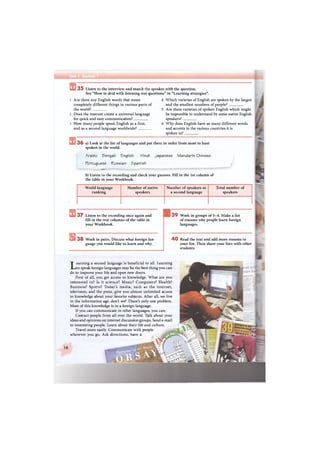
3 5 Listen to the interview and match the speaker with the question.
See "How to deal with listening test questions" in "Learning strategies".
Are there any English words that mean
completely different things in various parts of
the world?
Does the internet create a universal language
for quick and easy communication?
How many people speak English as a first,
and as a second language worldwide?
4 Which varieties of English are spoken by the largest
and the smallest numbers of people?
5 Are there varieties of spoken English which might
be impossible to understand by some native English
speakers?
6 Why does English have so many different words
and accents in the various countries it is
spoken in?
3 6 a) Look at the list of languages and put them in order from most to least
spoken in the world.
Arabic Bengali English Hindi Japanese Mandarin Chinese
Portuguese Russian Spanish
Щ SaSr®
b) Listen to the recording and check your guesses. Fill in the 1st column of
the table in your Workbook.
World language
ranking
Number of native
speakers
Number of speakers as
a second language
Total number of
speakers
3 7 Listen to the recording once again and
fill in the rest columns of the table in
your Workbook.
3 8 Work in pairs. Discuss what foreign lan-
guage you would like to learn and why.
Ш3 9 Work in groups of 3-4. Make a list
of reasons why people learn foreign
languages.
4 0 Read the text and add more reasons to
your list. Then share your lists with other
students.
Learning a second language is beneficial to all. Learning
to speak foreign languages may be the best thing you can
do to improve your life and open new doors.
First of all, you get access to knowledge. What are you
interested in? Is it science? Music? Computers? Health?
Business? Sports? Today's media, such as the internet,
television, and the press, give you almost unlimited access
to knowledge about your favorite subjects. After all, we live
in the information age, don't we? There's only one problem.
Most of this knowledge is in a foreign language.
If you can communicate in other languages, you can:
Contact people from all over the world. Talk about your
ideas and opinions on internet discussion groups. Send e-mail
to interesting people. Learn about their life and culture.
Travel more easily. Communicate with people
wherever you go. Ask directions, have a
18
|.„iHti'Ka
6 к S
А
conversation, or... ask for help. Who knows, may be a foreign
language will save your life someday!
Language competence in a second language increases your
job opportunities, and pushes your career forward. If you
want a good job in business, technology, or science, get out
of that armchair and start learning languages now!
Knowing a foreign language will let you:
Put "excellent knowledge of English or French" on your
CV. Get your dream job, earn more money and create your
future.
Gain technical knowledge. If you're going to read about
technology, computer science, genetics or medicine, you'll
probably have to do it in a foreign language. So you will
understand your subject area even better and become a solid
employee.
Foreign languages let you experience the culture of the
world. You can do wonderful things, such as watch films
in their original form. Once you try it this way, you'll never
go back to dubbed versions! You can also read great books.
There is an amazing number of titles — from classic plays
like Hamlet to modern love stories like A Knight in Shining
Armor and modern thrillers like Jurassic Park. And what
about enjoying music more? Believe us, music is much better
if you can understand the words.
Learning languages is not only useful, but it also gives
you a lot of satisfaction.
Making progress feels great. You'll never forget the
moment you discover you can speak with foreigners or watch
a TV programme in another language. Languages make you
a more powerful, happier person. It is not difficult to imagine
some of the situations where knowing a foreign language
would give you a great feeling.
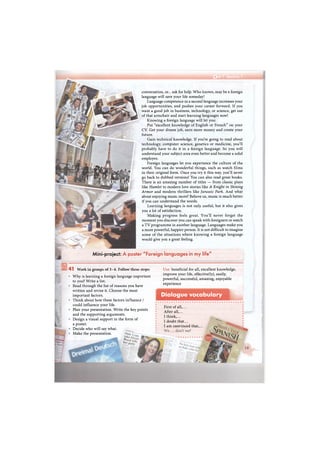
Mini-project: A poster "Foreign languages in my life"
Use: beneficial for all, excellent knowledge,
improve your life, effective(ly), easily,
powerful, successful, amazing, enjoyable
experience
Dialogue vocabulary
41 Work in groups of 3-4. Follow these steps:
Why is learning a foreign language important
to you? Write a list.
Read through the list of reasons you have
written and revise it. Choose the most
important factors.
Think about how these factors influence /
could influence your life.
Plan your presentation. Write the key points
and the supporting arguments.
Design a visual support in the form of
a poster.
Decide who will say what.
Make the presentation.
First of all,...
After all,...
I think,...
I doubt that...
I am convinced that,...
Section 2 Living in a global village
Your answers
before listening
after listening
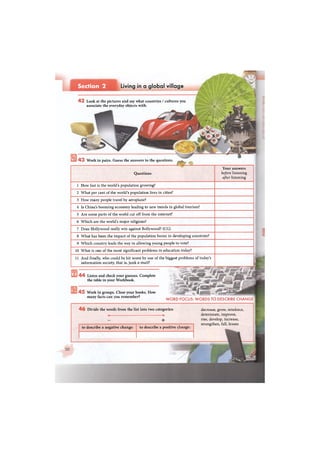
4 2 Look at the pictures and say what countries / cultures you
associate the everyday objects with.
4 3 Work in pairs. Guess the answers to the questions.
Questions
1 How fast is the world's population growing?
2 What per cent of the world's population lives in cities?
3 How many people travel by aeroplane?
4 Is China's booming economy leading to new trends in global tourism?
5 Are some parts of the world cut off from the internet?
6 Which are the world's major religions?
7 Does Hollywood really win against Bollywood? (CG)
8 What has been the impact of the population boom in developing countries?
9 Which country leads the way in allowing young people to vote?
10 What is one of the most significant problems in education today?
11 And finally, who could be hit worst by one of the biggest problems of today's
information society, that is, junk e-mail?
4 4 Listen and check your guesses. Complete
the table in your Workbook.
4 5 Work in groups. Close your books. How
many facts can you remember?
WORD FOCUS: WORDS TO DESCRIBE CHANGE
4 6 Divide the words from the list into two categories:
^
+
to describe a negative change: to describe a positive change:
decrease, grow, reinforce,
deteriorate, improve,
rise, develop, increase,
strengthen, fall, lessen
4 7 Fill in the table in your Workbook.
verb noun adjective
decrease
deteriorate
develop
! fall
I grow
verb noun adjective
improve
increase
lessen
rise
strengthen
4 8 Fill in the gaps in the sentences with the proper word forms (see Ex. 47).
Make any necessary changes. See "How to deal with fill-in-the-gap test questions"
in "Learning strategies".
1 The number of people studying languages has ... significantly. INCREASE
2 The educational programme was stopped because of the ... of interest FALL
among students.
3 The environmental situation in the region ... and many people moved DETERIORATE
to other parts of the country.
4 Experts predict a ... in migration. RISE
5 The inflation rate has ... by 10% during the last five years. DECREASE
6 Our college offers a new ... course for teenagers. DEVELOP
' 7 We can see a substantial ... of student numbers in our university. GROW
8 Everything should be done to ... the situation. IMPROVEMENT
9 The new traffic organisational system will ... the negative effects of LESS
cars in the city centre.
10 The conference participants will discuss ... of the regional economy. STRENGTHEN
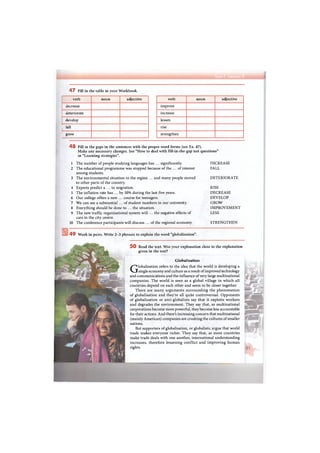
4 9 Work in pairs. Write 2-3 phrases to explain the word "globalisation".
5 0 Read the text. Was your explanation close to the explanation
given in the text?
Globalisation
Globalisation refers to the idea that the world is developing a
single economy and culture as a result of improved technology
and communications and the influence of very large multinational
companies. The world is seen as a global village in which all
countries depend on each other and seem to be closer together.
There are many arguments surrounding the phenomenon
of globalisation and they're all quite controversial. Opponents
of globalisation or anti-globalists say that it exploits workers
and degrades the environment. They say that, as multinational
corporations become more powerful, they become less accountable
for their actions. And there's increasing concern that multinational
(mainly American) companies are crushing the cultures of smaller
nations.
But supporters of globalisation, or globalists, argue that world
trade makes everyone richer. They say that, as more countries
make trade deals with one another, international understanding
increases, therefore lessening conflict and improving human
rights.
Unit I Section
4
51 Read the text again and guess the meaning of the words below.
1 controversial
a) a point that people disagree on
b) a point that people can't understand
2 degrade
a) spoil
b) treat badly
3 accountable
a) in a position where people have the right to criticise you or ask you
why something happened
b) in a position where you prepare financial reports
4 concern
a) a feeling of worry about something
b) a feeling that you care about someone
5 crush
a) make someone feel disappointed
b) completely defeat someone
5 2 Look at the pictures and say what they have to do with globalisation
22
nit I Section 2
4
и Ф
5 3 Read about an example of globalisation and say whether your
guesses were correct. What has changed?
The popularity of western music has spread all over the world. Pop music
developed into a global industry in the second half of the 20th century.
It started with Elvis Presley and the Beatles, who could be called the word's
first rock stars. These musicians created a new era, allowing other singers to
become internationally famous.
Rock'n'roll was spreading throughout the continents when a small group
in the north-west of England appeared. At that time, the group was playing
in small halls in Liverpool. They decided to change their name from the
Quarrymen to the Beatles and in the following eight years, they sold millions
of copies all over the world and became as popular as Elvis.
Both music professionals and fans agree that Elvis Presley and the Beatles
are the most valuable phenomena to have entered the pop music world of
the 20th century. They started a new era that then created a new global
industry.
But pop music changes quickly. It is sometimes difficult to understand
why a group or a singer is successful and why the public buys their music.
For this reason, the industry is constantly changing.
GRAMMAR FOCUS: REVISION OF TENSES
5 4 Do the tasks below. Then calculate your correct answers.
1 Read through the text and select some
of the verbs. Match the verbs with their
correct tenses. (6 points)
Present simple
Present continuous
Past simple
Past perfect
Past continuous
Present perfect
2 Which of the sentences describes a temporary
situation? Which one describes a permanent
one? (2 points)
a) They employ lots of people.
b) They are employing new staff.
a) From 1989 to 1995 he played in a rock group.
b) When I first saw him, he was playing
the piano.
Put the verbs in brackets into the correct tenses. (8 points)
e) My son (be) very naughty these days. It is so
untypical of him.
f) I (not / know) anything about this band.
a) (You / like) this kind of music?
b) What (you / think) about this song?
c) What (you / think) about? You look
worried.
d) My son (be) very naughty.
4 Choose the correct sentences. (2 points)
g) He (not / have) an MP3 player.
h) He (have) a talk with the manager. He can't
see you right now.
a) The Beatles have sold millions of records over a period of eight years.
b) The Beatles sold millions of records over a period of eight years.
a) She has worked in show business for eight years and she likes it.
b) She worked in show business for eight years and she likes it.
Choose the correct way to complete the sentences. (2 points)
a) They had worked together for several years b) They have worked together for several years
.. .before they became successful.
.. .and now they are very popular.
.. .before they decided to record an album.
.. .but they still don't get on well.
" 7
5 5 What is your score? Are you good at verb
forms? Read the "Grammar reference"
on page 182 if necessary and do Ex. 54
again.
5 6 Read the text about another globally
famous person and fill in the appropriate
verb forms.
_ _ . ..
Dmitri Hvorostovsky is one of the most famous
singers in the world. He often (1) ... (take) part
in performances in different countries and always
(2) ... (become) the centre of attraction. Some
fans (3) ... (call) him the "Elvis of opera". W h e n
Hvorostovsky heard about this, he (4) ... (think) it
was a huge compliment since to him, Elvis (5) ...
(be) a kind of revolutionary.
Hvorostovsky was born in Krasnoyarsk in Siberia —
there he (6) ... (study) at school, and for some time
(7) ... (be) the singer in a rock band where he
(8) ... (play) heavy metal. After Hvorostovsky (9) ...
(win) several professional contests in Russia, Irina
Arkhipova (10) ... (encourage) him to take part
in the Cardiff Singer of the World competition in
1989. He (1 1) ... (win) it and his world career
(12) ... (launch).
His manner of singing is very lyrical and it (1 3) ...
sometimes ... (call) "old school". He (14) ... (work)
with theatres and singers all around the world.
Some years ago he (15) ... (record) an album
with Olga Borodina. N o w Hvorostovsky (16) ...
(have) a house in London and (17) ... (speak) good
English. He works a lot and tries to have a healthy
w a y of life. He confessed that he (18) ... (give up)
smoking and (19) ... (stop) drinking alcohol many
years ago. He knew this would help him perform his
best in his profession.
1
157 Listen to the text and check your answers.
Correct any mistakes.
5 8 What other examples of globalisation can
you see around in everyday life?
Think of...
• shops in your region
• goods you buy
• food / restaurants
• your own ideas...
Make a list of items that are global.
5 9 Work in groups of 3-4. Compare
your lists from Ex. 58 and discuss the
questions below.
1 Are there any locally produced things in
your lists?
2 Do you think you can find examples of
globalisation more than 5-10 years ago?
What are they?
3 What do you think of these examples?
4 Do you think any brands from your region
could become global (for example, popular
local food brands)?
5 Do you think the process of globalisation is
the same in different countries?
6 How do you think other teenagers feel in
this globalisation of the world?
WORD FOCUS:
SUPPORTING / OPPOSING AN IDEA
6 0 Divide the words from the box into
two groups. Complete the table in your
Workbook.
For: Against:
to approve of something
to be against something
to be in favour of something
to be negative towards something
to be positive towards something
to disapprove of something
to oppose something
to support something
24
т
6 1 Fill in the gaps in the sentences with the words and word combinations
from Ex. 60.
1
2
3
4
6
7
8
When I decided to enter the technical university, my parents ... my choice.
I strongly ... this plan. It won't work.
The government was ... the new plan of city reconstruction. It was not realistic.
Anti-globalists ... multinational corporations.
Anti-globalists ... the international institutions, such as the World Bank,
the International Olympic Committee.
Those ... our new plan, please raise your hands.
The school administration ... the idea of creating a school council.
Globalists ... the ideas of close cooperation throughout the world.
6 2 Read the text and say if the author...
• supports anti-globalists
• is against the anti-globalist movement
• is neutral towards the movement
T
he groups and individuals that represent
what is known as the "anti-globalisation
movement" began in the late twentieth-
entury. Their purpose was to combat the
obalisation of corporate economic activity and
: prevent the free trade among nations that
ght result from such activity.
Members of the anti-globalisation movement
ave generally seeked to protect the world's
;pulation and ecosystem from what they believe
: be the damaging effects of globalisation,
jpport for human rights is another cornerstone
c
the anti-globalisation movement's platform,
-ey advocate for labor rights, environmentalism,
=Tiinism, freedom of migration, preservation of
e cultures of indigenous peoples, biodiversity,
. tural diversity, food safety, and ending or
eforming capitalism. The movement itself
"eludes diverse and sometimes opposing
- losophies of the globalisation process, and
corporates alternative visions, strategies and
-actics.
Generally speaking, protesters believe that
the global financial institutions and agreements
they make undermine local decision-making
methods. Many governments and free trade
institutions are seen as acting for the good only
of multinational corporations (e.g. Microsoft,
Monsanto, etc). These corporations are seen as
having privileges that most human beings do not
even have, such as moving freely across borders,
extracting desired natural resources, and utilising
a diversity of human resources. They are then
able to move on after sometimes doing permanent
damage to the environment, the culture or the
economy, in a manner impossible for that nation's
citizens to actually do themselves. Activists also
claim that corporations impose a kind of "global
monoculture".
Common targets include the World Bank
(WB), the International Monetary Fund (IMF),
the Organisation for Economic Co-operation
and Development (OECD) and the World Trade
Organization (WTO). In light of the economic 25
I f *
gap between rich and poor countries, anti-
globalists claim "free trade" will actually result
in strengthening the power of industrialised
nations.
Activists of the movement argue that, if
borders are opened to multinational corporations,
they should be similarly opened to allow free
and legal circulation and choice of residence for
migrants and refugees. These activists tend to
target organisations such as the International
Organization for Migration and the Schengen
Information System.
In 2003, many of those involved in the
movement showed wide opposition to the war
in Iraq. Many participants were among those 11
million or more protesters that on the weekend
of the 15th of February participated in global
protests against the Iraq war and were dubbed
the "world's second superpower" by an editorial
in the New York Times. The economic and military
issues are closely linked in the eyes of many
within the movement.
Despite the lack of formal co-ordinating
bodies, the movement manages to successfully
organise large protests on a global basis, using
information technology to spread information.
One argument often made by the opponents
of the anti-globalisation movement is that,
although it protests about things that are
widely recognised as serious problems, such
as human rights violations, genocide and global
warming, it rarely proposes detailed solutions.
Some have also criticised the movement for
engaging in violent or destructive protest. In
general, movement leaders tend to encourage
peaceful protest as the more productive way
of getting attention and respect for their goals,
although occasionally protests do turn violent.
Timeline of anti-globalists events
June 18, 1999 — Carnival against Capitalism worldwide, including London,
England, and the USA
January 20, 2001 — Washington, D.C., President Bush's inauguration
June 25, 2001 — Barcelona, Spain, World Bank protests
July 20, 2001 — Genoa, Italy, G8 summit
September 29, 2001 — Washington, D.C., Anti-capitalist anti-war protests
Weekend of February 15, 2003, March, April — Global protests against
Iraq war about 12 million anti-war protesters
May 29 — June 3, 2003 — Evian, Geneva and Lausanne, Switzerland, G8
July 2 — July 8, 2005 — Scotland, Protests against the G8 Summit
June 2006 — Russia, St Petersburg, G8
June 2, 2007 — 80,000 protest in Rostock ahead of the G8 Summit
6 3 Read the text once again and write out
the ideas that support / oppose the idea
of globalisation.
6 5 Listen to a radio programme about some
research on teenagers' attitudes towards
globalisation and say whether the speaker
has a similar attitude to yours.
6 6 Listen to the programme again and com-
plete the following sentences. Use your
Workbook.
1 The research wanted to find out what teenagers
thought about globalisation because . . . .
2 The research wanted to check two hypotheses:
a) Teenagers are . . . .
They want to consume . . . .
They want to learn more about . . . .
b) Teenagers are . . . .
They are not interested in ... .
3 The teenagers were from ... to ... years old.
4 They were from ... , ... , ... and . . . .
5 The results of the research suggest that . . . .
26
nit 1 Section 2
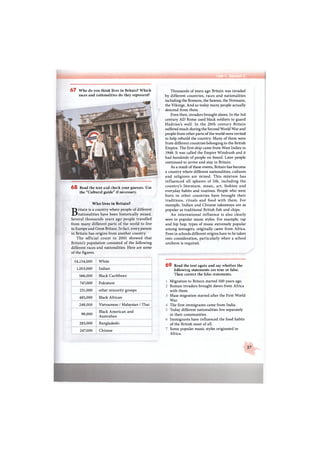
6 7 Who do you think lives in Britain? Which
races and nationalities do they represent?
6 8 Read the text and check your guesses. Use
the "Cultural guide" if necessary.
Who lives in Britain?
Britain is a country where people of different
nationalities have been historically mixed.
Several thousands years ago people travelled
from many different parts of the world to live
in Europe and Great Britain. In fact, every person
in Britain has origins from another country.
The official count in 2001 showed that
Britain's population consisted of the following
different races and nationalities. Here are some
of the figures.
54,154,000 White
1,053,000 Indian
566,000 Black Caribbean
747,000 Pakistani
231,000 other minority groups
485,000 Black African
248,000 Vietnamese / Malaysian / Thai
98,000
Black American and
Australian
283,000 Bangladeshi
247,000 Chinese
Thousands of years ago Britain was invaded
by different countries, races and nationalities
including the Romans, the Saxons, the Normans,
the Vikings. And so today many people actually
descend from them.
Even then, invaders brought slaves. In the 3rd
century AD Rome used black soldiers to guard
Hadrian's wall. In the 20th century Britain
suffered much during the Second World War and
people from other parts of the world were invited
to help rebuild the country. Many of them were
from different countries belonging to the British
Empire. The first ship came from West Indies in
1948. It was called the Empire Windrush and it
had hundreds of people on board. Later people
continued to arrive and stay in Britain.
As a result of these events, Britain has become
a country where different nationalities, cultures
and religions are mixed. This mixture has
influenced all spheres of life, including the
country's literature, music, art, fashion and
everyday habits and routines. People who were
born in other countries have brought their
traditions, rituals and food with them. For
example, Indian and Chinese takeaways are as
popular as traditional British fish and chips.
An international influence is also clearly
seen in popular music styles. For example, rap
and hip hop, types of music extremely popular
among teenagers, originally came from Africa.
Even in schools different origins have to be taken
into consideration, particularly when a school
uniform is required.
6 9 Read the text again and say whether the
following statements are true or false.
Then correct the false statements.
Migration to Britain started 500 years ago.
Roman invaders brought slaves from Africa
with them.
Mass migration started after the First World
War.
The first immigrants came from India.
Today different nationalities live separately
in their communities.
Immigrants have influenced the food habits
of the British most of all.
Some popular music styles originated in
Africa.
27
А
WORD FOCUS: DESCRIBING ORIGINS
7 0 Look through the text in Ex. 68 and
find expressions similar in meaning to
"be from".
6 There are global factors that make people
migrate, for example, ... and ....
7 The most important pull factors are ....
7 5 Do research on the topic "Who lives in
Russia?" Follow these steps.
ft
ft
71 Match the global objects and the names
that have come from different countries
to the countries of their origin. Make
sentences about them. Use the words from
Ex. 68. Then give your own examples.
macaroni
Pushkin
sushi
football
bicycle
silk
compass
gunpowder
printing
papermaking
Newton
Pavlova
sputnik
potato
Mother Teresa
America
Japan
China
Albania
Italy
England
Russia
France
7 2 Discuss the following questions:
• Do people migrate in your country / region?
• What makes people migrate?
7 3 Listen to the radio programme about the
reasons for migration. Then check your
guesses and add more reasons to your list.
7 4 Listen to the programme again and
complete the following statements
with your notes from Ex. 73. Use your
Workbook.
1 Sociologists designed ... to analyse and
describe migration.
2 In terms of migration, they divide countries
into two groups: ... and ....
3 Leaving one country, migrants are looking
for ... in another.
4 The most serious push factors that make
people emigrate are .... These are ... and ....
5 Other push factors that should be taken into
consideration are ... and ....
Find a person or a family who have migrated
to / from another country.
Prepare the questions for the interview.
Arrange a meeting time for the interview.
Conduct the interview with your selected
person or family.
Summarise their comments and responses.
Then report what you learned to your class-
mates.
Mini-project:
Should we agree with globalisation?
7 6 Work in groups. Discuss these questions:
1 Why is everyone talking about globalisation?
2 What is it and when did it start?
3 Is it good or bad or inevitable?
4 What are some of the examples of globalisa-
tion in your country?
5 Has globalisation brought any significant
changes to you personally?
6 How does migration affect your area?
Give examples.
7 On the whole, are you in favour or against
globalisation?
7 7 Present a brief summary of your discus-
sion to the other groups.
28
Section 3 Are you aware of your rights?
7 8 Work in pairs. Answer the questions.
1 Do you have any rights? Complete the table
with your answers.
Rights
at home
Rights
at school
Rights
in the street
2 What other rights would you like to have?
3 What would you do if you saw one of your
classmates cheating?
4 Do you think it's a good idea to give money
to homeless people in the street? Why? /
Why not?
5 Some teenagers won't accept someone who
looks different or who is of a different ethnic
origin. How do you feel about this? How
would you react?
6 What would you think of someone who dyes
their hair blue just to look cool?
7 Do you always agree with what your teacher /
parents tell you to do? Why? / Why not?
Give an example.
8 Can you remember a story from the news
which you've heard recently? What was it
about? Why do you remember it? What did
you feel about it?
7 9 Work in groups. Discuss the questions
from Ex. 78. Are your answers similar or
different? Which point is the most contro-
versial? Why do you think this is so?
8 0 Read the introduction to the text from an
internet forum and answer the question.
• What do you think happened to the young
people of Derry?
This week Children's Express Foyle Bureau
reporters discovered that the young people
of Derry have been kept in the dark over
their rights.
« 8 1 Read the report and check your guesses.
Derry young people wronged over rights
April 21, 2004
As young people, we were shocked when we recently found out —
about our official rights as children through a UN Convention on
the Rights of the Child.
Also as young journalists, we believe there is one right that is more
important to us than others and that is the right to have our voice
heard. Beyond this right, however, young people have almost 50 rights
in total, according to the UN Convention.
After completing a number of interviews across the city we discovered that three
out of ten children didn't know anything about what rights they had and most had
never even heard of the UN Convention on the Rights of the Child. This made us
ask the question, why?
Ш"
29
What we need are ways to enforce these rights and make sure that every child
knows them. If we do this, then we believe children will feel better about them-
selves and so will treat one another better.
Instead of perhaps boring you with the full list of rights, we, as a group of
young people in Derry, decided to compile a list of our ten top favourite rights.
If you want to find out more, check out the website www.unicef.org
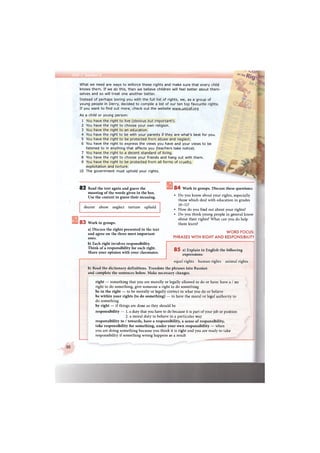
As a child or young person:
1 You have the right to live (obvious but important!).
2 You have the right to choose your own religion.
3 You have the right to an education.
4 You have the right to be with your parents if they are what's best for you.
5 You have the right to be protected from abuse and neglect.
6 You have the right to express the views you have and your views to be
listened to in anything that affects you (teachers take notice).
7 You have the right to a decent standard of living,
8 You have the right to choose your friends and hang out with them.
9 You have the right to be protected from all forms of cruelty,
exploitation and torture.
10 The government must uphold your rights.
°nth*Rig
8 2 Read the text again and guess the
meaning of the words given in the box.
Use the context to guess their meaning.
decent abuse neglect torture uphold
8 3 Work in groups.
a) Discuss the rights presented in the text
and agree on the three most important
ones.
b) Each right involves responsibility.
Think of a responsibility for each right.
Share your opinion with your classmates.
8 4 Work in groups. Discuss these questions:
• Do you know about your rights, especially
those which deal with education in grades
10-11?
• How do you find out about your rights?
• Do you think young people in general know
about their rights? What can you do help
them learn?
WORD FOCUS:
PHRASES WITH RIGHT AND RESPONSIBILITY
8 5 a) Explain in English the following
expressions:
equal rights human rights animal rights
b) Read the dictionary definitions. Translate the phrases into Russian
and complete the sentences below. Make necessary changes.
right — something that you are morally or legally allowed to do or have: have a / no
right to do something, give someone a right to do something
be in the right — to be morally or legally correct in what you do or believe
be within your rights (to do something) — to have the moral or legal authority to
do something
by right — if things are done as they should be
responsibility — l.a duty that you have to do because it is part of your job or position
2. a moral duty to behave in a particular way
responsibility to / towards, have a responsibility, a sense of responsibility,
take responsibility for something, under your own responsibility — when
you are doing something because you think it is right and you are ready to take
responsibility if something wrong happens as a result
30
L uMKfiftn'rfri. in . i Я В Ш н к Ы М fe.Avc-'ija Unit 1 Section 3
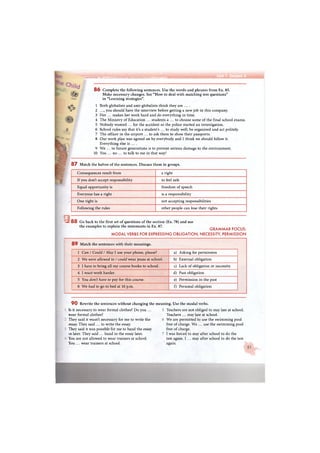
/ 8 6 Complete the following sentences. Use the words and phrases from Ex. 85.
Make necessary changes. See "How to deal with matching test questions"
in "Learning strategies".
1 Both globalists and anti-globalists think they are ....
2 ..., you should have the interview before getting a new job in this company.
3 Her ... makes her work hard and do everything in time.
4 The Ministry of Education ... students a ... to choose some of the final school exams.
5 Nobody wanted ... for the accident so the police started an investigation.
6 School rules say that it's a student's ... to study well, be organised and act politely.
7 The officer in the airport ... to ask them to show their passports.
8 Our work plan was agreed on by everybody and I think we should follow it.
Everything else is ... .
9 We ... to future generations is to prevent serious damage to the environment.
10 You ... no ... to talk to me in that way!
8 7 Match the halves of the sentences. Discuss them in groups.
Consequences result from a right
If you don't accept responsibility to feel safe
Equal opportunity is freedom of speech
Everyone has a right is a responsibility
One right is not accepting responsibilities
Following the rules other people can lose their rights
К Я 8 8 Go back to the first set of questions of the section (Ex. 78) and use
the examples to explain the statements in Ex. 87.
GRAMMAR FOCUS:
MODAL VERBS FOR EXPRESSING OBLIGATION, NECESSITY, PERMISSION
8 9 Match the sentences with their meanings.
1 Can / Could / May I use your phone, please? a) Asking for permission
2 We were allowed to / could wear jeans at school. b) External obligation
3 I have to bring all my course books to school. c) Lack of obligation or necessity
4 I must work harder. d) Past obligation
5 You don't have to pay for this course. e) Permission in the past
6 We had to go to bed at 10 p.m. f) Personal obligation
9 0 Rewrite the sentences without changing the meaning. Use the modal verbs.
Is it necessary to wear formal clothes? Do you ...
wear formal clothes?
They said it wasn't necessary for me to write the
essay. They said ... to write the essay.
They said it was possible for me to hand the essay
:n later. They said ... hand in the essay later.
You are not allowed to wear trainers at school.
You ... wear trainers at school.
Teachers are not obliged to stay late at school.
Teachers ... stay late at school.
We are permitted to use the swimming pool
free of charge. We ... use the swimming pool
free of charge.
I was forced to stay after school to do the
test again. I ... stay after school to do the test
again.
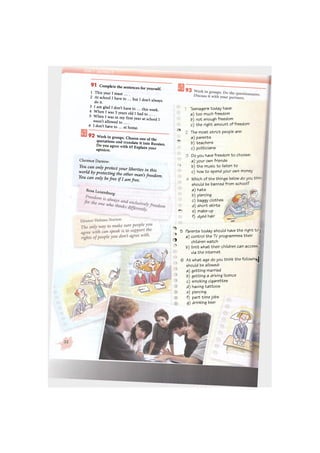
9 1 Complete the sentences for yourself.
1 This year I must ....
2 At school I have to ... but I don't always
do it.
3 I am glad I don't have to ... this week.
4 When I was 5 years old I had to ... .
5 When I was in my first year at school I
wasn't allowed to ... .
6 I don't have to ... at home.
9 2 Work in groups. Choose one of the
quotations and translate it into Russian.
Do you agree with it? Explain your
opinion.
Clarence Darrow:
You can only protect your liberties in this
world by protecting the other man's freedom.
You can only befree if I am free.
Rosa Luxemburg-
ф
• -
Ли
i
04
Ф
' H
Ф
em
Teenagers today have:
a) too much freedom
b) not enough freedom
c) the right amount of freedom
The most strict people are:
a) parents
b) teachers
c) politicians
Do you have freedom to choose:
a) your own friends
b) the music to listen to
c) how to spend your own money
Which of the things below do you thin-
should be banned from school?
a) hats
b) piercing
c) baggy clothes
d) short skirts
e) make-up
f) dyed hair
5 Parents today should have the right tc j
a) control the TV programmes their
children watch
b) limit what their children can access j
via the internet
6 At what age do you think the following
should be aWowed:
a) getting married
b) getting a driving licence
c) smoking cigarettes
d) having tattoos
e) piercing
f) part time jobs
g) drinking beer
WORD FOCUS: LINKING DEVICES
9 4 Group the linking devices from the list
below according to their function. Use
your Workbook.
introducing: ...
sequencing ideas: ...
expressing contrast: ..
stating results: ...
giving examples: ...
adding: ...
concluding: ...
also in summary
as a result moreover
besides nevertheless
but next
finally secondly
first of all so
firstly thus
for example to begin with
for instance to conclude
furthermore to sum up
however to summarise
in conclusion yet
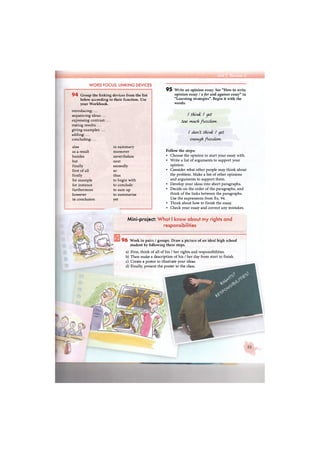
9 5 Write an opinion essay. See "How to write
opinion essay / afor and against essay" in
"Learning strategies". Begin it with the
words:
/ think / yet
too much ft&edom.
enough fiezcUwi.
Follow the steps:
• Choose the opinion to start your essay with.
• Write a list of arguments to support your
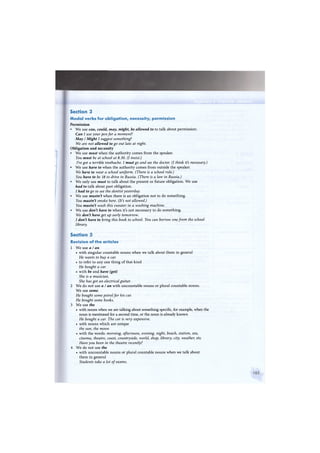
opinion.
• Consider what other people may think about
the problem. Make a list of other opinions
and arguments to support them.
• Develop your ideas into short paragraphs.
• Decide on the order of the paragraphs, and
think of the links between the paragraphs.
Use the expressions from Ex. 94.
• Think about how to finish the essay.
• Check your essay and correct any mistakes.
Mini-project: What I know about my rights and
responsibilities
9 6 Work in pairs / groups. Draw a picture of an ideal high school
student by following these steps.
a) First, think of all of his / her rights and responsibilities.
b) Then make a description of his / her day from start to finish.
c) Create a poster to illustrate your ideas.
d) Finally, present the poster to the class.
Participating in societySection 4
В
9 7 Work in pairs. Complete the quotations.
"A politician needs the ability
to foretell what is going to
happen tomorrow, next week, next
month, and next year. And to have
the ability afterwards to..."
Winston Churchill
"Politicians are the same
all over. They promise to
build bridges even when..."
Nikita Khrushchev
9 8 Work in pairs. Discuss the questions.
• How do you feel about politicians?
• Are you interested in them? Why? /
Why not?
• Do you know any politicians personally?
Would you like to be a politician?
4 doesn't feel it's the right time for him / her
to vote
5 has been influenced by his / her parents'
political views
6 has had some misunderstanding with peers
about politics.
7 doesn't feel he / she can change anything.
9 9 Listen to some teenagers speaking about
their attitude towards politics and decide
whether they are interested in it or not.
Speaker 1
Speaker 2.
Speaker 3.
Speaker 4.
Speaker 5
1 0 0 Listen to the recording again and
decide which of the speakers...
1 is interested in other things besides politics.
2 says that another hobby made them
interested in politics.
3 has changed his / her mind about political
parties several times.
1 0 1 Discuss this question in pairs.
• Which of the opinions in Ex. 100 is closest
to yours?
Dialogue vocabulary
I believe it's silly of (teenagers) to.
I don't believe...
I realise...
I feel/1 don't feel...
I think...
I'd like to...
I'm more interested in... than...
I can't agree with...
I have to say...
I don't see...
Probably it's because...
34
ННННННВВвЯВН швшшвт Unit Т Section 4
1 0 2 Write a paragraph expressing your
attitude to politics. Write about 100-
120 words.
Use:
to identify oneself with, to be prepared to,
to need some time for, to play one team
or another, to find the truth for oneself,
personality, political party, independent, open
to choice, life experience, limited
Useful phrases:
I think I need some time for...
I'd like to be a ... rather than...
I first got interested when...
I understand that...
That's why I'm so interested in...
But I can't agree with...
I have been unsure...
I know for sure...
I don't see much difference between...
I understand...
I don't believe...
1 0 3 Work in pairs. Discuss the questions.
E1 0 4 Work in groups. Choose 5-6 people from the list. Then rank them according
to the importance of their contribution to society. Explain your opinion.
S
T. Haaseve£t, M. Thatchex, M. Gox&achev, Txincess Ъ'игпа, /. Ghandi,
Ъ. 'Beckham, /. Sdutzkaya, T. ^stojevsky, W. Shakespeare,
S. Hastiapavlck, Oixaztsova, KL. TzLolkovskif, M. T&setzkaya,
M. Shanyakin, A. Satzhenitsln, J. R. Tolkien, L. Tolstoy,
ЪаОсх L. Kashal, A. Na&el
1 0 5 In groups of 3-4 analyse your results. Who are your choices? Why?
Who do you think is missing from the list?
106 Use the ideas from the list to design criteria to rank people for their
contribution to the society. Rank the criteria from the most to the least
important. Along with the ideas from the list, add some of your own.
beips others
beys the law
5 i good friend
antes in every election
r.ikes people happy
-_pports charities
: :ns a political party
works hard
follows political issues in newspapers
supports people in the community
protests when something is wrong
takes part in politics
writes to a Member of Parliament if he / she feels strongly about something
takes part in activities to protect the environment
35
• If you got a chance to talk to the prime
minister, what three questions would you
ask him?
• What is one thing the prime minister should
do for young people?
1 0 7 Read the text about Dmitry Likhachov and say what
the following figures refer to. See "How to deal with
reading test questions" in "Learning strategies".
1 5 500 1928 1953 1993
1 0 8 Read the text once again and say
whether the following statements are
true, false or not given in the text.
1 Dmitry Sergeevich Likhachev was born in
1906.
2 He was an expert in Old Russian language
and literature.
3 When he graduated from university, he
supported the orthography reform.
4 In 1928 he started his work in the Russian
Literature Institute.
5 During the Second World War, he left the
city for several years.
6 He opposed the ideas of Lev Gumilev and
Boris Rybakov.
7 He wrote several articles where he criticised
Gumilev's theories.
8 At the end of his life, he became a political
and public figure.
В1 0 9 Think of more people to add to the
list in Ex. 104. Do some research and
find some important facts from their
biographies.
Mini-project: Student awards
1 1 0 Work in groups of 3-4. Set up an
award for the students who contribute
most to school life.
• Think of a name for the new award.
• Decide how often the award would be given.
• Design a set of criteria for the award.
• Plan the application procedure.
• Choose possible winners.
• Organise an award ceremony.
36
Dmitry Sergeyevich Likhachov was an outstanding Russian
scholar who was considered the world's foremost expert in Old
Russian language and literature. He has been called "a guardian of
national culture" and "Russia's conscience".
The same year he graduated from the Leningrad University
(1928), Likhachov was arrested for his speech criticising the
Bolshevik reform of Russian orthography. Deported to the Solovki
Special Purpose Camp, he spent 5 years there. Likhachov returned
to Leningrad unbroken, and started his spectacular scholarly career in the Pushkin
House (as the Russian Literature Institute is known), which spanned more than
60 years and saw the publication of more than 500 scholarly works. Likhachov didn't
stop his work even during the Siege of Leningrad. He believed that Russia was an
integral and indivisible part of European civilisation, contrary to "Euroasiatic" views of
Russia popular with Lev Gumilev, Boris Rybakov, and many other contemporaries.
In 1953, Likhachov was admitted into the Soviet Academy of Sciences. He defended
Andrei Sakharov, Alexander Solzhenitsyn and others during their hard years. In 1986,
he was elected the first President of the Russian Cultural Fund. In his 80s and 90s,
he became more of a public figure, serving as an informal advisor to St Petersburg
Mayor Anatoly Sobchak and President Boris Yeltsin. In 1993, he became the first
person to be named an Honorary Citizen of St Petersburg. He also presided over the
commission set up to prepare for Alexander Pushkin's bicentenary. A year before his
death, Likhachov became the very first recipient of the reinstated Order of St Andrew.
The Likhachov Philanthropic Fund was set up in 2001.
Section 5 Feeling safe
1 1 2 Read the descriptions of such products and match them with the pictures.
Fill in the gaps in the texts. wipes
Small crimes against the planet
each meal
air freshener
This ... is called "Sweet Baby", and if you spray it
iround, your room will have the odor of perfumed
• aby nappies. You probably wouldn't like it, especially
ryou. don't have or want a baby. Moreover, the label on
5 rates openly that it is harmful to the environment.

•That is new about it is that this ... operates on
: ictricity, which means you will be wasting energy
: ;ether with filling the air with unwanted perfume.
: "ou have your ... on for 15 hours a day, one refill
last for up to 80 days.
So you don't like to cook? Then this invention is for
you! The kit consists of a cardboard sleeve, a plastic
tray, a beef burger, a bun, some chips, some tomato
sauce and a foil tray to cook everything in. Everything
is wrapped separately and put in a box or sachet. But
there is more here to throw away than there is to eat,
and the use-by date gives you only 24 hours before
the whole thing goes in the bin unopened. It seems
that ... producers think that you have nothing in
your kitchen apart from a microwave oven!
Using these makes me want to kill someone! You may
also be familiar with this terrible product if you have
got a cheap electric lawnmower: steel ... have been
replaced by disposable plastic ones, and they barely
are able to last for 15 minutes. They don't actually cut
the grass but shred it, and only one sort is compatible
with your make of the mower. Surprisingly, the label
is said to be made from 100% recycled paper.
I l l Make a list of the least "green" products you use in every day life.
I-: to any chemist's and you will find a big variety of
~em: makeup remover ..., hand ..., tooth ..., wood
dog ..., window ... and houseplant leaf ..., each
: i retaining some special compound that makes them
: irticularly suitable for a certain type of usage. The
tiole ... industry exploits the idea that a separate
i iposable cloth for every chore exists. I actually find
:~i.t many of them are exceedingly unnecessary. For
: cimple, I wouldn't choose to buy any houseplant
eaf ... since I wash my plants with soft soap foam
-rder a nice cool shower! And they like it!
5
Do you think it is possible to be 75% organic? I don't
think so! The label on a package of this fresh ... says
it is 100% organic and invites us to admire its quality.
Moreover, it says that it is alive and hydroponic, which
is just another way of saying that is grown in water.
I don't immediately understand why that means the
... has to be put into a thick plastic, individual box
and exported from Canada. Some people are ready
to pay more for organic food thinking they are doing
so partly out of concern for the environment, but this
is not exactly the case.
plastic lawnmower
blades
37
113 Use your Workbook. Read the texts again. Find and write down
the words which mean:
• Which of the products above do you find the least green? Why?
• Do you use any of these products? If so, how often?
• Do you ever refuse to use something out of concern for the environment?
GRAMMAR FOCUS:
REVIEW THE USE OF ARTICLES
115 Read the rules and find more examples in the texts (Ex. 112).
1 We use a / an
• with singular countable nouns when we talk
about them in general
He wants to buy a car.
• to refer to any one thing of that kind
He bought a car.
• with be and have (got)
2 We do not use a I an with uncountable
nouns or plural countable nouns. We use
some.
He bought some petrol for his car.
He bought some books.
3 We use the
• with nouns when we are talking about
something specific, for example, when the
noun is mentioned for a second time, or the
noun is already known
He bought a car. The car is very expensive.
• with nouns which are unique
The sun, the moon
• with the words: morning, afternoon, evening,
night, beach, station, sea, cinema, theatre,
coast, countryside, world, shop, library, city,
weather, etc
Have you been in the theatre recently?
4 We do not use the
• with uncountable nouns or plural countable
nouns when we talk about them in general
Students take a lot of exams.
• with proper nouns
Nikita lives in Novosibirsk.
• with possessive adjectives or the possessive
case
That is his new car.
• with the words: bed, church, school, college,
hospital, prison, university, court when we
refer to the purpose they exist
Children should go to school.
Unit 1 Section 5
1 1 6 Complete the text with articles as necessary.
What is happening to our weather?
Although most of us say we love the hot
weather, I wonder if we would feel (0) the
same if every day was the same with predictable
sunshine and heat? Never having lived in (1) ...
hot country for more than (2) ... few weeks I am
not sure what my (3) ... opinion would be. Maybe
I would miss (4) ... rain? There is something about
(5) ... freshness that is in (6) ... air after (7) ...
summer rainfall. When I was younger I was scared
of (8) ... thunder and my mum used to tell me
it was only God moving his furniture around!
To pass (9) ... time we counted between (10) ...
lightning flashes and thunder, (11) ... number we
got to was supposed to be (12) ... number of miles
away we were from (13) ... storm.
It is shame that today we don't have those
heavy snowfalls, these should be part of everyone's
childhood! Sledging down (14) ... nearest slope
until your fingers feel as though they will drop
off was all part of (15) ... fun! These days with
(16) ... first flurries of snow we are given weather
warnings and told not to go out unless our journey
is "essential". There is (17) ... outcry if schools are
closed, but is (18) ... journey to school "essential"
in such weather conditions? A debatable point! I
remember having to struggle through deep snow
to get to (19) ... school, but as it was only (20) ...
short distance from home and the teachers all
lived locally, that was no problem. Nowadays it
is somewhat different. Our seasons seem to have
disappeared — or have they merged into each
other?
Ey 117 Discuss with your partner the following questions.
What are the biggest threats to the environment today?
Is anything being done about them?
1 1 8 Read the text and say what the main purpose of the Kyoto Protocol is.
The Kyoto Protocol
The Kyoto Protocol is an addition to the United Nations
Convention on Climate Change.
Countries which ratify this protocol commit to reducing
their emissions of carbon dioxide and five other greenhouse
gases. Industrialised countries have specified reduction targets
and can engage in emissions trading or what's being called
"Joint implementations". Finally, countries can take part in a
third instrument, the "Clean development mechanism".
A total of 141 countries have ratified the Kyoto agreement.
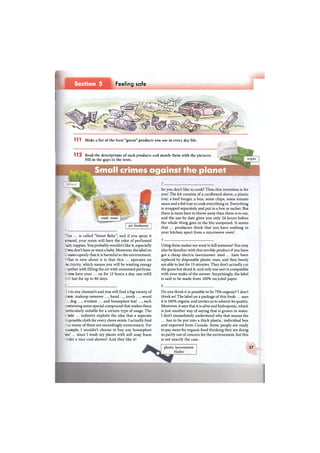
Notable exceptions include the United States and Australia.
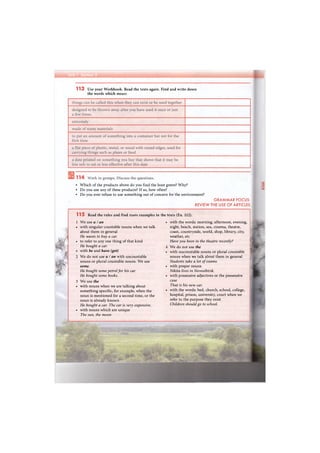
The agreement came into force on February 16, 2005, fol-
lowing ratification by Russia.
The Kyoto Protocol may seem just a small first step to
dealing with climate change, but it is significant. We have to
find ways to contribute to socio-economic growth and at the
same time lower our emissions of greenhouse gases.
But the major changes of our energy systems that are
required, are not only to reduce their harmful effects, but
also to address the oil shortage, the security of our energy
supply, and even world peace.
1 2 0 Choose the correct preposition in
brackets.
1 A new computer-operated heating system
was created in addition (with / to) the
existing one.
2 Representatives of different countries
were engaged (in / to) the discussion of
environmental problems.
3 The new school rules will come (into / to)
force next year.
4 Governments of all countries must deal
(with / about) environmental issues.
5 Everybody should contribute (to / into) the
solution of the problem.
6 We can't solve the problem now (for /
because) this simple reason: it requires time
and investment.
1 2 1 Listen to some teenagers talking
about an idea aimed at helping the
environment. What is the idea?
Ш 1 2 2 Listen again and say what each of
the speakers thinks about the idea.
Take notes. See "How to take notes
effectively" in "Learning strategies".
Work in groups. Discuss the questions.
Is your situation similar to the speakers'
or is it different? Prepare to discuss the
last two points with the whole class.
How much rubbish do you produce?
Where do you throw it out?
Do the shops you go to use too much
packaging?
Is it possible to recycle where you live?
If not, what do you think should be done
about this problem?
40
1
2
3
4
5
шЛ
119 Fill in the prepositions to complete the
expressions. Check your answers in
the text. Translate the expressions into
Russian. Use your Workbook.
1 an addition ... the Convention
2 to engage ... trading
3 the agreement came ... force
4 to deal ... climate change
5 to contribute ... socio-economic growth
6 changes are required ... many reasons
WORD FOCUS: PREPOSITIONS
1 2 4 Share your ideas. Think of some other
ways of helping the environment.
Whose idea is the most original, the
most sensible, the most efficient?
125 Work in pairs. Discuss this question:
What is anti-social behaviour? Give
some examples.
1 2 6 Look at the pictures and guess what
kinds of anti-social behaviour they
represent.
handsfree kit (bluetooth)
ш • i е* * г*
nit 1 Section 5
1 2 7 Listen to some people speaking about this kind of behaviour and
check your guesses.
1 2 8 Listen again and take notes. Complete the table in your Workbook.
reasons against using mobiles
while driving
reasons for using mobiles
while driving
actions to prevent people from
using mobiles while driving
1 2 9 Say what your opinion is on the
following points.
• Do you think that using mobiles while
driving should be prohibited? Why?
• What would you do to prevent people from
using mobiles while driving? Add your ideas
to the table.
1 3 0 Work in pairs. Discuss the questions.
1 Remember some of the other examples
of anti-social behaviour you talked about
in Ex. 126 and 127. What can be done to
prevent it?
2 Do you think that heavy fines and other
legal measures would stop anti-social
behaviour?
3 What can young people do about it?
131 Work in groups of 3-4. Discuss safety
issues. Take notes.
Think about:
• what makes your feel safe
• what you can do to make life safer
Consider the following aspects:
• the environment
• food
• everyday habits / lifestyles
• the people around you
• behaviour at home / outdoors / in public
places
Summarise the results of your discussion and
present them to the rest of the group.
Mini-project:
An ideal teenage citizen
1 3 2 Work in groups of 3-4. Draw a picture
of an ideal teenage citizen. Consider
these characteristics:
• which languages he / she speaks
• his / her attitude towards globalisation
• certain rights and responsibilities
• his / her attitude to politics
• his / her contribution to school life
• his / her lifestyle (for example, how "green"
it is) and his / her social behaviour
Prepare a presentation of the ideal teenage
citizen.
Unit 1
Key vocabulary
abuse contribute accountable approve of something
accent deal with ambitious be spoken
accuracy decrease authentic be against
concern degrade beneficial be in favour of
confidence deteriorate controversial be negative towards something
dialect develop effective be positive towards something
experience engage in fluent be in the right
fluency fall independent be within your rights
index grow ineffective come into force
jargon increase limited disapprove of something
neglect improve native (tongue) equal rights
personality lessen responsible for many reasons
shyness oppose spoken human rights
rise traditional have / take responsibility
strengthen widespread identify oneself with
support in addition to
uphold means of communication
wrong
Useful phrases ^ Р и Н И И ш У ^ '^ГмА^М^тР^™' :
'
First of all,... I think I need some time for...
I doubt that... I'd like to be a... rather than...
I am convinced that,... I first got interested in it when...
We..., don't we? That's why I'm so interested in...
I believe it's stupid of (teenagers) to... But I can't agree with...
I don't believe... I have been unsure...
I realise / understand... I know for sure...
I feel/1 don't feel... I don't see much difference between...
I'd like to...
I'm more interested in... than...
I have to say...
I don't see why...
Probably it's because...
In my view...
Let me start with... . . . . . .
wm
42
Points Ц /10
a) Listen to a girl speaking about her
experience of learning English and put
the parts of the course in the order she
mentions them.
1 A Case Study
2 В Original Writing
3 С Language Investigation
4 D Language and Society
5 E Stylistic Analysis
Points Q /5
b) Listen again and match the statements
and the course parts. You can choose some
of the parts more than once.
1 It made up most of the course work for the
students.
2 It was the speaker's favourite part.
3 The students studied all three parts of this
subject
4 It was the longest part of the course.
5 The students were given materials to prepare
for this part in advance.
6 The students were given plenty of practice in
this subject.
7 The speaker still recalls something from this
subject now.
8 The students had to write articles in this
subject.
2 Read the text and complete the gaps in
sentences with the words from the text. Use
no more than three words in each gap.
The Irish Travellers are the largest minority in
Ireland. There are about 25,000 Irish Travellers
in Ireland and 1,300 in Northern Ireland. They
are a little understood nomadic community, who
have many difficulties to overcome if they are
to survive as a culture and gain acceptance into
Irish society. Among the challenges facing them
are poverty and racism.
The Irish Travellers are a distinct ethnic group
which has existed for centuries. Often they are
mistakenly considered part of the nomadic
Romani, an ethnic group which originated in the
region of India and is now widespread throughout
Europe. But the Irish Travellers are indigenous to
Ireland, so the two cultures are not related. While
both are nomadic, the Irish Travellers are Roman
Catholic and speak a language that is theirs alone.
They have their own culture, customs, traditions,
and language. They are noted for their musical
and storytelling abilities.
In times past, they travelled by horse-drawn
wagon in caravans, making camp along the way.
Tinsmithing, horse trading and peddling were the
major sources of income in those days. Tinsmiths
were so prevalent among Irish Travellers that
the terms Tinker and Irish Traveller were used
interchangeably. Today, Tinker is one of many
names for Irish Travellers.
Horses and wagons have given way to mobile
homes pulled by motor vehicles. They continue
their life on the road, but there are fewer places
to stop and fewer places where they are wel-
come. Today, Irish Travellers mainly work in re-
cycling. Changing needs of society and progress
have eliminated the jobs that could support a
culture on wheels.
Irish Travellers are poor, undereducated, and
on the receiving end of discrimination. Their life
expectancy is lower than average while their
infant mortality rate is higher than average. As is
the case with the Romani, the Irish Travellers are
seen by many as a group of immoral, ignorant
criminals and con artists. People distrust their
nomadic culture and their language, Shelta.
Many think it's a secret language specifically
developed as a tool to help the Irish Travellers
trick innocent people. But this is not true. It is an
old language, which has evolved with time and
circumstances. Once heavily infused with Irish
Gaelic, it is now infused with English.
1 ... are the two main problems of Irish
Travellers.
2 The Irish Travellers are mistakenly taken
for the nomadic Romani, another ... widely
spread in Europe.
3 Although both groups are nomadic, their
cultures . . . .
4 In the past the Irish Travellers went around
by ... in caravans.
5 They were called Tinkers, which is now ...
for them.
6 Irish Travellers have mobile homes pulled ...
now.
7 Today, the Irish Travellers mainly work ....
8 They have low ... and their infant mortality
rate is ... .
9 People distrust their ... and . . . .
10 People think that the Irish Travellers have ...
that helps them trick people.
Points /12
3 Fill in the gaps in the text with the correct forms of the words in CAPITAL
LETTERS at the end of each line.
Origins of writing in China
Most linguists believe that writing was (0) invented in
China during the latter half of the 2nd millennium ВС.
Chinese is written with characters. Each character
represents a syllable of (1) ... Chinese and also has a
meaning. The characters were originally pictures of
people, animals or other things but over the centuries
they have become (2) ... stylised and no longer look like
the things they represent.
The Chinese writing system is (3) ... . The largest
Chinese dictionaries include about 56,000 characters, but
most of them are archaic, obscure or rare variant forms.
Knowledge of about 3,000 characters (4) ... you to read
about 99% of the characters in Chinese newspapers and
magazines. To read Chinese literature, technical writings
or Classical Chinese, though, you need to be familiar
with about 6,000 characters.
There are currently two systems for Chinese
characters. The (5)... system, still used in Hong Kong and
Taiwan, comes from standardised character forms dating
back to the late Han Dynasty. The Simplified Chinese
Character System, (6)... in 1954 to promote mass literacy,
(7) ... most complex traditional characters to fewer
strokes.
INVENT
SPEAK
INCREASE
LIMIT
ABLE
TRADITIO.
DEVELOP
SIMPLE
Points Q /7
44
4 Read the text and choose the best options to fill in the gaps.
Human
On 10 December 1948, the United Nations
General Assembly adopted the Universal
Declaration of Human Rights, which has become
a (1) ... standard for defending and promoting
human rights. Every year on 10 December, Human
Rights Day marks the adoption of the Universal
Declaration which states that "Human beings
are born with (2) ... rights and fundamental
freedoms".
In 2006, Human Rights Day focused on (3) ...
poverty as a matter of obligation, not of charity.
Poverty is (4) ... by human rights violations. The
links between human rights and poverty should be
obvious: people whose rights are (5) ... are more
likely to be poor. Generally they find it harder
Rights Day
or impossible to participate in the labour market
and have little or no access to (6) ... services and
resources. Meanwhile, the poor in many societies
cannot enjoy their rights to education, health
and housing simply (7) ... they cannot afford
them. And poverty affects all human rights: for
example, low income can prevent people from
accessing education, which in turn inhibits their
participation in public life and their ability to
influence the policies affecting them.
Governments and those in a position of
authority must (8) ... responsibility for dealing
(9) ... poverty. The realisation of human rights —
including the fight against poverty — is a duty,
not a mere aspiration.
1 A whole В universal С complete D typical
2 A similar В same С equal D identical
3 A fighting В saving С encouraging D breaking
4 A caused в led с resulted D made
5 A lessened в broken с decreased D neglected
6 A simple в basic с unimportant D extra
7 A so that в but с because D as
8 A make в support с take D contribute
9 A on в about с over D with
Points Q /9
5 Give a 2-minute talk on problems of glo-
balisation. Be ready to answer some ques-
tions when you finish.
Remember:
• to explain what "globalisation" is
• to mention what spheres of life it influences
• to give some examples of globalisation in
different spheres
• to say how globalisation influences your life
• to express you opinion on globalisation and
explain it
6 Comment on the following statement.
You have 40 minutes to do the task.
Studying foreign languages can change
your life.
What is your opinion? How can learning a
foreign language influence one's life?
Write 200-250 words.
Use the following plan:
• Introduction: State the problem.
• Your personal opinion: Give some reasons
to explain it.
• The other point of view: Give some
arguments and explain why you don't agree
with it.
• Conclusion.
45
The job ofyour dreams
Section 1 Choosing a profession
• I
I Read the joke. What do we call the job the
girl mentions?
"You never get anything right," complained the
teacher. "What kind of job do you think you'll
get when you leave school?"
"Well, how about a weather girl on TV?"
2 Make a list of 5-6 jobs. In pairs compare
your lists and put all the jobs in order from
the most to the least popular. Explain your
choices.
3 Match these job characteristics with their
definitions.
1 well-paid
2 stressful
3 challenging
4 enjoyable
5 boring
6 rewarding
7 complicated
8 satisfying
a) giving pleasure and joy
b) giving satisfaction and profit
c) dull and tiresome
d) extremely irritating and often overwhelming
e) difficult and complex
f) stimulating, interesting and thought-provoking
g) meeting all requirements and conditions
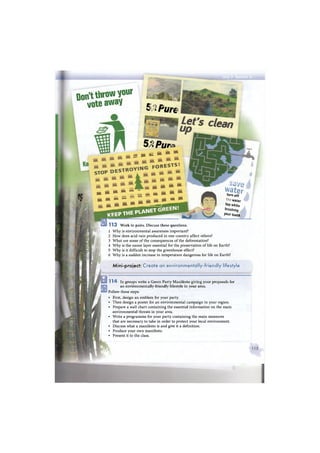
h) awarding enough money
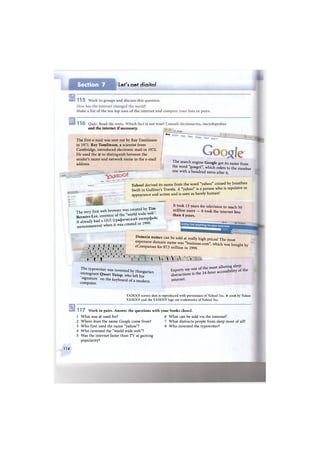
А
g4 Work in pairs. Write a description of the
most popular job in your list. Then join
another pair and read your description.
Let the other pair guess the job you have
described.
Use these points to guide you:
place of work
hours of work
duties
experience
Example: This person works in an office. He
or she has to work with documents and answer
telephone calls all day. This is a nine-to-five
job and is not very well-paid. The person in
this job should have a college or university
degree. Even though the job is not well-paid, it
is quite satisfying because...
5 Read the statements and guess the meaning
of the phrases in bold. Decide whether you
agree with the statements. Why or why not?
1 Not many people have unusual ambitions,
most of them choose an ordinary but
practical job.
2 Many young people prefer to become self-
employed business people, rather than work
for a company.
3 It is difficult to make a good career unless
your relatives are very supportive.
4 If you are stuck in a dead-end job, you
should try to choose a new direction in your
career.
5 You must have the guts to go through
medical training: some people get
squeamish at the sight of blood.
6 It is useful to make a rough estimate of your
future income when you apply for a new job.
6 Discuss the following questions with your
classmates. Then write your answers down.
Use your Workbook.
1 What kind of job would you like to have?
2 What would your friends and family think
about your choice?
3 What kind of job would you least like to
have?
4 What jobs, if any, do you think should only
be done by men / women?
5 What's more important to you — earning
lots of money or having a job you enjoy?
7 Listen to these teenagers talking about how
to choose a profession and take notes on
their answers. Then compare their answers
with yours from Ex. 6. Use your Workbook.
me Tim Mary Kate
Question 1
Question 2
Question 3
Question 4
Question 5
8 In groups of 3-4 discuss the questions.
• What do you consider a good job for you?
Why?
• Do you have any unusual ambitions?
• What do you expect from your future job?
• What do you need to do to get a good job?
Dialogue vocabulary
i
A good job should be...
Being (a pilot) seems an interesting job
because...
I'd like to become a... because...
I dream of becoming a... although it's not
an ordinary job.
I think my future job will...
Good salary is very important / not as
important as...
I believe that if a person is (persistent and
self-confident), he or she will...
4 7
9 Put the words and expressions in the box.
Some of them can reffer to both categories.
Use your Workbook.
WORD FOCUS: WORD FORMATION
Personal qualities
Professional qualities or
knowledge
imaginative, well-educated, professional, well-
organised, knowledgeable, able to work to tight
deadlines, computer literate, creative, able to work
in a team, interpersonal skills, telephone skills,
able to make decisions, able to solve problems,
able to do research, negotiation skills, initiative,
competent, enthusiastic, responsible, competitive,
persistent, inspirational, able to cope with stress,
able to take risks, motivated, committed
Ш 1 0 Work in pairs. Look at the pictures and
choose the three most important personal
qualities and the three most important
professional qualities or skills for each
job. Compare your choices giving your
reasons.
Example: We think that a nurse should be very
responsible because... Besides, it is important
for her to be able to solve problems as...
11 Fill in the table with the correct form of
the words. Use your Workbook.
noun adjective verb
imaginative
professional —
creative
competent —
enthusiastic
responsible —
competitive
persistent
inspirational
1 2 Make a list of people you know that you
associate with the qualities from Ex. 11.
In pairs ask each other questions about
why your partner has chosen those
people.
Example:
A: Why have you written "Lisa" here?
B: She is the most responsible person I know.
She always keeps her promises and...
Mini-project: Important qualities for
a successful career
13 Work in groups and follow the steps.
Report the results of your discussion to
the rest of the class.
• Decide which qualities are more important
for a successful career: are they more
professional or more personal? Explain
your opinion.
• Make a list of 8-10 qualities a person should
have to achieve professional success.
• Do you think the qualities depend on the
nature of the profession? Why?
ж 1
•
ШШШШШШШШШШШШШШШШШШШШЯШШШШШШШШШШше . лйвШШШШ
1 4 Label the table with the words below and
comment on what the table tells you.
Male Hairdressers Engineers Female
IT specialists Nurses
GENDER Male Female
10 90
9 91
85 15
78 22
Dialogue vocabulary
The table shows...
Statistics tells us...
The figures reveal...
The majority of (engineers) are... (male / female).
It looks like (90%) of... are (male / female).
Not many (women / men) are..., whereas...
E 1 5 Work in groups of 3-4 and discuss the
following questions. Make notes of your
discussion.
Are there jobs that are better for just men or
just women? What do you think are some male
and female jobs? Explain your opinion.
Use:
have different talents, be honest, get on well
with people, be aware of one's own emotions,
feel empathy, work well with others, deal with
stress well, be self-confident and optimistic, be
more / less ambitious...
m
•
1 6 Write a "For and Against" essay.
You have 40 minutes to do this task.
Comment on the following statement.
Roles as men and women start when we
are born and there will always be male and
female jobs in any society.
What can you say "for" and "against" this
issue? Write 200-250 words.
Use the following plan:
Introduction (state the problem).
Arguments "for".
Arguments "against".
Conclusion.
Use: be equal, understand better, be good at
doing something, a prestigious job, be aggres-
sive / passive, be dominant / subordinate, be
emotional / rational, have stereotypes in mind,
continue from the past...
WORD FOCUS: JOB AND PROFESSION
1 7 Read the dictionary entries and answer
the questions.
What types of jobs do you know?
What verbs can be used with jobs / profession?
What words can be used to speak about:
a) looking for a job c) not having a job
b) applying for a job d) having a job
job — work that you do regularly to earn
money
Words often used with job:
apply for a job, get a job, find a job, offer
someone a job, take a job, do a job, be in a
job, be out of job, leave your job, lose your
job, job interview, temporary / permanent
job, part-time / full-time job, top job
profession — a job that you need special
skills and qualifications to do
Words often used with profession:
the teaching / engineering profession, in a
profession, go into / enter / join a profession
When we ask people about their job, we usu-
ally say "What do you do?", or "What's your
job?" The answer would usually be "I am a..."
or "I work as a...", and not "My job is..."
18 Read the conversations and choose
the correct option. Then listen to the
recording and check your answers.
2 I Read the text and answer the questions.
• What does Sophia do for a living?
• Does she like her job? Why?
• Do you think she has made a success in it?
Why?
Look through the lens to a bigger
and brighter future
6 December 2001
2 0 Read the definition and think what jobs
a freelance can do. Give some examples.
Share your opinion with your classmates
Freelance is a self-employed person who
does work for different organisations.
Behind small-rimmed spectacles and locks of
unruly curly hair, Sophia Evans, a 33-year-
old freelance photographer talked passionately
about photography and modestly about her
successes.
From her London base, Evans travels around
the world to capture images for newspapers,
magazines and advertising agencies. At home
she works as a freelance photographer for The
Observer and The Sunday Telegraph.
During her university days, a boyfriend gave
her a camera; she snapped away and slowly
became hooked on taking pictures.
About to complete a degree in Latin American
studies, Evans talked with a friend about life after
university. Photojournalism came up.
"It was like a light went on. It had never
occurred to me but when she said it, I realised
yes that is what I want to do," said Evans, smiling
at her naivety.
Evans and her friend set off for Latin America
to become journalists. A night in jail in San
Salvador, while it did not impress resident hard-
bitten foreign journalists and photographers,
provided a fast-track into that world for her.
She travelled around Mexico, Haiti and Texas
documenting people's lives before returning to
set up home in London.
2
3
— I've applied / asked for several jobs
already.
— Have you got any?
— Oh, yes. I'm at / in advertising now!
— You know, I left /found my job after an
argument with the boss!
— How long have you been without / out of
your job?
— For a month already. But I'm going to a
job interview / job talk this morning!
— Good luck!
— I've given / taken a job at a hotel in the
city centre.
— Congratulations! Is it afull day / full-time
job?
— No, it isn't. It's part-time / part-day.
— Have you heard the news? Helen is
holding one of the first jobs / top jobs in
the company now!
— It's not surprising. She's very experienced:
she's been making / doing the job for
years.
PRONUNCIATION FOCUS:
PRACTISING INTONATION IN A SHORT
CONVERSATION
1 9 Listen to the recording again and
practice the conversations in pairs
imitating the intonation.
"When I was young, travel and adventure
_::racted me to photography; I was interested in
" he revolutions in Central America. But nowadays
:s about getting a good photograph. It is about
the language of photography, and really about
:rving to say something with photographs," she
idmitted.
Hard work, persistence and support from her
r.usband, a Mexican photographer, have been key
:: Evans' drive and success.
"I have been working as a professional pho-
ographer for six or seven years now. Before that I
> as studying photography and doing waitressing
:o support myself. I have dedicated about 10 years
:: my life to either trying to be a photographer
: r to being a photographer," she said.
She sincerely believes dreams must be pur-
ged with true commitment and energy, no mat-
ter if you make it a success or not.
"Someone cannot teach you how to do
rhotography. They can teach you how to use a
- iinera and what the technical side of things are
rut the actual taking of the photograph comes
rrom the mind, it is not something you can learn.
You have to practise and practise and practise
_nd learn through your mistakes."
Earlier this year, Evans was one of 12 photog-
raphers from around the world to be selected by
he World Press to attend the popular Photogra-
phy Master class and last year, she spent almost
hree months living with and documenting peo-
ple's lives on the Miskito coast, an isolated jungle
region in northeast Nicaragua.
She advocates that forming relationships with
••jbjects has an important place in the job.
"If it is a celebrity — and you don't have
much time — all you do is chit-chat, and talk
:c try and make them feel comfortable. But if
you are somewhere for weeks or days, then you
just involve yourself with the people. If they go
dancing, you go dancing, if they have a drink you
have a drink, you just do what they do."
"My favourite part of the job is meeting
people and then having the pleasure of being
led into their lives and photographing it — that
is a journey in itself."
Glossary
small-rimmed spectacles — очки в небольшой
оправе
unruly curly hair — непослушные вьющиеся
волосы
snap — (informal) take photographs
naivety [nai'iivsti] — наивность
hard-bitten — закаленный
drive — (here) the energy and determination that
makes you try hard to achieve something
pursue — try to achieve
chit-chat — friendly conversation about the things
that are not very important
2 2 Read the text again and put the events in
chronological order.
a) She gets her degree in Latin American
studies.
b) Sophia works as a photographer for The
Observer and The Sunday Telegraph.
c) A boyfriend gives Sophia a camera.
d) Evans travels around Mexico, Haiti and
Texas.
e) She realises that she wants to be a profes-
sional photojournalist.
f) She is put in jail in San Salvador.
g) Sophia gets interested in photography.
h) Evans goes to Latin America to become a
journalist.
2 3 Find in the text the words and expres-
sions corresponding to the definitions.
1 enthusiasm and determination to work hard
2 provide money, food, clothes, etc, that one
needs in order to live
3 find something so interesting that you want
to do it as much as possible
4 admit your mistakes and draw the right
conclusions from them
5 start a journey in a particular direction
6 finish a course of study at university and get
a qualification
51
2 4 Fill in the gaps with the words from Ex. 23.
1 We ate breakfast, collected our bags and school.
2 What are you going to do to ?
3 If you you are not likely to make them again.
4 Many city dwellers country living these days.
5 It takes up to six years to in Medicine.
6 The ..., energy, drive and innovation of staff are essential to our success.
2 5 Find in the text the qualities that describe
Sophia and her husband and write them
down. How do you think these qualities
help her cope with her job?
Dialogue vocabulary
2 6 Work in pairs. Discuss the questions and
report back to the class.
What is Sophia's recipe for success? Do you
agree with her?
Do you know any other recipes for success?
What are they?
I think her idea is that...
I think she is right because...
I don't think she's got the right recipe
because...
WORD FOCUS: VOCABULARY CLOZE
2 7 Read the text and fill in the gaps with the correct options. See "How to deal
with multiple choice test questions" in "Learning strategies".
Some people are fortunate enough to discover that they have a special
interest when they are very young giving them a direction when they go to
choose a (1) ... . Jessica showed an interest in clothes and in sewing from a very
early (2) ... which resulted in her winning awards in school fashion shows (3) ...
a teenager. She is well on her way toward a (4) ... career in costume design.
Others have a more difficult time finding their way. Even people who believe
they know their areas (5) ... interest are often misled by their emotions or the
glamour of a certain job. So (6) ... young people "want to write", but analysis
shows they are intrigued by what they think the life of a writer is (7) ..., not
realising that it is a hard craft.
Fortunately, there is help available to determine your areas of interest in
the form of {&) ... tests in which you answer "either/or" questions, if you are
asked if you would prefer to sell clothes in a store, or be in (9) ... of an auto
parts department, your immediate reaction may be "neither". However, a slight
preference toward one of those, as well as your choices in other questions, (10) ..
reveal some interests you have that may not have been so apparent before.
1
2
3
4
5
6
7
8
9
10
A
A
A
A
A
A
A
A
A
A
job
time
as
fortunate
in
many
about
pedagogical
charge
have to
В career С
В stage С
В when С
В difficult С
В about С
В all С
В resemble С
В psychological С
В deal С
В is able С
trade
year
while
different
of
much
like
psychiatric
response
can
D occupation
D age
D then
D wonderful
D at
D every
D kind
D physical
D sight
D could
тштм '' ' -
Mini-project: A poster ''What points should we consider
when choosing a career?"
J 2 9 Work in groups of 3-4 and follow these steps,
a) Discuss the ideas below and add your own.
parents' advice
friends' opinion
someone's successful example
personal interest
popularity of the job
qualifications / skills required
personal qualities and abilities
salary and bonuses
places to work / job opportunities in your region
b)
c)
d)
e)
f)
g)
h)
2 8 Work in pairs. Discuss the questions.
Sum up what you think influences our
choice of profession.
1 Have you ever done any psychological voca-
tional tests? What did they reveal?
2 Would you like to go into the same career as
your parents? Why or why not?
3 How have your parents' jobs influenced your
career choice? In what way?
4 Do you often discuss your future career
with your friends?
5 Would you like to choose the same profes-
sions as any of your friends? Why?
6 Whose opinion is important to you in choos-
ing a career? Why?
Make notes of your discussion.
Present the results of your discussion visually in the form of a poster.
Discuss the layout and the presentation of the information.
Check spelling and grammar.
Present your posters to the class, sharing as much information as
possible in a five-minute period.
Display the posters in one area of the classroom.
Select the best poster.
53
31 Listen to the people speaking about higher education and match the
speakers with the statements. Whose opinion do you share?
3 0 Think about your education after school. What kind of educational
institution would you prefer to attend? Why?
What happens after school?
1 Higher education should become cheaper.
2 You should save money so you can pay for higher education later.
3 The internet provides an alternative to universities.
4 Education should be free for everybody.
5 Higher education shouldn't be free for all.
6 Educated people are more useful to the country in general.
WORD FOCUS: UNIVERSITY WORDS
3 2 Match the words with their definitions
1 alumnus
(pi. alumni) (AmE)
a) a study course for people who want to get a new qualification that's
different from their previous one
2 graduate (AmE) b) a former student of a specific school, college or university
3 postgraduate c) someone who has completed his / her undergraduate studies and
was awarded such a degree by a college or university
4 undergraduate d) a student in a university or college who has not received a first
degree (esp. a bachelor's)
5 Bachelor /
Bachelor's
e) someone who has finished their studies at the high school, college,
or university level or someone who has a degree from a university
6 Master / Master's f) someone who has completed at least one year of graduate study and
was awarded such a degree by a graduate school or department
7 retraining course g) a student who continues his / her studies after graduation
8 refresher course h) to study some subject as an academic specialty (AmE)
9 major (in) (AmE) i) a study course which serves as a review of previous education
54
Новго ственныиУниве
Официальная информация Учебный процесс Наука Международная деятельность Разное Объявления Поиск English
I
t is not a coincidence that Novgorod University
has Prince Yaroslav's name. In the year of 1030,
Yaroslav the Wise came to Novgorod the Great to
teach reading and writing to the children of religious
and senior officials. It is a well-known fact that
education was of vital importance in the Novgorod
system of spiritual values in the 11th century. Indeed,
the existence of schools in medieval Novgorod can be
traced in birch bark letters and chronicles. As time
passed, not only were schools established but also
theological seminaries, gymnasiums, and libraries. That
is why Academician Yanin, the famous investigator
of ancient Novgorod called it "the cradle of Russian
education". Thus, the Yaroslav-the-Wise Novgorod
State University became the successor to what was
considered one of the oldest educational traditions in
Russia.
On the eve of the university's first anniversary,
Prince Yaroslav the Wise's personal seal was discovered
during some archaeological excavations. Academician
Yanin considered it a remarkable coincidence and
suggested awarding the university the name of the
Russian prince.
e
- ' Новгородский государстве»*ыйу«еер01тет
Glossary
spiritual values — духовные ценности
medieval — средневековый
birch bark letters — берестяные
грамоты
theological seminaries — духовные
семинарии
personal seal — яичная печать
coincidence — совпадение
3 She's always been academically minded. She
decided to do a ... course and become a. ...
of Science.
4 Vicky's about to ... from university. She's
going to get her first university degree: a. ...
of Arts.
5 Every five years doctors and teachers have
to do a ... course to keep up with new
developments in their areas.
6 Do you know any St Petersburg State
University ... who have become really
famous?
7 He's interested in environmental protection,
that's why he has chosen to ... in ecology.
3 4 Read the web page and answer the ques-
tions.
3 3 Fill in the gaps in these sentences with
the words from Ex. 32.
1 My qualification turned out to be so unpop-
ular that I had to do a ... course in order to
become a web designer.
2 Josh is in his first year at university. He's
only an ... student.
1
2
3
4
What have you learnt about Russian educa-
tional tradition?
How did Novgorod University get its name?
Would you like to study at this university?
Why? / Why not?
What should you know about a university to
55
3 5 Do research on the internet about a university of your choice
See "Tips for doing internet research" in "Learning
strategies". Find out:
the university's name and location
the courses that are taught there
the degrees you can get
its structure: departments, faculties, etc
the facilities available: laboratories, research centres,
libraries, computer centres, etc
the university's history
the number of students, professors, tutors
the projects the university is part of
the quality of the education, the university rating
in Russia or worldwide
any famous alumni
4 0 Listen to the recording again and choose
the best option.
3 7 Discuss the following questions in pairs.
1 Would you like to study in any of these
universities? Why? / Why not?
2 Is the rating of a university important to
you? Why? / Why not?
3 Is the history of a university important to
you? Why? / Why not?
3 8 One of the projects in Saratov State
University is called "The Global
Classroom". What do you think this
project is about? Make some guesses.
3 9 Listen to a student who is involved in the
project and check your guesses.
The speaker...
a) is a student at East Carolina University.
b) is the project participant.
c) is the project organiser.
The working language of the project is...
a) Russian, b) French, c) English.
The project is broadcast via...
a) the internet, b) radio, c) television.
The main aim of the project is to...
a) enable students to discuss important
topics.
b) develop students' computer skills.
c) teach students new subjects.
The participants major in...
a) Informational Technology, Cultural
Studies and Economics.
b) Marketing, Psychology and Business
Studies.
c) Communications, International Studies
and Education.
Most students work...
a) in groups, b) in pairs, c) in threes.
Student partners...
a) see each other regularly.
b) send each other lots of e-mails.
c) work on their tasks together.
В 36 Use the information you got in Ex. 35
and write a description complete with
illustrations. Put your description
on display for your classmates to get
acquainted with.
56
4 3 Put ticks in the table to indicate correct
expressions. Use your Workbook.
school college university
attend
study at
enter
get into / in
leave
get an
education at
Mini-project: An educational
initiative
4 2 Read the joke and translate the words
in bold. Which degree would you like to
get? Why?
The graduate with a science degree asks,
"Why does it work?"
The graduate with an engineering degree asks,
"How does it work?"
The graduate with an accounting degree asks,
"How much will it cost?"
The graduate with a philosophy degree asks,
"Do you want problems with that?"
graduate
from
41 You are going to design a project
concerning the cooperation between
secondary schools and universities
worldwide. Work in groups and follow
these steps.
a) Discuss these questions.
What is the main goal of the project?
What skills will it develop or what subjects
will it concern?
What will the working language of the
project be?
Who will be involved (e.g. teachers and
students)?
How will the participants communicate?
What kind of assignments will they be
given?
What will the output of the project be?
b) Write down your ideas and present your
project proposal to your local / nearest
university or college.
4 4 Read the text and fill in the gaps with the sentence parts that follow.
to the point where they actually left after just
one term. These universities really don't suit
everyone, and although it may be hard to see,
they may be doing you a favour by not accepting
you. Far too many people get carried away with
the mythology and prestige of these universities,
by parental and school pressure and (7) ... . You
have to decide if these places would really suit
you, not if you would suit them.
a) and Cambridge for history
b) your choice will have a large impact on your
time there
c) it happened to me the first time round
d) because it's simply not true
e) by the need to see if they can cut it
f) it's Oxford and Cambridge University
g) what you are looking for in a university
4 5 Read the joke and answer the questions.
1 What do '94' and '58' stand for?
2 What were the two men proud of?
3 Was the cab driver proud of the same thing?
Why do you think so?
4 What does the title of the joke mean?
World famous universities
Two young men who had just graduated from
Harvard got into a taxi in downtown Boston.
They were all excited about the graduation and
were talking non-stop about their futures as the
cab took off.
After listening to them for a couple of min-
utes, the cab driver asked, "You boys Harvard
graduates?"
"Yes, Sir! Class of '94'!" they answerec
proudly.
The cab driver extended his hand back t:
shake their hands, saying, "Class of '58'."
Oxbridge is something I feel very strongly
about. For those who don't know what
Oxbridge is, (1) ... . Cunning really, and sounds
better than Camford. I'm going to start here by
exploding a few myths — the first of which is
that these universities are the best in the country.
They aren't. It all depends on one, which subject
you take, and two, (2) ... . I f you want to do
medicine, for example, you'd be much better off
at Edinburgh: the Cambridge course is incredibly
academic and focused on training research
doctors rather than practising ones. And the
same is true of other subjects. On the other hand,
there are some subjects at which Oxbridge excels:
Oxford for English, for example, (3) .... So the
first message is: don't get caught up in the idea
that these universities are superior to every other
university academically, (4) ... .
So. If you've decided it is for you, what next?
Well, you have to decide on your college — and
this is not an easy business, for there are 26 of
them and (5) ... . Everyone has to decide on the
character, subject strength and location they are
interested in, and these things should not be
taken lightly. Each college is very different and it
is vital to pick one where you feel comfortable.
And if you don't get in, don't despair. I know
how terrible it is to be turned down: (6) ... .
I know it's easy to say that you shouldn't be
upset if you don't get in. But you really shouldn't
take it personally. Both universities are very
special places that do not suit everyone. I know
people who went to each of them and hated it
ияЯН
cunning — clever and skillful
explode — destroy
excel — be superior to in quality,
degree or performance
Ж11ШЙ1Ё:
4 6 Read the students' opinions on where to get an education and add
your own ideas to the list.
/• N
It seems that attending an
expensive university has become
similar to owning a designer bag.
I think a good education
and professional skills can
be got in any university.
r-elieve that a degree from a
: -estigious university guarantees
- nigh salary in future.
Graduates of top universities have
more job opportunities and are more
likely to have successful careers.
It's true that a university which is not
very famous is easier to enter but I think
the quality of the education is the same.
s
4 7 Work in pairs. What do you think of the
young people's opinions in Ex. 46? Do
you agree or disagree? Discuss various
ideas and opinions.
4 8 Work in groups. Make a list of the most
prestigious universities in your region.
Would you like to enter one of them?
Why? Discuss your opinions.
4 9 Look at the pictures and guess what all
these people have in common. Say what
you know about them.
Dialogue vocabulary
I think...
I feel that...
As far as I'm concerned...
Why do you think that...?
What makes you feel that...?
I think... because...
That's why I feel that...
.. .and so I think that...
That's what I feel too...
Exactly.
5 0 Answer the questions.
1 What professions can you master in vocational colleges?
2 What is the main difference between vocational colleges and universities?
5 3 Read the extracts from the radio programme about vocational colleges.
Then match the answers and the questions. Translate the words in bold into Russian.
51 Read the text and check your guesses.
U 5 2 Do research on the internet of a success-
ful person who didn't go straight to a
university after school. Present the results
of your research to the rest of the class.
WORD FOCUS:
VOCATIONAL EDUCATION TERMS
Contrary to popular belief, vocational colleges aren't just for students
who couldn't get into university. Students attend vocational colleges for
a number of reasons, including getting some practical skills or experience
before going to university. For many people it is a good two-year long
alternative to longer higher education programmes.
Whereas in universities the education concentrates more on theory and
abstract knowledge, in vocational colleges the education usually prepares
learners for careers that are traditionally non-academic. In other words, it is
directly related to a specific occupation or vocation, and students develop
expertise in a particular technique or learn some practical skills.
Till the end of the twentieth century, vocational education focused
more on specific trades, such as automobile mechanics or welding, and
was therefore associated with the activities of lower social classes. But the
situation has changed. Now vocational education exists in industries such
as retail, tourism, information technology and cosmetics.
In fact, a lot of famous people studied in colleges before they rose to
the tops of their fields. Can you name any of these people? Do you know
1 Who can enrol in a vocational
college?
a) Oh, that's not so easy. We have so many different
students from school-leavers to professionals with
graduate degrees.
2 Are there entrance exams? b) Many feel they might become more employable if they
get additional qualifications.
3 Describe a typical student of
the college.
c) Actually, we've got an "open admission" policy which
means we don't have exams, only an interview before
the start of the course.
4 Why do university graduates
come to the college?
d) Anyone who's got a secondary school certificate.
s
5 4 Work in pairs. Ask and answer these
questions.
1 To enroll at university or vocational college,
would you rather have an interview or an
entrance exam?
2 How does an interview differ from an
entrance exam?
3 Why do people get nervous before entrance
exams?
4 What educational institutions have an "open
admission" policy in Russia?
5 What graduate degrees do you know?
Describe them.
6 Why do additional qualifications make a
person more employable?
7 Who are some of the university graduates
you know? What kind of professional
careers have they made?
5 5 Listen to the recording and complete
the column about the USA. Use your
Workbook.
5 6 Work in pairs and complete the column
about Russia in Ex. 55.
The USA Russia
Where can you get a
vocational education?
Are there any entrance
exams?
What are the minimum
entrance requirements?
Who studies there?
How long is the course?
What qualifications are
given at the end of the
course?
What types of pro-
grammes are there?
5 7 Compare the systems of vocational edu-
cation in Russia to the ones in the USA.
Discuss the systems in groups.
Dialogue vocabulary
There are... whereas / while... there are...
...is not as... as
...are as... as
...is much more serious / shorter than...
.. .is less important than...
There are fewer / not as many arguments for...
than against...
You cant compare... to... because...
To sum up...
5 8 Write a paragraph that describes your
opinion of the Russian system of voca-
tional education.
5 9 Work in pairs and write down the advan-
tages of studying at a vocational college
or university. Use the ideas you discussed
in Sections 1 and 2 of this unit. Use your
Workbook.
University
Vocational
college
• gives more prestigious
qualifications
• provides better job
opportunities
• secures hiring
preference for
university graduates
• is easier to enter
• has shorter
courses
• . . .
Work in groups of 3-4. Discuss advan-
tages and disadvantages of studying at a
vocational college or university. Use the
ideas from the list in Ex. 59 and make
notes of your discussion.
61
Mini-project: A debate
6 1 Work in two groups and follow these steps:
• Here is the motion for the debate: "You can never make a successful career
unless you graduate from a prestigious university".
Work in two groups: those "for" the motion and those "against".
Select a secretary for each group and a chair for the debate.
Brainstorm reasons and examples for your arguments in the
two groups. Anticipate the arguments of the other side and develop
your group's counter-arguments.
Choose three people to represent your group.
Conduct the debate following this sequence:
Г
V
Group A presents their arguments
for the motion.
Group A supports their arguments
and criticises group B's arguments.
Group A sums up their arguments.
V
Group В presents their argument
against the motion.
Group В supports their arguments
and criticises group A's arguments.
Group В sums up their arguments.
J
Which group was stronger? Take a class vote.
Dialogue vocabulary
'. For the chairperson: For the speakers:
Dear guests / Ladies and gentlemen, could I have On behalf of our group, I'm going to...
! your attention, please? I'm sure you'll agree that...
Let me open / close the discussion. Today we're The fact / truth is...
: going to... We need to think about...
Now, I'll give the floor to... Yes, but do you really think that...?
May I ask you to keep to the time limit of... Yes, but look at this from another perspective...
I Unfortunately, your time is up. I agree, but on the other hand,...
* Does the audience have any questions?
' I invite the audience to vote.
62
• • н Н Н н ^ ш Н Н и
GRAMMAR FOCUS: FUTURE PERFECT (ACTIVE) / FUTURE PERFECT (PASSIVE)
6 2 Match the sentences with the pictures.
1 By June, 27 all the school-leaving exams will
have been taken.
2 By June, 10 the two most difficult exams
will have been taken.
3 On June, 10 the 11th graders will be getting
ready for the rest of the school-leaving
exams.
4 On June, 27 the 11th graders will be having
a school-leaving party.
6 3 Read the explanations and their exam-
ples. Fill in the gaps in the sentences
using future simple or future perfect.
We use future perfect passive to describe an
action that will be finished before a certain
moment in the future.
will + have + been + V3 (Past participle)
The future perfect passive is not used very
often because it is seldom required by the
situation. But when it is used, it is usually
followed by the word by.
Example: The book will have been read by
that time.
1 This assignment ... (write) by the 1st of
November.
2 Don't worry! Everything ... (do) on time.
3 The test ... (check) by tomorrow.
4 I am sure I ... (offer) a new job by
September.
5 He ... (give) a chance to re-sit the exam by
the end of the school year.
6 We ... (give) our school certificates by then.
6 4 Read the school development plan and write sentences to describe it.
4 W 2 0 1 3 / „ , „ , „ m № , ° f > e n
Ь by 2015 / eevrmt
6 by 2 0 , 5 , a ' N a t i o n * , p r o / e c t g ..
' 5Wim^ne pool / build Unch
65 In groups of 3-4 discuss the changes you expect by the end of
this century. Choose a secretary and then together develop a short
paragraph describing these changes. Compare your paragraphs with
another groups'. You can use the following verbs:
develop investigate complete discover construct create
invent reconstruct build launch learn erect
Example: New ways of transportation will have been discovered. People
will be able to travel to remote parts of the world in a very short time by.
63
Section 3 Final assessment
6 6 Read the exam questions. Match the questions with the students' answers.
Do you think these are real life answers? Why or why not?
1 What causes the tides in the oceans? a) Salt, pepper, mustard and vinegar.
2 Name the four seasons. b) Keep it in the cow.
3 How can you delay milk turning
sour?
c) There is a fight between the Earth and the Moon.
All water tends to flow towards the moon, because
there is no water on the moon, and nature hates a
vacuum. I forget where the Sun joins in this fight.
4 Who discovered radioactive
elements?
d) Filrtation makes water safe to drink because it
removes large pollutants like grit, sand and
dead sheep.
64
5 Name one of the processes by which
water can be made safe to drink.
e) Madman Curie discovered radium.
6 7 Put the sentences in the correct order to reconstruct the story about
a strict professor.
l_b_ 2 3 _ 4 5 6 _ 7 8 9 _
a)
b)
c)
d)
e)
f)
g)
h)
i)
He insisted that anyone who kept writing on their exam after the
bell would take a zero on the exam.
An economics professor at school had a strict policy that the hourly
examinations were to be completed at the bell.
The guy looked at him and said, "Professor, do you know who I am?"
The guy, with an enraged look on his face, shouted, "You mean you
have no idea who I am?"
The professor replied, "No, and I don't care if your dad is the
president of the United States... you get a zero on this exam!"
The professor responded, "No, I've no idea who you think you are."
Well, one guy kept writing on his exam for a while after the
bell and then confidently strode up to turn it in.
The professor looked at him and said, "Don't bother to hand
that paper in... you get a zero for continuing after the bell."
And with that, the guy said "Good!" and plunged his exam
into the middle of the stack with the other students' exams,
and made a hasty retreat from the examination room!
I'm just enjoying myself. I'm
never worried before the exam,
GRAMMAR FOCUS: REPORTED SPEECH REVISION
Г - so scared. I'm not
| ng to pass it!
I had my exams all last
week, and it was so stressful. I think it's good to have exams. Sometimes
it's a nice surprise to see that I've done better
than I expected.
I've just finished Maths and
have already started revising
for my next tests.
CMns,
^g e
мсная
6 9 Listen to the first part of the recording.
How do you think the story ends? Write
down 2-3 ideas.
I quite like tests because the class-
room is always so quiet and it helps
to concentrate and do your best!
7 0 Work in pairs. Exchange your ideas and
report them to the rest of the class. Then
listen to the real end of the story.
GRAMMAR FOCUS:
CLAUSES OF CONSEQUENCE
6 8 Read what these young people have said
about their exams and fill in the gaps
in the conversation. See "Grammar
reference" (page 185) if necessary.
Jenny: Have you talked with any classmates
about the exams? What have they said?
Mike: Yes, I have. They've all said different
things. Maria said...
Jenny: That's funny! You know, she's so clever!
And what about George?
Mike: Oh, he told...
Jenny: I'd have expected something like that.
What did Denis say?
Mike: Denis said...
Jenny: Poor thing, he must be so tired! And
Nelly?
Mike: Yes, she said...
Jenny: Oh, Nelly is Nelly! What about Anna?
Mike: Anna told...
Jenny: And what did Chris say?
Mike: Chris said...
Jenny: Oh! He's right as usual! Now let's get
down to studying!
71 Read the explanations and translate the
examples.
We use so / such (that) to talk about the result
of something.
such + adjective + noun + that
Example:
They were such good friends that they never
quarrelled.
so + adjective / adverb + that
Example:
The teacher spoke so quickly that I didn't
understand a word she said.
Clauses of consequence follow the sequence
of tenses' rule. (See "Grammar reference")
65
7 2 Join the sentences.
1 She was very busy last week. She missed our
meeting.
Example: She was so busy last week that she
missed our meeting.
2 Peter was very late. We decided to start our
conference without him.
3 He was embarrassed. He could hardly
understand the explanations.
4 They were making noise. They were turned
out.
5 His speech was brilliant. I felt extremely
proud of him.
6 She gave us a very good example. We
understood the rule at once.
7 3 Fill in the gaps with so or such.
1 I was ... tired that I couldn't go to the
stadium.
2 She spoke in ... a loud voice that we heard
everything from the last table.
3 You talk ... nonsense, I refuse to listen to
you.
4 These are ... trifles that you shouldn't feel
unhappy.
5 Their story was ... frightening that we
couldn't sleep.
6 She talked to him in ... a tone that he
became extremely angry.
7 He drew ... a wonderful picture that
everybody congratulated him on his success.
8 The trip appeared to be ... expensive that we
decided we couldn't afford it.
7 4 Think of a test or exam you've taken
some time ago and describe it. Use the
words from the list. Write 4-5 sentences.
Use: difficult, tired, happy, important, nervous,
helpful, friendly, clear
Example: I was so nervous that I couldn't read
the question.
7 5 Do the quiz and find out what kind of
student you are.
. You start revising
A two months before the exam
В a week before the exam
С two days before the exam
2 A friend invites you to a disco the night before the exam
A you go with pleasure — to relax before the exam
В you try to avoid discos during the period of exams
С you never waste time on entertainment when you could
3 You work better
A the day before an exam
В when you don't think about the exam
С when you plan everything thoroughly
1 4 You become nervousA a day before the exam if you haven't started revision
В whenever you think about exams
С when you feel you are not well-prepared
5 If you are not the best student in the group you
A don't careВ think it's obvious because you know you're not
С feel it's not fair
6 After the exam you think straight away of
A where to relax
В what you've done wrong
С what was wrong with the exam's structure
study
с
4)
чЗ
1 й-d rt
a uсл
£ С« <u
О О u
Relaxed student
T r y to concentrate and manage your time: you can easily do everything
but decide on your priority and stop finding more interesting things to
do. To cope with the problem try to follow these tips:
• Define and fix the time for your activities (lessons, homework, your way
to school and back, meals, sleep) and your rest.
• Make sure you have rest time every day.
• Try to break your timetable into periods not longer than half an hour.
It will help you to concentrate on your activity.
• At the end of each period write down the results of your learning or
revising activity (make notes, select some key words, etc).
• After each 30 minute period of work, give yourself a short rest. It will
provide some relaxation and good mood for a day ahead.
• As soon as you feel some success in coping with your time in this way,
make your serious activity periods longer.
• When you realise that this approach to your time management
is productive, look through your timetable again, define the
most challenging topic and break it into shorter parts.
• Analyse the results of your work during a day and think of
the place where you study better: at home (in your room, in
the kitchen, in your garden, etc) or out (at school library, at
your friends', etc).
• Think of your personal manner of learning things (reading
to yourself, reading aloud, making notes / keywords,
representing the information visually, repeating the
information aloud, listening to your friend who reads the
text, etc). Choose the manner which is most convenient for
you and learn things in this way when possible.
Glossary
self-confidence — sense
experienced by people who are
sure of their power and success
expectations — prospects of
good or bad fortune
perfectionist — a person who
is not satisfied with anything
that is not completely perfect
harsh — severe and strict
credit — praise, trust in oneself
Tense student
O n e of your main problems is lack of self-confidence. That's why revision
is delayed and you have many self-doubts. The more negative thoughts
you have, the more anxious you feel. You tend to exaggerate your weaknesses
and expect everything to be bad. As a result you may confuse thinking with
feeling — if you feel stupid it doesn't mean you are.
The main aim is to make your self-talk constructive. Think what
you would tell your friend in a similar situation. Probably something
encouraging and realistic — so now you need to practice saying it toyourself! Here are you tips:
• Try to realise your fears and worries. Why do you believe that your futurecompletely depends on the results of your exams?
• Plan your work in advance. Break a large task into smaller parts.
• Start doing your task step by step. Base on your positive personalexperience of doing similar tasks.
• Be optimistic. Appreciate your own success and avoid comparisons with
the outcomes of your classmates. Remember that he / she might be more
successful in this specific activity, but there are things you do better.
^ and make notes. Use your Workbook.
Mini-project: A new examination system
„ - « - « B W K W W w ™ * !
J 7 8 Work in groups of 3-4. You have two choices: Either design and introduce
a new exam system for Russia or describe how to improve the existing exam system.
Discuss the following aspects of the new or existing system:
• the stress it causes in students / teachers
• how to make it more student / teacher friendly
• its reliability
• its fairness
• how easy teachers find it to assess
• whether it's universal for secondary schools and institutions of higher education
• how it approaches multi-levels (for students with different needs and aims)
Present your group's ideas to the class using visual aids.
• Every morning you wake up think positively about a big day ahead of you.
First of all plan a realistic study schedule. Say to yourself: "It might be a
busy day, but a successful and productive one. I'll do it!"
• Remember that in 10-12 hours the day will be over! And the challenging
task or threatening exam will be in the past soon.
Try to support your friends who are even more nervous — it will give youa sense of self-confidence.
Perfectionist student
H
ave you noticed that you can be a perfectionist? It happens rather
often, but sometimes you experience a real trouble with managing
your time. Your perfectionist expectations push you to do a lot of
unnecessary work. You often feel stressed out because of trying to do things
"perfectly". Here are the tips for you:
• Remember that you study for yourself, and you should be healthy to
realise your plans in future. Be less harsh on yourself!
• Try to make difference between the things you should and you must do.
It will give you a chance to avoid stressful situations and to make your
high expectations more realistic.
• Discuss your expectations with your parents and friends. They know you
well and their opinion might be useful for you.
• Don't be afraid to make some mistakes. All people make mistakes from
time to time. No use being too critical to yourself. Give yourself credit.
• Planning your day try to break your timetable into shorter periods: not
longer than half an hour for a certain activity. Then relax for some time.
• Watch how your classmates work. Being aware of various personal styles
of learning will make you more tolerant to yourself.
• Do remember that nothing is absolutely perfect! In any of your activities
you should see a possibility of doing things better. That will give you a
perspective for the future and contribute to your creative thinking.
y y
"" ' d i S C U M , h e t i p S E *- * D ° >™ And .ben, „ s , «
68
Section 4 Are there any alternatives to modern technology?
7 9 Read the text and say what the danger is.
a r e i n
d a n 9 e r l
. „ v e r s u s
bg<3est
rapdW
ncreasing
rstes,л е e t , t u t i o n s * ' T n e urWerS ,
» « > o n : « w e n «
sbovNn : u n e . cotteges
« be enroUed >n an cornrnunM ^
"l t t
0 * t w o vears - » program
W V e ! p u r s e s to be a b ^
0 n U ° nacoUeges and exc
tradition^ csChoos-
8 0 Answer the questions.
1 What is e-learning?
2 What subjects do you think can be learned
online?
3 Do you think that e-learning can compete
with traditional universities and colleges?
8 1 Read the website description and answer
the questions.
1 Why do you think the site has this name?
2 Is it a popular site? How do you know?
3 Who is this site for: students, teachers,
researchers?
4 How do you think this site can be used?
5 Would you like to use this site? Why? /
Why not?
Second Life is a virtual world based on the internet. There are
more than 6 million people who have already signed up to it. In
this cyberspace you can become a new person by choosing your
appearance, age, gender and colour. Just type in your character's
password and meet with others who have the same academic
interests. You can use this cyberspace for learning, teaching and
doing research.
8 2 Read some people's opinions on the site and
There is one extra statement.
Andy:
There are some university professors and lectur-
ers today who are interested in Second Life but
I don't think they all are planning to partake in
it. Not yet, at least. It could be the right thing for
those who are disabled, have problems with com-
municating or are not confident enough in a real
life classroom.
Gilly:
We do hope that Second Life will become a place
where every student feels comfortable about
taking part in academic discussions. As you will
be able to choose your appearance there won't
match them with the statements.
be the typical discrimination found in normal
communication. And the teacher and the
student will be on the same level.
Tony:
It's a great idea but you should be aware that
Second Life uses a really advanced technology.
You won't be able to use it effectively unless
you have a top-range computer. Even univer-
sity computer laboratories may not be up to it.
Rosanna:
The character you design for yourself helps
you feel more confident and involved. You
can actually create the person you have always
69
ffiffljiiffcfciiMM-
8 3 In pairs discuss the following questions.
1 What types of students does e-learning suit
most of all? Why?
2 How does traditional learning differ from
e-learning? Make notes of your ideas and
report them to the class.
Dialogue vocabulary
I am sure that...
I believe that...
These are different approaches because...
These systems look similar because...
Traditional learning is... while e-learning...
dreamt of being. For example, I made myself
look fitter and younger.
Hamish:
My concern is that students may be taken in by
the fake personalities of their tutors who they
may expect to be of their own peer group. This
could be like bumping into an aged uncle in a
disco.
1 Some universities won't be able to use it
because they have old computers.
2 This site makes teachers and students feel
equal.
3 Some students might find it strange to find
their professors in this particular cyberspace.
4 Some universities will run their own cyber-
worlds and not need this site.
5 Some universities may not be interested in
using this site yet.
6 This site makes shy students feel more confi-
dent. WORD FOCUS:
E-LEARNING AND DISTANCE LEARNING
8 4 Complete the table. Use the words from the list and add some of your own.
Use your Workbook.
e-learning distance learning traditional learning
blogs CD-ROM classroom computer-aided assessment e-mails television
electronic voting systems regular mail software television courses
web-based teaching materials tape recorder exchange of printed or electronic media
face-to-face teaching group work interactive exercises mobile technologies
MP3 recordings multimedia online learning radio broadcasts laptop
70
8 5 Listen to a distance learning student and answer the questions.
What kind of course is he doing?
What is the main aim of the course?
What kind of tasks does he have to do?
What kind of assignments are there?
What materials are needed for the course?
Does he have a tutor on this course?
Is the course easy or difficult? Why do you
think so?
в8 6 Listen to the recording again and complete the notes.
The course I'm doing is aimed at those who the office or at school, and the question is if the
are interested in the process of learning and in the learning process. The assignments
the has had on it. One of the first exercises are wordy, lengthy and difficult. I often wake up
is to look through a virtual suitcase in an attic at five in the morning with new ideas about my
belonging to someone you don't know, then pick way of thinking!
five items that tell you something about this ... It's course that was just launched this
and say why you chose them. Easy, you year. Materials include and... including "First
say! Well, no. It's actually quite difficult, because Class", the university's own conferencing software.
you have to then do a lot of to complete You are allocated a tutor and a tutor group. There
the task! is , rather you are assessed on your portfolio.
Further on in the course, you watch a video This course is really what you make it. There are
about and what they are learning. Another which can be extremely frustrating,
video is about where you learn, be it at home, in but challenging and rewarding as well.
GRAMMAR FOCUS: PRESENT PERFECT SIMPLE /
PRESENT PERFECT CONTINUOUS / PAST SIMPLE (REVISION)
8 7 Read the text and change the verbs on the right to make sentences on the left.
Fill in the gaps with the correct form of the verbs. See the "Grammar reference"
(page 186) if necessary.
Modern distance education (1) ... around at least since Isaac Pitman BE
taught shorthand in Great Britain via correspondence in the 1840s.
Since the development of the postal service in the 19th century, commercial
correspondence colleges (2) ... distance education to students across the PROVIDE
country. Computers and the internet (3) ... not only distance learning MAKE
easier, but also many other day-to-day tasks.
One of the oldest distance education universities is the University of
South Africa, which (4) ... correspondence education courses since 1946. OFFER
The largest distance education university in the United Kingdom is the
Open University (5) ... in 1969. FOUND
There are now many similar institutions around the world, often with
the name "Open University" in English or in the local language.
Distance education programs are sometimes called correspondence
courses, an older term that (6) ... in nineteenth-century vocational
education programs that (7)... through the post. This term (8)... by distance
education, and has expanded to encompass more sophisticated technologies
and delivery methods. The first subject taught by correspondence (9) ...
the Pitman Shorthand, a tool of stenography. Primary and secondary
education programmes (10) ... also widely available by correspondence, BE
usually meant for children living in remote areas.
ORIGINATE
CONDUCT, REPLACE
BE
s8 8 List the advantages and the disadvantages of the different modes of learning.
Use the words from your list and from Ex. 84. Use your Workbook.
Use: flexibility, adaptability to learner's needs,
face-to-face human interaction, feeling of isola-
tion, expensive, globally resourced / unlimited
data, teacher's help and support, media literacy,
group / team work, peer assessment
e-learning
distance
learning
face-to-face
classes
71
8 9 Work in groups of 3 and role-play the
exam situation. See "Tips for participating
in a discussion (in an exam situation)" in
"Learning strategies".
STUDENT'S ROLE CARD
Task 2 (3-4 minutes)
You and your friend are given an opportunity to
choose a mode o f learning for the next month.
You can choose from:
• traditional face-to-face classes
• an e-learning assignment
• a distance-learning course
Discuss the options with your friend and choose
the one you both would prefer.
The examiner will listen to your conversation and
ask questions.
R e m e m b e r t o :
• discuss all the options
• take an active part in the conversation and be
polite• come up with new ideas• give good reasons for your ideas• find out your friend's attitudes and take them
into account• invite your friend to come up with suggestions
• come to an agreement
-лтр, CARD
ites)
д comets
stude^s
exarftp^'
ation
that'
sugSe!s tion'
• v * o a r t t t e t - ?
. W^a1 ovjn
ques'
rftaY ;
^.eme
to-.mber io.ake sure that all the op
scu
stej
avi
iUg
avoiu ^ that
,uons Vvave
been
ov^n
fjn
3oUte
72
9 0 Think of your plans and goals for the
next ten years. Write your ideas on the
lifeline. Use your Workbook.
now in a year in five years in ten years
0 9 1 " Work in pairs. Discuss your future plans.
Is there a time when you think you will
stop learning? Explain your answer.
9 2 Read the text and answer the questions.
1 According to the author of the text, when
does learning stop? Why?
2 Do the author's ideas correspond to your
ideas?
3 Choose the best title for the text and explain
your choice:
a) You can't teach an old dog new tricks
b) Lifelong learning
c) It's never too soon or too late for learning
T h e concept of lifelong learning is that "It's
never too soon or too late for learning". Life-
long learning is based on the idea that one can
and should be open to new ideas, decisions, skills
or behaviours throughout one's life. It throws the
proverb "You can't teach an old dog new tricks"
out the door and instead sees citizens provided
with learning opportunities at all ages and in nu-
merous contexts: at work, at home and through
leisure activities, not just through formal chan-
nels such as school and higher education.
Lifelong learning can be accomplished
through distance learning or e-learning, con-
tinuing education, home-schooling or corre-
spondence courses. There are also postgraduate
programs for those who want to improve their
qualification, bring their skills up to date, or re-
train for a new line of work. Internal corporate
training has similar goals. In later life, especially
in retirement, lifelong learning can take many
forms, not necessarily academic, and more often
recreational.
One of the reasons lifelong learning has be-
come more common is the fact that scientific
and technological progress happens so quickly.
Despite the increased duration of primary, sec-
ondary and university education (14-18 years
depending on the country), the knowledge and
skills acquired in these places are usually not
sufficient for a professional career spanning three
or four decades.
иimiltfiiiiiriiiiiiiwiiamarniii;MiiM>MtrmiMligiiiirif!iiaiiiBMMiijiiJiiraiiiiriiMiTiniMirirдммва*'
9 3 Read the text again and decide whether
these statements are true (T) or false (F).
Correct the false statements.
1 People stop learning when they finish
school. C D
2 People can learn in different situations
and circumstances. C D
3 There are many ways to continue
education after school. •
4 You can never change the qualification
you have got. •
5 Internal corporate training is one of the
forms of lifelong learning. СИ
6 Scientific and technological progress
makes people learn at all ages. •
9 4 Work in groups of 3-4. Choose one of
the quotations and discuss it. Report the
results of your discussion to the rest of
the class.
physicist and Nobel laureate
"Me having no education, I had
to use my brains."
ВШ Shanky (1913-1981).
manager
Scottish footballer and
"What poor education I have received has
been gained in the University of Life."
Horatioo Bottomley (1860-1933).
British journalist and financer
You can't teach an old dog new tricks."
An old saying
Mini-project: Round table discussion: Education in the 21 st century
El
*шшт wmmrmmmрвшн|
9 5 Prepare for a whole class discussion.
Work in groups of 3-4 and follow these steps.
a) Choose an issue your group will focus on. You can choose from
the following topics:
• Male vs female jobs. Will this separation exist in the future?
• What factors should be considered while choosing a career?
• Creating a "global classroom" (an educational initiative)
• Vocational college or university: Which is a better choice?
• A new exam system proposal
• Is e-learning a real alternative to traditional classes?
b) In your groups discuss your chosen issue. Use any of the materials
you have produced during the units so far. Some examples are:
• an opinion essay
• a poster
• a project proposal
• voting results from a debate
• results from a project
c) From your group, choose a speaker who will state your group's opinion
on the chosen issue. Prepare the speech in your group.
d) Hold a Round Table Discussion.
e) Listen to the speaker in your group and ask questions.
f) Then listen to the other groups' opinions and state your arguments.
g) At the end in your groups, decide whether your opinion has changed
after the discussion.
73
м
Key vocabulary
alumnus (pi. alumni) compete challenging a job interview
ambitions concern committed able to cope with stress
bachelor / bachelor's construct competent able to take risks
benefit document (something) competitive able to work in a team
cyberspace erect complicated able to work to tight deadlines
experience graduate (from) creative apply for a job
freelance guarantee enjoyable computer literate
graduate major (in) enthusiastic distance learning
initiative originate full-time e-learning
job reconstruct imaginative enrol in a vocational college
master / master's inspirational entrance exams
postgraduate lifelong leave / find a job
profession major negotiation skills
promotion motivated online test
refresher course part-time provide job opportunities
retrainer course persistent top job
site prestigious
undergraduate professional
rewarding
satisfying
self-employed
stressful
vocational
well-paid
worldwide
Useful phrases
.. .because I really do think...
.. .because it seems to me...
But, wouldn't you say...?
Do you agree?
Don't you think that...?
Excuse me for interrupting.
I can't understand your point...
I do think that...
I have my doubts about that...
I have to insist on...
I totally / entirely / completely agree
I'm absolutely certain that.
I'm afraid I don't agree.
I'm not sure but this...
I'm not sure I agree with you there..
Let's start with...
May I have a word?
Our opinions are different:
That's a very good point.
That's what I think.
The reason why... was...
We both agreed / thought / felt...
We couldn't agree / decide because...
Well, I guess...
What about...?
What do you think / feel?
What's your opinion?
Why don't we...?
Yes, that's my feeling too.
You mean that..., don't you?
ss ch#c
Progress check
1 a) Listen to a career officer talking about
the importance of a person's first job and
decide whether these statements are
true (T) or false (F).
1 Everyone likes his/her first job. •
2 Money is the main reason you get
your first job. •
3 Your first job helps you to feel inde-
pendent. •
4 Your first job teaches you responsi-
bility. •
5 You don't have to show up to
your first job. •
6 If you are sick, your supervisor will
find somebody to fill in. •
7 If you don't do a good job, you will
lose your position. EH
8 You will use all your skills in your
first job. •
9 You will feel more adult because of
your first job. •
10 Your first job will help you to grow
personally. •
Points Q ] /Ю
b) Listen again and choose the best option
from the questions below.
Most people look forward to their first job
because...
a) it's interesting.
b) it gives them money.
c) it seems enjoyable.
Your first job...
a) gives you independence.
b) enables you to go on living with your
parents.
c) provides you only monetary benefits.
To keep your first job you should...
a) be nice to your supervisor.
b) attend work every day.
c) find someone to work for you.
Having your first job means you can...
a) show your freedom to your parents.
b) speak to them about your maturity.
c) do more of what you want.
Your first job might be...
a) fun.
b) unskilled.
c) unique.
2 a) Read the texts and match them with the
headings. There is one extra title.
A T H E PERFECT JOB
В NEVER BORED
С EXHAUSTING FOR ALL
D MONEY OR TIME?
E A ROLE REVERSAL
F FREE EVENINGS
Points Q /5
Every family needs a homemaker. Whether
this is the mum or dad, or part-time from both is
irrelevant. In our family, we chose the traditional
role for me to stay at home, but some families
choose the reverse, especially if the woman has
the better-paid job. We have actually experienced
both since I had to work full-time when my
husband was made redundant and stayed at home
for a time. The days when the person staying at
home to look after the house and family was
thought of as being "just a housewife" have long
gone, especially now that there is a role reversal
and it is sometimes the man who stays home.
Nowadays there is a lot of pride in being the
"homemaker". It is one of the most worthwhile
careers and the rewards, although not financial,
are great. The family benefits from quality time
from one parent all the time.
So, after my first baby arrived, I felt for years
that I had the perfect job. I was my own boss. I
could work when I wanted and have a rest when I
wanted. If I didn't feel like cleaning or doing the
shopping and wanted to have a day off, that was
fine. Nobody else would have to be asked to cover
for me, my work could wait until I was ready to
do it. Oh yes, it was hard work taking care of our
home and our children and the hours were long,
but the work was varied and very rewarding. In
fact, being a homemaker was the perfect job for
me. I was absolutely happy being a housewife and
mum. Watching my children thrive, witnessing
their first steps, hearing their first words and all
the other milestones were worth more than any
amount of money.
Points Q /5
I stayed at home until the youngest started
school and then I went back to work part-time.
The extra money was very helpful but I found it
exhausting coping with the house and my job.
75
What amazes me is how people cope working
full-time, looking after a home and bringing up
children. I am surrounded by people like this
where I now live. They have big houses, new
cars, fancy clothes, they refurnish every couple
of years or so, take numerous holidays. But when
are they actually at home to enjoy all this? From
6.30 am the cars start leaving. Kids are woken
up at some early hour, then driven through busy
traffic to be dropped off at the child minder. The
parent then has to travel to work. What happens
if there is a blip in this tight schedule? What if
the child has a tantrum or the car won't start?
Then in the evenings the process starts again
in reverse. The kids are picked up from school
where they are in an after school club, then put
to bed almost as soon as they get home. Everyone
is exhausted. Where is the benefit to all this?
b) Read the texts again and decide which
text mentions that homemaking...
1 was easier than combining full-time
work and housework. EH
2 prevented the family from having
social life. EH
3 helped someone to pursue his/her
own interests. С
4 made someone very happy. EH
5 has become a worthwhile career. EH
6 gave someone much freedom. EH
7 is hard work with long hours. EH
8 made for a financially difficult period. EH
9 is beneficial for the family. EH
10 helped the family to establish a certain
routine. EH
Points /10
"I don't know how you stay at home all day...
I would be bored out of my mind", was a comment
I often heard when I stayed at home. Was I bored?
Never! I mastered the housework so that I wasn't
a slave to it. Obviously, there was the cleaning to
be done regularly but it was the sharing of the
tidying up that made the difference. My family
learnt to tidy up after themselves and if there was
a bit of accumulated dust it would wait until the
end of the week when a day was set aside for a
thorough cleaning. I established a routine for the
necessary chores that had to be done daily, but if
they weren't completed by lunchtime, they were
left until the next day. That way I had time to
pursue my own interests and to spend time with
the children as well.
There were financial downsides of course to
staying at home. New clothes and regular hairdos
were a luxury. Social outings were those which
included the family, perhaps going for a walk in
the countryside, or taking a picnic. Expensive
meals in restaurants were way beyond our
means and out of the question. After my second
child my former boss asked if I would consider
returning to work. The salary would have been
very welcome but there was no way anyone was
going to look after my children except me, until
they were old enough to go to school. Money was
less important to me than my family. Besides, I
would still have to pay someone to care for my
children.
3 Fill in the gaps in the text with the correct
forms of the verbs in brackets.
tsear s a r a h ,
Thanfc you for your Letter which I (o) received
last week, it was re ally good to hear from
you. you saId you (l) ... (see) A n t o n
recently but you didn't say how he was.
Please, Let me tenow and give him. m y best
regards.
I (2) ... (be) In Novgorod for three months
and I'm enjoying life here very much. I've
been working as я m a n a g e r since i (з) ...
(arrive) and l f i n d It really Interesting.
I'm living In a s m a l l hotel at the moment,
but I (4) ... (move) to a f l a t next week. I've
asfeed a friend of mine to share It with me.
I'm learning R u s s i a n and I can already
understand what people around me are
t a l k i n g about. B u t I f i n d It really difficult
to speafe R u s s i a n . I (5") ... (finish) the course
by the end of the year and hope i feel more
confident with this language.
you said you (&>) ... (come) to see me this
Christmas. I hope you haven't changed Ljour
mind. t>on't forget to bring some warm
clothes as It gets really cold In winter.
if you {y) ... (come) I'll show you around.
There's a n awful lot to see.
Love,
т>ее
Points Q /7'
76
4 Fill in the gaps in the text with the correct forms of the words in CAPITAL
LETTERS at the end of each line.
Career choice
Making a career choice is one of the most difficult and most important (0)
decisions we will ever make in our lives. It has to be made with much (1) ...
and deliberation. Moreover, career choices cannot be made based on just a few
criteria alone. Your job may carry great monetary (2) ... and perks, but if you do
not enjoy what you do then you are (3) ... wasting a large part of your life. At the
same time, remember that money is also important for you need it to survive. So,
if a job is all (4) ... but no pay, things can get difficult.
Before you start choosing a perfect career, you need to know yourself first. But
sometimes all this self-analysis leads to (5) ... . We end up more (6) ... than we
were at the beginning. Then, the best way to deal with the dilemma is to think
about (7) ... a career counselor.
A career development professional will use various tools to help you evaluate
your interests, personality, (8) ... and values. He or she will then show you how all
these things, combined, play a role in choosing a career. You can also learn about
a career by interviewing people who are already in that profession.
Once you have all the information you need, list out all the pros and cons of
that particular job. Look at the various (9) ... . Check to see if the job gives you
what you want from a career. Passion is the key word in selecting a career. Select
something because you feel passionate about it, not because it is the latest thing
in the job market.
DECIDE
T H I N K
BENEFICIAL
FOOL
SATISFY
W H E R E , CON-
FUSION
CONSULT
SKILLFUL
ALTER
Points Q /9
5 You and your friend have been asked to
organise an event to inform school students
about the local university. Decide which is
better:
• to invite some university teachers to your
school
• to hold an informal meeting with university
students at your school
• to organise a lecture at the university
• to have an excursion around the university
for the students at your school
Discuss the options with your friend and agree
on the best one. You have 3 - 4 minutes to do
the task.
Remember to:
• be active and polite
• come up with ideas
• give reasons
• agree or disagree with your friend
• invite your friend to suggest ideas
• find out your friend's attitudes and take
them into account
• come to an agreement
6 Comment on the following statement. You
have 40 minutes to do this task.
"Being a freelance opens a bigger and a
brighter future for you."
What can you say for and against this issue?
Write 2 0 0 - 2 5 0 words.
Use the following plan:
• Introduction: State the problem
• Arguments for
• Arguments against
• Conclusion
77
Michael:
"I find e-mail very useful
but I probably spend too much
time every day checking it when
I could be doing something
else..." ^
Heading for a better new world?
Section 1 How dependent are you on modern technology?
^ J ^ J f t t M f l
1 Work in pairs. Think of technologies you
cannot imagine your life without.
a) Explain why you cannot imagine your
life without these technologies.
b) How do they make your life easier?
2 Read the following opinions and describe
how certain technologies have actually
made people's lives more difficult.
Л!
if Tfji wm mm
• em Ms
"I need to use my car to get to
work but the air in our city is so bad already
thanks to the traffic. More and more people are
suffering from chest complaints like
asthma."
Will: "Technology has
really advanced over the years. For
example, when I was little we didn't use to have
computers and I spent most of my time playing
outdoors with my friends while these days children
spend most of their time indoors playing
computer games — in my opinion, too
much time."
so
T h i n k about your everyday life. W h a t
modern technologies do you use every day?
Make a list. Do they have a more positive
or a more negative impact on you? Share
your opinions in groups of 3 - 4 .
Dialogue vocabulary
I find... very useful because...
I spend too much time...
I could be doing...
I spend most of my t i m e -
It's good / bad for my health because...
If I didn't have... I would...
G R A M M A R FOCUS: (REVISION)
DESCRIBING C H A N G E S A N D C O M P A R I N G
PAST A N D PRESENT
4 Read Will's opinion and answer the
questions.
1 Which sentence describes a change or
an action in the past but that is linked to
the present? What grammar tense is used
for this?
2 How is the action that happened only in
the past described?
3 How are the things that happen regularly
in the present described?
4 How is a habit or state that happened in
the past, but is not connected to today,
shown? What phrase is used for this?
5 Make sentences using the correct tenses.
Use your Workbook.
1 People / learn much / from / behaviour of
animals.
2 People / think / Earth / flat.
3 Many years ago / people / live / with very
few things / and / have / a lot of time to
think.
4 Today / people / have / many electronic
devices / their home / and / use / every day.
о 6 Work in pairs. Think about people's lives 50 years ago. What did people use
to have instead of today's modern devices?
People's lives have changed a lot because of...
People didn't use to have... 50 years ago.
People used to have... instead.
Now they use...
It's much more convenient / fast / economical /
pleasant...
But it's less natural / beautiful / healthy.
7 Match the abbreviations on the left to the
names on the right. What are these things
used for?
PDA Compact disc — rewritable
DVD Personal digital assistant
PVR Personal computer
PC Personal video recorder
CD-RW Digital video disk or digital versatile
disk
S Listen to the interview and mark the
statements true / false / not stated.
1 People buy fewer electronic devices nowadays.
1) true 2) false 3) not stated
2 People have more gadgets at home now.
1) true 2) false 3) not stated
3 People like to have many different devices.
1) true 2) false 3) not stated
4 People want to buy cheap devices.
1) true 2) false 3) not stated
5 Producers are going to combine many
different functions into one device.
1) true 2) false 3) not stated
6 New multifunctional devices should be easy
to operate.
1) true 2) false 3) not stated
7 You can buy any gadget online.
1) true 2) false 3) not stated
8 Different gadgets should be able to work
separately.
1) true 2) false 3) not stated
9 Listen again and fill in the gaps. Use your
Workbook.
1 ... habits
2 ... time
3 ... toys
4 ... devices
5 ... phone
6 ... devices
7 ... navigation
8 ... control
9 ... devices
80
W O R D FOCUS: MULTI-WORD VERBS
1 0 Match the verbs from the interview to
their definitions.
1 take out a) to start doing something
seriously
2 get down to b) to connect a piece of
equipment to an electricity
supply
3 set up c) to remove something from
a box, bag, etc
4 plug in d) to make a piece of
equipment ready for use
1 1 Work in pairs. Describe a device or gadget
you've recently bought. Follow the plan.
1 What did you buy? When did you buy it?
2 Why did you want to buy it?
3 What did you do when you brought it home?
4 Was it easy to operate?
5 Did it make your life easier or more difficult?
6 How often do you use it now?
Use:
The device / gadget I last bought was...
bring home take out set up plug in
find it easy / difficult to operate
study the manual / phone a friend
It has made my life more / less...
Now I...
1 2 Work in pairs. Ask each other questions
about how much time you spend on each
of these activities every day. Write down
your answers.
ЯШ
T i m e S p e n t With M e d 1 Д И
Average a m o u n t of time spent with e a c h m e d i u m
per day, a m o n g 8-18 year-olds:
3:51
4 r Total
:14 P r e r e c o r d e d TV
:32 Videos DVDs
C D s
Tapes
M P 3 s
1:02
Г Total :49 : 4 3
Ш Othe T o t a l , Total
:17 H a n d h e l d ^ - N e w s p a p e r
j :14 Magazine
.48 O n l i n e : 3 2 C o n 5 o i e : 2 3 Books
I I I
U s i n g a P l a i n g v i d e o R e a d i n g
c o m p u t e r g a m e s
W a t c h i n g L i s t e n i n g t o
T V a n d v i d e o s m u s i c
1 3 In groups compare your answers with
the data in the diagram. Draw a similar
diagram for your group. Are there any
common tendencies you can spot?
Example: From our diagrams we can see
that our habits are very similar to those of
American teenagers. We also spend most of
the time... and...
Although we have a lot in common there are
some differences. For example, we spend...
whereas American teenagers...
81
14 Read the text and choose the best title.
1 Keeping in touch
2 Teens and technology
3 How teens express themselves
Today's American teens live in a world
surrounded by communication technologies.
The internet and cell phones have become a
central force that drives the rhythm of daily
life.
The number of teenagers using the internet
has grown by 24% in the past four years, and
87% of those teenagers between the ages of
12 and 17 are now online. Compared to four
years ago, teenagers' use of the internet has
intensified and broadened as they continue to
log on more often and do more things when
they are online.
Among other things, there has also been
significant growth over the past four years in
the number of teens who play games, get news,
shop, and get health information, all on the
internet.
Not only has the number of users increased,
but also the variety of technologies teens use
to support their communication, research, and
entertainment preferences.
These technologies have enabled a variety
of methods and channels by which youth can
communicate with one another as well as with
their parents and other authorities. E-mail,
once the cutting edge "killer app", is losing its
privileged place among many teens as they
express preferences for instant messaging (IM)
and text messaging as ways to connect with
their friends.
In focus groups, teens described their new
environment. To them, e-mail is increasingly
seen as a tool for communicating with "adults"
such as their teachers, and institutions like
schools. They also see it as a way to convey
lengthy and detailed information to large groups.
Meanwhile, teenagers use IM for everyday
conversations with multiple friends that range
from casual to more serious and private
exchanges. They also use it for their own
personal expression. Through buddy icons or
other customisation tools, teens can express
themselves with a particular look and feel and
differentiate themselves from one another.
Other IM tools allow for the posting of personal
profiles, and even "away" messages, which let
others know when a user is away from the
computer but wishes to remain connected to
their IM network.
Glossary
log on — to enter a computer system usually
by typing in a special password
"killer app" — short for the American slang
expression "killer application", a piece of
software that everyone wants to use because
it is so good
customise — to change the way something
looks or works to fit your exact needs
cell phone — AmE, mobile phone
15 Read the text again and choose the best op
1 The number of American teenagers using the
internet today
a) has grown by 87% compared to four years
ago.
b) is the same as four years ago.
c) has increased by 24% compared to four
years ago.
2 American teenagers today
a) use only the internet for their communica-
tion.
b) use various technologies for their commu-
nication.
c) prefer e-mail to other ways of communica-
tion.
82
3 If teenagers need to communicate with their
teachers they
a) use their cell phones.
b) use e-mail.
c) use instant messaging (IM).
4 Teenagers use buddy icons
a) to express themselves.
b) to save time.
c) to entertain themselves.
5 "Away" messages are used
a) to show that you don't want to connect to
your friends.
b) to show that you are away on holiday.
c) to show that you are not at your computer
at the moment.
1 6 Read the text in Ex. 14 again and complete
the left column of the table. Write down
the ways teenagers use these technologies
in the USA. Use your Workbook.
T h e USA Russia
the internet
e-mail
cell phone
1 8 Work in pairs. Discuss your favourite
method of communication. Do you prefer
the same method? Why? / W h y not?
Use:
M y favourite method of communication is...
I prefer it to other ways because...
I use it to...
But if I want to contact... I use... because...
I also use...
But I hardly ever use... as...
2 0 Read the texts again and underline the phrases that express what
people think about the future. W h a t grammar structure is used?
W e use future simple to say what we think will happen in the future
or what is certain to happen.
The phrases that are commonly used with future simple are:
I think... I hope... I'm (not) sure...
I can imagine... I believe... There is a good chance...
I expect...
1 7 Work in groups. Now complete the
right column of the table for teenagers
in Russia. Use your Workbook. Is the
situation the same or different?
I can imagine there will be houses in which
everything is controlled by computer, like the
heating, the fridge, the oven. No doubt you'll
be able to control these functions from your
own internet site so if you are at work, you'll
be able to switch on the oven to cook your
dinner simply by connecting to the internet.
G R A M M A R FOCUS
(REVISION):
M A K I N G PREDICTIONS
1 9 Read the texts A, B, and C. Say which
of them describes what is most likely to
happen in the near future.
I think that in the future roads will become
so busy that we won't be able to use cars
anymore, and I think we will have to have
better forms of public transport.
I believe that information technology will
continue to drive change in the next century.
I think there will be more than 100 computers
per person, mostly combined with other
things, each computer a million times more
powerful than today's PC, and all of them
interconnected.
J
83
2 1 Look at the diagram and make sentences
describing the teenagers' predictions. Use
your Workbook. Which of the following
devices do you think is most likely to
become obsolete in the next ten years?
Teens predict obsolete
technologies by 2015.
Land-line
telephone
computer —  1 i
Compact disc
Fuel-powered
automobile —
2 2 What other predictions can you make
about the future of modern technologies?
Write three more predictions of your
own. Use your Workbook.
2 3 Work in pairs. Compare your predictions.
What similarities and differences are
there?
2 4 Read the quotations and comment on
them. What do they all have in common?
"I think there's a world market for maybe five computers."
Thomas Watson, the Chairman of IBM, 1943
"But what... is it good for?"
Engineer at the Advanced Computing Systems Division of IBM, 1968,
commenting on the microchip.
"The wireless music box has no imaginable commercial value.
Who would pay for a message sent to nobody in particular?"
David Sarnoff's associates in response to his urgings for investment
in the radio in the 1920s.
" T h e r e is no reason anyone would want
• I ivi i • I к ШШёшШШшЁ
a computer in their home.
Ken Olson, President, Chairman and Founder
of Digital Equipment Corp, 1977
"This 'telephone has too many shortcomings to be
seriously considered as a means of communication."
Western Union internal memo, 1876
"Everything t h a t can be invented has b e e n
invented." i o n o
Charles H. Duell, Commissioner, U.S. Office of Patents, 1899
" 6 4 0 K ought to be enough for anybody."
Bill Gates, 1981
Start with any idea. Explain why
you think it is likely to happen.
Agree and give more support or
disagree and explain why.
React to your partner's opinions.
Suggest another idea. Explain
why you believe it will happen.
Agree and give more support or
disagree and explain why.
React to your partner's opinions.
Suggest the best idea. Support the idea.
c) Make notes of your discussion.
d) Write down your decision and then illustrate it.
e) Present your idea to the class.
f) Put it in a "time capsule" to be kept for 10 and 100 years.
Student 1 Student 2
(for discussing and choosing one
option)
I belive / I'm sure /1 think /
I suppose...
I agree /1 also think so /
Yes, definitely. /1 think you are right.
I'm afraid I can't agree with you.
I don't think this will happen.
I wouldn't be so certain.
That's a good idea, but...
Right... / OK... / Well...
So, what do we choose as the most
likely to happen?
Mini-project: Time capsule
b) Work in pairs. Discuss all the ideas. Choose two
or three most likely to happen. Follow the scheme.
5 2 5 a) Work in groups. Make predictions on
how technology at home will change in
the future. Read the ideas below and then
add your own to the list.
• a fridge that can analyse its contents and order
necessary food via the internet
• an electric guitar that can download the lyrics and
music of popular songs from the internet
• an ultra slim and super light laptop or tablet computers
» a digital calculator able to display real time
transactions done with credit cards
• a pen that can write on any surface and store the data
in itself
Section 2 Extraordinary minds
2 6 Take a piece of paper and draw a circle using only a pen or a pencil. Compare
your drawings in pairs. Whose circle is better? Why?
The Thames Tunnel
Clifton Suspension
The man who could draw a perfect circle
Isambard Kingdom Brunei (9 April 1806 — 15 September 1859) was an
English engineer. He was born in Portsmouth, UK, the son of Marc
Brunei, a naval officer and an engineer. He worked in his father's office, and
helped to plan the Thames Tunnel, opened in 1843. He himself planned the
Clifton Suspension Bridge, and the Hungerford Suspension Bridge
over the Thames. He designed the Great Western (1837), the first
steamship built to cross the Atlantic, the Great Britain (1843), the
first ocean screw-steamer, and the Great Eastern (1858), then the
largest vessel ever built. He was also appointed engineer to the
Great Western Railway (1833) and constructed many docks.
He is best known for the creation of the Great Western Railway,
a series of famous steamships, and numerous important bridges.
Most of Brunei's bridges are still in use. The Thames Tunnel is
now part of the London Underground, and the Brunei Engine
House at Rotherhithe that once housed the steam engines that
powered the tunnel pumps still stands, as a museum dedicated to
his work and life.
Though Brunei's projects were not always successful, they
often contained innovative solutions to long-standing engineering
problems. During his short career, Brunei achieved many
engineering "firsts", including assisting in the building of the first
tunnel under a navigable river and development of the first propeller-driven
ocean-going iron ship, which was at the time also the largest ship ever built.
He also set the example for the engineers and innovators who followed him
and who are inspired to translate their creative thought into action.
Glossary
suspension bridge — a type of
bridge that hangs from strong
steel ropes that are fixed to
towers
screw-steamer — a steamship
propelled by a screw
vessel — a large boat or ship
appointed — chosen to do a
particular job
to power — to give a machine or
vehicle energy to work
innovative — offering new ideas
or making changes
к
i f ' % f t Цйй Щ % - Л
The Maidenhead Railway Bridge |
2 7 Read the text and answer the following questions.
1 Who was I. K. Brunnel?
2 What do you know about his life?
3 What kind of person do you think he was?
4 Why is he famous?
In 1852 Brunei turned to a third ship, even
larger than two previous ones, and intended
for voyages to India and Australia. The Great
Eastern was cutting-edge technology for her
time: almost 700 ft (213 m) long, fitted out with
the most luxurious appartments and capable of
carrying over 4,000 passengers.
She was designed to be able to cruise under
her own power non-stop from London to Sydney
and back since engineers of the time thought that
Australia had no coal reserves, and she remained
the largest ship built until the turn of the century.
Like many of Brunei's ambitious projects, the
ship soon ran over budget and behind schedule
in the face of a series of technical problems. The
ship had been portrayed as a white elephant,
but it could be argued that in that case Brunei's
failure was principally one of economics — his
ships were simply years ahead of their time. His
vision and engineering innovations made the
building of large-scale, screw-driven, all-metal
steamships a practical reality.
The Great Eastern was built at John Scott
Russell's Napier Yard in London, and after two
trial trips in 1859, set forth the following year on
her maiden voyage from Southampton to New
York on 17 June 1860.
Though a failure at its original purpose of
passenger travel, she eventually found a role as
an oceanic telegraph cable-layer, and the Great
Eastern remains one of the most important
vessels in the history of shipbuilding —
the Trans-Atlantic cable had been laid, which
meant that Europe and America now had a
telecommunications link.
Glossary
luxurious — providing the greatest comfort
schedule — a planned order of things to be done
failure — lack of success
2 8 Read the text again and mark the
statements true (T) or false (F).
1 Brunei followed in his father's footsteps. •
2 He himself planned the Thames Tunnel. •
3 The Great Western was the largest ship
ever built. •
4 People still use most of the bridges built
by Brunnel. •
5 Today there are steam engines in the
Brunei Engine House. EH
6 All of Brunei's projects were successful. •
7 Today's engineers can learn a lot from
Brunei. D
2 9 Look through the text again and tick the
information it contains.
1 dates of life EH
2 main accomplishments EH
3 childhood events EH
4 things he is famous for •
5 beginning of his career EH
6 turning points of his life •
' 7 how he died •
8 personal qualities •
9 his appearance •
10 social recognition •
3 0 Discuss these questions in groups.
• Why are biographies important?
• What kind of information is there in a
biography? How is it different from other
texts / books?
П 3 1 Read through the text about one of
Brunei's important accomplishments and
say what it adds to your understanding of
his life and character.
В 3 2 Guess the meaning of the words from
the text.
1 cutting-edge
a) the most modern and advanced point in
the development of something
b) a feature that gives someone or
something an advantage
2 run over (schedule)
a) to continue for longer than planned
b) to explain something again
3 behind (schedule)
a) not modern b) too late or slow
4 trial trips
a) testing trips
b) difficult trips
5 maiden voyage
a) first voyage
b) voyage only for women
G R A M M A R FOCUS: PAST PERFECT PASSIVE
3 3 Translate the sentence from the text into
Russian. Answer the questions.
.. .The Great Eastern remains one of the
most important vessels in the history of
shipbuilding — the Trans-Atlantic cable had
been laid, which meant that Europe and
America now had a telecommunications link.
1 How many actions does the sentence
describe? W h a t are they?
2 In what chronological order did they
happen? How do you know?
3 What tenses are used to describe the
actions?
4 Do we know specifically who performed the
actions? Why? / W h y not?
5 W h y is a passive form of the verb used for
one of the actions?
6 Can you find another example of past
perfect passive in the text? What is it?
3 4 Read the explanation and the examples
below. Then tick the sentences with the
past perfect passive.
We use past perfect passive to describe an
action (in passive) that was finished before a
certain moment in the past.
had + been + V3 (past participle)
1 You had started the car too quickly.
2 They had been stopped by the police before
they realised what had happened.
3 We had been taken for a ride by the time
the other guests arrived.
4 Anna has earned the honours from her
hard work.
5 After the cat had been chased up a tree, the
smart dog relaxed under the tree.
6 The circus performer had often been hurt
by the old lion that died a week ago.
7 Mary has been injured from her jump off
the platform.
8 Had he been helped in a long time? He
looked very dissatisfied.
9 She had never forgotten Jerry's attitude.
10 James has been accused of crimes by the
judge.
11 She told us she had been remembered and
helped by her former students.
12 Harry has been seen in the library lately.
В 3 5 Read the joke and fill in the gaps with the
best option.
Once a doctor, an engineer, and a programmer
were debating what the world's oldest profession
(1) ... . The doctor said that medicine was the
oldest because God ( 2 ) . . . surgery in the removal
of Adam's rib. The engineer (3) ... that before
that act, God (4) ... feats of engineering by (5)
... the Earth and heavens from nothing.
The doctor (6) ... that the engineer was right
and that engineering was ( 7 ) . . . the oldest profes-
sion. But then the programmer interjected that
programming was even (8) ... . H e was chided
by both the doctor and the engineer saying that
engineering had to be the oldest, because before
God engineered the Earth and heavens, (9) ...
nothing, only the Great Void, only Chaos!
T h e programmer simply smiled and said:
"Where do you think the Chaos (10) ...?"
88
1 A has been В was С is D had been
2 A performed В produced С fulfiled D made
3 A agreed В added С argued D announced
4 A has performed в had been performed с had performed D was performed
5 A creating в designing с building D constructing
6 A argued в added с agreed D approved
7 A indeed в however с of course D completely
8 A oldest в older с younger D youngest
9 A it was в there is с had been D there was
10 A came from в came out с came of D came out of
в
Mini-project: Writing a famous person's biography
ifssspssrfisi — • д а - -
3 6 Work in groups of 3-4. Follow the steps and make notes. Use your Workbook.
1 Choose a famous person.
2 Write down at least four information sources
you could use to get information about your
person (both published or unpublished).
3 Write three questions that show why you are
interested in this person.
4 Design a mind map that reflects your ideas /
concepts about this person and keep adding
to it until it's complete.
5 Draw a timeline that shows 5-10 of the most
important dates in your person's life.
6 Find a photo or draw a picture of your
person.
7 Present all of your materials to the class.
Use:
He / She is best known for...
He / She is regarded as...
.. .is still in use.
dedicated to
innovative
solutions to long-standing problems
achievements
accomplishments
contribution
set the example for...
follow somebody
be inspired by somebody
be ahead of time
You can choose any format for your presentation:
a wall chart / poster, an essay, a Power-Point Presentation, a Quiz "Who am I?"
See "What questions to answer while writing a biography" and some sample
biographies in "Learning strategies".
a3 7 Work in pairs. Look through the texts in Section 2 and complete the mind
map with some examples of the work the engineering profession involves.
Use your Workbook. Compare your ideas with your partner.
Possible ideas: plan (projects), design (ships),
construct (docks), create (steamships), find
solutions (to problems), develop (new ships), etc
There's something wrong with it, it won't
backfire and the wheels don't fall off.
89
ИВНВнНнма
3 8 What kind of professional and personal
qualities do you think you need to
become a good engineer? Make a list of
qualities. Use your Workbook.
3 9 Listen to the interviews with some young
engineers and match the speakers to the
statements. There is one extra statement.
Use your Workbook.
a) Engineering is as important as any other
profession.
b) Working in different fields helps you to
make the right choice for yourself.
c) You can learn a lot from doing a project
from the very beginning to the end.
d) There is a lot of variety of technical
solutions in engineering.
e) Engineering involves lots of travel.
f) Engineering is about working for the future.
Speaker 1 2 3 4 5
Statement
4 0 Listen to the interviews again and add
to the mind map in Ex. 37. Use your
Workbook.
4 3 Work in pairs. Discuss the question:
Would you choose engineering as a
future career? Why? / Why not?
Dialogue vocabulary
I would definitely (not) choose engineering
as a future career for several reasons.
First of all,...
Also,...
In addition to this,...
What about you?
If you ask me,...
4 4 Read the message taken from Message
Board on Study Skills and decide what
kind of advice you would give her. Share
your advice with your classmates.
My dear, I feel I'm really behind the class in
Maths. I don't understand it and I can't make
myself study. How can I improve my study
skills? Please help!
4 1 Listen to the interviews again and write
down the positive and negative aspects
of choosing engineering as a career. Use
your Workbook.
Positive Negative
It was a very skilled
job which I learned a
lot from.
It is at the cutting
edge of technology.
It is seen as dull and
unexciting.
4 2 Work in pairs. Add your own ideas to the
list. Share the ideas with your classmates.
90
Dialogue vocabulary
llii
If I were her...
I think it is important for her to.
I believe she should...
I would..., if I were in her place.
I suggest she should...
4 5 Read the text and match the paragraphs to the titles.
a) Visualise!
b) Think metaphorically.
c) Make new combinations.
d) Think in opposites.
e) Prepare yourself for chance.
f) Find new perspectives that no one else has
taken before.
g) Form relationships and make unlikely
connections.
h) Produce!
THINKING LIKE
A GENIUS
"Even if you're not a genius, you can use the
same strategies as Aristotle and Einstein to
improve the power of your creative mind and
better manage your future."
The following eight strategies encourage you to think
productively, rather than reproductively, in order to arrive
at solutions to problems. "These strategies are common to
the thinking styles of creative geniuses in science, art, and
industry throughout history."
1
Glossary
to harness — to get control of something in order
to use it for a particular purpose
biased — preferring one person, thing or idea to
another in a way that is unfair
mediocre — average or below average in quality
heredity — the genetic process by which a parent's
qualities pass to their child
incongruent — strange because of being very
different from other things
relay — a piece of electrical equipment / a race in
which each member of the team does part of the
race and then another member continues
suspend — stop for a short time
particle — an extremely small piece or amount of
something
complementary — things that combine well
together, often because they have different
qualities
Leonardo da Vinci believed that, to gain knowledge about the form of
a problem, you begin by learning how to restructure it in many
different ways. He felt that the first way he looked at a problem was
too biased. Often, the problem itself is reconstructed and becomes a
new one.
When Einstein thought through a problem, he always
found it necessary to formulate his subject in as many
different ways as possible, including using diagrams.
He visualised solutions, and believed that words and
numbers as such did not play a significant role in his
thinking process.
A distinguishing characteristic of genius is productivity. Thomas
Edison held 1,093 patents. He guaranteed productivity by giving
himself and his assistants idea quotas. In a study of 2,036 scientists
throughout history, Dean Keith Simonton of the University of
California at Davis found that the most respected scientists produced
not only great works, but also many "bad" ones. They weren't afraid
to fail, or to produce the mediocre in order to arrive at excellence.
The laws of heredity on which the
modern science of genetics is based
came from the Austrian monk Grego
Mendel, who combined mathematics
and biology to create a new science.
Combine and recombine ideas,
images, and thoughts into different
combinations, no matter how
incongruent or unusual they are.
Da Vinci forced a relationship between
the sound of a bell and a stone hitting
water. This enabled him to make the
connection that sound travels in waves.
Samuel Morse invented relay stations for
telegraphic signals when observing relay
stations for horses.
Physicist Niels Bohr believed, that if you held
opposites together, then you suspend your thought,
and your mind moves to a new level. His ability to
imagine light as both a particle and a wave led to
his conception of the complementarity principle.
Suspending thought (logic) may allow your mind
to create a new form.
Aristotle considered metaphor a sign of genius,
and believed that the individual who had the
capacity to see resemblances between two
separate areas of existence and link them
together was a person of special gifts.
4 6 Read the texts in Ex. 45 again and match these pieces of advice to the texts
Try to produce as many ideas as you can.
You can learn a lot from your own mistakes and failures.
Try to look at a problem in a way in which you have never
looked at it before.
If you can't understand why it is white, ask yourself why it is
not black.
Think what a problem reminds you of or what it looks like.
Experiment with unusual combinations.
Try to see how different things are connected.
Illustrating possible solutions or trying to see them with your eyes
closed may make them clearer.
92
Whenever we attempt to do something and fail, we
end up doing something else. That is the first principle
of creative accident. Failure can be productive only
if we do not focus on it as an unproductive result.
Instead: analyse the process, its components, and how
you can change them to arrive at other results. Do
not ask the question "Why have I failed?", but rather
"What have I done?"
W O R D FOCUS:
PHRASES WITH THE W O R D PROBLEM
4 7 Look through the text in Ex. 45 and find
the words and phrases that combine with
the word "problem". Use a dictionary to
add more to it. Use your Workbook.
Example:
to arrive at a solution to a
to find a solution to a problem
4 8 Complete the sentences with one word
only.
1 That's a nice idea, but it still doesn't ... our
problem.
2 The unusually hot weather is ... serious
problems for the country.
3 I don't think I will ... problems passing this
exam.
4 Let's ... at the problem from a different
perspective.
5 First of all, I tried to think the problem . . . .
6 I couldn't find any ... to it.
4 9 With your books closed, try to write
down as many expressions with the word
"problem" as you can.
H 5 0 Work in pairs. Discuss the following
questions.
1 D o you ever use any of the strategies from
the text?
2 Which of the strategies do you consider the
most useful? Why?
3 Which strategies would you like to use to
improve your creative thinking?
Mini-project*: Applying thinking skills in practice. Problem-solving in groups
B s T Work in groups of 3 - 4 . Follow the steps:
Dialogue vocabulary
(for speculating)
Personally I think...
It seems to me that...
It's difficult to say exactly, but I
suppose it could be...
I'm not sure, but it might be...
It can't be... because...
It must be... as
I would guess...
(for analysing performance)
On the whole we did pretty well / O K / Not
so bad.
We thought the problem through and...
We worked quickly / in an organised way /
slowly.
We were good at...
W e found it difficult to...
If we had a chance to do it again, we would.
* If you haven't managed to solve all the problems in this
lesson, finish them in the next.
Choose one of the linguistic puzzles on page 94. Discuss it in your group
and find a solution to it. You have 10 minutes to solve it. If you have some
time left, solve another problem.
Now solve the logical problem. You have 10 minutes to solve it.
Finally, choose an engineering task and perform it
in 10-15 minutes.
Report your results to the class and check them with
your teacher.
Analyse your performance on all the problems.
What conclusions can you draw?
93
ШШЯШЯВашШЯя
LINGUISTIC PUZZLES:
I with borrowed silver shine,
What you see is none of mine.
First I show you but a quarter,
like the bow that guards the Tartar;
Then the half, and then the whole,
ever dancing around the pole;
And true it is, I chiefly owe
my beauty to the shades below.
Who am I?
The more you make of me the more
л^уои leave behind. What am I?
I have no voice, yet I speak to you;
I tell of all things in the world that people do.
I have leaves, but I am not a tree.
I have a spine and hinges, but I am not a man or a door;
I have told you all, I cannot tell you more.
What am I?
3Can you uncover what each group of three ha?
in common?
1 doughnut notebook golf course
2 turtle peanut oyster
3 brown polar Kodiak
4 cough tear rain
5 soap granola candy
4In your future and in your past
I come and go so senseless and fast.
My purpose is unknown to all,
Remembrance seems to drift then fall.
I travel by night and fade by day
Because that is my common way
'NUMERICAL TASKS:
1
В
Think of a number to continue the sequence:
0, 1, 2, 3, 5, 7, 9, 12, 15, 18, ...
If Peter gives Jane 20.00 roubles the money
they each have is in the ratio 1:3, but if Jane
gives Peter 20.00 roubles the money they each
have is exactly the same. How much money
have Peter and Jane each before they exchange
any money?
Kate's age plus Jim's age is 27;
and Kate's age plus Ann's age is 38;
and Jim's age plus Ann's age is 33.
Therefore, how old are Kate, Jim and Ann?
Engineering challenge tasks:
1 The objective in The Paper Tower challenge is
to construct the tallest freestanding tower from
a single sheet of paper and a small amount of
tape. The tower must be able to stand on its
own for at least 10 seconds.
2 The Spaghetti Cantilever challenge is a
fun one. Each team is given a small package
of spaghetti, a roll of tape and a table. The
objective is to construct a cantilevered
structure that extends as far from the table
as possible without touching the ground. The
structure must be attached to the top of the
table and nowhere else. Because spaghetti is
very brittle, the engineering becomes very
important. Measurements should be taken
from the edge of the table to the furthest poin:
of the spaghetti structure.
3 In The Bridge challenge each team is
given some building materials such as glue,
toothpicks, popsicle sticks, or small pieces of
wood. Each team should get the same amount
of materials. The goal is to build a bridge
that can span a 24-inch distance and support
increasing amounts of weight. The bridge that
can support the most weight before breaking
the winner.
94
Science or fraud?Section 3
5 2 Read the quotation and choose the best
explanation of it. Do you agree with it?
5 4 Listen to the interview again and fill in
the gaps in the sentences with not more
than three words. Use your Workbook.
"To mistrust science and deny the
validity of the scientific method is to
resign your job as a human. You'd
better go look for work as a plant or
wild animal."
P. J. O'Rourke, American political satirist,
journalist and writer
a) If you are not a scientist, you are not a good
person.
b) If you don't believe in science, you are not a
good thinker.
c) If you are bad at science, you should leave
your job.
5 3 Listen to an interview with a scientist and
decide whether these statements are true
(T) or false (F) according to the speaker.
1 Science is extremely important for
the lives of future generations.
2 Science is the way humans change
the world.
3 Science combines many different
processes.
4 Science is more important for society
than for individuals.
5 Science has an extremely wide applica-
tion.
6 Science helps us to become aware of
environmental problems.
•
•
•
•
•
•
1 Firstly, science is our way of observing the
2 I think personally that science combines
the use of observation, intuition, theory,
hypothesis, . . . .
3 I think that few other things in life have as
wide of an application in a person's ... , or ...
as does science.
4 ... our society is depending increasingly
upon technology, and the result of this
dependence is that our environment is ... .
5 Knowing more about science will help us to
become better informed about
the kinds . . . .
5 5 Work in pairs. Discuss these questions.
• Do you think science is important for
modern life? Why? / Why not?
• Would you like to take up science as a
future profession?
5 6 Do you know of any new scientific
discoveries made recently? Tell the rest of
the class about them.
Use:
be extremely important / crucial for...
a way of observing the world around us
have a wide application in...
depend upon / on technology
become more informed about...
95
G R A M M A R FOCUS:
W O R D CATEGORIES (REVISION)
5 7 Put the words from the list into these categories: articles,
prepositions, relative pronouns / question words, linking words,
auxiliary verbs, comparatives, expressions of quantity, indefinite
pronouns, personal pronouns.
Use your Workbook. Add more words to the categories.
anyone than so who for many where everything have
the but a it from do whatever which and more was
on they few is as with little you
5 8 a) Fill in the gaps. Refer to the "How to deal with structural clozes"
in "Learning strategies" to help you.
Secrets of an Ancient Computer
96
Computers go back farther in history than you
might imagine. A mysterious mechanism
found in a 2,000-year-old Greek shipwreck
may have been used to calculate the positions
of planets, predict when eclipses were to occur,
and solve other astronomical problems.
Known as the Antikythera mechanism, the
device is about (1)... size of a shoebox. W h e n (2)
... was found underwater about 100 years ago,
the m e c h a n i s m was (3) ... poor shape. (4) ...
metal pieces had congealed into one mass, then
broken into pieces.
People (5) ... studied what was left o f
t h e m e c h a n i s m s u s p e c t e d that it (6) ...
something to do with astronomy. To find (7)
... more, researchers recently used advanced
imaging methods, including X-ray computer
tomography, to look inside the metal fragments
and to check for ancient writing on the device.
T h e r e s e a r c h e r s discovered (8) ... the
mechanism had at least 30 bronze gears with as
many as 225 teeth, likely all cut (9) ... hand.
This fresh look provided clear evidence that
the device could have (10) ... used to compute
eclipses of the sun and moon. A lunar eclipse
occurs (11) ... the m o o n passes into Earth's
shadow, and a solar eclipse occurs (12) ... the
moon passes between the sun and Earth.
Scientists suspect that the mechanism (13)
... also able to show the motions of the planets.
A user could pick a day in the future and, using
some sort of crank, work out a planet's position
on (14) ... date.
With the added information, the researchers
c a m e up with a n e w model for h o w the
mechanism operated. All (15) ... findings show
that the Antikythera mechanism was perhaps
1,000 years ahead of anything else discovered
from its time period.
b) Read the text again. Say what the ancient device is like:
• How old is it?
• Where was it found?
• How big is it?
• What could it do?
5 9 Listen to the story of the discovery and check your answers.
в6 0 Read the rules and decide whether they
are serious or humorous. W h a t made you
think so? Give reasons for your answers.
Rules of the lab
If an experiment works, something has gone wrong.
When you don't know what you're doing, do it
neatly.
Experience is directly proportional to equipment
ruined.
Always keep a record of your data. It indicates
that you have been working.
To do a lab really well, have your report done
well in advance.
If in doubt, make it sound convincing.
Do not believe in miracles — rely on them.
Team work is essential; it allows you to blame
someone else.
All unmarked beakers contain fast-acting,
extremely toxic poisons.
No experiment is a complete failure. At least it
can serve as a negative example.
Any delicate and expensive piece of glassware
will break before any use can be made of it.
W O R D FOCUS: SCIENCE VOCABULARY
6 1 Work in pairs. Check the meaning of
the words using a dictionary. Complete
the gaps with the words from the box.
Change the form if necessary.
search for claim investigate challenge
declare reject accept reveal confess
1 They ... to have made a new discovery.
2 Stephen was ... the winner.
3 He was frustrated because his colleagues ...
his arguments.
4 Scientists are ... evidence.
5 The research aims to ... why the company
is not doing better.
6 The survey ... that most residents are
against the new project.
7 Sarah ... his explanation without question.
8 He later ... that he had been involved in
the trick.
9 They are likely to ... the decision because
it was made in a hurry.
6 2 Work in pairs. Match the words to
their explanations and find Russian
equivalents for these words.
1 fake a) something that is not what
people claim it is, and is
designed to trick people
2 hoax b) a copy of something such as
a painting or piece of
jewellery that is intended to
trick people
3 scandal c) someone who is very
interested in and knows a lot
about a particular subject
4 fraud d) a trick in which someone
deliberately tells people that
something bad is going to
happen or something is true
when it is not
5 buff e) talk or reports in the
newspapers or on television
about shocking events
- f
6 3 Work in groups. Follow the steps of the
jigsaw reading.
a) Read the article your teacher gives to your
group. Help each other to understand it.
Use a dictionary if necessary.
b) Fill in your line in the table. Use your
Workbook.
c) Form new groups with at least one member
from each of the other groups. D o not show
your notes to the new group.
d) Take it in turns to ask and answer questions
about the different articles so that you can
fill in the whole table.
e) Go back to your first group. Compare
your notes and reconstruct the rest of the
articles. Read them aloud in your groups.
f) If you have difficulties reconstructing the
articles, ask questions to clear them up.
Are aliens coming?
People have been searching for extraterrestrials
for years but there is no real proof that they
exist. But people's interest in UFOs surfaces again
and again when new "facts" — real or imaginary —
appear. At the age of globalisation such waves of
interest spread all over the world very quickly due
to the development of the T V and the internet.
For example, some years ago the "Roswell
case" launched a hot discussion in the USA.
A film showing the autopsy of an alien who died in
a UFO crash in 1947 in Roswell, New Mexico, gave
what UFO believers claimed to be real proof that
extraterrestrials exist. The US Committee for the
Scientific Investigation of Claims of the Paranormal
examined the film carefully checking every detail,
including the age and the quality of the film, the
photographer, and the shots of the alien's organs. The
investigation proved that the film was not real.
Great inventions
Inventors come up with all sorts of crazy ideas
and create a lot of strange things. Cars that run
on water, or machines that generate energy are just
some examples of what have been invented.
One of the first world-known perpetual motion
machines was invented by Charles Redheffer and
exhibited in Philadelphia and New York in the
beginning of the 19th century. Hundreds of people
paid a dollar to see it and the invention became a
profitable business.
The machine really looked as if it was turning by
itself without any power. But it became obvious that
there was actually a man off-site who was turning
•the crank.
For skeptics it was a convincing victory of how
common sense prevails, but these types of failures
couldn't stop creative inventors.
One hundred and fifty years later, another
American, Joe Newman, presented his "energy
machine". He persuaded people that if they bought
one, they could forget about electrical bills after that.
Some people believed him and now can't understand
why they are still getting electricity bills.
IQ — a number that influences your life
T a number that we think shows a persons
A V^intelligence. But what does it depend on?
For many years scientists believed that IQ was
mostly inherited. One of the largest IQ studies was
held by Sir Cyril Burt, professor of psychology at
University College of London. He based his theory
on the studies of twins and proved that IQ was really
mostly inherited. His study was the largest and the
results looked truly representative. Even skeptic:
believed them.
As a highly respected scientist Burt supportec
the much-debated 11+ exam and thus influences
children's school life throughout Britain.
Burt died in 1971 and what a shock it was wher
scientists found out that many results left by th^
professor couldn't be called "scientific" as they were
not supported by real figures. What is more, some ac
his IQ studies did not exist at all, even the names o:
his assistants were invented by the professor. So, thr
role of genes in IQ is still under discussion.
Crop circles
Some people think crop circles have been caused
by aliens but there are really no reliable theorie
on how they appeared.
They were first noticed in fields in southerj
England in the 1970s, but then spread over the worlc
People reported that they had seen balls of light anc
heard high-pitched noises over the fields. Various
"scientific" explanations appeared immediately. Son*
researchers blamed tornados, while others blame:
"directed plasma" and geomagnetic currents runninf
through the Earth. Alien-related theories appeare:
and military experiments started becoming connecte:
with crop circles.
All sorts of interpretations were made. Tht
circles were given sometimes mysterious or religio _
meanings, and even healing powers.
The discussion was hot and unresolved when i
pair of frauds confessed showing a special press the-
used to make the circles.
But it was too late... Many people still want :
know why there are crop circles all over the world.
No Title Topic / What
happened
Where it happened /
W h o was involved
How the mystery
was revealed
Outcomes
1 Are aliens coming?
2 Great inventions
3 IQ — a number that
influences your life
4 Crop circles
98
6 4 Finish these sentences about yourself.
a) Compare your notes to your partner's. b) Discuss the quotation. Give your interpretation
1 I didn't know that... o f
2 It was interesting to learn that...
3 I was surprised to know that... "Not to know certain things is a great part of
4 The conclusion I can make is that... wisdom.
H. Grotius, Dutch jurist
1
Mini-project: Semi-scientific conference "Believe it or not?"
_
6 5 To prepare for the conference, follow the steps:
99
Section 4 To clone or not to clone?
Speaker General attitude
to cloning
Reasons and
arguments
1
2
3
4
5
6
7 0 Listen again and make notes in the third
column. Use vour Workbook.
7 1 Put the phrases in three groups. Use your
Workbook.
6 6 Look at the cartoon. What's going on in
the picture? Why is it funny?
6 7 Do the quiz and find out whether you
know much about cloning.
Is it true that...
cloning is a human invention?
identical twins are actually clones?
clones have identical DNA or
deoxyribonucleic acid?
the word "clone" comes from Latin?
"clone" in Latin means brother?
the embryos of mice were first cloned in
Russia?
a sheep was the first mammal cloned from
an adult cell?
Dolly, the sheep, was first cloned in England?
cloned animals live longer that normal
animals?
6 8 Listen to the answers and check your
guesses. Which of the facts do you find
the most amazing?
6 9 Listen to the people's opinions about
cloning and fill in the second column of
the chart. Put a cross if a person supports
cloning and a minus, if he / she is against
it. Use your Workbook.
Positive
attitude
Neutral
attitude
Negative
attitude
I don't even want to think about it!
It makes me worry about the future.
It's an amazing medical breakthrough.
I'm not really into the whole cloning thing, but
it's interesting...
It has allowed medical research to advance at a
faster pace.
It allows scientists to find alternative methods
to cure certain diseases.
This would be extremely dangerous.
It will help us in the future.
That's a difficult one to answer! On the one
hand,... but on the other hand,...
1 7 2 Work in groups. Express your attitude to
cloning. Give reasons. Summarise your
group's opinions and report them to the
class.
Dialogue vocabulary
(for reporting the results of group discussion)
We all / Most of us believe that...
Two / Three of us are convinced that...
But one person...
No one is worried about...
100
I don't agree with cloning.
I think everybody has a right
to be an individual.
7 3 Look at the picture and answer the
questions.
1 Who is the main character of the film?
2 When was the film released?
3 Is it an original film or a screen version?
4 What is the whole story about?
5 Have you seen the film or read the story?
Did you like it? Why? / Why not?
7 4 Read the extract from the novel Franken-
stein by Mary Shelley (1818). Answer the
following questions.
1 Who do you think the monster is talking to?
2 Who is the narrator of the story?
3 What does the monster want and how does
the narrator respond?
4 How does the monster want to resolve the
problem?
5 How do we know that Frankenstein had
some sympathy for the monster?
6 What emotion does Victor Frankenstein
have? How do you know?
7 Does Victor accept the request of the mon-
ster? How do you know?
8 Is the monster physically violent toward
Victor? How do you know?
9 Why has the monster been violent in the
recent past? How do you know?
The being finished speaking and
fixed his looks upon me in the
expectation of a reply. But I was bewildered,
perplexed, and unable to arrange my ideas
sufficiently to understand the full extent of
his proposition. He continued "You must
create a female for me with whom I can live
and who also has those sympathies necessary
for my being. This you alone can do and I
demand it of you as a right which you must
not refuse to concede."
The latter part of his tale had kindled
anew in me the anger, that had died away
while he narrated his peaceful life among
the cottagers, and as he said this I could no
longer suppress the rage that burned within
me.
"I do refuse," I replied, "and no torture
shall ever extort consent from me. You may
render me the most miserable of men, but
you shall never make me base in my own eyes.
Shall I create another like yourself, whose
joint wickedness might desolate the world?
Begone! I have answered you; you torture me,
but I will never consent."
"You are in the wrong", replied the fiend,
"and instead of threatening, I am content to
reason with you. I am malicious because I
am miserable. Am I not shunned and hated
by all mankind?"
Glossary
bewildered — confused and not certain what
to do
perplexed — confused because you can't
understand something
sufficiently — enough
proposition — an offer or suggestion
concede — to admit that something is true
kindle — to create a strong interest or emotion
in someone
suppress — to stop yourself feeling an emotion
torture — extreme physical pain caused by
someone else
extort — to get money or information from
someone using force or threats
consent — permission
render — to show something in a particular way
desolate — destroy
Begone! — Go away!
fiend — a very evil person, monster
malicious — unkind and showing a strong feeling
of wanting to hurt someone
shun — to deliberately avoid a person
Ш а
7 5 Read the summary of the book and discuss the questions in pairs.
Report the results of your discussion to the class.
Mary Shelley's Frankenstein is a classic tale of
a man-made monster seeking acceptance
from society in light of his ghastly appearance
and strange upbringing.
Victor Frankenstein is an amateur scientist
who creates a "perfect" human from spare body
parts — only to have his plan backfire when
the monster turns out to be extremely hideous
and unappealing. The monster navigates the
social scene for human friendship and is turned
down again and again. So he decides to take
revenge on the person who created him. First
the monster kills his brother. Frankenstein is
ravaged by his grief and guilt for creating the
monster who has wreaked so much destruction,
so he goes to the mountains alone to find peace.
But instead of peace, Frankenstein finds horror
when he is approached by the monster who then
demands that he create a female monster to be his
companion. Frankenstein, fearing for his family,
agrees and goes to England to do his work. When
he is almost finished, he changes his mind, and
destroys the project. The monster then kills his
friend and later his new wife Elizabeth.
Victor realises that his life's goal from that
point forward is to hunt down the monster and
kill him. Victor chases after him throughout
Europe and the North Pole, but then temporarily
loses track of the monster when he disappears
into a crack in the ice. At this time he meets
Robert Walton and his crew.
The story ends with Victor's death and the
monster crying for forgiveness. After a short
contemplation by Robert Walton, who promised
to kill him if offered the chance, the monster
convinces him otherwise and disappears back to
the North Pole never to be seen again.
1 Did you like the story? Why? / Why not?
2 How did you feel after you finished reading
the story?
3 Do you think the story sounds as unreal
today as it did when it was written? Why?
4 Do you know any other examples of this
kind of story? What are they?
7 6 Put an 'x' on the line to show how much you agree or disagree with the statements.
Think of the arguments for your opinions.
Right or Wrong?
1 It is not ethical to clone a human being.
Agree completely Disagree completely
2 It is not ethical to clone any living creature, even an animal.
Agree completely Disagree completely
3 In the next twenty years there will be human clones.
Agree completely Disagree completely
4 Cloning is acceptable if it helps against terrible diseases like AIDS or cancer.
Agree completely Disagree completely
5 Cloning is acceptable if it saves the life of a baby who is very sick or dying.
Agree completely Disagree completely
102
Mini-project: Debate "Cloning humans should be allowed"
7 7 Work in two groups: A and B. Prepare for the debate:
Discuss the following questions:
1 Do you think humans should be allowed
to be cloned?
2 What benefits do you think cloning can
have?
3 What negative aspects do you think
cloning can have?
4 Do you know what your country's policy
on cloning is?
5 Would you like to clone yourself or
anyone else?
6 If you could clone someone famous, who
would it be and why?
Group A should think of as many
arguments in favour of cloning as possible.
Group В should do the same but against
cloning.
Think of how you can develop your
arguments and give examples.
Hold the debate.
• Take it in turns to present your arguments.
• Don't forget to react to your opponents'
arguments.
• Vote for the final decision.
Dialogue vocabulary
(for justifying opinions and persuading)
Personally, I think (don't think)... because...
In my opinion I feel (I don't feel)... because...
I would definitely (wouldn't definitely)...
because...
It would be better to... as...
I feel that it's important... as...
But don't you agree that...
Yes, but I'm sure you'd agree that...
Don't you think that...?
7 8 Write an opinion essay "To clone or not to clone?". Write 2 0 0 - 2 5 0 words.
Use the following plan:
• Make an introduction (state the problem).
• Express your personal opinion and give reasons for it.
• Give arguments for the other point of view and explain why you don't
agree with it.
• Draw a conclusion.
103
Section 5 Old or modern: Medicine as a new technology
•НШКШмШяНвшН
7 9 Work in pairs. Discuss these questions
in pairs.
• How have medical techniques improved over
the last 50 years?
• How have hospitals changed?
• How has what we eat changed?
8 0 a) Listen to the first part of a radio
programme and answer the questions.
What is Blue Fruit?
Would you like to eat it?
В b) D o you know what G M means?
Unjumble the definition.
GM is a different organism
picking up a gene it
and transporting
8 1 Listen to the rest of the programme and
choose the best option for each question.
1 The speaker thinks that G M food
a) is safe for eating.
b) should not be eaten.
c) will be O K in the future.
2 In the area of medicine G M food
a) can take up a long time to actually cure a
diseases.
b) can help to avoid painful treatment.
c) can change the way you look.
3 G M food
a) is very expensive to produce.
b) always looks the same as natural food.
c) can be easily made to taste better.
8 2 Listen again and fill in the table. Use
your Workbook.
into
Arguments for G M Arguments against G M
.. .they are not naturally
produced.
W O R D FOCUS: PHRASES WITH "HEALTH"
8 3 Read the sentences. Translate them into Russian. Write down the phrases
that contain the word "health". Use your Workbook.
• His health improved once he stopped smoking. / ч C .
• Eating j u n k food can seriously damage your ч J
health.
• Stress is definitely bad for your health. f
• What helps you to stay in good health?
• He has been in poor health lately.
• A balanced diet helps to maintain health.
• He stopped working because of ill health.
• It can take you several years to regain your
health.
• You can have a free health check if you work
for this company.
• Living in the city centre can be a hazard to
your health.
8 4 Work in groups of 3 - 4 . With your books closed, take it in turns
to make up sentences with the word "health". The last group
to give their example are the winners.
104
Mini-project: Opinion poll.
Class survey and results display. Would you eat a G M tomato?
8 5 a) Prepare a class survey. Use your
Workbook. Follow these steps:
• Think of 4 - 5 questions you would like to
ask your classmates. Write them down.
Use:
keep one's weight down
home cooking / a three-course meal
look, smell and taste / tasty food /
certain flavours / amazing taste
obvious benefits of GM food
many calories / minimal calories
protein and starch and vitamins
products that improve one's health
• Prepare a form for your survey.
b) Do the survey. Talk to as many people
as you can.
c) Summarise the results and display
them for the whole class.
В 8 6 Write a report on the survey. Use the
following plan.
Introduction
The aim of this report is to find out...
I interviewed... people to learn what they
think...
Reporting results
Most people seem to feel that...
Several people said that...
They gave the following reasons:...
Conclusion
It would seem that...
In conclusion I would assume that...
8 7 Work in pairs. Look at the pictures and say what you normally do if you
catch a cold. Share your ideas.
cup of ginger tea
patient sleeping in bed
person taking a hot bath
bottle of milk, a bar of chocolate and
garlic clove
bowl with hot chicken soup
teenager gargling his throat
105
8 8 Read the text and match the remedies with the pictures.
Simple and effective home remedies for the common cold
If you are sneezing and coughing, have mild fever, watery eyes,
sore throat, runny nose, you probably have a cold. Colds are
viral infections that take effect when the resistance in the body
is low. They usually target the upper respiratory tract. It is often
the result of stress, fatigue or nutritional deficiencies.
To avoid the common cold, there are several home
remedies:
Taking a hot liquid can lessen cold symptoms.
Hot chicken soup is most recommended.
Since common cold patients often experience
head and sinus congestion, a hot bath is most
advisable. Fill the bath tub with very warm
or hot water and add it with at least 0.5 kilo
of salt. After the bath, go straight to bed and
cover your whole body with a blanket. The
body will sweat as a response to the heat and
release some of the congestion.
Taking long naps on a warm bed also
soothes a cold and helps the body regain
strength.
Gargling with a warm salt water solution
once every two hours will ease a sore throat.
Drinking ginger tea is one of the best ways
to attack a cold directly. To do this, boil fresh
ginger root in water. Use honey instead of
sugar to sweeten the tea. The tea will cause
you to perspire. If you don't want to drink
the ginger, you can chew it instead which is
another effective way to cure a cold.
If you don't like the taste of ginger boiled
in water, try mixing cinnamon, milk and
honey. If you want to substitute the milk,
use chocolate instead. You can add garlic.
Most of these drinks don't taste very good, but
if you want a natural and effective way to cure
your cold, they are the best option.
8 9 Read the text again and collect the
phrases under the following categories.
Use your Workbook.
Symptoms Remedy Effect
sneezing hot chicken
soup
lessens cold
symptoms
coughing
W O R D FOCUS: W O R D S OFTEN C O N F U S E D
CURE, TREATMENT, REMEDY
9 0 a) Match the words to their explana-
tions.
1 cure a) the process of providing
medical care
2 treatment b) a fix for pain or minor
illness
3 remedy c) a medicine that makes
someone who is ill become
healthy
b) Fill in the gaps with cure, treatment
or remedy.
1 The ... is all prepared from wildflowers.
2 She is undergoing medical ... now.
3 The doctors cannot guarantee а ... .
4 It's a popular ... for toothache.
5 There is no instant ... for this condition.
6 The paramedics are getting training in
giving on-the-spot . . . .
106
9 1 Work in groups. Discuss different home remedies. Choose two or three
that are the least known. Write detailed recipes for them and present them
to the class.
Example:
Place 2-3 drops of eucalyptus oil in hot water. Mix desired
amount of honey and you will have a tea that can cure your
cold. Drink V2 cup every four hours.
Basil tea
Basil (fresh or dry basil leaves are good) tea is another way
to cure a cold. Add cinnamon to provide a nice aroma and
to ease the congestion.
Cinnamon and thyme tea
The combination of cinnamon, dried thyme, and cloves in
boiling water can produce an effective drink to ease the
cold. After boiling the tea, let it sit for three minutes, strain
and drink.
9 2 Work in pairs. Read these medical jokes
to each other. What makes them funny?
"Doctor, please hurry. My son swallowed a
razor-blade."
"Don't panic, I'm coming immediately. Have you
done anything yet?"
"Yeah, I shaved with the electric razor."
"Doctor, doctor, will I be able to play the violin
after the operation?"
"Yes, of course..."
"Great! I never could before!"
1 9 3 Listen to the conversation and answer
the questions.
1 Where are the people?
2 What is the relationship between them?
3 What is the problem?
1 9 4 Listen to the conversation and decide
whether these statements are true, false
or not stated.
1 The patient can't speak Russian,
a) true b) false c) not stated
2 The patient slept well last night,
a) true b) false c) not stated
3 The patient doesn't usually eat that kind of
food.
a) true b) false c) not stated
4 The patient drank some water,
a) true b) false c) not stated
5 The patient hasn't taken any medicine yet.
a) true b) false c) not stated
6 The patient has worked a lot recently,
a) true b) false c) not stated
7 The pharmacist believes that it's a minor
illness.
a) true b) false c) not stated
107
9 5 Work in groups. Discuss what a person
should do if he / she:
feels tired all the time
can't get to sleep
has got a high temperature
has got aching joints
has got a sore throat
his / her chest hurts
has got a bad cough
9 6 Work in pairs. Student A is a patient.
Student В is a pharmacist. Role-play the
situations.
Dialogue vocabulary
(for asking for and giving advice)
What seems to be wrong? / What's the matter? /
What's the problem?
Do you think it's...?
What do you think I should do...?
What would you advise me to do?
Why don't you...
Try...
You definitely should...
I'd recommend the...
You could...
Have you tried...?
If I were you, I...
Use: see a doctor, stay in bed, take some
medicine, do exercise, go out a lot, eat healthier
food, take an aspirin, use some anesthetic,
take your temperature, use a bandage, take
injections
9 7 What is nanotechnology? Unscramble the
definition and check yourself.
IS Nanotechnology
very small machines
building
How can I get through
this nanodoor?
О
by using
the skill of
computer technology
I
Ш
1
4
108
9 8 Read the text and match the titles to the
paragraphs.
1 Naturally nano
2 Small but dangerous?
3 Waiting time
4 What should be done?
5 Here and now
6 Future vision
7 Early days
What will the future
of healthcare look like?
A
In the future, nanotechnologies could help
doctors detect disease earlier, target drugs to
exact locations in the body, and give us new
ways to grow and repair body tissue. But what
will this "mini" medicine be like?
Media images often show extremely small
submarines shooting through the blood, but this
vision of nano-sized healthcare is unlikely to
become a reality. Scaled-down metal machines
won't work on the nano-scale.
В
But nanomachines actually already exist inside
you. They are large molecules, like the enzymes
that help power your body, and the ribosomes
that make the proteins to form your hair and
nails. They are present inside the cells of your
body, they just don't look like our idea of
machines.
But they are designed to work on the nano-
scale. If we could learn to copy their designs,
we might be able to build nano-sized robots to
help heal our bodies.
С
The arrival of nanomachines that could help
repair our bodies is a long way off. Before we can
design these devices, we need to understand
how things work on this tiny scale. Most of this
research is still at a very early stage.
Scientists at Oxford University are studying
how the tails, or "flagella", of some bacteria
work. This type of tiny motor could be used in
future as a propeller for delivering drugs
around the body.
A lot of current work is focused on developing
sensors that detect diseases and tiny capsules
that take medicines to where they're needed
most in the body.
But it could be a long time before we see the
Denefits. All new medicines have to go through
ong trials to make sure they're safe. So we'll
probably have to wait years for most nano-
sized healthcare to reach doctors' surgeries
and hospitals.
E
However, cosmetics and beauty companies are
already using this tiny technology to big effect.
Skin scientists have designed nano-sized
"containers" that can carry a product's active
ngredients deep into your skin, where they
work most effectively.
And some sunscreens now contain zinc
oxide nanoparticles. These protect you from
the Sun's rays but, unlike larger particles, they
don't give you that chalky look.
F
Some people are concerned that putting such
small particles into our bodies may cause us
harm.
The tiny size of nanoparticles means they
don't have the same properties as larger
particles of the same material. So a chemical
р ц
n
ЙйиУШММЁ!
that is safe in its normal state might actually be
harmful in its nano-form. Then again, it might
remain harmless. We don't really know yet.
G
A recent report by the Royal Society and the
Royal Academy of Engineering recommended
further research was needed into the possible
damaging effects of nanoparticles. They also
suggested that all consumer products containing
nanoparticles should be labelled.
Glossary
body tissue — ткани тела
nano-scale — наномасштаб
ribosome — рибосома, гранула
flagella — жгутики, реснички
zinc oxide — окись цинка
nanoparticles — наночастицы
JЖ > * * '
•г&ШГле, Ж-"
9 9 Work in pairs. Answer the questions.
• How can nanotechnologies be helpful in
the future? Make a list of ideas.
• What are some of the dangers of this
scientific invention?
• Find sentences and phrases in the text that
indicate further research is needed.
Mini-project: Discussion: What is better for us? Home remedies,
conventional medicine or modern technologies?
1 0 0 Work in pairs. Discuss the advantages
and disadvantages of these three
approaches. Choose the one you think
is the best.
Remember to:
• discuss all the options
• take an active part in the conversation and
be polite
• come up with ideas
• give good reasons
• find out your friends' attitudes and take
them into account
• invite your friend to come up with ideas
• come to an agreement
Dialogue vocabulary
(for giving and supporting arguments)
I'd much rather use... than... because...
I'd prefer to... because...
I think... is much more useful than...
I like... better than... because...
On the one hand... on the other hand...
There is no doubt that... but there is also a
chance that...
It would definitely be better because...
I don't think... would be nearly as effective
as...
109
I
Section 6 Modern technologies and the environment
1 0 1 T h i n k about the area you live in and
answer these questions in pairs.
1 What are the most well known ecological
threats?
2 Are the people in your area environmentally
conscious? W h y do you think so?
3 Is there a Green Party? What do you know
about it?
4 What recycling facilities are there?
5 How is the rubbish dealt with?
Use: river / oceans / lakes pollution, global
warming, ecological balance damage, acid rain,
pollution, plant and animal life extinction,
deforestation, air pollution, energy shortage,
human and industrial waste, etc
1 0 2 Work in pairs. Look at the picture and
say what it shows.
1 0 3 Listen to the story and check your
guesses.
1 0 4 Listen to the story again and choose the
best options.
1 The campaigners wanted the restaurant
a) to stop selling ice cream.
b) to collect the litter.
c) to redesign the plastic containers.
2 Hedgehogs got into containers because
a) they wanted to find a place to live.
b) they were looking for food.
c) they wanted to hide in containers.
3 Hedgehogs died because
a) it was very hot in the containers.
b) the ice cream was bad for them.
c) they got stuck and couldn't get out.
4 The new redesigned containers have
a) a smaller hole.
b) a bigger hole.
c) the same hole as in the old ones.
5 The restaurant is going to
a) warn people not to throw out litter
carelessly.
b) make people collect their litter
themselves.
c) treat the hedgehogs who got themselves
into danger.
1 0 5 Work in pairs. Discuss the following
questions.
• Did the story surprise you? W h y ? / W h y
not?
• Would you ever campaign for anything?
Give some examples.
W O R D FOCUS: ENVIRONMENT
1 0 6 Mark the words + or - according to
what kind of effect they have on the
environment.
preserve
harm
protect
damage
save > the environment
clean up
improve
have an impact on
pollute J
1 0 7 Write 4 - 5 sentences about the impact
people have on the environment in
the place where you live. Use your
Workbook.
Example: Heavy traffic pollutes the environ-
ment.
no
ШШШшШШ/ШЯШяШшШт
1 0 8 Read the interview and put the events in the correct order.
1 Kelly found a job in a factory.
2 Kelly found a job in a laundry of a hotel.
3 Kelly's neighbours moved out.
4 Kelly moved to a flat on a main road.
5 Kelly decided to leave the country.
6 Kelly moved to a block of flats.
INTERVIEW
Journalist: Today we're focusing on the problem
of noise — noise at home and noise at work.
Medical experts agree that there are definite
links between noise and stress levels... the
noisier the environment, the more stress
you are likely to experience. And it's even
worse when a person has to live and work in
noisy environments. This is Kelly Emerson's
problem...
Kelly: .. .the first place I lived in when I moved
here was really terrible. It was on a main
road... and I was used to living in the country.
There were lots of cars and lorries passing by
the front door all day and night. Because of
this I decided to move, but things got much
worse...
ournalist: Kelly moved from her house on the
main road to a block of flats. It was next to
a park, so it should have been quieter, but it
wasn't.
Kelly: .. .the problem in the next place was the
neighbours... the people directly upstairs from
me. They played music all night long and got
very annoyed when I asked them to stop. The
police used to come round two or three times a
week, but they only stopped for a few minutes
and then set off again even louder. I mean...
the problem for me was that there was no
break. It was noisy where I lived and noisy
where I worked.
'ournalist: Kelly was working in a laundry of a
hotel, the only job that she could find when
she left school, and decided at the same time
to move away from her home town. She
was advised to look for a job in a quieter
environment.
Kelly: ... it was very well telling me to get a
quieter job. If you've got qualifications, you can
do what you like. If you're not qualified, you've
got to take what you can get. Anyway, I did
what the doctor told me... I left the laundry
and went to work in a factory. It was bringing
in less money, but it was quieter.
Journalist: Kelly was lucky enough to move to a
really modern factory where the work involved
assembling car stereos. The change she
experienced was remarkable.
Kelly: I used to feel a pain in my back and my
shoulders while I was working in the laundry.
I didn't realise it was stress. After a week at
the factory, I really felt much better. I suddenly
noticed that the pain had gone. Then I started
feeling more energetic and I didn't feel so tired
at the end of the day. I mean... the difference
was quite incredible.
Journalist: But there was still the problem of the
noisy neighbours. Fortunately for Kelly, a
change was about to take place.
Kelly: My neighbours moved out. It's much quieter
now. The new people in the flat upstairs make
less noise than I do. They're so quiet. I think
they must tiptoe everywhere. When I think
about the way things were, the contrast is
incredible. There's really no comparison.
i
109 Read the interview again and say what
happens when you experience too much
noise. What happens when the situation
improves? Make notes.
I l l
1 1 0 Work in pairs. Discuss these questions. 1 1 2
1 Do you have to put up with a lot of noise?
2 Where do you experience more noise at
home, in the street or at school? Why?
3 What can be done to reduce this problem?
G R A M M A R FOCUS: W O R D BUILDING
1 1 1 Complete the sentences with the
correct forms of the words at the end
of the lines.
Follow these steps:
• Read the text for general understanding.
But ignore the gaps.
• Then read the text again sentence by
sentence. Consider each gap and decide
what part of speech is missing.
• Decide whether the missing word is
negative or positive.
• Decide whether the missing word is
singular or plural.
• Finally, read the text with your answers
and make sure it makes sense.
Earth-friendly fabrics
Shopping for clothes involves tricky decisions about
fit, colour, style, and price. And if a (1) ... number of
companies have their way, you'll soon start checking labels for
another key detail: (2) ... impact.
Earth-friendly fabrics are in. It's already (3) ... to buy shirts
made from bamboo and socks made from corn. Shopping
malls of the future might also carry clothes made from
chicken feathers or rice straw.
The companies that make such fabrics are interested in (4) ...
development. This means trying to (5) ... things that people
need while protecting natural resources and preserving
biodiversity.
"A fully sustainable business would be one that (6) ... no
negative impact on the environment," says Gordon Rands, an
environmental business expert at Western Illinois University
in Macomb. "I don't think such a business exists yet, but (7) ...
it's very possible. And companies are moving in this (8) ... ."
So, (9) ... are now looking for new ways to make fabrics for
clothes that are good both for your (10) ... and for the Earth.
Look at the leaflets of Environmental
Campaigns and Manifestos around the
world. Say what actions they desire? Do
vou think these actions are realistic?
Why? W h y not?
112
jg
- ж». &
KEEP THE PLANET
Don't throNYour
v o t e a w a y
5°° Pure
5ЛPun
щ¥
Шк Шк М -
ш j m Я » ^ ^
e m * *
» * * a g g i
а ш м И
•* _ - • » * ** **щ ж ж w — —
1 1 3 Work in pairs. Discuss these questions.
1 W h y is environmental awareness important?
2 How does acid rain produced in one country affect others?
3 What are some of the consequences of the deforestation?
4 W h y is the ozone layer essential for the preservation of life on Earth?
5 W h y is it difficult to stop the greenhouse effect?
6 W h y is a sudden increase in temperature dangerous for life on Earth?
Mini-project: Create an environmentally-friendly lifestyle
waterturn off
water
ta
P white
brushЩ
Уоиг teeth
1 1 4 In groups write a Green Party Manifesto giving your proposals for
an environmentally-friendly lifestyle in your area.
Follow these steps:
• First, design an emblem for your party.
• Then design a poster for an environmental campaign in your region.
• Prepare a wall chart containing the essential information on the main
environmental threats in your area.
• Write a programme for your party containing the main measures
that are necessary to take in order to protect your local environment.
• Discuss what a manifesto is and give it a definition.
• Produce your own manifesto.
• Present it to the class.
Section 7 Let's get digital
ШШШШЯШШШШШШШ
and the internet if necessary.
The first e-mail was sent out by Ray Tomlinson
in 1971. Ray Tomlinson, a scientist from
Cambridge, introduced electronic mail in 1972.
He used the @ to distinguish between the
sender's name and network name in the e-mail
address.
Wel> images
^ SffiUM Gmaji
3 '—1——
- y ^ t l o O !
The search engine Google got its name from
the word "googol", which refers to the number
one with a hundred zeros after it.
Yahoo! derived its name from the word "yahoo" coined by Jonathan
Swift in Gulliver's Travels. A "yahoo" is a person who is repulsive in
appearance and action and is seen as barely human!
The very first web browser was created by T i m
Berners-Lee, inventor of the "world wide w e b ;
ft S y had a GUI (графический интерфейс
пользователя) when it was created in 1990.
It took 13 years for television to reach 50
million users — it took the internet less
than 4 years.
цщ
JJicklyfind anything for your business
I euslness.com Chai
/ I. L I Г И »
i i i i i » » i
, , » , , , ,
i J I I I I I
<) t i , i t
i t. t . . i
D o m a i n names can be sold at really high prices! The most
expensive domain name was "business.com", which was bought by
eCompanies for $7.5 million in 1999. ё 7
. 1 V  A ^
The typewriter was invented by Hungarian
immigrant Qwert Y u i o p > w h o Ц h i f
signature on the keyboard of a modern
computer.
Experts say one
distractions is
internet.
of the most alluring sleep
the 24-hour accessibility of the
YAHOO! screen shot is reproduced with permission of Yahoo! Inc. ® 2008 by Yahoo
YAHOO! and the YAHOO! logo are trademarks of Yahoo! Inc.
1 1 7 Work in pairs. Answer the questions with your books closed.
6 What can be sold via the internet?
7 What distracts people from sleep most of all?
8 W h o invented the typewriter?
1 What was @ used for?
2 Where does the name Google come from?
3 W h o first used the name "yahoo"?
4 W h o invented the "world wide web"?
5 Was the internet faster than T V at gaining
popularity?
114
1 1 8 Read the texts and put the parts of the sentences back in the right places.
There is one extra choice.
Follow the steps:
• First, read the texts for general understanding.
• Then read the texts sentence by sentence. Consider each gap, especially
the words that go before and after the gaps.
• Think what kind of content is missing.
• Then find the right content.
• Make sure it fits the gap grammatically.
• Read the text again to make sure your answers make sense.
DVDs 8c итоге - Windows
Правка Вид Избранное
fl £ £  Amazon.com: Online Shoi
amazon.com J
BooKs
| Mmies. Music Ь Games
;*jrt,il Downloads
Becti onics & Computers
Home & Garden
Grocery
Toys, Kids 8. Baby
Appal el. S l i o e s i J e w e l t y
He.iltli & Beauty
I Sports*outdoors
Tools, Auto 8, Industrial
щ
Text 1
Amazon.com founder I e f f R « n c
After «searching ? 0 , Ш " ( , ) . . . .
a) in addition to books ' '
cl s t f a X o k f " 3 b U S i n £ S S ta * * City
C h e c k T h i s O u t „ . , .
_ Amazon.com Gift Titanium BestsellersAmazon.com Gift
» C a r d s
' Find exactly what
- Dad
Setting o n An
Publish on Kit
Sell Your 3ms
Fulfillment by
W e b S i t e by
j Advantage Pri
i Associates Pn
| A m a z o n txcH.
| Amazon Prittit
j Amazon Bests.
; Amazori D-3%
. Ощибг-э - = стран
' Пуск; • ..- I
h,t ' ' w h o designed and
Text 2 i t i s h mathematician and inventor, c o n c e p t s
Charles Babbage was a В п й Л o n principles U) | e v e l o p i n g
a) because be found a s ^ n » ^
^ ^ S - b S n t s e t b e p r o a u c t , ^ — UaUables
f) that anticipated tne
Amazon, Amazon.com and Amazon.com logo are registered trademarks
of Amazon.com, Inc. or its affiliates.
S
1 1 9 Work in pairs. Listen to the following customer comments and make notes.
Decide what is wrong about them. What do you think the people really meant?
115
•• • -Г
1 2 0 Read the jokes and in groups decide what the ending of each joke is.
_
в
Then listen and check your answers. - 1 Д 1 >
j l
II santi Ь "9 II « us О
5end Cut Copy Insert ndo Check nSpeiling ; Attach Priority Sign Encrypt Offline
ШT°! ijohn@mail.o
И": Г
Subject: i
~3 ГЗ E- B ' в A. I <& ШЗ
Number One Historical Spam Subject Line: URGENT VIRUS ALERT!
Don't Open Your City Gates for Giant Wooden Horses!
CD player
I wanted to buy a C D player, but was completely perplexed by one model's
promotional sign. So I called the sales clerk over and asked, "What does 'hybrid pulse
D/A converter' mean?"
He said, "It means that this machine will read the digital information that is encoded
on CDs and convert it into an audio signal."
"In other words," I said, "...". "Exactly."
Call Centre
I used to work in technical support for a 24/7 call centre. One day I got a call from an
individual who asked what hours the call centre was open. I told him, "The number
you dialed is open 24 hours a day, 7 days a week."
He responded, "Is that Eastern or Pacific time?"
Wanting to end the call quickly...
Windows?
A woman called the Canon help desk about a problem with her printer. The tech
asked her if she was "running it under Windows".
The woman then responded, "No, my desk is next to the door. But that is a good
point..."
Cat Technical Support
This is an actual account by a worker at a technical support and service centre. One
particular customer had an old console-type machine with a print head that would
ride back and forth on a spiral shaft. They also had a big bushy cat who liked to sit
on the edge of the printer next to the operator.
One day we got a service call with a panicky voice that said, "Cat caught in machine,
come quick!"
W h e n I arrived I saw everyone sitting around mending their various wounds and
scratches. But no sight of the cat. It appears that while they were running the
machine the cat was twirling his tail in his usual fashion and stuck it down into the
printer at the most inopportune time and got sucked in!...
W O R D FOCUS: GET YOUR INTERNET L A N G U A G E RIGHT
1 2 1 Choose the right options in the sentences.
1 You can check your e-mail at the internet cafe / restaurant in the square.
2 Thousands of people logged on / entered to view the live internet show / broadcast
of the concert.
3 To set up a company you first need to register an internet company / domain name.
4 I have unlimited / endless internet access via fast / broad-band internet connection.
5 You need special software / hardware for downloading / getting internet files.
116
4 »
internet provider ^ ^
Ш password
log on / log off /
к virus /
к hacker / 1 ш
• r internet link /  
W spam  
• browse 
 download 
у online / offline /
/ website /
/ surf / surfer 
world wide web N
ч homepage
/ hypertext 
attachment
text file / sound file / image file
e-mail address / e-mail message
ч access the internet
1 2 2 Match the phrases in the first column to those in the second.
1 connect to
2 type in
3 click
4 browse / search
5 download
b) Do you use the internet much?
a) the website address
b) the website
c) the internet
d) the information
e) on a link
1 2 3 Collect examples of some internet
language. Use your Workbook.
1 2 5 Listen to the people speaking about the
role of the internet in their lives and
match the speakers to the statements.
1 The speaker feels that people should solve
their problems in real life, not on the
internet.
2 The speaker sees the danger of the internet
cutting people off from real life.
3 The speaker is fascinated by the ability to
communicate with those who are far away
from you.
4 The speaker uses the internet for doing
everyday routine tasks.
5 The speaker believes that the internet allows
you to get your message across to many
people.
1 2 6 Listen again and write down the
positive and negative aspects of using
the internet. Use your Workbook.
Positive Negative
1 2 7 a) Work in pairs. Imagine a world
without computers. How would it affect
your everyday life?
Make a list of five inconveniences and
compare your lists with another pair. Use your
Workbook.
Example: We'd have to borrow dozens of books
from the library to get information instead of
finding it on the internet.
1 2 4 Work in groups of 3 - 4 . Imagine that
you are going to give a course on
how to use the internet to a complete
beginner. You'll need to explain the
following words to him or her.
Agree on the explanations and prepare your
notes.
Compare your notes with another group. Who
has the best explanations?
contact with friends
who are far away
getting an immediate
response from people
1 cutting people off
from real life
117
Total Worldwide
Worldwide Total
Unites States
China
Japan
Germany
Unites Kingdom
South Korea
France
Canada
| Italy
- India
• Brazil
I i Spain
Netherlands
: , Russia
Australia
1 2 8 Give a 3-minute talk on the internet
in your life. See "Tips for giving a talk
(individual long-turn exam task)" in
"Learning strategies".
Remember to say:
• how you use the internet (where, what kind
of connection)
• what you use the internet for
• how the internet influences your life (good
and bad aspects)
• what you would like to change, if anything,
in your internet habits
Use:
alienates us from friends
contact with people at the blink of the eye
chat with immediate response
new and chaotic carry your views
the medium be cut off from everyday life
have goods delivered
take using the internet to the extreme
take over your life
positive tool for everyday use
makes your life complicated
part of daily life
search the internet for the best prices
to surprise a friend
to remind a friend you are thinking of him
send e-cards instant chat messenger
G R A M M A R FOCUS: NUMERA
1 2 9 Read the text and put the figures back
into the test. Listen and check your
answers.
Practise saying the numbers.
5.6 2002 75 11.5 56.4 4.9 2001
2,024 75 550 2005 7.7
Some facts about the internet
According to a (1) ... study, there were more
than (2) ... billion documents on the web,
mostly in the "invisible web". A (3) ... survey
of (4) ... million web pages determined that
by far the most web content was in English
at ((5) ... %) next were pages in German
((6) ... %), French ((7) ... %) and Japanese
((8) ... %). A more recent study which used
web searches in (9) ... different languages
determined that there were over (10) ...
billion web pages in the publicly indexable
web as of January (11) ... .
5 1 1 3 0 Read the statistics and transform them
into a text for a news radio programme
Present your news item to the class.
Mini-project: TV Show "Bol'shie" (simulation)
1 3 1 You are going to take part in a TV show where young people discuss
the influence of modern technologies and the internet on their lives.
Follow these steps:
• Distribute the roles: the presenter, invited
experts, the audience.
• Work in groups according to your roles.
• Prepare for filming the programme.
• Film the programme.
Use: to buy something online, to download
music or movies, to give out personal
information, to meet people face to face,
to offer online courses of English, to give
truthful information, to have inappropriate
content, to be an anti-social activity,
to communicate with people from different
countries, to replace books and libraries,
to use the internet for education, for
entertainment...
Dialogue vocabulary
(for asking what someone thinks, presenting
an opinion and summarising)
What do you think about / of...?
What's your position on this?
Do you have any thoughts on...?
It seems to me that...
From my point of view...
The point I'm trying to make is...
To sum up...
Basically...
Questions for the Presenter:
• E-commerce has become very popular.
Is it better to buy online or to go to a shop?
Why do you think so?
• Many students use the internet to help them
do their assignments and they just cut and
paste information from the internet. Is it
possible to stop this? How?
• Many young people in Japan lock themselves
in their bedrooms, sometimes for years, to
escape the pressures of life. They refuse to
see people, but they still use the internet
and mobile phones. Do you think this will
happen in Russia? Why do you think so?
Does the internet make people more
impatient, so that we all expect an instant
reply or immediate satisfaction? Don't you
think people need more time to think over
their problems?
Many people download MP3 music without
paying any money for it. Do you think that
this is a problem?
Do you have any ideas or ambitions to start
an internet company? Is it dangerous to
meet people on the internet?
Would you like to go on a date with
someone you meet on the internet?
1
Key vocabulary
accomplishment accept alien-related time capsule
alien browse amazing trial trip
chat claim creative social recognition
cloning clone cutting-edge innovative solution
cure confess deliberately be behind schedule
deforestation declare digital be best known for
device download environmentally the turn of the century
engineering express (onerself) conscious be ahead of time
fake get down to environmentally be dedicated to
fraud log on / off fake be inspired by somebody
gadget operate friendly be crucial for
gene plug in extraordinary a wide application
genius reject extremely run over (budget)
growth release (a film) GM (food) have an impact on
haker reveal individual(ly)
hoax search for innovative Abbreviations:
manifesto set up logical PDA
manual speculate multifunctional DNA
nanotechnology store nano DVD
password surf neutral PVR
remedy take out online / offline PC
spam particular CD-RW
technology perpetual IQ
treatment sore (throat) IM (instant messaging)
virus sustainable
unlikely
unlimited
X-ray
Useful phrases
It's much more fast...
There is a good chance to...
I'm afraid I can't agree with you.
It wouldn't be so certain.
In addition...
If you ask me...
If I were her...
I suggest she should...
Personally, I think
Don't you think that..
It would be better to..
You definitely should.
Why don't you...
I'd recommend that...
A Bizarre Summer Fashion
В Solar Car Fan
С Direct Sun Lighting
D Solar DIY Car Kit
E Universal Hybrid Solar Charger
F Rotating Plant Holder
Points | | /5 j
a) Listen to five people talking about
environmental problems and match them
to the statements.
People can preserve the Earth for future
generations.
Plastic is difficult to destroy.
Trees help to make the air cleaner.
Recycling and using renewable energy can
help.
People are using environmentally harmful
materials.
Points Q /5
b) Listen again and decide which of the
speakers:
1 mentions that most of things we use today
are made of plastic
2 believes that destruction of the Earth can
be stopped
3 compares people with dinosaurs
4 hopes that our actions now will help future
generations
5 insists on taking environmental problems
seriously
6 thinks we should use less plastic
7 suggests planting a lot of trees
8 insists on using recycled paper
9 names some harmful effects of environ-
mental pollution
10 thinks people should use solar energy
more
A solar panel, which is 5 inches by 4.5 inches,
powers the fan, which exchanges hot air inside the
car for the presumably cooler air outside. If you
park in the shade and want to use the fan, there's
a plug-in adapter for the car. One retail Website
says the fan can reduce your parked car's interior
temperature by 25 degrees, though that's not much
solace considering another Website cited 160 to
180 degree temps inside a parked car on a hot day.
If you want to try to make your car cooler, you can
buy this solar gadget online for around $10.
This bamboo fan cap works just as you might
imagine. Sunlight is absorbed through the disk
on the top of the hat, which powers the fan that
blows onto the forehead of the person wearing
this unfortunate fashion accessory. Ladies don't
distress, there is also a more feminine style for
those of you who are more apt to go for a floral
design. For the joker in you or for those of you
just wanting to keep cool, both styles are for sale
in the U K at just £11.00 each.
Points Q ] /10
For the person who has everything else, this plant
holder uses the sun's rays to continually rotate
the base so that sunlight is evenly distributed
onto the plant. This could be deemed useful
to dedicated gardeners lacking time to be fully
attentive. Running in at only $24.95 (USD), this
solar gadget is affordable and time-saving.
a) Read the texts and match them with
the headings. There is one extra heading.
2
Now almost any common gadget can harness
the power of the sun to power itself. Winner of
the Mac World Best of Show 2005, the Universal
Hybrid Charger recharges any handheld device
that you would normally plug into an outlet.
The device is sold for $99.95 (USD) and comes
in four different colors including a Quicksilver
design. Besides the normal cables included in
the box, they also throw in different tips which
can be used to power a wide variety of cell
phone brands. The battery holds energy for up
to a year and can be recharged by the sun or,
when necessary, a wall outlet.
Direct Sun Lighting is not a single futuristic _
but a wave of new technology known as Hybr._
Lighting (HSL). HSL is supposed to reduce с -
for old-fashioned electricity by harnessing the
power of the sun. The new lighting systec:
that the light redirected into your home is
to the actual light of the sun. There is also ar
to filter the additional natural colors of the
and sunset. So when is HSL going to be four.-:
commonly in the average household? The
model, delivering 50,000 lumen of sunlight
to be available for commercial buildings in earn
and to be tested for residential housing in 2C Ж
b) Read the texts again and decide which of the texts mentions:
1 the year of a product's commercial launch 6 the size of a device
2 the year of a product's participation in an 7 the temperature inside a car
exhibition
3 the cheapest price of a device
4 the most expensive price of a device
5 the model of a device
8 the amount of light
9 the material used
10 the name of a design
Points /10
3 Read the text and choose the best options to fill in the gaps.
TVatct елег^у
Every day you can see the wind blowing and watch all of that wasted energy just
floating away. A lot of energy is thought to be (1) ... and all you need to use it are
a few wind turbines! Currently less than 1% of the Earth's energy needs are (2) ... by
wind, with Denmark being the most wind-friendly producing 23% of its own energy
needs from wind. The energy produced is totally clean and also one of the (3) ...
around and it is able to produce (4) ... 18 times more energy than is consumed in its
construction, (5) ... nuclear which is estimated at around five. People are often worried
about the look of wind farms but what they often forget is that the land can still (6)
... for farming, with only 1% of the space being taken up by the wind turbines. One
of the biggest (7) ... about wind turbines, is their effect on bats and birds. In Norway,
nine out of ten sea eagles were killed by turbines. Bats too are a serious problem. Even
the manufacturers of wind turbines are (8) ... concerned by the numbers of bats being
killed, prompting ongoing research.
1 A handy В available С convenient D ready
2 A supplied В hardest С distributed D donated
3 A easiest В selected С cheapest D most expensive
4 A on average в in average с by average D to average
5 A contrasted to в matched to с compared to D added to
6 A be using в have used с have been D be used
7 A advantages в benefits с prospects D concerns
8 A deeply в badly с wrongly D sadly
i Ш Vfiinn fflfrfWr
4 Fill in the gaps in the text with the correct
forms of the verbs in brackets.
»•» J . * , , x j j i r a . s j j A ^ p .
•вйя Главка Вид Избр<энное Сервис Справка с * ™ -
-- * s-ij-j f : I ' № ' V Странна - Сервис • "
The internet (0) has changed people's life
dramatically. It has allowed people from
all over the world (1) ... (communicate)
with each other and express their ideas and
opinions.
In a real life situation it is not easy to start
speaking with a complete stranger, a person
in power or a child. The internet (2) ... (hide)
your age, class and looks. It has allowed many
people to set up their own businesses. Some of
these people are very young, even under the
age of 18.
The workplace (3) ... (become) increasingly
stressful for many people, with longer hours
and polluted air in big cities. The internet offers
other alternatives, such as working from home
and online shopping. Today you (4) ... (not
, have to) go out to buy goods or earn money.
The biggest concern about people using the
internet is (5) ... (get) addicted to it. This hap-
pens because computers (6) ... (use) to com-
pensate for feelings of loneliness, marital and
work problems, poor social life, and financial
problems.
All in all, the internet is here to stay and
whether it (7) ... (improve or ruin) our life is
up to us.
Points Q /7
-'•АР POA. Лзйт
5 Discuss with your friend the importance of
the following inventions. Decide what the
most useful invention is:
• a CD player
• a video camera
• a telephone
• a television
• a personal computer
Discuss the options with your friend and
choose the one you both think is the most
useful. You have 3 - 4 minutes to do the task.
Remember to:
• be active and polite
• come up with ideas
• give reasons
• agree or disagree with your friend
• invite your friend to suggest ideas
• find out your friend's attitudes and take
them into account
• come to an agreement
6 Comment on the following statement.
You have 40 minutes to do the task.
Now people are absolutely dependent on
modern technologies, they will not survive
without them.
What is your opinion? How do modern
technologies influence one's life?
Write 2 0 0 - 2 5 0 words.
Use the following plan:
• Introduction: State the problem.
• Your personal opinion: Give some reasons to
explain it.
• Give some arguments for the other point of
view and explain why you don't agree with it.
• Conclusion.
л
Mark your score
For tasks 1-4, you can get a total of 45 points.
4 5 - 3 0 points — well done
29-23 points — good
22-17 points — you can do better
16 points or less — revise and try again
Tasks 5 and 6 should be evaluated by you,
your classmates and your teacher.
ШШШШШ
123
^J Where are you from?
Section 1 City versus country
3 Work in pairs. Discuss the following que<
tions. Share your opinions with another
pair.
• Do you live in the city or in the country?
• Where would you rather live? In a large /
small modern city or in the country?
• How are the people different in the city
from the people in the country?
• Are people kinder / more open / busier in thi I
city or in the country? Why do you think so5
sunlight and fresh air
terrible air pollution
hiking
some industrial areas
fishing
rush hour
spacious apartments
crowds of people
traffic jams
I Look at the pictures and say what m i s t s j »
the artist has made.
2 Put these words and expressions into tv :
groups: the city and the country. Add т э т
words of your own.
skyscrapers / blocks of flats
a cleaner and safer
environment
the underground
raising chickens
farming
nice little cottages
producing your own food
gathering a crop / harvest
swimming
litter
producing goods
growing wheat or rye
trees and forests
convenient parking areas
huge factories and plants
Work in pairs. Fill in the table below. Use
your Workbook.
City Country
Advantages
Disadvantages
s
в
5 Listen to the recording and decide whether
the speaker prefers to live in a big city or in
the country.
6 Listen again and add more points to the
table in Ex. 4. Use your Workbook.
7 Write an essay "If I could choose, I would
live in a big modern city / in the country".
Write up to 200 words.
8 Discuss these questions in pairs.
1 Have you ever thought of moving anywhere?
2 Where would you prefer to move if you could
choose any place in the world?
3 What would you do in your new place?
4 How do you think you would feel there?
5 Do you think you would see your home town /
village differently upon your return? Why?
9 Read the internet forum entry and say what
the person did and why.
=fe EtSt View Insert Format Tools Message
- .. : Г5 S I *! . • s -»5end . Ox ; Paste : Check Spelling : Attach Priority Sgn Encrypt Offfine
...I think that the worst place to live would be in a
big city. I think that, especially for a family, the only
reasonable way to live is to get food locally within
a small community that is working together.
There is also such a contrast between cities and
smaller towns and villages. One of the reasons
we moved from a small city with 150,000 people
to a smaller town of 10,000 was that the scale
and complexity of the place seems so much more
manageable. In our town, it's not that difficult to
imagine a decent quality of life even if we were
completely severed from the rest of the country.
The community is essentially agricultural, with
plenty of wood, easy distances between community
buildings, a mild climate, an ample water system
and lake, and a feeling that people could band
together in effective ways if required. In a
city, many of these things could be much more
challenging and complicated — especially access to
food, water and fuel — not to mention the ability of
getting people to cooperate on anything, including
safety.
I'm interested in how we view and value work
in smaller communities — it makes you wonder
how much of our modern techie and white-collar
skills have become useless. If you live in a big
city, your work is abstract as are your skills. But in
the country, the value of a good chainsaw quickly
outstrips the value of a laptop.
Perhaps my small-town bias has completely
negated my ability to see the benefits of the city.
SB""
1 0 Find in the text the answers to the follow-
ing questions.
• Where is the best place to live in the author's
opinion?
• What kind of community has she moved to?
• Does she like it there? How do you know?
• What does she like best about her new com-
munity? Why do you think so?
• How does the value of work differ in a city
from that in a small town?
• Do you agree with the author's opinions?
Why? / Why not?
1 1 Read the text again and choose the
correct meanings for the words in bold.
1 severed from
a) divided by b) separated from
2 band together
a) join the same force b) organise a group
3 techie
a) short for "technical" b) short for "tech-
nology"
4 bias
a) opinion b) prejudice
125
1 2 Read the text and answer the questions.
• Who are the boys?
• Where are they?
• How are they feeling?
• Why do you think they are ashamed of the way
they are feeling?
• Have you ever been away from home for some
time? How did you feel?
• What do you miss most about your home town /
village when you go away?
• What do you do to keep in touch with those you
left behind? How often do you do this?
Glossary
drag — go slowly
solemnity — торжественносп
brood — sadly exist
longing — strong desire
creep — crawl
dim — unclear
budding — starting
They found plenty of things to be delighted with, but
nothing to be astonished at. They discovered that
the island was about three miles long and a quarter of
a mile wide, and that the shore it lay closest to was
only separated from it by a narrow channel hardly two
hundred yards wide. They took a swim about every
hour, so it was close up to the middle of the afternoon
when they got back to camp. They were too hungry to
stop to fish, but they ate cold ham, and then threw themselves
down in the shade to talk. But the talk soon began to drag and
then died. The stillness, the solemnity that brooded in the woods,
and the sense of loneliness, began to tell upon the spirits of the
boys. They fell to thinking. A sort of undefined longing crept
upon them. This took dim shape presently — it was budding
homesickness. But they were all ashamed of their weakness, and
none was brave enough to speak his thought.
Tom Sawyer's Adventures by Mark Twain
WORD FOCUS: WORDS FOR THE CITY AND THE COUNT:
1 3 Put these places in order from the smallest to the biggest.
Compare your order in pairs.
megalopolis camp settlement city capital village town
1 4 Match the words to their definitions.
1 camp a) a compactly settled area usually larger than a village but smaller than a city
2 city b) a place where tents or buildings are erected usually for temporary living
3 village c) the main city of a state or country
4 settlement d) a settlement usually larger than a hamlet but smaller then a town
5 town e) a very large urban unit
6 megalopolis f) a small village or colony, usually historical
7 capital g) an inhabited place usually larger or more important than a town
126
1 5 Read the text and change the words in C A P I T A L letters on the right so that
they suit the gaps. Fill in the gaps with the words.
rite
M O N T A H A
.Coeur
d'Alene
•Weiser
.Payette Sun Valley Rexburg
• Boise 'Ketchum Jrlnh,
, Nampa
'Ketchum
•Hailey
Idaho
Falls
В• TwinFaHs/T
Burley
W
A Little Moscow
Moscow is located in northern Idaho, situated between
Moscow Mountain and the (1) ... rolling hills of the
Palouse. With small town friendliness and safety, Moscow
is also a great (2) ... for higher education, being home to the
University of Idaho and with Washington State University
just across the state line.
Moscow is the "Heart of the Arts" — with their annual
Jazz Festival, (3) ... music all over town, the Rendezvous
in the Park, and the summer theatre.
Moscow is also a great place for those who love the
outdoors (4) ..., mountain-biking, snow-mobiling, fishing
and skiing around, with some of the best big game and
upland game hunting in the world located nearby.
After the first (5) ... arrived in 1871, the town became
known as "Paradise Valley". In 1877, Samuel Neff filed
for a postal permit under the name of Moscow because
the area reminded him of his home town of Moscow,
Pennsylvania.
In 1875, the city's first store was opened on what is now
Main Street. Moscow grew with the (6) ... of the railroad
in 1885. The town became incorporated in 1887 and was
(7) ... chosen as the site for a land-grant institution, the
University of Idaho. Idaho achieved statehood in 1890.
B E A U T Y
L O C A T E
LIFE
C A M P
S E T T L E
A R R I V E
LATE
Work in pairs. Discuss these questions in
pairs. Give reasons for your answers.
• Are there any factories or industrial areas
where you live?
• Is there a lot of pollution there?
• What museums, galleries, or theatres are
close to your house?
• How often do you go to a museum, gallery,
or theatre?
• Is there any famous architecture near your
house?
• What do you usually do when you meet your
friends?
• Are there any famous historical sites close to
your house?
• What is the population of the city or town
that you live in?
• Do you think it is overcrowded? Why?
• Is there a lot of crime in your area? Why?
• Have you ever had something stolen from
you or been the victim of a crime?
• Do you like to eat out? Why? / W h y not?
• Do you have relatives who live in the
country? How often do you visit them?
• Do you ever visit the country?
• Are there many farms near your house?
• What do people grow in the country?
• What kind of jobs do people have in the
country / in the city?
• Do you enjoy nature? If yes, what do you
enjoy most about it?
• Do you think the country is less stressful
than the city?
• How do you like to relax?
Dialogue vocabulary
Я^^^Ш^ШШ Я Н Н н Н к
I think so.
I don't think so.
Personally, I think that...
It seems to me that...
From my point of view...
In my opinion...
127
1 7 You are going to write a profile of the place
where you live. Work in groups and follow these
steps.
a) Discuss the following questions and make notes
of your discussion.
1 Imagine you are returning to your home after
being away — what strikes you most about it?
2 What is special about the place?
3 How big is it and where is it? (population, distance
from other places, etc)
4 How do people get in and get out? How do people
get about once they are there? What are the roads
like?
5 What are the different areas? What are they like?
(old town, commercial areas, industrial zones, etc)
6 What type of housing do the people have? What is
the architectural style like?
7 Where do people gather together outdoors?
(squares, parks, etc)
8 What do members of the community do in their
leisure time? (sports, cinemas, theatre or opera,
museums and galleries, night clubs, restaurants,
bars and cafes, etc)
9 How do people earn their living? (main industries,
commerce, etc)
10 What facilities are there for secondary and higher
education? (schools, colleges, universities, evening
classes)
11 Would you recommend this place to a tourist?
What are some of the sights that tourists visit?
12 What might a newcomer find strange or difficult
about living there?
13 What do you like about the place? What do you
dislike?
b) What kind of useful information can you find
on the internet? Add the information to your
responses.
c) Organise your notes and develop them into three
or four paragraphs.
d) Check your writing and correct any mistakes.
e) Transfer your profile to an A4 paper and make
illustrations or design a computer presentation.
f) Display your profiles in class and vote for the best
profile.
Mini-project: A city/viilage profile
There are many health benefits to living outside of the city, or even in the
suburbs: clean air and an abundance of foliage are enough (1) ... . But
services such as municipal water and sewage disposal are often a rarity in very
rural areas.
In city areas, it is fairly easy to access transportation with city bus systems
and taxis. The opposite is the case in rural areas: (2) ... . With greater distances
between houses, even getting groceries can be a difficulty. So if a person loses
his / her driver's license or vehicle for some reason, it's a real hardship in a rural
area.
It has been said that village life encourages a greater sense of community and
gives some perspective on what is important. When a family faces a hardship,
(3) ... . I f there is a death in the family, members of the community are right
there with condolences. If someone falls ill, the community pulls together to
raise money for the family.
The reactions to these kinds of situations are much different in urban areas.
Many city-dwellers don't know their neighbours beyond a "hello" as they pass
each other in the hall. Some don't even say that much. Perhaps they feel they
don't need their neighbours, (4) ... .
People in rural areas organise more events together than urbanites do. From
church dinners to local fairs, to the community's summer barbecue, most people
have their fingers in the pie, in one way or another. It is these types of events that
(5) ... . I n urban areas, special events are often competing against each other,
since there are often many happening at the same time. Many people who attend
these urban events haven't got any particular sense of pride for them, (6) ... .
While one could argue that city life is more exciting and at times more
convenient, it's not necessarily better than country life.
a) as they are just spectators of the event, not coordinators.
b) without your own transportation, it is difficult to get around.
c) the way people in the rural areas have come to depend on theirs.
d) to convince many city-dwellers that country living is for them.
e) help to bring a community together, because those who attend can claim
ownership of the event.
f) often those in a rural community are quick to help wherever they can.
1 8 Read the text and fill in the gaps with the parts of the sentences below.
1 9 Listen to five people speaking about the countryside they live in
and match them with the place they are describing.
mountainSheila
Mike
2 0 Listen to the recording again and decide
which of the speakers:
1 mentions whether it is easy to get there
likes to come back to this place .
has lived there for a long time _
notices the history of the place _
mentions the flora of the place _
2 1 Produce a two-minute talk about the
nature in your city or village.
Comment on:
• the kinds of local landscape
• the flora and fauna
• the places of interest for a visitor
• the ecological problems
• your favorite season of the year there
used to imagine things in this place
admires the untouched wildlife of the place
mentions the mixture of the different features
of this place
Mini-project: The future of your city / village
2 2 Work in groups. You are consultants who have been hired by the
government to investigate the history and geography of the city /
village. You are to report on what significant information the
government, planners, and inhabitants should take into consideration
when planning for future developments. Follow these steps.
a) Conduct internet and / or library research on the places you all live.
Look for information based on the following questions:
• What is the climate like?
• What is the natural landscape like?
• What is the population of this place today, and how rapidly is it growing?
• What natural or human-made disasters is this place particularly
susceptible to (earthquakes, oil spills, technological accidents, etc)?
• What are some of the significant environmental problems facing
this place today?
• What events have had a significant impact on its history (e.g., an earth-
quake or fire, an economic depression, etc)?
• What specific information about your place's geography and history
would you find particularly important and helpful to know about?
b) Compile your research into reports that address the
Don't forget to include references to specific past or
and events that might be valuable for people to
know about when planning for the future.
c) Hold a class discussion about what you have
learned about where you all live. Present brief
summaries explaining the patterns you see
over time. Your summaries should answer the
following questions:
• What, in general, has been going on where you
live (e.g., population increase, environmental
changes, etc)?
• What specific changes have been noticeable over
the years?
• What trends seem like they might continue in
the future?
questions above,
present conditions
Dialogue vocabulary
.. .will definitely continue to grow...
.. .will almost certainly go on...
.. .will probably remain the same...
... is likely to change a bit...
.. .could / may well increase...
.. .may not / might not decrease...
.. .isn't likely to go down...
.. .possibly won't change...
.. .almost certainly won't be...
.. .definitely won't remain the same...
Section 2 What hobbies do you prefer?
ИВяМИяЯиИН H
2 3 Work in pairs. Read through the "Strange
Hobbies" websites and discuss them.
What do they offer? Which of them would
you like to visit? Why? / Why not?
ESS
Favorites Tools Help
Q»4 • О; J!] S 'i :,/ F< 4 • •
'Strange Hobbies" websites
L Get Bent
You, too, can bend forks with your bare,
uh, nose. Step-by-step instructions.
I Paper Airplanes
Paper airplane maker / Guinness record
holder Ken Blackburn shares what he
knows about the craft.
3 Jigsaw Puzzles
Online puzzles, from a simple game of б
pieces to a maddening 247 piece cut.
X Happy People
"Talking about being happy became
politically incorrect," says the Secret Society
of Happy People.
5 Funny Names
Drop by this online collection of amusing,
interesting, strange and occasionally rude
names from the phone book.
5 Cyber Karate
Kick, jab, spin and punch with your little
ninja stick figure.
2 4 a) Listen to people talking about their
hobbies and say which of the websites
they visited. Which speaker doesn't
mention any of the websites above?
b) Listen again and say which of the
speakers:
1 describes more than one hobby he / she
has
2 has a positive outlook in life.
3 wants to become more popular with people.
4 says that many people don't understand his /
her hobby.
5 believes that his / her hobby can improve
his / her thinking skills.
6 says that a hobby can help people to choose
a career.
7 doesn't like all aspects of his / her hobby.
8 admits that his / her hobby caused some
problems in the past
9 got an award due to his / her hobby.
10 can't understand everything about his / her
hobby.
2 5 Work in pairs. Discuss the questions.
Summarise your discussion for the class.
1 What are some positive aspects of the hob-
bies from Ex. 23 and 24?
2 Are there any negative aspects?
131
А
Which of the hobbies do you like / dislike?
Why?
Why do people choose strange hobbies?
Which of the hobbies would you like to
have? Why?
Dialogue vocabulary
There are quite a few positive aspects in the
hobbies we heard about.
First of all,...
Another good point we spotted is that...
As well as these...
Turning to the negative aspects, we would like
to mention that...
In addition to that,...
The hobbies which we both liked are...
The worst hobby from our point of view is...
We believe that the reason why people have
strange hobbies is...
If it were up to me I'd...
My partner agrees with my choice / doesn't
agree...
26 Read through the list of pastimes and
discuss the questions.
Which of the pastimes are most popular
in your country? Put them in order from the
most to the least popular.
Which of the activities have you tried? Give
more details.
Are there any activities you have no idea
about?
Do you think that English pastimes are
similar to Russian ones?
' watching television
having a conversation
seeing friends
gossiping on the
phone
cooking
DIY (do-it-yourself)
gardening
reading newspapers
and magazines
fishing
stamp collecting
train-spotting
bird-watching
doing sports
keeping pets
knitting
using the internet
playing darts
playing pool
playing billiards
playing cards
hunting
1 2 7 Work in groups. Read one of the extr.
from the book Watching the English.
The hidden rules of English behaviour l
Kate Fox and say what the most popular
pastimes of the English are. Choose a titl.
for the extract you've read.
Reading rules
Rules of the game
Pet rules and "petiquette"
Television rules
Cyberspace rules
A We do watch quite a lot of television
national average is about three to three anc
half hours a day — but television cannot
said to be killing the art of conversation. In v
same survey, 97 per cent of respondents had a"
entertained or visited friends or relations in
past month. I am also always somewhat skept
about television viewing figures, ever since I
involved in a research project in which a team
psychologists installed video cameras in ordir
people's sitting rooms to monitor how nr.
television they watched and how they beha
while watching. The subjects all filled in fo
every day, saying what programmes they had <
and estimating how much of each prograr
they had actually watched.
The differences between their estimates and
reality showed that when people tell a su:
researcher that they spent an evening, or an h
"watching television", it is more than likeb
they were doing no such thing. What they i
mean is that they had the television on i
they chatted with family or friends, played
the dog, read the newspaper, squabbled
the remote, gossiped on the telephone, cut 1
toenails, nagged their spouse, cooked an: j
supper, did the ironing and hoovering, sh: j
at their children, fell asleep and so on, реггл
occasionally only glancing at the television sere
during that period.
132
В I would add that reading books ranks as even more
popular than DIY and gardening in national surveys
of leisure activity, and over 80 per cent of us regularly
read a daily newspaper. Our passion for word games
and verbal puzzles is well known, but it is also worth
noting that every one of the non-verbal hobbies
and pastimes that occupy our leisure time — such
as fishing, stamp collecting, trainspotting, bird-
watching, walking, doing sports, keeping pets, flower
arranging, knitting and pigeon fancying — has at
least one, if not many more specialist magazines
devoted to it. The more popular hobbies each have
it least half a dozen dedicated weekly or monthly
publications, as well as umpteen internet sites, and
^e often spend much more time reading about our
ivourite pastime than we do practising it.
jj d i g
E It's no accident that almost all ofthe most popular
and games played around the world today
. England. F o o t b a l l , baseball, rugby
: all invented here, and even when
a sport or game, the
' ^ « n a proper,
зскеу,horseracing, polo,1 skiing, for
sports •
originated in
and tennis were an
we did not actually invent a
Englishwere usuallythefirsttolaydowna j
Лsetofrulesforit(hockey,
swimming, rowing,boxing— andeven w
iven's sake). And that's not counting all the
rather less athletic games and pastimes such as
darts, pool,billiards,cards, cribbage and skittles,
d let's notforgethunting, shootingandfishing,
didn't create or codify all o f these, of course,
but sports and games are widely recognised as
an essential part of our culture, our heritage and
our legacy — one cannot talk about Englishness
Ithout talking about sports and games.
a new and. . V t l l U
. . aiay at nome, pull up the imaginary
drawbridge and avoid the traumas of face-to-face social
interaction: the internet, e-mail, chatrooms, surfing,
messaging — the whole thing could have been invented
for the insular, socially handicapped, word-loving
English. In cyberspace, we are in our element: a world
of disembodied words. No need to worry about what
to wear, whether to make eye contact, whether to shake
hands or kiss cheeks or just smile. No awkward pauses
or embarrassing starts; no need to fill uncomfortable
silences with weather-speak; no polite procrastinating
or tea-making or other displacement activity; no need
for the usual prolonged goodbyes. Nothing physical,
no actual corporeal human beings to deal with at all.
Just written w " " ' - ^ "
written words. Our favou:
thing.
D Keeping pets, for the English, is not so much a leisure
activity as an entire way of life. In fact, "keeping pets" is
an inaccurate and inadequate expression — it does not
begin to convey the exalted status of our animals. An
Englishman's home may be his castle, but his dog is the
real king. People in other countries may buy luxurious
five-star kennels and silk-lined baskets for their pets,
but we, the English, let them take over the whole house.
The unwritten rules allow our dogs and cats to sprawl
all over our sofas and chairs, always hogging the best
places in front of the fire or television. They get far more
attention, affection, appreciation, encouragement and
"quality time", than our children, and often better food.
Imagine the most overindulged, well dressed, adored
bambino in Italy, and you will get a rough idea of the
status of the average English pet.
questions to g o f t h e bng
2 9 Read the extracts again and choose the best answers. According to the text:
1 Watching television
a) is a good entertainment.
b) does not prevent people from talking to each
other.
c) is better in the company of friends.
2 The survey showed that
a) people watch less television than they
think they do.
b) people watch more television than they think
they do.
c) people practically don't watch television
at all.
3 The English
a) like reading as much as DIY and gardening.
b) buy lots of different magazines.
c) prefer reading about their favourite pastimes
to doing them.
4 The word " i t " in the part about pets refers to
a) a leisure activity.
b) a way of life.
c) an expression.
3 0 Match the halves of the phrases without
looking at the text. Then use the text to
check your answers.
1 gossip a) at the T V screen
2 do b) eye contact
3 glance c) publication
4 have passion d) rules
5 weekly e) hands
6 social f) on the phone
7 make g) cheeks
8 fill h) recognised
9 shake i) the hoovering
10 kiss j) part
11 awkward k) interaction
12 unwritten 1) silence
13 widely m) pause
14 essential n) for word games
3 1 Work in pairs. Make lists of similarities and
differences between English and Russian
pastimes. Use your Workbook.
134
Similarities Differences
The verb "sprawl" in the text
about pets describes a way of
a) sleeping.
b) lying.
c) eating.
Pets in Britain
a) are allowed to do whatever they like in the: -
homes.
b) are less important than people.
c) are very lazy.
The English
a) invented most of the games played in the
world today.
b) made up rules for most of the games playei
in the world today.
c) are very sporty.
The author of the texts
a) is irritated by the habits of the English.
b) cannot understand English habits.
c) is humorous when writing about the habi:;
of the English.
3 2 Your English pen friend has written a
letter to you asking to help him with L » I
project on the most popular pastimes
in other countries. Write a letter to
your friend describing the most populi-
pastimes in Russia. See "How to write
informal letter" in "Learning strategic?
Follow the plan:
Paragraph 1
• Open your letter.
• Thank your friend for the letter.
• Express your readiness to help.
Paragraph 2
• Describe common pastimes in your c o u r r t
• Mention some pastimes which are not
popular in Russia.
• Write about your favourite pastimes.
Paragraph 3
• Express hope that your letter will help.
• Offer more help if needed.
• Close your letter.
В 3 3 Read the quotation. What do you thini
it means?
"He does not seem to me to be a free man wh
does not sometimes do nothing."
Cicero
W O R D FOCUS: EXPRESSIONS WITH "TIME"
3 4 Fill in the gaps in the sentences with the
phrases.
at this time of day
at the time
a short time ago
a really good time
for a long time
hard time
the first time
local time
the right time
tell the time
the time
it's time you started
1 It was ... we'd ever tried skating.
2 I'm usually free . . . .
3 Now seems ... to make a change.
4 We just left after midnight, . . . .
5 He is too young to ... .
6 It was a particularly ... for her.
7 What were you doing ... ?
8 She did karate . . . .
9 The fitness centre only opened . . . .
10 Do you remember ... when we first came
to school?
11 We had ... diving.
12 ... packing for the trip.
3 5 Put the phrases with time in three
groups. Use your Workbook.
clock
measurement
period occasion /
moment
3 6 Write down the answers to the questions.
Use your Workbook. Discuss your answers
with a partner. W h a t have you learned
about your partner?
1 What do you never do at this time of day?
2 W h e n was the first time you'd ever tried a
sport?
3 Could you tell the time when you were three
years old?
4 Have you ever had a hard time learning to
do something?
5 Is there a hobby you used to do / have been
doing for a long time?
6 Have you found a new hobby or stopped an
old one recently?
7 What do you always have a good time doing?
В 3 7 D o some dictionary research to find 4 - 5
more phrases with time. Share them with
the class. Give explanations and examples.
3 8 Give a two-minute talk on your hobbies.
C o m m e n t on:
• The time you have for hobbies.
• Your favourite hobby / hobbies.
• W h y you enjoy it.
• How you started doing it.
• Whether you want to take up something new.
3 9 Look at the cartoon and complete the
caption using your own ideas.
What do you mean you were having so much
fun in the internet and you lost track of time?
You were supposed to ... over a week ago!
4 0 Listen to two people talking about having
fun and complete the sentences. Use your
Workbook.
The first speaker believes that _
The second speaker is sure that.
4 1 Work in pairs. Listen to the recording
again and make a list of arguments the
speakers make for and against having
fun. Use your Workbook.
4 2 Work in pairs. Discuss the two opinions.
W h i c h one do you share? Explain your
opinion. Give an example of the most
mindless leisure activity you can think of.
135
4 3 a) Read the text for gist and say whether you agree or disagree
with the author. Try to ignore the gaps for this first read.
Playing video games
Hours spent playing action video games (1) ...
be as mindless as many parents think.
Whether it's Spiderman or Grand Theft Auto 3
or others, the fast-moving action of the games
(2)... to improve a range of visual skills. Scientists
believe that though teachers and parents sometimes
object to video-game playing, it is (3) ... radically
improving visual attention.They did a series of
experiments and (4) ... that people who played
video games several times a week for half a year
not so mindless after all
could deal with complex visual information 15 .
than those who didn't play at all.
Even those who were given 10 hours of tr;
on a video game, (6) ... their visual proc
skills.
Scientists think that what helps the p
to improve these skills is the necessity
simultaneously cope with a number of v
tasks: detect new enemies, track other en
and avoid (7) ... hurt.
b) Read the text again and choose the correct options.
1 A can В must С may not D will not
2 A seem В seems С seemed D had seemed
3 A capable of В able of С capable to D able to
4 A explored В understood с told D discovered
5 A more easily в easier с easily D much easier
6 A enlarged в reduced с improved D understood
7 A to get в getting с having D to have
4 4 Work in pairs. Discuss the questions.
1 Do you ever play computer games? How often?
What kinds of games?
2 What do you think of computer games?
3 Why do some people think they are dangerous
to play?
4 What benefits do they have?
4 5 Work in groups of three. You are going to
practice an exam-like task. See "Exam-taking
tips" in "Learning strategies". Follow the steps:
1 Divide the roles: two candidates and an
examiner.
2 Candidates do the task and the examiner listens
to them, noting down the mistakes made.
3 When the task is completed the examiner
comments on the performance.
4 Then the roles switch. The options to be discussed
also change. Possible options: go to the ballet; go
to a cafe; play volleyball; go sightseeing; go to the
opera; surf the net; go to the theatre; etc.
5 Candidates do the task, discussing the new
options.
6 The examiner comments on the performance.
7 The procedure is repeated one more time.
Why don't we choose...
The best we can do is...
And what if...
I don't quite agree with you.
It's quite a different thing.
I can't make up my mind.
This isn't exactly what I mean.
The more so that...
Evidently...
Unfortunately...
To sum it up...
4 6 You are going to spend the evenir :
with your English friend. Discuss •
her / him what you would like to ш
and choose one thing you will bot -
enjoy doing. Here is a list of possi: r
activities.
• watch T V
• go to the cinema
• go to the stadium
• play video games
136
4 7 Look at the pictures and discuss them.
Answer these questions.
• What are the people doing?
• What might they be saying to each other?
4 8 Read these quotations and comment on
them. Which ones make the most sense
to you? Which don't? Why?
"Friendship is composed of a single soul
inhabiting two bodies."
Aristotle (ВС 384-322), Greek Philosopher
"A cheerful friend is like a sunny day spreading
brightness all around."
John Lubcock, English Astronomer
4 9 What are your reasons for choosing some-
one as a friend? Rank them from the most
important to the least important.
"Tell me what company you keep, and I'll tell
thee what you are."
Miguel de Cervantes (1547-1616),
Spanish novelist
"My best friend is the one who brings out the
best in me."
Henry Ford
"Should auld aquaintance be forgot, And never
brought to min?"
Robert Burns (1759-96), Scottish poet
"A true friend is someone who thinks that you
are a good egg even though he knows that youо oo о у — j Ef
are slightly cracked." 5 0 Work in pairs. Share how you ranked
Bernard Meltzer your reasons and give reasons for your
opinions.
I choose someone as a friend because of his /
her...
• musical preferences
athletic abilities
outdoor interests
indoor interests
political views
age
location
cultural background
way of dressing
being in the same class
137
WORD FOCUS: PERSONAL ADJECTIVES
5 1 Put these adjectives on the line from
the most desired to the least desired
aspects you want in a friend. Use your
Workbook.
best friend undesired friend
handsome / beautiful well-traveled
trustworthy outgoing timid punctual
intelligent fun-loving rich artistic
athletic creative serious reserved
ambitious
5 2 Read and discuss the rules. Do you agree
with all the rules? Add more rules to the
list.
5 3 Write a "Friendship Recipe" about how l
be a good friend. Include the "ingredient
of a friendship and the steps for being a
good friend or making new friends.
5 4 Read the poem and fill in the gaps
with the words that rhyme. Check your
answers in pairs.
alright friend outside end
"The rain may be falling hard ... ,
But your smile makes it all ... .
I'm so glad that you're my ... .
I know our friendship will never ... ."
Robert Alar
HOW TO BE A GOOD FRIEND
To have good friends you must be a good
friend. Here are some of the ways good
friends treat each other:
Good friends:
• listen to each other.
• don't put each other down or hurt each
other's feelings.
• try to understand each other's feelings and
moods.
• help each other solve problems.
• give each other compliments.
• can disagree without hurting each other.
• are dependable.
• respect each other.
• are trustworthy.
• give each other room to change.
• care about each other.
5 5 Listen to the people speaking about their
school friends and match what they say
the following statements.
1 He / She belonged to group of friends that
took interest in a particular school subject
2 He / She used to have many friends at
school but didn't belong to any one group.
He / She has pleasant memories of school
and still keeps in touch with his / her schc
friends.
He / She was popular at school and used
to defend his / her friends who were shy.
5 He / She wasn't very good-looking and
liked to learn from his / her friends.
5 6 Listen to the recording again and say vl
of the speakers you would like to mat
friends with and why. Discuss your choice
in groups.
В И М
5 8 Work in pairs. Read the text again
and discuss the ways of maintaining a
friendship. Which one you think is the
best?
Dialogue vocabulary
Personally, I think...
In my opinion I feel... because...
Let me think, anyway...
For example, if...
How shall I put it...? I believe...
5 7 Read the text with gaps and choose the correct options.
Maintaining friendship is crucial, best friends take time
Best friends require one-on-one contact to survive. Telephone calls and (1)
... together are musts for best friends to continue. (2) ..., probably the
quickest way to end (3) ... friendship is to neglect it and sever contact. Yet it
is hard to make (4) ... in a busy day and busy life to maintain our friends. But
you (5) ... have to have hours to spare to maintain a friendship.
Instead try the following to keep from neglecting your friends:
• Send frequent e-mail. E-mail is a the fastest way to get a quick note to
someone.
• Call once a week. Telephone calls do not (6) ... long.
• Keep in (7) ... through brief messages left on answering machines.
• Send an occasional card. Funny and appropriate cards take minutes to
choose and address.
• Exercise together. We all have to exercise. It is more fun with a friend, plus,
there (8) ... no better place for talking than a walk in the park.
• Clean house together. This is (9) ... thing that makes cleaning fun instead
of boring.
• Send pictures. A picture is still (10) ... than a thousand words.
• Go to lunch at least once a month. More often would be better.
1 A joining В getting С coming D working
2 A In reality В In addition С In time D In fact
3 A a В — С the D an
4 A hours в seconds с time D minutes
5 A don't в didn't с doesn't D aren't
6 A do в take с g° D spend
7 A catch в touch с match D search
8 A is в be с was D are
9 A other в more с again D another
10 A better в good с worth D like
•""«•Йй
У
-J1.»
Щи.1
I "шшнни
5 9 Read the text and answer the following questions.
1 What is a social networking system?
2 How can you become part of one?
3 What are the benefits of being part of such a system?
4 How are such systems different?
5 What is the most popular system called? How did it develop?
6 What are the drawbacks of being a member of such a system?
/ k ejurd it / ш л. friend
иг!л(г/ Аш^ it from a>
friend...
Apparently quite a few other people have had the
same idea, which accounts for the increasing
popularity of social networking systems — online
networks of people linked together in much the
same way documents are linked together on the
•web. In a typical scenario, I register on a web page
and send invitations to my friends to become part
of my network or community. My friends, in turn,
invite their friends and so on. Only after joining
the network (on the invitation of a trusted third
party) can someone see my personal details —
e-mail address, location, hobbies, interests,
and the like. Since everyone in the network is
a "friend of a friend" (though perhaps several
times removed), we all have a greater level of
comfort about contacting each other and sharing
information. Some of these networks are geared
primarily toward dating, some are strictly for
business contacts or employment searches, and
still others are more general-purpose — for making
friends, finding people to join you in recreational
activities, or discussing common interests.
Certain social networking systems are exclusive
and invitation-only: you can't join unless you
know someone who's already a member — but once
you do join, you can contact (and be contacted
by) anyone in the network. Other services allow
anyone to join, but restrict newcomers' activities
until they've been approved or "sponsored" by an
existing member. Still others maintain multiple,
non-overlapping networks, so that I can start my
own network without an invitation, but I don't
get access to members who are part of another
network unless the two groups share at least
one member in common. Usually you can search
for people you know who are already part of a
network, and once such a person verifies the:
you're a friend, you then have access to all your
friend's friends — and their networks.
Social networking systems of one sort or
another have been around for a number o*
years, but they reached fad status only in 2003,
thanks to the service known as Friendster. Witb-
three months of its debut, Friendster had ove-
a million members. A year later, the numbe-
had passed seven million. Meanwhile, competing
sites sprang up by the truckload, each with its
own spin on the networking concept. These sites
proliferated so quickly that they soon became
known by the acronym YASNS ("yet another socia
networking system"). But while membership has
steadily increased, actual use is another story. For
example, while researching this article I searchec
Friendster for people in my address book and
found quite a few — but also found that most of
them hadn't logged in for many months. In fact,
all of the networks I've investigated have a sizable
percentage of "stale" members. Besides the time
and effort required to use the systems, mar.
users have found that "friends of friends" aren:
necessarily people they want to have relationships
with. For example, I noticed today that one of nr.
friends had a friend with whom I've had some
unpleasant dealings in the past. My friend me.
trust him, but I don't — yet he's now part of rr.
network. Still another difficulty is that most of
these networks are completely distinct from eacr
other. If your friends do not all use the same
system, it becomes very difficult to maintain e
coherent network of contacts.
140
В 6 0 Read the text again and discuss these ques-
tions in pairs or groups.
1 How is being "virtual" and being friends
different in reality?
2 Would you like to become part of a social
networking system? Why? / Why not?
3 If you had a choice, which form of
friendship would you prefer?
6 1 Give a two-minute talk about the friends
and friendships you have in your life. Say:
• if you have a lot of friends.
• what qualities you look for in friends.
• if you value your friends (Why? / Why not?).
• what you usually do with your friends.
6 2 Discuss these sayings. What do they
mean? Do you agree with them? What
are similar sayings in Russian?
Love me, love my dog.
Opposites attract.
Absence makes the heart growfonder.
When poverty comes in through the door,
love flies out the window.
6 3 Here are the names of some people
from famous couples. Do you know their
partners' names? Are they real people or
characters from fiction? Say something
about their relationship.
Pygmalion Ruslan Mozart Eugene Onegin
Odyssey John Lennon Anthony Romeo
Princess Diana Adam
6 4 Read the summary of a play and put the
paragraphs in the correct order.
1 _ 2 3 _ 4 5 6 _
A Juliet drinks the potion and everybody as-
sumes that she is dead — including Balthasar,
who immediately tells Romeo. Friar Lawrence's
letter fails to reach Romeo, so he assumes that
his wife is dead. He rushes to Juliet's tomb
and, in deep grief, drinks poison. Moments
later, Juliet wakes to find Romeo dead and kills
herself due to her own grief. Once the families
discover what has happened, they finally end
their bitter hate. Thus the youngsters' deaths
bring the families together. Romeo and Juliet
is a true tragedy in the literary sense because
the families gather sufficient self-knowledge
to correct their behaviour but not until it is
too late to save the situation.
В Friar Lawrence informs Romeo that he has
been banished from Verona and will be killed
if he stays. The Friar suggests Romeo spend
the night with Juliet, then leave for Mantua
in the morning. He tells Romeo that he will
attempt to settle the Capulet and Montague
dispute so Romeo can later return to a united
family. Romeo takes his advice, spending one
night with Juliet before fleeing Verona.
C The play begins with a large fight between the
Capulets and the Montagues, two prestigious
families in Verona, Italy. These families have
been fighting for quite some time, and the
Prince declares that their next public battle
will be punishable by death. When the fight is
over, Romeo's cousin Benvolio tries to cheer
him of his melancholy. Romeo reveals that
he is in love with a woman named Rosaline,
but she has chosen to live a life of chastity.
Romeo and Benvolio are accidentally invited
to their enemy's party; Benvolio convinces
Romeo to go.
D Romeo visits his best friend Mercutio and his
cousin Benvolio but his good mood is put to
an end. Juliet's cousin, Tybalt, starts a quar-
rel with Romeo, which soon turns into a duel
with Mercutio. Romeo tries to stop the fight
but it is too late: Tybalt kills Mercutio. Romeo,
enraged, kills Tybalt. Once Romeo realises the
consequences of his actions, he hides at Friar
Lawrence's cell.
E Juliet's mother, completely unaware of her
daughter's secret marriage to Romeo, informs
Juliet that she will marry a man named Paris in
a few days. Juliet, outraged, refuses to comply.
Her parents tell her that she must marry Paris
and the Nurse agrees with them. Juliet asks
Friar Lawrence for advice, insisting she would
rather die than marry Paris. Fr. Lawrence gives
Juliet a potion of poison which will make her
appear dead and tells her to take it the night
before the wedding. He promises to send word
to Romeo — intending that the two lovers be
reunited in the Capulet vault.
F At the party, Romeo locks eyes with a young
woman named Juliet. They instantly fall in
love, but they do not realise that their families
are mortal enemies. When they realize each
other's identities, they are in panic, but they
cannot help the way that they feel. Romeo
sneaks into Juliet's yard after the party and
proclaims his love for her. She returns his
sentiments and the two decide to marry. The
next day, Romeo and Juliet are married by
Friar Lawrence; an event witnessed by Juliet's
Nurse and Romeo's loyal servant, Balthasar.
They plan to meet in Juliet's chambers that
night.
6 5 Discuss these questions in groups and
report your ideas back to the whole class.
• Have you read Shakespeare's play?
• Have you seen any of the screen versions of
the play?
• Did you like any of them? Why? / Why not?
• Why do you think this play is still popular
today?
• If you were a film director, would you like to
make a screen version of the play?
• What alternative ending would you suggest
for the play?
Ex. 64 as a model.
6 7 Discuss these questions in groups and
make notes.
• Is getting along with others a natural ability
of someone from birth or does it have to be
learnt?
• If so, how can this ability be learnt?
• What qualities help you to have good
relationships with others?
• Friendship is one of the most important
relationships. Do you agree? Why? / Why
not?
• What are some of the ways your best friend
has influenced your life in a positive way?
• What is the relationship between love and
friendship?
6 8 Read the interviews with some young
people and decide what question they all
answered.
Michelle: .. .while both are important I feel
love is more important than friendship. If you
are a good decent person who treats others
with kindness and respect, chances that you
will have true friends are good. Love
however, is much harder. In my
opinion, we only get a chance
to love someone a few times
in our lives if we're lucky. So
when those rare chances present
themselves, it is important for us
to do all that we can in our power
to recognise those chances as such and
use every opportunity to love and be loved...
142
6 9 Work in pairs. Read the interviews again
and choose the closest one to your own
opinion. Discuss your choices.
Dialogue vocabulary
3 7 0 You are going to make a collage repre-
senting your understanding of "Love and
friendship" and put the concept in a
visual form. Work in groups and follow
these steps.
a) Discuss the concept you wish to present in
your collage. Use the notes you made during
your discussion and use the materials from
this section.
b) Discuss the collage. Find or draw pictures
which represent the concepts you've just
discussed. Be creative but make sure that
the pictures have some connection to the
concept.
c) Arrange the visuals on a large piece of paper.
d) Write a short paragraph which explains the
concept and your choice of visuals.
e) Invent a title for your collage.
f) Present your collages and paragraphs to the
class.
m m i i i i i M
In my opinion...
I'm not sure, but...
What I really think is...
I definitely believe that...
It's quite a different thing...
Mini-project:
Love and friendship collage
Will: .. .Well, they kind of go hand in hand...
if you've got a great friendship then you've
got love and if you're in love then you've got a
great friend. But to answer the question, I'd go
with love. I think love is the most important
thing to feel, and to give back.
Ryan: Friendship, of course! A friendship will
last a whole lot longer than love. I guarantee
it! I was best friends with my sweetheart first
before we became closer. I think if we had
skipped the friendship stage and gone straight
for the love part, it would not have lasted as
long as it has!
П
Claire: Love and friendship go together. But
love is most important. Friendship I believe
only goes so far. I believe you can love your
friends through thick and thin, but it does not
mean you have to participate in everything
they do. What they do may go against your
beliefs and I wouldn't want to sacrifice my own
values for a friendship.
Ben: .. .genuine love is an extension of
friendship. Friendship is the beginning of love.
Love without friendship is simply based on
physical attraction. Friendship in love helps
one person to see the other for who they
really are. ...so to answer the question as best
I can, it's friendship, and from that can grow
genuine love...
Section 4 East or West?
•НвКйМНМкМк
7 1 Write names of any five countries. In
groups of 3 - 4 compare your lists and
discuss the following:
• Are the countries situated to the east or to
the west from where you live?
• Do people have different lifestyles (kinds of
clothes they wear, whether they spend time
outdoors, etc) in different countries?
• Does a certain lifestyle depend on the
geographical position of a country?
7 2 What countries do you associate the
following things with?
fast food coffee
cola troika
icon a lot of national holidays
D V D player fashionable clothes
sushi plasma T V
kimono spaceship
7 3 Choose the words from the list to describe
the lifestyle in the following countries:
Japan, the USA, Italy.
advanced fashionable
not fast technological
quickly changing urban
7 5 Look through the texts and match the
headings to the paragraphs.
• Global trends
• The "Japanese" way of living
A simple but aesthetic life
Looking for a different lifestyle
Much work and bad health
Bar culture, cafe and conversation
Family life
1
A common feature of the leading countries of the
world today is tough competition. People in the
race have often sacrificed family or communitv
values and have become more and more
individualistic in order to compete. But Japan has
got a different story. The importance of family
still predominates over individualistic gains.
People adhere to that genuine humbleness tha:
has become the trademark of Japanese culture.
The rapid pace that life takes in this culture is
somehow hidden within the folds of an orderly
lifestyle. A deep sense of responsibility towards
maintaining social values and tradition even
among the younger generation makes Japan stand
tall and unmatched in this area. Competition
here is considered healthy and mutual respect
is a top priority.
Norfr
Atknii:
OcearNenft
P a d f i c
Ocean
Untied States
of America
7 4 Listen to the recording and check your
guesses.
144
From night clubs to Karaoke zones, to peculiar
fashion trends, the young Japanese have learned
how to come to terms with the global way of
enjoying oneself. However, the distinct strict
attitude of their culture prevents them from
taking this too far. Young people are able to enjoy
themselves without getting crazy. But they also
feel a constant struggle to keep up with peer
pressure and urban expectations, and this has
had a negative effect on Japanese people. Indeed,
Japan has one of the highest suicide rates in the
world.
On the brighter side, Japanese people today
are more leisurely than they were 2 0 - 3 0 years
ago. Travelling around the globe and within
the country has become popular. In fact, you
will notice a lot of Japanese tourists these days
in the major tourist destinations of the world.
Some current popular activities the Japanese
enjoy include mountaineering, hiking, fishing,
golf and football. Create funny and sometimes
surprisingly useful gadgets is another Japanese
distinction.
To the Italian, family and friends are one of the
important parts of life. They cannot think of
spending an entire day without enquiring about
their parents and children, or passing a weekend
without a family lunch or dinner. So it is not a
surprise that Italians living outside their country
miss their families a lot. These days a major part
of the Italian population is over the age of sixty.
This continues to add to the slowness of life,
and perhaps enforce the strong family bonding
Italians are so proud of.
The lifeline for the Italians is coffee. Their day
starts and ends with coffee. For the Italian, a
cappuccino or an espresso after every meal is a
must. Italians love to spend time talking with
friends over a cappuccino. Topics range from
family and football to religion and politics.
Italians believe in living life to the fullest. This
doesn't always mean big since as the world's most
famous automobile makers, they love getting
around in small well-designed cars. And they
don't necessarily care about parking their car in
a proper place or even keeping it clean. However,
Italians are great patrons of the art, and their
homes, which reflect their artistic sense and
warmth, are important to them.
Their artistic sense is also reflected in their
fashion. Italian fashion is world renowned. As
one of the most prominent fashion capitals of
the world, Milan, has been consistently adding
to fashion trends adopted across the globe. The
streets of this city reflect the height of fashion
where people experiment with different cuts,
colour and texture, even in everyday clothing.
The lifestyle of the A m e r i c a n family has
undergone rapid changes in order to conform
to the fast pace of changing trends. In the average
American family typically the father spends
around 9-10 hours a day at work while the mother
spends around 7 - 8 hours a day at work outside
the home. Add to it another couple of hours for
the mother who often does the majority of the
daily housework and the care of the children. The
demands of this lifestyle have resulted in people
becoming less concerned about maintaining their
health. The average American man spends more
hours watching television at home than he does
exercising or socialising. For the children, being
out of touch with their parents for most of the
day means they also watch a lot of television and
play video games. With this fast-paced lifestyle
also comes fast food, contributing to Americans'
already negative health habits.
To avoid this stressful lifestyle many Americans
are opting for alternative professions that have
less work pressure. The search often lands them
in foreign countries ranging from Spain to the
Philippines. These days some Americans can be
found appreciating the lifestyle of various foreign
countries rather than their own.
£
К
145
ЩМмМШНЭНнмяН
7 6 Read the texts once again and say in which
countries:
1 Family values are important.
2 The pace of life is rather slow.
3 Long working days influence one's lifestyle
a lot
4 People feel depressed because of the fast
pace and peer pressure.
5 The pace of life has increased recently.
6 Global trends have influenced people's
lifestyle
7 People have got more interested in
travelling.
8 People are looking for quieter places to live
and work.
9 People combine their love of the arts with
everyday things.
10 New fashion trends have been created.
W O R D FOCUS: C O M B I N I N G W O R D S
7 7 Match the words from the column A
to words from the column В to make
meaningful expressions. Use the text to
check your answers.
A В
community a balance
genuine a must
is changes
maintain competition
mutual humbleness
rapid lifestyle
rapid pace
stressful priority
top renowned
tough respect
world values
7 8 Fill in the gaps in the sentences with the
words from Ex. 77.
1 A lot of people in big cities suffer from a ...
lifestyle.
2 In our company ... respect is one of the
most important values.
3 In traditional societies ... values are still a
... priority.
4 To be fit one should ... a balance of exercise
and healthy food.
5 Visiting parents and grandparents is a ... fee
me every weekend.
6 W h e n they started their business they faced
... competition.
7 9 Work in groups. Discuss the questions.
Prepare to report on the results of your
discussion.
• What features characterise the lifestyle of
the people in a particular country?
• What does a country's lifestyle depend on?
• Compare people's lifestyles in Italy, the USA
and Japan.
Use: changing trends, urban living, fast
developing, unique, relaxed, lifestyle patterns,
comfortable, digital, and the expressions from
Ex. 77.
8 0 Read these ideas and divide them into th;
two groups in the table. Add your own
ideas. Then listen to the recording and
check your guesses. Use your Workbook.
• Based on ancient Greek and Socratic ideas
• Chinese and Indian philosophy created a
way of seeing life
• Emphasis on individual rights
• Emphasis on social responsibility
• The "truth" is important
• Balance is important
The Western way of
thinking
The Eastern way of
thinking
File Etft View Favorites Tools Help
Q Back -
Address llfhttpTfT
life
146
8 1 Work in pairs. Discuss the following ques-
tions.
• Do you think there are great differences
between Eastern and Western ways of life
and their ways of thinking? Why? Give
examples.
• What way of thinking dominates in Russia?
What are your reasons?
• What way of thinking is closer to how you
think? Why do you think this is so?
Dialogue vocabulary
I agree that...
I feel...
I really feel that...
I'm convinced that...
It means that...
It seems to be...
8 2 Work in groups of 3 - 4 . Plan a website
about the lifestyle in your region / city /
village. Use some websites from the
internet as a model.
• Decide what kind of information you should
include and how it will be organised.
• Identify your target audience.
• Choose or create pictures and illustrations.
• Make a presentation of your website.
• ¥
SpavDemensk
Boiovsk
Balabanovtf Ш 1 ^
THE KALUGA REGION 0bnto k
Maloyaroslavets
Geography
K a l u a a region is located in the
of Moscow.
From north to south oreo extended
a more than 2 2 0 km from 53 30
to 5 5 ° 30' north latitude, from
we^Ho east - at 220 km, the area
is 29.9 thousand km .
8 3 Do you think people's lifestyles in most
countries have changed recently? Why? /
Why not?
8 4 Read the text and choose the sentence
that best summarises its main idea.
A Advanced technologies play an important
role in the modern world.
В Technologies have helped people survive in
the past.
С New technologies have changed people's
lifestyles.
Our lives and everyday routines are con-
stantly changing in the 21st century. Every
day something new is invented to make life
supposedly easier. What I find strange, though,
is that as these things enter our lives, they
seem to create new problems that we didn't
have before. People are finding solutions to
problems that barely exist.
For example, do I really need that MP3 player
when I could just burn a CD? Or do I even need
that CD burner when I could just go out and
buy the CD in a shop? Or do I really need that
CD when I could read a book instead? This
progression — or one could say regression —
could go on forever. For every invention, a new
and better one seems to always follow.
The more I look at today's world and
technology, the more I think about its impact
on my life. Without even realising it, my lifestyle
has been affected daily by technology and its
147
never-ending advances. While I have spent days
writing endless e-mails and watching DVDs, I
almost never stop to think about the technology
behind these devices.
Last year I learned in history that the
biggest advance of the Mesolithic Age was the
fish-hook. Yes, the fish-hook — that little object
that attaches to a fishing line and is cast out,
as the person sits for hours and hours, waiting
to catch a fish that will probably require all of
their strength to haul from the water.
I found it ironic that an advance as enormous
as the fish-hook that historically meant the
survival of a community could later become
just a pleasurable pastime to some. I wonder
if fishermen ever think about the skill it took to
create the fish-hook, or realise that it was the
most important invention of a whole age.
The fact that I didn't even know about the
fish-hook makes me worry that I probably
don't have any idea about the genius behind
technology. I have turned on lamps countless
times without ever really appreciating Thomas
Edison's invention. And talking on the telephone
never reminds me to thank Alexander Graham
Bell for this miracle of communication.
I do not really know how to define technc
ogy, because everything around me seems
be a part of some kind of technology. It COL :
be anything from the invention of the fish-hc
to the engineering of cloning sheep. Technoloc
is a part of our lives as humans and it inevitat
affects how we live.
8 5 Read the text once again and say whether
the following statements are true (T) or
false (F).
1 Sometimes people invent things that in realirr
we could easily do without.
2 Certain things such as MP3 players and CE
are an essential part of our lives.
3 Whenever the author of the text uses varioL
technological advances, he always thinks
about the people who created them.
4 The biggest advance of the Mesolithic Age
was the fish-hook because it created an
enjoyable pastime.
5 Modern fishermen hardly think about the
importance of the invention of the fish-
hook.
6 The author remembers to thank Thomas
Edison and Alexander Bell for their inven-
tions.
8 6 Fill in the gaps in the sentences with the appropriate form of the word.
1 Today we often ... with our friends via e-mail.
2 The ... got an international prize in ... of his work.
3 They stayed in a remote place where ... doesn't depend on
modern technologies.
4 The ... for candidates are extremely high.
5 The scientists are working hard to find the ... to the problem.
6 This particular telephone model went out of ... in the mid-nineties.
COMMUNICATION
INVENT, APPRECIATE
SURVIVE
REQUIRE
SOLVE
EXIST
8 7 In the text in Ex. 84, find and write
down the expressions the author uses to
introduce and explain his ideas, and to
draw our attention to certain things. Use
your Workbook.
8 8 Work in pairs. Discuss one of the following
questions. Share your opinion with your
classmates.
1 How does modern technology influence our
lifestyle? Give examples.
2 Do modern technologies influence our way
of thinking? Why? / Why not?
3 Are modern technologies important for a
community to survive? Explain your opinio-
4 Are people becoming more and more
dependent on technology? In what way?
5 Do you think it would be better to avoid
using certain technologies? Why? / Why no:'
Use: (un)healthy, (un)safe, comfortable,
convenient, useful, easy / difficult to operate,
compact, advanced, inevitable, dangerous,
pleasant
148
8 9 Read the statement and think about what it means.
a) Say if you agree with the statement
or not.
Modern man should learn to live
in harmony with nature and he
less dependent on technological
advances.
b) Comment on the statement. Prepare a 2-minute talk.
Remember to say:
• What makes people dependent on technology. Give
examples.
• What can help people become less dependent on
technology.
• What you think it means to "live in harmony with
nature".
• What kind of lifestyle you would prefer.
9 0 Work in pairs. Take turns to give your 2-minute talks from Ex. 89.
Student A: Give your 2-minute talk and prepare to answer the questions.
Student B: Listen to your classmate and ask 2 - 3 questions after he / she finishes.
All the points from task b) in Ex. 89 should be covered.
9 3 Listen to the recording once again and say
which lifestyle:
1 is healthier
2 requires good computer skills
3 requires a lot of money
4 makes you stay at home
5 helps you be fit
6 keeps you close to your friends
7 allows you often see your family
Write 2 0 0 - 2 5 0 words.
Use the following plan:
• Make an introduction.
• Mention the advantages of the lifestyle you
have chosen, give examples, and explain
your opinion.
• Mention the possible disadvantages of your
chosen lifestyle.
• Draw a conclusion.
9 4 Work in pairs. Choose 3 - 4 lifestyles from
the list in Ex. 91. Make a list of advantages
and disadvantages of these lifestyles. What
lifestyle would you choose? Why?
9 5 Comment on the following statement.
Whatever you do, it is you who ultimately
determines your personal lifestyle. Lifestyle
is, after all, the way you demonstrate values
and attitudes that are unique to you only.
9 2 Listen to the people describing their
lifestyles. Use the list in Ex. 91 to say
which lifestyle they have.
healthy
online
business
sports
vegetarian
family
fashion
James Bond
outdoor
star
urban
shopping
traditional
9 1 In groups discuss the following words as
lifestyles and give them definitions.
Section 5 Keeping traditions
9 6 Work in pairs. Read the dictionary entry
for the word "tradition". Give examples of
traditions that are important where you
live.
Tradition — a) old customs, beliefs, or stories, that
are handed down. She chose to become a doctor
which was their family tradition; b) an activity
that happens regularly and has become the
expectation. My extended family has a tradition
of having reunions every summer.
9 7 Read the texts about some traditional
festivals and say which of the two
meanings of the word "tradition" they
represent.
9 8 Read the texts again and say which
festival:
1 used to be cruel towards animals
2 involves a lot of eating
3 requires fast and careful movements
4 involves men only
5 has an unclear origin
6 involves a strange use of vegetables
7 involves wearing special clothes
8 is compared to another festival
2 1 Л Т О М А Т 1 Я А С ^ ! f o u n t s
Held гп Вппо , ^ m the w ^ o f
t o the bigge s t 1
i n V O ving l l t K U
t o throw
o t i ^ of this fc^TSte political
them- ^ e o n S either- (a) * s h i p or
perspective- ^ f ranco s ^ dp e r s p e c t i v e . ^ r a n c o s d i ^ ^
response гп l 9 ^ c e after a l ° ' o f B u n o l
150
и 9 9 Work in groups. Describe an unusual
festival in your region or a festival you
УУ have read or heard about. The questions
will help you to structure your description.
1 Where and when does the festival take place?
2 What are its origins?
3 What does the festival involve?
4 What do people wear? What do they eat?
5 Is it popular? Why?
Use:
take place, originate from, used to involve,
commemorate, involve, feast
3 NAADAM (July, Mongolia)
J U r y a " Nadom"). Th
r' n Mongolian, "Eryn
are wrestling ridin g C ° n s i d ^ d "
nationwide event and* 8 ^ a r c h e i T - It is a
shorts and ha n ° e T t i t 0 r S ^ ^
- h l s uniform, they a ! ! ^ t h e i r bare chests
"Produced a couZ o ^ ^ e ,
^ « o s e involved w e r e ^ ^ to c o n f i r m
e a s " r e became u Z Z V " ^ ' This
f «er became i d S S a f t e r a t a m p i o n
. ^ G e n g h i s Khan o r I t t . ^ Г ^
' ! S l b ] y both, turned in fh Ь H u n '
b u r r e d . 'heir graves when this
4 T H E CAT FESTIVAL (May, Belgium)
Belgium is something of a surprise package on
the festival scene. The Cat Festival in; Ypres
only one of many, but given that (unil Ш 7 ) *
used to involve throwing live cats off a beltry
to see if they would land feet down, it deserves
a mention here. Today the cats are made of
material but originally the event c a m e about
to control a rising cat population. No doubt
there was a huge campaign not to ban the
original event which was probably at the t ®
seemed quite logical. It should be noted that
heannual goat'ossing from the church belfry
in Manganeses de la Polvorosa (Spain), while
outlawed in 1992, still continues and involves
the almost certain death of an animal.
5 THE KEPPEI KRABTASTIC WORLD
CRAB-TYING CHAMPIONSHIPS
(May, Australia)
Whereas American rodeo riders rope cattle and
steers and then jump from moving horses, the
brave inhabitants of Keppel Sands (Queensland)
take ten steps into an arena filled with big crabs
and try to tie their claws together before getting
nipped. On top of that, they are forced to go in
barefoot. Only someone with a great affinity
for shellfish would consider this event an act of
cruelty towards animals.
1 0 0 Work in groups. Discuss the questions.
What are some of the traditions in your
school?
Do you think they should be kept? Why?
Would you like to introduce a new tradition
for the future pupils of your school? What
would it be?
шшттт
Mini-project: A letter to the future
1 0 1 Think of the brightest, the funniest, the happiest, the
unhappiest moments in your school life. Write short
descriptions of these moments and illustrate them. Then
leave them at school to read at a later point in the future.
What time did you use to leave your house for school in the
morning?
What time did your school finish?
How did you get to school?
Were you ever late for school?
Did you take extra classes after school?
How many hours a week did you study English?
What was your best subject?
What was your favourite subject?
What was your worst subject?
What was your least favourite subject?
What was the best thing about going to school?
What was the worst thing about going to school?
Which teacher gave you the most homework?
Did you play any sports at school?
Who was your favourite teacher? Why?
What was your biggest success / failure?
What would you like to do in the future?
1 0 2 Sit in circle together with your teacher
Write short messages thanking each
other for working together and sharic.
the experience of learning English.
Dear School-leavers,
We congratulate you on finishing school and
starting your new adult life! We wish you gocc
luck because:
Life
Life
Life
Life
Life
Life
Life
Life
Life
Life
Life
Life
Life
Life
Life
Life
s a challenge. Meet it!
s a gift. Accept it!
s an adventure. Bear it!
s a sorrow. Overcome it!
s a tragedy. Face it!
s a duty. Perform it!
s a game. Play it!
s a mystery. Unfold it!
s a song. Sing it!
an opportunity. Take it!
s a journey. Complete it!
s a promise. Fulfill it!
s a beauty. Praise it!
2 struggle. Fight it!
я goal. Achieve it!
s a puzzle. Solve it!
Best wishes from your
English-language teachers
Key vocabulary L
bias appreciate advanced be severed from something
city-dweller band aesthetic band together
cyberspace comment (on) definitely keep traditions
gadget estimate digital be likely to do
humbleness increase essential something
icon go down fun-loving eye contact
interaction glance genuine the right time
megalopolis gossip global a short time ago
must locate humble for a long time
pastime maintain mindless exam-taking tips
plasma surf (the net) mutual ...and the like...
priority survive networking increasing popularity
settlement outgoing non-overlapping networks
sprawl rapid(ly) social networking systems
value (s) techie almost certainly / probably
top remain the same...
tough .. .could / may well increase
trustworthy .. .is likely to change a bit
urban
Useful phrases
Evidently... Why don't we choose...
And what if... The best we can do is...
I think so. It's quite a different thing.
I don't think so. The more so that...
Personally I think that... This isn't exactly what I mean...
In my opinion...
л i r i f i *'
•Eat , "
Progress check
Ws
v.
a) Listen to the interview with a person
with an unusual hobby and decide whether
the statements below are true (T), false (F),
or there is no information given (NG).
1 It was his grandmother who encouraged
him to catch spiders. CD
He goes hunting once or twice a year. •
The first spider he caught was very
harmful. •
His grandmother didn't know that the
spider was harmless. •
His mother didn't like bugs. СИ
His mother supports his hobby now. •
His favourite pet is a huge tarantula
called Moby. •
8 He avoided talking about his collection
with his girlfriends. •
9 He showed his collection of spiders
to his future wife. CD
10 His small son doesn't like bugs. •
5
6
7
Points Q /10
b) Listen again and fill in the gaps in the
text. Use not more than three words for
each gap.
My grandmother taught me when I was 5 :.
One afternoon she got tired of trying :
entertain me, so she invented this little actntr
which she said was a (1) ... . She sent me e
with a coffee can and an ice cream scoop г^ис
told me (2) .... When I caught one, she looke; i
over, screamed, and pretended she was going i
faint. She told me the spider was "(3)... to a bli.
widow". Then she explained how deadly b h .
widows are. The spider I'd caught was actui ^
a common house spider, which is related to :"
widow, but is utterly harmless. Grandma кг.-. •
that, of course. She made it (4) ..., but I'm s_r-
she didn't expect that childish game to becc - c
(5) ... .
Points
2 Put the lines of Aesop's fable in the correct order. The first and the last lines
have been done for you.
a
b
с
d
e
f
g
h
i
j
к
1
m
n
The Bear and the Two Travellers
Two men were travelling together, when a Bear
his companion replied. "Never travel with a friend
touch a dead body. When he was quite gone,
climbed up quickly into a tree and concealed himself
fell flat on the ground, and when the Bear came up
had whispered in his ear. "He gave me this advice,"
the other Traveller descended from the tree,
and felt him with his snout, and smelt him all over,
suddenly met them on their path. One of them
as he could. The Bear soon left him, for it is said he will not
in the branches. The other, seeing that he must be attacked,
and inquired of his friend what it was the Bear
he held his breath, and feigned the appearance of death as much
who deserts you at the approach of danger."
Points | | /12
154
3 Read the text and choose the best options to fill in the gaps.
Bird-watching
Bird-watching is not only a simple and effective stress-reliever, it is also
intellectually stimulating. There are so many different kinds of birds that
the bird-watcher has the (1) ... to have a new experience every time he / she
takes time out to go bird-watching.
Some of the most beautiful creatures on the planet can be found close to
your home. The graceful (2) ... of birds makes bird-watching one of the most
rewarding hobbies you can choose. (3) ..., bird-watching can be combined
with taking exercise and experiencing the beauty of the countryside.
If you are looking for a hobby that the whole family can (4) ... in, then
bird-watching must surely be on your list. Birds pose no (5) ... to children and
getting your kids involved can (6) ... your next holiday into an experience that
builds ever-stronger bonds within your family unit.
If you are concerned about our world and the environment, then bird-
watching can be an effective way to (7) ... a fascinating hobby with action to
preserve our planet. By spending some time learning about the patterns of
behavior and the migration of different types of birds, bird-watchers are able
to make a (8) ... contribution to the body of knowledge that helps wild life
organisations protect and preserve the natural environment.
1 A reality В disability С opportunity D ability
2 A nature В personality С outlook D view
3 A Furthermore В However С Although D Finally
4 A involve в practice с participate D enjoy
5 A damage в threat с hurt D pain
6 A make в take с turn D put
7 A mix в join с add D combine
8 A important в significant с insignificant D impressive
Points Q /8
4 Fill in the gaps in the text with the correct forms of the words in
CAPITAL LETTERS at the end of each line.
The dragon dance
The dragon dance was started by the Chinese who had shown great
(0) belief and respect towards the dragon. The dragon is an important
symbol of Chinese culture and tradition. The dragon dance has spread beyond
China to the whole world. It has become a special (1) ... of arts in Chinese
physical activities. It symbolises good luck and (2) ... in the year to come for
all the human beings on Earth. According to ancient history, during the period
of Chun Chiu, the learning of Chinese Martial Arts was very popular and in
students' spare time, the dragon dance was also being (3) ... to provide more
(4) ... . From its origins in combining stylised depictions of natural animals,
the Chinese dragon evolved to become a mythical (5)... in Chinese culture. Its
physical form is a (6) ... of many animals, including the horns of a stag, ears
of a bull, eyes of a rabbit, claws of a tiger and the scales of a fish, all on a long
serpent's body. With these traits, it was believed that dragons were amphibious
with the (7) ... to move on land, fly through the air and swim in the sea.
The emperors of ancient China considered themselves to be dragons. The
dragon is also the emblem of Imperial Authority. It symbolises (8) ... power,
goodness, fertility, and dignity.
BELIEVE
PERFORM
PROSPER
TEACH
ENCOURAGE
CREATE
COMBINE
ABLE
NATURE
Points /8
155
5 Give a 2-minute talk on the popular pastimes in your region. Be ready to answer
some questions from your classmates after your talk. Remember to:
• describe some common pastimes in your region
• mention some pastimes which are not as popular
• give some examples of your favourite pastimes and explain why you
prefer them
6 You have received a letter from your English-speaking
friend Peter who writes:
. . . A t s c h o o l we яге ил.a t e l n g p r e s e n t a t i o n s o n
f e s t i v a I s I n d i f f e r e n t c o u n t r i e s . C o u l d you. t e l l m.e
w h a t f e s t i v a l s яге и/tost p o p u l a r I n R u s s i a ? w h i c h
o f t h e m . яге e s p e c i a l l y р о р и 1 я г I n y o u r r e g i o n , япс>(
w h e r e ( с я п g e t m o r e I n f o r m a t i o n about them.?
A s f o r m y s c h o o l n e w s we яге p l a n n i n g our s c h o o l -
l e a v i n g c e r e m o n y . . .
Write a letter to Peter. You have 20 minutes to
do the task.
In your letter:
• Tell him about a popular festival in Russia
and in your region.
• Recommend to Peter where he can get more
information about these festivals.
• Ask him three questions about his school-
leaving ceremony.
Write 100-140 words. Remember the rules of
letter writing.
f
f N
Mark your score
v •»
For tasks 1-4, you can get a total of 43 point-
4 3 - 3 0 points — well done
29-23 points — good
22-17 points — you can do better
16 points or less — revise and try again
Tasks 5 and 6 should be evaluated by you,
your classmates and your teacher.
4
Appendix 1
What's economic geography about?
Without geography you're nowhere.
Jimmy Buffett
Geography has made us neighbors. History
has made us friends. Economics has made us
partners, and necessity has made us allies.
John F. Kennedy
I Work in pairs. What do each of the branches
of geography focus on?
Political
geography
Environmental
geography
Physical
geography
Geography
Regional
geography
Human
geography
Economic
geography
2 In what way can knowledge of geography
be useful to people in the following jobs?
What other geography-dependent jobs can
you think of?
builder
real estate agent
businessman
politician
astronaut
geologist
economist
builder
tourist agent
pilot
ш
•
•
•
•
•
•
•
•
•
3 Work in pairs. What does the economic
geography's sphere of interest include?
Tick the appropriate boxes.
raw materials
research on new medicines
agricultural and industrial regions, their
developmental tendencies and impact
the country's leading industries and their
locations
cutting-edge technologies in telecommuni-
cations
the country's transportation network,
economically effective and non-effective
means of transport
traditional arts and crafts
the country's population, its population
density and its trends in migration
trade and commercial links between
regions and countries
4 Read the story and choose the statement
which best expresses the main idea of
the text.
Apple pie of the world
When making an apple pie for the party,
Joanna used lots of different ingredients.
She got some flour, eggs, green sour apples, red
sweet apples, lemons, orange peels, sugar, some
condensed milk, and some vanilla. The pie was
a great success with everyone who was there to
eat it that night. Then Joanna remarked that it
was the most international pie she'd ever made.
And that was true — the flour was produced in
France from wheat imported from Canada, the
green sour apples were delivered from Poland
and the red sweet ones from China, the sugar
was Cuban, the lemons were from Morocco, and
the oranges had absorbed the hot sun of Spain.
The condensed milk had come from Finland,
and only the eggs were produced by local hens
157
at some nearby farm. Joanna wasn't sure about
the origin of the vanilla.
The fact that so many countries and so
many economies happened to be involved in
their party pie puzzled and excited everyone.
"How strange," said Mark, "that only one of the
many ingredients has been produced locally. Is
it good or bad for our economy?" His question
led to a long and hot debate over the apple pie,
which ended in nobody's victory but left many
unanswered questions.
A Joanna wouldn't have been able to make
a pie if there weren't well established
commercial links between different
countries.
В International trade is important for
industries but ordinary people are not real
aware of it.
С Our lifestyles and consumer habits depend
on some level of international cooperation.
D Economic integration is an essential featur
and a reality in today's world which may
lead to new prospects but also problems for
national economies.
5 Work in pairs. Match the columns to make meaningful phrases. Which of the
statements belong to the supporters of an integrated economy? Which are those
of their opponents?
1 The proportion of imported goods... a) .. .weaken local economies.
2 Due to economic integration,... b) .. .into the global economy, it may lead to its
political dependency.
3 Importing core consumer goods may... c) ...can reduce costs.
4 If a country is highly integrated... d) ...is increasing constantly.
5 Economic integration accelerates the economic... e) .. .we have much more variety in our
consumer goods.
6 Sometimes buying goods abroad... f) .. .development of most countries.
6 Work in small groups. Does economic integration and the process of
globalisation stimulate the economic development of a country? Give your
arguments for or against.
7 Study the pie-chart and the information explaining it. Comment on the
statements below — say if you find them very probable / possible / unlikely /
absolutely impossible, etc.
Here in this chart you can see which goods make up
the bulk of Country A's exports. The export of raw
materials (e.g. oil and minerals) constitutes almost half.
Next is machinery such as equipment for the oil and gas
industries as well as construction equipment, constituting
about fifteen per cent of their export products. Then
come cars which for this year comes to about ten per
cent. The automobile sector is very important for the
country because of its growth potential. Digital and radio
equipment gives another eight per cent of the total. The
remaining twenty-two per cent is divided equally between
agricultural machines and agricultural products.
158
1 Oil production is a considerable part of
Country As economy.
2 Country A has a good supply of oil.
3 Country A can provide its own energy to its
economy.
4 Country A is well integrated into the world
economy.
5 Country A embodies the agricultural type of
economy.
6 Country A does not pay much attention to
high technology development.
7 There is a chance to increase the share of
high tech equipment in Country A's exports.
8 Exporting raw materials is less profitable
than exporting manufactured goods.
Country A should change its exports in
favour of more technological industries.
Example: It's very likely that oil production
makes a considerable part of the country's
economy. The pie chart says that...
Useful phrases
шШШ.
According to the pie chart...
The figures suggest that...
The displayed information makes it possible
to suggest...
We can assume that...
It's very likely that...
It's very unlikely that...
It's highly probable / improbable that...
There's not enough information on...
8 What in your view stimulates the economic
development of a country? Name three
factors from the list which you believe are
the most important. Add your own to
the list.
population
warm climate
proximity to the sea
proximity to established transportation centres
mineral supplies
oil supplies
an efficient transportation network
general high education level of the population
recycling technologies
energy saving technologies
9 Work in pairs. Say what advantages
and disadvantages each of the means
of transportation have? Compare them
against some of the criteria below.
plane
helicopter
train
car / truck / lorry
ferry
pipeline
An efficient transportation
network is essential for the
sustainable development of
any country.
• its weight-carrying ability (how much of a
load it's able to transport)
• its speed (how quickly the load can be
delivered to its destination)
• its reliability (whether the transport is
independent from weather conditions)
• its safety (whether the transport is safe
enough for the people who operate it,
for the people living nearby, and for the
environment)
• its ability to work in hard-to-reach regions
(if the transport is able to do without proper
roads, runways, etc)
• its construction costs (how much it takes to
build the transport itself and its operational
facilities)
• its maintenance costs (how much it costs
to maintain the transport itself and all
the necessary facilities in appropriate
operational order)
Example: Pipelines are good for transporting
gas and oil. This way of transport is very
reliable as it doesn't depend on weather
conditions, and oil and gas can be delivered
to far destinations. However, the construction
costs are very high. Maintaining pipelines can
be difficult too as they often go through poorly
populated regions.
159
1 0 Work in pairs. What do you know
about the greatest Russian railway lines
Transib and BAM? Answer the following
questions:
1 What is Transib short for? What's its full
name?
2 What do the letters B A M stand for?
3 Were the Transib and B A M constructed
simultaneously?
4 What was their mission?
5 Has their mission been fully realised?
11 Read the text and check your answers.
In Russia, railways have always served as
the main means of transport. Taking into
consideration the vast territories of the country,
no one would underestimate the importance of
a reliable way to exchange goods between the
southern and central regions and Siberia and the
eastern parts of the country.
The idea to link Moscow and St Petersburg
with the distant territories of Siberia and the
Far East was supported by the key economists
of the Russian Empire at the end of the 19th
century, and as the result, the Trans-Siberian
Railway (the Transib) was constructed. It runs
from Moscow to Vladivostok through the south-
eastern parts of the country, along the borders
of China and Mongolia. The railway connects
hundreds of little towns with big industrial
cities like Chelyabinsk, Novosibirsk, Irkutsk and
Khabarovsk. The construction of the railway was
particularly impressive as it had to cover more
than nine thousand kilometres. The full journey
takes several days and takes passengers through
eight time zones.
In 1974 a new railway construction project
was launched — the Baikal A m u r M a i n l i n e
(BAM). That railway line was completed in 1991
and became an impressive supplement to the
Transib since it covered three thousand and four
hundred kilometres connecting Siberia to the
Asia-Pacific region. B A M was a very ambitious
construction project whose mission was to boost
the economic development of Siberia. It was
thought that from an economic point of view,
Siberia should be considered a very promising
region with its considerable supplies of oil, gas
and minerals necessary for many industries as
well as its gigantic coal deposits. Tin, diamonds,
and gold are also extracted there. The problem in
160
the past was Siberia's isolation from the cer_: - J
part of Russia (which was and still is the -
industrial centre), its labour shortage, and w.
inefficient transportation. There was a st:: - [
belief that activating the Siberian region COLC
spur rapid growth in the country's economv
Lots of enthusiastic young people took p a r »
the B A M construction project which ran throux*
mountains and over the greatest Siberian rive - k,
the Angara and the Lena. All in all, the raib» 2 r
comprises more than one hundred and for-j]
bridges of a hundred metres or longer each, i - 1
it has very long tunnels. New cities and t o i d
were built along the railway. In spite of the ve - J
harsh environment, the absence of proper h e a M
care, and the lack of any comfort or commod/ s,
the young construction workers moved quic- r
and B A M was completed in record time. Fore i
labour was never used there.
T h e Baikal A m u r M a i n l i n e goes aim a
parallel to the Transib, stretching from Taisr -Jt
through Severobaikalsk (on the b a n k of t h e
M O S C O W
SeverobaikalskNovosibirsk Krasnoyarsk
«Tomsk Taishet
Irkutsk
• Yakutsk
Barnaul
Kemerovo
Sovetskaya Gavan
> Khabarovsk
> Vladivostok
к I msk
Baikal) to Sovetskaya Gavan on the Pacific
Ocean. But in contrast to the original thought
about this railway the present day route could
not be called a busy one and it is not even fully
operational. This is because it's rather difficult
to maintain the long line that runs through
the relatively unpopulated regions of Russia.
The infrastructure of the towns built along the
railway is not well developed either. However,
economists and geopoliticians still consider the
Transib and B A M a key factor of the Euroasian
economy. The existing lines of transport provide
a vitally important corridor from Europe to the
resources of Siberia and further on to the riches
of the Far East. It also provides a possible link to
Japan, Korea and China, the boosting economies
of the present, via a bridge.
Will the Transib and B A M be revived shortly?
Will they change the map of the vast territories in
Russia and shape the future for millions of people
in those regions? No one can say that they have
the answer at their fingertips just yet.
Read the text again and answer the fol-
lowing questions.
1 What was the route of the Trans-Siberian
Railway and how much ground did it cover?
2 W h y are the Transib and B A M so important for
the economy of the region they go through?
3 W h o built BAM?
4 W h y do many economists support the
idea of re-launching the Transib and B A M
projects?
161
и м Я Н а к
13 Work in small groups. Study the facts about the Siberian region and the
Far East and analyse the economic situation according to the plan below.
• What contrasts can you see in the economic • What kind of problem does the present day
situation in the Siberian region? situation of the economy cause?
• Name some of the strengths of the region. • What measures could possibly solve this
• Name some of the weaknesses of the region. problem?
ripen quickly and happily. Raising cattle, anothr-
profitable business, is quite possible too.
The southern part of Siberia boasts vast for-
ests where valuable timber is produced. Howeve:
the forests are a slowly-renewable resource a»;
should be managed very carefully. The grt:
Siberian rivers, like the Yenisei, Lena, Angar.
and others, and the largest freshwater lake BaikiL
make the region a unique place for fishery.
Siberia has a multicultural and diverse popu
lation which represents many different lifestyle
and practises various religions. Most people l b ;
along the Trans-Siberian Railway. The large-
cities are Novosibirsk, Krasnoyarsk, and Irk./
and have populations that range from one to tw»
million people. However, in general, the popula-
tion density of Siberia is very low — it's a b o -
six people per one square kilometre in Weste—
Siberia, two people per one square kilometre л
Eastern Siberia, and only one person per cm
square kilometre in the Far East. In China . »
about 135 people per square kilometre, and „.:
Siberia is extremely rich in its natural re-
sources. It has the world's largest deposits
of nickel, silver, zink, lead and other minerals.
Siberia possesses oil and vast supplies of natural
gas. Some resources have been used for decades
while others were found quite recently (e.g. the
Kovyktinsk natural gas fields near Irkutsk and
the Chayadinsk gas fields in the Sakha Republic).
Geologists believe that there are a lot more re-
sources to be found and developed, especially in
the Far East region, in Sakhalin and Kamchatka.
But an adequate labour force and new technolo-
gies are needed to access and use the resources
more efficiently.
In spite of very cold winters, Southern
Siberia provides good conditions for agriculture.
In spring and summer this region has lots of
sunshine, it's warm, and the soil is very fertile
(chernozem soil). Wheat, rye, potatoes and
other vegetables can easily grow in this region.
Tropical fruits like oranges and bananas can be
cultivated in greenhouses, where they grow and
Japan and Korea, correspondingly, it's 337 and
465 people per one square kilometre. But the
natural resources of those countries in Asia do
not meet the demands of their rapidly develop-
ing economies.
Siberia has got high tech educational, medical
and scientific centres in Novosibirsk, Irkutsk,
Barnaul and other big cities. Teams of brilliant
scientists work in Acamemgorodok in Novosibirsk,
which is sometimes called T h e Silicon Valley
of Russia. Nowadays, more than a hundred
advanced computer and software companies
work there. Leading foreign companies, such
as Microsoft, Intel and Hewlett-Packard, have
offices there too. The Siberian "brains" are able
to send their development of high tech enterprises
across the whole of Russia.
In small towns people's everyday lives can
differ a lot from those in main industrial cities.
Heating systems often don't meet the requirements
of the harsh climate, and not everyone enjoys
conveniences like running water, warm showers
or baths in the house. Sometimes electricity and
gas can be inaccessible too. These towns can also
be difficult to reach due to undeveloped transport
and communication systems.
You may find some of the following ideas useful
for your project:
У Constructing bridges and tunnels which could
connect Sakhalin and Kamchatka with the
mainland.
Nowadays oil, minerals, fish, and timber are
transported to the mainland by ferries across
the Tatar Strait; most consumer goods are
delivered to the islands by sea too.
У Connecting Europe with Japan and Korea via
Siberia and the Far East.
The transport corridor would increase the
economic significance of the Trans-Siberian
Railway dramatically; the distance between
/
1 4 Work in small groups. Design a project that could
development in Siberia. Use the following ideas or
Concentrate on O N E problem only.
• Enhancing / Modernising the transport
system
• Setting up new enterprises
• Implementing new technologies to extract
minerals
• Taking measures to stimulate the agricultural
sector
• Investing in the infrastructure to attract a new
labour force
• Collaborating with neigbouring countries in
using and managing natural resources
• Initiating joint construction projects
• Your own idea /
help the economic
your own ones.
Sakhalin and the Japanese island Hokkaido is
only 40 km, which would make constructing a
bridge quite possible.
Creating an extended transport network based
on the Trans-Siberian Railway jointly with
China and Korea.
The latter countries have already got
their railway networks, which could be
integrated with the Russian railway, though
a considerable technical unification would be
necessary.
Modernising the Siberian railway system with
maglevs*.
This system could make the goods exchange
between Europe, Siberia and Pacific region
very quick and fully computerized.
Investing in the tourist business in Siberia in
order to spur the economy of the region.
The unique wild life in Siberia could attract
lots of tourists if the necessary infrastructure
were created.
Focusing on agriculture.
Agricultural reforms and innovations could
make Siberia one of the more attractive
regions for living.
Maglev is a type of a high speed train that runs on magnets supported
by a magnetic field generated around a track; it does not connect
with the rail but rather "flies" above it; scientists are quite optimistic
about applying magnetic levitation technology to freight trains.
163
••аМ
Is physics difficult?
The important thing is not to stop questioning.
Curiosity has its own reason for existing.
Albert Einstein
Anyone who has never made a mistake has
never tried anything new.
Albert Einstein
Work in pairs. Tick the words you associate
with physics as a school subject.
difficult •
scary EU
fascinating •
practical EH
logical •
challenging •
complex •
confusing •
brain-developing LH
ШШШШШH B H H
Explain one of the words you ticked above.
Example: I find physics practical because
it explains natural processes like electricity
or mechanics. It helps us understand how
different devices and appliances work. It can
also be useful in everyday life and may ensure
you against dangerous situations — a person
who is in good terms with physics will never
plug in a mixer with their wet hands.
Read the opinions below. Decide which of
them you support and explain why.
Physics never makes sense to me.
I've always thought that all those formulas have
nothing to do with real life and we can easily
do without them. There's no point in wasting
time on laws of gravitation, magnetism and
electrical induction. Physics is not a science
for everyone. It's good for a boring know-it-all
which I'm not. I value more down-to-
earth things and I'm not ready to spend
hours over schemes and calculations,
which are beyond my understanding
anyway.
Physics is the science that has altered the world.
It's simply not true that physics is a science only
for the select. I think everyone would be able to
understand it if only they stopped considering it
so scary. Physics is the most natural science which
reveals itself every moment in our everyday life.
We deal with it when we switch on the
light in the evening, when we ride a
bicycle and when we kick a ball on
the football pitch. W h y do some
people consider it so sophisticated
and impractical?
4 What do the branches of Physics study? Match the columns.
1 Mechanics a) This is a relatively young branch of physics which studies electrons, protons,
and neutrons. In contrast to Newton's physics, it states that the traditional
model of atom is wrong, and that electrons, protons and neutrons are not
the tiniest particles. It also studies what these particles consist of.
2 Molecular physics b) This branch of physics studies the structure of the molecule, and the forces
that hold atoms together.
3 Thermodynamics c) This branch of physics studies how objects and forces interact with each
other. It describes if the object is static or dynamic, the types of motion,
and the forces acting on the object.
4 Electrodynamics d) This branch of physics studies electricity, electrical current and electro-
magnetic fields. It also studies the interaction of charged particles within
electromagnetic fields.
5 Quantum physics e) This branch of physics studies heat and states that heat is a form of energy.
It also studies how temperature changes the characteristics of the object.
164
ш
Read the following quotations. What branches of physics from Ex. 4 are they
connected with? Whom do these two quotations belong to?
• You see, wire telegraph is a kind of a very, very long cat. You pull his tail
in New York and his head is meowing in Los Angeles. Do you understand
this? And radio operates exactly the same way: you send signals here,
they receive them there. The only difference is t h a t there is no cat.
Put your hand on a hot stove for a minute, and it seems like an hour. Sit with
a pretty girl for an hour, and it seems like a minute. That's relativity.
6 Read the information about one of the most famous scientists in physics.
Guess the name and fill it in the last line gap of the text.
He was born in 1642 and died in 1727, which
is almost three hundred years ago, but his
name is still familiar to everyone who has ever
been to school.
He is well-known for the "apple story". Nobody
knows for sure but it's widely believed that the
story describes how gravitational force was
discovered and also identified as the force which
acts on every object on the Earth.
This person is often called the "father"
of Physics, but like most talented people, he
established himself in other sciences as well.
Along with being a great physicist, he was also
a distinguished mathematician and chemist.
He studied history and chronology, and made
a profound impact on optics, astronomy and
philosophy. Being a university Professor and a
Member of Parliament, he led quite an active and
intense life. In 1705 he was awarded with the title
of the "Knight" and so added "Sir" to his name.
However, nobody inherited his title as he never
got married and never had a family.
He was buried in Westminster Abbey. People
who see his tomb there can also see Alexander
Pope's words caved on the tomb which say:
Nature and Nature's laws lay hid in night:
God said, "Let be!" and all was
light.
B 7 Work in pairs. Read the physics vocabulary and their definitions.
Suggest the Russian equivalents to them.
acceleration — change in speed or direction
state of motion — characteristics of the way an
object moves in the chosen coordinate system
state of rest — the form of existence when the
object does not move (in the chosen coordinate
system)
inertia — tendency to resist any changes in
motion
vector — something which has quantity and
direction
velocity — vector value of the speed
frictional force — the force that acts upon the
moving object in the movement in the opposite
direction
the universal gravitational constant —
universally characterises the strength of the
gravitational force
gravitational acceleration — changing of speed
due to gravity on the Earth's surface
equilibrium — the position in which all forces
are balanced
net force — the vector sum of all the forces that
act on the object
elastic force — a force arising from a deformation
of an object
165
о 8 Work in pairs. Describe what's going on in the picture below. Say what forces
are acting on the object (the sledge).
Useful vocabulary
to push upwards
to pull downwards
the force of gravity
the force of the ground (elastic force)
to push rightward
to move rightward
leftward directed frictional force
Useful vocabulary
to act on the object inside the car
to move at the same velocity
to bump into something
to pull up (тормозить) abruptly
to move due to inertia
can get the passenger through the windscreen
1 0 Read the three main laws of mechanics. Match the scientific wording for
each law, its main formulas (if they exist) and the explanation that's easiest
to understand.
Scientific wording
Newton's First Law
Any object in a state of invariable motion
remains in that state of motion as long as a new
unbalanced force is applied to it.
Formula
a = Fnet / m
Fnet = ma
Explanation
For every action there is an equal
and opposite reaction,
or
If you push something, you get
pushed back equally hard.
Newton's Second Law
The acceleration of a moving object is directly
proportional to the value of the net force acting
on the object and is inversely proportional to its
mass. The vector of the acceleration coincides
with the vector of the net force.
The greater force we apply to the
object, the greater acceleration it
gets.
Newton's T h i r d Law
For every external force that acts on an object
there is a force of equal value but in an opposite
direction which acts back on the object that
exerted the external force.
m ^ ! = - m 2 a 2
Fi = - F '
If not touched, the object keeps
moving in a straight line or
remains at rest until a new
external force starts acting on it.
force applied to the object
force applied to the object 9 Work in small groups. From the point of
view of physics, explain why it's necessary
to fasten safety belts when you drive a car.
F4 gravitational force
166
1 1 Match Newton's laws with the pictures.
Applications of Newton's laws
of motion in real life
Read the questions and give the answers
as quickly as possible.
Blitz:
1 Can the weight and the mass of one and the
same object have different values?
2 Do the weight of an object and the gravity
force which acts on it have the same or
opposite directions?
3 Which of the formulas should be applied to
find out the gravity force on the Earth?
a) b) c)
- s
v = — F = mg F = ma
t
F = mg
4 What is the value of the gravitational
constant?
5 What do we call a unit to measure the force?
1 3 Read the tale and guess which of
Newton's laws it's connected with.
The big old python enjoyed basking in
the sun on the very top of the high rock.
He spent days and weeks there — it was a
wonderful way to pass the time. Lazily his eyes
followed the big birds flying high in the sky. He
enjoyed watching them. Large and impressive,
they floated smoothly almost beside him. He
felt a kind of unity with the birds. They had
lots in common, didn't they? Like him, they
were far from the ground below. Just like him,
they were much closer to the sky than all those
miserable creatures that lived at the foot of the
rock. There was only one thing that kept him
167
apart from their community, and it always left
a strange bitter aftertaste in his mouth. Yes,
they could fly. They knew how to do something
he would never be able to experience. Flying,
being in the air without the ground supporting
you — how would it feel?
Just then, a light feather, obviously dropped
by one of the large birds, moved slowly past
him. It was descending gradually and almost
vertically as the air was absolutely still. The
python couldn't take his eyes off it. It reminded
him of something. Yes, it was at school. The
python didn't like school, but his mother had
insisted... True, he hadn't benefited much
from the experience. But that feather... it was
connected to those old school days somehow.
Yes, the python recalled it now: the Physics
teacher had once demonstrated a fascinating
experiment to the class. He had brought a long
glass tube to show the class and said that there
was a vacuum inside. But the python didn't see
any vacuum, just a white feather and a grey
stone. The teacher turned the tube upside
down and, naturally, both objects started to
fall. Amazingly, the stone reached the bottom
of the tube at the same moment the feather
did! This impressed the young python and
stuck in his memory but it didn't lead to any
desire to look into the matter further. Now the
python wished he had been more curious about
physics and had bothered to ask questions once
in a while. Didn't that experiment mean that
when anybody was in the air with no firm
ground below, a body could float just like a
light feather ...even such a big body, like his
own, the python's? The birds seemed to have
discovered this secret very long ago and kept it
from everyone. He must try it for himself...
For the first time in his life the python felt
excited. He kept looking down from the rock,
his eyes still on the tiny white spot that was
the feather far below him...
1 4 Read Newton's law of universal
gravitation and write it down using
physics symbols.
Two objects are attracted to each other with
the force that is directly proportional to
the product of their masses and inversely
proportional to the square of the distance
between them.
1 5 Read the text again and discuss the
following points.
1 Does the experiment mentioned in the
story exist, or did the python invent it all by
himself?
2 What is the point of the experiment? What
does it prove?
3 What is wrong with the python's interpreta-
tion of the experiment?
4 Describe the experiment in a more accurate
way.
1 6 Work in groups. Prepare a presentation
about one of the famous physicists of
Russia. You can either choose from the
list below or suggest another Russian
scientist.
Alexei Alexeyevich
Abrikosov
Zhores Ivanovich
Alferov
Pyotr Leonidovich
Kapitza
Igor Vasilyevich
Kurchatov
Lev Davidovich
Landau
Sergey Ivanovich
Vavilov
Appendix 2
How to deal with reading test questions
Unit 1: Ex. 107; Unit 2: Ex. 44, 82; Unit 3: Ex. 15, 45; Unit 4: Ex. 75
1 Read the instructions for each part very carefully to make sure that you
understand what you need to do.
2 Remember that you don't have to know the exact meaning of every word
in the text. Use any kinds of clues, like the title or pictures, to help you
understand what a text is about. Then try to read for the main idea.
3 Read and re-read your answers and be prepared to change your mind and
think again about the answers you have given. Always consider going back
and checking your answers.
4 Don't choose an answer just because you see the same word in the text. Seeing
the same or similar word both in text and question is no guarantee that you
have found the correct answer.
5 Don't choose your answers too quickly; check that linking words, tenses and
time references all fit the choices you have made.
6 Answer the questions that you think are easy first; leave the problem areas
until last.
How to deal with listening test questions
Unit 1: Ex. 35, 65, 99; Unit 2: Ex. 31, 86; Unit 3: Ex. 8, 39, 104
1 Listen to the instructions and read them carefully. Make sure you understand
what you are listening for and what you have to do.
2 Use the short time you have before hearing each part to read through all the
questions as carefully as you can so you are prepared for what you hear.
3 Check that your idea of what the correct answer is when you hear the
recording the first time is confirmed when you hear it the second time.
4 Concentrate on understanding as much as possible of what speakers say but
don't be distracted by individual words or phrases.
5 Answer all the questions even if you are not sure: you've probably understood
more than you think!
6 Don't spend too much time on a question you are having difficulty with or
you may miss the next question.
How to deal with matching test questions
Unit 1: Ex. 86; Unit 2: Ex. 3, 31, 53, 82; Unit 3: Ex. 98; Unit 4: Ex. 19, 30
Matching tests check your ability to see which things go together. Thinking of
these tests as puzzles will help you match the correct pieces and eliminate choices
as you go along.
1 Develop a clear test strategy and study past exam papers for more practice
with matching tasks.
2 Read the instructions carefully and make sure you understand the task
properly. Read the answers / titles first so you know the answer choices. Then
as you read the questions / texts, you will already know all the options. This
can prevent you from choosing the first or second choice because it looks
right, when the correct answer is further down the list.
3 As you find each correct match, cross it off the list. This helps you limit your
choices and increase your chances of getting every answer correct.
Learning strategies
169
Appendix 2 Learning strategies
How to deal with fill-in-the-gap test questions
Unit 1: Ex. 48; Unit 2: Ex. 44, 87; Unit 3: Ex. 54; Unit 4: Ex. 15, 18, 86
You may or may not have answers in fill-in-the-gap test questions. If you don't
have choices, you have to recall or guess the correct word; but if you do have
choices, you have to eliminate some options and choose the best answer.
1 Look for links in ideas. As you read the sentence, substitute the word blank for
the gap. This helps you figure out what is missing and how the sentence makes
sense when it's complete. If there are answer choices, try to predict the answer
without looking at the choices. Then look at the choices and find the one that
best matches your prediction. If there are no given choices, fill in the gap with
an answer based on your prediction.
2 Look for context clues. A fill-in-the-gap question usually contains clues to the
correct answer.
3 Read carefully. Sometimes one letter can change the meaning of a word. Some
words may look the same if you are reading fast when they are not the same
at all.
4 Match the grammatical form of the question with the answer. If the verb is
singular, the subject or answer must also be singular; if the verb is plural, the
subject, or answer must also be plural.
5 Check your answer by reading the entire sentence and decide whether it
makes sense. If not, revise your answer.
6 Use common sense to make sure your answer is logical. Revise your answer if
it doesn't match what you already know.
How to deal with true / false test questions
Unit 1: Ex. 16, 69; Unit 2: Ex. 93; Unit 3: Ex. 53; Unit 4: Ex. 85
1 True / False questions require you to recognise a fact or an idea and check
your reading comprehension. Consequently, you have to read very carefully
and closely.
2 When you take true / false tests, pay close attention to absolute words: words
that are all positive or all negative, such as all, everyone, all the time, always,
never, none, not at all, etc. If you see an absolute word in a test item, it will
probably not be correct since answers are rarely always or never.
3 Look for other modifiers too. Words such as usually, many, most, rarely,
sometimes, generally, and frequently can make the statement true because they
are not absolute words.
4 Study the sentence parts. Every part of a true sentence must be true. If any one
part of the sentence is false, the whole sentence is false despite other true parts.
5 Be on your guard for false logic. Two sentences might be true but connected
by a word that makes them false. Look closely at the connecting word to make
sure it doesn't lead to false conclusions.
6 Guess! When it comes to true / false questions you should guess on all
questions you can't answer. You have more than a 50% chance of getting the
answer right since true / false tests often contain more true answers than false
answers.
How to deal with multiple choice test questions
Unit 2: Ex. 27, 40; Unit 4: Ex. 11, 29, 43, 57
1 In multiple choice questions, the question is called the stem and the choices
are called the alternatives. Multiple choice questions sometimes require fine
distinctions between correct and nearly correct statements. These distinctions
170
Vppendb 2 earning strJBatels
involve more than just recognition of the correct option; they require
synthesis, analysis, and application of the information.
Familiarise yourself with the different kinds of multiple choice questions by
studying old exams.
Read all of the stem and every alternative for each question.
You can progress through a multiple choice section in three ways:
• Read every question carefully but quickly, answering only those of which
you are 100% certain. Put a "?" on those that need more thought.
• Examine the questions you have not yet answered. Answer those you are
reasonably sure of without spending too much time on each. Be sure to
erase the "?" so you do not waste time looking at it again.
• Finally, study the remaining unanswered questions. If you cannot come to
a decision after careful thought, or if you run out of time, make a logical
guess. Again, erase the "?" before you submit the exam.
Use the process of elimination to get rid of the obviously incorrect alternatives.
If your exam has other types of questions besides multiple choice, do the
multiple choice items first. Just reading the stems and their alternatives can act
as a warm-up to the whole exam. Also, the ideas embedded in these multiple
choice questions will fuel your thinking for doing the other parts of the exam.
How to write an informal letter
Unit 4: Ex. 32
1 Read the task carefully and understand what points you have to cover in
your letter.
2 Keep to the required format of the letter. It usually contains the following
parts:
Address
Salutation (Dear Sue / Mark...)
Reasons for writing
Development
Closing remarks
Signature / name
3 Use at least one paragraph for each part of your letter.
4 In a friendly letter, the vocabulary and sentence structures are informal.
5 Check your letter for mistakes in grammar and vocabulary when you have
finished.
6 Write clearly so that your letter is easy to read.
How to take notes effectively
Unit 1: Ex. 122, 128, 131; Unit 2: Ex. 7, 15, 29, 76; Unit 3: Ex. 36, 70, 109; Unit 4:
Ex. 17, 67, 70
No one can remember all the materials they read or hear during a lesson or a
lecture. That's why you need to take notes. Taking notes helps you remember
what you have learned. Good notes can also serve as a study guide to help you
get top marks on exams.
1 Keep your notes short and concise. If you write too much, you'll be right back
where you started, trying to separate all of the essential information from the
nonessential. There are several methods to taking notes:
a) Write sentence fragments rather than complete sentences.
b) Develop and use your own system of abbreviations to save space and time.
c) Use sketches, charts, lists and schemes to separate the important facts from
the minor details.
171
Appendix 2 Learning strategies
2 Be sure to mark direct quotes with quotation marks. This can help you
distinguish between your own words and the writers or teacher's words.
3 Check and double-check your notes after class. Be sure that you have spelled
all names and copied all data correctly. Check all other spelling as well.
How to write a n opinion e s s a y / a for a n d against e s s a y
Unit 1: Ex. 95; Unit 2: Ex. 16; Unit 3: Ex. 78; Unit 4: Ex. 7
1 Read the whole question thoroughly and decide on your opinion.
2 Keep to the required format of the essay:
General introduction: State the situation at the moment in the country /
in the world.
Give your opinion: List the reasons for it.
Comment on the other side of the argument: Say why you disagree with it.
Conclusion: Summarise your arguments and restate your opinion clearly.
3 Make a plan for your essay noting what to include in each paragraph.
4 Expand the point of your plan with relevant ideas and information.
5 Write in paragraphs.
6 Use a range of vocabulary and grammar structures.
7 Check your essay for correct tense forms, word order in sentences and proper
spelling.
8 Write clearly so that your work is easy to read.
Tips for doing internet research
Unit 2: Ex. 35, 52; Unit 3: Ex. 36, 65; Unit 4: Ex. 22
As there is usually far more information available than you require, you need to
make choices about what to read and how best to use it.
Consider:
• Your purpose
What do you intend to do with each piece of information? Do you really need
it? Can you do without it?
• What you already have
Brainstorm your knowledge of the subject before you start your research, or
make a list of the keywords you already know on the subject.
• Whether it is the best source
Check to see if the source is reliable, up to date, written by experts in the field,
and relevant to your needs.
• Whether it is the best example
As you find more information, the latest information may be better than what
you have already collected. Keep evaluating which material is the most up to
date and which is the best for your purposes.
• How much you need
Usually word limits are strict. Generally, you shouldn't write more than a few
lines or a paragraph on any one example. Bear this in mind when you take
notes so that you do not record more than you need. This will save you a lot
of time.
Tips for participating in a discussion (in a n e x a m situation)
Unit 2: Ex. 89; Unit 3: Ex. 25, 100; Unit 4: Ex. 46
This task involves discussing a certain topic with an examiner who will be playing
the role of your partner. The whole discussion will last for about 4 minutes. There
172
Appendix 2 Learning strategies
are three possible directions in the discussion and you have to touch upon all of
them, choose one option and then give reasons for your choice. You will initiate
the discussion with the examiner.
1 First, give your opinion on each of the possible options without making any
final judgments.
2 Listen to your partner (the examiner) and give support for the ideas you agree
with.
3 You may argue the ideas you don't agree with, but you have to state the
reasons for your arguments clearly.
4 When possible, find ideas you have in common and elaborate on those rather
than just focusing on the points you disagree on.
5 Make your suggestions according to the ideas you both agreed on.
6 Find out if your partner agrees with your suggestions.
7 Finish your discussion by summarising your points and giving reasons for
your choice.
8 Speak clearly so that the examiner can hear you.
What questions to answer while writing a biography
W h e n and where was this famous person born?
What do you know about his / her family? His / Her education?
W h e n and where was he / she born?
What do we know about his / her family? Their education?
In what ways was his / her life remarkable?
In what ways was his / her life admirable?
What do we know about his / her human qualities?
Which quality / qualities helped him / her to achieve success?
Which quality was the most troublesome and difficult?
What is the most important lesson we can learn from the way he / she lived?
SAMPLE BIOGRAPHIES
Nikola Tesla (10 July 1856-7 January 1943) was a world-renowned Serb-
American inventor, physicist, mechanical engineer and electrical engineer.
Tesla is regarded as one of the most important inventors in history. He
is well known for his contributions to the discipline of electricity and
magnetism in the late 19th and early 20th century. Tesla's patents and
theoretical work form the basis of modern alternating current electric power
(AC) systems, including the polyphase power distribution systems and the
AC motor, with which he helped prompt the Second Industrial Revolution.
In the United States, Tesla's fame rivaled that of any other inventor or
scientist in history or popular culture. After his demonstration of wireless
communication in 1893 and his victory in the "War of Currents", he was
widely respected as America's greatest electrical engineer. Much of his early
work pioneered modern electrical engineering and many of his discoveries
were of groundbreaking importance. In 1943, the Supreme Court of the
United States credited him as being the inventor of the radio. However,
despite all of these accomplishments, Tesla never put much focus on his
finances, and so died impoverished and forgotten at the age of 86.
His contributions were recognised and the derived SI unit measuring
magnetic flux density or magnetic induction (commonly known as the
magnetic field B), the tesla, was named in his honour.
173
. @ . и н н •
Appendix 2 Learning strategies
ИВЙИЯЩЁ
Tesla's legacy can be seen across the modern world wherever electricity is
used. Aside from his work on electromagnetism and engineering, Tesla is
said to have contributed in varying degrees to the fields of robotics, ballistics,
computer science, nuclear physics, and theoretical physics. In his later years,
Tesla was regarded as a mad scientist and became noted for making bizarre
claims about possible scientific developments. Many of his achievements
have been used, with some controversy, to support various pseudosciences,
UFO theories, and New Age occultism. Contemporary admirers of Tesla
have deemed him "the man who invented the twentieth century".
Sergey Pavlovich Korolyov (12 January 1907-14 January 1966), was the
head Soviet rocket engineer and designer during the "Space Race" between
the United States and the Soviet Union in the 1950s and 1960s. Unlike his
counterpart in America, Wernher von Braun, Korolyov's pivotal role in the
Soviet space program was kept a secret until after his death. Throughout his
period of work on the program he was known as the "Chief Designer". Twice
in his life S. Korolev was awarded the highest title of the USSR: "Hero" for
his contributions in science.
Although trained as an aircraft designer, Korolyov's greatest strengths proved
to be in design integration, organization and strategic planning. He became
a rocket designer and a key figure in the development of the Soviet Space
Programme. Being appointed to that position, Korolev designed the Vostok
and Vockhod spaceships on which the first cosmonauts were launched into
space. It was the beginning of the space era in the history of mankind.
S. Korolev had realised the most ambitious plans of the Russian scientist
and inventor K. Tziolkovsky.
Korolev prepared and assisted Russian cosmonauts, sending them to space
and meeting them personally after landing at the Bikanur Cosmodrome.
The first entry of a man into outer space was also made from the Voskhod
spaceship designed by S. Korolev. By the time S. Korolev died unexpectedly
in 1966, the foundation of the USSR as a powerful space state had been
established.
How to deal with structural clozes
Unit 3: Ex. 58
1 Read the text quickly for general understanding and ignore the gaps.
2 Then read the text sentence by sentence, paying attention to the words which go
before and after the gaps. Decide what part of speech is missing in each gap.
3 When you have filled in all the gaps, read the text again to check whether your
answers still work.
Tips for giving a talk (individual long-turn exam task)
Unit 3: Ex. 128; Unit 4: Ex. 21, 38, 61, 89, 90
You will have to express your opinion on a suggested topic in this task. Your talk
should be brief (about two minutes) but informative. This task checks your ability
to speak spontaneously.
1 Read the task and the suggested prompts.
2 Follow the suggested plan and comment on each part.
174
Keep to the point and be informative.
- Use logic to link your ideas. Use linking words and expressions.
5 Speak clearly so that the examiner can hear you.
General e x a m taking advice (final assessment)
How can you improve your results in a standardised exam in English? It is
certainly true that you can't cram for it as these exams are designed to assess
the knowledge you have gained during many years of education. But you can
significantly improve your score by studying! Follow these suggestions:
1 Find out what the exam format is. Practise taking old exams and learn which
format you may encounter. Are you going to fill in multiply-choice items?
Do you have to write an essay? Or does the exam have both? Studying old
exams will help you save time and increase your chance of earning the best
possible score / mark!
2 Understand the scoring / marking. For example, what happens if you leave
some blank spaces in your answer sheet? Will you lose points? That's why
you should usually fill in the answer, even if you are not absolutely sure if it
correct.
3 Take practice tests / exams. When it comes to taking an exam, practice does
make perfect! And besides, the real exam may include a question that you
have already answered correctly during your practice, as previously used
questions, or similar ones, are often recycled.
4 Improve your reading skills. Read, read and read to expand your vocabulary,
increase your reading speed and make your general understanding better. It
will save you precious time during the actual exam.
5 Familiarise yourself with the instructions. Any time you save is more time
you can spend answering the questions. This extra time could make the
difference in your getting a higher score or better mark.
6 Revise, don't cram. If you cram all the time, or try to put too much
information into your brain in a short period of time, it may simply result in
brain overload. When you are overloaded and don't understand what you are
studying, you are wasting your time.
7 Learn how to study effectively. Most people waste a lot of time trying to
figure out how to study instead of just getting down to working on their exam
tasks, learning new words and reading specifically for the exams.
Effective time management
• Develop blocks of study time. Some learners need more frequent breaks for
a variety of reasons. More difficult material may also require more frequent
breaks.
• Make a "To Do" list. Write down things you have to do, then decide what to
do at the moment, what to schedule for later, what to get someone else to do,
and what to put off for a later time.
• Keep a daily / weekly planner. Write down appointments, classes, and
meetings in a chronological log book or chart. If you are more visual, sketch
out your schedule, the night before, checking what's ahead for the next day.
This way you will always go to sleep knowing you're prepared for tomorrow.
• Create a long-term planner. Use a monthly chart so that you can plan ahead.
Long-term planners will also serve as a reminder to constructively plan time
for yourself.
• Prioritise assignments. When studying, get in the habit of beginning with the
most difficult subject or task.
Appendix 2 Learning strategies
• Find alternative study places free from distractions to maximise your
concentration.
• If you've got "dead time", think of how to use the time when you're walking,
riding in the car, etc to catch up on some extra studying.
• Review your study materials immediately after class. Your chance of forgetting
is greatest within the first 24 hours after you receive the information.
• Review all crucial study materials and readings just before class or an exam.
An effective study plan
Four days before the exam Reread your notes and review the textbook.
Three days before the exam Skim your notes and the textbook. Recite important points aloud.
Two days before the exam Without looking at your notes or the textbook, recite the key points.
Look back at your notes and the text to check your success.
The day before the exam Take a sample exam and answer the questions or have someone quiz you.
Skim your notes to find the most important and / or difficult points.
The day of the exam If the exam is in the morning, you may not be able to study. But if you
do have a few minutes, skim your notes once last time. Be sure to take a
deep breath and relax before the exam.
Effective exam-taking strategies
There is even more you can do to increase your chances on any test / exam. Try
these strategies:
1 Prepare the night before. Lay out your clothing, pens or pencils, watch,
lunch, and other school supplies. You don't want to be rushing around in the
morning!
2 Choose comfortable clothing.
3 Get a good night's sleep. A solid eight-hour sleep can recharge you batteries
and give you the winning edge on any test / exam.
4 Be sure to eat breakfast. Eat a nourishing breakfast of cereal, fruit, eggs and
toast or anything else that will help you last through the morning.
5 Avoid caffeinated drinks. Too much caffeine can give you the jitters.
6 Wake up! If you're not a morning person, wake yourself up with a hot shower
or take some brief exercise. A short jog can make a big difference.
7 Leave yourself enough time in the morning by adding an extra 15 minutes to
the time you normally need to get ready in the morning. You can review your
notes for a few extra minutes.
8 Build your self-confidence. Getting yourself upset and worked up before a
big test will make you feel even more nervous. Remind yourself that you have
prepared well so you will do well. A positive attitude brings great results.
How to conquer exam anxiety
There are many effective techniques to deal with exam anxiety, and here are some
of them.
1 Downplay the exam. Instead of thinking of the day of the exam as the worst
of your life and your own personal Waterloo, think about it as just one more
hurdle to overcome. Be careful when you talk about it and don't let you
friends, parents or teachers push your panic button.
2 Don't dismiss your fears. If you are trying to downplay the exam's importance,
don't go to the opposite extreme by saying that the exam doesn't mean a thing.
176
ШяШШШШШШШвШвш яВШШШвЯШШШЯШЯЯШЯВШШШШШШВт 2 Learning strategies
Recognise that exams do matter, some more than others. But no exam will
ever be the sole measure of your qualification. And an exam has nothing to do
with your worth as a human being!
Build familiarity. Study your notes in detail and be prepared. This will help
you to feel more confident. It's also helpful to work on practice tests / exams
and memorise all the instructions.
Learn and use relaxation techniques.
a) Visualise or imagine yourself doing well — filling in the gaps in the text or
writing an essay with confidence. Imagine your teacher handing back your
exam with an excellent mark on top of it. Visualising success puts you in
control.
b) Breathing techniques can help, especially during an exam. If you feel
yourself losing confidence, take slow, deep breaths to calm yourself. If you
have some time before the test, try to get in some exercise.
5 Be optimistic! Studies have clearly shown that people who approach tense
situations with an optimistic attitude do better than those who think they
will fail. Imagine yourself achieving success rather than failing.
Exam-taking tips
Unit 4: Ex. 45
Read the whole task very carefully.
Comment on all the given options without making a final choice yet.
Listen to your partner and agree to the suggestions you find relevant.
Say what you don't agree with and give your reasons.
Try to find something in common and make your suggestions based on
these points.
Ask your partner for his / her opinion and if she / he agrees with your
suggestions.
Sum up your discussion giving your reasons.
177
Cultural guide Appendix 3
Aristotle ['aeristntl | — a Greek philosopher and
scientist
В
Babel ['beibsl] — the word is used to describe the
situation when many people are talking at the
same time and it is impossible to understand
anyone. The word's origins were from the
"Tower of Babel" in the Hebrew Bible. The
story goes that God made all of the people
speak different languages in order to scatter
them across the Earth
Beatles, the — a British music group from
Liverpool, which became one of the most
famous and successful rock bands ever
Beckham, David — a British football player, who
played for Manchester United and the English
national team. His career includes playing for a
Spanish team as well as an American one
Bohr, Niels Henrik David (1885-1962) —
a Danish scientist who made important
discoveries in nuclear physics. He won the
Nobel Prize for Physics in 1922
Cicero f'sisarau] (106-43 ВС) — a Roman politician
who was known as an orator and writer
Clarence Darrow (1857-1938) — a US lawyer. In
his most famous case, he defended a teacher
who was educating his students about evolution
and the ideas of Charles Darwin
Croatia [krsu'eija] — a country in Europe, between
Hungary and the Adriatic Sea. It was part of
Yugoslavia until 1991
CV [,si: 'vi:] — curriculum vitae: a document giving
details of your qualifications and the jobs you
have had in the past that you send to someone
when you are applying for a job
Cyprus ['saipras] — a large island in the Mediter-
ranean Sea
Edison, Thomas Alva — a US inventor who
made over 1300 electrical inventions, the most
famous of them is the light bulb
Einstein, Albert — a US physicist and
mathematician who developed the theory of
relativity
Esperanto — an artificial language based on
various European languages. It was invented in
1887 and was intended to become a language
for international communication but it has
never really become popular
Gorbachev, Mikhail — the President of the Soviet
Union from 1985 to 1991, who started the
process of economic and political change
H
Hadrian's wall [heidrisnz 'wo:l] — a stone wall
which the Roman emperor Hadrian built across
the north of England in 122 AD in order to
defend Roman Britain from attack by northern
tribes
Harvard ['ha:vad] — a famous university in
Cambridge, Massachusetts, established in 1636,
and the oldest university in the USA
hip hop — a type of music that developed in
the 1970s in New York City among African-
American and Latino musicians using rap
and short pieces of music which are repeated
and combined with musical instruments on a
turntable by a DJ
Hvorostovsky, Dmitry — a famous opera singer,
born in Krasnoyarsk, Russia
International Monetary Fund — IMF, the
organisation that is part of the UN, which aims
to encourage international trade and make each
nation's economic system stronger
J
Jurassic Park — a US film, made by Stephen
Spielberg about dinosaurs created by scientists
and put in a special park where people can go
and see them. In the film, the dinosaurs escape
and try to kill people
178
к о
Kirov Opera in St Petersburg — The Mariinsky
Theatre is a historic theatre of opera and ballet
in St Petersburg, Russia. Opened in 1860, it
became the outstanding music theatre of late
19th century Russia, where many of the stage
masterpieces of Tchaikovsky, Mussorgsky, and
Rimsky-Korsakov received their premieres
Khrushchev, Nikita — a Russian politician who
was leader of the Soviet Union from 1953 to
1964
L
Lennon, John — a British singer and songwriter,
who was a member of the Beatles and wrote
most of the band's songs with Paul McCartney
Leonardo da Vinci — an Italian painter, inventor
and scientist of the Renaissance. His most
famous paintings include The Mona Lisa and
The Last Supper
Luxemburg, Rosa (1871-1919) — a German
Socialist leader, born in Poland
M
Meltzer, Bernard (1917-98) — a United States
radio host for several decades. His advice call-
in show, "What's Your Problem?" aired from
1967 until the mid-1990s
Mendel, Gregor Johann (1822-84) — an Austrian
monk, who studied the pea plant to find out
how qualities are passed from parent plants to
their children. Later his discoveries were used
in genetics
N
Napoleon Bonaparte — The Emperor of France
from 1804 to 1815, a strong and influential
military leader
Nemov, Alexei (born May 28, 1976) — a gymnast
from Russia and one of the most achieved of all
time. He has won 12 Olympic medals
Nobel, Alfred — a Swedish engineer and chemist
who invented dynamite. When he died, he left
all his money to establish the Nobel Prize
Ogden, Charles Kay (1889-1957) — an English
linguist, philosopher, and writer. He is now
mostly remembered as the inventor of Basic
English, an auxiliary international language
of 850 words comprising a system covering
everything necessary for everyday purposes
Observer, the — a British Sunday newspaper, the
world's first
Organisation for Economic Co-operation and
Development — (OECD), an international
organisation of thirty countries, originated
in 1948, that accept the principles of
representative democracy and a free market
economy
P
Posh Spice — Victoria Adams, a singer and
member of the Spice Girls, a band which was
very popular in the 1990s. She is now married
to David Beckham
Presley, Elvis — a US singer and guitar player,
who became popular as a rock-n-roll singer in
the 1950s, and was one of the most successful
ever.
Princess Diana (1961-97) — Diana, Princess of
Wales, the former wife of Prince Charles and
the mother of Prince William and Prince Harry
R
Rap — a type of music using rhythm and rhyme,
usually over a strong musical beat
Rostropovich Mstislav (1927-2007) — was a
Russian cellist and conductor. He is widely
considered to be one of the greatest cellists of
the 20th century
Romeo and Juliet — one of William Shakespeare's
best-known plays, a sad romantic story about
two young people, who fall in love although
their families are great enemies
Roosevelt, Franklin D. — a US politician in the
Democratic Party, who was president of the
USA from 1933 to 1945
Roshal, Leonid (born April 27, 1933) — Leonid
Mikhailovich Roshal is a noted pediatrician
from Moscow, Russia, and an expert for the
World Health Organization
179
Appendix 3 Cultural guide
Sarnoff, David (1891-1971) — a Russian-born
American businessman and pioneer of
American commercial radio and television. He
founded the National Broadcasting Company
(NBC) and throughout most of his career, he
led the Radio Corporation of America
Shemyakin, Mikhail (born 4 May, 1943) — a
Russian painter, stage designer, sculptor and
publisher, and a controversial representative of
the nonconformist art tradition of St Petersburg
Sir Arthur Charles Clarke (1917-2008) —
a British science-fiction author and inventor,
most famous for his novel 2001: A Space
Odyssey, and for his collaboration with director
Stanley Kubrick on the film of the same name
Solzhenitsyn, Alexander (1918-2008) — a Russian
writer, who was given the Nobel Prize for
Literature in 1970. Among his works are One
day in the life of Ivan Denisovich and The Gulag
Archipelago
Sunday Telegraph (the) — a more traditional
British Sunday newspaper started in 1961
Tolkien, J. R. R. [tt)lki:n] (1892-1973) — a British
writer and university teacher, known for his
novels about imaginary characters, including
The Hobbit and The Lord of the Rings
Tolstoy, Leo (1828-1910) — a Russian writer, best
known for his long novels War and Peace and
Anna Karenina
Twain, Mark (1835-1910) — a US writer, best
known for his novels The Adventures of Tom
Sawyer and The Adventures Huckleberry Finn
и
UN (the) [,ju: 'en] — The United Nations, an
international organisation that almost every
country in the world belongs to, established
in 1945 to ensure peace in the world and
cooperation between countries in dealing with
international problems
w
Winston Churchill — a British politician who
served as Prime Minister during World War II
in 1940-1945 and again in 1951-1955. He also
won the Nobel Prize in Literature in 1953
World Bank (the) — WB, an organisation that
is part of the UN, which lends money to
poorer countries so that they can develop their
economies
World Trade Organization (the) — WTO, an
international organization, established in 1995,
that deals with the rules of trade between
different nations
180
Grammar reference
1
Appendix 4
Этот раздел включает правила и примеры, которые помогут повторить
уже известные вам грамматические явления, а также более детально
изучить новую грамматику.
UNIT 1
Section 1
Irregular plural forms of nouns
• Some nouns have the same form in singular and in plural:
sheep — sheep, deer — deer, aircraft — aircraft, series — series, crossroads —
crossroads, etc
• Some nouns have -// -fe in singular, but -ves in the plural:
half— halves, thief— thieves, leaf — leaves, knife — knives, life — lives, etc
• Some nouns form the plural by changing their vowels:
foot —feet, tooth — teeth, goose — geese, man — men, woman — women,
mouse — mice, etc
• Some nouns form the plural with -en:
ox — oxen, child — children
• Some plural nouns have no singular:
cattle, clothes, contents, goods, thanks, trousers, etc
Articles with geographical names and languages
• We do not use articles with continents:
Europe, Asia, North America, South America, Africa, Australia, Antarctica
• We do not usually use articles with geographical areas:
Eastern Europe, Western Europe, Central America, Siberia
But: the is used with
the Far East, the Middle East, the North Pole, the South Pole, the Arctic,
the Antarctic
• We do not use articles with the names of countries:
Russia, Great Britain, Germany, France, Holland, Denmark, Spain, Israel,
Egypt, Iran, India, China, Japan
But: there are some exceptions: the Netherlands, the Ukraine, the Sudan,
the Vatican City
• We use the with the names of countries if they include words such as: state,
republic, kingdom:
the Russian Federation, the United Kingdom, the United States of America
• We do not use articles with the names of cities, towns and villages:
Moscow, Saint Petersburg, Washington, New York, Philadelphia, Toronto
But: there are some exceptions:
the Hague
the is also used with of phrases
the city of Moscow, the City of Rome, the town of Khanty-Mansiysk, the Village
of Cross Keys
• We do not use articles with the names of streets, avenues, highways, squares:
Tverskaya Street, Main Street, Wall Street, Tzvetnoy Boulevard, Sixth Avenue,
Red Square
But: the Mall
• We do not use the with the names of languages when they are NOT followed
by the word language:
English but the English language
181
Passive voice (Revision)
The passive voice is used when we want to focus attention on the person or thing
affected by the action. Normally, the performer of the action, or the agent, comes
first and is the subject and we use the active form of the verb. With passive voice,
the other person or thing receiving the action is made the subject.
With the dry zorb, you are securely strapped in and then rolled over the top...
With this one, you are not strapped in and you are encouraged to stand up
and run like a hamster in its wheel.
Verb form Construction
Present simple am / is / are + V-ed / V3 The sports equipment is kept in the gym.
Present continuous am / are / is being + V-ed / V3 The track is being repaired.
Present perfect simple has / have been + V-ed / V3 He has just been awarded the second prize!
Past simple was / were + V-ed / V3 The race was won by a school newcomer. He is so
sporty!
Past continuous was / were being + V-ed / V3 They were being treated as world champions
when they won a local competition.
Past perfect simple had been + V-ed / V3 The vegetables had been cooked for far too long,
but we had to eat them for launch.
Future simple will be + V-ed /V3 The school competition will be held on Saturday.
Future perfect simple will have been + V-ed / V3 There is no point in hurrying. The meeting will
have been finished by now.
Infinitive (to) be + V-ed /V3 Exams have to be taken almost every year you
are at school.
Do you know who is going to be invited to the
party?
Section 2
Revision of tenses
Past Present
Simple active I wrote the report yesterday. I write reports every month.Simple
passive The report was written yesterday. Reports are written every month.
Continuous active I couldn't talk to you when you phoned
yesterday because I was writing a report.
I am writing a report at the
moment.
Continuous
passive The report was being written yesterday
at 10.00.
The report is being written at the
moment.
Perfect active I had written the report by the time my
boss came to the office.
I have just written a report.Perfect
passive The report had been written by the time
the director came to the office.
The report has just been written.
Perfect continuous I had been writing the report for two
hours when my colleagues arrived.
I have been writing the report for
two hours already.
182
Section 3
Modal verbs for obligation, necessity, permission
Permission
• We use can, could, may, might, be allowed to to talk about permission:
Can I use your pen for a moment?
May / Might I suggest something?
We are not allowed to go out late at night.
Obligation and necessity
• We use must when the authority comes from the speaker.
You must be at school at 8.30. (I insist.)
I've got a terrible toothache. I must go and see the doctor. (I think it's necessary.)
• We use have to when the authority comes from outside the speaker.
We have to wear a school uniform. (There is a school rule.)
You have to be 18 to drive in Russia. (There is a law in Russia.)
• We only use must to talk about the present or future obligation. We use
had to talk about past obligation.
I had to go to see the dentist yesterday.
• We use mustn't when there is an obligation not to do something.
You mustn't smoke here. (It's not allowed.)
You mustn't wash this sweater in a washing machine.
• We use don't have to when it's not necessary to do something.
We don't have get up early tomorrow.
I don't have to bring this book to school. You can borrow one from the school
library.
Section 5
Revision of the articles
1 We use a I an
• with singular countable nouns when we talk about them in general
He wants to buy a car.
• to refer to any one thing of that kind
He bought a car.
• with be and have (got)
She is a musician.
She has got an electrical guitar.
2 We do not use a I an with uncountable nouns or plural countable nouns.
We use some.
He bought some petrol for his car.
He bought some books.
3 We use the
• with nouns when we are talking about something specific, for example, when the
noun is mentioned for a second time, or the noun is already known
He bought a car. The car is very expensive.
• with nouns which are unique
the sun, the moon
• with the words: morning, afternoon, evening, night, beach, station, sea,
cinema, theatre, coast, countryside, world, shop, library, city, weather, etc
Have you been in the theatre recently?
4 We do not use the
• with uncountable nouns or plural countable nouns when we talk about
them in general
Students take a lot of exams.
• with proper nouns
Nikita lives in Novosibirsk.
• with possessive adjectives or the possessive case
That is his new car.
• with the words: bed, church, school, college, hospital, prison, university, court
when we are referring to the reason they exist
Children should go to school.
UNIT 2
Section 2
Ways of expressing the future (Revision)
Form Function
going to To express a personal intention or make a
prediction about what you know / feel /
see.
I am going to study French this year.
The sea is going to be very rough this
afternoon, so don't go swimming.
Future simple With shall and will plus the infinitive
of a verb you can express: a future fact,
a sudden decision, an offer, a threat,
a promise, an opinion about the future,
a probability especially after think,
suppose, expect, doubt if.
Tomorrow will be my birthday.
It's all right, I'll do the shopping.
I will take you in the car if you like.
I'll stand by you whatever happens.
I suppose we'll manage without the car.
Present continuous We can use it for planned or personally
scheduled events. Usually used with
principle verbs such as: come, go, begin,
start, finish, have, etc.
He's coming tomorrow afternoon.
What are we having for dinner?
I'm not seeing myfriends until Friday.
Present simple We use this when we are thinking of
the certain future, something already
arranged as in a timetable or programme.
Your train leaves in ten minutes.
is to / are to These are used to express an instruction
or something arranged officially.
The political leaders are to meet next
month to discuss the crisis.
about to / due to We use these when we want to describe
actions that are expected to happen,
usually fairly soon.
The 100 metre race is about to start
any minute now.
Common future time expressions include:
next (week, month, year), tomorrow, soon, later, in X's time (amount of time, i.e. two
week's time), in + year, time clauses (when, as soon as, before, after) + simple present
(I will telephone as soon as I arrive.).
184
Future perfect
We use the future perfect to say that something will have been completed by
a certain time in the future.
will + have (been) + V3 (past participle)
The future perfect passive is not used very often because it is seldom required
by the situation. But when it is used, it is usually followed by the word by.
Future perfect simple Future perfect continuous
active I will have read the book by the end of
the week.
I will have been reading the book for a month
by the end of the week.
passive The book will have been read by the end
of the week.
—
Section 3
Reported speech (Revision)
Direct speech Reported speech
Statements
Present simple Past simple
Present continuous Past continuous
Present perfect Past perfect
Past simple Past perfect
Past continuous Past prefect continuous
will would
• Pronouns and time expressions change according to the meaning of the sentence.
"I want to read this book," she said.
She is doing her homework, he said.
She said (that) she wanted to read that book.
He said (that) she was doing her homework.
Questions
• The verb tenses, pronouns and time expressions change as in statements.
• The reported questions begin with a question word or i f / whether.
• The question mark and the words such as please, well, oh are omitted.
"What do you want to say?" she asked me.
"What are you doing?" Mother asked Tim.
"Do you like pop music?" Ann asked me.
She asked me what I wanted to say.
Mother asked Tim what he was doing.
Ann asked me if (whether) I liked pop music.
Clauses of consequence
We use so / such (that) to talk about the result of something.
such + adjective + noun + (that)
It's such an interesting book, that you can't put it down.
so + adjective / adverb + (that)
He runs so quickly, nobody can keep up with him.
Clauses of consequence follow the sequence of tenses' rule.
185
Section 4
Present perfect simple / Present perfect continuous / Past simple
(Revision)
Present perfect simple Present perfect continuous
The action is finished.
She has painted her room. (She has finished it.)
The action may be finished or may be not finished.
She has been painting her room. (Perhaps she hasn't
finished it, perhaps, she has.)
We use it to talk about what has been achieved in a
period of time.
I have read three short stories this morning.
We use it to talk about how long something has been
in progress.
I have been reading short stories all morning.
For more permanent situations.
I have lived here for all my life.
For more temporary situations.
I have been living in Moscow for three months.
Present perfect simple Past simple
Always connects past and present. Tells us only about past events.
We use it to talk about something which started in
the past and continues up to the present.
I have worked in Novgorod for 5 years.
We use it to talk about something which started and
finished in the past.
I worked in Novgorod for 5 years.
The result of the action is connected to the present.
I've lost my passport. Have you seen it anywhere?
The result of the action is not connected to the
present.
When I was on a trip to London, I lost my passport
and couldn't find it.
We use it with time phrases:
Yet, just, already, this week, so far, etc.
We use it with time phrases:
Yesterday, last week, two days ago, in 1999, etc.
UNIT 3
Section 1
Describing changes a n d comparing past a n d present
Present perfect (Revision)
The present perfect is used to connect the past and the present.
The present perfect is used:
• To describe an action which started in the past and continues up to the
present, especially with state verbs, e.g. know, have, like, be, etc.
I have known Mark for ten years.
We have been in this class since we were 7 years old.
• To describe an action which happened at an unstated time in the past.
The action is more important than the exact time.
He has been in Italy twice.
I have never done skateboarding.
• To describe an action within a time period which has not finished at the
moment of speaking, e.g. today, this week, this year, etc.
Have you seen Mary today?
I haven't met him this week.
86
Multi-word verbs
There are many multi-word verbs in English. They are often made up of a verb
•nd one or two small words, e.g.
.ike up, put on, sit down, keep up with, get on with
The smaller word may be a preposition or an adverbial. There are some
differences.
Verb + preposition Verb + adverbial
The cat climbed up the tree.
He fell in the swimming pool.
Look at this painting!
They filled in the form. / They filled the form in.
I switched off the light. /1 switched the light off.
He wrote down the address. / He wrote the address down.
Future simple
We can use future simple to predict the future.
In the future, machines will do many of the jobs that people do today.
When we predict the future, we often use will with the phrases:
I think...
I can imagine...
I expect...
I hope...
I believe...
I'm (not) sure...
There is a good chance...
Section 2
Past perfect passive
We use past perfect passive to describe an action (in passive) that was finished
before a certain moment in the past.
had + been + V3 (past participle)
He told me he had worked in Sweden.
Section 3
Revising word categories
• An article is a determiner (word used before a noun) that shows whether you
are referring to a particular thing or to a general example of something.
The indefinite article is a or an and the definite article is the.
• Prepositions: on, at, in, out, up, etc
• A pronoun is a word used instead of a noun for referring to a person or a
thing that has been mentioned earlier:
Personal pronouns: he, she, it, they, you, etc
Object pronouns: me, him, her, them, etc
Possessive pronouns: mine, yours, his, hers, theirs, etc
Reflexive pronouns: myself, yourself, ourselves, himself, herself, etc
Indefinite pronouns: something, anything, somebody, anybody, etc
• A relative pronoun is a word used to join sentences in place of it, he, she, etc
We use who for people and which for things.
• Question words: what, when, why, who, how, etc
187
• Linking words and phrases are used to connect parts of sentences, sentences
and ideas.
Time: when, as, while, as soon as, before, after, until, etc
Contrast: although, even though, though, in spite of, despite, while, whereas,
however, etc
Reason and result: because, because of, as, since, so, as a result, therefore, etc
Purpose: to, in order to, so as to, for, so that, etc
• An auxiliary verb is a verb used that is used with another verb to show its
tense, form questions, form the passive, or change an aspect of its meaning.
The main auxiliary verbs in English are: be, have and do.
• A modal verb is a verb that is used with another verb to express possibility,
permission or intention: can, may, might, must, should, etc
• Expressions of quantity: some, any, much, many, a lot of, little, few, no, none,
all, etc
Section 4
Numerals
• We use a or one before hundred. One hundred is more formal than
a hundred.
• We use one, not a, before another number or inside a larger number.
1,400: one thousand, four hundred.
• Hundred, thousand and million have no -s after a number.
six thousand
a few hundred
three million
but
It's happened hundreds of times.
• We use ordinal numbers to say the names of Kings, Queens, popes and tsars.
Henry the Eighth, Pius the Twelfth, Peter the First.
• Writing of dates:
30 April 1996: the thirtieth of April, nineteen ninety-six / April the thirtieth,
nineteen ninety six.
• Telephone numbers are usually said one number at a time.
188
1
List of irregular verbs
I t a M M
Appendix 5
Infinitive Past simple Past participle
awake [s'weik] awoke [a'wauk] awoken будить, просыпаться
be [bi:] was [wt>z] (ед. ч.) been быть, находиться,
were [w3:] (мн. ч.) являться
bear [Ьеэ] bore [bo:] born [bo:n] рождать
beat [bi:t] beat beaten бить, ударять
become [Ы'клт] became [bi'keim] become становиться
begin [bi'gin] began [bi'gaen] begun [Ы'длп] начинать(ся)
bite [bait] bit bitten кусать(ся)
break [breik] broke broken ломать, нарушать
bring brought [bro:t] brought приносить, приводить
build [bild] built [bilt] built строить
burn burnt, burned burnt, burned жечь, гореть
buy [bai] bought [bo:t] bought покупать
can could [kud] — могу, умею
cast [kcrst] cast cast кидать, бросать
catch [kaetf] caught [ko:t] caught ловить, поймать
choose [tfu:z] chose [tfsuzj chosen выбирать
come [клт] came come приходить, приезжать
cost [kDSt] cost cost стоить
cut [kt] cut cut резать, рубить
do [du:] did done [dAn] делать, поступать, выполнять
draw [dro:] drew [dru:] drawn [dro:n] рисовать, чертить, тянуть
drink drank drunk пить
drive drove [drauv] driven ['drivsnj вести машину, ехать на машине
eat [i:t] ate [et] eaten есть, кушать
fall [fo:i] fell fallen падать
feed fed fed кормить
feel felt felt чувствовать
fight [fait] fought [fb:t] fought бороться, сражаться
find [famd] found [faund] found находить
fly [flai] flew [flu:] flown [Яэип] летать
forbid forbade forbidden запрещать
forget forgot forgotten забывать
get got got получать
give [giv] gave given I'givsn] давать
g° went gone [gtm] ходить, идти, ехать
grow [дгэи] grew [gru:] grown [дгэип] расти, выращивать
hang hung hung висеть, вешать
have [hasv] had had иметь, владеть
hear [hia] heard [h3:d] heard слышать
hold [hauld] held held держать
hurt [h3:t] hurt hurt ушибить(ся), причинять боль
keep kept kept держать, хранить
know [паи] knew [nju:] known [nsunj знать
lay [lei] laid [leid] laid класть, положить
lead led led вести, руководить
189
Appendix 5 list of irregular verbs
Infinitive Past simple Past participle
learn [1з:п] learnt [l3:nt] learnt
learned learned
leave left left
let let let
lie [lai] lay lain
lose [lu:z] lost lost
make made made
mean meant [ment] meant [ment]
meet met met
pay paid paid
put [put] put put
read [ri:d] read [red] read [red]
rid [rid] rid, ridded rid, ridder
ride rode ridden
ring rang rung
rise rose risen ['nzn]
run ran run
say [sei] said [sed] said [sed]
see saw [so:] seen
sell sold [sould] sold [sould]
send sent sent
set set set
shake [feik] shook [fuk] shaken ['Jeikon]
shoot [fu:t] shot [frit] shot
show [fou] showed [foud] shown [faun]
shut UXt] shut shut
sing sang sung
sit sat sat
sleep slept slept
smell smelt, smelled smelt, smelled
speak spoke [spouk] spoken
spend spent spent
spill spilt, spilled spilt, spilled
spread [spred] spread [spred] spread [spred]
stand stood [stud] stood [stud]
steal stole stolen
swim swam [swasm] swum
take took [tuk] taken ['teikon]
teach taught [to:t] taught [tort]
tell told [tauld] told
think thought [9o:t] thought
throw [9гэи] threw [9ru:] thrown [вгэип]
tread [tred] trod trodden
understand understood understood
l^ndo'stend] [,Ando'stud]
upset [Ap'set] upset upset
wear [weo] wore [wo:] worn [wo:n]
win won [WAn] won [WAn]
write [rait] wrote [rsut] written ['ritn]
учить что-то,
узнавать, учиться
уезжать, оставлять
позволять, разрешать
лежать
терять
делать, заставлять
значить, иметь в виду
встречать(ся)
платить
класть, ставить
читать
избавлять
ехать верхом
звенеть, звонить
подниматься, вставать
бежать, бегать
говорить, сказать
видеть
продавать, торговать
посылать, отправлять
ставить, класть
трясти
стрелять
показывать
закрывать
петь
сидеть
спать
нюхать, пахнуть
говорить, разговаривать
тратить, расходовать
проливать, разливаться
простираться
стоять
воровать, красть
плавать
брать, взять
учить
сказать, рассказать
думать, полагать
бросать
ступать, топтать
понимать, предполагать
расстраивать
носить (одежду), изнашивать
выигрывать, побеждать
писать
190
Dialogue vocabulary Appendix 6
What you can say if
you meet new people or start
a conversation
Hi! / Hello! — Привет!
I'm Julia. I'm from Vladivostok.— Меня зовут
Юлия. Я из Владивостока.
And this is my friend Andre. He comes from
Germany.— А это мой друг Андре. Он родом
, из Германии.
Nice to meet you! — Приятно познакомиться!
It was nice to meet you too.— Мне тоже было
приятно познакомиться.
How do you do? (very formal) — Как пожива-
ете? (очень официальное приветствие.
В ответ повторяется та же фраза: How do
you do?)
=N
Excuse me, I could you tell me...? — Извините,
могли бы вы мне подсказать...?
I wonder if you could tell me...— He могли бы
Вы подсказать мне... (звучит очень вежливо)
Excuse me, do you happen to know...? — Про-
стите, Вы случайно не знаете...?
you want to state your point of view
I have to say...— Я вынужден(а) сказать...
In my view... In my opinion,...— По-моему...
Let me start with...— Позвольте мне начать с...
Personally, I think...— Лично я думаю, что...
I insist that...— Я настаиваю, что...
I am convinced that...— Я уверен, что...
I don't believe...— Я не думал, что...
I know for sure...— Я знаю наверняка, что...
I feel... / I don't feel...— Мне кажется / не
кажется, что...
you want to present arguments to support
your point of view
Let me start with...— Позвольте начать с...
First(ly)..., second(ly)..., finally...— Во-пер-
вых..., во-вторых..., наконец... (перед по-
следним аргументом)
In addition to...— В добавок к тому...
Moreover,...— Более того,...
On top of that,...— В довершение всего...
(перед последним и самым убедительным
аргументом)
From all that, it's obvious...— Из всего этого
очевидно, что...
you greet people you already know
Hi! How are you? — Привет! Как дела?
Fine, thanks. How are you? — Спасибо, пре-
красно. А у тебя?
How're you doing? How're things? How's life?
— Как дела? (равнозначные варианты)
Everything is all right, thanks.— Все в порядке,
спасибо.
It's great to see you again! — Здорово снова
тебя увидеть!
I'm glad to see you too.— Я тоже рад(а) тебя
видеть.
You look great! You look gorgeous! — Прекрас-
но выглядишь!
Cool jeans! — Классные джинсы! (разг.)
you share someone's opinion or support
someone's judgment or suggestion
I feel the same.— Я отношусь к этому точно
так же.
I can't agree more.— Полностью вас поддер-
живаю.
It seems reasonable.— Это кажется разумным /
резонным.
Sounds like a good plan / idea.— Это, кажет-
ся, хороший план / хорошая мысль.
I like the idea.— Мне нравится эта мысль.
191
you want to express disagreement
I don't think so. I don't believe...— He думаю,
что это так...
I'm afraid I can't agree with you.— Боюсь, что
не могу с Вами согласиться.
I wouldn't be so certain.— Я не был бы так
категоричен.
It's quite a different thing.— Это совсем другое
дело.
I doubt that...— Я сомневаюсь, что...
you want to find out something
Do you know about...? — Вы знаете о...?
Where are you from? — Откуда Вы родом?
Have you been to...? — Вы когда-нибудь
бывали в...?
Have you heard about...? — А Вы слышали
о...?
How do you feel about...? — Как Вы относи-
тесь к...?
you want to give some advice or make
a suggestion
You definitely should...— Вы определенно
должны...
It would be better to...— Было бы лучше...
I suggest you should... — Я предлагаю, что
Вы... (сделаете что-то)
I'd recommend that...— Я бы рекомендо-
вал...
Why don't you...? Don't you think that...? —
Почему бы тебе не...? He кажется ли тебе,
что...?
And what if...— А что, если...
The best we can do is...— Самое лучшее, что
мы можем сделать...
you want to check or clarify the meaning
or understanding
Do you mean that...? — Вы хотите сказать,
что...?
Are you saying that ... ? — Вы имеете в виду,
что...?
Have I got this right? — Правильно ли я это
понял?
This isn't exactly what I mean.— Это не совсем
то, что я имею в виду.
If I understand you correctly... — Если я по-
нял(а) Вас правильно...
V У
you want to say what you like or dislike ^
I'm quite happy about...— Я вполне доволен /
довольна...
I'm not really happy about...— Я не очень
доволен / довольна...
I'm keen on ...-ing (gardening, skiing) — Мне
очень нравится...
I hate when / if...— Я терпеть не могу, ког-
да...
I'm crazy about...— Мне ужасно нравится...
I love parties / partying.— Я люблю вечерин-
ки / ходить на вечеринки.
you want to comment on your partner's
words
Oh, come on! — Да ладно тебе! / He преуве-
личивай! / Поторопись! / Соберись и поста-
райся!
That doesn't sound convincing.— He очень
убедительно звучит.
Nothing of the kind! — Ничего подобного!
What are you talking about! — Ну что ты
такое говоришь!
Look here,... — Послушай,...
I'm absolutely positive about...— Полностью
согласен...
Right.— Да. (показывает, что вы следите за
мыслью собеседника и поддерживаете ее)
Exactly.— Именно так.
Absolutely! — Абсолютно верно! / Полностью
с этим согласен.
192
Key vocabulary Appendix 7
This vocabulary lists new words and phrases you should memorize and use
confidently by the end of the academic year. For the rest of the words, please,
refer to any good English-Russian dictionary you have, since on completing your
school course you are supposed to be able to work with all types of dictionaries
and reference materials.
Before you look up a word in the key vocabulary or in any other dictionary, please
study the abbreviation in the table below. It'll help you work more efficiently.
abbreviation the word it stands for
adj
adv
pron
v
prep
conj
n[C]
n[U]
n [C, U]
noun
adjective
adverb
pronoun
verb
preposition
conjunction
noun, countable
noun, uncountable
noun, can function as countable or
uncountable, depending on the context
Russian equivalents
существительное
прилагательное
наречие
местоимение
глагол
предлог
союз
существительное, исчисляемое
существительное, неисчисляемое
существительное в зависимости от контекста
может быть исчисляемым или неисчисляемым
able ['eibsl] adj — способный
be able — быть способным что-то сделать
be able to соре with stress — быть способным
справиться со стрессом
abuse [s'bjuis] п [U] — оскорбление, жестокое
обращение
abuse [a'bju:z] v — оскорблять, обижать
accent ['eekssnt] п [С] — акцент, манера произно-
шения
accept [ak'sept] v — принимать, признавать (чело-
веком, обществом)
acceptance [ak'septans] п [U] — признание, при-
нятие
accomplish [э'клтрЩ] v — завершать, доводить
до конца, выполнять, совершенствовать
accomplishment [э'клтрй/тэШ] п [U] — выпол-
нение, достижение, успех
accountable [a'kauntsbsl] adj — ответственный,
подотчетный
accuracy ['aekurasi] п [U] — точность, аккурат-
ность
accurate ['aekjurat] adj — точный, тщательный,
аккуратный
add [aed] v — добавлять, прибавлять
in addition to — в добавок к чему-либо, в до-
полнение
advanced [ad'vcrnst] adj — продвинутый, передовой
aesthetic [i:s'6etik] adj — эстетический
against [s'genst] [a'geinst] prep — против, напротив
be against — быть против, быть несогласным
ahead [a'hed] adv — впереди
be ahead of time — опережать свое время
alien ['eilisn] n [С] — чужестранец, инопланетя-
нин
alienate ['eilianeit] v — отдалять, заставлять отда-
литься (семью, друзей)
alien-related adj — имеющий отношение к ино-
планетянам
alumnus [a'Lminas] pi alumni [a'Lvmnai] n [C] —
выпускник школы или университета
amazing [a'meiziij] adj — удивительный, восхити-
тельный
ambition [sem'bijbn] n [С] — устремление, цель,
амбиция
ambitious adj — амбициозный, честолюбивый
application [.aepli'keijan | n [U, С] — применение,
использование; обращение, прошение, заявле-
ние, форма заявления
a wide application — широкое применение
apply [a'plaij v — обращаться к кому-то; применять
(умения)
apply for a job — обращаться по поводу приема
на работу, выступать в качестве соискателя
appreciate [э'ргцДеП] v — высоко оценить, про-
явить признательность
approve [s'prurv] (of) v — одобрять
authentic [o:'9entik] adj — аутентичный, ориги-
нальный (о тексте), настоящий
193
Б |
Bachelor / bachelor's [ bastjbla ] n [С] — бакалавр
band [baend] n [С] — музыкальная группа
band (together) v — собираться вместе, объеди-
няться
beneficial [.beni'fijbl] adj — полезный, выгодный
benefit ['benifit] n [U] — выгода, польза от чего-
либо
bias ['baias] n [U] — наклон, уклон, предвзятое
необъективное отношение
be biased [,bi: 'baisst] — быть необъективным,
склонным к поддержке кого-то / чего-то
по каким-то личным мотивам
browse [brauz] v — просматривать информацию,
бродить по интернету
д д
capsule ['kaspsju:l] п [С] — капсула
CD-RW [,si: di: ai'dAbalju:] (compact disk—rewritable)
n [С] — многоразовый компакт-диск (на одном
и том же диске можно записывать информацию
несколько раз, стирая предыдущую)
challenge ['tfaslinc^] п [С, U] — сложная задача,
вызов собственным силам
challenge v — ставить под сомнение, испытывать
challenging adj — сложный и интересный
(о проекте, работе, задании)
chat [tfaet] п [С] — беседа, болтовня; чат (компъют.)
chat v — болтать, общаться в чате
claim [kleim] v — заявлять, предъявлять претен-
зии
clone [klaun] п [С] — клон, клонированное суще-
ство
clone v — клонировать
cloning п — клонирование
comment ['kr»ment] (on) v — комментировать
commit [ka'mit] v — связывать себя обязатель-
ством
commitment [ks'mitmsnt] n [C, U] — обязатель-
ство, верность обязательствам
committed adj — преданный, верный обязатель-
ству, взглядам
competent ['knmpitsnt] adj — знающий, компетент-
ный
competitive [ksm'petitiv] adj — конкурентоспособ-
ный
complicated |'knmplikeitid| adj — сложный, ос-
ложненный многими факторами
concern [k3n's3in] n [U] — обеспокоенность чем-
то, заинтересованность в чем-то
concern v — рассматривать, беспокоиться, иметь
отношение к чему-то
concerning — в отношении чего-либо
be concerned — быть заинтересованным, иметь
отношение к чему-либо
As far as I'm concerned... — Насколько это каса-
ется меня...
confess [kan'fes] v — признавать(ся)
confidence ['ktmfidans] n [U] — уверенность
self-confidence n [U] — уверенность в себе;
самоуверенность
confident adj — уверенный в себе
confidently adv — уверено
contact ['knntaskt] и [С, U] — контакт
eye contact — зрительный контакт
contribute [,kr»n'tribju:t] v — вносить вклад, спо-
собствовать достижению общей цели
controversial [.kontrs'vaijsl] adj — неоднозначный,
вызывающий споры
creative [kri'eitiv] adj — криативный, творческий
crucial ['kru:Jal] adj — важный, критический, ре-
шающий
be crucial for — быть чрезвычайно важным /
жизненно важным
cure [kjua] п [С] — исцеление, выздоровление;
лекарство для исцеления
cure v — исцелять
cutting-edge [.kAtirj'ecfe] adj — передовой, совре-
менный
cyberspace ['saibaspeis] п [U] — киберпространство
D
deadline ['dedlain] n [С] — крайний срок оконча-
ния работы, проекта
be able to work to tight deadlines — быть спо-
собным работать в условиях жестких времен-
ных сроков
deal [di:l] п [С] — дело, сделка, соглашение
deal (with) v — иметь дело с кем-то / чем-то, рас-
сматривать (проблему), касаться (ситуации)
declare [di'klea] v — объявлять, делать заявление,
декларировать
decrease ['di:kri:s] п [U, С] — уменьшение, сокра-
щение (количества)
decrease [di'krirs] v — уменьшать(ся),
сокращать(ся)
dedicate ['dedikeit] v — посвящать (время, жизнь)
чему-то
be dedicated to — быть посвященным чему-то
definite ['defmit] adj — определенный
definitely adv — определенно, точно
deforestation [di:,ft>ri'stei/3n] n [U] — вымирание
леса, уничтожение лесов
degrade [di'greid] v — ухудшать, портить
deliberately [di'libaritli] adv — специально, предна-
меренно
deteriorate [di'tiariareit] v — ухудшать(ся),
портить(ся)
develop [di'velap] v — развивать(ся)
development n [U, С] — развитие, усовершен-
ствование
device [di'vais] n [С] — устройство, механизм
dialect ['daialekt] n [С] — диалект, говор
digital ['diciptl] adj — цифровой
disapprove [,diS3'pru:v] (of) v — не одобрять что-то
94
distance f'distans] n [С] — дистанция, расстояние
distance learning — дистанционное обучение
download [.daun'laud] v — загружать (компью-
теры.)
D V D [,di: vi: 'di:| (digital video disk) n [C] — DVD
диск
dweller ['dwela] n [С] — житель
city-dweller — городской житель
E
effective [1'fektiv] adj — эффективный
effectively adv — эффективно
e-learning ['к,1з:шг)] n — обучение, основанное на
использовании компьютера и интернета
engage [in'geicfe] (in) v — заинтересовывать, во-
влекать (в деятельность), принимать участие
be engaged — быть занятым чем-то
engineering [.encfci'nianr)] п [U] — инженерное
дело
engineering adj — технический, инженерный
enjoyable [in'ctpiabl] adj — приносящий положи-
тельные эмоции, удовольствие
enrol [in'rsul] (on/for/in) v — записываться, зачис-
ляться (обычно на обучение)
enrol in a vocational college — зачисляться в кол-
ледж профессионального образования
enthusiastic [in.Gjuzi'aestik] adj — делающий что-
то с энтузиазмом
entrance ['entrsns] п [С] — вход
entrance exams — вступительные экзамены
environment [in'vairsnmant] и [U] — окружающая
среда
environmentally conscious adj — понимающий и
осознанно относящийся к вопросам защиты
окружающей среды
environmentally friendly adj — не вредящий окру-
жающей среде
equal ['i:kwal] adj — одинаковый, равный
equal rights — равные права
essential [I'saenjbl] adj — основной, необходимый
estimate ['estimeit] v — оценивать, подсчитывать
experience [ik'spiarians] n [U] — опыт
experience v — испытывать что-то, проходить
через что-то (о чувствах, деятельности)
express [ik'spres] (oneself) v — выражать (себя)
extraordinary [ik'stroidsnari] adj — необыкновен-
ный, особенный
extremely [ik'stri:mli] adv — чрезвычайно
F .
fake [feik] n [С] — подделка
fake adj — поддельный, ненастоящий
fall [foil] n [С] — падение, спад
fall [foil] (fell, fallen) [fel] [Тэ:1эп] v — падать, сни-
жаться
fall to thinking — задуматься, начать думать
о чем-то
favour ['feiva] п [U] — поддержка, одобрение;
расположение к кому-либо / чему-либо
be in favour of — быть за что-то, поддержи-
вать что-то
fluency f'fluiansi] п [U] — беглость (о речи)
fluent [flu:ant] adj — беглый
fluently adv — бегло
force [fo:s] n [U, С] — сила, власть
come into force — вступать в силу
fraud [fro:d] n [U, С] — мошенничество, обман;
мошенник
full-time [,ful'taim] adj — полный (о времени)
full-time job — работа на полный рабочий день
fun-loving ['fimlAVir)] adj — любящий повесе-
литься
G
gadget ['gaecfcit] п [С] — приспособление, техниче-
ская новинка
gene [фгп] п [С] — ген
genetic [cfei'netik] adj — наследственный, генети-
ческий, имеющий отношение к генетике
genetics п [U] — генетика (наука)
genius ['cfemias] п [U, С] — гений, талант, гениаль-
ный человек
get down to (got, got) v — приступать к чему-либо
glance [gla:ns] n [С] — взгляд
glance v — взглянуть
global ['glaubal] adj — глобальный, повсеместный,
мирового масштаба
GM [.cfeii'em] (food) or genetically modified
Idy'netikoli ,mr>difaid] — генно-модифициро-
ванный
go down (went, gone) v — спускаться вниз, падать,
снижаться
gossip ['gusip] n [С] — сплетня, слух
gossip v — сплетничать, распускать слухи
graduate ['grsecfeuit] п [С] — выпускник универси-
тета
graduate (from) v — выпускаться из учебного
заведения (обычно университета)
grow [дгэи] (grew, grown) [дга:] [дгэип] v — расти,
увеличиваться
growth [дгэиб] п [U] — рост, увеличение
шт •
hacker ['haeksj п [С] — хакер
hoax [hauks] п [С] — обман, "газетная утка", лож-
ная информация
human ['hjumsn] adj — свойственный человеку,
человеческий
human rights — права человека
humble ['hvmbl] adj — простой, непритязатель-
ный
humbleness п [U] — непритязательность, доволь-
ствование малым
195
I
icon ['aikon] n [С] — икона, иконка (компъют.)
identify [ai'dentifai] v — распознавать, отожде-
ствлять
identify oneself with — отождествлять себя с кем-
то / чем-то
imaginative [I'msecfcinativ] adj — отличающийся
воображением
impact ['impaekt] n [С] — импульс, толчок
have an impact on — оказать влияние на что-
то, послужить толчком
improve [im'pru:v] v — улучшать(ся)
improvement п [U, С] — улучшение
increase ['inkri:s] п [U, С] — увеличение, рост, по-
вышение
increase [in'kri:s] v — расти, повышаться
increasing popularity — увеличивающаяся попу-
лярность
independent [.indi'pendsnt] adj — независимый,
самостоятельный
index ['indeks] n [С] — индекс, указатель, алфа-
витный список
(pi. indexes / indices) ['indeksis / 'indisi:z] — ката-
лог
individual [.indi'victjual] adj — индивидуальный
ineffective [.ini'fektiv] adj — неэффективный
innovative ['ina.veitrv] adj — инновационный,
передовой
inspiration [jnspi'reijbn] n [U] — вдохновение
inspirational adj — вдохновляющий
be inspired by somebody — быть вдохновлен-
ным кем-то
interact [.intar'aekt] v — взаимодействовать
interaction n [U, С] — взаимодействие
inspire [in'spais] v — вдохновлять
IQ [,ai 'kju:] (intelligence quotient) [in'telicfeant
'kwaufant] — коэффициент умственного раз-
вития
J
jargon ['фа:дэп] n [U] — профессиональный
жаргон, терминология, используемая людьми
одной профессиональной сферы, часто непо-
нятная остальным
job [фэЬ] п [С] — работа
job interview [.cfcob 'intavju:| — собеседование
при приеме на работу
job opportunities — возможности трудоустрой-
ства
К
keep [ki:p] (kept, kept) [kept] [kept] v — держать,
придерживаться, сохранять
keep traditions — сохранять традиции, придержи-
ваться традиций
1 9 6
Щ
know [пэи] (knew, known) [nju:] | пэип | v — знать
be best known for — быть наиболее известным
благодаря чему-то (изобретению, высказыва-
нию)
L
lessen ['lesan] v — сокращать(ся), уменыпать(ся),
становиться менее значительным
like [laik] adj — похожий
and the like — и тому подобное
likely adv — вероятный
be likely to do something — оборот, передаю-
щий вероятность, что действие будет совер-
шено
Не is likely to have successful careers.— Вероят-
но, что его карьера сложится удачно,
limited ['limitid] adj — ограниченный, неполный
line [lam] п [С] — линия, связь (в том числе
электронная)
be online — быть в режиме он-лайн, находить-
ся в интернет-пространстве
be offline — находиться вне интернет-про-
странства
literate f'litarit] adj — грамотный
computer literate — умеющий работать с ком-
пьютером
locate [lau'keit] v — располагать(ся) (о месте)
log on v — входить в систему, компьютерную сеть
log off v — выходить из системы, сети
logic ['lndsik] п [U] — логика
logical adj — логичный
м
major ['meicfca] adj — главный, основной
majority [ma'dpirati] п [С] — большинство
manifesto [,maeni'fest9u] п [С] — манифест
Master / Master's ['masta] — магистр
means [mi:nz] n [С] — средство / средства (обычно
во мн.ч.)
means of communication — средства коммуника-
ции, средства связи
megalopolis [.megs'lcpalis] п [С] — мегаполис
mindless ['maindlis] adj — бессмысленный
motivate ['mautiveit] v — побуждать, мотивиро-
вать
motivated adj — заинтересованный, мотивирован-
ный
N
nano- ['паепэо] — нано — префикс для обозна-
чения одной миллиардной доли (10~9); очень
маленький
nanotechnology [.naenautek'nubcfei] п [U] — нано-
технология (наука)
native ['neitrv] adj — родной, местный
native tongue [.neitiv'tAJj] — родной язык
negative ['negativ] adj — отрицательный
be negative towards something — быть против
чего-либо
neglect [ni'glekt] (of) n [U] — пренебрежительное
отношение, игнорирование
neglect v — относиться с пренебрежением, халат-
но, игнорировать
negotiate [m'gaujieit] v — обсуждать что-то, вести
переговоры
negotiations [ni.gauji'eijbns] — переговоры
negotiation skills — умения, необходимые для
ведения переговоров
networking ['netw3:kirj] п — установление полез-
ных контактов, налаживание деловых связей
neutral ['nju:tral] adj — нейтральный
О
opportunity [,Dp9'tju:niti] п [С] — возможность
oppose [э'рэиг] v — противостоять, не соглашать-
ся с чем-то
outgoing [aut'gauiol adj — дружелюбный, общи-
тельный
overlap [,эиуэ'1зер] v — частично перекрывать (о геом.
фигурах), частично заходить один на другой
non-overlapping networks — обособленные,
непересекающиеся системы
Р
particular [ps'tikjula] adj — особенный, отличный
от других
part-time [,pa:'taim] adj — неполный (о времени)
part-time job — работа на неполный рабочий
день, частичная занятость
password ['pa:sw3:d] п [С] — пароль
pastime ['pa:staim] п [U] — времяпрепровождение
PC [,pi: 'si:] (personal computer) n [С] — персо-
нальный компьютер
PDA [,pi: di: 'ei] (personal digital assistant) n [C] —
персональный цифровой секретарь (карман-
ный компьютер)
perpetual [ps'petfusl] adj — вечный, бесконечный
perpetual motion — вечное движение (перпетуум
мобиле)
persistent [pa'sistant] adj — настойчивый, упорный
personality [,p3:s3'n£eliti] п [С] — личность, инди-
видуальность
plasma ['plaezma] п [U] — плазма
plug in ['pLvg in] v — подключать к источнику
питания, к электричеству
positive ['pnzitiv] adj — позитивный, положитель-
ный
be positive towards something — быть за что-
либо, положительно относиться
postgraduate [psust'grasdjuit] п [С] — аспирант
priority [prai'nriti] п [С] — приоритет
profession [ргэТе/эп] п [С] — профессия, специ-
альность
professional adj — профессиональный
promotion [ргэ'тэи/эп] п [С, U] — продвижение
(по карьерной лестнице), профессиональный
рост
provide [pra'vaid] v — обеспечивать, предоставлять
provider п [С] — провайдер; тот, кто предоставля-
ет услуги
PVR [,pi: vi: 'а: | (personal video recorder) n [С] —
записывающий видеоплеер / магнитофон
R
rapid ['rsepid] adj — быстрый, стремительный
rapidly adv — быстро, резко, стремительно
reason [ riizan] п [С] — причина
for many reasons — по многим причинам
recognise ['rekagnaiz] v — узнавать, опознавать
recognition [.гекэд'щГэп] п [U] — узнавание, при-
знание
social recognition — общественное признание
refresh [ri'frej] v — обновлять, освежать
refresher course — учебный курс, позволяющий
вспомнить и расширить уже имеющиеся зна-
ния по специальности
release [ri'li:z] v — высвобождать, выпускать
release a film — выпускать фильм на экраны
remain [ri'mein] v — оставаться
remain the same — оставаться прежним, без изме-
нений
remedy ['remidi] п [С] — лекарство
responsibility [ri,spt>nsi'biliti] п [U, С] — ответ-
ственность, обязанность
responsible [n'sponsibal] adj — ответственный
on your own responsibility — по собственной
инициативе, под собственную ответственность
sense of responsibility — чувство ответствен-
ности
retrain [,ri:'trein] v — переучивать(ся), переква-
лифицироваться)
retrainer course — учебный курс, позволяющий
приобрести новую специальность, отличную
от предыдущей
reveal [ri'vi:l] v — открывать, показывать
rewarding [ri'wo:dir)] adj — стоящий, приносящий
удовлетворение (моральное и / или материаль-
ное)
right [rait] п [С] — право (юридическое или мо-
ральное)
be in the right — быть правым
be within the (your) rights — иметь право (юри-
дическое и / или моральное) что-то делать
rise [raiz] п [С] — подъем, увеличение
rise [raiz] (rose, risen) [rauz] ['rizan] v —
поднимать(ся), увеличивать(ся)
risk [risk] n [C, U] — риск
be able to take risks — быть способным на риск
run over (ran, run) v — превышать
run over budget ['глп suva 'bAchjit] — выходить
за рамки отведенного бюджета
197
satisfy ['saetisfai] v — удовлетворять
satisfying — приносящий удовлетворение
schedule ['Jedjuil, 'sked3ulj n [С] — график, распи-
сание
be behind schedule — отставать от графика
search for ['s3:tf for] v — искать
self-employed [.self im'ploid] adj — работающий
на себя, не по найму
set up п [С] — набор, комплект; установка (ком-
пьют.)
set up (set, set) v — основывать, устанавливать
(оборудование, программу)
settlement f'setlmont] п [С] — поселение людей
sever I'sevsj v — отделять
be severed from something — быть отделенным
от чего-то
shyness ['Jamas] n [U] — робость, застенчивость
solve [st>lv] v — решать, разрешать (проблему)
solution [so'lujon] n [С] — решение
sore [so:] adj — больной, воспаленный
sore throat ['so:,Grout] — больное горло
spam [speem] n [U] — спам
sprawl [spro:l] v — лечь растянувшись, растянуть-
ся
store [sto:] n [С] — магазин
store [sto:] v — хранить (вещи, электронную ин-
формацию)
strength [stregG] n [U, С] — сила, мощь; достоин-
ство
strengthen ['streijOan] v — усиливать(ся), укрепля-
ться)
stressful ['stresfol] adj — стрессовый
support [so'po:t] n [U] — поддержка, помощь, под-
тверждение
support v — поддерживать, помогать (материаль-
но и морально)
supportive [so'po:tiv] adj — поддерживающий,
подтверждающий
surf [s3:f] v — заниматься серфингом; переходить
с одного сайта на другой
surfer п [С] — серфингист; тот, кто "бродит"
по сайтам
survive [so'vaiv] v — выживать
survival [so'varvol] n [U] — спасение, выживание
sustain [so'stein] v — поддерживать, удерживать
от движения вниз
sustainable [so'steinobol] adj — устойчивый
т
take out (took, taken) v — вынимать, доставать
team [ti:m] n [С] — команда
be able to work in a team — быть способным
работать в команде
techie f'teki] п [С] — технарь, знаток компьютеров
и электроники
time [taim] п [U] — время
for a long time — в течение длительного про-
межутка времени, надолго
the right time — нужное время
a short time ago — недавно
tip [tip] n [С] — совет
exam-taking tips — советы о том, как сдавать
экзамен
traditional [tro'dijonol] adj — традиционный, ха-
рактерный для культуры, обычаев
treatment ['tri:tmont] п [С, U] — лечение
trustworthy ['trAst,w3:6i] adj — заслуживающий
доверия
turn [t3:n] п [С] — поворот
turn [t3:n] v — поворачивать
the turn of the century — время, когда один век
сменяет предыдущий, начало нового столетия
л р и
undergraduate [.Ando'graecfeuit] п [С] — студент
университета, еще не закончивший курс обу-
чения
unlikely [An'laikli] adv — маловероятно
unlimited [An'limitid] adj — неограниченный
uphold [Ap'hould] (upheld, upheld) [Ap'held] v —
поддерживать (на уровне), защищать
urban ['з:Ьэп] adj — городской
V
virus ['vaioros] n [С] — вирус
w
well-paid [,wel 'peid] adj — хорошо оплачиваемый
widespread ['waidspred] adj — широко распростра-
ненный
wrong [rt>r)] adj — неправильный, неверный,
неправый
wrong adv — неправильно, неверно
be in the wrong — быть виноватым, неправым
X-ray ['eks rei] n [С] — рентгеновский луч
98
Titul Publishers wish to thank the following persons for the materials
contributed by them: Natalia Bushneva, Ilya Denisenko, Svetlana Shirina and Igor Bizin.
The Publishers would like to thank the following for permission
to reproduce copyright material:
© Carnegie Endowment for International Peace, http://www.globalizationl01.org/index.php?file=issue&
pass l=subs&id= 183 28; © http://www.headliners.org 29, 50; © http://www.novsu.ru 55;
© Pew Internet&American Life Project, http://www.pewinternet.org From Teens and Technology: Youth
are heading the Transition to a Fully Wired and Mobile Nation by Amanda Lenhart, Mary Madden, Paul
Hitlin (from 7/27/2005), http://www.pewinternet.org/report_display.asp?r=162 82; © Michael Michalko,
http://www.creativethinking.net 91; © www.braingle.com 94; © http://www.xs4all.nl/~jcdverha/
scijokes/ 97; © Board of Trustees of the Science Museum 2007 108-109; © http://amusingfacts.com
114; © 2008 Yahoo! Inc. All rights reserved 114, 129; © Google.com 114; © Amazon.com, Inc. or
its affiliates. All Rights Reserved 115; © Hodder and Stoughton Limited. From Watching the English:
the Hidden Rules of English Behaviour by Kate Fox. Reproduced by permission of Hodder and Stoughton
Limited. 132-133; © 2008 alt concepts. The article is reprinted by permission of the author, Joseph
W. Kissell and alt concepts. 140; © 2008 by Teen Ink, The 21st Century and The Young Authors
Foundation, Inc. Reprinted with permission of Teen Ink magazine and The 21st Century and The Young
Authors Foundation, Inc. 47-148; © 2000-2008 Developing Teachers.com,
http://www.developingteachers.com/plans/festivals.htm 150-151
The Publishers would like to thank the following for permission
to reproduce images:
© Ant Strack / Corbis / RPG 137; © Antoine Serra / Corbis / RPG 25; © Arthur Klonsky / Corbis /
RPG 150; © Atlantide Phototravel / Corbis / RPG 145; © Bloomimage / Corbis / RPG 81, 132, 139,
140; © Chris Livingston / Corbis / RPG 59; © Corbis / RPG 81, 132, 140; © David Ashley / Corbis /
RPG 137; © David Wasserman / Corbis / RPG 122-123; © Edward Bock / Corbis / RPG 144;
© Fancy/Veer / Corbis / RPG 137, 149; © Fotobank 34, 59 (2 photos); © Fox Photos / Getty Images /
Fotobank 22; © Gerard Sioen / Anzenberger / Fotobank 43; © Hulton-Deutsch Collection / Corbis /
RPG 86; © imagelOO / Corbis / RPG 137, 151; © lavier Pierini / Corbis / RPG 149;
© loseph Sohm / Corbis / RPG 39; © JP Laffont / Corbis / RPG 59; © Jutta Klee / Corbis / RPG 132;
© Ken Seet / Corbis / RPG 81, 136-137, 149; © Maria Taglienti-Molinari / Corbis / RPG 137;
© Max Power / Corbis / RPG 139; © moodboard / Corbis / RPG 55; © Morgan David de Lossy /
Corbis / RPG 10; © MPI / Getty Images / Fotobank 84; © Ned Frisk / Corbis / RPG 137; ©Nice
One Productions / Corbis / RPG 149; © Owen Franken / Corbis / RPG 24, 137; © Peer Grimm /
dpa / Corbis / RPG 84; © Peter Dench / Corbis / RPG 27; © PhotoXPress.ru 18, 19, 21, 24, 25, 34, 39,
41, 46 (7 photos), 48 (2 photos), 54 (2 photos), 55, 56 (4 photos), 57 (4 photos), 60 (3 photos), 95
(2 photos), 96 (2 photos), 128 (3 photos), 129, 139, 144, 146, 150, 160, 162 (4 photos); Popperfoto /
Getty Images / Fotobank 95; © Pulp Photography / Corbis / RPG 81; © Push Pictures / Corbis /
RPG 50, 139; © Randy Faris / Corbis / RPG 70, 137, 149, 150; © RAY TANG / REX FEATURES /
Fotobank 59; © REX FEATURES / Fotobank 59; © RICHARD YOUNG / REX FEATURES / Fotobank
22; © RNT Productions / Corbis / RPG 35; © Rob Melnychuk / Corbis / RPG 137; © Ron Chappie /
Corbis / RPG 48; © Shooting Gallery Photography / Corbis / RPG 81; © Simon Jarratt / Corbis / RPG
149; © Simon Marcus / Corbis / RPG 10 (2 photos), 133; © Steve Liss // Time Life Pictures / Getty
Images / Fotobank 84; © Universal Pictorial Press Photo / Fotobank 34; © UPG / PhotoXPress.ru 25,
67; © Vera Berger / Corbis / RPG 32, 33, J53; © Zerkalo / PhotoXPress.ru 46, 54, 57, 150, 162;
© Артеменков Александр / PhotoXPress.ru 48; © Голованов Андрей / PhotoXPress.ru 46;
© Интерпресс / PhotoXPress.ru 22 (2 photos), 26, 36, 41 (2 photos), 46, 47 (2 photos), 48, 57 (2 photos),
95, 12S, 129 (2 photos), 151, 161; © ИТАР-ТАСС 19, 144, 146 (3 photos), 147 (3 photos), 150, 161
(3 photos); © Кораблев Дмитрий / PhotoXPress.ru 28; © Наталья Логинова / PhotoXPress.ru 11,
28 (2 photos); © Петросян Александр / PhotoXPress.ru 46; © Плотникова Мария / PhotoXPress.ru 46;
© Ровинский Герман / PhotoXPress.ru 252; © Синявский Борис / PhotoXPress.ru 129;
© Юшко Оксана / PhotoXPress.ru 128
The authors and publishers have used their best endeavours to trace all copyright holders
and obtain from them permission to reproduce all items used in this book wherever possible.
They apologise if for any reason there are any omissions and will be pleased to make the necessary
arrangements when the book is reprinted. All internet sources and information are believed to be correct
at the time of publication. However, the publishers can give no representation or warranty as
to the completeness or correctness of any website address or web search
information given in this publication.
Учебное издание
Биболетова Мерем Забатовна
Бабушис Елена Евгеньевна
Снежко Надежда Дмитриевна
Английский язык
Гг %
i r a j j ® ^ [IrogjOosft]
Учебник для 11 класса
общеобразовательных учреждений
Замдиректора по подготовке изданий С. В. Ширина
Редактор Anna Kutz
Корректоры Г.А.Киселева, Г.П.Мартыненко
Дизайн макета В. КиН, Н. С. Вишенковой
Иллюстрации Н. А.Валяевой, Н.В.Мишиной, О.А.Печенюк,
Е. А. Подтуркиной, А. В. Савельевой
Художественный редактор Е. А. Валяева
Фотографии, цифровая обработка изображений Л. Н. Новоселова
Санитарно-эпидемиологическое заключение о соответствии санитарным правилам РФ
№ 77.99.60.953.Д.002979.03.09 от 24.03.2009.
Подписано в печать 31.03.2011. Формат 60x84/8.
Гарнитура "Миньон". Печать офсетная. Бумага офсетная.
Усл. печ. л. 23,33. Усл. кр.-отт. 97,0. Тир. 50000 экз. Зак. № 11-924943
Издательство "Титул". 249035, Калужская обл., г. Обнинск, а/я 5055.
Тел. (48439) 9-10-09. E-mail pochta@titul.ru (книга почтой),
umk@titul.ru (оптовые покупатели).
Отпечатано в типографии "NEOGRAFIA a.s." 036 55, Martin, ul. Skultetyho 1, SLOVAKIA
Телефоны: ++421 (43) 420 12 73, 420 12 95. Факс: ++421 (43) 420 17 13
E-mail: Lubica.Simkova@neografia.sk, http://www.neografia.sk, ftp.neografia.sk
430а -

Издательство "Титул" выпускает единую линию
учебно-методических комплектов для 2-11 -х классов
"Английский с удовольствием" / "Enjoy English":
для 2 - 4 классов — учебники "Enjoy English—1", "Enjoy English—2" (Part 1, Part 2), книги
для учителя, Прописи, рабочие тетради, аудиокассеты, сборник песен "Game-Songs"
саудиоприложением (CD МРЗ), обучающая компьютерная программа „Интерактивные
плакаты"
для 2 - 4 классов (новая редакция с июня 2006 года) — учебники, книги для учителя,
рабочие тетради, аудиоприложение (аудиокассеты, CD МРЗ), сборник песен "Game-
Songs" с аудиоприложением (CD МРЗ), обучающие компьютерные программы "Enjoy
the ABC", "Enjoy Listening and Playing", „Интерактивные плакаты"
для 5 - 6 классов — учебник, книга для учителя, книга для чтения для 6-го класса,
рабочая тетрадь, аудиоприложение (CD МРЗ), обучающая компьютерная программа
для 7 класса — учебник, книга для учителя, рабочая тетрадь, аудиоприложение
(аудиокассета, CD МРЗ), обучающая компьютерная программа
для 8 класса — учебник, книга для учителя, рабочая тетрадь, аудиоприложение
(CD МРЗ), обучающая компьютерная программа
для 9 класса — учебник, книга для учителя, рабочая тетрадь № 1, рабочая тетрадь № 2
"Контрольные работы", аудиоприложение (CD МРЗ), обучающая компьютерная
программа
для 10 класса — учебник, книга для учителя, рабочая тетрадь № 1, рабочая тетрадь № 2
"Контрольные работы", аудиоприложение (CD МРЗ), электронное приложение
для 11 класса — учебник, книга для учителя, рабочая тетрадь № 1, рабочая тетрадь № 2
"Контрольные работы", аудиоприложение (CD МРЗ), электронное приложение
для 10-11 классов — элективные курсы "Moscow", "St Petersburg", "The Urals",
"Business English for Schools" и "English for Science"
Рабочая программа курса (2-11 классы)
Интернет-поддержка учебников и дополнительные материалы на сайтах:
www.titul.ru,www.englishteachers.ru
По вопросам приобретения книг следует обращаться в издательство "Титул":
249035, Калужская обл., г. Обнинск, а/я 5055, тел.: (48439) 9-10-09,
факс: (48439) 9-10-00, e-mail: pochta@titul.ru (книга почтой),
umk@titul.ru (оптовые покупатели).
L )
ISBN 978-5-86866-530-1
9
Издательство "Титул"

11 ay b

  • 1.
  • 2.
    М. 3. Биболетова,Е. Е. Бабушис, Н. Д. Снежко Английский язык Ёэ rasiQSglro J I Учебник для 1 1 класса общеобразовательных учреждений Рекомендовано Министерством образования и науки Российской Федерации к использованию в образовательном процессе в образовательных учреждениях, реализующих образовательные программы общего образования и имеющих государственную аккредитацию 2-е издание, исправленное И З Д А Т Е Л Ь С Т В О т и т У |<| т 1 т и L P U B L I S H E R S 201 1
  • 3.
    ББК 81.2Англ-922 Б59 УДК 802.0(075.3) Theauthors would like to thank the designers Natalia Valayeva and Ekaterina Valayeva for their creative artwork and design which really bring the book to life. Our deepest gratitude to Anna Kutz whose editing work helped make the English language in the textbook sound natural and transparent. Special thanks to Duncan Prowse for consultancy advice and coordinating the recording of the audio materials, and for assistance in publishing arrangements. УМК "Английский с удовольствием" / "Enjoy English" (11 класс) состоит из следующих компонентов: • учебника • книги для учителя • рабочей тетради № 1 • рабочей тетради № 2 "Контрольные работы" • аудиоприложения (CD МРЗ) • электронного приложения По вопросам приобретения УМК "Enjoy English" (11 класс) следует обращаться в издательство "Титул": тел.: (48439) 9-10-09, факс: (48439) 9-10-00, e-mail: pochta@titul.ru (книга почтой), umk@titul.ru (оптовые покупатели). Биболетова М. 3., Бабушис Е. Е., Снежко Н. Д. Б59 Английский язык: Английский с удовольствием / Enjoy English: Учебник для 11 кл. общеобраз. учрежд.— 2-е изд, испр.— Обнинск: Титул, 2011.— 200 е.: ил. ISBN 978-5-86866-530-1 Учебник "Английский с удовольствием" (11 класс) предназначен для старших классов (базовый уровень) общеобразовательных учреждений РФ, в которых обу- чение английскому языку начинается со второго класса. Все учебники данной серии рекомендованы Министерством образования и науки Российской Федерации. Содержание учебника полностью соответствует действующему образовательному стандарту и примерной программе по английскому языку. Тематика учебника отобрана с учетом интересов учащихся 11-го класса, их рече- вых потребностей и ориентирована на самоопределение учащихся, выбор будущей профессии и продолжение образования. Учебник готовит к итоговой проверке уровня подготовки по английскому языку, предусмотренной для выпускников полной средней школы, формирует умения по- знавательной деятельности, обучает школьников стратегиям самообразования. Учебник основывается на современных методических принципах и отвечает тре- бованиям, предъявляемым к учебникам начала третьего тысячелетия. Л J ББК 81.2Англ-922 ISBN 978-5-86866-530-1 © М. 3. Биболетова, Е.Е. Бабушис, Н. Д. Снежко, 2009 © Издательство "Титул", дизайн, воспроизведение, распространение, 2009
  • 4.
    Learning strategies content • Howto deal with reading test questions • How to deal with listening test questions • How to deal with matching test questions • How to deal with fill-in-the-gap test questions • How to deal with true / false test questions • How to deal with multiple choice test questions > How to write an informal letter How to take notes effectively How to write opinion essay / a for and against essay Tips for doing internet research Tips for participating in a discussion (in an exam situation) > What questions to answer while writing a biography • How to deal with structural clozes • Tips for giving a talk (individual long-turn exam task) • General exam taking advice (final assessment) • Effective time management • An effective study plan • Effective exam-taking strategies • How to conquer exam anxiety • Exam-taking tips
  • 5.
    Contents Unit «Л 1 ШШ Whatdo young people face in society today? Page 8 Thejob ofyour dreams Page 46 Section 1 World languages: local or global? 2 Living in a global village 3 Are you aware of your rights? 4 Participating in society 5 Feeling safe Progress check 1 Choosing a profession 2 What happens after school? Grammar focus Irregular plural forms Articles with countries, languages Passive voice (Revision) Common suffixes for adjectives Revision of tenses Modal verbs: obligation, necessity, permission Use of articles (Review) Prepositions Tenses (Revision) Word-formation Future perfect (active and passive) Function Writing to an internet forum expressing your opinion on the kind of English language you would like to be taught Giving personal reasons for learning languages and your future opportunities Supporting and opposing an idea Preparing and conducting an interview Summarising the results of an interview Expressing personal attitude to globalisation Writing an essay on having too much / not enough freedom Describing rights and responsibilities at school Expressing attitudes to politics Speaking about how to contribute to school life Conducting an award-giving ceremony Suggesting ways of helping the environment Describing the ideal citizen Describing a future job Interpreting diagrams Expressing opinions Writing an opinion essay Discussing criteria for choosing a profession Summarising the results of a discussion Writing a project proposal (co- operation programme) Expressing attitudes to top universities Discussing advantages / disadvantages of studying at different educational institutions Writing afor / against essay Vocabulary Names of countries and languages Words and phrases related to speaking / learning languages Borrowings Words used to describe change Words used to support or oppose an idea Words used to describe origins Words and expressions related to rights and responsibilities Linking words and transitional phrases Words and phrases related to contributing to society Words related to antisocial behaviour £ Personal qualities / skills Adjectives describing jobs Verbs related to applying to "jobs" / "professions" Words related to higher education 4
  • 6.
    Contents Unit Section Grammar focus Function Vocabulary 3Final assessment Reported speech (Revision) Clauses of consequence so /such (that) Taking notes Describing an exam system Developing presentation skills 4 Are there any alternatives to modern technology? Present perfect simple / Present perfect continous / Past simple (Revision) Expressing opinion Discussing different modes of learning Discussing controversial statements in groups Reporting the results of a discussion Verbs related to education Words related to e-learning and distance learning Progress check зтш Headingfor л retter new worid? Page 78 1 How dependent are you on modern technology? Describing changes and comparing past and present (Revision) Future simple for making predictions Adjectives (suffixes) Describing technological changes and the way they influence people's lives Describing one's favourite mode of communication Making predictions about the future of technology Abbreviations of electronic / digital devices Multi-word verbs 2 Extraordi- nary minds Past perfect passive Speaking about a famous person's life (doing research and writing a famous person's biography) Talking about engineering as a future profession Doing a problem-solving activity (in groups) Giving biographical information Phrases with the word "problem" 3 Science or fraud? Word categories (Revision) Discussing the importance of science Doing research and presenting a new scientific discovery or fraud Words and expressions related to science 4 To clone or not to clone? Expressing opinion on ethical issues (in groups) Debating on cloning humans Writing an opinion essay Words and phrases used to express attitude to ethical issues 5 Old or modern: Medicine as a new technology Doing a class survey (designing and writing questions, summarising information) Writing a report on survey results Writing a home remedy recipe Describing symptoms and giving advice Discussing the advantages and disadvantages of using modern technologies in medicine Giving and supporting arguments Phrases with the word "health" Words referring to food and healthy eating Words and expressions related to health and medicine Words often confused
  • 7.
    Contents Unit Section Grammar focus Function Vocabulary 6Modern technologies and the environment Word building Discussing the dangers of rubbish / litter Discussing noise pollution Doing research on existing environmentally-friendly technologies Discussing and writing a Green Party Manifesto Words and expressions related to the environment 7 Let's get digital Discourse Numerals Discussing the importance of the internet in modern life Simulation of the TV Show "Bol'shie" Words and expressions related to digital technologies and the internet Progress check mm 4и Where are you from? Page 124 1 City versus country Word building Expressing and justifying opinions about city life and country life Describing where you live Giving a talk about the nature in and around your city or village Words and phrases related to city life and country - 2 What hobbies do you prefer? Expressions with the word "time" Discussing hobbies and pastimes and summarising the results Comparing popular pastimes in different countries Writing a letter describing the most popular pastimes in Russia Talking about hobbies Discussing what to do in the evening Words and phrases related to hobbies and pastimes 3 My circle of friends Personal adjectives Discussing an ideal friend's profile Writing a "Friendship Recipe" about how to be a good friend Expressing personal opinions Discussing the ways of maintaining friendship Giving a talk about friends and friendship Making notes about a discussion Creating a collage Words and phrases related to friendship 4 East or West? Combining words Word building Discussing the lifestyles of people in different countries Expressing and justifying opinions Describing the lifestyle in your region / city / village Commenting on a common statement Writing a personal opinion essays Words and phrases related to lifestyles Definitions 5 Keeping traditions Progress check Multi-meaning words Describing festivals Discussing school traditions Writing a letter to the future
  • 8.
    Contents i Appendixes Appendix 1 SchoolEnglish 157 Appendix 2 Learning strategies 169 Appendix 3 Cultural guide 178 Appendix 4 Grammar reference 181 Appendix 5 List of irregular verbs 189 Appendix 6 Dialogue vocabulary 191 Appendix 7 Key vocabulary 193 Условные обозначения CG — Cultural guide — текст для аудирования — работа в парах — работа в группе | — задание повышенной сложности — работа с интернетом А
  • 9.
    1 м п с f i Whatdo young people face in society today? Section 1 World languages: local or global? • М Ш » . - . . . . л I Answer the questions. Use your Workbook to write the answers. Personal quiz in English: How long have you been learning English for? Why did you start learning it? 3 1 What was your first English lesson like? What was your first English teacher's name? What do you enjoy most in your English lessons? Why are you learning English now? Would you like to learn any other foreign languages? Are you learning any other foreign language? What do you find most difficult about learning English? How do you think you are going to use English in the future? 2 Work in pairs. Ask and answer the quiz questions. Do you have much in common?
  • 10.
    summarises its meaning. Noegg in eggplant f~e is no egg in eggplant or ham in hamburger; frther apple nor pine in pineapple. P&J&t E-.j :sh muffins were not invented in England or r-snch fries in Vrance. 1Й1§»И r.'.eetmeats are candies, while sweetbreads, -.^Ich aren't sweet, are meat. / руЛе '•5 take English for granted. But if we explore its paradoxes, find that quicksand can work slowly, boxing rings are square, S'-A a guinea pig is neither from Guinea nor is it a pig. * the plural of tooth is teeth, m , •vhy isn't the plural of booth beeth? £ One goose, 2 geese. -г $о, one moose, 2 meese? I One index, two indices? s cheese the plural of choose? Ship by truck and send cargo by ship? Have noses that run and feet that smell? Park on driveways and drive on parkways? How can a slim chance and a fat chance be the same, while a wise man and a wise guy are opposites? How can the weather be hot as hell one day and cold as hell another? When a house burns up, it burns down. You fill in a form by filling it out, and an alarm clock goes off by going on. When the stars are out, they are visible, but when the lights are out, they are invisible. ,uinea pig Parkwi 9
  • 11.
    GRAMMAR FOCUS: IRREGULARPLURAL FORMS 6 a) Find irregular plural forms of some nouns in the poem. b) Read the dictionary entries and check the irregular plural nouns in the poem. booth (countable) — an enclosed space, usually just for one person, where you can do something, such as voting or making a phone call, without other people seeing or hearing you cheese (countable or uncountable) — a solid food made from milk goose (pi. geese) — a large white or grey bird with a long beak index (pi. indexes, indices) — an alphabetical list of something, such as subjects or names at the back of a book that indicates the pages that are mentioned moose (pi. moose) — a large mammal that lives in North America, northern Europe, and Asia tooth (pi. teeth) — the hard white object inside your mouth that you use for biting and for chewing food c) Give other examples of irregular plural nouns. If necessary, check their plural forms in the dictionary. 7 Work in groups. What can you do to make learning English easier? Write a list of ideas. 8 Look at the picture and guess what the people are doing. 9 Listen to a radio programme about the different ways of learning English and then complete the sentences. Use your Workbook. 1 "Crazy English" is a method of ... . 2 Students practise it by ... . 3 This method helps them to ... . 4 The school administration is against this method because .... 5 "Crazy English" was developed when .... 6 Li Yang realised that reading his work out loud .... 7 According to the exam results, Li Yang was 8 In 1994 he started .... 9 Today about ... people practise this method. 1 0 Work in pairs. Answer the questions. Use the words below and also ideas from Ex. 7. 1 What skills do you think can be practised by the method described in the radio programme? 2 What other skills should be practised in order to speak English fluently? 3 Would you like to try learning English in this way? Why? / Why not? 4 What would you like to improve in your own learning? Use: effective / ineffective, shyness, confidence, accuracy, fluency, fear of public speaking, knowledge of vocabulary / grammar, reading / listening / speaking / writing skills
  • 12.
    i ШШМШИЯшВИШВШШШШШшШШШШВШШ 11 Readthe dictionary entry for the word "borrowing" and match the words with the countries they come from. borrowing — a word directly taken from one -irtguage and added to another. Vote: Although there are typically far fewer bor- -: wings than the native words of most languages, " are often widely known and used, since their r —owing served a certain purpose, for example to : -: ide a name for a new invention. 1 2 Work in groups. Give examples of borrowings in your language. Do you know where these words come from? How often do you use them? How do you feel about them? 13 Read the joke and say what language the people are speaking. Do they understand each other? Translate the joke into Russian and then back into English so that it makes sense. 14 Look at the map of the world and show where these languages are spoken. How did you guess? Spanglish Chingli&h Franglish Danglish Hunglish Finglish Poglish Runglish italish 11 bistro Australian Aboriginal feng shui African s= graffiti Arabic - Word kangaroo karaoke pnamas sauna French German scholarship Indian Russian zebra Japanese troika Italian Chinese Finnish Excuse me, which watch?
  • 13.
    I 12 15 Read thetext about these kinds of languages and find two names that are a combination of Russian and English. Explain how they came about. All these languages come from word combinations that describe certain local variants of English. They developed as a means of communication between two or more language groups that do not share a common language. Although the names of these languages look similar, they are actually quite different. Some genuinely mix the languages, some alter between English and the other language, some are local dialects of English used by English speakers themselves, and some are just non-native pronunciations of English. As a term for describing the Russian-English pidgin language, "Runglish" was popularised in the year 2000 when it was used as the language aboard the International Space Station. Although less widespread than other variants, Runglish is spoken in a number of English-Russian communities, most notably the Russian-speaking Jewish community of Brighton Beach in Brooklyn, New York. Arthur C. Clarke's novel 2010: Odyssey Two mentions a similarly named language, Russlish. The small subplot in Arthur C. Clarke's novel 2010 involved the crew of a Russo-American spaceship, who attempted to battle their boredom with a so-called "Stamp Out Russlish!" campaign. As the story went, both crews were fully fluent in each other's languages, to the point that they found themselves crossing over languages in mid-conversation, or even simply speaking the other language even when there was no one present who had it as their native tongue. Use of "Russlish" in space has been realised to some extent on the International Space Station. Cosmonaut Sergei Krikalyov said in October of 2000: "We say jokingly that we communicate in "Runglish", a mixture of Russian and English languages, so that when we are short of words in one language we can use the other, because all the crew members speak both languages well." WORD FOCUS: COMMON SUFFIXES FOR ADJECTIVES 1 6 Read the text once again and say whether the following statements are true (T) or false (F). Correct the false statements. See "How to deal with true / false test questions" in "Learning strategies". 1 The languages described in the text were invented to make English easier for people from different countries to understand. 2 The languages have different names but they are very similar. 3 Runglish was invented in space. 4 Runglish is spoken only aboard the Inter- national Space Station. 5 A variant of Runglish was first mentioned in a science fiction book. 6 A pidgin language is a mixture of two or more languages. Pidgin is usually used between people who do not speak each other's languages. • • • • • 17 Read through the text again. Put the adjectives you find in the table in your Workbook. Use the words from the list and add more examples of your own. suffix examples -al -ant, -ent, -ient -ed -ing -ful -ic -ive -less -ious, -ous -ible, -able -y tradition, communicate, responsibility, effect, culture, history, excellence, limit, music, remark, interest, conversation, understand, ambition, care, create, wonder
  • 14.
    Unit 1 Section1 1 8 Complete the sentences with the correct form of the word. 1 In this school we study languages that are less ... in Russia. 2 If I want to enter the university I must get an ... mark on the exam. 3 The new method of learning English is very ..., but I don't think it is ... for everyone. 4 I think that the usage of this language is very .... 5 She is a very ... person. She will do the task in time. 6 He is extremely ... .He wants to learn several languages and become a diplomat. 7 His English is perfect. Some people think he is a ... English speaker. TRADITION EXCELLENCE INTEREST EFFECT LIMIT RESPONSE AMBITION NATURE 19 Work in groups of 3-4. Draw a scheme / picture to show how languages influence each other. Explain it. Share your ideas with other students. Use: local variant / dialect, means of communication, native tongue, mixture, non-native pronunciation, pidgin language describe, develop, share a common language be different in nature, be spoken in..., mix, similar, different, mixed, widespread, fluent, international, so-called 2 0 Compare the two texts and say which of them you like more. Explain your opinion. Say it in English I went to my niece and nephew's party the other weekend. I played the piano and we were all singing along when a mouse ran out from behind the sofa with a piece of apple in its mouth. Say it in Globish At the party of my brother's children the other day, I played an instrument with black and white keys and we all sang along. Then an animal that cats like to eat ran out from behind the seat with a piece of fruit in its mouth. 2 1 Answer the questions. What do you think Globish is? Who speaks it? Is it useful? Does it have any future?
  • 15.
    2 2 Readthe text and check your guesses. T h e ^ M ankind has always dreamt of the end of Babel appeared called Glo< and Globish is its most recent expression. specifically with the As early as the 1920s, Charles Kay Ogden created ' " ^ ^ncY Basic English, a constructed language with 850 words. Ogden said that it would take seven years to learn English, seven months for Esperanto, and seven weeks for Basic English. The concept gained its greatest publicity just after the Second Nord War as a tool for Nord peace. Winston Churchill and Franklin Roosevelt supported the idea of using Basic English as an international language, and Churchill recommended it in a speech at Harvard University in 1943. Amused critics said that "blood, toil, tears and sweat" translates into Basic English as "blood,hard work, eyewash and body water". Though the idea got lots of criticism, it did not die. Another simplified version of the English language l e i u i u i o appeared called Globish. It was created in the 1990s specifically with the business world in mind due to a project its French creator, Jean-Paul Nerriere, had with IBM. It uses only the most common 1500 English words and phrases and continues to expand as a tool of common understanding in simple international communication. This expansion of Globish has made some consider it a menace to cultural diversity and the purity of non-English languages. Some also find Globish limited in what it can express, but the idea is that people would be able to share a vocabulary set up by the creation of the language. Nerriere himself is sometimes described as a remarkable man whose ambition is to promote global understanding between nationalities. He hopes that "some day it will be accepted as a viable alternative by the European Union or the United Nations". 123 Work in groups of 3-4. Make two lists of strengths and weaknesses of simplified languages. GRAMMAR FOCUS: USE OF ARTICLES WITH COUNTRIES AND LANGUAGES 2 4 Read the rules and match them with an example. There is more than one example for each rule. 1 We use "the" with the names of countries when they include words, such as state, republic, kingdom, etc. 2 We do not use "the" with the names of countries. There are some exceptions: the Netherlands, the Sudan, the Vatican City. 3 We do not use "the" with the names of languages when they are NOT followed by the word language. Examples: a) My brother speaks French fluently. b) The USA consists of 50 states. c) The Netherlands is a country in northwest Europe. d) The French language is difficult to learn. e) Australia is both a country and a continent. 2 5 Fill in "the" where necessary. Find the countries mentioned in the exercise on the world map. What languages are spoken in these countries? 1 ... United States of America is located in ... North America between ... Canada and ... Mexico. The official language of the USA is ... English. 2 ... China is the world's largest country. ... Chinese language is one of the most difficult for Europeans to learn. 3 ... Croatia lies on the northeast of Adriatic, it borders with ... Slovenia, Bosnia and Serbia. 4 ... Cyprus lies in the Mediterranean, 71 km south of ... Turkey. Most people in Cyprus speak ... Greek and ... English. 5 ... United Kingdom of Great Britain and Northern Ireland is made up of ... England, ... Wales, ... Scotland and ... Northern Ireland. Its population is about 60,000,000 people. 6 ... New Zealand is a country in the Pacific Ocean southeast of ... Australia. About 10% of the population are Maori people who lived there before Europeans came. The language they speak is ... Maori. 14
  • 16.
    2 6 Workin pairs. Answer the question: Do you think English should be simplified and made easier to learn? 2 7 Read the teachers' comments on this topic which they made on an internet forum. Mark the ideas + or - depending on how they answer the question above. ШВШШЖо Форум учителей английского языка (Работает на Invision Power Board) - Windows Internet Explorer j^jp ),T http://vwvw.englishteachers.ru Antonio Benedict from Italy In my view English should be taught at different levels, but not simplified. And besides, by changing the language, we are depriving the student of the real words. If the student is taught a simplified version of a language, how will he or she be able to understand authentic texts like poems, slang expressions, or lyrics? That is really no good for students! Magda Szabo from Hungary We call our planet "a global village" now which means that everything is gradually becoming one grey mass: our culture, our eating habits and even the way we think. I think this means that we should keep everything that is characteristic to us and our language in first place. We should guard our own mother tongue as a precious possession and use any second language just as a way to communicate with other global citizens. Hector Kadmos from Greece No language is easy to learn because they all have their own history and culture! And no language can be simplified just for the sake of easiness. By trying to make it easier, we might deform it and then, together with its complexity, much of its beauty would disappear! I think students should deal with the real language and all its complexity and be exposed to real-life language used by native speakers. This is the only way to teach learners how to manage in a real conversation. Lea Hoffman from Germany I know that doing business in English does not always require very good usage or even a complete understanding of the language. Why should we speak the way native speakers do when we can already understand each other? It is more important to be able to communicate and understand each other than it is to be grammatically correct. Sometimes students are taught old- fashioned phrases and vocabulary with subtle meanings and this makes it difficult for all users of English to understand each other! Students should be taught simpler English. Peter Teller from the UK I don't think there is any use in simplifying a language: if we over- simplify the language we teach, it will become useless for real communication. On the other hand, if the language is too difficult to learn, not many people will be able to master it. I believe we should teach a foreign language in a manner close to how children start learning their mother tongue, and then gradually work towards the real-life language. We definitely should aim at reaching a "real" language level, otherwise there is no sense in learning it at all.
  • 17.
    Cecylia Piastek fromPoland Why don't we show some respect for the English language? Although English is a difficult language both to learn and to teach, it doesn't mean that we have any right to change it just because we feel like it. How can we change something that doesn't belong to us anyway? Should we simplify it only for the sake of convenience for us, non-native users? I don't think that's fair. Language is valuable heritage and heritage demands respect. Muint Taine from Burma I'm convinced that a simplified version of English should be taught. The simpler the language, the better the communication will be between people, for current and future generations who are part of today's globalisation. English is no longer just a language used by native speakers; it is used by people all over the world, including young people who are increasingly trying to be part of the global community. I believe that if we can globalise English and use its more simplified version, we will be able to explore and better manage our planet. GRAMMAR FOCUS: PASSIVE VOICE (REVISION) 2 8 Read the rule and find examples of passive voice in the texts above (Ex. 27). Complete the table in your Workbook. Passive: be + Уз example Present simple am / is / are + Уз is written Present continuous am / is / are being + Уз are being written Past simple was / were + Уз were written Past continuous was / were being + Уз was being written Future simple will be + Уз will be written Present perfect have / has been + Уз has been written Past perfect had been + Уз had been written Future perfect will have been + Уз will have been written Modals + infinitive should / can / ... + be + Уз can be written Modals + perfect infinitive should / can ! ... + have been + Уз should have been written 16 2 9 Complete the gaps in the sentences below with the correct form of the passive voice. Add the examples to the corresponding line of the table in your Workbook. 1 2 3 4 5 6 7 8 During the last lesson students ... (expose) to some authentic language. At the moment the intensive language courses ... (organise). A new French textbook ... (write) recently. Some people think that soon a simplified version of English ... (use) by many people. They said that the book ... (translate) from German in 1989. By June 2015 our language research ... (complete). This article ... (discuss) when he arrived at the meeting. The essay should ... (finish) yesterday.
  • 18.
    3 0 Usethe correct forms of the words in the brackets to complete the text. "English English" is a term that (1) ... (apply) to the English language that (2) ... (speak) in England. In English-speaking countries outside the UK, the term "British English" (3) ... more frequently ... (use). However, the term "English English" (4) ... (introduce) some time ago by Peter Trudgill in Language in the British Isles. This term (5) ... now generally ... (recognise) in academic writing. The term "British English", however, has a wider meaning, and (6) ... usually ... (reserve) to describe the features common to English English, Welsh English, Hiberno-English, and Scottish English. A lot of people (7) ... always ... (interest) in the different accents and dialects that exist in Britain. That's why The English Dialect Dictionary that (S>) ... (compile) by Joseph Wright, is now extremely valuable. But the diversity of accents within the nation (9) ... still ... (study) by linguists. Dialect research papers (10) ... often ... (sell) for hundreds of pounds. People tend to be very proud of their local accent or dialect. 3 1 Read the opinions again (Ex. 27) and complete the table in your Workbook. 3 4 Read the definitions and match them to the words. Answer the questions in pairs. English should be simplified English should not be simplified 1. Accent 2. Dialect 3. Jargon 3 2 Discuss the question in pairs. Which of the teachers would you most like to learn from? Why? 3 3 Write to an internet forum expressing your opinion on the question: Would you like to be taught a simplified version of English? Use: Let me start by.. I'd rather... Only then... Why should... The most important need is... I think that... In my view,... This is a very good reason why... Obviously,... After all... Let's... shall we? a way of speaking a language that is used only in a particular area or by a particular group of people a way of saying words that shows what country, region, or social class someone comes from special words and phrases that are only understood by people who do the same kind of work. Are there different dialects in Russia? Name some of them. When did they first appear? Why do they exist? What are the differences between the dia- lects? When do we say that a person: ... speaks with an accent? ... speaks in a dialect? ... uses jargon? 17
  • 19.
    » I •i л • Unit I Section 3 5 Listen to the interview and match the speaker with the question. See "How to deal with listening test questions" in "Learning strategies". Are there any English words that mean completely different things in various parts of the world? Does the internet create a universal language for quick and easy communication? How many people speak English as a first, and as a second language worldwide? 4 Which varieties of English are spoken by the largest and the smallest numbers of people? 5 Are there varieties of spoken English which might be impossible to understand by some native English speakers? 6 Why does English have so many different words and accents in the various countries it is spoken in? 3 6 a) Look at the list of languages and put them in order from most to least spoken in the world. Arabic Bengali English Hindi Japanese Mandarin Chinese Portuguese Russian Spanish Щ SaSr® b) Listen to the recording and check your guesses. Fill in the 1st column of the table in your Workbook. World language ranking Number of native speakers Number of speakers as a second language Total number of speakers 3 7 Listen to the recording once again and fill in the rest columns of the table in your Workbook. 3 8 Work in pairs. Discuss what foreign lan- guage you would like to learn and why. Ш3 9 Work in groups of 3-4. Make a list of reasons why people learn foreign languages. 4 0 Read the text and add more reasons to your list. Then share your lists with other students. Learning a second language is beneficial to all. Learning to speak foreign languages may be the best thing you can do to improve your life and open new doors. First of all, you get access to knowledge. What are you interested in? Is it science? Music? Computers? Health? Business? Sports? Today's media, such as the internet, television, and the press, give you almost unlimited access to knowledge about your favorite subjects. After all, we live in the information age, don't we? There's only one problem. Most of this knowledge is in a foreign language. If you can communicate in other languages, you can: Contact people from all over the world. Talk about your ideas and opinions on internet discussion groups. Send e-mail to interesting people. Learn about their life and culture. Travel more easily. Communicate with people wherever you go. Ask directions, have a 18 |.„iHti'Ka 6 к S
  • 20.
    А conversation, or... askfor help. Who knows, may be a foreign language will save your life someday! Language competence in a second language increases your job opportunities, and pushes your career forward. If you want a good job in business, technology, or science, get out of that armchair and start learning languages now! Knowing a foreign language will let you: Put "excellent knowledge of English or French" on your CV. Get your dream job, earn more money and create your future. Gain technical knowledge. If you're going to read about technology, computer science, genetics or medicine, you'll probably have to do it in a foreign language. So you will understand your subject area even better and become a solid employee. Foreign languages let you experience the culture of the world. You can do wonderful things, such as watch films in their original form. Once you try it this way, you'll never go back to dubbed versions! You can also read great books. There is an amazing number of titles — from classic plays like Hamlet to modern love stories like A Knight in Shining Armor and modern thrillers like Jurassic Park. And what about enjoying music more? Believe us, music is much better if you can understand the words. Learning languages is not only useful, but it also gives you a lot of satisfaction. Making progress feels great. You'll never forget the moment you discover you can speak with foreigners or watch a TV programme in another language. Languages make you a more powerful, happier person. It is not difficult to imagine some of the situations where knowing a foreign language would give you a great feeling. Mini-project: A poster "Foreign languages in my life" Use: beneficial for all, excellent knowledge, improve your life, effective(ly), easily, powerful, successful, amazing, enjoyable experience Dialogue vocabulary 41 Work in groups of 3-4. Follow these steps: Why is learning a foreign language important to you? Write a list. Read through the list of reasons you have written and revise it. Choose the most important factors. Think about how these factors influence / could influence your life. Plan your presentation. Write the key points and the supporting arguments. Design a visual support in the form of a poster. Decide who will say what. Make the presentation. First of all,... After all,... I think,... I doubt that... I am convinced that,...
  • 21.
    Section 2 Livingin a global village Your answers before listening after listening 4 2 Look at the pictures and say what countries / cultures you associate the everyday objects with. 4 3 Work in pairs. Guess the answers to the questions. Questions 1 How fast is the world's population growing? 2 What per cent of the world's population lives in cities? 3 How many people travel by aeroplane? 4 Is China's booming economy leading to new trends in global tourism? 5 Are some parts of the world cut off from the internet? 6 Which are the world's major religions? 7 Does Hollywood really win against Bollywood? (CG) 8 What has been the impact of the population boom in developing countries? 9 Which country leads the way in allowing young people to vote? 10 What is one of the most significant problems in education today? 11 And finally, who could be hit worst by one of the biggest problems of today's information society, that is, junk e-mail? 4 4 Listen and check your guesses. Complete the table in your Workbook. 4 5 Work in groups. Close your books. How many facts can you remember? WORD FOCUS: WORDS TO DESCRIBE CHANGE 4 6 Divide the words from the list into two categories: ^ + to describe a negative change: to describe a positive change: decrease, grow, reinforce, deteriorate, improve, rise, develop, increase, strengthen, fall, lessen
  • 22.
    4 7 Fillin the table in your Workbook. verb noun adjective decrease deteriorate develop ! fall I grow verb noun adjective improve increase lessen rise strengthen 4 8 Fill in the gaps in the sentences with the proper word forms (see Ex. 47). Make any necessary changes. See "How to deal with fill-in-the-gap test questions" in "Learning strategies". 1 The number of people studying languages has ... significantly. INCREASE 2 The educational programme was stopped because of the ... of interest FALL among students. 3 The environmental situation in the region ... and many people moved DETERIORATE to other parts of the country. 4 Experts predict a ... in migration. RISE 5 The inflation rate has ... by 10% during the last five years. DECREASE 6 Our college offers a new ... course for teenagers. DEVELOP ' 7 We can see a substantial ... of student numbers in our university. GROW 8 Everything should be done to ... the situation. IMPROVEMENT 9 The new traffic organisational system will ... the negative effects of LESS cars in the city centre. 10 The conference participants will discuss ... of the regional economy. STRENGTHEN 4 9 Work in pairs. Write 2-3 phrases to explain the word "globalisation". 5 0 Read the text. Was your explanation close to the explanation given in the text? Globalisation Globalisation refers to the idea that the world is developing a single economy and culture as a result of improved technology and communications and the influence of very large multinational companies. The world is seen as a global village in which all countries depend on each other and seem to be closer together. There are many arguments surrounding the phenomenon of globalisation and they're all quite controversial. Opponents of globalisation or anti-globalists say that it exploits workers and degrades the environment. They say that, as multinational corporations become more powerful, they become less accountable for their actions. And there's increasing concern that multinational (mainly American) companies are crushing the cultures of smaller nations. But supporters of globalisation, or globalists, argue that world trade makes everyone richer. They say that, as more countries make trade deals with one another, international understanding increases, therefore lessening conflict and improving human rights.
  • 23.
    Unit I Section 4 51Read the text again and guess the meaning of the words below. 1 controversial a) a point that people disagree on b) a point that people can't understand 2 degrade a) spoil b) treat badly 3 accountable a) in a position where people have the right to criticise you or ask you why something happened b) in a position where you prepare financial reports 4 concern a) a feeling of worry about something b) a feeling that you care about someone 5 crush a) make someone feel disappointed b) completely defeat someone 5 2 Look at the pictures and say what they have to do with globalisation 22
  • 24.
    nit I Section2 4 и Ф 5 3 Read about an example of globalisation and say whether your guesses were correct. What has changed? The popularity of western music has spread all over the world. Pop music developed into a global industry in the second half of the 20th century. It started with Elvis Presley and the Beatles, who could be called the word's first rock stars. These musicians created a new era, allowing other singers to become internationally famous. Rock'n'roll was spreading throughout the continents when a small group in the north-west of England appeared. At that time, the group was playing in small halls in Liverpool. They decided to change their name from the Quarrymen to the Beatles and in the following eight years, they sold millions of copies all over the world and became as popular as Elvis. Both music professionals and fans agree that Elvis Presley and the Beatles are the most valuable phenomena to have entered the pop music world of the 20th century. They started a new era that then created a new global industry. But pop music changes quickly. It is sometimes difficult to understand why a group or a singer is successful and why the public buys their music. For this reason, the industry is constantly changing. GRAMMAR FOCUS: REVISION OF TENSES 5 4 Do the tasks below. Then calculate your correct answers. 1 Read through the text and select some of the verbs. Match the verbs with their correct tenses. (6 points) Present simple Present continuous Past simple Past perfect Past continuous Present perfect 2 Which of the sentences describes a temporary situation? Which one describes a permanent one? (2 points) a) They employ lots of people. b) They are employing new staff. a) From 1989 to 1995 he played in a rock group. b) When I first saw him, he was playing the piano. Put the verbs in brackets into the correct tenses. (8 points) e) My son (be) very naughty these days. It is so untypical of him. f) I (not / know) anything about this band. a) (You / like) this kind of music? b) What (you / think) about this song? c) What (you / think) about? You look worried. d) My son (be) very naughty. 4 Choose the correct sentences. (2 points) g) He (not / have) an MP3 player. h) He (have) a talk with the manager. He can't see you right now. a) The Beatles have sold millions of records over a period of eight years. b) The Beatles sold millions of records over a period of eight years. a) She has worked in show business for eight years and she likes it. b) She worked in show business for eight years and she likes it. Choose the correct way to complete the sentences. (2 points) a) They had worked together for several years b) They have worked together for several years .. .before they became successful. .. .and now they are very popular. .. .before they decided to record an album. .. .but they still don't get on well. " 7
  • 25.
    5 5 Whatis your score? Are you good at verb forms? Read the "Grammar reference" on page 182 if necessary and do Ex. 54 again. 5 6 Read the text about another globally famous person and fill in the appropriate verb forms. _ _ . .. Dmitri Hvorostovsky is one of the most famous singers in the world. He often (1) ... (take) part in performances in different countries and always (2) ... (become) the centre of attraction. Some fans (3) ... (call) him the "Elvis of opera". W h e n Hvorostovsky heard about this, he (4) ... (think) it was a huge compliment since to him, Elvis (5) ... (be) a kind of revolutionary. Hvorostovsky was born in Krasnoyarsk in Siberia — there he (6) ... (study) at school, and for some time (7) ... (be) the singer in a rock band where he (8) ... (play) heavy metal. After Hvorostovsky (9) ... (win) several professional contests in Russia, Irina Arkhipova (10) ... (encourage) him to take part in the Cardiff Singer of the World competition in 1989. He (1 1) ... (win) it and his world career (12) ... (launch). His manner of singing is very lyrical and it (1 3) ... sometimes ... (call) "old school". He (14) ... (work) with theatres and singers all around the world. Some years ago he (15) ... (record) an album with Olga Borodina. N o w Hvorostovsky (16) ... (have) a house in London and (17) ... (speak) good English. He works a lot and tries to have a healthy w a y of life. He confessed that he (18) ... (give up) smoking and (19) ... (stop) drinking alcohol many years ago. He knew this would help him perform his best in his profession. 1 157 Listen to the text and check your answers. Correct any mistakes. 5 8 What other examples of globalisation can you see around in everyday life? Think of... • shops in your region • goods you buy • food / restaurants • your own ideas... Make a list of items that are global. 5 9 Work in groups of 3-4. Compare your lists from Ex. 58 and discuss the questions below. 1 Are there any locally produced things in your lists? 2 Do you think you can find examples of globalisation more than 5-10 years ago? What are they? 3 What do you think of these examples? 4 Do you think any brands from your region could become global (for example, popular local food brands)? 5 Do you think the process of globalisation is the same in different countries? 6 How do you think other teenagers feel in this globalisation of the world? WORD FOCUS: SUPPORTING / OPPOSING AN IDEA 6 0 Divide the words from the box into two groups. Complete the table in your Workbook. For: Against: to approve of something to be against something to be in favour of something to be negative towards something to be positive towards something to disapprove of something to oppose something to support something 24
  • 26.
    т 6 1 Fillin the gaps in the sentences with the words and word combinations from Ex. 60. 1 2 3 4 6 7 8 When I decided to enter the technical university, my parents ... my choice. I strongly ... this plan. It won't work. The government was ... the new plan of city reconstruction. It was not realistic. Anti-globalists ... multinational corporations. Anti-globalists ... the international institutions, such as the World Bank, the International Olympic Committee. Those ... our new plan, please raise your hands. The school administration ... the idea of creating a school council. Globalists ... the ideas of close cooperation throughout the world. 6 2 Read the text and say if the author... • supports anti-globalists • is against the anti-globalist movement • is neutral towards the movement T he groups and individuals that represent what is known as the "anti-globalisation movement" began in the late twentieth- entury. Their purpose was to combat the obalisation of corporate economic activity and : prevent the free trade among nations that ght result from such activity. Members of the anti-globalisation movement ave generally seeked to protect the world's ;pulation and ecosystem from what they believe : be the damaging effects of globalisation, jpport for human rights is another cornerstone c the anti-globalisation movement's platform, -ey advocate for labor rights, environmentalism, =Tiinism, freedom of migration, preservation of e cultures of indigenous peoples, biodiversity, . tural diversity, food safety, and ending or eforming capitalism. The movement itself "eludes diverse and sometimes opposing - losophies of the globalisation process, and corporates alternative visions, strategies and -actics. Generally speaking, protesters believe that the global financial institutions and agreements they make undermine local decision-making methods. Many governments and free trade institutions are seen as acting for the good only of multinational corporations (e.g. Microsoft, Monsanto, etc). These corporations are seen as having privileges that most human beings do not even have, such as moving freely across borders, extracting desired natural resources, and utilising a diversity of human resources. They are then able to move on after sometimes doing permanent damage to the environment, the culture or the economy, in a manner impossible for that nation's citizens to actually do themselves. Activists also claim that corporations impose a kind of "global monoculture". Common targets include the World Bank (WB), the International Monetary Fund (IMF), the Organisation for Economic Co-operation and Development (OECD) and the World Trade Organization (WTO). In light of the economic 25
  • 27.
    I f * gapbetween rich and poor countries, anti- globalists claim "free trade" will actually result in strengthening the power of industrialised nations. Activists of the movement argue that, if borders are opened to multinational corporations, they should be similarly opened to allow free and legal circulation and choice of residence for migrants and refugees. These activists tend to target organisations such as the International Organization for Migration and the Schengen Information System. In 2003, many of those involved in the movement showed wide opposition to the war in Iraq. Many participants were among those 11 million or more protesters that on the weekend of the 15th of February participated in global protests against the Iraq war and were dubbed the "world's second superpower" by an editorial in the New York Times. The economic and military issues are closely linked in the eyes of many within the movement. Despite the lack of formal co-ordinating bodies, the movement manages to successfully organise large protests on a global basis, using information technology to spread information. One argument often made by the opponents of the anti-globalisation movement is that, although it protests about things that are widely recognised as serious problems, such as human rights violations, genocide and global warming, it rarely proposes detailed solutions. Some have also criticised the movement for engaging in violent or destructive protest. In general, movement leaders tend to encourage peaceful protest as the more productive way of getting attention and respect for their goals, although occasionally protests do turn violent. Timeline of anti-globalists events June 18, 1999 — Carnival against Capitalism worldwide, including London, England, and the USA January 20, 2001 — Washington, D.C., President Bush's inauguration June 25, 2001 — Barcelona, Spain, World Bank protests July 20, 2001 — Genoa, Italy, G8 summit September 29, 2001 — Washington, D.C., Anti-capitalist anti-war protests Weekend of February 15, 2003, March, April — Global protests against Iraq war about 12 million anti-war protesters May 29 — June 3, 2003 — Evian, Geneva and Lausanne, Switzerland, G8 July 2 — July 8, 2005 — Scotland, Protests against the G8 Summit June 2006 — Russia, St Petersburg, G8 June 2, 2007 — 80,000 protest in Rostock ahead of the G8 Summit 6 3 Read the text once again and write out the ideas that support / oppose the idea of globalisation. 6 5 Listen to a radio programme about some research on teenagers' attitudes towards globalisation and say whether the speaker has a similar attitude to yours. 6 6 Listen to the programme again and com- plete the following sentences. Use your Workbook. 1 The research wanted to find out what teenagers thought about globalisation because . . . . 2 The research wanted to check two hypotheses: a) Teenagers are . . . . They want to consume . . . . They want to learn more about . . . . b) Teenagers are . . . . They are not interested in ... . 3 The teenagers were from ... to ... years old. 4 They were from ... , ... , ... and . . . . 5 The results of the research suggest that . . . . 26
  • 28.
    nit 1 Section2 6 7 Who do you think lives in Britain? Which races and nationalities do they represent? 6 8 Read the text and check your guesses. Use the "Cultural guide" if necessary. Who lives in Britain? Britain is a country where people of different nationalities have been historically mixed. Several thousands years ago people travelled from many different parts of the world to live in Europe and Great Britain. In fact, every person in Britain has origins from another country. The official count in 2001 showed that Britain's population consisted of the following different races and nationalities. Here are some of the figures. 54,154,000 White 1,053,000 Indian 566,000 Black Caribbean 747,000 Pakistani 231,000 other minority groups 485,000 Black African 248,000 Vietnamese / Malaysian / Thai 98,000 Black American and Australian 283,000 Bangladeshi 247,000 Chinese Thousands of years ago Britain was invaded by different countries, races and nationalities including the Romans, the Saxons, the Normans, the Vikings. And so today many people actually descend from them. Even then, invaders brought slaves. In the 3rd century AD Rome used black soldiers to guard Hadrian's wall. In the 20th century Britain suffered much during the Second World War and people from other parts of the world were invited to help rebuild the country. Many of them were from different countries belonging to the British Empire. The first ship came from West Indies in 1948. It was called the Empire Windrush and it had hundreds of people on board. Later people continued to arrive and stay in Britain. As a result of these events, Britain has become a country where different nationalities, cultures and religions are mixed. This mixture has influenced all spheres of life, including the country's literature, music, art, fashion and everyday habits and routines. People who were born in other countries have brought their traditions, rituals and food with them. For example, Indian and Chinese takeaways are as popular as traditional British fish and chips. An international influence is also clearly seen in popular music styles. For example, rap and hip hop, types of music extremely popular among teenagers, originally came from Africa. Even in schools different origins have to be taken into consideration, particularly when a school uniform is required. 6 9 Read the text again and say whether the following statements are true or false. Then correct the false statements. Migration to Britain started 500 years ago. Roman invaders brought slaves from Africa with them. Mass migration started after the First World War. The first immigrants came from India. Today different nationalities live separately in their communities. Immigrants have influenced the food habits of the British most of all. Some popular music styles originated in Africa. 27
  • 29.
    А WORD FOCUS: DESCRIBINGORIGINS 7 0 Look through the text in Ex. 68 and find expressions similar in meaning to "be from". 6 There are global factors that make people migrate, for example, ... and .... 7 The most important pull factors are .... 7 5 Do research on the topic "Who lives in Russia?" Follow these steps. ft ft 71 Match the global objects and the names that have come from different countries to the countries of their origin. Make sentences about them. Use the words from Ex. 68. Then give your own examples. macaroni Pushkin sushi football bicycle silk compass gunpowder printing papermaking Newton Pavlova sputnik potato Mother Teresa America Japan China Albania Italy England Russia France 7 2 Discuss the following questions: • Do people migrate in your country / region? • What makes people migrate? 7 3 Listen to the radio programme about the reasons for migration. Then check your guesses and add more reasons to your list. 7 4 Listen to the programme again and complete the following statements with your notes from Ex. 73. Use your Workbook. 1 Sociologists designed ... to analyse and describe migration. 2 In terms of migration, they divide countries into two groups: ... and .... 3 Leaving one country, migrants are looking for ... in another. 4 The most serious push factors that make people emigrate are .... These are ... and .... 5 Other push factors that should be taken into consideration are ... and .... Find a person or a family who have migrated to / from another country. Prepare the questions for the interview. Arrange a meeting time for the interview. Conduct the interview with your selected person or family. Summarise their comments and responses. Then report what you learned to your class- mates. Mini-project: Should we agree with globalisation? 7 6 Work in groups. Discuss these questions: 1 Why is everyone talking about globalisation? 2 What is it and when did it start? 3 Is it good or bad or inevitable? 4 What are some of the examples of globalisa- tion in your country? 5 Has globalisation brought any significant changes to you personally? 6 How does migration affect your area? Give examples. 7 On the whole, are you in favour or against globalisation? 7 7 Present a brief summary of your discus- sion to the other groups. 28
  • 30.
    Section 3 Areyou aware of your rights? 7 8 Work in pairs. Answer the questions. 1 Do you have any rights? Complete the table with your answers. Rights at home Rights at school Rights in the street 2 What other rights would you like to have? 3 What would you do if you saw one of your classmates cheating? 4 Do you think it's a good idea to give money to homeless people in the street? Why? / Why not? 5 Some teenagers won't accept someone who looks different or who is of a different ethnic origin. How do you feel about this? How would you react? 6 What would you think of someone who dyes their hair blue just to look cool? 7 Do you always agree with what your teacher / parents tell you to do? Why? / Why not? Give an example. 8 Can you remember a story from the news which you've heard recently? What was it about? Why do you remember it? What did you feel about it? 7 9 Work in groups. Discuss the questions from Ex. 78. Are your answers similar or different? Which point is the most contro- versial? Why do you think this is so? 8 0 Read the introduction to the text from an internet forum and answer the question. • What do you think happened to the young people of Derry? This week Children's Express Foyle Bureau reporters discovered that the young people of Derry have been kept in the dark over their rights. « 8 1 Read the report and check your guesses. Derry young people wronged over rights April 21, 2004 As young people, we were shocked when we recently found out — about our official rights as children through a UN Convention on the Rights of the Child. Also as young journalists, we believe there is one right that is more important to us than others and that is the right to have our voice heard. Beyond this right, however, young people have almost 50 rights in total, according to the UN Convention. After completing a number of interviews across the city we discovered that three out of ten children didn't know anything about what rights they had and most had never even heard of the UN Convention on the Rights of the Child. This made us ask the question, why? Ш" 29
  • 31.
    What we needare ways to enforce these rights and make sure that every child knows them. If we do this, then we believe children will feel better about them- selves and so will treat one another better. Instead of perhaps boring you with the full list of rights, we, as a group of young people in Derry, decided to compile a list of our ten top favourite rights. If you want to find out more, check out the website www.unicef.org As a child or young person: 1 You have the right to live (obvious but important!). 2 You have the right to choose your own religion. 3 You have the right to an education. 4 You have the right to be with your parents if they are what's best for you. 5 You have the right to be protected from abuse and neglect. 6 You have the right to express the views you have and your views to be listened to in anything that affects you (teachers take notice). 7 You have the right to a decent standard of living, 8 You have the right to choose your friends and hang out with them. 9 You have the right to be protected from all forms of cruelty, exploitation and torture. 10 The government must uphold your rights. °nth*Rig 8 2 Read the text again and guess the meaning of the words given in the box. Use the context to guess their meaning. decent abuse neglect torture uphold 8 3 Work in groups. a) Discuss the rights presented in the text and agree on the three most important ones. b) Each right involves responsibility. Think of a responsibility for each right. Share your opinion with your classmates. 8 4 Work in groups. Discuss these questions: • Do you know about your rights, especially those which deal with education in grades 10-11? • How do you find out about your rights? • Do you think young people in general know about their rights? What can you do help them learn? WORD FOCUS: PHRASES WITH RIGHT AND RESPONSIBILITY 8 5 a) Explain in English the following expressions: equal rights human rights animal rights b) Read the dictionary definitions. Translate the phrases into Russian and complete the sentences below. Make necessary changes. right — something that you are morally or legally allowed to do or have: have a / no right to do something, give someone a right to do something be in the right — to be morally or legally correct in what you do or believe be within your rights (to do something) — to have the moral or legal authority to do something by right — if things are done as they should be responsibility — l.a duty that you have to do because it is part of your job or position 2. a moral duty to behave in a particular way responsibility to / towards, have a responsibility, a sense of responsibility, take responsibility for something, under your own responsibility — when you are doing something because you think it is right and you are ready to take responsibility if something wrong happens as a result 30
  • 32.
    L uMKfiftn'rfri. in. i Я В Ш н к Ы М fe.Avc-'ija Unit 1 Section 3 / 8 6 Complete the following sentences. Use the words and phrases from Ex. 85. Make necessary changes. See "How to deal with matching test questions" in "Learning strategies". 1 Both globalists and anti-globalists think they are .... 2 ..., you should have the interview before getting a new job in this company. 3 Her ... makes her work hard and do everything in time. 4 The Ministry of Education ... students a ... to choose some of the final school exams. 5 Nobody wanted ... for the accident so the police started an investigation. 6 School rules say that it's a student's ... to study well, be organised and act politely. 7 The officer in the airport ... to ask them to show their passports. 8 Our work plan was agreed on by everybody and I think we should follow it. Everything else is ... . 9 We ... to future generations is to prevent serious damage to the environment. 10 You ... no ... to talk to me in that way! 8 7 Match the halves of the sentences. Discuss them in groups. Consequences result from a right If you don't accept responsibility to feel safe Equal opportunity is freedom of speech Everyone has a right is a responsibility One right is not accepting responsibilities Following the rules other people can lose their rights К Я 8 8 Go back to the first set of questions of the section (Ex. 78) and use the examples to explain the statements in Ex. 87. GRAMMAR FOCUS: MODAL VERBS FOR EXPRESSING OBLIGATION, NECESSITY, PERMISSION 8 9 Match the sentences with their meanings. 1 Can / Could / May I use your phone, please? a) Asking for permission 2 We were allowed to / could wear jeans at school. b) External obligation 3 I have to bring all my course books to school. c) Lack of obligation or necessity 4 I must work harder. d) Past obligation 5 You don't have to pay for this course. e) Permission in the past 6 We had to go to bed at 10 p.m. f) Personal obligation 9 0 Rewrite the sentences without changing the meaning. Use the modal verbs. Is it necessary to wear formal clothes? Do you ... wear formal clothes? They said it wasn't necessary for me to write the essay. They said ... to write the essay. They said it was possible for me to hand the essay :n later. They said ... hand in the essay later. You are not allowed to wear trainers at school. You ... wear trainers at school. Teachers are not obliged to stay late at school. Teachers ... stay late at school. We are permitted to use the swimming pool free of charge. We ... use the swimming pool free of charge. I was forced to stay after school to do the test again. I ... stay after school to do the test again.
  • 33.
    9 1 Completethe sentences for yourself. 1 This year I must .... 2 At school I have to ... but I don't always do it. 3 I am glad I don't have to ... this week. 4 When I was 5 years old I had to ... . 5 When I was in my first year at school I wasn't allowed to ... . 6 I don't have to ... at home. 9 2 Work in groups. Choose one of the quotations and translate it into Russian. Do you agree with it? Explain your opinion. Clarence Darrow: You can only protect your liberties in this world by protecting the other man's freedom. You can only befree if I am free. Rosa Luxemburg- ф • - Ли i 04 Ф ' H Ф em Teenagers today have: a) too much freedom b) not enough freedom c) the right amount of freedom The most strict people are: a) parents b) teachers c) politicians Do you have freedom to choose: a) your own friends b) the music to listen to c) how to spend your own money Which of the things below do you thin- should be banned from school? a) hats b) piercing c) baggy clothes d) short skirts e) make-up f) dyed hair 5 Parents today should have the right tc j a) control the TV programmes their children watch b) limit what their children can access j via the internet 6 At what age do you think the following should be aWowed: a) getting married b) getting a driving licence c) smoking cigarettes d) having tattoos e) piercing f) part time jobs g) drinking beer
  • 34.
    WORD FOCUS: LINKINGDEVICES 9 4 Group the linking devices from the list below according to their function. Use your Workbook. introducing: ... sequencing ideas: ... expressing contrast: .. stating results: ... giving examples: ... adding: ... concluding: ... also in summary as a result moreover besides nevertheless but next finally secondly first of all so firstly thus for example to begin with for instance to conclude furthermore to sum up however to summarise in conclusion yet 9 5 Write an opinion essay. See "How to write opinion essay / afor and against essay" in "Learning strategies". Begin it with the words: / think / yet too much ft&edom. enough fiezcUwi. Follow the steps: • Choose the opinion to start your essay with. • Write a list of arguments to support your opinion. • Consider what other people may think about the problem. Make a list of other opinions and arguments to support them. • Develop your ideas into short paragraphs. • Decide on the order of the paragraphs, and think of the links between the paragraphs. Use the expressions from Ex. 94. • Think about how to finish the essay. • Check your essay and correct any mistakes. Mini-project: What I know about my rights and responsibilities 9 6 Work in pairs / groups. Draw a picture of an ideal high school student by following these steps. a) First, think of all of his / her rights and responsibilities. b) Then make a description of his / her day from start to finish. c) Create a poster to illustrate your ideas. d) Finally, present the poster to the class.
  • 35.
    Participating in societySection4 В 9 7 Work in pairs. Complete the quotations. "A politician needs the ability to foretell what is going to happen tomorrow, next week, next month, and next year. And to have the ability afterwards to..." Winston Churchill "Politicians are the same all over. They promise to build bridges even when..." Nikita Khrushchev 9 8 Work in pairs. Discuss the questions. • How do you feel about politicians? • Are you interested in them? Why? / Why not? • Do you know any politicians personally? Would you like to be a politician? 4 doesn't feel it's the right time for him / her to vote 5 has been influenced by his / her parents' political views 6 has had some misunderstanding with peers about politics. 7 doesn't feel he / she can change anything. 9 9 Listen to some teenagers speaking about their attitude towards politics and decide whether they are interested in it or not. Speaker 1 Speaker 2. Speaker 3. Speaker 4. Speaker 5 1 0 0 Listen to the recording again and decide which of the speakers... 1 is interested in other things besides politics. 2 says that another hobby made them interested in politics. 3 has changed his / her mind about political parties several times. 1 0 1 Discuss this question in pairs. • Which of the opinions in Ex. 100 is closest to yours? Dialogue vocabulary I believe it's silly of (teenagers) to. I don't believe... I realise... I feel/1 don't feel... I think... I'd like to... I'm more interested in... than... I can't agree with... I have to say... I don't see... Probably it's because... 34
  • 36.
    ННННННВВвЯВН швшшвт UnitТ Section 4 1 0 2 Write a paragraph expressing your attitude to politics. Write about 100- 120 words. Use: to identify oneself with, to be prepared to, to need some time for, to play one team or another, to find the truth for oneself, personality, political party, independent, open to choice, life experience, limited Useful phrases: I think I need some time for... I'd like to be a ... rather than... I first got interested when... I understand that... That's why I'm so interested in... But I can't agree with... I have been unsure... I know for sure... I don't see much difference between... I understand... I don't believe... 1 0 3 Work in pairs. Discuss the questions. E1 0 4 Work in groups. Choose 5-6 people from the list. Then rank them according to the importance of their contribution to society. Explain your opinion. S T. Haaseve£t, M. Thatchex, M. Gox&achev, Txincess Ъ'игпа, /. Ghandi, Ъ. 'Beckham, /. Sdutzkaya, T. ^stojevsky, W. Shakespeare, S. Hastiapavlck, Oixaztsova, KL. TzLolkovskif, M. T&setzkaya, M. Shanyakin, A. Satzhenitsln, J. R. Tolkien, L. Tolstoy, ЪаОсх L. Kashal, A. Na&el 1 0 5 In groups of 3-4 analyse your results. Who are your choices? Why? Who do you think is missing from the list? 106 Use the ideas from the list to design criteria to rank people for their contribution to the society. Rank the criteria from the most to the least important. Along with the ideas from the list, add some of your own. beips others beys the law 5 i good friend antes in every election r.ikes people happy -_pports charities : :ns a political party works hard follows political issues in newspapers supports people in the community protests when something is wrong takes part in politics writes to a Member of Parliament if he / she feels strongly about something takes part in activities to protect the environment 35 • If you got a chance to talk to the prime minister, what three questions would you ask him? • What is one thing the prime minister should do for young people?
  • 37.
    1 0 7Read the text about Dmitry Likhachov and say what the following figures refer to. See "How to deal with reading test questions" in "Learning strategies". 1 5 500 1928 1953 1993 1 0 8 Read the text once again and say whether the following statements are true, false or not given in the text. 1 Dmitry Sergeevich Likhachev was born in 1906. 2 He was an expert in Old Russian language and literature. 3 When he graduated from university, he supported the orthography reform. 4 In 1928 he started his work in the Russian Literature Institute. 5 During the Second World War, he left the city for several years. 6 He opposed the ideas of Lev Gumilev and Boris Rybakov. 7 He wrote several articles where he criticised Gumilev's theories. 8 At the end of his life, he became a political and public figure. В1 0 9 Think of more people to add to the list in Ex. 104. Do some research and find some important facts from their biographies. Mini-project: Student awards 1 1 0 Work in groups of 3-4. Set up an award for the students who contribute most to school life. • Think of a name for the new award. • Decide how often the award would be given. • Design a set of criteria for the award. • Plan the application procedure. • Choose possible winners. • Organise an award ceremony. 36 Dmitry Sergeyevich Likhachov was an outstanding Russian scholar who was considered the world's foremost expert in Old Russian language and literature. He has been called "a guardian of national culture" and "Russia's conscience". The same year he graduated from the Leningrad University (1928), Likhachov was arrested for his speech criticising the Bolshevik reform of Russian orthography. Deported to the Solovki Special Purpose Camp, he spent 5 years there. Likhachov returned to Leningrad unbroken, and started his spectacular scholarly career in the Pushkin House (as the Russian Literature Institute is known), which spanned more than 60 years and saw the publication of more than 500 scholarly works. Likhachov didn't stop his work even during the Siege of Leningrad. He believed that Russia was an integral and indivisible part of European civilisation, contrary to "Euroasiatic" views of Russia popular with Lev Gumilev, Boris Rybakov, and many other contemporaries. In 1953, Likhachov was admitted into the Soviet Academy of Sciences. He defended Andrei Sakharov, Alexander Solzhenitsyn and others during their hard years. In 1986, he was elected the first President of the Russian Cultural Fund. In his 80s and 90s, he became more of a public figure, serving as an informal advisor to St Petersburg Mayor Anatoly Sobchak and President Boris Yeltsin. In 1993, he became the first person to be named an Honorary Citizen of St Petersburg. He also presided over the commission set up to prepare for Alexander Pushkin's bicentenary. A year before his death, Likhachov became the very first recipient of the reinstated Order of St Andrew. The Likhachov Philanthropic Fund was set up in 2001.
  • 38.
    Section 5 Feelingsafe 1 1 2 Read the descriptions of such products and match them with the pictures. Fill in the gaps in the texts. wipes Small crimes against the planet each meal air freshener This ... is called "Sweet Baby", and if you spray it iround, your room will have the odor of perfumed • aby nappies. You probably wouldn't like it, especially ryou. don't have or want a baby. Moreover, the label on 5 rates openly that it is harmful to the environment. •That is new about it is that this ... operates on : ictricity, which means you will be wasting energy : ;ether with filling the air with unwanted perfume. : "ou have your ... on for 15 hours a day, one refill last for up to 80 days. So you don't like to cook? Then this invention is for you! The kit consists of a cardboard sleeve, a plastic tray, a beef burger, a bun, some chips, some tomato sauce and a foil tray to cook everything in. Everything is wrapped separately and put in a box or sachet. But there is more here to throw away than there is to eat, and the use-by date gives you only 24 hours before the whole thing goes in the bin unopened. It seems that ... producers think that you have nothing in your kitchen apart from a microwave oven! Using these makes me want to kill someone! You may also be familiar with this terrible product if you have got a cheap electric lawnmower: steel ... have been replaced by disposable plastic ones, and they barely are able to last for 15 minutes. They don't actually cut the grass but shred it, and only one sort is compatible with your make of the mower. Surprisingly, the label is said to be made from 100% recycled paper. I l l Make a list of the least "green" products you use in every day life. I-: to any chemist's and you will find a big variety of ~em: makeup remover ..., hand ..., tooth ..., wood dog ..., window ... and houseplant leaf ..., each : i retaining some special compound that makes them : irticularly suitable for a certain type of usage. The tiole ... industry exploits the idea that a separate i iposable cloth for every chore exists. I actually find :~i.t many of them are exceedingly unnecessary. For : cimple, I wouldn't choose to buy any houseplant eaf ... since I wash my plants with soft soap foam -rder a nice cool shower! And they like it! 5 Do you think it is possible to be 75% organic? I don't think so! The label on a package of this fresh ... says it is 100% organic and invites us to admire its quality. Moreover, it says that it is alive and hydroponic, which is just another way of saying that is grown in water. I don't immediately understand why that means the ... has to be put into a thick plastic, individual box and exported from Canada. Some people are ready to pay more for organic food thinking they are doing so partly out of concern for the environment, but this is not exactly the case. plastic lawnmower blades 37
  • 39.
    113 Use yourWorkbook. Read the texts again. Find and write down the words which mean: • Which of the products above do you find the least green? Why? • Do you use any of these products? If so, how often? • Do you ever refuse to use something out of concern for the environment? GRAMMAR FOCUS: REVIEW THE USE OF ARTICLES 115 Read the rules and find more examples in the texts (Ex. 112). 1 We use a / an • with singular countable nouns when we talk about them in general He wants to buy a car. • to refer to any one thing of that kind He bought a car. • with be and have (got) 2 We do not use a I an with uncountable nouns or plural countable nouns. We use some. He bought some petrol for his car. He bought some books. 3 We use the • with nouns when we are talking about something specific, for example, when the noun is mentioned for a second time, or the noun is already known He bought a car. The car is very expensive. • with nouns which are unique The sun, the moon • with the words: morning, afternoon, evening, night, beach, station, sea, cinema, theatre, coast, countryside, world, shop, library, city, weather, etc Have you been in the theatre recently? 4 We do not use the • with uncountable nouns or plural countable nouns when we talk about them in general Students take a lot of exams. • with proper nouns Nikita lives in Novosibirsk. • with possessive adjectives or the possessive case That is his new car. • with the words: bed, church, school, college, hospital, prison, university, court when we refer to the purpose they exist Children should go to school.
  • 40.
    Unit 1 Section5 1 1 6 Complete the text with articles as necessary. What is happening to our weather? Although most of us say we love the hot weather, I wonder if we would feel (0) the same if every day was the same with predictable sunshine and heat? Never having lived in (1) ... hot country for more than (2) ... few weeks I am not sure what my (3) ... opinion would be. Maybe I would miss (4) ... rain? There is something about (5) ... freshness that is in (6) ... air after (7) ... summer rainfall. When I was younger I was scared of (8) ... thunder and my mum used to tell me it was only God moving his furniture around! To pass (9) ... time we counted between (10) ... lightning flashes and thunder, (11) ... number we got to was supposed to be (12) ... number of miles away we were from (13) ... storm. It is shame that today we don't have those heavy snowfalls, these should be part of everyone's childhood! Sledging down (14) ... nearest slope until your fingers feel as though they will drop off was all part of (15) ... fun! These days with (16) ... first flurries of snow we are given weather warnings and told not to go out unless our journey is "essential". There is (17) ... outcry if schools are closed, but is (18) ... journey to school "essential" in such weather conditions? A debatable point! I remember having to struggle through deep snow to get to (19) ... school, but as it was only (20) ... short distance from home and the teachers all lived locally, that was no problem. Nowadays it is somewhat different. Our seasons seem to have disappeared — or have they merged into each other? Ey 117 Discuss with your partner the following questions. What are the biggest threats to the environment today? Is anything being done about them? 1 1 8 Read the text and say what the main purpose of the Kyoto Protocol is. The Kyoto Protocol The Kyoto Protocol is an addition to the United Nations Convention on Climate Change. Countries which ratify this protocol commit to reducing their emissions of carbon dioxide and five other greenhouse gases. Industrialised countries have specified reduction targets and can engage in emissions trading or what's being called "Joint implementations". Finally, countries can take part in a third instrument, the "Clean development mechanism". A total of 141 countries have ratified the Kyoto agreement. Notable exceptions include the United States and Australia. The agreement came into force on February 16, 2005, fol- lowing ratification by Russia. The Kyoto Protocol may seem just a small first step to dealing with climate change, but it is significant. We have to find ways to contribute to socio-economic growth and at the same time lower our emissions of greenhouse gases. But the major changes of our energy systems that are required, are not only to reduce their harmful effects, but also to address the oil shortage, the security of our energy supply, and even world peace.
  • 41.
    1 2 0Choose the correct preposition in brackets. 1 A new computer-operated heating system was created in addition (with / to) the existing one. 2 Representatives of different countries were engaged (in / to) the discussion of environmental problems. 3 The new school rules will come (into / to) force next year. 4 Governments of all countries must deal (with / about) environmental issues. 5 Everybody should contribute (to / into) the solution of the problem. 6 We can't solve the problem now (for / because) this simple reason: it requires time and investment. 1 2 1 Listen to some teenagers talking about an idea aimed at helping the environment. What is the idea? Ш 1 2 2 Listen again and say what each of the speakers thinks about the idea. Take notes. See "How to take notes effectively" in "Learning strategies". Work in groups. Discuss the questions. Is your situation similar to the speakers' or is it different? Prepare to discuss the last two points with the whole class. How much rubbish do you produce? Where do you throw it out? Do the shops you go to use too much packaging? Is it possible to recycle where you live? If not, what do you think should be done about this problem? 40 1 2 3 4 5 шЛ 119 Fill in the prepositions to complete the expressions. Check your answers in the text. Translate the expressions into Russian. Use your Workbook. 1 an addition ... the Convention 2 to engage ... trading 3 the agreement came ... force 4 to deal ... climate change 5 to contribute ... socio-economic growth 6 changes are required ... many reasons WORD FOCUS: PREPOSITIONS 1 2 4 Share your ideas. Think of some other ways of helping the environment. Whose idea is the most original, the most sensible, the most efficient? 125 Work in pairs. Discuss this question: What is anti-social behaviour? Give some examples. 1 2 6 Look at the pictures and guess what kinds of anti-social behaviour they represent. handsfree kit (bluetooth)
  • 42.
    ш • iе* * г* nit 1 Section 5 1 2 7 Listen to some people speaking about this kind of behaviour and check your guesses. 1 2 8 Listen again and take notes. Complete the table in your Workbook. reasons against using mobiles while driving reasons for using mobiles while driving actions to prevent people from using mobiles while driving 1 2 9 Say what your opinion is on the following points. • Do you think that using mobiles while driving should be prohibited? Why? • What would you do to prevent people from using mobiles while driving? Add your ideas to the table. 1 3 0 Work in pairs. Discuss the questions. 1 Remember some of the other examples of anti-social behaviour you talked about in Ex. 126 and 127. What can be done to prevent it? 2 Do you think that heavy fines and other legal measures would stop anti-social behaviour? 3 What can young people do about it? 131 Work in groups of 3-4. Discuss safety issues. Take notes. Think about: • what makes your feel safe • what you can do to make life safer Consider the following aspects: • the environment • food • everyday habits / lifestyles • the people around you • behaviour at home / outdoors / in public places Summarise the results of your discussion and present them to the rest of the group. Mini-project: An ideal teenage citizen 1 3 2 Work in groups of 3-4. Draw a picture of an ideal teenage citizen. Consider these characteristics: • which languages he / she speaks • his / her attitude towards globalisation • certain rights and responsibilities • his / her attitude to politics • his / her contribution to school life • his / her lifestyle (for example, how "green" it is) and his / her social behaviour Prepare a presentation of the ideal teenage citizen.
  • 43.
    Unit 1 Key vocabulary abusecontribute accountable approve of something accent deal with ambitious be spoken accuracy decrease authentic be against concern degrade beneficial be in favour of confidence deteriorate controversial be negative towards something dialect develop effective be positive towards something experience engage in fluent be in the right fluency fall independent be within your rights index grow ineffective come into force jargon increase limited disapprove of something neglect improve native (tongue) equal rights personality lessen responsible for many reasons shyness oppose spoken human rights rise traditional have / take responsibility strengthen widespread identify oneself with support in addition to uphold means of communication wrong Useful phrases ^ Р и Н И И ш У ^ '^ГмА^М^тР^™' : ' First of all,... I think I need some time for... I doubt that... I'd like to be a... rather than... I am convinced that,... I first got interested in it when... We..., don't we? That's why I'm so interested in... I believe it's stupid of (teenagers) to... But I can't agree with... I don't believe... I have been unsure... I realise / understand... I know for sure... I feel/1 don't feel... I don't see much difference between... I'd like to... I'm more interested in... than... I have to say... I don't see why... Probably it's because... In my view... Let me start with... . . . . . . wm 42
  • 44.
    Points Ц /10 a)Listen to a girl speaking about her experience of learning English and put the parts of the course in the order she mentions them. 1 A Case Study 2 В Original Writing 3 С Language Investigation 4 D Language and Society 5 E Stylistic Analysis Points Q /5 b) Listen again and match the statements and the course parts. You can choose some of the parts more than once. 1 It made up most of the course work for the students. 2 It was the speaker's favourite part. 3 The students studied all three parts of this subject 4 It was the longest part of the course. 5 The students were given materials to prepare for this part in advance. 6 The students were given plenty of practice in this subject. 7 The speaker still recalls something from this subject now. 8 The students had to write articles in this subject. 2 Read the text and complete the gaps in sentences with the words from the text. Use no more than three words in each gap. The Irish Travellers are the largest minority in Ireland. There are about 25,000 Irish Travellers in Ireland and 1,300 in Northern Ireland. They are a little understood nomadic community, who have many difficulties to overcome if they are to survive as a culture and gain acceptance into Irish society. Among the challenges facing them are poverty and racism. The Irish Travellers are a distinct ethnic group which has existed for centuries. Often they are mistakenly considered part of the nomadic Romani, an ethnic group which originated in the region of India and is now widespread throughout Europe. But the Irish Travellers are indigenous to Ireland, so the two cultures are not related. While both are nomadic, the Irish Travellers are Roman Catholic and speak a language that is theirs alone. They have their own culture, customs, traditions, and language. They are noted for their musical and storytelling abilities. In times past, they travelled by horse-drawn wagon in caravans, making camp along the way. Tinsmithing, horse trading and peddling were the major sources of income in those days. Tinsmiths were so prevalent among Irish Travellers that the terms Tinker and Irish Traveller were used interchangeably. Today, Tinker is one of many names for Irish Travellers. Horses and wagons have given way to mobile homes pulled by motor vehicles. They continue their life on the road, but there are fewer places to stop and fewer places where they are wel-
  • 45.
    come. Today, IrishTravellers mainly work in re- cycling. Changing needs of society and progress have eliminated the jobs that could support a culture on wheels. Irish Travellers are poor, undereducated, and on the receiving end of discrimination. Their life expectancy is lower than average while their infant mortality rate is higher than average. As is the case with the Romani, the Irish Travellers are seen by many as a group of immoral, ignorant criminals and con artists. People distrust their nomadic culture and their language, Shelta. Many think it's a secret language specifically developed as a tool to help the Irish Travellers trick innocent people. But this is not true. It is an old language, which has evolved with time and circumstances. Once heavily infused with Irish Gaelic, it is now infused with English. 1 ... are the two main problems of Irish Travellers. 2 The Irish Travellers are mistakenly taken for the nomadic Romani, another ... widely spread in Europe. 3 Although both groups are nomadic, their cultures . . . . 4 In the past the Irish Travellers went around by ... in caravans. 5 They were called Tinkers, which is now ... for them. 6 Irish Travellers have mobile homes pulled ... now. 7 Today, the Irish Travellers mainly work .... 8 They have low ... and their infant mortality rate is ... . 9 People distrust their ... and . . . . 10 People think that the Irish Travellers have ... that helps them trick people. Points /12 3 Fill in the gaps in the text with the correct forms of the words in CAPITAL LETTERS at the end of each line. Origins of writing in China Most linguists believe that writing was (0) invented in China during the latter half of the 2nd millennium ВС. Chinese is written with characters. Each character represents a syllable of (1) ... Chinese and also has a meaning. The characters were originally pictures of people, animals or other things but over the centuries they have become (2) ... stylised and no longer look like the things they represent. The Chinese writing system is (3) ... . The largest Chinese dictionaries include about 56,000 characters, but most of them are archaic, obscure or rare variant forms. Knowledge of about 3,000 characters (4) ... you to read about 99% of the characters in Chinese newspapers and magazines. To read Chinese literature, technical writings or Classical Chinese, though, you need to be familiar with about 6,000 characters. There are currently two systems for Chinese characters. The (5)... system, still used in Hong Kong and Taiwan, comes from standardised character forms dating back to the late Han Dynasty. The Simplified Chinese Character System, (6)... in 1954 to promote mass literacy, (7) ... most complex traditional characters to fewer strokes. INVENT SPEAK INCREASE LIMIT ABLE TRADITIO. DEVELOP SIMPLE Points Q /7 44
  • 46.
    4 Read thetext and choose the best options to fill in the gaps. Human On 10 December 1948, the United Nations General Assembly adopted the Universal Declaration of Human Rights, which has become a (1) ... standard for defending and promoting human rights. Every year on 10 December, Human Rights Day marks the adoption of the Universal Declaration which states that "Human beings are born with (2) ... rights and fundamental freedoms". In 2006, Human Rights Day focused on (3) ... poverty as a matter of obligation, not of charity. Poverty is (4) ... by human rights violations. The links between human rights and poverty should be obvious: people whose rights are (5) ... are more likely to be poor. Generally they find it harder Rights Day or impossible to participate in the labour market and have little or no access to (6) ... services and resources. Meanwhile, the poor in many societies cannot enjoy their rights to education, health and housing simply (7) ... they cannot afford them. And poverty affects all human rights: for example, low income can prevent people from accessing education, which in turn inhibits their participation in public life and their ability to influence the policies affecting them. Governments and those in a position of authority must (8) ... responsibility for dealing (9) ... poverty. The realisation of human rights — including the fight against poverty — is a duty, not a mere aspiration. 1 A whole В universal С complete D typical 2 A similar В same С equal D identical 3 A fighting В saving С encouraging D breaking 4 A caused в led с resulted D made 5 A lessened в broken с decreased D neglected 6 A simple в basic с unimportant D extra 7 A so that в but с because D as 8 A make в support с take D contribute 9 A on в about с over D with Points Q /9 5 Give a 2-minute talk on problems of glo- balisation. Be ready to answer some ques- tions when you finish. Remember: • to explain what "globalisation" is • to mention what spheres of life it influences • to give some examples of globalisation in different spheres • to say how globalisation influences your life • to express you opinion on globalisation and explain it 6 Comment on the following statement. You have 40 minutes to do the task. Studying foreign languages can change your life. What is your opinion? How can learning a foreign language influence one's life? Write 200-250 words. Use the following plan: • Introduction: State the problem. • Your personal opinion: Give some reasons to explain it. • The other point of view: Give some arguments and explain why you don't agree with it. • Conclusion. 45
  • 47.
    The job ofyourdreams Section 1 Choosing a profession • I I Read the joke. What do we call the job the girl mentions? "You never get anything right," complained the teacher. "What kind of job do you think you'll get when you leave school?" "Well, how about a weather girl on TV?" 2 Make a list of 5-6 jobs. In pairs compare your lists and put all the jobs in order from the most to the least popular. Explain your choices. 3 Match these job characteristics with their definitions. 1 well-paid 2 stressful 3 challenging 4 enjoyable 5 boring 6 rewarding 7 complicated 8 satisfying a) giving pleasure and joy b) giving satisfaction and profit c) dull and tiresome d) extremely irritating and often overwhelming e) difficult and complex f) stimulating, interesting and thought-provoking g) meeting all requirements and conditions h) awarding enough money
  • 48.
    А g4 Work inpairs. Write a description of the most popular job in your list. Then join another pair and read your description. Let the other pair guess the job you have described. Use these points to guide you: place of work hours of work duties experience Example: This person works in an office. He or she has to work with documents and answer telephone calls all day. This is a nine-to-five job and is not very well-paid. The person in this job should have a college or university degree. Even though the job is not well-paid, it is quite satisfying because... 5 Read the statements and guess the meaning of the phrases in bold. Decide whether you agree with the statements. Why or why not? 1 Not many people have unusual ambitions, most of them choose an ordinary but practical job. 2 Many young people prefer to become self- employed business people, rather than work for a company. 3 It is difficult to make a good career unless your relatives are very supportive. 4 If you are stuck in a dead-end job, you should try to choose a new direction in your career. 5 You must have the guts to go through medical training: some people get squeamish at the sight of blood. 6 It is useful to make a rough estimate of your future income when you apply for a new job. 6 Discuss the following questions with your classmates. Then write your answers down. Use your Workbook. 1 What kind of job would you like to have? 2 What would your friends and family think about your choice? 3 What kind of job would you least like to have? 4 What jobs, if any, do you think should only be done by men / women? 5 What's more important to you — earning lots of money or having a job you enjoy? 7 Listen to these teenagers talking about how to choose a profession and take notes on their answers. Then compare their answers with yours from Ex. 6. Use your Workbook. me Tim Mary Kate Question 1 Question 2 Question 3 Question 4 Question 5 8 In groups of 3-4 discuss the questions. • What do you consider a good job for you? Why? • Do you have any unusual ambitions? • What do you expect from your future job? • What do you need to do to get a good job? Dialogue vocabulary i A good job should be... Being (a pilot) seems an interesting job because... I'd like to become a... because... I dream of becoming a... although it's not an ordinary job. I think my future job will... Good salary is very important / not as important as... I believe that if a person is (persistent and self-confident), he or she will... 4 7
  • 49.
    9 Put thewords and expressions in the box. Some of them can reffer to both categories. Use your Workbook. WORD FOCUS: WORD FORMATION Personal qualities Professional qualities or knowledge imaginative, well-educated, professional, well- organised, knowledgeable, able to work to tight deadlines, computer literate, creative, able to work in a team, interpersonal skills, telephone skills, able to make decisions, able to solve problems, able to do research, negotiation skills, initiative, competent, enthusiastic, responsible, competitive, persistent, inspirational, able to cope with stress, able to take risks, motivated, committed Ш 1 0 Work in pairs. Look at the pictures and choose the three most important personal qualities and the three most important professional qualities or skills for each job. Compare your choices giving your reasons. Example: We think that a nurse should be very responsible because... Besides, it is important for her to be able to solve problems as... 11 Fill in the table with the correct form of the words. Use your Workbook. noun adjective verb imaginative professional — creative competent — enthusiastic responsible — competitive persistent inspirational 1 2 Make a list of people you know that you associate with the qualities from Ex. 11. In pairs ask each other questions about why your partner has chosen those people. Example: A: Why have you written "Lisa" here? B: She is the most responsible person I know. She always keeps her promises and... Mini-project: Important qualities for a successful career 13 Work in groups and follow the steps. Report the results of your discussion to the rest of the class. • Decide which qualities are more important for a successful career: are they more professional or more personal? Explain your opinion. • Make a list of 8-10 qualities a person should have to achieve professional success. • Do you think the qualities depend on the nature of the profession? Why? ж 1 •
  • 50.
    ШШШШШШШШШШШШШШШШШШШШЯШШШШШШШШШШше . лйвШШШШ 14 Label the table with the words below and comment on what the table tells you. Male Hairdressers Engineers Female IT specialists Nurses GENDER Male Female 10 90 9 91 85 15 78 22 Dialogue vocabulary The table shows... Statistics tells us... The figures reveal... The majority of (engineers) are... (male / female). It looks like (90%) of... are (male / female). Not many (women / men) are..., whereas... E 1 5 Work in groups of 3-4 and discuss the following questions. Make notes of your discussion. Are there jobs that are better for just men or just women? What do you think are some male and female jobs? Explain your opinion. Use: have different talents, be honest, get on well with people, be aware of one's own emotions, feel empathy, work well with others, deal with stress well, be self-confident and optimistic, be more / less ambitious... m • 1 6 Write a "For and Against" essay. You have 40 minutes to do this task. Comment on the following statement. Roles as men and women start when we are born and there will always be male and female jobs in any society. What can you say "for" and "against" this issue? Write 200-250 words. Use the following plan: Introduction (state the problem). Arguments "for". Arguments "against". Conclusion. Use: be equal, understand better, be good at doing something, a prestigious job, be aggres- sive / passive, be dominant / subordinate, be emotional / rational, have stereotypes in mind, continue from the past... WORD FOCUS: JOB AND PROFESSION 1 7 Read the dictionary entries and answer the questions. What types of jobs do you know? What verbs can be used with jobs / profession? What words can be used to speak about: a) looking for a job c) not having a job b) applying for a job d) having a job job — work that you do regularly to earn money Words often used with job: apply for a job, get a job, find a job, offer someone a job, take a job, do a job, be in a job, be out of job, leave your job, lose your job, job interview, temporary / permanent job, part-time / full-time job, top job profession — a job that you need special skills and qualifications to do Words often used with profession: the teaching / engineering profession, in a profession, go into / enter / join a profession When we ask people about their job, we usu- ally say "What do you do?", or "What's your job?" The answer would usually be "I am a..." or "I work as a...", and not "My job is..."
  • 51.
    18 Read theconversations and choose the correct option. Then listen to the recording and check your answers. 2 I Read the text and answer the questions. • What does Sophia do for a living? • Does she like her job? Why? • Do you think she has made a success in it? Why? Look through the lens to a bigger and brighter future 6 December 2001 2 0 Read the definition and think what jobs a freelance can do. Give some examples. Share your opinion with your classmates Freelance is a self-employed person who does work for different organisations. Behind small-rimmed spectacles and locks of unruly curly hair, Sophia Evans, a 33-year- old freelance photographer talked passionately about photography and modestly about her successes. From her London base, Evans travels around the world to capture images for newspapers, magazines and advertising agencies. At home she works as a freelance photographer for The Observer and The Sunday Telegraph. During her university days, a boyfriend gave her a camera; she snapped away and slowly became hooked on taking pictures. About to complete a degree in Latin American studies, Evans talked with a friend about life after university. Photojournalism came up. "It was like a light went on. It had never occurred to me but when she said it, I realised yes that is what I want to do," said Evans, smiling at her naivety. Evans and her friend set off for Latin America to become journalists. A night in jail in San Salvador, while it did not impress resident hard- bitten foreign journalists and photographers, provided a fast-track into that world for her. She travelled around Mexico, Haiti and Texas documenting people's lives before returning to set up home in London. 2 3 — I've applied / asked for several jobs already. — Have you got any? — Oh, yes. I'm at / in advertising now! — You know, I left /found my job after an argument with the boss! — How long have you been without / out of your job? — For a month already. But I'm going to a job interview / job talk this morning! — Good luck! — I've given / taken a job at a hotel in the city centre. — Congratulations! Is it afull day / full-time job? — No, it isn't. It's part-time / part-day. — Have you heard the news? Helen is holding one of the first jobs / top jobs in the company now! — It's not surprising. She's very experienced: she's been making / doing the job for years. PRONUNCIATION FOCUS: PRACTISING INTONATION IN A SHORT CONVERSATION 1 9 Listen to the recording again and practice the conversations in pairs imitating the intonation.
  • 52.
    "When I wasyoung, travel and adventure _::racted me to photography; I was interested in " he revolutions in Central America. But nowadays :s about getting a good photograph. It is about the language of photography, and really about :rving to say something with photographs," she idmitted. Hard work, persistence and support from her r.usband, a Mexican photographer, have been key :: Evans' drive and success. "I have been working as a professional pho- ographer for six or seven years now. Before that I > as studying photography and doing waitressing :o support myself. I have dedicated about 10 years :: my life to either trying to be a photographer : r to being a photographer," she said. She sincerely believes dreams must be pur- ged with true commitment and energy, no mat- ter if you make it a success or not. "Someone cannot teach you how to do rhotography. They can teach you how to use a - iinera and what the technical side of things are rut the actual taking of the photograph comes rrom the mind, it is not something you can learn. You have to practise and practise and practise _nd learn through your mistakes." Earlier this year, Evans was one of 12 photog- raphers from around the world to be selected by he World Press to attend the popular Photogra- phy Master class and last year, she spent almost hree months living with and documenting peo- ple's lives on the Miskito coast, an isolated jungle region in northeast Nicaragua. She advocates that forming relationships with ••jbjects has an important place in the job. "If it is a celebrity — and you don't have much time — all you do is chit-chat, and talk :c try and make them feel comfortable. But if you are somewhere for weeks or days, then you just involve yourself with the people. If they go dancing, you go dancing, if they have a drink you have a drink, you just do what they do." "My favourite part of the job is meeting people and then having the pleasure of being led into their lives and photographing it — that is a journey in itself." Glossary small-rimmed spectacles — очки в небольшой оправе unruly curly hair — непослушные вьющиеся волосы snap — (informal) take photographs naivety [nai'iivsti] — наивность hard-bitten — закаленный drive — (here) the energy and determination that makes you try hard to achieve something pursue — try to achieve chit-chat — friendly conversation about the things that are not very important 2 2 Read the text again and put the events in chronological order. a) She gets her degree in Latin American studies. b) Sophia works as a photographer for The Observer and The Sunday Telegraph. c) A boyfriend gives Sophia a camera. d) Evans travels around Mexico, Haiti and Texas. e) She realises that she wants to be a profes- sional photojournalist. f) She is put in jail in San Salvador. g) Sophia gets interested in photography. h) Evans goes to Latin America to become a journalist. 2 3 Find in the text the words and expres- sions corresponding to the definitions. 1 enthusiasm and determination to work hard 2 provide money, food, clothes, etc, that one needs in order to live 3 find something so interesting that you want to do it as much as possible 4 admit your mistakes and draw the right conclusions from them 5 start a journey in a particular direction 6 finish a course of study at university and get a qualification 51
  • 53.
    2 4 Fillin the gaps with the words from Ex. 23. 1 We ate breakfast, collected our bags and school. 2 What are you going to do to ? 3 If you you are not likely to make them again. 4 Many city dwellers country living these days. 5 It takes up to six years to in Medicine. 6 The ..., energy, drive and innovation of staff are essential to our success. 2 5 Find in the text the qualities that describe Sophia and her husband and write them down. How do you think these qualities help her cope with her job? Dialogue vocabulary 2 6 Work in pairs. Discuss the questions and report back to the class. What is Sophia's recipe for success? Do you agree with her? Do you know any other recipes for success? What are they? I think her idea is that... I think she is right because... I don't think she's got the right recipe because... WORD FOCUS: VOCABULARY CLOZE 2 7 Read the text and fill in the gaps with the correct options. See "How to deal with multiple choice test questions" in "Learning strategies". Some people are fortunate enough to discover that they have a special interest when they are very young giving them a direction when they go to choose a (1) ... . Jessica showed an interest in clothes and in sewing from a very early (2) ... which resulted in her winning awards in school fashion shows (3) ... a teenager. She is well on her way toward a (4) ... career in costume design. Others have a more difficult time finding their way. Even people who believe they know their areas (5) ... interest are often misled by their emotions or the glamour of a certain job. So (6) ... young people "want to write", but analysis shows they are intrigued by what they think the life of a writer is (7) ..., not realising that it is a hard craft. Fortunately, there is help available to determine your areas of interest in the form of {&) ... tests in which you answer "either/or" questions, if you are asked if you would prefer to sell clothes in a store, or be in (9) ... of an auto parts department, your immediate reaction may be "neither". However, a slight preference toward one of those, as well as your choices in other questions, (10) .. reveal some interests you have that may not have been so apparent before. 1 2 3 4 5 6 7 8 9 10 A A A A A A A A A A job time as fortunate in many about pedagogical charge have to В career С В stage С В when С В difficult С В about С В all С В resemble С В psychological С В deal С В is able С trade year while different of much like psychiatric response can D occupation D age D then D wonderful D at D every D kind D physical D sight D could
  • 54.
    тштм '' '- Mini-project: A poster ''What points should we consider when choosing a career?" J 2 9 Work in groups of 3-4 and follow these steps, a) Discuss the ideas below and add your own. parents' advice friends' opinion someone's successful example personal interest popularity of the job qualifications / skills required personal qualities and abilities salary and bonuses places to work / job opportunities in your region b) c) d) e) f) g) h) 2 8 Work in pairs. Discuss the questions. Sum up what you think influences our choice of profession. 1 Have you ever done any psychological voca- tional tests? What did they reveal? 2 Would you like to go into the same career as your parents? Why or why not? 3 How have your parents' jobs influenced your career choice? In what way? 4 Do you often discuss your future career with your friends? 5 Would you like to choose the same profes- sions as any of your friends? Why? 6 Whose opinion is important to you in choos- ing a career? Why? Make notes of your discussion. Present the results of your discussion visually in the form of a poster. Discuss the layout and the presentation of the information. Check spelling and grammar. Present your posters to the class, sharing as much information as possible in a five-minute period. Display the posters in one area of the classroom. Select the best poster. 53
  • 55.
    31 Listen tothe people speaking about higher education and match the speakers with the statements. Whose opinion do you share? 3 0 Think about your education after school. What kind of educational institution would you prefer to attend? Why? What happens after school? 1 Higher education should become cheaper. 2 You should save money so you can pay for higher education later. 3 The internet provides an alternative to universities. 4 Education should be free for everybody. 5 Higher education shouldn't be free for all. 6 Educated people are more useful to the country in general. WORD FOCUS: UNIVERSITY WORDS 3 2 Match the words with their definitions 1 alumnus (pi. alumni) (AmE) a) a study course for people who want to get a new qualification that's different from their previous one 2 graduate (AmE) b) a former student of a specific school, college or university 3 postgraduate c) someone who has completed his / her undergraduate studies and was awarded such a degree by a college or university 4 undergraduate d) a student in a university or college who has not received a first degree (esp. a bachelor's) 5 Bachelor / Bachelor's e) someone who has finished their studies at the high school, college, or university level or someone who has a degree from a university 6 Master / Master's f) someone who has completed at least one year of graduate study and was awarded such a degree by a graduate school or department 7 retraining course g) a student who continues his / her studies after graduation 8 refresher course h) to study some subject as an academic specialty (AmE) 9 major (in) (AmE) i) a study course which serves as a review of previous education 54
  • 56.
    Новго ственныиУниве Официальная информацияУчебный процесс Наука Международная деятельность Разное Объявления Поиск English I t is not a coincidence that Novgorod University has Prince Yaroslav's name. In the year of 1030, Yaroslav the Wise came to Novgorod the Great to teach reading and writing to the children of religious and senior officials. It is a well-known fact that education was of vital importance in the Novgorod system of spiritual values in the 11th century. Indeed, the existence of schools in medieval Novgorod can be traced in birch bark letters and chronicles. As time passed, not only were schools established but also theological seminaries, gymnasiums, and libraries. That is why Academician Yanin, the famous investigator of ancient Novgorod called it "the cradle of Russian education". Thus, the Yaroslav-the-Wise Novgorod State University became the successor to what was considered one of the oldest educational traditions in Russia. On the eve of the university's first anniversary, Prince Yaroslav the Wise's personal seal was discovered during some archaeological excavations. Academician Yanin considered it a remarkable coincidence and suggested awarding the university the name of the Russian prince. e - ' Новгородский государстве»*ыйу«еер01тет Glossary spiritual values — духовные ценности medieval — средневековый birch bark letters — берестяные грамоты theological seminaries — духовные семинарии personal seal — яичная печать coincidence — совпадение 3 She's always been academically minded. She decided to do a ... course and become a. ... of Science. 4 Vicky's about to ... from university. She's going to get her first university degree: a. ... of Arts. 5 Every five years doctors and teachers have to do a ... course to keep up with new developments in their areas. 6 Do you know any St Petersburg State University ... who have become really famous? 7 He's interested in environmental protection, that's why he has chosen to ... in ecology. 3 4 Read the web page and answer the ques- tions. 3 3 Fill in the gaps in these sentences with the words from Ex. 32. 1 My qualification turned out to be so unpop- ular that I had to do a ... course in order to become a web designer. 2 Josh is in his first year at university. He's only an ... student. 1 2 3 4 What have you learnt about Russian educa- tional tradition? How did Novgorod University get its name? Would you like to study at this university? Why? / Why not? What should you know about a university to 55
  • 57.
    3 5 Doresearch on the internet about a university of your choice See "Tips for doing internet research" in "Learning strategies". Find out: the university's name and location the courses that are taught there the degrees you can get its structure: departments, faculties, etc the facilities available: laboratories, research centres, libraries, computer centres, etc the university's history the number of students, professors, tutors the projects the university is part of the quality of the education, the university rating in Russia or worldwide any famous alumni 4 0 Listen to the recording again and choose the best option. 3 7 Discuss the following questions in pairs. 1 Would you like to study in any of these universities? Why? / Why not? 2 Is the rating of a university important to you? Why? / Why not? 3 Is the history of a university important to you? Why? / Why not? 3 8 One of the projects in Saratov State University is called "The Global Classroom". What do you think this project is about? Make some guesses. 3 9 Listen to a student who is involved in the project and check your guesses. The speaker... a) is a student at East Carolina University. b) is the project participant. c) is the project organiser. The working language of the project is... a) Russian, b) French, c) English. The project is broadcast via... a) the internet, b) radio, c) television. The main aim of the project is to... a) enable students to discuss important topics. b) develop students' computer skills. c) teach students new subjects. The participants major in... a) Informational Technology, Cultural Studies and Economics. b) Marketing, Psychology and Business Studies. c) Communications, International Studies and Education. Most students work... a) in groups, b) in pairs, c) in threes. Student partners... a) see each other regularly. b) send each other lots of e-mails. c) work on their tasks together. В 36 Use the information you got in Ex. 35 and write a description complete with illustrations. Put your description on display for your classmates to get acquainted with. 56
  • 58.
    4 3 Putticks in the table to indicate correct expressions. Use your Workbook. school college university attend study at enter get into / in leave get an education at Mini-project: An educational initiative 4 2 Read the joke and translate the words in bold. Which degree would you like to get? Why? The graduate with a science degree asks, "Why does it work?" The graduate with an engineering degree asks, "How does it work?" The graduate with an accounting degree asks, "How much will it cost?" The graduate with a philosophy degree asks, "Do you want problems with that?" graduate from 41 You are going to design a project concerning the cooperation between secondary schools and universities worldwide. Work in groups and follow these steps. a) Discuss these questions. What is the main goal of the project? What skills will it develop or what subjects will it concern? What will the working language of the project be? Who will be involved (e.g. teachers and students)? How will the participants communicate? What kind of assignments will they be given? What will the output of the project be? b) Write down your ideas and present your project proposal to your local / nearest university or college.
  • 59.
    4 4 Readthe text and fill in the gaps with the sentence parts that follow. to the point where they actually left after just one term. These universities really don't suit everyone, and although it may be hard to see, they may be doing you a favour by not accepting you. Far too many people get carried away with the mythology and prestige of these universities, by parental and school pressure and (7) ... . You have to decide if these places would really suit you, not if you would suit them. a) and Cambridge for history b) your choice will have a large impact on your time there c) it happened to me the first time round d) because it's simply not true e) by the need to see if they can cut it f) it's Oxford and Cambridge University g) what you are looking for in a university 4 5 Read the joke and answer the questions. 1 What do '94' and '58' stand for? 2 What were the two men proud of? 3 Was the cab driver proud of the same thing? Why do you think so? 4 What does the title of the joke mean? World famous universities Two young men who had just graduated from Harvard got into a taxi in downtown Boston. They were all excited about the graduation and were talking non-stop about their futures as the cab took off. After listening to them for a couple of min- utes, the cab driver asked, "You boys Harvard graduates?" "Yes, Sir! Class of '94'!" they answerec proudly. The cab driver extended his hand back t: shake their hands, saying, "Class of '58'." Oxbridge is something I feel very strongly about. For those who don't know what Oxbridge is, (1) ... . Cunning really, and sounds better than Camford. I'm going to start here by exploding a few myths — the first of which is that these universities are the best in the country. They aren't. It all depends on one, which subject you take, and two, (2) ... . I f you want to do medicine, for example, you'd be much better off at Edinburgh: the Cambridge course is incredibly academic and focused on training research doctors rather than practising ones. And the same is true of other subjects. On the other hand, there are some subjects at which Oxbridge excels: Oxford for English, for example, (3) .... So the first message is: don't get caught up in the idea that these universities are superior to every other university academically, (4) ... . So. If you've decided it is for you, what next? Well, you have to decide on your college — and this is not an easy business, for there are 26 of them and (5) ... . Everyone has to decide on the character, subject strength and location they are interested in, and these things should not be taken lightly. Each college is very different and it is vital to pick one where you feel comfortable. And if you don't get in, don't despair. I know how terrible it is to be turned down: (6) ... . I know it's easy to say that you shouldn't be upset if you don't get in. But you really shouldn't take it personally. Both universities are very special places that do not suit everyone. I know people who went to each of them and hated it ияЯН cunning — clever and skillful explode — destroy excel — be superior to in quality, degree or performance
  • 60.
    Ж11ШЙ1Ё: 4 6 Readthe students' opinions on where to get an education and add your own ideas to the list. /• N It seems that attending an expensive university has become similar to owning a designer bag. I think a good education and professional skills can be got in any university. r-elieve that a degree from a : -estigious university guarantees - nigh salary in future. Graduates of top universities have more job opportunities and are more likely to have successful careers. It's true that a university which is not very famous is easier to enter but I think the quality of the education is the same. s 4 7 Work in pairs. What do you think of the young people's opinions in Ex. 46? Do you agree or disagree? Discuss various ideas and opinions. 4 8 Work in groups. Make a list of the most prestigious universities in your region. Would you like to enter one of them? Why? Discuss your opinions. 4 9 Look at the pictures and guess what all these people have in common. Say what you know about them. Dialogue vocabulary I think... I feel that... As far as I'm concerned... Why do you think that...? What makes you feel that...? I think... because... That's why I feel that... .. .and so I think that... That's what I feel too... Exactly.
  • 61.
    5 0 Answerthe questions. 1 What professions can you master in vocational colleges? 2 What is the main difference between vocational colleges and universities? 5 3 Read the extracts from the radio programme about vocational colleges. Then match the answers and the questions. Translate the words in bold into Russian. 51 Read the text and check your guesses. U 5 2 Do research on the internet of a success- ful person who didn't go straight to a university after school. Present the results of your research to the rest of the class. WORD FOCUS: VOCATIONAL EDUCATION TERMS Contrary to popular belief, vocational colleges aren't just for students who couldn't get into university. Students attend vocational colleges for a number of reasons, including getting some practical skills or experience before going to university. For many people it is a good two-year long alternative to longer higher education programmes. Whereas in universities the education concentrates more on theory and abstract knowledge, in vocational colleges the education usually prepares learners for careers that are traditionally non-academic. In other words, it is directly related to a specific occupation or vocation, and students develop expertise in a particular technique or learn some practical skills. Till the end of the twentieth century, vocational education focused more on specific trades, such as automobile mechanics or welding, and was therefore associated with the activities of lower social classes. But the situation has changed. Now vocational education exists in industries such as retail, tourism, information technology and cosmetics. In fact, a lot of famous people studied in colleges before they rose to the tops of their fields. Can you name any of these people? Do you know 1 Who can enrol in a vocational college? a) Oh, that's not so easy. We have so many different students from school-leavers to professionals with graduate degrees. 2 Are there entrance exams? b) Many feel they might become more employable if they get additional qualifications. 3 Describe a typical student of the college. c) Actually, we've got an "open admission" policy which means we don't have exams, only an interview before the start of the course. 4 Why do university graduates come to the college? d) Anyone who's got a secondary school certificate.
  • 62.
    s 5 4 Workin pairs. Ask and answer these questions. 1 To enroll at university or vocational college, would you rather have an interview or an entrance exam? 2 How does an interview differ from an entrance exam? 3 Why do people get nervous before entrance exams? 4 What educational institutions have an "open admission" policy in Russia? 5 What graduate degrees do you know? Describe them. 6 Why do additional qualifications make a person more employable? 7 Who are some of the university graduates you know? What kind of professional careers have they made? 5 5 Listen to the recording and complete the column about the USA. Use your Workbook. 5 6 Work in pairs and complete the column about Russia in Ex. 55. The USA Russia Where can you get a vocational education? Are there any entrance exams? What are the minimum entrance requirements? Who studies there? How long is the course? What qualifications are given at the end of the course? What types of pro- grammes are there? 5 7 Compare the systems of vocational edu- cation in Russia to the ones in the USA. Discuss the systems in groups. Dialogue vocabulary There are... whereas / while... there are... ...is not as... as ...are as... as ...is much more serious / shorter than... .. .is less important than... There are fewer / not as many arguments for... than against... You cant compare... to... because... To sum up... 5 8 Write a paragraph that describes your opinion of the Russian system of voca- tional education. 5 9 Work in pairs and write down the advan- tages of studying at a vocational college or university. Use the ideas you discussed in Sections 1 and 2 of this unit. Use your Workbook. University Vocational college • gives more prestigious qualifications • provides better job opportunities • secures hiring preference for university graduates • is easier to enter • has shorter courses • . . . Work in groups of 3-4. Discuss advan- tages and disadvantages of studying at a vocational college or university. Use the ideas from the list in Ex. 59 and make notes of your discussion. 61
  • 63.
    Mini-project: A debate 61 Work in two groups and follow these steps: • Here is the motion for the debate: "You can never make a successful career unless you graduate from a prestigious university". Work in two groups: those "for" the motion and those "against". Select a secretary for each group and a chair for the debate. Brainstorm reasons and examples for your arguments in the two groups. Anticipate the arguments of the other side and develop your group's counter-arguments. Choose three people to represent your group. Conduct the debate following this sequence: Г V Group A presents their arguments for the motion. Group A supports their arguments and criticises group B's arguments. Group A sums up their arguments. V Group В presents their argument against the motion. Group В supports their arguments and criticises group A's arguments. Group В sums up their arguments. J Which group was stronger? Take a class vote. Dialogue vocabulary '. For the chairperson: For the speakers: Dear guests / Ladies and gentlemen, could I have On behalf of our group, I'm going to... ! your attention, please? I'm sure you'll agree that... Let me open / close the discussion. Today we're The fact / truth is... : going to... We need to think about... Now, I'll give the floor to... Yes, but do you really think that...? May I ask you to keep to the time limit of... Yes, but look at this from another perspective... I Unfortunately, your time is up. I agree, but on the other hand,... * Does the audience have any questions? ' I invite the audience to vote. 62
  • 64.
    • • нН Н н ^ ш Н Н и GRAMMAR FOCUS: FUTURE PERFECT (ACTIVE) / FUTURE PERFECT (PASSIVE) 6 2 Match the sentences with the pictures. 1 By June, 27 all the school-leaving exams will have been taken. 2 By June, 10 the two most difficult exams will have been taken. 3 On June, 10 the 11th graders will be getting ready for the rest of the school-leaving exams. 4 On June, 27 the 11th graders will be having a school-leaving party. 6 3 Read the explanations and their exam- ples. Fill in the gaps in the sentences using future simple or future perfect. We use future perfect passive to describe an action that will be finished before a certain moment in the future. will + have + been + V3 (Past participle) The future perfect passive is not used very often because it is seldom required by the situation. But when it is used, it is usually followed by the word by. Example: The book will have been read by that time. 1 This assignment ... (write) by the 1st of November. 2 Don't worry! Everything ... (do) on time. 3 The test ... (check) by tomorrow. 4 I am sure I ... (offer) a new job by September. 5 He ... (give) a chance to re-sit the exam by the end of the school year. 6 We ... (give) our school certificates by then. 6 4 Read the school development plan and write sentences to describe it. 4 W 2 0 1 3 / „ , „ , „ m № , ° f > e n Ь by 2015 / eevrmt 6 by 2 0 , 5 , a ' N a t i o n * , p r o / e c t g .. ' 5Wim^ne pool / build Unch 65 In groups of 3-4 discuss the changes you expect by the end of this century. Choose a secretary and then together develop a short paragraph describing these changes. Compare your paragraphs with another groups'. You can use the following verbs: develop investigate complete discover construct create invent reconstruct build launch learn erect Example: New ways of transportation will have been discovered. People will be able to travel to remote parts of the world in a very short time by. 63
  • 65.
    Section 3 Finalassessment 6 6 Read the exam questions. Match the questions with the students' answers. Do you think these are real life answers? Why or why not? 1 What causes the tides in the oceans? a) Salt, pepper, mustard and vinegar. 2 Name the four seasons. b) Keep it in the cow. 3 How can you delay milk turning sour? c) There is a fight between the Earth and the Moon. All water tends to flow towards the moon, because there is no water on the moon, and nature hates a vacuum. I forget where the Sun joins in this fight. 4 Who discovered radioactive elements? d) Filrtation makes water safe to drink because it removes large pollutants like grit, sand and dead sheep. 64 5 Name one of the processes by which water can be made safe to drink. e) Madman Curie discovered radium. 6 7 Put the sentences in the correct order to reconstruct the story about a strict professor. l_b_ 2 3 _ 4 5 6 _ 7 8 9 _ a) b) c) d) e) f) g) h) i) He insisted that anyone who kept writing on their exam after the bell would take a zero on the exam. An economics professor at school had a strict policy that the hourly examinations were to be completed at the bell. The guy looked at him and said, "Professor, do you know who I am?" The guy, with an enraged look on his face, shouted, "You mean you have no idea who I am?" The professor replied, "No, and I don't care if your dad is the president of the United States... you get a zero on this exam!" The professor responded, "No, I've no idea who you think you are." Well, one guy kept writing on his exam for a while after the bell and then confidently strode up to turn it in. The professor looked at him and said, "Don't bother to hand that paper in... you get a zero for continuing after the bell." And with that, the guy said "Good!" and plunged his exam into the middle of the stack with the other students' exams, and made a hasty retreat from the examination room!
  • 66.
    I'm just enjoyingmyself. I'm never worried before the exam, GRAMMAR FOCUS: REPORTED SPEECH REVISION Г - so scared. I'm not | ng to pass it! I had my exams all last week, and it was so stressful. I think it's good to have exams. Sometimes it's a nice surprise to see that I've done better than I expected. I've just finished Maths and have already started revising for my next tests. CMns, ^g e мсная 6 9 Listen to the first part of the recording. How do you think the story ends? Write down 2-3 ideas. I quite like tests because the class- room is always so quiet and it helps to concentrate and do your best! 7 0 Work in pairs. Exchange your ideas and report them to the rest of the class. Then listen to the real end of the story. GRAMMAR FOCUS: CLAUSES OF CONSEQUENCE 6 8 Read what these young people have said about their exams and fill in the gaps in the conversation. See "Grammar reference" (page 185) if necessary. Jenny: Have you talked with any classmates about the exams? What have they said? Mike: Yes, I have. They've all said different things. Maria said... Jenny: That's funny! You know, she's so clever! And what about George? Mike: Oh, he told... Jenny: I'd have expected something like that. What did Denis say? Mike: Denis said... Jenny: Poor thing, he must be so tired! And Nelly? Mike: Yes, she said... Jenny: Oh, Nelly is Nelly! What about Anna? Mike: Anna told... Jenny: And what did Chris say? Mike: Chris said... Jenny: Oh! He's right as usual! Now let's get down to studying! 71 Read the explanations and translate the examples. We use so / such (that) to talk about the result of something. such + adjective + noun + that Example: They were such good friends that they never quarrelled. so + adjective / adverb + that Example: The teacher spoke so quickly that I didn't understand a word she said. Clauses of consequence follow the sequence of tenses' rule. (See "Grammar reference") 65
  • 67.
    7 2 Jointhe sentences. 1 She was very busy last week. She missed our meeting. Example: She was so busy last week that she missed our meeting. 2 Peter was very late. We decided to start our conference without him. 3 He was embarrassed. He could hardly understand the explanations. 4 They were making noise. They were turned out. 5 His speech was brilliant. I felt extremely proud of him. 6 She gave us a very good example. We understood the rule at once. 7 3 Fill in the gaps with so or such. 1 I was ... tired that I couldn't go to the stadium. 2 She spoke in ... a loud voice that we heard everything from the last table. 3 You talk ... nonsense, I refuse to listen to you. 4 These are ... trifles that you shouldn't feel unhappy. 5 Their story was ... frightening that we couldn't sleep. 6 She talked to him in ... a tone that he became extremely angry. 7 He drew ... a wonderful picture that everybody congratulated him on his success. 8 The trip appeared to be ... expensive that we decided we couldn't afford it. 7 4 Think of a test or exam you've taken some time ago and describe it. Use the words from the list. Write 4-5 sentences. Use: difficult, tired, happy, important, nervous, helpful, friendly, clear Example: I was so nervous that I couldn't read the question. 7 5 Do the quiz and find out what kind of student you are. . You start revising A two months before the exam В a week before the exam С two days before the exam 2 A friend invites you to a disco the night before the exam A you go with pleasure — to relax before the exam В you try to avoid discos during the period of exams С you never waste time on entertainment when you could 3 You work better A the day before an exam В when you don't think about the exam С when you plan everything thoroughly 1 4 You become nervousA a day before the exam if you haven't started revision В whenever you think about exams С when you feel you are not well-prepared 5 If you are not the best student in the group you A don't careВ think it's obvious because you know you're not С feel it's not fair 6 After the exam you think straight away of A where to relax В what you've done wrong С what was wrong with the exam's structure study с 4) чЗ 1 й-d rt a uсл £ С« <u О О u
  • 68.
    Relaxed student T ry to concentrate and manage your time: you can easily do everything but decide on your priority and stop finding more interesting things to do. To cope with the problem try to follow these tips: • Define and fix the time for your activities (lessons, homework, your way to school and back, meals, sleep) and your rest. • Make sure you have rest time every day. • Try to break your timetable into periods not longer than half an hour. It will help you to concentrate on your activity. • At the end of each period write down the results of your learning or revising activity (make notes, select some key words, etc). • After each 30 minute period of work, give yourself a short rest. It will provide some relaxation and good mood for a day ahead. • As soon as you feel some success in coping with your time in this way, make your serious activity periods longer. • When you realise that this approach to your time management is productive, look through your timetable again, define the most challenging topic and break it into shorter parts. • Analyse the results of your work during a day and think of the place where you study better: at home (in your room, in the kitchen, in your garden, etc) or out (at school library, at your friends', etc). • Think of your personal manner of learning things (reading to yourself, reading aloud, making notes / keywords, representing the information visually, repeating the information aloud, listening to your friend who reads the text, etc). Choose the manner which is most convenient for you and learn things in this way when possible. Glossary self-confidence — sense experienced by people who are sure of their power and success expectations — prospects of good or bad fortune perfectionist — a person who is not satisfied with anything that is not completely perfect harsh — severe and strict credit — praise, trust in oneself Tense student O n e of your main problems is lack of self-confidence. That's why revision is delayed and you have many self-doubts. The more negative thoughts you have, the more anxious you feel. You tend to exaggerate your weaknesses and expect everything to be bad. As a result you may confuse thinking with feeling — if you feel stupid it doesn't mean you are. The main aim is to make your self-talk constructive. Think what you would tell your friend in a similar situation. Probably something encouraging and realistic — so now you need to practice saying it toyourself! Here are you tips: • Try to realise your fears and worries. Why do you believe that your futurecompletely depends on the results of your exams? • Plan your work in advance. Break a large task into smaller parts. • Start doing your task step by step. Base on your positive personalexperience of doing similar tasks. • Be optimistic. Appreciate your own success and avoid comparisons with the outcomes of your classmates. Remember that he / she might be more successful in this specific activity, but there are things you do better. ^ and make notes. Use your Workbook.
  • 69.
    Mini-project: A newexamination system „ - « - « B W K W W w ™ * ! J 7 8 Work in groups of 3-4. You have two choices: Either design and introduce a new exam system for Russia or describe how to improve the existing exam system. Discuss the following aspects of the new or existing system: • the stress it causes in students / teachers • how to make it more student / teacher friendly • its reliability • its fairness • how easy teachers find it to assess • whether it's universal for secondary schools and institutions of higher education • how it approaches multi-levels (for students with different needs and aims) Present your group's ideas to the class using visual aids. • Every morning you wake up think positively about a big day ahead of you. First of all plan a realistic study schedule. Say to yourself: "It might be a busy day, but a successful and productive one. I'll do it!" • Remember that in 10-12 hours the day will be over! And the challenging task or threatening exam will be in the past soon. Try to support your friends who are even more nervous — it will give youa sense of self-confidence. Perfectionist student H ave you noticed that you can be a perfectionist? It happens rather often, but sometimes you experience a real trouble with managing your time. Your perfectionist expectations push you to do a lot of unnecessary work. You often feel stressed out because of trying to do things "perfectly". Here are the tips for you: • Remember that you study for yourself, and you should be healthy to realise your plans in future. Be less harsh on yourself! • Try to make difference between the things you should and you must do. It will give you a chance to avoid stressful situations and to make your high expectations more realistic. • Discuss your expectations with your parents and friends. They know you well and their opinion might be useful for you. • Don't be afraid to make some mistakes. All people make mistakes from time to time. No use being too critical to yourself. Give yourself credit. • Planning your day try to break your timetable into shorter periods: not longer than half an hour for a certain activity. Then relax for some time. • Watch how your classmates work. Being aware of various personal styles of learning will make you more tolerant to yourself. • Do remember that nothing is absolutely perfect! In any of your activities you should see a possibility of doing things better. That will give you a perspective for the future and contribute to your creative thinking. y y "" ' d i S C U M , h e t i p S E *- * D ° >™ And .ben, „ s , « 68
  • 70.
    Section 4 Arethere any alternatives to modern technology? 7 9 Read the text and say what the danger is. a r e i n d a n 9 e r l . „ v e r s u s bg<3est rapdW ncreasing rstes,л е e t , t u t i o n s * ' T n e urWerS , » « > o n : « w e n « sbovNn : u n e . cotteges « be enroUed >n an cornrnunM ^ "l t t 0 * t w o vears - » program W V e ! p u r s e s to be a b ^ 0 n U ° nacoUeges and exc tradition^ csChoos- 8 0 Answer the questions. 1 What is e-learning? 2 What subjects do you think can be learned online? 3 Do you think that e-learning can compete with traditional universities and colleges? 8 1 Read the website description and answer the questions. 1 Why do you think the site has this name? 2 Is it a popular site? How do you know? 3 Who is this site for: students, teachers, researchers? 4 How do you think this site can be used? 5 Would you like to use this site? Why? / Why not? Second Life is a virtual world based on the internet. There are more than 6 million people who have already signed up to it. In this cyberspace you can become a new person by choosing your appearance, age, gender and colour. Just type in your character's password and meet with others who have the same academic interests. You can use this cyberspace for learning, teaching and doing research. 8 2 Read some people's opinions on the site and There is one extra statement. Andy: There are some university professors and lectur- ers today who are interested in Second Life but I don't think they all are planning to partake in it. Not yet, at least. It could be the right thing for those who are disabled, have problems with com- municating or are not confident enough in a real life classroom. Gilly: We do hope that Second Life will become a place where every student feels comfortable about taking part in academic discussions. As you will be able to choose your appearance there won't match them with the statements. be the typical discrimination found in normal communication. And the teacher and the student will be on the same level. Tony: It's a great idea but you should be aware that Second Life uses a really advanced technology. You won't be able to use it effectively unless you have a top-range computer. Even univer- sity computer laboratories may not be up to it. Rosanna: The character you design for yourself helps you feel more confident and involved. You can actually create the person you have always 69
  • 71.
    ffiffljiiffcfciiMM- 8 3 Inpairs discuss the following questions. 1 What types of students does e-learning suit most of all? Why? 2 How does traditional learning differ from e-learning? Make notes of your ideas and report them to the class. Dialogue vocabulary I am sure that... I believe that... These are different approaches because... These systems look similar because... Traditional learning is... while e-learning... dreamt of being. For example, I made myself look fitter and younger. Hamish: My concern is that students may be taken in by the fake personalities of their tutors who they may expect to be of their own peer group. This could be like bumping into an aged uncle in a disco. 1 Some universities won't be able to use it because they have old computers. 2 This site makes teachers and students feel equal. 3 Some students might find it strange to find their professors in this particular cyberspace. 4 Some universities will run their own cyber- worlds and not need this site. 5 Some universities may not be interested in using this site yet. 6 This site makes shy students feel more confi- dent. WORD FOCUS: E-LEARNING AND DISTANCE LEARNING 8 4 Complete the table. Use the words from the list and add some of your own. Use your Workbook. e-learning distance learning traditional learning blogs CD-ROM classroom computer-aided assessment e-mails television electronic voting systems regular mail software television courses web-based teaching materials tape recorder exchange of printed or electronic media face-to-face teaching group work interactive exercises mobile technologies MP3 recordings multimedia online learning radio broadcasts laptop 70 8 5 Listen to a distance learning student and answer the questions. What kind of course is he doing? What is the main aim of the course? What kind of tasks does he have to do? What kind of assignments are there? What materials are needed for the course? Does he have a tutor on this course? Is the course easy or difficult? Why do you think so?
  • 72.
    в8 6 Listento the recording again and complete the notes. The course I'm doing is aimed at those who the office or at school, and the question is if the are interested in the process of learning and in the learning process. The assignments the has had on it. One of the first exercises are wordy, lengthy and difficult. I often wake up is to look through a virtual suitcase in an attic at five in the morning with new ideas about my belonging to someone you don't know, then pick way of thinking! five items that tell you something about this ... It's course that was just launched this and say why you chose them. Easy, you year. Materials include and... including "First say! Well, no. It's actually quite difficult, because Class", the university's own conferencing software. you have to then do a lot of to complete You are allocated a tutor and a tutor group. There the task! is , rather you are assessed on your portfolio. Further on in the course, you watch a video This course is really what you make it. There are about and what they are learning. Another which can be extremely frustrating, video is about where you learn, be it at home, in but challenging and rewarding as well. GRAMMAR FOCUS: PRESENT PERFECT SIMPLE / PRESENT PERFECT CONTINUOUS / PAST SIMPLE (REVISION) 8 7 Read the text and change the verbs on the right to make sentences on the left. Fill in the gaps with the correct form of the verbs. See the "Grammar reference" (page 186) if necessary. Modern distance education (1) ... around at least since Isaac Pitman BE taught shorthand in Great Britain via correspondence in the 1840s. Since the development of the postal service in the 19th century, commercial correspondence colleges (2) ... distance education to students across the PROVIDE country. Computers and the internet (3) ... not only distance learning MAKE easier, but also many other day-to-day tasks. One of the oldest distance education universities is the University of South Africa, which (4) ... correspondence education courses since 1946. OFFER The largest distance education university in the United Kingdom is the Open University (5) ... in 1969. FOUND There are now many similar institutions around the world, often with the name "Open University" in English or in the local language. Distance education programs are sometimes called correspondence courses, an older term that (6) ... in nineteenth-century vocational education programs that (7)... through the post. This term (8)... by distance education, and has expanded to encompass more sophisticated technologies and delivery methods. The first subject taught by correspondence (9) ... the Pitman Shorthand, a tool of stenography. Primary and secondary education programmes (10) ... also widely available by correspondence, BE usually meant for children living in remote areas. ORIGINATE CONDUCT, REPLACE BE s8 8 List the advantages and the disadvantages of the different modes of learning. Use the words from your list and from Ex. 84. Use your Workbook. Use: flexibility, adaptability to learner's needs, face-to-face human interaction, feeling of isola- tion, expensive, globally resourced / unlimited data, teacher's help and support, media literacy, group / team work, peer assessment e-learning distance learning face-to-face classes 71
  • 73.
    8 9 Workin groups of 3 and role-play the exam situation. See "Tips for participating in a discussion (in an exam situation)" in "Learning strategies". STUDENT'S ROLE CARD Task 2 (3-4 minutes) You and your friend are given an opportunity to choose a mode o f learning for the next month. You can choose from: • traditional face-to-face classes • an e-learning assignment • a distance-learning course Discuss the options with your friend and choose the one you both would prefer. The examiner will listen to your conversation and ask questions. R e m e m b e r t o : • discuss all the options • take an active part in the conversation and be polite• come up with new ideas• give good reasons for your ideas• find out your friend's attitudes and take them into account• invite your friend to come up with suggestions • come to an agreement -лтр, CARD ites) д comets stude^s exarftp^' ation that' sugSe!s tion' • v * o a r t t t e t - ? . W^a1 ovjn ques' rftaY ; ^.eme to-.mber io.ake sure that all the op scu stej avi iUg avoiu ^ that ,uons Vvave been ov^n fjn 3oUte 72 9 0 Think of your plans and goals for the next ten years. Write your ideas on the lifeline. Use your Workbook. now in a year in five years in ten years 0 9 1 " Work in pairs. Discuss your future plans. Is there a time when you think you will stop learning? Explain your answer. 9 2 Read the text and answer the questions. 1 According to the author of the text, when does learning stop? Why? 2 Do the author's ideas correspond to your ideas? 3 Choose the best title for the text and explain your choice: a) You can't teach an old dog new tricks b) Lifelong learning c) It's never too soon or too late for learning T h e concept of lifelong learning is that "It's never too soon or too late for learning". Life- long learning is based on the idea that one can and should be open to new ideas, decisions, skills or behaviours throughout one's life. It throws the proverb "You can't teach an old dog new tricks" out the door and instead sees citizens provided with learning opportunities at all ages and in nu- merous contexts: at work, at home and through leisure activities, not just through formal chan- nels such as school and higher education. Lifelong learning can be accomplished through distance learning or e-learning, con- tinuing education, home-schooling or corre- spondence courses. There are also postgraduate programs for those who want to improve their qualification, bring their skills up to date, or re- train for a new line of work. Internal corporate training has similar goals. In later life, especially in retirement, lifelong learning can take many forms, not necessarily academic, and more often recreational. One of the reasons lifelong learning has be- come more common is the fact that scientific and technological progress happens so quickly. Despite the increased duration of primary, sec- ondary and university education (14-18 years depending on the country), the knowledge and skills acquired in these places are usually not sufficient for a professional career spanning three or four decades.
  • 74.
    иimiltfiiiiiriiiiiiiwiiamarniii;MiiM>MtrmiMligiiiirif!iiaiiiBMMiijiiJiiraiiiiriiMiTiniMirirдммва*' 9 3 Readthe text again and decide whether these statements are true (T) or false (F). Correct the false statements. 1 People stop learning when they finish school. C D 2 People can learn in different situations and circumstances. C D 3 There are many ways to continue education after school. • 4 You can never change the qualification you have got. • 5 Internal corporate training is one of the forms of lifelong learning. СИ 6 Scientific and technological progress makes people learn at all ages. • 9 4 Work in groups of 3-4. Choose one of the quotations and discuss it. Report the results of your discussion to the rest of the class. physicist and Nobel laureate "Me having no education, I had to use my brains." ВШ Shanky (1913-1981). manager Scottish footballer and "What poor education I have received has been gained in the University of Life." Horatioo Bottomley (1860-1933). British journalist and financer You can't teach an old dog new tricks." An old saying Mini-project: Round table discussion: Education in the 21 st century El *шшт wmmrmmmрвшн| 9 5 Prepare for a whole class discussion. Work in groups of 3-4 and follow these steps. a) Choose an issue your group will focus on. You can choose from the following topics: • Male vs female jobs. Will this separation exist in the future? • What factors should be considered while choosing a career? • Creating a "global classroom" (an educational initiative) • Vocational college or university: Which is a better choice? • A new exam system proposal • Is e-learning a real alternative to traditional classes? b) In your groups discuss your chosen issue. Use any of the materials you have produced during the units so far. Some examples are: • an opinion essay • a poster • a project proposal • voting results from a debate • results from a project c) From your group, choose a speaker who will state your group's opinion on the chosen issue. Prepare the speech in your group. d) Hold a Round Table Discussion. e) Listen to the speaker in your group and ask questions. f) Then listen to the other groups' opinions and state your arguments. g) At the end in your groups, decide whether your opinion has changed after the discussion. 73
  • 75.
    м Key vocabulary alumnus (pi.alumni) compete challenging a job interview ambitions concern committed able to cope with stress bachelor / bachelor's construct competent able to take risks benefit document (something) competitive able to work in a team cyberspace erect complicated able to work to tight deadlines experience graduate (from) creative apply for a job freelance guarantee enjoyable computer literate graduate major (in) enthusiastic distance learning initiative originate full-time e-learning job reconstruct imaginative enrol in a vocational college master / master's inspirational entrance exams postgraduate lifelong leave / find a job profession major negotiation skills promotion motivated online test refresher course part-time provide job opportunities retrainer course persistent top job site prestigious undergraduate professional rewarding satisfying self-employed stressful vocational well-paid worldwide Useful phrases .. .because I really do think... .. .because it seems to me... But, wouldn't you say...? Do you agree? Don't you think that...? Excuse me for interrupting. I can't understand your point... I do think that... I have my doubts about that... I have to insist on... I totally / entirely / completely agree I'm absolutely certain that. I'm afraid I don't agree. I'm not sure but this... I'm not sure I agree with you there.. Let's start with... May I have a word? Our opinions are different: That's a very good point. That's what I think. The reason why... was... We both agreed / thought / felt... We couldn't agree / decide because... Well, I guess... What about...? What do you think / feel? What's your opinion? Why don't we...? Yes, that's my feeling too. You mean that..., don't you?
  • 76.
    ss ch#c Progress check 1a) Listen to a career officer talking about the importance of a person's first job and decide whether these statements are true (T) or false (F). 1 Everyone likes his/her first job. • 2 Money is the main reason you get your first job. • 3 Your first job helps you to feel inde- pendent. • 4 Your first job teaches you responsi- bility. • 5 You don't have to show up to your first job. • 6 If you are sick, your supervisor will find somebody to fill in. • 7 If you don't do a good job, you will lose your position. EH 8 You will use all your skills in your first job. • 9 You will feel more adult because of your first job. • 10 Your first job will help you to grow personally. • Points Q ] /Ю b) Listen again and choose the best option from the questions below. Most people look forward to their first job because... a) it's interesting. b) it gives them money. c) it seems enjoyable. Your first job... a) gives you independence. b) enables you to go on living with your parents. c) provides you only monetary benefits. To keep your first job you should... a) be nice to your supervisor. b) attend work every day. c) find someone to work for you. Having your first job means you can... a) show your freedom to your parents. b) speak to them about your maturity. c) do more of what you want. Your first job might be... a) fun. b) unskilled. c) unique. 2 a) Read the texts and match them with the headings. There is one extra title. A T H E PERFECT JOB В NEVER BORED С EXHAUSTING FOR ALL D MONEY OR TIME? E A ROLE REVERSAL F FREE EVENINGS Points Q /5 Every family needs a homemaker. Whether this is the mum or dad, or part-time from both is irrelevant. In our family, we chose the traditional role for me to stay at home, but some families choose the reverse, especially if the woman has the better-paid job. We have actually experienced both since I had to work full-time when my husband was made redundant and stayed at home for a time. The days when the person staying at home to look after the house and family was thought of as being "just a housewife" have long gone, especially now that there is a role reversal and it is sometimes the man who stays home. Nowadays there is a lot of pride in being the "homemaker". It is one of the most worthwhile careers and the rewards, although not financial, are great. The family benefits from quality time from one parent all the time. So, after my first baby arrived, I felt for years that I had the perfect job. I was my own boss. I could work when I wanted and have a rest when I wanted. If I didn't feel like cleaning or doing the shopping and wanted to have a day off, that was fine. Nobody else would have to be asked to cover for me, my work could wait until I was ready to do it. Oh yes, it was hard work taking care of our home and our children and the hours were long, but the work was varied and very rewarding. In fact, being a homemaker was the perfect job for me. I was absolutely happy being a housewife and mum. Watching my children thrive, witnessing their first steps, hearing their first words and all the other milestones were worth more than any amount of money. Points Q /5 I stayed at home until the youngest started school and then I went back to work part-time. The extra money was very helpful but I found it exhausting coping with the house and my job. 75
  • 77.
    What amazes meis how people cope working full-time, looking after a home and bringing up children. I am surrounded by people like this where I now live. They have big houses, new cars, fancy clothes, they refurnish every couple of years or so, take numerous holidays. But when are they actually at home to enjoy all this? From 6.30 am the cars start leaving. Kids are woken up at some early hour, then driven through busy traffic to be dropped off at the child minder. The parent then has to travel to work. What happens if there is a blip in this tight schedule? What if the child has a tantrum or the car won't start? Then in the evenings the process starts again in reverse. The kids are picked up from school where they are in an after school club, then put to bed almost as soon as they get home. Everyone is exhausted. Where is the benefit to all this? b) Read the texts again and decide which text mentions that homemaking... 1 was easier than combining full-time work and housework. EH 2 prevented the family from having social life. EH 3 helped someone to pursue his/her own interests. С 4 made someone very happy. EH 5 has become a worthwhile career. EH 6 gave someone much freedom. EH 7 is hard work with long hours. EH 8 made for a financially difficult period. EH 9 is beneficial for the family. EH 10 helped the family to establish a certain routine. EH Points /10 "I don't know how you stay at home all day... I would be bored out of my mind", was a comment I often heard when I stayed at home. Was I bored? Never! I mastered the housework so that I wasn't a slave to it. Obviously, there was the cleaning to be done regularly but it was the sharing of the tidying up that made the difference. My family learnt to tidy up after themselves and if there was a bit of accumulated dust it would wait until the end of the week when a day was set aside for a thorough cleaning. I established a routine for the necessary chores that had to be done daily, but if they weren't completed by lunchtime, they were left until the next day. That way I had time to pursue my own interests and to spend time with the children as well. There were financial downsides of course to staying at home. New clothes and regular hairdos were a luxury. Social outings were those which included the family, perhaps going for a walk in the countryside, or taking a picnic. Expensive meals in restaurants were way beyond our means and out of the question. After my second child my former boss asked if I would consider returning to work. The salary would have been very welcome but there was no way anyone was going to look after my children except me, until they were old enough to go to school. Money was less important to me than my family. Besides, I would still have to pay someone to care for my children. 3 Fill in the gaps in the text with the correct forms of the verbs in brackets. tsear s a r a h , Thanfc you for your Letter which I (o) received last week, it was re ally good to hear from you. you saId you (l) ... (see) A n t o n recently but you didn't say how he was. Please, Let me tenow and give him. m y best regards. I (2) ... (be) In Novgorod for three months and I'm enjoying life here very much. I've been working as я m a n a g e r since i (з) ... (arrive) and l f i n d It really Interesting. I'm living In a s m a l l hotel at the moment, but I (4) ... (move) to a f l a t next week. I've asfeed a friend of mine to share It with me. I'm learning R u s s i a n and I can already understand what people around me are t a l k i n g about. B u t I f i n d It really difficult to speafe R u s s i a n . I (5") ... (finish) the course by the end of the year and hope i feel more confident with this language. you said you (&>) ... (come) to see me this Christmas. I hope you haven't changed Ljour mind. t>on't forget to bring some warm clothes as It gets really cold In winter. if you {y) ... (come) I'll show you around. There's a n awful lot to see. Love, т>ее Points Q /7' 76
  • 78.
    4 Fill inthe gaps in the text with the correct forms of the words in CAPITAL LETTERS at the end of each line. Career choice Making a career choice is one of the most difficult and most important (0) decisions we will ever make in our lives. It has to be made with much (1) ... and deliberation. Moreover, career choices cannot be made based on just a few criteria alone. Your job may carry great monetary (2) ... and perks, but if you do not enjoy what you do then you are (3) ... wasting a large part of your life. At the same time, remember that money is also important for you need it to survive. So, if a job is all (4) ... but no pay, things can get difficult. Before you start choosing a perfect career, you need to know yourself first. But sometimes all this self-analysis leads to (5) ... . We end up more (6) ... than we were at the beginning. Then, the best way to deal with the dilemma is to think about (7) ... a career counselor. A career development professional will use various tools to help you evaluate your interests, personality, (8) ... and values. He or she will then show you how all these things, combined, play a role in choosing a career. You can also learn about a career by interviewing people who are already in that profession. Once you have all the information you need, list out all the pros and cons of that particular job. Look at the various (9) ... . Check to see if the job gives you what you want from a career. Passion is the key word in selecting a career. Select something because you feel passionate about it, not because it is the latest thing in the job market. DECIDE T H I N K BENEFICIAL FOOL SATISFY W H E R E , CON- FUSION CONSULT SKILLFUL ALTER Points Q /9 5 You and your friend have been asked to organise an event to inform school students about the local university. Decide which is better: • to invite some university teachers to your school • to hold an informal meeting with university students at your school • to organise a lecture at the university • to have an excursion around the university for the students at your school Discuss the options with your friend and agree on the best one. You have 3 - 4 minutes to do the task. Remember to: • be active and polite • come up with ideas • give reasons • agree or disagree with your friend • invite your friend to suggest ideas • find out your friend's attitudes and take them into account • come to an agreement 6 Comment on the following statement. You have 40 minutes to do this task. "Being a freelance opens a bigger and a brighter future for you." What can you say for and against this issue? Write 2 0 0 - 2 5 0 words. Use the following plan: • Introduction: State the problem • Arguments for • Arguments against • Conclusion 77
  • 79.
    Michael: "I find e-mailvery useful but I probably spend too much time every day checking it when I could be doing something else..." ^ Heading for a better new world? Section 1 How dependent are you on modern technology? ^ J ^ J f t t M f l 1 Work in pairs. Think of technologies you cannot imagine your life without. a) Explain why you cannot imagine your life without these technologies. b) How do they make your life easier? 2 Read the following opinions and describe how certain technologies have actually made people's lives more difficult. Л! if Tfji wm mm • em Ms
  • 80.
    "I need touse my car to get to work but the air in our city is so bad already thanks to the traffic. More and more people are suffering from chest complaints like asthma." Will: "Technology has really advanced over the years. For example, when I was little we didn't use to have computers and I spent most of my time playing outdoors with my friends while these days children spend most of their time indoors playing computer games — in my opinion, too much time." so T h i n k about your everyday life. W h a t modern technologies do you use every day? Make a list. Do they have a more positive or a more negative impact on you? Share your opinions in groups of 3 - 4 . Dialogue vocabulary I find... very useful because... I spend too much time... I could be doing... I spend most of my t i m e - It's good / bad for my health because... If I didn't have... I would... G R A M M A R FOCUS: (REVISION) DESCRIBING C H A N G E S A N D C O M P A R I N G PAST A N D PRESENT 4 Read Will's opinion and answer the questions. 1 Which sentence describes a change or an action in the past but that is linked to the present? What grammar tense is used for this? 2 How is the action that happened only in the past described? 3 How are the things that happen regularly in the present described? 4 How is a habit or state that happened in the past, but is not connected to today, shown? What phrase is used for this? 5 Make sentences using the correct tenses. Use your Workbook. 1 People / learn much / from / behaviour of animals. 2 People / think / Earth / flat. 3 Many years ago / people / live / with very few things / and / have / a lot of time to think. 4 Today / people / have / many electronic devices / their home / and / use / every day.
  • 81.
    о 6 Workin pairs. Think about people's lives 50 years ago. What did people use to have instead of today's modern devices? People's lives have changed a lot because of... People didn't use to have... 50 years ago. People used to have... instead. Now they use... It's much more convenient / fast / economical / pleasant... But it's less natural / beautiful / healthy. 7 Match the abbreviations on the left to the names on the right. What are these things used for? PDA Compact disc — rewritable DVD Personal digital assistant PVR Personal computer PC Personal video recorder CD-RW Digital video disk or digital versatile disk S Listen to the interview and mark the statements true / false / not stated. 1 People buy fewer electronic devices nowadays. 1) true 2) false 3) not stated 2 People have more gadgets at home now. 1) true 2) false 3) not stated 3 People like to have many different devices. 1) true 2) false 3) not stated 4 People want to buy cheap devices. 1) true 2) false 3) not stated 5 Producers are going to combine many different functions into one device. 1) true 2) false 3) not stated 6 New multifunctional devices should be easy to operate. 1) true 2) false 3) not stated 7 You can buy any gadget online. 1) true 2) false 3) not stated 8 Different gadgets should be able to work separately. 1) true 2) false 3) not stated 9 Listen again and fill in the gaps. Use your Workbook. 1 ... habits 2 ... time 3 ... toys 4 ... devices 5 ... phone 6 ... devices 7 ... navigation 8 ... control 9 ... devices 80
  • 82.
    W O RD FOCUS: MULTI-WORD VERBS 1 0 Match the verbs from the interview to their definitions. 1 take out a) to start doing something seriously 2 get down to b) to connect a piece of equipment to an electricity supply 3 set up c) to remove something from a box, bag, etc 4 plug in d) to make a piece of equipment ready for use 1 1 Work in pairs. Describe a device or gadget you've recently bought. Follow the plan. 1 What did you buy? When did you buy it? 2 Why did you want to buy it? 3 What did you do when you brought it home? 4 Was it easy to operate? 5 Did it make your life easier or more difficult? 6 How often do you use it now? Use: The device / gadget I last bought was... bring home take out set up plug in find it easy / difficult to operate study the manual / phone a friend It has made my life more / less... Now I... 1 2 Work in pairs. Ask each other questions about how much time you spend on each of these activities every day. Write down your answers. ЯШ T i m e S p e n t With M e d 1 Д И Average a m o u n t of time spent with e a c h m e d i u m per day, a m o n g 8-18 year-olds: 3:51 4 r Total :14 P r e r e c o r d e d TV :32 Videos DVDs C D s Tapes M P 3 s 1:02 Г Total :49 : 4 3 Ш Othe T o t a l , Total :17 H a n d h e l d ^ - N e w s p a p e r j :14 Magazine .48 O n l i n e : 3 2 C o n 5 o i e : 2 3 Books I I I U s i n g a P l a i n g v i d e o R e a d i n g c o m p u t e r g a m e s W a t c h i n g L i s t e n i n g t o T V a n d v i d e o s m u s i c 1 3 In groups compare your answers with the data in the diagram. Draw a similar diagram for your group. Are there any common tendencies you can spot? Example: From our diagrams we can see that our habits are very similar to those of American teenagers. We also spend most of the time... and... Although we have a lot in common there are some differences. For example, we spend... whereas American teenagers... 81
  • 83.
    14 Read thetext and choose the best title. 1 Keeping in touch 2 Teens and technology 3 How teens express themselves Today's American teens live in a world surrounded by communication technologies. The internet and cell phones have become a central force that drives the rhythm of daily life. The number of teenagers using the internet has grown by 24% in the past four years, and 87% of those teenagers between the ages of 12 and 17 are now online. Compared to four years ago, teenagers' use of the internet has intensified and broadened as they continue to log on more often and do more things when they are online. Among other things, there has also been significant growth over the past four years in the number of teens who play games, get news, shop, and get health information, all on the internet. Not only has the number of users increased, but also the variety of technologies teens use to support their communication, research, and entertainment preferences. These technologies have enabled a variety of methods and channels by which youth can communicate with one another as well as with their parents and other authorities. E-mail, once the cutting edge "killer app", is losing its privileged place among many teens as they express preferences for instant messaging (IM) and text messaging as ways to connect with their friends. In focus groups, teens described their new environment. To them, e-mail is increasingly seen as a tool for communicating with "adults" such as their teachers, and institutions like schools. They also see it as a way to convey lengthy and detailed information to large groups. Meanwhile, teenagers use IM for everyday conversations with multiple friends that range from casual to more serious and private exchanges. They also use it for their own personal expression. Through buddy icons or other customisation tools, teens can express themselves with a particular look and feel and differentiate themselves from one another. Other IM tools allow for the posting of personal profiles, and even "away" messages, which let others know when a user is away from the computer but wishes to remain connected to their IM network. Glossary log on — to enter a computer system usually by typing in a special password "killer app" — short for the American slang expression "killer application", a piece of software that everyone wants to use because it is so good customise — to change the way something looks or works to fit your exact needs cell phone — AmE, mobile phone 15 Read the text again and choose the best op 1 The number of American teenagers using the internet today a) has grown by 87% compared to four years ago. b) is the same as four years ago. c) has increased by 24% compared to four years ago. 2 American teenagers today a) use only the internet for their communica- tion. b) use various technologies for their commu- nication. c) prefer e-mail to other ways of communica- tion. 82 3 If teenagers need to communicate with their teachers they a) use their cell phones. b) use e-mail. c) use instant messaging (IM). 4 Teenagers use buddy icons a) to express themselves. b) to save time. c) to entertain themselves. 5 "Away" messages are used a) to show that you don't want to connect to your friends. b) to show that you are away on holiday. c) to show that you are not at your computer at the moment.
  • 84.
    1 6 Readthe text in Ex. 14 again and complete the left column of the table. Write down the ways teenagers use these technologies in the USA. Use your Workbook. T h e USA Russia the internet e-mail cell phone 1 8 Work in pairs. Discuss your favourite method of communication. Do you prefer the same method? Why? / W h y not? Use: M y favourite method of communication is... I prefer it to other ways because... I use it to... But if I want to contact... I use... because... I also use... But I hardly ever use... as... 2 0 Read the texts again and underline the phrases that express what people think about the future. W h a t grammar structure is used? W e use future simple to say what we think will happen in the future or what is certain to happen. The phrases that are commonly used with future simple are: I think... I hope... I'm (not) sure... I can imagine... I believe... There is a good chance... I expect... 1 7 Work in groups. Now complete the right column of the table for teenagers in Russia. Use your Workbook. Is the situation the same or different? I can imagine there will be houses in which everything is controlled by computer, like the heating, the fridge, the oven. No doubt you'll be able to control these functions from your own internet site so if you are at work, you'll be able to switch on the oven to cook your dinner simply by connecting to the internet. G R A M M A R FOCUS (REVISION): M A K I N G PREDICTIONS 1 9 Read the texts A, B, and C. Say which of them describes what is most likely to happen in the near future. I think that in the future roads will become so busy that we won't be able to use cars anymore, and I think we will have to have better forms of public transport. I believe that information technology will continue to drive change in the next century. I think there will be more than 100 computers per person, mostly combined with other things, each computer a million times more powerful than today's PC, and all of them interconnected. J 83
  • 85.
    2 1 Lookat the diagram and make sentences describing the teenagers' predictions. Use your Workbook. Which of the following devices do you think is most likely to become obsolete in the next ten years? Teens predict obsolete technologies by 2015. Land-line telephone computer — 1 i Compact disc Fuel-powered automobile — 2 2 What other predictions can you make about the future of modern technologies? Write three more predictions of your own. Use your Workbook. 2 3 Work in pairs. Compare your predictions. What similarities and differences are there? 2 4 Read the quotations and comment on them. What do they all have in common? "I think there's a world market for maybe five computers." Thomas Watson, the Chairman of IBM, 1943 "But what... is it good for?" Engineer at the Advanced Computing Systems Division of IBM, 1968, commenting on the microchip. "The wireless music box has no imaginable commercial value. Who would pay for a message sent to nobody in particular?" David Sarnoff's associates in response to his urgings for investment in the radio in the 1920s. " T h e r e is no reason anyone would want • I ivi i • I к ШШёшШШшЁ a computer in their home. Ken Olson, President, Chairman and Founder of Digital Equipment Corp, 1977 "This 'telephone has too many shortcomings to be seriously considered as a means of communication." Western Union internal memo, 1876 "Everything t h a t can be invented has b e e n invented." i o n o Charles H. Duell, Commissioner, U.S. Office of Patents, 1899 " 6 4 0 K ought to be enough for anybody." Bill Gates, 1981
  • 86.
    Start with anyidea. Explain why you think it is likely to happen. Agree and give more support or disagree and explain why. React to your partner's opinions. Suggest another idea. Explain why you believe it will happen. Agree and give more support or disagree and explain why. React to your partner's opinions. Suggest the best idea. Support the idea. c) Make notes of your discussion. d) Write down your decision and then illustrate it. e) Present your idea to the class. f) Put it in a "time capsule" to be kept for 10 and 100 years. Student 1 Student 2 (for discussing and choosing one option) I belive / I'm sure /1 think / I suppose... I agree /1 also think so / Yes, definitely. /1 think you are right. I'm afraid I can't agree with you. I don't think this will happen. I wouldn't be so certain. That's a good idea, but... Right... / OK... / Well... So, what do we choose as the most likely to happen? Mini-project: Time capsule b) Work in pairs. Discuss all the ideas. Choose two or three most likely to happen. Follow the scheme. 5 2 5 a) Work in groups. Make predictions on how technology at home will change in the future. Read the ideas below and then add your own to the list. • a fridge that can analyse its contents and order necessary food via the internet • an electric guitar that can download the lyrics and music of popular songs from the internet • an ultra slim and super light laptop or tablet computers » a digital calculator able to display real time transactions done with credit cards • a pen that can write on any surface and store the data in itself
  • 87.
    Section 2 Extraordinaryminds 2 6 Take a piece of paper and draw a circle using only a pen or a pencil. Compare your drawings in pairs. Whose circle is better? Why? The Thames Tunnel Clifton Suspension The man who could draw a perfect circle Isambard Kingdom Brunei (9 April 1806 — 15 September 1859) was an English engineer. He was born in Portsmouth, UK, the son of Marc Brunei, a naval officer and an engineer. He worked in his father's office, and helped to plan the Thames Tunnel, opened in 1843. He himself planned the Clifton Suspension Bridge, and the Hungerford Suspension Bridge over the Thames. He designed the Great Western (1837), the first steamship built to cross the Atlantic, the Great Britain (1843), the first ocean screw-steamer, and the Great Eastern (1858), then the largest vessel ever built. He was also appointed engineer to the Great Western Railway (1833) and constructed many docks. He is best known for the creation of the Great Western Railway, a series of famous steamships, and numerous important bridges. Most of Brunei's bridges are still in use. The Thames Tunnel is now part of the London Underground, and the Brunei Engine House at Rotherhithe that once housed the steam engines that powered the tunnel pumps still stands, as a museum dedicated to his work and life. Though Brunei's projects were not always successful, they often contained innovative solutions to long-standing engineering problems. During his short career, Brunei achieved many engineering "firsts", including assisting in the building of the first tunnel under a navigable river and development of the first propeller-driven ocean-going iron ship, which was at the time also the largest ship ever built. He also set the example for the engineers and innovators who followed him and who are inspired to translate their creative thought into action. Glossary suspension bridge — a type of bridge that hangs from strong steel ropes that are fixed to towers screw-steamer — a steamship propelled by a screw vessel — a large boat or ship appointed — chosen to do a particular job to power — to give a machine or vehicle energy to work innovative — offering new ideas or making changes к i f ' % f t Цйй Щ % - Л The Maidenhead Railway Bridge | 2 7 Read the text and answer the following questions. 1 Who was I. K. Brunnel? 2 What do you know about his life? 3 What kind of person do you think he was? 4 Why is he famous?
  • 88.
    In 1852 Bruneiturned to a third ship, even larger than two previous ones, and intended for voyages to India and Australia. The Great Eastern was cutting-edge technology for her time: almost 700 ft (213 m) long, fitted out with the most luxurious appartments and capable of carrying over 4,000 passengers. She was designed to be able to cruise under her own power non-stop from London to Sydney and back since engineers of the time thought that Australia had no coal reserves, and she remained the largest ship built until the turn of the century. Like many of Brunei's ambitious projects, the ship soon ran over budget and behind schedule in the face of a series of technical problems. The ship had been portrayed as a white elephant, but it could be argued that in that case Brunei's failure was principally one of economics — his ships were simply years ahead of their time. His vision and engineering innovations made the building of large-scale, screw-driven, all-metal steamships a practical reality. The Great Eastern was built at John Scott Russell's Napier Yard in London, and after two trial trips in 1859, set forth the following year on her maiden voyage from Southampton to New York on 17 June 1860. Though a failure at its original purpose of passenger travel, she eventually found a role as an oceanic telegraph cable-layer, and the Great Eastern remains one of the most important vessels in the history of shipbuilding — the Trans-Atlantic cable had been laid, which meant that Europe and America now had a telecommunications link. Glossary luxurious — providing the greatest comfort schedule — a planned order of things to be done failure — lack of success 2 8 Read the text again and mark the statements true (T) or false (F). 1 Brunei followed in his father's footsteps. • 2 He himself planned the Thames Tunnel. • 3 The Great Western was the largest ship ever built. • 4 People still use most of the bridges built by Brunnel. • 5 Today there are steam engines in the Brunei Engine House. EH 6 All of Brunei's projects were successful. • 7 Today's engineers can learn a lot from Brunei. D 2 9 Look through the text again and tick the information it contains. 1 dates of life EH 2 main accomplishments EH 3 childhood events EH 4 things he is famous for • 5 beginning of his career EH 6 turning points of his life • ' 7 how he died • 8 personal qualities • 9 his appearance • 10 social recognition • 3 0 Discuss these questions in groups. • Why are biographies important? • What kind of information is there in a biography? How is it different from other texts / books? П 3 1 Read through the text about one of Brunei's important accomplishments and say what it adds to your understanding of his life and character.
  • 89.
    В 3 2Guess the meaning of the words from the text. 1 cutting-edge a) the most modern and advanced point in the development of something b) a feature that gives someone or something an advantage 2 run over (schedule) a) to continue for longer than planned b) to explain something again 3 behind (schedule) a) not modern b) too late or slow 4 trial trips a) testing trips b) difficult trips 5 maiden voyage a) first voyage b) voyage only for women G R A M M A R FOCUS: PAST PERFECT PASSIVE 3 3 Translate the sentence from the text into Russian. Answer the questions. .. .The Great Eastern remains one of the most important vessels in the history of shipbuilding — the Trans-Atlantic cable had been laid, which meant that Europe and America now had a telecommunications link. 1 How many actions does the sentence describe? W h a t are they? 2 In what chronological order did they happen? How do you know? 3 What tenses are used to describe the actions? 4 Do we know specifically who performed the actions? Why? / W h y not? 5 W h y is a passive form of the verb used for one of the actions? 6 Can you find another example of past perfect passive in the text? What is it? 3 4 Read the explanation and the examples below. Then tick the sentences with the past perfect passive. We use past perfect passive to describe an action (in passive) that was finished before a certain moment in the past. had + been + V3 (past participle) 1 You had started the car too quickly. 2 They had been stopped by the police before they realised what had happened. 3 We had been taken for a ride by the time the other guests arrived. 4 Anna has earned the honours from her hard work. 5 After the cat had been chased up a tree, the smart dog relaxed under the tree. 6 The circus performer had often been hurt by the old lion that died a week ago. 7 Mary has been injured from her jump off the platform. 8 Had he been helped in a long time? He looked very dissatisfied. 9 She had never forgotten Jerry's attitude. 10 James has been accused of crimes by the judge. 11 She told us she had been remembered and helped by her former students. 12 Harry has been seen in the library lately. В 3 5 Read the joke and fill in the gaps with the best option. Once a doctor, an engineer, and a programmer were debating what the world's oldest profession (1) ... . The doctor said that medicine was the oldest because God ( 2 ) . . . surgery in the removal of Adam's rib. The engineer (3) ... that before that act, God (4) ... feats of engineering by (5) ... the Earth and heavens from nothing. The doctor (6) ... that the engineer was right and that engineering was ( 7 ) . . . the oldest profes- sion. But then the programmer interjected that programming was even (8) ... . H e was chided by both the doctor and the engineer saying that engineering had to be the oldest, because before God engineered the Earth and heavens, (9) ... nothing, only the Great Void, only Chaos! T h e programmer simply smiled and said: "Where do you think the Chaos (10) ...?" 88
  • 90.
    1 A hasbeen В was С is D had been 2 A performed В produced С fulfiled D made 3 A agreed В added С argued D announced 4 A has performed в had been performed с had performed D was performed 5 A creating в designing с building D constructing 6 A argued в added с agreed D approved 7 A indeed в however с of course D completely 8 A oldest в older с younger D youngest 9 A it was в there is с had been D there was 10 A came from в came out с came of D came out of в Mini-project: Writing a famous person's biography ifssspssrfisi — • д а - - 3 6 Work in groups of 3-4. Follow the steps and make notes. Use your Workbook. 1 Choose a famous person. 2 Write down at least four information sources you could use to get information about your person (both published or unpublished). 3 Write three questions that show why you are interested in this person. 4 Design a mind map that reflects your ideas / concepts about this person and keep adding to it until it's complete. 5 Draw a timeline that shows 5-10 of the most important dates in your person's life. 6 Find a photo or draw a picture of your person. 7 Present all of your materials to the class. Use: He / She is best known for... He / She is regarded as... .. .is still in use. dedicated to innovative solutions to long-standing problems achievements accomplishments contribution set the example for... follow somebody be inspired by somebody be ahead of time You can choose any format for your presentation: a wall chart / poster, an essay, a Power-Point Presentation, a Quiz "Who am I?" See "What questions to answer while writing a biography" and some sample biographies in "Learning strategies". a3 7 Work in pairs. Look through the texts in Section 2 and complete the mind map with some examples of the work the engineering profession involves. Use your Workbook. Compare your ideas with your partner. Possible ideas: plan (projects), design (ships), construct (docks), create (steamships), find solutions (to problems), develop (new ships), etc There's something wrong with it, it won't backfire and the wheels don't fall off. 89
  • 91.
    ИВНВнНнма 3 8 Whatkind of professional and personal qualities do you think you need to become a good engineer? Make a list of qualities. Use your Workbook. 3 9 Listen to the interviews with some young engineers and match the speakers to the statements. There is one extra statement. Use your Workbook. a) Engineering is as important as any other profession. b) Working in different fields helps you to make the right choice for yourself. c) You can learn a lot from doing a project from the very beginning to the end. d) There is a lot of variety of technical solutions in engineering. e) Engineering involves lots of travel. f) Engineering is about working for the future. Speaker 1 2 3 4 5 Statement 4 0 Listen to the interviews again and add to the mind map in Ex. 37. Use your Workbook. 4 3 Work in pairs. Discuss the question: Would you choose engineering as a future career? Why? / Why not? Dialogue vocabulary I would definitely (not) choose engineering as a future career for several reasons. First of all,... Also,... In addition to this,... What about you? If you ask me,... 4 4 Read the message taken from Message Board on Study Skills and decide what kind of advice you would give her. Share your advice with your classmates. My dear, I feel I'm really behind the class in Maths. I don't understand it and I can't make myself study. How can I improve my study skills? Please help! 4 1 Listen to the interviews again and write down the positive and negative aspects of choosing engineering as a career. Use your Workbook. Positive Negative It was a very skilled job which I learned a lot from. It is at the cutting edge of technology. It is seen as dull and unexciting. 4 2 Work in pairs. Add your own ideas to the list. Share the ideas with your classmates. 90 Dialogue vocabulary llii If I were her... I think it is important for her to. I believe she should... I would..., if I were in her place. I suggest she should...
  • 92.
    4 5 Readthe text and match the paragraphs to the titles. a) Visualise! b) Think metaphorically. c) Make new combinations. d) Think in opposites. e) Prepare yourself for chance. f) Find new perspectives that no one else has taken before. g) Form relationships and make unlikely connections. h) Produce! THINKING LIKE A GENIUS "Even if you're not a genius, you can use the same strategies as Aristotle and Einstein to improve the power of your creative mind and better manage your future." The following eight strategies encourage you to think productively, rather than reproductively, in order to arrive at solutions to problems. "These strategies are common to the thinking styles of creative geniuses in science, art, and industry throughout history." 1 Glossary to harness — to get control of something in order to use it for a particular purpose biased — preferring one person, thing or idea to another in a way that is unfair mediocre — average or below average in quality heredity — the genetic process by which a parent's qualities pass to their child incongruent — strange because of being very different from other things relay — a piece of electrical equipment / a race in which each member of the team does part of the race and then another member continues suspend — stop for a short time particle — an extremely small piece or amount of something complementary — things that combine well together, often because they have different qualities Leonardo da Vinci believed that, to gain knowledge about the form of a problem, you begin by learning how to restructure it in many different ways. He felt that the first way he looked at a problem was too biased. Often, the problem itself is reconstructed and becomes a new one. When Einstein thought through a problem, he always found it necessary to formulate his subject in as many different ways as possible, including using diagrams. He visualised solutions, and believed that words and numbers as such did not play a significant role in his thinking process. A distinguishing characteristic of genius is productivity. Thomas Edison held 1,093 patents. He guaranteed productivity by giving himself and his assistants idea quotas. In a study of 2,036 scientists throughout history, Dean Keith Simonton of the University of California at Davis found that the most respected scientists produced not only great works, but also many "bad" ones. They weren't afraid to fail, or to produce the mediocre in order to arrive at excellence.
  • 93.
    The laws ofheredity on which the modern science of genetics is based came from the Austrian monk Grego Mendel, who combined mathematics and biology to create a new science. Combine and recombine ideas, images, and thoughts into different combinations, no matter how incongruent or unusual they are. Da Vinci forced a relationship between the sound of a bell and a stone hitting water. This enabled him to make the connection that sound travels in waves. Samuel Morse invented relay stations for telegraphic signals when observing relay stations for horses. Physicist Niels Bohr believed, that if you held opposites together, then you suspend your thought, and your mind moves to a new level. His ability to imagine light as both a particle and a wave led to his conception of the complementarity principle. Suspending thought (logic) may allow your mind to create a new form. Aristotle considered metaphor a sign of genius, and believed that the individual who had the capacity to see resemblances between two separate areas of existence and link them together was a person of special gifts. 4 6 Read the texts in Ex. 45 again and match these pieces of advice to the texts Try to produce as many ideas as you can. You can learn a lot from your own mistakes and failures. Try to look at a problem in a way in which you have never looked at it before. If you can't understand why it is white, ask yourself why it is not black. Think what a problem reminds you of or what it looks like. Experiment with unusual combinations. Try to see how different things are connected. Illustrating possible solutions or trying to see them with your eyes closed may make them clearer. 92 Whenever we attempt to do something and fail, we end up doing something else. That is the first principle of creative accident. Failure can be productive only if we do not focus on it as an unproductive result. Instead: analyse the process, its components, and how you can change them to arrive at other results. Do not ask the question "Why have I failed?", but rather "What have I done?"
  • 94.
    W O RD FOCUS: PHRASES WITH THE W O R D PROBLEM 4 7 Look through the text in Ex. 45 and find the words and phrases that combine with the word "problem". Use a dictionary to add more to it. Use your Workbook. Example: to arrive at a solution to a to find a solution to a problem 4 8 Complete the sentences with one word only. 1 That's a nice idea, but it still doesn't ... our problem. 2 The unusually hot weather is ... serious problems for the country. 3 I don't think I will ... problems passing this exam. 4 Let's ... at the problem from a different perspective. 5 First of all, I tried to think the problem . . . . 6 I couldn't find any ... to it. 4 9 With your books closed, try to write down as many expressions with the word "problem" as you can. H 5 0 Work in pairs. Discuss the following questions. 1 D o you ever use any of the strategies from the text? 2 Which of the strategies do you consider the most useful? Why? 3 Which strategies would you like to use to improve your creative thinking? Mini-project*: Applying thinking skills in practice. Problem-solving in groups B s T Work in groups of 3 - 4 . Follow the steps: Dialogue vocabulary (for speculating) Personally I think... It seems to me that... It's difficult to say exactly, but I suppose it could be... I'm not sure, but it might be... It can't be... because... It must be... as I would guess... (for analysing performance) On the whole we did pretty well / O K / Not so bad. We thought the problem through and... We worked quickly / in an organised way / slowly. We were good at... W e found it difficult to... If we had a chance to do it again, we would. * If you haven't managed to solve all the problems in this lesson, finish them in the next. Choose one of the linguistic puzzles on page 94. Discuss it in your group and find a solution to it. You have 10 minutes to solve it. If you have some time left, solve another problem. Now solve the logical problem. You have 10 minutes to solve it. Finally, choose an engineering task and perform it in 10-15 minutes. Report your results to the class and check them with your teacher. Analyse your performance on all the problems. What conclusions can you draw? 93
  • 95.
    ШШЯШЯВашШЯя LINGUISTIC PUZZLES: I withborrowed silver shine, What you see is none of mine. First I show you but a quarter, like the bow that guards the Tartar; Then the half, and then the whole, ever dancing around the pole; And true it is, I chiefly owe my beauty to the shades below. Who am I? The more you make of me the more л^уои leave behind. What am I? I have no voice, yet I speak to you; I tell of all things in the world that people do. I have leaves, but I am not a tree. I have a spine and hinges, but I am not a man or a door; I have told you all, I cannot tell you more. What am I? 3Can you uncover what each group of three ha? in common? 1 doughnut notebook golf course 2 turtle peanut oyster 3 brown polar Kodiak 4 cough tear rain 5 soap granola candy 4In your future and in your past I come and go so senseless and fast. My purpose is unknown to all, Remembrance seems to drift then fall. I travel by night and fade by day Because that is my common way 'NUMERICAL TASKS: 1 В Think of a number to continue the sequence: 0, 1, 2, 3, 5, 7, 9, 12, 15, 18, ... If Peter gives Jane 20.00 roubles the money they each have is in the ratio 1:3, but if Jane gives Peter 20.00 roubles the money they each have is exactly the same. How much money have Peter and Jane each before they exchange any money? Kate's age plus Jim's age is 27; and Kate's age plus Ann's age is 38; and Jim's age plus Ann's age is 33. Therefore, how old are Kate, Jim and Ann? Engineering challenge tasks: 1 The objective in The Paper Tower challenge is to construct the tallest freestanding tower from a single sheet of paper and a small amount of tape. The tower must be able to stand on its own for at least 10 seconds. 2 The Spaghetti Cantilever challenge is a fun one. Each team is given a small package of spaghetti, a roll of tape and a table. The objective is to construct a cantilevered structure that extends as far from the table as possible without touching the ground. The structure must be attached to the top of the table and nowhere else. Because spaghetti is very brittle, the engineering becomes very important. Measurements should be taken from the edge of the table to the furthest poin: of the spaghetti structure. 3 In The Bridge challenge each team is given some building materials such as glue, toothpicks, popsicle sticks, or small pieces of wood. Each team should get the same amount of materials. The goal is to build a bridge that can span a 24-inch distance and support increasing amounts of weight. The bridge that can support the most weight before breaking the winner. 94
  • 96.
    Science or fraud?Section3 5 2 Read the quotation and choose the best explanation of it. Do you agree with it? 5 4 Listen to the interview again and fill in the gaps in the sentences with not more than three words. Use your Workbook. "To mistrust science and deny the validity of the scientific method is to resign your job as a human. You'd better go look for work as a plant or wild animal." P. J. O'Rourke, American political satirist, journalist and writer a) If you are not a scientist, you are not a good person. b) If you don't believe in science, you are not a good thinker. c) If you are bad at science, you should leave your job. 5 3 Listen to an interview with a scientist and decide whether these statements are true (T) or false (F) according to the speaker. 1 Science is extremely important for the lives of future generations. 2 Science is the way humans change the world. 3 Science combines many different processes. 4 Science is more important for society than for individuals. 5 Science has an extremely wide applica- tion. 6 Science helps us to become aware of environmental problems. • • • • • • 1 Firstly, science is our way of observing the 2 I think personally that science combines the use of observation, intuition, theory, hypothesis, . . . . 3 I think that few other things in life have as wide of an application in a person's ... , or ... as does science. 4 ... our society is depending increasingly upon technology, and the result of this dependence is that our environment is ... . 5 Knowing more about science will help us to become better informed about the kinds . . . . 5 5 Work in pairs. Discuss these questions. • Do you think science is important for modern life? Why? / Why not? • Would you like to take up science as a future profession? 5 6 Do you know of any new scientific discoveries made recently? Tell the rest of the class about them. Use: be extremely important / crucial for... a way of observing the world around us have a wide application in... depend upon / on technology become more informed about... 95
  • 97.
    G R AM M A R FOCUS: W O R D CATEGORIES (REVISION) 5 7 Put the words from the list into these categories: articles, prepositions, relative pronouns / question words, linking words, auxiliary verbs, comparatives, expressions of quantity, indefinite pronouns, personal pronouns. Use your Workbook. Add more words to the categories. anyone than so who for many where everything have the but a it from do whatever which and more was on they few is as with little you 5 8 a) Fill in the gaps. Refer to the "How to deal with structural clozes" in "Learning strategies" to help you. Secrets of an Ancient Computer 96 Computers go back farther in history than you might imagine. A mysterious mechanism found in a 2,000-year-old Greek shipwreck may have been used to calculate the positions of planets, predict when eclipses were to occur, and solve other astronomical problems. Known as the Antikythera mechanism, the device is about (1)... size of a shoebox. W h e n (2) ... was found underwater about 100 years ago, the m e c h a n i s m was (3) ... poor shape. (4) ... metal pieces had congealed into one mass, then broken into pieces. People (5) ... studied what was left o f t h e m e c h a n i s m s u s p e c t e d that it (6) ... something to do with astronomy. To find (7) ... more, researchers recently used advanced imaging methods, including X-ray computer tomography, to look inside the metal fragments and to check for ancient writing on the device. T h e r e s e a r c h e r s discovered (8) ... the mechanism had at least 30 bronze gears with as many as 225 teeth, likely all cut (9) ... hand. This fresh look provided clear evidence that the device could have (10) ... used to compute eclipses of the sun and moon. A lunar eclipse occurs (11) ... the m o o n passes into Earth's shadow, and a solar eclipse occurs (12) ... the moon passes between the sun and Earth. Scientists suspect that the mechanism (13) ... also able to show the motions of the planets. A user could pick a day in the future and, using some sort of crank, work out a planet's position on (14) ... date. With the added information, the researchers c a m e up with a n e w model for h o w the mechanism operated. All (15) ... findings show that the Antikythera mechanism was perhaps 1,000 years ahead of anything else discovered from its time period. b) Read the text again. Say what the ancient device is like: • How old is it? • Where was it found? • How big is it? • What could it do? 5 9 Listen to the story of the discovery and check your answers.
  • 98.
    в6 0 Readthe rules and decide whether they are serious or humorous. W h a t made you think so? Give reasons for your answers. Rules of the lab If an experiment works, something has gone wrong. When you don't know what you're doing, do it neatly. Experience is directly proportional to equipment ruined. Always keep a record of your data. It indicates that you have been working. To do a lab really well, have your report done well in advance. If in doubt, make it sound convincing. Do not believe in miracles — rely on them. Team work is essential; it allows you to blame someone else. All unmarked beakers contain fast-acting, extremely toxic poisons. No experiment is a complete failure. At least it can serve as a negative example. Any delicate and expensive piece of glassware will break before any use can be made of it. W O R D FOCUS: SCIENCE VOCABULARY 6 1 Work in pairs. Check the meaning of the words using a dictionary. Complete the gaps with the words from the box. Change the form if necessary. search for claim investigate challenge declare reject accept reveal confess 1 They ... to have made a new discovery. 2 Stephen was ... the winner. 3 He was frustrated because his colleagues ... his arguments. 4 Scientists are ... evidence. 5 The research aims to ... why the company is not doing better. 6 The survey ... that most residents are against the new project. 7 Sarah ... his explanation without question. 8 He later ... that he had been involved in the trick. 9 They are likely to ... the decision because it was made in a hurry. 6 2 Work in pairs. Match the words to their explanations and find Russian equivalents for these words. 1 fake a) something that is not what people claim it is, and is designed to trick people 2 hoax b) a copy of something such as a painting or piece of jewellery that is intended to trick people 3 scandal c) someone who is very interested in and knows a lot about a particular subject 4 fraud d) a trick in which someone deliberately tells people that something bad is going to happen or something is true when it is not 5 buff e) talk or reports in the newspapers or on television about shocking events - f 6 3 Work in groups. Follow the steps of the jigsaw reading. a) Read the article your teacher gives to your group. Help each other to understand it. Use a dictionary if necessary. b) Fill in your line in the table. Use your Workbook. c) Form new groups with at least one member from each of the other groups. D o not show your notes to the new group. d) Take it in turns to ask and answer questions about the different articles so that you can fill in the whole table. e) Go back to your first group. Compare your notes and reconstruct the rest of the articles. Read them aloud in your groups. f) If you have difficulties reconstructing the articles, ask questions to clear them up. Are aliens coming? People have been searching for extraterrestrials for years but there is no real proof that they exist. But people's interest in UFOs surfaces again and again when new "facts" — real or imaginary — appear. At the age of globalisation such waves of interest spread all over the world very quickly due to the development of the T V and the internet. For example, some years ago the "Roswell case" launched a hot discussion in the USA.
  • 99.
    A film showingthe autopsy of an alien who died in a UFO crash in 1947 in Roswell, New Mexico, gave what UFO believers claimed to be real proof that extraterrestrials exist. The US Committee for the Scientific Investigation of Claims of the Paranormal examined the film carefully checking every detail, including the age and the quality of the film, the photographer, and the shots of the alien's organs. The investigation proved that the film was not real. Great inventions Inventors come up with all sorts of crazy ideas and create a lot of strange things. Cars that run on water, or machines that generate energy are just some examples of what have been invented. One of the first world-known perpetual motion machines was invented by Charles Redheffer and exhibited in Philadelphia and New York in the beginning of the 19th century. Hundreds of people paid a dollar to see it and the invention became a profitable business. The machine really looked as if it was turning by itself without any power. But it became obvious that there was actually a man off-site who was turning •the crank. For skeptics it was a convincing victory of how common sense prevails, but these types of failures couldn't stop creative inventors. One hundred and fifty years later, another American, Joe Newman, presented his "energy machine". He persuaded people that if they bought one, they could forget about electrical bills after that. Some people believed him and now can't understand why they are still getting electricity bills. IQ — a number that influences your life T a number that we think shows a persons A V^intelligence. But what does it depend on? For many years scientists believed that IQ was mostly inherited. One of the largest IQ studies was held by Sir Cyril Burt, professor of psychology at University College of London. He based his theory on the studies of twins and proved that IQ was really mostly inherited. His study was the largest and the results looked truly representative. Even skeptic: believed them. As a highly respected scientist Burt supportec the much-debated 11+ exam and thus influences children's school life throughout Britain. Burt died in 1971 and what a shock it was wher scientists found out that many results left by th^ professor couldn't be called "scientific" as they were not supported by real figures. What is more, some ac his IQ studies did not exist at all, even the names o: his assistants were invented by the professor. So, thr role of genes in IQ is still under discussion. Crop circles Some people think crop circles have been caused by aliens but there are really no reliable theorie on how they appeared. They were first noticed in fields in southerj England in the 1970s, but then spread over the worlc People reported that they had seen balls of light anc heard high-pitched noises over the fields. Various "scientific" explanations appeared immediately. Son* researchers blamed tornados, while others blame: "directed plasma" and geomagnetic currents runninf through the Earth. Alien-related theories appeare: and military experiments started becoming connecte: with crop circles. All sorts of interpretations were made. Tht circles were given sometimes mysterious or religio _ meanings, and even healing powers. The discussion was hot and unresolved when i pair of frauds confessed showing a special press the- used to make the circles. But it was too late... Many people still want : know why there are crop circles all over the world. No Title Topic / What happened Where it happened / W h o was involved How the mystery was revealed Outcomes 1 Are aliens coming? 2 Great inventions 3 IQ — a number that influences your life 4 Crop circles 98
  • 100.
    6 4 Finishthese sentences about yourself. a) Compare your notes to your partner's. b) Discuss the quotation. Give your interpretation 1 I didn't know that... o f 2 It was interesting to learn that... 3 I was surprised to know that... "Not to know certain things is a great part of 4 The conclusion I can make is that... wisdom. H. Grotius, Dutch jurist 1 Mini-project: Semi-scientific conference "Believe it or not?" _ 6 5 To prepare for the conference, follow the steps: 99
  • 101.
    Section 4 Toclone or not to clone? Speaker General attitude to cloning Reasons and arguments 1 2 3 4 5 6 7 0 Listen again and make notes in the third column. Use vour Workbook. 7 1 Put the phrases in three groups. Use your Workbook. 6 6 Look at the cartoon. What's going on in the picture? Why is it funny? 6 7 Do the quiz and find out whether you know much about cloning. Is it true that... cloning is a human invention? identical twins are actually clones? clones have identical DNA or deoxyribonucleic acid? the word "clone" comes from Latin? "clone" in Latin means brother? the embryos of mice were first cloned in Russia? a sheep was the first mammal cloned from an adult cell? Dolly, the sheep, was first cloned in England? cloned animals live longer that normal animals? 6 8 Listen to the answers and check your guesses. Which of the facts do you find the most amazing? 6 9 Listen to the people's opinions about cloning and fill in the second column of the chart. Put a cross if a person supports cloning and a minus, if he / she is against it. Use your Workbook. Positive attitude Neutral attitude Negative attitude I don't even want to think about it! It makes me worry about the future. It's an amazing medical breakthrough. I'm not really into the whole cloning thing, but it's interesting... It has allowed medical research to advance at a faster pace. It allows scientists to find alternative methods to cure certain diseases. This would be extremely dangerous. It will help us in the future. That's a difficult one to answer! On the one hand,... but on the other hand,... 1 7 2 Work in groups. Express your attitude to cloning. Give reasons. Summarise your group's opinions and report them to the class. Dialogue vocabulary (for reporting the results of group discussion) We all / Most of us believe that... Two / Three of us are convinced that... But one person... No one is worried about... 100 I don't agree with cloning. I think everybody has a right to be an individual.
  • 102.
    7 3 Lookat the picture and answer the questions. 1 Who is the main character of the film? 2 When was the film released? 3 Is it an original film or a screen version? 4 What is the whole story about? 5 Have you seen the film or read the story? Did you like it? Why? / Why not? 7 4 Read the extract from the novel Franken- stein by Mary Shelley (1818). Answer the following questions. 1 Who do you think the monster is talking to? 2 Who is the narrator of the story? 3 What does the monster want and how does the narrator respond? 4 How does the monster want to resolve the problem? 5 How do we know that Frankenstein had some sympathy for the monster? 6 What emotion does Victor Frankenstein have? How do you know? 7 Does Victor accept the request of the mon- ster? How do you know? 8 Is the monster physically violent toward Victor? How do you know? 9 Why has the monster been violent in the recent past? How do you know? The being finished speaking and fixed his looks upon me in the expectation of a reply. But I was bewildered, perplexed, and unable to arrange my ideas sufficiently to understand the full extent of his proposition. He continued "You must create a female for me with whom I can live and who also has those sympathies necessary for my being. This you alone can do and I demand it of you as a right which you must not refuse to concede." The latter part of his tale had kindled anew in me the anger, that had died away while he narrated his peaceful life among the cottagers, and as he said this I could no longer suppress the rage that burned within me. "I do refuse," I replied, "and no torture shall ever extort consent from me. You may render me the most miserable of men, but you shall never make me base in my own eyes. Shall I create another like yourself, whose joint wickedness might desolate the world? Begone! I have answered you; you torture me, but I will never consent." "You are in the wrong", replied the fiend, "and instead of threatening, I am content to reason with you. I am malicious because I am miserable. Am I not shunned and hated by all mankind?" Glossary bewildered — confused and not certain what to do perplexed — confused because you can't understand something sufficiently — enough proposition — an offer or suggestion concede — to admit that something is true kindle — to create a strong interest or emotion in someone suppress — to stop yourself feeling an emotion torture — extreme physical pain caused by someone else extort — to get money or information from someone using force or threats consent — permission render — to show something in a particular way desolate — destroy Begone! — Go away! fiend — a very evil person, monster malicious — unkind and showing a strong feeling of wanting to hurt someone shun — to deliberately avoid a person
  • 103.
    Ш а 7 5Read the summary of the book and discuss the questions in pairs. Report the results of your discussion to the class. Mary Shelley's Frankenstein is a classic tale of a man-made monster seeking acceptance from society in light of his ghastly appearance and strange upbringing. Victor Frankenstein is an amateur scientist who creates a "perfect" human from spare body parts — only to have his plan backfire when the monster turns out to be extremely hideous and unappealing. The monster navigates the social scene for human friendship and is turned down again and again. So he decides to take revenge on the person who created him. First the monster kills his brother. Frankenstein is ravaged by his grief and guilt for creating the monster who has wreaked so much destruction, so he goes to the mountains alone to find peace. But instead of peace, Frankenstein finds horror when he is approached by the monster who then demands that he create a female monster to be his companion. Frankenstein, fearing for his family, agrees and goes to England to do his work. When he is almost finished, he changes his mind, and destroys the project. The monster then kills his friend and later his new wife Elizabeth. Victor realises that his life's goal from that point forward is to hunt down the monster and kill him. Victor chases after him throughout Europe and the North Pole, but then temporarily loses track of the monster when he disappears into a crack in the ice. At this time he meets Robert Walton and his crew. The story ends with Victor's death and the monster crying for forgiveness. After a short contemplation by Robert Walton, who promised to kill him if offered the chance, the monster convinces him otherwise and disappears back to the North Pole never to be seen again. 1 Did you like the story? Why? / Why not? 2 How did you feel after you finished reading the story? 3 Do you think the story sounds as unreal today as it did when it was written? Why? 4 Do you know any other examples of this kind of story? What are they? 7 6 Put an 'x' on the line to show how much you agree or disagree with the statements. Think of the arguments for your opinions. Right or Wrong? 1 It is not ethical to clone a human being. Agree completely Disagree completely 2 It is not ethical to clone any living creature, even an animal. Agree completely Disagree completely 3 In the next twenty years there will be human clones. Agree completely Disagree completely 4 Cloning is acceptable if it helps against terrible diseases like AIDS or cancer. Agree completely Disagree completely 5 Cloning is acceptable if it saves the life of a baby who is very sick or dying. Agree completely Disagree completely 102
  • 104.
    Mini-project: Debate "Cloninghumans should be allowed" 7 7 Work in two groups: A and B. Prepare for the debate: Discuss the following questions: 1 Do you think humans should be allowed to be cloned? 2 What benefits do you think cloning can have? 3 What negative aspects do you think cloning can have? 4 Do you know what your country's policy on cloning is? 5 Would you like to clone yourself or anyone else? 6 If you could clone someone famous, who would it be and why? Group A should think of as many arguments in favour of cloning as possible. Group В should do the same but against cloning. Think of how you can develop your arguments and give examples. Hold the debate. • Take it in turns to present your arguments. • Don't forget to react to your opponents' arguments. • Vote for the final decision. Dialogue vocabulary (for justifying opinions and persuading) Personally, I think (don't think)... because... In my opinion I feel (I don't feel)... because... I would definitely (wouldn't definitely)... because... It would be better to... as... I feel that it's important... as... But don't you agree that... Yes, but I'm sure you'd agree that... Don't you think that...? 7 8 Write an opinion essay "To clone or not to clone?". Write 2 0 0 - 2 5 0 words. Use the following plan: • Make an introduction (state the problem). • Express your personal opinion and give reasons for it. • Give arguments for the other point of view and explain why you don't agree with it. • Draw a conclusion. 103
  • 105.
    Section 5 Oldor modern: Medicine as a new technology •НШКШмШяНвшН 7 9 Work in pairs. Discuss these questions in pairs. • How have medical techniques improved over the last 50 years? • How have hospitals changed? • How has what we eat changed? 8 0 a) Listen to the first part of a radio programme and answer the questions. What is Blue Fruit? Would you like to eat it? В b) D o you know what G M means? Unjumble the definition. GM is a different organism picking up a gene it and transporting 8 1 Listen to the rest of the programme and choose the best option for each question. 1 The speaker thinks that G M food a) is safe for eating. b) should not be eaten. c) will be O K in the future. 2 In the area of medicine G M food a) can take up a long time to actually cure a diseases. b) can help to avoid painful treatment. c) can change the way you look. 3 G M food a) is very expensive to produce. b) always looks the same as natural food. c) can be easily made to taste better. 8 2 Listen again and fill in the table. Use your Workbook. into Arguments for G M Arguments against G M .. .they are not naturally produced. W O R D FOCUS: PHRASES WITH "HEALTH" 8 3 Read the sentences. Translate them into Russian. Write down the phrases that contain the word "health". Use your Workbook. • His health improved once he stopped smoking. / ч C . • Eating j u n k food can seriously damage your ч J health. • Stress is definitely bad for your health. f • What helps you to stay in good health? • He has been in poor health lately. • A balanced diet helps to maintain health. • He stopped working because of ill health. • It can take you several years to regain your health. • You can have a free health check if you work for this company. • Living in the city centre can be a hazard to your health. 8 4 Work in groups of 3 - 4 . With your books closed, take it in turns to make up sentences with the word "health". The last group to give their example are the winners. 104
  • 106.
    Mini-project: Opinion poll. Classsurvey and results display. Would you eat a G M tomato? 8 5 a) Prepare a class survey. Use your Workbook. Follow these steps: • Think of 4 - 5 questions you would like to ask your classmates. Write them down. Use: keep one's weight down home cooking / a three-course meal look, smell and taste / tasty food / certain flavours / amazing taste obvious benefits of GM food many calories / minimal calories protein and starch and vitamins products that improve one's health • Prepare a form for your survey. b) Do the survey. Talk to as many people as you can. c) Summarise the results and display them for the whole class. В 8 6 Write a report on the survey. Use the following plan. Introduction The aim of this report is to find out... I interviewed... people to learn what they think... Reporting results Most people seem to feel that... Several people said that... They gave the following reasons:... Conclusion It would seem that... In conclusion I would assume that... 8 7 Work in pairs. Look at the pictures and say what you normally do if you catch a cold. Share your ideas. cup of ginger tea patient sleeping in bed person taking a hot bath bottle of milk, a bar of chocolate and garlic clove bowl with hot chicken soup teenager gargling his throat 105
  • 107.
    8 8 Readthe text and match the remedies with the pictures. Simple and effective home remedies for the common cold If you are sneezing and coughing, have mild fever, watery eyes, sore throat, runny nose, you probably have a cold. Colds are viral infections that take effect when the resistance in the body is low. They usually target the upper respiratory tract. It is often the result of stress, fatigue or nutritional deficiencies. To avoid the common cold, there are several home remedies: Taking a hot liquid can lessen cold symptoms. Hot chicken soup is most recommended. Since common cold patients often experience head and sinus congestion, a hot bath is most advisable. Fill the bath tub with very warm or hot water and add it with at least 0.5 kilo of salt. After the bath, go straight to bed and cover your whole body with a blanket. The body will sweat as a response to the heat and release some of the congestion. Taking long naps on a warm bed also soothes a cold and helps the body regain strength. Gargling with a warm salt water solution once every two hours will ease a sore throat. Drinking ginger tea is one of the best ways to attack a cold directly. To do this, boil fresh ginger root in water. Use honey instead of sugar to sweeten the tea. The tea will cause you to perspire. If you don't want to drink the ginger, you can chew it instead which is another effective way to cure a cold. If you don't like the taste of ginger boiled in water, try mixing cinnamon, milk and honey. If you want to substitute the milk, use chocolate instead. You can add garlic. Most of these drinks don't taste very good, but if you want a natural and effective way to cure your cold, they are the best option. 8 9 Read the text again and collect the phrases under the following categories. Use your Workbook. Symptoms Remedy Effect sneezing hot chicken soup lessens cold symptoms coughing W O R D FOCUS: W O R D S OFTEN C O N F U S E D CURE, TREATMENT, REMEDY 9 0 a) Match the words to their explana- tions. 1 cure a) the process of providing medical care 2 treatment b) a fix for pain or minor illness 3 remedy c) a medicine that makes someone who is ill become healthy b) Fill in the gaps with cure, treatment or remedy. 1 The ... is all prepared from wildflowers. 2 She is undergoing medical ... now. 3 The doctors cannot guarantee а ... . 4 It's a popular ... for toothache. 5 There is no instant ... for this condition. 6 The paramedics are getting training in giving on-the-spot . . . . 106
  • 108.
    9 1 Workin groups. Discuss different home remedies. Choose two or three that are the least known. Write detailed recipes for them and present them to the class. Example: Place 2-3 drops of eucalyptus oil in hot water. Mix desired amount of honey and you will have a tea that can cure your cold. Drink V2 cup every four hours. Basil tea Basil (fresh or dry basil leaves are good) tea is another way to cure a cold. Add cinnamon to provide a nice aroma and to ease the congestion. Cinnamon and thyme tea The combination of cinnamon, dried thyme, and cloves in boiling water can produce an effective drink to ease the cold. After boiling the tea, let it sit for three minutes, strain and drink. 9 2 Work in pairs. Read these medical jokes to each other. What makes them funny? "Doctor, please hurry. My son swallowed a razor-blade." "Don't panic, I'm coming immediately. Have you done anything yet?" "Yeah, I shaved with the electric razor." "Doctor, doctor, will I be able to play the violin after the operation?" "Yes, of course..." "Great! I never could before!" 1 9 3 Listen to the conversation and answer the questions. 1 Where are the people? 2 What is the relationship between them? 3 What is the problem? 1 9 4 Listen to the conversation and decide whether these statements are true, false or not stated. 1 The patient can't speak Russian, a) true b) false c) not stated 2 The patient slept well last night, a) true b) false c) not stated 3 The patient doesn't usually eat that kind of food. a) true b) false c) not stated 4 The patient drank some water, a) true b) false c) not stated 5 The patient hasn't taken any medicine yet. a) true b) false c) not stated 6 The patient has worked a lot recently, a) true b) false c) not stated 7 The pharmacist believes that it's a minor illness. a) true b) false c) not stated 107
  • 109.
    9 5 Workin groups. Discuss what a person should do if he / she: feels tired all the time can't get to sleep has got a high temperature has got aching joints has got a sore throat his / her chest hurts has got a bad cough 9 6 Work in pairs. Student A is a patient. Student В is a pharmacist. Role-play the situations. Dialogue vocabulary (for asking for and giving advice) What seems to be wrong? / What's the matter? / What's the problem? Do you think it's...? What do you think I should do...? What would you advise me to do? Why don't you... Try... You definitely should... I'd recommend the... You could... Have you tried...? If I were you, I... Use: see a doctor, stay in bed, take some medicine, do exercise, go out a lot, eat healthier food, take an aspirin, use some anesthetic, take your temperature, use a bandage, take injections 9 7 What is nanotechnology? Unscramble the definition and check yourself. IS Nanotechnology very small machines building How can I get through this nanodoor? О by using the skill of computer technology I Ш 1 4 108 9 8 Read the text and match the titles to the paragraphs. 1 Naturally nano 2 Small but dangerous? 3 Waiting time 4 What should be done? 5 Here and now 6 Future vision 7 Early days What will the future of healthcare look like? A In the future, nanotechnologies could help doctors detect disease earlier, target drugs to exact locations in the body, and give us new ways to grow and repair body tissue. But what will this "mini" medicine be like? Media images often show extremely small submarines shooting through the blood, but this vision of nano-sized healthcare is unlikely to become a reality. Scaled-down metal machines won't work on the nano-scale. В But nanomachines actually already exist inside you. They are large molecules, like the enzymes that help power your body, and the ribosomes that make the proteins to form your hair and nails. They are present inside the cells of your body, they just don't look like our idea of machines. But they are designed to work on the nano- scale. If we could learn to copy their designs, we might be able to build nano-sized robots to help heal our bodies. С The arrival of nanomachines that could help repair our bodies is a long way off. Before we can design these devices, we need to understand how things work on this tiny scale. Most of this research is still at a very early stage. Scientists at Oxford University are studying how the tails, or "flagella", of some bacteria work. This type of tiny motor could be used in future as a propeller for delivering drugs around the body.
  • 110.
    A lot ofcurrent work is focused on developing sensors that detect diseases and tiny capsules that take medicines to where they're needed most in the body. But it could be a long time before we see the Denefits. All new medicines have to go through ong trials to make sure they're safe. So we'll probably have to wait years for most nano- sized healthcare to reach doctors' surgeries and hospitals. E However, cosmetics and beauty companies are already using this tiny technology to big effect. Skin scientists have designed nano-sized "containers" that can carry a product's active ngredients deep into your skin, where they work most effectively. And some sunscreens now contain zinc oxide nanoparticles. These protect you from the Sun's rays but, unlike larger particles, they don't give you that chalky look. F Some people are concerned that putting such small particles into our bodies may cause us harm. The tiny size of nanoparticles means they don't have the same properties as larger particles of the same material. So a chemical р ц n ЙйиУШММЁ! that is safe in its normal state might actually be harmful in its nano-form. Then again, it might remain harmless. We don't really know yet. G A recent report by the Royal Society and the Royal Academy of Engineering recommended further research was needed into the possible damaging effects of nanoparticles. They also suggested that all consumer products containing nanoparticles should be labelled. Glossary body tissue — ткани тела nano-scale — наномасштаб ribosome — рибосома, гранула flagella — жгутики, реснички zinc oxide — окись цинка nanoparticles — наночастицы JЖ > * * ' •г&ШГле, Ж-" 9 9 Work in pairs. Answer the questions. • How can nanotechnologies be helpful in the future? Make a list of ideas. • What are some of the dangers of this scientific invention? • Find sentences and phrases in the text that indicate further research is needed. Mini-project: Discussion: What is better for us? Home remedies, conventional medicine or modern technologies? 1 0 0 Work in pairs. Discuss the advantages and disadvantages of these three approaches. Choose the one you think is the best. Remember to: • discuss all the options • take an active part in the conversation and be polite • come up with ideas • give good reasons • find out your friends' attitudes and take them into account • invite your friend to come up with ideas • come to an agreement Dialogue vocabulary (for giving and supporting arguments) I'd much rather use... than... because... I'd prefer to... because... I think... is much more useful than... I like... better than... because... On the one hand... on the other hand... There is no doubt that... but there is also a chance that... It would definitely be better because... I don't think... would be nearly as effective as... 109 I
  • 111.
    Section 6 Moderntechnologies and the environment 1 0 1 T h i n k about the area you live in and answer these questions in pairs. 1 What are the most well known ecological threats? 2 Are the people in your area environmentally conscious? W h y do you think so? 3 Is there a Green Party? What do you know about it? 4 What recycling facilities are there? 5 How is the rubbish dealt with? Use: river / oceans / lakes pollution, global warming, ecological balance damage, acid rain, pollution, plant and animal life extinction, deforestation, air pollution, energy shortage, human and industrial waste, etc 1 0 2 Work in pairs. Look at the picture and say what it shows. 1 0 3 Listen to the story and check your guesses. 1 0 4 Listen to the story again and choose the best options. 1 The campaigners wanted the restaurant a) to stop selling ice cream. b) to collect the litter. c) to redesign the plastic containers. 2 Hedgehogs got into containers because a) they wanted to find a place to live. b) they were looking for food. c) they wanted to hide in containers. 3 Hedgehogs died because a) it was very hot in the containers. b) the ice cream was bad for them. c) they got stuck and couldn't get out. 4 The new redesigned containers have a) a smaller hole. b) a bigger hole. c) the same hole as in the old ones. 5 The restaurant is going to a) warn people not to throw out litter carelessly. b) make people collect their litter themselves. c) treat the hedgehogs who got themselves into danger. 1 0 5 Work in pairs. Discuss the following questions. • Did the story surprise you? W h y ? / W h y not? • Would you ever campaign for anything? Give some examples. W O R D FOCUS: ENVIRONMENT 1 0 6 Mark the words + or - according to what kind of effect they have on the environment. preserve harm protect damage save > the environment clean up improve have an impact on pollute J 1 0 7 Write 4 - 5 sentences about the impact people have on the environment in the place where you live. Use your Workbook. Example: Heavy traffic pollutes the environ- ment. no
  • 112.
    ШШШшШШ/ШЯШяШшШт 1 0 8Read the interview and put the events in the correct order. 1 Kelly found a job in a factory. 2 Kelly found a job in a laundry of a hotel. 3 Kelly's neighbours moved out. 4 Kelly moved to a flat on a main road. 5 Kelly decided to leave the country. 6 Kelly moved to a block of flats. INTERVIEW Journalist: Today we're focusing on the problem of noise — noise at home and noise at work. Medical experts agree that there are definite links between noise and stress levels... the noisier the environment, the more stress you are likely to experience. And it's even worse when a person has to live and work in noisy environments. This is Kelly Emerson's problem... Kelly: .. .the first place I lived in when I moved here was really terrible. It was on a main road... and I was used to living in the country. There were lots of cars and lorries passing by the front door all day and night. Because of this I decided to move, but things got much worse... ournalist: Kelly moved from her house on the main road to a block of flats. It was next to a park, so it should have been quieter, but it wasn't. Kelly: .. .the problem in the next place was the neighbours... the people directly upstairs from me. They played music all night long and got very annoyed when I asked them to stop. The police used to come round two or three times a week, but they only stopped for a few minutes and then set off again even louder. I mean... the problem for me was that there was no break. It was noisy where I lived and noisy where I worked. 'ournalist: Kelly was working in a laundry of a hotel, the only job that she could find when she left school, and decided at the same time to move away from her home town. She was advised to look for a job in a quieter environment. Kelly: ... it was very well telling me to get a quieter job. If you've got qualifications, you can do what you like. If you're not qualified, you've got to take what you can get. Anyway, I did what the doctor told me... I left the laundry and went to work in a factory. It was bringing in less money, but it was quieter. Journalist: Kelly was lucky enough to move to a really modern factory where the work involved assembling car stereos. The change she experienced was remarkable. Kelly: I used to feel a pain in my back and my shoulders while I was working in the laundry. I didn't realise it was stress. After a week at the factory, I really felt much better. I suddenly noticed that the pain had gone. Then I started feeling more energetic and I didn't feel so tired at the end of the day. I mean... the difference was quite incredible. Journalist: But there was still the problem of the noisy neighbours. Fortunately for Kelly, a change was about to take place. Kelly: My neighbours moved out. It's much quieter now. The new people in the flat upstairs make less noise than I do. They're so quiet. I think they must tiptoe everywhere. When I think about the way things were, the contrast is incredible. There's really no comparison. i 109 Read the interview again and say what happens when you experience too much noise. What happens when the situation improves? Make notes. I l l
  • 113.
    1 1 0Work in pairs. Discuss these questions. 1 1 2 1 Do you have to put up with a lot of noise? 2 Where do you experience more noise at home, in the street or at school? Why? 3 What can be done to reduce this problem? G R A M M A R FOCUS: W O R D BUILDING 1 1 1 Complete the sentences with the correct forms of the words at the end of the lines. Follow these steps: • Read the text for general understanding. But ignore the gaps. • Then read the text again sentence by sentence. Consider each gap and decide what part of speech is missing. • Decide whether the missing word is negative or positive. • Decide whether the missing word is singular or plural. • Finally, read the text with your answers and make sure it makes sense. Earth-friendly fabrics Shopping for clothes involves tricky decisions about fit, colour, style, and price. And if a (1) ... number of companies have their way, you'll soon start checking labels for another key detail: (2) ... impact. Earth-friendly fabrics are in. It's already (3) ... to buy shirts made from bamboo and socks made from corn. Shopping malls of the future might also carry clothes made from chicken feathers or rice straw. The companies that make such fabrics are interested in (4) ... development. This means trying to (5) ... things that people need while protecting natural resources and preserving biodiversity. "A fully sustainable business would be one that (6) ... no negative impact on the environment," says Gordon Rands, an environmental business expert at Western Illinois University in Macomb. "I don't think such a business exists yet, but (7) ... it's very possible. And companies are moving in this (8) ... ." So, (9) ... are now looking for new ways to make fabrics for clothes that are good both for your (10) ... and for the Earth. Look at the leaflets of Environmental Campaigns and Manifestos around the world. Say what actions they desire? Do vou think these actions are realistic? Why? W h y not? 112 jg - ж». &
  • 114.
    KEEP THE PLANET Don'tthroNYour v o t e a w a y 5°° Pure 5ЛPun щ¥ Шк Шк М - ш j m Я » ^ ^ e m * * » * * a g g i а ш м И •* _ - • » * ** **щ ж ж w — — 1 1 3 Work in pairs. Discuss these questions. 1 W h y is environmental awareness important? 2 How does acid rain produced in one country affect others? 3 What are some of the consequences of the deforestation? 4 W h y is the ozone layer essential for the preservation of life on Earth? 5 W h y is it difficult to stop the greenhouse effect? 6 W h y is a sudden increase in temperature dangerous for life on Earth? Mini-project: Create an environmentally-friendly lifestyle waterturn off water ta P white brushЩ Уоиг teeth 1 1 4 In groups write a Green Party Manifesto giving your proposals for an environmentally-friendly lifestyle in your area. Follow these steps: • First, design an emblem for your party. • Then design a poster for an environmental campaign in your region. • Prepare a wall chart containing the essential information on the main environmental threats in your area. • Write a programme for your party containing the main measures that are necessary to take in order to protect your local environment. • Discuss what a manifesto is and give it a definition. • Produce your own manifesto. • Present it to the class.
  • 115.
    Section 7 Let'sget digital ШШШШЯШШШШШШШ and the internet if necessary. The first e-mail was sent out by Ray Tomlinson in 1971. Ray Tomlinson, a scientist from Cambridge, introduced electronic mail in 1972. He used the @ to distinguish between the sender's name and network name in the e-mail address. Wel> images ^ SffiUM Gmaji 3 '—1—— - y ^ t l o O ! The search engine Google got its name from the word "googol", which refers to the number one with a hundred zeros after it. Yahoo! derived its name from the word "yahoo" coined by Jonathan Swift in Gulliver's Travels. A "yahoo" is a person who is repulsive in appearance and action and is seen as barely human! The very first web browser was created by T i m Berners-Lee, inventor of the "world wide w e b ; ft S y had a GUI (графический интерфейс пользователя) when it was created in 1990. It took 13 years for television to reach 50 million users — it took the internet less than 4 years. цщ JJicklyfind anything for your business I euslness.com Chai / I. L I Г И » i i i i i » » i , , » , , , , i J I I I I I <) t i , i t i t. t . . i D o m a i n names can be sold at really high prices! The most expensive domain name was "business.com", which was bought by eCompanies for $7.5 million in 1999. ё 7 . 1 V A ^ The typewriter was invented by Hungarian immigrant Qwert Y u i o p > w h o Ц h i f signature on the keyboard of a modern computer. Experts say one distractions is internet. of the most alluring sleep the 24-hour accessibility of the YAHOO! screen shot is reproduced with permission of Yahoo! Inc. ® 2008 by Yahoo YAHOO! and the YAHOO! logo are trademarks of Yahoo! Inc. 1 1 7 Work in pairs. Answer the questions with your books closed. 6 What can be sold via the internet? 7 What distracts people from sleep most of all? 8 W h o invented the typewriter? 1 What was @ used for? 2 Where does the name Google come from? 3 W h o first used the name "yahoo"? 4 W h o invented the "world wide web"? 5 Was the internet faster than T V at gaining popularity? 114
  • 116.
    1 1 8Read the texts and put the parts of the sentences back in the right places. There is one extra choice. Follow the steps: • First, read the texts for general understanding. • Then read the texts sentence by sentence. Consider each gap, especially the words that go before and after the gaps. • Think what kind of content is missing. • Then find the right content. • Make sure it fits the gap grammatically. • Read the text again to make sure your answers make sense. DVDs 8c итоге - Windows Правка Вид Избранное fl £ £ Amazon.com: Online Shoi amazon.com J BooKs | Mmies. Music Ь Games ;*jrt,il Downloads Becti onics & Computers Home & Garden Grocery Toys, Kids 8. Baby Appal el. S l i o e s i J e w e l t y He.iltli & Beauty I Sports*outdoors Tools, Auto 8, Industrial щ Text 1 Amazon.com founder I e f f R « n c After «searching ? 0 , Ш " ( , ) . . . . a) in addition to books ' ' cl s t f a X o k f " 3 b U S i n £ S S ta * * City C h e c k T h i s O u t „ . , . _ Amazon.com Gift Titanium BestsellersAmazon.com Gift » C a r d s ' Find exactly what - Dad Setting o n An Publish on Kit Sell Your 3ms Fulfillment by W e b S i t e by j Advantage Pri i Associates Pn | A m a z o n txcH. | Amazon Prittit j Amazon Bests. ; Amazori D-3% . Ощибг-э - = стран ' Пуск; • ..- I h,t ' ' w h o designed and Text 2 i t i s h mathematician and inventor, c o n c e p t s Charles Babbage was a В п й Л o n principles U) | e v e l o p i n g a) because be found a s ^ n » ^ ^ ^ S - b S n t s e t b e p r o a u c t , ^ — UaUables f) that anticipated tne Amazon, Amazon.com and Amazon.com logo are registered trademarks of Amazon.com, Inc. or its affiliates. S 1 1 9 Work in pairs. Listen to the following customer comments and make notes. Decide what is wrong about them. What do you think the people really meant? 115
  • 117.
    •• • -Г 12 0 Read the jokes and in groups decide what the ending of each joke is. _ в Then listen and check your answers. - 1 Д 1 > j l II santi Ь "9 II « us О 5end Cut Copy Insert ndo Check nSpeiling ; Attach Priority Sign Encrypt Offline ШT°! ijohn@mail.o И": Г Subject: i ~3 ГЗ E- B ' в A. I <& ШЗ Number One Historical Spam Subject Line: URGENT VIRUS ALERT! Don't Open Your City Gates for Giant Wooden Horses! CD player I wanted to buy a C D player, but was completely perplexed by one model's promotional sign. So I called the sales clerk over and asked, "What does 'hybrid pulse D/A converter' mean?" He said, "It means that this machine will read the digital information that is encoded on CDs and convert it into an audio signal." "In other words," I said, "...". "Exactly." Call Centre I used to work in technical support for a 24/7 call centre. One day I got a call from an individual who asked what hours the call centre was open. I told him, "The number you dialed is open 24 hours a day, 7 days a week." He responded, "Is that Eastern or Pacific time?" Wanting to end the call quickly... Windows? A woman called the Canon help desk about a problem with her printer. The tech asked her if she was "running it under Windows". The woman then responded, "No, my desk is next to the door. But that is a good point..." Cat Technical Support This is an actual account by a worker at a technical support and service centre. One particular customer had an old console-type machine with a print head that would ride back and forth on a spiral shaft. They also had a big bushy cat who liked to sit on the edge of the printer next to the operator. One day we got a service call with a panicky voice that said, "Cat caught in machine, come quick!" W h e n I arrived I saw everyone sitting around mending their various wounds and scratches. But no sight of the cat. It appears that while they were running the machine the cat was twirling his tail in his usual fashion and stuck it down into the printer at the most inopportune time and got sucked in!... W O R D FOCUS: GET YOUR INTERNET L A N G U A G E RIGHT 1 2 1 Choose the right options in the sentences. 1 You can check your e-mail at the internet cafe / restaurant in the square. 2 Thousands of people logged on / entered to view the live internet show / broadcast of the concert. 3 To set up a company you first need to register an internet company / domain name. 4 I have unlimited / endless internet access via fast / broad-band internet connection. 5 You need special software / hardware for downloading / getting internet files. 116 4 »
  • 118.
    internet provider ^^ Ш password log on / log off / к virus / к hacker / 1 ш • r internet link / W spam • browse download у online / offline / / website / / surf / surfer world wide web N ч homepage / hypertext attachment text file / sound file / image file e-mail address / e-mail message ч access the internet 1 2 2 Match the phrases in the first column to those in the second. 1 connect to 2 type in 3 click 4 browse / search 5 download b) Do you use the internet much? a) the website address b) the website c) the internet d) the information e) on a link 1 2 3 Collect examples of some internet language. Use your Workbook. 1 2 5 Listen to the people speaking about the role of the internet in their lives and match the speakers to the statements. 1 The speaker feels that people should solve their problems in real life, not on the internet. 2 The speaker sees the danger of the internet cutting people off from real life. 3 The speaker is fascinated by the ability to communicate with those who are far away from you. 4 The speaker uses the internet for doing everyday routine tasks. 5 The speaker believes that the internet allows you to get your message across to many people. 1 2 6 Listen again and write down the positive and negative aspects of using the internet. Use your Workbook. Positive Negative 1 2 7 a) Work in pairs. Imagine a world without computers. How would it affect your everyday life? Make a list of five inconveniences and compare your lists with another pair. Use your Workbook. Example: We'd have to borrow dozens of books from the library to get information instead of finding it on the internet. 1 2 4 Work in groups of 3 - 4 . Imagine that you are going to give a course on how to use the internet to a complete beginner. You'll need to explain the following words to him or her. Agree on the explanations and prepare your notes. Compare your notes with another group. Who has the best explanations? contact with friends who are far away getting an immediate response from people 1 cutting people off from real life 117
  • 119.
    Total Worldwide Worldwide Total UnitesStates China Japan Germany Unites Kingdom South Korea France Canada | Italy - India • Brazil I i Spain Netherlands : , Russia Australia 1 2 8 Give a 3-minute talk on the internet in your life. See "Tips for giving a talk (individual long-turn exam task)" in "Learning strategies". Remember to say: • how you use the internet (where, what kind of connection) • what you use the internet for • how the internet influences your life (good and bad aspects) • what you would like to change, if anything, in your internet habits Use: alienates us from friends contact with people at the blink of the eye chat with immediate response new and chaotic carry your views the medium be cut off from everyday life have goods delivered take using the internet to the extreme take over your life positive tool for everyday use makes your life complicated part of daily life search the internet for the best prices to surprise a friend to remind a friend you are thinking of him send e-cards instant chat messenger G R A M M A R FOCUS: NUMERA 1 2 9 Read the text and put the figures back into the test. Listen and check your answers. Practise saying the numbers. 5.6 2002 75 11.5 56.4 4.9 2001 2,024 75 550 2005 7.7 Some facts about the internet According to a (1) ... study, there were more than (2) ... billion documents on the web, mostly in the "invisible web". A (3) ... survey of (4) ... million web pages determined that by far the most web content was in English at ((5) ... %) next were pages in German ((6) ... %), French ((7) ... %) and Japanese ((8) ... %). A more recent study which used web searches in (9) ... different languages determined that there were over (10) ... billion web pages in the publicly indexable web as of January (11) ... . 5 1 1 3 0 Read the statistics and transform them into a text for a news radio programme Present your news item to the class.
  • 120.
    Mini-project: TV Show"Bol'shie" (simulation) 1 3 1 You are going to take part in a TV show where young people discuss the influence of modern technologies and the internet on their lives. Follow these steps: • Distribute the roles: the presenter, invited experts, the audience. • Work in groups according to your roles. • Prepare for filming the programme. • Film the programme. Use: to buy something online, to download music or movies, to give out personal information, to meet people face to face, to offer online courses of English, to give truthful information, to have inappropriate content, to be an anti-social activity, to communicate with people from different countries, to replace books and libraries, to use the internet for education, for entertainment... Dialogue vocabulary (for asking what someone thinks, presenting an opinion and summarising) What do you think about / of...? What's your position on this? Do you have any thoughts on...? It seems to me that... From my point of view... The point I'm trying to make is... To sum up... Basically... Questions for the Presenter: • E-commerce has become very popular. Is it better to buy online or to go to a shop? Why do you think so? • Many students use the internet to help them do their assignments and they just cut and paste information from the internet. Is it possible to stop this? How? • Many young people in Japan lock themselves in their bedrooms, sometimes for years, to escape the pressures of life. They refuse to see people, but they still use the internet and mobile phones. Do you think this will happen in Russia? Why do you think so? Does the internet make people more impatient, so that we all expect an instant reply or immediate satisfaction? Don't you think people need more time to think over their problems? Many people download MP3 music without paying any money for it. Do you think that this is a problem? Do you have any ideas or ambitions to start an internet company? Is it dangerous to meet people on the internet? Would you like to go on a date with someone you meet on the internet?
  • 121.
    1 Key vocabulary accomplishment acceptalien-related time capsule alien browse amazing trial trip chat claim creative social recognition cloning clone cutting-edge innovative solution cure confess deliberately be behind schedule deforestation declare digital be best known for device download environmentally the turn of the century engineering express (onerself) conscious be ahead of time fake get down to environmentally be dedicated to fraud log on / off fake be inspired by somebody gadget operate friendly be crucial for gene plug in extraordinary a wide application genius reject extremely run over (budget) growth release (a film) GM (food) have an impact on haker reveal individual(ly) hoax search for innovative Abbreviations: manifesto set up logical PDA manual speculate multifunctional DNA nanotechnology store nano DVD password surf neutral PVR remedy take out online / offline PC spam particular CD-RW technology perpetual IQ treatment sore (throat) IM (instant messaging) virus sustainable unlikely unlimited X-ray Useful phrases It's much more fast... There is a good chance to... I'm afraid I can't agree with you. It wouldn't be so certain. In addition... If you ask me... If I were her... I suggest she should... Personally, I think Don't you think that.. It would be better to.. You definitely should. Why don't you... I'd recommend that...
  • 122.
    A Bizarre SummerFashion В Solar Car Fan С Direct Sun Lighting D Solar DIY Car Kit E Universal Hybrid Solar Charger F Rotating Plant Holder Points | | /5 j a) Listen to five people talking about environmental problems and match them to the statements. People can preserve the Earth for future generations. Plastic is difficult to destroy. Trees help to make the air cleaner. Recycling and using renewable energy can help. People are using environmentally harmful materials. Points Q /5 b) Listen again and decide which of the speakers: 1 mentions that most of things we use today are made of plastic 2 believes that destruction of the Earth can be stopped 3 compares people with dinosaurs 4 hopes that our actions now will help future generations 5 insists on taking environmental problems seriously 6 thinks we should use less plastic 7 suggests planting a lot of trees 8 insists on using recycled paper 9 names some harmful effects of environ- mental pollution 10 thinks people should use solar energy more A solar panel, which is 5 inches by 4.5 inches, powers the fan, which exchanges hot air inside the car for the presumably cooler air outside. If you park in the shade and want to use the fan, there's a plug-in adapter for the car. One retail Website says the fan can reduce your parked car's interior temperature by 25 degrees, though that's not much solace considering another Website cited 160 to 180 degree temps inside a parked car on a hot day. If you want to try to make your car cooler, you can buy this solar gadget online for around $10. This bamboo fan cap works just as you might imagine. Sunlight is absorbed through the disk on the top of the hat, which powers the fan that blows onto the forehead of the person wearing this unfortunate fashion accessory. Ladies don't distress, there is also a more feminine style for those of you who are more apt to go for a floral design. For the joker in you or for those of you just wanting to keep cool, both styles are for sale in the U K at just £11.00 each. Points Q ] /10 For the person who has everything else, this plant holder uses the sun's rays to continually rotate the base so that sunlight is evenly distributed onto the plant. This could be deemed useful to dedicated gardeners lacking time to be fully attentive. Running in at only $24.95 (USD), this solar gadget is affordable and time-saving. a) Read the texts and match them with the headings. There is one extra heading. 2
  • 123.
    Now almost anycommon gadget can harness the power of the sun to power itself. Winner of the Mac World Best of Show 2005, the Universal Hybrid Charger recharges any handheld device that you would normally plug into an outlet. The device is sold for $99.95 (USD) and comes in four different colors including a Quicksilver design. Besides the normal cables included in the box, they also throw in different tips which can be used to power a wide variety of cell phone brands. The battery holds energy for up to a year and can be recharged by the sun or, when necessary, a wall outlet. Direct Sun Lighting is not a single futuristic _ but a wave of new technology known as Hybr._ Lighting (HSL). HSL is supposed to reduce с - for old-fashioned electricity by harnessing the power of the sun. The new lighting systec: that the light redirected into your home is to the actual light of the sun. There is also ar to filter the additional natural colors of the and sunset. So when is HSL going to be four.-: commonly in the average household? The model, delivering 50,000 lumen of sunlight to be available for commercial buildings in earn and to be tested for residential housing in 2C Ж b) Read the texts again and decide which of the texts mentions: 1 the year of a product's commercial launch 6 the size of a device 2 the year of a product's participation in an 7 the temperature inside a car exhibition 3 the cheapest price of a device 4 the most expensive price of a device 5 the model of a device 8 the amount of light 9 the material used 10 the name of a design Points /10 3 Read the text and choose the best options to fill in the gaps. TVatct елег^у Every day you can see the wind blowing and watch all of that wasted energy just floating away. A lot of energy is thought to be (1) ... and all you need to use it are a few wind turbines! Currently less than 1% of the Earth's energy needs are (2) ... by wind, with Denmark being the most wind-friendly producing 23% of its own energy needs from wind. The energy produced is totally clean and also one of the (3) ... around and it is able to produce (4) ... 18 times more energy than is consumed in its construction, (5) ... nuclear which is estimated at around five. People are often worried about the look of wind farms but what they often forget is that the land can still (6) ... for farming, with only 1% of the space being taken up by the wind turbines. One of the biggest (7) ... about wind turbines, is their effect on bats and birds. In Norway, nine out of ten sea eagles were killed by turbines. Bats too are a serious problem. Even the manufacturers of wind turbines are (8) ... concerned by the numbers of bats being killed, prompting ongoing research. 1 A handy В available С convenient D ready 2 A supplied В hardest С distributed D donated 3 A easiest В selected С cheapest D most expensive 4 A on average в in average с by average D to average 5 A contrasted to в matched to с compared to D added to 6 A be using в have used с have been D be used 7 A advantages в benefits с prospects D concerns 8 A deeply в badly с wrongly D sadly
  • 124.
    i Ш VfiinnfflfrfWr 4 Fill in the gaps in the text with the correct forms of the verbs in brackets. »•» J . * , , x j j i r a . s j j A ^ p . •вйя Главка Вид Избр<энное Сервис Справка с * ™ - -- * s-ij-j f : I ' № ' V Странна - Сервис • " The internet (0) has changed people's life dramatically. It has allowed people from all over the world (1) ... (communicate) with each other and express their ideas and opinions. In a real life situation it is not easy to start speaking with a complete stranger, a person in power or a child. The internet (2) ... (hide) your age, class and looks. It has allowed many people to set up their own businesses. Some of these people are very young, even under the age of 18. The workplace (3) ... (become) increasingly stressful for many people, with longer hours and polluted air in big cities. The internet offers other alternatives, such as working from home and online shopping. Today you (4) ... (not , have to) go out to buy goods or earn money. The biggest concern about people using the internet is (5) ... (get) addicted to it. This hap- pens because computers (6) ... (use) to com- pensate for feelings of loneliness, marital and work problems, poor social life, and financial problems. All in all, the internet is here to stay and whether it (7) ... (improve or ruin) our life is up to us. Points Q /7 -'•АР POA. Лзйт 5 Discuss with your friend the importance of the following inventions. Decide what the most useful invention is: • a CD player • a video camera • a telephone • a television • a personal computer Discuss the options with your friend and choose the one you both think is the most useful. You have 3 - 4 minutes to do the task. Remember to: • be active and polite • come up with ideas • give reasons • agree or disagree with your friend • invite your friend to suggest ideas • find out your friend's attitudes and take them into account • come to an agreement 6 Comment on the following statement. You have 40 minutes to do the task. Now people are absolutely dependent on modern technologies, they will not survive without them. What is your opinion? How do modern technologies influence one's life? Write 2 0 0 - 2 5 0 words. Use the following plan: • Introduction: State the problem. • Your personal opinion: Give some reasons to explain it. • Give some arguments for the other point of view and explain why you don't agree with it. • Conclusion. л Mark your score For tasks 1-4, you can get a total of 45 points. 4 5 - 3 0 points — well done 29-23 points — good 22-17 points — you can do better 16 points or less — revise and try again Tasks 5 and 6 should be evaluated by you, your classmates and your teacher. ШШШШШ 123
  • 125.
    ^J Where areyou from? Section 1 City versus country 3 Work in pairs. Discuss the following que< tions. Share your opinions with another pair. • Do you live in the city or in the country? • Where would you rather live? In a large / small modern city or in the country? • How are the people different in the city from the people in the country? • Are people kinder / more open / busier in thi I city or in the country? Why do you think so5 sunlight and fresh air terrible air pollution hiking some industrial areas fishing rush hour spacious apartments crowds of people traffic jams I Look at the pictures and say what m i s t s j » the artist has made. 2 Put these words and expressions into tv : groups: the city and the country. Add т э т words of your own. skyscrapers / blocks of flats a cleaner and safer environment the underground raising chickens farming nice little cottages producing your own food gathering a crop / harvest swimming litter producing goods growing wheat or rye trees and forests convenient parking areas huge factories and plants
  • 126.
    Work in pairs.Fill in the table below. Use your Workbook. City Country Advantages Disadvantages s в 5 Listen to the recording and decide whether the speaker prefers to live in a big city or in the country. 6 Listen again and add more points to the table in Ex. 4. Use your Workbook. 7 Write an essay "If I could choose, I would live in a big modern city / in the country". Write up to 200 words. 8 Discuss these questions in pairs. 1 Have you ever thought of moving anywhere? 2 Where would you prefer to move if you could choose any place in the world? 3 What would you do in your new place? 4 How do you think you would feel there? 5 Do you think you would see your home town / village differently upon your return? Why? 9 Read the internet forum entry and say what the person did and why. =fe EtSt View Insert Format Tools Message - .. : Г5 S I *! . • s -»5end . Ox ; Paste : Check Spelling : Attach Priority Sgn Encrypt Offfine ...I think that the worst place to live would be in a big city. I think that, especially for a family, the only reasonable way to live is to get food locally within a small community that is working together. There is also such a contrast between cities and smaller towns and villages. One of the reasons we moved from a small city with 150,000 people to a smaller town of 10,000 was that the scale and complexity of the place seems so much more manageable. In our town, it's not that difficult to imagine a decent quality of life even if we were completely severed from the rest of the country. The community is essentially agricultural, with plenty of wood, easy distances between community buildings, a mild climate, an ample water system and lake, and a feeling that people could band together in effective ways if required. In a city, many of these things could be much more challenging and complicated — especially access to food, water and fuel — not to mention the ability of getting people to cooperate on anything, including safety. I'm interested in how we view and value work in smaller communities — it makes you wonder how much of our modern techie and white-collar skills have become useless. If you live in a big city, your work is abstract as are your skills. But in the country, the value of a good chainsaw quickly outstrips the value of a laptop. Perhaps my small-town bias has completely negated my ability to see the benefits of the city. SB"" 1 0 Find in the text the answers to the follow- ing questions. • Where is the best place to live in the author's opinion? • What kind of community has she moved to? • Does she like it there? How do you know? • What does she like best about her new com- munity? Why do you think so? • How does the value of work differ in a city from that in a small town? • Do you agree with the author's opinions? Why? / Why not? 1 1 Read the text again and choose the correct meanings for the words in bold. 1 severed from a) divided by b) separated from 2 band together a) join the same force b) organise a group 3 techie a) short for "technical" b) short for "tech- nology" 4 bias a) opinion b) prejudice 125
  • 127.
    1 2 Readthe text and answer the questions. • Who are the boys? • Where are they? • How are they feeling? • Why do you think they are ashamed of the way they are feeling? • Have you ever been away from home for some time? How did you feel? • What do you miss most about your home town / village when you go away? • What do you do to keep in touch with those you left behind? How often do you do this? Glossary drag — go slowly solemnity — торжественносп brood — sadly exist longing — strong desire creep — crawl dim — unclear budding — starting They found plenty of things to be delighted with, but nothing to be astonished at. They discovered that the island was about three miles long and a quarter of a mile wide, and that the shore it lay closest to was only separated from it by a narrow channel hardly two hundred yards wide. They took a swim about every hour, so it was close up to the middle of the afternoon when they got back to camp. They were too hungry to stop to fish, but they ate cold ham, and then threw themselves down in the shade to talk. But the talk soon began to drag and then died. The stillness, the solemnity that brooded in the woods, and the sense of loneliness, began to tell upon the spirits of the boys. They fell to thinking. A sort of undefined longing crept upon them. This took dim shape presently — it was budding homesickness. But they were all ashamed of their weakness, and none was brave enough to speak his thought. Tom Sawyer's Adventures by Mark Twain WORD FOCUS: WORDS FOR THE CITY AND THE COUNT: 1 3 Put these places in order from the smallest to the biggest. Compare your order in pairs. megalopolis camp settlement city capital village town 1 4 Match the words to their definitions. 1 camp a) a compactly settled area usually larger than a village but smaller than a city 2 city b) a place where tents or buildings are erected usually for temporary living 3 village c) the main city of a state or country 4 settlement d) a settlement usually larger than a hamlet but smaller then a town 5 town e) a very large urban unit 6 megalopolis f) a small village or colony, usually historical 7 capital g) an inhabited place usually larger or more important than a town 126
  • 128.
    1 5 Readthe text and change the words in C A P I T A L letters on the right so that they suit the gaps. Fill in the gaps with the words. rite M O N T A H A .Coeur d'Alene •Weiser .Payette Sun Valley Rexburg • Boise 'Ketchum Jrlnh, , Nampa 'Ketchum •Hailey Idaho Falls В• TwinFaHs/T Burley W A Little Moscow Moscow is located in northern Idaho, situated between Moscow Mountain and the (1) ... rolling hills of the Palouse. With small town friendliness and safety, Moscow is also a great (2) ... for higher education, being home to the University of Idaho and with Washington State University just across the state line. Moscow is the "Heart of the Arts" — with their annual Jazz Festival, (3) ... music all over town, the Rendezvous in the Park, and the summer theatre. Moscow is also a great place for those who love the outdoors (4) ..., mountain-biking, snow-mobiling, fishing and skiing around, with some of the best big game and upland game hunting in the world located nearby. After the first (5) ... arrived in 1871, the town became known as "Paradise Valley". In 1877, Samuel Neff filed for a postal permit under the name of Moscow because the area reminded him of his home town of Moscow, Pennsylvania. In 1875, the city's first store was opened on what is now Main Street. Moscow grew with the (6) ... of the railroad in 1885. The town became incorporated in 1887 and was (7) ... chosen as the site for a land-grant institution, the University of Idaho. Idaho achieved statehood in 1890. B E A U T Y L O C A T E LIFE C A M P S E T T L E A R R I V E LATE Work in pairs. Discuss these questions in pairs. Give reasons for your answers. • Are there any factories or industrial areas where you live? • Is there a lot of pollution there? • What museums, galleries, or theatres are close to your house? • How often do you go to a museum, gallery, or theatre? • Is there any famous architecture near your house? • What do you usually do when you meet your friends? • Are there any famous historical sites close to your house? • What is the population of the city or town that you live in? • Do you think it is overcrowded? Why? • Is there a lot of crime in your area? Why? • Have you ever had something stolen from you or been the victim of a crime? • Do you like to eat out? Why? / W h y not? • Do you have relatives who live in the country? How often do you visit them? • Do you ever visit the country? • Are there many farms near your house? • What do people grow in the country? • What kind of jobs do people have in the country / in the city? • Do you enjoy nature? If yes, what do you enjoy most about it? • Do you think the country is less stressful than the city? • How do you like to relax? Dialogue vocabulary Я^^^Ш^ШШ Я Н Н н Н к I think so. I don't think so. Personally, I think that... It seems to me that... From my point of view... In my opinion... 127
  • 129.
    1 7 Youare going to write a profile of the place where you live. Work in groups and follow these steps. a) Discuss the following questions and make notes of your discussion. 1 Imagine you are returning to your home after being away — what strikes you most about it? 2 What is special about the place? 3 How big is it and where is it? (population, distance from other places, etc) 4 How do people get in and get out? How do people get about once they are there? What are the roads like? 5 What are the different areas? What are they like? (old town, commercial areas, industrial zones, etc) 6 What type of housing do the people have? What is the architectural style like? 7 Where do people gather together outdoors? (squares, parks, etc) 8 What do members of the community do in their leisure time? (sports, cinemas, theatre or opera, museums and galleries, night clubs, restaurants, bars and cafes, etc) 9 How do people earn their living? (main industries, commerce, etc) 10 What facilities are there for secondary and higher education? (schools, colleges, universities, evening classes) 11 Would you recommend this place to a tourist? What are some of the sights that tourists visit? 12 What might a newcomer find strange or difficult about living there? 13 What do you like about the place? What do you dislike? b) What kind of useful information can you find on the internet? Add the information to your responses. c) Organise your notes and develop them into three or four paragraphs. d) Check your writing and correct any mistakes. e) Transfer your profile to an A4 paper and make illustrations or design a computer presentation. f) Display your profiles in class and vote for the best profile. Mini-project: A city/viilage profile
  • 130.
    There are manyhealth benefits to living outside of the city, or even in the suburbs: clean air and an abundance of foliage are enough (1) ... . But services such as municipal water and sewage disposal are often a rarity in very rural areas. In city areas, it is fairly easy to access transportation with city bus systems and taxis. The opposite is the case in rural areas: (2) ... . With greater distances between houses, even getting groceries can be a difficulty. So if a person loses his / her driver's license or vehicle for some reason, it's a real hardship in a rural area. It has been said that village life encourages a greater sense of community and gives some perspective on what is important. When a family faces a hardship, (3) ... . I f there is a death in the family, members of the community are right there with condolences. If someone falls ill, the community pulls together to raise money for the family. The reactions to these kinds of situations are much different in urban areas. Many city-dwellers don't know their neighbours beyond a "hello" as they pass each other in the hall. Some don't even say that much. Perhaps they feel they don't need their neighbours, (4) ... . People in rural areas organise more events together than urbanites do. From church dinners to local fairs, to the community's summer barbecue, most people have their fingers in the pie, in one way or another. It is these types of events that (5) ... . I n urban areas, special events are often competing against each other, since there are often many happening at the same time. Many people who attend these urban events haven't got any particular sense of pride for them, (6) ... . While one could argue that city life is more exciting and at times more convenient, it's not necessarily better than country life. a) as they are just spectators of the event, not coordinators. b) without your own transportation, it is difficult to get around. c) the way people in the rural areas have come to depend on theirs. d) to convince many city-dwellers that country living is for them. e) help to bring a community together, because those who attend can claim ownership of the event. f) often those in a rural community are quick to help wherever they can. 1 8 Read the text and fill in the gaps with the parts of the sentences below. 1 9 Listen to five people speaking about the countryside they live in and match them with the place they are describing. mountainSheila Mike
  • 131.
    2 0 Listento the recording again and decide which of the speakers: 1 mentions whether it is easy to get there likes to come back to this place . has lived there for a long time _ notices the history of the place _ mentions the flora of the place _ 2 1 Produce a two-minute talk about the nature in your city or village. Comment on: • the kinds of local landscape • the flora and fauna • the places of interest for a visitor • the ecological problems • your favorite season of the year there used to imagine things in this place admires the untouched wildlife of the place mentions the mixture of the different features of this place Mini-project: The future of your city / village 2 2 Work in groups. You are consultants who have been hired by the government to investigate the history and geography of the city / village. You are to report on what significant information the government, planners, and inhabitants should take into consideration when planning for future developments. Follow these steps. a) Conduct internet and / or library research on the places you all live. Look for information based on the following questions: • What is the climate like? • What is the natural landscape like? • What is the population of this place today, and how rapidly is it growing? • What natural or human-made disasters is this place particularly susceptible to (earthquakes, oil spills, technological accidents, etc)? • What are some of the significant environmental problems facing this place today? • What events have had a significant impact on its history (e.g., an earth- quake or fire, an economic depression, etc)? • What specific information about your place's geography and history would you find particularly important and helpful to know about? b) Compile your research into reports that address the Don't forget to include references to specific past or and events that might be valuable for people to know about when planning for the future. c) Hold a class discussion about what you have learned about where you all live. Present brief summaries explaining the patterns you see over time. Your summaries should answer the following questions: • What, in general, has been going on where you live (e.g., population increase, environmental changes, etc)? • What specific changes have been noticeable over the years? • What trends seem like they might continue in the future? questions above, present conditions Dialogue vocabulary .. .will definitely continue to grow... .. .will almost certainly go on... .. .will probably remain the same... ... is likely to change a bit... .. .could / may well increase... .. .may not / might not decrease... .. .isn't likely to go down... .. .possibly won't change... .. .almost certainly won't be... .. .definitely won't remain the same...
  • 132.
    Section 2 Whathobbies do you prefer? ИВяМИяЯиИН H 2 3 Work in pairs. Read through the "Strange Hobbies" websites and discuss them. What do they offer? Which of them would you like to visit? Why? / Why not? ESS Favorites Tools Help Q»4 • О; J!] S 'i :,/ F< 4 • • 'Strange Hobbies" websites L Get Bent You, too, can bend forks with your bare, uh, nose. Step-by-step instructions. I Paper Airplanes Paper airplane maker / Guinness record holder Ken Blackburn shares what he knows about the craft. 3 Jigsaw Puzzles Online puzzles, from a simple game of б pieces to a maddening 247 piece cut. X Happy People "Talking about being happy became politically incorrect," says the Secret Society of Happy People. 5 Funny Names Drop by this online collection of amusing, interesting, strange and occasionally rude names from the phone book. 5 Cyber Karate Kick, jab, spin and punch with your little ninja stick figure. 2 4 a) Listen to people talking about their hobbies and say which of the websites they visited. Which speaker doesn't mention any of the websites above? b) Listen again and say which of the speakers: 1 describes more than one hobby he / she has 2 has a positive outlook in life. 3 wants to become more popular with people. 4 says that many people don't understand his / her hobby. 5 believes that his / her hobby can improve his / her thinking skills. 6 says that a hobby can help people to choose a career. 7 doesn't like all aspects of his / her hobby. 8 admits that his / her hobby caused some problems in the past 9 got an award due to his / her hobby. 10 can't understand everything about his / her hobby. 2 5 Work in pairs. Discuss the questions. Summarise your discussion for the class. 1 What are some positive aspects of the hob- bies from Ex. 23 and 24? 2 Are there any negative aspects? 131
  • 133.
    А Which of thehobbies do you like / dislike? Why? Why do people choose strange hobbies? Which of the hobbies would you like to have? Why? Dialogue vocabulary There are quite a few positive aspects in the hobbies we heard about. First of all,... Another good point we spotted is that... As well as these... Turning to the negative aspects, we would like to mention that... In addition to that,... The hobbies which we both liked are... The worst hobby from our point of view is... We believe that the reason why people have strange hobbies is... If it were up to me I'd... My partner agrees with my choice / doesn't agree... 26 Read through the list of pastimes and discuss the questions. Which of the pastimes are most popular in your country? Put them in order from the most to the least popular. Which of the activities have you tried? Give more details. Are there any activities you have no idea about? Do you think that English pastimes are similar to Russian ones? ' watching television having a conversation seeing friends gossiping on the phone cooking DIY (do-it-yourself) gardening reading newspapers and magazines fishing stamp collecting train-spotting bird-watching doing sports keeping pets knitting using the internet playing darts playing pool playing billiards playing cards hunting 1 2 7 Work in groups. Read one of the extr. from the book Watching the English. The hidden rules of English behaviour l Kate Fox and say what the most popular pastimes of the English are. Choose a titl. for the extract you've read. Reading rules Rules of the game Pet rules and "petiquette" Television rules Cyberspace rules A We do watch quite a lot of television national average is about three to three anc half hours a day — but television cannot said to be killing the art of conversation. In v same survey, 97 per cent of respondents had a" entertained or visited friends or relations in past month. I am also always somewhat skept about television viewing figures, ever since I involved in a research project in which a team psychologists installed video cameras in ordir people's sitting rooms to monitor how nr. television they watched and how they beha while watching. The subjects all filled in fo every day, saying what programmes they had < and estimating how much of each prograr they had actually watched. The differences between their estimates and reality showed that when people tell a su: researcher that they spent an evening, or an h "watching television", it is more than likeb they were doing no such thing. What they i mean is that they had the television on i they chatted with family or friends, played the dog, read the newspaper, squabbled the remote, gossiped on the telephone, cut 1 toenails, nagged their spouse, cooked an: j supper, did the ironing and hoovering, sh: j at their children, fell asleep and so on, реггл occasionally only glancing at the television sere during that period. 132
  • 134.
    В I wouldadd that reading books ranks as even more popular than DIY and gardening in national surveys of leisure activity, and over 80 per cent of us regularly read a daily newspaper. Our passion for word games and verbal puzzles is well known, but it is also worth noting that every one of the non-verbal hobbies and pastimes that occupy our leisure time — such as fishing, stamp collecting, trainspotting, bird- watching, walking, doing sports, keeping pets, flower arranging, knitting and pigeon fancying — has at least one, if not many more specialist magazines devoted to it. The more popular hobbies each have it least half a dozen dedicated weekly or monthly publications, as well as umpteen internet sites, and ^e often spend much more time reading about our ivourite pastime than we do practising it. jj d i g E It's no accident that almost all ofthe most popular and games played around the world today . England. F o o t b a l l , baseball, rugby : all invented here, and even when a sport or game, the ' ^ « n a proper, зскеу,horseracing, polo,1 skiing, for sports • originated in and tennis were an we did not actually invent a Englishwere usuallythefirsttolaydowna j Лsetofrulesforit(hockey, swimming, rowing,boxing— andeven w iven's sake). And that's not counting all the rather less athletic games and pastimes such as darts, pool,billiards,cards, cribbage and skittles, d let's notforgethunting, shootingandfishing, didn't create or codify all o f these, of course, but sports and games are widely recognised as an essential part of our culture, our heritage and our legacy — one cannot talk about Englishness Ithout talking about sports and games. a new and. . V t l l U . . aiay at nome, pull up the imaginary drawbridge and avoid the traumas of face-to-face social interaction: the internet, e-mail, chatrooms, surfing, messaging — the whole thing could have been invented for the insular, socially handicapped, word-loving English. In cyberspace, we are in our element: a world of disembodied words. No need to worry about what to wear, whether to make eye contact, whether to shake hands or kiss cheeks or just smile. No awkward pauses or embarrassing starts; no need to fill uncomfortable silences with weather-speak; no polite procrastinating or tea-making or other displacement activity; no need for the usual prolonged goodbyes. Nothing physical, no actual corporeal human beings to deal with at all. Just written w " " ' - ^ " written words. Our favou: thing. D Keeping pets, for the English, is not so much a leisure activity as an entire way of life. In fact, "keeping pets" is an inaccurate and inadequate expression — it does not begin to convey the exalted status of our animals. An Englishman's home may be his castle, but his dog is the real king. People in other countries may buy luxurious five-star kennels and silk-lined baskets for their pets, but we, the English, let them take over the whole house. The unwritten rules allow our dogs and cats to sprawl all over our sofas and chairs, always hogging the best places in front of the fire or television. They get far more attention, affection, appreciation, encouragement and "quality time", than our children, and often better food. Imagine the most overindulged, well dressed, adored bambino in Italy, and you will get a rough idea of the status of the average English pet. questions to g o f t h e bng
  • 135.
    2 9 Readthe extracts again and choose the best answers. According to the text: 1 Watching television a) is a good entertainment. b) does not prevent people from talking to each other. c) is better in the company of friends. 2 The survey showed that a) people watch less television than they think they do. b) people watch more television than they think they do. c) people practically don't watch television at all. 3 The English a) like reading as much as DIY and gardening. b) buy lots of different magazines. c) prefer reading about their favourite pastimes to doing them. 4 The word " i t " in the part about pets refers to a) a leisure activity. b) a way of life. c) an expression. 3 0 Match the halves of the phrases without looking at the text. Then use the text to check your answers. 1 gossip a) at the T V screen 2 do b) eye contact 3 glance c) publication 4 have passion d) rules 5 weekly e) hands 6 social f) on the phone 7 make g) cheeks 8 fill h) recognised 9 shake i) the hoovering 10 kiss j) part 11 awkward k) interaction 12 unwritten 1) silence 13 widely m) pause 14 essential n) for word games 3 1 Work in pairs. Make lists of similarities and differences between English and Russian pastimes. Use your Workbook. 134 Similarities Differences The verb "sprawl" in the text about pets describes a way of a) sleeping. b) lying. c) eating. Pets in Britain a) are allowed to do whatever they like in the: - homes. b) are less important than people. c) are very lazy. The English a) invented most of the games played in the world today. b) made up rules for most of the games playei in the world today. c) are very sporty. The author of the texts a) is irritated by the habits of the English. b) cannot understand English habits. c) is humorous when writing about the habi:; of the English. 3 2 Your English pen friend has written a letter to you asking to help him with L » I project on the most popular pastimes in other countries. Write a letter to your friend describing the most populi- pastimes in Russia. See "How to write informal letter" in "Learning strategic? Follow the plan: Paragraph 1 • Open your letter. • Thank your friend for the letter. • Express your readiness to help. Paragraph 2 • Describe common pastimes in your c o u r r t • Mention some pastimes which are not popular in Russia. • Write about your favourite pastimes. Paragraph 3 • Express hope that your letter will help. • Offer more help if needed. • Close your letter. В 3 3 Read the quotation. What do you thini it means? "He does not seem to me to be a free man wh does not sometimes do nothing." Cicero
  • 136.
    W O RD FOCUS: EXPRESSIONS WITH "TIME" 3 4 Fill in the gaps in the sentences with the phrases. at this time of day at the time a short time ago a really good time for a long time hard time the first time local time the right time tell the time the time it's time you started 1 It was ... we'd ever tried skating. 2 I'm usually free . . . . 3 Now seems ... to make a change. 4 We just left after midnight, . . . . 5 He is too young to ... . 6 It was a particularly ... for her. 7 What were you doing ... ? 8 She did karate . . . . 9 The fitness centre only opened . . . . 10 Do you remember ... when we first came to school? 11 We had ... diving. 12 ... packing for the trip. 3 5 Put the phrases with time in three groups. Use your Workbook. clock measurement period occasion / moment 3 6 Write down the answers to the questions. Use your Workbook. Discuss your answers with a partner. W h a t have you learned about your partner? 1 What do you never do at this time of day? 2 W h e n was the first time you'd ever tried a sport? 3 Could you tell the time when you were three years old? 4 Have you ever had a hard time learning to do something? 5 Is there a hobby you used to do / have been doing for a long time? 6 Have you found a new hobby or stopped an old one recently? 7 What do you always have a good time doing? В 3 7 D o some dictionary research to find 4 - 5 more phrases with time. Share them with the class. Give explanations and examples. 3 8 Give a two-minute talk on your hobbies. C o m m e n t on: • The time you have for hobbies. • Your favourite hobby / hobbies. • W h y you enjoy it. • How you started doing it. • Whether you want to take up something new. 3 9 Look at the cartoon and complete the caption using your own ideas. What do you mean you were having so much fun in the internet and you lost track of time? You were supposed to ... over a week ago! 4 0 Listen to two people talking about having fun and complete the sentences. Use your Workbook. The first speaker believes that _ The second speaker is sure that. 4 1 Work in pairs. Listen to the recording again and make a list of arguments the speakers make for and against having fun. Use your Workbook. 4 2 Work in pairs. Discuss the two opinions. W h i c h one do you share? Explain your opinion. Give an example of the most mindless leisure activity you can think of. 135
  • 137.
    4 3 a)Read the text for gist and say whether you agree or disagree with the author. Try to ignore the gaps for this first read. Playing video games Hours spent playing action video games (1) ... be as mindless as many parents think. Whether it's Spiderman or Grand Theft Auto 3 or others, the fast-moving action of the games (2)... to improve a range of visual skills. Scientists believe that though teachers and parents sometimes object to video-game playing, it is (3) ... radically improving visual attention.They did a series of experiments and (4) ... that people who played video games several times a week for half a year not so mindless after all could deal with complex visual information 15 . than those who didn't play at all. Even those who were given 10 hours of tr; on a video game, (6) ... their visual proc skills. Scientists think that what helps the p to improve these skills is the necessity simultaneously cope with a number of v tasks: detect new enemies, track other en and avoid (7) ... hurt. b) Read the text again and choose the correct options. 1 A can В must С may not D will not 2 A seem В seems С seemed D had seemed 3 A capable of В able of С capable to D able to 4 A explored В understood с told D discovered 5 A more easily в easier с easily D much easier 6 A enlarged в reduced с improved D understood 7 A to get в getting с having D to have 4 4 Work in pairs. Discuss the questions. 1 Do you ever play computer games? How often? What kinds of games? 2 What do you think of computer games? 3 Why do some people think they are dangerous to play? 4 What benefits do they have? 4 5 Work in groups of three. You are going to practice an exam-like task. See "Exam-taking tips" in "Learning strategies". Follow the steps: 1 Divide the roles: two candidates and an examiner. 2 Candidates do the task and the examiner listens to them, noting down the mistakes made. 3 When the task is completed the examiner comments on the performance. 4 Then the roles switch. The options to be discussed also change. Possible options: go to the ballet; go to a cafe; play volleyball; go sightseeing; go to the opera; surf the net; go to the theatre; etc. 5 Candidates do the task, discussing the new options. 6 The examiner comments on the performance. 7 The procedure is repeated one more time. Why don't we choose... The best we can do is... And what if... I don't quite agree with you. It's quite a different thing. I can't make up my mind. This isn't exactly what I mean. The more so that... Evidently... Unfortunately... To sum it up... 4 6 You are going to spend the evenir : with your English friend. Discuss • her / him what you would like to ш and choose one thing you will bot - enjoy doing. Here is a list of possi: r activities. • watch T V • go to the cinema • go to the stadium • play video games 136
  • 138.
    4 7 Lookat the pictures and discuss them. Answer these questions. • What are the people doing? • What might they be saying to each other? 4 8 Read these quotations and comment on them. Which ones make the most sense to you? Which don't? Why? "Friendship is composed of a single soul inhabiting two bodies." Aristotle (ВС 384-322), Greek Philosopher "A cheerful friend is like a sunny day spreading brightness all around." John Lubcock, English Astronomer 4 9 What are your reasons for choosing some- one as a friend? Rank them from the most important to the least important. "Tell me what company you keep, and I'll tell thee what you are." Miguel de Cervantes (1547-1616), Spanish novelist "My best friend is the one who brings out the best in me." Henry Ford "Should auld aquaintance be forgot, And never brought to min?" Robert Burns (1759-96), Scottish poet "A true friend is someone who thinks that you are a good egg even though he knows that youо oo о у — j Ef are slightly cracked." 5 0 Work in pairs. Share how you ranked Bernard Meltzer your reasons and give reasons for your opinions. I choose someone as a friend because of his / her... • musical preferences athletic abilities outdoor interests indoor interests political views age location cultural background way of dressing being in the same class 137
  • 139.
    WORD FOCUS: PERSONALADJECTIVES 5 1 Put these adjectives on the line from the most desired to the least desired aspects you want in a friend. Use your Workbook. best friend undesired friend handsome / beautiful well-traveled trustworthy outgoing timid punctual intelligent fun-loving rich artistic athletic creative serious reserved ambitious 5 2 Read and discuss the rules. Do you agree with all the rules? Add more rules to the list. 5 3 Write a "Friendship Recipe" about how l be a good friend. Include the "ingredient of a friendship and the steps for being a good friend or making new friends. 5 4 Read the poem and fill in the gaps with the words that rhyme. Check your answers in pairs. alright friend outside end "The rain may be falling hard ... , But your smile makes it all ... . I'm so glad that you're my ... . I know our friendship will never ... ." Robert Alar HOW TO BE A GOOD FRIEND To have good friends you must be a good friend. Here are some of the ways good friends treat each other: Good friends: • listen to each other. • don't put each other down or hurt each other's feelings. • try to understand each other's feelings and moods. • help each other solve problems. • give each other compliments. • can disagree without hurting each other. • are dependable. • respect each other. • are trustworthy. • give each other room to change. • care about each other. 5 5 Listen to the people speaking about their school friends and match what they say the following statements. 1 He / She belonged to group of friends that took interest in a particular school subject 2 He / She used to have many friends at school but didn't belong to any one group. He / She has pleasant memories of school and still keeps in touch with his / her schc friends. He / She was popular at school and used to defend his / her friends who were shy. 5 He / She wasn't very good-looking and liked to learn from his / her friends. 5 6 Listen to the recording again and say vl of the speakers you would like to mat friends with and why. Discuss your choice in groups.
  • 140.
    В И М 58 Work in pairs. Read the text again and discuss the ways of maintaining a friendship. Which one you think is the best? Dialogue vocabulary Personally, I think... In my opinion I feel... because... Let me think, anyway... For example, if... How shall I put it...? I believe... 5 7 Read the text with gaps and choose the correct options. Maintaining friendship is crucial, best friends take time Best friends require one-on-one contact to survive. Telephone calls and (1) ... together are musts for best friends to continue. (2) ..., probably the quickest way to end (3) ... friendship is to neglect it and sever contact. Yet it is hard to make (4) ... in a busy day and busy life to maintain our friends. But you (5) ... have to have hours to spare to maintain a friendship. Instead try the following to keep from neglecting your friends: • Send frequent e-mail. E-mail is a the fastest way to get a quick note to someone. • Call once a week. Telephone calls do not (6) ... long. • Keep in (7) ... through brief messages left on answering machines. • Send an occasional card. Funny and appropriate cards take minutes to choose and address. • Exercise together. We all have to exercise. It is more fun with a friend, plus, there (8) ... no better place for talking than a walk in the park. • Clean house together. This is (9) ... thing that makes cleaning fun instead of boring. • Send pictures. A picture is still (10) ... than a thousand words. • Go to lunch at least once a month. More often would be better. 1 A joining В getting С coming D working 2 A In reality В In addition С In time D In fact 3 A a В — С the D an 4 A hours в seconds с time D minutes 5 A don't в didn't с doesn't D aren't 6 A do в take с g° D spend 7 A catch в touch с match D search 8 A is в be с was D are 9 A other в more с again D another 10 A better в good с worth D like •""«•Йй У -J1.» Щи.1
  • 141.
    I "шшнни 5 9Read the text and answer the following questions. 1 What is a social networking system? 2 How can you become part of one? 3 What are the benefits of being part of such a system? 4 How are such systems different? 5 What is the most popular system called? How did it develop? 6 What are the drawbacks of being a member of such a system? / k ejurd it / ш л. friend иг!л(г/ Аш^ it from a> friend... Apparently quite a few other people have had the same idea, which accounts for the increasing popularity of social networking systems — online networks of people linked together in much the same way documents are linked together on the •web. In a typical scenario, I register on a web page and send invitations to my friends to become part of my network or community. My friends, in turn, invite their friends and so on. Only after joining the network (on the invitation of a trusted third party) can someone see my personal details — e-mail address, location, hobbies, interests, and the like. Since everyone in the network is a "friend of a friend" (though perhaps several times removed), we all have a greater level of comfort about contacting each other and sharing information. Some of these networks are geared primarily toward dating, some are strictly for business contacts or employment searches, and still others are more general-purpose — for making friends, finding people to join you in recreational activities, or discussing common interests. Certain social networking systems are exclusive and invitation-only: you can't join unless you know someone who's already a member — but once you do join, you can contact (and be contacted by) anyone in the network. Other services allow anyone to join, but restrict newcomers' activities until they've been approved or "sponsored" by an existing member. Still others maintain multiple, non-overlapping networks, so that I can start my own network without an invitation, but I don't get access to members who are part of another network unless the two groups share at least one member in common. Usually you can search for people you know who are already part of a network, and once such a person verifies the: you're a friend, you then have access to all your friend's friends — and their networks. Social networking systems of one sort or another have been around for a number o* years, but they reached fad status only in 2003, thanks to the service known as Friendster. Witb- three months of its debut, Friendster had ove- a million members. A year later, the numbe- had passed seven million. Meanwhile, competing sites sprang up by the truckload, each with its own spin on the networking concept. These sites proliferated so quickly that they soon became known by the acronym YASNS ("yet another socia networking system"). But while membership has steadily increased, actual use is another story. For example, while researching this article I searchec Friendster for people in my address book and found quite a few — but also found that most of them hadn't logged in for many months. In fact, all of the networks I've investigated have a sizable percentage of "stale" members. Besides the time and effort required to use the systems, mar. users have found that "friends of friends" aren: necessarily people they want to have relationships with. For example, I noticed today that one of nr. friends had a friend with whom I've had some unpleasant dealings in the past. My friend me. trust him, but I don't — yet he's now part of rr. network. Still another difficulty is that most of these networks are completely distinct from eacr other. If your friends do not all use the same system, it becomes very difficult to maintain e coherent network of contacts. 140
  • 142.
    В 6 0Read the text again and discuss these ques- tions in pairs or groups. 1 How is being "virtual" and being friends different in reality? 2 Would you like to become part of a social networking system? Why? / Why not? 3 If you had a choice, which form of friendship would you prefer? 6 1 Give a two-minute talk about the friends and friendships you have in your life. Say: • if you have a lot of friends. • what qualities you look for in friends. • if you value your friends (Why? / Why not?). • what you usually do with your friends. 6 2 Discuss these sayings. What do they mean? Do you agree with them? What are similar sayings in Russian? Love me, love my dog. Opposites attract. Absence makes the heart growfonder. When poverty comes in through the door, love flies out the window. 6 3 Here are the names of some people from famous couples. Do you know their partners' names? Are they real people or characters from fiction? Say something about their relationship. Pygmalion Ruslan Mozart Eugene Onegin Odyssey John Lennon Anthony Romeo Princess Diana Adam 6 4 Read the summary of a play and put the paragraphs in the correct order. 1 _ 2 3 _ 4 5 6 _ A Juliet drinks the potion and everybody as- sumes that she is dead — including Balthasar, who immediately tells Romeo. Friar Lawrence's letter fails to reach Romeo, so he assumes that his wife is dead. He rushes to Juliet's tomb and, in deep grief, drinks poison. Moments later, Juliet wakes to find Romeo dead and kills herself due to her own grief. Once the families discover what has happened, they finally end their bitter hate. Thus the youngsters' deaths bring the families together. Romeo and Juliet is a true tragedy in the literary sense because the families gather sufficient self-knowledge to correct their behaviour but not until it is too late to save the situation. В Friar Lawrence informs Romeo that he has been banished from Verona and will be killed if he stays. The Friar suggests Romeo spend the night with Juliet, then leave for Mantua in the morning. He tells Romeo that he will attempt to settle the Capulet and Montague dispute so Romeo can later return to a united family. Romeo takes his advice, spending one night with Juliet before fleeing Verona. C The play begins with a large fight between the Capulets and the Montagues, two prestigious families in Verona, Italy. These families have been fighting for quite some time, and the Prince declares that their next public battle will be punishable by death. When the fight is over, Romeo's cousin Benvolio tries to cheer him of his melancholy. Romeo reveals that he is in love with a woman named Rosaline, but she has chosen to live a life of chastity. Romeo and Benvolio are accidentally invited to their enemy's party; Benvolio convinces Romeo to go. D Romeo visits his best friend Mercutio and his cousin Benvolio but his good mood is put to an end. Juliet's cousin, Tybalt, starts a quar- rel with Romeo, which soon turns into a duel
  • 143.
    with Mercutio. Romeotries to stop the fight but it is too late: Tybalt kills Mercutio. Romeo, enraged, kills Tybalt. Once Romeo realises the consequences of his actions, he hides at Friar Lawrence's cell. E Juliet's mother, completely unaware of her daughter's secret marriage to Romeo, informs Juliet that she will marry a man named Paris in a few days. Juliet, outraged, refuses to comply. Her parents tell her that she must marry Paris and the Nurse agrees with them. Juliet asks Friar Lawrence for advice, insisting she would rather die than marry Paris. Fr. Lawrence gives Juliet a potion of poison which will make her appear dead and tells her to take it the night before the wedding. He promises to send word to Romeo — intending that the two lovers be reunited in the Capulet vault. F At the party, Romeo locks eyes with a young woman named Juliet. They instantly fall in love, but they do not realise that their families are mortal enemies. When they realize each other's identities, they are in panic, but they cannot help the way that they feel. Romeo sneaks into Juliet's yard after the party and proclaims his love for her. She returns his sentiments and the two decide to marry. The next day, Romeo and Juliet are married by Friar Lawrence; an event witnessed by Juliet's Nurse and Romeo's loyal servant, Balthasar. They plan to meet in Juliet's chambers that night. 6 5 Discuss these questions in groups and report your ideas back to the whole class. • Have you read Shakespeare's play? • Have you seen any of the screen versions of the play? • Did you like any of them? Why? / Why not? • Why do you think this play is still popular today? • If you were a film director, would you like to make a screen version of the play? • What alternative ending would you suggest for the play? Ex. 64 as a model. 6 7 Discuss these questions in groups and make notes. • Is getting along with others a natural ability of someone from birth or does it have to be learnt? • If so, how can this ability be learnt? • What qualities help you to have good relationships with others? • Friendship is one of the most important relationships. Do you agree? Why? / Why not? • What are some of the ways your best friend has influenced your life in a positive way? • What is the relationship between love and friendship? 6 8 Read the interviews with some young people and decide what question they all answered. Michelle: .. .while both are important I feel love is more important than friendship. If you are a good decent person who treats others with kindness and respect, chances that you will have true friends are good. Love however, is much harder. In my opinion, we only get a chance to love someone a few times in our lives if we're lucky. So when those rare chances present themselves, it is important for us to do all that we can in our power to recognise those chances as such and use every opportunity to love and be loved... 142
  • 144.
    6 9 Workin pairs. Read the interviews again and choose the closest one to your own opinion. Discuss your choices. Dialogue vocabulary 3 7 0 You are going to make a collage repre- senting your understanding of "Love and friendship" and put the concept in a visual form. Work in groups and follow these steps. a) Discuss the concept you wish to present in your collage. Use the notes you made during your discussion and use the materials from this section. b) Discuss the collage. Find or draw pictures which represent the concepts you've just discussed. Be creative but make sure that the pictures have some connection to the concept. c) Arrange the visuals on a large piece of paper. d) Write a short paragraph which explains the concept and your choice of visuals. e) Invent a title for your collage. f) Present your collages and paragraphs to the class. m m i i i i i M In my opinion... I'm not sure, but... What I really think is... I definitely believe that... It's quite a different thing... Mini-project: Love and friendship collage Will: .. .Well, they kind of go hand in hand... if you've got a great friendship then you've got love and if you're in love then you've got a great friend. But to answer the question, I'd go with love. I think love is the most important thing to feel, and to give back. Ryan: Friendship, of course! A friendship will last a whole lot longer than love. I guarantee it! I was best friends with my sweetheart first before we became closer. I think if we had skipped the friendship stage and gone straight for the love part, it would not have lasted as long as it has! П Claire: Love and friendship go together. But love is most important. Friendship I believe only goes so far. I believe you can love your friends through thick and thin, but it does not mean you have to participate in everything they do. What they do may go against your beliefs and I wouldn't want to sacrifice my own values for a friendship. Ben: .. .genuine love is an extension of friendship. Friendship is the beginning of love. Love without friendship is simply based on physical attraction. Friendship in love helps one person to see the other for who they really are. ...so to answer the question as best I can, it's friendship, and from that can grow genuine love...
  • 145.
    Section 4 Eastor West? •НвКйМНМкМк 7 1 Write names of any five countries. In groups of 3 - 4 compare your lists and discuss the following: • Are the countries situated to the east or to the west from where you live? • Do people have different lifestyles (kinds of clothes they wear, whether they spend time outdoors, etc) in different countries? • Does a certain lifestyle depend on the geographical position of a country? 7 2 What countries do you associate the following things with? fast food coffee cola troika icon a lot of national holidays D V D player fashionable clothes sushi plasma T V kimono spaceship 7 3 Choose the words from the list to describe the lifestyle in the following countries: Japan, the USA, Italy. advanced fashionable not fast technological quickly changing urban 7 5 Look through the texts and match the headings to the paragraphs. • Global trends • The "Japanese" way of living A simple but aesthetic life Looking for a different lifestyle Much work and bad health Bar culture, cafe and conversation Family life 1 A common feature of the leading countries of the world today is tough competition. People in the race have often sacrificed family or communitv values and have become more and more individualistic in order to compete. But Japan has got a different story. The importance of family still predominates over individualistic gains. People adhere to that genuine humbleness tha: has become the trademark of Japanese culture. The rapid pace that life takes in this culture is somehow hidden within the folds of an orderly lifestyle. A deep sense of responsibility towards maintaining social values and tradition even among the younger generation makes Japan stand tall and unmatched in this area. Competition here is considered healthy and mutual respect is a top priority. Norfr Atknii: OcearNenft P a d f i c Ocean Untied States of America 7 4 Listen to the recording and check your guesses. 144 From night clubs to Karaoke zones, to peculiar fashion trends, the young Japanese have learned how to come to terms with the global way of
  • 146.
    enjoying oneself. However,the distinct strict attitude of their culture prevents them from taking this too far. Young people are able to enjoy themselves without getting crazy. But they also feel a constant struggle to keep up with peer pressure and urban expectations, and this has had a negative effect on Japanese people. Indeed, Japan has one of the highest suicide rates in the world. On the brighter side, Japanese people today are more leisurely than they were 2 0 - 3 0 years ago. Travelling around the globe and within the country has become popular. In fact, you will notice a lot of Japanese tourists these days in the major tourist destinations of the world. Some current popular activities the Japanese enjoy include mountaineering, hiking, fishing, golf and football. Create funny and sometimes surprisingly useful gadgets is another Japanese distinction. To the Italian, family and friends are one of the important parts of life. They cannot think of spending an entire day without enquiring about their parents and children, or passing a weekend without a family lunch or dinner. So it is not a surprise that Italians living outside their country miss their families a lot. These days a major part of the Italian population is over the age of sixty. This continues to add to the slowness of life, and perhaps enforce the strong family bonding Italians are so proud of. The lifeline for the Italians is coffee. Their day starts and ends with coffee. For the Italian, a cappuccino or an espresso after every meal is a must. Italians love to spend time talking with friends over a cappuccino. Topics range from family and football to religion and politics. Italians believe in living life to the fullest. This doesn't always mean big since as the world's most famous automobile makers, they love getting around in small well-designed cars. And they don't necessarily care about parking their car in a proper place or even keeping it clean. However, Italians are great patrons of the art, and their homes, which reflect their artistic sense and warmth, are important to them. Their artistic sense is also reflected in their fashion. Italian fashion is world renowned. As one of the most prominent fashion capitals of the world, Milan, has been consistently adding to fashion trends adopted across the globe. The streets of this city reflect the height of fashion where people experiment with different cuts, colour and texture, even in everyday clothing. The lifestyle of the A m e r i c a n family has undergone rapid changes in order to conform to the fast pace of changing trends. In the average American family typically the father spends around 9-10 hours a day at work while the mother spends around 7 - 8 hours a day at work outside the home. Add to it another couple of hours for the mother who often does the majority of the daily housework and the care of the children. The demands of this lifestyle have resulted in people becoming less concerned about maintaining their health. The average American man spends more hours watching television at home than he does exercising or socialising. For the children, being out of touch with their parents for most of the day means they also watch a lot of television and play video games. With this fast-paced lifestyle also comes fast food, contributing to Americans' already negative health habits. To avoid this stressful lifestyle many Americans are opting for alternative professions that have less work pressure. The search often lands them in foreign countries ranging from Spain to the Philippines. These days some Americans can be found appreciating the lifestyle of various foreign countries rather than their own. £ К 145
  • 147.
    ЩМмМШНЭНнмяН 7 6 Readthe texts once again and say in which countries: 1 Family values are important. 2 The pace of life is rather slow. 3 Long working days influence one's lifestyle a lot 4 People feel depressed because of the fast pace and peer pressure. 5 The pace of life has increased recently. 6 Global trends have influenced people's lifestyle 7 People have got more interested in travelling. 8 People are looking for quieter places to live and work. 9 People combine their love of the arts with everyday things. 10 New fashion trends have been created. W O R D FOCUS: C O M B I N I N G W O R D S 7 7 Match the words from the column A to words from the column В to make meaningful expressions. Use the text to check your answers. A В community a balance genuine a must is changes maintain competition mutual humbleness rapid lifestyle rapid pace stressful priority top renowned tough respect world values 7 8 Fill in the gaps in the sentences with the words from Ex. 77. 1 A lot of people in big cities suffer from a ... lifestyle. 2 In our company ... respect is one of the most important values. 3 In traditional societies ... values are still a ... priority. 4 To be fit one should ... a balance of exercise and healthy food. 5 Visiting parents and grandparents is a ... fee me every weekend. 6 W h e n they started their business they faced ... competition. 7 9 Work in groups. Discuss the questions. Prepare to report on the results of your discussion. • What features characterise the lifestyle of the people in a particular country? • What does a country's lifestyle depend on? • Compare people's lifestyles in Italy, the USA and Japan. Use: changing trends, urban living, fast developing, unique, relaxed, lifestyle patterns, comfortable, digital, and the expressions from Ex. 77. 8 0 Read these ideas and divide them into th; two groups in the table. Add your own ideas. Then listen to the recording and check your guesses. Use your Workbook. • Based on ancient Greek and Socratic ideas • Chinese and Indian philosophy created a way of seeing life • Emphasis on individual rights • Emphasis on social responsibility • The "truth" is important • Balance is important The Western way of thinking The Eastern way of thinking File Etft View Favorites Tools Help Q Back - Address llfhttpTfT life 146
  • 148.
    8 1 Workin pairs. Discuss the following ques- tions. • Do you think there are great differences between Eastern and Western ways of life and their ways of thinking? Why? Give examples. • What way of thinking dominates in Russia? What are your reasons? • What way of thinking is closer to how you think? Why do you think this is so? Dialogue vocabulary I agree that... I feel... I really feel that... I'm convinced that... It means that... It seems to be... 8 2 Work in groups of 3 - 4 . Plan a website about the lifestyle in your region / city / village. Use some websites from the internet as a model. • Decide what kind of information you should include and how it will be organised. • Identify your target audience. • Choose or create pictures and illustrations. • Make a presentation of your website. • ¥ SpavDemensk Boiovsk Balabanovtf Ш 1 ^ THE KALUGA REGION 0bnto k Maloyaroslavets Geography K a l u a a region is located in the of Moscow. From north to south oreo extended a more than 2 2 0 km from 53 30 to 5 5 ° 30' north latitude, from we^Ho east - at 220 km, the area is 29.9 thousand km . 8 3 Do you think people's lifestyles in most countries have changed recently? Why? / Why not? 8 4 Read the text and choose the sentence that best summarises its main idea. A Advanced technologies play an important role in the modern world. В Technologies have helped people survive in the past. С New technologies have changed people's lifestyles. Our lives and everyday routines are con- stantly changing in the 21st century. Every day something new is invented to make life supposedly easier. What I find strange, though, is that as these things enter our lives, they seem to create new problems that we didn't have before. People are finding solutions to problems that barely exist. For example, do I really need that MP3 player when I could just burn a CD? Or do I even need that CD burner when I could just go out and buy the CD in a shop? Or do I really need that CD when I could read a book instead? This progression — or one could say regression — could go on forever. For every invention, a new and better one seems to always follow. The more I look at today's world and technology, the more I think about its impact on my life. Without even realising it, my lifestyle has been affected daily by technology and its 147
  • 149.
    never-ending advances. WhileI have spent days writing endless e-mails and watching DVDs, I almost never stop to think about the technology behind these devices. Last year I learned in history that the biggest advance of the Mesolithic Age was the fish-hook. Yes, the fish-hook — that little object that attaches to a fishing line and is cast out, as the person sits for hours and hours, waiting to catch a fish that will probably require all of their strength to haul from the water. I found it ironic that an advance as enormous as the fish-hook that historically meant the survival of a community could later become just a pleasurable pastime to some. I wonder if fishermen ever think about the skill it took to create the fish-hook, or realise that it was the most important invention of a whole age. The fact that I didn't even know about the fish-hook makes me worry that I probably don't have any idea about the genius behind technology. I have turned on lamps countless times without ever really appreciating Thomas Edison's invention. And talking on the telephone never reminds me to thank Alexander Graham Bell for this miracle of communication. I do not really know how to define technc ogy, because everything around me seems be a part of some kind of technology. It COL : be anything from the invention of the fish-hc to the engineering of cloning sheep. Technoloc is a part of our lives as humans and it inevitat affects how we live. 8 5 Read the text once again and say whether the following statements are true (T) or false (F). 1 Sometimes people invent things that in realirr we could easily do without. 2 Certain things such as MP3 players and CE are an essential part of our lives. 3 Whenever the author of the text uses varioL technological advances, he always thinks about the people who created them. 4 The biggest advance of the Mesolithic Age was the fish-hook because it created an enjoyable pastime. 5 Modern fishermen hardly think about the importance of the invention of the fish- hook. 6 The author remembers to thank Thomas Edison and Alexander Bell for their inven- tions. 8 6 Fill in the gaps in the sentences with the appropriate form of the word. 1 Today we often ... with our friends via e-mail. 2 The ... got an international prize in ... of his work. 3 They stayed in a remote place where ... doesn't depend on modern technologies. 4 The ... for candidates are extremely high. 5 The scientists are working hard to find the ... to the problem. 6 This particular telephone model went out of ... in the mid-nineties. COMMUNICATION INVENT, APPRECIATE SURVIVE REQUIRE SOLVE EXIST 8 7 In the text in Ex. 84, find and write down the expressions the author uses to introduce and explain his ideas, and to draw our attention to certain things. Use your Workbook. 8 8 Work in pairs. Discuss one of the following questions. Share your opinion with your classmates. 1 How does modern technology influence our lifestyle? Give examples. 2 Do modern technologies influence our way of thinking? Why? / Why not? 3 Are modern technologies important for a community to survive? Explain your opinio- 4 Are people becoming more and more dependent on technology? In what way? 5 Do you think it would be better to avoid using certain technologies? Why? / Why no:' Use: (un)healthy, (un)safe, comfortable, convenient, useful, easy / difficult to operate, compact, advanced, inevitable, dangerous, pleasant 148
  • 150.
    8 9 Readthe statement and think about what it means. a) Say if you agree with the statement or not. Modern man should learn to live in harmony with nature and he less dependent on technological advances. b) Comment on the statement. Prepare a 2-minute talk. Remember to say: • What makes people dependent on technology. Give examples. • What can help people become less dependent on technology. • What you think it means to "live in harmony with nature". • What kind of lifestyle you would prefer. 9 0 Work in pairs. Take turns to give your 2-minute talks from Ex. 89. Student A: Give your 2-minute talk and prepare to answer the questions. Student B: Listen to your classmate and ask 2 - 3 questions after he / she finishes. All the points from task b) in Ex. 89 should be covered. 9 3 Listen to the recording once again and say which lifestyle: 1 is healthier 2 requires good computer skills 3 requires a lot of money 4 makes you stay at home 5 helps you be fit 6 keeps you close to your friends 7 allows you often see your family Write 2 0 0 - 2 5 0 words. Use the following plan: • Make an introduction. • Mention the advantages of the lifestyle you have chosen, give examples, and explain your opinion. • Mention the possible disadvantages of your chosen lifestyle. • Draw a conclusion. 9 4 Work in pairs. Choose 3 - 4 lifestyles from the list in Ex. 91. Make a list of advantages and disadvantages of these lifestyles. What lifestyle would you choose? Why? 9 5 Comment on the following statement. Whatever you do, it is you who ultimately determines your personal lifestyle. Lifestyle is, after all, the way you demonstrate values and attitudes that are unique to you only. 9 2 Listen to the people describing their lifestyles. Use the list in Ex. 91 to say which lifestyle they have. healthy online business sports vegetarian family fashion James Bond outdoor star urban shopping traditional 9 1 In groups discuss the following words as lifestyles and give them definitions.
  • 151.
    Section 5 Keepingtraditions 9 6 Work in pairs. Read the dictionary entry for the word "tradition". Give examples of traditions that are important where you live. Tradition — a) old customs, beliefs, or stories, that are handed down. She chose to become a doctor which was their family tradition; b) an activity that happens regularly and has become the expectation. My extended family has a tradition of having reunions every summer. 9 7 Read the texts about some traditional festivals and say which of the two meanings of the word "tradition" they represent. 9 8 Read the texts again and say which festival: 1 used to be cruel towards animals 2 involves a lot of eating 3 requires fast and careful movements 4 involves men only 5 has an unclear origin 6 involves a strange use of vegetables 7 involves wearing special clothes 8 is compared to another festival 2 1 Л Т О М А Т 1 Я А С ^ ! f o u n t s Held гп Вппо , ^ m the w ^ o f t o the bigge s t 1 i n V O ving l l t K U t o throw o t i ^ of this fc^TSte political them- ^ e o n S either- (a) * s h i p or perspective- ^ f ranco s ^ dp e r s p e c t i v e . ^ r a n c o s d i ^ ^ response гп l 9 ^ c e after a l ° ' o f B u n o l 150
  • 152.
    и 9 9Work in groups. Describe an unusual festival in your region or a festival you УУ have read or heard about. The questions will help you to structure your description. 1 Where and when does the festival take place? 2 What are its origins? 3 What does the festival involve? 4 What do people wear? What do they eat? 5 Is it popular? Why? Use: take place, originate from, used to involve, commemorate, involve, feast 3 NAADAM (July, Mongolia) J U r y a " Nadom"). Th r' n Mongolian, "Eryn are wrestling ridin g C ° n s i d ^ d " nationwide event and* 8 ^ a r c h e i T - It is a shorts and ha n ° e T t i t 0 r S ^ ^ - h l s uniform, they a ! ! ^ t h e i r bare chests "Produced a couZ o ^ ^ e , ^ « o s e involved w e r e ^ ^ to c o n f i r m e a s " r e became u Z Z V " ^ ' This f «er became i d S S a f t e r a t a m p i o n . ^ G e n g h i s Khan o r I t t . ^ Г ^ ' ! S l b ] y both, turned in fh Ь H u n ' b u r r e d . 'heir graves when this 4 T H E CAT FESTIVAL (May, Belgium) Belgium is something of a surprise package on the festival scene. The Cat Festival in; Ypres only one of many, but given that (unil Ш 7 ) * used to involve throwing live cats off a beltry to see if they would land feet down, it deserves a mention here. Today the cats are made of material but originally the event c a m e about to control a rising cat population. No doubt there was a huge campaign not to ban the original event which was probably at the t ® seemed quite logical. It should be noted that heannual goat'ossing from the church belfry in Manganeses de la Polvorosa (Spain), while outlawed in 1992, still continues and involves the almost certain death of an animal. 5 THE KEPPEI KRABTASTIC WORLD CRAB-TYING CHAMPIONSHIPS (May, Australia) Whereas American rodeo riders rope cattle and steers and then jump from moving horses, the brave inhabitants of Keppel Sands (Queensland) take ten steps into an arena filled with big crabs and try to tie their claws together before getting nipped. On top of that, they are forced to go in barefoot. Only someone with a great affinity for shellfish would consider this event an act of cruelty towards animals. 1 0 0 Work in groups. Discuss the questions. What are some of the traditions in your school? Do you think they should be kept? Why? Would you like to introduce a new tradition for the future pupils of your school? What would it be?
  • 153.
    шшттт Mini-project: A letterto the future 1 0 1 Think of the brightest, the funniest, the happiest, the unhappiest moments in your school life. Write short descriptions of these moments and illustrate them. Then leave them at school to read at a later point in the future. What time did you use to leave your house for school in the morning? What time did your school finish? How did you get to school? Were you ever late for school? Did you take extra classes after school? How many hours a week did you study English? What was your best subject? What was your favourite subject? What was your worst subject? What was your least favourite subject? What was the best thing about going to school? What was the worst thing about going to school? Which teacher gave you the most homework? Did you play any sports at school? Who was your favourite teacher? Why? What was your biggest success / failure? What would you like to do in the future? 1 0 2 Sit in circle together with your teacher Write short messages thanking each other for working together and sharic. the experience of learning English. Dear School-leavers, We congratulate you on finishing school and starting your new adult life! We wish you gocc luck because: Life Life Life Life Life Life Life Life Life Life Life Life Life Life Life Life s a challenge. Meet it! s a gift. Accept it! s an adventure. Bear it! s a sorrow. Overcome it! s a tragedy. Face it! s a duty. Perform it! s a game. Play it! s a mystery. Unfold it! s a song. Sing it! an opportunity. Take it! s a journey. Complete it! s a promise. Fulfill it! s a beauty. Praise it! 2 struggle. Fight it! я goal. Achieve it! s a puzzle. Solve it! Best wishes from your English-language teachers
  • 154.
    Key vocabulary L biasappreciate advanced be severed from something city-dweller band aesthetic band together cyberspace comment (on) definitely keep traditions gadget estimate digital be likely to do humbleness increase essential something icon go down fun-loving eye contact interaction glance genuine the right time megalopolis gossip global a short time ago must locate humble for a long time pastime maintain mindless exam-taking tips plasma surf (the net) mutual ...and the like... priority survive networking increasing popularity settlement outgoing non-overlapping networks sprawl rapid(ly) social networking systems value (s) techie almost certainly / probably top remain the same... tough .. .could / may well increase trustworthy .. .is likely to change a bit urban Useful phrases Evidently... Why don't we choose... And what if... The best we can do is... I think so. It's quite a different thing. I don't think so. The more so that... Personally I think that... This isn't exactly what I mean... In my opinion... л i r i f i *' •Eat , "
  • 155.
    Progress check Ws v. a) Listento the interview with a person with an unusual hobby and decide whether the statements below are true (T), false (F), or there is no information given (NG). 1 It was his grandmother who encouraged him to catch spiders. CD He goes hunting once or twice a year. • The first spider he caught was very harmful. • His grandmother didn't know that the spider was harmless. • His mother didn't like bugs. СИ His mother supports his hobby now. • His favourite pet is a huge tarantula called Moby. • 8 He avoided talking about his collection with his girlfriends. • 9 He showed his collection of spiders to his future wife. CD 10 His small son doesn't like bugs. • 5 6 7 Points Q /10 b) Listen again and fill in the gaps in the text. Use not more than three words for each gap. My grandmother taught me when I was 5 :. One afternoon she got tired of trying : entertain me, so she invented this little actntr which she said was a (1) ... . She sent me e with a coffee can and an ice cream scoop г^ис told me (2) .... When I caught one, she looke; i over, screamed, and pretended she was going i faint. She told me the spider was "(3)... to a bli. widow". Then she explained how deadly b h . widows are. The spider I'd caught was actui ^ a common house spider, which is related to :" widow, but is utterly harmless. Grandma кг.-. • that, of course. She made it (4) ..., but I'm s_r- she didn't expect that childish game to becc - c (5) ... . Points 2 Put the lines of Aesop's fable in the correct order. The first and the last lines have been done for you. a b с d e f g h i j к 1 m n The Bear and the Two Travellers Two men were travelling together, when a Bear his companion replied. "Never travel with a friend touch a dead body. When he was quite gone, climbed up quickly into a tree and concealed himself fell flat on the ground, and when the Bear came up had whispered in his ear. "He gave me this advice," the other Traveller descended from the tree, and felt him with his snout, and smelt him all over, suddenly met them on their path. One of them as he could. The Bear soon left him, for it is said he will not in the branches. The other, seeing that he must be attacked, and inquired of his friend what it was the Bear he held his breath, and feigned the appearance of death as much who deserts you at the approach of danger." Points | | /12 154
  • 156.
    3 Read thetext and choose the best options to fill in the gaps. Bird-watching Bird-watching is not only a simple and effective stress-reliever, it is also intellectually stimulating. There are so many different kinds of birds that the bird-watcher has the (1) ... to have a new experience every time he / she takes time out to go bird-watching. Some of the most beautiful creatures on the planet can be found close to your home. The graceful (2) ... of birds makes bird-watching one of the most rewarding hobbies you can choose. (3) ..., bird-watching can be combined with taking exercise and experiencing the beauty of the countryside. If you are looking for a hobby that the whole family can (4) ... in, then bird-watching must surely be on your list. Birds pose no (5) ... to children and getting your kids involved can (6) ... your next holiday into an experience that builds ever-stronger bonds within your family unit. If you are concerned about our world and the environment, then bird- watching can be an effective way to (7) ... a fascinating hobby with action to preserve our planet. By spending some time learning about the patterns of behavior and the migration of different types of birds, bird-watchers are able to make a (8) ... contribution to the body of knowledge that helps wild life organisations protect and preserve the natural environment. 1 A reality В disability С opportunity D ability 2 A nature В personality С outlook D view 3 A Furthermore В However С Although D Finally 4 A involve в practice с participate D enjoy 5 A damage в threat с hurt D pain 6 A make в take с turn D put 7 A mix в join с add D combine 8 A important в significant с insignificant D impressive Points Q /8 4 Fill in the gaps in the text with the correct forms of the words in CAPITAL LETTERS at the end of each line. The dragon dance The dragon dance was started by the Chinese who had shown great (0) belief and respect towards the dragon. The dragon is an important symbol of Chinese culture and tradition. The dragon dance has spread beyond China to the whole world. It has become a special (1) ... of arts in Chinese physical activities. It symbolises good luck and (2) ... in the year to come for all the human beings on Earth. According to ancient history, during the period of Chun Chiu, the learning of Chinese Martial Arts was very popular and in students' spare time, the dragon dance was also being (3) ... to provide more (4) ... . From its origins in combining stylised depictions of natural animals, the Chinese dragon evolved to become a mythical (5)... in Chinese culture. Its physical form is a (6) ... of many animals, including the horns of a stag, ears of a bull, eyes of a rabbit, claws of a tiger and the scales of a fish, all on a long serpent's body. With these traits, it was believed that dragons were amphibious with the (7) ... to move on land, fly through the air and swim in the sea. The emperors of ancient China considered themselves to be dragons. The dragon is also the emblem of Imperial Authority. It symbolises (8) ... power, goodness, fertility, and dignity. BELIEVE PERFORM PROSPER TEACH ENCOURAGE CREATE COMBINE ABLE NATURE Points /8 155
  • 157.
    5 Give a2-minute talk on the popular pastimes in your region. Be ready to answer some questions from your classmates after your talk. Remember to: • describe some common pastimes in your region • mention some pastimes which are not as popular • give some examples of your favourite pastimes and explain why you prefer them 6 You have received a letter from your English-speaking friend Peter who writes: . . . A t s c h o o l we яге ил.a t e l n g p r e s e n t a t i o n s o n f e s t i v a I s I n d i f f e r e n t c o u n t r i e s . C o u l d you. t e l l m.e w h a t f e s t i v a l s яге и/tost p o p u l a r I n R u s s i a ? w h i c h o f t h e m . яге e s p e c i a l l y р о р и 1 я г I n y o u r r e g i o n , япс>( w h e r e ( с я п g e t m o r e I n f o r m a t i o n about them.? A s f o r m y s c h o o l n e w s we яге p l a n n i n g our s c h o o l - l e a v i n g c e r e m o n y . . . Write a letter to Peter. You have 20 minutes to do the task. In your letter: • Tell him about a popular festival in Russia and in your region. • Recommend to Peter where he can get more information about these festivals. • Ask him three questions about his school- leaving ceremony. Write 100-140 words. Remember the rules of letter writing. f f N Mark your score v •» For tasks 1-4, you can get a total of 43 point- 4 3 - 3 0 points — well done 29-23 points — good 22-17 points — you can do better 16 points or less — revise and try again Tasks 5 and 6 should be evaluated by you, your classmates and your teacher. 4
  • 158.
    Appendix 1 What's economicgeography about? Without geography you're nowhere. Jimmy Buffett Geography has made us neighbors. History has made us friends. Economics has made us partners, and necessity has made us allies. John F. Kennedy I Work in pairs. What do each of the branches of geography focus on? Political geography Environmental geography Physical geography Geography Regional geography Human geography Economic geography 2 In what way can knowledge of geography be useful to people in the following jobs? What other geography-dependent jobs can you think of? builder real estate agent businessman politician astronaut geologist economist builder tourist agent pilot ш • • • • • • • • • 3 Work in pairs. What does the economic geography's sphere of interest include? Tick the appropriate boxes. raw materials research on new medicines agricultural and industrial regions, their developmental tendencies and impact the country's leading industries and their locations cutting-edge technologies in telecommuni- cations the country's transportation network, economically effective and non-effective means of transport traditional arts and crafts the country's population, its population density and its trends in migration trade and commercial links between regions and countries 4 Read the story and choose the statement which best expresses the main idea of the text. Apple pie of the world When making an apple pie for the party, Joanna used lots of different ingredients. She got some flour, eggs, green sour apples, red sweet apples, lemons, orange peels, sugar, some condensed milk, and some vanilla. The pie was a great success with everyone who was there to eat it that night. Then Joanna remarked that it was the most international pie she'd ever made. And that was true — the flour was produced in France from wheat imported from Canada, the green sour apples were delivered from Poland and the red sweet ones from China, the sugar was Cuban, the lemons were from Morocco, and the oranges had absorbed the hot sun of Spain. The condensed milk had come from Finland, and only the eggs were produced by local hens 157
  • 159.
    at some nearbyfarm. Joanna wasn't sure about the origin of the vanilla. The fact that so many countries and so many economies happened to be involved in their party pie puzzled and excited everyone. "How strange," said Mark, "that only one of the many ingredients has been produced locally. Is it good or bad for our economy?" His question led to a long and hot debate over the apple pie, which ended in nobody's victory but left many unanswered questions. A Joanna wouldn't have been able to make a pie if there weren't well established commercial links between different countries. В International trade is important for industries but ordinary people are not real aware of it. С Our lifestyles and consumer habits depend on some level of international cooperation. D Economic integration is an essential featur and a reality in today's world which may lead to new prospects but also problems for national economies. 5 Work in pairs. Match the columns to make meaningful phrases. Which of the statements belong to the supporters of an integrated economy? Which are those of their opponents? 1 The proportion of imported goods... a) .. .weaken local economies. 2 Due to economic integration,... b) .. .into the global economy, it may lead to its political dependency. 3 Importing core consumer goods may... c) ...can reduce costs. 4 If a country is highly integrated... d) ...is increasing constantly. 5 Economic integration accelerates the economic... e) .. .we have much more variety in our consumer goods. 6 Sometimes buying goods abroad... f) .. .development of most countries. 6 Work in small groups. Does economic integration and the process of globalisation stimulate the economic development of a country? Give your arguments for or against. 7 Study the pie-chart and the information explaining it. Comment on the statements below — say if you find them very probable / possible / unlikely / absolutely impossible, etc. Here in this chart you can see which goods make up the bulk of Country A's exports. The export of raw materials (e.g. oil and minerals) constitutes almost half. Next is machinery such as equipment for the oil and gas industries as well as construction equipment, constituting about fifteen per cent of their export products. Then come cars which for this year comes to about ten per cent. The automobile sector is very important for the country because of its growth potential. Digital and radio equipment gives another eight per cent of the total. The remaining twenty-two per cent is divided equally between agricultural machines and agricultural products. 158
  • 160.
    1 Oil productionis a considerable part of Country As economy. 2 Country A has a good supply of oil. 3 Country A can provide its own energy to its economy. 4 Country A is well integrated into the world economy. 5 Country A embodies the agricultural type of economy. 6 Country A does not pay much attention to high technology development. 7 There is a chance to increase the share of high tech equipment in Country A's exports. 8 Exporting raw materials is less profitable than exporting manufactured goods. Country A should change its exports in favour of more technological industries. Example: It's very likely that oil production makes a considerable part of the country's economy. The pie chart says that... Useful phrases шШШ. According to the pie chart... The figures suggest that... The displayed information makes it possible to suggest... We can assume that... It's very likely that... It's very unlikely that... It's highly probable / improbable that... There's not enough information on... 8 What in your view stimulates the economic development of a country? Name three factors from the list which you believe are the most important. Add your own to the list. population warm climate proximity to the sea proximity to established transportation centres mineral supplies oil supplies an efficient transportation network general high education level of the population recycling technologies energy saving technologies 9 Work in pairs. Say what advantages and disadvantages each of the means of transportation have? Compare them against some of the criteria below. plane helicopter train car / truck / lorry ferry pipeline An efficient transportation network is essential for the sustainable development of any country. • its weight-carrying ability (how much of a load it's able to transport) • its speed (how quickly the load can be delivered to its destination) • its reliability (whether the transport is independent from weather conditions) • its safety (whether the transport is safe enough for the people who operate it, for the people living nearby, and for the environment) • its ability to work in hard-to-reach regions (if the transport is able to do without proper roads, runways, etc) • its construction costs (how much it takes to build the transport itself and its operational facilities) • its maintenance costs (how much it costs to maintain the transport itself and all the necessary facilities in appropriate operational order) Example: Pipelines are good for transporting gas and oil. This way of transport is very reliable as it doesn't depend on weather conditions, and oil and gas can be delivered to far destinations. However, the construction costs are very high. Maintaining pipelines can be difficult too as they often go through poorly populated regions. 159
  • 161.
    1 0 Workin pairs. What do you know about the greatest Russian railway lines Transib and BAM? Answer the following questions: 1 What is Transib short for? What's its full name? 2 What do the letters B A M stand for? 3 Were the Transib and B A M constructed simultaneously? 4 What was their mission? 5 Has their mission been fully realised? 11 Read the text and check your answers. In Russia, railways have always served as the main means of transport. Taking into consideration the vast territories of the country, no one would underestimate the importance of a reliable way to exchange goods between the southern and central regions and Siberia and the eastern parts of the country. The idea to link Moscow and St Petersburg with the distant territories of Siberia and the Far East was supported by the key economists of the Russian Empire at the end of the 19th century, and as the result, the Trans-Siberian Railway (the Transib) was constructed. It runs from Moscow to Vladivostok through the south- eastern parts of the country, along the borders of China and Mongolia. The railway connects hundreds of little towns with big industrial cities like Chelyabinsk, Novosibirsk, Irkutsk and Khabarovsk. The construction of the railway was particularly impressive as it had to cover more than nine thousand kilometres. The full journey takes several days and takes passengers through eight time zones. In 1974 a new railway construction project was launched — the Baikal A m u r M a i n l i n e (BAM). That railway line was completed in 1991 and became an impressive supplement to the Transib since it covered three thousand and four hundred kilometres connecting Siberia to the Asia-Pacific region. B A M was a very ambitious construction project whose mission was to boost the economic development of Siberia. It was thought that from an economic point of view, Siberia should be considered a very promising region with its considerable supplies of oil, gas and minerals necessary for many industries as well as its gigantic coal deposits. Tin, diamonds, and gold are also extracted there. The problem in 160 the past was Siberia's isolation from the cer_: - J part of Russia (which was and still is the - industrial centre), its labour shortage, and w. inefficient transportation. There was a st:: - [ belief that activating the Siberian region COLC spur rapid growth in the country's economv Lots of enthusiastic young people took p a r » the B A M construction project which ran throux* mountains and over the greatest Siberian rive - k, the Angara and the Lena. All in all, the raib» 2 r comprises more than one hundred and for-j] bridges of a hundred metres or longer each, i - 1 it has very long tunnels. New cities and t o i d were built along the railway. In spite of the ve - J harsh environment, the absence of proper h e a M care, and the lack of any comfort or commod/ s, the young construction workers moved quic- r and B A M was completed in record time. Fore i labour was never used there. T h e Baikal A m u r M a i n l i n e goes aim a parallel to the Transib, stretching from Taisr -Jt through Severobaikalsk (on the b a n k of t h e M O S C O W
  • 162.
    SeverobaikalskNovosibirsk Krasnoyarsk «Tomsk Taishet Irkutsk •Yakutsk Barnaul Kemerovo Sovetskaya Gavan > Khabarovsk > Vladivostok к I msk Baikal) to Sovetskaya Gavan on the Pacific Ocean. But in contrast to the original thought about this railway the present day route could not be called a busy one and it is not even fully operational. This is because it's rather difficult to maintain the long line that runs through the relatively unpopulated regions of Russia. The infrastructure of the towns built along the railway is not well developed either. However, economists and geopoliticians still consider the Transib and B A M a key factor of the Euroasian economy. The existing lines of transport provide a vitally important corridor from Europe to the resources of Siberia and further on to the riches of the Far East. It also provides a possible link to Japan, Korea and China, the boosting economies of the present, via a bridge. Will the Transib and B A M be revived shortly? Will they change the map of the vast territories in Russia and shape the future for millions of people in those regions? No one can say that they have the answer at their fingertips just yet. Read the text again and answer the fol- lowing questions. 1 What was the route of the Trans-Siberian Railway and how much ground did it cover? 2 W h y are the Transib and B A M so important for the economy of the region they go through? 3 W h o built BAM? 4 W h y do many economists support the idea of re-launching the Transib and B A M projects? 161
  • 163.
    и м ЯН а к 13 Work in small groups. Study the facts about the Siberian region and the Far East and analyse the economic situation according to the plan below. • What contrasts can you see in the economic • What kind of problem does the present day situation in the Siberian region? situation of the economy cause? • Name some of the strengths of the region. • What measures could possibly solve this • Name some of the weaknesses of the region. problem? ripen quickly and happily. Raising cattle, anothr- profitable business, is quite possible too. The southern part of Siberia boasts vast for- ests where valuable timber is produced. Howeve: the forests are a slowly-renewable resource a»; should be managed very carefully. The grt: Siberian rivers, like the Yenisei, Lena, Angar. and others, and the largest freshwater lake BaikiL make the region a unique place for fishery. Siberia has a multicultural and diverse popu lation which represents many different lifestyle and practises various religions. Most people l b ; along the Trans-Siberian Railway. The large- cities are Novosibirsk, Krasnoyarsk, and Irk./ and have populations that range from one to tw» million people. However, in general, the popula- tion density of Siberia is very low — it's a b o - six people per one square kilometre in Weste— Siberia, two people per one square kilometre л Eastern Siberia, and only one person per cm square kilometre in the Far East. In China . » about 135 people per square kilometre, and „.: Siberia is extremely rich in its natural re- sources. It has the world's largest deposits of nickel, silver, zink, lead and other minerals. Siberia possesses oil and vast supplies of natural gas. Some resources have been used for decades while others were found quite recently (e.g. the Kovyktinsk natural gas fields near Irkutsk and the Chayadinsk gas fields in the Sakha Republic). Geologists believe that there are a lot more re- sources to be found and developed, especially in the Far East region, in Sakhalin and Kamchatka. But an adequate labour force and new technolo- gies are needed to access and use the resources more efficiently. In spite of very cold winters, Southern Siberia provides good conditions for agriculture. In spring and summer this region has lots of sunshine, it's warm, and the soil is very fertile (chernozem soil). Wheat, rye, potatoes and other vegetables can easily grow in this region. Tropical fruits like oranges and bananas can be cultivated in greenhouses, where they grow and
  • 164.
    Japan and Korea,correspondingly, it's 337 and 465 people per one square kilometre. But the natural resources of those countries in Asia do not meet the demands of their rapidly develop- ing economies. Siberia has got high tech educational, medical and scientific centres in Novosibirsk, Irkutsk, Barnaul and other big cities. Teams of brilliant scientists work in Acamemgorodok in Novosibirsk, which is sometimes called T h e Silicon Valley of Russia. Nowadays, more than a hundred advanced computer and software companies work there. Leading foreign companies, such as Microsoft, Intel and Hewlett-Packard, have offices there too. The Siberian "brains" are able to send their development of high tech enterprises across the whole of Russia. In small towns people's everyday lives can differ a lot from those in main industrial cities. Heating systems often don't meet the requirements of the harsh climate, and not everyone enjoys conveniences like running water, warm showers or baths in the house. Sometimes electricity and gas can be inaccessible too. These towns can also be difficult to reach due to undeveloped transport and communication systems. You may find some of the following ideas useful for your project: У Constructing bridges and tunnels which could connect Sakhalin and Kamchatka with the mainland. Nowadays oil, minerals, fish, and timber are transported to the mainland by ferries across the Tatar Strait; most consumer goods are delivered to the islands by sea too. У Connecting Europe with Japan and Korea via Siberia and the Far East. The transport corridor would increase the economic significance of the Trans-Siberian Railway dramatically; the distance between / 1 4 Work in small groups. Design a project that could development in Siberia. Use the following ideas or Concentrate on O N E problem only. • Enhancing / Modernising the transport system • Setting up new enterprises • Implementing new technologies to extract minerals • Taking measures to stimulate the agricultural sector • Investing in the infrastructure to attract a new labour force • Collaborating with neigbouring countries in using and managing natural resources • Initiating joint construction projects • Your own idea / help the economic your own ones. Sakhalin and the Japanese island Hokkaido is only 40 km, which would make constructing a bridge quite possible. Creating an extended transport network based on the Trans-Siberian Railway jointly with China and Korea. The latter countries have already got their railway networks, which could be integrated with the Russian railway, though a considerable technical unification would be necessary. Modernising the Siberian railway system with maglevs*. This system could make the goods exchange between Europe, Siberia and Pacific region very quick and fully computerized. Investing in the tourist business in Siberia in order to spur the economy of the region. The unique wild life in Siberia could attract lots of tourists if the necessary infrastructure were created. Focusing on agriculture. Agricultural reforms and innovations could make Siberia one of the more attractive regions for living. Maglev is a type of a high speed train that runs on magnets supported by a magnetic field generated around a track; it does not connect with the rail but rather "flies" above it; scientists are quite optimistic about applying magnetic levitation technology to freight trains. 163
  • 165.
    ••аМ Is physics difficult? Theimportant thing is not to stop questioning. Curiosity has its own reason for existing. Albert Einstein Anyone who has never made a mistake has never tried anything new. Albert Einstein Work in pairs. Tick the words you associate with physics as a school subject. difficult • scary EU fascinating • practical EH logical • challenging • complex • confusing • brain-developing LH ШШШШШH B H H Explain one of the words you ticked above. Example: I find physics practical because it explains natural processes like electricity or mechanics. It helps us understand how different devices and appliances work. It can also be useful in everyday life and may ensure you against dangerous situations — a person who is in good terms with physics will never plug in a mixer with their wet hands. Read the opinions below. Decide which of them you support and explain why. Physics never makes sense to me. I've always thought that all those formulas have nothing to do with real life and we can easily do without them. There's no point in wasting time on laws of gravitation, magnetism and electrical induction. Physics is not a science for everyone. It's good for a boring know-it-all which I'm not. I value more down-to- earth things and I'm not ready to spend hours over schemes and calculations, which are beyond my understanding anyway. Physics is the science that has altered the world. It's simply not true that physics is a science only for the select. I think everyone would be able to understand it if only they stopped considering it so scary. Physics is the most natural science which reveals itself every moment in our everyday life. We deal with it when we switch on the light in the evening, when we ride a bicycle and when we kick a ball on the football pitch. W h y do some people consider it so sophisticated and impractical? 4 What do the branches of Physics study? Match the columns. 1 Mechanics a) This is a relatively young branch of physics which studies electrons, protons, and neutrons. In contrast to Newton's physics, it states that the traditional model of atom is wrong, and that electrons, protons and neutrons are not the tiniest particles. It also studies what these particles consist of. 2 Molecular physics b) This branch of physics studies the structure of the molecule, and the forces that hold atoms together. 3 Thermodynamics c) This branch of physics studies how objects and forces interact with each other. It describes if the object is static or dynamic, the types of motion, and the forces acting on the object. 4 Electrodynamics d) This branch of physics studies electricity, electrical current and electro- magnetic fields. It also studies the interaction of charged particles within electromagnetic fields. 5 Quantum physics e) This branch of physics studies heat and states that heat is a form of energy. It also studies how temperature changes the characteristics of the object. 164
  • 166.
    ш Read the followingquotations. What branches of physics from Ex. 4 are they connected with? Whom do these two quotations belong to? • You see, wire telegraph is a kind of a very, very long cat. You pull his tail in New York and his head is meowing in Los Angeles. Do you understand this? And radio operates exactly the same way: you send signals here, they receive them there. The only difference is t h a t there is no cat. Put your hand on a hot stove for a minute, and it seems like an hour. Sit with a pretty girl for an hour, and it seems like a minute. That's relativity. 6 Read the information about one of the most famous scientists in physics. Guess the name and fill it in the last line gap of the text. He was born in 1642 and died in 1727, which is almost three hundred years ago, but his name is still familiar to everyone who has ever been to school. He is well-known for the "apple story". Nobody knows for sure but it's widely believed that the story describes how gravitational force was discovered and also identified as the force which acts on every object on the Earth. This person is often called the "father" of Physics, but like most talented people, he established himself in other sciences as well. Along with being a great physicist, he was also a distinguished mathematician and chemist. He studied history and chronology, and made a profound impact on optics, astronomy and philosophy. Being a university Professor and a Member of Parliament, he led quite an active and intense life. In 1705 he was awarded with the title of the "Knight" and so added "Sir" to his name. However, nobody inherited his title as he never got married and never had a family. He was buried in Westminster Abbey. People who see his tomb there can also see Alexander Pope's words caved on the tomb which say: Nature and Nature's laws lay hid in night: God said, "Let be!" and all was light. B 7 Work in pairs. Read the physics vocabulary and their definitions. Suggest the Russian equivalents to them. acceleration — change in speed or direction state of motion — characteristics of the way an object moves in the chosen coordinate system state of rest — the form of existence when the object does not move (in the chosen coordinate system) inertia — tendency to resist any changes in motion vector — something which has quantity and direction velocity — vector value of the speed frictional force — the force that acts upon the moving object in the movement in the opposite direction the universal gravitational constant — universally characterises the strength of the gravitational force gravitational acceleration — changing of speed due to gravity on the Earth's surface equilibrium — the position in which all forces are balanced net force — the vector sum of all the forces that act on the object elastic force — a force arising from a deformation of an object 165
  • 167.
    о 8 Workin pairs. Describe what's going on in the picture below. Say what forces are acting on the object (the sledge). Useful vocabulary to push upwards to pull downwards the force of gravity the force of the ground (elastic force) to push rightward to move rightward leftward directed frictional force Useful vocabulary to act on the object inside the car to move at the same velocity to bump into something to pull up (тормозить) abruptly to move due to inertia can get the passenger through the windscreen 1 0 Read the three main laws of mechanics. Match the scientific wording for each law, its main formulas (if they exist) and the explanation that's easiest to understand. Scientific wording Newton's First Law Any object in a state of invariable motion remains in that state of motion as long as a new unbalanced force is applied to it. Formula a = Fnet / m Fnet = ma Explanation For every action there is an equal and opposite reaction, or If you push something, you get pushed back equally hard. Newton's Second Law The acceleration of a moving object is directly proportional to the value of the net force acting on the object and is inversely proportional to its mass. The vector of the acceleration coincides with the vector of the net force. The greater force we apply to the object, the greater acceleration it gets. Newton's T h i r d Law For every external force that acts on an object there is a force of equal value but in an opposite direction which acts back on the object that exerted the external force. m ^ ! = - m 2 a 2 Fi = - F ' If not touched, the object keeps moving in a straight line or remains at rest until a new external force starts acting on it. force applied to the object force applied to the object 9 Work in small groups. From the point of view of physics, explain why it's necessary to fasten safety belts when you drive a car. F4 gravitational force 166
  • 168.
    1 1 MatchNewton's laws with the pictures. Applications of Newton's laws of motion in real life Read the questions and give the answers as quickly as possible. Blitz: 1 Can the weight and the mass of one and the same object have different values? 2 Do the weight of an object and the gravity force which acts on it have the same or opposite directions? 3 Which of the formulas should be applied to find out the gravity force on the Earth? a) b) c) - s v = — F = mg F = ma t F = mg 4 What is the value of the gravitational constant? 5 What do we call a unit to measure the force? 1 3 Read the tale and guess which of Newton's laws it's connected with. The big old python enjoyed basking in the sun on the very top of the high rock. He spent days and weeks there — it was a wonderful way to pass the time. Lazily his eyes followed the big birds flying high in the sky. He enjoyed watching them. Large and impressive, they floated smoothly almost beside him. He felt a kind of unity with the birds. They had lots in common, didn't they? Like him, they were far from the ground below. Just like him, they were much closer to the sky than all those miserable creatures that lived at the foot of the rock. There was only one thing that kept him 167
  • 169.
    apart from theircommunity, and it always left a strange bitter aftertaste in his mouth. Yes, they could fly. They knew how to do something he would never be able to experience. Flying, being in the air without the ground supporting you — how would it feel? Just then, a light feather, obviously dropped by one of the large birds, moved slowly past him. It was descending gradually and almost vertically as the air was absolutely still. The python couldn't take his eyes off it. It reminded him of something. Yes, it was at school. The python didn't like school, but his mother had insisted... True, he hadn't benefited much from the experience. But that feather... it was connected to those old school days somehow. Yes, the python recalled it now: the Physics teacher had once demonstrated a fascinating experiment to the class. He had brought a long glass tube to show the class and said that there was a vacuum inside. But the python didn't see any vacuum, just a white feather and a grey stone. The teacher turned the tube upside down and, naturally, both objects started to fall. Amazingly, the stone reached the bottom of the tube at the same moment the feather did! This impressed the young python and stuck in his memory but it didn't lead to any desire to look into the matter further. Now the python wished he had been more curious about physics and had bothered to ask questions once in a while. Didn't that experiment mean that when anybody was in the air with no firm ground below, a body could float just like a light feather ...even such a big body, like his own, the python's? The birds seemed to have discovered this secret very long ago and kept it from everyone. He must try it for himself... For the first time in his life the python felt excited. He kept looking down from the rock, his eyes still on the tiny white spot that was the feather far below him... 1 4 Read Newton's law of universal gravitation and write it down using physics symbols. Two objects are attracted to each other with the force that is directly proportional to the product of their masses and inversely proportional to the square of the distance between them. 1 5 Read the text again and discuss the following points. 1 Does the experiment mentioned in the story exist, or did the python invent it all by himself? 2 What is the point of the experiment? What does it prove? 3 What is wrong with the python's interpreta- tion of the experiment? 4 Describe the experiment in a more accurate way. 1 6 Work in groups. Prepare a presentation about one of the famous physicists of Russia. You can either choose from the list below or suggest another Russian scientist. Alexei Alexeyevich Abrikosov Zhores Ivanovich Alferov Pyotr Leonidovich Kapitza Igor Vasilyevich Kurchatov Lev Davidovich Landau Sergey Ivanovich Vavilov
  • 170.
    Appendix 2 How todeal with reading test questions Unit 1: Ex. 107; Unit 2: Ex. 44, 82; Unit 3: Ex. 15, 45; Unit 4: Ex. 75 1 Read the instructions for each part very carefully to make sure that you understand what you need to do. 2 Remember that you don't have to know the exact meaning of every word in the text. Use any kinds of clues, like the title or pictures, to help you understand what a text is about. Then try to read for the main idea. 3 Read and re-read your answers and be prepared to change your mind and think again about the answers you have given. Always consider going back and checking your answers. 4 Don't choose an answer just because you see the same word in the text. Seeing the same or similar word both in text and question is no guarantee that you have found the correct answer. 5 Don't choose your answers too quickly; check that linking words, tenses and time references all fit the choices you have made. 6 Answer the questions that you think are easy first; leave the problem areas until last. How to deal with listening test questions Unit 1: Ex. 35, 65, 99; Unit 2: Ex. 31, 86; Unit 3: Ex. 8, 39, 104 1 Listen to the instructions and read them carefully. Make sure you understand what you are listening for and what you have to do. 2 Use the short time you have before hearing each part to read through all the questions as carefully as you can so you are prepared for what you hear. 3 Check that your idea of what the correct answer is when you hear the recording the first time is confirmed when you hear it the second time. 4 Concentrate on understanding as much as possible of what speakers say but don't be distracted by individual words or phrases. 5 Answer all the questions even if you are not sure: you've probably understood more than you think! 6 Don't spend too much time on a question you are having difficulty with or you may miss the next question. How to deal with matching test questions Unit 1: Ex. 86; Unit 2: Ex. 3, 31, 53, 82; Unit 3: Ex. 98; Unit 4: Ex. 19, 30 Matching tests check your ability to see which things go together. Thinking of these tests as puzzles will help you match the correct pieces and eliminate choices as you go along. 1 Develop a clear test strategy and study past exam papers for more practice with matching tasks. 2 Read the instructions carefully and make sure you understand the task properly. Read the answers / titles first so you know the answer choices. Then as you read the questions / texts, you will already know all the options. This can prevent you from choosing the first or second choice because it looks right, when the correct answer is further down the list. 3 As you find each correct match, cross it off the list. This helps you limit your choices and increase your chances of getting every answer correct. Learning strategies 169
  • 171.
    Appendix 2 Learningstrategies How to deal with fill-in-the-gap test questions Unit 1: Ex. 48; Unit 2: Ex. 44, 87; Unit 3: Ex. 54; Unit 4: Ex. 15, 18, 86 You may or may not have answers in fill-in-the-gap test questions. If you don't have choices, you have to recall or guess the correct word; but if you do have choices, you have to eliminate some options and choose the best answer. 1 Look for links in ideas. As you read the sentence, substitute the word blank for the gap. This helps you figure out what is missing and how the sentence makes sense when it's complete. If there are answer choices, try to predict the answer without looking at the choices. Then look at the choices and find the one that best matches your prediction. If there are no given choices, fill in the gap with an answer based on your prediction. 2 Look for context clues. A fill-in-the-gap question usually contains clues to the correct answer. 3 Read carefully. Sometimes one letter can change the meaning of a word. Some words may look the same if you are reading fast when they are not the same at all. 4 Match the grammatical form of the question with the answer. If the verb is singular, the subject or answer must also be singular; if the verb is plural, the subject, or answer must also be plural. 5 Check your answer by reading the entire sentence and decide whether it makes sense. If not, revise your answer. 6 Use common sense to make sure your answer is logical. Revise your answer if it doesn't match what you already know. How to deal with true / false test questions Unit 1: Ex. 16, 69; Unit 2: Ex. 93; Unit 3: Ex. 53; Unit 4: Ex. 85 1 True / False questions require you to recognise a fact or an idea and check your reading comprehension. Consequently, you have to read very carefully and closely. 2 When you take true / false tests, pay close attention to absolute words: words that are all positive or all negative, such as all, everyone, all the time, always, never, none, not at all, etc. If you see an absolute word in a test item, it will probably not be correct since answers are rarely always or never. 3 Look for other modifiers too. Words such as usually, many, most, rarely, sometimes, generally, and frequently can make the statement true because they are not absolute words. 4 Study the sentence parts. Every part of a true sentence must be true. If any one part of the sentence is false, the whole sentence is false despite other true parts. 5 Be on your guard for false logic. Two sentences might be true but connected by a word that makes them false. Look closely at the connecting word to make sure it doesn't lead to false conclusions. 6 Guess! When it comes to true / false questions you should guess on all questions you can't answer. You have more than a 50% chance of getting the answer right since true / false tests often contain more true answers than false answers. How to deal with multiple choice test questions Unit 2: Ex. 27, 40; Unit 4: Ex. 11, 29, 43, 57 1 In multiple choice questions, the question is called the stem and the choices are called the alternatives. Multiple choice questions sometimes require fine distinctions between correct and nearly correct statements. These distinctions 170
  • 172.
    Vppendb 2 earningstrJBatels involve more than just recognition of the correct option; they require synthesis, analysis, and application of the information. Familiarise yourself with the different kinds of multiple choice questions by studying old exams. Read all of the stem and every alternative for each question. You can progress through a multiple choice section in three ways: • Read every question carefully but quickly, answering only those of which you are 100% certain. Put a "?" on those that need more thought. • Examine the questions you have not yet answered. Answer those you are reasonably sure of without spending too much time on each. Be sure to erase the "?" so you do not waste time looking at it again. • Finally, study the remaining unanswered questions. If you cannot come to a decision after careful thought, or if you run out of time, make a logical guess. Again, erase the "?" before you submit the exam. Use the process of elimination to get rid of the obviously incorrect alternatives. If your exam has other types of questions besides multiple choice, do the multiple choice items first. Just reading the stems and their alternatives can act as a warm-up to the whole exam. Also, the ideas embedded in these multiple choice questions will fuel your thinking for doing the other parts of the exam. How to write an informal letter Unit 4: Ex. 32 1 Read the task carefully and understand what points you have to cover in your letter. 2 Keep to the required format of the letter. It usually contains the following parts: Address Salutation (Dear Sue / Mark...) Reasons for writing Development Closing remarks Signature / name 3 Use at least one paragraph for each part of your letter. 4 In a friendly letter, the vocabulary and sentence structures are informal. 5 Check your letter for mistakes in grammar and vocabulary when you have finished. 6 Write clearly so that your letter is easy to read. How to take notes effectively Unit 1: Ex. 122, 128, 131; Unit 2: Ex. 7, 15, 29, 76; Unit 3: Ex. 36, 70, 109; Unit 4: Ex. 17, 67, 70 No one can remember all the materials they read or hear during a lesson or a lecture. That's why you need to take notes. Taking notes helps you remember what you have learned. Good notes can also serve as a study guide to help you get top marks on exams. 1 Keep your notes short and concise. If you write too much, you'll be right back where you started, trying to separate all of the essential information from the nonessential. There are several methods to taking notes: a) Write sentence fragments rather than complete sentences. b) Develop and use your own system of abbreviations to save space and time. c) Use sketches, charts, lists and schemes to separate the important facts from the minor details. 171
  • 173.
    Appendix 2 Learningstrategies 2 Be sure to mark direct quotes with quotation marks. This can help you distinguish between your own words and the writers or teacher's words. 3 Check and double-check your notes after class. Be sure that you have spelled all names and copied all data correctly. Check all other spelling as well. How to write a n opinion e s s a y / a for a n d against e s s a y Unit 1: Ex. 95; Unit 2: Ex. 16; Unit 3: Ex. 78; Unit 4: Ex. 7 1 Read the whole question thoroughly and decide on your opinion. 2 Keep to the required format of the essay: General introduction: State the situation at the moment in the country / in the world. Give your opinion: List the reasons for it. Comment on the other side of the argument: Say why you disagree with it. Conclusion: Summarise your arguments and restate your opinion clearly. 3 Make a plan for your essay noting what to include in each paragraph. 4 Expand the point of your plan with relevant ideas and information. 5 Write in paragraphs. 6 Use a range of vocabulary and grammar structures. 7 Check your essay for correct tense forms, word order in sentences and proper spelling. 8 Write clearly so that your work is easy to read. Tips for doing internet research Unit 2: Ex. 35, 52; Unit 3: Ex. 36, 65; Unit 4: Ex. 22 As there is usually far more information available than you require, you need to make choices about what to read and how best to use it. Consider: • Your purpose What do you intend to do with each piece of information? Do you really need it? Can you do without it? • What you already have Brainstorm your knowledge of the subject before you start your research, or make a list of the keywords you already know on the subject. • Whether it is the best source Check to see if the source is reliable, up to date, written by experts in the field, and relevant to your needs. • Whether it is the best example As you find more information, the latest information may be better than what you have already collected. Keep evaluating which material is the most up to date and which is the best for your purposes. • How much you need Usually word limits are strict. Generally, you shouldn't write more than a few lines or a paragraph on any one example. Bear this in mind when you take notes so that you do not record more than you need. This will save you a lot of time. Tips for participating in a discussion (in a n e x a m situation) Unit 2: Ex. 89; Unit 3: Ex. 25, 100; Unit 4: Ex. 46 This task involves discussing a certain topic with an examiner who will be playing the role of your partner. The whole discussion will last for about 4 minutes. There 172
  • 174.
    Appendix 2 Learningstrategies are three possible directions in the discussion and you have to touch upon all of them, choose one option and then give reasons for your choice. You will initiate the discussion with the examiner. 1 First, give your opinion on each of the possible options without making any final judgments. 2 Listen to your partner (the examiner) and give support for the ideas you agree with. 3 You may argue the ideas you don't agree with, but you have to state the reasons for your arguments clearly. 4 When possible, find ideas you have in common and elaborate on those rather than just focusing on the points you disagree on. 5 Make your suggestions according to the ideas you both agreed on. 6 Find out if your partner agrees with your suggestions. 7 Finish your discussion by summarising your points and giving reasons for your choice. 8 Speak clearly so that the examiner can hear you. What questions to answer while writing a biography W h e n and where was this famous person born? What do you know about his / her family? His / Her education? W h e n and where was he / she born? What do we know about his / her family? Their education? In what ways was his / her life remarkable? In what ways was his / her life admirable? What do we know about his / her human qualities? Which quality / qualities helped him / her to achieve success? Which quality was the most troublesome and difficult? What is the most important lesson we can learn from the way he / she lived? SAMPLE BIOGRAPHIES Nikola Tesla (10 July 1856-7 January 1943) was a world-renowned Serb- American inventor, physicist, mechanical engineer and electrical engineer. Tesla is regarded as one of the most important inventors in history. He is well known for his contributions to the discipline of electricity and magnetism in the late 19th and early 20th century. Tesla's patents and theoretical work form the basis of modern alternating current electric power (AC) systems, including the polyphase power distribution systems and the AC motor, with which he helped prompt the Second Industrial Revolution. In the United States, Tesla's fame rivaled that of any other inventor or scientist in history or popular culture. After his demonstration of wireless communication in 1893 and his victory in the "War of Currents", he was widely respected as America's greatest electrical engineer. Much of his early work pioneered modern electrical engineering and many of his discoveries were of groundbreaking importance. In 1943, the Supreme Court of the United States credited him as being the inventor of the radio. However, despite all of these accomplishments, Tesla never put much focus on his finances, and so died impoverished and forgotten at the age of 86. His contributions were recognised and the derived SI unit measuring magnetic flux density or magnetic induction (commonly known as the magnetic field B), the tesla, was named in his honour. 173
  • 175.
    . @ .и н н • Appendix 2 Learning strategies ИВЙИЯЩЁ Tesla's legacy can be seen across the modern world wherever electricity is used. Aside from his work on electromagnetism and engineering, Tesla is said to have contributed in varying degrees to the fields of robotics, ballistics, computer science, nuclear physics, and theoretical physics. In his later years, Tesla was regarded as a mad scientist and became noted for making bizarre claims about possible scientific developments. Many of his achievements have been used, with some controversy, to support various pseudosciences, UFO theories, and New Age occultism. Contemporary admirers of Tesla have deemed him "the man who invented the twentieth century". Sergey Pavlovich Korolyov (12 January 1907-14 January 1966), was the head Soviet rocket engineer and designer during the "Space Race" between the United States and the Soviet Union in the 1950s and 1960s. Unlike his counterpart in America, Wernher von Braun, Korolyov's pivotal role in the Soviet space program was kept a secret until after his death. Throughout his period of work on the program he was known as the "Chief Designer". Twice in his life S. Korolev was awarded the highest title of the USSR: "Hero" for his contributions in science. Although trained as an aircraft designer, Korolyov's greatest strengths proved to be in design integration, organization and strategic planning. He became a rocket designer and a key figure in the development of the Soviet Space Programme. Being appointed to that position, Korolev designed the Vostok and Vockhod spaceships on which the first cosmonauts were launched into space. It was the beginning of the space era in the history of mankind. S. Korolev had realised the most ambitious plans of the Russian scientist and inventor K. Tziolkovsky. Korolev prepared and assisted Russian cosmonauts, sending them to space and meeting them personally after landing at the Bikanur Cosmodrome. The first entry of a man into outer space was also made from the Voskhod spaceship designed by S. Korolev. By the time S. Korolev died unexpectedly in 1966, the foundation of the USSR as a powerful space state had been established. How to deal with structural clozes Unit 3: Ex. 58 1 Read the text quickly for general understanding and ignore the gaps. 2 Then read the text sentence by sentence, paying attention to the words which go before and after the gaps. Decide what part of speech is missing in each gap. 3 When you have filled in all the gaps, read the text again to check whether your answers still work. Tips for giving a talk (individual long-turn exam task) Unit 3: Ex. 128; Unit 4: Ex. 21, 38, 61, 89, 90 You will have to express your opinion on a suggested topic in this task. Your talk should be brief (about two minutes) but informative. This task checks your ability to speak spontaneously. 1 Read the task and the suggested prompts. 2 Follow the suggested plan and comment on each part. 174
  • 176.
    Keep to thepoint and be informative. - Use logic to link your ideas. Use linking words and expressions. 5 Speak clearly so that the examiner can hear you. General e x a m taking advice (final assessment) How can you improve your results in a standardised exam in English? It is certainly true that you can't cram for it as these exams are designed to assess the knowledge you have gained during many years of education. But you can significantly improve your score by studying! Follow these suggestions: 1 Find out what the exam format is. Practise taking old exams and learn which format you may encounter. Are you going to fill in multiply-choice items? Do you have to write an essay? Or does the exam have both? Studying old exams will help you save time and increase your chance of earning the best possible score / mark! 2 Understand the scoring / marking. For example, what happens if you leave some blank spaces in your answer sheet? Will you lose points? That's why you should usually fill in the answer, even if you are not absolutely sure if it correct. 3 Take practice tests / exams. When it comes to taking an exam, practice does make perfect! And besides, the real exam may include a question that you have already answered correctly during your practice, as previously used questions, or similar ones, are often recycled. 4 Improve your reading skills. Read, read and read to expand your vocabulary, increase your reading speed and make your general understanding better. It will save you precious time during the actual exam. 5 Familiarise yourself with the instructions. Any time you save is more time you can spend answering the questions. This extra time could make the difference in your getting a higher score or better mark. 6 Revise, don't cram. If you cram all the time, or try to put too much information into your brain in a short period of time, it may simply result in brain overload. When you are overloaded and don't understand what you are studying, you are wasting your time. 7 Learn how to study effectively. Most people waste a lot of time trying to figure out how to study instead of just getting down to working on their exam tasks, learning new words and reading specifically for the exams. Effective time management • Develop blocks of study time. Some learners need more frequent breaks for a variety of reasons. More difficult material may also require more frequent breaks. • Make a "To Do" list. Write down things you have to do, then decide what to do at the moment, what to schedule for later, what to get someone else to do, and what to put off for a later time. • Keep a daily / weekly planner. Write down appointments, classes, and meetings in a chronological log book or chart. If you are more visual, sketch out your schedule, the night before, checking what's ahead for the next day. This way you will always go to sleep knowing you're prepared for tomorrow. • Create a long-term planner. Use a monthly chart so that you can plan ahead. Long-term planners will also serve as a reminder to constructively plan time for yourself. • Prioritise assignments. When studying, get in the habit of beginning with the most difficult subject or task.
  • 177.
    Appendix 2 Learningstrategies • Find alternative study places free from distractions to maximise your concentration. • If you've got "dead time", think of how to use the time when you're walking, riding in the car, etc to catch up on some extra studying. • Review your study materials immediately after class. Your chance of forgetting is greatest within the first 24 hours after you receive the information. • Review all crucial study materials and readings just before class or an exam. An effective study plan Four days before the exam Reread your notes and review the textbook. Three days before the exam Skim your notes and the textbook. Recite important points aloud. Two days before the exam Without looking at your notes or the textbook, recite the key points. Look back at your notes and the text to check your success. The day before the exam Take a sample exam and answer the questions or have someone quiz you. Skim your notes to find the most important and / or difficult points. The day of the exam If the exam is in the morning, you may not be able to study. But if you do have a few minutes, skim your notes once last time. Be sure to take a deep breath and relax before the exam. Effective exam-taking strategies There is even more you can do to increase your chances on any test / exam. Try these strategies: 1 Prepare the night before. Lay out your clothing, pens or pencils, watch, lunch, and other school supplies. You don't want to be rushing around in the morning! 2 Choose comfortable clothing. 3 Get a good night's sleep. A solid eight-hour sleep can recharge you batteries and give you the winning edge on any test / exam. 4 Be sure to eat breakfast. Eat a nourishing breakfast of cereal, fruit, eggs and toast or anything else that will help you last through the morning. 5 Avoid caffeinated drinks. Too much caffeine can give you the jitters. 6 Wake up! If you're not a morning person, wake yourself up with a hot shower or take some brief exercise. A short jog can make a big difference. 7 Leave yourself enough time in the morning by adding an extra 15 minutes to the time you normally need to get ready in the morning. You can review your notes for a few extra minutes. 8 Build your self-confidence. Getting yourself upset and worked up before a big test will make you feel even more nervous. Remind yourself that you have prepared well so you will do well. A positive attitude brings great results. How to conquer exam anxiety There are many effective techniques to deal with exam anxiety, and here are some of them. 1 Downplay the exam. Instead of thinking of the day of the exam as the worst of your life and your own personal Waterloo, think about it as just one more hurdle to overcome. Be careful when you talk about it and don't let you friends, parents or teachers push your panic button. 2 Don't dismiss your fears. If you are trying to downplay the exam's importance, don't go to the opposite extreme by saying that the exam doesn't mean a thing. 176
  • 178.
    ШяШШШШШШШвШвш яВШШШвЯШШШЯШЯЯШЯВШШШШШШВт 2Learning strategies Recognise that exams do matter, some more than others. But no exam will ever be the sole measure of your qualification. And an exam has nothing to do with your worth as a human being! Build familiarity. Study your notes in detail and be prepared. This will help you to feel more confident. It's also helpful to work on practice tests / exams and memorise all the instructions. Learn and use relaxation techniques. a) Visualise or imagine yourself doing well — filling in the gaps in the text or writing an essay with confidence. Imagine your teacher handing back your exam with an excellent mark on top of it. Visualising success puts you in control. b) Breathing techniques can help, especially during an exam. If you feel yourself losing confidence, take slow, deep breaths to calm yourself. If you have some time before the test, try to get in some exercise. 5 Be optimistic! Studies have clearly shown that people who approach tense situations with an optimistic attitude do better than those who think they will fail. Imagine yourself achieving success rather than failing. Exam-taking tips Unit 4: Ex. 45 Read the whole task very carefully. Comment on all the given options without making a final choice yet. Listen to your partner and agree to the suggestions you find relevant. Say what you don't agree with and give your reasons. Try to find something in common and make your suggestions based on these points. Ask your partner for his / her opinion and if she / he agrees with your suggestions. Sum up your discussion giving your reasons. 177
  • 179.
    Cultural guide Appendix3 Aristotle ['aeristntl | — a Greek philosopher and scientist В Babel ['beibsl] — the word is used to describe the situation when many people are talking at the same time and it is impossible to understand anyone. The word's origins were from the "Tower of Babel" in the Hebrew Bible. The story goes that God made all of the people speak different languages in order to scatter them across the Earth Beatles, the — a British music group from Liverpool, which became one of the most famous and successful rock bands ever Beckham, David — a British football player, who played for Manchester United and the English national team. His career includes playing for a Spanish team as well as an American one Bohr, Niels Henrik David (1885-1962) — a Danish scientist who made important discoveries in nuclear physics. He won the Nobel Prize for Physics in 1922 Cicero f'sisarau] (106-43 ВС) — a Roman politician who was known as an orator and writer Clarence Darrow (1857-1938) — a US lawyer. In his most famous case, he defended a teacher who was educating his students about evolution and the ideas of Charles Darwin Croatia [krsu'eija] — a country in Europe, between Hungary and the Adriatic Sea. It was part of Yugoslavia until 1991 CV [,si: 'vi:] — curriculum vitae: a document giving details of your qualifications and the jobs you have had in the past that you send to someone when you are applying for a job Cyprus ['saipras] — a large island in the Mediter- ranean Sea Edison, Thomas Alva — a US inventor who made over 1300 electrical inventions, the most famous of them is the light bulb Einstein, Albert — a US physicist and mathematician who developed the theory of relativity Esperanto — an artificial language based on various European languages. It was invented in 1887 and was intended to become a language for international communication but it has never really become popular Gorbachev, Mikhail — the President of the Soviet Union from 1985 to 1991, who started the process of economic and political change H Hadrian's wall [heidrisnz 'wo:l] — a stone wall which the Roman emperor Hadrian built across the north of England in 122 AD in order to defend Roman Britain from attack by northern tribes Harvard ['ha:vad] — a famous university in Cambridge, Massachusetts, established in 1636, and the oldest university in the USA hip hop — a type of music that developed in the 1970s in New York City among African- American and Latino musicians using rap and short pieces of music which are repeated and combined with musical instruments on a turntable by a DJ Hvorostovsky, Dmitry — a famous opera singer, born in Krasnoyarsk, Russia International Monetary Fund — IMF, the organisation that is part of the UN, which aims to encourage international trade and make each nation's economic system stronger J Jurassic Park — a US film, made by Stephen Spielberg about dinosaurs created by scientists and put in a special park where people can go and see them. In the film, the dinosaurs escape and try to kill people 178
  • 180.
    к о Kirov Operain St Petersburg — The Mariinsky Theatre is a historic theatre of opera and ballet in St Petersburg, Russia. Opened in 1860, it became the outstanding music theatre of late 19th century Russia, where many of the stage masterpieces of Tchaikovsky, Mussorgsky, and Rimsky-Korsakov received their premieres Khrushchev, Nikita — a Russian politician who was leader of the Soviet Union from 1953 to 1964 L Lennon, John — a British singer and songwriter, who was a member of the Beatles and wrote most of the band's songs with Paul McCartney Leonardo da Vinci — an Italian painter, inventor and scientist of the Renaissance. His most famous paintings include The Mona Lisa and The Last Supper Luxemburg, Rosa (1871-1919) — a German Socialist leader, born in Poland M Meltzer, Bernard (1917-98) — a United States radio host for several decades. His advice call- in show, "What's Your Problem?" aired from 1967 until the mid-1990s Mendel, Gregor Johann (1822-84) — an Austrian monk, who studied the pea plant to find out how qualities are passed from parent plants to their children. Later his discoveries were used in genetics N Napoleon Bonaparte — The Emperor of France from 1804 to 1815, a strong and influential military leader Nemov, Alexei (born May 28, 1976) — a gymnast from Russia and one of the most achieved of all time. He has won 12 Olympic medals Nobel, Alfred — a Swedish engineer and chemist who invented dynamite. When he died, he left all his money to establish the Nobel Prize Ogden, Charles Kay (1889-1957) — an English linguist, philosopher, and writer. He is now mostly remembered as the inventor of Basic English, an auxiliary international language of 850 words comprising a system covering everything necessary for everyday purposes Observer, the — a British Sunday newspaper, the world's first Organisation for Economic Co-operation and Development — (OECD), an international organisation of thirty countries, originated in 1948, that accept the principles of representative democracy and a free market economy P Posh Spice — Victoria Adams, a singer and member of the Spice Girls, a band which was very popular in the 1990s. She is now married to David Beckham Presley, Elvis — a US singer and guitar player, who became popular as a rock-n-roll singer in the 1950s, and was one of the most successful ever. Princess Diana (1961-97) — Diana, Princess of Wales, the former wife of Prince Charles and the mother of Prince William and Prince Harry R Rap — a type of music using rhythm and rhyme, usually over a strong musical beat Rostropovich Mstislav (1927-2007) — was a Russian cellist and conductor. He is widely considered to be one of the greatest cellists of the 20th century Romeo and Juliet — one of William Shakespeare's best-known plays, a sad romantic story about two young people, who fall in love although their families are great enemies Roosevelt, Franklin D. — a US politician in the Democratic Party, who was president of the USA from 1933 to 1945 Roshal, Leonid (born April 27, 1933) — Leonid Mikhailovich Roshal is a noted pediatrician from Moscow, Russia, and an expert for the World Health Organization 179
  • 181.
    Appendix 3 Culturalguide Sarnoff, David (1891-1971) — a Russian-born American businessman and pioneer of American commercial radio and television. He founded the National Broadcasting Company (NBC) and throughout most of his career, he led the Radio Corporation of America Shemyakin, Mikhail (born 4 May, 1943) — a Russian painter, stage designer, sculptor and publisher, and a controversial representative of the nonconformist art tradition of St Petersburg Sir Arthur Charles Clarke (1917-2008) — a British science-fiction author and inventor, most famous for his novel 2001: A Space Odyssey, and for his collaboration with director Stanley Kubrick on the film of the same name Solzhenitsyn, Alexander (1918-2008) — a Russian writer, who was given the Nobel Prize for Literature in 1970. Among his works are One day in the life of Ivan Denisovich and The Gulag Archipelago Sunday Telegraph (the) — a more traditional British Sunday newspaper started in 1961 Tolkien, J. R. R. [tt)lki:n] (1892-1973) — a British writer and university teacher, known for his novels about imaginary characters, including The Hobbit and The Lord of the Rings Tolstoy, Leo (1828-1910) — a Russian writer, best known for his long novels War and Peace and Anna Karenina Twain, Mark (1835-1910) — a US writer, best known for his novels The Adventures of Tom Sawyer and The Adventures Huckleberry Finn и UN (the) [,ju: 'en] — The United Nations, an international organisation that almost every country in the world belongs to, established in 1945 to ensure peace in the world and cooperation between countries in dealing with international problems w Winston Churchill — a British politician who served as Prime Minister during World War II in 1940-1945 and again in 1951-1955. He also won the Nobel Prize in Literature in 1953 World Bank (the) — WB, an organisation that is part of the UN, which lends money to poorer countries so that they can develop their economies World Trade Organization (the) — WTO, an international organization, established in 1995, that deals with the rules of trade between different nations 180
  • 182.
    Grammar reference 1 Appendix 4 Этотраздел включает правила и примеры, которые помогут повторить уже известные вам грамматические явления, а также более детально изучить новую грамматику. UNIT 1 Section 1 Irregular plural forms of nouns • Some nouns have the same form in singular and in plural: sheep — sheep, deer — deer, aircraft — aircraft, series — series, crossroads — crossroads, etc • Some nouns have -// -fe in singular, but -ves in the plural: half— halves, thief— thieves, leaf — leaves, knife — knives, life — lives, etc • Some nouns form the plural by changing their vowels: foot —feet, tooth — teeth, goose — geese, man — men, woman — women, mouse — mice, etc • Some nouns form the plural with -en: ox — oxen, child — children • Some plural nouns have no singular: cattle, clothes, contents, goods, thanks, trousers, etc Articles with geographical names and languages • We do not use articles with continents: Europe, Asia, North America, South America, Africa, Australia, Antarctica • We do not usually use articles with geographical areas: Eastern Europe, Western Europe, Central America, Siberia But: the is used with the Far East, the Middle East, the North Pole, the South Pole, the Arctic, the Antarctic • We do not use articles with the names of countries: Russia, Great Britain, Germany, France, Holland, Denmark, Spain, Israel, Egypt, Iran, India, China, Japan But: there are some exceptions: the Netherlands, the Ukraine, the Sudan, the Vatican City • We use the with the names of countries if they include words such as: state, republic, kingdom: the Russian Federation, the United Kingdom, the United States of America • We do not use articles with the names of cities, towns and villages: Moscow, Saint Petersburg, Washington, New York, Philadelphia, Toronto But: there are some exceptions: the Hague the is also used with of phrases the city of Moscow, the City of Rome, the town of Khanty-Mansiysk, the Village of Cross Keys • We do not use articles with the names of streets, avenues, highways, squares: Tverskaya Street, Main Street, Wall Street, Tzvetnoy Boulevard, Sixth Avenue, Red Square But: the Mall • We do not use the with the names of languages when they are NOT followed by the word language: English but the English language 181
  • 183.
    Passive voice (Revision) Thepassive voice is used when we want to focus attention on the person or thing affected by the action. Normally, the performer of the action, or the agent, comes first and is the subject and we use the active form of the verb. With passive voice, the other person or thing receiving the action is made the subject. With the dry zorb, you are securely strapped in and then rolled over the top... With this one, you are not strapped in and you are encouraged to stand up and run like a hamster in its wheel. Verb form Construction Present simple am / is / are + V-ed / V3 The sports equipment is kept in the gym. Present continuous am / are / is being + V-ed / V3 The track is being repaired. Present perfect simple has / have been + V-ed / V3 He has just been awarded the second prize! Past simple was / were + V-ed / V3 The race was won by a school newcomer. He is so sporty! Past continuous was / were being + V-ed / V3 They were being treated as world champions when they won a local competition. Past perfect simple had been + V-ed / V3 The vegetables had been cooked for far too long, but we had to eat them for launch. Future simple will be + V-ed /V3 The school competition will be held on Saturday. Future perfect simple will have been + V-ed / V3 There is no point in hurrying. The meeting will have been finished by now. Infinitive (to) be + V-ed /V3 Exams have to be taken almost every year you are at school. Do you know who is going to be invited to the party? Section 2 Revision of tenses Past Present Simple active I wrote the report yesterday. I write reports every month.Simple passive The report was written yesterday. Reports are written every month. Continuous active I couldn't talk to you when you phoned yesterday because I was writing a report. I am writing a report at the moment. Continuous passive The report was being written yesterday at 10.00. The report is being written at the moment. Perfect active I had written the report by the time my boss came to the office. I have just written a report.Perfect passive The report had been written by the time the director came to the office. The report has just been written. Perfect continuous I had been writing the report for two hours when my colleagues arrived. I have been writing the report for two hours already. 182
  • 184.
    Section 3 Modal verbsfor obligation, necessity, permission Permission • We use can, could, may, might, be allowed to to talk about permission: Can I use your pen for a moment? May / Might I suggest something? We are not allowed to go out late at night. Obligation and necessity • We use must when the authority comes from the speaker. You must be at school at 8.30. (I insist.) I've got a terrible toothache. I must go and see the doctor. (I think it's necessary.) • We use have to when the authority comes from outside the speaker. We have to wear a school uniform. (There is a school rule.) You have to be 18 to drive in Russia. (There is a law in Russia.) • We only use must to talk about the present or future obligation. We use had to talk about past obligation. I had to go to see the dentist yesterday. • We use mustn't when there is an obligation not to do something. You mustn't smoke here. (It's not allowed.) You mustn't wash this sweater in a washing machine. • We use don't have to when it's not necessary to do something. We don't have get up early tomorrow. I don't have to bring this book to school. You can borrow one from the school library. Section 5 Revision of the articles 1 We use a I an • with singular countable nouns when we talk about them in general He wants to buy a car. • to refer to any one thing of that kind He bought a car. • with be and have (got) She is a musician. She has got an electrical guitar. 2 We do not use a I an with uncountable nouns or plural countable nouns. We use some. He bought some petrol for his car. He bought some books. 3 We use the • with nouns when we are talking about something specific, for example, when the noun is mentioned for a second time, or the noun is already known He bought a car. The car is very expensive. • with nouns which are unique the sun, the moon • with the words: morning, afternoon, evening, night, beach, station, sea, cinema, theatre, coast, countryside, world, shop, library, city, weather, etc Have you been in the theatre recently? 4 We do not use the • with uncountable nouns or plural countable nouns when we talk about them in general Students take a lot of exams.
  • 185.
    • with propernouns Nikita lives in Novosibirsk. • with possessive adjectives or the possessive case That is his new car. • with the words: bed, church, school, college, hospital, prison, university, court when we are referring to the reason they exist Children should go to school. UNIT 2 Section 2 Ways of expressing the future (Revision) Form Function going to To express a personal intention or make a prediction about what you know / feel / see. I am going to study French this year. The sea is going to be very rough this afternoon, so don't go swimming. Future simple With shall and will plus the infinitive of a verb you can express: a future fact, a sudden decision, an offer, a threat, a promise, an opinion about the future, a probability especially after think, suppose, expect, doubt if. Tomorrow will be my birthday. It's all right, I'll do the shopping. I will take you in the car if you like. I'll stand by you whatever happens. I suppose we'll manage without the car. Present continuous We can use it for planned or personally scheduled events. Usually used with principle verbs such as: come, go, begin, start, finish, have, etc. He's coming tomorrow afternoon. What are we having for dinner? I'm not seeing myfriends until Friday. Present simple We use this when we are thinking of the certain future, something already arranged as in a timetable or programme. Your train leaves in ten minutes. is to / are to These are used to express an instruction or something arranged officially. The political leaders are to meet next month to discuss the crisis. about to / due to We use these when we want to describe actions that are expected to happen, usually fairly soon. The 100 metre race is about to start any minute now. Common future time expressions include: next (week, month, year), tomorrow, soon, later, in X's time (amount of time, i.e. two week's time), in + year, time clauses (when, as soon as, before, after) + simple present (I will telephone as soon as I arrive.). 184
  • 186.
    Future perfect We usethe future perfect to say that something will have been completed by a certain time in the future. will + have (been) + V3 (past participle) The future perfect passive is not used very often because it is seldom required by the situation. But when it is used, it is usually followed by the word by. Future perfect simple Future perfect continuous active I will have read the book by the end of the week. I will have been reading the book for a month by the end of the week. passive The book will have been read by the end of the week. — Section 3 Reported speech (Revision) Direct speech Reported speech Statements Present simple Past simple Present continuous Past continuous Present perfect Past perfect Past simple Past perfect Past continuous Past prefect continuous will would • Pronouns and time expressions change according to the meaning of the sentence. "I want to read this book," she said. She is doing her homework, he said. She said (that) she wanted to read that book. He said (that) she was doing her homework. Questions • The verb tenses, pronouns and time expressions change as in statements. • The reported questions begin with a question word or i f / whether. • The question mark and the words such as please, well, oh are omitted. "What do you want to say?" she asked me. "What are you doing?" Mother asked Tim. "Do you like pop music?" Ann asked me. She asked me what I wanted to say. Mother asked Tim what he was doing. Ann asked me if (whether) I liked pop music. Clauses of consequence We use so / such (that) to talk about the result of something. such + adjective + noun + (that) It's such an interesting book, that you can't put it down. so + adjective / adverb + (that) He runs so quickly, nobody can keep up with him. Clauses of consequence follow the sequence of tenses' rule. 185
  • 187.
    Section 4 Present perfectsimple / Present perfect continuous / Past simple (Revision) Present perfect simple Present perfect continuous The action is finished. She has painted her room. (She has finished it.) The action may be finished or may be not finished. She has been painting her room. (Perhaps she hasn't finished it, perhaps, she has.) We use it to talk about what has been achieved in a period of time. I have read three short stories this morning. We use it to talk about how long something has been in progress. I have been reading short stories all morning. For more permanent situations. I have lived here for all my life. For more temporary situations. I have been living in Moscow for three months. Present perfect simple Past simple Always connects past and present. Tells us only about past events. We use it to talk about something which started in the past and continues up to the present. I have worked in Novgorod for 5 years. We use it to talk about something which started and finished in the past. I worked in Novgorod for 5 years. The result of the action is connected to the present. I've lost my passport. Have you seen it anywhere? The result of the action is not connected to the present. When I was on a trip to London, I lost my passport and couldn't find it. We use it with time phrases: Yet, just, already, this week, so far, etc. We use it with time phrases: Yesterday, last week, two days ago, in 1999, etc. UNIT 3 Section 1 Describing changes a n d comparing past a n d present Present perfect (Revision) The present perfect is used to connect the past and the present. The present perfect is used: • To describe an action which started in the past and continues up to the present, especially with state verbs, e.g. know, have, like, be, etc. I have known Mark for ten years. We have been in this class since we were 7 years old. • To describe an action which happened at an unstated time in the past. The action is more important than the exact time. He has been in Italy twice. I have never done skateboarding. • To describe an action within a time period which has not finished at the moment of speaking, e.g. today, this week, this year, etc. Have you seen Mary today? I haven't met him this week. 86
  • 188.
    Multi-word verbs There aremany multi-word verbs in English. They are often made up of a verb •nd one or two small words, e.g. .ike up, put on, sit down, keep up with, get on with The smaller word may be a preposition or an adverbial. There are some differences. Verb + preposition Verb + adverbial The cat climbed up the tree. He fell in the swimming pool. Look at this painting! They filled in the form. / They filled the form in. I switched off the light. /1 switched the light off. He wrote down the address. / He wrote the address down. Future simple We can use future simple to predict the future. In the future, machines will do many of the jobs that people do today. When we predict the future, we often use will with the phrases: I think... I can imagine... I expect... I hope... I believe... I'm (not) sure... There is a good chance... Section 2 Past perfect passive We use past perfect passive to describe an action (in passive) that was finished before a certain moment in the past. had + been + V3 (past participle) He told me he had worked in Sweden. Section 3 Revising word categories • An article is a determiner (word used before a noun) that shows whether you are referring to a particular thing or to a general example of something. The indefinite article is a or an and the definite article is the. • Prepositions: on, at, in, out, up, etc • A pronoun is a word used instead of a noun for referring to a person or a thing that has been mentioned earlier: Personal pronouns: he, she, it, they, you, etc Object pronouns: me, him, her, them, etc Possessive pronouns: mine, yours, his, hers, theirs, etc Reflexive pronouns: myself, yourself, ourselves, himself, herself, etc Indefinite pronouns: something, anything, somebody, anybody, etc • A relative pronoun is a word used to join sentences in place of it, he, she, etc We use who for people and which for things. • Question words: what, when, why, who, how, etc 187
  • 189.
    • Linking wordsand phrases are used to connect parts of sentences, sentences and ideas. Time: when, as, while, as soon as, before, after, until, etc Contrast: although, even though, though, in spite of, despite, while, whereas, however, etc Reason and result: because, because of, as, since, so, as a result, therefore, etc Purpose: to, in order to, so as to, for, so that, etc • An auxiliary verb is a verb used that is used with another verb to show its tense, form questions, form the passive, or change an aspect of its meaning. The main auxiliary verbs in English are: be, have and do. • A modal verb is a verb that is used with another verb to express possibility, permission or intention: can, may, might, must, should, etc • Expressions of quantity: some, any, much, many, a lot of, little, few, no, none, all, etc Section 4 Numerals • We use a or one before hundred. One hundred is more formal than a hundred. • We use one, not a, before another number or inside a larger number. 1,400: one thousand, four hundred. • Hundred, thousand and million have no -s after a number. six thousand a few hundred three million but It's happened hundreds of times. • We use ordinal numbers to say the names of Kings, Queens, popes and tsars. Henry the Eighth, Pius the Twelfth, Peter the First. • Writing of dates: 30 April 1996: the thirtieth of April, nineteen ninety-six / April the thirtieth, nineteen ninety six. • Telephone numbers are usually said one number at a time. 188
  • 190.
    1 List of irregularverbs I t a M M Appendix 5 Infinitive Past simple Past participle awake [s'weik] awoke [a'wauk] awoken будить, просыпаться be [bi:] was [wt>z] (ед. ч.) been быть, находиться, were [w3:] (мн. ч.) являться bear [Ьеэ] bore [bo:] born [bo:n] рождать beat [bi:t] beat beaten бить, ударять become [Ы'клт] became [bi'keim] become становиться begin [bi'gin] began [bi'gaen] begun [Ы'длп] начинать(ся) bite [bait] bit bitten кусать(ся) break [breik] broke broken ломать, нарушать bring brought [bro:t] brought приносить, приводить build [bild] built [bilt] built строить burn burnt, burned burnt, burned жечь, гореть buy [bai] bought [bo:t] bought покупать can could [kud] — могу, умею cast [kcrst] cast cast кидать, бросать catch [kaetf] caught [ko:t] caught ловить, поймать choose [tfu:z] chose [tfsuzj chosen выбирать come [клт] came come приходить, приезжать cost [kDSt] cost cost стоить cut [kt] cut cut резать, рубить do [du:] did done [dAn] делать, поступать, выполнять draw [dro:] drew [dru:] drawn [dro:n] рисовать, чертить, тянуть drink drank drunk пить drive drove [drauv] driven ['drivsnj вести машину, ехать на машине eat [i:t] ate [et] eaten есть, кушать fall [fo:i] fell fallen падать feed fed fed кормить feel felt felt чувствовать fight [fait] fought [fb:t] fought бороться, сражаться find [famd] found [faund] found находить fly [flai] flew [flu:] flown [Яэип] летать forbid forbade forbidden запрещать forget forgot forgotten забывать get got got получать give [giv] gave given I'givsn] давать g° went gone [gtm] ходить, идти, ехать grow [дгэи] grew [gru:] grown [дгэип] расти, выращивать hang hung hung висеть, вешать have [hasv] had had иметь, владеть hear [hia] heard [h3:d] heard слышать hold [hauld] held held держать hurt [h3:t] hurt hurt ушибить(ся), причинять боль keep kept kept держать, хранить know [паи] knew [nju:] known [nsunj знать lay [lei] laid [leid] laid класть, положить lead led led вести, руководить 189
  • 191.
    Appendix 5 listof irregular verbs Infinitive Past simple Past participle learn [1з:п] learnt [l3:nt] learnt learned learned leave left left let let let lie [lai] lay lain lose [lu:z] lost lost make made made mean meant [ment] meant [ment] meet met met pay paid paid put [put] put put read [ri:d] read [red] read [red] rid [rid] rid, ridded rid, ridder ride rode ridden ring rang rung rise rose risen ['nzn] run ran run say [sei] said [sed] said [sed] see saw [so:] seen sell sold [sould] sold [sould] send sent sent set set set shake [feik] shook [fuk] shaken ['Jeikon] shoot [fu:t] shot [frit] shot show [fou] showed [foud] shown [faun] shut UXt] shut shut sing sang sung sit sat sat sleep slept slept smell smelt, smelled smelt, smelled speak spoke [spouk] spoken spend spent spent spill spilt, spilled spilt, spilled spread [spred] spread [spred] spread [spred] stand stood [stud] stood [stud] steal stole stolen swim swam [swasm] swum take took [tuk] taken ['teikon] teach taught [to:t] taught [tort] tell told [tauld] told think thought [9o:t] thought throw [9гэи] threw [9ru:] thrown [вгэип] tread [tred] trod trodden understand understood understood l^ndo'stend] [,Ando'stud] upset [Ap'set] upset upset wear [weo] wore [wo:] worn [wo:n] win won [WAn] won [WAn] write [rait] wrote [rsut] written ['ritn] учить что-то, узнавать, учиться уезжать, оставлять позволять, разрешать лежать терять делать, заставлять значить, иметь в виду встречать(ся) платить класть, ставить читать избавлять ехать верхом звенеть, звонить подниматься, вставать бежать, бегать говорить, сказать видеть продавать, торговать посылать, отправлять ставить, класть трясти стрелять показывать закрывать петь сидеть спать нюхать, пахнуть говорить, разговаривать тратить, расходовать проливать, разливаться простираться стоять воровать, красть плавать брать, взять учить сказать, рассказать думать, полагать бросать ступать, топтать понимать, предполагать расстраивать носить (одежду), изнашивать выигрывать, побеждать писать 190
  • 192.
    Dialogue vocabulary Appendix6 What you can say if you meet new people or start a conversation Hi! / Hello! — Привет! I'm Julia. I'm from Vladivostok.— Меня зовут Юлия. Я из Владивостока. And this is my friend Andre. He comes from Germany.— А это мой друг Андре. Он родом , из Германии. Nice to meet you! — Приятно познакомиться! It was nice to meet you too.— Мне тоже было приятно познакомиться. How do you do? (very formal) — Как пожива- ете? (очень официальное приветствие. В ответ повторяется та же фраза: How do you do?) =N Excuse me, I could you tell me...? — Извините, могли бы вы мне подсказать...? I wonder if you could tell me...— He могли бы Вы подсказать мне... (звучит очень вежливо) Excuse me, do you happen to know...? — Про- стите, Вы случайно не знаете...? you want to state your point of view I have to say...— Я вынужден(а) сказать... In my view... In my opinion,...— По-моему... Let me start with...— Позвольте мне начать с... Personally, I think...— Лично я думаю, что... I insist that...— Я настаиваю, что... I am convinced that...— Я уверен, что... I don't believe...— Я не думал, что... I know for sure...— Я знаю наверняка, что... I feel... / I don't feel...— Мне кажется / не кажется, что... you want to present arguments to support your point of view Let me start with...— Позвольте начать с... First(ly)..., second(ly)..., finally...— Во-пер- вых..., во-вторых..., наконец... (перед по- следним аргументом) In addition to...— В добавок к тому... Moreover,...— Более того,... On top of that,...— В довершение всего... (перед последним и самым убедительным аргументом) From all that, it's obvious...— Из всего этого очевидно, что... you greet people you already know Hi! How are you? — Привет! Как дела? Fine, thanks. How are you? — Спасибо, пре- красно. А у тебя? How're you doing? How're things? How's life? — Как дела? (равнозначные варианты) Everything is all right, thanks.— Все в порядке, спасибо. It's great to see you again! — Здорово снова тебя увидеть! I'm glad to see you too.— Я тоже рад(а) тебя видеть. You look great! You look gorgeous! — Прекрас- но выглядишь! Cool jeans! — Классные джинсы! (разг.) you share someone's opinion or support someone's judgment or suggestion I feel the same.— Я отношусь к этому точно так же. I can't agree more.— Полностью вас поддер- живаю. It seems reasonable.— Это кажется разумным / резонным. Sounds like a good plan / idea.— Это, кажет- ся, хороший план / хорошая мысль. I like the idea.— Мне нравится эта мысль. 191
  • 193.
    you want toexpress disagreement I don't think so. I don't believe...— He думаю, что это так... I'm afraid I can't agree with you.— Боюсь, что не могу с Вами согласиться. I wouldn't be so certain.— Я не был бы так категоричен. It's quite a different thing.— Это совсем другое дело. I doubt that...— Я сомневаюсь, что... you want to find out something Do you know about...? — Вы знаете о...? Where are you from? — Откуда Вы родом? Have you been to...? — Вы когда-нибудь бывали в...? Have you heard about...? — А Вы слышали о...? How do you feel about...? — Как Вы относи- тесь к...? you want to give some advice or make a suggestion You definitely should...— Вы определенно должны... It would be better to...— Было бы лучше... I suggest you should... — Я предлагаю, что Вы... (сделаете что-то) I'd recommend that...— Я бы рекомендо- вал... Why don't you...? Don't you think that...? — Почему бы тебе не...? He кажется ли тебе, что...? And what if...— А что, если... The best we can do is...— Самое лучшее, что мы можем сделать... you want to check or clarify the meaning or understanding Do you mean that...? — Вы хотите сказать, что...? Are you saying that ... ? — Вы имеете в виду, что...? Have I got this right? — Правильно ли я это понял? This isn't exactly what I mean.— Это не совсем то, что я имею в виду. If I understand you correctly... — Если я по- нял(а) Вас правильно... V У you want to say what you like or dislike ^ I'm quite happy about...— Я вполне доволен / довольна... I'm not really happy about...— Я не очень доволен / довольна... I'm keen on ...-ing (gardening, skiing) — Мне очень нравится... I hate when / if...— Я терпеть не могу, ког- да... I'm crazy about...— Мне ужасно нравится... I love parties / partying.— Я люблю вечерин- ки / ходить на вечеринки. you want to comment on your partner's words Oh, come on! — Да ладно тебе! / He преуве- личивай! / Поторопись! / Соберись и поста- райся! That doesn't sound convincing.— He очень убедительно звучит. Nothing of the kind! — Ничего подобного! What are you talking about! — Ну что ты такое говоришь! Look here,... — Послушай,... I'm absolutely positive about...— Полностью согласен... Right.— Да. (показывает, что вы следите за мыслью собеседника и поддерживаете ее) Exactly.— Именно так. Absolutely! — Абсолютно верно! / Полностью с этим согласен. 192
  • 194.
    Key vocabulary Appendix7 This vocabulary lists new words and phrases you should memorize and use confidently by the end of the academic year. For the rest of the words, please, refer to any good English-Russian dictionary you have, since on completing your school course you are supposed to be able to work with all types of dictionaries and reference materials. Before you look up a word in the key vocabulary or in any other dictionary, please study the abbreviation in the table below. It'll help you work more efficiently. abbreviation the word it stands for adj adv pron v prep conj n[C] n[U] n [C, U] noun adjective adverb pronoun verb preposition conjunction noun, countable noun, uncountable noun, can function as countable or uncountable, depending on the context Russian equivalents существительное прилагательное наречие местоимение глагол предлог союз существительное, исчисляемое существительное, неисчисляемое существительное в зависимости от контекста может быть исчисляемым или неисчисляемым able ['eibsl] adj — способный be able — быть способным что-то сделать be able to соре with stress — быть способным справиться со стрессом abuse [s'bjuis] п [U] — оскорбление, жестокое обращение abuse [a'bju:z] v — оскорблять, обижать accent ['eekssnt] п [С] — акцент, манера произно- шения accept [ak'sept] v — принимать, признавать (чело- веком, обществом) acceptance [ak'septans] п [U] — признание, при- нятие accomplish [э'клтрЩ] v — завершать, доводить до конца, выполнять, совершенствовать accomplishment [э'клтрй/тэШ] п [U] — выпол- нение, достижение, успех accountable [a'kauntsbsl] adj — ответственный, подотчетный accuracy ['aekurasi] п [U] — точность, аккурат- ность accurate ['aekjurat] adj — точный, тщательный, аккуратный add [aed] v — добавлять, прибавлять in addition to — в добавок к чему-либо, в до- полнение advanced [ad'vcrnst] adj — продвинутый, передовой aesthetic [i:s'6etik] adj — эстетический against [s'genst] [a'geinst] prep — против, напротив be against — быть против, быть несогласным ahead [a'hed] adv — впереди be ahead of time — опережать свое время alien ['eilisn] n [С] — чужестранец, инопланетя- нин alienate ['eilianeit] v — отдалять, заставлять отда- литься (семью, друзей) alien-related adj — имеющий отношение к ино- планетянам alumnus [a'Lminas] pi alumni [a'Lvmnai] n [C] — выпускник школы или университета amazing [a'meiziij] adj — удивительный, восхити- тельный ambition [sem'bijbn] n [С] — устремление, цель, амбиция ambitious adj — амбициозный, честолюбивый application [.aepli'keijan | n [U, С] — применение, использование; обращение, прошение, заявле- ние, форма заявления a wide application — широкое применение apply [a'plaij v — обращаться к кому-то; применять (умения) apply for a job — обращаться по поводу приема на работу, выступать в качестве соискателя appreciate [э'ргцДеП] v — высоко оценить, про- явить признательность approve [s'prurv] (of) v — одобрять authentic [o:'9entik] adj — аутентичный, ориги- нальный (о тексте), настоящий 193
  • 195.
    Б | Bachelor /bachelor's [ bastjbla ] n [С] — бакалавр band [baend] n [С] — музыкальная группа band (together) v — собираться вместе, объеди- няться beneficial [.beni'fijbl] adj — полезный, выгодный benefit ['benifit] n [U] — выгода, польза от чего- либо bias ['baias] n [U] — наклон, уклон, предвзятое необъективное отношение be biased [,bi: 'baisst] — быть необъективным, склонным к поддержке кого-то / чего-то по каким-то личным мотивам browse [brauz] v — просматривать информацию, бродить по интернету д д capsule ['kaspsju:l] п [С] — капсула CD-RW [,si: di: ai'dAbalju:] (compact disk—rewritable) n [С] — многоразовый компакт-диск (на одном и том же диске можно записывать информацию несколько раз, стирая предыдущую) challenge ['tfaslinc^] п [С, U] — сложная задача, вызов собственным силам challenge v — ставить под сомнение, испытывать challenging adj — сложный и интересный (о проекте, работе, задании) chat [tfaet] п [С] — беседа, болтовня; чат (компъют.) chat v — болтать, общаться в чате claim [kleim] v — заявлять, предъявлять претен- зии clone [klaun] п [С] — клон, клонированное суще- ство clone v — клонировать cloning п — клонирование comment ['kr»ment] (on) v — комментировать commit [ka'mit] v — связывать себя обязатель- ством commitment [ks'mitmsnt] n [C, U] — обязатель- ство, верность обязательствам committed adj — преданный, верный обязатель- ству, взглядам competent ['knmpitsnt] adj — знающий, компетент- ный competitive [ksm'petitiv] adj — конкурентоспособ- ный complicated |'knmplikeitid| adj — сложный, ос- ложненный многими факторами concern [k3n's3in] n [U] — обеспокоенность чем- то, заинтересованность в чем-то concern v — рассматривать, беспокоиться, иметь отношение к чему-то concerning — в отношении чего-либо be concerned — быть заинтересованным, иметь отношение к чему-либо As far as I'm concerned... — Насколько это каса- ется меня... confess [kan'fes] v — признавать(ся) confidence ['ktmfidans] n [U] — уверенность self-confidence n [U] — уверенность в себе; самоуверенность confident adj — уверенный в себе confidently adv — уверено contact ['knntaskt] и [С, U] — контакт eye contact — зрительный контакт contribute [,kr»n'tribju:t] v — вносить вклад, спо- собствовать достижению общей цели controversial [.kontrs'vaijsl] adj — неоднозначный, вызывающий споры creative [kri'eitiv] adj — криативный, творческий crucial ['kru:Jal] adj — важный, критический, ре- шающий be crucial for — быть чрезвычайно важным / жизненно важным cure [kjua] п [С] — исцеление, выздоровление; лекарство для исцеления cure v — исцелять cutting-edge [.kAtirj'ecfe] adj — передовой, совре- менный cyberspace ['saibaspeis] п [U] — киберпространство D deadline ['dedlain] n [С] — крайний срок оконча- ния работы, проекта be able to work to tight deadlines — быть спо- собным работать в условиях жестких времен- ных сроков deal [di:l] п [С] — дело, сделка, соглашение deal (with) v — иметь дело с кем-то / чем-то, рас- сматривать (проблему), касаться (ситуации) declare [di'klea] v — объявлять, делать заявление, декларировать decrease ['di:kri:s] п [U, С] — уменьшение, сокра- щение (количества) decrease [di'krirs] v — уменьшать(ся), сокращать(ся) dedicate ['dedikeit] v — посвящать (время, жизнь) чему-то be dedicated to — быть посвященным чему-то definite ['defmit] adj — определенный definitely adv — определенно, точно deforestation [di:,ft>ri'stei/3n] n [U] — вымирание леса, уничтожение лесов degrade [di'greid] v — ухудшать, портить deliberately [di'libaritli] adv — специально, предна- меренно deteriorate [di'tiariareit] v — ухудшать(ся), портить(ся) develop [di'velap] v — развивать(ся) development n [U, С] — развитие, усовершен- ствование device [di'vais] n [С] — устройство, механизм dialect ['daialekt] n [С] — диалект, говор digital ['diciptl] adj — цифровой disapprove [,diS3'pru:v] (of) v — не одобрять что-то 94
  • 196.
    distance f'distans] n[С] — дистанция, расстояние distance learning — дистанционное обучение download [.daun'laud] v — загружать (компью- теры.) D V D [,di: vi: 'di:| (digital video disk) n [C] — DVD диск dweller ['dwela] n [С] — житель city-dweller — городской житель E effective [1'fektiv] adj — эффективный effectively adv — эффективно e-learning ['к,1з:шг)] n — обучение, основанное на использовании компьютера и интернета engage [in'geicfe] (in) v — заинтересовывать, во- влекать (в деятельность), принимать участие be engaged — быть занятым чем-то engineering [.encfci'nianr)] п [U] — инженерное дело engineering adj — технический, инженерный enjoyable [in'ctpiabl] adj — приносящий положи- тельные эмоции, удовольствие enrol [in'rsul] (on/for/in) v — записываться, зачис- ляться (обычно на обучение) enrol in a vocational college — зачисляться в кол- ледж профессионального образования enthusiastic [in.Gjuzi'aestik] adj — делающий что- то с энтузиазмом entrance ['entrsns] п [С] — вход entrance exams — вступительные экзамены environment [in'vairsnmant] и [U] — окружающая среда environmentally conscious adj — понимающий и осознанно относящийся к вопросам защиты окружающей среды environmentally friendly adj — не вредящий окру- жающей среде equal ['i:kwal] adj — одинаковый, равный equal rights — равные права essential [I'saenjbl] adj — основной, необходимый estimate ['estimeit] v — оценивать, подсчитывать experience [ik'spiarians] n [U] — опыт experience v — испытывать что-то, проходить через что-то (о чувствах, деятельности) express [ik'spres] (oneself) v — выражать (себя) extraordinary [ik'stroidsnari] adj — необыкновен- ный, особенный extremely [ik'stri:mli] adv — чрезвычайно F . fake [feik] n [С] — подделка fake adj — поддельный, ненастоящий fall [foil] n [С] — падение, спад fall [foil] (fell, fallen) [fel] [Тэ:1эп] v — падать, сни- жаться fall to thinking — задуматься, начать думать о чем-то favour ['feiva] п [U] — поддержка, одобрение; расположение к кому-либо / чему-либо be in favour of — быть за что-то, поддержи- вать что-то fluency f'fluiansi] п [U] — беглость (о речи) fluent [flu:ant] adj — беглый fluently adv — бегло force [fo:s] n [U, С] — сила, власть come into force — вступать в силу fraud [fro:d] n [U, С] — мошенничество, обман; мошенник full-time [,ful'taim] adj — полный (о времени) full-time job — работа на полный рабочий день fun-loving ['fimlAVir)] adj — любящий повесе- литься G gadget ['gaecfcit] п [С] — приспособление, техниче- ская новинка gene [фгп] п [С] — ген genetic [cfei'netik] adj — наследственный, генети- ческий, имеющий отношение к генетике genetics п [U] — генетика (наука) genius ['cfemias] п [U, С] — гений, талант, гениаль- ный человек get down to (got, got) v — приступать к чему-либо glance [gla:ns] n [С] — взгляд glance v — взглянуть global ['glaubal] adj — глобальный, повсеместный, мирового масштаба GM [.cfeii'em] (food) or genetically modified Idy'netikoli ,mr>difaid] — генно-модифициро- ванный go down (went, gone) v — спускаться вниз, падать, снижаться gossip ['gusip] n [С] — сплетня, слух gossip v — сплетничать, распускать слухи graduate ['grsecfeuit] п [С] — выпускник универси- тета graduate (from) v — выпускаться из учебного заведения (обычно университета) grow [дгэи] (grew, grown) [дга:] [дгэип] v — расти, увеличиваться growth [дгэиб] п [U] — рост, увеличение шт • hacker ['haeksj п [С] — хакер hoax [hauks] п [С] — обман, "газетная утка", лож- ная информация human ['hjumsn] adj — свойственный человеку, человеческий human rights — права человека humble ['hvmbl] adj — простой, непритязатель- ный humbleness п [U] — непритязательность, доволь- ствование малым 195
  • 197.
    I icon ['aikon] n[С] — икона, иконка (компъют.) identify [ai'dentifai] v — распознавать, отожде- ствлять identify oneself with — отождествлять себя с кем- то / чем-то imaginative [I'msecfcinativ] adj — отличающийся воображением impact ['impaekt] n [С] — импульс, толчок have an impact on — оказать влияние на что- то, послужить толчком improve [im'pru:v] v — улучшать(ся) improvement п [U, С] — улучшение increase ['inkri:s] п [U, С] — увеличение, рост, по- вышение increase [in'kri:s] v — расти, повышаться increasing popularity — увеличивающаяся попу- лярность independent [.indi'pendsnt] adj — независимый, самостоятельный index ['indeks] n [С] — индекс, указатель, алфа- витный список (pi. indexes / indices) ['indeksis / 'indisi:z] — ката- лог individual [.indi'victjual] adj — индивидуальный ineffective [.ini'fektiv] adj — неэффективный innovative ['ina.veitrv] adj — инновационный, передовой inspiration [jnspi'reijbn] n [U] — вдохновение inspirational adj — вдохновляющий be inspired by somebody — быть вдохновлен- ным кем-то interact [.intar'aekt] v — взаимодействовать interaction n [U, С] — взаимодействие inspire [in'spais] v — вдохновлять IQ [,ai 'kju:] (intelligence quotient) [in'telicfeant 'kwaufant] — коэффициент умственного раз- вития J jargon ['фа:дэп] n [U] — профессиональный жаргон, терминология, используемая людьми одной профессиональной сферы, часто непо- нятная остальным job [фэЬ] п [С] — работа job interview [.cfcob 'intavju:| — собеседование при приеме на работу job opportunities — возможности трудоустрой- ства К keep [ki:p] (kept, kept) [kept] [kept] v — держать, придерживаться, сохранять keep traditions — сохранять традиции, придержи- ваться традиций 1 9 6 Щ know [пэи] (knew, known) [nju:] | пэип | v — знать be best known for — быть наиболее известным благодаря чему-то (изобретению, высказыва- нию) L lessen ['lesan] v — сокращать(ся), уменыпать(ся), становиться менее значительным like [laik] adj — похожий and the like — и тому подобное likely adv — вероятный be likely to do something — оборот, передаю- щий вероятность, что действие будет совер- шено Не is likely to have successful careers.— Вероят- но, что его карьера сложится удачно, limited ['limitid] adj — ограниченный, неполный line [lam] п [С] — линия, связь (в том числе электронная) be online — быть в режиме он-лайн, находить- ся в интернет-пространстве be offline — находиться вне интернет-про- странства literate f'litarit] adj — грамотный computer literate — умеющий работать с ком- пьютером locate [lau'keit] v — располагать(ся) (о месте) log on v — входить в систему, компьютерную сеть log off v — выходить из системы, сети logic ['lndsik] п [U] — логика logical adj — логичный м major ['meicfca] adj — главный, основной majority [ma'dpirati] п [С] — большинство manifesto [,maeni'fest9u] п [С] — манифест Master / Master's ['masta] — магистр means [mi:nz] n [С] — средство / средства (обычно во мн.ч.) means of communication — средства коммуника- ции, средства связи megalopolis [.megs'lcpalis] п [С] — мегаполис mindless ['maindlis] adj — бессмысленный motivate ['mautiveit] v — побуждать, мотивиро- вать motivated adj — заинтересованный, мотивирован- ный N nano- ['паепэо] — нано — префикс для обозна- чения одной миллиардной доли (10~9); очень маленький nanotechnology [.naenautek'nubcfei] п [U] — нано- технология (наука) native ['neitrv] adj — родной, местный native tongue [.neitiv'tAJj] — родной язык
  • 198.
    negative ['negativ] adj— отрицательный be negative towards something — быть против чего-либо neglect [ni'glekt] (of) n [U] — пренебрежительное отношение, игнорирование neglect v — относиться с пренебрежением, халат- но, игнорировать negotiate [m'gaujieit] v — обсуждать что-то, вести переговоры negotiations [ni.gauji'eijbns] — переговоры negotiation skills — умения, необходимые для ведения переговоров networking ['netw3:kirj] п — установление полез- ных контактов, налаживание деловых связей neutral ['nju:tral] adj — нейтральный О opportunity [,Dp9'tju:niti] п [С] — возможность oppose [э'рэиг] v — противостоять, не соглашать- ся с чем-то outgoing [aut'gauiol adj — дружелюбный, общи- тельный overlap [,эиуэ'1зер] v — частично перекрывать (о геом. фигурах), частично заходить один на другой non-overlapping networks — обособленные, непересекающиеся системы Р particular [ps'tikjula] adj — особенный, отличный от других part-time [,pa:'taim] adj — неполный (о времени) part-time job — работа на неполный рабочий день, частичная занятость password ['pa:sw3:d] п [С] — пароль pastime ['pa:staim] п [U] — времяпрепровождение PC [,pi: 'si:] (personal computer) n [С] — персо- нальный компьютер PDA [,pi: di: 'ei] (personal digital assistant) n [C] — персональный цифровой секретарь (карман- ный компьютер) perpetual [ps'petfusl] adj — вечный, бесконечный perpetual motion — вечное движение (перпетуум мобиле) persistent [pa'sistant] adj — настойчивый, упорный personality [,p3:s3'n£eliti] п [С] — личность, инди- видуальность plasma ['plaezma] п [U] — плазма plug in ['pLvg in] v — подключать к источнику питания, к электричеству positive ['pnzitiv] adj — позитивный, положитель- ный be positive towards something — быть за что- либо, положительно относиться postgraduate [psust'grasdjuit] п [С] — аспирант priority [prai'nriti] п [С] — приоритет profession [ргэТе/эп] п [С] — профессия, специ- альность professional adj — профессиональный promotion [ргэ'тэи/эп] п [С, U] — продвижение (по карьерной лестнице), профессиональный рост provide [pra'vaid] v — обеспечивать, предоставлять provider п [С] — провайдер; тот, кто предоставля- ет услуги PVR [,pi: vi: 'а: | (personal video recorder) n [С] — записывающий видеоплеер / магнитофон R rapid ['rsepid] adj — быстрый, стремительный rapidly adv — быстро, резко, стремительно reason [ riizan] п [С] — причина for many reasons — по многим причинам recognise ['rekagnaiz] v — узнавать, опознавать recognition [.гекэд'щГэп] п [U] — узнавание, при- знание social recognition — общественное признание refresh [ri'frej] v — обновлять, освежать refresher course — учебный курс, позволяющий вспомнить и расширить уже имеющиеся зна- ния по специальности release [ri'li:z] v — высвобождать, выпускать release a film — выпускать фильм на экраны remain [ri'mein] v — оставаться remain the same — оставаться прежним, без изме- нений remedy ['remidi] п [С] — лекарство responsibility [ri,spt>nsi'biliti] п [U, С] — ответ- ственность, обязанность responsible [n'sponsibal] adj — ответственный on your own responsibility — по собственной инициативе, под собственную ответственность sense of responsibility — чувство ответствен- ности retrain [,ri:'trein] v — переучивать(ся), переква- лифицироваться) retrainer course — учебный курс, позволяющий приобрести новую специальность, отличную от предыдущей reveal [ri'vi:l] v — открывать, показывать rewarding [ri'wo:dir)] adj — стоящий, приносящий удовлетворение (моральное и / или материаль- ное) right [rait] п [С] — право (юридическое или мо- ральное) be in the right — быть правым be within the (your) rights — иметь право (юри- дическое и / или моральное) что-то делать rise [raiz] п [С] — подъем, увеличение rise [raiz] (rose, risen) [rauz] ['rizan] v — поднимать(ся), увеличивать(ся) risk [risk] n [C, U] — риск be able to take risks — быть способным на риск run over (ran, run) v — превышать run over budget ['глп suva 'bAchjit] — выходить за рамки отведенного бюджета 197
  • 199.
    satisfy ['saetisfai] v— удовлетворять satisfying — приносящий удовлетворение schedule ['Jedjuil, 'sked3ulj n [С] — график, распи- сание be behind schedule — отставать от графика search for ['s3:tf for] v — искать self-employed [.self im'ploid] adj — работающий на себя, не по найму set up п [С] — набор, комплект; установка (ком- пьют.) set up (set, set) v — основывать, устанавливать (оборудование, программу) settlement f'setlmont] п [С] — поселение людей sever I'sevsj v — отделять be severed from something — быть отделенным от чего-то shyness ['Jamas] n [U] — робость, застенчивость solve [st>lv] v — решать, разрешать (проблему) solution [so'lujon] n [С] — решение sore [so:] adj — больной, воспаленный sore throat ['so:,Grout] — больное горло spam [speem] n [U] — спам sprawl [spro:l] v — лечь растянувшись, растянуть- ся store [sto:] n [С] — магазин store [sto:] v — хранить (вещи, электронную ин- формацию) strength [stregG] n [U, С] — сила, мощь; достоин- ство strengthen ['streijOan] v — усиливать(ся), укрепля- ться) stressful ['stresfol] adj — стрессовый support [so'po:t] n [U] — поддержка, помощь, под- тверждение support v — поддерживать, помогать (материаль- но и морально) supportive [so'po:tiv] adj — поддерживающий, подтверждающий surf [s3:f] v — заниматься серфингом; переходить с одного сайта на другой surfer п [С] — серфингист; тот, кто "бродит" по сайтам survive [so'vaiv] v — выживать survival [so'varvol] n [U] — спасение, выживание sustain [so'stein] v — поддерживать, удерживать от движения вниз sustainable [so'steinobol] adj — устойчивый т take out (took, taken) v — вынимать, доставать team [ti:m] n [С] — команда be able to work in a team — быть способным работать в команде techie f'teki] п [С] — технарь, знаток компьютеров и электроники time [taim] п [U] — время for a long time — в течение длительного про- межутка времени, надолго the right time — нужное время a short time ago — недавно tip [tip] n [С] — совет exam-taking tips — советы о том, как сдавать экзамен traditional [tro'dijonol] adj — традиционный, ха- рактерный для культуры, обычаев treatment ['tri:tmont] п [С, U] — лечение trustworthy ['trAst,w3:6i] adj — заслуживающий доверия turn [t3:n] п [С] — поворот turn [t3:n] v — поворачивать the turn of the century — время, когда один век сменяет предыдущий, начало нового столетия л р и undergraduate [.Ando'graecfeuit] п [С] — студент университета, еще не закончивший курс обу- чения unlikely [An'laikli] adv — маловероятно unlimited [An'limitid] adj — неограниченный uphold [Ap'hould] (upheld, upheld) [Ap'held] v — поддерживать (на уровне), защищать urban ['з:Ьэп] adj — городской V virus ['vaioros] n [С] — вирус w well-paid [,wel 'peid] adj — хорошо оплачиваемый widespread ['waidspred] adj — широко распростра- ненный wrong [rt>r)] adj — неправильный, неверный, неправый wrong adv — неправильно, неверно be in the wrong — быть виноватым, неправым X-ray ['eks rei] n [С] — рентгеновский луч 98
  • 200.
    Titul Publishers wishto thank the following persons for the materials contributed by them: Natalia Bushneva, Ilya Denisenko, Svetlana Shirina and Igor Bizin. The Publishers would like to thank the following for permission to reproduce copyright material: © Carnegie Endowment for International Peace, http://www.globalizationl01.org/index.php?file=issue& pass l=subs&id= 183 28; © http://www.headliners.org 29, 50; © http://www.novsu.ru 55; © Pew Internet&American Life Project, http://www.pewinternet.org From Teens and Technology: Youth are heading the Transition to a Fully Wired and Mobile Nation by Amanda Lenhart, Mary Madden, Paul Hitlin (from 7/27/2005), http://www.pewinternet.org/report_display.asp?r=162 82; © Michael Michalko, http://www.creativethinking.net 91; © www.braingle.com 94; © http://www.xs4all.nl/~jcdverha/ scijokes/ 97; © Board of Trustees of the Science Museum 2007 108-109; © http://amusingfacts.com 114; © 2008 Yahoo! Inc. All rights reserved 114, 129; © Google.com 114; © Amazon.com, Inc. or its affiliates. All Rights Reserved 115; © Hodder and Stoughton Limited. From Watching the English: the Hidden Rules of English Behaviour by Kate Fox. Reproduced by permission of Hodder and Stoughton Limited. 132-133; © 2008 alt concepts. The article is reprinted by permission of the author, Joseph W. Kissell and alt concepts. 140; © 2008 by Teen Ink, The 21st Century and The Young Authors Foundation, Inc. Reprinted with permission of Teen Ink magazine and The 21st Century and The Young Authors Foundation, Inc. 47-148; © 2000-2008 Developing Teachers.com, http://www.developingteachers.com/plans/festivals.htm 150-151 The Publishers would like to thank the following for permission to reproduce images: © Ant Strack / Corbis / RPG 137; © Antoine Serra / Corbis / RPG 25; © Arthur Klonsky / Corbis / RPG 150; © Atlantide Phototravel / Corbis / RPG 145; © Bloomimage / Corbis / RPG 81, 132, 139, 140; © Chris Livingston / Corbis / RPG 59; © Corbis / RPG 81, 132, 140; © David Ashley / Corbis / RPG 137; © David Wasserman / Corbis / RPG 122-123; © Edward Bock / Corbis / RPG 144; © Fancy/Veer / Corbis / RPG 137, 149; © Fotobank 34, 59 (2 photos); © Fox Photos / Getty Images / Fotobank 22; © Gerard Sioen / Anzenberger / Fotobank 43; © Hulton-Deutsch Collection / Corbis / RPG 86; © imagelOO / Corbis / RPG 137, 151; © lavier Pierini / Corbis / RPG 149; © loseph Sohm / Corbis / RPG 39; © JP Laffont / Corbis / RPG 59; © Jutta Klee / Corbis / RPG 132; © Ken Seet / Corbis / RPG 81, 136-137, 149; © Maria Taglienti-Molinari / Corbis / RPG 137; © Max Power / Corbis / RPG 139; © moodboard / Corbis / RPG 55; © Morgan David de Lossy / Corbis / RPG 10; © MPI / Getty Images / Fotobank 84; © Ned Frisk / Corbis / RPG 137; ©Nice One Productions / Corbis / RPG 149; © Owen Franken / Corbis / RPG 24, 137; © Peer Grimm / dpa / Corbis / RPG 84; © Peter Dench / Corbis / RPG 27; © PhotoXPress.ru 18, 19, 21, 24, 25, 34, 39, 41, 46 (7 photos), 48 (2 photos), 54 (2 photos), 55, 56 (4 photos), 57 (4 photos), 60 (3 photos), 95 (2 photos), 96 (2 photos), 128 (3 photos), 129, 139, 144, 146, 150, 160, 162 (4 photos); Popperfoto / Getty Images / Fotobank 95; © Pulp Photography / Corbis / RPG 81; © Push Pictures / Corbis / RPG 50, 139; © Randy Faris / Corbis / RPG 70, 137, 149, 150; © RAY TANG / REX FEATURES / Fotobank 59; © REX FEATURES / Fotobank 59; © RICHARD YOUNG / REX FEATURES / Fotobank 22; © RNT Productions / Corbis / RPG 35; © Rob Melnychuk / Corbis / RPG 137; © Ron Chappie / Corbis / RPG 48; © Shooting Gallery Photography / Corbis / RPG 81; © Simon Jarratt / Corbis / RPG 149; © Simon Marcus / Corbis / RPG 10 (2 photos), 133; © Steve Liss // Time Life Pictures / Getty Images / Fotobank 84; © Universal Pictorial Press Photo / Fotobank 34; © UPG / PhotoXPress.ru 25, 67; © Vera Berger / Corbis / RPG 32, 33, J53; © Zerkalo / PhotoXPress.ru 46, 54, 57, 150, 162; © Артеменков Александр / PhotoXPress.ru 48; © Голованов Андрей / PhotoXPress.ru 46; © Интерпресс / PhotoXPress.ru 22 (2 photos), 26, 36, 41 (2 photos), 46, 47 (2 photos), 48, 57 (2 photos), 95, 12S, 129 (2 photos), 151, 161; © ИТАР-ТАСС 19, 144, 146 (3 photos), 147 (3 photos), 150, 161 (3 photos); © Кораблев Дмитрий / PhotoXPress.ru 28; © Наталья Логинова / PhotoXPress.ru 11, 28 (2 photos); © Петросян Александр / PhotoXPress.ru 46; © Плотникова Мария / PhotoXPress.ru 46; © Ровинский Герман / PhotoXPress.ru 252; © Синявский Борис / PhotoXPress.ru 129; © Юшко Оксана / PhotoXPress.ru 128 The authors and publishers have used their best endeavours to trace all copyright holders and obtain from them permission to reproduce all items used in this book wherever possible. They apologise if for any reason there are any omissions and will be pleased to make the necessary arrangements when the book is reprinted. All internet sources and information are believed to be correct at the time of publication. However, the publishers can give no representation or warranty as to the completeness or correctness of any website address or web search information given in this publication.
  • 201.
    Учебное издание Биболетова МеремЗабатовна Бабушис Елена Евгеньевна Снежко Надежда Дмитриевна Английский язык Гг % i r a j j ® ^ [IrogjOosft] Учебник для 11 класса общеобразовательных учреждений Замдиректора по подготовке изданий С. В. Ширина Редактор Anna Kutz Корректоры Г.А.Киселева, Г.П.Мартыненко Дизайн макета В. КиН, Н. С. Вишенковой Иллюстрации Н. А.Валяевой, Н.В.Мишиной, О.А.Печенюк, Е. А. Подтуркиной, А. В. Савельевой Художественный редактор Е. А. Валяева Фотографии, цифровая обработка изображений Л. Н. Новоселова Санитарно-эпидемиологическое заключение о соответствии санитарным правилам РФ № 77.99.60.953.Д.002979.03.09 от 24.03.2009. Подписано в печать 31.03.2011. Формат 60x84/8. Гарнитура "Миньон". Печать офсетная. Бумага офсетная. Усл. печ. л. 23,33. Усл. кр.-отт. 97,0. Тир. 50000 экз. Зак. № 11-924943 Издательство "Титул". 249035, Калужская обл., г. Обнинск, а/я 5055. Тел. (48439) 9-10-09. E-mail pochta@titul.ru (книга почтой), umk@titul.ru (оптовые покупатели). Отпечатано в типографии "NEOGRAFIA a.s." 036 55, Martin, ul. Skultetyho 1, SLOVAKIA Телефоны: ++421 (43) 420 12 73, 420 12 95. Факс: ++421 (43) 420 17 13 E-mail: Lubica.Simkova@neografia.sk, http://www.neografia.sk, ftp.neografia.sk
  • 202.
    430а - Издательство "Титул"выпускает единую линию учебно-методических комплектов для 2-11 -х классов "Английский с удовольствием" / "Enjoy English": для 2 - 4 классов — учебники "Enjoy English—1", "Enjoy English—2" (Part 1, Part 2), книги для учителя, Прописи, рабочие тетради, аудиокассеты, сборник песен "Game-Songs" саудиоприложением (CD МРЗ), обучающая компьютерная программа „Интерактивные плакаты" для 2 - 4 классов (новая редакция с июня 2006 года) — учебники, книги для учителя, рабочие тетради, аудиоприложение (аудиокассеты, CD МРЗ), сборник песен "Game- Songs" с аудиоприложением (CD МРЗ), обучающие компьютерные программы "Enjoy the ABC", "Enjoy Listening and Playing", „Интерактивные плакаты" для 5 - 6 классов — учебник, книга для учителя, книга для чтения для 6-го класса, рабочая тетрадь, аудиоприложение (CD МРЗ), обучающая компьютерная программа для 7 класса — учебник, книга для учителя, рабочая тетрадь, аудиоприложение (аудиокассета, CD МРЗ), обучающая компьютерная программа для 8 класса — учебник, книга для учителя, рабочая тетрадь, аудиоприложение (CD МРЗ), обучающая компьютерная программа для 9 класса — учебник, книга для учителя, рабочая тетрадь № 1, рабочая тетрадь № 2 "Контрольные работы", аудиоприложение (CD МРЗ), обучающая компьютерная программа для 10 класса — учебник, книга для учителя, рабочая тетрадь № 1, рабочая тетрадь № 2 "Контрольные работы", аудиоприложение (CD МРЗ), электронное приложение для 11 класса — учебник, книга для учителя, рабочая тетрадь № 1, рабочая тетрадь № 2 "Контрольные работы", аудиоприложение (CD МРЗ), электронное приложение для 10-11 классов — элективные курсы "Moscow", "St Petersburg", "The Urals", "Business English for Schools" и "English for Science" Рабочая программа курса (2-11 классы) Интернет-поддержка учебников и дополнительные материалы на сайтах: www.titul.ru,www.englishteachers.ru По вопросам приобретения книг следует обращаться в издательство "Титул": 249035, Калужская обл., г. Обнинск, а/я 5055, тел.: (48439) 9-10-09, факс: (48439) 9-10-00, e-mail: pochta@titul.ru (книга почтой), umk@titul.ru (оптовые покупатели). L ) ISBN 978-5-86866-530-1 9 Издательство "Титул"