RESEARCHAND EDUCATION
      Fit of implant frameworks fabricated by different techniques
          Stephen I. Riedy, DDS, MS, ~ Brien R. Lang, DDS, MS, b and Beth E. Lang,
          BAc
          School of Dentistry, University of Michigan, Ann Arbor, Mich.

          P u r p o s e . This study evaluated the precision of fit betwcen an implant framework and a patient simulation
          model that consisted of five implant abutments located in the mandibular symphysis area. One-piece cast
          frameworks were compared with Procera machined and laser-welded frameworks with laser videography.
          M a t e r i a l a n d m e t h o d s . Five frameworks of each type were measured with a laser digitizer and a
          graphics computer program to determine a single point represented as the "Centroid" for each framework
          component and each implant abutment. Differences between the paired centroids for each framework/
          abutment interface are reported as x- and y-axis displacements, and z-axis gaps. The direction of the x- and
          y-axis displacements was determined.
          Results. There were significant differences (p < 0.05) in the precision of fit between both the one-piece
          cast frameworks and the Procera frameworks, when compared with the abutments in the patient simulation
          model. The laser-welded tYamework exhibited a more precise fit than the one-piece casting, with significant
          differences at four of the five prosthodontic interfaces, when evaluated by the mean z-axis gap at the
          centroid points. (J Prosthet Dent 1997;78:596-604.)


    The       precision o f fit or the closeness o f the clear-     niques that are currently used in a majority o f clinical
ance between the bearing surfaces o f the implant abut-             situations. One is the conventional lost wax technique,
m e n t and implant c o m p o n e n t housed within a prosthe-      which is used to cast one-piece full-arch implant frame-
sis framework 1 has been questioned as being a signifi-             works. The other involves copy milling sections o f an
cant factor in: stress transfer, 2 the biomechanics o f an          acrylic resin framework pattern in grade 2 titanium and
implant system, 3,4 the occurrence o f complications, ~ 10          then laser welding the sections together (Procera sys-
and the response o f the host tissues at the biological             tem, N o b e l Biocare, AB, G/Steborg, Sweden). The pre-
interface.ll,12 An i m p o r t a n t question asked by clinicians   cision o f fit achieved with these two techniques has been
is: ~'What precision o f fit is achievable in clinical prac-        reported by several investigators. Cart and Stewart 13
tice, and is the fit different when frameworks are fabri-           determined that the conventional lost wax technique,
cated by different techniques?"                                     to produce a one-piece full-arch implant framework, was
   I f the precision o f fit or gap between a framework and         imprecise and inaccurate as judged against their passive
the abutments is excessive, then the effect o f fit on the          fit requirements. However, White 14 has claimed that the
biologic interface may become extremely important.                  cast one-piece Sheffield frameworks satisfy the one-screw
There are m a n y factors that can influence the precision          fitting test. According to White, .4 corrective soldering
o f fit achieved, including the manufacture o f implant             has not been required with the Sheffield frameworks,
components and the several clinical and laboratory steps            and no implant or implant prosthodontic c o m p o n e n t
involved in the restoration o f the edentulous situation.           has broken since 1985. This information is based on
Impression maldng, production o f the master cast, and              retrospective observations and has not been subjected
framework fabrication can accumulatively influence the              to scientific validation. Jemt and Linden is found that
fit observed by the clinician when the framework is fit-            machined and laser-welded titanium frameworks have a
ted to the abutments in the oral environment.                       better fit to the abutments than do the cast frameworks.
   There are two implant framework fabrication tech-                    Recognizing the need for additional scientific docu-
                                                                    mentation on the precision o f fit achieved by these two
Presented before the Academy of Prosthodontic's Annual Meeting,     framework fabrication techniques, this study was initi-
    Orlando, Fla., May 1994.
                                                                    ated to examine thc null hypothesis that there are no
~Adjunct Assistant Professor, Department of Prosthodontics.
bprofessor and Chair, Department of Prosthodontics.                 differences in the precision o f fit between the abutments
CResearch Assistant, Department of Prosthodontics.                  o f a patient simulation model and the prosthetic corn-

596     THE JOURNAL OF PROSTHETIC DENTISTRY                                                               VOLUME 78    NUMBER 6
RIEDY, LANG, A N D LANG                                                          THE JOURNAL OF PROSTHETIC DENTISTRY


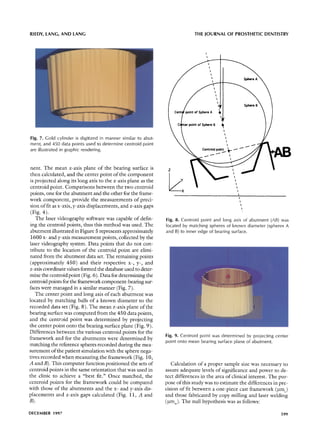
Fig. 1. Acrylic resin patient simulation model replicates eden-   Fig. 2. Framework positioned on abutments of patient simula-
tulous mandibular arch containing five osseointegrated im-        tion model to "best fit" relationship.
plants in symphysis region. Black reference spheres are essen-
tial for computer matching of framework to abutments. (Ar-
rows identify three reference spheres essential for computer      as opposed to selecting one specific laboratory. This ap-
matching of framework to abutments).                              proach was chosen because it would better represent the
                                                                  reality o f clinical practice. It would also reduce a situa-
                                                                  tion of bias, where the frameworks produced in one com-
ponents in (a) the one-piece cast framework or (b) the            mercial laboratory would not represent the variables
machined and laser-welded titanium framework.                     encountered with this fabrication process.
                                                                     For standardization in the design o f the cast one-piece
MATERIAL         AND METHODS
                                                                  framework, the commercial laboratories were provided
   An acrylic resin patient simulation model replicating          with detailed written instructions that included: (a) the
an edentulous mandibular arch was designed for this               type o f alloy, which dictated the investment, (b) waxing
project (Fig. ]). Five titanium implants (SDCA 062,               technique and materials, (c) sprue design, (d) casting
Nobel Biocare, Inc., Chicago, Ill.), 3.75 x 10 mm, were           technique, and (e) finishing sequence to be followed.
positioned in 1:he mandibular symphysis region, ante-             Instructions to the Procera laboratory included: (a) type
rior to the mental foremen. Standard 5.5 m m titanium             o f metal, (b) welding technique, and (c) the finishing
abutments (SDCA 005, Nobel Biocare, Inc.) were joined             sequence to be followed. Photographs o f the exact pat-
to the implants with abutment screws and tightened to             tern o f the framework design to be fabricated on the
20 Ncm.                                                           master cast were also provided to the laboratories. All
   Ten standardized master casts were made o f the simu-          frameworks were evaluated for compliance with these
lated mandible', model from 10 separate impressions by            directions when they were returned to the investigators.
using a controlled and repeatable technique. The tray                Laser videography ( M i t u t o y o / M T I Corp., Aurora,
design and the use o f an impression splint with an ap-           Ill.) was the m e t h o d selected to measure the precision
propriate impression material were factors to be consid-          o f fit between the abutments and the framework com-
ered in controlling the impression technique. Standard            ponents. This system combines a laser digitizer with a
stainless steel abutment replicas were joined to square           graphic computer program for both visual and numeri-
impression copings used in this impression procedure.             cal displays o f the linear data collected. The optic source
Die stone was poured into each impression to create 10            is a Gallium Arsenide laser ( M i t u t o y o / M T I Corp.) with
master casts.                                                     a wavelength o f 780 nm capable of measuring at the
   To control any influence that differences in the mas-          micron level. System software allowed plotting o f the
ter cast would have on the framework fabrication pro-             collected x-, y-, and z-axis data in a three-dimensional
cess, the master casts were randomly assigned to one o f          mode. The system accuracy is ±0.001 ram, and repeat-
two groups. For group 1, the master casts were assigned           ability tests measuring a calibration cast with five abut-
to the Procera laboratory for fabrication o f the machined        ments during five measurement sessions resulted in a
and laser-welded titanium frameworks. For group 2, the            standard deviation o f the mean x-axis o f 0.010 ram, the
master casts were randomly assigned to commercial den-            y-axis o f 0.010 ram, and the z-axis o f 0.001 ram.
tal laboratories selected in the Midwest United States               Three reference spheres essential to the computer
for fabrication o f a cast one-piece framework. Five dif-         matching of the framework to the abutments were in-
ferent laboratories, with a minimum o f 8 years experi-           corporated into the patient simulation model (Fig. 1).
ence in implant framework fabrication with the lost wax           One sphere was placed in the area o f the tongue space,
technique, were selected to fabricate the cast frameworks         while the other two were positioned on either side o f

DECEMBER 1997'                                                                                                                 597
THE JOURNAL OF PROSTHETIC DENTISTRY                                                                                             RIEDY, LANG, AND LANG


Fig. :3. Transfer impression in dental stone records "best fit"                            Fig. 5. Nobel Biocare standard abutment cylinder is digitized
orientation of framework to patient simulation model and                                   with laser videography system, and 1600 x-axis and y-axis
negatives of reference spheres (arrows).                                                   measurement points are illustrated in computer graphic ren-
                                                                                           dering.


  Z


(0,0,0)
                                         ore|..                  |   o,o ~ ,
                                                                          w           ~,

                       j     .   ojO                  ,w~....I                        i
                    oe I                o'~   ...                o       "''--        a
            o ele          ,,p~ ~'w~"               "'''-        o               -"


                                                                                           Fig. 6. After series of computer commands to remove hex
                                                                                           head, remaining 450 data points are used to determine cen-
                                                                                           troid point of abutment cylinder.

                                                                                      X
                                                                                           the most anterior (center) a b u t m e n t location and pro-
Fig. 4. X-, y-, and z-axis coordinate values for abutment cen-                             gressing posteriorly, the framework-bearing surfaces were
troid point@ (xl, yl, zl) at a specific prosthodontic interface is                         fitted to their respective abutments. When the "best fit"
compared with centroid point 0 (x2, y2, z2) for framework at                               was achieved, guide pins were positioned and tightened
this location to calculate linear differences in precision of fit.                         until initial resistance was met. A transfer impression in
                                                                                           dental stone was used to record the orientation o f the
                                                                                           framework to the patient simulation model and to the
the midline, anterior to the mandible. The patient simu-                                   reference spheres (Fig. 3). The stone impression with
lation model was positioned in the digitizer, and the ar-                                  the framework and the recorded "negatives" o f the ref-
eas to be measured were identified by the linked com-                                      erence spheres were positioned in the digitizer, and ar-
puter. A 6.0 m m 2 area that covered each a b u t m e n t was                              eas similar in dimensions to those used for the abut-
digitized with an x- and y-axis measurement matrix and                                     ments and reference spheres were digitized. Each frame-
0.100 m m between each data point. The area to be digi-                                    work c o m p o n e n t - b e a r i n g surface was digitized three
tized on each reference sphere was identified. Each bear-                                  times.
ing surface area o f the implant a b u t m e n t was digitized                                The centroid m e t h o d previously reported by Lie and
three times.                                                                               Jemt, ]6 and Tan et al) 7 was used to reduce the x-, y-,
   To measure the framework components, the frame-                                         and z-axis data collected from the bearing surface for
work was positioned on the abutments o f the patient                                       b o t h the abutments and framework components to a
simulation model, using a technique r e c o m m e n d e d in                               single point for fit measurements. This m e t h o d initially
the clinic to achieve a "best fit" (Fig. 2). Beginning with                                locates the center point and long axis o f each compo-

598                                                                                                                                VOLUME 78 NUMBER 6
RIEDY, LANG, AND LANG                                                         THE JOURNAL OF PROSTHETIC DENTISTRY


                                                                                      l
                                                                                          I
                                                                                              I
                                                                                                  l


                                                                                                      Il

                                                                                                           I
                                                                                                               l


                                                                                Sphere A


                                                                               of Sphere B


Fig. 7. Gold cylinder is digitized in manner similar to abut-                                                      i

ment, and 450 data points used to determine centroid point
are illustrated in graphic rendering.                                             Centroid                 point       ~        ~-~


                                                                                                                           t              ~ J


 nent. The mean z-axis plane of the bearing surface is           Z                                                             I
 then calculated, and the center point of the component                                                                         I
                                                                                                                                    I
 is projected along its long axis to the z-axis plane as the                                                                         I
                                                                                                                                         I
 centroid point. Comparisons between the two centroid                                                                                     I
                                                                       X                                                                      I
 points, one for the abutment and the other for the frame-                                                                                     I
                                                                                                                                                I
work component, provide the measurements of preci-                                                                                                  I
 sion of fit as x-axis, y-axis displacements, and z-axis gaps
 (Fig. 4).
    The laser videography software was capable of defin-        Fig. 8. Centroid point and long axis of abutment (AB) was
 ing the centroid points, thus this method was used. The        located by matching spheres of known diameter (spheres A
 abutment illusllated in Figure 5 represents approximately      and B) to inner edge of bearing surface.
 1600 x- and y-axis measurement points, collected by the
laser videography system. Data points that do not con-
tribute to the location of the centroid point are elimi-
nated from the abutment data set. The remaining points
 (approximately 450) and their respective x-, y-, and
z-axis coordinate values formed the database used to deter-
mine the centroid point (Fig. 6). Data for determining the
centroid points for the framework component-bearing sur-
faces were managed in a similar manner (Fig. 7).
    The center point and long axis of each abutment was
located by matching balls of a lr~nown diameter to the
recorded data set (Fig. 8). The mean z-axis plane of the
bearing surface was computed from the 450 data points,
and the centroid point was determined by projecting
the center point onto the bearing surface plane (Fig. 9).
Differences bewveen the various centroid points for the
                                                                Fig. 9. Centroid point was determined by projecting center
framework and for the abutments were determined by
                                                                point onto mean bearing surface plane of abutment.
matching the reference spheres recorded during the mea-
surement of the patient simulation with the sphere nega-
tives recorded when measuring the framework (Fig. 10,
A and B). This; computer function positioned the sets of           Calculation of a proper sample size was necessary to
centroid points in the same orientation that was used in        assure adequate levels of significance and power to de-
the clinic to achieve a "best fit." Once matched, the           tect differences in the area of clinical interest. The pur-
centroid poin'cs for the framework could be compared            pose of this study was to estimate the differences in pre-
with those of the abutments and the x- and y-axis dis-          cision of fit between a one-piece cast framework (lain)
placements and z-axis gaps calculated (Fig. 11, A and           and those fabricated by copy milling and laser welding
B).                                                             (gmw). The null hypothesis was as follows:

DECEMBER 1997                                                                                                                                           599
THE JOURNAL OF PROSTHETIC DENTISTRY                                                                      RIEDY, LANG, AND LANG


Fig. 10. A, Centroid points (arrows) were determined for all      Fig. 11. A, Fit between prosthetic gold cylinder in framework
abutments (green) and bearing surface components of frame-        (yellow) and abutment (green) in patient simulation model is
work (yellow). Reference spheres are also pictured. B, Com-       illustrated by computer graphic rendering. B, To demonstrate
puter-matched reference spheres of patient simulation model       relationship of centroid point for abutment (AB) to that of
with their negative representations recorded in stone transfer    framework component, computer graphic representation has
impression. This matching procedure produced same relation-       been illuminated to illustrate "best fit."
ship in computer at each prosthodontic interface that was
initially recorded when framework components (yellow) were
positioned on abutments (green) to "best fit."                    (50 to 10) or 0.045 m m . T h e standard deviation (6) for
                                                                  an experimental p o p u l a t i o n can be estimated as one
Table I. Establishing the experimental population                 f o u r t h o f the range; that is sigma = r a n g e / 4 or 0 . 0 4 5 /
                                                                  4 = 0.011 m m . For this study, an acceptable precision o f
 a                za/2                1 - fJ           zf~
                                                                  fit was established as o n e that w o u l d d e m o n s t r a t e a
0.100            1.645               0.800           0.840        z-axis gap between the framework and a b u t m e n t at the
0.050            1.960               0.850            1.030       centroid point o f less than 0.025 mm. The needed sample
0.025            2.240               0.900            1.282       size was calculated using the following formula:
0.010            2.576               0.950           1.645
                                                                                   N = 2(Zc~/2 + z[3) 2 x (~2/62

                                                                      T h e values for cq Zc~/2, 1 - ]5, and Z[3 are listed in
                         H o : Bm c = ~ m w                       T a b l e I. F o r this s t u d y , n = 2 ( 1 . 9 6 + 1 . 2 8 ) 2 "
while the alternative hypothesis was as follows:                  ( 0 . 0 1 1 ) 2 / ( 0 . 0 2 5 ) 2 , or n = 4.25, and therefore a sample
                                                                  size o f 5 was n e e d e d for each framework group. 18 F o r
                         Ha: p m c ~ ~ m w.                       this study, p o w e r = 1 - [3, and 13 = 0.1; therefore, p o w e r
   A n 0t "alpha" o f 0.05 and ~ " b e t a " o f 0.10 were used   = 1 - 0.1 = 0.9, m e a n i n g that a difference in the preci-
as levels o f statistical significance. I t was estimated that    sion o f fit o f the one-piece cast frameworks versus the
the range in precision o f fit for the one-piece castings         m a c h i n c d and laser-welded framcworks will be detected
w o u l d be 0 . 0 2 0 to 0 . 0 5 0 m m at the z-axis centroid    90% o f the time with a sample size o f n = 5.
points, and for the m a c h i n e d and laser-welded frame-           T h e statistical test selected for the analysis o f the data
w o r k w o u l d be 0.010 to 0.025 ram. Therefore the maxi-      was a t w o - w a y analysis o f variance (ANOVA). T h e level
m u m range differences w o u l d be - 5 (20 to 25) to 40         o f significance to reject the null-hypothesis w a s p _<0.05.

600                                                                                                          VOLUME 78       NUMBER 6
RIEDY, L A N G , A N D L A N G                                                                          THE J O U R N A L O F PROSTHETIC DENTISTRY


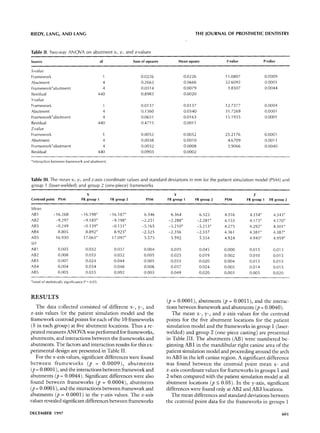
Table II. Two-way ANOVA on abutment x-, y-, and z-values
Source                                           df                    Sum of squares         Mean square              F-value             P-value

X-value
Framework                                             1                    0.0226                  0.0226             11.0807              0.0009
Abutment                                           4                       0.2663                  0.0666             32.6092              0.0001
Framework*abutment                                 4                       0.0314                  0.0079              3.8507              0.0044
Residual                                         440                       0.8983                  0.0020
Y-value
Framework                                          1                       0,0137                  0.0137             12.7377              0.0004
Abutment                                           4                       0,1360                  0.0340             31.7269              0.0001
Framework*abutment                                 4                       0.0651                  0.0163             15.1935              0.0001
Residual                                         440                       0.4715                  0.0011
Z-value
Framework                                             1                    0.0052                  0.0052             25.21 76             0.0001
Abutment                                           4                       0.0038                  0.0010              4.6709              0.0011
Framework*abutment                                 4                       0.0032                  0.0008              3.9066              0.0040
Residual                                         440                       0.0903                  0.0002

*interaction between framework and abutment.


Table !11. The mean x-, y-, and z-axis coordinate values and standard deviations in mm for the patient simulation model (PSM) and
group 1 (laser-welded) and group 2 (one-piece) frameworks
                                     X                                                      Y                                        Z
Centroid point PSM                FR group 1              FR group 2          PSM       FR group 1      FR group 2    PSM        FR group 1   FR group 2

/~ean
AB1            -16,268            -16.198"                -16.187"          6.346         6.364              6.323    4.316       4.334*        4.343*
AB2             -9.297             -9.185"                 -9.198"         -2.251        -2.288*            -2,281"   4.153       4,173"        4.I70"
AB3             -0,249             -0.139"                 -0.131"         -5.165        -5.210"            -5,213"   4.275       4.292*        4.301"
A84              8.805              8.892*                  8.925*         -2.325        -2.356             -2.337    4.361       4.381"        4.387*
AB5             16.930             17.065*                 17.097*          5.575         5.592              5.554    4,924       4.945*        4.959*
SD
AB1               0.005              0.032                  0.037            0.004        0.035              0.045    0.000       0,015         0.013
AB2               0.008              0.033                  0.032            0.005        0,025              0.019    0.002       0.010         0.015
AB3               0.007              0.024                  0.044            0.005        0.033              0.020    0.004       0,013         0.015
AB4               0.004              0.034                  0.048            0.006        0.037              0.024    0.005       0,014         0.015
AB5               0.005              0.035                  0.092            0.003        0.049              0.020    0.003       0.005         0.020

*Level of statistically significance P = 0.05.


RESULTS
                                                                                        (p = 0.0001), abutments (p = 0.0011), and the interac-
   The data collected consisted o f different x-, y-, and                               tions between framework and abutments (p = 0.0040).
z-axis values :For the patient simulation model and the                                    The mean x-, y-, and z-axis values for the centroid
framework centroid points for each o f the 10 frameworks                                points for the five abutment locations for the patient
(5 in each group) at five abutment locations. Thus a re-                                simulation model and the frameworks in group I (laser-
peated measm:es ANOVA was performed for frameworks,                                     welded) and group 2 (one-piece casting) are presented
abutments, and interactions between the frameworlcs and                                 in Table III. The abutments (AB) were numbered be-
abutments. The factors and interaction results for this ex-                             ginning AB 1 in the mandibular right canine area o f the
perimental design are presented in Table II.                                            patient simulation model and proceeding around the arch
   For the x-a~ds values, significant differences were found                            to AB5 in the left canine region. A significant difference
b e t w e e n f r a m e w o r k s (p = 0 . 0 0 0 9 ) , a b u t m e n t s                was found between the centroid point mean x- and
(p = 0.0001), and the interactions between framework and                                z-axis coordinate values for frameworks in groups 1 and
abutments (p = 0.0044). Significant differences were also                               2 when compared with the patient simulation model at all
found between frameworks (p = 0.0004), abutments                                        abutment locations (p < 0.05). In the y-axis, significant
(p = 0.0001 ), and the interactions between framework and                               differences were found only at AB2 and AB 3 locations.
abutments (p = 0.0001) in the y-axis values. The z-axis                                    The mean differences and standard deviations between
values revealed significant differences between frameworks                              the ccntroid point data for the frameworks in groups 1

DECEMBER 1997                                                                                                                                        601
THE JOURNAL OF PROSTHETIC DENTISTRY                                                                         RIEDY, LANG, AND LANG


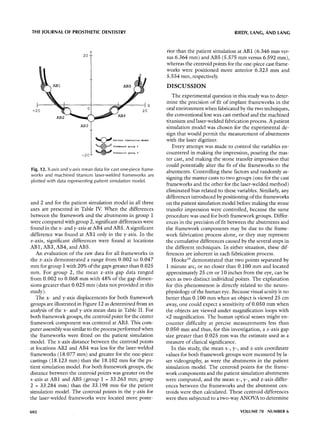
                               Y                                          rior than the patient simulation at AB1 (6.346 mm ver-
                          2O
                                                                          sus 6.364 ram) and AB5 (5.575 mm versus 6.592 mm),
                                                                          whereas the centroid points for the one-piece cast frame-
                                                                          works were positioned more anterior 6.323 m m and
                                                                          5.554 mm, respectively.
          ABI                                        AB5                  DISCUSSION
                                                                             The experimental question in this study was to deter-
                                                                          mine the precision o f fit o f implant frameworks in the
                                                            --I       x
 -20
                                                                          oral environment when fabricated by the two techniques,
                                                  AB4                     the conventional lost wax cast method and the machined
                                                                          titanium and laser-welded fabrication process. A patient
                                                                          simulation model was chosen for the experimental de-
                                                                          sign that would permit the measurement o f abutments
                                   ~           Patlent Simulation Model   with the laser digitizer.
                                   ~/~~    Framework group 1             Every attempt was made to control the variables en-
                                   ~Fra~work             group 2          countered in making the impression, pouring the mas-
                                                                          ter cast, and making the stone transfer impression that
                                                                          could potentially alter the fit o f the frameworks to the
Fig. 12. X-axis and y-axis mean data for cast one-piece frame-
                                                                          abutments. Controlling these factors and randomly as-
works and machined titanium laser-welded frameworks are
                                                                          signing the master casts to two groups (one for the cast
plotted with data representing patient simulation model.
                                                                          frameworks and the other for the laser-welded method)
                                                                          eliminated bias related to these variables. Similarly, any
                                                                          differences introduced by positioning o f the frameworks
and 2 and for the patient simulation model in all three                   on the patient simulation model before making the stone
axes are presented in Table IV. When the differences                      transfer impression were controlled, because the same
between the framework and the abuunents in group 1                        procedure was used for both framework groups. Differ-
were compared with group 2, significant differences were                  ences in the precision o f fit between the abutments and
found in the x- and y-axis arAB4 and AB5. A significant                   the framework components may be due to the frame-
difference was found at AB1 only in the y-axis. In the                    work fabrication process alone, or they may represent
z-axis, significant differences were found at locations                   the cumulative differences caused by the several steps in
AB1, AB3, AB4, and AB5.                                                   the different techniques. In either situation, these dif-
   An evaluation o f the raw data for all frameworks in                   ferences are inherent in each fabrication process.
the z-axis demonstrated a range from 0.002 to 0.047                          H o o k e 19 demonstrated that two points separated by
m m for group 1 with 20% o f the gaps greater than 0.025                  1 minute arc, or no closer than 0.100 mm and located
ram. For group 2, the mean z-axis gap data ranged                         approximately 25 cm or 10 inches from the eye, can be
from 0.002 to 0.068 m m with 48% o f the gap dimen-                       seen as two distinct individual points. The explanation
sions greater than 0.025 m m (data not provided in this                   for this p h e n o m e n o n is directly related to the neuro-
stu#).                                                                    physiology o f the human eye. Because visual acuity is no
   The x- and y-axis displacements for both framework                     better than 0.100 m m when an object is viewed 25 cm
groups are illustrated in Figure 12 as determined from an                 away, one could expect a sensitivity o f 0.050 m m when
analysis o f the x- and y-axis mean data in Table II. For                 the objects are viewed under magnification loops with
both framework groups, the centroid point for the center                  ×2 magnification. The human optical senses might en-
framework component was centered at AB3. This com-                        counter difficulty at precise measurements less than
puter assembly was similar to the process performed when                  0.050 m m and thus, for this investigation, a z-axis gap
the frameworks were fitted on the patient simulation                      size greater than 0.025 m m was the estimate used as a
model. The x-axis distance between the centroid points                    measure o f clinical significance.
at locations AB2 and AB4 was less for the laser-welded                       In this study, the mean x-, y-, and z-axis coordinate
frameworks (18.077 mm) and greater for the one-piece                      values for both framework groups were measured by la-
castings (18.123 ram) than the 18.102 mm for the pa-                      ser videography, as were the abutments in the patient
tient simulation model. For both framework groups, the                    simulation model. The centroid points for the frame-
distance between the centroid points was greater on the                   work components and the patient simulation abutments
x-axis at AB1 and AB5 (group 1 = 33.263 ram; group                        were computed, and the mean x-, y-, and z-axis differ-
2 = 33.284 mm) than the 33.198 mm for the patient                         ences between the frameworks and the abutment cen-
simulation model. The centroid points in the y-axis for                   troids were then calculated. These centroid differences
the laser-welded frameworks were located more poste-                      were then subjected to a two-way ANOVA to determine

602                                                                                                            VOLUME 78     NUMBER 6
RIEDY, LANG, AND LANG                                                          THE JOURNAL OF PROSTHETIC DENTISTRY


Fig. 13. A, Prosthodontic interface (arrow) between AB5         Fig. 14. A, Prosthodontic interface (arrow) between AB5 (abut-
(abutment) and framework component for cast one-piece           ment) and framework component for machined titanium la-
framework. B, C o m p u t e r graphic representation of         ser-welded framework. B, Reference spheres can be seen in
prosthodontic interface illustrated in A; reference spheres     computer graphic representation of prosthodontic interface
can be seen.                                                    of A.


whether significant differences existed between the two         the flat bearing surface. Either of these reasons can result
techniques for fabricating an implant framework.                in a gap at the centroid point and other locations at the
   Comparisons o f the mean coordinate values for the           interface (Figs. 13, A and B, and 14, A and B).
x-, y-, and z-axes for both framework groups to the pa-            Calculation o f the mean x-, y-, and z-axis differences
tient simulation model exhibited significant differences        between the framework groups and the patient simula-
(p < 0.05) (Table III). Obviously, something affected           tion abutments revealed significant differences in the
the precision o f fit o f the frameworks to the patient simu-   z-axis for framework to abutment interfaces at AB 1, AB 3,
lation model. The differences observed demonstrated             AB4, and AB5 (Table IV). For the laser-welded frame-
an influence by the techniques themselves.                      works (group 1), the mean z-axis gaps were 0.018 m m
   In every instance, a significant difference was found        and 0.021 mm for AB 1 and AB5, respectively. The mean
in the mean z-axis data for both framework groups, when         z-axis gaps for the one-piece frameworks at AB1 was
compared with the mean z-axis measurements for the              0.027 mm and, at AB5, the gap was 0.035 mm. A sig-
patient simulation model (Table III). These differences         nificant difference was also found at AB3 or the center
are more precisely determined because o f the 0.001 m m         a b u t m e n t l o c a t i o n w i t h the m e a n z-axis gap o f
resolution used[ to make the measurements and are in-           0.018 mm for laser-welded frameworks (group 1), and
fluenced by the: framework fabrication techniques.              the one-piece castings (group 2) being 0.026 mm. For
   The presence: o f a z-axis gap does not mean that there      abutment position AB4, the mean z-axis gap o f 0.019
is no contact at this interface. Contact may be occurring       m m was measured for the laser-welded frameworks
somewhere else around the circumference o f the bearing         (group 1), whereas the gap for the one-piece castings
surface. Contact may be occurring on the facial, lingual,       (group 2) was determined to be 0.026 mm.
mesial, or dista][ areas o f the bearing surface, or contact       The mean z-axis gaps were greater for the one-piece
may be occurring between the framework component and            castings. The magnitude o f the z-axis gap at the cen-
the inner vertical inclines o f the abutment, leading up to     troid points for the laser-welded frameworks ranged from

DECEMBER 1997                                                                                                                 603
THE JOURNAL OF PROSTHETIC DENTISTRY                                                                                          RIEDY, LANG, AND LANG


Table IV. The mean x-, y-, and z-axis differences and standard deviations in mm of the framework - a b u t m e n t PSM

                                    x                                            y                                                     z
Centroid point Group 1                           Group 2            Group 1                Group 2                    Group 1                   Group 2

Mean
AB1               0.069                          0.081               0.018*                 -0.023                     0.018*                     0.027
AB2               0.112                          0.099              -0.036                  -0.029                     0.020                      0.01 7
AB3               0.110                          0.118              -0.045                  -0.048                     0.01 8*                    0.026
AB4               0.087*                         0.120              -0.032*                 -0.012                     0.01 9*                    0.026
AB5               0.135*                         0.166               0.01 7*                -0.020                     0.021 *                    0.035
SD
AB1               0.033                          0.037               0.036                   0.045                     0.015                      0.013
AB2               0.034                          0.033               0.025                   0.020                     0.010                      0.016
AB3               0.025                          0.044               0.033                   0.021                     0.013                      0.015
AB4               0.034                          0.048               0.038                   0.025                     0.015                      0.016
AB5               0.035                          0.092               0.049                   0.020                     0.006                      0.020

*Level of statistically significance P = 0.05.


0.018 m m at AB3 (center) and AB1 (fight posterior) to                               system -- clinical studies. Aust Prosthodont J 1993;7(Supp):45-9.
0.021 m m at AB5 (left posterior). The small mean vari-                           5. Gregory M, Murphy WM, Scott J, Watson CJ, Reeve PK. A clinical study of
                                                                                     the Br&nemark dental implant system. Br Dent J 1990;168:18-23.
ance (0.003 ram) among the five abutment locations                                6. Zarb GA, Schmitt A. The longitudinal effectiveness of osseointegrated
for the laser-welded frameworks seemed to indicate                                   dental implants: the Toronto study. Part IIh problems and complications
consistency and a more precise fit with this technique.                              encountered. J Prosthet Dent 1990;64:185-94.
                                                                                  7. Johansson G, Palmqvist S. Complications, supplementary treatment, and
The z-axis gap for the one-piece castings ranged from                                maintenance in edentulous arches with implant-supported fixed prosthe-
0.017 m m at AB2 (fight anterior) to 0.035 mm at AB5                                 sis. Int J Prosthodont 1990;3:89-92.
(left posterior) or a variance o f 0.018 ram.                                     8. Jewt T, Linden B, Lekholm U. Failures and complications in 127 consecu-
                                                                                     tively placed fixed partial prostheses supported by Br&nemark implants:
                                                                                     from prosthetic treatment to first annual checkup, lnt J Oral Maxillofac
CONCLUSIONS                                                                          Implants 1992;7:40-4.
                                                                                  9. Patterson EA, Johns RB. Theoretical analysis of the fatigue life of fixture
   Within the limitations o f this study, the following con-
                                                                                     screws in osseointegrated dental implants. Int J Oral Maxi[Iofac Implants
clusions were drawn.                                                                 1992;7:26-34.
    1. There were significant differences in the precision                       10. Carlson B, Carlsson GE. Prosthodontic complications in osseointegrated
                                                                                     dental implant treatment. Int J Oral Maxillofac Implants 1994;9:90-4.
o f fit between both the machined titanium laser-welded
                                                                                 11. Hoshaw S, Brunski J, Cochran G. Mechanical loading of Br&nemark fix-
frameworks and the cast one-piece frameworks, when                                   tures affects interfacial bone modeling and remodeling. [nt J Oral Maxillofac
compared with the abutments in the patient simulation                                Implants 1994;9:345-60.
                                                                                 12. Albrektsson T. On long-term maintenance of the osseointegrated response.
model.
                                                                                     Aust Prosthodont J 1993;7(Supp):l 5-24.
    2. The machined titanium laser-welded frameworks                             13. Carr AB, Stewart RB. Full-arch implant framework casting accuracy. Pre-
exhibited a more precise fit than the cast one-piece frame-                          liminary in vitro observation for in vivo testing. J Prosthodont 1993;2:2-8.
                                                                                 14. White GE. Osseointegrated dental technology. Chicago: Quintessence
works, with significant differences at four o f the five
                                                                                     Publishing; 1993. p. 78-90.
prosthodontic interfaces, when evaluated by the mean                             15. Jemt T, Linden B. Fixed implant-supported prostheses with welded tita-
z-axis gap at the centroid points.                                                   nium frameworks. [ntJ Periodont Rest Dent 1992;12:177-83.
                                                                                 16. Lie A, Jemt T. Photogrammetric measurements of implant positions. De-
    3. The machined titanium laser-welded frameworks                                 scription of a technique to determine the fit between implants and super-
exhibited less than a 25 ]am gap in the mean z-axis mea-                             structures. J Oral Impl Res 1994;5:1-7.
surement at all five o f the framework to abutment inter-                        17. Tan KB, Rubenstein JE, Nicholls JE, Yuodelis RA. Three-dimensional analy-
                                                                                     sis of the casting accuracy of one-piece, osseointegrated implant-retained
faces.                                                                               prostheses. Int J Prosthodont 1993;6:346-63.
   We acknowledge the contributions by Mr. Rui-Feng Wang, Re-                    18. Fleiss JL, Kingman A. Statistical management of data in clinical research.
search Associate, Department of Prosthodontics, School of Dentistry,                 Crit Rev Oral Blot Med 1990;1:55-66.
                                                                                 19. Overheim RD, Wagner DL. Light and color. New York:John Wiley; 1982.
University of Michigan, in conducting the statistical analysis of the
                                                                                     p. 163-70.
data.
                                                                                 Reprint requests to:
REFERENCES                                                                       DR. STEPHEN RIEDY
                                                                                             J.
 1. American National Standards Institute. Industrial engineering terminology.   44790 CHARNWOdDDR.
    Revised edition, Norcross (GA): ANSI Z94.0; 1989. p. 07-02, 07-20, 07-       PLYMOUTH,M[ 48170
    58, 08-02, 08-19, 17-02.
 2. Rangert B, Jemt T, Jorneus L. Forces and moments on Br&nemark implants.      Copyright © 1997 by The Editorial Council of The Journal of Prosthetic Den-
    Int J Oral Maxillofac Implants 1989;4:241-7.                                    tistry.
 3. RangertB. Mechanical and biomechanical guidelines for the use of Br&nemark   0022-3913/97/$5.00 + O. 10/1/84266
    system -- general studies. Aust Prosthodont J 1993;7(Supp):39-44.
 4. RangertB. Mechanical and biomechanical guidelines for the use of Br~nemark


604                                                                                                                              V O L U M E 78    NUMBER 6

11

  • 1.
    RESEARCHAND EDUCATION Fit of implant frameworks fabricated by different techniques Stephen I. Riedy, DDS, MS, ~ Brien R. Lang, DDS, MS, b and Beth E. Lang, BAc School of Dentistry, University of Michigan, Ann Arbor, Mich. P u r p o s e . This study evaluated the precision of fit betwcen an implant framework and a patient simulation model that consisted of five implant abutments located in the mandibular symphysis area. One-piece cast frameworks were compared with Procera machined and laser-welded frameworks with laser videography. M a t e r i a l a n d m e t h o d s . Five frameworks of each type were measured with a laser digitizer and a graphics computer program to determine a single point represented as the "Centroid" for each framework component and each implant abutment. Differences between the paired centroids for each framework/ abutment interface are reported as x- and y-axis displacements, and z-axis gaps. The direction of the x- and y-axis displacements was determined. Results. There were significant differences (p < 0.05) in the precision of fit between both the one-piece cast frameworks and the Procera frameworks, when compared with the abutments in the patient simulation model. The laser-welded tYamework exhibited a more precise fit than the one-piece casting, with significant differences at four of the five prosthodontic interfaces, when evaluated by the mean z-axis gap at the centroid points. (J Prosthet Dent 1997;78:596-604.) The precision o f fit or the closeness o f the clear- niques that are currently used in a majority o f clinical ance between the bearing surfaces o f the implant abut- situations. One is the conventional lost wax technique, m e n t and implant c o m p o n e n t housed within a prosthe- which is used to cast one-piece full-arch implant frame- sis framework 1 has been questioned as being a signifi- works. The other involves copy milling sections o f an cant factor in: stress transfer, 2 the biomechanics o f an acrylic resin framework pattern in grade 2 titanium and implant system, 3,4 the occurrence o f complications, ~ 10 then laser welding the sections together (Procera sys- and the response o f the host tissues at the biological tem, N o b e l Biocare, AB, G/Steborg, Sweden). The pre- interface.ll,12 An i m p o r t a n t question asked by clinicians cision o f fit achieved with these two techniques has been is: ~'What precision o f fit is achievable in clinical prac- reported by several investigators. Cart and Stewart 13 tice, and is the fit different when frameworks are fabri- determined that the conventional lost wax technique, cated by different techniques?" to produce a one-piece full-arch implant framework, was I f the precision o f fit or gap between a framework and imprecise and inaccurate as judged against their passive the abutments is excessive, then the effect o f fit on the fit requirements. However, White 14 has claimed that the biologic interface may become extremely important. cast one-piece Sheffield frameworks satisfy the one-screw There are m a n y factors that can influence the precision fitting test. According to White, .4 corrective soldering o f fit achieved, including the manufacture o f implant has not been required with the Sheffield frameworks, components and the several clinical and laboratory steps and no implant or implant prosthodontic c o m p o n e n t involved in the restoration o f the edentulous situation. has broken since 1985. This information is based on Impression maldng, production o f the master cast, and retrospective observations and has not been subjected framework fabrication can accumulatively influence the to scientific validation. Jemt and Linden is found that fit observed by the clinician when the framework is fit- machined and laser-welded titanium frameworks have a ted to the abutments in the oral environment. better fit to the abutments than do the cast frameworks. There are two implant framework fabrication tech- Recognizing the need for additional scientific docu- mentation on the precision o f fit achieved by these two Presented before the Academy of Prosthodontic's Annual Meeting, framework fabrication techniques, this study was initi- Orlando, Fla., May 1994. ated to examine thc null hypothesis that there are no ~Adjunct Assistant Professor, Department of Prosthodontics. bprofessor and Chair, Department of Prosthodontics. differences in the precision o f fit between the abutments CResearch Assistant, Department of Prosthodontics. o f a patient simulation model and the prosthetic corn- 596 THE JOURNAL OF PROSTHETIC DENTISTRY VOLUME 78 NUMBER 6
  • 2.
    RIEDY, LANG, AN D LANG THE JOURNAL OF PROSTHETIC DENTISTRY Fig. 1. Acrylic resin patient simulation model replicates eden- Fig. 2. Framework positioned on abutments of patient simula- tulous mandibular arch containing five osseointegrated im- tion model to "best fit" relationship. plants in symphysis region. Black reference spheres are essen- tial for computer matching of framework to abutments. (Ar- rows identify three reference spheres essential for computer as opposed to selecting one specific laboratory. This ap- matching of framework to abutments). proach was chosen because it would better represent the reality o f clinical practice. It would also reduce a situa- tion of bias, where the frameworks produced in one com- ponents in (a) the one-piece cast framework or (b) the mercial laboratory would not represent the variables machined and laser-welded titanium framework. encountered with this fabrication process. For standardization in the design o f the cast one-piece MATERIAL AND METHODS framework, the commercial laboratories were provided An acrylic resin patient simulation model replicating with detailed written instructions that included: (a) the an edentulous mandibular arch was designed for this type o f alloy, which dictated the investment, (b) waxing project (Fig. ]). Five titanium implants (SDCA 062, technique and materials, (c) sprue design, (d) casting Nobel Biocare, Inc., Chicago, Ill.), 3.75 x 10 mm, were technique, and (e) finishing sequence to be followed. positioned in 1:he mandibular symphysis region, ante- Instructions to the Procera laboratory included: (a) type rior to the mental foremen. Standard 5.5 m m titanium o f metal, (b) welding technique, and (c) the finishing abutments (SDCA 005, Nobel Biocare, Inc.) were joined sequence to be followed. Photographs o f the exact pat- to the implants with abutment screws and tightened to tern o f the framework design to be fabricated on the 20 Ncm. master cast were also provided to the laboratories. All Ten standardized master casts were made o f the simu- frameworks were evaluated for compliance with these lated mandible', model from 10 separate impressions by directions when they were returned to the investigators. using a controlled and repeatable technique. The tray Laser videography ( M i t u t o y o / M T I Corp., Aurora, design and the use o f an impression splint with an ap- Ill.) was the m e t h o d selected to measure the precision propriate impression material were factors to be consid- o f fit between the abutments and the framework com- ered in controlling the impression technique. Standard ponents. This system combines a laser digitizer with a stainless steel abutment replicas were joined to square graphic computer program for both visual and numeri- impression copings used in this impression procedure. cal displays o f the linear data collected. The optic source Die stone was poured into each impression to create 10 is a Gallium Arsenide laser ( M i t u t o y o / M T I Corp.) with master casts. a wavelength o f 780 nm capable of measuring at the To control any influence that differences in the mas- micron level. System software allowed plotting o f the ter cast would have on the framework fabrication pro- collected x-, y-, and z-axis data in a three-dimensional cess, the master casts were randomly assigned to one o f mode. The system accuracy is ±0.001 ram, and repeat- two groups. For group 1, the master casts were assigned ability tests measuring a calibration cast with five abut- to the Procera laboratory for fabrication o f the machined ments during five measurement sessions resulted in a and laser-welded titanium frameworks. For group 2, the standard deviation o f the mean x-axis o f 0.010 ram, the master casts were randomly assigned to commercial den- y-axis o f 0.010 ram, and the z-axis o f 0.001 ram. tal laboratories selected in the Midwest United States Three reference spheres essential to the computer for fabrication o f a cast one-piece framework. Five dif- matching of the framework to the abutments were in- ferent laboratories, with a minimum o f 8 years experi- corporated into the patient simulation model (Fig. 1). ence in implant framework fabrication with the lost wax One sphere was placed in the area o f the tongue space, technique, were selected to fabricate the cast frameworks while the other two were positioned on either side o f DECEMBER 1997' 597
  • 3.
    THE JOURNAL OFPROSTHETIC DENTISTRY RIEDY, LANG, AND LANG Fig. :3. Transfer impression in dental stone records "best fit" Fig. 5. Nobel Biocare standard abutment cylinder is digitized orientation of framework to patient simulation model and with laser videography system, and 1600 x-axis and y-axis negatives of reference spheres (arrows). measurement points are illustrated in computer graphic ren- dering. Z (0,0,0) ore|.. | o,o ~ , w ~, j . ojO ,w~....I i oe I o'~ ... o "''-- a o ele ,,p~ ~'w~" "'''- o -" Fig. 6. After series of computer commands to remove hex head, remaining 450 data points are used to determine cen- troid point of abutment cylinder. X the most anterior (center) a b u t m e n t location and pro- Fig. 4. X-, y-, and z-axis coordinate values for abutment cen- gressing posteriorly, the framework-bearing surfaces were troid point@ (xl, yl, zl) at a specific prosthodontic interface is fitted to their respective abutments. When the "best fit" compared with centroid point 0 (x2, y2, z2) for framework at was achieved, guide pins were positioned and tightened this location to calculate linear differences in precision of fit. until initial resistance was met. A transfer impression in dental stone was used to record the orientation o f the framework to the patient simulation model and to the the midline, anterior to the mandible. The patient simu- reference spheres (Fig. 3). The stone impression with lation model was positioned in the digitizer, and the ar- the framework and the recorded "negatives" o f the ref- eas to be measured were identified by the linked com- erence spheres were positioned in the digitizer, and ar- puter. A 6.0 m m 2 area that covered each a b u t m e n t was eas similar in dimensions to those used for the abut- digitized with an x- and y-axis measurement matrix and ments and reference spheres were digitized. Each frame- 0.100 m m between each data point. The area to be digi- work c o m p o n e n t - b e a r i n g surface was digitized three tized on each reference sphere was identified. Each bear- times. ing surface area o f the implant a b u t m e n t was digitized The centroid m e t h o d previously reported by Lie and three times. Jemt, ]6 and Tan et al) 7 was used to reduce the x-, y-, To measure the framework components, the frame- and z-axis data collected from the bearing surface for work was positioned on the abutments o f the patient b o t h the abutments and framework components to a simulation model, using a technique r e c o m m e n d e d in single point for fit measurements. This m e t h o d initially the clinic to achieve a "best fit" (Fig. 2). Beginning with locates the center point and long axis o f each compo- 598 VOLUME 78 NUMBER 6
  • 4.
    RIEDY, LANG, ANDLANG THE JOURNAL OF PROSTHETIC DENTISTRY l I I l Il I l Sphere A of Sphere B Fig. 7. Gold cylinder is digitized in manner similar to abut- i ment, and 450 data points used to determine centroid point are illustrated in graphic rendering. Centroid point ~ ~-~ t ~ J nent. The mean z-axis plane of the bearing surface is Z I then calculated, and the center point of the component I I is projected along its long axis to the z-axis plane as the I I centroid point. Comparisons between the two centroid I X I points, one for the abutment and the other for the frame- I I work component, provide the measurements of preci- I sion of fit as x-axis, y-axis displacements, and z-axis gaps (Fig. 4). The laser videography software was capable of defin- Fig. 8. Centroid point and long axis of abutment (AB) was ing the centroid points, thus this method was used. The located by matching spheres of known diameter (spheres A abutment illusllated in Figure 5 represents approximately and B) to inner edge of bearing surface. 1600 x- and y-axis measurement points, collected by the laser videography system. Data points that do not con- tribute to the location of the centroid point are elimi- nated from the abutment data set. The remaining points (approximately 450) and their respective x-, y-, and z-axis coordinate values formed the database used to deter- mine the centroid point (Fig. 6). Data for determining the centroid points for the framework component-bearing sur- faces were managed in a similar manner (Fig. 7). The center point and long axis of each abutment was located by matching balls of a lr~nown diameter to the recorded data set (Fig. 8). The mean z-axis plane of the bearing surface was computed from the 450 data points, and the centroid point was determined by projecting the center point onto the bearing surface plane (Fig. 9). Differences bewveen the various centroid points for the Fig. 9. Centroid point was determined by projecting center framework and for the abutments were determined by point onto mean bearing surface plane of abutment. matching the reference spheres recorded during the mea- surement of the patient simulation with the sphere nega- tives recorded when measuring the framework (Fig. 10, A and B). This; computer function positioned the sets of Calculation of a proper sample size was necessary to centroid points in the same orientation that was used in assure adequate levels of significance and power to de- the clinic to achieve a "best fit." Once matched, the tect differences in the area of clinical interest. The pur- centroid poin'cs for the framework could be compared pose of this study was to estimate the differences in pre- with those of the abutments and the x- and y-axis dis- cision of fit between a one-piece cast framework (lain) placements and z-axis gaps calculated (Fig. 11, A and and those fabricated by copy milling and laser welding B). (gmw). The null hypothesis was as follows: DECEMBER 1997 599
  • 5.
    THE JOURNAL OFPROSTHETIC DENTISTRY RIEDY, LANG, AND LANG Fig. 10. A, Centroid points (arrows) were determined for all Fig. 11. A, Fit between prosthetic gold cylinder in framework abutments (green) and bearing surface components of frame- (yellow) and abutment (green) in patient simulation model is work (yellow). Reference spheres are also pictured. B, Com- illustrated by computer graphic rendering. B, To demonstrate puter-matched reference spheres of patient simulation model relationship of centroid point for abutment (AB) to that of with their negative representations recorded in stone transfer framework component, computer graphic representation has impression. This matching procedure produced same relation- been illuminated to illustrate "best fit." ship in computer at each prosthodontic interface that was initially recorded when framework components (yellow) were positioned on abutments (green) to "best fit." (50 to 10) or 0.045 m m . T h e standard deviation (6) for an experimental p o p u l a t i o n can be estimated as one Table I. Establishing the experimental population f o u r t h o f the range; that is sigma = r a n g e / 4 or 0 . 0 4 5 / 4 = 0.011 m m . For this study, an acceptable precision o f a za/2 1 - fJ zf~ fit was established as o n e that w o u l d d e m o n s t r a t e a 0.100 1.645 0.800 0.840 z-axis gap between the framework and a b u t m e n t at the 0.050 1.960 0.850 1.030 centroid point o f less than 0.025 mm. The needed sample 0.025 2.240 0.900 1.282 size was calculated using the following formula: 0.010 2.576 0.950 1.645 N = 2(Zc~/2 + z[3) 2 x (~2/62 T h e values for cq Zc~/2, 1 - ]5, and Z[3 are listed in H o : Bm c = ~ m w T a b l e I. F o r this s t u d y , n = 2 ( 1 . 9 6 + 1 . 2 8 ) 2 " while the alternative hypothesis was as follows: ( 0 . 0 1 1 ) 2 / ( 0 . 0 2 5 ) 2 , or n = 4.25, and therefore a sample size o f 5 was n e e d e d for each framework group. 18 F o r Ha: p m c ~ ~ m w. this study, p o w e r = 1 - [3, and 13 = 0.1; therefore, p o w e r A n 0t "alpha" o f 0.05 and ~ " b e t a " o f 0.10 were used = 1 - 0.1 = 0.9, m e a n i n g that a difference in the preci- as levels o f statistical significance. I t was estimated that sion o f fit o f the one-piece cast frameworks versus the the range in precision o f fit for the one-piece castings m a c h i n c d and laser-welded framcworks will be detected w o u l d be 0 . 0 2 0 to 0 . 0 5 0 m m at the z-axis centroid 90% o f the time with a sample size o f n = 5. points, and for the m a c h i n e d and laser-welded frame- T h e statistical test selected for the analysis o f the data w o r k w o u l d be 0.010 to 0.025 ram. Therefore the maxi- was a t w o - w a y analysis o f variance (ANOVA). T h e level m u m range differences w o u l d be - 5 (20 to 25) to 40 o f significance to reject the null-hypothesis w a s p _<0.05. 600 VOLUME 78 NUMBER 6
  • 6.
    RIEDY, L AN G , A N D L A N G THE J O U R N A L O F PROSTHETIC DENTISTRY Table II. Two-way ANOVA on abutment x-, y-, and z-values Source df Sum of squares Mean square F-value P-value X-value Framework 1 0.0226 0.0226 11.0807 0.0009 Abutment 4 0.2663 0.0666 32.6092 0.0001 Framework*abutment 4 0.0314 0.0079 3.8507 0.0044 Residual 440 0.8983 0.0020 Y-value Framework 1 0,0137 0.0137 12.7377 0.0004 Abutment 4 0,1360 0.0340 31.7269 0.0001 Framework*abutment 4 0.0651 0.0163 15.1935 0.0001 Residual 440 0.4715 0.0011 Z-value Framework 1 0.0052 0.0052 25.21 76 0.0001 Abutment 4 0.0038 0.0010 4.6709 0.0011 Framework*abutment 4 0.0032 0.0008 3.9066 0.0040 Residual 440 0.0903 0.0002 *interaction between framework and abutment. Table !11. The mean x-, y-, and z-axis coordinate values and standard deviations in mm for the patient simulation model (PSM) and group 1 (laser-welded) and group 2 (one-piece) frameworks X Y Z Centroid point PSM FR group 1 FR group 2 PSM FR group 1 FR group 2 PSM FR group 1 FR group 2 /~ean AB1 -16,268 -16.198" -16.187" 6.346 6.364 6.323 4.316 4.334* 4.343* AB2 -9.297 -9.185" -9.198" -2.251 -2.288* -2,281" 4.153 4,173" 4.I70" AB3 -0,249 -0.139" -0.131" -5.165 -5.210" -5,213" 4.275 4.292* 4.301" A84 8.805 8.892* 8.925* -2.325 -2.356 -2.337 4.361 4.381" 4.387* AB5 16.930 17.065* 17.097* 5.575 5.592 5.554 4,924 4.945* 4.959* SD AB1 0.005 0.032 0.037 0.004 0.035 0.045 0.000 0,015 0.013 AB2 0.008 0.033 0.032 0.005 0,025 0.019 0.002 0.010 0.015 AB3 0.007 0.024 0.044 0.005 0.033 0.020 0.004 0,013 0.015 AB4 0.004 0.034 0.048 0.006 0.037 0.024 0.005 0,014 0.015 AB5 0.005 0.035 0.092 0.003 0.049 0.020 0.003 0.005 0.020 *Level of statistically significance P = 0.05. RESULTS (p = 0.0001), abutments (p = 0.0011), and the interac- The data collected consisted o f different x-, y-, and tions between framework and abutments (p = 0.0040). z-axis values :For the patient simulation model and the The mean x-, y-, and z-axis values for the centroid framework centroid points for each o f the 10 frameworks points for the five abutment locations for the patient (5 in each group) at five abutment locations. Thus a re- simulation model and the frameworks in group I (laser- peated measm:es ANOVA was performed for frameworks, welded) and group 2 (one-piece casting) are presented abutments, and interactions between the frameworlcs and in Table III. The abutments (AB) were numbered be- abutments. The factors and interaction results for this ex- ginning AB 1 in the mandibular right canine area o f the perimental design are presented in Table II. patient simulation model and proceeding around the arch For the x-a~ds values, significant differences were found to AB5 in the left canine region. A significant difference b e t w e e n f r a m e w o r k s (p = 0 . 0 0 0 9 ) , a b u t m e n t s was found between the centroid point mean x- and (p = 0.0001), and the interactions between framework and z-axis coordinate values for frameworks in groups 1 and abutments (p = 0.0044). Significant differences were also 2 when compared with the patient simulation model at all found between frameworks (p = 0.0004), abutments abutment locations (p < 0.05). In the y-axis, significant (p = 0.0001 ), and the interactions between framework and differences were found only at AB2 and AB 3 locations. abutments (p = 0.0001) in the y-axis values. The z-axis The mean differences and standard deviations between values revealed significant differences between frameworks the ccntroid point data for the frameworks in groups 1 DECEMBER 1997 601
  • 7.
    THE JOURNAL OFPROSTHETIC DENTISTRY RIEDY, LANG, AND LANG Y rior than the patient simulation at AB1 (6.346 mm ver- 2O sus 6.364 ram) and AB5 (5.575 mm versus 6.592 mm), whereas the centroid points for the one-piece cast frame- works were positioned more anterior 6.323 m m and 5.554 mm, respectively. ABI AB5 DISCUSSION The experimental question in this study was to deter- mine the precision o f fit o f implant frameworks in the --I x -20 oral environment when fabricated by the two techniques, AB4 the conventional lost wax cast method and the machined titanium and laser-welded fabrication process. A patient simulation model was chosen for the experimental de- sign that would permit the measurement o f abutments ~ Patlent Simulation Model with the laser digitizer. ~/~~ Framework group 1 Every attempt was made to control the variables en- ~Fra~work group 2 countered in making the impression, pouring the mas- ter cast, and making the stone transfer impression that could potentially alter the fit o f the frameworks to the Fig. 12. X-axis and y-axis mean data for cast one-piece frame- abutments. Controlling these factors and randomly as- works and machined titanium laser-welded frameworks are signing the master casts to two groups (one for the cast plotted with data representing patient simulation model. frameworks and the other for the laser-welded method) eliminated bias related to these variables. Similarly, any differences introduced by positioning o f the frameworks and 2 and for the patient simulation model in all three on the patient simulation model before making the stone axes are presented in Table IV. When the differences transfer impression were controlled, because the same between the framework and the abuunents in group 1 procedure was used for both framework groups. Differ- were compared with group 2, significant differences were ences in the precision o f fit between the abutments and found in the x- and y-axis arAB4 and AB5. A significant the framework components may be due to the frame- difference was found at AB1 only in the y-axis. In the work fabrication process alone, or they may represent z-axis, significant differences were found at locations the cumulative differences caused by the several steps in AB1, AB3, AB4, and AB5. the different techniques. In either situation, these dif- An evaluation o f the raw data for all frameworks in ferences are inherent in each fabrication process. the z-axis demonstrated a range from 0.002 to 0.047 H o o k e 19 demonstrated that two points separated by m m for group 1 with 20% o f the gaps greater than 0.025 1 minute arc, or no closer than 0.100 mm and located ram. For group 2, the mean z-axis gap data ranged approximately 25 cm or 10 inches from the eye, can be from 0.002 to 0.068 m m with 48% o f the gap dimen- seen as two distinct individual points. The explanation sions greater than 0.025 m m (data not provided in this for this p h e n o m e n o n is directly related to the neuro- stu#). physiology o f the human eye. Because visual acuity is no The x- and y-axis displacements for both framework better than 0.100 m m when an object is viewed 25 cm groups are illustrated in Figure 12 as determined from an away, one could expect a sensitivity o f 0.050 m m when analysis o f the x- and y-axis mean data in Table II. For the objects are viewed under magnification loops with both framework groups, the centroid point for the center ×2 magnification. The human optical senses might en- framework component was centered at AB3. This com- counter difficulty at precise measurements less than puter assembly was similar to the process performed when 0.050 m m and thus, for this investigation, a z-axis gap the frameworks were fitted on the patient simulation size greater than 0.025 m m was the estimate used as a model. The x-axis distance between the centroid points measure o f clinical significance. at locations AB2 and AB4 was less for the laser-welded In this study, the mean x-, y-, and z-axis coordinate frameworks (18.077 mm) and greater for the one-piece values for both framework groups were measured by la- castings (18.123 ram) than the 18.102 mm for the pa- ser videography, as were the abutments in the patient tient simulation model. For both framework groups, the simulation model. The centroid points for the frame- distance between the centroid points was greater on the work components and the patient simulation abutments x-axis at AB1 and AB5 (group 1 = 33.263 ram; group were computed, and the mean x-, y-, and z-axis differ- 2 = 33.284 mm) than the 33.198 mm for the patient ences between the frameworks and the abutment cen- simulation model. The centroid points in the y-axis for troids were then calculated. These centroid differences the laser-welded frameworks were located more poste- were then subjected to a two-way ANOVA to determine 602 VOLUME 78 NUMBER 6
  • 8.
    RIEDY, LANG, ANDLANG THE JOURNAL OF PROSTHETIC DENTISTRY Fig. 13. A, Prosthodontic interface (arrow) between AB5 Fig. 14. A, Prosthodontic interface (arrow) between AB5 (abut- (abutment) and framework component for cast one-piece ment) and framework component for machined titanium la- framework. B, C o m p u t e r graphic representation of ser-welded framework. B, Reference spheres can be seen in prosthodontic interface illustrated in A; reference spheres computer graphic representation of prosthodontic interface can be seen. of A. whether significant differences existed between the two the flat bearing surface. Either of these reasons can result techniques for fabricating an implant framework. in a gap at the centroid point and other locations at the Comparisons o f the mean coordinate values for the interface (Figs. 13, A and B, and 14, A and B). x-, y-, and z-axes for both framework groups to the pa- Calculation o f the mean x-, y-, and z-axis differences tient simulation model exhibited significant differences between the framework groups and the patient simula- (p < 0.05) (Table III). Obviously, something affected tion abutments revealed significant differences in the the precision o f fit o f the frameworks to the patient simu- z-axis for framework to abutment interfaces at AB 1, AB 3, lation model. The differences observed demonstrated AB4, and AB5 (Table IV). For the laser-welded frame- an influence by the techniques themselves. works (group 1), the mean z-axis gaps were 0.018 m m In every instance, a significant difference was found and 0.021 mm for AB 1 and AB5, respectively. The mean in the mean z-axis data for both framework groups, when z-axis gaps for the one-piece frameworks at AB1 was compared with the mean z-axis measurements for the 0.027 mm and, at AB5, the gap was 0.035 mm. A sig- patient simulation model (Table III). These differences nificant difference was also found at AB3 or the center are more precisely determined because o f the 0.001 m m a b u t m e n t l o c a t i o n w i t h the m e a n z-axis gap o f resolution used[ to make the measurements and are in- 0.018 mm for laser-welded frameworks (group 1), and fluenced by the: framework fabrication techniques. the one-piece castings (group 2) being 0.026 mm. For The presence: o f a z-axis gap does not mean that there abutment position AB4, the mean z-axis gap o f 0.019 is no contact at this interface. Contact may be occurring m m was measured for the laser-welded frameworks somewhere else around the circumference o f the bearing (group 1), whereas the gap for the one-piece castings surface. Contact may be occurring on the facial, lingual, (group 2) was determined to be 0.026 mm. mesial, or dista][ areas o f the bearing surface, or contact The mean z-axis gaps were greater for the one-piece may be occurring between the framework component and castings. The magnitude o f the z-axis gap at the cen- the inner vertical inclines o f the abutment, leading up to troid points for the laser-welded frameworks ranged from DECEMBER 1997 603
  • 9.
    THE JOURNAL OFPROSTHETIC DENTISTRY RIEDY, LANG, AND LANG Table IV. The mean x-, y-, and z-axis differences and standard deviations in mm of the framework - a b u t m e n t PSM x y z Centroid point Group 1 Group 2 Group 1 Group 2 Group 1 Group 2 Mean AB1 0.069 0.081 0.018* -0.023 0.018* 0.027 AB2 0.112 0.099 -0.036 -0.029 0.020 0.01 7 AB3 0.110 0.118 -0.045 -0.048 0.01 8* 0.026 AB4 0.087* 0.120 -0.032* -0.012 0.01 9* 0.026 AB5 0.135* 0.166 0.01 7* -0.020 0.021 * 0.035 SD AB1 0.033 0.037 0.036 0.045 0.015 0.013 AB2 0.034 0.033 0.025 0.020 0.010 0.016 AB3 0.025 0.044 0.033 0.021 0.013 0.015 AB4 0.034 0.048 0.038 0.025 0.015 0.016 AB5 0.035 0.092 0.049 0.020 0.006 0.020 *Level of statistically significance P = 0.05. 0.018 m m at AB3 (center) and AB1 (fight posterior) to system -- clinical studies. Aust Prosthodont J 1993;7(Supp):45-9. 0.021 m m at AB5 (left posterior). The small mean vari- 5. Gregory M, Murphy WM, Scott J, Watson CJ, Reeve PK. A clinical study of the Br&nemark dental implant system. Br Dent J 1990;168:18-23. ance (0.003 ram) among the five abutment locations 6. Zarb GA, Schmitt A. The longitudinal effectiveness of osseointegrated for the laser-welded frameworks seemed to indicate dental implants: the Toronto study. Part IIh problems and complications consistency and a more precise fit with this technique. encountered. J Prosthet Dent 1990;64:185-94. 7. Johansson G, Palmqvist S. Complications, supplementary treatment, and The z-axis gap for the one-piece castings ranged from maintenance in edentulous arches with implant-supported fixed prosthe- 0.017 m m at AB2 (fight anterior) to 0.035 mm at AB5 sis. Int J Prosthodont 1990;3:89-92. (left posterior) or a variance o f 0.018 ram. 8. Jewt T, Linden B, Lekholm U. Failures and complications in 127 consecu- tively placed fixed partial prostheses supported by Br&nemark implants: from prosthetic treatment to first annual checkup, lnt J Oral Maxillofac CONCLUSIONS Implants 1992;7:40-4. 9. Patterson EA, Johns RB. Theoretical analysis of the fatigue life of fixture Within the limitations o f this study, the following con- screws in osseointegrated dental implants. Int J Oral Maxi[Iofac Implants clusions were drawn. 1992;7:26-34. 1. There were significant differences in the precision 10. Carlson B, Carlsson GE. Prosthodontic complications in osseointegrated dental implant treatment. Int J Oral Maxillofac Implants 1994;9:90-4. o f fit between both the machined titanium laser-welded 11. Hoshaw S, Brunski J, Cochran G. Mechanical loading of Br&nemark fix- frameworks and the cast one-piece frameworks, when tures affects interfacial bone modeling and remodeling. [nt J Oral Maxillofac compared with the abutments in the patient simulation Implants 1994;9:345-60. 12. Albrektsson T. On long-term maintenance of the osseointegrated response. model. Aust Prosthodont J 1993;7(Supp):l 5-24. 2. The machined titanium laser-welded frameworks 13. Carr AB, Stewart RB. Full-arch implant framework casting accuracy. Pre- exhibited a more precise fit than the cast one-piece frame- liminary in vitro observation for in vivo testing. J Prosthodont 1993;2:2-8. 14. White GE. Osseointegrated dental technology. Chicago: Quintessence works, with significant differences at four o f the five Publishing; 1993. p. 78-90. prosthodontic interfaces, when evaluated by the mean 15. Jemt T, Linden B. Fixed implant-supported prostheses with welded tita- z-axis gap at the centroid points. nium frameworks. [ntJ Periodont Rest Dent 1992;12:177-83. 16. Lie A, Jemt T. Photogrammetric measurements of implant positions. De- 3. The machined titanium laser-welded frameworks scription of a technique to determine the fit between implants and super- exhibited less than a 25 ]am gap in the mean z-axis mea- structures. J Oral Impl Res 1994;5:1-7. surement at all five o f the framework to abutment inter- 17. Tan KB, Rubenstein JE, Nicholls JE, Yuodelis RA. Three-dimensional analy- sis of the casting accuracy of one-piece, osseointegrated implant-retained faces. prostheses. Int J Prosthodont 1993;6:346-63. We acknowledge the contributions by Mr. Rui-Feng Wang, Re- 18. Fleiss JL, Kingman A. Statistical management of data in clinical research. search Associate, Department of Prosthodontics, School of Dentistry, Crit Rev Oral Blot Med 1990;1:55-66. 19. Overheim RD, Wagner DL. Light and color. New York:John Wiley; 1982. University of Michigan, in conducting the statistical analysis of the p. 163-70. data. Reprint requests to: REFERENCES DR. STEPHEN RIEDY J. 1. American National Standards Institute. Industrial engineering terminology. 44790 CHARNWOdDDR. Revised edition, Norcross (GA): ANSI Z94.0; 1989. p. 07-02, 07-20, 07- PLYMOUTH,M[ 48170 58, 08-02, 08-19, 17-02. 2. Rangert B, Jemt T, Jorneus L. Forces and moments on Br&nemark implants. Copyright © 1997 by The Editorial Council of The Journal of Prosthetic Den- Int J Oral Maxillofac Implants 1989;4:241-7. tistry. 3. RangertB. Mechanical and biomechanical guidelines for the use of Br&nemark 0022-3913/97/$5.00 + O. 10/1/84266 system -- general studies. Aust Prosthodont J 1993;7(Supp):39-44. 4. RangertB. Mechanical and biomechanical guidelines for the use of Br~nemark 604 V O L U M E 78 NUMBER 6