1
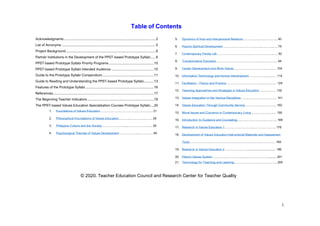
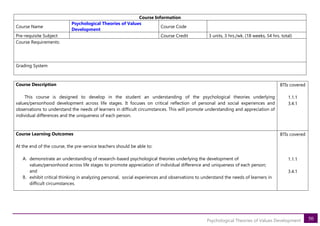
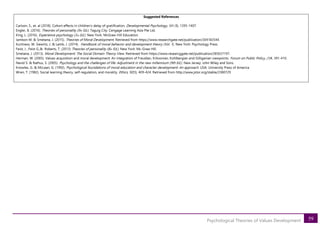
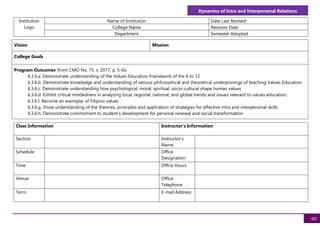
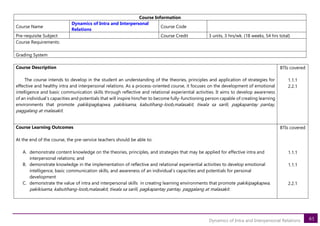
Table of Contents
Acknowledgments ...........................................................................................................2
List of Acronyms ..............................................................................................................5
Project Background.........................................................................................................6
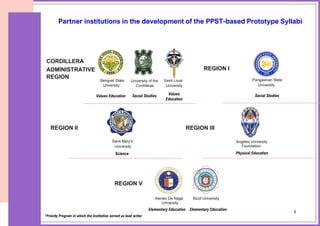
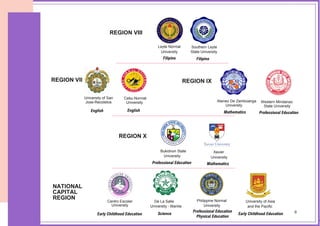
Partner Institutions in the Development of the PPST-based Prototype Syllabi......8
PPST-based Prototype Syllabi Priority Programs.....................................................10
PPST-based Prototype Syllabi Intended Audience ..................................................10
Guide to the Prototype Syllabi Compendium ............................................................11
Guide to Reading and Understanding the PPST-based Prototype Syllabi............13
Features of the Prototype Syllabi ................................................................................16
References......................................................................................................................17
The Beginning Teacher Indicators..............................................................................18
The PPST-based Values Education Specialization Courses Prototype Syllabi....20
1. Foundations of Values Education ……………………………………..…….. 21
2. Philosophical Foundations of Values Education ………..….………..…….. 29
3. Philippine Culture and the Society ……………...….......……….…….…..... 39
4. Psychological Theories of Values Development ……………......…………. 49
5. Dynamics of Intra and Interpersonal Relations …………….…..……..…... 60
6. Psycho-Spiritual Development ………………………………...………...…. 75
7. Contemporary Family Life …………………………...…………………...…. 82
8. Transformative Education ….……………………..……………...……..…... 94
9. Career Development and Work Values ………………………………..…. 104
10. Information Technology and Human Development ……………...…....… 114
11. Facilitation - Theory and Practice ……………………………...……..…… 124
12. Teaching Approaches and Strategies in Values Education ……...…..… 132
13. Values Integration in the Various Disciplines ………………….…………. 141
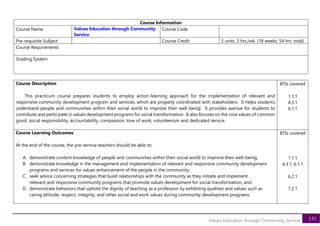
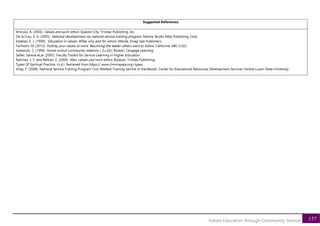
14. Values Education Through Community Service ……………...…..……... 150
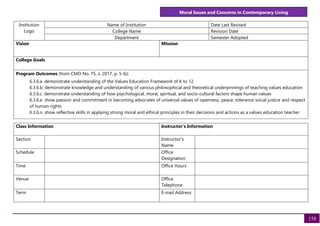
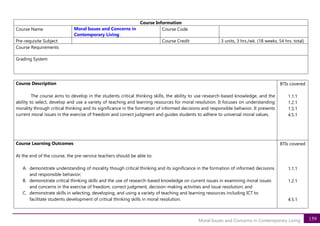
15. Moral Issues and Concerns in Contemporary Living ..……….…..……... 158
16. Introduction to Guidance and Counseling……………………..………….. 169
17. Research in Values Education 1………………………...…….…………... 178
18. Development of Values Education Instructional Materials and Assessment
Tools……………………………………………………………………….… 185
19. Research in Values Education 2 …………..……….................................... 196
20. Filipino Values System ……………………………...………………............ 201
21. Technology for Teaching and Learning………………………...….…….... 209
© 2020. Teacher Education Council and Research Center for Teacher Quality
2
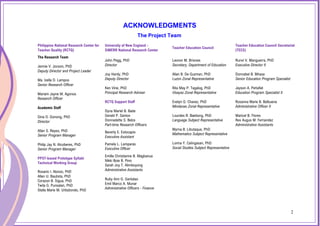
ACKNOWLEDGMENTS
The Project Team
Philippine National Research Center for
Teacher Quality (RCTQ)
University of New England -
SiMERR National Research Center
Teacher Education Council
Teacher Education Council Secretariat
(TECS)
The Research Team
Jennie V. Jocson, PhD
Deputy Director and Project Leader
Ma. Izella D. Lampos
Senior Research Officer
Mariam Jayne M. Agonos
Research Officer
Academic Staff
Gina O. Gonong, PhD
Director
Allan S. Reyes, PhD
Senior Program Manager
Philip Jay N. Alcoberes, PhD
Senior Program Manager
PPST-based Prototype Syllabi
Technical Working Group
Rosario I. Alonzo, PhD
Allen U. Bautista, PhD
Corazon B. Sigua, PhD
Twila G. Punsalan, PhD
Stella Marie M. Urbiztondo, PhD
John Pegg, PhD
Director
Joy Hardy, PhD
Deputy Director
Ken Vine, PhD
Principal Research Adviser
RCTQ Support Staff
Dyna Mariel B. Bade
Gerald P. Santos
Donnadette S. Belza
Part-time Research Officers
Beverly E. Estocapio
Executive Assistant
Pamela L. Lamparas
Executive Officer
Emille Christianne B. Magbanua
Nikki Boie B. Pino
Sarah Joy T. Alimboyong
Administrative Assistants
Ruby Ann G. Gantalao
Emil Marco A. Munar
Administrative Officers - Finance
Leonor M. Briones
Secretary, Department of Education
Allan B. De Guzman, PhD
Luzon Zonal Representative
Rita May P. Tagalog, PhD
Visayas Zonal Representative
Evelyn G. Chavez, PhD
Mindanao Zonal Representative
Lourdes R. Baetiong, PhD
Language Subject Representative
Myrna B. Libutaque, PhD
Mathematics Subject Representative
Lorina Y. Calingasan, PhD
Social Studies Subject Representative
Runvi V. Manguerra, PhD
Executive Director II
Donnabel B. Bihasa
Senior Education Program Specialist
Jayson A. Peñafiel
Education Program Specialist II
Rosanna Marie B. Balbuena
Administrative Officer II
Maricel B. Flores
Rex Augus M. Fernandez
Administrative Assistants
2
3
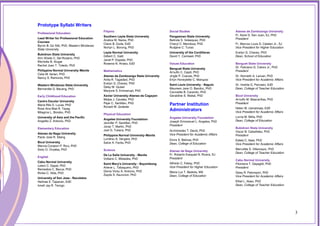
Prototype Syllabi Writers
Professional Education
Lead Writer for Professional Education
Courses
Byron B. Go Silk, PhD, Western Mindanao
State University
Bukidnon State University
Ann Sheila C. Del Rosario, PhD
Ritchelle B. Alugar
Rachel Joan T. Toledo, PhD
Philippine Normal University-Manila
Celia M. Ilanan, PhD
Nancy S. Ramores, PhD
Western Mindanao State University
Bernardita G. Bacang, PhD
Early Childhood Education
Centro Escolar University
Maria Rita D. Lucas, PhD
Rose Aira Mae R. Tayag
Milagros L. Borabo, PhD
University of Asia and the Pacific
Angelito Z. Antonio, PhD
Elementary Education
Ateneo de Naga University
Paolo Jose R. Silang
Bicol University
Marcia Corazon P. Rico, PhD
Sixto O. Orzales, PhD
English
Cebu Normal University
Lelani C. Dapat, PhD
Remedios C. Bacus, PhD
Rivika C. Alda, PhD
University of San Jose - Recoletos
Helmae E. Tapanan, EdD
Ionell Jay R. Terogo
Filipino
Southern Leyte State University
Analiza M. Nares, PhD
Claire B. Goda, EdD
Norlyn L. Borong, PhD
Leyte Normal University
Gilbert C. Galit
Janet P. Espada, PhD
Rowena N. Ariaso, EdD
Mathematics
Ateneo de Zamboanga State University
Anita R. Tagadiad, PhD
Evelyn G. Chavez, PhD
Daisy M. Quisel
Marjorie S. Emmanuel, PhD
Xavier University-Ateneo de Cagayan
Melpe J. Cavales, PhD
Pejie C. Santillan, PhD
Ronald M. Quileste
Physical Education
Angeles University Foundation
Jennifer P. Santillan, PhD
Jonar T. Martin, PhD
Joel G. Tubera, PhD
Philippine Normal University-Manila
Lordinio A. Vergara, PhD
Salve A. Favila, PhD
Science
De La Salle University - Manila
Voltaire C. Mistades, PhD
Saint Mary's University - Bayombong
Arlene L. Tabaquero, PhD
Gloria Vicky A. Antonio, PhD
Zayda S. Asuncion, PhD
Social Studies
Pangasinan State University
Belinda S. Velasquez, PhD
Cheryl C. Mendoza, PhD
Rudjane C. Tunac
University of the Cordilleras
David Y. Camiwet, PhD
Values Education
Benguet State University
Arnulfo C. Capili, PhD
Jingle P. Cuevas, PhD
Erlyn Honeylette C. Marquez
Saint Louis University - Baguio
Maureen Jane O. Bandoc, PhD
Carmelita B. Caramto, PhD
Geraldine S. Wakat, PhD
Partner Institution
Administrators
Angeles University Foundation
Joseph Emmanuel L. Angeles, PhD
President
Archimedes T. David, PhD
Vice President for Academic Affairs
Elvira S. Balinas, PhD
Dean, College of Education
Ateneo de Naga University
Fr. Roberto Exequiel N. Rivera, SJ
President
Alfredo C. Fabay, PhD
Vice President for Higher Education
Maria Luz T. Badiola, MA
Dean, College of Education
Ateneo de Zamboanga University
Fr. Karel S. San Juan, SJ, PhD
President
Fr. Marcos Louis D. Catalan Jr., SJ
Vice President for Higher Education
Evelyn G. Chavez, PhD
Dean, School of Education
Benguet State University
Dr. Feliciano G. Calora Jr., PhD
President
Dr. Kenneth A. Laruan, PhD
Vice President for Academic Affairs
Dr. Imelda G. Parcasio, EdD
Dean, College of Teacher Education
Bicol University
Arnulfo M. Mascariñas, PhD
President
Helen M. Llenaresas, EdD
Vice President for Academic Affairs
Lorna M. Miña, PhD
Dean, College of Education
Bukidnon State University
Oscar B. Cabaňelez, PhD
President
Estela C. Itaas, PhD
Vice President for Academic Affairs
Mercidita S. Villamayor, PhD
Dean, College of Teacher Education
Cebu Normal University
Filomena T. Dayagbil, PhD
President
Daisy R. Palompon, PhD
Vice President for Academic Affairs
Ethel L. Abao, PhD
Dean, College of Teacher Education
3
4
Centro Escolar University
Ma. Cristina D. Padolina, PhD
President
Teresa R. Perez, PhD
Vice President for Academic Affairs
Maria Rita D. Lucas, PhD
Dean, School of Education-Liberal Arts-
Music-Social Work
De La Salle University – Manila
Br. Raymundo B. Suplido FSC,
President
Robert C. Roleda, PhD
Vice Chancellor for Academics
Raymund C. Sison, PhD
Dean, Br. Andrew Gonzalez FSC
College of Education (BAGCED)
Leyte Normal University
Jude A. Duarte, DPA
President
Evelyn B. Aguirre, DA
Vice President for Academic Affairs
Prof. Lina G. Fabian
Dean, College of Education
Pangasinan State University
Dexter R. Buted, DBA
President
Paulo V. Cenas, EdD
Former OIC-Office of the President
Manolito C. Manuel, EdD
Vice President for Academic Affairs
Roy C. Ferrer PhD
Dean, College of Education (Bayambang)
Rosario DL. Valencerina EdD
Dean, College of Education (Lingayen)
Philippine Normal University – Manila
Ma. Antoinette C. Montealegre, DA
OIC- Office of the President
Rosemarievic V. Diaz, PhD
Vice President for Research, Planning and
Quality Assurance
Rita B. Ruscoe, PhD
Dean, College of Teacher Development
Saint Louis University – Baguio
Rev. Fr. Gilbert B. Sales, CICM, PhD
President
Roberto M. Arguelles, PhD
Vice President for Academic Affairs
Felina P. Espique, PhD
Dean, School of Teacher Education and
Liberal Arts
Saint Mary’s University – Bayombong
Rev. Fr. Fernold G. Denna, CICM
President
Moises AlexanderT. Asuncion, PhD
Vice President for Academic Affairs
Dr. Ma. Teresa B. Tayaban
Dean, School of Teacher Education and
Humanities
Southern Leyte State University
Prose Ivy G. Yepes, EdD
President
Juanita M. Costillas, PhD
Vice President for Academic Affairs
Frederick C. Aniga, PhD
Dean, College of Teacher Education
University of Asia and the Pacific
Winston Conrad B. Padojinog, DBA
President
Amado P. Saquido, PhD
Vice President for Academic Affairs
Celerino C. Tiongco, EdD
Dean, School of Education and Human
Development
University of the Cordilleras
Ray Dean D. Salvosa, AB, MPh
President
Nancy M. Flores
Executive Vice President
Rhodora A. Ngolob, PhD
Former OIC- Vice President for Academic
Affairs
Ramir Austria, PhD
Dean, College of Teacher Education
University of San Jose – Recoletos
Rev. Fr. Cristopher C. Maspara, OAR,
President
Rev. Fr. Leo G. Alaras, OAR
Vice President for Academics
Jestoni P. Babia, LPT, EdD
Dean, College of Education
Xavier University – Ateneo de Cagayan
Fr. Roberto C. Yap, SJ
President
Fr. Rene Tacastacas, SJ
Vice President of Higher Education
Jovelyn G Delosa, PhD
Dean, School of Education
Western Mindanao State University
Milabel Enriquez-Ho, RN, EdD
President
Ma. Carla A. Ochotorena, PhD
Vice President for Academic Affairs
Nolan S. Iglesia, EdD
Dean, College of Teacher Education
Other Partners in Pre-service
Projects
Adamson University
Central Luzon State University
Don Mariano Marcos Memorial State University
Far Eastern University
Negros Oriental State University
Palawan State University
Tarlac Agricultural University
TEC and RCTQ also acknowledge all
course teachers, deans,
administrators and personnel from
teacher education institutions,
DepEd teachers, principals/school
heads, supervisors, superintendents
and educators who took part in the
development and validation works.
We also acknowledge the Basic
Education Sector Transformation
(BEST) program for funding
activities that supported the project.
4
5
List of Acronyms
BTI beginning teacher indicator
CLO Course learning outcome
CMO CHED Memorandum Order
COD Center of Development
COE Center of Excellence
ILO Intended learning outcome
IM Instructional material
OBE Outcome-based Education
OECD Organisation for Economic Co-operation and Development
PPST Philippine Professional Standards for Teachers
PSG Policies, Standards and Guidelines
PST pre-service teacher
TEI teacher education institution
TLA teaching and learning activity
TOS table of specifications
5
6
Development of PPST-based Prototype Syllabi on Priority Programs in Pre-Service Teacher Education
PROJECT BACKGROUND
Rationale
This compendium is one of ten in the series of Prototype Syllabi on Priority Programs in
Pre-service Teacher Education developed through the Philippine National Research Center
for Teacher Quality (RCTQ), with the Teacher Education Council (TEC) as lead, in partnership
with select Centers of Excellence and Centers of Development in Teacher Education. The
Development of PPST-based Prototype Syllabi on Priority Programs in Pre-Service Teacher
Education Project aims to further align current teacher education curricula with the Philippine
Professional Standards for Teachers (PPST) to ensure that the future educators are geared
towards educating students for a long term and sustainable nation building.
The PPST-based prototype syllabi aim to provide a benchmark that TEIs can adopt or adapt
to enhance their curricula. This promotes shared understanding and expectations of quality
pre-service training throughout the country.
The Philippine Professional Standards for Teachers (PPST)
The National Adoption and Implementation of the Philippine Professional Standards for Teachers (PPST) (DepEd Order No.
42, S. 2017) sets clear expectations of teachers along well-defined career stages. In adopting it, DepEd integrates PPST in
all its professional development programs, learning and delivery systems, and HR systems. The DepEd adoption and
integration of the PPST necessitate that Teacher Education Institutions (TEIs) align their curricula with what the department
needs. The new CHED-issued PSGs on teacher education (2017) are based on PPST to ensure that every graduate of pre-
service teacher education programs can cope with the demands of DepEd. The development of prototype syllabi supports
new pre-service teacher education curriculum based on CHED requirements and DepEd needs.
"Teacher
qualifications,
teacher's
knowledge and
skills, make more
difference for
student learning
than any other
single factor."
(Darling-Hammond, 2011)
6
7
Linking Theory to Practice
The developed prototype syllabi do not only respond to the curricular requirements of the PPST and CHED's PSGs. A key
feature of the syllabi is the inclusion of activities that give opportunities for pre-service teachers to put their learnings into
practice. This supports international studies on linking theory to practice. According to Darling-Hammond (George Lucas
Educational Foundation, 2001):
"It's hard to learn theoretical ideas in isolation, try to remember them for two years until you get to student
teaching, and then all of sudden be put in a situation where you're supposed to implement something
you've never seen in practice. That doesn't work. That's the old model of teacher education."
The prototype syllabi were anchored on the core principles of the Pre-service Teachers' Practice-based Training
(PSTePT) framework, developed by RCTQ, with TEC as lead, and select COEs and CODs in teacher education. In this
framework, practice-based teacher education training is described as experiential, developmental, formative, integrative and
system-based. It is an attempt to integrate practicum into the course work of pre-service teachers starting from their
professional education courses, by recommending the inclusion of experiential activities in the field like observations,
interviews, and other opportunities to demonstrate their understanding of theories to actual practice.
Partnerships Towards Quality Pre-service Teacher Education
RCTQ and TEC partnered with select teacher education institutions on the development of 10 compendiums of prototype
syllabi. Two to three TEIs collaboratively worked on one compendium/priority program. Three to four writers per institution
were sent to attend a series of writeshops, reviews and validation to finalize the outputs.
7
8
Partner institutions in the development of the PPST-based Prototype Syllabi
CORDILLERA
ADMINISTRATIVE
REGION
Benguet State
University
University of the
Cordilleras
Saint Louis
University
REGION I
Pangasinan State
University
REGION II
Saint Mary's
University
REGION III
Angeles University
Foundation
REGION V
Ateneo De Naga
University
Bicol University
Values Education Social Studies Values
Education
Social Studies
Science Physical Education
Elementary Education Elementary Education
*Priority Program in which the institution served as lead writer
8
9
REGION VII
University of San
Jose-Recoletos
Cebu Normal
University
REGION IX
Ateneo De Zamboanga
University
Western Mindanao
State University
REGION X
Bukidnon State
University
Xavier
University
REGION VIII
Leyte Normal
University
Southern Leyte
State University
NATIONAL
CAPITAL
REGION
De La Salle
University - Manila
Philippine Normal University of Asia
and the Pacific
Centro Escolar
University University
Filipino Filipino
English English Mathematics
Mathematics
Professional Education
Physical Education
Professional Education
Early Childhood Education Early Childhood Education
Science 9
PPST-BASED PROTOTYPE SYLLABI PRIORITY PROGRAMS
The priority programs were selected based on various consultations. The prototype syllabi are on the following programs:
• Early Childhood Education
• Elementary Education
• English
• Filipino
• Mathematics
• Physical Education
• Science
• Social Studies
• Values Education
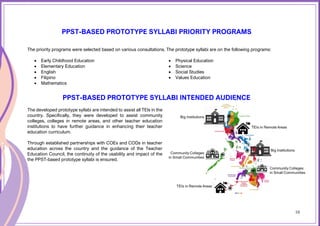
PPST-BASED PROTOTYPE SYLLABI INTENDED AUDIENCE
The developed prototype syllabi are intended to assist all TEIs in the
country. Specifically, they were developed to assist community
colleges, colleges in remote areas, and other teacher education
institutions to have further guidance in enhancing their teacher
education curriculum.
Through established partnerships with COEs and CODs in teacher
education across the country and the guidance of the Teacher
Education Council, the continuity of the usability and impact of the
the PPST-based prototype syllabi is ensured.
10
11
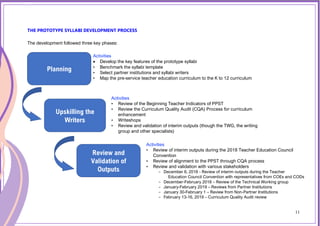
THE PROTOTYPE SYLLABI DEVELOPMENT PROCESS
The development followed three key phases:
Activities
• Develop the key features of the prototype syllabi
• Benchmark the syllabi template
• Select partner institutions and syllabi writers
• Map the pre-service teacher education curriculum to the K to 12 curriculum
Activities
• Review of the Beginning Teacher Indicators of PPST
• Review the Curriculum Quality Audit (CQA) Process for curriculum
enhancement
• Writeshops
• Review and validation of interim outputs (though the TWG, the writing
group and other specialists)
Planning
Activities
• Review of interim outputs during the 2018 Teacher Education Council
Convention
• Review of alignment to the PPST through CQA process
• Review and validation with various stakeholders
- December 6, 2018 - Review of interim outputs during the Teacher
Education Council Convention with representatives from COEs and CODs
- December-February 2018 – Review of the Technical Working group
- January-February 2019 – Reviews from Partner Institutions
- January 30-February 1 – Review from Non-Partner Institutions
- February 13-16, 2019 – Curriculum Quality Audit review
Upskilling the
Writers
Review and
Validation of
Outputs
11
12
GUIDE TO THE PROTOTYPE SYLLABI COMPENDIUM
This compendium is one of 10 in the PPST-based Prototype Syllabi in Pre-service Teacher Education Compendium Series:
Compendium 1: Professional Education Courses
Compendium 2: Early Childhood Education Specialization Courses
Compendium 3: Elementary Education Specialization Courses
Compendium 4: English Specialization Courses
Compendium 5: Filipino Specialization Courses
Compendium 6: Mathematics Specialization Courses
Compendium 7: Physical Education Specialization Courses
Compendium 8: Science Specialization Courses
Compendium 9: Social Studies Specialization Courses
Compendium 10: Values Education Specialization Courses
Each compendium contains prototype syllabi that Teacher Education Institutions (TEIs) could either adapt or adopt. Parts of the
prototype syllabi template were benchmarked from local and international sources and were agreed upon by the Technical Working
Group and partner institutions.
12
13
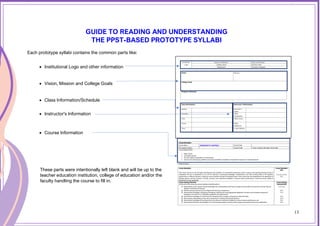
GUIDE TO READING AND UNDERSTANDING
THE PPST-BASED PROTOTYPE SYLLABI
Each prototype syllabi contains the common parts like:
• Institutional Logo and other information
• Vision, Mission and College Goals
• Class Information/Schedule
• Instructor's Information
• Course Information
These parts were intentionally left blank and will be up to the
teacher education institution, college of education and/or the
faculty handling the course to fill in.
13
14
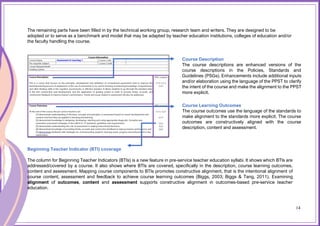
The remaining parts have been filled in by the technical working group, research team and writers. They are designed to be
adopted or to serve as a benchmark and model that may be adapted by teacher education institutions, colleges of education and/or
the faculty handling the course.
Beginning Teacher Indicator (BTI) coverage
The column for Beginning Teacher Indicators (BTIs) is a new feature in pre-service teacher education syllabi. It shows which BTIs are
addressed/covered by a course. It also shows where BTIs are covered, specifically in the description, course learning outcomes,
content and assessment. Mapping course components to BTIs promotes constructive alignment, that is the intentional alignment of
course content, assessment and feedback to achieve course learning outcomes (Biggs, 2003; Biggs & Tang, 2011). Examining
alignment of outcomes, content and assessment supports constructive alignment in outcomes-based pre-service teacher
education.
Course Description
The course descriptions are enhanced versions of the
course descriptions in the Policies, Standards and
Guidelines (PSGs). Enhancements include additional inputs
and/or elaboration using the language of the PPST to clarify
the intent of the course and make the alignment to the PPST
more explicit.
Course Learning Outcomes
The course outcomes use the language of the standards to
make alignment to the standards more explicit. The course
outcomes are constructively aligned with the course
description, content and assessment.
14
15
Time Allotment
The Time Allotment column indicates
the recommended duration to cover
the content.
Intended Learning Outcomes (ILOs)
The ILOs column presents outcomes
which are specific to the content
covered. It presents what pre-service
teachers should be able to know or do
after covering the topics.
The ILOs are learner-centered rather
than content-centered. They provide
guidance on the focus and intent of the
content to be covered.
Content
The Content column outlines topics to
be covered.
Mapping to the CLOs
Aside from the BTI coverage, the
prototype syllabi also map ILOs and
the Suggested Assessment to the
corresponsing CLO/s, to ensure
constructive alignment.
Example: 1.1.1 [A]
Suggested Teaching Learning
Activities (TLAs)
The Suggested TLAs column indicates
recommended activities to deliver the
content and help facilitate the pre-
service teachers’ achievement of the
ILOs.
Suggested Assessment
The Suggested Assessment column
indicates recommended formative or
summative activities to measure the
achievement of the ILOs and/or mastery of
the content covered.
15
16
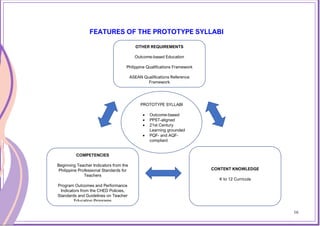
FEATURES OF THE PROTOTYPE SYLLABI
PROTOTYPE SYLLABI
• Outcome-based
• PPST-aligned
• 21st Century
Learning grounded
• PQF- and AQF-
compliant
COMPETENCIES
Beginning Teacher Indicators from the
Philippine Professional Standards for
Teachers
Program Outcomes and Performance
Indicators from the CHED Policies,
Standards and Guidelines on Teacher
Education Programs
CONTENT KNOWLEDGE
K to 12 Curricula
OTHER REQUIREMENTS
Outcome-based Education
Philippine Qualifications Framework
ASEAN Qualifications Reference
Framework
16
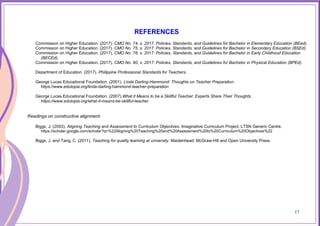
REFERENCES
Commission on Higher Education. (2017). CMO No. 74, s. 2017: Policies, Standards, and Guidelines for Bachelor in Elementary Education (BEed).
Commission on Higher Education. (2017). CMO No. 75, s. 2017: Policies, Standards, and Guidelines for Bachelor in Secondary Education (BSEd).
Commission on Higher Education. (2017). CMO No. 76, s. 2017: Policies, Standards, and Guidelines for Bachelor in Early Childhood Education
(BECEd).
Commission on Higher Education. (2017). CMO No. 80, s. 2017: Policies, Standards, and Guidelines for Bachelor in Physical Education (BPEd).
Department of Education. (2017). Philippine Professional Standards for Teachers.
George Lucas Educational Foundation. (2001). Linda Darling-Hammond: Thoughts on Teacher Preparation.
https://www.edutopia.org/linda-darling-hammond-teacher-preparation
George Lucas Educational Foundation. (2007).What it Means to be a Skillful Teacher: Experts Share Their Thoughts.
https://www.edutopia.org/what-it-means-be-skillful-teacher
Readings on constructive alignment:
Biggs, J. (2003). Aligning Teaching and Assessment to Curriculum Objectives. Imaginative Curriculum Project, LTSN Generic Centre.
https://scholar.google.com/scholar?q=%22Aligning%20Teaching%20and%20Assessment%20to%20Curriculum%20Objectives%22
Biggs, J. and Tang, C. (2011). Teaching for quality learning at university. Maidenhead: McGraw-Hill and Open University Press.
17
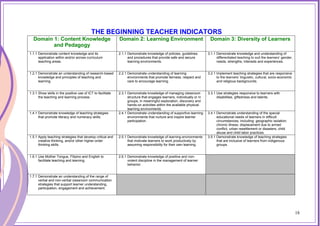
THE BEGINNING TEACHER INDICATORS
Domain 1: Content Knowledge
and Pedagogy
Domain 2: Learning Environment Domain 3: Diversity of Learners
1.1.1 Demonstrate content knowledge and its
application within and/or across curriculum
teaching areas.
2.1.1 Demonstrate knowledge of policies, guidelines
and procedures that provide safe and secure
learning environments.
3.1.1 Demonstrate knowledge and understanding of
differentiated teaching to suit the learners’ gender,
needs, strengths, interests and experiences.
1.2.1 Demonstrate an understanding of research-based
knowledge and principles of teaching and
learning.
2.2.1 Demonstrate understanding of learning
environments that promote fairness, respect and
care to encourage learning.
3.2.1 Implement teaching strategies that are responsive
to the learners’ linguistic, cultural, socio-economic
and religious backgrounds.
1.3.1 Show skills in the positive use of ICT to facilitate
the teaching and learning process.
2.3.1 Demonstrate knowledge of managing classroom
structure that engages learners, individually or in
groups, in meaningful exploration, discovery and
hands-on activities within the available physical
learning environments
3.3.1 Use strategies responsive to learners with
disabilities, giftedness and talents.
1.4.1 Demonstrate knowledge of teaching strategies
that promote literacy and numeracy skills.
2.4.1 Demonstrate understanding of supportive learning
environments that nurture and inspire learner
participation.
3.4.1 Demonstrate understanding of the special
educational needs of learners in difficult
circumstances, including: geographic isolation;
chronic illness; displacement due to armed
conflict, urban resettlement or disasters; child
abuse and child labor practices.
1.5.1 Apply teaching strategies that develop critical and
creative thinking, and/or other higher-order
thinking skills.
2.5.1 Demonstrate knowledge of learning environments
that motivate learners to work productively by
assuming responsibility for their own learning.
3.5.1 Demonstrate knowledge of teaching strategies
that are inclusive of learners from indigenous
groups.
1.6.1 Use Mother Tongue, Filipino and English to
facilitate teaching and learning.
2.6.1 Demonstrate knowledge of positive and non-
violent discipline in the management of learner
behavior.
1.7.1 Demonstrate an understanding of the range of
verbal and non-verbal classroom communication
strategies that support learner understanding,
participation, engagement and achievement.
18
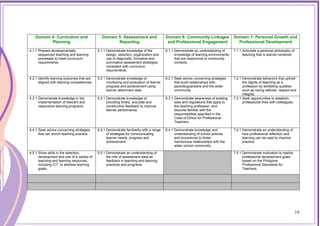
Domain 4: Curriculum and
Planning
Domain 5: Assessment and
Reporting
Domain 6: Community Linkages
and Professional Engagement
Domain 7: Personal Growth and
Professional Development
4.1.1 Prepare developmentally
sequenced teaching and learning
processes to meet curriculum
requirements.
5.1.1 Demonstrate knowledge of the
design, selection, organization and
use of diagnostic, formative and
summative assessment strategies
consistent with curriculum
requirements.
6.1.1 Demonstrate an understanding of
knowledge of learning environments
that are responsive to community
contexts.
7.1.1 Articulate a personal philosophy of
teaching that is learner-centered.
4.2.1 Identify learning outcomes that are
aligned with learning competencies.
5.2.1 Demonstrate knowledge of
monitoring and evaluation of learner
progress and achievement using
learner attainment data.
6.2.1 Seek advice concerning strategies
that build relationships with
parents/guardians and the wider
community.
7.2.1 Demonstrate behaviors that uphold
the dignity of teaching as a
profession by exhibiting qualities
such as caring attitude, respect and
integrity.
4.3.1 Demonstrate knowledge in the
implementation of relevant and
responsive learning programs.
5.3.1 Demonstrate knowledge of
providing timely, accurate and
constructive feedback to improve
learner performance.
6.3.1 Demonstrate awareness of existing
laws and regulations that apply to
the teaching profession, and
become familiar with the
responsibilities specified in the
Code of Ethics for Professional
Teachers.
7.3.1 Seek opportunities to establish
professional links with colleagues.
4.4.1 Seek advice concerning strategies
that can enrich teaching practice.
5.4.1 Demonstrate familiarity with a range
of strategies for communicating
learner needs, progress and
achievement.
6.4.1 Demonstrate knowledge and
understanding of school policies
and procedures to foster
harmonious relationships with the
wider school community.
7.4.1 Demonstrate an understanding of
how professional reflection and
learning can be used to improve
practice.
4.5.1 Show skills in the selection,
development and use of a variety of
teaching and learning resources,
including ICT, to address learning
goals.
5.5.1 Demonstrate an understanding of
the role of assessment data as
feedback in teaching and learning
practices and programs.
7.5.1 Demonstrate motivation to realize
professional development goals
based on the Philippine
Professional Standards for
Teachers.
19
THE PPST-BASED VALUES EDUCATION SPECIALIZATION
COURSES PROTOTYPE SYLLABI
Document Bases:
CMO No. 75, s. 2017: Policies, Standards, and Guidelines for Bachelor of Secondary Education (BSEd)
K to 12 Gabay Pangkurikulum Edukasyon sa Pagpapakatao (Baitang 1 - 10) [May 2016]
Philippine Professional Standards for Teachers (DO 42, s 2017)
Total Number of
Specialization Courses
Available Specialization
Course Outputs
Total Number of
Elective Courses
Available Elective Course
Outputs
21 21 0 0
Lead Writers:
Secondary Writers/ Reviewers:
20
Foundations of Values Education
21
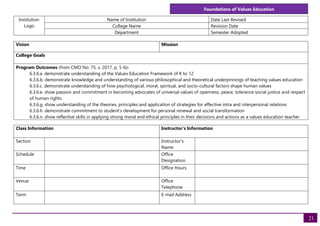
Institution
Logo
Name of Institution Date Last Revised
College Name Revision Date
Department Semester Adopted
Vision Mission
College Goals
Program Outcomes (from CMO No. 75, s. 2017, p. 5-6):
6.3.6.a. demonstrate understanding of the Values Education Framework of K to 12
6.3.6.b. demonstrate knowledge and understanding of various philosophical and theoretical underpinnings of teaching values education
6.3.6.c. demonstrate understanding of how psychological, moral, spiritual, and socio-cultural factors shape human values
6.3.6.e. show passion and commitment in becoming advocates of universal values of openness, peace, tolerance social justice and respect
of human rights
6.3.6.g. show understanding of the theories, principles and application of strategies for effective intra and interpersonal relations
6.3.6.h. demonstrate commitment to student’s development for personal renewal and social transformation
6.3.6.n. show reflective skills in applying strong moral and ethical principles in their decisions and actions as a values education teacher
Class Information Instructor's Information
Section Instructor's
Name
Schedule Office
Designation
Time Office Hours
Venue Office
Telephone
Term E-mail Address
22
Foundations of Values Education
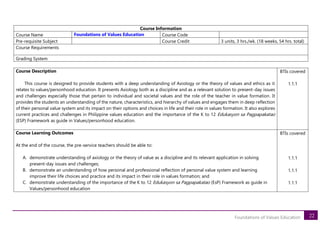
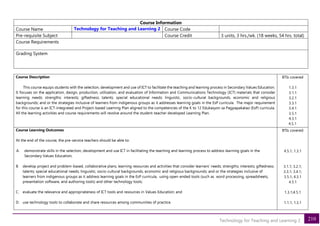
Course Information
Course Name Foundations of Values Education Course Code
Pre-requisite Subject Course Credit 3 units, 3 hrs./wk. (18 weeks, 54 hrs. total)
Course Requirements
Grading System
Course Description
This course is designed to provide students with a deep understanding of Axiology or the theory of values and ethics as it
relates to values/personhood education. It presents Axiology both as a discipline and as a relevant solution to present-day issues
and challenges especially those that pertain to individual and societal values and the role of the teacher in value formation. It
provides the students an understanding of the nature, characteristics, and hierarchy of values and engages them in deep reflection
of their personal value system and its impact on their options and choices in life and their role in values formation. It also explores
current practices and challenges in Philippine values education and the importance of the K to 12 Edukasyon sa Pagpapakatao
(ESP) Framework as guide in Values/personhood education.
BTIs covered
1.1.1
Course Learning Outcomes
At the end of the course, the pre-service teachers should be able to:
A. demonstrate understanding of axiology or the theory of value as a discipline and its relevant application in solving
present-day issues and challenges;
B. demonstrate an understanding of how personal and professional reflection of personal value system and learning
improve their life choices and practice and its impact in their role in values formation; and
C. demonstrate understanding of the importance of the K to 12 Edukasyon sa Pagpapakatao (EsP) Framework as guide in
Values/personhood education
BTIs covered
1.1.1
1.1.1
1.1.1
23
Foundations of Values Education
Time
Allotment
Intended Learning Outcomes (ILOs) BTIs Content Suggested Teaching Learning
Activities
Suggested Assessment BTIs
Week 1 At the end of the week, the pre-service
teacher (PST) should be able to:
• Explain the meaning of
axiology or the theory of
values as a discipline and its
historical background
1.1.1
[A]
A. Nature of values
1. Definition of Axiology
or Theory of Values
2. Historical Background
• Cross Word Puzzle on the
important concepts of
axiology as a branch of
philosophy and its historical
background
• Lecture on the axiology and
its historical background
5-minute paper to demonstrate
understanding of the meaning of
axiology and its historical background
*5-minute paper = The students are
asked to explain axiology and its
historical background in 5 minutes
without lifting their pen. After 5
minutes, the professor collects the
outputs.
Major Criteria: accuracy and clarity of
explanation and completeness of detail
on the historical background
1.1.1
Week 2 At the end of the week, the pre-service
teacher (PST) should be able to:
• Discuss the meaning of
values
1.1.1
[A]
3. Definition of Values
4. Properties of values
5. Value and Other
Metaphysical Realities:
value and being, value
and good, value and
truth, value and beauty
• Students brainstorm on the
definitions accorded to value
and values.
• Students deduce the
characteristics of values given
a list of values.
Word Cloud illustrating a clear
representation of the students’
understanding of values. Based on the
word cloud, the students are asked to
explain the meaning of values.
Major Criteria: completeness and
correctness of content
1.1.1
Week 3 At the end of the week, the pre-service
teacher (PST) should be able to:
• Describe the general
classification of values
1.1.1
[A]
B. Classification of Values
a. Intrinsic and
Instrumental
Values
b. Accidental and
Natural Human
Values
c. Primary and
Secondary Values
d. Moral or Ethical
Values
e. Religious Values
f. Cultural Values
g. Social Values
• Students make a list of values
and classify them according
to their commonalities.
Teacher presents suggested
classifications and students
reflect on their own
classifications.
Matrix to show a synthesis of the
general classification of values and
their descriptions
Criteria: completeness and correctness
of classifications and their descriptions
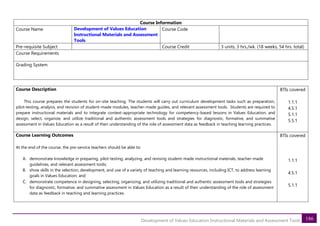
1.1.1
24
Foundations of Values Education
Week 4 At the end of the week, the pre-service
teacher (PST) should be able to:
• Justify the place of
Values/personhood
Education in schools for the
promotion of peace, social
justice, human rights and the
importance of family in the
country
1.1.1
[A]
C. Legal Basis of
Values/Personhood
Education in Schools:
The Philippine
Constitution Articles II,
XIII and XV
• Reading of the Philippine
Constitution (Article II, XIII
and XV)
• Small group discussion to
identify the place of
Values/personhood Education
in schools for the promotion
of peace, social justice,
human rights and the
importance of family in the
country based on Article II,
XIII and XV of the Philippine
Constitution
TV talk show or any creative
presentation to cite situations to
justify the importance of
Values/personhood education in the
country
Rubric focusing on clarity of
justification as mentioned above based
on the legal basis of
values/personhood education as
stated in the Philippine Constitution
1.1.1
Week 5 At the end of the week, the pre-service
teacher (PST) should be able to:
• Explain the meaning of ethics
as a branch of philosophy
and its role to
Values/Personhood
Education
1.1.1
[B]
D. Ethical Foundations of
Values Education
1. Meaning of Ethics
a. Ethics as a
Branch of
Philosophy
b. Ethics Defined
c. What is Ethics
and What is Not
Ethics?
d. Ethics and
Feeling; Ethics
and Religion;
Ethics and Law;
Ethics and what
Society Accepts
e. Importance of
Ethics
2. Ethics and Values
Education
• Lecture on the” what IS and IS
NOT of ethics as a discipline,
its delineation from related
disciplines, and an analysis of
its role as the bases of Values
Education. A graphic
organizer can be used to
illustrate relationships of
concepts.
Note: A review of the
philosophy of the K to 12
Edukasyon sa Pagpapakatao
Framework can be done to
explicitly articulate the
relationship of the discussion
on ethics to Values Education
in general and values
teaching in the secondary
level.
240-300-word assessment to explain
the meaning of ethics as a branch of
philosophy and its role in Values/
Personhood Education
Major Criteria: depth and clarity of
explanation and completeness of
details
1.1.1
Week 6-7 At the end of the week, the pre-service
teacher (PST) should be able to:
• Illustrate how virtue ethics,
divine command theory and
1.1.1
[B]
3. Ethics and Its Emphasis
on the Moral Agent
a. Virtue Ethics
(Socrates, Plato,
Aristotle)
• Teacher presents quotations
and asks students to
comment whether they agree
or disagree on it. Students
justify their claims.
Role Play to illustrate concrete
situations where virtue ethics, divine
command theory and natural law are
used as basis for ethical decision
making
1.1.1
25
Foundations of Values Education
natural law are used as basis
for ethical decision making
by using concrete examples
b. Divine Command
Theory
c. Natural Law
• Teacher utilizes students’
statements in the discussion
of how virtue ethics, divine
command theory and natural
are used as basis for ethical
decision making.
Rubric focusing on the correctness of
argument whether it is based on virtue
ethics, divine command theory and
natural law
Week 8 At the end of the week, the pre-service
teacher (PST) should be able to:
• Explain the meaning and
importance of hierarchy of
values
1.1.1
[A]
E. Hierarchy of Values
1. Plato’s Scale of Values
2. Max Scheler’s
Hierarchal Doctrine of
Values
• Think pair share: Students
list down and rank the things
they value. They identify
consequences of their chosen
values priorities and share it
to a classmate.
• Teacher processes the activity
by emphasizing on the
importance of the hierarchy
of values in everyday decision
making.
Short essay quiz to explain the
meaning and importance of hierarchy
of values
1.1.1
Week 9 At the end of the week, the pre-service
teacher (PST) should be able to:
• Reflect on how one
prioritizes and integrates
professional reflection and
learning in one’s hierarchy of
values as values/ personhood
educators
1.1.1
[B]
Hierarchy of Values (continued) • Students list down and rank
the things they value. They
identify consequences of their
chosen values priorities on
specified real-life situations as
an individual person and
future professional teacher in
values/personhood
education.
• Teacher processes student’s
output as he/she introduces
concepts on hierarchy of
values and its importance to
future teachers of
values/personhood education
Reflection paper to express one’s
examination on how one prioritizes
and integrates professional reflection
and learning in one’s hierarchy of
values as values/ personhood
educators
Rubric focusing on one’s
understanding of the importance of
professional reflection and learning to
improve values/personhood education
1.1.1
26
Foundations of Values Education
Week 10 At the end of the week, the pre-service
teacher (PST) should be able to:
• Explain how everyday issues
are resolved based on a well-
defined application of one’s
hierarchy of values
1.1.1
[B]
F. Conflict of Values
G. Conservation of Values
• Issue resolution using
Toulmin Model. Students can
be given more time to
research to support their
claims. This can be done
individually or by group.
Oral Presentation of arguments
Rubric focusing on the logic of
argument in resolving issues
1.1.1
Week 11 At the end of the week, the pre-service
teacher (PST) should be able to:
• Reflect on the importance of
one’s clear understanding of
how ones’ value system is
formed in guiding one’s
choices and decisions in life
1.1.1
[B]
H. Forming Our Value-
System
1. Sources of Values
2. The Norm and
Standard of Values
a. The Supreme
Being as the
Ultimate Norm
and Standard of
Values
b. Normative and
Metanormative
Standard of
Values
3. Modes of Participation
on Value
• Analysis of case problems and
how it was resolved by using
an identified value system as
the basis of decisions and
solutions
A Reflection Paper on the importance
of one’s clear understanding of how
ones’ value system is formed in
guiding one’s choices and decisions in
life
Rubric focusing on clarity of reflection
statements and the use of concepts
learned about forming value-system
1.1.1
Week
12-13
At the end of the week, the pre-service
teacher (PST) should be able to:
• Describe the role of schools
in values/personhood
education
1.1.1
[A]
I. Axiology and
Values/Personhood
Education:
1. Man as the Focus of
Values Teaching
2. Role of Schools in
Value/Personhood
Education
a. Values for the
Filipino (1997)
b. The K to 12
Edukasyon sa
Pagpapakatao
Framework
(2016)
• Discussion and analysis of the
rationale of Values for the
Filipino(1997) and EsP
Framework (2016). Discussion
revolves around: Review the
meaning of axiology,
pagpapahalaga,
pagpapakatao, good manners
and right conduct, character
education, etc.as it is
emphasized/taught in schools
• Film viewing/ readings of
values education practices in
different schools focusing on
their roles towards the
formation of values among
students
Collage showing situations that
describe the role of schools in
values/personhood education
Rubric focusing on the clarity and
significance of collage elements to
describe the role of schools in
values/personhood education
1.1.1
27
Foundations of Values Education
Week 14 At the end of the week, the pre-service
teacher (PST) should be able to:
• Explain the philosophy
directions, principles,
approaches and scope of the
K to 12 Edukasyon sa
Pagpapakatao Framework
and its implication to the
values education teacher
1.1.1
[C]
J. The K to 12 Edukasyong
sa Pagpapakatao
Framework
1. Philosophy
2. Principles
3. Approaches
4. Scope
• Lecture discussion
• Students analyze and discuss
the philosophy, principles,
approaches and scope of the
K to 12 Edukasyong sa
Pagpapakatao Framework.
Students deduce implications
to the future values education
teacher
Written Quiz to demonstrate
students’ knowledge of the general
content of the K to 12 EsP framework
1.1.1
Week 15 At the end of the week, the pre-service
teacher (PST) should be able to:
• Deduce from the K to 12 EsP
Curriculum the implied roles
of the future values educator
to students’ personal renewal
and social transformation
1.1.1
[C]
K. Roles of the Values
Education Teacher in the
realization of the K to
12 Edukasyon sa
Pagpapakatao
Framework for students
personal renewal and
social transformation
• Small group discussion:
Students identify the role of
the future values educator in
implementing the K to 12 EsP
curriculum.
• Students illustrate this
through simulations
Simulations of an ideal situation in
values education classroom that
presents the roles of a future values
education teacher in students’
personal renewal and social
transformation
Rubric focusing on the clarity of
presentation of the roles of a future
values education teacher in students’
personal renewal and social
transformation; and whether the
situation is realistic or not.
1.1.1
Week 16 At the end of the week, the pre-service
teacher (PST) should be able to:
• Discuss how various
disciplines support the
values/ personhood
education by citing concrete
examples
1.1.1
[C]
L. Values Education in the
Disciplines
1. Values Education in
the Social Sciences
2. Values Education the
Physical Sciences
3. Values Education in
Science and
Technology
4. Values Education in
Arts
5. Values Education in
Teaching Language
6. Values Education in
Math
• Panel Discussion: Students
are assigned topics for study
(How various disciplines
support values/personhood
education)
Editorial Article or Advertisements
illustrating the role of other disciplines
in supporting values/personhood
education
Rubric focusing on the depth and
relevance of examples used to support
one’s discussion of how various
disciplines support values/personhood
education
1.1.1
28
Foundations of Values Education
Week
17-18
At the end of the week, the pre-service
teacher (PST) should be able to:
• Evaluate researched-based
practices, issues and
problems in the Philippine
Values Education system in
view of its implications for
the improvement of teaching
and learning practice
1.1.1
1.2.1
[C]
M. Values Education in the
Philippines
1. Issues and Problems in
Philippine Values
Education
a. Good Manners
and Right
Conduct
b. Character
Education
c. Personhood
• Interview of teachers in
Values Education
• Journal article reading and
review
• Facilitated Discussion on the
input of students from their
interviews and readings, and
identification of implications
for the improvement of
teaching and learning in
values education in the
country. Concrete examples
should be cited.
PowerPoint Presentation of
researched-based practices, issues and
problems in the Philippine Values
Education system and its implications
to improve values/personhood
education in the country
Rubric focusing on accuracy and
recency of information regarding the
issue or problem presented; and the
logical statement of implications to
values/personhood education in the
country
1.1.1
1.2.1
Suggested References
Babor, E. (2006). Ethics: The philosophical discipline of action. Manila: Rex Bookstore.
Bailey, R. (2014). Teaching values and citizenship across the curriculum: Educating children for the world. London: Routledge.
Bauzon,P. (1994). Essentials of values education. Manila: National Bookstore.
Bellofiore, R. (April 2018).The multiple meanings of Marx’s value theory. Retrieved from https://monthlyreview.org/2018/04/01/the-multiple-meanings-of-marxs-value-theory.
Cairns, J., Gardner, R., & Lawton, D. (2013). Education for values: Morals, ethics and citizenship in contemporary teaching. London: Routledge.
Department of Education. (2014). K to 12 curriculum guide. Retrieved from https://www.deped.gov.ph/k-to-12/about/k-to-12-basic-education-curriculum/
Dorbolo, J, (2002). Plato II objective values. Retrieved from https://oregonstate.edu/instruct/phl201/module/Philosophers/Plato/plato02_objective_values.htm
Dy, M. (1994). Values in Philippine culture and education. US: Council for Research in Values and Philosophy.
Freakley,M., Burgh,G. & Tilt, L. (2008). Values education in schools: A Resource book for student inquiry. Victoria: Camberwell.
Halstead, M. & Taylor, M. (1996). Values in education and education in values. Routledge Falmer.
Haydon, G. (2007). Values in education: Continuum studies in research in education. London: Bloomsbury Pub.
Hart, S. (1971). Axiology--Theory of values. Philosophy and phenomenological research, 32(1), 29-41. doi:10.2307/2105883
Hennig, R. (1983). Philippine values in perspective:An analytical framework. Philippine sociological review,31 (3/4), 55-64. Retrieved from http://www.jstor.org/stable/23898198
Palispis, E. (1995). Introduction to values education. Quezon City: Rex Bookstore.
Perrin, R. (1991). Scheler’s hierarchy of values. In Max Scheler’s concept of the person. London: Palgrave Macmillan.
Rebollo, M. (2000). Moral education in the school. Manila: UST Publishing House.
Schroeder, M. (2016). Value theory. In The Stanford encyclopedia of philosophy. Retrieved from https://plato.stanford.edu/archives/fall2016/entries/value-theory/.
Smith, T. (1922). Dewey’s theory of value. The Monist,32 (3), 339-354. Retrieved from http://www.jstor.org/stable/27900913
The Philippine Constitution. (1987). Retrieved from https://www.officialgazette.gov.ph/constitutions/1987.
Tiempo, A. (2005). Social philosophy: Foundations of values education. QC. Rex Bookstore.
Tomar, B. (2014). Axiology in teacher education: Implementation and challenges. Journal of Research & Method in Education, 4(2), 51-54.
Vincent, C. (2018). Civic virtue and values teaching in a ‘post-secular’ world. Theory and Research in Education, 16(2), 226–243. Retrieved from https://doi.org/10.1177/1477878518774128
Philosophical Foundations of Values Education
29
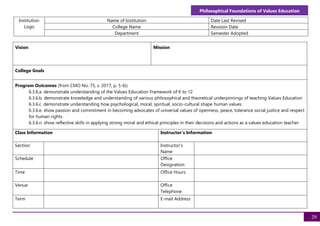
Institution
Logo
Name of Institution Date Last Revised
College Name Revision Date
Department Semester Adopted
Vision Mission
College Goals
Program Outcomes (from CMO No. 75, s. 2017, p. 5-6):
6.3.6.a. demonstrate understanding of the Values Education Framework of K to 12
6.3.6.b. demonstrate knowledge and understanding of various philosophical and theoretical underpinnings of teaching Values Education
6.3.6.c. demonstrate understanding how psychological, moral, spiritual, socio-cultural shape human values
6.3.6.e. show passion and commitment in becoming advocates of universal values of openness, peace, tolerance social justice and respect
for human rights
6.3.6.n. show reflective skills in applying strong moral and ethical principles in their decisions and actions as a values education teacher
Class Information Instructor's Information
Section Instructor's
Name
Schedule Office
Designation
Time Office Hours
Venue Office
Telephone
Term E-mail Address
30
Philosophical Foundations of Values Education
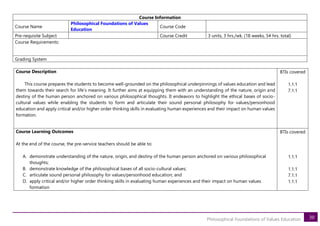
Course Information
Course Name
Philosophical Foundations of Values
Education
Course Code
Pre-requisite Subject Course Credit 3 units, 3 hrs./wk. (18 weeks, 54 hrs. total)
Course Requirements:
Grading System
Course Description
This course prepares the students to become well-grounded on the philosophical underpinnings of values education and lead
them towards their search for life’s meaning. It further aims at equipping them with an understanding of the nature, origin and
destiny of the human person anchored on various philosophical thoughts. It endeavors to highlight the ethical bases of socio-
cultural values while enabling the students to form and articulate their sound personal philosophy for values/personhood
education and apply critical and/or higher order thinking skills in evaluating human experiences and their impact on human values
formation.
BTIs covered
1.1.1
7.1.1
Course Learning Outcomes
At the end of the course, the pre-service teachers should be able to:
A. demonstrate understanding of the nature, origin, and destiny of the human person anchored on various philosophical
thoughts;
B. demonstrate knowledge of the philosophical bases of all socio-cultural values;
C. articulate sound personal philosophy for values/personhood education; and
D. apply critical and/or higher order thinking skills in evaluating human experiences and their impact on human values
formation
BTIs covered
1.1.1
1.1.1
7.1.1
1.1.1
31
Philosophical Foundations of Values Education
Time
Allotment
Intended Learning Outcomes (ILOs) BTIs Content Suggested Teaching Learning
Activities
Suggested Assessment BTIs
Week 1 At the end of the week, the pre-service
teacher (PST) should be able to:
• Discuss how philosophy as
paideia relate to Edukasyon
sa Pagpapakatao (EsP) in
schools
1.1.1
[A,B]
A. Philosophy and the
Personhood Education
(Ang Pilosopiya at
Edukasyon sa
Pagpapakatao -EsP)
• Interactive discussion
focusing on the relationship
of philosophy and paideia;
the EsP as a course in DepEd;
and how philosophy as
paideia relate to EsP
• Main guide questions:
1. What is the relationship of
paideia and philosophy?
2. Describe overview of
EsP?(objectives, method and
content)
3. How is philosophy as paideia
related to EsP?
Concept map presentation to discuss
how philosophy as paidea relate to EsP
Rubric focusing on the clarity of
discussion about the content; and the
use of words/phrase in the concept
map to represent a concept
1.1.1
Week 2-3 At the end of the week, the pre-service
teacher (PST) should be able to:
• Synthesize the arguments
about the nature, origin, and
destiny of the human person
and how goodness was
emphasized in their views
based on the ancient Greek
philosophy perspective
1.1.1
[A]
B. The nature, origin, and
destiny of the human
person
1. Ancient Greeks
Philosophy
a. Socrates
b. Plato
c. Aristotle
d. St. Thomas
Aquinas
e. Descartes
Dualism
f. Hegel’s Dialectics
and Marx’s
Reaction
• Panel Discussion:
1. Students will be grouped and
will be assigned to do
readings about one ancient
Greek philosopher’s
arguments about the nature,
origin and the destiny of the
human person. Guide
questions should be given to
students.
2. The students synthesize their
understanding of their
answers to the questions.
3. Discuss inputs in a panel
discussion facilitated by the
teacher.
Invented Dialogues (Students weave
together real quotes from primary
sources, or invent ones to fit the
speaker and context) to show students’
synthesis of their understanding of the
nature, origin, and destiny of the
human person from the ancient Greek
philosophers
Rubric focusing on the ability to weave
together views into brief
statements/dialogues
1.1.1
Week 4 At the end of the week, the pre-service
teacher (PST) should be able to:
• Summarize the different
perspectives of the different
ethical schools about the
nature, origin and the destiny
of the human person and
1.1.1
[A]
2. Ethical Schools
a. Stoicism
b. Epicureanism
c. Early Church Fathers
d. Ethics During
Reformation Period
e. Secular Philosophies
f. Utilitarianism
• Assigned reading on the
different ethical schools’
views about the nature, origin
and the destiny of the human
person and how goodness
was emphasized in their
views.
Poster slogan showing students
understanding of the views of different
ethical schools about goodness in the
human person
Rubric focusing on creativity of
presentation and the accuracy of
1.1.1
32
Philosophical Foundations of Values Education
how goodness was
emphasized in their views
• Question and Answer using
teacher made guide
questions.
• Students work in groups to
summarize the different
views.
ideas/views being portrayed by the
element of the poster slogan
Week 5 At the end of the week, the pre-service
teacher (PST) should be able to:
• Analyze how current
research-based societal
practices are reflective of
their adherence to the
modern ethical thoughts
about the nature, origin and
destiny of the human person
1.1.1
1.2.1
[A,B]
3. Modern Ethical
Thoughts
a. Soren Kierkegaard
b. Immanuel Kant
c. Bertrand Russell
d. Emmanuel Levinas
• Situational Analysis:
1. Reading assignment prior to
the meeting on modern
ethical thoughts of the nature
of the human person
2. Citing current research-based
societal practices/ issues
reflective of adherence to the
modern ethical thoughts.
3. Review arguments of these
practices if they are reflective
of the arguments of each
philosopher
Categorial Grid (rectangles divided
into cells containing list of items
categorized after organizing jumbled
listing of terms on current issues and
philosophers) to show students
understanding and analysis of the
nature, origin and destiny of the
human person in relation to current
societal situations/issues
1.1.1
1.2.1
Week 6 At the end of the week, the pre-service
teacher (PST) should be able to:
• Identify examples of current
practices/ statements of
personal philosophies and
beliefs that were influenced
by Eastern philosophy
1.1.1
[A]
4. Eastern Perspective
a. Confucius
b. Lao-Tze
c. Hinduism
d. Buddhism
e. Taoism
f. Islam
• Group assignment:
Readings, brainstorming and
role play
1. Students summarize
Readings on the Eastern
philosophies brainstorm
on its manifestation on
current beliefs and
practices. Students
synthesize their output
into a role play to show
its manifestation of the
Eastern philosophy.
2. After each role play,
other groups would be
asked to identify how
Eastern views have
influenced the portrayed
situation
Defining Features Matrix: students
categorize concepts according to
presence or absence of important
defining features of each of the
Eastern Philosopher views
Criteria: correctness of categorization
1.1.1
33
Philosophical Foundations of Values Education
Week 7 At the end of the week, the pre-service
teacher (PST) should be able to:
• Construct a synthesized
description of “human act”
based on the discussions on
the characteristics and
elements of human acts
1.1.1
[B]
C. Ethics and Human Act
1. Human Acts
2. Characteristics of
Human Acts
3. Essential Elements of
Human Acts
a. Knowledge
b. Freedom of the
Will
c. Voluntariness
4. Types of Human Acts
a. Elicited Acts
b. Commanded
Acts
• Given an enumeration of
“acts” students classify
whether they are “human act”
or “act of man”.
• This activity can use picture
prompts (of acts) through a
PowerPoint presentation or
illustration boards.
• Guide Questions to create a
concept map with the
students: which of the
pictures reflect a human act?
From the given examples and
categorization, how do you
describe a human act? From
the inputs you have given,
state your own definition of a
human act.
One Minute Paper stating personal
description of “human act”
Criteria: Brevity of statement;
correctness of description
1.1.1
Week 8 At the end of the week, the pre-service
teacher (PST) should be able to:
• State a working definition of
morality based on the
concepts related to it
1.1.1
[B]
D. Nature of Morality
1. Etymological Definition of
Morality
2. Definition of Key Terms:
Ethics, Ethical, Moral,
Unethical, Immoral;
Characteristics of Good,
Bad, Right, Wrong,
Happiness, or Pleasure;
Amoral and Nonmoral
3. A Working Definition of
Morality
• Using a concept map, teacher
discusses definition of the
terms related to morality and
its applications. Students
formulate a definition of
“morality.”
• Definition line to represent a
working definition of
morality. (definition line
consists of limited number of
words e.g. 40-50 words)
Criteria: clarity and
correctness of concepts in the
definition
Word cloud to represent a working
definition of morality.
Criteria: Correctness of input based on
justifications
1.1.1
Week 9 At the end of the week, the pre-service
teacher (PST) should be able to:
• Explain the argument that
“human act is the bases of
ethical responsibility”
1.1.1
[B]
E. Morality of Human Acts
1. Sources of
Morality
2. Good Acts and Evil
Acts
• Reading assignment on
“Morality of Human Acts”
• Think-pair-share:
Ask students to write down
their thoughts about the
topic prior to class meeting-
Short quiz for students to present
their explanation of the argument that
“Human act is the basis of ethical
responsibility.”
1.1.1
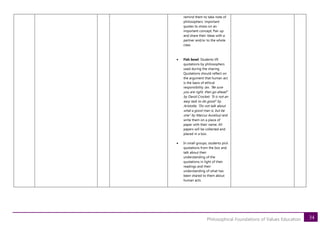
34
Philosophical Foundations of Values Education
remind them to take note of
philosophers’ important
quotes to stress on an
important concept; Pair up
and share their ideas with a
partner and/or to the whole
class
• Fish bowl: Students lift
quotations by philosophers
used during the sharing.
Quotations should reflect on
the argument that human act
is the basis of ethical
responsibility (ex. “Be sure
you are right, then go ahead”
by David Crocket; “It is not an
easy task to do good” by
Aristotle; “Do not talk about
what a good man is, but be
one” by Marcus Aurelius) and
write them on a piece of
paper with their name. All
papers will be collected and
placed in a box.
• In small groups, students pick
quotations from the box and
talk about their
understanding of the
quotations in light of their
readings and their
understanding of what has
been shared to them about
human acts.
35
Philosophical Foundations of Values Education
Week 10 At the end of the week, the pre-service
teacher (PST) should be able to:
• Apply the framework of
teleological ethics in
evaluating/ resolving moral
dilemmas
1.1.1
[B,D]
F. Teleological;
Deontological Ethics and
Situation Ethics
a. Teleological Ethics
1) Consequentialist
Theories (egoism,
altruism,
utilitarianism)
2) Pragmatism
3) Practical Ethics
• Interactive Discussion on the
theories and application
teleological ethics in resolving
moral dilemmas.
• In small groups, students
asses and resolve real-life
issues/moral dilemmas
applying teleological ethics.
They discuss their stand as a
group and share it to class.
Minute Papers to demonstrate how
students apply their understanding of
teleological ethics as a framework in
evaluating/resolving moral dilemmas.
(ex. Do you prefer buying one T-shirt
worth P500 (quality) or 10 T-shirts
worth P500 (quantity)? Explain your
preference.)
1.1.1
Week 11 At the end of the week, the pre-service
teacher (PST) should be able to:
• Illustrate how the application
of deontological ethical
framework is important in
confronting life issues and
problems
1.1.1
[B]
G. Deontological Ethics:
Kantian Ethics and the
Principle of Universality
• Suggested Activities:
Small group discussion:
Students study the “Universal
Declaration of Human Rights
(UDHR)” and lift at least 4
universal values reflected on
it then discuss why universal
values are important for
human survival
• Other activities: Students
resolve life-issues based on
Kantian Ethics.
Comic strips to illustrate situations
where the importance of confronting
life issues and problems using Kantian
Ethics and Principle of Universality is
applied
Rubric focusing on the clarity of
presentation through the comic strip;
and creativity of presentation
1.1.1
Week 12 At the end of the week, the pre-service
teacher (PST) should be able to:
• Apply situation ethics as a
framework in analyzing moral
experiences
1.1.1
[B,D]
H. Situation Ethics
a. Meaning of Situation
Ethics
b. Fletcher’s Six
Fundamental
Principles
c. Four Working
Principles of
Situation Ethics
(Pragmatism;
Relativism,
Positivism,
Personalism)
• Suggested activities:
Situational analysis (ex. A
fifteen-year-old girl was
driven to prostitution due to
poverty. For you, does
situation of poverty justify
prostitution? An affluent
mother addicted to gambling
is justifying her addition as
leisure or pass time. Can we
admit her plight?”)
Oral presentation of arguments in
applying situation ethics in analyzing
moral experiences
1.1.1
36
Philosophical Foundations of Values Education
Week 13 At the end of the week, the pre-service
teacher (PST) should be able to:
• Prove the importance of the
interrelatedness of the
different ethical frameworks
in coming up with a holistic
decision in confronting
everyday issues
1.1.1
[B,D]
I. Review of the ethical
theories (teleological,
deontological, virtue
ethics, divine command
theory, natural law)
• A review of the different
ethical theories using a
concept map. Brainstorming
on the important application
of the use of each ethical
framework by citing real-life
situations can be included.
• Given a moral issue (ex. Do
"drug suspects" deserve
summary execution?);
Students create their
arguments to defend their
stand based on the different
ethical frameworks.
Position paper to demonstrate
students understanding on the
importance of the interrelatedness of
the different ethical frameworks by
using them in coming up with a
holistic decision in confronting
everyday issues
Rubric focusing on the correctness of
the use of ethical framework (logic of
arguments)
1.1.1
Week 14-
15
At the end of the week, the pre-service
teacher (PST) should be able to:
• Reflect how one should arrive
at one’s authentic self to be a
good Values/personhood
Educator based on
Heidegger’s concept of
Dasein
1.1.1
7.4.1
[C]
J. Ethical Responsibility for
the Self
a. Martin
Heidegger: A Call
to Authentic Self
b. Be at Peace with
your Past
c. Reflection on
Commitment
d. Loving Your
Self/Self-
enhancement
(Og Mandinno)
• Use short moral stories to
illustrate the concepts on
Heidegger’s concept of
Dasein and ethical
responsibility for the self.
• Think pair share to monitor
understanding of each
concept before proceeding to
the next.
Refection paper expressing student’s
reflection of how they should arrive at
one’s authentic self to be a good a
good values educator
1.1.1
Week 16 At the end of the week, the pre-service
teacher (PST) should be able to:
• Prove how social
responsibility relates to ethics
by citing its application to
real life situations
1.1.1
[A]
K. Ethics and Social
Responsibility
a. Moral Act and
Human Will
b. Free Will and
Freedom
c. Human Act and
Moral Responsibility
1. Definition of
social
responsibility
2. Relationship
between ethics
• Lecture Discussion on the
meaning and relationships of
moral act and human will;
free will and moral
responsibility.
• Situation Analysis and
discussion of real-life
experiences where man’s
freedom of the will and the
element of responsibility is
illustrated. (citing of an
Reflection paper articulating one’s
philosophy as future values educator
reflective of one’s understanding of
ethical principles
1.1.1
37
Philosophical Foundations of Values Education
and social
responsibility
3. Ethics of Being
4. Ethics of Doing
institution and evidences of
social responsibility)
Or
Students share their
experiences where freedom
of the will and the element of
responsibility are considered
Week 17 At the end of the week, the pre-service
teacher (PST) should be able to:
• Formulate own philosophy as
a values educator reflecting
one’s understanding of
ethical principles, its
relationship to social
responsibility, and to learners
as the center of their
profession
1.1.1
7.1.1
[C]
Ethics and Social
Responsibility
(continued)
• Interactive discussion
revolving around the
relationship ethics of being
and ethics of doing in
becoming a better person.
• Reflection activity for
students to be able to write
their own philosophy as a
values educator
Reflection paper articulating one’s
philosophy as future values educator
reflective of one’s understanding of
ethical principles
1.1.1
7.1.1
Week 18 At the end of the week, the pre-service
teacher (PST) should be able to:
• Showcase research-based
real evidences that illustrate
the relevance of ethics in
society and its implications to
social responsibility
1.1.1
1.2.1
[B]
Social Responsibility and Its
Relation to Ethics
• Students are grouped and will
be assigned to research on
the profile of different
institutions and companies
(classified into different
disciplines like education,
engineering, media etc.) and
identify researched-based
evidences of social
responsibility. Present these
evidences creatively labelled
with appropriate quotations
based from one’s study of
ethical principles (ex. “The
duty of media is to observe
truth and social
responsibility”; “Every social
ethic is doomed to failure if it
is blind to personal
responsibility.”) through an
organized exhibit.
Exhibit showing real life situations
proving the strong relationship of
ethics and social responsibility
1.1.1
1.2.1
38
Philosophical Foundations of Values Education
Suggested References
Aquinas, T. (1996). On law, eternal law, and natural law. In Gilby, T. (Ed.) Summa theologiae (vol. 28, pp. 5-97). Cambridge: Blackfriars in coordination with New York: McGraw-Hill Book
Company.
Bauzon, P. (1994). Essentials of values education. Manila: National Book Store.
Brown, H., Kennedy, L, & Snyder, J. (1995). Images of the human: The philosophy of the human person in a religious context. Illinois: Loyola Press
Calano, M. (2015). Ang pilosopiya at edukasyong pagpapakatao. Retrieved at https://suri.pap73.org/issue4/Calano_SURI_2015.pdf
Davies, J. (2009). Philosophy of the human being. University Press of America.
Dy, M. (2001). Philosophy of man. Goodwill Trading.
Heidegger, M. (1996). Being and time: A translation of dein and zeit. Trans. Joan Stambaugh. New York: State University of New York Press
Muega, M. (2008). Values and moral education: Aims, content and pedagogy. Unitas 81 (1), 181 -200. University of Santo Tomas.
Oakley, J. (1996). Varieties of virtue ethics. Ratio 9.
Ochieng'-Odhiambo, F. (2009). Foundations of ethics: A critical reader in moral and social philosophy. Nairobi: Nairobi Press.
Palispis, E. (1995). Introduction to values education. Quezon City: Rex Bookstore.
Rachel, J. (2004). What is morality. In Elements of moral philosophy (4th ed.). New York: McGraw-Hill.
Ross, D. (2013). Foundations of ethics. US: Read Books
Smart,J.J.C & Williams,B. (1973). Utilitarianism: For and against. Cambridge: Cambridge University Press.
Silber, J. (1982). The moral good and the natural good in Kant's ethics. The Review of Metaphysics,36(2), 397-437. Retrieved from http://www.jstor.org/stable/20127842
Tiempo, A. (2005). Social philosophy: Foundations of values education. QC. Rex Bookstore Virtue Ethics by Athanassoulis. (n.d.). Retrieved from https://www.iep.utm.edu/virtue/
Welker, M. (2014). The depth of the human person: A multidisciplinary approach. UK: Wm.B. Eerdsman.
West, H.R. (2006). The Blackwelll guide in Mill’s utilitarianism. Oxford: Blackwell
Philippine Culture and the Society
39
Institution
Logo
Name of Institution Date Last Revised
College Name Revision Date
Department Semester Adopted
Vision Mission
College Goals
Program Outcomes (from CMO No. 75, s. 2017, p. 5-6):
6.3.6.a. demonstrate understanding of the Values Education Framework of K to 12
6.3.6.c. demonstrate understanding of how psychological, moral, spiritual, and socio-cultural factors shape human values
6.3.6.d. exhibit critical mindedness in analyzing local, regional, national, and global trends and issues relevant to values education
6.3.6.f. become an exemplar of Filipino values
6.3.6.h. demonstrate commitment to student’s development for personal renewal and social transformation
6.3.6.m. manifest commitment to community service as a means to promote social values
6.3.6.n. show reflective skills in applying strong moral and ethical principles in their decisions and actions as a values education teacher
Class Information Instructor's Information
Section Instructor's
Name
Schedule Office
Designation
Time Office Hours
Venue Office
Telephone
40
Philippine Culture and the Society
Term E-mail Address
Course Information
Course Name Philippine Culture and the Society Course Code
Pre-requisite Subject Course Credit 3 units, 3 hrs./wk. (18 weeks, 54 hrs. total)
Course Requirements:
Grading System
Course Description
This course introduces students to concepts, theories, and perspectives vital to understanding Philippine society and culture.
It explains why different groups and societies have diverse cultures and behaviors, with a special focus on the Filipino socio-cultural
heritage relevant to values/personhood education. In doing so, students are expected to recognize cultural elements that are
distinctly Filipino and choose those that are worth perpetuating towards the common good and national advancement.
BTIs covered
1.1.1
Course Learning Outcomes
At the end of the course, the pre-service teachers should be able to:
A. demonstrate research-based knowledge on the different concepts, theories and perspectives vital in understanding Philippine
society and culture;
B. demonstrate understanding of diverse cultures and behaviors of different groups and societies, focusing primarily on Filipino
socio-cultural heritage relevant to values/personhood education; and
C. demonstrate critical thinking in recognizing cultural elements that are distinctly Filipino and in choosing which are worth
perpetuating towards common good and national advancement.
BTIs covered
1.1.1; 1.2.1
1.1.1
1.1.1
41
Philippine Culture and the Society
Time
Allotment
Intended Learning Outcomes (ILOs) BTIs Content Suggested Teaching Learning
Activities
Suggested Assessment BTIs
Week 1 At the end of the week, the pre-service
teacher (PST) should be able to:
• Discuss the basic concepts of
society and culture in relation
to values/personhood
education to promote
common good and national
advancement
• Elucidate how the concept of
sociological perspectives can
be used in understanding the
connection of human
behavior and social
structures (e.g. social
institutions) but focusing
primarily on
values/personhood
education
1.1.1
[C]
1.1.1
[C]
• Meaning and purpose of
society (interdependence of
the individual and the
society)
• Types of society including its
contemporary usage
• Social institutions (family,
education, religion,
economics, politics, mass
media, civil society)
• Structural functionalism
• Social conflict
• Symbolic interactionism
• Community snapshot
(pictures which the students
are asked to capture in their
own community) presenting
the basic concepts of society
and culture in relation to
values/personhood
education.
• Focus on how understanding
society and culture enable us
to become more
understanding and
broadminded as we seek for
the common good and for
national advancement.
• PowerPoint presentation on
the sociological perspectives
in the study of individual
people and social structures
like social institutions. Focus
more on how for instance
structural functionalism views
the importance of
values/personhood education
in overall societal
transformation
Recitation to articulate the
importance of the study of society and
culture in values/personhood
transformation focusing on how our
better understanding of society helps
promote common good and overall
societal transformation
2-minute video to show the synthesis
of how the three sociological
perspectives can be used in studying/
understanding the interdependence of
human behavior and societal
structures using Philippine socio-
cultural values such as
bayanihan,damayan, malasakit, and
others as examples.
Rubric foci:
clarity of the application of sociological
perspectives using Philippine cultural
values, depth of elucidation
1.1.1
1.1.1
Week 2 At the end of the week, the pre-service
teacher (PST) should be able to:
• Explain the concept of
sociological imagination in
understanding society and
culture while relating it to
values/personhood
education
1.1.1
[A]
C. Wright Mill’s sociological
imagination
• Class discussion on the
concept of sociological
imagination to understand
the relationship between an
individual and the wider
society. Relate lesson on how
the individual could impact
society as well. Focus on
Filipino cultural values that
Ishikawa/fishbone diagram to apply
the concept of sociological
imagination in understanding how
colonization, modernization and
globalization impact the current
Philippine culture and society and at
the same time, to demonstrate how
Filipino cultural values could advance
towards the common good and
1.1.1
42
Philippine Culture and the Society
could enhance the promotion
of the common good,
national advancement and
the overall betterment of
society
national advancement in view of these
social processes
Criteria:
Key ideas – causes (all key ideas have
to be highlighted)
Evidence (detailed evidence,
analysis/reflection included)
Rubric focusing on the ability to weave
together views into brief
statements/dialogues
Week 3 At the end of the week, the pre-service
teacher (PST) should be able to:
• Explain research-based
concept, characteristics,
functions, components, and
viewpoints on culture,
including causes of cultural
change using Philippine
culture and society as an
example
1.2.1
[A]
• Concept of culture
• Characteristics of culture
• Functions of culture
• Freedom wall class
discussion using Philippine
culture as context to
identify/explain the concept
of culture, its characteristics,
and functions. Relate
discussion especially on the
functions of culture to
values/personhood education
Essay to demonstrate understanding
of the concept, characteristics and
functions of culture but with special
focus on distinct Filipino culture that
promotes values/personhood
transformation
1.1.1
Week 4-5 At the end of the week, the pre-service
teacher (PST) should be able to:
• Describe the components of
the Philippine culture in
relation to
values/personhood
education
• Write a reflection paper to
express one’s appreciation of
the peculiarities of Philippine
culture
1.1.1
[A]
1.1.1
[A]
• Components of culture
1. Material culture
2. Non-material culture
a) Norms
• Folkways
• Mores (positive
mores/duty/ “thou
shall behavior”;
negative
mores/taboo/ “thou
shall not behavior”)
• Laws
b) Ideas, beliefs, and values
c) Language, gestures and
symbols
d) Fashion, fads, crazes
• Internet search assignment
on the components of culture
• Power Point presentation
discussing the components of
culture focusing on Filipino
culture in relation to
values/personhood education
• Think pair share focusing on
what makes one proud of his
own culture (Filipino)
3-minute human tableau or class
modeling to demonstrate
understanding on Philippine culture
and society focusing on its norms,
beliefs, values, language, symbols,
gestures, fads, fashion, and crazes
among others. Let students focus on
Filipino cultures in relation to values
education
Rubric focus:
Vivid interpretation/ description
Reflection paper to demonstrate
understanding of the components of
Philippine culture and express one’s
appreciation thereof
1.1.1
1.1.1
43
Philippine Culture and the Society
Rubric focus: reflective thinking,
analysis, and making connections
Week 6 At the end of the week, the pre-service
teacher (PST) should be able to:
• Explain critically the different
viewpoints on culture and
their implications to common
good using observable
Filipino social behavior
1.1.1
[B]
Perspectives on culture and their
implications to common good
• Cultural relativism
• Ethnocentrism
• Culture shock
• Xenocentrism
• Noble savage mentality
• Subculture
• Counterculture
• Culture lag
• Web quest research on the
different perspectives on
culture
• Five-minute student reports
on perspectives on culture
• Classroom opinion polls to
indicate students’ agreement
or disagreement with
statement or prompt related
to different viewpoints on
culture. Discuss its
implications to common
good.
Invented dialogue to synthesize
students’ understanding of the
different viewpoints on culture while
incorporating Filipino cultural values
for the promotion of the common
good
Criteria:
Synthesis and creativity
Content
1.1.1
Week 7 At the end of the week, the pre-service
teacher (PST) should be able to:
• Elucidate how various factors
relate to cultural changes taking
place in the Philippine context by
citing research-based evidence
1.1.1
1.2.1
[B]
On causes of cultural change
(continued)
Example:
Malasakit
Bayanihan/team spirit
Family closeness and security
Pakikisama
Hospitality/bukas-loob na
pagtanggap
Desire for social acceptance
(marunong makibagay, makiisa,
makisama, makilahok, makitungo,
makisalamuha)
• Small group discussion on how
culture may change from time to
time using the Philippine context
as example. Students use
research-based evidences as
examples
Collage poster presentation to
demonstrate understanding of current
social processes of cultural change in
the Philippine context using research-
based evidences
Rubric focus:
Depth of elucidation
Clarity of meaning on the poster
1.1.1
1.2.1
Week 8 At the end of the week, the pre-service
teacher (PST) should be able to:
• Illustrate critical understanding of
how forces can shape Filipino
values and the relevance of
strengthening values that are
worth perpetuating at present
time
1.1.1
[A]
• Structural-functionalist
perspective on values
• Forces that shape
contemporary Filipino values
• Web quest on different concepts
related to Philippine values
• PowerPoint presentation in
discussing the different concepts
related to Philippine values
Editorial cartoon to demonstrate
critical understanding of the relevance
of strengthening Filipino values at
present time
Rubric focus:
Clear presentation of how forces can
shape Filipino values and the relevance
of strengthening values that are worth
perpetuating at present time
1.1.1
44
Philippine Culture and the Society
Week 9-10 At the end of the week, the pre-service
teacher (PST) should be able to:
• Explain Filipino values that
characterize the Filipino
culture and their contribution
to national advancement
• Reflect on how basic Filipino
values are personally
demonstrated for the common
good and in seeking to uphold
the dignity of the teaching
profession in the country
1.1.1
[C]
1.1.1
[C]
Strengths of the Filipino
Character
• Pakikipagkapwa-tao
(pakikiramay and
bayanihan)
• Family orientation
• Joy and humor
• Flexibility, adaptability,
and creativity
• Hard work and industry
• Faith and religiosity
• Ability to survive
Weaknesses of the Filipino
Character
• Extreme personalism
• Extreme family
centeredness
• Lack of discipline
• Passivity and lack of
initiative
• Colonial mentality
• Kanya kanya syndrome
• Lack of self-analysis and
self-reflection
• K-W-L. Students write what they
know, what they want to know or
learn about Filipino values that
characterize the Filipino culture
and their contribution to national
advancement.
• Teacher gives input on the
strengths and weaknesses of the
Filipino character
• Students complete their KWL by
writing what they learned
• Think pair and share to articulate
one’s reflection on how basic
Filipino values such as caring
(malasakit), respect (paggalang),
and integrity (dignidad) are
demonstrated for the common
good and particularly to Filipino
children or to future learners.
Letter to a hero (student’s choice to
whom he/ she wants to address that
letter e.g. Lapu-lapu, Mabini etc…)to
explain the strengths and weaknesses
of the Filipino character and what
goals and strategies for change are
proposed in order to attain the ideals
of nation-building
Rubric foci:
Explanation of the Filipino values
Clarity of proposal
Reflection Paper to articulate one’s
understanding of the basic Filipino
values and reflection on how basic
Filipino values such as caring
(malasakit), respect (paggalang), and
integrity (dignidad)are personally
demonstrated for the common good,
particularly to Filipino children or to
future learners, and in seeking to
uphold the dignity of the teaching
profession in the country
Rubric foci:
reflective thinking
analysis
making connections
1.1.1
1.1.1
45
Philippine Culture and the Society
Week 11 At the end of the week, the pre-service
teacher (PST) should be able to:
• Analyze how key values
dominating in the Philippine
way of life affect the
development of a value-
system based on research
evidences
• Reflect on Filipino values that
are worth perpetuating to
maintain a peaceful and
stable society
1.1.1
1.2.1
[C]
1.1.1
[C]
1. Key Values that dominate in
Philippine way of life
• Non-rationalism vs
rationalism
• Personalism vs
impersonalism
• Particularism vs
universalism
• Nationalism vs
internationalism
• WebQuest using teacher
made guide questions to
gather information to guide
students to evaluate how key
values dominating in the
Philippine way of life affect
the development of a value-
system
• Small group discussion on the
pros and cons of the key
Filipino values that dominate
Philippine way of life using
SWOT analysis
A graphic organizer presentation
focusing on the analysis of the impact
of key values dominating in the
Philippine way of life to the
development of a value-system based
on research evidences
SWOT analysis to demonstrate critical
reflection on the strengths,
weaknesses, opportunities and threats
of Filipino key values in order to realize
those that are worth perpetuating for
social stability
Rubric focus:
Clarity and depth of analysis
1.1.1
1.2.1
1.1.1
Week 12 At the end of the week, the pre-service
teacher (PST) should be able to:
• Examine critically the nature and
role of collective behavior, social
movements, and civil society
organizations (CSOs) in
contributing to social change,
improvements, and a sustainable
nation
1.1.1
[C]
• Nature and meaning of
collective behavior
• Types of collective behavior
(crowds, mass, public,
fashion, fad, crazes and
disaster behavior)
• Meaning and nature of social
movements
• Types of social movements
• Civil society organizations
• “The boat is sinking” activity:
this game is designed to increase
awareness of the value of group
life and assess the quality of
relationships with people
• Class discussion through
PowerPoint presentation: process
the above activity and relate it to
the nature and role of collective
behavior and social movements, in
particular, the role of civil society
in contributing to social change,
improvements, and to a
sustainable nation
Written interview report of leaders of
selected civil society organizations
(CSOs) to demonstrate critical
understanding of the roles of the
leaders in contributing to social
change, improvements, and to a
sustainable nation
Rubric focus:
Clarity of write-up
1.1.1
Week 13 At the end of the week, the pre-service
teacher (PST) should be able to:
• Explain the meaning and the
theories of socialization using the
Philippines as context
1.1.1
[A]
• Meaning and theories of
socialization
• Socialization in the
Philippines
• WebQuest using teacher-made
guide questions.
• Class discussions on the meaning
and theories of socialization
Quiz to demonstrate students’
knowledge of the meaning and the
theories of socialization
1.1.1
46
Philippine Culture and the Society
Week 14 At the end of the week, the pre-service
teacher (PST) should be able to:
• Explain in the Philippine context
how the elements of conformity,
social control, and deviance exist
in a society and its effect on
society, using research-based
evidence
1.1.1
1.2.1
[A]
• Conformity and social
control
• Deviance (based on Merton’s
strain theory)
• Innovation; ritualism;
retreatism; and rebellion)
• Charade or pantomime: Act out
some deviant behaviors to
demonstrate understanding on
the importance of socialization
and conformity
• Collaborative learning in
researching and presenting the
concepts of deviance, conformity,
and socialization and its effect to
society using the Philippines as
context of discussion
Power Point Presentation to
demonstrate understanding on how
the elements of conformity, social
control and deviance exist in a society
and its effect to society, using
research-based evidences
Rubric focus:
Summary and synthesis application
slide creation
pictures/clip arts background,
mechanics
presentation skills
1.1.1
1.2.1
Week 15 At the end of the week, the pre-service
teacher (PST) should be able to:
• Write a critique on the concepts
of social stratification and social
mobility as expound in Philippine
culture and society
1.1.1
[A]
Components of social
stratification
• Social class in the
Philippines
• Social status
• Social role
Types of social stratification
system
• Open class system
• Closed or caste system
Meaning and nature of social
mobility
• Vertical mobility and
downward mobility
• Factors affecting social
mobility in the Philippines
• “Photo language” (Land of
contrast Activity): Students pick up
pictures (from pictures scattered
on the floor) that greatly
impressed them. This activity will
show increased consciousness
about differences in life conditions
and their consequences.
• Small group discussion on the
concepts of social stratification,
social mobility, and the factors
affecting social mobility in the
Philippine society
Critical reflection journal to
demonstrate lessons learned about
social stratification and mobility
Rubric focus:
Content reflection
Personal growth
Or
Make a list of the comparative lingo,
stereotypes, epithets or negative
expletives to categorize people as
“rich” or “poor”
Examples:
Poor: Galis; may toyo; usisera
Rich: “skin allergy”; eccentric; curious
Then write a reflection on the effects/
impacts of these negative expletives.
1.1.1
1.1.1
Week 16 At the end of the week, the pre-service
teacher (PST) should be able to:
• Discuss the categories of
institutional traits in the
Philippine (education,
government, economy,
family, and religion)
1.1.1
[A]
Categories of institutional traits:
1. Attitudes and behavior
patterns
2. symbolic culture traits
3. utilitarian traits
4. code of oral or written
specifications
5. ideologies
• Small group web quest on the
traits of major social institutions in
the Philippines
• Applying the concept: Tabular
representation on the traits of
major Philippine social institutions
Matrix presentation to demonstrate
understanding on the traits of
Philippine social institutions
Rubric focus:
Keywords use
Focus
Organization
Details
1.1.1
47
Philippine Culture and the Society
Week 17 At the end of the week, the pre-service
teacher (PST) should be able to:
• Describe the culture, ways
and issues confronting
indigenous peoples and
ethnic minorities in the
Philippines based on research
evidence
• Reflect on ways to eliminate
or reduce discrimination in
various settings such as in
the classroom or school, at
home, neighborhood, or in
workplaces while trying to
promote common good and
national advancement
1.1.1
1.2.1
[C]
1.1.1
[C]
• Sociological meaning of
ethnic group
• Patterns of ethnic group
relations
• Patterns of racism (prejudice
and discrimination)
• Patterns of competition,
conflict and domination
• Indigenous peoples rights
act of 1997 (RA 8371)
• UNESCO policy on engaging
with indigenous peoples
• WebQuest prior to the meeting.
• “Bring me” activity on materials
gathered from different ethnic
groups. Students will identify the
significance of these materials.
This activity will identify, focus,
and stir appreciation of the culture
and ways of the ethnic groups.
• Small group discussion on the
culture and ways, including the
issues confronting ethnic groups
in the country.
• Documentary film about IPs in the
Philippines that can increase
awareness in the elimination or
reduction of prejudice and
discrimination in the country
• Think pair share to express one’s
comments/reactions to
discriminations being observed in
various settings like in schools, at
home, neighborhood or in
workplaces.
• Have students write their
reflection. After which, share it to
whole class.
Collage to demonstrate understanding
of the culture, ways and issues
confronting ethnic groups in the
Philippines based from research
evidences.
Rubric focus:
Information/ description
Reflective essay suggesting measures
to eliminate or reduce prejudice and
discrimination in various settings such
as in the classroom/school, at home, in
the neighborhood, or in the workplace
while promoting common good and
national advancement
Rubric focus:
reflective thinking
analysis
making connections
1.1.1
1.2.1
1.1.1
Week 18 At the end of the week, the pre-service
teacher (PST) should be able to:
• Present an advocacy that
strengthens values/ personhood
education
1.1.1
[B]
Advocacy for Strengthening
Values/Personhood
• Barangay survey on civil,
political, or economic need of
the area to strengthen values/
personhood education
Advocacy proposal that strengthens
values/ personhood development
Advocacy proposal presentation
Rubric foci:
Presentation of the summary of the
survey (need)
On-point and clear advocacy
1.1.1
48
Philippine Culture and the Society
Suggested References
Anaya, J., & Anaya, S. J. (2004). Indigenous peoples in international law. Oxford University Press.
Buendia, R. G. (1991). The Cordillera autonomy and the quest for nation-building: prospects in the Philippines.
Cobo, J. R. M. (1986). Study of the problem of discrimination against indigenous populations.
Disko, S. (2010). World Heritage Sites in Indigenous Peoples' Territories: Ways of Ensuring Respect for Indigenous Cultures, Values and Human Rights. World heritage and cultural diversity, 167.
Enriquez, V. G. (1986). Kapwa: A core concept in Filipino social psychology. Philippine world view, 6-19.
Gripaldo, R. M. (Ed.). (2005). Filipino cultural traits: Claro R. Ceniza lectures (Vol. 4). CRVP.
Henslin, J. M., & Nelson, A. (2000). Essentials of sociology: A down-to-earth approach.
Henslin, J. (2001). Sociology: A down-to-Earth approach. 5th Edition. A Pearson Education Company. Massachusetts
Henriksen, John B. (2001). Implementation of the Right of Self-Determination of Indigenous Peoples. Indigenous Affairs (3), 6–21. Copenhagen: International Work Group for Indigenous Affairs.
Hunt, C.L., Quisumbing, L.R., Espiritu, S.C., Costello, M.A., & Lacar, L. Q. (1987). Sociology in the Philippine setting (A modular approach). Quezon City: Phoenix Publishing House
Indigenous peoples and ethnic minorities. Retrieved from https://www.un.org/…/Chapter-VIIIndigenous-peoples-and-ethnic-minorities.pdf
Indigenous peoples. (n.d.). Retrieved from https://en.unesco.org/indigenous-peoples
Kroeber, A. L., & Kluckhohn, C. (1952). Culture: A critical review of concepts and definitions [Papers, Peabody Museum of Archaeology & Ethnology, Harvard University].
Licuanan, P. B. (1994). A moral recovery program: Building a people—building a nation. Values in the Philippine culture and education, 35-54.
Maciones, J. (2001). Sociology 8th edition. Upper Saddle River, New Jersey: Prentice-Hall Inc. Pearson Education
Mercer, C. (2002). NGOs, civil society and democratization: a critical review of the literature. Progress in development studies, 2(1), 5-22.
Merton, R. (1968). Social theory and social structure. NY. Free Press
Mills, Wright. (1959). The sociological imagination. NY: Harper and Row.
Interactive Techniques. (n.d.). Retrieved from https://www.usf.edu/atle/documents/handout-interactive-techniques.pdf
Palispis, E. (2003). Introduction to sociology and anthropology. Quezon City: Rex Bookstore
Panopio, I. and Rolda, R. S. (2000). Society and culture: Introduction to sociology and anthropology. JMC Press, Inc. Quezon City.
Panopio, I., & Raymundo, A. (2004). General sociology (Focus on the Philippines). 4th ed. Quezon City: KEN INC
Quisumbing, L. R. (1994). A study of the Philippine values education programme (1986-1993).
San Juan, W. et al. (2007). Sociology, culture, and family planning. Unlad Publishing. Pasay City.
Tapales, P. D., & Alfiler, M. C. P. (1991). Sustaining Filipino unity: Harnessing indigenous values for moral recovery.
The Role of Civil Society and Social Movements. (n.d.). Retrieved from https://gsdrc.org/topic-guides/social-exclusion/lessons-and-tools/the-role-of-civil-society-and-social-movements/
Psychological Theories of Values Development
49
Institution
Logo
Name of Institution Date Last Revised
College Name Revision Date
Department Semester Adopted
Vision Mission
College Goals
Program Outcomes (from CMO No. 75, s. 2017, p. 5-6):
6.3.6.a. demonstrate understanding of the Values Education Framework of K to 12
6.3.6.c. demonstrate understanding of how psychological, moral, spiritual, and socio-cultural factors shape human values
6.3.6.f. become an exemplar of Filipino values
6.3.6.g. show understanding of the theories, principles and application of strategies for effective intra and interpersonal relations
Class Information Instructor's Information
Section Instructor's
Name
Schedule Office
Designation
Time Office Hours
Venue Office
Telephone
Term E-mail Address
50
Psychological Theories of Values Development
Course Information
Course Name
Psychological Theories of Values
Development
Course Code
Pre-requisite Subject Course Credit 3 units, 3 hrs./wk. (18 weeks, 54 hrs. total)
Course Requirements:
Grading System
Course Description
This course is designed to develop in the student an understanding of the psychological theories underlying
values/personhood development across life stages. It focuses on critical reflection of personal and social experiences and
observations to understand the needs of learners in difficult circumstances. This will promote understanding and appreciation of
individual differences and the uniqueness of each person.
BTIs covered
1.1.1
3.4.1
Course Learning Outcomes
At the end of the course, the pre-service teachers should be able to:
A. demonstrate an understanding of research-based psychological theories underlying the development of
values/personhood across life stages to promote appreciation of individual difference and uniqueness of each person;
and
B. exhibit critical thinking in analyzing personal, social experiences and observations to understand the needs of learners in
difficult circumstances.
BTIs covered
1.1.1
3.4.1
51
Psychological Theories of Values Development
Time
Allotment
Intended Learning Outcomes (ILOs) BTIs Content Suggested Teaching Learning
Activities
Suggested Assessment BTIs
Week 1 At the end of the week, the pre-service
teacher (PST) should be able to:
• Trace major themes and
directions of thinking among
psychologists with respect to
values/personhood development
1.1.1
[A]
A. Historical Background of
the Psychology of
Values/ Personhood
Development
• Lecture on the historical
background of the psychology of
values/personhood development
Timelineto present major themes and
directions of thinking among
psychologists about values/
personhood development through
different periods
Criteria (focus): clarity on how the
themes and directions of psychologist
will be presented
1.1.1
Week 2 At the end of the week, the pre-service
teacher (PST) should be able to:
• Explain the arguments of
various cognitive
development theories
1.1.1
1.2.1
[A]
B. Cognitive Developmental
Theories
1. Piaget’s cognitive
development theory
2. Information Processing
Approach
3. Vygotsky’s Socio-
cultural Theory
• WebQuest on cognitive
developmental theories
• Small group discussion to
synthesize understanding of the
cognitive development theories
• Teacher provides “empty outlines
of the topics on various theories”
to act as guide for deeper
understanding.
• Continue group activity
mentioned above focusing on
identifying differences of the
various cognitive developmental
theories
Completed Empty Outlines to
demonstrate understanding of the
arguments of various cognitive
development theories
Matrixto present the differences of
the cognitive development theories
Criteria: clear understanding of the
cognitive theories; ability to use
theories as basis/source of one’s
standpoint about intelligence and
moral development.
1.1.1
1.2.1
Week 3 At the end of the week, the pre-service
teacher (PST) should be able to:
• Explain Erickson’s view of moral
development and why it is utilized
as the starting point for an
integrated psychological theory of
moral development using
1.1.1
1.2.1
[A]
B. Erickson as the Starting Point
for an Integrated Psychological
Theory of Moral Development
Article readings on Erickson’s view of
moral development: critiques and
arguments
Socratic questioning: Students should
arrive at reasons why the study of the
psychology of moral development can
Recitationto explain why Erickson’s
view of moral development is utilized
as the starting point for an integrated
psychological theory of moral
development
1.1.1
1.2.1
52
Psychological Theories of Values Development
research-based articles, critiques
and arguments
• Illustrate using real-life situations
in the Filipino context how the
three-pronged approaches in
Erickson’s work - vital aspect, ego
crisis and the social aspect,
influence moral development
1.1.1
1.2.1
[B]
1. Erickson: A Broader
Paradigm of Moral Action
be better done from Erickson’s view
based from their readings.
In small groups, students review
Erickson’s work on vital aspect, ego
crisis and social aspect. They
brainstorm on what real-life situation
can be explained by the concepts.
3 minutes Oral Presentation of how
the three-pronged approaches in
Erickson’s work - vital aspect, ego crisis
and the social aspect, influence moral
development using real-life situations
in general and in the Filipino context.
Rubric focusing on the clarity of
presentation
1.1.1
1.2.1
Week 4 At the end of the week, the pre-service
teacher (PST) should be able to:
• Elucidate in a panel discussion
Erickson’s view of the virtues in
the various developmental stages
and their role in psychological
maturity
• Write a reflection paper on
the implications of Erickson’s
view of moral development
to one’s commitment as
values educator in seeking to
1.1.1
1.2.1
[A]
1.1.1
7.2.1
[B]
2. Developmental Stages of
Moral Development:
Erickson’s View
a. Hope: the first year of life
b. Will: the second year of life
c. Purpose: Ages 3 to 7
d. Competence: age 7 to
puberty
e. Fidelity: adolescence to
adulthood
f. Adulthood as commitment
• Internet research on
“Erickson’s view of the virtues
in the various developmental
stages and their role in
psychological maturity”
• Group students and assign
the different stages to focus
their study on.
• Students discuss the concepts
for the assign 2 discussants to
represent them during a
panel discussion.
• Q and A follows. Questions
will be raised by the teacher
and other students.
• Recap of the activity.
Panel Discussion to demonstrate
students’ knowledge of Erickson’s view
of the virtues in the various
developmental stages and their role in
psychological maturity
Criteria: logic and clarity of arguments
1.1.1
1.2.1
1.1.1
7.2.1
53
Psychological Theories of Values Development
integrate in one’s values
system the qualities of caring
attitude, respect and integrity
in order to uphold the dignity
of teaching as a profession
• Think pair share and writing
of reflections for deeper
reflection.
Reflective essay to express students
deeper understanding and
appreciation of Erickson’s view of
moral development in relation to
upholding the dignity of the teaching
profession
Rubric focusing on one’s
understanding of Erickson’s view of
moral development in relation to
upholding the dignity of the teaching
profession
Week 5 At the end of the week, the pre-service
teacher (PST) should be able to:
• Describe how moral
development takes place
across life stages from the
perspective of Piaget,
Kohlberg Gilligan and Turiel’s
theories
1.1.1
1.2.1
[A]
C. Moral Developmental
Theories
3. Piaget’s Theory of Moral
Development
4. Kohlberg’s Theory of
Moral Development
5. Gilligan’s Theory of
Moral Development
6. Turiel’s Social Domain
Theory
• Reading of research articles
on moral development
theories
• Group discussion using
teacher-prepared guide
questions to allow students to
discover and describe how
moral development takes
place across life stages from
the perspective of Piaget’s
and Kohlberg’s theories
• Teacher provides
cases/dilemma for students
to discuss in relation to the
different moral development
theories to act as guide for
deeper understanding.
Group presentation to demonstrate
understanding of the arguments of
various moral development theories
Rubric focusing on students ability to
logically argue one’s standpoint by
the use of a moral resolution applying
the various moral development
theories; and the students
demonstration of research based
knowledge of current issues
1.1.1
1.2.1
Week 6 At the end of the week, the pre-service
teacher (PST) should be able to:
A Deeper Understanding of
Moral Development Across Life
Stages from Piaget’s, Kohlberg’s
• Students synthesize/summarize
concepts through a creative
presentation
Creative presentation: Simulations/
tableau/role play to illustrate simple
situations on how various theories
1.1.1
54
Psychological Theories of Values Development
• Simulate situations on how
various development theories
explain values/personhood
development across life stages
1.1.1
[B]
Theory, Turiel’s, and Gilligan’s
theory (continued)
explain values development across life
stages
Rubric focusing on the clarity of
presentation on
how various theories explain values
development across life stages
Week 7 At the end of the week, the pre-service
teacher (PST) should be able to:
• Reflect on the implications of
Piaget’s and Kohlberg’s Theory of
moral development to one’s
commitment as values educator
in upholding the dignity of
teaching as a profession
1.1.1
7.2.1
[B]
A Deeper Understanding of
Moral Development Across Life
Stages from Piaget’s and
Kohlberg’s Theory (continued)
• Think pair share: Each
student will reflect on the
stages of life he/she
experienced using the
following guide questions
and share it to partner:
1. What does he/she consider
the most critical stage?
2. How does this period make it
important?
3. Did it help you understand
yourself, your family, your
friends, or perhaps life in
general?
2-minute presentation of the pair
sharing as expression of personal
reflection
Rubric focusing on the clarity of
presentation on how a values educator
uphold the dignity of teaching a
profession
1.1.1
7.2.1
Week 8 At the end of the week, the pre-service
teacher (PST) should be able to:
• Examine the relationship of
cognitive development on
moral development using the
lens of various psychological
research-based theories
• Prove that moral
development is largely
dependent on cognitive
development by citing real-
life situations
1.1.1
1.2.1
[A]
1.1.1
1.2.1
[A]
Cognitive Developmental
Theories and Moral Development
(continued)
• Analysis of the relationship of
cognitive development on
moral development using the
lens of various psychological
research-based theories
• Writing of essay for deeper
reflection and analysis using
teacher made guide
questions.
• Teacher presents picture
prompts or situations related
to moral development
• Brain storming. Students cite
real life situations to prove
that moral development is
Short essay to discuss one’s
examination of the relationship of
cognitive development on moral
development using the lens of various
psychological research-based theories
Recitation to cite real life situations to
prove that moral development is
largely dependent on cognitive
development
1.1.1
1.2.1
1.1.1
1.2.1
55
Psychological Theories of Values Development
largely dependent on
cognitive development
Week 9 At the end of the week, the pre-service
teacher (PST) should be able to:
• Describe values/personhood
development from the point
of view of social learning
theory of Bandura
1.1.1
[A]
E. Moral Character: Social
Learning Perspective
1. Social Learning theory
(Bandura)
• Video clip viewing “Bobo
Doll Experiment” of Bandura
and other Social Learning
Theory video clips from You
tube.
(https://you.be/NjTxQy_U3ac)
• Students analyze how social
learning theory explains
values development among
children and youths
• Small group discussion to
summarize analysis. Illustrate
understanding through
artistic works
Comic Strips to illustrate situations
describing values development from
the social learning theory perspective
Criteria (focus): creativity and
appropriateness of created teaching
and learning activities
1.1.1
Week 10 At the end of the week, the pre-service
teacher (PST) should be able to:
• Elucidate how social learning
theory provides an account
of the role that individuals
play in the control of their
own actions, including moral
behavior
1.1.1
[A]
1. Bandura’s Theory of
Efficacy
2. Mischel’s Social Learning
Conceptualization of
Personality
• Rotter’s Locus of
Control
• Talk show: Students read
literatures related to
Bandura’s Theory of Efficacy,
Mischel’s theory and Rotter’s
Locus of control. Students
synthesize this using quide
questions provided by the
teacher.
• Discuss the concepts in a
simulated talk show. Students
state the main topic of the
talk show (should be related
to social learning theory and
moral/values development)
Talk show to demonstrate
understanding of how social learning
theory provides an account of the role
that individuals play in the control of
their own actions, including moral
behavior
Rubric focusing on the
appropriateness of activities presented
and clarity of presentation
1.1.1
56
Psychological Theories of Values Development
Week 11 At the end of the week, the pre-service
teacher (PST) should be able to:
• Deduce recommendations in
addressing limitations of
social learning theories in
one’s study of moral and
values/personhood
development based from
research-based articles
1.1.1
1.2.1
[A]
3. Criticisms on the
Limitations of Social
Learning theory in the
study of moral and
values/ personhood
development
• Students search from the web
articles containing criticisms
on the limitations of Social
learning theory in moral
development study.
• Share and discuss all inputs in
class and write a short essay
on recommendations in
addressing the limitations.
Short essay to discuss
recommendations in addressing
limitations of social learning theories in
one’s study of moral and
values/personhood development
Criteria: creativity, clarity and logic of
arguments
1.1.1
1.2.1
Week 12 At the end of the week, the pre-service
teacher (PST) should be able to:
• Describe how children
construct moral, societal, and
psychological concepts from
the perspective of Individual
Psychology and Ecological
Theory
1.1.1
1.2.1
[B]
4. Adler’s Individual
psychology
5. Bronfenbrenner’s
Ecological theory
• Video clip presentation and
analysis. Let students
interpret videos reflecting
Individual Psychology and
Ecological Theory.
(https://youtube/x89mdaHVT
8,
hhps://www.google.com/url?s
a=t&source=web&rct=j&url=
https://study.com/academ…)
• Teacher guides them to
conclude about how people,
situations, and circumstances
shape them who they are
now.
Reflection paper with insights about
the video clips, relate it to real-life
situations/experiences on how factors
like his/her biological their family,
neighbors, peers, etc exerted influence
on their development.
Rubric focusing on the
appropriateness of activities presented
and clarity of presentation
1.1.1
Week 13 At the end of the week, the pre-service
teacher (PST) should be able to:
• Explain the psychological
approaches to moral choice
1.1.1
1.2.1
[A]
Moral Choice: Psychological
Perspective
1. Determination, self-
determination and
indeterminism
• Class Discussion on determination,
self-determinism and
indeterminism and how is it
related to psychological study of
values/personhood development
Recitation to articulate understanding
of the role of psychological
approaches in the study of
values/personhood development
1.1.1
1.2.1
Week 14 At the end of the week, the pre-service
teacher (PST) should be able to:
• Evaluate the psychological view
on how people make moral
choices from the lens of various
1.1.1
[B]
2. Analysis of Skinner’s
View
3. Freudian psychoanalysis
view
4. E.O Wilson’s View
• Video clips on Skinner’s,
Freudian and Wilson’s view
on moral choices/free will
freedom/control
(https://youtu.be/RjmshUwAa
l)
Invented Dialogue to demonstrate
students understanding of how
people make moral choices from the
lens of various research-based
psychological theories
1.1.1
57
Psychological Theories of Values Development
research-based psychological
theories
(https://youtu.be/X5xt7Lt-
P6U)
• Processing activity: lecture/
small group discussion to
summarize main concepts
Criteria: clear understanding of the
theories; ability to use theories as
basis/source of one’s standpoint about
a moral issue
1.1.1
Week 15 At the end of the week, the pre-service
teacher (PST) should be able to:
• Explain the neo-
psychoanalytic views on
values development
1.1.1
[A]
Neo-psychoanalytic views on
values development
• Reading Assignments on neo-
psychoanalytic views on
values development
• Class discussion
Quiz on the neo-psychoanalytic views
on values development
1.1.1
Week 16 At the end of the week, the pre-service
teacher (PST) should be able to:
• Describe the psychological
view on how people make
moral choices based on
various research-based
psychological theories
1.1.1
[B]
Neo-psychoanalytic views
(Rogers, Maslow, Erickson,
Frankl, Bettelheim,
Menninger and Assagioli)
• Lecture on the neo-
psychoanalytic views
• Small group discussion:
Students plan and simulate
how people make choices
based on neo-psychoanalytic
theories.
Role plays/Simulations to
demonstrate students’ understanding
of the psychological view on how
people make moral choices using
various research-based psychological
theories
Rubric focusing on students’ ability to
logically argue one’s standpoint by
the use of a moral resolution
framework/model; and the students
demonstration of research based
knowledge of current issues
1.1.1
58
Psychological Theories of Values Development
Week 17 At the end of the week, the pre-service
teacher (PST) should be able to:
• Describe the developing
moral person in view of
various theories during the
earlier stages of life
1.1.1
[B]
I. Lifelong Moral Development
* Psychological Components of
Personal growth: Environment,
Vital Aspect and Ego or Cognitive
Aspects
a. Early Childhood
b. Elementary School
Children
c. Adolescence or High
School
d. College Youth
• Brainstorming: students
provide descriptions of
values/personhood
development from the lens of
various theories using the
psychological components of
personal growth as
framework: environment, vital
aspect, ego or cognitive
components and self
• Cite real life situations to
provide concrete examples
Diagram presentation to
demonstrate students’ understanding
of how various psychological theories
explain the behavior and
value/personhood development of
learners in difficult circumstances
across earlier stages of life.
Criteria focused on the clarity on how
the strategy was presented
1.1.1
3.4.1
Week 18 At the end of the week, the pre-service
teacher (PST) should be able to:
• Use ICT to present
description of the developing
moral person in view of
various research-based
theories from young
adulthood to later adulthood
1.1.1
1.3.1
1.2.1
[B]
e. Young Adulthood
f. Middle Age
g. Later Adulthood
• Small group discussion:
students provide descriptions
of values development from
the lens of various theories
using the psychological
components of personal
growth as framework:
environment, vital aspect, ego
or cognitive components and
self
• Infographic preparation for
an easy understanding of the
developing moral person
from young adulthood to
later adulthood.
Multimedia such as infographic
presentation to demonstrate
knowledge of developing moral
person in view from young adulthood
to later adulthood.
Rubric focusing on the
appropriateness of activities presented
and clarity of presentation
1.1.1
1.3.1
1.2.1
59
Psychological Theories of Values Development
Suggested References
Carlson, S., et. al (2018). Cohort effects in children’s delay of gratification. Developmental Psychology, 54 ( 8), 1395-1407.
Engler, B. (2016). Theories of personality (9th Ed.). Taguig City: Cengage Learning Asia Pte Ltd.
King, L. (2016). Experience psychology (3rd Ed.). New York: McGraw-Hill Education.
Jambon M. & Smetana, J. (2015). Theories of Moral Development. Retrieved from https://www.researchgate.net/publication/304183544.
Kurtiness, W. Gewirtz, J. & Lamb, J. (2014). Handbook of moral behavior and development theory (Vol. 1). New York: Psychology Press
Feist, J , Feist G.,& Roberts, T. (2013) Theories of personality (8th Ed.). New York: Mc-Graw Hill.
Smetana, J. (2013). Moral Development: The Social Domain Theory View. Retrieved from https://www.researcggate.net/publication/285637197.
Herman, W. (2005). Values acquisition and moral development: An integration of Freudian, Eriksonian, Kohlbergian and Gilliganian viewpoints. Forum on Public Policy, (1)4, 391-410.
Nevid S. & Rathus, S. (2005). Psychology and the challenges of life: Adjustment in the new millennium (9th Ed.). New Jersey: John Wiley and Sons.
Knowles, G. & McLean, G. (1992). Psychological foundations of moral education and character development: An approach. USA: University Press of America
Wren, T. (1982). Social learning theory, self-regulation, and morality. Ethics, 92(3), 409-424. Retrieved from http://www.jstor.org/stable/2380729
Dynamics of Intra and Interpersonal Relations
60
Institution
Logo
Name of Institution Date Last Revised
College Name Revision Date
Department Semester Adopted
Vision Mission
College Goals
Program Outcomes (from CMO No. 75, s. 2017, p. 5-6):
6.3.6.a. Demonstrate understanding of the Values Education Framework of the K to 12
6.3.6.b. Demonstrate knowledge and understanding of various philosophical and theoretical underpinnings of teaching Values Education
6.3.6.c. Demonstrate understanding how psychological, moral, spiritual, socio-cultural shape human values
6.3.6.d. Exhibit critical mindedness in analyzing local, regional, national, and global trends and issues relevant to values education.
6.3.6.f. Become an exemplar of Filipino values
6.3.6.g. Show understanding of the theories, principles and application of strategies for effective intra and interpersonal skills
6.3.6.h. Demonstrate commitment to student’s development for personal renewal and social transformation
Class Information Instructor's Information
Section Instructor's
Name
Schedule Office
Designation
Time Office Hours
Venue Office
Telephone
Term E-mail Address
61
Dynamics of Intra and Interpersonal Relations
Course Information
Course Name
Dynamics of Intra and Interpersonal
Relations
Course Code
Pre-requisite Subject Course Credit 3 units, 3 hrs/wk. (18 weeks, 54 hrs total)
Course Requirements:
Grading System
Course Description
The course intends to develop in the student an understanding of the theories, principles and application of strategies for
effective and healthy intra and interpersonal relations. As a process-oriented course, it focuses on the development of emotional
intelligence and basic communication skills through reflective and relational experiential activities. It aims to develop awareness
of an individual’s capacities and potentials that will inspire him/her to become fully-functioning person capable of creating learning
environments that promote pakikipagkapwa, pakikisama, kabutihang-loob,malasakit, tiwala sa sarili, pagkapantay pantay,
paggalang at malasakit.
BTIs covered
1.1.1
2.2.1
Course Learning Outcomes
At the end of the course, the pre-service teachers should be able to:
A. demonstrate content knowledge on the theories, principles, and strategies that may be applied for effective intra and
interpersonal relations; and
B. demonstrate knowledge in the implementation of reflective and relational experiential activities to develop emotional
intelligence, basic communication skills, and awareness of an individual’s capacities and potentials for personal
development
C. demonstrate the value of intra and interpersonal skills in creating learning environments that promote pakikipagkapwa,
pakikisama, kabutihang-loob,malasakit, tiwala sa sarili, pagkapantay pantay, paggalang at malasakit.
BTIs covered
1.1.1
1.1.1
2.2.1
62
Dynamics of Intra and Interpersonal Relations
Time
Allotment
Intended Learning Outcomes (ILOs) BTIs Content Suggested Teaching Learning
Activities
Suggested Assessment BTIs
Week 1 At the end of the week, the pre-service
teacher (PST) should be able to:
• Explain the difference of
intrapersonal and
interpersonal as a tool for
improving relationships
• Discuss the importance of
knowing the self and its
dimensions in relation to
dealing with others
• Discuss the importance and
role of Kagandahang loob
and pakikipagkapwa in
dealing with others
1.1.1
[A]
1.1.1
[C]
1.1.1
[A]
A. Definition of Intra and
Interpersonal Relations
B. Importance of Intra and
Interpersonal Relations
C. Nature of the Self
1. Definition of Self
2. Dimensions of the Self
• Self-Talk
Students talk to themselves
about their understanding of
intrapersonal and
interpersonal
• Group-talk
The class is divided into small
groups and let them share
about importance of
talking/dealing with self and
talking/dealing with others
• Class discussion facilitated by
the teacher
• My Metaphor
Students will draw an object
to represent the developing
self in relation to other
people
• From the sharing, the teacher
lead the class in defining the
self and discussing its
dimensions.
• Writing personal reflections
• Students will present a role
play depicting the importance
of kagandahang loob and
pakikipagkapwa in dealing
with others
Graded recitation to demonstrate
knowledge on the difference of intra
and interpersonal relationship.
Reflection paper demonstrating
students understanding about Self.
Role- play presentation. It will be
graded using rubric
Rubric highlighting the importance
and role of kagandahang loob at
pakikipagkapwa
1.1.1
1.1.1
1.1.1
63
Dynamics of Intra and Interpersonal Relations
Week 2 At the end of the week, the pre-service
teacher (PST) should be able to:
• Explain the formation of self-
image through the Looking
Glass Self theory
• Discuss the development of
attitude and preferences
through the Self-Perception
Theory
1.1.1
[A]
1.1.1
[A]
D. Theories on the Development of
Self
1. Looking Glass Self
2. Self-Perception Theory
(Daryl Bem)
• Who am I in Other’s Eye.
Students write who they think
they are based on the
perception of their parents,
teachers, friends and gives
proof based on their
interaction with them
• The students will research and
define the concept of Looking
Glass self and present its
advantages and
disadvantages to the class
• Unique and Shared
Students share to their group
their unique attributes and
explain why they see
themselves that way
• The teacher facilitates and
discuss the concepts of Self-
Perception Theory
Written output to show understanding
of the role of perception to the
formation of self-image
Oral participation to show
understanding that interpreting
behavior leads to changes in attitude
and preferences
1.1.1
1.1.1
Week 3 At the end of the week, the pre-service
teacher (PST) should be able to:
• Explain why others measure
their worth and abilities in
comparison to somebody
1.1.1
[A]
3. Social Comparison Theory
• Compare two famous
athletes/artists.
Let the students compare two
personalities and justify who
is better. Let the students
reflect why we often compare
ourselves with others
• Group Dynamics on Self-
awareness “Fear in a Hat”. The
students will be grouped and
each member will write their
personal fears anonymously
on a piece of paper which will
be collected. Then each
Comparison Matrix
Participation to show understanding
on the reasons why we measure our
abilities on someone’s work and worth
1.1.1
1.2.1
64
Dynamics of Intra and Interpersonal Relations
• Examine the effect of other
people’s judgement to the
formation of the self
according to the Reflected
Appraisal Theory
1.1.1
[A]
4. Reflected Appraisal Theory
student randomly selects and
read someone else’s fear to
the group and explain how
the person might feel.
• Teacher facilitates the
processing of the activity
• Judgement Day
Students will go out for 5
minutes to thee canteen,
student lounge, library and
other populated places. They
will observe and comment on
the behaviour, dress,
activities, etc of the people
they see.
• The teacher process the
activity and discuss with the
class the concepts of
Reflected Appraisal Theory
• Slogan Writing
Students write a slogan
related to the theory
Written reports of what they observed
and the comments
Slogan presentation to show
understanding of the effect of
judgment to self-development
1.1.1
Week 4 At the end of the week, the pre-service
teacher (PST) should be able to:
• Discuss the effect of
perceived self-control to
intrapersonal development
1.1.1
[B]
E. The Social Self
5. Perceived Self-control
a. General Description
b. Components of Personal
Control
c. Constructs and measures
(Efficacy, attribution, locus
of control)
• The teacher will conduct
lecture-discussion on the
topics perceived self-control,
components and its general
description and theoretical
background
• Reflection Writing
Graded Recitation to show knowledge
of perceived self -control
Reflective Essay to show
understanding of the effect of
perceived self-control to interpersonal
development
Paper and Pencil Test to check
student’s understanding and
knowledge on the different theories of
Self-development
1.1.1
65
Dynamics of Intra and Interpersonal Relations
Week 5 At the end of the week, the pre-service
teacher (PST) should be able to:
• Critique the reasons why
people engage in self
presentation
1.1.1
[A]
6. Self-presentation Theory
a. Meaning, Nature
and importance of
Self Presentation
b. Creating Desired
Impressions
b.1. Impressions
people try to create
b.2. What Constitute a
Desirable Impression
• Film Viewing on how people
attempt to present
themselves to shape how
others view them
• Reflective Essay will be
submitted
Reflective Essay to demonstrate
knowledge on self-presentation
1.1.1
Week 6 At the end of the week, the pre-service
teacher (PST) should be able to:
• Examine how the real-self
and ideal-self emerge in
difficult situation
• Explain the importance of having
a healthy self-concept in relating
with other people
1.1.1
[A]
1.1.1
[B]
E. Kinds of Self (Ideal and Real)
F. Levels of Self
1. Physiological
2. Psychological
3. Inner Core
G. Principles of Intrapersonal
Relations
1. Developing a Healthy
Self-concept
a Self-awareness
a.1. Importance of
• Lost on a deserted Island
Scenario
The class will be divided into
groups. Teacher presents a
scenario of a shipwreck and
list of items which they may
bring. Students choose and
justify an item or things they
will bring to the island
nearby. Students will
strategize and simulate how
they will reach the island.
The teacher will process the
simulation activity. Classify
items chosen by the group as
to the three levels of self
Class discussion on the kinds
of self and levels of self
• Journal Writing
• Through a video clip and
reading materials the class
discuss importance of
developing healthy self-
concepts
Simulation activity
Oral participation and Journal entry to
demonstrate knowledge of the ideal
self, real self and levels of self
Self-collage presentation to show
knowledge on the importance of
healthy self-concept
1.1.1
1.1.1
66
Dynamics of Intra and Interpersonal Relations
Self-awareness
a.2. Strategies for Self-
awareness
a.3. Self-introspection
• Designing Self-collage
Students create a collage using
pictures, words or symbols clipped
from magazines that represent
things they enjoy doing or own,
places they’ve been, and people
they admire. Collage will be
posted around the room.
Students are paired and they will
explain each other’s collage.
Week 7 At the end of the week, the pre-service
teacher (PST) should be able to:
• Determine the role of self -
acceptance and self- esteem in
the intrapersonal development of
the person
• Psychosynthesis: Perform
different strategies of improving
healthy body and mind towards
developing reflective
skills/attitude, and reflective
assessments , critical thinking,
healthy perception for self and
others
1.1.1
[B]
1.1.1
7.4.1
1.5.1
[B]
b. Self-acceptance and
Self-Esteem
b.1. Meaning
b.2. Signs of high and
low self-esteem
b.3. Self-serving bias as
defense mechanism
to protect self-esteem
b.4. Tips for Improving
Self-Esteem
c. Strategies in improving
the Body and the Mind
c.1. Loving and
Empowering the Body
and the Mind
• Johari Window – The teacher
will facilitate this activity for
the students to better
understand their relationship
with themselves and others
• The teacher will discuss
important concepts
• The students will research on
the weaknesses of Filipino
character focusing on self-
serving biases.
• Each group will brainstorm
and conceptualize a skit to be
presented in class
• Brain Gym
Teacher leads the class to do
some brain exercises to
balance brain functioning and
explain the importance of
having a healthy mind and
body.
• Other strategies will be
performed to empower the
body and mind giving
importance to improving
Class presentations are graded with
the use of a rubric to show knowledge
of self-esteem and its role to
intrapersonal development
Skit Presentation to demonstrate
knowledge on self-serving bias
Performance Assessment to
demonstrate skill in the different
strategies for healthy body and mind
to improve professional reflection to
improve practice, critical thinking,
healthy perception for self and others
1.1.1
1.1.1
7.4.1
1.5.1
67
Dynamics of Intra and Interpersonal Relations
practice as a result of
reflection.
• Accentuate the Positive
Break class into small groups
and let each member of the
group focus on one member
at a time and tell all positive
things or compliment about
the person to reinforce
positive thoughts
Week 8 At the end of the week, the pre-service
teacher (PST) should be able to:
• Examine the role of
intrapersonal communication
in developing personality and
practice through professional
reflection
1.1.1
7.4.1
[B]
2. Intrapersonal Communications
a. Types of Intrapersonal
Communications
a.1. Internal Discourse
a.2. Solo Vocal
Communication
a.3. Solo written
Communication
• Drawing self portrait
Using a small mirror, students draw
themselves and they will write
description about themselves
• Teacher process activity by
leading students to examine
the different intrapersonal
communications and how it
develops the personality as
well as professional practice.
• Write yourself a letter
Students write a letter to
themselves highlighting their
good attributes and qualities
to practice positive talk with
the self.
Self Portrait Drawing and letter to self
to show knowledge on the different
intrapersonal communication
strategies and how it develops
personality and professional reflection
CRITERIA for Assessment of self-
portrait letter
*Identify key values and beliefs
*Note skills and abilities
*Define goals and hopes
1.1.1
7.4.1
Week 9 At the end of the week, the pre-service
teacher (PST) should be able to:
• Explain the relevance of
reflection in developing the
aspects of intrapersonal
communication and to
improve teaching and
learning practice using
research-based information
1.1.1
7.4.1
1.2.1
[B]
b. Aspects of Intrapersonal
Communications
b.1. Self-concept
b.2. Perception
b.3 Expectations
b.4. Motivation (Maslow)
• Brochure Making
Students have library research
and reflect on the aspects of
intrapersonal
communications and present
their output through a
brochure highlighting its
importance in improving
teaching and learning
practice. The content of the
Brochure to show knowledge and
reflection in developing the aspects of
intrapersonal communication and to
improve teaching and learning practice
CRITERIA
*content zeroed in on how to develop
intrapersonal communication
*visual appeal
*lay out
1.1.1
1.2.1
68
Dynamics of Intra and Interpersonal Relations
brochure will be discussed in
the class facilitated by the
teacher and it will be
distribute to fellow students.
Week 10 At the end of the week, the pre-service
teacher (PST) should be able to:
• Critique the purpose of Social
Exchange Theory and
Uncertainty Reduction Theory
Interpersonal Relationships
1.1.1
[A]
H. Theories of Interpersonal
Relationships
1. Social Exchange Theory
• Uncertainty Reductions
Theory
• Group Activity: Each group
will be assigned to critique
the purpose of the Social
Exchange and Uncertainty
Reduction theories on
Interpersonal Relationships.
• Technology Box
Using the concepts learned
from the group activity,
students work with pair to
analyse the Cost and Reward
associated with electronic
mediated communication
Oral Presentation of output using ICT
to demonstrate insights and
knowledge gained from critiquing the
theories
Written cost and reward analysis to
show understanding of the theories
1.1.1
1.2.1
Week 11 At the end of the week, the pre-service
teacher (PST) should be able to:
• Discuss the role of politeness
in creating a comfortable
environment for
communication to inspire
learner participation
• Explain the changes in an
individual’s outlook and
perception as a person
builds relationship
1.1.1
2.4.2
[A]
1.1.1
[A]
3. Politeness Theory
4. Interpersonal
Relationships Model
a. Directional Components
a.1 Others to Self
a.2 Self to others
b. Assistive Polarity
b.1 Assistive Attitude
b.2 Resistive Attitude
b.3 Level of Intentionality
• Role play different
situations that show
politeness
• Teacher process the
activity and discuss the
concepts and principles
of politeness theory
when dealing with
others
• Count the squares.
The teacher presents an
image with multiple
squares (or other figures)
and let the students
count the squares (or
images) that they see
Role play to display knowledge in
showing politeness in order to have a
comfortable environment that inspires
positive communication and
participation
Oral recitation, participation and
Reflective Essay explaining how a
person’s outlook and perception
changes by circumstances
1.1.1
2.4.1
1.1.1
69
Dynamics of Intra and Interpersonal Relations
• Teacher leads the class to
reflect on the activity and
relate it to changing
outlooks and
perceptions. Teacher
provide reading material
on interpersonal relations
model and discuss
• Students write personal
insight about the lesson
Week 12 At the end of the week, the pre-service
teacher (PST) should be able to:
• Discuss the stages in
Interpersonal relations and
its importance in developing
supportive learning
environments that nurture
and inspire learners to value
pakikipagkapwa, pakikisama
, pagkakapantaypantay at
malasakit
• Seek advice concerning
strategies that build
relationships with
parents/guardians, teachers
and other people in the
community
1.1.1
2.4.1
[C]
6.2.1
[C]
I. The Social Self
1. Stages in Interpersonal
Relationships
a. Acquaintance
b. Build Up Stage
c. Continuation Stage
d. Deterioration
e. Termination Stage
2. Types of Interpersonal
Relationship
a. Friendship
a.1 Forming and
maintaining
friendship
b. Love
b.1 Attraction, Love,
and Intimacy
c. Platonic Relationship
d. Family Relationship
e. Professional Relationship
• Students research and
analyze the Knapp’s
Relationship Model
• Panel Discussion: Invite
experts from the school to
serve as guests to discuss the
topic. Students will raise
sound questions
• Buzz Groups: The class will
break into sub groups to
discuss the types of
interpersonal relations.
• Interview parents/guardians,
teachers, principals,
community leaders on how to
build and maintain
relationship
• The teacher will process the
activity
Written analysis of the Knapp’s
Relationship Model and
Reflection paper to demonstrate
knowledge on how relationships
develop and how values such as
pakikipagkapwa-tao, pakikisama and
pagpapakatao are nurtured through
establishing relationships with other
Present a Movie Maker to demonstrate
knowledge on the various types of
relationship and ways of maintaining
them based on the advices of people
around them
1.1.1
1.2.1
1.1.1
6.2.1
70
Dynamics of Intra and Interpersonal Relations
Week 13 At the end of the week, the pre-service
teacher (PST) should be able to:
• Evaluate the factors for
healthy relationship and how
they foster an environment
that promotes fairness,
respect, care and becoming a
person (pagpapakatao)
2.2.1
[C]
Factors for healthy
relationship:
Malasakit
Pagpapatawad
Paggalang
Pagkapantay-pantay
Kabutihang loob
• Group Work
• Dilemma Episode Making for
each factor affecting
relationships. After writing a
dilemma, groups will
exchange their output to
another group and try to
discuss then decide on what
to do.
• Teacher facilitates the
abstraction of the concepts
from the activity. Teacher
discuss the factors for healthy
relationships
Presentation of Dilemma Episodes and
decisions on the situation using ICT to
show knowledge of the factors for
healthy relationships promotes
fairness, respect, care and becoming a
person (pagpapakatao)
1.1.1
1.2.1
2.2.1
Week 14 At the end of the week, the pre-service
teacher (PST) should be able to:
• Examine the challenges affecting
interpersonal relations in view of
a learning environment that
promote fairness, respect, care
and reduced biases
1.1.1
2.2.1
[C]
H. Challenges to Healthy
Interpersonal relations
1. Barriers to Understanding
Others
a. Cultural Influences
Ethnocentrism
Racism
b. Stereotyping
c. Prejudice
5. Discrimination
• Implicit Association Test (IAT)
https://implicit.harvard.edu/i
mplicit/takeatest.html
Students take IAT to check
conscious or unconscious
biases against other people
• Cultural Awareness Activity
Match up students with a partner.
Students will be asked to pin
their partner’s thumb for
three seconds. Whoever
succeed gets a point
• The teacher processes the
activity by asking the
following questions:
“Who cooperated?”
“Who competed?”
• Teacher emphasizes the point
that they are partners not an
opponent and discuss how
culture affects relationships.
IAT Test Result to determine the extent
of student’s bias towards others
Performance Assessment to show how
cultural beliefs affect actions, often
without realizing it
Infographic to show result of analysis
on how advertisement reinforces
stereotyping and prejudices
1.1.1
2.2.1
71
Dynamics of Intra and Interpersonal Relations
• Illustrate self-disclosure as a
means of improving
relationship with others
1.1.1
1.7.1
[C]
J. Strategies in improving self-
disclosure skill
Trust
Openness
Respect
Acceptance
Sincerity
• Advertisement Analysis
Activity
Students choose an
advertisement, discuss
representation in the content
of the advertisement and
identify stereotypes and
prejudices
• Epitaphs Over your Tomb.
Students write epitaphs that
could be engraved on their
tomb. The class will be
grouped with 4 members
each and each student shares
their epitaphs, feelings and
fears while writing. Other
members of the group listen
and observe and take note of
the gestures of the sharer.
Written Output from the activity
1.1.1
Week 15 At the end of the week, the pre-service
teacher (PST) should be able to:
• Discuss the range of verbal
and non-verbal
communication strategies
that support understanding,
participation, engagement
and achievement
1.7.1
[B]
2. Effective Interpersonal
Communication
a. Verbal
communication
a.1. Using Language
Effectively
a.2. Listening and
responding with
empathy
Know Your Authentic
Self
Become Self Aware
Stay True to Yourself
Under Pressure
Disclose Yourself to
Others
• After the small group sharing,
the teacher will process the
activity and gives input on
communication, listening with
empathy
• The teacher discusses and
demonstrates the importance
and strategies of self-
disclosure listening and
responding with empathy.
Performance Assessment
to show skills in self-disclosure,
communicating, listening and
responding strategies to show
empathy as a means of improving
relationship and supportive
environment
2.4.1
72
Dynamics of Intra and Interpersonal Relations
Listening and
Responding
Strategies
b. Non-verbal communication
Week 16 At the end of the week, the pre-service
teacher (PST) should be able to:
• Practice resolving and
managing conflicts in a
positive and non-violent way
to create a learning
environment that promote
fairness, respect and care
1.1.1
2.2.1
[C]
3. Conflict Resolution and
Management
a. Interpersonal Conflicts
b. Managing
Interpersonal
Conflicts
c. Conflict Orientations
d. Conflict Responses
e. Communication
Patterns
f. Conflict Management
Skills
• The teacher provides a Mock
conflict situation and a
conflict resolution tip sheet.
• Students practice resolving
the conflict by utilizing the
tips.
• Group Activity
Students will describe
interpersonal conflicts
through video clips
presentation
• The teacher delivers a lecture
and demonstrates how to
manage interpersonal
conflicts.
• Students will do a role-play of
Conflict Situations and their
Healthy Resolutions
Performance Assessment to show
knowledge on using appropriate
strategy in conflict resolution
Submit video clips to describe
interpersonal conflicts. It will be
graded using rubric focusing on
conflict management
Performance Test to show knowledge
of Managing Interpersonal Conflicts in
a positive and non-violent way
1.1.1
1.2.1
1.1.1
2.6.1
Week 17 At the end of the week, the pre-service
teacher (PST) should be able to:
• Discuss the implication and
application of emotional
intelligence in improving
social relations
1.1.1
1.2.1
[C]
5. Understand Socio-
emotional Intelligence:
The Emotional Quotient
a. Meaning and
importance Emotional
Quotient
b. Relationships
between Primary
Emotions and other
Related Emotions
• Group Activity: discuss the
meaning and importance of
emotional intelligence.
• The Teacher will provide a
copy or ask students to surf
the net about Robert
Plutchik’s Wheel of Emotions
• In groups of five (5), students
will brainstorm by sharing
Presentation of output using ICT to
show knowledge on the meaning and
importance of emotional intelligence.
Presentation of output using ICT to
show knowledge on the relationships
between primary and related emotions
Submission of Journals for checking
scored using rubrics to measure
1.1.1
1.2.1
1.1.1
1.2.1
1.1.1
1.2.1
73
Dynamics of Intra and Interpersonal Relations
c. Explain Socio-
emotional
Development
d. Implications and
Applications of EQ
their thoughts and feelings
on the relationships of
primary emotions with other
related emotions
• Lecture- Discussion on Socio-
emotional development
highlighting the following
topics:
What feelings and emotions
are. Understanding how and
why they happen.
• Journal Writing explaining
socio emotional development
and insights gained from the
discussion
understanding of socio emotional
development
Week 18 At the end of the week, the pre-service
teacher (PST) should be able to:
• Formulate Guidelines to
improve Intra and
Interpersonal Relationship for
learning
2.1.1
[B]
4. Guidelines to Improve
Interpersonal Relations
a. Cultivate a Positive
Outlook
b. Control Your Emotions
c. Acknowledge Others’
Expertise
d. Practice Active Listening
e. Be Assertive
f. Practice Empathy
• Film Viewing on how to
improve Interpersonal
Relationship
• After processing, students will
prepare a short video clip
containing guidelines to
improve relationship
Video presentation containing
guidelines to improve interpersonal
relationship
1.1.1
74
Dynamics of Intra and Interpersonal Relations
Suggested References
Barriers to Understanding Others. Retrieved from http://www.yourthoughtpartner.com
Elkind, David (1970). The origins of religion in the child. Review of Religious Research, Vol. 12, No. 1 (Autumn,1970), pp. 35-42
Friedman, Harris, et. al. (2010). Transpersonal and other models of spiritual development. International Journal of Transpersonal Studies, 29 (1), 2010, 79-94.
Joseph, S. (2015). Positive psychology in practice. 2nd Ed. Hoboken, New Jersey: John Wiley and Sons, Inc.
Perceived Self Control. Retrieved from https://www.tanfonline.com
Roehlkepartain, Eugene C., et. al. (2006). The handbook of spiritual development in children and adolescents. California: Sage Publications, Inc.
Runzo, Joseph, et. al. (2007). The meaning of life in the world religions. Oxford: OneworldPubications.
Sadock, Benjamin James, et. al. (2015). Synopsis of Psychiatry. 11th Ed. Philadelphia: Wolters Kluwer.
Self Serving Biases. Retrieved from http://www.psychologytoday.com
Stages of Interpersonal Relationship. Retrieved from http://www.managementstudyguide.com
The Self Esteem. Retrieved from https://www.amazon.com/selfesteem
The Self Presentation. Retrieved from https://psychology.iresearchnet.com
75
Psycho-Spiritual Development
Institution
Logo
Name of Institution Date Last Revised
College Name Revision Date
Department Semester Adopted
Vision Mission
College Goals
Program Outcomes (from CMO No. 75, s. 2017, p. 5-6):
6.3.6.c. demonstrate understanding of how psychological, moral, spiritual, and socio-cultural factors shape human values
6.3.6.e. show passion and commitment in becoming advocates of universal values of openness, peace, tolerance social justice and respect
of human rights
6.3.6.f. become an exemplar of Filipino values
6.3.6.h. demonstrate commitment to students’ development for personal renewal and social transformation
6.3.6.i. demonstrate competence in employing various pedagogical approaches, methods and techniques for teaching values
6.3.6.j. demonstrate competence in the conduct of research and utilization of results to improve values education
6.3.6.l. demonstrate competence in integrating context appropriate technology to optimize teaching and learning
6.3.6.n. show reflective skills in applying strong moral and ethical principles in their decisions and actions as a values education teacher
Class Information Instructor's Information
Section Instructor's
Name
Schedule Office
Designation
Time Office Hours
Venue Office
Telephone
Term E-mail Address
76
Psycho-Spiritual Development
Course Information
Course Name Psycho-Spiritual Development Course Code
Pre-requisite Subject Course Credit 3 units, 3 hrs/wk (18 weeks, 54 hrs total)
Course Requirements
Grading System
Course Description
This course focuses on the psycho-spiritual experiences for facilitating the fullness of life such as prayer-centering, mind
body integration, transpersonal experiences, spiritual recollection, union and evocation- oriented activities suitable for an
individual or group. It aims to develop in the student an understanding of the theories and principles of psycho-spiritual growth
developed across various scientific, religious and cultural Orientations.
BTIs covered
1.1.1
Course Learning Outcomes
At the end of the course, the pre-service teachers should be able to:
A. demonstrate understanding of research-based theories, principles and strategies of psycho-spiritual growth developed
across various scientific, religious and cultural orientations; and
B. use basic psycho-spiritual skills, techniques, and differentiated strategies responsive to learners’ gender, needs, strengths,
interests, and experiences, cultural and religious backgrounds.
BTIs covered
1.1.1
3.1.1
77
Psycho-Spiritual Development
Time
Allotment
Intended Learning Outcomes (ILOs) BTIs Content Suggested Teaching Learning
Activities
Suggested Assessment BTIs
Week 1 At the end of the week, the pre-service
teacher (PST) should be able to:
• Utilize research-based
knowledge and ICT in
presenting basic concepts in
psycho-spiritual development
• Construct a personal
definition of religion and
spirituality
1.1.1
1.3.1
[A]
1.1.1
[A]
A. Meaning, essence, nature
and purposes of religion and
spirituality
B. Spirituality versus religion
• Students write their personal
definition of religion and
spirituality
and share their own
experiences/practices in
spiritual development
• Web Quest to explore the
meaning, essence, nature and
purposes of religion and
spirituality, including its
similarity and differences
• Class discussion on the
meaning, essence, nature and
purposes of religion and
spirituality
Presentation of research output in
class using ICT to show knowledge on
the difference of the terms
Written definition of religion and
spirituality to show personal
knowledge and meaning of religion
and spirituality
1.1.1
1.3.1
1.1.1
Week 2-3 At the end of the week, the pre-service
teacher (PST) should be able to:
• Synthesize research-based
knowledge to present some
personalities in the field of
early and modern psycho-
spirituality
1.1.1
1.3.1
[A]
A. William James
B. G. W. F. Hegel
C. Sigmund Freud
D. Carl Jung
E. Alfred Adler
F. Gordon Allport
G. Erik Erikson
Modern thinkers
A. Allen Bergin
B. Ralph W. Hood Jr.
C. Kenneth Pargament
D. Julian Jaynes
• Library and internet research
on the personalities in
religious and psychological
studies, including their
contribution
• Small group discussion on
some personalities in the field
of early psycho-spirituality
Written output on library and internet
research and sharing of findings
Presentation of research output using
ICT to demonstrate knowledge in
identifying personalities who made
significant contributions to the
psychology of religion
1.1.1
1.3.1
Week 4 At the end of the week, the pre-service
teacher (PST) should be able to:
• Explain the psychological
approaches to religion and
spirituality
1.1.1
[A]
Psychodynamic approaches in
understanding religion and
spirituality
• Lecture on psychodynamic
approaches to religion and
spirituality
• Preparing Venn diagram to
indicate major points of
psychodynamic approaches
to religion and spirituality
Venn Diagram to demonstrate
knowledge on salient points of
psychodynamic approaches in
understanding religion and spirituality
1.1.1
78
Psycho-Spiritual Development
Week 5 At the end of the week, the pre-service
teacher (PST) should be able to:
• Examine the similarities and
differences of psychological
approaches to religion and
spirituality
1.1.1
[A]
Humanistic and
transpersonal approaches to
religion and spirituality
• Article review on the
significant features found in
the article focusing on
similarities and differences of
religion and spirituality
Oral presentation of output using ICT
to demonstrate knowledge on
psychological approaches to religion
and Spirituality
1.1.1
Week 6 At the end of the week, the pre-service
teacher (PST) should be able to:
• Appraise the core principles
of social and personality
theory in understanding
religion and spirituality
1.1.1
[A]
Personality theory in
understanding religion and
spirituality
• Internet search assignment
on the social and personality
theories’ contribution to
understanding religion and
spirituality
• Group Activity- students will
be grouped into five (5) and
share their research output
Oral presentation of output using ICT
is deemed necessary for students to
demonstrate knowledge of Social and
Personality theories’ contribution in
understanding religion.
1.1.1
Week 7-8 At the end of the week, the pre-service
teacher (PST) should be able to:
• Determine the significant
contribution of positive
psychology and
neurobiological approaches
to religion and spirituality
1.1.1
[A]
Positive Psychology
1. Levels of Positive
Psychology
2. Concepts of Positive
Psychology
3. Elements of Positive
Psychology
Neurobiological approaches to
religion and spirituality
• Classroom discussion on the
concepts, significant
contribution of religion and
spirituality from the point of
view of psychology
• Student Activity: Song
Composition and Rendition
on the topic “ A Meaningful
Life”
The song composition will
demonstrate students’ knowledge on
positive psychology’s contribution to
religion and spirituality.
1.1.1
Week 9 At the end of the week, the pre-service
teacher (PST) should be able to:
• Use research-based
knowledge in explaining how
spirituality affects mental
health
1.1.1
[A]
1. How is spirituality related to
health?
2. What is the impact of
spirituality on mental health?
• Internet search assignment
• Group discussion and video
clip making on the impact of
spirituality to mental health
Students will demonstrate knowledge
on the effects of Spirituality to health
through
Video clip/movie maker presentation.
This will be graded using rubric
focusing on how spirituality affect
health condition
1.1.1
Week
10-11
At the end of the week, the pre-service
teacher (PST) should be able to:
• Explicate research-based
concepts of understanding
spiritual development
theories
1.1.1
1.2.1
[A]
A. David Elkind: The Cognitive
Development Tradition
B. Elements of Religion in the
Child (D. Elkind)
o Every Religion has a God
concept
o Every Religion has its own
symbols
• Group work: Collaborative
learning in researching and
presenting spiritual
development theories
Oral presentation of output to
demonstrate knowledge on the
elements of religion
1.1.1
1.3.1
79
Psycho-Spiritual Development
• Distinguish the elements and
characteristics of religion
based from cognitive
development tradition
1.1.1
[A]
o Every Religion has a set
of rituals
o Every Religion has a
theology
Week 12 At the end of the week, the pre-service
teacher (PST) should be able to:
• Explain how faith is being
developed using the theory
of James Fowler
1.1.1
[A]
James Fowler: Theory of Faith
Development
• Stages of Faith Development
a. Intuitive projective
b. Mythical literal
c. Synthetic conventional
d. Indivituative reflective
e. Conjunctive
f. Universalizing
• Classroom discussion on faith
development concepts
• Students work in small
groups to create invented
dialogues. The teacher can
cite examples to guide the
students
Invented dialogues to reflect
synthesized understanding and
evaluation of James Fowler’s theory of
Faith
1.1.1
1.3.1
Week 13 At the end of the week, the pre-service
teacher (PST) should be able to:
• Discuss the various stages of
religious development
1.1.1
[A]
Fritz Oser: Theory of religious
development
• Stages of faith and religious
development
• Classroom discussion on
Oser’s theory of religious
development
• Socratic method will also be
employed
Quiz to demonstrate understanding of
religious development stages
1.1.1
Week 14 At the end of the week, the pre-service
teacher (PST) should be able to:
• Determine the ways to
discover one’s spirituality
1.1.1
[A]
Discovering one’s spirituality • Journal Writing
a. Create an entry in their
journals regarding the
psycho-spiritual resource/s
that: They have employed in
the past 12 months
b. Is/ are available, but has/
have not been employed or
utilized.
c. They may be employing in
the next three months
d. Reasons for a, b, and c.
Journal writing will demonstrate
knowledge on one’s spirituality. This
will be collected for checking
1.1.1
Week 15 At the end of the week, the pre-service
teacher (PST) should be able to:
• Examine the four (4) Types of
Spiritual Practices
1.1.1
[A]
Types of Spiritual Practice
1. Dhayna (Meditation)
2. Japa (Repetition of
Mantra)
3. Prarthana (Prayer)
4. Puja (Ritualistic Worship)
• Group Work: “Collaborative
learning” in researching,
examining and presenting the
four types of Spiritual
practices
Graphic organizer/mapping of
relationship/ interrelationship of the
four types of spiritual practices
1.1.1
80
Psycho-Spiritual Development
Week 16 At the end of the week, the pre-service
teacher (PST) should be able to:
• Demonstrate centering
strategies
1.1.1
[B]
General advice about
Posture
Setting up meditation area
Basic meditation
Brief meditation
Thought stopping sequence
Mental activity self-assessment
Footsoaking
Mindful breathing
Conscious breathing
• Invite practitioner to
demonstrate centering
strategies, the students will
religiously follow the
steps/procedures
Demonstration per group using
criteria/rubric to demonstrate
understanding of centering strategies
CRITERIA:
Execution of steps with precision
1.1.1
Week 17 At the end of the week, the pre-service
teacher (PST) should be able to:
• Demonstrate knowledge and
understanding of
differentiated teaching to suit
learners’ need, interests,
strengths, and experiences by
performing activities for
exploring spiritual
development
1.1.1
3.1.1
[B]
Activities for Exploring Spiritual
Development
Activity 1. Metaphors of
Spiritual Life
Activity 2. Sacred Place
Activity 3. Let’s Talk
Activity 4. Nurturing Your
Own Spirituality
Activity 5. Ritual Is
Activity 6. I Will Live
Forever and Ever!
• Classroom discussion and
demonstration of activities
exploring spiritual
development
• Sharing of experiences: “Ups
and downs”, joys and
hardships, and lessons
learned and how they see
their image in this experience.
• Small group discussion on
“one’s sacred place”
• Small group discussion on
spiritual experiences and
practices
• Small group discussion
• Small group discussion of
rituals participated which
students considered as
meaningful.
• Reflection on Frances
Hodgson Burnett’s “The
Secret Garden”
Performance Assessment will be used
to demonstrate knowledge of activities
for exploring spiritual development.
Doodle art to demonstrate one’s
understanding on the metaphors of
spiritual life
Creative art expression to demonstrate
one’s concept of a “sacred place”
Sharing of one’s personal spiritual
experiences and practices.
Bookmark making to demonstrate how
one nurtures his/her own spirituality
Doodle art to demonstrate one’s
understanding on what ritual is
Reflection paper on Frances Hodgson
Burnett’s “The Secret Garden” to
demonstrate understanding of the
lessons learned from the excerpt
1.1.1
3.1.1
Week 18 At the end of the week, the pre-service
teacher (PST) should be able to:
• Utilize creative and
interactive activities for
spiritual development
1.1.1
3.1.1
[A,B]
Application of creative and
interactive activities for
exploring spiritual development
• Ecumenical Recollection
Meditation
A reflection paper to express
insights/lessons learned from the
learning activities for spiritual
development
1.1.1
3.1.1
81
Psycho-Spiritual Development
Suggested References
Benson, P. L., Roehlkepartain, E. C., & Rude, S. P. (2003). Spiritual development in childhood and adolescence: Toward a field of inquiry. Applied developmental science.
Corveleyn, J., Luyten, P., &Dezutter, J. (2013). Psychodynamic psychology and religion. Handbook of the psychology of religion and spirituality.
Fowler, J. W., & Dell, M. L. (2006). Stages of faith from infancy through adolescence: Reflections on three decades of faith development theory. The handbook of spiritual development in
childhood and adolescence.
Friedman, Harris, et. al. (2010). Transpersonal and Other Models of Spiritual Development. International Journal of Transpersonal Studies.
Joseph, S. (2015). Positive psychology in practice, 2nd Ed. Hoboken, New Jersey: John Wiley and Sons, Inc.
King, P. E., & Boyatzis, C. J. (2004). Exploring adolescent spiritual and religious development: Current and future theoretical and empirical perspectives. Applied Developmental Science
Kadar, J. L., Scott, A. B., Hipp, K., Belavich, T. G., Butfer, E. M., Rye, M. S. & Zinnbauer, B. J. (2015). Religion and spirituality: Unfuzzying the fuzzy. In Sociology of Religion Routledge.
Koessel, K. C. (2011). The relationship between spirituality and personality.
Manocha. R.R. (2019). Silence your mind. Sydney: Hachette Australia Books.
Miller, W. R., &Thoresen, C. E. (2003). Spirituality, religion, and health: An emerging research field.
Nelson, J. M. (2009). Psychology, religion, and spirituality. Springer Science & Business Media.
Oser, F. K., Scarlett, W. G., & Bucher, A. (2006). Religious and spiritual development throughout the life span. Handbook of child psychology.
Roehlkepartain, Eugene C., et. al. (2006). The handbook of spiritual development in children and adolescents. California: Sage Publications, Inc.
Runzo, Joseph, et. al. (2007). The meaning of life in the world religions. Oxford: Oneworld Publications.
Sadock, Benjamin James, et. al. (2015). Synopsis of Psychiatry. 11th Ed. Philadelphia: Wolters Kluwer.
Shapiro, S. I. (1994). Religion, spirituality, and transpersonal psychology. International Journal of Transpersonal Studies
Types Of Spiritual Practice. Retrieved from https://www.chinmayala.org
Wulff, D. M. (1991). Psychology of religion: Classic and contemporary views. John Wiley & Sons.
Contemporary Family Life
82
Institution
Logo
Name of Institution Date Last Revised
College Name Revision Date
Department Semester Adopted
Vision Mission
College Goals
Program Outcomes (from CMO No. 75, s. 2017, p. 5-6):
6.3.6.c. demonstrate understanding of how psychological, moral, spiritual, and socio-cultural factors shape human values
6.3.6.e. show passion and commitment in becoming advocates of universal values of openness, peace, tolerance social justice and respect
of human rights
6.3.6.f. become an exemplar of Filipino values
6.3.6.g. show understanding of the theories, principles and application of strategies for effective intra and interpersonal relations
6.3.6.h. demonstrate commitment to student’s development for personal renewal and social transformation
6.3.6.j. demonstrate competence in the conduct of research and utilization of results to improve values education
6.3.6.n. show reflective skills in applying strong moral and ethical principles in their decisions and actions as a values education teacher
Class Information Instructor's Information
Section Instructor's
Name
Schedule Office
Designation
Time Office Hours
Venue Office
Telephone
Term E-mail Address
83
Contemporary Family Life
Course Information
Course Name Contemporary Family Life Course Code
Pre-requisite Subject Course Credit
Course Requirements
Grading System
Course Description
This course helps students appreciate responsible parenthood and the role of the family as the primary educator of values
and its responsibilities in nation-building through the lens of social approaches in studying the family. It focuses on understanding
the dynamics of the Filipino family and the appreciation of one’s socio-cultural heritage and beliefs, traditions, practices, etc., as
vital factors in the development of values-system of the contemporary and indigenous Filipino families.
BTIs covered
1.1.1
Course Learning Outcomes
At the end of the course, the pre-service teachers should be able to:
A. demonstrate knowledge of responsible parenthood and the role of the family as the primary educator of values and its
responsibilities in building the nation;
B. demonstrate an understanding of the dynamics of the Filipino family and one’s socio-cultural heritage as vital factors in
the development of values-system of the contemporary and indigenous Filipino families
BTIs covered
1.1.1
1.1.1
84
Contemporary Family Life
Time
Allotment
Intended Learning Outcomes (ILOs) BTIs Content Suggested Teaching Learning
Activities
Suggested Assessment BTIs
Week 1 At the end of the week, the pre-service
teacher (PST) should be able to:
• Explain the meaning and
roles of the Filipino family
from the perspective of the
State
• Examine the essential
features of Executive Order
No. 209 or the Family Code
of the Philippines (July 6,
1987)
1.1.1
[A]
1.1.1
[A]
• Article II, Section 12 of the
1987 Philippine Constitution
• Article XV, Section 1
Internet search assignment on the
legal definition of Filipino Family
Buzz sessions on assignment about
legal definition of Filipino family
document analysis of the Family Code
of the Philippines
Document analysis of the Family Code
of the Philippines (en toto)
Or
Invite or interview Filipino lawyer with
specialization on Family and Civil Law
Creative short role-playing to
demonstrate understanding on the
meaning of Filipino family as defined
by the State
Rubric foci:
Understanding of topic
Cooperation and presentation
Concept map of the Family Code of
the Philippines to demonstrate analysis
of the essential features of the law
Rubric foci:
Concepts and terminology
Relationships among concepts
Clear communication of the concepts
on the map
Or
Written report on the interview of a
Filipino family lawyer to demonstrate
acquired information on the essential
features of the Family Code of the
Philippines
Rubric foci:
Clarity of the concepts in the written
interview report
Logical and sequential presentation
documentation
1.1.1
1.1.1
1.1.1
Week 2 At the end of the week, the pre-service
teacher (PST) should be able to:
• Articulate understanding on
the social approach to the
study of the family
1.1.1
[A]
• Structural-functional
• Social conflict
• Symbolic interactionist
• Social exchange
• Developmental approach
• Feminist approach
• Web quest on several sociological
perspectives in the study of family
• “Pretend experts/ sociologists”
activity demonstrating the
One to two sentence summaries
to synthesize understanding on the
social approach to the study of the
family
Criteria:
1.1.1
85
Contemporary Family Life
different sociological perspectives
to the study of the family
Sentence structure
Spelling
Punctuation
Grammar
Week 3 At the end of the week, the pre-service
teacher (PST) should be able to:
• Utilize research-based knowledge
to examine the nature of family
and kinship as part of the Filipino
socio-cultural heritage, traditions
and practices
1.1.1
1.2.1
[B]
• Concepts of family and
household
• Nuclear vs extended family
• Conjugal vs consanguineal
family
• Rules of residence
• Rules of descent
• Authority patterns
• The larger kin group
• Changing structures (Solo-
parent families and other
family norms)
• Web quest research on the
nature of family and kinship
structure of Philippine society
• Five-minute student reports on
Philippine nature of family and
kinship structure based from
scholarly articles
• Application of research-based
knowledge to own family nature
and kinship structure through
“family design logo”
Creating family Trademarks or logos
based on student own family nature
and kinship structure to demonstrate
research-based knowledge on family
nature and kinship structure
Rubric focus:
Clear presentation of the concepts
1.1.1
1.2.1
Week 4 At the end of the week, the pre-service
teacher (PST) should be able to:
• Synthesize using research-
based information the
roles/functions of the family
in developing the socio-
cultural heritage of the
individual and the Philippine
society
• Examine how the family
(including indigenous
families) contribute to the
formation of values system of
individuals
1.1.1
1.2.1
[B]
1.1.1
[B]
• Sexual regulation
• Biological reproduction
• Socializing children
• Status placement
• Welfare and protection
• Functions in relation to other
institutions
• Changing functions
• Functions of the Filipino
Family (continued)
• Student discuss from their
assigned readings the
roles/functions of family for its
individual members and for the
larger society
• Students work in small groups
to examine how the Filipino
family contribute to the
formation of its member’s value
system as it performs its
functions. Students cite real-life
situations to concretize their
analysis.
Creative acronym/acrostic poem
writing of the functions of the family to
synthesize the research-based
concepts on the critical role the family
plays in the social, political, economic,
educational, and religious life of the
people
Rubric foci:
comprehensive synthesis
Clear and creative presentation of the
synthesis
Family simulation to demonstrate
understanding of how various families
(including indigenous families)
perform their functions in value
formation of its members
Rubric foci:
Presentation of character
Achievement of purpose
1.1.1
1.2.1
1.1.1
86
Contemporary Family Life
Week 5 At the end of the week, the pre-service
teacher (PST) should be able to:
• Infer values from the various
Filipino practices (includes
indigenous families) on
Filipino courtship and
marriage patterns
• Deduce implications of the
various Filipino courtship and
marriage patterns to values
system formation through
applying creative thinking
1.1.1
[A]
1.1.1
[B]
• Traditional courtship
• Modern courtship
• Dating
• Going steady
• Engagement
• Wedding
• Singlehood
• Cohabitation/live-in
relationship
• Document Presentation of
various Filipino practices on
courtship and marriage
OR
• Invite indigenous elder,
couples, and marriage
counselor to talk about
courtship and marriage
• Read commentaries/
arguments on the impact of
the various Filipino courtship
and marriage patterns to the
formation of value system
Creative art expression (through simple
art form using any materials like foil,
clay, newspaper, or simply pencil
drawings) on values inferred from
Filipino courtship and marriage
patterns
Presentation of creative arts
Rubric foci:
Explanation of the values presented by
the creative arts
Writing editorial article to discuss
implications to Filipino values system
formation based on articles read
Rubric focus:
Depth of discussion of the implications
1.1.1
1.1.1
Week 6 At the end of the week, the pre-service
teacher (PST) should be able to:
• Describe the Filipino practice
of mate selection based on
scholarly knowledge
1.1.1
1.2.1
[A]
• Cultural and legal
determinants (endogamy &
exogamy; Article 5 & Article
37 of the Family Code)
• Role of the family and other
primary groups
• Propinquity and Availability
of partners
• Ideal Mate and Romantic
love
• Role of formal agencies,
mass media, and text
messaging
• Mate Selection theories
(homogamy; heterogamy;
exchange theory; Stimulus-
Value-Role Theory)
• Internet search on research-based
articles about Filipino mate
selection
• Small group discussion on the
practice of mate selection among
Filipinos
Invented dialogues synthesizing
knowledge of practices and issues on
Filipino mate selection
Rubric focus:
Comprehensiveness and clarity of
synthesis
1.1.1
1.2.1
1.5.1
Week 7 At the end of the week, the pre-service
teacher (PST) should be able to:
• Examine critically research-based
documents on Filipino mate
1.1.1
1.2.1
• Filipino practice of mate
selection
(continued)
• Think pair share of one’s
reaction/ideas and examination
based on read articles/
researches/ commentaries
Short essay to demonstrate knowledge
and critical thinking skills on the
impact of mate selection on the
formation of personal values system
1.1.1
1.2.1
87
Contemporary Family Life
selection and its impact on values
system formation
• Using Toulmin’s model, resolve
current issues related to love and
sex as elements of marriage
[B]
1.1.1
[B]
• Conceptualizing love
• Sex norms
• Premarital sex
• Sex in marriage
• Extramarital Sex
• Sex crimes
• Flip learning:
Students are given sample
propositions on the issues on love
and sex where they will apply
Toulmin’s model.
• Students can be given more time
to research to support their
claims. This can be done
individually or by group.
Rubric focus:
focus and details, organization, voice,
word choice, conventions
Oral Presentation of arguments
Rubric focusing on the logic of
argument in resolving issues
1.1.1
Week 8 At the end of the week, the pre-service
teacher (PST) should be able to:
• Explicate how parent-related
issues affect Filipino families,
including indigenous families in
adjusting to different societal
changes (e.g. migration,
technology, and globalization
• Deduce values from the parent-
related issues
1.1.1
1.2.1
[B]
Parent-related issues
• parenthood and parenting
skills
• parent-child and marital
relations
• parent experiences and traits
• impact of work to the
parents
• Comparative parenting (rural
and urban parents; mothers
and fathers)
• Web Quest on Filipino parent-
related issues based on recent
scholarly work
• Class discussion on parent-related
issues using power point
presentation
• Students analyze a parent-related
issue using infographic
presentation
OR
• Invite parents to share
experiences on parent-related
issues
Infographic presentation to
demonstrate students’ analysis of how
parent-related issues affect the
functioning of the Filipino family in
adjusting to different societal changes
Essay to explain values deduced from
the parent-related issues
1.1.1
1.2.1
Week 9 At the end of the week, the pre-service
teacher (PST) should be able to:
• Analyze the effect of child-related
issues on family solidarity,
communication in the family,
parents’ roles on gender
sensitivity, respect and authority
1.1.1
1.2.1
[B]
Child-related issues
H. impact of family
structure, composition,
functioning, parenting
styles, parent personality
on various child-related
variables (achievement,
socialization,
• Web Quest on Filipino child-
related issues based on recent
scholarly work
• Power Point Presentation
discussing child-related issues on
family solidarity, communication
in the family, parents’ roles on
Editorial cartoon to demonstrate
critical understanding on Filipino child-
related issues on solidarity,
communication in the family, parents’
roles on gender sensitivity, respect and
authority of parents, family spirituality,
forgiveness in the family, and on
parents’ roles in education.
1.1.1
1.2.1
88
Contemporary Family Life
of parents, family spirituality,
forgiveness in the family, and on
parents’ roles in education
adjustment, and
perception parents)
gender sensitivity, respect and
authority of parents, family
spirituality, forgiveness in the
family, and on parents’ roles in
education.
Rubric focus:
Clarity and depth of representation of
the effect of child-related issues
Week 10 At the end of the week, the pre-service
teacher (PST) should be able to:
• Use research-based knowledge in
explaining the effect of family
context-based issues on how
Filipino families adjust to different
societal changes
1.1.1
1.2.1
[B]
Family context-based issues
• environmental context
• rural vs urban
• immigrants vs. non-migrants
• OFWs vs. non-OFWs
households
• Web Quest on family context-
based issues
• Class discussion on family-related
issues using power point
presentation
Invented creative dialogues: Synthesize
knowledge of family context-based
issues into a form of a carefully
structured illustrative conversation
Rubric focus:
Comprehensiveness and clarity of
synthesis
1.1.1
1.2.1
Week 11 At the end of the week, the pre-service
teacher (PST) should be able to:
• Reflect on values from non-
traditional types of Filipino
families
1.1.1
[B]
• Single parent families
• Disruptive families (due
to abandonment,
separation, work abroad,
death)
• Adoptive families
• Cohabitation
• Blended families/ “step
families”
• Same sex/domestic
partnerships
• Internet search assignment
on scholarly based-
knowledge non-traditional
Filipino families
• “Think pair share” activity on
other types of non-traditional
Filipino families
Pro and Con Grid: Students list
pros/cons, costs/benefits,
advantages/disadvantages of modern
and present view of family to
demonstrate critical knowledge of the
lesson. Students write a reflection on
values from these types of family.
Rubric foci:
List of pros and cons
Depth of reflection
1.1.1
Week 12 At the end of the week, the pre-service
teacher (PST) should be able to:
• Examine critically some
current challenges
confronting contemporary
Filipino family life
• Reflect on how values system
is influenced by current
challenges confronting
Filipino family life
1.1.1
1.2.1
[B]
1.1.1
[B]
• Global and urban
migration
-nuclear family has become
smaller
-emergence of “skip generation
families”
-emergence of transnational
family
• Changing role of women
- “househusbands” and
“housebands”
-Emergence of female-
headed households
• Technological
advancement- -(gadget)
as substitute to parents
• “Collaborative learning” in
researching and presenting
scholarly work on current
challenges confronting
contemporary Filipino family
life
• Small group discussion –
sharing and discussion about
experiences and observations
as well as readings about
current challenges
Power Point Presentation to present
critical analysis of current challenges
confronting contemporary Filipino
family life related to issues
Rubric focus:
Clarity and depth of analysis
Critical reflection journal on how the
Filipino family value-system is
influenced by current challenges
confronting contemporary Filipino
family life
1.1.1
1.2.1
1.1.1
89
Contemporary Family Life
-effects of mass media
-family socialization
-digital generation
• Common notion of a
nuclear family and self-
identification
• Solo-parent families and
other emerging
structures
confronting contemporary
Filipino family life and its
impact on value system
formation in the family
Rubric foci:
Content reflection
Personal growth
Week 13 At the end of the week, the pre-service
teacher (PST) should be able to:
• Employ research-based
knowledge, ICT and other
resources to discuss the
meaning and scope of
reproductive health and
responsible family planning
• Reflect on the importance of
family planning as one
element of responsible
parenthood
1.1.1
1.2.1
[A]
1.1.1
[A]
Responsible Parenthood
• RH LAW (Republic Act No.
103541: Responsible
Parenthood and
Reproductive Health)
• Reproductive Health
• Importance of Family
Planning to:
Mother
Father
Children
Family
Community
• Classroom Opinion Polls:
Students indicate degree of
agreement or disagreement
with a statement or prompt
OR
• Student answer a prepared
crisscross puzzle
• Class discussion on scholarly
articles explaining the
following themes of
Responsible Parenthood and
Reproductive Health:
contraception, fertility control,
sexual education and
maternal care
• Web quest on the importance
of family planning to family
members and to society
• Small group discussion and
sharing of reflections on the
importance of family planning
Creative poster-making to
demonstrate critical understanding of
responsible parenthood and
reproductive health
SWOT analysis to demonstrate critical
reflection on the importance of family
planning in the country as one element
of responsible parenthood
Criteria:
Strengths
Weaknesses
Opportunities
Trends
1.1.1
1.2.1
1.1.1
1.2.1
90
Contemporary Family Life
Week 14 At the end of the week, the pre-service
teacher (PST) should be able to:
• Justify the vital role of
responsible parenthood in
the formation of the value-
system of the Filipino family
by inviting or interviewing
parents/couples
1.1.1
1.2.1
[B]
• Importance of Family
Planning – (continued)
• Invite couples or parents to
class to share about their
opinion on matters of
responsible parenthood
• Based on the interview or
sharing of invited parents or
couples, students write a 5-
minute speech articulating
their individual reflection on
the importance of responsible
parenthood
A 5-minute Speech delivered in class
to articulate one’s justification of the
vital role of responsible parenthood in
the formation of the value-system of
the Filipino family by citing research-
based issues and real-life experiences
Rubric foci:
Justification of the vital role of
responsible parenthood in the
formation of the value-system of the
Filipino family
Research-based and real life
experiences as evidences
1.1.1
1.2.1
Week 15 At the end of the week, the pre-service
teacher (PST) should be able to:
• Discuss the changing role
and parental beliefs
throughout history using
research-based evidence
• Deduce implications of
today’s changing roles and
parental beliefs to the
formation of the Filipino
family values system
1.1.1
1.2.1
[B]
1.1.1
[B]
• Traditional and
changing role of parents
in Filipino family
• Value of children
• Role of parents in
socialization
• Parental beliefs
throughout history and
Research Evidences on
parenting
“Parental beliefs through history
and research evidence on
parenting” (continued)
• Readings of articles on the
changing role and parental
beliefs in different periods of
history.
• Students are asked to outline
their inputs and use it during
the class discussion.
• Interviews can also be done
for additional data
• Students synthesize
important concepts based on
research and interviews on
the changing roles and parent
beliefs
• Small group discussion to
draw implication of the
changing role and parental
beliefs to the formation of the
Filipino family values system
Essay to articulate understanding of
parental beliefs throughout history
Rubric focus:
Depth and clarity of discussion
Blog to articulate understanding of
parental beliefs throughout history and
its implication to the formation of
Filipino family values systems
Criteria:
Depth and clarity of the implication
1.1.1
1.2.1
1.1.1
Week 16 At the end of the week, the pre-service
teacher (PST) should be able to:
• Discuss the impact of
different factors and
1.1.1
[A]
• Child-rearing patterns
• Fatherhood
• Solo parenthood
• Child abuse and child
labor
• Interview parents and other
resource persons (health
professionals, social workers,
educators) on "how" parents
influence their children and
Presentation of a 3 to 5 min Video clip
interview and discussion of the impact
of different factors and controversies
on parent-child relations
1.1.1
91
Contemporary Family Life
controversies on parent-child
relations using ICT
• Changing parent-child
relations
some of the controversies
regarding child-rearing,
fatherhood, solo parenthood,
child abuse and changing
parent-child relations
• (Guide questions for
interviews will be checked by
the teacher prior to the
interview)
• Class Discussion
Week 17 At the end of the week, the pre-service
teacher (PST) should be able to:
• Suggest school-based
activities that can enhance
appreciation and increase
awareness of the importance
of family and responsible
parenthood toward the
formation of positive values
system and its impact on
society
• Formulate mechanics for a
school-based activity to
enhance appreciation of the
importance of family and
responsible parenthood in
the formation of positive
values system
1.1.1
[A]
1.1.1
[A]
• Responsible Parenthood
and the Contemporary
Family
• Students work in small
groups to brainstorm on
possible activities that will be
implemented in schools to
increase and appreciate the
importance of the family and
responsible parenthood
towards positive value-system
that reflect positive impact to
communities
• Students work as a class to
organize concepts, materials
and other resources used
during the course and
conceptualize a specific
teaching-learning activity to
be implemented in school.
Matrix to present lists of school-based
activities that can enhance
appreciation and increase awareness
of the importance of family and
responsible parenthood toward the
formation of positive values system
and its impact to society
Power Point presentation of a draft of
specific mechanics of a school activity
to enhance appreciation of the
importance of family and responsible
parenthood in the formation of
positive values system
Rubric focus:
Clarity of the mechanics
1.1.1
1.1.1
Week 18 At the end of the week, the pre-service
teacher (PST) should be able to:
• Implement a school-based
family activity to demonstrate
appreciation of the
importance of family and
responsible parenthood
1.1.1
[B]
• Responsible Parenthood
and the Contemporary
Family(continued):
A Culminating activity
• Possible activities: Mini
exhibit; drama; film viewing;
brochure making/ newsletters
to be distributed in the
campus, family day, faMEALy
day
• Gallery walk
Activity Proposal
and implementation of the activity
Rubric foci:
Clarity of the proposal
Organization of the implementation
1.1.1
92
Contemporary Family Life
toward the development of
positive values system
• Small group discussions to
share reflections
Suggested References
Aguilar Jr, F. V. (2013). Brother’s keeper? Siblingship, overseas migration, and centripetal ethnography in a Philippine village. Ethnography, 14(3), 346-368.
Alampay, L. P. (2014). Parenting in the Philippines. In Parenting across cultures (pp. 105-121). Springer, Dordrecht.
Alipio, C. (2013). Young men in the Philippines: Mapping the costs and debts of work, marriage, and family life. The Annals of the American Academy of Political and Social Science, 646(1), 214-
232.
Asis, M. M. B., Huang, S., & Yeoh, B. S. (2004). When the light of the home is abroad: Unskilled female migration and the Filipino family. Singapore Journal of Tropical Geography, 25(2), 198-
215.
Bankoff, G. (2015). “Lahat para sa lahat” (everything to everybody) Consensual leadership, social capital and disaster risk reduction in a Filipino community. Disaster Prevention and
Management, 24(4), 430-447.
Bernarte, R. P., Jalandra, A. K. L., Jarquio, J. R. F., & Sanggo, M. E. (2016). The Criteria of Love: Trait Desirability of Filipino Youth on Mate Selection. Asia Pacific Journal of Multidisciplinary
Research, 4(3).
Cabigon, J. (1999). Understanding Filipino adolescents: Research gaps and challenges. Philippine Social Sciences Review, 56(1-4), 107-129.
Cabral, E. (2014). Reproductive health law in the Philippines. Journal of the ASEAN Federation of Endocrine Societies, 28(1), 26.
Constitutional Commission. (1987). The 1987 constitution of the republic of the Philippines. Retrieved from http://1987-philippine-constitution. blogspot.com/
Cruz, G. T., Laguna, E. P., & Mejia-Raymundo, C. (2001). Family influences on the lifestyle of Filipino youth.
de Irala, J., Osorio, A., del Burgo, C. L., Belen, V. A., de Guzman, F. O., del Carmen Calatrava, M., & Torralba, A. N. (2009). Relationships, love and sexuality: what the Filipino teens think and
feel. BMC Public Health, 9(1), 282.
De Jose, E. G. (2013). Filipino adolescents’ sexual attitudes and behaviors: results from a University cohort. Academic Journal of Interdisciplinary Studies, 2(8), 717.
de Leon, M. P. E. (2012). Methods and Practices of Urban Filipino Parents in Promoting Mabuting Asal among Preschool Children. Social science diliman, 8(2).
Eshleman, J.R. (1997). The Family: An Introduction. 8th Ed. Boston, Massachusetts: Allyn and Bacon Inc.
Executive Order No. 2019, S. 1987. https://www.officialgazette.gov.ph/1987/07/06/executive-order-no-209-s-1987/
Fuligni, A. J., & Pedersen, S. (2002). Family obligation and the transition to young adulthood. Developmental psychology, 38(5), 856.
Gelles, R.J. (1995). Contemporary Families: A Sociological View. Thousand Oaks, California: Sage Publications Inc.
Gipson, J. D., Hicks, A. L., & Gultiano, S. A. (2014). Gendered differences in the predictors of sexual initiation among young adults in Cebu, Philippines. Journal of Adolescent Health, 54(5), 599-
605.
Gipson, J. D., & Hicks, A. L. (2017). The delinking of sex and marriage: pathways to fertility among young Filipino women. Journal of biosocial science, 49(1), 1-14.
Gorospe, V. R. (2012). Philippine church and government on population: ethical and theological aspects. Philippine Studies: Historical and Ethnographic Viewpoints, 36(2), 233-240.
Harper, S. E. (2010). Exploring the role of Filipino fathers: Paternal behaviors and child outcomes. Journal of Family Issues, 31(1), 66-89.
Holden, G. W. (2014). Parenting: A dynamic perspective second edition. Thousand Oaks, CA: Sage.
Karbach, J. (1987). Using Toulmin's model of argumentation. Journal of Teaching Writing, 6(1), 81-92.
Lucea, M. B., Hindin, M. J., Gultiano, S., Kub, J., & Rose, L. (2013). The context of condom use among young adults in the Philippines: Implications for HIV prevention. Health care for women
international, 34(3-4), 227-248.
Madianou, M. (2012). Migration and the accentuated ambivalence of motherhood: The role of ICTs in Filipino transnational families. Global Networks, 12(3), 277-295.
Medina, B. (2001). The Filipino family (2nd ed.). Quezon City: University of the Philippines Press.
Medina, B. (2015). The Filipino family (3rd ed.). Quezon City: University of the Philippines Press.
Nadal, K. L., & Corpus, M. J. (2013). “Tomboys” and “baklas”: Experiences of lesbian and gay Filipino Americans. Asian American Journal of Psychology, 4(3), 166.
93
Contemporary Family Life
Nesteruk, O., & Gramescu, A. (2012). Dating and mate selection among young adults from immigrant families. Marriage & Family Review, 48(1), 40-58.
Ong, A. C. S., Poon, P. U., Sibya, S. F. J., & Macapagal, M. E. J. (2014). Gender, Adult Attachment Styles, and the Tendency to Commit Dating Infidelity: A Mixed Methods Study. Philippine Journal
of Psychology, 47(1), 93-116.
Palispis, E. (1996). Introduction to sociology and anthropology. Manila: Rex Book Store
Parreñas, R. S. (2001). Mothering from a distance: Emotions, gender, and intergenerational relations in Filipino transnational families. Feminist studies, 27(2), 361-390.
Parreñas, R. S. (2009). Transnational mothering: A source of gender conflicts in the family. NCL Rev., 88, 1825.
Philippine (Republic) Laws, Statuses, etc. (1987). The Family code of the Philippines. Executive order No. 209 as amended by executive order no. 227. Manila: Office of the President.
Raymundo, C. M. (2011). Sexuality and reproductive health of Filipino adolescents. Philippine Population Review, 3(1).
San Juan, W.R., Centeno, M. J., Tenoso, M. Q., & Anterola, M. J (2007). Sociology, culture & family planning (A conceptual, experiential & interactive approach). Pasig City: Unlad Publishing
House.
Tarroja, M. C. H. (2010). Revisiting the definition and concept of Filipino family: A psychological perspective.
Toulmin, S. E. (2003). The uses of argument. Cambridge university press.
The family code of the Philippines (2010). Manila, Philippines: A.V.B. Printing Press.
Transformative Education
94
Institution
Logo
Name of Institution Date Last Revised
College Name Revision Date
Department Semester Adopted
Vision Mission
College Goals
Program Outcomes (from CMO No. 75, s. 2017, p. 5-6):
6.3.6.a. demonstrate understanding of the Values Education Framework of K to 12;
6.3.6.b. demonstrate knowledge and understanding of various philosophical and theoretical underpinnings of teaching values education;
6.3.6.c. demonstrate understanding of how psychological, moral, spiritual, and socio-cultural factors shape human values;
6.3.6.d. exhibit critical mindedness in analyzing local, regional, national, and global trends and issues relevant to values education;
6.3.6.e. show passion and commitment in becoming advocates of universal values of openness, peace, tolerance social justice and respect
of human rights;
6.3.6.j. demonstrate competence in the conduct of research and utilization of results to improve values education; and
6.3.6.m. manifest commitment to community service as a means to promote social values.
Class Information Instructor's Information
Section Instructor's
Name
Schedule Office
Designation
Time Office Hours
Venue Office
Telephone
Term E-mail Address
95
Transformative Education
Course Information
Course Name Transformative Education Course Code
Pre-requisite Subject Course Credit 3 units, 3 hrs./wk. (18 weeks, 54 hrs. total)
Course Requirements
Grading System
Course Description
This course introduces transformative education as a pedagogical tool for societal transformations that builds a culture of
human rights, peace, sustainable development, and gender studies. It presents theories of and practices in human rights, peace,
sustainable development, and gender studies to equip students with concepts, values, and skills in reflecting personal, local,
national, and global realities that are relevant to values/personhood education. It also aims at developing samples of teaching
and learning resources aligned to the K to 12 learning competencies related to transformative education.
BTIs covered
1.1.1
4.5.1
Course Learning Outcomes
At the end of the course, the pre-service teachers should be able to:
A. demonstrate an understanding of the role of transformative education in societal transformation that builds a culture of
human rights, peace, sustainable development, and gender studies;
B. demonstrate research-based knowledge of theories and practices in human rights, peace, sustainable development, and
gender studies;
C. use research-based knowledge in analyzing personal, local, national, and global realities related to human rights, peace,
sustainable development, and gender studies that are relevant to values education; and
D. show skills in selecting, developing and using a variety of teaching and learning resources, including ICT aligned to the K
to 12 learning competencies related to transformative education.
BTIs covered
1.1.1
1.1.1; 1.2.1
1.1.1; 1.2.1
4.5.1
96
Transformative Education
Time
Allotment
Intended Learning Outcomes (ILOs) BTIs Content Suggested Teaching Learning
Activities
Suggested Assessment BTIs
Week 1 At the end of the week, the pre-service
teacher (PST) should be able to:
• Explicate the important terms
in Transformative Education,
and the relation of
transformative education to
the K to 12 curriculum and its
importance to Values/
Personhood Education
• Explicate research-based
concepts of Jack Mezirow’s
transformational learning
theory and its relevance to
Philippine education
1.1.1
[A]
1.2.1
[A]
A. Transformative Education: An
Introduction
• Definition of terms
• Transformative Education in
the K to 12 curriculum
• Transformative Education and
Values/ Personhood Education
A. Jack Mezirow’s
transformational learning theory
• Instrumental learning and
Communicative learning
• Perspective transformation
Buzz Session
Lecture on the overview of
transformative education as a way of
reflecting critical examination and
developing pedagogical practices
Internet search assignment on
Mezirow’s transformational learning
theory
Class discussion on Mezirow’s
transformation theory
Personal Journal to explain terms in
transformative education and the
relation of transformative education to
the K to 12 curriculum and its
importance to Values/ Personhood
Education
*Personal Journaling allows students to
make observations and reflect to their
learning.
Three-minute informative video to
demonstrate understanding of the
important concepts of Mezirow’s
transformational learning theory and
its relevance to Philippine education
Rubric focus:
Concept
Script/storyboard
Content/organization
Quality
1.1.1
1.1.1
4.5.1
Week 2 At the end of the week, the pre-service
teacher (PST) should be able to:
• Explain how Mezirow’s
transformational learning
theory accounts for the
application of teaching
strategies that develop
critical, creative and or higher
order thinking skills in values
education
1.1.1
1.5.1
[A]
Jack Mezirow’s transformational
learning theory (continued)
Small group discussion: cite learning
activities that reflect Mezirow’s theory
Oral Presentation of students’ output
to demonstrate understanding of the
relationship of Mezirow’s theory to the
learning processes/activities in a values
education classroom
Rubric focus:
Organization, content, presentation
1.1.1
1.1.1
97
Transformative Education
• Demonstrate how
Transtheoretical Model (TTM)
of Change can be applied in
providing strategies, or
processes of change to guide
students in attaining societal
transformation
1.1.1
4.5.1
[D]
James Prochaska and Carlos Di
Clemente’s Stages of Change
Web quest using teacher-prepared
guide questions to search about TTM
or Stages of Change
Small group discussion on the Stages
of Change
Infographic presentation to
demonstrate students’ understanding
of how TTM or the Stages of Change
can be applied in guiding students in
promoting societal transformation
such as peace, sustainable society and
gender equality.
Criteria: main idea, details, content
accuracy, graphics relevance and
visual, design/layout, and mechanics
4.5.1
Week 3 At the end of the week, the pre-service
teacher (PST) should be able to:
• Synthesize research-based
knowledge of Paulo Freire on
emancipatory education
• Examine how teaching
strategies and other
processes in values education
can be influenced by Paulo
Freire’s emancipatory
transformation to engage
diverse learners, individually
or in groups, in meaningful
exploration, discovery and
hands-on activities within the
available physical learning
environments
1.1.1
1.2.1
[C]
1.1.1
2.3.1
[A]
B. Paulo Freire’s transformation
as consciousness-raising
• Emancipatory
transformation
o Illumination from “bank
deposit” approach to
education
o Praxis for societal reforms
o Horizontal student-
teacher relationship
Paulo Freire’s transformation as
consciousness-raising/
emancipatory education
(continued)
Internet search assignment on the life
of Paulo Freire and his concept of
emancipatory education
Class discussion on Freire’s
emancipatory transformation
Poster-making activity
Small group discussion: Review of
Freire’s argument and identification of
strategies reflective of it and its
application to values education.
Discussion and sharing of justification
of its appropriate use in values
education.
Poster presentation to synthesize
Freire’s emancipatory education
Rubric focus:
Abstract, poster content, poster
appearance/clarity, poster
organization, and presenter’s oral
presentation
Reflective Essay to demonstrate
students’ understanding of how
teaching strategies and other
processes in values education can be
influenced by Paulo Freire’s
emancipatory transformation to
engage diverse learners, individually or
in groups, in meaningful exploration,
discovery and hands-on activities
within the available physical learning
environments
Rubric focus: reflective thinking,
analysis, and making connections
1.1.1
1.1.1
2.3.1
Week 4 At the end of the week, the pre-service
teacher (PST) should be able to:
• Use research-based concepts
to appraise Robert Boyd’s
1.1.1
1.2.1
C. Robert Boyd’s transformative
education
• Transformation as
Individuation
o discovery of new talents
Internet search assignment on Robert
Boyd’s concept of transformative
education
Creative art expression integrating
Boyd’s concept of “inner
transformation” that reflects its
influence in schools as they seek to
establish a learning environment that
1.1.1
2.2.1
2.4.1
2.5.1
98
Transformative Education
concept of transformative
education in influencing
schools to establish a
learning environment that
promotes fairness, respect,
and care; nurture and inspire
learners to participate and
motivates them to work
productively by assuming
responsibility for their
learning
2.2.1
2.4.1
2.5.1
[C]
o a sense of empowerment
and confidence
o deeper understanding of
one’s inner self
o greater sense of self-
responsibility
Small group discussion focusing on the
concept of “inner journey of
individuation” as conceptualized by
Boyd
promote fairness, respect and care;
nurture and inspire learners to
participate and motivates them to
work productively by assuming
responsibility for their own learning.
Rubric focus: content,
performance/appearance,
creativity/originality,
craftsmanship/skill, and connection to
the central text
Week 5 At the end of the week, the pre-service
teacher (PST) should be able to:
• Illustrate the relationship/
interrelationship of the
dimensions of multicultural
education
• Determine how Bank’s
multicultural education
influence pedagogical
practices in values education
while seeking to establish an
environment that promotes
respect and fairness; and
teaching and learning
activities that respond to
learners’ linguistic, cultural
and religious backgrounds
and are inclusive of learners
from indigenous groups
1.1.1
[A]
1.1.1
2.2.1
3.2.1
3.5.1
[A]
D. James Bank’s multicultural
education
• Five dimensions of
multicultural education
o Content integration
o Knowledge construction
o “Equity pedagogy”
o Prejudice reduction
o Empowering school
culture and social
structure
Group work:
“Collaborative learning” in researching
and presenting James Bank’s 5
dimensions of multicultural education
Memory Wall: guided by keywords
based from the graphic organizer in
week 4, posted on the wall, students
brainstorm on pedagogical practices
that is reflective of multicultural
education and its role in the
establishment of positive learning
environments
Graphic organizer/ mapping of the
relationship/ interrelationship of James
Bank’s five dimensions of multicultural
education
Criteria: organization, content,
creativity, and ideas
Creative presentation: simulations/role
play/tableau depicting the relationship
of “multicultural education and
positive learning environment”
Criteria: preparedness, participation,
originality, active listening/response,
etiquette
Or
Creative artwork presenting a theme
on “multicultural education and the
positive learning environment”
Criteria: originality, effort, skill,
cooperation
1.1.1
1.1.1
2.2.1
4.5.1
99
Transformative Education
Week 6 At the end of the week, the pre-service
teacher (PST) should be able to:
• Write a critique on
transformative learning in
practice (e.g. inclusive
education) in view of its
relevance for Philippine
societal transformation
1.1.1
[A]
E. Inclusive Education Small group discussion on
transformative learning in practice
such as Inclusive Education (IE) in the
country
Critique paper demonstrating appraisal
on the practice of inclusive education
in the Philippines
Rubric focus: introduction and
conclusion, main points, organization,
style, and mechanics
1.1.1
Week 7 At the end of the week, the pre-service
teacher (PST) should be able to:
• Explain the core principles of
transformative education (TE)
for sustainable education
1.1.1
[B]
F. TE promoting human
rights
G. TE promoting and
supporting sustainability
H. TE embracing the
importance of value
systems: morality, ethics,
and spirituality
I. TE informing, promoting
and supporting diversity
J. TE promoting and
teaching economic and
social justice/equity
Internet search assignment
Brainstorming on how the core
principles of transformative education
can be applied for sustainable
development
Pecha Kucha of the core principles of
transformative education for
sustainable education
Rubric focus: slideshow, capstone
analysis, organization, visual appeal
and creativity, prep and presentation
of script
1.1.1
Week 8 At the end of the week, the pre-service
teacher (PST) should be able to:
• Describe how transformative
education utilizes teaching
strategies that develop
critical thinking skills and
other higher order thinking
skills from research-based
articles on transformative
education in schools
1.1.1
1.2.1
1.5.1
4.5.1
[D]
(topics continued from week 7)
WebQuest on transformative
education and teaching strategies for
HOTS development
Develop activities by group
Prepare for presentation
Simulation of teaching and learning
activities to demonstrate students’
understanding of how transformative
education utilizes teaching strategies
that develop critical thinking skills and
other higher order thinking skills
Rubric focus: knowledge of subject
matter, communication skills,
poise/confidence, method of
presentation, voice, visual contact,
evidence of preparation, professional
appearance/conduct, and
demonstrations
1.1.1
1.5.1
4.5.1
100
Transformative Education
Week 9 At the end of the week, the pre-service
teacher (PST) should be able to:
• Evaluate the seven principles
of transformative education
(TE) for sustainable education
as manifested within the
school system
1.1.1
1.2.1
[B]
A. TE promoting and teaching
tools of peaceful conflict
resolution
B. TE as holistic education
C. TE as community-based and
value indigenous wisdom
D. TE encouraging and
promoting simulation and
experiential learning
programs
E. TE as promoting and
incorporating
transformative, pedagogical
practices that develop whole
brain, critical
thinking/feeling abilities and
capacities
F. TE utilizing technology for
greater connection not
alienation
G. TE promoting the sanctity of
human learning and life
Web quest research on the principles
of transformative education for
sustainable education.
Using guide questions prepared by the
teacher, students analyze various
school practices reflective or not
reflective of TE for sustainable
education
Oral Presentation of group’s evaluation
of the seven principles of
transformative education (TE) for
sustainable education as manifested
within the school system
Rubric focus:
Organization, content, participation,
presentation
1.1.1
Week 10 At the end of the week, the pre-service
teacher (PST) should be able to:
• Prepare a portfolio to
document real scenarios in
schools manifesting the
seven principles of
transformative education
1.1.1
[B]
(topic continued from week 9)
Document scenarios in the school
system that are reflective and non-
reflective of the seven principles of
transformative education (TE) for
sustainable education
Write short essays to discuss critical
assessment on how the seven specific
principles of TE are manifested within
the school system
Documented portfolio project with
short essays to demonstrate critical
assessment on how the seven specific
principles of TE are manifested within
the school system
Rubric focus:
1. Organizing portfolio--- Evidence of
TE for sustainable school
2. Relevant work
3. Evaluation and reflection
1.1.1
Week 11 At the end of the week, the pre-service
teacher (PST) should be able to:
• Use research-based
knowledge in explicating
diverse foundations of
human rights
1.1.1
1.2.1
[C]
A. Diverse foundations of
Human Rights and Human
Rights Education
• Various origins of Human
Rights
• How diverse scholars
understand and interpret social
realities through the lends of
Human Rights
Case studies of human rights
education: Students search and
present in class authentic concrete
examples of selected human rights
education practices from around the
world
Example: Human rights education in
India
PPT of concrete examples of selected
human rights education practices from
around the world
Rubric focus:
Content, slide creation, pictures/clip
arts background, mechanics, and
presentation skills
1.1.1
101
Transformative Education
• What is Human Rights
education?
Week 12 At the end of the week, the pre-service
teacher (PST) should be able to:
• Identify teaching strategies
that develop critical thinking
skills and other HOTS in
implementing human rights
education
1.1.1
1.5.1
[D]
B. Human Rights Education
Models and Theories
• Models and theories of human
rights and Human Rights
Education
Continue the analysis of the case in
week 11 and focus on identifying
teaching strategies that develop critical
thinking skills and other HOTS in
implementing human rights education
PPT of concrete examples of teaching
strategies to develop HOTS in
implementing human rights education
Rubric focus:
Content, slide creation, pictures/clip
arts background, mechanics, and
presentation skills
1.1.1
1.5.1
Week 13-
14
At the end of the week, the pre-service
teacher (PST) should be able to:
• Utilize research-based
knowledge in discussing
peace education
1.1.1
1.2.1
[C]
C. Peace education
• Defining the concept of peace
• Contribution of peace
education in the quest for
positive social transformation
• Key themes of peace
education
Brainstorming about peace education
Research and presentation of a case
study on how peace education is being
practiced/implemented in order to
foster social transformation
PPT to demonstrate how selected
countries around the world practice
peace education in order to foster
social transformation
Example: Peace education through
sports in many African countries
Rubric focus:
Content, slide creation, pictures/clip
arts background, mechanics, and
presentation skills
Other suggested output is for student
to design a peace tattoo themselves
with a peaceful message, e.g., see
excellent photos of words like "peace"
written on people's hands. Thin,
colored washable markers work well.
1.1.1
1.2.1
Week 15-
16
At the end of the week, the pre-service
teacher (PST) should be able to:
• Conduct a “sustainability
audit" in a school
1.1.1
4.5.1
[D]
D. Sustainable development
(SD)
• Defining Sustainable
Development
o Rio Declaration on
Environment and
Development
• Education for SD
• Importance of Education for
SD
Lecture introduction about sustainable
development by the teacher
Student carry out a “sustainability
audit in the school” to determine how
well resources are being conserved
and pollution minimized.
Activity Log during the conduct of a
sustainability audit to show students’
active participation and skill in doing
the specified activities in sustainability
audit.
Criteria/things to consider for auditing:
a) travel of student
b) energy/water consumption
c) school grounds
1.1.1
4.5.1
102
Transformative Education
• Importance of Global
Citizenship Education for SD
d) food and drink
e) waste
Presentation of findings and a
suggested school sustainability plan
Week 17 At the end of the week, the pre-service
teacher (PST) should be able to:
• Explain the basic concepts oF
gender studies and areas of
gender discrimination
• Describe how tools in raising
gender awareness;
promoting gender equality in
education; and gender-
responsive educational
environment can be used in
schools to create learning
environments that promote
fairness, respect, and care;
and implementing
differentiated teaching and
learning activities that suit
learner’s gender using
research-based knowledge
on gender studies
1.1.1
[B]
1.1.1
1.2.1
2.2.1
3.1.1
[B]
E. Gender studies
• Gender concepts
• Areas of gender discrimination
(family-sex ratio-literacy-
health-governance-religion
work vs employment- market-
media-politics-law-domestic
violence-sexual harassment-
state policies and planning)
• Promoting gender equality
in education
o Tools for raising gender-
awareness
o Tools for gender-
responsive educational
environment
Class discussion on the basic
concepts on gender studies and areas
of gender discrimination
WebQuest on tools in raising gender
awareness; promoting gender equality
in education; and gender-responsive
educational environment
Class discussion of inputs and its
potential in creating learning
environments that promote fairness,
respect, and care; and implementing
differentiated teaching and learning
activities that suit learner’s gender
Short Essay to demonstrate students’
knowledge of the basic concepts of
gender studies
Rubric focus: completion, accuracy,
comprehension, organization, and
conventions
Simulations of classroom/school
practices using tools in raising gender
awareness; promoting gender equality
in education; and gender-responsive
educational environment
Rubric focus: knowledge of subject
matter, communication skills,
poise/confidence, method of
presentation, voice, visual contact,
evidence of preparation, professional
appearance/conduct, and
demonstrations
1.1.1
1.1.1
2.2.1
3.1.1
4.5.1
Week 18 At the end of the week, the pre-service
teacher (PST) should be able to:
• Interweave concepts on
gender studies
1.1.1
[B]
F. Gender studies
• Gender concepts
• Areas of gender
discrimination (family-sex
ratio-literacy-health-
governance-religion work
vs employment- market-
media-politics-law-
domestic violence-sexual
Web Quest on gender studies focusing
on the gender concepts, areas of
gender discrimination, and practices
on promoting gender equality in
education
Group work project on promoting
gender equality in education through
brochure making
Brochure to promote gender equality
needed to foster societal
transformation
Rubric focus: content, written
presentation, research quality, and
visual appeal
1.1.1
103
Transformative Education
harassment-state policies
and planning)
• Promoting gender
equality in education
• Tools for raising gender-
awareness
• Tools for gender-
responsive educational
environment
Suggested References
Ardizzone, L. (2001). Towards global understanding: The transformative role of peace education. Current issues in comparative education, 4(1), 1-10.
Bajaj, M. (2011). Human Rights Education: Ideology, Location, and Approaches. Human Rights Quarterly, 33, 481-508.
Banks, J. A. (2013). The construction and historical development of multicultural education, 1962–2012. Theory into practice, 52(sup1), 73-82.
Benedik, W. (2012). Understanding Human Rights: Manual on Human Rights Education. (pp.27-42). Graz: European Training and Research Center for Human Rights and Democracy.
Boyd, R. D., & Myers, J. G. (1988). Transformative education. International journal of lifelong education, 7(4), 261-284.
Christie, M., Carey, M., Robertson, A., & Grainger, P. (2015). Putting transformative learning theory into practice. Australian Journal of Adult Learning, 55(1), 9.
Clark, W. C., Van Kerkhoff, L., Lebel, L., & Gallopin, G. C. (2016). Crafting usable knowledge for sustainable development. Proceedings of the National Academy of Sciences, 113(17), 4570-4578.
Darder, A. (2011). Chapter 9: Teaching as an act of love: Reflections on Paulo Freire and his contributions to our lives and our work. Counterpoints, 418, 179-194.
Dembour, M. (2010). What are Human Rights? Human Rights Quarterly, 32(1), 1-20
Dirkx, J. M. (1998). Transformative learning theory in the practice of adult education: An overview. PAACE journal of lifelong learning, 7, 1-14.
Fountain, S. (1999). Peace education in UNICEF. Unicef, Programme Division.
Freire, P. (2005). Pedagogy of the Oppressed/Paulo Freire. New York. –London: Continuum.
Gorman, J. (2015). What’s love got to do with transformative education. Journal of Sustainability Education, 9, 1-14.
Kitchenham, A. (2008). The evolution of John Mezirow's transformative learning theory. Journal of transformative education, 6(2), 104-123.
Krook, M. L., & True, J. (2012). Rethinking the life cycles of international norms: The United Nations and the global promotion of gender equality. European journal of international
relations, 18(1), 103-127.
Mayo, P. (2004). Liberating praxis: Paulo Freire's legacy for radical education and politics. Westport, Conn.
Mezirow, J. (2000). Learning as transformation: Critical perspective on a theory in progress. San Francisco: J Bass.
Mezirow, J. (2008). An overview on transformative learning. In Lifelong learning (pp. 40-54). Routledge.
Moore, M. J. (2005). The transtheoretical model of the stages of change and the phases of transformative learning: Comparing two theories of transformational change. Journal of
Transformative Education, 3(4), 394-415.
Prochaska, J. O., & DiClemente, C. C. (1986). Toward a comprehensive model of change. In Treating addictive behaviors (pp. 3-27). Springer, Boston, MA.
Quezada, R., & Romo, J. J. (2004). Multiculturalism, Peace Education and Social Justice in Teacher Education. Multicultural Education, 11(3), 2-11.
Sandy, L. R., & Perkins, R. (2002). The nature of peace and its implications for peace education. The Online Journal of Peace and Conflict Resolution, 4(2), 1-8.
Taylor, E. W. (2017). Transformative learning theory. In Transformative Learning Meets Bildung (pp. 17-29). SensePublishers, Rotterdam.
Taylor, E. W. (1998). The theory and practice of transformative learning. A critical review.
Torres, C. A. (2007). Paulo Freire, education, and transformative social justice learning. Critique and utopia: New developments in the sociology of education in the twenty-first century, 155.
Wilson, D. (2004). Human Rights: Promoting gender equality in and through education. Prospects, 34(1), 11-27.
104
Career Development and Work Values
Institution
Logo
Name of Institution Date Last Revised
College Name Revision Date
Department Semester Adopted
Vision Mission
College Goals
Program Outcomes (from CMO No. 75, s. 2017, p. 5-6):
6.3.6.a. demonstrate understanding of the Values Education Framework of K to 12
6.3.6.b. demonstrate knowledge and understanding of various philosophical and theoretical underpinnings of teaching Values Education
6.3.6.c. demonstrate understanding of how psychological, moral, spiritual, socio-cultural factors shape human values
6.3.6.d. exhibit critical mindedness in analyzing local, regional, national, and global trends and issues relevant to values education
6.3.6.f. become an exemplar of Filipino values
6.3.6.h. demonstrate commitment to student’s development for personal renewal and social transformation
Class Information Instructor's Information
Section Instructor's
Name
Schedule Office
Designation
Time Office Hours
Venue Office
Telephone
Term E-mail Address
105
Career Development and Work Values
Course Information
Course Name Career Development and Work Values Course Code
Pre-requisite Subject Course Credit 3 units, 3 hrs./wk. (18 weeks, 54 hrs. total)
Course Requirements
Grading System
Course Description
The course equips the students with career guidance competencies to guide diverse learners in their vocational choice and
career decision making. It will develop their skills on the process of career decision-making, capacity to access sources of
occupational information and utilize assessment tools and data as feedback in teaching and learning practices for career
development. Students will also analyze career development theories, strategies, approaches and probe into the changes and
demands in society and their influence on values and attitudes in the world-of-work.
BTIs covered
1.1.1
Course Learning Outcomes
At the end of the course, the pre-service teachers should be able to:
A. demonstrate competency in career guidance considering learners’ gender, needs, strengths, interests, experiences,
disabilities, giftedness, and talents;
B. demonstrate critical and/ or higher order thinking skills in analysing the various theories that underpin career
development, dynamic nature of the world-of-work, and how societal changes influence values and career decisions; and
C. demonstrate understanding of the role of assessment tools and data as feedback in teaching and learning practices for
career development.
BTIs covered
3.1.1
1.1.1
5.5.1
106
Career Development and Work Values
Time
Allotment
Intended Learning Outcomes (ILOs) BTIs Content Suggested Teaching Learning
Activities
Suggested Assessment BTIs
Week 1 At the end of the week, the pre-service
teacher (PST) should be able to:
• Demonstrate knowledge on
the difference of vocation
and career by elaborating the
fundamental concepts of
career development
1.1.1
[A]
A. Definition of fundamental
concepts
B. Vocation vs. Career
Brainstorming on what students know
about work, job, occupation, career
and vocation.
Students read and interpret the article
on career and vocation provided by
the teacher.
Students compare and contrast
vocation and career
Venn Diagram presentation to show
understanding of the fundamental
concepts and difference of career and
vocation
Criteria: clarity of presentation and
organization of the Venn diagram
showing the fundamental concepts
and differences of career and vocation
1.1.1
Week 2 At the end of the week, the pre-service
teacher (PST) should be able to:
• Explain the arguments of
various career development
theories and its implications
to Career Guidance.
1.1.1
1.2.1
[B]
C. Career Development Theories
1. Need Theory/
Psychodynamic Theory(
Ann Roe)
2. Life Space, Life Span
Theory or Self-Concept
Theory (Donald Super)
Group assignment to research on the
arguments of various career
development theories focused on the
tenets of each theory, to be able to
understand the relationship of an
individual’s unique traits and the
characteristics of society in which
career development occurs.
Organizing group output into a matrix.
Class discussion on the different career
development theories.
Matrix showing the various career
development theories and their tenets.
Discuss the theories in class for better
understanding.
Rubric focusing on the content and
presentation of the list of the different
career development theories
1.1.1
1.2.1
Week 3 At the end of the week, the pre-service
teacher (PST) should be able to:
• Describe situations how
Ginzberg’s theory , Krumboltz
and Abrenica’s theories
explain the different factors
that influences career choice
and development
1.1.1
1.2.1
[B]
3. Eli Ginzberg Theory (Eli
Ginzberg)
4. John Krumboltz Theory
(John Krumboltz)
5. The Generation Template
Theory (Alexa P.
Abrenica)
Small group discussion: students
identify the factors that influence
career choice from the matrix
presented and discussed. Prepare
presentation on how they understood
the different theories.
Role plays/Simulations to demonstrate
students understanding on how the
different career development theories
explained the factors that influences
career choice and development
Criteria focusing on the tenets of each
theory explaining the factors
influencing career choice and
development
1.1.1
1.2.1
107
Career Development and Work Values
Week 4 At the end of the week, the pre-service
teacher (PST) should be able to:
• Elucidate how traits,
personality types, work
environment and work
adjustment influences career
choice and development
1.1.1
1.2.1
[B]
D. Career Satisfaction Theories
1. Trait-and-Factor (Frank
Parsons)
2. Personality Types and Work
Environment Theory (John
Holland)
3. Theory of Work Adjustment
(Rene Dawis)
4. Values-Based Holistic
Approach (Duane Brown)
Students are grouped: Reading
assignment will be assigned prior to
the meeting. Students discuss the
concepts assigned to them and agree
among themselves about their
understanding of the concepts. They
will present in class.
Lecture discussion: teacher utilizes
students’ output to discuss the tenets
of the different career satisfaction
theories.
Students take the Holland’s Code
(RIASEC) Test
https://openpsychometrics.org/tests/RI
ASEC/
Teacher facilitates the interpretation of
the RIASEC to understand the
implications of personality types and
work environment in career choice and
development.
A Reflection Paper to express one’s
examination on how the traits,
personality types, work environment
and work adjustment influences career
choice and development
Criteria: clear understanding of the
theories; ability to use theories as
basis/source in making wise decisions
in their career choice
1.1.1
1.2.1
Week 5 At the end of the week, the pre-service
teacher (PST) should be able to:
• Analyze the relevance of
socio-economic and
psychological theories in
career development
1.1.1
1.2.1
[B]
E. Sociological and
Psychological Theories
Think-Pair-Share
Students think then share to their pairs
the difference of the theories
Teacher delivers lecture discussion
Collaborative activity
Students come up with creative
presentation
Creative presentation to illustrate
knowledge on the relevance of socio-
economic and psychological theories
in choosing a career
Criteria focused on the clarity and
content of presentation of the theories
1.1.1
1.2.1
Week 6 At the end of the week, the pre-service
teacher (PST) should be able to:
• Explain using research-based
information the events that
have driven the development
and use of constructivist
theories and decision-making
theories in recent times
1.1.1
1.2.1
[B]
F. Constructivist theories and
Decision making
Reading of research articles on the
development of constructivist and
decision-making theories for career
development
Class discussion
Recitation to articulate events that
have driven the development and use
of constructivist theories and decision-
making theories in recent times using
research-based information
1.1.1
108
Career Development and Work Values
• Reflect on the different
theories of career
development as they have
developed overtime in
response to changing
contexts of Career
Development
1.1.1
[B]
Small group discussion: Students read,
discuss and identify how the theories
relates to the changing context of
career development
Lecture discussion: teacher utilizes
students’ output to discuss the
changing context of career
development
Students write their reflective essay
synthesize their learning on the
different theories of career
development
Reflective essay to show
understanding how the different
theories relates to the current context
of career development
Criteria: clear understanding of the
theories; ability to use theories as basis
in career guidance
1.1.1
Week 7 At the end of the week, the pre-service
teacher (PST) should be able to:
• Describe how personal
factors influence career
decision-making and
development
1.1.1
[C]
G . Factors that influence career
decision-making
1. Personal Factors that
influence career development
a. Talent
b. Skills
c. Interests
d. Values
Familiarization on the RIASEC test of
Holland
Students will administer the HOLLAND
RIASEC TEST to high school students
to assist them decide on what course
to take in college
Class discussion to process the activity
and clarification
Interpretation of the result of the
Survey conducted to demonstrate
understanding how personal factors
influence career decision-making and
development
Criteria: appropriateness in explaining
the personal factors that influence
career choice
1.1.1
Week 8 At the end of the week, the pre-service
teacher (PST) should be able to:
• Develop a plan on improving
personal factor to improve
chances of success on chosen
career
1.1.1
[A]
e. Goals
f. Personal Mission in life
(Pangarap na
Hanapbuhay)
g. Genetic Factors
h. Psychological Factors
Develop career plan considering the
personal factors towards a successful
career and present in class
Career plan to articulate one’s self-
reflection and examination, and
actions in making wise decision in their
career choice
Rubric focusing on the clarity of the
personal factors which influence career
success
1.1.1
109
Career Development and Work Values
Week 9 At the end of the week, the pre-service
teacher (PST) should be able to:
• Describe how external factors
influence career development
by citing research-based
current scenarios
1.1.1
1.2.1
[A]
2. External Factors that
influence career
development
a. Sociological Factors
b. Economic Factors
c. Work Situations
d. Local and Global
Demands
Video/Documentary Analysis related to
external factors that influence career
development.
Small group discussion/Sharing of
analysis
Multimedia presentation such as
Infographic presentation to describe
how external factors influence career
development
Rubric focusing on the
appropriateness and clarity of
presentation
1.1.1
1.2.1
Week 10 At the end of the week, the pre-service
teacher (PST) should be able to:
• Trace the history of career
guidance to appreciate its
significance in today’s’
practice
1.1.1
[A]
E. Brief History of Career
Guidance
F. Objectives of Career
Guidance
Timeline Review. Different events in
the history of guidance will be
reviewed and relate the event to the
current practice in career development
Timeline to present significant events
in order to show knowledge on the
relationship of the history of career
guidance in today’s practice
Criteria (focus): clarity on the events
and how it is related to the current
practice in career choice
1.1.1
Week 11 At the end of the week, the pre-service
teacher (PST) should be able to:
• Analyze research-based
principles of career guidance
and process of decision-
making
• Evaluate sources of
occupational information as
basis for developing a criteria
for identifying reliable
sources
1.1.1
1.2.1
[A]
1.1.1
[A]
G. Guiding Principles of Career
Guidance
H. Principles and process of
Intelligent decision-making
(Matalinong Pagpapasya)
I. Identifying Reliable Sources
of Occupational Information
Situational Analysis: Students will
interview other students on how they
decided on their considering the
internal and external factors that
influence their career decision making
Big group discussion: Teacher
facilitates the discussion to
deduce principles from the situation
Students work in small groups to
evaluate examples of sources of
occupational information using
teacher-made guide questions.
Students draw conclusions by
identifying criteria in evaluating
sources of occupational information.
Deliver an informative speech to
demonstrate knowledge on the
principles of career guidance and
process of decision-making
Criteria on clarity of presentation
Presentation of criteria using a matrix
to show knowledge in identifying
reliable sources of occupational
information
Rubric focusing on the
appropriateness of the criteria
developed
1.1.1
1.2.1
1.1.1
110
Career Development and Work Values
• Evaluate e-sources of
occupational information
using specified criteria to
guarantee the reliability of
the material
1.1.1
1.2.1
5.1.1
[A]
J. Web search for Sources of
Occupational Information
Using the criteria developed, students
search the web for other sources.
Students convene to evaluate sources
of occupational information they have
listed/gathered using criteria.
Comments/remarks are given for each
source mentioned.
List of sources and processes to
demonstrate knowledge in finding and
accessing occupational information
Matrix to show evaluation result of
sources listed using the criteria to
demonstrate students’ knowledge in
evaluating e-sources for reliability of
information
Criteria focusing on the
appropriateness of sources of
occupational information
1.1.1
1.2.1
1.1.1
Week 12 At the end of the week, the pre-service
teacher (PST) should be able to:
• Demonstrate an
understanding of the role of
assessment tools and data in
career
development/guidance
program
1.1.1
5.5.1
[C]
K. Diagnostic assessment in
career guidance
L. Importance of Assessment
Tools in Career Development
K-W-L. Students write what they
know, what they want to know or learn
about diagnostic assessment in career
guidance,
Teacher gives input on different
diagnostic tools for career.
Students complete their K-W-L by
writing what they learned
Drawing for understanding
Students draw their ideas on the
relevance of assessment tools
K-W-L chart to demonstrate
understanding on the role of different
diagnostic tools and data used in
career development /guidance
program
Show and Tell to demonstrate
understanding on why assessment
tools are important in career
development/guidance
program
Criteria focused on the assessment
tools in career guidance
1.1.1
5.5.1
1.1.1
Week 13 At the end of the week, the pre-service
teacher (PST) should be able to:
• Examine the different types
of assessment tools utilized
in career development
1.1.1
5.1.1
[C]
M. Types of Assessment Tools
1. Standardized tools
2. Academic assessment
Document analysis. Students examine
examples of standardized test and
academic assessment and deduce their
distinct features.
Discussion facilitated by the teacher
Oral report to show understanding of
the features of the different types of
assessment tools used in career
guidance
Rubric focused on use how to the
assessment tools and when to utilize
them
1.1.1
111
Career Development and Work Values
Week 14 At the end of the week, the pre-service
teacher (PST) should be able to:
• Administer career assessment
and Interpret data/result
• Design, select, organize and
apply diagnostic, formative
and summative assessment
tools for EsP content on
Career Development.
1.1.1
5.1.1
[C]
5.1.1
[C]
N. Conducting diagnostic
assessment in career guidance
and interpreting data/result
O. Developing and applying
Assessment Tools for Career
Development
Administer Career Assessment to
Junior or Senior High School with the
supervision of the teacher
Interpretation of data
Students look into the K to 12
Curriculum Guide for EsP and design
different diagnostic, formative, and
summative assessment tools as aid in
career planning e.g. Pagplano ng
Kurso, Hanapbuhay o Negosyo
Interpretation of the result of the
career assessment
Written Report to demonstrate
competence in conducting diagnostic
assessment interpreting the result; and
to demonstrate understanding of the
role of assessment data as feedback.
Criteria: appropriateness in
administering and interpretation of the
career assessment tools
Career Assessment Booklet to show
skills in designing, selecting and
organizing diagnostic, formative and
summative assessment tools on Career
Development.
Rubric focusing on the
appropriateness of career assessment
tools
1.1.1
5.1.1
5.1.1
Week 15 At the end of the week, the pre-service
teacher (PST) should be able to:
• Portray the importance of the
Work Values in the 21st
Century and Work Quality
(Kalidad sa Paggawa)
1.1.1
[B]
P. Work Values of the 21st
Century and Work Quality
(Kalidad sa Paggawa)
1. Discipline (Disiplina)
2. Kasipagan (Industry)
3. Tiyaga (Patience)
4. Creativity
(Pagkamalikhain)
5. Teamwork (Pagtutulungan)
6. Volunteerism (Kusang-loob)
Portray a pantomime regarding 21st
century work values
Class discussion on the importance of
work quality
Performance evaluation to show
understanding on the importance of
21st century work values
Rubric focused on the appropriateness
and clarity of the presentation
1.1.1
Week 16 At the end of the week, the pre-service
teacher (PST) should be able to:
• Reflect on the work ethics &
attitudes in career guidance
considering learners’ gender,
needs, strengths, interests,
1.1.1
[A]
Q. Work Ethics & Attitude Discussion of the work ethics and
attitudes in career guidance
Reflections on actual practice
on positive work ethics and attitudes
Conduct relaxation exercises and
activities
Processing activity
Posterto portray students’ reflections
and acceptance of the role of work
ethics in career guidance
Criteria: clarity of
presentation/elements on the poster
slogan
1.1.1
112
Career Development and Work Values
experiences, disabilities,
giftedness and talents
• Determine the importance of
life and work balance and
stress management
1.1.1
[A]
R. Life and Work Balance and
Stress Management
Conduct Seminar on Life, Work
Balance and Stress Management.
Invite resource speakers.
Students will write reflective essay
Reflective essay to demonstrate
knowledge on the importance of
managing work and stress
Criteria: creativity, clarity and logic of
arguments in managing work and
stress
1.1.1
Week 17 At the end of the week, the pre-service
teacher (PST) should be able to:
• Prepare a proposal for career
guidance program
considering learners’ gender,
needs, strengths, interests,
experiences, disabilities,
giftedness, and talents
1.1.1
3.1.1
3.3.1
[A]
S. School Career Development
Programs
1. Competencies to be
Developed by High school
students
2. Program Delivery
Mechanisms
3. Resources for Classes and
Groups
Teacher discuss considerations or
points in preparing a career guidance
program
Students write a draft of their
proposal.
Proposal for career guidance to show
skills in preparing career guidance
program considering the diversity of
learners
1.1.1
3.1.1
3.3.1
Week 18 At the end of the week, the pre-service
teacher (PST) should be able to:
• Present the proposed School
Career Development
Program for critiquing and
revision to suit learners’
gender, needs, strengths,
interests, experiences,
disabilities, giftedness, and
talents
3.1.1
3.3.1
[A]
Finalization of the proposal and
presentation through the use of ICT.
Oral presentation with the aid of ICT of
drafted proposal to demonstrate
competence in the preparation of
relevant and responsive School Career
Development Program that suit
learners’ gender, needs, strengths,
interests, experiences, disabilities,
giftedness, and talents
Criteria: correctness in the use of steps
in the format discussed; and provision
of accurate data in each subtitle
1.1.1
1.3.1
3.1.1
3.3.1
113
Career Development and Work Values
Suggested References
Brown, D. (2003). Career Information, Career Counseling, Career Development, 89th Ed. Boston: Allyn and Bacon.
Baltus, R. (2000). Personal Psychology: For Life and Work,5th Ed. New York: Glenncoe McGraw-Hill.
Kerka, S. (1992). Life Cycles and Career Development: New Models. ERIC Digest No. 119.
McKay, D. R. Identifying your work values. Retrieved from www.careerplanin.com.
Pal, O. B. (2013). Career and vocational guidance. New Delhi: Discovery Publishing House PVT, LTD.
Sampson, J. P., Osborn, D. S., Kettunen, J., Hou, P. C., Miller, A. K., & Makela, J. P. (2018). The Validity of Social Media–Based Career Information. The Career Development Quarterly, 66(2),
121-134.
Sito, L. (2014). Perceived Employability Skills Among Graduates Of BSU 2012-2013: Implications to Curriculum Enhancement.
Top Ten Values Employers Look For In Employees. Retrieved from http://internships.about.com.
Villar, I. (2009). Career counseling in the Philippines. Makati: Aligned Transformations Publications.
Zunker, V (2008). Career counseling: Applied concepts of life planning. Brooks/Cole Publishing Co. 4th Ed.
Information Technology and Human Development
114
Institution
Logo
Name of Institution Date Last Revised
College Name Revision Date
Department Semester Adopted
Class Information Instructor's Information
Section Instructor's
Name
Schedule Office
Designation
Time Office Hours
Venue Office
Telephone
Term E-mail Address
Vision Mission
College Goals
Program Outcomes (from CMO No. 75, s. 2017, p. 5-6):
6.3.6.a. demonstrate understanding of the Values Education Framework of K to 12
6.3.6.b. demonstrate knowledge and understanding of various philosophical and theoretical underpinnings of teaching values education
6.3.6.c. demonstrate understanding of how psychological, moral, spiritual, and socio-cultural factors shape human values
6.3.6.d. exhibit critical mindedness in analyzing local, regional, national, and global trends and issues relevant to values education
6.3.6.i. demonstrate competence in employing various pedagogical approaches, methods and techniques for teaching values
6.3.6.l. demonstrate competence in integrating context appropriate technology to optimize teaching and learning
6.3.6.n. Show reflective skills in applying strong moral and ethical principles in their decisions and actions as a values education teacher
115
Information Technology and Human Development
Course Information
Course Name Information Technology and Human
Development
Course Code
Pre-requisite Subject Course Credit 3 Units
Course Requirements
Grading System
Course Description
This course enables students to think critically about values and information technology to demonstrate skills in the selection
and positive use of ICT and the use of other context appropriate technology to facilitate teaching and learning process in
addressing learning goals in values/ personhood education vis-a-vis 21st Century teaching-learning process. It focuses on the
critical analysis of research-based impact of all forms of media such as visual, electronic, print, audio and all its combinations on
human values and development. It provides opportunities for the students to explore and examine issues related to media
exposure on the basis of ethical and moral principles which will be used in the teaching- learning process.
BTIs covered
1.1.1
4.5.1
1.3.1
1.2.1
Course Learning Outcomes
At the end of the course, the pre-service teachers should be able to:
A. apply critical and or higher order thinking skills using ethical and moral principles in examining research-based impact
of all forms of media and the contemporary and pressing issues relative to human values and development;
B. demonstrate skills in the selection and positive use of ICTand the use of other context appropriate technology to
facilitate teaching and learning process in addressing learning goals in values/ personhood education vis-a-vis 21st
Century teaching-learning process.
BTIs covered
1.1.1; 1.2.1
1.3.1; 4.5.1
116
Information Technology and Human Development
Time
Allotment
Intended Learning Outcomes (ILOs) BTIs Content Suggested Teaching Learning
Activities
Suggested Assessment BTIs
Week 1 At the end of the week, the pre-service
teacher (PST) should be able to:
• Synthesize the basic concepts
about the relationship of
media, man and society
based on research-based
articles readings and
discussions
1.1.1
1.2.1
[A]
A. Understanding Media
Effects: An Overview
1. Media: An Extension of
Man
2. Defining Media Effects:
Overview
3. Media and Society
Assigned Reading on Journal Article
related to all forms of media, media as
an extension of man, its general effects
and impact to society.
Teacher gives out guide questions to
facilitate group discussions
Small group discussion: students work
in groups to answer questions to lead
them synthesize the basic concepts
about media and society
Concept Map presentation to
demonstrate student understanding of
the interrelationship of media, man
and society based from research-based
articles on media and society using
ICT/ specified online journals
*Rubric focusing on content, use of the
concept map in the presentation of the
content
1.1.1
1.3.1
Week 2 At the end of the week, the pre-service
teacher (PST) should be able to:
• Discuss the problems and
criticisms in interpreting
evidences of media effects
• Argue one’s position on how
and on what basis should a
values educator interpret and
approach issues of the
impact of media to human
values and development as a
reflection of a developed
positive value system and
teaching philosophy mindful
of the learner as the center of
teaching practice
1.1.1
[A]
1.1.1
[A]
4. Problems in Interpreting
Evidences of Media Effects
5. Criticisms of Media Effects
Approaches
6. Negative Outcomes Often
Attributed to Media
Exposure
7. Information Technology
and Moral Values
a. Views on the
Nature of human
technology
b. Phenomenologic
al Approaches to
Technology
c. Impact of
Information
Technology and
Application of
Ethical Theory
Small group discussion:
• Collect essays, commentaries,
arguments, reflections,
editorial articles, video clips
etc. from any type of media
(prints/digital) about issues
on the influence of media to
human values and
development
• Discuss major points of the
commentaries, summarize it
and deduce implications to
values educators. State
theirposition on how and on
what basis should a values
educator interpret and
approach issues of the impact
of media to human values
and development
• Agree on major arguments
and prepare a speech to be
delivered in class
Recitation to show students’
understanding of problems and
criticisms in interpreting evidences of
media effects
Speech to articulate student’s position
on how and on what basis should
values educators interpret and
approach issues of the impact of
media to human values and
development as a reflection of a
developed positive value system and
teaching philosophy mindful of the
learner as the center of teaching
practice
Rubric focusing on the ability to
articulate one’s argument (ex. Clarity of
arguments; ability to persuade)
1.1.1
1.1.1
117
Information Technology and Human Development
Week 3 At the end of the week, the pre-service
teacher (PST) should be able to:
• Discuss how models and
theories of media effects
explain human values
formation and development
using research-based
knowledge on issues related
to the use of various types of
media
• Examine how models of
media effects impact the
selection, development and
positive use of variety of
media resources including
ICT to address learning goals
in values education
1.1.1
1.2.1
[A]
1.1.1
1.3.1
4.5.1
[B]
1. Models of Media Effects:
How the Media Change
Attitudes and Opinions
2. Dimensions of Media Effects
Students work in small groups: They
read and analyze journal articles
related to issues in media effects that
illustrate how theories and models
explain how human values and
development are influenced by media.
• Teacher-prepared-Guide
questions will facilitate
students’ discussion.
• Students synthesize their
answers and present this for
further
discussion as a class.
Using the same grouping, students
deduce and discuss implications of the
models of media effects - to values
education processes
PowerPoint Presentation to
demonstrate students’ understanding
of how models and theories influence
human values and human
development
Rubric focusing on content and clarity
of presentation/explanation
PowerPoint Presentationto include
student’s statements of the
implications of the models of media
effects to the selection, development
and use of variety of media resources
including ICT to address learning goals
in values education
Rubric focusing on how implication
were deduced; and clarity of
presentation/explanation
1.1.1
1.2.1
1.1.1
1.3.1
4.5.1
Week 4 At the end of the week, the pre-service
teacher (PST) should be able to:
• Analyze the impact of media
exposure to attention,
cognition, and school
achievement using
researched-based theories
and concepts on media and
learning
1.1.1
1.2.1
[A]
B. Issues on the impact of
Media on Human Values and
Development
1. Learning from Media
a. Passive versus Active
Consumption
b. Children’s Learning
from Media
Media and Attention,
Cognition, and School
Achievement
WebQuest on the concepts about
passive and active media consumption
and children’s learning from media, and
the relationship of media to attention,
cognition and school achievement.
Students read research articles about
the effects of media to school
achievement
Triad discussion to synthesize
individual inputs to describe the
impact of media exposure to attention,
cognition and school achievement
Fishbone analysis to demonstrate
students’ knowledge on the impact of
media exposure to attention, cognition
and school achievement using
researched-based theories and
concepts on media and learning
Rubric/Criteria focusing on the clarity
of the graphic organizer; and depth of
analysis
1.1.1
1.2.1
118
Information Technology and Human Development
using researched-based theories and
concepts on media and learning
Week 5 At the end of the week, the pre-service
teacher (PST) should be able to:
• Analyze how media influence
individual social development
using research-based issues
on the socialization effects of
media
• Articulate one’s position on
issues related to unhealthy
behaviors and cyberbullying
based on an ethical
perspective and reflective of
one’s teaching philosophy as
learner-centered
1.1.1
1.2.1
[A]
1.1.1
[A]
2. Socialization Effects
a. Socialization and
Media
3. Socialization Effects
a. Acquisition of
Stereotypes
b. Learning Unhealthy
Behaviors
c. Cyberbullying
Documentary Analysis on “socialization
effects of media”
Teacher made guide questions will
facilitate students’ discussion on how
media influences a specific issue using
researched-based issues on the
socialization effects of media. Small
groups will focus their discussion on
one issue of socialization effects of
media.
Think pair share to discuss one’s
reactions and position on issues
related to unhealthy behaviors and
cyberbullying based on an ethical
perspective
Draft an editorial article
Graphic organizer to illustrate analysis
of how media influence social
development as gleaned from
research-based knowledge about
media and social development
Rubric focusing on the depth of
analysis of how media influence social
development as gleaned from
research-based knowledge about
media and social development
Editorial Article to articulate students’
position on issues related to unhealthy
behaviors and cyberbullying based on
an ethical perspective and reflective of
one’s teaching philosophy as learner-
centered
Or
Video presentation of a developed
advertisement to reflect one’s position
on issues related to unhealthy
behaviors and cyberbullying based on
an ethical perspective as reflected by
one’s teaching philosophy that is
learner centered
Rubric to focus on the clarity and
persuasiveness of one’s argument
based on ethical perspective
1.1.1
1.2.1
1.1.1
1.1.1
1.3.1
119
Information Technology and Human Development
Week 6 At the end of the week, the pre-service
teacher (PST) should be able to:
• Appraise how effects of IT or
media are explained by
research-based “theories of
Behavioral Effects of Violent
Media Content”
1.1.1
1.2.1
[A]
4. Effects of Violent Media
Content
a. Theories of Behavioral
Effects of Violent
Media Content
Lecture on the “Theories of Behavioral
Effects of Violent Media Content”
Students browse the web on the
current issues on the effects of violent
media content.
Small group discussion to synthesize
how effects of IT or media are explained
by research-based theories of
“Behavioral Effects of Violent Media
Content”
Students write and editorial article and
sketch an editorial cartoon
Include it in a Blog or propose to
include it in the school paper
newsletter
Editorial Article and editorial Cartoon or
a poster slogan to present a synthesis
of students’ appraisal of how effects of
IT or media are explained by research-
based “theories of Behavioral Effects of
Violent Media Content
Rubric focusing on “content and
creativity”
1.1.1
1.2.1
Week 7 At the end of the week, the pre-service
teacher (PST) should be able to:
• Evaluate how media influence
the youths’ perspective on
sexuality and the prevalence
of risky behaviors in younger
populations using research-
based issues on the effects of
media
• Articulate one’s position
regarding issues on the
effects of sexuality media
content from ethical
perspectives
1.1.1
1.2.1
[A]
1.1.1
[A]
b. Effects of Sexuality
Media Content
c. Media and Risky
Behaviors
d. Ethical Arguments on
issues of human
sexuality
Case Study/Documentary Analysis
related to “Effects of Sexuality Media
Content; Media and Risky Behaviors”
Teacher made guide questions will
facilitate students’ discussion on how
media influences a specific issue using
researched-based issues on the Effects
of Violent Media Content
Each group will focus their discussion
on one issue of socialization effects of
media.
Small group discussion: share one’s
understanding of the ethical
arguments on the issues of human
sexuality. Each will decide on their own
position and articulate it through a
Blog.
Blogto demonstrate students’
understanding of how media influence
the youths’ perspective on sexuality
and the prevalence of risky behaviors
in younger populations using
researched-based issues on the effects
of media
Rubric focusing on the accuracy of
information
Blog to articulate one’s position
regarding technology and freedom
issues based on ethical perspectives
and researched-based knowledge of
current issues on technology use
Rubric focusing on the accuracy of
information
1.1.1
1.3.1
1.2.1
1.1.1
1.3.1
120
Information Technology and Human Development
Week 8 At the end of the week, the pre-service
teacher (PST) should be able to:
• Analyze how media and the
issues arising from its effect
as entertainment impact the
human emotions, values and
development based from
research-based data
• Justify the positive potential
of IT in the development of
human values and its positive
use in facilitating learning
processes based from one’s
understanding of its appeal
to emotions as gleaned from
research-based data
1.1.1
1.2.1
[A]
1.1.1
1.2.1
1.3.1
[B]
e. Effects of Entertainment
1) Use of Media to
simulate emotions
2) Political Entertainment
3) Compulsive Media Use
and Media Addiction
Lecture on the Use of Media to
Stimulate Emotions -political
entertainment, compulsive media and
media addiction
Class discussion and sharing of
scholarly readings, current news and
observations of real-life situations
related to Media/Information
Technology
Search the Web/ do interviews to
gather more data.
Synthesize concepts in a multimedia
presentation
Students work in groups to create an
advertisement in the area of politics,
business, education, gaming, social
media etc. The theme should be aimed
at justifying IT’s positive potential of IT
in the development of human values
(criteria should be carefully drafted to
meet this objective)
Multimedia presentation of students’
research-based data about Media and
Emotions focusing on political
entertainment, compulsive media use
and media addiction and an
examination of its influence to human
values and development
Criteria: Accuracy of content (issues);
Depth of analysis
Advertisement (to be published in their
individual blogs) to justify the positive
potential of IT in human values and
development and its positive use in
facilitating learning processes based
from one’s understanding of its appeal
to emotions as gleaned from research-
based data
Rubric focusing on the accuracy of
information and persuasiveness of
arguments based on concepts about
effects of entertainment
1.1.1
1.2.1
1.3.1
1.1.1
1.3.1
1.2.1
Week 9 At the end of the week, the pre-service
teacher (PST) should be able to:
• Explain the concept of digital
citizenship
1.1.1
[A]
C. Digital Citizenship and Ethics
1. Meaning of Digital
Citizenship
2. Digital habits
3. Digital Footprint
Pair-share to explore the concept of
digital citizenship.
Word cloud to explain briefly the
concept of digital citizenship
1.1.1
121
Information Technology and Human Development
Week 10 At the end of the week, the pre-service
teacher (PST) should be able to:
• Simulate ways and strategies
in addressing cyberbullying,
fake news/disinformation and
trolling
1.1.1
[A]
4. Cyberbullying
5. Fake News/Disinformation
6. Trolling
Class discussion on the different ways
and strategies in addressing
cyberbullying fake news/
disinformation and trolling. Teacher
can cite concrete examples as a point
of discussion.
Simulation of a strategy in addressing
cyberbullying/fakenews and trolling
given a specific situation
Rubric focusing on the correctness of
strategy presented and how it
addresses the issue presented
1.1.1
Week 11 At the end of the week, the pre-service
teacher (PST) should be able to:
• Select a digital tool to share
an advocacy on safe practices
and ethical consideration in
using and sharing information
1.1.1
1.3.1
[B]
D. Digital Citizenship and Ethics
1. Cybersafety
2. Safe practices and ethical
consideration in using and
sharing information
Students work in small groups to
explore safe practices and ethical
consideration in using and sharing
information;
Students research and organize
information and resources that can be
used in the organization of a digital
tool to share their advocacy in digital
citizenship and ethics
Creative digital tool to share one’s
advocacy on digital citizenship and
ethics
Rubric focusing on creativity, accuracy
of information, manifestation of safe
practices and ethical consideration in
using and sharing information
1.1.1
1.3.1
Week 12 At the end of the week, the pre-service
teacher (PST) should be able to:
• Defend one’s position
regarding technology and
freedom issues based on
research-based knowledge of
current issues on technology
use and ethical perspectives
reflective of one’s positive
value-system and philosophy
that is learner centered
1.1.1
1.2.1
[A]
E. Technology and Freedom:
Issues and Arguments
Suggested Activities:
Film viewing, Case Studies,
documentary film analysisor reading of
articles discussing /showing the
interrelationship of technology and
freedom
(ex. “Man’s exercise of freedom in the
use of technology is related to modern
inventions in the field of medicine and
human health”, etc)
Blog to articulate one’s position
regarding technology and freedom
issues based on research-based
knowledge of current issues on
technology use and ethical
perspectives reflective of one’s positive
value-system and philosophy that is
learner centered
Rubric focusing on the accuracy of
information and the use of ethical
arguments to articulate one’s position
1.1.1
1.2.1
Week 13 At the end of the week, the pre-service
teacher (PST) should be able to:
• Elucidate the relationship of
technology, culture, and
values
1.1.1
[A]
F. Technology and Culture:
Issues and Arguments
Article Readings on the relationship of
“technology, culture and human
values”
(ex. Technology, Culture, and Virtue by
Patrick J. Deneen)
Short essay to express students
understanding of the relationship of
technology, culture and human values
1.1.1
122
Information Technology and Human Development
Teacher facilitates discussion on the
relationship of technology, culture and
virtues. Students share their reflections
by citing real life observations and
experiences.
Week 14 At the end of the week, the pre-service
teacher (PST) should be able to:
• Synthesize how IT and
human values and
development positively
impact various processes in
the different fields or
disciplines
1.1.1
[A]
G. Technology and Education
1. Positive Effects of
Technology in the
different Fields and Its
Implications to Values
Education
WebQuest on the effects of IT.
In a small group, students discus
effects of IT in the different fields citing
research-based information about its
positive impact in the successes of
different processes in the different
disciplines
Collage using printed media to present
situations that prove the positive
utilization of IT in education and in
other fields
Rubric focusing on IT and human
values and development positively
impact various processes in the
different fields or disciplines was
presented using the collage
1.1.1
Week 15-
16
At the end of the week, the pre-service
teacher (PST) should be able to:
• Present how to use
digital learning
resources based on
research evidences of
their effectiveness in
supporting the
facilitation and
realization of identified
learning goals in the EsP
curriculum
1.1.1
1.2.1
4.5.1
[A,B]
H. Digital Learning Resources:
1. WebQuests
2. Tools for Analysis
3. Using Technology
to Communicate
(Blogging,
multimedia
presentations)
4. Collaborative
Learning with
Technology
5. Creating with
Technology
6. Edmodo,
Socrative,
Thinglink, TED-
Ed, edu-clipper,
strory board,
kahoot
WebQuest on the use of effective IT
tools in facilitating the teaching and
learning process.
Multimedia presentation to show how
to utilize various digital learning
resources to facilitate teaching and
learning processes
Rubric focusing on the clarity of
illustration in utilizing various digital
learning resources to facilitate and
realize identified learning goals
in the EsP curriculum
1.1.1
1.2.1
4.5.1
123
Information Technology and Human Development
Week 17-
18
At the end of the week, the pre-service
teacher (PST) should be able to:
• Explain the criteria in
evaluating and selecting
digital tools and other
IT tools in realizing the
learning competencies
identified in the EsP
curriculum guide
1.1.1
4.5.1
[A,B]
I. ICT Teaching and Learning
Resources in Human Values
and Development
J. Evaluating Technology for
Teaching
Teacher will discuss the criteria in
evaluating and selecting technology
for teaching.
Using the K to 12 EsP Curriculum
Guide, students identify learning
competencies then select
technological tools to support the
teaching and learning process in
addressing the identified learning
competencies by the use of set criteria
Matrix presentation to explain the
criteria in evaluating and selecting
digital tools and other IT tools in
realizing the learning
competencies identified in the EsP
curriculum guide
Criteria: Appropriateness of the criteria;
clarity of explanation
1.1.1
4.5.1
Suggested References
Adeoye, B.F. (2015). Innovative applications of educational technology tools in teaching and learning. USA: Trafford Publishing
Amid, Z., Bilal, K. Kan, A.,& Riaz, N. (2015). The impact of emerging technologies on human values. Retrieved from http://ijcem.in/wp-content/uploads/2015/04/The-Impact-of-Emerging-
Technologies-on-Human-Values.pdf
Becker, K. (2010). The Clark-Kozma debate in the 21st century. Retrieved from http://mruir.mtroyal.ca/xmlui/handle/11205/143
Casserley, F. (2016). It is not the tool, but pedagogy that matters: Investigation of ICT use in further education. Warwickshire, California: Lu.lu.com bookstore
Deneen, P. (2008). Technology, culture, and virtue. Retrieved from https://www.thenewatlantis.com/publications/technology-culture-and-virtue
Hanks, C. (2010). Technology and values: Essential readings. USA: Wiley-Blackwell
Matsuda, T. & Hirabayashi, S. (2013). Design principles of instructional materials for cultivating attitude and ability to utilize ICT while considering ethical issues and safety. Retrieved from
http://www.ep.liu.se/ecp/073/038/ecp12073038.pdf
Moynihan, D. (1979). "Technology and Human Freedom," Syracuse Scholar (1979-1991): Vol. 1 : Iss. 1 , Article 8. Retrieved from https://surface.syr.edu/suscholar/vol1/iss1/8
Perse,E. &Lambe, J. (2016). Media and society. London: Routledge.
Samek, T. & Shultz, L. (2017). Information Ethics, Globalization and Citizenship. North Carolina: McFarland & Compant, Inc.
Splendorio, D & Reichel, L. (2014). Tools for teaching comprehensive human sexuality education: Lessons, activities, and teaching strategies utilizing the national sexuality education standards.
Hoboken: John Wiley & Sons Inc.
Stahl, B.C., Timmermans,J., & Flick, C. (2017). Ethics of Emerging Information and Communication Technologies: On the implementation of responsible research and innovation. Science and
Public Policy, Volume 44, Issue 3, 1 June 2017, Pages 369–381, https://doi.org/10.1093/scipol/scw069
Sullins, John, "Information Technology and Moral Values", The Stanford Encyclopedia of Philosophy (Winter 2018 Edition), Edward N. Zalta (ed.), retrieved from
https://plato.stanford.edu/archives/win2018/entries/it-moral-values/
Facilitation – Theory and Practice
124
Institution
Logo
Name of Institution Date Last Revised
College Name Revision Date
Department Semester Adopted
Vision Mission
College Goals
Program Outcomes (from CMO No. 75, s. 2017, p. 5-6):
6.3.6.a. demonstrate understanding of the Values Education Framework of K to 12;
6.3.6.b. demonstrate knowledge and understanding of various philosophical and theoretical underpinnings of teaching values education;
6.3.6.c. demonstrate understanding of how psychological, moral, spiritual, and socio-cultural factors shape human values;
6.3.6.e. show passion and commitment in becoming advocates of universal values of openness, peace, tolerance social justice and respect
of human rights;
6.3.6.f. become an exemplar of Filipino values;
6.3.6.g. show understanding of the theories, principles and application of strategies for effective intra and interpersonal relations; and
6.3.6.i. demonstrate competence in employing various pedagogical approaches, methods and techniques for teaching values.
Class Information Instructor's Information
Section Instructor's
Name
Schedule Office
Designation
Time Office Hours
Venue Office
Telephone
Term E-mail Address
125
Teaching Approaches and Strategies in Values Education
Course Information
Course Name Facilitation – Theory and Practice Course Code
Pre-requisite Subject Course Credit 3 units, 3 hrs./wk. (18 weeks, 54 hrs. total)
Course Requirements
Grading System
Course Description
This course equips students with skills necessary in handling groups and dealing with group issues effectively. It exposes them
to various theories and concepts of group facilitation. Further, it will provide them with opportunities to experience group dynamic
activities that would enhance their personal sensitivity and competencies such as skills in facilitating, observing, analyzing,
diagnosing and evaluating group structures, elements and processes to enable them to establish a supportive learning
environment that nurture and inspire learner participation.
BTIs covered
1.1.1
2.4.1
Course Learning Outcomes
At the end of the course, the pre-service teachers should be able to:
A. demonstrate understanding of research-based theories and concepts of group facilitation;
B. demonstrate knowledge in managing group structures, dynamics and processes in the classroom that engage learners in
meaningful exploration, discovery and hands-on activities; and
C. demonstrate skills in facilitating individual and group learning and in establishing a supportive learning environment that
nurture and inspire learner participation.
BTIs covered
1.1.1
2.3.1
2.4.1
126
Teaching Approaches and Strategies in Values Education
Time
Allotment
Intended Learning Outcomes (ILOs) BTIs Content Suggested Teaching Learning
Activities
Suggested Assessment BTIs
Week 1 At the end of the week, the pre-service
teacher (PST) should be able to:
• Discuss the basic concepts of
group facilitation, the types
of groups, and its application
to multicultural context and
to the teaching-learning
process
1.1.1.
2.4.1
[A]
A. Basic Concepts of Group
Facilitation
1. Meaning of Group
Facilitation
2. Types of Groups
3. Types of Roles in a Group
4. Group Facilitation in
Teaching-Learning Process
and Multicultural Context
Discussion about the basic concepts of
group facilitation such as the meaning
of group facilitation, the types of
groups, types of roles in groups and its
application to multicultural context
and to the teaching-learning process
Students will create a concept map
showing the various types of groups
with their corresponding
characteristics/nature (using one or
two words) and a synthesis of
students’ discussion about its
application to multicultural context
and to the teaching-learning process
Facilitate circle of voices (groups of 4-5
members) activity focused on the
experiences of students in group
works/ activities and process it
focusing on types of roles in groups
Concept Map presentation to
demonstrate students understanding
of basic concepts of group facilitation,
the types of groups, and its application
to multicultural context and to the
teaching-learning process
Circle of voices activity focused on
selected relevant topics to the students
to demonstrate a specific group role
picked by a student through a draw
lot. Use a rating rubric through peer
rating to rate each student’s
demonstration.
1.1.1
2.4.1
Week 2 At the end of the week, the pre-service
teacher (PST) should be able to:
• Describe the leadership role
in group facilitation and its
implications to the values
educator in fostering a
supportive environment that
nurture and inspire learner
participation
1.1.1
2.4.1
[C]
5. The VE/ESP Teacher as a
Facilitator of Learning
6. Group Leadership Skills
7. Effective Facilitating Skills
Role-play about leadership and
processing focused on group
leadership skills and leadership issues
Modelling/demonstration (for big class
size) or group dynamic activity
facilitated by teacher (for small class
size) of the specific facilitating skills
and then simulation by the students
Small-group discussion about their
application to teaching-learning
process and then class sharing of the
group output
Return demonstration of the
leadership and facilitating skills
through a group dynamic activity
facilitated by the student to his/her
classmates. Use a rating rubric to score
and an appropriate feedback
mechanism depending on class size.
1.1.1
2.4.1
127
Teaching Approaches and Strategies in Values Education
Week 3 At the end of the week, the pre-service
teacher (PST) should be able to:
• Describe the impact of the
leader’s values and
competence to the group in
supporting school policies
and procedures to foster
harmonious relationships
with the wider school
community
1.1.1
[A]
8. Impact of Leader’s Values
on the Group
9. Values Embedded in
Facilitating Groups
Facilitate a fishbowl activity focused on
leader’s values and values embedded
in facilitating groups or group works.
End up with a debriefing activity to
capture experiences and insights.
Movie review related to leadership
values and values in groups
1.1.1
Week 4 At the end of the week, the pre-service
teacher (PST) should be able to:
• Articulate personal mission
statement to uphold ethics in
any group leadership role
and as a values educator
1.1.1
[A]
B. The Ethical Issues in
Groups
1. Rights of Group
Participants
2. Ethics of Group Leader’s
Actions
Class discussion: brainstorming –
sharing of observations; lecture of the
rights of group participants and ethics
of group leaders; Think-pair-share on
one’s reflections/comments
Reflection Paper to articulate personal
mission statement to uphold ethics in
any group leadership role which
includes teaching (to be scored using
an analytic rating rubric)
1.1.1
Week 5 At the end of the week, the pre-service
teacher (PST) should be able to:
• Deduce implications from
issues of psychological risks
in groups to the values
educator in managing learner
behaviors and in providing a
safe and secure learning
environment
1.1.1
2.1.1
[A]
3. Issues of Psychological
Risks in Groups
WebQuest guided by teacher-made
questions. Students read journals and
other documents related to issues of
psychological risks in groups
Article reviewing and sharing of output
Processing activity facilitated by the
teacher
Short essay to articulate deduced
implications from issues of
psychological risks in groups to the
values educator in managing learner
behaviors and in providing a safe and
secure learning environment
1.1.1
2.1.1
Week 6 At the end of the week, the pre-service
teacher (PST) should be able to:
• Describe characteristics of
groups in each stage of
development and the roles of
members and leaders
1.1.1
[A]
C. Group Development
1. Characteristics of Early
stages of group
development
2. Characteristics of Later
stages of group
development
Video clip analysis of group
interactions.
Discussion of the different stages in
group development based on the
nature/characteristics of each stage
and the corresponding roles of
members and leaders
Graphic organizer showing the distinct
characteristics of each stage in group
development with the corresponding
roles of members and leaders
1.1.1
128
Teaching Approaches and Strategies in Values Education
Week 7 At the end of the week, the pre-service
teacher (PST) should be able to:
• Discuss implications of one’s
understanding of the
characteristics of groups in
each stage of development
and the roles of members
and leaders to the values
educator in fostering a
supportive environment that
nurture and inspire learner
participation
1.1.1
[A]
• Characteristics of Early
stages of group
development (continued)
• Characteristics of Later
stages of group
development (continued)
Video clip analysis of group
interactions.
Small group discussion. From the
video clips students and the
descriptions mentioned, students
identify and discuss implications of
one’s understanding of the
characteristics of groups in each stage
of development and the roles of
members and leaders to the values
educator in fostering a supportive
environment that nurture and inspire
learner participation
Oral presentation to discuss
implications of one’s understanding of
the characteristics of groups in each
stage of development and the roles of
members and leaders to the values
educator in fostering a supportive
environment that nurture and inspire
learner participation
1.1.1
Week 8 At the end of the week, the pre-service
teacher (PST) should be able to:
• Scrutinize the research-based
theoretical approaches and
their strategies and
techniques in group
facilitation
1.1.1
1.2.1
[A]
D. Theoretical approaches
in group facilitation
1. Adlerian Group
Counseling
2. Psychodrama in Groups
3. Person-Centered
Approach to Groups
4. Gestalt Therapy in Groups
5. Cognitive Behavioral
Approach to Groups
6. Rational-Emotive Therapy
in Groups
7. Solution-Focused Brief
Therapy (SFBT) in Groups
WebQuest on theoretical approaches
in group facilitation.
Apply jigsaw strategy to master the
main concepts of the theoretical
approaches and their corresponding
techniques
Group dynamic activities applying each
theories’ facilitation techniques (such
as exploration of family constellation
and social dynamics, soliloquy, role
reversal, auxiliary egos, mirroring,
unconditional positive regard, empty
chair, dream behavior rehearsal,
Socratic dialogue, etc.)
Brochure outlining the distinct
concepts and corresponding
techniques of each of each approach
and how each is applied in group
facilitation/teaching-learning process.
Modules of group dynamics using
each approach and its corresponding
techniques.
1.1.1
1.2.1
Week 9 At the end of the week, the pre-service
teacher (PST) should be able to:
• Examine the theoretical
approaches in light of its
effective use in group
facilitation and in
1.1.1
2.3.1
[A,B]
Theoretical Approaches to Group
Facilitation – Continued
Research article reading
Organization materials/concepts read
Small group discussion
Use matrix to organize discussions.
Presentation of Article reviews and
reflections to demonstrate students
critical understanding of the
theoretical approaches in light of its
effective use in group facilitation
based on research-based documents
1.1.1
129
Teaching Approaches and Strategies in Values Education
establishing and managing
classroom structure that
engages learners in groups
to participate in meaningful
exploration, discovery and
hands-on activities in the
classroom based on research
articles
Week 10 At the end of the week, the pre-service
teacher (PST) should be able to:
• Demonstrate how Adlerian,
Psychodrama and Person-
Centered approaches are
applied in group facilitation
through simulation activities
1.1.1
2.4.1
[A,C]
(Adlerian Approach; Person-
Centered Approach; and
Psychodrama) continued
The teacher facilitates the review of the
Adlerian Approach; Person-Centered
Approach; Psychodrama facilitated by
the teacher.
Viewing & critiquing of video-clips
showing the application of the
approaches in group
facilitation/teaching-learning process
Facilitate talking triads (group of three:
questioner, speaker, recorder) for in-
depth understanding of each
approach.
Simulation applying the distinct
techniques of each approach in group
facilitation/teaching-learning process
Students prepare their own examples.
Simulations to show skills in the use of
Psychoanalytic Approach; Person-
Centered Approach; Cognitive
Behavioral Approach in group
facilitation
1.1.1
2.4.1
Week 11-
12
At the end of the week, the pre-service
teacher (PST) should be able to:
• Demonstrate how rational-
emotive therapy approach
and Cognitive-Behavioral
Therapy approach are
applied in group facilitation
through simulation activities
1.1.1
2.4.1
[A,C]
(Rational-Emotive Therapy
Approach and Cognitive-
Behavioral Therapy Approach)
continued
Review on rational-emotive therapy
approach and Cognitive-Behavioral
Therapy in Groups
Viewing & critiquing of video-clips
showing the application of the
approaches in group
facilitation/teaching-learning process
Simulation applying the distinct
techniques of each approach in group
facilitation/teaching-learning process
(to be scored using an analytic rating
rubric)
1.1.1
2.4.1
130
Teaching Approaches and Strategies in Values Education
Facilitate talking triads (group of three:
questioner, speaker, recorder) for in-
depth understanding of each approach
Simulation applying the distinct
techniques of each approach in group
facilitation/teaching-learning process
Week 13 At the end of the week, the pre-service
teacher (PST) should be able to:
• Demonstrate how Gestalt
and Solution-Focused Brief
Therapy (SFBT) Approaches
are applied in group
facilitation through
simulation activities
1.1.1
2.4.1
[A,C]
(Gestalt and Solution-Focused
Brief Therapy (SFBT) in Groups)
continued
Review on Gestalt Therapy and
Solution-Focused Brief Therapy in
Groups
Viewing & critiquing of video-clips
showing the application of the
approaches in group
facilitation/teaching-learning process
Facilitate talking triads (group of three:
questioner, speaker, recorder) for in-
depth understanding of each approach
Simulation applying the distinct
techniques of each approach in group
facilitation/teaching-learning process
Simulation applying the distinct
techniques of each approach in group
facilitation/teaching-learning process
(to be scored using an analytic rating
rubric)
1.1.1
2.4.1
Week
14-17
At the end of the week, the pre-service
teacher (PST) should be able to:
• Apply group facilitation
approaches in group
facilitation in actual situations
1.1.1
2.4.1
[A,C]
Group Facilitation Practicum on group facilitation:
The teacher will coordinate with the
Junior high school for the conduct of
Group process to student with
different concerns.
Class critiquing of group dynamic
modules prepared in the earlier week
before they are used in actual
situations.
Group dynamic activities with Junior
High school using the modules
prepared earlier (to be scored by the
teacher using an analytic rating rubric
for group facilitation)
1.1.1
2.4.1
131
Teaching Approaches and Strategies in Values Education
Week 18 At the end of the week, the pre-service
teacher (PST) should be able to:
• Reflect on the vital role of the
values education teacher in
applying research-based
theories and concepts of
group facilitation to establish
a supportive learning
environment that nurture and
inspire learner participation
and motivate them to
engage in meaningful
exploration, discovery and
hands-on activities in the
classroom
1.1.1
2.2.1
2.3.1
[A,B]
The Role of Group Facilitation in
the Classroom
Sharing of experiences and concerns in
the actual application of the group
facilitation practicum.
Processing activities facilitated by the
teacher.
Sharing of reflections.
Reflection Journal articulating students
understanding of “group facilitation”
and their vital role of the values
education teacher in applying
research-based theories and concepts
of group facilitation to establish a
supportive learning environment that
nurture and inspire learner
participation and motivate them to
engage in meaningful exploration,
discovery and hands-on activities in
the classroom
1.1.1
2.2.1
2.3.1
Suggested References
Brilhart, J. (2001). Effective group discussion: Theory and practice (10th Edition). Boston: McGraw Hill Book Co.
Forsyth, D. (2007). Group Dynamics. 4th edition. Thomson Wadsworth.
Corey, G. (2012). Theory and practice of group counseling. California: Brooks/Cole Publishing,Co.
Johnson, D. (1997). Joining together: Group theory and group skills (6th Edition). Boston Massachusetts: Allyn and Bacon.
Ortigas, C. (1999). Group process and the inductive method: Theory and practice in the Philippines. Quezon City: Ateneo de Manila University Press.
Parker, G. (2001). Team workout: A trainer’s sourcebook of 50 teambuilding games and activities. New York: AMACOM.
Shulman, L. (2011). Dynamics and skills of group counseling (International edition). California: Brooks/Cole Cengage.
Schmuck, R. (1992). Group processes in the classroom (6th Edition). Dubuque: Wm.C. Brown.
Villar, I. (2009). Counseling and psychotherapy in the Philippines. Makati: Aligned Transformations Publications.
132
Teaching Approaches and Strategies in Values Education
Institution
Logo
Name of Institution Date Last Revised
College Name Revision Date
Department Semester Adopted
Vision Mission
College Goals
Program Outcomes (from CMO No. 75, s. 2017, p. 5-6):
6.3.6.a. demonstrate understanding of the Values Education Framework of K to 12
6.3.6.h. demonstrate commitment to student’s development for personal renewal and social transformation
6.3.6.i. demonstrate competence in employing various pedagogical approaches, methods and techniques for teaching values
6.3.6.k. demonstrate in depth knowledge in developing and using traditional and non-traditional strategies for assessing learner’s
performance in values education
6.3.6.l. demonstrate competence in integrating context appropriate technology to optimize teaching and learning
6.3.6.n. show reflective skills in applying strong moral and ethical principles in their decisions and actions as a values education teacher
Class Information Instructor's Information
Section Instructor's
Name
Schedule Office
Designation
Time Office Hours
Venue Office
Telephone
Term E-mail Address
133
Teaching Approaches and Strategies in Values Education
Course Information
Course Name Teaching Approaches and Strategies in
Values Education
Course Code
Pre-requisite Subject Course Credit 3 units, 3 hrs./wk. (18 weeks, 54 hrs. total)
Course Requirements
Grading System
Course Description
This course provides opportunity to demonstrate competence in preparing developmentally sequenced teaching and learning
process and employing various pedagogical approaches and strategies in teaching values to meet the K to 12 curriculum
requirements. It equips students with current thrusts and content of transformative education and pedagogical knowledge,
principles and skills in facilitating personal renewal and social transformation. It deals with progressive approaches and strategies
in teaching and learning to guide students develop higher levels of judgment, discernment and self-governance.
BTIs covered
1.1.1
4.1.1
Course Learning Outcomes
At the end of the course, the pre-service teachers should be able to:
A. demonstrate understanding of the various pedagogical approaches and strategies in teaching values/personhood
aligned in the K to 12 curriculum.
B. demonstrate competence in preparing developmentally sequenced teaching and learning processes to meet curriculum
requirements;
C. design instructional plans utilizing various approaches, methods and techniques to guide students develop higher levels
of judgment, discernment and self-governance;
D. implement progressive approaches, methods, strategies and techniques inclusive of learners from various groups to
facilitate personal renewal and social transformation.
BTIs covered
1.1.1
4.1.1
1.5.1
3.1.1
134
Teaching Approaches and Strategies in Values Education
Time
Allotment
Intended Learning Outcomes (ILOs) BTIs Content Suggested Teaching Learning
Activities
Suggested Assessment BTIs
Week 1-2 At the end of the week, the pre-service
teacher (PST) should be able to:
• Explain the standards and
features of the K to 12
Edukasyon sa Pagpapakatao
(EsP) curriculum as basis in
the preparation and
implementation of
developmentally sequenced
teaching and learning
processes in the selection
and development of learning
resources in values
education.
1.1.1
4.1.1
[A,B]
A. Understanding the standards
and features of the K to 12
EsP Curriculum
a. Framework
b. Philosophy
c. Suggested Approaches and
Strategies
d. Spiral Progression
Jigsaw. The class forms four groups.
Each group will research, analyze and
master elements of K to 12
(Framework, Philosophy, Approaches,
Strategies) curriculum assigned to
them.
After mastering the content, teacher
regroups the students by assigning
one member from each group to form
new group.
Each member shares to their new
group mates the knowledge they
learned/mastered from their original
group.
Class sharing on the importance of
understanding the K to 12 EsP
curriculum in the preparation of
lessons and learning resources in
Values/Personhood Education
Oral Participation to demonstrate
students’ understanding of the K to 12
EsP curriculum and its relevance in the
preparation and implementation of
developmentally sequenced teaching
and learning processes in the selection
and development of lessons and
learning resources in
values/personhood education.
1.1.1
4.1.1
Week 3 At the end of the week, the pre-service
teacher (PST) should be able to:
• Show skills in the use of
inculcation approach in the
development of desired
values among learners to
address learning goals,
facilitate renewal and social
transformation.
4.5.1
[C,D]
B. Inculcation Approach
a. Definition
b. Purpose
c. Theoretical basis
d. Strategies
Message Relay. The class will be
divided into groups. The first member
in the group memorizes the definition
of inculcation approach and relay it to
the next member. The last member to
receive the message will write it on a
paper.
Story Telling. In the same group
students write their own short story
about the history, purpose and
theoretical basis of Inculcation
Approach. Each group will share their
stories to the class.
Students simulate or role play other
strategies of inculcating values
Oral participation, Short Story and
Performance (simulation/role play) to
show skills in using Inculcation in the
development of desired values among
learners to address learning goals,
facilitate renewal and social
transformation
4.5.1
135
Teaching Approaches and Strategies in Values Education
Week 6 At the end of the week, the pre-service
teacher (PST) should be able to:
• Show skills in applying
cognitive-moral development
approach and ethical
decision making as teaching
strategies to develop moral
4.5.1
1.5.1
[B]
E. Cognitive-moral Development
approach
a. Definition
b. Purpose
c. Theoretical basis
d. Strategies
e. Models for Moral
dilemma episode
Moral dilemma episode. Teacher
presents moral dilemma episode to
the class. Students will share their
position on the situation and examine
reasons or positions of other
classmates.
Instructional plan to show skills in
applying cognitive-moral development
and ethical decision-making approach
as strategies in teaching moral values
and developing higher order thinking
skills to address learning goals
4.5.1
1.5.1
Week 4 At the end of the week, the pre-service
teacher (PST) should be able to:
• Evaluate the Clarification
Approach as a tool to meet
curriculum requirements and
guide students develop
higher levels of judgement
and self-governance
4.1.1
[C]
C. Clarification Approach
a. Definition
b. Purpose
c. Theoretical basis
d. Strategies
Think-Pair-Share. Students individually
analyze the definition of Values
Clarification and share it to their
partner
Clarification Grid. Students read the
purpose and theoretical basis of the
Clarification approach then individually
construct their own grid of the
purposes of Clarification Approach.
Under each purpose, they will write
methods and strategies they think fits
the achievement of the purpose and to
guide students develop higher levels
of judgment and self-governance.
The teacher process the activity using
the Clarifying Response Strategy (CRS).
Grid which shows the purpose of
clarification approach and
method/strategies to demonstrate
students’ personal evaluation and
knowledge in using the approach to
meet curriculum requirements and
guide students develop higher levels
of judgment and self-governance
Week 5 At the end of the week, the pre-service
teacher (PST) should be able to:
• Analyze how can Value
Analysis Approach, methods
and strategies be used to
meet curriculum
requirements and develop
critical and higher order
thinking skills/judgement
1.1.1
4.1.1
[A,B]
D. Value AnalysisApproach
a. Definition
b. Purpose
c. Theoretical basis
d. Strategies
Socratic Questioning: Students are
asked to write questions to analyze the
meaning, instructional model and
theoretical basis of Value Analysis
approach. Teacher facilitates the
conversation towards analyzing the
approach and using it effectively.
Rational class discussion. Students
identify competencies in EsP which
they think can be developed through
the Values analysis approach and let
them justify their list.
Top Ten list of EsP competencies that
can be taught using values analysis
approach to show students’ analysis
and higher order thinking and
judgment
1.1.1
136
Teaching Approaches and Strategies in Values Education
values, critical thinking skills
and other higher order
thinking skills to address
learning goals
F. Ethical Decision-Making
Approach
From the activity, the students,
through probing questions from the
teacher, will deduce the process of
using cognitive-moral development
approach in teaching moral values.
Students study, compare and justify
which of the three models of teaching
moral dilemma will be most effective
in teaching secondary students
Students selects competencies from
EsP curriculum related to moral values
and prepare an instructional plan
Week 7 At the end of the week, the pre-service
teacher (PST) should be able to:
• Implement teaching
strategies of socio-emotional
approach that are responsive
to the learners’ linguistic,
cultural, socio-economic and
religious background
1.1.1
3.2.1
[A,D]
G. Socio-emotional Approach
a. Definition
b. Purpose
c. Theoretical basis
d. Strategies
Talk show. The class organizes and
conducts a talk show regarding
strategies socio-emotional approach in
teaching values education. Resource
persons will talk about the meaning,
importance, theories and strategies
used in developing the social and
emotional aspects of diverse learners
Students apply what they learned from
the talk show by preparing a lesson
plan using socio-emotional approach
Cooperation in the organization of the
talk show to show skills in using a
strategy for developing socio-
emotional skill.
Lesson Plan for teaching values and
developing social and emotional skills
of learners and responsive to the
learners’ linguistic, cultural, socio-
economic and religious background
Week 8 At the end of the week, the pre-service
teacher (PST) should be able to:
• Evaluate the process of using
Action Learning Approach in
the preparation and
implementation of
developmentally sequenced
learning and teaching
processes in addressing
learning goals in values
education
4.1.1.
4.5.1
[A,B,
C]
H. Action Learning Approach
a. Definition
b. Purpose
c. Theoretical basis
d. Strategies
Video analysis
https://www.youtube.com/watch?v=2s
czaMKOceE
Students watch the video about
helping solve a problem in the
community.
Using the video as example, the
teacher process the activity by asking
questions based from the steps or
pointers and theoretical basis of Action
learning.
Lesson Plan using Action Learning
Approach to show skills in preparing a
developmentally sequenced learning
and teaching processes in addressing
learning goals in values education
4.1.1
4.5.1
137
Teaching Approaches and Strategies in Values Education
Students prepare an Action Learning
Plan following the process
Week 9 At the end of the week, the pre-service
teacher (PST) should be able to:
• Apply the strategies of
transpersonal approach in
preparing and facilitating
developmentally sequenced
teaching and learning
processes to meet curriculum
requirements.
1.1.1
4.1.1
[A,B]
I. Transpersonal Approach
a. Definition
b. Purpose
c. Theoretical basis
d. Strategies
Guided imagery. The teacher leads the
class in a relaxation exercise. With soft
music in the background, students try
to imagine the scene relayed by the
teacher. The teacher process the
activity.
Journal Writing. Based from their
experience in the activity, students
make a journal entry about their
personal meaning and purpose of
Transpersonal and its importance in
teaching values.
Students choose competencies in the
EsP curriculum and prepare an
instructional plan using Transpersonal
approach
Journal entry to show understanding
of the basic concepts of transpersonal
approach
Lesson plan to show skills in using
transpersonal approach in the
preparation of developmentally
sequenced teaching and learning
processes to meet curriculum
requirements.
.1.1.1
4.1.1
Week 10 At the end of the week, the pre-service
teacher (PST) should be able to:
• Design and implement a
developmentally sequenced
teaching and learning
process utilizing variety
teaching and learning
resources, including ICT
through Integrative Approach
1.1.1
4.1.1
4.5.1
[A,B,
C,D]
J. Integrative Approach
Integration of Values Across
Learning Areas
Mind Mapping. Students create a
mind-map on how to integrate a
certain theme or topic to the different
learning/subject areas.
Evaluate lesson exemplars using the
Integrative Approach and identify
different ways of integrating values
across learning areas.
Students design and implement their
own lesson plans
Demonstration lesson/micro teaching
to demonstrate student’s skill in using
integrated approach utilizing different
learning resources that address
specified EsP learning goals
1.1.1
4.1.1
4.5.1
138
Teaching Approaches and Strategies in Values Education
Week 11-
12
At the end of the week, the pre-service
teacher (PST) should be able to:
• Show skills in the positive
use of ICT to facilitate the
teaching and learning
process by utilizing
different ICT tools and
platforms to meet
curriculum requirements
and address specific
learning goals
1.3.1
4.1.1
4.5.1
[A,B,
C]
K. Digital Learning Resources
for Values Education:
a. WebQuest
b. Digital Story Telling
c. Webinar (Zoom)
d. Tools for Analysis
e. Social Media (Blogging,
Facebook, Twitter,
Instgram)
f. Collaborative Learning
using online platforms e.g.
Edmodo, google classroom,
talentlms, socrative, educlipper,
kahoot)
Teacher presents the lesson through
googleclassroom/edmodo/talentlms.
Students prepare a lesson using ICT
and submit through the platform used
by the teacher.
Participation discussion and
collaborative activities online to show
skills in the positive use of ICT to
facilitate the teaching and learning
process
Lesson Plan to demonstrate students’
skills in the use of ICT tools and
platforms to meet curriculum needs
and to address specific learning
goals
1.3.1
4.1.1
4.5.1
Week 13 At the end of the week, the pre-service
teacher (PST) should be able to:
• Demonstrate knowledge on
how ACES approach and
strategies be used in
managing classroom
structure that engages
learners, individually or in
groups, in meaningful
exploration, discovery and
hand-on activities within the
available physical learning
environment.
1.1.1
2.3.1
[A]
L. Affective-Cognitive Experience
for Self- direction (ACES)
Approach
a. Definition
b. Framework and strategies
c. Theoretical basis
Picture analysis. Students form a triad
and explain the concepts presented in
the image
Teacher facilitates the analysis of the
concepts based on students’ answers
using the clarifying response dialogue.
Brainstorming. Students come up with
a list of possible strategies to provide
experiential learning for learners.
Lecturette. Teacher gives input on the
Confluent Theory as basis for the ACES
approach
Oral and written report on the
activities given to demonstrate
students’ knowledge and
understanding on the concepts of the
ACES approach and how it can be used
to engage learners in meaningful
exploration, discovery and hand-on
activities within the available physical
learning environment
1.1.1
2.3.1
Week 14 At the end of the week, the pre-service
teacher (PST) should be able to:
• Show skills in the use of ACES
Approach in the preparation
of developmentally
sequenced teaching and
4.1.1
4.5.1
[B,C,
D]
M. Affective-Cognitive
Experience for Self- direction
(ACES) Approach
d. Methodology and Phases of
Value Learning
Demonstration lesson. Teacher
demonstrates or asks a student to
demonstrate a lesson using ACES
approach. The class will observe,
analyse the steps employed by the
Lesson plan and demonstration using
variety of teaching resources ,
including ICT, in order to show skills in
using the ACES approach to meet the
EsP curriculum requirements
4.1.1
4.5.1
139
Teaching Approaches and Strategies in Values Education
learning processes to meet
the EsP curriculum
requirements and in the
selection, development and
use of variety of teaching
resources, including ICT to
address learning goals.
demo teacher and come up with the
lesson plan structure.
The teacher facilitates the analysis of
the methodology and phases of the
ACES approach based on the demo
lesson,
Students design and demonstrate an
instructional plan using the ACES
approach
Week 15-
16
At the end of the week, the pre-service
teacher (PST) should be able to:
• Use the ACES Approach
methodology to prepare
developmentally sequenced
teaching and learning
processes and identify
outcomes that are aligned
with learning competencies
using the different
approaches in teaching
values/personhood.
• Seek advise in the
preparation of lesson plans
concerning the use of
approaches and strategies
that can enrich teaching
practice
4.1.1
4.2.1
[B,C]
4.4.1
Affective-Cognitive Experience
for Self- direction (ACES)
Approach
Students select appropriate
competencies, outcomes, learning
resources and materials and design an
ACES-based instructional plan for the
different approaches in teaching values
Consultation and revision of lesson
plans
Compilation/Curation of Lesson
exemplars in teaching
values/personhood using different
approaches, strategies, outcomes
aligned with competencies, teaching
and learning resources, including
online resources.
Criteria:
1. Appropriateness of the approach
and strategies to the competencies
2. Outcomes are aligned with
competencies
3. Relevance of teaching resources
Week 17-
18
At the end of the week, the pre-service
teacher (PST) should be able to:
• Show skills in the
implementation of relevant
teaching approaches and
strategies responsive to the
3.2.1
4.1.1
4.5.1
[D]
Affective-Cognitive Experience
for Self- direction (ACES)
Approach
Students choose one lesson plan and
demonstrate in class using variety of
teaching and learning resources,
including ICT
Demonstration Teaching to show skills
in the implementation of relevant
teaching approaches and strategies
suited for diverse learners
Criteria
1. Teacher’s personality
2. Lesson Plan
3.2.1
4.1.1
4.5.1
140
Teaching Approaches and Strategies in Values Education
learner’s linguistic, cultural,
socio-economic and religious
background to meet
curriculum needs through the
utilization of variety of
teaching and learning
resources, including ICT to
address learning goals
3. Lesson Development
4. Classroom interaction and
management
5. Instructional resources
6. Assessment technique
Suggested References
Alcantara, R.D., et al (1990). Approaches and Strategies for Education (Affective and Cognitive Experiences for Self-direction). Cebu City: Vibal Publishing House, Inc.
Andres, T., & Andres, P.Q (1998). Values education strategies and techniques for the development of intrapersonal relationships. Manila: Rexbookstore
Bauzon, P. T. (2002). Essentials of values education. Mandaluyong City: National Bookstore.
Benninga, J. (2013). Resolving ethical issues at school. Issues in Teacher Education, vol.22,1, Retrieved from https://files.eric.ed.gov/fulltext/EJ1013919.pdf
Brown, S. (2004). Building Character through Shadow Puppetry. Art Education, Vol 57. No.6.
Corpuz, B. B. & Salandanan, G. G. (2015). Principles of Teaching 2 (with TLE). Quezon City: Lorimar Publishing, Inc.
Huitt, W. (2004). Values. Educational Psychology Interactive. Valdosta, GA: Valdosta State University.
Inculcation of Values in Schools: 5 Strategies. Retrieved from http://www.yourarticlelibrary.com/education/values-education/inculcation-of-values-in-schools-5-strategies/86982
Kirschennaum, H. (1992). A Comprehensive Model for Values Education and Moral Education. The Phi Delta Kappan, Vol. 73, No. 10.
Major Approaches inValues Education (2005). Retrieved from http://www.valueseducation.net/aprrchs_pnu.htm
Miller, J. P. (2010). Whole child education. Toronto: University of Toronto Press.
Prencipe, A. & Helwig, C. C. (2002, May-June). The Development of Reasoning about the Teaching of Values in School and Family Contexts. Child Development, (73) 3.
Simon, G. S. (2001). Moral questions in the classroom: How to get kids to think deeply about real life and their schoolwork. Connecticut: Yale University Press
Sowbhagya, G.(2017). Inculcation of value in education [Proceedings of 72nd ISERD International Conference, Bangkok, Thailand, 5th-6th May 2017].
Strategies and Methods for Teaching Values in the Context of Science and Technology. Retrieved from http://collections.infocollections.org/ukedu/en/d/Js1471e/4.html
Teaching and learning for a sustainable future. (2010). Retrieved from http://www.unesco.org/education/tlsf/mods/theme_d/mod22.html?panel=3#top
Wiel, V. (2000). Different Ways of Teaching Values, Educational Review,(52)1,37-46,DOI: 10.1080/00131910097397
Values Integration in the Various Disciplines
141
Institution
Logo
Name of Institution Date Last Revised
College Name Revision Date
Department Semester Adopted
Vision Mission
College Goals
Program Outcomes (from CMO No. 75, s. 2017, p. 5-6):
6.3.6.a. demonstrate understanding of the Values Education Framework of K to 12
6.3.6.f. become an exemplar of Filipino values
6.3.6.g. show understanding of the theories, principles and application of strategies for effective intra and interpersonal relations
6.3.6.i. demonstrate competence in employing various pedagogical approaches, methods and techniques for teaching values
6.3.6.k. demonstrate in depth knowledge in developing and using traditional and non-traditional strategies for assessing learner’s
performance in values education
Class Information Instructor's Information
Section Instructor's
Name
Schedule Office
Designation
Time Office Hours
Venue Office
Telephone
Term E-mail Address
142
Values Integration in the Various Disciplines
Course Information
Course Name Values Integration in the Various
Disciplines
Course Code
Pre-requisite Subject Course Credit 3 units, 3 hrs./wk. (18 weeks, 54 hrs. total)
Course Requirements
Grading System
Course Description
This course provides students with basic training in the application of transformative teaching and learning in integrating
values in various learning areas and in implementing a comprehensive school systems-based approach to values development. It
deals with concepts, rationale, theories, models, approaches, and strategies of values integration in the curriculum and the school
system.
BTIs covered
1.1.1
1.2.1
Course Learning Outcomes
At the end of the course, the pre-service teachers should be able to:
A. demonstrate content knowledge on the different research-based concepts, rationale, theories, models, approaches, and
strategies of integrating values in the curriculum and the school system;
B. demonstrate knowledge in the application of strategies in developing relevant, responsive and comprehensive school
systems-based program for values development.
BTIs covered
1.1.1; 1.2.1
4.3.1
143
Values Integration in the Various Disciplines
Time
Allotment
Intended Learning Outcomes (ILOs) BTIs Content Suggested Teaching Learning
Activities
Suggested Assessment BTIs
Week 1 At the end of the week, the pre-service
teacher (PST) should be able to:
• Explicate the importance of
values integration in various
disciplines based from
research-based
documentaries and readings
1.1.1
1.2.1
[A]
A. The Need for Values
Integration:
1. The Concept of Values
Integration
2. Importance of Values
Integration in various
disciplines
WEB QUEST: Students will read
research articles reflecting evidence
situations on the increasing need for
values formation (ex. historical and
theoretical reasons for moral decline)
and importance of integrating values
Students work in small groups to
enumerate these evidences to prove
the need for focusing on values
integration across disciplines.
Concept map to present students’
understanding of the importance of
values integration in various disciplines
based from research-based
documentaries and readings
1.1.1
1.2.1
Week 2 At the end of the week, the pre-service
teacher (PST) should be able to:
• Describe the relationship of
education, society and values
and the essence of values
education.
1.1.1
[A]
B. The Essence of Values
Education: The Power of
Education, Society and Values
Reacting to a Statement/Quotation.
Students give their reaction to a
statement/quotation made by a
famous person regarding the power of
education or the role of society in
education.
Recitation and Reflective Essay to
demonstrate students’ knowledge and
understanding of the relationship of
education, society and values and the
essence of values education.
2.5.1
Week 3 At the end of the week, the pre-service
teacher (PST) should be able to:
• Determine
strategies/activities of
integrating values responsive
to the learner’s linguistic,
cultural, socio-economic and
religious background
through the administrative
approach.
1.1.1
3.2.1
[A]
C. Approaches of Integration
1. Administrative Approach
a. Vertical integration
b. Horizontal integration
c. Natural Integration
d. Unnatural Integration
e. Eclectic Integration
Video analysis. “Good morning Ms.
Toliver”
https://www.youtube.com/watch?v=X0
5F-9B10sA
After watching, students analyze how
the teacher integrated values in
teaching,
Interview. Students interview principal
and teachers to learn about the
approaches and activities employed in
the school to integrate values
Brochure on the different approaches
of integrating values in school and
across disciplines
1.1.1
1.2.1
144
Values Integration in the Various Disciplines
Week 4 At the end of the week, the pre-service
teacher (PST) should be able to:
• Demonstrate
strategies/activities of
integrating values responsive
to the learner’s linguistic,
cultural, socio-economic and
religious background
through the hidden
curriculum and the formal
curriculum
1.1.1
3.2.1
[A]
2. Hidden curriculum
3. Formal Curriculum
Intradisciplinary
Interdisciplinary
Transdisciplinary
School observation:
Students will observe how values are
taught outside and inside the
classroom. They will list all their
observations and later classify which is
part of the hidden curriculum and the
formal curriculum.
Teacher provides lesson examples
using the intradisciplinary,
interdisciplinary and transdisciplinary
approach. Students determines
strategies related to the approaches
Micro teaching using the approaches
and strategies in the formal and
hidden curriculum responsive of
learner’s linguistic, cultural, socio-
economic and religious background
1.1.1
3.2.1
Week 5 At the end of the week, the pre-service
teacher (PST) should be able to:
• Compare curricular
integration with
comprehensive approach of
integrating values
1.1.1
[A]
4. Comprehensive
approach
Caring beyond the classroom.
Students are asked to go out and do
something good to a person or group,
or for the school.
Small group sharing on other ways of
teaching values beyond the classroom.
Teacher guides students to compare
the curricular and comprehensive
approach
Double cell diagram to show
understanding on the difference of the
two approach
1.1.1
Week 6 At the end of the week, the pre-service
teacher (PST) should be able to:
• Infer from document analysis
how various models are
utilized in integrating values
across disciplines for
curriculum implementation
to become more relevant and
responsive to learners’ needs
1.1.1
[A]
D. Models of Integrating Values
1. Thematic Model of
Instruction
2. Content-Based Instruction
3. Problem-Based Model
4. Theme Based Model
Using curriculum documents such as
lesson plans, syllabi and curriculum
guides of various disciplines, students
will analyze how integration of values
are done using thematic, content-
based and interdisciplinary models
Inputs are used during the class
discussion.
Further examples will be cited to
deepen understanding
PowerPoint presentation to illustrate
how various models are utilized in
integrating values across disciplines for
curriculum implementation to become
more relevant and responsive to
learners’ needs
1.1.1
4.3.1
145
Values Integration in the Various Disciplines
Week 7 At the end of the week, the pre-service
teacher (PST) should be able to:
• Identify learning outcomes
that are aligned with
learning competencies in
designing instructional plans
using the different models of
integrating values
1.1.1
4.2.1
[B]
E. Designing lessons using the
different models of integration
Students look into the EsP curriculum
guide and identify outcomes aligned
with the competencies and individually
designs a lesson utilizing the different
models of integration
Lesson plan to show students’
knowledge in identifying learning
outcomes aligned with competencies
in designing lesson using the models
of integration
Criteria:
Alignment of the outcomes with
competencies
Appropriateness of the model and
strategies used
1.1.1
4.2.1
Week 8 At the end of the week, the pre-service
teacher (PST) should be able to:
• Examine the K-12 Curriculum
framework to determine
value-laden competencies on
the different subject areas as
entry point for values
integration and identify
outcomes that are aligned
with learning competencies
1.1.1
4.2.1
[C]
F. Identifying Value-laden
competencies in
1. English
2. Filipino
3. Mathematics
4. Science
Group Activity. The class will be
divided into seven groups and each
group will be assigned one learning
area to analyze.
Using the curriculum guide for each
subject areas, students identify
competencies for possible entry points
for integrating values, the values to be
integrated and learning outcomes
Matrix containing the list of
competencies for possible entry point
of integrating values, identified values
to be integrated and learning
outcomes
PowerPoint Presentation containing a
summary of competencies for values
integration and possible learning
outcomes.
1.1.1
4.2.1
Week 9 At the end of the week, the pre-service
teacher (PST) should be able to:
• Examine the K-12 Curriculum
framework to determine
value-laden competencies on
the different subject areas as
entry point for values
integration and identify
outcomes that are aligned
with learning competencies
1.1.1
4.2.1
[C]
G. Identifying Value-laden
competencies in
5. Social Studies (Araling
Panlipunan)
6. Technology and
Livelihood Education
7. Music, Arts , Physical
Education and Health
8. EduKasyon sa
Pagpapakatao
1.1.1
4.2.1
1.2.1
146
Values Integration in the Various Disciplines
Week 10 At the end of the week, the pre-service
teacher (PST) should be able to:
• Examine the concepts and
values inherent in the nature
of the subject areas as guide
in the preparation of
developmentally sequenced
teaching and learning
processes.
1.1.1
4.1.1
[A]
H. Examining the concepts and
values inherent in the different
learning areas
1. English
2. Filipino
3. Mathematics
4. Science
Students research and use the K to 12
curriculum guide to examine and
discuss the concepts of each learning
areas and the values inherent in each.
Matrix showing the different concept
taught in each learning areas and the
inherent values
Week 11 At the end of the week, the pre-service
teacher (PST) should be able to:
• Discuss the concepts and
values inherent in the nature
of the subject areas as guide
in the preparation of
developmentally sequenced
teaching and learning
processes.
1.1.1
4.1.1
[A]
H. Examining the concepts and
values inherent in the different
learning areas
5. Social Studies (Araling
Panlipunan)
6. Technology and
Livelihood Education
7. Music, Arts , Physical
Education and Health
8. EduKasyon sa
Pagpapakatao
Interview and peer partnership
Students find partners from different
major fields, interview teachers to
confirm or verify their findings or ideas
PowerPoint presentation to
demonstrate knowledge in the
concepts and inherent values in each
learning areas
Week 12 At the end of the week, the pre-service
teacher (PST) should be able to:
• Enhance a lesson plan from
different learning areas by
using different strategies in
values integration and
identifying learning
outcomes that are aligned
with learning competencies
1.1.1
4.2.1
[B]
I. Strategies in Integrating Values
across learning areas
1. Incomplete Sentence
2. Giving one’s title to a
poem/story/paragraph
3. Using Value-judgment
Questions
4. Giving Caption to a picture
Lesson Plan examination.
Students research lesson plans from
different learning areas. In a
collaborative group, they will examine
entry points for values in the lesson
plan and enhance the lesson plan by
integrating values using the different
strategies
Revised lesson plan from different
learning areas enhanced with values
Criteria:
Relevance of the values and the
strategies used
1.1.1
1.2.1
4.3.1
Week 13 At the end of the week, the pre-service
teacher (PST) should be able to:
• Enhance a lesson plan from
different learning areas by
using different strategies in
1.1.1
4.2.1
[B]
I. Strategies in Integrating Values
across learning areas
5. Values voting
6. Rank Order
7. Reacting to a statement
8. I learned statement
Lesson Plan examination.
Students research lesson plans from
different learning areas. In a
collaborative group, they will examine
entry points for values in the lesson
Revised lesson plan from different
learning areas enhanced with values
Criteria:
Relevance of the values and the
strategies used
1.1.1
1.2.1
4.3.1
147
Values Integration in the Various Disciplines
values integration and
identifying learning
outcomes that are aligned
with learning competencies
plan and enhance the lesson plan by
integrating values using the different
strategies
Week 14 At the end of the week, the pre-service
teacher (PST) should be able to:
• Discus school wide policies,
strategies and procedures
that foster harmonious
relationship with the wider
school community
1.1.1
6.4.1
[A]
J. School-wide Strategies in
Creating a Positive Environment
1. Creating a culture of
excellence and ethics
2. Caring beyond the
classroom
3. Building a strong
collaboration/ partnership
with parents and
community
Panel discussion
Teacher invites the principal, teacher,
parent, and community leader to share
their opinion on the different policies,
strategies and procedures
Students participates by asking
questions and take notes of the
significant statements/ideas
mentioned by speakers
Students and teachers can prepare
questions prior to the panel discussion
Memory matrix(completed) to show
students understanding of important
concepts about school wide strategies
and procedures that foster harmonious
relationship with the wider school
community
1.1.1
6.4.1
Week 15 At the end of the week, the pre-service
teacher (PST) should be able to:
• Discuss the steps and
components in designing a
relevant and responsive
values development program
in school that integrates
values in various discipline
1.1.1
4.3.1
[B]
K. Designing a Values
Development Program in School
1. Create a Touchstone
2. Have a values-based motto
3. Seek Leadership’s support
4. Identify essential
values/virtues
Teacher discuss the strategies and
provide samples for analysis
Students will be asked to make a draft
of touchstone, motto, list of
values/virtues
Flow Diagram with a draft statement
for each step to show students
understanding of the steps in
designing a values development
program in school
1.1.1
4.3.1
Week 16 At the end of the week, the pre-service
teacher (PST) should be able to:
• Identify strategies for
promoting values and
assessment plan for the
implementation of a relevant
1.1.1
[B]
K. Designing a Values
Development Program in School
5. Analyze the moral and
intellectual culture of the
school
6. Choose an organizing
strategy for promoting the
values/virtues
Teacher and students answer the
analysis questions for analyzing moral
and intellectual culture of a school and
students present a report
Small group discussion
Completed Flow Diagram showing the
components of Values Development
Program and assessment plan
1.1.1
148
Values Integration in the Various Disciplines
and responsive values
development program
7. Develop an Assessment Plan Students writes a list of strategies for
promoting values and develop an
assessment plan
Week 17 At the end of the week, the pre-service
teacher (PST) should be able to:
• Apply appropriate
approaches and strategies in
designing a relevant and
responsive values
development program that
suits learners’ needs
strengths, interests and
experiences and seek advice
in designing a values
development program
1.1.1
4.3.1
4.4.1
[B]
L. Designing a comprehensive
values development program:
- Synthesis and Application of
approaches, models of integration;
and techniques of positive behavior
management techniques for values
integration
Students designs a Values
Development Program for a school of
their choice
Coaching. Teacher provides special
assistance to students
Integrate suggestions and comments
on the drafted program
Booklet or Brochure showing the
mechanics for Values Development
Program implementation
Improved booklet or brochure content
to demonstrate students’ skill in
utilizing suggestions for the
improvement of the program
1.1.1
3.1.1
4.3.1
4.4.1
Week 18 At the end of the week, the pre-service
teacher (PST) should be able to:
• Demonstrate knowledge in
the implementation of
relevant and responsive
learning programs for values
development by presenting a
proposed program to a panel
of critics.
1.1.1
4.2.1
[B]
• Proposal Defense for
values development
program
Teacher coordinates and invites school
staff and teachers as panel member
Students present their proposed
Values development program before
the panel members
Proposal paper and oral presentation
with the aid of ICT to show knowledge
in the implementation of relevant and
responsive learning programs for
values development
Criteria:
Relevance of the program
Organization of presentation
Appropriateness of visual aids used
1.1.1
1.3.1
149
Values Integration in the Various Disciplines
Suggested References
A 12-point Comprehensive Approach to Character Education. Retrieved from http://www.cortland.edu/character/wheel/3.htm.
Carr, D. & Landon, J. (1999). The Hidden Curriculum. Journal of Beliefs and Values, (20)1
Esteban, E. J. (1990). Education in values: What, why and for whom. Manila: Sinagtala Publishers.
Gestwicki, C. (1996). Home-School Community & Community Relations (3rd Ed.). Boston: Cengage Learning.
Kilpatrick, W. (1993). Why johnny can’t tell right from wrong?. U.S.A.: Simon and Schuster.
Lickona, T. (2004). Character matters: How to help our children develop good judgement, integrity and other essential virtues. New York: Touchstone
Neill, J. (2011). A character education primer. Retrieved from www.goodcharacter.com.
Palispis, E. (1995). Introduction to values education. Quezon City: Rex Bookstore.
Values Education through Community Service
150
Institution
Logo
Name of Institution Date Last Revised
College Name Revision Date
Department Semester Adopted
Vision Mission
College Goals
Program Outcomes (from CMO No. 75, s. 2017, p. 5-6):
6.3.6.a. demonstrate understanding of the Values Education Framework of K to 12
6.3.6.d. exhibit critical mindedness in analyzing local, regional, national, and global trends and issues relevant to values education
6.3.6.e. show passion and commitment in becoming advocates of universal values of openness, peace, tolerance social justice and respect
of human rights
6.3.6.f. become an exemplar of Filipino values
6.3.6.g. show understanding of the theories, principles and application of strategies for effective intra and interpersonal relations
6.3.6.h. demonstrate commitment to student’s development for personal renewal and social transformation
6.3.6.m. manifest commitment to community service as a means to promote social values
Class Information Instructor's Information
Section Instructor's
Name
Schedule Office
Designation
Time Office Hours
Venue Office
Telephone
Term E-mail Address
151
Values Education through Community Service
Course Information
Course Name Values Education through Community
Service
Course Code
Pre-requisite Subject Course Credit 3 units, 3 hrs./wk. (18 weeks, 54 hrs. total)
Course Requirements
Grading System
Course Description
This practicum course prepares students to employ action-learning approach for the implementation of relevant and
responsive community development program and services, which are properly coordinated with stakeholders. It helps students
understand people and communities within their social world to improve their well-being. It provides avenue for students to
contribute and participate in values development programs for social transformation. It also focuses on the core values of common
good, social responsibility, accountability, compassion, love of work, volunteerism and dedicated service.
BTIs covered
1.1.1
4.3.1
6.1.1
Course Learning Outcomes
At the end of the course, the pre-service teachers should be able to:
A. demonstrate content knowledge of people and communities within their social world to improve their well-being;
B. demonstrate knowledge in the management and implementation of relevant and responsive community development
programs and services for values enhancement of the people in the community;
C. seek advice concerning strategies that build relationships with the community as they initiate and implement
relevant and responsive community programs that promote values development for social transformation; and
D. demonstrate behaviors that uphold the dignity of teaching as a profession by exhibiting qualities and values such as
caring attitude, respect, integrity, and other social and work values during community development programs.
BTIs covered
1.1.1
4.3.1; 6.1.1
6.2.1
7.2.1
152
Values Education through Community Service
Time
Allotment
Intended Learning Outcomes (ILOs) BTIs Content Suggested Teaching Learning
Activities
Suggested Assessment BTIs
Week 1 At the end of the week, the pre-service
teacher (PST) should be able to:
• Summarize the meaning,
purposes and nature of
values education as
community service
• Differentiate Community
Service and School Learning
Service
1.1.1
[A]
1.1.1
[A]
A. Nature of Values
Education and
Community Service
1. Revisiting Values
Education and Values
Formation and in view
of the K to 12 EsP
Curriculum Directions
2. Community Service,
School Learning and
Values Education
Facilitated discussion and
group brainstorming about the
meaning, purpose and nature of values
education and community service
The teacher will discuss the difference
between Community Service and
School Service
One-sentence summary to
demonstrate students’ understanding
of the nature of values education as
community service
Matrix to show the differences of
community service and
1.1.1
1.1.1
Week 2 At the end of the week, the pre-service
teacher (PST) should be able to:
• Infer from research-based
information, the current state
of local and global
communities as basis for
community development
program and services
• Suggest ways in addressing
specific community concerns
through community service
programs
1.2.1
[B]
1.1.1
1.2.1
[B]
B. Community Awareness
and Areas of Community
Service
WebQuest: Students do prior readings
on the current local and global
community issues and concerns in
different aspects (such a health,
education, etc.).
Students work in small groups to
discuss specific issues and concerns
prevalent in various communities
(local/global)
Using the same grouping, students
brainstorm on relevant ways and
solutions that address the specified
needs or concerns
Collage of excerpts from readings/
news clips and other forms of material
showing evidences of the prevalence
of community needs and problems
Graphic Organizer to present ways in
addressing specific community
concerns through community service
programs
1.2.1
1.1.1
Week 3 At the end of the week, the pre-service
teacher (PST) should be able to:
• Describe how important core
values such as common
good, social responsibility
and accountability,
compassion in implementing
1.1.1
[B]
C. Core values of common
good, social
responsibility and
accountability, and
compassion in
Community Service/
work
Interviews: Students work in small
groups to draft questions and conduct
interviews of community leaders “on
the meaning of common good, social
responsibility and accountability, and
compassion in the context of
community service”
Multimedia presentation to present
the meaning and importance of
“common good, social responsibility
and accountability, and compassion as
important elements of responsive
community service/work
1.1.1
153
Values Education through Community Service
responsive community
Service
They summarize and present their
work in class
Week 4 At the end of the week, the pre-service
teacher (PST) should be able to:
• Reflect on the importance of
work as one factor that
dignifies man
1.1.1
[A]
D. Value of Human Work
1. Definitions of Work
2. Reasons for Working
3. Dimensions of work
The teacher will present a movie
emphasizing on the value of work.
Processing Activity: discussions on the
definition of work, reasons for working
and the dimensions of work based
from the movie.
The students will write a reflection on
the value of work from the movie
presented.
A Reflection Paper
on the value of work from the movie
presented.
1.1.1
Week 5 At the end of the week, the pre-service
teacher (PST) should be able to:
• Explain the vital role of needs
assessment in developing
and implementing relevant
and responsive community
service programs and
services
1.1.1
[B]
E. Management and
implementation of relevant and
responsive community
development programs and
services
1. Assessing Community
Needs
a. Reasons for Collecting
Information about the
Problem
b. Criteria in Identifying
community Problems
c. Steps in collecting
Information
The teacher will discuss vital role of
needs assessment in developing and
implementing relevant and responsive
community service programs and
services by citing concrete examples.
Short Essay: Students will be required
to write an essay on the reasons for
collecting information and identifying
community problems towards
1.1.1
Week 6 At the end of the week, the pre-service
teacher (PST) should be able to:
• Describe the criteria and
steps in needs conducting
needs assessment towards
developing and
implementing relevant and
responsive community
service programs and
services
1.1.1
[B]
Management and
implementation of relevant and
responsive community
development programs and
services (continued)
Students analyze a “sample of a
community service program
document” and deduce criteria in
identifying community problems and
the steps in conducting a community
service
Flow Chart to demonstrate students’
knowledge of the criteria in identifying
community problems and the steps in
conducting a community service
1.1.1
154
Values Education through Community Service
Week 7 At the end of the week, the pre-service
teacher (PST) should be able to:
• Plan to conduct a needs
assessment activity to
identify basis of community
program development
1.1.1
5.5.1
[B]
Management and
implementation of relevant and
responsive community
development programs and
services (continued)
Students work in small groups to
implement a needs assessment activity
to a specified community to inform
program development
Presentation of a need’s assessment
plan
1.1.1
4.3.1
Week 8 At the end of the week, the pre-service
teacher (PST) should be able to:
• Collaborate with identified
stakeholder in the
community for the conduct
of community needs
assessment
• Conduct a needs assessment
activity in a specified
community as a pre-requisite
in designing a community
program that is relevant and
responsive
1.1.1
4.3.1
5.5.1
[C]
1.1.1
4.3.1
[C]
Management and
implementation of relevant and
responsive community
development programs and
services (continued)
Collaboration with community
stakeholders: Students draft letters and
follow protocol of collaboration in
conducting community needs
assessment
Needs assessment Proper with the
teacher’s supervision
Significant attachments of a need’s
assessment plan document
Activity Log to present students’ active
participation in the conduct as part of
needs assessment
1.1.1
4.3.1
5.5.1
1.1.1
4.3.1
Week 9 At the end of the week, the pre-service
teacher (PST) should be able to:
• Analyze data gathered in the
need’s assessment activity
using research-based tools
for analysis
• State goals/objectives of a
community service program
to be conducted based on
identified problems and
concerns.
1.1.1
1.2.1
5.5.1
[B]
1.1.1
4.3.1
[B]
2. Analysis of Community
Needs and Problems:
SWOT analysis and other
Appropriate Tools in
problem analysis
3. Stating Community
Service Project Goals
and Objectives
Lecture on the use of SWOT Analysis,
Problem Tree and other research-
based tools for problem analysis.
Students work in small groups to infer
from a reliable community service
program document how objectives are
stated based from the results of needs
assessment conducted.
Presentation of Identified community
needs using appropriate tool used for
analysis
Categorical Grid to present alignment
of stated objectives and problems
1.1.1
1.2.1
5.5.1
1.1.1
4.3.1
155
Values Education through Community Service
Week 10 At the end of the week, the pre-service
teacher (PST) should be able to:
• Plan to identify specific
activities to meet identified
goals and objectives for
community service .The
recipients of the activity are
the adopted barangays of the
school.
• Seek advice from barangay
officials and elders in the
community to help enrich the
drafting of the community
service program
• Formulate a complete project
proposal based from needs
assessment and advice
sought from the community
1.1.1
6.1.1
[B]
6.2.1
[C]
1.1.1
6.2.1
6.1.1
[B]
4. Parts of a Project
Proposal
5. Ethical Principles in
Community Service
6. General Principle in
Implementing a
Community Work
7. Guidelines and
Limitations for Student’s
Community Service
Planning Phase with the teacher’s
supervision
Both teacher and students will seek
advice from the key people in the
community regarding the proposed
project.
The teacher will explain the parts of
the project proposal
The students will design a project
proposal that is relevant and
responsive to community needs and
present to class.
Guide students in the revision of the
project proposal
Students will scrutinize the parts of the
proposal
Categorical Grid to present specific
activities to meet identified goals and
objectives for community service
Oral Presentation of
Inputs/suggestions from the
community to enrich the mechanics of
the community service program
Project Proposal to demonstrate
students’ knowledge and skill in
formulating a project proposal for
community service program
implementation
1.1.1
6.1.1
6.2.1
1.1.1
6.2.1
6.1.1
Week
11-16
At the end of the week, the pre-service
teacher (PST) should be able to:
• Implement relevant and
responsive community
projects for community
service.
1.1.1
6.1.1
[D]
8. Implementation Proper
Implementation of the planned
community service projects.
Teacher supervises the activities on-
site.
Activity Log/Progress Reports with
documentations to show students’
activities and accomplishments as
evidence of skill in community service
program preparation and
implementation
1.1.1
6.1.1
156
Values Education through Community Service
Week 17 At the end of the week, the pre-service
teacher (PST) should be able to:
• Evaluate the impact of the
community project and the
values gained from the
learning activity
• Construct insights gained
from the project
implementation activities
and implication to personal
philosophy of teaching
5.5.1
[D]
7.2.1
9. Community Project
Impact Assessment
10. Benefits of Community
Service Involvement
Require Students to create an
evaluation tool that assess and
evaluate the impact of the project and
the values gained from the community
service
Present a movie maker of the
experiences using ICT
Oral presentation/sharing of lessons
learned
Post Conference shall be conducted by
the teacher to process the values
learned from seeking advice with
stakeholders
The teacher will facilitate a “group sofa
chat” for Individual sharing of
experiences that nurture and inspire
learner participation.
Evaluation tool to show students skills
in using assessment tool as part
community service program
implementation
Multimedia presentation to present
experience lessons learned and
teaching philosophy statements for
community service
5.5.1
7.2.1
Week 18 At the end of the week, the pre-service
teacher (PST) should be able to:
• Produce a Terminal Report
highlighting
accomplishments and values
culled out from community
service program
implementation
1.1.1
4.3.1
6.1.1
[B]
Organization of documents for the
terminal report
Terminal report demonstrating
knowledge of in the implementation of
responsive and relevant programs
1.1.1
4.3.1
6.1.1
157
Values Education through Community Service
Suggested References
Articulo, A. (2003). Values and work ethics. Quezon City: Trinitas Publishing, Inc.
De la Cruz, S. G. (2005). National development via national service training program. Manila: Books Atbp Publishing Corp.
Esteban, E. J. (1990). Education in values: What, why and for whom. Manila: Sinag-tala Publishers.
Fairholm, M. (2013). Putting your values to work: Becoming the leader others want to follow. California: ABC-CLIO.
Gestwicki, C. (1996). Home-school community relations ( 3rd Ed.). Boston: Cengage Learning.
Seifer, Sarena et.al. (2007). Faculty Toolkit for Service-Learning in Higher Education
Ramirez, L. F. and Beltran, E. (2004). Man, values and work ethics. Bulacan: Trinitas Publishing.
Types Of Spiritual Practice. (n.d.). Retrieved from https:// www.chinmayala.org>types
Viray, F. (2008). National Service Training Program Civic Welfare Training Service in Handbook. Center for Educational Resources Development Services Central Luzon State University.
Moral Issues and Concerns in Contemporary Living
158
Institution
Logo
Name of Institution Date Last Revised
College Name Revision Date
Department Semester Adopted
Vision Mission
College Goals
Program Outcomes (from CMO No. 75, s. 2017, p. 5-6):
6.3.6.a. demonstrate understanding of the Values Education Framework of K to 12
6.3.6.b. demonstrate knowledge and understanding of various philosophical and theoretical underpinnings of teaching values education
6.3.6.c. demonstrate understanding of how psychological, moral, spiritual, and socio-cultural factors shape human values
6.3.6.e. show passion and commitment in becoming advocates of universal values of openness, peace, tolerance social justice and respect
of human rights
6.3.6.n. show reflective skills in applying strong moral and ethical principles in their decisions and actions as a values education teacher
Class Information Instructor's Information
Section Instructor's
Name
Schedule Office
Designation
Time Office Hours
Venue Office
Telephone
Term E-mail Address
159
Moral Issues and Concerns in Contemporary Living
Course Information
Course Name Moral Issues and Concerns in
Contemporary Living
Course Code
Pre-requisite Subject Course Credit 3 units, 3 hrs./wk. (18 weeks, 54 hrs. total)
Course Requirements
Grading System
Course Description
The course aims to develop in the students critical thinking skills, the ability to use research-based knowledge, and the
ability to select, develop and use a variety of teaching and learning resources for moral resolution. It focuses on understanding
morality through critical thinking and its significance in the formation of informed decisions and responsible behavior. It presents
current moral issues in the exercise of freedom and correct judgment and guides students to adhere to universal moral values.
BTIs covered
1.1.1
1.2.1
1.5.1
4.5.1
Course Learning Outcomes
At the end of the course, the pre-service teachers should be able to:
A. demonstrate understanding of morality though critical thinking and its significance in the formation of informed decisions
and responsible behavior;
B. demonstrate critical thinking skills and the use of research-based knowledge on current issues in examining moral issues
and concerns in the exercise of freedom, correct judgment, decision-making activities and issue resolution; and
C. demonstrate skills in selecting, developing, and using a variety of teaching and learning resources including ICT to
facilitate students development of critical thinking skills in moral resolution.
BTIs covered
1.1.1
1.2.1
4.5.1
160
Moral Issues and Concerns in Contemporary Living
Time
Allotment
Intended Learning Outcomes (ILOs) BTIs Content Suggested Teaching Learning
Activities
Suggested Assessment BTIs
Week 1 At the end of the week, the pre-service
teacher (PST) should be able to:
• Argue that human beings are
moral by citing real-life
situations
• Examine how the various
research-based theories’
attempt to account for the
origination of one’s
standpoint on morality/moral
issues
1.1.1
[A]
1.1.1
1.2.1
[B]
4. Why should Human
Beings be Moral?
1. Arguments from the
Enlightened Self-
interest
2. Arguments from the
Tradition and Law
3. Evolution of
Arguments
4. Common Human
Needs
B. Basic Sources/ Basis of
Morality
1. Natural law
(nature as human
being)
2. Customs and
Traditions
3. Law
4. Religion
Teacher presents different arguments
on why human beings should be
moral.
Students analyze statements to stir
arguments that will prove the human
beings are moral
Small group discussion: Students get a
copy of their city’s/province laws.
Students read, discus and identify what
prompted the formulation of these
laws/or on what basis.
Lecture discussion: teacher utilizes
students’ output to discuss the basis or
source of morality.
Group Presentation of Arguments
to demonstrate students
understanding of human beings as
moral
Criteria: clarity and logic of arguments
to prove that human being are moral
A Reflection Paper to express one’s
examination on how the various
theories’ attempt to account for one’s
standpoint on morality/moral issues
Criteria: clear understanding of the
theories; ability to use theories as
basis/source of one’s standpoint about
a moral issue
1.1.1
1.1.1
1.2.1
Week 2 At the end of the week, the pre-service
teacher (PST) should be able to:
• Justify the use of an
appropriate approach in
studying morality as values
educators
• Describe how
consequentialist and non-
consequentialist theories
apply to moral resolution
using a given ethical problem
1.2.1
[B]
1.1.1
[A]
C. Approaches to the Study
of Morality
1. Descriptive or Scientific
2. Philosophical
3. Normative and analytic
D. Theories of Morality
1. Consequential (Teleological)
a. Egoism
b. Utilitarianism
2. Nonconsequential Theory
(Deontological)
a. Act Nonconsequential
b. Rule Nonconsequential
Teacher presents situations where the
different approaches of studying
morality is applied (in different fields
such as in the sciences, education, etc.)
Students cite examples.
Small group discussion. Students
analyze how moral resolution is done
using consequentialist and non-
consequentialist theories.
Teacher processes student’s
presentation of their output.
.
Minute Paper to express students’
justification of their appropriate choice
of an approach in studying morality as
values educator.
Criteria: appropriateness of the
approach in studying morality; issues
cited are culled from current issues
Paper-pencil Test to demonstrate
understanding of how the two theories
of morality apply to in moral resolution
1.2.1
1.1.1
161
Moral Issues and Concerns in Contemporary Living
Week 3 At the end of the week, the pre-service
teacher (PST) should be able to:
• Evaluate whether a moral
system or a code is moral or
immoral based on one’s
understanding of absolutism
and relativism in morality
• Describe an ideal virtuous
human person and the
significance of living a life of
virtue
1.1.1
[A]
1.1.1
[A]
E. Cultural Absolutism and
Cultural Relativism
F. Propositions, Truth and
Moral Propositions
G. Virtue Ethics
1. Aristotle’s
Nicomachean Ethics
2. Confucian Moral Self-
cultivation
3. Confucian Rule of
Ethics
4. Contemporary
Analysis of Virtue
Ethics
5. Advantages of Virtue
Ethics
a. Creating the
good human
being
b. Unifying reason
and emotion
c. Emphasizing
emotion
Students evaluate the wrongness/
goodness of different statements such
as “Rape is always wrong”; “Adults
should never sexually molest children”
or “Children should always say “po” or
“opo”.
Case analysis to explain the absolutism
and relativism of morality.
Simulated Talk Show with a Q and A:
on “Who is a Virtuous Person? Is it
Worth Living a life of virtue?”
Students are grouped: Reading
assignment will be assigned prior to
the meeting. Students discuss the
concepts assigned to them and agree
among themselves about their
understanding of the concepts. They
discuss the topics during the talk show.
Short essay/Speech to express one’s
evaluation of a moral system using
one’s understanding of whether
morality is absolute or relative.
Rubric focusing on logic of argument as
manifestation of one’s understanding
of absolutism and relativism
Categorical Grid/or Poster Slogan: A
list/or a reflection of virtues the
students think everyone should
possess, and explanation and a
precept to each virtue.
This is to demonstrate students
understanding of content knowledge
about virtues and its significance.
Criteria: clarity of
presentation/elements on the poster
slogan
1.1.1
1.1.1
Week 4 At the end of the week, the pre-service
teacher (PST) should be able to:
• Discus how the freedom-
versus-determinism
controversy apply to moral
responsibility
1.1.1
[A]
H. Freedom Versus
Determinism
1. Meaning and Types
of Determinism
2. Fatalism and Hard
and Soft Determinism
Facilitated Discussion focusing on the
presence of freedom versus
determinism controversy in life
situations by the use of the following
activities:
• Students will list actions
committed about which they
have a strong feeling (e.g.,
regret or of pride) and
determine to what extent are
these actions freely done or
determined by outside
forces/factors working within
or outside them.
• Use of literary works (ex.
Albert Camus’s The Stranger
or any) and determine to
Group presentation to discuss how
freedom-versus determinism
controversy applies to moral
responsibility. (ex. research on the
background of some great men and
investigate the extent to which
goodness or badness was determined
by forces over which they had no
control.)
Rubric focusing on the clarity of
discussion on how freedom-versus
determinism controversy applies to
moral responsibility
1.1.1
162
Moral Issues and Concerns in Contemporary Living
what extent the characters are
free or determined.
Week 5 At the end of the week, the pre-service
teacher (PST) should be able to:
• Utilize an ethical framework
and researched-based
knowledge of current issues
and experiences in analyzing
moral experiences
• Illustrate how the basic
assumptions on the
characteristics or attributes of
a workable moral system or
theory is reflected in solving
a moral issue
1.1.1
1.2.1
[A,B]
1.1.1
[B]
SETTING UP A MORAL SYSTEM
A. Resolving Conflicting
General Moral Issues
1. Consequentialism
versus Non-
consequentialism
2. Self-versus Other
Interestedness
3. Act versus Rule
4. Emotion versus
Reason
B. Ethics of Proportionality
and the Four-Fold
Theory
C. Basic Assumptions
Concerning what
constitute a Workable
Set of standards for
Morality
1. Including the
emotional and
rational aspects
2. Logical Consistency
with Flexibility
3. Ability to be Taught
and Promulgated
4. Ability to Resolve
Conflicts
Workshop on the use of ethical
framework and researched-based
knowledge of current issues and
experiences in analyzing moral
experiences.
The teacher facilitates the analysis of
arguments on moral experiences or
issues to illustrate the importance of
resolving first conflicting general moral
issues.
The teacher will discuss how moral
experiences are analyzed using the
four-fold theory in view of the “ethics
of proportionality.”
Teacher facilitates the activity on moral
resolution illustrating the 4 attributes
of a workable moral system.
Case Problem Analysis Presentation
demonstrating knowledge and skill in
the application of an ethical
framework.
Rubric focusing on the correctness of
the use of an ethical framework based
on one’s arguments
Position Paper about a moral issue that
reflects the students’ use of a workable
moral system or theory. This
demonstrates students’ understanding
of the attributes of a workable moral
system that can be used on solving a
moral issue.
Rubric focusing on the how moral
resolution was made based on a
selected workable moral system or
theory and how the basic attributes of
a workable moral system are
considered
1.1.1
1.2.1
1.1.1
Week 6 At the end of the week, the pre-service
teacher (PST) should be able to:
• Prove that the principle of
goodness and value of life
principles should be
prioritized in applying the
five principles of morality
1.1.1
[A]
D. Basic Principles Towards
the Formation of any
Ethical System
1. Value of Life Principle
2. Principle of Goodness
and Rightness
3. Principle of Justice or
Fairness
4. Principle of Truth
Telling or Honesty
Facilitated examination of a system of
ethics or moral code which students
are familiar.
Describe to what extent any or all of
the five basic principles are found in
the system or code and to what extent
the first 2 principles are prioritized.
Oral presentation of group ethical
analysis and moral resolution to
demonstrate students understanding
that the principle of goodness and
value life principles take precedence
over the other principles in moral
resolution.
Rubric focusing on students’ ability to
prioritize the principle of goodness
1.1.1
163
Moral Issues and Concerns in Contemporary Living
• State one’s own standpoint
on a moral issue to illustrate
how various models of moral
issue resolution are utilized
1.1.1
[B]
5. Principle of Individual
Freedom
E. Various Models of Moral
Issue Resolution
1. General Steps in
Analyzing Moral
Issues
a. studying the
details of the
case
b. identifying the
relevant criteria
c. Determine
possible Courses
of action
d. Decide which
action is most
ethical
2. PLUS Ethical Decision
Making Model
3. Rational or Rules
Model (Forester-
Miller & Davis,
1995)
4. Virtue Ethics Model
(Jordan & Meara,
1995)
5. Social
Constructivism
model (Cottone,
2001)
6. Collaborative Model
(Davis, 1997),
7. Integrative Model
(Tarvydas, 1998)
8. others
Pressure lines activity. Statements
about a moral issue will be given by
the teacher. Students will be asked to
answer by applying the steps in
analyzing moral issues based on a
moral issue resolution model.
and value life principles in moral
resolution; logic of arguments
Recitation to state one’s standpoint on
a moral issue using the general steps
in analyzing and resolving a moral
issue
Criteria: correctness in the use of each
step; logic of argument; accuracy of
facts presented (this is a formative
assessment)
1.1.1
Week 7 At the end of the week, the pre-service
teacher (PST) should be able to:
• Evaluate moral issues such as
lying, cheating, breaking
promises and stealing using
1.2.1
[B]
EXAMINING MORAL ISSUES AND
CONCERNS IN
CONTEMPORARAY LIVING
A. Lying, Cheating,
Breaking Promises and
Stealing
Discussion using a matrix:
The matrix is being developed while
the discussion goes on. The matrix will
present the definition of terms,
different views and arguments for and
Individual or group presentation of a
case analysis/moral resolution (written
or oral presentation) about issues on
lying, cheating, breaking promises and
stealing using a specified ethical
framework
1.2.1
164
Moral Issues and Concerns in Contemporary Living
research-based knowledge
on current issues and
specified ethical framework
or model of moral issue
resolution
1. Definition of key terms:
Lying, white lie, lies of
omission and
commission, cheating,
promise and stealing
2. Consequentialist and
Non-consequentialist
Views
3. Studying the Arguments
against and for the
following: lying, cheating,
breaking promises, and
stealing
against lying, cheating, breaking
promises and stealing.
Ethical problem related to lying,
cheating, breaking promises and
stealing culled from current issues in
schools and among adolescents. These
will be analyzed using an ethical
framework
Rubric focusing on students ability to
logically argue one’s standpoint by
the use of a moral resolution
framework/model; and the students
demonstration of research based
knowledge of current issues
Week 8 At the end of the week, the pre-service
teacher (PST) should be able to:
• Create teaching and learning
activities that facilitate
students understanding and
skills in resolving issues on
lying, cheating, breaking
promises and stealing
4.5.1
[C]
EXAMINING MORAL ISSUES AND
CONCERNS IN
CONTEMPORARAY LIVING
(continued)
Workshop on the development of
teaching materials including library
work and compilation of activities
Peer evaluation of individual output.
Created teaching and learning
activities that facilitate students
understanding and develop skills in
resolving issues on lying, cheating,
breaking promises and stealing
presented in a classroom mini exhibit
Criteria (focus): creativity and
appropriateness of created teaching
and learning activities
4.5.1
Week 9 At the end of the week, the pre-service
teacher (PST) should be able to:
• Explain the importance of
distinguishing the major
aspects and the purposes of
human sexuality when
examining morality
• Discuss the advantages and
disadvantages of engaging in
pre-marital sex based on
researched based knowledge
on pre-marital sex
1.1.1
[A]
1.2.1
[B]
B. Human Sexuality
1. Major Aspects of
Human Sexuality
2. Meaning and Purpose
of Human Sexuality
3. Issues on Human
Sexuality
a. Premarital Sex
a.1. Arguments
against and for
premarital sex
b. Same Sex
Marriage
c. Sexual abuse
d. Marital rape
Question Box: allow students to write
their questions about human sexuality
prior to the meeting.
Teacher categorizes them and uses
researched-based knowledge about
human sexuality to answer them
during the discussion.
Documentary film showing a research-
based information on the
disadvantages and advantages of
premarital sex.
Short essay to demonstrate students’
understanding of the importance of
distinguishing the major aspects and
the purposes of human sexuality when
examining morality
Pros and cons grid to show ones
understanding of the advantages and
disadvantages of premarital sex.
1.1.1
1.2.1
165
Moral Issues and Concerns in Contemporary Living
Week 10 At the end of the week, the pre-service
teacher (PST) should be able to:
• Prove one’s standpoint on
issues related to
pornography, prostitution,
sexual perversion based on
arguments for and against
them using an ethical
framework
1.1.1
[A]
e. Pornography
f. Prostitution
g. Sexual Perversion
or “Unnatural
Sexual Activity”
Analysis of the arguments for and
against pornography and sexual
perversion
Documentary film analysis of the
effects of prostitution.
Teachers presents current case
problems for analysis using ethical
framework
Position paper arguing one’s
standpoint on cases/issues on
pornography, prostitution, and sexual
perversion using an ethical framework
1.1.1
Week 11 At the end of the week, the pre-service
teacher (PST) should be able to:
• Demonstrate a brief lesson
that facilitates students
understanding and use of
critical thinking skills in
resolving human sexuality
issues
4.5.1
[C]
4. Review on moral
resolution models
5. Introduction to the
Use of Critical
thinking skills in
moral resolution
Writeshop and development of
teaching resources (instructional
materials)
Library work/ consultation to peers
and teachers
Drafting of a brief lesson
Demonstration lesson to present
created teaching and learning activities
that facilitate students understanding
and use of critical thinking skills in
resolving human sexuality issues
Rubric focusing on creativity of
learning activities utilized to facilitate
students understanding and use of
critical thinking skills in resolving
human sexuality issues
4.5.1
Week 12 At the end of the week, the pre-service
teacher (PST) should be able to:
• Resolve issues caused by
technological gap based on
researched-based knowledge
about the issues
1.2.1
[B]
C. Mass Media Ethics:
1. Technological Gap
2. Cyberbullying
Picture Prompts are presented to stir
discussion on issues/problems caused
by technological gap. (What problems
do the pictures imply? what can we
do?)
Role play to illustrate suggested
strategies in resolving an issue on
technological gap.
Criteria (focus): clarity on how the
strategy was portrayed
1.1.1
Week 13 At the end of the week, the pre-service
teacher (PST) should be able to:
• Illustrate the use of group
dynamics activities and other
activities in facilitating
students understanding and
4.5.1
[C]
Moral Issues in Dysfunctional
Families (continued)
Writeshop/workshop on group
dynamics activities;
Students are guided on how to use
these strategies in facilitating students
understanding and in developing
Video clip presentation to illustrate the
application of group dynamics
activities and other activities in
facilitating students understanding and
in developing students’ skills in
resolving issues concerning the family
4.5.1
166
Moral Issues and Concerns in Contemporary Living
in developing students’ skills
in resolving issues
concerning the family
students’ skills in resolving issues
concerning the family;
Students create their own
activities/strategies
Rubric focusing on the
appropriateness of activities presented
and clarity of presentation
Week 14 At the end of the week, the pre-service
teacher (PST) should be able to:
• Evaluate moral issues caused
by poverty based on a
researched-based knowledge
of social issues and concerns
• Compile learning resources
that can be used to enhance
awareness; and develop skills
in resolving of moral issues
related to poverty
1.1.1
1.2.1
[B]
1.1.1
1.2.1
4.5.1
[B]
D. Issues Related to
Poverty
Documentary film analysis/ reading of
current news and issues/ interviews if
available.
Small group analysis using a graphic
organizer
Writeshop and development of
teaching resources (instructional
materials)
Library work/ consultation to peers
and teachers
Editorial Article with an editorial
cartoon expressing one’s evaluation of
moral problems caused by poverty and
suggest solutions.
Criteria: creativity, clarity and logic of
arguments
Compilation of learning resources that
can be used to enhance awareness;
and develop skills in resolving of moral
issues related to poverty
Rubric focusing on the
appropriateness of learning resources
that can be used to enhance
awareness; and develop skills in
resolving of moral issues related to
poverty; number of learning resources
produced (teachers identifies the
maximum number)
1.1.1
1.2.1
1.1.1
1.2.1
4.5.1
Week 15 At the end of the week, the pre-service
teacher (PST) should be able to:
• Resolve moral issues related
to taking human life using an
ethical framework/model
prioritizing on the value of
life principle and principle of
goodness and rightness
1.1.1
1.2.1
[B]
E. Respect for and Taking
Human Life
1. Abortion
2. Suicide
3. Euthanasia
4. Extra Judicial killings
5. Human
Cloning/genetic
issues
Case problem analysis exercises using
an ethical framework.
Oral Presentation of how an ethical
framework prioritizing on the value of
life principle and principle of goodness
and rightness resolve issues related to
“taking human life”
Criteria: logic and clarity of arguments
1.1.1
1.2.1
Week 16 At the end of the week, the pre-service
teacher (PST) should be able to:
1.1.1
F. Current Political Issues
(examples)
1. Graft and corruption
Case problem analysis exercises using
an ethical framework.
Research/ readings of current issues
Blog to demonstrate students
understanding of current political
issues and standpoint on moral issues
related to it.
1.1.1
1.2.1
167
Moral Issues and Concerns in Contemporary Living
• Resolve current moral issues
related to politics by using an
appropriate ethical
framework
i.
1.2.1
[A,B]
2. Internal security
issues
3. War on Drugs;
4. Marawi Issue
Rubric: focusing on recency and
accuracy of facts presented logic and
use of arguments/ethical framework
Week 17 At the end of the week, the pre-service
teacher (PST) should be able to:
• Develop teaching and
learning episodes on moral
issue resolution about
abortion, suicide and other
issues related to taking
human life.
1.2.1
4.5.1
[A,C]
Respect for and Taking
Human Life (continued)
Drafting of lesson plans/learning
activities; preparation of materials to
facilitate the teaching and learning of
strategies in resolving moral issues
related to taking human life.
Presentation of developed teaching -
learning episodes
Rubric focusing on the
appropriateness of developed teaching
learning episodes
4.5.1
Week 18 At the end of the week, the pre-service
teacher (PST) should be able to:
• Use environmental ethical
arguments to prove that
humans have a moral
obligation to preserve and
protect nature
• List down appropriate
teaching and learning
activities in the classroom
and school programs that
can be implemented to
increase consciousness about
man’s moral obligation to
preserve and protect nature
and to resolve moral issues
related to environment
1.1.1
1.2.1
[A,B]
4.5.1
[C]
G.Environmental Ethics
a. Environmental Issues
b.Categories of Environmental
Ethics
c. Libertarian Extension
d.Ecologic Extension
e. Conservation Ethics; Humanist
theories,applied theology,
anthropocentrism
class discussion focusing on analyzing
theories and arguments for and
against the exploitation of the natural
environment
Research on the different
environmental issues/problems and
their effects
Group assignment to research on
appropriate teaching and learning
activities in the classroom and school
programs that can be implemented to
increase consciousness about man’s
moral obligation to preserve and
protect nature and to resolve moral
issues related to environment;
Organizing group output into a matrix.
An Editorial Article to demonstrate
student’s ability to use environmental
ethical arguments in proving that
humans have a moral obligation to
preserve and protect nature
Criteria: creativity, clarity and logic of
arguments
A list of appropriate teaching and
learning activities in the classroom and
school programs that can be
implemented to increase
consciousness about man’s moral
obligation to preserve and protect
nature and to resolve moral issues
related to environment (organized into
a matrix)
1.1.1
1.2.1
4.5.1
168
Moral Issues and Concerns in Contemporary Living
Suggested References
Bautista, J. (2010). Church and State in the Philippines: Tackling Life Issues in a "Culture of Death". Sojourn: Journal of Social Issues in Southeast Asia,25(1), 29-53. Retrieved from
http://www.jstor.org/stable/41308135
Brennan, Andrew and Lo, Yeuk-Sze, "Environmental Ethics", The Stanford Encyclopedia of Philosophy (Winter 2016 Edition), Edward N. Zalta (ed.), URL =
<https://plato.stanford.edu/archives/win2016/entries/ethics-environmental/>.
Dy, M. (1994). Values in Philippine Culture and Education Cultural heritage and contemporary change: Asia. USAS: CRVP
Edwards, J. (2007). Ending Poverty: The Great Moral Issue of Our Time. Yale Law & Policy Review,25(2), 337-348. Retrieved from http://www.jstor.org/stable/40239682
Ekland-Olson, S. (2013). Life and Death Decisions: The Quest for Morality and Justice in Human Societies. Routledge
Galston, W., & Hoffenberg, P. (Eds.). (2010). Poverty and Morality: Religious and Secular Perspectives. Cambridge: Cambridge University Press. doi:10.1017/CBO9780511779084
Global poverty and the demands of morality. (n.d.). Retrieved from https://www.fhi.ox.ac.uk/wp
Graham, G. (2011). Theories of ethics: An introduction to moral philosophy with a selection of classic readings. New York: Routledge
Hinman, L. (2013). Contemporary moral issues: Diversity and consensus. Boston: Pearson.
Liza, C. (2017). Political and ethical issues in the Philippine war on drugs. Retrieved from https://www.academia.edu/35191739/Political_and_Ethical_issues_in_the_Philippine_War_on_Drugs
Mercado, LB. (2010). Metamorphosis: A Resource of Internal Argument. Indiana: AuthorHouse.
Rae, S. (2009). Moral choices: An introduction to ethics. Michigan: Zondervan Academic.
Ruggiero, V. (2015). Thinking Critically About Ethical Issues. New York: McGrawHill Education.
Thiroux, J. & Krasemann, K. (2015). Ethics: Theory and practice. US: Pearson.
Timmons, M. (2012). Moral theory: An introduction elements of philosophy. U.K: Rowman & Littlefield Publishers.
Williams, B. (2012). Morality: An introduction to ethics. Cambridge: Cambridge University Press.
Wolf, J. (2017). An introduction to moral philosophy: First edition. New York: W. W. Norton & Company.
Introduction to Guidance and Counseling
169
Institution
Logo
Name of Institution Date Last Revised
College Name Revision Date
Department Semester Adopted
Vision Mission
College Goals
Program Outcomes (from CMO No. 75, s. 2017, p. 5-6):
6.3.6.a. demonstrate understanding of the Values Education Framework of K to 12
6.3.6.e. show passion and commitment in becoming advocates of universal values of openness, peace, tolerance social justice and respect
of human rights
6.3.6.f. become an exemplar of Filipino values
6.3.6.g. show understanding of the theories, principles and application of strategies for effective intra and interpersonal relations
6.3.6.m. manifest commitment to community service as a means to promote social values
6.3.6.n. show reflective skills in applying strong moral and ethical principles in their decisions and actions as a values education teacher
Class Information Instructor's Information
Section Instructor's
Name
Schedule Office
Designation
Time Office Hours
Venue Office
Telephone
Term E-mail Address
170
Introduction to Guidance and Counseling
Course Information
Course Name Introduction to Guidance and
Counseling
Course Code
Pre-requisite Subject Course Credit 3 units, 3 hrs./wk. (18 weeks, 54 hrs. total)
Course Requirements
Grading System
Course Description
This is an introductory course in guidance and counseling designed to give the students a general overview of school guidance
in the secondary level to develop responsible and effective individuals. It will provide sufficient orientation for the students to
demonstrate research-based content knowledge on the nature, methods, and techniques of guidance, the basic guidance services,
and the qualifications, roles, and functions of the various guidance personnel. It also highlights basic facilitating skills in counseling
that suit the learners’ gender, needs, strengths, interests and unique experiences.
BTIs covered
1.1.1; 1.2.1
3.1.1
Course Learning Outcomes
At the end of the course, the pre-service teachers should be able to:
A. demonstrate research-based content knowledge on the nature, methods, and techniques of guidance, the basic guidance
services, and the qualifications, roles, and functions of the various guidance personnel; and
B. demonstrate basic facilitating skills in guidance and counselling that suit the learners’ gender, needs, strengths, interests,
and experiences to become responsible and effective individuals.
BTIs covered
1.1.1; 1.2.1
3.1.1
171
Introduction to Guidance and Counseling
Time
Allotment
Intended Learning Outcomes (ILOs) BTIs Content Suggested Teaching Learning
Activities
Suggested Assessment BTIs
Week 1 At the end of the week, the pre-service
teacher (PST) should be able to:
• Describe the nature,
meaning, scope of guidance
in schools in the context of
values teaching
• Trace the History and
Development of significant
events in “Guidance” in
education using research-
based information from
literatures
1.1.1
[A]
1.1.1
1.2.1
[A]
A. Explain the Nature,
Meaning and Scope of
Guidance
B. History and
Development of
Guidance
1. Pseudoscientific
Techniques in
Guidance
2. Guidance, The Result
of Scientific Study
3. The Status of
Guidance
✓ Guidance in the
U.S.
✓ Europe
✓ Philippines
*RA 9258
Students’ sharing of their experiences
with a guidance counselor
WEB QUEST (Each group will research
on the nature, meaning, scope, history,
and development of guidance.)
Multi Media presentation to
demonstrate students’ research-based
knowledge on the nature, meaning,
and scope of guidance in schools in
the context of values teaching
Timeline to present research-based
development of significant events of
“guidance” in education
Criteria focused on the clarity on how
the timeline was presented
1.1.1
1.2.1
1.1.1
1.2.1
Week 2 At the end of the week, the pre-service
teacher (PST) should be able to:
• Differentiate guidance from
education, counselling and
psychotherapy based on
research articles
• Elucidate the place and role
of guidance in education
1.1.1
1.2.1
[A]
1.1.1
1.2.1
C. Guidance within
Education
1. Differentiation of
Guidance from
Education,
Counselling, and
Psychotherapy
True or False activity on the concepts
of guidance, counselling, and
psychotherapy
Research article rummage: The
students will be asked to search for
Comparison table to present similarites
and differences of guidance,
counselling, and psychotherapy based
on research articles
Comic strip to illustrate students’
understanding of the place and role of
1.1.1
1.2.1
1.1.1
172
Introduction to Guidance and Counseling
using research articles to
address the learners’ needs,
strengths, interests and
experiences
3.1.1
[A,B]
2. Place and role of
Guidance in
Education
reliable research articles that focus on
the differences of guidance,
counselling, and psychotherapy and
the place and role of guidance in
education
guidance in education by citing
concrete examples in the school
context
Criteria focused on the clarity and
correctness of the illustration on the
place and role of guidance in
education as applied in the story of the
comics
Week 3-4 At the end of the week, the pre-service
teacher (PST) should be able to:
• Distinguish the roles,
characteristics, and functions
of guidance personnel
• Describe the guidance
services, tools and techniques
1.1.1
[A]
1.1.1
[A]
D. The roles, characteristics,
and functions of various
guidance personnel
E. Guidance services, tools
and techniques
1. The Basic Guidance
Services
✓ Meaning and
description
✓ Scope
✓ Services
2. Methods and Techniques
Guidance office visit
Guidance personnel interview on the
roles, characteristics, and functions of
various guidance personnel, and
guidance services, tools and
techniques
Simulation to distinguish the roles,
characteristics, and functions of various
guidance staff
Rubric focusing on the correctness of
presentation on the different roles,
characteristics and functions of
guidance personnel
Brochure containing guidance related
activities illustrating the tools and
techniques in guidance and counseling
Criteria (focus): content, clarity, and
presentation of the brochure
1.1.1
1.1.1
Week 5 At the end of the week, the pre-service
teacher (PST) should be able to:
• Explain the different concepts
and principles in designing a
guidance program in schools
that suit the learners’ gender,
needs, strengths, interests,
and experiences to become
responsible and effective
individuals
3.1.1
[B]
F. Organizing a guidance
program
1) Basic Philosophy of
Organization and
Administration
The teacher will explain the concepts
of organizing a guidance program.
Quiz to demonstrate students’
knowledge of the concepts and
principles in designing a guidance
program in schools
1.1.1
2.4.1
3.3.1
173
Introduction to Guidance and Counseling
Week 6 At the end of the week, the pre-service
teacher (PST) should be able to:
• Design a guidance program
by applying concepts and
principles discussed to suit
learner’s gender, needs,
strength, interests and
experiences disabilities,
giftedness and talents of
learners as it seeks to support
learning environments that
nurture and inspire learners.
1.1.1
2.4.1
3.3.1
[A,B]
4. General Considerations
in the Organization and
Conduct of Guidance
the Administration of
Guidance
Guide questions will be drafted.
The students will visit a guidance
center to interview and seek advice
from a guidance practitioner in
designing their guidance program.
Guidance program that reflects the
application of concepts and principles
discussed to suit learner’s gender,
needs, strength, interests and
experiences
Rubric focusing on the content,
presentation and clarity of the
guidance program based from a
format
1.1.1
2.4.1
3.3.1
Week 7 At the end of the week, the pre-service
teacher (PST) should be able to:
• Describe the teacher’s role in
guidance and the preventive
objective of guidance in the
classroom as it seeks support
that suit the learners’ gender,
needs, strengths, interests,
and experiences to become
responsible and effective
individuals
1.1.1
3.1.1
[A]
Developing a homeroom
guidance
1. The Classroom Teacher’s
Role in guidance
2. Ways Teachers can Help
the Students
3. The Preventive Objective
of Guidance in the
Classroom
Picture prompts to facilitate discussion
on the teacher’s role in guidance and
the preventive objective of guidance in
the classroom
Poster Slogan to demonstrate students
understanding of the
teacher’s role in guidance and the
preventive objective of guidance in the
classroom
as it seeks to support learning
environments that is safe, secure,
promotes fairness, respect and care,
and that which nurtures and inspire
learner participation
Criteria (focus): clarity on how the
strategy was portrayed
1.1.1
2.2.1
2.4.1
Week 8 At the end of the week, the pre-service
teacher (PST) should be able to:
• Describe the varied guidance
resources for the teacher and
the importance of home,
school and community
collaboration in school
1.1.1
4.3.1
3.1.1
[A,B]
4. Guidance Resources for
the Teacher
5. Home, School, and
Community
Collaboration
The students will seek advice from
teachers and guidance counselors
about their guidance resources and
interview them about their strategies
that build relationships with
parents/guardians and the wider
community.
Simulation on the varied guidance
resources for the teacher and the
importance of home, school and
community collaboration in school
guidance based on sought advice and
inputs from guidance personnel and
staff
1.1.1
4.3.1
174
Introduction to Guidance and Counseling
guidance to provide
responsive guidance
programs that suits diverse
types of learners, including
learners’ gender, needs,
strengths, interests, and
experiences to become
responsible and effective
individuals
Students work in groups to synthesize
the information gathered and present
this in class
Rubric focusing on creativity of the
presentation on how the home, school
and community collaborate for the
effective implementation of a guidance
program
Week 9 At the end of the week, the pre-service
teacher (PST) should be able to:
• Implement a Homeroom
guidance lesson based on a
developed program that suits
learner’s gender, needs,
strength, interests and
experiences
1.1.1
3.1.1
[A,B]
A. Implementation of a
Homeroom Guidance
Students in small groups draft their
plan in implementing a Homeroom
guidance lesson through the
supervision of the teacher.
Execute homeroom guidance with the
supervision of the teacher.
Peer evaluation
Execution of the homeroom guidance
lesson to demonstrate students’
knowledge and skill in implementing a
homeroom guidance program
Rubric focused on one’s mastery of the
lesson, teaching strategy, and
management of learning in the
execution of homeroom guidance
lessons
1.1.1
3.1.1
Week 10 At the end of the week, the pre-service
teacher (PST) should be able to:
• Describe the nature,
meaning, importance, scope
of counseling in schools
1.1.1
[A]
B. The nature, meaning,
importance and scope of
counseling in schools
The teacher will discuss the nature,
meaning, importance, and scope of
counseling in schools.
Brainstorming by citing situations in
schools where “counseling” comes in.
Word Cloudto demonstrate students’
knowledge of the nature, meaning,
importance, scope of counseling in
schools
Criteria focus: clarity on how the
strategy was portrayed
1.1.1
Week 11 At the end of the week, the pre-service
teacher (PST) should be able to:
• Compare and contrast the
classifications of Counseling
1.1.1
[A]
C. Classifications of
Counseling
The teacher will discuss the
classifications of counseling;
Students work in groups to plan and
present the difference of the
classifications of counseling
Role Play presentation to show the
differences of the classifications of
counseling, how it suits the learner’s
gender, needs, strength, interest and
experiences
1.1.1
3.1.1
175
Introduction to Guidance and Counseling
• Identify which classification
of counselling suits suits the
learner’s gender, needs,
strength, interest and
experiences
3.1.1
[B]
Rubric focused on creativity and
acting on how the classifications of
counseling is applied in different issues
and situations
Week 12 At the end of the week, the pre-service
teacher (PST) should be able to:
• Analyze how various factors
influence the counseling
process using research-based
knowledge on issues in
dealing with students with
special needs, those in
difficult circumstances,
indigenous groups, cultural
and socio-economic
backgrounds
1.1.1
1.2.1
[A]
D. Factors that Influence
the Counseling Process
E. The Basic Process of
Counseling
Journal article readings related to
doing counseling and factors
influencing the counseling process.
Students work in small groups to
analyze from researches how factors
influence the counseling process in
schools.
Students synthesize their inputs and
create a pecha kucha to present their
output in class.
Pecha Kucha to demonstrate students
understanding of how various factors
influence the counseling process using
research-based knowledge on issues
concerning counseling in schools
Criteria (focus): creativity and
appropriateness of presentation
1.1.1
1.2.1
Week 13 At the end of the week, the pre-service
teacher (PST) should be able to:
• Examine one’s role as a
future Values Education
teacher in counseling and in
values formation among
students with varied
educational needs,
disabilities, giftedness and
talents and varied interests
and experiences
1.1.1
[A]
F. The Roles of the Values
Education Teacher as an
Agent in Counseling
Teacher discusses the Roles of Values
Teachers in Guidance and Counseling.
Students in small groups describe what
role values educators assume in school
counseling and values formation.
Share personal reflections from the
discussion.
Reflection paperto articulate student’s
personally identified roles in guidance
considering the students’ needs
Criteria: clear understanding of the
roles of Values Teachers in guidance
considering the diversity of needs of
students
1.1.1
Week 14 At the end of the week, the pre-service
teacher (PST) should be able to:
• Deduce from a case study
how facilitating skills and
ethical considerations in
1.1.1
3.1.1
[A,B]
G. Facilitating Skills in
Counseling
✓ Attending Skills
✓ Influencing Skills
H. Ethical Consideration in
Counseling
Case Study: A teacher-made-guide
questions will be utilized to facilitate
student’s analysis of the case to
understand how facilitating skills and
ethical considerations in counseling
Creative presentation to demonstrate
students’ understanding of how
facilitating skills and ethical
considerations in counseling considers
the needs, strengths, interests and
1.1.1
3.1.1
176
Introduction to Guidance and Counseling
counseling considers the
needs, strengths, interests
and experiences of learners
are implemented by the
values educator
are done in solving students’
problems.
experiences of learners are
implemented
Rubric focusing on the correctness on
the use of the facilitating skills and
ethical considerations in counseling to
cater to the needs, strengths, interests
and experiences of diverse learners
Week 15-
16
At the end of the week, the pre-service
teacher (PST) should be able to:
• Explain the decision making
process in counseling that
suits the leaner’s’ gender,
needs, strengths, interests
and experiences
1.1.1
3.1.1
[A,B]
I. Three Stages in Decision
Making
a) Problem Definition
b) Work Phase
c) Decision for Action
Invite a guidance counselor to lecture
on the stages of decision making in
counseling. He/she provides cases for
students to analyze.
Students will be grouped and analyze
the case for presentation
Case analysis presentation to
demonstrate students’ understanding
on the stages of decision making that
suits the learners’ gender, needs,
strengths, interests and experiences
Criteria (focus): one’s understanding
on how to define a problem, how to
facilitate the counseling process and
assist the client in making wise
decision
1.1.1
3.1.1
Week 17-
18
At the end of the week, the pre-service
teacher (PST) should be able to:
• Apply basic facilitating skills
in counseling considering
ethical practices through a
mock counseling that is
responsive and mindful of its
suitability to learners’
gender, needs, strengths
interests, and experiences to
support and foster learning
environments that nurtures
and inspires learners
increased participation
1.1.1
3.1.1
[A,B]
J. Review of the Basic
Facilitating Skills in
Counseling in the
context of Values
Education
✓ Attending Skills
✓ Influencing Skills
The teacher facilitates the planning of
students’ mock counseling by pointing
out basic guidelines in applying the
basic facilitating skills that suit the
learners’ gender, needs, strengths
interests, and experiences to become
responsible and effective individuals.
Mock Counseling to demonstrate
students’ knowledge of the basic
facilitating skills in counseling
responsive to the learners’ gender,
needs, strengths interests, and
experiences to support and foster
learning environments that nurtures
and inspires learners increased
participation
Rubric focused on the performance in
acting and application of the
facilitating skills and ethical
considerations in counseling
1.1.1
3.1.1
2.4.1
177
Introduction to Guidance and Counseling
Suggested References
Aquino, G.V. & Alviar, C.C. (1979). Principles and methods of guidance and counseling (3rd Ed.). New York: McGraw-Hill Book Co,.
Cervera, V. M. (2009). Foundation of guidance. Quqzpn City: Great Books Publishing.
Cinco, L. A. (2008). Guidance and counseling in schools. Mandaluyong: National Bookstore.
Egan, G. (1998). The skilled helper. Belmont: Brooks/Cole Publishing Co.
Hill, C. E. & O’Brien, K. M. (2003). Helping Skills: Facilitating Exploration, Insight, and Action. Massachusets: American Psychological Association.
Ivey, A. E. & Ivey, M. B. (1999). Intentional interviewing & counseling: Facilitating client development in a multicultural society. 4th Ed. Belmont: Cengage Learning.
Roeber, E. et al. (n.d.). Organization, administration of guidance services. New York Harper and Row Publications.
Rosales, L. R. (2000). Counseling in perspective: Theory process and skills. Quezon City: University of the Philippines Printers.
Schmidt, J. (2005). Comprehensive counseling and guidance program. London: Pearson.
Stone, C.B. and Dahir, C.A. (2004). School counselor accountability. New Jersey: Pearson Prentice Hall Publishers.
Villar, I.V. (2007). Implementing a comprehensive guidance and counseling programs in the Philippines. Pasig: Aligned Transformation Publications.
Research in Values Education 1
178
Institution
Logo
Name of Institution Date Last Revised
College Name Revision Date
Department Semester Adopted
Vision Mission
College Goals
Program Outcomes (from CMO No. 75, s. 2017, p. 5-6):
6.3.6.a. demonstrate understanding of the Values Education Framework of K to 12
6.3.6.b. demonstrate knowledge and understanding of various philosophical and theoretical underpinnings of teaching values education
6.3.6.c. demonstrate understanding of how psychological, moral, spiritual, and socio-cultural factors shape human values
6.3.6.d. exhibit critical mindedness in analyzing local, regional, national, and global trends and issues relevant to values education
6.3.6.g. show understanding of the theories, principles and application of strategies for effective intra and interpersonal relations
6.3.6.i. demonstrate competence in employing various pedagogical approaches, methods and techniques for teaching values
6.3.6.j. demonstrate competence in the conduct of research and utilization of results to improve values education
Class Information Instructor's Information
Section Instructor's
Name
Schedule Office
Designation
Time Office Hours
Venue Office
Telephone
Term E-mail Address
179
Research in Values Education 1
Course Information
Course Name Research in Values Education 1 Course Code
Pre-requisite Subject Course Credit 3 units, 3 hrs./wk. (18 weeks, 54 hrs. total)
Course Requirements
Grading System
Course Description
This course is focused on the critical review of research studies and other works related to values/ personhood
education. It enables the students to determine appropriate ways of answering research questions thru the development of a
research proposal. It also highlights the application of various principles, ethics and research skills in undertaking a scholarly
research.
BTIs covered
1.1.1
Course Learning Outcomes
At the end of the course, the pre-service teachers should be able to:
A. demonstrate content knowledge in research and its application in designing research proposal in Values Education;
B. demonstrate an understanding of research-based knowledge and principles of teaching and learning in developing
research proposals in Values Education;
C. demonstrate awareness of regulations and ethics that apply to writing research proposal; and
D. demonstrate an understanding of how professional reflection and learning through research can be used to
improve practice.
BTIs covered
1.1.1
1.2.1
1.1.1
7.4.1
180
Research in Values Education 1
Time
Allotment
Intended Learning Outcomes (ILOs) BTIs Content Suggested Teaching Learning
Activities
Suggested Assessment BTIs
Week 1 At the end of the week, the pre-service
teacher (PST) should be able to:
• Explicate the nature,
characteristics, and types of
research and the importance
of research in Values and
Personhood Education
1.1.1
[A]
A. Nature of Research
1. Characteristics of Research
2. Importance of Research in
Values Education
Small group brain storming activity on
the nature, characteristics, and types of
research and the importance of
research in Values and Personhood
Education
Three-minute creative summary
presentation of the small group
discussion
One-paragraph elucidating the nature,
characteristics, and types of research
and the importance of research in
Values and Personhood Education
Criteria foci:
Clarity and correctness of information
1.1.1
Week 2 At the end of the week, the pre-service
teacher (PST) should be able to:
• Engage quoted statement,
summary, and paraphrase of
texts from various research
articles in Values Education
to avoid plagiarism
1.1.1
[A]
B. Ethics in Research
1. Copyright Law/ Plagiarism
Law/ Intellectual Property
Code
2. Avoiding Plagiarism
-Engaging quote,
paraphrase, and summary
Board exercises on writing acceptable
quoted statements, summary, and
paraphrase of texts from various
research articles in Values and
Personhood Education to avoid
plagiarism
Tabular presentation of acceptable
quoted statements, summary, and
paraphrase of texts from various
research articles in Values Education
then engaging these to demonstrate
knowledge on the peculiarity of writing
quoted statement, summary, and
paraphrase and to demonstrate
awareness of existing laws and
regulations that apply to research
Criteria foci: acceptable paraphrase,
quote, summary using appropriate
citation
appropriate engaging
1.1.1
Week 3 At the end of the week, the pre-service
teacher (PST) should be able to:
• Write citations and
references correctly
1.1.1
[C]
3. Proper Citation and
Referencing
Buddy-activity on citing properly and
preparing reference list
Quiz to demonstrate technicalities on
citations and references and to
demonstrate awareness of existing
laws and regulations that apply to
research
1.1.1
181
Research in Values Education 1
Week 4-5 At the end of the week, the pre-service
teacher (PST) should be able to:
• Identify research gaps,
objectives, and problems in
Values Education research
articles
1.1.1
[A]
C. Writing Research Proposal in
Values Education
1. Identifying research gaps,
objectives, problems
Pair-share activity on the analysis of
research articles to surface research
gaps, objectives, and problems
Repertory grid writing to scaffold the
writing of research introduction
Quiz to demonstrate knowledge on
identifying research gaps, objectives,
and problems
Repertory grid to clearly present a
summary of research articles read and
synthesis of research results in Values
Education
1.1.1
Week 6-7 At the end of the week, the pre-service
teacher (PST) should be able to:
• Write research introduction
integrating results of
research in Values and
Personhood Education
conducted in a global and
multilingual context to
rationalize the need to
conduct research
1.1.1
1.2.1
[B,D]
2. Writing the research
introduction
Small group writeshop on writing the
introduction of a research
Research introduction integrating the
results of research articles conducted
in global and multilingual context to
demonstrate an understanding of
research-based knowledge and
principles of teaching and learning in
Values and Personhood Education
Rubric foci:
Professional presentation of literature
review;well-presented status of current
research literature on the topic under
study; well-established theoretical
framework for investigating the gaps
and questions;clear and appropriate
purpose of research gaps and
questions
1.1.1
1.2.1
Week 8-9 At the end of the week, the pre-service
teacher (PST) should be able to:
• Identify research gap based
on the literature review of the
introduction
1.1.1
[A]
3. Framing research gaps,
objectives, and problems
Small group writeshop on identifying
research gap
Framed research gap, objectives, and
problems to set the direction of the
research proposal
Criteria:
Clear and correct phrasing of the
research questions
1.1.1
182
Research in Values Education 1
Week 10 At the end of the week, the pre-service
teacher (PST) should be able to:
• Write research objectives and
problems based on the
identified gap to improve
practice
1.1.1
[D]
Framing research gaps,
objectives, and problems
(continued)
• Small group writeshop on
writing research objectives
and problems based on the
identified gap
Repertory grid to clearly present a
summary of objectives and problems
based on the identified gap in Values
Education research
Criteria is focused on how the
information is synthesized into a
research question that has the
potential to contribute to knowledge
in the field/profession.
1.1.1
Week
11-14
At the end of the week, the pre-service
teacher (PST) should be able to:
• Distinguish the relationships
and differences of research
approaches, designs, tools,
and techniques used in
Values Education Research
• Use appropriate research
approach, design, techniques,
and tools in writing the
method section of the
research proposal employing
research-based knowledge
• Integrate constructive
criticism of adviser and
research officer/ experts in
enhancing the method
section of the proposal to
improve practice
• Integrate research-based
concepts in crafting research
tools
1.1.1
[A]
1.1.1
1.2.1
[A,B]
1.1.1
4.4.1
[A,D]
1.2.1
4.4.1
[A,D]
D. Research Approaches
1. Quantitative
2. Qualitative
3. Mixed
E. Research Designs
1. Qualitative Research
Designs
a. Narrative
b. Phenomenology
c. Grounded
d. Ethnography
e. Case Study
2. Quantitative Research
Designs
a. Descriptive
b. Correlational
c. Quasi-experimental
d. Experimental
3. Mixed
a. Action Research
b. Mixed Method
Research
F. Research techniques and tools
in Values Education Research
Class discussion on the research
approaches, designs, techniques, and
tools
Small group discussion on the
relationships and differences of
research approaches, designs,
techniques, and tools
Method-writing writeshop
utilizing lessons discussed and
research readings
Consultation with adviser, statistician,
and research officer/ expert
Consultation with research experts and
research on tools used in Values
Education studies
Quiz to demonstrate understanding of
the concepts learned from the
discussion
Mapping or diagram to demonstrate
understanding of the relationships and
differences of the research approaches,
designs, techniques, and approaches
Criteria focus:
Appropriateness of mapping
Method section draft to demonstrate
an understanding of research-based
knowledge and
knowledge of the lessons discussed
Criteria foci:
Appropriateness of design, techniques,
and tools to the research question
Consultation feedback and method
section final write-up to ddemonstrate
an understanding of how professional
reflection and learning can be used to
improve practice.
1.1.1
1.1.1
1.2.1
1.1.1
1.1.1
1.1.1
4.4.1
183
Research in Values Education 1
1. Framing the methods
section of the
research proposal
2. Crafting the research
tool of the proposal
Criteria/ rubric focus:
In a systemic manner, a methodology
for collection of data is presented, and
its suitability for the topic of the study
is critically assessed.
Crafted research tool to demonstrate
content knowledge and its application
and to demonstrate understanding of
research-based knowledge and
principles in crafting research tools.
Criteria focus: The crafted tool/s can
elicit correct answers to the research
question/s
7.4.1
1.2.1
4.4.1
Week 15 At the end of the week, the pre-service
teacher (PST) should be able to:
• Write the references and
appendices of the research
proposal conforming to the
technical and ethical
standards and existing
regulations
1.1.1
[C]
G. Writing the reference and
appendix section of the research
proposal
Writeshop on reference and appendix
writing applying technical and ethical
standards and existing regulations
Written output on the appendices and
list of references to demonstrate to
demonstrate awareness of existing
laws and regulations that apply to
research and knowledge on the
technicalities of writing references and
appendices
1.1.1
Week
16-18
At the end of the week, the pre-service
teacher (PST) should be able to:
• Present the research proposal
observing research
regulations, ethics, and
decorum
• Integrate the proposal
presentation feedback and
learning in finalizing the
1.1.1
[C]
7.4.1
[D]
H. Presenting Research Proposals
1. Research presentation
regulations, ethics and decorum
I. Finalizing the research proposal
Research presentation simulation
applying research regulations, ethics,
and decorum
Panel and adviser consultation to
finalize the research proposal
Presentation of research proposal to
demonstrate mastery of the proposal
content and awareness of existing
regulations, ethics, and decorum that
apply to research presentation
Rubric foci:
Presentation of the lecture
Organization of the lecture
Quality of the content
Answers to the questions raised
Finalized research proposal integrating
the suggestions of the research panel
to ddemonstrate an understanding of
1.1.1
7.4.1
184
Research in Values Education 1
research proposal to improve
practice
how professional reflection and
learning can be used to improve
practice.
Research Proposal foci:
Quality of the research proposal
Organization
Mechanics
Suggested References
American Psychological Association (2010). Publication manual of the American Psychological Association (6th ed.). Washington, DC: Author.
Creswell, J.W. (2012). Educational research: Planning, conducting, and evaluating quantitative and qualitative research (4thed.). New Jersey: Pearson/Merill Prentice Hall.
Creswell, J.W. & Creswell, J.D. (2017). Research design: Qualitative, quantitative, and mixed methods approaches,Fifth Edition. California: Sage Publishing. Inc.
DOAJ. (2014). Directory of open access journals. Retrieved from http://doaj.org/
Iparadigms. (2014). Turnitin. Retrieved from http://www.turnitin.com/
Komalasari, K. Saripudin, D., & Masyitoh, I.S. (2014). Living Values Education Model in learning and extracurricular activities to construct the students’ character. Journal of Education and
Practice, 5 (7), 166-174.
Miles, M.B., Huberman, A.M., & Saldana, M. (2014). Qualitative data analysis: A method sourcebook (3rd ed). California: Sage Publishing.
Philjol. (2014). Philippine journal online. Retrieved from http://www.philjol.info/philjol/index.phpc
Sigurdardottir, I. & Einarsdottir, J. (2016). An action sesearch study in an Icelandic preschool: Developing consensus about values and Values
Education. International Journal of Early Childhood. DOI 10.1007/s13158-016-0161-5
Swanson, D. M. (2010). Value in shadows: A critical contribution to values education in our times. In T. Lovat, R. Toomey, & N. Clement (Eds.), International research handbook on values
education and student wellbeing. London: Springer.
Development of Values Education Instructional Materials and Assessment Tools
185
Institution
Logo
Name of Institution Date Last Revised
College Name Revision Date
Department Semester Adopted
Vision Mission
College Goals
Program Outcomes (from CMO No. 75, s. 2017, p. 5-6):
6.3.6.a. demonstrate understanding of the Values Education Framework of K to 12
6.3.6.i. demonstrate competence in employing various pedagogical approaches, methods and techniques for teaching values
6.3.6.j. demonstrate competence in the conduct of research and utilization of results to improve values education
6.3.6.k. demonstrate in depth knowledge in developing and using traditional and non-traditional strategies for assessing learner’s
performance in values education
6.3.6.l. demonstrate competence in integrating context appropriate technology to optimize teaching and learning
Class Information Instructor's Information
Section Instructor's
Name
Schedule Office
Designation
Time Office Hours
Venue Office
Telephone
Term E-mail Address
186
Development of Values Education Instructional Materials and Assessment Tools
Course Information
Course Name Development of Values Education
Instructional Materials and Assessment
Tools
Course Code
Pre-requisite Subject Course Credit 3 units, 3 hrs./wk. (18 weeks, 54 hrs. total)
Course Requirements
Grading System
Course Description
This course prepares the students for on-site teaching. The students will carry out curriculum development tasks such as preparation,
pilot-testing, analysis, and revision of student-made modules, teacher-made guides, and relevant assessment tools. Students are required to
prepare instructional materials and to integrate context-appropriate technology for competency-based lessons in Values Education; and
design, select, organize, and utilize traditional and authentic assessment tools and strategies for diagnostic, formative, and summative
assessment in Values Education as a result of their understanding of the role of assessment data as feedback in teaching learning practices.
BTIs covered
1.1.1
4.5.1
5.1.1
5.5.1
Course Learning Outcomes
At the end of the course, the pre-service teachers should be able to:
A. demonstrate knowledge in preparing, pilot-testing, analyzing, and revising student-made instructional materials, teacher-made
guidelines, and relevant assessment tools;
B. show skills in the selection, development, and use of a variety of teaching and learning resources, including ICT, to address learning
goals in Values Education; and
C. demonstrate competence in designing, selecting, organizing, and utilizing traditional and authentic assessment tools and strategies
for diagnostic, formative, and summative assessment in Values Education as a result of their understanding of the role of assessment
data as feedback in teaching and learning practices.
BTIs covered
1.1.1
4.5.1
5.1.1
187
Development of Values Education Instructional Materials and Assessment Tools
Time
Allotment
Intended Learning Outcomes (ILOs) BTIs Content Suggested Teaching Learning
Activities
Suggested Assessment BTIs
Week 1 At the end of the week, the pre-service
teacher (PST) should be able to:
• Deduce from one’s exposure
of various instructional
materials, the importance,
components characteristics,
and types of relevant
instructional materials that
support learning in Values/
Personhood Education
1.1.1
[A]
A. Preparation and
Development of
Instructional Materials
(IMs)
1. The Need for
Instructional Materials
Development
2. Components of the
Instructional Package
3. Characteristics of
Instructional Materials
used in Values
Education
B. Types of Instructional
Materials
1. Traditional
2. Digital
Gallery walks
Students in small groups will analyze
samples of instructional materials
using teacher-made guide questions.
Teacher provides guide questions aims
to prompt students to make
conclusions about the importance and
characteristics of effective instructional
materials in values education.
A graphic organizer to show students’
understanding of the importance,
components characteristics, and types
of relevant instructional materials that
support learning in Values/
Personhood Education
Rubric/ criteria foci:
Content of the organizer
Clarity of the flow/ relationship of the
parts of the organizer
1.1.1
• Discuss the learning theories,
principles, and context
appropriate instructional
materials that support the
realization of the ESP
curriculum learning goals
1.1.1
[A]
C. Learning Theories of
Instructional Materials
D. Principles in Making
Instructional Materials
E. Context-appropriate
Teachnology for values/
pesonhood education
WebQuest about the learning theories,
principles, and context-appropriate
instructional materials.
Sharing and discussion of output.
OR Generation Chart of Instructional
Materials (from Baby boomers to Gen
Z
One-minute paper to demonstrate
students’ knowledge of the learning
theories, principles, and context-
appropriate instructional materials.
Cirteria/ Rubric focus:
Depth and clarity of the discussion
Comprehensiveness of the discussion
1.1.1
Week 2 At the end of the week, the pre-service
teacher (PST) should be able to:
• Create a process chart to
describe comprehensively
how various teaching and
learning resources and
materials are developed to
address learning goals
1.1.1
4.5.1
[A,B]
4. The Instructional
Materials
Development
Process
a. Identification of the
Aim
b. Outlining the Means
of Achieving the Aim
Lecture on instructional material
development describing the details of
each phase.
• Examples should be cited in
the context of Value
Education
• Samples of instructional
materials can be used for
student reference
Process Chart to demonstrate
understanding of the processes in
instructional development of teaching
and learning resources and materials,
including ICT to address learning goals
Criteria/ rubric focus:
Comprehensiveness of the description
Clarity of the flow of the process chart
1.1.1
4.5.1
188
Development of Values Education Instructional Materials and Assessment Tools
c. Progressive
Development and
Evaluation of Trial
Materials
• Students create a process
chart as the discussion is
going on.
Week 3 At the end of the week, the pre-service
teacher (PST) should be able to:
• Show skills in the selection of
teaching and learning
materials, including ICT tools
that support the realization
of learning competencies
articulated in the K to 12
Edukasyon sa Pagpapakatao
(EsP)
1.1.1
4.5.1
[A,B]
5. The Selection of
Instructional
Material and the
Identification of
Learning
Competencies
a. Developing the
Content,
Instructional
Processes and
Identification of
Materials of EsP
lessons
Based on the K-to 12 Edukasyon sa
Pagpapakatao Framework, students
will identify learning competencies and
brainstorm on what IMs are
appropriate to target such
competencies.
Teacher facilitates the review of the
competencies/target skills stipulated in
the K to 12 Edukasyon sa
Pagpapakatao Curriculum Guide.
Matrix showing appropriate
instructional materials that support the
EsP learning competencies
Rubric/ criteria focus:
Appropriateness of the instructional
materials supporting the competencies
1.1.1
4.5.1
• Prepare a developmentally
sequenced teaching and
learning content and
processes aligned with EsP
learning competencies and
supported with appropriately
selected instructional
materials
• Research on other relevant
instructional materials that
can aid in achieving learning
goals/objectives
4.1.1
4.5.1
[B]
1.2.1
4.5.1
[A,B]
6. Identification of
Content, learning
experiences and
Instructional
Elements (role play,
case studies, small
group discussion,
etc.) of the IM
7. Selecting Pre-
Existing
Instructional
Materials
Based from the K to 12 Edukasyon sa
Pagpapakatao Curriculum Guide,
students draft developmentally
sequenced teaching and learning
content and processes/ activities and
IMs aligned with learning outcomes
and objectives.
Web Quest/Journal Article Readings:
Students research on effective pre-
existing IMs and select the appropriate
material that can best aid in
addressing specified learning
outcomes
Lesson Plan to demonstrate students’
knowledge in preparing a
developmentally sequenced teaching
and learning content and processes
aligned with learning outcomes and
use of specific IMs
Rubric focus:
Alignment of objectives, processes,
and IMs
Category Grid to show students’ skill in
using researches as sources of relevant
instructional materials that aid the
realization of identified learning
objectives
Rubric focus:
Appropriateness of IMs in addressing
outcomes
4.1.1
4.5.1
1.2.1
4.5.1
189
Development of Values Education Instructional Materials and Assessment Tools
Week 4 At the end of the week, the pre-service
teacher (PST) should be able to:
• Identify instructional
materials that consider
learner’s needs, strengths,
interests, disabilities,
giftedness and talents,
cultural and socio-economic
backgrounds as well as
indigenous grouping while
using different teaching
approaches in addressing
learning goals in values
education
• Explain how specific
instructional materials,
including ICT support the
realization of target macro
skills and specific learning
goals identified in the K to
EsP Framework
• Discuss how specific
instructional materials,
including ICT aid in
addressing affective learning
goals
3.1.1
3.2.1
3.3.1
3.5.1
4.5.1
[B]
1.1.1
4.1.1
4.5.1
[A,B]
1.1.1
4.1.1
4.5.1
[B]
8. Developing
Instructional
Materials based on
identified learning
objectives
a. Instructional
Materials Used in
the Teaching
Approaches/Met
hods in Values
Education
b. Considering
Learners’
Diversity in IM
Development
c. Instructional
Materials
Appropriate in
the Development
of Macro Skills
Identified in the
K to EsP
Framework
d. Instructional
Materials
Appropriate for
the Affective
Domain of
Learning
Document Analysis:
By using samples of instructional
materials, students work in small
groups to determine what approach in
teaching is used and the kinds
instructional materials. They have to
look into how the instructional
materials are used in the context of a
teaching approach. (a teacher-made
guide questions can be used to guide
students in their analysis)
Analysis of Simulated Teaching in
Values Education. Students identify
macro skills being targeted and
identify what and how the instructional
materials are used.
Analysis of Simulated Teaching in
Values Education. Students identify
what values and how values
development is targeted by the aid of
a specific instructional material
Category Grid to show students list of
appropriate instructional materials vis
a vis the approach that will be used in
the delivery of instruction
Rubric focus:
Appropriatenes of IMs
Recitation for students to explain how
specific instructional materials support
the development of target macro skills
identified in the K to EsP Framework
Minute paper to discuss briefly how a
specific instructional material aids in
addressing affective learning goals
Rubric/ criteria focus:
Depth, comprehensiveness, and clarity
of discussion
3.1.1
3.2.1
3.3.1
3.5.1
4.5.1
1.1.1
4.1.1
4.5.1
1.1.1
4.1.1
4.5.1
Week 5 At the end of the week, the pre-service
teacher (PST) should be able to:
• Develop instructional
materials consistent to a
given criteria; and that
3.1.1
3.2.1
3.3.1
e. Factors to
Consider in
Developing an
instructional
material (cost,
effectiveness/con
The teacher will explain the criteria
evaluating an instructional material
Students will create their instructional
materials.
Instructional Material (IM)/s to
demonstrate students’ skills in the
development of instructional materials
consistent to a given criteria; and those
that consider learner’s needs,
strengths, interests, disabilities,
3.1.1
3.2.1
3.3.1
3.5.1
4.5.1
190
Development of Values Education Instructional Materials and Assessment Tools
consider learner’s needs,
strengths, interests,
disabilities, giftedness and
talents, cultural and socio-
economic backgrounds as
well as indigenous grouping
to effectively address
learning goals in values
education
3.5.1
4.5.1
[B]
textual factors-
age, interests
etc.)
f. Criteria in
Evaluating
Instructional
Materials in
Values Education
Teacher supervises. giftedness and talents, cultural and
socio-economic backgrounds as well
as indigenous grouping to effectively
address learning goals in values
education
Criteria/ rubric focus: inclusivity of the
material
Appropriateness of the material
Week 6 At the end of the week, the pre-service
teacher (PST) should be able to:
• Draft a module to organize
prepared learning objectives,
content, activities, resources
and other IMs based on EsP
curriculum
4.5.1
[B]
A. Designing Modules
B. The Module Design Process
C. Constructive Alignment
D. Parts of the Module
Review the parts of the module and
organize all elements developed on
previous lessons.
Write shop on module making
Module on identified EsP
competencies
Rubric/ Criteria Focus:
Alignment of the module learning
objectives vs content
4.5.1.
Week 7 At the end of the week, the pre-service
teacher (PST) should be able to:
• Demonstrate the use of an
instructional material using a
prepared developmentally
sequenced teaching and
learning plan
4.1.1
4.3.1
4.5.1
[B]
9. A. Pilot-testing,
Evaluating and
Revising the
Instructional
Material
1. External and Internal
Evaluation
Teaching Demonstration. Students
draft a brief lesson plan and
demonstrate how the instructional
materials are relevant in addressing a
specified learning goal in a values
education classroom
Micro-teaching to demonstrate
students’ knowledge in the use of an
instructional material using a prepared
developmentally sequenced teaching
and learning plan.
Rubric/ criteria foucs:
Appropriateness of the material
Student’s use of the material
4.1.1
4.3.1
4.5.1
Week 8 At the end of the week, the pre-service
teacher (PST) should be able to:
• Evaluate an effective
instructional material based
on a given criteria
• Revise the instructional
materials based on sought
advice concerning strategies
1.1.1
4.5.1
5.5.1
[B,C]
4.4.1
4.5.1
5.5.1
Pilot-testing, Evaluating
and Revising the
Instructional Material
1. External and Internal
Evaluation
(continued)
Teacher facilitates the review of the
criteria of an effective IM.
Given comments and suggestions,
students revise their IMs
Oral Presentation to show students’
skill in evaluating IMs.
Rubric focus:
Comprehensive and clear evaluation
Objectivity of evaluation
Final Presentation of Revised IMs
to demonstrate students’ use and
appreciation of seeking advice for the
1.1.1
4.5.1
5.5.1
4.4.1
4.5.1
5.5.1
191
Development of Values Education Instructional Materials and Assessment Tools
in enriching it to effectively
address specific learning
goals
[B,C] improvement of IMs to effectively
address specific learning goals
Rubric focus:
Comprehensive and clear presentation
Week 9 At the end of the week, the pre-service
teacher (PST) should be able to:
• Explain how quality
instructional assessment
influence decisions in
teaching and learning
practices and programs
1.1.1
5.5.1
[C]
B. Assessment Tools: A Review
(refer to Assessments 1 and 2)
Developing Quality Assessment
1. The Characteristics of
a Quality Instructional
Assessments
2. Types of Assessment
a. Diagnostic
b. Formative
c. Summative
3. Four Concerns to
Consider in the
design, and
organization of
assessment tools
Lecture: the teacher discusses the
types of assessment tools, their
purpose, nature, technique and use.
Brainstorming: students cite
examples/situations in the values
education classroom where the three
types of assessments are utilized
Matrix to demonstrate students’
understanding of the characteristics
and types f a quality Instructional
Assessment
and the concerns to consider in
designing and organizing assessment
tools
1.1.1
5.5.1
Week 10 At the end of the week, the pre-service
teacher (PST) should be able to:
• Determine appropriate
assessment tools used to
assess the realization of
specific learning goals in EsP
5.1.1
[C]
4. Student Assessment
Techniques
a. Techniques for
Assessing Course-
Related Knowledge
and Skills (Prior
Knowledge, Recall,
and Understanding,
Analysis and Critical
Thinking, Syntheses
and Critical
Thinking, Problem
Solving, Application
and Performance)
b. Techniques for
Assessing Learner
Attitudes, Values,
and Self-Awareness
From a simulated values education
lesson/ or a lesson plan in values
education, students analyze how
specific skills are assessed by the use
of various assessment techniques/tools
Category Grid to show students
understanding of what appropriate
assessment tools are used to realize
specific target skills/goals in values
education
5.1.1
192
Development of Values Education Instructional Materials and Assessment Tools
c. Assessing Mastery
of Performance
Skills
Week 11 At the end of the week, the pre-service
teacher (PST) should be able to:
• Describe how traditional
assessment tools are utilized
in providing timely, accurate
and constructive feedback to
monitor and evaluate learner’
progress in values education
5.2.1
5.3.1
5.5.1
[C]
5. Traditional Assessment
Tools:
A review on the
administration, scoring and
improving paper-pencil test
Questions
Reading of Journal Articles about the
use of traditional and authentic
assessment in values education.
Teacher can provide questions to
guide students in their reading.
Think pair share. Students examine
lessons in values education and look
into how traditional assessment tools
such as paper pencil test are utilized in
diagnostic, formative and summative
assessments. They share each other’s
observation
Minute paper to demonstrate students
understanding of how traditional
assessments are used in the formative,
and summative assessments
5.2.1
5.3.1
5.5.1
Week 12 At the end of the week, the pre-service
teacher (PST) should be able to:
• Design traditional assessment
tools used in diagnostic,
formative and summative
assessments consistent with
specified learning objectives
on the K to 12 EsP curriculum
guide
5.1.1
[C]
6. Traditional
Assessment Tools
a. A review on the
administration,
scoring and
improving paper-
pencil test Questions
(continued)
Teacher Facilitates the review on the
administration, scoring and improving
paper-pencil test
Students develop paper-pencil tests
consistent with specified learning
objectives from the K to 12 EsP
curriculum guide
Sets of Student Prepared Paper-pencil
assessment tools to demonstrate
students’ knowledge in the
development of traditional assessment
tools used in diagnostic, formative and
summative assessments consistent
with specified learning outcomes and
objectives
5.1.1
Week 13 At the end of the week, the pre-service
teacher (PST) should be able to:
• Describe the importance of
authentic assessment tools
and data in providing timely,
accurate and constructive
feedback to monitor and
evaluate learner’ progress
and teaching practice
improvement in values
education
5.2.1
5.3.1
5.5.1
[C]
7. Creating authentic
assessment tools in
the Context of Value
Education
a. Characteristics of
authentic assessment
tools
b. Types of Authentic
assessment tools
c. Samples of Authentic
assessment tools
Pair Checks: Students work in small
groups. They analyze values education
lesson plans or a demonstration lesson
carefully selected from ICT resources
by pair by focusing on the following:
- Identify assessment tools
used
- Describe how they are used
to satisfy learning objectives
- Describe the nature of
authentic assessment
- Discus
Recitation to demonstrate students’
understanding of the importance of
authentic assessment tools in
providing timely, accurate and
constructive feedback to monitor and
evaluate learner’ progress teaching
practice improvement in values
education
5.2.1
5.3.1
5.5.1
193
Development of Values Education Instructional Materials and Assessment Tools
All pairs discuss their answers and
come up with a common
understanding followed by a class
discussion to “check” or make sure
they all understand and have a correct
answer.
Week 14 At the end of the week, the pre-service
teacher (PST) should be able to:
• Construct reliable rubrics that
consider learner’s needs,
strengths, interests,
disabilities, giftedness and
talents, linguistic and cultural
backgrounds, to effectively
assess the realization of
learning goals in values
education
5.1.1
3.1.1
3.2.1
3.3.1
[C]
d. Principles and
Guidelines in
Developing Rubrics as
Applied to Values
Education
e. Types of Rubrics
Students review guidelines in
constructing rubrics and discus its
application in targeting skills in Values
education such as critical thinking
skills, problem-solving skills and
learning goals in the affective domain.
Students examine how sample of
rubrics are constructed using guide
questions posted by the teacher.
Rubrics targeting specified skills in
Values Education to demonstrate
students understanding of rubric
construction that considers learners’
diversity
5.1.1
3.1.1
3.2.1
3.3.1
Week 15 At the end of the week, the pre-service
teacher (PST) should be able to:
• Develop a portfolio to
demonstrate knowledge of
developing IMs and
assessment tools in Values
Education
1.1.1
4.5.1
5.1.1
[C]
Portfolios: Construction
and Application
Students start the development of
their portfolio in this course.
Student’s Portfolio to demonstrate
knowledge in portfolio construction
and knowledge of developing IMs and
assessment tools in Values Education
1.1.1
4.5.1
5.1.1
Week 16 At the end of the week, the pre-service
teacher (PST) should be able to:
• Select authentic assessment
tools that can be used in
diagnostic, formative and
summative assessment to
provide reliable data for
learner progress and
achievement.
5.1.1
5.2.1
5.5.1
[C]
f. Selecting Authentic
Assessment Tools
g. Steps in Developing
Authentic Assessment
Tools
Web Quest: students search the web
for samples of authentic assessment
tools appropriate in Values Education
Teacher will discuss principles in
selecting authentic assessments from
pre-existing samples
Students lifts sample learning
competencies from the K to 12 EsP
curriculum guide and identify
Category Grid to demonstrate student
knowledge of variety of authentic tools
used in diagnostic, formative and
summative assessment to provide
reliable data for learner progress and
achievement
5.1.1
5.2.1
5.5.1
3.1.1
194
Development of Values Education Instructional Materials and Assessment Tools
• Create authentic assessment
tools that provide reliable
assessment data used to
monitor and evaluate
learning progress and
achievement of diverse
learners in values education
3.1.1
5.1.1
5.2.1
5.5.1
[C]
h. Steps in Developing
Authentic Assessment
Tools
appropriate authentic assessment tools
that can be used.
Students work in pairs and identify a
specific competency from the K to 12
EsP Curriculum Guide.
Student-Constructed authentic
assessment tool to demonstrate
students’ knowledge in developing
authentic assessment tools that
provide reliable assessment data used
to monitor and evaluate progress and
achievement of diverse learners
5.1.1
5.2.1
5.5.1
Week 17 At the end of the week, the pre-service
teacher (PST) should be able to:
• Describe the characteristics
and strategies of giving
assessment feedback and its
role in providing data to
improve learner performance
and motivation to work
productively by assuming for
their own learning
5.3.1
5.4.1
2.5.1
[C]
8. Giving assessments
Feedback
a. The Purpose of Giving
Assessment Feedback
b. Characteristics of
Effective Feedback
Assessment
c. Techniques and
Strategies in Giving
Assessments
Feedback
Interviews: students prepare interview
questions and conduct interviews to
teachers about the role and strategies
of giving assessment feedback
Students organize their data and share
it to class.
The teacher will facilitate the
discussions until students make
conclusions about the role of
assessment feedback and techniques
in giving feedback.
Written quiz about the characteristics
and strategies of giving assessment
feedback and its role in providing data
to improve learner performance and
motivation to work productively by
assuming for their own learning
5.3.1
5.4.1
2.5.1
• Modify the module drafted
by incorporating appropriate
assessment tools
1.1.1
4.5.1
[B]
Module making (continued) Writeshop: organize the developed
module to include assessments tools
This can be given as an assignment
Complete Module to demonstrate
students’ skill in developing a module
as a resource that can aid teaching and
learning process
Rubric focus:
Appropriateness of materials
1.1.1
4.5.1
195
Development of Values Education Instructional Materials and Assessment Tools
Week 18 At the end of the week, the pre-service
teacher (PST) should be able to:
• Create an IM portfolio that
contains samples of student
developed instructional
materials for EsP
4.5.1
5.1.1
[B,C]
Application of Learning in the
Development of IM and
Assessment Tools
Students work to compile developed
and validated instructional materials.
(This can be an e-portfolio depending
on the accessibility of technology.)
Compilation of the validated
Instructional Materials and Assessment
Tools
The students may upload the
instructional materials and assessment
tools online
Rubric focus:
Clear and comprehensive presentation
Completeness of IMs
Validation results of the IMs
4.5.1
5.1.1
Suggested References
A Guide to Developing Assessment Tools (2015). Retrieved from https://www.asqa.gov.au/sites/g/files/net3521/f/Guide_to_developing_assessment_tools.pdf
Andres,T. & Andres, P. (1994). A handbook of values education strategies and techniques for the development of intrapersonal relationships. Manila: Rexbookstore
Balckburn, B. (2017). Rigor and assessment in the classroom. New York: Routledge
Cano, E. (2016). Innovative practices for higher education assessment and measurement: Advances in higher education and professional development. US: IG Global Pub.
Classroom Assessment Strategies. (2012). Retrieved from https://www.utc.edu/walker-center-teaching-learning/teaching-resources/classroomassessment-strategies.php
Classroom Assessment and Reporting (2018). Retrieved from https://curriculum.gov.bc.ca/assessment/classroom
Del Castillo, F.A. (2013). Teaching values using creative strategies. QC: Great Books Pub
Feedback and Formative Assessment Tools. Retrieved from http://www.queensu.ca/teachingandlearning/modules/assessments/11_s2_03_feedback_and_formative.html
Fenrich, P. (2014). Practical principles of instructional design, media selection, and interface design with a focus on computer-based training / educational software. California: Informing Science
Press.
Frey, B. (2014). Modern classroom assessment. Los Angeles: Sage Pub. Inc
Instructional Materials. (2018). Retrieved from https://designteachengage.wisc.edu/instructional-materials/
McMillan, J. (2011). Classroom assessment: Principles and practice for effective standard-based instruction. Boston: Pearson
Melton, R. (2014). Objectives, Competencies and Learning Outcomes: Developing Instructional Materials in Open and Distance Learning, Open and Flexible Learning Series. New York: Routledge
Mertler, C.A. (2017). Classroom assessment: A practical guide for educators. New York: Routledge
Popham, J. (2014). Classroom assessment: What teachers need to know. Boston: Pearson
Yong, T.H. (2018). Designing quality authentic assessments. New York: Routledge
Research in Values Education 2
196
Institution
Logo
Name of Institution Date Last Revised
College Name Revision Date
Department Semester Adopted
Vision Mission
College Goals
Program Outcomes (from CMO No. 75, s. 2017, p. 5-6):
6.3.6.a. demonstrate understanding of the Values Education Framework of K to 12
6.3.6.i. demonstrate competence in employing various pedagogical approaches, methods and techniques for teaching values
6.3.6.j. demonstrate competence in the conduct of research and utilization of results to improve values education
6.3.6.b. demonstrate knowledge and understanding of various philosophical and theoretical underpinnings of teaching values education
6.3.6.c. demonstrate understanding of how psychological, moral, spiritual, and socio-cultural factors shape human values
6.3.6.g. show understanding of the theories, principles and application of strategies for effective intra and interpersonal relations
6.3.6.d. exhibit critical mindedness in analyzing local, regional, national, and global trends and issues relevant to values education
Class Information Instructor's Information
Section Instructor's
Name
Schedule Office
Designation
Time Office Hours
Venue Office
Telephone
Term E-mail Address
197
Research in Values Education 2
Course Information
Course Name Research in Values Education 2 Course Code
Pre-requisite Subject Course Credit 3 units, 3 hrs./wk. (18 weeks, 54 hrs. total)
Course Requirements
Grading System
Course Description
This course deals with the research proposal that was developed in Research 1 to improve teaching and learning practices in
Values/ Personhood Education. It provides an opportunity for the application of the technical and ethical principles through the
actual conduct of research based on the proposal.
BTIs covered
1.1.1
1.2.1
Course Learning Outcomes
At the end of the course, the pre-service teachers should be able to:
A. demonstrate technical and ethical principles and research-based knowledge in conducting research in Values/
Personhood Education; and
B. demonstrate competence in the conduct of research and utilization of results to improve teaching and learning practices
in Values/ Personhood Education;
BTIs covered
1.1.1; 1.2.1
1.1.1
198
Research in Values Education 2
Time
Allotment
Intended Learning Outcomes (ILOs) BTIs Content Suggested Teaching Learning
Activities
Suggested Assessment BTIs
Week 1 At the end of the week, the pre-service
teacher (PST) should be able to:
• Evaluate the alignment of the
objective, problem, method,
findings/ discussion, and
conclusion
1.1.1
[A]
A. Review of the Research
Proposal
B. Review of the parts of
research
Small group discussion focusing on
objective, problem, and method
Tabular presentation of the objective,
research problems, and method to
ensure alignment of method parts to
the objective
Quiz to demonstrate content
knowledge
1.1.1
1.1.1
Week 2-3
Week 4-7
At the end of the week, the pre-service
teacher (PST) should be able to:
• Utilize research-based
principles, theories, and
ethics in doing validation and
reliability test of data
gathering tools
• Utilize the principles,
theories, and ethics in
gathering data
1.1.1
1.2.1
[A,B]
1.1.1
[A]
C. Data Gathering Tool
D. Data Gathering
Procedure
Consultation with research experts
Workshop on data gathering
Validated and/ or Reliability-Tested
Research Tools to ensure reliability of
the data that will be gathered
Simulation activity to demonstrate how
to gather data
1.1.1
1.2.1
1.1.1
Week 8-10 At the end of the week, the pre-service
teacher (PST) should be able to:
• Treat the gathered data
correctly using researched
based research tools
1.1.1
1.2.1
[A]
E. Treating and analyzing
the gathered data
Consultation with research experts on
how to correctly treat and analyze the
gathered data
Treated data to demonstrate
competence in data treatment
1.1.1
1.2.1
Week
11-13
At the end of the week, the pre-service
teacher (PST) should be able to:
• Write the findings/ results
and discussions section of
the research
1.1.1
1.2.1
[B]
F. Framing the findings/
results and discussion
Writeshop on writing the findings/
results and discussion
Write-up of the findings/ results and
discussion section to demonstrate
understanding of the lessons discussed
and research-based knowledge of the
principles of teaching and learning
Values Education
1.1.1
1.2.1
199
Research in Values Education 2
Criteria foci:
Objective and comprehensive
presentation of the results/ findings
Well-discussed implications of the
results/ findings
Week 14 At the end of the week, the pre-service
teacher (PST) should be able to:
• Write the conclusion and
recommendation section of
the research
1.1.1
[B]
G. Writing the conclusion
and recommendation
Writeshop on writing the conclusion
and recommendation
Written output on the conclusion and
recommendation
Criteria foci:
Well-explained conclusions based on
teh results/ findings
Appropriate suggestions for future
research
1.1.1
Week 15 At the end of the week, the pre-service
teacher (PST) should be able to:
• Update the reference and
appendix sections of the
research
1.1.1
[A]
H. Updating the references
and appendix
Writeshop on updating the references
and appendix
Print out of the reference list and
appendices
1.1.1
Week 16 At the end of the week, the pre-service
teacher (PST) should be able to:
• Dovetail the objectives,
problem, method, findings/
results, conclusion, and
recommendation of the
study
1.1.1
[A]
I. Review of the content of
the research paper
Writeshop on dovetailing the parts of
the research
Tabular presentation of the objectives,
problem, method, findings/ results,
conclusion, and recommendation to
demonstrate correctness and clarity of
the research paper
Final research output to
demonstrate content knowledge and
research-based knowledge
1.1.1
1.1.1
Week
17-18
At the end of the week, the pre-service
teacher (PST) should be able to:
• Present the research output 4.5.1
5.1.1
[A,B]
J. Research presentation
guidelines
Research presentation simulation
applying research regulations, ethics,
and decorum
Presentation of research to
demonstrate mastery of the content
and awareness of existing regulations,
ethics, and decorum that apply to
research presentation
Rubric foci:
Presentation of the lecturre
1.1.1
200
Research in Values Education 2
• Integrate the research
presentation feedback in
finalizing the research paper
• Proofread the research
article following the
conventions in technical
writing and institutional
format
K. Revision of research
paper
L. Finalizing the research
paper
Writeshop on finalizing the paper
Organization of the lecture
Quality of the content
Answers to the questions raised
Revised research paper to show
integration of feedback
Finalized research paper integrating
the suggestions of the research panel
and following the conventions of
technical writing and institutional
format
Research Paper foci:
Quality of the research proposal
Organization
Mechanics
1.1.1
4.4.1
1.1.1
Suggested References
American Psychological Association (2010). Publication manual of the American psychological association (6th ed.). Washington, DC: Author.
Creswell, J.W. (2012). Educational research: Planning, conducting, and evaluating quantitative and qualitative research (4thed.). New Jersey: Pearson/Merill Prentice Hall.
Creswell, J.W. & Creswell, J.D. (2017). Research design: Qualitative, quantitative, and mixed methods approaches, Fifth Edition. California: Sage Publishing. Inc.
DOAJ. (2014). Directory of open access journals. Retrieved from http://doaj.org/
Iparadigms. (2014). Turnitin. Retrieved from http://www.turnitin.com/
Komalasari, K. Saripudin, D., & Masyitoh, I.S. (2014). Living Values Education Model in learning and extracurricular activities to construct the students’ character. Journal of Education and
Practice, 5 (7), 166-174.
Miles, M.B., Huberman, A.M., & Saldana, M. (2014). Qualitative data analysis: A method sourcebook (3rd ed). California: Sage Publishing.
Philjol. (2014). Philippine journal online. From http://www.philjol.info/philjol/index.phpc
Sigurdardottir, I. & Einarsdottir, J. (2016). An action sesearch study in an Icelandic preschool: Developing consensus about values and Values
Education. International Journal of Early Childhood. DOI 10.1007/s13158-016-0161-5
Swanson, D. M. (2010). Value in shadows: A critical contribution to values education in our times. In T. Lovat, R. Toomey, & N. Clement (Eds.), International research handbook on values
education and student wellbeing. London: Springer.
Filipino Values System
201
Institution
Logo
Name of Institution Date Last Revised
College Name Revision Date
Department Semester Adopted
Vision Mission
College Goals
Program Outcomes (from CMO No. 75, s. 2017, p. 5-6):
6.3.6.a. demonstrate understanding of the Values Education Framework of K to 12
6.3.6.c. demonstrate understanding of how psychological, moral, spiritual, and socio-cultural factors shape human values
6.3.6.d. exhibit critical mindedness in analyzing local, regional, national, and global trends and issues relevant to values education
6.3.6.e. show passion and commitment in becoming advocates of universal values of openness, peace, tolerance social justice and respect
of human rights
6.3.6.f. become an exemplar of Filipino values
6.3.6.g. show understanding of the theories, principles and application of strategies for effective intra and interpersonal relations
6.3.6.h. demonstrate commitment to student’s development for personal renewal and social transformation
6.3.6.m. manifest commitment to community service as a means to promote social values
6.3.6.n. show reflective skills in applying strong moral and ethical principles in their decisions and actions as a values education teacher
Class Information Instructor's Information
Section Instructor's
Name
Schedule Office
Designation
Time Office Hours
Venue Office
Telephone
Term E-mail Address
202
Filipino Values System
Course Information
Course Name Filipino Values System Course Code
Pre-requisite Subject Course Credit 3 units, 3 hrs./wk. (18 weeks, 54 hrs. total)
Course Requirements
Grading System
Course Description
This course aims to help students become an exemplar of Filipino values by examining the value system of Filipinos as it has
evolved and is shaped by realities confronting Philippine society and culture. Students will look into the philosophy and models of
Filipino values. It helps students distinguish Filipino values that facilitate or inhibit the development and transformation of our
society. It will also include the appreciation of how the Filipino values system is formed and developed.
BTIs covered
1.1.1
Course Learning Outcomes
At the end of the course, the pre-service teachers should be able to:
A. demonstrate understanding of the evolution of the Filipino values system by examining critically the realities confronting
Philippine society and culture;
B. demonstrate understanding of the philosophy and models of Filipino values
C. analyze Filipino values that facilitate or inhibit development and transformation of society; and
D. develop a plan in demonstrating positive Filipino values that uphold the dignity of teaching as a profession by exhibiting
qualities such as caring attitude, respect, integrity, through their day-to-day actions.
BTIs covered
1.1.1
1.1.1
1.1.1
7.2.1
203
Filipino Values System
Time
Allotment
Intended Learning Outcomes (ILOs) BTIs Content Suggested Teaching Learning
Activities
Suggested Assessment BTIs
Week 1 At the end of the week, the pre-service
teacher (PST) should be able to:
• Examine the evolution of
Filipino Values System
through research-based
knowledge on the realities of
political events confronting
Philippine society and culture
1.1.1
1.2.1
[A]
A. Political Events
1. Colonization
2. Martial Law
3. EDSA Revolution
4. Current events in politics
Documentary Analysis
Student research and analyse different
documents related to some political
events. Each student comes up with a
list of values evolved through the
political events they researched on.
They will come up with a class list of
values written in manila paper.
Dotmocracy. Teacher will give dot
cut-outs and each students will cast
their votes based from their readings
and document analysis as to the top 5
values influenced by political events
by sticking the dots beside the values.
Matrix to show students’ knowledge
on the evolution of Filipino Values
System based from the political events
as early as the colonization period until
the current times
1.1.1
Week 2 At the end of the week, the pre-service
teacher (PST) should be able to:
• Critique how some recent
social and educational
reforms in the country
impact the progress of
Filipino values system
1.1.1
1.2.1
[A]
B. Educational Reform
1. K to 12 Program
2. Sex Education
3. Child Protection Act
Internet search assignment on events
that led the passage of laws and
reforms in education
Six thinking hats. The class will be
divided into six and each group will be
assigned a color symbolizing a
category. Each group critique the
impact of educational reforms based
on the category assigned to them.
Short essay to articulate students’
understanding and evaluation of the
impact of social and educational
reforms in the country to the
development of Filipino values system
1.1.1.
1.2.1
Week 3 At the end of the week, the pre-service
teacher (PST) should be able to:
• Distinguish the Filipino
values that evolved from
security issues and threats
1.1.1
[A]
C. Security Issues and threats Provocative Picture Analysis
Teacher shows pictures related to
security issues and threats and let the
students give their reactions. Class
discusses deeper how Filipino values
evolved through the events.
Digital Storytelling to show knowledge
on the values that evolved from
security issues and threats
1.1.1
1.2.1
204
Filipino Values System
Week 4 At the end of the week, the pre-service
teacher (PST) should be able to:
• Evaluate the effect of
environmental threats and
changes to the development
of Filipino values
1.1.1
[A]
D. Environmental threats and
changes
1. Climate Change
2. Risk Reduction Management
News Analysis
The class analyse news related to
climate change like typhoon, flooding,
landslide, hurricane, etc. and how this
events affects the values of Filipinos in
and outside the country
One page newsletter to show
knowledge on the effect of climate
change to Filipino values system
1.1.1
1.2.1
Week 5 At the end of the week, the pre-service
teacher (PST) should be able to:
• Examine the contribution of
fiscal laws on the
development of Filipino
values
1.1.1
[A]
E. Fiscal Policy
1. Magna Carta for Woman
2. TRAIN Law
Internet research and analysis of
selected fiscal laws.
Class sharing using inputs from the
web search
Students work in groups to examine
the contribution of fiscal laws on the
development of Filipino values
Journal entry to demonstrate
understanding and personal insight
how fiscal laws contributes to the
development of Filipino values
1.1.1
1.2.1
Week 6 At the end of the week, the pre-service
teacher (PST) should be able to:
• Examine the contribution of
globalization events and
development on the
evolution of Filipino values
1.1.1
[A]
F. Globalization
1. Social Media
2. Migration
Family Structure
Brain Drain
3. Sustainable
Development
WebQuest
The class will be divided into groups
and each group is given a topic to
research related to global events and
how it affects Filipino values
Powerpoint presentation to show
student’s knowledge on the
development of Filipino values as
influenced by global events
1.1.1
1.2.1
Week 7 At the end of the week, the pre-service
teacher (PST) should be able to:
• Discuss the philosophy of
Filipino Values and its
influence on the articulation
of one’s philosophy as a
Filipino values educator
1.1.1
7.1.1
[B]
G. Philosophy of Filipino Values
according to
1.Leonardo Mercado
2. Florentino Timbreza
Socratic Questioning
The class engage in Socratic method of
questioning to uncover the philosophy
of Filipino values
Oral discourse. Students write and
deliver a discourse about the
Philosophy of Filipino values
Reflective Essay to demonstrate
understanding and insights of the
precepts underlying Filipino Values as
it influences the articulation of one’s
philosophy as a Filipino values
educator
1.1.1
7.1.1
205
Filipino Values System
Week 8 At the end of the week, the pre-service
teacher (PST) should be able to:
• Examine the cause and effect
of the two models
influencing the behaviour
and values of the Filipinos
1.1.1
1.2.1
[B]
H. Different Models
1. Exogenous Model
2. Indigenous Model
Diagram analysis.
In a collaborative groups students
analyze the concepts and interpret the
meaning of the diagram
Reading of scholarly articles or
commentaries about the models.
Students discuss in their group the
cause and effect of the two models in
the behavior and values of Filipinos
Fishbone diagram to show students’
understanding on the influences of the
exogenous and indigenous models on
the behavior and the Filipino value
system
1.1.1
1.2.1
Week 9-10 At the end of the week, the pre-service
teacher (PST) should be able to:
• Prove, through the use of
varied learning resources
and observations, how the
strengths and weaknesses of
Filipino values are
demonstrated in
communities and their
effects to the Filipino identity
and nation building.
1.1.1
1.2.1
[A,C]
G. Building a People, Building a
Nation (Patricia Licuanan)
1. Strengths of the Filipino
Character
2. Weaknesses of the Filipino
Character
Facebook Wall. Students construct a
“Facebook Wall” containing the
strengths and weaknesses of Filipino
values as demonstrated in
communities, and their effect to the
Filipino identity and nation building
News Report to show evidences of
how the Filipino demonstrate the
strengths and weaknesses of Filipino
values and its effect in the community
1.1.1
1.2.1
Week 11 At the end of the week, the pre-service
teacher (PST) should be able to:
• Analyze situations objectively
to prove that faith,
religiosity, love of God and
family orientation contribute
1.1.1
[C]
Core Values
1. Faith and Religiosity/Love
of God
2. Family Orientation-
3. Respect for elders/other
Reversal. The class will be grouped
into two. The first group states a fact
or positive effect of each values and
the other group will reverse all the
statements by stating negative effects
of the values.
The class synthesize and generalize
through the guidance of the teacher
Analytical report paper to show
knowledge on how the core values
Faith, Religiosity, Love of God and
Family orientation contribute to the
development and transformation of
society
1.1.1
1.2.1
206
Filipino Values System
to the development and
transformation of society
Week 12 At the end of the week, the pre-service
teacher (PST) should be able to:
• Conclude whether the core
Filipino values facilitate or
inhibit development and
transformation of society
1.1.1
1.2.1
[A]
4. Malasakit
5. Nationalism and Patriotism
6. Resiliency
7. Flexibility, Adaptability, Joy
and Humor
Read journal articles to determine the
contribution of Filipino values in the
development and transformation of
society. Collect other evidences and
organize it in a collage.
Essay to demonstrate knowledge on
the value of malasakit, nationalism,
patriotism, resiliency, flexibility,
adaptability, joy and humor as
facilitator or inhibitor of development.
1.1.1
Week 13 At the end of the week, the pre-service
teacher (PST) should be able to:
• Justify the Filipino values
that facilitate or inhibit
development and
transformation of society
1.1.1
[C]
6. Hardwork, Industry and
Stewardship
7. Shared Identity
(Kapwa)
8. Shared Inner
Perception
(Pakiramdam)
9. Shared Humanity
(Kagandahang Loob)
Review research articles or papers to
determine the contribution of Filipino
values in the development and
transformation of society
Oral discourse to justify the effect of
the values on the development and
transformation of society
Infomercial to show knowledge on
how the values contribute to the
development and transformation of
the society
1.1.1
1.2.1
Week 14 At the end of the week, the pre-service
teacher (PST) should be able to:
• Evaluate the strengths and
limitations of the
accommodative surface
values for personal and
societal transformation
1.1.1
1.2.1
[C]
H. Accomodative Surface Values
1. Shame (Hiya)
2. Amor Propio
3. Bayanihan
(Community
Cohesiveness)
4. Reciprocity
(Utang na Loob)
5. Smooth Interpersonal
Relationship
(Pakikipagkapwa,
Pakikisama)
6. Hospitality
Gallery walk. The class is divided into
six groups and be assigned one values
and area in the classroom. Each group
comes up with an art exhibit about the
values assigned to them depicting the
strengths, limitations and negative
effect of the values.
Each group will go around to view,
analyze and write personal insights in
each group.
Reflective Essay to demonstrate
understanding that the
accommodative values contributes to
personal development and societal
transformation
1.1.1
1.2.1
Week 15 At the end of the week, the pre-service
teacher (PST) should be able to:
1.1.1
I. Confrontative Surface Values
1. Fatalistic Passiveness
(Bahala Na,
Kapalaran)
Interview teachers, parents and leaders
how the values are practiced or
demonstrated in daily lives of Filipinos.
Brochure that contains the description,
strengths, limitation and commentary
on the values and ways of using it to
improve self and society
1.1.1
207
Filipino Values System
• Examine the strengths and
limitations of the
confrontative surface values
for personal and societal
transformation
[C] 2. Courage (Lakas ng
Loob)
3. Concurrent Clashes
(Pakikibaka)
Role play events from the interview
and show the effect of the values for
personal development and
transformation of society
Week 16 At the end of the week, the pre-service
teacher (PST) should be able to:
• Reflect on how to improve
the weaknesses of the
Filipino values/characteristics
as a means of improving the
Filipino character and for
nation building
1.1.1
[D]
J. Weaknesses of Filipino
Character/Values
1. Colonial Mentality
2. Ningas Cogon
3. Crab mentality
4. Manana Habit
5. Nepotism
6. Extreme Personalism
7. Kanya Kanya Syndrom
Picture without a caption. The teacher
will show pictures related to the
weaknesses of Filipino values.
Students will make a matrix to explain
the negative effects of the values to
nation building and ways on how to
turn it into a strength
Editorial cartoon to express students’
solution on how to turn the
weaknesses of Filipino values as a tool
for nation building
Criteria:
Addresses the problem
Creativity
Neatness
Evidence of understanding
1.1.1
Week 17 At the end of the week, the pre-service
teacher (PST) should be able to:
• Promote Filipino Values in
the community through the
use of ICT to encourage
Filipinos to practice and
uphold the Filipino values
1.1.1
1.3.1
[D]
K. Promoting Filipino Values Create materials like documentary,
advertisement , news articles, arts,
graphics, poem, jingle, etc. to promote
Filipino Values System inside and
outside the school
Varied Promotional materials for
sharing the Filipino values in the
community
Criteria:
Appropriate for target group
Adequate and appropriate
information about the values
Creativity
1.1.1
1.3.1
Week 18 At the end of the week, the pre-service
teacher (PST) should be able to:
• Develop a plan of applying
the Filipino values in day-to-
day life to uphold the dignity
of the teaching profession,
the Filipinos and the nation.
1.1.1
7.2.1
[D]
K. Teaching Filipino Values Students design a plan on how to
apply, promote and uphold Filipino
values.
Sign a commitment contract and
develop a plan to uphold and apply
positive Filipino values in daily life
Action Plan and Commitment contract
to demonstrate personal commitment
to become exemplars of Filipino values
and uphold the dignity of the teaching
profession, the Filipinos and the nation
Criteria:
Goal/objective statement is
clear/SMART
Addresses the identified
goal/objectives
Plan is feasible
Plan is sustainable
1.1.1
7.2.1
208
Filipino Values System
Suggested References
Adviento, M. L. G., & de Guzman, J. M. (2010). Community resilience during Typhoon Ondoy: The case of Ateneoville.
Andress, T. D. (1981). Understanding Filipino values. Quezon City: New Day Publishers
Andress, T. D. (1989). Positive Filipino values. Quezon City: New Day Publishers
Andres, T. D. (1991). Understanding the Filipino seaman: His values, attitudes and behavior. Manila: Our Lady of Manaoag Publishers.
Bui, Y. N., & Turnbull, A. (2003). East meets west: Analysis of person-centered planning in the context of Asian American values. Education and Training in Developmental Disabilities, 18-31.
David, E. J. R. (2010). Cultural mistrust and mental health help-seeking attitudes among Filipino Americans. Asian American Journal of Psychology, 1(1), 57.
de Leon, M. P. E. (2012). Methods and Practices of Urban Filipino Parents in Promoting Mabuting Asal among Preschool Children. Social science Diliman, 8(2).
Demeterio III, F. P. A. (2014). Assessing the Developmental Potentials of Some Twelve Discourses of Filipino Philosophy,”. Philippiniana Sacra, 69, 147.
Dy, M. B. (Ed.). (1994). Values in Philippine culture and education (Vol. 1). CRVP.
Enriquez, V. (1977). Filipino psychology in the Third World.
Jocano, F.L. (1992). Issues and Challenges in Filipino Value Formation. Quezon City: Punlad Research House
Mendoza, S. L., & Perkinson, J. W. (2003). Filipino" Kapwa" in Global Dialogue: A Different Politics of Being-With the" Other". Intercultural Communication Studies, 12(4), 177-194.
Milner, A. (2002). What Happened to ‘Asian Values’?. In Towards recovery in Pacific Asia (pp. 66-78). New York: Routledge.
Mulder, N. (1994). Filipino culture and social analysis. Philippine studies, 42(1), 80-90.
Palispis, E. S. (1995). Introduction to values education. Quezon City: Rex Bookstore.
Quito, E. (1994). The ambivalence of Filipino traits and values. Values in Philippine culture and education. Washington (DC): The Council for Research in Values and Philosophy, 57-62.
Rungduin, T., Rungduin, D. C., Aninacion, J. G., Catindig, R. B., & Jr., Gallogo, L. S. (2016). The Filipino character strength of utang na loob: Exploring contextual associations with
gratitude. International Journal of Research Studies in Psychology, 5(1), 13-23.
Saito, I. (2010). Pakikisama: A Filipino Trait.
Salvador, D. S., Omizo, M. M., & Kim, B. S. (1997). Bayanihan: Providing effective counseling strategies with children of Filipino ancestry. Journal of Multicultural Counseling and
Development, 25(3), 201-209.
San Juan, W. et al. (2007). Sociology, culture, and family planning. Pasay City: Unlad Publishing.
Tuason, M., Teresa, G., Taylor, A. R., Rollings, L., Harris, T., & Martin, C. (2007). On both sides of the hyphen: Exploring the Filipino-American identity. Journal of Counseling Psychology, 54(4),
362.
Technology for Teaching and Learning 2
209
Institution
Logo
Name of Institution Date Last Revised
College Name Revision Date
Department Semester Adopted
Vision Mission
College Goals
Program Outcomes (from CMO No. 75, s. 2017, p. 5-6):
6.3.6.a. demonstrate understanding of the Values Education Framework of K to 12
6.3.6.i. demonstrate competence in employing various pedagogical approaches, methods and techniques for teaching values
6.3.6.k. demonstrate in depth knowledge in developing and using traditional and non-traditional strategies for assessing learner’s
performance.in values education
6.3.6.l. demonstrate competence in integrating context appropriate technology to optimize teaching and learning
6.3.6.m. manifest commitment to community service as a means to promote social values
Class Information Instructor's Information
Section Instructor's
Name
Schedule Office
Designation
Time Office Hours
Venue Office
Telephone
Term E-mail Address
210
Technology for Teaching and Learning 2
Course Information
Course Name Technology for Teaching and Learning 2 Course Code
Pre-requisite Subject Course Credit 3 units, 3 hrs./wk. (18 weeks, 54 hrs. total)
Course Requirements
Grading System
Course Description
This course equips students with the selection, development and use of ICT to facilitate the teaching and learning process in Secondary Values Education.
It focuses on the application, design, production, utilization, and evaluation of Information and Communications Technology (ICT) materials that consider
learning needs; strengths; interests; giftedness; talents; special educational needs; linguistic, socio-cultural backgrounds, economic and religious
backgrounds; and or the strategies inclusive of learners from indigenous groups as it addresses learning goals in the EsP curricula. The major requirement
for this course is an ICT-integrated and Project-based Learning Plan aligned to the competencies of the K to 12 Edukasyon sa Pagpapakatao (EsP) curricula.
All the learning activities and course requirements will revolve around the student-teacher developed Learning Plan.
BTIs covered
1.3.1
3.1.1
3.2.1
3.3.1
3.4.1
3.5.1
4.3.1
4.5.1
Course Learning Outcomes
At the end of the course, the pre-service teachers should be able to:
A. demonstrate skills in the selection, development and use ICT in facilitating the teaching and learning process to address learning goals in the
Secondary Values Education;
B. develop project and problem-based, collaborative plans, learning resources and activities that consider learners’ needs; strengths; interests; giftedness;
talents; special educational needs; linguistic, socio-cultural backgrounds, economic and religious backgrounds; and or the strategies inclusive of
learners from indigenous groups as it address learning goals in the EsP curricula, using open-ended tools (such as word processing, spreadsheets,
presentation software, and authoring tools) and other technology tools;
C. evaluate the relevance and appropriateness of ICT tools and resources in Values Education; and
D. use technology tools to collaborate and share resources among communities of practice.
BTIs covered
4.5.1; 1.3.1
3.1.1; 3.2.1;
3.3.1; 3.4.1;
3.5.1; 4.3.1
4.5.1
1.3.1;4.5.1
1.1.1; 1.3.1
211
Technology for Teaching and Learning 2
Time
Allotment
Intended Learning Outcomes (ILOs) BTIs Content Suggested Teaching Learning
Activities
Suggested Assessment BTIs
Week 1 At the end of the week, the pre-service
teacher (PST) should be able to:
• Analyze Values Education
learning plans and the EsP
curriculum guide in view of
its use of ICT tools and its
alignment with the EsP
curricula
1.1.1
4.5.1
[A,C]
• Sample Learning plans
and 21st Century Skills
• Learning Activities to
develop 21st Century
Skills
• EsP Curriculum Guide
Gallery Walk (In this activity, students
will be required to critique Values
Education learning plans and examine
the EsP curriculum guide using the 21st
century skills as a lens)
Group presentation (In this task,
students are required to present their
critique and examination of the
different values Ed learning plans and
Esp curriculum, guide using the 21st
century skills as criteria)
1.1.1
4.5.1
Week 2 At the end of the week, the pre-service
teacher (PST) should be able to:
• Enhance the Values
Education learning plan to
develop 21st Century Skills
through the positive use of
ICT to facilitate the teaching
and learning process
1.1.1
1.3.1
[A,C]
• Revisiting PB Learning
plan: Integration of 21st
Century skills
Individual and Group CQI (in this
activity, the students will be allowed to
reflect on their finished LPs in terms of
compliance with the 21st century skills)
Portfolio Draft (in this task the
students will be required to document
all their revisions of improvement on
their LPs. This should also reflect the
revisions done during the first week of
classes to the last). Please note that
this will be collected in the final
examination.
1.1.1
1.3.1
Week 3 At the end of the week, the pre-service
teacher (PST) should be able to:
• Explain the relevance of
problem-based learning
approaches in developing
critical and creative thinking
skills among students and in
addressing learning goals in
the EsP
4.5.1
1.5.1
[A,C]
• Nature of Problem-
based approaches in
Values Education
• Technology tools that fit
with Problem-based
learning
• Problem-based multi-
media learning
Student will present various values
dilemma as basis in the development
of their unit plan: the dilemma can be
based on the topics of peace
education, Philippine value system,
cultural diversity etc.
Group brainstorming (Students with
the guidance of the teacher will discuss
the concepts of problem-based
learning cycle)
Laboratory work (students will be
required to explore on technology
tools that complement with PBL in
Values Education such as Ning,
Wikispaces, TedEd, Slideshare)
Short essay discussing students’
arguments on the relevance of
problem-based learning approaches in
addressing learning goals in the EsP
Group presentation (students will
present the use of explored
technology tools in dealing with value
dilemma)
Values Ed PBL Design (students will be
required to make PBL brief outline in
VE: outcomes, summative assessment
strategies technology integration- this
will be used to the development of
their learning plans)
4.5.1
1.5.1
212
Technology for Teaching and Learning 2
Week 4 At the end of the week, the pre-service
teacher (PST) should be able to:
• Explain the parts of a
problem-based learning plan
and the principles of
constructive alignment and
technological pedagogical
content knowledge in values
education
4.1.1
4.2.1
[A,B,
C]
• Basic Parts of a
Learning Plan
• Principles of
Constructive Alignment
and Technological
Pedagogical Content
Knowledge in values
Education
Discuss the rationale of sample unit
plans in various values education
topics. Download discipline specific
learning plans. Present DepEd learning
plan samples for further review.
Require students to draw pedagogical
concepts and principles on problem-
based learning in values education.
Gallery Walk (Students will discover on
their own the principles of constructive
alignment through unit work
exemplars)
Essay discussing the parts of the PBL
learning plan and the principles of
constructive alignment
4.1.1
4.2.1
Week 5 At the end of the week, the pre-service
teacher (PST) should be able to:
• Develop a developmentally
sequenced problem-based
learning plan in Values
Education using ICT tools to
meet specified EsP
curriculum requirements
1.3.1
4.1.1
4.5.1
[A,B,
C]
• Writing a Problem-
based learning plan in
Value-dilemma
Review the philosophical and
theoretical foundations of PBL
Write-shop (students in this activity
will experience a supervised workshop
on PBL learning plan))
Value Dilemma PBL Learning Plan
presentation to demonstrate students’
knowledge and skill in utilizing PBL in
facilitating learning in Values
Education lessons
Use explicit quality criteria rubric
1.3.1
4.1.1
4.5.1
Week 6 At the end of the week, the pre-service
teacher (PST) should be able to:
• Identify uses of open-ended
tools in addressing learning
goals in Values education
1.3.1
4.5.1
[A,B,
C]
• Open-ended Tools and
their uses in teaching
and learning Value
education
• Use of Microsoft word,
spreadsheets and
Publisher
• Effective use of
PowerPoint, Prezi and
flash (suggested only, the
teacher can add more
whatever is applicable)
Laboratory work (teacher will conduct
a comprehensive review of the MS
Office)
Advanced/Graphic Organizers to
present students understanding of the
use of open-ended or productivity
tools in addressing learning goals in
Values education
1.3.1
4.5.1
213
Technology for Teaching and Learning 2
Week 7 At the end of the week, the pre-service
teacher (PST) should be able to:
• Create student outputs using
computer application
programs as evidence of
learning
1.3.1
4.5.1
[A,B,
C]
• Creating sample
teaching and learning VE
episodes using open-
ended tools
• Multimedia essential
(text, graphics, audio-
video and animation)
• Social Networking Sites
• Mobile Phones in the
Classrooms (if
applicable)
• Educational Apps for IOS
and Android (suggested
if applicable)
The teacher guides students to create
learning episodes in values education
using various open-ended/productivity
tools
Explore Podcasting in your class.
Discuss how social networking sites;
FB, twitter, Instagram…can be used in
teaching values education.
Require students to read research
articles about the use of mobile
phones ion teaching and learning.
Require students to do internet
research on the different educational
apps for IOS and Android. These will
be presented to the class (suggested
only)
Student samples of learning episodes
using open-ended tools
1.3.1
4.5.1
Week 8 At the end of the week, the pre-service
teacher (PST) should be able to:
• Prepare a developmentally
sequenced learning plan that
can be implemented utilizing
selected open-ended tools
1.3.1
4.5.1
[A,B,
C]
• Making IMs using open-
ended tools in Values
Education Value
Dilemma
• Revisiting of PB learning
plan: Integration of
student samples and
teacher-made IMs
Students revisit the PB learning plan
being developed and integrate their
open-ended tools (student samples
and teacher-made ICT IMs)
Write-shop
The Value Dilemma PBL Learning Plan
with the student samples and teacher-
made ICT IMs and open - ended tools
for implementation
1.3.1
4.5.1
Week 9 At the end of the week, the pre-service
teacher (PST) should be able to:
• Identify various instructional
materials (IMs) and ICT tools
in facilitating teaching and
learning processes in EsP
1.3.1
4.5.1
[A,B,
C]
• Producing learning
resources in Values Ed
using technology tools
- Human and Non-
human learning
resources/instruc
tional materials
- Technology tools
for teaching
Values Education
Computer laboratory Work (require
students to identify IMs and
Technology tools being used by Values
Ed teachers. Students will have a
hands-on experience on the
exploration and download of different
tools that are applicable to teaching
values education)
PowerPoint presentation to
demonstrate students’ identification of
various instructional materials (IMs)
and technology tools in the teaching
of Value Education
1.3.1
4.5.1
214
Technology for Teaching and Learning 2
Week 10 At the end of the week, the pre-service
teacher (PST) should be able to:
• Create appropriate IMs using
technology tools in teaching
Values education
1.1.1
1.3.1
[A,B,
C]
• Creating teaching
productivity materials
using ICT
• Revisiting of PB learning
plan, incorporating
technology tools in
preparing IMs in
introducing the unit
Hands-on activities (students create
teaching productivity materials tools
using the criteria of quality IMs and
technology tools as a lens)
Use IMs exemplars as guide
Instructional Materials in Values
Education
1.1.1
1.3.1
Week 11 At the end of the week, the pre-service
teacher (PST) should be able to:
• Characterize quality ICT
instructional resources
• Determine the relevance and
appropriateness of ICT
resources based on the
learning context (Values Ed)
1.1.1
1.3.1
4.5.1
[A,B,
C]
1.1.1
1.3.1
4.5.1
[A,B]
• Characteristics of Quality
ICT Instructional
Resources
• Relevance and
Appropriateness of ICT
resources
Group Dynamics (students in this
strategy will be required to socially
construct the Value Education field
such as Value System and Processes)
Through the use of technology tools,
students will be required to present
idiosyncrasies of various ICT
instructional resources in teaching
Values /education)
Require students to critique lesson
exemplars/unit of work/lesson plans
that utilized ICT resources. Ask them to
evaluate the appropriateness in the
context of values education.
Group Presentation to discus ICT
instructional resources in teaching
Values Education
Rubric Making to demonstrate student
skill in coming up with criteria on what
accounts as appropriate and quality
ICT resources in teaching Values
Education)
1.1.1
1.3.1
4.5.1
1.1.1
1.3.1
4.5.1
Week 12 At the end of the week, the pre-service
teacher (PST) should be able to:
• Revise ICT learning resources
in to suit the learners’
gender, needs, strengths,
interests and experiences;
disabilities, giftedness and
talents; and are inclusive of
learners from indigenous
groups
4.1.1
3.1.1
3.3.1
3.5.1
[A,B,
C]
• Assessment tools for
selecting relevant and
appropriate ICT
resources
Guide students in the revision of their
learning plans’ integration of ICT
resources taking into consideration
students’ needs and diversity
Revised ICT Learning Plans showing its
consideration of the the various
needs of learners
4.1.1
3.1.1
3.3.1
3.5.1
215
Technology for Teaching and Learning 2
• Develop assessment tools
that provide assessment data
about the relevance and
appropriateness of ICT
resources in teaching values
education
5.5.1
[A,C]
• Revisiting of PB learning
plan: integration of the
of ICT resources and
assessment of tools in
the LP procedure
Require students to create an
assessment tool that will assess and
evaluate the relevance and
appropriateness of ICT resources in
teaching and learning values education
Rubric/checklist presentation to
demonstrate student’s skill in
developing assessment tools to that
provide assessment data about the
relevance and appropriateness of ICT
resources in teaching values education
5.5.1
Week 13 At the end of the week, the pre-service
teacher (PST) should be able to:
• Create ICT learning resources
that consider learners’ needs;
strengths; interests;
giftedness; talents; special
educational needs; linguistic,
socio-cultural backgrounds,
economic and religious
backgrounds; indigenous
group, to enhance teaching
and learning process in
values education
3.1.1
3.2.1
3.3.1
3.4.1
3.5.1
4.5,1
[A,B,
C]
• Creating ICT learning
resources
Require students to produce ICT
learning in Values education
ICT learning resources to be assessed
and evaluated by classmates
3.1.1
3.2.1
3.3.1
3.4.1
3.5.1
4.5,1
Week
14-15
At the end of the week, the pre-service
teacher (PST) should be able to:
• Identify the features and uses
of ICT tools for collaboration
and sharing of resources
among communities of
practice
• Identify educational sites and
portals suitable to values
education
1.1.1
[A,B,
C]
4.5.1
1.3.1
[D]
• Technology Tools for
Collaboration
- Features and Uses of
ICT tools for
collaboration and
Sharing Resources
- Effective Teaching and
Learning in e-
classroom
• Collaborative and
transformative learning
in cyberspace
Lecture Discussion (discuss features
and uses of ICT tools for collaboration
and sharing of resources among
communities of practice and the four
process models)
Students explore the sites for web
page quality criteria and evaluate their
research outputs
Require students to identify
educational sites and portals in Values
Quiz to demonstrate students’
knowledge of on the features and uses
of ICT tools for collaboration and
sharing of resources among
communities of practice
Quiz
1.1.1
4.5.1
1.3.1
216
Technology for Teaching and Learning 2
• Evaluate useful and credible
web resources that support
the preparation and
implementation of teaching
and learning processes and
suits learners’ interests and
experiences, linguistic,
cultural, socio-economic and
religious backgrounds, and
giftedness and talents
-
4.5.1
4.1.1
3.1.1
3.2.1
3.3.1
[A,B,
C]
• Becoming Information
Users
- Four Process Models for
Information Use
(Information-Seeking of
Kuhthau’s, Eisenberg &
Berkowitz Information
Skills, Stripping and Pitt’s
Research Process)
education with brief description for
each site
Require students to demonstrate their
understanding on the concept of SSCC
Discuss the following models:
(Information-Seeking of Kuhthau’s,
Eisenberg & Berkowitz Information
Skills, Stripping and Pitt’s Research
Process)
Explore the following sites for web
page quality criteria:
http://alexia.lisuluc.edu/-
janicke/Eval.html.
Internet Source Validation Project:
http://www.stemnet.nf.ca/curriculum.v
alidate/valid.html
Informational web page:
http://www2.widener.edu/WolfgranMe
morial-
Library/webevaluaation/inform.html.
Cyberguides:
http://www.cyberbee.com/guides.html.
Critical Evaluation Surveys:
http://School.discovery.com/schrockgu
ide/eval.html
http://www.library.ucla.edu/libraries.col
lege/instruct/web/critical.htm.
Inventory to show knowledge of
educational sites and portals in VE and
their description and justification of its
suitability to learners’ interests and
experiences; linguistic, cultural, socio-
economic and religious backgrounds;
and giftedness and talents
4.5.1
4.1.1
3.1.1
3.2.1
3.3.1
217
Technology for Teaching and Learning 2
Week 16 At the end of the week, the pre-service
teacher (PST) should be able to:
• Engage in a community of
learning (COL) for Values
Education utilizing ICT and
other technologies
7.3.1
[D]
• Communities of
practice/community of
Learning for Values
Education teachers (local
and international)
- Effectiveness of COL’s in
professional
development of teachers
Students identify Community of
Learning for Values Education
Students are required to become an
active member of COL and participate
in the different for a and other sharing
information
Membership and extent of
participation to show engagement and
positive use of ICT to facilitate the
teaching and learning process
7.3.1
• Design a collaborative
activity using appropriate
technology tools to address
learning goals
1.1.1
1.3.1
4.5.1
[D]
• Revisiting of Problem
Based learning plan:
Integration of
collaborative activities in
teaching Values
Education
Group work in utilizing COL.
Teacher guides the students to make a
collaborative activity in Values
Education that will use technology
tools
Revised Learning Plan with
collaborative activities embedded to
show students’ skill in designing a
collaborative activity using appropriate
technology tools
1.1.1
1.3.1
4.5.1
Week 17-
18
At the end of the week, the pre-service
teacher (PST) should be able to:
• Implement the designed
ICT-based Learning Plan
1.3.1
4.5.1
[A,B,
C,D]
ICT-based Learning Plan Demonstration of designed learning
plans
Demonstration Teaching to show skills
in the positive use of ICT to facilitate
the teaching and learning process to
address learning goals in Values
Education
1.3.1
4.5.1
218
Technology for Teaching and Learning 2
Suggested References
Bilbao, P. Dayagbil, F. & Corpuz, B. (2014). Curriculum development for teachers. Quezon City: LORIMAR Publishing INC.
Biggs, J. (2014). Contructive Alignment in University.
Bitter, G.G. & J.M. Legacy. (2008). Using technology in the classroom. London: Pearson.
Byun, J. N. Kwon, D. Y, & Lee, W. G. (2014). Development of ill-structured problems for elementary learners to learn by computer-based tools. International Journal of Computer Theory and
Engineering vol. 6, no. 4, pp. 292-296, 2014.
Cast. (2011). Universal design for learning guidelines version 2.0 Wakefield. Massachusetts: Author.
Cindy E. H. (2004). Problem Based Learning: What and How Do Students Learn? Educational Psychology Review, 16, 3.
Keengwe, J., Schnellert, G., & Jonas, D. (2014). Mobile phones in education: Challenges and opportunities for learning. Education and Information Technologies, 19(2), 441-450.
Leadership and Economics. (2016). Lecture spotlights how to use digital tools in education. Retrieved from http://leadeconomics.org/blog/2016/02/02/lecture-spotlights-how-to-use-digital-
tools-in-education/
Monteith, M. (2004). ICT for curriculum enhancement (1). Bristol: Intellect Ltd.
Nazari, M. (2012). Information users and usability in the digital age. Australian library Journal, 61 (4), 318-319.
Norton, P. & K. M. Wilburg (2003). Teaching with technology. Canada: Thompson Learning. Pp. 166- 174.
Palispis, E. (1996). Introduction to values education. Manila: Rex Book Store.
Pavlova, M. (2005). Knowledge and values in technology Education. International Journal of Technology Education, 15, 127- 147.
Quirante, L. (2011). Fairy tales: As a teaching tools for values education. Retrieved from http://www.slideshare.net/2010lovelia/fairy-tales-as-a-teaching-tools-for-values-education.
Rotter, K. M. (2004). Simple techniques to improve teacher made instructional materials for pupils with disabilities. Preventing School Failure, 48 (2).
Santos, I. M. , & Ali, N. (2012). Exploring the uses of mobile phones to support informal learning. Education and Information Technologies, 17(2). 187
Savin, Baden, M. & Howell, C. (2006). Foundations of problem – based learning. Berkshire, GB: Open University Press.
The Global Teacher Project. (n.d.). Research. Retrieved from http://www.globalteacher.org.uk/research.htm
ELECTRONIC SOURCES/ WEBSITES:
http://www.symbaloo.com/shared/AAAACKY4W2QAA2AgbbFdg.
https://globalearlyyed.wordpress.com/global-tools/teacher-tools/#Video&Audio Tools
https://www.ubuntunet.net/sites/default/files/mtegaw.pdf.
https.//engage.intel.com/docs/DOC-52038.
http://education.com/reference/article/unit-plans-teachers/.
https.//www.youtube.com/user/TEDEducation.
http://www.wikispaces.com/content/classroom.
http://www.ning.com/.
219
© 2020. Teacher Education Council and Research Center for Teacher Quality
220
Technology for Teaching and Learning 2
The documents presented in this compendium are outputs of the collaborative efforts of the selected Centers of Excellence
(COEs) and Centers of Development (CODs) in Teacher Education. The COEs/CODs are lead writers/developers in specific
programs and secondary writers/developers for the rest of the programs.

10ValuesEducationSyllabiCompendium (1).pdf

  • 2.
    1 Table of Contents Acknowledgments...........................................................................................................2 List of Acronyms ..............................................................................................................5 Project Background.........................................................................................................6 Partner Institutions in the Development of the PPST-based Prototype Syllabi......8 PPST-based Prototype Syllabi Priority Programs.....................................................10 PPST-based Prototype Syllabi Intended Audience ..................................................10 Guide to the Prototype Syllabi Compendium ............................................................11 Guide to Reading and Understanding the PPST-based Prototype Syllabi............13 Features of the Prototype Syllabi ................................................................................16 References......................................................................................................................17 The Beginning Teacher Indicators..............................................................................18 The PPST-based Values Education Specialization Courses Prototype Syllabi....20 1. Foundations of Values Education ……………………………………..…….. 21 2. Philosophical Foundations of Values Education ………..….………..…….. 29 3. Philippine Culture and the Society ……………...….......……….…….…..... 39 4. Psychological Theories of Values Development ……………......…………. 49 5. Dynamics of Intra and Interpersonal Relations …………….…..……..…... 60 6. Psycho-Spiritual Development ………………………………...………...…. 75 7. Contemporary Family Life …………………………...…………………...…. 82 8. Transformative Education ….……………………..……………...……..…... 94 9. Career Development and Work Values ………………………………..…. 104 10. Information Technology and Human Development ……………...…....… 114 11. Facilitation - Theory and Practice ……………………………...……..…… 124 12. Teaching Approaches and Strategies in Values Education ……...…..… 132 13. Values Integration in the Various Disciplines ………………….…………. 141 14. Values Education Through Community Service ……………...…..……... 150 15. Moral Issues and Concerns in Contemporary Living ..……….…..……... 158 16. Introduction to Guidance and Counseling……………………..………….. 169 17. Research in Values Education 1………………………...…….…………... 178 18. Development of Values Education Instructional Materials and Assessment Tools……………………………………………………………………….… 185 19. Research in Values Education 2 …………..……….................................... 196 20. Filipino Values System ……………………………...………………............ 201 21. Technology for Teaching and Learning………………………...….…….... 209 © 2020. Teacher Education Council and Research Center for Teacher Quality
  • 3.
    2 ACKNOWLEDGMENTS The Project Team PhilippineNational Research Center for Teacher Quality (RCTQ) University of New England - SiMERR National Research Center Teacher Education Council Teacher Education Council Secretariat (TECS) The Research Team Jennie V. Jocson, PhD Deputy Director and Project Leader Ma. Izella D. Lampos Senior Research Officer Mariam Jayne M. Agonos Research Officer Academic Staff Gina O. Gonong, PhD Director Allan S. Reyes, PhD Senior Program Manager Philip Jay N. Alcoberes, PhD Senior Program Manager PPST-based Prototype Syllabi Technical Working Group Rosario I. Alonzo, PhD Allen U. Bautista, PhD Corazon B. Sigua, PhD Twila G. Punsalan, PhD Stella Marie M. Urbiztondo, PhD John Pegg, PhD Director Joy Hardy, PhD Deputy Director Ken Vine, PhD Principal Research Adviser RCTQ Support Staff Dyna Mariel B. Bade Gerald P. Santos Donnadette S. Belza Part-time Research Officers Beverly E. Estocapio Executive Assistant Pamela L. Lamparas Executive Officer Emille Christianne B. Magbanua Nikki Boie B. Pino Sarah Joy T. Alimboyong Administrative Assistants Ruby Ann G. Gantalao Emil Marco A. Munar Administrative Officers - Finance Leonor M. Briones Secretary, Department of Education Allan B. De Guzman, PhD Luzon Zonal Representative Rita May P. Tagalog, PhD Visayas Zonal Representative Evelyn G. Chavez, PhD Mindanao Zonal Representative Lourdes R. Baetiong, PhD Language Subject Representative Myrna B. Libutaque, PhD Mathematics Subject Representative Lorina Y. Calingasan, PhD Social Studies Subject Representative Runvi V. Manguerra, PhD Executive Director II Donnabel B. Bihasa Senior Education Program Specialist Jayson A. Peñafiel Education Program Specialist II Rosanna Marie B. Balbuena Administrative Officer II Maricel B. Flores Rex Augus M. Fernandez Administrative Assistants 2
  • 4.
    3 Prototype Syllabi Writers ProfessionalEducation Lead Writer for Professional Education Courses Byron B. Go Silk, PhD, Western Mindanao State University Bukidnon State University Ann Sheila C. Del Rosario, PhD Ritchelle B. Alugar Rachel Joan T. Toledo, PhD Philippine Normal University-Manila Celia M. Ilanan, PhD Nancy S. Ramores, PhD Western Mindanao State University Bernardita G. Bacang, PhD Early Childhood Education Centro Escolar University Maria Rita D. Lucas, PhD Rose Aira Mae R. Tayag Milagros L. Borabo, PhD University of Asia and the Pacific Angelito Z. Antonio, PhD Elementary Education Ateneo de Naga University Paolo Jose R. Silang Bicol University Marcia Corazon P. Rico, PhD Sixto O. Orzales, PhD English Cebu Normal University Lelani C. Dapat, PhD Remedios C. Bacus, PhD Rivika C. Alda, PhD University of San Jose - Recoletos Helmae E. Tapanan, EdD Ionell Jay R. Terogo Filipino Southern Leyte State University Analiza M. Nares, PhD Claire B. Goda, EdD Norlyn L. Borong, PhD Leyte Normal University Gilbert C. Galit Janet P. Espada, PhD Rowena N. Ariaso, EdD Mathematics Ateneo de Zamboanga State University Anita R. Tagadiad, PhD Evelyn G. Chavez, PhD Daisy M. Quisel Marjorie S. Emmanuel, PhD Xavier University-Ateneo de Cagayan Melpe J. Cavales, PhD Pejie C. Santillan, PhD Ronald M. Quileste Physical Education Angeles University Foundation Jennifer P. Santillan, PhD Jonar T. Martin, PhD Joel G. Tubera, PhD Philippine Normal University-Manila Lordinio A. Vergara, PhD Salve A. Favila, PhD Science De La Salle University - Manila Voltaire C. Mistades, PhD Saint Mary's University - Bayombong Arlene L. Tabaquero, PhD Gloria Vicky A. Antonio, PhD Zayda S. Asuncion, PhD Social Studies Pangasinan State University Belinda S. Velasquez, PhD Cheryl C. Mendoza, PhD Rudjane C. Tunac University of the Cordilleras David Y. Camiwet, PhD Values Education Benguet State University Arnulfo C. Capili, PhD Jingle P. Cuevas, PhD Erlyn Honeylette C. Marquez Saint Louis University - Baguio Maureen Jane O. Bandoc, PhD Carmelita B. Caramto, PhD Geraldine S. Wakat, PhD Partner Institution Administrators Angeles University Foundation Joseph Emmanuel L. Angeles, PhD President Archimedes T. David, PhD Vice President for Academic Affairs Elvira S. Balinas, PhD Dean, College of Education Ateneo de Naga University Fr. Roberto Exequiel N. Rivera, SJ President Alfredo C. Fabay, PhD Vice President for Higher Education Maria Luz T. Badiola, MA Dean, College of Education Ateneo de Zamboanga University Fr. Karel S. San Juan, SJ, PhD President Fr. Marcos Louis D. Catalan Jr., SJ Vice President for Higher Education Evelyn G. Chavez, PhD Dean, School of Education Benguet State University Dr. Feliciano G. Calora Jr., PhD President Dr. Kenneth A. Laruan, PhD Vice President for Academic Affairs Dr. Imelda G. Parcasio, EdD Dean, College of Teacher Education Bicol University Arnulfo M. Mascariñas, PhD President Helen M. Llenaresas, EdD Vice President for Academic Affairs Lorna M. Miña, PhD Dean, College of Education Bukidnon State University Oscar B. Cabaňelez, PhD President Estela C. Itaas, PhD Vice President for Academic Affairs Mercidita S. Villamayor, PhD Dean, College of Teacher Education Cebu Normal University Filomena T. Dayagbil, PhD President Daisy R. Palompon, PhD Vice President for Academic Affairs Ethel L. Abao, PhD Dean, College of Teacher Education 3
  • 5.
    4 Centro Escolar University Ma.Cristina D. Padolina, PhD President Teresa R. Perez, PhD Vice President for Academic Affairs Maria Rita D. Lucas, PhD Dean, School of Education-Liberal Arts- Music-Social Work De La Salle University – Manila Br. Raymundo B. Suplido FSC, President Robert C. Roleda, PhD Vice Chancellor for Academics Raymund C. Sison, PhD Dean, Br. Andrew Gonzalez FSC College of Education (BAGCED) Leyte Normal University Jude A. Duarte, DPA President Evelyn B. Aguirre, DA Vice President for Academic Affairs Prof. Lina G. Fabian Dean, College of Education Pangasinan State University Dexter R. Buted, DBA President Paulo V. Cenas, EdD Former OIC-Office of the President Manolito C. Manuel, EdD Vice President for Academic Affairs Roy C. Ferrer PhD Dean, College of Education (Bayambang) Rosario DL. Valencerina EdD Dean, College of Education (Lingayen) Philippine Normal University – Manila Ma. Antoinette C. Montealegre, DA OIC- Office of the President Rosemarievic V. Diaz, PhD Vice President for Research, Planning and Quality Assurance Rita B. Ruscoe, PhD Dean, College of Teacher Development Saint Louis University – Baguio Rev. Fr. Gilbert B. Sales, CICM, PhD President Roberto M. Arguelles, PhD Vice President for Academic Affairs Felina P. Espique, PhD Dean, School of Teacher Education and Liberal Arts Saint Mary’s University – Bayombong Rev. Fr. Fernold G. Denna, CICM President Moises AlexanderT. Asuncion, PhD Vice President for Academic Affairs Dr. Ma. Teresa B. Tayaban Dean, School of Teacher Education and Humanities Southern Leyte State University Prose Ivy G. Yepes, EdD President Juanita M. Costillas, PhD Vice President for Academic Affairs Frederick C. Aniga, PhD Dean, College of Teacher Education University of Asia and the Pacific Winston Conrad B. Padojinog, DBA President Amado P. Saquido, PhD Vice President for Academic Affairs Celerino C. Tiongco, EdD Dean, School of Education and Human Development University of the Cordilleras Ray Dean D. Salvosa, AB, MPh President Nancy M. Flores Executive Vice President Rhodora A. Ngolob, PhD Former OIC- Vice President for Academic Affairs Ramir Austria, PhD Dean, College of Teacher Education University of San Jose – Recoletos Rev. Fr. Cristopher C. Maspara, OAR, President Rev. Fr. Leo G. Alaras, OAR Vice President for Academics Jestoni P. Babia, LPT, EdD Dean, College of Education Xavier University – Ateneo de Cagayan Fr. Roberto C. Yap, SJ President Fr. Rene Tacastacas, SJ Vice President of Higher Education Jovelyn G Delosa, PhD Dean, School of Education Western Mindanao State University Milabel Enriquez-Ho, RN, EdD President Ma. Carla A. Ochotorena, PhD Vice President for Academic Affairs Nolan S. Iglesia, EdD Dean, College of Teacher Education Other Partners in Pre-service Projects Adamson University Central Luzon State University Don Mariano Marcos Memorial State University Far Eastern University Negros Oriental State University Palawan State University Tarlac Agricultural University TEC and RCTQ also acknowledge all course teachers, deans, administrators and personnel from teacher education institutions, DepEd teachers, principals/school heads, supervisors, superintendents and educators who took part in the development and validation works. We also acknowledge the Basic Education Sector Transformation (BEST) program for funding activities that supported the project. 4
  • 6.
    5 List of Acronyms BTIbeginning teacher indicator CLO Course learning outcome CMO CHED Memorandum Order COD Center of Development COE Center of Excellence ILO Intended learning outcome IM Instructional material OBE Outcome-based Education OECD Organisation for Economic Co-operation and Development PPST Philippine Professional Standards for Teachers PSG Policies, Standards and Guidelines PST pre-service teacher TEI teacher education institution TLA teaching and learning activity TOS table of specifications 5
  • 7.
    6 Development of PPST-basedPrototype Syllabi on Priority Programs in Pre-Service Teacher Education PROJECT BACKGROUND Rationale This compendium is one of ten in the series of Prototype Syllabi on Priority Programs in Pre-service Teacher Education developed through the Philippine National Research Center for Teacher Quality (RCTQ), with the Teacher Education Council (TEC) as lead, in partnership with select Centers of Excellence and Centers of Development in Teacher Education. The Development of PPST-based Prototype Syllabi on Priority Programs in Pre-Service Teacher Education Project aims to further align current teacher education curricula with the Philippine Professional Standards for Teachers (PPST) to ensure that the future educators are geared towards educating students for a long term and sustainable nation building. The PPST-based prototype syllabi aim to provide a benchmark that TEIs can adopt or adapt to enhance their curricula. This promotes shared understanding and expectations of quality pre-service training throughout the country. The Philippine Professional Standards for Teachers (PPST) The National Adoption and Implementation of the Philippine Professional Standards for Teachers (PPST) (DepEd Order No. 42, S. 2017) sets clear expectations of teachers along well-defined career stages. In adopting it, DepEd integrates PPST in all its professional development programs, learning and delivery systems, and HR systems. The DepEd adoption and integration of the PPST necessitate that Teacher Education Institutions (TEIs) align their curricula with what the department needs. The new CHED-issued PSGs on teacher education (2017) are based on PPST to ensure that every graduate of pre- service teacher education programs can cope with the demands of DepEd. The development of prototype syllabi supports new pre-service teacher education curriculum based on CHED requirements and DepEd needs. "Teacher qualifications, teacher's knowledge and skills, make more difference for student learning than any other single factor." (Darling-Hammond, 2011) 6
  • 8.
    7 Linking Theory toPractice The developed prototype syllabi do not only respond to the curricular requirements of the PPST and CHED's PSGs. A key feature of the syllabi is the inclusion of activities that give opportunities for pre-service teachers to put their learnings into practice. This supports international studies on linking theory to practice. According to Darling-Hammond (George Lucas Educational Foundation, 2001): "It's hard to learn theoretical ideas in isolation, try to remember them for two years until you get to student teaching, and then all of sudden be put in a situation where you're supposed to implement something you've never seen in practice. That doesn't work. That's the old model of teacher education." The prototype syllabi were anchored on the core principles of the Pre-service Teachers' Practice-based Training (PSTePT) framework, developed by RCTQ, with TEC as lead, and select COEs and CODs in teacher education. In this framework, practice-based teacher education training is described as experiential, developmental, formative, integrative and system-based. It is an attempt to integrate practicum into the course work of pre-service teachers starting from their professional education courses, by recommending the inclusion of experiential activities in the field like observations, interviews, and other opportunities to demonstrate their understanding of theories to actual practice. Partnerships Towards Quality Pre-service Teacher Education RCTQ and TEC partnered with select teacher education institutions on the development of 10 compendiums of prototype syllabi. Two to three TEIs collaboratively worked on one compendium/priority program. Three to four writers per institution were sent to attend a series of writeshops, reviews and validation to finalize the outputs. 7
  • 9.
    8 Partner institutions inthe development of the PPST-based Prototype Syllabi CORDILLERA ADMINISTRATIVE REGION Benguet State University University of the Cordilleras Saint Louis University REGION I Pangasinan State University REGION II Saint Mary's University REGION III Angeles University Foundation REGION V Ateneo De Naga University Bicol University Values Education Social Studies Values Education Social Studies Science Physical Education Elementary Education Elementary Education *Priority Program in which the institution served as lead writer 8
  • 10.
    9 REGION VII University ofSan Jose-Recoletos Cebu Normal University REGION IX Ateneo De Zamboanga University Western Mindanao State University REGION X Bukidnon State University Xavier University REGION VIII Leyte Normal University Southern Leyte State University NATIONAL CAPITAL REGION De La Salle University - Manila Philippine Normal University of Asia and the Pacific Centro Escolar University University Filipino Filipino English English Mathematics Mathematics Professional Education Professional Education Physical Education Professional Education Early Childhood Education Early Childhood Education Science 9
  • 11.
    PPST-BASED PROTOTYPE SYLLABIPRIORITY PROGRAMS The priority programs were selected based on various consultations. The prototype syllabi are on the following programs: • Early Childhood Education • Elementary Education • English • Filipino • Mathematics • Physical Education • Science • Social Studies • Values Education PPST-BASED PROTOTYPE SYLLABI INTENDED AUDIENCE The developed prototype syllabi are intended to assist all TEIs in the country. Specifically, they were developed to assist community colleges, colleges in remote areas, and other teacher education institutions to have further guidance in enhancing their teacher education curriculum. Through established partnerships with COEs and CODs in teacher education across the country and the guidance of the Teacher Education Council, the continuity of the usability and impact of the the PPST-based prototype syllabi is ensured. 10
  • 12.
    11 THE PROTOTYPE SYLLABIDEVELOPMENT PROCESS The development followed three key phases: Activities • Develop the key features of the prototype syllabi • Benchmark the syllabi template • Select partner institutions and syllabi writers • Map the pre-service teacher education curriculum to the K to 12 curriculum Activities • Review of the Beginning Teacher Indicators of PPST • Review the Curriculum Quality Audit (CQA) Process for curriculum enhancement • Writeshops • Review and validation of interim outputs (though the TWG, the writing group and other specialists) Planning Activities • Review of interim outputs during the 2018 Teacher Education Council Convention • Review of alignment to the PPST through CQA process • Review and validation with various stakeholders - December 6, 2018 - Review of interim outputs during the Teacher Education Council Convention with representatives from COEs and CODs - December-February 2018 – Review of the Technical Working group - January-February 2019 – Reviews from Partner Institutions - January 30-February 1 – Review from Non-Partner Institutions - February 13-16, 2019 – Curriculum Quality Audit review Upskilling the Writers Review and Validation of Outputs 11
  • 13.
    12 GUIDE TO THEPROTOTYPE SYLLABI COMPENDIUM This compendium is one of 10 in the PPST-based Prototype Syllabi in Pre-service Teacher Education Compendium Series: Compendium 1: Professional Education Courses Compendium 2: Early Childhood Education Specialization Courses Compendium 3: Elementary Education Specialization Courses Compendium 4: English Specialization Courses Compendium 5: Filipino Specialization Courses Compendium 6: Mathematics Specialization Courses Compendium 7: Physical Education Specialization Courses Compendium 8: Science Specialization Courses Compendium 9: Social Studies Specialization Courses Compendium 10: Values Education Specialization Courses Each compendium contains prototype syllabi that Teacher Education Institutions (TEIs) could either adapt or adopt. Parts of the prototype syllabi template were benchmarked from local and international sources and were agreed upon by the Technical Working Group and partner institutions. 12
  • 14.
    13 GUIDE TO READINGAND UNDERSTANDING THE PPST-BASED PROTOTYPE SYLLABI Each prototype syllabi contains the common parts like: • Institutional Logo and other information • Vision, Mission and College Goals • Class Information/Schedule • Instructor's Information • Course Information These parts were intentionally left blank and will be up to the teacher education institution, college of education and/or the faculty handling the course to fill in. 13
  • 15.
    14 The remaining partshave been filled in by the technical working group, research team and writers. They are designed to be adopted or to serve as a benchmark and model that may be adapted by teacher education institutions, colleges of education and/or the faculty handling the course. Beginning Teacher Indicator (BTI) coverage The column for Beginning Teacher Indicators (BTIs) is a new feature in pre-service teacher education syllabi. It shows which BTIs are addressed/covered by a course. It also shows where BTIs are covered, specifically in the description, course learning outcomes, content and assessment. Mapping course components to BTIs promotes constructive alignment, that is the intentional alignment of course content, assessment and feedback to achieve course learning outcomes (Biggs, 2003; Biggs & Tang, 2011). Examining alignment of outcomes, content and assessment supports constructive alignment in outcomes-based pre-service teacher education. Course Description The course descriptions are enhanced versions of the course descriptions in the Policies, Standards and Guidelines (PSGs). Enhancements include additional inputs and/or elaboration using the language of the PPST to clarify the intent of the course and make the alignment to the PPST more explicit. Course Learning Outcomes The course outcomes use the language of the standards to make alignment to the standards more explicit. The course outcomes are constructively aligned with the course description, content and assessment. 14
  • 16.
    15 Time Allotment The TimeAllotment column indicates the recommended duration to cover the content. Intended Learning Outcomes (ILOs) The ILOs column presents outcomes which are specific to the content covered. It presents what pre-service teachers should be able to know or do after covering the topics. The ILOs are learner-centered rather than content-centered. They provide guidance on the focus and intent of the content to be covered. Content The Content column outlines topics to be covered. Mapping to the CLOs Aside from the BTI coverage, the prototype syllabi also map ILOs and the Suggested Assessment to the corresponsing CLO/s, to ensure constructive alignment. Example: 1.1.1 [A] Suggested Teaching Learning Activities (TLAs) The Suggested TLAs column indicates recommended activities to deliver the content and help facilitate the pre- service teachers’ achievement of the ILOs. Suggested Assessment The Suggested Assessment column indicates recommended formative or summative activities to measure the achievement of the ILOs and/or mastery of the content covered. 15
  • 17.
    16 FEATURES OF THEPROTOTYPE SYLLABI PROTOTYPE SYLLABI • Outcome-based • PPST-aligned • 21st Century Learning grounded • PQF- and AQF- compliant COMPETENCIES Beginning Teacher Indicators from the Philippine Professional Standards for Teachers Program Outcomes and Performance Indicators from the CHED Policies, Standards and Guidelines on Teacher Education Programs CONTENT KNOWLEDGE K to 12 Curricula OTHER REQUIREMENTS Outcome-based Education Philippine Qualifications Framework ASEAN Qualifications Reference Framework 16
  • 18.
    REFERENCES Commission on HigherEducation. (2017). CMO No. 74, s. 2017: Policies, Standards, and Guidelines for Bachelor in Elementary Education (BEed). Commission on Higher Education. (2017). CMO No. 75, s. 2017: Policies, Standards, and Guidelines for Bachelor in Secondary Education (BSEd). Commission on Higher Education. (2017). CMO No. 76, s. 2017: Policies, Standards, and Guidelines for Bachelor in Early Childhood Education (BECEd). Commission on Higher Education. (2017). CMO No. 80, s. 2017: Policies, Standards, and Guidelines for Bachelor in Physical Education (BPEd). Department of Education. (2017). Philippine Professional Standards for Teachers. George Lucas Educational Foundation. (2001). Linda Darling-Hammond: Thoughts on Teacher Preparation. https://www.edutopia.org/linda-darling-hammond-teacher-preparation George Lucas Educational Foundation. (2007).What it Means to be a Skillful Teacher: Experts Share Their Thoughts. https://www.edutopia.org/what-it-means-be-skillful-teacher Readings on constructive alignment: Biggs, J. (2003). Aligning Teaching and Assessment to Curriculum Objectives. Imaginative Curriculum Project, LTSN Generic Centre. https://scholar.google.com/scholar?q=%22Aligning%20Teaching%20and%20Assessment%20to%20Curriculum%20Objectives%22 Biggs, J. and Tang, C. (2011). Teaching for quality learning at university. Maidenhead: McGraw-Hill and Open University Press. 17
  • 19.
    THE BEGINNING TEACHERINDICATORS Domain 1: Content Knowledge and Pedagogy Domain 2: Learning Environment Domain 3: Diversity of Learners 1.1.1 Demonstrate content knowledge and its application within and/or across curriculum teaching areas. 2.1.1 Demonstrate knowledge of policies, guidelines and procedures that provide safe and secure learning environments. 3.1.1 Demonstrate knowledge and understanding of differentiated teaching to suit the learners’ gender, needs, strengths, interests and experiences. 1.2.1 Demonstrate an understanding of research-based knowledge and principles of teaching and learning. 2.2.1 Demonstrate understanding of learning environments that promote fairness, respect and care to encourage learning. 3.2.1 Implement teaching strategies that are responsive to the learners’ linguistic, cultural, socio-economic and religious backgrounds. 1.3.1 Show skills in the positive use of ICT to facilitate the teaching and learning process. 2.3.1 Demonstrate knowledge of managing classroom structure that engages learners, individually or in groups, in meaningful exploration, discovery and hands-on activities within the available physical learning environments 3.3.1 Use strategies responsive to learners with disabilities, giftedness and talents. 1.4.1 Demonstrate knowledge of teaching strategies that promote literacy and numeracy skills. 2.4.1 Demonstrate understanding of supportive learning environments that nurture and inspire learner participation. 3.4.1 Demonstrate understanding of the special educational needs of learners in difficult circumstances, including: geographic isolation; chronic illness; displacement due to armed conflict, urban resettlement or disasters; child abuse and child labor practices. 1.5.1 Apply teaching strategies that develop critical and creative thinking, and/or other higher-order thinking skills. 2.5.1 Demonstrate knowledge of learning environments that motivate learners to work productively by assuming responsibility for their own learning. 3.5.1 Demonstrate knowledge of teaching strategies that are inclusive of learners from indigenous groups. 1.6.1 Use Mother Tongue, Filipino and English to facilitate teaching and learning. 2.6.1 Demonstrate knowledge of positive and non- violent discipline in the management of learner behavior. 1.7.1 Demonstrate an understanding of the range of verbal and non-verbal classroom communication strategies that support learner understanding, participation, engagement and achievement. 18
  • 20.
    Domain 4: Curriculumand Planning Domain 5: Assessment and Reporting Domain 6: Community Linkages and Professional Engagement Domain 7: Personal Growth and Professional Development 4.1.1 Prepare developmentally sequenced teaching and learning processes to meet curriculum requirements. 5.1.1 Demonstrate knowledge of the design, selection, organization and use of diagnostic, formative and summative assessment strategies consistent with curriculum requirements. 6.1.1 Demonstrate an understanding of knowledge of learning environments that are responsive to community contexts. 7.1.1 Articulate a personal philosophy of teaching that is learner-centered. 4.2.1 Identify learning outcomes that are aligned with learning competencies. 5.2.1 Demonstrate knowledge of monitoring and evaluation of learner progress and achievement using learner attainment data. 6.2.1 Seek advice concerning strategies that build relationships with parents/guardians and the wider community. 7.2.1 Demonstrate behaviors that uphold the dignity of teaching as a profession by exhibiting qualities such as caring attitude, respect and integrity. 4.3.1 Demonstrate knowledge in the implementation of relevant and responsive learning programs. 5.3.1 Demonstrate knowledge of providing timely, accurate and constructive feedback to improve learner performance. 6.3.1 Demonstrate awareness of existing laws and regulations that apply to the teaching profession, and become familiar with the responsibilities specified in the Code of Ethics for Professional Teachers. 7.3.1 Seek opportunities to establish professional links with colleagues. 4.4.1 Seek advice concerning strategies that can enrich teaching practice. 5.4.1 Demonstrate familiarity with a range of strategies for communicating learner needs, progress and achievement. 6.4.1 Demonstrate knowledge and understanding of school policies and procedures to foster harmonious relationships with the wider school community. 7.4.1 Demonstrate an understanding of how professional reflection and learning can be used to improve practice. 4.5.1 Show skills in the selection, development and use of a variety of teaching and learning resources, including ICT, to address learning goals. 5.5.1 Demonstrate an understanding of the role of assessment data as feedback in teaching and learning practices and programs. 7.5.1 Demonstrate motivation to realize professional development goals based on the Philippine Professional Standards for Teachers. 19
  • 21.
    THE PPST-BASED VALUESEDUCATION SPECIALIZATION COURSES PROTOTYPE SYLLABI Document Bases: CMO No. 75, s. 2017: Policies, Standards, and Guidelines for Bachelor of Secondary Education (BSEd) K to 12 Gabay Pangkurikulum Edukasyon sa Pagpapakatao (Baitang 1 - 10) [May 2016] Philippine Professional Standards for Teachers (DO 42, s 2017) Total Number of Specialization Courses Available Specialization Course Outputs Total Number of Elective Courses Available Elective Course Outputs 21 21 0 0 Lead Writers: Secondary Writers/ Reviewers: 20
  • 22.
    Foundations of ValuesEducation 21 Institution Logo Name of Institution Date Last Revised College Name Revision Date Department Semester Adopted Vision Mission College Goals Program Outcomes (from CMO No. 75, s. 2017, p. 5-6): 6.3.6.a. demonstrate understanding of the Values Education Framework of K to 12 6.3.6.b. demonstrate knowledge and understanding of various philosophical and theoretical underpinnings of teaching values education 6.3.6.c. demonstrate understanding of how psychological, moral, spiritual, and socio-cultural factors shape human values 6.3.6.e. show passion and commitment in becoming advocates of universal values of openness, peace, tolerance social justice and respect of human rights 6.3.6.g. show understanding of the theories, principles and application of strategies for effective intra and interpersonal relations 6.3.6.h. demonstrate commitment to student’s development for personal renewal and social transformation 6.3.6.n. show reflective skills in applying strong moral and ethical principles in their decisions and actions as a values education teacher Class Information Instructor's Information Section Instructor's Name Schedule Office Designation Time Office Hours Venue Office Telephone Term E-mail Address
  • 23.
    22 Foundations of ValuesEducation Course Information Course Name Foundations of Values Education Course Code Pre-requisite Subject Course Credit 3 units, 3 hrs./wk. (18 weeks, 54 hrs. total) Course Requirements Grading System Course Description This course is designed to provide students with a deep understanding of Axiology or the theory of values and ethics as it relates to values/personhood education. It presents Axiology both as a discipline and as a relevant solution to present-day issues and challenges especially those that pertain to individual and societal values and the role of the teacher in value formation. It provides the students an understanding of the nature, characteristics, and hierarchy of values and engages them in deep reflection of their personal value system and its impact on their options and choices in life and their role in values formation. It also explores current practices and challenges in Philippine values education and the importance of the K to 12 Edukasyon sa Pagpapakatao (ESP) Framework as guide in Values/personhood education. BTIs covered 1.1.1 Course Learning Outcomes At the end of the course, the pre-service teachers should be able to: A. demonstrate understanding of axiology or the theory of value as a discipline and its relevant application in solving present-day issues and challenges; B. demonstrate an understanding of how personal and professional reflection of personal value system and learning improve their life choices and practice and its impact in their role in values formation; and C. demonstrate understanding of the importance of the K to 12 Edukasyon sa Pagpapakatao (EsP) Framework as guide in Values/personhood education BTIs covered 1.1.1 1.1.1 1.1.1
  • 24.
    23 Foundations of ValuesEducation Time Allotment Intended Learning Outcomes (ILOs) BTIs Content Suggested Teaching Learning Activities Suggested Assessment BTIs Week 1 At the end of the week, the pre-service teacher (PST) should be able to: • Explain the meaning of axiology or the theory of values as a discipline and its historical background 1.1.1 [A] A. Nature of values 1. Definition of Axiology or Theory of Values 2. Historical Background • Cross Word Puzzle on the important concepts of axiology as a branch of philosophy and its historical background • Lecture on the axiology and its historical background 5-minute paper to demonstrate understanding of the meaning of axiology and its historical background *5-minute paper = The students are asked to explain axiology and its historical background in 5 minutes without lifting their pen. After 5 minutes, the professor collects the outputs. Major Criteria: accuracy and clarity of explanation and completeness of detail on the historical background 1.1.1 Week 2 At the end of the week, the pre-service teacher (PST) should be able to: • Discuss the meaning of values 1.1.1 [A] 3. Definition of Values 4. Properties of values 5. Value and Other Metaphysical Realities: value and being, value and good, value and truth, value and beauty • Students brainstorm on the definitions accorded to value and values. • Students deduce the characteristics of values given a list of values. Word Cloud illustrating a clear representation of the students’ understanding of values. Based on the word cloud, the students are asked to explain the meaning of values. Major Criteria: completeness and correctness of content 1.1.1 Week 3 At the end of the week, the pre-service teacher (PST) should be able to: • Describe the general classification of values 1.1.1 [A] B. Classification of Values a. Intrinsic and Instrumental Values b. Accidental and Natural Human Values c. Primary and Secondary Values d. Moral or Ethical Values e. Religious Values f. Cultural Values g. Social Values • Students make a list of values and classify them according to their commonalities. Teacher presents suggested classifications and students reflect on their own classifications. Matrix to show a synthesis of the general classification of values and their descriptions Criteria: completeness and correctness of classifications and their descriptions 1.1.1
  • 25.
    24 Foundations of ValuesEducation Week 4 At the end of the week, the pre-service teacher (PST) should be able to: • Justify the place of Values/personhood Education in schools for the promotion of peace, social justice, human rights and the importance of family in the country 1.1.1 [A] C. Legal Basis of Values/Personhood Education in Schools: The Philippine Constitution Articles II, XIII and XV • Reading of the Philippine Constitution (Article II, XIII and XV) • Small group discussion to identify the place of Values/personhood Education in schools for the promotion of peace, social justice, human rights and the importance of family in the country based on Article II, XIII and XV of the Philippine Constitution TV talk show or any creative presentation to cite situations to justify the importance of Values/personhood education in the country Rubric focusing on clarity of justification as mentioned above based on the legal basis of values/personhood education as stated in the Philippine Constitution 1.1.1 Week 5 At the end of the week, the pre-service teacher (PST) should be able to: • Explain the meaning of ethics as a branch of philosophy and its role to Values/Personhood Education 1.1.1 [B] D. Ethical Foundations of Values Education 1. Meaning of Ethics a. Ethics as a Branch of Philosophy b. Ethics Defined c. What is Ethics and What is Not Ethics? d. Ethics and Feeling; Ethics and Religion; Ethics and Law; Ethics and what Society Accepts e. Importance of Ethics 2. Ethics and Values Education • Lecture on the” what IS and IS NOT of ethics as a discipline, its delineation from related disciplines, and an analysis of its role as the bases of Values Education. A graphic organizer can be used to illustrate relationships of concepts. Note: A review of the philosophy of the K to 12 Edukasyon sa Pagpapakatao Framework can be done to explicitly articulate the relationship of the discussion on ethics to Values Education in general and values teaching in the secondary level. 240-300-word assessment to explain the meaning of ethics as a branch of philosophy and its role in Values/ Personhood Education Major Criteria: depth and clarity of explanation and completeness of details 1.1.1 Week 6-7 At the end of the week, the pre-service teacher (PST) should be able to: • Illustrate how virtue ethics, divine command theory and 1.1.1 [B] 3. Ethics and Its Emphasis on the Moral Agent a. Virtue Ethics (Socrates, Plato, Aristotle) • Teacher presents quotations and asks students to comment whether they agree or disagree on it. Students justify their claims. Role Play to illustrate concrete situations where virtue ethics, divine command theory and natural law are used as basis for ethical decision making 1.1.1
  • 26.
    25 Foundations of ValuesEducation natural law are used as basis for ethical decision making by using concrete examples b. Divine Command Theory c. Natural Law • Teacher utilizes students’ statements in the discussion of how virtue ethics, divine command theory and natural are used as basis for ethical decision making. Rubric focusing on the correctness of argument whether it is based on virtue ethics, divine command theory and natural law Week 8 At the end of the week, the pre-service teacher (PST) should be able to: • Explain the meaning and importance of hierarchy of values 1.1.1 [A] E. Hierarchy of Values 1. Plato’s Scale of Values 2. Max Scheler’s Hierarchal Doctrine of Values • Think pair share: Students list down and rank the things they value. They identify consequences of their chosen values priorities and share it to a classmate. • Teacher processes the activity by emphasizing on the importance of the hierarchy of values in everyday decision making. Short essay quiz to explain the meaning and importance of hierarchy of values 1.1.1 Week 9 At the end of the week, the pre-service teacher (PST) should be able to: • Reflect on how one prioritizes and integrates professional reflection and learning in one’s hierarchy of values as values/ personhood educators 1.1.1 [B] Hierarchy of Values (continued) • Students list down and rank the things they value. They identify consequences of their chosen values priorities on specified real-life situations as an individual person and future professional teacher in values/personhood education. • Teacher processes student’s output as he/she introduces concepts on hierarchy of values and its importance to future teachers of values/personhood education Reflection paper to express one’s examination on how one prioritizes and integrates professional reflection and learning in one’s hierarchy of values as values/ personhood educators Rubric focusing on one’s understanding of the importance of professional reflection and learning to improve values/personhood education 1.1.1
  • 27.
    26 Foundations of ValuesEducation Week 10 At the end of the week, the pre-service teacher (PST) should be able to: • Explain how everyday issues are resolved based on a well- defined application of one’s hierarchy of values 1.1.1 [B] F. Conflict of Values G. Conservation of Values • Issue resolution using Toulmin Model. Students can be given more time to research to support their claims. This can be done individually or by group. Oral Presentation of arguments Rubric focusing on the logic of argument in resolving issues 1.1.1 Week 11 At the end of the week, the pre-service teacher (PST) should be able to: • Reflect on the importance of one’s clear understanding of how ones’ value system is formed in guiding one’s choices and decisions in life 1.1.1 [B] H. Forming Our Value- System 1. Sources of Values 2. The Norm and Standard of Values a. The Supreme Being as the Ultimate Norm and Standard of Values b. Normative and Metanormative Standard of Values 3. Modes of Participation on Value • Analysis of case problems and how it was resolved by using an identified value system as the basis of decisions and solutions A Reflection Paper on the importance of one’s clear understanding of how ones’ value system is formed in guiding one’s choices and decisions in life Rubric focusing on clarity of reflection statements and the use of concepts learned about forming value-system 1.1.1 Week 12-13 At the end of the week, the pre-service teacher (PST) should be able to: • Describe the role of schools in values/personhood education 1.1.1 [A] I. Axiology and Values/Personhood Education: 1. Man as the Focus of Values Teaching 2. Role of Schools in Value/Personhood Education a. Values for the Filipino (1997) b. The K to 12 Edukasyon sa Pagpapakatao Framework (2016) • Discussion and analysis of the rationale of Values for the Filipino(1997) and EsP Framework (2016). Discussion revolves around: Review the meaning of axiology, pagpapahalaga, pagpapakatao, good manners and right conduct, character education, etc.as it is emphasized/taught in schools • Film viewing/ readings of values education practices in different schools focusing on their roles towards the formation of values among students Collage showing situations that describe the role of schools in values/personhood education Rubric focusing on the clarity and significance of collage elements to describe the role of schools in values/personhood education 1.1.1
  • 28.
    27 Foundations of ValuesEducation Week 14 At the end of the week, the pre-service teacher (PST) should be able to: • Explain the philosophy directions, principles, approaches and scope of the K to 12 Edukasyon sa Pagpapakatao Framework and its implication to the values education teacher 1.1.1 [C] J. The K to 12 Edukasyong sa Pagpapakatao Framework 1. Philosophy 2. Principles 3. Approaches 4. Scope • Lecture discussion • Students analyze and discuss the philosophy, principles, approaches and scope of the K to 12 Edukasyong sa Pagpapakatao Framework. Students deduce implications to the future values education teacher Written Quiz to demonstrate students’ knowledge of the general content of the K to 12 EsP framework 1.1.1 Week 15 At the end of the week, the pre-service teacher (PST) should be able to: • Deduce from the K to 12 EsP Curriculum the implied roles of the future values educator to students’ personal renewal and social transformation 1.1.1 [C] K. Roles of the Values Education Teacher in the realization of the K to 12 Edukasyon sa Pagpapakatao Framework for students personal renewal and social transformation • Small group discussion: Students identify the role of the future values educator in implementing the K to 12 EsP curriculum. • Students illustrate this through simulations Simulations of an ideal situation in values education classroom that presents the roles of a future values education teacher in students’ personal renewal and social transformation Rubric focusing on the clarity of presentation of the roles of a future values education teacher in students’ personal renewal and social transformation; and whether the situation is realistic or not. 1.1.1 Week 16 At the end of the week, the pre-service teacher (PST) should be able to: • Discuss how various disciplines support the values/ personhood education by citing concrete examples 1.1.1 [C] L. Values Education in the Disciplines 1. Values Education in the Social Sciences 2. Values Education the Physical Sciences 3. Values Education in Science and Technology 4. Values Education in Arts 5. Values Education in Teaching Language 6. Values Education in Math • Panel Discussion: Students are assigned topics for study (How various disciplines support values/personhood education) Editorial Article or Advertisements illustrating the role of other disciplines in supporting values/personhood education Rubric focusing on the depth and relevance of examples used to support one’s discussion of how various disciplines support values/personhood education 1.1.1
  • 29.
    28 Foundations of ValuesEducation Week 17-18 At the end of the week, the pre-service teacher (PST) should be able to: • Evaluate researched-based practices, issues and problems in the Philippine Values Education system in view of its implications for the improvement of teaching and learning practice 1.1.1 1.2.1 [C] M. Values Education in the Philippines 1. Issues and Problems in Philippine Values Education a. Good Manners and Right Conduct b. Character Education c. Personhood • Interview of teachers in Values Education • Journal article reading and review • Facilitated Discussion on the input of students from their interviews and readings, and identification of implications for the improvement of teaching and learning in values education in the country. Concrete examples should be cited. PowerPoint Presentation of researched-based practices, issues and problems in the Philippine Values Education system and its implications to improve values/personhood education in the country Rubric focusing on accuracy and recency of information regarding the issue or problem presented; and the logical statement of implications to values/personhood education in the country 1.1.1 1.2.1 Suggested References Babor, E. (2006). Ethics: The philosophical discipline of action. Manila: Rex Bookstore. Bailey, R. (2014). Teaching values and citizenship across the curriculum: Educating children for the world. London: Routledge. Bauzon,P. (1994). Essentials of values education. Manila: National Bookstore. Bellofiore, R. (April 2018).The multiple meanings of Marx’s value theory. Retrieved from https://monthlyreview.org/2018/04/01/the-multiple-meanings-of-marxs-value-theory. Cairns, J., Gardner, R., & Lawton, D. (2013). Education for values: Morals, ethics and citizenship in contemporary teaching. London: Routledge. Department of Education. (2014). K to 12 curriculum guide. Retrieved from https://www.deped.gov.ph/k-to-12/about/k-to-12-basic-education-curriculum/ Dorbolo, J, (2002). Plato II objective values. Retrieved from https://oregonstate.edu/instruct/phl201/module/Philosophers/Plato/plato02_objective_values.htm Dy, M. (1994). Values in Philippine culture and education. US: Council for Research in Values and Philosophy. Freakley,M., Burgh,G. & Tilt, L. (2008). Values education in schools: A Resource book for student inquiry. Victoria: Camberwell. Halstead, M. & Taylor, M. (1996). Values in education and education in values. Routledge Falmer. Haydon, G. (2007). Values in education: Continuum studies in research in education. London: Bloomsbury Pub. Hart, S. (1971). Axiology--Theory of values. Philosophy and phenomenological research, 32(1), 29-41. doi:10.2307/2105883 Hennig, R. (1983). Philippine values in perspective:An analytical framework. Philippine sociological review,31 (3/4), 55-64. Retrieved from http://www.jstor.org/stable/23898198 Palispis, E. (1995). Introduction to values education. Quezon City: Rex Bookstore. Perrin, R. (1991). Scheler’s hierarchy of values. In Max Scheler’s concept of the person. London: Palgrave Macmillan. Rebollo, M. (2000). Moral education in the school. Manila: UST Publishing House. Schroeder, M. (2016). Value theory. In The Stanford encyclopedia of philosophy. Retrieved from https://plato.stanford.edu/archives/fall2016/entries/value-theory/. Smith, T. (1922). Dewey’s theory of value. The Monist,32 (3), 339-354. Retrieved from http://www.jstor.org/stable/27900913 The Philippine Constitution. (1987). Retrieved from https://www.officialgazette.gov.ph/constitutions/1987. Tiempo, A. (2005). Social philosophy: Foundations of values education. QC. Rex Bookstore. Tomar, B. (2014). Axiology in teacher education: Implementation and challenges. Journal of Research & Method in Education, 4(2), 51-54. Vincent, C. (2018). Civic virtue and values teaching in a ‘post-secular’ world. Theory and Research in Education, 16(2), 226–243. Retrieved from https://doi.org/10.1177/1477878518774128
  • 30.
    Philosophical Foundations ofValues Education 29 Institution Logo Name of Institution Date Last Revised College Name Revision Date Department Semester Adopted Vision Mission College Goals Program Outcomes (from CMO No. 75, s. 2017, p. 5-6): 6.3.6.a. demonstrate understanding of the Values Education Framework of K to 12 6.3.6.b. demonstrate knowledge and understanding of various philosophical and theoretical underpinnings of teaching Values Education 6.3.6.c. demonstrate understanding how psychological, moral, spiritual, socio-cultural shape human values 6.3.6.e. show passion and commitment in becoming advocates of universal values of openness, peace, tolerance social justice and respect for human rights 6.3.6.n. show reflective skills in applying strong moral and ethical principles in their decisions and actions as a values education teacher Class Information Instructor's Information Section Instructor's Name Schedule Office Designation Time Office Hours Venue Office Telephone Term E-mail Address
  • 31.
    30 Philosophical Foundations ofValues Education Course Information Course Name Philosophical Foundations of Values Education Course Code Pre-requisite Subject Course Credit 3 units, 3 hrs./wk. (18 weeks, 54 hrs. total) Course Requirements: Grading System Course Description This course prepares the students to become well-grounded on the philosophical underpinnings of values education and lead them towards their search for life’s meaning. It further aims at equipping them with an understanding of the nature, origin and destiny of the human person anchored on various philosophical thoughts. It endeavors to highlight the ethical bases of socio- cultural values while enabling the students to form and articulate their sound personal philosophy for values/personhood education and apply critical and/or higher order thinking skills in evaluating human experiences and their impact on human values formation. BTIs covered 1.1.1 7.1.1 Course Learning Outcomes At the end of the course, the pre-service teachers should be able to: A. demonstrate understanding of the nature, origin, and destiny of the human person anchored on various philosophical thoughts; B. demonstrate knowledge of the philosophical bases of all socio-cultural values; C. articulate sound personal philosophy for values/personhood education; and D. apply critical and/or higher order thinking skills in evaluating human experiences and their impact on human values formation BTIs covered 1.1.1 1.1.1 7.1.1 1.1.1
  • 32.
    31 Philosophical Foundations ofValues Education Time Allotment Intended Learning Outcomes (ILOs) BTIs Content Suggested Teaching Learning Activities Suggested Assessment BTIs Week 1 At the end of the week, the pre-service teacher (PST) should be able to: • Discuss how philosophy as paideia relate to Edukasyon sa Pagpapakatao (EsP) in schools 1.1.1 [A,B] A. Philosophy and the Personhood Education (Ang Pilosopiya at Edukasyon sa Pagpapakatao -EsP) • Interactive discussion focusing on the relationship of philosophy and paideia; the EsP as a course in DepEd; and how philosophy as paideia relate to EsP • Main guide questions: 1. What is the relationship of paideia and philosophy? 2. Describe overview of EsP?(objectives, method and content) 3. How is philosophy as paideia related to EsP? Concept map presentation to discuss how philosophy as paidea relate to EsP Rubric focusing on the clarity of discussion about the content; and the use of words/phrase in the concept map to represent a concept 1.1.1 Week 2-3 At the end of the week, the pre-service teacher (PST) should be able to: • Synthesize the arguments about the nature, origin, and destiny of the human person and how goodness was emphasized in their views based on the ancient Greek philosophy perspective 1.1.1 [A] B. The nature, origin, and destiny of the human person 1. Ancient Greeks Philosophy a. Socrates b. Plato c. Aristotle d. St. Thomas Aquinas e. Descartes Dualism f. Hegel’s Dialectics and Marx’s Reaction • Panel Discussion: 1. Students will be grouped and will be assigned to do readings about one ancient Greek philosopher’s arguments about the nature, origin and the destiny of the human person. Guide questions should be given to students. 2. The students synthesize their understanding of their answers to the questions. 3. Discuss inputs in a panel discussion facilitated by the teacher. Invented Dialogues (Students weave together real quotes from primary sources, or invent ones to fit the speaker and context) to show students’ synthesis of their understanding of the nature, origin, and destiny of the human person from the ancient Greek philosophers Rubric focusing on the ability to weave together views into brief statements/dialogues 1.1.1 Week 4 At the end of the week, the pre-service teacher (PST) should be able to: • Summarize the different perspectives of the different ethical schools about the nature, origin and the destiny of the human person and 1.1.1 [A] 2. Ethical Schools a. Stoicism b. Epicureanism c. Early Church Fathers d. Ethics During Reformation Period e. Secular Philosophies f. Utilitarianism • Assigned reading on the different ethical schools’ views about the nature, origin and the destiny of the human person and how goodness was emphasized in their views. Poster slogan showing students understanding of the views of different ethical schools about goodness in the human person Rubric focusing on creativity of presentation and the accuracy of 1.1.1
  • 33.
    32 Philosophical Foundations ofValues Education how goodness was emphasized in their views • Question and Answer using teacher made guide questions. • Students work in groups to summarize the different views. ideas/views being portrayed by the element of the poster slogan Week 5 At the end of the week, the pre-service teacher (PST) should be able to: • Analyze how current research-based societal practices are reflective of their adherence to the modern ethical thoughts about the nature, origin and destiny of the human person 1.1.1 1.2.1 [A,B] 3. Modern Ethical Thoughts a. Soren Kierkegaard b. Immanuel Kant c. Bertrand Russell d. Emmanuel Levinas • Situational Analysis: 1. Reading assignment prior to the meeting on modern ethical thoughts of the nature of the human person 2. Citing current research-based societal practices/ issues reflective of adherence to the modern ethical thoughts. 3. Review arguments of these practices if they are reflective of the arguments of each philosopher Categorial Grid (rectangles divided into cells containing list of items categorized after organizing jumbled listing of terms on current issues and philosophers) to show students understanding and analysis of the nature, origin and destiny of the human person in relation to current societal situations/issues 1.1.1 1.2.1 Week 6 At the end of the week, the pre-service teacher (PST) should be able to: • Identify examples of current practices/ statements of personal philosophies and beliefs that were influenced by Eastern philosophy 1.1.1 [A] 4. Eastern Perspective a. Confucius b. Lao-Tze c. Hinduism d. Buddhism e. Taoism f. Islam • Group assignment: Readings, brainstorming and role play 1. Students summarize Readings on the Eastern philosophies brainstorm on its manifestation on current beliefs and practices. Students synthesize their output into a role play to show its manifestation of the Eastern philosophy. 2. After each role play, other groups would be asked to identify how Eastern views have influenced the portrayed situation Defining Features Matrix: students categorize concepts according to presence or absence of important defining features of each of the Eastern Philosopher views Criteria: correctness of categorization 1.1.1
  • 34.
    33 Philosophical Foundations ofValues Education Week 7 At the end of the week, the pre-service teacher (PST) should be able to: • Construct a synthesized description of “human act” based on the discussions on the characteristics and elements of human acts 1.1.1 [B] C. Ethics and Human Act 1. Human Acts 2. Characteristics of Human Acts 3. Essential Elements of Human Acts a. Knowledge b. Freedom of the Will c. Voluntariness 4. Types of Human Acts a. Elicited Acts b. Commanded Acts • Given an enumeration of “acts” students classify whether they are “human act” or “act of man”. • This activity can use picture prompts (of acts) through a PowerPoint presentation or illustration boards. • Guide Questions to create a concept map with the students: which of the pictures reflect a human act? From the given examples and categorization, how do you describe a human act? From the inputs you have given, state your own definition of a human act. One Minute Paper stating personal description of “human act” Criteria: Brevity of statement; correctness of description 1.1.1 Week 8 At the end of the week, the pre-service teacher (PST) should be able to: • State a working definition of morality based on the concepts related to it 1.1.1 [B] D. Nature of Morality 1. Etymological Definition of Morality 2. Definition of Key Terms: Ethics, Ethical, Moral, Unethical, Immoral; Characteristics of Good, Bad, Right, Wrong, Happiness, or Pleasure; Amoral and Nonmoral 3. A Working Definition of Morality • Using a concept map, teacher discusses definition of the terms related to morality and its applications. Students formulate a definition of “morality.” • Definition line to represent a working definition of morality. (definition line consists of limited number of words e.g. 40-50 words) Criteria: clarity and correctness of concepts in the definition Word cloud to represent a working definition of morality. Criteria: Correctness of input based on justifications 1.1.1 Week 9 At the end of the week, the pre-service teacher (PST) should be able to: • Explain the argument that “human act is the bases of ethical responsibility” 1.1.1 [B] E. Morality of Human Acts 1. Sources of Morality 2. Good Acts and Evil Acts • Reading assignment on “Morality of Human Acts” • Think-pair-share: Ask students to write down their thoughts about the topic prior to class meeting- Short quiz for students to present their explanation of the argument that “Human act is the basis of ethical responsibility.” 1.1.1
  • 35.
    34 Philosophical Foundations ofValues Education remind them to take note of philosophers’ important quotes to stress on an important concept; Pair up and share their ideas with a partner and/or to the whole class • Fish bowl: Students lift quotations by philosophers used during the sharing. Quotations should reflect on the argument that human act is the basis of ethical responsibility (ex. “Be sure you are right, then go ahead” by David Crocket; “It is not an easy task to do good” by Aristotle; “Do not talk about what a good man is, but be one” by Marcus Aurelius) and write them on a piece of paper with their name. All papers will be collected and placed in a box. • In small groups, students pick quotations from the box and talk about their understanding of the quotations in light of their readings and their understanding of what has been shared to them about human acts.
  • 36.
    35 Philosophical Foundations ofValues Education Week 10 At the end of the week, the pre-service teacher (PST) should be able to: • Apply the framework of teleological ethics in evaluating/ resolving moral dilemmas 1.1.1 [B,D] F. Teleological; Deontological Ethics and Situation Ethics a. Teleological Ethics 1) Consequentialist Theories (egoism, altruism, utilitarianism) 2) Pragmatism 3) Practical Ethics • Interactive Discussion on the theories and application teleological ethics in resolving moral dilemmas. • In small groups, students asses and resolve real-life issues/moral dilemmas applying teleological ethics. They discuss their stand as a group and share it to class. Minute Papers to demonstrate how students apply their understanding of teleological ethics as a framework in evaluating/resolving moral dilemmas. (ex. Do you prefer buying one T-shirt worth P500 (quality) or 10 T-shirts worth P500 (quantity)? Explain your preference.) 1.1.1 Week 11 At the end of the week, the pre-service teacher (PST) should be able to: • Illustrate how the application of deontological ethical framework is important in confronting life issues and problems 1.1.1 [B] G. Deontological Ethics: Kantian Ethics and the Principle of Universality • Suggested Activities: Small group discussion: Students study the “Universal Declaration of Human Rights (UDHR)” and lift at least 4 universal values reflected on it then discuss why universal values are important for human survival • Other activities: Students resolve life-issues based on Kantian Ethics. Comic strips to illustrate situations where the importance of confronting life issues and problems using Kantian Ethics and Principle of Universality is applied Rubric focusing on the clarity of presentation through the comic strip; and creativity of presentation 1.1.1 Week 12 At the end of the week, the pre-service teacher (PST) should be able to: • Apply situation ethics as a framework in analyzing moral experiences 1.1.1 [B,D] H. Situation Ethics a. Meaning of Situation Ethics b. Fletcher’s Six Fundamental Principles c. Four Working Principles of Situation Ethics (Pragmatism; Relativism, Positivism, Personalism) • Suggested activities: Situational analysis (ex. A fifteen-year-old girl was driven to prostitution due to poverty. For you, does situation of poverty justify prostitution? An affluent mother addicted to gambling is justifying her addition as leisure or pass time. Can we admit her plight?”) Oral presentation of arguments in applying situation ethics in analyzing moral experiences 1.1.1
  • 37.
    36 Philosophical Foundations ofValues Education Week 13 At the end of the week, the pre-service teacher (PST) should be able to: • Prove the importance of the interrelatedness of the different ethical frameworks in coming up with a holistic decision in confronting everyday issues 1.1.1 [B,D] I. Review of the ethical theories (teleological, deontological, virtue ethics, divine command theory, natural law) • A review of the different ethical theories using a concept map. Brainstorming on the important application of the use of each ethical framework by citing real-life situations can be included. • Given a moral issue (ex. Do "drug suspects" deserve summary execution?); Students create their arguments to defend their stand based on the different ethical frameworks. Position paper to demonstrate students understanding on the importance of the interrelatedness of the different ethical frameworks by using them in coming up with a holistic decision in confronting everyday issues Rubric focusing on the correctness of the use of ethical framework (logic of arguments) 1.1.1 Week 14- 15 At the end of the week, the pre-service teacher (PST) should be able to: • Reflect how one should arrive at one’s authentic self to be a good Values/personhood Educator based on Heidegger’s concept of Dasein 1.1.1 7.4.1 [C] J. Ethical Responsibility for the Self a. Martin Heidegger: A Call to Authentic Self b. Be at Peace with your Past c. Reflection on Commitment d. Loving Your Self/Self- enhancement (Og Mandinno) • Use short moral stories to illustrate the concepts on Heidegger’s concept of Dasein and ethical responsibility for the self. • Think pair share to monitor understanding of each concept before proceeding to the next. Refection paper expressing student’s reflection of how they should arrive at one’s authentic self to be a good a good values educator 1.1.1 Week 16 At the end of the week, the pre-service teacher (PST) should be able to: • Prove how social responsibility relates to ethics by citing its application to real life situations 1.1.1 [A] K. Ethics and Social Responsibility a. Moral Act and Human Will b. Free Will and Freedom c. Human Act and Moral Responsibility 1. Definition of social responsibility 2. Relationship between ethics • Lecture Discussion on the meaning and relationships of moral act and human will; free will and moral responsibility. • Situation Analysis and discussion of real-life experiences where man’s freedom of the will and the element of responsibility is illustrated. (citing of an Reflection paper articulating one’s philosophy as future values educator reflective of one’s understanding of ethical principles 1.1.1
  • 38.
    37 Philosophical Foundations ofValues Education and social responsibility 3. Ethics of Being 4. Ethics of Doing institution and evidences of social responsibility) Or Students share their experiences where freedom of the will and the element of responsibility are considered Week 17 At the end of the week, the pre-service teacher (PST) should be able to: • Formulate own philosophy as a values educator reflecting one’s understanding of ethical principles, its relationship to social responsibility, and to learners as the center of their profession 1.1.1 7.1.1 [C] Ethics and Social Responsibility (continued) • Interactive discussion revolving around the relationship ethics of being and ethics of doing in becoming a better person. • Reflection activity for students to be able to write their own philosophy as a values educator Reflection paper articulating one’s philosophy as future values educator reflective of one’s understanding of ethical principles 1.1.1 7.1.1 Week 18 At the end of the week, the pre-service teacher (PST) should be able to: • Showcase research-based real evidences that illustrate the relevance of ethics in society and its implications to social responsibility 1.1.1 1.2.1 [B] Social Responsibility and Its Relation to Ethics • Students are grouped and will be assigned to research on the profile of different institutions and companies (classified into different disciplines like education, engineering, media etc.) and identify researched-based evidences of social responsibility. Present these evidences creatively labelled with appropriate quotations based from one’s study of ethical principles (ex. “The duty of media is to observe truth and social responsibility”; “Every social ethic is doomed to failure if it is blind to personal responsibility.”) through an organized exhibit. Exhibit showing real life situations proving the strong relationship of ethics and social responsibility 1.1.1 1.2.1
  • 39.
    38 Philosophical Foundations ofValues Education Suggested References Aquinas, T. (1996). On law, eternal law, and natural law. In Gilby, T. (Ed.) Summa theologiae (vol. 28, pp. 5-97). Cambridge: Blackfriars in coordination with New York: McGraw-Hill Book Company. Bauzon, P. (1994). Essentials of values education. Manila: National Book Store. Brown, H., Kennedy, L, & Snyder, J. (1995). Images of the human: The philosophy of the human person in a religious context. Illinois: Loyola Press Calano, M. (2015). Ang pilosopiya at edukasyong pagpapakatao. Retrieved at https://suri.pap73.org/issue4/Calano_SURI_2015.pdf Davies, J. (2009). Philosophy of the human being. University Press of America. Dy, M. (2001). Philosophy of man. Goodwill Trading. Heidegger, M. (1996). Being and time: A translation of dein and zeit. Trans. Joan Stambaugh. New York: State University of New York Press Muega, M. (2008). Values and moral education: Aims, content and pedagogy. Unitas 81 (1), 181 -200. University of Santo Tomas. Oakley, J. (1996). Varieties of virtue ethics. Ratio 9. Ochieng'-Odhiambo, F. (2009). Foundations of ethics: A critical reader in moral and social philosophy. Nairobi: Nairobi Press. Palispis, E. (1995). Introduction to values education. Quezon City: Rex Bookstore. Rachel, J. (2004). What is morality. In Elements of moral philosophy (4th ed.). New York: McGraw-Hill. Ross, D. (2013). Foundations of ethics. US: Read Books Smart,J.J.C & Williams,B. (1973). Utilitarianism: For and against. Cambridge: Cambridge University Press. Silber, J. (1982). The moral good and the natural good in Kant's ethics. The Review of Metaphysics,36(2), 397-437. Retrieved from http://www.jstor.org/stable/20127842 Tiempo, A. (2005). Social philosophy: Foundations of values education. QC. Rex Bookstore Virtue Ethics by Athanassoulis. (n.d.). Retrieved from https://www.iep.utm.edu/virtue/ Welker, M. (2014). The depth of the human person: A multidisciplinary approach. UK: Wm.B. Eerdsman. West, H.R. (2006). The Blackwelll guide in Mill’s utilitarianism. Oxford: Blackwell
  • 40.
    Philippine Culture andthe Society 39 Institution Logo Name of Institution Date Last Revised College Name Revision Date Department Semester Adopted Vision Mission College Goals Program Outcomes (from CMO No. 75, s. 2017, p. 5-6): 6.3.6.a. demonstrate understanding of the Values Education Framework of K to 12 6.3.6.c. demonstrate understanding of how psychological, moral, spiritual, and socio-cultural factors shape human values 6.3.6.d. exhibit critical mindedness in analyzing local, regional, national, and global trends and issues relevant to values education 6.3.6.f. become an exemplar of Filipino values 6.3.6.h. demonstrate commitment to student’s development for personal renewal and social transformation 6.3.6.m. manifest commitment to community service as a means to promote social values 6.3.6.n. show reflective skills in applying strong moral and ethical principles in their decisions and actions as a values education teacher Class Information Instructor's Information Section Instructor's Name Schedule Office Designation Time Office Hours Venue Office Telephone
  • 41.
    40 Philippine Culture andthe Society Term E-mail Address Course Information Course Name Philippine Culture and the Society Course Code Pre-requisite Subject Course Credit 3 units, 3 hrs./wk. (18 weeks, 54 hrs. total) Course Requirements: Grading System Course Description This course introduces students to concepts, theories, and perspectives vital to understanding Philippine society and culture. It explains why different groups and societies have diverse cultures and behaviors, with a special focus on the Filipino socio-cultural heritage relevant to values/personhood education. In doing so, students are expected to recognize cultural elements that are distinctly Filipino and choose those that are worth perpetuating towards the common good and national advancement. BTIs covered 1.1.1 Course Learning Outcomes At the end of the course, the pre-service teachers should be able to: A. demonstrate research-based knowledge on the different concepts, theories and perspectives vital in understanding Philippine society and culture; B. demonstrate understanding of diverse cultures and behaviors of different groups and societies, focusing primarily on Filipino socio-cultural heritage relevant to values/personhood education; and C. demonstrate critical thinking in recognizing cultural elements that are distinctly Filipino and in choosing which are worth perpetuating towards common good and national advancement. BTIs covered 1.1.1; 1.2.1 1.1.1 1.1.1
  • 42.
    41 Philippine Culture andthe Society Time Allotment Intended Learning Outcomes (ILOs) BTIs Content Suggested Teaching Learning Activities Suggested Assessment BTIs Week 1 At the end of the week, the pre-service teacher (PST) should be able to: • Discuss the basic concepts of society and culture in relation to values/personhood education to promote common good and national advancement • Elucidate how the concept of sociological perspectives can be used in understanding the connection of human behavior and social structures (e.g. social institutions) but focusing primarily on values/personhood education 1.1.1 [C] 1.1.1 [C] • Meaning and purpose of society (interdependence of the individual and the society) • Types of society including its contemporary usage • Social institutions (family, education, religion, economics, politics, mass media, civil society) • Structural functionalism • Social conflict • Symbolic interactionism • Community snapshot (pictures which the students are asked to capture in their own community) presenting the basic concepts of society and culture in relation to values/personhood education. • Focus on how understanding society and culture enable us to become more understanding and broadminded as we seek for the common good and for national advancement. • PowerPoint presentation on the sociological perspectives in the study of individual people and social structures like social institutions. Focus more on how for instance structural functionalism views the importance of values/personhood education in overall societal transformation Recitation to articulate the importance of the study of society and culture in values/personhood transformation focusing on how our better understanding of society helps promote common good and overall societal transformation 2-minute video to show the synthesis of how the three sociological perspectives can be used in studying/ understanding the interdependence of human behavior and societal structures using Philippine socio- cultural values such as bayanihan,damayan, malasakit, and others as examples. Rubric foci: clarity of the application of sociological perspectives using Philippine cultural values, depth of elucidation 1.1.1 1.1.1 Week 2 At the end of the week, the pre-service teacher (PST) should be able to: • Explain the concept of sociological imagination in understanding society and culture while relating it to values/personhood education 1.1.1 [A] C. Wright Mill’s sociological imagination • Class discussion on the concept of sociological imagination to understand the relationship between an individual and the wider society. Relate lesson on how the individual could impact society as well. Focus on Filipino cultural values that Ishikawa/fishbone diagram to apply the concept of sociological imagination in understanding how colonization, modernization and globalization impact the current Philippine culture and society and at the same time, to demonstrate how Filipino cultural values could advance towards the common good and 1.1.1
  • 43.
    42 Philippine Culture andthe Society could enhance the promotion of the common good, national advancement and the overall betterment of society national advancement in view of these social processes Criteria: Key ideas – causes (all key ideas have to be highlighted) Evidence (detailed evidence, analysis/reflection included) Rubric focusing on the ability to weave together views into brief statements/dialogues Week 3 At the end of the week, the pre-service teacher (PST) should be able to: • Explain research-based concept, characteristics, functions, components, and viewpoints on culture, including causes of cultural change using Philippine culture and society as an example 1.2.1 [A] • Concept of culture • Characteristics of culture • Functions of culture • Freedom wall class discussion using Philippine culture as context to identify/explain the concept of culture, its characteristics, and functions. Relate discussion especially on the functions of culture to values/personhood education Essay to demonstrate understanding of the concept, characteristics and functions of culture but with special focus on distinct Filipino culture that promotes values/personhood transformation 1.1.1 Week 4-5 At the end of the week, the pre-service teacher (PST) should be able to: • Describe the components of the Philippine culture in relation to values/personhood education • Write a reflection paper to express one’s appreciation of the peculiarities of Philippine culture 1.1.1 [A] 1.1.1 [A] • Components of culture 1. Material culture 2. Non-material culture a) Norms • Folkways • Mores (positive mores/duty/ “thou shall behavior”; negative mores/taboo/ “thou shall not behavior”) • Laws b) Ideas, beliefs, and values c) Language, gestures and symbols d) Fashion, fads, crazes • Internet search assignment on the components of culture • Power Point presentation discussing the components of culture focusing on Filipino culture in relation to values/personhood education • Think pair share focusing on what makes one proud of his own culture (Filipino) 3-minute human tableau or class modeling to demonstrate understanding on Philippine culture and society focusing on its norms, beliefs, values, language, symbols, gestures, fads, fashion, and crazes among others. Let students focus on Filipino cultures in relation to values education Rubric focus: Vivid interpretation/ description Reflection paper to demonstrate understanding of the components of Philippine culture and express one’s appreciation thereof 1.1.1 1.1.1
  • 44.
    43 Philippine Culture andthe Society Rubric focus: reflective thinking, analysis, and making connections Week 6 At the end of the week, the pre-service teacher (PST) should be able to: • Explain critically the different viewpoints on culture and their implications to common good using observable Filipino social behavior 1.1.1 [B] Perspectives on culture and their implications to common good • Cultural relativism • Ethnocentrism • Culture shock • Xenocentrism • Noble savage mentality • Subculture • Counterculture • Culture lag • Web quest research on the different perspectives on culture • Five-minute student reports on perspectives on culture • Classroom opinion polls to indicate students’ agreement or disagreement with statement or prompt related to different viewpoints on culture. Discuss its implications to common good. Invented dialogue to synthesize students’ understanding of the different viewpoints on culture while incorporating Filipino cultural values for the promotion of the common good Criteria: Synthesis and creativity Content 1.1.1 Week 7 At the end of the week, the pre-service teacher (PST) should be able to: • Elucidate how various factors relate to cultural changes taking place in the Philippine context by citing research-based evidence 1.1.1 1.2.1 [B] On causes of cultural change (continued) Example: Malasakit Bayanihan/team spirit Family closeness and security Pakikisama Hospitality/bukas-loob na pagtanggap Desire for social acceptance (marunong makibagay, makiisa, makisama, makilahok, makitungo, makisalamuha) • Small group discussion on how culture may change from time to time using the Philippine context as example. Students use research-based evidences as examples Collage poster presentation to demonstrate understanding of current social processes of cultural change in the Philippine context using research- based evidences Rubric focus: Depth of elucidation Clarity of meaning on the poster 1.1.1 1.2.1 Week 8 At the end of the week, the pre-service teacher (PST) should be able to: • Illustrate critical understanding of how forces can shape Filipino values and the relevance of strengthening values that are worth perpetuating at present time 1.1.1 [A] • Structural-functionalist perspective on values • Forces that shape contemporary Filipino values • Web quest on different concepts related to Philippine values • PowerPoint presentation in discussing the different concepts related to Philippine values Editorial cartoon to demonstrate critical understanding of the relevance of strengthening Filipino values at present time Rubric focus: Clear presentation of how forces can shape Filipino values and the relevance of strengthening values that are worth perpetuating at present time 1.1.1
  • 45.
    44 Philippine Culture andthe Society Week 9-10 At the end of the week, the pre-service teacher (PST) should be able to: • Explain Filipino values that characterize the Filipino culture and their contribution to national advancement • Reflect on how basic Filipino values are personally demonstrated for the common good and in seeking to uphold the dignity of the teaching profession in the country 1.1.1 [C] 1.1.1 [C] Strengths of the Filipino Character • Pakikipagkapwa-tao (pakikiramay and bayanihan) • Family orientation • Joy and humor • Flexibility, adaptability, and creativity • Hard work and industry • Faith and religiosity • Ability to survive Weaknesses of the Filipino Character • Extreme personalism • Extreme family centeredness • Lack of discipline • Passivity and lack of initiative • Colonial mentality • Kanya kanya syndrome • Lack of self-analysis and self-reflection • K-W-L. Students write what they know, what they want to know or learn about Filipino values that characterize the Filipino culture and their contribution to national advancement. • Teacher gives input on the strengths and weaknesses of the Filipino character • Students complete their KWL by writing what they learned • Think pair and share to articulate one’s reflection on how basic Filipino values such as caring (malasakit), respect (paggalang), and integrity (dignidad) are demonstrated for the common good and particularly to Filipino children or to future learners. Letter to a hero (student’s choice to whom he/ she wants to address that letter e.g. Lapu-lapu, Mabini etc…)to explain the strengths and weaknesses of the Filipino character and what goals and strategies for change are proposed in order to attain the ideals of nation-building Rubric foci: Explanation of the Filipino values Clarity of proposal Reflection Paper to articulate one’s understanding of the basic Filipino values and reflection on how basic Filipino values such as caring (malasakit), respect (paggalang), and integrity (dignidad)are personally demonstrated for the common good, particularly to Filipino children or to future learners, and in seeking to uphold the dignity of the teaching profession in the country Rubric foci: reflective thinking analysis making connections 1.1.1 1.1.1
  • 46.
    45 Philippine Culture andthe Society Week 11 At the end of the week, the pre-service teacher (PST) should be able to: • Analyze how key values dominating in the Philippine way of life affect the development of a value- system based on research evidences • Reflect on Filipino values that are worth perpetuating to maintain a peaceful and stable society 1.1.1 1.2.1 [C] 1.1.1 [C] 1. Key Values that dominate in Philippine way of life • Non-rationalism vs rationalism • Personalism vs impersonalism • Particularism vs universalism • Nationalism vs internationalism • WebQuest using teacher made guide questions to gather information to guide students to evaluate how key values dominating in the Philippine way of life affect the development of a value- system • Small group discussion on the pros and cons of the key Filipino values that dominate Philippine way of life using SWOT analysis A graphic organizer presentation focusing on the analysis of the impact of key values dominating in the Philippine way of life to the development of a value-system based on research evidences SWOT analysis to demonstrate critical reflection on the strengths, weaknesses, opportunities and threats of Filipino key values in order to realize those that are worth perpetuating for social stability Rubric focus: Clarity and depth of analysis 1.1.1 1.2.1 1.1.1 Week 12 At the end of the week, the pre-service teacher (PST) should be able to: • Examine critically the nature and role of collective behavior, social movements, and civil society organizations (CSOs) in contributing to social change, improvements, and a sustainable nation 1.1.1 [C] • Nature and meaning of collective behavior • Types of collective behavior (crowds, mass, public, fashion, fad, crazes and disaster behavior) • Meaning and nature of social movements • Types of social movements • Civil society organizations • “The boat is sinking” activity: this game is designed to increase awareness of the value of group life and assess the quality of relationships with people • Class discussion through PowerPoint presentation: process the above activity and relate it to the nature and role of collective behavior and social movements, in particular, the role of civil society in contributing to social change, improvements, and to a sustainable nation Written interview report of leaders of selected civil society organizations (CSOs) to demonstrate critical understanding of the roles of the leaders in contributing to social change, improvements, and to a sustainable nation Rubric focus: Clarity of write-up 1.1.1 Week 13 At the end of the week, the pre-service teacher (PST) should be able to: • Explain the meaning and the theories of socialization using the Philippines as context 1.1.1 [A] • Meaning and theories of socialization • Socialization in the Philippines • WebQuest using teacher-made guide questions. • Class discussions on the meaning and theories of socialization Quiz to demonstrate students’ knowledge of the meaning and the theories of socialization 1.1.1
  • 47.
    46 Philippine Culture andthe Society Week 14 At the end of the week, the pre-service teacher (PST) should be able to: • Explain in the Philippine context how the elements of conformity, social control, and deviance exist in a society and its effect on society, using research-based evidence 1.1.1 1.2.1 [A] • Conformity and social control • Deviance (based on Merton’s strain theory) • Innovation; ritualism; retreatism; and rebellion) • Charade or pantomime: Act out some deviant behaviors to demonstrate understanding on the importance of socialization and conformity • Collaborative learning in researching and presenting the concepts of deviance, conformity, and socialization and its effect to society using the Philippines as context of discussion Power Point Presentation to demonstrate understanding on how the elements of conformity, social control and deviance exist in a society and its effect to society, using research-based evidences Rubric focus: Summary and synthesis application slide creation pictures/clip arts background, mechanics presentation skills 1.1.1 1.2.1 Week 15 At the end of the week, the pre-service teacher (PST) should be able to: • Write a critique on the concepts of social stratification and social mobility as expound in Philippine culture and society 1.1.1 [A] Components of social stratification • Social class in the Philippines • Social status • Social role Types of social stratification system • Open class system • Closed or caste system Meaning and nature of social mobility • Vertical mobility and downward mobility • Factors affecting social mobility in the Philippines • “Photo language” (Land of contrast Activity): Students pick up pictures (from pictures scattered on the floor) that greatly impressed them. This activity will show increased consciousness about differences in life conditions and their consequences. • Small group discussion on the concepts of social stratification, social mobility, and the factors affecting social mobility in the Philippine society Critical reflection journal to demonstrate lessons learned about social stratification and mobility Rubric focus: Content reflection Personal growth Or Make a list of the comparative lingo, stereotypes, epithets or negative expletives to categorize people as “rich” or “poor” Examples: Poor: Galis; may toyo; usisera Rich: “skin allergy”; eccentric; curious Then write a reflection on the effects/ impacts of these negative expletives. 1.1.1 1.1.1 Week 16 At the end of the week, the pre-service teacher (PST) should be able to: • Discuss the categories of institutional traits in the Philippine (education, government, economy, family, and religion) 1.1.1 [A] Categories of institutional traits: 1. Attitudes and behavior patterns 2. symbolic culture traits 3. utilitarian traits 4. code of oral or written specifications 5. ideologies • Small group web quest on the traits of major social institutions in the Philippines • Applying the concept: Tabular representation on the traits of major Philippine social institutions Matrix presentation to demonstrate understanding on the traits of Philippine social institutions Rubric focus: Keywords use Focus Organization Details 1.1.1
  • 48.
    47 Philippine Culture andthe Society Week 17 At the end of the week, the pre-service teacher (PST) should be able to: • Describe the culture, ways and issues confronting indigenous peoples and ethnic minorities in the Philippines based on research evidence • Reflect on ways to eliminate or reduce discrimination in various settings such as in the classroom or school, at home, neighborhood, or in workplaces while trying to promote common good and national advancement 1.1.1 1.2.1 [C] 1.1.1 [C] • Sociological meaning of ethnic group • Patterns of ethnic group relations • Patterns of racism (prejudice and discrimination) • Patterns of competition, conflict and domination • Indigenous peoples rights act of 1997 (RA 8371) • UNESCO policy on engaging with indigenous peoples • WebQuest prior to the meeting. • “Bring me” activity on materials gathered from different ethnic groups. Students will identify the significance of these materials. This activity will identify, focus, and stir appreciation of the culture and ways of the ethnic groups. • Small group discussion on the culture and ways, including the issues confronting ethnic groups in the country. • Documentary film about IPs in the Philippines that can increase awareness in the elimination or reduction of prejudice and discrimination in the country • Think pair share to express one’s comments/reactions to discriminations being observed in various settings like in schools, at home, neighborhood or in workplaces. • Have students write their reflection. After which, share it to whole class. Collage to demonstrate understanding of the culture, ways and issues confronting ethnic groups in the Philippines based from research evidences. Rubric focus: Information/ description Reflective essay suggesting measures to eliminate or reduce prejudice and discrimination in various settings such as in the classroom/school, at home, in the neighborhood, or in the workplace while promoting common good and national advancement Rubric focus: reflective thinking analysis making connections 1.1.1 1.2.1 1.1.1 Week 18 At the end of the week, the pre-service teacher (PST) should be able to: • Present an advocacy that strengthens values/ personhood education 1.1.1 [B] Advocacy for Strengthening Values/Personhood • Barangay survey on civil, political, or economic need of the area to strengthen values/ personhood education Advocacy proposal that strengthens values/ personhood development Advocacy proposal presentation Rubric foci: Presentation of the summary of the survey (need) On-point and clear advocacy 1.1.1
  • 49.
    48 Philippine Culture andthe Society Suggested References Anaya, J., & Anaya, S. J. (2004). Indigenous peoples in international law. Oxford University Press. Buendia, R. G. (1991). The Cordillera autonomy and the quest for nation-building: prospects in the Philippines. Cobo, J. R. M. (1986). Study of the problem of discrimination against indigenous populations. Disko, S. (2010). World Heritage Sites in Indigenous Peoples' Territories: Ways of Ensuring Respect for Indigenous Cultures, Values and Human Rights. World heritage and cultural diversity, 167. Enriquez, V. G. (1986). Kapwa: A core concept in Filipino social psychology. Philippine world view, 6-19. Gripaldo, R. M. (Ed.). (2005). Filipino cultural traits: Claro R. Ceniza lectures (Vol. 4). CRVP. Henslin, J. M., & Nelson, A. (2000). Essentials of sociology: A down-to-earth approach. Henslin, J. (2001). Sociology: A down-to-Earth approach. 5th Edition. A Pearson Education Company. Massachusetts Henriksen, John B. (2001). Implementation of the Right of Self-Determination of Indigenous Peoples. Indigenous Affairs (3), 6–21. Copenhagen: International Work Group for Indigenous Affairs. Hunt, C.L., Quisumbing, L.R., Espiritu, S.C., Costello, M.A., & Lacar, L. Q. (1987). Sociology in the Philippine setting (A modular approach). Quezon City: Phoenix Publishing House Indigenous peoples and ethnic minorities. Retrieved from https://www.un.org/…/Chapter-VIIIndigenous-peoples-and-ethnic-minorities.pdf Indigenous peoples. (n.d.). Retrieved from https://en.unesco.org/indigenous-peoples Kroeber, A. L., & Kluckhohn, C. (1952). Culture: A critical review of concepts and definitions [Papers, Peabody Museum of Archaeology & Ethnology, Harvard University]. Licuanan, P. B. (1994). A moral recovery program: Building a people—building a nation. Values in the Philippine culture and education, 35-54. Maciones, J. (2001). Sociology 8th edition. Upper Saddle River, New Jersey: Prentice-Hall Inc. Pearson Education Mercer, C. (2002). NGOs, civil society and democratization: a critical review of the literature. Progress in development studies, 2(1), 5-22. Merton, R. (1968). Social theory and social structure. NY. Free Press Mills, Wright. (1959). The sociological imagination. NY: Harper and Row. Interactive Techniques. (n.d.). Retrieved from https://www.usf.edu/atle/documents/handout-interactive-techniques.pdf Palispis, E. (2003). Introduction to sociology and anthropology. Quezon City: Rex Bookstore Panopio, I. and Rolda, R. S. (2000). Society and culture: Introduction to sociology and anthropology. JMC Press, Inc. Quezon City. Panopio, I., & Raymundo, A. (2004). General sociology (Focus on the Philippines). 4th ed. Quezon City: KEN INC Quisumbing, L. R. (1994). A study of the Philippine values education programme (1986-1993). San Juan, W. et al. (2007). Sociology, culture, and family planning. Unlad Publishing. Pasay City. Tapales, P. D., & Alfiler, M. C. P. (1991). Sustaining Filipino unity: Harnessing indigenous values for moral recovery. The Role of Civil Society and Social Movements. (n.d.). Retrieved from https://gsdrc.org/topic-guides/social-exclusion/lessons-and-tools/the-role-of-civil-society-and-social-movements/
  • 50.
    Psychological Theories ofValues Development 49 Institution Logo Name of Institution Date Last Revised College Name Revision Date Department Semester Adopted Vision Mission College Goals Program Outcomes (from CMO No. 75, s. 2017, p. 5-6): 6.3.6.a. demonstrate understanding of the Values Education Framework of K to 12 6.3.6.c. demonstrate understanding of how psychological, moral, spiritual, and socio-cultural factors shape human values 6.3.6.f. become an exemplar of Filipino values 6.3.6.g. show understanding of the theories, principles and application of strategies for effective intra and interpersonal relations Class Information Instructor's Information Section Instructor's Name Schedule Office Designation Time Office Hours Venue Office Telephone Term E-mail Address
  • 51.
    50 Psychological Theories ofValues Development Course Information Course Name Psychological Theories of Values Development Course Code Pre-requisite Subject Course Credit 3 units, 3 hrs./wk. (18 weeks, 54 hrs. total) Course Requirements: Grading System Course Description This course is designed to develop in the student an understanding of the psychological theories underlying values/personhood development across life stages. It focuses on critical reflection of personal and social experiences and observations to understand the needs of learners in difficult circumstances. This will promote understanding and appreciation of individual differences and the uniqueness of each person. BTIs covered 1.1.1 3.4.1 Course Learning Outcomes At the end of the course, the pre-service teachers should be able to: A. demonstrate an understanding of research-based psychological theories underlying the development of values/personhood across life stages to promote appreciation of individual difference and uniqueness of each person; and B. exhibit critical thinking in analyzing personal, social experiences and observations to understand the needs of learners in difficult circumstances. BTIs covered 1.1.1 3.4.1
  • 52.
    51 Psychological Theories ofValues Development Time Allotment Intended Learning Outcomes (ILOs) BTIs Content Suggested Teaching Learning Activities Suggested Assessment BTIs Week 1 At the end of the week, the pre-service teacher (PST) should be able to: • Trace major themes and directions of thinking among psychologists with respect to values/personhood development 1.1.1 [A] A. Historical Background of the Psychology of Values/ Personhood Development • Lecture on the historical background of the psychology of values/personhood development Timelineto present major themes and directions of thinking among psychologists about values/ personhood development through different periods Criteria (focus): clarity on how the themes and directions of psychologist will be presented 1.1.1 Week 2 At the end of the week, the pre-service teacher (PST) should be able to: • Explain the arguments of various cognitive development theories 1.1.1 1.2.1 [A] B. Cognitive Developmental Theories 1. Piaget’s cognitive development theory 2. Information Processing Approach 3. Vygotsky’s Socio- cultural Theory • WebQuest on cognitive developmental theories • Small group discussion to synthesize understanding of the cognitive development theories • Teacher provides “empty outlines of the topics on various theories” to act as guide for deeper understanding. • Continue group activity mentioned above focusing on identifying differences of the various cognitive developmental theories Completed Empty Outlines to demonstrate understanding of the arguments of various cognitive development theories Matrixto present the differences of the cognitive development theories Criteria: clear understanding of the cognitive theories; ability to use theories as basis/source of one’s standpoint about intelligence and moral development. 1.1.1 1.2.1 Week 3 At the end of the week, the pre-service teacher (PST) should be able to: • Explain Erickson’s view of moral development and why it is utilized as the starting point for an integrated psychological theory of moral development using 1.1.1 1.2.1 [A] B. Erickson as the Starting Point for an Integrated Psychological Theory of Moral Development Article readings on Erickson’s view of moral development: critiques and arguments Socratic questioning: Students should arrive at reasons why the study of the psychology of moral development can Recitationto explain why Erickson’s view of moral development is utilized as the starting point for an integrated psychological theory of moral development 1.1.1 1.2.1
  • 53.
    52 Psychological Theories ofValues Development research-based articles, critiques and arguments • Illustrate using real-life situations in the Filipino context how the three-pronged approaches in Erickson’s work - vital aspect, ego crisis and the social aspect, influence moral development 1.1.1 1.2.1 [B] 1. Erickson: A Broader Paradigm of Moral Action be better done from Erickson’s view based from their readings. In small groups, students review Erickson’s work on vital aspect, ego crisis and social aspect. They brainstorm on what real-life situation can be explained by the concepts. 3 minutes Oral Presentation of how the three-pronged approaches in Erickson’s work - vital aspect, ego crisis and the social aspect, influence moral development using real-life situations in general and in the Filipino context. Rubric focusing on the clarity of presentation 1.1.1 1.2.1 Week 4 At the end of the week, the pre-service teacher (PST) should be able to: • Elucidate in a panel discussion Erickson’s view of the virtues in the various developmental stages and their role in psychological maturity • Write a reflection paper on the implications of Erickson’s view of moral development to one’s commitment as values educator in seeking to 1.1.1 1.2.1 [A] 1.1.1 7.2.1 [B] 2. Developmental Stages of Moral Development: Erickson’s View a. Hope: the first year of life b. Will: the second year of life c. Purpose: Ages 3 to 7 d. Competence: age 7 to puberty e. Fidelity: adolescence to adulthood f. Adulthood as commitment • Internet research on “Erickson’s view of the virtues in the various developmental stages and their role in psychological maturity” • Group students and assign the different stages to focus their study on. • Students discuss the concepts for the assign 2 discussants to represent them during a panel discussion. • Q and A follows. Questions will be raised by the teacher and other students. • Recap of the activity. Panel Discussion to demonstrate students’ knowledge of Erickson’s view of the virtues in the various developmental stages and their role in psychological maturity Criteria: logic and clarity of arguments 1.1.1 1.2.1 1.1.1 7.2.1
  • 54.
    53 Psychological Theories ofValues Development integrate in one’s values system the qualities of caring attitude, respect and integrity in order to uphold the dignity of teaching as a profession • Think pair share and writing of reflections for deeper reflection. Reflective essay to express students deeper understanding and appreciation of Erickson’s view of moral development in relation to upholding the dignity of the teaching profession Rubric focusing on one’s understanding of Erickson’s view of moral development in relation to upholding the dignity of the teaching profession Week 5 At the end of the week, the pre-service teacher (PST) should be able to: • Describe how moral development takes place across life stages from the perspective of Piaget, Kohlberg Gilligan and Turiel’s theories 1.1.1 1.2.1 [A] C. Moral Developmental Theories 3. Piaget’s Theory of Moral Development 4. Kohlberg’s Theory of Moral Development 5. Gilligan’s Theory of Moral Development 6. Turiel’s Social Domain Theory • Reading of research articles on moral development theories • Group discussion using teacher-prepared guide questions to allow students to discover and describe how moral development takes place across life stages from the perspective of Piaget’s and Kohlberg’s theories • Teacher provides cases/dilemma for students to discuss in relation to the different moral development theories to act as guide for deeper understanding. Group presentation to demonstrate understanding of the arguments of various moral development theories Rubric focusing on students ability to logically argue one’s standpoint by the use of a moral resolution applying the various moral development theories; and the students demonstration of research based knowledge of current issues 1.1.1 1.2.1 Week 6 At the end of the week, the pre-service teacher (PST) should be able to: A Deeper Understanding of Moral Development Across Life Stages from Piaget’s, Kohlberg’s • Students synthesize/summarize concepts through a creative presentation Creative presentation: Simulations/ tableau/role play to illustrate simple situations on how various theories 1.1.1
  • 55.
    54 Psychological Theories ofValues Development • Simulate situations on how various development theories explain values/personhood development across life stages 1.1.1 [B] Theory, Turiel’s, and Gilligan’s theory (continued) explain values development across life stages Rubric focusing on the clarity of presentation on how various theories explain values development across life stages Week 7 At the end of the week, the pre-service teacher (PST) should be able to: • Reflect on the implications of Piaget’s and Kohlberg’s Theory of moral development to one’s commitment as values educator in upholding the dignity of teaching as a profession 1.1.1 7.2.1 [B] A Deeper Understanding of Moral Development Across Life Stages from Piaget’s and Kohlberg’s Theory (continued) • Think pair share: Each student will reflect on the stages of life he/she experienced using the following guide questions and share it to partner: 1. What does he/she consider the most critical stage? 2. How does this period make it important? 3. Did it help you understand yourself, your family, your friends, or perhaps life in general? 2-minute presentation of the pair sharing as expression of personal reflection Rubric focusing on the clarity of presentation on how a values educator uphold the dignity of teaching a profession 1.1.1 7.2.1 Week 8 At the end of the week, the pre-service teacher (PST) should be able to: • Examine the relationship of cognitive development on moral development using the lens of various psychological research-based theories • Prove that moral development is largely dependent on cognitive development by citing real- life situations 1.1.1 1.2.1 [A] 1.1.1 1.2.1 [A] Cognitive Developmental Theories and Moral Development (continued) • Analysis of the relationship of cognitive development on moral development using the lens of various psychological research-based theories • Writing of essay for deeper reflection and analysis using teacher made guide questions. • Teacher presents picture prompts or situations related to moral development • Brain storming. Students cite real life situations to prove that moral development is Short essay to discuss one’s examination of the relationship of cognitive development on moral development using the lens of various psychological research-based theories Recitation to cite real life situations to prove that moral development is largely dependent on cognitive development 1.1.1 1.2.1 1.1.1 1.2.1
  • 56.
    55 Psychological Theories ofValues Development largely dependent on cognitive development Week 9 At the end of the week, the pre-service teacher (PST) should be able to: • Describe values/personhood development from the point of view of social learning theory of Bandura 1.1.1 [A] E. Moral Character: Social Learning Perspective 1. Social Learning theory (Bandura) • Video clip viewing “Bobo Doll Experiment” of Bandura and other Social Learning Theory video clips from You tube. (https://you.be/NjTxQy_U3ac) • Students analyze how social learning theory explains values development among children and youths • Small group discussion to summarize analysis. Illustrate understanding through artistic works Comic Strips to illustrate situations describing values development from the social learning theory perspective Criteria (focus): creativity and appropriateness of created teaching and learning activities 1.1.1 Week 10 At the end of the week, the pre-service teacher (PST) should be able to: • Elucidate how social learning theory provides an account of the role that individuals play in the control of their own actions, including moral behavior 1.1.1 [A] 1. Bandura’s Theory of Efficacy 2. Mischel’s Social Learning Conceptualization of Personality • Rotter’s Locus of Control • Talk show: Students read literatures related to Bandura’s Theory of Efficacy, Mischel’s theory and Rotter’s Locus of control. Students synthesize this using quide questions provided by the teacher. • Discuss the concepts in a simulated talk show. Students state the main topic of the talk show (should be related to social learning theory and moral/values development) Talk show to demonstrate understanding of how social learning theory provides an account of the role that individuals play in the control of their own actions, including moral behavior Rubric focusing on the appropriateness of activities presented and clarity of presentation 1.1.1
  • 57.
    56 Psychological Theories ofValues Development Week 11 At the end of the week, the pre-service teacher (PST) should be able to: • Deduce recommendations in addressing limitations of social learning theories in one’s study of moral and values/personhood development based from research-based articles 1.1.1 1.2.1 [A] 3. Criticisms on the Limitations of Social Learning theory in the study of moral and values/ personhood development • Students search from the web articles containing criticisms on the limitations of Social learning theory in moral development study. • Share and discuss all inputs in class and write a short essay on recommendations in addressing the limitations. Short essay to discuss recommendations in addressing limitations of social learning theories in one’s study of moral and values/personhood development Criteria: creativity, clarity and logic of arguments 1.1.1 1.2.1 Week 12 At the end of the week, the pre-service teacher (PST) should be able to: • Describe how children construct moral, societal, and psychological concepts from the perspective of Individual Psychology and Ecological Theory 1.1.1 1.2.1 [B] 4. Adler’s Individual psychology 5. Bronfenbrenner’s Ecological theory • Video clip presentation and analysis. Let students interpret videos reflecting Individual Psychology and Ecological Theory. (https://youtube/x89mdaHVT 8, hhps://www.google.com/url?s a=t&source=web&rct=j&url= https://study.com/academ…) • Teacher guides them to conclude about how people, situations, and circumstances shape them who they are now. Reflection paper with insights about the video clips, relate it to real-life situations/experiences on how factors like his/her biological their family, neighbors, peers, etc exerted influence on their development. Rubric focusing on the appropriateness of activities presented and clarity of presentation 1.1.1 Week 13 At the end of the week, the pre-service teacher (PST) should be able to: • Explain the psychological approaches to moral choice 1.1.1 1.2.1 [A] Moral Choice: Psychological Perspective 1. Determination, self- determination and indeterminism • Class Discussion on determination, self-determinism and indeterminism and how is it related to psychological study of values/personhood development Recitation to articulate understanding of the role of psychological approaches in the study of values/personhood development 1.1.1 1.2.1 Week 14 At the end of the week, the pre-service teacher (PST) should be able to: • Evaluate the psychological view on how people make moral choices from the lens of various 1.1.1 [B] 2. Analysis of Skinner’s View 3. Freudian psychoanalysis view 4. E.O Wilson’s View • Video clips on Skinner’s, Freudian and Wilson’s view on moral choices/free will freedom/control (https://youtu.be/RjmshUwAa l) Invented Dialogue to demonstrate students understanding of how people make moral choices from the lens of various research-based psychological theories 1.1.1
  • 58.
    57 Psychological Theories ofValues Development research-based psychological theories (https://youtu.be/X5xt7Lt- P6U) • Processing activity: lecture/ small group discussion to summarize main concepts Criteria: clear understanding of the theories; ability to use theories as basis/source of one’s standpoint about a moral issue 1.1.1 Week 15 At the end of the week, the pre-service teacher (PST) should be able to: • Explain the neo- psychoanalytic views on values development 1.1.1 [A] Neo-psychoanalytic views on values development • Reading Assignments on neo- psychoanalytic views on values development • Class discussion Quiz on the neo-psychoanalytic views on values development 1.1.1 Week 16 At the end of the week, the pre-service teacher (PST) should be able to: • Describe the psychological view on how people make moral choices based on various research-based psychological theories 1.1.1 [B] Neo-psychoanalytic views (Rogers, Maslow, Erickson, Frankl, Bettelheim, Menninger and Assagioli) • Lecture on the neo- psychoanalytic views • Small group discussion: Students plan and simulate how people make choices based on neo-psychoanalytic theories. Role plays/Simulations to demonstrate students’ understanding of the psychological view on how people make moral choices using various research-based psychological theories Rubric focusing on students’ ability to logically argue one’s standpoint by the use of a moral resolution framework/model; and the students demonstration of research based knowledge of current issues 1.1.1
  • 59.
    58 Psychological Theories ofValues Development Week 17 At the end of the week, the pre-service teacher (PST) should be able to: • Describe the developing moral person in view of various theories during the earlier stages of life 1.1.1 [B] I. Lifelong Moral Development * Psychological Components of Personal growth: Environment, Vital Aspect and Ego or Cognitive Aspects a. Early Childhood b. Elementary School Children c. Adolescence or High School d. College Youth • Brainstorming: students provide descriptions of values/personhood development from the lens of various theories using the psychological components of personal growth as framework: environment, vital aspect, ego or cognitive components and self • Cite real life situations to provide concrete examples Diagram presentation to demonstrate students’ understanding of how various psychological theories explain the behavior and value/personhood development of learners in difficult circumstances across earlier stages of life. Criteria focused on the clarity on how the strategy was presented 1.1.1 3.4.1 Week 18 At the end of the week, the pre-service teacher (PST) should be able to: • Use ICT to present description of the developing moral person in view of various research-based theories from young adulthood to later adulthood 1.1.1 1.3.1 1.2.1 [B] e. Young Adulthood f. Middle Age g. Later Adulthood • Small group discussion: students provide descriptions of values development from the lens of various theories using the psychological components of personal growth as framework: environment, vital aspect, ego or cognitive components and self • Infographic preparation for an easy understanding of the developing moral person from young adulthood to later adulthood. Multimedia such as infographic presentation to demonstrate knowledge of developing moral person in view from young adulthood to later adulthood. Rubric focusing on the appropriateness of activities presented and clarity of presentation 1.1.1 1.3.1 1.2.1
  • 60.
    59 Psychological Theories ofValues Development Suggested References Carlson, S., et. al (2018). Cohort effects in children’s delay of gratification. Developmental Psychology, 54 ( 8), 1395-1407. Engler, B. (2016). Theories of personality (9th Ed.). Taguig City: Cengage Learning Asia Pte Ltd. King, L. (2016). Experience psychology (3rd Ed.). New York: McGraw-Hill Education. Jambon M. & Smetana, J. (2015). Theories of Moral Development. Retrieved from https://www.researchgate.net/publication/304183544. Kurtiness, W. Gewirtz, J. & Lamb, J. (2014). Handbook of moral behavior and development theory (Vol. 1). New York: Psychology Press Feist, J , Feist G.,& Roberts, T. (2013) Theories of personality (8th Ed.). New York: Mc-Graw Hill. Smetana, J. (2013). Moral Development: The Social Domain Theory View. Retrieved from https://www.researcggate.net/publication/285637197. Herman, W. (2005). Values acquisition and moral development: An integration of Freudian, Eriksonian, Kohlbergian and Gilliganian viewpoints. Forum on Public Policy, (1)4, 391-410. Nevid S. & Rathus, S. (2005). Psychology and the challenges of life: Adjustment in the new millennium (9th Ed.). New Jersey: John Wiley and Sons. Knowles, G. & McLean, G. (1992). Psychological foundations of moral education and character development: An approach. USA: University Press of America Wren, T. (1982). Social learning theory, self-regulation, and morality. Ethics, 92(3), 409-424. Retrieved from http://www.jstor.org/stable/2380729
  • 61.
    Dynamics of Intraand Interpersonal Relations 60 Institution Logo Name of Institution Date Last Revised College Name Revision Date Department Semester Adopted Vision Mission College Goals Program Outcomes (from CMO No. 75, s. 2017, p. 5-6): 6.3.6.a. Demonstrate understanding of the Values Education Framework of the K to 12 6.3.6.b. Demonstrate knowledge and understanding of various philosophical and theoretical underpinnings of teaching Values Education 6.3.6.c. Demonstrate understanding how psychological, moral, spiritual, socio-cultural shape human values 6.3.6.d. Exhibit critical mindedness in analyzing local, regional, national, and global trends and issues relevant to values education. 6.3.6.f. Become an exemplar of Filipino values 6.3.6.g. Show understanding of the theories, principles and application of strategies for effective intra and interpersonal skills 6.3.6.h. Demonstrate commitment to student’s development for personal renewal and social transformation Class Information Instructor's Information Section Instructor's Name Schedule Office Designation Time Office Hours Venue Office Telephone Term E-mail Address
  • 62.
    61 Dynamics of Intraand Interpersonal Relations Course Information Course Name Dynamics of Intra and Interpersonal Relations Course Code Pre-requisite Subject Course Credit 3 units, 3 hrs/wk. (18 weeks, 54 hrs total) Course Requirements: Grading System Course Description The course intends to develop in the student an understanding of the theories, principles and application of strategies for effective and healthy intra and interpersonal relations. As a process-oriented course, it focuses on the development of emotional intelligence and basic communication skills through reflective and relational experiential activities. It aims to develop awareness of an individual’s capacities and potentials that will inspire him/her to become fully-functioning person capable of creating learning environments that promote pakikipagkapwa, pakikisama, kabutihang-loob,malasakit, tiwala sa sarili, pagkapantay pantay, paggalang at malasakit. BTIs covered 1.1.1 2.2.1 Course Learning Outcomes At the end of the course, the pre-service teachers should be able to: A. demonstrate content knowledge on the theories, principles, and strategies that may be applied for effective intra and interpersonal relations; and B. demonstrate knowledge in the implementation of reflective and relational experiential activities to develop emotional intelligence, basic communication skills, and awareness of an individual’s capacities and potentials for personal development C. demonstrate the value of intra and interpersonal skills in creating learning environments that promote pakikipagkapwa, pakikisama, kabutihang-loob,malasakit, tiwala sa sarili, pagkapantay pantay, paggalang at malasakit. BTIs covered 1.1.1 1.1.1 2.2.1
  • 63.
    62 Dynamics of Intraand Interpersonal Relations Time Allotment Intended Learning Outcomes (ILOs) BTIs Content Suggested Teaching Learning Activities Suggested Assessment BTIs Week 1 At the end of the week, the pre-service teacher (PST) should be able to: • Explain the difference of intrapersonal and interpersonal as a tool for improving relationships • Discuss the importance of knowing the self and its dimensions in relation to dealing with others • Discuss the importance and role of Kagandahang loob and pakikipagkapwa in dealing with others 1.1.1 [A] 1.1.1 [C] 1.1.1 [A] A. Definition of Intra and Interpersonal Relations B. Importance of Intra and Interpersonal Relations C. Nature of the Self 1. Definition of Self 2. Dimensions of the Self • Self-Talk Students talk to themselves about their understanding of intrapersonal and interpersonal • Group-talk The class is divided into small groups and let them share about importance of talking/dealing with self and talking/dealing with others • Class discussion facilitated by the teacher • My Metaphor Students will draw an object to represent the developing self in relation to other people • From the sharing, the teacher lead the class in defining the self and discussing its dimensions. • Writing personal reflections • Students will present a role play depicting the importance of kagandahang loob and pakikipagkapwa in dealing with others Graded recitation to demonstrate knowledge on the difference of intra and interpersonal relationship. Reflection paper demonstrating students understanding about Self. Role- play presentation. It will be graded using rubric Rubric highlighting the importance and role of kagandahang loob at pakikipagkapwa 1.1.1 1.1.1 1.1.1
  • 64.
    63 Dynamics of Intraand Interpersonal Relations Week 2 At the end of the week, the pre-service teacher (PST) should be able to: • Explain the formation of self- image through the Looking Glass Self theory • Discuss the development of attitude and preferences through the Self-Perception Theory 1.1.1 [A] 1.1.1 [A] D. Theories on the Development of Self 1. Looking Glass Self 2. Self-Perception Theory (Daryl Bem) • Who am I in Other’s Eye. Students write who they think they are based on the perception of their parents, teachers, friends and gives proof based on their interaction with them • The students will research and define the concept of Looking Glass self and present its advantages and disadvantages to the class • Unique and Shared Students share to their group their unique attributes and explain why they see themselves that way • The teacher facilitates and discuss the concepts of Self- Perception Theory Written output to show understanding of the role of perception to the formation of self-image Oral participation to show understanding that interpreting behavior leads to changes in attitude and preferences 1.1.1 1.1.1 Week 3 At the end of the week, the pre-service teacher (PST) should be able to: • Explain why others measure their worth and abilities in comparison to somebody 1.1.1 [A] 3. Social Comparison Theory • Compare two famous athletes/artists. Let the students compare two personalities and justify who is better. Let the students reflect why we often compare ourselves with others • Group Dynamics on Self- awareness “Fear in a Hat”. The students will be grouped and each member will write their personal fears anonymously on a piece of paper which will be collected. Then each Comparison Matrix Participation to show understanding on the reasons why we measure our abilities on someone’s work and worth 1.1.1 1.2.1
  • 65.
    64 Dynamics of Intraand Interpersonal Relations • Examine the effect of other people’s judgement to the formation of the self according to the Reflected Appraisal Theory 1.1.1 [A] 4. Reflected Appraisal Theory student randomly selects and read someone else’s fear to the group and explain how the person might feel. • Teacher facilitates the processing of the activity • Judgement Day Students will go out for 5 minutes to thee canteen, student lounge, library and other populated places. They will observe and comment on the behaviour, dress, activities, etc of the people they see. • The teacher process the activity and discuss with the class the concepts of Reflected Appraisal Theory • Slogan Writing Students write a slogan related to the theory Written reports of what they observed and the comments Slogan presentation to show understanding of the effect of judgment to self-development 1.1.1 Week 4 At the end of the week, the pre-service teacher (PST) should be able to: • Discuss the effect of perceived self-control to intrapersonal development 1.1.1 [B] E. The Social Self 5. Perceived Self-control a. General Description b. Components of Personal Control c. Constructs and measures (Efficacy, attribution, locus of control) • The teacher will conduct lecture-discussion on the topics perceived self-control, components and its general description and theoretical background • Reflection Writing Graded Recitation to show knowledge of perceived self -control Reflective Essay to show understanding of the effect of perceived self-control to interpersonal development Paper and Pencil Test to check student’s understanding and knowledge on the different theories of Self-development 1.1.1
  • 66.
    65 Dynamics of Intraand Interpersonal Relations Week 5 At the end of the week, the pre-service teacher (PST) should be able to: • Critique the reasons why people engage in self presentation 1.1.1 [A] 6. Self-presentation Theory a. Meaning, Nature and importance of Self Presentation b. Creating Desired Impressions b.1. Impressions people try to create b.2. What Constitute a Desirable Impression • Film Viewing on how people attempt to present themselves to shape how others view them • Reflective Essay will be submitted Reflective Essay to demonstrate knowledge on self-presentation 1.1.1 Week 6 At the end of the week, the pre-service teacher (PST) should be able to: • Examine how the real-self and ideal-self emerge in difficult situation • Explain the importance of having a healthy self-concept in relating with other people 1.1.1 [A] 1.1.1 [B] E. Kinds of Self (Ideal and Real) F. Levels of Self 1. Physiological 2. Psychological 3. Inner Core G. Principles of Intrapersonal Relations 1. Developing a Healthy Self-concept a Self-awareness a.1. Importance of • Lost on a deserted Island Scenario The class will be divided into groups. Teacher presents a scenario of a shipwreck and list of items which they may bring. Students choose and justify an item or things they will bring to the island nearby. Students will strategize and simulate how they will reach the island. The teacher will process the simulation activity. Classify items chosen by the group as to the three levels of self Class discussion on the kinds of self and levels of self • Journal Writing • Through a video clip and reading materials the class discuss importance of developing healthy self- concepts Simulation activity Oral participation and Journal entry to demonstrate knowledge of the ideal self, real self and levels of self Self-collage presentation to show knowledge on the importance of healthy self-concept 1.1.1 1.1.1
  • 67.
    66 Dynamics of Intraand Interpersonal Relations Self-awareness a.2. Strategies for Self- awareness a.3. Self-introspection • Designing Self-collage Students create a collage using pictures, words or symbols clipped from magazines that represent things they enjoy doing or own, places they’ve been, and people they admire. Collage will be posted around the room. Students are paired and they will explain each other’s collage. Week 7 At the end of the week, the pre-service teacher (PST) should be able to: • Determine the role of self - acceptance and self- esteem in the intrapersonal development of the person • Psychosynthesis: Perform different strategies of improving healthy body and mind towards developing reflective skills/attitude, and reflective assessments , critical thinking, healthy perception for self and others 1.1.1 [B] 1.1.1 7.4.1 1.5.1 [B] b. Self-acceptance and Self-Esteem b.1. Meaning b.2. Signs of high and low self-esteem b.3. Self-serving bias as defense mechanism to protect self-esteem b.4. Tips for Improving Self-Esteem c. Strategies in improving the Body and the Mind c.1. Loving and Empowering the Body and the Mind • Johari Window – The teacher will facilitate this activity for the students to better understand their relationship with themselves and others • The teacher will discuss important concepts • The students will research on the weaknesses of Filipino character focusing on self- serving biases. • Each group will brainstorm and conceptualize a skit to be presented in class • Brain Gym Teacher leads the class to do some brain exercises to balance brain functioning and explain the importance of having a healthy mind and body. • Other strategies will be performed to empower the body and mind giving importance to improving Class presentations are graded with the use of a rubric to show knowledge of self-esteem and its role to intrapersonal development Skit Presentation to demonstrate knowledge on self-serving bias Performance Assessment to demonstrate skill in the different strategies for healthy body and mind to improve professional reflection to improve practice, critical thinking, healthy perception for self and others 1.1.1 1.1.1 7.4.1 1.5.1
  • 68.
    67 Dynamics of Intraand Interpersonal Relations practice as a result of reflection. • Accentuate the Positive Break class into small groups and let each member of the group focus on one member at a time and tell all positive things or compliment about the person to reinforce positive thoughts Week 8 At the end of the week, the pre-service teacher (PST) should be able to: • Examine the role of intrapersonal communication in developing personality and practice through professional reflection 1.1.1 7.4.1 [B] 2. Intrapersonal Communications a. Types of Intrapersonal Communications a.1. Internal Discourse a.2. Solo Vocal Communication a.3. Solo written Communication • Drawing self portrait Using a small mirror, students draw themselves and they will write description about themselves • Teacher process activity by leading students to examine the different intrapersonal communications and how it develops the personality as well as professional practice. • Write yourself a letter Students write a letter to themselves highlighting their good attributes and qualities to practice positive talk with the self. Self Portrait Drawing and letter to self to show knowledge on the different intrapersonal communication strategies and how it develops personality and professional reflection CRITERIA for Assessment of self- portrait letter *Identify key values and beliefs *Note skills and abilities *Define goals and hopes 1.1.1 7.4.1 Week 9 At the end of the week, the pre-service teacher (PST) should be able to: • Explain the relevance of reflection in developing the aspects of intrapersonal communication and to improve teaching and learning practice using research-based information 1.1.1 7.4.1 1.2.1 [B] b. Aspects of Intrapersonal Communications b.1. Self-concept b.2. Perception b.3 Expectations b.4. Motivation (Maslow) • Brochure Making Students have library research and reflect on the aspects of intrapersonal communications and present their output through a brochure highlighting its importance in improving teaching and learning practice. The content of the Brochure to show knowledge and reflection in developing the aspects of intrapersonal communication and to improve teaching and learning practice CRITERIA *content zeroed in on how to develop intrapersonal communication *visual appeal *lay out 1.1.1 1.2.1
  • 69.
    68 Dynamics of Intraand Interpersonal Relations brochure will be discussed in the class facilitated by the teacher and it will be distribute to fellow students. Week 10 At the end of the week, the pre-service teacher (PST) should be able to: • Critique the purpose of Social Exchange Theory and Uncertainty Reduction Theory Interpersonal Relationships 1.1.1 [A] H. Theories of Interpersonal Relationships 1. Social Exchange Theory • Uncertainty Reductions Theory • Group Activity: Each group will be assigned to critique the purpose of the Social Exchange and Uncertainty Reduction theories on Interpersonal Relationships. • Technology Box Using the concepts learned from the group activity, students work with pair to analyse the Cost and Reward associated with electronic mediated communication Oral Presentation of output using ICT to demonstrate insights and knowledge gained from critiquing the theories Written cost and reward analysis to show understanding of the theories 1.1.1 1.2.1 Week 11 At the end of the week, the pre-service teacher (PST) should be able to: • Discuss the role of politeness in creating a comfortable environment for communication to inspire learner participation • Explain the changes in an individual’s outlook and perception as a person builds relationship 1.1.1 2.4.2 [A] 1.1.1 [A] 3. Politeness Theory 4. Interpersonal Relationships Model a. Directional Components a.1 Others to Self a.2 Self to others b. Assistive Polarity b.1 Assistive Attitude b.2 Resistive Attitude b.3 Level of Intentionality • Role play different situations that show politeness • Teacher process the activity and discuss the concepts and principles of politeness theory when dealing with others • Count the squares. The teacher presents an image with multiple squares (or other figures) and let the students count the squares (or images) that they see Role play to display knowledge in showing politeness in order to have a comfortable environment that inspires positive communication and participation Oral recitation, participation and Reflective Essay explaining how a person’s outlook and perception changes by circumstances 1.1.1 2.4.1 1.1.1
  • 70.
    69 Dynamics of Intraand Interpersonal Relations • Teacher leads the class to reflect on the activity and relate it to changing outlooks and perceptions. Teacher provide reading material on interpersonal relations model and discuss • Students write personal insight about the lesson Week 12 At the end of the week, the pre-service teacher (PST) should be able to: • Discuss the stages in Interpersonal relations and its importance in developing supportive learning environments that nurture and inspire learners to value pakikipagkapwa, pakikisama , pagkakapantaypantay at malasakit • Seek advice concerning strategies that build relationships with parents/guardians, teachers and other people in the community 1.1.1 2.4.1 [C] 6.2.1 [C] I. The Social Self 1. Stages in Interpersonal Relationships a. Acquaintance b. Build Up Stage c. Continuation Stage d. Deterioration e. Termination Stage 2. Types of Interpersonal Relationship a. Friendship a.1 Forming and maintaining friendship b. Love b.1 Attraction, Love, and Intimacy c. Platonic Relationship d. Family Relationship e. Professional Relationship • Students research and analyze the Knapp’s Relationship Model • Panel Discussion: Invite experts from the school to serve as guests to discuss the topic. Students will raise sound questions • Buzz Groups: The class will break into sub groups to discuss the types of interpersonal relations. • Interview parents/guardians, teachers, principals, community leaders on how to build and maintain relationship • The teacher will process the activity Written analysis of the Knapp’s Relationship Model and Reflection paper to demonstrate knowledge on how relationships develop and how values such as pakikipagkapwa-tao, pakikisama and pagpapakatao are nurtured through establishing relationships with other Present a Movie Maker to demonstrate knowledge on the various types of relationship and ways of maintaining them based on the advices of people around them 1.1.1 1.2.1 1.1.1 6.2.1
  • 71.
    70 Dynamics of Intraand Interpersonal Relations Week 13 At the end of the week, the pre-service teacher (PST) should be able to: • Evaluate the factors for healthy relationship and how they foster an environment that promotes fairness, respect, care and becoming a person (pagpapakatao) 2.2.1 [C] Factors for healthy relationship: Malasakit Pagpapatawad Paggalang Pagkapantay-pantay Kabutihang loob • Group Work • Dilemma Episode Making for each factor affecting relationships. After writing a dilemma, groups will exchange their output to another group and try to discuss then decide on what to do. • Teacher facilitates the abstraction of the concepts from the activity. Teacher discuss the factors for healthy relationships Presentation of Dilemma Episodes and decisions on the situation using ICT to show knowledge of the factors for healthy relationships promotes fairness, respect, care and becoming a person (pagpapakatao) 1.1.1 1.2.1 2.2.1 Week 14 At the end of the week, the pre-service teacher (PST) should be able to: • Examine the challenges affecting interpersonal relations in view of a learning environment that promote fairness, respect, care and reduced biases 1.1.1 2.2.1 [C] H. Challenges to Healthy Interpersonal relations 1. Barriers to Understanding Others a. Cultural Influences Ethnocentrism Racism b. Stereotyping c. Prejudice 5. Discrimination • Implicit Association Test (IAT) https://implicit.harvard.edu/i mplicit/takeatest.html Students take IAT to check conscious or unconscious biases against other people • Cultural Awareness Activity Match up students with a partner. Students will be asked to pin their partner’s thumb for three seconds. Whoever succeed gets a point • The teacher processes the activity by asking the following questions: “Who cooperated?” “Who competed?” • Teacher emphasizes the point that they are partners not an opponent and discuss how culture affects relationships. IAT Test Result to determine the extent of student’s bias towards others Performance Assessment to show how cultural beliefs affect actions, often without realizing it Infographic to show result of analysis on how advertisement reinforces stereotyping and prejudices 1.1.1 2.2.1
  • 72.
    71 Dynamics of Intraand Interpersonal Relations • Illustrate self-disclosure as a means of improving relationship with others 1.1.1 1.7.1 [C] J. Strategies in improving self- disclosure skill Trust Openness Respect Acceptance Sincerity • Advertisement Analysis Activity Students choose an advertisement, discuss representation in the content of the advertisement and identify stereotypes and prejudices • Epitaphs Over your Tomb. Students write epitaphs that could be engraved on their tomb. The class will be grouped with 4 members each and each student shares their epitaphs, feelings and fears while writing. Other members of the group listen and observe and take note of the gestures of the sharer. Written Output from the activity 1.1.1 Week 15 At the end of the week, the pre-service teacher (PST) should be able to: • Discuss the range of verbal and non-verbal communication strategies that support understanding, participation, engagement and achievement 1.7.1 [B] 2. Effective Interpersonal Communication a. Verbal communication a.1. Using Language Effectively a.2. Listening and responding with empathy Know Your Authentic Self Become Self Aware Stay True to Yourself Under Pressure Disclose Yourself to Others • After the small group sharing, the teacher will process the activity and gives input on communication, listening with empathy • The teacher discusses and demonstrates the importance and strategies of self- disclosure listening and responding with empathy. Performance Assessment to show skills in self-disclosure, communicating, listening and responding strategies to show empathy as a means of improving relationship and supportive environment 2.4.1
  • 73.
    72 Dynamics of Intraand Interpersonal Relations Listening and Responding Strategies b. Non-verbal communication Week 16 At the end of the week, the pre-service teacher (PST) should be able to: • Practice resolving and managing conflicts in a positive and non-violent way to create a learning environment that promote fairness, respect and care 1.1.1 2.2.1 [C] 3. Conflict Resolution and Management a. Interpersonal Conflicts b. Managing Interpersonal Conflicts c. Conflict Orientations d. Conflict Responses e. Communication Patterns f. Conflict Management Skills • The teacher provides a Mock conflict situation and a conflict resolution tip sheet. • Students practice resolving the conflict by utilizing the tips. • Group Activity Students will describe interpersonal conflicts through video clips presentation • The teacher delivers a lecture and demonstrates how to manage interpersonal conflicts. • Students will do a role-play of Conflict Situations and their Healthy Resolutions Performance Assessment to show knowledge on using appropriate strategy in conflict resolution Submit video clips to describe interpersonal conflicts. It will be graded using rubric focusing on conflict management Performance Test to show knowledge of Managing Interpersonal Conflicts in a positive and non-violent way 1.1.1 1.2.1 1.1.1 2.6.1 Week 17 At the end of the week, the pre-service teacher (PST) should be able to: • Discuss the implication and application of emotional intelligence in improving social relations 1.1.1 1.2.1 [C] 5. Understand Socio- emotional Intelligence: The Emotional Quotient a. Meaning and importance Emotional Quotient b. Relationships between Primary Emotions and other Related Emotions • Group Activity: discuss the meaning and importance of emotional intelligence. • The Teacher will provide a copy or ask students to surf the net about Robert Plutchik’s Wheel of Emotions • In groups of five (5), students will brainstorm by sharing Presentation of output using ICT to show knowledge on the meaning and importance of emotional intelligence. Presentation of output using ICT to show knowledge on the relationships between primary and related emotions Submission of Journals for checking scored using rubrics to measure 1.1.1 1.2.1 1.1.1 1.2.1 1.1.1 1.2.1
  • 74.
    73 Dynamics of Intraand Interpersonal Relations c. Explain Socio- emotional Development d. Implications and Applications of EQ their thoughts and feelings on the relationships of primary emotions with other related emotions • Lecture- Discussion on Socio- emotional development highlighting the following topics: What feelings and emotions are. Understanding how and why they happen. • Journal Writing explaining socio emotional development and insights gained from the discussion understanding of socio emotional development Week 18 At the end of the week, the pre-service teacher (PST) should be able to: • Formulate Guidelines to improve Intra and Interpersonal Relationship for learning 2.1.1 [B] 4. Guidelines to Improve Interpersonal Relations a. Cultivate a Positive Outlook b. Control Your Emotions c. Acknowledge Others’ Expertise d. Practice Active Listening e. Be Assertive f. Practice Empathy • Film Viewing on how to improve Interpersonal Relationship • After processing, students will prepare a short video clip containing guidelines to improve relationship Video presentation containing guidelines to improve interpersonal relationship 1.1.1
  • 75.
    74 Dynamics of Intraand Interpersonal Relations Suggested References Barriers to Understanding Others. Retrieved from http://www.yourthoughtpartner.com Elkind, David (1970). The origins of religion in the child. Review of Religious Research, Vol. 12, No. 1 (Autumn,1970), pp. 35-42 Friedman, Harris, et. al. (2010). Transpersonal and other models of spiritual development. International Journal of Transpersonal Studies, 29 (1), 2010, 79-94. Joseph, S. (2015). Positive psychology in practice. 2nd Ed. Hoboken, New Jersey: John Wiley and Sons, Inc. Perceived Self Control. Retrieved from https://www.tanfonline.com Roehlkepartain, Eugene C., et. al. (2006). The handbook of spiritual development in children and adolescents. California: Sage Publications, Inc. Runzo, Joseph, et. al. (2007). The meaning of life in the world religions. Oxford: OneworldPubications. Sadock, Benjamin James, et. al. (2015). Synopsis of Psychiatry. 11th Ed. Philadelphia: Wolters Kluwer. Self Serving Biases. Retrieved from http://www.psychologytoday.com Stages of Interpersonal Relationship. Retrieved from http://www.managementstudyguide.com The Self Esteem. Retrieved from https://www.amazon.com/selfesteem The Self Presentation. Retrieved from https://psychology.iresearchnet.com
  • 76.
    75 Psycho-Spiritual Development Institution Logo Name ofInstitution Date Last Revised College Name Revision Date Department Semester Adopted Vision Mission College Goals Program Outcomes (from CMO No. 75, s. 2017, p. 5-6): 6.3.6.c. demonstrate understanding of how psychological, moral, spiritual, and socio-cultural factors shape human values 6.3.6.e. show passion and commitment in becoming advocates of universal values of openness, peace, tolerance social justice and respect of human rights 6.3.6.f. become an exemplar of Filipino values 6.3.6.h. demonstrate commitment to students’ development for personal renewal and social transformation 6.3.6.i. demonstrate competence in employing various pedagogical approaches, methods and techniques for teaching values 6.3.6.j. demonstrate competence in the conduct of research and utilization of results to improve values education 6.3.6.l. demonstrate competence in integrating context appropriate technology to optimize teaching and learning 6.3.6.n. show reflective skills in applying strong moral and ethical principles in their decisions and actions as a values education teacher Class Information Instructor's Information Section Instructor's Name Schedule Office Designation Time Office Hours Venue Office Telephone Term E-mail Address
  • 77.
    76 Psycho-Spiritual Development Course Information CourseName Psycho-Spiritual Development Course Code Pre-requisite Subject Course Credit 3 units, 3 hrs/wk (18 weeks, 54 hrs total) Course Requirements Grading System Course Description This course focuses on the psycho-spiritual experiences for facilitating the fullness of life such as prayer-centering, mind body integration, transpersonal experiences, spiritual recollection, union and evocation- oriented activities suitable for an individual or group. It aims to develop in the student an understanding of the theories and principles of psycho-spiritual growth developed across various scientific, religious and cultural Orientations. BTIs covered 1.1.1 Course Learning Outcomes At the end of the course, the pre-service teachers should be able to: A. demonstrate understanding of research-based theories, principles and strategies of psycho-spiritual growth developed across various scientific, religious and cultural orientations; and B. use basic psycho-spiritual skills, techniques, and differentiated strategies responsive to learners’ gender, needs, strengths, interests, and experiences, cultural and religious backgrounds. BTIs covered 1.1.1 3.1.1
  • 78.
    77 Psycho-Spiritual Development Time Allotment Intended LearningOutcomes (ILOs) BTIs Content Suggested Teaching Learning Activities Suggested Assessment BTIs Week 1 At the end of the week, the pre-service teacher (PST) should be able to: • Utilize research-based knowledge and ICT in presenting basic concepts in psycho-spiritual development • Construct a personal definition of religion and spirituality 1.1.1 1.3.1 [A] 1.1.1 [A] A. Meaning, essence, nature and purposes of religion and spirituality B. Spirituality versus religion • Students write their personal definition of religion and spirituality and share their own experiences/practices in spiritual development • Web Quest to explore the meaning, essence, nature and purposes of religion and spirituality, including its similarity and differences • Class discussion on the meaning, essence, nature and purposes of religion and spirituality Presentation of research output in class using ICT to show knowledge on the difference of the terms Written definition of religion and spirituality to show personal knowledge and meaning of religion and spirituality 1.1.1 1.3.1 1.1.1 Week 2-3 At the end of the week, the pre-service teacher (PST) should be able to: • Synthesize research-based knowledge to present some personalities in the field of early and modern psycho- spirituality 1.1.1 1.3.1 [A] A. William James B. G. W. F. Hegel C. Sigmund Freud D. Carl Jung E. Alfred Adler F. Gordon Allport G. Erik Erikson Modern thinkers A. Allen Bergin B. Ralph W. Hood Jr. C. Kenneth Pargament D. Julian Jaynes • Library and internet research on the personalities in religious and psychological studies, including their contribution • Small group discussion on some personalities in the field of early psycho-spirituality Written output on library and internet research and sharing of findings Presentation of research output using ICT to demonstrate knowledge in identifying personalities who made significant contributions to the psychology of religion 1.1.1 1.3.1 Week 4 At the end of the week, the pre-service teacher (PST) should be able to: • Explain the psychological approaches to religion and spirituality 1.1.1 [A] Psychodynamic approaches in understanding religion and spirituality • Lecture on psychodynamic approaches to religion and spirituality • Preparing Venn diagram to indicate major points of psychodynamic approaches to religion and spirituality Venn Diagram to demonstrate knowledge on salient points of psychodynamic approaches in understanding religion and spirituality 1.1.1
  • 79.
    78 Psycho-Spiritual Development Week 5At the end of the week, the pre-service teacher (PST) should be able to: • Examine the similarities and differences of psychological approaches to religion and spirituality 1.1.1 [A] Humanistic and transpersonal approaches to religion and spirituality • Article review on the significant features found in the article focusing on similarities and differences of religion and spirituality Oral presentation of output using ICT to demonstrate knowledge on psychological approaches to religion and Spirituality 1.1.1 Week 6 At the end of the week, the pre-service teacher (PST) should be able to: • Appraise the core principles of social and personality theory in understanding religion and spirituality 1.1.1 [A] Personality theory in understanding religion and spirituality • Internet search assignment on the social and personality theories’ contribution to understanding religion and spirituality • Group Activity- students will be grouped into five (5) and share their research output Oral presentation of output using ICT is deemed necessary for students to demonstrate knowledge of Social and Personality theories’ contribution in understanding religion. 1.1.1 Week 7-8 At the end of the week, the pre-service teacher (PST) should be able to: • Determine the significant contribution of positive psychology and neurobiological approaches to religion and spirituality 1.1.1 [A] Positive Psychology 1. Levels of Positive Psychology 2. Concepts of Positive Psychology 3. Elements of Positive Psychology Neurobiological approaches to religion and spirituality • Classroom discussion on the concepts, significant contribution of religion and spirituality from the point of view of psychology • Student Activity: Song Composition and Rendition on the topic “ A Meaningful Life” The song composition will demonstrate students’ knowledge on positive psychology’s contribution to religion and spirituality. 1.1.1 Week 9 At the end of the week, the pre-service teacher (PST) should be able to: • Use research-based knowledge in explaining how spirituality affects mental health 1.1.1 [A] 1. How is spirituality related to health? 2. What is the impact of spirituality on mental health? • Internet search assignment • Group discussion and video clip making on the impact of spirituality to mental health Students will demonstrate knowledge on the effects of Spirituality to health through Video clip/movie maker presentation. This will be graded using rubric focusing on how spirituality affect health condition 1.1.1 Week 10-11 At the end of the week, the pre-service teacher (PST) should be able to: • Explicate research-based concepts of understanding spiritual development theories 1.1.1 1.2.1 [A] A. David Elkind: The Cognitive Development Tradition B. Elements of Religion in the Child (D. Elkind) o Every Religion has a God concept o Every Religion has its own symbols • Group work: Collaborative learning in researching and presenting spiritual development theories Oral presentation of output to demonstrate knowledge on the elements of religion 1.1.1 1.3.1
  • 80.
    79 Psycho-Spiritual Development • Distinguishthe elements and characteristics of religion based from cognitive development tradition 1.1.1 [A] o Every Religion has a set of rituals o Every Religion has a theology Week 12 At the end of the week, the pre-service teacher (PST) should be able to: • Explain how faith is being developed using the theory of James Fowler 1.1.1 [A] James Fowler: Theory of Faith Development • Stages of Faith Development a. Intuitive projective b. Mythical literal c. Synthetic conventional d. Indivituative reflective e. Conjunctive f. Universalizing • Classroom discussion on faith development concepts • Students work in small groups to create invented dialogues. The teacher can cite examples to guide the students Invented dialogues to reflect synthesized understanding and evaluation of James Fowler’s theory of Faith 1.1.1 1.3.1 Week 13 At the end of the week, the pre-service teacher (PST) should be able to: • Discuss the various stages of religious development 1.1.1 [A] Fritz Oser: Theory of religious development • Stages of faith and religious development • Classroom discussion on Oser’s theory of religious development • Socratic method will also be employed Quiz to demonstrate understanding of religious development stages 1.1.1 Week 14 At the end of the week, the pre-service teacher (PST) should be able to: • Determine the ways to discover one’s spirituality 1.1.1 [A] Discovering one’s spirituality • Journal Writing a. Create an entry in their journals regarding the psycho-spiritual resource/s that: They have employed in the past 12 months b. Is/ are available, but has/ have not been employed or utilized. c. They may be employing in the next three months d. Reasons for a, b, and c. Journal writing will demonstrate knowledge on one’s spirituality. This will be collected for checking 1.1.1 Week 15 At the end of the week, the pre-service teacher (PST) should be able to: • Examine the four (4) Types of Spiritual Practices 1.1.1 [A] Types of Spiritual Practice 1. Dhayna (Meditation) 2. Japa (Repetition of Mantra) 3. Prarthana (Prayer) 4. Puja (Ritualistic Worship) • Group Work: “Collaborative learning” in researching, examining and presenting the four types of Spiritual practices Graphic organizer/mapping of relationship/ interrelationship of the four types of spiritual practices 1.1.1
  • 81.
    80 Psycho-Spiritual Development Week 16At the end of the week, the pre-service teacher (PST) should be able to: • Demonstrate centering strategies 1.1.1 [B] General advice about Posture Setting up meditation area Basic meditation Brief meditation Thought stopping sequence Mental activity self-assessment Footsoaking Mindful breathing Conscious breathing • Invite practitioner to demonstrate centering strategies, the students will religiously follow the steps/procedures Demonstration per group using criteria/rubric to demonstrate understanding of centering strategies CRITERIA: Execution of steps with precision 1.1.1 Week 17 At the end of the week, the pre-service teacher (PST) should be able to: • Demonstrate knowledge and understanding of differentiated teaching to suit learners’ need, interests, strengths, and experiences by performing activities for exploring spiritual development 1.1.1 3.1.1 [B] Activities for Exploring Spiritual Development Activity 1. Metaphors of Spiritual Life Activity 2. Sacred Place Activity 3. Let’s Talk Activity 4. Nurturing Your Own Spirituality Activity 5. Ritual Is Activity 6. I Will Live Forever and Ever! • Classroom discussion and demonstration of activities exploring spiritual development • Sharing of experiences: “Ups and downs”, joys and hardships, and lessons learned and how they see their image in this experience. • Small group discussion on “one’s sacred place” • Small group discussion on spiritual experiences and practices • Small group discussion • Small group discussion of rituals participated which students considered as meaningful. • Reflection on Frances Hodgson Burnett’s “The Secret Garden” Performance Assessment will be used to demonstrate knowledge of activities for exploring spiritual development. Doodle art to demonstrate one’s understanding on the metaphors of spiritual life Creative art expression to demonstrate one’s concept of a “sacred place” Sharing of one’s personal spiritual experiences and practices. Bookmark making to demonstrate how one nurtures his/her own spirituality Doodle art to demonstrate one’s understanding on what ritual is Reflection paper on Frances Hodgson Burnett’s “The Secret Garden” to demonstrate understanding of the lessons learned from the excerpt 1.1.1 3.1.1 Week 18 At the end of the week, the pre-service teacher (PST) should be able to: • Utilize creative and interactive activities for spiritual development 1.1.1 3.1.1 [A,B] Application of creative and interactive activities for exploring spiritual development • Ecumenical Recollection Meditation A reflection paper to express insights/lessons learned from the learning activities for spiritual development 1.1.1 3.1.1
  • 82.
    81 Psycho-Spiritual Development Suggested References Benson,P. L., Roehlkepartain, E. C., & Rude, S. P. (2003). Spiritual development in childhood and adolescence: Toward a field of inquiry. Applied developmental science. Corveleyn, J., Luyten, P., &Dezutter, J. (2013). Psychodynamic psychology and religion. Handbook of the psychology of religion and spirituality. Fowler, J. W., & Dell, M. L. (2006). Stages of faith from infancy through adolescence: Reflections on three decades of faith development theory. The handbook of spiritual development in childhood and adolescence. Friedman, Harris, et. al. (2010). Transpersonal and Other Models of Spiritual Development. International Journal of Transpersonal Studies. Joseph, S. (2015). Positive psychology in practice, 2nd Ed. Hoboken, New Jersey: John Wiley and Sons, Inc. King, P. E., & Boyatzis, C. J. (2004). Exploring adolescent spiritual and religious development: Current and future theoretical and empirical perspectives. Applied Developmental Science Kadar, J. L., Scott, A. B., Hipp, K., Belavich, T. G., Butfer, E. M., Rye, M. S. & Zinnbauer, B. J. (2015). Religion and spirituality: Unfuzzying the fuzzy. In Sociology of Religion Routledge. Koessel, K. C. (2011). The relationship between spirituality and personality. Manocha. R.R. (2019). Silence your mind. Sydney: Hachette Australia Books. Miller, W. R., &Thoresen, C. E. (2003). Spirituality, religion, and health: An emerging research field. Nelson, J. M. (2009). Psychology, religion, and spirituality. Springer Science & Business Media. Oser, F. K., Scarlett, W. G., & Bucher, A. (2006). Religious and spiritual development throughout the life span. Handbook of child psychology. Roehlkepartain, Eugene C., et. al. (2006). The handbook of spiritual development in children and adolescents. California: Sage Publications, Inc. Runzo, Joseph, et. al. (2007). The meaning of life in the world religions. Oxford: Oneworld Publications. Sadock, Benjamin James, et. al. (2015). Synopsis of Psychiatry. 11th Ed. Philadelphia: Wolters Kluwer. Shapiro, S. I. (1994). Religion, spirituality, and transpersonal psychology. International Journal of Transpersonal Studies Types Of Spiritual Practice. Retrieved from https://www.chinmayala.org Wulff, D. M. (1991). Psychology of religion: Classic and contemporary views. John Wiley & Sons.
  • 83.
    Contemporary Family Life 82 Institution Logo Nameof Institution Date Last Revised College Name Revision Date Department Semester Adopted Vision Mission College Goals Program Outcomes (from CMO No. 75, s. 2017, p. 5-6): 6.3.6.c. demonstrate understanding of how psychological, moral, spiritual, and socio-cultural factors shape human values 6.3.6.e. show passion and commitment in becoming advocates of universal values of openness, peace, tolerance social justice and respect of human rights 6.3.6.f. become an exemplar of Filipino values 6.3.6.g. show understanding of the theories, principles and application of strategies for effective intra and interpersonal relations 6.3.6.h. demonstrate commitment to student’s development for personal renewal and social transformation 6.3.6.j. demonstrate competence in the conduct of research and utilization of results to improve values education 6.3.6.n. show reflective skills in applying strong moral and ethical principles in their decisions and actions as a values education teacher Class Information Instructor's Information Section Instructor's Name Schedule Office Designation Time Office Hours Venue Office Telephone Term E-mail Address
  • 84.
    83 Contemporary Family Life CourseInformation Course Name Contemporary Family Life Course Code Pre-requisite Subject Course Credit Course Requirements Grading System Course Description This course helps students appreciate responsible parenthood and the role of the family as the primary educator of values and its responsibilities in nation-building through the lens of social approaches in studying the family. It focuses on understanding the dynamics of the Filipino family and the appreciation of one’s socio-cultural heritage and beliefs, traditions, practices, etc., as vital factors in the development of values-system of the contemporary and indigenous Filipino families. BTIs covered 1.1.1 Course Learning Outcomes At the end of the course, the pre-service teachers should be able to: A. demonstrate knowledge of responsible parenthood and the role of the family as the primary educator of values and its responsibilities in building the nation; B. demonstrate an understanding of the dynamics of the Filipino family and one’s socio-cultural heritage as vital factors in the development of values-system of the contemporary and indigenous Filipino families BTIs covered 1.1.1 1.1.1
  • 85.
    84 Contemporary Family Life Time Allotment IntendedLearning Outcomes (ILOs) BTIs Content Suggested Teaching Learning Activities Suggested Assessment BTIs Week 1 At the end of the week, the pre-service teacher (PST) should be able to: • Explain the meaning and roles of the Filipino family from the perspective of the State • Examine the essential features of Executive Order No. 209 or the Family Code of the Philippines (July 6, 1987) 1.1.1 [A] 1.1.1 [A] • Article II, Section 12 of the 1987 Philippine Constitution • Article XV, Section 1 Internet search assignment on the legal definition of Filipino Family Buzz sessions on assignment about legal definition of Filipino family document analysis of the Family Code of the Philippines Document analysis of the Family Code of the Philippines (en toto) Or Invite or interview Filipino lawyer with specialization on Family and Civil Law Creative short role-playing to demonstrate understanding on the meaning of Filipino family as defined by the State Rubric foci: Understanding of topic Cooperation and presentation Concept map of the Family Code of the Philippines to demonstrate analysis of the essential features of the law Rubric foci: Concepts and terminology Relationships among concepts Clear communication of the concepts on the map Or Written report on the interview of a Filipino family lawyer to demonstrate acquired information on the essential features of the Family Code of the Philippines Rubric foci: Clarity of the concepts in the written interview report Logical and sequential presentation documentation 1.1.1 1.1.1 1.1.1 Week 2 At the end of the week, the pre-service teacher (PST) should be able to: • Articulate understanding on the social approach to the study of the family 1.1.1 [A] • Structural-functional • Social conflict • Symbolic interactionist • Social exchange • Developmental approach • Feminist approach • Web quest on several sociological perspectives in the study of family • “Pretend experts/ sociologists” activity demonstrating the One to two sentence summaries to synthesize understanding on the social approach to the study of the family Criteria: 1.1.1
  • 86.
    85 Contemporary Family Life differentsociological perspectives to the study of the family Sentence structure Spelling Punctuation Grammar Week 3 At the end of the week, the pre-service teacher (PST) should be able to: • Utilize research-based knowledge to examine the nature of family and kinship as part of the Filipino socio-cultural heritage, traditions and practices 1.1.1 1.2.1 [B] • Concepts of family and household • Nuclear vs extended family • Conjugal vs consanguineal family • Rules of residence • Rules of descent • Authority patterns • The larger kin group • Changing structures (Solo- parent families and other family norms) • Web quest research on the nature of family and kinship structure of Philippine society • Five-minute student reports on Philippine nature of family and kinship structure based from scholarly articles • Application of research-based knowledge to own family nature and kinship structure through “family design logo” Creating family Trademarks or logos based on student own family nature and kinship structure to demonstrate research-based knowledge on family nature and kinship structure Rubric focus: Clear presentation of the concepts 1.1.1 1.2.1 Week 4 At the end of the week, the pre-service teacher (PST) should be able to: • Synthesize using research- based information the roles/functions of the family in developing the socio- cultural heritage of the individual and the Philippine society • Examine how the family (including indigenous families) contribute to the formation of values system of individuals 1.1.1 1.2.1 [B] 1.1.1 [B] • Sexual regulation • Biological reproduction • Socializing children • Status placement • Welfare and protection • Functions in relation to other institutions • Changing functions • Functions of the Filipino Family (continued) • Student discuss from their assigned readings the roles/functions of family for its individual members and for the larger society • Students work in small groups to examine how the Filipino family contribute to the formation of its member’s value system as it performs its functions. Students cite real-life situations to concretize their analysis. Creative acronym/acrostic poem writing of the functions of the family to synthesize the research-based concepts on the critical role the family plays in the social, political, economic, educational, and religious life of the people Rubric foci: comprehensive synthesis Clear and creative presentation of the synthesis Family simulation to demonstrate understanding of how various families (including indigenous families) perform their functions in value formation of its members Rubric foci: Presentation of character Achievement of purpose 1.1.1 1.2.1 1.1.1
  • 87.
    86 Contemporary Family Life Week5 At the end of the week, the pre-service teacher (PST) should be able to: • Infer values from the various Filipino practices (includes indigenous families) on Filipino courtship and marriage patterns • Deduce implications of the various Filipino courtship and marriage patterns to values system formation through applying creative thinking 1.1.1 [A] 1.1.1 [B] • Traditional courtship • Modern courtship • Dating • Going steady • Engagement • Wedding • Singlehood • Cohabitation/live-in relationship • Document Presentation of various Filipino practices on courtship and marriage OR • Invite indigenous elder, couples, and marriage counselor to talk about courtship and marriage • Read commentaries/ arguments on the impact of the various Filipino courtship and marriage patterns to the formation of value system Creative art expression (through simple art form using any materials like foil, clay, newspaper, or simply pencil drawings) on values inferred from Filipino courtship and marriage patterns Presentation of creative arts Rubric foci: Explanation of the values presented by the creative arts Writing editorial article to discuss implications to Filipino values system formation based on articles read Rubric focus: Depth of discussion of the implications 1.1.1 1.1.1 Week 6 At the end of the week, the pre-service teacher (PST) should be able to: • Describe the Filipino practice of mate selection based on scholarly knowledge 1.1.1 1.2.1 [A] • Cultural and legal determinants (endogamy & exogamy; Article 5 & Article 37 of the Family Code) • Role of the family and other primary groups • Propinquity and Availability of partners • Ideal Mate and Romantic love • Role of formal agencies, mass media, and text messaging • Mate Selection theories (homogamy; heterogamy; exchange theory; Stimulus- Value-Role Theory) • Internet search on research-based articles about Filipino mate selection • Small group discussion on the practice of mate selection among Filipinos Invented dialogues synthesizing knowledge of practices and issues on Filipino mate selection Rubric focus: Comprehensiveness and clarity of synthesis 1.1.1 1.2.1 1.5.1 Week 7 At the end of the week, the pre-service teacher (PST) should be able to: • Examine critically research-based documents on Filipino mate 1.1.1 1.2.1 • Filipino practice of mate selection (continued) • Think pair share of one’s reaction/ideas and examination based on read articles/ researches/ commentaries Short essay to demonstrate knowledge and critical thinking skills on the impact of mate selection on the formation of personal values system 1.1.1 1.2.1
  • 88.
    87 Contemporary Family Life selectionand its impact on values system formation • Using Toulmin’s model, resolve current issues related to love and sex as elements of marriage [B] 1.1.1 [B] • Conceptualizing love • Sex norms • Premarital sex • Sex in marriage • Extramarital Sex • Sex crimes • Flip learning: Students are given sample propositions on the issues on love and sex where they will apply Toulmin’s model. • Students can be given more time to research to support their claims. This can be done individually or by group. Rubric focus: focus and details, organization, voice, word choice, conventions Oral Presentation of arguments Rubric focusing on the logic of argument in resolving issues 1.1.1 Week 8 At the end of the week, the pre-service teacher (PST) should be able to: • Explicate how parent-related issues affect Filipino families, including indigenous families in adjusting to different societal changes (e.g. migration, technology, and globalization • Deduce values from the parent- related issues 1.1.1 1.2.1 [B] Parent-related issues • parenthood and parenting skills • parent-child and marital relations • parent experiences and traits • impact of work to the parents • Comparative parenting (rural and urban parents; mothers and fathers) • Web Quest on Filipino parent- related issues based on recent scholarly work • Class discussion on parent-related issues using power point presentation • Students analyze a parent-related issue using infographic presentation OR • Invite parents to share experiences on parent-related issues Infographic presentation to demonstrate students’ analysis of how parent-related issues affect the functioning of the Filipino family in adjusting to different societal changes Essay to explain values deduced from the parent-related issues 1.1.1 1.2.1 Week 9 At the end of the week, the pre-service teacher (PST) should be able to: • Analyze the effect of child-related issues on family solidarity, communication in the family, parents’ roles on gender sensitivity, respect and authority 1.1.1 1.2.1 [B] Child-related issues H. impact of family structure, composition, functioning, parenting styles, parent personality on various child-related variables (achievement, socialization, • Web Quest on Filipino child- related issues based on recent scholarly work • Power Point Presentation discussing child-related issues on family solidarity, communication in the family, parents’ roles on Editorial cartoon to demonstrate critical understanding on Filipino child- related issues on solidarity, communication in the family, parents’ roles on gender sensitivity, respect and authority of parents, family spirituality, forgiveness in the family, and on parents’ roles in education. 1.1.1 1.2.1
  • 89.
    88 Contemporary Family Life ofparents, family spirituality, forgiveness in the family, and on parents’ roles in education adjustment, and perception parents) gender sensitivity, respect and authority of parents, family spirituality, forgiveness in the family, and on parents’ roles in education. Rubric focus: Clarity and depth of representation of the effect of child-related issues Week 10 At the end of the week, the pre-service teacher (PST) should be able to: • Use research-based knowledge in explaining the effect of family context-based issues on how Filipino families adjust to different societal changes 1.1.1 1.2.1 [B] Family context-based issues • environmental context • rural vs urban • immigrants vs. non-migrants • OFWs vs. non-OFWs households • Web Quest on family context- based issues • Class discussion on family-related issues using power point presentation Invented creative dialogues: Synthesize knowledge of family context-based issues into a form of a carefully structured illustrative conversation Rubric focus: Comprehensiveness and clarity of synthesis 1.1.1 1.2.1 Week 11 At the end of the week, the pre-service teacher (PST) should be able to: • Reflect on values from non- traditional types of Filipino families 1.1.1 [B] • Single parent families • Disruptive families (due to abandonment, separation, work abroad, death) • Adoptive families • Cohabitation • Blended families/ “step families” • Same sex/domestic partnerships • Internet search assignment on scholarly based- knowledge non-traditional Filipino families • “Think pair share” activity on other types of non-traditional Filipino families Pro and Con Grid: Students list pros/cons, costs/benefits, advantages/disadvantages of modern and present view of family to demonstrate critical knowledge of the lesson. Students write a reflection on values from these types of family. Rubric foci: List of pros and cons Depth of reflection 1.1.1 Week 12 At the end of the week, the pre-service teacher (PST) should be able to: • Examine critically some current challenges confronting contemporary Filipino family life • Reflect on how values system is influenced by current challenges confronting Filipino family life 1.1.1 1.2.1 [B] 1.1.1 [B] • Global and urban migration -nuclear family has become smaller -emergence of “skip generation families” -emergence of transnational family • Changing role of women - “househusbands” and “housebands” -Emergence of female- headed households • Technological advancement- -(gadget) as substitute to parents • “Collaborative learning” in researching and presenting scholarly work on current challenges confronting contemporary Filipino family life • Small group discussion – sharing and discussion about experiences and observations as well as readings about current challenges Power Point Presentation to present critical analysis of current challenges confronting contemporary Filipino family life related to issues Rubric focus: Clarity and depth of analysis Critical reflection journal on how the Filipino family value-system is influenced by current challenges confronting contemporary Filipino family life 1.1.1 1.2.1 1.1.1
  • 90.
    89 Contemporary Family Life -effectsof mass media -family socialization -digital generation • Common notion of a nuclear family and self- identification • Solo-parent families and other emerging structures confronting contemporary Filipino family life and its impact on value system formation in the family Rubric foci: Content reflection Personal growth Week 13 At the end of the week, the pre-service teacher (PST) should be able to: • Employ research-based knowledge, ICT and other resources to discuss the meaning and scope of reproductive health and responsible family planning • Reflect on the importance of family planning as one element of responsible parenthood 1.1.1 1.2.1 [A] 1.1.1 [A] Responsible Parenthood • RH LAW (Republic Act No. 103541: Responsible Parenthood and Reproductive Health) • Reproductive Health • Importance of Family Planning to: Mother Father Children Family Community • Classroom Opinion Polls: Students indicate degree of agreement or disagreement with a statement or prompt OR • Student answer a prepared crisscross puzzle • Class discussion on scholarly articles explaining the following themes of Responsible Parenthood and Reproductive Health: contraception, fertility control, sexual education and maternal care • Web quest on the importance of family planning to family members and to society • Small group discussion and sharing of reflections on the importance of family planning Creative poster-making to demonstrate critical understanding of responsible parenthood and reproductive health SWOT analysis to demonstrate critical reflection on the importance of family planning in the country as one element of responsible parenthood Criteria: Strengths Weaknesses Opportunities Trends 1.1.1 1.2.1 1.1.1 1.2.1
  • 91.
    90 Contemporary Family Life Week14 At the end of the week, the pre-service teacher (PST) should be able to: • Justify the vital role of responsible parenthood in the formation of the value- system of the Filipino family by inviting or interviewing parents/couples 1.1.1 1.2.1 [B] • Importance of Family Planning – (continued) • Invite couples or parents to class to share about their opinion on matters of responsible parenthood • Based on the interview or sharing of invited parents or couples, students write a 5- minute speech articulating their individual reflection on the importance of responsible parenthood A 5-minute Speech delivered in class to articulate one’s justification of the vital role of responsible parenthood in the formation of the value-system of the Filipino family by citing research- based issues and real-life experiences Rubric foci: Justification of the vital role of responsible parenthood in the formation of the value-system of the Filipino family Research-based and real life experiences as evidences 1.1.1 1.2.1 Week 15 At the end of the week, the pre-service teacher (PST) should be able to: • Discuss the changing role and parental beliefs throughout history using research-based evidence • Deduce implications of today’s changing roles and parental beliefs to the formation of the Filipino family values system 1.1.1 1.2.1 [B] 1.1.1 [B] • Traditional and changing role of parents in Filipino family • Value of children • Role of parents in socialization • Parental beliefs throughout history and Research Evidences on parenting “Parental beliefs through history and research evidence on parenting” (continued) • Readings of articles on the changing role and parental beliefs in different periods of history. • Students are asked to outline their inputs and use it during the class discussion. • Interviews can also be done for additional data • Students synthesize important concepts based on research and interviews on the changing roles and parent beliefs • Small group discussion to draw implication of the changing role and parental beliefs to the formation of the Filipino family values system Essay to articulate understanding of parental beliefs throughout history Rubric focus: Depth and clarity of discussion Blog to articulate understanding of parental beliefs throughout history and its implication to the formation of Filipino family values systems Criteria: Depth and clarity of the implication 1.1.1 1.2.1 1.1.1 Week 16 At the end of the week, the pre-service teacher (PST) should be able to: • Discuss the impact of different factors and 1.1.1 [A] • Child-rearing patterns • Fatherhood • Solo parenthood • Child abuse and child labor • Interview parents and other resource persons (health professionals, social workers, educators) on "how" parents influence their children and Presentation of a 3 to 5 min Video clip interview and discussion of the impact of different factors and controversies on parent-child relations 1.1.1
  • 92.
    91 Contemporary Family Life controversieson parent-child relations using ICT • Changing parent-child relations some of the controversies regarding child-rearing, fatherhood, solo parenthood, child abuse and changing parent-child relations • (Guide questions for interviews will be checked by the teacher prior to the interview) • Class Discussion Week 17 At the end of the week, the pre-service teacher (PST) should be able to: • Suggest school-based activities that can enhance appreciation and increase awareness of the importance of family and responsible parenthood toward the formation of positive values system and its impact on society • Formulate mechanics for a school-based activity to enhance appreciation of the importance of family and responsible parenthood in the formation of positive values system 1.1.1 [A] 1.1.1 [A] • Responsible Parenthood and the Contemporary Family • Students work in small groups to brainstorm on possible activities that will be implemented in schools to increase and appreciate the importance of the family and responsible parenthood towards positive value-system that reflect positive impact to communities • Students work as a class to organize concepts, materials and other resources used during the course and conceptualize a specific teaching-learning activity to be implemented in school. Matrix to present lists of school-based activities that can enhance appreciation and increase awareness of the importance of family and responsible parenthood toward the formation of positive values system and its impact to society Power Point presentation of a draft of specific mechanics of a school activity to enhance appreciation of the importance of family and responsible parenthood in the formation of positive values system Rubric focus: Clarity of the mechanics 1.1.1 1.1.1 Week 18 At the end of the week, the pre-service teacher (PST) should be able to: • Implement a school-based family activity to demonstrate appreciation of the importance of family and responsible parenthood 1.1.1 [B] • Responsible Parenthood and the Contemporary Family(continued): A Culminating activity • Possible activities: Mini exhibit; drama; film viewing; brochure making/ newsletters to be distributed in the campus, family day, faMEALy day • Gallery walk Activity Proposal and implementation of the activity Rubric foci: Clarity of the proposal Organization of the implementation 1.1.1
  • 93.
    92 Contemporary Family Life towardthe development of positive values system • Small group discussions to share reflections Suggested References Aguilar Jr, F. V. (2013). Brother’s keeper? Siblingship, overseas migration, and centripetal ethnography in a Philippine village. Ethnography, 14(3), 346-368. Alampay, L. P. (2014). Parenting in the Philippines. In Parenting across cultures (pp. 105-121). Springer, Dordrecht. Alipio, C. (2013). Young men in the Philippines: Mapping the costs and debts of work, marriage, and family life. The Annals of the American Academy of Political and Social Science, 646(1), 214- 232. Asis, M. M. B., Huang, S., & Yeoh, B. S. (2004). When the light of the home is abroad: Unskilled female migration and the Filipino family. Singapore Journal of Tropical Geography, 25(2), 198- 215. Bankoff, G. (2015). “Lahat para sa lahat” (everything to everybody) Consensual leadership, social capital and disaster risk reduction in a Filipino community. Disaster Prevention and Management, 24(4), 430-447. Bernarte, R. P., Jalandra, A. K. L., Jarquio, J. R. F., & Sanggo, M. E. (2016). The Criteria of Love: Trait Desirability of Filipino Youth on Mate Selection. Asia Pacific Journal of Multidisciplinary Research, 4(3). Cabigon, J. (1999). Understanding Filipino adolescents: Research gaps and challenges. Philippine Social Sciences Review, 56(1-4), 107-129. Cabral, E. (2014). Reproductive health law in the Philippines. Journal of the ASEAN Federation of Endocrine Societies, 28(1), 26. Constitutional Commission. (1987). The 1987 constitution of the republic of the Philippines. Retrieved from http://1987-philippine-constitution. blogspot.com/ Cruz, G. T., Laguna, E. P., & Mejia-Raymundo, C. (2001). Family influences on the lifestyle of Filipino youth. de Irala, J., Osorio, A., del Burgo, C. L., Belen, V. A., de Guzman, F. O., del Carmen Calatrava, M., & Torralba, A. N. (2009). Relationships, love and sexuality: what the Filipino teens think and feel. BMC Public Health, 9(1), 282. De Jose, E. G. (2013). Filipino adolescents’ sexual attitudes and behaviors: results from a University cohort. Academic Journal of Interdisciplinary Studies, 2(8), 717. de Leon, M. P. E. (2012). Methods and Practices of Urban Filipino Parents in Promoting Mabuting Asal among Preschool Children. Social science diliman, 8(2). Eshleman, J.R. (1997). The Family: An Introduction. 8th Ed. Boston, Massachusetts: Allyn and Bacon Inc. Executive Order No. 2019, S. 1987. https://www.officialgazette.gov.ph/1987/07/06/executive-order-no-209-s-1987/ Fuligni, A. J., & Pedersen, S. (2002). Family obligation and the transition to young adulthood. Developmental psychology, 38(5), 856. Gelles, R.J. (1995). Contemporary Families: A Sociological View. Thousand Oaks, California: Sage Publications Inc. Gipson, J. D., Hicks, A. L., & Gultiano, S. A. (2014). Gendered differences in the predictors of sexual initiation among young adults in Cebu, Philippines. Journal of Adolescent Health, 54(5), 599- 605. Gipson, J. D., & Hicks, A. L. (2017). The delinking of sex and marriage: pathways to fertility among young Filipino women. Journal of biosocial science, 49(1), 1-14. Gorospe, V. R. (2012). Philippine church and government on population: ethical and theological aspects. Philippine Studies: Historical and Ethnographic Viewpoints, 36(2), 233-240. Harper, S. E. (2010). Exploring the role of Filipino fathers: Paternal behaviors and child outcomes. Journal of Family Issues, 31(1), 66-89. Holden, G. W. (2014). Parenting: A dynamic perspective second edition. Thousand Oaks, CA: Sage. Karbach, J. (1987). Using Toulmin's model of argumentation. Journal of Teaching Writing, 6(1), 81-92. Lucea, M. B., Hindin, M. J., Gultiano, S., Kub, J., & Rose, L. (2013). The context of condom use among young adults in the Philippines: Implications for HIV prevention. Health care for women international, 34(3-4), 227-248. Madianou, M. (2012). Migration and the accentuated ambivalence of motherhood: The role of ICTs in Filipino transnational families. Global Networks, 12(3), 277-295. Medina, B. (2001). The Filipino family (2nd ed.). Quezon City: University of the Philippines Press. Medina, B. (2015). The Filipino family (3rd ed.). Quezon City: University of the Philippines Press. Nadal, K. L., & Corpus, M. J. (2013). “Tomboys” and “baklas”: Experiences of lesbian and gay Filipino Americans. Asian American Journal of Psychology, 4(3), 166.
  • 94.
    93 Contemporary Family Life Nesteruk,O., & Gramescu, A. (2012). Dating and mate selection among young adults from immigrant families. Marriage & Family Review, 48(1), 40-58. Ong, A. C. S., Poon, P. U., Sibya, S. F. J., & Macapagal, M. E. J. (2014). Gender, Adult Attachment Styles, and the Tendency to Commit Dating Infidelity: A Mixed Methods Study. Philippine Journal of Psychology, 47(1), 93-116. Palispis, E. (1996). Introduction to sociology and anthropology. Manila: Rex Book Store Parreñas, R. S. (2001). Mothering from a distance: Emotions, gender, and intergenerational relations in Filipino transnational families. Feminist studies, 27(2), 361-390. Parreñas, R. S. (2009). Transnational mothering: A source of gender conflicts in the family. NCL Rev., 88, 1825. Philippine (Republic) Laws, Statuses, etc. (1987). The Family code of the Philippines. Executive order No. 209 as amended by executive order no. 227. Manila: Office of the President. Raymundo, C. M. (2011). Sexuality and reproductive health of Filipino adolescents. Philippine Population Review, 3(1). San Juan, W.R., Centeno, M. J., Tenoso, M. Q., & Anterola, M. J (2007). Sociology, culture & family planning (A conceptual, experiential & interactive approach). Pasig City: Unlad Publishing House. Tarroja, M. C. H. (2010). Revisiting the definition and concept of Filipino family: A psychological perspective. Toulmin, S. E. (2003). The uses of argument. Cambridge university press. The family code of the Philippines (2010). Manila, Philippines: A.V.B. Printing Press.
  • 95.
    Transformative Education 94 Institution Logo Name ofInstitution Date Last Revised College Name Revision Date Department Semester Adopted Vision Mission College Goals Program Outcomes (from CMO No. 75, s. 2017, p. 5-6): 6.3.6.a. demonstrate understanding of the Values Education Framework of K to 12; 6.3.6.b. demonstrate knowledge and understanding of various philosophical and theoretical underpinnings of teaching values education; 6.3.6.c. demonstrate understanding of how psychological, moral, spiritual, and socio-cultural factors shape human values; 6.3.6.d. exhibit critical mindedness in analyzing local, regional, national, and global trends and issues relevant to values education; 6.3.6.e. show passion and commitment in becoming advocates of universal values of openness, peace, tolerance social justice and respect of human rights; 6.3.6.j. demonstrate competence in the conduct of research and utilization of results to improve values education; and 6.3.6.m. manifest commitment to community service as a means to promote social values. Class Information Instructor's Information Section Instructor's Name Schedule Office Designation Time Office Hours Venue Office Telephone Term E-mail Address
  • 96.
    95 Transformative Education Course Information CourseName Transformative Education Course Code Pre-requisite Subject Course Credit 3 units, 3 hrs./wk. (18 weeks, 54 hrs. total) Course Requirements Grading System Course Description This course introduces transformative education as a pedagogical tool for societal transformations that builds a culture of human rights, peace, sustainable development, and gender studies. It presents theories of and practices in human rights, peace, sustainable development, and gender studies to equip students with concepts, values, and skills in reflecting personal, local, national, and global realities that are relevant to values/personhood education. It also aims at developing samples of teaching and learning resources aligned to the K to 12 learning competencies related to transformative education. BTIs covered 1.1.1 4.5.1 Course Learning Outcomes At the end of the course, the pre-service teachers should be able to: A. demonstrate an understanding of the role of transformative education in societal transformation that builds a culture of human rights, peace, sustainable development, and gender studies; B. demonstrate research-based knowledge of theories and practices in human rights, peace, sustainable development, and gender studies; C. use research-based knowledge in analyzing personal, local, national, and global realities related to human rights, peace, sustainable development, and gender studies that are relevant to values education; and D. show skills in selecting, developing and using a variety of teaching and learning resources, including ICT aligned to the K to 12 learning competencies related to transformative education. BTIs covered 1.1.1 1.1.1; 1.2.1 1.1.1; 1.2.1 4.5.1
  • 97.
    96 Transformative Education Time Allotment Intended LearningOutcomes (ILOs) BTIs Content Suggested Teaching Learning Activities Suggested Assessment BTIs Week 1 At the end of the week, the pre-service teacher (PST) should be able to: • Explicate the important terms in Transformative Education, and the relation of transformative education to the K to 12 curriculum and its importance to Values/ Personhood Education • Explicate research-based concepts of Jack Mezirow’s transformational learning theory and its relevance to Philippine education 1.1.1 [A] 1.2.1 [A] A. Transformative Education: An Introduction • Definition of terms • Transformative Education in the K to 12 curriculum • Transformative Education and Values/ Personhood Education A. Jack Mezirow’s transformational learning theory • Instrumental learning and Communicative learning • Perspective transformation Buzz Session Lecture on the overview of transformative education as a way of reflecting critical examination and developing pedagogical practices Internet search assignment on Mezirow’s transformational learning theory Class discussion on Mezirow’s transformation theory Personal Journal to explain terms in transformative education and the relation of transformative education to the K to 12 curriculum and its importance to Values/ Personhood Education *Personal Journaling allows students to make observations and reflect to their learning. Three-minute informative video to demonstrate understanding of the important concepts of Mezirow’s transformational learning theory and its relevance to Philippine education Rubric focus: Concept Script/storyboard Content/organization Quality 1.1.1 1.1.1 4.5.1 Week 2 At the end of the week, the pre-service teacher (PST) should be able to: • Explain how Mezirow’s transformational learning theory accounts for the application of teaching strategies that develop critical, creative and or higher order thinking skills in values education 1.1.1 1.5.1 [A] Jack Mezirow’s transformational learning theory (continued) Small group discussion: cite learning activities that reflect Mezirow’s theory Oral Presentation of students’ output to demonstrate understanding of the relationship of Mezirow’s theory to the learning processes/activities in a values education classroom Rubric focus: Organization, content, presentation 1.1.1 1.1.1
  • 98.
    97 Transformative Education • Demonstratehow Transtheoretical Model (TTM) of Change can be applied in providing strategies, or processes of change to guide students in attaining societal transformation 1.1.1 4.5.1 [D] James Prochaska and Carlos Di Clemente’s Stages of Change Web quest using teacher-prepared guide questions to search about TTM or Stages of Change Small group discussion on the Stages of Change Infographic presentation to demonstrate students’ understanding of how TTM or the Stages of Change can be applied in guiding students in promoting societal transformation such as peace, sustainable society and gender equality. Criteria: main idea, details, content accuracy, graphics relevance and visual, design/layout, and mechanics 4.5.1 Week 3 At the end of the week, the pre-service teacher (PST) should be able to: • Synthesize research-based knowledge of Paulo Freire on emancipatory education • Examine how teaching strategies and other processes in values education can be influenced by Paulo Freire’s emancipatory transformation to engage diverse learners, individually or in groups, in meaningful exploration, discovery and hands-on activities within the available physical learning environments 1.1.1 1.2.1 [C] 1.1.1 2.3.1 [A] B. Paulo Freire’s transformation as consciousness-raising • Emancipatory transformation o Illumination from “bank deposit” approach to education o Praxis for societal reforms o Horizontal student- teacher relationship Paulo Freire’s transformation as consciousness-raising/ emancipatory education (continued) Internet search assignment on the life of Paulo Freire and his concept of emancipatory education Class discussion on Freire’s emancipatory transformation Poster-making activity Small group discussion: Review of Freire’s argument and identification of strategies reflective of it and its application to values education. Discussion and sharing of justification of its appropriate use in values education. Poster presentation to synthesize Freire’s emancipatory education Rubric focus: Abstract, poster content, poster appearance/clarity, poster organization, and presenter’s oral presentation Reflective Essay to demonstrate students’ understanding of how teaching strategies and other processes in values education can be influenced by Paulo Freire’s emancipatory transformation to engage diverse learners, individually or in groups, in meaningful exploration, discovery and hands-on activities within the available physical learning environments Rubric focus: reflective thinking, analysis, and making connections 1.1.1 1.1.1 2.3.1 Week 4 At the end of the week, the pre-service teacher (PST) should be able to: • Use research-based concepts to appraise Robert Boyd’s 1.1.1 1.2.1 C. Robert Boyd’s transformative education • Transformation as Individuation o discovery of new talents Internet search assignment on Robert Boyd’s concept of transformative education Creative art expression integrating Boyd’s concept of “inner transformation” that reflects its influence in schools as they seek to establish a learning environment that 1.1.1 2.2.1 2.4.1 2.5.1
  • 99.
    98 Transformative Education concept oftransformative education in influencing schools to establish a learning environment that promotes fairness, respect, and care; nurture and inspire learners to participate and motivates them to work productively by assuming responsibility for their learning 2.2.1 2.4.1 2.5.1 [C] o a sense of empowerment and confidence o deeper understanding of one’s inner self o greater sense of self- responsibility Small group discussion focusing on the concept of “inner journey of individuation” as conceptualized by Boyd promote fairness, respect and care; nurture and inspire learners to participate and motivates them to work productively by assuming responsibility for their own learning. Rubric focus: content, performance/appearance, creativity/originality, craftsmanship/skill, and connection to the central text Week 5 At the end of the week, the pre-service teacher (PST) should be able to: • Illustrate the relationship/ interrelationship of the dimensions of multicultural education • Determine how Bank’s multicultural education influence pedagogical practices in values education while seeking to establish an environment that promotes respect and fairness; and teaching and learning activities that respond to learners’ linguistic, cultural and religious backgrounds and are inclusive of learners from indigenous groups 1.1.1 [A] 1.1.1 2.2.1 3.2.1 3.5.1 [A] D. James Bank’s multicultural education • Five dimensions of multicultural education o Content integration o Knowledge construction o “Equity pedagogy” o Prejudice reduction o Empowering school culture and social structure Group work: “Collaborative learning” in researching and presenting James Bank’s 5 dimensions of multicultural education Memory Wall: guided by keywords based from the graphic organizer in week 4, posted on the wall, students brainstorm on pedagogical practices that is reflective of multicultural education and its role in the establishment of positive learning environments Graphic organizer/ mapping of the relationship/ interrelationship of James Bank’s five dimensions of multicultural education Criteria: organization, content, creativity, and ideas Creative presentation: simulations/role play/tableau depicting the relationship of “multicultural education and positive learning environment” Criteria: preparedness, participation, originality, active listening/response, etiquette Or Creative artwork presenting a theme on “multicultural education and the positive learning environment” Criteria: originality, effort, skill, cooperation 1.1.1 1.1.1 2.2.1 4.5.1
  • 100.
    99 Transformative Education Week 6At the end of the week, the pre-service teacher (PST) should be able to: • Write a critique on transformative learning in practice (e.g. inclusive education) in view of its relevance for Philippine societal transformation 1.1.1 [A] E. Inclusive Education Small group discussion on transformative learning in practice such as Inclusive Education (IE) in the country Critique paper demonstrating appraisal on the practice of inclusive education in the Philippines Rubric focus: introduction and conclusion, main points, organization, style, and mechanics 1.1.1 Week 7 At the end of the week, the pre-service teacher (PST) should be able to: • Explain the core principles of transformative education (TE) for sustainable education 1.1.1 [B] F. TE promoting human rights G. TE promoting and supporting sustainability H. TE embracing the importance of value systems: morality, ethics, and spirituality I. TE informing, promoting and supporting diversity J. TE promoting and teaching economic and social justice/equity Internet search assignment Brainstorming on how the core principles of transformative education can be applied for sustainable development Pecha Kucha of the core principles of transformative education for sustainable education Rubric focus: slideshow, capstone analysis, organization, visual appeal and creativity, prep and presentation of script 1.1.1 Week 8 At the end of the week, the pre-service teacher (PST) should be able to: • Describe how transformative education utilizes teaching strategies that develop critical thinking skills and other higher order thinking skills from research-based articles on transformative education in schools 1.1.1 1.2.1 1.5.1 4.5.1 [D] (topics continued from week 7) WebQuest on transformative education and teaching strategies for HOTS development Develop activities by group Prepare for presentation Simulation of teaching and learning activities to demonstrate students’ understanding of how transformative education utilizes teaching strategies that develop critical thinking skills and other higher order thinking skills Rubric focus: knowledge of subject matter, communication skills, poise/confidence, method of presentation, voice, visual contact, evidence of preparation, professional appearance/conduct, and demonstrations 1.1.1 1.5.1 4.5.1
  • 101.
    100 Transformative Education Week 9At the end of the week, the pre-service teacher (PST) should be able to: • Evaluate the seven principles of transformative education (TE) for sustainable education as manifested within the school system 1.1.1 1.2.1 [B] A. TE promoting and teaching tools of peaceful conflict resolution B. TE as holistic education C. TE as community-based and value indigenous wisdom D. TE encouraging and promoting simulation and experiential learning programs E. TE as promoting and incorporating transformative, pedagogical practices that develop whole brain, critical thinking/feeling abilities and capacities F. TE utilizing technology for greater connection not alienation G. TE promoting the sanctity of human learning and life Web quest research on the principles of transformative education for sustainable education. Using guide questions prepared by the teacher, students analyze various school practices reflective or not reflective of TE for sustainable education Oral Presentation of group’s evaluation of the seven principles of transformative education (TE) for sustainable education as manifested within the school system Rubric focus: Organization, content, participation, presentation 1.1.1 Week 10 At the end of the week, the pre-service teacher (PST) should be able to: • Prepare a portfolio to document real scenarios in schools manifesting the seven principles of transformative education 1.1.1 [B] (topic continued from week 9) Document scenarios in the school system that are reflective and non- reflective of the seven principles of transformative education (TE) for sustainable education Write short essays to discuss critical assessment on how the seven specific principles of TE are manifested within the school system Documented portfolio project with short essays to demonstrate critical assessment on how the seven specific principles of TE are manifested within the school system Rubric focus: 1. Organizing portfolio--- Evidence of TE for sustainable school 2. Relevant work 3. Evaluation and reflection 1.1.1 Week 11 At the end of the week, the pre-service teacher (PST) should be able to: • Use research-based knowledge in explicating diverse foundations of human rights 1.1.1 1.2.1 [C] A. Diverse foundations of Human Rights and Human Rights Education • Various origins of Human Rights • How diverse scholars understand and interpret social realities through the lends of Human Rights Case studies of human rights education: Students search and present in class authentic concrete examples of selected human rights education practices from around the world Example: Human rights education in India PPT of concrete examples of selected human rights education practices from around the world Rubric focus: Content, slide creation, pictures/clip arts background, mechanics, and presentation skills 1.1.1
  • 102.
    101 Transformative Education • Whatis Human Rights education? Week 12 At the end of the week, the pre-service teacher (PST) should be able to: • Identify teaching strategies that develop critical thinking skills and other HOTS in implementing human rights education 1.1.1 1.5.1 [D] B. Human Rights Education Models and Theories • Models and theories of human rights and Human Rights Education Continue the analysis of the case in week 11 and focus on identifying teaching strategies that develop critical thinking skills and other HOTS in implementing human rights education PPT of concrete examples of teaching strategies to develop HOTS in implementing human rights education Rubric focus: Content, slide creation, pictures/clip arts background, mechanics, and presentation skills 1.1.1 1.5.1 Week 13- 14 At the end of the week, the pre-service teacher (PST) should be able to: • Utilize research-based knowledge in discussing peace education 1.1.1 1.2.1 [C] C. Peace education • Defining the concept of peace • Contribution of peace education in the quest for positive social transformation • Key themes of peace education Brainstorming about peace education Research and presentation of a case study on how peace education is being practiced/implemented in order to foster social transformation PPT to demonstrate how selected countries around the world practice peace education in order to foster social transformation Example: Peace education through sports in many African countries Rubric focus: Content, slide creation, pictures/clip arts background, mechanics, and presentation skills Other suggested output is for student to design a peace tattoo themselves with a peaceful message, e.g., see excellent photos of words like "peace" written on people's hands. Thin, colored washable markers work well. 1.1.1 1.2.1 Week 15- 16 At the end of the week, the pre-service teacher (PST) should be able to: • Conduct a “sustainability audit" in a school 1.1.1 4.5.1 [D] D. Sustainable development (SD) • Defining Sustainable Development o Rio Declaration on Environment and Development • Education for SD • Importance of Education for SD Lecture introduction about sustainable development by the teacher Student carry out a “sustainability audit in the school” to determine how well resources are being conserved and pollution minimized. Activity Log during the conduct of a sustainability audit to show students’ active participation and skill in doing the specified activities in sustainability audit. Criteria/things to consider for auditing: a) travel of student b) energy/water consumption c) school grounds 1.1.1 4.5.1
  • 103.
    102 Transformative Education • Importanceof Global Citizenship Education for SD d) food and drink e) waste Presentation of findings and a suggested school sustainability plan Week 17 At the end of the week, the pre-service teacher (PST) should be able to: • Explain the basic concepts oF gender studies and areas of gender discrimination • Describe how tools in raising gender awareness; promoting gender equality in education; and gender- responsive educational environment can be used in schools to create learning environments that promote fairness, respect, and care; and implementing differentiated teaching and learning activities that suit learner’s gender using research-based knowledge on gender studies 1.1.1 [B] 1.1.1 1.2.1 2.2.1 3.1.1 [B] E. Gender studies • Gender concepts • Areas of gender discrimination (family-sex ratio-literacy- health-governance-religion work vs employment- market- media-politics-law-domestic violence-sexual harassment- state policies and planning) • Promoting gender equality in education o Tools for raising gender- awareness o Tools for gender- responsive educational environment Class discussion on the basic concepts on gender studies and areas of gender discrimination WebQuest on tools in raising gender awareness; promoting gender equality in education; and gender-responsive educational environment Class discussion of inputs and its potential in creating learning environments that promote fairness, respect, and care; and implementing differentiated teaching and learning activities that suit learner’s gender Short Essay to demonstrate students’ knowledge of the basic concepts of gender studies Rubric focus: completion, accuracy, comprehension, organization, and conventions Simulations of classroom/school practices using tools in raising gender awareness; promoting gender equality in education; and gender-responsive educational environment Rubric focus: knowledge of subject matter, communication skills, poise/confidence, method of presentation, voice, visual contact, evidence of preparation, professional appearance/conduct, and demonstrations 1.1.1 1.1.1 2.2.1 3.1.1 4.5.1 Week 18 At the end of the week, the pre-service teacher (PST) should be able to: • Interweave concepts on gender studies 1.1.1 [B] F. Gender studies • Gender concepts • Areas of gender discrimination (family-sex ratio-literacy-health- governance-religion work vs employment- market- media-politics-law- domestic violence-sexual Web Quest on gender studies focusing on the gender concepts, areas of gender discrimination, and practices on promoting gender equality in education Group work project on promoting gender equality in education through brochure making Brochure to promote gender equality needed to foster societal transformation Rubric focus: content, written presentation, research quality, and visual appeal 1.1.1
  • 104.
    103 Transformative Education harassment-state policies andplanning) • Promoting gender equality in education • Tools for raising gender- awareness • Tools for gender- responsive educational environment Suggested References Ardizzone, L. (2001). Towards global understanding: The transformative role of peace education. Current issues in comparative education, 4(1), 1-10. Bajaj, M. (2011). Human Rights Education: Ideology, Location, and Approaches. Human Rights Quarterly, 33, 481-508. Banks, J. A. (2013). The construction and historical development of multicultural education, 1962–2012. Theory into practice, 52(sup1), 73-82. Benedik, W. (2012). Understanding Human Rights: Manual on Human Rights Education. (pp.27-42). Graz: European Training and Research Center for Human Rights and Democracy. Boyd, R. D., & Myers, J. G. (1988). Transformative education. International journal of lifelong education, 7(4), 261-284. Christie, M., Carey, M., Robertson, A., & Grainger, P. (2015). Putting transformative learning theory into practice. Australian Journal of Adult Learning, 55(1), 9. Clark, W. C., Van Kerkhoff, L., Lebel, L., & Gallopin, G. C. (2016). Crafting usable knowledge for sustainable development. Proceedings of the National Academy of Sciences, 113(17), 4570-4578. Darder, A. (2011). Chapter 9: Teaching as an act of love: Reflections on Paulo Freire and his contributions to our lives and our work. Counterpoints, 418, 179-194. Dembour, M. (2010). What are Human Rights? Human Rights Quarterly, 32(1), 1-20 Dirkx, J. M. (1998). Transformative learning theory in the practice of adult education: An overview. PAACE journal of lifelong learning, 7, 1-14. Fountain, S. (1999). Peace education in UNICEF. Unicef, Programme Division. Freire, P. (2005). Pedagogy of the Oppressed/Paulo Freire. New York. –London: Continuum. Gorman, J. (2015). What’s love got to do with transformative education. Journal of Sustainability Education, 9, 1-14. Kitchenham, A. (2008). The evolution of John Mezirow's transformative learning theory. Journal of transformative education, 6(2), 104-123. Krook, M. L., & True, J. (2012). Rethinking the life cycles of international norms: The United Nations and the global promotion of gender equality. European journal of international relations, 18(1), 103-127. Mayo, P. (2004). Liberating praxis: Paulo Freire's legacy for radical education and politics. Westport, Conn. Mezirow, J. (2000). Learning as transformation: Critical perspective on a theory in progress. San Francisco: J Bass. Mezirow, J. (2008). An overview on transformative learning. In Lifelong learning (pp. 40-54). Routledge. Moore, M. J. (2005). The transtheoretical model of the stages of change and the phases of transformative learning: Comparing two theories of transformational change. Journal of Transformative Education, 3(4), 394-415. Prochaska, J. O., & DiClemente, C. C. (1986). Toward a comprehensive model of change. In Treating addictive behaviors (pp. 3-27). Springer, Boston, MA. Quezada, R., & Romo, J. J. (2004). Multiculturalism, Peace Education and Social Justice in Teacher Education. Multicultural Education, 11(3), 2-11. Sandy, L. R., & Perkins, R. (2002). The nature of peace and its implications for peace education. The Online Journal of Peace and Conflict Resolution, 4(2), 1-8. Taylor, E. W. (2017). Transformative learning theory. In Transformative Learning Meets Bildung (pp. 17-29). SensePublishers, Rotterdam. Taylor, E. W. (1998). The theory and practice of transformative learning. A critical review. Torres, C. A. (2007). Paulo Freire, education, and transformative social justice learning. Critique and utopia: New developments in the sociology of education in the twenty-first century, 155. Wilson, D. (2004). Human Rights: Promoting gender equality in and through education. Prospects, 34(1), 11-27.
  • 105.
    104 Career Development andWork Values Institution Logo Name of Institution Date Last Revised College Name Revision Date Department Semester Adopted Vision Mission College Goals Program Outcomes (from CMO No. 75, s. 2017, p. 5-6): 6.3.6.a. demonstrate understanding of the Values Education Framework of K to 12 6.3.6.b. demonstrate knowledge and understanding of various philosophical and theoretical underpinnings of teaching Values Education 6.3.6.c. demonstrate understanding of how psychological, moral, spiritual, socio-cultural factors shape human values 6.3.6.d. exhibit critical mindedness in analyzing local, regional, national, and global trends and issues relevant to values education 6.3.6.f. become an exemplar of Filipino values 6.3.6.h. demonstrate commitment to student’s development for personal renewal and social transformation Class Information Instructor's Information Section Instructor's Name Schedule Office Designation Time Office Hours Venue Office Telephone Term E-mail Address
  • 106.
    105 Career Development andWork Values Course Information Course Name Career Development and Work Values Course Code Pre-requisite Subject Course Credit 3 units, 3 hrs./wk. (18 weeks, 54 hrs. total) Course Requirements Grading System Course Description The course equips the students with career guidance competencies to guide diverse learners in their vocational choice and career decision making. It will develop their skills on the process of career decision-making, capacity to access sources of occupational information and utilize assessment tools and data as feedback in teaching and learning practices for career development. Students will also analyze career development theories, strategies, approaches and probe into the changes and demands in society and their influence on values and attitudes in the world-of-work. BTIs covered 1.1.1 Course Learning Outcomes At the end of the course, the pre-service teachers should be able to: A. demonstrate competency in career guidance considering learners’ gender, needs, strengths, interests, experiences, disabilities, giftedness, and talents; B. demonstrate critical and/ or higher order thinking skills in analysing the various theories that underpin career development, dynamic nature of the world-of-work, and how societal changes influence values and career decisions; and C. demonstrate understanding of the role of assessment tools and data as feedback in teaching and learning practices for career development. BTIs covered 3.1.1 1.1.1 5.5.1
  • 107.
    106 Career Development andWork Values Time Allotment Intended Learning Outcomes (ILOs) BTIs Content Suggested Teaching Learning Activities Suggested Assessment BTIs Week 1 At the end of the week, the pre-service teacher (PST) should be able to: • Demonstrate knowledge on the difference of vocation and career by elaborating the fundamental concepts of career development 1.1.1 [A] A. Definition of fundamental concepts B. Vocation vs. Career Brainstorming on what students know about work, job, occupation, career and vocation. Students read and interpret the article on career and vocation provided by the teacher. Students compare and contrast vocation and career Venn Diagram presentation to show understanding of the fundamental concepts and difference of career and vocation Criteria: clarity of presentation and organization of the Venn diagram showing the fundamental concepts and differences of career and vocation 1.1.1 Week 2 At the end of the week, the pre-service teacher (PST) should be able to: • Explain the arguments of various career development theories and its implications to Career Guidance. 1.1.1 1.2.1 [B] C. Career Development Theories 1. Need Theory/ Psychodynamic Theory( Ann Roe) 2. Life Space, Life Span Theory or Self-Concept Theory (Donald Super) Group assignment to research on the arguments of various career development theories focused on the tenets of each theory, to be able to understand the relationship of an individual’s unique traits and the characteristics of society in which career development occurs. Organizing group output into a matrix. Class discussion on the different career development theories. Matrix showing the various career development theories and their tenets. Discuss the theories in class for better understanding. Rubric focusing on the content and presentation of the list of the different career development theories 1.1.1 1.2.1 Week 3 At the end of the week, the pre-service teacher (PST) should be able to: • Describe situations how Ginzberg’s theory , Krumboltz and Abrenica’s theories explain the different factors that influences career choice and development 1.1.1 1.2.1 [B] 3. Eli Ginzberg Theory (Eli Ginzberg) 4. John Krumboltz Theory (John Krumboltz) 5. The Generation Template Theory (Alexa P. Abrenica) Small group discussion: students identify the factors that influence career choice from the matrix presented and discussed. Prepare presentation on how they understood the different theories. Role plays/Simulations to demonstrate students understanding on how the different career development theories explained the factors that influences career choice and development Criteria focusing on the tenets of each theory explaining the factors influencing career choice and development 1.1.1 1.2.1
  • 108.
    107 Career Development andWork Values Week 4 At the end of the week, the pre-service teacher (PST) should be able to: • Elucidate how traits, personality types, work environment and work adjustment influences career choice and development 1.1.1 1.2.1 [B] D. Career Satisfaction Theories 1. Trait-and-Factor (Frank Parsons) 2. Personality Types and Work Environment Theory (John Holland) 3. Theory of Work Adjustment (Rene Dawis) 4. Values-Based Holistic Approach (Duane Brown) Students are grouped: Reading assignment will be assigned prior to the meeting. Students discuss the concepts assigned to them and agree among themselves about their understanding of the concepts. They will present in class. Lecture discussion: teacher utilizes students’ output to discuss the tenets of the different career satisfaction theories. Students take the Holland’s Code (RIASEC) Test https://openpsychometrics.org/tests/RI ASEC/ Teacher facilitates the interpretation of the RIASEC to understand the implications of personality types and work environment in career choice and development. A Reflection Paper to express one’s examination on how the traits, personality types, work environment and work adjustment influences career choice and development Criteria: clear understanding of the theories; ability to use theories as basis/source in making wise decisions in their career choice 1.1.1 1.2.1 Week 5 At the end of the week, the pre-service teacher (PST) should be able to: • Analyze the relevance of socio-economic and psychological theories in career development 1.1.1 1.2.1 [B] E. Sociological and Psychological Theories Think-Pair-Share Students think then share to their pairs the difference of the theories Teacher delivers lecture discussion Collaborative activity Students come up with creative presentation Creative presentation to illustrate knowledge on the relevance of socio- economic and psychological theories in choosing a career Criteria focused on the clarity and content of presentation of the theories 1.1.1 1.2.1 Week 6 At the end of the week, the pre-service teacher (PST) should be able to: • Explain using research-based information the events that have driven the development and use of constructivist theories and decision-making theories in recent times 1.1.1 1.2.1 [B] F. Constructivist theories and Decision making Reading of research articles on the development of constructivist and decision-making theories for career development Class discussion Recitation to articulate events that have driven the development and use of constructivist theories and decision- making theories in recent times using research-based information 1.1.1
  • 109.
    108 Career Development andWork Values • Reflect on the different theories of career development as they have developed overtime in response to changing contexts of Career Development 1.1.1 [B] Small group discussion: Students read, discuss and identify how the theories relates to the changing context of career development Lecture discussion: teacher utilizes students’ output to discuss the changing context of career development Students write their reflective essay synthesize their learning on the different theories of career development Reflective essay to show understanding how the different theories relates to the current context of career development Criteria: clear understanding of the theories; ability to use theories as basis in career guidance 1.1.1 Week 7 At the end of the week, the pre-service teacher (PST) should be able to: • Describe how personal factors influence career decision-making and development 1.1.1 [C] G . Factors that influence career decision-making 1. Personal Factors that influence career development a. Talent b. Skills c. Interests d. Values Familiarization on the RIASEC test of Holland Students will administer the HOLLAND RIASEC TEST to high school students to assist them decide on what course to take in college Class discussion to process the activity and clarification Interpretation of the result of the Survey conducted to demonstrate understanding how personal factors influence career decision-making and development Criteria: appropriateness in explaining the personal factors that influence career choice 1.1.1 Week 8 At the end of the week, the pre-service teacher (PST) should be able to: • Develop a plan on improving personal factor to improve chances of success on chosen career 1.1.1 [A] e. Goals f. Personal Mission in life (Pangarap na Hanapbuhay) g. Genetic Factors h. Psychological Factors Develop career plan considering the personal factors towards a successful career and present in class Career plan to articulate one’s self- reflection and examination, and actions in making wise decision in their career choice Rubric focusing on the clarity of the personal factors which influence career success 1.1.1
  • 110.
    109 Career Development andWork Values Week 9 At the end of the week, the pre-service teacher (PST) should be able to: • Describe how external factors influence career development by citing research-based current scenarios 1.1.1 1.2.1 [A] 2. External Factors that influence career development a. Sociological Factors b. Economic Factors c. Work Situations d. Local and Global Demands Video/Documentary Analysis related to external factors that influence career development. Small group discussion/Sharing of analysis Multimedia presentation such as Infographic presentation to describe how external factors influence career development Rubric focusing on the appropriateness and clarity of presentation 1.1.1 1.2.1 Week 10 At the end of the week, the pre-service teacher (PST) should be able to: • Trace the history of career guidance to appreciate its significance in today’s’ practice 1.1.1 [A] E. Brief History of Career Guidance F. Objectives of Career Guidance Timeline Review. Different events in the history of guidance will be reviewed and relate the event to the current practice in career development Timeline to present significant events in order to show knowledge on the relationship of the history of career guidance in today’s practice Criteria (focus): clarity on the events and how it is related to the current practice in career choice 1.1.1 Week 11 At the end of the week, the pre-service teacher (PST) should be able to: • Analyze research-based principles of career guidance and process of decision- making • Evaluate sources of occupational information as basis for developing a criteria for identifying reliable sources 1.1.1 1.2.1 [A] 1.1.1 [A] G. Guiding Principles of Career Guidance H. Principles and process of Intelligent decision-making (Matalinong Pagpapasya) I. Identifying Reliable Sources of Occupational Information Situational Analysis: Students will interview other students on how they decided on their considering the internal and external factors that influence their career decision making Big group discussion: Teacher facilitates the discussion to deduce principles from the situation Students work in small groups to evaluate examples of sources of occupational information using teacher-made guide questions. Students draw conclusions by identifying criteria in evaluating sources of occupational information. Deliver an informative speech to demonstrate knowledge on the principles of career guidance and process of decision-making Criteria on clarity of presentation Presentation of criteria using a matrix to show knowledge in identifying reliable sources of occupational information Rubric focusing on the appropriateness of the criteria developed 1.1.1 1.2.1 1.1.1
  • 111.
    110 Career Development andWork Values • Evaluate e-sources of occupational information using specified criteria to guarantee the reliability of the material 1.1.1 1.2.1 5.1.1 [A] J. Web search for Sources of Occupational Information Using the criteria developed, students search the web for other sources. Students convene to evaluate sources of occupational information they have listed/gathered using criteria. Comments/remarks are given for each source mentioned. List of sources and processes to demonstrate knowledge in finding and accessing occupational information Matrix to show evaluation result of sources listed using the criteria to demonstrate students’ knowledge in evaluating e-sources for reliability of information Criteria focusing on the appropriateness of sources of occupational information 1.1.1 1.2.1 1.1.1 Week 12 At the end of the week, the pre-service teacher (PST) should be able to: • Demonstrate an understanding of the role of assessment tools and data in career development/guidance program 1.1.1 5.5.1 [C] K. Diagnostic assessment in career guidance L. Importance of Assessment Tools in Career Development K-W-L. Students write what they know, what they want to know or learn about diagnostic assessment in career guidance, Teacher gives input on different diagnostic tools for career. Students complete their K-W-L by writing what they learned Drawing for understanding Students draw their ideas on the relevance of assessment tools K-W-L chart to demonstrate understanding on the role of different diagnostic tools and data used in career development /guidance program Show and Tell to demonstrate understanding on why assessment tools are important in career development/guidance program Criteria focused on the assessment tools in career guidance 1.1.1 5.5.1 1.1.1 Week 13 At the end of the week, the pre-service teacher (PST) should be able to: • Examine the different types of assessment tools utilized in career development 1.1.1 5.1.1 [C] M. Types of Assessment Tools 1. Standardized tools 2. Academic assessment Document analysis. Students examine examples of standardized test and academic assessment and deduce their distinct features. Discussion facilitated by the teacher Oral report to show understanding of the features of the different types of assessment tools used in career guidance Rubric focused on use how to the assessment tools and when to utilize them 1.1.1
  • 112.
    111 Career Development andWork Values Week 14 At the end of the week, the pre-service teacher (PST) should be able to: • Administer career assessment and Interpret data/result • Design, select, organize and apply diagnostic, formative and summative assessment tools for EsP content on Career Development. 1.1.1 5.1.1 [C] 5.1.1 [C] N. Conducting diagnostic assessment in career guidance and interpreting data/result O. Developing and applying Assessment Tools for Career Development Administer Career Assessment to Junior or Senior High School with the supervision of the teacher Interpretation of data Students look into the K to 12 Curriculum Guide for EsP and design different diagnostic, formative, and summative assessment tools as aid in career planning e.g. Pagplano ng Kurso, Hanapbuhay o Negosyo Interpretation of the result of the career assessment Written Report to demonstrate competence in conducting diagnostic assessment interpreting the result; and to demonstrate understanding of the role of assessment data as feedback. Criteria: appropriateness in administering and interpretation of the career assessment tools Career Assessment Booklet to show skills in designing, selecting and organizing diagnostic, formative and summative assessment tools on Career Development. Rubric focusing on the appropriateness of career assessment tools 1.1.1 5.1.1 5.1.1 Week 15 At the end of the week, the pre-service teacher (PST) should be able to: • Portray the importance of the Work Values in the 21st Century and Work Quality (Kalidad sa Paggawa) 1.1.1 [B] P. Work Values of the 21st Century and Work Quality (Kalidad sa Paggawa) 1. Discipline (Disiplina) 2. Kasipagan (Industry) 3. Tiyaga (Patience) 4. Creativity (Pagkamalikhain) 5. Teamwork (Pagtutulungan) 6. Volunteerism (Kusang-loob) Portray a pantomime regarding 21st century work values Class discussion on the importance of work quality Performance evaluation to show understanding on the importance of 21st century work values Rubric focused on the appropriateness and clarity of the presentation 1.1.1 Week 16 At the end of the week, the pre-service teacher (PST) should be able to: • Reflect on the work ethics & attitudes in career guidance considering learners’ gender, needs, strengths, interests, 1.1.1 [A] Q. Work Ethics & Attitude Discussion of the work ethics and attitudes in career guidance Reflections on actual practice on positive work ethics and attitudes Conduct relaxation exercises and activities Processing activity Posterto portray students’ reflections and acceptance of the role of work ethics in career guidance Criteria: clarity of presentation/elements on the poster slogan 1.1.1
  • 113.
    112 Career Development andWork Values experiences, disabilities, giftedness and talents • Determine the importance of life and work balance and stress management 1.1.1 [A] R. Life and Work Balance and Stress Management Conduct Seminar on Life, Work Balance and Stress Management. Invite resource speakers. Students will write reflective essay Reflective essay to demonstrate knowledge on the importance of managing work and stress Criteria: creativity, clarity and logic of arguments in managing work and stress 1.1.1 Week 17 At the end of the week, the pre-service teacher (PST) should be able to: • Prepare a proposal for career guidance program considering learners’ gender, needs, strengths, interests, experiences, disabilities, giftedness, and talents 1.1.1 3.1.1 3.3.1 [A] S. School Career Development Programs 1. Competencies to be Developed by High school students 2. Program Delivery Mechanisms 3. Resources for Classes and Groups Teacher discuss considerations or points in preparing a career guidance program Students write a draft of their proposal. Proposal for career guidance to show skills in preparing career guidance program considering the diversity of learners 1.1.1 3.1.1 3.3.1 Week 18 At the end of the week, the pre-service teacher (PST) should be able to: • Present the proposed School Career Development Program for critiquing and revision to suit learners’ gender, needs, strengths, interests, experiences, disabilities, giftedness, and talents 3.1.1 3.3.1 [A] Finalization of the proposal and presentation through the use of ICT. Oral presentation with the aid of ICT of drafted proposal to demonstrate competence in the preparation of relevant and responsive School Career Development Program that suit learners’ gender, needs, strengths, interests, experiences, disabilities, giftedness, and talents Criteria: correctness in the use of steps in the format discussed; and provision of accurate data in each subtitle 1.1.1 1.3.1 3.1.1 3.3.1
  • 114.
    113 Career Development andWork Values Suggested References Brown, D. (2003). Career Information, Career Counseling, Career Development, 89th Ed. Boston: Allyn and Bacon. Baltus, R. (2000). Personal Psychology: For Life and Work,5th Ed. New York: Glenncoe McGraw-Hill. Kerka, S. (1992). Life Cycles and Career Development: New Models. ERIC Digest No. 119. McKay, D. R. Identifying your work values. Retrieved from www.careerplanin.com. Pal, O. B. (2013). Career and vocational guidance. New Delhi: Discovery Publishing House PVT, LTD. Sampson, J. P., Osborn, D. S., Kettunen, J., Hou, P. C., Miller, A. K., & Makela, J. P. (2018). The Validity of Social Media–Based Career Information. The Career Development Quarterly, 66(2), 121-134. Sito, L. (2014). Perceived Employability Skills Among Graduates Of BSU 2012-2013: Implications to Curriculum Enhancement. Top Ten Values Employers Look For In Employees. Retrieved from http://internships.about.com. Villar, I. (2009). Career counseling in the Philippines. Makati: Aligned Transformations Publications. Zunker, V (2008). Career counseling: Applied concepts of life planning. Brooks/Cole Publishing Co. 4th Ed.
  • 115.
    Information Technology andHuman Development 114 Institution Logo Name of Institution Date Last Revised College Name Revision Date Department Semester Adopted Class Information Instructor's Information Section Instructor's Name Schedule Office Designation Time Office Hours Venue Office Telephone Term E-mail Address Vision Mission College Goals Program Outcomes (from CMO No. 75, s. 2017, p. 5-6): 6.3.6.a. demonstrate understanding of the Values Education Framework of K to 12 6.3.6.b. demonstrate knowledge and understanding of various philosophical and theoretical underpinnings of teaching values education 6.3.6.c. demonstrate understanding of how psychological, moral, spiritual, and socio-cultural factors shape human values 6.3.6.d. exhibit critical mindedness in analyzing local, regional, national, and global trends and issues relevant to values education 6.3.6.i. demonstrate competence in employing various pedagogical approaches, methods and techniques for teaching values 6.3.6.l. demonstrate competence in integrating context appropriate technology to optimize teaching and learning 6.3.6.n. Show reflective skills in applying strong moral and ethical principles in their decisions and actions as a values education teacher
  • 116.
    115 Information Technology andHuman Development Course Information Course Name Information Technology and Human Development Course Code Pre-requisite Subject Course Credit 3 Units Course Requirements Grading System Course Description This course enables students to think critically about values and information technology to demonstrate skills in the selection and positive use of ICT and the use of other context appropriate technology to facilitate teaching and learning process in addressing learning goals in values/ personhood education vis-a-vis 21st Century teaching-learning process. It focuses on the critical analysis of research-based impact of all forms of media such as visual, electronic, print, audio and all its combinations on human values and development. It provides opportunities for the students to explore and examine issues related to media exposure on the basis of ethical and moral principles which will be used in the teaching- learning process. BTIs covered 1.1.1 4.5.1 1.3.1 1.2.1 Course Learning Outcomes At the end of the course, the pre-service teachers should be able to: A. apply critical and or higher order thinking skills using ethical and moral principles in examining research-based impact of all forms of media and the contemporary and pressing issues relative to human values and development; B. demonstrate skills in the selection and positive use of ICTand the use of other context appropriate technology to facilitate teaching and learning process in addressing learning goals in values/ personhood education vis-a-vis 21st Century teaching-learning process. BTIs covered 1.1.1; 1.2.1 1.3.1; 4.5.1
  • 117.
    116 Information Technology andHuman Development Time Allotment Intended Learning Outcomes (ILOs) BTIs Content Suggested Teaching Learning Activities Suggested Assessment BTIs Week 1 At the end of the week, the pre-service teacher (PST) should be able to: • Synthesize the basic concepts about the relationship of media, man and society based on research-based articles readings and discussions 1.1.1 1.2.1 [A] A. Understanding Media Effects: An Overview 1. Media: An Extension of Man 2. Defining Media Effects: Overview 3. Media and Society Assigned Reading on Journal Article related to all forms of media, media as an extension of man, its general effects and impact to society. Teacher gives out guide questions to facilitate group discussions Small group discussion: students work in groups to answer questions to lead them synthesize the basic concepts about media and society Concept Map presentation to demonstrate student understanding of the interrelationship of media, man and society based from research-based articles on media and society using ICT/ specified online journals *Rubric focusing on content, use of the concept map in the presentation of the content 1.1.1 1.3.1 Week 2 At the end of the week, the pre-service teacher (PST) should be able to: • Discuss the problems and criticisms in interpreting evidences of media effects • Argue one’s position on how and on what basis should a values educator interpret and approach issues of the impact of media to human values and development as a reflection of a developed positive value system and teaching philosophy mindful of the learner as the center of teaching practice 1.1.1 [A] 1.1.1 [A] 4. Problems in Interpreting Evidences of Media Effects 5. Criticisms of Media Effects Approaches 6. Negative Outcomes Often Attributed to Media Exposure 7. Information Technology and Moral Values a. Views on the Nature of human technology b. Phenomenologic al Approaches to Technology c. Impact of Information Technology and Application of Ethical Theory Small group discussion: • Collect essays, commentaries, arguments, reflections, editorial articles, video clips etc. from any type of media (prints/digital) about issues on the influence of media to human values and development • Discuss major points of the commentaries, summarize it and deduce implications to values educators. State theirposition on how and on what basis should a values educator interpret and approach issues of the impact of media to human values and development • Agree on major arguments and prepare a speech to be delivered in class Recitation to show students’ understanding of problems and criticisms in interpreting evidences of media effects Speech to articulate student’s position on how and on what basis should values educators interpret and approach issues of the impact of media to human values and development as a reflection of a developed positive value system and teaching philosophy mindful of the learner as the center of teaching practice Rubric focusing on the ability to articulate one’s argument (ex. Clarity of arguments; ability to persuade) 1.1.1 1.1.1
  • 118.
    117 Information Technology andHuman Development Week 3 At the end of the week, the pre-service teacher (PST) should be able to: • Discuss how models and theories of media effects explain human values formation and development using research-based knowledge on issues related to the use of various types of media • Examine how models of media effects impact the selection, development and positive use of variety of media resources including ICT to address learning goals in values education 1.1.1 1.2.1 [A] 1.1.1 1.3.1 4.5.1 [B] 1. Models of Media Effects: How the Media Change Attitudes and Opinions 2. Dimensions of Media Effects Students work in small groups: They read and analyze journal articles related to issues in media effects that illustrate how theories and models explain how human values and development are influenced by media. • Teacher-prepared-Guide questions will facilitate students’ discussion. • Students synthesize their answers and present this for further discussion as a class. Using the same grouping, students deduce and discuss implications of the models of media effects - to values education processes PowerPoint Presentation to demonstrate students’ understanding of how models and theories influence human values and human development Rubric focusing on content and clarity of presentation/explanation PowerPoint Presentationto include student’s statements of the implications of the models of media effects to the selection, development and use of variety of media resources including ICT to address learning goals in values education Rubric focusing on how implication were deduced; and clarity of presentation/explanation 1.1.1 1.2.1 1.1.1 1.3.1 4.5.1 Week 4 At the end of the week, the pre-service teacher (PST) should be able to: • Analyze the impact of media exposure to attention, cognition, and school achievement using researched-based theories and concepts on media and learning 1.1.1 1.2.1 [A] B. Issues on the impact of Media on Human Values and Development 1. Learning from Media a. Passive versus Active Consumption b. Children’s Learning from Media Media and Attention, Cognition, and School Achievement WebQuest on the concepts about passive and active media consumption and children’s learning from media, and the relationship of media to attention, cognition and school achievement. Students read research articles about the effects of media to school achievement Triad discussion to synthesize individual inputs to describe the impact of media exposure to attention, cognition and school achievement Fishbone analysis to demonstrate students’ knowledge on the impact of media exposure to attention, cognition and school achievement using researched-based theories and concepts on media and learning Rubric/Criteria focusing on the clarity of the graphic organizer; and depth of analysis 1.1.1 1.2.1
  • 119.
    118 Information Technology andHuman Development using researched-based theories and concepts on media and learning Week 5 At the end of the week, the pre-service teacher (PST) should be able to: • Analyze how media influence individual social development using research-based issues on the socialization effects of media • Articulate one’s position on issues related to unhealthy behaviors and cyberbullying based on an ethical perspective and reflective of one’s teaching philosophy as learner-centered 1.1.1 1.2.1 [A] 1.1.1 [A] 2. Socialization Effects a. Socialization and Media 3. Socialization Effects a. Acquisition of Stereotypes b. Learning Unhealthy Behaviors c. Cyberbullying Documentary Analysis on “socialization effects of media” Teacher made guide questions will facilitate students’ discussion on how media influences a specific issue using researched-based issues on the socialization effects of media. Small groups will focus their discussion on one issue of socialization effects of media. Think pair share to discuss one’s reactions and position on issues related to unhealthy behaviors and cyberbullying based on an ethical perspective Draft an editorial article Graphic organizer to illustrate analysis of how media influence social development as gleaned from research-based knowledge about media and social development Rubric focusing on the depth of analysis of how media influence social development as gleaned from research-based knowledge about media and social development Editorial Article to articulate students’ position on issues related to unhealthy behaviors and cyberbullying based on an ethical perspective and reflective of one’s teaching philosophy as learner- centered Or Video presentation of a developed advertisement to reflect one’s position on issues related to unhealthy behaviors and cyberbullying based on an ethical perspective as reflected by one’s teaching philosophy that is learner centered Rubric to focus on the clarity and persuasiveness of one’s argument based on ethical perspective 1.1.1 1.2.1 1.1.1 1.1.1 1.3.1
  • 120.
    119 Information Technology andHuman Development Week 6 At the end of the week, the pre-service teacher (PST) should be able to: • Appraise how effects of IT or media are explained by research-based “theories of Behavioral Effects of Violent Media Content” 1.1.1 1.2.1 [A] 4. Effects of Violent Media Content a. Theories of Behavioral Effects of Violent Media Content Lecture on the “Theories of Behavioral Effects of Violent Media Content” Students browse the web on the current issues on the effects of violent media content. Small group discussion to synthesize how effects of IT or media are explained by research-based theories of “Behavioral Effects of Violent Media Content” Students write and editorial article and sketch an editorial cartoon Include it in a Blog or propose to include it in the school paper newsletter Editorial Article and editorial Cartoon or a poster slogan to present a synthesis of students’ appraisal of how effects of IT or media are explained by research- based “theories of Behavioral Effects of Violent Media Content Rubric focusing on “content and creativity” 1.1.1 1.2.1 Week 7 At the end of the week, the pre-service teacher (PST) should be able to: • Evaluate how media influence the youths’ perspective on sexuality and the prevalence of risky behaviors in younger populations using research- based issues on the effects of media • Articulate one’s position regarding issues on the effects of sexuality media content from ethical perspectives 1.1.1 1.2.1 [A] 1.1.1 [A] b. Effects of Sexuality Media Content c. Media and Risky Behaviors d. Ethical Arguments on issues of human sexuality Case Study/Documentary Analysis related to “Effects of Sexuality Media Content; Media and Risky Behaviors” Teacher made guide questions will facilitate students’ discussion on how media influences a specific issue using researched-based issues on the Effects of Violent Media Content Each group will focus their discussion on one issue of socialization effects of media. Small group discussion: share one’s understanding of the ethical arguments on the issues of human sexuality. Each will decide on their own position and articulate it through a Blog. Blogto demonstrate students’ understanding of how media influence the youths’ perspective on sexuality and the prevalence of risky behaviors in younger populations using researched-based issues on the effects of media Rubric focusing on the accuracy of information Blog to articulate one’s position regarding technology and freedom issues based on ethical perspectives and researched-based knowledge of current issues on technology use Rubric focusing on the accuracy of information 1.1.1 1.3.1 1.2.1 1.1.1 1.3.1
  • 121.
    120 Information Technology andHuman Development Week 8 At the end of the week, the pre-service teacher (PST) should be able to: • Analyze how media and the issues arising from its effect as entertainment impact the human emotions, values and development based from research-based data • Justify the positive potential of IT in the development of human values and its positive use in facilitating learning processes based from one’s understanding of its appeal to emotions as gleaned from research-based data 1.1.1 1.2.1 [A] 1.1.1 1.2.1 1.3.1 [B] e. Effects of Entertainment 1) Use of Media to simulate emotions 2) Political Entertainment 3) Compulsive Media Use and Media Addiction Lecture on the Use of Media to Stimulate Emotions -political entertainment, compulsive media and media addiction Class discussion and sharing of scholarly readings, current news and observations of real-life situations related to Media/Information Technology Search the Web/ do interviews to gather more data. Synthesize concepts in a multimedia presentation Students work in groups to create an advertisement in the area of politics, business, education, gaming, social media etc. The theme should be aimed at justifying IT’s positive potential of IT in the development of human values (criteria should be carefully drafted to meet this objective) Multimedia presentation of students’ research-based data about Media and Emotions focusing on political entertainment, compulsive media use and media addiction and an examination of its influence to human values and development Criteria: Accuracy of content (issues); Depth of analysis Advertisement (to be published in their individual blogs) to justify the positive potential of IT in human values and development and its positive use in facilitating learning processes based from one’s understanding of its appeal to emotions as gleaned from research- based data Rubric focusing on the accuracy of information and persuasiveness of arguments based on concepts about effects of entertainment 1.1.1 1.2.1 1.3.1 1.1.1 1.3.1 1.2.1 Week 9 At the end of the week, the pre-service teacher (PST) should be able to: • Explain the concept of digital citizenship 1.1.1 [A] C. Digital Citizenship and Ethics 1. Meaning of Digital Citizenship 2. Digital habits 3. Digital Footprint Pair-share to explore the concept of digital citizenship. Word cloud to explain briefly the concept of digital citizenship 1.1.1
  • 122.
    121 Information Technology andHuman Development Week 10 At the end of the week, the pre-service teacher (PST) should be able to: • Simulate ways and strategies in addressing cyberbullying, fake news/disinformation and trolling 1.1.1 [A] 4. Cyberbullying 5. Fake News/Disinformation 6. Trolling Class discussion on the different ways and strategies in addressing cyberbullying fake news/ disinformation and trolling. Teacher can cite concrete examples as a point of discussion. Simulation of a strategy in addressing cyberbullying/fakenews and trolling given a specific situation Rubric focusing on the correctness of strategy presented and how it addresses the issue presented 1.1.1 Week 11 At the end of the week, the pre-service teacher (PST) should be able to: • Select a digital tool to share an advocacy on safe practices and ethical consideration in using and sharing information 1.1.1 1.3.1 [B] D. Digital Citizenship and Ethics 1. Cybersafety 2. Safe practices and ethical consideration in using and sharing information Students work in small groups to explore safe practices and ethical consideration in using and sharing information; Students research and organize information and resources that can be used in the organization of a digital tool to share their advocacy in digital citizenship and ethics Creative digital tool to share one’s advocacy on digital citizenship and ethics Rubric focusing on creativity, accuracy of information, manifestation of safe practices and ethical consideration in using and sharing information 1.1.1 1.3.1 Week 12 At the end of the week, the pre-service teacher (PST) should be able to: • Defend one’s position regarding technology and freedom issues based on research-based knowledge of current issues on technology use and ethical perspectives reflective of one’s positive value-system and philosophy that is learner centered 1.1.1 1.2.1 [A] E. Technology and Freedom: Issues and Arguments Suggested Activities: Film viewing, Case Studies, documentary film analysisor reading of articles discussing /showing the interrelationship of technology and freedom (ex. “Man’s exercise of freedom in the use of technology is related to modern inventions in the field of medicine and human health”, etc) Blog to articulate one’s position regarding technology and freedom issues based on research-based knowledge of current issues on technology use and ethical perspectives reflective of one’s positive value-system and philosophy that is learner centered Rubric focusing on the accuracy of information and the use of ethical arguments to articulate one’s position 1.1.1 1.2.1 Week 13 At the end of the week, the pre-service teacher (PST) should be able to: • Elucidate the relationship of technology, culture, and values 1.1.1 [A] F. Technology and Culture: Issues and Arguments Article Readings on the relationship of “technology, culture and human values” (ex. Technology, Culture, and Virtue by Patrick J. Deneen) Short essay to express students understanding of the relationship of technology, culture and human values 1.1.1
  • 123.
    122 Information Technology andHuman Development Teacher facilitates discussion on the relationship of technology, culture and virtues. Students share their reflections by citing real life observations and experiences. Week 14 At the end of the week, the pre-service teacher (PST) should be able to: • Synthesize how IT and human values and development positively impact various processes in the different fields or disciplines 1.1.1 [A] G. Technology and Education 1. Positive Effects of Technology in the different Fields and Its Implications to Values Education WebQuest on the effects of IT. In a small group, students discus effects of IT in the different fields citing research-based information about its positive impact in the successes of different processes in the different disciplines Collage using printed media to present situations that prove the positive utilization of IT in education and in other fields Rubric focusing on IT and human values and development positively impact various processes in the different fields or disciplines was presented using the collage 1.1.1 Week 15- 16 At the end of the week, the pre-service teacher (PST) should be able to: • Present how to use digital learning resources based on research evidences of their effectiveness in supporting the facilitation and realization of identified learning goals in the EsP curriculum 1.1.1 1.2.1 4.5.1 [A,B] H. Digital Learning Resources: 1. WebQuests 2. Tools for Analysis 3. Using Technology to Communicate (Blogging, multimedia presentations) 4. Collaborative Learning with Technology 5. Creating with Technology 6. Edmodo, Socrative, Thinglink, TED- Ed, edu-clipper, strory board, kahoot WebQuest on the use of effective IT tools in facilitating the teaching and learning process. Multimedia presentation to show how to utilize various digital learning resources to facilitate teaching and learning processes Rubric focusing on the clarity of illustration in utilizing various digital learning resources to facilitate and realize identified learning goals in the EsP curriculum 1.1.1 1.2.1 4.5.1
  • 124.
    123 Information Technology andHuman Development Week 17- 18 At the end of the week, the pre-service teacher (PST) should be able to: • Explain the criteria in evaluating and selecting digital tools and other IT tools in realizing the learning competencies identified in the EsP curriculum guide 1.1.1 4.5.1 [A,B] I. ICT Teaching and Learning Resources in Human Values and Development J. Evaluating Technology for Teaching Teacher will discuss the criteria in evaluating and selecting technology for teaching. Using the K to 12 EsP Curriculum Guide, students identify learning competencies then select technological tools to support the teaching and learning process in addressing the identified learning competencies by the use of set criteria Matrix presentation to explain the criteria in evaluating and selecting digital tools and other IT tools in realizing the learning competencies identified in the EsP curriculum guide Criteria: Appropriateness of the criteria; clarity of explanation 1.1.1 4.5.1 Suggested References Adeoye, B.F. (2015). Innovative applications of educational technology tools in teaching and learning. USA: Trafford Publishing Amid, Z., Bilal, K. Kan, A.,& Riaz, N. (2015). The impact of emerging technologies on human values. Retrieved from http://ijcem.in/wp-content/uploads/2015/04/The-Impact-of-Emerging- Technologies-on-Human-Values.pdf Becker, K. (2010). The Clark-Kozma debate in the 21st century. Retrieved from http://mruir.mtroyal.ca/xmlui/handle/11205/143 Casserley, F. (2016). It is not the tool, but pedagogy that matters: Investigation of ICT use in further education. Warwickshire, California: Lu.lu.com bookstore Deneen, P. (2008). Technology, culture, and virtue. Retrieved from https://www.thenewatlantis.com/publications/technology-culture-and-virtue Hanks, C. (2010). Technology and values: Essential readings. USA: Wiley-Blackwell Matsuda, T. & Hirabayashi, S. (2013). Design principles of instructional materials for cultivating attitude and ability to utilize ICT while considering ethical issues and safety. Retrieved from http://www.ep.liu.se/ecp/073/038/ecp12073038.pdf Moynihan, D. (1979). "Technology and Human Freedom," Syracuse Scholar (1979-1991): Vol. 1 : Iss. 1 , Article 8. Retrieved from https://surface.syr.edu/suscholar/vol1/iss1/8 Perse,E. &Lambe, J. (2016). Media and society. London: Routledge. Samek, T. & Shultz, L. (2017). Information Ethics, Globalization and Citizenship. North Carolina: McFarland & Compant, Inc. Splendorio, D & Reichel, L. (2014). Tools for teaching comprehensive human sexuality education: Lessons, activities, and teaching strategies utilizing the national sexuality education standards. Hoboken: John Wiley & Sons Inc. Stahl, B.C., Timmermans,J., & Flick, C. (2017). Ethics of Emerging Information and Communication Technologies: On the implementation of responsible research and innovation. Science and Public Policy, Volume 44, Issue 3, 1 June 2017, Pages 369–381, https://doi.org/10.1093/scipol/scw069 Sullins, John, "Information Technology and Moral Values", The Stanford Encyclopedia of Philosophy (Winter 2018 Edition), Edward N. Zalta (ed.), retrieved from https://plato.stanford.edu/archives/win2018/entries/it-moral-values/
  • 125.
    Facilitation – Theoryand Practice 124 Institution Logo Name of Institution Date Last Revised College Name Revision Date Department Semester Adopted Vision Mission College Goals Program Outcomes (from CMO No. 75, s. 2017, p. 5-6): 6.3.6.a. demonstrate understanding of the Values Education Framework of K to 12; 6.3.6.b. demonstrate knowledge and understanding of various philosophical and theoretical underpinnings of teaching values education; 6.3.6.c. demonstrate understanding of how psychological, moral, spiritual, and socio-cultural factors shape human values; 6.3.6.e. show passion and commitment in becoming advocates of universal values of openness, peace, tolerance social justice and respect of human rights; 6.3.6.f. become an exemplar of Filipino values; 6.3.6.g. show understanding of the theories, principles and application of strategies for effective intra and interpersonal relations; and 6.3.6.i. demonstrate competence in employing various pedagogical approaches, methods and techniques for teaching values. Class Information Instructor's Information Section Instructor's Name Schedule Office Designation Time Office Hours Venue Office Telephone Term E-mail Address
  • 126.
    125 Teaching Approaches andStrategies in Values Education Course Information Course Name Facilitation – Theory and Practice Course Code Pre-requisite Subject Course Credit 3 units, 3 hrs./wk. (18 weeks, 54 hrs. total) Course Requirements Grading System Course Description This course equips students with skills necessary in handling groups and dealing with group issues effectively. It exposes them to various theories and concepts of group facilitation. Further, it will provide them with opportunities to experience group dynamic activities that would enhance their personal sensitivity and competencies such as skills in facilitating, observing, analyzing, diagnosing and evaluating group structures, elements and processes to enable them to establish a supportive learning environment that nurture and inspire learner participation. BTIs covered 1.1.1 2.4.1 Course Learning Outcomes At the end of the course, the pre-service teachers should be able to: A. demonstrate understanding of research-based theories and concepts of group facilitation; B. demonstrate knowledge in managing group structures, dynamics and processes in the classroom that engage learners in meaningful exploration, discovery and hands-on activities; and C. demonstrate skills in facilitating individual and group learning and in establishing a supportive learning environment that nurture and inspire learner participation. BTIs covered 1.1.1 2.3.1 2.4.1
  • 127.
    126 Teaching Approaches andStrategies in Values Education Time Allotment Intended Learning Outcomes (ILOs) BTIs Content Suggested Teaching Learning Activities Suggested Assessment BTIs Week 1 At the end of the week, the pre-service teacher (PST) should be able to: • Discuss the basic concepts of group facilitation, the types of groups, and its application to multicultural context and to the teaching-learning process 1.1.1. 2.4.1 [A] A. Basic Concepts of Group Facilitation 1. Meaning of Group Facilitation 2. Types of Groups 3. Types of Roles in a Group 4. Group Facilitation in Teaching-Learning Process and Multicultural Context Discussion about the basic concepts of group facilitation such as the meaning of group facilitation, the types of groups, types of roles in groups and its application to multicultural context and to the teaching-learning process Students will create a concept map showing the various types of groups with their corresponding characteristics/nature (using one or two words) and a synthesis of students’ discussion about its application to multicultural context and to the teaching-learning process Facilitate circle of voices (groups of 4-5 members) activity focused on the experiences of students in group works/ activities and process it focusing on types of roles in groups Concept Map presentation to demonstrate students understanding of basic concepts of group facilitation, the types of groups, and its application to multicultural context and to the teaching-learning process Circle of voices activity focused on selected relevant topics to the students to demonstrate a specific group role picked by a student through a draw lot. Use a rating rubric through peer rating to rate each student’s demonstration. 1.1.1 2.4.1 Week 2 At the end of the week, the pre-service teacher (PST) should be able to: • Describe the leadership role in group facilitation and its implications to the values educator in fostering a supportive environment that nurture and inspire learner participation 1.1.1 2.4.1 [C] 5. The VE/ESP Teacher as a Facilitator of Learning 6. Group Leadership Skills 7. Effective Facilitating Skills Role-play about leadership and processing focused on group leadership skills and leadership issues Modelling/demonstration (for big class size) or group dynamic activity facilitated by teacher (for small class size) of the specific facilitating skills and then simulation by the students Small-group discussion about their application to teaching-learning process and then class sharing of the group output Return demonstration of the leadership and facilitating skills through a group dynamic activity facilitated by the student to his/her classmates. Use a rating rubric to score and an appropriate feedback mechanism depending on class size. 1.1.1 2.4.1
  • 128.
    127 Teaching Approaches andStrategies in Values Education Week 3 At the end of the week, the pre-service teacher (PST) should be able to: • Describe the impact of the leader’s values and competence to the group in supporting school policies and procedures to foster harmonious relationships with the wider school community 1.1.1 [A] 8. Impact of Leader’s Values on the Group 9. Values Embedded in Facilitating Groups Facilitate a fishbowl activity focused on leader’s values and values embedded in facilitating groups or group works. End up with a debriefing activity to capture experiences and insights. Movie review related to leadership values and values in groups 1.1.1 Week 4 At the end of the week, the pre-service teacher (PST) should be able to: • Articulate personal mission statement to uphold ethics in any group leadership role and as a values educator 1.1.1 [A] B. The Ethical Issues in Groups 1. Rights of Group Participants 2. Ethics of Group Leader’s Actions Class discussion: brainstorming – sharing of observations; lecture of the rights of group participants and ethics of group leaders; Think-pair-share on one’s reflections/comments Reflection Paper to articulate personal mission statement to uphold ethics in any group leadership role which includes teaching (to be scored using an analytic rating rubric) 1.1.1 Week 5 At the end of the week, the pre-service teacher (PST) should be able to: • Deduce implications from issues of psychological risks in groups to the values educator in managing learner behaviors and in providing a safe and secure learning environment 1.1.1 2.1.1 [A] 3. Issues of Psychological Risks in Groups WebQuest guided by teacher-made questions. Students read journals and other documents related to issues of psychological risks in groups Article reviewing and sharing of output Processing activity facilitated by the teacher Short essay to articulate deduced implications from issues of psychological risks in groups to the values educator in managing learner behaviors and in providing a safe and secure learning environment 1.1.1 2.1.1 Week 6 At the end of the week, the pre-service teacher (PST) should be able to: • Describe characteristics of groups in each stage of development and the roles of members and leaders 1.1.1 [A] C. Group Development 1. Characteristics of Early stages of group development 2. Characteristics of Later stages of group development Video clip analysis of group interactions. Discussion of the different stages in group development based on the nature/characteristics of each stage and the corresponding roles of members and leaders Graphic organizer showing the distinct characteristics of each stage in group development with the corresponding roles of members and leaders 1.1.1
  • 129.
    128 Teaching Approaches andStrategies in Values Education Week 7 At the end of the week, the pre-service teacher (PST) should be able to: • Discuss implications of one’s understanding of the characteristics of groups in each stage of development and the roles of members and leaders to the values educator in fostering a supportive environment that nurture and inspire learner participation 1.1.1 [A] • Characteristics of Early stages of group development (continued) • Characteristics of Later stages of group development (continued) Video clip analysis of group interactions. Small group discussion. From the video clips students and the descriptions mentioned, students identify and discuss implications of one’s understanding of the characteristics of groups in each stage of development and the roles of members and leaders to the values educator in fostering a supportive environment that nurture and inspire learner participation Oral presentation to discuss implications of one’s understanding of the characteristics of groups in each stage of development and the roles of members and leaders to the values educator in fostering a supportive environment that nurture and inspire learner participation 1.1.1 Week 8 At the end of the week, the pre-service teacher (PST) should be able to: • Scrutinize the research-based theoretical approaches and their strategies and techniques in group facilitation 1.1.1 1.2.1 [A] D. Theoretical approaches in group facilitation 1. Adlerian Group Counseling 2. Psychodrama in Groups 3. Person-Centered Approach to Groups 4. Gestalt Therapy in Groups 5. Cognitive Behavioral Approach to Groups 6. Rational-Emotive Therapy in Groups 7. Solution-Focused Brief Therapy (SFBT) in Groups WebQuest on theoretical approaches in group facilitation. Apply jigsaw strategy to master the main concepts of the theoretical approaches and their corresponding techniques Group dynamic activities applying each theories’ facilitation techniques (such as exploration of family constellation and social dynamics, soliloquy, role reversal, auxiliary egos, mirroring, unconditional positive regard, empty chair, dream behavior rehearsal, Socratic dialogue, etc.) Brochure outlining the distinct concepts and corresponding techniques of each of each approach and how each is applied in group facilitation/teaching-learning process. Modules of group dynamics using each approach and its corresponding techniques. 1.1.1 1.2.1 Week 9 At the end of the week, the pre-service teacher (PST) should be able to: • Examine the theoretical approaches in light of its effective use in group facilitation and in 1.1.1 2.3.1 [A,B] Theoretical Approaches to Group Facilitation – Continued Research article reading Organization materials/concepts read Small group discussion Use matrix to organize discussions. Presentation of Article reviews and reflections to demonstrate students critical understanding of the theoretical approaches in light of its effective use in group facilitation based on research-based documents 1.1.1
  • 130.
    129 Teaching Approaches andStrategies in Values Education establishing and managing classroom structure that engages learners in groups to participate in meaningful exploration, discovery and hands-on activities in the classroom based on research articles Week 10 At the end of the week, the pre-service teacher (PST) should be able to: • Demonstrate how Adlerian, Psychodrama and Person- Centered approaches are applied in group facilitation through simulation activities 1.1.1 2.4.1 [A,C] (Adlerian Approach; Person- Centered Approach; and Psychodrama) continued The teacher facilitates the review of the Adlerian Approach; Person-Centered Approach; Psychodrama facilitated by the teacher. Viewing & critiquing of video-clips showing the application of the approaches in group facilitation/teaching-learning process Facilitate talking triads (group of three: questioner, speaker, recorder) for in- depth understanding of each approach. Simulation applying the distinct techniques of each approach in group facilitation/teaching-learning process Students prepare their own examples. Simulations to show skills in the use of Psychoanalytic Approach; Person- Centered Approach; Cognitive Behavioral Approach in group facilitation 1.1.1 2.4.1 Week 11- 12 At the end of the week, the pre-service teacher (PST) should be able to: • Demonstrate how rational- emotive therapy approach and Cognitive-Behavioral Therapy approach are applied in group facilitation through simulation activities 1.1.1 2.4.1 [A,C] (Rational-Emotive Therapy Approach and Cognitive- Behavioral Therapy Approach) continued Review on rational-emotive therapy approach and Cognitive-Behavioral Therapy in Groups Viewing & critiquing of video-clips showing the application of the approaches in group facilitation/teaching-learning process Simulation applying the distinct techniques of each approach in group facilitation/teaching-learning process (to be scored using an analytic rating rubric) 1.1.1 2.4.1
  • 131.
    130 Teaching Approaches andStrategies in Values Education Facilitate talking triads (group of three: questioner, speaker, recorder) for in- depth understanding of each approach Simulation applying the distinct techniques of each approach in group facilitation/teaching-learning process Week 13 At the end of the week, the pre-service teacher (PST) should be able to: • Demonstrate how Gestalt and Solution-Focused Brief Therapy (SFBT) Approaches are applied in group facilitation through simulation activities 1.1.1 2.4.1 [A,C] (Gestalt and Solution-Focused Brief Therapy (SFBT) in Groups) continued Review on Gestalt Therapy and Solution-Focused Brief Therapy in Groups Viewing & critiquing of video-clips showing the application of the approaches in group facilitation/teaching-learning process Facilitate talking triads (group of three: questioner, speaker, recorder) for in- depth understanding of each approach Simulation applying the distinct techniques of each approach in group facilitation/teaching-learning process Simulation applying the distinct techniques of each approach in group facilitation/teaching-learning process (to be scored using an analytic rating rubric) 1.1.1 2.4.1 Week 14-17 At the end of the week, the pre-service teacher (PST) should be able to: • Apply group facilitation approaches in group facilitation in actual situations 1.1.1 2.4.1 [A,C] Group Facilitation Practicum on group facilitation: The teacher will coordinate with the Junior high school for the conduct of Group process to student with different concerns. Class critiquing of group dynamic modules prepared in the earlier week before they are used in actual situations. Group dynamic activities with Junior High school using the modules prepared earlier (to be scored by the teacher using an analytic rating rubric for group facilitation) 1.1.1 2.4.1
  • 132.
    131 Teaching Approaches andStrategies in Values Education Week 18 At the end of the week, the pre-service teacher (PST) should be able to: • Reflect on the vital role of the values education teacher in applying research-based theories and concepts of group facilitation to establish a supportive learning environment that nurture and inspire learner participation and motivate them to engage in meaningful exploration, discovery and hands-on activities in the classroom 1.1.1 2.2.1 2.3.1 [A,B] The Role of Group Facilitation in the Classroom Sharing of experiences and concerns in the actual application of the group facilitation practicum. Processing activities facilitated by the teacher. Sharing of reflections. Reflection Journal articulating students understanding of “group facilitation” and their vital role of the values education teacher in applying research-based theories and concepts of group facilitation to establish a supportive learning environment that nurture and inspire learner participation and motivate them to engage in meaningful exploration, discovery and hands-on activities in the classroom 1.1.1 2.2.1 2.3.1 Suggested References Brilhart, J. (2001). Effective group discussion: Theory and practice (10th Edition). Boston: McGraw Hill Book Co. Forsyth, D. (2007). Group Dynamics. 4th edition. Thomson Wadsworth. Corey, G. (2012). Theory and practice of group counseling. California: Brooks/Cole Publishing,Co. Johnson, D. (1997). Joining together: Group theory and group skills (6th Edition). Boston Massachusetts: Allyn and Bacon. Ortigas, C. (1999). Group process and the inductive method: Theory and practice in the Philippines. Quezon City: Ateneo de Manila University Press. Parker, G. (2001). Team workout: A trainer’s sourcebook of 50 teambuilding games and activities. New York: AMACOM. Shulman, L. (2011). Dynamics and skills of group counseling (International edition). California: Brooks/Cole Cengage. Schmuck, R. (1992). Group processes in the classroom (6th Edition). Dubuque: Wm.C. Brown. Villar, I. (2009). Counseling and psychotherapy in the Philippines. Makati: Aligned Transformations Publications.
  • 133.
    132 Teaching Approaches andStrategies in Values Education Institution Logo Name of Institution Date Last Revised College Name Revision Date Department Semester Adopted Vision Mission College Goals Program Outcomes (from CMO No. 75, s. 2017, p. 5-6): 6.3.6.a. demonstrate understanding of the Values Education Framework of K to 12 6.3.6.h. demonstrate commitment to student’s development for personal renewal and social transformation 6.3.6.i. demonstrate competence in employing various pedagogical approaches, methods and techniques for teaching values 6.3.6.k. demonstrate in depth knowledge in developing and using traditional and non-traditional strategies for assessing learner’s performance in values education 6.3.6.l. demonstrate competence in integrating context appropriate technology to optimize teaching and learning 6.3.6.n. show reflective skills in applying strong moral and ethical principles in their decisions and actions as a values education teacher Class Information Instructor's Information Section Instructor's Name Schedule Office Designation Time Office Hours Venue Office Telephone Term E-mail Address
  • 134.
    133 Teaching Approaches andStrategies in Values Education Course Information Course Name Teaching Approaches and Strategies in Values Education Course Code Pre-requisite Subject Course Credit 3 units, 3 hrs./wk. (18 weeks, 54 hrs. total) Course Requirements Grading System Course Description This course provides opportunity to demonstrate competence in preparing developmentally sequenced teaching and learning process and employing various pedagogical approaches and strategies in teaching values to meet the K to 12 curriculum requirements. It equips students with current thrusts and content of transformative education and pedagogical knowledge, principles and skills in facilitating personal renewal and social transformation. It deals with progressive approaches and strategies in teaching and learning to guide students develop higher levels of judgment, discernment and self-governance. BTIs covered 1.1.1 4.1.1 Course Learning Outcomes At the end of the course, the pre-service teachers should be able to: A. demonstrate understanding of the various pedagogical approaches and strategies in teaching values/personhood aligned in the K to 12 curriculum. B. demonstrate competence in preparing developmentally sequenced teaching and learning processes to meet curriculum requirements; C. design instructional plans utilizing various approaches, methods and techniques to guide students develop higher levels of judgment, discernment and self-governance; D. implement progressive approaches, methods, strategies and techniques inclusive of learners from various groups to facilitate personal renewal and social transformation. BTIs covered 1.1.1 4.1.1 1.5.1 3.1.1
  • 135.
    134 Teaching Approaches andStrategies in Values Education Time Allotment Intended Learning Outcomes (ILOs) BTIs Content Suggested Teaching Learning Activities Suggested Assessment BTIs Week 1-2 At the end of the week, the pre-service teacher (PST) should be able to: • Explain the standards and features of the K to 12 Edukasyon sa Pagpapakatao (EsP) curriculum as basis in the preparation and implementation of developmentally sequenced teaching and learning processes in the selection and development of learning resources in values education. 1.1.1 4.1.1 [A,B] A. Understanding the standards and features of the K to 12 EsP Curriculum a. Framework b. Philosophy c. Suggested Approaches and Strategies d. Spiral Progression Jigsaw. The class forms four groups. Each group will research, analyze and master elements of K to 12 (Framework, Philosophy, Approaches, Strategies) curriculum assigned to them. After mastering the content, teacher regroups the students by assigning one member from each group to form new group. Each member shares to their new group mates the knowledge they learned/mastered from their original group. Class sharing on the importance of understanding the K to 12 EsP curriculum in the preparation of lessons and learning resources in Values/Personhood Education Oral Participation to demonstrate students’ understanding of the K to 12 EsP curriculum and its relevance in the preparation and implementation of developmentally sequenced teaching and learning processes in the selection and development of lessons and learning resources in values/personhood education. 1.1.1 4.1.1 Week 3 At the end of the week, the pre-service teacher (PST) should be able to: • Show skills in the use of inculcation approach in the development of desired values among learners to address learning goals, facilitate renewal and social transformation. 4.5.1 [C,D] B. Inculcation Approach a. Definition b. Purpose c. Theoretical basis d. Strategies Message Relay. The class will be divided into groups. The first member in the group memorizes the definition of inculcation approach and relay it to the next member. The last member to receive the message will write it on a paper. Story Telling. In the same group students write their own short story about the history, purpose and theoretical basis of Inculcation Approach. Each group will share their stories to the class. Students simulate or role play other strategies of inculcating values Oral participation, Short Story and Performance (simulation/role play) to show skills in using Inculcation in the development of desired values among learners to address learning goals, facilitate renewal and social transformation 4.5.1
  • 136.
    135 Teaching Approaches andStrategies in Values Education Week 6 At the end of the week, the pre-service teacher (PST) should be able to: • Show skills in applying cognitive-moral development approach and ethical decision making as teaching strategies to develop moral 4.5.1 1.5.1 [B] E. Cognitive-moral Development approach a. Definition b. Purpose c. Theoretical basis d. Strategies e. Models for Moral dilemma episode Moral dilemma episode. Teacher presents moral dilemma episode to the class. Students will share their position on the situation and examine reasons or positions of other classmates. Instructional plan to show skills in applying cognitive-moral development and ethical decision-making approach as strategies in teaching moral values and developing higher order thinking skills to address learning goals 4.5.1 1.5.1 Week 4 At the end of the week, the pre-service teacher (PST) should be able to: • Evaluate the Clarification Approach as a tool to meet curriculum requirements and guide students develop higher levels of judgement and self-governance 4.1.1 [C] C. Clarification Approach a. Definition b. Purpose c. Theoretical basis d. Strategies Think-Pair-Share. Students individually analyze the definition of Values Clarification and share it to their partner Clarification Grid. Students read the purpose and theoretical basis of the Clarification approach then individually construct their own grid of the purposes of Clarification Approach. Under each purpose, they will write methods and strategies they think fits the achievement of the purpose and to guide students develop higher levels of judgment and self-governance. The teacher process the activity using the Clarifying Response Strategy (CRS). Grid which shows the purpose of clarification approach and method/strategies to demonstrate students’ personal evaluation and knowledge in using the approach to meet curriculum requirements and guide students develop higher levels of judgment and self-governance Week 5 At the end of the week, the pre-service teacher (PST) should be able to: • Analyze how can Value Analysis Approach, methods and strategies be used to meet curriculum requirements and develop critical and higher order thinking skills/judgement 1.1.1 4.1.1 [A,B] D. Value AnalysisApproach a. Definition b. Purpose c. Theoretical basis d. Strategies Socratic Questioning: Students are asked to write questions to analyze the meaning, instructional model and theoretical basis of Value Analysis approach. Teacher facilitates the conversation towards analyzing the approach and using it effectively. Rational class discussion. Students identify competencies in EsP which they think can be developed through the Values analysis approach and let them justify their list. Top Ten list of EsP competencies that can be taught using values analysis approach to show students’ analysis and higher order thinking and judgment 1.1.1
  • 137.
    136 Teaching Approaches andStrategies in Values Education values, critical thinking skills and other higher order thinking skills to address learning goals F. Ethical Decision-Making Approach From the activity, the students, through probing questions from the teacher, will deduce the process of using cognitive-moral development approach in teaching moral values. Students study, compare and justify which of the three models of teaching moral dilemma will be most effective in teaching secondary students Students selects competencies from EsP curriculum related to moral values and prepare an instructional plan Week 7 At the end of the week, the pre-service teacher (PST) should be able to: • Implement teaching strategies of socio-emotional approach that are responsive to the learners’ linguistic, cultural, socio-economic and religious background 1.1.1 3.2.1 [A,D] G. Socio-emotional Approach a. Definition b. Purpose c. Theoretical basis d. Strategies Talk show. The class organizes and conducts a talk show regarding strategies socio-emotional approach in teaching values education. Resource persons will talk about the meaning, importance, theories and strategies used in developing the social and emotional aspects of diverse learners Students apply what they learned from the talk show by preparing a lesson plan using socio-emotional approach Cooperation in the organization of the talk show to show skills in using a strategy for developing socio- emotional skill. Lesson Plan for teaching values and developing social and emotional skills of learners and responsive to the learners’ linguistic, cultural, socio- economic and religious background Week 8 At the end of the week, the pre-service teacher (PST) should be able to: • Evaluate the process of using Action Learning Approach in the preparation and implementation of developmentally sequenced learning and teaching processes in addressing learning goals in values education 4.1.1. 4.5.1 [A,B, C] H. Action Learning Approach a. Definition b. Purpose c. Theoretical basis d. Strategies Video analysis https://www.youtube.com/watch?v=2s czaMKOceE Students watch the video about helping solve a problem in the community. Using the video as example, the teacher process the activity by asking questions based from the steps or pointers and theoretical basis of Action learning. Lesson Plan using Action Learning Approach to show skills in preparing a developmentally sequenced learning and teaching processes in addressing learning goals in values education 4.1.1 4.5.1
  • 138.
    137 Teaching Approaches andStrategies in Values Education Students prepare an Action Learning Plan following the process Week 9 At the end of the week, the pre-service teacher (PST) should be able to: • Apply the strategies of transpersonal approach in preparing and facilitating developmentally sequenced teaching and learning processes to meet curriculum requirements. 1.1.1 4.1.1 [A,B] I. Transpersonal Approach a. Definition b. Purpose c. Theoretical basis d. Strategies Guided imagery. The teacher leads the class in a relaxation exercise. With soft music in the background, students try to imagine the scene relayed by the teacher. The teacher process the activity. Journal Writing. Based from their experience in the activity, students make a journal entry about their personal meaning and purpose of Transpersonal and its importance in teaching values. Students choose competencies in the EsP curriculum and prepare an instructional plan using Transpersonal approach Journal entry to show understanding of the basic concepts of transpersonal approach Lesson plan to show skills in using transpersonal approach in the preparation of developmentally sequenced teaching and learning processes to meet curriculum requirements. .1.1.1 4.1.1 Week 10 At the end of the week, the pre-service teacher (PST) should be able to: • Design and implement a developmentally sequenced teaching and learning process utilizing variety teaching and learning resources, including ICT through Integrative Approach 1.1.1 4.1.1 4.5.1 [A,B, C,D] J. Integrative Approach Integration of Values Across Learning Areas Mind Mapping. Students create a mind-map on how to integrate a certain theme or topic to the different learning/subject areas. Evaluate lesson exemplars using the Integrative Approach and identify different ways of integrating values across learning areas. Students design and implement their own lesson plans Demonstration lesson/micro teaching to demonstrate student’s skill in using integrated approach utilizing different learning resources that address specified EsP learning goals 1.1.1 4.1.1 4.5.1
  • 139.
    138 Teaching Approaches andStrategies in Values Education Week 11- 12 At the end of the week, the pre-service teacher (PST) should be able to: • Show skills in the positive use of ICT to facilitate the teaching and learning process by utilizing different ICT tools and platforms to meet curriculum requirements and address specific learning goals 1.3.1 4.1.1 4.5.1 [A,B, C] K. Digital Learning Resources for Values Education: a. WebQuest b. Digital Story Telling c. Webinar (Zoom) d. Tools for Analysis e. Social Media (Blogging, Facebook, Twitter, Instgram) f. Collaborative Learning using online platforms e.g. Edmodo, google classroom, talentlms, socrative, educlipper, kahoot) Teacher presents the lesson through googleclassroom/edmodo/talentlms. Students prepare a lesson using ICT and submit through the platform used by the teacher. Participation discussion and collaborative activities online to show skills in the positive use of ICT to facilitate the teaching and learning process Lesson Plan to demonstrate students’ skills in the use of ICT tools and platforms to meet curriculum needs and to address specific learning goals 1.3.1 4.1.1 4.5.1 Week 13 At the end of the week, the pre-service teacher (PST) should be able to: • Demonstrate knowledge on how ACES approach and strategies be used in managing classroom structure that engages learners, individually or in groups, in meaningful exploration, discovery and hand-on activities within the available physical learning environment. 1.1.1 2.3.1 [A] L. Affective-Cognitive Experience for Self- direction (ACES) Approach a. Definition b. Framework and strategies c. Theoretical basis Picture analysis. Students form a triad and explain the concepts presented in the image Teacher facilitates the analysis of the concepts based on students’ answers using the clarifying response dialogue. Brainstorming. Students come up with a list of possible strategies to provide experiential learning for learners. Lecturette. Teacher gives input on the Confluent Theory as basis for the ACES approach Oral and written report on the activities given to demonstrate students’ knowledge and understanding on the concepts of the ACES approach and how it can be used to engage learners in meaningful exploration, discovery and hand-on activities within the available physical learning environment 1.1.1 2.3.1 Week 14 At the end of the week, the pre-service teacher (PST) should be able to: • Show skills in the use of ACES Approach in the preparation of developmentally sequenced teaching and 4.1.1 4.5.1 [B,C, D] M. Affective-Cognitive Experience for Self- direction (ACES) Approach d. Methodology and Phases of Value Learning Demonstration lesson. Teacher demonstrates or asks a student to demonstrate a lesson using ACES approach. The class will observe, analyse the steps employed by the Lesson plan and demonstration using variety of teaching resources , including ICT, in order to show skills in using the ACES approach to meet the EsP curriculum requirements 4.1.1 4.5.1
  • 140.
    139 Teaching Approaches andStrategies in Values Education learning processes to meet the EsP curriculum requirements and in the selection, development and use of variety of teaching resources, including ICT to address learning goals. demo teacher and come up with the lesson plan structure. The teacher facilitates the analysis of the methodology and phases of the ACES approach based on the demo lesson, Students design and demonstrate an instructional plan using the ACES approach Week 15- 16 At the end of the week, the pre-service teacher (PST) should be able to: • Use the ACES Approach methodology to prepare developmentally sequenced teaching and learning processes and identify outcomes that are aligned with learning competencies using the different approaches in teaching values/personhood. • Seek advise in the preparation of lesson plans concerning the use of approaches and strategies that can enrich teaching practice 4.1.1 4.2.1 [B,C] 4.4.1 Affective-Cognitive Experience for Self- direction (ACES) Approach Students select appropriate competencies, outcomes, learning resources and materials and design an ACES-based instructional plan for the different approaches in teaching values Consultation and revision of lesson plans Compilation/Curation of Lesson exemplars in teaching values/personhood using different approaches, strategies, outcomes aligned with competencies, teaching and learning resources, including online resources. Criteria: 1. Appropriateness of the approach and strategies to the competencies 2. Outcomes are aligned with competencies 3. Relevance of teaching resources Week 17- 18 At the end of the week, the pre-service teacher (PST) should be able to: • Show skills in the implementation of relevant teaching approaches and strategies responsive to the 3.2.1 4.1.1 4.5.1 [D] Affective-Cognitive Experience for Self- direction (ACES) Approach Students choose one lesson plan and demonstrate in class using variety of teaching and learning resources, including ICT Demonstration Teaching to show skills in the implementation of relevant teaching approaches and strategies suited for diverse learners Criteria 1. Teacher’s personality 2. Lesson Plan 3.2.1 4.1.1 4.5.1
  • 141.
    140 Teaching Approaches andStrategies in Values Education learner’s linguistic, cultural, socio-economic and religious background to meet curriculum needs through the utilization of variety of teaching and learning resources, including ICT to address learning goals 3. Lesson Development 4. Classroom interaction and management 5. Instructional resources 6. Assessment technique Suggested References Alcantara, R.D., et al (1990). Approaches and Strategies for Education (Affective and Cognitive Experiences for Self-direction). Cebu City: Vibal Publishing House, Inc. Andres, T., & Andres, P.Q (1998). Values education strategies and techniques for the development of intrapersonal relationships. Manila: Rexbookstore Bauzon, P. T. (2002). Essentials of values education. Mandaluyong City: National Bookstore. Benninga, J. (2013). Resolving ethical issues at school. Issues in Teacher Education, vol.22,1, Retrieved from https://files.eric.ed.gov/fulltext/EJ1013919.pdf Brown, S. (2004). Building Character through Shadow Puppetry. Art Education, Vol 57. No.6. Corpuz, B. B. & Salandanan, G. G. (2015). Principles of Teaching 2 (with TLE). Quezon City: Lorimar Publishing, Inc. Huitt, W. (2004). Values. Educational Psychology Interactive. Valdosta, GA: Valdosta State University. Inculcation of Values in Schools: 5 Strategies. Retrieved from http://www.yourarticlelibrary.com/education/values-education/inculcation-of-values-in-schools-5-strategies/86982 Kirschennaum, H. (1992). A Comprehensive Model for Values Education and Moral Education. The Phi Delta Kappan, Vol. 73, No. 10. Major Approaches inValues Education (2005). Retrieved from http://www.valueseducation.net/aprrchs_pnu.htm Miller, J. P. (2010). Whole child education. Toronto: University of Toronto Press. Prencipe, A. & Helwig, C. C. (2002, May-June). The Development of Reasoning about the Teaching of Values in School and Family Contexts. Child Development, (73) 3. Simon, G. S. (2001). Moral questions in the classroom: How to get kids to think deeply about real life and their schoolwork. Connecticut: Yale University Press Sowbhagya, G.(2017). Inculcation of value in education [Proceedings of 72nd ISERD International Conference, Bangkok, Thailand, 5th-6th May 2017]. Strategies and Methods for Teaching Values in the Context of Science and Technology. Retrieved from http://collections.infocollections.org/ukedu/en/d/Js1471e/4.html Teaching and learning for a sustainable future. (2010). Retrieved from http://www.unesco.org/education/tlsf/mods/theme_d/mod22.html?panel=3#top Wiel, V. (2000). Different Ways of Teaching Values, Educational Review,(52)1,37-46,DOI: 10.1080/00131910097397
  • 142.
    Values Integration inthe Various Disciplines 141 Institution Logo Name of Institution Date Last Revised College Name Revision Date Department Semester Adopted Vision Mission College Goals Program Outcomes (from CMO No. 75, s. 2017, p. 5-6): 6.3.6.a. demonstrate understanding of the Values Education Framework of K to 12 6.3.6.f. become an exemplar of Filipino values 6.3.6.g. show understanding of the theories, principles and application of strategies for effective intra and interpersonal relations 6.3.6.i. demonstrate competence in employing various pedagogical approaches, methods and techniques for teaching values 6.3.6.k. demonstrate in depth knowledge in developing and using traditional and non-traditional strategies for assessing learner’s performance in values education Class Information Instructor's Information Section Instructor's Name Schedule Office Designation Time Office Hours Venue Office Telephone Term E-mail Address
  • 143.
    142 Values Integration inthe Various Disciplines Course Information Course Name Values Integration in the Various Disciplines Course Code Pre-requisite Subject Course Credit 3 units, 3 hrs./wk. (18 weeks, 54 hrs. total) Course Requirements Grading System Course Description This course provides students with basic training in the application of transformative teaching and learning in integrating values in various learning areas and in implementing a comprehensive school systems-based approach to values development. It deals with concepts, rationale, theories, models, approaches, and strategies of values integration in the curriculum and the school system. BTIs covered 1.1.1 1.2.1 Course Learning Outcomes At the end of the course, the pre-service teachers should be able to: A. demonstrate content knowledge on the different research-based concepts, rationale, theories, models, approaches, and strategies of integrating values in the curriculum and the school system; B. demonstrate knowledge in the application of strategies in developing relevant, responsive and comprehensive school systems-based program for values development. BTIs covered 1.1.1; 1.2.1 4.3.1
  • 144.
    143 Values Integration inthe Various Disciplines Time Allotment Intended Learning Outcomes (ILOs) BTIs Content Suggested Teaching Learning Activities Suggested Assessment BTIs Week 1 At the end of the week, the pre-service teacher (PST) should be able to: • Explicate the importance of values integration in various disciplines based from research-based documentaries and readings 1.1.1 1.2.1 [A] A. The Need for Values Integration: 1. The Concept of Values Integration 2. Importance of Values Integration in various disciplines WEB QUEST: Students will read research articles reflecting evidence situations on the increasing need for values formation (ex. historical and theoretical reasons for moral decline) and importance of integrating values Students work in small groups to enumerate these evidences to prove the need for focusing on values integration across disciplines. Concept map to present students’ understanding of the importance of values integration in various disciplines based from research-based documentaries and readings 1.1.1 1.2.1 Week 2 At the end of the week, the pre-service teacher (PST) should be able to: • Describe the relationship of education, society and values and the essence of values education. 1.1.1 [A] B. The Essence of Values Education: The Power of Education, Society and Values Reacting to a Statement/Quotation. Students give their reaction to a statement/quotation made by a famous person regarding the power of education or the role of society in education. Recitation and Reflective Essay to demonstrate students’ knowledge and understanding of the relationship of education, society and values and the essence of values education. 2.5.1 Week 3 At the end of the week, the pre-service teacher (PST) should be able to: • Determine strategies/activities of integrating values responsive to the learner’s linguistic, cultural, socio-economic and religious background through the administrative approach. 1.1.1 3.2.1 [A] C. Approaches of Integration 1. Administrative Approach a. Vertical integration b. Horizontal integration c. Natural Integration d. Unnatural Integration e. Eclectic Integration Video analysis. “Good morning Ms. Toliver” https://www.youtube.com/watch?v=X0 5F-9B10sA After watching, students analyze how the teacher integrated values in teaching, Interview. Students interview principal and teachers to learn about the approaches and activities employed in the school to integrate values Brochure on the different approaches of integrating values in school and across disciplines 1.1.1 1.2.1
  • 145.
    144 Values Integration inthe Various Disciplines Week 4 At the end of the week, the pre-service teacher (PST) should be able to: • Demonstrate strategies/activities of integrating values responsive to the learner’s linguistic, cultural, socio-economic and religious background through the hidden curriculum and the formal curriculum 1.1.1 3.2.1 [A] 2. Hidden curriculum 3. Formal Curriculum Intradisciplinary Interdisciplinary Transdisciplinary School observation: Students will observe how values are taught outside and inside the classroom. They will list all their observations and later classify which is part of the hidden curriculum and the formal curriculum. Teacher provides lesson examples using the intradisciplinary, interdisciplinary and transdisciplinary approach. Students determines strategies related to the approaches Micro teaching using the approaches and strategies in the formal and hidden curriculum responsive of learner’s linguistic, cultural, socio- economic and religious background 1.1.1 3.2.1 Week 5 At the end of the week, the pre-service teacher (PST) should be able to: • Compare curricular integration with comprehensive approach of integrating values 1.1.1 [A] 4. Comprehensive approach Caring beyond the classroom. Students are asked to go out and do something good to a person or group, or for the school. Small group sharing on other ways of teaching values beyond the classroom. Teacher guides students to compare the curricular and comprehensive approach Double cell diagram to show understanding on the difference of the two approach 1.1.1 Week 6 At the end of the week, the pre-service teacher (PST) should be able to: • Infer from document analysis how various models are utilized in integrating values across disciplines for curriculum implementation to become more relevant and responsive to learners’ needs 1.1.1 [A] D. Models of Integrating Values 1. Thematic Model of Instruction 2. Content-Based Instruction 3. Problem-Based Model 4. Theme Based Model Using curriculum documents such as lesson plans, syllabi and curriculum guides of various disciplines, students will analyze how integration of values are done using thematic, content- based and interdisciplinary models Inputs are used during the class discussion. Further examples will be cited to deepen understanding PowerPoint presentation to illustrate how various models are utilized in integrating values across disciplines for curriculum implementation to become more relevant and responsive to learners’ needs 1.1.1 4.3.1
  • 146.
    145 Values Integration inthe Various Disciplines Week 7 At the end of the week, the pre-service teacher (PST) should be able to: • Identify learning outcomes that are aligned with learning competencies in designing instructional plans using the different models of integrating values 1.1.1 4.2.1 [B] E. Designing lessons using the different models of integration Students look into the EsP curriculum guide and identify outcomes aligned with the competencies and individually designs a lesson utilizing the different models of integration Lesson plan to show students’ knowledge in identifying learning outcomes aligned with competencies in designing lesson using the models of integration Criteria: Alignment of the outcomes with competencies Appropriateness of the model and strategies used 1.1.1 4.2.1 Week 8 At the end of the week, the pre-service teacher (PST) should be able to: • Examine the K-12 Curriculum framework to determine value-laden competencies on the different subject areas as entry point for values integration and identify outcomes that are aligned with learning competencies 1.1.1 4.2.1 [C] F. Identifying Value-laden competencies in 1. English 2. Filipino 3. Mathematics 4. Science Group Activity. The class will be divided into seven groups and each group will be assigned one learning area to analyze. Using the curriculum guide for each subject areas, students identify competencies for possible entry points for integrating values, the values to be integrated and learning outcomes Matrix containing the list of competencies for possible entry point of integrating values, identified values to be integrated and learning outcomes PowerPoint Presentation containing a summary of competencies for values integration and possible learning outcomes. 1.1.1 4.2.1 Week 9 At the end of the week, the pre-service teacher (PST) should be able to: • Examine the K-12 Curriculum framework to determine value-laden competencies on the different subject areas as entry point for values integration and identify outcomes that are aligned with learning competencies 1.1.1 4.2.1 [C] G. Identifying Value-laden competencies in 5. Social Studies (Araling Panlipunan) 6. Technology and Livelihood Education 7. Music, Arts , Physical Education and Health 8. EduKasyon sa Pagpapakatao 1.1.1 4.2.1 1.2.1
  • 147.
    146 Values Integration inthe Various Disciplines Week 10 At the end of the week, the pre-service teacher (PST) should be able to: • Examine the concepts and values inherent in the nature of the subject areas as guide in the preparation of developmentally sequenced teaching and learning processes. 1.1.1 4.1.1 [A] H. Examining the concepts and values inherent in the different learning areas 1. English 2. Filipino 3. Mathematics 4. Science Students research and use the K to 12 curriculum guide to examine and discuss the concepts of each learning areas and the values inherent in each. Matrix showing the different concept taught in each learning areas and the inherent values Week 11 At the end of the week, the pre-service teacher (PST) should be able to: • Discuss the concepts and values inherent in the nature of the subject areas as guide in the preparation of developmentally sequenced teaching and learning processes. 1.1.1 4.1.1 [A] H. Examining the concepts and values inherent in the different learning areas 5. Social Studies (Araling Panlipunan) 6. Technology and Livelihood Education 7. Music, Arts , Physical Education and Health 8. EduKasyon sa Pagpapakatao Interview and peer partnership Students find partners from different major fields, interview teachers to confirm or verify their findings or ideas PowerPoint presentation to demonstrate knowledge in the concepts and inherent values in each learning areas Week 12 At the end of the week, the pre-service teacher (PST) should be able to: • Enhance a lesson plan from different learning areas by using different strategies in values integration and identifying learning outcomes that are aligned with learning competencies 1.1.1 4.2.1 [B] I. Strategies in Integrating Values across learning areas 1. Incomplete Sentence 2. Giving one’s title to a poem/story/paragraph 3. Using Value-judgment Questions 4. Giving Caption to a picture Lesson Plan examination. Students research lesson plans from different learning areas. In a collaborative group, they will examine entry points for values in the lesson plan and enhance the lesson plan by integrating values using the different strategies Revised lesson plan from different learning areas enhanced with values Criteria: Relevance of the values and the strategies used 1.1.1 1.2.1 4.3.1 Week 13 At the end of the week, the pre-service teacher (PST) should be able to: • Enhance a lesson plan from different learning areas by using different strategies in 1.1.1 4.2.1 [B] I. Strategies in Integrating Values across learning areas 5. Values voting 6. Rank Order 7. Reacting to a statement 8. I learned statement Lesson Plan examination. Students research lesson plans from different learning areas. In a collaborative group, they will examine entry points for values in the lesson Revised lesson plan from different learning areas enhanced with values Criteria: Relevance of the values and the strategies used 1.1.1 1.2.1 4.3.1
  • 148.
    147 Values Integration inthe Various Disciplines values integration and identifying learning outcomes that are aligned with learning competencies plan and enhance the lesson plan by integrating values using the different strategies Week 14 At the end of the week, the pre-service teacher (PST) should be able to: • Discus school wide policies, strategies and procedures that foster harmonious relationship with the wider school community 1.1.1 6.4.1 [A] J. School-wide Strategies in Creating a Positive Environment 1. Creating a culture of excellence and ethics 2. Caring beyond the classroom 3. Building a strong collaboration/ partnership with parents and community Panel discussion Teacher invites the principal, teacher, parent, and community leader to share their opinion on the different policies, strategies and procedures Students participates by asking questions and take notes of the significant statements/ideas mentioned by speakers Students and teachers can prepare questions prior to the panel discussion Memory matrix(completed) to show students understanding of important concepts about school wide strategies and procedures that foster harmonious relationship with the wider school community 1.1.1 6.4.1 Week 15 At the end of the week, the pre-service teacher (PST) should be able to: • Discuss the steps and components in designing a relevant and responsive values development program in school that integrates values in various discipline 1.1.1 4.3.1 [B] K. Designing a Values Development Program in School 1. Create a Touchstone 2. Have a values-based motto 3. Seek Leadership’s support 4. Identify essential values/virtues Teacher discuss the strategies and provide samples for analysis Students will be asked to make a draft of touchstone, motto, list of values/virtues Flow Diagram with a draft statement for each step to show students understanding of the steps in designing a values development program in school 1.1.1 4.3.1 Week 16 At the end of the week, the pre-service teacher (PST) should be able to: • Identify strategies for promoting values and assessment plan for the implementation of a relevant 1.1.1 [B] K. Designing a Values Development Program in School 5. Analyze the moral and intellectual culture of the school 6. Choose an organizing strategy for promoting the values/virtues Teacher and students answer the analysis questions for analyzing moral and intellectual culture of a school and students present a report Small group discussion Completed Flow Diagram showing the components of Values Development Program and assessment plan 1.1.1
  • 149.
    148 Values Integration inthe Various Disciplines and responsive values development program 7. Develop an Assessment Plan Students writes a list of strategies for promoting values and develop an assessment plan Week 17 At the end of the week, the pre-service teacher (PST) should be able to: • Apply appropriate approaches and strategies in designing a relevant and responsive values development program that suits learners’ needs strengths, interests and experiences and seek advice in designing a values development program 1.1.1 4.3.1 4.4.1 [B] L. Designing a comprehensive values development program: - Synthesis and Application of approaches, models of integration; and techniques of positive behavior management techniques for values integration Students designs a Values Development Program for a school of their choice Coaching. Teacher provides special assistance to students Integrate suggestions and comments on the drafted program Booklet or Brochure showing the mechanics for Values Development Program implementation Improved booklet or brochure content to demonstrate students’ skill in utilizing suggestions for the improvement of the program 1.1.1 3.1.1 4.3.1 4.4.1 Week 18 At the end of the week, the pre-service teacher (PST) should be able to: • Demonstrate knowledge in the implementation of relevant and responsive learning programs for values development by presenting a proposed program to a panel of critics. 1.1.1 4.2.1 [B] • Proposal Defense for values development program Teacher coordinates and invites school staff and teachers as panel member Students present their proposed Values development program before the panel members Proposal paper and oral presentation with the aid of ICT to show knowledge in the implementation of relevant and responsive learning programs for values development Criteria: Relevance of the program Organization of presentation Appropriateness of visual aids used 1.1.1 1.3.1
  • 150.
    149 Values Integration inthe Various Disciplines Suggested References A 12-point Comprehensive Approach to Character Education. Retrieved from http://www.cortland.edu/character/wheel/3.htm. Carr, D. & Landon, J. (1999). The Hidden Curriculum. Journal of Beliefs and Values, (20)1 Esteban, E. J. (1990). Education in values: What, why and for whom. Manila: Sinagtala Publishers. Gestwicki, C. (1996). Home-School Community & Community Relations (3rd Ed.). Boston: Cengage Learning. Kilpatrick, W. (1993). Why johnny can’t tell right from wrong?. U.S.A.: Simon and Schuster. Lickona, T. (2004). Character matters: How to help our children develop good judgement, integrity and other essential virtues. New York: Touchstone Neill, J. (2011). A character education primer. Retrieved from www.goodcharacter.com. Palispis, E. (1995). Introduction to values education. Quezon City: Rex Bookstore.
  • 151.
    Values Education throughCommunity Service 150 Institution Logo Name of Institution Date Last Revised College Name Revision Date Department Semester Adopted Vision Mission College Goals Program Outcomes (from CMO No. 75, s. 2017, p. 5-6): 6.3.6.a. demonstrate understanding of the Values Education Framework of K to 12 6.3.6.d. exhibit critical mindedness in analyzing local, regional, national, and global trends and issues relevant to values education 6.3.6.e. show passion and commitment in becoming advocates of universal values of openness, peace, tolerance social justice and respect of human rights 6.3.6.f. become an exemplar of Filipino values 6.3.6.g. show understanding of the theories, principles and application of strategies for effective intra and interpersonal relations 6.3.6.h. demonstrate commitment to student’s development for personal renewal and social transformation 6.3.6.m. manifest commitment to community service as a means to promote social values Class Information Instructor's Information Section Instructor's Name Schedule Office Designation Time Office Hours Venue Office Telephone Term E-mail Address
  • 152.
    151 Values Education throughCommunity Service Course Information Course Name Values Education through Community Service Course Code Pre-requisite Subject Course Credit 3 units, 3 hrs./wk. (18 weeks, 54 hrs. total) Course Requirements Grading System Course Description This practicum course prepares students to employ action-learning approach for the implementation of relevant and responsive community development program and services, which are properly coordinated with stakeholders. It helps students understand people and communities within their social world to improve their well-being. It provides avenue for students to contribute and participate in values development programs for social transformation. It also focuses on the core values of common good, social responsibility, accountability, compassion, love of work, volunteerism and dedicated service. BTIs covered 1.1.1 4.3.1 6.1.1 Course Learning Outcomes At the end of the course, the pre-service teachers should be able to: A. demonstrate content knowledge of people and communities within their social world to improve their well-being; B. demonstrate knowledge in the management and implementation of relevant and responsive community development programs and services for values enhancement of the people in the community; C. seek advice concerning strategies that build relationships with the community as they initiate and implement relevant and responsive community programs that promote values development for social transformation; and D. demonstrate behaviors that uphold the dignity of teaching as a profession by exhibiting qualities and values such as caring attitude, respect, integrity, and other social and work values during community development programs. BTIs covered 1.1.1 4.3.1; 6.1.1 6.2.1 7.2.1
  • 153.
    152 Values Education throughCommunity Service Time Allotment Intended Learning Outcomes (ILOs) BTIs Content Suggested Teaching Learning Activities Suggested Assessment BTIs Week 1 At the end of the week, the pre-service teacher (PST) should be able to: • Summarize the meaning, purposes and nature of values education as community service • Differentiate Community Service and School Learning Service 1.1.1 [A] 1.1.1 [A] A. Nature of Values Education and Community Service 1. Revisiting Values Education and Values Formation and in view of the K to 12 EsP Curriculum Directions 2. Community Service, School Learning and Values Education Facilitated discussion and group brainstorming about the meaning, purpose and nature of values education and community service The teacher will discuss the difference between Community Service and School Service One-sentence summary to demonstrate students’ understanding of the nature of values education as community service Matrix to show the differences of community service and 1.1.1 1.1.1 Week 2 At the end of the week, the pre-service teacher (PST) should be able to: • Infer from research-based information, the current state of local and global communities as basis for community development program and services • Suggest ways in addressing specific community concerns through community service programs 1.2.1 [B] 1.1.1 1.2.1 [B] B. Community Awareness and Areas of Community Service WebQuest: Students do prior readings on the current local and global community issues and concerns in different aspects (such a health, education, etc.). Students work in small groups to discuss specific issues and concerns prevalent in various communities (local/global) Using the same grouping, students brainstorm on relevant ways and solutions that address the specified needs or concerns Collage of excerpts from readings/ news clips and other forms of material showing evidences of the prevalence of community needs and problems Graphic Organizer to present ways in addressing specific community concerns through community service programs 1.2.1 1.1.1 Week 3 At the end of the week, the pre-service teacher (PST) should be able to: • Describe how important core values such as common good, social responsibility and accountability, compassion in implementing 1.1.1 [B] C. Core values of common good, social responsibility and accountability, and compassion in Community Service/ work Interviews: Students work in small groups to draft questions and conduct interviews of community leaders “on the meaning of common good, social responsibility and accountability, and compassion in the context of community service” Multimedia presentation to present the meaning and importance of “common good, social responsibility and accountability, and compassion as important elements of responsive community service/work 1.1.1
  • 154.
    153 Values Education throughCommunity Service responsive community Service They summarize and present their work in class Week 4 At the end of the week, the pre-service teacher (PST) should be able to: • Reflect on the importance of work as one factor that dignifies man 1.1.1 [A] D. Value of Human Work 1. Definitions of Work 2. Reasons for Working 3. Dimensions of work The teacher will present a movie emphasizing on the value of work. Processing Activity: discussions on the definition of work, reasons for working and the dimensions of work based from the movie. The students will write a reflection on the value of work from the movie presented. A Reflection Paper on the value of work from the movie presented. 1.1.1 Week 5 At the end of the week, the pre-service teacher (PST) should be able to: • Explain the vital role of needs assessment in developing and implementing relevant and responsive community service programs and services 1.1.1 [B] E. Management and implementation of relevant and responsive community development programs and services 1. Assessing Community Needs a. Reasons for Collecting Information about the Problem b. Criteria in Identifying community Problems c. Steps in collecting Information The teacher will discuss vital role of needs assessment in developing and implementing relevant and responsive community service programs and services by citing concrete examples. Short Essay: Students will be required to write an essay on the reasons for collecting information and identifying community problems towards 1.1.1 Week 6 At the end of the week, the pre-service teacher (PST) should be able to: • Describe the criteria and steps in needs conducting needs assessment towards developing and implementing relevant and responsive community service programs and services 1.1.1 [B] Management and implementation of relevant and responsive community development programs and services (continued) Students analyze a “sample of a community service program document” and deduce criteria in identifying community problems and the steps in conducting a community service Flow Chart to demonstrate students’ knowledge of the criteria in identifying community problems and the steps in conducting a community service 1.1.1
  • 155.
    154 Values Education throughCommunity Service Week 7 At the end of the week, the pre-service teacher (PST) should be able to: • Plan to conduct a needs assessment activity to identify basis of community program development 1.1.1 5.5.1 [B] Management and implementation of relevant and responsive community development programs and services (continued) Students work in small groups to implement a needs assessment activity to a specified community to inform program development Presentation of a need’s assessment plan 1.1.1 4.3.1 Week 8 At the end of the week, the pre-service teacher (PST) should be able to: • Collaborate with identified stakeholder in the community for the conduct of community needs assessment • Conduct a needs assessment activity in a specified community as a pre-requisite in designing a community program that is relevant and responsive 1.1.1 4.3.1 5.5.1 [C] 1.1.1 4.3.1 [C] Management and implementation of relevant and responsive community development programs and services (continued) Collaboration with community stakeholders: Students draft letters and follow protocol of collaboration in conducting community needs assessment Needs assessment Proper with the teacher’s supervision Significant attachments of a need’s assessment plan document Activity Log to present students’ active participation in the conduct as part of needs assessment 1.1.1 4.3.1 5.5.1 1.1.1 4.3.1 Week 9 At the end of the week, the pre-service teacher (PST) should be able to: • Analyze data gathered in the need’s assessment activity using research-based tools for analysis • State goals/objectives of a community service program to be conducted based on identified problems and concerns. 1.1.1 1.2.1 5.5.1 [B] 1.1.1 4.3.1 [B] 2. Analysis of Community Needs and Problems: SWOT analysis and other Appropriate Tools in problem analysis 3. Stating Community Service Project Goals and Objectives Lecture on the use of SWOT Analysis, Problem Tree and other research- based tools for problem analysis. Students work in small groups to infer from a reliable community service program document how objectives are stated based from the results of needs assessment conducted. Presentation of Identified community needs using appropriate tool used for analysis Categorical Grid to present alignment of stated objectives and problems 1.1.1 1.2.1 5.5.1 1.1.1 4.3.1
  • 156.
    155 Values Education throughCommunity Service Week 10 At the end of the week, the pre-service teacher (PST) should be able to: • Plan to identify specific activities to meet identified goals and objectives for community service .The recipients of the activity are the adopted barangays of the school. • Seek advice from barangay officials and elders in the community to help enrich the drafting of the community service program • Formulate a complete project proposal based from needs assessment and advice sought from the community 1.1.1 6.1.1 [B] 6.2.1 [C] 1.1.1 6.2.1 6.1.1 [B] 4. Parts of a Project Proposal 5. Ethical Principles in Community Service 6. General Principle in Implementing a Community Work 7. Guidelines and Limitations for Student’s Community Service Planning Phase with the teacher’s supervision Both teacher and students will seek advice from the key people in the community regarding the proposed project. The teacher will explain the parts of the project proposal The students will design a project proposal that is relevant and responsive to community needs and present to class. Guide students in the revision of the project proposal Students will scrutinize the parts of the proposal Categorical Grid to present specific activities to meet identified goals and objectives for community service Oral Presentation of Inputs/suggestions from the community to enrich the mechanics of the community service program Project Proposal to demonstrate students’ knowledge and skill in formulating a project proposal for community service program implementation 1.1.1 6.1.1 6.2.1 1.1.1 6.2.1 6.1.1 Week 11-16 At the end of the week, the pre-service teacher (PST) should be able to: • Implement relevant and responsive community projects for community service. 1.1.1 6.1.1 [D] 8. Implementation Proper Implementation of the planned community service projects. Teacher supervises the activities on- site. Activity Log/Progress Reports with documentations to show students’ activities and accomplishments as evidence of skill in community service program preparation and implementation 1.1.1 6.1.1
  • 157.
    156 Values Education throughCommunity Service Week 17 At the end of the week, the pre-service teacher (PST) should be able to: • Evaluate the impact of the community project and the values gained from the learning activity • Construct insights gained from the project implementation activities and implication to personal philosophy of teaching 5.5.1 [D] 7.2.1 9. Community Project Impact Assessment 10. Benefits of Community Service Involvement Require Students to create an evaluation tool that assess and evaluate the impact of the project and the values gained from the community service Present a movie maker of the experiences using ICT Oral presentation/sharing of lessons learned Post Conference shall be conducted by the teacher to process the values learned from seeking advice with stakeholders The teacher will facilitate a “group sofa chat” for Individual sharing of experiences that nurture and inspire learner participation. Evaluation tool to show students skills in using assessment tool as part community service program implementation Multimedia presentation to present experience lessons learned and teaching philosophy statements for community service 5.5.1 7.2.1 Week 18 At the end of the week, the pre-service teacher (PST) should be able to: • Produce a Terminal Report highlighting accomplishments and values culled out from community service program implementation 1.1.1 4.3.1 6.1.1 [B] Organization of documents for the terminal report Terminal report demonstrating knowledge of in the implementation of responsive and relevant programs 1.1.1 4.3.1 6.1.1
  • 158.
    157 Values Education throughCommunity Service Suggested References Articulo, A. (2003). Values and work ethics. Quezon City: Trinitas Publishing, Inc. De la Cruz, S. G. (2005). National development via national service training program. Manila: Books Atbp Publishing Corp. Esteban, E. J. (1990). Education in values: What, why and for whom. Manila: Sinag-tala Publishers. Fairholm, M. (2013). Putting your values to work: Becoming the leader others want to follow. California: ABC-CLIO. Gestwicki, C. (1996). Home-school community relations ( 3rd Ed.). Boston: Cengage Learning. Seifer, Sarena et.al. (2007). Faculty Toolkit for Service-Learning in Higher Education Ramirez, L. F. and Beltran, E. (2004). Man, values and work ethics. Bulacan: Trinitas Publishing. Types Of Spiritual Practice. (n.d.). Retrieved from https:// www.chinmayala.org>types Viray, F. (2008). National Service Training Program Civic Welfare Training Service in Handbook. Center for Educational Resources Development Services Central Luzon State University.
  • 159.
    Moral Issues andConcerns in Contemporary Living 158 Institution Logo Name of Institution Date Last Revised College Name Revision Date Department Semester Adopted Vision Mission College Goals Program Outcomes (from CMO No. 75, s. 2017, p. 5-6): 6.3.6.a. demonstrate understanding of the Values Education Framework of K to 12 6.3.6.b. demonstrate knowledge and understanding of various philosophical and theoretical underpinnings of teaching values education 6.3.6.c. demonstrate understanding of how psychological, moral, spiritual, and socio-cultural factors shape human values 6.3.6.e. show passion and commitment in becoming advocates of universal values of openness, peace, tolerance social justice and respect of human rights 6.3.6.n. show reflective skills in applying strong moral and ethical principles in their decisions and actions as a values education teacher Class Information Instructor's Information Section Instructor's Name Schedule Office Designation Time Office Hours Venue Office Telephone Term E-mail Address
  • 160.
    159 Moral Issues andConcerns in Contemporary Living Course Information Course Name Moral Issues and Concerns in Contemporary Living Course Code Pre-requisite Subject Course Credit 3 units, 3 hrs./wk. (18 weeks, 54 hrs. total) Course Requirements Grading System Course Description The course aims to develop in the students critical thinking skills, the ability to use research-based knowledge, and the ability to select, develop and use a variety of teaching and learning resources for moral resolution. It focuses on understanding morality through critical thinking and its significance in the formation of informed decisions and responsible behavior. It presents current moral issues in the exercise of freedom and correct judgment and guides students to adhere to universal moral values. BTIs covered 1.1.1 1.2.1 1.5.1 4.5.1 Course Learning Outcomes At the end of the course, the pre-service teachers should be able to: A. demonstrate understanding of morality though critical thinking and its significance in the formation of informed decisions and responsible behavior; B. demonstrate critical thinking skills and the use of research-based knowledge on current issues in examining moral issues and concerns in the exercise of freedom, correct judgment, decision-making activities and issue resolution; and C. demonstrate skills in selecting, developing, and using a variety of teaching and learning resources including ICT to facilitate students development of critical thinking skills in moral resolution. BTIs covered 1.1.1 1.2.1 4.5.1
  • 161.
    160 Moral Issues andConcerns in Contemporary Living Time Allotment Intended Learning Outcomes (ILOs) BTIs Content Suggested Teaching Learning Activities Suggested Assessment BTIs Week 1 At the end of the week, the pre-service teacher (PST) should be able to: • Argue that human beings are moral by citing real-life situations • Examine how the various research-based theories’ attempt to account for the origination of one’s standpoint on morality/moral issues 1.1.1 [A] 1.1.1 1.2.1 [B] 4. Why should Human Beings be Moral? 1. Arguments from the Enlightened Self- interest 2. Arguments from the Tradition and Law 3. Evolution of Arguments 4. Common Human Needs B. Basic Sources/ Basis of Morality 1. Natural law (nature as human being) 2. Customs and Traditions 3. Law 4. Religion Teacher presents different arguments on why human beings should be moral. Students analyze statements to stir arguments that will prove the human beings are moral Small group discussion: Students get a copy of their city’s/province laws. Students read, discus and identify what prompted the formulation of these laws/or on what basis. Lecture discussion: teacher utilizes students’ output to discuss the basis or source of morality. Group Presentation of Arguments to demonstrate students understanding of human beings as moral Criteria: clarity and logic of arguments to prove that human being are moral A Reflection Paper to express one’s examination on how the various theories’ attempt to account for one’s standpoint on morality/moral issues Criteria: clear understanding of the theories; ability to use theories as basis/source of one’s standpoint about a moral issue 1.1.1 1.1.1 1.2.1 Week 2 At the end of the week, the pre-service teacher (PST) should be able to: • Justify the use of an appropriate approach in studying morality as values educators • Describe how consequentialist and non- consequentialist theories apply to moral resolution using a given ethical problem 1.2.1 [B] 1.1.1 [A] C. Approaches to the Study of Morality 1. Descriptive or Scientific 2. Philosophical 3. Normative and analytic D. Theories of Morality 1. Consequential (Teleological) a. Egoism b. Utilitarianism 2. Nonconsequential Theory (Deontological) a. Act Nonconsequential b. Rule Nonconsequential Teacher presents situations where the different approaches of studying morality is applied (in different fields such as in the sciences, education, etc.) Students cite examples. Small group discussion. Students analyze how moral resolution is done using consequentialist and non- consequentialist theories. Teacher processes student’s presentation of their output. . Minute Paper to express students’ justification of their appropriate choice of an approach in studying morality as values educator. Criteria: appropriateness of the approach in studying morality; issues cited are culled from current issues Paper-pencil Test to demonstrate understanding of how the two theories of morality apply to in moral resolution 1.2.1 1.1.1
  • 162.
    161 Moral Issues andConcerns in Contemporary Living Week 3 At the end of the week, the pre-service teacher (PST) should be able to: • Evaluate whether a moral system or a code is moral or immoral based on one’s understanding of absolutism and relativism in morality • Describe an ideal virtuous human person and the significance of living a life of virtue 1.1.1 [A] 1.1.1 [A] E. Cultural Absolutism and Cultural Relativism F. Propositions, Truth and Moral Propositions G. Virtue Ethics 1. Aristotle’s Nicomachean Ethics 2. Confucian Moral Self- cultivation 3. Confucian Rule of Ethics 4. Contemporary Analysis of Virtue Ethics 5. Advantages of Virtue Ethics a. Creating the good human being b. Unifying reason and emotion c. Emphasizing emotion Students evaluate the wrongness/ goodness of different statements such as “Rape is always wrong”; “Adults should never sexually molest children” or “Children should always say “po” or “opo”. Case analysis to explain the absolutism and relativism of morality. Simulated Talk Show with a Q and A: on “Who is a Virtuous Person? Is it Worth Living a life of virtue?” Students are grouped: Reading assignment will be assigned prior to the meeting. Students discuss the concepts assigned to them and agree among themselves about their understanding of the concepts. They discuss the topics during the talk show. Short essay/Speech to express one’s evaluation of a moral system using one’s understanding of whether morality is absolute or relative. Rubric focusing on logic of argument as manifestation of one’s understanding of absolutism and relativism Categorical Grid/or Poster Slogan: A list/or a reflection of virtues the students think everyone should possess, and explanation and a precept to each virtue. This is to demonstrate students understanding of content knowledge about virtues and its significance. Criteria: clarity of presentation/elements on the poster slogan 1.1.1 1.1.1 Week 4 At the end of the week, the pre-service teacher (PST) should be able to: • Discus how the freedom- versus-determinism controversy apply to moral responsibility 1.1.1 [A] H. Freedom Versus Determinism 1. Meaning and Types of Determinism 2. Fatalism and Hard and Soft Determinism Facilitated Discussion focusing on the presence of freedom versus determinism controversy in life situations by the use of the following activities: • Students will list actions committed about which they have a strong feeling (e.g., regret or of pride) and determine to what extent are these actions freely done or determined by outside forces/factors working within or outside them. • Use of literary works (ex. Albert Camus’s The Stranger or any) and determine to Group presentation to discuss how freedom-versus determinism controversy applies to moral responsibility. (ex. research on the background of some great men and investigate the extent to which goodness or badness was determined by forces over which they had no control.) Rubric focusing on the clarity of discussion on how freedom-versus determinism controversy applies to moral responsibility 1.1.1
  • 163.
    162 Moral Issues andConcerns in Contemporary Living what extent the characters are free or determined. Week 5 At the end of the week, the pre-service teacher (PST) should be able to: • Utilize an ethical framework and researched-based knowledge of current issues and experiences in analyzing moral experiences • Illustrate how the basic assumptions on the characteristics or attributes of a workable moral system or theory is reflected in solving a moral issue 1.1.1 1.2.1 [A,B] 1.1.1 [B] SETTING UP A MORAL SYSTEM A. Resolving Conflicting General Moral Issues 1. Consequentialism versus Non- consequentialism 2. Self-versus Other Interestedness 3. Act versus Rule 4. Emotion versus Reason B. Ethics of Proportionality and the Four-Fold Theory C. Basic Assumptions Concerning what constitute a Workable Set of standards for Morality 1. Including the emotional and rational aspects 2. Logical Consistency with Flexibility 3. Ability to be Taught and Promulgated 4. Ability to Resolve Conflicts Workshop on the use of ethical framework and researched-based knowledge of current issues and experiences in analyzing moral experiences. The teacher facilitates the analysis of arguments on moral experiences or issues to illustrate the importance of resolving first conflicting general moral issues. The teacher will discuss how moral experiences are analyzed using the four-fold theory in view of the “ethics of proportionality.” Teacher facilitates the activity on moral resolution illustrating the 4 attributes of a workable moral system. Case Problem Analysis Presentation demonstrating knowledge and skill in the application of an ethical framework. Rubric focusing on the correctness of the use of an ethical framework based on one’s arguments Position Paper about a moral issue that reflects the students’ use of a workable moral system or theory. This demonstrates students’ understanding of the attributes of a workable moral system that can be used on solving a moral issue. Rubric focusing on the how moral resolution was made based on a selected workable moral system or theory and how the basic attributes of a workable moral system are considered 1.1.1 1.2.1 1.1.1 Week 6 At the end of the week, the pre-service teacher (PST) should be able to: • Prove that the principle of goodness and value of life principles should be prioritized in applying the five principles of morality 1.1.1 [A] D. Basic Principles Towards the Formation of any Ethical System 1. Value of Life Principle 2. Principle of Goodness and Rightness 3. Principle of Justice or Fairness 4. Principle of Truth Telling or Honesty Facilitated examination of a system of ethics or moral code which students are familiar. Describe to what extent any or all of the five basic principles are found in the system or code and to what extent the first 2 principles are prioritized. Oral presentation of group ethical analysis and moral resolution to demonstrate students understanding that the principle of goodness and value life principles take precedence over the other principles in moral resolution. Rubric focusing on students’ ability to prioritize the principle of goodness 1.1.1
  • 164.
    163 Moral Issues andConcerns in Contemporary Living • State one’s own standpoint on a moral issue to illustrate how various models of moral issue resolution are utilized 1.1.1 [B] 5. Principle of Individual Freedom E. Various Models of Moral Issue Resolution 1. General Steps in Analyzing Moral Issues a. studying the details of the case b. identifying the relevant criteria c. Determine possible Courses of action d. Decide which action is most ethical 2. PLUS Ethical Decision Making Model 3. Rational or Rules Model (Forester- Miller & Davis, 1995) 4. Virtue Ethics Model (Jordan & Meara, 1995) 5. Social Constructivism model (Cottone, 2001) 6. Collaborative Model (Davis, 1997), 7. Integrative Model (Tarvydas, 1998) 8. others Pressure lines activity. Statements about a moral issue will be given by the teacher. Students will be asked to answer by applying the steps in analyzing moral issues based on a moral issue resolution model. and value life principles in moral resolution; logic of arguments Recitation to state one’s standpoint on a moral issue using the general steps in analyzing and resolving a moral issue Criteria: correctness in the use of each step; logic of argument; accuracy of facts presented (this is a formative assessment) 1.1.1 Week 7 At the end of the week, the pre-service teacher (PST) should be able to: • Evaluate moral issues such as lying, cheating, breaking promises and stealing using 1.2.1 [B] EXAMINING MORAL ISSUES AND CONCERNS IN CONTEMPORARAY LIVING A. Lying, Cheating, Breaking Promises and Stealing Discussion using a matrix: The matrix is being developed while the discussion goes on. The matrix will present the definition of terms, different views and arguments for and Individual or group presentation of a case analysis/moral resolution (written or oral presentation) about issues on lying, cheating, breaking promises and stealing using a specified ethical framework 1.2.1
  • 165.
    164 Moral Issues andConcerns in Contemporary Living research-based knowledge on current issues and specified ethical framework or model of moral issue resolution 1. Definition of key terms: Lying, white lie, lies of omission and commission, cheating, promise and stealing 2. Consequentialist and Non-consequentialist Views 3. Studying the Arguments against and for the following: lying, cheating, breaking promises, and stealing against lying, cheating, breaking promises and stealing. Ethical problem related to lying, cheating, breaking promises and stealing culled from current issues in schools and among adolescents. These will be analyzed using an ethical framework Rubric focusing on students ability to logically argue one’s standpoint by the use of a moral resolution framework/model; and the students demonstration of research based knowledge of current issues Week 8 At the end of the week, the pre-service teacher (PST) should be able to: • Create teaching and learning activities that facilitate students understanding and skills in resolving issues on lying, cheating, breaking promises and stealing 4.5.1 [C] EXAMINING MORAL ISSUES AND CONCERNS IN CONTEMPORARAY LIVING (continued) Workshop on the development of teaching materials including library work and compilation of activities Peer evaluation of individual output. Created teaching and learning activities that facilitate students understanding and develop skills in resolving issues on lying, cheating, breaking promises and stealing presented in a classroom mini exhibit Criteria (focus): creativity and appropriateness of created teaching and learning activities 4.5.1 Week 9 At the end of the week, the pre-service teacher (PST) should be able to: • Explain the importance of distinguishing the major aspects and the purposes of human sexuality when examining morality • Discuss the advantages and disadvantages of engaging in pre-marital sex based on researched based knowledge on pre-marital sex 1.1.1 [A] 1.2.1 [B] B. Human Sexuality 1. Major Aspects of Human Sexuality 2. Meaning and Purpose of Human Sexuality 3. Issues on Human Sexuality a. Premarital Sex a.1. Arguments against and for premarital sex b. Same Sex Marriage c. Sexual abuse d. Marital rape Question Box: allow students to write their questions about human sexuality prior to the meeting. Teacher categorizes them and uses researched-based knowledge about human sexuality to answer them during the discussion. Documentary film showing a research- based information on the disadvantages and advantages of premarital sex. Short essay to demonstrate students’ understanding of the importance of distinguishing the major aspects and the purposes of human sexuality when examining morality Pros and cons grid to show ones understanding of the advantages and disadvantages of premarital sex. 1.1.1 1.2.1
  • 166.
    165 Moral Issues andConcerns in Contemporary Living Week 10 At the end of the week, the pre-service teacher (PST) should be able to: • Prove one’s standpoint on issues related to pornography, prostitution, sexual perversion based on arguments for and against them using an ethical framework 1.1.1 [A] e. Pornography f. Prostitution g. Sexual Perversion or “Unnatural Sexual Activity” Analysis of the arguments for and against pornography and sexual perversion Documentary film analysis of the effects of prostitution. Teachers presents current case problems for analysis using ethical framework Position paper arguing one’s standpoint on cases/issues on pornography, prostitution, and sexual perversion using an ethical framework 1.1.1 Week 11 At the end of the week, the pre-service teacher (PST) should be able to: • Demonstrate a brief lesson that facilitates students understanding and use of critical thinking skills in resolving human sexuality issues 4.5.1 [C] 4. Review on moral resolution models 5. Introduction to the Use of Critical thinking skills in moral resolution Writeshop and development of teaching resources (instructional materials) Library work/ consultation to peers and teachers Drafting of a brief lesson Demonstration lesson to present created teaching and learning activities that facilitate students understanding and use of critical thinking skills in resolving human sexuality issues Rubric focusing on creativity of learning activities utilized to facilitate students understanding and use of critical thinking skills in resolving human sexuality issues 4.5.1 Week 12 At the end of the week, the pre-service teacher (PST) should be able to: • Resolve issues caused by technological gap based on researched-based knowledge about the issues 1.2.1 [B] C. Mass Media Ethics: 1. Technological Gap 2. Cyberbullying Picture Prompts are presented to stir discussion on issues/problems caused by technological gap. (What problems do the pictures imply? what can we do?) Role play to illustrate suggested strategies in resolving an issue on technological gap. Criteria (focus): clarity on how the strategy was portrayed 1.1.1 Week 13 At the end of the week, the pre-service teacher (PST) should be able to: • Illustrate the use of group dynamics activities and other activities in facilitating students understanding and 4.5.1 [C] Moral Issues in Dysfunctional Families (continued) Writeshop/workshop on group dynamics activities; Students are guided on how to use these strategies in facilitating students understanding and in developing Video clip presentation to illustrate the application of group dynamics activities and other activities in facilitating students understanding and in developing students’ skills in resolving issues concerning the family 4.5.1
  • 167.
    166 Moral Issues andConcerns in Contemporary Living in developing students’ skills in resolving issues concerning the family students’ skills in resolving issues concerning the family; Students create their own activities/strategies Rubric focusing on the appropriateness of activities presented and clarity of presentation Week 14 At the end of the week, the pre-service teacher (PST) should be able to: • Evaluate moral issues caused by poverty based on a researched-based knowledge of social issues and concerns • Compile learning resources that can be used to enhance awareness; and develop skills in resolving of moral issues related to poverty 1.1.1 1.2.1 [B] 1.1.1 1.2.1 4.5.1 [B] D. Issues Related to Poverty Documentary film analysis/ reading of current news and issues/ interviews if available. Small group analysis using a graphic organizer Writeshop and development of teaching resources (instructional materials) Library work/ consultation to peers and teachers Editorial Article with an editorial cartoon expressing one’s evaluation of moral problems caused by poverty and suggest solutions. Criteria: creativity, clarity and logic of arguments Compilation of learning resources that can be used to enhance awareness; and develop skills in resolving of moral issues related to poverty Rubric focusing on the appropriateness of learning resources that can be used to enhance awareness; and develop skills in resolving of moral issues related to poverty; number of learning resources produced (teachers identifies the maximum number) 1.1.1 1.2.1 1.1.1 1.2.1 4.5.1 Week 15 At the end of the week, the pre-service teacher (PST) should be able to: • Resolve moral issues related to taking human life using an ethical framework/model prioritizing on the value of life principle and principle of goodness and rightness 1.1.1 1.2.1 [B] E. Respect for and Taking Human Life 1. Abortion 2. Suicide 3. Euthanasia 4. Extra Judicial killings 5. Human Cloning/genetic issues Case problem analysis exercises using an ethical framework. Oral Presentation of how an ethical framework prioritizing on the value of life principle and principle of goodness and rightness resolve issues related to “taking human life” Criteria: logic and clarity of arguments 1.1.1 1.2.1 Week 16 At the end of the week, the pre-service teacher (PST) should be able to: 1.1.1 F. Current Political Issues (examples) 1. Graft and corruption Case problem analysis exercises using an ethical framework. Research/ readings of current issues Blog to demonstrate students understanding of current political issues and standpoint on moral issues related to it. 1.1.1 1.2.1
  • 168.
    167 Moral Issues andConcerns in Contemporary Living • Resolve current moral issues related to politics by using an appropriate ethical framework i. 1.2.1 [A,B] 2. Internal security issues 3. War on Drugs; 4. Marawi Issue Rubric: focusing on recency and accuracy of facts presented logic and use of arguments/ethical framework Week 17 At the end of the week, the pre-service teacher (PST) should be able to: • Develop teaching and learning episodes on moral issue resolution about abortion, suicide and other issues related to taking human life. 1.2.1 4.5.1 [A,C] Respect for and Taking Human Life (continued) Drafting of lesson plans/learning activities; preparation of materials to facilitate the teaching and learning of strategies in resolving moral issues related to taking human life. Presentation of developed teaching - learning episodes Rubric focusing on the appropriateness of developed teaching learning episodes 4.5.1 Week 18 At the end of the week, the pre-service teacher (PST) should be able to: • Use environmental ethical arguments to prove that humans have a moral obligation to preserve and protect nature • List down appropriate teaching and learning activities in the classroom and school programs that can be implemented to increase consciousness about man’s moral obligation to preserve and protect nature and to resolve moral issues related to environment 1.1.1 1.2.1 [A,B] 4.5.1 [C] G.Environmental Ethics a. Environmental Issues b.Categories of Environmental Ethics c. Libertarian Extension d.Ecologic Extension e. Conservation Ethics; Humanist theories,applied theology, anthropocentrism class discussion focusing on analyzing theories and arguments for and against the exploitation of the natural environment Research on the different environmental issues/problems and their effects Group assignment to research on appropriate teaching and learning activities in the classroom and school programs that can be implemented to increase consciousness about man’s moral obligation to preserve and protect nature and to resolve moral issues related to environment; Organizing group output into a matrix. An Editorial Article to demonstrate student’s ability to use environmental ethical arguments in proving that humans have a moral obligation to preserve and protect nature Criteria: creativity, clarity and logic of arguments A list of appropriate teaching and learning activities in the classroom and school programs that can be implemented to increase consciousness about man’s moral obligation to preserve and protect nature and to resolve moral issues related to environment (organized into a matrix) 1.1.1 1.2.1 4.5.1
  • 169.
    168 Moral Issues andConcerns in Contemporary Living Suggested References Bautista, J. (2010). Church and State in the Philippines: Tackling Life Issues in a "Culture of Death". Sojourn: Journal of Social Issues in Southeast Asia,25(1), 29-53. Retrieved from http://www.jstor.org/stable/41308135 Brennan, Andrew and Lo, Yeuk-Sze, "Environmental Ethics", The Stanford Encyclopedia of Philosophy (Winter 2016 Edition), Edward N. Zalta (ed.), URL = <https://plato.stanford.edu/archives/win2016/entries/ethics-environmental/>. Dy, M. (1994). Values in Philippine Culture and Education Cultural heritage and contemporary change: Asia. USAS: CRVP Edwards, J. (2007). Ending Poverty: The Great Moral Issue of Our Time. Yale Law & Policy Review,25(2), 337-348. Retrieved from http://www.jstor.org/stable/40239682 Ekland-Olson, S. (2013). Life and Death Decisions: The Quest for Morality and Justice in Human Societies. Routledge Galston, W., & Hoffenberg, P. (Eds.). (2010). Poverty and Morality: Religious and Secular Perspectives. Cambridge: Cambridge University Press. doi:10.1017/CBO9780511779084 Global poverty and the demands of morality. (n.d.). Retrieved from https://www.fhi.ox.ac.uk/wp Graham, G. (2011). Theories of ethics: An introduction to moral philosophy with a selection of classic readings. New York: Routledge Hinman, L. (2013). Contemporary moral issues: Diversity and consensus. Boston: Pearson. Liza, C. (2017). Political and ethical issues in the Philippine war on drugs. Retrieved from https://www.academia.edu/35191739/Political_and_Ethical_issues_in_the_Philippine_War_on_Drugs Mercado, LB. (2010). Metamorphosis: A Resource of Internal Argument. Indiana: AuthorHouse. Rae, S. (2009). Moral choices: An introduction to ethics. Michigan: Zondervan Academic. Ruggiero, V. (2015). Thinking Critically About Ethical Issues. New York: McGrawHill Education. Thiroux, J. & Krasemann, K. (2015). Ethics: Theory and practice. US: Pearson. Timmons, M. (2012). Moral theory: An introduction elements of philosophy. U.K: Rowman & Littlefield Publishers. Williams, B. (2012). Morality: An introduction to ethics. Cambridge: Cambridge University Press. Wolf, J. (2017). An introduction to moral philosophy: First edition. New York: W. W. Norton & Company.
  • 170.
    Introduction to Guidanceand Counseling 169 Institution Logo Name of Institution Date Last Revised College Name Revision Date Department Semester Adopted Vision Mission College Goals Program Outcomes (from CMO No. 75, s. 2017, p. 5-6): 6.3.6.a. demonstrate understanding of the Values Education Framework of K to 12 6.3.6.e. show passion and commitment in becoming advocates of universal values of openness, peace, tolerance social justice and respect of human rights 6.3.6.f. become an exemplar of Filipino values 6.3.6.g. show understanding of the theories, principles and application of strategies for effective intra and interpersonal relations 6.3.6.m. manifest commitment to community service as a means to promote social values 6.3.6.n. show reflective skills in applying strong moral and ethical principles in their decisions and actions as a values education teacher Class Information Instructor's Information Section Instructor's Name Schedule Office Designation Time Office Hours Venue Office Telephone Term E-mail Address
  • 171.
    170 Introduction to Guidanceand Counseling Course Information Course Name Introduction to Guidance and Counseling Course Code Pre-requisite Subject Course Credit 3 units, 3 hrs./wk. (18 weeks, 54 hrs. total) Course Requirements Grading System Course Description This is an introductory course in guidance and counseling designed to give the students a general overview of school guidance in the secondary level to develop responsible and effective individuals. It will provide sufficient orientation for the students to demonstrate research-based content knowledge on the nature, methods, and techniques of guidance, the basic guidance services, and the qualifications, roles, and functions of the various guidance personnel. It also highlights basic facilitating skills in counseling that suit the learners’ gender, needs, strengths, interests and unique experiences. BTIs covered 1.1.1; 1.2.1 3.1.1 Course Learning Outcomes At the end of the course, the pre-service teachers should be able to: A. demonstrate research-based content knowledge on the nature, methods, and techniques of guidance, the basic guidance services, and the qualifications, roles, and functions of the various guidance personnel; and B. demonstrate basic facilitating skills in guidance and counselling that suit the learners’ gender, needs, strengths, interests, and experiences to become responsible and effective individuals. BTIs covered 1.1.1; 1.2.1 3.1.1
  • 172.
    171 Introduction to Guidanceand Counseling Time Allotment Intended Learning Outcomes (ILOs) BTIs Content Suggested Teaching Learning Activities Suggested Assessment BTIs Week 1 At the end of the week, the pre-service teacher (PST) should be able to: • Describe the nature, meaning, scope of guidance in schools in the context of values teaching • Trace the History and Development of significant events in “Guidance” in education using research- based information from literatures 1.1.1 [A] 1.1.1 1.2.1 [A] A. Explain the Nature, Meaning and Scope of Guidance B. History and Development of Guidance 1. Pseudoscientific Techniques in Guidance 2. Guidance, The Result of Scientific Study 3. The Status of Guidance ✓ Guidance in the U.S. ✓ Europe ✓ Philippines *RA 9258 Students’ sharing of their experiences with a guidance counselor WEB QUEST (Each group will research on the nature, meaning, scope, history, and development of guidance.) Multi Media presentation to demonstrate students’ research-based knowledge on the nature, meaning, and scope of guidance in schools in the context of values teaching Timeline to present research-based development of significant events of “guidance” in education Criteria focused on the clarity on how the timeline was presented 1.1.1 1.2.1 1.1.1 1.2.1 Week 2 At the end of the week, the pre-service teacher (PST) should be able to: • Differentiate guidance from education, counselling and psychotherapy based on research articles • Elucidate the place and role of guidance in education 1.1.1 1.2.1 [A] 1.1.1 1.2.1 C. Guidance within Education 1. Differentiation of Guidance from Education, Counselling, and Psychotherapy True or False activity on the concepts of guidance, counselling, and psychotherapy Research article rummage: The students will be asked to search for Comparison table to present similarites and differences of guidance, counselling, and psychotherapy based on research articles Comic strip to illustrate students’ understanding of the place and role of 1.1.1 1.2.1 1.1.1
  • 173.
    172 Introduction to Guidanceand Counseling using research articles to address the learners’ needs, strengths, interests and experiences 3.1.1 [A,B] 2. Place and role of Guidance in Education reliable research articles that focus on the differences of guidance, counselling, and psychotherapy and the place and role of guidance in education guidance in education by citing concrete examples in the school context Criteria focused on the clarity and correctness of the illustration on the place and role of guidance in education as applied in the story of the comics Week 3-4 At the end of the week, the pre-service teacher (PST) should be able to: • Distinguish the roles, characteristics, and functions of guidance personnel • Describe the guidance services, tools and techniques 1.1.1 [A] 1.1.1 [A] D. The roles, characteristics, and functions of various guidance personnel E. Guidance services, tools and techniques 1. The Basic Guidance Services ✓ Meaning and description ✓ Scope ✓ Services 2. Methods and Techniques Guidance office visit Guidance personnel interview on the roles, characteristics, and functions of various guidance personnel, and guidance services, tools and techniques Simulation to distinguish the roles, characteristics, and functions of various guidance staff Rubric focusing on the correctness of presentation on the different roles, characteristics and functions of guidance personnel Brochure containing guidance related activities illustrating the tools and techniques in guidance and counseling Criteria (focus): content, clarity, and presentation of the brochure 1.1.1 1.1.1 Week 5 At the end of the week, the pre-service teacher (PST) should be able to: • Explain the different concepts and principles in designing a guidance program in schools that suit the learners’ gender, needs, strengths, interests, and experiences to become responsible and effective individuals 3.1.1 [B] F. Organizing a guidance program 1) Basic Philosophy of Organization and Administration The teacher will explain the concepts of organizing a guidance program. Quiz to demonstrate students’ knowledge of the concepts and principles in designing a guidance program in schools 1.1.1 2.4.1 3.3.1
  • 174.
    173 Introduction to Guidanceand Counseling Week 6 At the end of the week, the pre-service teacher (PST) should be able to: • Design a guidance program by applying concepts and principles discussed to suit learner’s gender, needs, strength, interests and experiences disabilities, giftedness and talents of learners as it seeks to support learning environments that nurture and inspire learners. 1.1.1 2.4.1 3.3.1 [A,B] 4. General Considerations in the Organization and Conduct of Guidance the Administration of Guidance Guide questions will be drafted. The students will visit a guidance center to interview and seek advice from a guidance practitioner in designing their guidance program. Guidance program that reflects the application of concepts and principles discussed to suit learner’s gender, needs, strength, interests and experiences Rubric focusing on the content, presentation and clarity of the guidance program based from a format 1.1.1 2.4.1 3.3.1 Week 7 At the end of the week, the pre-service teacher (PST) should be able to: • Describe the teacher’s role in guidance and the preventive objective of guidance in the classroom as it seeks support that suit the learners’ gender, needs, strengths, interests, and experiences to become responsible and effective individuals 1.1.1 3.1.1 [A] Developing a homeroom guidance 1. The Classroom Teacher’s Role in guidance 2. Ways Teachers can Help the Students 3. The Preventive Objective of Guidance in the Classroom Picture prompts to facilitate discussion on the teacher’s role in guidance and the preventive objective of guidance in the classroom Poster Slogan to demonstrate students understanding of the teacher’s role in guidance and the preventive objective of guidance in the classroom as it seeks to support learning environments that is safe, secure, promotes fairness, respect and care, and that which nurtures and inspire learner participation Criteria (focus): clarity on how the strategy was portrayed 1.1.1 2.2.1 2.4.1 Week 8 At the end of the week, the pre-service teacher (PST) should be able to: • Describe the varied guidance resources for the teacher and the importance of home, school and community collaboration in school 1.1.1 4.3.1 3.1.1 [A,B] 4. Guidance Resources for the Teacher 5. Home, School, and Community Collaboration The students will seek advice from teachers and guidance counselors about their guidance resources and interview them about their strategies that build relationships with parents/guardians and the wider community. Simulation on the varied guidance resources for the teacher and the importance of home, school and community collaboration in school guidance based on sought advice and inputs from guidance personnel and staff 1.1.1 4.3.1
  • 175.
    174 Introduction to Guidanceand Counseling guidance to provide responsive guidance programs that suits diverse types of learners, including learners’ gender, needs, strengths, interests, and experiences to become responsible and effective individuals Students work in groups to synthesize the information gathered and present this in class Rubric focusing on creativity of the presentation on how the home, school and community collaborate for the effective implementation of a guidance program Week 9 At the end of the week, the pre-service teacher (PST) should be able to: • Implement a Homeroom guidance lesson based on a developed program that suits learner’s gender, needs, strength, interests and experiences 1.1.1 3.1.1 [A,B] A. Implementation of a Homeroom Guidance Students in small groups draft their plan in implementing a Homeroom guidance lesson through the supervision of the teacher. Execute homeroom guidance with the supervision of the teacher. Peer evaluation Execution of the homeroom guidance lesson to demonstrate students’ knowledge and skill in implementing a homeroom guidance program Rubric focused on one’s mastery of the lesson, teaching strategy, and management of learning in the execution of homeroom guidance lessons 1.1.1 3.1.1 Week 10 At the end of the week, the pre-service teacher (PST) should be able to: • Describe the nature, meaning, importance, scope of counseling in schools 1.1.1 [A] B. The nature, meaning, importance and scope of counseling in schools The teacher will discuss the nature, meaning, importance, and scope of counseling in schools. Brainstorming by citing situations in schools where “counseling” comes in. Word Cloudto demonstrate students’ knowledge of the nature, meaning, importance, scope of counseling in schools Criteria focus: clarity on how the strategy was portrayed 1.1.1 Week 11 At the end of the week, the pre-service teacher (PST) should be able to: • Compare and contrast the classifications of Counseling 1.1.1 [A] C. Classifications of Counseling The teacher will discuss the classifications of counseling; Students work in groups to plan and present the difference of the classifications of counseling Role Play presentation to show the differences of the classifications of counseling, how it suits the learner’s gender, needs, strength, interest and experiences 1.1.1 3.1.1
  • 176.
    175 Introduction to Guidanceand Counseling • Identify which classification of counselling suits suits the learner’s gender, needs, strength, interest and experiences 3.1.1 [B] Rubric focused on creativity and acting on how the classifications of counseling is applied in different issues and situations Week 12 At the end of the week, the pre-service teacher (PST) should be able to: • Analyze how various factors influence the counseling process using research-based knowledge on issues in dealing with students with special needs, those in difficult circumstances, indigenous groups, cultural and socio-economic backgrounds 1.1.1 1.2.1 [A] D. Factors that Influence the Counseling Process E. The Basic Process of Counseling Journal article readings related to doing counseling and factors influencing the counseling process. Students work in small groups to analyze from researches how factors influence the counseling process in schools. Students synthesize their inputs and create a pecha kucha to present their output in class. Pecha Kucha to demonstrate students understanding of how various factors influence the counseling process using research-based knowledge on issues concerning counseling in schools Criteria (focus): creativity and appropriateness of presentation 1.1.1 1.2.1 Week 13 At the end of the week, the pre-service teacher (PST) should be able to: • Examine one’s role as a future Values Education teacher in counseling and in values formation among students with varied educational needs, disabilities, giftedness and talents and varied interests and experiences 1.1.1 [A] F. The Roles of the Values Education Teacher as an Agent in Counseling Teacher discusses the Roles of Values Teachers in Guidance and Counseling. Students in small groups describe what role values educators assume in school counseling and values formation. Share personal reflections from the discussion. Reflection paperto articulate student’s personally identified roles in guidance considering the students’ needs Criteria: clear understanding of the roles of Values Teachers in guidance considering the diversity of needs of students 1.1.1 Week 14 At the end of the week, the pre-service teacher (PST) should be able to: • Deduce from a case study how facilitating skills and ethical considerations in 1.1.1 3.1.1 [A,B] G. Facilitating Skills in Counseling ✓ Attending Skills ✓ Influencing Skills H. Ethical Consideration in Counseling Case Study: A teacher-made-guide questions will be utilized to facilitate student’s analysis of the case to understand how facilitating skills and ethical considerations in counseling Creative presentation to demonstrate students’ understanding of how facilitating skills and ethical considerations in counseling considers the needs, strengths, interests and 1.1.1 3.1.1
  • 177.
    176 Introduction to Guidanceand Counseling counseling considers the needs, strengths, interests and experiences of learners are implemented by the values educator are done in solving students’ problems. experiences of learners are implemented Rubric focusing on the correctness on the use of the facilitating skills and ethical considerations in counseling to cater to the needs, strengths, interests and experiences of diverse learners Week 15- 16 At the end of the week, the pre-service teacher (PST) should be able to: • Explain the decision making process in counseling that suits the leaner’s’ gender, needs, strengths, interests and experiences 1.1.1 3.1.1 [A,B] I. Three Stages in Decision Making a) Problem Definition b) Work Phase c) Decision for Action Invite a guidance counselor to lecture on the stages of decision making in counseling. He/she provides cases for students to analyze. Students will be grouped and analyze the case for presentation Case analysis presentation to demonstrate students’ understanding on the stages of decision making that suits the learners’ gender, needs, strengths, interests and experiences Criteria (focus): one’s understanding on how to define a problem, how to facilitate the counseling process and assist the client in making wise decision 1.1.1 3.1.1 Week 17- 18 At the end of the week, the pre-service teacher (PST) should be able to: • Apply basic facilitating skills in counseling considering ethical practices through a mock counseling that is responsive and mindful of its suitability to learners’ gender, needs, strengths interests, and experiences to support and foster learning environments that nurtures and inspires learners increased participation 1.1.1 3.1.1 [A,B] J. Review of the Basic Facilitating Skills in Counseling in the context of Values Education ✓ Attending Skills ✓ Influencing Skills The teacher facilitates the planning of students’ mock counseling by pointing out basic guidelines in applying the basic facilitating skills that suit the learners’ gender, needs, strengths interests, and experiences to become responsible and effective individuals. Mock Counseling to demonstrate students’ knowledge of the basic facilitating skills in counseling responsive to the learners’ gender, needs, strengths interests, and experiences to support and foster learning environments that nurtures and inspires learners increased participation Rubric focused on the performance in acting and application of the facilitating skills and ethical considerations in counseling 1.1.1 3.1.1 2.4.1
  • 178.
    177 Introduction to Guidanceand Counseling Suggested References Aquino, G.V. & Alviar, C.C. (1979). Principles and methods of guidance and counseling (3rd Ed.). New York: McGraw-Hill Book Co,. Cervera, V. M. (2009). Foundation of guidance. Quqzpn City: Great Books Publishing. Cinco, L. A. (2008). Guidance and counseling in schools. Mandaluyong: National Bookstore. Egan, G. (1998). The skilled helper. Belmont: Brooks/Cole Publishing Co. Hill, C. E. & O’Brien, K. M. (2003). Helping Skills: Facilitating Exploration, Insight, and Action. Massachusets: American Psychological Association. Ivey, A. E. & Ivey, M. B. (1999). Intentional interviewing & counseling: Facilitating client development in a multicultural society. 4th Ed. Belmont: Cengage Learning. Roeber, E. et al. (n.d.). Organization, administration of guidance services. New York Harper and Row Publications. Rosales, L. R. (2000). Counseling in perspective: Theory process and skills. Quezon City: University of the Philippines Printers. Schmidt, J. (2005). Comprehensive counseling and guidance program. London: Pearson. Stone, C.B. and Dahir, C.A. (2004). School counselor accountability. New Jersey: Pearson Prentice Hall Publishers. Villar, I.V. (2007). Implementing a comprehensive guidance and counseling programs in the Philippines. Pasig: Aligned Transformation Publications.
  • 179.
    Research in ValuesEducation 1 178 Institution Logo Name of Institution Date Last Revised College Name Revision Date Department Semester Adopted Vision Mission College Goals Program Outcomes (from CMO No. 75, s. 2017, p. 5-6): 6.3.6.a. demonstrate understanding of the Values Education Framework of K to 12 6.3.6.b. demonstrate knowledge and understanding of various philosophical and theoretical underpinnings of teaching values education 6.3.6.c. demonstrate understanding of how psychological, moral, spiritual, and socio-cultural factors shape human values 6.3.6.d. exhibit critical mindedness in analyzing local, regional, national, and global trends and issues relevant to values education 6.3.6.g. show understanding of the theories, principles and application of strategies for effective intra and interpersonal relations 6.3.6.i. demonstrate competence in employing various pedagogical approaches, methods and techniques for teaching values 6.3.6.j. demonstrate competence in the conduct of research and utilization of results to improve values education Class Information Instructor's Information Section Instructor's Name Schedule Office Designation Time Office Hours Venue Office Telephone Term E-mail Address
  • 180.
    179 Research in ValuesEducation 1 Course Information Course Name Research in Values Education 1 Course Code Pre-requisite Subject Course Credit 3 units, 3 hrs./wk. (18 weeks, 54 hrs. total) Course Requirements Grading System Course Description This course is focused on the critical review of research studies and other works related to values/ personhood education. It enables the students to determine appropriate ways of answering research questions thru the development of a research proposal. It also highlights the application of various principles, ethics and research skills in undertaking a scholarly research. BTIs covered 1.1.1 Course Learning Outcomes At the end of the course, the pre-service teachers should be able to: A. demonstrate content knowledge in research and its application in designing research proposal in Values Education; B. demonstrate an understanding of research-based knowledge and principles of teaching and learning in developing research proposals in Values Education; C. demonstrate awareness of regulations and ethics that apply to writing research proposal; and D. demonstrate an understanding of how professional reflection and learning through research can be used to improve practice. BTIs covered 1.1.1 1.2.1 1.1.1 7.4.1
  • 181.
    180 Research in ValuesEducation 1 Time Allotment Intended Learning Outcomes (ILOs) BTIs Content Suggested Teaching Learning Activities Suggested Assessment BTIs Week 1 At the end of the week, the pre-service teacher (PST) should be able to: • Explicate the nature, characteristics, and types of research and the importance of research in Values and Personhood Education 1.1.1 [A] A. Nature of Research 1. Characteristics of Research 2. Importance of Research in Values Education Small group brain storming activity on the nature, characteristics, and types of research and the importance of research in Values and Personhood Education Three-minute creative summary presentation of the small group discussion One-paragraph elucidating the nature, characteristics, and types of research and the importance of research in Values and Personhood Education Criteria foci: Clarity and correctness of information 1.1.1 Week 2 At the end of the week, the pre-service teacher (PST) should be able to: • Engage quoted statement, summary, and paraphrase of texts from various research articles in Values Education to avoid plagiarism 1.1.1 [A] B. Ethics in Research 1. Copyright Law/ Plagiarism Law/ Intellectual Property Code 2. Avoiding Plagiarism -Engaging quote, paraphrase, and summary Board exercises on writing acceptable quoted statements, summary, and paraphrase of texts from various research articles in Values and Personhood Education to avoid plagiarism Tabular presentation of acceptable quoted statements, summary, and paraphrase of texts from various research articles in Values Education then engaging these to demonstrate knowledge on the peculiarity of writing quoted statement, summary, and paraphrase and to demonstrate awareness of existing laws and regulations that apply to research Criteria foci: acceptable paraphrase, quote, summary using appropriate citation appropriate engaging 1.1.1 Week 3 At the end of the week, the pre-service teacher (PST) should be able to: • Write citations and references correctly 1.1.1 [C] 3. Proper Citation and Referencing Buddy-activity on citing properly and preparing reference list Quiz to demonstrate technicalities on citations and references and to demonstrate awareness of existing laws and regulations that apply to research 1.1.1
  • 182.
    181 Research in ValuesEducation 1 Week 4-5 At the end of the week, the pre-service teacher (PST) should be able to: • Identify research gaps, objectives, and problems in Values Education research articles 1.1.1 [A] C. Writing Research Proposal in Values Education 1. Identifying research gaps, objectives, problems Pair-share activity on the analysis of research articles to surface research gaps, objectives, and problems Repertory grid writing to scaffold the writing of research introduction Quiz to demonstrate knowledge on identifying research gaps, objectives, and problems Repertory grid to clearly present a summary of research articles read and synthesis of research results in Values Education 1.1.1 Week 6-7 At the end of the week, the pre-service teacher (PST) should be able to: • Write research introduction integrating results of research in Values and Personhood Education conducted in a global and multilingual context to rationalize the need to conduct research 1.1.1 1.2.1 [B,D] 2. Writing the research introduction Small group writeshop on writing the introduction of a research Research introduction integrating the results of research articles conducted in global and multilingual context to demonstrate an understanding of research-based knowledge and principles of teaching and learning in Values and Personhood Education Rubric foci: Professional presentation of literature review;well-presented status of current research literature on the topic under study; well-established theoretical framework for investigating the gaps and questions;clear and appropriate purpose of research gaps and questions 1.1.1 1.2.1 Week 8-9 At the end of the week, the pre-service teacher (PST) should be able to: • Identify research gap based on the literature review of the introduction 1.1.1 [A] 3. Framing research gaps, objectives, and problems Small group writeshop on identifying research gap Framed research gap, objectives, and problems to set the direction of the research proposal Criteria: Clear and correct phrasing of the research questions 1.1.1
  • 183.
    182 Research in ValuesEducation 1 Week 10 At the end of the week, the pre-service teacher (PST) should be able to: • Write research objectives and problems based on the identified gap to improve practice 1.1.1 [D] Framing research gaps, objectives, and problems (continued) • Small group writeshop on writing research objectives and problems based on the identified gap Repertory grid to clearly present a summary of objectives and problems based on the identified gap in Values Education research Criteria is focused on how the information is synthesized into a research question that has the potential to contribute to knowledge in the field/profession. 1.1.1 Week 11-14 At the end of the week, the pre-service teacher (PST) should be able to: • Distinguish the relationships and differences of research approaches, designs, tools, and techniques used in Values Education Research • Use appropriate research approach, design, techniques, and tools in writing the method section of the research proposal employing research-based knowledge • Integrate constructive criticism of adviser and research officer/ experts in enhancing the method section of the proposal to improve practice • Integrate research-based concepts in crafting research tools 1.1.1 [A] 1.1.1 1.2.1 [A,B] 1.1.1 4.4.1 [A,D] 1.2.1 4.4.1 [A,D] D. Research Approaches 1. Quantitative 2. Qualitative 3. Mixed E. Research Designs 1. Qualitative Research Designs a. Narrative b. Phenomenology c. Grounded d. Ethnography e. Case Study 2. Quantitative Research Designs a. Descriptive b. Correlational c. Quasi-experimental d. Experimental 3. Mixed a. Action Research b. Mixed Method Research F. Research techniques and tools in Values Education Research Class discussion on the research approaches, designs, techniques, and tools Small group discussion on the relationships and differences of research approaches, designs, techniques, and tools Method-writing writeshop utilizing lessons discussed and research readings Consultation with adviser, statistician, and research officer/ expert Consultation with research experts and research on tools used in Values Education studies Quiz to demonstrate understanding of the concepts learned from the discussion Mapping or diagram to demonstrate understanding of the relationships and differences of the research approaches, designs, techniques, and approaches Criteria focus: Appropriateness of mapping Method section draft to demonstrate an understanding of research-based knowledge and knowledge of the lessons discussed Criteria foci: Appropriateness of design, techniques, and tools to the research question Consultation feedback and method section final write-up to ddemonstrate an understanding of how professional reflection and learning can be used to improve practice. 1.1.1 1.1.1 1.2.1 1.1.1 1.1.1 1.1.1 4.4.1
  • 184.
    183 Research in ValuesEducation 1 1. Framing the methods section of the research proposal 2. Crafting the research tool of the proposal Criteria/ rubric focus: In a systemic manner, a methodology for collection of data is presented, and its suitability for the topic of the study is critically assessed. Crafted research tool to demonstrate content knowledge and its application and to demonstrate understanding of research-based knowledge and principles in crafting research tools. Criteria focus: The crafted tool/s can elicit correct answers to the research question/s 7.4.1 1.2.1 4.4.1 Week 15 At the end of the week, the pre-service teacher (PST) should be able to: • Write the references and appendices of the research proposal conforming to the technical and ethical standards and existing regulations 1.1.1 [C] G. Writing the reference and appendix section of the research proposal Writeshop on reference and appendix writing applying technical and ethical standards and existing regulations Written output on the appendices and list of references to demonstrate to demonstrate awareness of existing laws and regulations that apply to research and knowledge on the technicalities of writing references and appendices 1.1.1 Week 16-18 At the end of the week, the pre-service teacher (PST) should be able to: • Present the research proposal observing research regulations, ethics, and decorum • Integrate the proposal presentation feedback and learning in finalizing the 1.1.1 [C] 7.4.1 [D] H. Presenting Research Proposals 1. Research presentation regulations, ethics and decorum I. Finalizing the research proposal Research presentation simulation applying research regulations, ethics, and decorum Panel and adviser consultation to finalize the research proposal Presentation of research proposal to demonstrate mastery of the proposal content and awareness of existing regulations, ethics, and decorum that apply to research presentation Rubric foci: Presentation of the lecture Organization of the lecture Quality of the content Answers to the questions raised Finalized research proposal integrating the suggestions of the research panel to ddemonstrate an understanding of 1.1.1 7.4.1
  • 185.
    184 Research in ValuesEducation 1 research proposal to improve practice how professional reflection and learning can be used to improve practice. Research Proposal foci: Quality of the research proposal Organization Mechanics Suggested References American Psychological Association (2010). Publication manual of the American Psychological Association (6th ed.). Washington, DC: Author. Creswell, J.W. (2012). Educational research: Planning, conducting, and evaluating quantitative and qualitative research (4thed.). New Jersey: Pearson/Merill Prentice Hall. Creswell, J.W. & Creswell, J.D. (2017). Research design: Qualitative, quantitative, and mixed methods approaches,Fifth Edition. California: Sage Publishing. Inc. DOAJ. (2014). Directory of open access journals. Retrieved from http://doaj.org/ Iparadigms. (2014). Turnitin. Retrieved from http://www.turnitin.com/ Komalasari, K. Saripudin, D., & Masyitoh, I.S. (2014). Living Values Education Model in learning and extracurricular activities to construct the students’ character. Journal of Education and Practice, 5 (7), 166-174. Miles, M.B., Huberman, A.M., & Saldana, M. (2014). Qualitative data analysis: A method sourcebook (3rd ed). California: Sage Publishing. Philjol. (2014). Philippine journal online. Retrieved from http://www.philjol.info/philjol/index.phpc Sigurdardottir, I. & Einarsdottir, J. (2016). An action sesearch study in an Icelandic preschool: Developing consensus about values and Values Education. International Journal of Early Childhood. DOI 10.1007/s13158-016-0161-5 Swanson, D. M. (2010). Value in shadows: A critical contribution to values education in our times. In T. Lovat, R. Toomey, & N. Clement (Eds.), International research handbook on values education and student wellbeing. London: Springer.
  • 186.
    Development of ValuesEducation Instructional Materials and Assessment Tools 185 Institution Logo Name of Institution Date Last Revised College Name Revision Date Department Semester Adopted Vision Mission College Goals Program Outcomes (from CMO No. 75, s. 2017, p. 5-6): 6.3.6.a. demonstrate understanding of the Values Education Framework of K to 12 6.3.6.i. demonstrate competence in employing various pedagogical approaches, methods and techniques for teaching values 6.3.6.j. demonstrate competence in the conduct of research and utilization of results to improve values education 6.3.6.k. demonstrate in depth knowledge in developing and using traditional and non-traditional strategies for assessing learner’s performance in values education 6.3.6.l. demonstrate competence in integrating context appropriate technology to optimize teaching and learning Class Information Instructor's Information Section Instructor's Name Schedule Office Designation Time Office Hours Venue Office Telephone Term E-mail Address
  • 187.
    186 Development of ValuesEducation Instructional Materials and Assessment Tools Course Information Course Name Development of Values Education Instructional Materials and Assessment Tools Course Code Pre-requisite Subject Course Credit 3 units, 3 hrs./wk. (18 weeks, 54 hrs. total) Course Requirements Grading System Course Description This course prepares the students for on-site teaching. The students will carry out curriculum development tasks such as preparation, pilot-testing, analysis, and revision of student-made modules, teacher-made guides, and relevant assessment tools. Students are required to prepare instructional materials and to integrate context-appropriate technology for competency-based lessons in Values Education; and design, select, organize, and utilize traditional and authentic assessment tools and strategies for diagnostic, formative, and summative assessment in Values Education as a result of their understanding of the role of assessment data as feedback in teaching learning practices. BTIs covered 1.1.1 4.5.1 5.1.1 5.5.1 Course Learning Outcomes At the end of the course, the pre-service teachers should be able to: A. demonstrate knowledge in preparing, pilot-testing, analyzing, and revising student-made instructional materials, teacher-made guidelines, and relevant assessment tools; B. show skills in the selection, development, and use of a variety of teaching and learning resources, including ICT, to address learning goals in Values Education; and C. demonstrate competence in designing, selecting, organizing, and utilizing traditional and authentic assessment tools and strategies for diagnostic, formative, and summative assessment in Values Education as a result of their understanding of the role of assessment data as feedback in teaching and learning practices. BTIs covered 1.1.1 4.5.1 5.1.1
  • 188.
    187 Development of ValuesEducation Instructional Materials and Assessment Tools Time Allotment Intended Learning Outcomes (ILOs) BTIs Content Suggested Teaching Learning Activities Suggested Assessment BTIs Week 1 At the end of the week, the pre-service teacher (PST) should be able to: • Deduce from one’s exposure of various instructional materials, the importance, components characteristics, and types of relevant instructional materials that support learning in Values/ Personhood Education 1.1.1 [A] A. Preparation and Development of Instructional Materials (IMs) 1. The Need for Instructional Materials Development 2. Components of the Instructional Package 3. Characteristics of Instructional Materials used in Values Education B. Types of Instructional Materials 1. Traditional 2. Digital Gallery walks Students in small groups will analyze samples of instructional materials using teacher-made guide questions. Teacher provides guide questions aims to prompt students to make conclusions about the importance and characteristics of effective instructional materials in values education. A graphic organizer to show students’ understanding of the importance, components characteristics, and types of relevant instructional materials that support learning in Values/ Personhood Education Rubric/ criteria foci: Content of the organizer Clarity of the flow/ relationship of the parts of the organizer 1.1.1 • Discuss the learning theories, principles, and context appropriate instructional materials that support the realization of the ESP curriculum learning goals 1.1.1 [A] C. Learning Theories of Instructional Materials D. Principles in Making Instructional Materials E. Context-appropriate Teachnology for values/ pesonhood education WebQuest about the learning theories, principles, and context-appropriate instructional materials. Sharing and discussion of output. OR Generation Chart of Instructional Materials (from Baby boomers to Gen Z One-minute paper to demonstrate students’ knowledge of the learning theories, principles, and context- appropriate instructional materials. Cirteria/ Rubric focus: Depth and clarity of the discussion Comprehensiveness of the discussion 1.1.1 Week 2 At the end of the week, the pre-service teacher (PST) should be able to: • Create a process chart to describe comprehensively how various teaching and learning resources and materials are developed to address learning goals 1.1.1 4.5.1 [A,B] 4. The Instructional Materials Development Process a. Identification of the Aim b. Outlining the Means of Achieving the Aim Lecture on instructional material development describing the details of each phase. • Examples should be cited in the context of Value Education • Samples of instructional materials can be used for student reference Process Chart to demonstrate understanding of the processes in instructional development of teaching and learning resources and materials, including ICT to address learning goals Criteria/ rubric focus: Comprehensiveness of the description Clarity of the flow of the process chart 1.1.1 4.5.1
  • 189.
    188 Development of ValuesEducation Instructional Materials and Assessment Tools c. Progressive Development and Evaluation of Trial Materials • Students create a process chart as the discussion is going on. Week 3 At the end of the week, the pre-service teacher (PST) should be able to: • Show skills in the selection of teaching and learning materials, including ICT tools that support the realization of learning competencies articulated in the K to 12 Edukasyon sa Pagpapakatao (EsP) 1.1.1 4.5.1 [A,B] 5. The Selection of Instructional Material and the Identification of Learning Competencies a. Developing the Content, Instructional Processes and Identification of Materials of EsP lessons Based on the K-to 12 Edukasyon sa Pagpapakatao Framework, students will identify learning competencies and brainstorm on what IMs are appropriate to target such competencies. Teacher facilitates the review of the competencies/target skills stipulated in the K to 12 Edukasyon sa Pagpapakatao Curriculum Guide. Matrix showing appropriate instructional materials that support the EsP learning competencies Rubric/ criteria focus: Appropriateness of the instructional materials supporting the competencies 1.1.1 4.5.1 • Prepare a developmentally sequenced teaching and learning content and processes aligned with EsP learning competencies and supported with appropriately selected instructional materials • Research on other relevant instructional materials that can aid in achieving learning goals/objectives 4.1.1 4.5.1 [B] 1.2.1 4.5.1 [A,B] 6. Identification of Content, learning experiences and Instructional Elements (role play, case studies, small group discussion, etc.) of the IM 7. Selecting Pre- Existing Instructional Materials Based from the K to 12 Edukasyon sa Pagpapakatao Curriculum Guide, students draft developmentally sequenced teaching and learning content and processes/ activities and IMs aligned with learning outcomes and objectives. Web Quest/Journal Article Readings: Students research on effective pre- existing IMs and select the appropriate material that can best aid in addressing specified learning outcomes Lesson Plan to demonstrate students’ knowledge in preparing a developmentally sequenced teaching and learning content and processes aligned with learning outcomes and use of specific IMs Rubric focus: Alignment of objectives, processes, and IMs Category Grid to show students’ skill in using researches as sources of relevant instructional materials that aid the realization of identified learning objectives Rubric focus: Appropriateness of IMs in addressing outcomes 4.1.1 4.5.1 1.2.1 4.5.1
  • 190.
    189 Development of ValuesEducation Instructional Materials and Assessment Tools Week 4 At the end of the week, the pre-service teacher (PST) should be able to: • Identify instructional materials that consider learner’s needs, strengths, interests, disabilities, giftedness and talents, cultural and socio-economic backgrounds as well as indigenous grouping while using different teaching approaches in addressing learning goals in values education • Explain how specific instructional materials, including ICT support the realization of target macro skills and specific learning goals identified in the K to EsP Framework • Discuss how specific instructional materials, including ICT aid in addressing affective learning goals 3.1.1 3.2.1 3.3.1 3.5.1 4.5.1 [B] 1.1.1 4.1.1 4.5.1 [A,B] 1.1.1 4.1.1 4.5.1 [B] 8. Developing Instructional Materials based on identified learning objectives a. Instructional Materials Used in the Teaching Approaches/Met hods in Values Education b. Considering Learners’ Diversity in IM Development c. Instructional Materials Appropriate in the Development of Macro Skills Identified in the K to EsP Framework d. Instructional Materials Appropriate for the Affective Domain of Learning Document Analysis: By using samples of instructional materials, students work in small groups to determine what approach in teaching is used and the kinds instructional materials. They have to look into how the instructional materials are used in the context of a teaching approach. (a teacher-made guide questions can be used to guide students in their analysis) Analysis of Simulated Teaching in Values Education. Students identify macro skills being targeted and identify what and how the instructional materials are used. Analysis of Simulated Teaching in Values Education. Students identify what values and how values development is targeted by the aid of a specific instructional material Category Grid to show students list of appropriate instructional materials vis a vis the approach that will be used in the delivery of instruction Rubric focus: Appropriatenes of IMs Recitation for students to explain how specific instructional materials support the development of target macro skills identified in the K to EsP Framework Minute paper to discuss briefly how a specific instructional material aids in addressing affective learning goals Rubric/ criteria focus: Depth, comprehensiveness, and clarity of discussion 3.1.1 3.2.1 3.3.1 3.5.1 4.5.1 1.1.1 4.1.1 4.5.1 1.1.1 4.1.1 4.5.1 Week 5 At the end of the week, the pre-service teacher (PST) should be able to: • Develop instructional materials consistent to a given criteria; and that 3.1.1 3.2.1 3.3.1 e. Factors to Consider in Developing an instructional material (cost, effectiveness/con The teacher will explain the criteria evaluating an instructional material Students will create their instructional materials. Instructional Material (IM)/s to demonstrate students’ skills in the development of instructional materials consistent to a given criteria; and those that consider learner’s needs, strengths, interests, disabilities, 3.1.1 3.2.1 3.3.1 3.5.1 4.5.1
  • 191.
    190 Development of ValuesEducation Instructional Materials and Assessment Tools consider learner’s needs, strengths, interests, disabilities, giftedness and talents, cultural and socio- economic backgrounds as well as indigenous grouping to effectively address learning goals in values education 3.5.1 4.5.1 [B] textual factors- age, interests etc.) f. Criteria in Evaluating Instructional Materials in Values Education Teacher supervises. giftedness and talents, cultural and socio-economic backgrounds as well as indigenous grouping to effectively address learning goals in values education Criteria/ rubric focus: inclusivity of the material Appropriateness of the material Week 6 At the end of the week, the pre-service teacher (PST) should be able to: • Draft a module to organize prepared learning objectives, content, activities, resources and other IMs based on EsP curriculum 4.5.1 [B] A. Designing Modules B. The Module Design Process C. Constructive Alignment D. Parts of the Module Review the parts of the module and organize all elements developed on previous lessons. Write shop on module making Module on identified EsP competencies Rubric/ Criteria Focus: Alignment of the module learning objectives vs content 4.5.1. Week 7 At the end of the week, the pre-service teacher (PST) should be able to: • Demonstrate the use of an instructional material using a prepared developmentally sequenced teaching and learning plan 4.1.1 4.3.1 4.5.1 [B] 9. A. Pilot-testing, Evaluating and Revising the Instructional Material 1. External and Internal Evaluation Teaching Demonstration. Students draft a brief lesson plan and demonstrate how the instructional materials are relevant in addressing a specified learning goal in a values education classroom Micro-teaching to demonstrate students’ knowledge in the use of an instructional material using a prepared developmentally sequenced teaching and learning plan. Rubric/ criteria foucs: Appropriateness of the material Student’s use of the material 4.1.1 4.3.1 4.5.1 Week 8 At the end of the week, the pre-service teacher (PST) should be able to: • Evaluate an effective instructional material based on a given criteria • Revise the instructional materials based on sought advice concerning strategies 1.1.1 4.5.1 5.5.1 [B,C] 4.4.1 4.5.1 5.5.1 Pilot-testing, Evaluating and Revising the Instructional Material 1. External and Internal Evaluation (continued) Teacher facilitates the review of the criteria of an effective IM. Given comments and suggestions, students revise their IMs Oral Presentation to show students’ skill in evaluating IMs. Rubric focus: Comprehensive and clear evaluation Objectivity of evaluation Final Presentation of Revised IMs to demonstrate students’ use and appreciation of seeking advice for the 1.1.1 4.5.1 5.5.1 4.4.1 4.5.1 5.5.1
  • 192.
    191 Development of ValuesEducation Instructional Materials and Assessment Tools in enriching it to effectively address specific learning goals [B,C] improvement of IMs to effectively address specific learning goals Rubric focus: Comprehensive and clear presentation Week 9 At the end of the week, the pre-service teacher (PST) should be able to: • Explain how quality instructional assessment influence decisions in teaching and learning practices and programs 1.1.1 5.5.1 [C] B. Assessment Tools: A Review (refer to Assessments 1 and 2) Developing Quality Assessment 1. The Characteristics of a Quality Instructional Assessments 2. Types of Assessment a. Diagnostic b. Formative c. Summative 3. Four Concerns to Consider in the design, and organization of assessment tools Lecture: the teacher discusses the types of assessment tools, their purpose, nature, technique and use. Brainstorming: students cite examples/situations in the values education classroom where the three types of assessments are utilized Matrix to demonstrate students’ understanding of the characteristics and types f a quality Instructional Assessment and the concerns to consider in designing and organizing assessment tools 1.1.1 5.5.1 Week 10 At the end of the week, the pre-service teacher (PST) should be able to: • Determine appropriate assessment tools used to assess the realization of specific learning goals in EsP 5.1.1 [C] 4. Student Assessment Techniques a. Techniques for Assessing Course- Related Knowledge and Skills (Prior Knowledge, Recall, and Understanding, Analysis and Critical Thinking, Syntheses and Critical Thinking, Problem Solving, Application and Performance) b. Techniques for Assessing Learner Attitudes, Values, and Self-Awareness From a simulated values education lesson/ or a lesson plan in values education, students analyze how specific skills are assessed by the use of various assessment techniques/tools Category Grid to show students understanding of what appropriate assessment tools are used to realize specific target skills/goals in values education 5.1.1
  • 193.
    192 Development of ValuesEducation Instructional Materials and Assessment Tools c. Assessing Mastery of Performance Skills Week 11 At the end of the week, the pre-service teacher (PST) should be able to: • Describe how traditional assessment tools are utilized in providing timely, accurate and constructive feedback to monitor and evaluate learner’ progress in values education 5.2.1 5.3.1 5.5.1 [C] 5. Traditional Assessment Tools: A review on the administration, scoring and improving paper-pencil test Questions Reading of Journal Articles about the use of traditional and authentic assessment in values education. Teacher can provide questions to guide students in their reading. Think pair share. Students examine lessons in values education and look into how traditional assessment tools such as paper pencil test are utilized in diagnostic, formative and summative assessments. They share each other’s observation Minute paper to demonstrate students understanding of how traditional assessments are used in the formative, and summative assessments 5.2.1 5.3.1 5.5.1 Week 12 At the end of the week, the pre-service teacher (PST) should be able to: • Design traditional assessment tools used in diagnostic, formative and summative assessments consistent with specified learning objectives on the K to 12 EsP curriculum guide 5.1.1 [C] 6. Traditional Assessment Tools a. A review on the administration, scoring and improving paper- pencil test Questions (continued) Teacher Facilitates the review on the administration, scoring and improving paper-pencil test Students develop paper-pencil tests consistent with specified learning objectives from the K to 12 EsP curriculum guide Sets of Student Prepared Paper-pencil assessment tools to demonstrate students’ knowledge in the development of traditional assessment tools used in diagnostic, formative and summative assessments consistent with specified learning outcomes and objectives 5.1.1 Week 13 At the end of the week, the pre-service teacher (PST) should be able to: • Describe the importance of authentic assessment tools and data in providing timely, accurate and constructive feedback to monitor and evaluate learner’ progress and teaching practice improvement in values education 5.2.1 5.3.1 5.5.1 [C] 7. Creating authentic assessment tools in the Context of Value Education a. Characteristics of authentic assessment tools b. Types of Authentic assessment tools c. Samples of Authentic assessment tools Pair Checks: Students work in small groups. They analyze values education lesson plans or a demonstration lesson carefully selected from ICT resources by pair by focusing on the following: - Identify assessment tools used - Describe how they are used to satisfy learning objectives - Describe the nature of authentic assessment - Discus Recitation to demonstrate students’ understanding of the importance of authentic assessment tools in providing timely, accurate and constructive feedback to monitor and evaluate learner’ progress teaching practice improvement in values education 5.2.1 5.3.1 5.5.1
  • 194.
    193 Development of ValuesEducation Instructional Materials and Assessment Tools All pairs discuss their answers and come up with a common understanding followed by a class discussion to “check” or make sure they all understand and have a correct answer. Week 14 At the end of the week, the pre-service teacher (PST) should be able to: • Construct reliable rubrics that consider learner’s needs, strengths, interests, disabilities, giftedness and talents, linguistic and cultural backgrounds, to effectively assess the realization of learning goals in values education 5.1.1 3.1.1 3.2.1 3.3.1 [C] d. Principles and Guidelines in Developing Rubrics as Applied to Values Education e. Types of Rubrics Students review guidelines in constructing rubrics and discus its application in targeting skills in Values education such as critical thinking skills, problem-solving skills and learning goals in the affective domain. Students examine how sample of rubrics are constructed using guide questions posted by the teacher. Rubrics targeting specified skills in Values Education to demonstrate students understanding of rubric construction that considers learners’ diversity 5.1.1 3.1.1 3.2.1 3.3.1 Week 15 At the end of the week, the pre-service teacher (PST) should be able to: • Develop a portfolio to demonstrate knowledge of developing IMs and assessment tools in Values Education 1.1.1 4.5.1 5.1.1 [C] Portfolios: Construction and Application Students start the development of their portfolio in this course. Student’s Portfolio to demonstrate knowledge in portfolio construction and knowledge of developing IMs and assessment tools in Values Education 1.1.1 4.5.1 5.1.1 Week 16 At the end of the week, the pre-service teacher (PST) should be able to: • Select authentic assessment tools that can be used in diagnostic, formative and summative assessment to provide reliable data for learner progress and achievement. 5.1.1 5.2.1 5.5.1 [C] f. Selecting Authentic Assessment Tools g. Steps in Developing Authentic Assessment Tools Web Quest: students search the web for samples of authentic assessment tools appropriate in Values Education Teacher will discuss principles in selecting authentic assessments from pre-existing samples Students lifts sample learning competencies from the K to 12 EsP curriculum guide and identify Category Grid to demonstrate student knowledge of variety of authentic tools used in diagnostic, formative and summative assessment to provide reliable data for learner progress and achievement 5.1.1 5.2.1 5.5.1 3.1.1
  • 195.
    194 Development of ValuesEducation Instructional Materials and Assessment Tools • Create authentic assessment tools that provide reliable assessment data used to monitor and evaluate learning progress and achievement of diverse learners in values education 3.1.1 5.1.1 5.2.1 5.5.1 [C] h. Steps in Developing Authentic Assessment Tools appropriate authentic assessment tools that can be used. Students work in pairs and identify a specific competency from the K to 12 EsP Curriculum Guide. Student-Constructed authentic assessment tool to demonstrate students’ knowledge in developing authentic assessment tools that provide reliable assessment data used to monitor and evaluate progress and achievement of diverse learners 5.1.1 5.2.1 5.5.1 Week 17 At the end of the week, the pre-service teacher (PST) should be able to: • Describe the characteristics and strategies of giving assessment feedback and its role in providing data to improve learner performance and motivation to work productively by assuming for their own learning 5.3.1 5.4.1 2.5.1 [C] 8. Giving assessments Feedback a. The Purpose of Giving Assessment Feedback b. Characteristics of Effective Feedback Assessment c. Techniques and Strategies in Giving Assessments Feedback Interviews: students prepare interview questions and conduct interviews to teachers about the role and strategies of giving assessment feedback Students organize their data and share it to class. The teacher will facilitate the discussions until students make conclusions about the role of assessment feedback and techniques in giving feedback. Written quiz about the characteristics and strategies of giving assessment feedback and its role in providing data to improve learner performance and motivation to work productively by assuming for their own learning 5.3.1 5.4.1 2.5.1 • Modify the module drafted by incorporating appropriate assessment tools 1.1.1 4.5.1 [B] Module making (continued) Writeshop: organize the developed module to include assessments tools This can be given as an assignment Complete Module to demonstrate students’ skill in developing a module as a resource that can aid teaching and learning process Rubric focus: Appropriateness of materials 1.1.1 4.5.1
  • 196.
    195 Development of ValuesEducation Instructional Materials and Assessment Tools Week 18 At the end of the week, the pre-service teacher (PST) should be able to: • Create an IM portfolio that contains samples of student developed instructional materials for EsP 4.5.1 5.1.1 [B,C] Application of Learning in the Development of IM and Assessment Tools Students work to compile developed and validated instructional materials. (This can be an e-portfolio depending on the accessibility of technology.) Compilation of the validated Instructional Materials and Assessment Tools The students may upload the instructional materials and assessment tools online Rubric focus: Clear and comprehensive presentation Completeness of IMs Validation results of the IMs 4.5.1 5.1.1 Suggested References A Guide to Developing Assessment Tools (2015). Retrieved from https://www.asqa.gov.au/sites/g/files/net3521/f/Guide_to_developing_assessment_tools.pdf Andres,T. & Andres, P. (1994). A handbook of values education strategies and techniques for the development of intrapersonal relationships. Manila: Rexbookstore Balckburn, B. (2017). Rigor and assessment in the classroom. New York: Routledge Cano, E. (2016). Innovative practices for higher education assessment and measurement: Advances in higher education and professional development. US: IG Global Pub. Classroom Assessment Strategies. (2012). Retrieved from https://www.utc.edu/walker-center-teaching-learning/teaching-resources/classroomassessment-strategies.php Classroom Assessment and Reporting (2018). Retrieved from https://curriculum.gov.bc.ca/assessment/classroom Del Castillo, F.A. (2013). Teaching values using creative strategies. QC: Great Books Pub Feedback and Formative Assessment Tools. Retrieved from http://www.queensu.ca/teachingandlearning/modules/assessments/11_s2_03_feedback_and_formative.html Fenrich, P. (2014). Practical principles of instructional design, media selection, and interface design with a focus on computer-based training / educational software. California: Informing Science Press. Frey, B. (2014). Modern classroom assessment. Los Angeles: Sage Pub. Inc Instructional Materials. (2018). Retrieved from https://designteachengage.wisc.edu/instructional-materials/ McMillan, J. (2011). Classroom assessment: Principles and practice for effective standard-based instruction. Boston: Pearson Melton, R. (2014). Objectives, Competencies and Learning Outcomes: Developing Instructional Materials in Open and Distance Learning, Open and Flexible Learning Series. New York: Routledge Mertler, C.A. (2017). Classroom assessment: A practical guide for educators. New York: Routledge Popham, J. (2014). Classroom assessment: What teachers need to know. Boston: Pearson Yong, T.H. (2018). Designing quality authentic assessments. New York: Routledge
  • 197.
    Research in ValuesEducation 2 196 Institution Logo Name of Institution Date Last Revised College Name Revision Date Department Semester Adopted Vision Mission College Goals Program Outcomes (from CMO No. 75, s. 2017, p. 5-6): 6.3.6.a. demonstrate understanding of the Values Education Framework of K to 12 6.3.6.i. demonstrate competence in employing various pedagogical approaches, methods and techniques for teaching values 6.3.6.j. demonstrate competence in the conduct of research and utilization of results to improve values education 6.3.6.b. demonstrate knowledge and understanding of various philosophical and theoretical underpinnings of teaching values education 6.3.6.c. demonstrate understanding of how psychological, moral, spiritual, and socio-cultural factors shape human values 6.3.6.g. show understanding of the theories, principles and application of strategies for effective intra and interpersonal relations 6.3.6.d. exhibit critical mindedness in analyzing local, regional, national, and global trends and issues relevant to values education Class Information Instructor's Information Section Instructor's Name Schedule Office Designation Time Office Hours Venue Office Telephone Term E-mail Address
  • 198.
    197 Research in ValuesEducation 2 Course Information Course Name Research in Values Education 2 Course Code Pre-requisite Subject Course Credit 3 units, 3 hrs./wk. (18 weeks, 54 hrs. total) Course Requirements Grading System Course Description This course deals with the research proposal that was developed in Research 1 to improve teaching and learning practices in Values/ Personhood Education. It provides an opportunity for the application of the technical and ethical principles through the actual conduct of research based on the proposal. BTIs covered 1.1.1 1.2.1 Course Learning Outcomes At the end of the course, the pre-service teachers should be able to: A. demonstrate technical and ethical principles and research-based knowledge in conducting research in Values/ Personhood Education; and B. demonstrate competence in the conduct of research and utilization of results to improve teaching and learning practices in Values/ Personhood Education; BTIs covered 1.1.1; 1.2.1 1.1.1
  • 199.
    198 Research in ValuesEducation 2 Time Allotment Intended Learning Outcomes (ILOs) BTIs Content Suggested Teaching Learning Activities Suggested Assessment BTIs Week 1 At the end of the week, the pre-service teacher (PST) should be able to: • Evaluate the alignment of the objective, problem, method, findings/ discussion, and conclusion 1.1.1 [A] A. Review of the Research Proposal B. Review of the parts of research Small group discussion focusing on objective, problem, and method Tabular presentation of the objective, research problems, and method to ensure alignment of method parts to the objective Quiz to demonstrate content knowledge 1.1.1 1.1.1 Week 2-3 Week 4-7 At the end of the week, the pre-service teacher (PST) should be able to: • Utilize research-based principles, theories, and ethics in doing validation and reliability test of data gathering tools • Utilize the principles, theories, and ethics in gathering data 1.1.1 1.2.1 [A,B] 1.1.1 [A] C. Data Gathering Tool D. Data Gathering Procedure Consultation with research experts Workshop on data gathering Validated and/ or Reliability-Tested Research Tools to ensure reliability of the data that will be gathered Simulation activity to demonstrate how to gather data 1.1.1 1.2.1 1.1.1 Week 8-10 At the end of the week, the pre-service teacher (PST) should be able to: • Treat the gathered data correctly using researched based research tools 1.1.1 1.2.1 [A] E. Treating and analyzing the gathered data Consultation with research experts on how to correctly treat and analyze the gathered data Treated data to demonstrate competence in data treatment 1.1.1 1.2.1 Week 11-13 At the end of the week, the pre-service teacher (PST) should be able to: • Write the findings/ results and discussions section of the research 1.1.1 1.2.1 [B] F. Framing the findings/ results and discussion Writeshop on writing the findings/ results and discussion Write-up of the findings/ results and discussion section to demonstrate understanding of the lessons discussed and research-based knowledge of the principles of teaching and learning Values Education 1.1.1 1.2.1
  • 200.
    199 Research in ValuesEducation 2 Criteria foci: Objective and comprehensive presentation of the results/ findings Well-discussed implications of the results/ findings Week 14 At the end of the week, the pre-service teacher (PST) should be able to: • Write the conclusion and recommendation section of the research 1.1.1 [B] G. Writing the conclusion and recommendation Writeshop on writing the conclusion and recommendation Written output on the conclusion and recommendation Criteria foci: Well-explained conclusions based on teh results/ findings Appropriate suggestions for future research 1.1.1 Week 15 At the end of the week, the pre-service teacher (PST) should be able to: • Update the reference and appendix sections of the research 1.1.1 [A] H. Updating the references and appendix Writeshop on updating the references and appendix Print out of the reference list and appendices 1.1.1 Week 16 At the end of the week, the pre-service teacher (PST) should be able to: • Dovetail the objectives, problem, method, findings/ results, conclusion, and recommendation of the study 1.1.1 [A] I. Review of the content of the research paper Writeshop on dovetailing the parts of the research Tabular presentation of the objectives, problem, method, findings/ results, conclusion, and recommendation to demonstrate correctness and clarity of the research paper Final research output to demonstrate content knowledge and research-based knowledge 1.1.1 1.1.1 Week 17-18 At the end of the week, the pre-service teacher (PST) should be able to: • Present the research output 4.5.1 5.1.1 [A,B] J. Research presentation guidelines Research presentation simulation applying research regulations, ethics, and decorum Presentation of research to demonstrate mastery of the content and awareness of existing regulations, ethics, and decorum that apply to research presentation Rubric foci: Presentation of the lecturre 1.1.1
  • 201.
    200 Research in ValuesEducation 2 • Integrate the research presentation feedback in finalizing the research paper • Proofread the research article following the conventions in technical writing and institutional format K. Revision of research paper L. Finalizing the research paper Writeshop on finalizing the paper Organization of the lecture Quality of the content Answers to the questions raised Revised research paper to show integration of feedback Finalized research paper integrating the suggestions of the research panel and following the conventions of technical writing and institutional format Research Paper foci: Quality of the research proposal Organization Mechanics 1.1.1 4.4.1 1.1.1 Suggested References American Psychological Association (2010). Publication manual of the American psychological association (6th ed.). Washington, DC: Author. Creswell, J.W. (2012). Educational research: Planning, conducting, and evaluating quantitative and qualitative research (4thed.). New Jersey: Pearson/Merill Prentice Hall. Creswell, J.W. & Creswell, J.D. (2017). Research design: Qualitative, quantitative, and mixed methods approaches, Fifth Edition. California: Sage Publishing. Inc. DOAJ. (2014). Directory of open access journals. Retrieved from http://doaj.org/ Iparadigms. (2014). Turnitin. Retrieved from http://www.turnitin.com/ Komalasari, K. Saripudin, D., & Masyitoh, I.S. (2014). Living Values Education Model in learning and extracurricular activities to construct the students’ character. Journal of Education and Practice, 5 (7), 166-174. Miles, M.B., Huberman, A.M., & Saldana, M. (2014). Qualitative data analysis: A method sourcebook (3rd ed). California: Sage Publishing. Philjol. (2014). Philippine journal online. From http://www.philjol.info/philjol/index.phpc Sigurdardottir, I. & Einarsdottir, J. (2016). An action sesearch study in an Icelandic preschool: Developing consensus about values and Values Education. International Journal of Early Childhood. DOI 10.1007/s13158-016-0161-5 Swanson, D. M. (2010). Value in shadows: A critical contribution to values education in our times. In T. Lovat, R. Toomey, & N. Clement (Eds.), International research handbook on values education and student wellbeing. London: Springer.
  • 202.
    Filipino Values System 201 Institution Logo Nameof Institution Date Last Revised College Name Revision Date Department Semester Adopted Vision Mission College Goals Program Outcomes (from CMO No. 75, s. 2017, p. 5-6): 6.3.6.a. demonstrate understanding of the Values Education Framework of K to 12 6.3.6.c. demonstrate understanding of how psychological, moral, spiritual, and socio-cultural factors shape human values 6.3.6.d. exhibit critical mindedness in analyzing local, regional, national, and global trends and issues relevant to values education 6.3.6.e. show passion and commitment in becoming advocates of universal values of openness, peace, tolerance social justice and respect of human rights 6.3.6.f. become an exemplar of Filipino values 6.3.6.g. show understanding of the theories, principles and application of strategies for effective intra and interpersonal relations 6.3.6.h. demonstrate commitment to student’s development for personal renewal and social transformation 6.3.6.m. manifest commitment to community service as a means to promote social values 6.3.6.n. show reflective skills in applying strong moral and ethical principles in their decisions and actions as a values education teacher Class Information Instructor's Information Section Instructor's Name Schedule Office Designation Time Office Hours Venue Office Telephone Term E-mail Address
  • 203.
    202 Filipino Values System CourseInformation Course Name Filipino Values System Course Code Pre-requisite Subject Course Credit 3 units, 3 hrs./wk. (18 weeks, 54 hrs. total) Course Requirements Grading System Course Description This course aims to help students become an exemplar of Filipino values by examining the value system of Filipinos as it has evolved and is shaped by realities confronting Philippine society and culture. Students will look into the philosophy and models of Filipino values. It helps students distinguish Filipino values that facilitate or inhibit the development and transformation of our society. It will also include the appreciation of how the Filipino values system is formed and developed. BTIs covered 1.1.1 Course Learning Outcomes At the end of the course, the pre-service teachers should be able to: A. demonstrate understanding of the evolution of the Filipino values system by examining critically the realities confronting Philippine society and culture; B. demonstrate understanding of the philosophy and models of Filipino values C. analyze Filipino values that facilitate or inhibit development and transformation of society; and D. develop a plan in demonstrating positive Filipino values that uphold the dignity of teaching as a profession by exhibiting qualities such as caring attitude, respect, integrity, through their day-to-day actions. BTIs covered 1.1.1 1.1.1 1.1.1 7.2.1
  • 204.
    203 Filipino Values System Time Allotment IntendedLearning Outcomes (ILOs) BTIs Content Suggested Teaching Learning Activities Suggested Assessment BTIs Week 1 At the end of the week, the pre-service teacher (PST) should be able to: • Examine the evolution of Filipino Values System through research-based knowledge on the realities of political events confronting Philippine society and culture 1.1.1 1.2.1 [A] A. Political Events 1. Colonization 2. Martial Law 3. EDSA Revolution 4. Current events in politics Documentary Analysis Student research and analyse different documents related to some political events. Each student comes up with a list of values evolved through the political events they researched on. They will come up with a class list of values written in manila paper. Dotmocracy. Teacher will give dot cut-outs and each students will cast their votes based from their readings and document analysis as to the top 5 values influenced by political events by sticking the dots beside the values. Matrix to show students’ knowledge on the evolution of Filipino Values System based from the political events as early as the colonization period until the current times 1.1.1 Week 2 At the end of the week, the pre-service teacher (PST) should be able to: • Critique how some recent social and educational reforms in the country impact the progress of Filipino values system 1.1.1 1.2.1 [A] B. Educational Reform 1. K to 12 Program 2. Sex Education 3. Child Protection Act Internet search assignment on events that led the passage of laws and reforms in education Six thinking hats. The class will be divided into six and each group will be assigned a color symbolizing a category. Each group critique the impact of educational reforms based on the category assigned to them. Short essay to articulate students’ understanding and evaluation of the impact of social and educational reforms in the country to the development of Filipino values system 1.1.1. 1.2.1 Week 3 At the end of the week, the pre-service teacher (PST) should be able to: • Distinguish the Filipino values that evolved from security issues and threats 1.1.1 [A] C. Security Issues and threats Provocative Picture Analysis Teacher shows pictures related to security issues and threats and let the students give their reactions. Class discusses deeper how Filipino values evolved through the events. Digital Storytelling to show knowledge on the values that evolved from security issues and threats 1.1.1 1.2.1
  • 205.
    204 Filipino Values System Week4 At the end of the week, the pre-service teacher (PST) should be able to: • Evaluate the effect of environmental threats and changes to the development of Filipino values 1.1.1 [A] D. Environmental threats and changes 1. Climate Change 2. Risk Reduction Management News Analysis The class analyse news related to climate change like typhoon, flooding, landslide, hurricane, etc. and how this events affects the values of Filipinos in and outside the country One page newsletter to show knowledge on the effect of climate change to Filipino values system 1.1.1 1.2.1 Week 5 At the end of the week, the pre-service teacher (PST) should be able to: • Examine the contribution of fiscal laws on the development of Filipino values 1.1.1 [A] E. Fiscal Policy 1. Magna Carta for Woman 2. TRAIN Law Internet research and analysis of selected fiscal laws. Class sharing using inputs from the web search Students work in groups to examine the contribution of fiscal laws on the development of Filipino values Journal entry to demonstrate understanding and personal insight how fiscal laws contributes to the development of Filipino values 1.1.1 1.2.1 Week 6 At the end of the week, the pre-service teacher (PST) should be able to: • Examine the contribution of globalization events and development on the evolution of Filipino values 1.1.1 [A] F. Globalization 1. Social Media 2. Migration Family Structure Brain Drain 3. Sustainable Development WebQuest The class will be divided into groups and each group is given a topic to research related to global events and how it affects Filipino values Powerpoint presentation to show student’s knowledge on the development of Filipino values as influenced by global events 1.1.1 1.2.1 Week 7 At the end of the week, the pre-service teacher (PST) should be able to: • Discuss the philosophy of Filipino Values and its influence on the articulation of one’s philosophy as a Filipino values educator 1.1.1 7.1.1 [B] G. Philosophy of Filipino Values according to 1.Leonardo Mercado 2. Florentino Timbreza Socratic Questioning The class engage in Socratic method of questioning to uncover the philosophy of Filipino values Oral discourse. Students write and deliver a discourse about the Philosophy of Filipino values Reflective Essay to demonstrate understanding and insights of the precepts underlying Filipino Values as it influences the articulation of one’s philosophy as a Filipino values educator 1.1.1 7.1.1
  • 206.
    205 Filipino Values System Week8 At the end of the week, the pre-service teacher (PST) should be able to: • Examine the cause and effect of the two models influencing the behaviour and values of the Filipinos 1.1.1 1.2.1 [B] H. Different Models 1. Exogenous Model 2. Indigenous Model Diagram analysis. In a collaborative groups students analyze the concepts and interpret the meaning of the diagram Reading of scholarly articles or commentaries about the models. Students discuss in their group the cause and effect of the two models in the behavior and values of Filipinos Fishbone diagram to show students’ understanding on the influences of the exogenous and indigenous models on the behavior and the Filipino value system 1.1.1 1.2.1 Week 9-10 At the end of the week, the pre-service teacher (PST) should be able to: • Prove, through the use of varied learning resources and observations, how the strengths and weaknesses of Filipino values are demonstrated in communities and their effects to the Filipino identity and nation building. 1.1.1 1.2.1 [A,C] G. Building a People, Building a Nation (Patricia Licuanan) 1. Strengths of the Filipino Character 2. Weaknesses of the Filipino Character Facebook Wall. Students construct a “Facebook Wall” containing the strengths and weaknesses of Filipino values as demonstrated in communities, and their effect to the Filipino identity and nation building News Report to show evidences of how the Filipino demonstrate the strengths and weaknesses of Filipino values and its effect in the community 1.1.1 1.2.1 Week 11 At the end of the week, the pre-service teacher (PST) should be able to: • Analyze situations objectively to prove that faith, religiosity, love of God and family orientation contribute 1.1.1 [C] Core Values 1. Faith and Religiosity/Love of God 2. Family Orientation- 3. Respect for elders/other Reversal. The class will be grouped into two. The first group states a fact or positive effect of each values and the other group will reverse all the statements by stating negative effects of the values. The class synthesize and generalize through the guidance of the teacher Analytical report paper to show knowledge on how the core values Faith, Religiosity, Love of God and Family orientation contribute to the development and transformation of society 1.1.1 1.2.1
  • 207.
    206 Filipino Values System tothe development and transformation of society Week 12 At the end of the week, the pre-service teacher (PST) should be able to: • Conclude whether the core Filipino values facilitate or inhibit development and transformation of society 1.1.1 1.2.1 [A] 4. Malasakit 5. Nationalism and Patriotism 6. Resiliency 7. Flexibility, Adaptability, Joy and Humor Read journal articles to determine the contribution of Filipino values in the development and transformation of society. Collect other evidences and organize it in a collage. Essay to demonstrate knowledge on the value of malasakit, nationalism, patriotism, resiliency, flexibility, adaptability, joy and humor as facilitator or inhibitor of development. 1.1.1 Week 13 At the end of the week, the pre-service teacher (PST) should be able to: • Justify the Filipino values that facilitate or inhibit development and transformation of society 1.1.1 [C] 6. Hardwork, Industry and Stewardship 7. Shared Identity (Kapwa) 8. Shared Inner Perception (Pakiramdam) 9. Shared Humanity (Kagandahang Loob) Review research articles or papers to determine the contribution of Filipino values in the development and transformation of society Oral discourse to justify the effect of the values on the development and transformation of society Infomercial to show knowledge on how the values contribute to the development and transformation of the society 1.1.1 1.2.1 Week 14 At the end of the week, the pre-service teacher (PST) should be able to: • Evaluate the strengths and limitations of the accommodative surface values for personal and societal transformation 1.1.1 1.2.1 [C] H. Accomodative Surface Values 1. Shame (Hiya) 2. Amor Propio 3. Bayanihan (Community Cohesiveness) 4. Reciprocity (Utang na Loob) 5. Smooth Interpersonal Relationship (Pakikipagkapwa, Pakikisama) 6. Hospitality Gallery walk. The class is divided into six groups and be assigned one values and area in the classroom. Each group comes up with an art exhibit about the values assigned to them depicting the strengths, limitations and negative effect of the values. Each group will go around to view, analyze and write personal insights in each group. Reflective Essay to demonstrate understanding that the accommodative values contributes to personal development and societal transformation 1.1.1 1.2.1 Week 15 At the end of the week, the pre-service teacher (PST) should be able to: 1.1.1 I. Confrontative Surface Values 1. Fatalistic Passiveness (Bahala Na, Kapalaran) Interview teachers, parents and leaders how the values are practiced or demonstrated in daily lives of Filipinos. Brochure that contains the description, strengths, limitation and commentary on the values and ways of using it to improve self and society 1.1.1
  • 208.
    207 Filipino Values System •Examine the strengths and limitations of the confrontative surface values for personal and societal transformation [C] 2. Courage (Lakas ng Loob) 3. Concurrent Clashes (Pakikibaka) Role play events from the interview and show the effect of the values for personal development and transformation of society Week 16 At the end of the week, the pre-service teacher (PST) should be able to: • Reflect on how to improve the weaknesses of the Filipino values/characteristics as a means of improving the Filipino character and for nation building 1.1.1 [D] J. Weaknesses of Filipino Character/Values 1. Colonial Mentality 2. Ningas Cogon 3. Crab mentality 4. Manana Habit 5. Nepotism 6. Extreme Personalism 7. Kanya Kanya Syndrom Picture without a caption. The teacher will show pictures related to the weaknesses of Filipino values. Students will make a matrix to explain the negative effects of the values to nation building and ways on how to turn it into a strength Editorial cartoon to express students’ solution on how to turn the weaknesses of Filipino values as a tool for nation building Criteria: Addresses the problem Creativity Neatness Evidence of understanding 1.1.1 Week 17 At the end of the week, the pre-service teacher (PST) should be able to: • Promote Filipino Values in the community through the use of ICT to encourage Filipinos to practice and uphold the Filipino values 1.1.1 1.3.1 [D] K. Promoting Filipino Values Create materials like documentary, advertisement , news articles, arts, graphics, poem, jingle, etc. to promote Filipino Values System inside and outside the school Varied Promotional materials for sharing the Filipino values in the community Criteria: Appropriate for target group Adequate and appropriate information about the values Creativity 1.1.1 1.3.1 Week 18 At the end of the week, the pre-service teacher (PST) should be able to: • Develop a plan of applying the Filipino values in day-to- day life to uphold the dignity of the teaching profession, the Filipinos and the nation. 1.1.1 7.2.1 [D] K. Teaching Filipino Values Students design a plan on how to apply, promote and uphold Filipino values. Sign a commitment contract and develop a plan to uphold and apply positive Filipino values in daily life Action Plan and Commitment contract to demonstrate personal commitment to become exemplars of Filipino values and uphold the dignity of the teaching profession, the Filipinos and the nation Criteria: Goal/objective statement is clear/SMART Addresses the identified goal/objectives Plan is feasible Plan is sustainable 1.1.1 7.2.1
  • 209.
    208 Filipino Values System SuggestedReferences Adviento, M. L. G., & de Guzman, J. M. (2010). Community resilience during Typhoon Ondoy: The case of Ateneoville. Andress, T. D. (1981). Understanding Filipino values. Quezon City: New Day Publishers Andress, T. D. (1989). Positive Filipino values. Quezon City: New Day Publishers Andres, T. D. (1991). Understanding the Filipino seaman: His values, attitudes and behavior. Manila: Our Lady of Manaoag Publishers. Bui, Y. N., & Turnbull, A. (2003). East meets west: Analysis of person-centered planning in the context of Asian American values. Education and Training in Developmental Disabilities, 18-31. David, E. J. R. (2010). Cultural mistrust and mental health help-seeking attitudes among Filipino Americans. Asian American Journal of Psychology, 1(1), 57. de Leon, M. P. E. (2012). Methods and Practices of Urban Filipino Parents in Promoting Mabuting Asal among Preschool Children. Social science Diliman, 8(2). Demeterio III, F. P. A. (2014). Assessing the Developmental Potentials of Some Twelve Discourses of Filipino Philosophy,”. Philippiniana Sacra, 69, 147. Dy, M. B. (Ed.). (1994). Values in Philippine culture and education (Vol. 1). CRVP. Enriquez, V. (1977). Filipino psychology in the Third World. Jocano, F.L. (1992). Issues and Challenges in Filipino Value Formation. Quezon City: Punlad Research House Mendoza, S. L., & Perkinson, J. W. (2003). Filipino" Kapwa" in Global Dialogue: A Different Politics of Being-With the" Other". Intercultural Communication Studies, 12(4), 177-194. Milner, A. (2002). What Happened to ‘Asian Values’?. In Towards recovery in Pacific Asia (pp. 66-78). New York: Routledge. Mulder, N. (1994). Filipino culture and social analysis. Philippine studies, 42(1), 80-90. Palispis, E. S. (1995). Introduction to values education. Quezon City: Rex Bookstore. Quito, E. (1994). The ambivalence of Filipino traits and values. Values in Philippine culture and education. Washington (DC): The Council for Research in Values and Philosophy, 57-62. Rungduin, T., Rungduin, D. C., Aninacion, J. G., Catindig, R. B., & Jr., Gallogo, L. S. (2016). The Filipino character strength of utang na loob: Exploring contextual associations with gratitude. International Journal of Research Studies in Psychology, 5(1), 13-23. Saito, I. (2010). Pakikisama: A Filipino Trait. Salvador, D. S., Omizo, M. M., & Kim, B. S. (1997). Bayanihan: Providing effective counseling strategies with children of Filipino ancestry. Journal of Multicultural Counseling and Development, 25(3), 201-209. San Juan, W. et al. (2007). Sociology, culture, and family planning. Pasay City: Unlad Publishing. Tuason, M., Teresa, G., Taylor, A. R., Rollings, L., Harris, T., & Martin, C. (2007). On both sides of the hyphen: Exploring the Filipino-American identity. Journal of Counseling Psychology, 54(4), 362.
  • 210.
    Technology for Teachingand Learning 2 209 Institution Logo Name of Institution Date Last Revised College Name Revision Date Department Semester Adopted Vision Mission College Goals Program Outcomes (from CMO No. 75, s. 2017, p. 5-6): 6.3.6.a. demonstrate understanding of the Values Education Framework of K to 12 6.3.6.i. demonstrate competence in employing various pedagogical approaches, methods and techniques for teaching values 6.3.6.k. demonstrate in depth knowledge in developing and using traditional and non-traditional strategies for assessing learner’s performance.in values education 6.3.6.l. demonstrate competence in integrating context appropriate technology to optimize teaching and learning 6.3.6.m. manifest commitment to community service as a means to promote social values Class Information Instructor's Information Section Instructor's Name Schedule Office Designation Time Office Hours Venue Office Telephone Term E-mail Address
  • 211.
    210 Technology for Teachingand Learning 2 Course Information Course Name Technology for Teaching and Learning 2 Course Code Pre-requisite Subject Course Credit 3 units, 3 hrs./wk. (18 weeks, 54 hrs. total) Course Requirements Grading System Course Description This course equips students with the selection, development and use of ICT to facilitate the teaching and learning process in Secondary Values Education. It focuses on the application, design, production, utilization, and evaluation of Information and Communications Technology (ICT) materials that consider learning needs; strengths; interests; giftedness; talents; special educational needs; linguistic, socio-cultural backgrounds, economic and religious backgrounds; and or the strategies inclusive of learners from indigenous groups as it addresses learning goals in the EsP curricula. The major requirement for this course is an ICT-integrated and Project-based Learning Plan aligned to the competencies of the K to 12 Edukasyon sa Pagpapakatao (EsP) curricula. All the learning activities and course requirements will revolve around the student-teacher developed Learning Plan. BTIs covered 1.3.1 3.1.1 3.2.1 3.3.1 3.4.1 3.5.1 4.3.1 4.5.1 Course Learning Outcomes At the end of the course, the pre-service teachers should be able to: A. demonstrate skills in the selection, development and use ICT in facilitating the teaching and learning process to address learning goals in the Secondary Values Education; B. develop project and problem-based, collaborative plans, learning resources and activities that consider learners’ needs; strengths; interests; giftedness; talents; special educational needs; linguistic, socio-cultural backgrounds, economic and religious backgrounds; and or the strategies inclusive of learners from indigenous groups as it address learning goals in the EsP curricula, using open-ended tools (such as word processing, spreadsheets, presentation software, and authoring tools) and other technology tools; C. evaluate the relevance and appropriateness of ICT tools and resources in Values Education; and D. use technology tools to collaborate and share resources among communities of practice. BTIs covered 4.5.1; 1.3.1 3.1.1; 3.2.1; 3.3.1; 3.4.1; 3.5.1; 4.3.1 4.5.1 1.3.1;4.5.1 1.1.1; 1.3.1
  • 212.
    211 Technology for Teachingand Learning 2 Time Allotment Intended Learning Outcomes (ILOs) BTIs Content Suggested Teaching Learning Activities Suggested Assessment BTIs Week 1 At the end of the week, the pre-service teacher (PST) should be able to: • Analyze Values Education learning plans and the EsP curriculum guide in view of its use of ICT tools and its alignment with the EsP curricula 1.1.1 4.5.1 [A,C] • Sample Learning plans and 21st Century Skills • Learning Activities to develop 21st Century Skills • EsP Curriculum Guide Gallery Walk (In this activity, students will be required to critique Values Education learning plans and examine the EsP curriculum guide using the 21st century skills as a lens) Group presentation (In this task, students are required to present their critique and examination of the different values Ed learning plans and Esp curriculum, guide using the 21st century skills as criteria) 1.1.1 4.5.1 Week 2 At the end of the week, the pre-service teacher (PST) should be able to: • Enhance the Values Education learning plan to develop 21st Century Skills through the positive use of ICT to facilitate the teaching and learning process 1.1.1 1.3.1 [A,C] • Revisiting PB Learning plan: Integration of 21st Century skills Individual and Group CQI (in this activity, the students will be allowed to reflect on their finished LPs in terms of compliance with the 21st century skills) Portfolio Draft (in this task the students will be required to document all their revisions of improvement on their LPs. This should also reflect the revisions done during the first week of classes to the last). Please note that this will be collected in the final examination. 1.1.1 1.3.1 Week 3 At the end of the week, the pre-service teacher (PST) should be able to: • Explain the relevance of problem-based learning approaches in developing critical and creative thinking skills among students and in addressing learning goals in the EsP 4.5.1 1.5.1 [A,C] • Nature of Problem- based approaches in Values Education • Technology tools that fit with Problem-based learning • Problem-based multi- media learning Student will present various values dilemma as basis in the development of their unit plan: the dilemma can be based on the topics of peace education, Philippine value system, cultural diversity etc. Group brainstorming (Students with the guidance of the teacher will discuss the concepts of problem-based learning cycle) Laboratory work (students will be required to explore on technology tools that complement with PBL in Values Education such as Ning, Wikispaces, TedEd, Slideshare) Short essay discussing students’ arguments on the relevance of problem-based learning approaches in addressing learning goals in the EsP Group presentation (students will present the use of explored technology tools in dealing with value dilemma) Values Ed PBL Design (students will be required to make PBL brief outline in VE: outcomes, summative assessment strategies technology integration- this will be used to the development of their learning plans) 4.5.1 1.5.1
  • 213.
    212 Technology for Teachingand Learning 2 Week 4 At the end of the week, the pre-service teacher (PST) should be able to: • Explain the parts of a problem-based learning plan and the principles of constructive alignment and technological pedagogical content knowledge in values education 4.1.1 4.2.1 [A,B, C] • Basic Parts of a Learning Plan • Principles of Constructive Alignment and Technological Pedagogical Content Knowledge in values Education Discuss the rationale of sample unit plans in various values education topics. Download discipline specific learning plans. Present DepEd learning plan samples for further review. Require students to draw pedagogical concepts and principles on problem- based learning in values education. Gallery Walk (Students will discover on their own the principles of constructive alignment through unit work exemplars) Essay discussing the parts of the PBL learning plan and the principles of constructive alignment 4.1.1 4.2.1 Week 5 At the end of the week, the pre-service teacher (PST) should be able to: • Develop a developmentally sequenced problem-based learning plan in Values Education using ICT tools to meet specified EsP curriculum requirements 1.3.1 4.1.1 4.5.1 [A,B, C] • Writing a Problem- based learning plan in Value-dilemma Review the philosophical and theoretical foundations of PBL Write-shop (students in this activity will experience a supervised workshop on PBL learning plan)) Value Dilemma PBL Learning Plan presentation to demonstrate students’ knowledge and skill in utilizing PBL in facilitating learning in Values Education lessons Use explicit quality criteria rubric 1.3.1 4.1.1 4.5.1 Week 6 At the end of the week, the pre-service teacher (PST) should be able to: • Identify uses of open-ended tools in addressing learning goals in Values education 1.3.1 4.5.1 [A,B, C] • Open-ended Tools and their uses in teaching and learning Value education • Use of Microsoft word, spreadsheets and Publisher • Effective use of PowerPoint, Prezi and flash (suggested only, the teacher can add more whatever is applicable) Laboratory work (teacher will conduct a comprehensive review of the MS Office) Advanced/Graphic Organizers to present students understanding of the use of open-ended or productivity tools in addressing learning goals in Values education 1.3.1 4.5.1
  • 214.
    213 Technology for Teachingand Learning 2 Week 7 At the end of the week, the pre-service teacher (PST) should be able to: • Create student outputs using computer application programs as evidence of learning 1.3.1 4.5.1 [A,B, C] • Creating sample teaching and learning VE episodes using open- ended tools • Multimedia essential (text, graphics, audio- video and animation) • Social Networking Sites • Mobile Phones in the Classrooms (if applicable) • Educational Apps for IOS and Android (suggested if applicable) The teacher guides students to create learning episodes in values education using various open-ended/productivity tools Explore Podcasting in your class. Discuss how social networking sites; FB, twitter, Instagram…can be used in teaching values education. Require students to read research articles about the use of mobile phones ion teaching and learning. Require students to do internet research on the different educational apps for IOS and Android. These will be presented to the class (suggested only) Student samples of learning episodes using open-ended tools 1.3.1 4.5.1 Week 8 At the end of the week, the pre-service teacher (PST) should be able to: • Prepare a developmentally sequenced learning plan that can be implemented utilizing selected open-ended tools 1.3.1 4.5.1 [A,B, C] • Making IMs using open- ended tools in Values Education Value Dilemma • Revisiting of PB learning plan: Integration of student samples and teacher-made IMs Students revisit the PB learning plan being developed and integrate their open-ended tools (student samples and teacher-made ICT IMs) Write-shop The Value Dilemma PBL Learning Plan with the student samples and teacher- made ICT IMs and open - ended tools for implementation 1.3.1 4.5.1 Week 9 At the end of the week, the pre-service teacher (PST) should be able to: • Identify various instructional materials (IMs) and ICT tools in facilitating teaching and learning processes in EsP 1.3.1 4.5.1 [A,B, C] • Producing learning resources in Values Ed using technology tools - Human and Non- human learning resources/instruc tional materials - Technology tools for teaching Values Education Computer laboratory Work (require students to identify IMs and Technology tools being used by Values Ed teachers. Students will have a hands-on experience on the exploration and download of different tools that are applicable to teaching values education) PowerPoint presentation to demonstrate students’ identification of various instructional materials (IMs) and technology tools in the teaching of Value Education 1.3.1 4.5.1
  • 215.
    214 Technology for Teachingand Learning 2 Week 10 At the end of the week, the pre-service teacher (PST) should be able to: • Create appropriate IMs using technology tools in teaching Values education 1.1.1 1.3.1 [A,B, C] • Creating teaching productivity materials using ICT • Revisiting of PB learning plan, incorporating technology tools in preparing IMs in introducing the unit Hands-on activities (students create teaching productivity materials tools using the criteria of quality IMs and technology tools as a lens) Use IMs exemplars as guide Instructional Materials in Values Education 1.1.1 1.3.1 Week 11 At the end of the week, the pre-service teacher (PST) should be able to: • Characterize quality ICT instructional resources • Determine the relevance and appropriateness of ICT resources based on the learning context (Values Ed) 1.1.1 1.3.1 4.5.1 [A,B, C] 1.1.1 1.3.1 4.5.1 [A,B] • Characteristics of Quality ICT Instructional Resources • Relevance and Appropriateness of ICT resources Group Dynamics (students in this strategy will be required to socially construct the Value Education field such as Value System and Processes) Through the use of technology tools, students will be required to present idiosyncrasies of various ICT instructional resources in teaching Values /education) Require students to critique lesson exemplars/unit of work/lesson plans that utilized ICT resources. Ask them to evaluate the appropriateness in the context of values education. Group Presentation to discus ICT instructional resources in teaching Values Education Rubric Making to demonstrate student skill in coming up with criteria on what accounts as appropriate and quality ICT resources in teaching Values Education) 1.1.1 1.3.1 4.5.1 1.1.1 1.3.1 4.5.1 Week 12 At the end of the week, the pre-service teacher (PST) should be able to: • Revise ICT learning resources in to suit the learners’ gender, needs, strengths, interests and experiences; disabilities, giftedness and talents; and are inclusive of learners from indigenous groups 4.1.1 3.1.1 3.3.1 3.5.1 [A,B, C] • Assessment tools for selecting relevant and appropriate ICT resources Guide students in the revision of their learning plans’ integration of ICT resources taking into consideration students’ needs and diversity Revised ICT Learning Plans showing its consideration of the the various needs of learners 4.1.1 3.1.1 3.3.1 3.5.1
  • 216.
    215 Technology for Teachingand Learning 2 • Develop assessment tools that provide assessment data about the relevance and appropriateness of ICT resources in teaching values education 5.5.1 [A,C] • Revisiting of PB learning plan: integration of the of ICT resources and assessment of tools in the LP procedure Require students to create an assessment tool that will assess and evaluate the relevance and appropriateness of ICT resources in teaching and learning values education Rubric/checklist presentation to demonstrate student’s skill in developing assessment tools to that provide assessment data about the relevance and appropriateness of ICT resources in teaching values education 5.5.1 Week 13 At the end of the week, the pre-service teacher (PST) should be able to: • Create ICT learning resources that consider learners’ needs; strengths; interests; giftedness; talents; special educational needs; linguistic, socio-cultural backgrounds, economic and religious backgrounds; indigenous group, to enhance teaching and learning process in values education 3.1.1 3.2.1 3.3.1 3.4.1 3.5.1 4.5,1 [A,B, C] • Creating ICT learning resources Require students to produce ICT learning in Values education ICT learning resources to be assessed and evaluated by classmates 3.1.1 3.2.1 3.3.1 3.4.1 3.5.1 4.5,1 Week 14-15 At the end of the week, the pre-service teacher (PST) should be able to: • Identify the features and uses of ICT tools for collaboration and sharing of resources among communities of practice • Identify educational sites and portals suitable to values education 1.1.1 [A,B, C] 4.5.1 1.3.1 [D] • Technology Tools for Collaboration - Features and Uses of ICT tools for collaboration and Sharing Resources - Effective Teaching and Learning in e- classroom • Collaborative and transformative learning in cyberspace Lecture Discussion (discuss features and uses of ICT tools for collaboration and sharing of resources among communities of practice and the four process models) Students explore the sites for web page quality criteria and evaluate their research outputs Require students to identify educational sites and portals in Values Quiz to demonstrate students’ knowledge of on the features and uses of ICT tools for collaboration and sharing of resources among communities of practice Quiz 1.1.1 4.5.1 1.3.1
  • 217.
    216 Technology for Teachingand Learning 2 • Evaluate useful and credible web resources that support the preparation and implementation of teaching and learning processes and suits learners’ interests and experiences, linguistic, cultural, socio-economic and religious backgrounds, and giftedness and talents - 4.5.1 4.1.1 3.1.1 3.2.1 3.3.1 [A,B, C] • Becoming Information Users - Four Process Models for Information Use (Information-Seeking of Kuhthau’s, Eisenberg & Berkowitz Information Skills, Stripping and Pitt’s Research Process) education with brief description for each site Require students to demonstrate their understanding on the concept of SSCC Discuss the following models: (Information-Seeking of Kuhthau’s, Eisenberg & Berkowitz Information Skills, Stripping and Pitt’s Research Process) Explore the following sites for web page quality criteria: http://alexia.lisuluc.edu/- janicke/Eval.html. Internet Source Validation Project: http://www.stemnet.nf.ca/curriculum.v alidate/valid.html Informational web page: http://www2.widener.edu/WolfgranMe morial- Library/webevaluaation/inform.html. Cyberguides: http://www.cyberbee.com/guides.html. Critical Evaluation Surveys: http://School.discovery.com/schrockgu ide/eval.html http://www.library.ucla.edu/libraries.col lege/instruct/web/critical.htm. Inventory to show knowledge of educational sites and portals in VE and their description and justification of its suitability to learners’ interests and experiences; linguistic, cultural, socio- economic and religious backgrounds; and giftedness and talents 4.5.1 4.1.1 3.1.1 3.2.1 3.3.1
  • 218.
    217 Technology for Teachingand Learning 2 Week 16 At the end of the week, the pre-service teacher (PST) should be able to: • Engage in a community of learning (COL) for Values Education utilizing ICT and other technologies 7.3.1 [D] • Communities of practice/community of Learning for Values Education teachers (local and international) - Effectiveness of COL’s in professional development of teachers Students identify Community of Learning for Values Education Students are required to become an active member of COL and participate in the different for a and other sharing information Membership and extent of participation to show engagement and positive use of ICT to facilitate the teaching and learning process 7.3.1 • Design a collaborative activity using appropriate technology tools to address learning goals 1.1.1 1.3.1 4.5.1 [D] • Revisiting of Problem Based learning plan: Integration of collaborative activities in teaching Values Education Group work in utilizing COL. Teacher guides the students to make a collaborative activity in Values Education that will use technology tools Revised Learning Plan with collaborative activities embedded to show students’ skill in designing a collaborative activity using appropriate technology tools 1.1.1 1.3.1 4.5.1 Week 17- 18 At the end of the week, the pre-service teacher (PST) should be able to: • Implement the designed ICT-based Learning Plan 1.3.1 4.5.1 [A,B, C,D] ICT-based Learning Plan Demonstration of designed learning plans Demonstration Teaching to show skills in the positive use of ICT to facilitate the teaching and learning process to address learning goals in Values Education 1.3.1 4.5.1
  • 219.
    218 Technology for Teachingand Learning 2 Suggested References Bilbao, P. Dayagbil, F. & Corpuz, B. (2014). Curriculum development for teachers. Quezon City: LORIMAR Publishing INC. Biggs, J. (2014). Contructive Alignment in University. Bitter, G.G. & J.M. Legacy. (2008). Using technology in the classroom. London: Pearson. Byun, J. N. Kwon, D. Y, & Lee, W. G. (2014). Development of ill-structured problems for elementary learners to learn by computer-based tools. International Journal of Computer Theory and Engineering vol. 6, no. 4, pp. 292-296, 2014. Cast. (2011). Universal design for learning guidelines version 2.0 Wakefield. Massachusetts: Author. Cindy E. H. (2004). Problem Based Learning: What and How Do Students Learn? Educational Psychology Review, 16, 3. Keengwe, J., Schnellert, G., & Jonas, D. (2014). Mobile phones in education: Challenges and opportunities for learning. Education and Information Technologies, 19(2), 441-450. Leadership and Economics. (2016). Lecture spotlights how to use digital tools in education. Retrieved from http://leadeconomics.org/blog/2016/02/02/lecture-spotlights-how-to-use-digital- tools-in-education/ Monteith, M. (2004). ICT for curriculum enhancement (1). Bristol: Intellect Ltd. Nazari, M. (2012). Information users and usability in the digital age. Australian library Journal, 61 (4), 318-319. Norton, P. & K. M. Wilburg (2003). Teaching with technology. Canada: Thompson Learning. Pp. 166- 174. Palispis, E. (1996). Introduction to values education. Manila: Rex Book Store. Pavlova, M. (2005). Knowledge and values in technology Education. International Journal of Technology Education, 15, 127- 147. Quirante, L. (2011). Fairy tales: As a teaching tools for values education. Retrieved from http://www.slideshare.net/2010lovelia/fairy-tales-as-a-teaching-tools-for-values-education. Rotter, K. M. (2004). Simple techniques to improve teacher made instructional materials for pupils with disabilities. Preventing School Failure, 48 (2). Santos, I. M. , & Ali, N. (2012). Exploring the uses of mobile phones to support informal learning. Education and Information Technologies, 17(2). 187 Savin, Baden, M. & Howell, C. (2006). Foundations of problem – based learning. Berkshire, GB: Open University Press. The Global Teacher Project. (n.d.). Research. Retrieved from http://www.globalteacher.org.uk/research.htm ELECTRONIC SOURCES/ WEBSITES: http://www.symbaloo.com/shared/AAAACKY4W2QAA2AgbbFdg. https://globalearlyyed.wordpress.com/global-tools/teacher-tools/#Video&Audio Tools https://www.ubuntunet.net/sites/default/files/mtegaw.pdf. https.//engage.intel.com/docs/DOC-52038. http://education.com/reference/article/unit-plans-teachers/. https.//www.youtube.com/user/TEDEducation. http://www.wikispaces.com/content/classroom. http://www.ning.com/.
  • 220.
    219 © 2020. TeacherEducation Council and Research Center for Teacher Quality
  • 221.
    220 Technology for Teachingand Learning 2 The documents presented in this compendium are outputs of the collaborative efforts of the selected Centers of Excellence (COEs) and Centers of Development (CODs) in Teacher Education. The COEs/CODs are lead writers/developers in specific programs and secondary writers/developers for the rest of the programs.