2
ACKNOWLEDGMENTS
The Project Team
PhilippineNational Research Center for
Teacher Quality (RCTQ)
University of New England -
SiMERR National Research Center
Teacher Education Council
Teacher Education Council Secretariat
(TECS)
The Research Team
Jennie V. Jocson, PhD
Deputy Director and Project Leader
Ma. Izella D. Lampos
Senior Research Officer
Mariam Jayne M. Agonos
Research Officer
Academic Staff
Gina O. Gonong, PhD
Director
Allan S. Reyes, PhD
Senior Program Manager
Philip Jay N. Alcoberes, PhD
Senior Program Manager
PPST-based Prototype Syllabi
Technical Working Group
Rosario I. Alonzo, PhD
Allen U. Bautista, PhD
Corazon B. Sigua, PhD
Twila G. Punsalan, PhD
Stella Marie M. Urbiztondo, PhD
John Pegg, PhD
Director
Joy Hardy, PhD
Deputy Director
Ken Vine, PhD
Principal Research Adviser
RCTQ Support Staff
Dyna Mariel B. Bade
Gerald P. Santos
Donnadette S. Belza
Part-time Research Officers
Beverly E. Estocapio
Executive Assistant
Pamela L. Lamparas
Executive Officer
Emille Christianne B. Magbanua
Nikki Boie B. Pino
Sarah Joy T. Alimboyong
Administrative Assistants
Ruby Ann G. Gantalao
Emil Marco A. Munar
Administrative Officers - Finance
Leonor M. Briones
Secretary, Department of Education
Allan B. De Guzman, PhD
Luzon Zonal Representative
Rita May P. Tagalog, PhD
Visayas Zonal Representative
Evelyn G. Chavez, PhD
Mindanao Zonal Representative
Lourdes R. Baetiong, PhD
Language Subject Representative
Myrna B. Libutaque, PhD
Mathematics Subject Representative
Lorina Y. Calingasan, PhD
Social Studies Subject Representative
Runvi V. Manguerra, PhD
Executive Director II
Donnabel B. Bihasa
Senior Education Program Specialist
Jayson A. Peñafiel
Education Program Specialist II
Rosanna Marie B. Balbuena
Administrative Officer II
Maricel B. Flores
Rex Augus M. Fernandez
Administrative Assistants
2
4.
3
Prototype Syllabi Writers
ProfessionalEducation
Lead Writer for Professional Education
Courses
Byron B. Go Silk, PhD, Western Mindanao
State University
Bukidnon State University
Ann Sheila C. Del Rosario, PhD
Ritchelle B. Alugar
Rachel Joan T. Toledo, PhD
Philippine Normal University-Manila
Celia M. Ilanan, PhD
Nancy S. Ramores, PhD
Western Mindanao State University
Bernardita G. Bacang, PhD
Early Childhood Education
Centro Escolar University
Maria Rita D. Lucas, PhD
Rose Aira Mae R. Tayag
Milagros L. Borabo, PhD
University of Asia and the Pacific
Angelito Z. Antonio, PhD
Elementary Education
Ateneo de Naga University
Paolo Jose R. Silang
Bicol University
Marcia Corazon P. Rico, PhD
Sixto O. Orzales, PhD
English
Cebu Normal University
Lelani C. Dapat, PhD
Remedios C. Bacus, PhD
Rivika C. Alda, PhD
University of San Jose - Recoletos
Helmae E. Tapanan, EdD
Ionell Jay R. Terogo
Filipino
Southern Leyte State University
Analiza M. Nares, PhD
Claire B. Goda, EdD
Norlyn L. Borong, PhD
Leyte Normal University
Gilbert C. Galit
Janet P. Espada, PhD
Rowena N. Ariaso, EdD
Mathematics
Ateneo de Zamboanga State University
Anita R. Tagadiad, PhD
Evelyn G. Chavez, PhD
Daisy M. Quisel
Marjorie S. Emmanuel, PhD
Xavier University-Ateneo de Cagayan
Melpe J. Cavales, PhD
Pejie C. Santillan, PhD
Ronald M. Quileste
Physical Education
Angeles University Foundation
Jennifer P. Santillan, PhD
Jonar T. Martin, PhD
Joel G. Tubera, PhD
Philippine Normal University-Manila
Lordinio A. Vergara, PhD
Salve A. Favila, PhD
Science
De La Salle University - Manila
Voltaire C. Mistades, PhD
Saint Mary's University - Bayombong
Arlene L. Tabaquero, PhD
Gloria Vicky A. Antonio, PhD
Zayda S. Asuncion, PhD
Social Studies
Pangasinan State University
Belinda S. Velasquez, PhD
Cheryl C. Mendoza, PhD
Rudjane C. Tunac
University of the Cordilleras
David Y. Camiwet, PhD
Values Education
Benguet State University
Arnulfo C. Capili, PhD
Jingle P. Cuevas, PhD
Erlyn Honeylette C. Marquez
Saint Louis University - Baguio
Maureen Jane O. Bandoc, PhD
Carmelita B. Caramto, PhD
Geraldine S. Wakat, PhD
Partner Institution
Administrators
Angeles University Foundation
Joseph Emmanuel L. Angeles, PhD
President
Archimedes T. David, PhD
Vice President for Academic Affairs
Elvira S. Balinas, PhD
Dean, College of Education
Ateneo de Naga University
Fr. Roberto Exequiel N. Rivera, SJ
President
Alfredo C. Fabay, PhD
Vice President for Higher Education
Maria Luz T. Badiola, MA
Dean, College of Education
Ateneo de Zamboanga University
Fr. Karel S. San Juan, SJ, PhD
President
Fr. Marcos Louis D. Catalan Jr., SJ
Vice President for Higher Education
Evelyn G. Chavez, PhD
Dean, School of Education
Benguet State University
Dr. Feliciano G. Calora Jr., PhD
President
Dr. Kenneth A. Laruan, PhD
Vice President for Academic Affairs
Dr. Imelda G. Parcasio, EdD
Dean, College of Teacher Education
Bicol University
Arnulfo M. Mascariñas, PhD
President
Helen M. Llenaresas, EdD
Vice President for Academic Affairs
Lorna M. Miña, PhD
Dean, College of Education
Bukidnon State University
Oscar B. Cabaňelez, PhD
President
Estela C. Itaas, PhD
Vice President for Academic Affairs
Mercidita S. Villamayor, PhD
Dean, College of Teacher Education
Cebu Normal University
Filomena T. Dayagbil, PhD
President
Daisy R. Palompon, PhD
Vice President for Academic Affairs
Ethel L. Abao, PhD
Dean, College of Teacher Education
3
5.
4
Centro Escolar University
Ma.Cristina D. Padolina, PhD
President
Teresa R. Perez, PhD
Vice President for Academic Affairs
Maria Rita D. Lucas, PhD
Dean, School of Education-Liberal Arts-
Music-Social Work
De La Salle University – Manila
Br. Raymundo B. Suplido FSC,
President
Robert C. Roleda, PhD
Vice Chancellor for Academics
Raymund C. Sison, PhD
Dean, Br. Andrew Gonzalez FSC
College of Education (BAGCED)
Leyte Normal University
Jude A. Duarte, DPA
President
Evelyn B. Aguirre, DA
Vice President for Academic Affairs
Prof. Lina G. Fabian
Dean, College of Education
Pangasinan State University
Dexter R. Buted, DBA
President
Paulo V. Cenas, EdD
Former OIC-Office of the President
Manolito C. Manuel, EdD
Vice President for Academic Affairs
Roy C. Ferrer PhD
Dean, College of Education (Bayambang)
Rosario DL. Valencerina EdD
Dean, College of Education (Lingayen)
Philippine Normal University – Manila
Ma. Antoinette C. Montealegre, DA
OIC- Office of the President
Rosemarievic V. Diaz, PhD
Vice President for Research, Planning and
Quality Assurance
Rita B. Ruscoe, PhD
Dean, College of Teacher Development
Saint Louis University – Baguio
Rev. Fr. Gilbert B. Sales, CICM, PhD
President
Roberto M. Arguelles, PhD
Vice President for Academic Affairs
Felina P. Espique, PhD
Dean, School of Teacher Education and
Liberal Arts
Saint Mary’s University – Bayombong
Rev. Fr. Fernold G. Denna, CICM
President
Moises AlexanderT. Asuncion, PhD
Vice President for Academic Affairs
Dr. Ma. Teresa B. Tayaban
Dean, School of Teacher Education and
Humanities
Southern Leyte State University
Prose Ivy G. Yepes, EdD
President
Juanita M. Costillas, PhD
Vice President for Academic Affairs
Frederick C. Aniga, PhD
Dean, College of Teacher Education
University of Asia and the Pacific
Winston Conrad B. Padojinog, DBA
President
Amado P. Saquido, PhD
Vice President for Academic Affairs
Celerino C. Tiongco, EdD
Dean, School of Education and Human
Development
University of the Cordilleras
Ray Dean D. Salvosa, AB, MPh
President
Nancy M. Flores
Executive Vice President
Rhodora A. Ngolob, PhD
Former OIC- Vice President for Academic
Affairs
Ramir Austria, PhD
Dean, College of Teacher Education
University of San Jose – Recoletos
Rev. Fr. Cristopher C. Maspara, OAR,
President
Rev. Fr. Leo G. Alaras, OAR
Vice President for Academics
Jestoni P. Babia, LPT, EdD
Dean, College of Education
Xavier University – Ateneo de Cagayan
Fr. Roberto C. Yap, SJ
President
Fr. Rene Tacastacas, SJ
Vice President of Higher Education
Jovelyn G Delosa, PhD
Dean, School of Education
Western Mindanao State University
Milabel Enriquez-Ho, RN, EdD
President
Ma. Carla A. Ochotorena, PhD
Vice President for Academic Affairs
Nolan S. Iglesia, EdD
Dean, College of Teacher Education
Other Partners in Pre-service
Projects
Adamson University
Central Luzon State University
Don Mariano Marcos Memorial State University
Far Eastern University
Negros Oriental State University
Palawan State University
Tarlac Agricultural University
TEC and RCTQ also acknowledge all
course teachers, deans,
administrators and personnel from
teacher education institutions,
DepEd teachers, principals/school
heads, supervisors, superintendents
and educators who took part in the
development and validation works.
We also acknowledge the Basic
Education Sector Transformation
(BEST) program for funding
activities that supported the project.
4
6.
5
List of Acronyms
BTIbeginning teacher indicator
CLO Course learning outcome
CMO CHED Memorandum Order
COD Center of Development
COE Center of Excellence
ILO Intended learning outcome
IM Instructional material
OBE Outcome-based Education
OECD Organisation for Economic Co-operation and Development
PPST Philippine Professional Standards for Teachers
PSG Policies, Standards and Guidelines
PST pre-service teacher
TEI teacher education institution
TLA teaching and learning activity
TOS table of specifications
5
7.
6
Development of PPST-basedPrototype Syllabi on Priority Programs in Pre-Service Teacher Education
PROJECT BACKGROUND
Rationale
This compendium is one of ten in the series of Prototype Syllabi on Priority Programs in
Pre-service Teacher Education developed through the Philippine National Research Center
for Teacher Quality (RCTQ), with the Teacher Education Council (TEC) as lead, in partnership
with select Centers of Excellence and Centers of Development in Teacher Education. The
Development of PPST-based Prototype Syllabi on Priority Programs in Pre-Service Teacher
Education Project aims to further align current teacher education curricula with the Philippine
Professional Standards for Teachers (PPST) to ensure that the future educators are geared
towards educating students for a long term and sustainable nation building.
The PPST-based prototype syllabi aim to provide a benchmark that TEIs can adopt or adapt
to enhance their curricula. This promotes shared understanding and expectations of quality
pre-service training throughout the country.
The Philippine Professional Standards for Teachers (PPST)
The National Adoption and Implementation of the Philippine Professional Standards for Teachers (PPST) (DepEd Order No.
42, S. 2017) sets clear expectations of teachers along well-defined career stages. In adopting it, DepEd integrates PPST in
all its professional development programs, learning and delivery systems, and HR systems. The DepEd adoption and
integration of the PPST necessitate that Teacher Education Institutions (TEIs) align their curricula with what the department
needs. The new CHED-issued PSGs on teacher education (2017) are based on PPST to ensure that every graduate of pre-
service teacher education programs can cope with the demands of DepEd. The development of prototype syllabi supports
new pre-service teacher education curriculum based on CHED requirements and DepEd needs.
"Teacher
qualifications,
teacher's
knowledge and
skills, make more
difference for
student learning
than any other
single factor."
(Darling-Hammond, 2011)
6
8.
7
Linking Theory toPractice
The developed prototype syllabi do not only respond to the curricular requirements of the PPST and CHED's PSGs. A key
feature of the syllabi is the inclusion of activities that give opportunities for pre-service teachers to put their learnings into
practice. This supports international studies on linking theory to practice. According to Darling-Hammond (George Lucas
Educational Foundation, 2001):
"It's hard to learn theoretical ideas in isolation, try to remember them for two years until you get to student
teaching, and then all of sudden be put in a situation where you're supposed to implement something
you've never seen in practice. That doesn't work. That's the old model of teacher education."
The prototype syllabi were anchored on the core principles of the Pre-service Teachers' Practice-based Training
(PSTePT) framework, developed by RCTQ, with TEC as lead, and select COEs and CODs in teacher education. In this
framework, practice-based teacher education training is described as experiential, developmental, formative, integrative and
system-based. It is an attempt to integrate practicum into the course work of pre-service teachers starting from their
professional education courses, by recommending the inclusion of experiential activities in the field like observations,
interviews, and other opportunities to demonstrate their understanding of theories to actual practice.
Partnerships Towards Quality Pre-service Teacher Education
RCTQ and TEC partnered with select teacher education institutions on the development of 10 compendiums of prototype
syllabi. Two to three TEIs collaboratively worked on one compendium/priority program. Three to four writers per institution
were sent to attend a series of writeshops, reviews and validation to finalize the outputs.
7
9.
8
Partner institutions inthe development of the PPST-based Prototype Syllabi
CORDILLERA
ADMINISTRATIVE
REGION
Benguet State
University
University of the
Cordilleras
Saint Louis
University
REGION I
Pangasinan State
University
REGION II
Saint Mary's
University
REGION III
Angeles University
Foundation
REGION V
Ateneo De Naga
University
Bicol University
Values Education Social Studies Values
Education
Social Studies
Science Physical Education
Elementary Education Elementary Education
*Priority Program in which the institution served as lead writer
8
10.
9
REGION VII
University ofSan
Jose-Recoletos
Cebu Normal
University
REGION IX
Ateneo De Zamboanga
University
Western Mindanao
State University
REGION X
Bukidnon State
University
Xavier
University
REGION VIII
Leyte Normal
University
Southern Leyte
State University
NATIONAL
CAPITAL
REGION
De La Salle
University - Manila
Philippine Normal University of Asia
and the Pacific
Centro Escolar
University University
Filipino Filipino
English English Mathematics
Mathematics
Professional Education
Professional Education
Physical Education
Professional Education
Early Childhood Education Early Childhood Education
Science
9
11.
PPST-BASED PROTOTYPE SYLLABIPRIORITY PROGRAMS
The priority programs were selected based on various consultations. The prototype syllabi are on the following programs:
• Early Childhood Education
• Elementary Education
• English
• Filipino
• Mathematics
• Physical Education
• Science
• Social Studies
• Values Education
PPST-BASED PROTOTYPE SYLLABI INTENDED AUDIENCE
The developed prototype syllabi are intended to assist all TEIs in the
country. Specifically, they were developed to assist community
colleges, colleges in remote areas, and other teacher education
institutions to have further guidance in enhancing their teacher
education curriculum.
Through established partnerships with COEs and CODs in teacher
education across the country and the guidance of the Teacher
Education Council, the continuity of the usability and impact of the
the PPST-based prototype syllabi is ensured.
10
12.
11
THE PROTOTYPE SYLLABIDEVELOPMENT PROCESS
The development followed three key phases:
Activities
• Develop the key features of the prototype syllabi
• Benchmark the syllabi template
• Select partner institutions and syllabi writers
• Map the pre-service teacher education curriculum to the K to 12 curriculum
Activities
• Review of the Beginning Teacher Indicators of PPST
• Review the Curriculum Quality Audit (CQA) Process for curriculum
enhancement
• Writeshops
• Review and validation of interim outputs (though the TWG, the writing
group and other specialists)
Planning
Activities
• Review of interim outputs during the 2018 Teacher Education Council
Convention
• Review of alignment to the PPST through CQA process
• Review and validation with various stakeholders
- December 6, 2018 - Review of interim outputs during the Teacher
Education Council Convention with representatives from COEs and CODs
- December-February 2018 – Review of the Technical Working group
- January-February 2019 – Reviews from Partner Institutions
- January 30-February 1 – Review from Non-Partner Institutions
- February 13-16, 2019 – Curriculum Quality Audit review
Upskilling the
Writers
Review and
Validation of
Outputs
11
13.
12
GUIDE TO THEPROTOTYPE SYLLABI COMPENDIUM
This compendium is one of 10 in the PPST-based Prototype Syllabi in Pre-service Teacher Education Compendium Series:
Compendium 1: Professional Education Courses
Compendium 2: Early Childhood Education Specialization Courses
Compendium 3: Elementary Education Specialization Courses
Compendium 4: English Specialization Courses
Compendium 5: Filipino Specialization Courses
Compendium 6: Mathematics Specialization Courses
Compendium 7: Physical Education Specialization Courses
Compendium 8: Science Specialization Courses
Compendium 9: Social Studies Specialization Courses
Compendium 10: Values Education Specialization Courses
Each compendium contains prototype syllabi that Teacher Education Institutions (TEIs) could either adapt or adopt. Parts of the
prototype syllabi template were benchmarked from local and international sources and were agreed upon by the Technical Working
Group and partner institutions.
12
14.
13
GUIDE TO READINGAND UNDERSTANDING
THE PPST-BASED PROTOTYPE SYLLABI
Each prototype syllabi contains the common parts like:
• Institutional Logo and other information
• Vision, Mission and College Goals
• Class Information/Schedule
• Instructor's Information
• Course Information
These parts were intentionally left blank and will be up to the
teacher education institution, college of education and/or the
faculty handling the course to fill in.
13
15.
14
The remaining partshave been filled in by the technical working group, research team and writers. They are designed to be adopted
or to serve as a benchmark and model that may be adapted by teacher education institutions, colleges of education and/or the faculty
handling the course.
Beginning Teacher Indicator (BTI) coverage
The column for Beginning Teacher Indicators (BTIs) is a new feature in pre-service teacher education syllabi. It shows which BTIs are
addressed/covered by a course. It also shows where BTIs are covered, specifically in the description, course learning outcomes,
content and assessment. Mapping course components to BTIs promotes constructive alignment, that is the intentional alignment of
course content, assessment and feedback to achieve course learning outcomes (Biggs, 2003; Biggs & Tang, 2011). Examining
alignment of outcomes, content and assessment supports constructive alignment in outcomes-based pre-service teacher
education.
Course Description
The course descriptions are enhanced versions of the
course descriptions in the Policies, Standards and
Guidelines (PSGs). Enhancements include additional inputs
and/or elaboration using the language of the PPST to clarify
the intent of the course and make the alignment to the PPST
more explicit.
Course Learning Outcomes
The course outcomes use the language of the standards to
make alignment to the standards more explicit. The course
outcomes are constructively aligned with the course
description, content and assessment.
14
16.
15
Time Allotment
The TimeAllotment column indicates
the recommended duration to cover
the content.
Intended Learning Outcomes (ILOs)
The ILOs column presents outcomes
which are specific to the content
covered. It presents what pre-service
teachers should be able to know or do
after covering the topics.
The ILOs are learner-centered rather
than content-centered. They provide
guidance on the focus and intent of the
content to be covered.
Content
The Content column outlines topics to
be covered.
Mapping to the CLOs
Aside from the BTI coverage, the
prototype syllabi also map ILOs and
the Suggested Assessment to the
corresponsing CLO/s, to ensure
constructive alignment.
Example: 1.1.1 [A]
Suggested Teaching Learning
Activities (TLAs)
The Suggested TLAs column indicates
recommended activities to deliver the
content and help facilitate the pre-
service teachers’ achievement of the
ILOs.
Suggested Assessment
The Suggested Assessment column
indicates recommended formative or
summative activities to measure the
achievement of the ILOs and/or mastery of
the content covered.
15
17.
16
FEATURES OF THEPROTOTYPE SYLLABI
PROTOTYPE SYLLABI
• Outcome-based
• PPST-aligned
• 21st Century
Learning grounded
• PQF- and AQF-
compliant
COMPETENCIES
Beginning Teacher Indicators from the
Philippine Professional Standards for
Teachers
Program Outcomes and Performance
Indicators from the CHED Policies,
Standards and Guidelines on Teacher
Education Programs
CONTENT KNOWLEDGE
K to 12 Curricula
OTHER REQUIREMENTS
Outcome-based Education
Philippine Qualifications Framework
ASEAN Qualifications Reference
Framework
16
18.
REFERENCES
Commission on HigherEducation. (2017). CMO No. 74, s. 2017: Policies, Standards, and Guidelines for Bachelor in Elementary Education (BEed).
Commission on Higher Education. (2017). CMO No. 75, s. 2017: Policies, Standards, and Guidelines for Bachelor in Secondary Education (BSEd).
Commission on Higher Education. (2017). CMO No. 76, s. 2017: Policies, Standards, and Guidelines for Bachelor in Early Childhood Education
(BECEd).
Commission on Higher Education. (2017). CMO No. 80, s. 2017: Policies, Standards, and Guidelines for Bachelor in Physical Education (BPEd).
Department of Education. (2017). Philippine Professional Standards for Teachers.
George Lucas Educational Foundation. (2001). Linda Darling-Hammond: Thoughts on Teacher Preparation.
https://www.edutopia.org/linda-darling-hammond-teacher-preparation
George Lucas Educational Foundation. (2007).What it Means to be a Skillful Teacher: Experts Share Their Thoughts.
https://www.edutopia.org/what-it-means-be-skillful-teacher
Readings on constructive alignment:
Biggs, J. (2003). Aligning Teaching and Assessment to Curriculum Objectives. Imaginative Curriculum Project, LTSN Generic Centre.
https://scholar.google.com/scholar?q=%22Aligning%20Teaching%20and%20Assessment%20to%20Curriculum%20Objectives%22
Biggs, J. and Tang, C. (2011). Teaching for quality learning at university. Maidenhead: McGraw-Hill and Open University Press.
17
19.
THE BEGINNING TEACHERINDICATORS
Domain 1: Content Knowledge
and Pedagogy
Domain 2: Learning Environment Domain 3: Diversity of Learners
1.1.1 Demonstrate content knowledge and its
application within and/or across curriculum
teaching areas.
2.1.1 Demonstrate knowledge of policies, guidelines
and procedures that provide safe and secure
learning environments.
3.1.1 Demonstrate knowledge and understanding of
differentiated teaching to suit the learners’ gender,
needs, strengths, interests and experiences.
1.2.1 Demonstrate an understanding of research-based
knowledge and principles of teaching and
learning.
2.2.1 Demonstrate understanding of learning
environments that promote fairness, respect and
care to encourage learning.
3.2.1 Implement teaching strategies that are responsive
to the learners’ linguistic, cultural, socio-economic
and religious backgrounds.
1.3.1 Show skills in the positive use of ICT to facilitate
the teaching and learning process.
2.3.1 Demonstrate knowledge of managing classroom
structure that engages learners, individually or in
groups, in meaningful exploration, discovery and
hands-on activities within the available physical
learning environments
3.3.1 Use strategies responsive to learners with
disabilities, giftedness and talents.
1.4.1 Demonstrate knowledge of teaching strategies
that promote literacy and numeracy skills.
2.4.1 Demonstrate understanding of supportive learning
environments that nurture and inspire learner
participation.
3.4.1 Demonstrate understanding of the special
educational needs of learners in difficult
circumstances, including: geographic isolation;
chronic illness; displacement due to armed
conflict, urban resettlement or disasters; child
abuse and child labor practices.
1.5.1 Apply teaching strategies that develop critical and
creative thinking, and/or other higher-order
thinking skills.
2.5.1 Demonstrate knowledge of learning environments
that motivate learners to work productively by
assuming responsibility for their own learning.
3.5.1 Demonstrate knowledge of teaching strategies
that are inclusive of learners from indigenous
groups.
1.6.1 Use Mother Tongue, Filipino and English to
facilitate teaching and learning.
2.6.1 Demonstrate knowledge of positive and non-
violent discipline in the management of learner
behavior.
1.7.1 Demonstrate an understanding of the range of
verbal and non-verbal classroom communication
strategies that support learner understanding,
participation, engagement and achievement.
18
20.
Domain 4: Curriculumand
Planning
Domain 5: Assessment and
Reporting
Domain 6: Community Linkages
and Professional Engagement
Domain 7: Personal Growth and
Professional Development
4.1.1 Prepare developmentally
sequenced teaching and learning
processes to meet curriculum
requirements.
5.1.1 Demonstrate knowledge of the
design, selection, organization and
use of diagnostic, formative and
summative assessment strategies
consistent with curriculum
requirements.
6.1.1 Demonstrate an understanding of
knowledge of learning environments
that are responsive to community
contexts.
7.1.1 Articulate a personal philosophy of
teaching that is learner-centered.
4.2.1 Identify learning outcomes that are
aligned with learning competencies.
5.2.1 Demonstrate knowledge of
monitoring and evaluation of learner
progress and achievement using
learner attainment data.
6.2.1 Seek advice concerning strategies
that build relationships with
parents/guardians and the wider
community.
7.2.1 Demonstrate behaviors that uphold
the dignity of teaching as a
profession by exhibiting qualities
such as caring attitude, respect and
integrity.
4.3.1 Demonstrate knowledge in the
implementation of relevant and
responsive learning programs.
5.3.1 Demonstrate knowledge of
providing timely, accurate and
constructive feedback to improve
learner performance.
6.3.1 Demonstrate awareness of existing
laws and regulations that apply to
the teaching profession, and
become familiar with the
responsibilities specified in the
Code of Ethics for Professional
Teachers.
7.3.1 Seek opportunities to establish
professional links with colleagues.
4.4.1 Seek advice concerning strategies
that can enrich teaching practice.
5.4.1 Demonstrate familiarity with a range
of strategies for communicating
learner needs, progress and
achievement.
6.4.1 Demonstrate knowledge and
understanding of school policies
and procedures to foster
harmonious relationships with the
wider school community.
7.4.1 Demonstrate an understanding of
how professional reflection and
learning can be used to improve
practice.
4.5.1 Show skills in the selection,
development and use of a variety of
teaching and learning resources,
including ICT, to address learning
goals.
5.5.1 Demonstrate an understanding of
the role of assessment data as
feedback in teaching and learning
practices and programs.
7.5.1 Demonstrate motivation to realize
professional development goals
based on the Philippine
Professional Standards for
Teachers.
19
21.
THE PPST-BASED ELEMENTARYEDUCATION SPECIALIZATION
COURSES PROTOTYPE SYLLABI
Document Bases:
CMO No. 74, s. 2017: Policies, Standards, and Guidelines for Bachelor of Secondary Education (BSEd)
K to 12 Curriculum Guides in English, Filipino, Mathematics, Science, Araling Panlipunan, Edukasyon sa Pagpapakatao,
Physical Education [May 2016]
Philippine Professional Standards for Teachers (DO 42, s 2017)
Total Number of
Specialization Courses
Available Specialization
Course Outputs
Total Number of
Elective Courses
Available Elective Course
Outputs
19 19 2 0
Lead Writers:
Secondary Writers/ Reviewers:
20
22.
Content and Pedagogyin the Mother Tongue
21
Institution
Logo
Name of Institution Date Last Revised
College Name Revision Date
Department Semester Adopted
Vision Mission
College Goals
Program Outcomes (from CMO No. 74, s. 2017 p. 4):
6.3.a. Demonstrate in-depth understanding of the diversity of learners in various learning areas
6.3.b. Manifest meaningful and comprehensive pedagogical content knowledge (PCK) of the different subject areas
6.3.c. Utilize appropriate assessment and evaluation tools to measure learning outcomes
6.3.d. Manifest skills in communication, higher order thinking and use of tools and technology to accelerate learning and teaching
6.3.e. Demonstrate positive attributes of a model teacher, both as an individual and as a professional
Class Information Instructor's Information
Section Instructor's
Name
Schedule Office
Designation
Time Office Hours
Venue Office
Telephone
Term E-mail Address
23.
22
Content and Pedagogyin the Mother Tongue
Course Information
Course Name Content and Pedagogy in the Mother
Tongue
Course Code
Pre-requisite Subject Course Credit 3 units, 3 hrs./wk. (18 weeks, 54 hrs. total)
Course Requirements
Grading System
Course Description
This course includes both the content and the pedagogy of the mother tongue as well as its underlying theoretical assumptions
and frameworks that support its being a foundation for learning of the additional languages of Filipino and English and developing
stronger literacy skills of learners. The subject matter content includes the structure of the mother tongue as a language, literature
in the mother tongue, methods and techniques of teaching the language, development of instructional materials and assessment.
Ultimately, the course will develop prospective teachers’ pedagogical content knowledge of the mother tongue which is necessary
for the effective implementation of the Mother Tongue-Based Multilingual Education (MTB-MLE) Program of the Department of
Education.
BTIs covered
1.1.1
1.4.1
1.6.1
Course Learning Outcomes
At the end of the course, the pre-service teachers will be able to:
A. demonstrate knowledge and understanding of the mother tongue, both as a subject and as a language of learning,
including its structure as a language, literature in the mother tongue, methods and techniques of teaching the language,
and research-based best practices in MTB-MLE implementation,
B. demonstrate pedagogical content knowledge on effective MTB-MLE instruction through the creation of developmentally
sequenced teaching and learning processes that meet curriculum requirements,
C. demonstrate knowledge of teaching strategies that promote literacy skills through selecting, developing and using varied
teaching and learning resources, including ICT, in teaching the mother tongue,
D. design, select, organize and use appropriate and varied assessment strategies consistent with the MTB-MLE curriculum
requirements.
BTIs covered
1.1.1,
1.2.1
1.1.1., 4.1.1
1.4.1, 1.6.1,
4.5.1
5.1.1
24.
23
Content and Pedagogyin the Mother Tongue
Time
Allotment
Intended Learning Outcomes
(ILOs)
BTIs Content Suggested Teaching
Learning Activities
Suggested Assessment BTIs
Week 1 a. Define key concepts in MTB-
MLE
b. Identify the national and official
languages in the Philippines
c. Discuss cultural rootedness as
one of the reasons behind the
use of mother tongue as a
medium of instruction
[CLO A]
1.1.1
[A]
1.1.1
[A]
1.1.1
Concept clarification:
Mother tongue, MTB-MLE,
Language policy, official and
national languages, language
of instruction
• Group discussion of
the key concepts and
sharing of
consolidated ideas
with the class
• Synthesis of group sharings
focusing on how the use of
mother tongue as medium
of instruction, and sharing of
own insights
[A]
1.1.1
Week 2 a. Explain theories relevant to
MTB-MLE
b. Discuss journal articles
providing empirical evidence
for these theories
[A]
1.1.1
[A]
1.1.1
Theories, Rationale and
Evidence supporting MTB-
MLE Developmental
learning theories: Piaget’s
theory, Schema theory of
learning, Social learning
theory
Cognitive theories of
bilingualism: Balance theory,
Iceberg Analogy, Threshold
theory
• Lecture
• Creating infographics
on the articles
• Sharing of insights on
the MTB-MLE theories.
Ask students to share if
they have seen these
theories applied in
teaching or how they
think these could be
applied to tecahing
• Written test on the various
theories
• Answering metacognitive
reading questions about the
selected articles
[A]
1.1.1
[A]
1.1.1
Week 3 a. Trace the legal and educational
arguments for MTB-MLE
program implementation in the
Philippines
b. Discuss the role of teachers and
the necessary competencies to
[A]
1.1.1
[A]
1.1.1
Legal Bases of MTB-MLE
• Republic Act No. 10157
The Kindergarten
Education Act
• Republic Act No. 10553 An
Act Enhancing the
Philippine Basic Education
• Group analysis of legal
documents, class
discussion
• Create a profile of a
teacher who has the
competencies to
• Short test on the legal bases
of MTB-MLE
• Look for stories of teachers
(online) or interview
teachers on how they
[A]
1.1.1
[A]
1.1.1
25.
24
Content and Pedagogyin the Mother Tongue
ensure the successful
implementation of the program
• DepEd Order No 31 s.
2013
successfully implement
the program.
effectively implement the
MTB-MLE program
Week 4 a. Examine the language policy
considerations for MTB-MLE
program implementation in the
Philippines through the lens of
Spolky (2004) and other
scholars
(A)
1.1.1
1.2.1
Language Policies and
Language Planning
• Spolsky’s (2004) language
policy
• Ricento and Hornberger‘s
(1996) language planning
and policy (LPP)
• Lecture, class
discussion
• Group infographics on
language policies in the
Philippines to be presented
in class for viewing
(A)
1.1.1
Week 5 a. Identify factors affecting the
success of multilingualism
b. Appraise the criticisms against
MTB-MLE
[A]
1.1.1
[A]
1.1.1
Factors affecting success of
multilingualism, Criticisms
Against MTB-MLE
• Interview school
principals, teachers,
and parents of K-3
pupils
• Group reporting in
class
• Group reports that discuss
the factors affecting success
of multilingualism and
criticisms against MTB-MLE
using available local
researches
[A]
1.1.1
Week 6 a. Examine the curriculum guide
for MTB-MLE
b. Discuss the major approaches
to teaching MTB-MLE (i.e.,
Communicative Approach,
Task-Based, Content-Based
Approaches; Two-track
method: story track [focus on
meaning] and primer track
[focus on accuracy])
c. Review model instructional
plans
[A]
1.1.1
[A]
1.1.1
[A]
1.1.1
MTB-MLE Curriculum and
Different Approaches to
teaching MTB-MLE
• Lecture
• Analysis of sample
instructional plans
• Reflection paper that will
elicit students’ insights from
the discussion
[A]
1.1.1
Week 7 - 8 a. Examine literature in the
Mother Tongue
b. Develop instructional materials
for MTB-MLE following OBE
framework and embedding
local literature
[C]
1.1.1, 1.6.1, 4.5.1
Instructional Materials
Development for MTB-MLE
following OBE framework
• Lecture
• Analysis of sample
instructional materials.
• Production and evaluation
of instructional materials
[C]
4.5.1
26.
25
Content and Pedagogyin the Mother Tongue
Week 9 a. Explain the importance of
phonological and phonemic
awareness of MT
b. Compare the sounds of MT to
English using IPA transcription
c. Design an instructional plan
applying phonology and
phonemics in MTB-MLE
[A]
1.1.1
[A]
1.1.1
[B, C]
1.1.1, 1.2.1, 4.1.1
Phonology and Phonemics
of MT
• Watching videos on
phonological and
phonemic awareness
• Listening, reading, and
speaking exercises
• Individual/Dyadic work
on instructional plan
• Writing and critiquing of
instructional plan
• Micro-teaching
[A, B, C]
1.1.1, 1.2.1, 4.1.1
[A, B, C]
1.1.1, 1.2.1, 4.1.1
Week 10-
11
a. Describe the morphological
features of the nominals,
pronominals, verbs, adjectives,
and adverbs as well as
standard orthography of MT
b. Design an instructional plan
using concepts of
morphological features of MT
in MTB-MLE
[A]
1.1.1
[B, C]
1.1.1, 1.2.1, 4.1.1
Morphology and standard
orthography of MT
• Lectures
• Morphological analysis
of MT words, reading
exercises, vocabulary
building exercises,
• Individual/Dyadic work
on instructional plan
• Writing and critiquing of
instructional plan
• Micro-teaching
[A, B, C]
1.1.1, 1.2.1, 4.1.1
[A, B, C]
1.1.1, 1.2.1, 4.1.1
Week 12 a. Explain the connotation and
denotation of words
b. Design an instructional plan
using concepts of semantics of
MT in MTB-MLE
[A,C]
1.1.1, 1.6.1
[B, C]
1.1.1, 1.2.1, 4.1.1
Semantics of MT • Lecture, class
discussion
• Vocabulary building
exercises, reading
exercises (e.g., poems,
short stories)
• Individual/Dyadic work
on instructional plan
• Writing and critiquing of
instructional plan
• Micro-teaching
[A, B, C]
1.1.1, 1.2.1, 4.1.1
[A, B, C]
1.1.1, 1.2.1, 4.1.1
27.
26
Content and Pedagogyin the Mother Tongue
Week 13 a. Discuss the locutionary,
illocutionary, and
perlocutionary forces of
sentences and possible
implicatures
b. Design an instructional plan
using concepts of pragmatics
of MT in MTB-MLE
[A,C]
1.1.1, 1.6.1
[B, C]
1.1.1, 1.2.1, 4.1.1
Pragmatics of MT • Lecture, class
discussion
• Role playing in groups
of 4-5
• Individual/Dyadic work
on instructional plan
• Writing and critiquing of
instructional plan
• Micro-teaching
[A, B, C]
1.1.1, 1.2.1, 4.1.1
[A, B, C]
1.1.1, 1.2.1, 4.1.1
Week 14 a. Parse MT sentences using TGG
model.
b. Describe the syntactic features
of MT.
c. Write a short essay in MT.
d. Trace syntactic deviations in
MT poems.
e. Design an instructional plan
using concepts of syntax of
[A] 1.1.1
[A] 1.1.1
[A] 1.1.1
[A] 1.1.1
[A, B, C]
1.1.1, 1.2.
Syntax of MT Lecture, class discussion
Board work, stylistic
analysis
Individual/ dyadic work on
instructional plan
Writing and critiquing of
instructional plan
Micro-teaching
[A, B, C]
1.1.1, 1.2.1, 4.1.1
[A, B, C]
1.1.1, 1.2.1, 4.1.1
Week 15 a. Develop appropriate
assessment procedures and
tools/instruments for the
mother tongue
[C]
4.5.1
Assessment of Mother
Tongue
Lecture, class discussion Writing and critiquing of
assessment plan
[C]
4.5.1
Week
16-18
a. Teach a subject in K-3 using
the principles and concepts
learned in the course
[A, B, C, D]
1.1.1, 1.1.1, 1.6.1,
4.5.1, 5.1.1
Synthesis and Application
of key concepts and
principles in MTB-MLE
Demonstration teaching
Peer critiquing of
instructional plans and
materials
Individual Demonstration
Teaching and Critiquing
[A, B, C, D]
1.1.1,1.6.1, 4.5.1,
5.1.1
28.
27
Content and Pedagogyin the Mother Tongue
Suggested List of References
Alidou, H., Birgit, B., & Yaya, S. (2006). Optimizing learning and education in Africa – the Language Factor. Paris, France.
Baker, C. (2006). Foundations of bilingual education and bilingualism (4th ed). Clevedon: Multilingual Matters Ltd.
Burton, L.A. (2013). Mother tongue-based multilingual education in the Philippines: Studying top-down policy implementation from the bottom up. Doctoral Dissertation, University of
Minnesota.
Corpuz, B. & Salandanan, G. (2015). Principles of teaching (with TLE). Quezon City: LORIMAR Publishing.
DepEd MTB-MLE Curriculum Guide
DepED Order No. 74. (2009, July 14). Institutionalizing mother tongue-based multilingual education (MLE). http://mlephil.wordpress.com/2009/07/18/deped-order-no-74-s-2009/.
Giron, P. R., Aguirre, R., Flojo, O. C., Gutierrez, M. R. M., & Llagas, A. T. (2016). Teaching and learning languages and multiliteracies: Responding to the MTB-MLE challenge. Quezon City: Lorimar
Publishing.
Gunigundo, M. T. (2010). The right to learn in one’s own language. In R. M. D. Nolasco, F. A. Datar, & A. M. Azurin (Eds.), Starting where the children are: A collection of essays on Mother
tongue-based multilingual education and language issues in the Philippines (pp. 78–80). Diliman, Quezon City: 170+ Talaytayan MLE.
Mahboob, A., & Cruz, P. (2013). English and mother tongue-based multilingual education: Language attitudes in the Philippines. Asian Journal of English Language Studies, (1), 1–19.
Metila, R., Pradilla, L. A., & Williams, A. (2017). Investigating best practice in Mother Tongue-Based Multilingual Education (MTB-MLE) in the Philippines, Phase 3 progress report: Strategies of
exemplar schools. Report prepared for Australian Department of Foreign Affairs and Trade and Philippine Department of Education. Melbourne and Manila: Assessment, Curriculum
and Technology Research Centre (ACTRC).
Metila, R., Pradilla, L., & Williams, A. (2016). The challenge of implementing mother tongue education in linguistically diverse contexts: The case of the Philippines. The Asia-Pacific Education
Researcher. doi: 10.1007/s40299-016-0310-5
Nolasco, R. M. D., Datar, F. A., & Azurin, A. M. (Eds.). (2010). Starting where the children are: A collection of essays on Mother tongue-based multilingual education and language issues in the
Philippines. Diliman, Quezon City: 170+ Talaytayan MLE.
Pflepsen, A, Benson, C., Chabbott, C., & Van Ginkel, A.J. (2015). Planning for language use in education: Best practices and practical steps to improve learning outcome. Washington, DC: USAID.
PPST-RPMS Manual
Tupas, R. (2015). Inequalities of multilingualism: Challenges to mother tongue-based multilingual education. Language and Education, 29 (2), 112–124.
Van Ginkel, A. J. (2014). Additive language learning for multilingual settings. Washington, DC: USAID.
Williams, A., Metila, R., Pradilla, L. A., & Digo, M. (2014). Investigating Best Practice in MTB-MLE in the Philippines MTB-MLE: Phase 1 Progress Report. University of the Philippines: Assessment,
Curriculum and Technology Research Centre.
Young, C. (2011). Enablers and constraints of an effective and sustainable mother tongue-based multilingual education policy in the Philippines. (Unpublished doctoral dissertation). University
of Bangor.
29.
28
Pagtuturo ng Filipinosa Elementarya I – Estruktura at Gamit ng Wikang Filipino
Institution
Logo
Name of Institution Date Last Revised
College Name Revision Date
Department Semester Adopted
Vision Mission
College Goals
Program Outcomes (from CMO No. 74, s. 2017 p. 4):
6.3.a. Demonstrate in-depth understanding of the diversity of learners in various learning areas
6.3.b. Manifest meaningful and comprehensive pedagogical content knowledge (PCK) of the different subject areas
6.3.c. Utilize appropriate assessment and evaluation tools to measure learning outcomes
6.3.d. Manifest skills in communication, higher order thinking and use of tools and technology to accelerate learning and teaching
6.3.e. Demonstrate positive attributes of a model teacher, both as an individual and as a professional
Class Information Instructor's Information
Section Instructor's
Name
Schedule Office
Designation
Time Office Hours
Venue Office
Telephone
Term E-mail Address
30.
29
Pagtuturo ng Filipinosa Elementarya I – Estruktura at Gamit ng Wikang Filipino
Course Description
Pangunahing kahingian sa anumang pagtuturo ng wika ang pag-aaral at pagsusuri sa estrukturang nakapaloob dito. Hindi
maititiwalag ang kayarian ng wika upang masapol at maunawaan ang kaligiran, kalikasan at kasaysayan nito. Kung gayon, ang
kursong ito ay nakatuon sa pagsanay ng paggamit ng estruktura at gamit ng Wikang Filipino sa pagtuturo sa elementarya.
Sumasaklaw ito sa deskriptibong pag-aaral ng wikang Filipino sa antas ng ponolohiya, morpolohiya, sintaktika at semantika.
Bibigyang-diin sa kursong ito ang ibat ibang dulog at estratehiya sa pagtuturo at pagtataya ng/sa wikang Filipino ayon sa kahingian
ng K – 12 curriculum..
BTIs covered
1.1.1, 4.1.1
Course Learning Outcomes
Matapos ang isang semestre, ang mga mag-aaral ay inaasahang:
A. naipapamalas ang kasanayan sa pagpapaliwanag ng mga batayang kaalaman sa pagtuturo ng panitikan ng Pilipinas sa
elementarya,
B. naipapamalas ang kahusayan sa pagtuturo ng Filipino gamit ang wikang Filipino at mother tongue at akmang dulog
pagtuturo at pagkatuto ng/sa panitikang Filipino ayon sa kahingian ng K-12 kurikulum,
C. nakakapili, nakakalikha at nakakagamit ng kagamitang panturong nakaugat sa lokal na kultura at
D. nakakapili, nakakalikha at nakakagamit ng mga akmang pagdulog sa pagtasa at pagtaya sa pagtuturo at pagkatuto ng/sa
wikang Filipino.
BTIs covered
1.1.1
1.6.1, 4.1.1
4.5.1
5.1.1
Course Information
Course Name
Pagtuturo ng Filipino sa Elementarya I –
Estruktura at Gamit ng Wikang Filipino
Course Code
Pre-requisite Subject Course Credit 3 units, 3 hrs./wk. (18 weeks, 54 hrs. total)
Course Requirements:
Grading System
31.
30
Pagtuturo ng Filipinosa Elementarya I – Estruktura at Gamit ng Wikang Filipino
Time
Allotment
Intended Learning Outcomes
(ILOs)
BTIs Content Suggested Teaching Learning
Activities
Suggested Assessment BTIs
Week 1 a. Nabibigyang-depinisyon ang
wika batay kay Henry R.
Gleason.
b. Natatalakay ang mga
elementong taglay ng isang
wika.
c. Naibabahagi ang halaga ng
wika sa sarili at sa lipunan sa
kabuoan.
a. Natatalakay ang mga
sumusunod: Jean Piaget
(Developmental Stages of
Learning), Leo Vygotsky
(Cooperative Learning),
Jerome Bruner (Discovery
Learning), Robert Gagne
(Heirarchical Learning ),
David Ausubel
(Interactive/Integrated
Learning),Cummins (Basic
Interpersonal
Communication Skills-BICS
at Cognitive Academic
Language Proficiency Skills-
CALPS)
b. Naipapaliwanag ang
implikasyon ng mga teoryang
nabanggit sa pagtuturo at
pagkatuto ng/sa Filipino
[A]
1.1.1
[A]
1.1.1
[A]
1.1.1
[A]
1.1.1
[A]
1.1.1
Kahulugan ng Wika
Mga teoryang pilosopikal
ng edukasyon at wika/
Teorya sa kalikasan at
pagkatuto ng wika
• Pagbuo ng habing semantika
na magpapakita ng prior
knowledge ng mga mag-aaral
• Pagsusuri ng mga teorya
gamit ang mind maps
• Maikling
pagsusulit/Pagsasanay [A]
1.1.1
Week 2 a. Naipapaliwanag ang
kahulugan ng ponolohiya.
b. Naikokontrast ang titik at
ponema gayundin ang
[A]
1.1.1
[A]
1.1.1
Ponolohiya:
Titik at Ponema, Ponemang
Patinig at Ponemang Katinig
• Kolaboratibong talakayan/
Question and Answer
• Exit slip na nagbubuod ng
natutuhan sa talakayan
[A]
1.1.1
32.
31
Pagtuturo ng Filipinosa Elementarya I – Estruktura at Gamit ng Wikang Filipino
ponemang patinig at katinig
sa isa’t isa.
c. Nasusuri ang mga salita
batay sa bilang ng titik at
ponema nito.
a. Napag-uusapan ang
ponemang segmental
partikular ang diptonggo,
klaster, pares minimal at
ponemang malayang
nagpapalitan.
b. Nakakapagbigyan ng mga
tiyak na halimbawa ng saklaw
ng ponemang segmental.
c. Nagagamit ang mga ibinigay
na halimbawa sa sariling
pangungusap kaugnay sa
mga isyung pambansa.
a. Napag-uusapan ang saklaw
ng ponemang
suprasegmental.
b. Nagagamit ang kaalaman sa
ponemang suprasegmental
sa aktuwal na pakikipag-usap.
c. Naibabahagi ang reaksiyon
kaugnay sa pagkakaroon ng
kaaalaman tungkol sa
ponemang suprasegmental.
[A]
1.1.1
[A]
1.1.1
[A]
1.1.1
[A]
1.1.1
[A]
1.1.1
[A]
1.1.1
[A]
1.1.1
Ponemang Segmental
Ponemang Suprasegmental
• Malikhaing pagsasadula • Self-/ peer assessment ng
dula na nagpapakita ng
paglalapat ng paksang
tinalakay
33.
32
Pagtuturo ng Filipinosa Elementarya I – Estruktura at Gamit ng Wikang Filipino
Week 3 a. Nakikilala ang apat na uri ng
bigkas at ang kaukulang
tuldik na ginagamit dito.
b. Nagagamit ang tamang
tuldik sa isang salita batay sa
kahulugang taglay nito.
c. Nabibigkas nang tama ang
mga salita sa tulong ng
tuldik na ginamit.
a. Naipapaliwanag ang mga
tuntunin sa pagpapantig sa
wikang Filipino.
b. Napapantig nang tama ang
mga salita sa wikang
Filipino.
c. Naibabahagi ang halaga ng
pagpapantig sa pag-aaral
ng wikang Filipino.
[A]
1.1.1
[A]
1.1.1
[A]
1.1.1
[A]
1.1.1
[A]
1.1.1
Apat na Uri ng Bigkas
Pormasyon ng Pantig at
Pagpapantig
• Partner learning: Pakikinig at
pagsasalita bilang ensayo sa
pagbigkas at pagpapantig
• Pagtutuldik at Malakas na
Pagpapabasa
[A]
1.1.1
Week 4 a. Natatalunton ang
ebolusyon ng alpabetong
Filipino sa pamamagitan ng
timeline.
b. Naitatampok ang
pinakalutang na katangian
ng bawat alpabeto sa
pinagdaanang kasaysayan
nito.
c. Napapapangatwiranan kung
bakit mahalaga ang patuloy
na ebolusyon ng
alpabetong Filipino.
(A)
1.1.1
[A]
1.1.1
[A]
1.1.1
Ebolusyon ng Alpabetong
Filipino
• Paggamit ng diagram na
nagpapakita ng punto at
paraan ng artikulasyon
[A]
1.1.1
34.
33
Pagtuturo ng Filipinosa Elementarya I – Estruktura at Gamit ng Wikang Filipino
a. Nailalarawan ang punto ng
artikulasyon.
b. Nabibigkas ang bawat
ponemang katinig batay sa
punto ng artikulasyon.
c. Napupunuan ang
talahanayan sa tamang
punto ng artikulasyon.
a. Nailalarawan ang paraan ng
artikulasyon.
b. Nabibigkas ang bawat
ponemang katinig batay sa
paraan ng artikulasyon.
c. Napupunuan ang
talahanayan sa tamang
paraan ng artikulasyon.
a. Naipapaliwanag ang
kahulugan ng morpolohiya.
b. Nasusuri ang mga salita
batay sa mga uri ng
morpema.
c. Nakakapagbigay ng mga
tiyak na halimbawa sa mga
uri ng morpema.
[A]
1.1.1
[A]
1.1.1
[A]
1.1.1
[A]
1.1.1
[A]
1.1.1
[A]
1.1.1
[A]
1.1.1
[A]
1.1.1
[A]
1.1.1
Punto ng Artikulasyon
Paraan ng Artikulasyon
Morpolohiya
Mga Uri ng Morpema
Panonood ng video
Pagsagot sa mga tanong
tungkol sa napanood
(A)
1.1.1
Week 5 a. Nabibigyang-kahulugan ang
mga pagbabagong
morpoponeniko.
b. Nakakapagbigay ng mga
tamang halimbawa sa mga
pagbabagong
morpoponemiko.
[A]
1.1.1
[A]
1.1.1
[A]
Mga Pagbabagong
Morpoponemiko
Fast talk/Paspasang Usapan Pagsulat ng maikling sanaysay
tungkol sa natutuhan
[A]
1.1.1
35.
34
Pagtuturo ng Filipinosa Elementarya I – Estruktura at Gamit ng Wikang Filipino
c. Nasasabi ang halaga sa pag-
aaral ng mga pagbabagong
morpoponemiko
a. Natatalakay ang saklaw ng
pangngalan.
b. Nakakapagbigay ng mga
tamang halimbawa sa bawat
saklaw ng pangngalan.
c. Nagagamit sa makabuluhang
pangungusap ang mga
ibinigay na tiyak na
halimbawa sa bawat saklaw
ng pangngalan.
1.1.1
[A]
1.1.1
[A]
1.1.1
[A]
1.1.1
Bahaging Pangnilalaman:
Pangngalan
Round robin discussion Quiz bee: pangkatan [A]
1.1.1
Week 6 a. Natatalakay ang saklaw ng
panghalip.
b. Nakakapagbigay ng mga
tamang halimbawa sa bawat
saklaw ng panghalip.
c. Nagagamit sa makabuluhang
pangungusap ang mga
ibinigay na tiyak na
halimbawa sa bawat saklaw
ng panghalip
a. Naipapaliwanag ang
depinisyon ng pandiwa.
b. Nababanghay ang mga salita
sa bawat aspekto at iba pang
kategorisasyon ng pandiwa.
c. Natatalakay ang pokus at
kaganapan ng pandiwa gamit
ang mga tamang halimbawa.
[A]
1.1.1
[A]
1.1.1
[A]
1.1.1
[A]
1.1.1
[A]
1.1.1
[A]
1.1.1
Panghalip
Pandiwa
Jigsaw Discussion
Interaktibong Lektyur
Quiz bee: pangkatan
Pagsulat ng journal entry o
kuwento
[A]
1.1.1
[A]
1.1.1
36.
35
Pagtuturo ng Filipinosa Elementarya I – Estruktura at Gamit ng Wikang Filipino
Week 7 - 8 a. Nabibigyang-kahulugan ang
pang-uri.
b. Napag-uusapan ang lahat ng
saklaw ng pang-uri.
c. Nailalarawan ang
kasalukuyang kalagayan ng
bansa at mundo gamit ang
mga tamang pang-uri.
a. Natutukoy ang pang-abay sa
isang pangungusap o
pahayag.
b. Nakikilala ang iba’t ibang uri
ng pang-abay.
c. Nagagamit ang mga pang-
abay sa pagbuo ng mga
pangungusap tungkol sa
pagkamakabayan at
pagkamamamayan.
a. Naipapamalas ang kahusayan
sa pagtuturo ng Filipino
gamit ang wikang Filipino at
mother tongue at akmang
dulog sa pagtuturo at
pagkatuto ng/sa wikang
Filipino ayon sa kahingian ng
K-12 kurikulum
b. Nakakapili, nakakalikha at
nakakagamit ng kagamitang
panturong nakaugat sa lokal
na kultura at
c. Nakakapili, nakakalikha at
nakakagamit ng mga akmang
[A]
1.1.1
[A]
1.1.1
[A]
1.1.1
[A]
1.1.1
[A]
1.1.1
[A]
1.1.1
[A, B]
1.1.1,
1.6.1, 3.1.1
[C]
4.5.1
[D]
5.1.1
Pang-uri
Pang-abay
Mga epektibong dulog at
estratehiya sa pagtuturo ng
bahaging pangnilalaman
Paglalarawan
Larong pangwika
Pakitang Turo
Pagsulat ng Banghay-aralin
Paglikha ng kagamitang panturo
Pagbuo ng angkop na pagtataya
(assessment)
Iguhit mo: Ang mga mag-aaral
ay pagtatambalin. Magbibigay
ng panuto ang isa sa kanyang
kapareho sa pamamagitan ng
paglalarawan. Kailangan ay
eksakto ang iginuhit na
larawan sa orihinal. Magpapalit
din ng role ang bawat isa
pagkatapos.
Maikling
pagsusulit/Pagsasanay
Pagkritika (Critiquing) at
Paggamit ng rubrik
[A]
1.1.1
[A]
1.1.1
[A, B,
C, D]
1.1.1,
1.6.1,
4.1.,
4.5.1,
5.1.1
37.
36
Pagtuturo ng Filipinosa Elementarya I – Estruktura at Gamit ng Wikang Filipino
pagdulog sa pagtasa at
pagtaya sa pagtuturo at
pagkatuto ng/sa wikang
Filipino
Week 9 a. Naipapaliwanag ang halaga
ng pang-angkop sa isang
pangungusap.
b. Nalalapatan ng tamang pang-
angkop ang bawat
pangungusap.
c. Nakikritika ang isang
sanaysay batay sa ginamit na
mga pang-angkop.
a. Naikokontrast ang pangatnig
para sa magkatimbang at di-
magkatimbang na yunit.
b. Nagagamit ang pangatnig sa
pagbuo ng isang malikhaing
akda.
c. Nasusuri kung bakit dapat
alam ang paggamit ng
tamang pangatnig.
[A]
1.1.1
[A]
1.1.1
[A]
1.1.1
[A]
1.1.1
[A]
1.1.1
[A]
1.1.1
Bahaging Pangkayarian:
Pang-angkop
Pangatnig
Malikhaing pagsusulat
Talakayan
Kritikang pangklase
Maikling pagsasanay/
pagsagot sa worksheets
[A]
1.1.1
[A]
1.1.1
Week
10-11
a. Nabibigyang-depinisyon
ang pantukoy.
b. Nakikilala ang mga
pantukoy.
c. Nagagamit ang tamang
pantukoy sa pagbuo ng
makabuluhang
pangungusap tungkol sa
pangangalaga ng kalikasan.
[A]
1.1.1
[A]
1.1.1
[A]
1.1.1
Pantukoy Talakayan Maikling pagsasanay/
pagsagot sa worksheets
[A]
1.1.1
38.
37
Pagtuturo ng Filipinosa Elementarya I – Estruktura at Gamit ng Wikang Filipino
a. Nakikilala ang mga pang-
ukol sa wikang Filipino.
b. Nagagamit ang mga pang-
ukol sa pagbubuo ng
makabuluhang
pangungusap tungkol sa
halaga ng edukasyon.
c. Nasusuri ang papel na
ginagampanan ng pang-
ukol sa pagbuo ng mga
pangungusap sa wikang
Filipino.
a. Naipapamalas ang
kahusayan sa pagtuturo ng
Filipino gamit ang wikang
Filipino at mother tongue at
akmang dulog sa pagtuturo
at pagkatuto ng/sa wikang
Filipino ayon sa kahingian
ng K-12 kurikulum
b. Nakakapili, nakakalikha at
nakakagamit ng kagamitang
panturong nakaugat sa
lokal na kultura at
c. Nakakapili, nakakalikha at
nakakagamit ng mga
akmang pagdulog sa
pagtasa at pagtaya sa
pagtuturo at pagkatuto
ng/sa wikang Filipino
[A]
1.1.1
[A]
1.1.1
[A]
1.1.1
[A, B]
1.1.1,
1.6.1, 3.1.1
[C]
4.5.1
[D]
5.1.1
Pang-ukol
Mga epektibong dulog at
estratehiya sa pagtuturo ng
bahaging pangkayarian
Larong Pangwika
Pakitang Turo
Pagsulat ng Banghay-aralin
Paglikha ng kagamitang panturo
Pagbuo ng angkop na pagtataya
(assessment)
Maikling pagsasanay/
pagsagot sa worksheets
Pagkritika (Critiquing) at
Paggamit ng rubrik
[A]
1.1.1
[A, B,
C, D]
1.1.1,
1.6.1,
4.1.1,
4.5.1,
5.1.1
Week 12 a. Natatalakay ang saklaw ng
sintaks.
[A]
1.1.1
Sintaks Inter-aktibong talakayan Pagsulat ng talata/sanaysay [A]
1.1.1
39.
38
Pagtuturo ng Filipinosa Elementarya I – Estruktura at Gamit ng Wikang Filipino
b. Nakakabuo ng mga
matinong pangungusap
tungkol sa karapatang
pantao.
c. Nakikritika ang mga talata
batay sa pangungusap na
bumubuo rito.
a. Nakikilala ang pangungusap
batay sa gamit.
b. Nailalatag ang halaga ng
apat na uri ng pangungusap
batay sa gamit.
c. Nakakabuo ng isang
sanaysay na may tamang
paggamit ng pangungusap.
a. Natutukoy ang mga
pangungusap batay sa
kayarian.
b. Nakakapagbigay ng mga
tamang halimbawa ng
pangungusap batay sa
kayarian.
c. Nasasabi ang halaga ng
pag-aaral sa mga kayarian
ng pangungusap sa
pagbubuo ng tamang
sulatin.
a. Nailalahad ang mga uri ng
pangungusap na hindi
lantad ang paksa.
[A]
1.1.1
[A]
1.1.1
[A]
1.1.1
[A]
1.1.1
[A]
1.1.1
[A]
1.1.1
[A]
1.1.1
[A]
1.1.1
[A]
1.1.1
Pangungusap Batay sa
Gamit
Pangungusap Batay sa
Kayarian
Pangungusap na Hindi
Lantad ang Paksa
Inter-aktibong talakayan
Inter-aktibong talakayan
Pangkatang talakayan
Pagsulat ng talata/sanaysay
Pagsasanay sa pisara
Pagsulat ng maikling dula at
pagtatanghal gamit ang rubrik
[A]
1.1.1
[A]
1.1.1
[A]
1.1.1
40.
39
Pagtuturo ng Filipinosa Elementarya I – Estruktura at Gamit ng Wikang Filipino
b. Nakakabuo ng iskrip na
ginagamitan ng mga
pangungusap na hindi
lantad ang paksa.
c. Nakakapagtanghal ng isang
maikling dulang may tuon sa
mga pangungusap na
walang paksa.
[A]
1.1.1
[A]
1.1.1
Week 13 a. Naipapaliwanag ang
semantika.
b. Naikokontrast ang
denotasyon at konotasyon.
c. Nasusuri ang mga salita
kung ito ay denotasyon o
konotasyon.
a. Natatalakay ang paggamit
ng diksiyonaryo.
b. Nakikilala ang bawat bahagi
ng diksiyonaryo.
c. Nakakabuo ng mga
pagsusulit kaugnay sa
pagggamit ng diksiyonaryo.
[A]
1.1.1
[A]
1.1.1
[A]
1.1.1
[A]
1.1.1
[A]
1.1.1
[A]
1.1.1
Semantika: Denotasyon at
Konotasyon
Paggamit ng Diksiyonaryo
Talakayan
Larong pangwika
Maikling Pagsusulit
Maikling Pagsusulit
[A]
1.1.1
[A]
1.1.1
Week
14-18
a. Naipapamalas ang
kahusayan sa pagtuturo ng
Filipino gamit ang wikang
Filipino at mother tongue at
akmang dulog sa pagtuturo
at pagkatuto ng/sa wikang
Filipino ayon sa kahingian
ng K-12 kurikulum
b. Nakakapili, nakakalikha at
nakakagamit ng kagamitang
panturong nakaugat sa
lokal na kultura at
[A, B]
1.1.1,
1.6.1, 3.1.1
[C]
4.5.1
Sintesis at Paglalapat ng
mga Natutuhan sa Kurso
Pakitang Turo
Pagsulat ng Banghay-aralin
Paglikha ng kagamitang panturo
Pagkritika (Critiquing) at
Paggamit ng rubrik
[A, B,
C, D]
1.1.1,
1.6.1,
4.1.1,
4.5.1,
5.1.1
41.
40
Pagtuturo ng Filipinosa Elementarya I – Estruktura at Gamit ng Wikang Filipino
c. Nakakapili, nakakalikha at
nakakagamit ng mga
akmang pagdulog sa
pagtasa at pagtaya sa
pagtuturo at pagkatuto
ng/sa wikang Filipino
[D]
5.1.1
Pagbuo ng angkop na pagtataya
(assessment)
Suggested List of References
Almario, Virgilio S. Patnubay sa Pagsasalin. Lungsod Pasig: Anvil Publishing, Inc. 2003.
Badayos, Paquito B. Masining na Pagpapahayag, Aklat sa Filipino 3, Antas-Tersiyarya. Lungsod Valenzuela: Mega-Jesta Prints, Inc. 2010.
Badayos, Paquito B. Metodolohiya sa Pagtuturo at Pagkakatuto ng/sa Filipino, Mga Teorya, Simulain at Estratehiya. Lungsod Malabon: Mutya Publishing House, Inc. 2008.
Bernales, Rolando A., et al. Masining na Pagpapahayag sa Filipino: Mga Prinsipyo at Proseso. Lungsod Valenzuela: Adelko Printing Press. 2012.
Bernales, Rolando A., et al. Akademikong Filipino para sa Kompetetibong Filipino. Lungsod Malabon: Mutya Publishing House, Inc. 2013.
Batnag, Aurora E. at Jayson D. Petras. Teksbuk sa Pagsasalin. Lungsod Quezon: C & E Publishing, Inc. 2009
Batnag, Aurora E. at Alvin Ringgo C. Reyes. Sayusay, Sining ng Mabisang Pagpapahayag. Lungsod Quezon: C & E Publishing, Inc. 2011.
Corpuz, B. & Salandanan, G. (2015). Principles of teaching (with TLE). Quezon City: LORIMAR Publishing.
Malicsi, Jonathan C. Gramar ng Filipino. Lungsod Quezon: Sentro ng Wikang Filipino. 2013.
Paz, Consuelo J., et al. Ang Pag-aaral ng Wika. Lungsod Quezon: UP Press. 2003.
PPST-RPMS Manual
Santos, Benilda S. (ed). Ang Wikang Filipino sa Loob at Labas ng Akademya’t Bansa, Unang Sourcebook ng SANGFIL 1994-2001. Lungsod Quezon: UP-SWF. 2003.
Tanawan, Dolores S., et al. Retorika: Mabisang Pagpapahayag sa Kolehiyo. Bulacan: Trinitas Publishing, Inc. 2003.
Victoria, Vasil A. Ponolohiyang Filipino. Sariling Limbag. 2018.
Villafuerte, Pat V., et al. Ang Manghahasik ng Edukasyong Pangwika. Bataan: Sons Print Corporation. 2009.
Zafra, Galileo S. Daluyan, Journal ng Wikang Filipino. Lungsod Quezon: SWF. 2002.
http://kwf.gov.ph/wp-content/uploads/Ortograpiyang-Pambansa.pdf
http://sentrofilipino.upd.edu.ph/programa_at_proyekto/download/uswagan_kartila_fil.pdf
http://kwf.gov.ph/wp-content/uploads/Pagpaplanong-Wika-at-Filipino_2.pdf
42.
41
Pagtuturo ng Filipinosa Elementarya II – Panitikan ng Pilipinas
Institution
Logo
Name of Institution Date Last Revised
College Name Revision Date
Department Semester Adopted
Vision Mission
College Goals
Program Outcomes (from CMO No. 74, s. 2017 p. 4):
6.3.a. Demonstrate in-depth understanding of the diversity of learners in various learning areas
6.3.b. Manifest meaningful and comprehensive pedagogical content knowledge (PCK) of the different subject areas
6.3.c. Utilize appropriate assessment and evaluation tools to measure learning outcomes
6.3.d. Manifest skills in communication, higher order thinking and use of tools and technology to accelerate learning and teaching
6.3.e. Demonstrate positive attributes of a model teacher, both as an individual and as a professional
Class Information Instructor's Information
Section Instructor's
Name
Schedule Office
Designation
Time Office Hours
Venue Office
Telephone
Term E-mail Address
43.
42
Pagtuturo ng Filipinosa Elementarya II – Panitikan ng Pilipinas
Course Description
Sumasaklaw ang kursong ito sa paggamit ng iba’t ibang anyo ng literatura ng Pilipinas galing sa sarili at iba’t ibang rehiyon sa
pagtuturo, produksiyon ng mga kagamitang panturo at pagtatayang angkop sa elementarya. Mahalaga ang kursong ito sapagkat
ihahanda at ipapadanas sa mismong mga mag-aaral ang landasin kung paano ituturo ang mga panitikang nakalaan sa antas ng
elementarya gamit ang wikang Filipino. Higit na bibigyang-tuon ang mga layuning nakatala sa Curriculum Guide mula sa
Kagawaran ng Edukasyon, ang aktuwal na mga sipi ng teksto mula sa librong ginagamit sa pampubliko at pampribadong paaralan
at paglikha ng mga kagamitang panturo. Sa huli, layunin ng kursong ito na maikintal at mapalalim sa mga mag-aaral (pre-service
teachers) ang kanilang kamalayan at pagpapahalaga sa panitikan upang sila ay maging mahusay na guro ng Filipino sa
elementarya.
BTIs covered
1.1.1, 1.6.1,
3.2.1, 4.1.1,
5.1.1
Course Learning Outcomes
Matapos ang isang semestre, ang mga mag-aaral ay inaasahang:
A. naipapamalas ang kasanayan sa mga estratehiyang pampagtuturo sa pagpapaliwanag ng mga batayang kaalaman sa
pagtuturo ng panitikan ng Pilipinas sa elementarya,
B. naipapamalas ang kahusayan sa pagtuturo ng Filipino gamit ang wikang Filipino at mother tongue at akmang dulog
pagtuturo at pagkatuto ng/sa panitikang Filipino ayon sa kahingian ng K-12 kurikulum,
C. nakakapili, nakakalikha at nakakagamit ng kagamitang panturong nakaugat sa lokal na kultura at
D. nakakapili, nakakalikha at nakakagamit ng mga akmang pagdulog sa pagtasa at pagtaya sa pagtuturo at pagkatuto ng/sa
wikang Filipino.
BTIs covered
1.1.1, 3.2.1
1.6.1, 4.1.1
4.5.1
5.1.1
Course Information
Course Name
Pagtuturo ng Filipino sa Elementarya II
– Panitikan ng Pilipinas
Course Code
Pre-requisite Subject Course Credit 3 units, 3 hrs./wk. (18 weeks, 54 hrs. total)
Course Requirements:
Grading System
44.
43
Pagtuturo ng Filipinosa Elementarya II – Panitikan ng Pilipinas
Time
Allotment
Intended Learning Outcomes (ILOs) BTIs Content Suggested Teaching Learning
Activities
Suggested Assessment BTIs
Week 1 a. Nakakabuo ng tiyak at malinaw na
kahulugan ng panitikan.
b. Nasusuri ang kahulugan ng
panitikan sa lapit-estruktural.
c. Nasasabi ang kaugnayan ng
panitikan sa sarili at lipunan.
d. Naiisa-isa ang halaga ng panitikan
batay sa iba’t ibang kategorya o
pamantayan.
e. Nakikritika ang kahalagahan ng
pantikan batay sa sariling danas.
f. Nakakabuo ng posisyong papel
kaugnay sa halaga ng pagtuturo ng
panitikan sa elementarya.
[A]
1.1.1
Kahulugan ng Panitikan
Kahalagahan ng Panitikan
• Lektyur at Pangkatang
paligsahan
• Pagbabahagi ng mga
sariling sanaysay o
karanasan kung saan ang
isang akdang
pampanitikan ay
nakapagpabago o
nakaimpluwensya sa
kanilang buhay
• Maikling
pagsusulit/Pagsasanay
• Posisyong papel kung bakit
sa gitna ng makabagong
panahon ng social media ay
mahalagang matutuhan ng
mga mag-aaral sa
elementarya ang iba’t-ibang
uri ng panitikan
[A]
1.1.1
[A]
1.1.1
Week 2 a. Naipapaliwanag ang iba’t ibang
kahulugan ng tula.
b. Napag-uusapan ang mga
elementong bumubuo sa tula.
c. Nailalapat sa piling tula ang mga
elementong tinataglay nito sa
tulong ng maikling pagsusuri.
d. Naibibigay ang malinaw na
kahulugan ng bugtong.
e. Nasusuri ang paraan ng
konstruksiyon ng bugtong at kung
paano ito maituturo sa mga mag-
aaral sa elementarya
[A]
1.1.1
Tula
Bugtong
• Malikhaing pag-uulat
• Pangkatang kritika
• Bugtungan
• Pagbabahagi ng mga
kasanayang nahuhubog sa
mga mag-aaral kapag sila
ay nag-iisip ng mga
kasagutan sa bugtong
• Maikling pagsusulit at/o
pagsasanay
• Maikling pagsusulit at/o
pagsasanay kung saan
magiisip ng mga
‘makabagong bugtong’ na
ang mga sagot ay mga
modernong bagay gaya ng
cellphone, internet, etc.
[A]
1.1.1
[A]
1.1.1
45.
44
Pagtuturo ng Filipinosa Elementarya II – Panitikan ng Pilipinas
Week 3 a. Naipapaliwanag ang kahulugan ng
salawikain.
b. Nabibigyang-pagpapakulugan ang
ilang piling salawikain.
c. Nakakalikha ng sariling
makabagong salawikain
d. Nabibigyang-kahulugan ang
kuwento.
e. Naipapaliwanag kung bakit
mahalaga ang mga kuwento sa
paghubog ng kamalayan ng mga
mag-aaral
f. Nakakalikha sariling mga
kuwentong pambata.
[A]
1.1.1
Salawikain
Kuwento
• Q and A
• Pagsulat ng salawikain
• Inter-aktibong talakayan
ng mga uri kwentong
naaangkop sa at
magugustuhan ng mga
kabataan ngayon
• Pagsulat ng salawikain
• Pagbabahagi ng konsepto
ng isang kuwentong
pambata. (Maaari ring ituloy
ang pagbuo sa kwentong
pambata bilang proyekto sa
katapusan ng kurso)
[A]
1.1.1
[A]
1.1.1
Week 4 a. Naipapaliwanag ang kahulugan ng
alamat.
b. Nakakabasa ng ilang piling alamat.
c. Nakikritika ang nilalaman ng
alamat lalo na ang taglay na
pagpapahalaga o esensiya nito.
d. Nailalahad ang pagiging epektibo
ng mga pabula sa pagbibigay ng
aral lalo na sa mga mag-aaral sa
elementarya.
e. Nakakabasa ng ilang piling pabula.
f. Naitatanghal ang ilang piling
pabula.
[A]
1.1.1
Alamat
Pabula
• Kritikang pangnilalaman sa
alamat
• Pagtatanghal ng piling
pabula
• Maikling pagsusulit at/o
pagsasanay
• Pagkikritika ng pagtatanghal
gamit ang rubrik
[A]
1.1.1
[A]
1.1.1
Week 5-8 a. Naipapamalas ang kahusayan sa
pagtuturo ng Filipino gamit ang
wikang Filipino at mother tongue
at akmang dulog pagtuturo at
pagkatuto ng/sa panitikang
Filipino ayon sa kahingian ng K-12
kurikulum,
[A, B]
1.1.1,
1.6.1,
3.2.1,
4.1.1
Mga epektibong dulog at
estratehiya sa pagtuturo ng
panitikan, paglikha ng
kagamitang panturo at
pagtataya
• Paunang Pakitang Turo
(formative)
• Pagkritika (Critiquing) at
Paggamit ng rubrik
[A, B,
C, D]
1.1.1,
1.6.1,
3.2.1,
4.1.1,
4.5.1,
5.1.1
46.
45
Pagtuturo ng Filipinosa Elementarya II – Panitikan ng Pilipinas
b. Nakakapili, nakakalikha at
nakakagamit ng kagamitang
panturong nakaugat sa lokal na
kultura
c. Nakakapili, nakakalikha at
nakakagamit ng mga akmang
pagdulog sa pagtasa at pagtaya sa
pagtuturo at pagkatuto ng/sa
wikang Filipino.
[C]
4.5.1
[D]
5.1.1
• Pagsulat ng Banghay-
aralin
• Paglikha ng kagamitang
panturo
• Pagbuo ng angkop na
pagtataya (assessment)
Week 9 a. Naikokontrast ang parabula sa
pabula.
b. Nakakabasa ng ilang piling
parabula.
c. Naitatanghal ang ilang piling
parabula.
d. Naipapaliwanag ang katuturan ng
kuwentong-bayan.
e. Nakakahanap sa sariling lugar ng
mga kuwentong-bayan.
f. Naisasalaysay sa klase ang
nilalaman ng nahanap na
kuwentong-bayan.
[A]
1.1.1
Parabula
Kuwentong-bayan
• Pagtatanghal
• Komunikatibong talakayan
sa kahalagahan ng mga
kuwentong bayan sa
paghubog ng kamalayan
ng mga mag-aaral
• Dugtungang Pagsasalysay
• Pagkikritika sa pagtatanghal
• Maikling pagsusulit at/o
pagsasanay
[A]
1.1.1
[A]
1.1.1
Week 10 a. Naipapaliwanag ang ibig sabihin
ng mitolohiya.
b. Nakikirtika ang ilang piling
mitolohiya sa tulong ng mga
karakter na bida rito.
c. Naisasadula ang ilang piling
kuwentong-bayan sa Filipino.
d. Nakikilala ang mga anda ng isang
epiko.
e. Napapangalanan ang mga sikat na
epiko sa bansa.
f. Nakakanta ang ilang piling epiko.
[A]
1.1.1
Mitolohiya
Epiko
• Talakayan
• Kantahan /Chanting
• Maikling pagsusulit at/o
pagsasanay
• Pag-aaral sa mga piling
epiko at ang mga
mabubuting aral o reyalidad
sa buhay na sinasaklaw ng
mga akda na mahalagang
[A]
1.1.1
[A]
1.1.1
47.
46
Pagtuturo ng Filipinosa Elementarya II – Panitikan ng Pilipinas
matutunan ng mga mag-
aaral.
Week 11 a. Naipapaliwanag ang kahulugan ng
sanaysay.
b. Nakikirtika ang pagkakabuo nito.
c. Naikokontrast ang pormal sa di-
pormal na sanaysay.
d. Nakakahanap ng mga tiyak na
halimbawa ng pormal at di-pormal
na sanaysay.
e. Nakakasulat ng pormal at di-
pormal na sanaysay.
f. Nakakabasa ng napapanahong
sanaysay.
g. Napag-uusapan ang nilalaman nito.
h. Nakikritika ang sanaysay batay sa
nilalaman at estilo ng pagkakasulat
nito.
[A]
1.1.1
Sanaysay
Pormal at Di-Pormal na
Sanaysay
Pagbasa ng Sanaysay
• Panayam ng Guro
• Pagbasa at kritika sa
sanaysay
• Paggawa ng Venn Diagram
na nagpapakita ng
pagkakahalintulad at
pagkakaiba ng pormal at
di-pormal na sanaysay
• Pagpapabasa ng sanaysay
• Maikling pagsusulit at/o
pagsasanay
• Pagpapasulat ng sanaysay
• Kritikang pangklase at
pagbabahagi ng mga
natatanging makabagong
sanaysay na marapat na
isama sa pag-aaral ng mga
estudyante sa elementarya
[A]
1.1.1
[A]
1.1.1
[A]
1.1.1
Week 12 a. Nakakasulat ng sariling sanaysay.
b. Nababasa ang ginawang sariling
sanaysay.
c. Nakikritika ang sanaysay sa
pamamagitan ng binuong rubriks
para sa klase.
d. Nabibigyang-depinisyon ang dula.
e. Nakakapanood ng ilang piling
dula.
f. Nakikritika ang napanood na dula.
[A]
1.1.1
Pagsulat ng Sanaysay
Dula
• Pagpapasulat ng sanaysay
• Madulang pagtalakay
• Aktuwal na panonood
• Metakritika
• Pagkikritika ng dula base sa
artistikong pagkakatanghal
at sa mahahalagang aral o
konseptong ibinabahagi nito
[A]
1.1.1
[A]
1.1.1
48.
47
Pagtuturo ng Filipinosa Elementarya II – Panitikan ng Pilipinas
Week 13 a. Nailalarawan ang mga uri ng dula.
b. Nakakakapagbigay ng mga tiyak
na halimbawa sa mga uri ng dula.
c. Nabibigyang-reaksiyon ang ilang
piling eksena sa dula.
d. Nakakasulat ng isang dula para sa
bata.
e. Naibabahagi sa klase ang
ginawang dula.
f. Nakikitrika ang nilalaman ng dula.
[A]
1.1.1
Mga Uri ng Dula
Pagsulat ng Dula
• Talakayan
• Pagpapasulat ng dula na
sumasaklaw sa mga
kasalukuyang isyu na
kinakaharap ng mga mag-
aaral
• Metakritika
• Pagkikiritika ng mga
ibinahaging dula
[A]
1.1.1
[A]
1.1.1
Week 14 a. Nakakapagsadula ang isang klase
sa tulong ng napiling piyesa.
b. Namamarkahan ang pagsasadula
sa tulong ng rubriks.
c. Nakikritika ang isinagawang
pagsasadula
[A]
1.1.1
Aktuwal na Pagsasadula • Pagsasadula • Pagsulat ng repleksiyong
papel tungkol sa ginawang
pagsasadula
[A]
1.1.1
Week
15-18
a. Naipapamalas ang kahusayan sa
pagtuturo ng Filipino gamit ang
wikang Filipino at mother tongue
at akmang dulog pagtuturo at
pagkatuto ng/sa panitikang
Filipino ayon sa kahingian ng K-12
kurikulum,
b. nakakapili, nakakalikha at
nakakagamit ng kagamitang
panturong nakaugat sa lokal na
kultura at
c. Nakakapili, nakakalikha at
nakakagamit ng mga akmang
pagdulog sa pagtasa at pagtaya sa
pagtuturo at pagkatuto ng/sa
wikang Filipino.
[A, B]
1.1.1,
1.6.1,
3.2.1,
4.1.1
[C]
4.5.1
[D]
5.1.1
Mga epektibong dulog at
estratehiya sa pagtuturo ng
panitikan, paglikha ng
kagamitang panturo at
pagtataya
• Huling Pakitang Turo
(summative)
• Pagsulat ng Banghay-
aralin
• Paglikha ng kagamitang
panturo
• Pagbuo ng angkop na
pagtataya (assessment)
• Pagkritika (Critiquing) at
Paggamit ng rubrik
[A, B,
C, D]
1.1.1,
1.6.1,
3.2.1,
4.1.1,
4.5.1,
5.1.1
49.
48
Pagtuturo ng Filipinosa Elementarya II – Panitikan ng Pilipinas
Suggested List of References
Casanova, Arthur P. Klasrum Drama, Mga Anyo ng Dulaan para sa Paaralan. Lungsod Mandaluyong: Anvil Publishing, Inc. 2011.
Corpuz, B. & Salandanan, G. (2015). Principles of teaching (with TLE). Quezon City: LORIMAR Publishing.
Gojo Cruz, Genaro R. “Sampung Pinakamahusay na Teknik na Ating Ginagamit sa Pagtuturo ng Panitikan.” Nasa Villafuerte, Pat V., et al. Pamfilo D. Catacataca, PhD: Ang
Manghahasik ng Edukasyong Pangwika. Lungsod Caloocan: Suatengco Publishing House. 2009.
PPST-RPMS Manual
Villafuerte, Patrocinio V. Pagpapahalaga sa Panitikan (Sining Pantanghalan). Lungsod Malabon: Jimcyzville Publications. 2012.
50.
Teaching Science inthe Primary Grades (Biology and Chemistry)
49
Institution
Logo
Name of Institution Date Last Revised
College Name Revision Date
Department Semester Adopted
Vision Mission
College Goals
Program Outcomes (from CMO No. 74, s. 2017 p. 4):
6.3.a. Demonstrate in-depth understanding of the diversity of learners in various learning areas
6.3.b. Manifest meaningful and comprehensive pedagogical content knowledge (PCK) of the different subject areas
6.3.c. Utilize appropriate assessment and evaluation tools to measure learning outcomes
6.3.d. Manifest skills in communication, higher order thinking and use of tools and technology to accelerate learning and teaching
6.3.e. Demonstrate positive attributes of a model teacher, both as an individual and as a professional
Class Information Instructor's Information
Section Instructor's
Name
Schedule Office
Designation
Time Office Hours
Venue Office
Telephone
Term E-mail Address
51.
50
Teaching Science inthe Primary Grades (Biology and Chemistry)
Course Information
Course Name
Teaching Science in the Primary Grades
(Biology and Chemistry)
Course Code
Pre-requisite Subject Course Credit 3 units, 3 hrs./wk. (18 weeks, 54 hrs. total)
Course Requirements:
Grading System
Course Description
This course includes understanding of spiralling/spiralling basic science concepts and application of science inquiry in Chemistry
and Biology, strategies in teaching elementary science, development of instructional materials and assessment. Content topics in
Chemistry include Properties and Structure of Matter and Changes that Matter Undergo. In Biology, content topics include Parts
and Functions of Animals and Plants, Heredity: Inheritance and Variation, Biodiversity and Evolution and Ecosystems. Ultimately,
the pre-service teachers will be equipped with the pedagogical content knowledge in science as well as skills in instructional
materials development and knowledge of the design, selection, organization and use of appropriate assessment strategies for the
primary elementary grades (1-3).
BTIs covered
1.1.1, 4.1.1,
4.5.1, 5.1.1
Course Learning Outcomes
At the end of the course, the pre-service teachers will be able to:
A. demonstrate content knowledge of science for elementary grades including its nature, content, conceptual framework,
domains of learning, pedagogical approaches, and research-based knowledge and principles of teaching and learning the
subject,
B. demonstrate pedagogical content knowledge that promotes scientific, technological and environmental literacies,
C. select, develop and use varied teaching and learning resources, including ICT, in teaching science and
D. design, select, organize and use appropriate and varied learning processes and assessment strategies consistent with the
curriculum requirements.
BTIs covered
1.1.1, 1.2.1
1.1.1
4.5.1
4.1.1, 5.1.1
52.
51
Teaching Science inthe Primary Grades (Biology and Chemistry)
Time
Allotment
Intended Learning Outcomes (ILOs) BTIs Content Suggested Teaching Learning
Activities
Suggested Assessment BTIs
Week 1 a. Inquire into the nature of science -
-- the scientific enterprise,
products, applications and
attitudes --- and what this looks
like in the primary classroom
b. Explain the goals appropriate for
the quality elementary science
program
[A]
1.1.1
1.2.1
[A]
1.1.1
The Nature of Science
Goals of Elementary Science
Education
• Lecture, class discussion • Making a concept map on
the nature of science and the
goals of science education
[A]
1.1.1
1.2.1
Week 2 a. Discuss the current state of primary
science --- the status and provision
of science education in elementary
schools
b. Identify what recent and relevant
research in science education has
to say about primary science (what
works and what challenges to
consider)
[A]
1.1.1,
1.2.1
[A]
1.1.1,
1.2.1
Current Developments in
Primary Science
• Plenary discussion where
students synthesize their
findings based on their
individual readings
• Writing an insight paper on
the subject matter
[A]
1.1.1,
1.2.1
Week 3-4 a. Elucidate on the basic processes
that form the foundation for
scientific investigation and the
integrated processes that form the
method of actual scientific inquiry
[A]
1.1.1,
1.2.1
The Processes of Science
d. Basic Processes
o Observing
o Classifying
o Communicating
o Measuring
o Predicting
o Inferring
e. Integrated Processes
o Identifying and
controlling variables
o Formulating and testing
hypotheses
o Interpreting data
o Defining operationally
• Interactive activities on the
processes of science
• Accomplishing worksheets
and practical exercises
(written or performance-
based) on the processes of
science
[A]
1.1.1,
1.2.1
53.
52
Teaching Science inthe Primary Grades (Biology and Chemistry)
o Experimenting
o Constructing models
Week 5 a. Examine the constructivist view of
learning
b. Trace indications/manifestations of
spiral progression approach as
seen in the science curriculum
guide
[A]
1.1.1,
1.2.1
Constructivism • Classroom observation
where students identify
practices consistent with
constructivism
• Preparing observation notes
and/or journal writing
[A]
1.1.1,
1.2.1
Week 6 a. Discuss and apply the process-
oriented guided-inquiry
methodology of science teaching
[A, B]
1.1.1,
1.2.1,
Inquiry: Learning how to do
science rather than learning
about science
• Modelling the process-
oriented guided-inquiry
methodology of science
teaching
• Writing lesson plan that
applies the process-oriented
guided-inquiry methodology
of science teaching
[A, B]
1.1.1,
1.2.1
Week 7-8 a. Synthesize information about
scientific principles
b. Examine the scope and sequence
of science in the primary grades
c. Develop sound lesson plans to
guide children in their
investigations with corresponding
instructional materials and
assessment tools
[A]
1.1.1
[A]
1.1.1
[A, B,
D]
1.1.1,
1.2.1,
4.1.1
Basic Concepts and Principles
for the Elementary Science
Education Program:
Chemistry includes Properties
and Structure of Matter and
Changes that Matter Undergo.
• Student-led discussion:
Individually or in groups,
students will be assigned a
specific topic to discuss
with corresponding
instructional material to be
used
• Micro-teaching on a given
topic in Chemistry
• “Microteaching is a scaled-
down, simulated teaching
encounter designed for the
training of both pre-service
or in-service teachers… Its
purpose is to provide
teachers with the
opportunity for the safe
practice of an enlarged
cluster of teaching skills
while learning how to
develop simple, single-
concept lessons in any
teaching subject.”
(https://www.encyclopedia.c
om/education/encyclopedia
s-almanacs-transcripts-and-
maps/microteaching)
[A, B,
D]
1.1.1,
1.2.1,
4.1.1
54.
53
Teaching Science inthe Primary Grades (Biology and Chemistry)
• A sample configuration of
which is as follows: Teachers
would teach an initial five to
ten minute, single element
lesson that was critiqued by
a supervisor. The teacher
would have a brief time to
revise the lesson and then
reteach the same lesson to a
different group.
Week 9-10 a. Synthesize information about
scientific principles
b. Develop sound lesson plans to
guide children in their
investigations with corresponding
instructional materials and
assessment tools
[A]
1.1.1
[A, B]
1.1.1,
1.2.1
Basic Concepts and Principles
for the Elementary Science
Education Program: Biology
includes Parts and Functions of
Animals and Plants, Heredity:
Inheritance and Variation,
Biodiversity and Evolution and
Ecosystems.
• Lecture, class discussion • Micro-teaching on a given
topic in Biology
[A]
1.1.1
[A, B]
1.1.1,
1.2.1
Week 11 a. Describe the current technologies
that may be used in teaching
science
b. Infuse technologies into scientific
investigations
[C]
4.5.1
Instructional Materials
Development for Elementary
Science Education and
Technology in Elementary
Science Education
• Answering Educational
Technology Quotient (ETQ)
Inventory
• Creating and evaluating
instructional materials (both
traditional and technology-
based) using a teacher-
made rubric
[C]
4.5.1
Week
12-13
a. Identify practical suggestions
pertaining to implementing a
constructivist, process-oriented,
inquiry science program in the
elementary classroom
[A, B,
D]
1.1.1,
1.2.1,
4.1.1
1.1.1
Strategies for Successful
Science Activities
a. Process-oriented,
Problem-based,
Inquiry-based
b. Animals and Plants in
the Classroom
c. Outdoor classrooms
d. Others based on
students’ reasearch
• Teacher modelling some
strategies of science
teaching
• Brainstorming
• Micro-teaching on a given
topic
[A, B,
D]
1.1.1,
1.2.1,
4.1.1
1.1.1
55.
54
Teaching Science inthe Primary Grades (Biology and Chemistry)
Week 14 a. Devise ways in which process-
oriented inquiry science teachers
can assess the learning of their
students
[D]
5.1.1
Assessment
a) Assessment of process
skills
b) Assessment of inquiry
c) Assessment of attitude
d) Assessment of content
Authentic Assessment
Techniques
a) Interviewing
b) Journals
c) Portfolios
• Lecture, discussion and
writeshop on developing
assessment
tools/instruments
• Self, peer and teacher
critiquing of assessment
tools/instruments using the
teacher-made rubric
[D]
5.1.1
Week 15 a. Explain what concept maps are,
how the technique can be taught
and how they can be used to
enhance science learning
[B, C]
4.1.1,
4.5.1
Concept Mapping in
Elementary Science for
Lesson Planning, Instruction
and Assessment
• Class discussion and board
work
• Constructing concept map
on any particular science
topic and grade level (1-3)
[B, C]
4.1.1,
4.5.1
Week
16-18
a. Teach a topic using the principles
and concepts learned in the course
through demonstration teaching
ng/sa wikang Filipino.
[A, B,
C, D]
1.1.1,
1.2.1,
4.1.1,
4.5.1,
5.1.1
Synthesis and Application of
Key concepts and principles
• Final (individual)
demonstration teaching,
peer critiquing of
instructional plans,
materials and assessment
tools
• Demonstration teaching
with critiquing/ mentoring
[A, B,
C, D]
1.1.1,
1.2.1,
4.1.1,
4.5.1,
5.1.1
Suggested List of References
Corpuz, B. & Salandanan, G. (2015). Principles of teaching (with TLE). Quezon City: LORIMAR Publishing.
Martin, D. J. (2003.). Elementary science methods: A constructivist approach. Wadsworth
McCrory, A. & Worthington, K. (2018). Mastering primary science. London, UK: Bloomsbury Publishing.
National Research Council of the National Academies (2007). Taking science to school: Learning and teaching science in grades K-8. Washington, DC: The National
Academies Press.
PPST-RPMS Manual
56.
Teaching Science inthe Intermediate Grades (Physics, Earth and Space Science)
55
Institution
Logo
Name of Institution Date Last Revised
College Name Revision Date
Department Semester Adopted
Vision Mission
College Goals
Program Outcomes (from CMO No. 74, s. 2017 p. 4):
6.3.a. Demonstrate in-depth understanding of the diversity of learners in various learning areas
6.3.b. Manifest meaningful and comprehensive pedagogical content knowledge (PCK) of the different subject areas
6.3.c. Utilize appropriate assessment and evaluation tools to measure learning outcomes
6.3.d. Manifest skills in communication, higher order thinking and use of tools and technology to accelerate learning and teaching
6.3.e. Demonstrate positive attributes of a model teacher, both as an individual and as a professional
Class Information Instructor's Information
Section Instructor's
Name
Schedule Office
Designation
Time Office Hours
Venue Office
Telephone
Term E-mail Address
57.
56
Teaching Science inthe Intermediate Grades (Physics, Earth and Space Science)
Course Information
Course Name
Teaching Science in the Intermediate
Grades (Physics, Earth and Space
Science)
Course Code
Pre-requisite Subject Course Credit 3 units, 3 hrs./wk. (18 weeks, 54 hrs. total)
Course Requirements:
Grading System
Course Description
This course includes understanding of spiraling basic science concepts and application of science inquiry in Physics and Earth and
Space, strategies in teaching elementary science, development of instructional materials and assessment. Content topics in Physics
include Force and Motion, and Energy while Earth and Space Science include Geology, Meteorology, and Astronomy. Ultimately,
the pre-service teachers will be equipped with the pedagogical content knowledge in science as well as skills in instructional
materials development and knowledge of the design, selection, organization and use of appropriate assessment strategies for the
intermediate elementary grades (4-6).
BTIs covered
1.1.1, 4.1.1,
4.5.1, 5.1.1
Course Learning Outcomes
At the end of the course, the pre-service teachers will be able to:
A. demonstrate content knowledge of science for elementary grades including its nature, content, conceptual framework,
domains of learning, pedagogical approaches, and research-based knowledge and principles of teaching and learning the
subject,
B. demonstrate pedagogical content knowledge that promotes scientific, technological and environmental literacies,
C. select, develop and use varied teaching and learning resources, including ICT, in teaching science and
D. design, select, organize and use appropriate and varied learning processes and assessment strategies consistent with the
curriculum requirements.
BTIs covered
1.1.1, 1.2.1
1.1.1
4.5.1
4.1.1, 5.1.1
58.
57
Teaching Science inthe Intermediate Grades (Physics, Earth and Space Science)
Time
Allotment
Intended Learning Outcomes (ILOs) BTIs Content Suggested Teaching Learning
Activities
Suggested Assessment BTIs
Week 1 a. Elaborate the nature, goals and
processes of science
[A]
1.1.1
1.2.1
Review of the Nature, Goals,
and Processes of Science
• Cooperative learning
groups discussing the
assigned topic
• Making an infographic that
summarizes the topic for the
week
[A]
1.1.1
1.2.1
Week 2 a. Discuss the domains of learning
science: (1) understanding and
applying scientific knowledge in
local setting as well as global
context whenever possible, (2)
performing scientific processes and
skills and (3) developing and
demonstrating scientific attitudes
and values
[A]
1.1.1
Domains of learning Science • Plenary discussion where
students synthesize their
findings based on their
individual readings
• Writing an insight paper on
the subject matter
[A]
1.1.1
Week 3-4 a. Synthesize information about
scientific principles
b. Examine the scope and sequence
of science in the primary grades
c. Develop sound lesson plans to
guide children in their
investigations with corresponding
instructional materials and
assessment tools
[A]
1.1.1
[A, B]
1.1.1,
1.2.1
Basic Concepts and
Principles for the Elementary
Science Education Program:
Physics includes Force and
Motion, and Energy.
• Lecture, class discussion • Lesson plan writing on a
given topic in Physics
[A]
1.1.1
[A, B]
1.1.1,
1.2.1
Week 5-6 a. Synthesize information about
scientific principles
b. Develop sound lesson plans to
guide children in their
investigations with corresponding
instructional materials and
assessment tools
[[A]
1.1.1
[A, B,
D]
1.1.1,
1.2.1,
4.1.1
Basic Concepts and
Principles for the Elementary
Science Education Program:
Earth and Space Science
includes Geology,
Meteorology, and Astronomy .
• Lecture, class discussion • Lesson plan writing on a
given topic in Earth and
Space Science
[A, B],
D
1.1.1,
1.2.1,
4.1.1
59.
58
Teaching Science inthe Intermediate Grades (Physics, Earth and Space Science)
Week 7-9 a. Analyze the appropriateness,
benefits and drawbacks of the
following approaches:
a. Multi/ interdisciplinary
b. Science-technology-
society approach
c. Contextual learning
b. Demonstrate understanding of
the approaches through micro-
teaching
[A, B,
D]
1.1.1,
1.2.1,
4.1.1
Approaches to teaching
science
• Student-led discussion
with the teacher acting as
“devil’s advocate”
• Accomplished exit slip on
the topic
• Micro-teaching on a given
topic in Physics or Earth and
Space Science
• “Microteaching is a scaled-
down, simulated teaching
• encounter designed for the
training of both pre-service
or in-service teachers… Its
purpose is to provide
teachers with the
opportunity for the safe
practice of an enlarged
cluster of teaching skills
while learning how to
develop simple, single
concept lessons in any
teaching subject.”
• (https://www.encyclopedia.c
om/education/encyclopedia
salmanacs-transcripts-and-
maps/microteaching)
• A sample configuration of
which is as
• follows: Teachers would
teach an initial five to ten
minute, single element
lesson that was critiqued by
a supervisor. The teacher
would have a brief time to
revise the lesson and then
reteach the same lesson to a
different group.
[A, B,
D]
1.1.1,
1.2.1,
4.1.1
60.
59
Teaching Science inthe Intermediate Grades (Physics, Earth and Space Science)
Week
10-12
a. Analyze the appropriateness,
benefits and drawbacks of the
following approaches:
a. Problem/issue-based
learning
b. Inquiry-based
b. Demonstrate understanding of the
approaches through micro-
teaching
[A, B,
D]
1.1.1,
1.2.1,
4.1.1
Approaches to teaching
science
• Student-led discussion
with the teacher acting as
“devil’s advocate”
• Accomplished exit slip on
the topic
• Micro-teaching on a given
topic in Physics or Earth and
Space Science
[A, B,
D]
1.1.1,
1.2.1,
4.1.1
Week 13 a. Describe the current technologies
that may be used in teaching
science
b. Infuse technologies into scientific
investigations
[C]
4.5.1
Instructional Materials
Development for
Elementary Science
Education and Technology in
Elementary Science
Education
• Answering Educational
Technology Quotient (ETQ)
Inventory
• Creating instructional
materials (traditional and
technology-based)
[C]
4.5.1
Week 14 a. Identify practical suggestions
pertaining to implementing a
constructivist, process-oriented,
inquiry science program in the
elementary classroom
[A, B,
D]
1.1.1,
1.2.1,
4.1.1
Strategies for Successful
Science Activities
• Process-oriented,
Problem-based,
Inquiry-based
• Animals and Plants in
the Classroom
• Outdoor classrooms
• Others based on
students’ research
• Teacher modelling some
strategies of science
teaching
• Brainstorming
• Reflection paper that
discusses student’s personal
appropriation of the topic
[A, B,
D]
1.1.1,
1.2.1,
4.1.1
Week 15 a. Devise ways in which process-
oriented inquiry science teachers
can assess the learning of their
students
[D]
5.1.1
Assessment
e) Assessment of process
skills
f) Assessment of inquiry
g) Assessment of attitude
h) Assessment of content
Authentic Assessment
Techniques
d) Interviewing
• Lecture and writeshop on
developing assessment
tools/instruments
• eveloped assessment
tools/instruments
[D]
5.1.1
61.
60
Teaching Science inthe Intermediate Grades (Physics, Earth and Space Science)
e) Journals
f) Portfolios
g) Others
Week
16-18
a. Teach a topic using the principles
and concepts learned in the course
through demonstration teaching
[A, B,
C, D]
1.1.1,
1.2.1,
4.1.1,
4.5.1,
5.1.1
Synthesis and Application of
Key concepts and principles
• Final (individual)
demonstration teaching,
peer critiquing of
instructional plans,
materials and assessment
tools
• Demonstration teaching
with critiquing/ mentoring
[A, B,
C, D]
1.1.1,
1.2.1,
4.1.1,
4.5.1,
5.1.1
Suggested List of References
Corpuz, B. & Salandanan, G. (2015). Principles of teaching (with TLE). Quezon City: LORIMAR Publishing.
Martin, D. J. (2003.). Elementary science methods: A constructivist approach. Wadsworth
McCrory, A. & Worthington, K. (2018). Mastering primary science. London, UK: Bloomsbury Publishing.
National Research Council of the National Academies (2007). Taking science to school: Learning and teaching science in grades K-8. Washington, DC: The National
Academies Press.
PPST-RPMS Manual
62.
Teaching Social Studiesin the Primary Grades
61
Institution
Logo
Name of Institution Date Last Revised
College Name Revision Date
Department Semester Adopted
Vision Mission
College Goals
Program Outcomes (from CMO No. 74, s. 2017 p. 4):
6.3.a. Demonstrate in-depth understanding of the diversity of learners in various learning areas
6.3.b. Manifest meaningful and comprehensive pedagogical content knowledge (PCK) of the different subject areas
6.3.c. Utilize appropriate assessment and evaluation tools to measure learning outcomes
6.3.d. Manifest skills in communication, higher order thinking and use of tools and technology to accelerate learning and teaching
6.3.e. Demonstrate positive attributes of a model teacher, both as an individual and as a professional
Class Information Instructor's Information
Section Instructor's
Name
Schedule Office
Designation
Time Office Hours
Venue Office
Telephone
Term E-mail Address
63.
62
Teaching Social Studiesin the Primary Grades
Course Description
This course shall equip the students in the BEED Program with the technological, pedagogical and content knowledge (TPCK)
necessary for them to effectively teach Social Studies to diverse learners in the primary grades. In this course, local history and
culture which form part of the curriculum content of Araling Panlipunan, and the appropriate teaching strategies and assessment
methods, will be given emphasis. Profiling available cultural resources in the community, preparing contextualized instructional
materials, facilitating discussion, finding and utilizing appropriate social studies resources, planning and teaching a lesson to an
entire class in the primary shall form part of the authentic and experiential activities of the course.
BTIs covered
1.1.1, 1.2.1,
3.2.1, 4.1.1,
4.2.1, 4.5.1,
5.1.1
Course Learning Outcomes
At the end of the course, the pre-service teachers will be able to:
A. Demonstrate content knowledge and research-based knowledge and its application within/or across curriculum teaching
areas
B. Implement teaching strategies that are responsive to the learners’ linguistic, cultural, socio-economic and religious
backgrounds
C. Prepare developmentally-sequenced teaching and learning processes using a variety of resources, including ICT, to address
learning goals aligned with curriculum requirements
D. Identify learning outcomes that are aligned with learning competencies in the primary grades
E. Design, select, organize and use appropriate and varied assessment strategies consistent with the curriculum requirements
BTIs covered
1.1.1, 1.2.1
3.2.1
4.1.1, 4.5.1
4.2.1
5.1.1
Course Information
Course Name
Teaching Social Studies in the Primary
Grades
Course Code
Pre-requisite Subject Course Credit 3 units, 3 hrs/wk. (18 weeks, 54 hrs total)
Course Requirements:
Grading System
64.
63
Teaching Social Studiesin the Primary Grades
Time
Allotment
Intended Learning Outcomes (ILOs) BTIs Content Suggested Teaching Learning
Activities
Suggested Assessment BTIs
Week 1 a. Clarify and Explain the meaning
and importance of Social Sciences
and Social Studies through graphic
organizers and visual illustrations
1.1.1
1.2.1
[A]
Social Sciences Defined
Social Studies (Araling
Panlipunan) Defined
Importance/relevance of
Teaching Social Studies
(Araling Panlipunan)
• Library and Internet Search
• Brainstorming
• Students will prepare and
present graphic
organizers/visual
illustrations focusing on
the definition of Social
Sciences/Social Studies
and the Importance of
Studying/Teaching Social
Studies (Araling
Panlipunan)
• Group Presentation
• Class Discussion
• Students retrieval of
information from
internet/books on the topics
• Participation in Group
Sharing/Discussion/Work
• Rubric score cards of
graphic organizers/visual
illustrations and group
presentation
1.1.1
1.2.1
Week 2-3 a. Describe the K to 12 Araling
Panlipunan in Grades 1-3
b. Prepare creative expressions
through visual illustrations/graphic
organizers to describe the K to 12
AP Curriculum (Grades 1-3)
c. Prepare a curriculum map for the
K-12 AP for Grades 1-3
d. Show the alignment of the
intended outcomes, grade level
standards and scope of Araling
Panlipunan in the Primary Grades
1.1.1
[A]
4.1.1,
4.5.1
[C]
4.1.1
[C]
4.1.1,
4.2.1
[C,D]
The Social Studies Program
in the K to 12 Curriculum
(Grades 1-3); The
Intended Outcomes
Key Stage Standards
Grade Level Standards
Scope and Sequence (Saklaw
at Daloy ng Kurikulum sa
Araling Panlipunan Baitang K-
3)
Profiling of Available
Community Resources
• Library/Internet Search
• Buzz Session;
• Think-Square-Share
• Lecture-Discussion
• Oral presentation
• Curriculum Mapping
• Community Mapping
(Resources, Local History
and Culture)
• Students retrieval of
information from the CGs
for AP in the Primary
Grades/internet/books on
the topics
• Assess through observation
of student responses in the
Q and A
• Participation in Group
Sharing/Discussion/ Work
• Rubric Score Card to assess
the Curriculum Map and the
4.1.1,
4.2.1
1.1.1
1.1.1
4.5.1
1.1.1
1.2.1
65.
64
Teaching Social Studiesin the Primary Grades
e. Profile the available community
resources that will form part of the
local history and culture for
contextualization
1.1.1
,
1.2.1
[A]
Community Profile that will
be submitted
Week 4 a. Cite concrete applications of the
Guiding Principles of Araling
Panlipunan
b. Present a Role Play applying the
different principles in teaching
Araling Panlipunan
1.1.1
1.2.1
[A]
4.1.1
[C]
Guiding Principles in
Teaching Araling Panlipunan
• Group Sharing and
Discussion
• Role Playing
• Assess through observation
the participation in Group
sharing/discussion
• Assess the role playing with
the help of the Role Playing
Rubric
1.1.1
1.2.1
4.1.1
Week 5-6 a. Differentiate an approach, a
strategy or method and a
technique
b. Prepare session plans and
instructional aids as they facilitate
the discussion and demonstration
of and explain the features of the
different approaches and methods
in teaching Social Studies
c. Observe a Demonstration Lesson
to be conducted by the Course
Facilitator or a Basic Education
Teacher handling AP for Grades 1-
3
1.1.1
[A]
4.1.1,
4.2.1
[C,D]
1.1.1
4.1.1
4.2.1
4.5.1
[A,C,
D]
Definition of Approach,
Strategy and Technique
Approaches and Methods in
Teaching AP in the Primary
Grades
• Class Discussion
• Preparing/Writing Session
Plans, IMs and hand-outs
• Oral presentation/
Demonstration of assigned
topics on approaches and
methods of teaching
Araling Panlipunan
• Observing a
Demonstration Lesson
• Participation in Discussion
• Assess through observation
of student responses in the
Q and A
• Oral presentation of
assigned topics
• Rubric score cards for Oral
presentation/Demonstration
and Session Plan with hand-
outs
• Rubric score cards on the
Observation Report
1.1.1
1.1.1
1.1.1
4.1.1
4.2.1
4.5.1
1.1.1
4.1.1
4.2.1
4.5.1
Week 7-8 a. Describe the different assessment
techniques/tools used in Araling
Panlipunan
1.1.1
1.2.1
[A]
Evaluating Pupils’
Achievement in Social
Studies
• Library and Internet Search
• Brainstorming
• Students will prepare and
present graphic
• Students retrieval of
information from
internet/books on the topics
1.1.1
1.2.1
66.
65
Teaching Social Studiesin the Primary Grades
b. Critique sample tests in AP for
Grades 1-3
c. Prepare sample formative and
summative assessment tools in AP
for Grades 1-3
1.1.1
5.1.1
[A, E]
5.1.1
[E]
Authentic/Creative
Assessment in AP
a. Traditional
b. Portfolio
c. Performance Tasks
d. Scoring Rubrics
organizers/visual
illustrations
• Group Presentation
• Lecture- Discussion
• Critique of tests in Araling
Panlipunan Grades 1-3
• Preparing sample
formative and summative
assessment tools in AP
Grades 1-3
•
• Participation in Group
Sharing/Discussion/Work
• Rubric score cards of graphic
organizers/visual
illustrations, group
presentation and sample
tests developed
1.1.1
1.1.1
5.1.1
Week
9-10
a. Define what a lesson plan is
b. Identify the different components
of a lesson plan
c. Differentiate the different kinds of
lesson plan
d. Prepare lesson plans in AP from
Grades 1-3
1.1.1
[A]
1.1.1
[A]
1.1.1
[A]
4.1.1
4.2.1
[C,D]
Planning for Effective
Teaching
The Lesson Plan-Kinds,
Format, Components of the
Lesson Plan
Writing detailed lesson plans
in Social Studies(Araling
Panlipunan 1-3)
• Lecture Discussion
• Mini Workshops on Lesson
Planning
• Preparing/Writing lesson
plans in Social
Studies(Araling Panlipunan
1-3)
• Students retrieval of
information from
internet/books on the topics
• Participation in Group
Sharing/Discussion/Work
• Rubric Score Cards for the
Lesson Plan
1.1.1
1.1.1
4.1.1
4.2.1
Week
11-16
a. Carry out a prepared lesson plan in
Social Studies in a chosen year level
b. Demonstrate a meaningful and
comprehensive knowledge of the
subject matter they will teach.
c. Apply a wide range of
teaching/presentation skills. That
are responsive to learners’
4.1.1
4.2.1
[C,D]
1.1.1
1.2.1
[A]
3.2.1
[B]
Teaching Araling Panlipunan
in the Primary Grades
Actual Teaching
Demonstration
Evaluation of the Teaching
Demonstration
• Teaching Demonstration at
the DepEd Cooperating
Schools
• Pre and Post Conference
• Actual Teaching
Demonstration
• Rubric Score Cards for the
Teaching Demonstration
4.1.1
4.2.1
1.1.1
3.2.1
67.
66
Teaching Social Studiesin the Primary Grades
linguistic, cultural, socio-economic
and cultural backgrounds
d. Facilitate learning of diverse types
of learners in diverse type of
learning environments, using a
wide range of teaching knowledge
and skills.
4.1.1
3.2.1
[B,C]
Week
17-18
a. Prepare a portfolio showcasing
their significant experiences of
their first teaching demonstration
highlighting lesson preparation
and implementing teaching
strategies
4.1.1
4.2.1
4.5.1
3.2.1
[B,C,
D]
Preparation of Portfolio • Preparation of Portfolio
which highlights learnings
on how to prepare
developmentally
sequenced teaching and
learning processes to meet
curriculum requirements,
selection and development
of a variety teaching and
learning resources, and
implementing teaching
strategies responsive to
different learner
backgrounds
• Rubric score card 4.1.1
4.2.1
4.5.1
3.2.1
Suggested List of References
Bilbao, Purita, et. Al. (2008). Curriculum Development. Quezon City: Sorimar Publication, Inc.
Duka, Cecilio D. Curriculum Development. Quezon City: Rex Book Store
Longstreet, W.S. and Shane, H.G. (1993) Curriculum for a New Millennium. Boston: Allyn and Bacon
Oliva, P. (1997) The Curriculum: Theoretical Dimension. New York: Longman
What is Curriculum Development? www.technology.com/edleadership/curriculum development (accessed April, 2017)
Pryor, Stefan, SDE: Guide to Curriculum Development. www.sde.et.go/sde/cwp/view.asp?=2618Q=321162 (accessed April, 2017). History_of_curriculum_development.doc
68.
67
Teaching Social Studiesin the Intermediate Grades
Institution
Logo
Name of Institution Date Last Revised
College Name Revision Date
Department Semester Adopted
Vision Mission
College Goals
Program Outcomes (from CMO No. 74, s. 2017 p. 4):
6.3.a. Demonstrate in-depth understanding of the diversity of learners in various learning areas
6.3.b. Manifest meaningful and comprehensive pedagogical content knowledge (PCK) of the different subject areas
6.3.c. Utilize appropriate assessment and evaluation tools to measure learning outcomes
6.3.d. Manifest skills in communication, higher order thinking and use of tools and technology to accelerate learning and teaching
6.3.e. Demonstrate positive attributes of a model teacher, both as an individual and as a professional
Class Information Instructor's Information
Section Instructor's
Name
Schedule Office
Designation
Time Office Hours
Venue Office
Telephone
Term E-mail Address
69.
68
Teaching Social Studiesin the Intermediate Grades
Course Information
Course Name
Teaching Social Studies in the
Intermediate Grades
Course Code
Pre-requisite Subject Course Credit 3 units, 3 hrs/wk (18 weeks, 54 hrs total)
Course Requirements
Grading System
Course Description
This course shall equip the pre service teachers with the technological, pedagogical and content knowledge (TPCK) necessary for
them to effectively teach Social Studies to diverse learners in the intermediate grades. In this course, the curriculum content of
Araling Panlipunan in Grades IV to VI (Philippine Geography, History and Government, the appropriate teaching strategies and
assessment methods will be given emphasis to prepare students to become elementary grades teachers. Facilitating discussion,
reflecting, finding and utilizing appropriate social studies resources, planning and teaching a lesson to an entire class in the
intermediate grades shall form part of the authentic and experiential activities of the course.
BTIs covered
1.1.1, 1.2.1,
3.2.1, 4.1.1,
4.2.1, 4.5.1,
5.1.1
Course Learning Outcomes
At the end of the course, the pre-service teachers will be able to:
A. Demonstrate content knowledge and research-based knowledge and its application within/or across curriculum teaching
areas
B. Implement teaching strategies that are responsive to learners’ backgrounds and special educational needs
C. Prepare developmentally-sequenced teaching and learning processes using a variety of resources, including ICT, to address
learning goals aligned with curriculum requirements
D. Identify learning outcomes that are aligned with learning competencies in the intermediate grades
E. Design, select, organize and use appropriate and varied assessment strategies consistent with the curriculum requirements
BTIs covered
1.1.1, 1.2.1
3.2.1, 3.4.1
4.1.1, 4.5.1
4.2.1
5.1.1
70.
69
Teaching Social Studiesin the Intermediate Grades
Time
Allotment
Intended Learning Outcomes (ILOs) BTIs Content Suggested Teaching Learning
Activities
Suggested Assessment BTIs
Week 1 a. Clarify and Explain the meaning
and importance of Social Sciences
and Social Studies visual
illustrations and panel discussions
1.1.1
1.2.1
[A]
Course Orientation
Review: What is Social Studies
(Araling Panlipunan) and the
Importance of Teaching and
Studying
Social Studies (Araling
Panlipunan)
Goals and Emphasis of
Teaching Araling Panlipunan
• Students retrieval of
information from
internet/books on the
topics
• Participation in Group
Sharing/Discussion/Work
• Rubric score cards of visual
illustrations and group
presentation
• Students retrieval of
information from
internet/books on the topics
• Participation in Group
Sharing/Discussion/Work
• Rubric score cards of
graphic organizers/visual
illustrations and group
presentation
1.1.1
1.2.1
Week 2-3 a. Describe the K to 12 Araling
Panlipunan in Grades 4-6
b. Prepare creative expressions
through visual illustrations/graphic
organizers to describe the K to 12
AP Curriculum (Grades 4-6)
c. Prepare a curriculum map for the
K-12 AP for Grades 4-6
d. Show the alignment of the
intended outcomes, grade level
standards and scope of Araling
Panlipunan in the Intermediate
Grades
1.1.1
[A]
4.1.1,
4.5.1
[C]
4.1.1
[C]
4.1.1,
4.2.1
[C,D]
The Social Studies Program in
the K to 12 Curriculum (Grades
4-6); The
Intended Outcomes
Key Stage Standards
Grade Level Standards
Balangkas Konseptwal
Tunguhin, Tema ng AP
Scope and Sequence (Saklaw
at Daloy ng Kurikulum sa
Araling Panlipunan Baitang 4-
6)
• Library/Internet Search
• Buzz Session
• Lecture-Discussion
• Oral presentation
• Mini workshop: Curriculum
Mapping
• Students retrieval of
information from the CGs
for AP in the Intermediate
Grades/internet/books on
the topics
• Assess through observation
of student responses in the
• Q and A
• Participation in Group
Sharing/Discussion/
• Work
• Rubric Score Card to assess
the Curriculum Map
4.1.1,
4.2.1
1.1.1
1.1.1
4.5.1
1.1.1
1.2.1
71.
70
Teaching Social Studiesin the Intermediate Grades
Week 4 a. Cite concrete applications of the
Guiding Principles of Araling
Panlipunan
b. Present a graphic organizer (chart)
showing authentic applications of
the different principles in
classroom situations
1.1.1
1.2.1
[A]
4.1.1
3.2.1
3.4.1
[B,C]
Guiding Principles in Teaching
Araling Panlipunan
• Group Sharing and
Discussion
• Preparing graphic
organizers
• Assess through observation
the participation in Group
sharing/discussion
• Microteaching to
demonstrate select guiding
principles of Araling
Panlipunan
1.1.1
1.2.1
1.1.1
3.2.1
3.4.1
Week 5-6 a. Differentiate an approach, a
strategy or method and a
technique
b. Facilitate the discussion and
demonstration of features of the
different approaches and methods
in teaching Social Studies
c. Observe a Demonstration Lesson
to be conducted by the Course
Facilitator or a Basic Education
Teacher handling AP for Grades 4-
6
1.1.1
[A]
4.1.1,
4.2.1
[C,D]
1.1.1
4.1.1
4.2.1
4.5.1
[A,C,
D]
Definition of Approach,
Strategy and Technique
Approaches and Methods in
Teaching AP in the
Intermediate Grades
• Class Discussion
• Preparing/Writing Session
Plans, IMs and hand-outs
• Oral
presentation/Demonstratio
n (Microteaching) of
assigned topics on
approaches and methods
of teaching Araling
Panlipunan
• Observing a
Demonstration Lesson
• Participation in Discussion
• Assess through observation
of student responses in the
Q and A
• Oral presentation of
assigned topics
• Rubric score cards for Oral
presentation/Demonstration
/Microteaching and Session
Plan with hand-outs
• Rubric score cards on the
Observation Report
11.1.1
1.1.1
1.1.1
4.1.1
4.2.1
4.5.1
1.1.1
4.1.1
4.2.1
4.5.1
Week 7-8 a. Describe the different assessment
techniques/tools used in Araling
Panlipunan
b. Critique sample tests in AP for
Grades 4-6
1.1.1
1.2.1
[A]
1.1.1,
5.1.1
[A, E]
Evaluating Pupils’
Achievement in Social
Studies
Authentic/Creative
Assessment in AP
• Library and Internet Search
• Brainstorming
• Students will prepare and
present graphic
organizers/visual
illustrations
• Students retrieval of
information from
internet/books on the topics
• Participation in Group
Sharing/Discussion/Work
1.1.1
1.2.1
1.1.1
72.
71
Teaching Social Studiesin the Intermediate Grades
c. Prepare sample formative and
summative assessment tools in AP
for Grades 4-6
5.1.1
[E]
e. Traditional
f. Portfolio
g. Performance Tasks
Scoring Rubrics
• Group Presentation
• Lecture- Discussion
• Critique of tests in Araling
Panlipunan Grades 4-6
• Preparing sample
formative and summative
assessment tools in AP
Grades 4-6
• Rubric score cards of graphic
organizers/visual
illustrations, group
presentation and sample
tests developed
1.1.1
5.1.1
Week
9-10
a. Prepare lesson plans in AP from
Grades 4-6
1.1.1
1.2.1
3.2.1
3.4.1
4.1.1
4.2.1
5.1.1
[A,B,
C,D,E
]
Planning for Effective
Teaching
Review on The Lesson
Plan-Kinds, Format,
Components of the Lesson
Plan
Writing detailed lesson
plans in Social
Studies(Araling Panlipunan
4-6)
• Review Lesson on the
Lesson Plan, Kinds and
Components
• Mini Workshops on Lesson
Planning
• Preparing/Writing lesson
plans in Social
Studies(Araling Panlipunan
4-6)
• Critiquing
• Students retrieval of
information from
internet/books on the topics
• Participation in Group
Sharing/Discussion/Work
• Rubric Score Cards for the
Lesson Plan
1.1.1
1.2.1
1.1.1
1.1.1
3.2.1
3.4.1
4.1.1
4.2.1
5.1.1
Week
11-16
a. Carry out a prepared lesson plan in
Social Studies in a chosen year level
b. Demonstrate a meaningful and
comprehensive knowledge of the
subject matter they will teach.
4.1.1
4.2.1
5.1.1
[C,D,
E]
1.1.1
1.2.1
[A]
Teaching Araling Panlipunan in
the Intermediate Grades
Actual Teaching
Demonstration
Evaluation of the Teaching
Demonstration
• Teaching Demonstration at
the DepEd Cooperating
Schools
• Pre and Post Conference
• Actual Teaching
Demonstration
• Rubric Score Cards for the
Teaching Demonstration
1.1.1
4.1.1
4.2.1
4.5.1
3.2.1
3.4.1
5.1.1
73.
72
Teaching Social Studiesin the Intermediate Grades
c. Apply a wide range of
teaching/presentation skills.
d. Facilitate learning of diverse types
of learners with different linguistic,
cultural, socio-economic and
religious backgrounds and coming
learners in difficult circumstances
including: geographic isolation;
chronic illness; displacement due
to armed conflict, urban
resettlement or disasters; child
abuse and child labor practices.
3.2.1
4.5.1
[B,C]
3.2.1
3.4.1
[B]
Week
17-18
a. Prepare a portfolio showcasing
their significant experiences of
their teaching demonstration
4.1.1
4.2.1
4.5.1
3.2.1
3.4.1
[B,C,
D]
Preparation of Portfolio • Preparation of Portfolio
with focus on sharing how
the teaching of social
studies should be
comprehensive and at the
same time inclusive of
learners with different
backgrounds and from
difficult circumstances.
• Rubric score card 4.1.1
4.2.1
4.5.1
3.2.1
3.4.1
Suggested List of References
Bilbao, Purita, et. Al. (2008). Curriculum Development. Quezon City: Sorimar Publication, Inc.
Department of Education (2013)K to 12 Curriculum Guide
Duka, Cecilio D. Curriculum Development. Quezon City: Rex Book Store
Longstreet, W.S. and Shane, H.G. (1993) Curriculum for a New Millennium. Boston: Allyn and Bacon
Oliva, P. (1997) The Curriculum: Theoretical Dimension: New York: Longman
What is Curriculum Development? www.technology.com/edleadership/curriculum development (accessed April, 2017)
Pryor, Stefan, SDE: Guide to Curriculum Development. www.sde.et.go/sde/cwp/view.asp?=2618Q=321162 (accessed April, 2017)
History_of_curriculum_development.doc
74.
Teaching Mathematics inthe Primary Grades
73
Institution
Logo
Name of Institution Date Last Revised
College Name Revision Date
Department Semester Adopted
Vision Mission
College Goals
Program Outcomes (from CMO No. 74, s. 2017 p. 4):
6.3.a. Demonstrate in-depth understanding of the diversity of learners in various learning areas
6.3.b. Manifest meaningful and comprehensive pedagogical content knowledge (PCK) of the different subject areas
6.3.c. Utilize appropriate assessment and evaluation tools to measure learning outcomes
6.3.d. Manifest skills in communication, higher order thinking and use of tools and technology to accelerate learning and teaching
6.3.e. Demonstrate positive attributes of a model teacher, both as an individual and as a professional
Class Information Instructor's Information
Section Instructor's
Name
Schedule Office
Designation
Time Office Hours
Venue Office
Telephone
Term E-mail Address
75.
74
Teaching Mathematics inthe Primary Grades
Course Information
Course Name Teaching Mathematics in the
Primary Grades
Course Code
Pre-requisite Subject Course Credit
Course Requirements
Grading System
Course Description
The course aims to equip the prospective teachers in the primary grades with the necessary pedagogical content knowledge for
the teaching of basic contents in mathematics. Understanding of key concepts and skills involving number and number sense (
whole numbers up to 10 000 and the four fundamental operations including money, ordinal numbers up to 100th , basic concepts
of fractions); , measurements ( time, length, mass, capacity, area of square and rectangle); geometry (2-dimensional and3-
dimensional objects, lines, symmetry and tessellation); patterns and algebra (continuous and repeating patterns and number
sentences); statistics and probability (data collection and representation in tables, pictographs and bar graphs and outcomes) as
applied using technology in critical thinking, problem solving, reasoning, communicating making connections representations and
decisions in real life. Various principles and appropriate teaching approaches, methods and techniques specially through problem
solving as well as differentiated-instruction and inquiry-based learning with the use of different mathematical tools associated with
Mathematics Instruction will be emphasized.
BTIs covered
1.1.1
1.2.1
1.4.1
1.5.1
4.1.1
4.5.1
Course Learning Outcomes
At the end of the course, the pre-service teachers will be able to:
A. Demonstrate content knowledge and skills in teaching the K-12 BEC Mathematics for the primary grades to promote
literacy and numeracy skills.
B. Demonstrate research-based pedagogical content knowledge and skills in teaching the K-12 BEC Mathematics curriculum
for the primary grades through learning environments that nurture and inspire learner participation.
C. Apply appropriate teaching strategies that develop critical and creative thinking and/or other higher- level thinking skills.
D. Show skills in the selection, development and use of a variety of teaching and learning resources, including ICT, to address
learning goals aligned to meet curriculum requirements.
E. Show knowledge and skills in designing, selecting and using assessment tools aligned with the curriculum requirement in
teaching mathematics in the primary level.
BTIs covered
1.1.1, 1.4.1
1.2.1, 2.4.1
1.5.1
4.1.1, 4.5.1
5.1.1
76.
75
Teaching Mathematics inthe Primary Grades
Time
Allotment
Intended Learning Outcomes (ILOs) BTIs Content Suggested Teaching Learning
Activities
Suggested Assessment BTIs
Week 1 a. Explain and discuss the goals and
objectives of the Key Stage 1 of the
K to 12 Basic Education Program
Elementary Mathematics
Curriculum
1.1.1
1.2.1
4.1.1
[A,B,D]
Twin Goals of critical
thinking and problem
solving
Conceptual Framework and
Theoretical Bases
Learning Area Standard and
Key Stage Standards
• Lecture-discussion on the
K-12 Curriculum Guide for
Mathematics
• Oral Recitation
• Reflection Paper on the
goals and objectives of
Math in the primary grades
based on the curriculum
guide. Possible guide
questions: How
similar/different is the
current curriculum
compared to how you were
taught? How are the
contents of the current
curriculum addressing the
kinds of 21st century learners
that we have?
Rubric:
Quality of Ideas - 60%
Presented/Substance
Coherence of Ideas - 20%
Clarity of Expression - 20%
100%
1.1.1
1.2.1
4.1.1
Week 2 a. Identify and discuss the
content/scope and sequence of
Mathematics in the K-12 basic
education curriculum (BEC) for the
primary grades.
b. Explain the importance of the
alignment between the content
standards performance standards
and learning competencies
1.1.1
1.2.1
4.1.1
[A,B,D]
Mathematics in the K-12
basic education curriculum
for the primary grades
• Walkthrough about the
content/scope and
sequence of Mathematics
Curriculum for Primary
Level in the K-12 BEP
• Lecture-discussion
• Choose a certain grade level
and map the alignment
within the content
standards, performance
standards and learning
competencies
1.1.1
1.2.1
4.1.1
77.
76
Teaching Mathematics inthe Primary Grades
Week 3-5 a. Demonstrate in-depth
understanding of key concepts and
skills of the Curriculum content in
Mathematics Education for
primary level in the K-12 BEC.
1.1.1
1.2.1
4.1.1
[A,B,D]
Number and number sense
(whole numbers up to 10 000
and the four fundamental
operations including money,
ordinal numbers up to 100th ,
basic concepts of fractions); ,
measurements ( time, length,
mass, capacity, area of square
and rectangle);
Geometry (2 dimensional
and 3 dimensional objects,
lines, symmetry and
tessellation);
Patterns and algebra
(continuous and repeating
patterns and number
sentences);
Statistics and probability
(data collection and
representation in tables,
pictographs and bar graphs
and outcomes)
• Whole class discussion
technique
• Quiz 1.1.1
1.2.1
4.1.1
Week 6 a. Explain and design activities that
would help develop and improve
childrens’ mathematical skills and
competence.
b. Demonstrate how goals become
objectives and objectives are used
to select materials and activities
1.1.1
1.2.1
1.4.1
[A,B]
4.1.1
4.5.1
[D]
1.2.1
2.4.1
[B]
Informal Activities
Cooperative Learning
Teacher-directed Activities
• Lecture- discussion with
Workshop
• Class critiquing of lesson
plan exemplars
• Worksheets and Activity
Sheets which allow the pre-
service teachers to critique
lesson plan objectives,
selected materials and
session flow
1.1.1
4.1.1
4.5.1
2.4.1
78.
77
Teaching Mathematics inthe Primary Grades
c. Discuss some of the options
teachers have for helping learners
learn mathematics
Week 7 a. Describe the 6 levels of cognitive
domain
b. Formulate objectives in the 6 levels
of the cognitive domain
c. Enumerate and explain the
characteristics of good question
d. Identify and explain the principles
of classroom management
1.1.1
[A]
4.1.1
[D]
1.1.1
[A]
1.1.1
[A]
Developing Teacher
Competencies
• Lecture-discussion • Paper and pencil Test 1.1.1
4.1.1
Week 8 a. Identify and discuss the underlying
principles and theories and its
implications to learning
mathematics in the K-12 Basic
Education Program
b. Plan a lesson using different
principles and theories in teaching
Mathematics to promote literacy
and numeracy skills
1.1.1
1.2.1
[A,B]
1.4.1
4.1.1
[A,D]
Experiential and Situated
Learning
Reflective Learning
Cooperative Learning
Discovery and Inquiry based
Learning
Constructivism
• Lecture-discussion to show
different principles and
theories (could be through
videos, described
classroom scenarios,
shared math learning
experiences, etc.)
• Sharing of which
principle/theory the pre-
service teachers think is
most appropriate/effective
for different kinds of
learners and classroom
environment
• Paper and pencil Test/
worksheets
• Lesson planning by group-
Each group will be assigned
a topic and they will come up
with a lesson plan that will be
most supportive in nurturing
and inspiring learner
participation
1.1.1
1.4.1
4.1.1
Week 9 a. Identify classroom practices on the
teaching and learning of the skills
and processes to be developed in
the mathematics education for
primary level in the K-12 BEP:
knowing and understanding;
estimating; computing and
solving; visualizing and modeling;
representing and communicating;
conjecturing, reasoning, proving
1.4.1
1.2.1
[A,B]
Teaching and Assessment in
primary Grade Mathematics
Lecture-discussion
Share/Group discussion
• Reaction Paper
• Paper and Pencil Test
1.4.1
4.5.1
79.
78
Teaching Mathematics inthe Primary Grades
and decision-making; and applying
and connecting
b. Use appropriate tools necessary in
teaching mathematics based on
recent research evidence:
manipulative objects, measuring
devices, calculators, smart phones
and tablet, PCs and the internet
c. Contrast between assessment of
learning, assessment for learning
and assessment as learning in
Mathematics of the K-12 Basic
Education Program
d. Evaluate learners’ daily work using
different processes of assessing
and evaluating learner’s progress
in elementary school mathematics
4.5.1
[A,D]
1.1.1
[A]
5.1.1
1.1.1
[A,E]
Observation of primary
mathematics classes and
interview primary mathematics
teachers
• Scenario-based practical
examination where pre-
service teachers evaluate a
learner’s daily work,
problem-solving activities,
and portfolios; self-
evaluations and tests.
5.1.1
Week 10 a. Explain the classroom assessment
framework of the K to 12 BEP as
contained in DO 8, s. 2015
b. Create authentic assessment tool
for measuring learning outcomes
for Mathematics in the primary
grades.
1.1.1
1.2.1
[A,B]
4.1.1
4.5.1
5.1.1
[D,E]
Classroom Assessment
Framework of the K to 12 BEC
Free-Wheeling Discussion
Sharing of primary grade
Mathematics authentic
assessment tool ideas (videos,
etc)
• Design authentic
assessment tools aligned
with learning outcomes
4.1.1
4.5.1
5.1.1
Week
11-12
a. Develop and prepare varied
teaching and learning resources
that develop critical and creative
1.5.1
4.5.1
[C,D]
Critical and Creative Thinking
in Mathematics for the
Primary Grades
Workshop/Project Making • Prepare a lesson which
develops learners’ critical
and creative thinking skills.
1.5.1
4.5.1
80.
79
Teaching Mathematics inthe Primary Grades
thinking skills in the primary
grades
Present the
developed/designed
learning resources to the
class.
Week 13 a. Design a developmentally
sequenced teaching and learning
process to meet the curriculum
requirements in teaching
Mathematics in the primary
grades.
b. Set learning outcomes that are
aligned with learning
competencies.
4.1.1
[D]
4.1.1
[D]
Lesson Planning Lecture-discussion
Classroom observation
Writeshop
Lesson plan on the observed
demo-lesson
Output presentation and
critiquing
4.1.1
Week 14-
18
a. Perform a demonstration lesson in
Mathematics (primary level) by
group.
b. Implement strategies that develop
critical and creative thinking skills
c. Use technology appropriately in
teaching the lesson.
d. Use assessment tools aligned with
the curriculum requirement and
lesson outcomes
1.1.1
2.4.1
[A,B]
1.5.1
[C]
4.5.1
[D]
5.1.1
[E]
Demo- teaching Demonstration Lesson Evaluating the Demo-lesson
Rubric:
Mastery of Content - 30%
Delivery - 30%
Attainment of the - 20%
Objectives
Teaching Strategy -
Used 20%
100%
1.1.1
2.4.1
1.5.1
4.5.1
5.1.1
81.
80
Teaching Mathematics inthe Primary Grades
Suggested List of References
Agno, Lydia N. (2010) Principles of Teaching 2. As Modular Approach: C&E Publishing Inc. Quezon City
Corpuz ,Brenda B. and Salandanan , Gloria G. Principles of Teaching ( with TLE ),Quezon City,Lorimar Publishing, 2015.
DepEd Order #8, s. 2015
Kennedy, L.M. & Tipps, S. (1997). Guiding Children’s Learning of Mathematics. Belmont: California: Wadsworth Publishing Company.
(Chapter 3 & 4)
K-12 Curriculum Guide for Mathematics
K-12 Textbooks for Mathematics
Lardizabal, Amparo S. et.al, Principles and Methods of Teaching. Rex Publishing
Teacher Induction Program Curriculum and Instructions
Module 6.3 Mathematics
https://lrmds.deped.gov.ph/
http://innovativelearning.com/teaching/teaching_methods.html
https://en.wikipedia.org/wiki/Constructivism_(philosophy_of_mathematics)
82.
Teaching Mathematics inthe Intermediate Grades
81
Institution
Logo
Name of Institution Date Last Revised
College Name Revision Date
Department Semester Adopted
Vision Mission
College Goals
Program Outcomes (from CMO No. 74, s. 2017 p. 4):
6.3.a. Demonstrate in-depth understanding of the diversity of learners in various learning areas
6.3.b. Manifest meaningful and comprehensive pedagogical content knowledge (PCK) of the different subject areas
6.3.c. Utilize appropriate assessment and evaluation tools to measure learning outcomes
6.3.d. Manifest skills in communication, higher order thinking and use of tools and technology to accelerate learning and teaching
6.3.e. Demonstrate positive attributes of a model teacher, both as an individual and as a professional
Class Information Instructor's Information
Section Instructor's
Name
Schedule Office
Designation
Time Office Hours
Venue Office
Telephone
Term E-mail Address
83.
82
Teaching Mathematics inthe Intermediate Grades
Course Description
The course aims to equip the prospective teachers with the necessary pedagogical content knowledge for the teaching of basic
contents in mathematics in the intermediate grades. Understanding and appreciation of key concepts and skills involving numbers
and number (whole numbers, number theory, fractions, decimals, ratio and proportion, percent and integers); measurement (time,
speed, perimeter, circumference and area of plane figures, volume and surface area of solid/ space figures, temperature and meter
reading); geometry (parallel and perpendicular lines, angles, triangles, quadrilaterals, polygons, circles and solid figures); patterns
and algebra (continuous and repeating patterns, number sentences, sequences and simple equations); statistics and probability
(bar graphs, line graphs and pie graphs, simple experiment and experimental probability) as applied using appropriate technology
in critical thinking, problem solving, reasoning, communicating, making connections, representations and decisions in real life.
Various principles and appropriate teaching approaches, methods and techniques associated with Mathematics Instruction
towards assuming responsibility for independent learning will be emphasized.
BTIs covered
1.1.1
1.2.1
1.5.1
2.5.1
4.1.1
4.5.1
Course Learning Outcomes
At the end of the course, the pre-service teachers will be able to:
A. Demonstrate content knowledge and skills in teaching the K-12 BEC Mathematics curriculum for the intermediate grades
to promote critical and creative thinking skills.
B. Demonstrate research-based pedagogical content knowledge and skills in teaching the K-12 BEC Mathematics curriculum
for the primary grades through learning environments that nurture and inspire learner participation.
C. Demonstrate knowledge of learning environments that motivate learners to work productively by assuming responsibility
for their own learning.
D. Show skills in the selection, development and use of a variety of teaching and learning resources, including ICT, to address
learning goals aligned to meet curriculum requirements.
E. Show knowledge and skills in designing, selecting and using assessment tools aligned with the curriculum requirement in
teaching mathematics in the intermediate level.
BTIs covered
1.1.1, 1.5.1
1.2.1, 2.4.1
2.5.1
4.5.1
5.1.1
Course Information
Course Name Teaching Mathematics in the
Intermediate Grades
Course Code
Pre-requisite Subject Course Credit 3 units, 3 hrs./wk. (18 weeks, 54 hrs. total)
Course Requirements
Grading System
84.
83
Teaching Mathematics inthe Intermediate Grades
Time
Allotment
Intended Learning Outcomes (ILOs) BTIs Content Suggested Teaching Learning
Activities
Suggested Assessment BTIs
Week 1 a. Identify and discuss the nature of
mathematics and its implication to
Mathematics Instruction.
b. Explain the need for a modern
Mathematics Program.
[A]
1.1.1
1.2.1
1.1.1
1.2.1
Foundations of Mathematics
Teaching and Learning
Lecture-discussion
Lecture-discussion
Recitation
Reflection Paper
1.1.1
1.2.1
Week
2-3
a. Explain and discuss the goals and
objectives of the Key Stage 2 of the
K-12 Basic Education Program
Elementary Mathematics
Education.
b. Identify and discuss content/scope
and sequence of Mathematics in
the K-12 BEC for the intermediate
grades.
1.1.1
1.2.1
[A,B]
1.1.1
1.2.1
[A,B]
Goals and Objectives of
Mathematics in the K-12 BEC
for the intermediate grades
The K-12 Curriculum Guide for
Mathematics Education
Walkthrough about the
content/scope and sequence of
Mathematics for the
Intermediate Level in the K-12
BEP
Group reporting and insight-
sharing
1.1.1
1.2.1
Week
4-6
a. Demonstrate in-depth
understanding of key concepts and
skills of the Curriculum content of
Mathematics Education for the
intermediate level in the K-12 BEC
b. Design activities that would help
develop and improve children’s
mathematical skills and
competencies.
c. Develop activities that motivates
learners to work productively and
assume responsibility for their own
learning
1.1.1
1.2.1
[A,B]
1.5.1
[A]
2.5.1
[C]
Numbers and Number Sense
(whole numbers, number
theory, fractions, decimals,
ratio and proportion, percent
and integers)
Measurement ( time, speed,
perimeter, circumference
and area of plane figures,
volume and surface area of
solid/ space figures,
temperature and meter
reading)
Lecture-discussion
Workshop
Whole class discussion
technique
Quiz
Worksheets and Activity Sheets
1.1.1
1.5.1
2.5.1
85.
84
Teaching Mathematics inthe Intermediate Grades
Geometry (parallel and
perpendicular lines, angles,
triangles, quadrilaterals,
polygons, circles and solid
figures)
Patterns and Algebra
(continuous and repeating
patterns, number sentences,
sequences and simple
equations)
Statistics and Probability (bar
graphs, line graphs and pie
graphs, simple experiment
and experimental probability)
Week 7 a. Discuss the learning episodes of
Mathematics for children.
b. Discuss the theories of
Mathematics
c. Cite Mathematics learning
situations where each theory is
applicable
1.1.1
2.5.1
[A,C]
1.2.1
2.4.1
[B]
1.2.1
2.4.1
2.5.1
[A,B,C]
Naturalistic
Informal
Structured
Behaviorism
Constructivism
Whole class discussion
technique
Reflection paper on case ctudies
on theories in Mathematics
teaching and approaches
Case analysis of different
learning theories
1.1.1
1.2.1
2.4.1
1.1.1
2.5.1
Week 8-9 a. Discuss the learning theories
advocated by prominent
contemporary psychologists.
b. Relate the different learning
theories in intermediate grades
mathematics class situation
1.1.1
1.2.1
[B]
2.4.1
2.5.1
[B,C]
Jerome Bruner and Discovery
Learning
Robert Gagne and Learning
Hierarchy
Jean Piaget and Cognitive
Learning
Lecture-presentation
Lecture-discussion
Share/Group discussion
Reaction Paper
Paper and Pencil Test
Case analysis of different
learning theories
1.1.1
1.2.1
2.4.1
2.5.1
86.
85
Teaching Mathematics inthe Intermediate Grades
c. Prepare a lesson plan following
different learning theories
1.1.1
1.2.1
2.4.1
2.5.1
[A,B,C
]
By group, prepare one lesson
plan for each learning theory
1.1.1
1.2.1
2.4.1
2.5.1
Week
10-11
a. Use different approaches,
methods and techniques in
teaching Mathematics in the
intermediate grades.
b. Develop a variety of teaching and
learning resources, including ICT,
to address learning goals
c. Deliver a lesson demonstrating
learning environments that nurture
and inspire learner participation
1.1.1
1.2.1
[A,B]
4.5.1
[D]
2.4.1
[B]
Approaches, Methods and
Techniques in Teaching
Mathematics:
- Discovery Approach
- Inquiry Approach
- Process Approach
- Cooperative Learning
- Project-based Learning
- Problem Solving
Techniques
- The 5-E Learning Cycle
- Activity Approach
- Using Patterns
- The Investigative
Approach
Lecture-Demonstration
Demonstration Technique
Return-Demo (Peer Teaching) 1.1.1
1.2.1
2.4.1
4.5.1
Week 12 a. Use different approaches,
methods and techniques in
teaching Mathematics in the
intermediate grades.
b. Develop a variety of teaching and
learning resources, including ICT,
to address learning goals
c. Deliver a lesson that motivates
learners to work productively by
assuming responsibility for their
own learning
1.1.1
1.2.1
[A,B]
4.1.1
4.5.1
[D]
2.5.1
[B]
Other Teaching Strategies
and Supplementary Methods:
• Research-based Strategy
• Interactive Direct
Instruction
• Use of Instructional Aids
• Modules
• Instructional Games
• Computer Aided
Instruction
• Collaborative Learning
Strategy
• Peer Practice Strategy
Lecture-group presentation
Oral Presentation of assigned
topic
Output presentation by group
Recitation
Paper and Pencil Test
Reaction Paper
Rubric:
Quality of Ideas - 60%
Presented/Substance
Coherence of Ideas - 20%
Clarity of Expression - 20%
100%
1.1.1
1.2.1
2.5.1
4.1.1
4.5.1
87.
86
Teaching Mathematics inthe Intermediate Grades
Week 13 a. Explain and discuss the factors in
choosing a method or strategy.
b. Explain other pedagogical
considerations in teaching
mathematics in the elementary.
1.1.1
2.4.1
2.5.1
[A,B,C]
Learning by Doing
Reinforcement in
Mathematics
Classroom discussion
Free-wheeling discussion
Participation
Test
1.1.1
2.4.1
2.5.1
Week 14 a. Develop and prepare varied
teaching and learning resources
that are suited, useful and effective
in teaching critical and creative
thinking skills appropriate to
intermediate grades.
1.1.1
1.5.1
4.1.1
4.5.1
[A,D]
Critical and Creative Thinking
Skills in Intermediate
Mathematics
Workshop/Project Making Prepare a lesson which develops
learners’ critical and creative
thinking skills.
Present the developed/designed
learning resources to the class.
1.1.1
1.5.1
4.1.1
4.5.1
Week 15 a. Identify and discuss some ways of
appraising and assessing
Mathematics learning outcomes
b. Create authentic assessment tool
for measuring learning outcomes
for Mathematics in the
intermediate grades.
1.1.1
5.1.1
[A,E]
5.1.1
[E]
Assessing Learning
Outcomes in Intermediate
Mathematics
Lecture-discussion
Workshop/Project Making
TOS and Test question
preparation (Developing
assessment tools for
Mathematics in the intermediate
grades)
1.1.1
5.1.1
Week 16 a. Design a developmentally
sequenced teaching and learning
process to meet the curriculum
requirements in teaching
Mathematics in the intermediate
grades.
b. Set learning outcomes that are
aligned with learning
competencies.
c. Use effective teaching approaches,
strategies and assessment
1.1.1
4.1.1
[A,D]
4.1.1
[D]
4.1.1
5.1.1
[D,E]
Lesson Planning Lecture-discussion
Classroom observation
Writeshop
Lesson plan on the observed
demo-lesson
Output presentation and
critiquing
1.1.1
4.1.1
5.1.1
88.
87
Teaching Mathematics inthe Intermediate Grades
materials in preparing the lesson
plan.
Week
17-18
a. Perform a demonstration lesson in
Mathematics (intermediate level)
by group.
b. Implement strategies that inspire
learner participation and motivate
learners to work productively by
assuming responsibility for their
own learning.
c. Maximize use of appropriate
technology in teaching the lesson
in order to promote critical and
creative thinking skills.
d. Use assessment tools aligned with
the curriculum requirement and
lesson outcomes
1.1.1
4.1.1
[A,D]
2.4.1
2.5.1
[B,C]
4.5.1
1.5.1
[A,D]
5.1.1
[E]
Demo- teaching Demonstration Lesson Evaluating the Demo-lesson
Rubric:
Mastery of Content - 30%
Delivery - 30%
Attainment of the - 20%
Objectives
Teaching Strategy - 20%
Used 100%
1.1.1
1.5.1
2.4.1
2.5.1
4.1.1
4.5.1
5.1.1
Suggested List of References
Agno, Lydia N. (2010) Principles of Teaching 2. As Modular Approach: C&E Publishing Inc. Quezon City
Corpuz ,Brenda B. and Salandanan , Gloria G. Principles of Teaching ( with TLE ),Quezon City,Lorimar Publishing, 2015.
Lardizabal, Amparo S. et.al, Principles and Methods of Teaching. Rex Publishing
Teacher Induction Program Curriculum and Instructions
Module 6.3 Mathematics
K-12 Curriculum Guide for Mathematics
K-12 Textbooks for Mathematics
https://lrmds.deped.gov.ph/
http://innovativelearning.com/teaching/teaching_methods.html
https://en.wikipedia.org/wiki/Constructivism_(philosophy_of_mathematics)
89.
Edukasyong Pantahanan atPangkabuhayan
88
Institution
Logo
Name of Institution Date Last Revised
College Name Revision Date
Department Semester Adopted
Vision Mission
College Goals
Program Outcomes (from CMO No. 74, s. 2017 p. 4):
6.3.a. Demonstrate in-depth understanding of the diversity of learners in various learning areas
6.3.b. Manifest meaningful and comprehensive pedagogical content knowledge (PCK) of the different subject areas
6.3.c. Utilize appropriate assessment and evaluation tools to measure learning outcomes
6.3.d. Manifest skills in communication, higher order thinking and use of tools and technology to accelerate learning and teaching
6.3.e. Demonstrate positive attributes of a model teacher, both as an individual and as a professional
Class Information Instructor's Information
Section Instructor's
Name
Schedule Office
Designation
Time Office Hours
Venue Office
Telephone
Term E-mail Address
90.
89
Edukasyong Pantahanan atPangkabuhayan
Course Information
Course Name Edukasyong Pantahanan at
Pangkabuhayan
Course Code
Pre-requisite Subject Course Credit 3 units, 3 hrs./wk. (18 weeks, 54 hrs. total)
(Suggested) Course Requirements
Course Requirements:
1. Project/Output
2. Midterm and Final Examination
3. Instructional Materials
4. Demonstration Teaching
Grading System
Course Description
Experiential in its approach, this course shall include pedagogical content and technological knowledge and skills in technology
and livelihood education necessary in teaching and learning in the elementary level. Selected topics in home economics, industrial
arts, agriculture, technology and livelihood education shall form parts of the course. Appropriate teaching and assessment
strategies, preparation of instructional materials and resources shall be the focus of this course.
BTIs covered
1.1.1, 2.3.1
4.3.1, 4.5.1,
5.1.1
Course Learning Outcomes
A. Demonstrate content knowledge and its application within and across technology and livelihood education through
research-based principles of teaching and learning
B. Use Mother Tongue, Filipino and English to facilitate teaching and learning;
C. Demonstrate knowledge of managing classroom structure that engages learners within the available physical learning
environments;
D. Identify learning outcomes that are aligned with learning competencies in the selected topics;
E. Select, develop and use varied teaching and learning resources in TLE; and
F. Design, select, organize and use appropriate and varied assessment strategies consistent with the curriculum requirements.
BTIs covered
1.1.1, 1.2.1
1.6.1
2.3.1
4.3.1
4.5.1
5.1.1
91.
90
Edukasyong Pantahanan atPangkabuhayan
Time
Allotment
Intended Learning Outcomes (ILOs) BTIs Content Suggested Teaching Learning
Activities
Suggested Assessment BTIs
Week 1 a. The students can demonstrate and
explain the basic knowledge and
skills in ICT, Agriculture, Home
Economics, and Industrial Arts
toward the improvement of life
skills, family, and community.
1.1.1
[A]
Key standards of EPP
a. ICT
b. Agriculture
c. Home Economics
d. Industrial Arts
• Lecture-discussion • Recitation
• Reflection Paper
1.1.1
Week 2 a. The students can explain the
significance of the learning
theories of Bruner and Gagne in
the teaching-learning process of
the different skill in the EPP subject.
1.1.1
1.2.1
[A]
Contemporary Learning
Theories/Psychologists:
Their Impact to EPP Teaching
a. Jerome Bruner and
Discovery Learning
b. Robert Gagne and Leaning
Hierarchy
• Lecture-discussion
• Share/Group discussion
• Video Clip Analysis
• Paper and Pencil Test
1.1.1
1.1.1
Week 3 a. The students can appreciate the
importance of using a language
best understood by the pupils,
particularly in the EPP subject
1.1.1
1.6.1
[B]
The Need of Teaching EPP in
the Intermediate Grades Using
a combination of Mother
Tongue, Filipino and English as
Medium of Instruction
• Lecture-discussion
• Viewing of exemplar
lessons in the EPP subject
• Reaction Paper 1.1.1
Week 4 a. The students can explain the
importance of developing the
different skills needed to improve
their quality of life
1.1.1
[A]
Latest studies and trends in
teaching EPP with emphasis on
the following:
a. Consumerism
b. Hospitality Management
c. Valuable Intrapersonal Skills
d. Personality Development
e. Decision Making
• Lecture-discussion
• Small Group Discussion
• Group Sharing
• Research
• Reflection Paper 1.1.1
Week 5-8 a. The students can identify and use
appropriate method/approach
/technique in teaching specific
knowledge and skill in teaching
1.1.1
2.3.1
[A,C]
Approaches, Methods and
Techniques in Teaching EPP
a. Demonstration Method
b. Hands on Learning
c. Cooperative Learning
• Walkthrough of the
different Methods and
Techniques in Teaching
EPP
• Cooking Demonstration
• Buying Basic Commodities
• Making a chair/dust pan
2.3.1
2.3.1
92.
91
Edukasyong Pantahanan atPangkabuhayan
ICT, Agriculture, Home Economics,
and Industrial Arts.
d. Project method
e. Instructional modules
f. Utilization of resource
persons and community
materials
g. Field trip/Home visits/
Community Work
• Lecture-discussion
• Share/Group Discussion
• Inviting a resource person
• Field trip/Home visits/
• Community Work
• Modules in EPP
Paper/Article
• Reflection Paper
1.1.1
1.1.1
Week
9-10
a. The student can differentiate the
two kinds of assessment used in
EPP and conduct each of them.
5.1.1
[F]
Authentic Assessment
Traditional Assessment
• Lecture-discussion
•
• Paper and Pencil Test
• Development of TOS and
Tests for Quarterly
Assessment
5.1.1
Week 11 a. The student can construct lesson
plan appropriate to the skill to be
developed
1.1.1.
4.3.1
4.5.1
5.1.1
[A,D,
E,F]
Lesson Planning in EPP • Workshop on Lesson
Planning and Output
Presentation
• Sample Detailed Lesson for
EPP
1.1.1.
4.3.1
4.5.1
5.1.1
[A,D,
E,F]
Week 12 a. The student can prepare/create
instructional materials suited to the
lesson to developed
4.5.1
[E]
Preparation of
Instructional Materials
• Presentation of
Instructional Output
• Instructional Materials 4.5.1
Week
13-16
a. The student can execute the steps
in the lesson plan properly.
1.1.1
1.6.1
2.3.1
4.5.1
[A,B,
C,E]
Implement the Lesson Plan • Demonstration Lesson • Evaluating the Demo-Lesson 1.1.1
1.6.1
2.3.1
4.5.1
[A,B,
C,E]
93.
92
Edukasyong Pantahanan atPangkabuhayan
Suggested List of References
Basbas, L. (2017) - Learning and Living in the 21st Century. Manila, Philippines, Rex Book Store Inc.
Enriqie et al. (1995) – Teaching the Elementary School Subjects. Manila, Philippines, Rex Book Store Inc.
Miller, Boyd (1970) – Teaching Elementary Industrial Arts Goodheart-Willcox Co., Inc.
Varnum (2018) – Industrial Arts Design: A Textbook of Practical Methods for Students, Teachers, and Craftsmen. Forgotten Books
Dagoon et al. (1990) Home Economics and Livelihood Education 6. Manila, Philippines, Rex Book Store Inc.
Shekara et al. (2016) Farmers Handbook on Basic Agriculture. Desai Fruits & Vegetables Pvt. Ltd. Navsari, Gujarat India
Livestock Production and Management. http://www.agrimoon.com/wp-content/uploads/Livestock-Production-and-Management.pdf
Roxas, C. (2017) Enhancing Skill in HELE. Manila, Philippines, Brighthouse Publishing
k-12 Curriculum Guide
https://www.mindtools.com/pages/article/gagne.htm
94.
Edukasyong Pantahanan atPangkabuhayan with Entrpreneurship
93
Institution
Logo
Name of Institution Date Last Revised
College Name Revision Date
Department Semester Adopted
Class Information Instructor's Information
Section Instructor's
Name
Schedule Office
Designation
Time Office Hours
Venue Office
Telephone
Term E-mail Address
Vision Mission
College Goals
Program Outcomes (from CMO No. 74, s. 2017 p. 4):
6.3.a. Demonstrate in-depth understanding of the diversity of learners in various learning areas
6.3.b. Manifest meaningful and comprehensive pedagogical content knowledge (PCK) of the different subject areas
6.3.c. Utilize appropriate assessment and evaluation tools to measure learning outcomes
6.3.d. Manifest skills in communication, higher order thinking and use of tools and technology to accelerate learning and teaching
6.3.e. Demonstrate positive attributes of a model teacher, both as an individual and as a professional
95.
94
Edukasyong Pantahanan atPangkabuhayan with Entrpreneurship
Course Description
This course shall include pedagogical content, knowledge and skills in technology and livelihood education necessary in teaching
and learning in the elementary level. Selected topics in agriculture, industrial arts, fisheries, and livelihood education and
entrepreneurship shall form a major part of the course. The students will learn appropriate teaching and assessment strategies and
techniques including preparation of fruitful and usable projects that can be utilized in teaching TLE in the elementary grades. This
course will utilize project based and experiential learning approaches.
BTIs covered
1.1.1, 4.1.1,
4.5.1, 5.1.1
Course Learning Outcomes
A. Demonstrate content knowledge and an understanding of research-based knowledge and principles of teaching and
learning on technology and livelihood education;
B. Demonstrate pedagogical content knowledge fundamental in teaching technology and livelihood responsive to learners’
individual needs, interests, experiences and diverse background;
C. Select, develop and use varied teaching and learning processes to meet curricular requirements of the course; and
D. Design, select, organize and use appropriate and varied assessment strategies consistent with the curriculum requirements.
BTIs covered
1.1.1, 1.2.1
3.1.1, 3.4.1
4.1.1
4.5.1
Course Information
Course Name Edukasyong Pantahanan at
Pangkabuhayan with Entrepreneurship
Course Code
Pre-requisite Subject Course Credit 3 Units
(Suggested) Course Requirements
1. Project/Output
2. Midterm and Final Examination
3. Instructional Materials
4. Demonstration Teaching
Grading System
96.
95
Edukasyong Pantahanan atPangkabuhayan with Entrpreneurship
Time
Allotment
Intended Learning Outcomes
(ILOs)
BTIs Content Suggested Teaching Learning
Activities
Suggested Assessment BTIs
Week
1-2
a. The student can explain the
importance of EPP in the
holistic development of the
learner for the improvement
of their quality of life, their
family and their community.
1.1.1
3.1.1
3.4.1
[A,B]
Importance of Edukasyon
Pantahanan at Pangkabuhayan with
Entrepreneurship in the K-12
Curriculum
Components of EPP in the K-12
Curriculum
1. Industrial Arts
a. carpentry d. metal works
b. plumbing e. electrical
c. electronics f. orthographic
drawing/CAD
2. Home Economics
a. food, health and nutrition
b. personal finance and family
resources
c. textile and clothing
d. consumer science
e. household management
f. human development
3. Agriculture
a. livestock production
b. agricultural economics
c. crop production
d. modern agriculture
4. Theories of Entrepreneurship
a. Economic b. Sociological
c. Psychological
d. crop production
e. Opportunity– Based
f. Resource-Based
Lecture-discussion
Walkthrough of the different
components of EPP
Lecture-discussion
Demonstration
Film Showing
Cooperative Learning
Lecture-discussion
Demonstration
Film Showing
Lecture-discussion
Demonstration
Film Showing
Group work
Lecture-discussion
Film Showing Lecture-
discussion
Personal observation of
business success/failures
Recitation
Content -40%
Presentation – 30
Voice – 20
Attitude - 10
Reflection Paper
Content-40
Organization-20
Mechanics-20
Visual appeal-20
Video clip of project making
Content- 50
Clarity-25
Creativity-25
Quiz
Video Clip Analysis
Quiz
Project making
Content-40
Creativity-30
Presentation-30
Picture of project making
Content- 50
Clarity-25
Creativity-25
Quiz
1.1.1
3.1.1
3.4.1
97.
96
Edukasyong Pantahanan atPangkabuhayan with Entrpreneurship
Mini business proposal
Content-40
Creativity-30
Organization-30
Reflection paper
Week
3-4
a. The students can explain and
be guided by the different
learning theories needed in
teaching EPP.
1.1.1
1.2.1
[A]
Learning Theories and their Impact to
EPP Teaching
a. Behaviourism d. Cognitivism
b. Constructivist e. Experientialism
c. Social Learning
Film Showing
Lecture-discussion
Reporting
Quiz
Reflection paper
1.1.1
Week
5-7
a. The students can identify
and use appropriate
method/approach
/technique in teaching
specific knowledge and skill
in ICT, Agriculture, Home
Economics, and Industrial
Arts.
b. The students can use
differentiated teaching to
suit learners’ needs,
strengths, interests and
experiences.
1.1.1
[A]
3.1.1
[B]
Approaches, Methods and
Techniques
in Teaching EPP
a. Demonstration Method
b. Cooperative Learning
c. Instructional modules
d. Utilization of resource persons
e. and community materials
f. Field trip/Home visits/
Community Work
g. Hands on Learning
h. Project method
Walkthrough of the different
Methods and Techniques in
Teaching EPP
Lecture-discussion
Share/Group Discussion
Inviting a resource person Field
trip/Home visits/Community
Work
Cooking Demonstration
Mastery-40
Presentation-30
Creativity-30
Buying Basic Commodities
Planning-20
Marketing-40
Resourcefulness-40
Reflection Paper
1.1.1
3.1.1
1.1.1
3.1.1
1.1.1
3.1.1
Week
8-9
a. The student can construct
lesson plan appropriate to
the skill to be developed.
b. The student can
demonstrate understanding
of the special educational
needs of learners in difficult
circumstances.
4.1.1
[C]
3.4.1
[B]
Lesson Planning in EPP
a. Lesson Plan aligned with
curriculum requirements
b.Lesson plan that responds to
special educational needs of
learners in difficult circumstances
including:
• geographic isolation
• chronic illness
Workshop on Lesson Planning
and Output Presentation
Sample Detailed Lesson for EPP
Organization-40
Content-40
Neatness-20
4.1.1
3.4.1
98.
97
Edukasyong Pantahanan atPangkabuhayan with Entrpreneurship
• displacement due to armed
conflict
• urban resettlement or
disasters
• child abuse and child labor
practices
Week
10-11
a. The student can
prepare/create instructional
materials suited to the
lesson to developed
4.1.1
4.5.1
[C,D]
Preparation of
Instructional Materials
Presentation of Instructional
Output
Cooking Demonstration
Instructional Materials
Content- 40
Creativity-30
Usability- 30
4.1.1
4.5.1
Week
12-13
a. The student can execute the
steps in the lesson plan
properly.
1.1.1
3.1.1
3.4.1
4.1.1
4.5.1
Implement the Lesson Plan Demonstration Lesson Evaluating the Demo-Lesson
Strategy-25
Attitude-25
Content- 25
Assessment-25
1.1.
1
3.1.
1
3.4.
1
4.1.
1
4.5.
1
Suggested List of References
Basbas, L. (2017) - Learning and Living in the 21st Century. Manila, Philippines, Rex Book Store Inc.
Enriqie et al. (1995) – Teaching the Elementary School Subjects. Manila, Philippines, Rex Book Store Inc.
Miller, Boyd (1970) – Teaching Elementary Industrial Arts Goodheart-Willcox Co., Inc.
Varnum (2018) – Industrial Arts Design: A Textbook of Practical Methods for Students, Teachers, and Craftsmen. Forgotten Books
Dagoon et al. (1990) Home Economics and Livelihood Education 6. Manila, Philippines, Rex Book Store Inc.
Shekara et al. (2016) Farmers Handbook on Basic Agriculture. Desai Fruits & Vegetables Pvt. Ltd. Navsari, Gujarat India
Livestock Production and Management. http://www.agrimoon.com/wp-content/uploads/Livestock-Production-and-Management.pdf
Roxas, C. (2017) Enhancing Skill in HELE. Manila, Philippines, Brighthouse Publishing
http://kwhs.wharton.upenn.edu/nbea-standard/entrepreneurship/
https://www.coursera.org/specializations/wharton-entrepreneurship
99.
Teaching Music inthe Elementary Grades
98
Institution
Logo
Name of Institution Date Last Revised
College Name Revision Date
Department Semester Adopted
Vision Mission
College Goals
Program Outcomes (from CMO No. 74, s. 2017 p. 4):
6.3.a. Demonstrate in-depth understanding of the diversity of learners in various learning areas
6.3.b. Manifest meaningful and comprehensive pedagogical content knowledge (PCK) of the different subject areas
6.3.c. Utilize appropriate assessment and evaluation tools to measure learning outcomes
6.3.d. Manifest skills in communication, higher order thinking and use of tools and technology to accelerate learning and teaching
6.3.e. Demonstrate positive attributes of a model teacher, both as an individual and as a professional
Class Information Instructor's Information
Section Instructor's
Name
Schedule Office
Designation
Time Office Hours
Venue Office
Telephone
Term E-mail Address
100.
99
Teaching Music inthe Elementary Grades
Course Information
Course Name Teaching Music in the Elementary
Grades
Course Code
Pre-requisite Subject Course Credit 3 units, 3 hrs./wk. (18 weeks, 54 hrs. total)
Course Requirements
Grading System
Course Description
This course shall equip the pre-service teachers with technological, pedagogical and content knowledge to have an adequate
musicianship necessary to teach music effectively to diverse learners. In this course, elements in music which form part of the
curriculum content of Music Education, the appropriate teaching strategies and assessment methods will be given emphasis.
Carrying out a music education program, organizing performing group, skill and artistry in teaching, finding and utilizing
appropriate musical resources, planning and teaching a lesson to an entire class shall form part of the authentic and experiential
activities of the course.
BTIs covered
1.1.1, 3.1.1
4.1.1, 4.5.1,
5.1.1
Course Outcomes
At the end of the course, the pre-service teachers will be able to:
A. Demonstrate content knowledge on the philosophies and values of music education.
B. Demonstrate pedagogical content knowledge fundamental in music education responsive to learner’s diverse strengths,
interests, experiences and abilities.
C. Select teaching methods, learning activities and instructional materials or resources appropriate to the learners and
aligned to the objectives of the lesson.
D. Design, select, organize and use appropriate and varied assessment strategies consistent with the curriculum
requirements.
E. Demonstrate a lesson applying all the necessary considerations in teaching music in the elementary level.
BTIs covered
1.1.1
3.1.1, 3.3.1
4.1.1, 4.5.1
5.1.1
4.1.1
101.
100
Teaching Music inthe Elementary Grades
Time
Allotment
Intended Learning Outcomes (ILOs) BTIs Content Suggested Teaching Learning
Activities
Suggested Assessment BTIs
Week 1 a. Identify the guiding principles and
values in music education
b. Reflect on the importance of
music to education and teaching.
1.1.1
[A]
1.1.1
[A]
Philosophy and Values in
Music Education
Lecture-discussion
Think-pair share
Oral Presentation
Content- 60%
Delivery-20%
Organization and correct usage-
20%
Class impact-10%
Participation in the discussion
Reflection Paper
1.1.1
Week 2 a. Evaluate and discuss the scope and
sequence of musical concepts for
first to sixth grades
1.1.1
[C]
Scope and Sequence of Music
for Grades 1-6
• Lecture-presentation
• Problem-based learning
• Walk through the K to 12
Music Curriculum
• Oral Presentation
Criteria for Oral discussion:
Content- 60%
Delivery-20%
Organization and correct
usage-20%
Class impact-10%
1.1.1
Week 3 a. Identify the competencies of a
music teacher in the elementary
grades.
-Leadership Qualities
-Musicianship
-Pedagogical skill
b. Cite the importance of having
these qualities and competencies
especially when dealing with
learners with diverse strengths,
interests, experiences and abilities
1.1.1
[A]
1.1.1
3.1.1
3.3.1
[A,B]
The Music Teacher • Lecture-group Discussion
• Interview to Music
teachers in the field
• Recitation
• Presentation of the
interviews done
• Individual and Group Output
1.1.1
3.1.1
3.4.1
102.
101
Teaching Music inthe Elementary Grades
(disabilities, giftedness and
talents).
Week
4-8
a. Discuss the considerations in
developing the facets of music to
the learners.
b. Demonstrate knowledge and
understanding of differentiated
teaching in performing the 5 facets
of Music Teaching
c. Determine how these five facets be
done and experienced by the
learners.
1.1.1
3.1.1
[A]
1.1.1
3.1.1
[A,B]
1.1.1
3.1.1
[A,B]
Five Facets of Music Teaching
a. Singing
b. Listening
c. Creative Work
d. Instrumental Work
e. Movement
• Lecture-discussion
• Individual and Group
Performance
• Recitation
• Quizzes
• Practical Tests
1.1.1
3.1.1
Week
9-11
a. Identify and discuss the features of
the different strategies in music
teaching.
b. Select the best strategies for a
certain topic and explain the
reason for choosing such.
1.1.1
[A]
1.1.1
4.1.1
[A,C]
Strategies in Music Teaching • Actual Performance of the
different methods in Music
Teaching
• Think-Pair -Share on the
Importance of the different
Strategies
• Recitation/ Performance
• Sharing
• Practical Test
1.1.1
1.1.1
4.1.1
Week
12-13
a. Select appropriate assessment
technique to assess the extent of
learners’ mastery
b. Develop rubrics in rating authentic
assessment.
5.1.1 Assessment in Music • Lecture-Discussion
• Development of Rubrics of
Authentic and Traditional
Assessment in Music
• Classroom Observation
• Rubrics-Making
• Narrative Report/ Reflection
5.1.1
Week
14-18
a. Demonstrate music lesson using
content-based and pedagogical
knowledge effectively
1.1.1
4.1.1
[A,E]
Demonstration Teaching
a. Micro teaching
b. Team teaching
• Actual Demonstration • Graded lesson presentation
- The students deliver a
lesson in front of jurors
who will evaluate their
1.1.1
4.1.1
3.1.1
3.4.1
103.
102
Teaching Music inthe Elementary Grades
b. Apply well-selected teaching
strategies and resources that are
responsive to diverse learners’
strengths, interests, experiences
and abilities through an actual
teaching presentation
c. Use appropriate and varied
assessment strategies consistent
with the curriculum requirements
3.1.1
3.4.1
4.5.1
[B,C]
5.1.1
[D]
c. Individual teaching
• Post-conference ( demo-
teacher and observer)
performance through
the following criteria:
Content: 30 %
Delivery and use of
strategy- 30%
Mastery of the lesson-
20%
Instructional materials-
10%
Classroom
management_10%
Assessment strategy
10%
4.1.1
4.5.1
5.1.1
Suggested List of References
Agapay, N. (2005) – Music, Arts & PE, Made Simple for Young Learners. Manila, Philippines. Lighthouse Publication Inc.
Bautista, M. et al (2000). An Introduction to Music. Manila, Philippines. National Book Store Inc.
Baxter and Baxter. The Right Way to Read Music. Kingswood, Tadworth, Surrey, KT206TD, U.K. Cox & Wyman Ltd.
Ewen, D. & Slonimsky, N. (1982). Fun with Musical Games and Quizzes. New York. Prentice-Hall, Inc.
K to 12 Curriculum Guide for MAPE (2014). Kagawaran ng Edukasyon
K to 12 Music Gurriculum Guide 2016.
Kabayao, Gilopez. (1988). Listening Program of Fine Music for Filipino Youth. Manila, Philippines. Rex Book Store, Inc.
Leonhard, Charles & House, R.(1959). Foundations and Principles of Music Education. U.S.A. McGraw-Hill Book Company, Inc.
Lugue, V.(2009). Enjoy Life with Music and Arts. Maria Clara Street, Quezon City, Philippines.SD Publication Inc.
104.
103
Teaching Arts inthe Elementary Grades
Institution
Logo
Name of Institution Date Last Revised
College Name Revision Date
Department Semester Adopted
Vision Mission
College Goals
Program Outcomes (from CMO No. 74, s. 2017 p. 4):
6.3.a. Demonstrate in-depth understanding of the diversity of learners in various learning areas
6.3.b. Manifest meaningful and comprehensive pedagogical content knowledge (PCK) of the different subject areas
6.3.c. Utilize appropriate assessment and evaluation tools to measure learning outcomes
6.3.d. Manifest skills in communication, higher order thinking and use of tools and technology to accelerate learning and teaching
6.3.e. Demonstrate positive attributes of a model teacher, both as an individual and as a professional
Class Information Instructor's Information
Section Instructor's
Name
Schedule Office
Designation
Time Office Hours
Venue Office
Telephone
Term E-mail Address
105.
104
Teaching Arts inthe Elementary Grades
Course Description
This course shall equip the pre-service teachers with technological, pedagogical and content knowledge to have an adequate skill
necessary to teach art effectively to diverse learners. In this course, elements in arts which form part of the curriculum content of
Art Education, the appropriate teaching strategies and assessment methods will be given emphasis. Carrying out art education
activities and experiences, skill and artistry in teaching, finding and utilizing appropriate art resources, planning and teaching a
lesson to an entire class shall form part of the authentic and experiential activities of the course.
BTIs covered
1.1.1, 3.1.1
4.1.1, 4.5.1,
5.1.1
Course Learning Outcomes
At the end of the course, the pre-service teachers will be able to:
A. Demonstrate content knowledge on the philosophies and values of art education.
B. Demonstrate pedagogical content knowledge fundamental in art education in managing classroom structure responsive
to learner’s diverse strengths, interests, experiences and abilities.
C. Select teaching methods, learning activities and instructional materials or resources appropriate to the learners and
aligned to the objectives of the lesson.
D. Design, select, organize and use appropriate and varied assessment strategies consistent with the curriculum
requirements and use the assessment data as feedback in teaching and learning practices.
E. Demonstrate a lesson applying all the necessary considerations in teaching music in the elementary level.
BTIs covered
1.1.1
2.3.1, 3.1.1,
3.3.1
4.1.1, 4.5.1
5.1.1, 5.5.1
4.1.1
Course Information
Course Name Teaching Arts in the Elementary
Grades
Course Code
Pre-requisite Subject Course Credit 3 units, 3 hrs./wk. (18 weeks, 54 hrs. total)
(Suggested) Course Requirements:
1. Art Activities/ Output
2. Midterm and Final Examination
3. Research on Selected Topics
4. Demonstration Teaching
Grading System
106.
105
Teaching Arts inthe Elementary Grades
Time
Allotment
Intended Learning Outcomes (ILOs) BTIs Content Suggested Teaching
Learning Activities
Suggested Assessment BTIs
Week 1-2 a. Identify the guiding philosophies
and objectives of art education
b. Reflect on the importance of art to
education and teaching
1.1.1
[A]
1.1.1
[A]
Philosophy and Objectives of
Art Education
• Lecture-discussion
• Think-pair share
• Recitation
Criteria for Oral Presentation
Content- 60%
Delivery-20%
Organization and correct
usage-20%
Class impact-10%
• Participation in the
discussion
• Reflection Paper
1.1.1
Week 3 a. Discuss clearly the values of art
b. Cite examples significant to the
realization of these values
1.1.1
[A]
1.1.1
[A]
Values of Art Education • Group Discussion • Recitation
Criteria for Oral
Presentation/ Reporting
Content- 60%
Delivery-20%
Organization and correct
usage-20%
• Class impact-10%
1.1.1
Week
4-6
a. Discuss the different methods of
teaching art to diverse elementary
pupils.
b. Provide an example for each
method which addresses the
diverse strengths, interests,
experiences and abilities
(disabilities, giftedness and talents)
of learners.
1.1.1
[A]
1.1.1
3.1.1
3.3.1
[A]
Methods of Teaching Art
Education
• Actual Performance of the
different methods in Art
Teaching
• Think-Pair -Share on the
Importance of the different
Strategies
• Recitation/ Performance
• Sharing
• Practical Test
1.1.1
1.1.1
3.1.1
3.3.1
107.
106
Teaching Arts inthe Elementary Grades
Week 7 a. Identify the competencies of an art
teacher in the elementary grades
b. Cite the importance of having
these qualities and competencies
especially when dealing with
learners with diverse strengths,
interests, experiences and abilities
(disabilities, giftedness and
talents).
1.1.1
[A]
1.1.1
3.1.1
3.3.1
[A]
Competencies of an art
Teacher
• Group Discussion
• Interview an Art Teacher
• Reflection Paper
• Self Evaluation
• Recitation
• Presentation of the
interviews done
1.1.1
Week 8 a. Evaluate and discuss the scope and
sequence of art elements from first
to sixth grades
1.1.1
[A]
Scope and Sequence of Arts
for Grades 1-6
• Lecture-presentation
• Problem-based learning
• Walk Through theK-12
Arts Curriculum
Oral discussion
Criteria for Oral discussion:
Content- 60%
Delivery-20%
Organization and correct usage-
20%
Class impact-10%
1.1.1
Week
9-11
a. Identify the appropriate teaching
strategies, activities and learning
resources for different grade level
b. Make a sample of art activities for
the different grade levels
4.1.1
4.5.1
[C]
4.1.1
4.5.1
[C]
Suggested Art Activities for
Different Grade Levels and
Quarters
• Discussion of Art Activities
• Try-out of Art Activities
• Art Activities
• Individual and group Output
4.1.1
4.5.1
Week
12-13
a. Design, select, organize and use
appropriate assessment technique
to assess the extent of learners’
mastery
b. Develop rubrics in rating authentic
assessment that will provide data
as feedback in teaching and
learning practices
5.1.1
[D]
5.5.1
[D]
Assessment in Art • Lecture-Discussion
• Development of Rubrics of
Authentic and Traditional
Assessment in Arts
• Classroom Observation
• Rubrics-Making
• Narrative Report/ Reflection
5.1.1
5.5.1
108.
107
Teaching Arts inthe Elementary Grades
Week
14-18
a. Demonstrate art lesson using
content-based and pedagogical
knowledge effectively
b. Apply well-selected teaching and
assessment strategies that are
responsive to diverse learners’
strengths, interests, experiences
and abilities through an actual
teaching presentation
c. Apply principles in managing
classroom structures that engages
learners, individually or in groups
in meaningful exploration,
discovery and hands-on activities
within the available physical
learning environment
1.1.1
4.1.1
[A,E]
3.1.1
3.4.1
4.5.1
5.1.1
[B,C]
2.3.1
[B]
Demonstration Teaching
a. Micro teaching
b. Team teaching
c. Individual teaching
• Actual Demonstration
• Post-conference ( demo-
teacher and observer)
• Graded lesson presentation
- The students deliver a
lesson in front of jurors
who will evaluate their
performance through
the following criteria:
Content: 30 %
Delivery and use of
strategy- 30%
Mastery of the lesson-
20%
Instructional materials-
10%
Classroom
management_10%
Assessment strategy
10%
1.1.1
2.3.1
3.1.1
3.4.1
4.1.1
4.5.1
5.1.1
Suggested List of References
Agapay, N. (2005) – Music, Arts & PE, Made Simple for Young Learners. Manila, Philippines. Lighthouse Publication Inc.
Britanico, E. et al (2009). Shine with MAPE. Manila, Philippines. JO-ES Publishing House Inc.
Favila, S. et al (2011). Active MAPE. Sampaloc, Manila, Philippines. Magallanes Publishing House.
K to 12 Curriculum Guide for MAPE (2014). Kagawaran ng Edukasyon
K to 12 Arts Curriculum Guide. May 2016.
Lugue, V.(2009). Enjoy Life with Music and Arts. Maria Clara Street, Quezon City, Philippines.SD Publication Inc.
Ortiz, M. et al (2000), Art: Perception and Appreciation. Quezon City, Philippines. University of the East Publishing
Morales, G. et al (2011). Active MAPE. Sampaloc, Manila. Magallanes Publishing House.
Sporre, Debbis J. (1990). The Creative Impulse-An Introduction to the Arts. Englewood Cliffs, N.J. Prentice-Hall, Inc
109.
Teaching P.E andHealth in the Elementary Grades
108
Institution
Logo
Name of Institution Date Last Revised
College Name Revision Date
Department Semester Adopted
Vision Mission
College Goals
Program Outcomes (from CMO No. 74, s. 2017 p. 4):
6.3.a. Demonstrate in-depth understanding of the diversity of learners in various learning areas
6.3.b. Manifest meaningful and comprehensive pedagogical content knowledge (PCK) of the different subject areas
6.3.c. Utilize appropriate assessment and evaluation tools to measure learning outcomes
6.3.d. Manifest skills in communication, higher order thinking and use of tools and technology to accelerate learning and teaching
6.3.e. Demonstrate positive attributes of a model teacher, both as an individual and as a professional
Class Information Instructor's Information
Section Instructor's
Name
Schedule Office
Designation
Time Office Hours
Venue Office
Telephone
Term E-mail Address
110.
109
Teaching P.E andHealth in the Elementary Grades
Course Information
Course Name Teaching P.E and Health in the
Elementary Grades
Course Code
Pre-requisite Subject Course Credit 3 units, 3 hrs./wk. (18 weeks, 54 hrs. total)
(Suggested) Course Requirements
1. Practical Tests
2. Midterm and Final Examination
3. Research on Selected Topics
4. Demonstration Teaching/ Culminating Activity
Grading System
Course Description
This course shall equip the pre-service teachers with technological, pedagogical and content knowledge to have an adequate skill
necessary to teach Physical Education and Health effectively to diverse learners. In this course, physical education, movement and health
form part of the curriculum content of Physical and Health Education, the appropriate teaching strategies and assessment methods will
be given emphasis. Carrying out P. E. and Health Education activities and experiences, skill and artistry in teaching, finding and utilizing
appropriate art resources, planning and teaching a lesson to an entire class shall form part of the authentic and experiential activities of
the course.
BTIs covered
1.1.1
3.1.1
4.1.1
5.1.1
Course Outcomes
At the end of the course, the pre-service teachers will be able to:
A. Demonstrate content knowledge of physical and health education and concepts that are necessary in teaching K-12 Curriculum
in the different grade level.
B. Apply teaching strategies in teaching physical education and health education that develop physical fitness and wellness
responsive to the needs of diverse learners.
C. Demonstrate knowledge of policies, guidelines and procedures that provide safe and secure learning environments in facilitating
physical and wellness activities.
D. Select teaching methods, learning activities and instructional materials or resources appropriate to the learners and aligned to
the objectives of the lesson.
E. Design, select, organize and use appropriate and varied assessment strategies consistent with the curriculum requirements and
use the assessment data as feedback in teaching and learning practices.
BTIs covered
1.1.1
3.1.1, 3.3.1
2.1.1
4.1.1, 4.5.1
5.1.1, 5.5.1
111.
110
Teaching P.E andHealth in the Elementary Grades
Time
Allotment
Intended Learning Outcomes (ILOs) BTIs Content Suggested Teaching Learning
Activities
Suggested Assessment BTIs
Week 1-2 a. Identify the objectives of physical
and health education
b. Reflect on the how these objectives
can be attained
1.1.1
[A]
1.1.1
[A]
Objectives of Physical and
Health Education
• Lecture-discussion
• Think-pair share
• Recitation
Criteria for Oral Presentation
Content- 60%
Delivery-20%
Organization and correct
usage-20%
Class impact-10%
• Participation in the
discussion
• Reflection Paper
1.1.1
Week 3-4 a. Discuss and explain the scope and
sequence of topics from first to
sixth grades
1.1.1
[A]
Scope and Sequence of PE and
Health for Grades 1-6
• Lecture-presentation
• Problem-based learning
• Walk Through the K-12 PE
and Health Curriculum
• Oral discussion
Criteria for Oral
discussion:
Content- 60%
Delivery-20%
Organization and
correct usage-20%
Class impact-10%
1.1.1
Week 5 a. Identify the competencies of a P.E.
and Health teacher in the
elementary grades
b. Cite the importance of having
these qualities and competencies
especially when dealing with
learners with diverse strengths,
interests, experiences and abilities
(disabilities, giftedness and
talents).
1.1.1
[A]
1.1.1
3.1.1
3.3.1
[A,B]
Competencies of a P.E. and
Health Teacher
• Group Discussion
• Interview/ Observe a P.E.
and Health Teacher
• Reflection Paper
• Self-Evaluation
• Recitation
• Presentation of the
interviews and observation
done
1.2.1
112.
111
Teaching P.E andHealth in the Elementary Grades
Week
6-8
a. Discuss the different methods of
teaching P.E. and Health to
elementary pupils
b. Provide an example for each
method which addresses the
diverse strengths, interests,
experiences and abilities
(disabilities, giftedness and talents)
of learners.
1.1.1
[A]
1.1.1
3.1.1
3.3.1
[A,B]
Methods of Teaching P.E. and
Health Education
• Actual Performance of the
different methods in P.E.
and Health Teaching
• Think-Pair -Share on the
Importance of the different
methods
• Recitation/ Performance
• Sharing
• Practical Test
1.1.1
1.1.1
3.1.1
3.3.1
Week
9-11
a. Identify the appropriate activity
and learning resources for
different grade levels
b. Demonstrate knowledge of
policies, guidelines and
procedures that provide safe and
secure learning environments in
facilitating games for the
elementary pupils
1.1.1
4.1.1
4.5.1
[A,C]
2.3.1
[C]
Suggested Games and
Activities for Different Grade
Levels and Quarters
• Discussion of different
activities
• Trying -out of the activities
• Performance of Individual
and group Activities
1.1.1
4.1.1
2.3.1
Week
12-13
a. Design, select, organize and use
appropriate assessment technique
to assess the extent of learners’
mastery
b. Develop rubrics in rating authentic
assessment that will provide data
as feedback in teaching and
learning practices
5.1.1
[E]
5.5.1
[E]
Assessment in Physical
Education and Health
• Lecture-Discussion
• Development of Rubrics of
Authentic and Traditional
Assessment in Music
• Classroom Observation
• Rubrics-Making
• Narrative Report/
Reflection
5.1.1
5.5.1
Week
14-18
a. Demonstrate content-based and
pedagogical content knowledge in
a P.E. and Health lesson aligned
with curriculum requirements
1.1.1
4.1.1
[A]
Demonstration Teaching
d. Micro teaching
e. Team teaching
f. Individual teaching
• Actual Demonstration • Graded lesson presentation
- The students deliver a
lesson in front of jurors who
will evaluate their
1.1.1
2.3.1
3.1.1
3.3.1
4.1.1
113.
112
Teaching P.E andHealth in the Elementary Grades
b. Apply well-selected, safe and
secure teaching and assessment
strategies and resources that are
responsive to diverse learners’
strengths, interests, experiences
and abilities through an actual
teaching presentation
3.1.1
3.3.1
2.3.1
4.5.1
5.1.1
[B,C,
D,E]
• Post-conference ( demo-
teacher and observer)
performance through the
following criteria:
Content: 30 %
Delivery and use of strategy-
30%
Mastery of the lesson-20%
Instructional materials-10%
Classroom
management_10%
Assessment strategy 10%
4.5.1
5.1.1
Suggested List of References
A Collection of Philippine Folk Dances. (2015). Philippine Folk Dance Society. Series VIII. Pasay City, Philippines. Nazarene Printing
Agapay, N. (2005) – Music, Arts & PE, Made Simple for Young Learners. Manila, Philippines. Lighthouse Publication Inc.
Andin, Carmen (2001). Teaching Physical Education in the Philippine Schools. Manila, Philippines. Rex Bookstore Publishing
Britanico, E. et al (2009). Shine with MAPE. Manila, Philippines. JO-ES Publishing House Inc.
Darilag, A.C. et al (2009). Enjoy Life with P.E. and Health. Maria Clara St. Quezon City. Philippines. SD Publications, Inc.
Domingo, JP et al (2010). Physical Education II, Beginner’s Dance Book. Potrero, Malabon City. Mutya Publishing House Inc.
Favila, S. et al (2011). Active MAPE. Sampaloc, Manila, Philippines. Magallanes Publishing House.
Jimena, Edgar C., (2006) Dance Your Way To Fitness. Manila, Philippines. Rex Book Store, Inc.
K to 12 Curriculum Guide for MAPE (2014). Kagawaran ng Edukasyon
K to 12 PE and Health Curriculum Guide 2016.
114.
113
Teaching P.E andHealth in the Elementary Grades
Morales, G. et al (2011). Active MAPE. Sampaloc, Manila. Magallanes Publishing House.
Tabije, C. & Legaspi, P. (2004). Dance Education in the School Curriculum. Sta Mesa Heights, Quezon City, Philippines. Rex Printing Company Inc.
Tulio, Doris et al (2005). Individual, Dual Sports. General Puyat Avenue, Makati City, Philippines. Katha Publishing Co., Inc.
115.
Teaching English inthe Elementary Grades (Language Arts)
114
Institution
Logo
Name of Institution Date Last Revised
College Name Revision Date
Department Semester Adopted
Vision Mission
College Goals
Program Outcomes (from CMO No. 74, s. 2017 p. 4):
6.3.a. Demonstrate in-depth understanding of the diversity of learners in various learning areas
6.3.b. Manifest meaningful and comprehensive pedagogical content knowledge (PCK) of the different subject areas
6.3.c. Utilize appropriate assessment and evaluation tools to measure learning outcomes
6.3.d. Manifest skills in communication, higher order thinking and use of tools and technology to accelerate learning and teaching
6.3.e. Demonstrate positive attributes of a model teacher, both as an individual and as a professional
Class Information Instructor's Information
Section Instructor's
Name
Schedule Office
Designation
Time Office Hours
Venue Office
Telephone
Term E-mail Address
116.
115
Teaching English inthe Elementary Grades (Language Arts)
Course Information
Course Name Teaching English in the Elementary
Grades (Language Arts)
Course Code
Pre-requisite Subject Course Credit 3 units, 3 hrs./wk. (18 weeks, 54 hrs. total)
Course Requirements
Grading System
Course Description
This course will emphasize English as a second language with main focus on language teaching methodologies to improve
knowledge on the structure and fluency in the English language, and literacy skills, through listening ,speaking, reading, writing
and viewing. It consists of content-based lessons that will enhance the students skills along application of various teaching
strategies in teaching English, the use of ICT to facilitate the teaching learning process and selecting, designing and organization
of approriate assessment strategies. Demonstrating knowledge and skills on content and pedagogy through lesson presentations
is an important highlight of this course.
BTIs covered
1.1.1
1.4.1
4.1.1
5.1.1
Course Outcomes
At the end of the course, the pre-service teachers will be able to:
A. Demonstrate content knowledge on the structure of English language that refers to grammar in both oral and written form.
B. Demonstrate understanding of research-based knowledge and principles of teaching and learning fundamental in language
arts education.
C. Prepare developmentally sequenced teaching and learning processes to meet curriculum requirements and respond to the
learners’ linguistic backgrounds.
D. Select, develop and use varied teaching and learning resources in Language Arts to promote literacy and English language
fluency.
E. Design, select, organize and use appropriate and varied assessment strategies consistent with the curriculum requirements
and communicate learner progress and achievement.
BTIs covered
1.1.1
1.2.1
3.2.1, 4.1.1
1.4.1, 4.5.1
5.1.1, 5.5.1
117.
116
Teaching English inthe Elementary Grades (Language Arts)
Time
Allotment
Intended Learning Outcomes (ILOs) BTIs Content Suggested Teaching Learning
Activities
Suggested Assessment BTIs
Week 1 a. Identify teaching principles in
language Arts teaching and explain
how these principles are used in
teaching.
1.1.1
1.2.1
[A,B]
General Principles in
Language Arts Teaching
• Lecture-discussion
• Discuss concepts and
principles of language
Arts teaching.
• Brainstorming using the
talking circle strategy
• Oral Discussion
Criteria for Oral discussion:
Content- 60%
Delivery-20%
Organization and correct
usage-20%
Class impact-10%
• Participation in the talking
circle
1.1.1
1.2.1
Week 2 a. Describe and discuss the salient
features of the K to 12 Language
Curriculum
1.1.1 The structure of the K to 12
Language arts Curriculum
• Lecture-presentation
• Problem-based learning
• A walk through about the
structure of the K to 12
Curriculum
• 4As Approach (activate,
acquire, apply and assess)
• Oral discussion
Criteria for Oral discussion:
Content- 60%
Delivery-20%
Organization and correct usage-
20%
Class impact-10%
1.1.1
Week
3-4
a. Discuss the five macro skill and
their importance within the English
teaching area and in promoting
literacy skills.
b. Demonstrate examples of teaching
strategies that promote the five
macro skills.
1.1.1
1.2.1
1.4.1
[A,B,D]
1.1.1
1.2.1
1.4.1
[A,B,D]
Five Macro Skills in
language
a. Listening
b. Speaking
c. Reading
d. Writing
e. Viewing
• Lecture-group
presentation
• Talking circles
• 5Es Learning models
• Creative presentation of
outputs by group with the
use of rubric
1.1.1
1.2.1
1.4.1
118.
117
Teaching English inthe Elementary Grades (Language Arts)
Week 5 a. Differentiate approaches,
strategies, methods and
techniques from each other
b. Give examples of Approaches,
strategies, methodologies and
techniques that can be used in
Language Arts
1.1.1
[A]
1.1.1
[A]
Background on
Approaches, Strategies,
Methods and Techniques
• Lecture-discussion
• Discuss the tenets of the
different models in
teaching language arts
along approaches,
strategies , methods and
techniques
• Reality Pedagogy
• An objective type of test
• An essay type of test
CLO 2
and 3
1.2.1
Week
6-7
a. Provide background information
about the different teaching
approaches used for teaching
English
b. Select approaches that support
learner understanding ,
participation , engagement and
achievement towards promoting
literacy skills and English language
fluency..
1.1.1
1.2.1
[A,B]
1.1.1
1.2.1
1.4.1
[A,B,D]
The Approaches for
Language Arts Teaching
a. Communicative
b. Language
Scaffolding
c. Cooperative Learning
d. Situational
e. Functional-notional
f. Multi-skill
g. Content-based
h. Task-based
i. Participatory
• Lecture-presentation with
peer discussion
• Classroom observation
• Narrative reports on the
classroom observation made
• The narrative
1.1.1
1.2.1
1.4.1
Week
8-9
a. Explain the process of different
methodologies used in teaching
English for the elementary
b. Determine how these methods
address learner’s diversity in an
English class
c. Assess the methods used in an
actual teaching through classroom
observation
1.1.1
[A]
1.1.1
3.2.1
[C]
1.1.1
3.2.1
[C]
The Methods of Teaching
Language Arts
a. The Grammar-
translation
b. The Direct method
c. The Audiolingual
method
d. Total Physical
response
e. Community language
learning
f. The Silent way
g. Language experience
method
• Video- lecture
presentation
• Talking circle and class
sharing
• Classroom observation
• Making Graphic Organizer
that shows diff. methods in
• Participation to Talking
Circles
Criteria for participation in
talking circles
Content – 40%
Delivery- 20%
Organization- 20%
Response to questions- 20%
1.1.1
3.2.1
119.
118
Teaching English inthe Elementary Grades (Language Arts)
h. Desuggestopedia teaching English language
arts
Week
10-11
a. Identify and discuss learning
strategies for an English lesson
b. Select appropriate assessment
technique to assess the extent of
learners’ mastery
c. Articulate constructive feedback to
improve learners’ performance
1.1.1
[A]
5.1.1
[E]
5.5.1
[E]
Learning Strategies and
Assessment technique as
applied to teaching language
Strategies: -Content language
integrated learning
CALL Computer assisted
language learning
• Lecture- discussion
• Process Oriented Guided
Inquiry Lessons( POGIL)
• Classroom observation
• TOS and Test Question
preparation for English
subjects
• Think-pair-share
• Critiquing of sample
assessment tools
• Post-conference ( demo-
teacher and observer)
• Refection paper about the
classroom observation
made.
• Graded simulation
1.1.1
5.1.1
5.5.1
Week 12 a. Select and/or create appropriate
instructional materials for teaching
English in the elementary
4.5.1
[D]
Instructional material
selection, design and
development
• Lecture-presentation aided
by ppt
• Project-based learning(
making MIs)
• Exhibit of Instructional
materials made by
students for teaching
English
• Grading of the students’
outputs (completed
instructional materials on
display)
4.5.1
Week 13 a. Prepare developmentally
sequenced teaching and learning
process to meet the curriculum
4.1.1
[C]
Development of learning
plans for English language
arts subject
• Lecture-discussion • Individual writing of sample
lesson plans/ session plans
using different techniques in
4.1.1
5.1.1
120.
119
Teaching English inthe Elementary Grades (Language Arts)
requirements of English arts
teaching
b. Apply teaching principles,
strategies and assessment
technique knowledge in lesson
plan preparation
c. Write a lesson design for a given
subject-matter in English language
Arts
4.1.1
5.1.1
[C,E]
• Lesson plan writing the different parts of the
lesson.
• Pair work-peer critiquing of
sample lesson/session plans
Week
14-18
a. Demonstrate an English language
arts lesson using content-based
and pedagogical knowledge
effectively
b. Apply developmentally-
sequenced teaching strategies that
promote literacy kills through an
actual teaching presentation
c. Use varied learning resources
responsive to learners with
different linguistic backgrounds
d. Use appropriate and varied
assessment strategies consistent
with the curriculum requirements
and communicate learner progress
and achievement
1.1.1
1.2.1
[A,B]
4.1.1
1.4.1
[C,D]
4.5.1
3.2.1
[C,D]
5.1.1
5.5.1
[E]
Lesson Presentation
a. Micro teaching
b. Team teaching
c. Individual teaching
• Demo-teaching
• Post-conference ( demo-
teacher and observer)
• Graded lesson presentation
• The students deliver a lesson
in front of jurors who will
evaluate their performance
through the following
criteria:
Content: 30 %
Delivery and use of strategy-
30%
Mastery of the lesson-20%
Instructional materials-10%
Classroom
management_10%
Assessment strategy 10%
1.1.1
1.2.1
1.4.1
3.2.1
4.1.1
5.1.1
5.5.1
121.
120
Teaching English inthe Elementary Grades (Language Arts)
Suggested List of References
English Guide, K to 12 Curriculum . Department of Education
Corpuz ,Brenda B. and Salandanan , Gloria G. Principles of Teaching ( with TLE ). Quezon City,Lorimar Publishing, 2015.
Nunan,D(2004). Task-based LanguageTeaching. (Cambridge Language Teaching Library). Cambridge University Press.
https://www.teachingenglish/org.uk/article/content-language-integrated-learning
https://www.fluentu.com/blog/educator/language-teaching-approaches/
http://esl.fis.edu/teachers/support/method.htm
htts://prinzessinnadia.wordpress.com/2013/02/01/ict-english-language-teaching-and-learning/
https://www.education.vic.gov.au/school/teachers/teachingcourses/discipline/english/literacy/Pages
http://www.onestopenglish.com/methodology/teaching-articles/teaching-approaches/
https://www.brown.edu/academics/education-alliance/teaching-diverse-learners/home/strategies
122.
Teaching Literacy inthe Elementary Grades through Literature
121
Institution
Logo
Name of Institution Date Last Revised
College Name Revision Date
Department Semester Adopted
Vision Mission
College Goals
Program Outcomes (from CMO No. 74, s. 2017 p. 4):
6.3.a. Demonstrate in-depth understanding of the diversity of learners in various learning areas
6.3.b. Manifest meaningful and comprehensive pedagogical content knowledge (PCK) of the different subject areas
6.3.c. Utilize appropriate assessment and evaluation tools to measure learning outcomes
6.3.d. Manifest skills in communication, higher order thinking and use of tools and technology to accelerate learning and teaching
6.3.e. Demonstrate positive attributes of a model teacher, both as an individual and as a professional
Class Information Instructor's Information
Section Instructor's
Name
Schedule Office
Designation
Time Office Hours
Venue Office
Telephone
Term E-mail Address
123.
122
Teaching Literacy inthe Elementary Grades through Literature
Course Information
Course Name Teaching Literacy in the Elementary
Grades through Literature
Course Code
Pre-requisite Subject Course Credit 3 units, 3 hrs./wk. (18 weeks, 54 hrs. total)
Course Requirements
Grading System
Course Description
This course will emphasize English as a second language with main focus on language teaching methodologies to improve knowledge on the
structure and fluency in the English language through listening ,speaking, reading, writing and viewing. Proficiency in these macro-skills shall
enable the pre-service teachers to demonstrate ease and confidence in the use of the English language , thus, making them good
communicators of knowledge and adept in principles of language arts teaching , assessment and responsive learning programs for diverse
learners . It consists of content-based lessons that will enhance the students’ skills along application of various teaching strategies in teaching
English, the use of ICT to facilitate the teaching learning process and selecting, designing and organization of approriate assessment strategies.
Demonstrating knowledge and skills on content and pedagogy through lesson presentations is an important highlight of this course.
BTIs covered
1.1.1
4.5.1
5.1.1
Course Learning Outcomes
At the end of the course, the pre-service teachers will be able to:
A. Demonstrate content and pedagogical content knowledge on teaching literary through literature in the elementary level.
B. Demonstrate understanding of learning environments that promote love for reading, fairness, respect and care to encourage
learning.
C. Implement teaching strategies that are responsive to the learner’s linguistic, cultural, socio-economic and religious backgrounds
through contextualization.
D. Show skills in the selection, development and use of a variety of teaching and learning resources, including ICT to address learn`ing
goals in the study of literary skills.
E. Demonstrate knowledge of the design, selection, organization and use of diagnostic, formative, summative assessment, project-based
assessment and performance -based assessment strategies appropriate for the teaching of literature.
BTIs covered
1.1.1
2.2.1
3.2.1
4.5.1
5.1.1
124.
123
Teaching Literacy inthe Elementary Grades through Literature
Time
Allotment
Intended Learning Outcomes (ILOs) BTIs Content Suggested Teaching Learning
Activities
Suggested Assessment BTIs
Week 1 a. Identify the underpinning
principles in teaching literacy
among young learners
b. Discuss the principles in teaching
literacy
1.1.1
2.2.1
[A,B]
General principles in teaching
literacy in the elementary
level
• Lecture-Discussion
• Brainstorming (Sharing of
one’s Experiences/
Observations)
• Talking Circles
• Participation in the Talking
Circles
• Group Work- Group
Presentation of Selected
Topics
• Participation in Talking
Circle
Content (40%)
Delivery (20%)
Organization & Correct
Usage (20%)
Response to Questions
(20%)
1.1.1
2.2.1
Week 2 a. Point out the significance of
literacy among young learners
1.1.1
[A]
Significance of literature in
teaching children
• Lecture-Presentation
• 4As Approach
• Panel discussion
• Oral discussion
Criteria for Oral Discussion:
Content (60%)
Delivery (20%)
Organization & Correct
Usage (20%)
Class Impact (10%)
1.1.1
Week
3-4
a. Describe the different literary
genre for children
b. Give examples of selections,
stories, riddles and poems suitable
for literacy development among
young learners
c. Compile well-selected literary
pieces that can be used for
instruction
1.1.1
[A]
Types of literature for
Children
a. Poetry
b. Riddles
c. Stories
d. Drama
• Lecture-Group Presentations
• Talking Circles
• 5Es Learning Model
• Participation in Talking
Circle
Content (40%)
Delivery (20%)
Organization & Correct
Usage (20%)
Response to Questions
(20%)
1.1.1
125.
124
Teaching Literacy inthe Elementary Grades through Literature
Week
5-6
a. Discuss the importance of
contextualization in teaching
b. Choose a wide array of classical
and contemporary literary pieces
written in the local setting
appropriate for a specific grade
level
3.2.1
[C]
Contextualizing literacy
lessons for Filipino learners
• Lecture-Group Presentations
• Peer Learning
• Mini-seminar on Localization
/Contextualization: an expert
on local literature may be
invited
• Participation in the Oral
discussion
3.2.1
Week
7-8
a. Identify and explain the various
approaches in teaching literature
b. Identify lessons in literature vis a vis
the intended literary approach to
be used
2.2.1
3.2.1
[B,C]
Enhancing the literary skills
of learners through the
various approaches effective
in teaching literature like:
a. Shared Reading
b. Silent Reading
c. Cooperative learning
d. Differentiated
learning ( MI
grouping )
e. Listening to
Literature
• Lecture-demonstration
• Group presentations
• Oral discussion
Criteria for Oral Discussion:
Content (60%)
Delivery (20%)
Organization & Correct
Usage (20%)
Class Impact (10%)
• Portfolio assessment
2.2.1
3.2.1
Week
9-10
a. Describe and discuss different
methods used in teaching
literature for children
b. Develop a simple classroom
activity using literary methods
2.2.1
3.2.1
[B,C]
The strategies in
teaching literacy through
literature
a. KWL
b. Think-Pair-Share
c. Think-Square-Share
d. The Drama
Method
e. Image Analysis
f. Graphic Story
• Lecture- demonstration
• Group presentation
• Oral Discussion
• Class Task/Group Work -
Word Collocation on
Teaching (including
approaches, strategies,
method and techniques),
and Literature
2.2.1
3.2.1
126.
125
Teaching Literacy inthe Elementary Grades through Literature
- The role of
teachers in the
drama method
g. Using Graphic
Organizers
• Performance-based
assessment with the use of
rubric
Week 11 a. Identify reading strategies
b. Describe how these reading
strategies are done
c. Write original samples of reading
strategies
2.2.1
3.2.1
[B,C]
Strategies and techniques
that foster the reading -
writing connection
a. Writing diary entries
b. Writing journals
c. Writing reflections
d. Poetry writing
e. Writing sequel to
stories read
f. Writing book reports
g. Journalistic Writing
• Video viewing
• Lecture-presentation
• Talking circles
• Assessment of completed
task or outputs
CLO 2
and 3
2.2.1
3.2.1
Week 12 a. Identify and describe the different
types of assessment
b. Develop an assessment tool for
teaching literature
5.1.1
[E]
Assessment Techniques as
applied for teaching
literature
a. Traditional
b. Performance-based
c. Project-based
d. Portfolio
• Lecture-presentation on
types of assessment
• Group task
( TOS and test question
preparation to be used as an
assessment tool in
evaluating the level of
pupil’s literary skills )
• Rubric making
• Portfolio preparation
• Paper /pencil
• Assessment of completed
outputs
CLO 5
5.1.1
127.
126
Teaching Literacy inthe Elementary Grades through Literature
Week
13-14
a. Apply appropriate methodologies
and strategies in the preparation of
learning plan
b. Exhibit creativity in making
instructional materials for a
literature class
c. Prepare a lesson plan with
assessment strategies appropriate
for the teaching of literature
1.1.1
[A]
2.2.1
3.2.1
4.5.1
[B,C,D]
5.1.1
[E]
Designing instructional plans
and materials for teaching
literacy through literature
• Lecture-demonstration on
how Instructional materials
in teaching literature are
prepared and lesson
planning
• Putting up an exhibit
featuring the creative
outputs of students
• Instructional plan writing
-guided
-independent
• Graded display of
instructional materials
• Individual Work-
Preparation of Lesson
Plans/Session Plans Using
Different Approaches and
Strategies
• Pair Work – Peer Critiquing
of Sample Lesson Plans or
Session Plans
1.1.1
2.2.1
3.2.1
4.5.1
5.1.1
Week
15-18
a. Teach a literary lesson to an
elementary class in a lab school or
cooperating DepEd School
effectively (applying competencies
learned from the previous lessons)
or conduct peer teaching.
1.1.1
2.2.1
3.2.1
4.5.1
5.1.1
[A,B,C,
D,E]
Lesson Presentation
d. Micro teaching
e. Team teaching
f. Individual teaching
• Lesson presentation
• Peer Critiquing
• Final Teaching
Demonstration
Criteria for Oral Discussion:
Content (60%)
Delivery (20%)
Organization & Correct Usage
(20%)
Class Impact (10%)
- Critiquing Peer’s Teaching
Demonstration
Criteria for Peer Critiquing
Quality of Questions (40%)
Delivery (25%)
Organization & Correct Usage
(25%)
1.1.1
2.2.1
3.2.1
4.5.1
5.1.1
128.
127
Teaching Literacy inthe Elementary Grades through Literature
Suggested List of References
English Curriculum Guide , K to 12 Curriculum. Department of Education.
Introduction to Literature: Forms, Divisions and Sub-
divisions.https://www.academia.edu/27992041/INTRODUCTION_TO_LITERATURE_FORMS_DIVISIONS_AND_SUBDIVISIONS
Kreber, Carolin (2006) Developing the Scholarship of Teaching Through Transformative Learning . Journal of Scholarship of Teaching and Learning, Vol. 6(1), 88 – 109.
Lesley University (n.d.) Empowering Students: The 5E Model Explained. https://lesley.edu/article/empowering-students-the-5e-model-explained
Literary Devices. https://literarydevices.net/
Literary Devices. https://literary-devices.com/ Bercasio. R (2016) PER3C Learning Model. Unpublished Report on Innovative Modules in Selected Courses in Teacher
Education, BU, Legazpi City
Bonces, Rodriguez (2012) Content and Language Integrated Learning (CLIL): Considerations in the Colombian Context. Gist Education and Learning Research Journal 6, 177-
189. https://files.eric.ed.gov/fulltext/EJ1062605.pdf
Carter, Ronald A. & Michael N. Long (1991) Teaching literature. Harlow: Longman Pub. Northern College learning Excellence & Innovation Department (n.d.) Writing a
lesson Plan. http://northernc.on.ca/leid/docs/lessonplanning.pdf
Phenomenon-based learning. http://www.phenomenaleducation.info/phenomenon-based-learning.html
129.
Good Manners andRight Conduct (Edukasyon sa Pagpapakatao)
128
Institution
Logo
Name of Institution Date Last Revised
College Name Revision Date
Department Semester Adopted
Vision Mission
College Goals
Program Outcomes (from CMO No. 74, s. 2017 p. 4):
6.3.a. Demonstrate in-depth understanding of the diversity of learners in various learning areas
6.3.b. Manifest meaningful and comprehensive pedagogical content knowledge (PCK) of the different subject areas
6.3.c. Utilize appropriate assessment and evaluation tools to measure learning outcomes
6.3.d. Manifest skills in communication, higher order thinking and use of tools and technology to accelerate learning and teaching
6.3.e. Demonstrate positive attributes of a model teacher, both as an individual and as a professional
Class Information Instructor's Information
Section Instructor's
Name
Schedule Office
Designation
Time Office Hours
Venue Office
Telephone
Term E-mail Address
130.
129
Good Manners andRight Conduct (Edukasyon sa Pagpapakatao)
Course Information
Course Name Good Manners and Right Conduct
(Edukasyon sa Pagpapakatao)
Course Code
Pre-requisite Subject Course Credit 3 units, 3 hrs./wk. (18 weeks, 54 hrs. total)
Course Requirements
Grading System
Course Description
Anchored on the essential component of personhood that deals with intra/interpersonal relationships which allow harmony with
oneself, with others and the environment, this course will highlight the fundamental rules of good manners and appropriate
conduct or behavior of each learner which are necessary of the formation of character that embraces the core values of maka-
Dios, Maka-Tao, Maka- Bansa, and Maka-kalikasan. Moreover, the course intends to equip the pre-service teachers with
pedagogical content knowledge on Edukasyon sa Pagpapakatao as well as skills in instructional materials development and
assessment for the elementary grades.
BTIs covered
1.1.1, 4.5.1,
5.1.1
Course Learning Outcomes
At the end of the course, the pre-service teachers will be able to:
A. demonstrate knowledge and understanding of Edukasyon sa Pagpapakatao for elementary grades including its nature,
content, conceptual framework, pedagogical approaches, and research-based knowledge and principles of teaching and
learning the subject,
B. prepare developmentally-sequenced teaching and learning processes demonstrating pedagogical content knowledge that
promotes deciding and acting responsibly for the collective good (nagpapasya at kumikilos nang mapanagutan tungo sa
kabutihang panlahat) to meet curriculum requirements,
C. select, develop and use varied teaching and learning resources, including ICT, in teaching Edukasyon sa Pagpapakatao and
D. design, select, organize and use appropriate and varied assessment strategies consistent with the curriculum requirements.
BTIs covered
1.1.1, 1.2.1
4.1.1
4.5.1
5.1.1
131.
130
Good Manners andRight Conduct (Edukasyon sa Pagpapakatao)
Time
Allotment
Intended Learning Outcomes (ILOs) BTIs Content Suggested Teaching Learning
Activities
Suggested Assessment BTIs
Week
1-2
a. Identify the guiding philosophies
and objectives
b. Reflect on the importance of values
education
1.1.1,
1.2.1
[A]
Philosophy and Objectives of
Edukasyon sa Pagpapakatao/
Values Education/ Good
Manners and Right Conduct
• Lecture-discussion
• Think-pair share
• Recitation
• Reflection paper on the
importance of values
education
1.1.1,
1.2.1
Week
3-4
a. Discuss the framework and
approaches
b. Cite examples of
practices/strategies that reflect the
approaches
1.1.1,
1.2.1
[A]
Edukasyon sa Pagpapakatao
Framework
Approaches to values
education:
a. Trait approach
b. Values clarification
c. Cognitive
developmental
d. Moral dilemma
e. Problem-based
f. Reflective teaching
g. Role playing
h. Evocation
i. Inculcation
j. Awareness
k. Moral reasoning
l. Analysis
m. Commitment
n. Union
• Group discussion using
student-made visual aid and
available literature on the
assigned approach to values
education
• Group question and
answer: Students will
answer questions raised by
the other groups with
regard to the assigned
approach
1.1.1,
1.2.1
Week 5 a. Evaluate and discuss the scope and
sequence of Edukasyon sa
Pagpapakatao from first to sixth
grades
b. Elucidate the core values of maka-
diyos, makatao, makabayan at
makakalikasan
1.1.1,
1.2.1,
4.1.1
[A, B]
Scope and Sequence from
First to Sixth grades:
o Baitang 1 – mga paraan ng paggalang sa
sarili, kapwa, bansa at Diyos bilang gabay
tungo sa maayos at masayang tahanan at
paaralan
o Baitang 2 - mga kilos na nagpapahalaga
sa sarili, kapwa, bansa, Diyos at sa
Kanyang mga nilikha bilang patnubay sa
• Lecture-presentation of
scope and sequence and
core values with problem-
based learning to elucidate
the content
• Examination of the structure
of the K to 12 Curriculum
through jigsaw activity
• Summary matrix of the
scope and sequence
1.1.1,
1.2.1,
4.1.1
132.
131
Good Manners andRight Conduct (Edukasyon sa Pagpapakatao)
maayos at masayang paaralan at
pamayanan
o Baitang 3 - mga gawain na nagpapakita
ng pagpapahalaga tungo sa maayos at
masayang pamumuhay na may
mapanagutang pagkilos at pagpapasiya
para sa sarili, kapwa, pamayanan, bansa at
Diyos
o Baitang 4 - mga makabuluhang gawain na
may kaakibat na pagpapahalaga tungo sa
wasto, maayos, masaya at mapayapang
pamumuhay para sa sarili, kapwa, bansa at
Diyos
o Baitang 5 - masusing pagsusuri sa
pagpapahayag, pagganap ng tungkulin na
may pananagutan at pagsasabuhay ng
mga ito tungo sa masaya, mapayapa at
maunlad na pamumuhay para sa sarili/
mag-anak, kapwa/ pamayanan, bansa/
daigdig at Diyos
o Baitang 6 - mga gawain na tumutulong sa
pag-angat ng sariling dignidad,
pagmamahal sa kapwa na may
mapanagutang pagkilos at pagpapasiya
tungo sa maayos, mapayapa at maunlad
na pamumuhay para sa kabutihang
panlahat
Week 6 a. Discuss the different methods of
teaching values to elementary
pupils
1.1.1
[A]
Pedagogy of Values/
Methods of Teaching Values
Education
• Actual demonstration of the
different methods
• Think-Pair-Share
• Critiquing of each
demonstration
1.1.1
Week
7-10
a. Explain each of the different
strategies in teaching the subject
1.1.1,
1.2.1,
4.1.1,
General strategies for
teaching values
a. Silent sitting
• Plenary discussion and
modelling of strategies
• Micro-teaching with
critiquing/mentoring
1.1.1,
1.2.1,
4.1.1,
133.
132
Good Manners andRight Conduct (Edukasyon sa Pagpapakatao)
b. Demonstrate the strategies in class 4.5.1,
5.1.1
[A, B,
C, D]
b. Parables, proverbs,
quotations and
poems
c. Visual experiences
d. Role plays
e. Biographies
f. Moral dilemmas
g. Essays, articles,
classics and news
paper
h. Anecdotes
i. Group singing
j. Group activities
k. Questioning
l. Discussion
m. Value clarification
4.5.1,
5.1.1
Week 11 a. Create appropriate instructional
materials in teaching the subject
4.5.1
[C]
Instructional materials
development for Edukasyon
sa Pagpapakatao
• Workshop and Gallery Walk
(exhibition of outputs made
by all students)
• Self and Peer critiquing of
instructional materials
4.5.1
Week
12-13
a. Select appropriate assessment
technique to assess the extent of
learners’ mastery.
b. Develop rubrics in rating authentic
assessment.
5.1.1
[D]
Assessment in Edukasyon sa
Pagpapakatao
• Lecture-Discussion
• Development of Rubrics of
Authentic and Traditional
Assessment
• Classroom Observation
• 3-2-1 Exit Slip (3 things I
learned, 2 things I will
apply, 1 question I have)
• Narrative Report/
Reflection
5.1.1
134.
133
Good Manners andRight Conduct (Edukasyon sa Pagpapakatao)
Week
14-18
a. Apply the principles and concepts
learned in the course through
demonstration teaching
1.1.1,
1.2.1,
4.1.1,
4.5.1,
5.1.1
[A, B,
C, D]
Synthesis and Application of
Key Concepts and Principles
through Demonstration
Teaching
g. Micro teaching
h. Team teaching
i. Individual teaching
• Individual Demonstration
Teaching
• Graded lesson
presentation: deliver a
lesson in front of jurors
who will evaluate their
performance using a
teacher-made rubric or
classroom observation tool
(COT)
• Post-conference (demo-
teacher and observer)
1.1.1,
1.2.1,
4.1.1,
4.5.1,
5.1.1
Suggested List of References
Corpuz, B. & Salandanan, G. (2015). Principles of teaching (with TLE). Quezon City: Lorimar Publishing.
Cubucku, F. (2014). Values Education through Literature in English Classes. Procedia – Social and Behavioral Sciences (116), 265- 269.DepEd K-12 Edukasyon sa
Pagpapakatao Curriculum Guide
Etherington, M. (2013).Values Education: Why the teaching of values in schools is necessary, but not sufficient. Journal of Research in Christian Education 22(2), 189-210.
PPST-RPMS Manual
Talts, L., Kukk, A., Tuisk, M., & Kaljuve, M. (2012). Design for learning and teaching in the context of value education. Procedia – Social and Behavioral Sciences (45), 75-83.
135.
Technology for Teachingand Learning in the Elementary Grades
134
Institution
Logo
Name of Institution Date Last Revised
College Name Revision Date
Department Semester Adopted
Vision Mission
College Goals
Program Outcomes (from CMO No. 74, s. 2017 p. 4):
6.3.a. Demonstrate in-depth understanding of the diversity of learners in various learning areas
6.3.b. Manifest meaningful and comprehensive pedagogical content knowledge (PCK) of the different subject areas
6.3.c. Utilize appropriate assessment and evaluation tools to measure learning outcomes
6.3.d. Manifest skills in communication, higher order thinking and use of tools and technology to accelerate learning and teaching
6.3.e. Demonstrate positive attributes of a model teacher, both as an individual and as a professional
Class Information Instructor's Information
Section Instructor's
Name
Schedule Office
Designation
Time Office Hours
Venue Office
Telephone
Term E-mail Address
136.
135
Technology for Teachingand Learning in the Elementary Grades
Course Description
This course is designed for prospective teachers to develop and use digital and non-digital teaching-learning resources using
technology tools appropriate in various subject areas in the elementary level. Further, the course will provide opportunities for
students to use technology tools to develop individual and project-based collaborative activities and assessment tasks and share
resources among communities of practice. It also includes information and communication technology (ICT) policies and safety
issues, media and technology in various content areas, learning theories and principles in the use and design of learning lessons
that utilize appropriate traditional and innovative technologies with social, ethical and legal responsibility in the use of technology
tools and resources.
BTIs covered
1.3.1, 4.5.1
Course Learning Outcomes
At the end of the course, the pre-service teachers will be able to:
A. demonstrate technological pedagogical content knowledge (TPACK) and its application within and/or across the
curriculum teaching areas in the elementary grades,
B. prepare developmentally appropriate teaching and learning processes that meet K-12 curriculum requirements,
C. select, develop and use variety of contextualized teaching and learning resources, including ICT, to address learning goals,
D. design, select, organize and use appropriate and varied assessment strategies consistent with the curriculum requirements
and
E. show skills in the positive use of ICT to facilitate the teaching and learning process.
BTIs covered
1.1.1
4.1.1
4.5.1
5.1.1
1.3.1
Course Information
Course Name Technology for Teaching and Learning
in the Elementary Grades
Course Code
Pre-requisite Subject Course Credit 3 units, 3 hrs./wk. (18 weeks, 54 hrs. total)
Course Requirements
Grading System
137.
136
Technology for Teachingand Learning in the Elementary Grades
Time
Allotment
Intended Learning Outcomes (ILOs) BTIs Content Suggested Teaching Learning
Activities
Suggested Assessment BTIs
Week 1-2 a. Define basic concepts in
understanding ICT in education
b. Determine the roles of ICT in
Teaching for Learning
c. Identify learning theories,
principles and researches applied
in the use and design of learning
lessons with technology
d. Determine the different
technology driven teaching-
learning models
1.1.1
[A]
1.1.1
[A]
1.1.1
[A]
1.1.1
[A]
Review of Technology for
Teaching and Learning
A. Definition of Basic
Concepts and
Important Terms
B. Roles of ICT in
Teaching for
Learning
C. Theories and
Principles in the Use
and Design of
Technology Driven
Learning Lessons
(Dale’s Cone of
Experience, TPACK,
ASSURE, SAMR;
Mayer’s [2009]
Principles for the
Selection of
Technology for
Educational Use:
appropriateness,
authenticity, cost,
interest, organization
and balance)
• PowerPoint-based game on
defining important terms:
Students play the
PowerPoint-based game on
the basic concepts and roles
of ICT in Teaching and
Learning prepared by the
teacher.
• Interactive lecture-
discussion and image
analysis of the different
models: The objective of this
activity is to enable the
students to explain to their
fellow classmates the salient
ideas about the different
models of technology
integration introduced to
them in TTL 1. The teacher
and the entire class will
rectify if there are
misconceptions.
• Concept map: Individually,
students must synthesize
the sessions by coming up
with an original concept
map that will demonstrate
how they see the
connections among
different topics. The
concept map is
accompanied by a one-
paragraph explanation.
1.1.1
Week
3-4
a. Enumerate the national ICT policies
affecting classroom practices
1.1.1
[A]
ICT Policies and Safety Issues
in Teaching and Learning
A. ICT national or
international policies
• Presentation of information
gathered on the different
policies and safety issues ICT
use using infographics:
• Rubrics for infographic and
ICT policies contextualized
for classroom use: These
teacher-made rubrics will
1.1.1
138.
137
Technology for Teachingand Learning in the Elementary Grades
b. Describe the implementation of ICT
policies in teaching-learning
c. Identify ICT policies that are
incorporated to the design and
implementation of teaching-
learning activities
1.1.1
[A]
1.1.1
[A]
that are applicable to
teaching and
learning
B. Safety Issues in ICT
Uses of ICT Policies in the
Teaching and Learning
Environment
Students will discuss ICT
policies and safety issues
using their original
infographics.
• Crafting ICT Classroom
Policies: Students formulate
a sound ICT classroom policy
that may be implemented in
their classroom in the future.
be used by the teacher in
assessing these outputs.
Week 5-6 a. Join online communities of
learning
b. Use resources from relevant
mailing lists and online resources
1.1.1
[A]
4.5.1
[C]
Online Communities of
Learning
e.g.
a. Facebook
b. Twitter
c. Instagram
d. Webinar
Online Resources
a. Opensource
b. Multimedia
resources; video sites
c. Finding images
d. Music and audio;
webcasts
e. Locate web sources
by topic
• Hands-on activities for
students’ online
membership: Students
participate in a workshop
facilitated by the teacher
with the objective of
enabling them to go through
the step-by-step process of
joining communities of
learning.
• Listing of online resources
and their use in the
classroom/ teaching-
learning process: Students
locate and download
relevant online resources
that may be utilized in their
lessons.
• Using a checklist: The
students must accomplish
a checklist on how to
evaluate online
communities of learning
and online resources.
1.1.1
Week 7-8 a. Describe technology tools that are
used in group activities
b. Use technology tools to
collaborate and share resources
among communities of practice
1.1.1
[A]
4.5.1
[C]
Collaborative Projects
Technology Tools for
Collaborative Work
a. Google Suite (docs,
drive, classroom)
b. Edmodo
• Plenary discussion: The
teacher will give a lecture on
the what and how of
technology tools for
collaborative work.
• Unit plan writing: A unit
plan made by groups must
be made as evidence of
learning. At the very least, it
must allow elementary
grade pupils to collaborate
with one another.
1.1.1,
4.1.1
139.
138
Technology for Teachingand Learning in the Elementary Grades
c. bubbl.us
d. Wikispaces
e. Others
• Guided demonstration:
Students will explore and use
the suggested technology
tools for collaborative work
with the guidance of the
teacher. The class may be
asked to bring their own
gadgets or may use the
available resource center/
laboratory of the school.
Week 9 a. Articulate digital safety rules that
ensure child online safety
1.1.1,
1.3.1
[A,E]
Digital Safety Rules
Rule 1: Research before you
register.
Rule 2: Discriminate.
Rule 3: Think before typing.
Rule 4: Require ID.
Rule 5: Trust your gut.
• Forum discussion on digital
safety rules: Students
conduct their individual
research on the subject
matter. The class will be
arranged as if it is in a forum
where anyone can share their
knowledge and
understanding about the
topic while the teacher
moderates the discussion.
• Digital safety rules for their
class: Done in groups,
students will formulate a
guide on digital safety
rules that they may
consider using in their
future classroom. A
teacher-made rubric will
be used to assess this
output.
1.1.1
1.3.1
Week
10-14
a. Select, design and create digital
learning materials designed to
enhance teaching-learning and
assessment
b. Showcase the appropriate use of
different learning resources
through a teaching demonstration
4.5.1
[C]
5.1.1
[D]
Digital and Conventional
Learning Materials to
Enhance Teaching-Learning
A. Digital Learning
Resources
1. Google Docs
2. Youtube
3. Survey Monkey
4. Word clouds
5. Audios
6. Videos
7. Slide presentations/
narrated slideshows
• Student-led discussion: The
class will conduct group
research on conventional
materials identified as
appropriate and feasible in a
given teaching-learning
context. They will create a
handout that contains the
essential information about
the assigned learning
resource.
• Microteaching: This activity,
done either individually or in
team, highlights the use of
• Rubrics for Student-led
Discussion and
Demonstration Teaching:
The teacher will use these
rubrics together with
student/s who sit as co-
critic/s will give feedback
(peer assessment) to the
student-led discussion and
demonstration teaching
conducted.
4.5.1
5.1.1
140.
139
Technology for Teachingand Learning in the Elementary Grades
8. Still images/
Photographs, talking
pictures
9. Comic strips
10. Mobile apps
(utility,/productivity
content presentation,
games,
augmented/virtual
reality)
assigned conventional
learning resources. Prior to
this, students are expected
to consult with the course
instructor for proper
guidance in the preparation
of lesson plan and learning
resource. Students will
integrate an existing
learning resource and
design/ create an original
one that they will
demonstrate in class.
Week
15-17
a. Select, design and create
conventional learning materials
designed to enhance teaching-
learning
b. Showcase the appropriate use of
different learning resources
through a teaching demonstration
4.5.1
[C]
5.1.1
[D]
Digital and Conventional
Learning Materials to
Enhance Teaching-Learning
B. Conventional
Learning Resources
1. Manipulatives (realia
and models or mock-
ups)
2. Printed materials
(handouts, study
guides, flashcards,
big books)
3. Charts/ graphs and
posters
4. Wall display
• Student-led discussion: The
class will conduct group
research on conventional
materials identified as
appropriate and feasible in a
given teaching-learning
context. They will create a
handout that contains the
essential information about
the assigned learning
resource.
• Microteaching: This activity,
done either individually or in
team, highlights the use of
assigned conventional
learning resources. Prior to
this, students are expected
to consult with the course
instructor for proper
guidance in the preparation
of lesson plan and learning
resource. Students will
• Rubrics for Student-led
Discussion and
Demonstration Teaching:
The teacher will use these
rubrics together with
student/s who sit as co-
critic/s will give feedback
(peer assessment) to the
student-led discussion and
demonstration teaching
conducted.
4.5.1
5.1.1
141.
140
Technology for Teachingand Learning in the Elementary Grades
integrate an existing
learning resource and
design/ create an original
one that they will
demonstrate in class.
Week 18 a. Synthesize what they learned from
the course through the portfolio
1.1.1
4.1.1
4.5.1
5.1.1
1.3.1
[A,B,C,
D,E]
Course Synthesis and
Finalization of Portdolio
• The class may not meet
face-to-face anymore. This
week may be devoted for
consultation and polishing
of portfolio.
• Rubric for Portfolio: A
teacher-made rubric will
be used in assessing the
portfolio.
1.1.1
4.1.1
4.5.1
5.1.1
1.3.1
Suggested List of References
Bilbao, P. P., Dequilla, M. A., Rosano, D. A., & Boholano, H. B. (2019). Technology for teaching and learning I. Quezon City: LORIMAR Publishing.
Canonigo, A. M. (2018). Educational technology. Mandaluyong City: Anvil Publishing Inc.
Corpuz„ B. & Lucido, P. l. (2008). Educational Technology l. Quezon City: LORIMAR Publishing.
Corpuz, B. & Salandanan, G. (2015). Principles of teaching (with TLE). Quezon City: LORIMAR Publishing.
Corpuz, B., et.al.(2007). Principles of Teaching l, Quezon City.
DepEd K-12 Curriculum Guides
Garo, C. D. (2008). Theories and Principles of Educational Act Technology. Philippines: National Book Store.
Lucido, P. I. (2007). Educational Technology 2. Quezon City: LORIMAR Publishing.
Lucido, P. L, et.al. (2008). Educational Technology l. Quezon City: LORIMAR Publishing.
PPST-RPMS Manual
Salandanan, G. G. (2007). Principles and Strategies of Teaching. Quezon City: LORIMAR Publishing..
142.
Research in Education
141
Institution
Logo
Nameof Institution Date Last Revised
College Name Revision Date
Department Semester Adopted
Vision Mission
College Goals
Program Outcomes (from CMO No. 74, s. 2017 p. 4):
6.3.d. Manifest skills in communication, higher order thinking and use of tools and technology to accelerate learning and teaching
6.3.e. Demonstrate positive attributes of a model teacher, both as an individual and as a professional
Class Information Instructor's Information
Section Instructor's
Name
Schedule Office
Designation
Time Office Hours
Venue Office
Telephone
Term E-mail Address
143.
142
Research in Education
CourseInformation
Course Name Research in Education Course Code
Pre-requisite Subject Course Credit 3 units, 3 hrs./wk. (18 weeks, 54 hrs. total)
Course Requirements
Grading System
Course Description
This is a practicum research course that introduces the fundamentals of research and understanding of research-based knowledge
and principles of teaching and learning. It will also provide prospective elementary teachers with an avenue to conduct applied or
action research on significant problems in their own classrooms/ schools that will provide empirical bases and research-based
knowledge to improve teaching and learning and make curricular as well as instructional decisions both school-wide and at the
classroom level.
BTIs covered
1.1.1, 1.2.1
Course Learning Outcomes
At the end of the course, the pre-service teachers will be able to:
A. demonstrate knowledge and understanding of research and how it can inform classroom decisions and practices
B. demonstrate understanding of research-based knowledge and principles of teaching and learning and
C. apply the ability to use research as part of personal professional development and reflective practice.
BTIs covered
1.1.1
1.2.1
7.4.1
144.
143
Research in Education
Time
Allotment
IntendedLearning Outcomes
(ILOs)
BTIs Content Suggested Teaching Learning
Activities
Suggested Assessment BTIs
Week 1 a. Explicate the nature of research
as a scientific inquiry aimed at
providing basis for informed
classroom decisions
b. Review the fundamentals of
research
[A]
1.1.1
[A]
1.1.1
The Scientific Approach in
Education
• Group work: preparing a
concept/semantic map of the
nature and fundamentals of
research and how it informs
classroom decisions
• Group presentation of the
concept/semantic map [A]
1.1.1
Week 2 a. Compare and contrast the major
characteristics of quantitative
and qualitative research designs
[A]
1.1.1
Research Approaches:
Qualitative vs Quantitative
• Dyad work: reading sample
articles for each type of
research approaches,
preparing a comparative
matrix of the characteristics of
the two based on the articles
provided, and sharing in the
class discussion their
observations.
• Short Quiz/ Making a Venn
diagram for comparing and
contrasting qualitative and
quantitative research
approaches
[A],
1.1.1
Week
3-4
a. Identify a research problem
b. Develop potential questions
related to the selected research
topic
c. Evaluate the plausibility of the
questions
d. Articulate the significance of the
study
[A]
1.1.1
Typical Stages of a Research
Study, Selecting a Research
Problem, Articulating the
Research Questions, and
Underscoring Significance of
Study: Focus on Action
Research
• Group work: identifying an
educational problem and
formulate a research problem,
2 potential research questions,
and significance of the study.
• Discussion of output (i.e.,
research problem, research
questions, significance of
the study)
[A]
1.1.1
Week
5-6
a. Evaluate the sources for review
b. Prepare an annotated
bibliography
c. Document sources properly using
APA citation style
[A, B]
1.1.1,
1.2.1
Reviewing and Evaluating the
Literature, Avoiding
Plagiarism, APA Citation Style
• Library work, seatwork and
board work on APA Style
• Writing an annotated
bibliography, List of
References following APA
format
[A, B]
1.1.1,
1.2.1
145.
144
Research in Education
Week
7-8
a.Provide a summary of the
reviewed literature based on the
annotated bibliography
b. Conduct a peer evaluation of a
classmate’s work
[A, B]
1.1.1,
1.2.1
Writing and Organizing the
Review of Literature
• Writing the related literature
review inside the classroom
• Peer evaluation of the
writing output in terms of
achieving its purpose,
coherence, and adherence
to APA citation standards
[A, B]
1.1.1,
1.2.1
Week 9 a. Elucidate on how theories
explain the phenomena being
explored
b. Cite a theoretical and a practical
question that educational
researchers ask
c. Identify appropriate tools for
gathering research data
[A]
1.1.1
[B]
1.1.1
[A]
1.1.1
The role of theory in research
Tools of Research: Tests,
Measures of Personality,
Surveys, Observations
• Lecture, class discussion,
group discussion
• Ex Theory identification
and justification (Short
quiz)
• Tool Identification and
Rationalization (Short quiz)
[A]
1.1.1
[B]
1.1.1
[A]
1.1.1
Week 10 a. Develop a survey questionnaire [A, C]
1.1.1,
7.4.1
Constructing the survey
instruments
• Lecture, Dyadic Task on
Instrument development, pilot
testing of research instrument
• Constructed survey
questionnaire
[A, C]
1.1.1,
7.4.1
Week 11 a. Provide an example for each
type of hypotheses, namely
research hypothesis, null
hypothesis, and alternative
hypothesis
b. Discuss a classroom example of
testing a hypothesis.
c. Elucidate the concept of
sampling and sampling error
[A, C]
1.1.1,
7.4.1
[A, C]
1.1.1,
7.4.1
[A]
1.1.1
Quantitative Research
Designs: Hypothesis testing,
validity
Quantitative Research
Designs: Sampling
Techniques
• Lecture, exercises, class
discussion
• Accomplishing worksheets
on hypothesis formulation
• Short quiz on sampling
techniques
[A, C]
1.1.1,
7.4.1
[A, C]
1.1.1,
7.4.1
[A]
1.1.1
Week 12 a. Identify the statistical test/s
appropriate for a research
question
[A, C]
1.1.1,
7.4.1
Quantitative Research
Designs: Correlation, t-tests,
Chi-Square Tests of
Significance, Analysis of
Variance
• Lecture, article analysis • Writing a Statistical
Analysis Plan
[A, C]
1.1.1,
7.4.1
146.
145
Research in Education
Week13 a. Determine the appropriateness
of a qualitative research design
in relation to a research problem
[A, B]
1.1.1,
1.2.1
Qualitative Research Designs:
Grounded Theory,
Ethnography, Case Study
• Lecture, article analysis • Short quiz on qualitative
research designs
[A, B]
1.1.1,
1.2.1
Week 14 b. Analyze qualitative data using
Creswell’s (2014) model
[A, C]
1.1.1
Analyzing and Reporting
Qualitative Research
• Lecture, data analysis
exercises
• Data analysis report in
tabular form
[A, C]
1.1.1
Week
15-18
a. Explain the nature and process
of action research
b. Write and present research report
[A]
1.1.1
[A, B,
C]
1.1.1,
1.2.1,
7.4.1
Action Research: Its nature,
process, data collection and
analysis
Writing the Final Report:
IMRD format
1. Swales’ CARS Model for
Introduction
2. Generic structures of
other sections
• Lecture - writeshop
• Writing and critiquing of the
written research report
• Writing Action Research
Plan
• Completed research report
in IMRD format
[A]
1.1.1
[A, B,
C]
1.1.1,
1.2.1,
7.4.1
Suggested List of References
Ary, D., Jacobs, L.C., & Sorensen, C. (2010). Introduction to research in education (8th ed.). Belmont, CA: Wadsworth, Engage Learning.
Baumfield, V., Hall, E., & Wall, K. (2013). Action research in education: Learning through practitioner enquiry. SAGE Publications Ltd
Creswell, J. W. (2014). Research design: Qualitative, quantitative, and mixed methods approaches (4th ed.). Los Angeles, CA: SAGE Publication.
Cunningham, D. (2011). Improving teaching with collaborative action research: An ASCD action tool. Alexandria, VA: Association for Supervision and Curriculum
Development.
Efron, S. E. & Ravid, R. (2013). Action research in education: A practical guide. Guilford Press.
Wilson, E. (2017). School-based research: A guide for education students. SAGE Publications Ltd
147
Research in Education
Thedocuments presented in this compendium are outputs of the collaborative efforts of the selected Centers of Excellence
(COEs) and Centers of Development (CODs) in Teacher Education. The COEs/CODs are lead writers/developers in specific
programs and secondary writers/developers for the rest of the programs.

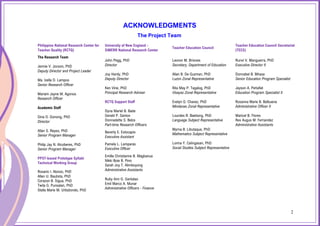
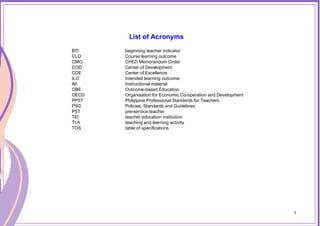
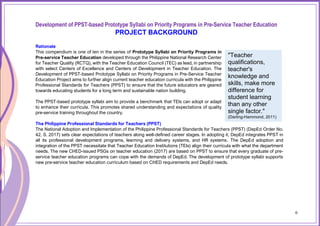
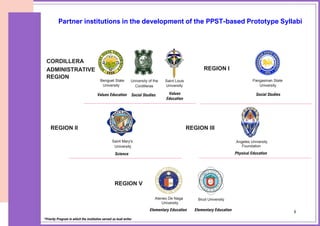
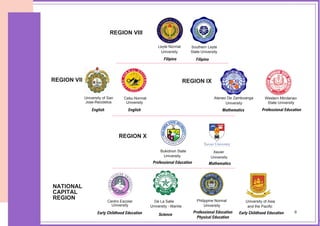
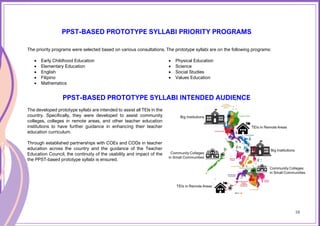
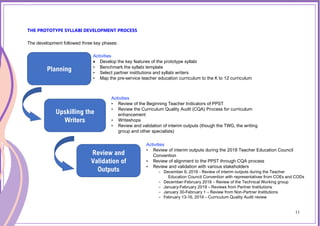
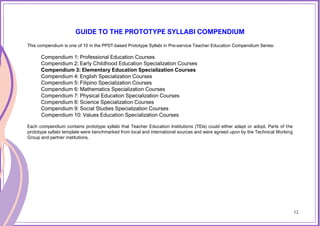
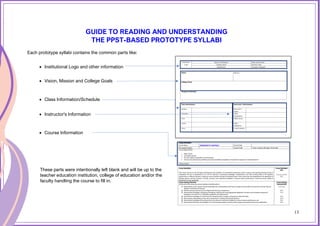
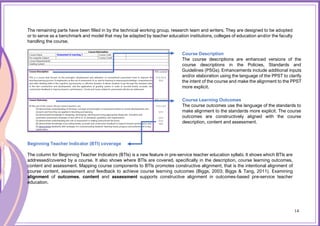
![15
Time Allotment
The Time Allotment column indicates
the recommended duration to cover
the content.
Intended Learning Outcomes (ILOs)
The ILOs column presents outcomes
which are specific to the content
covered. It presents what pre-service
teachers should be able to know or do
after covering the topics.
The ILOs are learner-centered rather
than content-centered. They provide
guidance on the focus and intent of the
content to be covered.
Content
The Content column outlines topics to
be covered.
Mapping to the CLOs
Aside from the BTI coverage, the
prototype syllabi also map ILOs and
the Suggested Assessment to the
corresponsing CLO/s, to ensure
constructive alignment.
Example: 1.1.1 [A]
Suggested Teaching Learning
Activities (TLAs)
The Suggested TLAs column indicates
recommended activities to deliver the
content and help facilitate the pre-
service teachers’ achievement of the
ILOs.
Suggested Assessment
The Suggested Assessment column
indicates recommended formative or
summative activities to measure the
achievement of the ILOs and/or mastery of
the content covered.
15](https://image.slidesharecdn.com/3-elementary-education-prototype-syllabi-compendium-250905000714-7fd53d01/85/3-Elementary-Education-Prototype-Syllabi-Compendium-pdf-16-320.jpg)
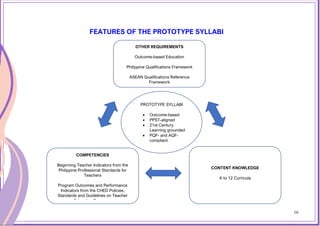
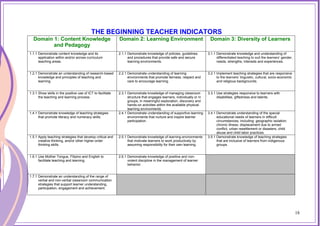
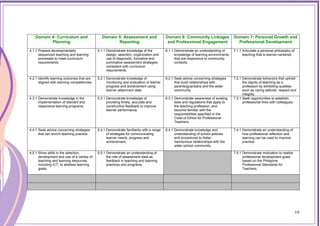
![THE PPST-BASED ELEMENTARY EDUCATION SPECIALIZATION
COURSES PROTOTYPE SYLLABI
Document Bases:
CMO No. 74, s. 2017: Policies, Standards, and Guidelines for Bachelor of Secondary Education (BSEd)
K to 12 Curriculum Guides in English, Filipino, Mathematics, Science, Araling Panlipunan, Edukasyon sa Pagpapakatao,
Physical Education [May 2016]
Philippine Professional Standards for Teachers (DO 42, s 2017)
Total Number of
Specialization Courses
Available Specialization
Course Outputs
Total Number of
Elective Courses
Available Elective Course
Outputs
19 19 2 0
Lead Writers:
Secondary Writers/ Reviewers:
20](https://image.slidesharecdn.com/3-elementary-education-prototype-syllabi-compendium-250905000714-7fd53d01/85/3-Elementary-Education-Prototype-Syllabi-Compendium-pdf-21-320.jpg)
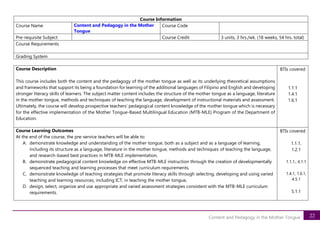
![23
Content and Pedagogy in the Mother Tongue
Time
Allotment
Intended Learning Outcomes
(ILOs)
BTIs Content Suggested Teaching
Learning Activities
Suggested Assessment BTIs
Week 1 a. Define key concepts in MTB-
MLE
b. Identify the national and official
languages in the Philippines
c. Discuss cultural rootedness as
one of the reasons behind the
use of mother tongue as a
medium of instruction
[CLO A]
1.1.1
[A]
1.1.1
[A]
1.1.1
Concept clarification:
Mother tongue, MTB-MLE,
Language policy, official and
national languages, language
of instruction
• Group discussion of
the key concepts and
sharing of
consolidated ideas
with the class
• Synthesis of group sharings
focusing on how the use of
mother tongue as medium
of instruction, and sharing of
own insights
[A]
1.1.1
Week 2 a. Explain theories relevant to
MTB-MLE
b. Discuss journal articles
providing empirical evidence
for these theories
[A]
1.1.1
[A]
1.1.1
Theories, Rationale and
Evidence supporting MTB-
MLE Developmental
learning theories: Piaget’s
theory, Schema theory of
learning, Social learning
theory
Cognitive theories of
bilingualism: Balance theory,
Iceberg Analogy, Threshold
theory
• Lecture
• Creating infographics
on the articles
• Sharing of insights on
the MTB-MLE theories.
Ask students to share if
they have seen these
theories applied in
teaching or how they
think these could be
applied to tecahing
• Written test on the various
theories
• Answering metacognitive
reading questions about the
selected articles
[A]
1.1.1
[A]
1.1.1
Week 3 a. Trace the legal and educational
arguments for MTB-MLE
program implementation in the
Philippines
b. Discuss the role of teachers and
the necessary competencies to
[A]
1.1.1
[A]
1.1.1
Legal Bases of MTB-MLE
• Republic Act No. 10157
The Kindergarten
Education Act
• Republic Act No. 10553 An
Act Enhancing the
Philippine Basic Education
• Group analysis of legal
documents, class
discussion
• Create a profile of a
teacher who has the
competencies to
• Short test on the legal bases
of MTB-MLE
• Look for stories of teachers
(online) or interview
teachers on how they
[A]
1.1.1
[A]
1.1.1](https://image.slidesharecdn.com/3-elementary-education-prototype-syllabi-compendium-250905000714-7fd53d01/85/3-Elementary-Education-Prototype-Syllabi-Compendium-pdf-24-320.jpg)
![24
Content and Pedagogy in the Mother Tongue
ensure the successful
implementation of the program
• DepEd Order No 31 s.
2013
successfully implement
the program.
effectively implement the
MTB-MLE program
Week 4 a. Examine the language policy
considerations for MTB-MLE
program implementation in the
Philippines through the lens of
Spolky (2004) and other
scholars
(A)
1.1.1
1.2.1
Language Policies and
Language Planning
• Spolsky’s (2004) language
policy
• Ricento and Hornberger‘s
(1996) language planning
and policy (LPP)
• Lecture, class
discussion
• Group infographics on
language policies in the
Philippines to be presented
in class for viewing
(A)
1.1.1
Week 5 a. Identify factors affecting the
success of multilingualism
b. Appraise the criticisms against
MTB-MLE
[A]
1.1.1
[A]
1.1.1
Factors affecting success of
multilingualism, Criticisms
Against MTB-MLE
• Interview school
principals, teachers,
and parents of K-3
pupils
• Group reporting in
class
• Group reports that discuss
the factors affecting success
of multilingualism and
criticisms against MTB-MLE
using available local
researches
[A]
1.1.1
Week 6 a. Examine the curriculum guide
for MTB-MLE
b. Discuss the major approaches
to teaching MTB-MLE (i.e.,
Communicative Approach,
Task-Based, Content-Based
Approaches; Two-track
method: story track [focus on
meaning] and primer track
[focus on accuracy])
c. Review model instructional
plans
[A]
1.1.1
[A]
1.1.1
[A]
1.1.1
MTB-MLE Curriculum and
Different Approaches to
teaching MTB-MLE
• Lecture
• Analysis of sample
instructional plans
• Reflection paper that will
elicit students’ insights from
the discussion
[A]
1.1.1
Week 7 - 8 a. Examine literature in the
Mother Tongue
b. Develop instructional materials
for MTB-MLE following OBE
framework and embedding
local literature
[C]
1.1.1, 1.6.1, 4.5.1
Instructional Materials
Development for MTB-MLE
following OBE framework
• Lecture
• Analysis of sample
instructional materials.
• Production and evaluation
of instructional materials
[C]
4.5.1](https://image.slidesharecdn.com/3-elementary-education-prototype-syllabi-compendium-250905000714-7fd53d01/85/3-Elementary-Education-Prototype-Syllabi-Compendium-pdf-25-320.jpg)
![25
Content and Pedagogy in the Mother Tongue
Week 9 a. Explain the importance of
phonological and phonemic
awareness of MT
b. Compare the sounds of MT to
English using IPA transcription
c. Design an instructional plan
applying phonology and
phonemics in MTB-MLE
[A]
1.1.1
[A]
1.1.1
[B, C]
1.1.1, 1.2.1, 4.1.1
Phonology and Phonemics
of MT
• Watching videos on
phonological and
phonemic awareness
• Listening, reading, and
speaking exercises
• Individual/Dyadic work
on instructional plan
• Writing and critiquing of
instructional plan
• Micro-teaching
[A, B, C]
1.1.1, 1.2.1, 4.1.1
[A, B, C]
1.1.1, 1.2.1, 4.1.1
Week 10-
11
a. Describe the morphological
features of the nominals,
pronominals, verbs, adjectives,
and adverbs as well as
standard orthography of MT
b. Design an instructional plan
using concepts of
morphological features of MT
in MTB-MLE
[A]
1.1.1
[B, C]
1.1.1, 1.2.1, 4.1.1
Morphology and standard
orthography of MT
• Lectures
• Morphological analysis
of MT words, reading
exercises, vocabulary
building exercises,
• Individual/Dyadic work
on instructional plan
• Writing and critiquing of
instructional plan
• Micro-teaching
[A, B, C]
1.1.1, 1.2.1, 4.1.1
[A, B, C]
1.1.1, 1.2.1, 4.1.1
Week 12 a. Explain the connotation and
denotation of words
b. Design an instructional plan
using concepts of semantics of
MT in MTB-MLE
[A,C]
1.1.1, 1.6.1
[B, C]
1.1.1, 1.2.1, 4.1.1
Semantics of MT • Lecture, class
discussion
• Vocabulary building
exercises, reading
exercises (e.g., poems,
short stories)
• Individual/Dyadic work
on instructional plan
• Writing and critiquing of
instructional plan
• Micro-teaching
[A, B, C]
1.1.1, 1.2.1, 4.1.1
[A, B, C]
1.1.1, 1.2.1, 4.1.1](https://image.slidesharecdn.com/3-elementary-education-prototype-syllabi-compendium-250905000714-7fd53d01/85/3-Elementary-Education-Prototype-Syllabi-Compendium-pdf-26-320.jpg)
![26
Content and Pedagogy in the Mother Tongue
Week 13 a. Discuss the locutionary,
illocutionary, and
perlocutionary forces of
sentences and possible
implicatures
b. Design an instructional plan
using concepts of pragmatics
of MT in MTB-MLE
[A,C]
1.1.1, 1.6.1
[B, C]
1.1.1, 1.2.1, 4.1.1
Pragmatics of MT • Lecture, class
discussion
• Role playing in groups
of 4-5
• Individual/Dyadic work
on instructional plan
• Writing and critiquing of
instructional plan
• Micro-teaching
[A, B, C]
1.1.1, 1.2.1, 4.1.1
[A, B, C]
1.1.1, 1.2.1, 4.1.1
Week 14 a. Parse MT sentences using TGG
model.
b. Describe the syntactic features
of MT.
c. Write a short essay in MT.
d. Trace syntactic deviations in
MT poems.
e. Design an instructional plan
using concepts of syntax of
[A] 1.1.1
[A] 1.1.1
[A] 1.1.1
[A] 1.1.1
[A, B, C]
1.1.1, 1.2.
Syntax of MT Lecture, class discussion
Board work, stylistic
analysis
Individual/ dyadic work on
instructional plan
Writing and critiquing of
instructional plan
Micro-teaching
[A, B, C]
1.1.1, 1.2.1, 4.1.1
[A, B, C]
1.1.1, 1.2.1, 4.1.1
Week 15 a. Develop appropriate
assessment procedures and
tools/instruments for the
mother tongue
[C]
4.5.1
Assessment of Mother
Tongue
Lecture, class discussion Writing and critiquing of
assessment plan
[C]
4.5.1
Week
16-18
a. Teach a subject in K-3 using
the principles and concepts
learned in the course
[A, B, C, D]
1.1.1, 1.1.1, 1.6.1,
4.5.1, 5.1.1
Synthesis and Application
of key concepts and
principles in MTB-MLE
Demonstration teaching
Peer critiquing of
instructional plans and
materials
Individual Demonstration
Teaching and Critiquing
[A, B, C, D]
1.1.1,1.6.1, 4.5.1,
5.1.1](https://image.slidesharecdn.com/3-elementary-education-prototype-syllabi-compendium-250905000714-7fd53d01/85/3-Elementary-Education-Prototype-Syllabi-Compendium-pdf-27-320.jpg)
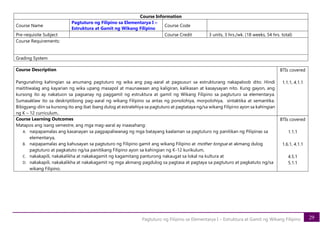
![30
Pagtuturo ng Filipino sa Elementarya I – Estruktura at Gamit ng Wikang Filipino
Time
Allotment
Intended Learning Outcomes
(ILOs)
BTIs Content Suggested Teaching Learning
Activities
Suggested Assessment BTIs
Week 1 a. Nabibigyang-depinisyon ang
wika batay kay Henry R.
Gleason.
b. Natatalakay ang mga
elementong taglay ng isang
wika.
c. Naibabahagi ang halaga ng
wika sa sarili at sa lipunan sa
kabuoan.
a. Natatalakay ang mga
sumusunod: Jean Piaget
(Developmental Stages of
Learning), Leo Vygotsky
(Cooperative Learning),
Jerome Bruner (Discovery
Learning), Robert Gagne
(Heirarchical Learning ),
David Ausubel
(Interactive/Integrated
Learning),Cummins (Basic
Interpersonal
Communication Skills-BICS
at Cognitive Academic
Language Proficiency Skills-
CALPS)
b. Naipapaliwanag ang
implikasyon ng mga teoryang
nabanggit sa pagtuturo at
pagkatuto ng/sa Filipino
[A]
1.1.1
[A]
1.1.1
[A]
1.1.1
[A]
1.1.1
[A]
1.1.1
Kahulugan ng Wika
Mga teoryang pilosopikal
ng edukasyon at wika/
Teorya sa kalikasan at
pagkatuto ng wika
• Pagbuo ng habing semantika
na magpapakita ng prior
knowledge ng mga mag-aaral
• Pagsusuri ng mga teorya
gamit ang mind maps
• Maikling
pagsusulit/Pagsasanay [A]
1.1.1
Week 2 a. Naipapaliwanag ang
kahulugan ng ponolohiya.
b. Naikokontrast ang titik at
ponema gayundin ang
[A]
1.1.1
[A]
1.1.1
Ponolohiya:
Titik at Ponema, Ponemang
Patinig at Ponemang Katinig
• Kolaboratibong talakayan/
Question and Answer
• Exit slip na nagbubuod ng
natutuhan sa talakayan
[A]
1.1.1](https://image.slidesharecdn.com/3-elementary-education-prototype-syllabi-compendium-250905000714-7fd53d01/85/3-Elementary-Education-Prototype-Syllabi-Compendium-pdf-31-320.jpg)
![31
Pagtuturo ng Filipino sa Elementarya I – Estruktura at Gamit ng Wikang Filipino
ponemang patinig at katinig
sa isa’t isa.
c. Nasusuri ang mga salita
batay sa bilang ng titik at
ponema nito.
a. Napag-uusapan ang
ponemang segmental
partikular ang diptonggo,
klaster, pares minimal at
ponemang malayang
nagpapalitan.
b. Nakakapagbigyan ng mga
tiyak na halimbawa ng saklaw
ng ponemang segmental.
c. Nagagamit ang mga ibinigay
na halimbawa sa sariling
pangungusap kaugnay sa
mga isyung pambansa.
a. Napag-uusapan ang saklaw
ng ponemang
suprasegmental.
b. Nagagamit ang kaalaman sa
ponemang suprasegmental
sa aktuwal na pakikipag-usap.
c. Naibabahagi ang reaksiyon
kaugnay sa pagkakaroon ng
kaaalaman tungkol sa
ponemang suprasegmental.
[A]
1.1.1
[A]
1.1.1
[A]
1.1.1
[A]
1.1.1
[A]
1.1.1
[A]
1.1.1
[A]
1.1.1
Ponemang Segmental
Ponemang Suprasegmental
• Malikhaing pagsasadula • Self-/ peer assessment ng
dula na nagpapakita ng
paglalapat ng paksang
tinalakay](https://image.slidesharecdn.com/3-elementary-education-prototype-syllabi-compendium-250905000714-7fd53d01/85/3-Elementary-Education-Prototype-Syllabi-Compendium-pdf-32-320.jpg)
![32
Pagtuturo ng Filipino sa Elementarya I – Estruktura at Gamit ng Wikang Filipino
Week 3 a. Nakikilala ang apat na uri ng
bigkas at ang kaukulang
tuldik na ginagamit dito.
b. Nagagamit ang tamang
tuldik sa isang salita batay sa
kahulugang taglay nito.
c. Nabibigkas nang tama ang
mga salita sa tulong ng
tuldik na ginamit.
a. Naipapaliwanag ang mga
tuntunin sa pagpapantig sa
wikang Filipino.
b. Napapantig nang tama ang
mga salita sa wikang
Filipino.
c. Naibabahagi ang halaga ng
pagpapantig sa pag-aaral
ng wikang Filipino.
[A]
1.1.1
[A]
1.1.1
[A]
1.1.1
[A]
1.1.1
[A]
1.1.1
Apat na Uri ng Bigkas
Pormasyon ng Pantig at
Pagpapantig
• Partner learning: Pakikinig at
pagsasalita bilang ensayo sa
pagbigkas at pagpapantig
• Pagtutuldik at Malakas na
Pagpapabasa
[A]
1.1.1
Week 4 a. Natatalunton ang
ebolusyon ng alpabetong
Filipino sa pamamagitan ng
timeline.
b. Naitatampok ang
pinakalutang na katangian
ng bawat alpabeto sa
pinagdaanang kasaysayan
nito.
c. Napapapangatwiranan kung
bakit mahalaga ang patuloy
na ebolusyon ng
alpabetong Filipino.
(A)
1.1.1
[A]
1.1.1
[A]
1.1.1
Ebolusyon ng Alpabetong
Filipino
• Paggamit ng diagram na
nagpapakita ng punto at
paraan ng artikulasyon
[A]
1.1.1](https://image.slidesharecdn.com/3-elementary-education-prototype-syllabi-compendium-250905000714-7fd53d01/85/3-Elementary-Education-Prototype-Syllabi-Compendium-pdf-33-320.jpg)
![33
Pagtuturo ng Filipino sa Elementarya I – Estruktura at Gamit ng Wikang Filipino
a. Nailalarawan ang punto ng
artikulasyon.
b. Nabibigkas ang bawat
ponemang katinig batay sa
punto ng artikulasyon.
c. Napupunuan ang
talahanayan sa tamang
punto ng artikulasyon.
a. Nailalarawan ang paraan ng
artikulasyon.
b. Nabibigkas ang bawat
ponemang katinig batay sa
paraan ng artikulasyon.
c. Napupunuan ang
talahanayan sa tamang
paraan ng artikulasyon.
a. Naipapaliwanag ang
kahulugan ng morpolohiya.
b. Nasusuri ang mga salita
batay sa mga uri ng
morpema.
c. Nakakapagbigay ng mga
tiyak na halimbawa sa mga
uri ng morpema.
[A]
1.1.1
[A]
1.1.1
[A]
1.1.1
[A]
1.1.1
[A]
1.1.1
[A]
1.1.1
[A]
1.1.1
[A]
1.1.1
[A]
1.1.1
Punto ng Artikulasyon
Paraan ng Artikulasyon
Morpolohiya
Mga Uri ng Morpema
Panonood ng video
Pagsagot sa mga tanong
tungkol sa napanood
(A)
1.1.1
Week 5 a. Nabibigyang-kahulugan ang
mga pagbabagong
morpoponeniko.
b. Nakakapagbigay ng mga
tamang halimbawa sa mga
pagbabagong
morpoponemiko.
[A]
1.1.1
[A]
1.1.1
[A]
Mga Pagbabagong
Morpoponemiko
Fast talk/Paspasang Usapan Pagsulat ng maikling sanaysay
tungkol sa natutuhan
[A]
1.1.1](https://image.slidesharecdn.com/3-elementary-education-prototype-syllabi-compendium-250905000714-7fd53d01/85/3-Elementary-Education-Prototype-Syllabi-Compendium-pdf-34-320.jpg)
![34
Pagtuturo ng Filipino sa Elementarya I – Estruktura at Gamit ng Wikang Filipino
c. Nasasabi ang halaga sa pag-
aaral ng mga pagbabagong
morpoponemiko
a. Natatalakay ang saklaw ng
pangngalan.
b. Nakakapagbigay ng mga
tamang halimbawa sa bawat
saklaw ng pangngalan.
c. Nagagamit sa makabuluhang
pangungusap ang mga
ibinigay na tiyak na
halimbawa sa bawat saklaw
ng pangngalan.
1.1.1
[A]
1.1.1
[A]
1.1.1
[A]
1.1.1
Bahaging Pangnilalaman:
Pangngalan
Round robin discussion Quiz bee: pangkatan [A]
1.1.1
Week 6 a. Natatalakay ang saklaw ng
panghalip.
b. Nakakapagbigay ng mga
tamang halimbawa sa bawat
saklaw ng panghalip.
c. Nagagamit sa makabuluhang
pangungusap ang mga
ibinigay na tiyak na
halimbawa sa bawat saklaw
ng panghalip
a. Naipapaliwanag ang
depinisyon ng pandiwa.
b. Nababanghay ang mga salita
sa bawat aspekto at iba pang
kategorisasyon ng pandiwa.
c. Natatalakay ang pokus at
kaganapan ng pandiwa gamit
ang mga tamang halimbawa.
[A]
1.1.1
[A]
1.1.1
[A]
1.1.1
[A]
1.1.1
[A]
1.1.1
[A]
1.1.1
Panghalip
Pandiwa
Jigsaw Discussion
Interaktibong Lektyur
Quiz bee: pangkatan
Pagsulat ng journal entry o
kuwento
[A]
1.1.1
[A]
1.1.1](https://image.slidesharecdn.com/3-elementary-education-prototype-syllabi-compendium-250905000714-7fd53d01/85/3-Elementary-Education-Prototype-Syllabi-Compendium-pdf-35-320.jpg)
![35
Pagtuturo ng Filipino sa Elementarya I – Estruktura at Gamit ng Wikang Filipino
Week 7 - 8 a. Nabibigyang-kahulugan ang
pang-uri.
b. Napag-uusapan ang lahat ng
saklaw ng pang-uri.
c. Nailalarawan ang
kasalukuyang kalagayan ng
bansa at mundo gamit ang
mga tamang pang-uri.
a. Natutukoy ang pang-abay sa
isang pangungusap o
pahayag.
b. Nakikilala ang iba’t ibang uri
ng pang-abay.
c. Nagagamit ang mga pang-
abay sa pagbuo ng mga
pangungusap tungkol sa
pagkamakabayan at
pagkamamamayan.
a. Naipapamalas ang kahusayan
sa pagtuturo ng Filipino
gamit ang wikang Filipino at
mother tongue at akmang
dulog sa pagtuturo at
pagkatuto ng/sa wikang
Filipino ayon sa kahingian ng
K-12 kurikulum
b. Nakakapili, nakakalikha at
nakakagamit ng kagamitang
panturong nakaugat sa lokal
na kultura at
c. Nakakapili, nakakalikha at
nakakagamit ng mga akmang
[A]
1.1.1
[A]
1.1.1
[A]
1.1.1
[A]
1.1.1
[A]
1.1.1
[A]
1.1.1
[A, B]
1.1.1,
1.6.1, 3.1.1
[C]
4.5.1
[D]
5.1.1
Pang-uri
Pang-abay
Mga epektibong dulog at
estratehiya sa pagtuturo ng
bahaging pangnilalaman
Paglalarawan
Larong pangwika
Pakitang Turo
Pagsulat ng Banghay-aralin
Paglikha ng kagamitang panturo
Pagbuo ng angkop na pagtataya
(assessment)
Iguhit mo: Ang mga mag-aaral
ay pagtatambalin. Magbibigay
ng panuto ang isa sa kanyang
kapareho sa pamamagitan ng
paglalarawan. Kailangan ay
eksakto ang iginuhit na
larawan sa orihinal. Magpapalit
din ng role ang bawat isa
pagkatapos.
Maikling
pagsusulit/Pagsasanay
Pagkritika (Critiquing) at
Paggamit ng rubrik
[A]
1.1.1
[A]
1.1.1
[A, B,
C, D]
1.1.1,
1.6.1,
4.1.,
4.5.1,
5.1.1](https://image.slidesharecdn.com/3-elementary-education-prototype-syllabi-compendium-250905000714-7fd53d01/85/3-Elementary-Education-Prototype-Syllabi-Compendium-pdf-36-320.jpg)
![36
Pagtuturo ng Filipino sa Elementarya I – Estruktura at Gamit ng Wikang Filipino
pagdulog sa pagtasa at
pagtaya sa pagtuturo at
pagkatuto ng/sa wikang
Filipino
Week 9 a. Naipapaliwanag ang halaga
ng pang-angkop sa isang
pangungusap.
b. Nalalapatan ng tamang pang-
angkop ang bawat
pangungusap.
c. Nakikritika ang isang
sanaysay batay sa ginamit na
mga pang-angkop.
a. Naikokontrast ang pangatnig
para sa magkatimbang at di-
magkatimbang na yunit.
b. Nagagamit ang pangatnig sa
pagbuo ng isang malikhaing
akda.
c. Nasusuri kung bakit dapat
alam ang paggamit ng
tamang pangatnig.
[A]
1.1.1
[A]
1.1.1
[A]
1.1.1
[A]
1.1.1
[A]
1.1.1
[A]
1.1.1
Bahaging Pangkayarian:
Pang-angkop
Pangatnig
Malikhaing pagsusulat
Talakayan
Kritikang pangklase
Maikling pagsasanay/
pagsagot sa worksheets
[A]
1.1.1
[A]
1.1.1
Week
10-11
a. Nabibigyang-depinisyon
ang pantukoy.
b. Nakikilala ang mga
pantukoy.
c. Nagagamit ang tamang
pantukoy sa pagbuo ng
makabuluhang
pangungusap tungkol sa
pangangalaga ng kalikasan.
[A]
1.1.1
[A]
1.1.1
[A]
1.1.1
Pantukoy Talakayan Maikling pagsasanay/
pagsagot sa worksheets
[A]
1.1.1](https://image.slidesharecdn.com/3-elementary-education-prototype-syllabi-compendium-250905000714-7fd53d01/85/3-Elementary-Education-Prototype-Syllabi-Compendium-pdf-37-320.jpg)
![37
Pagtuturo ng Filipino sa Elementarya I – Estruktura at Gamit ng Wikang Filipino
a. Nakikilala ang mga pang-
ukol sa wikang Filipino.
b. Nagagamit ang mga pang-
ukol sa pagbubuo ng
makabuluhang
pangungusap tungkol sa
halaga ng edukasyon.
c. Nasusuri ang papel na
ginagampanan ng pang-
ukol sa pagbuo ng mga
pangungusap sa wikang
Filipino.
a. Naipapamalas ang
kahusayan sa pagtuturo ng
Filipino gamit ang wikang
Filipino at mother tongue at
akmang dulog sa pagtuturo
at pagkatuto ng/sa wikang
Filipino ayon sa kahingian
ng K-12 kurikulum
b. Nakakapili, nakakalikha at
nakakagamit ng kagamitang
panturong nakaugat sa
lokal na kultura at
c. Nakakapili, nakakalikha at
nakakagamit ng mga
akmang pagdulog sa
pagtasa at pagtaya sa
pagtuturo at pagkatuto
ng/sa wikang Filipino
[A]
1.1.1
[A]
1.1.1
[A]
1.1.1
[A, B]
1.1.1,
1.6.1, 3.1.1
[C]
4.5.1
[D]
5.1.1
Pang-ukol
Mga epektibong dulog at
estratehiya sa pagtuturo ng
bahaging pangkayarian
Larong Pangwika
Pakitang Turo
Pagsulat ng Banghay-aralin
Paglikha ng kagamitang panturo
Pagbuo ng angkop na pagtataya
(assessment)
Maikling pagsasanay/
pagsagot sa worksheets
Pagkritika (Critiquing) at
Paggamit ng rubrik
[A]
1.1.1
[A, B,
C, D]
1.1.1,
1.6.1,
4.1.1,
4.5.1,
5.1.1
Week 12 a. Natatalakay ang saklaw ng
sintaks.
[A]
1.1.1
Sintaks Inter-aktibong talakayan Pagsulat ng talata/sanaysay [A]
1.1.1](https://image.slidesharecdn.com/3-elementary-education-prototype-syllabi-compendium-250905000714-7fd53d01/85/3-Elementary-Education-Prototype-Syllabi-Compendium-pdf-38-320.jpg)
![38
Pagtuturo ng Filipino sa Elementarya I – Estruktura at Gamit ng Wikang Filipino
b. Nakakabuo ng mga
matinong pangungusap
tungkol sa karapatang
pantao.
c. Nakikritika ang mga talata
batay sa pangungusap na
bumubuo rito.
a. Nakikilala ang pangungusap
batay sa gamit.
b. Nailalatag ang halaga ng
apat na uri ng pangungusap
batay sa gamit.
c. Nakakabuo ng isang
sanaysay na may tamang
paggamit ng pangungusap.
a. Natutukoy ang mga
pangungusap batay sa
kayarian.
b. Nakakapagbigay ng mga
tamang halimbawa ng
pangungusap batay sa
kayarian.
c. Nasasabi ang halaga ng
pag-aaral sa mga kayarian
ng pangungusap sa
pagbubuo ng tamang
sulatin.
a. Nailalahad ang mga uri ng
pangungusap na hindi
lantad ang paksa.
[A]
1.1.1
[A]
1.1.1
[A]
1.1.1
[A]
1.1.1
[A]
1.1.1
[A]
1.1.1
[A]
1.1.1
[A]
1.1.1
[A]
1.1.1
Pangungusap Batay sa
Gamit
Pangungusap Batay sa
Kayarian
Pangungusap na Hindi
Lantad ang Paksa
Inter-aktibong talakayan
Inter-aktibong talakayan
Pangkatang talakayan
Pagsulat ng talata/sanaysay
Pagsasanay sa pisara
Pagsulat ng maikling dula at
pagtatanghal gamit ang rubrik
[A]
1.1.1
[A]
1.1.1
[A]
1.1.1](https://image.slidesharecdn.com/3-elementary-education-prototype-syllabi-compendium-250905000714-7fd53d01/85/3-Elementary-Education-Prototype-Syllabi-Compendium-pdf-39-320.jpg)
![39
Pagtuturo ng Filipino sa Elementarya I – Estruktura at Gamit ng Wikang Filipino
b. Nakakabuo ng iskrip na
ginagamitan ng mga
pangungusap na hindi
lantad ang paksa.
c. Nakakapagtanghal ng isang
maikling dulang may tuon sa
mga pangungusap na
walang paksa.
[A]
1.1.1
[A]
1.1.1
Week 13 a. Naipapaliwanag ang
semantika.
b. Naikokontrast ang
denotasyon at konotasyon.
c. Nasusuri ang mga salita
kung ito ay denotasyon o
konotasyon.
a. Natatalakay ang paggamit
ng diksiyonaryo.
b. Nakikilala ang bawat bahagi
ng diksiyonaryo.
c. Nakakabuo ng mga
pagsusulit kaugnay sa
pagggamit ng diksiyonaryo.
[A]
1.1.1
[A]
1.1.1
[A]
1.1.1
[A]
1.1.1
[A]
1.1.1
[A]
1.1.1
Semantika: Denotasyon at
Konotasyon
Paggamit ng Diksiyonaryo
Talakayan
Larong pangwika
Maikling Pagsusulit
Maikling Pagsusulit
[A]
1.1.1
[A]
1.1.1
Week
14-18
a. Naipapamalas ang
kahusayan sa pagtuturo ng
Filipino gamit ang wikang
Filipino at mother tongue at
akmang dulog sa pagtuturo
at pagkatuto ng/sa wikang
Filipino ayon sa kahingian
ng K-12 kurikulum
b. Nakakapili, nakakalikha at
nakakagamit ng kagamitang
panturong nakaugat sa
lokal na kultura at
[A, B]
1.1.1,
1.6.1, 3.1.1
[C]
4.5.1
Sintesis at Paglalapat ng
mga Natutuhan sa Kurso
Pakitang Turo
Pagsulat ng Banghay-aralin
Paglikha ng kagamitang panturo
Pagkritika (Critiquing) at
Paggamit ng rubrik
[A, B,
C, D]
1.1.1,
1.6.1,
4.1.1,
4.5.1,
5.1.1](https://image.slidesharecdn.com/3-elementary-education-prototype-syllabi-compendium-250905000714-7fd53d01/85/3-Elementary-Education-Prototype-Syllabi-Compendium-pdf-40-320.jpg)
![40
Pagtuturo ng Filipino sa Elementarya I – Estruktura at Gamit ng Wikang Filipino
c. Nakakapili, nakakalikha at
nakakagamit ng mga
akmang pagdulog sa
pagtasa at pagtaya sa
pagtuturo at pagkatuto
ng/sa wikang Filipino
[D]
5.1.1
Pagbuo ng angkop na pagtataya
(assessment)
Suggested List of References
Almario, Virgilio S. Patnubay sa Pagsasalin. Lungsod Pasig: Anvil Publishing, Inc. 2003.
Badayos, Paquito B. Masining na Pagpapahayag, Aklat sa Filipino 3, Antas-Tersiyarya. Lungsod Valenzuela: Mega-Jesta Prints, Inc. 2010.
Badayos, Paquito B. Metodolohiya sa Pagtuturo at Pagkakatuto ng/sa Filipino, Mga Teorya, Simulain at Estratehiya. Lungsod Malabon: Mutya Publishing House, Inc. 2008.
Bernales, Rolando A., et al. Masining na Pagpapahayag sa Filipino: Mga Prinsipyo at Proseso. Lungsod Valenzuela: Adelko Printing Press. 2012.
Bernales, Rolando A., et al. Akademikong Filipino para sa Kompetetibong Filipino. Lungsod Malabon: Mutya Publishing House, Inc. 2013.
Batnag, Aurora E. at Jayson D. Petras. Teksbuk sa Pagsasalin. Lungsod Quezon: C & E Publishing, Inc. 2009
Batnag, Aurora E. at Alvin Ringgo C. Reyes. Sayusay, Sining ng Mabisang Pagpapahayag. Lungsod Quezon: C & E Publishing, Inc. 2011.
Corpuz, B. & Salandanan, G. (2015). Principles of teaching (with TLE). Quezon City: LORIMAR Publishing.
Malicsi, Jonathan C. Gramar ng Filipino. Lungsod Quezon: Sentro ng Wikang Filipino. 2013.
Paz, Consuelo J., et al. Ang Pag-aaral ng Wika. Lungsod Quezon: UP Press. 2003.
PPST-RPMS Manual
Santos, Benilda S. (ed). Ang Wikang Filipino sa Loob at Labas ng Akademya’t Bansa, Unang Sourcebook ng SANGFIL 1994-2001. Lungsod Quezon: UP-SWF. 2003.
Tanawan, Dolores S., et al. Retorika: Mabisang Pagpapahayag sa Kolehiyo. Bulacan: Trinitas Publishing, Inc. 2003.
Victoria, Vasil A. Ponolohiyang Filipino. Sariling Limbag. 2018.
Villafuerte, Pat V., et al. Ang Manghahasik ng Edukasyong Pangwika. Bataan: Sons Print Corporation. 2009.
Zafra, Galileo S. Daluyan, Journal ng Wikang Filipino. Lungsod Quezon: SWF. 2002.
http://kwf.gov.ph/wp-content/uploads/Ortograpiyang-Pambansa.pdf
http://sentrofilipino.upd.edu.ph/programa_at_proyekto/download/uswagan_kartila_fil.pdf
http://kwf.gov.ph/wp-content/uploads/Pagpaplanong-Wika-at-Filipino_2.pdf](https://image.slidesharecdn.com/3-elementary-education-prototype-syllabi-compendium-250905000714-7fd53d01/85/3-Elementary-Education-Prototype-Syllabi-Compendium-pdf-41-320.jpg)
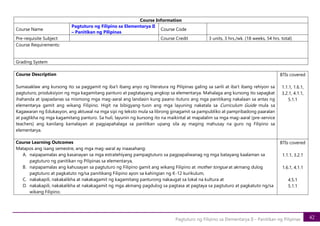
![43
Pagtuturo ng Filipino sa Elementarya II – Panitikan ng Pilipinas
Time
Allotment
Intended Learning Outcomes (ILOs) BTIs Content Suggested Teaching Learning
Activities
Suggested Assessment BTIs
Week 1 a. Nakakabuo ng tiyak at malinaw na
kahulugan ng panitikan.
b. Nasusuri ang kahulugan ng
panitikan sa lapit-estruktural.
c. Nasasabi ang kaugnayan ng
panitikan sa sarili at lipunan.
d. Naiisa-isa ang halaga ng panitikan
batay sa iba’t ibang kategorya o
pamantayan.
e. Nakikritika ang kahalagahan ng
pantikan batay sa sariling danas.
f. Nakakabuo ng posisyong papel
kaugnay sa halaga ng pagtuturo ng
panitikan sa elementarya.
[A]
1.1.1
Kahulugan ng Panitikan
Kahalagahan ng Panitikan
• Lektyur at Pangkatang
paligsahan
• Pagbabahagi ng mga
sariling sanaysay o
karanasan kung saan ang
isang akdang
pampanitikan ay
nakapagpabago o
nakaimpluwensya sa
kanilang buhay
• Maikling
pagsusulit/Pagsasanay
• Posisyong papel kung bakit
sa gitna ng makabagong
panahon ng social media ay
mahalagang matutuhan ng
mga mag-aaral sa
elementarya ang iba’t-ibang
uri ng panitikan
[A]
1.1.1
[A]
1.1.1
Week 2 a. Naipapaliwanag ang iba’t ibang
kahulugan ng tula.
b. Napag-uusapan ang mga
elementong bumubuo sa tula.
c. Nailalapat sa piling tula ang mga
elementong tinataglay nito sa
tulong ng maikling pagsusuri.
d. Naibibigay ang malinaw na
kahulugan ng bugtong.
e. Nasusuri ang paraan ng
konstruksiyon ng bugtong at kung
paano ito maituturo sa mga mag-
aaral sa elementarya
[A]
1.1.1
Tula
Bugtong
• Malikhaing pag-uulat
• Pangkatang kritika
• Bugtungan
• Pagbabahagi ng mga
kasanayang nahuhubog sa
mga mag-aaral kapag sila
ay nag-iisip ng mga
kasagutan sa bugtong
• Maikling pagsusulit at/o
pagsasanay
• Maikling pagsusulit at/o
pagsasanay kung saan
magiisip ng mga
‘makabagong bugtong’ na
ang mga sagot ay mga
modernong bagay gaya ng
cellphone, internet, etc.
[A]
1.1.1
[A]
1.1.1](https://image.slidesharecdn.com/3-elementary-education-prototype-syllabi-compendium-250905000714-7fd53d01/85/3-Elementary-Education-Prototype-Syllabi-Compendium-pdf-44-320.jpg)
![44
Pagtuturo ng Filipino sa Elementarya II – Panitikan ng Pilipinas
Week 3 a. Naipapaliwanag ang kahulugan ng
salawikain.
b. Nabibigyang-pagpapakulugan ang
ilang piling salawikain.
c. Nakakalikha ng sariling
makabagong salawikain
d. Nabibigyang-kahulugan ang
kuwento.
e. Naipapaliwanag kung bakit
mahalaga ang mga kuwento sa
paghubog ng kamalayan ng mga
mag-aaral
f. Nakakalikha sariling mga
kuwentong pambata.
[A]
1.1.1
Salawikain
Kuwento
• Q and A
• Pagsulat ng salawikain
• Inter-aktibong talakayan
ng mga uri kwentong
naaangkop sa at
magugustuhan ng mga
kabataan ngayon
• Pagsulat ng salawikain
• Pagbabahagi ng konsepto
ng isang kuwentong
pambata. (Maaari ring ituloy
ang pagbuo sa kwentong
pambata bilang proyekto sa
katapusan ng kurso)
[A]
1.1.1
[A]
1.1.1
Week 4 a. Naipapaliwanag ang kahulugan ng
alamat.
b. Nakakabasa ng ilang piling alamat.
c. Nakikritika ang nilalaman ng
alamat lalo na ang taglay na
pagpapahalaga o esensiya nito.
d. Nailalahad ang pagiging epektibo
ng mga pabula sa pagbibigay ng
aral lalo na sa mga mag-aaral sa
elementarya.
e. Nakakabasa ng ilang piling pabula.
f. Naitatanghal ang ilang piling
pabula.
[A]
1.1.1
Alamat
Pabula
• Kritikang pangnilalaman sa
alamat
• Pagtatanghal ng piling
pabula
• Maikling pagsusulit at/o
pagsasanay
• Pagkikritika ng pagtatanghal
gamit ang rubrik
[A]
1.1.1
[A]
1.1.1
Week 5-8 a. Naipapamalas ang kahusayan sa
pagtuturo ng Filipino gamit ang
wikang Filipino at mother tongue
at akmang dulog pagtuturo at
pagkatuto ng/sa panitikang
Filipino ayon sa kahingian ng K-12
kurikulum,
[A, B]
1.1.1,
1.6.1,
3.2.1,
4.1.1
Mga epektibong dulog at
estratehiya sa pagtuturo ng
panitikan, paglikha ng
kagamitang panturo at
pagtataya
• Paunang Pakitang Turo
(formative)
• Pagkritika (Critiquing) at
Paggamit ng rubrik
[A, B,
C, D]
1.1.1,
1.6.1,
3.2.1,
4.1.1,
4.5.1,
5.1.1](https://image.slidesharecdn.com/3-elementary-education-prototype-syllabi-compendium-250905000714-7fd53d01/85/3-Elementary-Education-Prototype-Syllabi-Compendium-pdf-45-320.jpg)
![45
Pagtuturo ng Filipino sa Elementarya II – Panitikan ng Pilipinas
b. Nakakapili, nakakalikha at
nakakagamit ng kagamitang
panturong nakaugat sa lokal na
kultura
c. Nakakapili, nakakalikha at
nakakagamit ng mga akmang
pagdulog sa pagtasa at pagtaya sa
pagtuturo at pagkatuto ng/sa
wikang Filipino.
[C]
4.5.1
[D]
5.1.1
• Pagsulat ng Banghay-
aralin
• Paglikha ng kagamitang
panturo
• Pagbuo ng angkop na
pagtataya (assessment)
Week 9 a. Naikokontrast ang parabula sa
pabula.
b. Nakakabasa ng ilang piling
parabula.
c. Naitatanghal ang ilang piling
parabula.
d. Naipapaliwanag ang katuturan ng
kuwentong-bayan.
e. Nakakahanap sa sariling lugar ng
mga kuwentong-bayan.
f. Naisasalaysay sa klase ang
nilalaman ng nahanap na
kuwentong-bayan.
[A]
1.1.1
Parabula
Kuwentong-bayan
• Pagtatanghal
• Komunikatibong talakayan
sa kahalagahan ng mga
kuwentong bayan sa
paghubog ng kamalayan
ng mga mag-aaral
• Dugtungang Pagsasalysay
• Pagkikritika sa pagtatanghal
• Maikling pagsusulit at/o
pagsasanay
[A]
1.1.1
[A]
1.1.1
Week 10 a. Naipapaliwanag ang ibig sabihin
ng mitolohiya.
b. Nakikirtika ang ilang piling
mitolohiya sa tulong ng mga
karakter na bida rito.
c. Naisasadula ang ilang piling
kuwentong-bayan sa Filipino.
d. Nakikilala ang mga anda ng isang
epiko.
e. Napapangalanan ang mga sikat na
epiko sa bansa.
f. Nakakanta ang ilang piling epiko.
[A]
1.1.1
Mitolohiya
Epiko
• Talakayan
• Kantahan /Chanting
• Maikling pagsusulit at/o
pagsasanay
• Pag-aaral sa mga piling
epiko at ang mga
mabubuting aral o reyalidad
sa buhay na sinasaklaw ng
mga akda na mahalagang
[A]
1.1.1
[A]
1.1.1](https://image.slidesharecdn.com/3-elementary-education-prototype-syllabi-compendium-250905000714-7fd53d01/85/3-Elementary-Education-Prototype-Syllabi-Compendium-pdf-46-320.jpg)
![46
Pagtuturo ng Filipino sa Elementarya II – Panitikan ng Pilipinas
matutunan ng mga mag-
aaral.
Week 11 a. Naipapaliwanag ang kahulugan ng
sanaysay.
b. Nakikirtika ang pagkakabuo nito.
c. Naikokontrast ang pormal sa di-
pormal na sanaysay.
d. Nakakahanap ng mga tiyak na
halimbawa ng pormal at di-pormal
na sanaysay.
e. Nakakasulat ng pormal at di-
pormal na sanaysay.
f. Nakakabasa ng napapanahong
sanaysay.
g. Napag-uusapan ang nilalaman nito.
h. Nakikritika ang sanaysay batay sa
nilalaman at estilo ng pagkakasulat
nito.
[A]
1.1.1
Sanaysay
Pormal at Di-Pormal na
Sanaysay
Pagbasa ng Sanaysay
• Panayam ng Guro
• Pagbasa at kritika sa
sanaysay
• Paggawa ng Venn Diagram
na nagpapakita ng
pagkakahalintulad at
pagkakaiba ng pormal at
di-pormal na sanaysay
• Pagpapabasa ng sanaysay
• Maikling pagsusulit at/o
pagsasanay
• Pagpapasulat ng sanaysay
• Kritikang pangklase at
pagbabahagi ng mga
natatanging makabagong
sanaysay na marapat na
isama sa pag-aaral ng mga
estudyante sa elementarya
[A]
1.1.1
[A]
1.1.1
[A]
1.1.1
Week 12 a. Nakakasulat ng sariling sanaysay.
b. Nababasa ang ginawang sariling
sanaysay.
c. Nakikritika ang sanaysay sa
pamamagitan ng binuong rubriks
para sa klase.
d. Nabibigyang-depinisyon ang dula.
e. Nakakapanood ng ilang piling
dula.
f. Nakikritika ang napanood na dula.
[A]
1.1.1
Pagsulat ng Sanaysay
Dula
• Pagpapasulat ng sanaysay
• Madulang pagtalakay
• Aktuwal na panonood
• Metakritika
• Pagkikritika ng dula base sa
artistikong pagkakatanghal
at sa mahahalagang aral o
konseptong ibinabahagi nito
[A]
1.1.1
[A]
1.1.1](https://image.slidesharecdn.com/3-elementary-education-prototype-syllabi-compendium-250905000714-7fd53d01/85/3-Elementary-Education-Prototype-Syllabi-Compendium-pdf-47-320.jpg)
![47
Pagtuturo ng Filipino sa Elementarya II – Panitikan ng Pilipinas
Week 13 a. Nailalarawan ang mga uri ng dula.
b. Nakakakapagbigay ng mga tiyak
na halimbawa sa mga uri ng dula.
c. Nabibigyang-reaksiyon ang ilang
piling eksena sa dula.
d. Nakakasulat ng isang dula para sa
bata.
e. Naibabahagi sa klase ang
ginawang dula.
f. Nakikitrika ang nilalaman ng dula.
[A]
1.1.1
Mga Uri ng Dula
Pagsulat ng Dula
• Talakayan
• Pagpapasulat ng dula na
sumasaklaw sa mga
kasalukuyang isyu na
kinakaharap ng mga mag-
aaral
• Metakritika
• Pagkikiritika ng mga
ibinahaging dula
[A]
1.1.1
[A]
1.1.1
Week 14 a. Nakakapagsadula ang isang klase
sa tulong ng napiling piyesa.
b. Namamarkahan ang pagsasadula
sa tulong ng rubriks.
c. Nakikritika ang isinagawang
pagsasadula
[A]
1.1.1
Aktuwal na Pagsasadula • Pagsasadula • Pagsulat ng repleksiyong
papel tungkol sa ginawang
pagsasadula
[A]
1.1.1
Week
15-18
a. Naipapamalas ang kahusayan sa
pagtuturo ng Filipino gamit ang
wikang Filipino at mother tongue
at akmang dulog pagtuturo at
pagkatuto ng/sa panitikang
Filipino ayon sa kahingian ng K-12
kurikulum,
b. nakakapili, nakakalikha at
nakakagamit ng kagamitang
panturong nakaugat sa lokal na
kultura at
c. Nakakapili, nakakalikha at
nakakagamit ng mga akmang
pagdulog sa pagtasa at pagtaya sa
pagtuturo at pagkatuto ng/sa
wikang Filipino.
[A, B]
1.1.1,
1.6.1,
3.2.1,
4.1.1
[C]
4.5.1
[D]
5.1.1
Mga epektibong dulog at
estratehiya sa pagtuturo ng
panitikan, paglikha ng
kagamitang panturo at
pagtataya
• Huling Pakitang Turo
(summative)
• Pagsulat ng Banghay-
aralin
• Paglikha ng kagamitang
panturo
• Pagbuo ng angkop na
pagtataya (assessment)
• Pagkritika (Critiquing) at
Paggamit ng rubrik
[A, B,
C, D]
1.1.1,
1.6.1,
3.2.1,
4.1.1,
4.5.1,
5.1.1](https://image.slidesharecdn.com/3-elementary-education-prototype-syllabi-compendium-250905000714-7fd53d01/85/3-Elementary-Education-Prototype-Syllabi-Compendium-pdf-48-320.jpg)
![51
Teaching Science in the Primary Grades (Biology and Chemistry)
Time
Allotment
Intended Learning Outcomes (ILOs) BTIs Content Suggested Teaching Learning
Activities
Suggested Assessment BTIs
Week 1 a. Inquire into the nature of science -
-- the scientific enterprise,
products, applications and
attitudes --- and what this looks
like in the primary classroom
b. Explain the goals appropriate for
the quality elementary science
program
[A]
1.1.1
1.2.1
[A]
1.1.1
The Nature of Science
Goals of Elementary Science
Education
• Lecture, class discussion • Making a concept map on
the nature of science and the
goals of science education
[A]
1.1.1
1.2.1
Week 2 a. Discuss the current state of primary
science --- the status and provision
of science education in elementary
schools
b. Identify what recent and relevant
research in science education has
to say about primary science (what
works and what challenges to
consider)
[A]
1.1.1,
1.2.1
[A]
1.1.1,
1.2.1
Current Developments in
Primary Science
• Plenary discussion where
students synthesize their
findings based on their
individual readings
• Writing an insight paper on
the subject matter
[A]
1.1.1,
1.2.1
Week 3-4 a. Elucidate on the basic processes
that form the foundation for
scientific investigation and the
integrated processes that form the
method of actual scientific inquiry
[A]
1.1.1,
1.2.1
The Processes of Science
d. Basic Processes
o Observing
o Classifying
o Communicating
o Measuring
o Predicting
o Inferring
e. Integrated Processes
o Identifying and
controlling variables
o Formulating and testing
hypotheses
o Interpreting data
o Defining operationally
• Interactive activities on the
processes of science
• Accomplishing worksheets
and practical exercises
(written or performance-
based) on the processes of
science
[A]
1.1.1,
1.2.1](https://image.slidesharecdn.com/3-elementary-education-prototype-syllabi-compendium-250905000714-7fd53d01/85/3-Elementary-Education-Prototype-Syllabi-Compendium-pdf-52-320.jpg)
![52
Teaching Science in the Primary Grades (Biology and Chemistry)
o Experimenting
o Constructing models
Week 5 a. Examine the constructivist view of
learning
b. Trace indications/manifestations of
spiral progression approach as
seen in the science curriculum
guide
[A]
1.1.1,
1.2.1
Constructivism • Classroom observation
where students identify
practices consistent with
constructivism
• Preparing observation notes
and/or journal writing
[A]
1.1.1,
1.2.1
Week 6 a. Discuss and apply the process-
oriented guided-inquiry
methodology of science teaching
[A, B]
1.1.1,
1.2.1,
Inquiry: Learning how to do
science rather than learning
about science
• Modelling the process-
oriented guided-inquiry
methodology of science
teaching
• Writing lesson plan that
applies the process-oriented
guided-inquiry methodology
of science teaching
[A, B]
1.1.1,
1.2.1
Week 7-8 a. Synthesize information about
scientific principles
b. Examine the scope and sequence
of science in the primary grades
c. Develop sound lesson plans to
guide children in their
investigations with corresponding
instructional materials and
assessment tools
[A]
1.1.1
[A]
1.1.1
[A, B,
D]
1.1.1,
1.2.1,
4.1.1
Basic Concepts and Principles
for the Elementary Science
Education Program:
Chemistry includes Properties
and Structure of Matter and
Changes that Matter Undergo.
• Student-led discussion:
Individually or in groups,
students will be assigned a
specific topic to discuss
with corresponding
instructional material to be
used
• Micro-teaching on a given
topic in Chemistry
• “Microteaching is a scaled-
down, simulated teaching
encounter designed for the
training of both pre-service
or in-service teachers… Its
purpose is to provide
teachers with the
opportunity for the safe
practice of an enlarged
cluster of teaching skills
while learning how to
develop simple, single-
concept lessons in any
teaching subject.”
(https://www.encyclopedia.c
om/education/encyclopedia
s-almanacs-transcripts-and-
maps/microteaching)
[A, B,
D]
1.1.1,
1.2.1,
4.1.1](https://image.slidesharecdn.com/3-elementary-education-prototype-syllabi-compendium-250905000714-7fd53d01/85/3-Elementary-Education-Prototype-Syllabi-Compendium-pdf-53-320.jpg)
![53
Teaching Science in the Primary Grades (Biology and Chemistry)
• A sample configuration of
which is as follows: Teachers
would teach an initial five to
ten minute, single element
lesson that was critiqued by
a supervisor. The teacher
would have a brief time to
revise the lesson and then
reteach the same lesson to a
different group.
Week 9-10 a. Synthesize information about
scientific principles
b. Develop sound lesson plans to
guide children in their
investigations with corresponding
instructional materials and
assessment tools
[A]
1.1.1
[A, B]
1.1.1,
1.2.1
Basic Concepts and Principles
for the Elementary Science
Education Program: Biology
includes Parts and Functions of
Animals and Plants, Heredity:
Inheritance and Variation,
Biodiversity and Evolution and
Ecosystems.
• Lecture, class discussion • Micro-teaching on a given
topic in Biology
[A]
1.1.1
[A, B]
1.1.1,
1.2.1
Week 11 a. Describe the current technologies
that may be used in teaching
science
b. Infuse technologies into scientific
investigations
[C]
4.5.1
Instructional Materials
Development for Elementary
Science Education and
Technology in Elementary
Science Education
• Answering Educational
Technology Quotient (ETQ)
Inventory
• Creating and evaluating
instructional materials (both
traditional and technology-
based) using a teacher-
made rubric
[C]
4.5.1
Week
12-13
a. Identify practical suggestions
pertaining to implementing a
constructivist, process-oriented,
inquiry science program in the
elementary classroom
[A, B,
D]
1.1.1,
1.2.1,
4.1.1
1.1.1
Strategies for Successful
Science Activities
a. Process-oriented,
Problem-based,
Inquiry-based
b. Animals and Plants in
the Classroom
c. Outdoor classrooms
d. Others based on
students’ reasearch
• Teacher modelling some
strategies of science
teaching
• Brainstorming
• Micro-teaching on a given
topic
[A, B,
D]
1.1.1,
1.2.1,
4.1.1
1.1.1](https://image.slidesharecdn.com/3-elementary-education-prototype-syllabi-compendium-250905000714-7fd53d01/85/3-Elementary-Education-Prototype-Syllabi-Compendium-pdf-54-320.jpg)
![54
Teaching Science in the Primary Grades (Biology and Chemistry)
Week 14 a. Devise ways in which process-
oriented inquiry science teachers
can assess the learning of their
students
[D]
5.1.1
Assessment
a) Assessment of process
skills
b) Assessment of inquiry
c) Assessment of attitude
d) Assessment of content
Authentic Assessment
Techniques
a) Interviewing
b) Journals
c) Portfolios
• Lecture, discussion and
writeshop on developing
assessment
tools/instruments
• Self, peer and teacher
critiquing of assessment
tools/instruments using the
teacher-made rubric
[D]
5.1.1
Week 15 a. Explain what concept maps are,
how the technique can be taught
and how they can be used to
enhance science learning
[B, C]
4.1.1,
4.5.1
Concept Mapping in
Elementary Science for
Lesson Planning, Instruction
and Assessment
• Class discussion and board
work
• Constructing concept map
on any particular science
topic and grade level (1-3)
[B, C]
4.1.1,
4.5.1
Week
16-18
a. Teach a topic using the principles
and concepts learned in the course
through demonstration teaching
ng/sa wikang Filipino.
[A, B,
C, D]
1.1.1,
1.2.1,
4.1.1,
4.5.1,
5.1.1
Synthesis and Application of
Key concepts and principles
• Final (individual)
demonstration teaching,
peer critiquing of
instructional plans,
materials and assessment
tools
• Demonstration teaching
with critiquing/ mentoring
[A, B,
C, D]
1.1.1,
1.2.1,
4.1.1,
4.5.1,
5.1.1
Suggested List of References
Corpuz, B. & Salandanan, G. (2015). Principles of teaching (with TLE). Quezon City: LORIMAR Publishing.
Martin, D. J. (2003.). Elementary science methods: A constructivist approach. Wadsworth
McCrory, A. & Worthington, K. (2018). Mastering primary science. London, UK: Bloomsbury Publishing.
National Research Council of the National Academies (2007). Taking science to school: Learning and teaching science in grades K-8. Washington, DC: The National
Academies Press.
PPST-RPMS Manual](https://image.slidesharecdn.com/3-elementary-education-prototype-syllabi-compendium-250905000714-7fd53d01/85/3-Elementary-Education-Prototype-Syllabi-Compendium-pdf-55-320.jpg)
![57
Teaching Science in the Intermediate Grades (Physics, Earth and Space Science)
Time
Allotment
Intended Learning Outcomes (ILOs) BTIs Content Suggested Teaching Learning
Activities
Suggested Assessment BTIs
Week 1 a. Elaborate the nature, goals and
processes of science
[A]
1.1.1
1.2.1
Review of the Nature, Goals,
and Processes of Science
• Cooperative learning
groups discussing the
assigned topic
• Making an infographic that
summarizes the topic for the
week
[A]
1.1.1
1.2.1
Week 2 a. Discuss the domains of learning
science: (1) understanding and
applying scientific knowledge in
local setting as well as global
context whenever possible, (2)
performing scientific processes and
skills and (3) developing and
demonstrating scientific attitudes
and values
[A]
1.1.1
Domains of learning Science • Plenary discussion where
students synthesize their
findings based on their
individual readings
• Writing an insight paper on
the subject matter
[A]
1.1.1
Week 3-4 a. Synthesize information about
scientific principles
b. Examine the scope and sequence
of science in the primary grades
c. Develop sound lesson plans to
guide children in their
investigations with corresponding
instructional materials and
assessment tools
[A]
1.1.1
[A, B]
1.1.1,
1.2.1
Basic Concepts and
Principles for the Elementary
Science Education Program:
Physics includes Force and
Motion, and Energy.
• Lecture, class discussion • Lesson plan writing on a
given topic in Physics
[A]
1.1.1
[A, B]
1.1.1,
1.2.1
Week 5-6 a. Synthesize information about
scientific principles
b. Develop sound lesson plans to
guide children in their
investigations with corresponding
instructional materials and
assessment tools
[[A]
1.1.1
[A, B,
D]
1.1.1,
1.2.1,
4.1.1
Basic Concepts and
Principles for the Elementary
Science Education Program:
Earth and Space Science
includes Geology,
Meteorology, and Astronomy .
• Lecture, class discussion • Lesson plan writing on a
given topic in Earth and
Space Science
[A, B],
D
1.1.1,
1.2.1,
4.1.1](https://image.slidesharecdn.com/3-elementary-education-prototype-syllabi-compendium-250905000714-7fd53d01/85/3-Elementary-Education-Prototype-Syllabi-Compendium-pdf-58-320.jpg)
![58
Teaching Science in the Intermediate Grades (Physics, Earth and Space Science)
Week 7-9 a. Analyze the appropriateness,
benefits and drawbacks of the
following approaches:
a. Multi/ interdisciplinary
b. Science-technology-
society approach
c. Contextual learning
b. Demonstrate understanding of
the approaches through micro-
teaching
[A, B,
D]
1.1.1,
1.2.1,
4.1.1
Approaches to teaching
science
• Student-led discussion
with the teacher acting as
“devil’s advocate”
• Accomplished exit slip on
the topic
• Micro-teaching on a given
topic in Physics or Earth and
Space Science
• “Microteaching is a scaled-
down, simulated teaching
• encounter designed for the
training of both pre-service
or in-service teachers… Its
purpose is to provide
teachers with the
opportunity for the safe
practice of an enlarged
cluster of teaching skills
while learning how to
develop simple, single
concept lessons in any
teaching subject.”
• (https://www.encyclopedia.c
om/education/encyclopedia
salmanacs-transcripts-and-
maps/microteaching)
• A sample configuration of
which is as
• follows: Teachers would
teach an initial five to ten
minute, single element
lesson that was critiqued by
a supervisor. The teacher
would have a brief time to
revise the lesson and then
reteach the same lesson to a
different group.
[A, B,
D]
1.1.1,
1.2.1,
4.1.1](https://image.slidesharecdn.com/3-elementary-education-prototype-syllabi-compendium-250905000714-7fd53d01/85/3-Elementary-Education-Prototype-Syllabi-Compendium-pdf-59-320.jpg)
![59
Teaching Science in the Intermediate Grades (Physics, Earth and Space Science)
Week
10-12
a. Analyze the appropriateness,
benefits and drawbacks of the
following approaches:
a. Problem/issue-based
learning
b. Inquiry-based
b. Demonstrate understanding of the
approaches through micro-
teaching
[A, B,
D]
1.1.1,
1.2.1,
4.1.1
Approaches to teaching
science
• Student-led discussion
with the teacher acting as
“devil’s advocate”
• Accomplished exit slip on
the topic
• Micro-teaching on a given
topic in Physics or Earth and
Space Science
[A, B,
D]
1.1.1,
1.2.1,
4.1.1
Week 13 a. Describe the current technologies
that may be used in teaching
science
b. Infuse technologies into scientific
investigations
[C]
4.5.1
Instructional Materials
Development for
Elementary Science
Education and Technology in
Elementary Science
Education
• Answering Educational
Technology Quotient (ETQ)
Inventory
• Creating instructional
materials (traditional and
technology-based)
[C]
4.5.1
Week 14 a. Identify practical suggestions
pertaining to implementing a
constructivist, process-oriented,
inquiry science program in the
elementary classroom
[A, B,
D]
1.1.1,
1.2.1,
4.1.1
Strategies for Successful
Science Activities
• Process-oriented,
Problem-based,
Inquiry-based
• Animals and Plants in
the Classroom
• Outdoor classrooms
• Others based on
students’ research
• Teacher modelling some
strategies of science
teaching
• Brainstorming
• Reflection paper that
discusses student’s personal
appropriation of the topic
[A, B,
D]
1.1.1,
1.2.1,
4.1.1
Week 15 a. Devise ways in which process-
oriented inquiry science teachers
can assess the learning of their
students
[D]
5.1.1
Assessment
e) Assessment of process
skills
f) Assessment of inquiry
g) Assessment of attitude
h) Assessment of content
Authentic Assessment
Techniques
d) Interviewing
• Lecture and writeshop on
developing assessment
tools/instruments
• eveloped assessment
tools/instruments
[D]
5.1.1](https://image.slidesharecdn.com/3-elementary-education-prototype-syllabi-compendium-250905000714-7fd53d01/85/3-Elementary-Education-Prototype-Syllabi-Compendium-pdf-60-320.jpg)
![60
Teaching Science in the Intermediate Grades (Physics, Earth and Space Science)
e) Journals
f) Portfolios
g) Others
Week
16-18
a. Teach a topic using the principles
and concepts learned in the course
through demonstration teaching
[A, B,
C, D]
1.1.1,
1.2.1,
4.1.1,
4.5.1,
5.1.1
Synthesis and Application of
Key concepts and principles
• Final (individual)
demonstration teaching,
peer critiquing of
instructional plans,
materials and assessment
tools
• Demonstration teaching
with critiquing/ mentoring
[A, B,
C, D]
1.1.1,
1.2.1,
4.1.1,
4.5.1,
5.1.1
Suggested List of References
Corpuz, B. & Salandanan, G. (2015). Principles of teaching (with TLE). Quezon City: LORIMAR Publishing.
Martin, D. J. (2003.). Elementary science methods: A constructivist approach. Wadsworth
McCrory, A. & Worthington, K. (2018). Mastering primary science. London, UK: Bloomsbury Publishing.
National Research Council of the National Academies (2007). Taking science to school: Learning and teaching science in grades K-8. Washington, DC: The National
Academies Press.
PPST-RPMS Manual](https://image.slidesharecdn.com/3-elementary-education-prototype-syllabi-compendium-250905000714-7fd53d01/85/3-Elementary-Education-Prototype-Syllabi-Compendium-pdf-61-320.jpg)
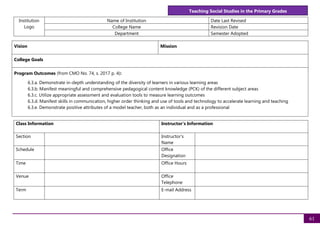
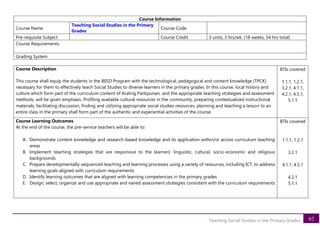
![63
Teaching Social Studies in the Primary Grades
Time
Allotment
Intended Learning Outcomes (ILOs) BTIs Content Suggested Teaching Learning
Activities
Suggested Assessment BTIs
Week 1 a. Clarify and Explain the meaning
and importance of Social Sciences
and Social Studies through graphic
organizers and visual illustrations
1.1.1
1.2.1
[A]
Social Sciences Defined
Social Studies (Araling
Panlipunan) Defined
Importance/relevance of
Teaching Social Studies
(Araling Panlipunan)
• Library and Internet Search
• Brainstorming
• Students will prepare and
present graphic
organizers/visual
illustrations focusing on
the definition of Social
Sciences/Social Studies
and the Importance of
Studying/Teaching Social
Studies (Araling
Panlipunan)
• Group Presentation
• Class Discussion
• Students retrieval of
information from
internet/books on the topics
• Participation in Group
Sharing/Discussion/Work
• Rubric score cards of
graphic organizers/visual
illustrations and group
presentation
1.1.1
1.2.1
Week 2-3 a. Describe the K to 12 Araling
Panlipunan in Grades 1-3
b. Prepare creative expressions
through visual illustrations/graphic
organizers to describe the K to 12
AP Curriculum (Grades 1-3)
c. Prepare a curriculum map for the
K-12 AP for Grades 1-3
d. Show the alignment of the
intended outcomes, grade level
standards and scope of Araling
Panlipunan in the Primary Grades
1.1.1
[A]
4.1.1,
4.5.1
[C]
4.1.1
[C]
4.1.1,
4.2.1
[C,D]
The Social Studies Program
in the K to 12 Curriculum
(Grades 1-3); The
Intended Outcomes
Key Stage Standards
Grade Level Standards
Scope and Sequence (Saklaw
at Daloy ng Kurikulum sa
Araling Panlipunan Baitang K-
3)
Profiling of Available
Community Resources
• Library/Internet Search
• Buzz Session;
• Think-Square-Share
• Lecture-Discussion
• Oral presentation
• Curriculum Mapping
• Community Mapping
(Resources, Local History
and Culture)
• Students retrieval of
information from the CGs
for AP in the Primary
Grades/internet/books on
the topics
• Assess through observation
of student responses in the
Q and A
• Participation in Group
Sharing/Discussion/ Work
• Rubric Score Card to assess
the Curriculum Map and the
4.1.1,
4.2.1
1.1.1
1.1.1
4.5.1
1.1.1
1.2.1](https://image.slidesharecdn.com/3-elementary-education-prototype-syllabi-compendium-250905000714-7fd53d01/85/3-Elementary-Education-Prototype-Syllabi-Compendium-pdf-64-320.jpg)
![64
Teaching Social Studies in the Primary Grades
e. Profile the available community
resources that will form part of the
local history and culture for
contextualization
1.1.1
,
1.2.1
[A]
Community Profile that will
be submitted
Week 4 a. Cite concrete applications of the
Guiding Principles of Araling
Panlipunan
b. Present a Role Play applying the
different principles in teaching
Araling Panlipunan
1.1.1
1.2.1
[A]
4.1.1
[C]
Guiding Principles in
Teaching Araling Panlipunan
• Group Sharing and
Discussion
• Role Playing
• Assess through observation
the participation in Group
sharing/discussion
• Assess the role playing with
the help of the Role Playing
Rubric
1.1.1
1.2.1
4.1.1
Week 5-6 a. Differentiate an approach, a
strategy or method and a
technique
b. Prepare session plans and
instructional aids as they facilitate
the discussion and demonstration
of and explain the features of the
different approaches and methods
in teaching Social Studies
c. Observe a Demonstration Lesson
to be conducted by the Course
Facilitator or a Basic Education
Teacher handling AP for Grades 1-
3
1.1.1
[A]
4.1.1,
4.2.1
[C,D]
1.1.1
4.1.1
4.2.1
4.5.1
[A,C,
D]
Definition of Approach,
Strategy and Technique
Approaches and Methods in
Teaching AP in the Primary
Grades
• Class Discussion
• Preparing/Writing Session
Plans, IMs and hand-outs
• Oral presentation/
Demonstration of assigned
topics on approaches and
methods of teaching
Araling Panlipunan
• Observing a
Demonstration Lesson
• Participation in Discussion
• Assess through observation
of student responses in the
Q and A
• Oral presentation of
assigned topics
• Rubric score cards for Oral
presentation/Demonstration
and Session Plan with hand-
outs
• Rubric score cards on the
Observation Report
1.1.1
1.1.1
1.1.1
4.1.1
4.2.1
4.5.1
1.1.1
4.1.1
4.2.1
4.5.1
Week 7-8 a. Describe the different assessment
techniques/tools used in Araling
Panlipunan
1.1.1
1.2.1
[A]
Evaluating Pupils’
Achievement in Social
Studies
• Library and Internet Search
• Brainstorming
• Students will prepare and
present graphic
• Students retrieval of
information from
internet/books on the topics
1.1.1
1.2.1](https://image.slidesharecdn.com/3-elementary-education-prototype-syllabi-compendium-250905000714-7fd53d01/85/3-Elementary-Education-Prototype-Syllabi-Compendium-pdf-65-320.jpg)
![65
Teaching Social Studies in the Primary Grades
b. Critique sample tests in AP for
Grades 1-3
c. Prepare sample formative and
summative assessment tools in AP
for Grades 1-3
1.1.1
5.1.1
[A, E]
5.1.1
[E]
Authentic/Creative
Assessment in AP
a. Traditional
b. Portfolio
c. Performance Tasks
d. Scoring Rubrics
organizers/visual
illustrations
• Group Presentation
• Lecture- Discussion
• Critique of tests in Araling
Panlipunan Grades 1-3
• Preparing sample
formative and summative
assessment tools in AP
Grades 1-3
•
• Participation in Group
Sharing/Discussion/Work
• Rubric score cards of graphic
organizers/visual
illustrations, group
presentation and sample
tests developed
1.1.1
1.1.1
5.1.1
Week
9-10
a. Define what a lesson plan is
b. Identify the different components
of a lesson plan
c. Differentiate the different kinds of
lesson plan
d. Prepare lesson plans in AP from
Grades 1-3
1.1.1
[A]
1.1.1
[A]
1.1.1
[A]
4.1.1
4.2.1
[C,D]
Planning for Effective
Teaching
The Lesson Plan-Kinds,
Format, Components of the
Lesson Plan
Writing detailed lesson plans
in Social Studies(Araling
Panlipunan 1-3)
• Lecture Discussion
• Mini Workshops on Lesson
Planning
• Preparing/Writing lesson
plans in Social
Studies(Araling Panlipunan
1-3)
• Students retrieval of
information from
internet/books on the topics
• Participation in Group
Sharing/Discussion/Work
• Rubric Score Cards for the
Lesson Plan
1.1.1
1.1.1
4.1.1
4.2.1
Week
11-16
a. Carry out a prepared lesson plan in
Social Studies in a chosen year level
b. Demonstrate a meaningful and
comprehensive knowledge of the
subject matter they will teach.
c. Apply a wide range of
teaching/presentation skills. That
are responsive to learners’
4.1.1
4.2.1
[C,D]
1.1.1
1.2.1
[A]
3.2.1
[B]
Teaching Araling Panlipunan
in the Primary Grades
Actual Teaching
Demonstration
Evaluation of the Teaching
Demonstration
• Teaching Demonstration at
the DepEd Cooperating
Schools
• Pre and Post Conference
• Actual Teaching
Demonstration
• Rubric Score Cards for the
Teaching Demonstration
4.1.1
4.2.1
1.1.1
3.2.1](https://image.slidesharecdn.com/3-elementary-education-prototype-syllabi-compendium-250905000714-7fd53d01/85/3-Elementary-Education-Prototype-Syllabi-Compendium-pdf-66-320.jpg)
![66
Teaching Social Studies in the Primary Grades
linguistic, cultural, socio-economic
and cultural backgrounds
d. Facilitate learning of diverse types
of learners in diverse type of
learning environments, using a
wide range of teaching knowledge
and skills.
4.1.1
3.2.1
[B,C]
Week
17-18
a. Prepare a portfolio showcasing
their significant experiences of
their first teaching demonstration
highlighting lesson preparation
and implementing teaching
strategies
4.1.1
4.2.1
4.5.1
3.2.1
[B,C,
D]
Preparation of Portfolio • Preparation of Portfolio
which highlights learnings
on how to prepare
developmentally
sequenced teaching and
learning processes to meet
curriculum requirements,
selection and development
of a variety teaching and
learning resources, and
implementing teaching
strategies responsive to
different learner
backgrounds
• Rubric score card 4.1.1
4.2.1
4.5.1
3.2.1
Suggested List of References
Bilbao, Purita, et. Al. (2008). Curriculum Development. Quezon City: Sorimar Publication, Inc.
Duka, Cecilio D. Curriculum Development. Quezon City: Rex Book Store
Longstreet, W.S. and Shane, H.G. (1993) Curriculum for a New Millennium. Boston: Allyn and Bacon
Oliva, P. (1997) The Curriculum: Theoretical Dimension. New York: Longman
What is Curriculum Development? www.technology.com/edleadership/curriculum development (accessed April, 2017)
Pryor, Stefan, SDE: Guide to Curriculum Development. www.sde.et.go/sde/cwp/view.asp?=2618Q=321162 (accessed April, 2017). History_of_curriculum_development.doc](https://image.slidesharecdn.com/3-elementary-education-prototype-syllabi-compendium-250905000714-7fd53d01/85/3-Elementary-Education-Prototype-Syllabi-Compendium-pdf-67-320.jpg)
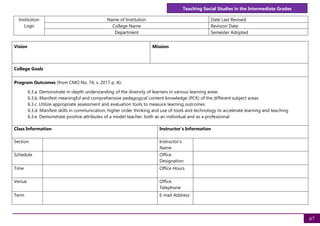
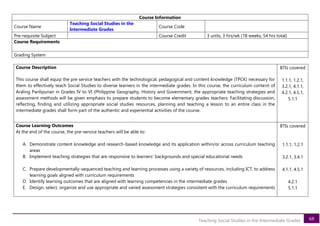
![69
Teaching Social Studies in the Intermediate Grades
Time
Allotment
Intended Learning Outcomes (ILOs) BTIs Content Suggested Teaching Learning
Activities
Suggested Assessment BTIs
Week 1 a. Clarify and Explain the meaning
and importance of Social Sciences
and Social Studies visual
illustrations and panel discussions
1.1.1
1.2.1
[A]
Course Orientation
Review: What is Social Studies
(Araling Panlipunan) and the
Importance of Teaching and
Studying
Social Studies (Araling
Panlipunan)
Goals and Emphasis of
Teaching Araling Panlipunan
• Students retrieval of
information from
internet/books on the
topics
• Participation in Group
Sharing/Discussion/Work
• Rubric score cards of visual
illustrations and group
presentation
• Students retrieval of
information from
internet/books on the topics
• Participation in Group
Sharing/Discussion/Work
• Rubric score cards of
graphic organizers/visual
illustrations and group
presentation
1.1.1
1.2.1
Week 2-3 a. Describe the K to 12 Araling
Panlipunan in Grades 4-6
b. Prepare creative expressions
through visual illustrations/graphic
organizers to describe the K to 12
AP Curriculum (Grades 4-6)
c. Prepare a curriculum map for the
K-12 AP for Grades 4-6
d. Show the alignment of the
intended outcomes, grade level
standards and scope of Araling
Panlipunan in the Intermediate
Grades
1.1.1
[A]
4.1.1,
4.5.1
[C]
4.1.1
[C]
4.1.1,
4.2.1
[C,D]
The Social Studies Program in
the K to 12 Curriculum (Grades
4-6); The
Intended Outcomes
Key Stage Standards
Grade Level Standards
Balangkas Konseptwal
Tunguhin, Tema ng AP
Scope and Sequence (Saklaw
at Daloy ng Kurikulum sa
Araling Panlipunan Baitang 4-
6)
• Library/Internet Search
• Buzz Session
• Lecture-Discussion
• Oral presentation
• Mini workshop: Curriculum
Mapping
• Students retrieval of
information from the CGs
for AP in the Intermediate
Grades/internet/books on
the topics
• Assess through observation
of student responses in the
• Q and A
• Participation in Group
Sharing/Discussion/
• Work
• Rubric Score Card to assess
the Curriculum Map
4.1.1,
4.2.1
1.1.1
1.1.1
4.5.1
1.1.1
1.2.1](https://image.slidesharecdn.com/3-elementary-education-prototype-syllabi-compendium-250905000714-7fd53d01/85/3-Elementary-Education-Prototype-Syllabi-Compendium-pdf-70-320.jpg)
![70
Teaching Social Studies in the Intermediate Grades
Week 4 a. Cite concrete applications of the
Guiding Principles of Araling
Panlipunan
b. Present a graphic organizer (chart)
showing authentic applications of
the different principles in
classroom situations
1.1.1
1.2.1
[A]
4.1.1
3.2.1
3.4.1
[B,C]
Guiding Principles in Teaching
Araling Panlipunan
• Group Sharing and
Discussion
• Preparing graphic
organizers
• Assess through observation
the participation in Group
sharing/discussion
• Microteaching to
demonstrate select guiding
principles of Araling
Panlipunan
1.1.1
1.2.1
1.1.1
3.2.1
3.4.1
Week 5-6 a. Differentiate an approach, a
strategy or method and a
technique
b. Facilitate the discussion and
demonstration of features of the
different approaches and methods
in teaching Social Studies
c. Observe a Demonstration Lesson
to be conducted by the Course
Facilitator or a Basic Education
Teacher handling AP for Grades 4-
6
1.1.1
[A]
4.1.1,
4.2.1
[C,D]
1.1.1
4.1.1
4.2.1
4.5.1
[A,C,
D]
Definition of Approach,
Strategy and Technique
Approaches and Methods in
Teaching AP in the
Intermediate Grades
• Class Discussion
• Preparing/Writing Session
Plans, IMs and hand-outs
• Oral
presentation/Demonstratio
n (Microteaching) of
assigned topics on
approaches and methods
of teaching Araling
Panlipunan
• Observing a
Demonstration Lesson
• Participation in Discussion
• Assess through observation
of student responses in the
Q and A
• Oral presentation of
assigned topics
• Rubric score cards for Oral
presentation/Demonstration
/Microteaching and Session
Plan with hand-outs
• Rubric score cards on the
Observation Report
11.1.1
1.1.1
1.1.1
4.1.1
4.2.1
4.5.1
1.1.1
4.1.1
4.2.1
4.5.1
Week 7-8 a. Describe the different assessment
techniques/tools used in Araling
Panlipunan
b. Critique sample tests in AP for
Grades 4-6
1.1.1
1.2.1
[A]
1.1.1,
5.1.1
[A, E]
Evaluating Pupils’
Achievement in Social
Studies
Authentic/Creative
Assessment in AP
• Library and Internet Search
• Brainstorming
• Students will prepare and
present graphic
organizers/visual
illustrations
• Students retrieval of
information from
internet/books on the topics
• Participation in Group
Sharing/Discussion/Work
1.1.1
1.2.1
1.1.1](https://image.slidesharecdn.com/3-elementary-education-prototype-syllabi-compendium-250905000714-7fd53d01/85/3-Elementary-Education-Prototype-Syllabi-Compendium-pdf-71-320.jpg)
![71
Teaching Social Studies in the Intermediate Grades
c. Prepare sample formative and
summative assessment tools in AP
for Grades 4-6
5.1.1
[E]
e. Traditional
f. Portfolio
g. Performance Tasks
Scoring Rubrics
• Group Presentation
• Lecture- Discussion
• Critique of tests in Araling
Panlipunan Grades 4-6
• Preparing sample
formative and summative
assessment tools in AP
Grades 4-6
• Rubric score cards of graphic
organizers/visual
illustrations, group
presentation and sample
tests developed
1.1.1
5.1.1
Week
9-10
a. Prepare lesson plans in AP from
Grades 4-6
1.1.1
1.2.1
3.2.1
3.4.1
4.1.1
4.2.1
5.1.1
[A,B,
C,D,E
]
Planning for Effective
Teaching
Review on The Lesson
Plan-Kinds, Format,
Components of the Lesson
Plan
Writing detailed lesson
plans in Social
Studies(Araling Panlipunan
4-6)
• Review Lesson on the
Lesson Plan, Kinds and
Components
• Mini Workshops on Lesson
Planning
• Preparing/Writing lesson
plans in Social
Studies(Araling Panlipunan
4-6)
• Critiquing
• Students retrieval of
information from
internet/books on the topics
• Participation in Group
Sharing/Discussion/Work
• Rubric Score Cards for the
Lesson Plan
1.1.1
1.2.1
1.1.1
1.1.1
3.2.1
3.4.1
4.1.1
4.2.1
5.1.1
Week
11-16
a. Carry out a prepared lesson plan in
Social Studies in a chosen year level
b. Demonstrate a meaningful and
comprehensive knowledge of the
subject matter they will teach.
4.1.1
4.2.1
5.1.1
[C,D,
E]
1.1.1
1.2.1
[A]
Teaching Araling Panlipunan in
the Intermediate Grades
Actual Teaching
Demonstration
Evaluation of the Teaching
Demonstration
• Teaching Demonstration at
the DepEd Cooperating
Schools
• Pre and Post Conference
• Actual Teaching
Demonstration
• Rubric Score Cards for the
Teaching Demonstration
1.1.1
4.1.1
4.2.1
4.5.1
3.2.1
3.4.1
5.1.1](https://image.slidesharecdn.com/3-elementary-education-prototype-syllabi-compendium-250905000714-7fd53d01/85/3-Elementary-Education-Prototype-Syllabi-Compendium-pdf-72-320.jpg)
![72
Teaching Social Studies in the Intermediate Grades
c. Apply a wide range of
teaching/presentation skills.
d. Facilitate learning of diverse types
of learners with different linguistic,
cultural, socio-economic and
religious backgrounds and coming
learners in difficult circumstances
including: geographic isolation;
chronic illness; displacement due
to armed conflict, urban
resettlement or disasters; child
abuse and child labor practices.
3.2.1
4.5.1
[B,C]
3.2.1
3.4.1
[B]
Week
17-18
a. Prepare a portfolio showcasing
their significant experiences of
their teaching demonstration
4.1.1
4.2.1
4.5.1
3.2.1
3.4.1
[B,C,
D]
Preparation of Portfolio • Preparation of Portfolio
with focus on sharing how
the teaching of social
studies should be
comprehensive and at the
same time inclusive of
learners with different
backgrounds and from
difficult circumstances.
• Rubric score card 4.1.1
4.2.1
4.5.1
3.2.1
3.4.1
Suggested List of References
Bilbao, Purita, et. Al. (2008). Curriculum Development. Quezon City: Sorimar Publication, Inc.
Department of Education (2013)K to 12 Curriculum Guide
Duka, Cecilio D. Curriculum Development. Quezon City: Rex Book Store
Longstreet, W.S. and Shane, H.G. (1993) Curriculum for a New Millennium. Boston: Allyn and Bacon
Oliva, P. (1997) The Curriculum: Theoretical Dimension: New York: Longman
What is Curriculum Development? www.technology.com/edleadership/curriculum development (accessed April, 2017)
Pryor, Stefan, SDE: Guide to Curriculum Development. www.sde.et.go/sde/cwp/view.asp?=2618Q=321162 (accessed April, 2017)
History_of_curriculum_development.doc](https://image.slidesharecdn.com/3-elementary-education-prototype-syllabi-compendium-250905000714-7fd53d01/85/3-Elementary-Education-Prototype-Syllabi-Compendium-pdf-73-320.jpg)
![75
Teaching Mathematics in the Primary Grades
Time
Allotment
Intended Learning Outcomes (ILOs) BTIs Content Suggested Teaching Learning
Activities
Suggested Assessment BTIs
Week 1 a. Explain and discuss the goals and
objectives of the Key Stage 1 of the
K to 12 Basic Education Program
Elementary Mathematics
Curriculum
1.1.1
1.2.1
4.1.1
[A,B,D]
Twin Goals of critical
thinking and problem
solving
Conceptual Framework and
Theoretical Bases
Learning Area Standard and
Key Stage Standards
• Lecture-discussion on the
K-12 Curriculum Guide for
Mathematics
• Oral Recitation
• Reflection Paper on the
goals and objectives of
Math in the primary grades
based on the curriculum
guide. Possible guide
questions: How
similar/different is the
current curriculum
compared to how you were
taught? How are the
contents of the current
curriculum addressing the
kinds of 21st century learners
that we have?
Rubric:
Quality of Ideas - 60%
Presented/Substance
Coherence of Ideas - 20%
Clarity of Expression - 20%
100%
1.1.1
1.2.1
4.1.1
Week 2 a. Identify and discuss the
content/scope and sequence of
Mathematics in the K-12 basic
education curriculum (BEC) for the
primary grades.
b. Explain the importance of the
alignment between the content
standards performance standards
and learning competencies
1.1.1
1.2.1
4.1.1
[A,B,D]
Mathematics in the K-12
basic education curriculum
for the primary grades
• Walkthrough about the
content/scope and
sequence of Mathematics
Curriculum for Primary
Level in the K-12 BEP
• Lecture-discussion
• Choose a certain grade level
and map the alignment
within the content
standards, performance
standards and learning
competencies
1.1.1
1.2.1
4.1.1](https://image.slidesharecdn.com/3-elementary-education-prototype-syllabi-compendium-250905000714-7fd53d01/85/3-Elementary-Education-Prototype-Syllabi-Compendium-pdf-76-320.jpg)
![76
Teaching Mathematics in the Primary Grades
Week 3-5 a. Demonstrate in-depth
understanding of key concepts and
skills of the Curriculum content in
Mathematics Education for
primary level in the K-12 BEC.
1.1.1
1.2.1
4.1.1
[A,B,D]
Number and number sense
(whole numbers up to 10 000
and the four fundamental
operations including money,
ordinal numbers up to 100th ,
basic concepts of fractions); ,
measurements ( time, length,
mass, capacity, area of square
and rectangle);
Geometry (2 dimensional
and 3 dimensional objects,
lines, symmetry and
tessellation);
Patterns and algebra
(continuous and repeating
patterns and number
sentences);
Statistics and probability
(data collection and
representation in tables,
pictographs and bar graphs
and outcomes)
• Whole class discussion
technique
• Quiz 1.1.1
1.2.1
4.1.1
Week 6 a. Explain and design activities that
would help develop and improve
childrens’ mathematical skills and
competence.
b. Demonstrate how goals become
objectives and objectives are used
to select materials and activities
1.1.1
1.2.1
1.4.1
[A,B]
4.1.1
4.5.1
[D]
1.2.1
2.4.1
[B]
Informal Activities
Cooperative Learning
Teacher-directed Activities
• Lecture- discussion with
Workshop
• Class critiquing of lesson
plan exemplars
• Worksheets and Activity
Sheets which allow the pre-
service teachers to critique
lesson plan objectives,
selected materials and
session flow
1.1.1
4.1.1
4.5.1
2.4.1](https://image.slidesharecdn.com/3-elementary-education-prototype-syllabi-compendium-250905000714-7fd53d01/85/3-Elementary-Education-Prototype-Syllabi-Compendium-pdf-77-320.jpg)
![77
Teaching Mathematics in the Primary Grades
c. Discuss some of the options
teachers have for helping learners
learn mathematics
Week 7 a. Describe the 6 levels of cognitive
domain
b. Formulate objectives in the 6 levels
of the cognitive domain
c. Enumerate and explain the
characteristics of good question
d. Identify and explain the principles
of classroom management
1.1.1
[A]
4.1.1
[D]
1.1.1
[A]
1.1.1
[A]
Developing Teacher
Competencies
• Lecture-discussion • Paper and pencil Test 1.1.1
4.1.1
Week 8 a. Identify and discuss the underlying
principles and theories and its
implications to learning
mathematics in the K-12 Basic
Education Program
b. Plan a lesson using different
principles and theories in teaching
Mathematics to promote literacy
and numeracy skills
1.1.1
1.2.1
[A,B]
1.4.1
4.1.1
[A,D]
Experiential and Situated
Learning
Reflective Learning
Cooperative Learning
Discovery and Inquiry based
Learning
Constructivism
• Lecture-discussion to show
different principles and
theories (could be through
videos, described
classroom scenarios,
shared math learning
experiences, etc.)
• Sharing of which
principle/theory the pre-
service teachers think is
most appropriate/effective
for different kinds of
learners and classroom
environment
• Paper and pencil Test/
worksheets
• Lesson planning by group-
Each group will be assigned
a topic and they will come up
with a lesson plan that will be
most supportive in nurturing
and inspiring learner
participation
1.1.1
1.4.1
4.1.1
Week 9 a. Identify classroom practices on the
teaching and learning of the skills
and processes to be developed in
the mathematics education for
primary level in the K-12 BEP:
knowing and understanding;
estimating; computing and
solving; visualizing and modeling;
representing and communicating;
conjecturing, reasoning, proving
1.4.1
1.2.1
[A,B]
Teaching and Assessment in
primary Grade Mathematics
Lecture-discussion
Share/Group discussion
• Reaction Paper
• Paper and Pencil Test
1.4.1
4.5.1](https://image.slidesharecdn.com/3-elementary-education-prototype-syllabi-compendium-250905000714-7fd53d01/85/3-Elementary-Education-Prototype-Syllabi-Compendium-pdf-78-320.jpg)
![78
Teaching Mathematics in the Primary Grades
and decision-making; and applying
and connecting
b. Use appropriate tools necessary in
teaching mathematics based on
recent research evidence:
manipulative objects, measuring
devices, calculators, smart phones
and tablet, PCs and the internet
c. Contrast between assessment of
learning, assessment for learning
and assessment as learning in
Mathematics of the K-12 Basic
Education Program
d. Evaluate learners’ daily work using
different processes of assessing
and evaluating learner’s progress
in elementary school mathematics
4.5.1
[A,D]
1.1.1
[A]
5.1.1
1.1.1
[A,E]
Observation of primary
mathematics classes and
interview primary mathematics
teachers
• Scenario-based practical
examination where pre-
service teachers evaluate a
learner’s daily work,
problem-solving activities,
and portfolios; self-
evaluations and tests.
5.1.1
Week 10 a. Explain the classroom assessment
framework of the K to 12 BEP as
contained in DO 8, s. 2015
b. Create authentic assessment tool
for measuring learning outcomes
for Mathematics in the primary
grades.
1.1.1
1.2.1
[A,B]
4.1.1
4.5.1
5.1.1
[D,E]
Classroom Assessment
Framework of the K to 12 BEC
Free-Wheeling Discussion
Sharing of primary grade
Mathematics authentic
assessment tool ideas (videos,
etc)
• Design authentic
assessment tools aligned
with learning outcomes
4.1.1
4.5.1
5.1.1
Week
11-12
a. Develop and prepare varied
teaching and learning resources
that develop critical and creative
1.5.1
4.5.1
[C,D]
Critical and Creative Thinking
in Mathematics for the
Primary Grades
Workshop/Project Making • Prepare a lesson which
develops learners’ critical
and creative thinking skills.
1.5.1
4.5.1](https://image.slidesharecdn.com/3-elementary-education-prototype-syllabi-compendium-250905000714-7fd53d01/85/3-Elementary-Education-Prototype-Syllabi-Compendium-pdf-79-320.jpg)
![79
Teaching Mathematics in the Primary Grades
thinking skills in the primary
grades
Present the
developed/designed
learning resources to the
class.
Week 13 a. Design a developmentally
sequenced teaching and learning
process to meet the curriculum
requirements in teaching
Mathematics in the primary
grades.
b. Set learning outcomes that are
aligned with learning
competencies.
4.1.1
[D]
4.1.1
[D]
Lesson Planning Lecture-discussion
Classroom observation
Writeshop
Lesson plan on the observed
demo-lesson
Output presentation and
critiquing
4.1.1
Week 14-
18
a. Perform a demonstration lesson in
Mathematics (primary level) by
group.
b. Implement strategies that develop
critical and creative thinking skills
c. Use technology appropriately in
teaching the lesson.
d. Use assessment tools aligned with
the curriculum requirement and
lesson outcomes
1.1.1
2.4.1
[A,B]
1.5.1
[C]
4.5.1
[D]
5.1.1
[E]
Demo- teaching Demonstration Lesson Evaluating the Demo-lesson
Rubric:
Mastery of Content - 30%
Delivery - 30%
Attainment of the - 20%
Objectives
Teaching Strategy -
Used 20%
100%
1.1.1
2.4.1
1.5.1
4.5.1
5.1.1](https://image.slidesharecdn.com/3-elementary-education-prototype-syllabi-compendium-250905000714-7fd53d01/85/3-Elementary-Education-Prototype-Syllabi-Compendium-pdf-80-320.jpg)
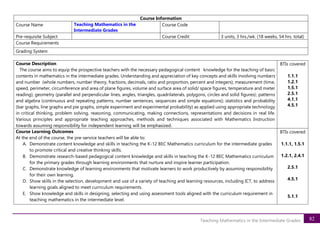
![83
Teaching Mathematics in the Intermediate Grades
Time
Allotment
Intended Learning Outcomes (ILOs) BTIs Content Suggested Teaching Learning
Activities
Suggested Assessment BTIs
Week 1 a. Identify and discuss the nature of
mathematics and its implication to
Mathematics Instruction.
b. Explain the need for a modern
Mathematics Program.
[A]
1.1.1
1.2.1
1.1.1
1.2.1
Foundations of Mathematics
Teaching and Learning
Lecture-discussion
Lecture-discussion
Recitation
Reflection Paper
1.1.1
1.2.1
Week
2-3
a. Explain and discuss the goals and
objectives of the Key Stage 2 of the
K-12 Basic Education Program
Elementary Mathematics
Education.
b. Identify and discuss content/scope
and sequence of Mathematics in
the K-12 BEC for the intermediate
grades.
1.1.1
1.2.1
[A,B]
1.1.1
1.2.1
[A,B]
Goals and Objectives of
Mathematics in the K-12 BEC
for the intermediate grades
The K-12 Curriculum Guide for
Mathematics Education
Walkthrough about the
content/scope and sequence of
Mathematics for the
Intermediate Level in the K-12
BEP
Group reporting and insight-
sharing
1.1.1
1.2.1
Week
4-6
a. Demonstrate in-depth
understanding of key concepts and
skills of the Curriculum content of
Mathematics Education for the
intermediate level in the K-12 BEC
b. Design activities that would help
develop and improve children’s
mathematical skills and
competencies.
c. Develop activities that motivates
learners to work productively and
assume responsibility for their own
learning
1.1.1
1.2.1
[A,B]
1.5.1
[A]
2.5.1
[C]
Numbers and Number Sense
(whole numbers, number
theory, fractions, decimals,
ratio and proportion, percent
and integers)
Measurement ( time, speed,
perimeter, circumference
and area of plane figures,
volume and surface area of
solid/ space figures,
temperature and meter
reading)
Lecture-discussion
Workshop
Whole class discussion
technique
Quiz
Worksheets and Activity Sheets
1.1.1
1.5.1
2.5.1](https://image.slidesharecdn.com/3-elementary-education-prototype-syllabi-compendium-250905000714-7fd53d01/85/3-Elementary-Education-Prototype-Syllabi-Compendium-pdf-84-320.jpg)
![84
Teaching Mathematics in the Intermediate Grades
Geometry (parallel and
perpendicular lines, angles,
triangles, quadrilaterals,
polygons, circles and solid
figures)
Patterns and Algebra
(continuous and repeating
patterns, number sentences,
sequences and simple
equations)
Statistics and Probability (bar
graphs, line graphs and pie
graphs, simple experiment
and experimental probability)
Week 7 a. Discuss the learning episodes of
Mathematics for children.
b. Discuss the theories of
Mathematics
c. Cite Mathematics learning
situations where each theory is
applicable
1.1.1
2.5.1
[A,C]
1.2.1
2.4.1
[B]
1.2.1
2.4.1
2.5.1
[A,B,C]
Naturalistic
Informal
Structured
Behaviorism
Constructivism
Whole class discussion
technique
Reflection paper on case ctudies
on theories in Mathematics
teaching and approaches
Case analysis of different
learning theories
1.1.1
1.2.1
2.4.1
1.1.1
2.5.1
Week 8-9 a. Discuss the learning theories
advocated by prominent
contemporary psychologists.
b. Relate the different learning
theories in intermediate grades
mathematics class situation
1.1.1
1.2.1
[B]
2.4.1
2.5.1
[B,C]
Jerome Bruner and Discovery
Learning
Robert Gagne and Learning
Hierarchy
Jean Piaget and Cognitive
Learning
Lecture-presentation
Lecture-discussion
Share/Group discussion
Reaction Paper
Paper and Pencil Test
Case analysis of different
learning theories
1.1.1
1.2.1
2.4.1
2.5.1](https://image.slidesharecdn.com/3-elementary-education-prototype-syllabi-compendium-250905000714-7fd53d01/85/3-Elementary-Education-Prototype-Syllabi-Compendium-pdf-85-320.jpg)
![85
Teaching Mathematics in the Intermediate Grades
c. Prepare a lesson plan following
different learning theories
1.1.1
1.2.1
2.4.1
2.5.1
[A,B,C
]
By group, prepare one lesson
plan for each learning theory
1.1.1
1.2.1
2.4.1
2.5.1
Week
10-11
a. Use different approaches,
methods and techniques in
teaching Mathematics in the
intermediate grades.
b. Develop a variety of teaching and
learning resources, including ICT,
to address learning goals
c. Deliver a lesson demonstrating
learning environments that nurture
and inspire learner participation
1.1.1
1.2.1
[A,B]
4.5.1
[D]
2.4.1
[B]
Approaches, Methods and
Techniques in Teaching
Mathematics:
- Discovery Approach
- Inquiry Approach
- Process Approach
- Cooperative Learning
- Project-based Learning
- Problem Solving
Techniques
- The 5-E Learning Cycle
- Activity Approach
- Using Patterns
- The Investigative
Approach
Lecture-Demonstration
Demonstration Technique
Return-Demo (Peer Teaching) 1.1.1
1.2.1
2.4.1
4.5.1
Week 12 a. Use different approaches,
methods and techniques in
teaching Mathematics in the
intermediate grades.
b. Develop a variety of teaching and
learning resources, including ICT,
to address learning goals
c. Deliver a lesson that motivates
learners to work productively by
assuming responsibility for their
own learning
1.1.1
1.2.1
[A,B]
4.1.1
4.5.1
[D]
2.5.1
[B]
Other Teaching Strategies
and Supplementary Methods:
• Research-based Strategy
• Interactive Direct
Instruction
• Use of Instructional Aids
• Modules
• Instructional Games
• Computer Aided
Instruction
• Collaborative Learning
Strategy
• Peer Practice Strategy
Lecture-group presentation
Oral Presentation of assigned
topic
Output presentation by group
Recitation
Paper and Pencil Test
Reaction Paper
Rubric:
Quality of Ideas - 60%
Presented/Substance
Coherence of Ideas - 20%
Clarity of Expression - 20%
100%
1.1.1
1.2.1
2.5.1
4.1.1
4.5.1](https://image.slidesharecdn.com/3-elementary-education-prototype-syllabi-compendium-250905000714-7fd53d01/85/3-Elementary-Education-Prototype-Syllabi-Compendium-pdf-86-320.jpg)
![86
Teaching Mathematics in the Intermediate Grades
Week 13 a. Explain and discuss the factors in
choosing a method or strategy.
b. Explain other pedagogical
considerations in teaching
mathematics in the elementary.
1.1.1
2.4.1
2.5.1
[A,B,C]
Learning by Doing
Reinforcement in
Mathematics
Classroom discussion
Free-wheeling discussion
Participation
Test
1.1.1
2.4.1
2.5.1
Week 14 a. Develop and prepare varied
teaching and learning resources
that are suited, useful and effective
in teaching critical and creative
thinking skills appropriate to
intermediate grades.
1.1.1
1.5.1
4.1.1
4.5.1
[A,D]
Critical and Creative Thinking
Skills in Intermediate
Mathematics
Workshop/Project Making Prepare a lesson which develops
learners’ critical and creative
thinking skills.
Present the developed/designed
learning resources to the class.
1.1.1
1.5.1
4.1.1
4.5.1
Week 15 a. Identify and discuss some ways of
appraising and assessing
Mathematics learning outcomes
b. Create authentic assessment tool
for measuring learning outcomes
for Mathematics in the
intermediate grades.
1.1.1
5.1.1
[A,E]
5.1.1
[E]
Assessing Learning
Outcomes in Intermediate
Mathematics
Lecture-discussion
Workshop/Project Making
TOS and Test question
preparation (Developing
assessment tools for
Mathematics in the intermediate
grades)
1.1.1
5.1.1
Week 16 a. Design a developmentally
sequenced teaching and learning
process to meet the curriculum
requirements in teaching
Mathematics in the intermediate
grades.
b. Set learning outcomes that are
aligned with learning
competencies.
c. Use effective teaching approaches,
strategies and assessment
1.1.1
4.1.1
[A,D]
4.1.1
[D]
4.1.1
5.1.1
[D,E]
Lesson Planning Lecture-discussion
Classroom observation
Writeshop
Lesson plan on the observed
demo-lesson
Output presentation and
critiquing
1.1.1
4.1.1
5.1.1](https://image.slidesharecdn.com/3-elementary-education-prototype-syllabi-compendium-250905000714-7fd53d01/85/3-Elementary-Education-Prototype-Syllabi-Compendium-pdf-87-320.jpg)
![87
Teaching Mathematics in the Intermediate Grades
materials in preparing the lesson
plan.
Week
17-18
a. Perform a demonstration lesson in
Mathematics (intermediate level)
by group.
b. Implement strategies that inspire
learner participation and motivate
learners to work productively by
assuming responsibility for their
own learning.
c. Maximize use of appropriate
technology in teaching the lesson
in order to promote critical and
creative thinking skills.
d. Use assessment tools aligned with
the curriculum requirement and
lesson outcomes
1.1.1
4.1.1
[A,D]
2.4.1
2.5.1
[B,C]
4.5.1
1.5.1
[A,D]
5.1.1
[E]
Demo- teaching Demonstration Lesson Evaluating the Demo-lesson
Rubric:
Mastery of Content - 30%
Delivery - 30%
Attainment of the - 20%
Objectives
Teaching Strategy - 20%
Used 100%
1.1.1
1.5.1
2.4.1
2.5.1
4.1.1
4.5.1
5.1.1
Suggested List of References
Agno, Lydia N. (2010) Principles of Teaching 2. As Modular Approach: C&E Publishing Inc. Quezon City
Corpuz ,Brenda B. and Salandanan , Gloria G. Principles of Teaching ( with TLE ),Quezon City,Lorimar Publishing, 2015.
Lardizabal, Amparo S. et.al, Principles and Methods of Teaching. Rex Publishing
Teacher Induction Program Curriculum and Instructions
Module 6.3 Mathematics
K-12 Curriculum Guide for Mathematics
K-12 Textbooks for Mathematics
https://lrmds.deped.gov.ph/
http://innovativelearning.com/teaching/teaching_methods.html
https://en.wikipedia.org/wiki/Constructivism_(philosophy_of_mathematics)](https://image.slidesharecdn.com/3-elementary-education-prototype-syllabi-compendium-250905000714-7fd53d01/85/3-Elementary-Education-Prototype-Syllabi-Compendium-pdf-88-320.jpg)
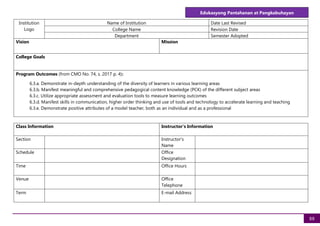
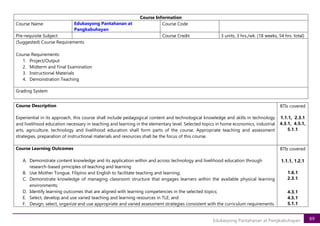
![90
Edukasyong Pantahanan at Pangkabuhayan
Time
Allotment
Intended Learning Outcomes (ILOs) BTIs Content Suggested Teaching Learning
Activities
Suggested Assessment BTIs
Week 1 a. The students can demonstrate and
explain the basic knowledge and
skills in ICT, Agriculture, Home
Economics, and Industrial Arts
toward the improvement of life
skills, family, and community.
1.1.1
[A]
Key standards of EPP
a. ICT
b. Agriculture
c. Home Economics
d. Industrial Arts
• Lecture-discussion • Recitation
• Reflection Paper
1.1.1
Week 2 a. The students can explain the
significance of the learning
theories of Bruner and Gagne in
the teaching-learning process of
the different skill in the EPP subject.
1.1.1
1.2.1
[A]
Contemporary Learning
Theories/Psychologists:
Their Impact to EPP Teaching
a. Jerome Bruner and
Discovery Learning
b. Robert Gagne and Leaning
Hierarchy
• Lecture-discussion
• Share/Group discussion
• Video Clip Analysis
• Paper and Pencil Test
1.1.1
1.1.1
Week 3 a. The students can appreciate the
importance of using a language
best understood by the pupils,
particularly in the EPP subject
1.1.1
1.6.1
[B]
The Need of Teaching EPP in
the Intermediate Grades Using
a combination of Mother
Tongue, Filipino and English as
Medium of Instruction
• Lecture-discussion
• Viewing of exemplar
lessons in the EPP subject
• Reaction Paper 1.1.1
Week 4 a. The students can explain the
importance of developing the
different skills needed to improve
their quality of life
1.1.1
[A]
Latest studies and trends in
teaching EPP with emphasis on
the following:
a. Consumerism
b. Hospitality Management
c. Valuable Intrapersonal Skills
d. Personality Development
e. Decision Making
• Lecture-discussion
• Small Group Discussion
• Group Sharing
• Research
• Reflection Paper 1.1.1
Week 5-8 a. The students can identify and use
appropriate method/approach
/technique in teaching specific
knowledge and skill in teaching
1.1.1
2.3.1
[A,C]
Approaches, Methods and
Techniques in Teaching EPP
a. Demonstration Method
b. Hands on Learning
c. Cooperative Learning
• Walkthrough of the
different Methods and
Techniques in Teaching
EPP
• Cooking Demonstration
• Buying Basic Commodities
• Making a chair/dust pan
2.3.1
2.3.1](https://image.slidesharecdn.com/3-elementary-education-prototype-syllabi-compendium-250905000714-7fd53d01/85/3-Elementary-Education-Prototype-Syllabi-Compendium-pdf-91-320.jpg)
![91
Edukasyong Pantahanan at Pangkabuhayan
ICT, Agriculture, Home Economics,
and Industrial Arts.
d. Project method
e. Instructional modules
f. Utilization of resource
persons and community
materials
g. Field trip/Home visits/
Community Work
• Lecture-discussion
• Share/Group Discussion
• Inviting a resource person
• Field trip/Home visits/
• Community Work
• Modules in EPP
Paper/Article
• Reflection Paper
1.1.1
1.1.1
Week
9-10
a. The student can differentiate the
two kinds of assessment used in
EPP and conduct each of them.
5.1.1
[F]
Authentic Assessment
Traditional Assessment
• Lecture-discussion
•
• Paper and Pencil Test
• Development of TOS and
Tests for Quarterly
Assessment
5.1.1
Week 11 a. The student can construct lesson
plan appropriate to the skill to be
developed
1.1.1.
4.3.1
4.5.1
5.1.1
[A,D,
E,F]
Lesson Planning in EPP • Workshop on Lesson
Planning and Output
Presentation
• Sample Detailed Lesson for
EPP
1.1.1.
4.3.1
4.5.1
5.1.1
[A,D,
E,F]
Week 12 a. The student can prepare/create
instructional materials suited to the
lesson to developed
4.5.1
[E]
Preparation of
Instructional Materials
• Presentation of
Instructional Output
• Instructional Materials 4.5.1
Week
13-16
a. The student can execute the steps
in the lesson plan properly.
1.1.1
1.6.1
2.3.1
4.5.1
[A,B,
C,E]
Implement the Lesson Plan • Demonstration Lesson • Evaluating the Demo-Lesson 1.1.1
1.6.1
2.3.1
4.5.1
[A,B,
C,E]](https://image.slidesharecdn.com/3-elementary-education-prototype-syllabi-compendium-250905000714-7fd53d01/85/3-Elementary-Education-Prototype-Syllabi-Compendium-pdf-92-320.jpg)
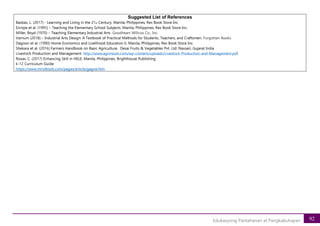
![95
Edukasyong Pantahanan at Pangkabuhayan with Entrpreneurship
Time
Allotment
Intended Learning Outcomes
(ILOs)
BTIs Content Suggested Teaching Learning
Activities
Suggested Assessment BTIs
Week
1-2
a. The student can explain the
importance of EPP in the
holistic development of the
learner for the improvement
of their quality of life, their
family and their community.
1.1.1
3.1.1
3.4.1
[A,B]
Importance of Edukasyon
Pantahanan at Pangkabuhayan with
Entrepreneurship in the K-12
Curriculum
Components of EPP in the K-12
Curriculum
1. Industrial Arts
a. carpentry d. metal works
b. plumbing e. electrical
c. electronics f. orthographic
drawing/CAD
2. Home Economics
a. food, health and nutrition
b. personal finance and family
resources
c. textile and clothing
d. consumer science
e. household management
f. human development
3. Agriculture
a. livestock production
b. agricultural economics
c. crop production
d. modern agriculture
4. Theories of Entrepreneurship
a. Economic b. Sociological
c. Psychological
d. crop production
e. Opportunity– Based
f. Resource-Based
Lecture-discussion
Walkthrough of the different
components of EPP
Lecture-discussion
Demonstration
Film Showing
Cooperative Learning
Lecture-discussion
Demonstration
Film Showing
Lecture-discussion
Demonstration
Film Showing
Group work
Lecture-discussion
Film Showing Lecture-
discussion
Personal observation of
business success/failures
Recitation
Content -40%
Presentation – 30
Voice – 20
Attitude - 10
Reflection Paper
Content-40
Organization-20
Mechanics-20
Visual appeal-20
Video clip of project making
Content- 50
Clarity-25
Creativity-25
Quiz
Video Clip Analysis
Quiz
Project making
Content-40
Creativity-30
Presentation-30
Picture of project making
Content- 50
Clarity-25
Creativity-25
Quiz
1.1.1
3.1.1
3.4.1](https://image.slidesharecdn.com/3-elementary-education-prototype-syllabi-compendium-250905000714-7fd53d01/85/3-Elementary-Education-Prototype-Syllabi-Compendium-pdf-96-320.jpg)
![96
Edukasyong Pantahanan at Pangkabuhayan with Entrpreneurship
Mini business proposal
Content-40
Creativity-30
Organization-30
Reflection paper
Week
3-4
a. The students can explain and
be guided by the different
learning theories needed in
teaching EPP.
1.1.1
1.2.1
[A]
Learning Theories and their Impact to
EPP Teaching
a. Behaviourism d. Cognitivism
b. Constructivist e. Experientialism
c. Social Learning
Film Showing
Lecture-discussion
Reporting
Quiz
Reflection paper
1.1.1
Week
5-7
a. The students can identify
and use appropriate
method/approach
/technique in teaching
specific knowledge and skill
in ICT, Agriculture, Home
Economics, and Industrial
Arts.
b. The students can use
differentiated teaching to
suit learners’ needs,
strengths, interests and
experiences.
1.1.1
[A]
3.1.1
[B]
Approaches, Methods and
Techniques
in Teaching EPP
a. Demonstration Method
b. Cooperative Learning
c. Instructional modules
d. Utilization of resource persons
e. and community materials
f. Field trip/Home visits/
Community Work
g. Hands on Learning
h. Project method
Walkthrough of the different
Methods and Techniques in
Teaching EPP
Lecture-discussion
Share/Group Discussion
Inviting a resource person Field
trip/Home visits/Community
Work
Cooking Demonstration
Mastery-40
Presentation-30
Creativity-30
Buying Basic Commodities
Planning-20
Marketing-40
Resourcefulness-40
Reflection Paper
1.1.1
3.1.1
1.1.1
3.1.1
1.1.1
3.1.1
Week
8-9
a. The student can construct
lesson plan appropriate to
the skill to be developed.
b. The student can
demonstrate understanding
of the special educational
needs of learners in difficult
circumstances.
4.1.1
[C]
3.4.1
[B]
Lesson Planning in EPP
a. Lesson Plan aligned with
curriculum requirements
b.Lesson plan that responds to
special educational needs of
learners in difficult circumstances
including:
• geographic isolation
• chronic illness
Workshop on Lesson Planning
and Output Presentation
Sample Detailed Lesson for EPP
Organization-40
Content-40
Neatness-20
4.1.1
3.4.1](https://image.slidesharecdn.com/3-elementary-education-prototype-syllabi-compendium-250905000714-7fd53d01/85/3-Elementary-Education-Prototype-Syllabi-Compendium-pdf-97-320.jpg)
![97
Edukasyong Pantahanan at Pangkabuhayan with Entrpreneurship
• displacement due to armed
conflict
• urban resettlement or
disasters
• child abuse and child labor
practices
Week
10-11
a. The student can
prepare/create instructional
materials suited to the
lesson to developed
4.1.1
4.5.1
[C,D]
Preparation of
Instructional Materials
Presentation of Instructional
Output
Cooking Demonstration
Instructional Materials
Content- 40
Creativity-30
Usability- 30
4.1.1
4.5.1
Week
12-13
a. The student can execute the
steps in the lesson plan
properly.
1.1.1
3.1.1
3.4.1
4.1.1
4.5.1
Implement the Lesson Plan Demonstration Lesson Evaluating the Demo-Lesson
Strategy-25
Attitude-25
Content- 25
Assessment-25
1.1.
1
3.1.
1
3.4.
1
4.1.
1
4.5.
1
Suggested List of References
Basbas, L. (2017) - Learning and Living in the 21st Century. Manila, Philippines, Rex Book Store Inc.
Enriqie et al. (1995) – Teaching the Elementary School Subjects. Manila, Philippines, Rex Book Store Inc.
Miller, Boyd (1970) – Teaching Elementary Industrial Arts Goodheart-Willcox Co., Inc.
Varnum (2018) – Industrial Arts Design: A Textbook of Practical Methods for Students, Teachers, and Craftsmen. Forgotten Books
Dagoon et al. (1990) Home Economics and Livelihood Education 6. Manila, Philippines, Rex Book Store Inc.
Shekara et al. (2016) Farmers Handbook on Basic Agriculture. Desai Fruits & Vegetables Pvt. Ltd. Navsari, Gujarat India
Livestock Production and Management. http://www.agrimoon.com/wp-content/uploads/Livestock-Production-and-Management.pdf
Roxas, C. (2017) Enhancing Skill in HELE. Manila, Philippines, Brighthouse Publishing
http://kwhs.wharton.upenn.edu/nbea-standard/entrepreneurship/
https://www.coursera.org/specializations/wharton-entrepreneurship](https://image.slidesharecdn.com/3-elementary-education-prototype-syllabi-compendium-250905000714-7fd53d01/85/3-Elementary-Education-Prototype-Syllabi-Compendium-pdf-98-320.jpg)
![100
Teaching Music in the Elementary Grades
Time
Allotment
Intended Learning Outcomes (ILOs) BTIs Content Suggested Teaching Learning
Activities
Suggested Assessment BTIs
Week 1 a. Identify the guiding principles and
values in music education
b. Reflect on the importance of
music to education and teaching.
1.1.1
[A]
1.1.1
[A]
Philosophy and Values in
Music Education
Lecture-discussion
Think-pair share
Oral Presentation
Content- 60%
Delivery-20%
Organization and correct usage-
20%
Class impact-10%
Participation in the discussion
Reflection Paper
1.1.1
Week 2 a. Evaluate and discuss the scope and
sequence of musical concepts for
first to sixth grades
1.1.1
[C]
Scope and Sequence of Music
for Grades 1-6
• Lecture-presentation
• Problem-based learning
• Walk through the K to 12
Music Curriculum
• Oral Presentation
Criteria for Oral discussion:
Content- 60%
Delivery-20%
Organization and correct
usage-20%
Class impact-10%
1.1.1
Week 3 a. Identify the competencies of a
music teacher in the elementary
grades.
-Leadership Qualities
-Musicianship
-Pedagogical skill
b. Cite the importance of having
these qualities and competencies
especially when dealing with
learners with diverse strengths,
interests, experiences and abilities
1.1.1
[A]
1.1.1
3.1.1
3.3.1
[A,B]
The Music Teacher • Lecture-group Discussion
• Interview to Music
teachers in the field
• Recitation
• Presentation of the
interviews done
• Individual and Group Output
1.1.1
3.1.1
3.4.1](https://image.slidesharecdn.com/3-elementary-education-prototype-syllabi-compendium-250905000714-7fd53d01/85/3-Elementary-Education-Prototype-Syllabi-Compendium-pdf-101-320.jpg)
![101
Teaching Music in the Elementary Grades
(disabilities, giftedness and
talents).
Week
4-8
a. Discuss the considerations in
developing the facets of music to
the learners.
b. Demonstrate knowledge and
understanding of differentiated
teaching in performing the 5 facets
of Music Teaching
c. Determine how these five facets be
done and experienced by the
learners.
1.1.1
3.1.1
[A]
1.1.1
3.1.1
[A,B]
1.1.1
3.1.1
[A,B]
Five Facets of Music Teaching
a. Singing
b. Listening
c. Creative Work
d. Instrumental Work
e. Movement
• Lecture-discussion
• Individual and Group
Performance
• Recitation
• Quizzes
• Practical Tests
1.1.1
3.1.1
Week
9-11
a. Identify and discuss the features of
the different strategies in music
teaching.
b. Select the best strategies for a
certain topic and explain the
reason for choosing such.
1.1.1
[A]
1.1.1
4.1.1
[A,C]
Strategies in Music Teaching • Actual Performance of the
different methods in Music
Teaching
• Think-Pair -Share on the
Importance of the different
Strategies
• Recitation/ Performance
• Sharing
• Practical Test
1.1.1
1.1.1
4.1.1
Week
12-13
a. Select appropriate assessment
technique to assess the extent of
learners’ mastery
b. Develop rubrics in rating authentic
assessment.
5.1.1 Assessment in Music • Lecture-Discussion
• Development of Rubrics of
Authentic and Traditional
Assessment in Music
• Classroom Observation
• Rubrics-Making
• Narrative Report/ Reflection
5.1.1
Week
14-18
a. Demonstrate music lesson using
content-based and pedagogical
knowledge effectively
1.1.1
4.1.1
[A,E]
Demonstration Teaching
a. Micro teaching
b. Team teaching
• Actual Demonstration • Graded lesson presentation
- The students deliver a
lesson in front of jurors
who will evaluate their
1.1.1
4.1.1
3.1.1
3.4.1](https://image.slidesharecdn.com/3-elementary-education-prototype-syllabi-compendium-250905000714-7fd53d01/85/3-Elementary-Education-Prototype-Syllabi-Compendium-pdf-102-320.jpg)
![102
Teaching Music in the Elementary Grades
b. Apply well-selected teaching
strategies and resources that are
responsive to diverse learners’
strengths, interests, experiences
and abilities through an actual
teaching presentation
c. Use appropriate and varied
assessment strategies consistent
with the curriculum requirements
3.1.1
3.4.1
4.5.1
[B,C]
5.1.1
[D]
c. Individual teaching
• Post-conference ( demo-
teacher and observer)
performance through
the following criteria:
Content: 30 %
Delivery and use of
strategy- 30%
Mastery of the lesson-
20%
Instructional materials-
10%
Classroom
management_10%
Assessment strategy
10%
4.1.1
4.5.1
5.1.1
Suggested List of References
Agapay, N. (2005) – Music, Arts & PE, Made Simple for Young Learners. Manila, Philippines. Lighthouse Publication Inc.
Bautista, M. et al (2000). An Introduction to Music. Manila, Philippines. National Book Store Inc.
Baxter and Baxter. The Right Way to Read Music. Kingswood, Tadworth, Surrey, KT206TD, U.K. Cox & Wyman Ltd.
Ewen, D. & Slonimsky, N. (1982). Fun with Musical Games and Quizzes. New York. Prentice-Hall, Inc.
K to 12 Curriculum Guide for MAPE (2014). Kagawaran ng Edukasyon
K to 12 Music Gurriculum Guide 2016.
Kabayao, Gilopez. (1988). Listening Program of Fine Music for Filipino Youth. Manila, Philippines. Rex Book Store, Inc.
Leonhard, Charles & House, R.(1959). Foundations and Principles of Music Education. U.S.A. McGraw-Hill Book Company, Inc.
Lugue, V.(2009). Enjoy Life with Music and Arts. Maria Clara Street, Quezon City, Philippines.SD Publication Inc.](https://image.slidesharecdn.com/3-elementary-education-prototype-syllabi-compendium-250905000714-7fd53d01/85/3-Elementary-Education-Prototype-Syllabi-Compendium-pdf-103-320.jpg)
![105
Teaching Arts in the Elementary Grades
Time
Allotment
Intended Learning Outcomes (ILOs) BTIs Content Suggested Teaching
Learning Activities
Suggested Assessment BTIs
Week 1-2 a. Identify the guiding philosophies
and objectives of art education
b. Reflect on the importance of art to
education and teaching
1.1.1
[A]
1.1.1
[A]
Philosophy and Objectives of
Art Education
• Lecture-discussion
• Think-pair share
• Recitation
Criteria for Oral Presentation
Content- 60%
Delivery-20%
Organization and correct
usage-20%
Class impact-10%
• Participation in the
discussion
• Reflection Paper
1.1.1
Week 3 a. Discuss clearly the values of art
b. Cite examples significant to the
realization of these values
1.1.1
[A]
1.1.1
[A]
Values of Art Education • Group Discussion • Recitation
Criteria for Oral
Presentation/ Reporting
Content- 60%
Delivery-20%
Organization and correct
usage-20%
• Class impact-10%
1.1.1
Week
4-6
a. Discuss the different methods of
teaching art to diverse elementary
pupils.
b. Provide an example for each
method which addresses the
diverse strengths, interests,
experiences and abilities
(disabilities, giftedness and talents)
of learners.
1.1.1
[A]
1.1.1
3.1.1
3.3.1
[A]
Methods of Teaching Art
Education
• Actual Performance of the
different methods in Art
Teaching
• Think-Pair -Share on the
Importance of the different
Strategies
• Recitation/ Performance
• Sharing
• Practical Test
1.1.1
1.1.1
3.1.1
3.3.1](https://image.slidesharecdn.com/3-elementary-education-prototype-syllabi-compendium-250905000714-7fd53d01/85/3-Elementary-Education-Prototype-Syllabi-Compendium-pdf-106-320.jpg)
![106
Teaching Arts in the Elementary Grades
Week 7 a. Identify the competencies of an art
teacher in the elementary grades
b. Cite the importance of having
these qualities and competencies
especially when dealing with
learners with diverse strengths,
interests, experiences and abilities
(disabilities, giftedness and
talents).
1.1.1
[A]
1.1.1
3.1.1
3.3.1
[A]
Competencies of an art
Teacher
• Group Discussion
• Interview an Art Teacher
• Reflection Paper
• Self Evaluation
• Recitation
• Presentation of the
interviews done
1.1.1
Week 8 a. Evaluate and discuss the scope and
sequence of art elements from first
to sixth grades
1.1.1
[A]
Scope and Sequence of Arts
for Grades 1-6
• Lecture-presentation
• Problem-based learning
• Walk Through theK-12
Arts Curriculum
Oral discussion
Criteria for Oral discussion:
Content- 60%
Delivery-20%
Organization and correct usage-
20%
Class impact-10%
1.1.1
Week
9-11
a. Identify the appropriate teaching
strategies, activities and learning
resources for different grade level
b. Make a sample of art activities for
the different grade levels
4.1.1
4.5.1
[C]
4.1.1
4.5.1
[C]
Suggested Art Activities for
Different Grade Levels and
Quarters
• Discussion of Art Activities
• Try-out of Art Activities
• Art Activities
• Individual and group Output
4.1.1
4.5.1
Week
12-13
a. Design, select, organize and use
appropriate assessment technique
to assess the extent of learners’
mastery
b. Develop rubrics in rating authentic
assessment that will provide data
as feedback in teaching and
learning practices
5.1.1
[D]
5.5.1
[D]
Assessment in Art • Lecture-Discussion
• Development of Rubrics of
Authentic and Traditional
Assessment in Arts
• Classroom Observation
• Rubrics-Making
• Narrative Report/ Reflection
5.1.1
5.5.1](https://image.slidesharecdn.com/3-elementary-education-prototype-syllabi-compendium-250905000714-7fd53d01/85/3-Elementary-Education-Prototype-Syllabi-Compendium-pdf-107-320.jpg)
![107
Teaching Arts in the Elementary Grades
Week
14-18
a. Demonstrate art lesson using
content-based and pedagogical
knowledge effectively
b. Apply well-selected teaching and
assessment strategies that are
responsive to diverse learners’
strengths, interests, experiences
and abilities through an actual
teaching presentation
c. Apply principles in managing
classroom structures that engages
learners, individually or in groups
in meaningful exploration,
discovery and hands-on activities
within the available physical
learning environment
1.1.1
4.1.1
[A,E]
3.1.1
3.4.1
4.5.1
5.1.1
[B,C]
2.3.1
[B]
Demonstration Teaching
a. Micro teaching
b. Team teaching
c. Individual teaching
• Actual Demonstration
• Post-conference ( demo-
teacher and observer)
• Graded lesson presentation
- The students deliver a
lesson in front of jurors
who will evaluate their
performance through
the following criteria:
Content: 30 %
Delivery and use of
strategy- 30%
Mastery of the lesson-
20%
Instructional materials-
10%
Classroom
management_10%
Assessment strategy
10%
1.1.1
2.3.1
3.1.1
3.4.1
4.1.1
4.5.1
5.1.1
Suggested List of References
Agapay, N. (2005) – Music, Arts & PE, Made Simple for Young Learners. Manila, Philippines. Lighthouse Publication Inc.
Britanico, E. et al (2009). Shine with MAPE. Manila, Philippines. JO-ES Publishing House Inc.
Favila, S. et al (2011). Active MAPE. Sampaloc, Manila, Philippines. Magallanes Publishing House.
K to 12 Curriculum Guide for MAPE (2014). Kagawaran ng Edukasyon
K to 12 Arts Curriculum Guide. May 2016.
Lugue, V.(2009). Enjoy Life with Music and Arts. Maria Clara Street, Quezon City, Philippines.SD Publication Inc.
Ortiz, M. et al (2000), Art: Perception and Appreciation. Quezon City, Philippines. University of the East Publishing
Morales, G. et al (2011). Active MAPE. Sampaloc, Manila. Magallanes Publishing House.
Sporre, Debbis J. (1990). The Creative Impulse-An Introduction to the Arts. Englewood Cliffs, N.J. Prentice-Hall, Inc](https://image.slidesharecdn.com/3-elementary-education-prototype-syllabi-compendium-250905000714-7fd53d01/85/3-Elementary-Education-Prototype-Syllabi-Compendium-pdf-108-320.jpg)
![110
Teaching P.E and Health in the Elementary Grades
Time
Allotment
Intended Learning Outcomes (ILOs) BTIs Content Suggested Teaching Learning
Activities
Suggested Assessment BTIs
Week 1-2 a. Identify the objectives of physical
and health education
b. Reflect on the how these objectives
can be attained
1.1.1
[A]
1.1.1
[A]
Objectives of Physical and
Health Education
• Lecture-discussion
• Think-pair share
• Recitation
Criteria for Oral Presentation
Content- 60%
Delivery-20%
Organization and correct
usage-20%
Class impact-10%
• Participation in the
discussion
• Reflection Paper
1.1.1
Week 3-4 a. Discuss and explain the scope and
sequence of topics from first to
sixth grades
1.1.1
[A]
Scope and Sequence of PE and
Health for Grades 1-6
• Lecture-presentation
• Problem-based learning
• Walk Through the K-12 PE
and Health Curriculum
• Oral discussion
Criteria for Oral
discussion:
Content- 60%
Delivery-20%
Organization and
correct usage-20%
Class impact-10%
1.1.1
Week 5 a. Identify the competencies of a P.E.
and Health teacher in the
elementary grades
b. Cite the importance of having
these qualities and competencies
especially when dealing with
learners with diverse strengths,
interests, experiences and abilities
(disabilities, giftedness and
talents).
1.1.1
[A]
1.1.1
3.1.1
3.3.1
[A,B]
Competencies of a P.E. and
Health Teacher
• Group Discussion
• Interview/ Observe a P.E.
and Health Teacher
• Reflection Paper
• Self-Evaluation
• Recitation
• Presentation of the
interviews and observation
done
1.2.1](https://image.slidesharecdn.com/3-elementary-education-prototype-syllabi-compendium-250905000714-7fd53d01/85/3-Elementary-Education-Prototype-Syllabi-Compendium-pdf-111-320.jpg)
![111
Teaching P.E and Health in the Elementary Grades
Week
6-8
a. Discuss the different methods of
teaching P.E. and Health to
elementary pupils
b. Provide an example for each
method which addresses the
diverse strengths, interests,
experiences and abilities
(disabilities, giftedness and talents)
of learners.
1.1.1
[A]
1.1.1
3.1.1
3.3.1
[A,B]
Methods of Teaching P.E. and
Health Education
• Actual Performance of the
different methods in P.E.
and Health Teaching
• Think-Pair -Share on the
Importance of the different
methods
• Recitation/ Performance
• Sharing
• Practical Test
1.1.1
1.1.1
3.1.1
3.3.1
Week
9-11
a. Identify the appropriate activity
and learning resources for
different grade levels
b. Demonstrate knowledge of
policies, guidelines and
procedures that provide safe and
secure learning environments in
facilitating games for the
elementary pupils
1.1.1
4.1.1
4.5.1
[A,C]
2.3.1
[C]
Suggested Games and
Activities for Different Grade
Levels and Quarters
• Discussion of different
activities
• Trying -out of the activities
• Performance of Individual
and group Activities
1.1.1
4.1.1
2.3.1
Week
12-13
a. Design, select, organize and use
appropriate assessment technique
to assess the extent of learners’
mastery
b. Develop rubrics in rating authentic
assessment that will provide data
as feedback in teaching and
learning practices
5.1.1
[E]
5.5.1
[E]
Assessment in Physical
Education and Health
• Lecture-Discussion
• Development of Rubrics of
Authentic and Traditional
Assessment in Music
• Classroom Observation
• Rubrics-Making
• Narrative Report/
Reflection
5.1.1
5.5.1
Week
14-18
a. Demonstrate content-based and
pedagogical content knowledge in
a P.E. and Health lesson aligned
with curriculum requirements
1.1.1
4.1.1
[A]
Demonstration Teaching
d. Micro teaching
e. Team teaching
f. Individual teaching
• Actual Demonstration • Graded lesson presentation
- The students deliver a
lesson in front of jurors who
will evaluate their
1.1.1
2.3.1
3.1.1
3.3.1
4.1.1](https://image.slidesharecdn.com/3-elementary-education-prototype-syllabi-compendium-250905000714-7fd53d01/85/3-Elementary-Education-Prototype-Syllabi-Compendium-pdf-112-320.jpg)
![112
Teaching P.E and Health in the Elementary Grades
b. Apply well-selected, safe and
secure teaching and assessment
strategies and resources that are
responsive to diverse learners’
strengths, interests, experiences
and abilities through an actual
teaching presentation
3.1.1
3.3.1
2.3.1
4.5.1
5.1.1
[B,C,
D,E]
• Post-conference ( demo-
teacher and observer)
performance through the
following criteria:
Content: 30 %
Delivery and use of strategy-
30%
Mastery of the lesson-20%
Instructional materials-10%
Classroom
management_10%
Assessment strategy 10%
4.5.1
5.1.1
Suggested List of References
A Collection of Philippine Folk Dances. (2015). Philippine Folk Dance Society. Series VIII. Pasay City, Philippines. Nazarene Printing
Agapay, N. (2005) – Music, Arts & PE, Made Simple for Young Learners. Manila, Philippines. Lighthouse Publication Inc.
Andin, Carmen (2001). Teaching Physical Education in the Philippine Schools. Manila, Philippines. Rex Bookstore Publishing
Britanico, E. et al (2009). Shine with MAPE. Manila, Philippines. JO-ES Publishing House Inc.
Darilag, A.C. et al (2009). Enjoy Life with P.E. and Health. Maria Clara St. Quezon City. Philippines. SD Publications, Inc.
Domingo, JP et al (2010). Physical Education II, Beginner’s Dance Book. Potrero, Malabon City. Mutya Publishing House Inc.
Favila, S. et al (2011). Active MAPE. Sampaloc, Manila, Philippines. Magallanes Publishing House.
Jimena, Edgar C., (2006) Dance Your Way To Fitness. Manila, Philippines. Rex Book Store, Inc.
K to 12 Curriculum Guide for MAPE (2014). Kagawaran ng Edukasyon
K to 12 PE and Health Curriculum Guide 2016.](https://image.slidesharecdn.com/3-elementary-education-prototype-syllabi-compendium-250905000714-7fd53d01/85/3-Elementary-Education-Prototype-Syllabi-Compendium-pdf-113-320.jpg)
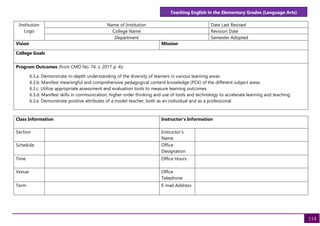
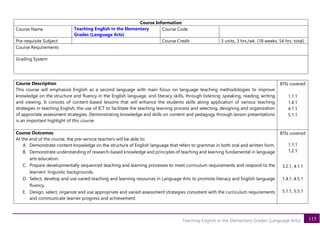
![116
Teaching English in the Elementary Grades (Language Arts)
Time
Allotment
Intended Learning Outcomes (ILOs) BTIs Content Suggested Teaching Learning
Activities
Suggested Assessment BTIs
Week 1 a. Identify teaching principles in
language Arts teaching and explain
how these principles are used in
teaching.
1.1.1
1.2.1
[A,B]
General Principles in
Language Arts Teaching
• Lecture-discussion
• Discuss concepts and
principles of language
Arts teaching.
• Brainstorming using the
talking circle strategy
• Oral Discussion
Criteria for Oral discussion:
Content- 60%
Delivery-20%
Organization and correct
usage-20%
Class impact-10%
• Participation in the talking
circle
1.1.1
1.2.1
Week 2 a. Describe and discuss the salient
features of the K to 12 Language
Curriculum
1.1.1 The structure of the K to 12
Language arts Curriculum
• Lecture-presentation
• Problem-based learning
• A walk through about the
structure of the K to 12
Curriculum
• 4As Approach (activate,
acquire, apply and assess)
• Oral discussion
Criteria for Oral discussion:
Content- 60%
Delivery-20%
Organization and correct usage-
20%
Class impact-10%
1.1.1
Week
3-4
a. Discuss the five macro skill and
their importance within the English
teaching area and in promoting
literacy skills.
b. Demonstrate examples of teaching
strategies that promote the five
macro skills.
1.1.1
1.2.1
1.4.1
[A,B,D]
1.1.1
1.2.1
1.4.1
[A,B,D]
Five Macro Skills in
language
a. Listening
b. Speaking
c. Reading
d. Writing
e. Viewing
• Lecture-group
presentation
• Talking circles
• 5Es Learning models
• Creative presentation of
outputs by group with the
use of rubric
1.1.1
1.2.1
1.4.1](https://image.slidesharecdn.com/3-elementary-education-prototype-syllabi-compendium-250905000714-7fd53d01/85/3-Elementary-Education-Prototype-Syllabi-Compendium-pdf-117-320.jpg)
![117
Teaching English in the Elementary Grades (Language Arts)
Week 5 a. Differentiate approaches,
strategies, methods and
techniques from each other
b. Give examples of Approaches,
strategies, methodologies and
techniques that can be used in
Language Arts
1.1.1
[A]
1.1.1
[A]
Background on
Approaches, Strategies,
Methods and Techniques
• Lecture-discussion
• Discuss the tenets of the
different models in
teaching language arts
along approaches,
strategies , methods and
techniques
• Reality Pedagogy
• An objective type of test
• An essay type of test
CLO 2
and 3
1.2.1
Week
6-7
a. Provide background information
about the different teaching
approaches used for teaching
English
b. Select approaches that support
learner understanding ,
participation , engagement and
achievement towards promoting
literacy skills and English language
fluency..
1.1.1
1.2.1
[A,B]
1.1.1
1.2.1
1.4.1
[A,B,D]
The Approaches for
Language Arts Teaching
a. Communicative
b. Language
Scaffolding
c. Cooperative Learning
d. Situational
e. Functional-notional
f. Multi-skill
g. Content-based
h. Task-based
i. Participatory
• Lecture-presentation with
peer discussion
• Classroom observation
• Narrative reports on the
classroom observation made
• The narrative
1.1.1
1.2.1
1.4.1
Week
8-9
a. Explain the process of different
methodologies used in teaching
English for the elementary
b. Determine how these methods
address learner’s diversity in an
English class
c. Assess the methods used in an
actual teaching through classroom
observation
1.1.1
[A]
1.1.1
3.2.1
[C]
1.1.1
3.2.1
[C]
The Methods of Teaching
Language Arts
a. The Grammar-
translation
b. The Direct method
c. The Audiolingual
method
d. Total Physical
response
e. Community language
learning
f. The Silent way
g. Language experience
method
• Video- lecture
presentation
• Talking circle and class
sharing
• Classroom observation
• Making Graphic Organizer
that shows diff. methods in
• Participation to Talking
Circles
Criteria for participation in
talking circles
Content – 40%
Delivery- 20%
Organization- 20%
Response to questions- 20%
1.1.1
3.2.1](https://image.slidesharecdn.com/3-elementary-education-prototype-syllabi-compendium-250905000714-7fd53d01/85/3-Elementary-Education-Prototype-Syllabi-Compendium-pdf-118-320.jpg)
![118
Teaching English in the Elementary Grades (Language Arts)
h. Desuggestopedia teaching English language
arts
Week
10-11
a. Identify and discuss learning
strategies for an English lesson
b. Select appropriate assessment
technique to assess the extent of
learners’ mastery
c. Articulate constructive feedback to
improve learners’ performance
1.1.1
[A]
5.1.1
[E]
5.5.1
[E]
Learning Strategies and
Assessment technique as
applied to teaching language
Strategies: -Content language
integrated learning
CALL Computer assisted
language learning
• Lecture- discussion
• Process Oriented Guided
Inquiry Lessons( POGIL)
• Classroom observation
• TOS and Test Question
preparation for English
subjects
• Think-pair-share
• Critiquing of sample
assessment tools
• Post-conference ( demo-
teacher and observer)
• Refection paper about the
classroom observation
made.
• Graded simulation
1.1.1
5.1.1
5.5.1
Week 12 a. Select and/or create appropriate
instructional materials for teaching
English in the elementary
4.5.1
[D]
Instructional material
selection, design and
development
• Lecture-presentation aided
by ppt
• Project-based learning(
making MIs)
• Exhibit of Instructional
materials made by
students for teaching
English
• Grading of the students’
outputs (completed
instructional materials on
display)
4.5.1
Week 13 a. Prepare developmentally
sequenced teaching and learning
process to meet the curriculum
4.1.1
[C]
Development of learning
plans for English language
arts subject
• Lecture-discussion • Individual writing of sample
lesson plans/ session plans
using different techniques in
4.1.1
5.1.1](https://image.slidesharecdn.com/3-elementary-education-prototype-syllabi-compendium-250905000714-7fd53d01/85/3-Elementary-Education-Prototype-Syllabi-Compendium-pdf-119-320.jpg)
![119
Teaching English in the Elementary Grades (Language Arts)
requirements of English arts
teaching
b. Apply teaching principles,
strategies and assessment
technique knowledge in lesson
plan preparation
c. Write a lesson design for a given
subject-matter in English language
Arts
4.1.1
5.1.1
[C,E]
• Lesson plan writing the different parts of the
lesson.
• Pair work-peer critiquing of
sample lesson/session plans
Week
14-18
a. Demonstrate an English language
arts lesson using content-based
and pedagogical knowledge
effectively
b. Apply developmentally-
sequenced teaching strategies that
promote literacy kills through an
actual teaching presentation
c. Use varied learning resources
responsive to learners with
different linguistic backgrounds
d. Use appropriate and varied
assessment strategies consistent
with the curriculum requirements
and communicate learner progress
and achievement
1.1.1
1.2.1
[A,B]
4.1.1
1.4.1
[C,D]
4.5.1
3.2.1
[C,D]
5.1.1
5.5.1
[E]
Lesson Presentation
a. Micro teaching
b. Team teaching
c. Individual teaching
• Demo-teaching
• Post-conference ( demo-
teacher and observer)
• Graded lesson presentation
• The students deliver a lesson
in front of jurors who will
evaluate their performance
through the following
criteria:
Content: 30 %
Delivery and use of strategy-
30%
Mastery of the lesson-20%
Instructional materials-10%
Classroom
management_10%
Assessment strategy 10%
1.1.1
1.2.1
1.4.1
3.2.1
4.1.1
5.1.1
5.5.1](https://image.slidesharecdn.com/3-elementary-education-prototype-syllabi-compendium-250905000714-7fd53d01/85/3-Elementary-Education-Prototype-Syllabi-Compendium-pdf-120-320.jpg)
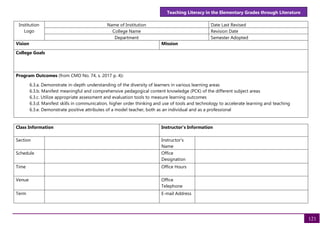
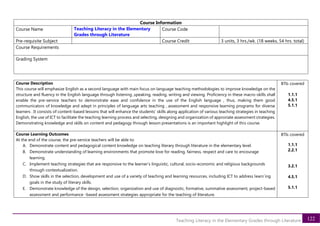
![123
Teaching Literacy in the Elementary Grades through Literature
Time
Allotment
Intended Learning Outcomes (ILOs) BTIs Content Suggested Teaching Learning
Activities
Suggested Assessment BTIs
Week 1 a. Identify the underpinning
principles in teaching literacy
among young learners
b. Discuss the principles in teaching
literacy
1.1.1
2.2.1
[A,B]
General principles in teaching
literacy in the elementary
level
• Lecture-Discussion
• Brainstorming (Sharing of
one’s Experiences/
Observations)
• Talking Circles
• Participation in the Talking
Circles
• Group Work- Group
Presentation of Selected
Topics
• Participation in Talking
Circle
Content (40%)
Delivery (20%)
Organization & Correct
Usage (20%)
Response to Questions
(20%)
1.1.1
2.2.1
Week 2 a. Point out the significance of
literacy among young learners
1.1.1
[A]
Significance of literature in
teaching children
• Lecture-Presentation
• 4As Approach
• Panel discussion
• Oral discussion
Criteria for Oral Discussion:
Content (60%)
Delivery (20%)
Organization & Correct
Usage (20%)
Class Impact (10%)
1.1.1
Week
3-4
a. Describe the different literary
genre for children
b. Give examples of selections,
stories, riddles and poems suitable
for literacy development among
young learners
c. Compile well-selected literary
pieces that can be used for
instruction
1.1.1
[A]
Types of literature for
Children
a. Poetry
b. Riddles
c. Stories
d. Drama
• Lecture-Group Presentations
• Talking Circles
• 5Es Learning Model
• Participation in Talking
Circle
Content (40%)
Delivery (20%)
Organization & Correct
Usage (20%)
Response to Questions
(20%)
1.1.1](https://image.slidesharecdn.com/3-elementary-education-prototype-syllabi-compendium-250905000714-7fd53d01/85/3-Elementary-Education-Prototype-Syllabi-Compendium-pdf-124-320.jpg)
![124
Teaching Literacy in the Elementary Grades through Literature
Week
5-6
a. Discuss the importance of
contextualization in teaching
b. Choose a wide array of classical
and contemporary literary pieces
written in the local setting
appropriate for a specific grade
level
3.2.1
[C]
Contextualizing literacy
lessons for Filipino learners
• Lecture-Group Presentations
• Peer Learning
• Mini-seminar on Localization
/Contextualization: an expert
on local literature may be
invited
• Participation in the Oral
discussion
3.2.1
Week
7-8
a. Identify and explain the various
approaches in teaching literature
b. Identify lessons in literature vis a vis
the intended literary approach to
be used
2.2.1
3.2.1
[B,C]
Enhancing the literary skills
of learners through the
various approaches effective
in teaching literature like:
a. Shared Reading
b. Silent Reading
c. Cooperative learning
d. Differentiated
learning ( MI
grouping )
e. Listening to
Literature
• Lecture-demonstration
• Group presentations
• Oral discussion
Criteria for Oral Discussion:
Content (60%)
Delivery (20%)
Organization & Correct
Usage (20%)
Class Impact (10%)
• Portfolio assessment
2.2.1
3.2.1
Week
9-10
a. Describe and discuss different
methods used in teaching
literature for children
b. Develop a simple classroom
activity using literary methods
2.2.1
3.2.1
[B,C]
The strategies in
teaching literacy through
literature
a. KWL
b. Think-Pair-Share
c. Think-Square-Share
d. The Drama
Method
e. Image Analysis
f. Graphic Story
• Lecture- demonstration
• Group presentation
• Oral Discussion
• Class Task/Group Work -
Word Collocation on
Teaching (including
approaches, strategies,
method and techniques),
and Literature
2.2.1
3.2.1](https://image.slidesharecdn.com/3-elementary-education-prototype-syllabi-compendium-250905000714-7fd53d01/85/3-Elementary-Education-Prototype-Syllabi-Compendium-pdf-125-320.jpg)
![125
Teaching Literacy in the Elementary Grades through Literature
- The role of
teachers in the
drama method
g. Using Graphic
Organizers
• Performance-based
assessment with the use of
rubric
Week 11 a. Identify reading strategies
b. Describe how these reading
strategies are done
c. Write original samples of reading
strategies
2.2.1
3.2.1
[B,C]
Strategies and techniques
that foster the reading -
writing connection
a. Writing diary entries
b. Writing journals
c. Writing reflections
d. Poetry writing
e. Writing sequel to
stories read
f. Writing book reports
g. Journalistic Writing
• Video viewing
• Lecture-presentation
• Talking circles
• Assessment of completed
task or outputs
CLO 2
and 3
2.2.1
3.2.1
Week 12 a. Identify and describe the different
types of assessment
b. Develop an assessment tool for
teaching literature
5.1.1
[E]
Assessment Techniques as
applied for teaching
literature
a. Traditional
b. Performance-based
c. Project-based
d. Portfolio
• Lecture-presentation on
types of assessment
• Group task
( TOS and test question
preparation to be used as an
assessment tool in
evaluating the level of
pupil’s literary skills )
• Rubric making
• Portfolio preparation
• Paper /pencil
• Assessment of completed
outputs
CLO 5
5.1.1](https://image.slidesharecdn.com/3-elementary-education-prototype-syllabi-compendium-250905000714-7fd53d01/85/3-Elementary-Education-Prototype-Syllabi-Compendium-pdf-126-320.jpg)
![126
Teaching Literacy in the Elementary Grades through Literature
Week
13-14
a. Apply appropriate methodologies
and strategies in the preparation of
learning plan
b. Exhibit creativity in making
instructional materials for a
literature class
c. Prepare a lesson plan with
assessment strategies appropriate
for the teaching of literature
1.1.1
[A]
2.2.1
3.2.1
4.5.1
[B,C,D]
5.1.1
[E]
Designing instructional plans
and materials for teaching
literacy through literature
• Lecture-demonstration on
how Instructional materials
in teaching literature are
prepared and lesson
planning
• Putting up an exhibit
featuring the creative
outputs of students
• Instructional plan writing
-guided
-independent
• Graded display of
instructional materials
• Individual Work-
Preparation of Lesson
Plans/Session Plans Using
Different Approaches and
Strategies
• Pair Work – Peer Critiquing
of Sample Lesson Plans or
Session Plans
1.1.1
2.2.1
3.2.1
4.5.1
5.1.1
Week
15-18
a. Teach a literary lesson to an
elementary class in a lab school or
cooperating DepEd School
effectively (applying competencies
learned from the previous lessons)
or conduct peer teaching.
1.1.1
2.2.1
3.2.1
4.5.1
5.1.1
[A,B,C,
D,E]
Lesson Presentation
d. Micro teaching
e. Team teaching
f. Individual teaching
• Lesson presentation
• Peer Critiquing
• Final Teaching
Demonstration
Criteria for Oral Discussion:
Content (60%)
Delivery (20%)
Organization & Correct Usage
(20%)
Class Impact (10%)
- Critiquing Peer’s Teaching
Demonstration
Criteria for Peer Critiquing
Quality of Questions (40%)
Delivery (25%)
Organization & Correct Usage
(25%)
1.1.1
2.2.1
3.2.1
4.5.1
5.1.1](https://image.slidesharecdn.com/3-elementary-education-prototype-syllabi-compendium-250905000714-7fd53d01/85/3-Elementary-Education-Prototype-Syllabi-Compendium-pdf-127-320.jpg)
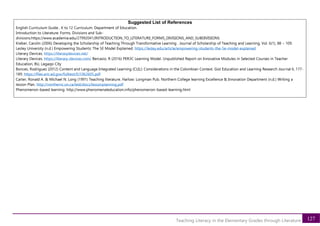
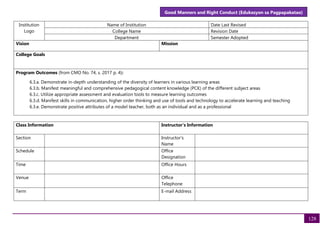
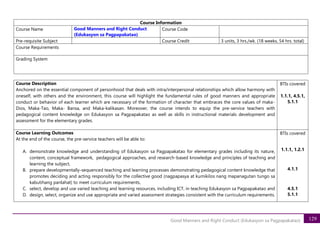
![130
Good Manners and Right Conduct (Edukasyon sa Pagpapakatao)
Time
Allotment
Intended Learning Outcomes (ILOs) BTIs Content Suggested Teaching Learning
Activities
Suggested Assessment BTIs
Week
1-2
a. Identify the guiding philosophies
and objectives
b. Reflect on the importance of values
education
1.1.1,
1.2.1
[A]
Philosophy and Objectives of
Edukasyon sa Pagpapakatao/
Values Education/ Good
Manners and Right Conduct
• Lecture-discussion
• Think-pair share
• Recitation
• Reflection paper on the
importance of values
education
1.1.1,
1.2.1
Week
3-4
a. Discuss the framework and
approaches
b. Cite examples of
practices/strategies that reflect the
approaches
1.1.1,
1.2.1
[A]
Edukasyon sa Pagpapakatao
Framework
Approaches to values
education:
a. Trait approach
b. Values clarification
c. Cognitive
developmental
d. Moral dilemma
e. Problem-based
f. Reflective teaching
g. Role playing
h. Evocation
i. Inculcation
j. Awareness
k. Moral reasoning
l. Analysis
m. Commitment
n. Union
• Group discussion using
student-made visual aid and
available literature on the
assigned approach to values
education
• Group question and
answer: Students will
answer questions raised by
the other groups with
regard to the assigned
approach
1.1.1,
1.2.1
Week 5 a. Evaluate and discuss the scope and
sequence of Edukasyon sa
Pagpapakatao from first to sixth
grades
b. Elucidate the core values of maka-
diyos, makatao, makabayan at
makakalikasan
1.1.1,
1.2.1,
4.1.1
[A, B]
Scope and Sequence from
First to Sixth grades:
o Baitang 1 – mga paraan ng paggalang sa
sarili, kapwa, bansa at Diyos bilang gabay
tungo sa maayos at masayang tahanan at
paaralan
o Baitang 2 - mga kilos na nagpapahalaga
sa sarili, kapwa, bansa, Diyos at sa
Kanyang mga nilikha bilang patnubay sa
• Lecture-presentation of
scope and sequence and
core values with problem-
based learning to elucidate
the content
• Examination of the structure
of the K to 12 Curriculum
through jigsaw activity
• Summary matrix of the
scope and sequence
1.1.1,
1.2.1,
4.1.1](https://image.slidesharecdn.com/3-elementary-education-prototype-syllabi-compendium-250905000714-7fd53d01/85/3-Elementary-Education-Prototype-Syllabi-Compendium-pdf-131-320.jpg)
![131
Good Manners and Right Conduct (Edukasyon sa Pagpapakatao)
maayos at masayang paaralan at
pamayanan
o Baitang 3 - mga gawain na nagpapakita
ng pagpapahalaga tungo sa maayos at
masayang pamumuhay na may
mapanagutang pagkilos at pagpapasiya
para sa sarili, kapwa, pamayanan, bansa at
Diyos
o Baitang 4 - mga makabuluhang gawain na
may kaakibat na pagpapahalaga tungo sa
wasto, maayos, masaya at mapayapang
pamumuhay para sa sarili, kapwa, bansa at
Diyos
o Baitang 5 - masusing pagsusuri sa
pagpapahayag, pagganap ng tungkulin na
may pananagutan at pagsasabuhay ng
mga ito tungo sa masaya, mapayapa at
maunlad na pamumuhay para sa sarili/
mag-anak, kapwa/ pamayanan, bansa/
daigdig at Diyos
o Baitang 6 - mga gawain na tumutulong sa
pag-angat ng sariling dignidad,
pagmamahal sa kapwa na may
mapanagutang pagkilos at pagpapasiya
tungo sa maayos, mapayapa at maunlad
na pamumuhay para sa kabutihang
panlahat
Week 6 a. Discuss the different methods of
teaching values to elementary
pupils
1.1.1
[A]
Pedagogy of Values/
Methods of Teaching Values
Education
• Actual demonstration of the
different methods
• Think-Pair-Share
• Critiquing of each
demonstration
1.1.1
Week
7-10
a. Explain each of the different
strategies in teaching the subject
1.1.1,
1.2.1,
4.1.1,
General strategies for
teaching values
a. Silent sitting
• Plenary discussion and
modelling of strategies
• Micro-teaching with
critiquing/mentoring
1.1.1,
1.2.1,
4.1.1,](https://image.slidesharecdn.com/3-elementary-education-prototype-syllabi-compendium-250905000714-7fd53d01/85/3-Elementary-Education-Prototype-Syllabi-Compendium-pdf-132-320.jpg)
![132
Good Manners and Right Conduct (Edukasyon sa Pagpapakatao)
b. Demonstrate the strategies in class 4.5.1,
5.1.1
[A, B,
C, D]
b. Parables, proverbs,
quotations and
poems
c. Visual experiences
d. Role plays
e. Biographies
f. Moral dilemmas
g. Essays, articles,
classics and news
paper
h. Anecdotes
i. Group singing
j. Group activities
k. Questioning
l. Discussion
m. Value clarification
4.5.1,
5.1.1
Week 11 a. Create appropriate instructional
materials in teaching the subject
4.5.1
[C]
Instructional materials
development for Edukasyon
sa Pagpapakatao
• Workshop and Gallery Walk
(exhibition of outputs made
by all students)
• Self and Peer critiquing of
instructional materials
4.5.1
Week
12-13
a. Select appropriate assessment
technique to assess the extent of
learners’ mastery.
b. Develop rubrics in rating authentic
assessment.
5.1.1
[D]
Assessment in Edukasyon sa
Pagpapakatao
• Lecture-Discussion
• Development of Rubrics of
Authentic and Traditional
Assessment
• Classroom Observation
• 3-2-1 Exit Slip (3 things I
learned, 2 things I will
apply, 1 question I have)
• Narrative Report/
Reflection
5.1.1](https://image.slidesharecdn.com/3-elementary-education-prototype-syllabi-compendium-250905000714-7fd53d01/85/3-Elementary-Education-Prototype-Syllabi-Compendium-pdf-133-320.jpg)
![133
Good Manners and Right Conduct (Edukasyon sa Pagpapakatao)
Week
14-18
a. Apply the principles and concepts
learned in the course through
demonstration teaching
1.1.1,
1.2.1,
4.1.1,
4.5.1,
5.1.1
[A, B,
C, D]
Synthesis and Application of
Key Concepts and Principles
through Demonstration
Teaching
g. Micro teaching
h. Team teaching
i. Individual teaching
• Individual Demonstration
Teaching
• Graded lesson
presentation: deliver a
lesson in front of jurors
who will evaluate their
performance using a
teacher-made rubric or
classroom observation tool
(COT)
• Post-conference (demo-
teacher and observer)
1.1.1,
1.2.1,
4.1.1,
4.5.1,
5.1.1
Suggested List of References
Corpuz, B. & Salandanan, G. (2015). Principles of teaching (with TLE). Quezon City: Lorimar Publishing.
Cubucku, F. (2014). Values Education through Literature in English Classes. Procedia – Social and Behavioral Sciences (116), 265- 269.DepEd K-12 Edukasyon sa
Pagpapakatao Curriculum Guide
Etherington, M. (2013).Values Education: Why the teaching of values in schools is necessary, but not sufficient. Journal of Research in Christian Education 22(2), 189-210.
PPST-RPMS Manual
Talts, L., Kukk, A., Tuisk, M., & Kaljuve, M. (2012). Design for learning and teaching in the context of value education. Procedia – Social and Behavioral Sciences (45), 75-83.](https://image.slidesharecdn.com/3-elementary-education-prototype-syllabi-compendium-250905000714-7fd53d01/85/3-Elementary-Education-Prototype-Syllabi-Compendium-pdf-134-320.jpg)
![136
Technology for Teaching and Learning in the Elementary Grades
Time
Allotment
Intended Learning Outcomes (ILOs) BTIs Content Suggested Teaching Learning
Activities
Suggested Assessment BTIs
Week 1-2 a. Define basic concepts in
understanding ICT in education
b. Determine the roles of ICT in
Teaching for Learning
c. Identify learning theories,
principles and researches applied
in the use and design of learning
lessons with technology
d. Determine the different
technology driven teaching-
learning models
1.1.1
[A]
1.1.1
[A]
1.1.1
[A]
1.1.1
[A]
Review of Technology for
Teaching and Learning
A. Definition of Basic
Concepts and
Important Terms
B. Roles of ICT in
Teaching for
Learning
C. Theories and
Principles in the Use
and Design of
Technology Driven
Learning Lessons
(Dale’s Cone of
Experience, TPACK,
ASSURE, SAMR;
Mayer’s [2009]
Principles for the
Selection of
Technology for
Educational Use:
appropriateness,
authenticity, cost,
interest, organization
and balance)
• PowerPoint-based game on
defining important terms:
Students play the
PowerPoint-based game on
the basic concepts and roles
of ICT in Teaching and
Learning prepared by the
teacher.
• Interactive lecture-
discussion and image
analysis of the different
models: The objective of this
activity is to enable the
students to explain to their
fellow classmates the salient
ideas about the different
models of technology
integration introduced to
them in TTL 1. The teacher
and the entire class will
rectify if there are
misconceptions.
• Concept map: Individually,
students must synthesize
the sessions by coming up
with an original concept
map that will demonstrate
how they see the
connections among
different topics. The
concept map is
accompanied by a one-
paragraph explanation.
1.1.1
Week
3-4
a. Enumerate the national ICT policies
affecting classroom practices
1.1.1
[A]
ICT Policies and Safety Issues
in Teaching and Learning
A. ICT national or
international policies
• Presentation of information
gathered on the different
policies and safety issues ICT
use using infographics:
• Rubrics for infographic and
ICT policies contextualized
for classroom use: These
teacher-made rubrics will
1.1.1](https://image.slidesharecdn.com/3-elementary-education-prototype-syllabi-compendium-250905000714-7fd53d01/85/3-Elementary-Education-Prototype-Syllabi-Compendium-pdf-137-320.jpg)
![137
Technology for Teaching and Learning in the Elementary Grades
b. Describe the implementation of ICT
policies in teaching-learning
c. Identify ICT policies that are
incorporated to the design and
implementation of teaching-
learning activities
1.1.1
[A]
1.1.1
[A]
that are applicable to
teaching and
learning
B. Safety Issues in ICT
Uses of ICT Policies in the
Teaching and Learning
Environment
Students will discuss ICT
policies and safety issues
using their original
infographics.
• Crafting ICT Classroom
Policies: Students formulate
a sound ICT classroom policy
that may be implemented in
their classroom in the future.
be used by the teacher in
assessing these outputs.
Week 5-6 a. Join online communities of
learning
b. Use resources from relevant
mailing lists and online resources
1.1.1
[A]
4.5.1
[C]
Online Communities of
Learning
e.g.
a. Facebook
b. Twitter
c. Instagram
d. Webinar
Online Resources
a. Opensource
b. Multimedia
resources; video sites
c. Finding images
d. Music and audio;
webcasts
e. Locate web sources
by topic
• Hands-on activities for
students’ online
membership: Students
participate in a workshop
facilitated by the teacher
with the objective of
enabling them to go through
the step-by-step process of
joining communities of
learning.
• Listing of online resources
and their use in the
classroom/ teaching-
learning process: Students
locate and download
relevant online resources
that may be utilized in their
lessons.
• Using a checklist: The
students must accomplish
a checklist on how to
evaluate online
communities of learning
and online resources.
1.1.1
Week 7-8 a. Describe technology tools that are
used in group activities
b. Use technology tools to
collaborate and share resources
among communities of practice
1.1.1
[A]
4.5.1
[C]
Collaborative Projects
Technology Tools for
Collaborative Work
a. Google Suite (docs,
drive, classroom)
b. Edmodo
• Plenary discussion: The
teacher will give a lecture on
the what and how of
technology tools for
collaborative work.
• Unit plan writing: A unit
plan made by groups must
be made as evidence of
learning. At the very least, it
must allow elementary
grade pupils to collaborate
with one another.
1.1.1,
4.1.1](https://image.slidesharecdn.com/3-elementary-education-prototype-syllabi-compendium-250905000714-7fd53d01/85/3-Elementary-Education-Prototype-Syllabi-Compendium-pdf-138-320.jpg)
![138
Technology for Teaching and Learning in the Elementary Grades
c. bubbl.us
d. Wikispaces
e. Others
• Guided demonstration:
Students will explore and use
the suggested technology
tools for collaborative work
with the guidance of the
teacher. The class may be
asked to bring their own
gadgets or may use the
available resource center/
laboratory of the school.
Week 9 a. Articulate digital safety rules that
ensure child online safety
1.1.1,
1.3.1
[A,E]
Digital Safety Rules
Rule 1: Research before you
register.
Rule 2: Discriminate.
Rule 3: Think before typing.
Rule 4: Require ID.
Rule 5: Trust your gut.
• Forum discussion on digital
safety rules: Students
conduct their individual
research on the subject
matter. The class will be
arranged as if it is in a forum
where anyone can share their
knowledge and
understanding about the
topic while the teacher
moderates the discussion.
• Digital safety rules for their
class: Done in groups,
students will formulate a
guide on digital safety
rules that they may
consider using in their
future classroom. A
teacher-made rubric will
be used to assess this
output.
1.1.1
1.3.1
Week
10-14
a. Select, design and create digital
learning materials designed to
enhance teaching-learning and
assessment
b. Showcase the appropriate use of
different learning resources
through a teaching demonstration
4.5.1
[C]
5.1.1
[D]
Digital and Conventional
Learning Materials to
Enhance Teaching-Learning
A. Digital Learning
Resources
1. Google Docs
2. Youtube
3. Survey Monkey
4. Word clouds
5. Audios
6. Videos
7. Slide presentations/
narrated slideshows
• Student-led discussion: The
class will conduct group
research on conventional
materials identified as
appropriate and feasible in a
given teaching-learning
context. They will create a
handout that contains the
essential information about
the assigned learning
resource.
• Microteaching: This activity,
done either individually or in
team, highlights the use of
• Rubrics for Student-led
Discussion and
Demonstration Teaching:
The teacher will use these
rubrics together with
student/s who sit as co-
critic/s will give feedback
(peer assessment) to the
student-led discussion and
demonstration teaching
conducted.
4.5.1
5.1.1](https://image.slidesharecdn.com/3-elementary-education-prototype-syllabi-compendium-250905000714-7fd53d01/85/3-Elementary-Education-Prototype-Syllabi-Compendium-pdf-139-320.jpg)
![139
Technology for Teaching and Learning in the Elementary Grades
8. Still images/
Photographs, talking
pictures
9. Comic strips
10. Mobile apps
(utility,/productivity
content presentation,
games,
augmented/virtual
reality)
assigned conventional
learning resources. Prior to
this, students are expected
to consult with the course
instructor for proper
guidance in the preparation
of lesson plan and learning
resource. Students will
integrate an existing
learning resource and
design/ create an original
one that they will
demonstrate in class.
Week
15-17
a. Select, design and create
conventional learning materials
designed to enhance teaching-
learning
b. Showcase the appropriate use of
different learning resources
through a teaching demonstration
4.5.1
[C]
5.1.1
[D]
Digital and Conventional
Learning Materials to
Enhance Teaching-Learning
B. Conventional
Learning Resources
1. Manipulatives (realia
and models or mock-
ups)
2. Printed materials
(handouts, study
guides, flashcards,
big books)
3. Charts/ graphs and
posters
4. Wall display
• Student-led discussion: The
class will conduct group
research on conventional
materials identified as
appropriate and feasible in a
given teaching-learning
context. They will create a
handout that contains the
essential information about
the assigned learning
resource.
• Microteaching: This activity,
done either individually or in
team, highlights the use of
assigned conventional
learning resources. Prior to
this, students are expected
to consult with the course
instructor for proper
guidance in the preparation
of lesson plan and learning
resource. Students will
• Rubrics for Student-led
Discussion and
Demonstration Teaching:
The teacher will use these
rubrics together with
student/s who sit as co-
critic/s will give feedback
(peer assessment) to the
student-led discussion and
demonstration teaching
conducted.
4.5.1
5.1.1](https://image.slidesharecdn.com/3-elementary-education-prototype-syllabi-compendium-250905000714-7fd53d01/85/3-Elementary-Education-Prototype-Syllabi-Compendium-pdf-140-320.jpg)
![140
Technology for Teaching and Learning in the Elementary Grades
integrate an existing
learning resource and
design/ create an original
one that they will
demonstrate in class.
Week 18 a. Synthesize what they learned from
the course through the portfolio
1.1.1
4.1.1
4.5.1
5.1.1
1.3.1
[A,B,C,
D,E]
Course Synthesis and
Finalization of Portdolio
• The class may not meet
face-to-face anymore. This
week may be devoted for
consultation and polishing
of portfolio.
• Rubric for Portfolio: A
teacher-made rubric will
be used in assessing the
portfolio.
1.1.1
4.1.1
4.5.1
5.1.1
1.3.1
Suggested List of References
Bilbao, P. P., Dequilla, M. A., Rosano, D. A., & Boholano, H. B. (2019). Technology for teaching and learning I. Quezon City: LORIMAR Publishing.
Canonigo, A. M. (2018). Educational technology. Mandaluyong City: Anvil Publishing Inc.
Corpuz„ B. & Lucido, P. l. (2008). Educational Technology l. Quezon City: LORIMAR Publishing.
Corpuz, B. & Salandanan, G. (2015). Principles of teaching (with TLE). Quezon City: LORIMAR Publishing.
Corpuz, B., et.al.(2007). Principles of Teaching l, Quezon City.
DepEd K-12 Curriculum Guides
Garo, C. D. (2008). Theories and Principles of Educational Act Technology. Philippines: National Book Store.
Lucido, P. I. (2007). Educational Technology 2. Quezon City: LORIMAR Publishing.
Lucido, P. L, et.al. (2008). Educational Technology l. Quezon City: LORIMAR Publishing.
PPST-RPMS Manual
Salandanan, G. G. (2007). Principles and Strategies of Teaching. Quezon City: LORIMAR Publishing..](https://image.slidesharecdn.com/3-elementary-education-prototype-syllabi-compendium-250905000714-7fd53d01/85/3-Elementary-Education-Prototype-Syllabi-Compendium-pdf-141-320.jpg)
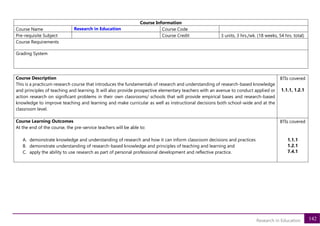
![143
Research in Education
Time
Allotment
Intended Learning Outcomes
(ILOs)
BTIs Content Suggested Teaching Learning
Activities
Suggested Assessment BTIs
Week 1 a. Explicate the nature of research
as a scientific inquiry aimed at
providing basis for informed
classroom decisions
b. Review the fundamentals of
research
[A]
1.1.1
[A]
1.1.1
The Scientific Approach in
Education
• Group work: preparing a
concept/semantic map of the
nature and fundamentals of
research and how it informs
classroom decisions
• Group presentation of the
concept/semantic map [A]
1.1.1
Week 2 a. Compare and contrast the major
characteristics of quantitative
and qualitative research designs
[A]
1.1.1
Research Approaches:
Qualitative vs Quantitative
• Dyad work: reading sample
articles for each type of
research approaches,
preparing a comparative
matrix of the characteristics of
the two based on the articles
provided, and sharing in the
class discussion their
observations.
• Short Quiz/ Making a Venn
diagram for comparing and
contrasting qualitative and
quantitative research
approaches
[A],
1.1.1
Week
3-4
a. Identify a research problem
b. Develop potential questions
related to the selected research
topic
c. Evaluate the plausibility of the
questions
d. Articulate the significance of the
study
[A]
1.1.1
Typical Stages of a Research
Study, Selecting a Research
Problem, Articulating the
Research Questions, and
Underscoring Significance of
Study: Focus on Action
Research
• Group work: identifying an
educational problem and
formulate a research problem,
2 potential research questions,
and significance of the study.
• Discussion of output (i.e.,
research problem, research
questions, significance of
the study)
[A]
1.1.1
Week
5-6
a. Evaluate the sources for review
b. Prepare an annotated
bibliography
c. Document sources properly using
APA citation style
[A, B]
1.1.1,
1.2.1
Reviewing and Evaluating the
Literature, Avoiding
Plagiarism, APA Citation Style
• Library work, seatwork and
board work on APA Style
• Writing an annotated
bibliography, List of
References following APA
format
[A, B]
1.1.1,
1.2.1](https://image.slidesharecdn.com/3-elementary-education-prototype-syllabi-compendium-250905000714-7fd53d01/85/3-Elementary-Education-Prototype-Syllabi-Compendium-pdf-144-320.jpg)
![144
Research in Education
Week
7-8
a. Provide a summary of the
reviewed literature based on the
annotated bibliography
b. Conduct a peer evaluation of a
classmate’s work
[A, B]
1.1.1,
1.2.1
Writing and Organizing the
Review of Literature
• Writing the related literature
review inside the classroom
• Peer evaluation of the
writing output in terms of
achieving its purpose,
coherence, and adherence
to APA citation standards
[A, B]
1.1.1,
1.2.1
Week 9 a. Elucidate on how theories
explain the phenomena being
explored
b. Cite a theoretical and a practical
question that educational
researchers ask
c. Identify appropriate tools for
gathering research data
[A]
1.1.1
[B]
1.1.1
[A]
1.1.1
The role of theory in research
Tools of Research: Tests,
Measures of Personality,
Surveys, Observations
• Lecture, class discussion,
group discussion
• Ex Theory identification
and justification (Short
quiz)
• Tool Identification and
Rationalization (Short quiz)
[A]
1.1.1
[B]
1.1.1
[A]
1.1.1
Week 10 a. Develop a survey questionnaire [A, C]
1.1.1,
7.4.1
Constructing the survey
instruments
• Lecture, Dyadic Task on
Instrument development, pilot
testing of research instrument
• Constructed survey
questionnaire
[A, C]
1.1.1,
7.4.1
Week 11 a. Provide an example for each
type of hypotheses, namely
research hypothesis, null
hypothesis, and alternative
hypothesis
b. Discuss a classroom example of
testing a hypothesis.
c. Elucidate the concept of
sampling and sampling error
[A, C]
1.1.1,
7.4.1
[A, C]
1.1.1,
7.4.1
[A]
1.1.1
Quantitative Research
Designs: Hypothesis testing,
validity
Quantitative Research
Designs: Sampling
Techniques
• Lecture, exercises, class
discussion
• Accomplishing worksheets
on hypothesis formulation
• Short quiz on sampling
techniques
[A, C]
1.1.1,
7.4.1
[A, C]
1.1.1,
7.4.1
[A]
1.1.1
Week 12 a. Identify the statistical test/s
appropriate for a research
question
[A, C]
1.1.1,
7.4.1
Quantitative Research
Designs: Correlation, t-tests,
Chi-Square Tests of
Significance, Analysis of
Variance
• Lecture, article analysis • Writing a Statistical
Analysis Plan
[A, C]
1.1.1,
7.4.1](https://image.slidesharecdn.com/3-elementary-education-prototype-syllabi-compendium-250905000714-7fd53d01/85/3-Elementary-Education-Prototype-Syllabi-Compendium-pdf-145-320.jpg)
![145
Research in Education
Week 13 a. Determine the appropriateness
of a qualitative research design
in relation to a research problem
[A, B]
1.1.1,
1.2.1
Qualitative Research Designs:
Grounded Theory,
Ethnography, Case Study
• Lecture, article analysis • Short quiz on qualitative
research designs
[A, B]
1.1.1,
1.2.1
Week 14 b. Analyze qualitative data using
Creswell’s (2014) model
[A, C]
1.1.1
Analyzing and Reporting
Qualitative Research
• Lecture, data analysis
exercises
• Data analysis report in
tabular form
[A, C]
1.1.1
Week
15-18
a. Explain the nature and process
of action research
b. Write and present research report
[A]
1.1.1
[A, B,
C]
1.1.1,
1.2.1,
7.4.1
Action Research: Its nature,
process, data collection and
analysis
Writing the Final Report:
IMRD format
1. Swales’ CARS Model for
Introduction
2. Generic structures of
other sections
• Lecture - writeshop
• Writing and critiquing of the
written research report
• Writing Action Research
Plan
• Completed research report
in IMRD format
[A]
1.1.1
[A, B,
C]
1.1.1,
1.2.1,
7.4.1
Suggested List of References
Ary, D., Jacobs, L.C., & Sorensen, C. (2010). Introduction to research in education (8th ed.). Belmont, CA: Wadsworth, Engage Learning.
Baumfield, V., Hall, E., & Wall, K. (2013). Action research in education: Learning through practitioner enquiry. SAGE Publications Ltd
Creswell, J. W. (2014). Research design: Qualitative, quantitative, and mixed methods approaches (4th ed.). Los Angeles, CA: SAGE Publication.
Cunningham, D. (2011). Improving teaching with collaborative action research: An ASCD action tool. Alexandria, VA: Association for Supervision and Curriculum
Development.
Efron, S. E. & Ravid, R. (2013). Action research in education: A practical guide. Guilford Press.
Wilson, E. (2017). School-based research: A guide for education students. SAGE Publications Ltd](https://image.slidesharecdn.com/3-elementary-education-prototype-syllabi-compendium-250905000714-7fd53d01/85/3-Elementary-Education-Prototype-Syllabi-Compendium-pdf-146-320.jpg)