ISSN (Print) : 2320 – 3765
ISSN (Online): 2278 – 8875
International Journal of Advanced Research in Electrical,
Electronics and Instrumentation Engineering
(An ISO 3297: 2007 Certified Organization)
Vol. 5, Issue 5, May 2016
Copyright to IJAREEIE DOI:10.15662/IJAREEIE.2016.0505102 4316
PLC Based Monitoring System of Diesel
Generator Units
Sandeep S.R1
, Chaithra H.B2
, Pavithra K.N3
, Shreesha G4
, Bharath N5
,
Asst. Professor, Dept. of Electrical and Electronics Engineering, SJBIT, Karnataka, India1
.
BE Student, Dept. of Electrical and Electronics Engineering, SJBIT, Karnataka, India2,3,4,5
ABSTRACT: This project explains about the operation, control and maintenance features of a diesel generator Unit
and discuss about the system technology, implementing and adopting for automatic operation by using programmable
logic controller (PLC). All criteria for safe starting, efficient time of operation, load maintenance and load distribution
among the available diesel generator units. Protection against electrical emergency faults and fuel level operation faults
of the diesel generators are taken into consideration in the software. This facility enhances the method of learning of
PLC based monitoring of various systems of diesel generator unit operation and control. Over the years the demand of
higher quality, greater efficiency automated systems and machines has increased in the world wide. To meet with this
advancement and development it is expected that this project will be considered very effective effort.
KEYWORDS: PLC, Fuel tank, Diesel Generator operation and control
I. INTRODUCTION
Diesel Generator units are the system which is used in peak load demand, Back up supply, Mobile units, Remote areas
etc,. This provides the power supply for loads. Current technology in the maintenance of Diesel Generator units are not
completely Automated like Fuel tank operation, load sharing etc,. So considering the current technology we are trying
to upgrade the present system of maintenance by Automatic fuel level monitoring, load sharing between Generator
units and efficient operation of Diesel Generator units.
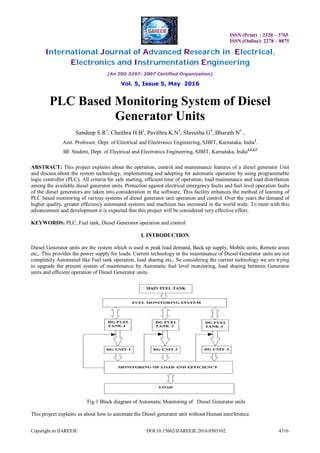
Fig.1 Block diagram of Automatic Monitoring of Diesel Generator units
This project explains us about how to automate the Diesel generator unit without Human interference.
ISSN (Print) : 2320 – 3765
ISSN (Online): 2278 – 8875
International Journal of Advanced Research in Electrical,
Electronics and Instrumentation Engineering
(An ISO 3297: 2007 Certified Organization)
Vol. 5, Issue 5, May 2016
Copyright to IJAREEIE DOI:10.15662/IJAREEIE.2016.0505102 4317
The main aspects of this project are
1.1 Automatic fuel monitoring
1.2 Efficient operation of D-G Unit
1.3 Load distribution and sharing
1.4 Continuous power generation
II. SYSTEM DESCRIPTION
Fuel from the overhead tank flows to the respective DG fuel tank through the Fuel Monitoring system
(FMS).The FMS continuously monitors the fuel in the DG fuel tank and allows the fuel to the DG fuel tank considering
the current Fuel level. When the DG set turns ON the fuel enters the DG set. The ON and OFF of the DG set is
controlled by monitoring of load and efficiency system. In this monitoring system depending on the load demand and
DG set efficiency turning ON and OFF the DG sets are controlled. The output of the DG set is then supplied to the load
through Bus bar.
III. COMPONENTS DESCRIPTION
A. PLC
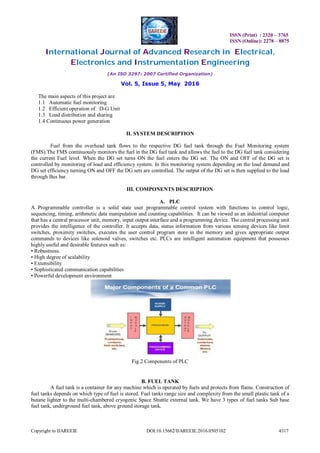
A Programmable controller is a solid state user programmable control system with functions to control logic,
sequencing, timing, arithmetic data manipulation and counting capabilities. It can be viewed as an industrial computer
that has a central processor unit, memory, input output interface and a programming device. The central processing unit
provides the intelligence of the controller. It accepts data, status information from various sensing devices like limit
switches, proximity switches, executes the user control program store in the memory and gives appropriate output
commands to devices like solenoid valves, switches etc. PLCs are intelligent automation equipment that possesses
highly useful and desirable features such as:
• Robustness.
• High degree of scalability
• Extensibility
• Sophisticated communication capabilities
• Powerful development environment
Fig.2 Components of PLC
B. FUEL TANK
A fuel tank is a container for any machine which is operated by fuels and protects from flame. Construction of
fuel tanks depends on which type of fuel is stored. Fuel tanks range size and complexity from the small plastic tank of a
butane lighter to the multi-chambered cryogenic Space Shuttle external tank. We have 3 types of fuel tanks Sub base
fuel tank, underground fuel tank, above ground storage tank.
ISSN (Print) : 2320 – 3765
ISSN (Online): 2278 – 8875
International Journal of Advanced Research in Electrical,
Electronics and Instrumentation Engineering
(An ISO 3297: 2007 Certified Organization)
Vol. 5, Issue 5, May 2016
Copyright to IJAREEIE DOI:10.15662/IJAREEIE.2016.0505102 4318
C. FUEL SENSOR
A fuel sensor is an instrument used to measure and indicate the level of fuel contained in a fuel tank.
Commonly used in all motor vehicles, these may also be used for any type of fuel tanks to measure. From fuel sensor
feedback can be taken to control the input valve of fuel to refill.
D. SOLENOID VALVE
A solenoid valve is an electromechanically operated valve to control flow of liquid. The valve is controlled by
an electric current flow through a solenoid coil in the case of a two-port valve the flow is switched on or off in the case
of a three-port valve, the outflow is switched between the two outlet ports. Multiple solenoid valves can be placed
together on a manifold. Solenoid valves are the most frequently used elements in control of fuel flow. Their tasks are to
shut off, release, distribute. They are found in many application areas. Solenoids offer fast and safe switching, high
reliability, long service life, good medium compatibility of the materials used, low control power and compact design.
IV. WORKING OF PROPOSED MODEL
A. Conditions for fuel level operation
By monitoring the fuel level automatically we can get the details of
 Fuel used with daily and hourly usage analysis
 Fuel top ups / filled
 Fuel removed
 Engine run hours
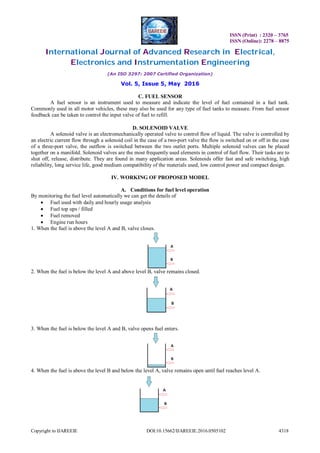
1. When the fuel is above the level A and B, valve closes.
2. When the fuel is below the level A and above level B, valve remains closed.
3. When the fuel is below the level A and B, valve opens fuel enters.
4. When the fuel is above the level B and below the level A, valve remains open until fuel reaches level A.
ISSN (Print) : 2320 – 3765
ISSN (Online): 2278 – 8875
International Journal of Advanced Research in Electrical,
Electronics and Instrumentation Engineering
(An ISO 3297: 2007 Certified Organization)
Vol. 5, Issue 5, May 2016
Copyright to IJAREEIE DOI:10.15662/IJAREEIE.2016.0505102 4319
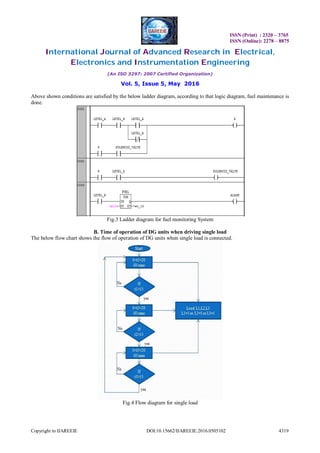
Above shown conditions are satisfied by the below ladder diagram, according to that logic diagram, fuel maintenance is
done.
Fig.3 Ladder diagram for fuel monitoring System
B. Time of operation of DG units when driving single load
The below flow chart shows the flow of operation of DG units when single load is connected.
Fig.4 Flow diagram for single load
ISSN (Print) : 2320 – 3765
ISSN (Online): 2278 – 8875
International Journal of Advanced Research in Electrical,
Electronics and Instrumentation Engineering
(An ISO 3297: 2007 Certified Organization)
Vol. 5, Issue 5, May 2016
Copyright to IJAREEIE DOI:10.15662/IJAREEIE.2016.0505102 4320
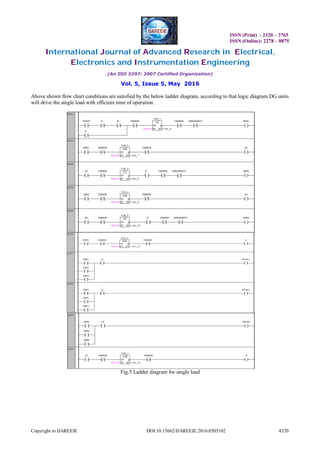
Above shown flow chart conditions are satisfied by the below ladder diagram, according to that logic diagram DG units
will drive the single load with efficient time of operation.
Fig.5 Ladder diagram for single load
ISSN (Print) : 2320 – 3765
ISSN (Online): 2278 – 8875
International Journal of Advanced Research in Electrical,
Electronics and Instrumentation Engineering
(An ISO 3297: 2007 Certified Organization)
Vol. 5, Issue 5, May 2016
Copyright to IJAREEIE DOI:10.15662/IJAREEIE.2016.0505102 4321
C. Load sharing between DG units
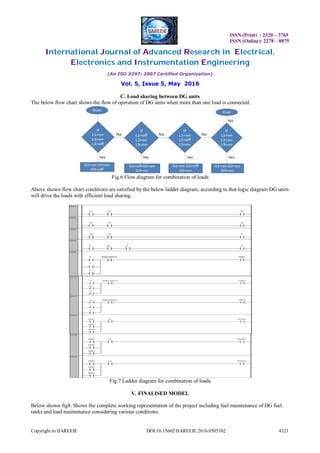
The below flow chart shows the flow of operation of DG units when more than one load is connected.
Fig.6 Flow diagram for combination of loads
Above shown flow chart conditions are satisfied by the below ladder diagram, according to that logic diagram DG units
will drive the loads with efficient load sharing.
Fig.7 Ladder diagram for combination of loads
V. FINALISED MODEL
Below shown fig8. Shows the complete working representation of the project including fuel maintenance of DG fuel
tanks and load maintenance considering various conditions.
ISSN (Print) : 2320 – 3765
ISSN (Online): 2278 – 8875
International Journal of Advanced Research in Electrical,
Electronics and Instrumentation Engineering
(An ISO 3297: 2007 Certified Organization)
Vol. 5, Issue 5, May 2016
Copyright to IJAREEIE DOI:10.15662/IJAREEIE.2016.0505102 4322
Fig.8 Complete Model showing Operation of Fuel Tank and DG Units
VI. CONCLUSION
Generation control is the important aspect of any power generation system. Several methods can be
implemented to control the generator in power plant. This project helps in maintaining of diesel generator units
efficiently by monitoring fuel level optimally, efficient time of operation of DG units, efficient load sharing, accurate
operation of plant using PLC.
REFERENCES
[1] P.K.Bhowmik, M. Dey, and S. K. Dhar, “PLC Based Operation and Control of Two Diesel Generator Set”, Department of Electrical &
Electronic Engineering, Chittagong University of Engineering & Technology.
[2] P.K.Bhowmik and M. Dey,“Protection and Control of Steam Turbine Generator using PLC” First International Conference on Mechanical
Engineering and Renewable Energy.
[3] Monitoring of Electro-mechanical System, "Diesel – Synchronous Generator" Alexander Gasparjan, Alexander Terebkov Latvian Maritime
Academy, LMA, Riga, Latvia
[4] Load Compensation for Diesel Generator-Based Isolated Generation System Employing DSTATCOM Bhim Singh, Fellow, IEEE, and
Jitendra Solanki, Member, IEEE
[5] S. Da'na, A. Sagahyroon, A. Elrayes, A.R. Al-Ali, R.Al-Aydi “Development of a monitoring and control platform for PLC-based
applications”
[6] Tadao Nakamura, Oyama, Japan,“Automatic load distributing apparatus for generator and method of controlling same”
[7] Diesel Generator Operation Guideline, Reactor Operation an Maintenance Unit (ROMU) of Bangladesh Atomic Energy Commission.
[8] Y Jaganmohan Reddy, Y V Pavan Kumar, K Padma Raju, Anilkumar Ramsesh, “PLC Based Energy Management and
Control Design for an Alternative Energy Power System with Improved Power Quality”, International Journal of
Engineering Research and Applications
[9] Anoop R, Anup J Nambiar, Prathap R, Sridhar Divakar, Dr. T B Isha Sucosoft PC Based Condition Monitoring of a Diesel – Generator Set.
[10] S. Boopathi, M. Jagadeeshraja, L. Manivannan, M. Dhanasu -“Smart Generator Monitoring System in Industry Using Microcontroller”

102_19_PLC

  • 1.
    ISSN (Print) :2320 – 3765 ISSN (Online): 2278 – 8875 International Journal of Advanced Research in Electrical, Electronics and Instrumentation Engineering (An ISO 3297: 2007 Certified Organization) Vol. 5, Issue 5, May 2016 Copyright to IJAREEIE DOI:10.15662/IJAREEIE.2016.0505102 4316 PLC Based Monitoring System of Diesel Generator Units Sandeep S.R1 , Chaithra H.B2 , Pavithra K.N3 , Shreesha G4 , Bharath N5 , Asst. Professor, Dept. of Electrical and Electronics Engineering, SJBIT, Karnataka, India1 . BE Student, Dept. of Electrical and Electronics Engineering, SJBIT, Karnataka, India2,3,4,5 ABSTRACT: This project explains about the operation, control and maintenance features of a diesel generator Unit and discuss about the system technology, implementing and adopting for automatic operation by using programmable logic controller (PLC). All criteria for safe starting, efficient time of operation, load maintenance and load distribution among the available diesel generator units. Protection against electrical emergency faults and fuel level operation faults of the diesel generators are taken into consideration in the software. This facility enhances the method of learning of PLC based monitoring of various systems of diesel generator unit operation and control. Over the years the demand of higher quality, greater efficiency automated systems and machines has increased in the world wide. To meet with this advancement and development it is expected that this project will be considered very effective effort. KEYWORDS: PLC, Fuel tank, Diesel Generator operation and control I. INTRODUCTION Diesel Generator units are the system which is used in peak load demand, Back up supply, Mobile units, Remote areas etc,. This provides the power supply for loads. Current technology in the maintenance of Diesel Generator units are not completely Automated like Fuel tank operation, load sharing etc,. So considering the current technology we are trying to upgrade the present system of maintenance by Automatic fuel level monitoring, load sharing between Generator units and efficient operation of Diesel Generator units. Fig.1 Block diagram of Automatic Monitoring of Diesel Generator units This project explains us about how to automate the Diesel generator unit without Human interference.
  • 2.
    ISSN (Print) :2320 – 3765 ISSN (Online): 2278 – 8875 International Journal of Advanced Research in Electrical, Electronics and Instrumentation Engineering (An ISO 3297: 2007 Certified Organization) Vol. 5, Issue 5, May 2016 Copyright to IJAREEIE DOI:10.15662/IJAREEIE.2016.0505102 4317 The main aspects of this project are 1.1 Automatic fuel monitoring 1.2 Efficient operation of D-G Unit 1.3 Load distribution and sharing 1.4 Continuous power generation II. SYSTEM DESCRIPTION Fuel from the overhead tank flows to the respective DG fuel tank through the Fuel Monitoring system (FMS).The FMS continuously monitors the fuel in the DG fuel tank and allows the fuel to the DG fuel tank considering the current Fuel level. When the DG set turns ON the fuel enters the DG set. The ON and OFF of the DG set is controlled by monitoring of load and efficiency system. In this monitoring system depending on the load demand and DG set efficiency turning ON and OFF the DG sets are controlled. The output of the DG set is then supplied to the load through Bus bar. III. COMPONENTS DESCRIPTION A. PLC A Programmable controller is a solid state user programmable control system with functions to control logic, sequencing, timing, arithmetic data manipulation and counting capabilities. It can be viewed as an industrial computer that has a central processor unit, memory, input output interface and a programming device. The central processing unit provides the intelligence of the controller. It accepts data, status information from various sensing devices like limit switches, proximity switches, executes the user control program store in the memory and gives appropriate output commands to devices like solenoid valves, switches etc. PLCs are intelligent automation equipment that possesses highly useful and desirable features such as: • Robustness. • High degree of scalability • Extensibility • Sophisticated communication capabilities • Powerful development environment Fig.2 Components of PLC B. FUEL TANK A fuel tank is a container for any machine which is operated by fuels and protects from flame. Construction of fuel tanks depends on which type of fuel is stored. Fuel tanks range size and complexity from the small plastic tank of a butane lighter to the multi-chambered cryogenic Space Shuttle external tank. We have 3 types of fuel tanks Sub base fuel tank, underground fuel tank, above ground storage tank.
  • 3.
    ISSN (Print) :2320 – 3765 ISSN (Online): 2278 – 8875 International Journal of Advanced Research in Electrical, Electronics and Instrumentation Engineering (An ISO 3297: 2007 Certified Organization) Vol. 5, Issue 5, May 2016 Copyright to IJAREEIE DOI:10.15662/IJAREEIE.2016.0505102 4318 C. FUEL SENSOR A fuel sensor is an instrument used to measure and indicate the level of fuel contained in a fuel tank. Commonly used in all motor vehicles, these may also be used for any type of fuel tanks to measure. From fuel sensor feedback can be taken to control the input valve of fuel to refill. D. SOLENOID VALVE A solenoid valve is an electromechanically operated valve to control flow of liquid. The valve is controlled by an electric current flow through a solenoid coil in the case of a two-port valve the flow is switched on or off in the case of a three-port valve, the outflow is switched between the two outlet ports. Multiple solenoid valves can be placed together on a manifold. Solenoid valves are the most frequently used elements in control of fuel flow. Their tasks are to shut off, release, distribute. They are found in many application areas. Solenoids offer fast and safe switching, high reliability, long service life, good medium compatibility of the materials used, low control power and compact design. IV. WORKING OF PROPOSED MODEL A. Conditions for fuel level operation By monitoring the fuel level automatically we can get the details of  Fuel used with daily and hourly usage analysis  Fuel top ups / filled  Fuel removed  Engine run hours 1. When the fuel is above the level A and B, valve closes. 2. When the fuel is below the level A and above level B, valve remains closed. 3. When the fuel is below the level A and B, valve opens fuel enters. 4. When the fuel is above the level B and below the level A, valve remains open until fuel reaches level A.
  • 4.
    ISSN (Print) :2320 – 3765 ISSN (Online): 2278 – 8875 International Journal of Advanced Research in Electrical, Electronics and Instrumentation Engineering (An ISO 3297: 2007 Certified Organization) Vol. 5, Issue 5, May 2016 Copyright to IJAREEIE DOI:10.15662/IJAREEIE.2016.0505102 4319 Above shown conditions are satisfied by the below ladder diagram, according to that logic diagram, fuel maintenance is done. Fig.3 Ladder diagram for fuel monitoring System B. Time of operation of DG units when driving single load The below flow chart shows the flow of operation of DG units when single load is connected. Fig.4 Flow diagram for single load
  • 5.
    ISSN (Print) :2320 – 3765 ISSN (Online): 2278 – 8875 International Journal of Advanced Research in Electrical, Electronics and Instrumentation Engineering (An ISO 3297: 2007 Certified Organization) Vol. 5, Issue 5, May 2016 Copyright to IJAREEIE DOI:10.15662/IJAREEIE.2016.0505102 4320 Above shown flow chart conditions are satisfied by the below ladder diagram, according to that logic diagram DG units will drive the single load with efficient time of operation. Fig.5 Ladder diagram for single load
  • 6.
    ISSN (Print) :2320 – 3765 ISSN (Online): 2278 – 8875 International Journal of Advanced Research in Electrical, Electronics and Instrumentation Engineering (An ISO 3297: 2007 Certified Organization) Vol. 5, Issue 5, May 2016 Copyright to IJAREEIE DOI:10.15662/IJAREEIE.2016.0505102 4321 C. Load sharing between DG units The below flow chart shows the flow of operation of DG units when more than one load is connected. Fig.6 Flow diagram for combination of loads Above shown flow chart conditions are satisfied by the below ladder diagram, according to that logic diagram DG units will drive the loads with efficient load sharing. Fig.7 Ladder diagram for combination of loads V. FINALISED MODEL Below shown fig8. Shows the complete working representation of the project including fuel maintenance of DG fuel tanks and load maintenance considering various conditions.
  • 7.
    ISSN (Print) :2320 – 3765 ISSN (Online): 2278 – 8875 International Journal of Advanced Research in Electrical, Electronics and Instrumentation Engineering (An ISO 3297: 2007 Certified Organization) Vol. 5, Issue 5, May 2016 Copyright to IJAREEIE DOI:10.15662/IJAREEIE.2016.0505102 4322 Fig.8 Complete Model showing Operation of Fuel Tank and DG Units VI. CONCLUSION Generation control is the important aspect of any power generation system. Several methods can be implemented to control the generator in power plant. This project helps in maintaining of diesel generator units efficiently by monitoring fuel level optimally, efficient time of operation of DG units, efficient load sharing, accurate operation of plant using PLC. REFERENCES [1] P.K.Bhowmik, M. Dey, and S. K. Dhar, “PLC Based Operation and Control of Two Diesel Generator Set”, Department of Electrical & Electronic Engineering, Chittagong University of Engineering & Technology. [2] P.K.Bhowmik and M. Dey,“Protection and Control of Steam Turbine Generator using PLC” First International Conference on Mechanical Engineering and Renewable Energy. [3] Monitoring of Electro-mechanical System, "Diesel – Synchronous Generator" Alexander Gasparjan, Alexander Terebkov Latvian Maritime Academy, LMA, Riga, Latvia [4] Load Compensation for Diesel Generator-Based Isolated Generation System Employing DSTATCOM Bhim Singh, Fellow, IEEE, and Jitendra Solanki, Member, IEEE [5] S. Da'na, A. Sagahyroon, A. Elrayes, A.R. Al-Ali, R.Al-Aydi “Development of a monitoring and control platform for PLC-based applications” [6] Tadao Nakamura, Oyama, Japan,“Automatic load distributing apparatus for generator and method of controlling same” [7] Diesel Generator Operation Guideline, Reactor Operation an Maintenance Unit (ROMU) of Bangladesh Atomic Energy Commission. [8] Y Jaganmohan Reddy, Y V Pavan Kumar, K Padma Raju, Anilkumar Ramsesh, “PLC Based Energy Management and Control Design for an Alternative Energy Power System with Improved Power Quality”, International Journal of Engineering Research and Applications [9] Anoop R, Anup J Nambiar, Prathap R, Sridhar Divakar, Dr. T B Isha Sucosoft PC Based Condition Monitoring of a Diesel – Generator Set. [10] S. Boopathi, M. Jagadeeshraja, L. Manivannan, M. Dhanasu -“Smart Generator Monitoring System in Industry Using Microcontroller”