Mongolia
Selected Macroeconomic Indicators
October 16, 2013
For further information, please contact:
SSelenge@imf.org
2
2005 2006 2007 2008 2009 2010 2011 2012 2012 2013
Q1 Q2 Sept. Q3
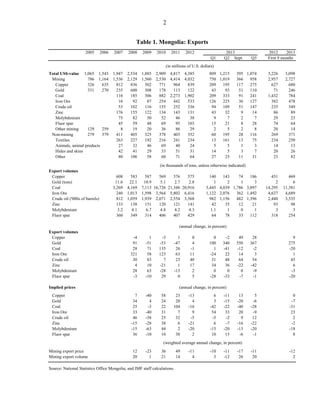
Total US$-value 1,065 1,543 1,947 2,534 1,885 2,909 4,817 4,385 809 1,215 395 1,074 3,226 3,098
Mining 786 1,164 1,536 2,129 1,560 2,530 4,414 4,032 750 1,019 366 958 2,957 2,727
Copper 326 635 812 836 502 771 964 839 209 195 117 275 627 680
Gold 331 270 235 600 308 178 113 122 43 93 51 110 71 246
Coal 116 185 306 882 2,273 1,902 209 333 91 241 1,432 784
Iron Ore 16 92 87 254 442 533 126 225 36 127 382 478
Crude oil 53 102 116 155 252 336 94 109 51 147 235 349
Zinc 176 155 122 134 143 131 43 32 9 14 86 89
Molybdenium 75 82 50 52 46 38 9 7 2 7 29 23
Fluor spar 45 59 48 69 95 103 15 21 8 28 74 64
Other mining 129 259 8 19 20 36 86 29 2 5 2 8 20 14
Non-mining 279 379 411 405 325 378 403 352 60 195 28 116 269 371
Textiles 263 227 192 216 241 234 13 161 13 75 234 250
Animals, animal products 27 32 46 69 40 24 5 5 1 3 14 13
Hides and skins 42 41 29 33 51 31 14 5 3 7 20 26
Other 80 106 58 60 71 64 27 25 11 31 23 82
Export volumes
Copper 608 583 587 569 576 575 140 143 74 186 431 469
Gold (tons) 11.6 22.1 10.9 5.1 2.7 2.8 1 2 1 3 2 6
Coal 3,269 4,169 7,113 16,726 21,106 20,916 3,445 4,039 1,786 3,897 14,295 11,381
Iron Ore 240 1,013 1,598 3,564 5,802 6,416 1,122 2,076 362 1,492 4,627 4,689
Crude oil ('000s of barrels) 812 1,059 1,939 2,071 2,554 3,568 982 1,156 482 1,396 2,440 3,535
Zinc 133 138 151 120 121 141 42 35 12 21 93 98
Molybdenium 3.2 4.1 6.7 4.8 4.2 4.3 1.1 1 0 1 3 3
Fluor spar 360 349 314 406 407 429 64 78 33 112 318 254
Export volumes
Copper -4 1 -3 1 0 0 -2 49 28 9
Gold 91 -51 -53 -47 4 100 340 550 367 275
Coal 28 71 135 26 -1 1 -41 -12 -2 -20
Iron Ore 321 58 123 63 11 -24 22 14 3 1
Crude oil 30 83 7 23 40 31 48 64 54 45
Zinc 4 10 -21 1 17 34 36 -22 -42 6
Molybdenium 28 63 -28 -13 2 0 0 0 -9 -3
Fluor spar -3 -10 29 0 5 -28 -33 -7 -1 -20
Implied prices
Copper 7 -40 58 23 -13 6 -11 13 5 0
Gold 34 4 24 20 4 3 -15 -20 -6 -7
Coal 25 -3 22 104 -16 -42 -22 -40 -28 -31
Iron Ore 33 -40 31 7 9 54 33 20 -9 23
Crude oil 46 -38 25 32 -5 -5 -2 9 12 2
Zinc -15 -28 38 6 -21 6 -7 -16 -22 -2
Molybdenium -15 -63 44 2 -20 -15 -20 -13 -20 -18
Fluor spar 36 -10 10 38 2 10 15 -6 -1 8
Mining export price 12 -23 36 49 -11 -10 -11 -17 -11 -12
Mining export volume 20 1 21 14 4 3 -12 26 20 2
Source: National Statistics Office Mongolia; and IMF staff calculations.
(weighted average annual change, in percent)
(in thousands of tons, unless otherwise indicated)
(annual change, in percent)
Table 1. Mongolia: Exports
First 9 months
(annual change, in percent)
(in millions of U.S. dollars)
2013
3
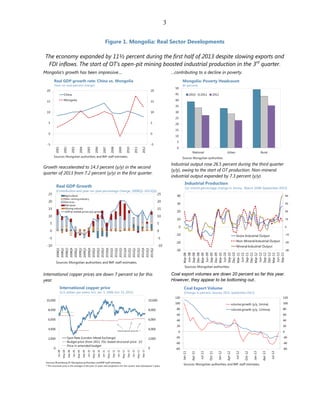
Figure 1. Mongolia: Real Sector Developments
The economy expanded by 11½ percent during the first half of 2013 despite slowing exports and
FDI inflows. The start of OT’s open-pit mining boosted industrial production in the 3rd
quarter.
Mongolia’s growth has been impressive.... …contributing to a decline in poverty.
Growth reaccelerated to 14.3 percent (y/y) in the second
quarter of 2013 from 7.2 percent (y/y) in the first quarter.
Industrial output rose 26.5 percent during the third quarter
(y/y), owing to the start of OT production. Non-mineral
industrial output expanded by 7.3 percent (y/y).
International copper prices are down 7 percent so far this
year.
Coal export volumes are down 20 percent so far this year.
However, they appear to be bottoming out..
-5
0
5
10
15
20
-5
0
5
10
15
20
2001
2002
2003
2004
2005
2006
2007
2008
2009
2010
2011
2012
China
Mongolia
Sources: Mongolian authorities; and IMF staff estimates.
Real GDP growth rate: China vs. Mongolia
(Year-on-year percent change)
0
5
10
15
20
25
30
35
40
45
50
National Urban Rural
2010 2011 2012
Mongolia: Poverty Headcount
(In percent)
Source: Mongolian authorities.
-10
-5
0
5
10
15
20
25
-10
-5
0
5
10
15
20
25
2008Q1
2008Q2
2008Q3
2008Q4
2009Q1
2009Q2
2009Q3
2009Q4
2010Q1
2010Q2
2010Q3
2010Q4
2011Q1
2011Q2
2011Q3
2011Q4
2012Q1
2012Q2
2012Q3
2012Q4
2013Q1
2013Q2
Agriculture
Non-miningindustry
Services
Net taxes
Miningindustry
GDP at market prices (y/y growth)
Sources: Mongolian authorities; and IMF staff estimates.
Real GDP Growth
(Contribution and year-on-year percentage change, 2008Q1-2013Q2)
-30
-20
-10
0
10
20
30
40
-30
-20
-10
0
10
20
30
40
Mar-08
Jun-08
Sep-08
Dec-08
Mar-09
Jun-09
Sep-09
Dec-09
Mar-10
Jun-10
Sep-10
Dec-10
Mar-11
Jun-11
Sep-11
Dec-11
Mar-12
Jun-12
Sep-12
Dec-12
Mar-13
Jun-13
Sep-13
Gross Industrial Output
Non-Mineral Industrial Output
Mineral Industrial Output
Industrial Production
(12-month percentage change in 3mma , March 2008-September 2013)
Sources: Mongolian authorities.
0
2,000
4,000
6,000
8,000
10,000
0
2,000
4,000
6,000
8,000
10,000
Jan-08
May-08
Sep-08
Jan-09
May-09
Sep-09
Jan-10
May-10
Sep-10
Jan-11
May-11
Sep-11
Jan-12
May-12
Sep-12
Jan-13
May-13
Sep-13
Spot Rate (London Metal Exchange)
Budget price (from 2011: FSL-based structural price 1/)
Price in amended budget
International copper price
(U.S. dollars per metric ton, Jan. 1, 2008-Oct. 15, 2013)
Sources: Bloomberg LP; Mongolian authorities; and IMF staff estimates.
1/
The structural price is the average of the past 12 years and projections for the current and subsequent 3 years.
Structuralprices as perFSL 1/
-60
-40
-20
0
20
40
60
80
100
120
-60
-40
-20
0
20
40
60
80
100
120
Jan-11
Apr-11
Jul-11
Oct-11
Jan-12
Apr-12
Jul-12
Oct-12
Jan-13
Apr-13
Jul-13
volume growth (y/y, 3mma)
volume growth (y/y, 12mma)
Sources: Mongolian authorities; and IMF staff estimates.
Coal Export Volume
(Change, in percent, January 2011-September 2013)
4
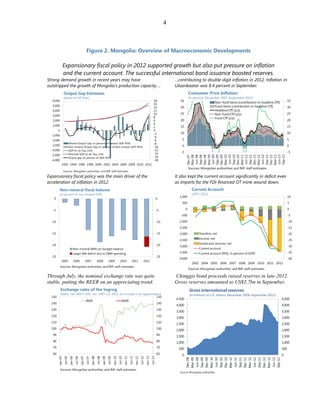
Figure 2. Mongolia: Overview of Macroeconomic Developments
Expansionary fiscal policy in 2012 supported growth but also put pressure on inflation
and the current account. The successful international bond issuance boosted reserves.
Strong demand growth in recent years may have
outstripped the growth of Mongolia’s production capacity….
…contributing to double-digit inflation in 2012. Inflation in
Ulaanbaatar was 8.4 percent in September.
Expansionary fiscal policy was the main driver of the
acceleration of inflation in 2012.
It also kept the current account significantly in deficit even
as imports for the FDI-financed OT mine wound down.
Through July, the nominal exchange rate was quite
stable, putting the REER on an appreciating trend.
Chinggis bond proceeds raised reserves in late-2012.
Gross reserves amounted to US$2.7bn in September.
-18
-16
-14
-12
-10
-8
-6
-4
-2
0
2
4
6
8
10
12
14
16
18
-6,000
-5,000
-4,000
-3,000
-2,000
-1,000
0
1,000
2,000
3,000
4,000
5,000
6,000
1992 1994 1996 1998 2000 2002 2004 2006 2008 2010 2012
Mineral Output Gap (in percent of mineral GDP, RHS)
Non-mineral Output Gap (in percent of Non-mineral GDP, RHS)
GDP (in bil Tog, LHS)
Potential GDP (in bil Tog, LHS)
Output gap (in percent of GDP, RHS)
Sources: Mongolian authorities; and IMF staff estimates.
Output Gap Estimates
(based on HP filter)
-5
0
5
10
15
20
25
30
35
-5
0
5
10
15
20
25
30
35
Dec-07
Mar-08
Jun-08
Sep-08
Dec-08
Mar-09
Jun-09
Sep-09
Dec-09
Mar-10
Jun-10
Sep-10
Dec-10
Mar-11
Jun-11
Sep-11
Dec-11
Mar-12
Jun-12
Sep-12
Dec-12
Mar-13
Jun-13
Sep-13
Non-food items (contribution to headline CPI)
Food items (contribution to headline CPI)
Headline CPI (y/y)
Non-food CPI (y/y)
Food CPI (y/y)
Sources: Mongolian authorities; and IMF staff estimates.
Consumer Price Inflation
(in percent, December 2007-September 2013)
-25
-20
-15
-10
-5
0
-25
-20
-15
-10
-5
0
2005 2006 2007 2008 2009 2010 2011 2012
Non-mineral (NM) on-budget balance
Larger NM deficit due to DBM spending
Sources: Mongolian authorities; and IMF staff estimates.
Non-mineral fiscal balance
(in percent of non-mineral GDP)
-40
-35
-30
-25
-20
-15
-10
-5
0
5
10
-4,000
-3,500
-3,000
-2,500
-2,000
-1,500
-1,000
-500
0
500
1,000
2003 2004 2005 2006 2007 2008 2009 2010 2011 2012
Transfers, net
Income, net
Goods and services, net
Current account
Current account (RHS, in percent of GDP)
Current Account
(2003-2012)
Sources: Mongolian authorities; and IMF staff estimates.
60
70
80
90
100
110
120
130
140
150
60
70
80
90
100
110
120
130
140
150
Jan-05
Jul-05
Jan-06
Jul-06
Jan-07
Jul-07
Jan-08
Jul-08
Jan-09
Jul-09
Jan-10
Jul-10
Jan-11
Jul-11
Jan-12
Jul-12
Jan-13
Jul-13
REER NEER
Sources: Mongolian authorities; and IMF staff estimates.
Exchange rates of the togrog
(Index, Jan. 2005=100, Jan. 2005-Jul, 2013; an increase is an appreciation)
0
500
1,000
1,500
2,000
2,500
3,000
3,500
4,000
4,500
0
500
1,000
1,500
2,000
2,500
3,000
3,500
4,000
4,500
Dec-08
Mar-09
Jun-09
Sep-09
Dec-09
Mar-10
Jun-10
Sep-10
Dec-10
Mar-11
Jun-11
Sep-11
Dec-11
Mar-12
Jun-12
Sep-12
Dec-12
Mar-13
Jun-13
Sep-13
Source: Mongolian authorities.
Gross international reserves
(In millions of U.S. dollars, December 2008-September 2013)
5
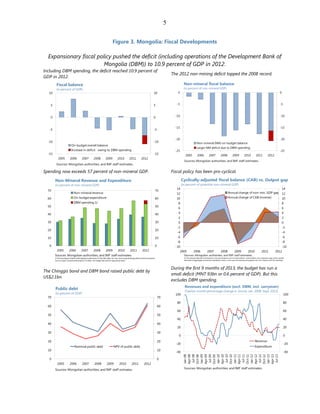
Figure 3. Mongolia: Fiscal Developments
Expansionary fiscal policy pushed the deficit (including operations of the Development Bank of
Mongolia (DBM)) to 10.9 percent of GDP in 2012.
Including DBM spending, the deficit reached 10.9 percent of
GDP in 2012.
The 2012 non-mining deficit topped the 2008 record.
Spending now exceeds 57 percent of non-mineral GDP. Fiscal policy has been pro-cyclical.
The Chinggis bond and DBM bond raised public debt by
US$2.1bn.
During the first 9 months of 2013, the budget has run a
small deficit (MNT 93bn or 0.6 percent of GDP). But this
excludes DBM spending.
-15
-10
-5
0
5
10
-15
-10
-5
0
5
10
2005 2006 2007 2008 2009 2010 2011 2012
On-budget overall balance
Increase in deficit owing to DBM spending
Sources: Mongolian authorities; and IMF staff estimates.
Fiscal balance
(in percent of GDP)
-25
-20
-15
-10
-5
0
-25
-20
-15
-10
-5
0
2005 2006 2007 2008 2009 2010 2011 2012
Non-mineral (NM) on-budget balance
Larger NM deficit due to DBM spending
Sources: Mongolian authorities; and IMF staff estimates.
Non-mineral fiscal balance
(in percent of non-mineral GDP)
0
10
20
30
40
50
60
70
0
10
20
30
40
50
60
70
2005 2006 2007 2008 2009 2010 2011 2012
Non-mineral revenue
On-budget expenditure
DBM spending 1/
Sources: Mongolian authorities; and IMF staff estimates.
1/The DevelopmentBankof Mongoliaprovidedloansof US$ 190 million for non-revenue generatingpublicinvestmentprojects
suchas roads("social benefitprojects") in2012. The budgetwill needto repaythese loans.
Non-Mineral Revenue and Expenditure
(in percent of non-mineral GDP)
-10
-8
-6
-4
-2
0
2
4
6
8
10
12
14
-10
-8
-6
-4
-2
0
2
4
6
8
10
12
14
2005 2006 2007 2008 2009 2010 2011 2012
Annual change of non-min. GDP gap
Annual change of CAB (inverse)
Sources: Mongolian authorities; and IMF staff estimates.
2/ The cyclically adjusted fiscal balance is the overall balance net of cyclical effects. Cyclical effects are computed using country specific
elasticities of aggregagerevenueand expenditure series. In this case, the elasticityassumptions are 1 for revenue and 0 for spending.
Cyclically-adjusted fiscal balance (CAB) vs. Output gap
(in percent of potential non-mineral GDP)
0
10
20
30
40
50
60
70
0
10
20
30
40
50
60
70
2005 2006 2007 2008 2009 2010 2011 2012
Nominal public debt NPV of public debt
Public debt
(in percent of GDP)
Sources: Mongolian authorities; and IMF staff esimates.
-40
-20
0
20
40
60
80
100
-40
-20
0
20
40
60
80
100
Jan-08
Apr-08
Jul-08
Oct-08
Jan-09
Apr-09
Jul-09
Oct-09
Jan-10
Apr-10
Jul-10
Oct-10
Jan-11
Apr-11
Jul-11
Oct-11
Jan-12
Apr-12
Jul-12
Oct-12
Jan-13
Apr-13
Jul-13
Revenue
Expenditure
Sources: Mongolian authorities; and IMF staff estimates.
Revenues and expenditure (excl. DBM, incl. carryover)
(Twelve-month percentage change in 3mma, Jan. 2008-Sept. 2013)
6
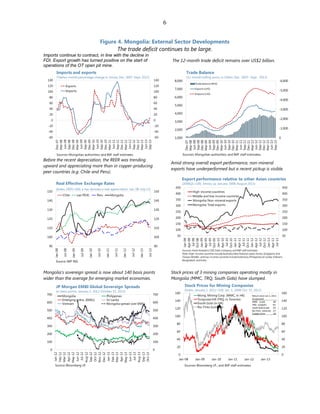
Figure 4. Mongolia: External Sector Developments
The trade deficit continues to be large.
Imports continue to contract, in line with the decline in
FDI. Export growth has turned positive on the start of
operations of the OT open pit mine.
The 12-month trade deficit remains over US$2 billion.
Before the recent depreciation, the REER was trending
upward and appreciating more than in copper-producing
peer countries (e.g. Chile and Peru).
Amid strong overall export performance, non-mineral
exports have underperformed but a recent pickup is visible.
Mongolia’s sovereign spread is now about 140 basis points
wider than the average for emerging market economies.
Stock prices of 3 mining companies operating mostly in
Mongolia (MMC, TRQ, South Gobi) have slumped.
-60
-40
-20
0
20
40
60
80
100
120
140
-60
-40
-20
0
20
40
60
80
100
120
140
Dec-07
Mar-08
Jun-08
Sep-08
Dec-08
Mar-09
Jun-09
Sep-09
Dec-09
Mar-10
Jun-10
Sep-10
Dec-10
Mar-11
Jun-11
Sep-11
Dec-11
Mar-12
Jun-12
Sep-12
Dec-12
Mar-13
Jun-13
Sep-13
Exports
Imports
Sources: Mongolian authorities; and IMF staff estimates.
Imports and exports
(Twelve-month percentage change in 3mma, Dec. 2007-Sept. 2013)
-6,000
-5,000
-4,000
-3,000
-2,000
-1,000
01,000
2,000
3,000
4,000
5,000
6,000
7,000
8,000
Dec-07
Mar-08
Jun-08
Sep-08
Dec-08
Mar-09
Jun-09
Sep-09
Dec-09
Mar-10
Jun-10
Sep-10
Dec-10
Mar-11
Jun-11
Sep-11
Dec-11
Mar-12
Jun-12
Sep-12
Dec-12
Mar-13
Jun-13
Sep-13
Trade balance (RHS)
Exports (LHS)
Imports (LHS)
Trade Balance
(12-month rolling sums, in US$m, Dec. 2007- Sept . 2013)
Sources: Mongolian authorities; and IMF staff estimates.
90
100
110
120
130
140
150
90
100
110
120
130
140
150
Jan-08
Jul-08
Jan-09
Jul-09
Jan-10
Jul-10
Jan-11
Jul-11
Jan-12
Jul-12
Jan-13
Jul-13
Chile Lao P.D.R. Peru Mongolia
Source: IMF INS.
Real Effective Exchange Rates
(Index, 2005=100; a rise denotes a real appreciation. Jan. 08-July 13)
50
100
150
200
250
300
350
400
450
50
100
150
200
250
300
350
400
450
Jan-08
Apr-08
Jul-08
Oct-08
Jan-09
Apr-09
Jul-09
Oct-09
Jan-10
Apr-10
Jul-10
Oct-10
Jan-11
Apr-11
Jul-11
Oct-11
Jan-12
Apr-12
Jul-12
Oct-12
Jan-13
Apr-13
Jul-13
High-income countries
Middle and low income countries
Mongolia: Non-mineral exports
Mongolia: Total exports
Sources: Haver Analytics; CEIC Data Company; and IMF staff estimates.
Note: High-income countries include Australia, New Zealand, Japan, Korea, Singapore, and
Taiwan; Middle- andlow-income countries include Indonesia, Philippines; Sri Lanka, Vietnam,
Bangladesh, andIndia.
Export performance relative to other Asian countries
(2006Q1=100, 3mma, sa, January 2008-August 2013)
0
100
200
300
400
500
600
700
0
100
200
300
400
500
600
700
Jan-12
Feb-12
Mar-12
Apr-12
May-12
Jun-12
Jul-12
Aug-12
Sep-12
Oct-12
Nov-12
Dec-12
Jan-13
Feb-13
Mar-13
Apr-13
May-13
Jun-13
Jul-13
Aug-13
Sep-13
Oct-13
Mongolia Philippines
Emerging mrkts. (EMEs) Sri Lanka
Vietnam Mongolia spread over EMEs
Source: Bloomberg LP.
JP Morgan EMBI Global Sovereign Spreads
(in basis points, January 1, 2012-October 15, 2013)
0
20
40
60
80
100
120
140
160
0
20
40
60
80
100
120
140
160
Jan-08 Jan-09 Jan-10 Jan-11 Jan-12 Jan-13
Mong. Mining Corp. (MMC, in HK)
Turquoise Hill (TRQ, in Toronto)
South Gobi (in HK)
Rio Tinto (London)
Sources: Bloomberg LP.; and IMF staff estimates.
Stock Prices for Mining Companies
(Index, January 1, 2011=100, Jan. 1, 2008-Oct. 15, 2013)
Return since Jan.1, 2011
(in percent) _
MMC (coal) -86
TRQ (copper) -81
South Gobi(coal) -91
Rio Tinto (diverse) -27
Copper price -26
7
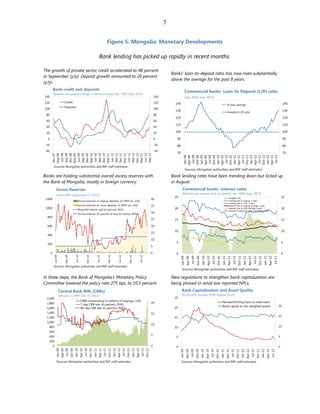
Figure 5. Mongolia: Monetary Developments
Bank lending has picked up rapidly in recent months.
The growth of private sector credit accelerated to 48 percent
in September (y/y). Deposit growth amounted to 20 percent
(y/y).
Banks’ loan-to-deposit ratio has now risen substantially
above the average for the past 8 years.
Banks are holding substantial overall excess reserves with
the Bank of Mongolia, mostly in foreign currency.
Bank lending rates have been trending down but ticked up
in August.
In three steps, the Bank of Mongolia’s Monetary Policy
Committee lowered the policy rate 275 bps, to 10.5 percent.
New regulations to strengthen bank capitalization are
being phased in amid low reported NPLs.
-40
-20
0
20
40
60
80
100
120
140
-40
-20
0
20
40
60
80
100
120
140
Dec-07
Mar-08
Jun-08
Sep-08
Dec-08
Mar-09
Jun-09
Sep-09
Dec-09
Mar-10
Jun-10
Sep-10
Dec-10
Mar-11
Jun-11
Sep-11
Dec-11
Mar-12
Jun-12
Sep-12
Dec-12
Mar-13
Jun-13
Sep-13
Credit
Deposits
Sources: Mongolian authorities; and IMF staff estimates.
Bank credit and deposits
(Quarter-on-quarter change, in percent (saar), Dec. 2007-Sep. 2013)
70
80
90
100
110
120
130
140
70
80
90
100
110
120
130
140
Jan-08
Apr-08
Jul-08
Oct-08
Jan-09
Apr-09
Jul-09
Oct-09
Jan-10
Apr-10
Jul-10
Oct-10
Jan-11
Apr-11
Jul-11
Oct-11
Jan-12
Apr-12
Jul-12
Oct-12
Jan-13
Apr-13
Jul-13
8-year average
Headline L/D ratio
Commercial banks' Loan-to-Deposit (L/D) ratio
(Jan. 2008-Sep. 2013)
Sources: Mongolian authorities; and IMF staff estimates.
0
5
10
15
20
25
30
35
40
0
200
400
600
800
1000
1200
Jun-09
Dec-09
Jun-10
Dec-10
Jun-11
Dec-11
Jun-12
Dec-12
Jun-13
Excess reserves on togrog deposits (in MNT bn, LHS)
Excess reserves on forex deposits (in MNT bn, LHS)
Required reserve rate (in percent, RHS)
Excess reserves (in percent of reserve money, RHS)
Sources: Mongolian authorities; and IMF staff estimates.
Excess Reserves
(June 2009-September 17, 2013)
0
5
10
15
20
25
0
5
10
15
20
25
Jan-09
Apr-09
Jul-09
Oct-09
Jan-10
Apr-10
Jul-10
Oct-10
Jan-11
Apr-11
Jul-11
Oct-11
Jan-12
Apr-12
Jul-12
Oct-12
Jan-13
Apr-13
Jul-13
Headline CPI
Lending rate (in togrog, 1 year)
Lending rate (in US$, 1 year)
Deposit rate (in togrog, average 1 year)
Deposit rate (in US$, average 1 year)
Spread on togrog lending and deposit rates
Commercial banks' interest rates
(Percent per annum, end-of-period, Jan. 2009-Aug. 2013)
Sources: Mongolian authorities; and IMF staff estimates.
0
5
10
15
20
0
200
400
600
800
1,000
1,200
1,400
1,600
1,800
2,000
Jan-09
Apr-09
Jul-09
Oct-09
Jan-10
Apr-10
Jul-10
Oct-10
Jan-11
Apr-11
Jul-11
Oct-11
Jan-12
Apr-12
Jul-12
Oct-12
Jan-13
Apr-13
Jul-13
Oct-13
CBBs outstanding (in billions of togrogs, LHS)
7-day CBB rate (in percent, RHS)
84-day CBB rate (in percent, RHS)
Sources: Mongolian authorities; and IMF staff estimates.
Central Bank Bills (CBBs)
(January 1, 2009-Oct. 15, 2013)
0
5
10
15
20
0
5
10
15
20
25
Jan-09
Apr-09
Jul-09
Oct-09
Jan-10
Apr-10
Jul-10
Oct-10
Jan-11
Apr-11
Jul-11
Oct-11
Jan-12
Apr-12
Jul-12
Oct-12
Jan-13
Apr-13
Jul-13
Nonperforming loans to total loans
Bank capital to risk-weighted assets
Bank Capitalization and Asset Quality
(In percent, January 2009-August 2013)
Sources: Mongolian authorities; and IMF staff estimates.

10.16.2013, REPORT, Selected Macroeconomic Indicators; data through, Internatinal Monetary Fund

  • 1.
    Mongolia Selected Macroeconomic Indicators October16, 2013 For further information, please contact: SSelenge@imf.org
  • 2.
    2 2005 2006 20072008 2009 2010 2011 2012 2012 2013 Q1 Q2 Sept. Q3 Total US$-value 1,065 1,543 1,947 2,534 1,885 2,909 4,817 4,385 809 1,215 395 1,074 3,226 3,098 Mining 786 1,164 1,536 2,129 1,560 2,530 4,414 4,032 750 1,019 366 958 2,957 2,727 Copper 326 635 812 836 502 771 964 839 209 195 117 275 627 680 Gold 331 270 235 600 308 178 113 122 43 93 51 110 71 246 Coal 116 185 306 882 2,273 1,902 209 333 91 241 1,432 784 Iron Ore 16 92 87 254 442 533 126 225 36 127 382 478 Crude oil 53 102 116 155 252 336 94 109 51 147 235 349 Zinc 176 155 122 134 143 131 43 32 9 14 86 89 Molybdenium 75 82 50 52 46 38 9 7 2 7 29 23 Fluor spar 45 59 48 69 95 103 15 21 8 28 74 64 Other mining 129 259 8 19 20 36 86 29 2 5 2 8 20 14 Non-mining 279 379 411 405 325 378 403 352 60 195 28 116 269 371 Textiles 263 227 192 216 241 234 13 161 13 75 234 250 Animals, animal products 27 32 46 69 40 24 5 5 1 3 14 13 Hides and skins 42 41 29 33 51 31 14 5 3 7 20 26 Other 80 106 58 60 71 64 27 25 11 31 23 82 Export volumes Copper 608 583 587 569 576 575 140 143 74 186 431 469 Gold (tons) 11.6 22.1 10.9 5.1 2.7 2.8 1 2 1 3 2 6 Coal 3,269 4,169 7,113 16,726 21,106 20,916 3,445 4,039 1,786 3,897 14,295 11,381 Iron Ore 240 1,013 1,598 3,564 5,802 6,416 1,122 2,076 362 1,492 4,627 4,689 Crude oil ('000s of barrels) 812 1,059 1,939 2,071 2,554 3,568 982 1,156 482 1,396 2,440 3,535 Zinc 133 138 151 120 121 141 42 35 12 21 93 98 Molybdenium 3.2 4.1 6.7 4.8 4.2 4.3 1.1 1 0 1 3 3 Fluor spar 360 349 314 406 407 429 64 78 33 112 318 254 Export volumes Copper -4 1 -3 1 0 0 -2 49 28 9 Gold 91 -51 -53 -47 4 100 340 550 367 275 Coal 28 71 135 26 -1 1 -41 -12 -2 -20 Iron Ore 321 58 123 63 11 -24 22 14 3 1 Crude oil 30 83 7 23 40 31 48 64 54 45 Zinc 4 10 -21 1 17 34 36 -22 -42 6 Molybdenium 28 63 -28 -13 2 0 0 0 -9 -3 Fluor spar -3 -10 29 0 5 -28 -33 -7 -1 -20 Implied prices Copper 7 -40 58 23 -13 6 -11 13 5 0 Gold 34 4 24 20 4 3 -15 -20 -6 -7 Coal 25 -3 22 104 -16 -42 -22 -40 -28 -31 Iron Ore 33 -40 31 7 9 54 33 20 -9 23 Crude oil 46 -38 25 32 -5 -5 -2 9 12 2 Zinc -15 -28 38 6 -21 6 -7 -16 -22 -2 Molybdenium -15 -63 44 2 -20 -15 -20 -13 -20 -18 Fluor spar 36 -10 10 38 2 10 15 -6 -1 8 Mining export price 12 -23 36 49 -11 -10 -11 -17 -11 -12 Mining export volume 20 1 21 14 4 3 -12 26 20 2 Source: National Statistics Office Mongolia; and IMF staff calculations. (weighted average annual change, in percent) (in thousands of tons, unless otherwise indicated) (annual change, in percent) Table 1. Mongolia: Exports First 9 months (annual change, in percent) (in millions of U.S. dollars) 2013
  • 3.
    3 Figure 1. Mongolia:Real Sector Developments The economy expanded by 11½ percent during the first half of 2013 despite slowing exports and FDI inflows. The start of OT’s open-pit mining boosted industrial production in the 3rd quarter. Mongolia’s growth has been impressive.... …contributing to a decline in poverty. Growth reaccelerated to 14.3 percent (y/y) in the second quarter of 2013 from 7.2 percent (y/y) in the first quarter. Industrial output rose 26.5 percent during the third quarter (y/y), owing to the start of OT production. Non-mineral industrial output expanded by 7.3 percent (y/y). International copper prices are down 7 percent so far this year. Coal export volumes are down 20 percent so far this year. However, they appear to be bottoming out.. -5 0 5 10 15 20 -5 0 5 10 15 20 2001 2002 2003 2004 2005 2006 2007 2008 2009 2010 2011 2012 China Mongolia Sources: Mongolian authorities; and IMF staff estimates. Real GDP growth rate: China vs. Mongolia (Year-on-year percent change) 0 5 10 15 20 25 30 35 40 45 50 National Urban Rural 2010 2011 2012 Mongolia: Poverty Headcount (In percent) Source: Mongolian authorities. -10 -5 0 5 10 15 20 25 -10 -5 0 5 10 15 20 25 2008Q1 2008Q2 2008Q3 2008Q4 2009Q1 2009Q2 2009Q3 2009Q4 2010Q1 2010Q2 2010Q3 2010Q4 2011Q1 2011Q2 2011Q3 2011Q4 2012Q1 2012Q2 2012Q3 2012Q4 2013Q1 2013Q2 Agriculture Non-miningindustry Services Net taxes Miningindustry GDP at market prices (y/y growth) Sources: Mongolian authorities; and IMF staff estimates. Real GDP Growth (Contribution and year-on-year percentage change, 2008Q1-2013Q2) -30 -20 -10 0 10 20 30 40 -30 -20 -10 0 10 20 30 40 Mar-08 Jun-08 Sep-08 Dec-08 Mar-09 Jun-09 Sep-09 Dec-09 Mar-10 Jun-10 Sep-10 Dec-10 Mar-11 Jun-11 Sep-11 Dec-11 Mar-12 Jun-12 Sep-12 Dec-12 Mar-13 Jun-13 Sep-13 Gross Industrial Output Non-Mineral Industrial Output Mineral Industrial Output Industrial Production (12-month percentage change in 3mma , March 2008-September 2013) Sources: Mongolian authorities. 0 2,000 4,000 6,000 8,000 10,000 0 2,000 4,000 6,000 8,000 10,000 Jan-08 May-08 Sep-08 Jan-09 May-09 Sep-09 Jan-10 May-10 Sep-10 Jan-11 May-11 Sep-11 Jan-12 May-12 Sep-12 Jan-13 May-13 Sep-13 Spot Rate (London Metal Exchange) Budget price (from 2011: FSL-based structural price 1/) Price in amended budget International copper price (U.S. dollars per metric ton, Jan. 1, 2008-Oct. 15, 2013) Sources: Bloomberg LP; Mongolian authorities; and IMF staff estimates. 1/ The structural price is the average of the past 12 years and projections for the current and subsequent 3 years. Structuralprices as perFSL 1/ -60 -40 -20 0 20 40 60 80 100 120 -60 -40 -20 0 20 40 60 80 100 120 Jan-11 Apr-11 Jul-11 Oct-11 Jan-12 Apr-12 Jul-12 Oct-12 Jan-13 Apr-13 Jul-13 volume growth (y/y, 3mma) volume growth (y/y, 12mma) Sources: Mongolian authorities; and IMF staff estimates. Coal Export Volume (Change, in percent, January 2011-September 2013)
  • 4.
    4 Figure 2. Mongolia:Overview of Macroeconomic Developments Expansionary fiscal policy in 2012 supported growth but also put pressure on inflation and the current account. The successful international bond issuance boosted reserves. Strong demand growth in recent years may have outstripped the growth of Mongolia’s production capacity…. …contributing to double-digit inflation in 2012. Inflation in Ulaanbaatar was 8.4 percent in September. Expansionary fiscal policy was the main driver of the acceleration of inflation in 2012. It also kept the current account significantly in deficit even as imports for the FDI-financed OT mine wound down. Through July, the nominal exchange rate was quite stable, putting the REER on an appreciating trend. Chinggis bond proceeds raised reserves in late-2012. Gross reserves amounted to US$2.7bn in September. -18 -16 -14 -12 -10 -8 -6 -4 -2 0 2 4 6 8 10 12 14 16 18 -6,000 -5,000 -4,000 -3,000 -2,000 -1,000 0 1,000 2,000 3,000 4,000 5,000 6,000 1992 1994 1996 1998 2000 2002 2004 2006 2008 2010 2012 Mineral Output Gap (in percent of mineral GDP, RHS) Non-mineral Output Gap (in percent of Non-mineral GDP, RHS) GDP (in bil Tog, LHS) Potential GDP (in bil Tog, LHS) Output gap (in percent of GDP, RHS) Sources: Mongolian authorities; and IMF staff estimates. Output Gap Estimates (based on HP filter) -5 0 5 10 15 20 25 30 35 -5 0 5 10 15 20 25 30 35 Dec-07 Mar-08 Jun-08 Sep-08 Dec-08 Mar-09 Jun-09 Sep-09 Dec-09 Mar-10 Jun-10 Sep-10 Dec-10 Mar-11 Jun-11 Sep-11 Dec-11 Mar-12 Jun-12 Sep-12 Dec-12 Mar-13 Jun-13 Sep-13 Non-food items (contribution to headline CPI) Food items (contribution to headline CPI) Headline CPI (y/y) Non-food CPI (y/y) Food CPI (y/y) Sources: Mongolian authorities; and IMF staff estimates. Consumer Price Inflation (in percent, December 2007-September 2013) -25 -20 -15 -10 -5 0 -25 -20 -15 -10 -5 0 2005 2006 2007 2008 2009 2010 2011 2012 Non-mineral (NM) on-budget balance Larger NM deficit due to DBM spending Sources: Mongolian authorities; and IMF staff estimates. Non-mineral fiscal balance (in percent of non-mineral GDP) -40 -35 -30 -25 -20 -15 -10 -5 0 5 10 -4,000 -3,500 -3,000 -2,500 -2,000 -1,500 -1,000 -500 0 500 1,000 2003 2004 2005 2006 2007 2008 2009 2010 2011 2012 Transfers, net Income, net Goods and services, net Current account Current account (RHS, in percent of GDP) Current Account (2003-2012) Sources: Mongolian authorities; and IMF staff estimates. 60 70 80 90 100 110 120 130 140 150 60 70 80 90 100 110 120 130 140 150 Jan-05 Jul-05 Jan-06 Jul-06 Jan-07 Jul-07 Jan-08 Jul-08 Jan-09 Jul-09 Jan-10 Jul-10 Jan-11 Jul-11 Jan-12 Jul-12 Jan-13 Jul-13 REER NEER Sources: Mongolian authorities; and IMF staff estimates. Exchange rates of the togrog (Index, Jan. 2005=100, Jan. 2005-Jul, 2013; an increase is an appreciation) 0 500 1,000 1,500 2,000 2,500 3,000 3,500 4,000 4,500 0 500 1,000 1,500 2,000 2,500 3,000 3,500 4,000 4,500 Dec-08 Mar-09 Jun-09 Sep-09 Dec-09 Mar-10 Jun-10 Sep-10 Dec-10 Mar-11 Jun-11 Sep-11 Dec-11 Mar-12 Jun-12 Sep-12 Dec-12 Mar-13 Jun-13 Sep-13 Source: Mongolian authorities. Gross international reserves (In millions of U.S. dollars, December 2008-September 2013)
  • 5.
    5 Figure 3. Mongolia:Fiscal Developments Expansionary fiscal policy pushed the deficit (including operations of the Development Bank of Mongolia (DBM)) to 10.9 percent of GDP in 2012. Including DBM spending, the deficit reached 10.9 percent of GDP in 2012. The 2012 non-mining deficit topped the 2008 record. Spending now exceeds 57 percent of non-mineral GDP. Fiscal policy has been pro-cyclical. The Chinggis bond and DBM bond raised public debt by US$2.1bn. During the first 9 months of 2013, the budget has run a small deficit (MNT 93bn or 0.6 percent of GDP). But this excludes DBM spending. -15 -10 -5 0 5 10 -15 -10 -5 0 5 10 2005 2006 2007 2008 2009 2010 2011 2012 On-budget overall balance Increase in deficit owing to DBM spending Sources: Mongolian authorities; and IMF staff estimates. Fiscal balance (in percent of GDP) -25 -20 -15 -10 -5 0 -25 -20 -15 -10 -5 0 2005 2006 2007 2008 2009 2010 2011 2012 Non-mineral (NM) on-budget balance Larger NM deficit due to DBM spending Sources: Mongolian authorities; and IMF staff estimates. Non-mineral fiscal balance (in percent of non-mineral GDP) 0 10 20 30 40 50 60 70 0 10 20 30 40 50 60 70 2005 2006 2007 2008 2009 2010 2011 2012 Non-mineral revenue On-budget expenditure DBM spending 1/ Sources: Mongolian authorities; and IMF staff estimates. 1/The DevelopmentBankof Mongoliaprovidedloansof US$ 190 million for non-revenue generatingpublicinvestmentprojects suchas roads("social benefitprojects") in2012. The budgetwill needto repaythese loans. Non-Mineral Revenue and Expenditure (in percent of non-mineral GDP) -10 -8 -6 -4 -2 0 2 4 6 8 10 12 14 -10 -8 -6 -4 -2 0 2 4 6 8 10 12 14 2005 2006 2007 2008 2009 2010 2011 2012 Annual change of non-min. GDP gap Annual change of CAB (inverse) Sources: Mongolian authorities; and IMF staff estimates. 2/ The cyclically adjusted fiscal balance is the overall balance net of cyclical effects. Cyclical effects are computed using country specific elasticities of aggregagerevenueand expenditure series. In this case, the elasticityassumptions are 1 for revenue and 0 for spending. Cyclically-adjusted fiscal balance (CAB) vs. Output gap (in percent of potential non-mineral GDP) 0 10 20 30 40 50 60 70 0 10 20 30 40 50 60 70 2005 2006 2007 2008 2009 2010 2011 2012 Nominal public debt NPV of public debt Public debt (in percent of GDP) Sources: Mongolian authorities; and IMF staff esimates. -40 -20 0 20 40 60 80 100 -40 -20 0 20 40 60 80 100 Jan-08 Apr-08 Jul-08 Oct-08 Jan-09 Apr-09 Jul-09 Oct-09 Jan-10 Apr-10 Jul-10 Oct-10 Jan-11 Apr-11 Jul-11 Oct-11 Jan-12 Apr-12 Jul-12 Oct-12 Jan-13 Apr-13 Jul-13 Revenue Expenditure Sources: Mongolian authorities; and IMF staff estimates. Revenues and expenditure (excl. DBM, incl. carryover) (Twelve-month percentage change in 3mma, Jan. 2008-Sept. 2013)
  • 6.
    6 Figure 4. Mongolia:External Sector Developments The trade deficit continues to be large. Imports continue to contract, in line with the decline in FDI. Export growth has turned positive on the start of operations of the OT open pit mine. The 12-month trade deficit remains over US$2 billion. Before the recent depreciation, the REER was trending upward and appreciating more than in copper-producing peer countries (e.g. Chile and Peru). Amid strong overall export performance, non-mineral exports have underperformed but a recent pickup is visible. Mongolia’s sovereign spread is now about 140 basis points wider than the average for emerging market economies. Stock prices of 3 mining companies operating mostly in Mongolia (MMC, TRQ, South Gobi) have slumped. -60 -40 -20 0 20 40 60 80 100 120 140 -60 -40 -20 0 20 40 60 80 100 120 140 Dec-07 Mar-08 Jun-08 Sep-08 Dec-08 Mar-09 Jun-09 Sep-09 Dec-09 Mar-10 Jun-10 Sep-10 Dec-10 Mar-11 Jun-11 Sep-11 Dec-11 Mar-12 Jun-12 Sep-12 Dec-12 Mar-13 Jun-13 Sep-13 Exports Imports Sources: Mongolian authorities; and IMF staff estimates. Imports and exports (Twelve-month percentage change in 3mma, Dec. 2007-Sept. 2013) -6,000 -5,000 -4,000 -3,000 -2,000 -1,000 01,000 2,000 3,000 4,000 5,000 6,000 7,000 8,000 Dec-07 Mar-08 Jun-08 Sep-08 Dec-08 Mar-09 Jun-09 Sep-09 Dec-09 Mar-10 Jun-10 Sep-10 Dec-10 Mar-11 Jun-11 Sep-11 Dec-11 Mar-12 Jun-12 Sep-12 Dec-12 Mar-13 Jun-13 Sep-13 Trade balance (RHS) Exports (LHS) Imports (LHS) Trade Balance (12-month rolling sums, in US$m, Dec. 2007- Sept . 2013) Sources: Mongolian authorities; and IMF staff estimates. 90 100 110 120 130 140 150 90 100 110 120 130 140 150 Jan-08 Jul-08 Jan-09 Jul-09 Jan-10 Jul-10 Jan-11 Jul-11 Jan-12 Jul-12 Jan-13 Jul-13 Chile Lao P.D.R. Peru Mongolia Source: IMF INS. Real Effective Exchange Rates (Index, 2005=100; a rise denotes a real appreciation. Jan. 08-July 13) 50 100 150 200 250 300 350 400 450 50 100 150 200 250 300 350 400 450 Jan-08 Apr-08 Jul-08 Oct-08 Jan-09 Apr-09 Jul-09 Oct-09 Jan-10 Apr-10 Jul-10 Oct-10 Jan-11 Apr-11 Jul-11 Oct-11 Jan-12 Apr-12 Jul-12 Oct-12 Jan-13 Apr-13 Jul-13 High-income countries Middle and low income countries Mongolia: Non-mineral exports Mongolia: Total exports Sources: Haver Analytics; CEIC Data Company; and IMF staff estimates. Note: High-income countries include Australia, New Zealand, Japan, Korea, Singapore, and Taiwan; Middle- andlow-income countries include Indonesia, Philippines; Sri Lanka, Vietnam, Bangladesh, andIndia. Export performance relative to other Asian countries (2006Q1=100, 3mma, sa, January 2008-August 2013) 0 100 200 300 400 500 600 700 0 100 200 300 400 500 600 700 Jan-12 Feb-12 Mar-12 Apr-12 May-12 Jun-12 Jul-12 Aug-12 Sep-12 Oct-12 Nov-12 Dec-12 Jan-13 Feb-13 Mar-13 Apr-13 May-13 Jun-13 Jul-13 Aug-13 Sep-13 Oct-13 Mongolia Philippines Emerging mrkts. (EMEs) Sri Lanka Vietnam Mongolia spread over EMEs Source: Bloomberg LP. JP Morgan EMBI Global Sovereign Spreads (in basis points, January 1, 2012-October 15, 2013) 0 20 40 60 80 100 120 140 160 0 20 40 60 80 100 120 140 160 Jan-08 Jan-09 Jan-10 Jan-11 Jan-12 Jan-13 Mong. Mining Corp. (MMC, in HK) Turquoise Hill (TRQ, in Toronto) South Gobi (in HK) Rio Tinto (London) Sources: Bloomberg LP.; and IMF staff estimates. Stock Prices for Mining Companies (Index, January 1, 2011=100, Jan. 1, 2008-Oct. 15, 2013) Return since Jan.1, 2011 (in percent) _ MMC (coal) -86 TRQ (copper) -81 South Gobi(coal) -91 Rio Tinto (diverse) -27 Copper price -26
  • 7.
    7 Figure 5. Mongolia:Monetary Developments Bank lending has picked up rapidly in recent months. The growth of private sector credit accelerated to 48 percent in September (y/y). Deposit growth amounted to 20 percent (y/y). Banks’ loan-to-deposit ratio has now risen substantially above the average for the past 8 years. Banks are holding substantial overall excess reserves with the Bank of Mongolia, mostly in foreign currency. Bank lending rates have been trending down but ticked up in August. In three steps, the Bank of Mongolia’s Monetary Policy Committee lowered the policy rate 275 bps, to 10.5 percent. New regulations to strengthen bank capitalization are being phased in amid low reported NPLs. -40 -20 0 20 40 60 80 100 120 140 -40 -20 0 20 40 60 80 100 120 140 Dec-07 Mar-08 Jun-08 Sep-08 Dec-08 Mar-09 Jun-09 Sep-09 Dec-09 Mar-10 Jun-10 Sep-10 Dec-10 Mar-11 Jun-11 Sep-11 Dec-11 Mar-12 Jun-12 Sep-12 Dec-12 Mar-13 Jun-13 Sep-13 Credit Deposits Sources: Mongolian authorities; and IMF staff estimates. Bank credit and deposits (Quarter-on-quarter change, in percent (saar), Dec. 2007-Sep. 2013) 70 80 90 100 110 120 130 140 70 80 90 100 110 120 130 140 Jan-08 Apr-08 Jul-08 Oct-08 Jan-09 Apr-09 Jul-09 Oct-09 Jan-10 Apr-10 Jul-10 Oct-10 Jan-11 Apr-11 Jul-11 Oct-11 Jan-12 Apr-12 Jul-12 Oct-12 Jan-13 Apr-13 Jul-13 8-year average Headline L/D ratio Commercial banks' Loan-to-Deposit (L/D) ratio (Jan. 2008-Sep. 2013) Sources: Mongolian authorities; and IMF staff estimates. 0 5 10 15 20 25 30 35 40 0 200 400 600 800 1000 1200 Jun-09 Dec-09 Jun-10 Dec-10 Jun-11 Dec-11 Jun-12 Dec-12 Jun-13 Excess reserves on togrog deposits (in MNT bn, LHS) Excess reserves on forex deposits (in MNT bn, LHS) Required reserve rate (in percent, RHS) Excess reserves (in percent of reserve money, RHS) Sources: Mongolian authorities; and IMF staff estimates. Excess Reserves (June 2009-September 17, 2013) 0 5 10 15 20 25 0 5 10 15 20 25 Jan-09 Apr-09 Jul-09 Oct-09 Jan-10 Apr-10 Jul-10 Oct-10 Jan-11 Apr-11 Jul-11 Oct-11 Jan-12 Apr-12 Jul-12 Oct-12 Jan-13 Apr-13 Jul-13 Headline CPI Lending rate (in togrog, 1 year) Lending rate (in US$, 1 year) Deposit rate (in togrog, average 1 year) Deposit rate (in US$, average 1 year) Spread on togrog lending and deposit rates Commercial banks' interest rates (Percent per annum, end-of-period, Jan. 2009-Aug. 2013) Sources: Mongolian authorities; and IMF staff estimates. 0 5 10 15 20 0 200 400 600 800 1,000 1,200 1,400 1,600 1,800 2,000 Jan-09 Apr-09 Jul-09 Oct-09 Jan-10 Apr-10 Jul-10 Oct-10 Jan-11 Apr-11 Jul-11 Oct-11 Jan-12 Apr-12 Jul-12 Oct-12 Jan-13 Apr-13 Jul-13 Oct-13 CBBs outstanding (in billions of togrogs, LHS) 7-day CBB rate (in percent, RHS) 84-day CBB rate (in percent, RHS) Sources: Mongolian authorities; and IMF staff estimates. Central Bank Bills (CBBs) (January 1, 2009-Oct. 15, 2013) 0 5 10 15 20 0 5 10 15 20 25 Jan-09 Apr-09 Jul-09 Oct-09 Jan-10 Apr-10 Jul-10 Oct-10 Jan-11 Apr-11 Jul-11 Oct-11 Jan-12 Apr-12 Jul-12 Oct-12 Jan-13 Apr-13 Jul-13 Nonperforming loans to total loans Bank capital to risk-weighted assets Bank Capitalization and Asset Quality (In percent, January 2009-August 2013) Sources: Mongolian authorities; and IMF staff estimates.