IEEE TRANSACTIONS ON COMMUNICATIONS, VOL. 46, NO. 3, MARCH 1998                                                                            357


                                   Spatio-Temporal Coding for
                                    Wireless Communication
                             Gregory G. Raleigh, Member, IEEE, and John M. Cioffi, Fellow, IEEE


   Abstract—Multipath signal propagation has long been viewed                 linear MMSE vector transmission and reception filters for
as an impairment to reliable communication in wireless channels.                        channels with no excess bandwidth. More recent work
This paper shows that the presence of multipath greatly improves              on MIMO equalizers includes the linear equalizer with excess
achievable data rate if the appropriate communication structure
is employed. A compact model is developed for the multiple-input              bandwidth and the decision feedback equalizer [5]–[7].
multiple-output (MIMO) dispersive spatially selective wireless                   Consider the problem of communication with linear mod-
communication channel. The multivariate information capacity                  ulation in a frequency-dispersive spatially selective wireless
is analyzed. For high signal-to-noise ratio (SNR) conditions, the             channel       composed of        transmission antennas and
MIMO channel can exhibit a capacity slope in bits per decibel                 reception antennas with additive noise. What is the impact
of power increase that is proportional to the minimum of the
number multipath components, the number of input antennas, or                 of multipath on the information capacity of the discrete time
the number of output antennas. This desirable result is contrasted            communication channel? How do various multiple antenna
with the lower capacity slope of the well-studied case with multi-            structures influence channel capacity? Is it possible to con-
ple antennas at only one side of the radio link. A spatio-temporal            struct multiple antenna coding systems that benefit from the
vector-coding (STVC) communication structure is suggested as                  inherent properties of severe multipath channels? This paper
a means for achieving MIMO channel capacity. The complexity
of STVC motivates a more practical reduced-complexity discrete                is a first attempt to answer these questions for time-invariant
matrix multitone (DMMT) space–frequency coding approach.                      channels such as those that exist in certain wireless local loop
Both of these structures are shown to be asymptotically optimum.              applications. Time-varying channels are treated in [8] and [9].
An adaptive-lattice trellis-coding technique is suggested as a                   A compact MIMO channel model is developed in Section
method for coding across the space and frequency dimensions                   II. We then explore the theoretical information capacity limits
that exist in the DMMT channel. Experimental examples that
support the theoretical results are presented.                                of the MIMO channel in Section III. We find that multipath
                                                                              substantially improves capacity for the MIMO case. Specifi-
  Index Terms—Adaptive arrays, adaptive coding, adaptive mod-                 cally, if the number of multipath components exceeds a certain
ulation, antenna arrays, broad-band communication, channel
coding, digital modulation, information rates, MIMO systems,                  value, then the channel capacity slope in bits per decibel of
multipath channels.                                                           power increase can be proportional to the number of antennas
                                                                              located at both the input and output of the channel. This
                          I. INTRODUCTION                                     highly desirable result is contrasted with the more conventional
                                                                              case with multiple antennas on only one side of the channel.

T    HE SYSTEMATIC study of reliable communication in
     linear channels was initiated by the work of Shannon
in 1948 [1]. The information capacity of certain multiple-
                                                                              A spatio-temporal vector coding (STVC) structure for burst
                                                                              transmission is suggested as a theoretical means for achieving
                                                                              capacity. The high complexity of the STVC structure motivates
input multiple-output (MIMO) channels with memory was                         a more practical reduced-complexity discrete matrix multitone
derived by Brandenburg and Wyner [2]. Recent work by                          (DMMT) space–frequency coding structure which is analyzed
Cheng and Verdu [3] derives the capacity region for more                      in Section IV. Both STVC and DMMT are shown to achieve
general multiaccess MIMO channels. The problem of joint                       the true channel capacity as the burst duration increases.
optimization of a multivariate transmitter–receiver pair to                   In Section V, an adaptive-lattice trellis-coding technique is
minimize the mean-square error criteria (MMSE) has gained                     suggested as a practical method for coding across space and
considerable attention. One of the earliest contributions to this             frequency dimensions in the DMMT channel. Experimental
problem was made by Salz [4], who developed the optimum                       examples that support the theoretical results are then reported
                                                                              in Section VI.
  Paper approved by T. Aulin, the Editor for Coding and Communication            The main contributions in this paper are the matrix channel
Theory of the IEEE Communications Society. Manuscript received April 9,
1996; revised September 27, 1996 and July 21, 1997. This work was supported   model development, the connection between rank and multi-
by Watkins-Johnson Company and by Clarity Wireless, Inc. This paper was       path shown in Lemma 1, the multipath capacity behavior of
presented in part at the 1996 Global Communications Conference, November      various multiple antenna structures highlighted by Corollaries
1996.
  G. G. Raleigh is with Clarity Wireless, Inc., Belmont, CA 94002 USA (e-     2 and 3, introduction of DMMT as a realizable means to
mail: raleigh@clarity-wireless.com).                                          achieve a multiplicative reliable rate advantage in dispersive
  J. M. Cioffi is with the Department of Electrical Engineering, Stanford      MIMO channels, and the asymptotic optimality proof for
University, Stanford, CA 94305-4055 USA, and with Amati Communications
Corporation, San Jose, CA 95124 USA.                                          DMMT capacity Theorem 2. The results presented in this
  Publisher Item Identifier S 0090-6778(98)02123-0.                            paper are based on the work previously reported in [10]–[12].
                                                           0090–6778/98$10.00 © 1998 IEEE
358                                                                               IEEE TRANSACTIONS ON COMMUNICATIONS, VOL. 46, NO. 3, MARCH 1998


                                                                                     Synchronous complex baseband sampling with symbol pe-
                                                                                  riod is assumed for the receiver. We define         and
                                                                                  to be the maximum lag and length over all for the sampled
                                                                                  pulse function sequences                  To simplify notation,
                                                                                  it is assumed that            , and the discrete-time notation
                                                                                                        is adopted.
                                                                                     When a block of       data symbols are transmitted,
                                                                                  nonzero output samples result, beginning at time sample
                                                                                               and ending with sample             The composite
                                                                                  channel output can now be written as a column vector with all
                                                                                  time samples for a given receive antenna appearing in order
Fig. 1. Illustration of the physical wireless channel.                            so that
                                                                                                      , with an identical stacking for the output
                    II. MIMO CHANNEL MODEL                                        noise samples       The input symbol vector is written
   Wireless communication channels are often characterized by                                                                                The
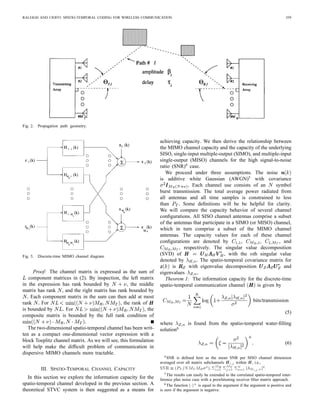
severe multipath [13], [14]. The transmitted signal propagates                    spatio-temporal channel may then be expressed as a vector
along     multiple paths created by reflection and scattering                      equation
from physical objects in the terrain as illustrated in Fig. 1.
                                                                                                                                                           (1)
We derive a far field1 signal model for linearly modulated
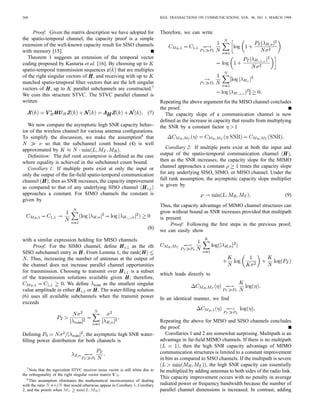
digital communication for a system with             transmitting                  where the MIMO channel matrix is composed of
antennas and          receiving antennas. In all that follows,                    single-input single-output (SISO) subblocks
complex valued baseband signal models are used. The implicit
assumption is that a radio frequency carrier upconverts the
baseband communication signal which is transmitted over the                                        .
                                                                                                   .       ..              .
                                                                                                                           .
                                                                                                   .            .          .
air and then coherently demodulated back to baseband at the
receiver.
   Considering the propagation geometry for the th propaga-                       with each subblock possessing the well-known Toeplitz form.
tion path, the th transmit antenna gain response2 due to the                      To clearly illustrate the effect of multipath, the channel can be
angle of departure      is      and the th receive antenna gain                   written as the sum over multipath components3
response due to angle of arrival          is             The th
propagation path is further characterized by a complex path
                                                                                                                               .
                                                                                                                               .
amplitude and a path propagation delay         This propagation                                                                .
geometry is depicted in Fig. 2.
   In the context of a digital signaling scheme, the transmitted                                                                                           (2)
baseband signal for the th transmitter element is
                                                                                  where the                         Toeplitz pulse shaping matrix is

                                                                                                   .
                                                                                                   .       ..         ..           ..       ..       .
                                                                                                                                                     .
where           is the (complex) symbol sequence,        is the                                    .            .          .            .        .   .
pulse shaping function impulse response, and is the symbol
period. The pulse shaping function is typically the convolution
of two separate filters, one at the transmitter and one at the                                      .
                                                                                                   .       ..         ..           ..       ..       .
                                                                                                                                                     .     (3)
                                                                                                   .            .          .            .        .   .
receiver. The optimum receiver filter is a matched filter. In
practice, the pulse shape is windowed, resulting in a finite
                                                                                                   .
                                                                                                   .       ..         ..           ..       ..       .
                                                                                                                                                     .
duration impulse response. The received signal for the th                                          .            .          .            .        .   .
antenna is then

                                                                                  This channel description is illustrated in Fig. 3.
                                                                                    Lemma 1: The number of finite amplitude parallel spatio-
                                                                                  temporal channel dimensions that can be created to commu-
                                                                                  nicate over the far field channel described by (1) is bounded
                                                                                  by
where           is the additive receiver noise.
                                                                                                                                                           (4)
  1 Here,  the far field assumption implies that dominant reflectors are suffi-
ciently far from the arrays so that the angles of departure, angles of arrival,      3 In (2), the inherent assumptions are that each propagation path ampli-
and time delays are constant over the extent of the array aperture.               tude
l , and the transmit and receive antenna array responses aT ;j (T ;l )
   2 Azimuth plane path propagation angles are considered here. The models        and aR;i (R;l ), are frequency invariant over the fractional bandwidth of
can easily be extended to include the effects of elevation angle by simply        the signal. While these assumptions are not necessary, they simplify the
adding a second angular coordinate.                                               discussion.
RALEIGH AND CIOFFI: SPATIO-TEMPORAL CODING FOR WIRELESS COMMUNICATION                                                                         359


Fig. 2. Propagation path geometry.


                                                                  achieving capacity. We then derive the relationship between
                                                                  the MIMO channel capacity and the capacity of the underlying
                                                                  SISO, single-input multiple-output (SIMO), and multiple-input
                                                                  single-output (MISO) channels for the high signal-to-noise
                                                                  ratio (SNR)4 case.
                                                                     We proceed under three assumptions. The noise
                                                                  is additive white Gaussian (AWGN)5 with covariance
                                                                                 Each channel use consists of an          symbol
                                                                  burst transmission. The total average power radiated from
                                                                  all antennas and all time samples is constrained to less
                                                                  than       Some definitions will be be helpful for clarity.
                                                                  We will compare the capacity behavior of several channel
                                                                  configurations. All SISO channel antennas comprise a subset
                                                                  of the antennas that participate in a SIMO (or MISO) channel,
                                                                  which in turn comprise a subset of the MIMO channel
                                                                  antennas. The capacity values for each of these channel
                                                                  configurations are denoted by            ,        ,       , and
                                                                           , respectively. The singular value decomposition
Fig. 3. Discrete-time MIMO channel diagram.
                                                                  (SVD) of                        , with the th singular value
                                                                  denoted by         The spatio-temporal covariance matrix for
                                                                        is     with eigenvalue decomposition                 and
     Proof: The channel matrix is expressed as the sum of         eigenvalues
   component matrices in (2). By inspection, the left matrix         Theorem 1: The information capacity for the discrete-time
in the expression has rank bounded by           , the middle      spatio-temporal communication channel          is given by
matrix has rank , and the right matrix has rank bounded by
    Each component matrix in the sum can then add at most
rank    For                                   the rank of                                                                     bits/transmission
is bounded by      For                                  , the
                                                                                                                                              (5)
composite matrix is bounded by the full rank condition of
                                                                  where           is found from the spatio-temporal water-filling
   The two-dimensional spatio-temporal channel has been writ-     solution6
ten as a compact one-dimensional vector expression with a
block Toeplitz channel matrix. As we will see, this formulation                                                                               (6)
will help make the difficult problem of communication in
dispersive MIMO channels more tractable.
                                                                    4 SNR is defined here as the mean SNR per SISO channel dimension
                                                                  averaged over all matrix subchannels H i;j within H , i.e.,
         III. SPATIO-TEMPORAL CHANNEL CAPACITY                    SNR (P =NM M 2 ); 6 =1 6 =1 6 =1 
                                                                             T      T    R
                                                                                                   M
                                                                                                   i
                                                                                                          M
                                                                                                          j
                                                                                                                 N
                                                                                                                 n    j   H     ;n j
                                                                                                                                       2:
                                                                     5 The results can easily be extended to the correlated spatio-temporal inter-
  In this section we explore the information capacity for the     ference plus noise case with a prewhitening receiver filter matrix approach.
spatio-temporal channel developed in the previous section. A         6 The function (1)+ is equal to the argument if the argument is positive and
theoretical STVC system is then suggested as a means for          is zero if the argument is negative.
360                                                                              IEEE TRANSACTIONS ON COMMUNICATIONS, VOL. 46, NO. 3, MARCH 1998


     Proof: Given the matrix description we have adopted for                     Therefore, we can write
the spatio-temporal channel, the capacity proof is a simple
extension of the well-known capacity result for SISO channels
with memory [15].
   Theorem 1 suggests an extension of the temporal vector
coding proposed by Kasturia et al. [16]. By choosing up to
spatio-temporal transmission sequences        that are multiples
of the right singular vectors of , and receiving with up to
matched spatio-temporal filter vectors that are the left singular
vectors of , up to       parallel subchannels are constructed.7
We coin this structure STVC. The STVC parallel channel is
written                                                                          Repeating the above argument for the MISO channel concludes
                                                                                 the proof.
                                                                          (7)       The capacity slope of a communication channel is now
                                                                                 defined as the increase in capacity that results from multiplying
   We now compare the asymptotic high SNR capacity behav-                        the SNR by a constant factor
ior of the wireless channel for various antenna configurations.
To simplify the discussion, we make the assumption8 that
           so that the subchannel count bound (4) is well
approximated by                                                                     Corollary 2: If multiple ports exist at both the input and
   Definition: The full rank assumption is defined as the case                     output of the spatio-temporal communication channel          ,
where equality is achieved in the subchannel count bound.                        then as the SNR increases, the capacity slope for the MIMO
   Corollary 1: If multiple ports exist at only the input or                     channel approaches a constant         times the capacity slope
only the output of the far-field spatio-temporal communication                    for any underlying SISO, SIMO, or MISO channel. Under the
channel      , then as SNR increases, the capacity improvement                   full rank assumption, the asymptotic capacity slope multiplier
as compared to that of any underlying SISO channel                               is given by
approaches a constant. For SIMO channels the constant is                                                                                      (9)
given by
                                                                                 Thus, the capacity advantage of MIMO channel structures can
                                                                                 grow without bound as SNR increases provided that multipath
                                                                                 is present.
                                                                                      Proof: Following the first steps in the previous proof,
                                                                          (8)
                                                                                 we can easily show
with a similar expression holding for MISO channels.
     Proof: For the SIMO channel, define             as the th
SISO subchannel entry in      From Lemma 1, the rank
    Thus, increasing the number of antennas at the output of
the channel does not increase parallel channel opportunities
for transmission. Choosing to transmit over        is a subset
                                                                                 which leads directly to
of the transmission solutions available given ; therefore,
                     We define         as the smallest singular
value amplitude in either     or    The water-filling solution
(6) uses all available subchannels when the transmit power                       In an identical manner, we find
exceeds


                                                                                 Repeating the above for MISO and SISO channels concludes
                                                                                 the proof.
Defining                      , the asymptotic high SNR water-                       Corollaries 1 and 2 are somewhat surprising. Multipath is an
filling power distribution for both channels is                                   advantage in far-field MIMO channels. If there is no multipath
                                                                                            , then the high SNR capacity advantage of MIMO
                                                                                 communication structures is limited to a constant improvement
                                                                                 in bits as compared to SISO channels. If the multipath is severe
                                                                                                         , the high SNR capacity can essentially
   7 Note that the equivalent STVC receiver noise vector is still white due to
                                                                                 be multiplied by adding antennas to both sides of the radio link.
the orthogonality of the right singular vector matrix V H :
   8 This assumption eliminates the mathematical inconvenience of dealing
                                                                                 This capacity improvement occurs with no penalty in average
with the ratio N + =N that would otherwise appear in Corollary 1, Corollary     radiated power or frequency bandwidth because the number of
2, and the proofs when MT       min(L; MR ):                                    parallel channel dimensions is increased. In contrast, adding
RALEIGH AND CIOFFI: SPATIO-TEMPORAL CODING FOR WIRELESS COMMUNICATION                                                             361


multiple antennas to only one side of the radio link increases     orthonormal singular vectors of the cyclic matrices          , the
capacity by an additive term as compared to SISO channels          new matrix is
regardless of the number of propagation paths. This is because
the number of parallel dimensions is not increased. This                                              .                     .
                                                                                                      .   ..                .
clearly provides theoretical motivation for optimal space–time                                        .        .            .
communication structures that can be implemented in practice.
In the next section we develop a practical computationally
efficient approach to spatio-temporal coding that can achieve       where        is the diagonal matrix containing the eigenvalues
the multiplicative capacity advantage.                                     of the cyclic channel submatrix      Premultiplication
                                                                   and post-multiplication by a permutation matrix     , and post-
             IV. DISCRETE MATRIX MULTITONE                         multiplication by a similar permutation matrix     , yields the
                                                                   block diagonal matrix
   The main disadvantage with the space–time vector coding
solution is the associated computational complexity. The SVD
of an                         matrix must be computed. Com-                                                        ..           (11)
                                                                                                                        .
plexity can be reduced by using a coding structure similar to
the discrete multitone (DMT) solution for the SISO channel
[17]–[19]. This new space–frequency coding structure results       where
in a matrix of transmission and reception vector solutions for
each discrete Fourier transform (DFT) frequency index. We
therefore coin the method DMMT.                                                       .           .            .
   For DMMT,         data symbols are again transmitted from                          .
                                                                                      .           .
                                                                                                  .            .
                                                                                                               .
each antenna during each channel usage. However, a cyclic
prefix is added to the beginning of the data sequence so that the
                                                                   is the            space–frequency channel evaluated at DFT
last data symbols are transmitted from each antenna element
                                                                   index
before transmitting the full block of     symbols. By receiving
                                                                      It is instructive to explore the nature of the
only     time samples at the output of each antenna element,
                                                                   space–frequency channel matrix               Defining the
ignoring the first and last       output samples, the DMMT
                                                                   receive array response vector as the column vector
channel submatrices                      now appear as cyclic
                                                                                                            and the transmit
structures. The new block cyclic channel matrix can again be
                                                                   array response vector as                                  ,
written as the matrix sum in (2) with the Toeplitz pulse shaping
                                                                   it can be verified that
matrices       replaced by the             cyclic pulse shaping
matrices given in (10), shown at the bottom of the page.
Given the cyclic SISO channel blocks, we can diagonalize the                                                                    (12)
new channel matrix with a three-step procedure. We first post-
multiply      with the                   block diagonal inverse
                                                                   where         is the DFT of the sequence               evalu-
discrete Fourier transform (IDFT) matrix
                                                                   ated at DFT index . Thus, at each frequency index, the
                                                                   DMMT channel is due to a weighted sum over             rank-1
                                    ..                             outer products of the frequency-invariant receive and trans-
                                         .
                                                                   mit array response vectors. The weighting is determined by
                                                                   the frequency-invariant path fading values and the Fourier
where each diagonal block is the unitary      by     IDFT          transform of the delayed pulse shaping function. This reveals
matrix      The next step is to premultiply   by a similar         a highly structured nature for the space–frequency channel
       by       block diagonal DFT matrix        where the         spectrum.
diagonal submatrices are      by    DFT matrices. With the            Given the SVD of                                     , the
well-known result [20] that the DFT basis vectors form the         diagonal DMMT channel matrix          is finally obtained by


                                                                                                                                (10)
362                                                                IEEE TRANSACTIONS ON COMMUNICATIONS, VOL. 46, NO. 3, MARCH 1998


Fig. 4. DMMT system diagram.


postmultiplying by             and premultiplying by               continuous-frequency channel capacity given by

                                                                                                                                          (14)

                          ..                                       where             is found from the space–frequency water-filling
                               .
                                                                   solution

where          is block diagonal, with each block containing                                                                              (15)
the right singular matrices of the        matrices,           is
                                                                         Proof: The DMMT noise sequence is still AWGN since
block diagonal containing the left singular matrices of the
matrices, and each of the diagonal submatrices     contains the
DMMT spatial subchannel amplitudes           where
               The parallel channel DMMT equation is then
                                                                   Given this, and the parallel independent channel structure of
                                                           (13)    DMMT, it is clear that

where         is the length       input symbol vector,        is
the length         output symbol vector, and       is the length
       equivalent output noise vector. A block diagram archi-                                                                             (16)
tecture that implements the DMMT space–frequency channel
decomposition is presented in Fig. 4.                              where
   Assuming                       and         , the
complexity of the vector coding solution computation has been
reduced to       independent    point IFFT’s,       independent
   point FFT’s, and independent          by    SVD’s resulting     As         , the noise sequence power spectrum remains flat
in a complexity of                                 for DMMT.       with power density     It is well known that the DFT sequence
The signal processing complexity required at the transmit-         converges to the continuous-frequency Fourier transform, so
ter and receiver to diagonalize all space–time subchannels                                    ,9 which leads directly to
for each data block has been reduced from                     to
                                                                                                                                          (17)
   We now show that STVC and DMMT are both asymptot-
ically optimal.                                                       9 Note that G (! )
                                                                                    l       = (1=T ) 61 01 [Gct ((!=T )) 0 (2n=
                                                                                                              n=
   Theorem 2: In the limit as      , the capacity of the           T ))ej (!=T 0(2n=T )) ] is the folded frequency spectrum of the continuous-
STVC solution and the DMMT solution both converge to the           time continuous-frequency Fourier transform Gct (! ) = F (g (t 0 l )):
RALEIGH AND CIOFFI: SPATIO-TEMPORAL CODING FOR WIRELESS COMMUNICATION                                                                363


and the channel matrix singular value                 becomes        where is the spatial index and is the DFT frequency index.
           Therefore, from the standard properties of Riemann        The bit allocation per subchannel is then given by
integration, the summation in (16) converges to the desired
result for the DMMT structure.                                                                                                     (21)
   For the STVC case, the output noise is again AWGN. With
    written as in (2), it is known [21], [22] that the singular         It is not possible to achieve infinite bit resolution (granu-
value distribution for the Toeplitz matrix       converges, as       larity) with coset codes. Therefore, the solution in (21) must
          , to the continuous-frequency Fourier transform of         be modified. Several bit loading algorithms exist to resolve
          Therefore, the STVC space–frequency channel also           this problem. The granularity of possible bit allocations is
converges to (17). This concludes the proof.                         determined by the dimensionality of the coset code lattice
   In the more general spatially continuous antenna case, the        structure. A two-dimensional symbol [e.g., quadrature ampli-
summation over the discrete antenna index          becomes an        tude modulation (QAM)] in an eight-dimensional lattice has a
integration over continuous antenna volume index                     bit granularity of 0.25. In our MIMO channel communication
                                                                     structures the orthogonal constellation dimensions are the
                                                                     complex plane, space, and frequency (or time).
                                                             (18)
                                                                        Referring now to [26], an effective coding method for
                                                                     parallel channel systems is to “code across subchannels.” In
                                                                     this technique the power and bit allocation for each subchannel
                                                                     is computed as in (20) and (21), and each successive set of
                                                             (19)
                                                                     input bits to the trellis encoder corresponds to a different trans-
                                                                     mit subchannel. At each branch in the receiver’s maximum-
These equations suggest that an unexploited capacity mul-
                                                                     likelihood sequence estimator (MLSE) the number of possible
tiplying advantage also exists for many distributed antenna
                                                                     coset members and trellis branches are determined by the
structures commonly used in wireless communication.                  number of bits loaded onto the corresponding subchannel.
                                                                     Using this technique, the maximum latency is approximately
                V. SPATIO-TEMPORAL CODING                                          [27]. The additive factor         is associated with
                                                                     the decoding delay to code across transmitted data blocks.
   This section provides background on existing coding               This factor can be eliminated using the so-called “tail biting”
schemes that can be used effectively to distribute information       technique. If tail biting is used, there is a rate ratio penalty
over parallel space and frequency (or temporal) dimensions           of approximately                  that is associated with always
that exist in STVC and DMMT channels. This discussion                transmitting a known sequence at the end of the block so that
assumes estimation of the MIMO channel by transmitting               the MLSE can complete the trellis decision sequence.
a series of training symbol sequences from each antenna                 Many of the other practical coding techniques developed
element and that the receiver and transmitter share the              for parallel subchannel communication systems, not mentioned
information required to decompose the channel into                   here, can also be applied to the STVC and DMMT parallel
parallel subchannels. Estimating the DMMT channels can               subchannel structures developed in the previous section.
be accomplished by using well-known SISO channel training
and estimation techniques for each of the channel subblocks
                                                                                     VI. EXPERIMENTAL EXAMPLES
   The trellis codes first reported by Ungerboeck [23] led to the        In this section the results of wireless DMMT simulation
general class of coset coding techniques reported by Forney          experiments are reported. The first experiment compares the
[24]. The coset selection encoder is typically a convolutional       capacity of an example wireless MIMO channel with the
code with constraint length and input to output coding ratio         capacity of the underlying SIMO and SISO channel blocks.
The so-called “gap analysis” [25] provides an effective method       The second experiment illustrates how DMMT can increase
for approximating the probability of error performance of            reliable data transmission rates using practical coding schemes.
coset codes. In this technique, a particular coset code with an      The third experiment illustrates the decrease in MIMO channel
associated lattice structure is characterized by first determining    capacity that occurs if the number of multipath components is
the SNR required to achieve a theoretical capacity equal to          less than the number of input and output antenna elements.
the desired data rate. The code gap is then the SNR multiplier
required to achieve the target probability of error at the desired   Example 1:
data rate. In a parallel channel communication system this gap          The STVC channel is described by (2). For the DMMT
can be used to determine the power and bit distributions that        channel, the block Toeplitz matrix   is replaced by the block
maximize data rate subject to a probability of error constraint.     cyclic matrix    All model parameters are generated randomly
With a coding gap of , the rate maximizing water-filling              from probability distributions that approximate a realistic
solution for the DMMT channel becomes                                urban multipath channel. There are ten random multipath
                                                                     components. The path time delays are drawn from a uniform
                                                             (20)    distribution with a root-mean-square (rms) delay spread of 2
                                                                          The transmission and reception angles       and       for
364                                                                              IEEE TRANSACTIONS ON COMMUNICATIONS, VOL. 46, NO. 3, MARCH 1998


                                                                                 SIMO DMT channels are also computed. The transmitter
                                                                                 power penalty associated with transmitting the cyclic prefix11
                                                                                 is accounted for in the DMMT capacity results. Mean channel
                                                                                 capacity per symbol12 as a function of mean SNR13 per symbol
                                                                                 is plotted for each of the test cases.
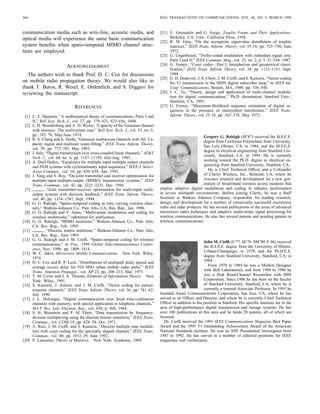
                                                                                    The experimental results are in strong agreement with
                                                                                 Corollaries 1 and 2. For large SNR values, a 3-dB increase in
                                                                                 SNR results is a 4-bit increase in STVC channel capacity while
                                                                                 the SISO [Fig. 5(a)] and SIMO [Fig. 5(b)] DMT channels only
                                                                                 increase by 1 bit. This capacity slope multiplier corresponds
                                                                                 to the fourfold increase in spatial channel water-filling dimen-
                                                                                 sions associated with four channel inputs and four channel
                                                                                 outputs. At all SNR values the DMMT channel capacity is
                                                                                 significantly higher than the capacity of any of the SISO and
                                                                                 SIMO DMT channels. The STVC channel capacity is slightly
                                                                                 higher than the DMMT channel capacity. The difference is
                                                                                 essentially equal to the transmitted power penalty associated
                                     (a)                                         with the cyclic prefix.

                                                                                 Example 2:
                                                                                    In the second example the same experimental channels
                                                                                 described above are used again. The channels were evaluated
                                                                                 for achievable data rates using the coding gap             dB)
                                                                                 for a well-known eight-dimensional trellis code applied across
                                                                                 space and frequency (time) subchannels. The results of the
                                                                                 second experiment are presented in Table I. The experimental
                                                                                 values for reliable data rate follow the same trends that were
                                                                                 observed in the capacity experiments. The DMMT channel bit
                                                                                 rate is much higher than all of the SIMO and SISO DMT
                                                                                 channels. The high SNR DMMT data rate slope is again 4
                                                                                 bits per 3 dB SNR increase while the SIMO DMT and SISO
                                                                                 DMT channels exhibit a slope of 1 bit per 3 dB increrase.
                                                                                    The experimental SISO multipath channels, with 300 kHz
                                                                                 channel spacing, would support data rates ranging from 1.7 to
                                                                                 6.0 b/symbol period, or 0.34 to 1.20 Mb/s, at a mean SNR
                                     (b)
                                                                                 of 20 dB. This results in a data transmission efficiency from
Fig. 5. Channel capacity experimental results for L    = 10:                     1.1 to 4.0 b/s/Hz. When combined into a DMMT structure,
                                                                                 these same underlying SISO channels with the same frequency
each path are drawn from uniform distributions centered at                       bandwidth and transmitter power will support a data rate
0 with an rms angle spread of 25 The path amplitudes                             of 14.7 b/symbol period, or 2.94 Mb/s, for an efficiency of
    are generated from a complex Gaussian distribution. The                      9.8 b/s/Hz.
pulse shaping function      is raised cosine with 5- symbol                         It may at first seem impractical to transmit an average of
period10 and rolloff factor 0.35. The pulse function duration                    15 b/symbol due to the limits of practical constellation sizes.
is seven symbol periods and the lag              Each antenna                    However, the DMMT data for each DFT bin is spread over
array contains four elements in a linear arrangement with an                     four orthogonal spatial subchannel dimensions. This reduces
interelement spacing of five carrier frequency wavelengths.                       the peak number of bits per tone that must be transmitted over
Each element has an omnidirectional radiation pattern. The                       any single subchannel. With a mean SNR of 20 dB, the peak
number of transmitted symbols per block is 64. The receiver                      experimental data load for any single DMMT space–frequency
noise for each antenna element is complex AWGN.                                  subchannel is 7.2 b. The maximum data load for the best
   The capacity of the 4 4 STVC channel is compared to the                       DMT SISO subchannel is 6.9 b and the maximum load for
capacity of the 4 4 DMMT channel in Fig. 5. To provide                           the best DMT SIMO subchannel is 8.1 b. Thus, even though
a reference for capacity improvement, the capacity values                          11 The requirement to transmit the cyclic prefix results in an equivalent
for all 16 1 1 SISO DMT subchannels are computed. To                             DMMT transmission power of PT 1 N=(N +  ):
provide another comparison, the capacity values for all 4 1                        12 Mean capacity per symbol period is defined here as the total channel
                                                                                 capacity in bits for all parallel channels over the entire block, divided by N:
   10 This pulse shape is consistent with certain existing personal communica-     13 Mean SNR per symbol is computed by averaging over all of the squared
tion services (PCS) wireless modulation schemes intended for wireless local      channel singular values for all of the 16 SISO DMT channels and then
loop applications.                                                                                                 2
                                                                                 multiplying by the ratio PT =n (see footnote 4).
RALEIGH AND CIOFFI: SPATIO-TEMPORAL CODING FOR WIRELESS COMMUNICATION                                                              365


                                                              TABLE I
                                          EXPERIMENTAL ACHIEVABLE DATA RATES   AT   Pe   = 1006


the DMMT coding scheme achieves much higher data rates,
in this experimental example, the maximum bit loading per
tone was essentially the same as the best SISO channel and
less than the best SIMO channel.

Example 3:
   In the third example, a second capacity experiment was
conducted wherein the number of multipath components was
reduced to three, which is less than the four channel inputs
and outputs. All other channel parameters remained unchanged
from experiment 1. The results of this experiment are presented
in Fig. 6. Again, the experimental data supports the theory
on capacity slope. With only three multipath components, the
maximum improvement in MIMO parallel space–time channel
count is a factor of three above the SIMO and MISO channels.
The high SNR DMMT capacity slope is now 3 bits for every
3 dB of SNR increase. The SISO and SIMO DMT channels                                                   (a)
maintain an incremental slope of 1 b per 3 dB SNR increase.

                      VII. CONCLUSIONS
   A model was developed wherein the difficult two dimen-
sional problem of communicating with dispersive MIMO
channels was collapsed into a one dimensional vector equation.
The information capacity for wireless MIMO channels was
then analyzed. An asymptotically optimal STVC communica-
tion structure was proposed. Multipath can significantly im-
prove the capacity of MIMO channels. If                         ,
then at high SNR values, the capacity slope in bits per
decibel of power increase increases linearly with the number
of antennas employed at the input and output of the chan-
nel. This capacity multiplying effect does not result from
the well studied approach of employing multiple antennas
only on one side of the channel. An asympototically opti-
mal space–frequency MIMO DMMT information transmission
structure was derived. This new approach has a complexity                                              (b)
advantage of approximately         as compared to STVC. The         Fig. 6. Channel capacity experimental results for   L   = 3:
necessary background was provided to show how to use
adaptive-lattice trellis-coding techniques to code across the
                                                                    constrain radiated interference power at the transmitter. Spatial
space and frequency dimensions in a DMMT channel. Exam-
ples were provided to demonstrate that the theoretical results      coding techniques can also be applied to single frequency
are consistent with observed experimental MIMO channel              subchannel systems with flat fading, conventional analog mul-
behavior.                                                           ticarrier transmission channels, or CDMA channels where each
   The results presented in this paper can easily be extended to    code delay can be decomposed into orthogonal subchannels
channels where the noise is not white but is highly structured      provided that there is subchip multipath. Our basic results can
as in the case of additive cochannel interference. In this          also be applied to a more general class of channels where
case, large cellular network capacity gains result due to the       the antenna array is distributed over large distances and the
ability to null interference at the receiver and the ability to     propagation does not follow far-field behavior. Finally, other

10.1.1.21.5598

  • 1.
    IEEE TRANSACTIONS ONCOMMUNICATIONS, VOL. 46, NO. 3, MARCH 1998 357 Spatio-Temporal Coding for Wireless Communication Gregory G. Raleigh, Member, IEEE, and John M. Cioffi, Fellow, IEEE Abstract—Multipath signal propagation has long been viewed linear MMSE vector transmission and reception filters for as an impairment to reliable communication in wireless channels. channels with no excess bandwidth. More recent work This paper shows that the presence of multipath greatly improves on MIMO equalizers includes the linear equalizer with excess achievable data rate if the appropriate communication structure is employed. A compact model is developed for the multiple-input bandwidth and the decision feedback equalizer [5]–[7]. multiple-output (MIMO) dispersive spatially selective wireless Consider the problem of communication with linear mod- communication channel. The multivariate information capacity ulation in a frequency-dispersive spatially selective wireless is analyzed. For high signal-to-noise ratio (SNR) conditions, the channel composed of transmission antennas and MIMO channel can exhibit a capacity slope in bits per decibel reception antennas with additive noise. What is the impact of power increase that is proportional to the minimum of the number multipath components, the number of input antennas, or of multipath on the information capacity of the discrete time the number of output antennas. This desirable result is contrasted communication channel? How do various multiple antenna with the lower capacity slope of the well-studied case with multi- structures influence channel capacity? Is it possible to con- ple antennas at only one side of the radio link. A spatio-temporal struct multiple antenna coding systems that benefit from the vector-coding (STVC) communication structure is suggested as inherent properties of severe multipath channels? This paper a means for achieving MIMO channel capacity. The complexity of STVC motivates a more practical reduced-complexity discrete is a first attempt to answer these questions for time-invariant matrix multitone (DMMT) space–frequency coding approach. channels such as those that exist in certain wireless local loop Both of these structures are shown to be asymptotically optimum. applications. Time-varying channels are treated in [8] and [9]. An adaptive-lattice trellis-coding technique is suggested as a A compact MIMO channel model is developed in Section method for coding across the space and frequency dimensions II. We then explore the theoretical information capacity limits that exist in the DMMT channel. Experimental examples that support the theoretical results are presented. of the MIMO channel in Section III. We find that multipath substantially improves capacity for the MIMO case. Specifi- Index Terms—Adaptive arrays, adaptive coding, adaptive mod- cally, if the number of multipath components exceeds a certain ulation, antenna arrays, broad-band communication, channel coding, digital modulation, information rates, MIMO systems, value, then the channel capacity slope in bits per decibel of multipath channels. power increase can be proportional to the number of antennas located at both the input and output of the channel. This I. INTRODUCTION highly desirable result is contrasted with the more conventional case with multiple antennas on only one side of the channel. T HE SYSTEMATIC study of reliable communication in linear channels was initiated by the work of Shannon in 1948 [1]. The information capacity of certain multiple- A spatio-temporal vector coding (STVC) structure for burst transmission is suggested as a theoretical means for achieving capacity. The high complexity of the STVC structure motivates input multiple-output (MIMO) channels with memory was a more practical reduced-complexity discrete matrix multitone derived by Brandenburg and Wyner [2]. Recent work by (DMMT) space–frequency coding structure which is analyzed Cheng and Verdu [3] derives the capacity region for more in Section IV. Both STVC and DMMT are shown to achieve general multiaccess MIMO channels. The problem of joint the true channel capacity as the burst duration increases. optimization of a multivariate transmitter–receiver pair to In Section V, an adaptive-lattice trellis-coding technique is minimize the mean-square error criteria (MMSE) has gained suggested as a practical method for coding across space and considerable attention. One of the earliest contributions to this frequency dimensions in the DMMT channel. Experimental problem was made by Salz [4], who developed the optimum examples that support the theoretical results are then reported in Section VI. Paper approved by T. Aulin, the Editor for Coding and Communication The main contributions in this paper are the matrix channel Theory of the IEEE Communications Society. Manuscript received April 9, 1996; revised September 27, 1996 and July 21, 1997. This work was supported model development, the connection between rank and multi- by Watkins-Johnson Company and by Clarity Wireless, Inc. This paper was path shown in Lemma 1, the multipath capacity behavior of presented in part at the 1996 Global Communications Conference, November various multiple antenna structures highlighted by Corollaries 1996. G. G. Raleigh is with Clarity Wireless, Inc., Belmont, CA 94002 USA (e- 2 and 3, introduction of DMMT as a realizable means to mail: raleigh@clarity-wireless.com). achieve a multiplicative reliable rate advantage in dispersive J. M. Cioffi is with the Department of Electrical Engineering, Stanford MIMO channels, and the asymptotic optimality proof for University, Stanford, CA 94305-4055 USA, and with Amati Communications Corporation, San Jose, CA 95124 USA. DMMT capacity Theorem 2. The results presented in this Publisher Item Identifier S 0090-6778(98)02123-0. paper are based on the work previously reported in [10]–[12]. 0090–6778/98$10.00 © 1998 IEEE
  • 2.
    358 IEEE TRANSACTIONS ON COMMUNICATIONS, VOL. 46, NO. 3, MARCH 1998 Synchronous complex baseband sampling with symbol pe- riod is assumed for the receiver. We define and to be the maximum lag and length over all for the sampled pulse function sequences To simplify notation, it is assumed that , and the discrete-time notation is adopted. When a block of data symbols are transmitted, nonzero output samples result, beginning at time sample and ending with sample The composite channel output can now be written as a column vector with all time samples for a given receive antenna appearing in order Fig. 1. Illustration of the physical wireless channel. so that , with an identical stacking for the output II. MIMO CHANNEL MODEL noise samples The input symbol vector is written Wireless communication channels are often characterized by The severe multipath [13], [14]. The transmitted signal propagates spatio-temporal channel may then be expressed as a vector along multiple paths created by reflection and scattering equation from physical objects in the terrain as illustrated in Fig. 1. (1) We derive a far field1 signal model for linearly modulated digital communication for a system with transmitting where the MIMO channel matrix is composed of antennas and receiving antennas. In all that follows, single-input single-output (SISO) subblocks complex valued baseband signal models are used. The implicit assumption is that a radio frequency carrier upconverts the baseband communication signal which is transmitted over the . . .. . . . . . air and then coherently demodulated back to baseband at the receiver. Considering the propagation geometry for the th propaga- with each subblock possessing the well-known Toeplitz form. tion path, the th transmit antenna gain response2 due to the To clearly illustrate the effect of multipath, the channel can be angle of departure is and the th receive antenna gain written as the sum over multipath components3 response due to angle of arrival is The th propagation path is further characterized by a complex path . . amplitude and a path propagation delay This propagation . geometry is depicted in Fig. 2. In the context of a digital signaling scheme, the transmitted (2) baseband signal for the th transmitter element is where the Toeplitz pulse shaping matrix is . . .. .. .. .. . . where is the (complex) symbol sequence, is the . . . . . . pulse shaping function impulse response, and is the symbol period. The pulse shaping function is typically the convolution of two separate filters, one at the transmitter and one at the . . .. .. .. .. . . (3) . . . . . . receiver. The optimum receiver filter is a matched filter. In practice, the pulse shape is windowed, resulting in a finite . . .. .. .. .. . . duration impulse response. The received signal for the th . . . . . . antenna is then This channel description is illustrated in Fig. 3. Lemma 1: The number of finite amplitude parallel spatio- temporal channel dimensions that can be created to commu- nicate over the far field channel described by (1) is bounded by where is the additive receiver noise. (4) 1 Here, the far field assumption implies that dominant reflectors are suffi- ciently far from the arrays so that the angles of departure, angles of arrival, 3 In (2), the inherent assumptions are that each propagation path ampli- and time delays are constant over the extent of the array aperture. tude
  • 3.
    l , andthe transmit and receive antenna array responses aT ;j (T ;l ) 2 Azimuth plane path propagation angles are considered here. The models and aR;i (R;l ), are frequency invariant over the fractional bandwidth of can easily be extended to include the effects of elevation angle by simply the signal. While these assumptions are not necessary, they simplify the adding a second angular coordinate. discussion.
  • 4.
    RALEIGH AND CIOFFI:SPATIO-TEMPORAL CODING FOR WIRELESS COMMUNICATION 359 Fig. 2. Propagation path geometry. achieving capacity. We then derive the relationship between the MIMO channel capacity and the capacity of the underlying SISO, single-input multiple-output (SIMO), and multiple-input single-output (MISO) channels for the high signal-to-noise ratio (SNR)4 case. We proceed under three assumptions. The noise is additive white Gaussian (AWGN)5 with covariance Each channel use consists of an symbol burst transmission. The total average power radiated from all antennas and all time samples is constrained to less than Some definitions will be be helpful for clarity. We will compare the capacity behavior of several channel configurations. All SISO channel antennas comprise a subset of the antennas that participate in a SIMO (or MISO) channel, which in turn comprise a subset of the MIMO channel antennas. The capacity values for each of these channel configurations are denoted by , , , and , respectively. The singular value decomposition Fig. 3. Discrete-time MIMO channel diagram. (SVD) of , with the th singular value denoted by The spatio-temporal covariance matrix for is with eigenvalue decomposition and Proof: The channel matrix is expressed as the sum of eigenvalues component matrices in (2). By inspection, the left matrix Theorem 1: The information capacity for the discrete-time in the expression has rank bounded by , the middle spatio-temporal communication channel is given by matrix has rank , and the right matrix has rank bounded by Each component matrix in the sum can then add at most rank For the rank of bits/transmission is bounded by For , the (5) composite matrix is bounded by the full rank condition of where is found from the spatio-temporal water-filling The two-dimensional spatio-temporal channel has been writ- solution6 ten as a compact one-dimensional vector expression with a block Toeplitz channel matrix. As we will see, this formulation (6) will help make the difficult problem of communication in dispersive MIMO channels more tractable. 4 SNR is defined here as the mean SNR per SISO channel dimension averaged over all matrix subchannels H i;j within H , i.e., III. SPATIO-TEMPORAL CHANNEL CAPACITY SNR (P =NM M 2 ); 6 =1 6 =1 6 =1 T T R M i M j N n j H ;n j 2: 5 The results can easily be extended to the correlated spatio-temporal inter- In this section we explore the information capacity for the ference plus noise case with a prewhitening receiver filter matrix approach. spatio-temporal channel developed in the previous section. A 6 The function (1)+ is equal to the argument if the argument is positive and theoretical STVC system is then suggested as a means for is zero if the argument is negative.
  • 5.
    360 IEEE TRANSACTIONS ON COMMUNICATIONS, VOL. 46, NO. 3, MARCH 1998 Proof: Given the matrix description we have adopted for Therefore, we can write the spatio-temporal channel, the capacity proof is a simple extension of the well-known capacity result for SISO channels with memory [15]. Theorem 1 suggests an extension of the temporal vector coding proposed by Kasturia et al. [16]. By choosing up to spatio-temporal transmission sequences that are multiples of the right singular vectors of , and receiving with up to matched spatio-temporal filter vectors that are the left singular vectors of , up to parallel subchannels are constructed.7 We coin this structure STVC. The STVC parallel channel is written Repeating the above argument for the MISO channel concludes the proof. (7) The capacity slope of a communication channel is now defined as the increase in capacity that results from multiplying We now compare the asymptotic high SNR capacity behav- the SNR by a constant factor ior of the wireless channel for various antenna configurations. To simplify the discussion, we make the assumption8 that so that the subchannel count bound (4) is well approximated by Corollary 2: If multiple ports exist at both the input and Definition: The full rank assumption is defined as the case output of the spatio-temporal communication channel , where equality is achieved in the subchannel count bound. then as the SNR increases, the capacity slope for the MIMO Corollary 1: If multiple ports exist at only the input or channel approaches a constant times the capacity slope only the output of the far-field spatio-temporal communication for any underlying SISO, SIMO, or MISO channel. Under the channel , then as SNR increases, the capacity improvement full rank assumption, the asymptotic capacity slope multiplier as compared to that of any underlying SISO channel is given by approaches a constant. For SIMO channels the constant is (9) given by Thus, the capacity advantage of MIMO channel structures can grow without bound as SNR increases provided that multipath is present. Proof: Following the first steps in the previous proof, (8) we can easily show with a similar expression holding for MISO channels. Proof: For the SIMO channel, define as the th SISO subchannel entry in From Lemma 1, the rank Thus, increasing the number of antennas at the output of the channel does not increase parallel channel opportunities for transmission. Choosing to transmit over is a subset which leads directly to of the transmission solutions available given ; therefore, We define as the smallest singular value amplitude in either or The water-filling solution (6) uses all available subchannels when the transmit power In an identical manner, we find exceeds Repeating the above for MISO and SISO channels concludes the proof. Defining , the asymptotic high SNR water- Corollaries 1 and 2 are somewhat surprising. Multipath is an filling power distribution for both channels is advantage in far-field MIMO channels. If there is no multipath , then the high SNR capacity advantage of MIMO communication structures is limited to a constant improvement in bits as compared to SISO channels. If the multipath is severe , the high SNR capacity can essentially 7 Note that the equivalent STVC receiver noise vector is still white due to be multiplied by adding antennas to both sides of the radio link. the orthogonality of the right singular vector matrix V H : 8 This assumption eliminates the mathematical inconvenience of dealing This capacity improvement occurs with no penalty in average with the ratio N + =N that would otherwise appear in Corollary 1, Corollary radiated power or frequency bandwidth because the number of 2, and the proofs when MT min(L; MR ): parallel channel dimensions is increased. In contrast, adding
  • 6.
    RALEIGH AND CIOFFI:SPATIO-TEMPORAL CODING FOR WIRELESS COMMUNICATION 361 multiple antennas to only one side of the radio link increases orthonormal singular vectors of the cyclic matrices , the capacity by an additive term as compared to SISO channels new matrix is regardless of the number of propagation paths. This is because the number of parallel dimensions is not increased. This . . . .. . clearly provides theoretical motivation for optimal space–time . . . communication structures that can be implemented in practice. In the next section we develop a practical computationally efficient approach to spatio-temporal coding that can achieve where is the diagonal matrix containing the eigenvalues the multiplicative capacity advantage. of the cyclic channel submatrix Premultiplication and post-multiplication by a permutation matrix , and post- IV. DISCRETE MATRIX MULTITONE multiplication by a similar permutation matrix , yields the block diagonal matrix The main disadvantage with the space–time vector coding solution is the associated computational complexity. The SVD of an matrix must be computed. Com- .. (11) . plexity can be reduced by using a coding structure similar to the discrete multitone (DMT) solution for the SISO channel [17]–[19]. This new space–frequency coding structure results where in a matrix of transmission and reception vector solutions for each discrete Fourier transform (DFT) frequency index. We therefore coin the method DMMT. . . . For DMMT, data symbols are again transmitted from . . . . . . each antenna during each channel usage. However, a cyclic prefix is added to the beginning of the data sequence so that the is the space–frequency channel evaluated at DFT last data symbols are transmitted from each antenna element index before transmitting the full block of symbols. By receiving It is instructive to explore the nature of the only time samples at the output of each antenna element, space–frequency channel matrix Defining the ignoring the first and last output samples, the DMMT receive array response vector as the column vector channel submatrices now appear as cyclic and the transmit structures. The new block cyclic channel matrix can again be array response vector as , written as the matrix sum in (2) with the Toeplitz pulse shaping it can be verified that matrices replaced by the cyclic pulse shaping matrices given in (10), shown at the bottom of the page. Given the cyclic SISO channel blocks, we can diagonalize the (12) new channel matrix with a three-step procedure. We first post- multiply with the block diagonal inverse where is the DFT of the sequence evalu- discrete Fourier transform (IDFT) matrix ated at DFT index . Thus, at each frequency index, the DMMT channel is due to a weighted sum over rank-1 .. outer products of the frequency-invariant receive and trans- . mit array response vectors. The weighting is determined by the frequency-invariant path fading values and the Fourier where each diagonal block is the unitary by IDFT transform of the delayed pulse shaping function. This reveals matrix The next step is to premultiply by a similar a highly structured nature for the space–frequency channel by block diagonal DFT matrix where the spectrum. diagonal submatrices are by DFT matrices. With the Given the SVD of , the well-known result [20] that the DFT basis vectors form the diagonal DMMT channel matrix is finally obtained by (10)
  • 7.
    362 IEEE TRANSACTIONS ON COMMUNICATIONS, VOL. 46, NO. 3, MARCH 1998 Fig. 4. DMMT system diagram. postmultiplying by and premultiplying by continuous-frequency channel capacity given by (14) .. where is found from the space–frequency water-filling . solution where is block diagonal, with each block containing (15) the right singular matrices of the matrices, is Proof: The DMMT noise sequence is still AWGN since block diagonal containing the left singular matrices of the matrices, and each of the diagonal submatrices contains the DMMT spatial subchannel amplitudes where The parallel channel DMMT equation is then Given this, and the parallel independent channel structure of (13) DMMT, it is clear that where is the length input symbol vector, is the length output symbol vector, and is the length equivalent output noise vector. A block diagram archi- (16) tecture that implements the DMMT space–frequency channel decomposition is presented in Fig. 4. where Assuming and , the complexity of the vector coding solution computation has been reduced to independent point IFFT’s, independent point FFT’s, and independent by SVD’s resulting As , the noise sequence power spectrum remains flat in a complexity of for DMMT. with power density It is well known that the DFT sequence The signal processing complexity required at the transmit- converges to the continuous-frequency Fourier transform, so ter and receiver to diagonalize all space–time subchannels ,9 which leads directly to for each data block has been reduced from to (17) We now show that STVC and DMMT are both asymptot- ically optimal. 9 Note that G (! ) l = (1=T ) 61 01 [Gct ((!=T )) 0 (2n= n= Theorem 2: In the limit as , the capacity of the T ))ej (!=T 0(2n=T )) ] is the folded frequency spectrum of the continuous- STVC solution and the DMMT solution both converge to the time continuous-frequency Fourier transform Gct (! ) = F (g (t 0 l )):
  • 8.
    RALEIGH AND CIOFFI:SPATIO-TEMPORAL CODING FOR WIRELESS COMMUNICATION 363 and the channel matrix singular value becomes where is the spatial index and is the DFT frequency index. Therefore, from the standard properties of Riemann The bit allocation per subchannel is then given by integration, the summation in (16) converges to the desired result for the DMMT structure. (21) For the STVC case, the output noise is again AWGN. With written as in (2), it is known [21], [22] that the singular It is not possible to achieve infinite bit resolution (granu- value distribution for the Toeplitz matrix converges, as larity) with coset codes. Therefore, the solution in (21) must , to the continuous-frequency Fourier transform of be modified. Several bit loading algorithms exist to resolve Therefore, the STVC space–frequency channel also this problem. The granularity of possible bit allocations is converges to (17). This concludes the proof. determined by the dimensionality of the coset code lattice In the more general spatially continuous antenna case, the structure. A two-dimensional symbol [e.g., quadrature ampli- summation over the discrete antenna index becomes an tude modulation (QAM)] in an eight-dimensional lattice has a integration over continuous antenna volume index bit granularity of 0.25. In our MIMO channel communication structures the orthogonal constellation dimensions are the complex plane, space, and frequency (or time). (18) Referring now to [26], an effective coding method for parallel channel systems is to “code across subchannels.” In this technique the power and bit allocation for each subchannel is computed as in (20) and (21), and each successive set of (19) input bits to the trellis encoder corresponds to a different trans- mit subchannel. At each branch in the receiver’s maximum- These equations suggest that an unexploited capacity mul- likelihood sequence estimator (MLSE) the number of possible tiplying advantage also exists for many distributed antenna coset members and trellis branches are determined by the structures commonly used in wireless communication. number of bits loaded onto the corresponding subchannel. Using this technique, the maximum latency is approximately V. SPATIO-TEMPORAL CODING [27]. The additive factor is associated with the decoding delay to code across transmitted data blocks. This section provides background on existing coding This factor can be eliminated using the so-called “tail biting” schemes that can be used effectively to distribute information technique. If tail biting is used, there is a rate ratio penalty over parallel space and frequency (or temporal) dimensions of approximately that is associated with always that exist in STVC and DMMT channels. This discussion transmitting a known sequence at the end of the block so that assumes estimation of the MIMO channel by transmitting the MLSE can complete the trellis decision sequence. a series of training symbol sequences from each antenna Many of the other practical coding techniques developed element and that the receiver and transmitter share the for parallel subchannel communication systems, not mentioned information required to decompose the channel into here, can also be applied to the STVC and DMMT parallel parallel subchannels. Estimating the DMMT channels can subchannel structures developed in the previous section. be accomplished by using well-known SISO channel training and estimation techniques for each of the channel subblocks VI. EXPERIMENTAL EXAMPLES The trellis codes first reported by Ungerboeck [23] led to the In this section the results of wireless DMMT simulation general class of coset coding techniques reported by Forney experiments are reported. The first experiment compares the [24]. The coset selection encoder is typically a convolutional capacity of an example wireless MIMO channel with the code with constraint length and input to output coding ratio capacity of the underlying SIMO and SISO channel blocks. The so-called “gap analysis” [25] provides an effective method The second experiment illustrates how DMMT can increase for approximating the probability of error performance of reliable data transmission rates using practical coding schemes. coset codes. In this technique, a particular coset code with an The third experiment illustrates the decrease in MIMO channel associated lattice structure is characterized by first determining capacity that occurs if the number of multipath components is the SNR required to achieve a theoretical capacity equal to less than the number of input and output antenna elements. the desired data rate. The code gap is then the SNR multiplier required to achieve the target probability of error at the desired Example 1: data rate. In a parallel channel communication system this gap The STVC channel is described by (2). For the DMMT can be used to determine the power and bit distributions that channel, the block Toeplitz matrix is replaced by the block maximize data rate subject to a probability of error constraint. cyclic matrix All model parameters are generated randomly With a coding gap of , the rate maximizing water-filling from probability distributions that approximate a realistic solution for the DMMT channel becomes urban multipath channel. There are ten random multipath components. The path time delays are drawn from a uniform (20) distribution with a root-mean-square (rms) delay spread of 2 The transmission and reception angles and for
  • 9.
    364 IEEE TRANSACTIONS ON COMMUNICATIONS, VOL. 46, NO. 3, MARCH 1998 SIMO DMT channels are also computed. The transmitter power penalty associated with transmitting the cyclic prefix11 is accounted for in the DMMT capacity results. Mean channel capacity per symbol12 as a function of mean SNR13 per symbol is plotted for each of the test cases. The experimental results are in strong agreement with Corollaries 1 and 2. For large SNR values, a 3-dB increase in SNR results is a 4-bit increase in STVC channel capacity while the SISO [Fig. 5(a)] and SIMO [Fig. 5(b)] DMT channels only increase by 1 bit. This capacity slope multiplier corresponds to the fourfold increase in spatial channel water-filling dimen- sions associated with four channel inputs and four channel outputs. At all SNR values the DMMT channel capacity is significantly higher than the capacity of any of the SISO and SIMO DMT channels. The STVC channel capacity is slightly higher than the DMMT channel capacity. The difference is essentially equal to the transmitted power penalty associated (a) with the cyclic prefix. Example 2: In the second example the same experimental channels described above are used again. The channels were evaluated for achievable data rates using the coding gap dB) for a well-known eight-dimensional trellis code applied across space and frequency (time) subchannels. The results of the second experiment are presented in Table I. The experimental values for reliable data rate follow the same trends that were observed in the capacity experiments. The DMMT channel bit rate is much higher than all of the SIMO and SISO DMT channels. The high SNR DMMT data rate slope is again 4 bits per 3 dB SNR increase while the SIMO DMT and SISO DMT channels exhibit a slope of 1 bit per 3 dB increrase. The experimental SISO multipath channels, with 300 kHz channel spacing, would support data rates ranging from 1.7 to 6.0 b/symbol period, or 0.34 to 1.20 Mb/s, at a mean SNR (b) of 20 dB. This results in a data transmission efficiency from Fig. 5. Channel capacity experimental results for L = 10: 1.1 to 4.0 b/s/Hz. When combined into a DMMT structure, these same underlying SISO channels with the same frequency each path are drawn from uniform distributions centered at bandwidth and transmitter power will support a data rate 0 with an rms angle spread of 25 The path amplitudes of 14.7 b/symbol period, or 2.94 Mb/s, for an efficiency of are generated from a complex Gaussian distribution. The 9.8 b/s/Hz. pulse shaping function is raised cosine with 5- symbol It may at first seem impractical to transmit an average of period10 and rolloff factor 0.35. The pulse function duration 15 b/symbol due to the limits of practical constellation sizes. is seven symbol periods and the lag Each antenna However, the DMMT data for each DFT bin is spread over array contains four elements in a linear arrangement with an four orthogonal spatial subchannel dimensions. This reduces interelement spacing of five carrier frequency wavelengths. the peak number of bits per tone that must be transmitted over Each element has an omnidirectional radiation pattern. The any single subchannel. With a mean SNR of 20 dB, the peak number of transmitted symbols per block is 64. The receiver experimental data load for any single DMMT space–frequency noise for each antenna element is complex AWGN. subchannel is 7.2 b. The maximum data load for the best The capacity of the 4 4 STVC channel is compared to the DMT SISO subchannel is 6.9 b and the maximum load for capacity of the 4 4 DMMT channel in Fig. 5. To provide the best DMT SIMO subchannel is 8.1 b. Thus, even though a reference for capacity improvement, the capacity values 11 The requirement to transmit the cyclic prefix results in an equivalent for all 16 1 1 SISO DMT subchannels are computed. To DMMT transmission power of PT 1 N=(N + ): provide another comparison, the capacity values for all 4 1 12 Mean capacity per symbol period is defined here as the total channel capacity in bits for all parallel channels over the entire block, divided by N: 10 This pulse shape is consistent with certain existing personal communica- 13 Mean SNR per symbol is computed by averaging over all of the squared tion services (PCS) wireless modulation schemes intended for wireless local channel singular values for all of the 16 SISO DMT channels and then loop applications. 2 multiplying by the ratio PT =n (see footnote 4).
  • 10.
    RALEIGH AND CIOFFI:SPATIO-TEMPORAL CODING FOR WIRELESS COMMUNICATION 365 TABLE I EXPERIMENTAL ACHIEVABLE DATA RATES AT Pe = 1006 the DMMT coding scheme achieves much higher data rates, in this experimental example, the maximum bit loading per tone was essentially the same as the best SISO channel and less than the best SIMO channel. Example 3: In the third example, a second capacity experiment was conducted wherein the number of multipath components was reduced to three, which is less than the four channel inputs and outputs. All other channel parameters remained unchanged from experiment 1. The results of this experiment are presented in Fig. 6. Again, the experimental data supports the theory on capacity slope. With only three multipath components, the maximum improvement in MIMO parallel space–time channel count is a factor of three above the SIMO and MISO channels. The high SNR DMMT capacity slope is now 3 bits for every 3 dB of SNR increase. The SISO and SIMO DMT channels (a) maintain an incremental slope of 1 b per 3 dB SNR increase. VII. CONCLUSIONS A model was developed wherein the difficult two dimen- sional problem of communicating with dispersive MIMO channels was collapsed into a one dimensional vector equation. The information capacity for wireless MIMO channels was then analyzed. An asymptotically optimal STVC communica- tion structure was proposed. Multipath can significantly im- prove the capacity of MIMO channels. If , then at high SNR values, the capacity slope in bits per decibel of power increase increases linearly with the number of antennas employed at the input and output of the chan- nel. This capacity multiplying effect does not result from the well studied approach of employing multiple antennas only on one side of the channel. An asympototically opti- mal space–frequency MIMO DMMT information transmission structure was derived. This new approach has a complexity (b) advantage of approximately as compared to STVC. The Fig. 6. Channel capacity experimental results for L = 3: necessary background was provided to show how to use adaptive-lattice trellis-coding techniques to code across the constrain radiated interference power at the transmitter. Spatial space and frequency dimensions in a DMMT channel. Exam- ples were provided to demonstrate that the theoretical results coding techniques can also be applied to single frequency are consistent with observed experimental MIMO channel subchannel systems with flat fading, conventional analog mul- behavior. ticarrier transmission channels, or CDMA channels where each The results presented in this paper can easily be extended to code delay can be decomposed into orthogonal subchannels channels where the noise is not white but is highly structured provided that there is subchip multipath. Our basic results can as in the case of additive cochannel interference. In this also be applied to a more general class of channels where case, large cellular network capacity gains result due to the the antenna array is distributed over large distances and the ability to null interference at the receiver and the ability to propagation does not follow far-field behavior. Finally, other