100 Most Popular
Software Testing Terms

Ajoy Kumar Singha
www.ajoysingha.info
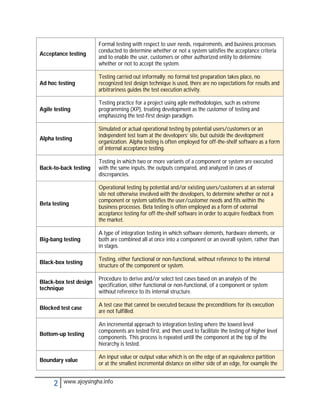
Formal testing with respect to user needs, requirements, and business processes
                        conducted to determine whether or not a system satisfies the acceptance criteria
Acceptance testing
                        and to enable the user, customers or other authorized entity to determine
                        whether or not to accept the system.

                        Testing carried out informally; no formal test preparation takes place, no
Ad hoc testing          recognized test design technique is used, there are no expectations for results and
                        arbitrariness guides the test execution activity.

                        Testing practice for a project using agile methodologies, such as extreme
Agile testing           programming (XP), treating development as the customer of testing and
                        emphasizing the test-first design paradigm.

                        Simulated or actual operational testing by potential users/customers or an
                        independent test team at the developers’ site, but outside the development
Alpha testing
                        organization. Alpha testing is often employed for off-the-shelf software as a form
                        of internal acceptance testing.

                        Testing in which two or more variants of a component or system are executed
Back-to-back testing    with the same inputs, the outputs compared, and analyzed in cases of
                        discrepancies.

                        Operational testing by potential and/or existing users/customers at an external
                        site not otherwise involved with the developers, to determine whether or not a
                        component or system satisfies the user/customer needs and fits within the
Beta testing
                        business processes. Beta testing is often employed as a form of external
                        acceptance testing for off-the-shelf software in order to acquire feedback from
                        the market.

                        A type of integration testing in which software elements, hardware elements, or
Big-bang testing        both are combined all at once into a component or an overall system, rather than
                        in stages.

                        Testing, either functional or non-functional, without reference to the internal
Black-box testing
                        structure of the component or system.

                        Procedure to derive and/or select test cases based on an analysis of the
Black-box test design
                        specification, either functional or non-functional, of a component or system
technique
                        without reference to its internal structure.

                        A test case that cannot be executed because the preconditions for its execution
Blocked test case
                        are not fulfilled.

                        An incremental approach to integration testing where the lowest level
                        components are tested first, and then used to facilitate the testing of higher level
Bottom-up testing
                        components. This process is repeated until the component at the top of the
                        hierarchy is tested.

                        An input value or output value which is on the edge of an equivalence partition
Boundary value
                        or at the smallest incremental distance on either side of an edge, for example the


     2    www.ajoysingha.info
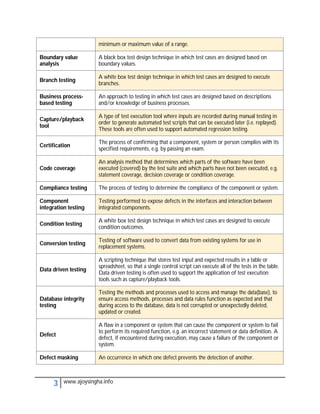
minimum or maximum value of a range.

Boundary value         A black box test design technique in which test cases are designed based on
analysis               boundary values.

                       A white box test design technique in which test cases are designed to execute
Branch testing
                       branches.

Business process-      An approach to testing in which test cases are designed based on descriptions
based testing          and/or knowledge of business processes.

                       A type of test execution tool where inputs are recorded during manual testing in
Capture/playback
                       order to generate automated test scripts that can be executed later (i.e. replayed).
tool
                       These tools are often used to support automated regression testing.

                       The process of confirming that a component, system or person complies with its
Certification
                       specified requirements, e.g. by passing an exam.

                       An analysis method that determines which parts of the software have been
Code coverage          executed (covered) by the test suite and which parts have not been executed, e.g.
                       statement coverage, decision coverage or condition coverage.

Compliance testing     The process of testing to determine the compliance of the component or system.

Component              Testing performed to expose defects in the interfaces and interaction between
integration testing    integrated components.

                       A white box test design technique in which test cases are designed to execute
Condition testing
                       condition outcomes.

                       Testing of software used to convert data from existing systems for use in
Conversion testing
                       replacement systems.

                       A scripting technique that stores test input and expected results in a table or
                       spreadsheet, so that a single control script can execute all of the tests in the table.
Data driven testing
                       Data driven testing is often used to support the application of test execution
                       tools such as capture/playback tools.

                       Testing the methods and processes used to access and manage the data(base), to
Database integrity     ensure access methods, processes and data rules function as expected and that
testing                during access to the database, data is not corrupted or unexpectedly deleted,
                       updated or created.

                       A flaw in a component or system that can cause the component or system to fail
                       to perform its required function, e.g. an incorrect statement or data definition. A
Defect
                       defect, if encountered during execution, may cause a failure of the component or
                       system.

Defect masking         An occurrence in which one defect prevents the detection of another.


     3    www.ajoysingha.info
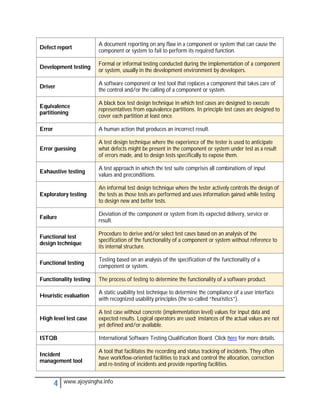
A document reporting on any flaw in a component or system that can cause the
Defect report
                         component or system to fail to perform its required function.

                         Formal or informal testing conducted during the implementation of a component
Development testing
                         or system, usually in the development environment by developers.

                         A software component or test tool that replaces a component that takes care of
Driver
                         the control and/or the calling of a component or system.

                         A black box test design technique in which test cases are designed to execute
Equivalence
                         representatives from equivalence partitions. In principle test cases are designed to
partitioning
                         cover each partition at least once.

Error                    A human action that produces an incorrect result.

                         A test design technique where the experience of the tester is used to anticipate
Error guessing           what defects might be present in the component or system under test as a result
                         of errors made, and to design tests specifically to expose them.

                         A test approach in which the test suite comprises all combinations of input
Exhaustive testing
                         values and preconditions.

                         An informal test design technique where the tester actively controls the design of
Exploratory testing      the tests as those tests are performed and uses information gained while testing
                         to design new and better tests.

                         Deviation of the component or system from its expected delivery, service or
Failure
                         result.

                         Procedure to derive and/or select test cases based on an analysis of the
Functional test
                         specification of the functionality of a component or system without reference to
design technique
                         its internal structure.

                         Testing based on an analysis of the specification of the functionality of a
Functional testing
                         component or system.

Functionality testing    The process of testing to determine the functionality of a software product.

                         A static usability test technique to determine the compliance of a user interface
Heuristic evaluation
                         with recognized usability principles (the so-called “heuristics”).

                         A test case without concrete (implementation level) values for input data and
High level test case     expected results. Logical operators are used; instances of the actual values are not
                         yet defined and/or available.

ISTQB                    International Software Testing Qualification Board. Click here for more details.

                         A tool that facilitates the recording and status tracking of incidents. They often
Incident
                         have workflow-oriented facilities to track and control the allocation, correction
management tool
                         and re-testing of incidents and provide reporting facilities.


        4   www.ajoysingha.info
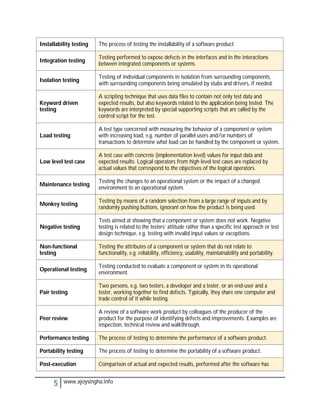
Installability testing   The process of testing the installability of a software product.

                         Testing performed to expose defects in the interfaces and in the interactions
Integration testing
                         between integrated components or systems.

                         Testing of individual components in isolation from surrounding components,
Isolation testing
                         with surrounding components being simulated by stubs and drivers, if needed.

                         A scripting technique that uses data files to contain not only test data and
Keyword driven           expected results, but also keywords related to the application being tested. The
testing                  keywords are interpreted by special supporting scripts that are called by the
                         control script for the test.

                         A test type concerned with measuring the behavior of a component or system
Load testing             with increasing load, e.g. number of parallel users and/or numbers of
                         transactions to determine what load can be handled by the component or system.

                         A test case with concrete (implementation level) values for input data and
Low level test case      expected results. Logical operators from high level test cases are replaced by
                         actual values that correspond to the objectives of the logical operators.

                         Testing the changes to an operational system or the impact of a changed
Maintenance testing
                         environment to an operational system.

                         Testing by means of a random selection from a large range of inputs and by
Monkey testing
                         randomly pushing buttons, ignorant on how the product is being used.

                         Tests aimed at showing that a component or system does not work. Negative
Negative testing         testing is related to the testers’ attitude rather than a specific test approach or test
                         design technique, e.g. testing with invalid input values or exceptions.

Non-functional           Testing the attributes of a component or system that do not relate to
testing                  functionality, e.g. reliability, efficiency, usability, maintainability and portability.

                         Testing conducted to evaluate a component or system in its operational
Operational testing
                         environment.

                         Two persons, e.g. two testers, a developer and a tester, or an end-user and a
Pair testing             tester, working together to find defects. Typically, they share one computer and
                         trade control of it while testing.

                         A review of a software work product by colleagues of the producer of the
Peer review              product for the purpose of identifying defects and improvements. Examples are
                         inspection, technical review and walkthrough.

Performance testing      The process of testing to determine the performance of a software product.

Portability testing      The process of testing to determine the portability of a software product.

Post-execution           Comparison of actual and expected results, performed after the software has


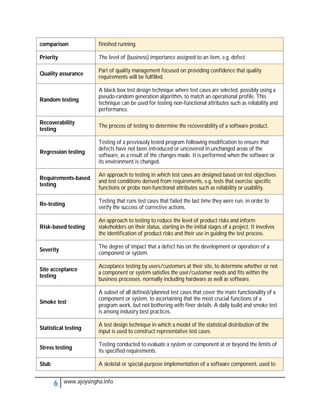
      5   www.ajoysingha.info
comparison              finished running.

Priority                The level of (business) importance assigned to an item, e.g. defect.

                        Part of quality management focused on providing confidence that quality
Quality assurance
                        requirements will be fulfilled.

                        A black box test design technique where test cases are selected, possibly using a
                        pseudo-random generation algorithm, to match an operational profile. This
Random testing
                        technique can be used for testing non-functional attributes such as reliability and
                        performance.

Recoverability
                        The process of testing to determine the recoverability of a software product.
testing

                        Testing of a previously tested program following modification to ensure that
                        defects have not been introduced or uncovered in unchanged areas of the
Regression testing
                        software, as a result of the changes made. It is performed when the software or
                        its environment is changed.

                        An approach to testing in which test cases are designed based on test objectives
Requirements-based
                        and test conditions derived from requirements, e.g. tests that exercise specific
testing
                        functions or probe non-functional attributes such as reliability or usability.

                        Testing that runs test cases that failed the last time they were run, in order to
Re-testing
                        verify the success of corrective actions.

                        An approach to testing to reduce the level of product risks and inform
Risk-based testing      stakeholders on their status, starting in the initial stages of a project. It involves
                        the identification of product risks and their use in guiding the test process.

                        The degree of impact that a defect has on the development or operation of a
Severity
                        component or system.

                        Acceptance testing by users/customers at their site, to determine whether or not
Site acceptance
                        a component or system satisfies the user/customer needs and fits within the
testing
                        business processes, normally including hardware as well as software.

                        A subset of all defined/planned test cases that cover the main functionality of a
                        component or system, to ascertaining that the most crucial functions of a
Smoke test
                        program work, but not bothering with finer details. A daily build and smoke test
                        is among industry best practices.

                        A test design technique in which a model of the statistical distribution of the
Statistical testing
                        input is used to construct representative test cases.

                        Testing conducted to evaluate a system or component at or beyond the limits of
Stress testing
                        its specified requirements.

Stub                    A skeletal or special-purpose implementation of a software component, used to


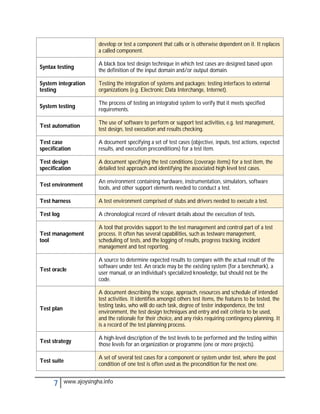
       6   www.ajoysingha.info
develop or test a component that calls or is otherwise dependent on it. It replaces
                         a called component.

                         A black box test design technique in which test cases are designed based upon
Syntax testing
                         the definition of the input domain and/or output domain.

System integration       Testing the integration of systems and packages; testing interfaces to external
testing                  organizations (e.g. Electronic Data Interchange, Internet).

                         The process of testing an integrated system to verify that it meets specified
System testing
                         requirements.

                         The use of software to perform or support test activities, e.g. test management,
Test automation
                         test design, test execution and results checking.

Test case                A document specifying a set of test cases (objective, inputs, test actions, expected
specification            results, and execution preconditions) for a test item.

Test design              A document specifying the test conditions (coverage items) for a test item, the
specification            detailed test approach and identifying the associated high level test cases.

                         An environment containing hardware, instrumentation, simulators, software
Test environment
                         tools, and other support elements needed to conduct a test.

Test harness             A test environment comprised of stubs and drivers needed to execute a test.

Test log                 A chronological record of relevant details about the execution of tests.

                         A tool that provides support to the test management and control part of a test
Test management          process. It often has several capabilities, such as testware management,
tool                     scheduling of tests, and the logging of results, progress tracking, incident
                         management and test reporting.

                         A source to determine expected results to compare with the actual result of the
                         software under test. An oracle may be the existing system (for a benchmark), a
Test oracle
                         user manual, or an individual’s specialized knowledge, but should not be the
                         code.

                         A document describing the scope, approach, resources and schedule of intended
                         test activities. It identifies amongst others test items, the features to be tested, the
                         testing tasks, who will do each task, degree of tester independence, the test
Test plan
                         environment, the test design techniques and entry and exit criteria to be used,
                         and the rationale for their choice, and any risks requiring contingency planning. It
                         is a record of the test planning process.

                         A high-level description of the test levels to be performed and the testing within
Test strategy
                         those levels for an organization or programme (one or more projects).

                         A set of several test cases for a component or system under test, where the post
Test suite
                         condition of one test is often used as the precondition for the next one.


     7      www.ajoysingha.info
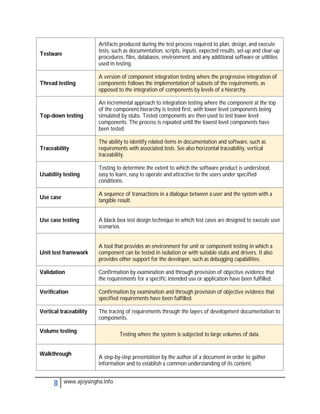
Artifacts produced during the test process required to plan, design, and execute
                        tests, such as documentation, scripts, inputs, expected results, set-up and clear-up
Testware
                        procedures, files, databases, environment, and any additional software or utilities
                        used in testing.

                        A version of component integration testing where the progressive integration of
Thread testing          components follows the implementation of subsets of the requirements, as
                        opposed to the integration of components by levels of a hierarchy.

                        An incremental approach to integration testing where the component at the top
                        of the component hierarchy is tested first, with lower level components being
Top-down testing        simulated by stubs. Tested components are then used to test lower level
                        components. The process is repeated until the lowest level components have
                        been tested.

                        The ability to identify related items in documentation and software, such as
Traceability            requirements with associated tests. See also horizontal traceability, vertical
                        traceability.

                        Testing to determine the extent to which the software product is understood,
Usability testing       easy to learn, easy to operate and attractive to the users under specified
                        conditions.

                        A sequence of transactions in a dialogue between a user and the system with a
Use case
                        tangible result.


Use case testing        A black box test design technique in which test cases are designed to execute user
                        scenarios.


                        A tool that provides an environment for unit or component testing in which a
Unit test framework     component can be tested in isolation or with suitable stubs and drivers. It also
                        provides other support for the developer, such as debugging capabilities.

Validation              Confirmation by examination and through provision of objective evidence that
                        the requirements for a specific intended use or application have been fulfilled.

Verification            Confirmation by examination and through provision of objective evidence that
                        specified requirements have been fulfilled.

Vertical traceability   The tracing of requirements through the layers of development documentation to
                        components.

Volume testing
                                 Testing where the system is subjected to large volumes of data.


Walkthrough
                        A step-by-step presentation by the author of a document in order to gather
                        information and to establish a common understanding of its content.


      8    www.ajoysingha.info
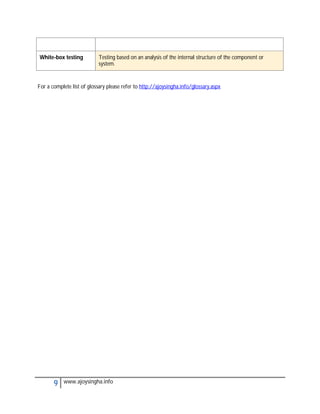
White-box testing           Testing based on an analysis of the internal structure of the component or
                            system.


For a complete list of glossary please refer to http://ajoysingha.info/glossary.aspx


       9   www.ajoysingha.info

100 most popular software testing terms

  • 1.
    100 Most Popular SoftwareTesting Terms Ajoy Kumar Singha www.ajoysingha.info
  • 2.
    Formal testing withrespect to user needs, requirements, and business processes conducted to determine whether or not a system satisfies the acceptance criteria Acceptance testing and to enable the user, customers or other authorized entity to determine whether or not to accept the system. Testing carried out informally; no formal test preparation takes place, no Ad hoc testing recognized test design technique is used, there are no expectations for results and arbitrariness guides the test execution activity. Testing practice for a project using agile methodologies, such as extreme Agile testing programming (XP), treating development as the customer of testing and emphasizing the test-first design paradigm. Simulated or actual operational testing by potential users/customers or an independent test team at the developers’ site, but outside the development Alpha testing organization. Alpha testing is often employed for off-the-shelf software as a form of internal acceptance testing. Testing in which two or more variants of a component or system are executed Back-to-back testing with the same inputs, the outputs compared, and analyzed in cases of discrepancies. Operational testing by potential and/or existing users/customers at an external site not otherwise involved with the developers, to determine whether or not a component or system satisfies the user/customer needs and fits within the Beta testing business processes. Beta testing is often employed as a form of external acceptance testing for off-the-shelf software in order to acquire feedback from the market. A type of integration testing in which software elements, hardware elements, or Big-bang testing both are combined all at once into a component or an overall system, rather than in stages. Testing, either functional or non-functional, without reference to the internal Black-box testing structure of the component or system. Procedure to derive and/or select test cases based on an analysis of the Black-box test design specification, either functional or non-functional, of a component or system technique without reference to its internal structure. A test case that cannot be executed because the preconditions for its execution Blocked test case are not fulfilled. An incremental approach to integration testing where the lowest level components are tested first, and then used to facilitate the testing of higher level Bottom-up testing components. This process is repeated until the component at the top of the hierarchy is tested. An input value or output value which is on the edge of an equivalence partition Boundary value or at the smallest incremental distance on either side of an edge, for example the 2 www.ajoysingha.info
  • 3.
    minimum or maximumvalue of a range. Boundary value A black box test design technique in which test cases are designed based on analysis boundary values. A white box test design technique in which test cases are designed to execute Branch testing branches. Business process- An approach to testing in which test cases are designed based on descriptions based testing and/or knowledge of business processes. A type of test execution tool where inputs are recorded during manual testing in Capture/playback order to generate automated test scripts that can be executed later (i.e. replayed). tool These tools are often used to support automated regression testing. The process of confirming that a component, system or person complies with its Certification specified requirements, e.g. by passing an exam. An analysis method that determines which parts of the software have been Code coverage executed (covered) by the test suite and which parts have not been executed, e.g. statement coverage, decision coverage or condition coverage. Compliance testing The process of testing to determine the compliance of the component or system. Component Testing performed to expose defects in the interfaces and interaction between integration testing integrated components. A white box test design technique in which test cases are designed to execute Condition testing condition outcomes. Testing of software used to convert data from existing systems for use in Conversion testing replacement systems. A scripting technique that stores test input and expected results in a table or spreadsheet, so that a single control script can execute all of the tests in the table. Data driven testing Data driven testing is often used to support the application of test execution tools such as capture/playback tools. Testing the methods and processes used to access and manage the data(base), to Database integrity ensure access methods, processes and data rules function as expected and that testing during access to the database, data is not corrupted or unexpectedly deleted, updated or created. A flaw in a component or system that can cause the component or system to fail to perform its required function, e.g. an incorrect statement or data definition. A Defect defect, if encountered during execution, may cause a failure of the component or system. Defect masking An occurrence in which one defect prevents the detection of another. 3 www.ajoysingha.info
  • 4.
    A document reportingon any flaw in a component or system that can cause the Defect report component or system to fail to perform its required function. Formal or informal testing conducted during the implementation of a component Development testing or system, usually in the development environment by developers. A software component or test tool that replaces a component that takes care of Driver the control and/or the calling of a component or system. A black box test design technique in which test cases are designed to execute Equivalence representatives from equivalence partitions. In principle test cases are designed to partitioning cover each partition at least once. Error A human action that produces an incorrect result. A test design technique where the experience of the tester is used to anticipate Error guessing what defects might be present in the component or system under test as a result of errors made, and to design tests specifically to expose them. A test approach in which the test suite comprises all combinations of input Exhaustive testing values and preconditions. An informal test design technique where the tester actively controls the design of Exploratory testing the tests as those tests are performed and uses information gained while testing to design new and better tests. Deviation of the component or system from its expected delivery, service or Failure result. Procedure to derive and/or select test cases based on an analysis of the Functional test specification of the functionality of a component or system without reference to design technique its internal structure. Testing based on an analysis of the specification of the functionality of a Functional testing component or system. Functionality testing The process of testing to determine the functionality of a software product. A static usability test technique to determine the compliance of a user interface Heuristic evaluation with recognized usability principles (the so-called “heuristics”). A test case without concrete (implementation level) values for input data and High level test case expected results. Logical operators are used; instances of the actual values are not yet defined and/or available. ISTQB International Software Testing Qualification Board. Click here for more details. A tool that facilitates the recording and status tracking of incidents. They often Incident have workflow-oriented facilities to track and control the allocation, correction management tool and re-testing of incidents and provide reporting facilities. 4 www.ajoysingha.info
  • 5.
    Installability testing The process of testing the installability of a software product. Testing performed to expose defects in the interfaces and in the interactions Integration testing between integrated components or systems. Testing of individual components in isolation from surrounding components, Isolation testing with surrounding components being simulated by stubs and drivers, if needed. A scripting technique that uses data files to contain not only test data and Keyword driven expected results, but also keywords related to the application being tested. The testing keywords are interpreted by special supporting scripts that are called by the control script for the test. A test type concerned with measuring the behavior of a component or system Load testing with increasing load, e.g. number of parallel users and/or numbers of transactions to determine what load can be handled by the component or system. A test case with concrete (implementation level) values for input data and Low level test case expected results. Logical operators from high level test cases are replaced by actual values that correspond to the objectives of the logical operators. Testing the changes to an operational system or the impact of a changed Maintenance testing environment to an operational system. Testing by means of a random selection from a large range of inputs and by Monkey testing randomly pushing buttons, ignorant on how the product is being used. Tests aimed at showing that a component or system does not work. Negative Negative testing testing is related to the testers’ attitude rather than a specific test approach or test design technique, e.g. testing with invalid input values or exceptions. Non-functional Testing the attributes of a component or system that do not relate to testing functionality, e.g. reliability, efficiency, usability, maintainability and portability. Testing conducted to evaluate a component or system in its operational Operational testing environment. Two persons, e.g. two testers, a developer and a tester, or an end-user and a Pair testing tester, working together to find defects. Typically, they share one computer and trade control of it while testing. A review of a software work product by colleagues of the producer of the Peer review product for the purpose of identifying defects and improvements. Examples are inspection, technical review and walkthrough. Performance testing The process of testing to determine the performance of a software product. Portability testing The process of testing to determine the portability of a software product. Post-execution Comparison of actual and expected results, performed after the software has 5 www.ajoysingha.info
  • 6.
    comparison finished running. Priority The level of (business) importance assigned to an item, e.g. defect. Part of quality management focused on providing confidence that quality Quality assurance requirements will be fulfilled. A black box test design technique where test cases are selected, possibly using a pseudo-random generation algorithm, to match an operational profile. This Random testing technique can be used for testing non-functional attributes such as reliability and performance. Recoverability The process of testing to determine the recoverability of a software product. testing Testing of a previously tested program following modification to ensure that defects have not been introduced or uncovered in unchanged areas of the Regression testing software, as a result of the changes made. It is performed when the software or its environment is changed. An approach to testing in which test cases are designed based on test objectives Requirements-based and test conditions derived from requirements, e.g. tests that exercise specific testing functions or probe non-functional attributes such as reliability or usability. Testing that runs test cases that failed the last time they were run, in order to Re-testing verify the success of corrective actions. An approach to testing to reduce the level of product risks and inform Risk-based testing stakeholders on their status, starting in the initial stages of a project. It involves the identification of product risks and their use in guiding the test process. The degree of impact that a defect has on the development or operation of a Severity component or system. Acceptance testing by users/customers at their site, to determine whether or not Site acceptance a component or system satisfies the user/customer needs and fits within the testing business processes, normally including hardware as well as software. A subset of all defined/planned test cases that cover the main functionality of a component or system, to ascertaining that the most crucial functions of a Smoke test program work, but not bothering with finer details. A daily build and smoke test is among industry best practices. A test design technique in which a model of the statistical distribution of the Statistical testing input is used to construct representative test cases. Testing conducted to evaluate a system or component at or beyond the limits of Stress testing its specified requirements. Stub A skeletal or special-purpose implementation of a software component, used to 6 www.ajoysingha.info
  • 7.
    develop or testa component that calls or is otherwise dependent on it. It replaces a called component. A black box test design technique in which test cases are designed based upon Syntax testing the definition of the input domain and/or output domain. System integration Testing the integration of systems and packages; testing interfaces to external testing organizations (e.g. Electronic Data Interchange, Internet). The process of testing an integrated system to verify that it meets specified System testing requirements. The use of software to perform or support test activities, e.g. test management, Test automation test design, test execution and results checking. Test case A document specifying a set of test cases (objective, inputs, test actions, expected specification results, and execution preconditions) for a test item. Test design A document specifying the test conditions (coverage items) for a test item, the specification detailed test approach and identifying the associated high level test cases. An environment containing hardware, instrumentation, simulators, software Test environment tools, and other support elements needed to conduct a test. Test harness A test environment comprised of stubs and drivers needed to execute a test. Test log A chronological record of relevant details about the execution of tests. A tool that provides support to the test management and control part of a test Test management process. It often has several capabilities, such as testware management, tool scheduling of tests, and the logging of results, progress tracking, incident management and test reporting. A source to determine expected results to compare with the actual result of the software under test. An oracle may be the existing system (for a benchmark), a Test oracle user manual, or an individual’s specialized knowledge, but should not be the code. A document describing the scope, approach, resources and schedule of intended test activities. It identifies amongst others test items, the features to be tested, the testing tasks, who will do each task, degree of tester independence, the test Test plan environment, the test design techniques and entry and exit criteria to be used, and the rationale for their choice, and any risks requiring contingency planning. It is a record of the test planning process. A high-level description of the test levels to be performed and the testing within Test strategy those levels for an organization or programme (one or more projects). A set of several test cases for a component or system under test, where the post Test suite condition of one test is often used as the precondition for the next one. 7 www.ajoysingha.info
  • 8.
    Artifacts produced duringthe test process required to plan, design, and execute tests, such as documentation, scripts, inputs, expected results, set-up and clear-up Testware procedures, files, databases, environment, and any additional software or utilities used in testing. A version of component integration testing where the progressive integration of Thread testing components follows the implementation of subsets of the requirements, as opposed to the integration of components by levels of a hierarchy. An incremental approach to integration testing where the component at the top of the component hierarchy is tested first, with lower level components being Top-down testing simulated by stubs. Tested components are then used to test lower level components. The process is repeated until the lowest level components have been tested. The ability to identify related items in documentation and software, such as Traceability requirements with associated tests. See also horizontal traceability, vertical traceability. Testing to determine the extent to which the software product is understood, Usability testing easy to learn, easy to operate and attractive to the users under specified conditions. A sequence of transactions in a dialogue between a user and the system with a Use case tangible result. Use case testing A black box test design technique in which test cases are designed to execute user scenarios. A tool that provides an environment for unit or component testing in which a Unit test framework component can be tested in isolation or with suitable stubs and drivers. It also provides other support for the developer, such as debugging capabilities. Validation Confirmation by examination and through provision of objective evidence that the requirements for a specific intended use or application have been fulfilled. Verification Confirmation by examination and through provision of objective evidence that specified requirements have been fulfilled. Vertical traceability The tracing of requirements through the layers of development documentation to components. Volume testing Testing where the system is subjected to large volumes of data. Walkthrough A step-by-step presentation by the author of a document in order to gather information and to establish a common understanding of its content. 8 www.ajoysingha.info
  • 9.
    White-box testing Testing based on an analysis of the internal structure of the component or system. For a complete list of glossary please refer to http://ajoysingha.info/glossary.aspx 9 www.ajoysingha.info