





100 ideas for exploiting activities
(all for under 5 minutes of planning)
3rd June 2020, IH Bucharest webinar
Sandy Millin
http://sandymillin.wordpress.com/100ideas
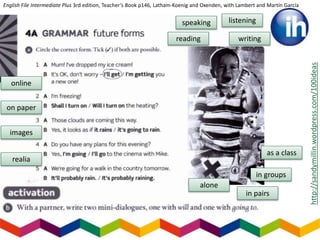
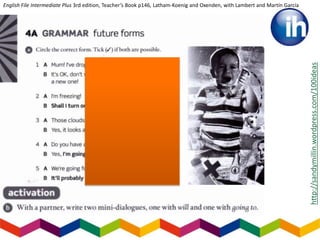
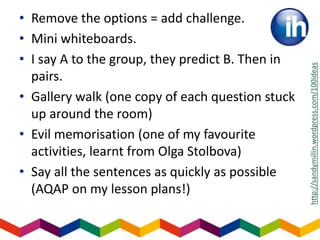
English File Intermediate Plus 3rd edition, Teacher’s Book p146, Latham-Koenig and Oxenden, with Lambert and Martín García
http://sandymillin.wordpress.com/100ideas
English File Intermediate Plus 3rd edition, Teacher’s Book p146, Latham-Koenig and Oxenden, with Lambert and Martín García
speaking
writing
listening
reading
alone
in pairs
in groups
as a class
on paper
online
realia
images
http://sandymillin.wordpress.com/100ideas
English File Intermediate Plus 3rd edition, Teacher’s Book p146, Latham-Koenig and Oxenden, with Lambert and Martín García
http://sandymillin.wordpress.com/100ideas
English File Intermediate Plus 3rd edition, Teacher’s Book p146, Latham-Koenig and Oxenden, with Lambert and Martín García
• Remove the options = add challenge.
• Mini whiteboards.
• I say A to the group, they predict B. Then in
pairs.
• Gallery walk (one copy of each question stuck
up around the room)
• Evil memorisation (one of my favourite
activities, learnt from Olga Stolbova)
• Say all the sentences as quickly as possible
(AQAP on my lesson plans!)
http://sandymillin.wordpress.com/100ideas
English File Intermediate Plus 3rd edition, Teacher’s Book p146, Latham-Koenig and Oxenden, with Lambert and Martín García
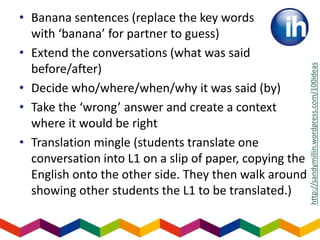
• Banana sentences (replace the key words
with ‘banana’ for partner to guess)
• Extend the conversations (what was said
before/after)
• Decide who/where/when/why it was said (by)
• Take the ‘wrong’ answer and create a context
where it would be right
• Translation mingle (students translate one
conversation into L1 on a slip of paper, copying the
English onto the other side. They then walk around
showing other students the L1 to be translated.)
http://sandymillin.wordpress.com/100ideas
English File Intermediate Plus 3rd edition, Teacher’s Book p146, Latham-Koenig and Oxenden, with Lambert and Martín García
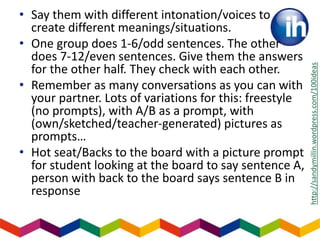
• Say them with different intonation/voices to
create different meanings/situations.
• One group does 1-6/odd sentences. The other
does 7-12/even sentences. Give them the answers
for the other half. They check with each other.
• Remember as many conversations as you can with
your partner. Lots of variations for this: freestyle
(no prompts), with A/B as a prompt, with
(own/sketched/teacher-generated) pictures as
prompts…
• Hot seat/Backs to the board with a picture prompt
for student looking at the board to say sentence A,
person with back to the board says sentence B in
response
http://sandymillin.wordpress.com/100ideas
English File Intermediate Plus 3rd edition, Teacher’s Book p146, Latham-Koenig and Oxenden, with Lambert and Martín García
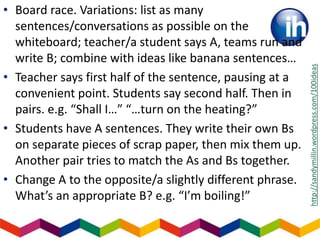
• Board race. Variations: list as many
sentences/conversations as possible on the
whiteboard; teacher/a student says A, teams run and
write B; combine with ideas like banana sentences…
• Teacher says first half of the sentence, pausing at a
convenient point. Students say second half. Then in
pairs. e.g. “Shall I…” “…turn on the heating?”
• Students have A sentences. They write their own Bs
on separate pieces of scrap paper, then mix them up.
Another pair tries to match the As and Bs together.
• Change A to the opposite/a slightly different phrase.
What’s an appropriate B? e.g. “I’m boiling!”
http://sandymillin.wordpress.com/100ideas
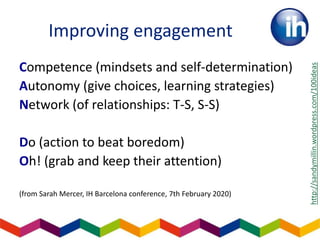
Improving engagement
Competence (mindsets and self-determination)
Autonomy (give choices, learning strategies)
Network (of relationships: T-S, S-S)
Do (action to beat boredom)
Oh! (grab and keep their attention)
(from Sarah Mercer, IH Barcelona conference, 7th February 2020)
http://sandymillin.wordpress.com/100ideas
Recommended webinar
• Sarah Mercer: The foundations of
engagement: a positive classroom culture
https://www.cambridge.org/elt/blog/2019/12
/09/engagement-positive-classroom-culture/
http://sandymillin.wordpress.com/100ideas
Being creative 3:
One activity,
multiple tasks
ELT Playbook 1
http://sandymillin.wordpress.com/100ideas
100 ideas for exploiting activities
(all for under 5 minutes of planning)
3rd June 2020, IH Bucharest webinar
Sandy Millin
http://sandymillin.wordpress.com/100ideas

100 ideas for exploiting materials IH Bucharest webinar by Sandy Millin

  • 1.
    100 ideas forexploiting activities (all for under 5 minutes of planning) 3rd June 2020, IH Bucharest webinar Sandy Millin http://sandymillin.wordpress.com/100ideas
  • 2.
    http://sandymillin.wordpress.com/100ideas English File IntermediatePlus 3rd edition, Teacher’s Book p146, Latham-Koenig and Oxenden, with Lambert and Martín García
  • 3.
    http://sandymillin.wordpress.com/100ideas English File IntermediatePlus 3rd edition, Teacher’s Book p146, Latham-Koenig and Oxenden, with Lambert and Martín García speaking writing listening reading alone in pairs in groups as a class on paper online realia images
  • 4.
    http://sandymillin.wordpress.com/100ideas English File IntermediatePlus 3rd edition, Teacher’s Book p146, Latham-Koenig and Oxenden, with Lambert and Martín García
  • 5.
    http://sandymillin.wordpress.com/100ideas English File IntermediatePlus 3rd edition, Teacher’s Book p146, Latham-Koenig and Oxenden, with Lambert and Martín García
  • 6.
    • Remove theoptions = add challenge. • Mini whiteboards. • I say A to the group, they predict B. Then in pairs. • Gallery walk (one copy of each question stuck up around the room) • Evil memorisation (one of my favourite activities, learnt from Olga Stolbova) • Say all the sentences as quickly as possible (AQAP on my lesson plans!) http://sandymillin.wordpress.com/100ideas
  • 7.
    http://sandymillin.wordpress.com/100ideas English File IntermediatePlus 3rd edition, Teacher’s Book p146, Latham-Koenig and Oxenden, with Lambert and Martín García
  • 8.
    • Banana sentences(replace the key words with ‘banana’ for partner to guess) • Extend the conversations (what was said before/after) • Decide who/where/when/why it was said (by) • Take the ‘wrong’ answer and create a context where it would be right • Translation mingle (students translate one conversation into L1 on a slip of paper, copying the English onto the other side. They then walk around showing other students the L1 to be translated.) http://sandymillin.wordpress.com/100ideas
  • 9.
    http://sandymillin.wordpress.com/100ideas English File IntermediatePlus 3rd edition, Teacher’s Book p146, Latham-Koenig and Oxenden, with Lambert and Martín García
  • 10.
    • Say themwith different intonation/voices to create different meanings/situations. • One group does 1-6/odd sentences. The other does 7-12/even sentences. Give them the answers for the other half. They check with each other. • Remember as many conversations as you can with your partner. Lots of variations for this: freestyle (no prompts), with A/B as a prompt, with (own/sketched/teacher-generated) pictures as prompts… • Hot seat/Backs to the board with a picture prompt for student looking at the board to say sentence A, person with back to the board says sentence B in response http://sandymillin.wordpress.com/100ideas
  • 11.
    http://sandymillin.wordpress.com/100ideas English File IntermediatePlus 3rd edition, Teacher’s Book p146, Latham-Koenig and Oxenden, with Lambert and Martín García
  • 12.
    • Board race.Variations: list as many sentences/conversations as possible on the whiteboard; teacher/a student says A, teams run and write B; combine with ideas like banana sentences… • Teacher says first half of the sentence, pausing at a convenient point. Students say second half. Then in pairs. e.g. “Shall I…” “…turn on the heating?” • Students have A sentences. They write their own Bs on separate pieces of scrap paper, then mix them up. Another pair tries to match the As and Bs together. • Change A to the opposite/a slightly different phrase. What’s an appropriate B? e.g. “I’m boiling!” http://sandymillin.wordpress.com/100ideas
  • 13.
    Improving engagement Competence (mindsetsand self-determination) Autonomy (give choices, learning strategies) Network (of relationships: T-S, S-S) Do (action to beat boredom) Oh! (grab and keep their attention) (from Sarah Mercer, IH Barcelona conference, 7th February 2020) http://sandymillin.wordpress.com/100ideas
  • 14.
    Recommended webinar • SarahMercer: The foundations of engagement: a positive classroom culture https://www.cambridge.org/elt/blog/2019/12 /09/engagement-positive-classroom-culture/ http://sandymillin.wordpress.com/100ideas
  • 15.
    Being creative 3: Oneactivity, multiple tasks ELT Playbook 1 http://sandymillin.wordpress.com/100ideas
  • 16.
    100 ideas forexploiting activities (all for under 5 minutes of planning) 3rd June 2020, IH Bucharest webinar Sandy Millin http://sandymillin.wordpress.com/100ideas

Editor's Notes

  • #2 Ideas coming from you as much as me! Mix of online and offline
  • #3 Do the activity, questions 1-5, controlled by me with them writing in the chat. Write a mini dialogue in the chat.
  • #4 3. What else can you use it for? Brainstorm in the chat. Use the prompts to help you
  • #5 What do you remember? Look at the pictures – what are the conversations?
  • #6 I’ll tell you about each set of ideas, then show you a summary slide of them – also in the blogpost linked at the side: Remove the options = add challenge. Mini whiteboards. I say A to the group, they predict B. Then in pairs. Gallery walk (one copy of each question stuck up around the room) Evil memorisation (one of my favourite activities, learnt from Olga Stolbova) Say all the sentences as quickly as possible (AQAP on my lesson plans!)
  • #8 I’ll tell you about each set of ideas, then show you a summary slide of them: Banana sentences (replace the key words with ‘banana’ for partner to guess) Extend the conversations (what was said before/after) Decide who/where/when/why it was said (by) Take the ‘wrong’ answer and create a context where it would be right Translation mingle (students translate one conversation into L1 on a slip of paper, copying the English onto the other side. They then walk around showing other students the L1 to be translated.)
  • #10 I’ll tell you about each set of ideas, then show you a summary slide of them: Say them with different intonation/voices to create different meanings/situations. One group does 1-6/odd sentences. The other does 7-12/even sentences. Give them the answers for the other half. They check with each other. Remember as many conversations as you can with your partner. Lots of variations for this: freestyle (no prompts), with A/B as a prompt, with (own/sketched/teacher-generated) pictures as prompts… Hot seat/Backs to the board with a picture prompt for student looking at the board to say sentence A, person with back to the board says sentence B in response
  • #12 I’ll tell you about each set of ideas, then show you a summary slide of them: Board race. Again, lots of variations: list as many sentences/conversations as possible on the whiteboard; teacher/a student says A, teams run and write B; combine with ideas above like banana sentences… Teacher says first half of the sentence, pausing at a convenient point. Students say second half. Then in pairs. e.g. “Shall I…” “…turn on the heating?” Students have A sentences. They write their own Bs on separate pieces of scrap paper, then mix them up. Another pair tries to match the As and Bs together. Change A to the opposite/a slightly different phrase. What’s an appropriate B? e.g. “I’m boiling!”
  • #14 Why is it important to plan more in depth rather than hitting lots of different points? Improves engagement, aids memorisation of chunks – spending more time with particular bits of language (I believe that’s a useful thing to do) – these activities can also be used for recycling/revision Sarah Mercer great on engagement She says… Competence = Focus on learners' strengths (which might not be the original activity as presented) and make sure it's genuine, specific and authentic. Encouragement rather than praise when you can: growth mindset. Use effort as the focus... learners think I can do that too Autonomy = once you’ve tried a few of these out, learners can pick how they want to work/what they want to do. Many of these are ways students can work with language on their own too Network = 33% of students activity is influenced by peers and there's a need to build on the relationships in classrooms. These provide a range of ways to work. Designer of learning experiences – surprise them, make them curious, challenge them with desirable difficulty (how challenging was the original activity? And the variants?)
  • #17 Ideas coming from you as much as me! Mix of online and offline