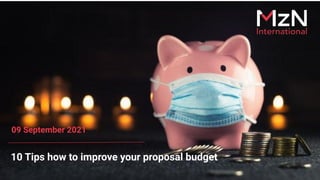
10 Tips how to improve your proposal budget
09 September 2021
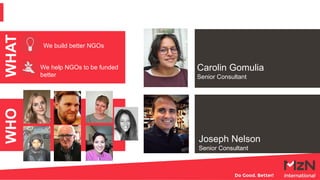
WHO
Joseph Nelson
Senior Consultant
WHAT
We build better NGOs
We help NGOs to be funded
better
Carolin Gomulia
Senior Consultant
Talking points
This is a presentation with about 13 slides. We will try to make it an
interactive session but will also keep time for engagement and Q&A
at the end.
● Preparing Budgets From Start to Finish
● Donors Requirements and How to Meet Them
● The Value of a Good Budget
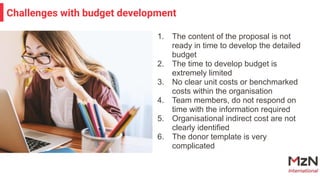
1. The content of the proposal is not
ready in time to develop the detailed
budget
2. The time to develop budget is
extremely limited
3. No clear unit costs or benchmarked
costs within the organisation
4. Team members, do not respond on
time with the information required
5. Organisational indirect cost are not
clearly identified
6. The donor template is very
complicated
Challenges with budget development
● Calculations are incorrect
● The budget exceeds the stated amount in the ToR
● The budget does not include all the details and explanations the donor asked for
● The donors template is not used
● No transparency on how unit costs have been derived
● Large contingency costs without explanation
● Indirect costs are too high / % of ICR too high
● Human Resource costs are not reflected transparently
● Size of the budget is too large or too small
5
30% of proposals fail because of their budgets...here is why
● Have a meeting with the proposal team - ask questions
about amounts - have there been any
agreements/discussions with the donor? Is there an
understanding of the size of the budget.
● Develop a project plan with a timeline.
● Ensure your timeline is in line with the rest of the
proposal/bid requirements
● Build in time for budget review and approval.
● Inform all relevant stakeholders of the information
requirements and the timeline
● Study the financial requirements of the funder and
ensure you have the correct templates and information
1. Treat your budget development as a project
2. Get the template right
● Always use the donor template (if there is one) and understand
how it needs to be completed
● Ensure the header clearly states the project name, timeframe
and your organisation’s name
● If there is no template - always use excel or google sheet (never
word) to develop a budget and build in formulas to avoid
calculation errors
● If you design a template make sure it contains all the details the
funders wants to see
● Ge the currency right - if you use conversions ensure the date,
website and rate is reflected in the budget ideally on top
● Structure your budget as per the donor requirements
3. Is the content clearly reflected in the budget?
● Ensure that your proposal content 100%
matches your budget
● There are different ways how donors want
the information, for example
✓ All project activities costed
✓ All cost linked to general headers such as
Human Resources, Project related, Admin.
Cost
✓ Per phase of the project
✓ Per objective or outcome
If there is no donor template, make your choice and stick with it. There is no right or wrong
answer but consider that it needs to be clear to the donor.
Activity budgets separates the programme into a group of smaller activities. It is logical to
produce and makes it very clear what each activity costs. It shows your intentions, it is often
more effective in communication Value for Money (VfM) and it is more difficult to forget
things as you are able to visualise the programme activity by activity. They can become over
complicated if there are too many activities within the proposal.
Line by line budgets place all expenses of the same type within the same line (e.g. Human
Resources, Stationary, petrol, travel), donor templates are more often like this. It creates a
quick overall picture of the costs associated with the programme and enables the donor to
see where the money is to be spent. Line by line budgeting is less logical than activity
budgets, items can get missed out because you are not visualising the activity but just the
cost. It is good practice to complete activity budgets first, then transfer them to the line by
line budget to ensure items do not get missed.
4. Activity or Line by Line
5. Ask yourself some questions:
The programme budget needs to answer the same questions as your
proposal:
● Who will do the work? - Staff costs vary depending on expertise.
● How long will it take? - Think about festivals and holidays.
● What supplies and equipment will be required? - We often see
vehicles budgeted for but no maintenance costs or sometimes
even no fuel!
● Where will activities take place? - Are the logistics considered?
● Will anyone have to travel? What will the reimbursement rate be? -
Travel budgets are often completed without per diems or other
incidentals.
● Will the activity require supervision or oversight?
Each of these questions have costs, if they are not covered in your
budget then the donor will not pay for them.
● Categorise the expenses: Direct or Indirect.
● The donor will have a policy (hopefully provided with the ToR)
ensure that you adhere to this guidance, regardless of previous
donor experience.
● The structural, managerial and logistical support indirect
expenses include are essential to a programmes completion
as well as to the health of your organisation.
● Be sure to consider all expenses and categorise them
appropriately them because someone is going to have to pick
up the tab if they are not covered.
● Be thorough and do not try and “best guess” expense items,
this will limit the financial challenges later in the project.
6. Direct or Indirect Expenses
7. Re-read what the donor wants!
Frequent Errors:
● Project Budget Exceeded - Blown the budget before you start!
● Currency not Stated - Is it US$ or €? There is often a difference
between the donors currency of choice and the accounting currency of
the NGO.
● Indirect Cost Recovery - Check the policy and do not deviate - If it
doesn’t work for your organisation then it might not be the right donor.
Avoid them!
8. Watch contingencies
● Avoid adding a ‘bottom line’ percentage for so-called ‘contingencies’ on
the overall budget
● Donors don’t like this and it’s not an accurate way of calculating a budget
● If needed, calculate a contingency amount for separate items in the
budget
○ E.g. a salaries contingency or fuel contingency
● Every item in your budget must be justifiable – bottom line percentages
are difficult to justify or monitor.
● Besides your formal approval processes ensure
that the formulas and calculations are checked by
various people - ideally by at least one person that
has not worked on the proposal.
● Triple check that you meet all the donor
requirements, e.g. % of overhead cost, are all
explanations clear
● Check again that everything that has been said in
the narrative proposal is reflected in the budget
● Ensure that the final, final number is added
correctly back into the narrative proposal
9. The extra pair(s) of eyes - double/triple check
A budget is a tool to communicate with a donor. It can say a lot more about the programme
and your organisation than just the price of your proposal. Good budgets can demonstrate:
● Openness– Providing details of core salaries, overhead and infrastructure costs
demonstrates an openness in all that you do.
● Value for Money – Critical for donors, a good budget allows them to see the cost and the
impact.
● Capacity – A well prepared budget demonstrates how you are able to efficiently manage
the finances of the programme.
● Competitiveness – Detailed budgets allow for donors to review costs at every level, if you
have worked hard to create an efficient organisation, the budget will show this to the
donor.
● Compliance – If you weren’t able to get the budget right, what chance is there you would
get the programme right.
10. Emphasise the value of a good budget
Stay in touch!
Sarah Fernandes
sarah@mzninternational.com
Carolin Gomulia
carolin@mzninternational.com
Joseph Nelson
joseph@mzninternational.com
Check out our blogs and upcoming events on
our website:
www.mzninternational.com
Agile and Robustly Funded:
NGOs and International
Organizations Need New
Ways to Survive and Thrive
September 21st
10 Questions every proposal
should answer to be
successful
September 23rd
Upcoming webinars:

10 tips how to improve your proposal budget

  • 1.
    10 Tips howto improve your proposal budget 09 September 2021
  • 2.
    WHO Joseph Nelson Senior Consultant WHAT Webuild better NGOs We help NGOs to be funded better Carolin Gomulia Senior Consultant
  • 3.
    Talking points This isa presentation with about 13 slides. We will try to make it an interactive session but will also keep time for engagement and Q&A at the end. ● Preparing Budgets From Start to Finish ● Donors Requirements and How to Meet Them ● The Value of a Good Budget
  • 4.
    1. The contentof the proposal is not ready in time to develop the detailed budget 2. The time to develop budget is extremely limited 3. No clear unit costs or benchmarked costs within the organisation 4. Team members, do not respond on time with the information required 5. Organisational indirect cost are not clearly identified 6. The donor template is very complicated Challenges with budget development
  • 5.
    ● Calculations areincorrect ● The budget exceeds the stated amount in the ToR ● The budget does not include all the details and explanations the donor asked for ● The donors template is not used ● No transparency on how unit costs have been derived ● Large contingency costs without explanation ● Indirect costs are too high / % of ICR too high ● Human Resource costs are not reflected transparently ● Size of the budget is too large or too small 5 30% of proposals fail because of their budgets...here is why
  • 6.
    ● Have ameeting with the proposal team - ask questions about amounts - have there been any agreements/discussions with the donor? Is there an understanding of the size of the budget. ● Develop a project plan with a timeline. ● Ensure your timeline is in line with the rest of the proposal/bid requirements ● Build in time for budget review and approval. ● Inform all relevant stakeholders of the information requirements and the timeline ● Study the financial requirements of the funder and ensure you have the correct templates and information 1. Treat your budget development as a project
  • 7.
    2. Get thetemplate right ● Always use the donor template (if there is one) and understand how it needs to be completed ● Ensure the header clearly states the project name, timeframe and your organisation’s name ● If there is no template - always use excel or google sheet (never word) to develop a budget and build in formulas to avoid calculation errors ● If you design a template make sure it contains all the details the funders wants to see ● Ge the currency right - if you use conversions ensure the date, website and rate is reflected in the budget ideally on top ● Structure your budget as per the donor requirements
  • 8.
    3. Is thecontent clearly reflected in the budget? ● Ensure that your proposal content 100% matches your budget ● There are different ways how donors want the information, for example ✓ All project activities costed ✓ All cost linked to general headers such as Human Resources, Project related, Admin. Cost ✓ Per phase of the project ✓ Per objective or outcome
  • 9.
    If there isno donor template, make your choice and stick with it. There is no right or wrong answer but consider that it needs to be clear to the donor. Activity budgets separates the programme into a group of smaller activities. It is logical to produce and makes it very clear what each activity costs. It shows your intentions, it is often more effective in communication Value for Money (VfM) and it is more difficult to forget things as you are able to visualise the programme activity by activity. They can become over complicated if there are too many activities within the proposal. Line by line budgets place all expenses of the same type within the same line (e.g. Human Resources, Stationary, petrol, travel), donor templates are more often like this. It creates a quick overall picture of the costs associated with the programme and enables the donor to see where the money is to be spent. Line by line budgeting is less logical than activity budgets, items can get missed out because you are not visualising the activity but just the cost. It is good practice to complete activity budgets first, then transfer them to the line by line budget to ensure items do not get missed. 4. Activity or Line by Line
  • 10.
    5. Ask yourselfsome questions: The programme budget needs to answer the same questions as your proposal: ● Who will do the work? - Staff costs vary depending on expertise. ● How long will it take? - Think about festivals and holidays. ● What supplies and equipment will be required? - We often see vehicles budgeted for but no maintenance costs or sometimes even no fuel! ● Where will activities take place? - Are the logistics considered? ● Will anyone have to travel? What will the reimbursement rate be? - Travel budgets are often completed without per diems or other incidentals. ● Will the activity require supervision or oversight? Each of these questions have costs, if they are not covered in your budget then the donor will not pay for them.
  • 11.
    ● Categorise theexpenses: Direct or Indirect. ● The donor will have a policy (hopefully provided with the ToR) ensure that you adhere to this guidance, regardless of previous donor experience. ● The structural, managerial and logistical support indirect expenses include are essential to a programmes completion as well as to the health of your organisation. ● Be sure to consider all expenses and categorise them appropriately them because someone is going to have to pick up the tab if they are not covered. ● Be thorough and do not try and “best guess” expense items, this will limit the financial challenges later in the project. 6. Direct or Indirect Expenses
  • 12.
    7. Re-read whatthe donor wants! Frequent Errors: ● Project Budget Exceeded - Blown the budget before you start! ● Currency not Stated - Is it US$ or €? There is often a difference between the donors currency of choice and the accounting currency of the NGO. ● Indirect Cost Recovery - Check the policy and do not deviate - If it doesn’t work for your organisation then it might not be the right donor. Avoid them!
  • 13.
    8. Watch contingencies ●Avoid adding a ‘bottom line’ percentage for so-called ‘contingencies’ on the overall budget ● Donors don’t like this and it’s not an accurate way of calculating a budget ● If needed, calculate a contingency amount for separate items in the budget ○ E.g. a salaries contingency or fuel contingency ● Every item in your budget must be justifiable – bottom line percentages are difficult to justify or monitor.
  • 14.
    ● Besides yourformal approval processes ensure that the formulas and calculations are checked by various people - ideally by at least one person that has not worked on the proposal. ● Triple check that you meet all the donor requirements, e.g. % of overhead cost, are all explanations clear ● Check again that everything that has been said in the narrative proposal is reflected in the budget ● Ensure that the final, final number is added correctly back into the narrative proposal 9. The extra pair(s) of eyes - double/triple check
  • 15.
    A budget isa tool to communicate with a donor. It can say a lot more about the programme and your organisation than just the price of your proposal. Good budgets can demonstrate: ● Openness– Providing details of core salaries, overhead and infrastructure costs demonstrates an openness in all that you do. ● Value for Money – Critical for donors, a good budget allows them to see the cost and the impact. ● Capacity – A well prepared budget demonstrates how you are able to efficiently manage the finances of the programme. ● Competitiveness – Detailed budgets allow for donors to review costs at every level, if you have worked hard to create an efficient organisation, the budget will show this to the donor. ● Compliance – If you weren’t able to get the budget right, what chance is there you would get the programme right. 10. Emphasise the value of a good budget
  • 16.
    Stay in touch! SarahFernandes sarah@mzninternational.com Carolin Gomulia carolin@mzninternational.com Joseph Nelson joseph@mzninternational.com Check out our blogs and upcoming events on our website: www.mzninternational.com Agile and Robustly Funded: NGOs and International Organizations Need New Ways to Survive and Thrive September 21st 10 Questions every proposal should answer to be successful September 23rd Upcoming webinars: