TEN QUESTIONS EVERY PROPOSAL SHOULD
ANSWER TO BE SUCCESSFUL
23 September 2021
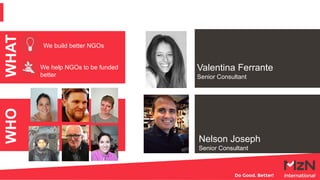
WHO
Nelson Joseph
Senior Consultant
Valentina Ferrante
Senior Consultant
WHAT
We build better NGOs
We help NGOs to be funded
better
Talking points
• Challenges to proposal writing
• What do funders look for?
• 10 questions every proposal should answer
• How to get to submitting successful proposals
Presentation with about 7 slides. We will try to make it an interactive
session but will also keep time for engagement and Q&A at the end.
4
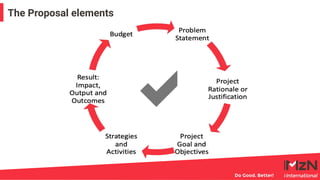
The Proposal elements
1. Short turn around times and poorly written
ToRs
2. Programme teams don’t deliver good content
3. M&E data not available or poor
4. Compliance documents missing/difficult to
obtain
5. Underestimation of time needed to finalise a
proposal.
6. Realising too late some of the ‘fineprint’
requirements
7. Too many other things to do - no dedicated
time and headspace to focus
8. Difficulties to understand some of the donor
requirements/asks
Challenges to proposal writing
● Need: How your work will improve the situation
● Clarity of Purpose: List your goals
● Measure of Success: Create an image of what your end goal looks like
● Realistic Budget: Do your figures make sense and add up? Check and triple check!
● Competence: Show goals you have achieved in the past. Demonstrate success.
● Acknowledgement of Potential Problems: Account for possible risks and provide
mitigation measures—shows clear and thorough consideration of the interventions
● Vision: Account for the competition you are up against
● Flexibility: Consider partnerships or other ways to deliver and offer the best value for
money
● Exit Strategy: Outline a plan for if/when donor funding stops. Must consider
sustainability.
● Attention to Detail: Answer all questions and provide requested information (and show
you’ve done so!)
6
Things (Almost) Every Funder Looks For
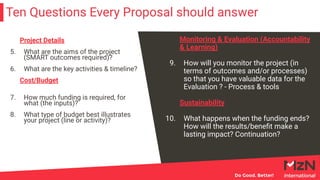
Ten Questions Every Proposal should answer
Beneficiaries
1. How many (primary and
secondary) and which type of
people will benefit from the
project (demographics, need)?
Organisational Context
2. What are the overall aims
of your organisation and
how does it fit in with the
context of the project?
Relevance of external environment
3. How does your project fit in with the
context (other organisations, gov.
Strategies, existing programmes)?
Complementary actions are often
well received.
4. What is the relevance of the project
to the funding criteria and policies?
Ten Questions Every Proposal should answer
Monitoring & Evaluation (Accountability
& Learning)
9. How will you monitor the project (in
terms of outcomes and/or processes)
so that you have valuable data for the
Evaluation ? - Process & tools
Sustainability
10. What happens when the funding ends?
How will the results/benefit make a
lasting impact? Continuation?
Project Details
5. What are the aims of the project
(SMART outcomes required)?
6. What are the key activities & timeline?
Cost/Budget
7. How much funding is required, for
what (the inputs)?
8. What type of budget best illustrates
your project (line or activity)?
Important Issues
These are important cross-cutting themes that donors often expect to
be built into proposals and demonstrated throughout:
● Equality - Proposals should demonstrate impact across genders
and population groups.
● Diversity - Minority groups, the disabled, the youth and others
should be considered.
● Value for Money - the most advantageous combination of cost,
quality and sustainability
● SDGs - Demonstrating integration with the SDGs is critical.
● Climate Conscious - Donors look for proposals that actively reduce
the impact on the environment.
Tips for writing better proposals
1. Plan enough time & budget
2. Complete and concise
3. Suit the donor
4. Stick with the donor’s
format
5. Follow all instructions and
read the fine print
6. Correct and specific
7. Present yourself credibly
8.Be realistic, be accountable
9. Make it sustainable
10. Avoid the “Budget
rejection trap”
Stay in touch!
Need support with your proposals?
Sarah Fernandez
sarah@mzninternational.com
Valentina Ferrante
valentina@mzninternational.com
Joseph Nelson
joseph@mzninternational.com
Check out our blog and upcoming events on
our website:
www.mzninternational.com
How to Turn Around a
Financially Distressed NGO
October 7th
Non-Profit Financial
Planning in Uncertain Times
October 14th
Accountability – Punishment or
Performance Booster?
Latest blog article:
Upcoming webinars:

10 questions every proposal should answer

  • 1.
    TEN QUESTIONS EVERYPROPOSAL SHOULD ANSWER TO BE SUCCESSFUL 23 September 2021
  • 2.
    WHO Nelson Joseph Senior Consultant ValentinaFerrante Senior Consultant WHAT We build better NGOs We help NGOs to be funded better
  • 3.
    Talking points • Challengesto proposal writing • What do funders look for? • 10 questions every proposal should answer • How to get to submitting successful proposals Presentation with about 7 slides. We will try to make it an interactive session but will also keep time for engagement and Q&A at the end.
  • 4.
  • 5.
    1. Short turnaround times and poorly written ToRs 2. Programme teams don’t deliver good content 3. M&E data not available or poor 4. Compliance documents missing/difficult to obtain 5. Underestimation of time needed to finalise a proposal. 6. Realising too late some of the ‘fineprint’ requirements 7. Too many other things to do - no dedicated time and headspace to focus 8. Difficulties to understand some of the donor requirements/asks Challenges to proposal writing
  • 6.
    ● Need: Howyour work will improve the situation ● Clarity of Purpose: List your goals ● Measure of Success: Create an image of what your end goal looks like ● Realistic Budget: Do your figures make sense and add up? Check and triple check! ● Competence: Show goals you have achieved in the past. Demonstrate success. ● Acknowledgement of Potential Problems: Account for possible risks and provide mitigation measures—shows clear and thorough consideration of the interventions ● Vision: Account for the competition you are up against ● Flexibility: Consider partnerships or other ways to deliver and offer the best value for money ● Exit Strategy: Outline a plan for if/when donor funding stops. Must consider sustainability. ● Attention to Detail: Answer all questions and provide requested information (and show you’ve done so!) 6 Things (Almost) Every Funder Looks For
  • 7.
    Ten Questions EveryProposal should answer Beneficiaries 1. How many (primary and secondary) and which type of people will benefit from the project (demographics, need)? Organisational Context 2. What are the overall aims of your organisation and how does it fit in with the context of the project? Relevance of external environment 3. How does your project fit in with the context (other organisations, gov. Strategies, existing programmes)? Complementary actions are often well received. 4. What is the relevance of the project to the funding criteria and policies?
  • 8.
    Ten Questions EveryProposal should answer Monitoring & Evaluation (Accountability & Learning) 9. How will you monitor the project (in terms of outcomes and/or processes) so that you have valuable data for the Evaluation ? - Process & tools Sustainability 10. What happens when the funding ends? How will the results/benefit make a lasting impact? Continuation? Project Details 5. What are the aims of the project (SMART outcomes required)? 6. What are the key activities & timeline? Cost/Budget 7. How much funding is required, for what (the inputs)? 8. What type of budget best illustrates your project (line or activity)?
  • 9.
    Important Issues These areimportant cross-cutting themes that donors often expect to be built into proposals and demonstrated throughout: ● Equality - Proposals should demonstrate impact across genders and population groups. ● Diversity - Minority groups, the disabled, the youth and others should be considered. ● Value for Money - the most advantageous combination of cost, quality and sustainability ● SDGs - Demonstrating integration with the SDGs is critical. ● Climate Conscious - Donors look for proposals that actively reduce the impact on the environment.
  • 10.
    Tips for writingbetter proposals 1. Plan enough time & budget 2. Complete and concise 3. Suit the donor 4. Stick with the donor’s format 5. Follow all instructions and read the fine print 6. Correct and specific 7. Present yourself credibly 8.Be realistic, be accountable 9. Make it sustainable 10. Avoid the “Budget rejection trap”
  • 11.
    Stay in touch! Needsupport with your proposals? Sarah Fernandez sarah@mzninternational.com Valentina Ferrante valentina@mzninternational.com Joseph Nelson joseph@mzninternational.com Check out our blog and upcoming events on our website: www.mzninternational.com How to Turn Around a Financially Distressed NGO October 7th Non-Profit Financial Planning in Uncertain Times October 14th Accountability – Punishment or Performance Booster? Latest blog article: Upcoming webinars: