10THE NORMAL HEART: ANATOMY AND
TECHNIQUES OF EXAMINATION
CARDIOVASCULAR SYSTEM
DAVID SUTTON
DAVID SUTTON PICTURES
DR. Muhammad Bin Zulfiqar
PGR-FCPS III SIMS/SHL
• Fig. 10.1 Normal gated spin-echo MRI series-
transverse plane slices from superior to inferior; (A)
The brachiocephalic arteries lie to the left of the
trachea (T). (B) The transverse aortic arch (Ao) lies to
the left of the trachea (T); the oesophagus lies
posterior to the trachea (arrowed).
• Fig. 10.1 Normal gated spin-echo MRI series-
transverse plane slices from superior to inferior;
(C) The tracheal bifurcation (large arrow) lies
posterior to the ascending aorta (AA) and the
superior vena cava (small arrows) is to the right
of the ascending aorta. (D) The left pulmonary
artery (L) lies more superiorly than the right and is
seen on the uppermost pulmonary artery slice.
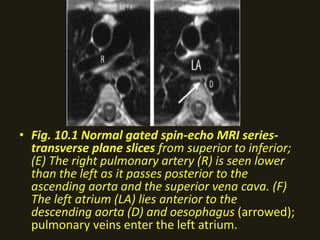
• Fig. 10.1 Normal gated spin-echo MRI series-
transverse plane slices from superior to inferior;
(E) The right pulmonary artery (R) is seen lower
than the left as it passes posterior to the
ascending aorta and the superior vena cava. (F)
The left atrium (LA) lies anterior to the
descending aorta (D) and oesophagus (arrowed);
pulmonary veins enter the left atrium.
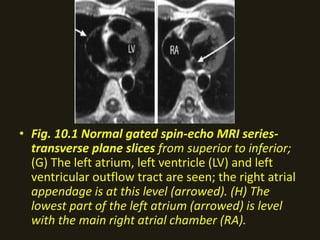
• Fig. 10.1 Normal gated spin-echo MRI series-
transverse plane slices from superior to inferior;
(G) The left atrium, left ventricle (LV) and left
ventricular outflow tract are seen; the right atrial
appendage is at this level (arrowed). (H) The
lowest part of the left atrium (arrowed) is level
with the main right atrial chamber (RA).
• Fig. 10.1 Normal gated spin-echo MRI series-
transverse plane slices from superior to
inferior; (I) The tricuspid valve (T) is seen; the
right ventricular free wall is thin in comparison
to the left; the coronary sinus enters the right
atrium (arrowed). (I) The inferior vena cava is
seen at the level of the diaphragmatic
domes(arrowed)
• Fig. 10.2 Normal gated spin-echo MRI series-coronal plane slices from
anterior to posterior. (A) The most anterior coronal section shows the
ascending aorta (A) curving to the right of the main pulmonary trunk (P);
the brachiocephalic venous confluence lies to the right of the first
brachiocephalic branch (arrowed). (B) The next slice shows how the
superior vena cava (S) and the right atrium (RA) form the right heart border;
the aortic knuckle, the pulmonary trunk, the left atrial appendage and the
left ventricle form the left heart border (arrowed).
• Fig. 10.2 Normal gated spin-echo MRI series-coronal plane slices from
anterior to posterior. (C) Pulmonary veins (arrowed) are seen entering the
left atrium in the plane of the tracheal bifurcation; the most posterior part
of the aortic root is just visible in the slice (A). (D) The left atrium (LA) lies
below the tracheal bifurcation and the right pulmonary artery; the
interatrial septum lies obliquely above the right atrium (RA); the IVC is to
the right of the descending aorta
• Fig. 10.3 Normal gated spin-echo MRI series-sagittal plane slices
from right to left. (A) The inferior vena cava (I) enters the right
atrium (RA) near the Eustachian valve; the left atrium lies above
and posterior to the right atrium and below the right pulmonary
artery (R). (B) The ascending aorta (A) lies anterior to the left
atrium (L) and right pulmonary artery (R).
• Fig. 10.3 Normal gated spin-echo MRI series-sagittal
plane slices from right to left. (C) The transverse and
posterior aortic arch lie at the same level as the main
pulmonary artery (M). (D) The relationship between
the right and left ventricles is clearly seen; the
pulmonary valve lies above the right ventricular
outflow tract (arrowed).
• Fig. 10.4 The posterior aspect of the pericardial space. The
transverse sinus lies between the aorta/pulmonary artery
and the great veins. The oblique sinus lies between the
pulmonary venous confluence. Ao = aorta; PA = pulmonary
artery; PV = pulmonary vein; SVC = superior vena cava; IVC
= inferior vena cava.
• Fig. 10.6 (A) Gated spin-echo MR] short-axis section of
the left and right ventricles. The papillary muscles are
clearly seen in the left ventricle comparative TOE
image (B) showing a short-axis section of both
ventricles-the gastric position of the transducer is at
the bottom of the image.
• Fig. 10.7 Transthoracic echocardiogram
showing a long-axis view of the left ventricle
(A) with a corresponding M-mode trace. (B)
The anterior leaflet of the mitral valve arises
from the posterior aortic annulus (arrowed).
• Fig. 10.8 Transoesophageal long-axis view
from the transgastric window showing the
chordae running from the papillary muscles to
the mitral valve (M). LA = left atrium; LV = left
ventricle.
• Fig. 10.9 M-mode sweep from mitral to aortic
valve. The anterior leaflet of the mitral valve
(arrowed) is in continuity with the posterior
wall of the aortic root. The anterior wall of the
aorta is in continuity with the interventricular
septum.
• Fig. 10.10 The anterior view of the septal surface of the right ventricle.
The basal, middle, apical, tonal and high anterior portions of the septum
are marked. The Eustachian valve (e) lies between the opening of the
inferior vena cava and the tricuspid valve annulus (t). The limbus of the
fossa ovalis is arrowed. The membranous septum (ms) lies on the upper
aspect of the tricuspid valve annulus and forms part of the ventriculoatrial
septum (v). The transected moderator band of the right ventricle (m) lies
in the mid septum. The parietal band of muscle (P) forms the tonal or
outflow septum. The right (r) and non-coronary (n) aortic sinuses are
marked.
• Fig. 10.11 Four-chamber transoesophageal
echocardiogram showing the mobile sinuous
appearance of a Chiari malformation in the right
atrium. RA = right atrium; LA = left atrium; RV =
right ventricle; LV = left ventricle.
Fig. 10.12 Longitudinal transoesophageal
echocardiogram showing the left atrial appendage
(arrowed). LA = left atrium; LV = left ventricle.
• Fig. 10.13 Gadolinium contrast MRI
angiography in the coronal plane showing the
four pulmonary veins entering the left atrium.
• Fig. 10.14 Short-axis transoesophageal
echocardiogram of the aortic valve in systole
(A) and diastole (B). The right (R), left (L) and
noncoronary (N) sinuses are shown. The lower
part of the images lie anteriorly.
• Fig. 10.15 Anomalous right subclavian artery. (A)
Barium study showing the oblique posterior
esophageal indentation. (B) Coronal MRI showing
diverticulum of origin of anomalous vessel (arrow).
(C) Coronal MRI showing obliquely running
anomalous vessel (arrow)
Fig. 10.15 Anomalous right subclavian artery. (A) Barium study
showing the oblique posterior esophageal indentation. (B) Coronal
MRI showing diverticulum of origin of anomalous vessel (arrow).
(C) Coronal MRI showing obliquely running anomalous vessel
(arrow). (D) Sagittal MRI showing diverticulum of origin of
anomalous vessel (arrow). (E) Sagittal MRI showing anomalous
vessel posterior to oesophagus (arrow)
• Fig. 10.16 Main pulmonary artery bifurcation.
(A) Contrast-enhanced CT. (B) Gated spin-
echo MRI. (C) Transthoracic echocardiogram.
• Fig. 10.17 (A) The transverse plane
showing the orientation of the three
aortic sinuses and the origins of the
coronary arteries. Angiographic
projections are annotated. (B) The levels
of the three aortic valve sinuses from two
different projections. RAO = right anterior
oblique; LAO = left anterior oblique; LAT =
lateral; L = left sinus; R = right sinus; N =
non-coronary sinus.
• Fig. 10.18 Series of normal coronary artery angiograms. LMS = left
main stem; LAD = left anterior descending artery; D = diagonal
branch; S = septal branch; I = intermediate branch; Cx = circumflex
artery; OM = obtuse marginal branch; PDA = posterior descending
artery; RV = right ventricular branch; LV = inferior left ventricular
branch. (A) Right anterior oblique view of the left coronary artery.
(B) Cranially angulated view of the left coronary artery.
• Fig. 10.18 Series of normal coronary artery angiograms.
LMS = left main stem; LAD = left anterior descending
artery; D = diagonal branch; S = septal branch; I =
intermediate branch; Cx = circumflex artery; OM = obtuse
marginal branch; PDA = posterior descending artery; RV =
right ventricular branch; LV = inferior left ventricular
branch. (C) Right anterior oblique view of the right
coronary artery. (D) Left anterior oblique view of the right
coronary artery. The posterior descending artery is
foreshortened. (E) Cranially angulated left anterior oblique
view of the right coronary artery. The posterior descending
artery is now well profiled.
• Fig. 10.19 Normal chest X-ray. (A) PA view
annotated to show measurements for
cardiothoracic ratio. (B) Lateral view.
• Fig. 10.20 Pulsed-Doppler study showing normal
mitral inflow. The left panel shows an apical
image with the sample volume (S) placed in the
mitral orifice between left atrium (LA) and left
ventricle (LV). The right panel shows the normal
inflow pattern with an initial large passive flow
(E) followed by a later smaller active flow (A)
produced by atrial systole.
• Fig. 10.21 Transoesophageal echocardiogram
showing color flow through a normal mitral
valve. There is aliasing (yellow and red) in the
central part of the flow where the velocity is
highest.
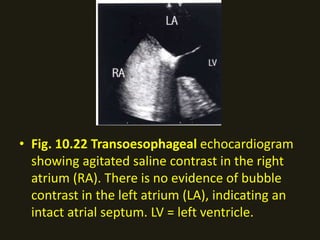
• Fig. 10.22 Transoesophageal echocardiogram
showing agitated saline contrast in the right
atrium (RA). There is no evidence of bubble
contrast in the left atrium (LA), indicating an
intact atrial septum. LV = left ventricle.
Fig. 10.23 Transthoracic apical four-chamber view
showing a bolus of transpulmonary contrast
agent entering the left ventricle through the
mitral valve after peripheral intravenous
injection. LV = left ventricle; RV = right ventricle;
LA = left atrium.
• Fig. 10.24 Technetium SPECT study showing a
normal series of short-axis slices along the left
ventricle after exercise stress (top) and at rest
(bottom).
• Fig. 10.25 Technetium SPECT study showing a
normal series of vertical long axis slices of the
left ventricle after exercise stress (top) and at
rest (bottom).
• Fig. 10.26 Technetium SPECT study showing a
normal series of horizontal long-axis slices of
the left ventricle after exercise stress (top) and
at rest (bottom).
• Fig. 10.27 Technetium SPECT study showing a normal
'bull's eye view' display (A). The apex of the left
ventricle is represented at the centre of the image and
the regions around the ventricle are annotated. (B)
Quantitation of the same display showing only minor
variation in counts across the left ventricular
myocardium. ?????????????
• Fig. 10.28 Technetium SPECT study showing surface-rendered
images of a normally contracting left ventricle. The systolic
contour is represented within the diastolic contour short-axis view
(A) and vertical (top) and horizontal (bottom) long-axis views (B).
• Fig. 10.29 High-
resolution multislice
contrast CT
demonstrating the left
coronary artery with a
stenosis (S) in the mid
left anterior descending
branch. Ao = aorta; MPA
= main pulmonary artery;
LMS = left mainstem; LAD
= left anterior descending
artery; GCV = great
cardiac vein. (Courtesy of
Dr A. Baumbach and Dr
S. Schroeder.)
Fig. 10.30 Double oblique MRI gradient-echotime
sequence of the left ventricular short axis in
diastole (A) and systole (B).
• Fig. 10.31 Coronal MRI gradient-echotime
sequence of the left ventricular outflow tract
and aortic valve in diastole (A) and systole (B).
• Fig. 10.32 Left ventricular angiogram in the
right anterior oblique projection using a
pigtail catheter. (A) Plain frame. (B) Diastolic
frame. (C) Systolic frame. The papillary
muscles are arrowed.
• Fig. 10.33 Cut film pulmonary angiogram
series. (A) Early arterial phase. (B) Late
arterial phase. (C) Capillary phase. (D)
Pulmonary venous phase. (E) Laevophase.
• Fig. 10.33 Cut film pulmonary angiogram
series. (A) Early arterial phase. (B) Late
arterial phase. (C) Capillary phase. (D)
Pulmonary venous phase. (E) Laevophase.
• Fig. 10.33 Cut film pulmonary angiogram
series. (A) Early arterial phase. (B) Late
arterial phase. (C) Capillary phase. (D)
Pulmonary venous phase. (E) Laevophase.
10 the normal heart

10 the normal heart

  • 1.
    10THE NORMAL HEART:ANATOMY AND TECHNIQUES OF EXAMINATION CARDIOVASCULAR SYSTEM DAVID SUTTON
  • 2.
    DAVID SUTTON PICTURES DR.Muhammad Bin Zulfiqar PGR-FCPS III SIMS/SHL
  • 3.
    • Fig. 10.1Normal gated spin-echo MRI series- transverse plane slices from superior to inferior; (A) The brachiocephalic arteries lie to the left of the trachea (T). (B) The transverse aortic arch (Ao) lies to the left of the trachea (T); the oesophagus lies posterior to the trachea (arrowed).
  • 4.
    • Fig. 10.1Normal gated spin-echo MRI series- transverse plane slices from superior to inferior; (C) The tracheal bifurcation (large arrow) lies posterior to the ascending aorta (AA) and the superior vena cava (small arrows) is to the right of the ascending aorta. (D) The left pulmonary artery (L) lies more superiorly than the right and is seen on the uppermost pulmonary artery slice.
  • 5.
    • Fig. 10.1Normal gated spin-echo MRI series- transverse plane slices from superior to inferior; (E) The right pulmonary artery (R) is seen lower than the left as it passes posterior to the ascending aorta and the superior vena cava. (F) The left atrium (LA) lies anterior to the descending aorta (D) and oesophagus (arrowed); pulmonary veins enter the left atrium.
  • 6.
    • Fig. 10.1Normal gated spin-echo MRI series- transverse plane slices from superior to inferior; (G) The left atrium, left ventricle (LV) and left ventricular outflow tract are seen; the right atrial appendage is at this level (arrowed). (H) The lowest part of the left atrium (arrowed) is level with the main right atrial chamber (RA).
  • 7.
    • Fig. 10.1Normal gated spin-echo MRI series- transverse plane slices from superior to inferior; (I) The tricuspid valve (T) is seen; the right ventricular free wall is thin in comparison to the left; the coronary sinus enters the right atrium (arrowed). (I) The inferior vena cava is seen at the level of the diaphragmatic domes(arrowed)
  • 8.
    • Fig. 10.2Normal gated spin-echo MRI series-coronal plane slices from anterior to posterior. (A) The most anterior coronal section shows the ascending aorta (A) curving to the right of the main pulmonary trunk (P); the brachiocephalic venous confluence lies to the right of the first brachiocephalic branch (arrowed). (B) The next slice shows how the superior vena cava (S) and the right atrium (RA) form the right heart border; the aortic knuckle, the pulmonary trunk, the left atrial appendage and the left ventricle form the left heart border (arrowed).
  • 9.
    • Fig. 10.2Normal gated spin-echo MRI series-coronal plane slices from anterior to posterior. (C) Pulmonary veins (arrowed) are seen entering the left atrium in the plane of the tracheal bifurcation; the most posterior part of the aortic root is just visible in the slice (A). (D) The left atrium (LA) lies below the tracheal bifurcation and the right pulmonary artery; the interatrial septum lies obliquely above the right atrium (RA); the IVC is to the right of the descending aorta
  • 10.
    • Fig. 10.3Normal gated spin-echo MRI series-sagittal plane slices from right to left. (A) The inferior vena cava (I) enters the right atrium (RA) near the Eustachian valve; the left atrium lies above and posterior to the right atrium and below the right pulmonary artery (R). (B) The ascending aorta (A) lies anterior to the left atrium (L) and right pulmonary artery (R).
  • 11.
    • Fig. 10.3Normal gated spin-echo MRI series-sagittal plane slices from right to left. (C) The transverse and posterior aortic arch lie at the same level as the main pulmonary artery (M). (D) The relationship between the right and left ventricles is clearly seen; the pulmonary valve lies above the right ventricular outflow tract (arrowed).
  • 12.
    • Fig. 10.4The posterior aspect of the pericardial space. The transverse sinus lies between the aorta/pulmonary artery and the great veins. The oblique sinus lies between the pulmonary venous confluence. Ao = aorta; PA = pulmonary artery; PV = pulmonary vein; SVC = superior vena cava; IVC = inferior vena cava.
  • 14.
    • Fig. 10.6(A) Gated spin-echo MR] short-axis section of the left and right ventricles. The papillary muscles are clearly seen in the left ventricle comparative TOE image (B) showing a short-axis section of both ventricles-the gastric position of the transducer is at the bottom of the image.
  • 15.
    • Fig. 10.7Transthoracic echocardiogram showing a long-axis view of the left ventricle (A) with a corresponding M-mode trace. (B) The anterior leaflet of the mitral valve arises from the posterior aortic annulus (arrowed).
  • 16.
    • Fig. 10.8Transoesophageal long-axis view from the transgastric window showing the chordae running from the papillary muscles to the mitral valve (M). LA = left atrium; LV = left ventricle.
  • 17.
    • Fig. 10.9M-mode sweep from mitral to aortic valve. The anterior leaflet of the mitral valve (arrowed) is in continuity with the posterior wall of the aortic root. The anterior wall of the aorta is in continuity with the interventricular septum.
  • 18.
    • Fig. 10.10The anterior view of the septal surface of the right ventricle. The basal, middle, apical, tonal and high anterior portions of the septum are marked. The Eustachian valve (e) lies between the opening of the inferior vena cava and the tricuspid valve annulus (t). The limbus of the fossa ovalis is arrowed. The membranous septum (ms) lies on the upper aspect of the tricuspid valve annulus and forms part of the ventriculoatrial septum (v). The transected moderator band of the right ventricle (m) lies in the mid septum. The parietal band of muscle (P) forms the tonal or outflow septum. The right (r) and non-coronary (n) aortic sinuses are marked.
  • 19.
    • Fig. 10.11Four-chamber transoesophageal echocardiogram showing the mobile sinuous appearance of a Chiari malformation in the right atrium. RA = right atrium; LA = left atrium; RV = right ventricle; LV = left ventricle.
  • 20.
    Fig. 10.12 Longitudinaltransoesophageal echocardiogram showing the left atrial appendage (arrowed). LA = left atrium; LV = left ventricle.
  • 21.
    • Fig. 10.13Gadolinium contrast MRI angiography in the coronal plane showing the four pulmonary veins entering the left atrium.
  • 22.
    • Fig. 10.14Short-axis transoesophageal echocardiogram of the aortic valve in systole (A) and diastole (B). The right (R), left (L) and noncoronary (N) sinuses are shown. The lower part of the images lie anteriorly.
  • 23.
    • Fig. 10.15Anomalous right subclavian artery. (A) Barium study showing the oblique posterior esophageal indentation. (B) Coronal MRI showing diverticulum of origin of anomalous vessel (arrow). (C) Coronal MRI showing obliquely running anomalous vessel (arrow)
  • 24.
    Fig. 10.15 Anomalousright subclavian artery. (A) Barium study showing the oblique posterior esophageal indentation. (B) Coronal MRI showing diverticulum of origin of anomalous vessel (arrow). (C) Coronal MRI showing obliquely running anomalous vessel (arrow). (D) Sagittal MRI showing diverticulum of origin of anomalous vessel (arrow). (E) Sagittal MRI showing anomalous vessel posterior to oesophagus (arrow)
  • 25.
    • Fig. 10.16Main pulmonary artery bifurcation. (A) Contrast-enhanced CT. (B) Gated spin- echo MRI. (C) Transthoracic echocardiogram.
  • 26.
    • Fig. 10.17(A) The transverse plane showing the orientation of the three aortic sinuses and the origins of the coronary arteries. Angiographic projections are annotated. (B) The levels of the three aortic valve sinuses from two different projections. RAO = right anterior oblique; LAO = left anterior oblique; LAT = lateral; L = left sinus; R = right sinus; N = non-coronary sinus.
  • 27.
    • Fig. 10.18Series of normal coronary artery angiograms. LMS = left main stem; LAD = left anterior descending artery; D = diagonal branch; S = septal branch; I = intermediate branch; Cx = circumflex artery; OM = obtuse marginal branch; PDA = posterior descending artery; RV = right ventricular branch; LV = inferior left ventricular branch. (A) Right anterior oblique view of the left coronary artery. (B) Cranially angulated view of the left coronary artery.
  • 28.
    • Fig. 10.18Series of normal coronary artery angiograms. LMS = left main stem; LAD = left anterior descending artery; D = diagonal branch; S = septal branch; I = intermediate branch; Cx = circumflex artery; OM = obtuse marginal branch; PDA = posterior descending artery; RV = right ventricular branch; LV = inferior left ventricular branch. (C) Right anterior oblique view of the right coronary artery. (D) Left anterior oblique view of the right coronary artery. The posterior descending artery is foreshortened. (E) Cranially angulated left anterior oblique view of the right coronary artery. The posterior descending artery is now well profiled.
  • 29.
    • Fig. 10.19Normal chest X-ray. (A) PA view annotated to show measurements for cardiothoracic ratio. (B) Lateral view.
  • 30.
    • Fig. 10.20Pulsed-Doppler study showing normal mitral inflow. The left panel shows an apical image with the sample volume (S) placed in the mitral orifice between left atrium (LA) and left ventricle (LV). The right panel shows the normal inflow pattern with an initial large passive flow (E) followed by a later smaller active flow (A) produced by atrial systole.
  • 31.
    • Fig. 10.21Transoesophageal echocardiogram showing color flow through a normal mitral valve. There is aliasing (yellow and red) in the central part of the flow where the velocity is highest.
  • 32.
    • Fig. 10.22Transoesophageal echocardiogram showing agitated saline contrast in the right atrium (RA). There is no evidence of bubble contrast in the left atrium (LA), indicating an intact atrial septum. LV = left ventricle.
  • 33.
    Fig. 10.23 Transthoracicapical four-chamber view showing a bolus of transpulmonary contrast agent entering the left ventricle through the mitral valve after peripheral intravenous injection. LV = left ventricle; RV = right ventricle; LA = left atrium.
  • 34.
    • Fig. 10.24Technetium SPECT study showing a normal series of short-axis slices along the left ventricle after exercise stress (top) and at rest (bottom).
  • 35.
    • Fig. 10.25Technetium SPECT study showing a normal series of vertical long axis slices of the left ventricle after exercise stress (top) and at rest (bottom).
  • 36.
    • Fig. 10.26Technetium SPECT study showing a normal series of horizontal long-axis slices of the left ventricle after exercise stress (top) and at rest (bottom).
  • 37.
    • Fig. 10.27Technetium SPECT study showing a normal 'bull's eye view' display (A). The apex of the left ventricle is represented at the centre of the image and the regions around the ventricle are annotated. (B) Quantitation of the same display showing only minor variation in counts across the left ventricular myocardium. ?????????????
  • 38.
    • Fig. 10.28Technetium SPECT study showing surface-rendered images of a normally contracting left ventricle. The systolic contour is represented within the diastolic contour short-axis view (A) and vertical (top) and horizontal (bottom) long-axis views (B).
  • 39.
    • Fig. 10.29High- resolution multislice contrast CT demonstrating the left coronary artery with a stenosis (S) in the mid left anterior descending branch. Ao = aorta; MPA = main pulmonary artery; LMS = left mainstem; LAD = left anterior descending artery; GCV = great cardiac vein. (Courtesy of Dr A. Baumbach and Dr S. Schroeder.)
  • 40.
    Fig. 10.30 Doubleoblique MRI gradient-echotime sequence of the left ventricular short axis in diastole (A) and systole (B).
  • 41.
    • Fig. 10.31Coronal MRI gradient-echotime sequence of the left ventricular outflow tract and aortic valve in diastole (A) and systole (B).
  • 42.
    • Fig. 10.32Left ventricular angiogram in the right anterior oblique projection using a pigtail catheter. (A) Plain frame. (B) Diastolic frame. (C) Systolic frame. The papillary muscles are arrowed.
  • 43.
    • Fig. 10.33Cut film pulmonary angiogram series. (A) Early arterial phase. (B) Late arterial phase. (C) Capillary phase. (D) Pulmonary venous phase. (E) Laevophase.
  • 44.
    • Fig. 10.33Cut film pulmonary angiogram series. (A) Early arterial phase. (B) Late arterial phase. (C) Capillary phase. (D) Pulmonary venous phase. (E) Laevophase.
  • 45.
    • Fig. 10.33Cut film pulmonary angiogram series. (A) Early arterial phase. (B) Late arterial phase. (C) Capillary phase. (D) Pulmonary venous phase. (E) Laevophase.