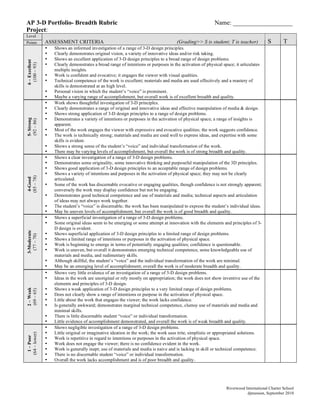
AP 3-D Portfolio- Breadth Rubric                                                                          Name: ___________________
Project:
Level
Points          ASSESSMENT CRITERIA                                                   (Grading>> S is student; T is teacher)           S        T
                •   Shows an informed investigation of a range of 3-D design principles.
                •   Clearly demonstrates original vision, a variety of innovative ideas and/or risk taking.
                •   Shows an excellent application of 3-D design principles to a broad range of design problems.
6 – Excellent


                    Clearly demonstrates a broad range of intentions or purposes in the activation of physical space; it articulates
  (100 – 93)


                •
                    multiple insights.
                •   Work is confident and evocative; it engages the viewer with visual qualities.
                •   Technical competence of the work is excellent; materials and media are used effectively and a mastery of
                    skills is demonstrated at an high level.
                •   Personal vision in which the student’s “voice” is prominent.
                •   Maybe a varying range of accomplishment, but overall work is of excellent breadth and quality.
                •   Work shows thoughtful investigation of 3-D principles.
                •   Clearly demonstrates a range of original and innovative ideas and effective manipulation of media & design.
                •   Shows strong application of 3-D design principles to a range of design problems.
                •   Demonstrates a variety of intentions or purposes in the activation of physical space; a range of insights is
5- Strong
(92 – 86)


                    apparent.
                •   Most of the work engages the viewer with expressive and evocative qualities; the work suggests confidence.
                •   The work is technically strong; materials and media are used well to express ideas, and expertise with some
                    skills is evident.
                •   Shows a strong sense of the student’s “voice” and individual transformation of the work.
                •   There may be varying levels of accomplishment, but overall the work is of strong breadth and quality.
                •   Shows a clear investigation of a range of 3-D design problems.
                •   Demonstrates some originality, some innovative thinking and purposeful manipulation of the 3D principles.
                •   Shows good application of 3-D design principles to an acceptable range of design problems.
                •   Shows a variety of intentions and purposes in the activation of physical space; they may not be clearly
(85 – 78)


                    articulated.
 4-Good


                •   Some of the work has discernable evocative or engaging qualities, though confidence is not strongly apparent;
                    conversely the work may display confidence but not be engaging.
                •   Demonstrates good technical competence and use of materials and media; technical aspects and articulation
                    of ideas may not always work together.
                •   The student’s “voice” is discernable; the work has been manipulated to express the student’s individual ideas.
                •   May be uneven levels of accomplishment, but overall the work is of good breadth and quality.
                •   Shows a superficial investigation of a range of 3-D design problems.
                •   Some original ideas seem to be emerging or some attempt at innovation with the elements and principles of 3-
                    D design is evident.
3-Moderate


                •   Shows superficial application of 3-D design principles to a limited range of design problems.
  (77 – 70)


                •   Shows a limited range of intentions or purposes in the activation of physical space.
                •   Work is beginning to emerge in terms of potentially engaging qualities; confidence is questionable.
                •   Work is uneven, but overall it demonstrates emerging technical competence, some knowledgeable use of
                    materials and media, and rudimentary skills.
                •   Although skillful, the student’s “voice” and the individual transformation of the work are minimal.
                •   May be an emerging level of accomplishment; overall the work is of moderate breadth and quality.
                •   Shows very little evidence of an investigation of a range of 3-D design problems.
                •   Ideas in the work are unoriginal or rely mostly on appropriation; the work does not show inventive use of the
                    elements and principles of 3-D design.
                •   Shows a weak application of 3-D design principles to a very limited range of design problems.
2 – Weak
(69 – 65)


                •   Does not clearly show a range of intentions or purpose in the activation of physical space.
                •   Little about the work that engages the viewer; the work lacks confidence.
                •   Is generally awkward; demonstrates marginal technical competence, clumsy use of materials and media and
                    minimal skills.
                •   There is little discernable student “voice” or individual transformation.
                •   Little evidence of accomplishment demonstrated, and overall the work is of weak breadth and quality.
                •   Shows negligible investigation of a range of 3-D design problems.
                •   Little original or imaginative ideation in the work; the work uses trite, simplistic or appropriated solutions.
(64 – lower)
  1 – Poor


                •   Work is repetitive in regard to intentions or purposes in the activation of physical space.
                •   Work does not engage the viewer; there is no confidence evident in the work.
                •   Work is generally inept; use of materials and media is naive and is lacking in skill or technical competence.
                •   There is no discernable student “voice” or individual transformation.
                •   Overall the work lacks accomplishment and is of poor breadth and quality.


                                                                                                                Riverwood International Charter School
                                                                                                                           djmunson, September 2010

10 rubric 3d_breadth

  • 1.
    AP 3-D Portfolio-Breadth Rubric Name: ___________________ Project: Level Points ASSESSMENT CRITERIA (Grading>> S is student; T is teacher) S T • Shows an informed investigation of a range of 3-D design principles. • Clearly demonstrates original vision, a variety of innovative ideas and/or risk taking. • Shows an excellent application of 3-D design principles to a broad range of design problems. 6 – Excellent Clearly demonstrates a broad range of intentions or purposes in the activation of physical space; it articulates (100 – 93) • multiple insights. • Work is confident and evocative; it engages the viewer with visual qualities. • Technical competence of the work is excellent; materials and media are used effectively and a mastery of skills is demonstrated at an high level. • Personal vision in which the student’s “voice” is prominent. • Maybe a varying range of accomplishment, but overall work is of excellent breadth and quality. • Work shows thoughtful investigation of 3-D principles. • Clearly demonstrates a range of original and innovative ideas and effective manipulation of media & design. • Shows strong application of 3-D design principles to a range of design problems. • Demonstrates a variety of intentions or purposes in the activation of physical space; a range of insights is 5- Strong (92 – 86) apparent. • Most of the work engages the viewer with expressive and evocative qualities; the work suggests confidence. • The work is technically strong; materials and media are used well to express ideas, and expertise with some skills is evident. • Shows a strong sense of the student’s “voice” and individual transformation of the work. • There may be varying levels of accomplishment, but overall the work is of strong breadth and quality. • Shows a clear investigation of a range of 3-D design problems. • Demonstrates some originality, some innovative thinking and purposeful manipulation of the 3D principles. • Shows good application of 3-D design principles to an acceptable range of design problems. • Shows a variety of intentions and purposes in the activation of physical space; they may not be clearly (85 – 78) articulated. 4-Good • Some of the work has discernable evocative or engaging qualities, though confidence is not strongly apparent; conversely the work may display confidence but not be engaging. • Demonstrates good technical competence and use of materials and media; technical aspects and articulation of ideas may not always work together. • The student’s “voice” is discernable; the work has been manipulated to express the student’s individual ideas. • May be uneven levels of accomplishment, but overall the work is of good breadth and quality. • Shows a superficial investigation of a range of 3-D design problems. • Some original ideas seem to be emerging or some attempt at innovation with the elements and principles of 3- D design is evident. 3-Moderate • Shows superficial application of 3-D design principles to a limited range of design problems. (77 – 70) • Shows a limited range of intentions or purposes in the activation of physical space. • Work is beginning to emerge in terms of potentially engaging qualities; confidence is questionable. • Work is uneven, but overall it demonstrates emerging technical competence, some knowledgeable use of materials and media, and rudimentary skills. • Although skillful, the student’s “voice” and the individual transformation of the work are minimal. • May be an emerging level of accomplishment; overall the work is of moderate breadth and quality. • Shows very little evidence of an investigation of a range of 3-D design problems. • Ideas in the work are unoriginal or rely mostly on appropriation; the work does not show inventive use of the elements and principles of 3-D design. • Shows a weak application of 3-D design principles to a very limited range of design problems. 2 – Weak (69 – 65) • Does not clearly show a range of intentions or purpose in the activation of physical space. • Little about the work that engages the viewer; the work lacks confidence. • Is generally awkward; demonstrates marginal technical competence, clumsy use of materials and media and minimal skills. • There is little discernable student “voice” or individual transformation. • Little evidence of accomplishment demonstrated, and overall the work is of weak breadth and quality. • Shows negligible investigation of a range of 3-D design problems. • Little original or imaginative ideation in the work; the work uses trite, simplistic or appropriated solutions. (64 – lower) 1 – Poor • Work is repetitive in regard to intentions or purposes in the activation of physical space. • Work does not engage the viewer; there is no confidence evident in the work. • Work is generally inept; use of materials and media is naive and is lacking in skill or technical competence. • There is no discernable student “voice” or individual transformation. • Overall the work lacks accomplishment and is of poor breadth and quality. Riverwood International Charter School djmunson, September 2010