Early History

 The Israelites or Hebrews
  recorded events and laws in
  the Torah, their most sacred
  text.

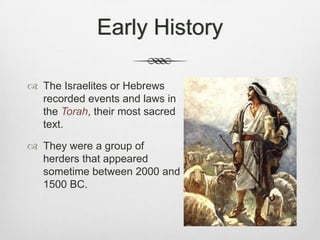
 They were a group of
  herders that appeared
  sometime between 2000 and
  1500 BC.
Nomadic People

 2000 B.C. According to the
  Torah, Abraham who lived near
  Ur, migrated with his sheep-herding
  family into a region named Canaan. He
  is considered to be the founding father of
  the Israelite nation.
    Because of famine, they had to move
     out Canaan and left for Egypt, where
     they lived well. Their numbers grew into
     great numbers. Therefore, the Pharaoh
     enslaved them out of fear.
Nomadic People

 1200 B.C. According to the
  Hebrew Bible, a leader
  named Moses appeared
  among the Israelites.
      He appeared before the
       Pharaoh and demanded
       his people be freed. He
       refused.
      Soon a series of plagues
       struck the land of Egypt
       and out of fear and
       superstition, the Pharaoh
       freed them.

 The journey out of Egypt
  back to Canaan was called
  the Exodus.
      They believed that God
       had chosen them as their
       special people and set
Law and Morals

      According to the Hebrew
       Bible, during the
       Exodus, Moses received from
       God two stone tablets at Mount
       Sinai:
         These included a code of
          moral laws.
         They are known as The Ten
          Commandments.

      With these laws they agreed to
       value human life, self-control
       and justice.
      Also the commitment to only
       one God.
Monotheism

 “I am the Lord your God, who brought you
out of the house of bondage. You shall have
         no other gods beside Me.”


 This promise of a unique relationship with God
  helped shape the history of the Israelites, later
  known as the Jews. Their early religion evolved into
  Judaism.
Return to Canaan

 Eventually they reached
  the land of Canaan. Once
  there, they fought against
  people living there to gain
  control of the land, before
  they could settle.
    Afterwards they built
     their own society.

 In Canaan they lived in
  scattered
  communities, with no
  central government!
    Instead they chose
     judges to enforce laws
     and settle disputes
Ask Yourselves
 Identify:
      Who was Abraham? Where did he come from and where did he
       move to?

 Sequence:
      Briefly detail the events that led to the Exodus.

 Infer:
      Knowing the geography of the Middle East, which natural features do
       you think Abraham might have followed into Canaan? (draw a map
       with the answer given in class)

 Recall:
      According to the Hebrew Bible, what code of morals did God give to
       Moses?

 Explain:
      How did the Ten Commandments shape Israelite life?
Bibliography

 Burstein, S. M., & Shek, R. (2012). World History
  (Teacher´s Edition) (1st Edition ed.). (H.
  McDougal, Ed.) Orlando, Florida, US.: Houghton
  Mifflin Harcourt Publishing Company.

 Images taken from Google.com

10 hebrews

  • 2.
    Early History  TheIsraelites or Hebrews recorded events and laws in the Torah, their most sacred text.  They were a group of herders that appeared sometime between 2000 and 1500 BC.
  • 3.
    Nomadic People  2000B.C. According to the Torah, Abraham who lived near Ur, migrated with his sheep-herding family into a region named Canaan. He is considered to be the founding father of the Israelite nation.  Because of famine, they had to move out Canaan and left for Egypt, where they lived well. Their numbers grew into great numbers. Therefore, the Pharaoh enslaved them out of fear.
  • 4.
    Nomadic People  1200B.C. According to the Hebrew Bible, a leader named Moses appeared among the Israelites.  He appeared before the Pharaoh and demanded his people be freed. He refused.  Soon a series of plagues struck the land of Egypt and out of fear and superstition, the Pharaoh freed them.  The journey out of Egypt back to Canaan was called the Exodus.  They believed that God had chosen them as their special people and set
  • 5.
    Law and Morals  According to the Hebrew Bible, during the Exodus, Moses received from God two stone tablets at Mount Sinai:  These included a code of moral laws.  They are known as The Ten Commandments.  With these laws they agreed to value human life, self-control and justice.  Also the commitment to only one God.
  • 6.
    Monotheism “I amthe Lord your God, who brought you out of the house of bondage. You shall have no other gods beside Me.”  This promise of a unique relationship with God helped shape the history of the Israelites, later known as the Jews. Their early religion evolved into Judaism.
  • 7.
    Return to Canaan Eventually they reached the land of Canaan. Once there, they fought against people living there to gain control of the land, before they could settle.  Afterwards they built their own society.  In Canaan they lived in scattered communities, with no central government!  Instead they chose judges to enforce laws and settle disputes
  • 8.
    Ask Yourselves  Identify:  Who was Abraham? Where did he come from and where did he move to?  Sequence:  Briefly detail the events that led to the Exodus.  Infer:  Knowing the geography of the Middle East, which natural features do you think Abraham might have followed into Canaan? (draw a map with the answer given in class)  Recall:  According to the Hebrew Bible, what code of morals did God give to Moses?  Explain:  How did the Ten Commandments shape Israelite life?
  • 9.
    Bibliography  Burstein, S.M., & Shek, R. (2012). World History (Teacher´s Edition) (1st Edition ed.). (H. McDougal, Ed.) Orlando, Florida, US.: Houghton Mifflin Harcourt Publishing Company.  Images taken from Google.com