Lesson 10
Key Text
“And the
apostles said to
the Lord,
‘Increase our
faith’ ”
Luke 17:5
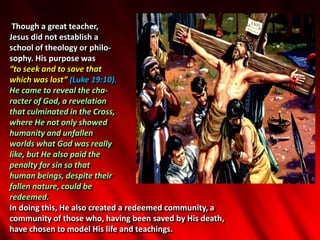
Though a great teacher,
Jesus did not establish a
school of theology or philo-
sophy. His purpose was
“to seek and to save that
which was lost” (Luke 19:10).
He came to reveal the cha-
racter of God, a revelation
that culminated in the Cross,
where He not only showed
humanity and unfallen
worlds what God was really
like, but He also paid the
penalty for sin so that
human beings, despite their
fallen nature, could be
redeemed.
In doing this, He also created a redeemed community, a
community of those who, having been saved by His death,
have chosen to model His life and teachings.
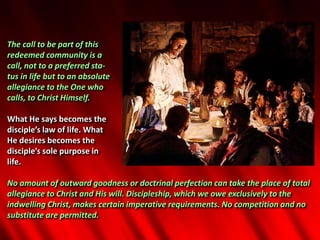
The call to be part of this
redeemed community is a
call, not to a preferred sta-
tus in life but to an absolute
allegiance to the One who
calls, to Christ Himself.
What He says becomes the
disciple’s law of life. What
He desires becomes the
disciple’s sole purpose in
life.
No amount of outward goodness or doctrinal perfection can take the place of total
allegiance to Christ and His will. Discipleship, which we owe exclusively to the
indwelling Christ, makes certain imperative requirements. No competition and no
substitute are permitted.
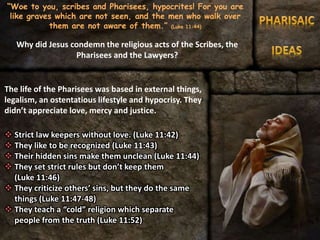
“Woe to you, scribes and Pharisees, hypocrites! For you are
like graves which are not seen, and the men who walk over
them are not aware of them.” (Luke 11:44)
The life of the Pharisees was based in external things,
legalism, an ostentatious lifestyle and hypocrisy. They
didn’t appreciate love, mercy and justice.
 Strict law keepers without love. (Luke 11:42)
 They like to be recognized (Luke 11:43)
 Their hidden sins make them unclean (Luke 11:44)
 They set strict rules but don’t keep them
(Luke 11:46)
 They criticize others’ sins, but they do the same
things (Luke 11:47-48)
 They teach a “cold” religion which separate
people from the truth (Luke 11:52)
Why did Jesus condemn the religious acts of the Scribes, the
Pharisees and the Lawyers?
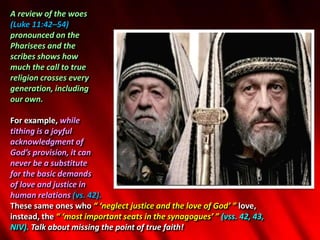
A review of the woes
(Luke 11:42–54)
pronounced on the
Pharisees and the
scribes shows how
much the call to true
religion crosses every
generation, including
our own.
For example, while
tithing is a joyful
acknowledgment of
God’s provision, it can
never be a substitute
for the basic demands
of love and justice in
human relations (vs. 42).
These same ones who “ ‘neglect justice and the love of God’ ” love,
instead, the “ ‘most important seats in the synagogues’ ” (vss. 42, 43,
NIV). Talk about missing the point of true faith!
Jesus warned, too, that those who equate true religion with outward rituals alone are
really unclean, somewhat like those who come in contact with the dead (Luke 11:44;
see also Num. 19:16). How easy to confuse what’s trivial with what’s sacred in the
eyes of God. Also, Jesus pronounced a woe on the experts in the law who used their
education and experience to place intolerable religious burdens on others while they
themselves “ ‘do not touch the burdens with one of [their] fingers’ ” (Luke 11:46,
NKJV).
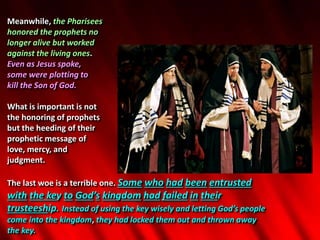
Meanwhile, the Pharisees
honored the prophets no
longer alive but worked
against the living ones.
Even as Jesus spoke,
some were plotting to
kill the Son of God.
What is important is not
the honoring of prophets
but the heeding of their
prophetic message of
love, mercy, and
judgment.
The last woe is a terrible one. Some who had been entrusted
with the key to God’s kingdom had failed in their
trusteeship. Instead of using the key wisely and letting God’s people
come into the kingdom, they had locked them out and thrown away
the key.
“Are not five sparrows sold for two copper coins? And not
one of them is forgotten before God. But the very hairs of
your head are all numbered. Do not fear therefore; you are
of more value than many sparrows.” (Luke 12:6-7)
Fearing god (that is, respecting
and revering God, Revelation
14:7) frightens fear away (fear,
suspicion, misgiving…).
Fearing God casts our worldly
fears out.
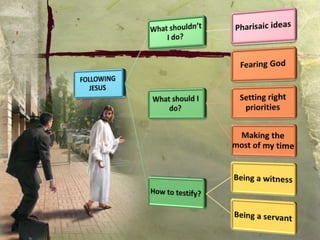
Jesus taught us what to fear:
 Don’t fear those who can’t
take our eternal life away
(Luke 12:4).
 Fear those who can dissuade
us from the path to eternal life
(Luke 12:5).
 Don’t fear for our life, because
it is in God’s hands
(Luke 12:6-7).
 Don’t fear confessing Christ
(Luke 12:8-10).
 Don’t fear talking about God to
those who ask us about our
faith (Luke 12:11-12).
“And He said to them, ‘Take heed and beware of
covetousness, for one’s life does not consist in the
abundance of the things he possesses.’” (Luke 12:15)
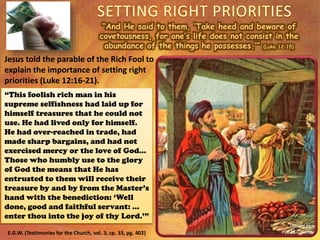
Jesus told the parable of the Rich Fool to
explain the importance of setting right
priorities (Luke 12:16-21).
“This foolish rich man in his
supreme selfishness had laid up for
himself treasures that he could not
use. He had lived only for himself.
He had over-reached in trade, had
made sharp bargains, and had not
exercised mercy or the love of God…
Those who humbly use to the glory
of God the means that He has
entrusted to them will receive their
treasure by and by from the Master’s
hand with the benediction: ‘Well
done, good and faithful servant: ...
enter thou into the joy of thy Lord.’”
E.G.W. (Testimonies for the Church, vol. 3, cp. 33, pg. 402)
“Let your waist be girded and your lamps burning.” (Luke 12:35)
People wore tunics in Jesus’ time.
In order to move easily during
work, they needed to “gird up their
loins"; that is, to hold the tunic
with a belt.
They also needed to light the lamps
on at night in order to keep awake.
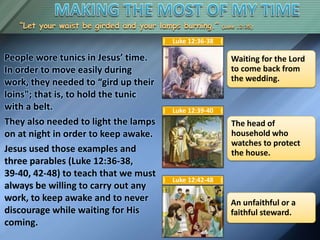
Jesus used those examples and
three parables (Luke 12:36-38,
39-40, 42-48) to teach that we must
always be willing to carry out any
work, to keep awake and to never
discourage while waiting for His
coming.
Waiting for the Lord
to come back from
the wedding.
Luke 12:36-38
The head of
household who
watches to protect
the house.
Luke 12:39-40
An unfaithful or a
faithful steward.
Luke 12:42-48
“Now is the time to prepare for the
coming of our Lord. Readiness to meet
Him cannot be attained in a moment’s
time. Preparatory to that solemn scene
there must be vigilant waiting and
watching, combined with earnest
work. So God’s children glorify Him.
Amid the busy scenes of life their
voices will be heard speaking words of
encouragement, faith, and hope. All
they have and are is consecrated to the
Master’s service.”
E.G.W. (God’s Amazing Grace, December 11)
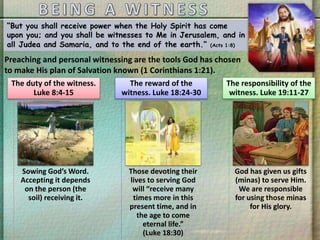
“But you shall receive power when the Holy Spirit has come
upon you; and you shall be witnesses to Me in Jerusalem, and in
all Judea and Samaria, and to the end of the earth.” (Acts 1:8)
Preaching and personal witnessing are the tools God has chosen
to make His plan of Salvation known (1 Corinthians 1:21).
Sowing God’s Word.
Accepting it depends
on the person (the
soil) receiving it.
The duty of the witness.
Luke 8:4-15
Those devoting their
lives to serving God
will “receive many
times more in this
present time, and in
the age to come
eternal life.”
(Luke 18:30)
The reward of the
witness. Luke 18:24-30
God has given us gifts
(minas) to serve Him.
We are responsible
for using those minas
for His glory.
The responsibility of the
witness. Luke 19:11-27
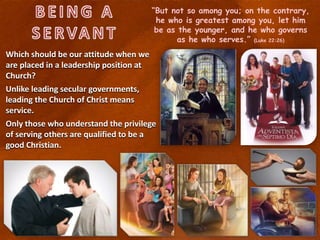
“But not so among you; on the contrary,
he who is greatest among you, let him
be as the younger, and he who governs
as he who serves.” (Luke 22:26)
Which should be our attitude when we
are placed in a leadership position at
Church?
Unlike leading secular governments,
leading the Church of Christ means
service.
Only those who understand the privilege
of serving others are qualified to be a
good Christian.
“Christ gave His disciples a most important
lesson in regard to who should be His disciples.
‘In the kingdom that I am about to set up,’ He
said, ‘strife for the supremacy shall have no
place. All ye are brethren. All My servants there
shall be equal. The only greatness recognized
there will be the greatness of humility and
devotion to the service of others. He that
humbleth himself shall be exalted, and he that
exalteth himself shall be abased. He who seeks to
serve others by self-denial and self-sacrifice will
be given the attributes of character that
commend themselves to God, and develop
wisdom, true patience, forbearance, kindness,
compassion. This gives him the chiefest place in
the kingdom of God.’”
E.G.W. (This Day with God, December 13)
THE GOSPEL OF LUKE
Slideshare.net/chucho1943
We invite you to download and study each one of the 13
lessons about this serie
THIS SERVICE IS
FREE AND YOU
CAN USE IT

10 following jesus

  • 1.
  • 2.
    Key Text “And the apostlessaid to the Lord, ‘Increase our faith’ ” Luke 17:5
  • 3.
    Though a greatteacher, Jesus did not establish a school of theology or philo- sophy. His purpose was “to seek and to save that which was lost” (Luke 19:10). He came to reveal the cha- racter of God, a revelation that culminated in the Cross, where He not only showed humanity and unfallen worlds what God was really like, but He also paid the penalty for sin so that human beings, despite their fallen nature, could be redeemed. In doing this, He also created a redeemed community, a community of those who, having been saved by His death, have chosen to model His life and teachings.
  • 4.
    The call tobe part of this redeemed community is a call, not to a preferred sta- tus in life but to an absolute allegiance to the One who calls, to Christ Himself. What He says becomes the disciple’s law of life. What He desires becomes the disciple’s sole purpose in life. No amount of outward goodness or doctrinal perfection can take the place of total allegiance to Christ and His will. Discipleship, which we owe exclusively to the indwelling Christ, makes certain imperative requirements. No competition and no substitute are permitted.
  • 6.
    “Woe to you,scribes and Pharisees, hypocrites! For you are like graves which are not seen, and the men who walk over them are not aware of them.” (Luke 11:44) The life of the Pharisees was based in external things, legalism, an ostentatious lifestyle and hypocrisy. They didn’t appreciate love, mercy and justice.  Strict law keepers without love. (Luke 11:42)  They like to be recognized (Luke 11:43)  Their hidden sins make them unclean (Luke 11:44)  They set strict rules but don’t keep them (Luke 11:46)  They criticize others’ sins, but they do the same things (Luke 11:47-48)  They teach a “cold” religion which separate people from the truth (Luke 11:52) Why did Jesus condemn the religious acts of the Scribes, the Pharisees and the Lawyers?
  • 7.
    A review ofthe woes (Luke 11:42–54) pronounced on the Pharisees and the scribes shows how much the call to true religion crosses every generation, including our own. For example, while tithing is a joyful acknowledgment of God’s provision, it can never be a substitute for the basic demands of love and justice in human relations (vs. 42). These same ones who “ ‘neglect justice and the love of God’ ” love, instead, the “ ‘most important seats in the synagogues’ ” (vss. 42, 43, NIV). Talk about missing the point of true faith!
  • 8.
    Jesus warned, too,that those who equate true religion with outward rituals alone are really unclean, somewhat like those who come in contact with the dead (Luke 11:44; see also Num. 19:16). How easy to confuse what’s trivial with what’s sacred in the eyes of God. Also, Jesus pronounced a woe on the experts in the law who used their education and experience to place intolerable religious burdens on others while they themselves “ ‘do not touch the burdens with one of [their] fingers’ ” (Luke 11:46, NKJV).
  • 9.
    Meanwhile, the Pharisees honoredthe prophets no longer alive but worked against the living ones. Even as Jesus spoke, some were plotting to kill the Son of God. What is important is not the honoring of prophets but the heeding of their prophetic message of love, mercy, and judgment. The last woe is a terrible one. Some who had been entrusted with the key to God’s kingdom had failed in their trusteeship. Instead of using the key wisely and letting God’s people come into the kingdom, they had locked them out and thrown away the key.
  • 10.
    “Are not fivesparrows sold for two copper coins? And not one of them is forgotten before God. But the very hairs of your head are all numbered. Do not fear therefore; you are of more value than many sparrows.” (Luke 12:6-7) Fearing god (that is, respecting and revering God, Revelation 14:7) frightens fear away (fear, suspicion, misgiving…). Fearing God casts our worldly fears out. Jesus taught us what to fear:  Don’t fear those who can’t take our eternal life away (Luke 12:4).  Fear those who can dissuade us from the path to eternal life (Luke 12:5).  Don’t fear for our life, because it is in God’s hands (Luke 12:6-7).  Don’t fear confessing Christ (Luke 12:8-10).  Don’t fear talking about God to those who ask us about our faith (Luke 12:11-12).
  • 11.
    “And He saidto them, ‘Take heed and beware of covetousness, for one’s life does not consist in the abundance of the things he possesses.’” (Luke 12:15) Jesus told the parable of the Rich Fool to explain the importance of setting right priorities (Luke 12:16-21). “This foolish rich man in his supreme selfishness had laid up for himself treasures that he could not use. He had lived only for himself. He had over-reached in trade, had made sharp bargains, and had not exercised mercy or the love of God… Those who humbly use to the glory of God the means that He has entrusted to them will receive their treasure by and by from the Master’s hand with the benediction: ‘Well done, good and faithful servant: ... enter thou into the joy of thy Lord.’” E.G.W. (Testimonies for the Church, vol. 3, cp. 33, pg. 402)
  • 12.
    “Let your waistbe girded and your lamps burning.” (Luke 12:35) People wore tunics in Jesus’ time. In order to move easily during work, they needed to “gird up their loins"; that is, to hold the tunic with a belt. They also needed to light the lamps on at night in order to keep awake. Jesus used those examples and three parables (Luke 12:36-38, 39-40, 42-48) to teach that we must always be willing to carry out any work, to keep awake and to never discourage while waiting for His coming. Waiting for the Lord to come back from the wedding. Luke 12:36-38 The head of household who watches to protect the house. Luke 12:39-40 An unfaithful or a faithful steward. Luke 12:42-48
  • 13.
    “Now is thetime to prepare for the coming of our Lord. Readiness to meet Him cannot be attained in a moment’s time. Preparatory to that solemn scene there must be vigilant waiting and watching, combined with earnest work. So God’s children glorify Him. Amid the busy scenes of life their voices will be heard speaking words of encouragement, faith, and hope. All they have and are is consecrated to the Master’s service.” E.G.W. (God’s Amazing Grace, December 11)
  • 14.
    “But you shallreceive power when the Holy Spirit has come upon you; and you shall be witnesses to Me in Jerusalem, and in all Judea and Samaria, and to the end of the earth.” (Acts 1:8) Preaching and personal witnessing are the tools God has chosen to make His plan of Salvation known (1 Corinthians 1:21). Sowing God’s Word. Accepting it depends on the person (the soil) receiving it. The duty of the witness. Luke 8:4-15 Those devoting their lives to serving God will “receive many times more in this present time, and in the age to come eternal life.” (Luke 18:30) The reward of the witness. Luke 18:24-30 God has given us gifts (minas) to serve Him. We are responsible for using those minas for His glory. The responsibility of the witness. Luke 19:11-27
  • 15.
    “But not soamong you; on the contrary, he who is greatest among you, let him be as the younger, and he who governs as he who serves.” (Luke 22:26) Which should be our attitude when we are placed in a leadership position at Church? Unlike leading secular governments, leading the Church of Christ means service. Only those who understand the privilege of serving others are qualified to be a good Christian.
  • 16.
    “Christ gave Hisdisciples a most important lesson in regard to who should be His disciples. ‘In the kingdom that I am about to set up,’ He said, ‘strife for the supremacy shall have no place. All ye are brethren. All My servants there shall be equal. The only greatness recognized there will be the greatness of humility and devotion to the service of others. He that humbleth himself shall be exalted, and he that exalteth himself shall be abased. He who seeks to serve others by self-denial and self-sacrifice will be given the attributes of character that commend themselves to God, and develop wisdom, true patience, forbearance, kindness, compassion. This gives him the chiefest place in the kingdom of God.’” E.G.W. (This Day with God, December 13)
  • 17.
    THE GOSPEL OFLUKE Slideshare.net/chucho1943 We invite you to download and study each one of the 13 lessons about this serie THIS SERVICE IS FREE AND YOU CAN USE IT