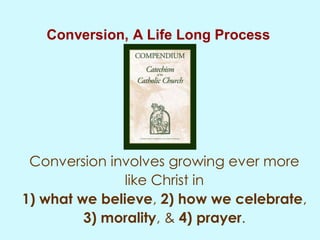
Conversion, A Life Long Process
Conversion involves growing ever more
like Christ in
1) what we believe, 2) how we celebrate,
3) morality, & 4) prayer.
Part 1, the Profession of Faith (What We Believe) includes an
extended reflection on the Apostles’ Creed
“1. What is the plan of God for man?
“God, infinitely perfect and blessed in
Himself, in a plan of sheer goodness
freely
created man to make him
share in His own blessed life.
In the fullness of time, God the Father
sent His son as the Redeemer and
Savior of
Mankind, fallen into sin, then calling all
into His Church
and, through the work of the
Holy Spirit, making them adopted
children and heirs of
His eternal happiness.”
How Cool is That!!!
“9. What is the full and definitive stage of God's Revelation?
“The full & definitive stage of God’s revelation is accomplished in His Word made flesh,
Jesus Christ ….Revelation is now fully complete, although the faith of the Church must
gradually grasp its full significance over the course of centuries.”
http://www.virtualtoursantosepolcro.org/index_en.htm
“11. Why and in what way is divine revelation transmitted?
“God ‘desires all men to be saved and to
come to the knowledge of the Truth’
(1 Timothy 2:4), that is, of Jesus Christ.
For this reason, Christ must be proclaimed
to all according to His own command,
‘Go forth & teach all’”
God wants all people to be saved.
How Cool is That!!!
Just as a collection of historical works, the Bible is so undeniably
unique that no intelligent person would want to be ignorant of it
(Yet, plenty are!).
Intelligent non-believers do not say that Jesus is a fictional
character. The worst they can do is dismissively treat Him as a
mere moral teacher. Yet, via His actions & Words, Jesus
repeatedly claimed to be God! What sane, moral "fella" goes
around claiming He’s God - if He's not?
When Jesus was buried, the world’s most powerful empire
stationed an armed guard. The easiest way to discredit Jesus would have been to
come up with His body and disprove His resurrection. No one ever did so!, and no
one ever will!
"it is important to understand a common misconception and faulty mind-set held by
most antagonists of the Bible: the presupposition of anti-supernaturalism" (Josh
McDowell, The New Evidence that Demands a Verdict, p. 349).
"The anti-supernaturalist bases his thinking on the presupposition that God has not
intervened in history. Therefore he rejects evidence indicating the supernatural no
matter how convincing" (p. 368).
A one year reading plan for the Bible, learning more about God’s Salvation History:
Apologeticsanyone.blogspot.com
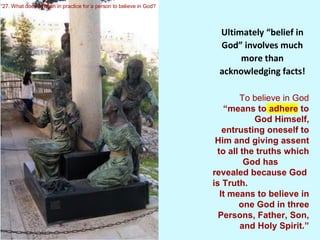
Ultimately “belief in
God” involves much
more than
acknowledging facts!
To believe in God
“means to adhere to
God Himself,
entrusting oneself to
Him and giving assent
to all the truths which
God has
revealed because God
is Truth.
It means to believe in
one God in three
Persons, Father, Son,
and Holy Spirit.”
“27. What does it mean in practice for a person to believe in God?
Part 2 (The Celebration of the Christian
Mystery) includes an extended reflection
on the Seven Sacraments
Perhaps, the Celebration of
the Eucharist and the
Sacrament of Reconciliation
are the most readily available
in our lifelong process of
conversion.
We “go to heaven when we go to
Mass, and this is true of every Mass we
attend, regardless of the quality of the music
or the fervor of the preaching” (p.5).
“It is not enough that Christ bled and died for
our sake. Now we have our part to play….If
you want to mark your covenant with God, to
seal your covenant with God, to renew your
covenant with God, you have to eat the Lamb –
the paschal lamb Who is our unleavened bread
“ (p. 26).
“Faithfulness to our routines is a way of
showing love. We don’t just work, or thank, or
offer affection when we really feel like it. Real
loves are loves we live with constancy, and
that constancy shows itself in routine” (p. 41).
(Scott Hahn, The Lamb’s Supper, 1999, pp. 66 - 69).
“297. Why is there a sacrament of Reconciliation after
Baptism?....
“the new life of grace received in
Baptism does not abolish the
weakness of human nature nor the
inclination to sin… Christ instituted
this sacrament for the conversion of
the baptized who have been
separated from Him by sin.
298. When did he institute this sacrament?....
“The risen Lord instituted this sacrament on the evening of Easter when he
showed himself to his apostles & said to them, ‘Receive the Holy Spirit. If you
forgive the sins of any, they are forgiven; if you retain the sins of any, they are
retained.’ (John 20:22-23).
“309. Is a confessor bound to secrecy?....
“every confessor, without any exception & under very severe penalties, is
bound to maintain ‘the sacramental seal’ which means absolute secrecy about
the sins revealed to him in confession”
PART THREE, LIFE IN CHRIST (Morality) includes an extended
reflection on the Ten Commandments and the Beatitudes
“357. How is the Christian moral life bound up with faith
and the sacraments?
“What the symbol of faith professes, the
sacraments communicate….through them the
faithful receive the grace of Christ & the gifts of
the Holy Spirit which give them the capability of
living a new life as children of God in Christ
whom they have received in faith”
As to Jesus’ interpre-
tation of the law,
“You shall love the Lord
your God with all
your heart, & with all
your soul, & with all
your mind.’ This is the
greatest & 1st
commandment.
& the second is like it:
You shall love your
neighbor as yourself.”
(435)
“358. What is the root of human dignity?
We are created “in the image & likeness of God” & “called…to eternal beatitude.”
(“eternal beatitude” = authentic happiness) Jesus taught the Beatitudes within
the Sermon on the Mount
Part 4, Christian Prayer, includes an extended reflection on
the Our Father
Our Father Who Art in Heaven:
We dare draw near to God in full confidence “Because Jesus, our
Redeemer, brings us into the Father’s presence & His Spirit makes us
His children….” (582)
“The invocation, Father, lets us enter into His mystery with an ever new
sense of wonder & awakens in us the desire to act as His children”
(583)
“To pray the ‘Our Father’ is to pray with all people & for all people that
they may know the one true God & be gathered into unity.’”(585)
The phrase “Who art in heaven” means “a way of being: God
transcends everything. The expression refers to the majesty, the
holiness of God, & also to His presence in the hearts of the just” (586)
“Heaven, or the Father’s house, constitutes our true homeland toward
which we are moving in hope while we are still on earth” (586)
Hallowed Be Thy Name:
“To hallow or make holy the Name of God is above all a prayer of
praise that acknowledges God as holy.” (588)
Thy Kingdom Come:
“The Church prays for the final coming of the
Kingdom of God through Christ’s return in glory. The Church prays also
that the Kingdom of God increase from now on through people’s
sanctification in the Spirit and through their commitment to the service of
justice and peace in keeping with the Beatitudes.” (590)
Thy Will Be Done on Earth as It is in
Heaven:
“The will of the Father is that ‘all men be saved’ (1 Timothy 2:4). For
this Jesus came: to perfectly fulfill the saving will of his Father. We
pray God our Father to unite our will to that of his Son ….We ask that
this loving plan be fully realized on earth as it is already in heaven.”
(591)
Give Us This Day Our Daily Bread:
“Asking God with the filial trust of children for the daily nourishment
which is necessary for us all we recognize how good God is, beyond
all goodness. We ask also for the grace to know how to act so that
justice and solidarity may allow the abundance of some to remedy the
needs of others.” (592)
“Since ‘man does not live by bread alone but by every word that comes
from the mouth of God’ (Matthew 4:4), this petition equally applies to
hunger for the Word of God & for the Body of Christ received in the
Eucharist as well as hunger for the Holy Spirit. We ask this with
complete confidence for this day – God’s ‘today’ – and this is given to
us above all in the Eucharist which anticipates the banquet of the
Kingdom to come.” (593)
Forgive Us Our Trespasses as We
Forgive Those Who Trespass Against
Us:
“By asking God the Father to pardon us, we acknowledge before him
that we are sinners. At the same time we proclaim his mercy because
in his Son and through the sacraments ‘we have redemption, the
forgiveness of sins’ (Colossians 1:14). Still our petition will be
answered only if we for our part have forgiven first.” (594)
Lead Us Not into Temptation:
“We ask God our Father not to leave us alone & in the power of
temptation. We ask the Holy Spirit to help us know how to discern, on
the one hand, between a trial that makes us grow in goodness & a
temptation that leads to sin and death &, on the other hand, between
being tempted & consenting to temptation. This petition unites us to
Jesus who overcame temptation by his prayer. It requests the grace of
vigilance & of final perseverance.” (596)
We conclude by asking
“But deliver us from evil”
because “‘Evil’ indicates the person of Satan who opposes God and
is ‘the deceiver of the whole world’ (Revelation 12:9). Victory over the
devil has already been won by Christ. We pray, however, that the
human family be freed from Satan and his works. We also ask for the
precious gift of peace and the grace of perseverance as we wait for
the coming of Christ who will free us definitively from the Evil One.”
(597)
“At the end of the prayer, you say
‘Amen’
and thus you ratify by this word that means ‘so be it’ all that is
contained in this prayer that God has taught us.” (Saint Cyril of
Jerusalem)

Conversion, a Llifelong Process (2019)

  • 1.
    Conversion, A LifeLong Process Conversion involves growing ever more like Christ in 1) what we believe, 2) how we celebrate, 3) morality, & 4) prayer.
  • 2.
    Part 1, theProfession of Faith (What We Believe) includes an extended reflection on the Apostles’ Creed
  • 3.
    “1. What isthe plan of God for man? “God, infinitely perfect and blessed in Himself, in a plan of sheer goodness freely created man to make him share in His own blessed life. In the fullness of time, God the Father sent His son as the Redeemer and Savior of Mankind, fallen into sin, then calling all into His Church and, through the work of the Holy Spirit, making them adopted children and heirs of His eternal happiness.” How Cool is That!!!
  • 4.
    “9. What isthe full and definitive stage of God's Revelation? “The full & definitive stage of God’s revelation is accomplished in His Word made flesh, Jesus Christ ….Revelation is now fully complete, although the faith of the Church must gradually grasp its full significance over the course of centuries.” http://www.virtualtoursantosepolcro.org/index_en.htm
  • 5.
    “11. Why andin what way is divine revelation transmitted? “God ‘desires all men to be saved and to come to the knowledge of the Truth’ (1 Timothy 2:4), that is, of Jesus Christ. For this reason, Christ must be proclaimed to all according to His own command, ‘Go forth & teach all’” God wants all people to be saved. How Cool is That!!!
  • 6.
    Just as acollection of historical works, the Bible is so undeniably unique that no intelligent person would want to be ignorant of it (Yet, plenty are!). Intelligent non-believers do not say that Jesus is a fictional character. The worst they can do is dismissively treat Him as a mere moral teacher. Yet, via His actions & Words, Jesus repeatedly claimed to be God! What sane, moral "fella" goes around claiming He’s God - if He's not? When Jesus was buried, the world’s most powerful empire stationed an armed guard. The easiest way to discredit Jesus would have been to come up with His body and disprove His resurrection. No one ever did so!, and no one ever will! "it is important to understand a common misconception and faulty mind-set held by most antagonists of the Bible: the presupposition of anti-supernaturalism" (Josh McDowell, The New Evidence that Demands a Verdict, p. 349). "The anti-supernaturalist bases his thinking on the presupposition that God has not intervened in history. Therefore he rejects evidence indicating the supernatural no matter how convincing" (p. 368).
  • 7.
    A one yearreading plan for the Bible, learning more about God’s Salvation History: Apologeticsanyone.blogspot.com
  • 14.
    Ultimately “belief in God”involves much more than acknowledging facts! To believe in God “means to adhere to God Himself, entrusting oneself to Him and giving assent to all the truths which God has revealed because God is Truth. It means to believe in one God in three Persons, Father, Son, and Holy Spirit.” “27. What does it mean in practice for a person to believe in God?
  • 15.
    Part 2 (TheCelebration of the Christian Mystery) includes an extended reflection on the Seven Sacraments Perhaps, the Celebration of the Eucharist and the Sacrament of Reconciliation are the most readily available in our lifelong process of conversion.
  • 16.
    We “go toheaven when we go to Mass, and this is true of every Mass we attend, regardless of the quality of the music or the fervor of the preaching” (p.5). “It is not enough that Christ bled and died for our sake. Now we have our part to play….If you want to mark your covenant with God, to seal your covenant with God, to renew your covenant with God, you have to eat the Lamb – the paschal lamb Who is our unleavened bread “ (p. 26). “Faithfulness to our routines is a way of showing love. We don’t just work, or thank, or offer affection when we really feel like it. Real loves are loves we live with constancy, and that constancy shows itself in routine” (p. 41). (Scott Hahn, The Lamb’s Supper, 1999, pp. 66 - 69).
  • 17.
    “297. Why isthere a sacrament of Reconciliation after Baptism?.... “the new life of grace received in Baptism does not abolish the weakness of human nature nor the inclination to sin… Christ instituted this sacrament for the conversion of the baptized who have been separated from Him by sin. 298. When did he institute this sacrament?.... “The risen Lord instituted this sacrament on the evening of Easter when he showed himself to his apostles & said to them, ‘Receive the Holy Spirit. If you forgive the sins of any, they are forgiven; if you retain the sins of any, they are retained.’ (John 20:22-23). “309. Is a confessor bound to secrecy?.... “every confessor, without any exception & under very severe penalties, is bound to maintain ‘the sacramental seal’ which means absolute secrecy about the sins revealed to him in confession”
  • 18.
    PART THREE, LIFEIN CHRIST (Morality) includes an extended reflection on the Ten Commandments and the Beatitudes “357. How is the Christian moral life bound up with faith and the sacraments? “What the symbol of faith professes, the sacraments communicate….through them the faithful receive the grace of Christ & the gifts of the Holy Spirit which give them the capability of living a new life as children of God in Christ whom they have received in faith”
  • 19.
    As to Jesus’interpre- tation of the law, “You shall love the Lord your God with all your heart, & with all your soul, & with all your mind.’ This is the greatest & 1st commandment. & the second is like it: You shall love your neighbor as yourself.” (435)
  • 20.
    “358. What isthe root of human dignity? We are created “in the image & likeness of God” & “called…to eternal beatitude.” (“eternal beatitude” = authentic happiness) Jesus taught the Beatitudes within the Sermon on the Mount
  • 22.
    Part 4, ChristianPrayer, includes an extended reflection on the Our Father
  • 23.
    Our Father WhoArt in Heaven: We dare draw near to God in full confidence “Because Jesus, our Redeemer, brings us into the Father’s presence & His Spirit makes us His children….” (582) “The invocation, Father, lets us enter into His mystery with an ever new sense of wonder & awakens in us the desire to act as His children” (583) “To pray the ‘Our Father’ is to pray with all people & for all people that they may know the one true God & be gathered into unity.’”(585) The phrase “Who art in heaven” means “a way of being: God transcends everything. The expression refers to the majesty, the holiness of God, & also to His presence in the hearts of the just” (586) “Heaven, or the Father’s house, constitutes our true homeland toward which we are moving in hope while we are still on earth” (586)
  • 24.
    Hallowed Be ThyName: “To hallow or make holy the Name of God is above all a prayer of praise that acknowledges God as holy.” (588) Thy Kingdom Come: “The Church prays for the final coming of the Kingdom of God through Christ’s return in glory. The Church prays also that the Kingdom of God increase from now on through people’s sanctification in the Spirit and through their commitment to the service of justice and peace in keeping with the Beatitudes.” (590)
  • 25.
    Thy Will BeDone on Earth as It is in Heaven: “The will of the Father is that ‘all men be saved’ (1 Timothy 2:4). For this Jesus came: to perfectly fulfill the saving will of his Father. We pray God our Father to unite our will to that of his Son ….We ask that this loving plan be fully realized on earth as it is already in heaven.” (591)
  • 26.
    Give Us ThisDay Our Daily Bread: “Asking God with the filial trust of children for the daily nourishment which is necessary for us all we recognize how good God is, beyond all goodness. We ask also for the grace to know how to act so that justice and solidarity may allow the abundance of some to remedy the needs of others.” (592) “Since ‘man does not live by bread alone but by every word that comes from the mouth of God’ (Matthew 4:4), this petition equally applies to hunger for the Word of God & for the Body of Christ received in the Eucharist as well as hunger for the Holy Spirit. We ask this with complete confidence for this day – God’s ‘today’ – and this is given to us above all in the Eucharist which anticipates the banquet of the Kingdom to come.” (593)
  • 27.
    Forgive Us OurTrespasses as We Forgive Those Who Trespass Against Us: “By asking God the Father to pardon us, we acknowledge before him that we are sinners. At the same time we proclaim his mercy because in his Son and through the sacraments ‘we have redemption, the forgiveness of sins’ (Colossians 1:14). Still our petition will be answered only if we for our part have forgiven first.” (594)
  • 28.
    Lead Us Notinto Temptation: “We ask God our Father not to leave us alone & in the power of temptation. We ask the Holy Spirit to help us know how to discern, on the one hand, between a trial that makes us grow in goodness & a temptation that leads to sin and death &, on the other hand, between being tempted & consenting to temptation. This petition unites us to Jesus who overcame temptation by his prayer. It requests the grace of vigilance & of final perseverance.” (596)
  • 29.
    We conclude byasking “But deliver us from evil” because “‘Evil’ indicates the person of Satan who opposes God and is ‘the deceiver of the whole world’ (Revelation 12:9). Victory over the devil has already been won by Christ. We pray, however, that the human family be freed from Satan and his works. We also ask for the precious gift of peace and the grace of perseverance as we wait for the coming of Christ who will free us definitively from the Evil One.” (597) “At the end of the prayer, you say ‘Amen’ and thus you ratify by this word that means ‘so be it’ all that is contained in this prayer that God has taught us.” (Saint Cyril of Jerusalem)