“THE LEAST
OF THESE”
“‘And the King will answer and say to
them, “Assuredly, I say to you, inasmuch
as you did it to one of the least of these
My brethren, you did it to Me” ’”
(Matthew 25:40).
Lesson 8 for August 24, 2019
Adopted from www.fustero.es
www.gmahktanjungpinang.org
Values and influence
Responding to injustice
Acts of love
Our priorities
Serving others
On a certain occasion, Peter summarized the
ministry of Jesus: “[He] went about doing
good and healing all who were oppressed by
the devil” (Acts 10:38).
At the Sermon on the Mount (Matthew 5-7),
Jesus taught us how the citizens of the
Kingdom of Heaven behave.
The life of Jesus is an example
of His teachings. Peter’s
summary of His ministry reflects
the principles of the Kingdom.
“Blessed are you […] You are the salt of
the earth […] You are the light of the
world.” (Matthew 5:11, 13, 14)
This is what makes us blessed (happy): Being poor of
spirit, weeping because of sin, acting with meekness,
yarning for righteousness, being merciful, having a pure
mind, being peacemakers, bearing the injustice against
us.
VALUES AND
INFLUENCE
Many of these qualities
are related to the way
we treat others.
We are light when
enlighten the lives of
others with our words
and example.
We must live with other
people in order to be
salt, influencing and
improving their lives.
“The followers of Christ are to be the light
of the world; but God does not bid them
make an effort to shine. He does not
approve of any self-satisfied endeavor to
display superior goodness. He desires that
their souls shall be imbued with the
principles of heaven; then, as they come in
contact with the world, they will reveal
the light that is in them. Their steadfast
fidelity in every act of life will be a means
of illumination.”
E.G.W. (The Ministry of Healing, cp. 2, p. 36)
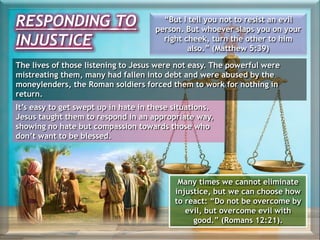
The lives of those listening to Jesus were not easy. The powerful were
mistreating them, many had fallen into debt and were abused by the
moneylenders, the Roman soldiers forced them to work for nothing in
return.
It’s easy to get swept up in hate in these situations.
Jesus taught them to respond in an appropriate way,
showing no hate but compassion towards those who
don’t want to be blessed.
“But I tell you not to resist an evil
person. But whoever slaps you on your
right cheek, turn the other to him
also.” (Matthew 5:39)
RESPONDING TO
INJUSTICE
Many times we cannot eliminate
injustice, but we can choose how
to react: “Do not be overcome by
evil, but overcome evil with
good.” (Romans 12:21).
“Let us daily represent Christ’s
great love by loving our
enemies as Christ loves them.
If we would thus represent the
grace of Christ, strong feelings
of hatred would be broken
down and into many hearts
genuine love would be
brought. Many more
conversions than are now seen
would follow.”
E.G.W. (Medical Ministry, p. 254)
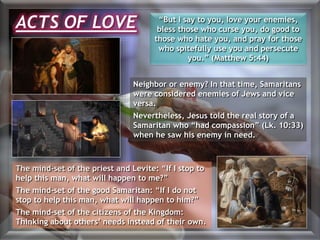
Neighbor or enemy? In that time, Samaritans
were considered enemies of Jews and vice
versa.
Nevertheless, Jesus told the real story of a
Samaritan who “had compassion” (Lk. 10:33)
when he saw his enemy in need.
The mind-set of the priest and Levite: “If I stop to
help this man, what will happen to me?”
The mind-set of the good Samaritan: “If I do not
stop to help this man, what will happen to him?”
The mind-set of the citizens of the Kingdom:
Thinking about others’ needs instead of their own.
“But I say to you, love your enemies,
bless those who curse you, do good to
those who hate you, and pray for those
who spitefully use you and persecute
you.” (Matthew 5:44)
ACTS OF LOVE
“Seize every opportunity to contribute to the happiness of
those around you, sharing with them your affection. Words
of kindness, looks of sympathy, expressions of
appreciation, would to many a struggling, lonely one be as
a cup of cold water to a thirsty soul. A word of cheer, an
act of kindness, would go far to lighten the burdens that
are resting heavily upon weary shoulders. It is in unselfish
ministry that true happiness is found. And every word and
deed of such service is recorded in the books of heaven as
done for Christ…
Live in the sunshine of the Saviour’s love. Then your
influence will bless the world. Let the Spirit of Christ
control you. Let the law of kindness be ever on your lips.
Forbearance and unselfishness mark the words and actions
of those who are born again, to live the new life in Christ.”
E.G.W. (Testimonies for the Church, vol. 7, cp. 10, p. 49-50)
“But seek first the kingdom of God and His
righteousness, and all these things shall be
added to you.” (Matthew 6:33)
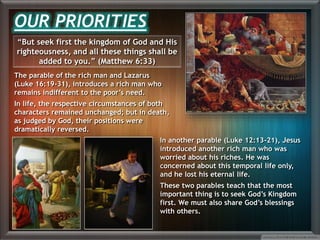
The parable of the rich man and Lazarus
(Luke 16:19-31), introduces a rich man who
remains indifferent to the poor’s need.
In life, the respective circumstances of both
characters remained unchanged; but in death,
as judged by God, their positions were
dramatically reversed.
OUR PRIORITIES
In another parable (Luke 12:13-21), Jesus
introduced another rich man who was
worried about his riches. He was
concerned about this temporal life only,
and he lost his eternal life.
These two parables teach that the most
important thing is to seek God’s Kingdom
first. We must also share God’s blessings
with others.
“God desires men and women to
live the higher life. He gives them
the boon of life, not to enable them
merely to gain wealth, but to
improve their higher powers by
doing the work He has entrusted to
mankind—the work of searching out
and relieving the necessities of their
fellowmen. Man should work not for
his own selfish interest but for the
interest of every one about him,
blessing others by his influence and
kindly deeds.”
E.G.W. (Mind, Character and Personality, vol. 2, cp. 71, p. 645)
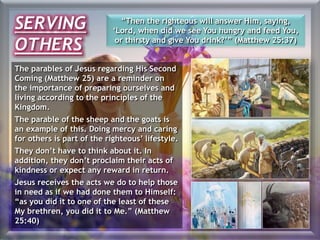
The parables of Jesus regarding His Second
Coming (Matthew 25) are a reminder on
the importance of preparing ourselves and
living according to the principles of the
Kingdom.
The parable of the sheep and the goats is
an example of this. Doing mercy and caring
for others is part of the righteous’ lifestyle.
They don’t have to think about it. In
addition, they don’t proclaim their acts of
kindness or expect any reward in return.
Jesus receives the acts we do to help those
in need as if we had done them to Himself:
“as you did it to one of the least of these
My brethren, you did it to Me.” (Matthew
25:40)
“Then the righteous will answer Him, saying,
‘Lord, when did we see You hungry and feed You,
or thirsty and give You drink?’” (Matthew 25:37)
SERVING
OTHERS
“The truth as it is in Jesus does much for the
receiver, and not only for him, but for all who are
brought within the sphere of his influence… He does
not consider present convenience; he is not
ambitious for display; he does not crave the praise
of men. His hope is in heaven, and he keeps straight
on, with his eye fixed on Jesus. He does right
because it is right, and because only those who do
right will have an entrance into the kingdom of God.
He is kind and humble, and thoughtful of others’
happiness… His manner is not harsh and dictatorial,
like that of the godless; but he reflects light from
heaven upon men.”
E.G.W. (Testimonies for the Church, vol. 5, cp. 68, p. 569)

Sabbath school lesson 8, 3rd quarter 2019

  • 1.
    “THE LEAST OF THESE” “‘Andthe King will answer and say to them, “Assuredly, I say to you, inasmuch as you did it to one of the least of these My brethren, you did it to Me” ’” (Matthew 25:40). Lesson 8 for August 24, 2019 Adopted from www.fustero.es www.gmahktanjungpinang.org
  • 2.
    Values and influence Respondingto injustice Acts of love Our priorities Serving others On a certain occasion, Peter summarized the ministry of Jesus: “[He] went about doing good and healing all who were oppressed by the devil” (Acts 10:38). At the Sermon on the Mount (Matthew 5-7), Jesus taught us how the citizens of the Kingdom of Heaven behave. The life of Jesus is an example of His teachings. Peter’s summary of His ministry reflects the principles of the Kingdom.
  • 3.
    “Blessed are you[…] You are the salt of the earth […] You are the light of the world.” (Matthew 5:11, 13, 14) This is what makes us blessed (happy): Being poor of spirit, weeping because of sin, acting with meekness, yarning for righteousness, being merciful, having a pure mind, being peacemakers, bearing the injustice against us. VALUES AND INFLUENCE Many of these qualities are related to the way we treat others. We are light when enlighten the lives of others with our words and example. We must live with other people in order to be salt, influencing and improving their lives.
  • 4.
    “The followers ofChrist are to be the light of the world; but God does not bid them make an effort to shine. He does not approve of any self-satisfied endeavor to display superior goodness. He desires that their souls shall be imbued with the principles of heaven; then, as they come in contact with the world, they will reveal the light that is in them. Their steadfast fidelity in every act of life will be a means of illumination.” E.G.W. (The Ministry of Healing, cp. 2, p. 36)
  • 5.
    The lives ofthose listening to Jesus were not easy. The powerful were mistreating them, many had fallen into debt and were abused by the moneylenders, the Roman soldiers forced them to work for nothing in return. It’s easy to get swept up in hate in these situations. Jesus taught them to respond in an appropriate way, showing no hate but compassion towards those who don’t want to be blessed. “But I tell you not to resist an evil person. But whoever slaps you on your right cheek, turn the other to him also.” (Matthew 5:39) RESPONDING TO INJUSTICE Many times we cannot eliminate injustice, but we can choose how to react: “Do not be overcome by evil, but overcome evil with good.” (Romans 12:21).
  • 6.
    “Let us dailyrepresent Christ’s great love by loving our enemies as Christ loves them. If we would thus represent the grace of Christ, strong feelings of hatred would be broken down and into many hearts genuine love would be brought. Many more conversions than are now seen would follow.” E.G.W. (Medical Ministry, p. 254)
  • 7.
    Neighbor or enemy?In that time, Samaritans were considered enemies of Jews and vice versa. Nevertheless, Jesus told the real story of a Samaritan who “had compassion” (Lk. 10:33) when he saw his enemy in need. The mind-set of the priest and Levite: “If I stop to help this man, what will happen to me?” The mind-set of the good Samaritan: “If I do not stop to help this man, what will happen to him?” The mind-set of the citizens of the Kingdom: Thinking about others’ needs instead of their own. “But I say to you, love your enemies, bless those who curse you, do good to those who hate you, and pray for those who spitefully use you and persecute you.” (Matthew 5:44) ACTS OF LOVE
  • 8.
    “Seize every opportunityto contribute to the happiness of those around you, sharing with them your affection. Words of kindness, looks of sympathy, expressions of appreciation, would to many a struggling, lonely one be as a cup of cold water to a thirsty soul. A word of cheer, an act of kindness, would go far to lighten the burdens that are resting heavily upon weary shoulders. It is in unselfish ministry that true happiness is found. And every word and deed of such service is recorded in the books of heaven as done for Christ… Live in the sunshine of the Saviour’s love. Then your influence will bless the world. Let the Spirit of Christ control you. Let the law of kindness be ever on your lips. Forbearance and unselfishness mark the words and actions of those who are born again, to live the new life in Christ.” E.G.W. (Testimonies for the Church, vol. 7, cp. 10, p. 49-50)
  • 9.
    “But seek firstthe kingdom of God and His righteousness, and all these things shall be added to you.” (Matthew 6:33) The parable of the rich man and Lazarus (Luke 16:19-31), introduces a rich man who remains indifferent to the poor’s need. In life, the respective circumstances of both characters remained unchanged; but in death, as judged by God, their positions were dramatically reversed. OUR PRIORITIES In another parable (Luke 12:13-21), Jesus introduced another rich man who was worried about his riches. He was concerned about this temporal life only, and he lost his eternal life. These two parables teach that the most important thing is to seek God’s Kingdom first. We must also share God’s blessings with others.
  • 10.
    “God desires menand women to live the higher life. He gives them the boon of life, not to enable them merely to gain wealth, but to improve their higher powers by doing the work He has entrusted to mankind—the work of searching out and relieving the necessities of their fellowmen. Man should work not for his own selfish interest but for the interest of every one about him, blessing others by his influence and kindly deeds.” E.G.W. (Mind, Character and Personality, vol. 2, cp. 71, p. 645)
  • 11.
    The parables ofJesus regarding His Second Coming (Matthew 25) are a reminder on the importance of preparing ourselves and living according to the principles of the Kingdom. The parable of the sheep and the goats is an example of this. Doing mercy and caring for others is part of the righteous’ lifestyle. They don’t have to think about it. In addition, they don’t proclaim their acts of kindness or expect any reward in return. Jesus receives the acts we do to help those in need as if we had done them to Himself: “as you did it to one of the least of these My brethren, you did it to Me.” (Matthew 25:40) “Then the righteous will answer Him, saying, ‘Lord, when did we see You hungry and feed You, or thirsty and give You drink?’” (Matthew 25:37) SERVING OTHERS
  • 12.
    “The truth asit is in Jesus does much for the receiver, and not only for him, but for all who are brought within the sphere of his influence… He does not consider present convenience; he is not ambitious for display; he does not crave the praise of men. His hope is in heaven, and he keeps straight on, with his eye fixed on Jesus. He does right because it is right, and because only those who do right will have an entrance into the kingdom of God. He is kind and humble, and thoughtful of others’ happiness… His manner is not harsh and dictatorial, like that of the godless; but he reflects light from heaven upon men.” E.G.W. (Testimonies for the Church, vol. 5, cp. 68, p. 569)