May 11, 2010

Third Way Internet Regulation


Richard Bennett
Research Fellow
Information Technology and Innovation Foundation
rbennett@itif.org
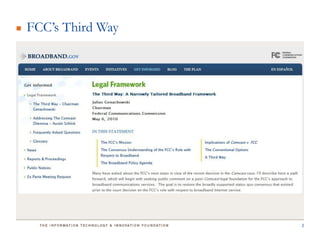
FCC’s Third Way


                  2
Impact


         3
Impact


         OK, maybe not so much.
         But still…it’s not good.


                                    4
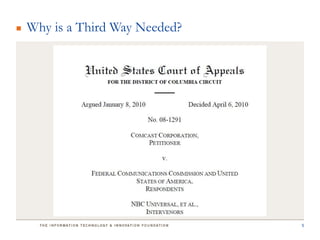
Why is a Third Way Needed?


                             5
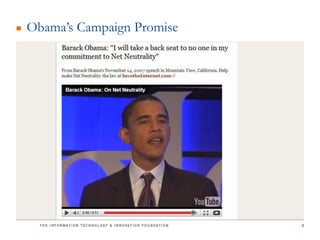
Obama’s Campaign Promise


                           6
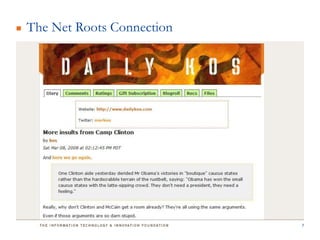
The Net Roots Connection


                           7
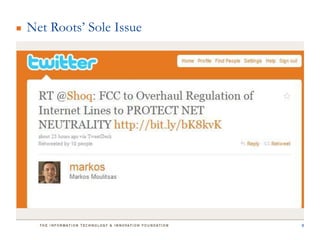
Net Roots’ Sole Issue


                        8
FCC’s Motivation


                   9
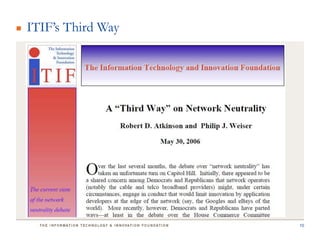
ITIF’s Third Way


                   10
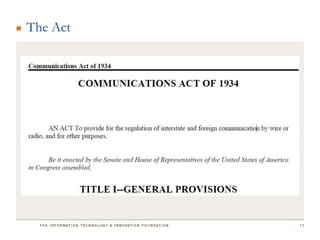
The Act


          11
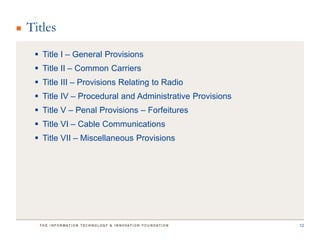
Titles
  Title I – General Provisions
  Title II – Common Carriers
  Title III – Provisions Relating to Radio
  Title IV – Procedural and Administrative Provisions
  Title V – Penal Provisions – Forfeitures
  Title VI – Cable Communications
  Title VII – Miscellaneous Provisions


                                                         12
Where does the Internet Go?
  Title I – General Provisions
  Title II – Common Carriers
  Title III – Provisions Relating to Radio
  Title IV – Procedural and Administrative Provisions
  Title V – Penal Provisions – Forfeitures
  Title VI – Cable Communications
  Title VII – Miscellaneous Provisions
  Title [New] – Internet Services


                                                         13
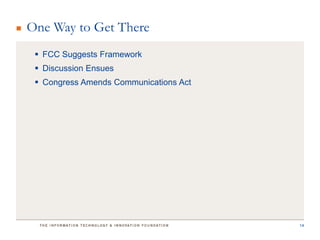
One Way to Get There
  FCC Suggests Framework
  Discussion Ensues
  Congress Amends Communications Act


                                        14
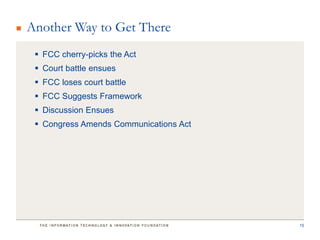
Another Way to Get There
  FCC cherry-picks the Act
  Court battle ensues
  FCC loses court battle
  FCC Suggests Framework
  Discussion Ensues
  Congress Amends Communications Act


                                        15
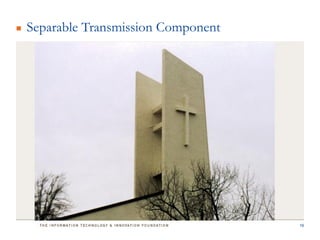
Separable Transmission Component


                                   16
Separable Transmission Component
  Point-to-Point
    Wire?
    Frame?
  Hop-to-Hop Packet?
  Network-to-Network
    Transit?
    Peering?
  End-to-End
    Application?
    Cache?


                                   17
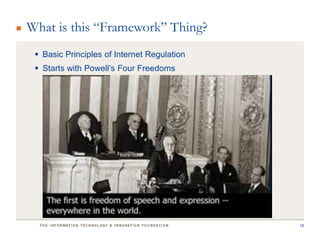
What is this “Framework” Thing?
  Basic Principles of Internet Regulation
  Starts with Powell’s Four Freedoms


                                             18
Powell’s Four Freedoms
  Freedom to Access Content
  Freedom to Use Applications
  Freedom to Attach Personal Devices
  Freedom to Obtain Service Plan Information


  Fourth Freedom amended by FCC in Open Internet NPRM:
   Subject to reasonable network management, a provider of
    broadband Internet access service may not deprive any of its
    users of the user’s entitlement to competition among network
    providers, application providers, service providers, and content
    providers.


                                                                       19
Network Policy Issues
  Net Neutrality Consensus
   Four Freedoms + Transparency
   Managed Services


                                   20
Network Policy Issues
  Net Neutrality Consensus
    Four Freedoms + Transparency
    Managed Services
  Net Neutrality Controversy
    What do we mean by “Discrimination?”
    Good discrimination vs. Bad discrimination


                                                  21
Network Policy Issues
  Net Neutrality Consensus
    Four Freedoms + Transparency
    Managed Services
  Net Neutrality Controversy
    What do we mean by “Discrimination?”
    Good discrimination vs. Bad discrimination
  Two New Freedoms
    Engineering Freedom
    Business Model Freedom


                                                  22
Network Policy Issues
  Net Neutrality Consensus
    Four Freedoms + Transparency
    Managed Services
  Net Neutrality Controversy
    What do we mean by “Discrimination?”
    Good discrimination vs. Bad discrimination
  Two New Freedoms
    Engineering Freedom
    Business Model Freedom
  Technical Advisory Groups
    Specific Boundaries


                                                  23
Spectrum Controversies
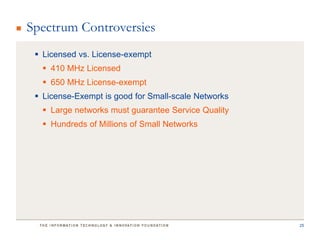
  Licensed vs. License-exempt
   410 MHz Licensed
   650 MHz License-exempt


                                 24
Spectrum Controversies
  Licensed vs. License-exempt
   410 MHz Licensed
   650 MHz License-exempt
  License-Exempt is good for Small-scale Networks
   Large networks must guarantee Service Quality
   Hundreds of Millions of Small Networks


                                                     25
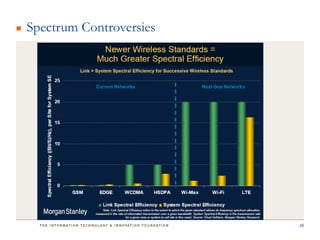
Spectrum Controversies


                         26
Spectrum Controversies
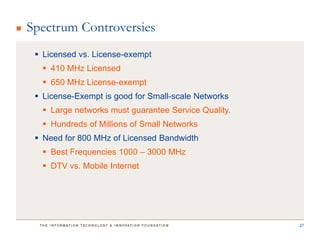
  Licensed vs. License-exempt
   410 MHz Licensed
   650 MHz License-exempt
  License-Exempt is good for Small-scale Networks
   Large networks must guarantee Service Quality.
   Hundreds of Millions of Small Networks
  Need for 800 MHz of Licensed Bandwidth
   Best Frequencies 1000 – 3000 MHz
   DTV vs. Mobile Internet


                                                     27
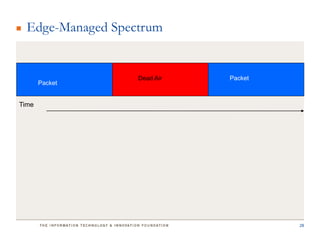
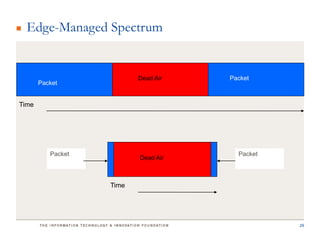
Edge-Managed Spectrum


                   Dead Air   Packet
       Packet


Time


                                       28
Edge-Managed Spectrum


                          Dead Air   Packet
       Packet


Time


          Packet                       Packet
                          Dead Air


                   Time


                                                29
Spectrum Controversies
  Big Historical Mistake:
    TV Should be Wired.
    Telephony Should be Wireless.


                                     30
New Freedoms
  Mobile Internet Experience the Fruit of Innovation
    Policy has to create the space for fundamental advances.
    Innovation at the Bottom Enables Innovation at the Top.
    We’re Not Done Yet.


                                                                31
New Freedoms
  Mobile Internet Experience the Fruit of Innovation
    Policy has to create the space for fundamental advances.
    Innovation at the Bottom Enables Innovation at the Top.
    We’re Not Done Yet.
  Engineering Freedom is Not a License to Steal
    Reasonable Oversight, not Strangling Regulation


                                                                32
New Freedoms
  Mobile Internet Experience the Fruit of Innovation
    Policy has to create the space for fundamental advances.
    Innovation at the Bottom Enables Innovation at the Top.
    We’re Not Done Yet.
  Engineering Freedom is Not a License to Steal
    Reasonable Oversight, not Strangling Regulation
  Business Model Innovation is Essential
    Internet Economy Clouded with Secret Deals
    Peering and Transit Agreements are Trade Secret.
    Fundamental Algorithms of Internet Economy are Trade Secret.


                                                                    33
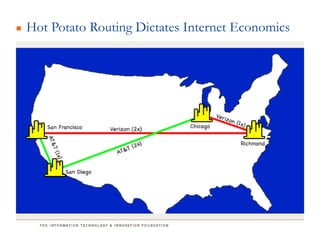
Hot Potato Routing Dictates Internet Economics
Technical Freedoms
  Why No Attention so Far?
   Four Freedoms Take Innovation for Granted.
   Innovation is like Air: We only Notice it when it’s Gone.


                                                                35
Thank you.

                       Please read:

   Going Mobile: Technology and Policy Issues in the
                    Mobile Internet

         http://www.itif.org/files/100302_GoingMobile.pdf


                      Contact me at:

                     rbennett@itif.org


                                                            36

10 fn s08

  • 1.
    May 11, 2010 ThirdWay Internet Regulation Richard Bennett Research Fellow Information Technology and Innovation Foundation rbennett@itif.org
  • 2.
  • 3.
  • 4.
    Impact OK, maybe not so much. But still…it’s not good. 4
  • 5.
    Why is aThird Way Needed? 5
  • 6.
  • 7.
    The Net RootsConnection 7
  • 8.
  • 9.
  • 10.
  • 11.
  • 12.
    Titles  TitleI – General Provisions  Title II – Common Carriers  Title III – Provisions Relating to Radio  Title IV – Procedural and Administrative Provisions  Title V – Penal Provisions – Forfeitures  Title VI – Cable Communications  Title VII – Miscellaneous Provisions 12
  • 13.
    Where does theInternet Go?  Title I – General Provisions  Title II – Common Carriers  Title III – Provisions Relating to Radio  Title IV – Procedural and Administrative Provisions  Title V – Penal Provisions – Forfeitures  Title VI – Cable Communications  Title VII – Miscellaneous Provisions  Title [New] – Internet Services 13
  • 14.
    One Way toGet There  FCC Suggests Framework  Discussion Ensues  Congress Amends Communications Act 14
  • 15.
    Another Way toGet There  FCC cherry-picks the Act  Court battle ensues  FCC loses court battle  FCC Suggests Framework  Discussion Ensues  Congress Amends Communications Act 15
  • 16.
  • 17.
    Separable Transmission Component  Point-to-Point  Wire?  Frame?  Hop-to-Hop Packet?  Network-to-Network  Transit?  Peering?  End-to-End  Application?  Cache? 17
  • 18.
    What is this“Framework” Thing?  Basic Principles of Internet Regulation  Starts with Powell’s Four Freedoms 18
  • 19.
    Powell’s Four Freedoms  Freedom to Access Content  Freedom to Use Applications  Freedom to Attach Personal Devices  Freedom to Obtain Service Plan Information  Fourth Freedom amended by FCC in Open Internet NPRM:  Subject to reasonable network management, a provider of broadband Internet access service may not deprive any of its users of the user’s entitlement to competition among network providers, application providers, service providers, and content providers. 19
  • 20.
    Network Policy Issues  Net Neutrality Consensus  Four Freedoms + Transparency  Managed Services 20
  • 21.
    Network Policy Issues  Net Neutrality Consensus  Four Freedoms + Transparency  Managed Services  Net Neutrality Controversy  What do we mean by “Discrimination?”  Good discrimination vs. Bad discrimination 21
  • 22.
    Network Policy Issues  Net Neutrality Consensus  Four Freedoms + Transparency  Managed Services  Net Neutrality Controversy  What do we mean by “Discrimination?”  Good discrimination vs. Bad discrimination  Two New Freedoms  Engineering Freedom  Business Model Freedom 22
  • 23.
    Network Policy Issues  Net Neutrality Consensus  Four Freedoms + Transparency  Managed Services  Net Neutrality Controversy  What do we mean by “Discrimination?”  Good discrimination vs. Bad discrimination  Two New Freedoms  Engineering Freedom  Business Model Freedom  Technical Advisory Groups  Specific Boundaries 23
  • 24.
    Spectrum Controversies Licensed vs. License-exempt  410 MHz Licensed  650 MHz License-exempt 24
  • 25.
    Spectrum Controversies Licensed vs. License-exempt  410 MHz Licensed  650 MHz License-exempt  License-Exempt is good for Small-scale Networks  Large networks must guarantee Service Quality  Hundreds of Millions of Small Networks 25
  • 26.
  • 27.
    Spectrum Controversies Licensed vs. License-exempt  410 MHz Licensed  650 MHz License-exempt  License-Exempt is good for Small-scale Networks  Large networks must guarantee Service Quality.  Hundreds of Millions of Small Networks  Need for 800 MHz of Licensed Bandwidth  Best Frequencies 1000 – 3000 MHz  DTV vs. Mobile Internet 27
  • 28.
    Edge-Managed Spectrum Dead Air Packet Packet Time 28
  • 29.
    Edge-Managed Spectrum Dead Air Packet Packet Time Packet Packet Dead Air Time 29
  • 30.
    Spectrum Controversies Big Historical Mistake:  TV Should be Wired.  Telephony Should be Wireless. 30
  • 31.
    New Freedoms Mobile Internet Experience the Fruit of Innovation  Policy has to create the space for fundamental advances.  Innovation at the Bottom Enables Innovation at the Top.  We’re Not Done Yet. 31
  • 32.
    New Freedoms Mobile Internet Experience the Fruit of Innovation  Policy has to create the space for fundamental advances.  Innovation at the Bottom Enables Innovation at the Top.  We’re Not Done Yet.  Engineering Freedom is Not a License to Steal  Reasonable Oversight, not Strangling Regulation 32
  • 33.
    New Freedoms Mobile Internet Experience the Fruit of Innovation  Policy has to create the space for fundamental advances.  Innovation at the Bottom Enables Innovation at the Top.  We’re Not Done Yet.  Engineering Freedom is Not a License to Steal  Reasonable Oversight, not Strangling Regulation  Business Model Innovation is Essential  Internet Economy Clouded with Secret Deals  Peering and Transit Agreements are Trade Secret.  Fundamental Algorithms of Internet Economy are Trade Secret. 33
  • 34.
    Hot Potato RoutingDictates Internet Economics
  • 35.
    Technical Freedoms Why No Attention so Far?  Four Freedoms Take Innovation for Granted.  Innovation is like Air: We only Notice it when it’s Gone. 35
  • 36.
    Thank you. Please read: Going Mobile: Technology and Policy Issues in the Mobile Internet http://www.itif.org/files/100302_GoingMobile.pdf Contact me at: rbennett@itif.org 36