As 3D printers are become more affordable and versatile, they
are destined to disrupt multiple industries. Here's what you need to
know about this quickly accelerating technology.
The world of 3D printing is exciting. With more affordable
machines, creative entrepreneurs, innovative start ups, and new
materials, the industry is rapidly evolving.
Since the invention of the 3D printer in 1983 by Chuck Hull
of 3D Systems, companies have popped up all over the globe,
attempting to make the most innovative machine.
Here are 10 reasons why 3D printing matters—maybe you'll
decide the equipment is a worthy investment, or maybe you'll just
be convinced this futuristic technology will one day have a place
in your business or home.
 Enthusiasm is high, and so is the market for 3D
printing in both consumer and enterprise space.
 According to Gartner research, printers under
$100,000 were expected to grow almost 50 percent in
2013, and will increase 75 percent this year.
 Right now, enterprises are using the printers to
prototype objects, but we'll see an increasing amount used
to make product designs this year.
1. 3D PRINTING IS A KEY INDUSTRY TO
WATCH IN 2014
2. 3D PRINTERS ARE EMPOWERING
"MAKERS"
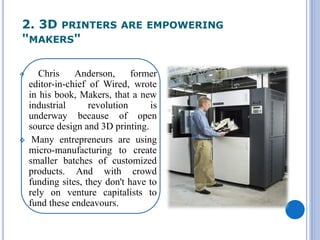
 Chris Anderson, former
editor-in-chief of Wired, wrote
in his book, Makers, that a new
industrial revolution is
underway because of open
source design and 3D printing.
 Many entrepreneurs are using
micro-manufacturing to create
smaller batches of customized
products. And with crowd
funding sites, they don't have to
rely on venture capitalists to
fund these endeavours.
3. CUSTOMIZATION IS THE NEXT STEP IN
3D PRINTING TECHNOLOGY
 Soon enough the question won't be how we will print things, but
what we will print. Customization is the next buzzword in the
industry, according to Pete Basil ere, lead Gartner analyst for 3D
printing.
 Replacement parts, toys, and random designs and schematics found
on the internet can all be customized to fit consumer needs. Because
the machines can print one piece at a time, this can be done relatively
easily.
 Shape ways, for instance, is a website where customers can connect
with designers and order customized products such as jewelry and
home decor.
4. THERE ARE SEVERAL TYPES OF 3D
PRINTING TECHNOLOGIES
 Fused deposition modelling: Maker Bot is one of the best examples
of this technology. These printers melt a plastic filament and deposit
the plastic in layers until it fills up the model. There are two types of
plastic, both of which Maker Bot uses: ABS, which is sturdy and
made from oil-based resources, and PLA, which is biodegradable
and made from plant-based resources.
 Stereo lithography: These machines use a laser to cure a resin and
build the prototype one layer at a time. Rapid prototyping, another
form, doesn't use supports to hold up the part so that it can be built
faster, but in basic stereo lithography, the supports must be manually
removed from the part.
 Selective laser sintering: Lasers are used to sinter powdered metal,
binding the powder together to create a solid structure. After each
layer is sintered together, the structure drops and the next layer is
built on top of it.
5. PEOPLE ARE MAKING ALL KINDS OF
THINGS WITH 3D PRINTERS
 Check out Makerbot's Thing verse—the things people
create with 3D printers are extraordinarily creative. It's a
community for makers where they can upload digital
designs or photos of objects they have made with 3D
printers.
 The website has more than 100,000 models and that
number is growing every day. From Storm Trooper pen
cups to household planters to customizable necklaces,
the options of objects people can make are seemingly
endless.
6. ETHICAL DILEMMAS OF 3D PRINTING
WILL BE A GROWING CONVERSATION
 Get ready for it—the next great debate will be about the political,
ethical, and religious questions 3D printing technologies raise. This is
particularly important for bio printing, which is already accelerating at
an alarming rate. Scientists at Cornell University successfully printed a
human ear last year, and scientists in Scotland are developing a way to
print embryonic stem cells.
 Another issue is weapons. In 2012,a man 3D-printed a gun and shared
the blueprints on his website (they garnered 100,000 downloads in the
two days before the U.S. State Department took them down). He
successfully fired it last year, landing himself on Weird's list of
deadliest people on the planet.
7. LOWER PRICES WILL DRIVE CONSUMER
ADOPTION
 As smaller companies make their own 3D printers or crowd fund them,
the prices are going to continue to drop. Already, Makerbot's smallest
printer—which will begin shipping this spring— is available for
$1,375. That still seems pricy for a lot of us, but it's quite affordable
for the technology.
 "Of course you're always going to have a people particularly invested
in the technology who will have the means to spend the money [on
their own printer]," Basil ere said. "But as prices come down some
more and consumers start to buy them, that number of dedicated
consumers will continue to grow."
 The prices for larger machines used in manufacturing enterprises are
not lowering as quickly, he added, but they will improve in
performance and enhancements to more rapidly and efficiently
produce parts.
8. HP IS GOING TO GET IN THE GAME AT
SOME POINT
 The 3D printing leaders are making themselves known, but there's
an elephant in the room: when will HP join the ranks and produce
this technology for the mass market? The traditional printing giant
has a five-foot-tall 3D printing prototype in the basement of its Palo
Alto research lab, and the company said they plan to release a
product this year.
 "3D printing is in its infancy," CEO Meg Whitman said at a tech
conference in Bangkok last October. "It's a big opportunity and we
are all over it. We will have something by the middle of next year."
9. 3D PRINTING IS GOING TO COMPLETELY
REVOLUTIONIZE MANUFACTURING AS WE
KNOW IT
 Open source electronics allow companies to iterate designs and
experiment with schematics and product parts. Eventually, they
won't need to design every piece in-house and they won't need to
ship every part because local or regional makers can design and/or
print the parts themselves. Big supply chains will be a thing of the
past.
 Most companies aren't grasping this technology yet because it's
going to change the industry so dramatically. According to Basil ere,
the key to long-term growth in the manufacturing industry is the
number of materials 3D printers can use, which is small but growing
quickly as well.
10. 3D PRINTING IS GOING TO CAUSE
DISRUPTION IN MANY INDUSTRIES
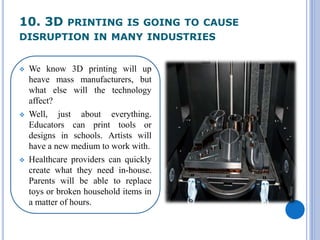
 We know 3D printing will up
heave mass manufacturers, but
what else will the technology
affect?
 Well, just about everything.
Educators can print tools or
designs in schools. Artists will
have a new medium to work with.
 Healthcare providers can quickly
create what they need in-house.
Parents will be able to replace
toys or broken household items in
a matter of hours.
Address: 698 Clems Run
City: Monroeville
State: NJ
Country: USA
Zip code: 08343
Phone no: (856)-244-1940
Client Mail: sales@iannone3d.com
Web site: http://www.iannone3d.com/
10 facts on 3D printing

10 facts on 3D printing

  • 2.
    As 3D printersare become more affordable and versatile, they are destined to disrupt multiple industries. Here's what you need to know about this quickly accelerating technology. The world of 3D printing is exciting. With more affordable machines, creative entrepreneurs, innovative start ups, and new materials, the industry is rapidly evolving. Since the invention of the 3D printer in 1983 by Chuck Hull of 3D Systems, companies have popped up all over the globe, attempting to make the most innovative machine. Here are 10 reasons why 3D printing matters—maybe you'll decide the equipment is a worthy investment, or maybe you'll just be convinced this futuristic technology will one day have a place in your business or home.
  • 3.
     Enthusiasm ishigh, and so is the market for 3D printing in both consumer and enterprise space.  According to Gartner research, printers under $100,000 were expected to grow almost 50 percent in 2013, and will increase 75 percent this year.  Right now, enterprises are using the printers to prototype objects, but we'll see an increasing amount used to make product designs this year. 1. 3D PRINTING IS A KEY INDUSTRY TO WATCH IN 2014
  • 4.
    2. 3D PRINTERSARE EMPOWERING "MAKERS"  Chris Anderson, former editor-in-chief of Wired, wrote in his book, Makers, that a new industrial revolution is underway because of open source design and 3D printing.  Many entrepreneurs are using micro-manufacturing to create smaller batches of customized products. And with crowd funding sites, they don't have to rely on venture capitalists to fund these endeavours.
  • 5.
    3. CUSTOMIZATION ISTHE NEXT STEP IN 3D PRINTING TECHNOLOGY  Soon enough the question won't be how we will print things, but what we will print. Customization is the next buzzword in the industry, according to Pete Basil ere, lead Gartner analyst for 3D printing.  Replacement parts, toys, and random designs and schematics found on the internet can all be customized to fit consumer needs. Because the machines can print one piece at a time, this can be done relatively easily.  Shape ways, for instance, is a website where customers can connect with designers and order customized products such as jewelry and home decor.
  • 6.
    4. THERE ARESEVERAL TYPES OF 3D PRINTING TECHNOLOGIES  Fused deposition modelling: Maker Bot is one of the best examples of this technology. These printers melt a plastic filament and deposit the plastic in layers until it fills up the model. There are two types of plastic, both of which Maker Bot uses: ABS, which is sturdy and made from oil-based resources, and PLA, which is biodegradable and made from plant-based resources.  Stereo lithography: These machines use a laser to cure a resin and build the prototype one layer at a time. Rapid prototyping, another form, doesn't use supports to hold up the part so that it can be built faster, but in basic stereo lithography, the supports must be manually removed from the part.  Selective laser sintering: Lasers are used to sinter powdered metal, binding the powder together to create a solid structure. After each layer is sintered together, the structure drops and the next layer is built on top of it.
  • 7.
    5. PEOPLE AREMAKING ALL KINDS OF THINGS WITH 3D PRINTERS  Check out Makerbot's Thing verse—the things people create with 3D printers are extraordinarily creative. It's a community for makers where they can upload digital designs or photos of objects they have made with 3D printers.  The website has more than 100,000 models and that number is growing every day. From Storm Trooper pen cups to household planters to customizable necklaces, the options of objects people can make are seemingly endless.
  • 8.
    6. ETHICAL DILEMMASOF 3D PRINTING WILL BE A GROWING CONVERSATION  Get ready for it—the next great debate will be about the political, ethical, and religious questions 3D printing technologies raise. This is particularly important for bio printing, which is already accelerating at an alarming rate. Scientists at Cornell University successfully printed a human ear last year, and scientists in Scotland are developing a way to print embryonic stem cells.  Another issue is weapons. In 2012,a man 3D-printed a gun and shared the blueprints on his website (they garnered 100,000 downloads in the two days before the U.S. State Department took them down). He successfully fired it last year, landing himself on Weird's list of deadliest people on the planet.
  • 9.
    7. LOWER PRICESWILL DRIVE CONSUMER ADOPTION  As smaller companies make their own 3D printers or crowd fund them, the prices are going to continue to drop. Already, Makerbot's smallest printer—which will begin shipping this spring— is available for $1,375. That still seems pricy for a lot of us, but it's quite affordable for the technology.  "Of course you're always going to have a people particularly invested in the technology who will have the means to spend the money [on their own printer]," Basil ere said. "But as prices come down some more and consumers start to buy them, that number of dedicated consumers will continue to grow."  The prices for larger machines used in manufacturing enterprises are not lowering as quickly, he added, but they will improve in performance and enhancements to more rapidly and efficiently produce parts.
  • 10.
    8. HP ISGOING TO GET IN THE GAME AT SOME POINT  The 3D printing leaders are making themselves known, but there's an elephant in the room: when will HP join the ranks and produce this technology for the mass market? The traditional printing giant has a five-foot-tall 3D printing prototype in the basement of its Palo Alto research lab, and the company said they plan to release a product this year.  "3D printing is in its infancy," CEO Meg Whitman said at a tech conference in Bangkok last October. "It's a big opportunity and we are all over it. We will have something by the middle of next year."
  • 11.
    9. 3D PRINTINGIS GOING TO COMPLETELY REVOLUTIONIZE MANUFACTURING AS WE KNOW IT  Open source electronics allow companies to iterate designs and experiment with schematics and product parts. Eventually, they won't need to design every piece in-house and they won't need to ship every part because local or regional makers can design and/or print the parts themselves. Big supply chains will be a thing of the past.  Most companies aren't grasping this technology yet because it's going to change the industry so dramatically. According to Basil ere, the key to long-term growth in the manufacturing industry is the number of materials 3D printers can use, which is small but growing quickly as well.
  • 12.
    10. 3D PRINTINGIS GOING TO CAUSE DISRUPTION IN MANY INDUSTRIES  We know 3D printing will up heave mass manufacturers, but what else will the technology affect?  Well, just about everything. Educators can print tools or designs in schools. Artists will have a new medium to work with.  Healthcare providers can quickly create what they need in-house. Parents will be able to replace toys or broken household items in a matter of hours.
  • 13.
    Address: 698 ClemsRun City: Monroeville State: NJ Country: USA Zip code: 08343 Phone no: (856)-244-1940 Client Mail: sales@iannone3d.com Web site: http://www.iannone3d.com/