Peeling Back the Onion: What are Patients
and Their Caregivers Actually Saying About
Their Health Care Experience and What
Does it Mean for the Delivery of Care?
Cathy Fooks
The Change Foundation
April 18, 2013
SMH Clinical & Population Research Rounds
The Change Foundation????
• Charitable Foundation set up in 1995 by the Ontario
Hospital Association
• $55 million endowment – spend the investment income
based on Board approved strategy
• Currently focused on improving the patient and caregiver
experience for people living with chronic disease
• Three buckets of work:
• Policy analysis and advocacy
• Citizen/patient engagement
• Quality improvement with an emphasis on experience-
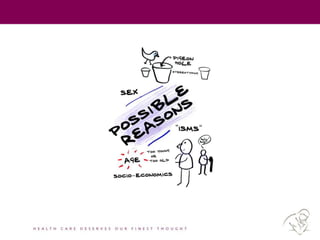
based design (EBD)
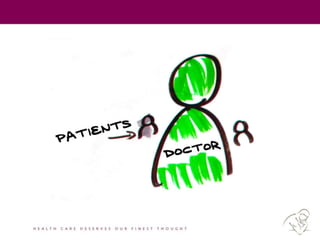
Focus for Today
1) Regional Consultations – LOUD AND CLEAR
2) Current Experiences - PANORAMA
3) Experience Survey – Cobourg/PATH
4) Framework to Help Clarify Discussions
5) Evidence of Impac
6) Implications for System Design
LOUD AND CLEAR
Seniors and Caregivers on Navigating
Ontario’s Health Care System
Six Regional Consultations
• Locations:
Ottawa, Dryden, Timmins, Peterborough, London, Toronto
for face to face discussions
• Participants recruited through local providers
(hospital, LTC, FHT, CHC)
• Online webinars for those who did not attend in person
• Discussion guide sent out in advance
• Keypad voting used for in person sessions
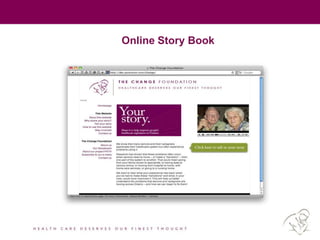
Online Story Book
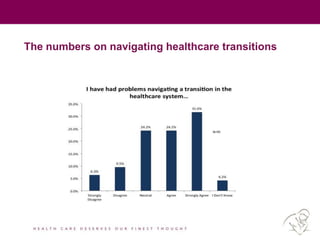
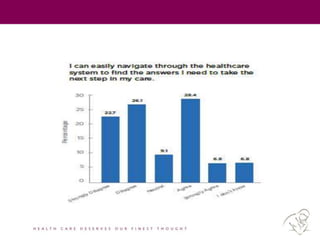
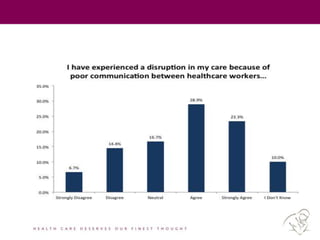
The numbers on navigating healthcare transitions
N=95
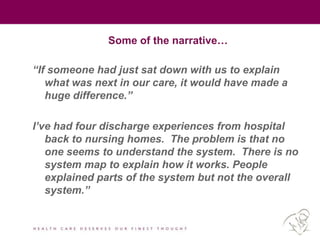
Some of the narrative…
“If someone had just sat down with us to explain
what was next in our care, it would have made a
huge difference.”
I‟ve had four discharge experiences from hospital
back to nursing homes. The problem is that no
one seems to understand the system. There is no
system map to explain how it works. People
explained parts of the system but not the overall
system.”
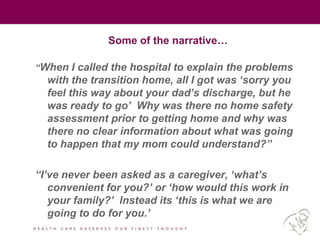
Some of the narrative…
“When I called the hospital to explain the problems
with the transition home, all I got was „sorry you
feel this way about your dad‟s discharge, but he
was ready to go‟ Why was there no home safety
assessment prior to getting home and why was
there no clear information about what was going
to happen that my mom could understand?”
“I‟ve never been asked as a caregiver, „what‟s
convenient for you?‟ or „how would this work in
your family?‟ Instead its „this is what we are
going to do for you.‟
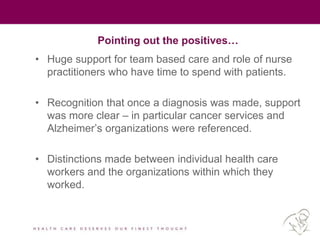
Pointing out the positives…
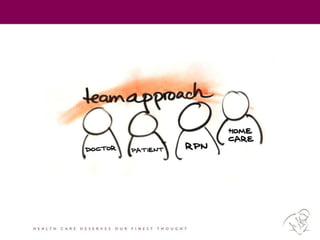
• Huge support for team based care and role of nurse
practitioners who have time to spend with patients.
• Recognition that once a diagnosis was made, support
was more clear – in particular cancer services and
Alzheimer’s organizations were referenced.
• Distinctions made between individual health care
workers and the organizations within which they
worked.
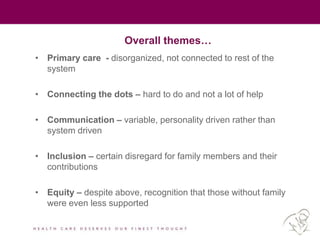
Overall themes…
• Primary care - disorganized, not connected to rest of the
system
• Connecting the dots – hard to do and not a lot of help
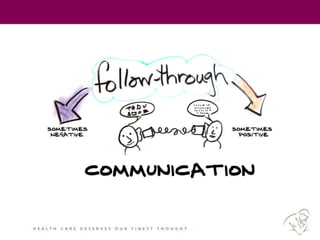
• Communication – variable, personality driven rather than
system driven
• Inclusion – certain disregard for family members and their
contributions
• Equity – despite above, recognition that those without family
were even less supported
PANORAMA
A Panel of Ontario Residents
Exchanging Views, Experiences
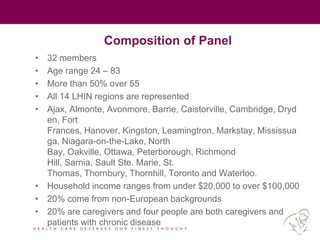
Composition of Panel
• 32 members
• Age range 24 – 83
• More than 50% over 55
• All 14 LHIN regions are represented
• Ajax, Almonte, Avonmore, Barrie, Caistorville, Cambridge, Dryd
en, Fort
Frances, Hanover, Kingston, Leamingtron, Markstay, Mississua
ga, Niagara-on-the-Lake, North
Bay, Oakville, Ottawa, Peterborough, Richmond
Hill, Sarnia, Sault Ste. Marie, St.
Thomas, Thornbury, Thornhill, Toronto and Waterloo.
• Household income ranges from under $20,000 to over $100,000
• 20% come from non-European backgrounds
• 20% are caregivers and four people are both caregivers and
patients with chronic disease
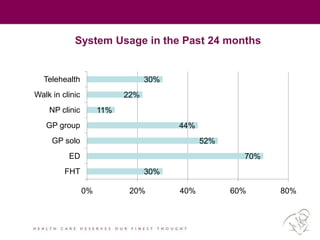
System Usage in the Past 24 months
30%
70%
52%
44%
11%
22%
30%
0% 20% 40% 60% 80%
FHT
ED
GP solo
GP group
NP clinic
Walk in clinic
Telehealth
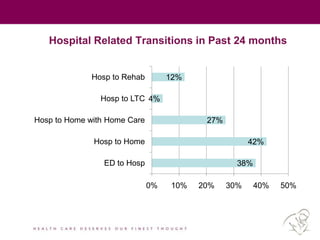
Hospital Related Transitions in Past 24 months
38%
42%
27%
4%
12%
0% 10% 20% 30% 40% 50%
ED to Hosp
Hosp to Home
Hosp to Home with Home Care
Hosp to LTC
Hosp to Rehab
HOW DO THEY DESCRIBE THE
HEALTH
CARE SYSTEM?
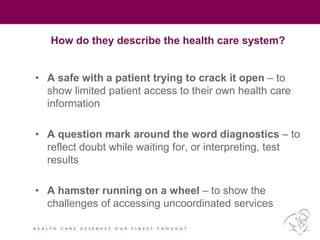
How do they describe the health care system?
• A safe with a patient trying to crack it open – to
show limited patient access to their own health care
information
• A question mark around the word diagnostics – to
reflect doubt while waiting for, or interpreting, test
results
• A hamster running on a wheel – to show the
challenges of accessing uncoordinated services
How do they describe the health care system?
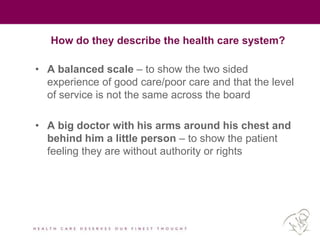
• A balanced scale – to show the two sided
experience of good care/poor care and that the level
of service is not the same across the board
• A big doctor with his arms around his chest and
behind him a little person – to show the patient
feeling they are without authority or rights
HOW DO THEY VISUALIZE THE
SYSTEM?
COMMUNITY SURVEY:
CURRENT EXPERIENCE IN
NORTHUMBERLAND
(HOME OF OUR PATH PROJECT)
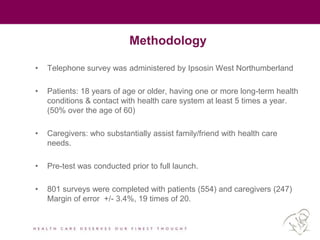
Methodology
• Telephone survey was administered by Ipsosin West Northumberland
• Patients: 18 years of age or older, having one or more long-term health
conditions & contact with health care system at least 5 times a year.
(50% over the age of 60)
• Caregivers: who substantially assist family/friend with health care
needs.
• Pre-test was conducted prior to full launch.
• 801 surveys were completed with patients (554) and caregivers (247)
Margin of error +/- 3.4%, 19 times of 20.
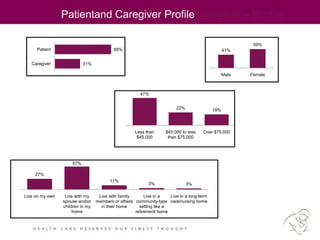
Patientand Caregiver ProfileCaregiver – Profile
69%
31%
Patient
Caregiver
41%
59%
Male Female
27%
57%
11%
3% 3%
Live on my own Live with my
spouse and/or
children in my
home
Live with family
members or others
in their home
Live in a
community-type
setting like a
retirement home
Live in a long-term
care/nursing home
47%
22% 19%
Less than
$45,000
$45,000 to less
than $75,000
Over $75,000
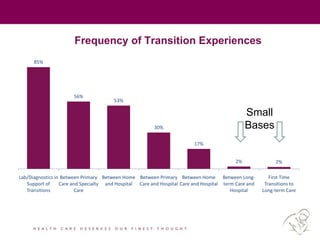
Frequency of Transition Experiences
85%
56%
53%
30%
17%
2% 2%
Lab/Diagnostics in
Support of
Transitions
Between Primary
Care and Specialty
Care
Between Home
and Hospital
Between Primary
Care and Hospital
Between Home
Care and Hospital
Between Long-
term Care and
Hospital
First Time
Transitions to
Long-term Care
Small
Bases
Patient anPrimary and Speciality CareCaregiver – Prire
67%
65%
64%
63%
59%
59%
20%
20%
21%
18%
19%
16%
4%
6%
4%
4%
6%
5%
9%
6%
4%
6%
5%
8%
10%
6%7%
I felt cared for by the medical specialist or outpatient
specialty service as soon as I arrived.
The medical specialist or outpatient specialty service
staff was informed and up to date about my health care
needs.
All my questions were answered.
The medical specialist or outpatient specialty service
staff was up to date regarding the medications I was
taking.
It was easy for me to get to the medical specialist or
outpatient specialty service office.
When I went back to see my family doctor/primary care
physician, they were informed and up-to-date about the
care I received from specialist doctors.
Strongly agree Somewhat agree Neither agree nor disagree
Somewhat disagree Strongly disagree Don't know
Experiencing Anxiety
Were you anxious about the transition
between your family doctor/primary
care physician and the medical
specialist or outpatient specialty
service?
Yes
35%No
64%
70%
67%
30%
33%
The medical specialist or
outpatient specialty service
staff
Your family doctor/primary
care physician and the
hospital?
Yes
74%
70%
23%
29%
Were you able to
express these anxieties
to….?
Did they help to relieve
your anxiety?
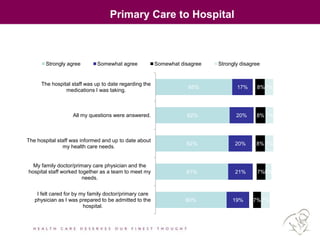
Primary Care to Hospital
65%
62%
62%
61%
60%
17%
20%
20%
21%
19%
8%
8%
8%
7%
7%
7%
7%
7%
5%
7%
The hospital staff was up to date regarding the
medications I was taking.
All my questions were answered.
The hospital staff was informed and up to date about
my health care needs.
My family doctor/primary care physician and the
hospital staff worked together as a team to meet my
needs.
I felt cared for by my family doctor/primary care
physician as I was prepared to be admitted to the
hospital.
Strongly agree Somewhat agree Somewhat disagree Strongly disagree
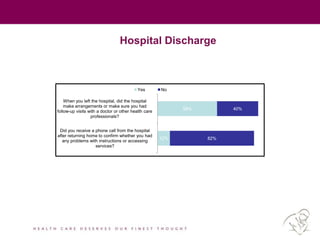
58%
12%
40%
82%
When you left the hospital, did the hospital
make arrangements or make sure you had
follow-up visits with a doctor or other health care
professionals?
Did you receive a phone call from the hospital
after returning home to confirm whether you had
any problems with instructions or accessing
services?
Yes No
Hospital Discharge
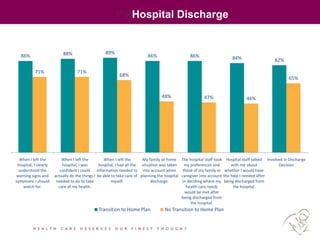
PatHospital Discharge
86% 88% 89%
86% 86% 84% 82%
71% 71%
68%
48% 47% 46%
65%
When I left the
hospital, I clearly
understood the
warning signs and
symptoms I should
watch for.
When I left the
hospital, I was
confident I could
actually do the things I
needed to do to take
care of my health.
When I left the
hospital, I had all the
information needed to
be able to take care of
myself.
My family or home
situation was taken
into account when
planning the hospital
discharge.
The hospital staff took
my preferences and
those of my family or
caregiver into account
in deciding where my
health care needs
would be met after
being discharged from
the hospital.
Hospital staff talked
with me about
whether I would have
the help I needed after
being discharged from
the hospital.
Involved in Discharge
Decision
Transition to Home Plan No Transition to Home Plan
Differences Between Patients and Caregivers
89%
92% 91%
87%
78% 78%
81%
75%
My family doctor/primary
care physician clearly
explained why I was being
admitted to the hospital.
The admission process
was well organized.
I was able to participate in
this decision to the extent
that I wanted to.
All my questions were
answered.
Patient Caregiver
Hospital to Home with Home Care
67%
60%
58%
48%
42%
16%
19%
18%
12%
15%
8%
10%
7%
6%
6%
8%
10%
7%
8%
15%
15%
5%
8%
12%
10%
After returning home from the hospital I received all the home
care I needed to manage at home.
My home care service providers were informed and up to
date about my health care needs after returning home.
My home care case manager was informed and up to date
about my health care needs after returning home.
My home care case manager worked closely with hospital
staff to ensure I had the services I needed at home.
My home care case manager worked closely with hospital
staff to coordinate my return home.
Strongly agree Somewhat agree Neither agree nor disagree
Somewhat disagree Strongly disagree Don't know
70%
63%
30%
33%
Your home care health
professionals?
The hospital staff?
Yes
No
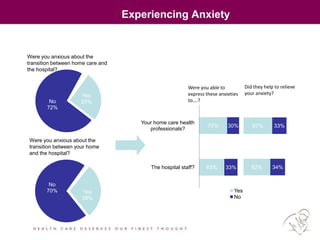
PExperiencing Anxiety
Were you anxious about the
transition between your home
and the hospital?
Yes
28%
No
70%
Were you able to
express these anxieties
to….?
Did they help to relieve
your anxiety?Yes
25%No
72%
67%
62%
33%
34%
Were you anxious about the
transition between home care and
the hospital?
FRAMEWORK TO HELP
ORGANIZE THINKING
K. Carman et al (2013) A Multidimensional Framework for Patient and
Family Engagement in Health and Health Care. Health Affairs. 32: 223-
231.
Doyle C et al (2013) A Systematic Review of Evidence on the Links
Between Patient Experience and Clinical Safety and Effectiveness. BMJ
Open: 3:e001570
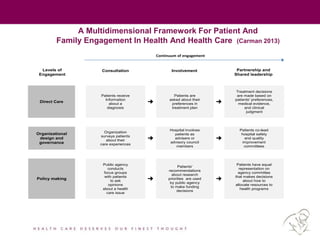
A Multidimensional Framework For Patient And
Family Engagement In Health And Health Care (Carman 2013)
Continuum of engagement
Levels of
Engagement
Consultation Involvement Partnership and
Shared leadership
Direct Care
Patients receive
Information
about a
diagnosis

Patients are
asked about their
preferences in
treatment plan

Treatment decisions
are made based on
patients' preferences,
medical evidence,
and clinical
judgment
Organizational
design and
governance
Organization
surveys patients
about their
care experiences

Hospital involves
patients as
advisers or
advisory council
members

Patients co-lead
hospital safety
and quality
improvement
committees
Policy making
Public agency
conducts
focus groups
with patients
to ask
opinions
about a health
care issue

Patients'
recommendations
about research
priorities are used
by public agency
to make funding
decisions

Patients have equal
representation on
agency committee
that makes decisions
about how to
allocate resources to
health programs
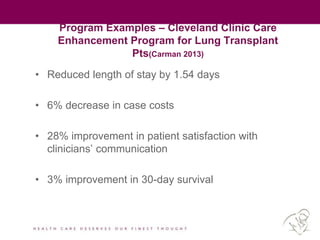
Program Examples – Cleveland Clinic Care
Enhancement Program for Lung Transplant
Pts(Carman 2013)
• Reduced length of stay by 1.54 days
• 6% decrease in case costs
• 28% improvement in patient satisfaction with
clinicians’ communication
• 3% improvement in 30-day survival
Program Examples – Theda Care - Organizing Care
Around the Patient at Point of Admission
• 10% reduction in length of stay
• Patient satisfaction scores of 5/5 went from 68% to 95%
• 25% reduction in direct and indirect costs of inpatient care
• Improved care protocol compliance
Others…
• Cincinnati Children’s
• Intermountain Health
• Virginia MasonHealth System
• Gesinger
• Denver Health
Systematic Review Supports Case Examples
(Doyle 2013)
• Systematic review looking at inpatient hospital care and
primary care settings.
• Focused on wide range of demographic and age groups.
• Total of 55 studies met inclusion criteria
• Variety of measures including mortality, physical
symptoms, length of stay, adherence to treatment, patient
satisfaction, self rated and objectively measured health
outcomes.
Review Conclusions
• Data display that patient experience is positively
associated with clinical effectiveness and patient
safety, and support the case for the inclusion of
patient experience as one of the central pillars of
quality in healthcare. It supports the argument that
dimensions of quality should be looked at as a group
and not in isolation. Clinicians should resist
sidelining patient experience as too subjective or
mood-oriented, divorced from the ‘real’ clinical work
of measuring safety and effectiveness.
IMPLICATIONS FOR SYSTEM
DESIGN?
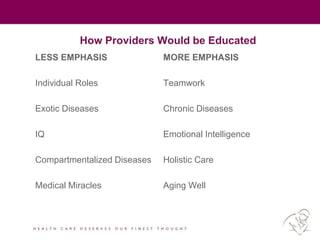
How Providers Would be Educated
LESS EMPHASIS MORE EMPHASIS
Individual Roles Teamwork
Exotic Diseases Chronic Diseases
IQ Emotional Intelligence
Compartmentalized Diseases Holistic Care
Medical Miracles Aging Well
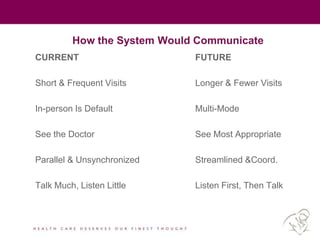
How the System Would Communicate
CURRENT FUTURE
Short & Frequent Visits Longer & Fewer Visits
In-person Is Default Multi-Mode
See the Doctor See Most Appropriate
Parallel & Unsynchronized Streamlined &Coord.
Talk Much, Listen Little Listen First, Then Talk
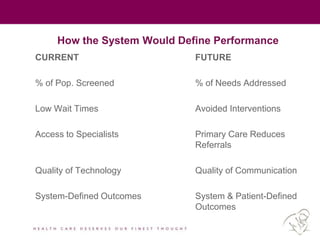
How the System Would Define Performance
CURRENT FUTURE
% of Pop. Screened % of Needs Addressed
Low Wait Times Avoided Interventions
Access to Specialists Primary Care Reduces
Referrals
Quality of Technology Quality of Communication
System-Defined Outcomes System & Patient-Defined
Outcomes
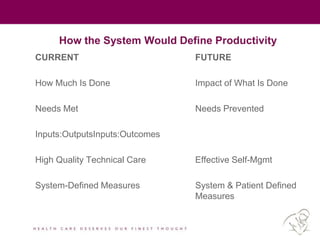
How the System Would Define Productivity
CURRENT FUTURE
How Much Is Done Impact of What Is Done
Needs Met Needs Prevented
Inputs:OutputsInputs:Outcomes
High Quality Technical Care Effective Self-Mgmt
System-Defined Measures System & Patient Defined
Measures
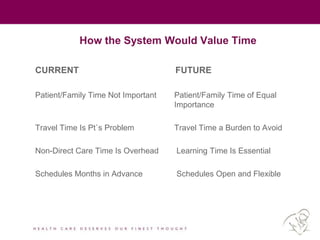
How the System Would Value Time
CURRENT FUTURE
Patient/Family Time Not Important Patient/Family Time of Equal
Importance
Travel Time Is Pt`s Problem Travel Time a Burden to Avoid
Non-Direct Care Time Is Overhead Learning Time Is Essential
Schedules Months in Advance Schedules Open and Flexible
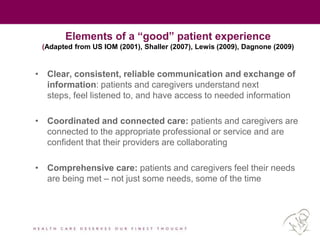
Elements of a “good” patient experience
(Adapted from US IOM (2001), Shaller (2007), Lewis (2009), Dagnone (2009)
• Clear, consistent, reliable communication and exchange of
information: patients and caregivers understand next
steps, feel listened to, and have access to needed information
• Coordinated and connected care: patients and caregivers are
connected to the appropriate professional or service and are
confident that their providers are collaborating
• Comprehensive care: patients and caregivers feel their needs
are being met – not just some needs, some of the time
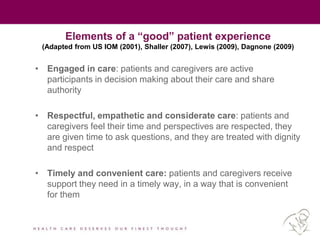
Elements of a “good” patient experience
(Adapted from US IOM (2001), Shaller (2007), Lewis (2009), Dagnone (2009)
• Engaged in care: patients and caregivers are active
participants in decision making about their care and share
authority
• Respectful, empathetic and considerate care: patients and
caregivers feel their time and perspectives are respected, they
are given time to ask questions, and they are treated with dignity
and respect
• Timely and convenient care: patients and caregivers receive
support they need in a timely way, in a way that is convenient
for them
ENGAGEMENT IS NOT NICE.
IT IS NECESSARY.

Cf

  • 1.
    Peeling Back theOnion: What are Patients and Their Caregivers Actually Saying About Their Health Care Experience and What Does it Mean for the Delivery of Care? Cathy Fooks The Change Foundation April 18, 2013 SMH Clinical & Population Research Rounds
  • 2.
    The Change Foundation???? •Charitable Foundation set up in 1995 by the Ontario Hospital Association • $55 million endowment – spend the investment income based on Board approved strategy • Currently focused on improving the patient and caregiver experience for people living with chronic disease • Three buckets of work: • Policy analysis and advocacy • Citizen/patient engagement • Quality improvement with an emphasis on experience- based design (EBD)
  • 3.
    Focus for Today 1)Regional Consultations – LOUD AND CLEAR 2) Current Experiences - PANORAMA 3) Experience Survey – Cobourg/PATH 4) Framework to Help Clarify Discussions 5) Evidence of Impac 6) Implications for System Design
  • 4.
    LOUD AND CLEAR Seniorsand Caregivers on Navigating Ontario’s Health Care System
  • 5.
    Six Regional Consultations •Locations: Ottawa, Dryden, Timmins, Peterborough, London, Toronto for face to face discussions • Participants recruited through local providers (hospital, LTC, FHT, CHC) • Online webinars for those who did not attend in person • Discussion guide sent out in advance • Keypad voting used for in person sessions
  • 6.
  • 7.
    The numbers onnavigating healthcare transitions N=95
  • 10.
    Some of thenarrative… “If someone had just sat down with us to explain what was next in our care, it would have made a huge difference.” I‟ve had four discharge experiences from hospital back to nursing homes. The problem is that no one seems to understand the system. There is no system map to explain how it works. People explained parts of the system but not the overall system.”
  • 11.
    Some of thenarrative… “When I called the hospital to explain the problems with the transition home, all I got was „sorry you feel this way about your dad‟s discharge, but he was ready to go‟ Why was there no home safety assessment prior to getting home and why was there no clear information about what was going to happen that my mom could understand?” “I‟ve never been asked as a caregiver, „what‟s convenient for you?‟ or „how would this work in your family?‟ Instead its „this is what we are going to do for you.‟
  • 12.
    Pointing out thepositives… • Huge support for team based care and role of nurse practitioners who have time to spend with patients. • Recognition that once a diagnosis was made, support was more clear – in particular cancer services and Alzheimer’s organizations were referenced. • Distinctions made between individual health care workers and the organizations within which they worked.
  • 13.
    Overall themes… • Primarycare - disorganized, not connected to rest of the system • Connecting the dots – hard to do and not a lot of help • Communication – variable, personality driven rather than system driven • Inclusion – certain disregard for family members and their contributions • Equity – despite above, recognition that those without family were even less supported
  • 14.
    PANORAMA A Panel ofOntario Residents Exchanging Views, Experiences
  • 15.
    Composition of Panel •32 members • Age range 24 – 83 • More than 50% over 55 • All 14 LHIN regions are represented • Ajax, Almonte, Avonmore, Barrie, Caistorville, Cambridge, Dryd en, Fort Frances, Hanover, Kingston, Leamingtron, Markstay, Mississua ga, Niagara-on-the-Lake, North Bay, Oakville, Ottawa, Peterborough, Richmond Hill, Sarnia, Sault Ste. Marie, St. Thomas, Thornbury, Thornhill, Toronto and Waterloo. • Household income ranges from under $20,000 to over $100,000 • 20% come from non-European backgrounds • 20% are caregivers and four people are both caregivers and patients with chronic disease
  • 16.
    System Usage inthe Past 24 months 30% 70% 52% 44% 11% 22% 30% 0% 20% 40% 60% 80% FHT ED GP solo GP group NP clinic Walk in clinic Telehealth
  • 17.
    Hospital Related Transitionsin Past 24 months 38% 42% 27% 4% 12% 0% 10% 20% 30% 40% 50% ED to Hosp Hosp to Home Hosp to Home with Home Care Hosp to LTC Hosp to Rehab
  • 18.
    HOW DO THEYDESCRIBE THE HEALTH CARE SYSTEM?
  • 19.
    How do theydescribe the health care system? • A safe with a patient trying to crack it open – to show limited patient access to their own health care information • A question mark around the word diagnostics – to reflect doubt while waiting for, or interpreting, test results • A hamster running on a wheel – to show the challenges of accessing uncoordinated services
  • 20.
    How do theydescribe the health care system? • A balanced scale – to show the two sided experience of good care/poor care and that the level of service is not the same across the board • A big doctor with his arms around his chest and behind him a little person – to show the patient feeling they are without authority or rights
  • 21.
    HOW DO THEYVISUALIZE THE SYSTEM?
  • 30.
    COMMUNITY SURVEY: CURRENT EXPERIENCEIN NORTHUMBERLAND (HOME OF OUR PATH PROJECT)
  • 31.
    Methodology • Telephone surveywas administered by Ipsosin West Northumberland • Patients: 18 years of age or older, having one or more long-term health conditions & contact with health care system at least 5 times a year. (50% over the age of 60) • Caregivers: who substantially assist family/friend with health care needs. • Pre-test was conducted prior to full launch. • 801 surveys were completed with patients (554) and caregivers (247) Margin of error +/- 3.4%, 19 times of 20.
  • 32.
    Patientand Caregiver ProfileCaregiver– Profile 69% 31% Patient Caregiver 41% 59% Male Female 27% 57% 11% 3% 3% Live on my own Live with my spouse and/or children in my home Live with family members or others in their home Live in a community-type setting like a retirement home Live in a long-term care/nursing home 47% 22% 19% Less than $45,000 $45,000 to less than $75,000 Over $75,000
  • 33.
    Frequency of TransitionExperiences 85% 56% 53% 30% 17% 2% 2% Lab/Diagnostics in Support of Transitions Between Primary Care and Specialty Care Between Home and Hospital Between Primary Care and Hospital Between Home Care and Hospital Between Long- term Care and Hospital First Time Transitions to Long-term Care Small Bases
  • 34.
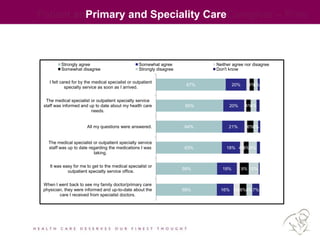
    Patient anPrimary andSpeciality CareCaregiver – Prire 67% 65% 64% 63% 59% 59% 20% 20% 21% 18% 19% 16% 4% 6% 4% 4% 6% 5% 9% 6% 4% 6% 5% 8% 10% 6%7% I felt cared for by the medical specialist or outpatient specialty service as soon as I arrived. The medical specialist or outpatient specialty service staff was informed and up to date about my health care needs. All my questions were answered. The medical specialist or outpatient specialty service staff was up to date regarding the medications I was taking. It was easy for me to get to the medical specialist or outpatient specialty service office. When I went back to see my family doctor/primary care physician, they were informed and up-to-date about the care I received from specialist doctors. Strongly agree Somewhat agree Neither agree nor disagree Somewhat disagree Strongly disagree Don't know
  • 35.
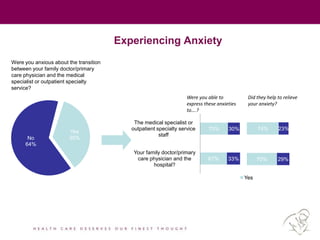
    Experiencing Anxiety Were youanxious about the transition between your family doctor/primary care physician and the medical specialist or outpatient specialty service? Yes 35%No 64% 70% 67% 30% 33% The medical specialist or outpatient specialty service staff Your family doctor/primary care physician and the hospital? Yes 74% 70% 23% 29% Were you able to express these anxieties to….? Did they help to relieve your anxiety?
  • 36.
    Primary Care toHospital 65% 62% 62% 61% 60% 17% 20% 20% 21% 19% 8% 8% 8% 7% 7% 7% 7% 7% 5% 7% The hospital staff was up to date regarding the medications I was taking. All my questions were answered. The hospital staff was informed and up to date about my health care needs. My family doctor/primary care physician and the hospital staff worked together as a team to meet my needs. I felt cared for by my family doctor/primary care physician as I was prepared to be admitted to the hospital. Strongly agree Somewhat agree Somewhat disagree Strongly disagree
  • 37.
    58% 12% 40% 82% When you leftthe hospital, did the hospital make arrangements or make sure you had follow-up visits with a doctor or other health care professionals? Did you receive a phone call from the hospital after returning home to confirm whether you had any problems with instructions or accessing services? Yes No Hospital Discharge
  • 38.
    PatHospital Discharge 86% 88%89% 86% 86% 84% 82% 71% 71% 68% 48% 47% 46% 65% When I left the hospital, I clearly understood the warning signs and symptoms I should watch for. When I left the hospital, I was confident I could actually do the things I needed to do to take care of my health. When I left the hospital, I had all the information needed to be able to take care of myself. My family or home situation was taken into account when planning the hospital discharge. The hospital staff took my preferences and those of my family or caregiver into account in deciding where my health care needs would be met after being discharged from the hospital. Hospital staff talked with me about whether I would have the help I needed after being discharged from the hospital. Involved in Discharge Decision Transition to Home Plan No Transition to Home Plan
  • 39.
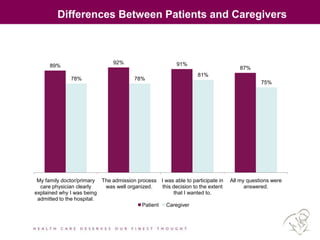
    Differences Between Patientsand Caregivers 89% 92% 91% 87% 78% 78% 81% 75% My family doctor/primary care physician clearly explained why I was being admitted to the hospital. The admission process was well organized. I was able to participate in this decision to the extent that I wanted to. All my questions were answered. Patient Caregiver
  • 40.
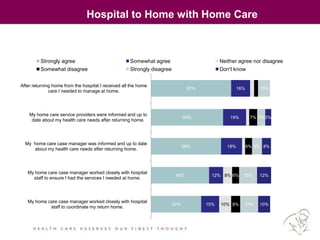
    Hospital to Homewith Home Care 67% 60% 58% 48% 42% 16% 19% 18% 12% 15% 8% 10% 7% 6% 6% 8% 10% 7% 8% 15% 15% 5% 8% 12% 10% After returning home from the hospital I received all the home care I needed to manage at home. My home care service providers were informed and up to date about my health care needs after returning home. My home care case manager was informed and up to date about my health care needs after returning home. My home care case manager worked closely with hospital staff to ensure I had the services I needed at home. My home care case manager worked closely with hospital staff to coordinate my return home. Strongly agree Somewhat agree Neither agree nor disagree Somewhat disagree Strongly disagree Don't know
  • 41.
    70% 63% 30% 33% Your home carehealth professionals? The hospital staff? Yes No PExperiencing Anxiety Were you anxious about the transition between your home and the hospital? Yes 28% No 70% Were you able to express these anxieties to….? Did they help to relieve your anxiety?Yes 25%No 72% 67% 62% 33% 34% Were you anxious about the transition between home care and the hospital?
  • 42.
    FRAMEWORK TO HELP ORGANIZETHINKING K. Carman et al (2013) A Multidimensional Framework for Patient and Family Engagement in Health and Health Care. Health Affairs. 32: 223- 231. Doyle C et al (2013) A Systematic Review of Evidence on the Links Between Patient Experience and Clinical Safety and Effectiveness. BMJ Open: 3:e001570
  • 43.
    A Multidimensional FrameworkFor Patient And Family Engagement In Health And Health Care (Carman 2013) Continuum of engagement Levels of Engagement Consultation Involvement Partnership and Shared leadership Direct Care Patients receive Information about a diagnosis  Patients are asked about their preferences in treatment plan  Treatment decisions are made based on patients' preferences, medical evidence, and clinical judgment Organizational design and governance Organization surveys patients about their care experiences  Hospital involves patients as advisers or advisory council members  Patients co-lead hospital safety and quality improvement committees Policy making Public agency conducts focus groups with patients to ask opinions about a health care issue  Patients' recommendations about research priorities are used by public agency to make funding decisions  Patients have equal representation on agency committee that makes decisions about how to allocate resources to health programs
  • 44.
    Program Examples –Cleveland Clinic Care Enhancement Program for Lung Transplant Pts(Carman 2013) • Reduced length of stay by 1.54 days • 6% decrease in case costs • 28% improvement in patient satisfaction with clinicians’ communication • 3% improvement in 30-day survival
  • 45.
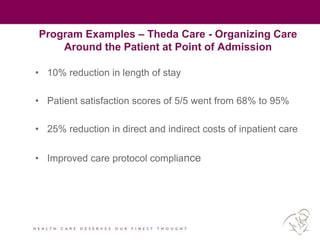
    Program Examples –Theda Care - Organizing Care Around the Patient at Point of Admission • 10% reduction in length of stay • Patient satisfaction scores of 5/5 went from 68% to 95% • 25% reduction in direct and indirect costs of inpatient care • Improved care protocol compliance
  • 46.
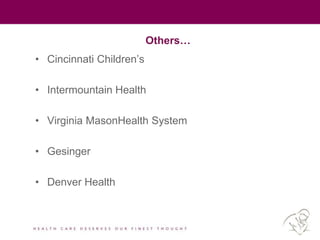
    Others… • Cincinnati Children’s •Intermountain Health • Virginia MasonHealth System • Gesinger • Denver Health
  • 47.
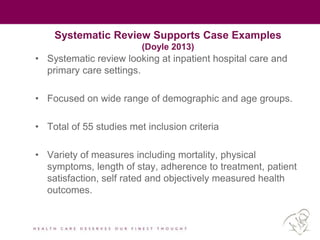
    Systematic Review SupportsCase Examples (Doyle 2013) • Systematic review looking at inpatient hospital care and primary care settings. • Focused on wide range of demographic and age groups. • Total of 55 studies met inclusion criteria • Variety of measures including mortality, physical symptoms, length of stay, adherence to treatment, patient satisfaction, self rated and objectively measured health outcomes.
  • 48.
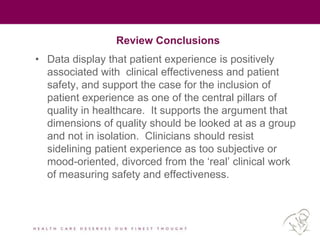
    Review Conclusions • Datadisplay that patient experience is positively associated with clinical effectiveness and patient safety, and support the case for the inclusion of patient experience as one of the central pillars of quality in healthcare. It supports the argument that dimensions of quality should be looked at as a group and not in isolation. Clinicians should resist sidelining patient experience as too subjective or mood-oriented, divorced from the ‘real’ clinical work of measuring safety and effectiveness.
  • 49.
  • 50.
    How Providers Wouldbe Educated LESS EMPHASIS MORE EMPHASIS Individual Roles Teamwork Exotic Diseases Chronic Diseases IQ Emotional Intelligence Compartmentalized Diseases Holistic Care Medical Miracles Aging Well
  • 51.
    How the SystemWould Communicate CURRENT FUTURE Short & Frequent Visits Longer & Fewer Visits In-person Is Default Multi-Mode See the Doctor See Most Appropriate Parallel & Unsynchronized Streamlined &Coord. Talk Much, Listen Little Listen First, Then Talk
  • 52.
    How the SystemWould Define Performance CURRENT FUTURE % of Pop. Screened % of Needs Addressed Low Wait Times Avoided Interventions Access to Specialists Primary Care Reduces Referrals Quality of Technology Quality of Communication System-Defined Outcomes System & Patient-Defined Outcomes
  • 53.
    How the SystemWould Define Productivity CURRENT FUTURE How Much Is Done Impact of What Is Done Needs Met Needs Prevented Inputs:OutputsInputs:Outcomes High Quality Technical Care Effective Self-Mgmt System-Defined Measures System & Patient Defined Measures
  • 54.
    How the SystemWould Value Time CURRENT FUTURE Patient/Family Time Not Important Patient/Family Time of Equal Importance Travel Time Is Pt`s Problem Travel Time a Burden to Avoid Non-Direct Care Time Is Overhead Learning Time Is Essential Schedules Months in Advance Schedules Open and Flexible
  • 55.
    Elements of a“good” patient experience (Adapted from US IOM (2001), Shaller (2007), Lewis (2009), Dagnone (2009) • Clear, consistent, reliable communication and exchange of information: patients and caregivers understand next steps, feel listened to, and have access to needed information • Coordinated and connected care: patients and caregivers are connected to the appropriate professional or service and are confident that their providers are collaborating • Comprehensive care: patients and caregivers feel their needs are being met – not just some needs, some of the time
  • 56.
    Elements of a“good” patient experience (Adapted from US IOM (2001), Shaller (2007), Lewis (2009), Dagnone (2009) • Engaged in care: patients and caregivers are active participants in decision making about their care and share authority • Respectful, empathetic and considerate care: patients and caregivers feel their time and perspectives are respected, they are given time to ask questions, and they are treated with dignity and respect • Timely and convenient care: patients and caregivers receive support they need in a timely way, in a way that is convenient for them
  • 57.
    ENGAGEMENT IS NOTNICE. IT IS NECESSARY.

Editor's Notes

  • #32 RDD – Using census subdivision codes, targeted phone numbers in the qualifying regions; all listed numbers and valid numbers generated by the RDD process were dialled at least once.Resident of West Northumberland – catchment area of NHH; confirmed with question (Town of Cobourg, Municipality of Port Hope, Townships of Alnwick/Haldimand, Cramahe, Hamilton)Patient, Caregiver – screening questionsLong term health conditions - defined as being of long duration and slow progression, such as arthritis, cancer, asthma, diabetes, depression, heart disease, hypertension or stroke, etc.
  • #34 The core transitions explored in this project are just some of the many different transition types frequent health care users would experience.A transition occurs when a client is moved from one health care organization/profession to another either within or between locations.For simplicity and to capture the overall experience we have grouped these two transitions into one transitional experience, moving between primary care and hospital.All other transitions were similarly grouped with the exception of first time transitions to long-term care which is only a one way transition. For today’s purpose, we’ll focus on the more frequently experienced transitions and ultimately only a sub-set of the data. Each transition is explored thoroughly in the report and many crosstabs are explored - if a primary care physician is informed about a hospital experience, higher ratings are reported for working as a team (primary care/hospital staff)
  • #35 Moreover, some clients may need help going to specialty care as only 78% say it was easy to get to the specialist.
  • #42 Importantly, clients generally felt able to express these anxieties to home health care professionals (70%) and hospital staff (63%). While those health care professionals involved in the transition from home care often helped clients relieve this anxiety (67%), there is room for improvement both here and among hospital staff (62%).