Contemporary
Scottish Art
Practice
(1945-present)
Week 6:
Devolution not
Revolution
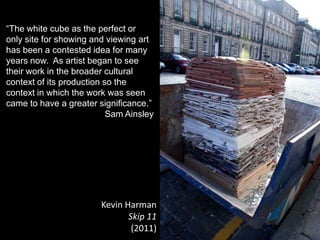
“The white cube as the perfect or
only site for showing and viewing art
has been a contested idea for many
years now. As artist began to see
their work in the broader cultural
context of its production so the
context in which the work was seen
came to have a greater significance.”
Sam Ainsley
Kevin Harman
Skip 11
(2011)
Objectives:
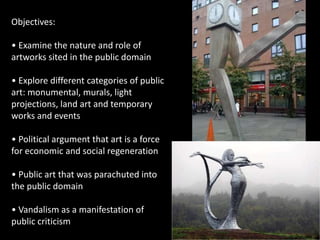
• Examine the nature and role of
artworks sited in the public domain
• Explore different categories of public
art: monumental, murals, light
projections, land art and temporary
works and events
• Political argument that art is a force
for economic and social regeneration
• Public art that was parachuted into
the public domain
• Vandalism as a manifestation of
public criticism
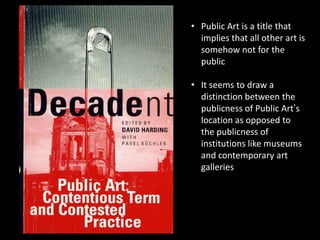
• Public Art is a title that
implies that all other art is
somehow not for the
public
• It seems to draw a
distinction between the
publicness of Public Art‟s
location as opposed to
the publicness of
institutions like museums
and contemporary art
galleries
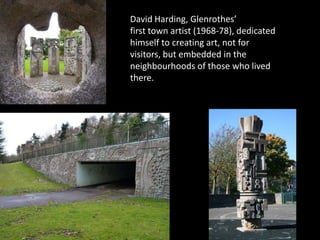
David Harding, Glenrothes’
first town artist (1968-78), dedicated
himself to creating art, not for
visitors, but embedded in the
neighbourhoods of those who lived
there.
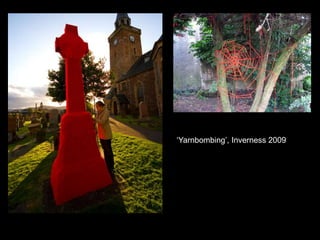
„Yarnbombing‟, Inverness 2009
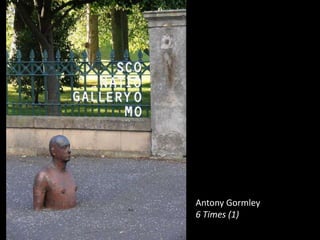
Antony Gormley
6 Times (1)
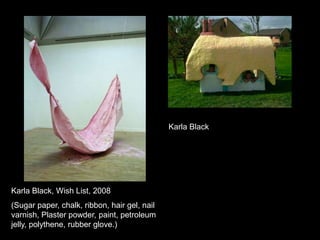
Karla Black, Wish List, 2008
(Sugar paper, chalk, ribbon, hair gel, nail
varnish, Plaster powder, paint, petroleum
jelly, polythene, rubber glove.)
Karla Black
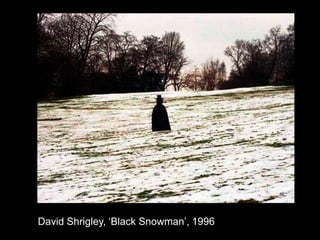
David Shrigley, „Black Snowman‟, 1996
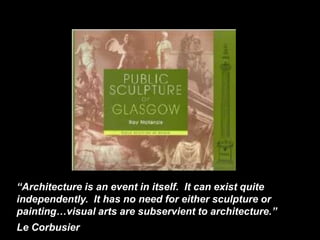
“Architecture is an event in itself. It can exist quite
independently. It has no need for either sculpture or
painting…visual arts are subservient to architecture.”
Le Corbusier
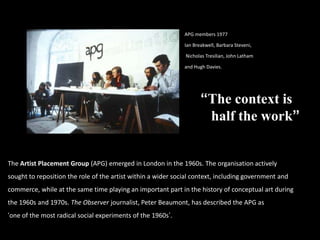
APG members 1977
Ian Breakwell, Barbara Steveni,
Nicholas Tresilian, John Latham
and Hugh Davies.
The Artist Placement Group (APG) emerged in London in the 1960s. The organisation actively
sought to reposition the role of the artist within a wider social context, including government and
commerce, while at the same time playing an important part in the history of conceptual art during
the 1960s and 1970s. The Observer journalist, Peter Beaumont, has described the APG as
„one of the most radical social experiments of the 1960s‟.
“The context is
half the work”
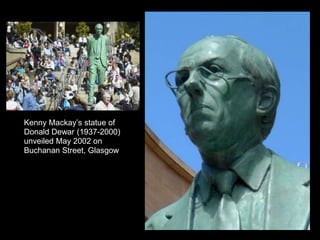
Kenny Mackay‟s statue of
Donald Dewar (1937-2000)
unveiled May 2002 on
Buchanan Street, Glasgow
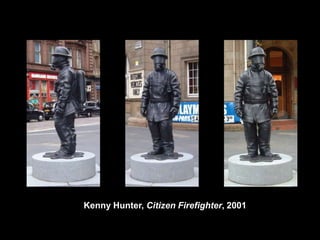
Kenny Hunter, Citizen Firefighter, 2001
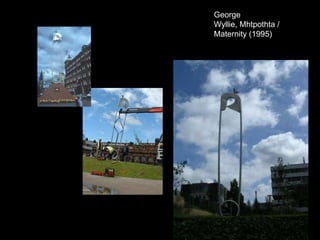
George
Wyllie, Mhtpothta /
Maternity (1995)
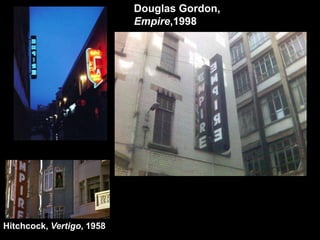
Douglas Gordon,
Empire,1998
Hitchcock, Vertigo, 1958
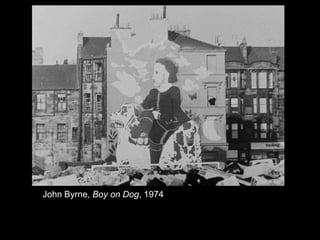
John Byrne, Boy on Dog, 1974
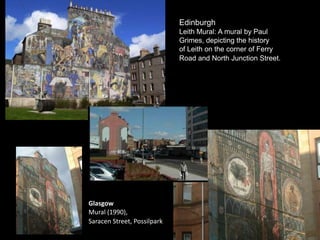
Edinburgh
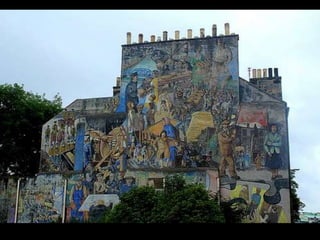
Leith Mural: A mural by Paul
Grimes, depicting the history
of Leith on the corner of Ferry
Road and North Junction Street.
Glasgow
Mural (1990),
Saracen Street, Possilpark
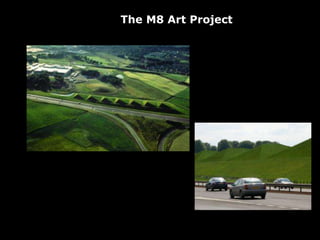
The M8 Art Project
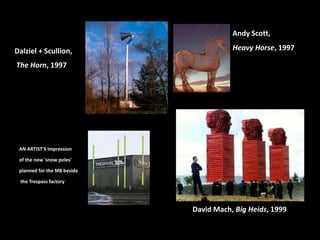
Dalziel + Scullion,
The Horn, 1997
AN ARTIST'S impression
of the new 'snow poles'
planned for the M8 beside
the Trespass factory
Andy Scott,
Heavy Horse, 1997
David Mach, Big Heids, 1999
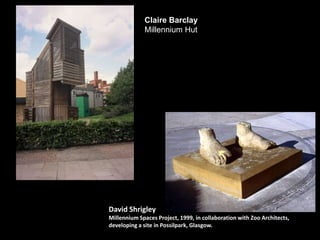
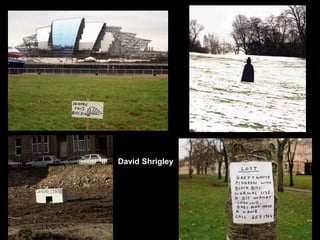
David Shrigley
Millennium Spaces Project, 1999, in collaboration with Zoo Architects,
developing a site in Possilpark, Glasgow.
Claire Barclay
Millennium Hut
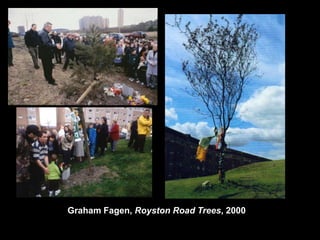
Graham Fagen, Royston Road Trees, 2000
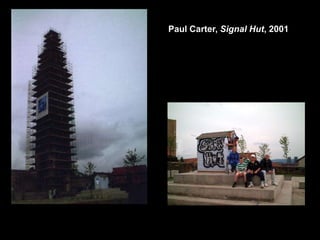
Paul Carter, Signal Hut, 2001
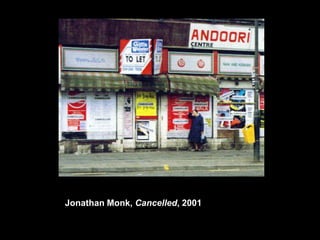
Jonathan Monk, Cancelled, 2001
David Shrigley
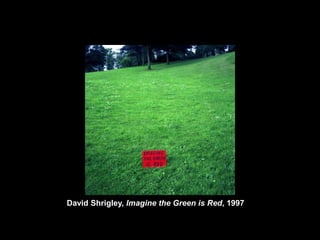
David Shrigley, Imagine the Green is Red, 1997
OCTOBER: CONTEMPORARY ART IN ST. VINCENT STREET
October presents the work of 31 Glasgow-based artists in the city-centre location of St Vincent Street. Each artist is assigned one day of the month of October 2001
in which they can make and show work in any site along the street: bars, cafes, banks, offices, waste-grounds, churches, pavements, walls… Presenting public art in
this transitory way allows the artists the freedom to bring their practice into the public realm without the constraints of producing a permanent work. St Vincent
Street runs from George Square across the M8 and into the residential area of Finnieston: from the heart of the city to its contrasting outskirts. Along the way, the
overall look and atmosphere changes from high-class commercial outlets and the head offices of national corporations to small corner-shops and council flats.
Rather than placing the art object in the gallery, October places the work of art within this social context that represents various aspects of the everyday. Artworks
will include installation, painting, performance, photography, sculpture, text, and video. Not all of the artists have previously made public art, many work only in
gallery spaces. These artists have been selected to represent a cross section of contemporary art practice in Glasgow, enabling a general engagement with the wider
context of the city street.
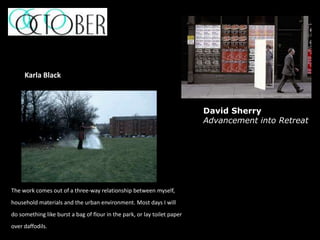
The work comes out of a three-way relationship between myself,
household materials and the urban environment. Most days I will
do something like burst a bag of flour in the park, or lay toilet paper
over daffodils.
Karla Black
David Sherry
Advancement into Retreat
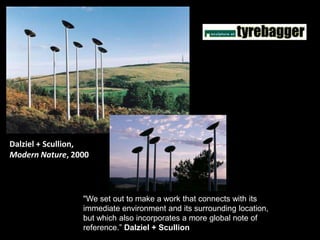
Dalziel + Scullion,
Modern Nature, 2000
"We set out to make a work that connects with its
immediate environment and its surrounding location,
but which also incorporates a more global note of
reference.” Dalziel + Scullion
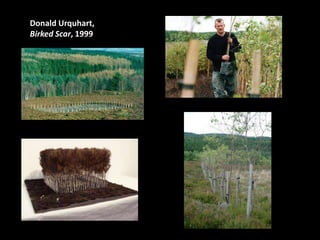
Donald Urquhart,
Birked Scar, 1999
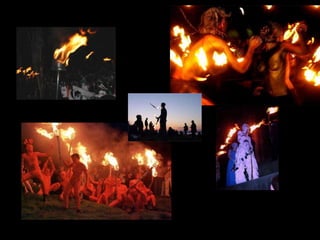
'Walking through this place at night, we aim to create
an intense experience that people simply cannot get
elsewhere. And we hope this will lead to a more profound
understanding of the landscape. It will be a step into the
unknown.‟
Angus Farquhar, nva
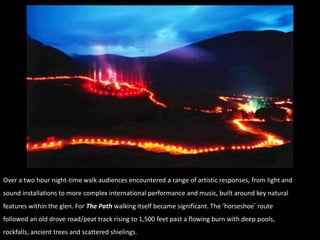
Over a two hour night-time walk audiences encountered a range of artistic responses, from light and
sound installations to more complex international performance and music, built around key natural
features within the glen. For The Path walking itself became significant. The „horseshoe‟ route
followed an old drove road/peat track rising to 1,500 feet past a flowing burn with deep pools,
rockfalls, ancient trees and scattered shielings.
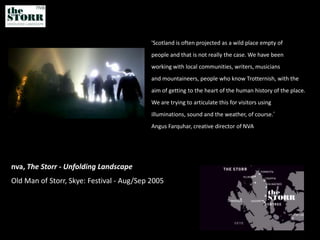
nva, The Storr - Unfolding Landscape
Old Man of Storr, Skye: Festival - Aug/Sep 2005
'Scotland is often projected as a wild place empty of
people and that is not really the case. We have been
working with local communities, writers, musicians
and mountaineers, people who know Trotternish, with the
aim of getting to the heart of the human history of the place.
We are trying to articulate this for visitors using
illuminations, sound and the weather, of course.‟
Angus Farquhar, creative director of NVA
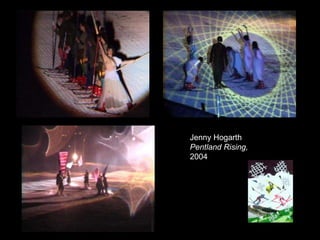
Jenny Hogarth
Pentland Rising,
2004
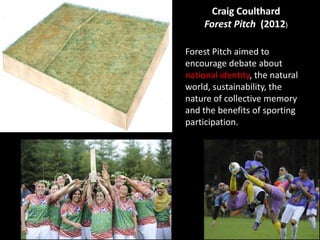
Craig Coulthard
Forest Pitch (2012)
Forest Pitch aimed to
encourage debate about
national identity, the natural
world, sustainability, the
nature of collective memory
and the benefits of sporting
participation.
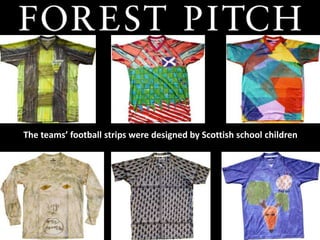
The teams’ football strips were designed by Scottish school children
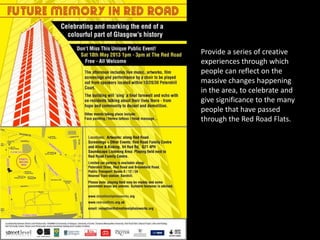
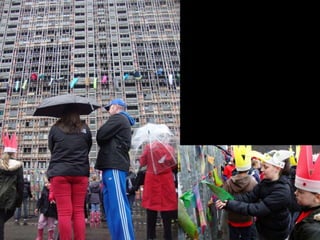
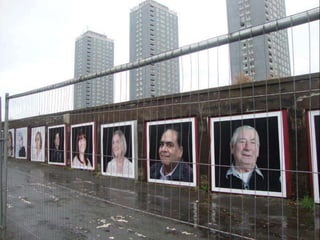
Provide a series of creative
experiences through which
people can reflect on the
massive changes happening
in the area, to celebrate and
give significance to the many
people that have passed
through the Red Road Flats.
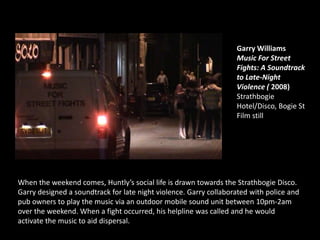
Garry Williams
Music For Street
Fights: A Soundtrack
to Late-Night
Violence ( 2008)
Strathbogie
Hotel/Disco, Bogie St
Film still
When the weekend comes, Huntly’s social life is drawn towards the Strathbogie Disco.
Garry designed a soundtrack for late night violence. Garry collaborated with police and
pub owners to play the music via an outdoor mobile sound unit between 10pm-2am
over the weekend. When a fight occurred, his helpline was called and he would
activate the music to aid dispersal.
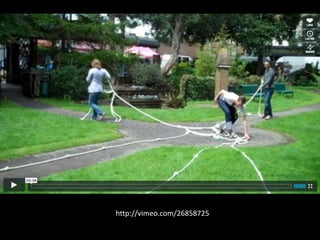
http://vimeo.com/26858725
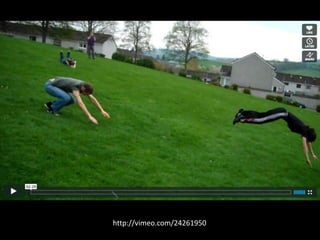
http://vimeo.com/24261950
http://vimeo.com/32358614
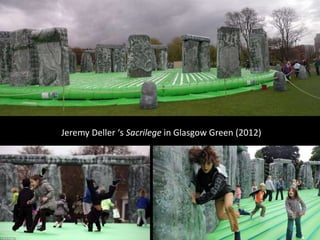
Jeremy Deller ‘s Sacrilege in Glasgow Green (2012)
Week 6 devolution not revolution 2

Week 6 devolution not revolution 2

  • 1.
  • 2.
    “The white cubeas the perfect or only site for showing and viewing art has been a contested idea for many years now. As artist began to see their work in the broader cultural context of its production so the context in which the work was seen came to have a greater significance.” Sam Ainsley Kevin Harman Skip 11 (2011)
  • 3.
    Objectives: • Examine thenature and role of artworks sited in the public domain • Explore different categories of public art: monumental, murals, light projections, land art and temporary works and events • Political argument that art is a force for economic and social regeneration • Public art that was parachuted into the public domain • Vandalism as a manifestation of public criticism
  • 4.
    • Public Artis a title that implies that all other art is somehow not for the public • It seems to draw a distinction between the publicness of Public Art‟s location as opposed to the publicness of institutions like museums and contemporary art galleries
  • 5.
    David Harding, Glenrothes’ firsttown artist (1968-78), dedicated himself to creating art, not for visitors, but embedded in the neighbourhoods of those who lived there.
  • 6.
  • 8.
  • 9.
    Karla Black, WishList, 2008 (Sugar paper, chalk, ribbon, hair gel, nail varnish, Plaster powder, paint, petroleum jelly, polythene, rubber glove.) Karla Black
  • 10.
    David Shrigley, „BlackSnowman‟, 1996
  • 11.
    “Architecture is anevent in itself. It can exist quite independently. It has no need for either sculpture or painting…visual arts are subservient to architecture.” Le Corbusier
  • 12.
    APG members 1977 IanBreakwell, Barbara Steveni, Nicholas Tresilian, John Latham and Hugh Davies. The Artist Placement Group (APG) emerged in London in the 1960s. The organisation actively sought to reposition the role of the artist within a wider social context, including government and commerce, while at the same time playing an important part in the history of conceptual art during the 1960s and 1970s. The Observer journalist, Peter Beaumont, has described the APG as „one of the most radical social experiments of the 1960s‟. “The context is half the work”
  • 15.
    Kenny Mackay‟s statueof Donald Dewar (1937-2000) unveiled May 2002 on Buchanan Street, Glasgow
  • 16.
    Kenny Hunter, CitizenFirefighter, 2001
  • 17.
  • 18.
  • 19.
    John Byrne, Boyon Dog, 1974
  • 20.
    Edinburgh Leith Mural: Amural by Paul Grimes, depicting the history of Leith on the corner of Ferry Road and North Junction Street. Glasgow Mural (1990), Saracen Street, Possilpark
  • 21.
    The M8 ArtProject
  • 22.
    Dalziel + Scullion, TheHorn, 1997 AN ARTIST'S impression of the new 'snow poles' planned for the M8 beside the Trespass factory Andy Scott, Heavy Horse, 1997 David Mach, Big Heids, 1999
  • 23.
    David Shrigley Millennium SpacesProject, 1999, in collaboration with Zoo Architects, developing a site in Possilpark, Glasgow. Claire Barclay Millennium Hut
  • 24.
    Graham Fagen, RoystonRoad Trees, 2000
  • 25.
  • 26.
  • 27.
  • 28.
    David Shrigley, Imaginethe Green is Red, 1997
  • 29.
    OCTOBER: CONTEMPORARY ARTIN ST. VINCENT STREET October presents the work of 31 Glasgow-based artists in the city-centre location of St Vincent Street. Each artist is assigned one day of the month of October 2001 in which they can make and show work in any site along the street: bars, cafes, banks, offices, waste-grounds, churches, pavements, walls… Presenting public art in this transitory way allows the artists the freedom to bring their practice into the public realm without the constraints of producing a permanent work. St Vincent Street runs from George Square across the M8 and into the residential area of Finnieston: from the heart of the city to its contrasting outskirts. Along the way, the overall look and atmosphere changes from high-class commercial outlets and the head offices of national corporations to small corner-shops and council flats. Rather than placing the art object in the gallery, October places the work of art within this social context that represents various aspects of the everyday. Artworks will include installation, painting, performance, photography, sculpture, text, and video. Not all of the artists have previously made public art, many work only in gallery spaces. These artists have been selected to represent a cross section of contemporary art practice in Glasgow, enabling a general engagement with the wider context of the city street.
  • 30.
    The work comesout of a three-way relationship between myself, household materials and the urban environment. Most days I will do something like burst a bag of flour in the park, or lay toilet paper over daffodils. Karla Black David Sherry Advancement into Retreat
  • 31.
    Dalziel + Scullion, ModernNature, 2000 "We set out to make a work that connects with its immediate environment and its surrounding location, but which also incorporates a more global note of reference.” Dalziel + Scullion
  • 32.
  • 33.
    'Walking through thisplace at night, we aim to create an intense experience that people simply cannot get elsewhere. And we hope this will lead to a more profound understanding of the landscape. It will be a step into the unknown.‟ Angus Farquhar, nva
  • 36.
    Over a twohour night-time walk audiences encountered a range of artistic responses, from light and sound installations to more complex international performance and music, built around key natural features within the glen. For The Path walking itself became significant. The „horseshoe‟ route followed an old drove road/peat track rising to 1,500 feet past a flowing burn with deep pools, rockfalls, ancient trees and scattered shielings.
  • 37.
    nva, The Storr- Unfolding Landscape Old Man of Storr, Skye: Festival - Aug/Sep 2005 'Scotland is often projected as a wild place empty of people and that is not really the case. We have been working with local communities, writers, musicians and mountaineers, people who know Trotternish, with the aim of getting to the heart of the human history of the place. We are trying to articulate this for visitors using illuminations, sound and the weather, of course.‟ Angus Farquhar, creative director of NVA
  • 38.
  • 39.
    Craig Coulthard Forest Pitch(2012) Forest Pitch aimed to encourage debate about national identity, the natural world, sustainability, the nature of collective memory and the benefits of sporting participation.
  • 40.
    The teams’ footballstrips were designed by Scottish school children
  • 41.
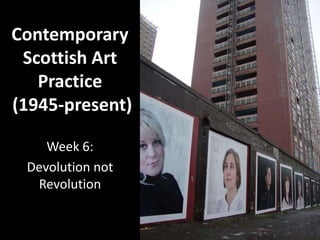
    Provide a seriesof creative experiences through which people can reflect on the massive changes happening in the area, to celebrate and give significance to the many people that have passed through the Red Road Flats.
  • 45.
    Garry Williams Music ForStreet Fights: A Soundtrack to Late-Night Violence ( 2008) Strathbogie Hotel/Disco, Bogie St Film still When the weekend comes, Huntly’s social life is drawn towards the Strathbogie Disco. Garry designed a soundtrack for late night violence. Garry collaborated with police and pub owners to play the music via an outdoor mobile sound unit between 10pm-2am over the weekend. When a fight occurred, his helpline was called and he would activate the music to aid dispersal.
  • 46.
  • 47.
  • 48.
  • 49.
    Jeremy Deller ‘sSacrilege in Glasgow Green (2012)

Editor's Notes

  • #2 Every urban regeneration project seems to come with its own piece of public art. Scotland has a long tradition of art in public spaces. But what is it actually for?
  • #4 Examine the nature and role of artworks sited in the public domainExploring different categories of public art: monumental sculpture; building features including murals and light projections; natural artworks such as land-form artworks and temporary public works including eventsI will be touching on the political argument that art is force for economic and social regenerationI will look at a genre of public art that as a result of such policies was parachuted into public space and that was sometimes no more than a token gesture, somewhat dumped in an uncongenial settingI will consider vandalism as a manifestation of public criticism, or a spirited guerrila art intervention by the public
  • #6 David Harding, Glenrothes’ first town artist (1968-78), dedicated himself to creating art, not for visitors, but embedded in the neighbourhoods of those who lived there.Harding felt it was important to involve local people and get them to contribute.One of the first ways that was done was by getting local school children to make a very personal ceramic tile which they all cemented into a wall next to their playground.
  • #8 The term Public art is synonymous with work that is physically outside the gallery or museum, located in what the art critic, Lawrence Alloway, referred to as, ‘unregulated’ space. These works are passed daily by a broad cross section of people. Some public art has a specific relationship to the community in which it’s sited and its meaning is dependent link between the work and its surroundings whilst other work would seem to have no recognisable reason for why it is there.
  • #9 We can dissect this categorisation further and could say that there are perhaps three main particular strands of public art commissioning that are concurrently existing. Firstly there are a number of commissions which broadly speaking could have been commissioned 100years ago in that they have not responded to the paradigm shifts in practice and culture.
  • #40 A major arts project by Craig Coulthard, in the Borders of Scotland, Forest Pitch arts project created a full-size football pitch hidden within a forest. Commercial trees felled to make space for the pitch will be used to create goalposts, a shelter and other infrastructure on site.In summer 2012 Forest Pitch hosted two football matches. The participating players were made up of amateurs from across Scotland, who have taken up British citizenship since 2000. Spectators of the games were members of local communities and schools, the players' families and people involved in producing the event; andthe general publicAfter the games, the site has been left to grow back naturally, with some native species replanted to encourage a more diverse environment. This major commission aims to encourage debate about national identity, the natural world, sustainability, the nature of collective memory and the benefits of sporting participation. It this way it acted as a small-scale mirror to the London 2012 Games
  • #41 The teams’ football strips were designed by Scottish school children as part of a national design competition
  • #42 Provide a series of creative experiences through which people can reflect on the massive changes happening in the area, to celebrate and give significance to the many people that have passed through the Red Road Flats.
  • #43 Red Roadsocial engagementAnd like many other works in Glasgow in that it was linked to the regeneration of a public housing estate in which a residency, involving consultation with the local community, and the process of the work were key elements.This however only goes to highlight the fact that artist involved in public art navigate a number of issues when they engage with people, places, and ideas. Just as public art encompasses a diverse range of artistic practice and each has their own triumphs and problems.
  • #44 Portrait Archive
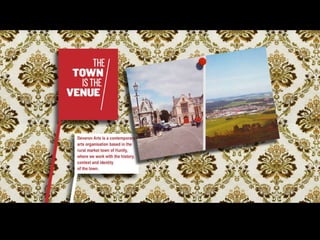
  • #45 Deveron Arts has no gallery - instead the town is the venue - acting as studio, gallery and stage for artists of all disciplines invited from around the world to live and work here. For this we use found spaces throughout the town and its surrounding areas: supermarkets, churches, garages etc. to name just a few.
  • #46 When the weekend comes, Huntly’s social life is drawn towards the Strathbogie Disco. Garry designed a soundtrack for late night violence. Garry collaborated with police and pub owners to play the music via an outdoor mobile sound unit between 10pm-2am over the weekend. When a fight occurred, his helpline was called and he would activate the music to aid dispersal.
  • #49 “When viewing the sculpture of Saddam Hussein being pulled down, I was witnessing an object, which had been built to be permanent, transforming, advancing how futile an idea of permanence became.My own sculpture falls over and advances to another state in its existence”.
  • #50 Jeremy Deller's Sacrilege at Glasgow Green was part of the Glasgow international festival of visual arts was a giant inflatable Stonehenge.