1
Referenced shown in into slide h.meligy@ieee.org also from Kaplan books
Hassan El-Meligy
Materials used for BSC with
reference to originals
h.meligy@ieee.org
Balanced Scorecard Workshop
Presented by:
Matt H. Evans, CPA, CMA, CFM
Public Sector Retreat on
Malcolm Baldrige Performance Excellence
2
Referenced shown in into slide h.meligy@ieee.org also from Kaplan books
Balanced Scorecard Workshop
Presented by:
Matt H. Evans, CPA, CMA, CFM
Public Sector Retreat on
Malcolm Baldrige Performance Excellence
Materials used for BSC with reference to originals
h.meligy@ieee.org
3
Referenced shown in into slide h.meligy@ieee.org also from Kaplan books
Purpose of the Workshop
• Introduce the Balanced Scorecard to the Organization
• Make sure everyone understands how the scorecard works
• Communicate how the Balanced Scorecard fits with the Malcolm
Baldrige Model of performance excellence
4
Referenced shown in into slide h.meligy@ieee.org also from Kaplan books
Table of Contents
I. Balanced Scorecard Basics
II. Creating the Strategy Map
III. Good Performance Measurements
IV. The Final Scorecard Components
V. Case Study Exercise
VI. Some Final Points
5
Referenced shown in into slide h.meligy@ieee.org also from Kaplan books
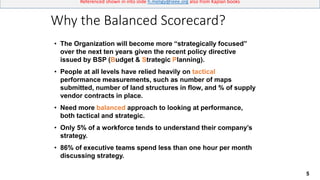
• The Organization will become more “strategically focused”
over the next ten years given the recent policy directive
issued by BSP (Budget & Strategic Planning).
• People at all levels have relied heavily on tactical
performance measurements, such as number of maps
submitted, number of land structures in flow, and % of supply
vendor contracts in place.
• Need more balanced approach to looking at performance,
both tactical and strategic.
• Only 5% of a workforce tends to understand their company’s
strategy.
• 86% of executive teams spend less than one hour per month
discussing strategy.
Why the Balanced Scorecard?
6
Referenced shown in into slide h.meligy@ieee.org also from Kaplan books
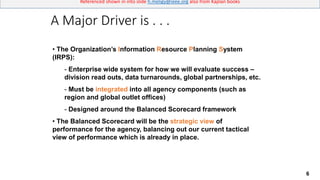
• The Organization’s Information Resource Planning System
(IRPS):
- Enterprise wide system for how we will evaluate success –
division read outs, data turnarounds, global partnerships, etc.
- Must be integrated into all agency components (such as
region and global outlet offices)
- Designed around the Balanced Scorecard framework
• The Balanced Scorecard will be the strategic view of
performance for the agency, balancing out our current tactical
view of performance which is already in place.
A Major Driver is . . .
7
Referenced shown in into slide h.meligy@ieee.org also from Kaplan books
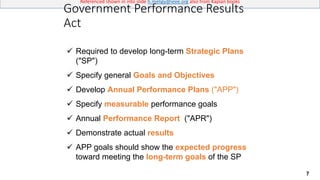
Government Performance Results
Act
 Required to develop long-term Strategic Plans
("SP")
 Specify general Goals and Objectives
 Develop Annual Performance Plans ("APP")
 Specify measurable performance goals
 Annual Performance Report ("APR")
 Demonstrate actual results
 APP goals should show the expected progress
toward meeting the long-term goals of the SP
8
Referenced shown in into slide h.meligy@ieee.org also from Kaplan books
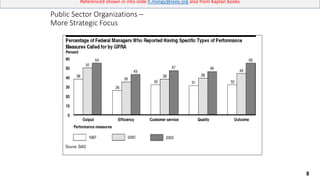
Public Sector Organizations –
More Strategic Focus
9
Referenced shown in into slide h.meligy@ieee.org also from Kaplan books
Where it started . . .
Introduced in 1992, by Robert Kaplan and David Norton, the
Balanced Scorecard is the most commonly used framework for
ensuring that agencies execute their strategies. Today, about
70% of the Fortune 1,000 companies utilize the Balanced
Scorecard to help manage performance.
Balanced Scorecards are used as the roadmap for
creating the “Strategic Management System” or our
IRPS. And this will drive overall organizational
performance for our entire agency!
10
Referenced shown in into slide h.meligy@ieee.org also from Kaplan books
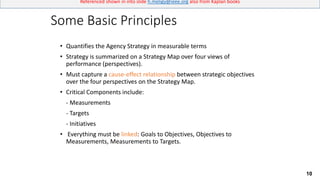
Some Basic Principles
• Quantifies the Agency Strategy in measurable terms
• Strategy is summarized on a Strategy Map over four views of
performance (perspectives).
• Must capture a cause-effect relationship between strategic objectives
over the four perspectives on the Strategy Map.
• Critical Components include:
- Measurements
- Targets
- Initiatives
• Everything must be linked: Goals to Objectives, Objectives to
Measurements, Measurements to Targets.
11
Referenced shown in into slide h.meligy@ieee.org also from Kaplan books
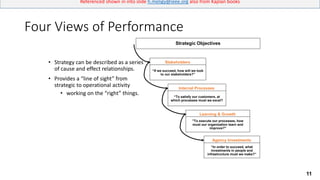
Four Views of Performance
• Strategy can be described as a series
of cause and effect relationships.
• Provides a “line of sight” from
strategic to operational activity
• working on the “right” things.
“If we succeed, how will we look
to our stakeholders?”
Stakeholders
Strategic Objectives
“To satisfy our customers, at
which processes must we excel?
Internal Processes
"To execute our processes, how
must our organization learn and
improve?"
Learning & Growth
“In order to succeed, what
investments in people and
infrastructure must we make?”
Agency Investments
12
Referenced shown in into slide h.meligy@ieee.org also from Kaplan books
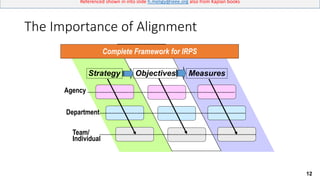
Strategy
Agency
Department
Team/
Individual
MeasuresObjectives
Complete Framework for IRPS
The Importance of Alignment
13
Referenced shown in into slide h.meligy@ieee.org also from Kaplan books
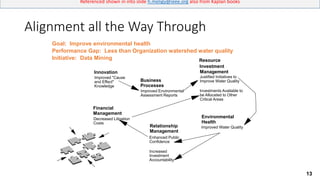
Alignment all the Way Through
Improved "Cause
and Effect"
Knowledge
Innovation
Business
Processes
Improved Environmental
Assessment Reports
Management
Justified Initiatives to
Improve Water Quality
Investments Available to
be Allocated to Other
Critical Areas
Environmental
Health
Improved Water QualityRelationship
Management
Enhanced Public
Confidence
Increased
Investment
Accountability
Financial
Management
Decreased Litigation
Costs
Resource
Investment
Goal: Improve environmental health
Initiative: Data Mining
Performance Gap: Less than Organization watershed water quality
14
Referenced shown in into slide h.meligy@ieee.org also from Kaplan books
In order to be successful, the Agency’s IRPS
should . . .
• Be comprised of a balanced set of a limited vital few measures;
• Produce timely and useful reports at a reasonable cost;
• Display and make readily available information that is shared,
understood, and used by the Agency; and
• Supports the organization’s values and the relationship the
organization has with customers, suppliers, and stakeholders.
15
Referenced shown in into slide h.meligy@ieee.org also from Kaplan books
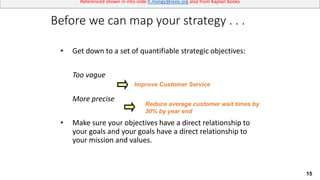
Before we can map your strategy . . .
• Get down to a set of quantifiable strategic objectives:
Too vague
More precise
• Make sure your objectives have a direct relationship to
your goals and your goals have a direct relationship to
your mission and values.
Improve Customer Service
Reduce average customer wait times by
30% by year end
16
Referenced shown in into slide h.meligy@ieee.org also from Kaplan books
Table Of Contents
I. Balanced Scorecard Basics
II. Creating the Strategy Map
III. Good Performance Measurements
IV. The Final Scorecard Components
V. Case Study Exercise
VI. Some Final Points
17
Referenced shown in into slide h.meligy@ieee.org also from Kaplan books
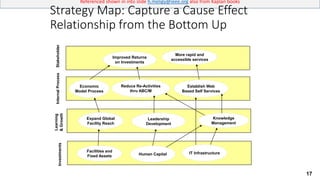
InternalProcessStakeholderLearning
&Growth
Reduce Re-Activities
thru ABC/M
Establish Web
Based Self Services
Knowledge
Management
Human Capital
Improved Returns
on Investments
More rapid and
accessible services
Leadership
Development
Investments
Strategy Map: Capture a Cause Effect
Relationship from the Bottom Up
IT InfrastructureFacilities and
Fixed Assets
Economic
Model Process
Expand Global
Facility Reach
18
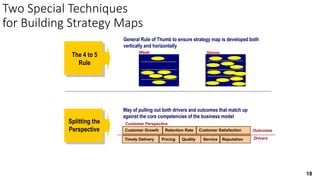
Two Special Techniques
for Building Strategy Maps
The 4 to 5
Rule
Splitting the
Perspective
General Rule of Thumb to ensure strategy map is developed both
vertically and horizontally
Way of pulling out both drivers and outcomes that match up
against the core competencies of the business model
Customer Growth Customer SatisfactionRetention Rate
Timely Delivery Pricing Quality Service Reputation
Customer Perspective
Outcomes
Drivers
Weak Strong
19
Referenced shown in into slide h.meligy@ieee.org also from Kaplan books
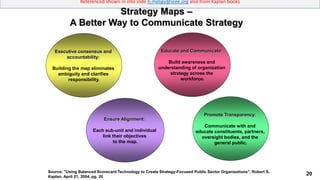
Key Benefits of Strategy Maps
• Articulates how the organization creates value for its constituents and
legitimizing authority
• Displays key priorities and relationships between outcomes (the "what") and
performance enablers or drivers (the "how")
• Provides a clear view of "how I fit in" for sub-organizations, teams, and
individuals
• "Cascading the scorecard throughout the organization, and clearly mapping the
various units and functions back to the organization or agency-wide map is
critical to leveraging and ensuring alignment"
20
Referenced shown in into slide h.meligy@ieee.org also from Kaplan books
Executive consensus and
accountability:
Building the map eliminates
ambiguity and clarifies
responsibility.
Educate and Communicate:
Build awareness and
understanding of organization
strategy across the
workforce.
Ensure Alignment:
Each sub-unit and individual
link their objectives
to the map.
Source: "Using Balanced Scorecard Technology to Create Strategy-Focused Public Sector Organizations", Robert S.
Kaplan, April 21, 2004, pg. 20
Promote Transparency:
Communicate with and
educate constituents, partners,
oversight bodies, and the
general public.
Strategy Maps –
A Better Way to Communicate Strategy
21
Referenced shown in into slide h.meligy@ieee.org also from Kaplan books
Multiple Choice Question –
Cause Effect on Strategy Map
The top perspective of the Balanced Scorecard is the final end results or
outcomes we want to achieve. This perspective is called:
a. Internal Processes
b. Stakeholder / Customer
c. Learning & Growth
d. Agency Investments
22
Referenced shown in into slide h.meligy@ieee.org also from Kaplan books
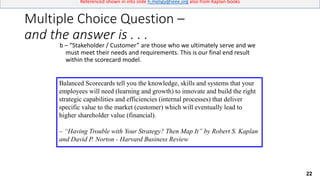
Multiple Choice Question –
and the answer is . . .
b – “Stakeholder / Customer” are those who we ultimately serve and we
must meet their needs and requirements. This is our final end result
within the scorecard model.
Balanced Scorecards tell you the knowledge, skills and systems that your
employees will need (learning and growth) to innovate and build the right
strategic capabilities and efficiencies (internal processes) that deliver
specific value to the market (customer) which will eventually lead to
higher shareholder value (financial).
– “Having Trouble with Your Strategy? Then Map It” by Robert S. Kaplan
and David P. Norton - Harvard Business Review
23
Referenced shown in into slide h.meligy@ieee.org also from Kaplan books
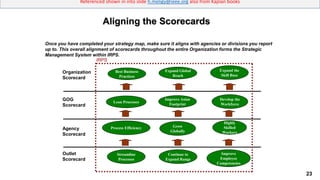
Once you have completed your strategy map, make sure it aligns with agencies or divisions you report
up to. This overall alignment of scorecards throughout the entire Organization forms the Strategic
Management System within IRPS.
Best Business
Practices
Expand Global
Reach
Expand the
Skill Base
Lean Processes
Organization
Scorecard
Improve Asian
Footprint
Develop the
Workforce
GOG
Scorecard
Process Efficiency Grow
Globally
Highly
Skilled
Workers
Agency
Scorecard
Streamline
Processes
Continue to
Expand Range
Improve
Employee
Competencies
Outlet
Scorecard
IRPS
Aligning the Scorecards
24
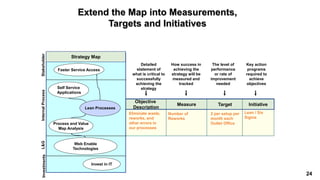
Detailed
statement of
what is critical to
successfully
achieving the
strategy
How success in
achieving the
strategy will be
measured and
tracked
Key action
programs
required to
achieve
objectives
The level of
performance
or rate of
improvement
needed
Objective
Description
Target
2 per setup per
month each
Outlet Office
InitiativeMeasure
Number of
Reworks
Strategy Map
StakeholderInternalProcessL&G
Faster Service Access
Self Service
Applications
Web Enable
Technologies
Process and Value
Map Analysis
Lean Processes
Investments
Invest in IT
Extend the Map into Measurements,
Targets and Initiatives
Lean / Six
Sigma
Eliminate waste,
reworks, and
other errors in
our processes
25
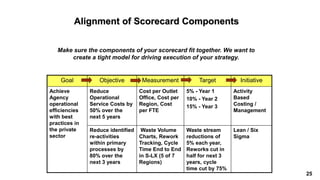
Make sure the components of your scorecard fit together. We want to
create a tight model for driving execution of your strategy.
Goal Objective Measurement Target Initiative
Achieve
Agency
operational
efficiencies
with best
practices in
the private
sector
Reduce
Operational
Service Costs by
50% over the
next 5 years
Cost per Outlet
Office, Cost per
Region, Cost
per FTE
5% - Year 1
10% - Year 2
15% - Year 3
Activity
Based
Costing /
Management
Reduce identified
re-activities
within primary
processes by
80% over the
next 3 years
Waste Volume
Charts, Rework
Tracking, Cycle
Time End to End
in S-LX (5 of 7
Regions)
Waste stream
reductions of
5% each year,
Reworks cut in
half for next 3
years, cycle
time cut by 75%
Lean / Six
Sigma
Alignment of Scorecard Components
26
Referenced shown in into slide h.meligy@ieee.org also from Kaplan books
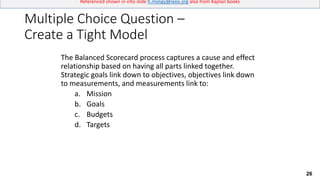
Multiple Choice Question –
Create a Tight Model
The Balanced Scorecard process captures a cause and effect
relationship based on having all parts linked together.
Strategic goals link down to objectives, objectives link down
to measurements, and measurements link to:
a. Mission
b. Goals
c. Budgets
d. Targets
27
Referenced shown in into slide h.meligy@ieee.org also from Kaplan books
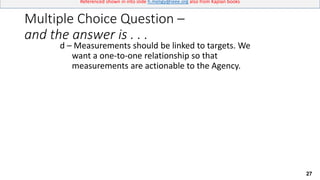
Multiple Choice Question –
and the answer is . . .
d – Measurements should be linked to targets. We
want a one-to-one relationship so that
measurements are actionable to the Agency.
28
Referenced shown in into slide h.meligy@ieee.org also from Kaplan books
Table Of Contents
I. Balanced Scorecard Basics
II. Creating the Strategy Map
III. Good Performance Measurements
IV. The Final Scorecard Components
V. Case Study Exercise
VI. Some Final Points
29
Referenced shown in into slide h.meligy@ieee.org also from Kaplan books
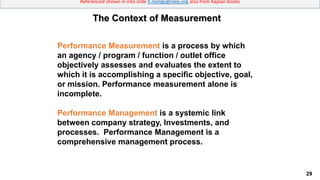
Performance Measurement is a process by which
an agency / program / function / outlet office
objectively assesses and evaluates the extent to
which it is accomplishing a specific objective, goal,
or mission. Performance measurement alone is
incomplete.
Performance Management is a systemic link
between company strategy, Investments, and
processes. Performance Management is a
comprehensive management process.
The Context of Measurement
30
Referenced shown in into slide h.meligy@ieee.org also from Kaplan books
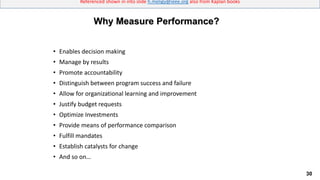
• Enables decision making
• Manage by results
• Promote accountability
• Distinguish between program success and failure
• Allow for organizational learning and improvement
• Justify budget requests
• Optimize Investments
• Provide means of performance comparison
• Fulfill mandates
• Establish catalysts for change
• And so on…
Why Measure Performance?
31
Referenced shown in into slide h.meligy@ieee.org also from Kaplan books
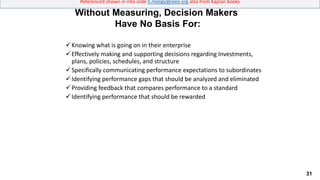
Knowing what is going on in their enterprise
Effectively making and supporting decisions regarding Investments,
plans, policies, schedules, and structure
Specifically communicating performance expectations to subordinates
Identifying performance gaps that should be analyzed and eliminated
Providing feedback that compares performance to a standard
Identifying performance that should be rewarded
Without Measuring, Decision Makers
Have No Basis For:
32
Referenced shown in into slide h.meligy@ieee.org also from Kaplan books
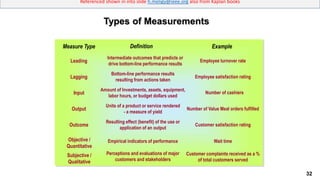
Leading
Definition
Lagging
Input
Output
Outcome
Objective /
Quantitative
Example
Intermediate outcomes that predicts or
drive bottom-line performance results
Measure Type
Bottom-line performance results
resulting from actions taken
Amount of Investments, assets, equipment,
labor hours, or budget dollars used
Units of a product or service rendered
- a measure of yield
Resulting effect (benefit) of the use or
application of an output
Empirical indicators of performance
Subjective /
Qualitative
Perceptions and evaluations of major
customers and stakeholders
Employee turnover rate
Employee satisfaction rating
Number of Value Meal orders fulfilled
Customer satisfaction rating
Wait time
Customer complaints received as a %
of total customers served
Number of cashiers
Types of Measurements
33
Referenced shown in into slide h.meligy@ieee.org also from Kaplan books
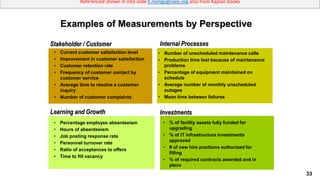
Stakeholder / Customer Internal Processes
Learning and Growth Investments
• % of facility assets fully funded for
upgrading
• % of IT infrastructure investments
approved
• # of new hire positions authorized for
filling
• % of required contracts awarded and in
place
• Percentage employee absenteeism
• Hours of absenteeism
• Job posting response rate
• Personnel turnover rate
• Ratio of acceptances to offers
• Time to fill vacancy
• Number of unscheduled maintenance calls
• Production time lost because of maintenance
problems
• Percentage of equipment maintained on
schedule
• Average number of monthly unscheduled
outages
• Mean time between failures
• Current customer satisfaction level
• Improvement in customer satisfaction
• Customer retention rate
• Frequency of customer contact by
customer service
• Average time to resolve a customer
inquiry
• Number of customer complaints
Examples of Measurements by Perspective
34
Referenced shown in into slide h.meligy@ieee.org also from Kaplan books
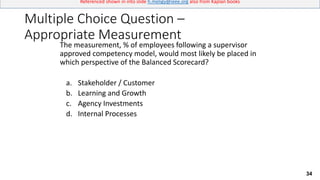
Multiple Choice Question –
Appropriate Measurement
The measurement, % of employees following a supervisor
approved competency model, would most likely be placed in
which perspective of the Balanced Scorecard?
a. Stakeholder / Customer
b. Learning and Growth
c. Agency Investments
d. Internal Processes
35
Referenced shown in into slide h.meligy@ieee.org also from Kaplan books
Multiple Choice Question –
and the answer is . . .
b – this measurement relates to helping grow the
workforce and this would most likely fit with the
Learning and Growth perspective of the Balanced
Scorecard.
36
Referenced shown in into slide h.meligy@ieee.org also from Kaplan books
• You should have at least one measurement for each
objective.
• Measurements define or explain objectives in quantifiable
terms:
Vague => We will improve customer service
Precise => We will improve customer service by
reducing response times by 30% by year
end.
• Measurements should drive change and encourage the
right behavior.
• Should be able to influence the outcome.
Some Basic Guidelines for
Good Performance Measures
37
Selection Criteria for
Performance Measurements
 MEANINGFUL - related significantly and directly to organizations mission and
goal
 VALUABLE – measure the most important activities of the organization
 BALANCED – inclusive of several types of measures (i.e. quality, efficiency)
 LINKED - matched to a unit responsible for achieving the measure
 PRACTICAL – affordable price to retrieve and/or capture data
 COMPARABLE – used to make comparisons with other data over time
 CREDIBLE - based on accurate and reliable data
 TIMELY - use and report data in a usable timeframe
 SIMPLE -- easy to calculate and understand
38
Referenced shown in into slide h.meligy@ieee.org also from Kaplan books
1. Relevant
• Addresses an operational or strategic performance issue
• Is results- or outcome-focused
• Provides useful information to enable decision making
2. Measurable
• Quantifiable and Objective
• Facilitates Analysis
• Can be done in a timely manner with high accuracy
• Data are available and collectable
3. Actionable
• Can be tracked to an appropriate person or team responsible for the activity
measured
• Measure relates to process inputs that can be controlled/adjusted to address
concerns
Three Criteria Used for Agency Scorecard
39
Referenced shown in into slide h.meligy@ieee.org also from Kaplan books
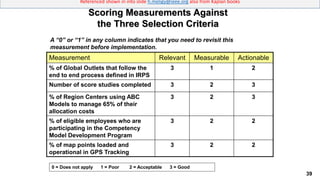
Measurement Relevant Measurable Actionable
% of Global Outlets that follow the
end to end process defined in IRPS
3 1 2
Number of score studies completed 3 2 3
% of Region Centers using ABC
Models to manage 65% of their
allocation costs
3 2 3
% of eligible employees who are
participating in the Competency
Model Development Program
3 2 2
% of map points loaded and
operational in GPS Tracking
3 2 2
A “0” or “1” in any column indicates that you need to revisit this
measurement before implementation.
0 = Does not apply 1 = Poor 2 = Acceptable 3 = Good
Scoring Measurements Against
the Three Selection Criteria
40
Referenced shown in into slide h.meligy@ieee.org also from Kaplan books
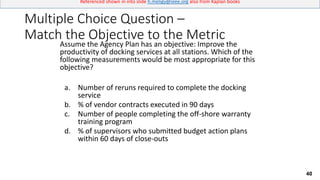
Multiple Choice Question –
Match the Objective to the Metric
Assume the Agency Plan has an objective: Improve the
productivity of docking services at all stations. Which of the
following measurements would be most appropriate for this
objective?
a. Number of reruns required to complete the docking
service
b. % of vendor contracts executed in 90 days
c. Number of people completing the off-shore warranty
training program
d. % of supervisors who submitted budget action plans
within 60 days of close-outs
41
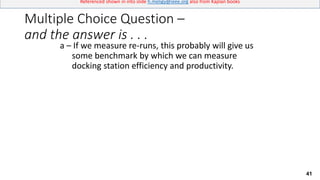
Referenced shown in into slide h.meligy@ieee.org also from Kaplan books
Multiple Choice Question –
and the answer is . . .
a – If we measure re-runs, this probably will give us
some benchmark by which we can measure
docking station efficiency and productivity.
42
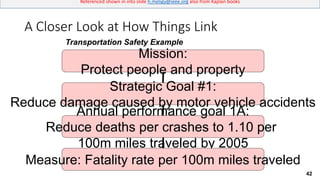
Referenced shown in into slide h.meligy@ieee.org also from Kaplan books
A Closer Look at How Things Link
Mission:
Protect people and property
Strategic Goal #1:
Reduce damage caused by motor vehicle accidents
Annual performance goal 1A:
Reduce deaths per crashes to 1.10 per
100m miles traveled by 2005
Measure: Fatality rate per 100m miles traveled
Transportation Safety Example
43
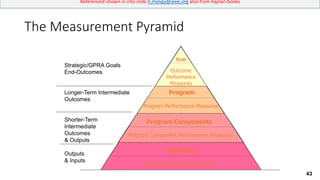
Referenced shown in into slide h.meligy@ieee.org also from Kaplan books
The Measurement Pyramid
Goal
Outcome
Performance
Measures
Program
Program Performance Measures
Program Components
Program Component Performance Measures
Activities
Activity Performance Measures
Strategic/GPRA Goals
End-Outcomes
Longer-Term Intermediate
Outcomes
Shorter-Term
Intermediate
Outcomes
& Outputs
Outputs
& Inputs
44
Referenced shown in into slide h.meligy@ieee.org also from Kaplan books
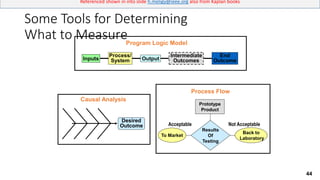
Some Tools for Determining
What to Measure
Inputs
Process/
System Output
Intermediate
Outcomes
End
Outcome
Program Logic Model
Desired
Outcome
Causal Analysis
Process Flow
Results
Of
Testing
Not AcceptableAcceptable
Prototype
Product
Back to
Laboratory
To Market
45
Referenced shown in into slide h.meligy@ieee.org also from Kaplan books
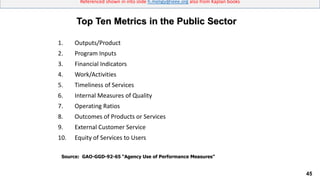
1. Outputs/Product
2. Program Inputs
3. Financial Indicators
4. Work/Activities
5. Timeliness of Services
6. Internal Measures of Quality
7. Operating Ratios
8. Outcomes of Products or Services
9. External Customer Service
10. Equity of Services to Users
Source: GAO-GGD-92-65 “Agency Use of Performance Measures”
Top Ten Metrics in the Public Sector
46
Referenced shown in into slide h.meligy@ieee.org also from Kaplan books
Table Of Contents
I. Balanced Scorecard Basics
II. Creating the Strategy Map
III. Good Performance Measurements
IV. The Final Scorecard Components
V. Case Study Exercise
VI. Some Final Points
47
Referenced shown in into slide h.meligy@ieee.org also from Kaplan books
• Past performance trends per historical data.
• Performance levels of similar organizational units at a
comparable level that facilitates benchmarking.
• Best practices across the agency, the public sector or the
private sector. Must be at a pre-existing high level of
performance before you use this approach.
• For newly launched services, may have to establish a
baseline per a prototype test and extend out from this
point forward.
• For major strategic shifts, may have to set directly per the
plan itself without regard for hard data.
How to Set Targets
48
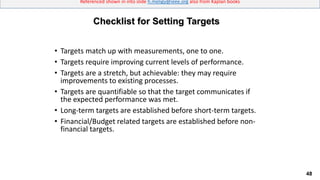
Referenced shown in into slide h.meligy@ieee.org also from Kaplan books
• Targets match up with measurements, one to one.
• Targets require improving current levels of performance.
• Targets are a stretch, but achievable: they may require
improvements to existing processes.
• Targets are quantifiable so that the target communicates if
the expected performance was met.
• Long-term targets are established before short-term targets.
• Financial/Budget related targets are established before non-
financial targets.
Checklist for Setting Targets
49
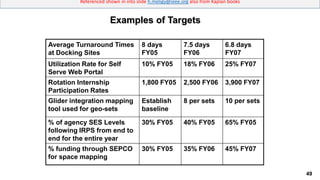
Referenced shown in into slide h.meligy@ieee.org also from Kaplan books
Average Turnaround Times
at Docking Sites
8 days
FY05
7.5 days
FY06
6.8 days
FY07
Utilization Rate for Self
Serve Web Portal
10% FY05 18% FY06 25% FY07
Rotation Internship
Participation Rates
1,800 FY05 2,500 FY06 3,900 FY07
Glider integration mapping
tool used for geo-sets
Establish
baseline
8 per sets 10 per sets
% of agency SES Levels
following IRPS from end to
end for the entire year
30% FY05 40% FY05 65% FY05
% funding through SEPCO
for space mapping
30% FY05 35% FY06 45% FY07
Examples of Targets
50
Referenced shown in into slide h.meligy@ieee.org also from Kaplan books
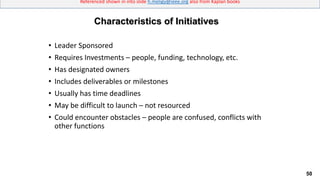
• Leader Sponsored
• Requires Investments – people, funding, technology, etc.
• Has designated owners
• Includes deliverables or milestones
• Usually has time deadlines
• May be difficult to launch – not resourced
• Could encounter obstacles – people are confused, conflicts with
other functions
Characteristics of Initiatives
51
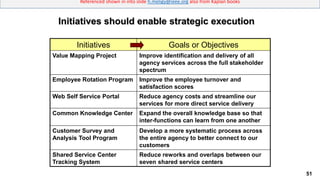
Referenced shown in into slide h.meligy@ieee.org also from Kaplan books
Initiatives Goals or Objectives
Value Mapping Project Improve identification and delivery of all
agency services across the full stakeholder
spectrum
Employee Rotation Program Improve the employee turnover and
satisfaction scores
Web Self Service Portal Reduce agency costs and streamline our
services for more direct service delivery
Common Knowledge Center Expand the overall knowledge base so that
inter-functions can learn from one another
Customer Survey and
Analysis Tool Program
Develop a more systematic process across
the entire agency to better connect to our
customers
Shared Service Center
Tracking System
Reduce reworks and overlaps between our
seven shared service centers
Initiatives should enable strategic execution
52
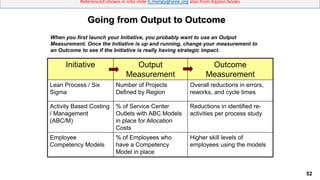
Referenced shown in into slide h.meligy@ieee.org also from Kaplan books
When you first launch your Initiative, you probably want to use an Output
Measurement. Once the Initiative is up and running, change your measurement to
an Outcome to see if the Initiative is really having strategic impact.
Initiative Output
Measurement
Outcome
Measurement
Lean Process / Six
Sigma
Number of Projects
Defined by Region
Overall reductions in errors,
reworks, and cycle times
Activity Based Costing
/ Management
(ABC/M)
% of Service Center
Outlets with ABC Models
in place for Allocation
Costs
Reductions in identified re-
activities per process study
Employee
Competency Models
% of Employees who
have a Competency
Model in place
Higher skill levels of
employees using the models
Going from Output to Outcome
53
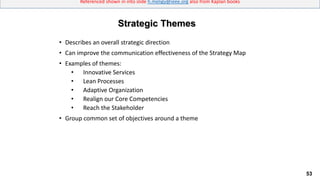
Referenced shown in into slide h.meligy@ieee.org also from Kaplan books
• Describes an overall strategic direction
• Can improve the communication effectiveness of the Strategy Map
• Examples of themes:
• Innovative Services
• Lean Processes
• Adaptive Organization
• Realign our Core Competencies
• Reach the Stakeholder
• Group common set of objectives around a theme
Strategic Themes
54
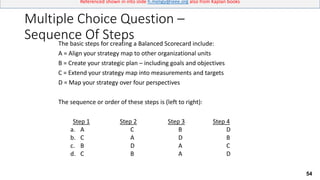
Referenced shown in into slide h.meligy@ieee.org also from Kaplan books
Multiple Choice Question –
Sequence Of StepsThe basic steps for creating a Balanced Scorecard include:
A = Align your strategy map to other organizational units
B = Create your strategic plan – including goals and objectives
C = Extend your strategy map into measurements and targets
D = Map your strategy over four perspectives
The sequence or order of these steps is (left to right):
Step 1 Step 2 Step 3 Step 4
a. A C B D
b. C A D B
c. B D A C
d. C B A D
55
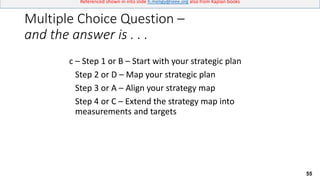
Referenced shown in into slide h.meligy@ieee.org also from Kaplan books
Multiple Choice Question –
and the answer is . . .
c – Step 1 or B – Start with your strategic plan
Step 2 or D – Map your strategic plan
Step 3 or A – Align your strategy map
Step 4 or C – Extend the strategy map into
measurements and targets
56
Referenced shown in into slide h.meligy@ieee.org also from Kaplan books
TABLE OF CONTENTS
I. Balanced Scorecard Basics
II. Creating the Strategy Map
III. Good Performance Measurements
IV. The Final Scorecard Components
V. Case Study Exercise
VI. Some Final Points
57
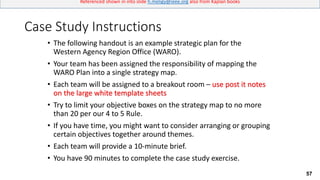
Referenced shown in into slide h.meligy@ieee.org also from Kaplan books
Case Study Instructions
• The following handout is an example strategic plan for the
Western Agency Region Office (WARO).
• Your team has been assigned the responsibility of mapping the
WARO Plan into a single strategy map.
• Each team will be assigned to a breakout room – use post it notes
on the large white template sheets
• Try to limit your objective boxes on the strategy map to no more
than 20 per our 4 to 5 Rule.
• If you have time, you might want to consider arranging or grouping
certain objectives together around themes.
• Each team will provide a 10-minute brief.
• You have 90 minutes to complete the case study exercise.
58
Referenced shown in into slide h.meligy@ieee.org also from Kaplan books
TABLE OF CONTENTS
I. Balanced Scorecard Basics
II. Creating the Strategy Map
III. Good Performance Measurements
IV. The Final Scorecard Components
V. Case Study Exercise
VI. Some Final Points
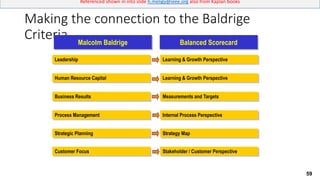
59
Referenced shown in into slide h.meligy@ieee.org also from Kaplan books
Making the connection to the Baldrige
Criteria Malcolm Baldrige Balanced Scorecard
Leadership Learning & Growth Perspective
Human Resource Capital
Business Results
Process Management
Strategic Planning Strategy Map
Learning & Growth Perspective
Internal Process Perspective
Customer Focus Stakeholder / Customer Perspective
Measurements and Targets
60
Referenced shown in into slide h.meligy@ieee.org also from Kaplan books
• IRPS is the Organization’s “Strategic Management System” for creating the
Strategically Focused Organization (SFO).
• The Strategic Management System Module within IRPS:
– Cascades scorecards down by folders
– Includes a web based training component
– Analytical tools include unit trends, service costing comparisons, strategy
map gap analysis, alignment point scoring, and executive dashboard views
sent to PDA’s.
• IRPS Scorecard Module has the following features:
- Project / Initiative Tracking with milestones
- Automated Email Data Collection
- Automated Report Distribution
- Linking Capability to Agency Databases (such as SES,
G-PAC, and Shared Service Docking Databases)
Automated System Overview - IRPS
61
Referenced shown in into slide h.meligy@ieee.org also from Kaplan books
• Cascade and align strategy down to the Outlet level (and beyond – personal
scorecards) where execution takes place.
• Capture cause effect linkages as you cascade and align down. This will
ensure that all of the Agency is moving in the same strategic direction.
• Identify and commit to projects and initiatives that will drive strategic
execution.
• Establish performance outcomes in the form of measurements and targets.
• Review results on a regular basis within the Quarterly Leadership Briefings
using the Balanced Scorecard framework.
Highlight Important Steps
62
Referenced shown in into slide h.meligy@ieee.org also from Kaplan books
• Training Slides (1)
• Performance Based Handbook (1)
• Performance Measurement Tool Kit (1)
• Formal Training:
• Offered Quarterly at the Central and Western Region Offices
• Annual Leadership Conference – 2 Hour Workshop
• Web Based Training:
• IRPS SMS – Option 6, self serve registration
(1) Posted on the internet at: www.exinfm.com/workshop.html
Additional Information
Contact Information: Matt Evans, matt@exinfm.com,877-689-4097

1 Scorecard Workshop Working Materials

  • 1.
    1 Referenced shown ininto slide h.meligy@ieee.org also from Kaplan books Hassan El-Meligy Materials used for BSC with reference to originals h.meligy@ieee.org Balanced Scorecard Workshop Presented by: Matt H. Evans, CPA, CMA, CFM Public Sector Retreat on Malcolm Baldrige Performance Excellence
  • 2.
    2 Referenced shown ininto slide h.meligy@ieee.org also from Kaplan books Balanced Scorecard Workshop Presented by: Matt H. Evans, CPA, CMA, CFM Public Sector Retreat on Malcolm Baldrige Performance Excellence Materials used for BSC with reference to originals h.meligy@ieee.org
  • 3.
    3 Referenced shown ininto slide h.meligy@ieee.org also from Kaplan books Purpose of the Workshop • Introduce the Balanced Scorecard to the Organization • Make sure everyone understands how the scorecard works • Communicate how the Balanced Scorecard fits with the Malcolm Baldrige Model of performance excellence
  • 4.
    4 Referenced shown ininto slide h.meligy@ieee.org also from Kaplan books Table of Contents I. Balanced Scorecard Basics II. Creating the Strategy Map III. Good Performance Measurements IV. The Final Scorecard Components V. Case Study Exercise VI. Some Final Points
  • 5.
    5 Referenced shown ininto slide h.meligy@ieee.org also from Kaplan books • The Organization will become more “strategically focused” over the next ten years given the recent policy directive issued by BSP (Budget & Strategic Planning). • People at all levels have relied heavily on tactical performance measurements, such as number of maps submitted, number of land structures in flow, and % of supply vendor contracts in place. • Need more balanced approach to looking at performance, both tactical and strategic. • Only 5% of a workforce tends to understand their company’s strategy. • 86% of executive teams spend less than one hour per month discussing strategy. Why the Balanced Scorecard?
  • 6.
    6 Referenced shown ininto slide h.meligy@ieee.org also from Kaplan books • The Organization’s Information Resource Planning System (IRPS): - Enterprise wide system for how we will evaluate success – division read outs, data turnarounds, global partnerships, etc. - Must be integrated into all agency components (such as region and global outlet offices) - Designed around the Balanced Scorecard framework • The Balanced Scorecard will be the strategic view of performance for the agency, balancing out our current tactical view of performance which is already in place. A Major Driver is . . .
  • 7.
    7 Referenced shown ininto slide h.meligy@ieee.org also from Kaplan books Government Performance Results Act  Required to develop long-term Strategic Plans ("SP")  Specify general Goals and Objectives  Develop Annual Performance Plans ("APP")  Specify measurable performance goals  Annual Performance Report ("APR")  Demonstrate actual results  APP goals should show the expected progress toward meeting the long-term goals of the SP
  • 8.
    8 Referenced shown ininto slide h.meligy@ieee.org also from Kaplan books Public Sector Organizations – More Strategic Focus
  • 9.
    9 Referenced shown ininto slide h.meligy@ieee.org also from Kaplan books Where it started . . . Introduced in 1992, by Robert Kaplan and David Norton, the Balanced Scorecard is the most commonly used framework for ensuring that agencies execute their strategies. Today, about 70% of the Fortune 1,000 companies utilize the Balanced Scorecard to help manage performance. Balanced Scorecards are used as the roadmap for creating the “Strategic Management System” or our IRPS. And this will drive overall organizational performance for our entire agency!
  • 10.
    10 Referenced shown ininto slide h.meligy@ieee.org also from Kaplan books Some Basic Principles • Quantifies the Agency Strategy in measurable terms • Strategy is summarized on a Strategy Map over four views of performance (perspectives). • Must capture a cause-effect relationship between strategic objectives over the four perspectives on the Strategy Map. • Critical Components include: - Measurements - Targets - Initiatives • Everything must be linked: Goals to Objectives, Objectives to Measurements, Measurements to Targets.
  • 11.
    11 Referenced shown ininto slide h.meligy@ieee.org also from Kaplan books Four Views of Performance • Strategy can be described as a series of cause and effect relationships. • Provides a “line of sight” from strategic to operational activity • working on the “right” things. “If we succeed, how will we look to our stakeholders?” Stakeholders Strategic Objectives “To satisfy our customers, at which processes must we excel? Internal Processes "To execute our processes, how must our organization learn and improve?" Learning & Growth “In order to succeed, what investments in people and infrastructure must we make?” Agency Investments
  • 12.
    12 Referenced shown ininto slide h.meligy@ieee.org also from Kaplan books Strategy Agency Department Team/ Individual MeasuresObjectives Complete Framework for IRPS The Importance of Alignment
  • 13.
    13 Referenced shown ininto slide h.meligy@ieee.org also from Kaplan books Alignment all the Way Through Improved "Cause and Effect" Knowledge Innovation Business Processes Improved Environmental Assessment Reports Management Justified Initiatives to Improve Water Quality Investments Available to be Allocated to Other Critical Areas Environmental Health Improved Water QualityRelationship Management Enhanced Public Confidence Increased Investment Accountability Financial Management Decreased Litigation Costs Resource Investment Goal: Improve environmental health Initiative: Data Mining Performance Gap: Less than Organization watershed water quality
  • 14.
    14 Referenced shown ininto slide h.meligy@ieee.org also from Kaplan books In order to be successful, the Agency’s IRPS should . . . • Be comprised of a balanced set of a limited vital few measures; • Produce timely and useful reports at a reasonable cost; • Display and make readily available information that is shared, understood, and used by the Agency; and • Supports the organization’s values and the relationship the organization has with customers, suppliers, and stakeholders.
  • 15.
    15 Referenced shown ininto slide h.meligy@ieee.org also from Kaplan books Before we can map your strategy . . . • Get down to a set of quantifiable strategic objectives: Too vague More precise • Make sure your objectives have a direct relationship to your goals and your goals have a direct relationship to your mission and values. Improve Customer Service Reduce average customer wait times by 30% by year end
  • 16.
    16 Referenced shown ininto slide h.meligy@ieee.org also from Kaplan books Table Of Contents I. Balanced Scorecard Basics II. Creating the Strategy Map III. Good Performance Measurements IV. The Final Scorecard Components V. Case Study Exercise VI. Some Final Points
  • 17.
    17 Referenced shown ininto slide h.meligy@ieee.org also from Kaplan books InternalProcessStakeholderLearning &Growth Reduce Re-Activities thru ABC/M Establish Web Based Self Services Knowledge Management Human Capital Improved Returns on Investments More rapid and accessible services Leadership Development Investments Strategy Map: Capture a Cause Effect Relationship from the Bottom Up IT InfrastructureFacilities and Fixed Assets Economic Model Process Expand Global Facility Reach
  • 18.
    18 Two Special Techniques forBuilding Strategy Maps The 4 to 5 Rule Splitting the Perspective General Rule of Thumb to ensure strategy map is developed both vertically and horizontally Way of pulling out both drivers and outcomes that match up against the core competencies of the business model Customer Growth Customer SatisfactionRetention Rate Timely Delivery Pricing Quality Service Reputation Customer Perspective Outcomes Drivers Weak Strong
  • 19.
    19 Referenced shown ininto slide h.meligy@ieee.org also from Kaplan books Key Benefits of Strategy Maps • Articulates how the organization creates value for its constituents and legitimizing authority • Displays key priorities and relationships between outcomes (the "what") and performance enablers or drivers (the "how") • Provides a clear view of "how I fit in" for sub-organizations, teams, and individuals • "Cascading the scorecard throughout the organization, and clearly mapping the various units and functions back to the organization or agency-wide map is critical to leveraging and ensuring alignment"
  • 20.
    20 Referenced shown ininto slide h.meligy@ieee.org also from Kaplan books Executive consensus and accountability: Building the map eliminates ambiguity and clarifies responsibility. Educate and Communicate: Build awareness and understanding of organization strategy across the workforce. Ensure Alignment: Each sub-unit and individual link their objectives to the map. Source: "Using Balanced Scorecard Technology to Create Strategy-Focused Public Sector Organizations", Robert S. Kaplan, April 21, 2004, pg. 20 Promote Transparency: Communicate with and educate constituents, partners, oversight bodies, and the general public. Strategy Maps – A Better Way to Communicate Strategy
  • 21.
    21 Referenced shown ininto slide h.meligy@ieee.org also from Kaplan books Multiple Choice Question – Cause Effect on Strategy Map The top perspective of the Balanced Scorecard is the final end results or outcomes we want to achieve. This perspective is called: a. Internal Processes b. Stakeholder / Customer c. Learning & Growth d. Agency Investments
  • 22.
    22 Referenced shown ininto slide h.meligy@ieee.org also from Kaplan books Multiple Choice Question – and the answer is . . . b – “Stakeholder / Customer” are those who we ultimately serve and we must meet their needs and requirements. This is our final end result within the scorecard model. Balanced Scorecards tell you the knowledge, skills and systems that your employees will need (learning and growth) to innovate and build the right strategic capabilities and efficiencies (internal processes) that deliver specific value to the market (customer) which will eventually lead to higher shareholder value (financial). – “Having Trouble with Your Strategy? Then Map It” by Robert S. Kaplan and David P. Norton - Harvard Business Review
  • 23.
    23 Referenced shown ininto slide h.meligy@ieee.org also from Kaplan books Once you have completed your strategy map, make sure it aligns with agencies or divisions you report up to. This overall alignment of scorecards throughout the entire Organization forms the Strategic Management System within IRPS. Best Business Practices Expand Global Reach Expand the Skill Base Lean Processes Organization Scorecard Improve Asian Footprint Develop the Workforce GOG Scorecard Process Efficiency Grow Globally Highly Skilled Workers Agency Scorecard Streamline Processes Continue to Expand Range Improve Employee Competencies Outlet Scorecard IRPS Aligning the Scorecards
  • 24.
    24 Detailed statement of what iscritical to successfully achieving the strategy How success in achieving the strategy will be measured and tracked Key action programs required to achieve objectives The level of performance or rate of improvement needed Objective Description Target 2 per setup per month each Outlet Office InitiativeMeasure Number of Reworks Strategy Map StakeholderInternalProcessL&G Faster Service Access Self Service Applications Web Enable Technologies Process and Value Map Analysis Lean Processes Investments Invest in IT Extend the Map into Measurements, Targets and Initiatives Lean / Six Sigma Eliminate waste, reworks, and other errors in our processes
  • 25.
    25 Make sure thecomponents of your scorecard fit together. We want to create a tight model for driving execution of your strategy. Goal Objective Measurement Target Initiative Achieve Agency operational efficiencies with best practices in the private sector Reduce Operational Service Costs by 50% over the next 5 years Cost per Outlet Office, Cost per Region, Cost per FTE 5% - Year 1 10% - Year 2 15% - Year 3 Activity Based Costing / Management Reduce identified re-activities within primary processes by 80% over the next 3 years Waste Volume Charts, Rework Tracking, Cycle Time End to End in S-LX (5 of 7 Regions) Waste stream reductions of 5% each year, Reworks cut in half for next 3 years, cycle time cut by 75% Lean / Six Sigma Alignment of Scorecard Components
  • 26.
    26 Referenced shown ininto slide h.meligy@ieee.org also from Kaplan books Multiple Choice Question – Create a Tight Model The Balanced Scorecard process captures a cause and effect relationship based on having all parts linked together. Strategic goals link down to objectives, objectives link down to measurements, and measurements link to: a. Mission b. Goals c. Budgets d. Targets
  • 27.
    27 Referenced shown ininto slide h.meligy@ieee.org also from Kaplan books Multiple Choice Question – and the answer is . . . d – Measurements should be linked to targets. We want a one-to-one relationship so that measurements are actionable to the Agency.
  • 28.
    28 Referenced shown ininto slide h.meligy@ieee.org also from Kaplan books Table Of Contents I. Balanced Scorecard Basics II. Creating the Strategy Map III. Good Performance Measurements IV. The Final Scorecard Components V. Case Study Exercise VI. Some Final Points
  • 29.
    29 Referenced shown ininto slide h.meligy@ieee.org also from Kaplan books Performance Measurement is a process by which an agency / program / function / outlet office objectively assesses and evaluates the extent to which it is accomplishing a specific objective, goal, or mission. Performance measurement alone is incomplete. Performance Management is a systemic link between company strategy, Investments, and processes. Performance Management is a comprehensive management process. The Context of Measurement
  • 30.
    30 Referenced shown ininto slide h.meligy@ieee.org also from Kaplan books • Enables decision making • Manage by results • Promote accountability • Distinguish between program success and failure • Allow for organizational learning and improvement • Justify budget requests • Optimize Investments • Provide means of performance comparison • Fulfill mandates • Establish catalysts for change • And so on… Why Measure Performance?
  • 31.
    31 Referenced shown ininto slide h.meligy@ieee.org also from Kaplan books Knowing what is going on in their enterprise Effectively making and supporting decisions regarding Investments, plans, policies, schedules, and structure Specifically communicating performance expectations to subordinates Identifying performance gaps that should be analyzed and eliminated Providing feedback that compares performance to a standard Identifying performance that should be rewarded Without Measuring, Decision Makers Have No Basis For:
  • 32.
    32 Referenced shown ininto slide h.meligy@ieee.org also from Kaplan books Leading Definition Lagging Input Output Outcome Objective / Quantitative Example Intermediate outcomes that predicts or drive bottom-line performance results Measure Type Bottom-line performance results resulting from actions taken Amount of Investments, assets, equipment, labor hours, or budget dollars used Units of a product or service rendered - a measure of yield Resulting effect (benefit) of the use or application of an output Empirical indicators of performance Subjective / Qualitative Perceptions and evaluations of major customers and stakeholders Employee turnover rate Employee satisfaction rating Number of Value Meal orders fulfilled Customer satisfaction rating Wait time Customer complaints received as a % of total customers served Number of cashiers Types of Measurements
  • 33.
    33 Referenced shown ininto slide h.meligy@ieee.org also from Kaplan books Stakeholder / Customer Internal Processes Learning and Growth Investments • % of facility assets fully funded for upgrading • % of IT infrastructure investments approved • # of new hire positions authorized for filling • % of required contracts awarded and in place • Percentage employee absenteeism • Hours of absenteeism • Job posting response rate • Personnel turnover rate • Ratio of acceptances to offers • Time to fill vacancy • Number of unscheduled maintenance calls • Production time lost because of maintenance problems • Percentage of equipment maintained on schedule • Average number of monthly unscheduled outages • Mean time between failures • Current customer satisfaction level • Improvement in customer satisfaction • Customer retention rate • Frequency of customer contact by customer service • Average time to resolve a customer inquiry • Number of customer complaints Examples of Measurements by Perspective
  • 34.
    34 Referenced shown ininto slide h.meligy@ieee.org also from Kaplan books Multiple Choice Question – Appropriate Measurement The measurement, % of employees following a supervisor approved competency model, would most likely be placed in which perspective of the Balanced Scorecard? a. Stakeholder / Customer b. Learning and Growth c. Agency Investments d. Internal Processes
  • 35.
    35 Referenced shown ininto slide h.meligy@ieee.org also from Kaplan books Multiple Choice Question – and the answer is . . . b – this measurement relates to helping grow the workforce and this would most likely fit with the Learning and Growth perspective of the Balanced Scorecard.
  • 36.
    36 Referenced shown ininto slide h.meligy@ieee.org also from Kaplan books • You should have at least one measurement for each objective. • Measurements define or explain objectives in quantifiable terms: Vague => We will improve customer service Precise => We will improve customer service by reducing response times by 30% by year end. • Measurements should drive change and encourage the right behavior. • Should be able to influence the outcome. Some Basic Guidelines for Good Performance Measures
  • 37.
    37 Selection Criteria for PerformanceMeasurements  MEANINGFUL - related significantly and directly to organizations mission and goal  VALUABLE – measure the most important activities of the organization  BALANCED – inclusive of several types of measures (i.e. quality, efficiency)  LINKED - matched to a unit responsible for achieving the measure  PRACTICAL – affordable price to retrieve and/or capture data  COMPARABLE – used to make comparisons with other data over time  CREDIBLE - based on accurate and reliable data  TIMELY - use and report data in a usable timeframe  SIMPLE -- easy to calculate and understand
  • 38.
    38 Referenced shown ininto slide h.meligy@ieee.org also from Kaplan books 1. Relevant • Addresses an operational or strategic performance issue • Is results- or outcome-focused • Provides useful information to enable decision making 2. Measurable • Quantifiable and Objective • Facilitates Analysis • Can be done in a timely manner with high accuracy • Data are available and collectable 3. Actionable • Can be tracked to an appropriate person or team responsible for the activity measured • Measure relates to process inputs that can be controlled/adjusted to address concerns Three Criteria Used for Agency Scorecard
  • 39.
    39 Referenced shown ininto slide h.meligy@ieee.org also from Kaplan books Measurement Relevant Measurable Actionable % of Global Outlets that follow the end to end process defined in IRPS 3 1 2 Number of score studies completed 3 2 3 % of Region Centers using ABC Models to manage 65% of their allocation costs 3 2 3 % of eligible employees who are participating in the Competency Model Development Program 3 2 2 % of map points loaded and operational in GPS Tracking 3 2 2 A “0” or “1” in any column indicates that you need to revisit this measurement before implementation. 0 = Does not apply 1 = Poor 2 = Acceptable 3 = Good Scoring Measurements Against the Three Selection Criteria
  • 40.
    40 Referenced shown ininto slide h.meligy@ieee.org also from Kaplan books Multiple Choice Question – Match the Objective to the Metric Assume the Agency Plan has an objective: Improve the productivity of docking services at all stations. Which of the following measurements would be most appropriate for this objective? a. Number of reruns required to complete the docking service b. % of vendor contracts executed in 90 days c. Number of people completing the off-shore warranty training program d. % of supervisors who submitted budget action plans within 60 days of close-outs
  • 41.
    41 Referenced shown ininto slide h.meligy@ieee.org also from Kaplan books Multiple Choice Question – and the answer is . . . a – If we measure re-runs, this probably will give us some benchmark by which we can measure docking station efficiency and productivity.
  • 42.
    42 Referenced shown ininto slide h.meligy@ieee.org also from Kaplan books A Closer Look at How Things Link Mission: Protect people and property Strategic Goal #1: Reduce damage caused by motor vehicle accidents Annual performance goal 1A: Reduce deaths per crashes to 1.10 per 100m miles traveled by 2005 Measure: Fatality rate per 100m miles traveled Transportation Safety Example
  • 43.
    43 Referenced shown ininto slide h.meligy@ieee.org also from Kaplan books The Measurement Pyramid Goal Outcome Performance Measures Program Program Performance Measures Program Components Program Component Performance Measures Activities Activity Performance Measures Strategic/GPRA Goals End-Outcomes Longer-Term Intermediate Outcomes Shorter-Term Intermediate Outcomes & Outputs Outputs & Inputs
  • 44.
    44 Referenced shown ininto slide h.meligy@ieee.org also from Kaplan books Some Tools for Determining What to Measure Inputs Process/ System Output Intermediate Outcomes End Outcome Program Logic Model Desired Outcome Causal Analysis Process Flow Results Of Testing Not AcceptableAcceptable Prototype Product Back to Laboratory To Market
  • 45.
    45 Referenced shown ininto slide h.meligy@ieee.org also from Kaplan books 1. Outputs/Product 2. Program Inputs 3. Financial Indicators 4. Work/Activities 5. Timeliness of Services 6. Internal Measures of Quality 7. Operating Ratios 8. Outcomes of Products or Services 9. External Customer Service 10. Equity of Services to Users Source: GAO-GGD-92-65 “Agency Use of Performance Measures” Top Ten Metrics in the Public Sector
  • 46.
    46 Referenced shown ininto slide h.meligy@ieee.org also from Kaplan books Table Of Contents I. Balanced Scorecard Basics II. Creating the Strategy Map III. Good Performance Measurements IV. The Final Scorecard Components V. Case Study Exercise VI. Some Final Points
  • 47.
    47 Referenced shown ininto slide h.meligy@ieee.org also from Kaplan books • Past performance trends per historical data. • Performance levels of similar organizational units at a comparable level that facilitates benchmarking. • Best practices across the agency, the public sector or the private sector. Must be at a pre-existing high level of performance before you use this approach. • For newly launched services, may have to establish a baseline per a prototype test and extend out from this point forward. • For major strategic shifts, may have to set directly per the plan itself without regard for hard data. How to Set Targets
  • 48.
    48 Referenced shown ininto slide h.meligy@ieee.org also from Kaplan books • Targets match up with measurements, one to one. • Targets require improving current levels of performance. • Targets are a stretch, but achievable: they may require improvements to existing processes. • Targets are quantifiable so that the target communicates if the expected performance was met. • Long-term targets are established before short-term targets. • Financial/Budget related targets are established before non- financial targets. Checklist for Setting Targets
  • 49.
    49 Referenced shown ininto slide h.meligy@ieee.org also from Kaplan books Average Turnaround Times at Docking Sites 8 days FY05 7.5 days FY06 6.8 days FY07 Utilization Rate for Self Serve Web Portal 10% FY05 18% FY06 25% FY07 Rotation Internship Participation Rates 1,800 FY05 2,500 FY06 3,900 FY07 Glider integration mapping tool used for geo-sets Establish baseline 8 per sets 10 per sets % of agency SES Levels following IRPS from end to end for the entire year 30% FY05 40% FY05 65% FY05 % funding through SEPCO for space mapping 30% FY05 35% FY06 45% FY07 Examples of Targets
  • 50.
    50 Referenced shown ininto slide h.meligy@ieee.org also from Kaplan books • Leader Sponsored • Requires Investments – people, funding, technology, etc. • Has designated owners • Includes deliverables or milestones • Usually has time deadlines • May be difficult to launch – not resourced • Could encounter obstacles – people are confused, conflicts with other functions Characteristics of Initiatives
  • 51.
    51 Referenced shown ininto slide h.meligy@ieee.org also from Kaplan books Initiatives Goals or Objectives Value Mapping Project Improve identification and delivery of all agency services across the full stakeholder spectrum Employee Rotation Program Improve the employee turnover and satisfaction scores Web Self Service Portal Reduce agency costs and streamline our services for more direct service delivery Common Knowledge Center Expand the overall knowledge base so that inter-functions can learn from one another Customer Survey and Analysis Tool Program Develop a more systematic process across the entire agency to better connect to our customers Shared Service Center Tracking System Reduce reworks and overlaps between our seven shared service centers Initiatives should enable strategic execution
  • 52.
    52 Referenced shown ininto slide h.meligy@ieee.org also from Kaplan books When you first launch your Initiative, you probably want to use an Output Measurement. Once the Initiative is up and running, change your measurement to an Outcome to see if the Initiative is really having strategic impact. Initiative Output Measurement Outcome Measurement Lean Process / Six Sigma Number of Projects Defined by Region Overall reductions in errors, reworks, and cycle times Activity Based Costing / Management (ABC/M) % of Service Center Outlets with ABC Models in place for Allocation Costs Reductions in identified re- activities per process study Employee Competency Models % of Employees who have a Competency Model in place Higher skill levels of employees using the models Going from Output to Outcome
  • 53.
    53 Referenced shown ininto slide h.meligy@ieee.org also from Kaplan books • Describes an overall strategic direction • Can improve the communication effectiveness of the Strategy Map • Examples of themes: • Innovative Services • Lean Processes • Adaptive Organization • Realign our Core Competencies • Reach the Stakeholder • Group common set of objectives around a theme Strategic Themes
  • 54.
    54 Referenced shown ininto slide h.meligy@ieee.org also from Kaplan books Multiple Choice Question – Sequence Of StepsThe basic steps for creating a Balanced Scorecard include: A = Align your strategy map to other organizational units B = Create your strategic plan – including goals and objectives C = Extend your strategy map into measurements and targets D = Map your strategy over four perspectives The sequence or order of these steps is (left to right): Step 1 Step 2 Step 3 Step 4 a. A C B D b. C A D B c. B D A C d. C B A D
  • 55.
    55 Referenced shown ininto slide h.meligy@ieee.org also from Kaplan books Multiple Choice Question – and the answer is . . . c – Step 1 or B – Start with your strategic plan Step 2 or D – Map your strategic plan Step 3 or A – Align your strategy map Step 4 or C – Extend the strategy map into measurements and targets
  • 56.
    56 Referenced shown ininto slide h.meligy@ieee.org also from Kaplan books TABLE OF CONTENTS I. Balanced Scorecard Basics II. Creating the Strategy Map III. Good Performance Measurements IV. The Final Scorecard Components V. Case Study Exercise VI. Some Final Points
  • 57.
    57 Referenced shown ininto slide h.meligy@ieee.org also from Kaplan books Case Study Instructions • The following handout is an example strategic plan for the Western Agency Region Office (WARO). • Your team has been assigned the responsibility of mapping the WARO Plan into a single strategy map. • Each team will be assigned to a breakout room – use post it notes on the large white template sheets • Try to limit your objective boxes on the strategy map to no more than 20 per our 4 to 5 Rule. • If you have time, you might want to consider arranging or grouping certain objectives together around themes. • Each team will provide a 10-minute brief. • You have 90 minutes to complete the case study exercise.
  • 58.
    58 Referenced shown ininto slide h.meligy@ieee.org also from Kaplan books TABLE OF CONTENTS I. Balanced Scorecard Basics II. Creating the Strategy Map III. Good Performance Measurements IV. The Final Scorecard Components V. Case Study Exercise VI. Some Final Points
  • 59.
    59 Referenced shown ininto slide h.meligy@ieee.org also from Kaplan books Making the connection to the Baldrige Criteria Malcolm Baldrige Balanced Scorecard Leadership Learning & Growth Perspective Human Resource Capital Business Results Process Management Strategic Planning Strategy Map Learning & Growth Perspective Internal Process Perspective Customer Focus Stakeholder / Customer Perspective Measurements and Targets
  • 60.
    60 Referenced shown ininto slide h.meligy@ieee.org also from Kaplan books • IRPS is the Organization’s “Strategic Management System” for creating the Strategically Focused Organization (SFO). • The Strategic Management System Module within IRPS: – Cascades scorecards down by folders – Includes a web based training component – Analytical tools include unit trends, service costing comparisons, strategy map gap analysis, alignment point scoring, and executive dashboard views sent to PDA’s. • IRPS Scorecard Module has the following features: - Project / Initiative Tracking with milestones - Automated Email Data Collection - Automated Report Distribution - Linking Capability to Agency Databases (such as SES, G-PAC, and Shared Service Docking Databases) Automated System Overview - IRPS
  • 61.
    61 Referenced shown ininto slide h.meligy@ieee.org also from Kaplan books • Cascade and align strategy down to the Outlet level (and beyond – personal scorecards) where execution takes place. • Capture cause effect linkages as you cascade and align down. This will ensure that all of the Agency is moving in the same strategic direction. • Identify and commit to projects and initiatives that will drive strategic execution. • Establish performance outcomes in the form of measurements and targets. • Review results on a regular basis within the Quarterly Leadership Briefings using the Balanced Scorecard framework. Highlight Important Steps
  • 62.
    62 Referenced shown ininto slide h.meligy@ieee.org also from Kaplan books • Training Slides (1) • Performance Based Handbook (1) • Performance Measurement Tool Kit (1) • Formal Training: • Offered Quarterly at the Central and Western Region Offices • Annual Leadership Conference – 2 Hour Workshop • Web Based Training: • IRPS SMS – Option 6, self serve registration (1) Posted on the internet at: www.exinfm.com/workshop.html Additional Information Contact Information: Matt Evans, matt@exinfm.com,877-689-4097