Amine Treating
1-Day Course for Starborn Chemical
17 July, 2017
Amine Treating
Course Topics
Process
Equipment
Operations
Control
Analysis
Foaming
Corrosion/HSS
Troubleshooting
Process Principles
Chemistry and Amine
Selection
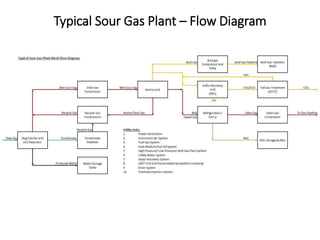
Typical Sour Gas Plant – Flow Diagram
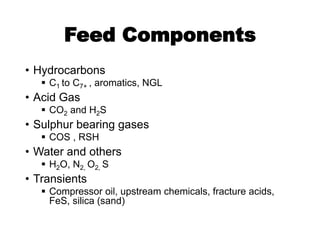
Feed Components
• Hydrocarbons
 C1 to C7+ , aromatics, NGL
• Acid Gas
 CO2 and H2S
• Sulphur bearing gases
 COS , RSH
• Water and others
 H2O, N2, O2, S
• Transients
 Compressor oil, upstream chemicals, fracture acids,
FeS, silica (sand)
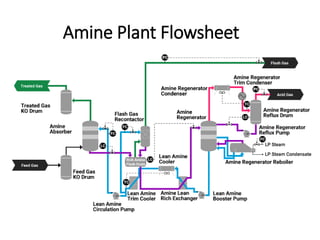
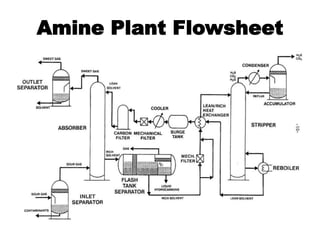
Amine Plant Flowsheet
Purpose of the Amine Plant
• Recover CO2 from natural gas
• Minimize CO2 emissions
• CO2 to be incinerated
• Optional : sell to other industries or re-inject into ground
Amine Treating : Gas Plants
• Single absorber for each generator
• Wide range of both H2S and CO2 in gas feed
• Potential for oxygen in feed gas – solution gas
treaters
• Problems with amine degradations
• Typical specification sales specifications : 4
ppm H2S, 2 % CO2
Amine Treating : Refinery
• Both Gas and Liquid Streams
• Multiple absorbers with common regenerator
• Predominantly H2S removal
 Some CO2 removal
• Complication of inlet contaminants
• Organic acids, ammonia, etc.
• Problems with Heat Stable Salts
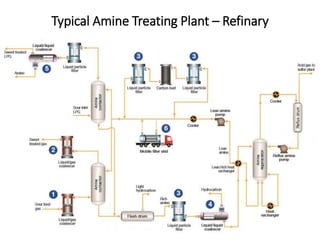
Typical Amine Treating Plant – Refinary
Amine Treating : Tail Gas
• Used to minimize Sulphur emissions on sour
plants
• Low pressure absorption
7- 28 kPag (1-4 psig)
• Low H2S specification
• Low CO2 removal (High Slip)
• Potential inlet Contaminants – SO2
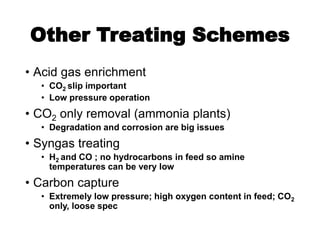
Other Treating Schemes
• Acid gas enrichment
• CO2 slip important
• Low pressure operation
• CO2 only removal (ammonia plants)
• Degradation and corrosion are big issues
• Syngas treating
• H2 and CO ; no hydrocarbons in feed so amine
temperatures can be very low
• Carbon capture
• Extremely low pressure; high oxygen content in feed; CO2
only, loose spec
Types of Amines
Used for
Gas / Liquid Treating
Amine Samples - Refinery
Amine Samples – Gas Plant
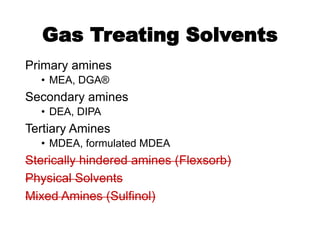
Gas Treating Solvents
Primary amines
• MEA, DGA®
Secondary amines
• DEA, DIPA
Tertiary Amines
• MDEA, formulated MDEA
Sterically hindered amines (Flexsorb)
Physical Solvents
Mixed Amines (Sulfinol)
Molecular Structures of Amines
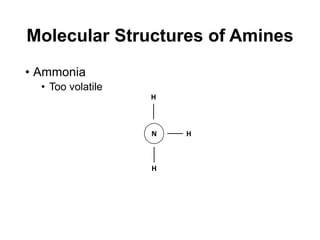
• Ammonia
• Too volatile
N
H
H
H
Primary Amines
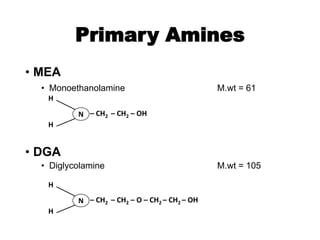
• MEA
• Monoethanolamine M.wt = 61
• DGA
• Diglycolamine M.wt = 105
N
H
H
– CH2 – CH2 – OH
N
H
H
– CH2 – CH2 – O – CH2 – CH2 – OH
Primary Amines
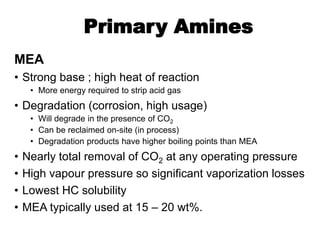
MEA
• Strong base ; high heat of reaction
• More energy required to strip acid gas
• Degradation (corrosion, high usage)
• Will degrade in the presence of CO2
• Can be reclaimed on-site (in process)
• Degradation products have higher boiling points than MEA
• Nearly total removal of CO2 at any operating pressure
• High vapour pressure so significant vaporization losses
• Lowest HC solubility
• MEA typically used at 15 – 20 wt%.
Primary Amines
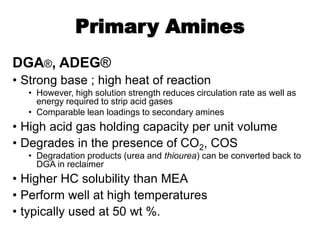
DGA®, ADEG®
• Strong base ; high heat of reaction
• However, high solution strength reduces circulation rate as well as
energy required to strip acid gases
• Comparable lean loadings to secondary amines
• High acid gas holding capacity per unit volume
• Degrades in the presence of CO2, COS
• Degradation products (urea and thiourea) can be converted back to
DGA in reclaimer
• Higher HC solubility than MEA
• Perform well at high temperatures
• typically used at 50 wt %.
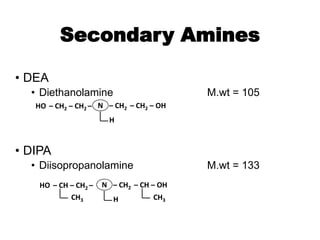
Secondary Amines
• DEA
• Diethanolamine M.wt = 105
• DIPA
• Diisopropanolamine M.wt = 133
N
H
– CH2 – CH2 – OH
HO – CH2 – CH2 –
N
H
– CH2 – CH – OH
HO – CH – CH2 –
CH3 CH3
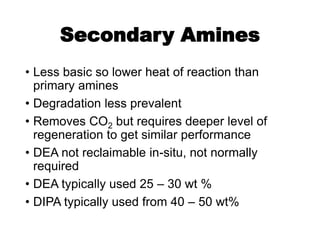
Secondary Amines
• Less basic so lower heat of reaction than
primary amines
• Degradation less prevalent
• Removes CO2 but requires deeper level of
regeneration to get similar performance
• DEA not reclaimable in-situ, not normally
required
• DEA typically used 25 – 30 wt %
• DIPA typically used from 40 – 50 wt%
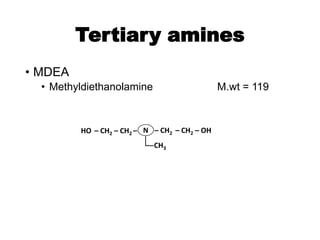
Tertiary amines
• MDEA
• Methyldiethanolamine M.wt = 119
N
CH3
– CH2 – CH2 – OH
HO – CH2 – CH2 –
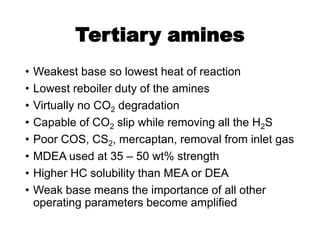
Tertiary amines
• Weakest base so lowest heat of reaction
• Lowest reboiler duty of the amines
• Virtually no CO2 degradation
• Capable of CO2 slip while removing all the H2S
• Poor COS, CS2, mercaptan, removal from inlet gas
• MDEA used at 35 – 50 wt% strength
• Higher HC solubility than MEA or DEA
• Weak base means the importance of all other
operating parameters become amplified
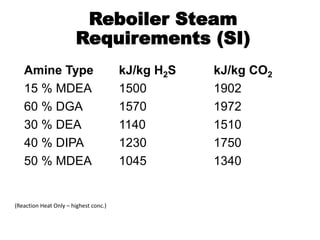
Reboiler Steam
Requirements (SI)
(Reaction Heat Only – highest conc.)
Amine Type kJ/kg H2S kJ/kg CO2
15 % MDEA 1500 1902
60 % DGA 1570 1972
30 % DEA 1140 1510
40 % DIPA 1230 1750
50 % MDEA 1045 1340
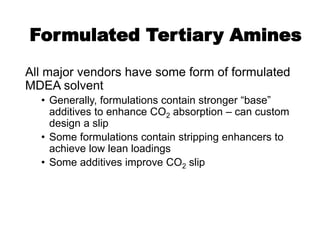
Formulated Tertiary Amines
All major vendors have some form of formulated
MDEA solvent
• Generally, formulations contain stronger “base”
additives to enhance CO2 absorption – can custom
design a slip
• Some formulations contain stripping enhancers to
achieve low lean loadings
• Some additives improve CO2 slip
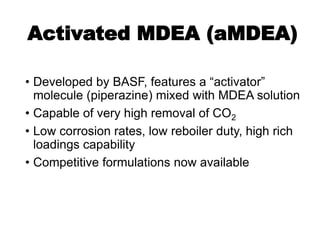
Activated MDEA (aMDEA)
• Developed by BASF, features a “activator”
molecule (piperazine) mixed with MDEA solution
• Capable of very high removal of CO2
• Low corrosion rates, low reboiler duty, high rich
loadings capability
• Competitive formulations now available
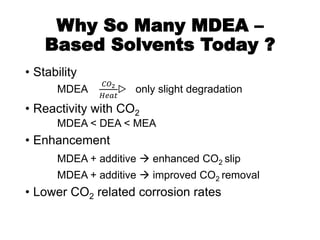
Why So Many MDEA –
Based Solvents Today ?
• Stability
MDEA
𝐶𝑂2
𝐻𝑒𝑎𝑡
▷ only slight degradation
• Reactivity with CO2
MDEA < DEA < MEA
• Enhancement
MDEA + additive  enhanced CO2 slip
MDEA + additive  improved CO2 removal
• Lower CO2 related corrosion rates
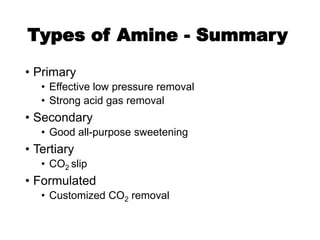
Types of Amine - Summary
• Primary
• Effective low pressure removal
• Strong acid gas removal
• Secondary
• Good all-purpose sweetening
• Tertiary
• CO2 slip
• Formulated
• Customized CO2 removal
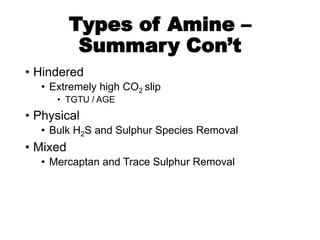
Types of Amine –
Summary Con’t
• Hindered
• Extremely high CO2 slip
• TGTU / AGE
• Physical
• Bulk H2S and Sulphur Species Removal
• Mixed
• Mercaptan and Trace Sulphur Removal
Molarity
Is a measure of the “potency” of the solvent
– the number of moles of amine per liter of
solution
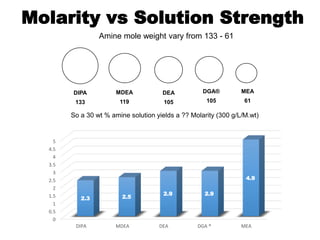
Molarity vs Solution Strength
Amine mole weight vary from 133 - 61
DIPA
133
MDEA
119
DEA
105
DGA®
105
MEA
61
0
0.5
1
1.5
2
2.5
3
3.5
4
4.5
5
DIPA MDEA DEA DGA ® MEA
2.3 2.5
2.9 2.9
4.9
So a 30 wt % amine solution yields a ?? Molarity (300 g/L/M.wt)
Molarity
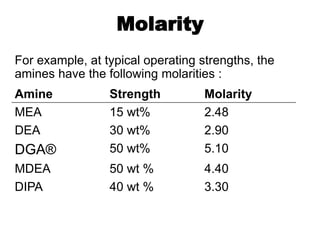
For example, at typical operating strengths, the
amines have the following molarities :
Amine Strength Molarity
MEA 15 wt% 2.48
DEA 30 wt% 2.90
DGA® 50 wt% 5.10
MDEA 50 wt % 4.40
DIPA 40 wt % 3.30
Amine Plant Flowsheet
Gas Mixtures – Partial Pressure
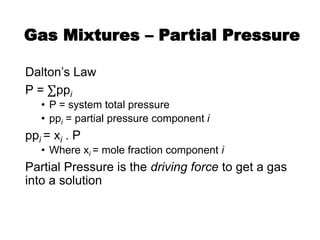
Dalton’s Law
P = ∑ppi
• P = system total pressure
• ppi = partial pressure component i
ppi = xi . P
• Where xi = mole fraction component i
Partial Pressure is the driving force to get a gas
into a solution
Partial Pressure
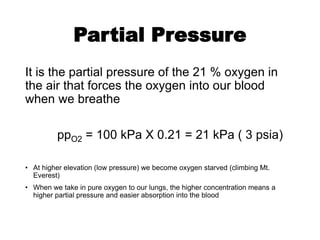
It is the partial pressure of the 21 % oxygen in
the air that forces the oxygen into our blood
when we breathe
ppO2 = 100 kPa X 0.21 = 21 kPa ( 3 psia)
• At higher elevation (low pressure) we become oxygen starved (climbing Mt.
Everest)
• When we take in pure oxygen to our lungs, the higher concentration means a
higher partial pressure and easier absorption into the blood
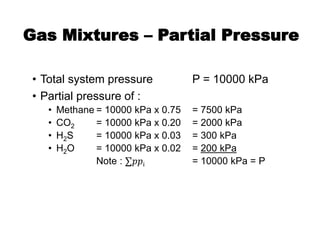
Gas Mixtures – Partial Pressure
• Total system pressure P = 10000 kPa
• Partial pressure of :
• Methane = 10000 kPa x 0.75 = 7500 kPa
• CO2 = 10000 kPa x 0.20 = 2000 kPa
• H2S = 10000 kPa x 0.03 = 300 kPa
• H2O = 10000 kPa x 0.02 = 200 kPa
Note : ∑𝑝𝑝i = 10000 kPa = P
Partial Pressure – CO2
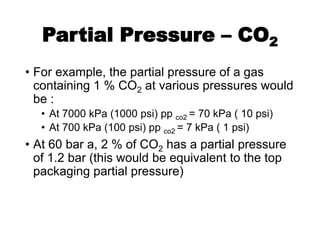
• For example, the partial pressure of a gas
containing 1 % CO2 at various pressures would
be :
• At 7000 kPa (1000 psi) pp co2 = 70 kPa ( 10 psi)
• At 700 kPa (100 psi) pp co2 = 7 kPa ( 1 psi)
• At 60 bar a, 2 % of CO2 has a partial pressure
of 1.2 bar (this would be equivalent to the top
packaging partial pressure)
CO2 removal profile –
Simulation Output
Mass Transfer
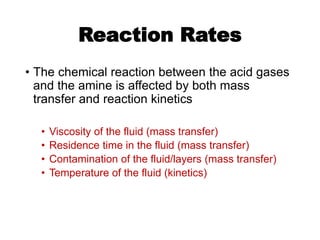
Reaction Rates
• The chemical reaction between the acid gases
and the amine is affected by both mass
transfer and reaction kinetics
• Viscosity of the fluid (mass transfer)
• Residence time in the fluid (mass transfer)
• Contamination of the fluid/layers (mass transfer)
• Temperature of the fluid (kinetics)
Basic Chemistry
Amine Treating
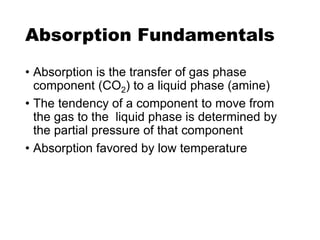
Absorption Fundamentals
• Absorption is the transfer of gas phase
component (CO2) to a liquid phase (amine)
• The tendency of a component to move from
the gas to the liquid phase is determined by
the partial pressure of that component
• Absorption favored by low temperature
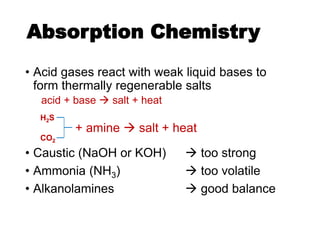
Absorption Chemistry
• Acid gases react with weak liquid bases to
form thermally regenerable salts
acid + base  salt + heat
• Caustic (NaOH or KOH)  too strong
• Ammonia (NH3)  too volatile
• Alkanolamines  good balance
+ amine  salt + heat
H2S
CO2
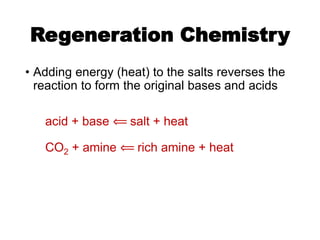
Regeneration Chemistry
• Adding energy (heat) to the salts reverses the
reaction to form the original bases and acids
acid + base ⟸ salt + heat
CO2 + amine ⟸ rich amine + heat
Reaction Mechanism
• CO2 reactions (primary and secondary amines)
– carbamate formation
2 [R1R2NH] + CO2 ⟺ [R1R2NH]H+ + [R1R2N-COO]–
(fast)
“carbamate reaction”
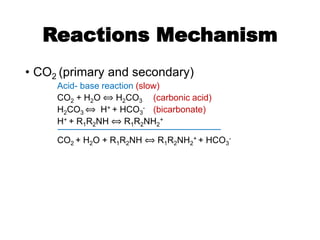
Reactions Mechanism
• CO2 (primary and secondary)
Acid- base reaction (slow)
CO2 + H2O ⟺ H2CO3 (carbonic acid)
H2CO3 ⟺ H+ + HCO3
- (bicarbonate)
H+ + R1R2NH ⟺ R1R2NH2
+
CO2 + H2O + R1R2NH ⟺ R1R2NH2
+ + HCO3
-
Reactions Mechanism
CO2 reactions
• Tertiary Amines
CO2 + H2O ⟺ H2CO3
(slow)
[R1R2NR3] + H2CO3 ⟺ [R1R2NR3]H+ + HCO3
-
(fast)
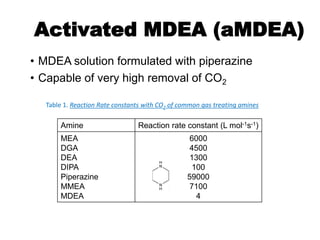
Activated MDEA (aMDEA)
• MDEA solution formulated with piperazine
• Capable of very high removal of CO2
Amine Reaction rate constant (L mol-1s-1)
MEA
DGA
DEA
DIPA
Piperazine
MMEA
MDEA
6000
4500
1300
100
59000
7100
4
Table 1. Reaction Rate constants with CO2 of common gas treating amines
CO2 Absorption in Amine Solvent
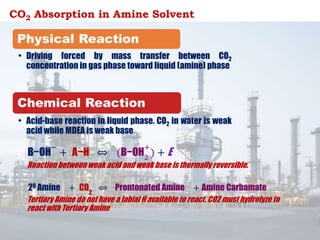
Physical Reaction
• Driving forced by mass transfer between CO2
concentration in gas phase toward liquid (amine) phase
Chemical Reaction
• Acid-base reaction in liquid phase. CO2 in water is weak
acid while MDEA is weak base
Reaction between weak acid and weak base is thermally reversible.
B−OH
−
+ A−H (B−OH2
+
) + E
20 Amine + CO2
Prontonated Amine + Amine Carbamate
Tertiary Amine do not have a labial H available to react. CO2 must hydrolyze to
react with Tertiary Amine
CO2 Absorption in Amine Solvent
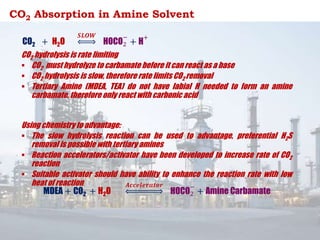
CO2 hydrolysis is rate limiting
 CO2 must hydrolyze to carbamate before it can react as a base
 CO2 hydrolysis is slow, therefore rate limits CO2 removal
 Tertiary Amine (MDEA, TEA) do not have labial H needed to form an amine
carbamate, therefore only react with carbonic acid
CO2 + H2O
𝑺𝑳𝑶𝑾
HOCO2
−
+ H
+
MDEA + CO2 + H2O
𝑨𝒄𝒄𝒆𝒍𝒆𝒓𝒂𝒕𝒐𝒓
HOCO2
−
+ Amine Carbamate
Using chemistry to advantage:
 The slow hydrolysis reaction can be used to advantage, preferential H2S
removal is possible with tertiary amines
 Reaction accelerators/activator have been developed to increase rate of CO2
reaction
 Suitable activator should have ability to enhance the reaction rate with low
heat of reaction
CO2 Absorption in Promoted Amine Solvent
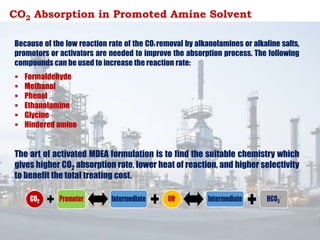
Because of the low reaction rate of the CO2 removal by alkanolamines or alkaline salts,
promotors or activators are needed to improve the absorption process. The following
compounds can be used to increase the reaction rate:
 Formaldehyde
 Methanol
 Phenol
 Ethanolamine
 Glycine
 Hindered amine
The art of activated MDEA formulation is to find the suitable chemistry which
gives higher CO2 absorption rate, lower heat of reaction, and higher selectivity
to benefit the total treating cost.
1. Process Gas Swwetening Principles.pptx

  • 1.
    Amine Treating 1-Day Coursefor Starborn Chemical 17 July, 2017
  • 2.
  • 3.
  • 4.
    Typical Sour GasPlant – Flow Diagram
  • 5.
    Feed Components • Hydrocarbons C1 to C7+ , aromatics, NGL • Acid Gas  CO2 and H2S • Sulphur bearing gases  COS , RSH • Water and others  H2O, N2, O2, S • Transients  Compressor oil, upstream chemicals, fracture acids, FeS, silica (sand)
  • 6.
  • 7.
    Purpose of theAmine Plant • Recover CO2 from natural gas • Minimize CO2 emissions • CO2 to be incinerated • Optional : sell to other industries or re-inject into ground
  • 8.
    Amine Treating :Gas Plants • Single absorber for each generator • Wide range of both H2S and CO2 in gas feed • Potential for oxygen in feed gas – solution gas treaters • Problems with amine degradations • Typical specification sales specifications : 4 ppm H2S, 2 % CO2
  • 9.
    Amine Treating :Refinery • Both Gas and Liquid Streams • Multiple absorbers with common regenerator • Predominantly H2S removal  Some CO2 removal • Complication of inlet contaminants • Organic acids, ammonia, etc. • Problems with Heat Stable Salts
  • 10.
    Typical Amine TreatingPlant – Refinary
  • 11.
    Amine Treating :Tail Gas • Used to minimize Sulphur emissions on sour plants • Low pressure absorption 7- 28 kPag (1-4 psig) • Low H2S specification • Low CO2 removal (High Slip) • Potential inlet Contaminants – SO2
  • 12.
    Other Treating Schemes •Acid gas enrichment • CO2 slip important • Low pressure operation • CO2 only removal (ammonia plants) • Degradation and corrosion are big issues • Syngas treating • H2 and CO ; no hydrocarbons in feed so amine temperatures can be very low • Carbon capture • Extremely low pressure; high oxygen content in feed; CO2 only, loose spec
  • 13.
    Types of Amines Usedfor Gas / Liquid Treating
  • 14.
    Amine Samples -Refinery Amine Samples – Gas Plant
  • 15.
    Gas Treating Solvents Primaryamines • MEA, DGA® Secondary amines • DEA, DIPA Tertiary Amines • MDEA, formulated MDEA Sterically hindered amines (Flexsorb) Physical Solvents Mixed Amines (Sulfinol)
  • 16.
    Molecular Structures ofAmines • Ammonia • Too volatile N H H H
  • 17.
    Primary Amines • MEA •Monoethanolamine M.wt = 61 • DGA • Diglycolamine M.wt = 105 N H H – CH2 – CH2 – OH N H H – CH2 – CH2 – O – CH2 – CH2 – OH
  • 18.
    Primary Amines MEA • Strongbase ; high heat of reaction • More energy required to strip acid gas • Degradation (corrosion, high usage) • Will degrade in the presence of CO2 • Can be reclaimed on-site (in process) • Degradation products have higher boiling points than MEA • Nearly total removal of CO2 at any operating pressure • High vapour pressure so significant vaporization losses • Lowest HC solubility • MEA typically used at 15 – 20 wt%.
  • 19.
    Primary Amines DGA®, ADEG® •Strong base ; high heat of reaction • However, high solution strength reduces circulation rate as well as energy required to strip acid gases • Comparable lean loadings to secondary amines • High acid gas holding capacity per unit volume • Degrades in the presence of CO2, COS • Degradation products (urea and thiourea) can be converted back to DGA in reclaimer • Higher HC solubility than MEA • Perform well at high temperatures • typically used at 50 wt %.
  • 20.
    Secondary Amines • DEA •Diethanolamine M.wt = 105 • DIPA • Diisopropanolamine M.wt = 133 N H – CH2 – CH2 – OH HO – CH2 – CH2 – N H – CH2 – CH – OH HO – CH – CH2 – CH3 CH3
  • 21.
    Secondary Amines • Lessbasic so lower heat of reaction than primary amines • Degradation less prevalent • Removes CO2 but requires deeper level of regeneration to get similar performance • DEA not reclaimable in-situ, not normally required • DEA typically used 25 – 30 wt % • DIPA typically used from 40 – 50 wt%
  • 22.
    Tertiary amines • MDEA •Methyldiethanolamine M.wt = 119 N CH3 – CH2 – CH2 – OH HO – CH2 – CH2 –
  • 23.
    Tertiary amines • Weakestbase so lowest heat of reaction • Lowest reboiler duty of the amines • Virtually no CO2 degradation • Capable of CO2 slip while removing all the H2S • Poor COS, CS2, mercaptan, removal from inlet gas • MDEA used at 35 – 50 wt% strength • Higher HC solubility than MEA or DEA • Weak base means the importance of all other operating parameters become amplified
  • 24.
    Reboiler Steam Requirements (SI) (ReactionHeat Only – highest conc.) Amine Type kJ/kg H2S kJ/kg CO2 15 % MDEA 1500 1902 60 % DGA 1570 1972 30 % DEA 1140 1510 40 % DIPA 1230 1750 50 % MDEA 1045 1340
  • 25.
    Formulated Tertiary Amines Allmajor vendors have some form of formulated MDEA solvent • Generally, formulations contain stronger “base” additives to enhance CO2 absorption – can custom design a slip • Some formulations contain stripping enhancers to achieve low lean loadings • Some additives improve CO2 slip
  • 26.
    Activated MDEA (aMDEA) •Developed by BASF, features a “activator” molecule (piperazine) mixed with MDEA solution • Capable of very high removal of CO2 • Low corrosion rates, low reboiler duty, high rich loadings capability • Competitive formulations now available
  • 27.
    Why So ManyMDEA – Based Solvents Today ? • Stability MDEA 𝐶𝑂2 𝐻𝑒𝑎𝑡 ▷ only slight degradation • Reactivity with CO2 MDEA < DEA < MEA • Enhancement MDEA + additive  enhanced CO2 slip MDEA + additive  improved CO2 removal • Lower CO2 related corrosion rates
  • 28.
    Types of Amine- Summary • Primary • Effective low pressure removal • Strong acid gas removal • Secondary • Good all-purpose sweetening • Tertiary • CO2 slip • Formulated • Customized CO2 removal
  • 29.
    Types of Amine– Summary Con’t • Hindered • Extremely high CO2 slip • TGTU / AGE • Physical • Bulk H2S and Sulphur Species Removal • Mixed • Mercaptan and Trace Sulphur Removal
  • 30.
    Molarity Is a measureof the “potency” of the solvent – the number of moles of amine per liter of solution
  • 31.
    Molarity vs SolutionStrength Amine mole weight vary from 133 - 61 DIPA 133 MDEA 119 DEA 105 DGA® 105 MEA 61 0 0.5 1 1.5 2 2.5 3 3.5 4 4.5 5 DIPA MDEA DEA DGA ® MEA 2.3 2.5 2.9 2.9 4.9 So a 30 wt % amine solution yields a ?? Molarity (300 g/L/M.wt)
  • 32.
    Molarity For example, attypical operating strengths, the amines have the following molarities : Amine Strength Molarity MEA 15 wt% 2.48 DEA 30 wt% 2.90 DGA® 50 wt% 5.10 MDEA 50 wt % 4.40 DIPA 40 wt % 3.30
  • 33.
  • 34.
    Gas Mixtures –Partial Pressure Dalton’s Law P = ∑ppi • P = system total pressure • ppi = partial pressure component i ppi = xi . P • Where xi = mole fraction component i Partial Pressure is the driving force to get a gas into a solution
  • 35.
    Partial Pressure It isthe partial pressure of the 21 % oxygen in the air that forces the oxygen into our blood when we breathe ppO2 = 100 kPa X 0.21 = 21 kPa ( 3 psia) • At higher elevation (low pressure) we become oxygen starved (climbing Mt. Everest) • When we take in pure oxygen to our lungs, the higher concentration means a higher partial pressure and easier absorption into the blood
  • 36.
    Gas Mixtures –Partial Pressure • Total system pressure P = 10000 kPa • Partial pressure of : • Methane = 10000 kPa x 0.75 = 7500 kPa • CO2 = 10000 kPa x 0.20 = 2000 kPa • H2S = 10000 kPa x 0.03 = 300 kPa • H2O = 10000 kPa x 0.02 = 200 kPa Note : ∑𝑝𝑝i = 10000 kPa = P
  • 37.
    Partial Pressure –CO2 • For example, the partial pressure of a gas containing 1 % CO2 at various pressures would be : • At 7000 kPa (1000 psi) pp co2 = 70 kPa ( 10 psi) • At 700 kPa (100 psi) pp co2 = 7 kPa ( 1 psi) • At 60 bar a, 2 % of CO2 has a partial pressure of 1.2 bar (this would be equivalent to the top packaging partial pressure)
  • 38.
    CO2 removal profile– Simulation Output
  • 39.
  • 40.
    Reaction Rates • Thechemical reaction between the acid gases and the amine is affected by both mass transfer and reaction kinetics • Viscosity of the fluid (mass transfer) • Residence time in the fluid (mass transfer) • Contamination of the fluid/layers (mass transfer) • Temperature of the fluid (kinetics)
  • 41.
  • 42.
    Absorption Fundamentals • Absorptionis the transfer of gas phase component (CO2) to a liquid phase (amine) • The tendency of a component to move from the gas to the liquid phase is determined by the partial pressure of that component • Absorption favored by low temperature
  • 43.
    Absorption Chemistry • Acidgases react with weak liquid bases to form thermally regenerable salts acid + base  salt + heat • Caustic (NaOH or KOH)  too strong • Ammonia (NH3)  too volatile • Alkanolamines  good balance + amine  salt + heat H2S CO2
  • 44.
    Regeneration Chemistry • Addingenergy (heat) to the salts reverses the reaction to form the original bases and acids acid + base ⟸ salt + heat CO2 + amine ⟸ rich amine + heat
  • 45.
    Reaction Mechanism • CO2reactions (primary and secondary amines) – carbamate formation 2 [R1R2NH] + CO2 ⟺ [R1R2NH]H+ + [R1R2N-COO]– (fast) “carbamate reaction”
  • 46.
    Reactions Mechanism • CO2(primary and secondary) Acid- base reaction (slow) CO2 + H2O ⟺ H2CO3 (carbonic acid) H2CO3 ⟺ H+ + HCO3 - (bicarbonate) H+ + R1R2NH ⟺ R1R2NH2 + CO2 + H2O + R1R2NH ⟺ R1R2NH2 + + HCO3 -
  • 47.
    Reactions Mechanism CO2 reactions •Tertiary Amines CO2 + H2O ⟺ H2CO3 (slow) [R1R2NR3] + H2CO3 ⟺ [R1R2NR3]H+ + HCO3 - (fast)
  • 48.
    Activated MDEA (aMDEA) •MDEA solution formulated with piperazine • Capable of very high removal of CO2 Amine Reaction rate constant (L mol-1s-1) MEA DGA DEA DIPA Piperazine MMEA MDEA 6000 4500 1300 100 59000 7100 4 Table 1. Reaction Rate constants with CO2 of common gas treating amines
  • 49.
    CO2 Absorption inAmine Solvent Physical Reaction • Driving forced by mass transfer between CO2 concentration in gas phase toward liquid (amine) phase Chemical Reaction • Acid-base reaction in liquid phase. CO2 in water is weak acid while MDEA is weak base Reaction between weak acid and weak base is thermally reversible. B−OH − + A−H (B−OH2 + ) + E 20 Amine + CO2 Prontonated Amine + Amine Carbamate Tertiary Amine do not have a labial H available to react. CO2 must hydrolyze to react with Tertiary Amine
  • 50.
    CO2 Absorption inAmine Solvent CO2 hydrolysis is rate limiting  CO2 must hydrolyze to carbamate before it can react as a base  CO2 hydrolysis is slow, therefore rate limits CO2 removal  Tertiary Amine (MDEA, TEA) do not have labial H needed to form an amine carbamate, therefore only react with carbonic acid CO2 + H2O 𝑺𝑳𝑶𝑾 HOCO2 − + H + MDEA + CO2 + H2O 𝑨𝒄𝒄𝒆𝒍𝒆𝒓𝒂𝒕𝒐𝒓 HOCO2 − + Amine Carbamate Using chemistry to advantage:  The slow hydrolysis reaction can be used to advantage, preferential H2S removal is possible with tertiary amines  Reaction accelerators/activator have been developed to increase rate of CO2 reaction  Suitable activator should have ability to enhance the reaction rate with low heat of reaction
  • 51.
    CO2 Absorption inPromoted Amine Solvent Because of the low reaction rate of the CO2 removal by alkanolamines or alkaline salts, promotors or activators are needed to improve the absorption process. The following compounds can be used to increase the reaction rate:  Formaldehyde  Methanol  Phenol  Ethanolamine  Glycine  Hindered amine The art of activated MDEA formulation is to find the suitable chemistry which gives higher CO2 absorption rate, lower heat of reaction, and higher selectivity to benefit the total treating cost.