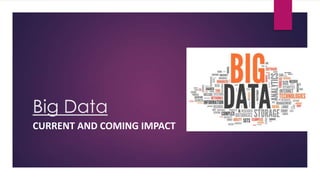
Big Data
CURRENT AND COMING IMPACT
Managing and analyzing data have always offered the greatest benefits
and the greatest challenges for organizations of all sizes and across all
industries.
Businesses have long struggled with finding a pragmatic approach
to capturing information about their customers, products, and services.
When a company only had a handful of customers who all bought the same
product in the same way, things were pretty straightforward and simple. But
over time, companies and the markets they participate in have grown more
complicated. To survive or gain a competitive advantage with customers,
these companies added more product lines and diversified how they deliver
their product.
Data struggles are not limited to business. Research and development (R&D) organizations, for
example, have struggled to get enough computing power to run sophisticated models or to process
images and other sources of scientific data.
Indeed, we are dealing with a lot of complexity when it comes to data. Some
data is structured and stored in a traditional relational database, while other
data, including documents, customer service records, and even pictures and
videos, is unstructured. Companies also have to consider new sources of
data generated by machines such as sensors. Other new information sources
are human generated, such as data from social media and the click-stream
data generated from website interactions. In addition, the availability and
adoption of newer, more powerful mobile devices, coupled with ubiquitous
access to global networks will drive the creation of new sources for data.
Although each data source can be independently managed and searched, the
challenge today is how companies can make sense of the intersection of all
these different types of data. When you are dealing with so much information
in so many different forms, it is impossible to think about data management
in traditional ways. Although we have always had a lot of data, the difference
today is that significantly more of it exists, and it varies in type and timeliness. Organizations are also
finding more ways to make use of this information than ever before. Therefore, you have to think about
managing data differently.
That is the opportunity and challenge of big data.
Big data is defined as any kind of data source that has at least
three shared characteristics:

✓ Extremely large Volumes of data
✓ Extremely high Velocity of data
✓ Extremely wide Variety of data
Why is Big Data Important?
Big data is important because it enables organizations to gather, store,
manage, and manipulate vast amounts data at the right speed, at the right
time, to gain the right insights.
All this data looks like a potential gold mine, but like a gold
mine, you only have a little gold and lot more of everything else.
The technology challenges are :
“How do you make sense of that data when you can’t
easily recognize the patterns that are the most meaningful for your business
decisions?”
“How does your organization deal with massive amounts of data in
a meaningful way?”
Businesses want to be able to gain insights and actionable
results from many different kinds of data at the right speed — no matter how
much data is involved.
If companies can of analyze petabytes data (equivalent to 13.3 years of HDTV content)
With acceptable performance to discern patterns and anomalies, businesses can
begin to make sense of data in new ways. The move to big data is not just
about businesses.
Science, research, and government activities have also helped to drive it forward.
Data Overload
Back in 2010 Google chief executive Eric Schmidt noted that the amount of data collected since
the dawn of humanity until 2003 was the equivalent to the volume we now produce every two days.
This data comes not only from posts to social media sites, mobile signals and purchase transactions
but increasingly from sensors on objects from lamp-posts to skyscrapers.

Some Examples of Big Data:
In Birmingham, lamp-posts are being fitted with sensors that can transmit information about cloud
cover to offer hyper-local weather forecasting.
In Norway, more than 40,000 bus stops are tweeting, allowing passengers to leave messages about
their experiences, and in London the mayor's office has just begun a project to tag trees so that
people can learn about their history.
At MIT's Senseable City Lab, 5,000 pieces of rubbish in Seattle were geo-tagged and tracked around
the country for three months to find out whether recycling was really efficient.
Now the team is working on a project in Singapore which offers advanced weather forecasts to taxi
drivers to get them to places in the city ten minutes before it starts to rain.
Supermarket chain Tesco is installing sensors across its stores to reduce
heating and lighting costs.

City planning

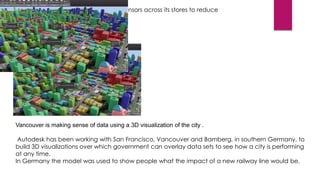
Vancouver is making sense of data using a 3D visualization of the city .
Autodesk has been working with San Francisco, Vancouver and Bamberg, in southern Germany, to
build 3D visualizations over which government can overlay data sets to see how a city is performing
at any time.
In Germany the model was used to show people what the impact of a new railway line would be.
Sumanth dbms3-big data

Sumanth dbms3-big data

  • 1.
    Big Data CURRENT ANDCOMING IMPACT
  • 2.
    Managing and analyzingdata have always offered the greatest benefits and the greatest challenges for organizations of all sizes and across all industries. Businesses have long struggled with finding a pragmatic approach to capturing information about their customers, products, and services. When a company only had a handful of customers who all bought the same product in the same way, things were pretty straightforward and simple. But over time, companies and the markets they participate in have grown more complicated. To survive or gain a competitive advantage with customers, these companies added more product lines and diversified how they deliver their product. Data struggles are not limited to business. Research and development (R&D) organizations, for example, have struggled to get enough computing power to run sophisticated models or to process images and other sources of scientific data.
  • 3.
    Indeed, we aredealing with a lot of complexity when it comes to data. Some data is structured and stored in a traditional relational database, while other data, including documents, customer service records, and even pictures and videos, is unstructured. Companies also have to consider new sources of data generated by machines such as sensors. Other new information sources are human generated, such as data from social media and the click-stream data generated from website interactions. In addition, the availability and adoption of newer, more powerful mobile devices, coupled with ubiquitous access to global networks will drive the creation of new sources for data. Although each data source can be independently managed and searched, the challenge today is how companies can make sense of the intersection of all these different types of data. When you are dealing with so much information in so many different forms, it is impossible to think about data management in traditional ways. Although we have always had a lot of data, the difference today is that significantly more of it exists, and it varies in type and timeliness. Organizations are also finding more ways to make use of this information than ever before. Therefore, you have to think about managing data differently. That is the opportunity and challenge of big data.
  • 4.
    Big data isdefined as any kind of data source that has at least three shared characteristics: ✓ Extremely large Volumes of data ✓ Extremely high Velocity of data ✓ Extremely wide Variety of data Why is Big Data Important? Big data is important because it enables organizations to gather, store, manage, and manipulate vast amounts data at the right speed, at the right time, to gain the right insights.
  • 5.
    All this datalooks like a potential gold mine, but like a gold mine, you only have a little gold and lot more of everything else. The technology challenges are : “How do you make sense of that data when you can’t easily recognize the patterns that are the most meaningful for your business decisions?” “How does your organization deal with massive amounts of data in a meaningful way?” Businesses want to be able to gain insights and actionable results from many different kinds of data at the right speed — no matter how much data is involved.
  • 6.
    If companies canof analyze petabytes data (equivalent to 13.3 years of HDTV content) With acceptable performance to discern patterns and anomalies, businesses can begin to make sense of data in new ways. The move to big data is not just about businesses. Science, research, and government activities have also helped to drive it forward.
  • 7.
    Data Overload Back in2010 Google chief executive Eric Schmidt noted that the amount of data collected since the dawn of humanity until 2003 was the equivalent to the volume we now produce every two days. This data comes not only from posts to social media sites, mobile signals and purchase transactions but increasingly from sensors on objects from lamp-posts to skyscrapers. Some Examples of Big Data: In Birmingham, lamp-posts are being fitted with sensors that can transmit information about cloud cover to offer hyper-local weather forecasting. In Norway, more than 40,000 bus stops are tweeting, allowing passengers to leave messages about their experiences, and in London the mayor's office has just begun a project to tag trees so that people can learn about their history. At MIT's Senseable City Lab, 5,000 pieces of rubbish in Seattle were geo-tagged and tracked around the country for three months to find out whether recycling was really efficient. Now the team is working on a project in Singapore which offers advanced weather forecasts to taxi drivers to get them to places in the city ten minutes before it starts to rain.
  • 8.
    Supermarket chain Tescois installing sensors across its stores to reduce heating and lighting costs. City planning Vancouver is making sense of data using a 3D visualization of the city . Autodesk has been working with San Francisco, Vancouver and Bamberg, in southern Germany, to build 3D visualizations over which government can overlay data sets to see how a city is performing at any time. In Germany the model was used to show people what the impact of a new railway line would be.