Mother Tongue-Based
Multilingual Education (MTB-MLE)
Teacher’s Guide
Sinugbuanong Binisaya
Mother Tongue-Based
Multilingual Education (MTB-MLE)
Teacher’s Guide
Sinugbuanong Binisaya
1
Mother Tongue-Based
Multilingual Education
(MTB-MLE)
Teacher’s Guide
(Unit 1- Week 7)
Sinugbuanong Binisaya
Department of Education
Republic of the Philippines
This instructional material was collaboratively developed and
reviewed by educators from public and private schools,
colleges, and/or universities. We encourage teachers and
other education stakeholders to email their feedback,
comments, and recommendations to the Department of
Education at action@deped.gov.ph.
We value your feedback and recommendations.
Mother Tongue Based Multilingual Education – Grade 1
Teacher’s Guide: Sinugbuanong Binisaya
First Edition, 2013
ISBN: 978-971-9981-79-4
Republic Act 8293, section 176 indicates that: No copyright shall subsist in
any work of the Government of the Philippines. However, prior approval of the
government agency or office wherein the work is created shall be necessary for
exploitation of such work for profit. Such agency or office may among other things,
impose as a condition the payment of royalties.
The borrowed materials (i.e., songs, stories, poems, pictures, photos, brand
names, trademarks, etc.) included in this book are owned by their respective
copyright holders. The publisher and authors do not represent nor claim ownership
over them.
Published by the Department of Education
Secretary: Br. Armin A. Luistro FSC
Undersecretary: Dr. Yolanda S. Quijano
Assistant Secretary: Dr. Elena R. Ruiz
Development Team of the Teacher’s Guide
Authors: Nena V. Miñoza, Gea Catalan Alonso, Caren S. Selgas, Virginia
S. Cayon, Jennifer O. Artiaga, Ritchie C. Barrera, Ninie del Rosario and
Jocelyn Conta
Consultant: Rosalina J. Villaneza
Editors: Atty. Manuel Lino Faelnar, Dr Romeo Macan, Mrs. Aida Zafra
and Mr. Jes B. Tirol
Graphic Artists: Jason Villena, Jayson R. Gaduena, Bienvenido Saldua
and Erich David Garcia
Layout Artist: Aileen Nacario Ilagan
Printed in the Philippines ____________
Department of Education-Instructional Materials Council Secretariat (DepEd-
IMCS)
Office Address: 2nd
Floor Dorm G, PSC Complex, Meralco Avenue.
Pasig City, Philippines 1600
Telefax: (02) 634-1054, 634-1072
E-mail Address: imcsetd@yahoo.com
I. Objectives
At the end of the week pupils are expected to:
1. Note details in a story listened to
2. React to what the characters did in a story listened to
3. Predict what the story is about
4. Confirm predictions after listening to a story
5. Respond to the story through the different engagement activities
a. acting out portion of the story
b. Draw the spider
c. completing a character list
d. Tell the ending of the story
6. Identify specific letter in the alphabet both upper and lower case of letter
Kk
7. Pronounce the words that start with letter Kk clearly
8. Identify pictures with initial sound Kk
9. Show relationship between sounds and written symbols
10. Make one-to-one correspondence between written and spoken words
11. Match words with pictures
12. Develop and use vocabulary of words that begin with the target letter
13. Write and spell correctly the words learned
14. Recognize and appreciate that spoken words are represented by written
letters that are arranged in a specific order
II. Subject Matter
Story: “Kaka”
Letter Name and Sound of Kk
A. Reference
MTB-MLE Indicators, K to 12 Curriculum Guide
B. Materials
pictures, charts
C. Value
Caring for an animal.
III. Procedure
DAY 1
A. Unlocking of Difficult Words
Teacher will unlock the difficult words found in the story through picture
and context clue.
1
Week 7
Letter Kk
Week 7
Letter Kk
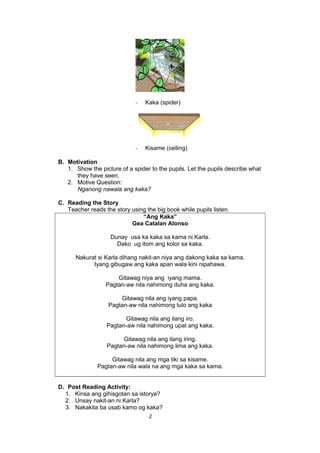
- Kaka (spider)
- Kisame (ceiling)
B. Motivation
1. Show the picture of a spider to the pupils. Let the pupils describe what
they have seen.
2. Motive Question:
Nganong nawala ang kaka?
C. Reading the Story
Teacher reads the story using the big book while pupils listen.
“Ang Kaka”
Gea Catalan Alonso
Dunay usa ka kaka sa kama ni Karla.
Dako ug itom ang kolor sa kaka.
Nakurat si Karla dihang nakit-an niya ang dakong kaka sa kama.
Iyang gibugaw ang kaka apan wala kini nipahawa.
Gitawag niya ang iyang mama.
Pagtan-aw nila nahimong duha ang kaka.
Gitawag nila ang iyang papa.
Pagtan-aw nila nahimong tulo ang kaka
Gitawag nila ang ilang iro.
Pagtan-aw nila nahimong upat ang kaka.
Gitawag nila ang ilang iring.
Pagtan-aw nila nahimong lima ang kaka.
Gitawag nila ang mga tiki sa kisame.
Pagtan-aw nila wala na ang mga kaka sa kama.
D. Post Reading Activity:
1. Kinsa ang gihisgotan sa istorya?
2. Unsay nakit-an ni Karla?
3. Nakakita ba usab kamo og kaka?
2
4. Unsay imong gibuhat, gipasagdan ba lang nimo kini? Ngano man?
5. Kinsay gipanawag ni Karla?
6. Nganong nawala ang mga kaka?
E. Guided Activity
Grouping: “Light, Camera, action!” Teacher grouped pupils into 4
groups. Give each group a scenario from the story and let pupils to act it
out.
Group 1- Acting out portion of the story
Group 2- Draw the spider
Group 3- Graphic organizer-make a character list
Group 4- Tell the ending of the story
F. Post Activity
“Time to Share” - Teacher will give question related to the story. Let
pupils share their answer to the class.
1. How will you take good care of the animals found in your place?
2. How can you help in keeping your place clean and beautiful?
DAY 2
A. Drill
B. Review of the story about “Kaka”
C. Introduce key picture to the learners using puzzle.
1. Using the same groupings, each group will assemble the pieces of
paper to find out what animal is in the puzzle.
2. Give an award or incentive to the group which is able to form the
puzzle correctly and who did it first.
3. Ask: What animal did you form?
D. Primer Track: Letter Kk
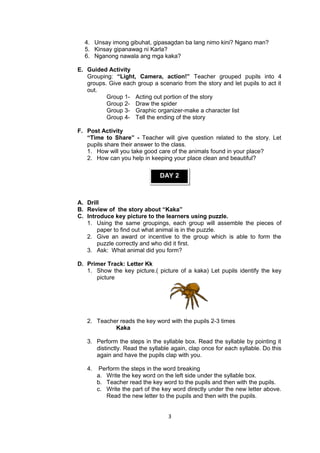
1. Show the key picture.( picture of a kaka) Let pupils identify the key
picture
2. Teacher reads the key word with the pupils 2-3 times
Kaka
3. Perform the steps in the syllable box. Read the syllable by pointing it
distinctly. Read the syllable again, clap once for each syllable. Do this
again and have the pupils clap with you.
4. Perform the steps in the word breaking
a. Write the key word on the left side under the syllable box.
b. Teacher read the key word to the pupils and then with the pupils.
c. Write the part of the key word directly under the new letter above.
Read the new letter to the pupils and then with the pupils.
3
d. Write the new letter directly under the new letter above. Teacher
reads the new letter to the pupils, then with the pupils.
e. Read the whole word -breaking column with the pupils.
5. Perform the steps in the word making:
a. Start with the new letter and make the word whole again.
b. Write the new letter to the right of the word- breaking column and
read the new letter with the pupils.
c. Write the part of the word under the new letter so the new letters
are in the straight column. Teacher, reads the part of the word
with the pupils
d. Write the entire word so the new letters are in the straight column
and read the word with the pupils.
kaka k
ka ka
k kaka
Ask: What words in the story that starts with letter k?
Expected answers: kaka, Karla, kama, kisame
 What other words do you know that start with letter k?
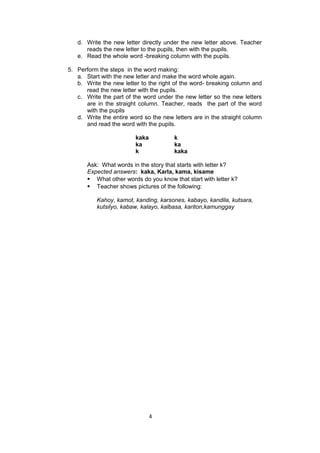
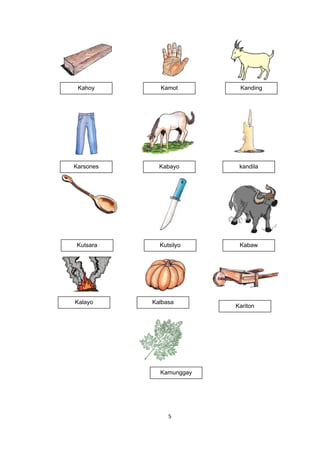
 Teacher shows pictures of the following:
Kahoy, kamot, kanding, karsones, kabayo, kandila, kutsara,
kutsilyo, kabaw, kalayo, kalbasa, kariton,kamunggay
4
5
Kalbasa
Kamunggay
KamotKahoy Kanding
KabayoKarsones kandila
Kutsilyo
Kalayo
Kariton
Kutsara Kabaw
DAY 3
A. Greeting Song
B. Drill
1. “Mystery Box”: Get a box and put pictures of persons, things and
place that begin with letter k.
2. A volunteer pupil picks one and identifies the name. As the pupil name
the picture, teacher will post it on the board and put a name below it.
3. Teacher says the picture name again. Ask: What is in the picture?
C. Modelling
1. Teacher says the picture name one at a time by producing the initial
sound of each. Say the word three times.
This is a picture of a /kkk/…kaka
This is a picture of a /kkk/…kama
This is a picture of /kkk/…Karla
2. Write the new letter and the new word in the air, on the palm and on
the back of their classmate. Let them trace it using there right foot on
the ground.
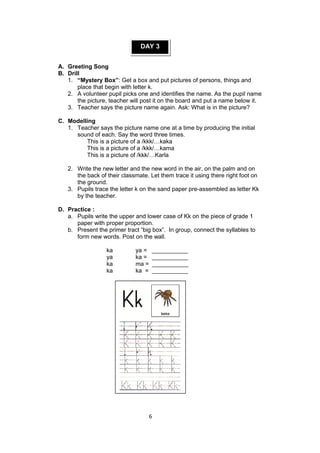
3. Pupils trace the letter k on the sand paper pre-assembled as letter Kk
by the teacher.
D. Practice :
a. Pupils write the upper and lower case of Kk on the piece of grade 1
paper with proper proportion.
b. Present the primer tract “big box”. In group, connect the syllables to
form new words. Post on the wall.
ka ya = ___________
ya ka = ___________
ka ma = ___________
ka ka = ___________
6
DAY 4
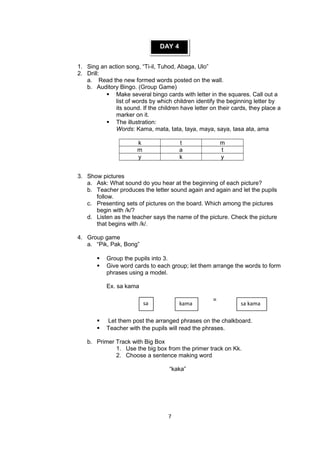
1. Sing an action song, “Ti-il, Tuhod, Abaga, Ulo”
2. Drill:
a. Read the new formed words posted on the wall.
b. Auditory Bingo. (Group Game)
 Make several bingo cards with letter in the squares. Call out a
list of words by which children identify the beginning letter by
its sound. If the children have letter on their cards, they place a
marker on it.
 The illustration:
Words: Kama, mata, tata, taya, maya, saya, tasa ata, ama
k t m
m a t
y k y
3. Show pictures
a. Ask: What sound do you hear at the beginning of each picture?
b. Teacher produces the letter sound again and again and let the pupils
follow.
c. Presenting sets of pictures on the board. Which among the pictures
begin with /k/?
d. Listen as the teacher says the name of the picture. Check the picture
that begins with /k/.
4. Group game
a. “Pik, Pak, Bong”
 Group the pupils into 3.
 Give word cards to each group; let them arrange the words to form
phrases using a model.
Ex. sa kama
+ =
 Let them post the arranged phrases on the chalkboard.
 Teacher with the pupils will read the phrases.
b. Primer Track with Big Box
1. Use the big box from the primer track on Kk.
2. Choose a sentence making word
“kaka”
7
kama sa kamasa
c. Sentence making and breaking word
May kaka sa kama ni Tata. kaka
may kaka May kaka
kaka May kaka sa
kama ni Tata.
DAY 5
Writing Activities
A. Review
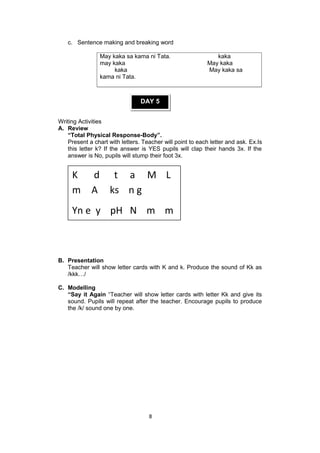
“Total Physical Response-Body”.
Present a chart with letters. Teacher will point to each letter and ask. Ex.Is
this letter k? If the answer is YES pupils will clap their hands 3x. If the
answer is No, pupils will stump their foot 3x.
K d t a M L
m A ks n g
Yn e y pH N m m
B. Presentation
Teacher will show letter cards with K and k. Produce the sound of Kk as
/kkk…/
C. Modelling
“Say it Again “Teacher will show letter cards with letter Kk and give its
sound. Pupils will repeat after the teacher. Encourage pupils to produce
the /k/ sound one by one.
8
D. Guided Practice
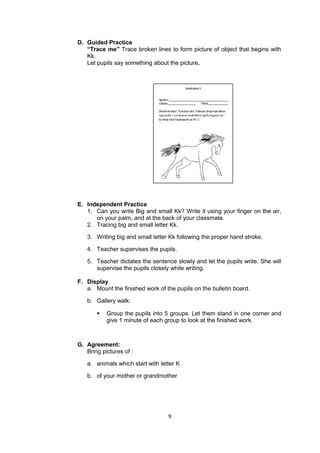
“Trace me” Trace broken lines to form picture of object that begins with
Kk.
Let pupils say something about the picture.
E. Independent Practice
1. Can you write Big and small Kk? Write it using your finger on the air,
on your palm, and at the back of your classmate.
2. Tracing big and small letter Kk.
3. Writing big and small letter Kk following the proper hand stroke.
4. Teacher supervises the pupils.
5. Teacher dictates the sentence slowly and let the pupils write. She will
supervise the pupils closely while writing.
F. Display
a. Mount the finished work of the pupils on the bulletin board.
b. Gallery walk:
 Group the pupils into 5 groups. Let them stand in one corner and
give 1 minute of each group to look at the finished work.
G. Agreement:
Bring pictures of :
a. animals which start with letter K
b. of your mother or grandmother
9
ISBN: 978-971-9981-79-4
For inquiries or feedback, please write or call:
DepEd-Bureau of Elementary Education,
Curriculum Development Division
2nd Floor, Bonifacio Bldg., DepEd Complex (ULTRA)
Meralco Avenue, Pasig City, Philippines 1600
Telefax: (632) 638-4799 or 637-4347
E-mail Address: bee-deped@pldtdsl.net,
bee_director@yahoo.com

1 mtb tg sb q1 w7

  • 1.
    Mother Tongue-Based Multilingual Education(MTB-MLE) Teacher’s Guide Sinugbuanong Binisaya
  • 2.
    Mother Tongue-Based Multilingual Education(MTB-MLE) Teacher’s Guide Sinugbuanong Binisaya
  • 3.
    1 Mother Tongue-Based Multilingual Education (MTB-MLE) Teacher’sGuide (Unit 1- Week 7) Sinugbuanong Binisaya Department of Education Republic of the Philippines This instructional material was collaboratively developed and reviewed by educators from public and private schools, colleges, and/or universities. We encourage teachers and other education stakeholders to email their feedback, comments, and recommendations to the Department of Education at action@deped.gov.ph. We value your feedback and recommendations.
  • 4.
    Mother Tongue BasedMultilingual Education – Grade 1 Teacher’s Guide: Sinugbuanong Binisaya First Edition, 2013 ISBN: 978-971-9981-79-4 Republic Act 8293, section 176 indicates that: No copyright shall subsist in any work of the Government of the Philippines. However, prior approval of the government agency or office wherein the work is created shall be necessary for exploitation of such work for profit. Such agency or office may among other things, impose as a condition the payment of royalties. The borrowed materials (i.e., songs, stories, poems, pictures, photos, brand names, trademarks, etc.) included in this book are owned by their respective copyright holders. The publisher and authors do not represent nor claim ownership over them. Published by the Department of Education Secretary: Br. Armin A. Luistro FSC Undersecretary: Dr. Yolanda S. Quijano Assistant Secretary: Dr. Elena R. Ruiz Development Team of the Teacher’s Guide Authors: Nena V. Miñoza, Gea Catalan Alonso, Caren S. Selgas, Virginia S. Cayon, Jennifer O. Artiaga, Ritchie C. Barrera, Ninie del Rosario and Jocelyn Conta Consultant: Rosalina J. Villaneza Editors: Atty. Manuel Lino Faelnar, Dr Romeo Macan, Mrs. Aida Zafra and Mr. Jes B. Tirol Graphic Artists: Jason Villena, Jayson R. Gaduena, Bienvenido Saldua and Erich David Garcia Layout Artist: Aileen Nacario Ilagan Printed in the Philippines ____________ Department of Education-Instructional Materials Council Secretariat (DepEd- IMCS) Office Address: 2nd Floor Dorm G, PSC Complex, Meralco Avenue. Pasig City, Philippines 1600 Telefax: (02) 634-1054, 634-1072 E-mail Address: imcsetd@yahoo.com
  • 5.
    I. Objectives At theend of the week pupils are expected to: 1. Note details in a story listened to 2. React to what the characters did in a story listened to 3. Predict what the story is about 4. Confirm predictions after listening to a story 5. Respond to the story through the different engagement activities a. acting out portion of the story b. Draw the spider c. completing a character list d. Tell the ending of the story 6. Identify specific letter in the alphabet both upper and lower case of letter Kk 7. Pronounce the words that start with letter Kk clearly 8. Identify pictures with initial sound Kk 9. Show relationship between sounds and written symbols 10. Make one-to-one correspondence between written and spoken words 11. Match words with pictures 12. Develop and use vocabulary of words that begin with the target letter 13. Write and spell correctly the words learned 14. Recognize and appreciate that spoken words are represented by written letters that are arranged in a specific order II. Subject Matter Story: “Kaka” Letter Name and Sound of Kk A. Reference MTB-MLE Indicators, K to 12 Curriculum Guide B. Materials pictures, charts C. Value Caring for an animal. III. Procedure DAY 1 A. Unlocking of Difficult Words Teacher will unlock the difficult words found in the story through picture and context clue. 1 Week 7 Letter Kk Week 7 Letter Kk
  • 6.
    - Kaka (spider) -Kisame (ceiling) B. Motivation 1. Show the picture of a spider to the pupils. Let the pupils describe what they have seen. 2. Motive Question: Nganong nawala ang kaka? C. Reading the Story Teacher reads the story using the big book while pupils listen. “Ang Kaka” Gea Catalan Alonso Dunay usa ka kaka sa kama ni Karla. Dako ug itom ang kolor sa kaka. Nakurat si Karla dihang nakit-an niya ang dakong kaka sa kama. Iyang gibugaw ang kaka apan wala kini nipahawa. Gitawag niya ang iyang mama. Pagtan-aw nila nahimong duha ang kaka. Gitawag nila ang iyang papa. Pagtan-aw nila nahimong tulo ang kaka Gitawag nila ang ilang iro. Pagtan-aw nila nahimong upat ang kaka. Gitawag nila ang ilang iring. Pagtan-aw nila nahimong lima ang kaka. Gitawag nila ang mga tiki sa kisame. Pagtan-aw nila wala na ang mga kaka sa kama. D. Post Reading Activity: 1. Kinsa ang gihisgotan sa istorya? 2. Unsay nakit-an ni Karla? 3. Nakakita ba usab kamo og kaka? 2
  • 7.
    4. Unsay imonggibuhat, gipasagdan ba lang nimo kini? Ngano man? 5. Kinsay gipanawag ni Karla? 6. Nganong nawala ang mga kaka? E. Guided Activity Grouping: “Light, Camera, action!” Teacher grouped pupils into 4 groups. Give each group a scenario from the story and let pupils to act it out. Group 1- Acting out portion of the story Group 2- Draw the spider Group 3- Graphic organizer-make a character list Group 4- Tell the ending of the story F. Post Activity “Time to Share” - Teacher will give question related to the story. Let pupils share their answer to the class. 1. How will you take good care of the animals found in your place? 2. How can you help in keeping your place clean and beautiful? DAY 2 A. Drill B. Review of the story about “Kaka” C. Introduce key picture to the learners using puzzle. 1. Using the same groupings, each group will assemble the pieces of paper to find out what animal is in the puzzle. 2. Give an award or incentive to the group which is able to form the puzzle correctly and who did it first. 3. Ask: What animal did you form? D. Primer Track: Letter Kk 1. Show the key picture.( picture of a kaka) Let pupils identify the key picture 2. Teacher reads the key word with the pupils 2-3 times Kaka 3. Perform the steps in the syllable box. Read the syllable by pointing it distinctly. Read the syllable again, clap once for each syllable. Do this again and have the pupils clap with you. 4. Perform the steps in the word breaking a. Write the key word on the left side under the syllable box. b. Teacher read the key word to the pupils and then with the pupils. c. Write the part of the key word directly under the new letter above. Read the new letter to the pupils and then with the pupils. 3
  • 8.
    d. Write thenew letter directly under the new letter above. Teacher reads the new letter to the pupils, then with the pupils. e. Read the whole word -breaking column with the pupils. 5. Perform the steps in the word making: a. Start with the new letter and make the word whole again. b. Write the new letter to the right of the word- breaking column and read the new letter with the pupils. c. Write the part of the word under the new letter so the new letters are in the straight column. Teacher, reads the part of the word with the pupils d. Write the entire word so the new letters are in the straight column and read the word with the pupils. kaka k ka ka k kaka Ask: What words in the story that starts with letter k? Expected answers: kaka, Karla, kama, kisame  What other words do you know that start with letter k?  Teacher shows pictures of the following: Kahoy, kamot, kanding, karsones, kabayo, kandila, kutsara, kutsilyo, kabaw, kalayo, kalbasa, kariton,kamunggay 4
  • 9.
  • 10.
    DAY 3 A. GreetingSong B. Drill 1. “Mystery Box”: Get a box and put pictures of persons, things and place that begin with letter k. 2. A volunteer pupil picks one and identifies the name. As the pupil name the picture, teacher will post it on the board and put a name below it. 3. Teacher says the picture name again. Ask: What is in the picture? C. Modelling 1. Teacher says the picture name one at a time by producing the initial sound of each. Say the word three times. This is a picture of a /kkk/…kaka This is a picture of a /kkk/…kama This is a picture of /kkk/…Karla 2. Write the new letter and the new word in the air, on the palm and on the back of their classmate. Let them trace it using there right foot on the ground. 3. Pupils trace the letter k on the sand paper pre-assembled as letter Kk by the teacher. D. Practice : a. Pupils write the upper and lower case of Kk on the piece of grade 1 paper with proper proportion. b. Present the primer tract “big box”. In group, connect the syllables to form new words. Post on the wall. ka ya = ___________ ya ka = ___________ ka ma = ___________ ka ka = ___________ 6
  • 11.
    DAY 4 1. Singan action song, “Ti-il, Tuhod, Abaga, Ulo” 2. Drill: a. Read the new formed words posted on the wall. b. Auditory Bingo. (Group Game)  Make several bingo cards with letter in the squares. Call out a list of words by which children identify the beginning letter by its sound. If the children have letter on their cards, they place a marker on it.  The illustration: Words: Kama, mata, tata, taya, maya, saya, tasa ata, ama k t m m a t y k y 3. Show pictures a. Ask: What sound do you hear at the beginning of each picture? b. Teacher produces the letter sound again and again and let the pupils follow. c. Presenting sets of pictures on the board. Which among the pictures begin with /k/? d. Listen as the teacher says the name of the picture. Check the picture that begins with /k/. 4. Group game a. “Pik, Pak, Bong”  Group the pupils into 3.  Give word cards to each group; let them arrange the words to form phrases using a model. Ex. sa kama + =  Let them post the arranged phrases on the chalkboard.  Teacher with the pupils will read the phrases. b. Primer Track with Big Box 1. Use the big box from the primer track on Kk. 2. Choose a sentence making word “kaka” 7 kama sa kamasa
  • 12.
    c. Sentence makingand breaking word May kaka sa kama ni Tata. kaka may kaka May kaka kaka May kaka sa kama ni Tata. DAY 5 Writing Activities A. Review “Total Physical Response-Body”. Present a chart with letters. Teacher will point to each letter and ask. Ex.Is this letter k? If the answer is YES pupils will clap their hands 3x. If the answer is No, pupils will stump their foot 3x. K d t a M L m A ks n g Yn e y pH N m m B. Presentation Teacher will show letter cards with K and k. Produce the sound of Kk as /kkk…/ C. Modelling “Say it Again “Teacher will show letter cards with letter Kk and give its sound. Pupils will repeat after the teacher. Encourage pupils to produce the /k/ sound one by one. 8
  • 13.
    D. Guided Practice “Traceme” Trace broken lines to form picture of object that begins with Kk. Let pupils say something about the picture. E. Independent Practice 1. Can you write Big and small Kk? Write it using your finger on the air, on your palm, and at the back of your classmate. 2. Tracing big and small letter Kk. 3. Writing big and small letter Kk following the proper hand stroke. 4. Teacher supervises the pupils. 5. Teacher dictates the sentence slowly and let the pupils write. She will supervise the pupils closely while writing. F. Display a. Mount the finished work of the pupils on the bulletin board. b. Gallery walk:  Group the pupils into 5 groups. Let them stand in one corner and give 1 minute of each group to look at the finished work. G. Agreement: Bring pictures of : a. animals which start with letter K b. of your mother or grandmother 9
  • 14.
    ISBN: 978-971-9981-79-4 For inquiriesor feedback, please write or call: DepEd-Bureau of Elementary Education, Curriculum Development Division 2nd Floor, Bonifacio Bldg., DepEd Complex (ULTRA) Meralco Avenue, Pasig City, Philippines 1600 Telefax: (632) 638-4799 or 637-4347 E-mail Address: bee-deped@pldtdsl.net, bee_director@yahoo.com